Category: News

  • Patient dies in West Philly ambulance crash

    Patient dies in West Philly ambulance crash

    A 75-year-old patient died after the Delaware County ambulance that was transporting him was involved in a crash Monday evening in West Philadelphia, police said.

    The crash involving a Nissan Altima happened just after 6 p.m. at the intersection of 63rd and Race Streets, police said.

    After the crash, the patient was transported to Lankenau Medical Center, where he was pronounced dead at 6:15 p.m.

    The driver of the Nissan was taken to another hospital. That person’s condition was not immediately available.

    The cause of the crash was under investigation, police said.

  • Jeff Van Drew weighs a 2028 run after shocking loss to Zack Mullock: ‘Just see what people are thinking’

    Jeff Van Drew weighs a 2028 run after shocking loss to Zack Mullock: ‘Just see what people are thinking’

    U.S. Rep. Jeff Van Drew is keeping his campaign going as he weighs running again in 2028 after his shocking loss to U.S. Rep.-elect Zack Mullock, the mayor of Cape May.

    “I’m going to visit and travel the depth and breadth of my district … and just see what people are thinking and how,” Van Drew said on the phone Monday, confirming that he is exploring a 2028 run.

    The South Jersey Republican conceded to Mullock two hours after polls closed in a race many had expected would go red. Mullock, 41, swung the district approximately 20 percentage points after Van Drew, 73, won reelection by double digits in 2022 and 2024. Van Drew, of Cape May County’s Dennis Township, was first elected as a Democrat in 2018 before switching his party to Republican and vowing his “undying support” to President Donald Trump one year later.

    Van Drew will continue to employ campaign staff, who will help with his fundraising and scheduling. They will take a deep dive into the election results, and also help local Republican candidates, he said on the phone.

    “This is a tough time to be a Republican Eagles fan,” he joked.

    Van Drew compared his exploration to candidates who start campaigning two years early for president or governor to feel out their district. But he said he does not think he would run for a different role.

    “I’ll look at everything, but you know, Congress is my love,” he said. “We’ll see.”

    Chris Carroll, Mullock’s campaign manager, said in a text message Monday that the Democrat is “grateful to the voters of South Jersey for the honor of representing them in Congress.”

    “He is going to remain focused on reducing the cost of living, ending the war, tariffs and cuts to Medicare & Medicaid and fighting for the middle class,” Carroll said. “For Congressman-elect Mullock, the campaign is over. The work of governing is about to begin.”

    Despite the giant swing, the candidates were still just over 7,000 votes and less than 3 percentage points apart with 97% of votes counted. Van Drew won reelection by nearly 6 points in 2020, 19 points in 2022, and 17 points in 2024.

    The Republican said he expects the district to continue to be “more conservative than not” in the future.

    “This was a very, very close election in the worst of times. I mean, this is Watergate 2,” Van Drew said, repeating a comparison he made right after conceding.

    Van Drew’s congressional campaign announced that he is maintaining a full-time political operation “as he weighs options looking ahead to 2028″ in a post on Facebook.

    “Congressman Van Drew isn’t done fighting for A STRONG AMERICA and A STRONG SOUTH JERSEY,” spokesperson Ron Filan said in a statement. “He will continue to stand up, speak out, and remain as active in the community as he always has been.”

    Filan added, in underlined bold: “Our campaign office will remain open and a full time staff in place as he weighs the options ahead.”

    Van Drew still had almost $900,000 left in his campaign coffers as of Oct. 14, according to Federal Election Commission data.

    The statement from Filan came just a day after Mullock, who ran as an everyday guy, went viral on Sunday for saying he had to look up his congressional salary shortly before new member orientation in Washington.

    The announcement marked a decisive shift from Van Drew’s tone on Tuesday.

    In his concession speech Tuesday, Van Drew said that he was weighing his options but that he would not necessarily seek political office. He said he had to organize his thoughts after his improbable loss.

    Early in his speech, before even sharing that he had conceded to Mullock, Van Drew noted: “I’m not good at just tinkering around the house and driving my wife crazy, so I’m going to do something. And I’m not talking about running for anything, or any of that. But that’ll work out. It’ll work out in time.”

    Later in his eight-minute remarks, after thanking his staff, he added: “I’m not going to go away. That doesn’t mean I’m running for office again.”

    But he emphasized that he would “be around” and continue to share his “strong feelings about America and American exceptionalism, and what we have to do.”

    The 2nd Congressional District touches six South Jersey counties, spanning from Gloucester County across to Ocean County and down to Cape May County.

  • Bus driver charged in crash that killed 83-year-old man in Bucks County

    Bus driver charged in crash that killed 83-year-old man in Bucks County

    Bucks County District Attorney Joe Khan on Monday announced charges against a shuttle-bus driver who fatally struck an 83-year-old man and then fled, and confirmed an investigation into a second fatal hit by a driver working for the same nonprofit transportation service.

    Separately, Khan said an investigation was opened into Bucks County Transport, the nonprofit that operated both buses.

    Blair R. Vanacore, 69, of Jamison, is accused of fatally striking Ronald James Davenport on Aug. 12 in the parking lot of Grundy Hall, a retirement complex in Doylestown Township where Davenport lived.

    Vanacore was charged with causing an accident involving death, a second-degree felony with a minimum three-year sentence in state prison. Vanacore also was charged with failing to give information or render aid, and careless driving involving unintentional death.

    At a news conference Monday, Khan said Davenport “was a beloved husband, father, grandfather, and great-grandfather. He was a graduate of Neshaminy High School who built a successful career in sales before retiring.”

    Davenport “remained active in his church, enjoying his retirement and enjoying his family. He is survived by his wife, his four adult children, and their families,” Khan said.

    On Aug. shortly before 9 p.m., Davenport was crossing a roadway within the Grundy Hall complex when he was hit by a 2024 Ford E450 Super Duty Bucks County Transport bus operated by Vanacore, Khan said.

    Vanacore allegedly called 911 and reported that “someone fell in the parking lot,” the district attorney’s office said.

    The driver’s-side tire of the shuttle bus hit Davenport, causing the bus to “lurch up in the air and come to a stop for a couple of seconds,” the district attorney’s office said. The rear driver’s-side tire then ran over Davenport, whose body was dragged several feet, Khan said.

    Vanacore allegedly got out of the shuttle bus and briefly spoke to Davenport, Khan said. Vanacore allegedly then placed the 911 call, gathered Davenport’s belongings and placed them next to the man, then fled.

    Doylestown Township police quickly learned that night that Davenport had been hit by a bus and called Vanacore back on his phone, asking him to return to the scene, Khan said.

    “He stated that he believed he had run over a shoe, and also stated that the reason that he left rather than stay on the scene was that he believed he would get in trouble with the company if he did not return the bus to the depot by 10 o’clock that evening,” Khan said.

    Vanacore agreed to a blood test when he was questioned by police and the testing showed no presence of alcohol or any controlled substances, Khan said.

    The second fatal crash under investigation involving a Bucks County Transport vehicle happened on Nov. 2 when Katherine “Kitty” Semisch, 67, was fatally struck by a DART bus outside the Bucks County Free Library in Doylestown Borough.

    The district attorney’s office said that Bucks County Transport, which operates the DART system in Central Bucks County, does not currently require prior commercial driving experience or a commercial driver’s license.

    Khan said Semisch “was a retired teacher here in the Central Bucks School District, where she spent her career at Central Bucks West, teaching for 26 years, beloved by all who knew her in and out of the classroom.”

    Khan added: “During her retirement, she spent her time traveling and camping with her husband, spending time with her kids and her grandkids, and notably being active in her community, fighting for a better future for Bucks County children, even after she retired from teaching, as was memorialized in the recent PBS documentary series Bucks County, USA.”

    A spokesperson for Bucks County Transport could not be reached for comment.

    On Nov. 5, the nonprofit’s CEO, James Raymond, issued a statement on the fatal incident that had occurred three days earlier.

    “Our thoughts are with the family and loved ones of the victim during this difficult time. Any loss of life is tragic, and we recognize the stress this incident has caused our passengers and community,” Raymond said.

    “The safety of our passengers, employees and the communities we serve remains BCT’s priority. We remain committed to providing safe, dependable transportation and maintaining the trust of those who rely on our services every day. As part of that commitment, BCT is reviewing safety policies and procedures to identify opportunities to further strengthen its operations and make traveling with BCT even safer,” Raymond said.

    “Out of respect for the ongoing investigation, we will not be commenting any further at this time,” Raymond said.

    Khan said his office is investigating the nonprofit “to figure out exactly what was going on with this company at the time of these deaths, what policies were in place that need to be reviewed,” and to make sure “we have done everything that the people of Bucks County deserve to have somebody doing to ensuring that we’re not up here again” talking about another death.

  • Repaired pipeline resumes service as jet fuel cleanup continues in Upper Merion

    Repaired pipeline resumes service as jet fuel cleanup continues in Upper Merion

    A ruptured pipeline that spilled 60,000 gallons of jet fuel last week in Upper Merion is back in service, though some cleanup continues.

    The pipe has been repaired, and the federal Pipeline and Hazardous Materials Safety Administration (PHMSA) approved refilling it for service.

    That’s according to a statement issued Monday by a joint command that includes the U.S. Environmental Protection Agency (EPA), the Pennsylvania Department of Environmental Protection (DEP), and pipeline owner Energy Transfer.

    The spill occurred Thursday when a third-party contractor working for Peco ruptured the 14-inch Twin Oaks pipeline.

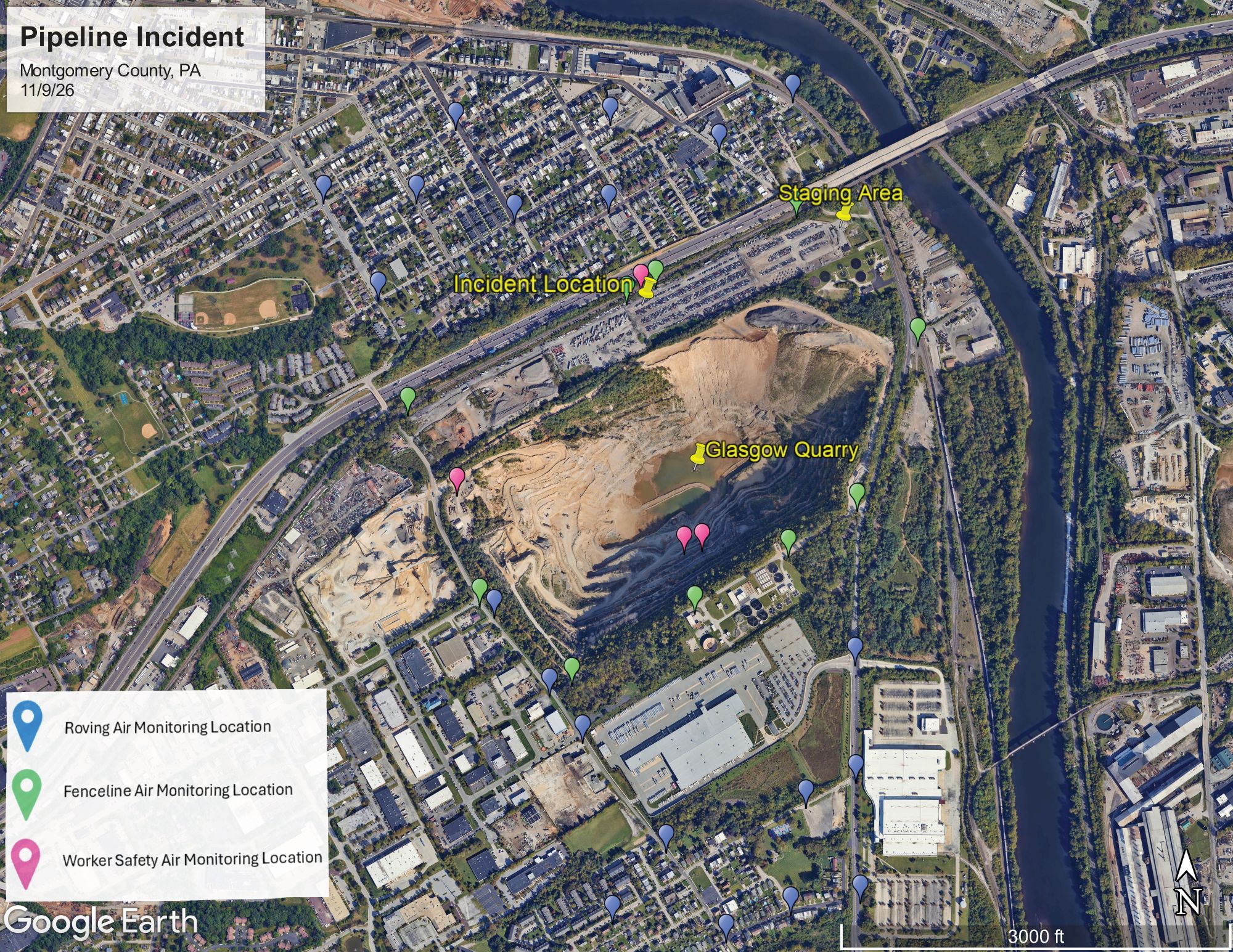
    The fuel leaked near Colbert and River Roads in the township’s Bridgeport section adjacent to the Schuylkill and into a quarry owned by Glasgow Inc.

    No one was injured, and no one was evacuated, but the pipeline was shut down. Cleanup began Friday.

    Energy Transfer said in a statement Friday that it had “mobilized the appropriate personnel and equipment for the cleanup and restoration of the area, which is underway.”

    Over the weekend, crews used vacuum trucks to transfer fuel and water from critical areas into temporary holding tanks. The mixture was taken to be processed for reuse, according to the joint command’s statement.

    Map shows location of a jet fuel spill that occurred Nov. 5 in Upper Merion when a Peco contractor struck a pipeline, and jet fuel spilled into the adjacent Glasgow Quarry.Unified Command: U.S. EPA, Pa. DEP, Energy Transfer

    Responders also used long tubes and absorbent pads to contain and soak up the fuel from paved surfaces, stormwater ponds, and affected ground.

    The absorbed mixture was taken for testing and disposal that meets state and federal standards, the statement said.

    Responders used drones to track progress, assess conditions at the quarry, and inspect the Schuylkill.

    For safety reasons, the continuing quarry cleanup is restricted to daylight hours.

    Officials said monitoring wells in the quarry showed no detection of volatile organic compounds (VOCs), and the spill has caused no impact to the Schuylkill or public drinking water supplies. VOCs are gases that evaporate into the air and can be harmful, depending on the chemicals, concentration, and length of exposure.

    The joint command also oversaw installation of an air monitoring network to track vapors, VOCs, and benzene, a component of fossil fuels that can be harmful and is linked to cancer.

    The network contains 20 roving monitors placed in residential communities, 10 stationary monitors along the site fence line, and four specialized monitors in active work zones.

    No elevated readings have been detected in the community or at the perimeter, officials said. But they noted wind shifts could produce odors of fuel.

    Response personnel review drone imagery in a trailer during a flyover assessment of quarry conditions after a jet fuel spill that occurred Nov. 5 when a Peco contractor struck a pipeline.Unified Command: U.S. EPA, Pa. DEP, Energy Transfer

    Peco, whose third-party contractor struck the line, said Monday that its immediate goal was to support “Energy Transfer, EPA, and PA DEP as they lead remediation and recovery efforts.”

    It said that “safety is Peco’s highest priority, and we expect every contractor working on our behalf to meet rigorous standards for safety, quality, and performance.”

    The company said it would provide any information required in support of an investigation and would “conduct a full and thorough review of the incident.”

    IBEW Local 614, which represents some Peco workers, said it would press the utility “for full transparency and answers.”

    The statement issued by the union’s president, Larry Anastasi, said, “Serious questions remain about the safety protocols, oversight, and partnership in place before and during the work.”

    Anastasi asked: “Who was responsible for overseeing this contractor’s work, what safeguards were in place, and how did those safeguards fail to prevent a strike of this magnitude?”

    Peco responded that it rejects any “suggestion that we would put schedules, cost, or any other consideration ahead of safety. Safety is our highest priority.”

    The company said the contractor, CJ Drilling, was chosen for its expertise.

  • An Uber driver who raped a Villanova student he drove back to campus was sentenced to state prison

    An Uber driver who raped a Villanova student he drove back to campus was sentenced to state prison

    An Uber driver who raped a drunk Villanova University student in September 2024 after driving her back to her dorm was sentenced Monday to three to six years in state prison.

    Mirvan Dinler must also register as a sex offender for the rest of his life, and he faces deportation to his native Turkey as a result of his conviction. Delaware County Court Judge Mary Alice Brennan barred him from working for rideshare services and from visiting Villanova’s campus.

    Dinler, 28, of Trappe, pleaded no contest to rape of an unconscious person in June for the incident, which Assistant District Attorney Danielle Gallaher said Monday demonstrated extreme callousness and lack of respect for human life.

    Gallaher said Dinler has not shown remorse and told prosecutors that the woman had initiated their sexual encounter, which she said is patently false.

    “This is inherently antisocial risk-taking behavior: He was in a position of trust, and he decided to rape a stranger,” she said. “He saw a woman in a vulnerable state, and rather than help her, he decided to become every woman’s worst nightmare.”

    Dinler’s attorney, Shaka Johnson, asked the judge for leniency, saying his client was deeply sorry for the events of that evening in 2024. The incident, Johnson said, was the result of “a series of bad decisions, back to back.”

    Dinler, according to Johnson, had been molested as a child, and was in the United States on a student visa, pursuing a degree in computer science at West Chester University.

    By entering the no-contest plea, Dinler did not admit guilt but did not dispute the prosecution’s statement of the facts in the case.

    The woman, who was a senior at Villanova at the time, testified Monday that she woke up, disoriented, as Dinler was raping her. She said she was too terrified to fight back or call out for help — her only concern, she said, was to survive the assault.

    She told Dinler he had acted like a monster, and in turn had treated her “like a discarded tissue.”

    “You decided your desperation for satisfaction, for power, whatever your motivation, was more important than my life,” she said.

    Earlier that evening, she said, she had been drinking with friends on campus before the group headed to Warehouse on Watts, a bar in North Philadelphia, to celebrate a friend’s birthday.

    The woman said she did not drink regularly, but on that night had three glasses of wine and two shots of liquor. After arriving at the bar in the city, she said, she felt dizzy and ill, and decided to return home.

    The woman ordered an Uber, and Dinler arrived in his Toyota Prius to pick her up, she said.

    Surveillance footage from Villanova’s Commons residence hall complex showed Dinler escorting her inside, arm-in-arm, because she was too intoxicated to walk on her own

    Prosecutors said Dinler’s DNA was a match to semen found on a towel and comforter taken from the woman’s dorm room.

    In a tearful statement, Dinler apologized to the woman, saying he “shut down” after entering the woman’s dorm room and did not know what to do.

    “I know the decisions I made were horrible as I look at it today,” he said. “I wanted to leave the room. I didn’t and I regret it.”

    The woman said her life was completely derailed by that night. Her plans for her career, and her active social life on Villanova’s campus, were placed on hold.

    Struggling with complications from the preventive, antiviral medication she was prescribed after the rape, as well as bouts of serious depression, the woman said, she moved into her childhood bedroom to finish her senior year.

    Through her tears, she told Brennan, the judge, that those four walls became her prison cell, while Dinler remained free. Even now, two years later, she struggles with spending time among strangers, she said, and has worked hard to overcome an aversion to physical touch.

    “I survived. I regained control,” she said. “I proved I’m a real person, not a piece of meat for slimy low-lives.”

  • Trump after meeting with Qatari PM says he believes war with Iran is militarily ‘effectively over’

    Trump after meeting with Qatari PM says he believes war with Iran is militarily ‘effectively over’

    WASHINGTON — President Donald Trump on Monday told reporters he believes the war in Iran “militarily is effectively over.”

    The president made a surprise visit to the White House briefing room after meeting with Qatar’s prime minister earlier in the day.

    “Iran militarily is effectively over,” Trump said. “We’re just keeping it the status quo.”

    Trump added that Iran has been “decapitated” but said he is still looking to make sure there’s a long-term solution to ensuring that Iran’s nuclear program is defanged.

    The president offered some of his most definitive comments about moving away from his threat to resume strikes on Iran after the U.S. midterm elections passed.

    The president’s Republican Party lost both chambers of Congress to Democrats in last week’s elections. The election was shadowed by dissatisfaction among the American electorate over the 8-month-old war, which has led to a surge in fuel prices that’s impacted nearly ever sector of the global economy.

    Trump told CNN in a phone interview Sunday that as long as the U.S. sees progress in negotiations with the Iranians and they sign a “strong agreement,” it’s “highly unlikely it’s going to be necessary” to resume strikes.

    Trump said, however, that the U.S. had identified infrastructure targets, including 38 bridges, that it would strike if military action resumes.

    The U.S. military, meanwhile, still has carried out limited strikes on Iran, including against its air defenses, at least twice over the past week. It also fired on and disabled a commercial ship Saturday that the U.S. says was trying to breach its naval blockade on Iranian ports.

  • Delaware County police chief charged with stealing more than $50,000 in overtime payments, authorities say

    Delaware County police chief charged with stealing more than $50,000 in overtime payments, authorities say

    Upland Borough Police Chief Michael Irey collected more than $50,000 in fraudulent overtime payments, prosecutors said Monday, and during some of the hours he said he was working he was actually dining and drinking at local bars.

    Irey, 55, was charged with multiple counts of theft, tampering with evidence, obstruction of justice, forgery, and related crimes in connection with the scheme, which authorities said began in 2025 and continued until early this year.

    Irey frequently logged overtime using his access to the police department’s scheduling system, saying he was directing traffic outside a local charter school or pursuing aggressive and intoxicated drivers on borough roads, prosecutors said.

    Instead, they said, he was visiting bars and restaurants in Media, Middletown, and Newtown Square, while assigning other officers to cover the work he was being paid for.

    Detectives with the Delaware County District Attorney’s Office began investigating Irey in December after receiving information about the alleged misconduct. Eight of Upland Borough’s nine police officers submitted anonymous tips to borough officials about Irey, prosecutors said.

    He was placed on leave in February and later resigned, borough officials said.

    The officers said they had seen Irey at bars like DiFabio’s Market & Tap, Old State Tavern, La Porta, and LaScala’s Fire during afternoon hours when he was supposed to be directing traffic outside the Chester Community Charter School or serving as roving DUI enforcement as part of a Pennsylvania Department of Transportation grant program.

    Investigators built their case by studying Irey’s digital time sheet, reviewing his bank statements, and tracking his vehicles’ movements using automatic license plate readers and finding several instances in which the chief was not where he was supposed to be.

    At one of those locations, DiFabio’s in Media, staff told investigators Irey and another person were frequent visitors and often came in the early afternoon. Staff at La Porta said Irey was a regular, coming in “every Thursday” in 2025.

    The overtime payments amounted to more than $56,600 over the course of the year, prosecutors said.

    Irey was arrested in New Jersey last week on a separate gun possession charge and is awaiting extradition back to Delaware County.

    In announcing the charges against Irey, Delaware County District Attorney Tanner Rouse commended the Upland police officers who reported their boss to authorities, saying they had demonstrated “willingness to do what is right, even when it is difficult.”

    “The badge carries a responsibility that does not end when the shift is over,” the prosecutor said. “Public trust should never be treated as a personal paycheck.”

    Staff writer Vinny Vella contributed to this article.

  • Senate weighs sweeping energy legislation in first major action since midterm elections

    Senate weighs sweeping energy legislation in first major action since midterm elections

    WASHINGTON — The Senate on Monday was set to take up bipartisan legislation aimed at speeding up permitting reviews for data centers and other infrastructure projects, in the first major action since last week’s election that soundly repudiated President Donald Trump and congressional Republicans.

    The Senate was expected to hold a procedural vote on the bill, which senators and the president have pushed as a way to meet growing demand for electricity and other forms of energy that now faces yearslong delays in getting to the grid.

    The legislation’s sweeping changes would shorten the timeline to get big energy projects started — both for clean energy and fossil fuel projects — and make sure data centers pay for the energy they use. Anger over artificial intelligence data centers and rising electricity costs helped usher in a wave of Democrats pledging to clamp down on the massive, energy-hungry structures.

    Trump urged senators to vote for it, calling it a “BIG WIN for U.S. ENERGY INDEPENDENCE and DOMINANCE” in a social media post on Sunday. The bill will “ensure that we can build Pipelines, Mines, and Power Plants faster than ever before, lowering Energy Costs for American Families,” Trump wrote.

    Major industry groups representing developers in clean energy and in the oil and gas sector also support the bill.

    However, many environmental organizations have panned the deal because they say it would lock in fossil fuel development, weaken environmental safeguards, and make it harder for communities to challenge energy project approvals.

    Midterm results could complicate bill’s passage in lame-duck session

    While the bill has received bipartisan support, the Democrats’ sweeping midterm win could complicate its passage.

    Some Democrats say the party should use its stronger position in the next Congress to pass legislation that produces needed clean energy but limits expansion of oil, natural gas, and mining. Some critics have said the permitting bill as proposed could lead to a vast increase in exports of liquefied natural gas and facilitate a “reckless” build-out of data centers powered by natural gas.

    House Minority Leader Hakeem Jeffries, a New York Democrat who is expected to become speaker in January, criticized the bill last week, with his office saying it “falls short” in a number of areas.

    Major environmental groups, including the Sierra Club and National Wildlife Federation, have strongly opposed the measure in recent days, citing concerns about its limits on judicial review and changes to the National Environmental Policy Act and Endangered Species Act. The environmental policy law, known as NEPA, requires agencies to consider a project’s possible impacts and allows the public to be heard before a project is approved, but supporters of an overhaul say that causes yearslong delays in federal permitting.

    The bill’s four main champions — two Democrats and two Republicans — released a detailed set of amendments Saturday designed to bolster support for the legislation.

    The four senators, who lead the chamber’s energy and environment panels, negotiated the deal weeks before the election. Republican Sens. Shelley Moore Capito of West Virginia and Mike Lee of Utah and Democratic Sens. Martin Heinrich of New Mexico and Sheldon Whitehouse of Rhode Island say Americans are tired of paying more in utility bills while projects that could lower costs sit stuck in the planning phase for years.

    “Americans can’t afford to wait for lower electricity prices. We need to pass this bill now,” said Heinrich.

    Trump promotes expanding production of oil, natural gas, and coal and he particularly dislikes offshore wind. His administration has been paying energy companies to walk away from offshore wind projects under development. It has spent nearly $4 billion on such settlements.

    Whitehouse said a provision in the permitting bill would end the buyouts, so the administration will no longer be able to use public money to pay clean energy developers to relinquish wind energy leases and oblige them to invest in fossil fuels instead.

    Democrats are optimistic the bill will pass both chambers

    At a news conference with Heinrich on Monday, Whitehouse said the bill is “the floor, not the ceiling, of our climate and environmental aspirations. And we look forward to working to accomplish big things with our big Democratic majorities” next year.

    Whitehouse said Trump’s support should help the bill move toward a vote in the House.

    Heinrich said he worked hard to incorporate feedback from tribal leaders on the initial proposal, adding that the amended version requires federal agencies to consult with tribes on projects that affect important cultural sites.

    Sponsors also extended the window for objections to agency reports and strengthened opportunities for states to weigh in, Heinrich said.

    If passed, the bill will save households billions on electricity costs, create jobs, cut emissions, and force big corporations to pay their full share for data centers instead of pushing energy costs on consumers, he said.

    Industry leaders are advocating for the bill’s passage, including leaders of the American Clean Power Association, which represents clean energy developers, and the American Petroleum Institute, the oil and gas industry’s top lobbying group.

    But Bradley Campbell, president of the Conservation Law Foundation, said it would be a “terrible mistake” to proceed with the bill in the waning days of the current Congress.

    While changes announced Saturday address a few concerns, the bill also comes with a gauntlet of new — and at times conflicting — rules, Campbell said. He said the bill maintains a veneer of federal safeguards while in fact stripping the power of federal agencies, states, tribes, and communities to identify and prevent serious harm to health and the environment.

    Sara Amundson, president of the Humane World Action Fund, said the bill weakens the scientific foundation of the Endangered Species Act and could create new opportunities to exclude needed wildlife protections.

    “This proposed rewrite of the ‘best available science’ standard could give agencies new grounds to unfairly dismiss credible research, including science showing that stronger protections are needed for species at risk,” she said, urging lawmakers to drop the provision or oppose the bill.

  • Supreme Court clears the way for border wall construction in Texas’ Big Bend to resume

    Supreme Court clears the way for border wall construction in Texas’ Big Bend to resume

    WASHINGTON — The Supreme Court cleared the way Monday for the Trump administration to resume border wall construction in the Big Bend region of Texas, a blow to bipartisan opponents who had argued the project is a waste of money that threatens the unique landscape.

    The border wall is a signature project of President Donald Trump, who has long vowed to build a wall from the Pacific Ocean to the Gulf of Mexico.

    Republicans in Congress last summer funded the project with $46 billion, and Customs and Border Protection has been rapidly erecting 12 miles of border barriers a week across the entire border.

    The government has pushed forward by issuing sweeping waivers to bypass regulations. Those rules are aimed at protecting the environment, but have historically slowed down major construction projects.

    In Texas’ Big Bend region, bipartisan opposition has rallied to fight back against the project, which would include 30-foot-tall steel walls in some areas as well as vehicle barriers and new roads.

    They’ve argued that the barriers are a waste of money that threaten the local economy and lifestyle in an area of historically low illegal immigration. They say the job could be better done using only surveillance technology like drones.

    A judge in Texas sided with opponents, finding that Congress likely had not clearly authorized such broad waivers for an area with the southern border’s lowest rate of migrant apprehensions. She ordered an immediate stop to all construction-related activity in the area, which includes Big Bend National Park as well as land up and down river in state and private hands.

    The Trump administration filed an emergency appeal, saying there are illegal border crossings and drug seizures in Big Bend. More traffic could also be funneled there if there’s a gap in the wall, federal attorneys argued.

    The Supreme Court agreed that the law sharply limits judges’ powers to intervene when the federal government decides speedy border barrier construction is necessary. The majority paused the lower court decision, with Justice Ketanji Brown Jackson dissenting.

  • The Free Library’s online catalog was taken down for security. A new one is coming this week.

    The Free Library’s online catalog was taken down for security. A new one is coming this week.

    The Free Library of Philadelphia might not seem like a likely cyberattack target, but it is taking no chances.

    The library shut down its online catalog last month because of digital security concerns. The library’s catalog remains down, but the Free Library plans to launch a new online catalog this week.

    Library staff removed the catalog on Oct. 23 as a precaution after vulnerabilities were found in an open-source programming language, PHP, that is used on roughly 70% of websites around the world.

    The PHP security issues, which have collectively been called “PHP2Shell,” were identified and announced Oct. 21 by researchers using OpenAI’s GPT-5.6 Sol model. The issues in the coding language could have allowed hackers to take control of web servers and access critical data without authentication or prior access.

    “Cyber actors are likely to weaponize PHP2Shell vulnerabilities. These risks are serious enough to require immediate patching across United States Government departments and agencies. … We stand with our warfighters and our domestic and foreign partners to improve our collective cyber defenses and threat detection,” the National Security Agency said in a statement last month.

    According to OpenAI, the issue was identified before hackers could exploit it, and a patch for the issue was immediately made available. However, in the days before the problem was announced, some attacks were attempted.

    The Free Library did not see signs of any security breaches on its own servers, but decided to take down the catalog based on vulnerabilities reported in other regions and on the City of Philadelphia’s Office of Information and Technology standards, according to Free Library spokesperson Mark Graham.

    SEPTA shut down its real-time tracking tool for a day, and other websites including Internet Archive, parts of Wikipedia, and governmental sites in Europe and Asia were also taken down as a precaution.

    It is unclear why it has taken more than two weeks for the Free Library to launch its new catalog. Until then, patrons can still find e-books and audiobooks through the library’s app, Libby, or its OverDrive site, and the library has extended returns for borrowed materials through Thursday.

    “We apologize for any inconvenience to patrons since we realize [the catalog] is a valuable resource and used by many. The security of our patrons, staff, and community is a high priority for the Free Library. So is high-quality customer service, which is why the down time is as short as possible, and library staff … can handle any questions about finding materials or holds in person or on the phone,” Graham said by email.

    Borrowing in person at library branches has been unaffected.