Category: News

  • Long-awaited pedestrian swing bridge across Schuylkill is officially open. Here’s what you need to know.

    Long-awaited pedestrian swing bridge across Schuylkill is officially open. Here’s what you need to know.

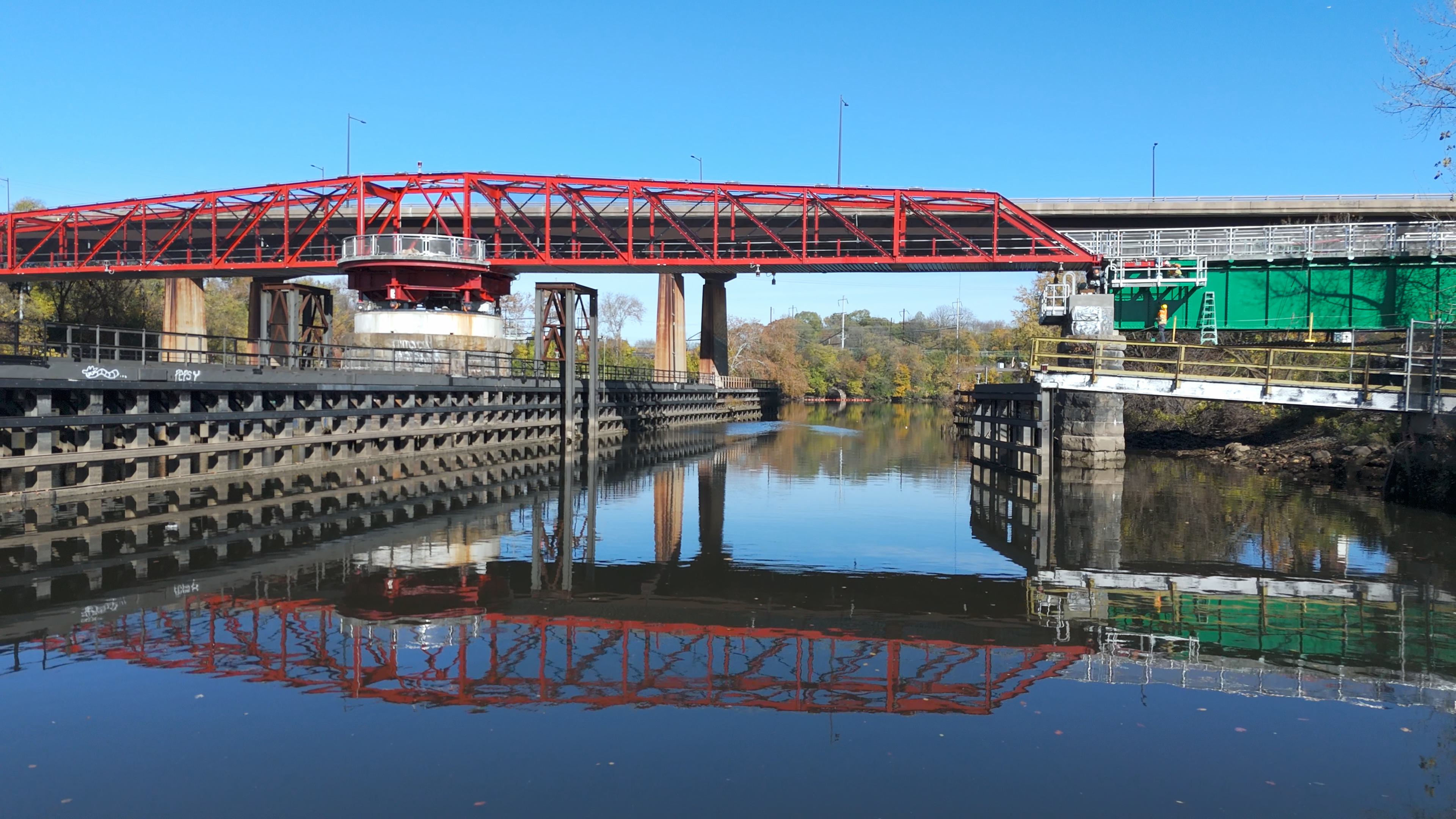
    A red steel bridge swung over the Schuylkill in one of its final tests before opening to the public.

    Its 225-foot span and 60,000 pounds of mechanical drive equipment pivoted into place with precision, joining the east and west sides of the river.

    “It is kind of like a Swiss watch,” Tyler Barile, assistant chief construction engineer for the Philadelphia Streets Department, observed during a test of the new bridge Wednesday. “All those pieces have come from all over the country to fit together with tolerances to thousandths of an inch.”

    The $28 million bridge officially opens Friday to thousands of runners, cyclists, and walkers using the Schuylkill River Trail. They will be able to cross unimpeded from Center City through South Philadelphia to Grays Ferry. They will come out just above Bartram’s Garden.

    Officials call it a major engineering achievement for the Schuylkill River Trail in Philadelphia.
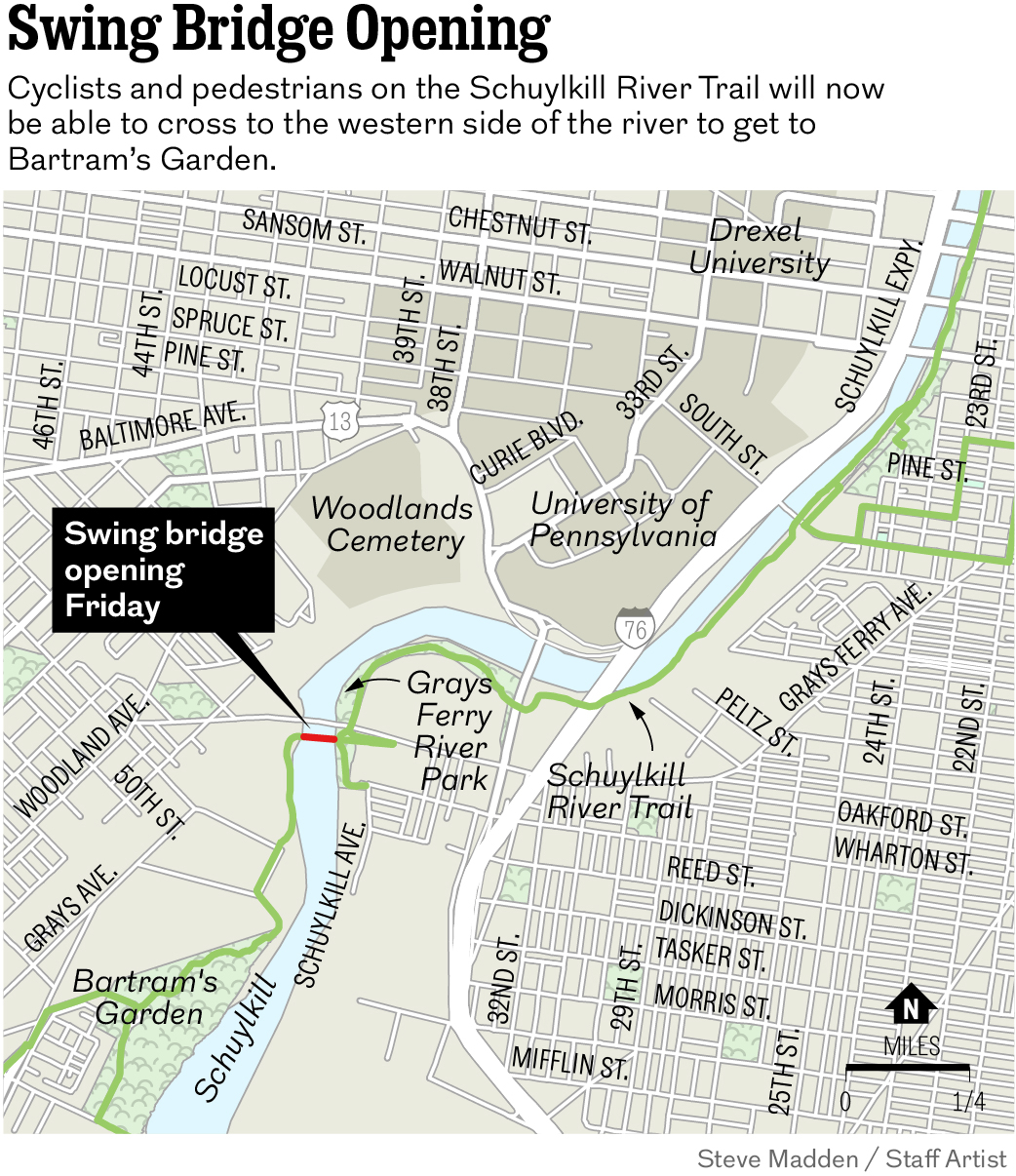
    Map of a new swing bridge opening Friday connecting the east and west sides of the Schuylkill River TrailSteve Madden

    Connecting historic landmarks

    The bridge was built through a partnership between the nonprofit Schuylkill River Development Corp. (SRDC) and the city. SRDC works with the city on the Schuylkill corridor from the Fairmount Dam to the Delaware River, branded as Schuylkill Banks, which is part of the much larger Schuylkill River Trail.

    “The bridge fills an important gap that connects not just the east and west river banks,” said Heather Saeger, interim CEO of SRDC, “but it also connects Bartram’s Garden to Fairmount Waterworks, both National Historic Landmarks.”

    The crossing links approximately 1.5 miles of trail to the south with three miles to the north, creating about 4.7 continuous miles along Schuylkill Banks with the bridge included.

    Beyond Schuylkill Banks, the opening extends unbroken riverfront trail travel to over seven miles north to Ridge Avenue in Manayunk, where plans are underway for a connector to the rest of the Schuylkill River Trail that now extends to Reading.

    Saeger emphasized that adding the swing bridge alongside the Schuylkill Banks boardwalk and cable-stayed bridge that opened in 2025 is “hugely important for completing that vision, building momentum for future trail sections.”

    Past trail expansions have dramatically accelerated use. Average weekly trips by users on Schuylkill Banks grew from 8,000 during its 2000 opening to 37,000 now, at Walnut Street, after the cable-stayed bridge opened, Saeger said.

    In fact, Schuylkill Banks is by far the most heavily used trail segment in the region where trail counters are installed, according to data from the Delaware Valley Regional Planning Commission.

    In the year to date, counters have logged 431,159 cyclist and 1.4 million pedestrian trips on the segment.

    The new crossing also serves as a critical stepping stone for future southern extensions toward Passyunk Avenue and, ultimately, Fort Mifflin. It unlocks a dedicated commuter route between Southwest and South Philadelphia.

    The bridge will remain in place across the river for trail users most of the time, swinging open only occasionally to let marine traffic pass. The city will get notice far in advance through the U.S. Coast Guard and can schedule the closing of the trail.

    In all, it takes about three minutes from start to finish for the gates on the pedestrian walkway to close and the bridge to open or close.
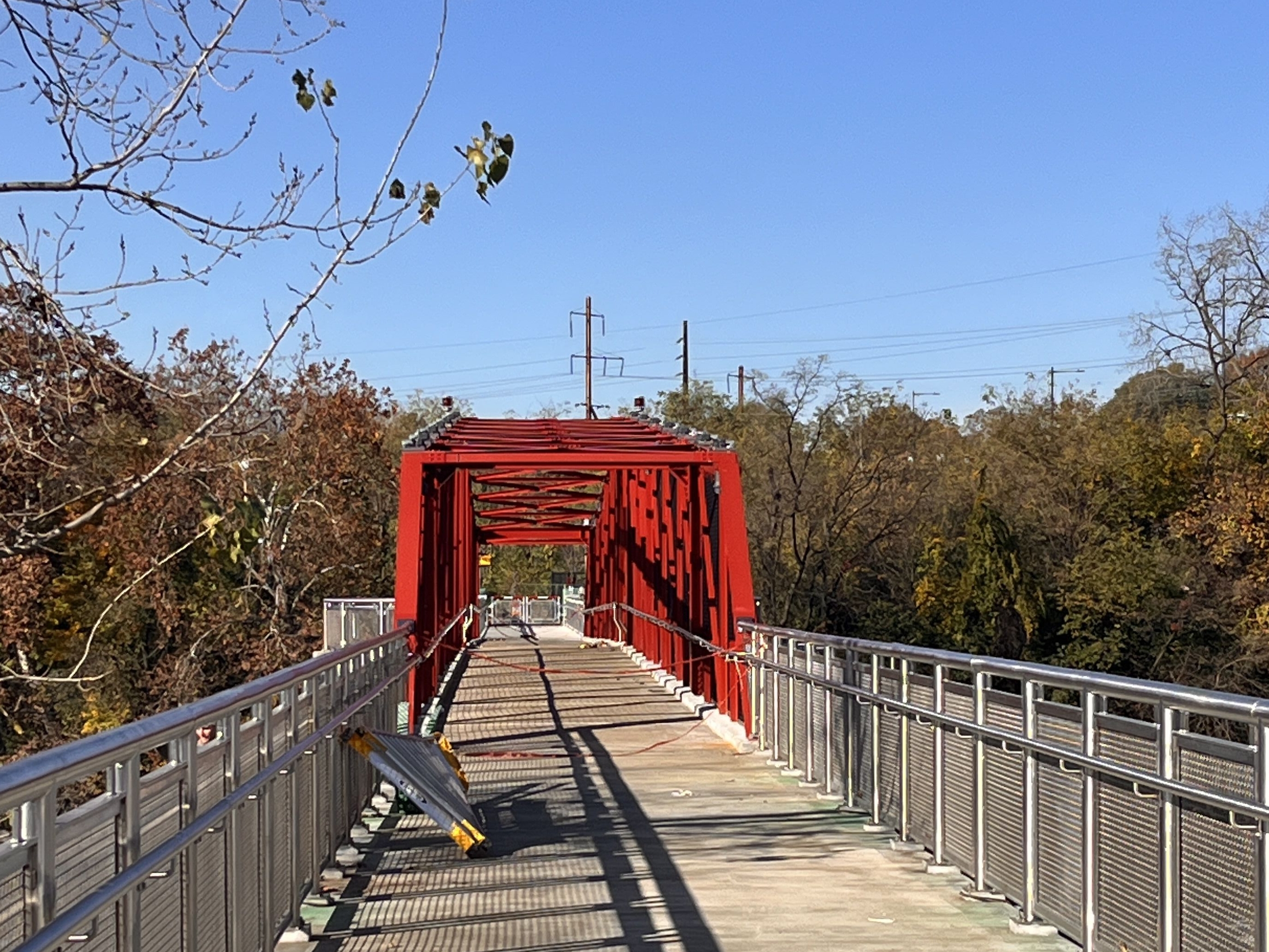
    A view from the top of Philadelphia’s new $28 million swing bridge. The ladder was being used by a worker performing last minute work.Frank Kummer

    Why a swing bridge?

    The idea for using a swing bridge to cross the Schuylkill dates to 2009, said Chariss McAfee of Charles Loomis Chariss McAfee Architects. The firm volunteered with the nonprofit Community Design Collaborative’s Infill Philadelphia initiative, which explores development opportunities through design.

    At the time, the group was studying connections between Wharton Street in South Philadelphia and Bartram’s Garden.

    Separately, the SRDC and city officials were considering building a pedestrian bridge over the existing swing bridge at the same location. That bridge was adjacent to the traditional Grays Ferry Avenue bridge, which has a pedestrian walkway but is not connected to the trail on both sides.

    McAfee and the Infill Philadelphia group believed that building over the infrastructure of the old swing bridge would require a new bridge to be very high with steep ramps.

    The swing bridge was built in 1902. Conrail acquired it in 1976 and removed it from service in 1984.

    The Infill Philadelphia team proposed rehabilitating it.

    “We suggested that they really consider reusing the swing bridge,” McAfee said, “because it would put the people crossing it, the bikers and the pedestrians, closer to the water.”

    That concept drew support.

    “It’s going to be wonderful to actually cross and come over on the other side pretty much at the bank level,” McAfee said this week, “and not have to come down another massive ramp.”

    Philadelphia’s new $28 million swing bridge spanning the east and west sides of the Schuylkill, Wednesday, Nov. 11, 2026, in Philadelphia. It officially opens to users of the Schuylkill River Trail on Friday, Nov. 13.Gabriel Coffey / Staff

    Built in Coatesville

    The city adopted the concept of a bank-level swing bridge, but structural realities required building a new truss atop the historic stone piers.

    It took about eight years from planning and funding through to construction and installation. The bulk of the funding came in 2015 through a federal grant.

    The swing bridge work involved construction that had to navigate around I-76, active CSX rail yards and tracks, and private commercial landowners along the riverfront. And it included building over a tidal riverfront.

    Removing the old bridge and assembling a new bridge posed significant challenges, said Barile, the city engineer. The old truss was frozen open, and removing it risked destabilizing it. Because it rested on a pivot, workers had to cut a little off one side, then a little off the other side repeatedly to keep it balanced.

    The new bridge had to be built and assembled to rest on the original stone-and-masonry piers and abutments already anchored in bedrock.

    A center pivot balances the new bridge with so little friction that workers were able to spin it by hand during assembly.

    Motors came from California, electrical controls from Chicago, various machinery from Miami, and gearboxes from Niagara Falls. The main truss was fabricated in Coatesville.

    South Jersey-based AP Construction is the general contractor, and Philly-based Urban Engineers provides construction management oversight.

    “You’re not just ordering a truss online, and it gets you a two-day shipping,” Barile said.
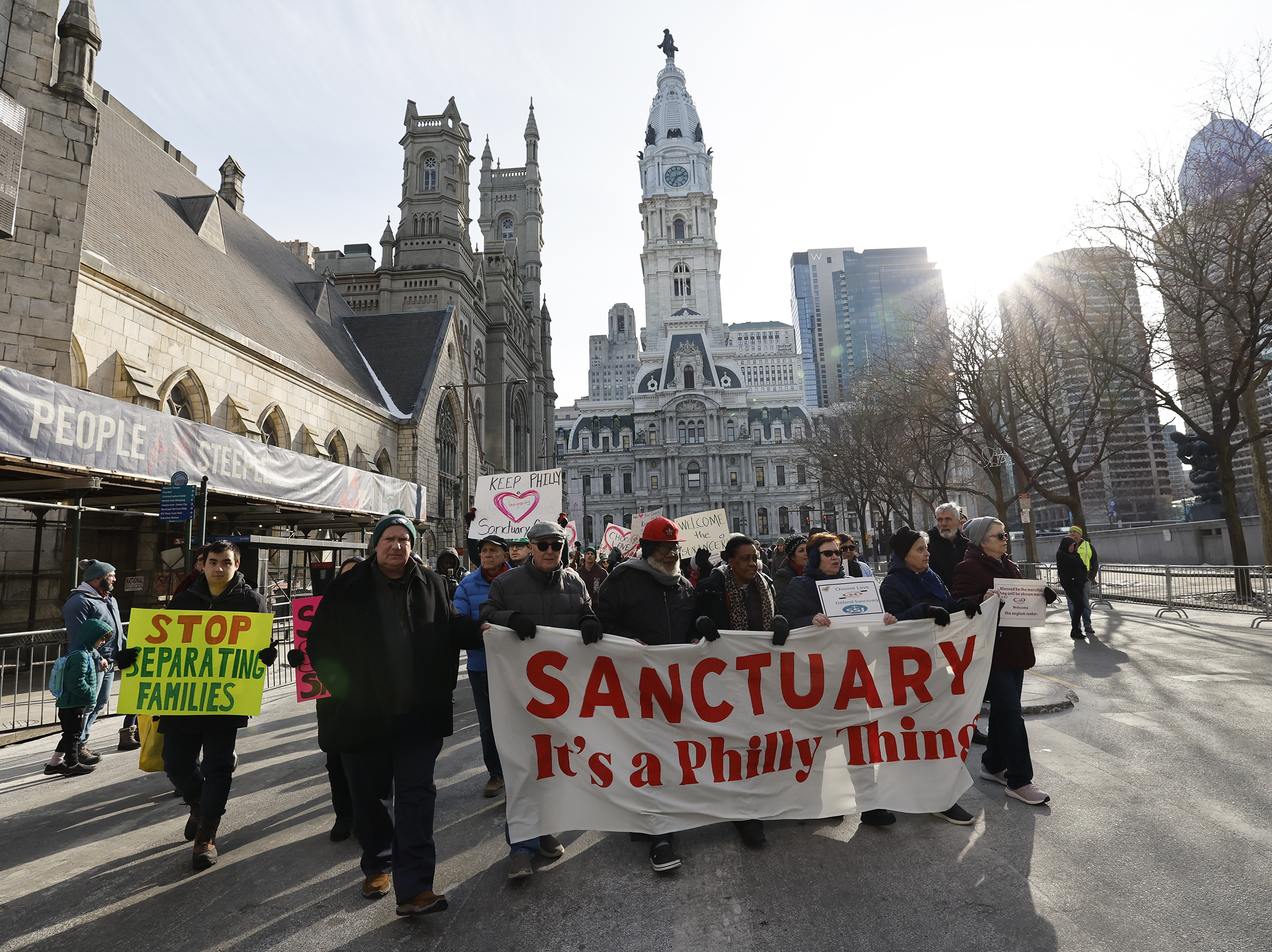
  • ICE targeting sanctuary cities, a new chapter in 40-year history of intimidation and resistance

    ICE targeting sanctuary cities, a new chapter in 40-year history of intimidation and resistance

    Recently, DHS announced that ICE has begun a surge targeting sanctuary cities, including communications blasting “sanctuary politicians” for covering up purported voter “fraud.” These efforts are part of the Trump administration’s attempt to fulfill a campaign promise to carry out the “largest deportation” in U.S. history, putting sanctuary cities front and center.

    It is unclear if targeting sanctuary cities will bolster the administration’s popularity. Even Fox News polling show a majority of Americans is disenchanted with Trump’s immigration policy, in particular interior enforcement that has brought thousands of masked and armed ICE agents into American cities. But, hoping to turn the tide, the administration is perhaps counting on the contentious place that sanctuary cities have occupied in American immigration politics since the 1980s.

    Federal officials and immigration restrictionists have repeatedly portrayed them as jurisdictions that frustrate the government’s ability to carry out federal law. Sanctuary advocates, meanwhile, have argued that local governments should decide how much of their own personnel and resources should be devoted to federal immigration enforcement.

    There is no single definition of a sanctuary city. The term often refers to jurisdictions that limit cooperation between local government agencies and federal immigration authorities. These policies can restrict local participation in immigration arrests, limit the sharing of information regarding individuals’ immigration status, or prevent local police from holding people solely at the request of ICE. No peer-reviewed study on sanctuary cities suggests that such policies foster crime or lead to increased violence. On the contrary, research suggests that such policies foster greater trust between immigrant communities and law enforcement.

    The roots of sanctuary policies predate city ordinances, however. The modern sanctuary movement emerged in the early 1980s when religious congregations opened their doors to Central Americans fleeing civil wars and political repression. They did so in defiance of the U.S. federal government. The Ronald Reagan administration refused to grant political asylum to Salvadorans and Guatemalans whom they deemed economic migrants, rather than victims of persecution. Churches and synagogues provided shelter and transportation while challenging their government’s foreign policies and application of refugee law. Sanctuary combined humanitarian assistance with a sustained effort to change the political and moral terms of the nation’s immigration debate.

    As the movement expanded across the country, activists carried their sanctuary practices into municipal politics. They created a new arena in which to debate the interplay between federal and local government jurisdiction as well as resist an expanding apparatus that detained and deported their neighbors. Sanctuary thus became an assertion of both local self-determination and a powerful statement of solidarity with asylum seekers, as municipal leaders claimed the authority to decide how their institutions and resources would be used while refusing to make those resources an extension of federal immigration enforcement.

    The Reagan administration responded immediately. In 1987, federal officials threatened to withhold Justice Department funding from California cities that had adopted sanctuary policies. The Government Accountability Office subsequently concluded that federal law did not authorize the Justice Department to withhold those grants on that basis. The threat of financial penalties for cities that refused to abide by the White House’s policies, however, would remain a potent one for years to come.

    Attacking sanctuary cities became a marginal position in national politics in the 1990s. That relative quiet reflected developments at the national level that were hardly reassuring for immigrants living in the United States. During the decade, Congress gave the federal government new and unprecedented powers to detain and remove immigrants from the interior of the country. The Antiterrorism and Effective Death Penalty Act of 1996 expanded the grounds for deporting immigrants convicted of a wide panoply of crimes, while the Illegal Immigration Reform and Immigrant Responsibility Act passed in the same year broadened the definition of offenses that could trigger removal while creating an expedited procedure that allowed the government to deport some immigrants without a full hearing before an immigration judge.

    These measures passed with substantial bipartisan support under President Bill Clinton. As federal enforcement grew more powerful and increasingly capable of reaching into immigrant communities across the country, there was less political need for immigration hardliners to single out individual cities as obstacles to immigration enforcement.

    The political quiet around sanctuary cities began to change after Sept. 11, 2001. The attacks generated a new climate of suspicion toward immigrants, which restrictionist lawmakers such as former Colorado Rep. Tom Tancredo used to recast immigration as a matter of national security. The federal government continued developing policies and technologies to extend immigration enforcement into local communities, such as Section 287(g) agreements allowing federal officials to deputize state and local police to perform certain immigration-enforcement functions, and Secure Communities, launched in 2008, linking municipal fingerprint databases with federal registers to identify people in custody who could be subject to removal.

    Meanwhile, cities and states became new battlegrounds for anti-immigrant legislation. Hazleton, Pa., enacted ordinances in 2006 targeting landlords who rented to undocumented immigrants and employers who hired them, while in Arizona state legislators passed SB1070 in 2010, which further intertwined local police with federal immigration enforcement.

    Yet sanctuary remained a thorny issue for national political figures. Mitt Romney opposed sanctuary cities during his 2012 presidential campaign, proposing to make conditions so difficult for undocumented immigrants that they would “self-deport.” But the proposition generated political blowback rather than a clear electoral advantage.

    Trump brought sanctuary cities back into the center of national politics during his first presidential campaign alongside his calls for a border wall and expanded immigration enforcement. In 2017 he immediately sought to deliver yet faced resistance from states like California as well as from the Supreme Court. In Philadelphia, Mayor Kenney terminated the Preliminary Arraignment Reporting System (PARS) which gave ICE access to record databases used by law enforcement and the courts. Such policies limiting cooperation between local law enforcement and federal immigration enforcement reflected the assertion of local residents and elected officials that their communities should not be enlisted in an immigration enforcement regime they opposed.

    Republican governors during the Biden years sought a new sanctuary battlefield. Governors Ron DeSantis of Florida and Greg Abbott of Texas sought to make an example of sanctuary cities by transporting migrants en masse to these municipalities. Whether the targeted Democratic-led cities were actually sanctuary cities mattered little, as anti-sanctuary theatrics played well among the MAGA base. A centerpiece of Trump’s campaign stump speeches in 2024, then, was the promise to “end all sanctuary cities,” ostensibly to finally bring peace and order to the nation.

    Since returning to office, Trump has worked to fulfill these promises, and the nation has witnessed how this has played out on city streets. Beginning in the summer of 2025, federal immigration operations increasingly concentrated on those municipalities that had set limits on cooperation with ICE. Los Angeles, Chicago, Portland, Washington, D.C., and Minneapolis became the major sites of enforcement.

    The consequences have been profound and traumatic. Roving bands of ICE and Border Patrol agents, snatching both non-citizens and citizens off the street; clashes between local residents and federal officers; and the killing of Renee Good and Alex Pretti in broad daylight. More recently, arrests have skyrocketed even as ICE has disappeared from the front-page headlines.

    Made By History sponsors. FOR USE ON MADE BY HISTORY STORIES ONLY.Inquirer Staff

    While sanctuary policies cannot prevent ICE from making arrests nor can they indefinitely protect people living in this country without legal status, those advocating for them have repeatedly thrown a wrench in the plans to complete the largest deportation in American history. They have served as a bulwark against an expanding federal apparatus and statement of values for local communities that refuse to view their neighbors as criminals

    Trump’s attacks have continued apace. Along with expanded enforcement operations, he has continually directed the Department of Justice to file lawsuits against sanctuary jurisdictions. Time and time again, however, judges have sided with cities and states, arguing that local municipalities have the constitutional right to dictate how their resources should be used. As Trump faces losses in the courts and once again pivots to targeting sanctuary cities with more ICE enforcement, the administration seems to be arguing that if you can’t abolish them, intimidate them. And, if they won’t be intimidated, continue to wreak havoc.

    Sanctuary cities aren’t to be taken lightly. They’ve never been the soft target that Trump has hoped they’d be, and they’ve consistently offered an alternative vision for not only immigration policy but for who Americans value as their neighbor.

    Lloyd D. Barba is Associate Professor of Religion at Amherst College. Sergio M. González is Associate Professor of History at Marquette University. They are the authors of Sanctuary in America: How Activists Defied the Government and Defended Immigrants—And Why It Still Matters.

    Made by History takes readers beyond the headlines with articles written and edited by professional historians. Opinions expressed do not necessarily reflect the views of The Inquirer.

  • How local couples are aging in place | Inquirer Radnor

    How local couples are aging in place | Inquirer Radnor

    Hello, Radnor!

    Local couples are reimagining their homes to ensure they can adapt to their changing needs. Here’s a look at how. Also this week, an Uber driver has been sentenced to prison for raping a Villanova University student, a local a cappella group with ties to Jim Croce is going viral, plus the Route 202 sinkhole repair project is complete.

    Also, Sangkee Peking Duck has opened and popular shop BellaDonna Gifts has relocated.

    — Lisa Dukart (radnor@inquirer.com)

    P.S. The Inquirer is looking for submissions to its “Life Partners” series about unexpected intimacies across the region. Tell us about your creative co-parenting arrangements, rekindled relationships after divorce, or dating across fault lines at lifepartners@inquirer.com, and one of our reporters might reach out.

    If someone forwarded you this email, sign up for free here.

    A Villanova couple’s home design allows them to age in place

    A view of Lee and Susan Zoeller’s Villanova home.Photo by Don Pearse

    Homeowners across the region are finding ways to age safely in their homes, integrating long-term plans into their designs or renovating for adaptability.

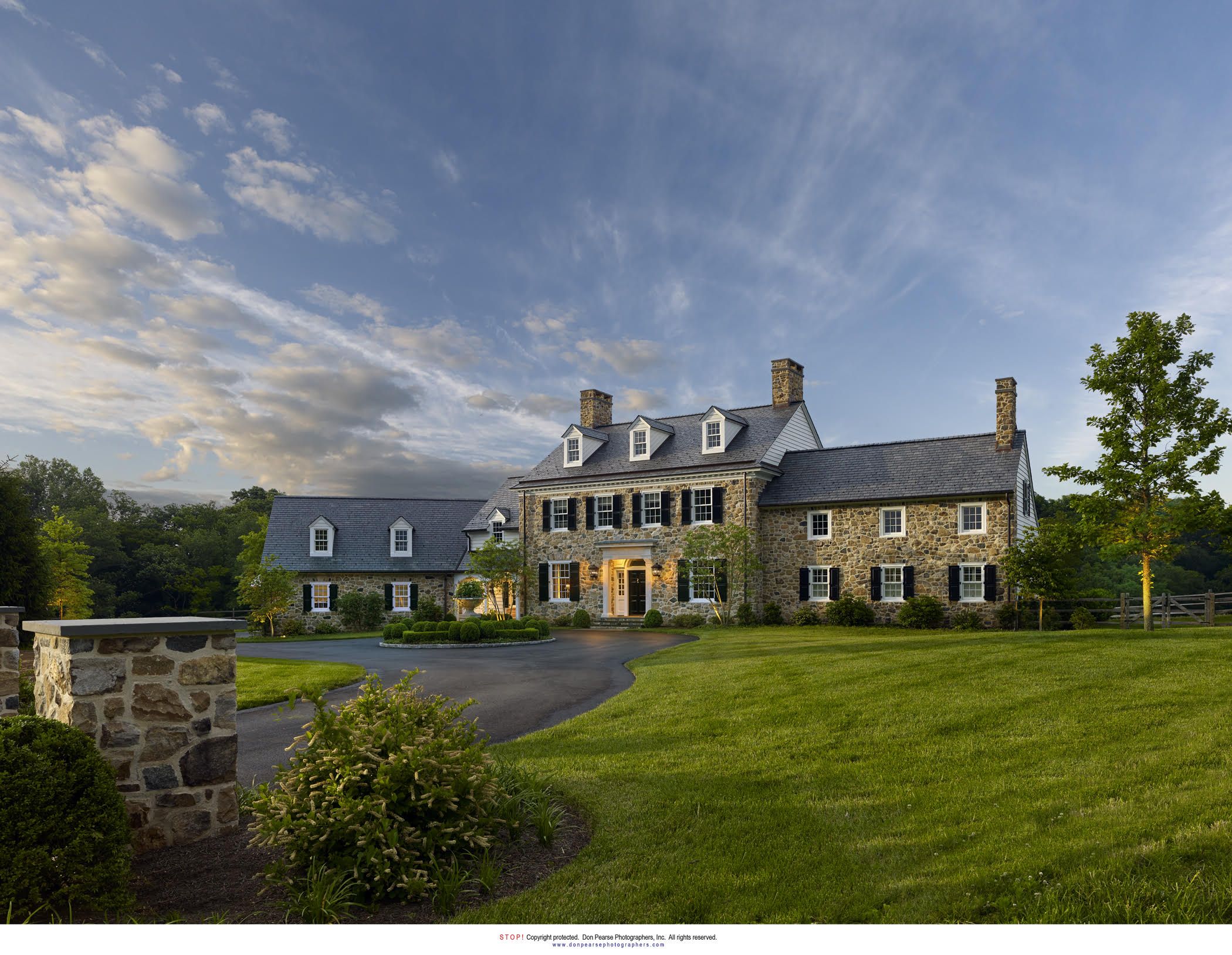
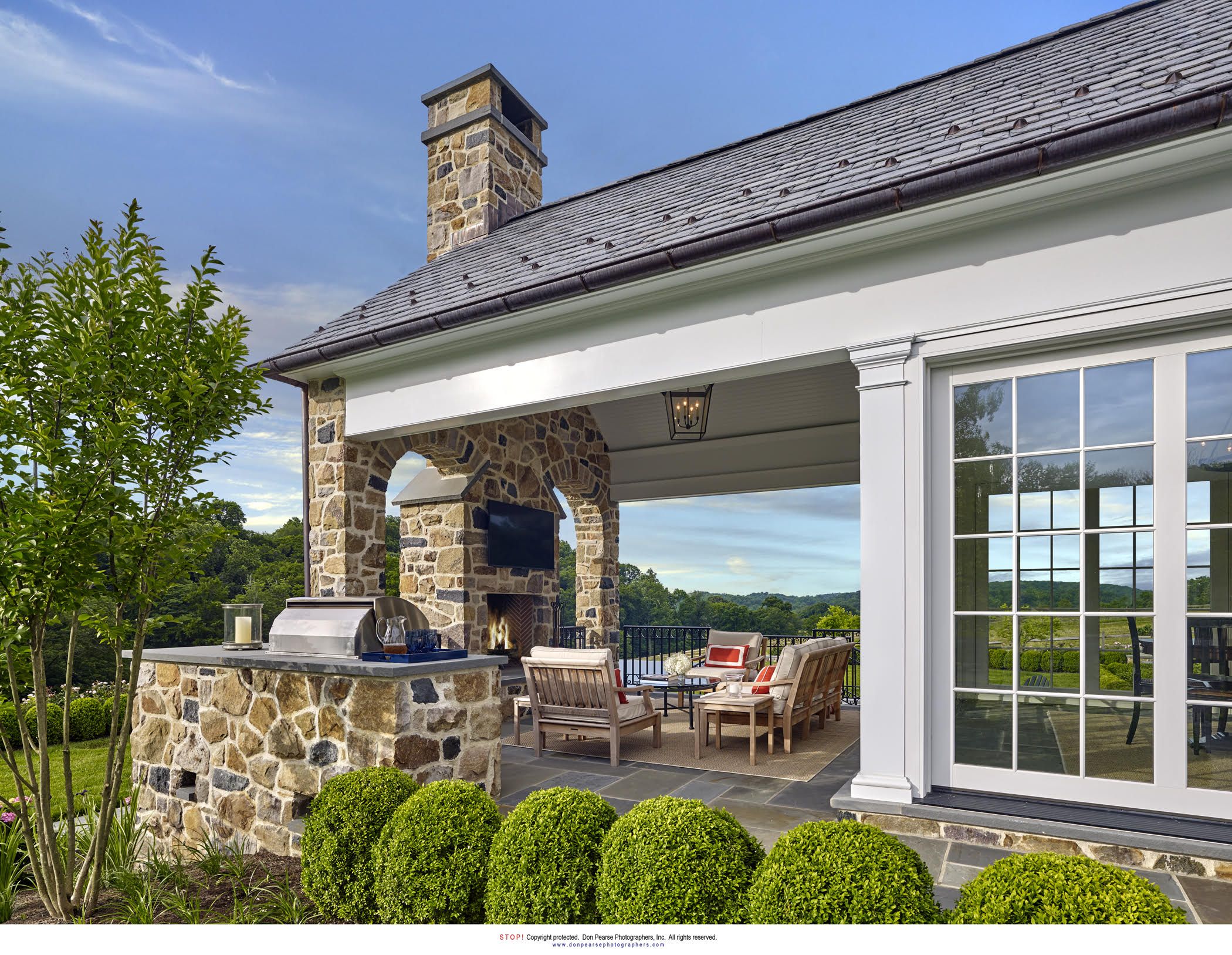
    When building their Villanova home in 2017, Lee and Susan Zoeller chose to include a first-floor primary bedroom suite and an apartment above their garage, which could one day accommodate a caregiver.

    Narberth couple Beth and David Mark, who recently added a first-floor primary suite, have lived in their home for decades and wanted to ensure they could stay as they age. That was particularly important after David suffered a cycling accident 10 years ago, making them realize the difficulties of navigating stairs.

    Inquirer contributor Terri Akman looks at how others in the region are updating their homes with longevity in mind.

    💡 Community news

    • Mirvan Dinler, the Uber driver who pleaded no contest to raping an unconscious Villanova University student in her dorm room in 2024, has been sentenced to three to six years in state prison and must register as a sex offender. He also faces deportation to his native Turkey.
    • Villanova University’s oldest a cappella group, the Villanova Spires, has gone viral thanks to its birthday serenades on campus. The all-male group dates back to 1961 and counts late singer Jim Croce among its alums. The Inquirer’s Susan Snyder delves into the group’s surprising rise to internet fame.
    • Eastern University’s football program has been completely transformed in the last few years in the hands of head coach Billy Crocker, who took it from a club team to a conference champion. The team, currently 7-2, has a chance to defend that title at its final regular season game on Saturday.
    • The Little Gym, a chain specializing in kids’ gymnastics classes, opened over the weekend at 154 E. Lancaster Ave. in Wayne.
    • BellaDonna Gifts has moved a short distance to 118 E. Lancaster Ave. in Wayne.
    • Midland Avenue will be closed between Louella and Aberdeen Avenues today from 9 a.m. to 3 p.m.
    • The lower portion of the North Wayne parking lot will be closed tomorrow and Saturday for a traffic study as the township looks to improve infrastructure as laid out in the Wayne master plan.

    🗺️ Other nearby news

    • All lanes on a sinkhole-plagued stretch of Route 202 in King of Prussia are now open after months of repairs.
    • The local woman behind private chef service Prepped by Carly is putting her skills to work to feed Mark Ruffalo. The Hollywood A-lister has been in the region for the past few months to film the second season of HBO series Task, which is set locally and was created by Berwyn native Brad Ingelsby. Carly Foglia began the business from her West Chester University dorm room and still operates near campus. Here’s a glimpse at what she’s been cooking up for Ruffalo.
    • A nearly 18,000-square-foot Tredyffrin Township home with six bedrooms, including one with a massive closet and dressing room, is on the market for $8.75 million. Other features include a built-in, 700-gallon fish tank and a more than 8,000-square-foot detached garage that can accommodate 40 vehicles. Take a peek inside.

    🍽️ On our plate

    • Main Line restaurant Sangkee expanded its footprint this week, soft opening Sangkee Peking Duck at Wayne’s Gateway Shopping Center. The new spot specializes in its namesake dish and more duck offerings such as duck stir-fried noodles, Peking duck bao, and duck soup, along with other Chinese dishes.

    🎳 Things to do

    🎤 What Would Jerry Do?: Hear a tribute to The Grateful Dead. ⏰ Thursday, Nov. 12, 8 p.m. 💵 $20.75 📍 118 North, Wayne

    🧶 Ornament Workshops: Stoneleigh is hosting two DIY holiday ornament workshops, one geared toward experienced crocheters on Friday and another on Saturday for families with kids ages 6 to 12. ⏰ Friday, Nov. 13, 10 a.m.-noon and Saturday, Nov. 14, 10-11:30 a.m. 💵 $30-$40 for the crocheting event, $25-$30 for the family event 📍 Stoneleigh, Villanova

    🦉 Owl Encounter and Night Hike: Hit the trails in search of owls in the wild. ⏰ Friday, Nov. 13, 7:30-9 p.m. 💵 $25 📍 The Willows Mansion and Skunk Hollow Trails, Villanova

    🎁 Holiday Market: The Saturday Club’s annual market features an array of businesses selling everything from jewelry and books to candles and pottery. ⏰ Saturday, Nov. 14, 10 a.m.-2 p.m. 💵 Pay as you go 📍 The Saturday Club Clubhouse, Wayne

    🦃 Kids Cook Thanksgiving: Ahead of the holidays, kids can learn the basics alongside an adult. ⏰ Saturday, Nov. 14, 1:30-4 p.m. 💵 $80 📍 Wayne Art Center

    🖼️ 23rd Annual Betsy Meyer Memorial Exhibition and Opening Reception: See the works of three contemporary artists, which will be unveiled at an opening reception and on display for the next month. ⏰ Opening reception is Saturday, Nov. 14, 6-8 p.m., exhibit is on display through Friday, Dec. 18 💵 $10 suggested donation for the opening reception 📍 Main Line Art Center, Haverford

    🏡 On the market

    A stately St. Davids home with a library and sunroom

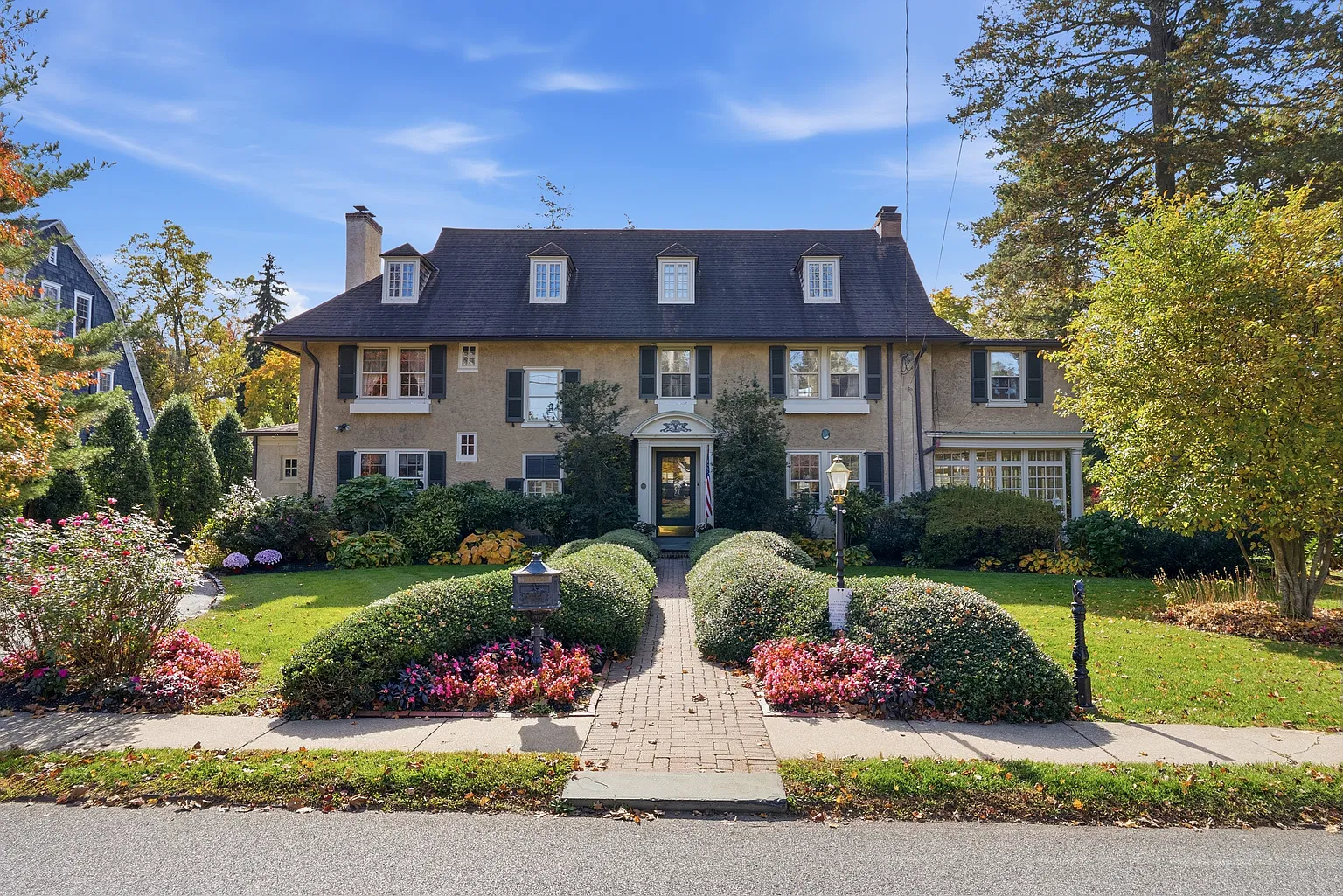
    Built in 1920 and kept in the same family for the past five decades, this St. Davids home spans three stories and features a living room with a fireplace, a library with wood beams and built-in shelving, and a sunroom. It has six bedrooms, four full bathrooms, and a patio that leads to a yard with a gazebo.

    See more photos of the home here.

    Price: $2.1M | Size: 5,400 SF | Acreage: 0.66

    Each week we feature an interesting local listing in or around the township. Have one we should consider? Email us at radnor@inquirer.com.

    🗞️ What other Radnor residents are reading this week:

    By submitting your written, visual, and/or audio contributions, you agree to The Inquirer’s Terms of Use, including the grant of rights in Section 10.

    This suburban content is produced with support from the Leslie Miller and Richard Worley Foundation and The Lenfest Institute for Journalism. Editorial content is created independently of the project donors. Gifts to support The Inquirer’s high-impact journalism can be made at inquirer.com/donate. A list of Lenfest Institute donors can be found at lenfestinstitute.org/supporters.

  • Why the fire department wants an extra $1.1M | Inquirer Lower Merion

    Why the fire department wants an extra $1.1M | Inquirer Lower Merion

    Hi, Lower Merion!

    As the township finalizes its 2027 budget, the fire department is seeking additional funding to the tune of $1.1 million. Here’s why it says that’s needed. Also this week, a township native’s new documentary explores her family’s Holocaust history, we look at why Bryn Mawr College has launched an Institute of Failure, plus an Uber driver has been sentenced for raping a Villanova University student.

    — Lisa Dukart (lowermerion@inquirer.com)

    P.S. The Inquirer is looking for submissions to its “Life Partners” series about unexpected intimacies across the region. Tell us about your creative co-parenting arrangements, rekindled relationships after divorce, or dating across fault lines at lifepartners@inquirer.com, and one of our reporters might reach out.

    If someone forwarded you this email, sign up for free here.

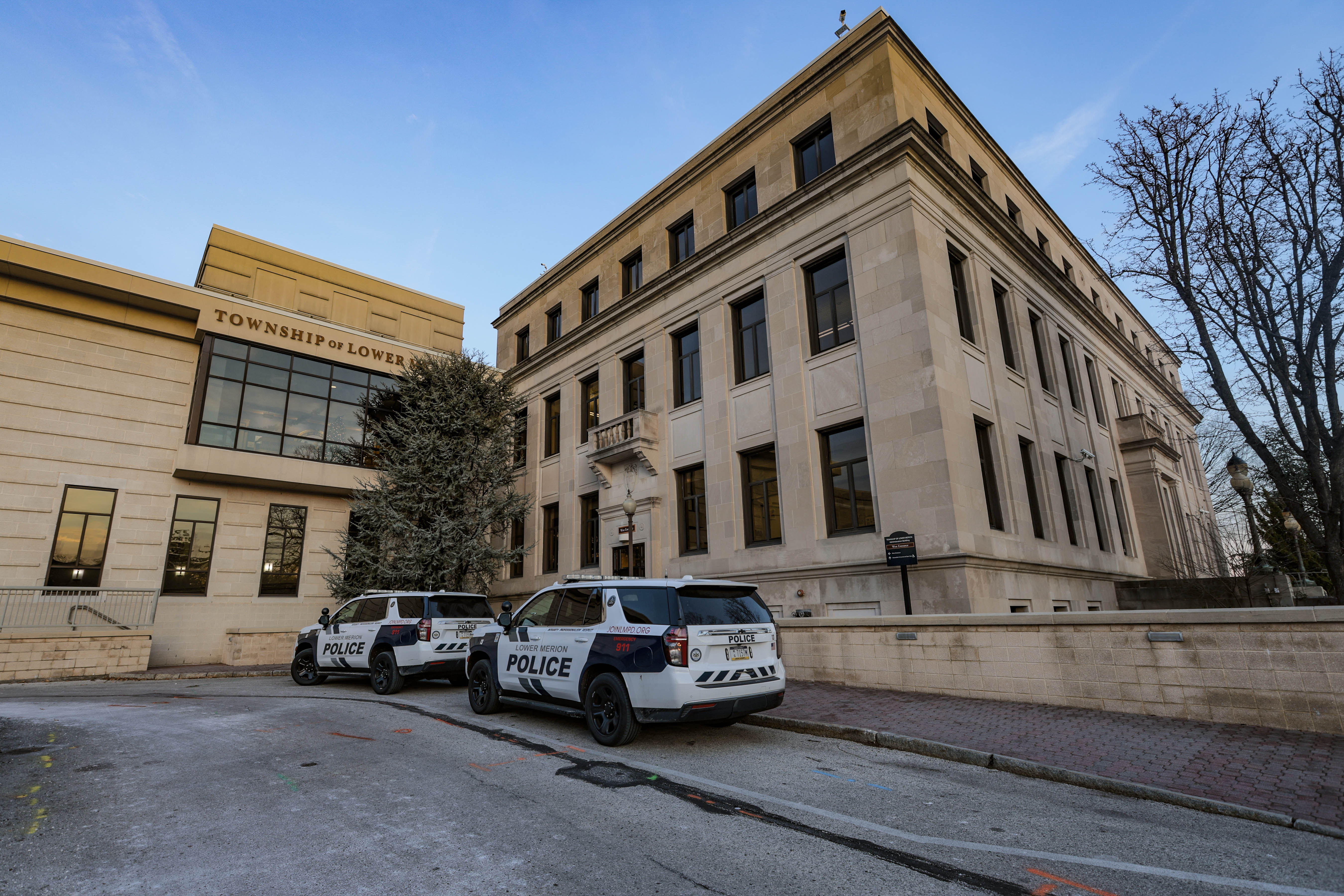
    The township’s fire department seeks $1.1M in additional funding as calls grow and volunteers shrink

    Lower Merion’s fire department is seeking additional funding from the township as the number of volunteer firefighters dwindle and calls increase.

    The department has requested an additional $1.1 million from the township next year, funds that would allow it to hire a fourth full-time firefighter at each of Lower Merion’s six fire stations. The funding would also go toward rising operating costs.

    “Our volunteer system is stressed,” Merion Fire Company president Brooke McMullin told commissioners.

    The township’s fire houses are currently slated to receive roughly $2.5 million next year, a figure that could change as the township finalizes its budget in the coming weeks. There are budget meetings scheduled for Nov. 18 and Dec. 2 before potential adoption on Dec. 16.

    The Inquirer’s Denali Sagner looks at the funding crunch.

    Lower Merion native explores her family’s Holocaust history in new documentary

    A still image from “I Don’t Know What I’m Doing Here.”Courtesy of Jacob Pincus

    A Lower Merion native is gearing up for the premiere of her new documentary, which explores her family’s history during the Holocaust.

    Madeline Kohn, 23, began working on I Don’t Know What I’m Doing Here in 2024, taking a 10-day journey to retrace her grandmother’s steps in her native Romania.

    Kohn said the film at its core is about “chasing belonging and finding familiarity,” and that visiting significant places from her family’s past gave her a sense of “rootedness.”

    It will premiere Tuesday at the Weitzman National Museum of American Jewish History.

    The Inquirer’s Earl Hopkins delves into Kohn’s story.

    💡 Community news

    • As students increasingly strive for perfection, Bryn Mawr College has taken a new approach to teaching them that failure is a part of life through its “Institute of Failure.”
    • Lower Merion is slated to get four new electric vehicle charging stations at the township lot in Bryn Mawr, part of $37 million in funding Gov. Josh Shapiro announced for southeastern Pennsylvania.
    • Gratz College recently opened its Bala Cynwyd campus at 382 Bala Ave. Known as Gratz Commonspace, the project combined two properties with a glass atrium. There’s an open house Sunday from 11 a.m. to 4 p.m.
    • Haverford resident Jeff Yass’ wealth continued to climb this year, according to the latest Forbes 400 ranking of wealthiest Americans. The cofounder of Susquehanna International Group has an estimated net worth of $77.8 billion, making him the wealthiest person in the state and the 18th wealthiest in the nation. He’s followed at No. 59 by SIG cofounder Arthur Dantchik, who lives in Gladwyne and has a $19.5 billion net worth. Fanatics CEO Michael Rubin ($11.7 billion), Morgan Properties founder and chairman Mitchell Morgan ($6.7 billion), and Phillies managing partner John Middleton ($4.9 billion), all Bryn Mawr residents, also made the list along with Wynnewood resident and Eagles owner Jeffrey Lurie ($8.8 billion).
    • Montgomery County commissioners released the proposed 2027 budget this week, which calls for no county tax increase. There will be public hearings on Dec. 3 ahead of an expected adoption vote on Dec. 17.

    🗺️ Other nearby news

    🏫 Schools briefing

    🍽️ On our plate

    • Main Line restaurant Sangkee expanded its footprint this week, soft opening Sangkee Peking Duck at Wayne’s Gateway Shopping Center. The new spot specializes in its namesake dish and other duck offerings such as duck stir-fried noodles, Peking duck bao, and duck soup, along with other Chinese dishes.
    • A new restaurant, Koutouki, opened at 24 E. Eagle Rd. in Havertown Monday. Chef Tony Procopos’ joint dishes up traditional Greek cuisine such as spanakopita, souvlaki, lamb chops, and moussaka.

    🎳 Things to do

    🧶 Ornament Workshops: Stoneleigh is hosting two DIY holiday ornament workshops, one geared toward experienced crocheters on Friday and another on Saturday for families with kids ages 6 to 12. ⏰ Friday, Nov. 13, 10 a.m.-noon and Saturday, Nov. 14, 10-11:30 a.m. 💵 $30-$40 for the crocheting event, $25-$30 for the family event 📍 Stoneleigh, Villanova

    🦸 The Incredibles: Catch a screening of the 2004 Disney Pixar animated film. ⏰ Saturday, Nov. 14, 11 a.m. 💵 $6.75-$7.75 📍 Bryn Mawr Film Institute

    🖼️ 23rd Annual Betsy Meyer Memorial Exhibition and Opening Reception: See the works of three contemporary artists, which will be unveiled at an opening reception and on display for the next month. ⏰ Opening reception is Saturday, Nov. 14, 6-8 p.m., exhibit is on display through Friday, Dec. 18 💵 $10 suggested donation for the opening reception 📍 Main Line Art Center, Haverford

    🏡 On the Market

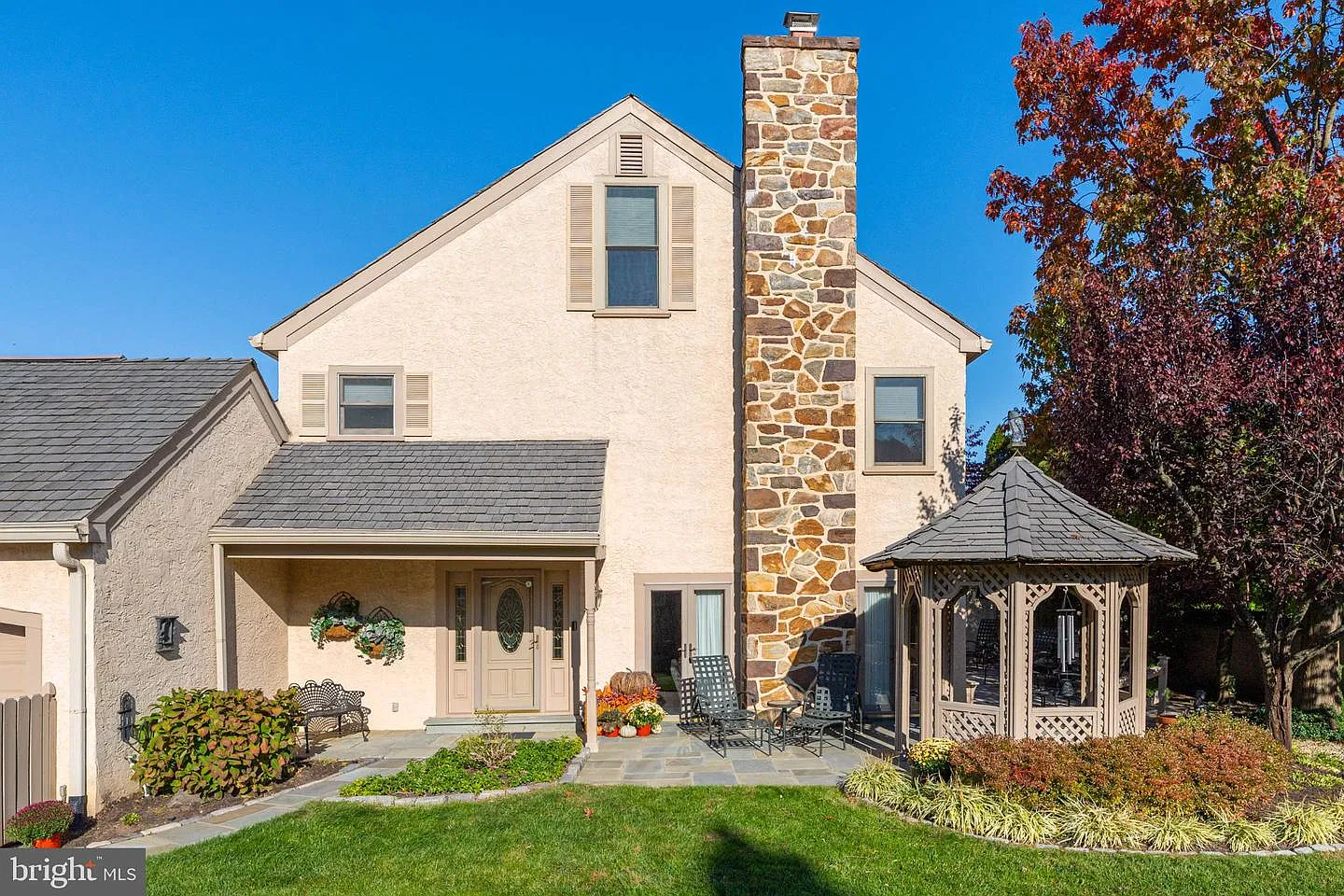
    A three-bedroom Gladwyne townhouse with a gazebo

    This Gladwyne townhouse has lots of living space thanks to a living room with a fireplace, a sunny family room, and a finished basement. Its updated kitchen has a large island and stainless steel appliances. It has three bedrooms and a home office. Outside, there’s a deck and a patio with a gazebo.

    See more photos of the home here.

    Price: $1.175M | Size: 2,291 SF | Acreage: 0.11

    🗞️ What other Lower Merion residents are reading this week:

    By submitting your written, visual, and/or audio contributions, you agree to The Inquirer’s Terms of Use, including the grant of rights in Section 10.

    This suburban content is produced with support from the Leslie Miller and Richard Worley Foundation and The Lenfest Institute for Journalism. Editorial content is created independently of the project donors. Gifts to support The Inquirer’s high-impact journalism can be made at inquirer.com/donate. A list of Lenfest Institute donors can be found at lenfestinstitute.org/supporters.

  • Why library visits are growing | Inquirer Haverford

    Why library visits are growing | Inquirer Haverford

    Hello, Haverford!

    The township’s library is having a standout year after a $22 million renovation. Here’s why. Also this week, the Havertown Barnaby’s played host to a watch party for the MLB American League’s Rookie of the Year, a Delaware County native. Plus, Main Line Health is no longer accepting cash or checks as payment and a local chef is fueling Mark Ruffalo while he’s in town to film Task.

    — Lisa Dukart (haverford@inquirer.com)

    P.S. The Inquirer is looking for submissions to its “Life Partners” series about unexpected intimacies across the region. Tell us about your creative co-parenting arrangements, rekindled relationships after divorce, or dating across fault lines at lifepartners@inquirer.com, and one of our reporters might reach out.

    If someone forwarded you this email, sign up for free here.

    The township’s library is having a banner year as more residents seek out its offerings

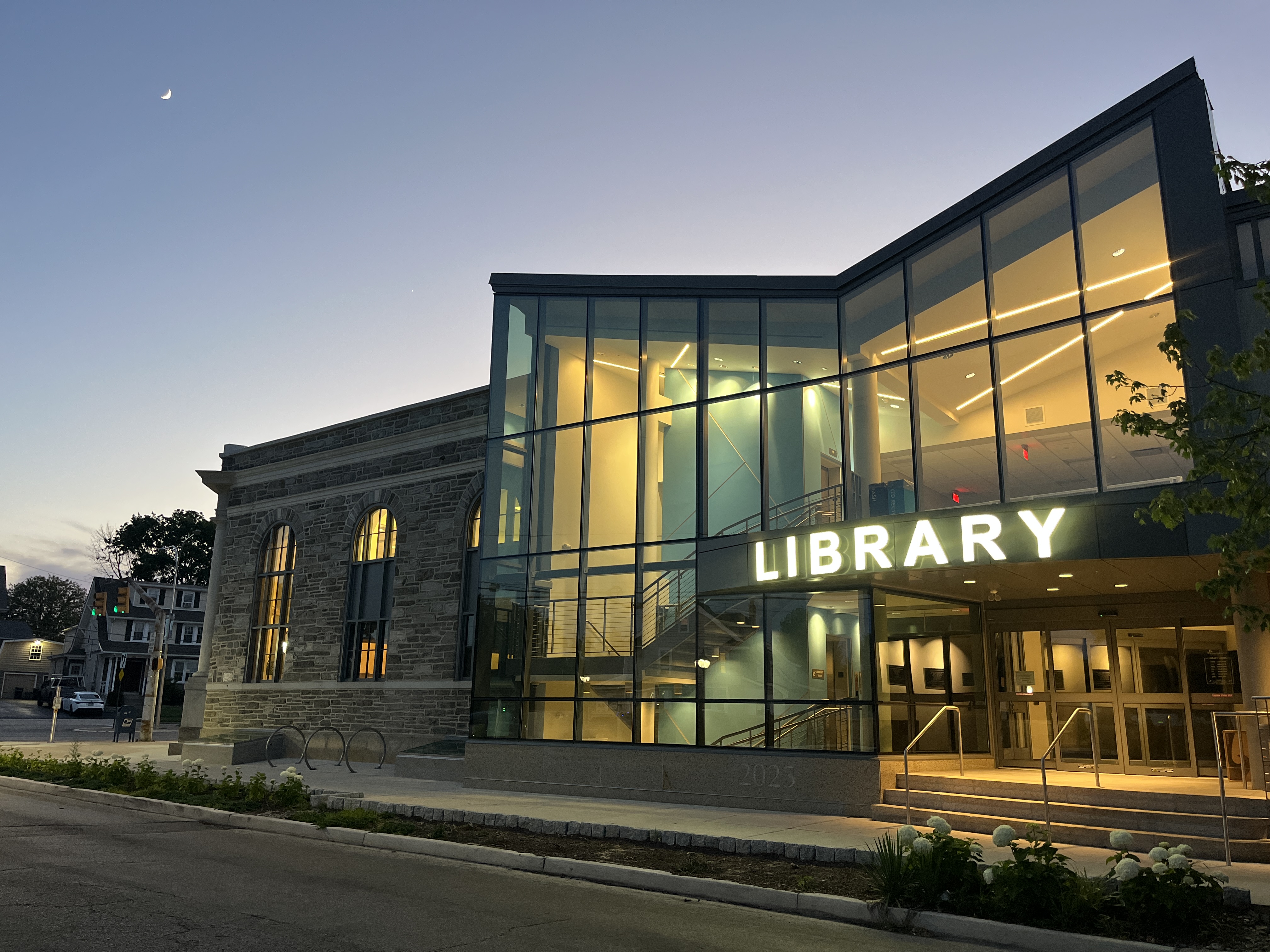
    After undergoing an 18-month, $22 million renovation, the Haverford Township Free Library is having a banner year.

    The library, which reopened in May 2025, has seen programming attendance quintuple and reference queries double, compared to 2022. It’s also reported an increase in visits.

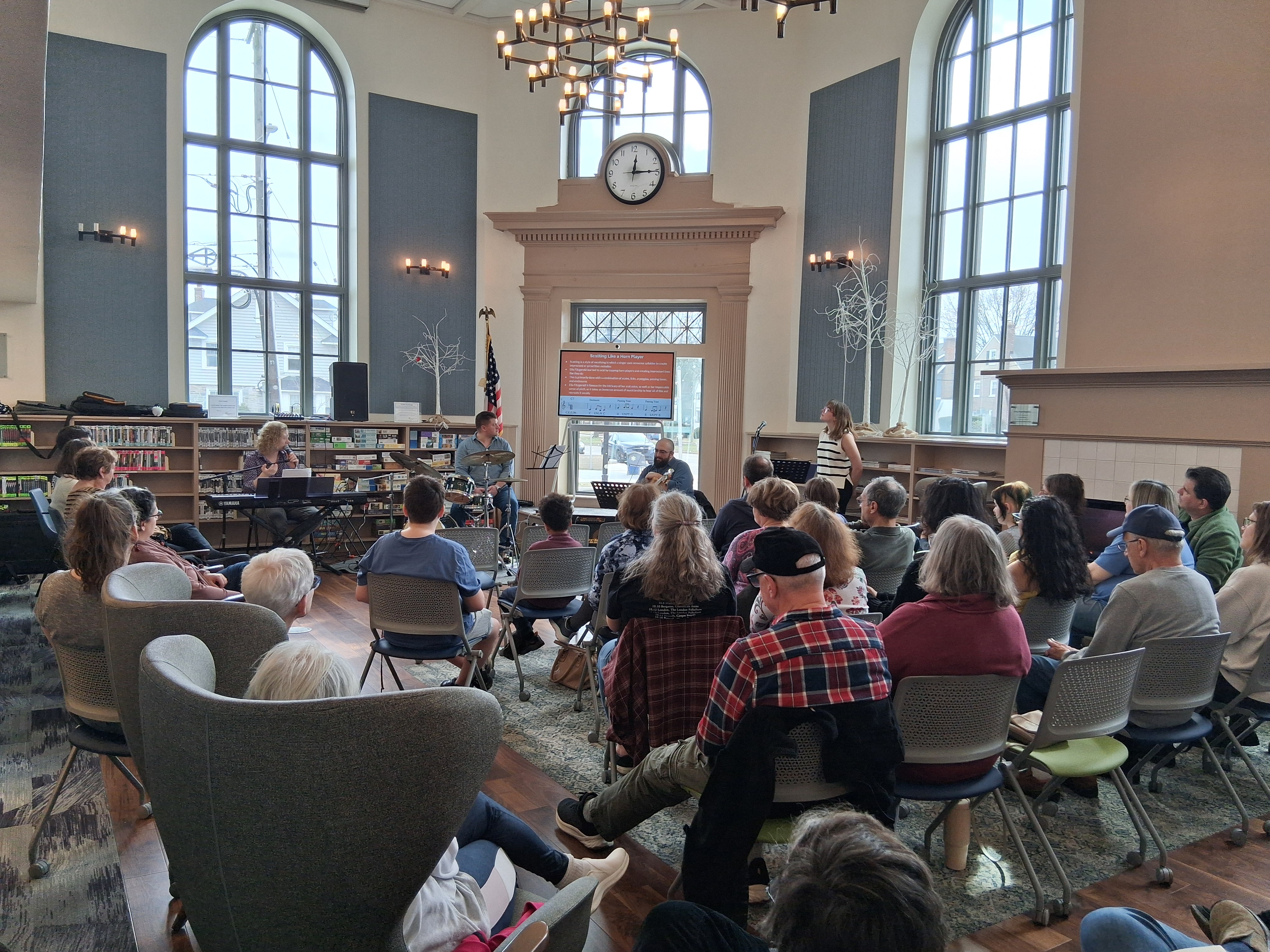
    That growth is thanks in part to increased programming — think book clubs, quilting, and canasta — and the desire for third spaces, library director Maryanne Olson said. Residents are also taking advantage of the “Library of Things,” checking out cornhole sets and label makers, in addition to museum passes and online databases.

    The Inquirer’s Denali Sagner looks at some of the library’s new programming and how its major upgrade has attracted additional visitors.

    💡 Community news

    • The Barnaby’s in Havertown this week hosted Kevin McGonigle and about 50 of his friends and family members, decked out in Detroit Tigers apparel, as the MLB American League named him Rookie of the Year. The Delaware County native took 28 of the 30 first-place votes.
    • The board of commissioners is scheduled to meet Monday evening to discuss the township’s preliminary 2027 budget.
    • The township is hosting a public open house Tuesday from 4 to 7 p.m. to discuss the second phase of its comprehensive zoning update.
    • Havertown resident Curtis Parker competed on Jeopardy! this week, winning his first episode before falling in the second. Stumped during “Final Jeopardy!” on night two, Parker, a researcher, shared a fitting message instead of an answer: “Go Birds.”
    • Police are investigating a report of a man exposing himself to a woman at Haverford Reserve on Sunday, NBC10 Philadelphia reports.
    • A new study from the Welcoming Center found that the county’s population grew between 2020 and 2025 thanks to immigration, without which it would have shrunk. The county was also the only one in the region to see H-1B certifications rise between 2025 and 2026. The Inquirer’s Jeff Gammage unpacks the major takeaways.

    🗺️ Other nearby news

    • Main Line Health, which owns nearby Lankenau Medical Center and Bryn Mawr Hospital, is no longer accepting cash or checks for any transactions, including patient copays and gift shop purchases. Here’s why.
    • The local woman behind private chef service Prepped by Carly is putting her skills to work to feed Mark Ruffalo. The Hollywood A-lister has been in the region for the past few months to film the second season of HBO series Task, which is set locally and was created by Berwyn native Brad Ingelsby. Carly Foglia began the business from her West Chester University dorm room and still operates near campus. Here’s a glimpse at what she’s been cooking up for Ruffalo.

    🏫 Schools briefing

    • Haverford Middle School has been named a Pennsylvania Blue Ribbon School, ranking among the top 15% of schools statewide for “whole school improvement while showing progress for all student groups.” It is the only school in the county to earn the distinction this year.

    🍽️ On our plate

    • A new restaurant, Koutouki, opened at 24 E. Eagle Rd. in Havertown Monday. Chef Tony Procopos’ joint dishes up traditional Greek cuisine such as spanakopita, souvlaki, lamb chops, and moussaka.
    • Popular Philadelphia cafe Rival Bros. is expanding to the suburbs, with plans to open a cafe at Wayne’s Eagle Village Shops.
    • Main Line restaurant Sangkee expanded its footprint this week, soft opening Sangkee Peking Duck at Wayne’s Gateway Shopping Center. The new spot specializes in its namesake dish and other duck offerings such as duck stir-fried noodles, Peking duck bao, and duck soup, along with other Chinese dishes.

    🎳 Things to do

    🎶 Lauren Mendelsohn: Hear the singer-songwriter perform. ⏰ Friday, Nov. 13, 7:30-10 p.m. 💵 $19.36-$21.40 📍 Kelly Center, Havertown

    🦸 The Incredibles: Catch a screening of the 2004 Disney Pixar animated film. ⏰ Saturday, Nov. 14, 11 a.m. 💵 $6.75-$7.75 📍 Bryn Mawr Film Institute

    🖼️ 23rd Annual Betsy Meyer Memorial Exhibition and Opening Reception: See the works of three contemporary artists, which will be unveiled at an opening reception and on display for the next month. ⏰ Opening reception is Saturday, Nov. 14, 6-8 p.m., exhibit is on display through Friday, Dec. 18 💵 $10 suggested donation for the opening reception 📍 Main Line Art Center, Haverford

    🦃 Delco Friendsgiving: Kick off the holiday season with the annual event that features vendors, a DJ, a performance by country band Shot of Southern, and more. ⏰ Sunday, Nov. 15, 1-8 p.m. 💵 Pay as you go 📍 The Yard Pub, Havertown

    🏡 On the market

    An updated Havertown home with multiple fireplaces

    This nearly century-old Dutch Colonial in Havertown’s Merwood Park neighborhood has been fully updated. Its first floor features a living room with a fireplace, an eat-in kitchen with quartz countertops and stainless steel appliances, and a great room with an electric fireplace. Three of the home’s bedrooms are on the second floor, including a primary suite with an electric fireplace, a walk-in closet, and a soaking tub. There are two additional rooms on the third floor and additional living space in the finished basement. There’s an open house today from 4 to 6 p.m.

    See more photos of the home here.

    Price: $849,900 | Size: 3,298 SF | Acreage: 0.14

    Each week we feature an interesting local listing in or around the township. Have one we should consider? Email us at haverford@inquirer.com.

    🗞️ What other Haverford residents are reading this week:

    By submitting your written, visual, and/or audio contributions, you agree to The Inquirer’s Terms of Use, including the grant of rights in Section 10.

    This suburban content is produced with support from the Leslie Miller and Richard Worley Foundation and The Lenfest Institute for Journalism. Editorial content is created independently of the project donors. Gifts to support The Inquirer’s high-impact journalism can be made at inquirer.com/donate. A list of Lenfest Institute donors can be found at lenfestinstitute.org/supporters.

  • These local students are racking up job offers | Inquirer Greater Media

    These local students are racking up job offers | Inquirer Greater Media

    Hi, Greater Media!

    Students at local nonprofit school Williamson College of the Trades say they’re being swarmed with job offers. We take a look at the school’s approach. Also this week, we unpack why Main Line Health had to add $134 million to its medical malpractice reserves, we meet the local chef fueling Mark Ruffalo while he’s in town to film Task, plus a former police chief has been charged with collecting overtime pay when he was allegedly dining at local restaurants instead.

    P.S. The Inquirer is looking for submissions to its “Life Partners” series about unexpected intimacies across the region. Tell us about your creative co-parenting arrangements, rekindled relationships after divorce, or dating across fault lines at lifepartners@inquirer.com, and one of our reporters might reach out.

    If someone forwarded you this email, sign up for free here.

    Students at Media’s Williamson College of the Trades are raking in job offers

    Media’s Williamson College of the Trades is training students for in-demand jobs such as carpenters, masons, project managers, and field engineers — and students are scoring lots of job offers in turn.

    Last week, the school hosted 178 companies from 19 states, looking for summer interns and full-time employees. The vast reach of the career fair underscores the national demand for skilled workers as more reach retirement age.

    That demand is also showing up in the three-year, tuition-free school’s applicant pool — its most recent freshman class drew 770 applicants for 130 spots.

    The Inquirer’s Ariana Perez-Castells looks at Williamson’s model and how it’s helping fill workforce gaps.

    💡 Community news

    • Main Line Health, which owns Riddle Hospital in Media, posted a $33 million loss in fiscal 2026 after adding $134 million in medical malpractice reserves. Here’s why the system deemed the move necessary.
    • A former Delaware County police chief has been charged with collecting more than $50,000 in fraudulent overtime payments when prosecutors say he was actually at restaurants and bars in Media and Middletown Township, including La Porta, DiFabio’s Market & Tap, and Old State Tavern. Michael Irey was placed on leave from Upland Borough’s force in February and later resigned.
    • The local woman behind private chef service Prepped by Carly is putting her skills to work to feed Mark Ruffalo. The Hollywood A-lister has been in the region for the past few months to film the second season of HBO series Task, which is set locally and was created by Berwyn native Brad Ingelsby. Carly Foglia began the business from her West Chester University dorm room and still operates near campus. Here’s a glimpse at what she’s been cooking up for Ruffalo.
    • The Philadelphia Union is hosting a pop-up event Saturday from noon to 3 p.m. at Media’s State Street parking lot near Apollo Pizza as the team gears up for the post-season. The mobile pop-up will include photos, player appearances, and a DJ, with the first 100 attendees scoring a playoff T-shirt. The Union’s first-round playoff game takes place Nov. 21 in Massachusetts, with a second game set for Nov. 28 on home turf.
    • The Delaware County Health Department this week unveiled a new “Test & Go” kiosk outside ChristianaCare Primary Care in Glen Mills. The kiosk offers free access to home test kits for COVID-19, the flu, and RSV; radon test kits; and naloxone, which reverses opioid overdoses. There are other nearby kiosks at the Delaware County Government Center in Media, Delaware County Community College in Marple Township, and the ChristianaCare Glen Mills in Concord Township.
    • There’s an e-waste recycling event for residents of Nether Providence Township and Media and Swarthmore Boroughs Saturday from 9 a.m. to 1 p.m. at Strath Haven High School. You can also bring documents for shredding.

    🗺️ Other nearby news

    🏫 Schools briefing

    • Community members are mourning longtime Wallingford Elementary School educator Meryl Chafetz, who died Saturday at the age of 53. Chafetz spent 28 years in the district, teaching second and fifth graders before serving as Wallingford Elementary’s librarian. She was also active in the Wallingford-Swarthmore Education Association, including as president. “Her impact touched every corner of our school district,” Wallingford Elementary principal Stephen Krall said in an email to the school community.
    • Strath Haven High School’s longtime head football coach Kevin Clancy announced his retirement this week. He was one of the longest tenured football coaches in the state, having spent the better part of five decades coaching, the last 36 with the Panthers. During his career, he led teams to two state championships.

    🍽️ On our plate

    🎳 Things to do

    🍑 James and the Giant Peach: The Roald Dahl classic gets the stage treatment. ⏰ Saturdays and Sundays, Nov. 14-Nov. 22, 11 a.m. and 3 p.m. 💵 $13.50-$18.50 📍 Players Club of Swarthmore

    🌾 Flax Processing and Natural Dyeing Demonstration: The PA Flax Project will show how flax becomes fiber. ⏰ Sunday, Nov. 15, sessions are at 11 a.m., noon, and 1 p.m. 💵 $8-$16 📍 Tyler Arboretum, Media

    💚 Green Sunday Holiday Craft Fair: Transition Town Greater Media’s alternative to Black Friday and Cyber Monday returns for its 15th year, featuring 50 juried vendors selling locally, handmade goods. ⏰ Sunday, Nov. 15, 1-5 p.m. 💵 Pay as you go 📍 Media-Providence Friends School, Media

    🗞️ What other Greater Media residents are reading this week:

    By submitting your written, visual, and/or audio contributions, you agree to The Inquirer’s Terms of Use, including the grant of rights in Section 10.

    This suburban content is produced with support from the Leslie Miller and Richard Worley Foundation and The Lenfest Institute for Journalism. Editorial content is created independently of the project donors. Gifts to support The Inquirer’s high-impact journalism can be made at inquirer.com/donate. A list of Lenfest Institute donors can be found at lenfestinstitute.org/supporters.

  • Pa. ranks 28th out of 50 states in supporting immigrant residents. New Jersey stands in top 10.

    Pa. ranks 28th out of 50 states in supporting immigrant residents. New Jersey stands in top 10.

    When it comes to supporting its immigrant residents, Pennsylvania doesn’t do so well, a new study shows, ranking 28th out of 50 states.

    New Jersey finished a more-than-respectable ninth. And tiny Delaware came in at 13th.

    Those standings come from the American Immigration Council, which this week released a post-midterm-election analysis of how U.S. states perform in their ability to support and include immigrant residents. The council created a States Index that assesses government policies across four key areas to compile a score for each state.

    Nan Wu, the council’s director of research, said the index is a way for states to compare and contrast their own policies, to better understand the implications of immigration-related actions or the lack thereof.

    “It’s a tool that can inform state advocates and policymakers as they develop a roadmap in response to the needs of their constituents,” she said in a statement.

    The national average score was 1.65 out of 5.

    At the top were California, 4.56; Washington, 3.94; and Illinois, 3.92. At the bottom was Texas, 0.42, with Florida and Tennessee close behind.

    People can see how individual states scored here.

    (function(){function e(){window.addEventListener(`message`,function(e){if(e.data[`datawrapper-height`]!==void 0){var t=document.querySelectorAll(`iframe`);for(var n in e.data[`datawrapper-height`])for(var r=0,i;i=t[r];r++)if(i.contentWindow===e.source){var a=e.data[`datawrapper-height`][n]+`px`;i.style.height=a}}})}e()})();

    Pennsylvania had an overall score of 1.05, lower than the national average of 1.65. In subcategories, it scored a high 3.75 in access to identification, but recorded zeros in housing protections, legal-services programs, and language access.

    The state is home to more than a million immigrants, who make up 8% of the population.

    New Jersey scored 2.78 out of 5 overall.

    In subcategories the Garden State earned perfect 5 scores in access to driver’s licenses ― the state allows undocumented immigrants to earn standard licenses ― and in immigrant offices or liaisons.

    An estimated 2.2 million immigrants live in New Jersey, about 24% of the population, the council reported.

    The index gave each state a score for every policy category and for subcategories, capturing the extent to which individual policies supported or hindered immigrant residents.

    The index focused on policies in four main areas:

    • Workforce, education, and occupational licensure.
    • Access to services.
    • Government infrastructure, including language-access programming.
    • Cooperation with federal immigration enforcement.

    The index arrives at a moment when the future of U.S. immigration ― and particularly immigration enforcement ― is suddenly at play, with a Democratic Congress poised to take office in January.

    U.S. Rep. Robert Garcia, a California Democrat projected to become chair of the House Oversight and Government Reform Committee, has already announced plans to investigate “abuses” by the Department of Homeland Security and Immigration and Customs Enforcement.

    Immigration advocates in Philadelphia and elsewhere say this is the moment for change.

    ICE says it is not slowing down. In Pennsylvania, for instance, the agency has nearly doubled the number of partnership agreements it holds with local police agencies.

    Meanwhile, President Donald Trump told CBS’s 60 Minutes on Sunday that his immigration policies had been “too tough” and his push for mass deportations had hurt him during the midterm elections. On Monday, however, Trump defended his deportation policy as “very strong” and said he was opposed to any deal that would include “amnesty” for immigrants who entered the country without permission.

    As comprehensive immigration reform continues to elude Congress, the immigration council said, state policies regarding immigrants become more important ― on everything from limiting coordination with federal immigration enforcement to strengthening local economies.

    The council said the index can help policymakers identify practical approaches to support and protect community members, and to develop policies that promote economic growth.

    In Oregon, for example, policymakers created a statewide right-to-counsel program to connect immigrants to legal services.

    New Jersey has worked to expand language access across state-government services.

    Maryland worked for years to withdraw state support and participation in federal immigration enforcement.

    North Dakota directed its Global Talent Office to help businesses recruit and retain immigrant workers, showing how states that have not traditionally been immigrant destinations are recognizing opportunities to fix workforce shortages.

    The federal government determines who can enter and stay in the U.S., the council noted, but states play a big role in how immigrants experience daily life.

    Council executive director Jeremy Robbins said in a statement that, across the country, states are recognizing that the economy continues to be the main concern for most Americans.

    “By embracing policies focused on economic opportunities and the well-being of all community members, including immigrants,” he said, “states can create safe, connected communities and promote the small businesses that truly power the country.”

  • President Trump says he’s opposed to immigration amnesty. But here’s how it could change the United States.

    President Trump says he’s opposed to immigration amnesty. But here’s how it could change the United States.

    Even as President Donald Trump seemed to soften his stance on immigration enforcement, saying his mass-deportation policy may have been “too tough,” he opposed any deal with Democrats that would include “amnesty” for those living in the country without permission.

    Homeland Security Secretary Markwayne Mullin, who oversees Immigration and Customs Enforcement, said he was likewise adamantly opposed.

    What exactly is amnesty, and what could it mean to the millions of undocumented immigrants in the U.S.? It is not going too far to say that were such a plan approved, it could dramatically change both individual lives and the nation at large. Here is a look at its meaning and potential impact.

    What is amnesty?

    Generally speaking, amnesty is an official act of forgiveness granted by a government to a group of people. It comes from the Greek word amnestia, meaning “forgetfulness,” in this case the forgetting of past violations. In immigration, amnesty would take the form of government-granted legal relief to allow undocumented people ― a few, some, or all ― to gain legal status.

    So people who came to the U.S. without permission would be rewarded for violating federal law?

    That is the GOP view, and a big reason that amnesty proposals have struggled in Congress. It is important to note that individual circumstances vary widely. Some people were brought to the country as children, having had no say in where they went or lived. Others entered legally as adults, then overstayed visas. Some have tried for years to legalize their status but have no path to do so.

    Generally, in other instances, people seeking amnesty have been required to come forward and to meet certain benchmarks. That could include proving their continuous physical presence in the U.S. as of a specific cutoff date, paying fines, and passing background checks. The government could even impose requirements like community service. It is likely that, at best, amnesty would offer a path to legal permanent residency, not to citizenship.

    How many undocumented people live in the U.S.?

    Millions. The Pew Research Center puts the figure at about 14 million, while the estimate of the Migration Policy Institute is even higher. That agency reported this year that the undocumented population reached 15.8 million in mid-2024. Both those figures are higher than the population of Pennsylvania, which is about 13 million.

    Why not simply deport people who have no authority to be here?

    The Trump administration is trying. But here’s where the machinery of deportation and the cry of “No amnesty!” bump against reality.

    During the first 18 months of the president’s second term, Homeland Security completed about 980,000 deportations, according to an analysis by the Migration Policy Institute.

    That works out to about 653,000 deportations a year.

    Which means even if the government can keep up that fast pace, deporting the 14 million undocumented people who are already in the U.S. would take more than 21 years. And that does not account for the people who would be arriving even as others were being sent out.

    Would amnesty have to cover all undocumented immigrants?

    No. Multiple configurations could be conceived and implemented to cover smaller groups of people.

    For instance, amnesty could be extended to immigrants who have lost temporary protected status, which the Trump administration has stripped or intends to take from nearly a million people, many of whom have lived here for decades. That loss of TPS exposes people to deportation.

    Amnesty could also be offered to DACA recipients, people who were brought to the country as children and have lived under Deferred Action for Childhood Arrivals. That program, which covers about 436,350 immigrants, has been in greater or lesser danger of elimination depending on which political party has held power.

    Who would benefit from amnesty?

    To undocumented people, the gain would be life-changing. No more living in fear that a routine traffic stop could forever separate them from their families ― who routinely include American sons and daughters. They would gain legal work authorization. Meanwhile, projections are that the United States would see growth in gross domestic product and tax income as newly legal workers joined the labor pool ― and as those workers launched their own businesses, spurring greater job creation.

    The White House says amnesty would damage the country, exploding federal funding for programs such as SNAP and Medicaid as more people gained access to those benefits.

    Has immigration amnesty been granted before?

    Yes — by President Ronald Reagan, an architect of the modern conservative movement. He signed the 1986 Immigration Reform and Control Act, which granted legal status and a path to permanent residency to nearly three million undocumented immigrants, most of them Latino.

    Former Reagan speechwriter Peter Robinson told NPR: “It was in Ronald Reagan’s bones ― it was part of his understanding of America ― that the country was fundamentally open to those who wanted to join us here.”

    That has all changed, of course. In his first year in office, former President Joe Biden offered a sweeping immigration bill that would have provided undocumented people with an eight-year path to citizenship. The bill died in Congress.

    Today the word amnesty has become toxic to many Republicans in Congress and in the executive branch, as campaign promises of harsh enforcement helped sweep Trump to the Oval Office. Even some Democrats are queasy about calling amnesty what it is, preferring terms like reform.

  • The geezer of graffiti art, Barry McGee, goes ‘another round’ in Los Angeles

    The geezer of graffiti art, Barry McGee, goes ‘another round’ in Los Angeles

    When Barry McGee drove his Chevy Astro van from his home in Marin County, Calif., to Los Angeles in October to install his exhibition at Jeffrey Deitch gallery, he stopped in train yards along the way to write invented graffiti monikers on the sides of the freight cars with a white crayon.

    McGee is an aficionado of this old-fashioned genre of graffiti. Since the 1800s, long before “wildstyle” throw-ups and spray-painted subway trains, itinerant men have written their names or insignia on the boxcars they hopped all across this country.

    McGee cut his teeth as a graffiti writer in San Francisco in the early 1980s under the pseudonym Twist. He then found success in the next decade showing paintings and drawings in galleries under his own name. Along with colorful paintings of tessellated grids and hand-lettered signs for fictional businesses, in his 20s, he began making pictures (both legally and on public walls) of older men with melting features and exhausted expressions: geezers, as he calls them.

    McGee, 60, has become one of street art’s elder statesmen, an influential and well-loved figure who has retained his credibility with a younger generation despite exhibiting in blue-chip galleries and doing corporate collaborations with brands such as Meta, Adidas, and Beats by Dre. In his packed exhibition, “Another Round,” which opened Oct. 30, alongside more than 200 of his paintings, sculptures, and photographs, he includes the work of scores of artists decades younger than himself and a few who are older.

    On one of several recent video calls with the artist in the small hours (he’s a night owl), I asked if he identifies with the geezers he paints and with the train-hopping itinerants on whom many are based. “Unfortunately, yes I do,” he replied.

    These days, McGee spends most of his time at his home in Bolinas, Calif., five minutes from the beach. He says he was tired of getting parking tickets and having to lock his doors in San Francisco: “I became an old person, is what happened.”

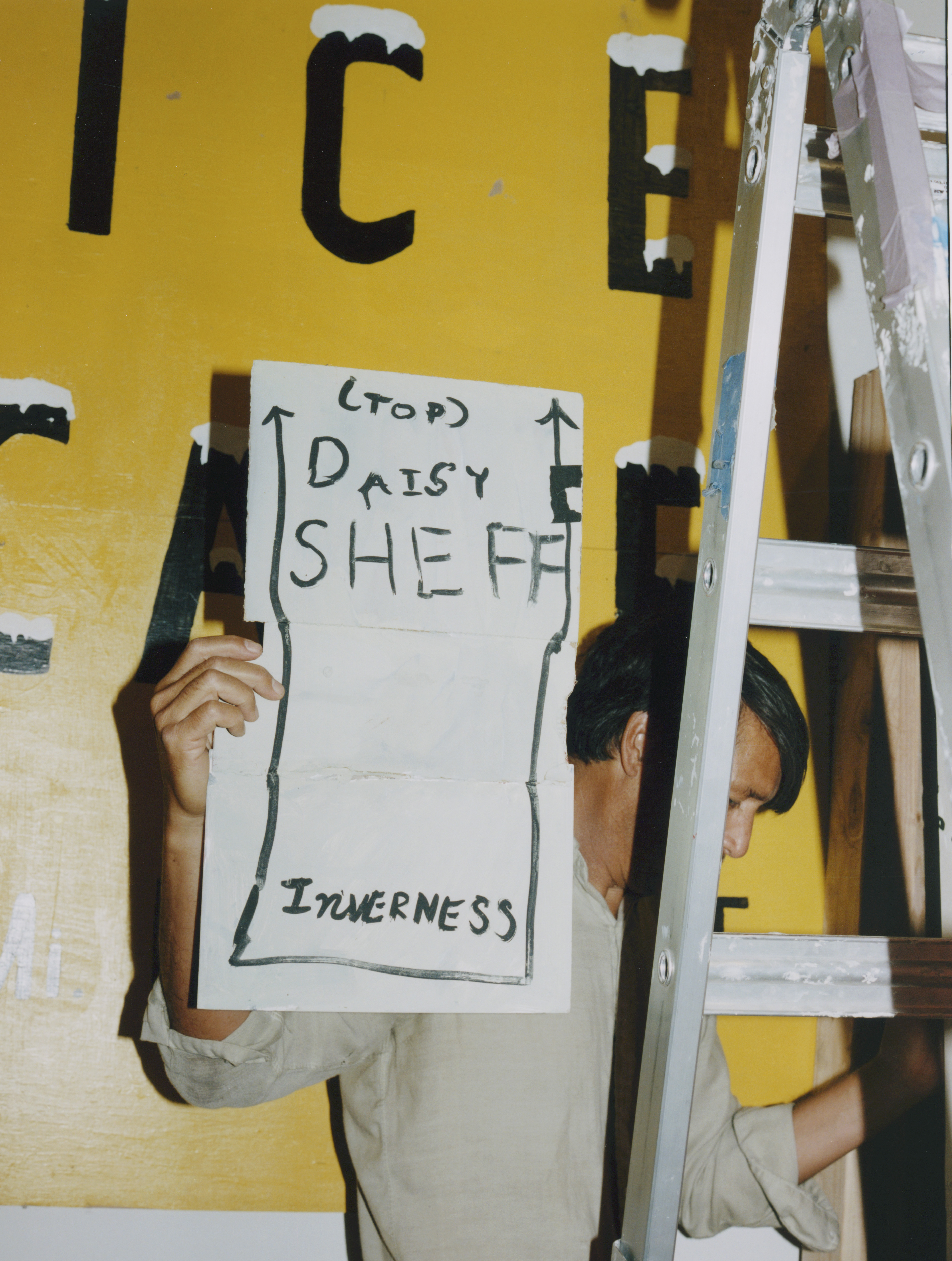
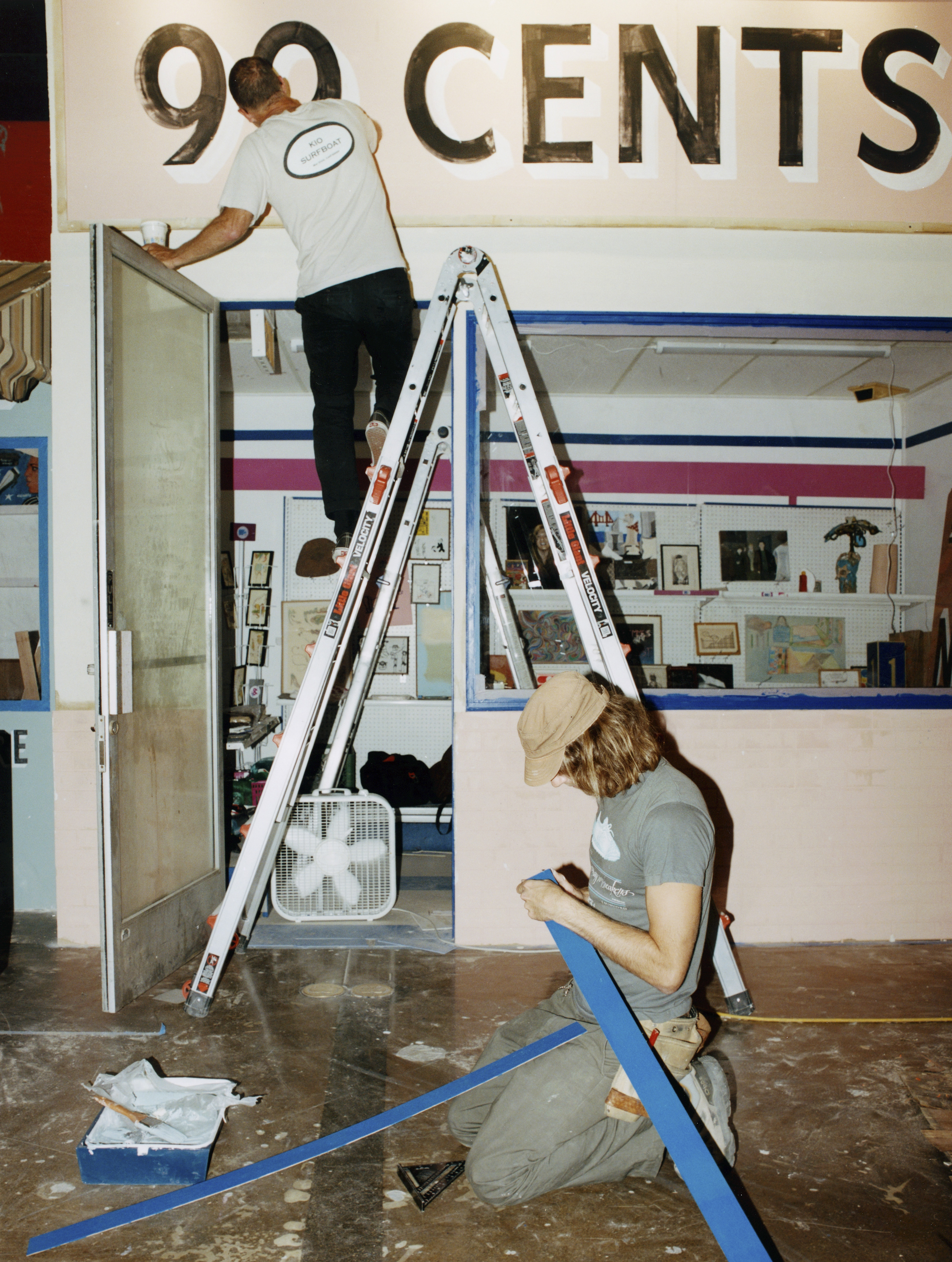
    In a subculture defined by youth, McGee still holds sway. In February, in collaboration with the Hole gallery, he organized a pop-up exhibition in a 99-cent store on Wilshire Boulevard, a stone’s throw from the Los Angeles County Museum of Art and the Academy Museum of Motion Pictures. It was a chaotic triumph; more than 200 artists showed up with just a day or two of notice to cram their work onto the supermarket’s empty shelves. (They also graffitied most of its writable surfaces — and walls in the surrounding neighborhood, to the chagrin of residents.)

    Barry McGee enlisted the help of the artist Alexis Ross to fabricate a storefront facade inside the gallery, based on an imaginary 99-cent store and using materials salvaged from his prior exhibit, “99CENT.”Jack Bool

    “99CENT” was a rude riposte to the Frieze Art Fair, which opened in Los Angeles a few days later. It satirized the commercial contemporary art world with creations of uneven virtuosity by diverse makers and dabblers, many of whom do not aspire to careers as professional artists. Nevertheless, most of it was for sale.

    Graffiti, when McGee started out, was staunchly anticapitalist. But views have evolved, said Aaron Rose, a Los Angeles-based artist and writer who showed McGee’s work in the 1990s at the Alleged Gallery in New York. “In the late ’90s and even into the early aughts, Barry and most of the artists from that scene were reluctant to collaborate with brands,” he said. “But the world changed, and the whole idea of ‘no sellout’ kind of went out the window.”

    One of the artists in “Another Round” is graffiti writer, designer, and artist Chito, who has collaborated with brands including Adidas and Crocs. Chito, 30, said he admired how McGee maintained a separation between his work for the street, for galleries, and for brands. “He never made his graffiti corny, because he’s always kept it real on both sides, you know?”

    Others cite McGee’s willingness to use his success to elevate the artwork of others in his community. “99CENT” was a case in point; so, too, is “Another Round.”

    “In graffiti,” McGee said, “if someone cuts a hole in the fence, everybody goes through that same hole. Just like, if I have an opportunity at Jeffrey Deitch’s space, everybody’s coming in with me.”

    Deitch has witnessed McGee patiently signing books, T-shirts, and skate decks for crowds of fans. “He’s like a Pied Piper,” the gallerist said. In one week, “99CENT” drew an estimated 25,000 visitors; Frieze, by comparison, counted 32,000.

    “Another Round” continues a thread through McGee’s exhibitions since 2015, when he built his first “Healing Arts Center” in a former check-cashing business in San Francisco. Since then, he has created several such installations, which he fills with art and artifacts by his friends and peers.

    “Art’s healed me,” McGee said. “It’s helped me as much as anything in my life.”

    “I just wanted to feel good and have others feel good about art and coming together as a local community,” he added.

    “99CENT,” McGee said, “was the biggest version of a healing.” He was struck by how it brought together people who might, in the territorial graffiti scene, have been “warring factions” because they were from different neighborhoods.

    For “Another Round,” McGee worked with artist Alexis Ross to create two mock storefronts in the gallery. One is a condensed refabrication of the 99-cent store, with the same linoleum floor and pegboard shelving, dressed with artwork from that show and some fresh additions. Adjacent is a bookshop that offers zines, obscure books, T-shirts, and McGee’s favorite granola. It’s operated by Matthew James-Wilson of Heavy Manners Library, a lending library, bookstore, and event space in Echo Park.

    Artist Henri Paul Broyard, 37, who participated in “99CENT,” contributed a maquette for a “Healing Arts Center” built from cardboard and an old paint palette. Broyard said he understood McGee’s healing arts concept as “both sincere and kind of tongue-in-cheek.”

    Barry McGee in front of an untitled sculpture made from fanned surfboards for his new show at Jeffrey Deitch. The graffiti artist still aims for his work to be inclusive of underrepresented voices.Jack Bool

    In the wake of the collaborative “99CENT” exhibition — for which McGee insists he “was pretty hands-off” — his latest show hews closer to a loosely authored, collective model. As he toured me around the gallery by video, he seemed surprised to encounter objects — like two spray-painted tumbleweeds — that artists had simply left there.

    The space was busy with visitors, many of whom greeted McGee. They wove around plinths topped with ceramics and his painted, papier-mache sculptures; a custom motorbike that once belonged to Kenny Howard (better known as Von Dutch); and an ornate tricycle that McGee’s hot-rodder father had tricked out for him when he was a kid.

    McGee’s ballpoint pen drawings of baleful faces, from early in his career, can be found farther along. There’s plenty of new work too, including shaped abstract paintings and decorated plates.

    It is hard not to notice that most of the artists in the exhibition — as in the broader graffiti scene — are male, although McGee said he is working on making the gender balance more equal in his shows.

    “He has a crew of boys who help him do everything. They adore him,” said artist Ruby Neri, an old friend of McGee’s associated with the Mission School group of San Francisco in the 1990s. Neri moved from graffiti to paintings and painted sculptures, often depicting ribald female nudes. Her deft early painting of two faces, on a scrap of plywood, features in the 99-cent-themed section of this show.

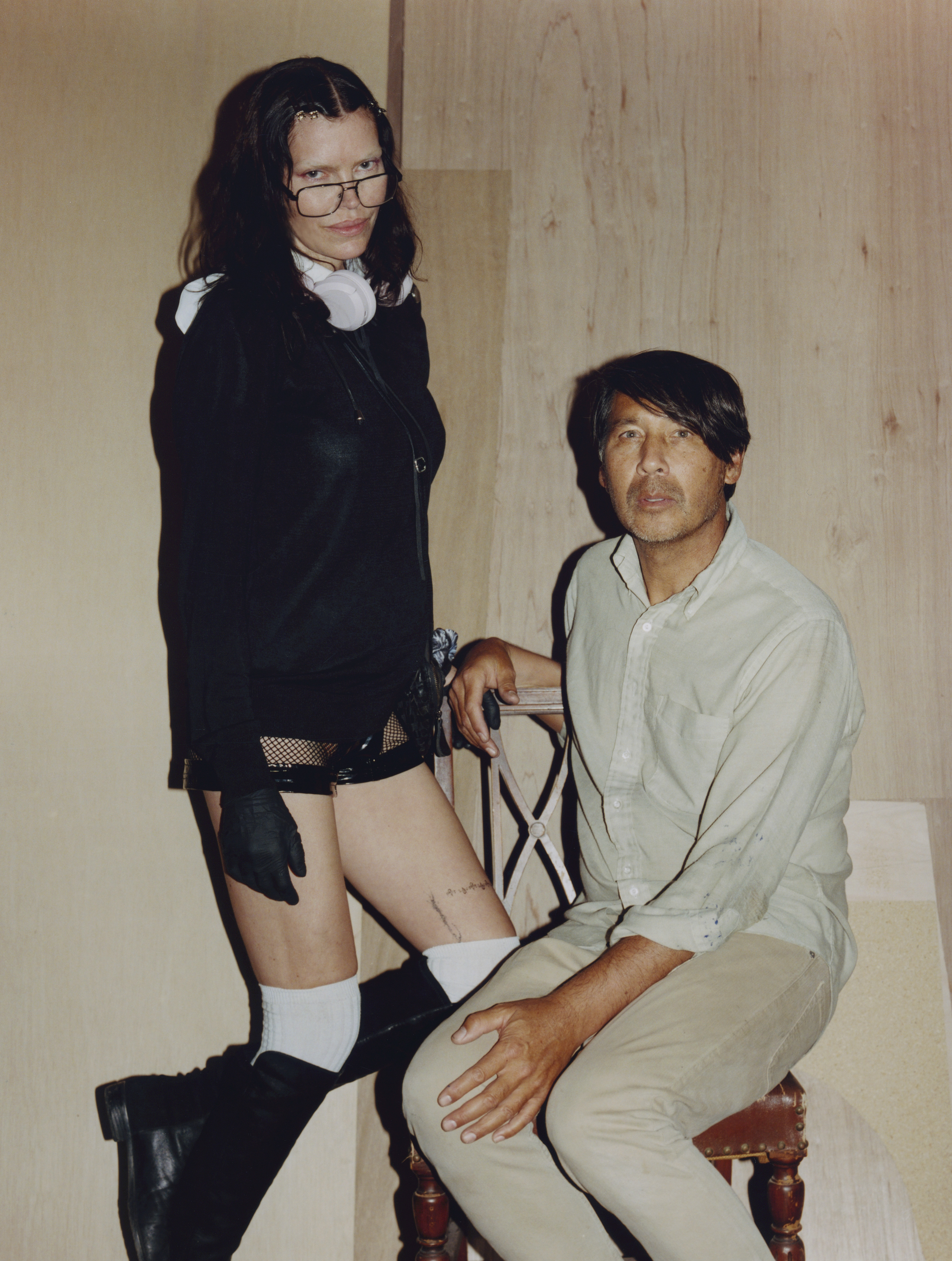
    Barry McGee and Sorat May Andersen during the exhibition’s installation.JACK BOOL

    Other female artists, including McGee’s first wife Margaret Kilgallen, who died in 2001 at 33, are included. There is a photograph of Kilgallen drawing on a boxcar, and a print by McGee and Kilgallen’s daughter, Asha, 25. A carbuncular gray sculpture, made from spray-painted pom-poms, is by McGee’s current partner, Sorat May Andersen. As with “99CENT,” this exhibition seems less concerned with scrupulous aesthetic discernment than with generosity of spirit, with the warm embrace of friends and family.

    During his visit, McGee was painting on walls all around Los Angeles, though he declined to reveal where. McGee is intent on leaving his mark on trains, on walls, on sneakers, on skate decks, on posters, and in galleries throughout the world, sending signals, as he said, that he’s “alive and breathing.”

    “I just have this urgency — I want to draw on something and have it outlast me, and let it sit in a field in Missouri or Utah,” he said of his train tags. To be influential, to encourage another generation of artists, is surely the ultimate way of leaving your mark.

    This article originally appeared in the New York Times.

  • The lights go out at Novaya Gazeta, Russia’s bravest newspaper

    The lights go out at Novaya Gazeta, Russia’s bravest newspaper

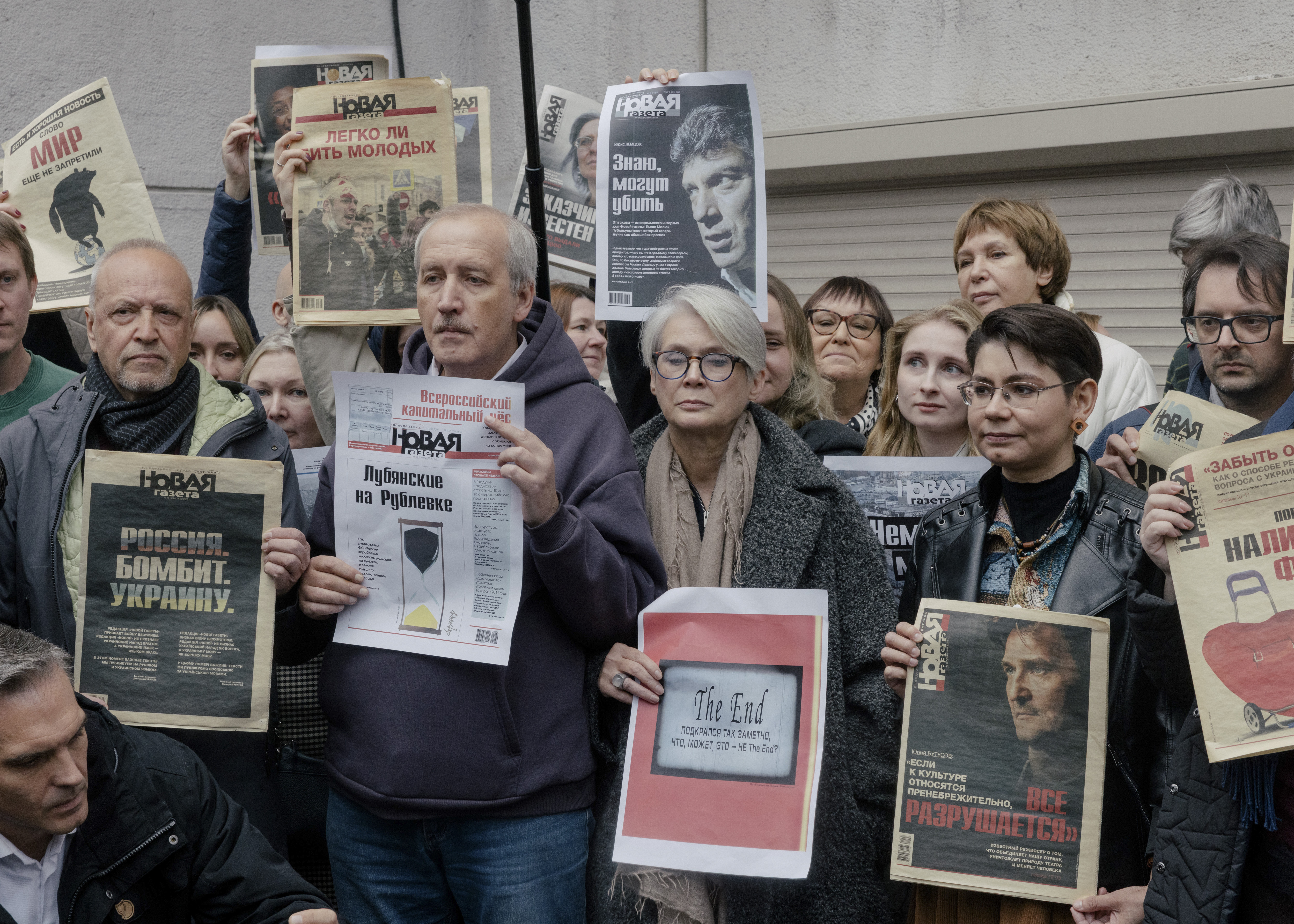
    MOSCOW — Outside a five-story office building on Potapovsky Lane in Moscow, a group of journalists took down a metal plaque and installed a plastic one in its place: Novaya Gazeta Lived Here. White carnations, the flower that Russians associate with mourning, were placed on top of it.

    Novaya Gazeta, Russia’s most daring independent newspaper for decades, closed its doors Monday, the latest blow to Russians who value freedom of expression and human rights.

    Its forced closure is emblematic of the Kremlin’s erasure of opinions, ideas, and people that do not conform to its views. That process has been underway for years, but it has dramatically accelerated since Russia launched its full-scale invasion of Ukraine in 2022.

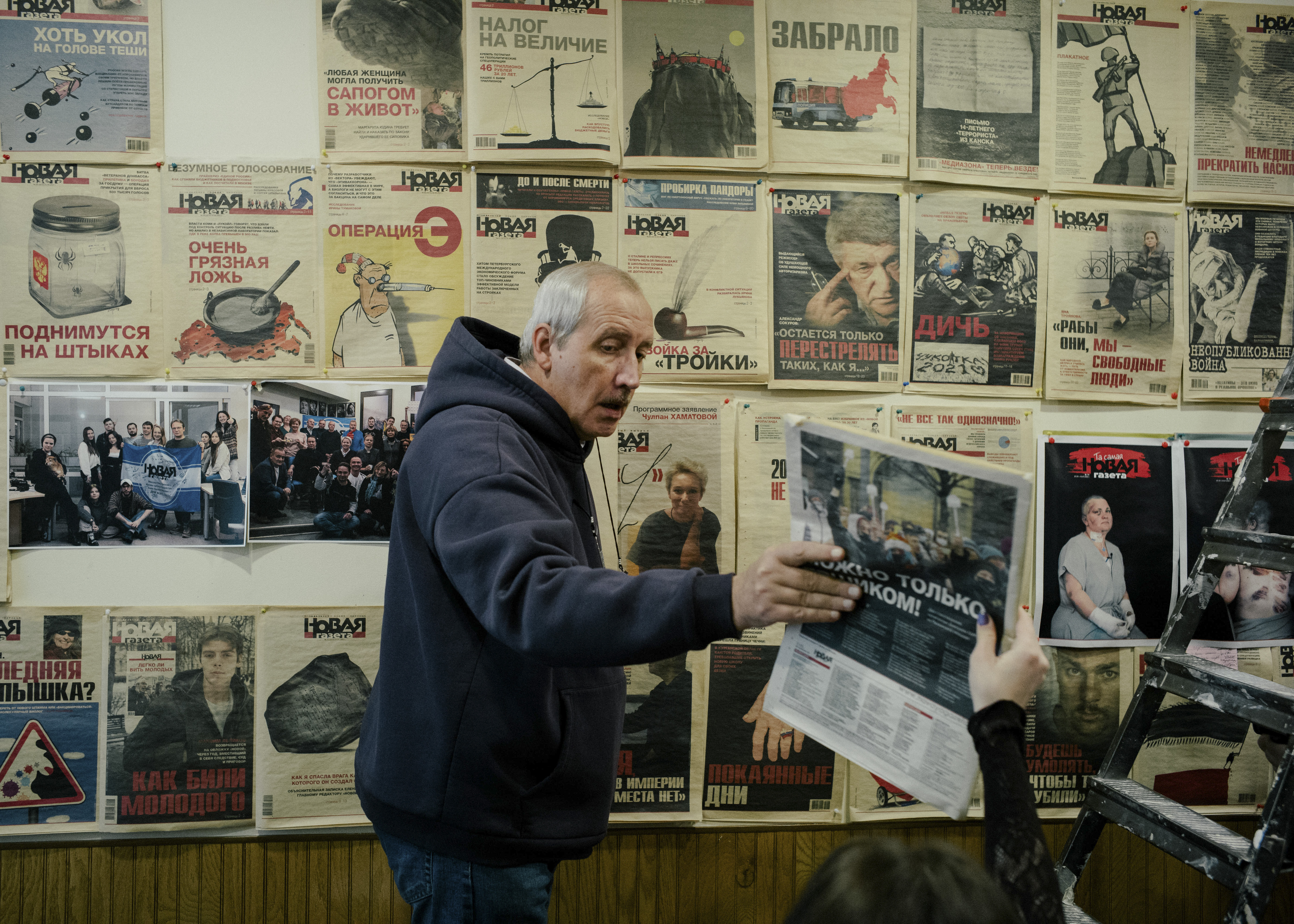
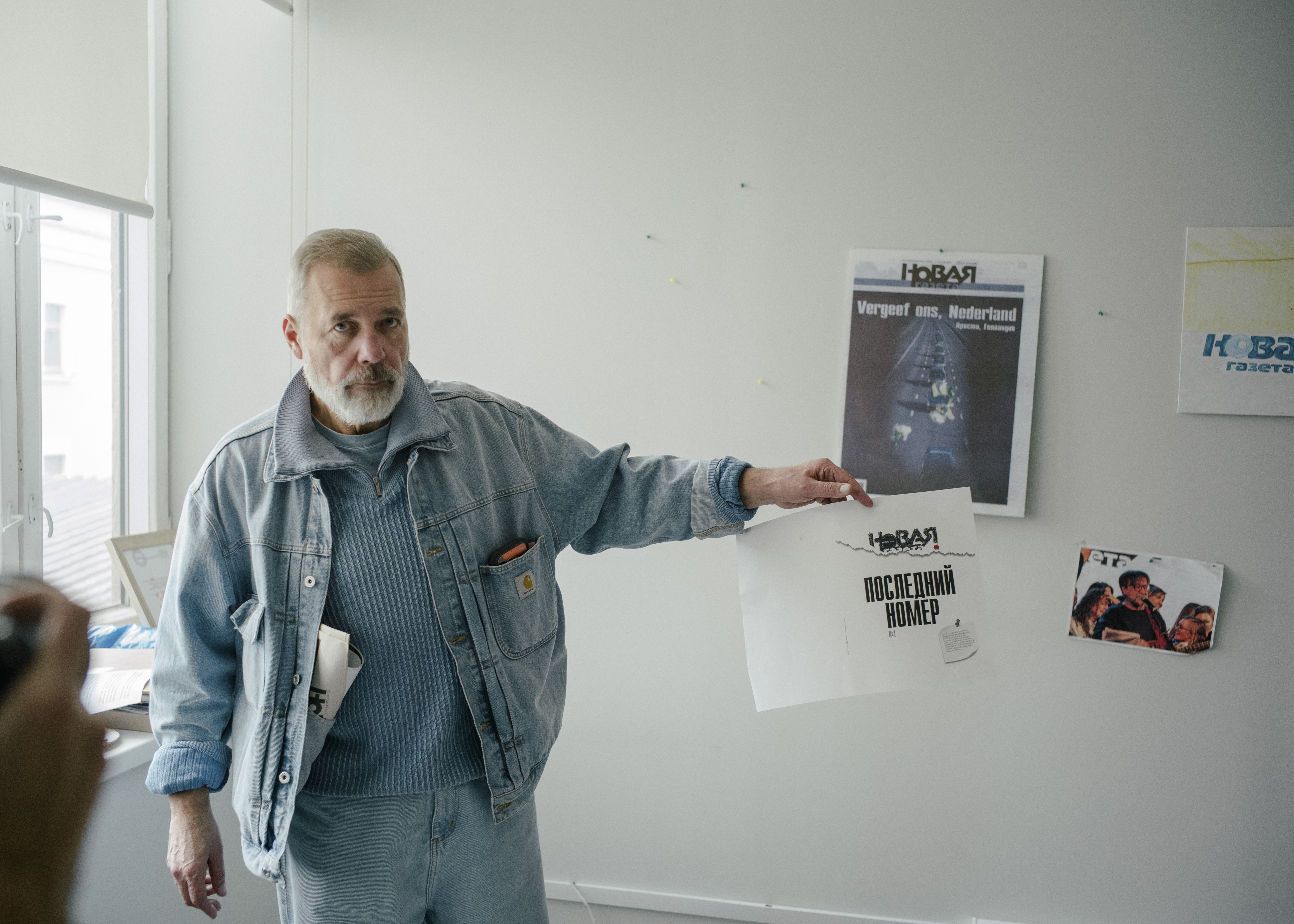
    Novaya Gazeta’s journalists were packing up their offices when I visited Monday. Its co-founder Dmitri A. Muratov, who shared the Nobel Peace Prize in 2021 for defending press freedom, was giving away personal items to colleagues and well-wishers.

    He handed his emerald banker’s lamp to one of the paper’s last recruits, a video journalist. He kept for himself a fire evacuation floor plan, on which he asked staff members to sign their names where their offices had been.

    “The people in our country who stand for peace were not given the opportunity to read what they want,” said Dmitri A. Muratov, a founder of Novaya Gazeta.Nanna Heitmann

    The office once occupied by Anna Politkovskaya, an investigative journalist and Kremlin critic who was gunned down on President Vladimir Putin’s birthday in 2006, had already been cleared out. Her computer, eyeglasses, and notebooks, left in place for 20 years after her murder, are now in storage.

    While the occasion was somber, the journalists were not despondent. In many ways, it was a miracle that the newspaper had survived for as long as it had.

    After its start in 1993, less than two years after the fall of the Soviet Union, Novaya Gazeta chronicled Russia’s chaotic 1990s, its consumerist 2000s, its increasingly repressive 2010s, and Putin’s near-total consolidation of power in the 2020s.

    It carried on even as six of its journalists were killed and others violently attacked. It kept publishing after its website was blocked, its media license revoked, its printing press seized, and one of its journalists detained.

    But it could not, at least in its current form, outlast Russia’s war in Ukraine. The double death blows came last month, when its landlord refused to renew the lease and the banks that had processed reader donations, the paper’s sole form of income, said they would stop doing so. None of the journalists consider this a coincidence.

    “No one is in shock here,” one of the paper’s journalists, Tatiana Britskaya, said as she walked the halls amid the boxes and plastic wrap. “The process of silencing us started many years ago.”

    The journalists had tried to adapt to Russia’s wartime reality. They did not report about what was happening on the front lines, because censorship laws passed in March 2022 had made it a crime to use anything but government sources for such reports.

    Internally, they debated whether it made sense to keep operating under those conditions, and the newsroom had been divided about it, said Britskaya, 43. But she said their readers overwhelmingly wanted them to continue, even if they had to abide by the new laws.

    “They said, ‘Continue, because many of us are post-Soviet people, and our entire lives were spent reading between the lines. What matters to us is that you stay with us,’” Britskaya said.

    The paper published front pages with the word “war” blurred out. But its journalists wrote unflinchingly about lives that were taken or forever damaged by the conflict. With philanthropy and activism at the core of its mission, Novaya Gazeta also encouraged readers to help those in need of assistance and organized fundraisers of its own. The paper made its anti-war position eminently clear, withstanding the pressure until it became insurmountable.

    At noon Monday, the journalists gathered for their final editorial meeting, as dozens of reporters — mostly foreigners — filmed the scene. The editor-in-chief, Sergei Sokolov, listed the articles and columns that would run in the final issue.

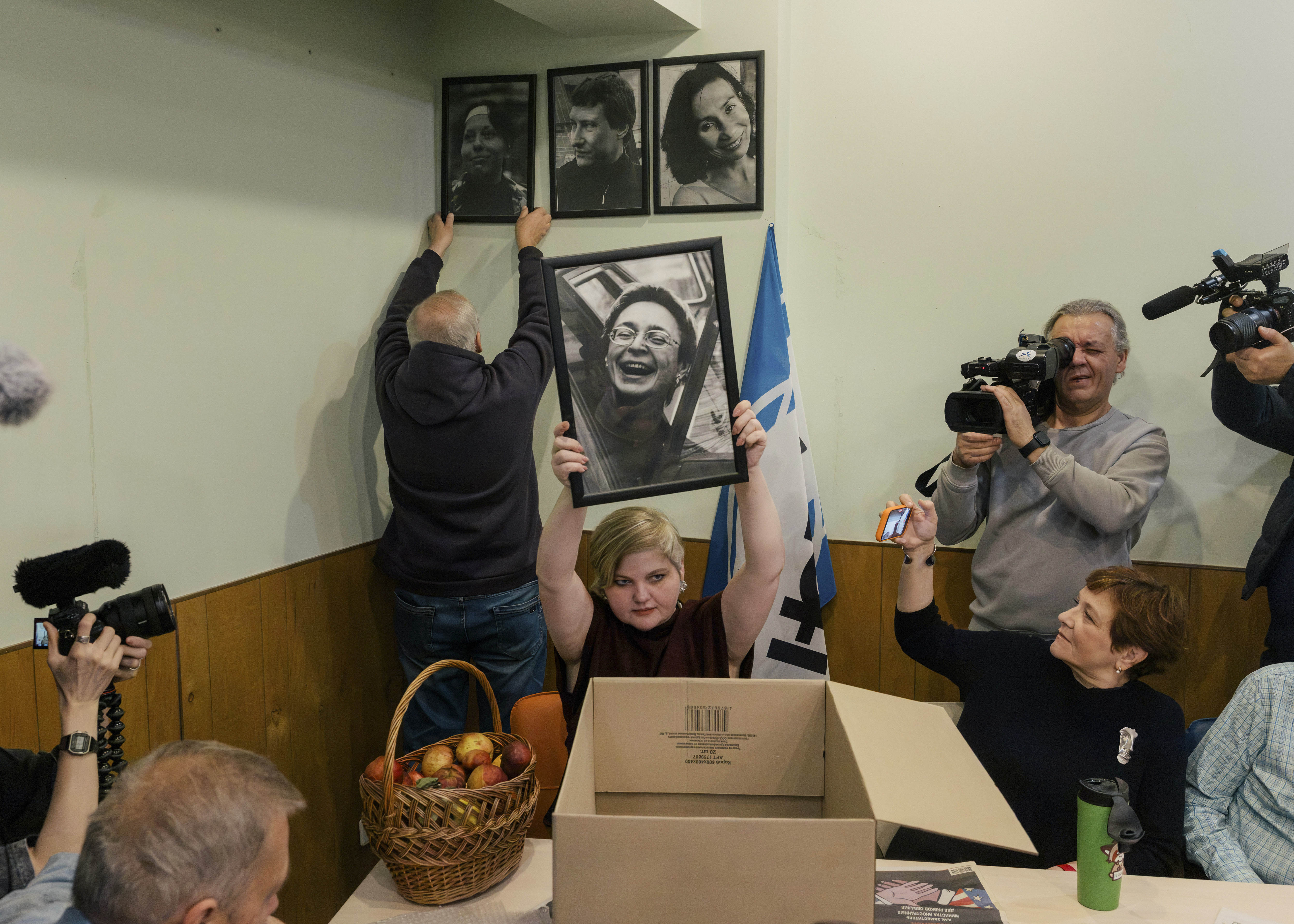
    Tatiana Britskaya, a Novaya Gazeta journalist, held up a picture of Ms. Politkovskaya before it was packed away on Monday.Nanna Heitmann

    There was an investigation into an orphan rescued from an abusive psychiatric hospital, who was subsequently drafted and killed in the war. An article about teenagers who had fallen prey to scammers. A report on representatives from the anti-war Yabloko party taking office in the parliament of Nizhny Novgorod, the only region of Russia that allowed the party to field candidates.

    After announcing that Novaya Gazeta’s website and social media channels would stop being updated with new content at midnight, Sokolov recalled the words of exiled Orthodox priest Andrei Kordochkin, a columnist for the paper who was stripped of his Moscow congregation because of his anti-war position. Despondency, Kordochkin had said, is the seventh sin.

    Slowly, the journalists took down portraits of their six slain colleagues that had watched over every editorial meeting: Igor Domnikov, Yuri Shchekochikhin, Stanislav Markelov, Anastasia Baburova, Natalia Estemirova, and Politkovskaya.

    “We are not saying goodbye,” Sokolov said. “We definitely will return, because Novaya Gazeta is not a newspaper, not a website — it is an idea, a way of life for those who work here. And it is impossible to kill and impossible to close. We will live. I am sure that society, caught in this terrible time, will finally stir.”

    The journalists went outside for a final photo as “Eto Vsyo” (“That Is All”), a popular rock ballad, played on a sound system. The song, a hit in 1994 for Russian rock band DDT, is about loss and mourning, but also about the triumph of love. Its lead singer, Yuri Shevchuk, recorded a new acoustic version in honor of Novaya Gazeta after it announced that it would close.

    Shevchuk is Russia’s Bruce Springsteen. After declaring that he opposed the war, he was interrogated, charged with “discrediting the Russian armed forces” and effectively blacklisted from performing in Russia. Now he only tours abroad, like all of Russia’s anti-war singers. The Kremlin has instead promoted nationalist artists who sing about the country’s greatness.

    Muratov used the media coverage of the paper’s closure to call for distinguishing Russian authorities from the people of Russia.

    “This is not a war of Russia with Ukraine — it is a war of the Kremlin with Ukraine,” he said. “The people in our country who stand for peace were not given the opportunity to read what they want — we see this today — or to vote for the anti-war party, Yabloko, that they would have liked to vote for.”

    Novaya Gazeta journalists in front of the building on Monday. Sergei Sokolov said it was not a newspaper but an idea, “impossible to kill and impossible to close.”Nanna Heitmann

    He called for freedom for Russia’s thousands of political prisoners and for humanitarian evacuations for Ukrainians trapped by the war. “This madness, this slaughter must be stopped,” he said. In contemporary Russia, those are dangerous words.

    Among those who came to bid farewell was Yan Rachinsky, the former head of Memorial, the Russian rights group that shared the 2022 Nobel Peace Prize. Memorial, which was created to preserve the memory of those persecuted by the Soviet regime, was officially labeled “extremist” in April, making it a criminal offense to be affiliated with the group.

    A small museum that was operated by Memorial, with rotating exhibits about life in the Soviet gulag, is now closed. Since Memorial was labeled an extremist group, memorials to victims of the gulag in public squares across Russia have been dismantled.

    Russian authorities have also gone after nonconformist communities. “Promoting” LGBTQ+ relationships or a “child-free” lifestyle has been illegal for years. Police in Moscow recently carried out raids in the neighborhood of Kitai Gorod, a popular gathering place for counterculture youth.

    Kremlin spokesperson Dmitry Peskov called the closure of Novaya Gazeta a “normal process of turnover.”

    “Of course, every year some media outlets close, and new ones take their place,” he said Monday during a call with reporters.

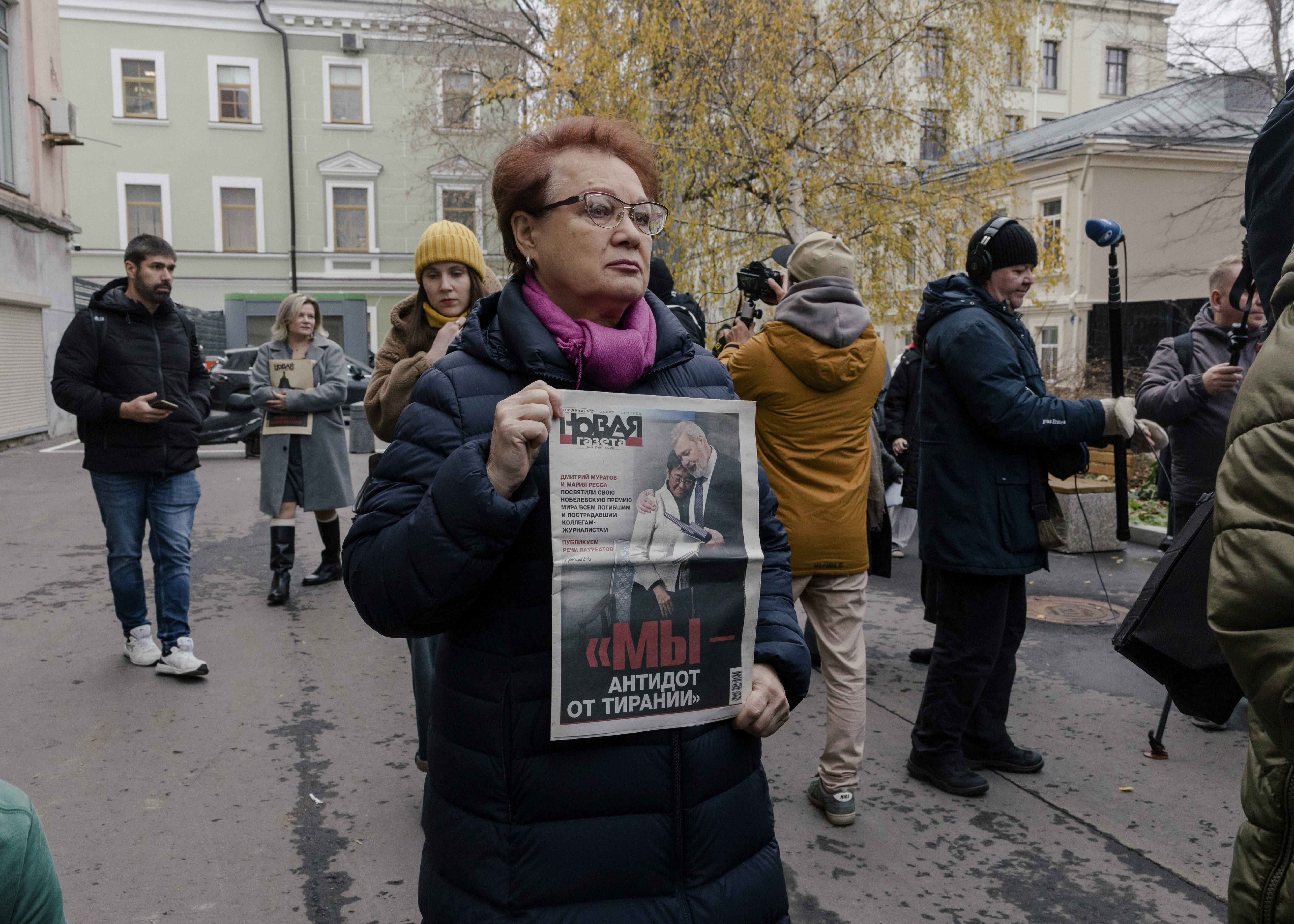
    “We are the antidote to tyranny,” reads the headline on this 2021 issue of Novaya Gazeta, featuring Dmitri A. Muratov and the Philippine journalist Maria Ressa after they were awarded the Nobel Peace Prize.Nanna Heitmann

    But Novaya’s journalists, and many of its readers, know this was not a matter of economics.

    “When voices like these disappear from public life, it starts to feel like there are fewer and fewer people who think differently, like you’re alone in what you believe,” said a 21-year-old reader, Danila, a recent university graduate with a degree in computer programming. He asked that his last name not be published, to avoid trouble with authorities.

    “The less you hear people expressing views different from the official narrative,” he said, “the harder it gets to speak up yourself.”

    This article originally appeared in the New York Times.