Category: News

  • DA’s office says two prosecutors who said Krasner told them to ‘protect the office’ in controversial case are ‘ill-informed’

    DA’s office says two prosecutors who said Krasner told them to ‘protect the office’ in controversial case are ‘ill-informed’

    The Philadelphia District Attorney’s Office said Thursday that the two prosecutors who accused DA Larry Krasner of encouraging them to act unethically in a controversial appellate case did so in a court filing that was both unauthorized and “ill-informed.”

    In a court document filed late Thursday, written by Assistant District Attorney Thomas Gaeta and signed by Krasner, the office said prosecutors Katherine Ernst and Steven J. Wildberger acted inappropriately and without Krasner’s permission when they filed a brief Monday saying the office had a conflict in the appeal of Dennis Johnson, who is seeking to have his murder conviction overturned.

    The office said it had taken steps to address all of the issues it saw with Johnson’s case, and that Ernst and Wildberger’s assertions were “ill-informed” and made without firsthand knowledge because they were no longer a part of the case.

    The filing primarily focused on the steps the office took to ensure it was handling the case in a legal and ethical manner — and did not directly address the two prosecutors’ contentions that Krasner had asked them to “protect the office.”

    In their filing Monday, Ernst and Wildberger said they tried to persuade Krasner to allow the state attorney general’s office to take over Johnson’s appeal after the prosecutor previously assigned to the case, Jaclyn Mason, recommended that his case be overturned — a recommendation the office later sought to reverse, saying Mason’s filing was full of false statements.

    U.S. District Judge Paul S. Diamond then ordered a hearing on the matter. And in explosive testimony in federal court last week, Mason said she had sought to vacate Johnson’s conviction at the direction of her boss, Matt Stiegler — whom she accused of colluding with defense attorneys. Stiegler has said that was not the case.

    Mason, who has since resigned, also said she was later told to lie about the case to minimize scrutiny of the office.

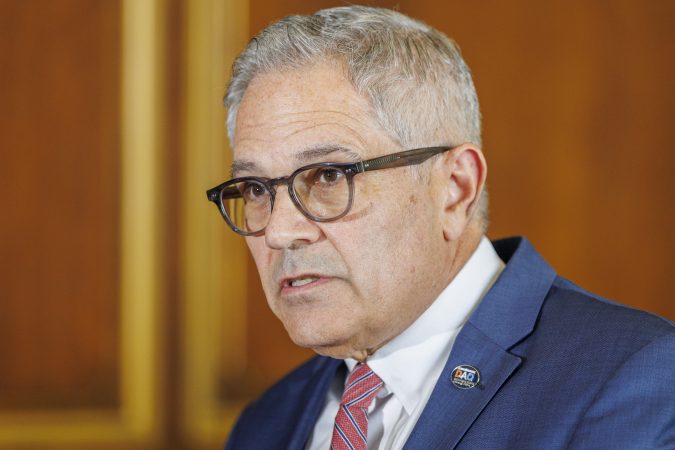
    District Attorney Larry Krasner at a 2025 press conference. Tom Gralish / Staff Photographer

    Ernst and Wildberger, who work in the law division of the DA’s office, said that as they were evaluating the case in the spring, they tried to encourage Krasner to refer the case to the state attorney general because of issues with how it was handled.

    For example, they said, Stiegler, the supervisor who they believed had made mistakes while overseeing the case, was still offering legal advice about it from a different role in the office, which Ernst and Wildberger viewed as self-interested and “inappropriate” because of his potential interest in clearing his name rather than evaluating the case on its merits.

    But Krasner’s office kept the case. And as they deliberated how to move forward, the two prosecutors wrote, Krasner told them “to litigate the case in a manner to ‘protect the office.’”

    Then, in late June, Ernst and Wildberger wrote, they again asked Krasner to refer the matter to state prosecutors, but “DA Krasner stated that there would be ‘consequences’ for anyone who notified the court of the conflict issues.”

    Ernst and Wildberger then filed a notice in federal court saying they believed the DA’s office was beset by conflicts and should not handle Johnson’s appeal.

    Krasner’s team, in its first response to the matter this week, said that was not true.

    Ernst and Wildberger, they said, were appropriately excluded from the case as soon as they disclosed a personal conflict with it, and did not have firsthand knowledge of the office’s discussions thereafter.

    The prosecutors “are disqualified from filing or speaking on behalf of the Commonwealth” and were not authorized to file the “notice of conflict” or to speak for the office about the matter, they said.

    Any discussions Ernst and Wildberger had with the office about the case are privileged conversations they should not be able to disclose, the DA’s filing said.

    To remedy the issue, the office said, it has hired a new prosecutor to handle the case who has been walled off from the ongoing conversations. Assistant District Attorney Jean Peters-Baker, who recently joined the office and has spent more than 25 years as a prosecutor, will review Johnson’s case and decide if it has merit, the filing said.

    Johnson was convicted of second-degree murder in 2009 in the shooting death of Kenyatta Smith during a robbery outside a North Philadelphia convenience store two years earlier. He was sentenced to life in prison.

    Johnson appealed his conviction, in part because he said his trial attorney was ineffective. Mason filed court documents in 2022 agreeing with that assertion and saying Johnson’s conviction should be overturned.

    But then, this spring, others in the office reviewed the case and took the opposite view.

    Ernst and Wildberger said they were prepared to testify before Diamond about the situation. Others in the office are also expected to take the stand as the case proceeds.

    The judge has not yet scheduled a date for testimony.

  • Cecily Tynan is retiring from 6abc after three decades on Action News

    Cecily Tynan is retiring from 6abc after three decades on Action News

    The big story on Action News is the departure of Cecily Tynan.

    The beloved meteorologist is retiring after more than three decades at 6abc, a trailblazing career spanning major weather events, including Hurricane Sandy, the Blizzard of 1996, and devastating flooding in Philadelphia following Hurricane Ida.

    Tynan’s last day with the station will be Monday, Aug. 31.

    At the end of the 6 p.m. Thursday newscast, Tynan publicly confirmed her plans.

    “After more than 30 years at Action News, I will be retiring in a few weeks, and honestly, I’m thrilled about it,” Tynan, 57, said.

    “This has been in the works for a while. I’ve been counting down here at the station. Both my children have graduated from high school. My daughter is going to college in less than a month, and she’ll be running cross country and track. And my husband and I, we plan to attend every single one of her meets. So it’s the right time for me. It’s the right time for my family, and I’m so very thankful,” Tynan said.

    Responding to her announcement, anchor Brian Taff told Tynan: “You are a treasure, not just in this newsroom, of course, but among everybody out there watching who loves tuning in every night and feeling the comfort of having Cecily Tynan tell them what’s coming up.”

    In a written statement, Tynan said she was “honored” to have been a key part of the Action News team, where she began as the station’s first-ever weekend meteorologist before becoming its first female chief meteorologist in 2009, replacing the retiring Dave Roberts.

    “I’m proud of the work we’ve done and thankful to 6abc viewers for trusting me with their weather forecasts,” Tynan said, adding she plans to spend her winters “in Florida water skiing, traveling and having lots of quality time” with her family.

    Tynan is a mainstay in Philly’s closely watched TV news ecosystem, spending much of her career alongside famed anchor Jim Gardner on the 11 p.m. edition of Action News before his retirement in 2022.

    Cecily Tynan cleans a cab with former WIP host Howard Eskin during a fundraiser at the Wyndham Franklin Plaza Hotel in 1999.G.W. MILLER III / Philadelphia Daily News

    She began at the station in 1995 as a weekend weather anchor and reporter, parlaying a two-year contract into a multidecade career that also included the 5 p.m. and 6 p.m. newscasts and a prime spot on the station’s Thanksgiving Day parade coverage.

    “From the moment she first walked off the elevator and joined Action News, Cecily has been a trusted voice for viewers, a leader in our newsroom, and one of the most talented broadcasters in Philadelphia,” John W. Morris, 6abc’s general manager, said in a statement. “Whether guiding us through storms or being part of our holiday traditions, Cecily has been a part of our lives for a long time.”

    On Oct. 9 last year, Tynan celebrated her 30th anniversary in a social media post, recalling that she had originally planned to stay with the ABC network’s Philadelphia station for three years.

    “That’s what happens when you find your ‘home,’ where your co-workers evolve into some of your closest friends,” Tynan wrote.

    “If you love what you do, you never work a day in your life. Thank you from the bottom of my heart!” she added.

    Prior to landing in Philly, the Connecticut native made stops in Las Vegas and Roanoke, Va. She also previously hosted the public affairs show Primetime Weekend.

    “As much as our viewers are going to miss her, we will miss her even more,” Morris said.

    While Action News has been known for its stability, Philly’s most-watched news broadcast has said goodbye to a few notable people recently. Fellow meteorologist Chris Sowers left the station in 2024 to join the ABC affiliate in West Palm Beach, longtime general manager Bernie Prazenica retired in 2025, and Tom Davis, the station’s former vice president and news director, departed in March.

    There have also been a few departures on the sports side, including reporters Gabriella Galati, Jeff Skversky, and Jamie Apody. Both Skversky and Apody later landed at Fox 29.

    The station hasn’t yet announced Tynan’s replacement. Among the candidates are 6abc veterans Karen Rogers, Adam Joseph, and Brittany Boyer.

  • A presumed lightning strike forced 2 store closures on Maple Shade’s Main Street

    A presumed lightning strike forced 2 store closures on Maple Shade’s Main Street

    From this past December to April, Julie Hause took only three days off. The rest of her time was spent on Maple Shade’s Main Street, transforming the longstanding chocolate shop she purchased in 2023.

    Hause spent months personally ripping up the worn green carpet by hand, installing laminate flooring, repainting, and more, breathing new life into the aging downtown staple.

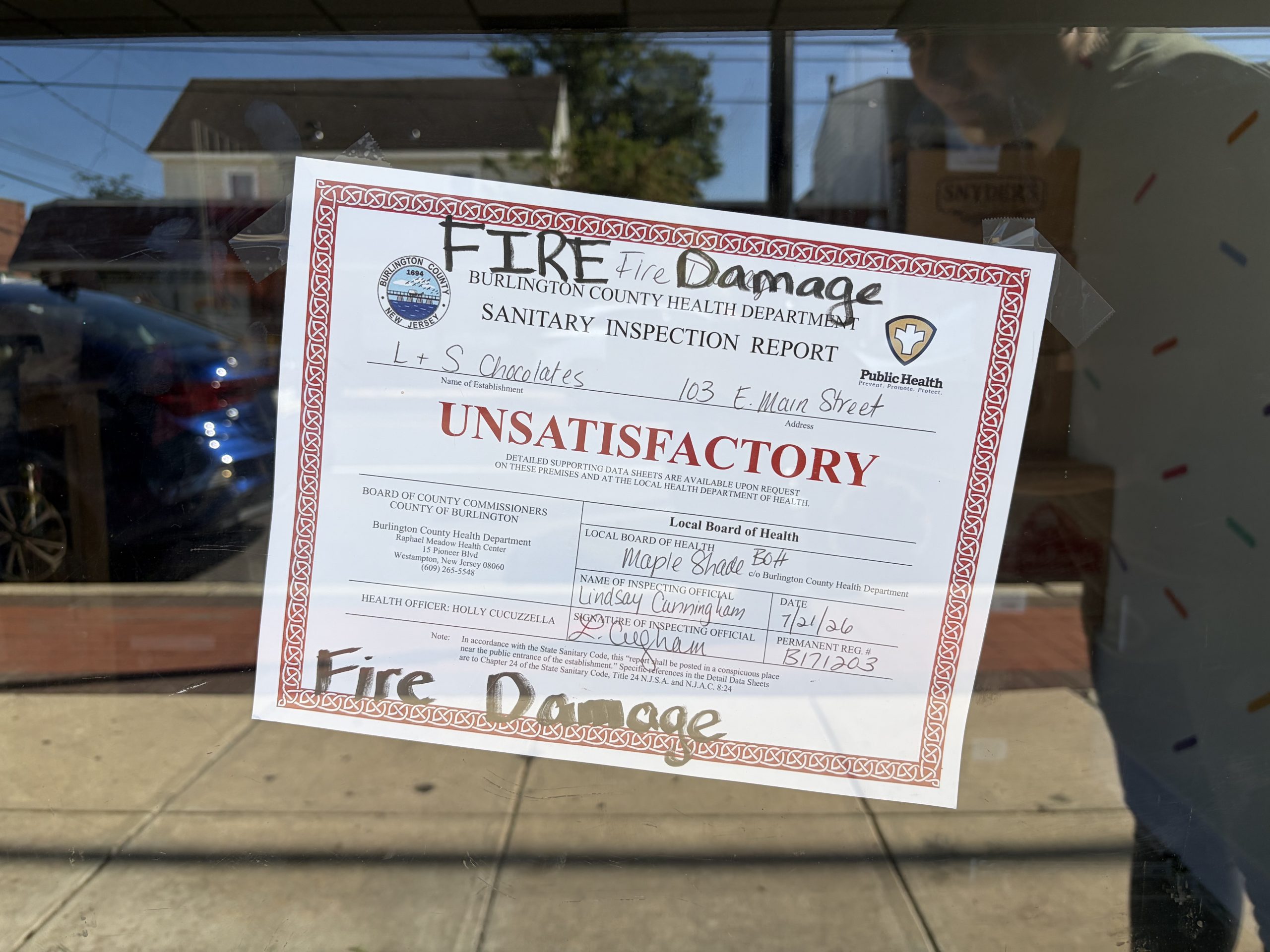
    Now, her L&S Chocolates is closed with extensive smoke, water, and roof damage from a fire Tuesday night that is suspected to have been caused by lightning.

    “It was a group effort. My husband, my kids, my friends — everybody came in and we did it all ourselves. And that’s why I’m so devastated,” Hause said. “I put my blood, sweat, and tears into this. And now, I feel like it literally went up in smoke or washed away in a flood because that’s what I’m dealing with.”

    Hause was in her shop — which had been open for less than four months — when powerful storms rolled through South Jersey Tuesday evening and she heard a “very loud crack” that came from the back of the neighboring bakery, she said.

    The lights flickered in an unusual way, “a really quick stutter of flashing,” she said, before she smelled something burning. Hause quickly searched in her back workroom for the source of the fire before exiting the building and calling the fire department, she said.

    The official investigation into the cause of the fire is ongoing, Maple Shade Fire Marshal Matthew Orsini said.

    Firefighters responded to the scene at 5:53 p.m. Tuesday when they located the fire in “a small area involving the rear exterior wall and roof” of the bakery, Orsini said. The bulk of the fire was extinguished within 10 minutes, he said.

    “Damage was limited primarily to the vinyl siding on the rear exterior wall and an approximately 5-by-5-foot section of the roof,” Orsini said, noting that the concrete construction beneath the siding helped prevent the fire from extending into the interior of the building or the adjoining property.

    The National Weather Service confirmed there were lightning strikes in the area around the time of the fire but the agency does not collect the location-specific data needed to determine whether a particular building was struck or not, a meteorologist with the NWS office in Mount Holly said Thursday.

    Tis So Sweet, the adjoining bakery, posted on social media shortly after Tuesday’s storm announcing that it will be closed until further notice.

    “Unfortunately our Maple Shade store was struck by lightning during this evening’s storm and will be closed until we can clean up and repair damage,” the bakery wrote.

    By Thursday morning, cakes and cupcakes were still sitting in the display cases inside the shuttered bakery on the corner of Maple Avenue, and an “unsatisfactory” designation from the health department was taped to the front door. The bakery’s owners could not be reached for comment.

    L&S Chocolates is closed until further notice due to smoke and water damage from a suspected lightning-caused fire in Maple Shade on Tuesday.Lacey Latch

    Since the fire, Hause has spent nearly every waking moment trying to determine her next steps. Fielding visits and phone calls from the health department, multiple insurance adjusters, her landlord, and more, she said it will likely be at least four to six months before she can reopen the store.

    “It’s hard. I put so much work and effort into this. I cried most of last night, I’ve cried most of today,” Hause said Wednesday afternoon. “Maybe a couple days off of just breathing and relaxing, and then I’ll figure out my next steps.”

    Before the fire, Hause had begun developing ideas for classes and community events that she could host at the store, like cake decorating classes or a “Chocolate & Sip” wine night. Now, she’s just taking things “hour by hour” as she starts to rebuild.

    “I’m scared. I’m absolutely scared for my future now,” she said. “After putting everything into this and, overnight, it’s gone.”

  • Government withdraws subpoenas of 3 reporters for the New York Times after admitting legal errors

    Government withdraws subpoenas of 3 reporters for the New York Times after admitting legal errors

    NEW YORK — Criticized by a federal judge for sloppy legal work, the government on Thursday grudgingly withdrew subpoenas that would have compelled three New York Times reporters to testify about their sources for articles about President Donald Trump’s Qatari-gifted Air Force One jet.

    The withdrawals in U.S. District Court followed a remarkable back and forth between a visibly irritated Judge Arun Subramanian and government lawyers. They come at a time when the Trump administration is vigorously going after news organizations whose reporting and coverage it doesn’t like — and also trying to crack down on leaks inside the government.

    The government’s retreat in the face of vigorous legal opposition and a stern reprimand from a judge marked the latest instance of the Justice Department pulling back on its aggressive efforts to compel journalists to identify their sources before a grand jury. The administration recently withdrew similar subpoenas that sought to compel testimony in Virginia from journalists for the Washington Post and the Wall Street Journal related to separate national security coverage.

    Subramanian said he otherwise would have granted the newspaper’s request to reject the subpoenas because laws and regulations pertaining to subpoenas served on journalists maintain that they should be issued as a last resort in an investigation.

    “Subpoenas are the last step, not the first step, but the last step,” the judge said, citing rules set to protect against violations of the First Amendment. He said the government’s actions had turned the law and the regulations “on its head.”

    “When you see something like this, if this were a civil proceeding, what I would normally do is ask the parties to show causes why sanctions should not be issued,” the judge said, referencing punishment for lawyers for egregious actions.

    After the hearing, the Justice Department lashed out at the judge in a statement, saying he “threatened our attorneys with sanctions unless subpoenas were withdrawn, and blocked us from presenting the meticulous process of this investigation.”

    “The grand jury has a right to hear testimony from all material witnesses in a federal criminal investigation. This judge’s conduct overrides clear longstanding principles and common sense — blocking the grand jury from receiving core evidence in a national security investigation,” the statement said.

    “Make no mistake,” it added, “this investigation remains ongoing, and we will pursue justice against those threatening national security by leaking classified information, a serious federal crime.”

    Government attorneys upbraided by judge

    Subramanian noted that with protections for journalists at stake, the government was required to ensure it could not obtain what it needed from any other sources before issuing subpoenas to journalists.

    A Justice Department lawyer, Sean Buckley, cast the government’s missteps as inadvertent errors and said “no one was trying to pull a fast one.” Buckley apologized for other subpoenas that sought records for phone numbers belonging to one reporter’s mother and two of the journalists’ spouses.

    “That was an error, judge, which we own,” Buckley said. “It was a consequence of trying to move quickly.”

    “These things are starting to pile up,” Subramanian said, becoming increasingly testy.

    The hearing was held publicly despite efforts by the Trump administration to keep secret the litigation spawned by subpoenas it served on the Times’ journalists to try to get them to divulge their sources.

    The newspaper’s lawyers had challenged the validity of the grand jury subpoenas, along with subpoenas issued for phone records of several Times journalists and some of their relatives. Senior Times officials, including the paper’s managing editor and general counsel, sat in the gallery watching during Thursday’s proceedings.

    The request for phone records raised questions about the extent of the investigation being carried out by the Justice Department.

    David McCraw, the Times’ chief newsroom lawyer, said after the hearing in a statement that it “was an important affirmation of our country’s commitment to a free press.”

    “We are pleased that the government finally conceded that the subpoenas violated the law, but they should never have been issued in the first place,” he said. “We will not be deterred in the face of tactics like these.”

    Court action comes after reporting on new Air Force One jet

    The new jet in question, a present from Qatar that Trump’s administration spent $400 million to retrofit and upgrade, recently entered service. But Trump used an older model Air Force One jet to leave a NATO summit in Turkey earlier this month.

    The Times, citing anonymous sources, reported that the switch had come at the urging of the Secret Service and that the newer plane lacked some of the advanced security features of the older Air Force One aircraft, including antimissile capabilities. On social media, Trump rejected claims of security concerns.

    The Times wrote in a letter to the judge several days ago that two subpoenas seek records beginning on Jan. 1, long before the newspaper published articles on July 8 and July 9 that became the basis for the grand jury subpoenas.

    It said that lengthy stretch of records sought would indicate that the purpose of the subpoenas might have been “to forage for information about the Journalists’ source relationships more broadly.”

    The Times argued for the phone records subpoenas to be disallowed on the grounds that the government had acted in “bad faith” and ignored its own protocols by not giving the journalists advance notice that records were being sought and by demanding the information “without first conducting any serious investigation.”

    The Justice Department has justified the grand jury subpoenas by saying that “reporters are not the targets, those leaking classified information are.”

    The Justice Department also said it had complied with its own regulations in issuing the subpoenas and had taken investigative steps before seeking them. It said it was authorized to delay disclosing the subpoenas but decided to alert the journalists’ lawyers so they could challenge them.

    In fighting the subpoenas, the Times’ lawyers highlighted how the government’s carelessness could have exposed sensitive information that had nothing to do with the journalists. The mother whose phone records were mistakenly sought is a mental health professional with confidential client relationships and one of the two spouses is the general counsel of a law firm, the lawyers said.

    At Thursday’s hearing, a final rebuke from the judge to the government came when he asked its lawyers to assure him that it won’t repeat a scenario that left one journalist being served a subpoena by an FBI agent while he was home watching the family-friendly movie The Sheep Detectives, about sheep on a quest to solve the murder of their shepherd.

    Said the judge, to loud courtroom laughter: “I can’t think of anything more inconsistent with ‘Sheep Detective’ than an FBI agent showing up at your door.”

  • Fatal police shooting of man with knife roils Madison, Wisconsin

    Fatal police shooting of man with knife roils Madison, Wisconsin

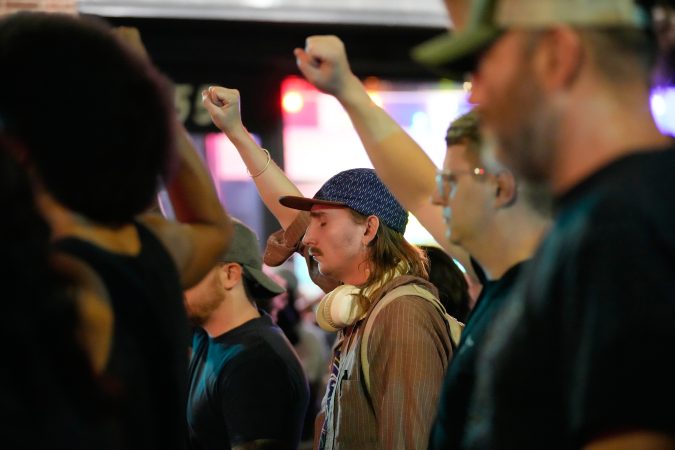
    MADISON, Wis. — Protesters burst into a Thursday news conference about the police shooting of a homeless man in Madison, taking the microphone from the police chief and arguing with some attendees who said they wanted to hear more about the investigation.

    The group of roughly 20 protesters burst into the room at the Madison police station, shortly after Mayor Satya Rhodes-Conway and Common Council President Sabrina Madison identified the man killed by police as Corey Durell Ruiz, a homeless resident.

    Ruiz, 38, was shot and killed Wednesday after police said he resisted arrest and injured an officer with a knife.

    Police Chief John Patterson stepped away from the microphone when the protesters were shouting, and one man in the group took his spot at the podium. The event quickly devolved into a shouting match.

    One protester held a sign saying “Corrupt cops deserve to die too!!!”

    Moments earlier, the mayor said the shooting will be “rigorously investigated.”

    “It does not matter who you are or what your past is, you should not lose your life as a result of an encounter with law enforcement,” Satya Rhodes-Conway said.

    Madison, for her part, said “Corey could have been my brother because my brother is homeless and he often rides a bike.”

    Court records show Ruiz had been in and out of jail over the past decade on charges including failing to pay child support, driving a vehicle without consent, jumping bail, threatening authorities, taking a vehicle without consent, possessing drug paraphernalia, resisting an officer and retail theft.

    “He’s a human being. He had a family. He has parents who loved him who brought him home, who cared for him,” Madison said, adding that she’s struggling to understand what she’s seen in videos of the shooting that have circulated on social media.

    “My first thought is, when the officer’s walking away, why isn’t he walking away in cuffs,” Madison said. “I’m angry, there’s no way around it.”

    Once the protesters quieted down, the chief resumed his presentation, promising his department’s full cooperation with the state investigation.

    Police have released few details

    The shooting has roiled Wisconsin’s capital city, with Gov. Tony Evers calling for “transparency and accountability” and Madison community members gathering Thursday at a growing memorial.

    None of the four officers who were detaining the man wore body cameras, but passersby recorded the confrontation on video, and accused the officers of overreacting.

    “I thought, ‘Holy cow — what could have warranted that?’ It looked to me like they had him under control,” David Ortiz-Whittingham, who saw officers swarming and heard the gunshots, said Thursday. “Even now, knowing about the knife, did he have to die for it? Could this have been de-escalated without him losing his life?”

    The police chief released few details Thursday, saying the Wisconsin Department of Criminal Investigation into the officer-involved shooting must run its course.

    Earlier Thursday, Madison’s independent police monitor, Aeiramique Glass, said police have not yet shared evidence or the officer’s identity with her office, which will review the case and can recommend to the district attorney that charges be filed if warranted. She said the department and city are “obstructing what the community and the public” want.

    “Let me do my job,” she said.

    Patterson said the police were committed to cooperating with Glass as the independent monitor’s investigation is carried out, at the same time as the state’s probe.

    The chief urged people not to draw conclusions

    Patterson has urged caution in reading too much from the cell-phone videos. He said none show the perspective of the officers, and additional video that hasn’t been released is being reviewed.

    The officer who fired his weapon is a veteran of the force, the chief said. He and the three other responding officers will be placed on administrative leave pending an independent investigation by the Wisconsin Department of Criminal Investigation, as required under state law.

    Patterson said police were responding to calls that someone was attempting to enter parked vehicles, and the suspect fled on a bike before the officers surrounded him. One deployed a taser, but Patterson said he didn’t know if the taser worked. Those efforts failed to control the man, Patterson said.

    In the videos circulating online, the man can be seen standing before he’s brought to his knees as the officers struggle to force him into a prone position. Then he falls quickly to the pavement after what sounds like three gunshots, and seems motionless as the officers handcuff him behind his back. Arriving officers then escort one of the officers a short distance away.

    Patterson said he did not know the extent of the injuries sustained by the officer who was injured by the knife.

    “This situation was clearly dangerous,” Patterson said. He later continued, “I am incredibly saddened by the loss of life.”

    A neighborhood now accustomed to police shootings

    The shooting happened in the middle of an intersection in the popular Marquette neighborhood, which is lined with restaurants, bars, shops, and homes less than 2 miles from the state Capitol. The bystander videos show numerous cars at the scene, with people watching and commenting as it unfolded.

    “I saw everything! I saw everything! You did not need to kill him! … We watched it all!” a woman yelled in the video recorded by Ortiz-Whittingham. Three loud shots could be heard among the sirens, followed by screams.

    Residents who dealt with two other police killings within the same few blocks expressed their frustration on Thursday.

    In 2015, a white police officer shot and killed Tony Robinson, who was biracial, on the same street. Large protests followed, but the district attorney filed no charges, determining the officer was justified. In 2012, Paul Heenan, a white musician, was fatally shot after he had been drinking and mistakenly entered his neighbor’s house. That officer was exonerated as well.

    The chief acknowledged that the neighborhood “has experienced a lot of trauma” and urged people to support one another.

    “I want transparency, I want accountability,” Patterson said.

    Questions about race and technology emerge

    The race of the officer who fired his gun on Wednesday and that of the man he killed were not released by police.

    But Black advocacy groups, protesters, and politicians spoke out against the crime and said they believe the man was Black.

    The shooting also focused attention on the Madison Police Department’s lack of body-worn cameras. The force of around 500 is among the largest in the Midwest that doesn’t use the devices.

    Common Council President Sabrina Madison said Thursday that she expects a police request for $400,000 to be approved, enabling the cameras to be phased in over the next three years. Others lamented that cameras aren’t already being used.

    “Nobody can agree on anything,” said Katey Nelson, a member of the police civilian oversight board and operations director at YWCA Madison, a racial justice group. “Now we’re here, looking at another police shooting where we don’t have what we need to make sure the officers are held accountable.”

    The mayor said her budget, which has not yet been released, will include funding for body-worn cameras. Rhodes-Conway said the city needs to put together a policy for the use of the cameras, and said that will be completed before the budget takes effect in January.

    And now it’s a talking point in the governor’s race

    Madison, home to the University of Wisconsin, has a long history of organized protest dating back to the 1960s. More than 100,000 people marched on the state Capitol in 2011 in favor of union rights. There were large demonstrations that turned violent after the George Floyd shooting in 2020.

    And so the shooting quickly infused itself into the race to succeed Evers as governor, with voting already underway in the Aug. 11 primary.

    “This state sanctioned violence was an execution,” posted Francesca Hong, a democratic socialist candidate who appeared with a bullhorn at the scene just a few blocks from her campaign office. She has called for defunding the police.

    Another Democrat in the race, Milwaukee County Executive David Crowley, said while the details must become public, “these reports are painfully reminiscent of the tragedies we have witnessed in Kenosha, Minneapolis, and far too many communities across our country.”

    Republican U.S. Rep. Tom Tiffany called on his rivals to let the state investigation “establish the facts without politicians rushing to judgment or stoking division” in a statement that also said he would “work to end revolving-door criminal justice policies.”

  • Trump imposes double-digit tariffs on dozens of countries as his 10% levies are set to expire Friday

    Trump imposes double-digit tariffs on dozens of countries as his 10% levies are set to expire Friday

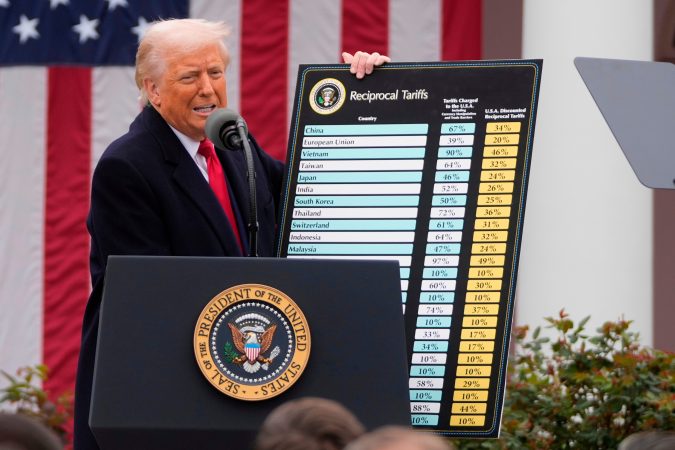
    WASHINGTON — President Donald Trump is going ahead with new double-digit tariffs on dozens of U.S. trading partners just as the clock runs out Friday on stopgap levies he imposed after a stinging defeat at the Supreme Court.

    The United States will slap taxes of 10% to 12.5% on imports from 60 countries accounting for 99% of U.S. imports, charging that they have inadequately enforced bans on goods produced by forced labor.

    “The United States has had a forced labor import ban for nearly a century, and rigorously enforces it; it’s well past time for our trading partners to do the same,” said U.S. Trade Representative Jamieson Greer. “Today’s action will begin to correct what is both a human rights abuse and distortive trade practice to improve the welfare of workers everywhere.

    The new tariffs will take effect just as temporary 10% worldwide tariffs expire at 12:01 a.m. Friday. Trump had turned to those temporary levies after the Supreme Court struck down his biggest and boldest tariffs in February.

    Now he’s tapping more durable tariffs under Section 301 of the Trade Act of 1974, which permits the president to impose import taxes and other sanctions against countries found to engage in “unjustifiable,” “unreasonable,” or “discriminatory” trade practices. Trump used Section 301 to impose big tariffs on China in his first term, and they survived court challenges.

    More Section 301 tariffs are likely coming: The U.S. Trade Representative’s office has launched a probe into whether 16 countries — accounting for 70% of U.S. imports — have overproduced goods, pushing down prices and putting U.S. companies at a disadvantage in global markets. The administration has yet to complete that investigation.

    Trump, who argues that high tariffs will revive American manufacturing, last year overturned decades of U.S. policy that favored lower tariffs and ever-freer trade. Invoking the 1977 International Emergency Economic Powers Act (IEEPA), he imposed double-digit tariffs on imports from almost every country on Earth, saying America’s longstanding trade deficit amounted to a national emergency.

    But the Supreme Court ruled that IEEPA did not authorize tariffs. The decision forced the administration to pay refunds to importers that had paid the tariffs.

    In response, Trump announced 10% worldwide tariffs under Section 122 of the Trade Act of 1974. But he can only use Section 122 levies for 150 days; time runs out on them Friday.

    The administration initially proposed the forced labor tariffs last month. Since then, some countries have tightened forced labor enforcement and qualified for lower tariffs, said a senior administration official who spoke under condition of anonymity. For example, the official said, the tariff on imports from India initially was set at 12.5% but now will be 10%.

    Some products — including oil and gas and fertilizer — are exempted from the new tariffs announced Thursday. Also being spared are products that qualify for duty-free status under the US-Mexico-Canada Agreement, the North American trade pact Trump negotiated in his first term.

    Tariffs are paid by companies in the United States that import foreign products. The importers usually try to pass along the cost by charging consumers higher prices. Americans are already frustrated by the high cost of living. So the administration is taking a risk in rolling out new tariffs ahead of the Nov. 3 midterm elections.

    Human rights watchers say that it’s reasonable to be skeptical of the motivation behind the tariffs. But they say the levies could make an impact on the problem of forced labor.

    Forced labor is defined by the International Labor Organization Forced Labor Convention of 1930 as “all work or service which is exacted from any person under the menace of any penalty and for which the said person has not offered himself (or herself) voluntarily.”

    According to the latest statistics from the ILO, which is a U.N. agency focused on human and labor rights, about 27.6 million people were in forced labor worldwide on any given day in 2021.

    “We’ve gone on record for years now advocating for import bans, not as a magic bullet, it’s not a silver bullet, but as a potentially effective tool in combating forced labor across the globe,” said Martina Vandenberg, founder and president of The Human Trafficking Legal Center.

    “It’s possible to be extremely critical of tariffs, as we are, and to be very concerned about blanket tariffs used as bludgeons against countries,” she said. “And yet I think it’s undeniable that there is a significant response in terms of the adoption of import bans.”

    However Vandenberg and her organization urged in testimony that the tariffs be implemented in a phased approach to give countries time to implement a ban or a plan for enforcement.

    “Our concern is that the import bans will be thin slips of paper with no enforcement,” she said. “Countries need time to build import ban mechanisms that are meaningful and enforceable.”

    Kenya Davis, partner at Boies Schiller Flexner, said the Uyghur Forced Labor Prevention Act, a U.S. federal law passed in 2021 that prohibits the importation of goods made wholly or in part in China’s Xinjiang region or by designated entities, is the most significant legislation related to forced labor that the U.S. has passed before the tariffs.

    “The level of effectiveness is certainly up for debate, but it certainly has drawn attention to the issue of labor trafficking and forced labor,” she said. “And so, if nothing else, these import bans will serve that function of bringing greater awareness to forced labor.”

    But without a “comprehensive approach,” that provides transparency about what the investigations consisted of, and programs that provide countries aid in enforcing bans, “I’m very cautious in my enthusiasm about the [tariffs],” she said.

    Isabelle Glimcher, senior research scientist for global labor at the NYU Stern Center for Human Rights, said one flaw in the tariffs is that they focus on levying the tax on countries based on goods they import — not goods they make domestically.

    But she said the impending tariffs threat has spurred several countries — such as India — to amend their foreign trade policies to include a forced labor import ban. European Union forced labor regulations due to go into effect later next year are also contributing, she said.

    “Not all of these things are necessarily or wholly attributable to the Section 301 investigations, but does seem like countries are responding and starting to take all of this seriously,” she said.

  • Philadelphia dental clinic reopens two months after patients were urged to get tested for HIV

    Philadelphia dental clinic reopens two months after patients were urged to get tested for HIV

    A Center City dentist is reopening her practice this week after correcting infection-control lapses that health inspectors say put patients at risk of HIV and other communicable diseases.

    Kirti Chopra’s license was temporarily suspended in May after an inspection by the Philadelphia Department of Public Health found she was not following sterilization protocol.

    She was ordered to temporarily close her practice, Smiles at Rittenhouse Square, located at 255 S. 17th St., Suite 2507. The practice is also known as Smiles on the Square.

    The Pennsylvania Board of Dentistry reinstated her license under probation earlier this month after she agreed to four years’ probation and a $10,000 civil fine, plus about $4,400 in fees to cover the cost of the investigation.

    Chopra told The Inquirer she resumed seeing patients on Thursday.

    Chopra also hired a consultant to oversee infection-control improvements, including new policies for storing sterile supplies and staff training on sanitation protocol.

    “I will work tirelessly to rebuild trust with my patients and demonstrate accountability,” Chopra said in a statement.

    She said she was “deeply sorry” to her patients and grateful to the health department for working with her to reopen.

    Sterilization problems lead to shutdown

    The Philadelphia health department said Thursday its recommendations had been “satisfactorily implemented.”

    “We are not opposed to the practice reopening, subject to continued compliance with their agreement with the state,” James Garrow, deputy health commissioner, said in a statement.

    In March, the health department had cited the clinic for reusing saline bags and a vial of septocaine, a local anesthetic, that were supposed to be thrown out after having been used on a patient.

    During its investigation, the Pennsylvania Board of Dentistry did not find evidence the partially used vial of septocaine had been reused with another patient.

    Reusing these types of single-use medical supplies can expose patients to HIV, hepatitis C, hepatitis B, and other diseases that are transmitted through blood or saliva.

    She was ordered to shut down the practice in May, when the Pennsylvania Department of State temporarily suspended her license pending an investigation by the dentistry board.

    The Philadelphia health department in May issued a public notice urging Chopra’s patients to get tested for HIV, hepatitis C, and hepatitis B.

    Reopening with safety improvements

    In an interview with The Inquirer, Chopra said she began addressing the health department’s concerns immediately after the March citation.

    She overhauled sanitation policies, set up new procedures to ensure used dental tools are kept separate from sterile instruments, and purchased a new ultrasonic cleaner. The independent consultant she hired to oversee that work will conduct quarterly inspections, she said.

    “The goal is to not look at the past but outlook at the future, and the future is to provide quality care to my patients,” Chopra said. “This is the most humbling experience of my life, and I’ve learned my lesson the hard way.”

    Chopra has been licensed to practice dentistry in Pennsylvania since 2021 and purchased her Rittenhouse Square practice in April 2025.

    Staff were trained on the new protocols and equipment, and Chopra plans to work with Learn2Prevent, a dental compliance and education company, to provide annual infection-control training.

    Under her agreement with the Pennsylvania Board of Dentistry, Chopra’s practice will be monitored for infection-control safety and is subject to unannounced inspections.

  • Philadelphia man charged with murder for the third time, Pa. Attorney General’s Office says

    Philadelphia man charged with murder for the third time, Pa. Attorney General’s Office says

    A Philadelphia man has been charged with fatally gunning down another man three years ago on a North Philadelphia street, authorities said Thursday.

    A grand jury on Wednesday indicted Richard Pridgen, 21, on charges of murder, attempted murder, and related crimes for the 2023 shooting death of George Smith, according to the Pennsylvania Attorney General’s Office.

    The case marks the third time state prosecutors have charged Pridgen with murder. He is currently serving a 17-year federal prison sentence for a separate crime.

    In a news release Thursday, state prosecutors said Pridgen is a member of the “Backblock” gang, a violent North Philadelphia group that has been at the center of joint investigations by the attorney general’s office, the Philadelphia Police Department, and the federal Bureau of Alcohol, Tobacco, Firearms and Explosives for years.

    Just before midnight on April 22, 2023, two people attacked Smith, 27, in the 2400 block of North 17th Street, state prosecutors said. Surveillance cameras captured the killing, and showed one of the men — whom state prosecutors identified as Pridgen — firing multiple shots into Smith’s body before fleeing in a vehicle driven by a third person.

    That vehicle, state prosecutors said, had been stolen at gunpoint the day before in the 2500 block of East Monmouth Street, less than four miles away.

    The two other homicides Pridgen is accused of committing also occurred in 2023 in Philadelphia, state prosecutors said.

    In one case, Pridgen is accused of shooting Hassan German, 31, and another man, who survived, on May 24, 2023, at the intersection of North Gratz Street and Susquehanna Avenue in North Philadelphia. The details of the other case were not immediately available on Thursday.

    “There are public dangers, and then there is Richard Pridgen — for whom killing, stealing, and harming people is a way of life,” Pennsylvania Attorney General Dave Sunday said in the news release.

    Pridgen has pleaded not guilty in both prior murder cases.

    A spokesperson for the Defender Association of Philadelphia, which is representing Pridgen in those cases, declined to comment.

    In February, Pridgen was convicted in federal court of two carjackings and sentenced to more than 17 years in federal prison.

    In the carjackings — which also took place in 2023 in Philadelphia — Pridgen robbed two men of their vehicles at gunpoint, federal prosecutors said. Neither man was injured.

  • John Alviti, retired senior curator at the Franklin Institute and former executive director at the Atwater Kent Museum, has died at 76

    John Alviti, retired senior curator at the Franklin Institute and former executive director at the Atwater Kent Museum, has died at 76

    John Alviti, 76, of Flourtown, Montgomery County, retired innovative senior curator at the Franklin Institute, former executive director at the Atwater Kent Museum, adjunct professor of urban studies, and “Mr. Philadelphia History” to family and friends, died Saturday, June 20, of complications from heart and kidney disease at Jefferson Abington Hospital.

    Born in Chicago and devoted to history and his South Side White Sox baseball team, Mr. Alviti came to Philadelphia in the 1970s to pursue a doctorate in history and urban studies at Temple University. He never got that doctorate.

    But he fell in love with Philadelphia’s history and architecture, got married, settled down in Flourtown, and, for 34 years, was one of the region’s most influential museum curators and historians. Affable, creative, and energetic, by all accounts, Mr. Alviti became a groundbreaking executive director at the now-closed Atwater Kent Museum in 1982 and celebrated curator at the Franklin Institute in 1994.

    Even after he retired in 2018, he was known around town as “Mr. Philadelphia History.”

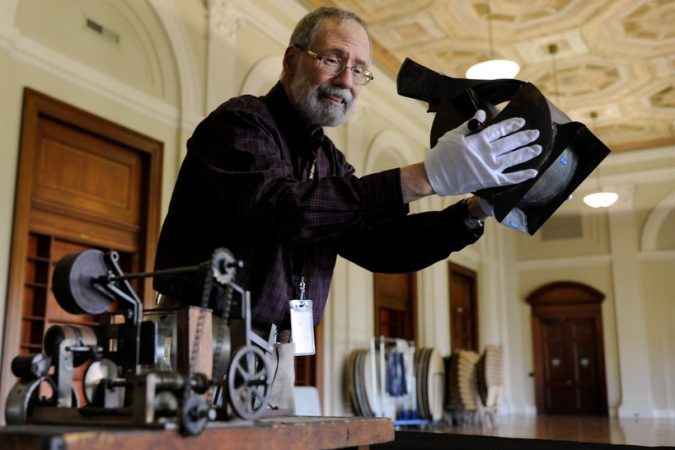
    Mr. Alviti displayed this 5-foot-long fragment of a lightning rod designed by Benjamin Franklin at the Franklin Institute in 2010. Michael S. Wirtz / Staff Photographer

    At the Atwater Kent, Mr. Alviti updated exhibits on William Penn, the history of Philadelphia, the old Enchanted Colonial Village display, and local cemeteries. He added maritime and archaeology galleries.

    At a gala to celebrate the museum in 1984, A. Atwater Kent Jr., son of the museum founder, said Mr. Alviti “has done a great job of creating interesting exhibits and improving the museum.”

    At the Franklin Institute, he reorganized its huge inventory, redecorated the galleries, digitalized many artifacts, and created popular exhibits regarding the Wright Brothers, Benjamin Franklin, antique machines, X-rays, and dozens of other scientific subjects.

    “He loved objects,” said his wife, Maryellen. “He loved the history of objects and telling their story.”

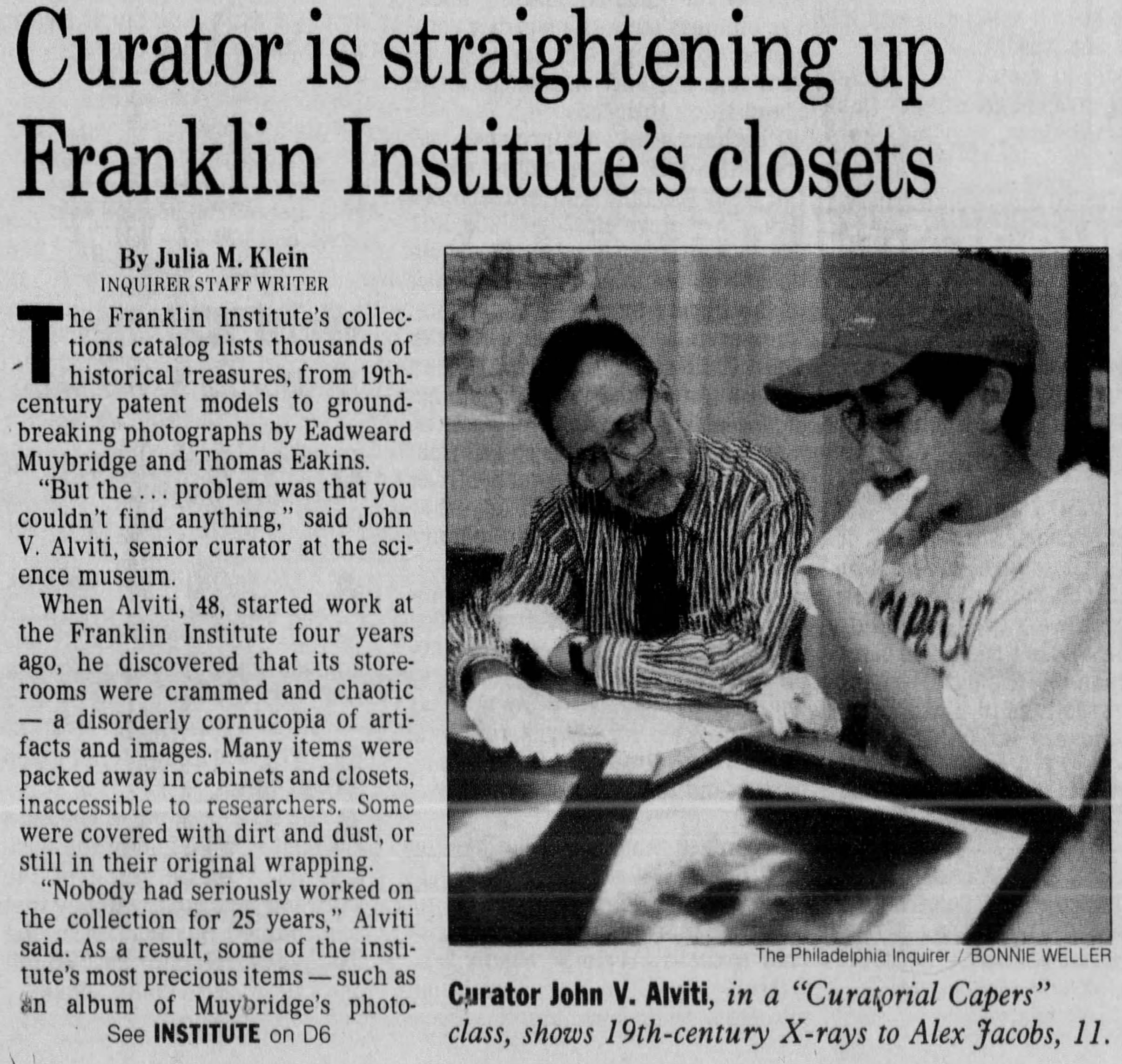
    This story and photo of Mr. Alviti (left) was published in The Inquirer in 1998.Newspapers.com

    In 1998, Mr. Alviti told The Inquirer: “Besides the curator of stuff, I’m also the curator of institutional memory. And institutional memory is more than just simply the facts about what happened in the past. It’s about the legacy of an institution … and how it informs our thinking and decision-making.”

    He was also adept at merging his collections with educational programs, and he helped organize the city’s National History Day competition for students, the Phil-A-Kid hands-on history workshop for fourth and fifth graders, the Peopling of Philadelphia research project, and the Curatorial Capers summer day camp program. Often, in a nod to the ever-present protective gloves he wore to handle the artifacts, he introduced himself as “Johnny Whitegloves.”

    “There are some curators who think I’m crazy,” he told The Inquirer. But a public presentation, he said, “really demonstrates the power of an object.”

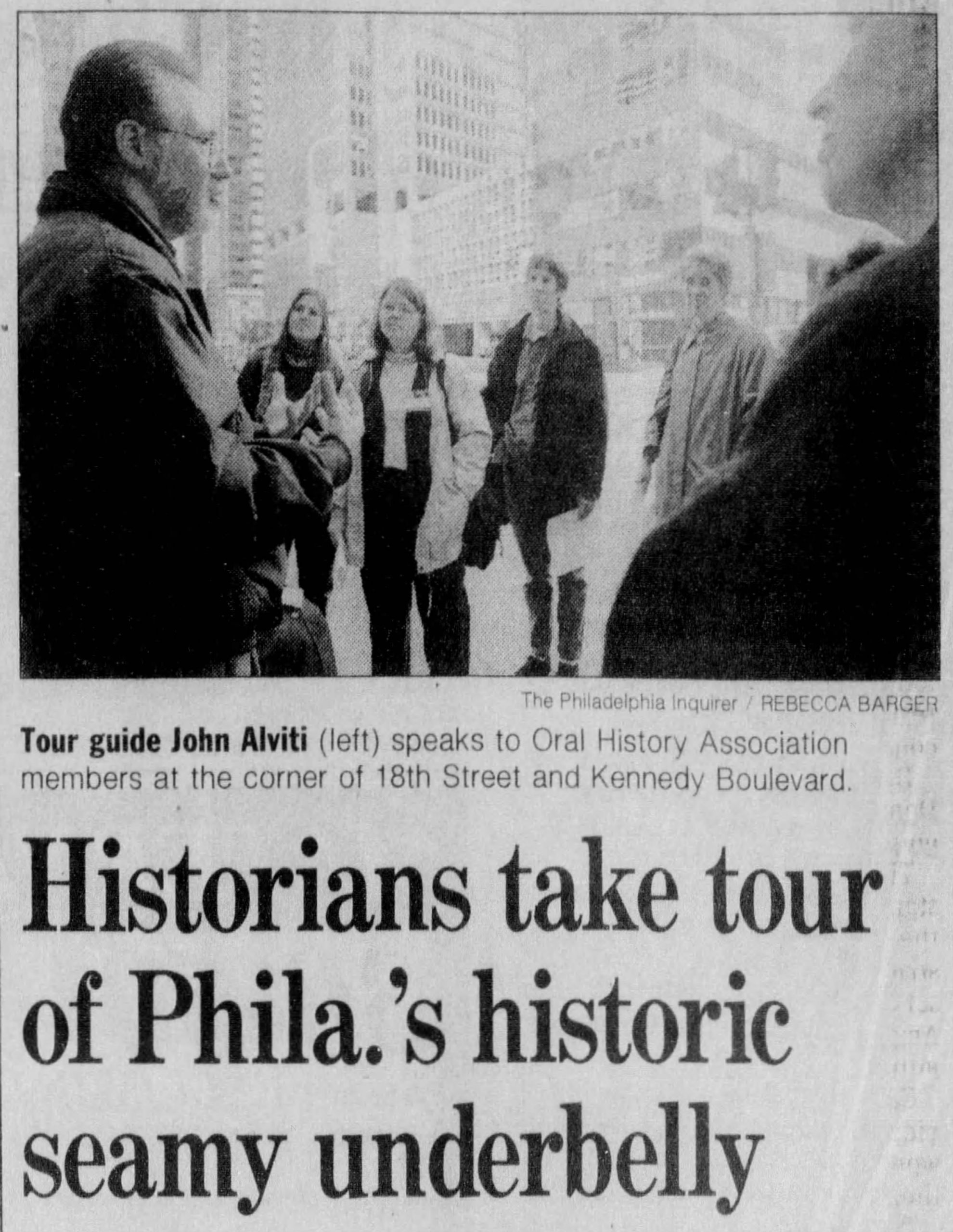
    Mr. Alviti also led walking tours of the city for visiting colleagues from the Oral History Association, the Organization of American Historians, and other groups. He admired and worked closely with amateur historians, and led the successful effort in 1981 to save the historic Lit Bros. building complex on Market Street from demolition.

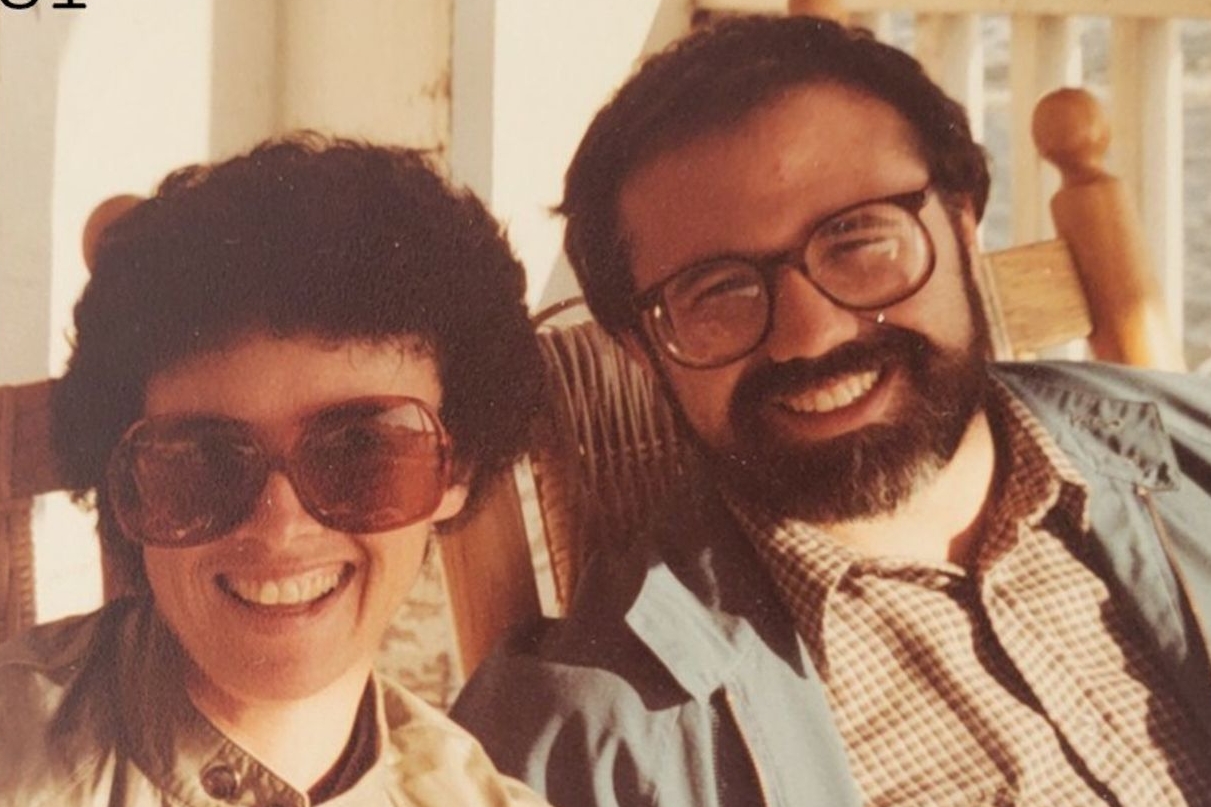
    Mr. Alviti and his wife, Maryellen, married in 1983.Courtesy of the family

    Between the Atwater Kent and the Franklin Institute, Mr. Alviti spent two years as director of the Historical Society of Washington, D.C. He was an expert on public transportation and taught urban studies, American history, and museum training at Temple and Stockton Universities, Rutgers University-Camden, and elsewhere.

    He was onetime curator of historic Fort Mifflin and president of what is now the Museum Council of Greater Philadelphia. He was on the advisory board of the old Philadelphia Alliance for Teaching Humanities in the Schools and active with the American Association of Museums and other groups.

    “He had a gift for making friends for life,” longtime friend Margaret Marsh said, “and he had a legendary generosity of spirit.” Longtime friend Howard Gillette said: “He never met a stranger.”

    John Vincent Alviti was born Sept. 22, 1949. A lifelong avid reader, he earned a bachelor’s degree in urban studies and history at Lewis University in Illinois in 1971 and a master’s degree in history at the University of Wisconsin-Milwaukee in 1975.

    The photo and a story about Mr. Alviti and his city walking tours appeared in The Inquirer in 1996.Newspapers.com

    He played piano and clarinet, and sang in choirs in high school and college. “He left Chicago when he was 25 or 26,” said his younger sister, Rosemarie Alviti Babic, “but never stopped loving the city.”

    He met Maryellen Coonahan when she took an urban studies class he was teaching at Temple, and they married in 1983 and lived in Philadelphia, Washington, and Flourtown. Together, they traveled the world and visited museums in London, Rome, Athens, Madrid, and elsewhere.

    Mr. Alviti enjoyed puzzles, games, and conversation. He lived with a heart condition for most of his life and was the lovable “Uncle Johnny” to his nieces and nephews. “He is missed beyond words,” said his niece Lindsay Hogan.

    He was fascinated by urban architecture and city life around the world, and he routinely bought food and drink for people without homes, picked up litter, and offered correct directions to those who looked lost.

    Mr. Alviti (right) enjoyed time with family and friends.Courtesy of the family

    “He was a curious fellow,” his wife said, “who loved to help people.”

    In addition to his wife, sister, and niece, Mr. Alviti is survived by a sister, Rita Jo Alviti Coyne, a brother, James, and other relatives.

    A celebration of his life was held earlier.

    Donations in his name may be made to Face to Face, 123 E. Price St., Philadelphia, Pa. 19144.

    His wife called Mr. Alviti “a curious fellow who loved to help people.”Courtesy of the family
  • School board votes to nonrenew a Philadelphia charter

    School board votes to nonrenew a Philadelphia charter

    The Philadelphia school board on Thursday voted to nonrenew a city charter school — despite multiple ongoing lawsuits to attempt to halt the action.

    The board voted 7-2 to nonrenew Philadelphia Montessori Charter School, the first step on a long road that could ultimately lead to closing the K-4 school in Southwest Philadelphia.

    Sarah-Ashley Andrews, school board vice president, said the school’s students “have shown consistently low academic performance in math and English language arts. Its third and fourth graders have consistently lagged behind their peers in demographically similar schools, school district schools, and other Philadelphia charter schools serving the same grade levels. And student academic growth has not kept pace with state expectations.”

    Philadelphia Montessori has had five different leaders since 2020. In 2024-25, the last school for which data are available, 18% of students met state standards in reading and 12% in math.

    School leaders say the school is improving and serves an important role as the only public Montessori school in the city. They have objected to what they say are shifting and arbitrary standards for charter schools.

    Board members Crystal Cubbage and Whitney Jones opposed the vote to begin the nonrenewal process. Cubbage, who said she had “mixed feelings” and initially was in favor of the nonrenewal, said she wanted more clarity on the school’s struggles.

    Philadelphia Montessori has been aggressively attempting to block such action in court. State and federal lawsuits are pending, with school lawyers asking judges this week to block the board’s vote.

    Amanda Wilson, the school’s executive director, asked the board to hold off on the nonrenewal.

    “There is no emergency,” Wilson told the board. “There is no deadline requiring a vote before the courts have had the opportunity to weigh in on the significant legal issues surrounding this charter renewal process. Those issues are now pending in both state and federal court, and they deserve to be resolved before any action is taken. If this board proceeds today and the courts later determine that the school district’s process was unlawful, everyone loses.”

    Lynn Rauch, the district’s general counsel, said “both the state and the federal court issued rulings that do allow us to proceed with the vote today.”

    School board president Reginald Streater said it was appropriate to move forward with the Philadelphia Montessori matter, “exercising our responsibility and duty to ensure that schools throughout our district are meeting their responsibilities to children, families, and taxpayers by demonstrating a high-quality academic experience for our students.”

    The school, which educates 228 students in an Island Avenue building, will continue to operate during the nonrenewal process — the appointment of a hearing officer, a formal hearing with witnesses and evidence, a report from the hearing officer, and, finally, another school board vote on how to move forward.

    The nonrenewal process can take years.