Category: News

  • Philly’s ban on stopping in bike lanes violates federal disability protections, lawsuit says

    Philly’s ban on stopping in bike lanes violates federal disability protections, lawsuit says

    The legal fight over bike lanes on Pine and Spruce Streets took a citywide turn with a new federal lawsuit.

    Safety upgrades for bike lanes on the streets’ Center City blocks have been stalled for more than a year following a Philadelphia Common Pleas judge’s order.

    And now, two residents of Pine and Spruce with mobility impairments argue in a proposed class-action lawsuit that the city violated the Americans with Disabilities Act when it banned all cars from stopping on a bike lane.

    The ban on stopping contains no exception for a vehicle transporting people with mobility impairments, the complaint says.

    A bicyclist weaves into traffic to avoid a parked van in the bike lane on Pine Street.David Swanson

    Susan Herskovits, a Spruce Street resident in her 80s, and Carl Roeder, a Pine Street resident in his 60s, sued because they say they are unable to safely reach their homes because of the ban.

    Both have had trouble getting in and out of rideshares safely since the prohibition took effect.

    “A person who cannot walk a block, or cannot carry what she brings, may have no practical way from the vehicle to the door,” the suit says.

    The lawsuit asks a judge to order the city to adopt a disability exception to the ban, creating a process for people with disabilities whose home is adjacent to a bike lane to receive a parking or loading permit, and conducting an accessibility evaluation for the planned safety upgrades on Pine and Spruce.

    George Bochetto, the attorney who filed the lawsuit on behalf of the two residents, said the city ignored attempts to resolve the issue outside of court.

    “The Americans with Disabilities Act requires municipalities to make reasonable accommodations for the disabled,” Bochetto said. “We are not going to go away.”

    A spokesperson for the city’s law department declined to comment.

    Philly Bike Action, an bicycle safety advocacy group, said in a statement that “disability advocates and AARP have long touted” the safety benefits of bike lanes. And the additional loading zones that a previous lawsuit blocked were meant to “provide adequate curbside access,” the group said.

    “This lawsuit is nothing more than an attempt by a privileged group of neighbors to keep their parking spots,” Philly Bike Action’s statement said.

    The citywide stopping ban and planned safety upgrades for bike lanes on Spruce and Pine in Center City followed the 2024 death of Barbara Friedes, a 30-year-old physician at Children’s Hospital of Philadelphia who was killed when a drunk driver veered into the Spruce Street bike lane.

    A cyclist use the bike lane on the 1800 block of Spruce Street in July 2024, prompting Philly Bike Action to hold a vigil for Barbara Friedes and other cyclists killed. David Maialetti / Staff Photographer

    The city also unveiled a plan to harden the bike lanes on the two east-west corridors by erecting concrete barriers, and designating loading zones across from the bike lane for residents to use.

    Friends of Pine and Spruce, a group representing some residents, sued in 2025 over the loading zones plan, calling it regulatory overreach. That summer, Philadelphia Common Pleas Court Judge Sierra Thomas-Street ruled that the city had no legal authority to remove parking spaces for the loading zones, and issued an injunction prohibiting the city from making changes to the bike lanes.

    The city asked Common Pleas Judge Damaris L. Garcia to dissolve the injunction in June after City Council passed legislation empowering the Streets Department to make decisions on parking changes. But the judge denied the request.

    The city’s appeal in Commonwealth Court is pending.

    The federal disability lawsuit opens a second legal front in the battle over the bike lanes, which has been causing skirmishes between some residents and cyclists since 2009.

    The city knew about the accessibility concerns, the suit says, which were aired in public hearings related to the plan and in the previous court case.

    Disability Rights Pennsylvania, a watchdog nonprofit, asked the city in December to “retract and remove” the ban on stopping and revise the plan for the bike lanes in “a manner that allows individuals with disabilities to freely enter and exit their premises, to have access to their transportation, and to move about in the community,” according to the federal lawsuit.

    While the federal complaint focuses on the two narrow Center City corridors, the suit says, the lack of a disability exception is a citywide problem.

    “The same rule strands relatives, friends and guests with mobility disabilities who come to those homes,” the lawsuit says. “Each resident faces one rule and one missing exception, and one order can fix it.”

  • Oaklyn’s hockey rink will get a second life that includes soccer

    Oaklyn’s hockey rink will get a second life that includes soccer

    Two months after closing suddenly because of deteriorating conditions, Oaklyn’s popular outdoor hockey rink has been torn down and will be replaced by a multiuse court for both hockey and soccer, according to Oaklyn Mayor Greg Brandley.

    The rink and the adjacent basketball court at Oaklyn-Lions Park had been cordoned off by temporary fencing and caution tape since closing in early September after an annual safety inspection found issues with the surface, boards, and fencing.

    The new rink should be open by next summer, Brandley said, with most of the construction set to begin once the cold weather breaks in the spring.

    The outdoor hockey rink at Oaklyn-Lions Park, cordoned off on Sept. 17 after being closed due to safety concerns.Lacey Latch

    The borough may even begin to pour the concrete footings this fall if the weather cooperates, Brandley said.

    The project’s total cost is still being calculated, he said.

    The rink’s second wind is coming thanks to help from Camden County and Flyers Charities, said Camden County Commissioner Jeff Nash. A spokesperson for Flyers Charities said Friday the organization is looking into the Oaklyn project but could not provide any further information.

    “Everyone who was involved in this — the mayor’s office, the county parks department, Flyers Charities — everyone is very excited about this project,” Nash said. “This is a really great opportunity for the Flyers to make a difference in the community, and the county was happy to help work with all the partners to make it happen.”

    County parks staff are already working on the project’s engineering and design, Nash said.

    After the rink is rebuilt, Brandley said, the borough will make sure the space is suitable for both hockey and soccer players.

    Alex Lewis, an Oaklyn native and founder of Oaklyn United FC, has long been a proponent of both repairing the area and formalizing the long-standing practice of sharing the court between sports.

    Once the rink is back in working order, Lewis said, he and other local soccer enthusiasts are willing to help fundraise for any remaining soccer aspects needed.

    The repairs are likely as simple as a few extra lines painted on the court, an extra set of removable goals, and possibly a shed for storage, and the roughly $1,000 he has already raised for repairs will go a long way, he said.

    “This is progress,” Lewis said. “This is more progress than we’ve had in 20 years, as far as I know.”

    Lewis said the community needs to ensure that it remains a public asset.

    With so many athletic fields across South Jersey reserved by leagues or organizations, he said, it is critical that Oaklyn kids still have somewhere to play whenever and with whomever they want.

    “It’s really important at this point, and even before it’s built, that Oaklyn starts to prepare itself for keeping it as a public good,” he said, “because that’s what made it so great all those years ago for so long, and that’s what’ll make it good again.”

  • Trump’s tariffs are unpopular — but they’ll be tough to repeal despite Democrats’ landslide win

    Trump’s tariffs are unpopular — but they’ll be tough to repeal despite Democrats’ landslide win

    WASHINGTON — For months, Democrats on the campaign trail hammered President Donald Trump’s unpopular tariffs, arguing that the taxes on imports drive up prices for American families already frustrated by the high cost of living.

    James Talarico, a Democrat running for a U.S. Senate seat in Texas, blamed Trump’s tariff on Mexican tomatoes for pushing up the price of a popular appetizer: “Chips and salsa,” he said, “are sacred in Texas.”

    Targeting tariffs proved to be a winning message nationwide, contributing to the Democrats’ stunning gains in the Nov. 3 midterm elections. And in Texas? Talarico became the first Democrat elected to the Senate from the state since 1988.

    “Americans don’t like tariffs,″ said Scott Lincicome at the Cato Institute’s Center for Trade Policy Studies. ”They connect them to the cost of living.″

    But when the Democrats take full control of Congress, they are likely to find that reversing Trump’s tariffs won’t be easy.

    The president will still have power to veto any legislation that repeals his import taxes or reins in his legal authority to impose them. And it’s unclear — probably doubtful — that enough Republicans would defy Trump and join Democrats in overriding his veto.

    Moreover, Democrats themselves are divided over trade policy. Some want to move back toward low-tariff trade policies that Trump demolished. Other Democrats want to see the United States continue using tariffs to fight other countries’ unfair trade policies and to sanction U.S. adversaries such as China.

    “There’s going to be a big debate over what should the Democrats’ tariff and trade policy be,” said Ryan Majerus, a former U.S. trade official during Trump’s first term and in the Biden administration. ”It can’t just be: We don’t like what Trump’s doing.’’

    Complicating matters is the fact that Trump’s tariffs are delivering significant amounts of revenue to the U.S. Treasury — nearly $370 billion in the last two budget years — at a time when the federal government is sitting on a staggering $40 trillion in debt.

    Democrats have “just been elected to come in and address concerns about affordability,’’ said Sally Laing, former chief trade counsel for the Senate Finance Committee and now a partner at the law firm Akin Gump. “It’s not as easy as people may think.’’

    Trump’s tariffs pinched family budgets

    The U.S. Constitution gives the power to levy taxes — including tariffs — to Congress. But over the years, lawmakers have relinquished tariff-setting authority to the president.

    Trump swept into the vacuum. In his first term, he started a trade war with China and slapped taxes on steel and aluminum imports, saying they posed a threat to U.S. national security. All that was just a warmup for his second term. Although the Supreme Court rejected his most ambitious tariffs in February, he has still managed to build a high protective wall around the U.S. economy, sometimes relying on the expansive use of the legal authority Congress gave up.

    His use of tariffs also has proven erratic. Last year, for instance, he suddenly imposed a 50% tariff on Brazil because its government had prosecuted his friend, former Brazilian president Jair Bolsonaro. (The Supreme Court decision struck down that tariff, among others.)

    “Trade policy has sort of gone off the rails and has lost a strategic focus,” said Inu Manak, senior fellow at the Peterson Institute for International Economics. “Now, we’re just using tariffs as a blunt cudgel instead of addressing real challenges.’’

    Trump’s tariff frenzy has lifted the average U.S. tariff from around 2.5% when he returned to the White House in January 2025 to 11.2% now, according to Yale University’s Budget Lab. Tariffs are paid by importers in the United States. And they often pass along the burden to consumers via higher prices. Yale’s Budget Lab estimates that tariffs cost the average U.S. household about $900 a year.

    That burden comes at a time when elevated inflation is already pinching family budgets, even more so because Trump’s war with Iran has driven up gasoline prices.

    But the Republicans who controlled Congress did nothing to reassert their authority and push back against the president’s aggressive use of tariffs.

    Voters largely turned against Trump’s tariffs as they voted in the midterm elections. About two-thirds of U.S. voters said Trump’s tariffs had hurt the national economy or the economy in their area, while only about 2 in 10 said they’d helped, according to the AP Voter Poll, a survey of more than 100,000 midterm voters. Voters who saw a negative impact from the tariffs overwhelmingly supported the Democratic candidate in their local U.S. House race.

    Trump, meanwhile, remains committed to his protectionist agenda.

    “President Trump will never waver from putting Americans and America First, whether in trade negotiations or through an economic agenda of tax cuts and deregulation,’’ White House spokesperson Matthew Middleton said in response to questions from the Associated Press.

    Democrats must round up GOP votes to repeal Trump tariffs

    As they campaigned this fall, Democrats vowed to cancel some Trump tariffs and curb his legal authority to impose others. Their proposals include repealing the tariffs he levied in July on 60 U.S. trading partners for allegedly failing to do enough to crack down on trade in products made by forced labor. Another would require Congress to approve his tariffs.

    Turning their ideas into law will require overcoming a daunting obstacle: Trump’s veto power. Overriding a presidential veto requires a two-thirds majority in both houses of Congress. Even if Democrats win all the congressional races that are still undecided this year, they won’t have enough votes to override a Trump veto on their own. They will need Republican support.

    Can they get it? Their resounding midterms victory makes “a veto-proof vote more possible,” said Majerus, the former trade official and now a partner at King & Spalding. “Are Republicans willing to break with Trump? I’m still skeptical.’’

    Oregon Sen. Ron Wyden, the top Democrat on the Senate Finance Committee, sees one issue that could draw Republican support: ending the 50% tariffs that Trump imposed in August on $20 billion worth of Canadian imports.

    “That’s what we’re focused on, figuring out a way to beat Trump and his veto,” said Wyden, who will be Senate Finance chair when the Democrats take over.

    The levies damaged relations with America’s neighbor and longstanding ally, drew retaliatory tariffs from Ottawa, and hurt U.S. companies that depend on trade with Canada. “The Canadian tariffs, these tariffs on our allies, are wildly unpopular,’’ Laing said.

    Gellert Global Group, a food importer based in Elizabeth, N.J., is contending with Trump tariffs on Canadian cheese.

    “We are paying millions of dollars in additional costs and tariffs to maintain our distribution and have our products on the shelf,” said co-CEO Thomas Gellert. “We’re absorbing that today. It’s not sustainable for our business.″ The company, represented by the libertarian advocacy group Liberty Justice Center, has sued the Trump administration over the Canada tariffs.

    Furor over the Canada tariffs contributed to longtime Republican Sen. Susan Collins’ loss in Maine — even after Trump exempted products from the levies to aid her reelection bid.

    Republicans, Wyden said, face a choice: They can “help lower costs for American families or they can continue to defend Trump’s tariffs and make clear whose side they’re on.’’

  • Man charged with double murder in 2022 fatal shooting of pregnant woman in Philly

    Man charged with double murder in 2022 fatal shooting of pregnant woman in Philly

    A 25-year-old man Delaware County has been charged with two counts of murder for the 2022 fatal shooting of a pregnant woman in the Port Richmond section of Philadelphia and the subsequent death of her newborn who survived a month after the woman was killed, police said.

    Christian G. Brown, of Lansdowne, was arrested Friday and was being held without bail at the Curran-Fromhold Correctional Facility, court records show.

    Around 1 a.m. on June 4, 2022, in the area of Richmond Street and Wheatsheaf Lane, Brown allegedly shot 19-year-old Matayah Haynes in the head.

    Haynes, a Camden resident who was about 34 weeks pregnant, was taken by medics to Temple University Hospital, where she was pronounced dead at 1:56 a.m.

    Police reported that a baby boy was delivered and was immediately listed in critical condition.

    Ry’Kier Haynes, as he was named, died July 5, 2022, at 2:56 p.m., police said Monday.

    Police did not release any other details about the investigation.

    No attorney was listed in court records on Monday for Brown.

    An online obituary for Haynes said she “couldn’t wait to take on life with her first child, son Ry’Kier whom she passionately referred to as her critter.”

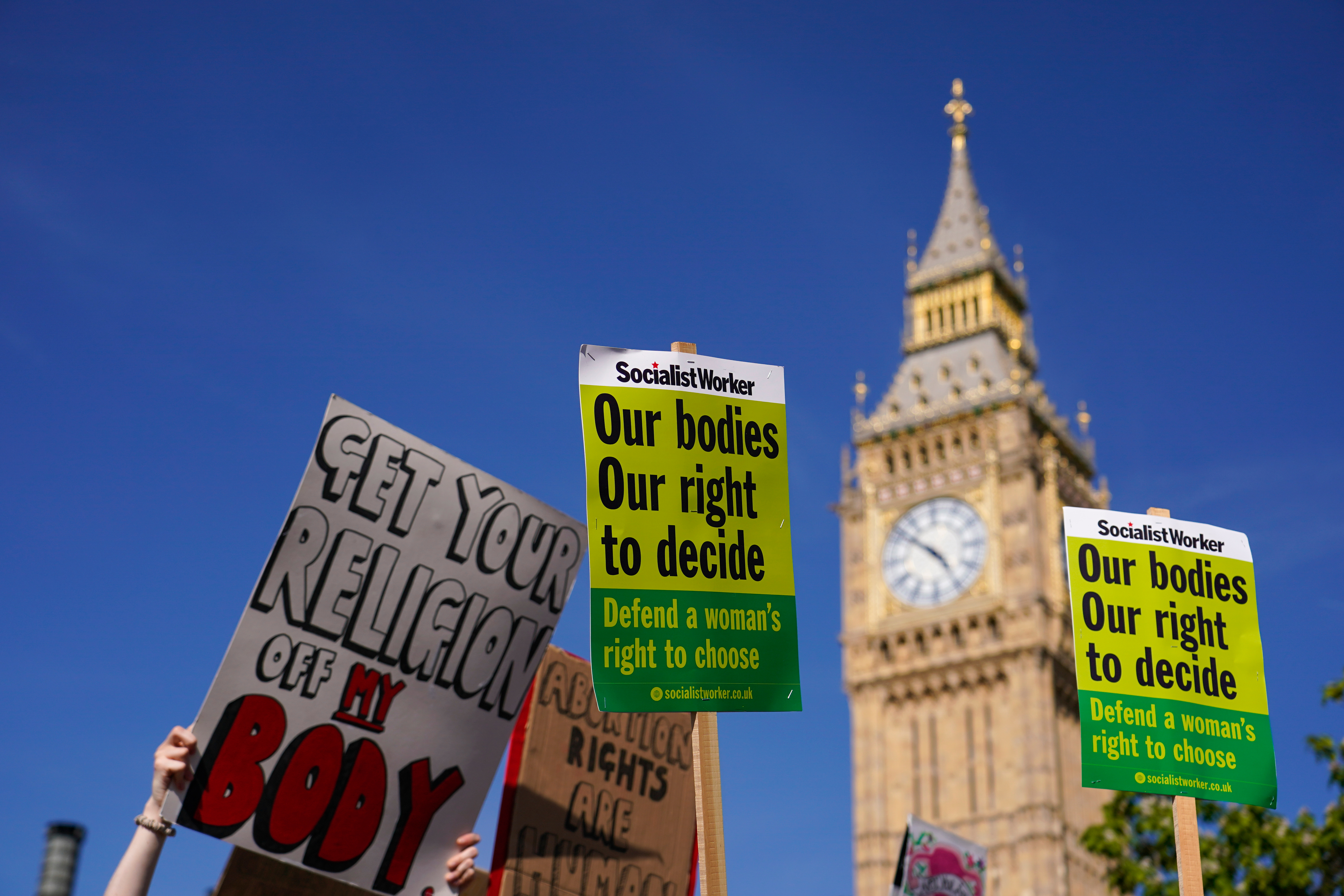
  • British women to receive automatic pardons for past abortion convictions

    British women to receive automatic pardons for past abortion convictions

    LONDON — British women convicted of illegally terminating their pregnancies under a Victorian-era law will be automatically pardoned Monday, the government said.

    The action follows Parliament’s passage last year of a landmark vote to decriminalize abortion by repealing a section from the 1861 Offences Against the Person Act.

    Women who have received a caution from police will also be pardoned and women arrested or investigated for ending their own pregnancy will have those details removed from their criminal records. They will not have to apply for pardons and some will be issued posthumously.

    “For too long, women have faced the devastating consequences of outdated abortion laws,” said Heidi Stewart, chief executive of the British Pregnancy Advisory Service. “While no pardon can undo the distress and trauma these women have experienced, this historic change in the law recognizes the profound harm caused by their criminalization and represents a meaningful step towards justice.”

    The government did not provide the number of women affected. But Tonia Antoniazzi, the Labour member of Parliament who introduced the decriminalization amendment, said police had investigated more than 100 women suspected of illegal abortions in the five years preceding last year’s vote. That included some who suffered natural miscarriages and stillbirths.

    Antoniazzi described how women suspected of illegally aborting a fetus were once “dragged from hospital beds to police cells” and interrogated when they should have been cared for.

    “This trauma cannot be erased, but I hope that this offers some alleviation of the pain these women have endured, enabling them to participate fully in society again, living their lives to the full, working the jobs they’ve always wanted to,” she said.

    Under current law, doctors can legally carry out abortions in England, Scotland, and Wales up to 24 weeks, and beyond that under special circumstances, such as when the life of the mother is in danger. Abortion in Northern Ireland was decriminalized in 2019.

    Under the Crime and Policing Act that took effect this spring, women who terminate a pregnancy at any stage will not face criminal charges.

    The measure was opposed by anti-abortion groups that argued it would open the door to abortion on demand at any stage of pregnancy.

    The law was changed after high-profile prosecutions, including the jailing of a mother of three that caused an outcry from abortion rights supporters.

    Carla Foster was sentenced to more than two years in prison in 2023 for medically inducing an abortion about eight months into her pregnancy. An appeals court freed her a month later, saying the case called for “compassion, not punishment.”

    Another woman, Nicola Packer, was acquitted on a charge of unlawfully self-administering poison or a noxious thing with intent to procure a miscarriage. Packer, who took abortion medicine when she was about 26 weeks pregnant, testified that she did not know she had been pregnant more than 10 weeks.

  • A technical issue at JPMorgan Chase triggers online banking delays for major U.S. banks

    A technical issue at JPMorgan Chase triggers online banking delays for major U.S. banks

    NEW YORK — Thousands of customers reported difficulty accessing online accounts at several major U.S. banks and the money transfer service Zelle on Monday after a technical issue at JPMorgan Chase caused ripple effects throughout the financial system.

    Chase said Monday that the technical problems were not a systemic issue and were not the result of a cyberattack, and that it was working to bring banking services back online.

    “Due to a technical issue, some transactions are taking longer than usual to complete but customers still have access to their accounts and funds,” a Chase spokesperson said in a statement. “We are working to resolve this as quickly as possible.”

    The disruption comes days after two major outages affected other parts of the U.S. economy: A major outage by Microsoft happened Thursday and lasted for hours, severely impacting services including Outlook, Teams, and AI assistant Copilot. This was followed by an outage affecting the nation’s air traffic control system Friday that grounded all U.S. flights for several hours and continued to disrupt air travel across the country over the weekend.

    Monday’s technical issues seem to be centered on Chase customers and customers at other banks trying to transact with Chase. Those banks, including Bank of America and Citigroup, were not having issues with their banking services.

    A spokesperson for U.S. Bank said its systems are not directly impacted but that “clients attempting to send or receive Zelle payments with another financial institution may experience transaction delays.”

    Zelle is the peer-to-peer payment system that major U.S. banks use to allow customers to send money to friends and family at near-instant speed. Zelle is owned by Arizona-based Early Warning Services, which in turn is owned by financial institutions including Bank of America, Capital One, JPMorgan Chase, PNC Bank, Truist, U.S. Bank, and Wells Fargo.

    A spokesperson for Early Warning Services said the Zelle network was fully operational.

    “An issue at the financial institutions may be delaying Zelle payments for some of their customers,” the spokesperson said.

    Some Chase customers received a message that said, “Some services aren’t available. We’re working on them. Please try back later.”

  • Swarthmore Borough passed an earned income tax. Officials say it will bring in $2 million in 2027.

    Swarthmore Borough passed an earned income tax. Officials say it will bring in $2 million in 2027.

    Swarthmore Borough voted to implement a 1% earned income tax last week, a move officials say will generate nearly $2 million next year as the borough contends with deferred maintenance and rising operational costs.

    Swarthmore’s earned income tax will take effect on Jan. 1 and will be levied on both working Swarthmore residents and nonresidents with jobs in the borough. The borough estimates the tax will bring in about $1.9 million in 2027 and about $2.9 million annually after that.

    Disability benefits and retirement pay such as pensions and Social Security will not be taxed. People making $12,000 or less annually will be exempt.

    Swarthmore joins 28 of 49 municipalities in Delaware County, and nearly 97% of municipalities across the state, that levy earned income taxes.

    In Pennsylvania, earned income taxes are reciprocal, meaning that for people who work in one municipality with the tax and live in another that also has it, the tax revenue from their income goes to their home municipality.

    In Swarthmore, about two-thirds of working residents already pay an earned income tax or wage tax to another municipality. The new tax will allow the borough to recapture about $1 million in revenue that residents are currently paying elsewhere, according to a presentation from consulting firm Keystone Municipal Solutions.

    Philadelphia is a notable exception. Those who work in Philadelphia but live in a municipality with an earned income tax must pay Philadelphia’s nonresident wage tax instead of their home municipality’s tax. One-third of employed Swarthmore residents worked in Philadelphia as of 2023, according to Keystone Municipal Solutions.

    Residents are projected to contribute about 80% of Swarthmore’s income tax revenue, and people who work in the borough but live elsewhere will contribute the remaining 20%, according to the presentation.

    The tax, approved at a Nov. 9 council meeting, faced pushback from residents in attendance, many of whom said it will unfairly burden lower-income workers who do not benefit from the borough’s services.

    Resident and local business owner Gus Pappas called the tax “aggressive” and warned it will land “on the backs of people who don’t live here.”

    “Supposed good intentions do not excuse poor fiscal stewardship, and taxpayer dollars are not an unlimited resource to fund every program that council members consider worthwhile,” said resident Stephen Kraftschik, who criticized the council’s spending decisions.

    Council members described the tax as an unfortunate necessity, as the borough faces a “sobering” financial reality.

    In the absence of an earned income tax, the borough would face a budget shortfall of more than $1 million, council member Cindy MacLeod said.

    “There is no great way to approach this problem, and I’ve racked my brain and I’ve been uncomfortable and squirming, and this is a horrible position to be in as council,” council president Jill Gaieski said.

    “I do think that we’re in this period of righting our financial ship and figuring out where the money is actually coming from and where it’s going,” council member Angie Tseng said.

    Council members described years of overdue maintenance, including fire trucks that are beyond their usable life and bridges that need to be replaced.

    Swarthmore floated an earned income tax last year, but dropped the proposal after a $638,000 contribution from Swarthmore College. The borough instead voted to levy an emergency service tax, which will be eliminated in 2027.

    Swarthmore’s borough council voted to approve the new tax in a 6-1 vote. Council member Jared Therrien voted against it, arguing it would burden working people and young families.

    This suburban content is produced with support from the Leslie Miller and Richard Worley Foundation and The Lenfest Institute for Journalism. Editorial content is created independently of the project donors. Gifts to support The Inquirer’s high-impact journalism can be made at inquirer.com/donate. A list of Lenfest Institute donors can be found at lenfestinstitute.org/supporters.

  • Lindsay Clancy to face March retrial in deaths of her 3 children

    Lindsay Clancy to face March retrial in deaths of her 3 children

    PLYMOUTH, Mass. — A Massachusetts judge on Monday scheduled Lindsay Clancy’s retrial for late March after prosecutors signaled that — at least for now — they intend to prosecute her again on first-degree murder charges in the killings of her three young children.

    Clancy’s first trial ended in a mistrial after jurors were unable to reach a unanimous verdict on whether she was criminally responsible for the killings. Eleven jurors favored acquittal on the grounds of insanity, while one disagreed.

    While the Plymouth County district attorney hasn’t indicated publicly whether his office will pursue the same charges in a second trial, Assistant District Attorney Jennifer Sprague told the judge during Monday’s hearing that prosecutors were “ready to pick a jury trial date.”

    Clancy’s lawyer, Kevin Reddington, said he took that to mean that prosecutors intended to go ahead with a first-degree murder case, as a lesser charge would allow Clancy to waive her right to have a jury.

    “The die has been cast,” Reddington told Judge William Sullivan. “I think you can read between the lines that when they say that the case is going to require a jury, that it’s an indirect comment from the DA that they intend to proceed on first-degree murder indictments.”

    Prosecutors had sought a May trial date, citing scheduling conflicts, but Sullivan set the retrial for March 29.

    The decision to schedule Clancy’s second trial comes a week after Sullivan rejected a defense request to dismiss the charges. He ruled that a retrial would not violate Clancy’s constitutional protection against double jeopardy.

    Attorneys are scheduled to return to court Dec. 30 to discuss trial logistics, security, and media arrangements.

    Clancy, a former labor and delivery nurse, has never disputed that she killed her three children at the family’s Duxbury home in January 2023. Her attorneys said she was suffering from postpartum psychosis, a rare mental illness that can afflict mothers after childbirth.

    Prosecutors argued Clancy planned the killings and understood what she was doing.

  • The surprising new face of the MAHA-MAGA alliance: Stephen Miller

    The surprising new face of the MAHA-MAGA alliance: Stephen Miller

    Two weeks ago, Health Secretary Robert F. Kennedy Jr. went to the home of one of President Donald Trump’s most loyal aides, Stephen Miller. The two men and their wives chatted about their shared enthusiasm for a movement whose supporters had grown increasingly disillusioned: Make America Healthy Again.

    “During that dinner, [Miller] said to me, ‘I’m the only one in the administration who’s more radical than you are on MAHA,’” Kennedy recalled at an event last week hosted by MAHA Action, an advocacy group. Kennedy told the activists that Miller, who had been focused on the administration’s controversial immigration crackdown for the past two years, wanted to make MAHA his “top priority” after the midterms.

    Now Miller, Trump’s new chief of staff, has the power to transform that private pledge into a reality. His wife, Katie Miller, whom he has described as a “MAHA mom,” previously worked in the Trump administration and has hosted a podcast tackling topics including concerns regarding ultra-processed foods, vaccines, and baby formula ingredients. Miller has spoken forcefully about his connection to the MAHA movement, saying at a White House event last year that he was shocked to “learn how filled our whole world is with toxins.”

    Though the MAHA movement was born out of Trump and Kennedy’s 2024 political alignment, its support for the administration was shaky leading into this year’s midterms. Prominent supporters had openly expressed frustration over the lack of progress on some of their priorities, such as cracking down on ingredients in the nation’s food supply, tighter regulations over pesticides, and altering vaccine recommendations.

    But Miller’s ascension, which drew swift condemnation from Democrats and some public health experts, has been viewed as a boon for the movement. Kennedy has seemed invigorated by Miller’s promotion, said one person familiar with the matter. He touted it at a staff retreat at Camp David last week, according to a Department of Health and Human Services official.

    It’s “the best possible thing to happen to Bobby,” said another person familiar with the matter, who, like others interviewed for this article, spoke on the condition of anonymity to describe private conversations and internal matters.

    Miller’s new role comes at a crossroads for the administration after Democrats’ sweeping electoral victory, which has prompted Republican finger-pointing over the causes of the wipeout.

    House Minority Leader Hakeem Jeffries, the New York Democrat in line to be the next speaker, called Miller a “stone-cold racist” and said he had “zero interest in working with” him. Some public health experts and Democratic-aligned groups blasted the administration’s treatment of immigrants and its deportation campaign, and said they believe Miller’s selection will deepen the rift between the public health community and MAHA supporters. They have particularly expressed concern over Trump-backed efforts to change federal vaccine recommendations, saying such moves could leave children more exposed to infectious diseases.

    “Stephen Miller’s appointment is a signal that the administration plans to double down on their reckless anti-vaccine agenda,” said Shaughnessy Naughton, president of 314 Action, which helps elect Democrats with a background in science.

    Miller has credited his wife, who helped with Kennedy’s contentious Senate confirmation battle, with educating him about MAHA issues after the births of their children. He has expressed concerns about consumption of ultra-processed foods, exposure to industrial chemicals in yards and in foods, and the number of vaccines on the childhood schedule.

    “Stephen Miller has spent more than a decade advancing President Trump’s populist, America First agenda,” Taylor Rogers, a White House spokesperson, said in a statement. “He has led the implementation of these policies, from public safety reforms to expanded access to clean drinking water and healthier food options, and overall efforts to make the country safer and healthier for families. Meanwhile, the Democrats have consistently fought to block this agenda.”

    Under Miller, Kennedy will be given more freedom to push his plans forward, according to two people familiar with the matter.

    “The next two years are likely going to be the most consequential years of Secretary Kennedy’s time as HHS secretary, and I believe will be in large part because of the freedom and the alignment that comes from Stephen Miller,” said Zach Lahn, a Republican allied with MAHA who lost his bid for Iowa governor this month.

    Katie Miller’s podcast, which she announced she would end as her husband became chief of staff, had become a regular platform for Trump officials and conservative celebrities. Kennedy appeared on the show in January, where Katie Miller asked him to identify the major obstacles facing the MAHA agenda.

    “The biggest roadblock is the power of vested interests, of the pharmaceutical cartel, of Big Food, and an economic system that through nobody’s particular fault has rewarded very, very addictive foods,” Kennedy said.

    After Trump announced Miller as his new chief of staff, Kennedy posted on social media, “It’s time to unleash the Kraken.”

    Katie Miller, on an episode of her podcast, discussed her decision on whether to vaccinate her children. She said her oldest child is fully vaccinated and another one of her children is not immunized, adding that child was fully breastfed until age 1 and is her “healthiest.”

    The Millers do not have ultra-processed food in their house, and they exclusively bake and cook from scratch, according to a person familiar with the matter, who spoke on the condition of anonymity to describe a personal subject.

    The MAHA movement wasn’t a main focus of Miller’s portfolio as deputy chief of staff for policy and homeland security adviser, roles in which he helped devise immigration policies such as aggressive deportation campaigns sending federal agents into American cities. Aside from issues related to HHS’ refugee resettlement office, he was not largely involved in that department’s operations, according to two former HHS officials and another person familiar with the matter.

    But his personal interest in the issue, coupled with new allegations from Calley Means, a Kennedy ally and former White House adviser, accusing other advisers and aides in Trump’s orbit of catering to special interests and prioritizing money for the midterms, could provide a fresh opening for Miller to press forward on MAHA issues.

    Means pushed aggressively for MAHA policies, particularly related to food, while at the White House and HHS. He decided to quit his job in the Trump administration in late October, he said, after the White House delayed releasing a definition of ultra-processed foods and a new rule aimed at healthier school meals.

    Means has said Susie Wiles, who departed the White House this month after serving as Trump’s chief of staff since the start of his second term, and others had blocked progress on some MAHA priorities, such as the definition of ultra-processed foods and another effort aimed at determining the safety of certain ingredients they contain. Some of Trump’s advisers have disputed allegations of corruption; Wiles told CBS News that Trump “did more for MAHA” than any other past president and probably any future president.

    Miller has already sought to crack down on staff meetings with lobbyists. In a memo issued Thursday, Miller’s office said that White House staff members must receive “prior approval” from the White House counsel’s office for meetings on-site related to government policy with registered lobbyists. The memo was first reported by Benny Johnson, a conservative commentator.

    Means praised Miller on Nov. 8 as wanting “to get transformative things done with Bobby.” Miller is taking charge as federal officials are also facing deadlines for other decisions important to MAHA activists, such as reevaluating the weed killer glyphosate and planning to reduce and space out the schedule for administering childhood vaccines.

    Emily Hilliard, an HHS spokesperson, said that Kennedy “welcomes” the appointment of Miller.

    “Together, we will put prevention at the center of healthcare and reform America’s food supply to end the chronic disease epidemic and Make America Healthy Again,” Hilliard said in a statement.

    Polls have shown the majority of Americans agree there is insufficient regulation of chemical additives in food, as well as pesticides used to grow crops. But vaccine policy is more divisive, with about 4 in 10 voters approving of the administration’s handling of immunizations, according to KFF, a health policy research and news organization.

    At an August Oval Office signing ceremony for an executive order aimed at reducing the number of recommended childhood vaccines, spacing out the shots, and splitting up the measles, mumps, and rubella vaccine, Miller stood near the president. He turned to him and said, “The fact that you had the courage to push this forward knowing the unfair criticisms from some in the establishment and to give the chance for Bobby, who spent decades representing parents, to stand here today, it’s such a profound moment.”

    The effort, which has not yet been finalized, defies guidance from major medical associations, which decried the move.

    Alex Clark, a prominent conservative wellness influencer and podcaster aligned with the MAHA movement, was among a group of activists who met with top administration officials at the White House in April. She said Miller was “vocal and passionate” about issues such as chemicals in food, pesticides sprayed on crops, and some of the immunizations that children commonly receive.

    “The most controversial, most unpopular policies, sure — with Democrats on illegal immigration — he’s not afraid to go toe-to-toe,” Clark said, “and so that gives me a lot of hope when it comes to some of the most controversial MAHA initiatives that we would like to get done, especially surrounding chemicals and pesticides.”

    It’s unclear if Miller has a specific opinion on glyphosate, which is a widely used weed killer that is the subject of extensive lawsuits alleging it causes non-Hodgkin lymphoma. But at a May 2025 event for the MAHA Commission, an interagency effort to issue policy recommendations that Trump established last year, Miller suggested that environmental factors could be driving up the nation’s rates of pediatric cancer. “What is happening in our environment, in our food supply, in our lives, in our medical protocols, that is causing us to be so sick?” he asked.


  • Freeman Johnson, the oldest of the dwindling number of Pearl Harbor survivors, dies at 106

    Freeman Johnson, the oldest of the dwindling number of Pearl Harbor survivors, dies at 106

    BOSTON — Freeman Johnson, the oldest of the few remaining Pearl Harbor survivors, has died.

    Mr. Johnson died Saturday at his home in Centerville, Mass. He was 106, according to one of his daughters, Diane Johnson.

    “It’s going to be a hell of a Thanksgiving,” said Diane Johnson, 72. “He’s going to be up there with all of his friends and family and my mom.”

    Freeman Johnson was one of the estimated 87,000 military personnel on Oahu on Dec. 7, 1941, and was below deck working on a boiler of the USS St. Louis when the Japanese surprise attack happened. In a May 2026 interview with the Associated Press, Mr. Johnson said he didn’t hear or see the attack. He never heard his shipmates firing anti-aircraft guns at the attacking planes — shooting down a torpedo plane.

    “While all the rigamarole was going on topside, I was inside a steam drum. Couldn’t see anything, absolutely nothing,” said Mr. Johnson, whose job had been known as a firefighter on the ship.

    Even as the St. Louis headed into the Pacific Ocean, Mr. Johnson knew little about the attack. By the time he was topside, the St. Louis, a light cruiser, had evaded midget submarines and safely set out to sea.

    “We were way out to sea, way out. You couldn’t see any land at all. All you saw was ocean,” he said. “I was just a sailor, just a swabbie, I was not an officer. They don’t tell you anything if you don’t need to know. And I didn’t need to know it. So they tell you nothing.”

    The list of surviving veterans from the attack had stood at about a dozen names after the December 2025 death of Ira “Ike” Schab, who was 105.

    While Mr. Johnson didn’t see the Pearl Harbor attack, which killed just over 2,400 Americans and propelled the United States into the war, he was witness to other historic moments during World War II.

    He helped commission the USS Iowa and recalled the battleship’s preparations in November 1943 ahead of transporting President Franklin D. Roosevelt to the Tehran Conference with British Prime Minister Winston Churchill and Soviet leader Josef Stalin. The ship was equipped with two elevators and a bathtub. All the ammunition and much of the oil was removed to lighten the ship as it made its way down the Potomac River to pick up Roosevelt. It was reloaded before the ship headed out to sea.

    Mr. Johnson also witnessed the war’s end while aboard the Iowa. He was on the Iowa’s mast watching the surrender ceremonies about a mile away in Tokyo Bay aboard the USS Missouri on Sept. 2, 1945.

    “I could see the boats coming up with the Marines escorting the Japanese onto the ship and sitting around a table,” he said. “It was all over. That was the end of the war. A bunch of us got together — the war is over. Let’s go home.”

    For all the attention to Pearl Harbor, the gruff Mr. Johnson, who was known for his cackling laugh and mischievous smile, didn’t see it as one of the defining moments in his life.

    Those would have been getting married after the war to his late wife and having three daughters. He worked for years in a machinist shop, then in a convenience store, and, finally, delivering meals to seniors — all jobs he retired from, the last one at the age of 90.

    “Pearl Harbor just happened. I can’t put it any other way,” he said.