Category: News

  • France evacuates 4,000 people as heat threatens wildfire fight

    France evacuates 4,000 people as heat threatens wildfire fight

    LEGE-CAP FERRET, France — French authorities ordered nearly 4,000 people evacuated Tuesday from tourist sites on France’s Atlantic coast as returning heat threatened firefighters’ fragile hold on a vast wildfire west of Bordeaux.

    The order underscored a wildfire emergency of exceptional scale across southwestern Europe.

    Fires in France and Spain have forced roughly 330,000 people to evacuate. Spain braced for its fourth heat wave of the summer, with several blazes still out of control, including its largest on record.

    Firefighters held the French blaze in check through a calm night, bringing flare-ups near coastal dunes under control and keeping the burned area unchanged at 162 square miles.

    Authorities described the Gironde fire as stabilized, not fixed, meaning it could still spread again as temperatures rose and humidity fell.

    The precautionary evacuation order covered campsites, holiday villages, tourist residences and leisure parks around the resort of Lacanau, including Lacanau Ocean and both shores of Lacanau lake, Gironde regional authorities said.

    “We are at a point of fragility,” Eric Brocardi, spokesperson for France’s national firefighters federation, told BFMTV on Tuesday. “We will continue attacking this fire despite the forecast rise in temperatures.”

    France’s national weather service placed Gironde under a yellow heat warning from midday Tuesday, forecasting inland temperatures of 33 to 35 Celsius (91 to 95 Fahrenheit). Southeast winds were expected across Gironde, with westerly sea breezes along the coast.

    More than 448 square miles have burned across France this year, according to the Interior Ministry.

    Europe is the world’s fastest-warming continent, heating at more than twice the global average, according to the European Union’s Copernicus climate service and the World Meteorological Organization.

    Western Europe recorded its hottest June on record, with extreme heat and widespread dryness contributing to the spread and intensification of fires in France and Spain, Copernicus said.

    The Gironde blaze has been raging since last week and has proven wildly unpredictable, transforming at times into a self-feeding firestorm. It has burned an area four times the size of Paris and prompted the evacuation of 220,000 people.

    Officials warned that smoldering vegetation, rising temperatures and falling humidity could produce fresh outbreaks along the vast perimeter.

    Military engineers and forest-fire prevention crews resumed work early Tuesday on firebreaks designed to prevent the flames from spreading. Authorities said 103 kilometers (64 miles) of firebreaks had been completed.

    A total of 93 firefighters have been injured, the prefecture said.

    The A63 highway remained partly closed, while rail traffic south of Bordeaux was suspended except on the route toward Toulouse.

    Thousands return as second fire stops advancing

    In neighboring Landes, thousands of evacuees were allowed home after a separate wildfire stopped advancing. The fire had displaced more than 30,000 residents and vacationers.

    “The fire is fixed, which is good news in the Landes,” French President Emmanuel Macron said Monday evening. Regional authorities said that meant its advance had been stopped and there were no new fire starts.

    About 15,000 people were authorized to return home Monday night in Sanguinet, Parentis-en-Born and some parts of Biscarrosse.

    Residents of Biscarrosse’s aviation village and a large campground were among those allowed back, although several other neighborhoods remained inaccessible.

    The return marked a significant step for communities evacuated as flames swept through forests and tourist areas during the height of the summer vacation season.

    Authorities warned that the Landes fire was not extinguished.

    Residual hot spots, wind and drought could cause flare-ups, and surveillance and damping-down operations were expected to continue for days or possibly weeks.

    Spain braces for worsening conditions

    Hundreds of firefighters backed by military emergency brigades and water-dropping aircraft continued battling several major wildfires in Spain.

    Spanish Interior Minister Fernando Grande-Marlaska said Tuesday that nonstop work through the night left him “reasonably positive,” but warned that conditions could deteriorate as temperatures rose again.

    Spain’s national weather service said the country was bracing for its fourth heat wave of the summer, with temperatures expected to exceed 104 F in some areas.

    Authorities have evacuated about 79,000 people and ordered another 30,000 to remain in their homes. The government declared a national emergency over the fires.

    The greatest concern remained two large fires that had at times come close to merging into a single blaze in wooded hills about an hour’s drive west of Madrid.

    Another fire in the eastern province of Castellón also forced mass evacuations.

    A fire burning through hilly, rural terrain in Ávila, west of Madrid, has become Spain’s largest on record, scorching more than 193 square miles, the government said.

    “Look at how the valley is burned. Look at the houses, the people,” said David Gonzalez, a 48-year-old gardener who used his van to deliver supplies to firefighters in Ávila.

    “We are feeling a lot of anger and helplessness. It’s something inhuman,” he said.

    Fires have burned 590 square miles this year in Spain, Ecology Minister Sara Aagesen said.

    Spanish Prime Minister Pedro Sánchez has called for a national pact to fight wildfires, saying climate change is making them worse.


  • US looks to boost anti-China spending worldwide by hundreds of millions, documents say

    US looks to boost anti-China spending worldwide by hundreds of millions, documents say

    WASHINGTON — The Trump administration is preparing to ramp up funding by hundreds of millions of dollars for programs designed to counter China’s growing influence around the world, after it had put a halt to many of those initiatives last year during a flurry of budget and personnel cuts.

    The administration notified Congress late last week that it intends to spend $175.8 million to replace outdated and aging undersea telecommunications cables in the Caribbean and Central America to prevent China from moving in. The Associated Press obtained a copy of the notification on Monday.

    The administration has expressed deep concern about China’s activities in the Americas, pushing back on Chinese ownership of ports at either end of the Panama Canal, infrastructure projects funded by China’s Belt and Road initiative in the region, and Chinese investment in the telecommunications sector.

    A State Department official said China’s economic activities in the Western Hemisphere pose risks to U.S. national security and prosperity. The official, who was not authorized to speak publicly to the subject and spoke on condition of anonymity, said China’s offerings may seem cheaper but in the end wind up being more expensive due to cost overruns, hidden maintenance fees and poor performance.

    The underseas cable funding appears to be part of a broader push to restore support for initiatives aimed at blunting Chinese influence globally that would cost many hundreds of millions of dollars more. That is even as President Donald Trump and Chinese leader Xi Jinping put on a show of cooperation and Xi prepares to visit the U.S. this fall.

    US weighs wider spending to counter China globally

    The State Department is considering spending nearly half a billion dollars more on programs aimed at China throughout the Western Hemisphere, Africa and Asia, according to an internal State Department document obtained by AP.

    “The United States must respond to the CCP’s growing economic, technological, and diplomatic leverage around the world which undermines our national interests,” the document says, using the acronym for the Chinese Communist Party.

    Many of those proposed programs are designed to “reclaim diplomatic leverage” through investments in areas where the U.S. had previously been spending money but stopped as the Elon Musk-led Department of Government Efficiency, or DOGE, carried out deep cuts to government budgets and personnel last year.

    Those cuts, which dismantled the U.S. Agency for International Development and eliminated several hundred diplomatic posts worldwide, also affected previously approved projects, including some aimed at countering China.

    Chinese Foreign Ministry spokesperson Lin Jian said that China’s cooperation with other regions “is not about wooing or rivaling anyone, but about safeguarding world peace, promoting global development, upholding international order and building a community with a shared future for humanity.”

    A senior U.S. official, who spoke on condition of anonymity to discuss future administration plans, confirmed the Trump administration’s intent to boost funding on countering China but could not speak to specifics. The official acknowledged discussions of large-scale projects but said many were still in the discussion phase.

    Congress told about undersea cable project to keep China away

    The program described to Congress on Friday is called the “Countering CCP Control of Caribbean and Central America Undersea Cables project.”

    It will “fund the installation of strategically selected undersea cable infrastructure” and support foreign governments in partnering with private sector undersea cable installers, according to the notification. The money will “support replacement of outdated undersea telecommunications cables in the Caribbean and Central America region with secure, U.S. and trusted alternatives,” it said.

    Even as it pursues the war with Iran and peace efforts in Gaza and Lebanon, the Trump administration has put a focus on the Western Hemisphere, capturing Venezuelan leader Nicolás Maduro earlier this year, ramping up pressure on Cuba’s socialist government in the months since and imposing severe sanctions on the government in Nicaragua.

    Under the new program, funding is anticipated to be given to or in support of undersea cable projects benefiting El Salvador, Guatemala, Honduras, Nicaragua and Haiti, the document said. The U.S. has tenuous ties with Nicaragua and would not be working with the government there.

    Lin said undersea cables benefit people globally and that China is ready to work with the rest of the world to promote their construction and protection.

    “Turning it into a political or security issue will only disrupt international market rules and threaten global digital connectivity and cybersecurity, which serves no one’s interests,” he said in Beijing.

    Other anti-China efforts could focus on cyber and critical minerals

    At the same time, the administration has drawn up plans to spend more than $340 million for over 50 specific anti-China projects around the world, including many in the Western Hemisphere, according to the internal State Department document outlining various proposals.

    The administration notified Congress in May that it had spent several hundred million dollars in counter-China funding from the 2024 budget that was approved by the Biden administration. However, many other projects funded for 2024 and 2025 had been put on hold.

    Among the plans to be resurrected are the creation of security operations centers in Argentina and Belize to monitor Chinese threats to critical infrastructure and cyber platforms throughout the region. Also coming back would be initiatives to protect Ecuador, Jamaica, Mexico, Paraguay, Peru and Uruguay from alleged Chinese attempts to infiltrate port operations and illegally exploit offshore fishing and critical minerals extraction.

    More broadly, the proposal, which is still under consideration, would work against Chinese influence in the selection of a successor to the Dalai Lama “by developing proprietary technology to ensure secure communications and information collection.” It also would go after international support for China’s space program and push back against Chinese firms seeking to export surveillance and censorship technology.

    The document did not describe the initiatives in detail.

    Trump is expected to meet with Xi in September around the time of the annual U.N. General Assembly gathering of world leaders in New York. To prepare for that meeting, Secretary of State Marco Rubio met with Chinese Foreign Minister Wang Yi last week at a regional security conference in the Philippines.

    Trump has oscillated between anger and elation with Xi, whom the U.S. leader has sought to cultivate as an ally even while China pursues goals antithetical to many of his administration’s. The ultimate impact of the proposed new programs won’t be known for many months or years.

  • Zelenskyy will visit Trump at the White House before Sen. Graham’s funeral

    Zelenskyy will visit Trump at the White House before Sen. Graham’s funeral

    WASHINGTON — President Donald Trump and Ukrainian President Volodymyr Zelenskyy will meet Tuesday ahead of Sen. Lindsey Graham’s funeral, their second sit-down this month and after a far-right activist with the U.S. president’s ear had a widely publicized change of heart on Russia’s war against Ukraine.

    Trump is set to welcome Zelenskyy to the White House as the Ukrainian leader travels to Washington to honor Graham, whose final act as a public official was visiting Kyiv and securing an agreement on a package of sanctions that seek to punish countries that purchase Russian oil, gas and other exports.

    Zelenskyy posted on X early Tuesday that he had arrived in the U.S. and listed the goals for his visit.

    “Our schedule includes meetings with President Trump, his team, and those who can support our defense,” the Ukrainian leader said. ”Our number one priority is anti-ballistic defense and strategic cooperation with America. Peace needs to be brought closer.”

    Zelenskyy is now being bolstered by an unusual source: Laura Loomer, known primarily for her incendiary social media posts and her influence with the president. Traveling through Ukraine, Loomer has witnessed Moscow’s barrage firsthand and interviewed Zelenskyy while admitting she was “bamboozled by Russian propaganda.”

    Loomer said she spoke to Trump after she met with Zelenskyy in Ukraine last week, and she also expects to meet with the U.S. president once she returns from her trip.

    “It’s looking good for Ukraine, right?” Loomer said during an interview with The Associated Press. “Going into this meeting next week at the Oval Office is looking pretty good.”

    Ahead of the meeting, Zelenskyy has also warned that Russia has been aiding Iran as the war persists by capturing satellite imagery of U.S. bases in the Gulf region that later appear in Iran. The Ukrainian president also asserted that there was a “clear correlation” between Russia’s images and subsequent Iranian strikes.

    “The purpose is clear,” Zelenskyy said earlier this month. “None of us in the world should turn a blind eye to one very simple fact: Evil always seeks ways to make things worse and spread further.”

    On Monday, Trump downplayed any impact of potential Russian assistance for Iran.

    “I don’t think they’ve been doing it, certainly not at a high level,” Trump told reporters on Air Force One as he traveled to Michigan. “And if they have, it has been very un-impactful.”

    Still, he said he would raise the issue with Russian President Vladimir Putin.

    Zelenskyy has a busy itinerary during his latest visit to Washington. In addition to his White House meeting, Zelenskyy will head to the Capitol to meet with senators on Tuesday evening after Graham’s funeral at Washington National Cathedral, according to a person with knowledge of the meeting who was not authorized to discuss it publicly and spoke on condition of anonymity.

    Republican leadership is hoping to advance Graham’s sanctions legislation this week, although the Senate is juggling several other priorities before lawmakers leave Washington for the August recess.

    The bill has dozens of backers from both parties and is seen as the main policy tribute to Graham, who died unexpectedly this month from a tear in his aorta. It imposes tariffs on goods from the world’s top five purchasers of Russia oil or natural gas, including China and India.

    The legislation also includes sanctions against Putin, senior Russian political and military leaders, and Russian financial institutions and energy projects.

    Trump met with Zelenskyy on the sidelines of the NATO summit earlier this month in Ankara, Turkey, and announced that the U.S. will give Ukraine a license to make Patriot air defense systems, a long-running request from Kyiv in order to counter Russian missile attacks.

    The air defense systems are expensive to make and are in high demand. Noting that he and Zelenskyy have “actually developed a good relationship,” Trump said the U.S. will help Ukraine produce the Patriots and that the country would be able to produce them “pretty quickly.”

  • Democrat’s TV ad targets data centers in drive to oust Republican from swing Pennsylvania House seat

    Democrat’s TV ad targets data centers in drive to oust Republican from swing Pennsylvania House seat

    HARRISBURG — Democrat Paige Cognetti is taking a shot at artificial intelligence data centers in her challenge to freshman Republican Rep. Rob Bresnahan, saying “we’re not for sale” in a new TV ad in a swing Pennsylvania congressional district where communities are fighting data center projects.

    The race between Cognetti, the mayor of Scranton, and Bresnahan is considered one of the Democratic Party’s best opportunities to pick up a seat in the November election in its bid to take control of the U.S. House and block President Donald Trump’s agenda.

    Cognetti is airing the ad in a district that’s been buffeted by AI data center projects and as the opposition to data centers that has upended races for local offices across the country is spreading to top-of-the-ticket contests.

    Speaking to the camera, Cognetti invokes the region’s industrial heritage as a coal and shale gas powerhouse, saying, “Big companies have come before, taken what they wanted and left us with their mess to clean up. Now it’s data centers.”

    She then criticizes the secrecy that developers often use to veil details of projects from the public, the tax breaks developers often get from states and the rising electric bills that have hit the mid-Atlantic region to satisfy the growing energy demand of data centers, which house rows of computers for storing, processing and transmitting data.

    “Big Tech needs to pay their own way. Not hide behind NDAs. No tax breaks. Don’t raise our electric bills, don’t poison our water. And hire local, union labor,” Cognetti says.

    If not, “then get out,” she says. “This is our home. We are not for sale.”

    Trump has made data centers a top priority to help the U.S. compete against China for AI superiority.

    However, communities across the U.S. have fought many of the projects, including in northeastern Pennsylvania, where complexes of data centers and new high-voltage transmission lines are planned. Fights between communities and developers have landed in court.

    The 30-second ad will run on broadcast TV channels, cable and digital platforms, Cognetti’s campaign said. It is costing about $200,000 for the initial run of two weeks.

    Bresnahan has introduced legislation called the Local Control Protection Act, which he says would put limits on a corporation’s right to sue over local zoning decisions denying an application to build a data center.

    “We should never let billion-dollar corporations supersede the voices of those who live in the community,” Bresnahan said in a statement accompanying the bill’s introduction in June.

    The bill has yet to move out of committee or gain a cosponsor.

    Republicans have made protecting Bresnahan a high priority. Both Trump and Vice President JD Vance visited the district last year.

  • Fallout from N.J.’s voter roll glitch | Inquirer South Jersey

    Good morning, South Jersey. Don’t forget your umbrella: More rain is expected to come our way.

    Roughly a week after Gov. Mikie Sherrill disclosed that thousands of noncitizens were improperly registered to vote in New Jersey, the fallout includes Republicans pushing for more federal power over elections while national Democrats reject suggestions of widespread voter fraud.

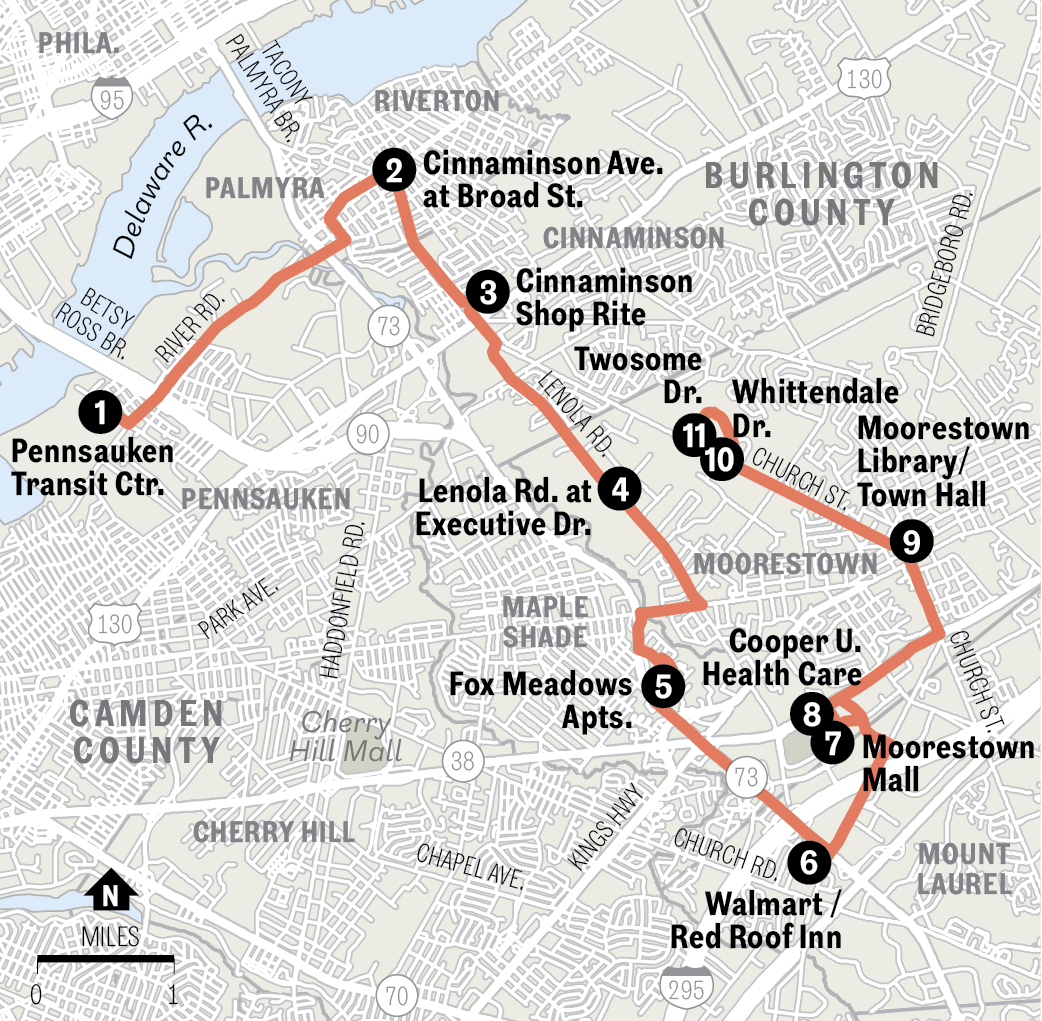
    And Burlington County’s new free bus shuttle mainly covers areas closest to Philadelphia and Camden.

    Plus, George E. Norcross is donating $100 million to Cooper University Health Care, and more news of the day.

    — Taylor Allen (southjersey@inquirer.com)

    P.S. Thank you for your continuing support. We want your thoughts! Tell us your opinion of the newsletter by taking our survey or replying to this email.

    If someone forwarded you this email, sign up for free here.

    Democrats aren’t changing their message

    New Jersey and Pennsylvania were among the four Democratic-led states where President Donald Trump claimed 250,000 noncitizens were registered to vote.

    It’s unclear how the Trump administration reached that figure, but it has sought to leverage last week’s disclosure of 6,600 noncitizens being registered to vote and nearly 400 casting a ballot in New Jersey as evidence of a widespread issue.

    As Trump seeks more power over state-run elections, national Democrats haven’t shifted their messaging.

    Instead, they are continuing to warn that changes Republicans want may make voting harder for many Americans.

    New Jersey and Pennsylvania are part of a lawsuit with other Democratic officials from across the country challenging the administration’s push to withhold money for disaster aid if they don’t share raw voter data.

    Reporter Michelle Baruchman has more.

    Burlington County’s draft bus route

    Burlington County’s new bus route slated to begin in September is expected primarily to cover places closest to Philadelphia and Camden. But it’ll also serve as a transfer destination.

    The South Jersey Transportation Authority has not posted details about the free Burlington County route, but The Inquirer obtained the draft brochure through a public records request.

    Documentation shows the 11-stop bus service connects Palmyra, Moorestown, Cinnaminson, Mount Laurel, and Maple Shade with the Pennsauken Transit Center in Camden County.

    Reporter Aliya Schneider has the story.

    What to know today

    • Political powerbroker George Norcross is gifting $100 million to Cooper University Health Care, where he serves as the longtime board chair. It’s Cooper’s largest donation ever, and among the biggest a nonprofit health system in New Jersey has ever received.
    • The founder of a Westville-based security company and his deputy director have been charged in separate indictments for allegedly stealing millions through embezzlement and other crimes, authorities announced Monday.
    • The vendor that Gov. Sherrill blamed for illegally registering thousands of noncitizens to vote has two other multimillion-dollar contracts with the state, according to New Jersey Monitor. Sherrill blamed this vendor last week for issues beyond the registration error.
    • The Gloucester County Shower Trailer will be available today at Glassboro Intermediate School from 10 a.m. to 2 p.m. It is open to anyone who needs a shower or clean laundry.
    • Jersey has seen the largest drop in its death rate in the country between 2015 and 2025, NJ Monitor reports.
    • Be aware of roadwork throughout Camden County this week, with most ongoing work occurring in Camden and Oaklyn.

    🗣️ Quote of the week

    Marie McCool, a Moorestown High School alumna, was named MVP of the inaugural Women’s Lacrosse League All-Star Game. She said the school program shaped her into who she is today.

    🧠 Trivia time

    What number will LeBron James wear for the Sixers?

    A) 22

    B) 23

    C) 25

    D) 32

    Think you know? Check your answer.

    What we’re…

    🏀 Wondering: Why LeBron James chose to commute from NYC instead of South Jersey?

    🍴 Touring: Craig LaBan’s guide to the best seafood down the Shore.

    🚶🏽‍♀️‍➡️ Exploring: Downtown Woodbury.

    And that’s been your morning news. I’ll be back in your inbox tomorrow. 📧

    By submitting your written, visual, and/or audio contributions, you agree to The Inquirer’s Terms of Use, including the grant of rights in Section 10.

  • In Montco data center fight, local officials say a developer has ‘bullied’ them. He says that’s a ‘bold-faced lie.’

    In Montco data center fight, local officials say a developer has ‘bullied’ them. He says that’s a ‘bold-faced lie.’

    The debate over a proposed 2 million-square-foot AI data center in Plymouth Township near Conshohocken has become acrimonious, with local officials and the developer trading accusations of mistreatment.

    Plymouth Township Council Chair Lynne Viscio said Monday that the project’s developer, Brian O’Neill, had “bullied” and “intimidated” township officials in an attempt to gain approval to build the facility on the site of the shuttered Cleveland-Cliffs steel mill.

    O’Neill’s recent efforts have included a legal challenge to the township’s zoning ordinance. Viscio said it was filed after O’Neill “rejected” the township’s concerns and its proposed data-center “safeguards.”

    “This is a blatant attempt by the applicant to demand approval by throwing a tantrum,” Viscio said in a statement, which she delivered during a live streamed appearance by council members, later posted to the township’s website. “The township is not interested in entertaining such theatrics.”

    Reached by phone, O’Neill called the accusations “a bold-faced lie” that were part of a “misinformation campaign” against his planned data center. He said he had been “negotiating in good faith” with township attorneys for months and had agreed to “the majority” of the township’s conditions.

    “We are sympathetic to the fact that they are under tremendous political scrutiny from people outside the township, as well as residents inside the township, and that makes giving a landowner their property rights … challenging,” said O’Neill, a longtime developer in Conshohocken and on the Main Line.

    “However, I am a landowner, and I do have rights,” he added, “and it is their job to be impartial and fair in their analysis and response.”

    The closed Cleveland-Cliffs steel mill is seen last month outside Conshohocken.Monica Herndon / Staff Photographer

    Hyperscale data centers, such as the one O’Neill is proposing, house the energy-hungry technology that powers ChatGPT and other artificial intelligence tools.

    Several such facilities have been proposed in the Philadelphia region amid surging AI demand and a global boom in data-center development. Two are under construction — an Amazon data center in Falls Township, Bucks County, and a facility in Vineland, Cumberland County, that is set to power Microsoft’s AI tools.

    On the outskirts of Conshohocken, O’Neill and his team have spent nearly a year trying to get the green light for a data center at the 66-acre property along the Schuylkill. Last fall, they abruptly withdrew their original proposal due to legal issues. In May, they resubmitted the plans for a center that would span 10 existing buildings.

    The Plymouth Township site is less than a mile from downtown Conshohocken, near the Proving Grounds sports complex, Tee’s Golf Center, and dozens of homes in the township’s Connaughtown section.

    The closed Cleveland-Cliffs steel mill where Brian O’Neill wants to build a data center is shown in June.Monica Herndon / Staff Photographer

    O’Neill has not said who would operate the center but has indicated it would be a tenant related to the life sciences.

    An initial zoning hearing board meeting on the resurrected Plymouth Township project was held last month. As of Monday, a more substantive hearing was scheduled for Aug. 6 and was set to include the presentation of evidence and testimony.

    The Plymouth Township project is one of six data centers that O’Neill is proposing in the area. Across the river in Upper Merion Township, where O’Neill’s MLP Ventures already has offices and labs, the developer has proposed a 4.6 million-square-foot data center campus spanning five properties.

    The proposed data centers in Upper Merion and Plymouth TownshipsJohn Duchneskie

    After a tense Upper Merion Township Planning Commission meeting last week, officials there voted not to recommend approval of three of O’Neill’s five plans. A hearing on the other two Upper Merion plans is set for Aug. 12.

    After the planning commission reviews all the applications, the Upper Merion Township Board of Supervisors will ultimately decide whether to approve the projects.

    In both Upper Merion and Plymouth Townships, some residents have rallied against the plans, packing township meetings, signing online petitions, putting anti-data-center signs on their lawns, and organizing on social media. They have cited concerns about light, noise, and air pollution; water usage; and electricity costs.

    A yard sign protests the proposed Plymouth Township data center.Monica Herndon / Staff Photographer

    On Monday, O’Neill reiterated that his Plymouth Township data center would make little noise, emit no light pollution, and operate on a closed-loop system that does not require outside water. He said it would generate its own power, not taxing the grid, and generate “billions of dollars in employment and economic development.”

    “I am shocked that [the township council] can in good conscience not promote my plan, let alone publicly oppose it,” given office vacancies in the area, O’Neill said. In the past, “our developments have helped to create the vibrant community that Conshohocken and Plymouth are today.”

    Viscio, the Plymouth Township Council chair, said that local officials wanted to ensure that O’Neill’s proposed data center improved residents’ quality of life — and that O’Neill’s efforts could prevent them from doing so.

    “We will not allow ourselves to be bullied or intimidated by any developer,” Viscio said. “We will not dismiss legitimate concerns raised by our residents.”

    She said the council would continue to oppose O’Neill’s application and his challenge to the zoning ordinance.

    On Monday afternoon, O’Neill called back a reporter with an additional message for Plymouth Township officials: “We’re always willing to make a deal if they want to sit down and talk.”

  • Family speaks on Cheltenham High assault | Inquirer Greater Abington

    Family speaks on Cheltenham High assault | Inquirer Greater Abington

    Hi, Greater Abington. 👋

    Thanks for reading the third edition of this newsletter. It’s been incredibly helpful to hear your thoughts so far. Please keep sharing your insights with us via this survey so we can shape this resource to be the most helpful it can be!

    This week, we go inside the alleged assaults in the Cheltenham High School locker room that led to the cancellation of two football seasons. We also take a look at the resident-driven push that’s prompted Cheltenham Township to pull millions from Citizens Bank, what caused the Friends of Fox Chase Farm volunteer group to disband, and the approach Jenkintown’s new superintendent is taking to overseeing the school district.

    — Laura Smythe (greaterabington@inquirer.com)

    P.S. If you’re not in a survey mood, you can also share your feedback on this newsletter by replying directly to this email.

    If someone forwarded you this newsletter, sign up for free here.

    The long shadow of locker room assaults

    A Cheltenham mother has spoken exclusively to The Inquirer about the alleged assaults her son experienced last year in the Cheltenham High School football locker room. In one instance, nearly 20 students watched as the boy’s teammates attempted to sexually assault him, his lawyers said.

    No students have been disciplined even after the school district determined that an assault had taken place and been recorded on video by witnesses, while the affected teenager “can’t escape” continued harassment throughout the local community, his mother said.

    The school’s previous and upcoming football seasons were both canceled amid the ongoing investigation by the Montgomery County District Attorney’s Office.

    Meanwhile, the teen’s family is still awaiting accountability.

    The Inquirer’s Maddie Hanna tells the story of a school district’s nightmare and a mother’s push for justice.

    Cheltenham closing Citizens Bank accounts over immigrant detention center ties

    Cheltenham Township is closing its last two accounts with Citizens Bank over the bank’s financing of companies that run detention facilities, despite the bank’s announcement it would no longer do so.

    The accounts hold about $9 million cumulatively, which township officials are planning to divert to Santander Bank. The move comes after months of lobbying by local residents.

    The Inquirer’s Jess Rohan explains the divestment plan, plus the pending status of some other Citizens Bank accounts held by the township’s tax collector’s office.

    💡 Community news

    • Friends of Fox Chase Farm, a volunteer group that supports the 112-acre expanse that straddles Abington Township and Philadelphia, has disbanded after more than 30 years.
    • Ramah Day Camp, a Jewish summer program in Cheltenham, will also shutter soon, ending its 30-year run.
    • Abington, Jenkintown, and Cheltenham are among the Montgomery County locales that will be scrutinized by law enforcement in the coming weeks in an effort to combat aggressive drivers.
    • A 27-year-old Nigerian man who laundered money as part of a “sextortion” plot that led a 20-year-old Abington native to kill himself has been sentenced to five years in federal prison.
    • Jenkintown man Seok Joon Lee, 54, has been charged with impersonating a federal officer after allegedly pretending to be an FBI agent at a Philadelphia grocery store, where he carried a loaded gun and attempted to conduct a security check of the supermarket.
    • The community is mourning the deaths of esteemed clothing designer and professor of fashion Emil DeJohn, 88, who was a congregant of St. Luke the Evangelist Church in Glenside, and Ida Schmertz, 91, a former Jenkintonian who became a pioneering women’s activist, presidential appointee, and the first female senior vice president at American Express. They each died in recent weeks.
    • Inquirer contributor Paul Jablow takes a good look at a three-story, six-bedroom Queen Anne Victorian home up for sale in the Wyncote Historic District.

    🏫 Schools briefing

    • Meet Brea D’Angelo, the former Sixers reporter who is now leading Jenkintown School District as its new superintendent.
    • Also in the Cheltenham School District, a new vice principal starts at Wyncote Elementary on Aug. 1. Plus, Glenside Elementary has named an interim principal and Cheltenham Elementary has named a new principal, both pending school board approval.
    • Construction is underway on Abington High School’s forthcoming Ash Carter Courtyard, a tribute to the late 1972 alumnus who served as U.S. Secretary of Defense from 2015 to 2017, the Main Line Times reports.

    🍽️ On our plate

    🎳 Things to do

    🔨 Legacy Park Community Build Week: Volunteers will help assemble the new Legacy Park playground. ⏰ Tuesday, July 28-Sunday, Aug. 2, various shifts 8 a.m.-8:30 p.m. 💵 Free 📍 Legacy Park, Jenkintown

    👻 Summerween Character Event: Enjoy spooky-themed drink specials, check out your favorite scary characters in their summer garb, and get a reading from a medium (if you dare). ⏰ Saturday, Aug. 1, 11 a.m.-1 p.m. 💵 Pay as you go 📍 Pot Heads Coffee House, Jenkintown

    🕺 The Concert: A Tribute to ABBA: The touring production from Sweden, featuring original band members from the iconic pop group, will perform renditions of ABBA’s ‘70s and ‘80s hits to Montgomery County. ⏰ Tuesday, Aug. 4, 8 p.m. 💵 $52.53-$75.74 📍 Keswick Theatre, Glenside

    🏡 On the market

    A cozy Colonial with a wood-burning fireplace

    1248 Gordon Rd. features a bay window in the dining space.

    Built in 1935 in Jenkintown Manor, this charming four-bed, three-bath home features original hardwood floors, a bay window in the dining area, and a wood-burning fireplace. There is a front porch as well as a back patio.

    See more photos of the home here.

    Price: $725,000 | Size: 2,982 SF | Acreage: 0.31

    🗞️ What other Greater Abington residents are reading this week:

    By submitting your written, visual, and/or audio contributions, you agree to The Inquirer’s Terms of Use, including the grant of rights in Section 10.

    This suburban content is produced with support from the Leslie Miller and Richard Worley Foundation and The Lenfest Institute for Journalism. Editorial content is created independently of the project donors. Gifts to support The Inquirer’s high-impact journalism can be made at inquirer.com/donate. A list of Lenfest Institute donors can be found at lenfestinstitute.org/supporters.

  • New Burlington County shuttle bus will connect Philly suburbs with regional transportation options

    New Burlington County shuttle bus will connect Philly suburbs with regional transportation options

    A new free shuttle bus in Burlington County will be concentrated in a small slice of the county in some of the places closest to Philadelphia and Camden, according to a draft brochure for the service.

    But it’ll also serve as a transfer point for other residents in the area.

    SJ Connects, a free shuttle bus service run by the South Jersey Transportation Authority (SJTA), was granted $5 million under former Gov. Phil Murphy’s administration for an 18- to 24-month trial run to improve transit in the region. All of the service’s routes already began running except for Burlington County’s bus, which is expected to start service in September despite being included in a June 1 launch announcement.

    The SJTA has not yet posted the details of the Burlington County route but The Inquirer obtained its draft brochure through a public records request. The document shows that the planned 11-stop route connects Burlington County’s Palmyra, Moorestown, Cinnaminson, Mount Laurel, and Maple Shade with the Pennsauken Transit Center in Camden County.

    While it will most directly service the residents who live along the route, the planned route will also connect with existing transportation centers in the area to serve as a transfer point for riders.

    Locally, the bus is slated to stop at Cooper University Health Care‘s Moorestown campus, Moorestown Library and Town Hall, Cinnaminson Shop Rite, Fox Meadow Apartments, and the Mount Laurel Walmart Supercenter.

    Stops at the Moorestown Mall and Pennsauken Transit Center will connect riders to NJ Transit buses that go to Philadelphia’s 30th Street Station, Trenton, Camden County municipalities such as Cherry Hill, Haddonfield and Gloucester City, and other Burlington County locations such as Mount Holly and Willingboro. It will also link riders with the RiverLine and Atlantic City Rail.

    (function() {
    var l2 = function() {
    new pym.Parent(‘BURLCO28-A’,
    ‘https://media.inquirer.com/storage/inquirer/projects/innovation/arcgis_iframe/BURLCO28-A.html’);
    };
    if (typeof(pym) === ‘undefined’) {
    var h = document.getElementsByTagName(‘head’)[0],
    s = document.createElement(‘script’);
    s.type = ‘text/javascript’;
    s.src = ‘https://pym.nprapps.org/pym.v1.min.js’;
    s.onload = l2;
    h.appendChild(s);
    } else {
    l2();
    }
    })();

    Dominic D’Amico, director of transportation services at the SJTA, said the agency designed the routes to connect with NJ Transit’s existing infrastructure and the region’s “eds and meds.”

    Some parts of Burlington County that are excluded from SJ Connects — such as Pemberton and Mount Holly — have access to a separate, existing system called the BurLINK shuttle, which is administered by the county and run by a private company.

    The new SJ Connects route is not slated to directly connect with BurLINK. But riders can transfer between the two services using the River Line, for example.

    Assembly member Andrea Katz, a Burlington County Democrat, said in an interview earlier this month that she hopes SJ Connects will expand further into her district in the future. The long-term viability for the program will likely depend on whether its advocates can convince Democratic Gov. Mikie Sherrill and legislative leaders that it’s worth funding in future state budgets.

    “We have very little down here in Burlington County, and in South Jersey as a whole, but folks still have those issues that they need a ride to the hospital, they need a ride to a grocery store,” Katz said. “They need to get access to these things, and we’re finally starting to see this expansion into South Jersey.”

  • He was assaulted by teammates in Cheltenham High’s locker room. Nearly a year later, his mom says he ‘can’t escape the situation.’

    He was assaulted by teammates in Cheltenham High’s locker room. Nearly a year later, his mom says he ‘can’t escape the situation.’

    The mother knew something was wrong the night her son came home from football practice last September and quietly went to his room.

    Four days later, she took him to the doctor after he told her his teammates had jumped him inside the Cheltenham High School locker room after that practice, injuring his genitals.

    It was not until she got a call from police later that month that the mother learned that teammates had used a broomstick in the alleged attack, an act his lawyers described as attempted sexual assault.

    Her son, who was 15 at the time, told her teammates had tried “to mess with his manhood,” the mother said.

    He told her that the school’s football coaches, who knew that his teammates had jumped him, had called him that night and told him not to tell his parents.

    “He didn’t want to talk about it,” said the mother, who spoke to The Inquirer on the condition of anonymity to protect her son’s identity. Her son, she said, “was trying to put it in the back of his head. He was traumatized.”

    Cheltenham abruptly canceled its football season last October, citing hazing allegations. In January, the district said it had confirmed that a “student-on-student assault” took place in its football locker room on Sept. 3, and that nearly 20 students had watched without trying to stop it.

    A video of a locker room attack that investigators thought matched the student’s description of the alleged attack in September surfaced in the fall and was obtained by the district. The teammates who assaulted the student are identifiable in the video, said Gabrielle Turley, a lawyer representing the student. She said the student provided their names to Cheltenham police.

    But this spring, detectives determined the footage actually had been taken in August, according to the student’s lawyers — prompting the student to reveal he had been assaulted more than once.

    Eleven months later, no charges have been filed. A spokesperson for the Montgomery County District Attorney’s Office said it is still investigating but declined to comment further.

    The incidents have reverberated throughout the suburban community, even as the school district has provided few specifics about what happened in the locker room.

    The district announced in May it was canceling the forthcoming football season for the Panthers, but has not disciplined any students.

    A Title IX investigation — which schools are required by federal law to conduct into sexual misconduct allegations — is ongoing. “Unfortunately, the district received extremely limited cooperation from students,” Superintendent Brian Scriven said in a statement in response to questions from The Inquirer about the assaults. Any discipline for students will be imposed once the investigation is done, Scriven said.

    The district in April approved a separation agreement with the team’s head coach, Terence Tolbert, who had been Cheltenham’s top football coach since June 2025.

    Scriven noted that the district also in April approved a separation agreement with another football coach, Darian McFadden. None of the coaches from the 2025-26 season are still affiliated with the district, the superintendent said.

    Scriven declined to address specific questions about the alleged assaults, saying the district attorney’s office had asked school officials not to comment.

    Brian Scriven, superintendent of the Cheltenham School District.Courtesy of Cheltenham School District

    As the new school year approaches, some football players and their families have criticized the district’s cancellation of another season as unfair punishment for a situation they had no part in.

    But students who participated in or witnessed the alleged assaults have been able to move on with their lives, graduating from the 1,450-student Wyncote school or transferring to other schools, the mother of the victim said. Her son has not.

    He was taunted by peers after the September assault and switched to virtual school in the district, where he struggled and was isolated, his mother said. After getting harassed by kids at his local basketball court, he avoids going outside, she said.

    “He can’t escape the situation,” she said.

    Inside the locker room

    Video footage from the August incident after a football training camp at Cheltenham High School shows the student being dragged by his shirt on the floor of the locker room, according to his lawyers.

    About “seven or eight students are making physical contact” with him, while other students are standing by lockers, some with their phones out, said Alan Yatvin, one of the lawyers.

    The video shows one young man holding a broomstick, which is being “poked or thrust at [the student’s] genitals and backside,” Yatvin said.

    Turley, the other lawyer representing the student, said the video shows teammates trying to pick the student up by his shirt, which is ripped, while the student tries to remain seated on the floor.

    “There’s no other reason to be in that area, unless you’re trying to sexually assault somebody,” Turley said of the broomstick she saw in the video of the alleged attack.

    The student did not tell anyone about the August incident because he was embarrassed, his lawyers said.

    But then on Sept. 3, he was assaulted again. The student had taken someone’s shoulder pads because his were missing. Coaches made players run as a punishment, and they blamed the student, the lawyers said.

    Yatvin said that as the student tried to leave the locker room, he was thrown on the floor and punched and kicked in the head and testicles. He said the student reported there were “three main people hitting him.”

    The altercation lasted about five minutes, and the student heard someone say, “‘Get the broomstick,’” Yatvin said. He said the student tried to ball up on the ground and “sat in such a way to avoid the broomstick being stuck in him.”

    A couple of teammates intervened, and the fight broke up, Yatvin said. He said one player went to get a trainer, while another got the student ice.

    A volunteer coach drove the student home. That same night, three coaches, including then-head coach Tolbert, called the student, according to Yatvin.

    “They told him that he shouldn’t tell his mom, because they would handle it. He believed that,” Yatvin said.

    Reached by phone earlier this month, Tolbert declined to comment.

    A mother pushes for answers

    The student’s mother recalls taking her son to an urgent care center four days after the Sept. 3 incident because he was “complaining his pee was burning a little bit,” she said.

    She texted the vice principal, Mark Hoff, to let him know what had happened. “I was very upset,” the mother said. Hoff called her; the school opened an investigation the next day, Yatvin said.

    It was about 12 days later when Cheltenham police called her about a tip that had been submitted through the state’s anonymous Safe2Say line, about a broomstick being used during an assault.

    “I know that’s like a sexual assault — trying to sodomize somebody,” the mother said, noting she works at a prison. “What was going through my mind was, ‘Where did these kids get this from?’”

    At the end of September, lawyers said, the district contacted the mother to ask if she wanted to open a Title IX investigation, given the sexual nature of the allegations. She said yes.

    At the time, the mother did not know her son had been attacked more than once.

    No one had shown her and her son the video of the alleged assault that the district obtained — which had circulated through the school community, Yatvin said — until the spring. Had they seen it earlier, he said, they would have known it was from August, based on the student’s hairstyle at the time.

    The mother said her son was “scared to come forward.”

    “He didn’t want to go through none of this,” she said. “But I kind of pushed the issue.”

    Waiting for accountability

    On Oct. 17, a Friday, Cheltenham announced that it was postponing that night’s football game.

    “Today, the district received anonymous information regarding allegations of hazing in the football program,” Scriven said in a statement. The season was temporarily suspended, he said, and the district had “engaged an external investigator.”

    By that Sunday, Scriven had announced that the season was canceled. The district had received a report “approximately three weeks ago” of a locker room assault, he said in the announcement, and that Friday, it “received additional information, including reports indicating multiple team members engaged in hazing through physical contact.”

    Asked why it took until Oct. 17 for the district to suspend the season when the mother had reported the assault Sept. 7, Scriven drew a distinction between hazing and a “singular incident of assault.”

    The district’s external investigation, which was completed in January, determined there was insufficient supervision in the locker room and “a failure to prioritize student safety by the coaching staff and/or adult volunteers,” as well as a “a toxic and negative culture within the current football program.”

    Scriven said he expected the Title IX investigation to be completed “in the near future.”

    Yatvin believes more students know what happened to his client than have come forward.

    “If all the necessary information was available, there probably would have been something happening with the school’s investigation, and something happening with the district attorney’s investigation,” he said.

    The student’s mother, who is considering filing a lawsuit, said she wants people held accountable for what happened to her son. No one from his school has called and checked on his well-being, she said.

    “You’ve got parents on the news, worrying about their football team, but not necessarily worried about what happened,” she said. “Nobody is focused on what happened to him.”

  • She fought to bring the man she loves home from prison after a landmark court ruling. But lawmakers’ inaction has left her in limbo.

    She fought to bring the man she loves home from prison after a landmark court ruling. But lawmakers’ inaction has left her in limbo.

    The phone rang at lunchtime, the way it did every day. Carisia Magobet answered within seconds.

    An automated voice spoke first: This call is from a Pennsylvania state correctional institution.

    Then his.

    “May the peace, mercy, and blessings of Allah be with you, my love,” Matthew Garcia said in Arabic.

    They had only 15 minutes, and for once, Magobet did not spend the first of them on small talk. There was no good way to tell him what she knew: State lawmakers had gone home the night before without taking the vote that the couple had hoped would bring him home.

    Garcia was 18 in 1998 when he and four friends set out to rob a Hunting Park bar. He said he was the lookout and did not have a gun.

    One of the teens pointed a sawed-off shotgun at a bartender and demanded cash. A retired Philadelphia police officer, Frank King, was inside the bar and grabbed for the gun. Another teen shot him with a pistol. King died on the floor.

    By that time, Garcia said, he had already run.

    It didn’t matter.

    All five were convicted of second-degree murder — a killing committed during a felony, no matter who pulled the trigger — and sentenced to the only punishment Pennsylvania law allowed: life without the possibility of parole.

    Magobet, who had known Garcia since they were kids in Hunting Park, was in the courtroom on June 21, 2000, the day he was sentenced. For decades, they did not see each other again.

    Then, about two years ago, she found Garcia’s Facebook account, where he shared his writing and his work inside State Correctional Institution-Chester, the prison he called home. She reached out.

    Garcia told her about a case before the Pennsylvania Supreme Court that could mean freedom for people serving life sentences in cases like his.

    Derek Lee, a Pittsburgh man sentenced to life in prison for his role in a fatal robbery in which a coconspirator fired the fatal shot, had challenged the mandatory punishment as unconstitutional, saying it failed to account for individual culpability.

    In March — six months after Magobet and Garcia wed in a prison visiting room — the high court struck down mandatory life sentences for second-degree murder.

    It gave lawmakers until July 24 to write new sentencing guidelines for future cases and determine how, or whether, the ruling would apply to the roughly 1,100 Pennsylvanians already serving that sentence.

    On Friday, the deadline arrived, but a resolution did not. On July 12, the legislature had adjourned without voting on a fix. And fresh efforts last week failed to produce a bill that Democrats and Republicans could agree on.

    The stalemate places in limbo everything Magobet, 40, and Garcia, 45, have spent the last two years assembling in anticipation of a freedom both yearn for but neither can control.

    Building together

    She loved him first.

    Magobet was 13 when Garcia’s sister got married and they were both in the wedding party. He was supposed to walk her down the aisle. But at the last minute, the pairs were swapped, and she walked with his brother instead. Magobet decided, quietly, that she was owed that walk one day.

    She never told him. Not before his arrest, not for years after he went to prison. She found his social media accounts and saw what his life had become in prison.

    He had earned college credits, started programs for young people, and launched a podcast to share his story.

    In a prison foster-cat program, Garcia adopted a calico, named her Lil Mama, and fed her until the name stopped fitting. “It’s not Lil Mama now,” he said in a recent interview. “It’s Fat Mama.”

    Prison reform advocate Carisia Magobet shows photos of her husband, Matthew Garcia, who is serving a life sentence for second-degree murder, at her home in Northeast Philadelphia.Sarah Silbiger / For The Inquirer

    The orange-and-black foster fail appeared often in Instagram photos. In one, a full-bearded Garcia wrote: “Me and Lil Mama, patiently waiting on our moment.”

    By then, Magobet had four children, a house, a dental office she managed by day, and a commercial cleaning business she ran at night. Yet she found herself thinking often about Garcia. Seeing him there — older, broader, smiling beside a chubby cat — made him less a memory and more real. She emailed him.

    Not long after, she took over his social media accounts.

    Together, they began building a growing audience for Garcia’s work, a network of supporters, and, eventually, a life that felt shared despite the prison walls that separated them.

    She posted his poetry. She built a website explaining the Lee case and a guide to contacting lawmakers about sentencing reform. He wrote children’s books, including one about Lil Mama that Magobet’s 21-year-old daughter, a digital arts student, illustrated.

    A chance for ‘FREEDOM’

    Garcia proposed on Aug. 1, three months after they reconnected. But it didn’t feel fast to Magobet. She had been carrying that moment since the wedding party.

    They wed on Aug. 23. She is still waiting on prison paperwork to make it legal. But to them, Magobet said, it’s official.

    Matthew Garcia and Lil Mama.Courtesy of Carisia Magobet.

    He calls at least four times each day — when his cell door opens at 7 a.m., at lunch, after his work shift at the prison’s reentry program, at night. Each call lasts 15 minutes, the maximum allowed under prison policy, plus six video calls and four in-person visits a month.

    On a video call last month, the couple discussed Magobet’s plan to join other families, formerly incarcerated people, and advocates in Harrisburg to support legislation in response to the high court’s decision that would allow people like Garcia to seek parole after serving at least 25 years. Not guaranteed release, but a chance to make their case.

    She told him about a poster she had printed to bring, with a photo of him holding Lil Mama and “FREEDOM” written in all capital letters. She had ordered a custom T-shirt, too, but it had not arrived yet.

    “Will it come in time for Monday” for the trip to the Capitol? Garcia asked.

    The call cut out before she could answer.

    ‘Do your job and legislate’

    Carisia Magobet participates in a rally at the state Capitol in Harrisburg.Kalim A. Bhatti / For The Inquirer

    Magobet wore the T-shirt to Harrisburg two days later.

    Beneath the Capitol rotunda, Magobet met Saleem Holbrook, the executive director of the Abolitionist Law Center, which represented Lee before the Supreme Court. He told Magobet he knew Garcia from their years in prison together.

    “If there’s a person who’s earned being able to come home,” he said, “it’s Matt.”

    In State Rep. Nikki Rivera’s office, Magobet read a speech from her phone. Her voice broke only once, when she told Rivera (D., Lancaster) that Garcia was her husband.

    In the lobby of House Majority Leader Matt Bradford’s office, Magobet joined several others in a chant — “the time is getting late, do your job and legislate!” — that prompted the Montgomery County Democrat’s chief of staff to take Magobet and another person back to her office. The staffer had listened, Magobet said, promised nothing, and blamed the other side.

    But Lil Mama made her laugh.

    “The cat gets everyone,” Magobet said afterward. “We gotta get Lil Mama T-shirts for next time.”

    Holding onto hope

    Five weeks later, there was no next time to plan for.

    Magobet learned that lawmakers adjourned July 12 without voting on the Democratic-sponsored measure she had supported, or the stricter Republican proposal.

    She told Garcia on a phone call, and before the 15 minutes were up, he told her he couldn’t keep talking. It was the first time he had ever done that, she said.

    A new measure, introduced by Democrats in an emergency session last week, did not earn a vote in the Senate.

    The Supreme Court’s 120-day stay on new sentencings in second-degree murder cases expired on Friday, and judges can again hand out life sentences to people convicted of second-degree murder, but only in limited circumstances. But without a new law, there are no mandatory minimums or clear guidelines.

    On Thursday, the Allegheny County District Attorney’s Office asked the high court to extend its stay until September, when lawmakers are scheduled to return to the Capitol. As of Monday, the court had not ruled on the request.

    In the meantime, the next chapter will likely unfold in the courts for the more than 1,000 people already serving mandatory life sentences.

    Bret Grote, an attorney with the Abolitionist Law Center who represented Lee in the Supreme Court case, said the high court has been asked in a separate case to determine whether the ruling applies retroactively.

    He called the situation “a constitutional crisis.” But even under the most optimistic timeline, he said, a resolution could take years.

    In the meantime, attorneys expect a wave of challenges from incarcerated people seeking relief. More than half of those serving the sentences are from Philadelphia.

    Garcia said he will meet with his attorney to determine his next steps.

    Prison reform advocate Carisia Magobet poses for a portrait at her home in Northeast Philadelphia.Sarah Silbiger / For The Inquirer

    Magobet said she is holding on to hope — for the smaller things.

    Walks together.

    Coffee he brewed waiting for her in the morning.

    Afternoons at a pool. (Garcia has not been in water deeper than a shower in nearly three decades.)

    For months they talked about those plans as though they were approaching.

    Now they wait. Again.