Category: News

  • FanDuel and DraftKings seek dismissal of lawsuit at the center of Bryce Harper video controversy

    FanDuel and DraftKings seek dismissal of lawsuit at the center of Bryce Harper video controversy

    FanDuel and DraftKings have each asked a Philadelphia judge to dismiss a lawsuit that accuses the companies of profiting from practices that two bettors say caused them to develop gambling addictions.

    The sportsbook operators, as well as the National Football League and the data company Genius Sports, were sued in March by the nonprofit Public Health Advocacy Institute on behalf of Terry Thompson and Christopher Sage, men from the Philadelphia suburbs who allege that they compulsively placed in-game microbets through FanDuel’s and DraftKings’ apps and were enticed to continue gambling by rewards that VIP managers offered, even after they displayed signs of addiction.

    But attorneys for FanDuel and DraftKings argue that the lawsuit — which claims that the companies violated Pennsylvania’s consumer protection law, and were negligent in protecting Thompson and Sage from harm — is inherently flawed, according to preliminary objections that were filed July 15 in Common Pleas Court in Philadelphia.

    “Courts around the country, including courts that sit in this Commonwealth, have held that there is no duty of care to protect customers from their own lawful wagering, even where such wagering is alleged to be compulsive,” wrote attorney Erin L. Leffler, who represents FanDuel.

    Phillies first baseman Bryce Harper said he didn’t know FanDuel intended to use a Cameo video that he recorded in 2024 as a reward for a VIP bettor. Elizabeth Robertson / Staff Photographer

    Thompson, of Montgomery County, placed his first bet with FanDuel in 2020 and went on to lose nearly $1.8 million, his lawsuit alleges. He planned to die by suicide earlier this year rather than confess the scope of his losses to his family, the lawsuit says.

    Sage, of Delaware County, began wagering with DraftKings in 2019 and eventually lost about $175,000. To fund his gambling, he alleges, he stopped making payments on his mortgage and truck, and borrowed money from loan sharks.

    Lawyers for FanDuel and DraftKings wrote that Thompson and Sage knew about their addictions for longer than the state’s two-year statute of limitations for product liability lawsuits.

    Yet the sportsbooks contend that they should not even face product liability claims, because they do not sell an actual product but instead offer customers a free online app.

    The Public Health Advocacy Institute declined to comment Monday.

    The lawsuit attracted national attention following a July 9 Inquirer report that revealed Bryttanni Morgan, a FanDuel VIP manager, had sent a personalized video of Phillies first baseman Bryce Harper to Thompson in November 2024. (Morgan, who is named in the lawsuit, was also a VIP manager for Sage.)

    Harper later wrote on Instagram that he had recorded the message through the paid video service Cameo but had not known that FanDuel intended to use it as a reward for a VIP gambler who had an addiction.

    The Phillies star is not named in the lawsuit. The Pennsylvania Gaming Control Board — which regulates casinos, online gambling, and sports wagering — has said it is reviewing the Harper video.

    FanDuel and DraftKings, in their preliminary objections, suggested that Common Pleas Court Judge Gwendolyn N. Bright could pause the case to allow the gaming control board to evaluate elements of the case that fall under its regulatory purview, like in-game microbets.

    The board has not yet reviewed the court records, a spokesperson, Doug Harbach, wrote in an email Monday.

    “With that said, the PGCB’s role as the regulator of gaming in the Commonwealth is, first, to make sure that all persons and entities licensed by us to engage in that activity have and maintain suitability through a showing of ongoing good character, honesty and integrity,” he said.

    NFL commissioner Roger Goodell, pictured in February prior to the Super Bowl. Lawyers for the league argued that Terry Thompson’s lawsuit should be dismissed. Matt York

    One of the defendants, London-based Genius Sports, licenses official statistics and data from the NFL, the NCAA, and other leagues, and supplies that information to betting markets. The company also earns commissions on gamblers’ microbets, Thompson’s and Sage’s attorneys have alleged, a revenue stream that reached more than $125 million in 2025.

    In addition to licensing its data to Genius Sports, the NFL has also owned as much as 8.7% of the publicly traded company’s stock, making it Genius Sports’ largest shareholder.

    Genius Sports and the NFL are also seeking to have Thompson’s and Sage’s lawsuit dismissed.

    Attorneys for Genius Sports wrote that the company is “merely an upstream data supplier” and has no control over sportsbook apps.

    The NFL argued that the court has no jurisdiction over the league, which had no “relevant contact of any kind” with the plaintiffs.

    Other possible resolutions

    In a separate court filing, FanDuel’s attorneys argued there is a more proper path to resolving the case.

    “This dispute belongs in arbitration, not in court,” the lawyers wrote.

    After creating accounts with FanDuel, Thompson and Sage each agreed to the company’s terms and conditions, which require customers to resolve complaints through mandatory, multistep arbitration.
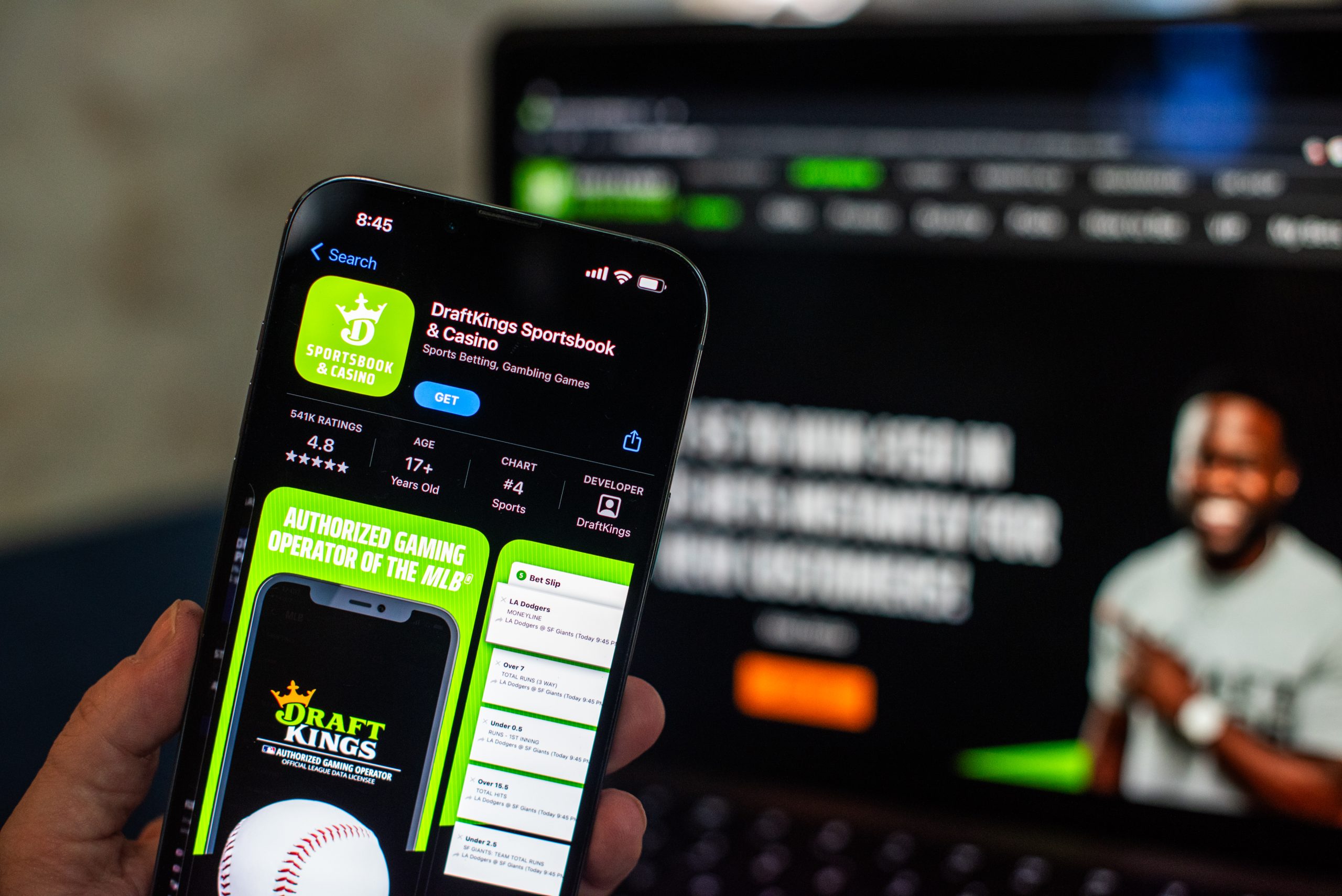
    The DraftKings app on a smartphone arranged in Hastings-on-Hudson, New York, US, on Monday, July 31, 2023. MUST CREDIT:Tiffany Hagler-Geard

    “The arbitration agreement was not hidden in the terms,” reads part of the response to the lawsuit. “It was prominently disclosed at the outset.”

    FanDuel successfully argued for arbitration earlier this year in the Southern District of New York, where a former Jacksonville Jaguars executive, Amit Patel, sued the sportsbook operator for $250 million, claiming it worsened his gambling addiction, according to a report in Sportico, a sports business web site.

    Patel was sentenced in 2024 to more than six years in federal prison for embezzling more than $22 million from the Jaguars. He used some of the money to place online wagers.

    FanDuel later agreed to pay $5 million to the NFL, in “the interest of being a good partner with the league,” ESPN reported.

    The Inquirer will continue to report on issues related to the growth of gambling addiction — among teens and adults — across Pennsylvania. If you or someone you know would like to speak with a reporter, please contact David Gambacorta or William Bender at dgambacorta@inquirer.com or wbender@inquirer.com

  • George Norcross is donating $100 million to Cooper University Health Care

    George Norcross is donating $100 million to Cooper University Health Care

    George E. Norcross, longtime Cooper University Health Care board chair and political powerbroker, is donating $100 million to the South Jersey health system and its MD Anderson Cancer Center at Cooper, the nonprofit announced Tuesday.

    The gift, in honor of Norcross’ parents, is Cooper’s largest and among the largest ever to a nonprofit health system in New Jersey. It comes at a time when Cooper’s financial condition is stronger than it has been in decades and as the nonprofit pursues a $3 billion expansion in Camden.

    Cooper said it would add Norcross to its name but didn’t specify how.

    “For more than 50 years, our family has been dedicated to Cooper, and we are so proud to make this contribution to ensure that Cooper and the thousands of talented, committed professionals who make a difference every day for the people of Camden and South Jersey can continue the important work of investing in their future and in Camden’s continued renaissance,” Norcross said in the announcement.

    Norcross, chairman of insurance brokerage Conner Strong & Buckelew and a former owner of The Inquirer, was not available for an interview, a spokesperson said.

    The money will be used for investments in Camden and throughout Cooper’s South Jersey service area, which stretches to Cape May County since the acquisition of Cape Regional Health System two years ago. Priorities will be education and community programs that create jobs and training, Cooper said.

    Cooper had $2.9 billion in revenue last year and $144 million in operating profit. In June 2025, Standard & Poor’s raised Cooper’s credit rate to A+, its highest level ever and a substantial turnaround for a system that was near bankruptcy 25 years ago. The system has more than 14,000 employees.

    Norcross’ gift in context

    Norcross’ donation matches a $100 million gift in 2021 to St. Barnabas Medical Center in Livingston, now called Cooperman Barnabas Medical Center in honor of the donor, Leon Cooperman, a billionaire hedge fund manager.

    Holy Name Medical Center in Teaneck received a $75 million gift last year.

    The Norcross contribution to Cooper is bigger than gifts to other health systems in South Jersey.

    Virtua Health said last year that a $5 million pledge from the Marvin Samson Foundation was its largest gift ever. Marvin Samson, a local pharmaceutical entrepreneur, pledged the money for Virtua’s education and workforce development programs, Virtua said.

    Deborah Heart & Lung Center received a $5 million gift in 2019, which it called its largest ever. The specialty hospital in Browns Mills received $4 million in 2024.

    In Philadelphia, Comcast CEO Brian Roberts and his wife, Aileen, are giving Children’s Hospital of Philadelphia $125 million and will have their name on the nonprofit’s new $2.59 billion patient tower expected to open in late 2028, CHOP said last year. It was CHOP’s largest gift ever.

    Also last year, Penn Medicine received a $120 million gift from Catherine and Anthony Clifton and renamed its new, $1.6 billion Pavilion at the Hospital of the University of Pennsylvania the Clifton Center for Medical Breakthroughs.

    Norcross family ties to Cooper

    The Norcross family has deep ties to Cooper starting with Norcross’ father, George E. Norcross Jr., a labor leader who was on the Cooper Hospital board from 1976 to 1983. He died in 1998.

    Norcross III joined the Cooper board two years later and has been chair since 2006.

    Norcross’ mother, Anne Carol Conner Norcross, gave birth to four sons — George, John, Donald, and Philip — at Cooper. She devoted years of her life to helping seniors and underserved Camden residents, Cooper said. She died in 2016.

    Philip A. Norcross is vice chairman of Cooper’s board of directors and chairman of the Cooper Foundation. Alessandra “Lexie” Triem Norcross, George Norcross III’s daughter, is also on the Cooper Foundation board.

    Cooper’s expansion

    In addition to acquiring Cape Regional and embarking on a major expansion of its Camden campus, Cooper has been expanding its network of outpatient facilities in suburban South Jersey.

    It spent $150 million to open a three-story facility in a former Sears at Moorestown Mall in late 2023. In the year following the Cape Regional acquisition, Cooper added cardiology, oncology, and orthopedics specialists care to those offices in Cape May County.

    In June, Cooper said it plans to build a $300 million outpatient facility in Gloucester Township and expects to start seeing its first patients in specialties like cardiology, neurology, and oncology in 2029.

  • A shootout that killed 3 at a food festival near Seattle’s Space Needle may have been gang-related

    A shootout that killed 3 at a food festival near Seattle’s Space Needle may have been gang-related

    SEATTLE — There were at least three suspects involved in a shootout at a crowded food festival near Seattle’s Space Needle over the weekend, police said Monday. One of them was among those killed in the violence.

    In a document filed in juvenile court in Seattle, where a 15-year-old arrested in the case waived his initial appearance Monday, police said they believe there were at least three shooters, rather than two: the 15-year-old, an acquaintance who died at the scene and “at least one other unknown suspect.”

    Nicole Powell, the Seattle Police Department’s assistant chief of investigations, told a news conference Monday afternoon that investigators believe the shooting may have been gang-related, with two groups firing at each other. The deceased shooter was 19.

    A judge ordered the 15-year-old held in juvenile detention for investigation of firearms violations and first-degree assault. The King County prosecutor’s office said it expected to receive the case from Seattle police on Wednesday for a charging decision.

    The gunfire erupted around 6 p.m. Sunday in the waning hours of the Bite of Seattle, leaving three people dead and at least four others, including a toddler, injured. The annual three-day festival draws hundreds of food and retail vendors and performers to Seattle Center, a sprawling park in the shadow of the Space Needle. Many attendees rushed into campus buildings or ran from the park at the sound of the shots.

    Officials provided confusing statements about the shooting

    News that there were at least three suspects followed a series of confusing statements from city officials concerning the shooting.

    On Sunday, the police department waited five hours to share with the public that one shooter had been arrested and that they believed another to be on the loose. Earlier, Mayor Katie Wilson had announced two people were in custody, a statement she retracted.

    At a news conference before the court hearing Monday, Police Chief Shon Barnes said investigators weren’t sure if the second shooter was among the dead. Neither he nor the mayor made any reference to additional shooters. Barnes had been out of town Sunday, attending a conference of Black law enforcement executives in Dallas.

    The officials defended their handling of the case, saying they were trying to ensure they provided accurate information about chaotic events.

    The victims included a father of three

    The King County Medical Examiner’s Office on Monday identified the dead as Carlos Israel Sanchez Villalba, 44; Ashley Whitehead, 56; and Junior Cee Niko Semo, 19.

    Villalba was a husband and father of three known for his kindness and willingness to help others, according to a GoFundMe campaign launched Monday to help his family with funeral expenses. He died from a gunshot wound to his torso, while Whitehead died from a gunshot to her pelvis and Semo died from multiple gunshot wounds, according to the medical examiner’s office.

    The four wounded included a 2-year-old boy, who was in satisfactory condition Monday. The others — two men, ages 23 and 27, and a woman, 39 — were discharged, a hospital spokesperson said.

    One of the victims was walking a bicycle when struck, the court document said. The toddler was with his mother.

    Vendors were allowed to clean up Monday

    Vendors were allowed to return to the campus Monday morning to collect their equipment. Skewered squid on grills, roasted ducks in ovens and plates full of food were among the items left behind as people fled.

    Near the spot of the shooting, a stain of what appeared to be blood was still visible. A candlelight vigil was planned Monday night at the center’s International Fountain.

    Dozens of officers were providing security at the event and responded in seconds, at least one observing a suspect firing, authorities said. Police searched an IMAX theater on the grounds where they initially believed a second shooter had fled.

    Adam Lombardo, who had a Burmese food stand at the festival, described the panic of fleeing people as a “stampede.” As he gathered his equipment Monday, he described how police escorted food vendors back to the crime scene to turn off their ovens and stoves.

    “It’s really sad because you think that three innocent people aren’t getting up with their families,” he said. “They just came to enjoy a food festival with people, with friends, with new friends, and they lost their lives in just what sounds like meaningless bloodshed.”

    Attendees describe chaos at a joyful event

    Festival attendee Faith Adia Hunter said she and her friends had just gotten food from a crepe vendor when gunfire broke out. They sheltered in the nearby Seattle Children’s Museum.

    “We were about to start eating, then heard someone yell something, then we saw people start to run,” Hunter said. “So we took off running, too.”

    Moises Perez, 30, was cooking in his apartment next to the Seattle Center when he spotted people running and yelling outside his window. When he opened his door, he heard gunshots and started ushering more than a dozen people, mostly women and children, inside.

    “I was like, ‘OK, we need to help these people,’” said Perez, a construction worker who had attended the food festival that morning. He said losing his brother to gun violence in Mexico years ago made him determined to help the people trying to get to safety.

    He and his roommate, William Large, 25, made sure the door was locked and started directing people to the bathroom and hallway, and told them they could stay as long as they needed.

    “They were definitely in shock. I know that a lot of people were crying, people were screaming, people were just in complete fear,” said Large, who works in social services.

    About 30 minutes later, Perez walked out to see what had happened. He found a woman shot in the leg being helped by emergency officials.

    The festival started in 1982 and draws 350,000 attendees, according to its website.

  • 2 executives with South Jersey security firm charged with stealing millions through embezzlement and bank fraud

    2 executives with South Jersey security firm charged with stealing millions through embezzlement and bank fraud

    The founder of a security company in South Jersey has been charged in connection with embezzling $3 million from his business and causing a $9 million loss for a bank, U.S. Attorney Robert Frazier announced Monday.

    Robert Cormier, 51, of Barrington, was arraigned on July 20 in Camden federal court before U.S. Magistrate Judge Elizabeth A. Pascal. He was charged in an indictment filed July 8 with embezzlement by bank agent, bank fraud, money laundering, income tax evasion, and failing to collect and pay over payroll taxes.

    Cormier was still in federal custody on Monday, according to court records. A federal defender representing Cormier could not be reached for comment.

    A second man, Richard Eisler, 38, of Clementon, who was the deputy director for the security company, was charged in a separate indictment in connection with embezzling over $2 million from the business.

    Eisler was charged with embezzlement by bank agent, money laundering, income tax evasion, and witness tampering. Eisler was arraigned on Friday in Camden federal court before Pascal and pleaded not guilty, court records show. Eisler was released on $100,000 unsecured bail.

    The lawyer representing Eisler could not be reached for comment Monday.

    In 2017, Cormier started Erigere Rapidus Solutions, Inc. (ERS), a security services business based in Westville, prosecutors said.

    According to several organizations that promoted him as a public speaker with a law enforcement background, Cormier is a retired U.S. Border Patrol agent. The Latin phrase “erigere rapidus” is the motto for a special operations group in the Border Patrol, an agency official posted on social media last year. Various translations say the Latin means “stand ready” or “rapid deployment” or something similar.

    On Monday, it was unclear if Erigere Rapidus Solutions was still operating as a business. The domain name used for the company’s website was available for sale.

    In late 2019, ERS entered into an agreement with a local bank to collect, count, transport, store, and deposit cash, prosecutors said.

    ERS employees, including Eisler, were responsible for picking up cash from various customers of the bank, counting and storing the cash, and providing daily reports about the cash to the bank.

    On a daily basis, ERS stored varying amounts of cash in its vault ranging from $1 million to $12 million, prosecutors said.

    The bank ended its relationship with ERS after determining that more than $8 million was missing from the vault, prosecutors said.

    Starting in 2020 until 2022, Cormier allegedly stole at least $3 million in cash out of the vault, prosecutors said.

    Cormier, who was the company’s chief operating officer, allegedly used the embezzled funds to cover business-related costs and to pay personal expenses for himself and his family members, including the installation of a deck and a pool, and household renovations, prosecutors said.

    He allegedly failed to report the extra income to the Internal Revenue Service and did not collect and pay over payroll taxes for employees of ERS, prosecutors said.

    From 2020 until late 2021, Eisler allegedly stole at least $2 million from the vault, prosecutors said.

    Eisler allegedly used the embezzled funds to pay personal expenses for himself and his family members, including the purchase of a Porsche 911, two Audis, two trucks, and a recreational vehicle, prosecutors said.

    He also allegedly used the money to pay for wedding rings, a wedding reception, and a roof for his residence, and to pay off an automobile loan, prosecutors said. Eisler allegedly failed to report the income to the IRS.

    Prosecutors also allege that Eisler attempted to obstruct the investigation by attempting to persuade a witness to lie to federal agents.

  • Shapiro, Democrats blasted Trump’s ‘conspiracy theories.’ That message has not changed after New Jersey’s noncitizen voting revelation.

    Shapiro, Democrats blasted Trump’s ‘conspiracy theories.’ That message has not changed after New Jersey’s noncitizen voting revelation.

    The day after President Donald Trump delivered a prime-time speech contending, among other claims, that 250,000 noncitizens were registered to vote in just four states, Pennsylvania Gov. Josh Shapiro derided it as “a whole bunch of conspiracy theories that are just simply not connected to reality.”

    A week later, when New Jersey revealed that 6,600 noncitizens were improperly registered to vote in the state and nearly 400 cast a ballot due to a glitch, Shapiro’s message was nearly identical — that Trump is pushing “baseless conspiracy theories” as he seeks more power over state-run elections.

    Pennsylvania and New Jersey were both on the list of Democratic-led states that Trump claimed had thousands of noncitizens on their voter rolls. The methodology of how the Trump administration arrived at that figure remained unclear, but his administration has sought to leverage the New Jersey disclosure as evidence of a larger problem.

    But Shapiro and other national Democrats have not shifted their messaging on the issue ahead of the high-stakes midterm elections. They are refusing to cede to the GOP any suggestion that New Jersey’s voter rolls are evidence of widespread voter fraud and are warning that the changes Republicans seek would make it tougher for many Americans to vote.

    Shapiro, a likely presidential contender in 2028, joined 25 other Democratic officials from across the nation in a lawsuit last Thursday challenging the administration’s ramped-up attempts to coerce states to share their raw voter data by threatening to withhold money for homeland security and disaster preparedness.

    “Withholding this funding will make our communities less safe and would be dangerous under any circumstance, but doing this in an attempt to undermine states’ authority over elections is reckless and unconstitutional,” Shapiro said.

    Kentucky Gov. Andy Beshear, another potential 2028 candidate, also joined the suit. (Both Shapiro and Beshear lead states with Republican attorneys general.)

    The day after Trump’s speech, Shapiro challenged the administration to present “real evidence” of noncitizen voting, which Pennsylvania election officials say is extremely rare.

    In addition to Pennsylvania and New Jersey, the White House also targeted Nevada and California for additional scrutiny over their voter rolls, according to a document posted to the White House website last week shortly after Trump’s speech.

    California Gov. Gavin Newsom, one of Trump’s most vocal critics in the Democrats’ potential 2028 field, said the president’s speech was fueled by debunked lies.

    “It was unhinged. Unfounded allegations of election fraud — it’s madness. But he’s setting it up. He’s setting you all up. You know what he’s doing. He’s doing it in plain sight. He’s socializing all of this to normalize all of this,” Newsom said last week, during a news conference that took place the same day as New Jersey’s announcement.

    Trump has repeatedly promoted conspiracy theories about California elections in recent weeks — including in two Pennsylvania speeches — despite no evidence that fraud occurred.

    For U.S. Sen. Cory Booker (D., N.J.), pushing back against Trump presents a tougher challenge.

    Booker, also a likely 2028 aspirant, must balance the governing changes he sees as needed in New Jersey with the larger politics of the moment. He said the failure of the software was “not acceptable” but rejected Trump’s efforts to portray the entire election system as faulty.

    “There are those who will choose to weaponize this issue to undermine confidence in our elections,” Booker said in a statement. “We cannot allow that.”

    But Republicans have pointed to New Jersey as proof that a sweeping overhaul is needed for November’s results to be trusted.

    Trump’s allies are pushing the SAVE America Act, which would require voters to provide proof of citizenship when registering to vote and to show photo ID at the polls. The effort has stalled in Congress amid concern, even among Republicans, that the bill’s restrictions on mail voting could make it harder to cast a ballot and that many citizens could wrongly be blocked from voting if they do not have access to required paperwork.

    Vice President JD Vance, widely viewed as a 2028 Republican candidate and a potential political heir to Trump, seized on New Jersey’s revelations as a renewed opportunity for the legislation’s relevance.

    “If only there was a way to stop this type of ‘software error’ that allowed non citizens to vote in our elections,” he wrote in a post on X that targeted Booker and Sen. Andy Kim (D., N.J.), both of whom are unlikely to support the Republican-led bill.

    But the registration glitch happened despite these individuals answering “no” when asked on a keypad whether they were U.S. citizens. They were added to the system “through no fault of their own,” New Jersey Gov. Mikie Sherrill said last week, so it is not clear that showing additional documentation would have prevented the error.

    Sherrill ordered her chief counsel to investigate the issue, which occurred under her predecessor, former Democratic Gov. Phil Murphy, and promised to hold those responsible for the error accountable.

    Talking about this issue can pose an obstacle for both parties now that New Jersey’s glitch has been identified, said Sam Chen, a Pennsylvania strategist who has worked for former Gov. Tom Corbett and other Republicans.

    Republicans have overplayed their hand and are not seen as an authoritative voice on voter fraud, but Democrats have spent the same amount of time dismissing all of Republicans’ concerns, including some that are legitimate, Chen said.

    “When you’ve got an entire party saying, ‘No, this is never happening,’ and now you see what you see in New Jersey, it is going to leave a serious credibility issue for them,” Chen said.

    Democrats, like Shapiro, could build more credibility if they acknowledged the positive parts of the SAVE Act, he contended.

    “Grab what’s good, vehemently oppose what’s bad, and states can blaze their own path,” he said.

    But J.J. Balaban, a Philly-based Democratic ad maker, said it does not make sense for Democrats to go along with the SAVE Act because the charges are being made in bad faith.

    While many Democrats would support efforts to make election systems more secure, Balaban said, that is not what the Trump administration is trying to do — and New Jersey does not change that.

    “Voter fraud was shockingly rare a month ago. It remains shockingly rare today,” he said.

  • Lower Merion could get the first Indego bike share expansion outside Philly city limits

    Lower Merion could get the first Indego bike share expansion outside Philly city limits

    Indego, Philly’s bike share system, may be expanding to the suburbs for the first time.

    Lower Merion Township commissioners are set to consider an agreement on Wednesday that would bring the Indego program into Bala Cynwyd, adding three docks and around two dozen e-bikes to a growing corridor in the suburban community.

    Under the proposed agreement, bike share docks would be placed at Pencoyd Landing, One Bala Plaza, and One Belmont Avenue. The three sites would house a total of 45 docking points and 22 e-bikes. The agreement between Lower Merion and Indego would last for three years after the effective start date, which would be determined upon the contract’s approval.

    Indego launched in 2015 in Philadelphia and has since expanded to include over 250 docks and 2,000 bikes in the city, according to the bike share program. Indego is owned by the City of Philadelphia, operated by Revolution BTS (previously Bicycle Transit Systems), and sponsored by Independence Blue Cross.

    The proposed Bala Cynwyd expansion would connect suburbanites to Philadelphia’s extensive Indego network and would make Lower Merion the first municipality outside the city lines to have Indego bikes.

    If approved, the township would pay $150,000 up front, all of which would be reimbursed by Montgomery County through its Montco 2040 grant program. Montco 2040 is the county’s comprehensive plan, which outlines land use and growth goals for the county’s 62 municipalities, including “improved bikeability of roads and bicycle facilities.” The county has doled out 173 grants totaling more than $22 million thus far for implementation of the goals outlined in the plan.

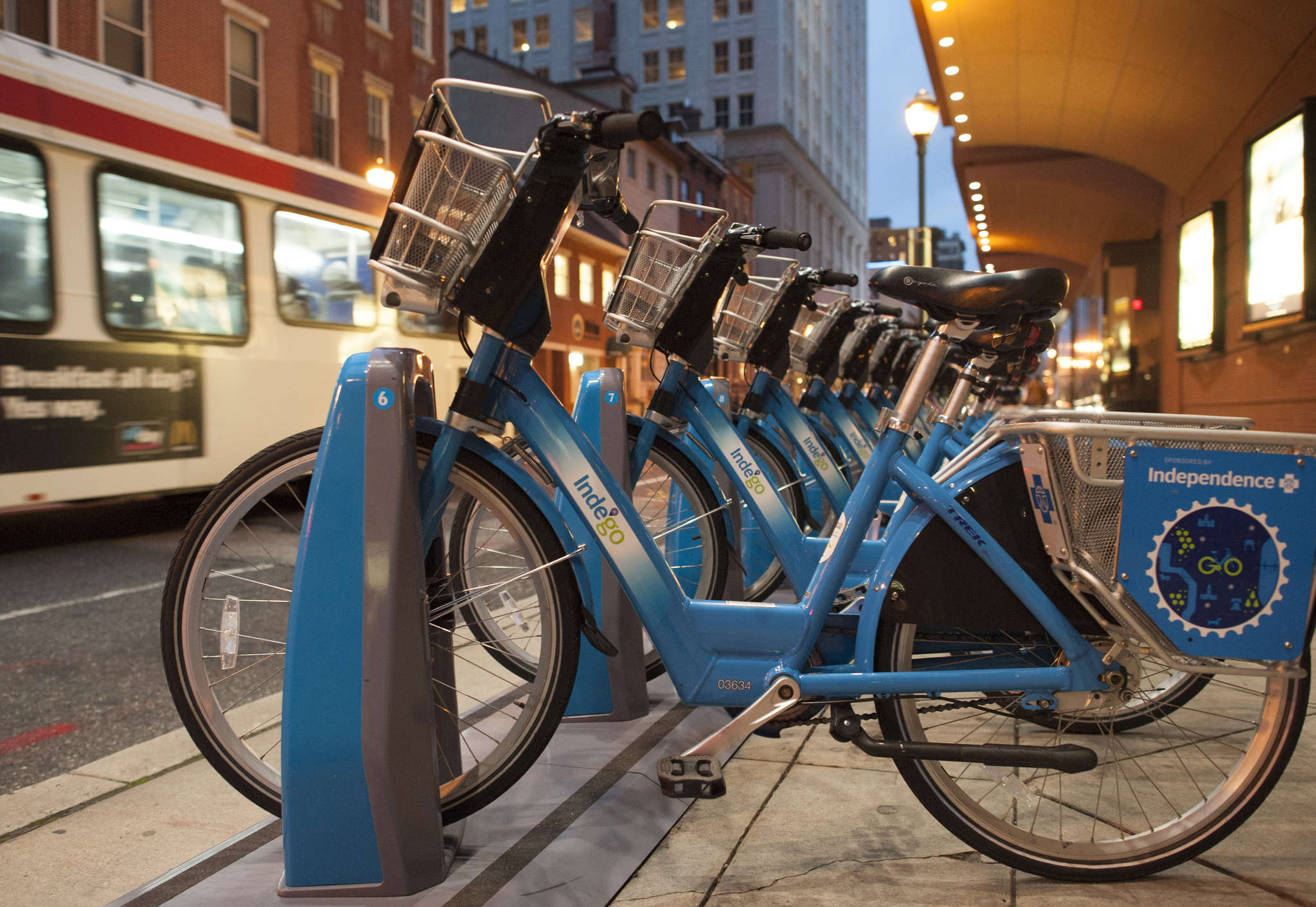
    Indego, Philadelphia’s bike share program, may be expanding to Lower Merion, marking the program’s first foray into the Philly suburbs.TRACIE VAN AUKEN / For The Inquirer

    Efforts to bring Indego to Lower Merion have been in the works for years. Lower Merion received a grant from Montgomery County to expand the bike share program in 2023, and has since received two extensions to carry out the grant after delays caused by “changing market conditions,” according to a staff report.

    The proposed bike share expansion is the latest development in an ongoing effort to transform City Avenue from a collection of office parks to a vibrant, mixed-used hub with easy walking, biking, and transit access. Hundreds of new apartments have gone up on City Avenue in recent years, as well as new retail spaces, and more are on the horizon.

    The bicycle docks at One Bala Plaza and One Belmont Avenue were included as conditions of approval for the new developments on those sites. The property owners of all three sites will pay $12,000 annually to cover ongoing maintenance costs and will provide the electricity for the stations, if the expansion is approved.

    In Montgomery County, Lower Merion is not the only municipality working to expand its bicycle network. Abington Township in 2023 received a Montco 2040 grant to install 6.68 miles of bike infrastructure, including signage and road markings. In 2024, Whitpain Township received a grant from the county to install bicycle repair kits and racks in township parks, and in 2025, Hatfield Borough and Hatfield Township were awarded a grant to install bike racks, repair kits, wayfinding signage, and pavement marking for bike routes.

    This suburban content is produced with support from the Leslie Miller and Richard Worley Foundation and The Lenfest Institute for Journalism. Editorial content is created independently of the project donors. Gifts to support The Inquirer’s high-impact journalism can be made at inquirer.com/donate. A list of Lenfest Institute donors can be found at lenfestinstitute.org/supporters.

  • Trump defends his economic policies in Michigan, where new Canadian tariffs may sting

    Trump defends his economic policies in Michigan, where new Canadian tariffs may sting

    MILFORD, Mich. — In a visit to Michigan on Monday, President Donald Trump argued that his economic policies have revived the auto industry and American manufacturing even as many businesses contend that the sweeping tariffs he’s imposed against Canada and the rest of the world have hurt the state.

    Trump defended his policies while visiting a General Motors facility in the Detroit suburb of Milford that is a testing ground for its vehicles. He pumped a fist after watching Corvette, Cadillac, and Hummer vehicles compete in a series of drag races.

    In a speech, Trump cheered GM’s plans to expand production domestically in coming years and declared himself a president who was standing up for auto workers “at long last.”

    “I’ve done more for you than your parents, OK?” he said.

    After being led on a tour of vehicles from different eras of GM, some of which he sat in, Trump claimed the tariffs have helped the automaker.

    “They’ve come a long way,” he said to reporters about the Detroit-based automaker. “It’s amazing what tariffs are doing for GM.” Trump said he’s been good to the company but he declined to say more.

    “The rest of the world doesn’t love me, but that’s OK,” he said, alluding to tariffs. “It’s called ‘America first.’”

    Trump’s visit is close to Michigan primary on Aug. 4

    Trump called out several Republican candidates and invited them onstage during his remarks Monday.

    Republican Mike Rogers is unopposed in the Senate primary, but the GOP gubernatorial contest pits Trump-backed Rep. John James against Perry Johnson, a businessperson turned politician who has launched unsuccessful campaigns before, including for president in 2024.

    Johnson is now trying to style himself in the president’s mold — despite missing out on his endorsement.

    The Democratic Senate primary between Rep. Haley Stevens and progressive Abdul El-Sayed has drawn national attention for the right to face Rogers, who was narrowly defeated by Democrat Sen. Elissa Slotkin in 2024.

    Early voting is underway.

    Trump’s new Canada tariffs could hurt Michigan

    Michigan was one of the 2024 battlegrounds Trump flipped after it backed Democrat Joe Biden in 2020. But the state has seen parts of its economy affected by the president’s tariffs, including those on imported cars and auto parts.

    A new round of steep import levies is taking effect on dozens of U.S. trading partners. But Trump has singled out Canada with tariffs as high as 50% on a wide array of its products, including cars.

    The GM facility is in Oakland County, which encompasses much of Detroit’s northern suburbs. Once a Republican stronghold, it has increasingly leaned Democratic, backing Biden against Trump in 2020 and Vice President Kamala Harris against Trump four years later.

    GM says its facility is the oldest dedicated vehicle testing operation in the United States, where 4,200 employees work to refine nearly every vehicle the company makes before they reach consumers.

    Michigan’s economy relies heavily on Canada, however, meaning the new tariffs — coupled with inflation still running high and gas prices rising again as the already unpopular war in Iran continues — have created additional economic concerns statewide.

    Those come at a time when voters across the country were already increasingly dissatisfied with Trump’s handling of the economy.

    Jason Roe, a former executive director of the Michigan Republican Party who tried unsuccessfully to distance it from Trump’s Make America Great Again movement in 2021, said that more than coinciding with his new round of tariffs, Trump’s visit is a function of Michigan’s relatively late primary and is meant to ensure that James secures the nomination.

    But Roe also said it was a risk for the president to tie himself too closely to top Republicans before the general election, calling it “kryptonite to November voters.”

    Trump, who won the White House on a promise to lower the cost of living, also has seen his approval ratings sag, meaning kitchen table issues could be a liability for Republicans trying to hold control of Congress in the Nov. 3 elections.

    “We’re happy to have the president here, campaigning with Republicans. We think it highlights the fact that the only thing they care about is Donald Trump and refuse to stand up to him,” said Curtis Hertel, chairperson of the Michigan Democratic Party. ”It’s good for us every time the president is here because he’s incredibly unpopular.”

    U.S. and Canada have squabbled over a new border bridge

    The Supreme Court struck down many of Trump’s sweeping tariffs, but his administration has tried to find ways around that, including by arguing that he can impose them on Canada because that country is discriminating against American exports of products including automobiles.

    But Trump’s latest round of tariffs came after he voiced frustration with Canada for having retaliated and imposed its own levies on U.S. imports in response to Trump’s initial tariffs last year. Trump launched the first round after alleging Canada should do more to stop fentanyl smuggling.

    It is Trump’s third trip to Michigan in his second term.

    In January, he visited a Ford plant in Dearborn and addressed the Detroit Economic Club, offering a defense of tariffs even as auto industry leaders blamed them for increasing the cost of doing business.

    The president marked his second term’s first 100 days with a rally in Warren, where he mostly mentioned grievances left over from the 2024 campaign,

    His latest visit coincides with tensions between his administration and Canada that have marred the opening of a new bridge linking Detroit and Windsor, Ontario.

    Canada on Friday held its own event hailing the opening of the $4.7 billion Gordie Howe International Bridge instead of a planned celebration with officials in the U.S. after Trump announced the new Canadian tariffs.

    An earlier, joint ceremony had been set for June but was scrapped after Trump suggested the U.S. wanted a “better” deal on the bridge it co-owns with Canada.

    That eventually led to an agreement on splitting tolls that was supposed to allow for the rescheduled joint U.S.-Canada celebration — until the new tariffs derailed that, too.

  • N.J. sees largest drop in death rate in the U.S.

    N.J. sees largest drop in death rate in the U.S.

    The nation’s death rate may have fallen to a historic low last year as many of the killers of young people such as drug overdoses, gun homicides and traffic accidents continued receding in 2025, according to new federal statistics.

    States have not shared equally in the success, though, according to a Stateline analysis of provisional data by state. And the low ebb may reflect the effects of past health care expansion efforts that are threatened by today’s Trump administration moves to curtail Medicaid expansion and cut funding for rural hospitals.

    Some states in the Northeast have seen death rates drop by the most between 2015 and 2025 — led by New Jersey (down 8.3%), Rhode Island (down 8%), New York (down 7.9%), Massachusetts (down 7.4%) and the District of Columbia (down 7.0%). Some experts credit states’ attention to health care, traffic issues and gun violence.

    New Jersey has taken the lead in decreases because of a long-term commitment to expanding health care to people with low incomes, said Stephen Crystal, director of Rutgers University’s Center for Health Services Research.

    Even before Medicaid expansion under the federal Affordable Care Act, New Jersey and Massachusetts, among other states, were pooling funds with hospitals to cover more low-income residents, Crystal said.

    “New Jersey has been doing this for a long time, and you’re seeing the effects in the lower mortality rates for the big killers,” he said.

    The state stands out for having less than half the national rate of firearm deaths, both suicide and homicide, as well as deaths from heart and kidney diseases caused by high blood pressure. The rate of traffic accident deaths is also well below the national rate.

    There’s also a more confrontational attitude toward speeding and less tolerance for guns in the Northeast, he said.

    “Here’s something that annoys a lot of New Jerseyans. The state troopers have the cojones to pull you over if you’re doing 90 on the turnpike. This is not the case in Wyoming,” Crystal said. “Also if you go out West where gun possession is very high, then the firearm suicide deaths become enormous.”

    Nationally most of the decrease between 2024 and 2025 came from young age groups. The things most likely to kill them dropped after spiking during the early pandemic, including drug overdoses, traffic accidents, gun violence and suicide, according to an analysis of death counts by Mary Pat Campbell, an actuary and life insurance analyst in New York state.

    Northeastern states have an advantage in tackling those problems based on wealth, she said.

    “There has been an increasing separation of mortality outcomes by socioeconomic status,” Campbell said, noting that traffic accidents are rarer in places like New Jersey partly because so many people commute on public transportation.

    “For New Jersey, a lot of it really is that there are a bunch of high-income people who have lower-than-average mortality, just like people on Long Island and the rich parts of Westchester [in New York state],” she added.

    Some states have not improved since 2015 in the provisional statistics analyzed by Stateline, which may change as the federal Centers for Disease Control and Prevention makes new age adjustments at the state level.

    New Mexico had an age-adjusted death rate 9% higher last year than 10 years ago, as drug overdose deaths continue to plague the state at more than twice the national rate.

    In June, New Mexico Democratic Gov. Michelle Lujan Grisham called for restitution from the federal government over allegations that U.S. Drug Enforcement Administration officials knowingly let fentanyl shipments into the state during multiple presidential administrations. In one case, a whistleblower alleged, agents stood by while 1.8 million fentanyl pills were trafficked in hopes of catching higher-ranking dealers and suppliers down the line.

    New Mexico also struggles with higher death rates from alcoholic liver disease and gun homicide. Neighboring Arizona, where the death rate is 5% higher than 10 years ago, also stands out for a high overdose death rate and a high gun suicide rate.

    Iowa and Oklahoma death rates are also up 5% from 2015. Iowa stands out for a higher-than-national rate of fall-related deaths, typical of an aging rural population with little day-to-day supervision. Oklahoma has a similarly high rate of fall-related deaths, as well as almost four times the national rate of deaths from high blood pressure and hardening of the arteries — both problems that can be controlled with medication.

    Iowa “recognizes fall-related deaths as a significant public health concern,” wrote a spokesperson for the state Department of Health and Human Services, Danielle Sample, in an e-mail statement. Those falls are associated with older age groups and possibly rural access to health care and preventive services, she said.

    The state has a falls prevention program that stresses exercise to maintain mobility and monitoring excessive medication that could cause dizziness, poor vision and unsafe home conditions.

    Almost two-thirds of the national death rate improvement for 2024 to 2025 came from people between the ages of 15 to 44, Campbell told Stateline.

    Improvements were especially large for young people 25 to 34, a group including younger Millennials and older Gen Z, a demographic hard hit by homicides and drug overdose deaths early in the pandemic, Campbell told Stateline. The rate for accidents, a category that includes drug overdoses, gun accidents and traffic accidents, dropped 6% in one year, and the homicide rate dropped 14%, she said.

    It’s hard to be sure how much death rates really changed between 2024 and 2025 because the methodology changed, Crystal noted, accusing the CDC of “grabbing for a good news headline” by reporting the apparently historic decrease prominently in a blog item.

    For 2025, the CDC used different methods to calculate rates, including more adjustments to 2020 census data used as a basis for age adjustment, noting in the report that the results could change and “should be interpreted with caution.”

    Asked about the issue, the CDC said in a statement to Stateline that “as this is a provisional report, we did not go in depth about the change in population denominators” and that it is “planning a brief report that will show the impact” of the changes on death rates and birth rate in new statistics.

    In any case, the Trump administration likely can’t claim credit for current decreases in death rates, which would reflect policy changes from years ago that slowly take effect, Crystal said.

    “This is not the time to see the effect of what Trump is doing now. It’s going to take five years,” Crystal said.

    One killer of young people has not dropped: The rate of gun suicide has increased 14% since 2015, according to the Stateline analysis. Suicide has affected Gen Z young people more than previous generations.

    Over the past 10 years, rates for Black and Hispanic people have increased while rates for other groups have gone down, according to the Stateline analysis.

    “As a country we are improving. We should celebrate that. But many segments of the population are left behind,” said Ali Mokdad, a professor of health metrics sciences at the University of Washington.

    Mokdad credited some medical advances for decreases in heart disease that came in spite of increased obesity.

    “That decline in cardiovascular disease was due to better controlled blood pressure,” Mokdad said. “Blood pressure medication, when it came out, was very expensive. Now blood pressure medication is so cheap you can get a three-month supply for less than the price of a cup of coffee.”

    This story originally appeared on New Jersey Monitor.

  • Secret Service agent charged with felonies in beatings police say were fraternity hazing

    Secret Service agent charged with felonies in beatings police say were fraternity hazing

    A U.S. Secret Service agent and two other men have been arrested and charged with violent felonies in the Miami area, where authorities say they committed brutal beatings as part of a fraternity hazing ritual in April that left two people hospitalized with severe injuries.

    One of the men charged, 29-year-old Marquez Christopher Pinder, works in the Secret Service’s Miami field office and is described in an arrest warrant as a “dean of pledges” for a Miami chapter of the Kappa Alpha Psi fraternity.

    The Secret Service said it’s cooperating with investigators and has placed Pinder on administrative leave. He was released from jail after posting a $75,000 bond Monday and faces arraignment before a judge Sept. 24.

    The three men were charged last week after police uncovered evidence of “alleged hazing incidents involving prolonged and repeated beatings with canes and paddles,” the Miami-Dade County state attorney’s office said in a news release.

    Police said in court documents that a University of Miami graduate student and another young man had injuries that could have been fatal had they not been treated. One required skin grafts to his backside and suffered kidney damage, the documents said, while the other had a tube placed in his windpipe to help him breathe.

    Accused agent has worked for Secret Service since 2023

    Charges against the three men include felony counts of hazing with a deadly weapon, aggravated battery with great bodily harm, and attempted manslaughter.

    “In Florida, hazing is abuse and it is a crime,” Katherine Fernandez Rundle, state attorney for Miami-Dade County, said in a statement Sunday. “Its victims too often lie in their graves and in hospital beds.”

    An attorney for Pinder, Justin Beckham, did not immediately return phone and email messages seeking comment Monday. Court and jail records did not list attorneys for the other two men.

    Pinder has worked as a Secret Service agent since 2023, agency spokesperson Matt Fagiana confirmed Monday.

    “Any misconduct will be addressed swiftly and appropriately upon completion of the investigative and judicial process,” Michael Townsend, the special agent in charge of the Secret Service’s Miami field office, said in a statement.

    A spokesperson for Kappa Alpha Psi did not immediately return a phone message left at the fraternity’s Philadelphia headquarters.

    Arrest warrant describes bloody paddling, emergency medical care

    According to Pinder’s arrest warrant, the graduate student told police that he and another young man had their backsides beaten by Pinder and the other defendants during four nights in early April at an apartment and a home off-campus. The paddling started when the victims failed to correctly answer questions about the fraternity and its history, a police investigator said in an arrest warrant filed in court.

    The warrant did not name either victim.

    The beatings stopped on the fourth night when one of the victims had blood seeping through the seat of his pants, according to the warrant. It said fraternity leaders ordered both victims to strip off their clothes and place them in garbage bags before going home.

    One of the victims suffered vomiting, fevers, and intense pain before being admitted to a hospital, where he required skin grafts on his buttocks and treatment for kidney damage, according to police.

    Without emergency medical treatment, the warrant said, “his injuries would have resulted in renal failure leading to death.”

    The second victim told police he knew the other victim from the fraternity. He denied being paddled, the warrant said, but acknowledged receiving emergency medical care in April.

    That person’s medical records showed he had been hospitalized with injuries to his backside and “was intubated during his stay in the hospital to prevent further physical deterioration and death,” the arrest warrant said.

    Florida lawmakers in 2005 made hazing a felony punishable by up to five years in prison if it results in serious injury or death. The law was spurred by the 2001 death of Chad Meredith, a University of Miami freshman who drowned after drinking alcohol and then attempting to swim across a lake at the urging of campus fraternity leaders.

  • Company at center of N.J. voter registration scandal has multiple state contracts

    Company at center of N.J. voter registration scandal has multiple state contracts

    The French company under fire after Gov. Mikie Sherrill blamed it for allowing non-citizens to register to vote holds three multimillion-dollar contracts with the state of New Jersey.

    Besides the contract with the state Motor Vehicle Commission that is at the center of the voter registration debacle, the company, Idemia, also holds contracts to handle fingerprinting for the New Jersey State Police and a third one to provide fingerprinting, background searches, and other services for various state agencies, state records show.

    State taxpayers have paid the company about $61.1 million so far total, the records show.

    A spokesman for Gov. Mikie Sherrill, who said last week that her administration is moving to terminate Idemia’s contract with the motor vehicle agency, declined to say whether the other two contracts are in jeopardy. Idemia, which has denied responsibility for registering non-citizens, did not respond to a request for comment.

    Assemblywoman Dawn Fantasia (R-Sussex), who is among the Republicans who has called for a bipartisan legislative committee to investigate the voter registration matter, said it doesn’t make sense for the Sherrill administration to target only Idemia’s contract with the Motor Vehicle Commission.

    “If Idemia really was the problem here and lost the state’s confidence, why would we be concerned with that and not actual background checks?” she said.

    Sherrill last week announced that about 6,600 non-citizens had been added to the state voter rolls for a year starting in June 2023 because of what she called a software glitch on Idemia’s part. She said non-citizens who were prompted at the agency to say whether they were citizens would respond no, but the software identified them as citizens anyway. About 400 of them cast ballots, she said.

    Sherrill said Thursday that the motor vehicle commissioner had moved to end Idemia’s work with the agency because the company “was at the heart” of the agency’s failures.

    “The commissioner was already in the process of removing them for their incompetence,” Sherrill said.

    Idemia’s contract to assist with enhanced driver’s licenses was issued in January 2010 and ends in January 2027. It has been paid $35.7 million so far, records show.

    It also holds a contract with the State Police related to an electronic fingerprinting system, a contract that started in January 2019, runs through January 2027, and has cost the state roughly $3.8 million so far, the records show.

    Another contract that began in May 2019 and expires in May 2027 allows Idemia to provide electronic fingerprinting for background checks and other “noncriminal justice purposes” for agencies across state government. New Jersey has spent about $21.6 million on that contract to date, the records show.

    Fantasia thinks moving to sever Idemia’s contract now would be a mistake. She said she does not believe Sherrill’s story that the 6,600 non-citizens were registered because of a software error.

    “Without an investigation, I think we’re setting ourselves up for a serious lawsuit,” Fantasia said. “If the flag we’re carrying is we’re getting rid of them because of this software glitch, that has yet to be proven. That’s an assertion by the governor. The vendor denies it. So to me, that’s hardly irrefutable evidence.”

    The company is also a contractor with the federal government. Rep. Josh Gottheimer, a Democrat, last week requested a government-wide audit of every federal contract involving Idemia, suggesting there could be a deeper problem as the company “sits at the center of the federal government’s identity, screening, and border infrastructure.” He pointed to contracts for TSA PreCheck, U.S. Customs and Border Protection’s biometric entry-exit system, and identity operations at the U.S. Department of Defense, including contracts with driver’s license systems in 36 states.

    “A ‘small’ software issue like what happened in New Jersey could, right now, be allowing improperly vetted individuals to enter our airports and board our airplanes,” Gottheimer told federal budget officials last week.

    Sherrill has blamed the administration of her predecessor, Phil Murphy (D), in addition to Idemia because the problem started when he was governor. Sherrill took office in January.

    Murphy spokesman Mahen Gunaratna said Friday that Murphy was unaware of this issue before Sherrill brought it to light this week.

    The registration matter has drawn national attention, including criticism from President Donald Trump. The Trump administration is suing New Jersey over the state’s refusal to hand over unredacted voter roll information. U.S. Homeland Security Secretary Markwayne Mullin has alleged that more than 35,000 noncitizens are registered to vote in New Jersey.

    Dana DiFilippo contributed reporting.

    This story originally appeared on New Jersey Monitor.