Category: News

  • 6abc’s Cecily Tynan discusses her surprise retirement, sealed after a brief bout with vertigo

    6abc’s Cecily Tynan discusses her surprise retirement, sealed after a brief bout with vertigo

    Viewers across the Philadelphia area were shocked when longtime 6abc meteorologist Cecily Tynan announced her retirement.

    But her Action News colleagues weren’t.

    Tynan knew she wanted to retire back in 2020, when she signed her last contract with the station, which will end next month just as her youngest daughter heads off to college.

    Since then, it had been something of an open secret inside the 6abc newsroom that Tynan’s time at the station was coming to an end. Any chance of her extending her contract ended a few years ago, when she experienced a short but intense bout of vertigo.

    “For most of the day I couldn’t do anything, and I thought this must be what it’s like to be really old and infirm,” Tynan said. “I didn’t want to work all the way up to get to that stage, so it kind of sealed the deal.

    “I’m 57, which is relatively young, I guess, for retiring,” Tynan added. “But I wanted to retire while I’m healthy and active.”

    So rather than stick around 6abc or move up the national ladder, Tynan and her husband, Greg, plan to split time between their homes in Delaware County and Florida after her last day, Aug. 31. She even turned down a chance to come back to host Philadelphia’s Thanksgiving Day parade, something she has done for close to 25 years. But the idea of being able to cook Thanksgiving dinner for her family for the first time won out.

    “My children have never spent the night before Thanksgiving in their own home. We’ve always been in a hotel by the parade route, and I’ve never actually cooked,” Tynan said. “I’ve always picked it up from Whole Foods and reheated it.”

    Tynan discussed her decision to retire, what’s next, and the best and worst weather events she has covered in her three decades at 6abc. This conversation has been edited for length and clarity.

    How do you plan on filling your retirement? Is it just going to be water-skiing and enjoying life?

    That sounds pretty great!

    That’s definitely a big part of it. That and visiting and watching all my daughters’ cross-country and track meets. I do want to stay active in animal rescue. … I’ve been really active with Providence Animal Center. I’m not sure exactly how I’ll do it, but I would definitely still want to be involved in that.

    And I’d like to be able to go to bed at a decent hour.

    What do you make of the reaction to your decision to retire?

    I’ve been talking about it for months with my personal friends and they’d be like, “Philadelphia’s gonna freak,” and I’m like, “No, everyone’s gonna be fine.” I get it because I’ve been here for almost 31 years, so for a lot of people it seems like they’ve been watching me their whole lifetime. I think that Philadelphians have a special relationship with Action News that you don’t see in a lot of other cities or stations.

    Are there any on-air memories that stand out?

    One fun moment was when my earring fell off, and Jim Gardner got up. I saw him stand up and take off his microphone, and there was a frenzy behind the scenes, like, “Jim’s on the move. Traveler’s on the move.”

    I tried to ignore it, and then I saw this white thing go behind my head, which I thought was a cloud animation. Then I realized it was his hair. It was hilarious and then it went viral — it was on Live With Regis and Kelly the next day and stuff, and that was fun.

    Another one was when I was on the morning show with Monica [Malpass] and Rick [Williams], I would always try to crack them up by dancing off camera.

    One time Rick told the director, “Record Cecily when she’s dancing.” I dance like Elaine from Seinfeld, but worse. And so they aired that.

    Is there a reason you stayed in Philadelphia vs. moving to national television?

    I was born and raised in Newtown, Conn., so I always watched the New York stations.

    I thought I would work here a few years and then go to New York. Then I had I had some opportunities early in my career to go up. I filled in on Good Morning America for a full week with Charlie Gibson and Diane Sawyer, which was a great experience. Gibson gave me a bottle of champagne when the week was over.

    I talked about going to New York with Tom Kane, who was the general manager of WABC and was the GM when I came to Channel 6. … But then I spent the rest of my week there and was like, “Man, I want to get back to Philadelphia.”

    Philadelphia felt like home. … Even when I walked in for my interview, I felt really at home with everyone and they were all nice and welcoming. No backstabbing at all.

    Also, once you have children, that really grounds you. Your children are growing up in a community, and you don’t want to uproot them and leave.

    What are the best weather events to cover, and what are the worst?

    Snowstorms are the best, because everybody gets excited. I was here only a few months and we had the blizzard of 1996, the biggest snowstorm in Philadelphia’s history.

    The worst are tornado warnings because we get a lot of those nowadays, because we have more advanced radar … and we do have a warmer climate. But tornado warnings freak people out, because I’m telling them to get in their basement.

    I was at the airport back in the spring … and the people in front of me recognized me and thanked me. They live in Mullica Hill, and they were there when they had the tornado warning and I told them to get in their basement. They said they got their kids and their pets down there … and when they got out of the basement, their house was destroyed. But they were OK. … That really hit home about the importance of our job. I kind of teared up.

    I’m sure you hear the other side, too, when the weather shifts and your forecast might be off.

    Oh, yeah. The whole saying, “Oh, I wish I had a job where I could be wrong 90% of the time and still keep my job.” I get that all the time. Anybody who says that doesn’t really understand the complexities of the atmosphere. … But I feel like when you’re in the public eye, you do have to grow a thick skin. Especially in Philly. They’re going to tell you what they really think, so they’re not going to sugarcoat it.

    Is there a weather thing people still get confused by?

    One thing I think people really don’t understand is tornado watch vs. warning.

    When a tornado watch is issued, it usually means there’s like a 2% chance of a tornado happening in your neighborhood. It’s pretty low.

    I think a lot of people think when there’s a tornado watch it means warning, which it doesn’t. It just means heads up. The warning is when you have to go to your basement.


  • Man charged with murder in the death of a fellow inmate at Burlington County state facility

    Man charged with murder in the death of a fellow inmate at Burlington County state facility

    A 23-year-old New Jersey man was charged with first-degree murder in the July 17 death of another inmate at the Garden State Youth Correctional Facility in Burlington County, Prosecutor LaChia L. Bradshaw said Friday.

    Trevor Banton, of East Orange, allegedly killed 24-year-old Yasin Sellers in the prison gym after a religious service attended by other inmates, Bradshaw said.

    Correctional officers found Sellers unresponsive on the floor and he was pronounced dead at the scene, Bradshaw said.

    Banton is awaiting his first court appearance in the case.

    No other details about the fatal assault were released.

  • U.S. general warns Pentagon he lacks sufficient forces to protect Israel

    The top U.S. general in Europe privately warned the Pentagon this week that he lacks sufficient naval forces to continue protecting Israel from incoming ballistic missiles, officials said, illustrating how the ongoing Iran war has imposed constraints on the military.

    Gen. Alexus Grynkewich, the head of U.S. European Command, sent written notification to senior Pentagon officials saying that without another Navy destroyer he will be forced to choose defense of the United States “homeland” over that of Israel, said the officials, who like some others spoke on the condition of anonymity to discuss the correspondence.

    A U.S. defense official said Grynkewich’s notification appears consistent with past outreach to the Pentagon from the military’s top generals when they see certain risks that require Washington’s consideration. This can occur, the official said, as commanders compete for finite resources and weapons.

    The Pentagon declined to comment. U.S. European Command did not respond to requests for comment. A spokesperson for the Israeli Embassy in Washington could not be reached for comment.

    The general’s warning comes at a tenuous moment in the five-month conflict, as near-daily attacks have resumed following the collapse of peace talks between Washington and Tehran and the operation’s intensity has drained U.S. supplies of key defensive weapons.

    The Navy has been particularly taxed, as the Trump administration has directed a blockade of Iranian ports in response to Tehran’s closure of the Strait of Hormuz. The standoff has stymied the movement of Middle Eastern oil and other commodities through the narrow waterway, upending the global economy.

    U.S. naval destroyers in the eastern Mediterranean Sea have been employed as a part of Israel’s defense for many years. The vessels, equipped with powerful radar and armed with an array of missiles, have downed missiles aimed at Israel not only by Iran, but by Houthi militants in Yemen that are equipped by Tehran.

    European Command is central to this mission, as it coordinates military operations in the Mediterranean. At the same time, its forces must remain ready for any Russian incursion into territory protected by the NATO military alliance. Russia also poses a ballistic missile threat to the United States, with missiles capable of reaching the U.S. mainland.

    The Navy has five destroyers that deploy from a U.S. port in Rota, Spain, with a sixth expected to arrive there later this year, Pentagon officials have said. But maintenance issues have piled up due to the Iran war’s tempo, complicating matters for Grynkewich, officials said. The Washington Post withheld specific details about the ships’ availability at the request of military officials, who cited security concerns.

    As the Post reported in May, Pentagon assessments conducted earlier in the war showed that U.S. forces have shouldered the brunt of defending Israel from Iranian ballistic missiles. The assessments found that American weapons, including the Terminal High Altitude Area Defense and naval interceptors launched from the eastern Mediterranean, were used far more frequently than Israeli air defense weapons.

    Two destroyers, the USS Paul Ignatius and the USS Roosevelt, were in the Mediterranean Sea on Friday, a U.S. official said. Three destroyers were in Rota: the USS Arleigh Burke, the USS Bulkeley and the USS Oscar Austin.

    Closer to Iran, an armada of additional vessels was in the Arabian Sea, including two aircraft carriers, the USS George H.W. Bush and USS Abraham Lincoln, and at least 15 other warships, this official said. Eleven are destroyers.

    The fleet has been central to the Trump administration’s blockade of Iranian ports. It also has been involved in an effort called Project Freedom, in which the U.S. military has helped protect vessels in the contested Strait of Hormuz.

    Another destroyer, the USS Gonzalez, is in the Red Sea, where Yemen’s Houthis have attempted to enforce their own blockade of commercial shipping in a bid to further the economic pressure facing the U.S. and its allies in the region. Saudi Arabia, a key U.S. partner, has sought to thwart the Houthis, a longtime adversary, by developing a military coalition to ensure freedom of navigation.

    The Iran war is increasingly unpopular among the U.S. public, and members of Congress — from both political parties — have grown frustrated with the administration as top officials struggle to articulate a plan for ending the conflict on terms deemed favorable to the United States. There is a deepening worry among many Republicans, particularly, that the war’s impact on the price of gas, food, and other goods will cost the party in November’s midterm elections.

    Tom Karako, director of the Missile Defense Project at the Center for Strategic and International Studies, a think tank, said the warning issued by Grynkewich highlights the scope of the Pentagon’s challenges.

    “Being on a wartime footing is going to take a toll in terms of readiness and munitions inventory levels,” he said. “Now the question is: What’s the strategy here?”

  • In Trump Gaza deal, Hamas disarms, Israel withdraws. Neither wants to go first.

    In Trump Gaza deal, Hamas disarms, Israel withdraws. Neither wants to go first.

    TEL AVIV — President Donald Trump this week touted “a HISTORIC agreement for the COMPLETE DISARMAMENT” of Hamas. But after his Board of Peace released the text of the 15-point plan Friday, analysts cautioned that there seemed to be a substantial gap between Israel and Hamas on a path forward.

    Under the agreement, the sides have 14 days to agree on the “timetable and implementation mechanisms” for the disarmament of Hamas and the withdrawal of Israeli forces from Gaza. But there was already disagreement on the order in which each should happen.

    Israeli Prime Minister Benjamin Netanyahu, who met with Trump on Tuesday, has been silent on the deal. In a statement to the Post, an Israeli official reiterated Israel’s long-standing position: “Israel demands the complete disarmament of Hamas, including the removal of weapons from Gaza and the full demilitarization of the Strip, as a prerequisite for any process.” The official spoke on the condition of anonymity to discuss the highly sensitive subject.

    Hamas, meanwhile, said Israel must end its military campaign in Gaza as a “first step.” The Israel Defense Forces on Friday announced the killing of men it described as a Hamas commander and a Hamas arms smuggler. Hamas also said that its agreement to surrender heavy weapons was contingent on Israel’s “cessation of all forms of hostility,” among other variables.

    Jonathan Rynhold, a senior researcher at the Begin-Sadat Center for Strategic Studies at Bar-Ilan University, said the effort to move toward disarmament and demilitarization in phases represented “some kind of progress,” but obstacles remained.

    “On a practical level, what Israel wants is for Hamas to disarm, and then for Israel to withdraw. Hamas wants the opposite,” he said. “Israel does not believe that Hamas will voluntarily disarm in a material sense.”

    Under the agreement, the weapons Hamas surrenders are to be held by the National Committee for the Administration of Gaza, run by Palestinian technocrats. The fear in Israel, Rynhold said, is that the militants, who led the surprise attack that killed about 1,200 people in Israel on Oct. 7, 2023, will retain the ability to intimidate whoever is in the government in Gaza.

    Israel responded to the Hamas attack with a military campaign that has killed more than 73,000 people, according to the Gaza health ministry.

    “The bottom line,” Rynhold said, “is that Israel doesn’t think that Hamas has changed its DNA.”

    There will be “no Israeli withdrawal from the Yellow Line before Hamas is disarmed and the Gaza Strip is demilitarized,” the Israeli official said. The line marks territory controlled by Israel since the sides agreed to a ceasefire in October. The territory amounts to about half the enclave.

    Ibrahim Al-Madhoun, a Gazan political analyst seen as close to Hamas, said the plan “represents significant political progress” toward an end to the war.

    “But optimism must remain cautious,” he said in a statement. “Israel has not finalized its position, and Netanyahu is evading and trying to evade the deal’s entitlements.”

    A month ago, Hebrew University political scientist Gayil Talshir noted, Netanyahu was boasting that Israel controlled 70% of the Gaza Strip — implying that the IDF had gone beyond the yellow line.

    Talshir predicted the IDF would first withdraw to the yellow line. Later, “if Hamas is indeed disarmed,” she said, “the IDF will gradually withdraw to the perimeter.”

    With elections in October, Talshir said, Netanyahu doesn’t want to give opponents the opportunity to say he has approved the withdrawal of military forces in either Gaza or Lebanon, where Israel is fighting Hezbollah. Israel has in fact withdrawn from several villages in southern Lebanon, ceding control back to the Lebanese army, and Trump’s announcement suggested more to come.

    There appears to be “a gap between the facts and how Netanyahu is presenting them,” Talshir said. Netanyahu, she said, is trying to portray himself as close to Trump but also able to stand up to him.

    “This is the narrative he sells in Israel — that only Netanyahu can say ‘no’ to an American president. This is both contradictory and makes Trump’s blood boil.”

    Right-wing National Security Minister Itamar Ben Gvir said Friday the agreement will allow “Hamas to organize for the next massacre.”

    Madhoun, the Gazan analyst, said the Israeli elections will complicate implementation of any agreement. “The Gaza war has turned into political and electoral material,” he said.

    Gadi Eisenkot, a leading challenger to Netanyahu, said, “The infuriating gap between [his] promises and reality has been exposed.” The deal stems from his “political weakness,” the former IDF chief of staff said, and will leave Hamas in power in Gaza.

    Michael Milstein, a former adviser on Palestinian affairs to the Israeli military, said there appeared to be a gap between Netanyahu’s claim of an “excellent” meeting with Trump and the details of the agreement. But he said he doubts Trump is “set on the details” of the deal.

    “I say this cautiously, but it seems that what is happening aligns with Hamas’ interests, which is mainly the growing pressure on Israel to begin the withdrawal,” said Milstein, who is now at the Moshe Dayan Center at Tel Aviv University. “No one is conditioning every single bit of progress [in the agreement] on complete disarmament.”

    The government’s mistake, he said, was refusing to “engage with a political track.”

    “The deal ends up being forced on you from the outside.”

    For Netanyahu, he said, the timing is a “nightmare scenario.”

    “If Trump is determined to push this forward — realizing he isn’t securing achievements in Iran, Lebanon, and Ukraine — and Netanyahu remains extremely stubborn about not complying with anything, this opens the door to friction.”

    The question, Madhoun said, is whether the Trump administration can “oblige Israel to implement what is agreed upon.”

    Hussam Al Hwaiti hoped so.

    “After three years of war, killing, destruction and siege, I say ‘enough,’” the Gaza merchant said Friday.

    “We don’t want to resist,” he said. “Hamas is weak now. They are not in a position to continue the fight. … It’s time to return back to our normal life, travel, and send our children to school.”

  • Spain installs sea barrier on Ceuta’s border with Morocco after frontier rush that killed 67

    Spain installs sea barrier on Ceuta’s border with Morocco after frontier rush that killed 67

    CEUTA, Spain — Spain on Saturday installed a 1,600-foot-long barrier on the sea border between its North African territory of Ceuta and neighboring Morocco after tens of thousands of migrants breached the frontier earlier in the week.

    At least 67 migrants died, including some who drowned and others who were killed in a stampede to cross a breakwater barrier, the Spanish government said Saturday.

    Spanish Prime Minister Pedro Sánchez slammed the reaction of some other European Union leaders to the events in Ceuta, saying calls for Spain to be suspended from the EU’s borderless Schengen zone were “driven by prejudice, fake news, ignorance, or political interest.”

    A handful of exhausted migrants who swam to Ceuta’s urban Tarajal beach Saturday morning were met by soldiers who escorted them across the border. Most of the 50,000 to 60,000 migrants who entered the territory between Thursday and Friday soon went back.

    “We are relentless against those who break the law,” Spanish Interior Minister Fernando Grande-Marlaska told journalists Saturday.

    Questioned how the massive border breach could have happened given the heavy security on both sides of the border and whether Morocco posed a threat to Ceuta, Marlaska defended the government in Rabat.

    “The events require an evaluation by Spain and Morocco,” he said. But it was the cooperation with its neighbors that allowed Spain “to revert the situation in 24 hours.”

    “Morocco is not a threat to Ceuta, or to the rest of Spain. It is a reliable partner,” Marlaska emphasized.

    EU leaders call for coordinated response

    The leaders of 22 EU countries called for a coordinated response to the situation. In a letter to top EU officials, released Saturday by the Danish prime minister’s office, the countries asked the EU’s current Irish presidency to urgently convene a videoconference of interior ministers.

    “We cannot allow uncontrolled mass crossings, the instrumentalization of migration, or other hybrid threats to create the perception that illegal entry into the European Union is possible. That a migrant’s illegal entry can turn into legal stay,” the letter said. “Such a perception would encourage further attempts, undermine confidence in our common migration policy and have repercussions for all Member States.”

    Leaders of Italy, Denmark, Austria, Belgium, Bulgaria, Cyprus, Croatia, the Czech Republic, Estonia, Finland, Germany, Greece, Hungary, Latvia, Lithuania, Malta, the Netherlands, Poland, Romania, Slovenia, Slovakia, and Sweden signed the letter.

    Sánchez also asked for a videoconference of EU interior ministers to “enable us to establish a common response to situations of this kind and reaffirm that the security of our external borders is a shared responsibility of all Member States, and not only of those on the Union’s front line.”

    Italian Premier Giorgia Meloni has threatened to suspend Italy’s open-border Schengen agreement with Spain, and Italy was reimposing border controls for people arriving from Spain by air and sea.

    “In the current international context, the European Union cannot afford this kind of selfish, polarizing, and unlawful reaction,” Sánchez wrote in his letter.

    Migrants head back into Morocco

    Hundreds of migrants returned to Morocco on Saturday. Some told an Associated Press reporter they were returning “of their own free will” after what they described as degrading treatment on the Spanish side of the border.

    Migrants walked along a long stretch of wave breakers before slipping into Morocco through a small breach in the border fence that had become an informal entry point. Moroccan police and soldiers watched. Most of the migrants were Moroccans, while a smaller number were from sub-Saharan Africa.

    Hungry and angry, some barefoot or shirtless and others nursing visible injuries, those who returned said they had “seen hell in Ceuta.”

    “I decided to come back on my own,” said Ouail Lamzeiz. “I spent eight days in Ceuta, and I was about to get a bed at the migrant center, but I hadn’t eaten for days. Even the Moroccans there didn’t help,” he added, showing a document supporting his account.

    His friend, Salah Eddine El Arrage, said he decided to return to Morocco after, he said, Spanish police beat him.

    Migrants said they spent their nights sleeping in the forests around Ceuta because they could not find shelter, and that they often fought over food.

    One, Othmane El Merzoug, asked passersby for a phone call so he could reach his family and ask them to send money for the journey back to his hometown, about 189 miles from the border.

    Along Ceuta’s Tarajal beach, sunbathers largely ignored the streams of migrants walking toward the border.

    Ceuta resident Mohamed Abdelatif, 21, said the border rush had ruptured the city’s peace.

    “The reality is, it’s not good,” Abdelatif said, before wading into the water with his girlfriend.

    The road linking the Moroccan town of Fnideq to the border crossing bore the scars of the unrest. Burned-out vehicles sat along the roadside, while the acrid smell of smoke still hung in the air. Police barriers channeled traffic toward the crossing, and water cannons remained stationed nearby.

    “Life in this city has been disrupted as a result of the border incident,” said Ceuta President Juan Jesús Vivas. “The return of people has begun satisfactorily but the process must be completed.”

    In the Moroccan city of Tangier, about 46 miles west of Ceuta, the main railway station was busy with people returning. Some slept on the ground.

    “I tried to cross, but I failed. I stayed near the border with Ceuta for two days, but I couldn’t find anything to eat,” said Abdalah, an aspiring migrant who asked that his last name not be published out of fear of retaliation for trying to cross illegally.

    But some who made it to Ceuta were determined to stay. Among them was Mohamed Hatri, a 23-year-old Moroccan.

    “They’ve closed everything down so that we can’t buy anything to eat, to force us to return to our country,” he said, adding that he and others were determined to stay “whether we’re hungry or not.”

  • Police were searching for a man who fired a gun inside a Walmart in Delaware County

    Police are searching for a man who fired a gun inside a Walmart store in Delaware County, wounding an employee.

    Around 7:30 p.m. Friday, police responded to a report of shots fired inside the Walmart at 50 N. MacDade Blvd. in Glenolden. Officers found a woman suffering from a “non-life-threatening” wound to the calf, police said Friday night in a video NBC10 Philadelphia posted to social media.

    The woman, a Walmart employee, was taken to the hospital and is “expected to be just fine,” police said.

    A disagreement between two customers led up to the shooting, police said.

    Police said they recovered the gun that was fired.

    Police initially searched a nearby ShopRite supermarket where some witnesses said the shooter ran to, but police did not find the gunman, who was described as wearing an orange sweatshirt and black pants.

    Police said they believed the man was shooting at someone and they were checking with area hospitals in case a victim arrived for treatment.

    A Walmart spokesperson said the safety of associates and customers is a top priority.

    “We’re grateful to first responders for their swift response and are working closely with law enforcement as they continue their investigation,” the spokesperson said.

    Police said there was no immediate threat to the public.

  • Trump’s threat to push ahead on settlement fund injects new uncertainty into attorney general talks

    Trump’s threat to push ahead on settlement fund injects new uncertainty into attorney general talks

    WASHINGTON — President Donald Trump on Saturday threatened to push forward with a fund to compensate his allies if two Republican holdouts will not support his nominee for attorney general, injecting fresh uncertainty into a Senate confirmation vote planned for next week and underscoring once more his interest in securing payouts for supporters who feel unjustly persecuted.

    Trump asserted in his Truth Social post that he would keep acting Attorney General Todd Blanche in his current role and press ahead on the “Anti-Weaponization Fund” if Sens. John Cornyn of Texas and Thom Tillis of North Carolina refuse to back the former federal prosecutor who was a key member of Trump’s defense team when the Republican battled four indictments.

    The administration needs their votes but both lawmakers have protested Blanche’s selection because of a lawsuit settlement that created a $1.8 billion fund to compensate people who feel mistreated by the criminal justice system and provided Trump and his family members with immunity from tax audits.

    In a sign of apparent progress Friday, Trump pronounced the fund “dead.” As negotiations continued into the night, the chairperson of the Senate Judiciary Committee, Sen. Chuck Grassley, rescheduled a committee vote for Blanche that had been postponed earlier in the week.

    A spokesperson for the committee said Grassley (R., Iowa) would like to see Blanche confirmed before the August recess and that putting the Tuesday vote on the calendar “gives more time for the White House to secure the votes for the President’s nominee.”

    But by Saturday morning, those plans were in jeopardy with a new announcement from Trump that appeared to put the fund back on the table — and dinged the two senators who are leaving Capitol Hill when their terms end in January.

    “If Senators Cornyn and Tillis, both upset because I wouldn’t Endorse them (they lost, and quit, respectively!), aren’t going to approve Todd Blanche, one of the most respected professionals, according to everybody, in the Country, to be the United States Attorney General, then I will keep Todd as Acting A.G., and push hard” to restore the fund. The president insisted, as he previously has, that the fund “takes care of those who have been so badly treated” during the administrations of Democratic Presidents Barack Obama and Joe Biden.

    Tillis, who is retiring, took note of the president’s turnabout by saying in a post on X that despite Trump’s comments Friday, he “clearly intends to resurrect the payout pot for punks either by inappropriately establishing another bogus fund or pushing Congress to vote for a bill that the majority of Republicans in the Senate would be against.”

    He added: “It’s unfortunate that Todd Blanche, who I consider qualified for the job, will not be confirmed because of this reversal. Hopefully, we can resolve this by Tuesday.”

    Blanche had said at a hearing two months ago that the anti-weaponization fund would not move forward after Republican senators revolted and held up an immigration funding bill.

    But Tillis and Cornyn, who lost reelection this year after Trump endorsed his primary opponent, said they want to ensure that the White House does not reverse course, especially as Trump continues to argue that a fund is needed.

    The Department of Justice has provided the senators with language that says Blanche’s May 18 order establishing the “Anti-Weaponization Fund” is “rescinded and shall have no force or effect,” according to a document reviewed by the Associated Press.

    Cornyn and Tillis have said they also want some clarifications on a separate piece of the settlement that would grant Trump and members of his family immunity from tax audits. Cornyn said this week that it was his understanding that the audits could extend to more than 100 different Trump organization subsidiaries into the future.

    “Todd Blanche said it was limited to the parties to the litigation — and it was retrospective, not prospective,” Cornyn said. “And all we’re doing is asking them to put that in writing.”

  • LeBron James could live in NYC as a Sixer. Philly’s wage tax has no exemption for a King.

    LeBron James could live in NYC as a Sixer. Philly’s wage tax has no exemption for a King.

    LeBron James is going to take his talent to South Philly, and a portion of his salary to City Hall.

    The newly signed Sixer — that feels so good to write — is being rumored to live in New York City and commute to games and practices by helicopter, according to ESPN.

    Commuters who live elsewhere but work in Philly are required to pay the city’s wage tax on a portion of their salary. And there is no exemption in the tax code for a King.

    Main Liners, rejoice. Next time you look at the withholdings on your pay stub, you are allowed to proclaim: LeBron, he’s just like us, amirite?

    In fact, James has likely paid the Philadelphia wage tax throughout his career for games he played here against the Sixers.

    But how much of James’ $8 million salary over two years counts toward the wage tax will depend on how, and where, No. 23 spends his time from training camp to the final day of the season.

    Let’s break it down.

    What is Philly’s wage tax, and does it apply to athletes?

    Philadelphia levies a 3.735% tax on the entire income of its residents, and 3.425% on the income nonresidents earned working in the city.

    The wage tax is one of the city’s three major revenue sources, alongside property and business taxes, and has brought in more than $2 billion annually in recent years. A third of the taxes collected comes from commuters.

    Philly’s tax on earnings is among the highest in the country, and the city led the charge in the 1990s to ensure professional athletes paid their share. It is now common practice for cities to impose a so-called jock tax on players — home and visiting — but athletes are taxed in the City of Brotherly Love under the same wage tax as everyone else.

    What counts as a Philly workday for LeBron James?

    Calculating the wage tax for commuters can get tricky, especially since remote work has become common.

    Every day of work that requires a nonresident to be in Philadelphia counts toward the tax.

    The question for James, and other athletes, is what counts as a working day — and how many of those days he spends in Philly vs. the Sixers’ training facility in Camden.

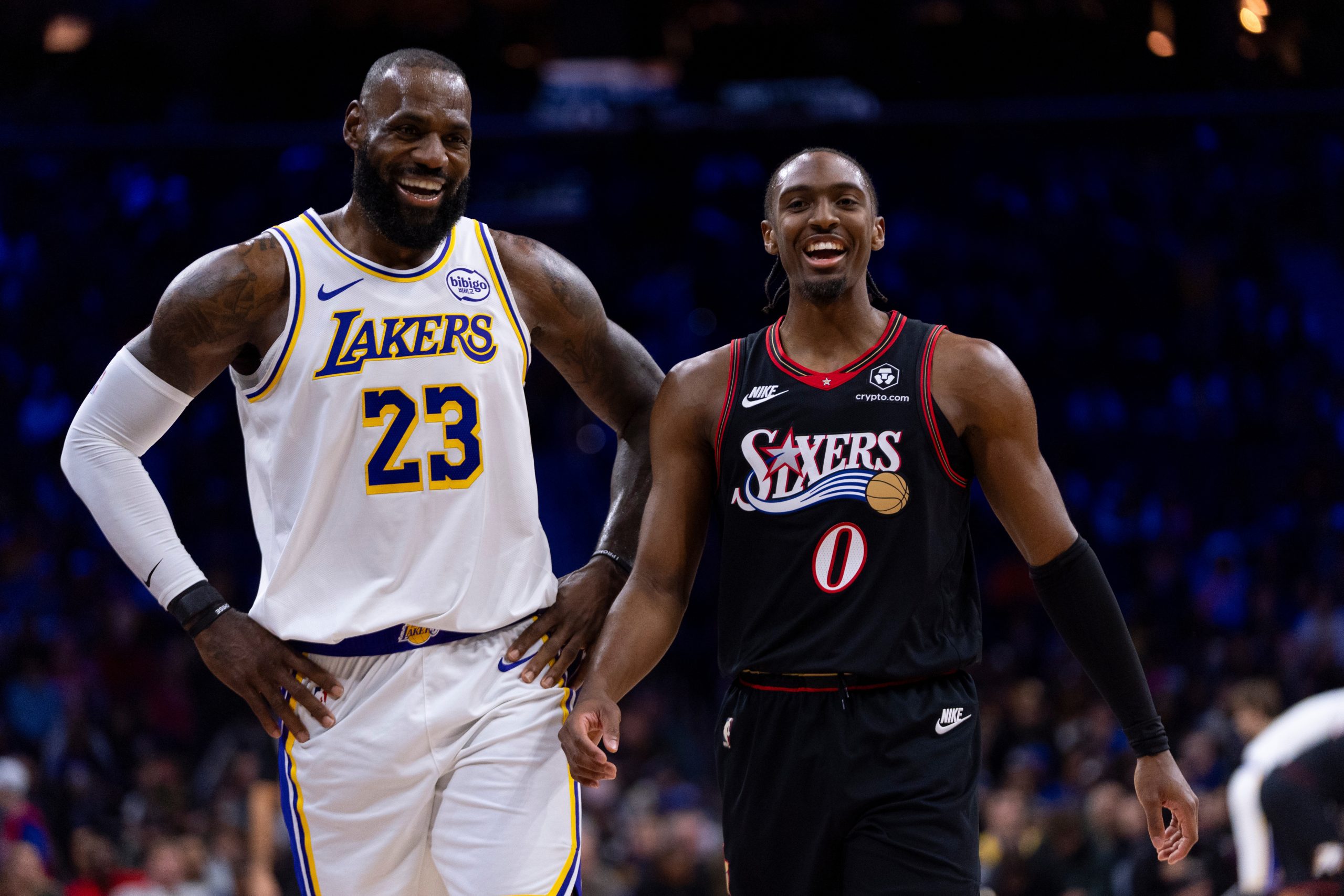
    Los Angeles Lakers’ LeBron James, left, shares a laugh with Philadelphia 76ers’ Tyrese Maxey, right, during an NBA basketball game, Sunday, Dec. 7, 2025, in Philadelphia.Chris Szagola / AP

    Practice, film review, rehab, and games could all count as workdays, said Stephen Kidder, a tax attorney who specializes in professional sports.

    “Every single one of those days is a duty day for a professional athlete,” Kidder said.

    A spokesperson for the city said, “Philadelphia welcomes LeBron James with open arms,” but did not respond to a request for comment about any special guidance for athletes.

    How much will LeBron James pay in wage taxes?

    If James ends up living in Philly, the calculation is simple. He would have to pay 3.735% of his annual salary of $4 million — roughly $150,000 — regardless of where he spends his time.

    But if he lives outside the city, it comes down to counting days.

    Without knowing James’ overall number of workdays in the year, and how much of that time is spent in Philadelphia, it is impossible to estimate his tax bill.

    The number of duty days for an NBA player can vary widely, depending on practice schedule, depth of playoff run, and other activities, such as promotions.

    An often-cited number to get a sense of the size of the tax bill for NBA players is 200 workdays.

    If his only Philadelphia workdays were the Sixers’ 41 home games, and if, as seemingly the youngest 41-year-old in history, he played in all of them, roughly 20% of King James’ income would be earned in Philly.

    In this scenario, the city would tax 20% of James’ annual income at the 3.425% rate for nonresidents, for a hypothetical tax bill of around $28,000. That number would decrease if he missed some home games, or increase if he attended other team activities in Philadelphia.

    (This writer refuses to make any calculation related to the playoffs that could constitute a jinx but suffice to say: See you on Broad Street next summer.)

    Do taxes affect players’ decisions?

    Professional athletes and the associations representing them care a lot about state and local taxes, and are fighting against them.

    The MLB, NHL, and NFL players associations, alongside three former professional athletes, sued Pittsburgh over its 3% jock tax for visiting players. And last year the Pennsylvania Supreme Court struck the tax down because it was higher for nonresidents than for residents.

    City and state taxes are part of the package when athletes choose where to play, according to Kidder, who represented the associations in the state Supreme Court case. A professional athlete in Florida owes the state no tax, for example, while California has a jock tax of up to 13.3%.

    “Some athletes may be in a point in their career where it doesn’t matter that much,” Kidder said. “But for other athletes it may be a big difference playing for a team based in Florida compared to a team based in New York.”

    Ed Wasielewski, a Philadelphia-based NFL agent and founder of EMG Sports, says tax considerations come up often in free agency deals. The difference between no tax, Philly’s 3.735% tax on residents, and California’s 13.3% jock tax amounts to millions of dollars in take-home pay.

    “A player is well advised to have a good accountant, a good attorney, and a good agent team to correctly analyze the tax consequences,” Wasielewski said. “It definitely comes into play in contract negotiations, especially in free agency.”

    If James chooses to live in NYC and commute to practices in Camden and games in Philly by helicopter, taxes might not be high on his list of concerns.

    New Jersey and New York have state jock taxes, and New York City has a new pied-à-terre tax on luxury second homes.

    At least one person in the Sixers organization, it seems, is not working overtime to duck a tax.

  • The Legionnaires’ outbreak in Philly 50 years ago led to months of mystery — and gave the disease its name

    The Legionnaires’ outbreak in Philly 50 years ago led to months of mystery — and gave the disease its name

    As Philadelphia wallowed in self-pity over its seemingly botched Bicentennial celebrations 50 years ago, thousands of American Legion members arrived for a late July convention at the Bellevue-Stratford Hotel.

    Weeks later, dozens of them were dead from a mystery ailment, and scores of others were sickened. The victims, authorities said, returned home to develop respiratory infections that in some instances progressed to fatal cases of pneumonia.

    For more than half a year, local and federal health authorities were unable to determine what killed them, resulting in a web of fear, paranoia, and frustration that gripped not only Philadelphia, but also the nation at large.

    This was the infamous Legionnaires’ disease outbreak of 1976, perhaps the blackest of marks on Philadelphia’s record for the year. Today, the disease — known as legionellosis, caused by Legionella pneumophila bacteria — still crops up, most recently in a 50-building outbreak in Manhattan that has so far caused at least seven deaths.

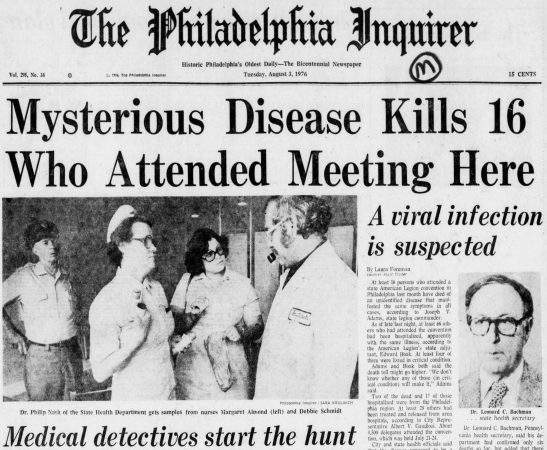
    Philadelphia was not the last, or even the first, city to experience the disease. But that outbreak half a century ago is how it got its name. Here is how The Inquirer and Daily News covered it:

    https://www.newspapers.com/article/philadelphia-daily-news/202696263/

    Article from Aug 3, 1976 Philadelphia Daily News (Philadelphia, Pennsylvania) <!— –>

    The initial outbreak

    About 2,000 American Legion delegates came to town for a convention that ran from July 21 to 24, 1976, at the iconic Bellevue-Stratford Hotel. There were no signs of trouble during the convention, or for several days afterward.

    But by early August, about a week after the convention’s end, 14 Pennsylvania American Legion members were dead of an unclear illness, with their deaths involving “some type of respiratory problem,” reports from the time indicate. Roughly 50 others were reportedly hospitalized.

    Many of the initial victims were from Western Pennsylvania and had traveled to the city, though some Philadelphians were among the sick and dead. All had attended the American Legion convention the month before, officials said.

    https://www.newspapers.com/article/the-philadelphia-inquirer/202696881/

    Article from Jul 17, 1977 The Philadelphia Inquirer (Philadelphia, Pennsylvania) <!— –>

    As officials mounted an investigation that cost the state $25,000 a day, the death toll continued to increase. By mid-August, 29 people were dead and about 200 were sickened, reports indicate.

    The Centers for Disease Control said at the time that the outbreak was “without precedent” in the agency’s 30-year existence, and began conducting laboratory work to determine the cause.

    “We have not seen anything like this take place in such a short period of time,” said Jay Satz, chief virologist with the Pennsylvania Department of Health. “This is something to be quite concerned about.”

    https://www.newspapers.com/article/philadelphia-daily-news/202696483/

    Article from Aug 9, 1976 Philadelphia Daily News (Philadelphia, Pennsylvania) <!— –>

    Conspiracies reign

    Health officials largely expected the cause to be a then-long-awaited epidemic of swine flu, which had killed a soldier at Fort Dix in New Jersey earlier in the year, and focused much of the investigation on identifying that disease, reports indicate. Other possible causes, including toxins such as nickel carbonyl, were also considered.

    But public speculation about the cause, as well as how the disease arrived in the city, ran rampant. Or, as The Inquirer put it at one point, there were more people who had “their own ideas on what is causing the mysterious disease than there are Kennedy assassination conspiracy theories.”

    Inquirer readers wrongly blamed everything from pigeon droppings to contaminated ice. One person claimed the trash piling up on city streets, thanks to a municipal worker slowdown at the time, was the reason. Another contended shellfish was the cause, noting that “mostly men had been stricken because women don’t like shellfish.”

    Others believed the cause was more nefarious. Surely the disease had come from communists from Ecuador or Poland, who intentionally spread it to American Legion members. No, it was a sneak attack staged by the potentially disruptive activist groups Mayor Frank Rizzo had warned about.

    The American Legion, meanwhile, did not believe foul play was involved — nor did investigators, who said no evidence supported any of these theories. The truth, it seemed, was far less salacious.

    The Bellevue closes

    As worry over the illness wore on, the Bellevue-Stratford hotel itself also fell victim to the disease’s impacts, closing in November 1976.

    Though investigators avoided directly implicating the hotel early on, it suffered severe financial damage. Reservations collapsed into single-digit occupancy percentages, resulting in losses of up to $10,000 per day, reports from the time indicate. William G. Chadwick, the hotel’s vice president and general manager, said business had been devastated.

    https://www.newspapers.com/article/philadelphia-daily-news/202696555/

    Article from Nov 10, 1976 Philadelphia Daily News (Philadelphia, Pennsylvania) <!— –>

    “We have found it impossible any longer to withstand the economic impact of the worldwide adverse publicity which has been associated with the Legionnaires’ disease,” he said.

    By then, the Bellevue had operated for more than 70 years and was considered a jewel in the city’s hospitality crown. Its closure, Rizzo said, was a “great loss,” and he vowed the property would host a new, modern hotel to fill the gap. Today, it is a mixed-used development at 200 S. Broad St. that includes a hotel portion.

    Philadelphia’s Bicentennial tourist business also suffered, with several conventions canceling their bookings over fear of the illness, significantly affecting what was expected to be a banner year for visitors. Public perception erred on the side of avoiding the city, which some local officials tried to rebut.

    https://www.newspapers.com/article/philadelphia-daily-news/202696766/

    Article from Aug 19, 1976 Philadelphia Daily News (Philadelphia, Pennsylvania) <!— –>

    “We are still a safe city,” said Eugene Hosmer, director of the Philadelphia Convention and Visitors Bureau, noting the disease struck just as low civic self-esteem seemed to be fading. And then, “we’re hit with this.”

    Robert Jacob, manager of the Penn Center Inn and head of the Greater Philadelphia Hotel Association, put the illness’ impact more dramatically.

    “We’re being crucified,” he said.

    A break in the case

    Investigators searched for months for the disease’s cause to no avail, facing substantial criticism — including a congressional subcommittee hearing during which their efforts were labeled an “embarrassment,” according to reports from the time.

    But in January 1977, after tens of thousands of tests, investigators identified the culprit. The deadly Legionnaires’ disease, the CDC found, was caused not by a toxin or virus, but a bacterium. One so strange and unknown, lab workers and scientists had missed it for months.

    https://www.newspapers.com/article/the-philadelphia-inquirer/202696612/

    Article from Jul 17, 1977 The Philadelphia Inquirer (Philadelphia, Pennsylvania) <!— –>

    Credited with its discovery was Joseph McDade, then a CDC microbiologist in the agency’s leprosy and rickettsia laboratory. On a hunch after receiving a routine report, McDade reexamined slide samples and decided to look for unfamiliar microbe shapes. And he found them — and they appeared not only in samples from Philadelphia, but also in past unsolved outbreaks.

    The disease was found to be present in samples from a 1965 pneumonia outbreak at St. Elizabeth’s Hospital in Washington, in which 18 people died, and a 1968 one that sickened 144 people at a Pontiac, Mich., health department building. Additionally, the illness had struck a 1974 Independent Order of Odd Fellows convention in an outbreak that killed two people — also held at the Bellevue-Stratford.

    https://www.newspapers.com/article/the-philadelphia-inquirer/202696954/

    Article from Jul 17, 1977 The Philadelphia Inquirer (Philadelphia, Pennsylvania) <!— –>

    Investigators later determined the 1976 outbreak had been spread via airborne water mist from the hotel’s air-conditioning cooling towers. The towers allowed the bacteria to grow and be spread to convention attendees, as well as some individuals who had traveled near the hotel, investigators found.

    “We are dealing with a very real phenomenon which has been present in the past but has never been recognized,” said CDC director David Sencer in 1977. “We now know what to look for.”

  • LeBron mania, Kruk’s clip-on ties, and saying goodbye to Cecily | Weekly Report Card

    LeBron mania, Kruk’s clip-on ties, and saying goodbye to Cecily | Weekly Report Card

    Philadelphia fandom: A+

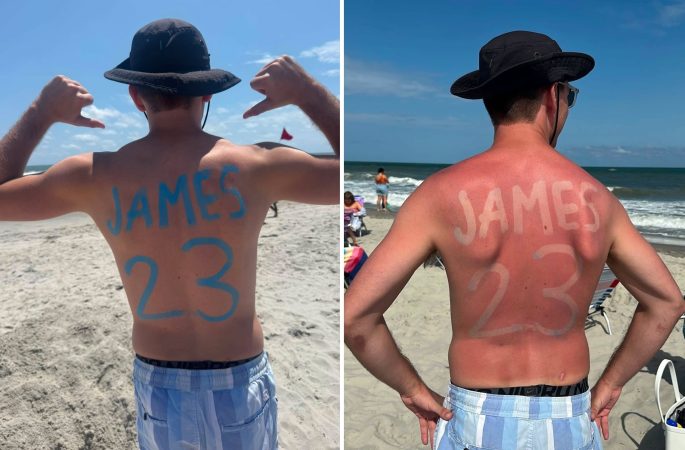
    LeBron James announced he was coming to Philadelphia. Within days, someone had intentionally sunburned a No. 23 jersey onto his back. That’s commitment.

    A Delco man spent a day at the beach in Sea Isle using zinc sunscreen to leave behind a perfectly outlined “James 23” sunburn. His family thought he’d lost his mind, and beachgoers assumed he’d lost a bet. But later that night he got to proudly show it off at Ocean Drive like he’d just gotten fresh ink.

    The man called it “Philly toughness” … sure. This is exactly why Philadelphia sports fans have the reputation we do. We climb poles, tattoo the Phanatic on our bellies, and name our dogs after backup quarterbacks. And now someone has a LeBron jersey they can’t take off for a week.

    Longtime 6abc meteorologist Cecily Tynan has spent more than 30 years as a member of the Action News team.6abc

    The end of another Action News era: F

    Thirty years is long enough for someone to become part of your routine without you even realizing it.

    For decades, Cecily Tynan has been the person telling Philadelphia whether to grab a jacket, brace for a blizzard, or enjoy a sunny weekend. You hear the forecast while making dinner or before heading out the door and rarely stop to think about who’s delivering it.

    Then one day, she announces she’s retiring.

    Cecily Tynan leaving feels a little bigger than another broadcaster calling it a career because Action News is part of the city’s daily rhythm. Generations have eaten dinner while those familiar voices played in the background.

    But it’s hard to argue with her reason. She’s retiring while she’s healthy enough to spend more time with her family, cheer at her daughter’s track meets, water ski in Florida, rescue animals, and, perhaps most shocking of all, cook Thanksgiving dinner for the first time instead of picking it up from Whole Foods.

    First Jim Gardner. Now Cecily Tynan.

    Good luck to whoever has to tell Philadelphia there’s snow coming next. Those are big rain boots to fill.

    Reacher comes to Philly: B+

    The new Reacher trailer opens with Jack Reacher fighting his way through a SEPTA station.

    So, pretty realistic.

    One of the best parts of watching a movie or TV show filmed in Philadelphia isn’t the plot. It’s playing, “I know where that is.”

    The trailer delivers plenty of that. You get SEPTA stations, Market East, the Benjamin Franklin Bridge, Center City rooftops — Reacher himself even slams a guy’s head against an Inquirer vending box. We knew Reacher was filming here last summer but seeing the finished product is still oddly satisfying.

    Maybe the action scenes will be great. Maybe the mystery will keep us hooked. But let’s be honest: Half of Philadelphia is going to spend every episode pointing at the TV and announcing exactly where they filmed it. (Bonus points if you can call out shots of Toronto masquerading as Philly.)

    NBC Sports Philadelphia analyst John Kruk following the Phillies’ loss to the New York Mets on Tuesday.NBC Sports Philadelphia

    John Kruk on national TV: A

    Every time John Kruk joins the Sunday Night Baseball broadcast, it feels like someone accidentally invited your funniest uncle to a black-tie wedding.

    This week, the conversation somehow turned into Kruk admitting he doesn’t really own ties, that most of the ones he brought were clip-ons, and then struggled to button his collar while Joe Girardi and Jason Benetti narrated the ordeal like it was Game 7 of the World Series. At one point, Kruk declared facing Randy Johnson was easier than putting on the tie.

    That’s why Philadelphia loves him.

    Kruk makes millions of viewers feel like they’re sitting in the living room watching baseball with a friend who wandered in wearing whatever he found in the closet. He’s knowledgeable without acting like the smartest guy in the room, and he’s never afraid to laugh at himself.

    Sure, NBC can put him in a jacket and hand him a tie, but they can’t make John Kruk stop being John Kruk.

    From left: Former Eagles receiver Terrell Owens, the Phillies’ Bryce Harper, and former Flyer Eric Lindros.Associated Press

    Everybody wants to be here: A

    Remember when Philadelphia was the city athletes were supposed to leave? Now, they’re choosing it.

    LeBron James is the latest reminder that the biggest names in sports don’t just tolerate Philadelphia anymore — they want to play here. And once you start thinking about it, the list is pretty impressive: Bryce Harper, Saquon Barkley, Terrell Owens, Jim Thome, Cliff Lee, Dr. J, Eric Lindros, Moses Malone. Each arrival felt like a holiday. Not every move worked out perfectly. (Sorry, T.O.) But that’s beside the point.

    For decades, Philadelphia fans carried around the idea that stars preferred bigger markets, warmer weather, or flashier franchises. We were the “underdogs.” Now, one of the greatest basketball players of all time looked around the NBA and decided he wanted to spend the final chapter of his career was South Philly. (We just have to convince him to move here now.)

    A crowd strolls along the boardwalk in Wildwood on Monday, May 26, 2025.David Maialetti / Staff Photographer

    Wildwood on TV: B

    A new comedy from the creator of Derry Girls is headed to FX, and it’s set in (and called) Wildwood.

    Now comes the important part: Please film it there.

    Hollywood has a habit of setting shows in one place and shooting them somewhere completely different. But Wildwood has too much personality to fake. The boardwalk, the neon motels, the tram car. If you’re going to call the show Wildwood, you have to earn it.

    Besides, if The Four Seasons can film down the Shore and Reacher can turn Philadelphia into an action movie backdrop, there’s no reason this one can’t let Wildwood play itself.

    If nothing else, we deserve a season of spotting familiar landmarks instead of arguing online, “That’s clearly not Jersey.”