Category: News

  • ‘People are sacrificing necessities.’ Ahead of Pa. governor’s race, the economy weighs heavily for Latino voters

    ‘People are sacrificing necessities.’ Ahead of Pa. governor’s race, the economy weighs heavily for Latino voters

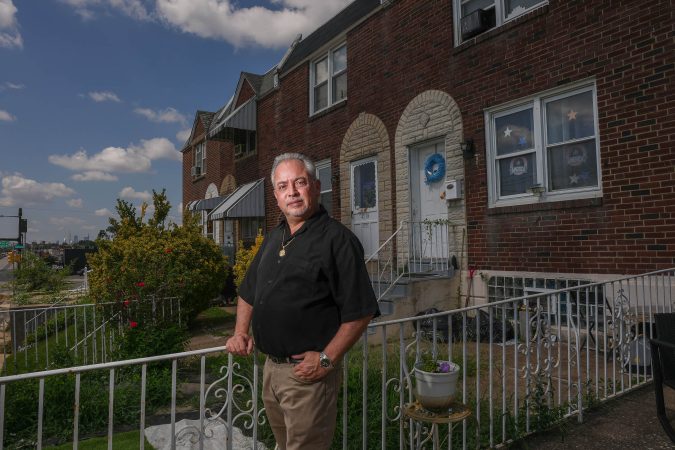
    Jorge Luis Burgos of North Philadelphia, a registered Democrat, was one of many Latino voters who shifted to the right and voted for President Donald Trump in the 2024 presidential election.

    Now he’s planning to shift back and vote for Democratic Gov. Josh Shapiro as he runs for reelection in the key swing state.

    “Shapiro 100%. I love the way he manages everything,” Burgos said while attending Arte en las Calles, an event last weekend celebrating Latino culture held by the Esperanza Art Center in North Philadelphia.

    Burgos, 57, who moved to Philadelphia from Puerto Rico in 1980, said he voted for Trump in 2024 because he was worried about inflation and felt betrayed by the last-minute switch that swapped then-President Joe Biden for Vice President Kamala Harris as the Democratic nominee. But he said Trump has failed to fulfill his promises, and he has found himself turning back to the Democratic Party.

    “I was disappointed, and that’s why I switched. But you ask me now, I’m disappointed, too. Big time,” Burgos said. “Trump didn’t accomplish his promise: ‘On Day One,’ inflation is gonna go down. It didn’t happen.”

    In the past decade, support of Republican candidates, specifically Trump, has grown in the majority Latino precincts of Philadelphia — with Trump’s share of the vote increasing from 6.1% in 2016 to 21.8% in 2024.

    While Harris still won these wards — and a slight majority of Latino voters nationally, according to exit polls — Trump’s improved performance with this voter group helped him win both Pennsylvania and the presidency.

    Burgos, like many other supporters who shifted to the right, said Trump’s promises to bring the cost of living down to its pre-COVID rate ultimately won over their vote.

    Ninety-three percent of Trump’s Latino supporters cited the economy as the main issue driving their vote in the 2024 election, according to a September 2024 Pew Research Center poll.
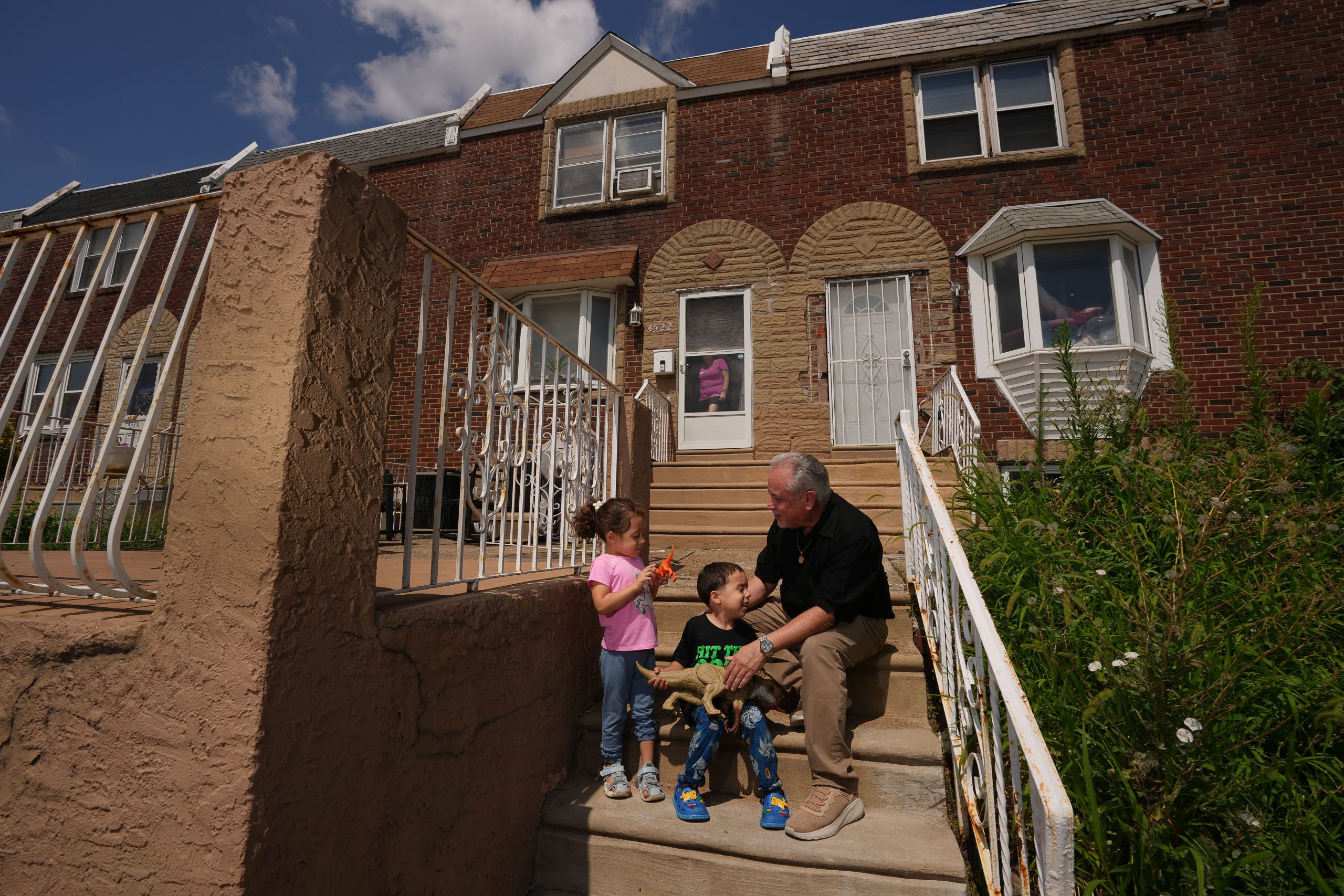
    Jorge Luis Burgos with his grandchildren Luis Burgos Jr. and Athena Burgos, in Philadelphia. His wife Carmen is standing in the doorway in this photo.Jessica Griffin / Staff Photographer

    But now many Latino voters have not seen the outcomes they were hoping for, with a May poll from Pew finding that Trump’s support has fallen more sharply with Latino voters than other voters. Only 66% of Hispanic Trump voters approved of his job performance in the poll, falling 27 percentage points from the start of his presidency.

    According to a May poll from UnidosUS, a national Latino civil rights organization, 66% of Latino voters say Trump and congressional Republicans are not focused on fixing the economy.

    Pennsylvania Democrats and Republicans will be seeking to sway these voters in November when Shapiro faces off against Republican nominee Stacy Garrity, the state’s treasurer, in the race for governor.

    What are the issues on the minds of Latino voters?

    Latino voters, who make up more than 600,000 of eligible voters in Pennsylvania and are the fastest-growing demographic group in Philadelphia, said in interviews that the economy, immigration, and support for small businesses are the issues that will determine who they vote for.

    “They’re focused on cutting costs,” Shapiro said of the region’s Latino voters at a rally with congressional candidate Bob Brooks and House Minority Leader Hakeem Jeffries in the 7th Congressional District, one of four GOP-held seats in the state Democrats are hoping to flip after the area accounted for some of Trump’s biggest Pennsylvania gains in 2024.

    “They’re focused on their small businesses getting help,” Shapiro said. “They’re focused on more cops on the street for safer communities and schools that are stronger.”

    Gov. Josh Shapiro addresses the audience during a rally for congressional candidate Bob Brooks at the United Steelworkers Union Hall in Bethlehem, Pa. on Sunday, July 26, 2026.David Maialetti / Staff Photographer

    Jaime Negrone, 67, from North Philadelphia, has lived in Pennsylvania his whole life but has roots in Puerto Rico. He said the cost of living is the major issue he is hoping to see tackled.

    “Everything has become so expensive,” Negrone said. “People are sacrificing necessities on one end to cover for the other end: food, gas, housing.”

    Negrone said he will vote for Shapiro over Garrity because the governor seems to be more connected to the people of Pennsylvania.

    “Shapiro has a pulse on the issues in Pennsylvania,” Negrone said. “He’s been in the office, he knows the politics, and he seems to be a politician for the people.”

    Seth Ortiz, 30, a second-generation Puerto Rican from Northeast Philadelphia, said he’s going to vote for Democratic candidates in November because he feels that’s the only way to protect people’s rights amid increased immigration enforcement.

    “I don’t like the fact that ICE is pretty much doing what they want in U.S. cities. At some point, even killing American citizens and getting away with it, it’s horrible,” Ortiz said. “So anyone who is going to stand up for immigrant rights is probably the most important thing for me. And it’s probably always going to be the Democrat.”

    Gladis Avila, 55, a Venezuelan business owner from South Philadelphia, said she is not sure who she is going to cast her vote for yet. She wants a candidate who is going to stand up for her community and small businesses but has not heard much outreach from either campaign.

    “The Latino community needs people who work more for our community,” Avila said. “…When we vote, we want to feel like we are voting for someone who is going to help our community. Because that’s our voice, and our voice has an impact.”
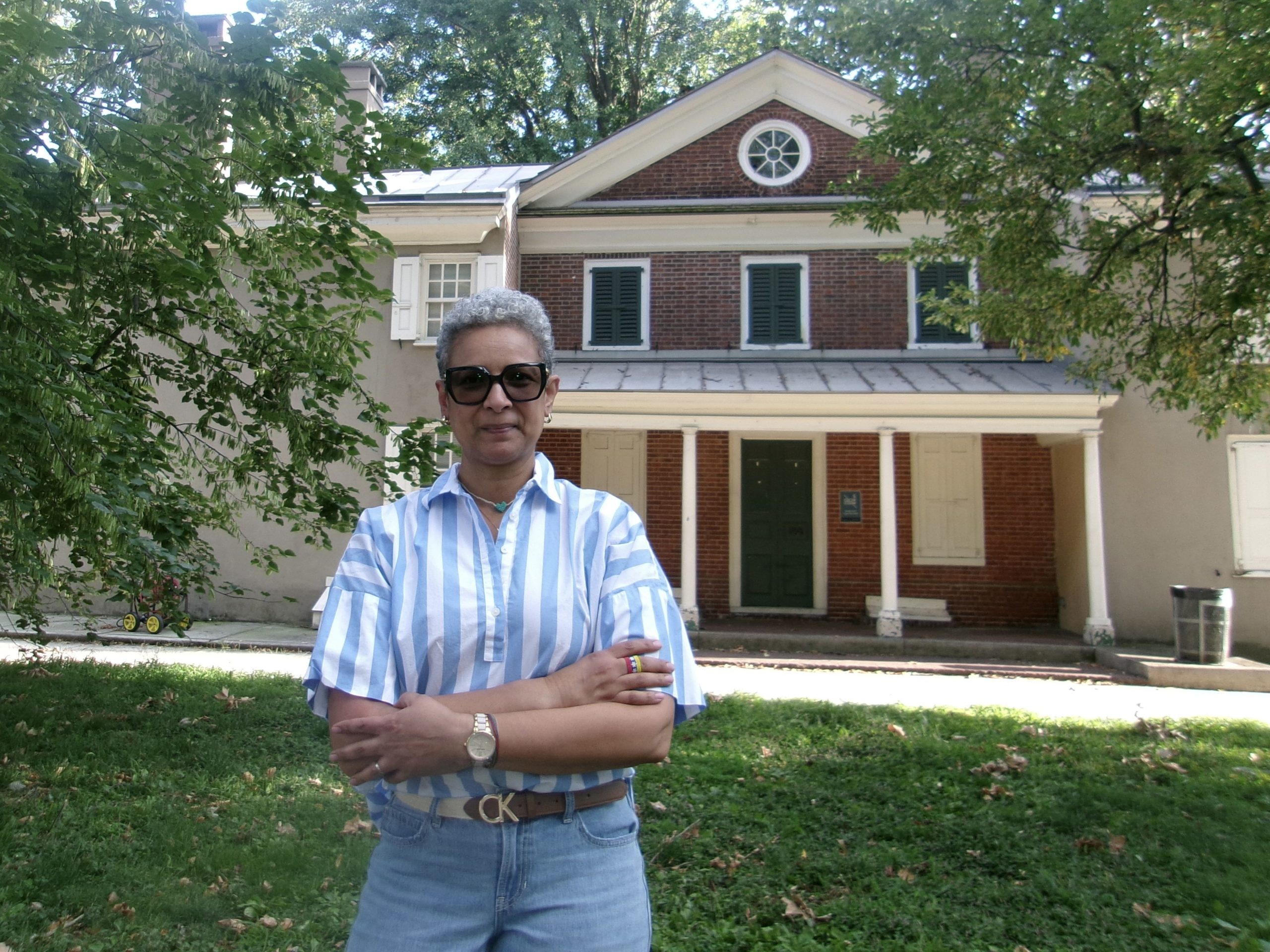
    Gladis Avila stands in a park near her house in South Philadelphia.Andrea Padilla

    Echoing this, Jennifer Rodriguez, president of the Greater Philadelphia Hispanic Chamber of Commerce, a nonprofit focused on the economic growth of the Hispanic community, said she’s heard worries from businesses about being able to keep up with their expenses.

    “Small businesses are very, very concerned about the viability of their businesses,” she said. “And in the really escalating cost environments. Particularly, the labor force has become very costly.”

    How are campaigns reaching the Latino community?

    Matt Beynon, a representative for the Garrity campaign, said that helping small businesses is the main concern the campaign has heard from Latino voters.

    “And a lot of concerns she’s hearing are about the overregulation and red tape that is preventing them from either starting a business, growing their business, expanding their business,” he said.

    Outreach to the Latino community has so far included attending community events in Philadelphia and other communities with large Latino populations, like Allentown, Beynon said.
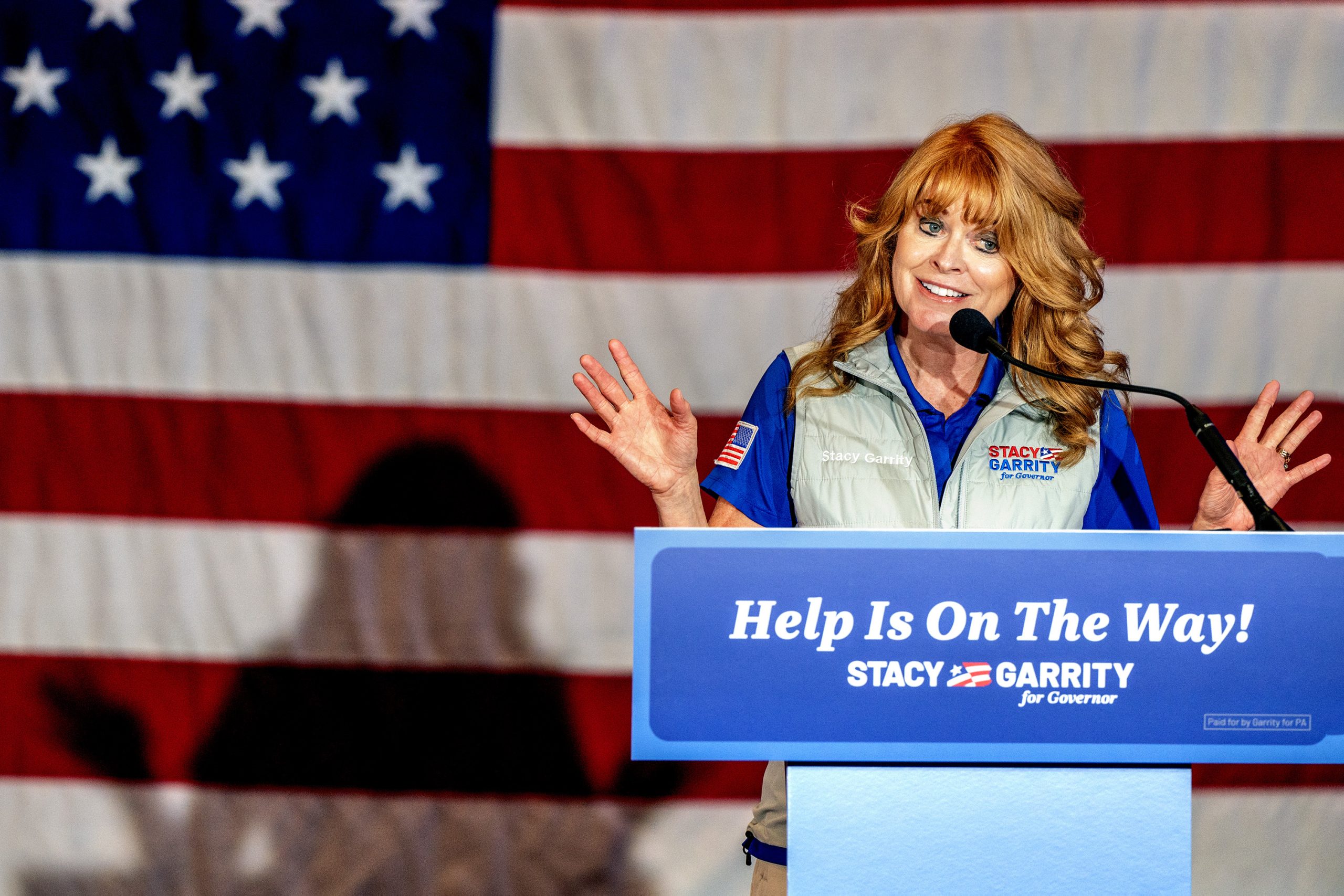
    State Treasurer and Republican candidate for governor Stacy Garrity holds a rally in Bucks County Sept. 25, 2025 at the Newtown Sports & Events Center.Tom Gralish / Staff Photographer

    Shapiro has also spent time in majority Latino areas. In May, he attended and co-hosted “Fiesta on Hamilton,” in Allentown, a street festival that celebrates Latino culture in the Lehigh Valley.

    “During Fiesta on Hamilton, Gov. Shapiro met with local small business owners, entrepreneurs, creators, cultural leaders, and local officials as part of Shapiro for Pennsylvania’s ongoing commitment to engaging, uplifting, and investing in Latino communities across the Commonwealth,” the Shapiro campaign wrote in a statement.

    Samantha Reposa, a representative for the Shapiro campaign, said the campaign is also running Spanish-language radio ads to further engage voters.

    ‘I feel left behind’

    Despite this, many Latino voters in Philly said they haven’t felt reached by either campaign.

    Rodriguez expects messaging to ramp up closer to the election. Because of the Latino community’s lower voter turnout in relation to other groups, Rodriguez said they are often the last to be reached, a strategy she is hoping to see change

    “One thing that typically happens is that the Latino community oftentimes is the last community to be approached by politicians and their systems,” Rodriguez said. “The Latin community’s voter engagement is relatively low. And a lot needs to be improved, but a lot of it has to do with candidates really seeking the relationship with our community much earlier on.”

    Carolina Hansell, 61, immigrated from Venezuela 33 years ago and is planning to vote for Shapiro, but said she has seen and felt the conservative shift in her community and that it’s in part due to a lack of outreach.

    “They need to work and talk to real people and the neighbors over here,” Hansell said. “It’s the only way to convince people and have a good plan. There’s not a plan right now, not in that Democratic Party.”

    Anjoli Santiago, 41, said it’s not just the Democrats that are lacking but feels like both political parties have lost touch with the Latino community and sees that trend continuing.

    “I think it will continue if we don’t have more conversations about how diverse our people are and the different needs that our people have,” Santiago said. “I feel left behind by both parties definitely. It feels like we are voting and those who we vote for no longer represent us.”

    Staff writer Michelle Baruchman contributed to this article.
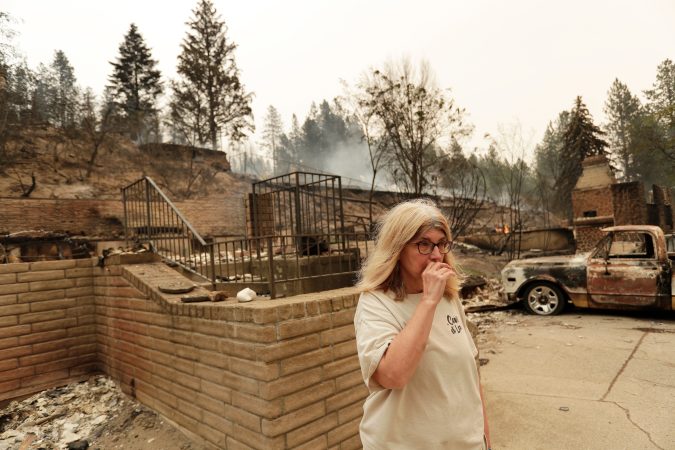
  • Eastern Washington fires have burned 600 structures and forced the evacuation of 60,000 people

    Eastern Washington fires have burned 600 structures and forced the evacuation of 60,000 people

    Wildfires in eastern Washington state forced the evacuation of 60,000 people in the Spokane area while destroying at least 600 homes, businesses, and other structures, authorities said Sunday.

    The fires in and around Spokane, the state’s second largest city, burned about 8.2 square miles over the weekend and were among dozens of wildfires across the Western U.S. that stretched the ability of federal, state and local agencies to fight them.

    A total of about 390 square miles has burned across the state, and some of the fires, including those in the Spokane area, have not been contained.

    No one hurt or unaccounted for — so far

    Fire and law enforcement officials said there had been no reports of injuries or people unaccounted for — but they stressed it was early in the response effort.

    Officials also said that the evacuees in Spokane included patients at its U.S. Veterans Affairs hospital.

    Video from the Spokane area showed buildings on fire, black smoke billowing up near neighborhoods, and the smoking ruins of homes, with only chimneys still standing. Several officials expressed concern that the area does not appear likely to get a break in coming days from the weather, which is expected to remain dry.

    “We are not out of danger,” U.S. Sen. Maria Cantwell said during a news conference with federal, state and local officials in Spokane. “The next couple of days will be challenging.”

    Investigators had yet to determine how the blazes started.

    Grassland in flames in parts of Idaho, Oregon

    Spokane was hardly the only place struggling to contain fires.

    Crews using bulldozers and helicopters continued for a 10th day to fight a fire that has burned nearly 525 square miles of grassland in western Idaho and eastern Oregon. The area is home to cattle ranches, and authorities said the fire is threatening more than 600 homes and 800 other structures.

    The weather in the area was expected to remain sunny — and dry — well into the week, with temperatures rising to more than 90 degrees Fahrenheit on Wednesday. Officials say the fire was caused by lightning.

    The National Weather Service issued warnings about the air quality in eastern Washington, eastern Oregon, western and central Idaho, and western Montana. It issued red flag fire warnings for parts of Utah and Montana and western Nebraska, and extreme heat warnings for the southern parts of Arizona, California, and Nevada and northern Montana.

    High winds make it hard to fight fires in Spokane area

    While temperatures Sunday in Spokane were forecast to remain below 80 F, wind gusts from 35 mph to 45 mph were expected by the afternoon, said Benjamin Cossel, public information officer for the federal response team from California called in Saturday night to deal with the fires.

    “We have weather working against us, and we have terrain working against us,” Cossel said.

    There were three fires in the Spokane area: the Old Trails Fire, the Fairview Fire, and the Meadowview Fire. Washington Gov. Bob Ferguson declared a state of emergency Saturday, and the National Weather Service issued a “particularly dangerous situation” red flag alert for eastern Washington.

    Cossel said that as it gets warmer during the day, cool air that’s closer to the ground and keeping winds at bay will rise, allowing those winds to move through the area. The Spokane River cuts through the city of about 229,000 people, and there are steep canyons on both sides that channel the wind.

    “They push the fire through the canyons, up, up the slopes, and then outside the slopes and around,” he said. “It’s very, very hilly, very, very steep slopes, a lot of canyons that create really turbulent, really challenging sort of wind scenarios.”

    Spokane sets up shelter for impacted residents

    Authorities in Spokane set up a shelter at the city’s main convention center. About 400 people were staying there, officials said Sunday.

    Spokane County Commissioner Chris Jordan said relatives of his were in an area affected by the fires and that they don’t know if their home is still standing. He said he spoke with them as they were leaving the home.

    “They’re in their car and all they can see is smoke everywhere, and it was incredibly scary for so many people,” he said during the news conference.

    Heather Rosenstrater, president and CEO of Avista Corp., the area’s electric and natural gas utility, said about 10,000 people were without power Sunday, down from a peak of 30,000. Avista needs to repair two transmission lines, she said, so it’s possible that demand for electricity over the next few days could cause outages.

    Meanwhile, several larger fires continued to burn in less populated areas northwest of Spokane, including one about 80 miles from the city that has burned about 210 square miles. Another fire in eastern Oregon, about 70 miles to the northwest in the Stinkingwater Mountains, has burned about 336 square miles.

    “The whole northwest is heavily impacted right now,” said Keila Vizcarra, the spokesperson for the federal team from California handling what’s been named the Big Grass Fire in western Idaho and eastern Oregon.

  • Police issue a warrant for a suspect in the Delco Walmart shooting

    Police issue a warrant for a suspect in the Delco Walmart shooting

    Police in Darby Township, Delaware County, have identified a suspect in a shooting at a Walmart in which an employee was injured.

    An arrest warrant has been issued for Armani Tyrell Waite, who is wanted on attempted murder, aggravated assault, reckless endangerment, and other weapons charges.

    The incident unfolded on Friday evening, after an argument broke out between two customers inside a Walmart on MacDade Boulevard in Glenolden.

    Police believe Waite opened fire inside the store, discharging more than five rounds and striking an employee in the calf.

    Officers later recovered the weapon at the scene. The employee was hospitalized and listed in stable condition.

    Public records list addresses for Waite in Southwest Philadelphia and Clifton Heights. An online resume states that he worked as a package handler for FedEx.

    Police believe Waite is armed and dangerous, and cautioned members of the public not to approach him. Individuals with information regarding his whereabouts were asked to call 911.

  • Some Philadelphians have turned to farmers’ markets as the cyclosporiasis outbreak continues

    Some Philadelphians have turned to farmers’ markets as the cyclosporiasis outbreak continues

    Procoro Jeronimo, 45, went to his yearly physical in late June. Doctors told him to lay off the bread and replace it with lettuce.

    The professional baker was wary, aware that lettuce was linked to an ongoing outbreak — caused by the single-celled parasite cyclospora — causing explosive bowel movements.

    Wanting to stay healthy for his five children, he caved, finding solace in not hearing about specific cases in Philadelphia.

    A week later, mid lettuce bite, Jeronimo learned that not only was Pennsylvania officially added to the CDC list of the states affected, but also that the outbreak was linked to now-recalled Taylor Farms iceberg lettuce sourced from central Mexico and sold at grocery stores, as well as Taco Bell and other restaurants.

    “That was it,” Jeronimo said. “It stopped feeling safe.”

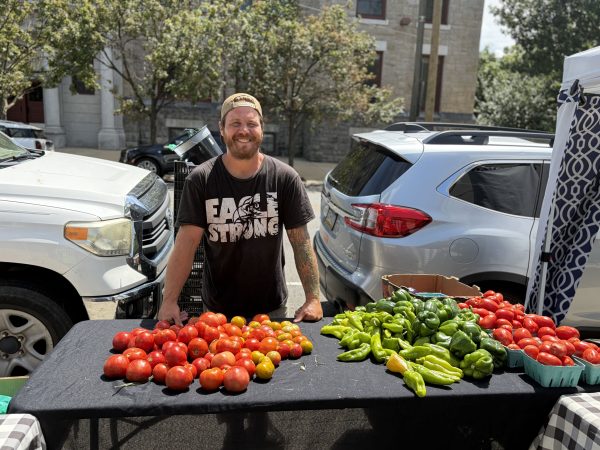
    The family ditched their grocery store produce section for the vegetable and fruit stand at the Dickinson Square Farmers’ Market in the city’s Pennsport area.

    “It’s hard, because most of our food, like pozole, includes lettuce,” Jeronimo said, checking tomato ripeness in front of farmer Bruce Santino’s stand Sunday morning.

    “Lettuce is cheaper at the grocery store; I went from paying $8 to $10 per month for lettuce to paying $20. I guess that is the price for mental peace,” he added.

    Jeronimo is not the only one willing to pay more for the feeling of safety. South Philly resident Marie Abbondanza, 42, also abandoned her grocery store produce to walk with her toddler and shop at the farmers’ market.

    “We are choosing to get all of our produce from the market because we don’t want to get sick and we want to support the local farmers,” Abbondanza said. “[Grocery stores are] really expensive and their produce isn’t really good, so if we have to pay a little bit more and the quality is better, it’s enough for me.”

    So far this year, Pennsylvania health officials confirmed at least 45 cases of cyclosporiasis. That number already surpassed the 40 cases the state experienced in 2025, but still below the 87 reported in 2024.

    In the last two to three weeks, Dickinson Square Farmers’ Market has seen the volume of visitors increase by about 15%, said Ben Bergman, 48.

    Bergman helps oversee Dickinson Square as well as four other farmers’ markets citywide.

    “It looks to be a little safer here because the food is grown closer to you,” Bergman said. “It has less opportunity to become infected with something.”

    The increase is being seen by the operators of other farmers’ markets.

    According to Bridget Palombo, director of healthy food access programming at the Food Trust, it’s not automatically the case that farmers’ market produce is safer.

    “It all depends on the processes that people follow,” Palombo said. “But there seems to be more trust in the products when people can speak to those growing it and bringing it to the market.”

    The Food Trust operates three year-round markets, three seasonal farm stands, and multiple pop-up markets citywide. Seeing an uptick in foot traffic makes Palombo believe that transparency is a big reason behind the feeling of safety Philadelphians are finding in farmers’ markets.

    Farmers’ market visitors get to ask the farmers where their food comes from, what kind of pesticides they used (if any), and how it was harvested.

    That transparency does come with a stiffer price tag.

    Farmers’ markets are opportunities to purchase directly from producers, allowing the local farms to charge the full, fair cost of production, where corporate farms can cut corners, Palombo said.

    “Lettuce from the local farmer has probably traveled only a fifth of the time in and out of cold storage; it’s touched fewer hands; and they are paying their staff livable wages, giving them breaks, and treating them in humane ways,” Palombo said.

    At the Dickinson Square Farmers’ Market, farmer Bruce Santino, 38, said he can attest to the care that goes into all of his produce, and how despite the cyclosporiasis outbreak and the uptick in clientele, his business has tried to keep prices steady.

    Four people work at his Mullica Hill, Gloucester County, farm, planting and harvesting all kinds of peppers, tomatoes, corn, melons, squash, and leafy greens.

    “Only eight hands touch your food, and we harvest the day before the market to get the freshest, highest-quality product,” Santino said.

    When they ran the numbers on how much lettuce they would need for this year’s season, they were not expecting a higher demand due to cyclospora.

    “As a farmer it’s been tough, because every year you have a crop plan and you do the math of how much you are going to need, then when something like this happens you have to produce as much as you can for the demand,” Santino said.

    He was planting and selling 1,200 to 1,500 heads of lettuce per week. Three weeks ago, the business sold almost $1,000 worth of lettuce in one day, he said. But as the staff were planning on upping their production, a couple of days with 100-degree weather fried the lettuce left in the field.

    “The little that actually survived was too bitter to harvest and we don’t want to put a bad name on our product, so we prefer to go without it,” Santino said.

    His business has already started replanting and plans to produce 30% more lettuce to keep up with the demand. But Santino will keep his price at $3 to $5 per lettuce head.

    “I hope we can retain this after the parasite gets taken care of,” Santino said. “I hope people feel safer coming to the local farmers’ market and I hope they taste the difference and stay with us.”

  • Iran’s leaders show a united front over the war but are divided over what the goal is

    Iran’s leaders show a united front over the war but are divided over what the goal is

    CAIRO — With escalating attacks against U.S. bases and its allies over the past week, Iran’s leaders are showing considerable unity over their war strategy: hanging tough, determined to show Iran can endure more than America and its allies can.

    But within the leadership, there are sharp differences over what the endgame should be.

    On one side, the ultra-hardliners who oppose any negotiations with the United States are pressing for total victory in the war. Known as the “Paydari” movement — Persian for “stability” — they are hard-core ideologues who want to enforce the Islamic Republic’s control over society.

    On the other, those who support President Masoud Pezeshkian and powerful parliament speaker Mohammad Bagher Qalibaf — who doubles as Iran’s chief negotiator — see military pressure as a way to win a negotiated deal with the United States. This camp is also spurred by concern over the economic toll Iran is suffering from the war and the need to adapt to social change in the country.

    “Negotiation is a political tool and a complement to military action to force the enemy to a point of compulsion and extract real concessions,” an adviser to Qalibaf, Mahdi Mohammadi, wrote on his Telegram channel Thursday.

    The unusually open rivalry within the theocracy’s leadership points to a struggle for control over Iran’s postwar future. A huge question mark is where the new supreme leader, Ayatollah Mojtaba Khamenei, stands. Reportedly injured in the strike that killed his father in the opening minutes of the war on Feb. 28, Khamenei remains in hiding, and both sides have claimed his support.

    Iran is determined to show strength

    In a boost for Qalibaf and Pezeshkian, the ceasefire deal reached with the U.S. in April received strong backing in Iran’s top leadership body, the Supreme National Security Council. Twelve of its 13 members approved it, including senior figures in the Revolutionary Guard and the military.

    The lone vote against the deal is widely believed to have come from Saeed Jalili, the most prominent figure in the Paydari movement.

    But the ceasefire crumbled as the two sides trade strikes and as Iran presses for control over passage through the Strait of Hormuz, which before the war carried a fifth of the world’s traded oil and gas. Iran was also frustrated that financial promises under the deal — including the release of billions of frozen assets — didn’t materialize, and now the American blockade is back in place.

    With no benefits from the deal, “there’s no serious division” in the leadership over how to respond, said Ali Vaez, Iran project director at the International Crisis Group.

    They believe U.S. President Donald Trump “only understands the language of force, and therefore, they would have to gain the upper hand in order to compel him to deliver,” Vaez said.

    The hard-liners are pressuring Iranians

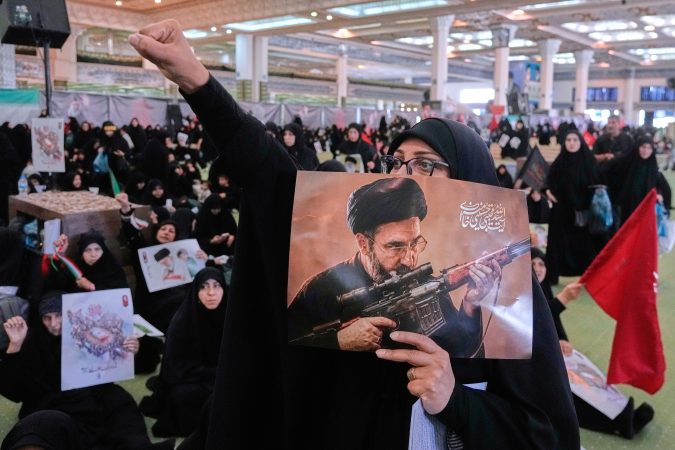
    The funeral for slain Iranian supreme leader, Ali Khamenei, earlier this month appeared to show the strength of the ultra-hardline Paydari. Crowds called for revenge on the U.S. and Israel for the war. Videos showed mourners in Tehran welcoming Jalili, while Pezeshkian was greeted at one point with insults and cries of “Death to the compromiser!”

    The ultra-hardliners have used nightly rallies and their control of state television, known by the acronym IRIB, to drum up opposition to negotiations. At rallies and on TV, speakers have portrayed Iran as headed for total victory and denounced those who compromise with the Islamic Republic’s archenemy, the United States.

    State television cut off a June 30 live broadcast with Qalibaf as he discussed negotiations with Washington. Earlier this month, it cut off broadcasting a speech by Pezeshkian to businesspeople seconds after he said that the elder Khamenei had given permission for renewed U.S. talks before his death.

    Pezeshkian and his camp have pushed back, portraying IRIB as dividing the country at the time of war. The president accused the broadcaster of making it like “the military are on one side, and the government is on another side.”

    Last month, the president’s media office condemned state television for what it described as “censoring” the president and other government heads, signaling an open rift.

    The hard-liners have sought to press their influence in other ways. In past weeks, authorities shut down cafes in central Tehran that were popular with residents during the ceasefire. Videos on Iranian social media showed many women at the cafes flouting mandatory veiling laws, and crowds mixing freely.

    The closures were brief but signaled that “religious extremist parties” were showing their influence, said Mohamad Ali Abtahi, a reformist cleric and an aide to former President Mohammad Khatami, who is still widely considered to be the leader of Iran’s reformist groups.

    While Jalili’s supporters are a minority they are influential, said Vali Nasr, professor of international affairs and Middle East studies at Johns Hopkins University.

    “They have a lot of money. They have a lot of power. They have put a lot of people in the bureaucracy” and developed connections in the Revolutionary Guard, Nasr said.

    The pragmatists say the public must be heard

    The more pragmatic camp argues that maintaining unity during the war requires addressing the public’s unhappiness over the economy as well as political and social repression. This, as Iran’s currency continues to slide, inflation spirals, and unemployment rises. A final agreement with the U.S. could bring Iran a huge windfall with the lifting of sanctions and the return of billions in assets.

    Small flashes of impatience with the war have emerged. In July, over 250 former lawmakers, clerics, professors, and other public figures signed an anti-war petition warning of the costs of the conflict. “We believe that the overwhelming majority of the Iranian people want peace and the right to a decent life,” the statement read. Others have spoken out against stepped-up executions of protesters following wide-scale anti-government protests in January.

    A top reformist party that assisted Pezeshkian’s presidential campaign warned that the war’s domestic toll was “undermining internal social cohesion.” That brought a rebuke from Tasnim, a news agency close to the Revolutionary Guard, which said the statement amounted to blaming Iran for a war started by the United States.

    In mid-July, the president’s son and influential adviser, Youssef Pezeshkian, posted a series of messages about the need to balance realistic military aims with a weak economy. Referring to the decades of sanctions and confrontation with the West, he said Iran has “been prevented from growing and has suffered greatly. It has become sick.”

    Both sides are looking to what happens after the war

    Ultimately, both sides are jockeying for power after the war, given the unusual uncertainty brought on by the change in the supreme leadership. Abtahi, the reformist cleric, said Mojtaba Khamenei’s real views are still not known, so while some believe he could be more radical than his father, others see the potential for him to bring moderate change.

    The supreme leader, because of the power invested in him, could act as a “brake” to restrain the more extremist factions, Abtahi said. But over time, the confrontation with more radical factions could grow more dangerous “if that brake isn’t used.”

  • A democratic socialist in the White House? Activists are thinking big.

    A democratic socialist in the White House? Activists are thinking big.

    CHICAGO — Officially, the summit for democratic socialists across the country here over the weekend was taking place in a hotel conference facility.

    But on Friday night, the real action was at a corner bar two miles away, where dozens of members of the Democratic Socialists of America crammed into a patio in the middle of a summer storm.

    As the rain poured down, two DSA leaders put it bluntly: If they wanted Rep. Alexandria Ocasio-Cortez (D) to run for president — and if they wanted the DSA to endorse her — it was time to start now.

    “We’re in the moment of the presidential question,” Katie Sims, an electoral organizer in Ithaca, N.Y., said at the “DSA for AOC” gathering. “Doesn’t it just make sense now?”

    That was, for many, the question looming over the Democratic Socialists of America’s summit, right in the middle of the group’s most consequential summer ever.

    A self-dubbed big-tent group that was essentially dormant a decade ago, the DSA has ballooned into one of the largest and most disciplined operations on the U.S. left.

    The Chicago summit hosted about 600 dues-paying members who flew in from across the country to attend workshops and swap organizing strategies as their group faces greater momentum — and greater scrutiny — than ever before.

    After its members helped elect Zohran Mamdani mayor of New York, DSA-backed candidates won a string of Democratic primaries this summer in deep-blue cities. The victories intensified a broader fight with centrist Democrats, some of whom signed on to a pledge declaring themselves “capitalist, not socialist.”

    If upcoming primaries in Michigan and Missouri go their way, some speculated, the democratic socialists might be able to start their own small caucus on Capitol Hill.

    “Before, we were putting our shoes on, or lacing our shoelaces,” said John Lewis, an engineer in New Orleans who serves as a member of the DSA’s National Political Committee, the group’s top decision-making body. “Now we’re getting ready to run.”

    What’s not totally clear is for what — or, with whom at the helm.

    The DSA’s 120,000 members are supposed to make decisions democratically, and there is still broad disagreement about whether and how the group might make an endorsement for the White House.

    Divisions often arise over key questions: Should the DSA work within the Democratic Party or break from it? Should they back only the most committed socialists or also support those who might stray from their platform sometimes?

    In the case of Ocasio-Cortez and the 2028 Democratic primary, a potential endorsement is a test of how flexible it might be to take its message on a national stage.

    Ocasio-Cortez, who was not at the Chicago summit, became one of the DSA’s first two members elected to federal office when she won her initial race for Congress in 2018. But her failure to adhere to the group’s red lines on the war in Gaza prompted the national DSA to withdraw its endorsement two years ago.

    She has also publicly declined to support abolishing the Senate, a moon-shot goal for the DSA, in favor of more targeted moves like ending the filibuster.

    Lewis, a member of the Marxist-Leninist “Red Star” caucus within the DSA that has repudiated Ocasio-Cortez, said he expected her to run. She is active in the DSA’s New York chapter and has since shifted again on some Israeli-Palestinian issues, he pointed out.

    But his former chapter was split apart by a similar endorsement question in 2020, and he cautioned against a “paper endorsement” that might fall flat with the DSA’s base.

    “It has to be something that people can deeply believe in,” he said, “and someone that people deeply trust to do this.”

    Palestinian poetry and engineered conflict

    In the halls of the hotel conference center in Chicago, an independent bookstore sold titles on mass incarceration, Palestinian poetry and theories of engineered conflict. Chapters set up tables offering T-shirts to “Melt ICE” and stickers to “stop arming Israel.”

    Similar messages appeared on DSA members themselves. Some wore green “Groundwork” hats, for the environmentally minded group within the DSA that advocates for working within the Democratic Party. Others had coffee mug tattoos to rep their allegiance to the Marxist Unity Group — MUG for short.

    At one workshop on Friday morning, the standing-room-only crowd was instructed to break out into small groups with a prompt: what they didn’t think was possible beforehand that feels attainable now.

    In the back corner, a group of three from New York, California, and Kentucky went around introducing themselves — the name tag for each “comrade,” as some call themselves, lists only first names and last initials.

    The woman from New York answered the prompt by mentioning Ocasio-Cortez. (DSA members, aside from those in elected office or on the NPC, were instructed not to talk to reporters at the conference, and that member declined to share their last name for privacy reasons.)

    “We’ve all known Alex. We’ve all organized with her over the years,” she said. “This is the first time in 10 years I feel like she has a real shot at the presidency.”

    Like many other DSA members at this summit, Ocasio-Cortez worked on Bernie Sanders’s 2016 presidential campaign. The future New York congresswoman was, of course, still years away from making it to Congress and nearly a decade away from the minimum age to run for the White House.

    If the DSA had previously functioned as a home for some politically frustrated millennials, it grew into much more than that. A series of galvanizing events over the last few years — Trump’s reelection, the war in Gaza, Mamdani’s victory — have ballooned the DSA in size, with more than 140 chapters around the country.

    Some have been wrapped into each chapter’s social events. Others were drawn in by local causes or campaigns.

    The ability to put all those people to work — out knocking doors and phone-banking voters — is what has made the DSA an electoral force in some cities.

    Sims, who leads the DSA’s national electoral strategy, said chapters carefully decide if they have the capacity to boost a candidate before endorsing them — or sometimes recruiting them. Only those candidates endorsed by local chapters go to national leaders for a possible endorsement later on.

    To beat campaigns with more money, Sims said, “we really got to put our feet where our mouth is.”

    Still, debates over how exactly to put that electoral strategy into practice have roiled the DSA in recent years.

    Some of the more staunchly Marxist factions hold a harder line against candidates who don’t always talk about being a socialist or adhere to all parts of the group’s platform. Other caucuses, like Groundwork and Socialist Majority Caucuses, which dominate the New York chapter, may be more open to putting resources behind such DSA members.

    There’s an added challenge with congressional candidates like Will Lawrence and Abdul El-Sayed in Michigan, who have not formally adopted the DSA label or received the group’s backing — perhaps intentionally — but back platforms that resemble those of democratic socialists.

    A presidential endorsement would amplify that debate — and do so across every DSA chapter.

    The DSA’s 2020 endorsement of Sanders followed intense internal discussion, though participating members ultimately approved it.

    “Everybody is well aware that everything we’re doing right now as DSA is either setting us up or not setting us up to be serious political players in the 2028 election,” said Frances Gill, a Los Angeles psychiatrist and NPC member.

    Summit participants were slated to hold a closed-door discussion on whether and how to endorse later in the weekend.

    Alex Pellitteri, a union organizer in New York City who is leading the DSA’s “presidential exploratory group,” compared the upsides to Mamdani’s citywide race in his hometown.

    Before the campaign, the DSA’s New York chapter — by far its largest, making up about 1 in 8 of the group’s members — had largely only supported campaigns in its strongest bases of support in Brooklyn and Queens.

    Part of the argument for endorsing Mamdani’s mayoral campaign was to get its muscular canvassing operation into parts of the city where they had never knocked a door. Backing a presidential candidate, he said, could enable the group to do the same across the country.

    But there are still questions over what that might look like — and risks.

    Some people who want to sketch out a “model of co-governance” for SIOs — socialists-in-office — at the presidential level before endorsing. Others want to reconcile an endorsement with the group’s platform, formally dubbed the “national program,” which advocates for replacing the presidency with a parliamentary system.

    And then there’s the reality that Ocasio-Cortez could very well choose not to seek out the White House.

    At the “DSA for AOC” event at an off-site bar on Friday night, a fellow comrade came up to Sims to ask the second question on everyone’s mind: Is there anyone else they’d want to encourage?

    Sims paused and thought for a second.

    “Well,” they said, “no one.”

  • ‘Sopranos’ actor Vincent Pastore, known for playing mobsters and tough guys, dead at 80

    ‘Sopranos’ actor Vincent Pastore, known for playing mobsters and tough guys, dead at 80

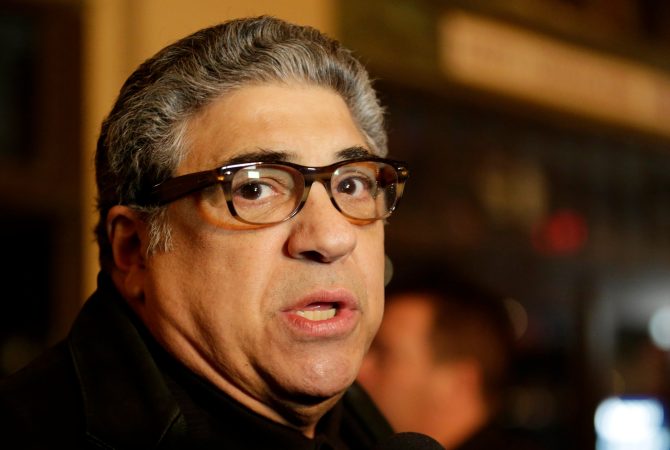
    NEW YORK — Vincent Pastore, a veteran actor who played mobsters and tough guys, and was best known for portraying Salvatore “Big Pussy” Bonpensiero on The Sopranos, has died. He was 80.

    Bob McGowan, who managed Mr. Pastore since his run on The Sopranos, told the Associated Press that he learned of his death Saturday from another client and actor on the show, Vincent Curatola.

    He said Mr. Pastore was found in his home on New York’s City Island after not being heard from for a few days.

    McGowan said he had been trying to reach Mr. Pastore about a possible job.

    “He was the most loyal client, and he always gave to charity,” McGowan said, “and he was the kind of guy who would help anybody, which is rare in my business.”

    Robert Attermann represented Mr. Pastore for more than 30 years, before his time on The Sopranos. While Mr. Pastore will be remembered as “Big Pussy,” he was so much more, Attermann said in an email to the AP.

    “Vinny was one of the kindest, most generous people I have ever known,” Attermann said. “He treated everyone with warmth and respect, never turning down a fan who wanted a photograph or an autograph. He genuinely appreciated the people who supported him and always made them feel valued.”

    Attermann said Mr. Pastore loved being an actor and was passionate about his craft while always encouraging young actors, “taking the time to offer guidance and support whenever he could.”

    Michael Imperioli, a longtime friend and collaborator, said on Instagram that it seemed as though he had known Mr. Pastore forever.

    “We did lots of work together and traveled all over the USA as well as Italy and Australia. Lots of good times. Lots of laughs,” Imperioli said. “Vinny was a kind-hearted brother who cared deeply about his family and friends. I will miss him always.”

    Mr. Pastore appeared in movies dating back to the 1980s including roles in big films such as Goodfellas and Awakenings, both in 1990.

    He often played gangsters. And it was one of those roles he is best known for: his 30-episode run as Bonpensiero, the friend of Tony Soprano who becomes an FBI informant.

    Mr. Pastore was born in the Bronx and grew up in suburban New Rochelle, N.Y. He enlisted in the Navy during the Vietnam War and later attended Pace University, according to his biography on IMDb.

    He is survived by his daughter, Renee Pastore.

  • Holocaust archives were dedicated to a curator whose family story sparked a lifelong quest to preserve history

    Holocaust archives were dedicated to a curator whose family story sparked a lifelong quest to preserve history

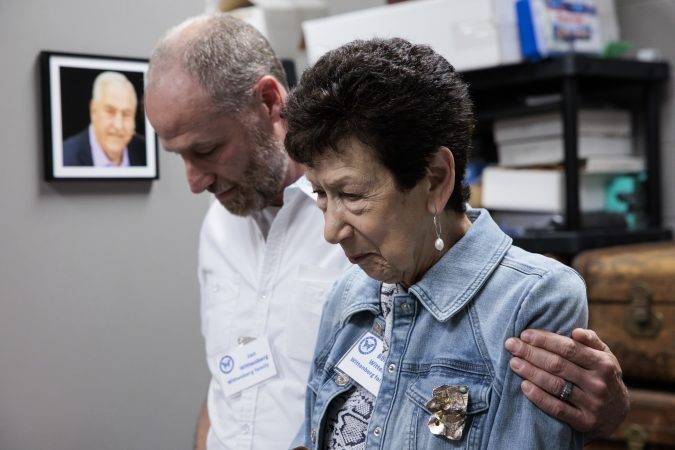
    For decades, Donald Wittenberg spent much of his free time scrupulously documenting how the Holocaust affected people in the Philadelphia region and educating people to prevent anything like it from happening again.

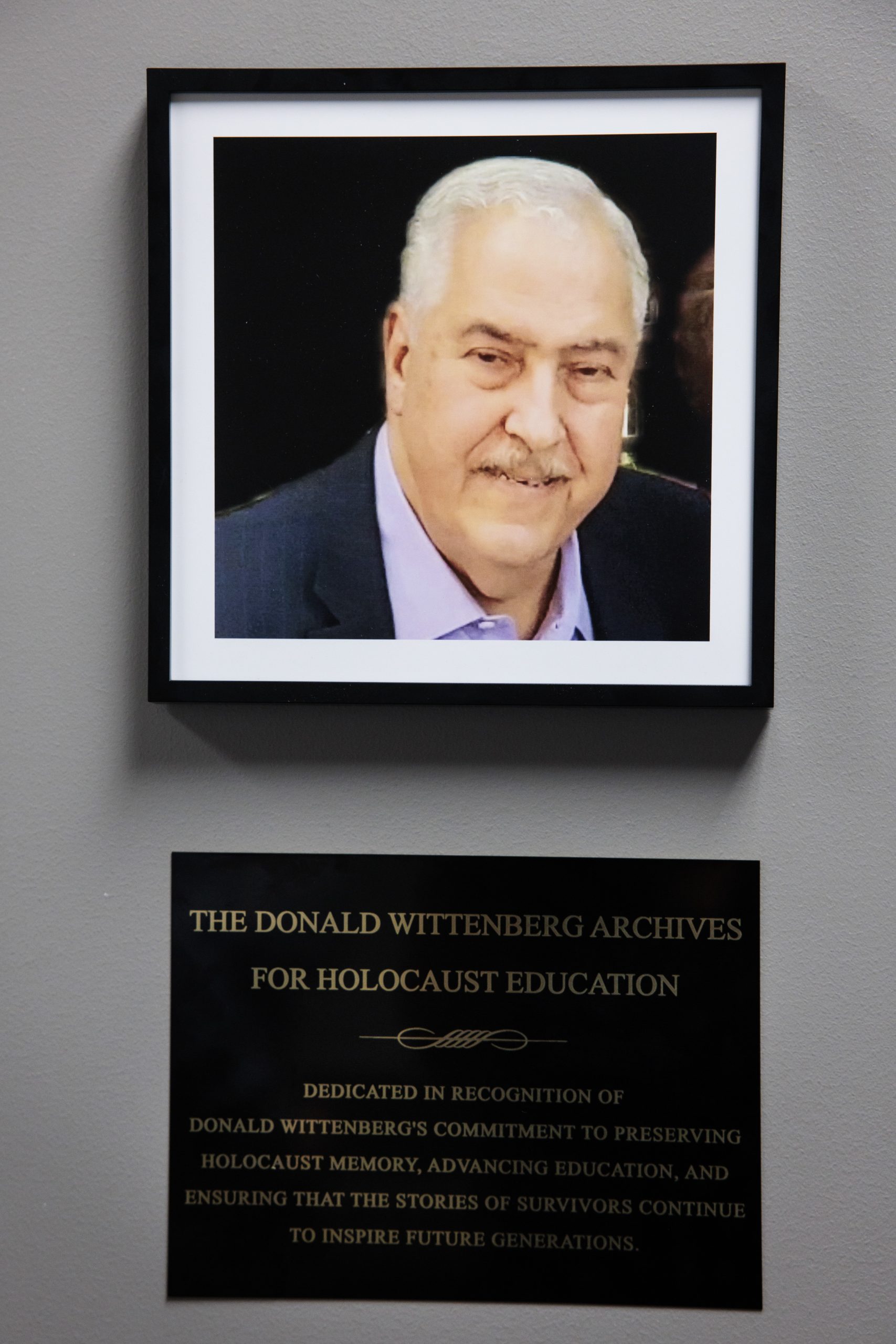
    Now, the archives of the Holocaust Awareness Museum and Education Center (HAMEC) in Elkins Park are dedicated to Wittenberg, who died in March at age 79.

    “In these more than difficult times, Don’s efforts will go on, and we will always appreciate those efforts,” HAMEC board president Chuck Feldman said to family and friends gathered at the museum Sunday.

    Attendees listen to the dedication ceremony at the Holocaust Awareness Museum and Education Center on Sunday, Aug. 2, 2026, in Elkins Park. The Archives for Holocaust Education were dedicated in honor of longtime curator Donald Wittenberg.Monica Herndon / Staff Photographer

    Feldman estimated that with Wittenberg’s guidance, the museum and its educational programs have reached 400,000 young people in Pennsylvania and beyond.

    Feldman said he had known Wittenberg since 1970, when they were young members of the Northeast Independent Democrats, helping to elect Milton Shapp for Pennsylvania governor.

    Back then, the museum was in the basement of Yaakov Riz, who survived five years in a Soviet labor camp only to learn that 83 of his family members died in the Holocaust, Feldman said.

    Though Riz was the museum’s founder, Wittenberg — a public school teacher and administrator — helped build it into what it is today, Feldman said.

    “Don found artifacts through the local community, whose owners were looking for a respectful and impactful resting place,” Feldman said.

    Wittenberg’s wife, Bonnie, said his motivation was partly personal. On his father’s side, most of Wittenberg’s family died in the Holocaust. Wittenberg wanted to know who they were, and who may have survived.

    Visitors browse the exhibits during the archives dedication ceremony at the Holocaust Awareness Museum and Education Center.Monica Herndon / Staff Photographer

    “He was like a detective. He was trying to solve mysteries,” Bonnie Wittenberg said.

    One example: Her husband became obsessed with finding where a distant relative had been buried. She wasn’t sure if he ever found out, but unanswered questions like this one often drove his research.

    This curiosity marked his conversations with the many Jewish families who over the years came to him with their own family stories. “He wanted to tell the story right,” she said.

    Joseph Wittenberg’s Army jacket worn during the liberation of the Buchenwald Concentration Camp, on display during the dedication ceremony at the Holocaust Awareness Museum and Education Center on Sunday, Aug. 2, 2026, in Elkins Park. The Archives for Holocaust Education were dedicated in honor of his son, longtime curator Donald Wittenberg.Monica Herndon / Staff Photographer

    Wittenberg’s search for his ancestors continued a journey begun by his own Hungarian-born father, Joseph Wittenberg, said Donald’s son Steven Wittenberg.

    Joseph Wittenberg served in the U.S. Army during World War II, “and when the war was over, he went back searching for his family, but he couldn’t find them,” Steven Wittenberg said.

    After Joseph died, Donald Wittenberg found personal journals and war trophies that revealed more about his family and his father’s military service, he said. He learned his father had been in Normandy on D-Day plus one and had seen combat.

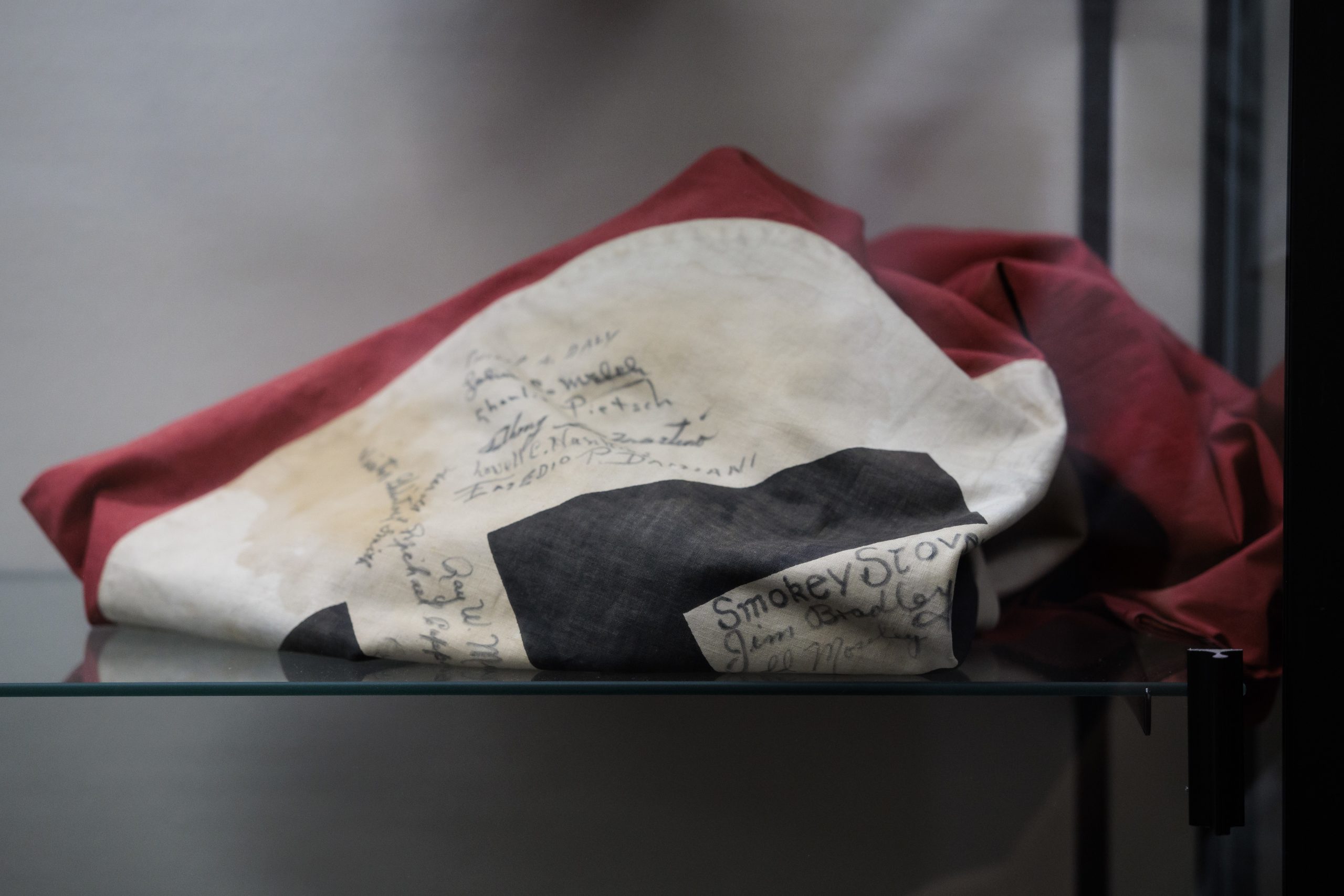
    One item, a Nazi flag taken from Nuremberg’s city hall and signed by Joseph Wittenberg’s comrades in the U.S. Army 102nd Cavalry Regiment, is now on display in the museum. So is Joseph Wittenberg’s Army service coat, which Steven and his brother Jan remembered wearing when they were children.

    A photograph of Donald Wittenberg and a commemorative plaque were placed during a dedication ceremony at the Holocaust Awareness Museum and Education Center on Sunday, Aug. 2, 2026, in Elkins Park. Monica Herndon / Staff Photographer

    These objects, and the stories they tell, offer lessons for people today, Steven Wittenberg said: “The survivors are starting to pass away, and so you need to document that.”

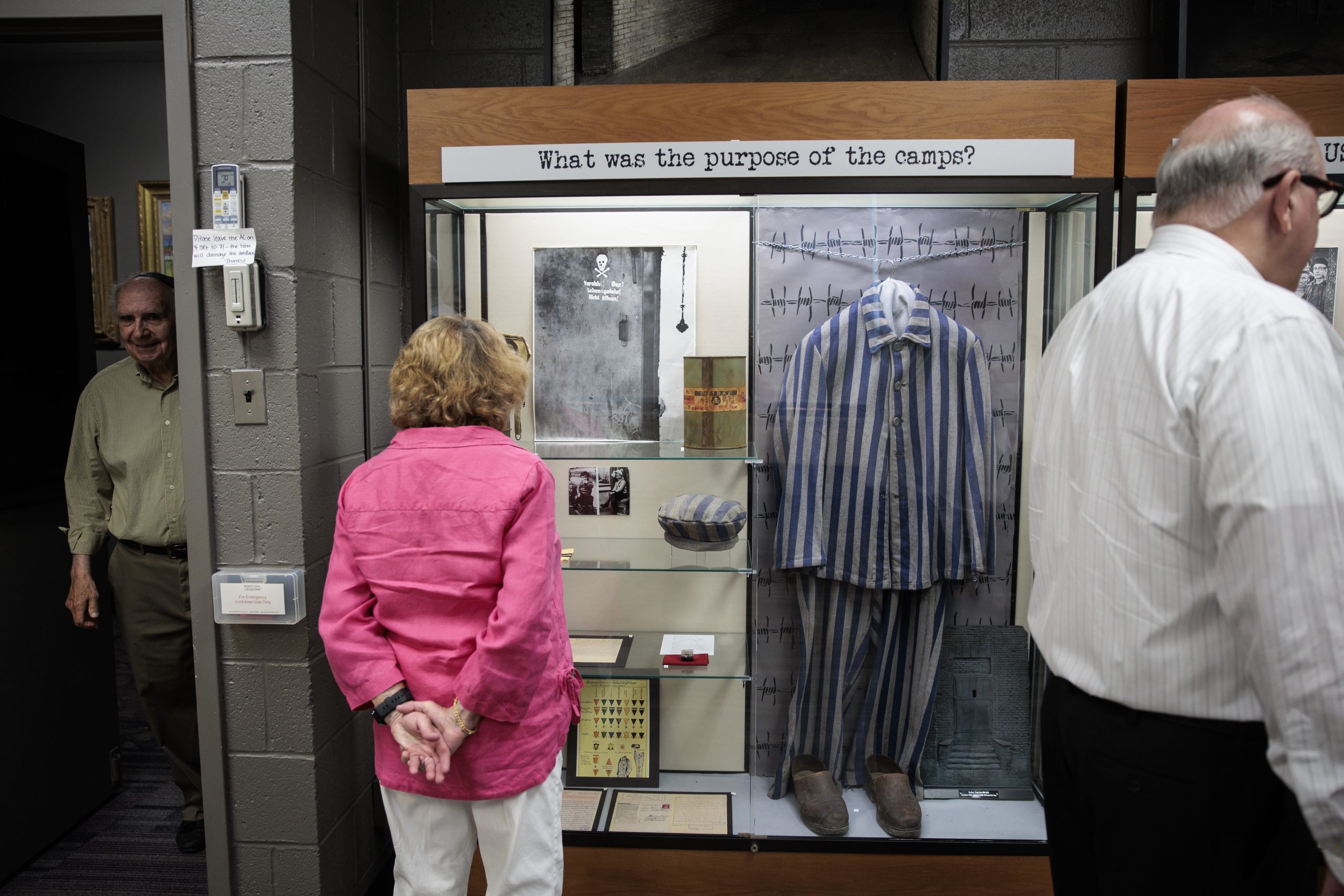
    Donald Wittenberg carefully chose every artifact in the museum, said Jacob Dupre, a Holocaust historian who worked as Wittenberg’s assistant and who will be taking over as curator. Dupre noted that there were no images of death on display — a choice Wittenberg made.

    Wittenberg did include evidence of Nazi atrocities in the display, however. Tom Brennan of Oreland acquired a canister that once held Zyklon B, a gas used to kill people. Brennan noted that the shape of the puncture holes in the canister were the size of a standard-issue German soldier’s knife.

    Other artifacts spoke to the resilience of those imprisoned in the camps, such as a tiny six-sided die made of bread dough.

    A Nazi flag from Nurenberg during the dedication ceremony.Monica Herndon / Staff Photographer

    One poignant item, a handmade birthday card passed between two concentration camp prisoners, was translated from German to read, “Whom the stork brought in May / the sun smiled on him.”

    The poem-like text of the card, written more than 90 years ago, concluded with the lines, “Everything on Earth will change / when we’re all home again.”

    Such messages of hope and endurance, found throughout the museum, still have something to teach people today, said HAMEC CEO Fabulous Flores. The museum tracked the yearslong process from the Nazi’s hate campaign against Jews to the end of World War II.

    “We talk a lot about empathy,” Flores said. “When antisemitism is on the rise, when one group is targeted for hate, everyone is at risk.”

  • Hundreds of thousands line Amsterdam canals for the annual Pride boat parade

    Hundreds of thousands line Amsterdam canals for the annual Pride boat parade

    AMSTERDAM — Hundreds of thousands of people lined Amsterdam’s canals on Saturday to watch the city’s canal boat parade, the highlight of an annual Pride festival that this year comes just a week after a deadly attack on a Pride event in Berlin.

    Openly gay Dutch Prime Minister Rob Jetten, dressed in a white shirt, black life vest, and gold necklace, waved to crowds as he sailed in a small boat through the colorfully decorated parade of 80 vessels, waving to participants and spectators as techno music pumped from speakers along the route.

    The colorful floating parade came a week after the Berlin attack left one person dead and 29 injured. A suspect, Abdul Ballout, was suspected of driving a van into a crowd near the festival Saturday night before apparently stabbing others with a machete in what authorities believe was an Islamic extremist attack. Ballout was shot and killed by police during a confrontation on Sunday in a suburb of the city, authorities said.

    Jetten, the first Dutch prime minister to ever take part in the boat parade, said in a video posted on X that the event was more important than ever because worldwide the freedom and security of the LGBTQ+ community “is under pressure with new discriminatory legislation, lack of safety on the street, or last week’s terrible attack in Berlin.”

    Amsterdam Mayor Femke Halsema said in the aftermath of the German attack that authorities in the city would “where necessary take extra measures that visitors will hopefully notice as little as possible.”

    Motorboats carrying police officers cruised the canals and a helicopter hovered overhead as Saturday’s parade got underway.

    The Berlin attack also cast a shadow Saturday over Hamburg’s Pride parade, one of Germany’s biggest, where increased security was noticeable as dozens of trucks made their way through Germany’s second-biggest city.

    Police and organizers said about 300,000 attended, compared with about 260,000 people last year, German news agency dpa reported. Hamburg’s police chief said earlier this week that roughly twice as many officers as last year would protect the event.

    The boat parade is the traditional highlight of Amsterdam’s Pride. This year it coincides with a World Pride celebration that also is being hosted by the Dutch capital.

    Rod Lugtenburg, 55, from Toronto, said he came to Amsterdam for World Pride. He stood on the city’s famous Skinny Bridge wearing a T-shirt emblazoned with a rainbow maple leaf as the boats passed.

    “For me, it’s about acceptance, being able to be who you are,” he said.

    “I have Dutch heritage and I have always loved the fact that the Dutch have been leading the way” in acceptance and rights for the LGBTQ+ community. “And Canada is right behind them, so I’m very proud.”

    The joyful event happened against a backdrop of rising reports of verbal and physical assaults on members of the LGBTQ+ community in the Netherlands, which has long been considered a haven of tolerance. On Friday, a court in Amsterdam convicted a man of using discriminatory language at a Pride event in the city earlier in the week. He was ordered to do 40 hours of community service.

    Boats taking part in the parade included vessels representing the Dutch government ministries, the military, and police as well as LGBTQ+ organizations and clubs.

    The Netherlands LGBTQ+ rights group COC, which is celebrating its 80th anniversary this year, had a boat in the parade carrying a manifesto calling for progress in the fight for human rights for LGBTQ+ people in the Netherlands. It also carried a portrait of activist Marsha P. Johnson, who took part in the Stonewall rebellion when patrons at the New York inn of that name resisted a police raid on June 28, 1969. The raid helped usher in a new, militant phase of the movement for gay rights.

    Another boat carried two giant inflatable likenesses of U.S. President Donald Trump and his Russian counterpart Vladimir Putin. The two figures, dressed in Delft blue and white costumes and each clutching a tulip, leaned toward one another for a kiss, in the style of pottery figurines that are a staple of tourist souvenir stores throughout the Netherlands.

    The group that created the boat said on its website said they re-imagined the symbol of love and unity “not to provoke, but to pause power for a moment and highlight something human.”

  • Moscow mayor calls deadly bomb attack on restaurant a ‘terrorist act’

    Moscow mayor calls deadly bomb attack on restaurant a ‘terrorist act’

    Moscow mayor Sergei Sobyanin on Sunday called a bomb attack on a restaurant in the capital the day before a “brutal terrorist act,” but did not say who was responsible.

    The blast on Saturday evening at the Balzi Rossi, an upscale Italian establishment in central Moscow, killed three people, including the woman bomber, Russian state media said, citing local officials.

    “Yesterday, a brutal terrorist act was committed in Moscow that claimed human lives. The victims are currently in the city’s hospitals, where they are receiving all necessary care,” Sobyanin wrote on social media Sunday.

    He added that a probe into the attack was underway. “Those responsible for committing this crime will certainly be found and will face the punishment they deserve,” he wrote.

    At least 21 people were wounded when the explosive device detonated at the restaurant on Kudrinskaya Square, the National Anti-Terrorism Committee said late on Saturday, according to Russian state news agency Ria Novosti.

    A woman attempted to smuggle the bomb into the establishment, but a security guard refused to let her in before the bomb exploded, reported Ria Novosti. The Moscow Investigative Committee said on Saturday evening the attack was still being investigated.

    As of early afternoon on Sunday, there was no further information from Russian authorities, and no one had publicly claimed responsibility.

    According to Ria Novosti, the restaurant was closed for a private function on Saturday evening.

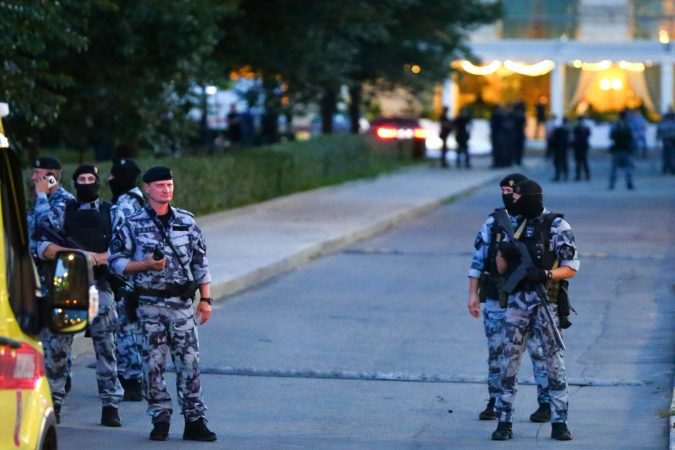
    Footage released by Russian state media showed heavily armed law enforcement officers, several ambulances, and other emergency vehicles at the site.

    Earlier this year, Russia’s Federal Security Service announced that authorities would tighten security around senior military and government officials, after a series of assassination attempts in Russian cities that followed the Kremlin’s full-scale invasion of Ukraine in February 2022.

    So far, Russian authorities have not drawn any connections between Saturday’s blast and these earlier attacks or the war in Ukraine.

    Russia previously said Kyiv was behind a car bombing in Moscow last April that killed Lt. Gen. Yaroslav Moskalik, a deputy head of the main operational department in Russia’s General Staff. Ukraine did not publicly claim responsibility.

    But Ukraine’s SBU security service earlier said it had organized the killing in December 2024 of Lt. Gen. Igor Kirillov, who headed the Russian military’s nuclear, biological, and chemical protection forces.

    Kirillov was killed by a bomb hidden in a scooter outside his apartment building in Moscow, a day after Ukraine’s security service leveled criminal charges against him.

    Among other prominent victims of bombing attacks in Russia were Daria Dugina, the daughter of influential nationalist thinker Aleksandr Dugin, and Vladlen Tatarsky, a well-known pro-Kremlin military blogger.

    Kyiv denied involvement in the attack on Dugina, and did not respond to Russian accusations that it was behind Tatarsky’s death.