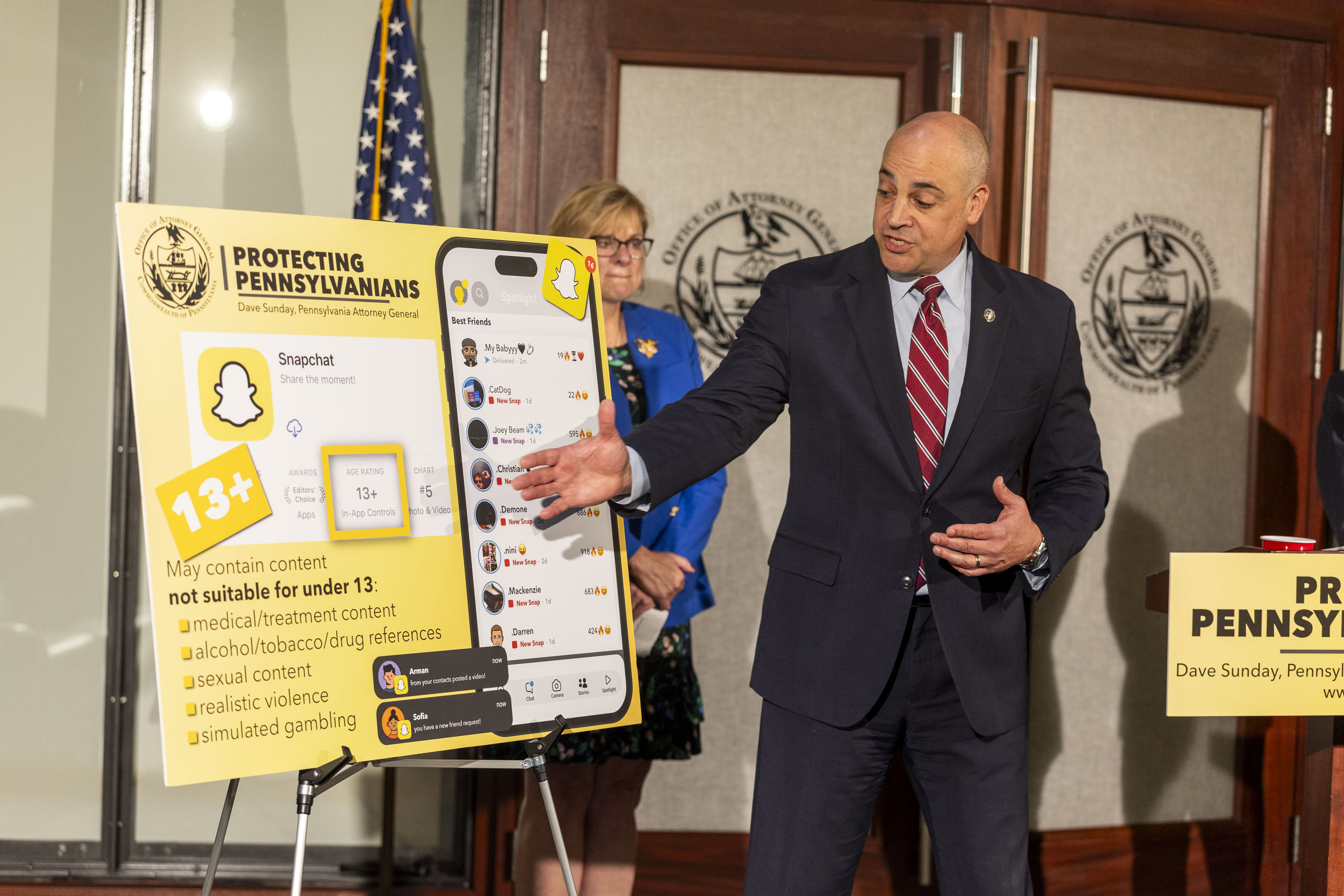
“Both of these actions reflect my priority as attorney general to protect our young people from tech giants who are choosing growth at all costs over the mental wellness of its users,” Sunday saidTuesday at a news conferencein Philadelphia.
The suit alleges that Snap Inc., owner-operator of Snapchat, does not properly warn users of the addictiveness of its features and does not protect children properly from compulsive use.
“The allegations against Snap fundamentally misrepresent our platform and our approach to teen safety,” a Snap spokesperson said in a statement. “We share the Attorney General’s commitment to protecting young people online and are disappointed they have chosen litigation rather than working with us toward that shared goal.”
The complaint, which Sunday’s office filed this week in Common Pleas Court in Philadelphia, asks the company to take steps to protect children from becoming addicted. It cites the SnapStreak feature and the ephemeral nature of the content as examples of ways the app hooks teens specifically.
“To a 13-, 14-, 15-year-old, social acceptance is everything,” Sunday said. “The streak feature puts a tangible value on friendships and influences a child’s feelings of self-worth.”
The app sends an implicit message that the more a child is on the app, the more friends they will have and the more socially accepted they will be, Sunday said.
“That exploits the fear-of-missing-out culture to the absolute extreme,” he said.
It also alleges that Snapchat improperly promotes how frequently adult-themed material — including sexual content and nudity, suicidal ideation, and drug use — appears on the platform to achieve an age-13-plus app rating in app stores.
Through this litigation, Sunday said, he hopes to see Snapchat required to provide a more honest depiction of its content to app stores so it can be marked with a more mature rating, and to change its algorithm to be less addictive.
Montgomery County similarly sued some of the nation’s largest social media companies, including Snapchat’s and TikTok’s parent companies, in a federal court in Northern California earlier this month.
Facing a fresh economic assault from the United States, Iran’s leaders are gambling that they can weather the coming storm and make the cost of their suffering felt in an oil-rich region that is critical to the global economy.
As Iran’s ever more devastating economic crisis deepens, experts warn, Iranian leaders may feel they have little to lose by responding to U.S. pressure with the kind of military escalation President Donald Trump now seems keen to avoid.
“The danger is that ‘economic D-Day’ is being presented almost as a substitute for further war when it may instead become another mechanism for escalating it,” said Sina Toossi, an Iran expert at the Center for International Policy. “The harder Washington pushes third countries to sever Iran’s remaining lifelines, the stronger Tehran’s incentive becomes to demonstrate that participating in Iran’s isolation carries costs of its own.”
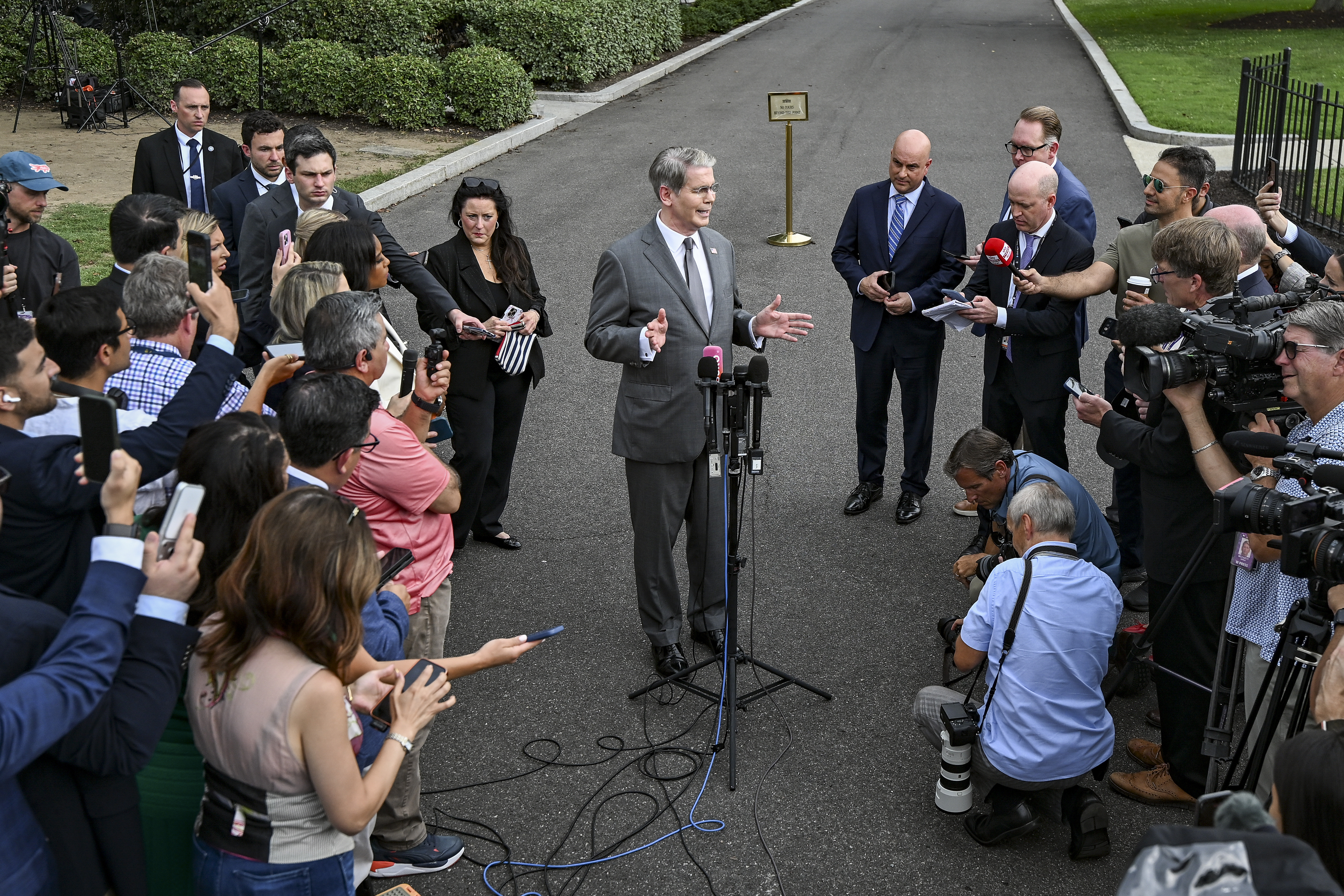
Treasury Secretary Scott Bessent on Monday announced a new package of U.S. measures to disrupt Iran’s economy, although he offered few details. The success of the U.S. efforts will also depend on how much the Trump administration can persuade other countries to go along with its plan — especially critical trade partners for Iran, such as Turkey, Russia, and China.
Still, as the Trump administration reached for military metaphors to convey the severity of its plans — calling them an “economic D-Day”— Iran responded in kind. Iranian officials have labeled the U.S. campaign the next phase of the war that Washington has waged since U.S.-Israeli strikes were launched in February.
Economic warfare is the “main battlefield” in the current confrontation, Iran’s Revolutionary Guard was quoted as saying in a statement Monday cited by Press TV, an Iranian state news outlet.
In statements broadcast after Bessent’s news conference, Iran’s economy minister, Ali Madanizadeh, warned that the country would find ways to push back.
“The enemies intend to launch an economic terrorist attack on us, but we also have our own tools and know how to play the game,” he said, in comments carried by the semiofficial news agency, Tasnim.
A day before Bessent’s announcements, Iran’s top security chief, Mohsen Rezaei, vowed that “not a single drop” of oil would leave the region if its Persian Gulf neighbors joined the U.S. effort, and that they would be considered enemy states.
The severity of the Iranian warnings also highlights just how bad Iran’s current economic crisis is — and it is worsening by the day.
A report Monday by Iran’s most prominent economic newspaper, Donya-e-Eghtesad, said Iran’s rial has depreciated to new lows. It has plummeted 41% since December, when the currency rate sparked protests that morphed into weeks of nationwide unrest. Iranian security forces responded with a deadly crackdown.
Inflation and unemployment have soared, with prices of everyday goods increasingly out of reach for many Iranians. At the same time, the U.S. strikes that damaged Iranian energy infrastructure and the ongoing U.S. naval blockade have intensified an ever-worsening fuel supply crisis — an issue that sparked massive protests in 2019.
But Iranian officials are projecting confidence that their leadership can survive because this new wave of U.S. measures looks similar to old ones. For decades, U.S. leaders have vowed to devastate the Iranian economy through ever harsher sanctions that the Islamic Republic’s leaders have learned to withstand.
Iran’s leadership “has been planning to confront U.S. sanctions for a long time and is fully prepared for new sanctions,” Madanizadeh said late Monday. He said the government had a two-year plan in place for dealing with such sanctions.
Iran’s ability to withstand the Trump administration’s economic pressure campaign will depend on the attitude of Iran’s key trading partners.
Mahdi Ghodsi, an economist at the Vienna Institute for International Economic Studies, said that “faced with sufficiently credible secondary-sanctions risks,” those trading partners may “prefer to protect their much more important financial and commercial interests with the United States and reduce the services they provide to Iranian entities.”
Some analysts also warn that the brunt of further economic pain is likely to be borne by ordinary Iranians, not Iran’s leaders.
Among the sectors Bessent identified as being targeted in the new U.S. campaign were gold, digital assets, technology, aviation, and shipping — sectors that Esfandyar Batmanghelidj, who heads the Bourse & Bazaar Foundation, a London-based think tank focused on Iran’s economy, called “lifelines for the Iranian people.”
“Digital assets and gold are how ordinary Iranians protect their savings from inflation,” he wrote in a social media post. “Technology keeps Iranians connected with the world. Aviation keeps Iranian families connected with loved ones across borders. Shipping is how essential goods, including food and medicine, reach Iran.”
This article originally appeared in the New York Times.
The State Department wants to sell a painting by celebrated artist Kehinde Wiley that the director of its Art in Embassies program called “very woke” and “aesthetically terrifying.” It was removed from the U.S. Embassy in the Dominican Republic last week.
The painting by Wiley, who rose to fame after being selected to create President Barack Obama’s official portrait, features four Dominican models against a floral backdrop. It was commissioned by the federal government in 2013 and paid for with taxpayer dollars.
State Department officials removed the painting from the embassy last week, after first hiding it behind a tarp designed with an image of the American flag.
Erin Scavino, the director of Art in Embassies, criticized Wiley’s painting in a recent podcast interview and pointed out the artist’s connection to Obama. Leah Campos, the U.S. ambassador to the Dominican Republic, celebrated its removal on social media with a video playing the rock anthem “We’re Not Gonna Take It,” writing that the painting was an example of “globalist and woke ideologies.”
Neither elaborated on what she found objectionable.
In a statement on Monday about the removal of the painting, a State Department spokesperson did not directly address the artwork. The statement instead criticized comments Wiley had made in 2023 about his “Judith and Holofernes” painting, which he described as “a play on the ‘kill whitey’ thing.” It also cited accusations of sexual assault that Wiley has denied.
“The work of an individual with such violent and racist words and depictions has no place in the America First State Department,” the spokesperson said.
The statement said the State Department is determining whether it can legally sell the painting of Dominicans, which is titled “Young Artists After Siamesas 1960.”
“If that is feasible,” the spokesperson said, “it would be the goal of Art in Embassies to proudly do so.”
A smaller painting by the artist sold at a Phillips auction in 2024 for nearly $845,000. Wiley and his gallerist, Sean Kelly, did not respond to requests for comment.
Virginia Shore, who commissioned the Wiley painting, established many of the embassy art collections as director of acquisitions and chief curator for the Art in Embassies program between 2000 and 2017. She described the work as nonpartisan and said there was no precedent for selling embassy artworks.
“Calling this woke is difficult for me to understand,” she said. “This is a program validated and financially backed under Bush. There is a science of building trust and empathy across borders.”
Wiley received an award from the State Department in 2015 because of his contributions to cultural diplomacy. He often takes inspiration from historic paintings, asking contemporary Black models to pose inside his version of the compositions. For “Young Artists After Siamesas 1960,” he spent two years studying paintings by Dominican artists Celeste Woss y Gil and Gilberto Hernández Ortega, working with art students in the country to finish the scene.
The artwork’s removal was the latest attempt to politicize the State Department’s art program, which became part of the government during the Kennedy administration in 1963 to foster cultural diplomacy. The program was strengthened in 1999 under the Secure Embassy Construction and Counterterrorism Act, which led to embassies developing their own permanent art collections.
This year, Scavino claimed to have gotten an ambassador in Bucharest, Romania, fired over “satanic baby art,” though the diplomat’s departure was reported as a planned retirement. She also selected a friend with no curatorial experience to serve as the commissioner of the U.S. Pavilion at the Venice Biennale, bypassing normal procedures. In July, Scavino organized an exhibition in Washington that aimed to “Make Art Great Again” with nearly 70 versions of the American flag on display.
In a statement about the removed Wiley painting, Campos, the U.S. ambassador, said, “It is my intention that everything we project from U.S. Embassy Santo Domingo, including the art and décor, reflect the beauty, strength, and commitment to liberty of the United States of America and its people.”
Online, she had a stronger perspective: “Under the Trump administration and my leadership, we are leaving behind globalist, ‘woke’ ideologies to embrace, instead, American patriotism and the beauty of our great country.”
She ended the sentence with an emoji of the American flag.
An event ordinance passed earlier this month by Lower Oxford Township unfairly targets Lincoln University and is unconstitutional and racially discriminatory, the historically Black school said in a federal lawsuit filed Tuesday.
“The ordinance’s disparate negative impact on the Lincoln University community is the result of deliberate racial gerrymandering — or other illicit gerrymandering — by the Defendants,” the school’s lawyers argued in the complaint, filed in the U.S. District Court for the Eastern District.
The suit notes that the township’s three supervisors are white and that the population of the township nestled in farm fields with about 5,000 residents is “overwhelmingly white” except for Lincoln’s community.
The ordinance seeks to regulate events with more than 500 people, requires a permitting process, allows the township to revoke permits without a hearing for a violation, and threatens to prohibit an entity from applying for another permit for two years if a violation occurs. In the permit request, applicants will be asked to address security, parking and traffic impact, number of attendees, planned activities, and other elements. Violations will result in fines of up to $1,000, the ordinance states.
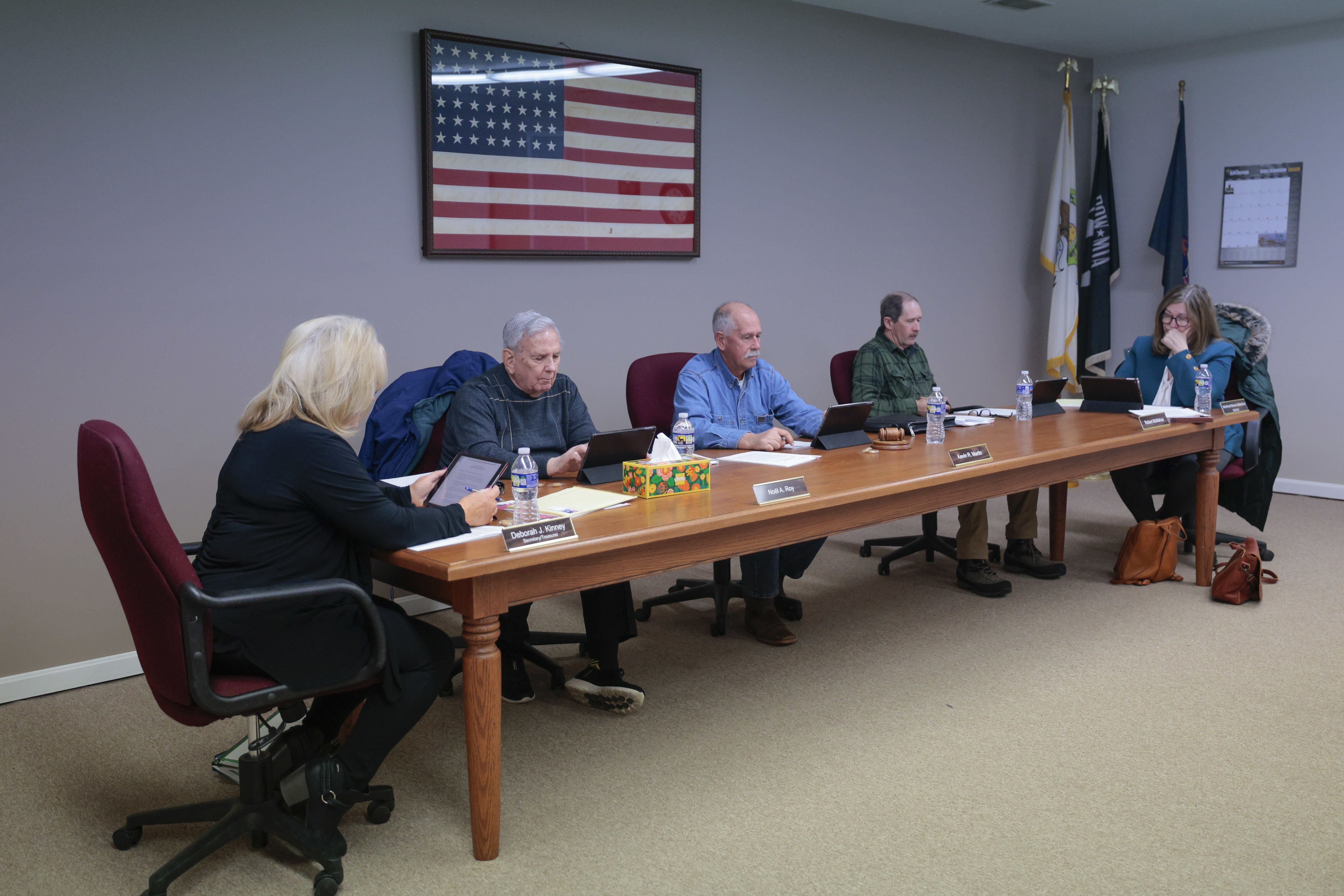
Lower Oxford Township supervisors meet and discuss a potential event ordinance to address problems with large events held on Lincoln University’s campus, Monday, Dec. 8, 2025.Steven M. Falk / For The Inquirer
The rural Chester County township began looking at enacting the ordinance following the shooting last October of seven people, one of whom died, on Lincoln’s campus during homecoming festivities. Township officials also had cited ongoing concerns about traffic, trash on neighbors’ lawns, and other disturbances, including crimes, during large events on the 422-acre campus, where 1,650 students are enrolled. The township previously had passed a parking ordinance in response to access issues created during large events at Lincoln.
Deborah Kinney, township secretary/treasurer and codes enforcement officer, said Tuesday she had not been aware of the lawsuit until The Inquirer called. She declined immediate comment.
Lincoln president Brenda A. Allen said the university is seeking to stop the township from depriving members of its community of their First Amendment rights to free speech, freedom of assembly, and freedom of religion. The ordinance, she said, is attempting to restrict the university from events that are essential to its academic mission.
“Lower Oxford Township’s ordinance is a targeted, unconstitutional overreach that threatens the hallowed traditions ingrained in the university’s foundation,” Allen said in a statement Tuesday. “Lincoln University will remain on the front lines of protecting, defending, and advancing our community as we take this matter seriously.”
In its ordinance, the township states that “activities associated with special events can constitute a hazard to the public’s health, safety and welfare and that these activities can also create a public nuisance when unregulated.”
Venus Boston, Lincoln general counsel, speaks to the Lower Oxford Township supervisors in December 2025 as they discuss a potential event ordinance to address issues with large events held on Lincoln University’s campus, Monday, Dec. 8, 2025.Steven M. Falk / For The Inquirer
The township’s supervisors, the ordinance states, have “determined that the impact of special events that involve large numbers of attendees on roads and other infrastructure within the Township represents both a traffic hazard and an impediment to the delivery of emergency services to residents of the Township and therefore constitutes a nuisance.”
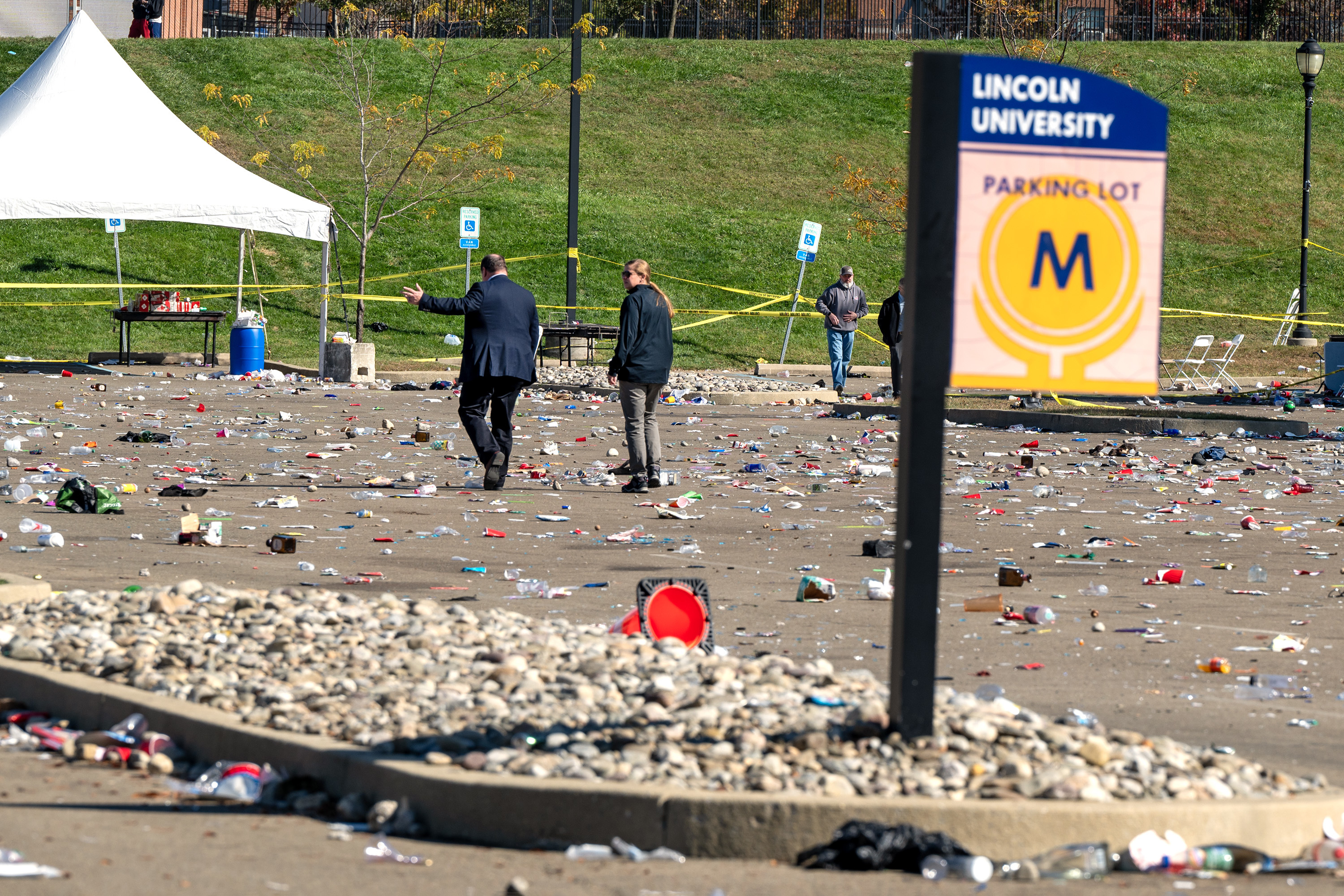
The shootings that spurred the township to begin considering an ordinance occurred Oct. 25, when thousands gathered on campus for Lincoln’s homecoming. Emergency personnel had to use all-terrain vehicles to transport patients on stretchers because ambulances could not access the campus, given how many cars were parked around the venue, township officials said at the time.
Investigators are on the scene outside Lincoln University’s International Cultural Center Sunday, Oct. 26, 2025, where one person was killed and several others were shot the night before during homecoming weekend celebrations.Tom Gralish / Staff Photographer
While the ordinance applies to other township events, the school’s lawyers argue that it targets Lincoln and specifically names examples of special events subject to regulation as “College homecoming or other similar events, college, university or school commencement, graduation or baccalaureate.”
“It was enacted by the township with the deliberate purpose and with the calculated effect of targeting Lincoln,” the school’s lawyers argued. “Specifically, the ordinance was enacted to interfere with Lincoln’s academic mission and with the speech and other academic activities of the Individual Plaintiffs and their academic colleagues.”
The ordinance targets events with over 500 people “with the knowledge that the Lincoln University community is at all times several times in excess of that threshold” and “with the knowledge that very few — if any — of the events outside of Lincoln would exceed that threshold,” the lawyers said.
The ordinance, the school’s lawyers argued, violates Lincoln’s constitutional rights by imposing restrictions on its speech and “its ability to serve as a marketplace of ideas.” The ordinance also violates the First Amendment right to assembly because it treats events of more than 500 people as a nuisance, the lawyers said. And the lawyers said it infringes on religious freedom by naming baccalaureates, which they said “in general — and baccalaureates at Lincoln in particular — are religious services.”
They objected, too, that the township has sole discretion over whether an event is subject to the ordinance and over whether it should be permitted, and that no objective standards exist. And they disputed the township’s intention to require event holders to have liability insurance subject to approval by the township solicitor.
“The ordinance also makes the sponsor of a special event liable for actions of people over whom it has no control,” the school’s lawyers argued.
The ordinance states that the sponsor “shall be responsible to the township for damages sustained to township property caused by participants in the special event.”
Founded in 1854, Lincoln is known as the first degree-granting historically Black university in the nation. The first presidents of both Nigeria and Ghana are Lincoln graduates, as are Philadelphia Mayor Cherelle L. Parker, former U.S. Supreme Court Justice Thurgood Marshall, and poet Langston Hughes.
The school hasreceived $45 million in gifts fromphilanthropist MacKenzie Scott, the ex-wife of Jeff Bezos. Allen, Lincoln’s president, who in 2020 had survived an internal battle to oust her and had her contract extended to 2030, was named a top leader of a historically Black college by a national nonprofitin 2021.
Township officials had been expressing concerns about events at Lincoln for a while before the homecoming shootings brought renewed attention.
In spring 2023, two women were shot and injured on Lincoln’s campus during its annual Spring Fling event. In 2022, a student was fatally stabbed by the sister of a student during a fight inside a dorm. During an on-campus dance in 2018, 15 students were taken to the hospital following a brawl in which a security officer was assaulted. In 2016, there was a robbery and shooting on Lincoln’s campus following homecoming. And in 2015, Lincoln tightened security after shots were fired in a dorm.
At the homecoming last October, Ju’Juan Jeffers, 20, of Wilmington, was killed, and six others, ages 20 to 25, including a student, were also shot. Jeffers’ mother subsequently filed a lawsuit against the school, and three Wilmington men — William Sells, 20; Makaveli Valera, 19; and Karon Rollins, 17 — were charged with second-degree murder, conspiracy, and related crimes in connection with the shootings.
“We have had meetings with people at Lincoln,” Township Supervisor Noel Roy said last December. “They’ve been somewhat reluctant to do what needs to be done to try and control the situation.”
Allen at that time acknowledged that changes were needed around large events as well as better collaboration with the township.
“We want to come together because we are a part of this community as well,” Venus Boston, Lincoln’s general counsel, said during a supervisors meeting last December.
Before its Spring Fling in April, the university announced new safety plans for large events, including no outdoor events after dusk, screening guests, and allowing only one registered guest per student.
PORT-AU-PRINCE, Haiti — At least 47 people were killed and more than 50 others kidnapped when armed men attacked a once-peaceful community near Haiti’s capital earlier this week, the United Nations said Tuesday.
It is believed to be one of the largest mass kidnappings in Haiti in recent years, and one gang leader is threatening to kill the hostages if authorities kill any gang members as they try to secure the community nestled in the hills above Port-au-Prince.
“This is a major political and security test, for the government, for the police, and for the international mission alike,” said Romain Le Cour, head of the Haiti Observatory at the Global Initiative Against Transnational Organized Crime.
He said the threat of executing hostages is a trap: If forces don’t act, they’ve failed to protect them; if they do and hostages die, the gangs will blame the state.
Kenscoff resident Marc Paul, 42, said gangs kidnapped his brother, stepmother, stepfather, and two cousins. He said his 16-year-old niece also was kidnapped and raped but was able to escape and has reunited with him.
“I had to run over bodies,” he said as he recalled how he ran during the attack. “I can’t sleep knowing all these people died.”
Paul and his family had already lost their home to a previous gang attack in January 2025, but he said it was not as violent as Sunday’s attack.
“It’s horrible,” he said, adding that he was upset about the video the gangs posted. “My brother is probably going to die.”
A threat posted on social media
In a video posted on social media, the gang leader threatened Vladimir Paraison, director of Haiti’s National Police.
“Paraison, if any of our soldiers are hurt, I will kill all of them,” he said, referring to the hostages.
The gang member identified himself as Izo 2, a reference to Izo, or Johnson André, one of Haiti’s most powerful gang leaders.
Le Cour said Izo 2 is also known as “Didi” and leads the armed group in Kenscoff on behalf of and in coordination with Izo and other gang leaders.
He said the aim of Sunday’s attack could be to force Haiti’s police and the U.N.-backed gang suppression force to disperse even more of their limited resources.
“They don’t have enough personnel,” Le Cour said in a phone interview. “If you force them to deploy more troops, it would inevitably be at the expense of other areas.”
The attack might also just be a show of force and a message to Haiti’s government and police as the country prepares to hold general elections on Dec. 13 for the first time in more than a decade.
“This is a message to the government and the police that their claims of protection do not match reality,” Le Cour said. “The gangs are saying: When we choose to attack, we can, and we will succeed.”
Attacks on Kenscoff have escalated
The first major attack on Kenscoff occurred in January 2025, and since then, there have been sporadic attacks in the mountains surrounding the city center.
But Sunday’s attack was the largest yet. At least five of the 47 people killed were children, according to the United Nations Integrated Office in Haiti, known as BINUH.
U.N. Secretary-General António Guterres condemned the attack on Tuesday, noting that 22 of the victims were reportedly executed in a church compound where they had sought shelter: “The relentless gang attacks on communities and the loss of lives underscore the alarming security conditions in Haiti,” he said.
Kenscoff Mayor Jean Massillon told the Associated Press on Tuesday that gangs set fire to 25 homes and killed two government employees including his cousin, who served as his security detail.
“The atrocity of this crime reminds us that we have to continue working stronger every day to bring peace to the community,” Massillon said. “I’m optimistic that the state will continue working to eradicate the gangs in Kenscoff.”
Gangs are coveting Kenscoff because it allows them to surround and control the upscale community of Pétion-Ville and alternate routes connecting Haiti’s capital to its southern region, said María Fernanda Arocha, a researcher with the nonprofit Armed Conflict Location & Event Data.
Between January and August this year, security operations had managed to reduce violence in Kenscoff by 66% prior to the attack, she said in a statement.
“While security forces have concentrated their efforts on operations aimed at regaining control in the central areas of Port-au-Prince, criminal groups have instead sought to expand into rural communities that are vulnerable due to the limited response capacity of the police, but which remain strategic hubs,” she added.
Haitians demand police protection
Some survivors accused the government of not providing enough protection prior to the attack, with Haiti’s National Police rejecting those accusations.
Le Cour said that if police and armored vehicles were indeed stationed in Kenscoff prior to the attack, then the assertion is concerning: “You let the gangs come in even if you had everything in place?”
Armed men control an estimated 70% of Port-au-Prince and swaths of land in Haiti’s central region and beyond.
Gang violence has displaced a record 1.5 million people across Haiti, where more than 3,050 people were reported killed from January to June and another 1,400 injured, according to U.N. statistics released Tuesday.
The U.N. noted that nearly 800 rapes were reported from April to June, with 87% of those cases representing collective rapes.
At least 81 people also were reported kidnapped during that time period, according to a new U.N. report.
“These figures represent only a portion of the total number of people kidnapped,” it stated. “In many cases, victims’ relatives do not report kidnappings to the police or service providers and choose to negotiate directly with the kidnappers, believing that this approach allows for a quicker release and avoids possible reprisals.”
The number of kidnappings reported from April to June represents a more than 40% increase compared with the previous quarter.
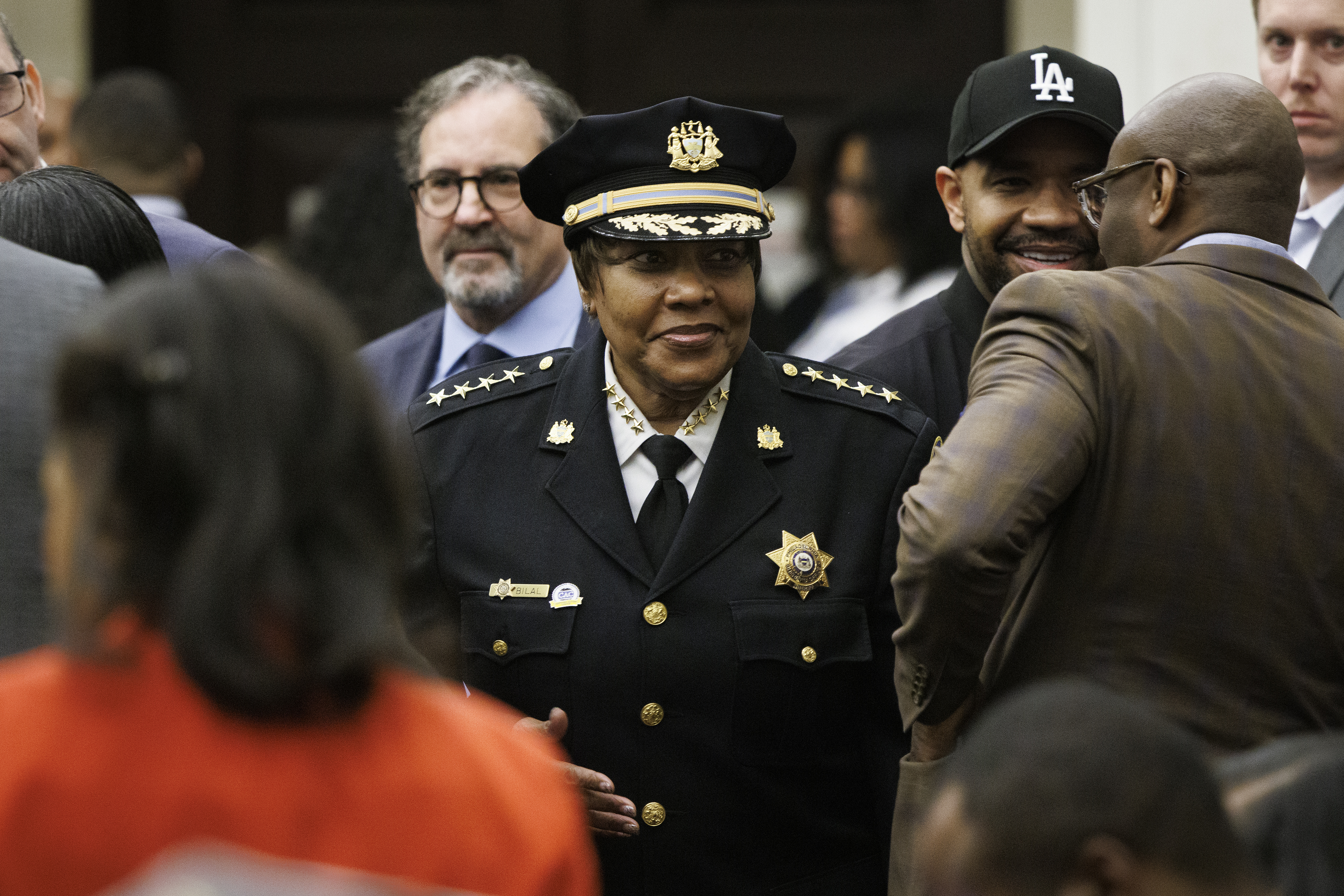
Philadelphia Sheriff Rochelle Bilal made an unsuccessful, last-ditch attempt to avoid facing a city judge about major problems in her office, arguing through an attorney that she has “limited personal knowledge” of the real estate transactions she oversees.
Jonathan Rardin, a lawyer the city retained to represent Bilal, wrote in a motion filed Friday afternoon that the embattled sheriff should not have to testify before Common Pleas Court Judge Paula Patrick at Wednesday’s hearing on sheriff sales because it would involve “matters outside her unique personal knowledge.”
On Tuesday morning, Patrick rejected Bilal’s request for a protective order to shield her from testifying, writing that “Bilal and any other relevant parties shall appear” on Wednesday morning and “be expected to testify if necessary.”
Patrick, supervisor of the court’s commerce division, scheduled the hearing in May, as winning bidders at sheriff sales continued to flood the courts with petitions seeking their deeds. As The Inquirer first reported in July 2024, Bilal’s office had not been issuing the deeds for a year or more after the auctions, leaving neglected homes unable to be renovated, rented, or resold.
An attorney who represents real estate investors recently filed a lawsuit arguing that Bilal had breached the terms of a 2003 consent order requiring the office to issue deeds within 40 days of settlement. Patrick responded by ordering Bilal’s office to demonstrate at a public hearing that it was not in violation of the decree.
Wednesday’s hearing will help decide whether Patrick will appoint a “special master,” a title agent, or some other third-party expert in real estate to administer sheriff sales in Philadelphia — arguably the most important function of Bilal’s office.
Bilal’s lawyer had already successfully pushed back the hearing, which originally had been set for July 27, by arguing the sheriff had an unavoidable scheduling conflict due to “a previously scheduled vacation.” That request to delay the hearing did not mention that Bilal hoped to completely avoid testifying, and at the time, Rardin wrote that her “presence in this matter is necessary.”
Yet last week’s motion argued instead that the sheriff’s knowledge is “limited to the information provided to her by her staff” and that she should not have to personally testify at all.
“Requiring Sheriff Bilal to appear and testify regarding events and administrative practices that are not within her unique personal knowledge would impose an unreasonable burden and oppression” under the state’s rules of civil procedure “and would divert a high public official from the discharge of her official duties …,” Rardin wrote.
Daniel Bernheim, the lawyer for a property group whose March lawsuit triggered Patrick’s court order, said Monday evening that Bilal’s attempt to avoid testimony was a “disappointing response by an elected official.” On Tuesday, Bernheim — himself an elected commissioner in Lower Merion Township — filed a response to her motion that sought to force Bilal to testify in court.
“[T]he sheriff seeks to avoid answering questions based upon a series of cases which have no relevance whatsoever with the present proceedings and a claim of immunity from testifying which does not exist,” Bernheim wrote.
In April, Bilal claimed at a City Council budget hearing that most post-auction delays had been resolved. She blamed any ongoing delays in issuing deeds on buyers who did not submit required forms or fees.
But after Patrick filed her court order in May, Bilal’s office within 48 hours processed 277 deeds, some attached to auctions that had taken place more than a year ago. The office filed more paperwork in two days than it had in the prior three months.
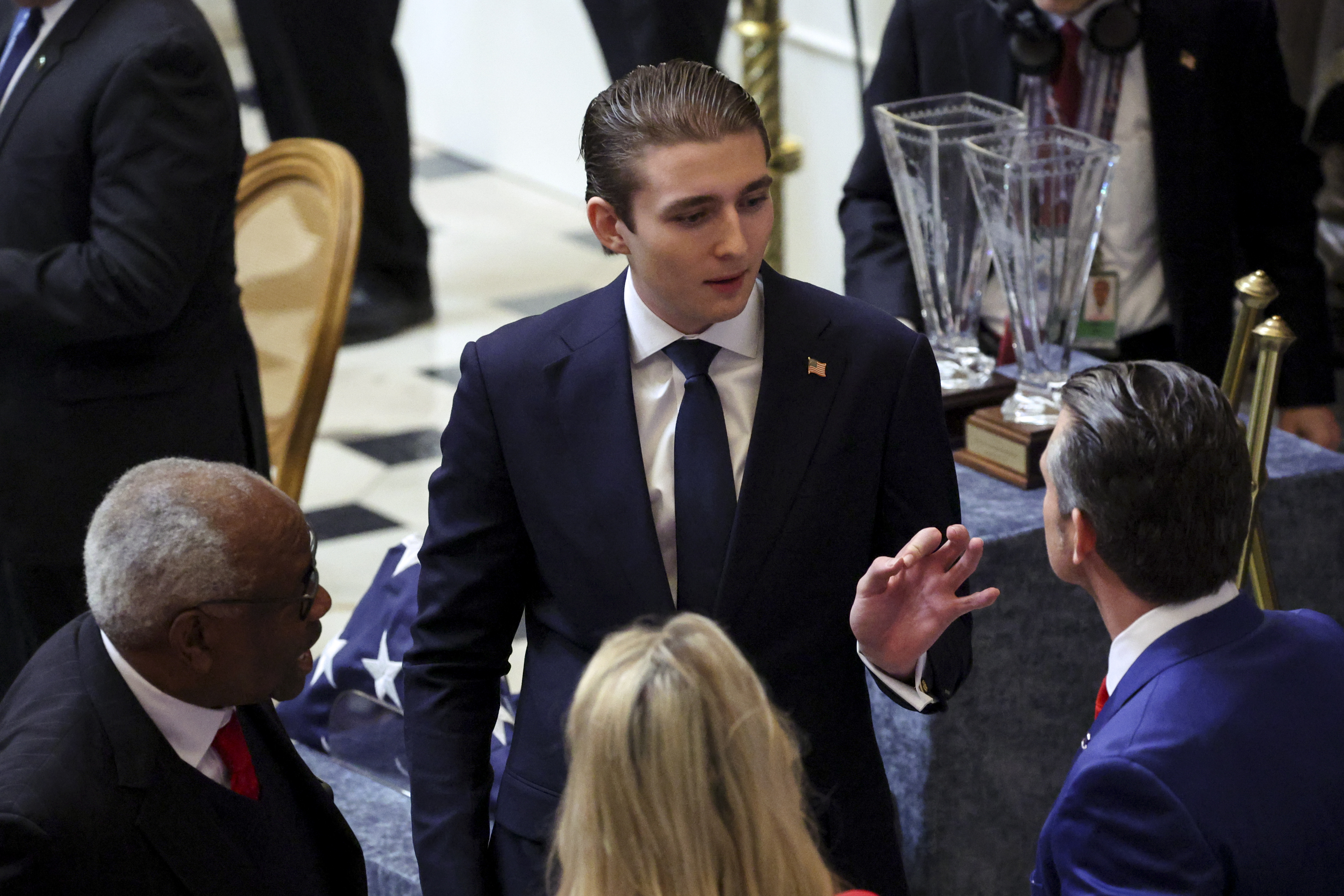
The Secret Service has said it is aware of a video broadcast by Iranian state media appearing to threaten Barron Trump, President Donald Trump’s son.
The footage, which was reportedly released by media linked to Iran’s Islamic Revolutionary Guard Corps, claimed a $10 million bounty had been placed on him.
The video opens with the title: “Where to kill Barron Trump?” It depicts a man resembling him and suggests general locations where he might be found.
“The U.S. Secret Service is aware of the video and investigates anything that can be perceived as a threat toward our protectees,” Nate Herring, a Secret Service spokesperson, said in an emailed statement. “Out of concern for operational security, we do not discuss matters of protective intelligence.”
The White House did not immediately respond to a request for comment Tuesday morning.
Trump, who was 10 years old when his father was first elected president and is now 20, has kept a much lower profile than others in his family.
He has occasionally appeared at high-profile events with his father, such as at his Inauguration Day ceremony in January 2025.
Concerns about Iranian plots against U.S. officials, including the president, have existed for decades. Those fears have escalated in recent years because of the U.S. role in the killing of Iranian military and political leaders, including the U.S. airstrike that killed Gen. Qasem Soleimani in January 2020.
The president has cited Iran’s efforts in 2024 to assassinate him as a factor in ordering the joint U.S.-Israeli operation that killed Ayatollah Ali Khamenei.
In July, an Iranian assassination threat against the president prompted a clandestine operation in which he flew secretly from Turkey on an alternate military aircraft while the White House said he was aboard Air Force One. The operation was first reported by the Washington Post a month later.
The threat was relayed by the Israeli government to the CIA. U.S. intelligence officials were skeptical and conveyed that view to the Trump administration.
One official described it as “Israeli-derived, not U.S.-generated, and viewed as low confidence.”
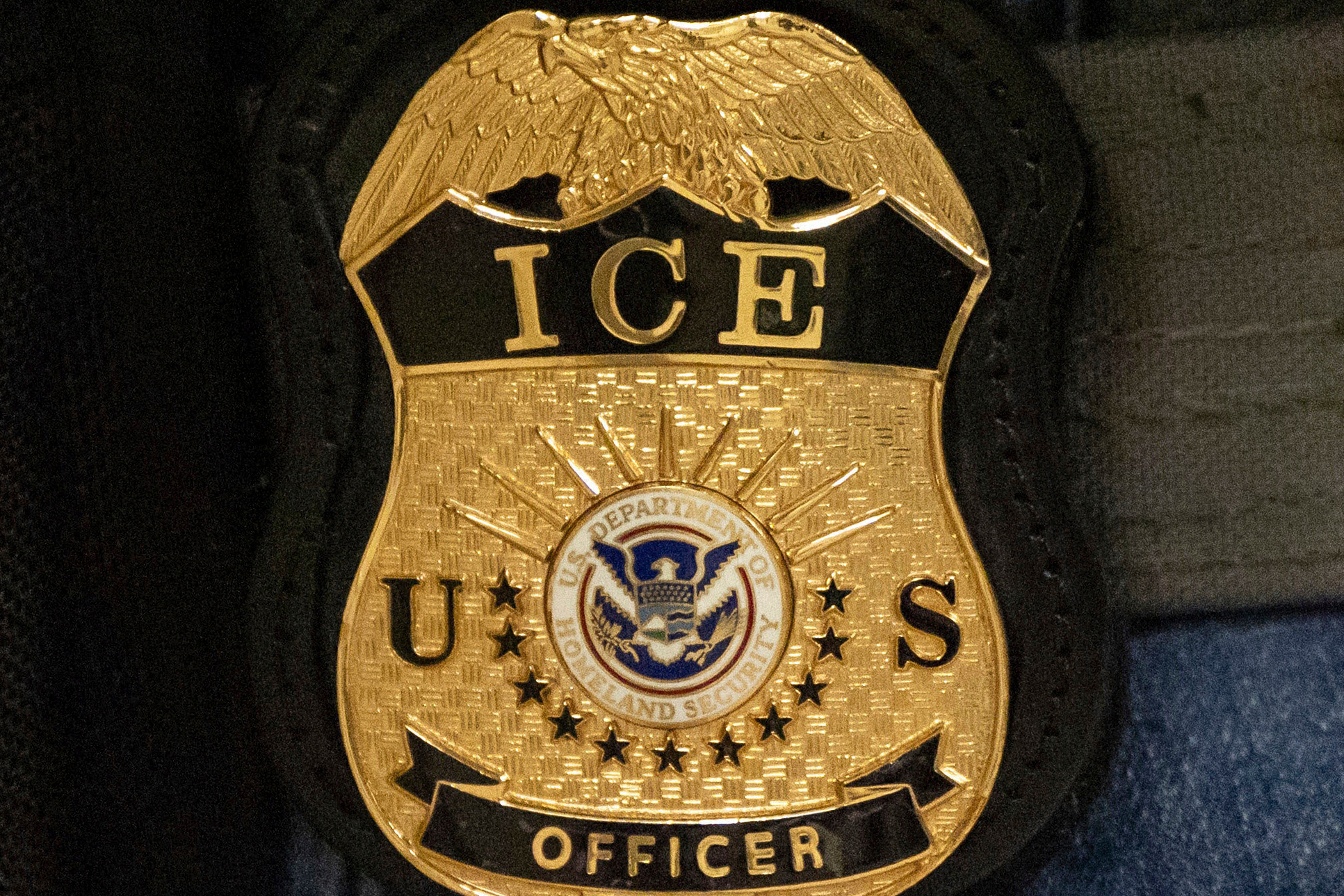
WASHINGTON — U.S. Immigration and Customs Enforcement arrested nearly 50,000 people in July, the highest single monthly arrest total during the second Trump administration, according to new figures.
The spike in immigration arrests shows that the administration has continued to advance its mass deportations agenda despite a shift in approach earlier this year from high-profile operations in large American cities that sparked a public outcry to arrests that have garnered less attention but have nonetheless been disruptive.
The July arrest tally of 49,571 marks a 15% jump from 43,021 arrests a month earlier, and a 70% increase from 29,241 in February, in the aftermath of the Trump administration’s enforcement surge in Minnesota, according to government data that was provided by ICE to the Deportation Data Project based at U.C. Berkeley and UCLA and analyzed by the Associated Press.
As part of the surging arrest numbers over recent weeks and bolstered by a hiring surge, ICE has made arrests at traffic stops. The agency has increasingly relied on state and local law enforcement partners who are assuming immigration enforcement duties. And ICE officers have started to arrest people from Haiti who’ve seen their protections from deportation stripped away.
The new arrest numbers show the administration “didn’t stop the enforcement,” said Mark Krikorian of the Center for Immigration Studies, which advocates for more immigration restrictions.
“They changed the tactics and are, if anything, being more effective.”
State partnerships becoming key to immigration enforcement
Immigration arrests the month before President Donald Trump returned to office hovered at a little over 8,000, a figure largely made up of immigrants transferred from city or state jails and prisons and turned over to ICE to remove from the country. During Trump’s first year back in office, the numbers started climbing as the administration loosened restrictions on where and whom ICE could arrest while it also infused the agency with billions of dollars.
By December, the number of arrests jumped to more than 40,177, according to the data, which was obtained through a Freedom of Information Act lawsuit. Homeland Security largely stopped reporting immigration enforcement data at the beginning of the second Trump administration, making the data from the Deportation Data Project one of the few insights into how the agency is operating.
In the aftermath of two fatal shootings in Minnesota in January that sparked protests and an uproar from Democratic lawmakers, arrests began to fall in February. After remaining stagnant for months, the numbers surged in June and then again in July.
The number of arrests made by state and local police departments who partner with ICE has dramatically increased over the last year. Those partnerships, which ICE has grown with the help of generous financial incentives for participating agencies, accounted for 6,500 arrests in July, or about 13% of the total, the data showed. A year earlier, they accounted for less than 5% of ICE’s monthly arrests.
Texas and Florida accounted for nearly 20,000 of the July arrests, in a sign of how important those states have become to the Trump administration’s mass deportation agenda. Both states have leaned heavily into those cooperation deals with ICE, known as 287g agreements, which allow local and state law enforcement to essentially operate as arms of federal immigration enforcement.
That close cooperation is increasingly resulting in arrests like one last week in Florida’s Key West. The manager at the Half Shell Raw Bar said Tuesday that one of his staff members, a 36-year-old asylum seeker who fled Haiti in 2017 after receiving death threats, was arrested by local police and turned over to ICE.
The manager, Bobby Kuchinsky, said the man had worked as a cook and supervisor at the restaurant and was the main provider of his family. Kuchinsky declined to identify the man out of concern for his safety while in custody.
“He was an excellent worker, he learned very fast, he never had any problem with the law,” Kuchinsky said in an interview with the AP, noting that it will be a challenge to replace him. “He was a nice kid, he was a family man.”
DHS secretary pledged quieter approach but mass deportations still a priority
In his confirmation hearing earlier this year, Homeland Security Secretary Markwayne Mullin pledged to keep ICE out of the headlines, suggesting that the administration’s immigration crackdown might take a softer approach. But his tenure has been marred by a number of fatal shootings of immigrants in encounters with ICE officers. And the figures show Mullin hasn’t shifted the agency from Trump’s vision for mass deportations.
Under Mullin’s predecessor, Kristi Noem, immigration enforcement was often characterized by high-profile operations that targeted specific Democratic cities such as Chicago, Los Angeles, and Minneapolis. Operations, often led by former Border Patrol agent Greg Bovino, were blasted out on social media videos showing officers bursting out of moving vans to chase people or rappelling from helicopters onto apartment rooftops.
But Krikorian said those tactics were “provoking a lot of ordinary people, turning them off even if they liked the idea of the immigration law being enforced.”
New data shows most immigrants arrested didn’t have criminal history
The administration has often said its immigration enforcement operations target people who have committed crimes in the U.S. as a way to make the country safer.
But the data shows that more than half of those arrested in July had not been convicted of any crimes and were not facing any criminal charges. Less than a quarter of those arrested had been convicted of a crime.
And half of the arrests were noncustodial, which means ICE agents arrested people in the community rather than someone already behind bars or held by local police.
Patricia Quiñonez, a journalist at Utahzolanos, which covers the Venezuelan immigrant community in Utah, said immigration arrests during traffic stops have increased sharply in recent months.
“They stop you for whatever reason — for example, you don’t have a driver’s license, your vehicle tags are expired, your windows are more tinted than what is allowed. From there, they take advantage of the situation and ask about immigration.”
People with valid work permits and pending asylum claims are among those arrested, said Quiñonez, who believes they are being targeted by race.
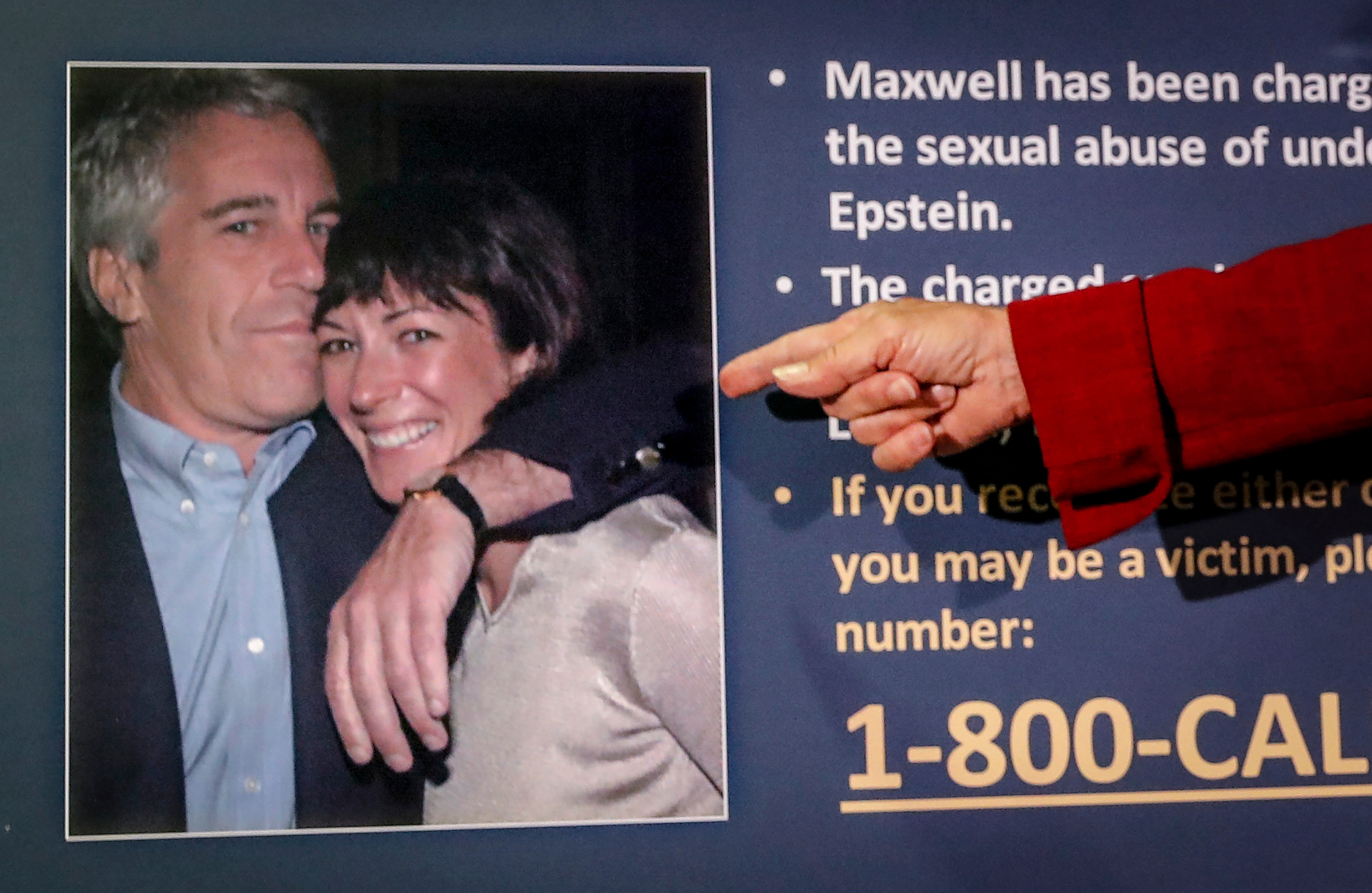
NEW YORK — Ghislaine Maxwell’s bid to overturn her sex trafficking conviction and be freed from prison was rejected by a federal judge Tuesday who said the claims by Jeffrey Epstein’s former girlfriend and longtime associate that new evidence had emerged were “demonstrably meritless.”
Maxwell filed a habeas petition last December seeking to set aside her conviction and free her from a 20-year prison sentence, claiming exonerating information was withheld and false testimony presented at her trial, resulting in a “complete miscarriage of justice.”
Judge Paul A. Engelmayer rejected her arguments, saying in his written ruling they “all or almost all are frivolous” and that she had presented nothing that could upend the outcome of her trial.
“Nearly all its claims are procedurally barred; the overwhelming testimonial and documentary evidence adduced at trial conclusively established her guilt; and her petition’s claims are demonstrably meritless, and generally based on speculation, distortions, and/or outright falsehoods,” Engelmayer wrote.
A request for comment was sent to lawyers who represented Maxwell in the past.
Habeas petitions are often filed as a last resort and to protect against unlawful confinement after appeals are exhausted, as happened after Maxwell’s conviction and sentencing.
Epstein, a millionaire financier, was arrested in July 2019 on sex trafficking charges. Ordered detained until trial, he was found dead in his cell at a New York federal jail in August 2019 and his death was ruled a suicide.
Maxwell, a British socialite, was arrested a year later and was convicted of sex trafficking in December 2021. She was moved from a Florida prison to a prison camp in Texas last year, shortly after she was interviewed by the Justice Department’s then second-in-command, Todd Blanche, President Donald Trump’s former criminal defense attorney and now U.S. attorney general.
As a result of that law, the Justice Department over the last eight months has released 18 categories of investigative materials gathered in the massive sex trafficking probe, including search warrants, financial records, notes from interviews with victims, and data from electronic devices.
Engelmayer said that material is “largely irrelevant to the charges against Maxwell and does not support her claims of error.”
“On the contrary, to the extent it is relevant, far from exculpating her, it incriminates her or reinforces the correctness of the legal rulings Maxwell challenges,” he wrote.
The judge also rejected Maxwell’s claim that she was selectively prosecuted and made a “scapegoat” when the Justice Department did not indict four co-conspirators named in a government document or 25 men who settled with victims.
Engelmayer said she could have raised that claim on appeal after her trial, but he found it to be frivolous nonetheless.
Among the recently released Justice Department documents, “she does not cite any that reveals the existence of an uncharged confederate, let alone one as instrumental as she in facilitating Epstein’s horrific crimes,” the judge said.
The company recently announced plans to open stores in King of Prussia and Moorestown in late 2027.
The King of Prussia market, the chain’s first Pennsylvania location, is set to open at 320 W. DeKalb Pike, the site of the closed Hobby Lobby in the DeKalb Plaza shopping center.
The Moorestown store, the first in South Jersey, will be located at 1311 Nixon Dr., replacing the Barnes & Noble and PetSmart in the East Gate Square complex.
Each of the new locations will be about 58,000 square feet.
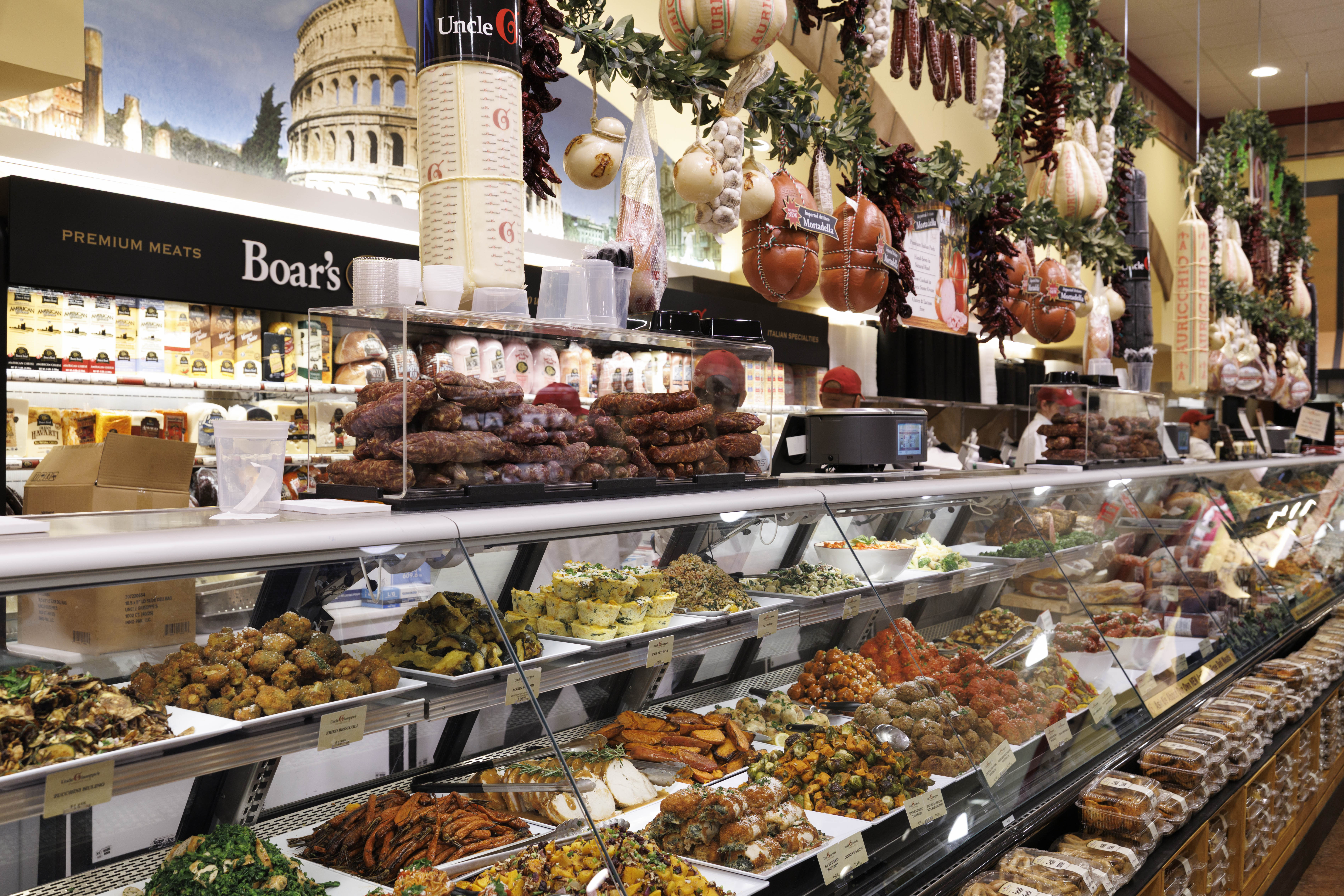
The inside of a recently opened Uncle Giuseppe’s Marketplace in New York.Courtesy Uncle Giuseppe's Marketplace
“King of Prussia and Moorestown are two markets we’ve been looking at for some time,” Carl DelPrete, CEO and cofounder of Uncle Giuseppe’s Marketplace, said in a statement. “We look for communities where we believe our stores will be a good fit and where customers are looking for fresh, quality food and good service.”
Founded on Long Island in 2001, Uncle Giuseppe’s now operates 13 locations in New York and North Jersey.
Every store sells made-in-house mozzarella, homemade pasta, prepared foods, fresh produce, specialty cheeses, imported Italian products, natural and organic items, and more traditional groceries. Each market also has full-service meat and seafood departments, an Italian deli, a scratch bakery, and a catering department.
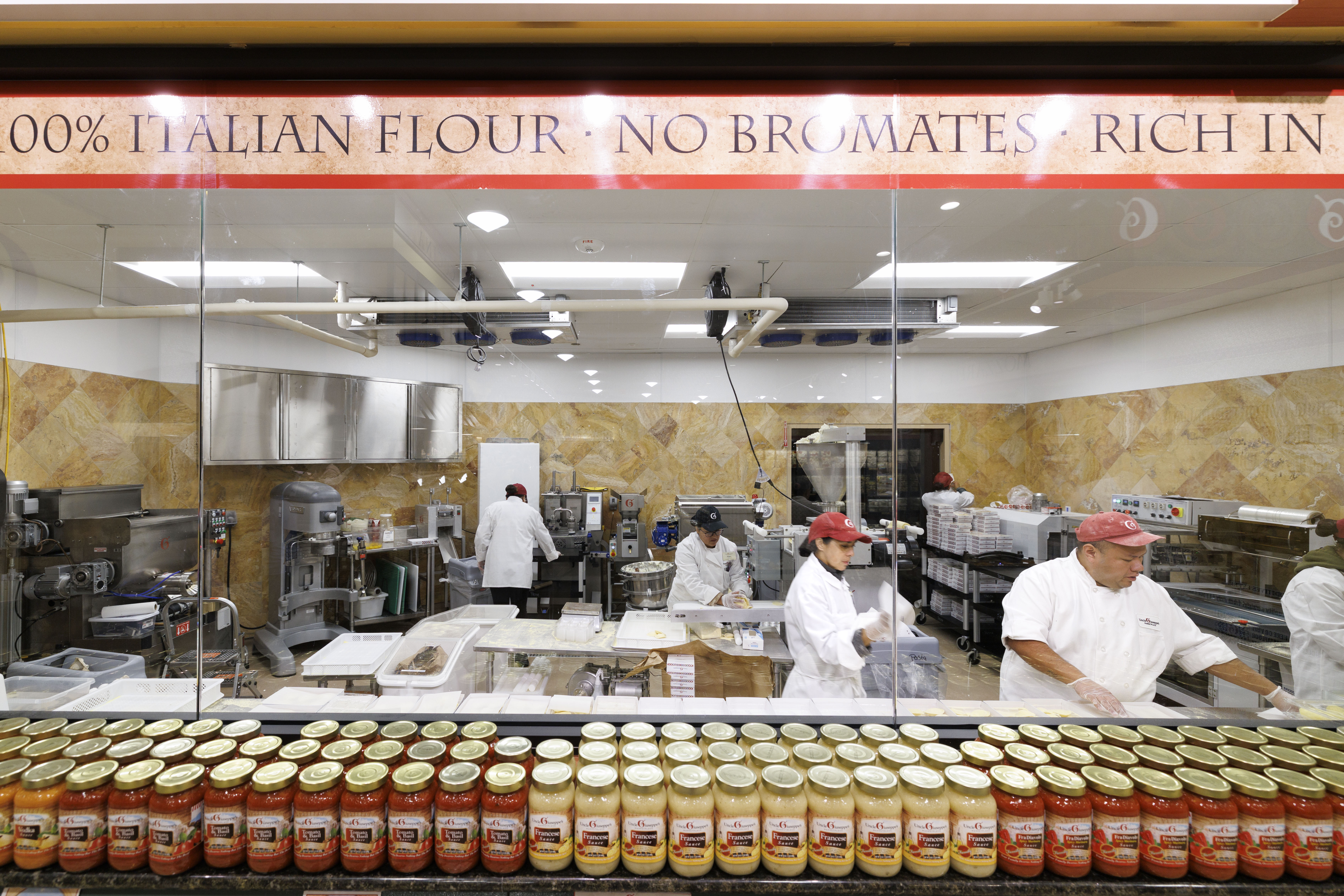
Customers can watch workers make pasta at a recently opened Uncle Giuseppe’s Marketplace in New York.Courtesy Uncle Giuseppe's Marketplace
Company executives call shopping at Uncle Giuseppe’s an experience, one in which customers can watch pasta, mozzarella, and bread being made and see meats being cut to order.
Gourmet grocers have not been spared. Di Bruno Bros., the Philly-based Italian-food retailer, closed three of its five locations this winter, two years after being acquired by Wakefern Food Corp., the North Jersey-based supermarket cooperative that operates ShopRite.
Despite industry uncertainty, Uncle Giuseppe’s is not the only grocer expanding. Sprouts, the organic supermarket chain, is adding stores, too, including in Havertown, Limerick, and Washington Township.