SEOUL, South Korea — North Korea launched a barrage of ballistic missiles toward the sea on Thursday, South Korea’s military said, a day after the North shrugged off a U.S. decision to scale back military drills with South Korea in an apparent bid to resume diplomacy.
The Joint Chiefs of Staff said the launches of about 10 short-range ballistic missiles happened from North Korea’s capital region around 5 p.m. local time on Thursday. The military said the missiles flew about 185 miles each toward North Korea’s eastern waters.
The military said South Korea has bolstered its surveillance posture and was closely coordinating information on the launches with the U.S. and Japan. South Korea’s presidential national security council issued a statement urging North Korea to halt ballistic missile launches.
The Japanese prime minister’s office had earlier said that it detected a suspected missile launch.
President Donald Trump earlier ordered the Pentagon to “substantially reduce” the Ulchi Freedom Shield exercises, just before they began Monday. Trump cited what he said was a good relationship with Kim and South Korea’s refusal to support him over the war in Iran.
On Wednesday, the South Korean and U.S. militaries confirmed they shortened the 11-day drills by shortening their duration by about half and canceling some field training exercises. The reduction of the exercises raised worries about the allies’ joint defense posture.
Kim Yo Jong, the influential sister of North Korean leader Kim Jong Un, dismissed Trump’s overture later Wednesday, saying “the provocative, aggressive nature of the drills won’t change even though their duration and size were reduced.”
“If the U.S. calculates that it can propagate its recent measure as the one of so-called good faith, they will not get the desired answer,” she said in a statement.
She denied Trump’s claim that Kim Jong Un had responded to his request for a conversation.
Kim Yo Jong still refrained from the typical North Korean reaction of fiery rhetoric and said personal relations between her brother and Trump are “still excellent.” That signals North Korea would want to wait for Trump to make bigger concessions before returning to talks.
When asked by reporters Wednesday if he would be meeting with Kim Jong Un this year, Trump said that “Yeah, I will be.” He wouldn’t answer a question about whether he is exchanging letters with Kim but said he gets along with him.
The Ulchi Freedom Shield is one of the main military exercises conducted by the U.S. and South Korea annually to enhance their ability to cope with potential North Korean aggression. Washington and Seoul say their drills are defensive in nature, but North Korea calls them an invasion rehearsal and often reacts with weapons tests.
Before this month’s drills started, North Korea accused the U.S. and South Korea of plotting more provocative exercises this summer and vowed to respond with “a new level of a deterrent.” Days before the drills’ start, North Korea fired two ballistic missiles into the sea in its first such launches since late June.
Trump’s earlier diplomacy with Kim Jong Un collapsed in 2019 due to disputes over how much sanctions relief North Korea should be given in return for dismantling its main nuclear complex, a limited denuclearization step. Kim has since shunned any talks with the U.S., pushed to modernize weapons arsenals and expanded cooperation with Russia.
Kim has said he won’t place his nuclear program back on the negotiating table. Experts say Kim has more leverage than when he first held talks with Trump in 2018 and 2019. They say Kim likely hopes to eventually win international recognition as a nuclear state and extensive sanctions relief in exchange for only limited steps toward denuclearization.
MOGADISHU, Somalia — Six million people in Somalia are facing acute food insecurity while the World Food Program has only a tenth of the resources it had in 2022 when it helped avert famine in the drought- and conflict-stricken East African nation, the head of the U.N. agency told The Associated Press.
“We can only do the bare minimum,” WFP executive director Carl Skau said Wednesday during a visit to a nutrition center on the outskirts of the capital, Mogadishu. “We’re only providing these nutrition supplies to the children that are really the worst hit.”
The reduced funds, because of cuts in international aid by donors and the redirection of resources to other humanitarian crises, meant that the WFP is unable to expand its assistance in Somalia, Skau said.
Millions of people at risk but far less aid
The WFP projects that 1.9 million children under age 5 in the country will suffer acute malnutrition this year, including nearly 500,000 who will require urgent treatment for severe acute malnutrition. Overall, around 30% of the population faces critical levels of food insecurity, the U.N. has said.
“We had 10 times more resources than now,” Skau said of the 2022 hunger emergency that was caused by a prolonged drought. “We were able to step in, and we prevented a famine here in Somalia.”
“We know what’s going on, we have the capacity, we have the experience of dealing with this. We just need the resources now to do it.”
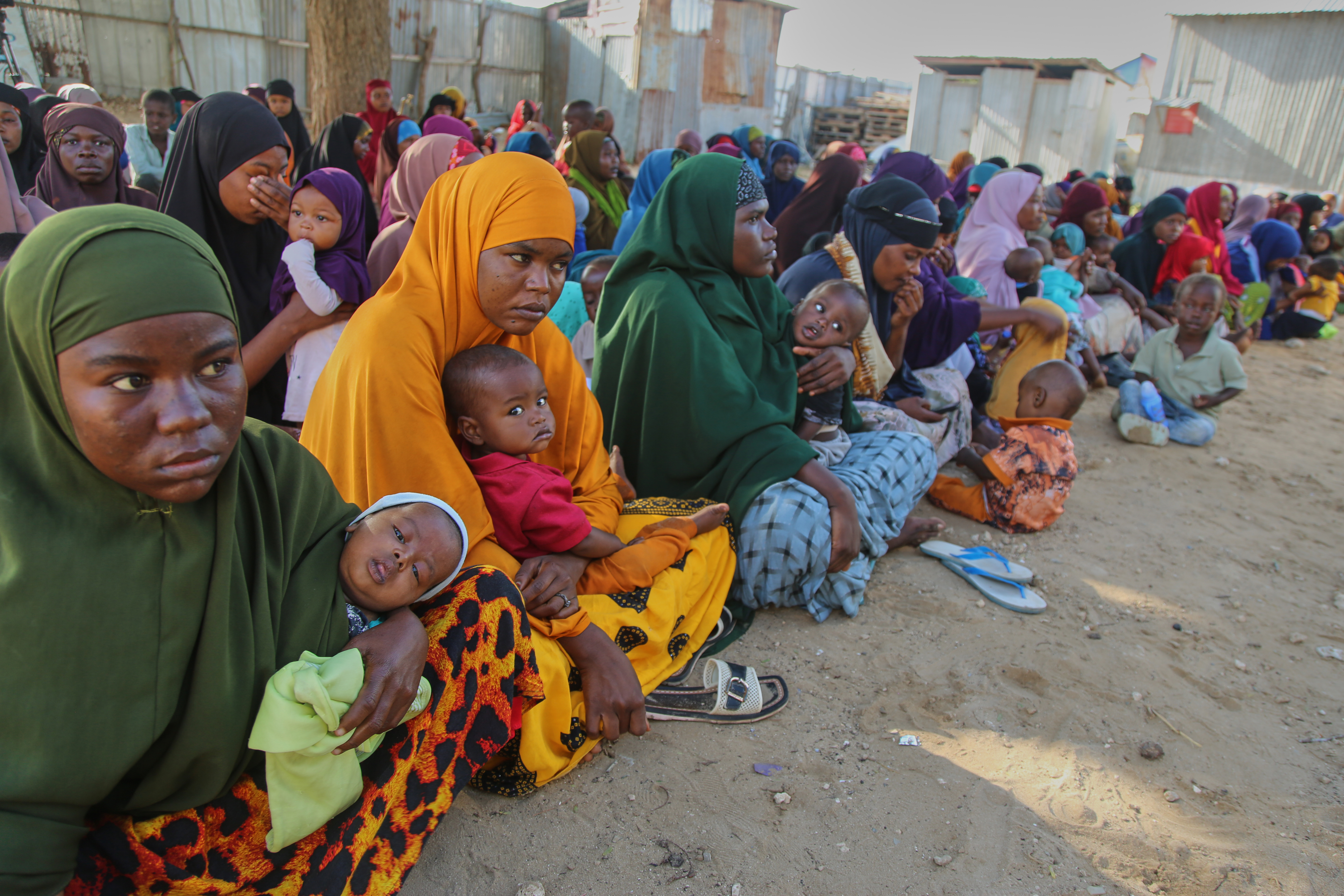
The consequences of the current food shortage, which is also a result of drought, conflict and the displacement of people, are seen at the Feynuus Health Center in Mogadishu’s Kahda district. Dozens of women carrying babies waited beneath a large tree or crowded along the veranda of the corrugated-metal facility seeking help.
Inside, health workers placed children in a blue weighing sling, screened them for malnutrition, and distributed therapeutic food.
One desperate mother tells her story
Halima Mohamed Hassan, a mother of six, had walked nearly 2 miles carrying her malnourished 4-year-old child. She is pregnant, but said she hadn’t eaten for two days. Her last meal was plain rice.
Health workers treated the child she brought with a special nutrient-dense food, while Hassan said that her other children were also malnourished, but she wasn’t able to bring them to the center.
“I could not carry all of them,” she said.
Hassan fled the Lower Shabelle region four months ago after her husband died of malnutrition, she said. Food and water became scarce, and conflict made it increasingly dangerous for the family to stay.
She and her children walked for four nights before reaching a camp for internally displaced people on Mogadishu’s outskirts.
Hassan now shares a makeshift shelter with her widowed mother and her mother’s four other children. The two women look for occasional work washing clothes in nearby neighborhoods to feed their household of 12.
A health center tries its best to help
The Feynuus center receives between 250 and 350 patients daily, mainly displaced women and children from regions outside Mogadishu, said Abdirahman Barkhad, program director of Youth Link Somalia, which operates the center.
Barkhad said that about 10 nearby health and nutrition centers had closed because of a reduction in humanitarian funding, increasing pressure on those that remain.
“We have witnessed children collapsing, because their families do not have enough food,” he said.
Mohamud Moallim Abdulle, commissioner of the Somali Disaster Management Agency, described the country’s food situation as “extremely alarming.”
He said that an estimated 1.85 million children are malnourished, while around 6 million people are affected by drought, and 2 million urgently need assistance.
They don’t know where their next meal is
Skau said that mothers he met this week in the town of Burhakaba described drought, insecurity, and also rising food prices as the main drivers of the crisis. Some had lost their crops and fled their homes. Others walked for three or four hours to reach health facilities, because aid workers couldn’t reach them.
“I spoke to women with eight to 10 children,” Skau said. “They don’t know where the next meal is going to come from.”
Insecurity, with Somalia battling a 20-year-long insurgency by the al-Shabab militant group, also makes humanitarian operations more expensive. WFP must use aircraft in areas where staff and supplies can’t travel safely by road, and some communities are inaccessible, Skau said.
He said that conflict in the Middle East was adding to the pressure by driving up fuel and food prices, limiting agricultural supplies, and drawing funding toward other emergencies.
After her child received some food at the center, Hassan began the walk back to the camp they live in. Her five other children were still waiting and hungry, she said, and she would have to return with them one at a time.
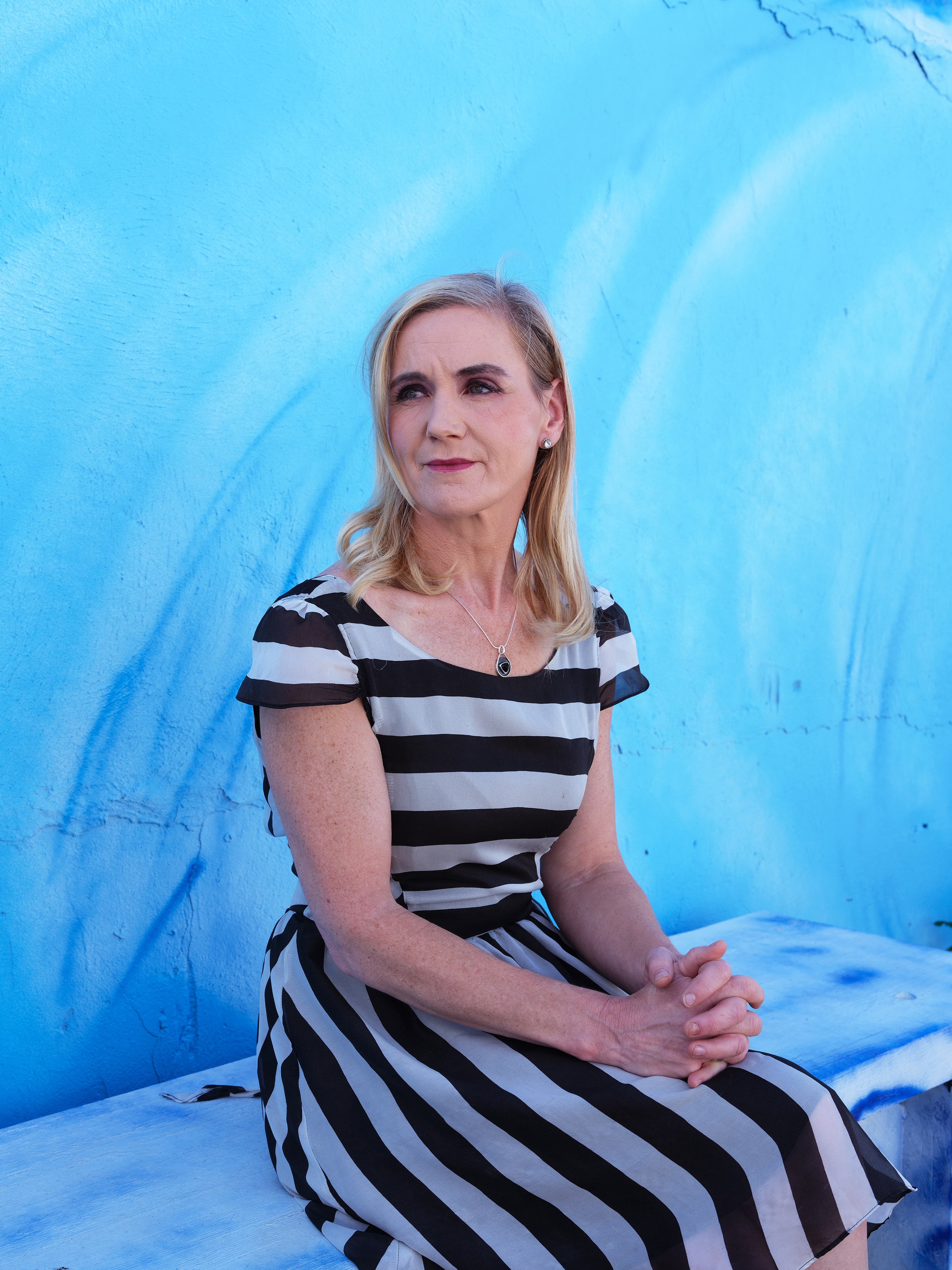
Camila Toro de Paula, a 25-year-old transgender woman from Venezuela, has spent the past 11 months in a federal immigration detention center for men, where she said she has been assaulted, threatened, and deprived of medical care.
Toro de Paula, who entered the United States seeking asylum, has lingered in solitary confinement without ready access to water for up to 24 hours a day, her lawyer said. Medical files from the center in Jena, Louisiana, where she is being detained show that she has complained to social workers about being punished because of her gender expression.
“I’m afraid of dying here,” Toro de Paula said in Spanish during a video interview from the federal facility. Immigration officials said Toro de Paula had entered the country illegally and cited her criminal history in the United States. Records show that the most serious charges against her, of felony assault and possession of a weapon, had been dismissed.
The case of Toro de Paula comes as the federal government has halted specialized care for transgender detainees inside at least 10 detention centers from Calexico, Calif., to Batavia, N.Y., according to public records. Officials no longer consistently provide transgender inmates with hormones and other gender-related care.
An Obama-era policy that provided basic rights for transgender people in immigration detention was deleted from the Department of Homeland Security website in February 2025. And officials have dissolved longstanding protections meant to shield transgender detainees from being harassed or physically harmed.
“We are NOT wasting U.S. taxpayer dollars to provide hormone therapy to illegal aliens seeking to change their sex,” the Department of Homeland Security said in an email to The New York Times, which did not address the other changes in policy.
Homeland Security has in recent months declined to say how many transgender migrants are in custody, but experts on incarceration estimate that there are at least several dozen out of more than 65,000 people in detention as of July 11. On Jan. 12, 2025, the latest date for which the government reported a count, the Immigration and Customs Enforcement agency had 47 transgender people in custody, according to data archived by the Vera Institute of Justice, a think tank focused on criminal justice reform.
Many migrants have complained about mistreatment and shoddy medical care in federal facilities. While transgender detainees represent a small fraction of those being held, they are an especially vulnerable population. Many are fleeing harassment in other countries and had just begun to be given some protections within the U.S. detention system in recent years.
Medical experts say that withholding hormones and other treatment for gender dysphoria can cause unique physical and mental health complications.
A hotline run by Immigration Equality, a nonprofit organization that helps LGBTQ+ and HIV-positive people who are in the immigration system, recorded a 68% increase in calls from LGBTQ+ detainees in 2025 compared with the year before. (The group does not have data specifically for transgender detainees.)
Immigration Equality’s clients include transgender women who said they had been removed from detention center units that had been reserved for them during the Biden administration and placed with men or in solitary confinement. The group said that the federal government had denied requests from transgender women to be transferred to facilities for women or transgender people.
“The administration is creating a humanitarian disaster” by changing policies that were meant to protect transgender people, said Bridget Crawford, the legal director at Immigration Equality.
The Department of Homeland Security rejected claims that conditions inside detention centers were inhumane. The agency did not directly respond to Toro de Paula’s assertions of assault and mistreatment, and identified her with male pronouns. Toro de Paula has received hormones for years, and her lawyer said that she has been denied hormone treatment in ICE detention.
“No detainees are being beaten or abused,” the federal agency said. “No lawbreakers in the history of human civilization have been treated better than illegal aliens in the United States.”
The actions of the Trump administration have been welcomed by opponents of transgender rights, including the Women’s Liberation Front, a women’s rights advocacy group that defines gender based on sex at birth and does not acknowledge transgender women. The group has argued that placing transgender women in prisons for women violates the constitutional rights of female inmates who are not transgender, including the Eighth Amendment right to protection from cruel and unusual punishment.
The Center for American Progress, a left-leaning think tank, issued a report citing ICE data that Democrats in Congress had collected. It found that LGBTQ+ migrants have a disproportionately higher chance of being abused in migrant detention centers. The statistics were collected during the 2017 fiscal year, which spanned Democratic and Republican administrations.
The report said that transgender detainees, on average, spent 99 days in solitary confinement, more than double the average for all immigrants in ICE custody. In the 2017 fiscal year, 1 in 8 transgender detainees was placed in solitary confinement, which officials said is done when detainees are viewed as a threat to other immigrants or personnel, or for protective purposes.
Data from the federal government show that in the 2024 fiscal year, during the Biden administration, 244 detainees who identified as transgender were booked into ICE custody.
In 2023, Immigration Equality interviewed 41 LGBTQ+ and HIV-positive immigrants who had been in detention. About one-third said that they had experienced sexual abuse, physical assaults, or sexual harassment because of their identity while in detention.
Almost all the participants said that they were the targets of homophobic, transphobic, xenophobic, racist, or other verbal and nonverbal abuse. Most said that they had received inadequate medical care for a range of conditions, and about half said that they had been placed in solitary confinement. Of the 41 participants interviewed for the report, 14 were transgender.
Safeguards under President Joe Biden have vanished during President Donald Trump’s second term.
In May, the federal government closed the Office of the Immigration Detention Ombudsman, which was responsible for investigating misconduct and abuse of all kinds in the immigration detention system.
“The violations that we’re seeing now are, to some extent, what we had seen in Trump’s first term — it’s almost like they’re on steroids, though,” said Lynly Egyes, the legal director of the Transgender Law Center, a civil-rights group. “It was often difficult for trans people to access medical care. Now, it is almost impossible.”
Many transgender migrants in detention, like Toro de Paula, came to the United States seeking asylum.
She told the story of a violent childhood in Venezuela. From the age of 8, she said that she was raped repeatedly by relatives. When she was about 10, she said that she tried to hug her mother, who recoiled and splashed her with hot cooking oil. She said that police stabbed her when she was 14 in what she described as a homophobic attack.
In October, a doctor who was retained by her legal team evaluated Toro de Paula and found an irregular hyperpigmented patch inside her left elbow where she said her mother had burned her. She had long scars on her left wrist and hand and on her right leg where she said Venezuelan police had sliced her skin with a knife when they had detained her.
Texas Gov. Greg Abbott (right) and Montana Gov. Greg Gianforte greet members of the National Guard as they arrive with fellow governors for a 2024 news conference along the Rio Grande to discuss Operation Lone Star in Eagle Pass, Texas. Eric Gay
Two years ago, she made the dangerous journey on foot to the United States. In September 2024, she reached Eagle Pass, Texas, where officials gave her food and clothes and put her on a flight to New York City. At the time, Gov. Greg Abbott of Texas had been sending thousands of migrants to Democratic-led cities as part of his multibillion-dollar border security effort, known as Operation Lone Star.
In New York, she joined a community of transgender women and attended parades and parties for LGBTQ+ people.
Her new life unraveled in August 2025 when she was arrested during a routine appointment at the New York City offices of ICE. She was flown to Louisiana and placed in a detention center for men, despite objections from her lawyer, Laura Berger, who works with the Legal Aid Society. The placement, Berger said, would put her client in danger.
The Department of Homeland Security said Toro de Paula had a criminal history that included charges for felony assault and criminal possession of a weapon, both of which were dismissed and sealed. According to her lawyer, those charges related to her arrest in the Bronx on June 30, 2025, after she was accused of hitting a man on the head with a skillet. Her lawyer said Toro de Paula was fending off a robber. The charges related to that incident were dismissed in October, court records show.
In a separate case in Queens, Toro de Paula was charged with prostitution; that was dismissed. She was also charged with pickpocketing in Queens and pleaded guilty to jostling.
“A lot of people don’t understand us,” said Jessica Guaman, a transgender woman who organized gatherings that Toro de Paula had attended in New York. “Camila is a good girl.”
Many transgender people in detention have fled persecution in their home countries, said Crawford of Immigration Equality.
Wilmar Quintero, a 50-year-old transgender woman from Venezuela, came to the United States seeking asylum and was detained in Michigan for about three months. Quintero said that she had fled her native country because police officers tortured her and left her for dead after she spoke out against civil rights abuses. Photographs of her bare chest revealed an expansive stretch of pinched, red scars that mark where officers carved out her breast implants, she said.
Quintero said that she was sexually assaulted by another migrant while being detained in Michigan.
“I lived through the worst horrors and humiliations imaginable,” Quintero said in Spanish. “They treated me like an animal.”
Immigration officials deported Quintero to Venezuela in April, and she went into hiding there. She said she is afraid of the police in Venezuela.
Crawford shared the stories of eight transgender clients who had similarly complained of discrimination, harassment, or abuse inside immigration detention facilities.
Toro de Paula said that detention center officials had pressured her to voluntarily agree to return to Venezuela, but she had refused. She said that they had humiliated her by forcing her to wear a mask and gloves while she is outside her cell because she is HIV-positive, even though the virus does not spread through the air. She has not been allowed to replace her wig, and officials have refused to give her undergarments for women. The Department of Homeland Security said Toro de Paula had worn the mask by choice — a claim that her lawyer disputed.
“I want to be heard,” Toro de Paula said. “Women like me have been disrespected enough. No more.”
CHICAGO — Meta insists it has a long history of protecting its youngest customers as it defends itself against a swath of lawsuits alleging its social media empire harms children.
In the latest such instance, the social media giant is fighting allegations in a California federal court that it contributes to the youth mental health crisis by deliberately and stealthily designing features to get children hooked on its platforms Instagram and Facebook. Four states are seeking billions of dollars in damages as well as fundamental changes to how Meta runs those apps.
Children’s mental health, and what they do and see on social media, are all issues “Meta takes seriously and tries to act on,” Paul Schmidt, a lawyer for the tech giant, said in opening statements this week.
Critics say the company’s safety record falls short and that many of its protections simply don’t work.
They include Marc Berkman, executive director at the Organization for Social Media Safety, who said Meta introduced safeguards promising to protect children in response to public pressure rather than out of concern.
There’s been a “lack of real institutional willingness to act here,” Berkman said.
Here’s a look at some of the changes Meta has introduced, along with the work advocates say could still be done.
Instagram users have always been able to block others — and, along with Meta’s oldest crown jewel, Facebook — the app has gradually added features for reporting problematic accounts and inappropriate content.
In 2016, Instagram users were given the option to delete or filter comments they found offensive, and later added warnings that prompted users to reconsider posting potentially harmful content, as well as options to limit comments and tags on their posts.
Meta also says it prevents adults from starting private chats with teens if they are not already connected, and has increased checks to make sure users under 13 — the minimum age for holding a Facebook or Instagram account — aren’t online. Schmidt said in his opening remarks that Meta recognizes some users still sign up using incorrect birthdays but that the company takes enforcement of age limits seriously.
The company says it also posts warnings and resources at the top of Instagram search results related to suicide, self-harm and eating disorders, and touts its “Teen Accounts,” launched in 2024, as a safe space for teenagers online. It aligns photo and video restrictions for teen accounts with those for a PG-13 movie, unless there’s parental permission otherwise.
Critics complain these changes amount to little more than corporate posturing.
A September 2025 report from former employee and whistleblower Arturo Béjar and four online safety advocacy nonprofits accused Meta of not taking “real steps” to address youth safety, instead opting for “splashy headlines about new tools for parents and Instagram Teen Accounts for underage users.”
“We really found that overall what Meta was marketing under Teen Accounts was very lacking in actual protections,” said Haley Hinkle, policy counsel at Fairplay, which co-authored the report. They evaluated 47 of Meta’s 53 safety features for teens on Instagram and found 60% of them were either not available or didn’t work as advertised, Hinkle said.
Meta called the report’s findings “misleading” and “dangerously speculative.”
Scrolling and core design
Researchers say Meta’s efforts to reduce the risk of children becoming addicted to the scrolling features of social media platforms have been largely unsuccessful.
Ashley Shea, a Ph.D. candidate specializing in social media and online spaces at Cornell University, points to what academics call “attention-capture deceptive designs” that are not exclusive to Meta’s platforms. They include infinite scrolling, “casino style” pulls to refresh content, push notifications and algorithmic recommendations. Those features “prey on the cognitive vulnerabilities” of young people with developing brains, in particular the need to feel rewarded.
Meta has taken important steps to address problematic content, cyberbullies, and sexual predators, Shea said, but she has not seen the same level of effort to offset the addictive impact of attention-capture deceptive designs.
Nudges and time management controls
“There’s no question that some teens struggle to manage their time with social media,” Schmidt said Tuesday, adding that Meta’s time management tools prove its evolution on the issue. Those tools include parental supervision controls and in-app “nudges” for teen users who repeatedly look at the same type of content or spend too long on Instagram or Facebook late at night.
Hinkle notes the “entirely voluntary” time management tools are not easy to set up, and amount to “far too little, too late.”
Béjar, the former Meta employee and whistleblower, agrees. In testimony Wednesday, he said a tool called “Take a Break” is “designed to fail.” Users have to turn the feature on themselves and, he said, very few do.
Across the board, tech companies exist to maximize revenue, said Berkman, and for almost every social media platform today, that means “maximizing children using their features for as long as they can.”
Legal challenges focused on “the fact that these are defective products by design because of their features, not the content per se” is something new, Shea added. And beyond the courtroom, mounting pressure on lawmakers could bring more industrywide changes.
“The momentum only continues to grow,” she said. “Ultimately, these are for-profit companies that respond to economic pressures. And so I think that the more economic pressure they’re confronted with through these litigations, the quicker they will have to adapt.”
PLYMOUTH, Mass. — Hundreds of Lindsay Clancy supporters, many wearing pink with the words “Believe,” “She Needed Help” and “Peace For Lindsay,” gathered Thursday outside the courthouse where she is on trial in the killings of her three children.
Several of the 300 women, and a few men, said Clancy’s story resonated with them and that they wanted to raise awareness about how the mental health system treats women. Clancy’s lawyer does not dispute that she killed the children, but says she should not be held criminally responsible because she was mentally ill.
The livestreamed trial has sparked massive discussions online and has brought attention to postpartum psychosis, a rare mental illness Clancy’s attorney Kevin Reddington says she had that is linked to the stress, sleep deprivation and hormonal changes that follow childbirth. Reddington said she also has bipolar disorder. After strangling her children, Clancy jumped from a second-story window and remains paralyzed from the waist down.
Reddington says Clancy repeatedly sought help: She turned to multiple outpatient providers, tried various drugs they prescribed, called a suicide hotline, went to an emergency room, and even checked herself into a psychiatric hospital.
Prosecutors say the former labor and delivery nurse planned the Jan. 24, 2023, killings and contrived to get her husband out of the house by sending him to pick up medicine for one of their children and dinner for the family. They have also questioned the seriousness of her suicide attempt, and witnesses have testified that Clancy wouldn’t always take prescribed medications.
Thursday’s rally was the first time during the nearly monthlong trial that supporters have come out in such large numbers.
“Women are being dismissed, neglected and ignored when we speak up,” said April Vincent, a 52-year-old paralegal from Providence, Rhode Island. “We’re scared because nobody takes us seriously.”
The women stood silently for more than an hour ahead of Thursday’s proceedings, where a chaplain called by the defense testified about visiting Clancy in the hospital after the killings.
At the sight of Reddington outside the courthouse, the crowd broke into applause.
Rally organizer Renee Kimball implored the crowd to trust that Reddington “has Lindsay’s fight.”
Toward the end of their rally, supporters formed a circle, said the Lord’s Prayer, held up their arms and formed hearts with their hands. Some held flags from different countries to show that the support for Clancy was global.
Clancy, 36, has pleaded not guilty to murder charges in the deaths of Callan, Dawson and Cora Clancy, who ranged from 8 months to 5 years old. Researchers estimate that postpartum psychosis — which is more serious and less common than postpartum depression — afflicts 1 to 2 per 1,000 women after delivery.
Jeanne Zaborski, a 72-year-old retired nurse from Rockland, Massachusetts, said she hopes the case raises awareness about postpartum health. She and many others at the rally said they had been following the trial almost daily.
“It’s very sad,” Zaborski said. “I am a mother. I am a grandmother. I have a sister who had problems after birth and it’s just very sad. I hope Lindsay gets the care she needs and deserves and other women will come together like we did today.”
In court, Sheila Cavanaugh, a chaplain at Brigham and Women’s Hospital in Boston, testified that when she first visited and prayed for Clancy, she was unconscious. By Jan. 31, 2023, Clancy was conscious and no longer connected to a ventilator, Cavanaugh said, but “her emotional state was very neutral – a flat affect.”
Cavanaugh said she “vividly remembers” one of the first things Clancy said to her.
“She said to me, as I held her hand to comfort her, ‘I’m so glad my children are safe,’” Cavanaugh said. “I replied theologically to Lindsay. I said, ‘Lindsay, your children are safe. They’re safe in heaven with God.’”
“We prayed for them,” said Cavanaugh, who saw Clancy more than 200 times and still visits her at the state mental hospital where she resides.
Cavanaugh said Clancy “alluded to hearing a voice, and the voice, according to Lindsay, told her that if she did not follow the command, neither she nor her children would be safe.”
U.S. Central Command, which oversees military operations in the Middle East, said on social media that the carrier arrived in the region Wednesday. It was not clear when the USS Abraham Lincoln would arrive back in the U.S. or whether it would make a port stop along the way, but the journey takes just over a month.
The Washington arrived as concerns have grown about the Lincoln’s lengthy deployment, which has included a record-setting uninterrupted time at sea of more than 250 days, and about reports of crew stress and poor mental health, as well as supply shortages, including food and hygiene products.
Several Democratic lawmakers have pressed the Department of Defense for accountability over conditions aboard the Lincoln, which Defense Secretary Pete Hegseth has said were “completely misrepresented.”
Hegseth spoke with the Lincoln’s crew last week, and Adm. Brad Cooper, head of U.S. Central Command, visited this past weekend. In an editorial published Sunday by The Wall Street Journal, Cooper said the crew “delivered a performance for the ages, and now you are going home.”
Extended deployments of carriers wear on service members who are away from home for long periods and increase strain on the ship and its equipment. While renewed hostilities between the U.S. and Iran calmed in recent weeks, the Navy is enforcing a reimposed blockade on Iranian ports in the Strait of Hormuz, and the Trump administration has offered no clarity on how it intends to wind down the war.
Hegseth has said the U.S. can maintain the blockade “indefinitely.”
President Donald Trump this week downplayed reports about conditions on the Lincoln, which left its homeport in San Diego in November and arrived in the Middle East in January. Trump called the nearly nine months at sea that the sailors endured a “good period of time” but added that “over the years, we’ve had them out there much longer.”
Trump told reporters Monday that he spoke with a retired admiral over the weekend who recounted being on ships for “much longer.” Trump said the admiral assured him that the Lincoln is “beautifully maintained and beautifully taken care of.” Trump did not name the admiral.
In a statement Sunday after visiting the Lincoln, Cooper praised the carrier’s leaders for prioritizing mental health and resilience.
“History will record this deployment as one of the most operationally intense and consequential of the modern era,” Cooper said.
The Washington joins the USS George H.W. Bush in the Middle East, leaving Asia without an American carrier strike group at a time when China has shown more signs of aggression.
The lack of a U.S. carrier in the Pacific may be short-lived if the Navy deploys another in the next couple of months. But it shows how the open-ended operations with Iran are running some American sailors ragged, analysts say, while the Trump administration further retreats from the Asia-Pacific region and focuses on the Western Hemisphere.
Everything seemed primed for President Donald Trump to get his ballroom.
No, not that ballroom. His other ballroom.
Across the Atlantic, in the tiny village of Doonbeg, where the Trump International Golf Links & Hotel rises above the dunes of a wind-swept beach, the president and his family had promised to build “the nicest ballroom in Ireland” — a grand edifice that would extend across 12,000 square feet and seat 320 guests at 42 tables.
And unlike in Washington, where Trump’s push to fast-track a grandiose White House ballroom set off a political and legal fight that has now reached the Supreme Court, the population of Doonbeg, which hovers around 300, had lined up behind the project.
In a letter to the local planning commission, a local pub owner said it would halt the village’s decline. Another resident said it would create jobs and bring in offseason tourism. A statement by the Doonbeg Football Club called the golf resort “not just a business … but an integral part of our community.”
Even the snail lobby had been appeased.
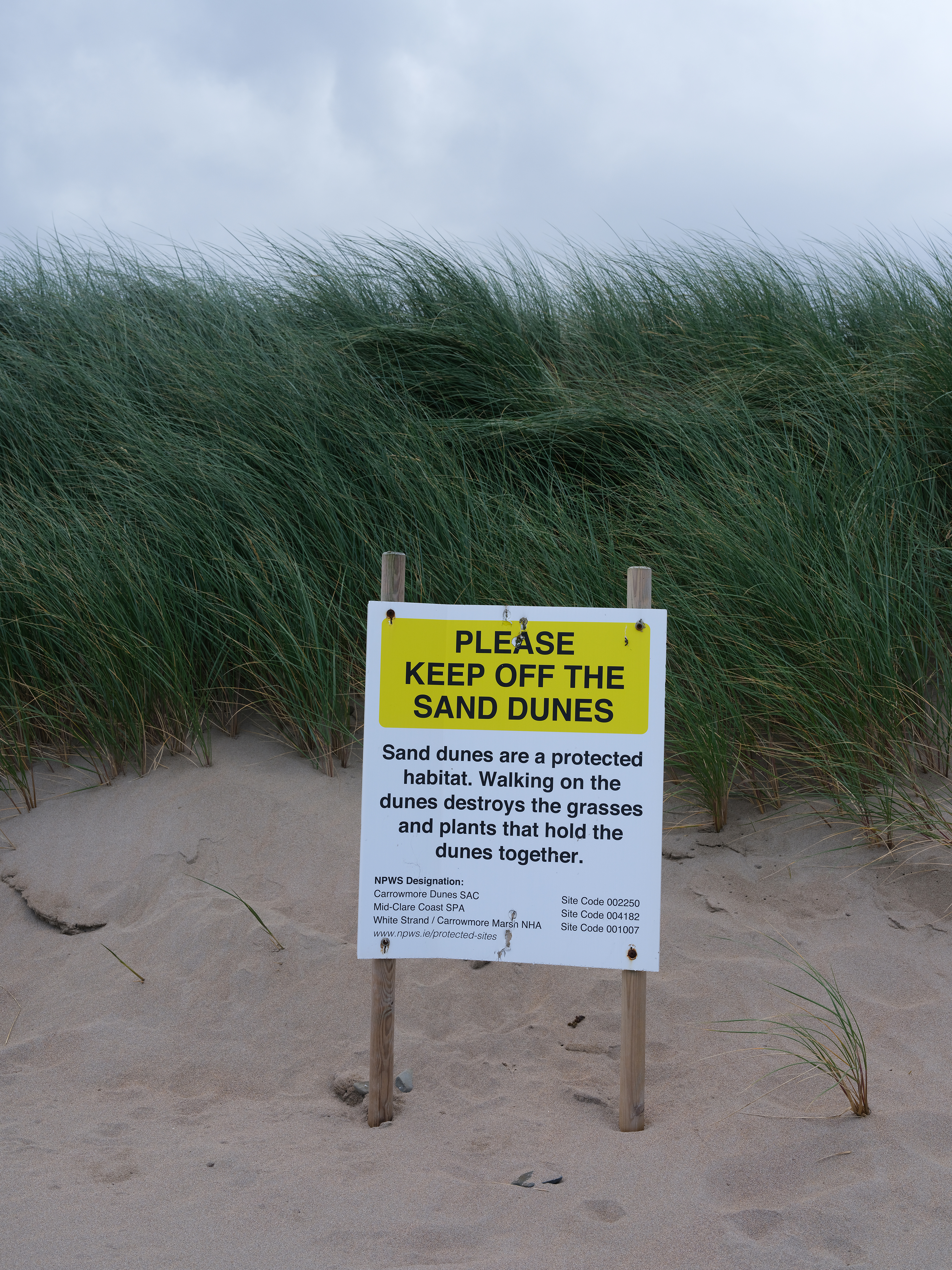
Questions over the fate of the threatened Vertigo angustior snail — a microscopic mollusk nestled in Doonbeg’s sandy dunes — had bedeviled the golf property even before the Trump Organization owned it. But in February, the commission approved the ballroom provided the Trumps offer a snail restoration plan.
“The ballroom,” said Rita McInerney, a Doonbeg resident and member of the Clare County council, had become “part of the community’s vision.”
The jubilation, however, was quickly cut short.
Days after the February approval, a lone appeal was lodged by Liam Madden, a hermetic figure notorious for blocking hundreds if not thousands of development projects across Ireland, including a previous expansion plan in Doonbeg. Impervious to shaming or calls for decency, he once stirred such rage that a foe attacked him with a blowtorch.
“Please,” Madden urged the appellate board, “refuse this nonsense.”
Trump’s other ballroom was stalled.
Guests ride horses at Trump International Golf Links Ireland.Anastasia Taylor-Lind
How to torpedo a project
Madden is a tall man with white hair who lives in a historic house behind a thick stone wall in the Irish village of Longford. He owns no cell phone. He has no website. No social media accounts. The only way to find him is either through his malfunctional landline or an email address that identifies him, in Latin, as the “Irish Vitruvius.”
And yet, people across this country know the name Liam Madden.
When confronted by bothersome development projects, the Irish over the years have turned to this quarrelsome and punctilious man for his ability to torpedo plans. He is what many in Ireland call a “serial objector” — someone who makes a living by appealing planning commission decisions. Madden, however, bristles at that classification.
Instead, when he’s feeling reticent, he describes himself as “the most successful appellant in the history of the Irish state.” At other times, including in interviews with the Washington Post, he referred to himself as a “god,” a “hero,” a “celebrity.”
“There simply isn’t anyone better,” he said. “It’s a scientific fact.”
“I’m modest as well,” Madden, 76, added. “That’s one of my failings.”
His profession is an unintended outgrowth of Ireland’s wildly permissive planning appellate system. In most of Europe and the Americas, a person typically needs to legally demonstrate some stake — financial, geographic or otherwise — to gum up a project with an objection. Ireland has taken a different tack.
All anyone has to do to file an appeal — and trigger a monthslong review by An Coimisiún Pleanála, the national appellate planning board — is submit a preliminary “observation” and pay a nominal fee. Appellants don’t have to be Irish. Or even in Ireland.
“There’s no such thing as too much democracy,” reasoned Lorcan Sirr, a housing analyst at Technological University Dublin.
A house in Doonbeg is painted in preparation of the Irish Open Golf Tournament.Anastasia Taylor-Lind
The system increasingly has become a matter of national controversy. Developers complain that it’s an impediment to progress, vulnerable to abuse and fueling a cottage industry of serial objectors, some of whom have used appeals to extract payments from developers. In 2024, lawmakers proposed reforms.
Madden, who’s never been accused of such improprieties, looks at other serial objectors as a lesser form of the species. He said he would never profane his craft with profit-seeking. What motivates him is the pleasure of winning — identifying even the smallest legal violations to bedevil his adversaries.
That, and bald-faced publicity. “I’m perpetually seeking notoriety,” he said.
So in January, while flipping through the papers, he saw what he recalled as a “golden opportunity.” In Doonbeg, roughly three hours from Madden’s house by car, Eric Trump had proclaimed his intent to build the “nicest ballroom in Ireland.”
Madden knew then what he must do.
“If there is a God in heaven,” he declared one July evening, “I will win the planning appeals and capitalize on it for notoriety.”
Volunteers for Doonbeg Tidy Towns water flowers along Main Street.Anastasia Taylor-Lind
A village praying for a golf course
Doonbeg was in trouble. As the 1990s drew to a close, the shoreline village, whose history dated to at least the 1500s, was fading.
“We weren’t poor in community,” said Tommy Comerford, a fifth-generation Doonbeg resident. “But we were poor in jobs and opportunities to keep our young people.”
The community pitched the European Regional Development Fund on a golf course — and won financing for it. Designed by famed golfer Greg Norman, the Doonbeg Golf Club opened in 2002, just as the local population fell to 206.
Busloads of golf tourists from the United States and Canada were soon rolling in. Seasonal employment at the club — which quickly added a luxury hotel and events space — grew to 300 people. Residents who’d left were coming back.
“The golf resort is so important to us,” said Seoirse Comerford, 52, who returned to take over the family pub.
But the resort could not turn a profit. By 2011, it had lost a reported $70 million. In January 2014, it was put up for sale, and worry spread through Doonbeg.
“It was like, ‘Oh my God, 300 jobs — gone,’” said Caroline O’Brien, a resident.
A savior, however, quickly arrived: an American buyer named Donald Trump. He touched down at Shannon Airport in May 2014 and immediately declared his plans for the resort.
“One of the main reasons I’m here is siting the ballroom,” Trump said. “A truly great ballroom. I believe people from all over the world will be using this ballroom.”
The sand dunes of Trump International Golf Links, as seen from Doughmore Bay Beach. Anastasia Taylor-Lind
‘I’ll be a friend to the snail’
Shortly after the sale’s announcement, an Irish environmentalist named Tony Lowes got a call from Trump.
“I’ll be a friend to the snail,” Lowes recalled Trump declaring.
Questions over the threatened Vertigo angustior, a fickle creature with exacting ecological needs, had long troubled the golf course. Even before it was built, Lowes’s Friends of the Irish Environment had filed a lawsuit to protect the snail. A judge ordered that the snail’s lot be “maintained or improved” and a settlement agreement even allowed for the appointment of a snail expert as a sort of steward.
For years, the snail thrived, and Trump promised to sustain its roll.
But Lowes said the Trumps haven’t kept their word, and the snail’s population has plunged. Shortly after they bought the resort, the snail expert was dismissed. (The expert didn’t respond to requests for comment.) Then, in 2016, the Trumps proposed building a 1.7-mile rock barrier wall along Doughmore Bay Beach to forestall shoreline erosion and protect the links from storm damage.
Environmentalists said the plan, even after it was scaled down, would alter the dunes’ delicate alchemy and doom the snail. To block construction, Friends of the Irish Environment filed an appeal with the national planning board. At its side, with his own appeal, was Liam Madden.
The board decided against the Trumps. Madden basked in glory.
Comparing himself to Saint Patrick, Madden at the time said he’d drive Trump “out of Ireland” like a “snake.”
Trump International Golf Links Hotel, seen from Doughmore Bay Beach. Anastasia Taylor-Lind
The making of a serial objector
When he graduated from architecture school in 1973, Madden said he wanted only an architect’s life. But the planning system was so integral to his work that he immersed himself in planning law and, upon submitting his first appeals, realized, “I was very good at it.”
During the mid-1990s, as Ireland experienced a building boom, people began seeking out Madden for his unusual acumen. Some wanted him to clear a project’s way. Others wanted the opposite. He became friend and foe to developers.
“He had a nickname among developers: the ‘Condom Man,’” said Irish federal senator Joe Flaherty. “You’d use him once, and then throw him out.”
Most of Madden’s work was done in obscurity. But his name nonetheless often rose to public notice.
First came a political campaign in 2004 against a candidate also named Liam Madden, for nothing more than what Madden called “devilment.” Then he stalled a project by the Gaelic Athletic Association, which is Ireland’s largest sporting organization, until it apologized to him over a decades-old grievance.
In 2013, Madden delayed the reopening of St. Mel’s Cathedral, a massive church that suffered a devastating fire, by objecting to a glass elevator that he alleged would offend the “modesty” of “Scotsmen visiting in their kilts.”
The town was furious.
“It was hugely emotional for the town,” Flaherty said. “It was two middle fingers to the local community.”
The attention only spurred Madden on. He objected to a fast food development. He objected to converting an abandoned factory into a car auction site. He objected to Trump’s barrier wall. And he objected to UFC legend Conor McGregor’s bid to build a boutique hotel, challenging him to a “bare-knuckle fight.”
Louis Herterich, a longtime client, said most people simply didn’t get Madden. “He’s just different,” Herterich said. “His god is being right and getting it right and winning.”
Flaherty added: “Nobody in their right mind would want to be Liam Madden — the criticism, the open contempt — but he relishes it.”
In a way, the two men said, they almost felt sorry for Trump.
“Even if he loses,” Flaherty said, “he’ll just find something else and keep going at it.”
Newly built houses in Doonbeg. Anastasia Taylor-Lind
A fatal error?
To Madden, there is no way he’ll lose — not this one.
“I’ve caught them with their pants down,” he said while beaming one July evening.
He returned to the snail — this time focused on helicopters. The Trump Organization, a promotional video indicated, allows guests to be ferried in and out by helicopter. In materials published online, an aviation company, Executive Helicopters, said it has two “heli landings” at the resort, one by the hotel and one on the golf course.
To Madden, this was a “fatal error”: The Trump Organization neither mentioned the helicopters nor sought to measure their ecological impact. The ballroom proposal thus was “tainted at law and beyond remedy,” he wrote.
Plus, Madden wrote, “Would our poor little Vertigo Angustior survive?”
The Trump organization didn’t respond to a request for comment. Golf course manager Joe Russel declined to comment. Executive Helicopters didn’t respond to a request for comment.
Geraint Ellis, an expert on Irish planning law who reviewed the appeal at The Post’s request, said Madden’s objection wasn’t frivolous. “Mr. Madden seems to have found some issues that are worthy of further scrutiny,” Ellis said.
As word spread of the objection, Doonbeg residents reacted with outrage. The golf resort had nothing to do with Trump, resident Rita McInerney said. Doonbeg started the resort, and will rise or fall with its fortune. How could a single outsider with nothing at stake kick up such trouble?
“Ludicrous,” she said.
“Disgraceful,” agreed Seoirse Comerford.
“Totally unfair,” added Tommy Comerford.
Doonbeg resident Rita McInerney said the ballrom became “part of the community’s vision.” Anastasia Taylor-Lind
In Washington, the White House ballroom is well underway. Foundational construction has started. The $900 million, 90,000-square-foot structure is coming into focus, including new details like gold-colored presidential seals. The Supreme Court is expected to rule this week, potentially giving it a green light.
But in Ireland, where the national appellate board is expected to rule by year’s end, Liam Madden insists the other ballroom will never be approved.
“Joe Biden beat Donald Trump once,” he said. “I’ve beaten him twice.”
LONDON — Prince Harry and his wife, Meghan, have decided to return to the United Kingdom, but they won’t resume their roles as working members of the royal family, British news media reported late Wednesday.
The couple’s children, Prince Archie, 7, and Princess Lilibet, 5, have already enrolled at British schools and will start classes in September, according to the Daily Telegraph, which broke the story. The family plans to live at a private, nonroyal residence outside of London, the newspaper said.
Harry and Meghan gave up their royal duties and moved to California more than six years ago to earn their living through lucrative contracts with Netflix and Spotify. Although relations with the rest of the royal family have soured since then, Harry has recently expressed an interest in reconciliation so he could spend more time with his father, King Charles III, who is being treated for an undisclosed form of cancer.
Charles was informed of the couple’s plans on Sunday and wasn’t told about them during Harry and Meghan’s visit to the U.K. last month.
Buckingham Palace has a policy of not commenting on speculation about non-working members of the royal family. A representative for Harry and Meghan declined to comment.
Harry and Meghan have had a stormy relationship with the royal family ever since they decamped to a mansion in the exclusive Southern California enclave of Montecito.
In a series of interviews and Harry’s memoir Spare, the couple said they left Britain to escape the restrictions of royal life and criticized palace officials for being insensitive to Meghan’s mental health while alleging that at least one member of the royal family had expressed racist views when she was pregnant with their first child. Meghan describes herself as biracial.
Those tensions were exacerbated by Harry’s long-running legal battle with Britain’s tabloid newspapers, which he alleges illegally hacked his phones and invaded his privacy when he was younger. The prince has lost a series of lawsuits against the media, including one against the publisher of the Daily Mail, which concluded last month.
The latest trial has left Harry facing a potential bill for millions of pounds after the court ruled he and other plaintiffs in the case were liable for the publisher’s legal fees. Associated Newspapers has filed documents showing that its legal costs amounted to 34.5 million pounds ($47 million).
Harry has also been embroiled in a legal wrangle with the British government after a government committee refused to authorize police protection for the prince and his family when they are in the U.K. The prince says he and his family need armed police protection because they are at risk simply because they are members of the royal family, regardless of whether or not they are working royals.
After losing a court battle over the security issue last year, Harry said he hoped to rebuild relations with his family.
“I would love reconciliation with my family. There’s no point in continuing to fight anymore,” Harry told the BBC. “I don’t know how much longer my father has.”
A tentative step toward that reconciliation came last month when Harry returned to the U.K. for a series of charity engagements. Meghan and the children joined Harry for part of the visit and they spent time with the king at his Highgrove estate in western England. It was the first time Archie and Lilibet had seen their grandfather since the late Queen Elizabeth II’s platinum jubilee in 2022.
While Harry has recently met with his father, there are no signs of a warming of relations with his brother, Prince William, the heir to the throne.
Peter Hunt, a former BBC royal correspondent, said the surprise announcement would make William “apoplectic.”
“In the short term, Harry will be able to deepen his rapprochement with his father,” Hunt told Britain’s Press Association. “And his presence back home will make it harder for his brother to duck a reconciliation.”
Harvard University said Tuesday that it had agreed to pay $53 million to settle claims that body parts that had been donated for research were stolen and sold by a former manager of the morgue at the university’s medical school.
The former manager, Cedric Lodge, 58, was sentenced to eight years in prison in December after pleading guilty to one count of interstate transportation of stolen goods. The university fired him in 2023.
Lodge had been entrusted with handling cadavers that were part of the Harvard Medical School’s Anatomical Gift Program and were supposed to be cremated after the research on them had been completed, prosecutors said.
But a sweeping federal investigation found that Lodge supplied brains, skin and other body parts to collectors in several states as part of a criminal network that involved several people, including his wife. Investigators said he drove the stolen body parts to his home in New Hampshire.
The breach went undetected from about 2018 until March 2023, tainting one of the nation’s most prestigious medical schools.
Families who accused Harvard of mishandling the remains of their loved ones sued the university. A Suffolk County Superior Court judge threw out a dozen lawsuits in 2024, but the Massachusetts Supreme Judicial Court revived them last year. It ruled that Harvard and the managing director of the Anatomical Gift Program were not protected by limited immunity under the Uniform Anatomical Gift Act.
George Q. Daley, dean of the faculty of medicine at Harvard, and Dr. Bernard Chang, the dean for medical education at Harvard Medical School, said in a statement announcing the settlement that the agreement would allow Harvard and the plaintiffs to avoid “prolonged litigation.”
“These events do not reflect the reverence we hold for the altruistic individuals who selflessly donate their bodies to our Anatomical Gift Program (AGP) to provide essential educational opportunities to medical and dental students, practicing surgeons and allied health professionals,” they said. “We reaffirm our deep sorrow and empathy for the families of donors who may have been impacted.”
The settlement was also announced in a statement from Morgan & Morgan, the law firm representing the donor families in Boston.
“Both Harvard and the plaintiffs’ attorneys worked diligently to come to an agreement so that these families can finally have closure and begin to heal,” Morgan & Morgan’s founder, John Morgan, said in the statement. “We hope that this resolution ensures that this never happens to another family ever again.”
Daley and Chang said in their statement that lawyers for Harvard and the plaintiffs would seek preliminary approval for the settlement at a hearing Wednesday. If it is granted, they said, two class-action settlement funds totaling $53 million will be established to resolve the lawsuits. A third-party settlement administrator will be appointed to notify potential class members of their eligibility and to distribute settlement funds.
The process is expected to take several months, they said.
Harvard Medical School has also agreed to issue a statement to the plaintiffs confirming that Lodge’s actions were “morally reprehensible” and another statement detailing changes that have been made to improve the Anatomical Gift Program.
Harvard has also agreed to establish an annual scholarship for medical students beginning in the 2027-28 academic year “in appreciation and in honor of all of our anatomical donors,” according to the university’s statement.
“While Lodge’s sentencing concludes the criminal case against him, and the class action settlement agreement when fulfilled would conclude the civil cases,” Daley and Chang wrote, “the process of recovering from this painful incident continues.”
A 41-year-old man allegedly fleeing sex-assault charges in Maine was arrested Sunday at Philadelphia International Airport as he attempted to board a flight to Germany, authorities said.
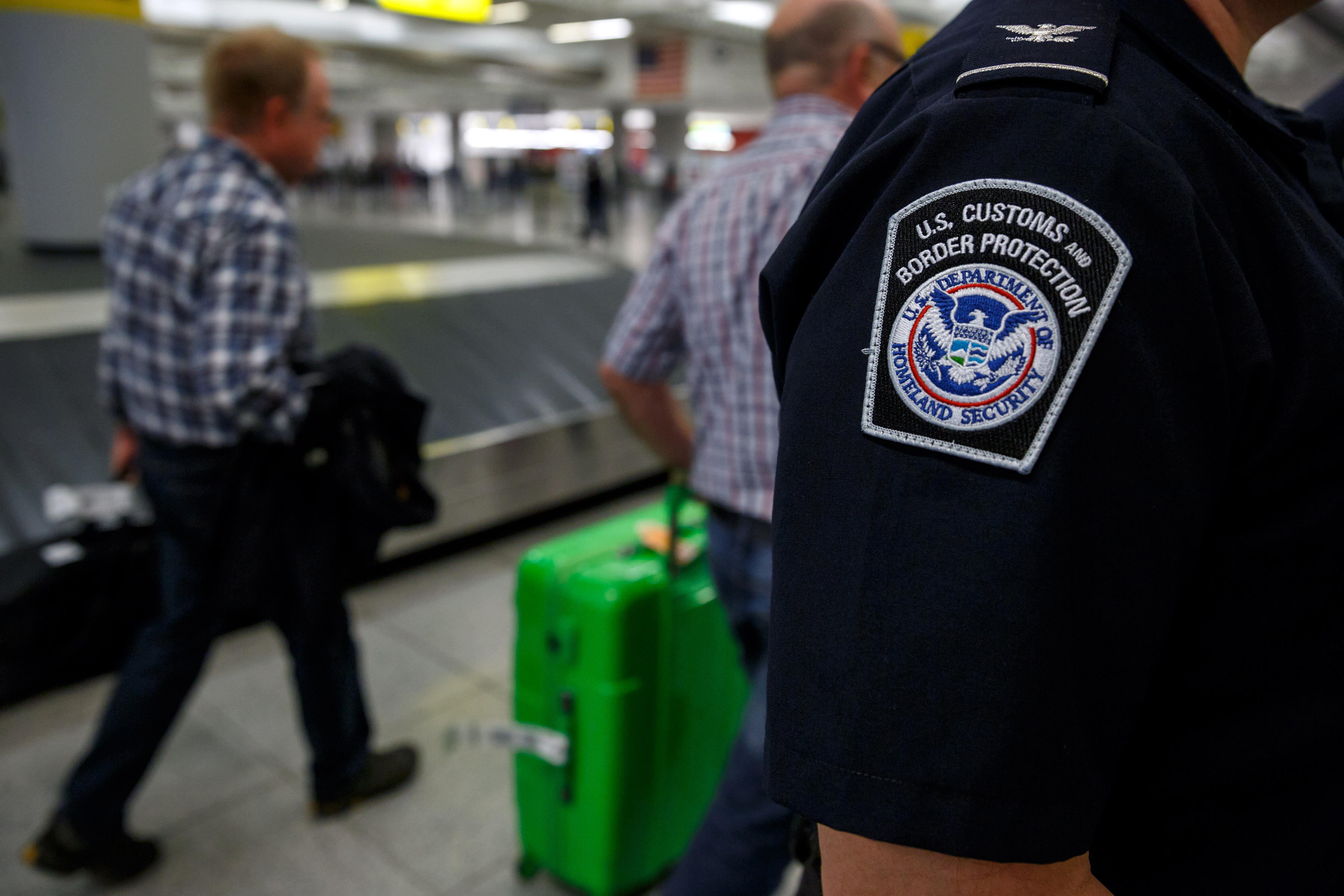
Matthew Thomas Cooley, of Solon, Maine, was stopped by U.S. Customs and Border Protection officers at the departure gate where he attempted to board a flight to Frankfurt on a one-way ticket, the federal law enforcement agency said Wednesday.
Cooley was transferred to the Tinicum Township Police Department to initiate extradition proceedings.
Court records show no attorney listed for Cooley, who was being held at the George W. Hill Correctional Facility in Delaware County.
In April, detectives from the Somerset County Sheriff’s Office in Maine went to Cooley’s home to arrest him in the sexual-assault case and Cooley allegedly pepper sprayed the detectives, CentralMaine.com reported.
Detectives began investigating Cooley after a 31-year-old woman alleged that Cooley sexually assaulted her twice last year, the news outlet reported. The woman also gave investigators videos and photos of multiple firearms and hundreds of boxes of ammunition kept in Cooley’s home.
Cooley was charged in Maine with two counts of gross sexual assault, one count of possession of a firearm by a prohibited person, and one count of domestic violence stalking. Cooley also was charged with two counts of assault on an officer, and one count of refusing to submit to arrest.
Elliott N. Ortiz, area port director in Philadelphia for Customs and Border protection, said in a statement: “Customs and Border Protection officers will always leverage our border security authority to help victims of sexual assault seek justice by capture dangerous fugitives attempting to flee the United States.”
Ortiz added: “Capturing dangerous fugitives is one way in which CBP works with our law enforcement partners to help keep our communities safe.”