Category: History

  • Conservative education warriors have reshaped GOP politics — even if their crusades often fail

    Conservative education warriors have reshaped GOP politics — even if their crusades often fail

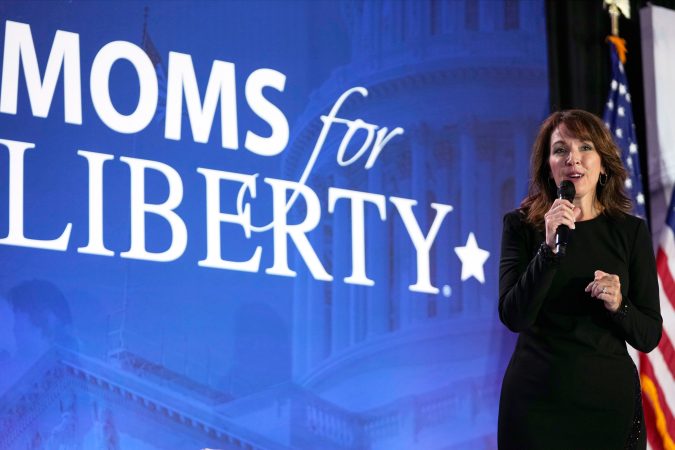
    Since its founding in 2021, the educational advocacy group Moms for Liberty has been mobilizing conservative mothers across the country against school curriculum they deem indoctrinating, un-American, anti-Christian, and antithetical to their understanding of family values.

    They’ve targeted books that explore LGBTQ+ themes, transgender athletes, and curriculum they deride as critical race theory or as too focused on diversity, equity, and inclusion. More broadly, they claim to be fighting to protect their parental rights to control what their children learn.

    Members of Moms for Liberty have earned seats on school boards, garnered national media attention, and infiltrated the highest levels of conservative policymaking. According to cofounder and CEO Tina Descovich, she has visited President Donald Trump’s White House more than a dozen times.

    Moms for Liberty has also made waves in the Philadelphia suburbs, especially in Bucks County, which boasted the largest leadership team of any chapter in the country by April 2025. At a Harrisburg-area event last October, Descovich said: “I am very familiar with Bucks County. Before I knew it existed, I knew the [Bucks County] Beacon existed because they were writing trash pieces about us.”

    Groups like Moms for Liberty have proved effective at making political noise — and even notching some policy wins, at least temporarily. Yet, the group is really just a continuation of a decades-long crusade by conservative white women to weaponize public education in the service of a right-wing agenda. While it has largely failed to transform American curriculum, this push has turned these women into key figures in Republican politics who have made fighting the culture wars a GOP priority.

    The modern conservative movement since World War II owes much of its success to the work of grassroots education warriors.

    These women proudly embraced traditional gender roles. They saw them as a marker of success because many women in their mothers’ generation had to work outside of the home to make ends meet in the Great Depression and wartime years.

    Even as some of these conservative women became full-time political activists, they claimed the mantle of traditional homemakers and mothers — which aroused charges of hypocrisy from critics. Yet, they argued that their advocacy work in the traditionally male world of politics and education policy was wholly consistent with traditional gender roles because protecting innocent children from worldly dangers was a natural role for women and mothers.

    At their kitchen tables and in PTA meetings across the country, these “suburban warriors” launched far-reaching campaigns against sex education, multicultural curriculum, and other aspects of schooling they deemed antithetical to traditional American values.

    In the 1970s and 1980s, as the political parties realigned, these conservative education warriors emerged as a crucial Republican constituency and a core part of the New Right coalition. These white women were galvanized by the recent gains of the Civil Rights Movement, the U.S. Supreme Court’s Roe v. Wade decision — which provided a right for women to have legal abortions under certain circumstances — and debates over the proposed Equal Rights Amendment to the U.S. Constitution, which they claimed (without evidence) would decimate the female homemaking role.

    These recent changes threatened to disrupt what the conservative women argued were divinely inspired gender roles, which were embodied by the “traditional” nuclear family of a working male breadwinner, a female homemaker, and kids. They feared that big government-backed forces might take away this ideal life, which many had only recently achieved.

    Increasingly, these women looked to public schools as the place to fight their crusade. Taxpayers funded the schools, and they were responsible for shaping the next generation of Americans outside of parental control.

    In 1974, the education wars burst onto the national stage in Kanawha County, W.Va., thanks to an ugly and violent struggle over school textbooks. The controversy began after Alice Moore, a 29-year-old mother and the lone woman on the county school board, objected to a newly adopted language arts curriculum she deemed indoctrinating, racially divisive, and steeped in “secular humanism.”

    This latter concept wasn’t new. It dated to the late 19th century, and argued that people could gain knowledge through reason, intellect, and logic rather than relying upon religious teaching.

    Yet in the 1970s conservatives thrust it into the spotlight, because they needed a fresh villain. Tried-and-true messaging on anti-communism had grown stale. But pushing secular humanism as the latest liberal conspiracy aligned with the New Right’s renewed focus on faith, family, and traditional gender roles, while energizing Christian conservatives.

    Moore and her allies saw secular humanism as increasingly influential in education — and as incredibly hostile to Christianity and their narrow definition of divinely inspired traditional family values. It further alarmed them because they saw secular humanism as teaching students to challenge their parents’ authority. Within a few years, the once obscure concept would become the New Right’s star bogeyman.
    Made By History sponsors. FOR USE ON MADE BY HISTORY STORIES ONLY.Inquirer Staff

    Throughout the fall of 1974, Moore read excerpts from the textbooks before the school board. She singled out Black nationalist Eldridge Cleaver, whose writings allegedly produced “racial hatred” toward white people. She also took issue with “dialectology,” a study of dialects that included lessons on African American vernacular — what she called “ghetto dialect” — that she believed to be antithetical to American speech.

    By October, the controversy had produced two shootings, dozens of arrests, and multiple rounds of bombings, boycotts, and school bus blockades.

    Moore’s crusade against secular humanism in West Virginia quickly caught the attention of national conservative organizations. The Heritage Foundation featured Kanawha County in its 1976 study, “Secular Humanism and the Schools: The Issue Whose Time Has Come.” Phyllis Schlafly — the country’s most famous anti-feminist at the time — jumped into the fray, claiming that public education promoted “a tolerance of violence, theft, adultery, obscenity, profanity, and blasphemy.”

    In part because organizations like the Heritage Foundation and Schlafly’s Eagle Forum highlighted Moore’s activism for like-minded conservative women, it inspired conservative mothers across the country to wage their own crusades against dirty textbooks. In the ensuing years, they launched repeated battles against seemingly subversive curriculum.

    In 1983, in rural East Tennessee, fundamentalist mother Vicki Frost waged her own legal battle against the Hawkins County school board after discovering objectionable material in her daughter’s reading textbook, including alleged depictions of telepathy, witchcraft, and black magic that violated her religious beliefs.

    In Mozert v. Hawkins County Board of Education — a case that became known as “Scopes II” because of Hawkins County’s proximity to the original Scopes trial — Frost and her fellow plaintiffs alleged that the school board’s policies violated the First Amendment’s free exercise clause. Their legal counsel came courtesy of Concerned Women for America, whose founder, Beverly LaHaye, took Frost on a national speaking tour to publicize the alleged dangers of modern textbooks. Although the plaintiffs lost their case on appeal, LaHaye deemed the case a “PR success” that “identified us as a friend of the family.”

    The result epitomized the outcome of the broader education wars. Fighting against offensive school curriculums turned many conservative women into key figures in the culture wars, with substantial reach and political impact. They quickly became politically astute grassroots organizers who leveraged their identities as white Christian homemakers and mothers to argue for an educational system rooted in Christianity, the traditional nuclear family, and American exceptionalism.

    The impact of these organizers, however, hasn’t necessarily come in the classroom. Most of Moore’s “dirty books” found their way into the Kanawha County curriculum. Frost and the plaintiffs in Hawkins County ultimately lost their case on appeal. In recent years, the majority of school board candidates backed by Moms for Liberty have similarly suffered defeat.

    Yet, these organizers have been able to mobilize thousands of culturally conservative women — particularly other white Christian mothers — and bring them into the Republican Party. Their involvement has driven the GOP to make the culture wars a key component of the party’s identity.

    These earlier crusaders also created a language that remains a staple of conservative critiques of public education to the present day. More than five decades after Moore’s war, conservative organizations continue to emphasize “parental rights,” “family values,” and “school choice” in their efforts to influence American education.

    When groups like Moms for Liberty claim public schools are indoctrinating children with “woke” ideologies such as critical race theory, they rely upon a well-established playbook that conservative women have drawn upon for more than half a century. Despite mixed results in America’s actual classrooms, their political activism has proved a tried-and-true means for both enflaming public opinion and solidifying the role of self-proclaimed traditional mothers and homemakers within modern conservatism.

    Allen Fletcher is a public historian and journal editor with research interests in Appalachia, gender, and the history of American education. His current book, “Building Schools, Building Communities: Appalachian Women and the Struggle for Educational Change,” is under contract with LSU Press.

    Made By History takes readers beyond the headlines with articles written and edited by professional historians. Opinions expressed do not necessarily reflect the views of The Inquirer.
  • The first Jewish American to serve the government was a Philadelphian. A letter he carried to Paris for Thomas Jefferson just sold for $108,000.

    The first Jewish American to serve the government was a Philadelphian. A letter he carried to Paris for Thomas Jefferson just sold for $108,000.

    In the early 1780s, Revolutionary War era Jewish patriot and Philadelphian Lt. Col. David S. Franks had a desperate work situation in hand.

    He had served as one of Benedict Arnold’s high-ranking personal assistants, and after Continental militiamen discovered Arnold’s intentions to sell America out to the British in 1780, it became nearly impossible for Franks to find a job with the United States government.

    Franks was cleared of wrongdoing. But working with Arnold made the Founders wary of employing Franks.

    But not Thomas Jefferson, who hired Franks as his secretary. By the time the Treaty of Paris ending the Revolution was ratified in January 1784 in Annapolis, Md., then America’s capital, Franks had been Jefferson’s secretary for almost a year.

    It was Franks who carried at least one official copy of the finalized treaty to Benjamin Franklin — who was in Paris at the time — and other officials in Britain and France.

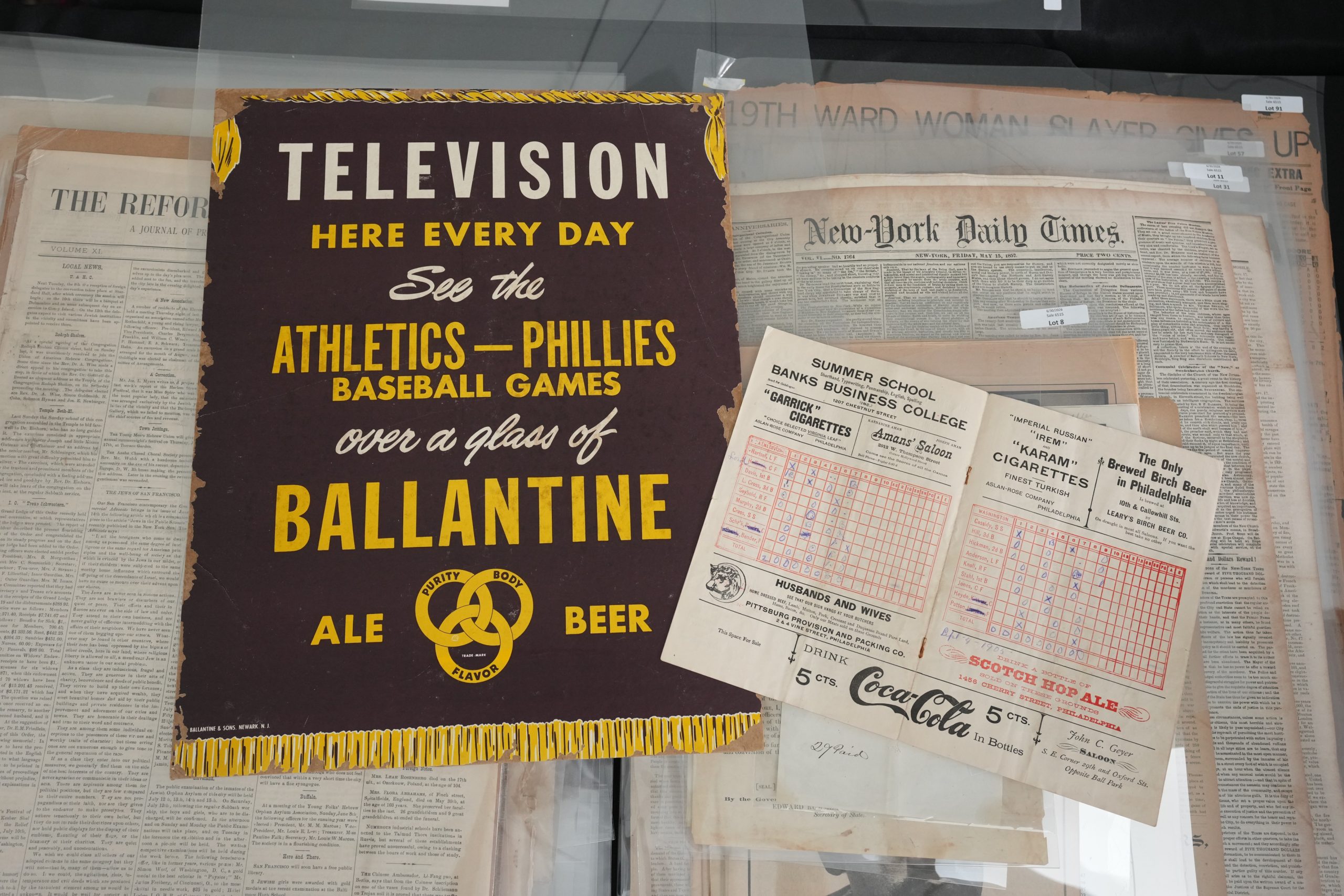
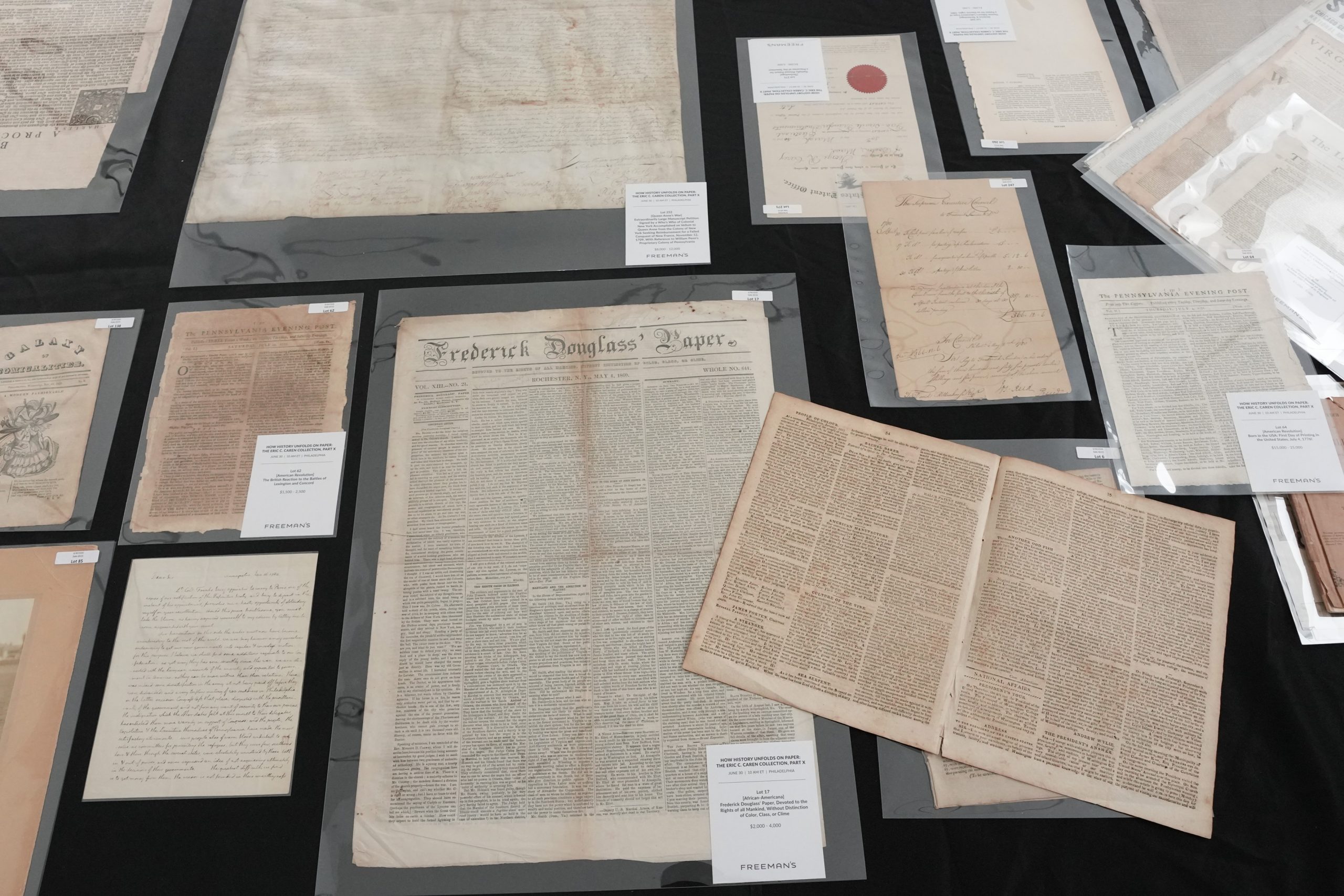
    Frederick Douglass’ Paper (front center) and other documents, part of the collection “How History Unfolds on Paper: Important Americana from the Eric C. Caren Collection,” which boasts more than 320 rare newspapers, books, pamphlets, and ephemera tracing the development of printing and publishing in America, an enterprise that started in Philadelphia in1690 with the first paper mill.Jessica Griffin / Staff Photographer

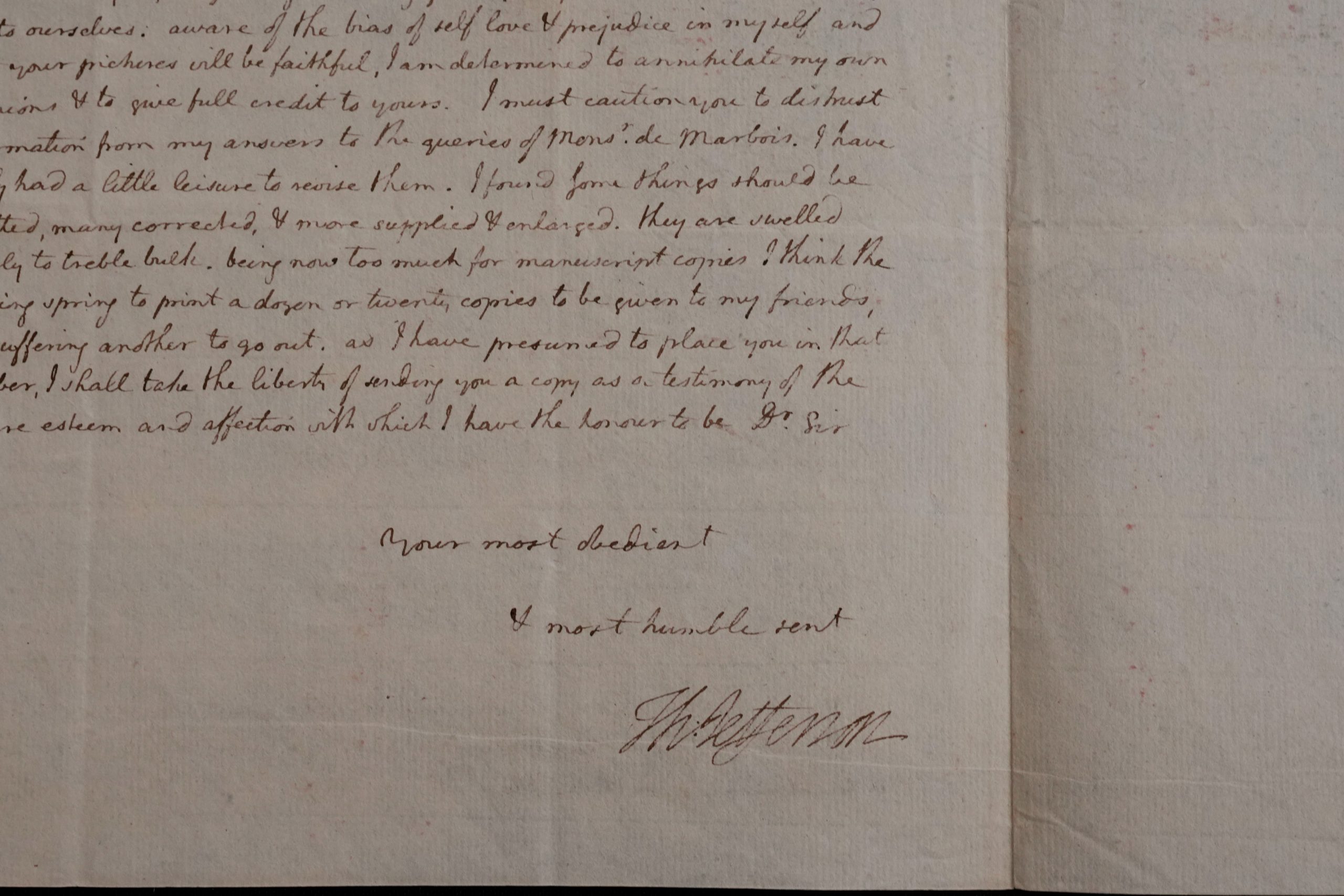
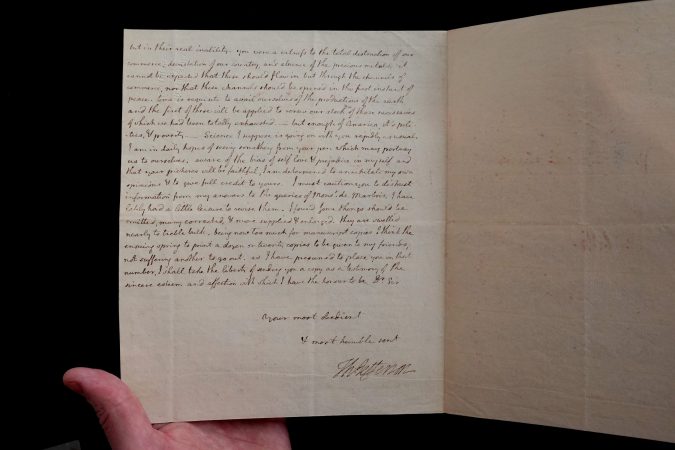
    Franks also carried a two-page letter written in Jefferson’s customary neat hand for Francois Jean de Beauvoir, Chevalier de Chastellux. It was a friendly message between the longtime acquaintances, in which Jefferson wrote to the French noble about how America was progressing as a sovereign nation and about his forthcoming book Notes on The State of Virginia.

    That letter sold for $108,000 Tuesday as part of an online and in-person auction presented by Philadelphia’s Freeman’s auction house.

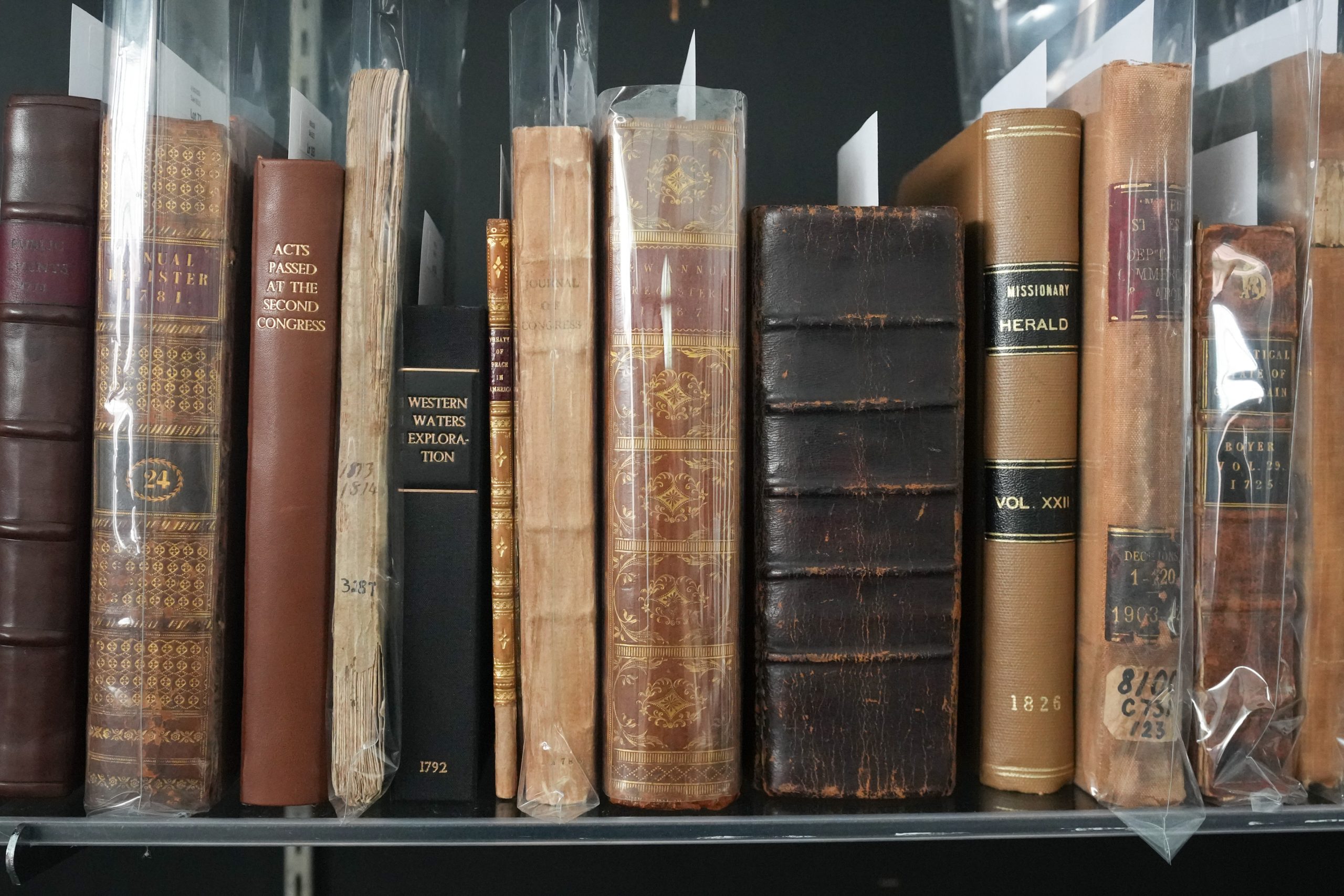
    “How History Unfolds on Paper: Important Americana from the Eric C. Caren Collection, Part X” boasted more than 320 rare newspapers, books, pamphlets, and ephemera tracing the development of printing and publishing in America, an enterprise that started in Philadelphia in 1690 with the first paper mill.

    Books from the collection “How History Unfolds on Paper: Important Americana from the Eric C. Caren Collection,” which boasts more than 320 rare newspapers, books, pamphlets, and ephemera tracing the development of printing and publishing in America.Jessica Griffin / Staff Photographer

    “Caren goes where the history leads him. His collection reflects that,” said Darren Winston, Freeman’s senior vice president and head of the books and manuscripts department. “When he asked us to host a sale in honor of the 250th, we immediately said yes.”

    18th century news treasures

    The vast sepia-hued collection of aged newspapers and bound volumes was heaven sent for primary-source junkies who can afford to plop down a few hundred or several thousand dollars for the kinds of historical gems usually found only on microfilm. It’s also a gold mine for those who think hundred-year-old newspapers in near mint condition are frame-worthy.

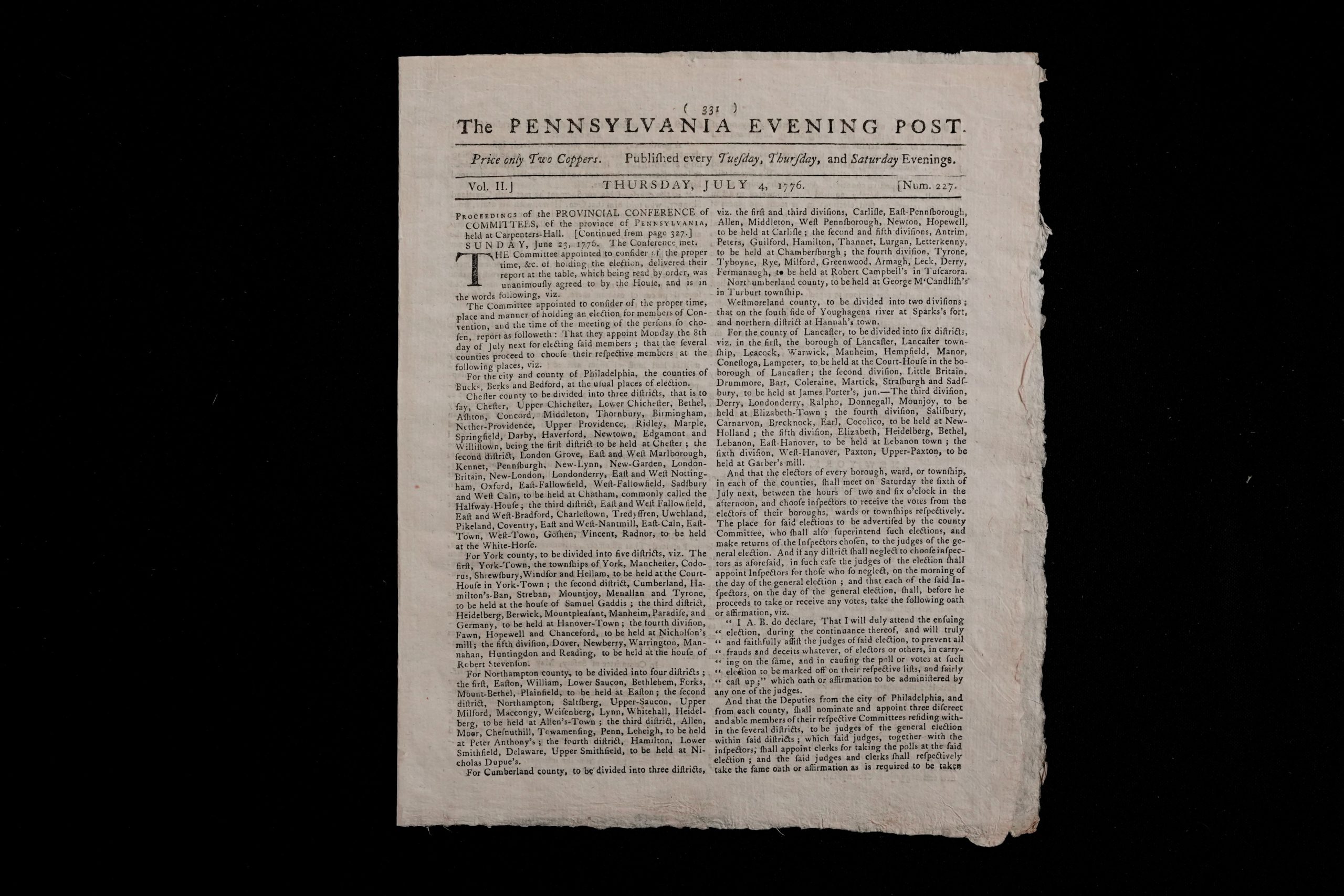
    One such memento was a four-page Pennsylvania Evening Post printed on July 4, 1776, believed to be the first daily newspaper printed on North American soil just declared free of the monarchy.

    A four-page Pennsylvania Evening Post printed on July 4, 1776, believed to be the first daily newspaper printed on North American soil just declared free of the monarchy.Jessica Griffin / Staff Photographer

    The Evening Post, founded by printer Benjamin Towne in 1775, was published just a few blocks from the Pennsylvania State House on Tuesday, Thursday, and Saturday evenings.

    The July 4 edition contains a short mention that the Continental Congress declared the United Colonies free and Independent States earlier in the day. And “the day before, we had a King in charge,” Winston said.“How History Unfolds on Paper” included five 18th century newspaper editions, including one printed in Scotland, that published the Declaration of Independence in full.

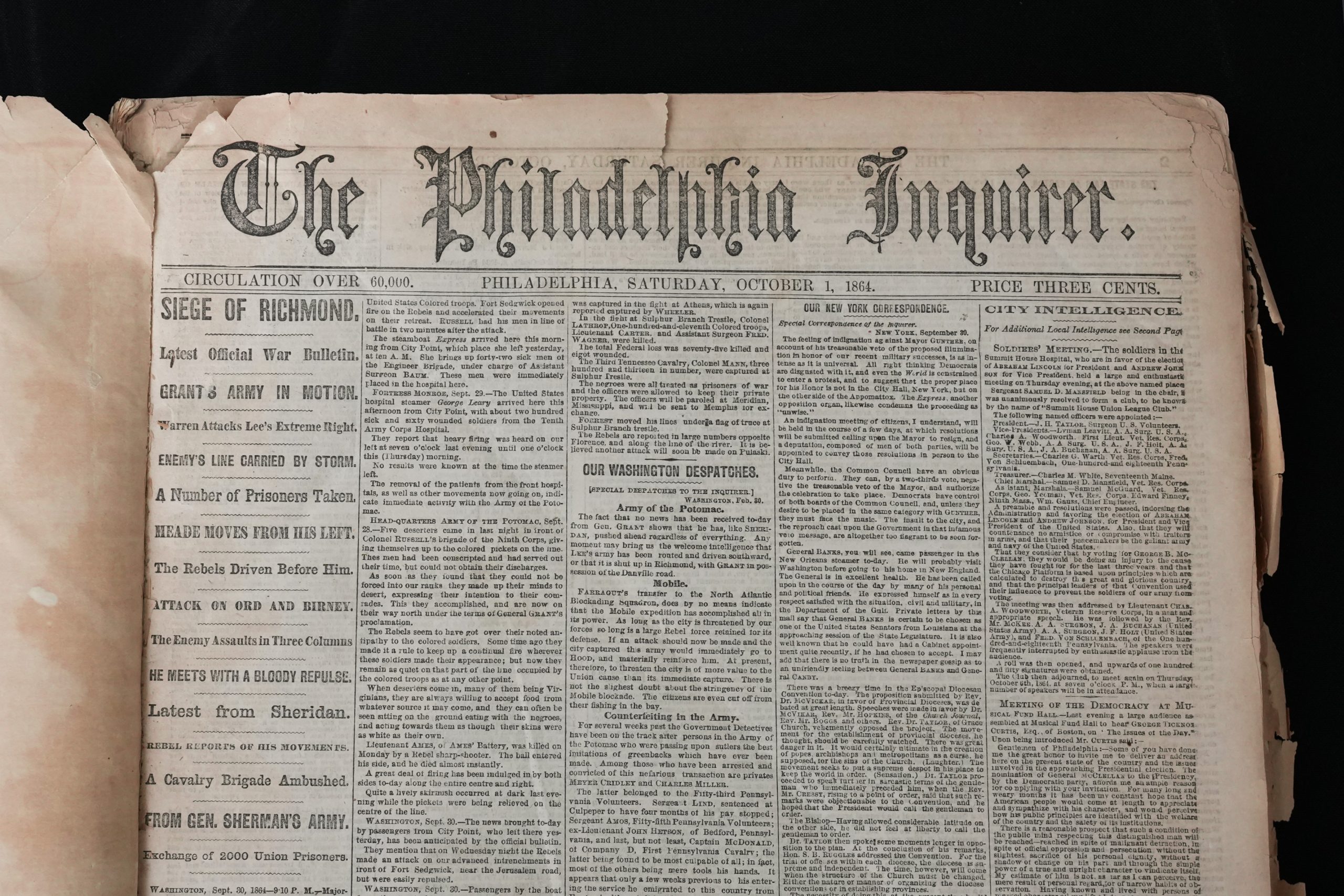
    Other archival gems included a copy of the Frederick Douglass Paper from 1860; copies of the Emancipation Proclamation as they appeared in the Daily Globe, the New York Tribune, the Evening Journal Almanac, and The Philadelphia Inquirer; Abraham Lincoln’s second inaugural address as printed in the New York Times in 1865; and more than 70 issues of Civil War-era Philadelphia Inquirers.

    A copy of the Philadelphia Inquirer, part of the collection “How History Unfolds on Paper: Important Americana from the Eric C. Caren Collection,” which boasts more than 320 rare newspapers, books, pamphlets, and ephemera tracing the development of printing and publishing in America, an enterprise that started in Philadelphia in 1690 with the first paper mill.Jessica Griffin / Staff Photographer

    But Caren’s collection is more than weathered newspapers.

    The auctioned collection bubbled with relics, collectibles, and keepsakes that speak to the economy, such as a note signed by first director of the U.S. Mint, David Rittenhouse — for whom Rittenhouse Square is named — ordering payment of 350 pounds to a doorkeeper employed at the Pennsylvania State House. (That’s about $107,000 in today’s money.)

    An 1874 advertisement for Levi Strauss & Co. that appeared in a Montana newspaper was among the cool finds, as was a 1905 Phillies Athletics score card. An 1869 letter signed by Susan B. Anthony and a 1772 volume of poetry including works from Phillis Wheatley are priceless, but their bidding started at $900 and $400 respectively.

    “Freeman’s is America’s oldest auction house, and Philadelphia is the birthplace of the United States,” Caren said. “So for the 250th anniversary [of America], I thought this sale would be quite fitting.”

    Some of the sports memorabilia featured in “How History Unfolds on Paper: Important Americana from the Eric C. Caren Collection” Jessica Griffin / Staff Photographer

    50 years of collecting

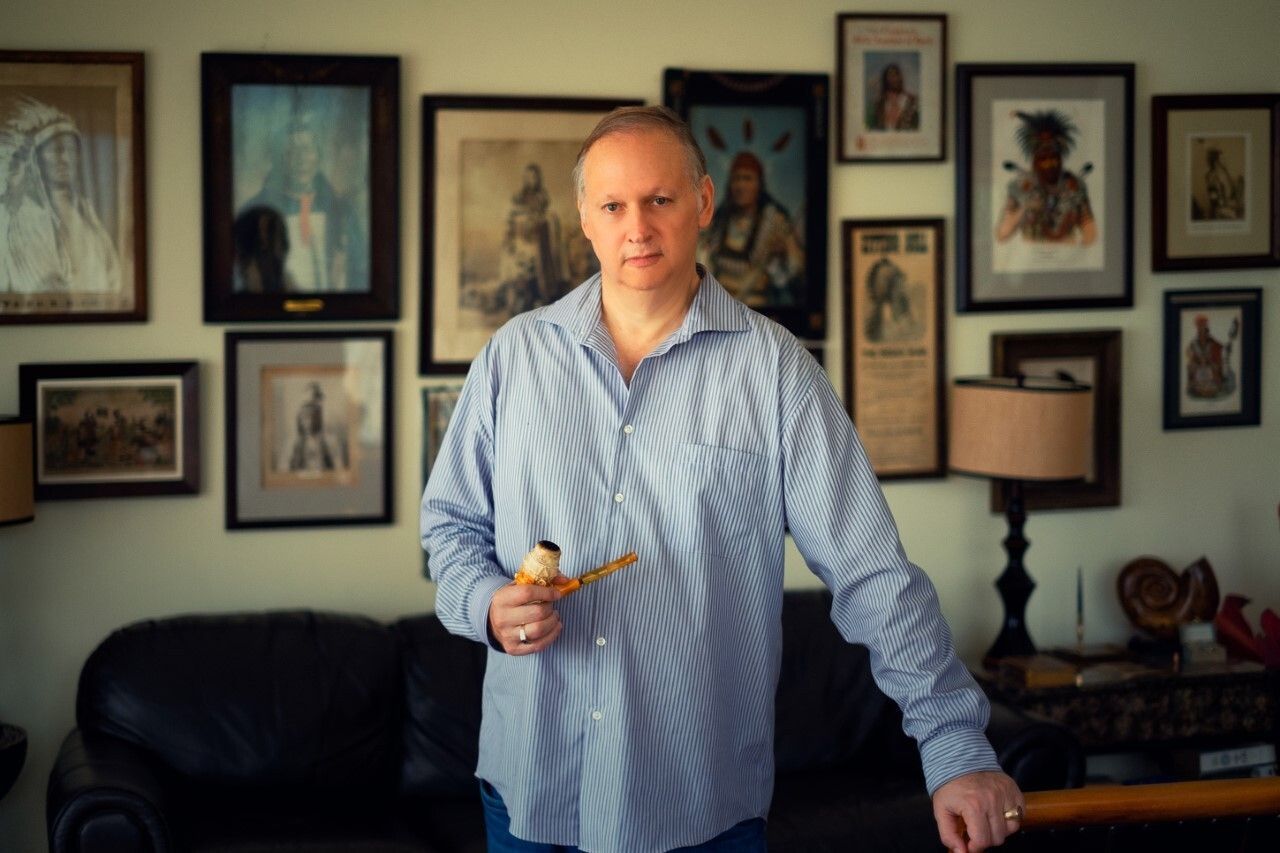
    Caren, 66, is a New Yorker and said he came out of his mother’s womb collecting — starting with comic books, stamps, coins, and baseball cards.

    In 1970, he learned that a few of his friends were going rummaging through an abandoned house in Rockland County and that they had found newspapers from the turn of the 20th century.

    “I asked them to try and find me a sports page with Babe Ruth, and they brought me one from 1913 and I was mesmerized,” Caren said.

    After some cajoling, Caren convinced his friends to reveal their secret treasure trove. There, he discovered periodicals going back to the 1890s and was hooked.

    Caren spent the next 50-plus years collecting the printed and written word. He has traveled the world to estate sales, garage sales, rare book shops, and antique shows. He’s one of the founders of the Ephemera Society of America and a member of the American Antiquarian Society and the Grolier Club.

    He owns hundreds of thousands of paper items, and pieces of his collection have been sold at the auction houses Christie’s and Sotheby’s. “How History Unfolds on Paper” was his 10th auction and first in Philadelphia.

    “If ever there was a Philadelphia item, this is it”

    In his travels, Caren has come across many of Jefferson’s letters. The one written to Chastellux, he says, is particularly noteworthy because Jefferson wrote it himself, as opposed to dictating it to a secretary, like Franks.

    Long-time ephemera collector Eric C. Caren, his collection “How History Unfolds on Paper: Important Americana from the Eric C. Caren Collection, Part X” went to auction at Freeman’s in Philadelphia.courtesy of Freeman Auction House

    The letter had been in the Chastellux family for centuries before landing at an auction a few years ago. Caren passed it over a few times before recognizing Frank’s name in the first paragraph.

    “It was a great example of how even great things can slip by,” Caren said.

    The Treaty of Paris was signed in September 1783. The following January, legislators ratified it in Annapolis.

    Dated Jan. 16, 1784, Jefferson’s letter reads like a chatty blog of late 18th century American happenings. In the five months since the war’s end, news traveled to Europe that Americans were behaving badly. One of the reasons Jefferson penned this missive, Caren said, was to “dispel [this] fake news.”

    “There was indeed some dissatisfaction in the army at not being paid off before they were disbanded and a very trifling mutiny of 200 souldiers in Philadelphia,” Jefferson wrote, playing down the Pennsylvania Mutiny of 1783, during which a few Continental Army soldiers rioted in Philadelphia streets when they weren’t paid.

    Thomas Jefferson’s signature on a letter to Francois Jean de Beauvoir, Chevalier de Chastellux, a part of the auction at Freeman’s.Jessica Griffin / Staff Photographer

    He also mentions his yet-to-be published book Notes on The State of Virginia and encouraged Chastellux to write one of his own. He did.

    Voyages de M. le Marquis de Chastellux dans l’Amerique septentrionale, published at the turn of the 20th century, is what rare book dealer Wright Howes described as “the first trustworthy record of life in the United States.”

    Franks, the first Jewish American to serve in the early American diplomatic corps, did not fare as well as Jefferson or Chastellux. Lingering rumors from his association with Arnold continued to follow him, and in 1786, he was fired from the government.

    He spent years trying to restore his name. During his first term, President George Washington helped Franks secure a job as an assistant cashier at the Bank of the United States of America, but Franks was no longer accepted in the Founding Father’s circle.

    He died in 1793 during Philadelphia’s yellow fever epidemic.

    “If ever there was a Philadelphia item, this is it,” Caren said. “This letter is the intersection between the history of Philadelphia and the history of our nation.”

    The headline and article have been updated to include the winning bid at the auction on Tuesday morning.

  • Florida shows how not to teach U.S. history on the republic’s 250th anniversary

    Florida shows how not to teach U.S. history on the republic’s 250th anniversary

    The state of Florida recently released a new American history high school course with a conservative tilt. Troublingly, it glosses over the relationship between the founders and slavery—a topic that should in 2026 promote a rich understanding of the U.S. past, but one that has also been a subject of controversy, including in Philadelphia at the site of the President’s House. In fact, slavery was central to the economic growth and expansion of the young republic, so much so that it would take a long and brutal war to get rid of it. As Abraham Lincoln, dealing with slavery during the Civil War, put it: “Fellow-citizens, we cannot escape history.”

    On the 250th anniversary of the founding of the American republic, it bears repeating that the history of the United States is neither the linear, uninterrupted history of American exceptionalism that the Florida framework promotes nor is it solely an unremitting story of racism and reaction. Students benefit from learning about the brutality of slavery as well as the bravery of those ordinary Americans, men and women, Black and white, who resisted it. Emphasizing just one part of this equation is incomplete and bad history.

    The Florida course framework portrays the founding generation of American revolutionists as unanimously antislavery. The truth is more complex. While most of the northern founders like Benjamin Franklin, Alexander Hamilton, and John Jay lent the prestige of their names to abolition societies, most southern founders did not. Their actions reflected the reality on the ground. Between 1779-1804, northern states gradually abolished slavery. But southern slavery not only persisted but expanded considerably in the early American republic. If the founders were unanimous, what explains this divergence?

    While Jefferson and Madison professed to abhor slavery in their writings, like most southern enslavers they did not free their slaves. Jefferson made an exception for his own progeny, freeing select enslaved people. During his presidency, George Washington famously pursued his slave Ona Judge, who had escaped enslavement, with a relentless energy. However, New Hampshire authorities refused to render her back to the President—a signal of diverging attitudes and policies about slavery in the early republic.

    Washington did become the only prominent member of the so-called Virginia dynasty of Presidents to free his slaves on his death. It was a belated gesture. As the Black abolitionist Reverend Richard Allen noted in his eulogy of Washington in 1799, “he dared to do his duty, and wipe off the only stain with which man could ever reproach him.” While Washington was lauded as the Father of the Nation, few southern slaveholders followed his example, as Allen had hoped.

    The Florida history standards also present the U.S. Constitution, which was signed in 1787, ratified in 1788, and went into effect with the launch of the federal government in 1789, as an antislavery document rather than one that contained expedient compromises on the issue of slavery. One particularly egregious example of this relates to the three-fifths clause, which counted the enslaved population at a three-fifths proportion for representation and taxes. The Florida guidelines consider this an antislavery clause because the enslaved population was not counted fully. But this compromise led to southern domination over the federal government until Lincoln’s election as it gave the slave states disproportionate representation in Congress.

    The framers of the Constitution were careful not to use the words slavery and slaves in the fundamental legal document of the republic. Instead, they employed euphemisms such as “persons held to service” or “all other persons.” But that did not prevent contemporary abolitionists from bemoaning its fugitive slave clause, a part of the Constitution that gave southern laws of slavery extraterritoriality in the free states—an endless source of political friction between the states—and the continuation of the African slave trade, an execrable commerce whose tortures were well known then, until 1808.

    While Florida students under the new guidelines would learn about a debate among abolitionists like William Lloyd Garrison and Frederick Douglass on whether the Constitution was a proslavery or antislavery document, they would miss other important context. For example, the guidelines elide the equally important debate among abolitionists on the extent of the complicity of American churches in upholding slavery. Instead, abolition is framed as a Christian movement—with no mention of the schism over the issue of slavery leading to religious divisions that still exist today, including northern and southern Methodist and Baptist denominations.

    The framework also includes words of praise for proslavery theorist John C. Calhoun, a planter politician from South Carolina, as a constitutional thinker. Confederate generals like Robert E. Lee and Thomas “Stonewall” Jackson are portrayed as “honorable,” pious, and militarily skilled with little mention of their cause of human bondage, which Ulysses Grant called “one of the worst for which a people ever fought.” Mississippi’s “Declaration of the Immediate Causes which induce and justify Secession” clearly stated: “Our position is thoroughly identified with the institution of slavery — the greatest material interest of the world.”

    Indeed, Lee’s army enslaved free Black people in Pennsylvania while retreating from Gettysburg in 1863—not a very honorable thing to do and explicitly condemned in the Bible as man stealing. But this context is missing in the new Florida guidance.

    The histories of Reconstruction and the Progressive era are not particularly well understood by the public. The Florida guidelines portray Lincoln as being at odds with Radical Republicans who implemented Reconstruction. He wasn’t. It also casts Andrew Johnson as continuing his “lenient” policy to the south, a canard that Johnson assiduously promoted to oppose Reconstruction. In fact, before his death, Lincoln became the first U.S. President to endorse Black citizenship and male suffrage, the cornerstone of Reconstruction. Radicals such as Thaddeus Stevens and Charles Sumner as well as moderate Republicans like Lincoln championed the constitutional amendments and federal laws that comprised Reconstruction.

    Echoing a viewpoint espoused by white Southern elites at the time, Reconstruction gets short shrift and is deemed a failure in Florida’s new standards. Actually, the Reconstruction amendments and the first federal civil rights laws were tremendous achievements. We know the first 10 amendments to the Constitution as the “Bill of Rights” today because the author of the consequential Fourteenth Amendment that established national citizenship by birthright or naturalization, John Bingham, gave them that moniker and it eventually stuck. And Reconstruction didn’t fail; a systematic campaign of domestic racist terror in the south and reactionary judicial decisions by the United States Supreme Court overthrew it.

    The Jim Crow era that followed became a cautionary tale of how quickly and completely a country can lose its democracy and rights gained. But the Florida guidelines casts more than half a century of Jim Crow as a blip or aberration from a national history otherwise committed to democratic ideals.

    Students will be better prepared to be citizens of the republic when presented with differentiated historical narratives rather than having sanitized versions of the past served up to them. The Florida standards not only whitewash the past, they evoke an unchanging founding moment and pristine originalism—as though Americans in the founding era did not argue, debate, or change their thinking about slavery over time.

    Made By History sponsors. FOR USE ON MADE BY HISTORY STORIES ONLY.Inquirer Staff

    It also distorts how Americans continue to fight to expand—or curtail—access to rights and democracy more broadly. For instance, Progressive era reforms that included government regulation of the economy and working conditions are portrayed as “unbound by traditional constitutional restraints.”

    Most historians argue that our modern democracy was founded during Reconstruction, whose seeds later grew in the 20th century and were expanded by the Civil Rights revolution of the 1960s. But, as in previous eras, the fundamental questions remain contested and unsettled. That is both clear in the historical record and the foundational knowledge students must understand to continue to expand or improve our democracy today.

    Manisha Sinha is the Draper Chair in American History at the University of Connecticut and author most recently of The Rise and Fall of the Second American Republic: Reconstruction, 1860-1920.

    Made by History takes readers beyond the headlines with articles written and edited by professional historians. Opinions expressed do not necessarily reflect the views of The Inquirer.
  • This 18th-century tavern with a tainted past is now South Jersey’s American Revolution Museum

    This 18th-century tavern with a tainted past is now South Jersey’s American Revolution Museum

    An unsuspecting property in north Camden that had a front-row seat to the American Revolution has become a multimillion-dollar museum.

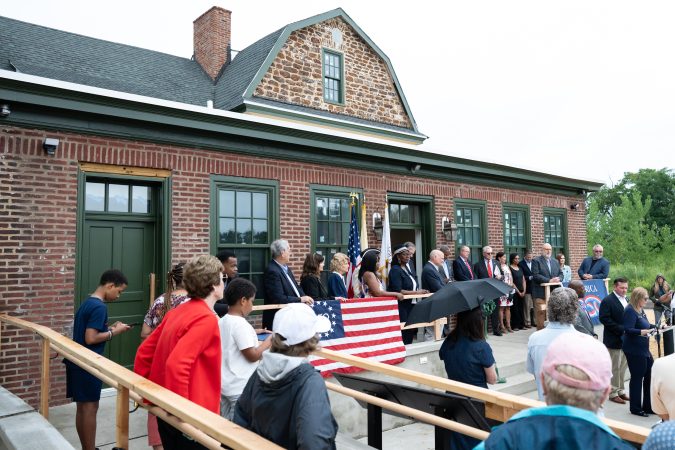
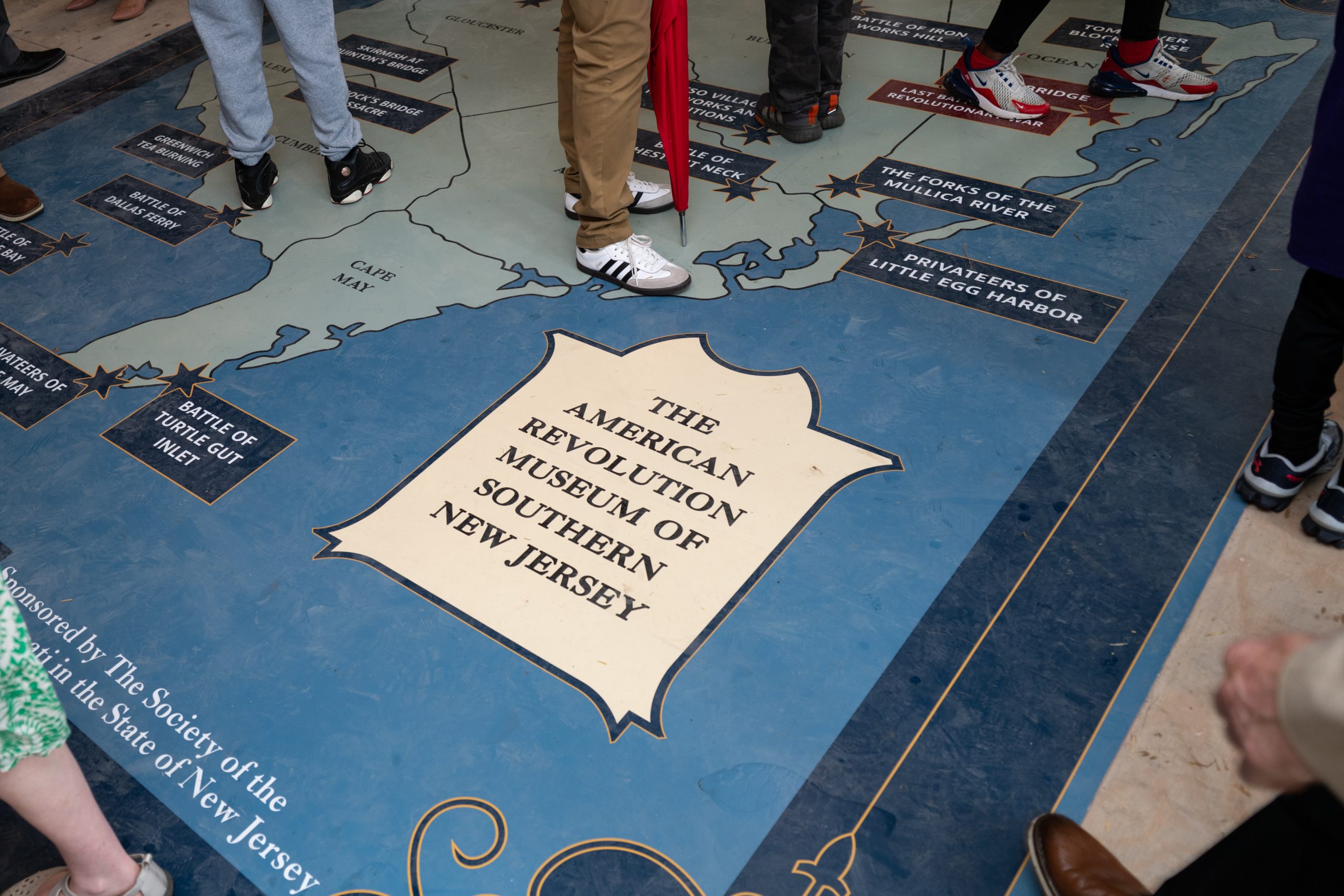
    Elected officials, history buffs, and local organizers gathered at the Benjamin Cooper Inn at 75 Erie St. on Saturday to celebrate the soft opening of the American Revolution Museum of Southern New Jersey. The project was funded by $4.6 million in grants from federal, state, and local sources, with the largest amount coming from the New Jersey Historic Trust.

    The 18th-century stone building has taken on many identities, including a private residence, tavern, British Army outpost, shipyard, luxury yacht building site, storage unit, and dumping ground for toxic materials. In the 1760s, the land was witness to the mass auction of enslaved people. Until recently, the building was abandoned.

    The museum hasn’t fully opened to the public and likely won’t for at least a little while, but leaders of the Camden County Historical Society, which has a 30-year lease with the building’s private owner, wanted to give people a taste of what the museum will be when it does. Right now, the museum is open for limited tours by appointment only.

    The Inn still needs work. The building has a temporary roof installed after a 2012 fire. The floors aren’t finished, and bathrooms have no doors. The second floor, currently sectioned off, hasn’t undergone any renovations, which will require fundraising of hundreds of thousands of dollars. Dirt piles and overgrown foliage block any view of the Delaware River.

    Visitors explore the exhibits at the soft opening of the American Revolution Museum of Southern New Jersey in Camden on Saturday.Erin Blewett / For The Inquirer

    For the past six years, the society has planned to unveil the museum before America’s 250th, said Jack O’Byrne, the society’s executive director, but they kept running into obstacles. The project’s success came years after the society lost the Hugg-Harrison-Glover House, a Bellmawr home that survived the Revolutionary War, to a highway construction project after a preservation battle.

    “It’s been a race to the end,” said O’Byrne, who will retire from his role on July 4. “The project probably died like 13 times.”

    Zed Fox, the incoming executive director, and the society’s board will determine the future official opening date, hours, and cost. Fox said Monday that the board will meet on Wednesday to discuss those options, but he expects the museum to ready to open at full capacity by fall.

    The museum is planned to serve as the trailhead for Camden County’s LINK trail, a 34 mile shared-use path in the works across 17 municipalities, and educate people on South Jersey’s role in American history.

    A long history and a damaged home

    The new museum doesn’t showcase many historic artifacts. Many gems kept in the society’s archives, such as a letter written by George Washington at Valley Forge and a dozen other Revolutionary War-era items, wouldn’t fare well at the Inn with the sunlight streaming through the windows.

    But scattered amid walls of weapon replicas and educational text are hints of the real thing.

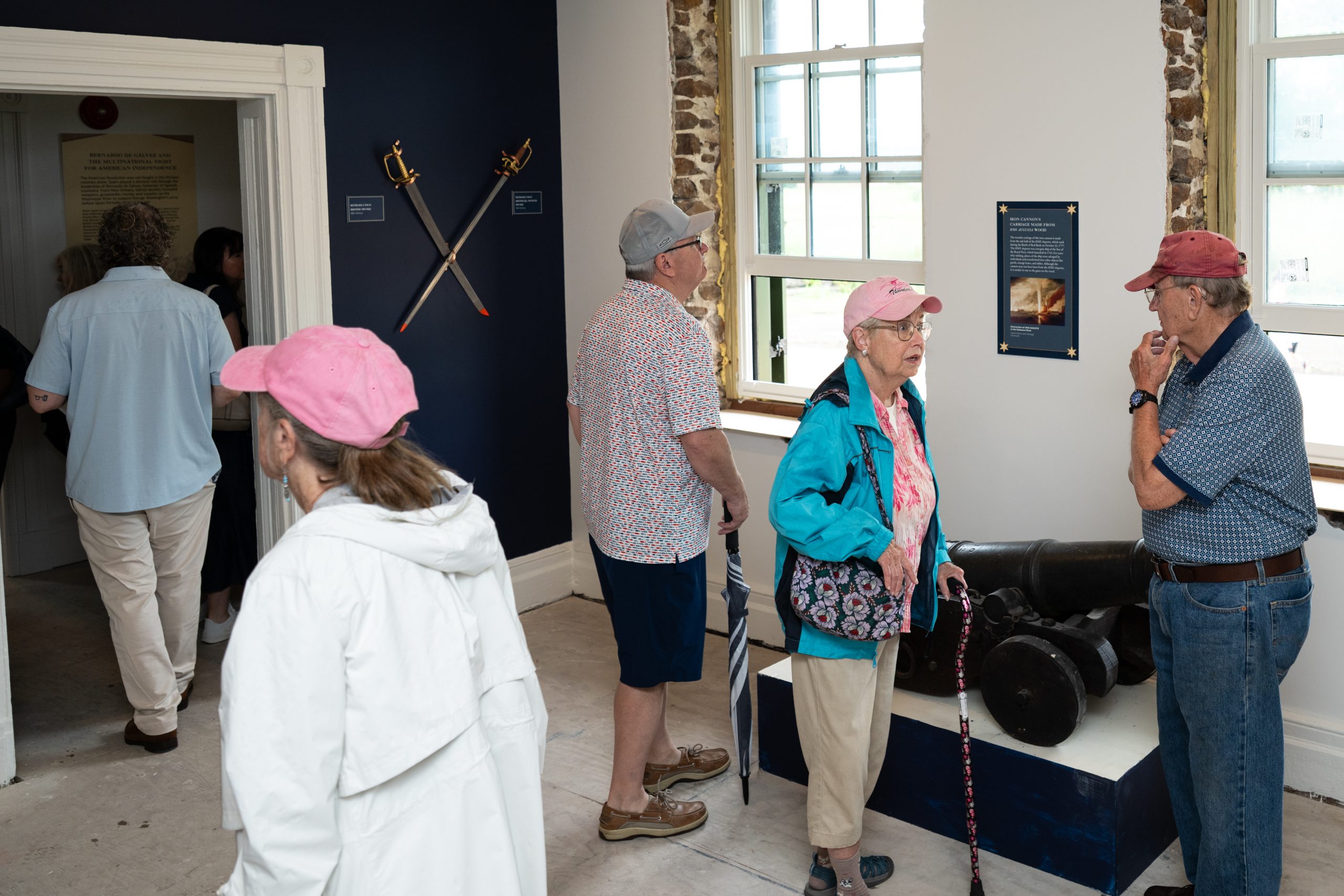
    There’s some 19th-century furniture originally owned by the Cooper family, a British cannon featuring wood blown off an 18th-century Royal Navy ship in Gloucester City, framed New Jersey bank notes from the 1760s and 1770s, and a front door key from when the Inn was a saloon called the “Old Stone Jug.”

    A bell hanging in one room rang to announce ferries landing at Cooper Street Ferry in 1800, and a cheval-de-frise, a sharp wooden log, once blocked British ships from sailing the Delaware River.

    In the same room, there’s a mantel from Hugg’s Tavern in Gloucester City, salvaged in 1929 before the building was demolished. Betsy Ross married her first husband, John Ross, in front of the fireplace at the tavern in 1773, though the mantel at the museum isn’t the original.

    Visitors explore the exhibits at the opening of the American Revolution Museum of Southern New Jersey in Camden on Saturday.Erin Blewett / For The Inquirer

    But local historians say the displays aren’t the main attraction.

    “The building itself is an artifact,” O’Byrne said. “You know, it’s the most historic building in Camden.”

    Before the house was built, a teenage Benjamin Franklin was said to have slept at the property while traveling from Boston to Philadelphia.

    In 1734, Joseph Cooper, a Quaker, built a 2½-story Dutch Colonial stone home for his son and daughter-in-law, Benjamin and Hannah Cooper, at what became the historic building. Benjamin Cooper, a ferryman, also used the residence as an inn and a tavern.

    In 1777, the Benjamin Cooper Inn was used as a outpost for British Col. Robert Abercrombie. Hessian troops, German auxiliaries to the British Army, marched through Cooper Point during the war, and at one time, local historians say Benjamin Cooper’s sons, Samuel and Joseph Cooper, were jailed in Haddonfield in 1778 on suspicion of being American spies.

    But the property has a more troubling past.

    In the 1760s, the site was used for the auction of enslaved people. Though some who were forced to stay on the Cooper’s property until being sold managed to escape, “all were pursued and re-captured,” according to the Inn’s 2021 historic preservation plan.

    O’Byrne said the museum is working to educate people about that history. One of the museum’s few rooms, which the society has titled “The Declaration’s Promise,” informs visitors about how immigrants, Black people, and the Lenape, who lived in the region before white settlers arrived, shaped South Jersey’s history.

    “What we’re trying to do is make this a balanced history and not just about, you know, white people,” O’Byrne said.

    Camden’s ‘most historic building,’ under threat

    When demolition crews tore down the Hugg-Harrison-Glover House in 2017, the Camden County Historical Society viewed the outcome as a huge injustice to historic preservation.

    “That was a gut punch,” said Chris Perks, board president. “We had invested a tremendous amount of time and the community’s time into that site.”

    Then, in 2018, a private company, 75 Erie St. LLC, purchased the Benjamin Cooper House from Agathon Realty for $1.1 million without knowing the building’s history. The house was in poor condition and graffitied. The windows were boarded up. It was difficult from the street to even know the building was there, because the house faces the river instead. The waterways were the real highways back then, O’Byrne said.

    “When we heard this just got purchased, we were like, ‘Oh, my God, we can’t let Camden’s most historic house go under,’” O’Byrne said. “It took me two years, and I was able to get a 30-year lease.”

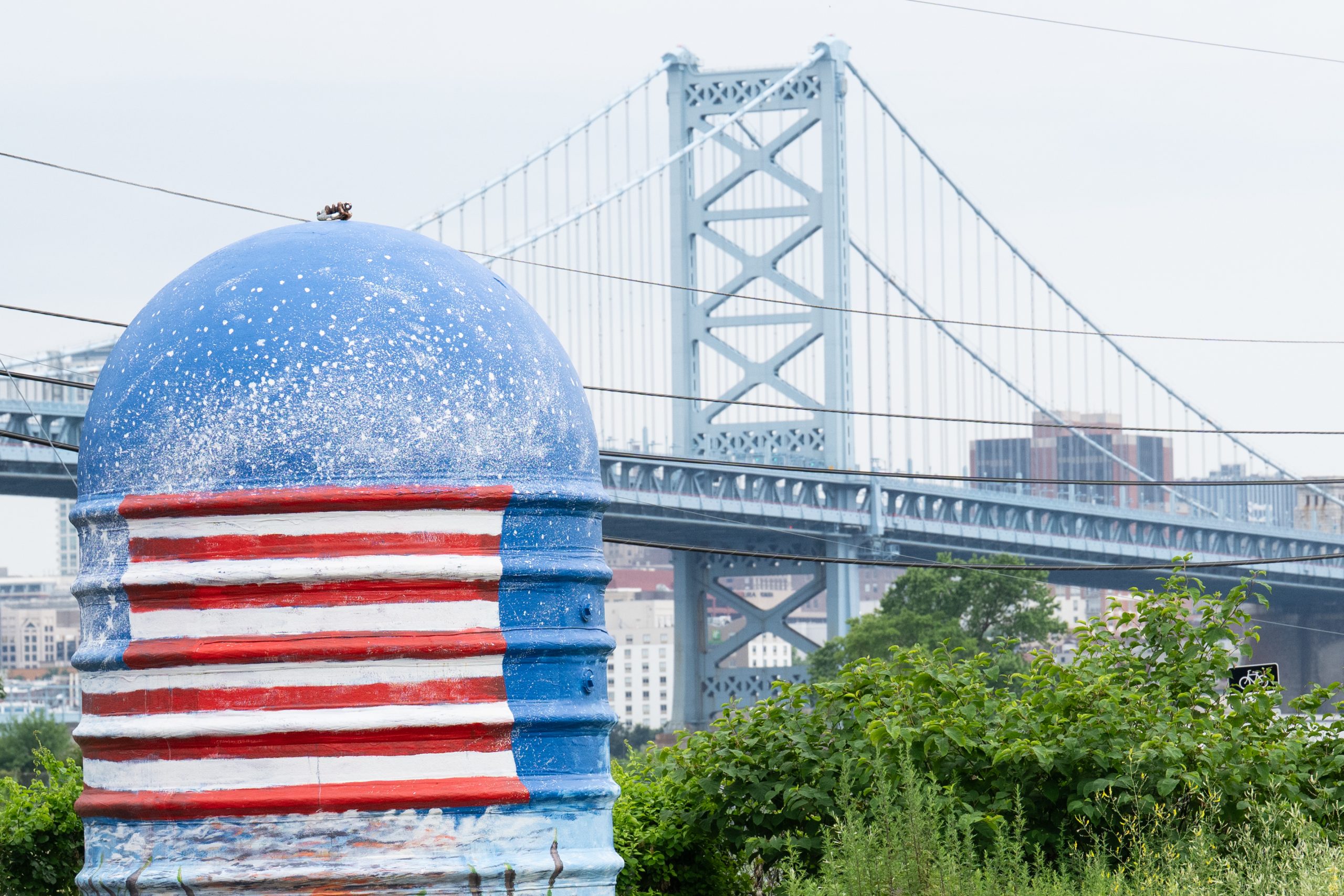
    A view of the Benjamin Franklin Bridge from the newly opened American Revolution Museum of Southern New Jersey in Camden on Saturday.Erin Blewett / For The Inquirer

    That lease will last at least through 2051. Perks declined to share how much the historical society will pay monthly.

    The 2021 historic preservation plan for the building estimated that if the building opened in 2025 as originally projected, museum operations would have required an operating budget of $300,000 full time, or $132,000 part time.

    While several organizations came together to fund the Benjamin Cooper Inn’s restoration, O’Byrne said the society will require more revenue beyond the funding for the restorations to maintain operations. O’Byrne applied for an operating support grant from the state and is working to raise $750,000 to match a New Jersey Historic Trust grant to restore the tavern’s upper level.

    “We opened this thing, and it’s a minor miracle that we were able to pull all the funds together and make it in time,” O’Byrne said. “But in some respects, capital fundraising is easier.”

  • After a century of false starts, soccer has taken off in the U.S.

    The 2026 FIFA World Cup — which includes six games in Philadelphia — has taken the U.S. by storm. The excitement generated by the tournament reflects how, in contemporary American society, soccer has become a feature of everyday life.

    Parents drive their kids to and from soccer practices and fork out large sums of money for travel games. At the professional level, Major League Soccer (MLS) and the National Women’s Soccer League (NWSL) are thriving. The U.S. women’s national team has won a record five Olympic gold medals and four World Cup titles. Even European soccer has taken off with American fans: this year, the English Premier League (EPL) season opener between Chelsea and Manchester City drew close to 2 million viewers in the U.S.

    The meteoric rise of soccer in the U.S., however, is a recent phenomenon. While Americans have played the game for centuries, it struggled to take off in the U.S. A number of factors drove soccer’s struggle to catch on, including ideas about masculinity and Americanness, a lack of infrastructure and the failure to build robust college soccer programs. Yet, in the 21st century, immigration, demographic shifts, technological changes and the rapid growth of youth soccer have transformed the landscape. Soccer has moved from a fringe and unpopular sport to become one of the most popular sports in America — even ahead of baseball according to one poll.

    In 1869, Rutgers beat Princeton 6-4 in the first American collegiate soccer game. By the early 20th century, teams like Fall River Football Club had become established enough to play against European teams including the Glasgow Rangers and Sparta Prague.

    Bethlehem Steel, based in Bethlehem Pa., was one of the most dominant teams in the early 20th century. It built what was widely regarded as the first soccer specific stadium in the U.S. and went on to win a record five U.S. Open Cups.

    Although the game seemed to be taking root — especially after the formation of the American Soccer League (ASL) in 1921 — it was predominately an amateur sport, even as professional soccer took off in Europe.

    The ASL hit rough shoals in its earliest days: only three of the initial clubs returned for a second season. Financial struggles were quite common in the league, and crowds were sparse.

    In the early 20th century, the near absence of soccer on American college campuses entrenched its status as a fringe sport. Other sports like baseball and basketball were taking off on campuses at the time, a signal of what sports young people were interested in playing. The problem was compounded by the lack of a national administrative structure, which ensured that almost no organized soccer took place beyond high school.

    Soccer also suffered from the lack of physical infrastructure. While sports like baseball and basketball developed at the professional level in the U.S. — including the construction of stadiums and arenas — soccer was forced to rely on baseball stadiums for games. For instance, Grand Avenue Baseball Ground in St. Louis, hosted four U.S Open Cups between 1929 and 1948 while also serving several Major League Baseball teams. Soccer in 20th century America simply wasn’t a robust enough business to justify the construction of multimillion-dollar stadiums.

    These challenges and tribulations plaguing soccer had a significant impact on sport’s growth in the U.S.

    At the college level, the game remained on the periphery of the American sports landscape. In 1939, only eight universities and colleges had men’s soccer teams and there were no interregional matches or postseason tournaments. It would take another 20 years before the National Collegiate Athletic Association sponsored a postseason soccer championship.

    Meanwhile, American football remained dominant on college campuses. Commenting in a New York Times article on soccer, an official from an unnamed American university argued that it was a good sport and must be played “in addition to football but should not supplant the latter game.”

    Soccer was stuck in neutral, even after two rival professional leagues, the National Professional Soccer League and the United Soccer Association, merged to form the North American Soccer League (NASL) in 1968.

    In 1975, the arrival of Edson Arantes do Nascimento — better known as Pelé — was supposed to change everything. Following sustained lobbying from New York Cosmos General Manager Clive Toye and intervention by U.S. Secretary of State Henry Kissinger, the superstar agreed to bring his talents to the U.S.

    Hopes, however, for a soccer revolution never truly materialized. While Pelé drew huge crowds to his games, his proclamation that soccer had “finally arrived in the United States” proved to be only hype. A decade after his heralded arrival, the NASL actually collapsed due to ballooning costs — leaving the U.S. without any serious professional league for several years.

    Made By History sponsors. FOR USE ON MADE BY HISTORY STORIES ONLY.Inquirer Staff

    No one was quite sure precisely why the most popular global sport couldn’t break through in the U.S. Some observers wondered if the problem was that the sport simply wasn’t American.

    The game ran afoul of American ideas of masculinity, which were primarily associated with aggression and capacity for violence, both of which were celebrated aspects of football. Dick Young, the former sports columnist for the New York Daily News once described soccer as “a game for commie pansies.”

    While sports like baseball and basketball weren’t as violent as football, they had the built in infrastructure — stadiums, robust college programs, big money television deals — and cultural cachet from a century of being in the top tier of American sports. Soccer lacked these advantages, and its inability to overcome the deep seated stigmas about the game kept the sport on the margins of the American sports landscape throughout the late 20th century.

    In the 21st century however, everything has shifted. The structural barriers holding soccer back began to erode, starting with youth leagues. Youth soccer grew in prominence, including the development of travel leagues. This growth, in turn, produced a pipeline of talent for professional soccer teams. Highly skilled American players like Christian Pulisic and Weston McKennie have become global superstars.

    Major League Soccer, which launched in 1993 as part of the U.S. bid for the 1994 World Cup, was initially treated as a retirement league for star players with declining skills. Yet, the emergence of this homegrown talent pipeline created a pool of exciting young players for MLS teams.

    Immigration has also bolstered soccer, both in terms of generating interest in the MLS and in expanding the talent pool. Reforms to immigration policy in 1965 created opportunities and demographic shifts that peaked in the early 2000s. Scholar Maurico Espinoza-Quesada argues that the majority of immigrants coming to the U.S. in the 21st century were primarily from “soccer-crazed countries in Latin America, Europe and Africa.”

    Tapiwa Gumunyu, a Zimbabwean immigrant living in Ohio, has attended several Columbus Crew matches with his family. Such matches have become social events for the relatively small Zimbabwean community living between Ohio and Kentucky. Similar trends can also be observed among Latin American communities that have brought their global soccer zeal to different cities across the US.

    MLS clubs have recognized the potential business opportunities offered by immigrant communities. The Seattle Sounders, for one, have tried to grow their fanbase by broadcasting their games in Spanish. Ric Jensen, a scholar of sport fandom and management, argues that MLS clubs regularly recruit “well-known Hispanic players to maximize sponsorship dollars” and expand their fanbase among Hispanics.

    Looking at the U.S. men’s national team, it’s also hard to ignore the impact that immigrants and their descendants have had on the growth of soccer in America. The U.S. has benefited immensely from players who would otherwise play for different countries altogether. Folarin Balogun could have played for England and Nigeria. Haji Wright was eligible to play for Ghana but like Balogun, chose to play for the U.S.

    The popularity of the game among immigrant communities has undoubtedly played a major role in elevating the MLS and injecting a generation of talented players and passionate fans into the local game.

    The popularity of soccer in the U.S. has also extended to foreign leagues — and technology has played a role in this shift. The internet and social media have created an interconnected world that allows fans to engage in rivalries and subcultures across previously unprecedented distances. There is now a generation of Americans who passionately identify as die hard “Culers” (Barcelona fans) or “Gooners” (Arsenal fans) despite never having set foot in Spain or England.

    One recent poll even suggested that soccer had surpassed baseball to become the third most popular sport in the U.S. Given how quickly soccer has grown, it seems possible that after decades of false starts, the sport may finally soon come to rival football and basketball atop the American sports landscape.

    Abraham Seda is an assistant professor of history at Lafayette College. He is currently writing a book on boxing and colonialism in Rhodesia.

    Made by History takes readers beyond the headlines with articles written and edited by professional historians. Opinions expressed do not necessarily reflect the views of The Inquirer.
  • In the weeks before independence, the man from Monticello drafts a declaration

    In the weeks before independence, the man from Monticello drafts a declaration

    Philadelphia. June 1776.

    America stands on the brink. The ultimate question of independence hangs over Philadelphia.

    And Thomas Jefferson has a declaration to draft.

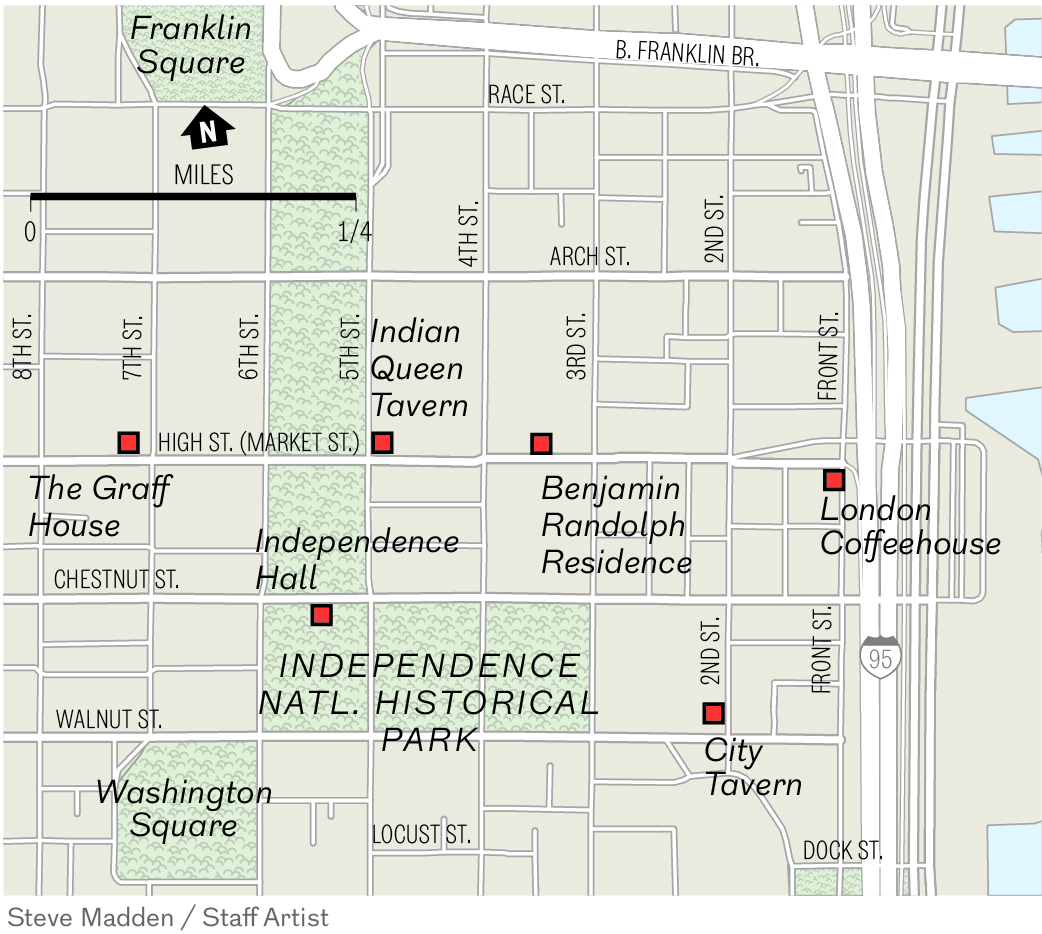
    His heart is in Virginia. His “country,” as he calls it. But here he is at Seventh and High Streets, 33 years old, living in two sweltering rooms, with his chance to make his mark on history.

    Unlike his fellow delegates, lodged in rooms along Philadelphia’s booming riverfront, Jefferson takes quarters along the city’s rural western edge, two blocks from the Pennsylvania State House, where the rebels conspire. The orchards and pastures bordering the downtown of British America’s largest and wealthiest city offer an escape from Philadelphia’s stifling summer heat and foul smells. Its stinking creeks, rotting trash, and unchoked illness. The verdant outpost, elsewise occupied by a bricklayer and his family, provides “the Squire,” as his friends back home call him, some small semblance of his mountaintop mansion, Monticello.

    Thomas Jefferson’s Philadelphia in 1776.Steve Madden

    He is living out of leather-bound trunks. Fresh air and sunlight stream through a window overlooking High Street — Philadelphia’s main thoroughfare, busy even on the outskirts. Hinterland farmers’ wagons clatter over cobbles, headed for the market. The sweet scent of fresh loaves drifts from a shopfront bakery. Jefferson’s thoroughbred — Caractacus, perhaps, his favored bay stallion, whose regal appellation derives from a first-century British chieftain — nickers in a nearby stable.

    Robert “Bob” Hemmings, Jefferson’s 14-year-old enslaved valet — and half brother of Jefferson’s future paramour, Sally — attends his every need in Philadelphia, sleeping in a garret off the writing parlor.

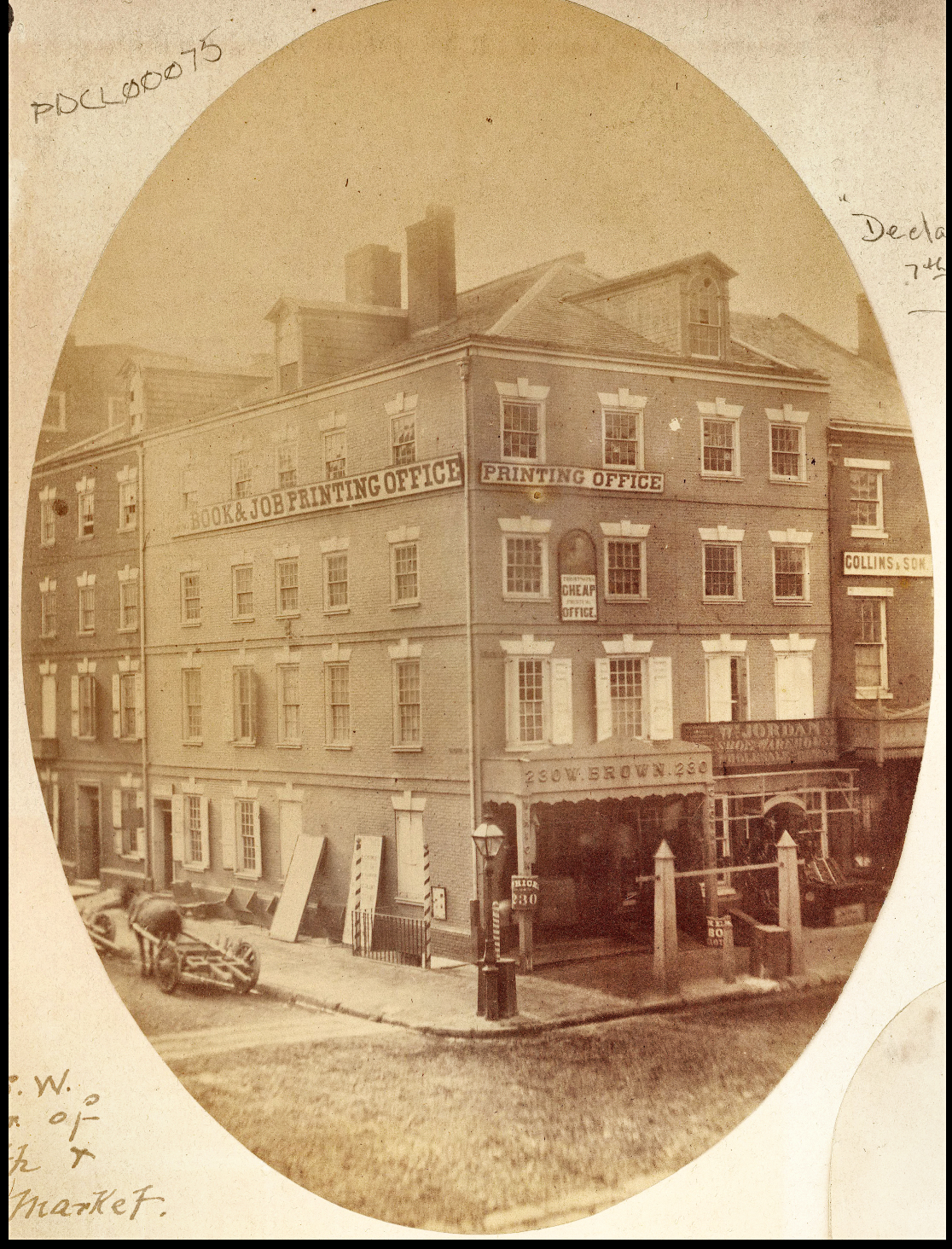
    The Declaration House, 7th and Market Streets, in 1856.Free Library of Philadelphia

    The rag paper resting on Jefferson’s mahogany travel desk — a small, portable lap device of his own design that the inveterate tinkerer had commissioned from a Chestnut Street cabinetmaker upon his arrival in Philadelphia a month earlier — remains blank. His quill is still. In the shadows, a grandfather clock ticks a stately rhythm.

    Tick … tock … tick … tock.

    The master of Monticello is working on a deadline.

    A momentum for independence

    Tarrying at the threshold of independence for months, the roar of rebellion echoes throughout Philadelphia by late spring.

    Just weeks earlier, more than four thousand Philly patriots braved driving rains to gather in the brick-walled yard of the State House. Celebrating the Second Continental Congress’ decree to form new governments apart from King George III — the masterstroke of John Adams, 40 — the drenched Philly masses thunder for independence.

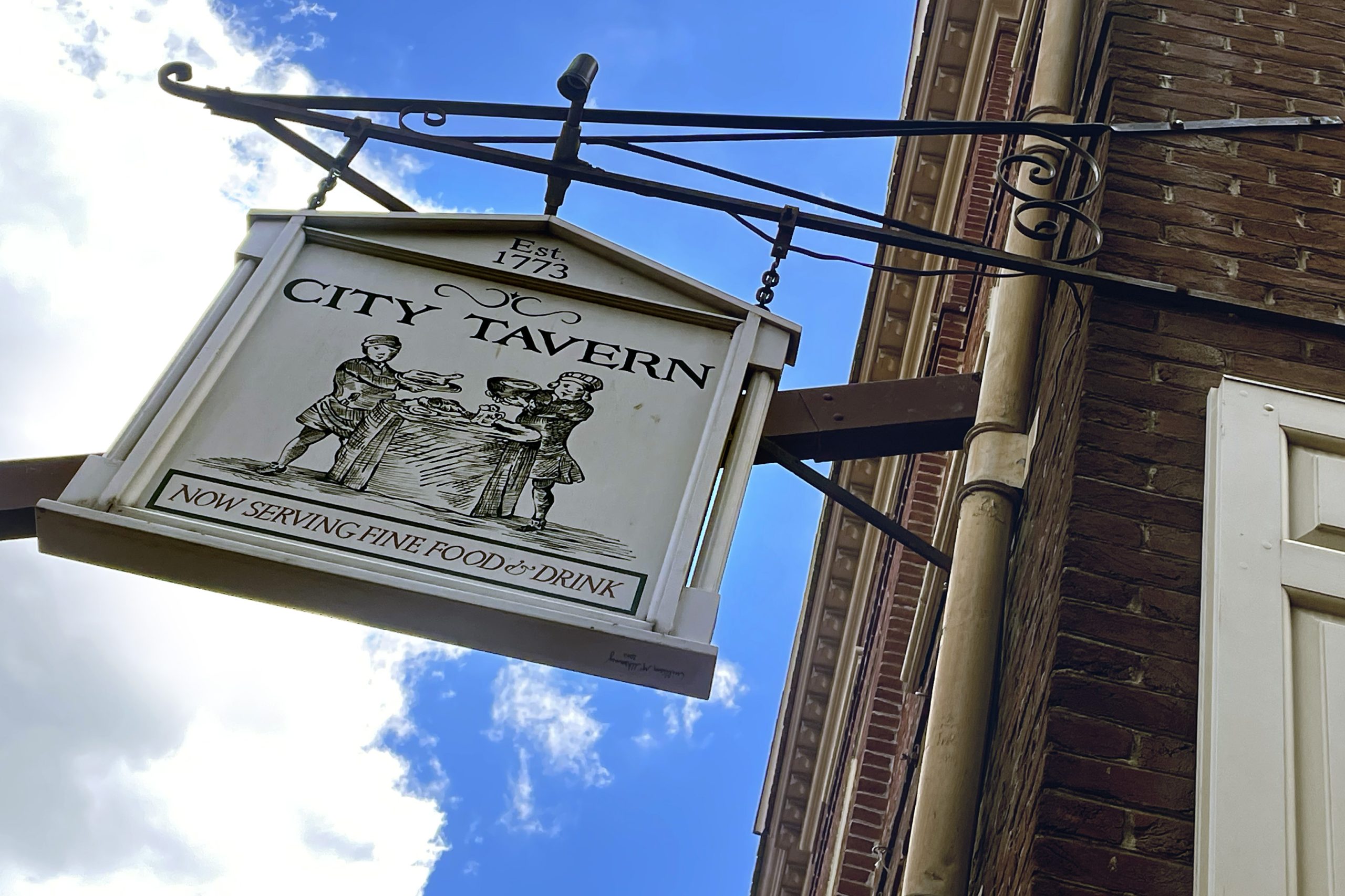
    City Tavern Monday, June 15, 2026. The original building was demolished in 1854 and reconstructed in 1975.Tom Gralish / Staff Photographer

    George Washington himself takes brief leave of his embattled army, digging in for an expected British assault on New York, to update the 56 congressional delegates in Philadelphia. The general’s tidings are lost to the centuries. But hear the lusty huzzahs that greet the stoic warrior at the representatives’ nightly repast at City Tavern, their unofficial headquarters.

    “George Washington, and victory to the American arms!” goes the toast.

    Inside the locked chamber, radicals like Adams and his older cousin, and backroom operator, Samuel, 53, lead the fight for liberty. Jefferson, whose resolve for popular government in America is unquestioned, but who detests public speaking, rarely rises.

    In early June, it is Jefferson’s fellow Virginian, the passionate patriot Henry Lee, who delivers a decisive stroke, boldly uttering words hitherto unsaid in Congress: “That these United Colonies are, and of right ought to be, free and independent.”

    The thunderclap is met by delay. Delegates from powerful colonies, including Pennsylvania’s own reluctant son of liberty, John Dickinson, are hesitant to cut the cord. Radicals work furiously to build unanimity.

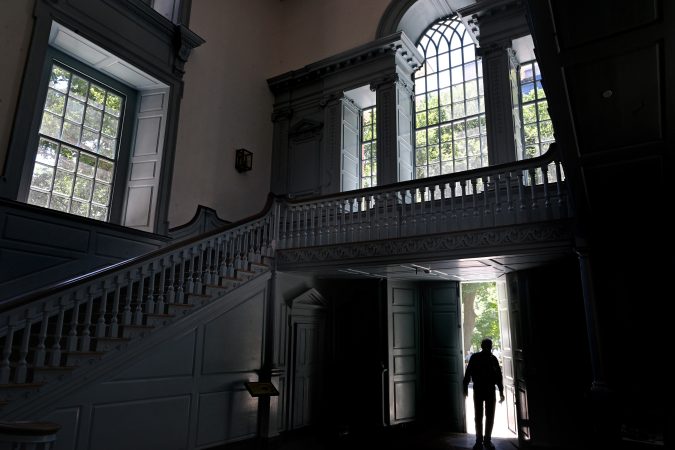
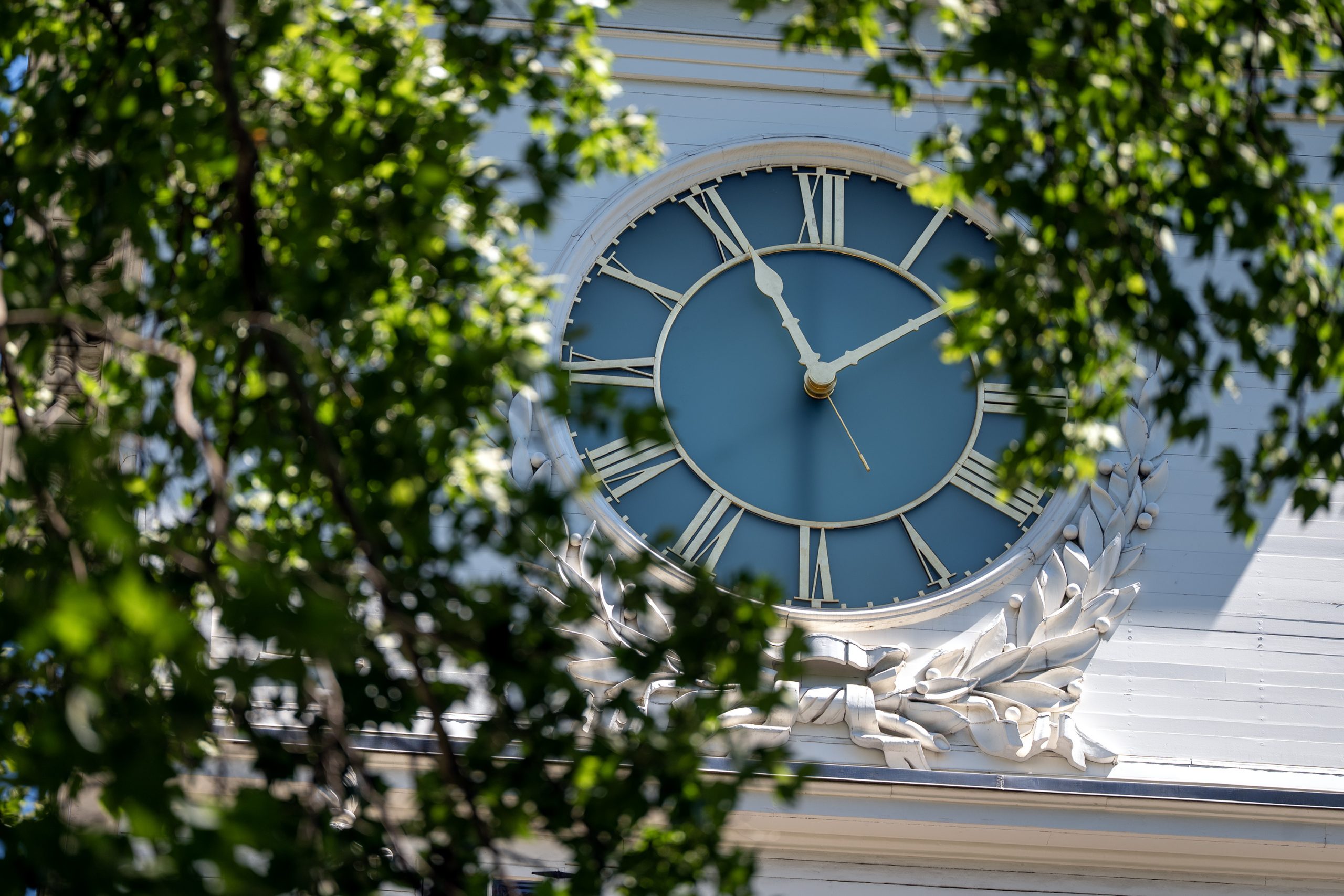
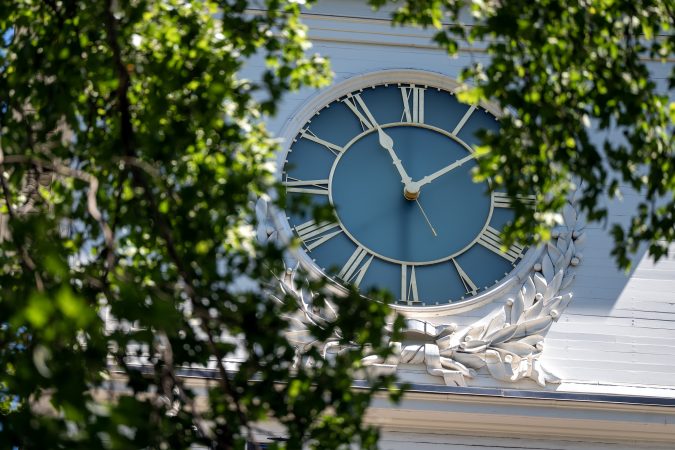
    Clock tower at Independence Hall (Pennsylvania State House) Monday, June 15, 2026.Tom Gralish / Staff Photographer

    Philly headlines — in the same papers publishing fugitive slave ads and notices for the sale of Black children far younger than Bob Hemmings — decry “our mortal enemy the King of Great Britain.”

    “The people wait for us to lead the way,” Jefferson will note.

    During the delegates’ fiery, closed-door debates, his long legs folded underneath his desk, Jefferson stays mum.

    But now the poet-philosopher and slaveholder, whose bright brilliance and dark contradictions mirror perfectly the promise and sins of the nation he seeks to author, must find all the words.

    A renaissance figure among the rebels

    It is John Adams, in characteristically gruff fashion, who appoints Jefferson first quill. The good gentleman from Virginia is but one of five men appointed to draft America’s creed — including Adams and Franklin, home sick with gout and other ailments — but Adams argues it is Jefferson, with his “peculiar felicity for expression,” who should do the writing.

    “Reason first, you are a Virginian, and a Virginian ought to appear at the head of this business,” Adams recalls telling Jefferson in the committee’s first convocation. “Reason second, I am obnoxious, suspected, and unpopular. You are very much otherwise. Reason third, you can write 10 times better than I can.”

    Adams is right.

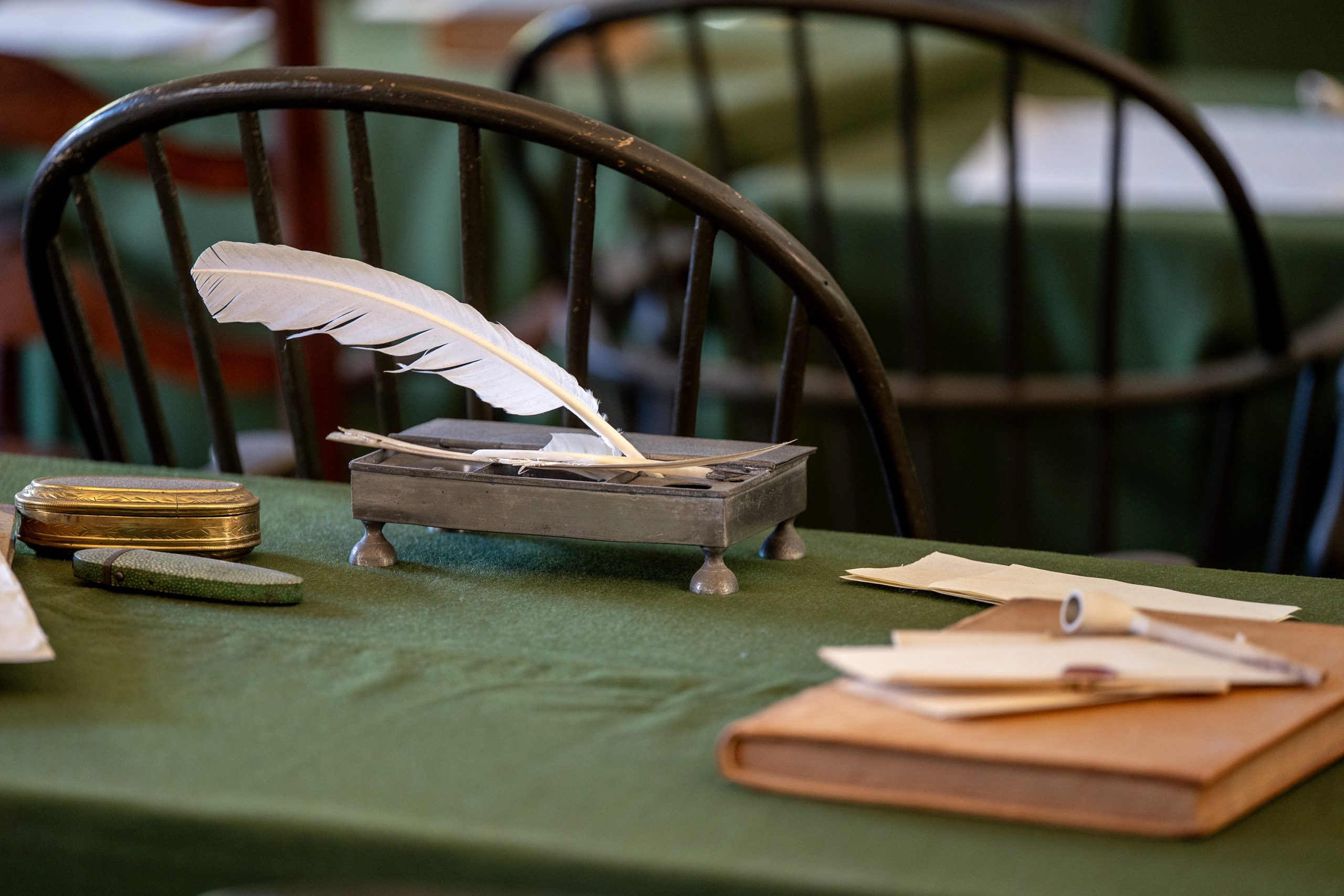
    Replica desks in the Assembly Room in Independence Hall (Pennsylvania State House) Monday, June 15, 2026.Tom Gralish / Staff Photographer

    Both drawn to the flame of American independence — the noblest cause of their age, and any other, they believe — the freedom fighters cut an odd coupling.

    Adams, short, plump, balding, cantankerous. Jefferson, tall, lean, formidable, a shock of copper hair, freckled in the Philly heat, his illusive eyes described as blue or hazel or light gray. The Southern planter and legislator who matriculated at the College of William & Mary is soft-spoken and painfully gracious and polite, charming, flirtatious. He abhors confrontation.

    Behold this true renaissance figure among the rebels.

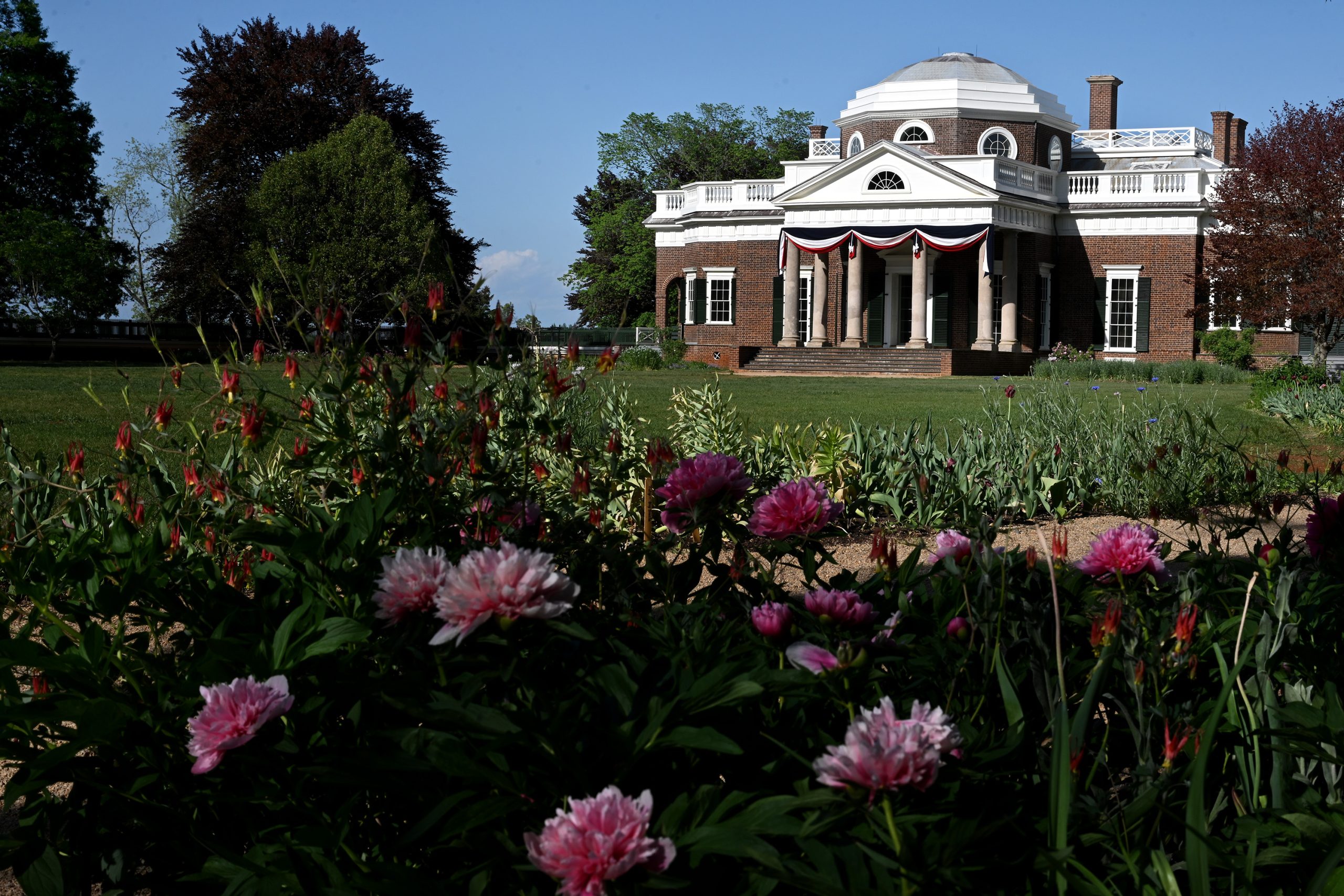
    Monticello, the primary residence and plantation of Thomas Jefferson in Charlottesville, Virginia, April 22, 2026.Tom Gralish / Staff Photographer

    A lover of food and wine and fine things, he studies art and history, philosophy and mathematics, science, botany, astronomy. He speaks four languages and can aptly read ancient Greek. He has been building his Palladian plantation house — situated on land more than five times bigger than the core of Philadelphia, the makeshift colonial capital city, and toiled by more than 100 chained souls — since the age of 14.

    Adams, obsessive even in his sightseeing, catalogs and compares the marvels of Philadelphia — its spacious thoroughfares, leafy green spaces, commanding skyline, including Christ Church’s heaven-kissing steeple, the tallest structure Washington had ever laid eyes on, its booming ports, gleaming institutions, exotic foods, and bottomless wine, porter, and punch.

    During his few hours free from the rigors of revolution, Jefferson shops.

    With Bob touting bulging bundles, the Squire strolls Philadelphia’s abundant artisanal shops, buying maps and books across all his tastes — so many volumes, he commissions his favorite Philly cabinetmaker to make a specialized bookcase to ship them home — and tools for Monticello. He buys fine fabrics for his wife, Martha, whom he is heartsick for. An elegant doll for his 4-year-old daughter, Patsy. He buys a straw hat for himself, and shoes and socks for Bob. At a market stall, he pays a shilling to gaze upon a merchant’s exotic monkey.

    Along with his compatriots, he sups at the City Tavern most nights, enjoying as many as three glasses of wine, but also favors the regal rusticity — and punch — of the Sign of the Conestoga Wagon Tavern on High Street.

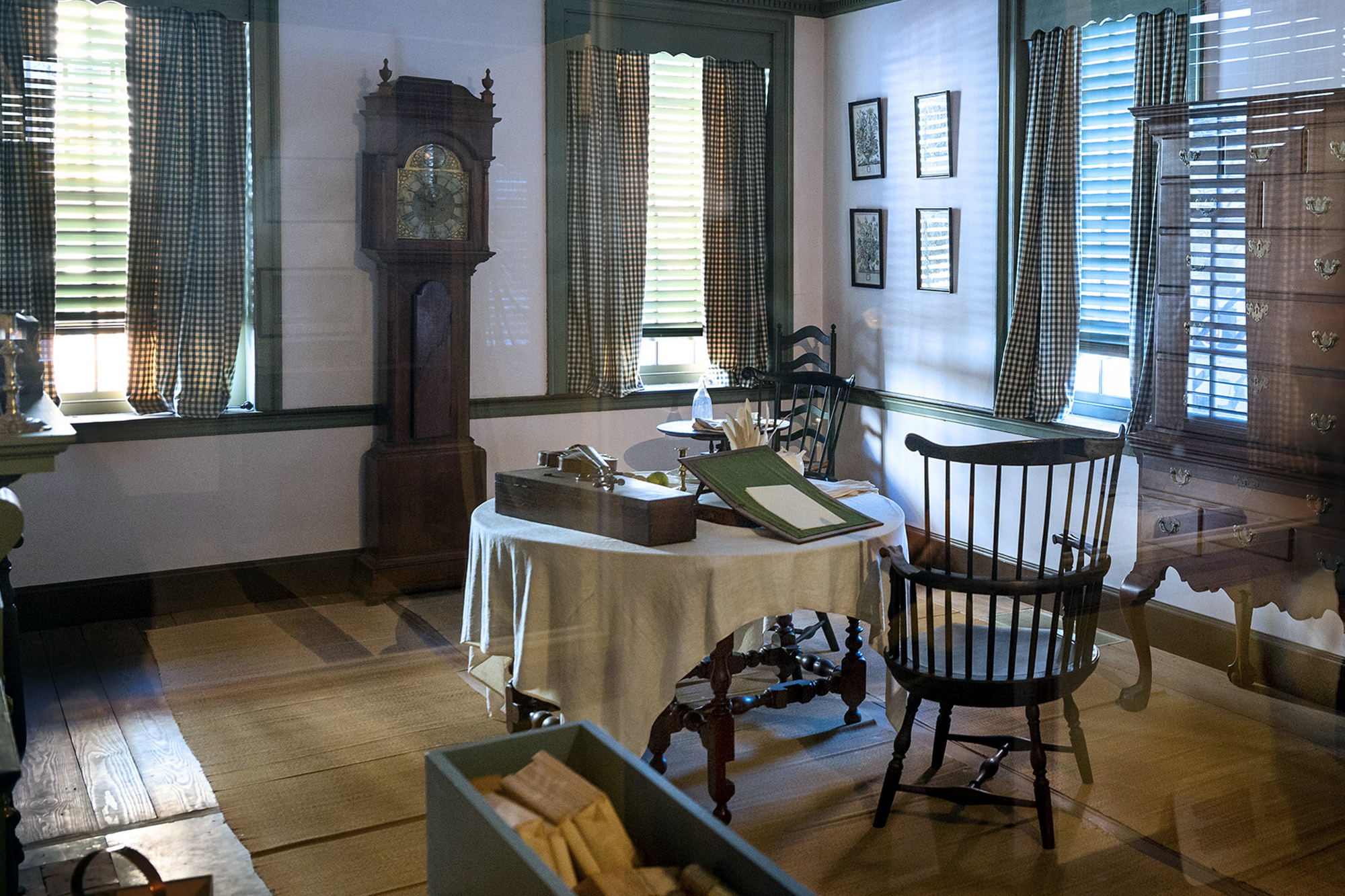
    A replica of the room where Thomas Jefferson wrote the Declaration of Independence, inside Declaration House (home of Jacob Graff, Jr.) Dec. 20, 2023.Tom Gralish / Staff Photographer

    Envision him, this sun-freckled Moses of American history, in flesh and bone, a living, breathing man, donning a sun hat, whose first memory is being held on a pillow by an enslaved worker, and who will within days pen the most revolutionary, if fatally flawed, manifesto ever put to parchment, walking among, but set apart from, the working classes of Philadelphia. The laboring, the indentured, and the enslaved — all those he would conversely see lifted to the altar of democracy or sold at the auction block.

    See this man. And understand America.

    An expression of the American mind

    He envisions his task to “place before mankind the common sense of the subject.” A justification for revolution, yes. A litany of proof that King George was a tyrant — and among other things, in an epic, and ultimately unsuccessful, act of blame-shifting, responsible for the entirety of the slave trade. But not a wholly original document. Rather, a soaring summation of the American revolutionary zeitgeist.

    “Neither aiming at originality of principle or sentiment, nor yet copied from any particular and precious writing, it was intended to be an expression of the American mind, and to give to that expression the proper tone and spirit called for by the occasion,” he will later explain.

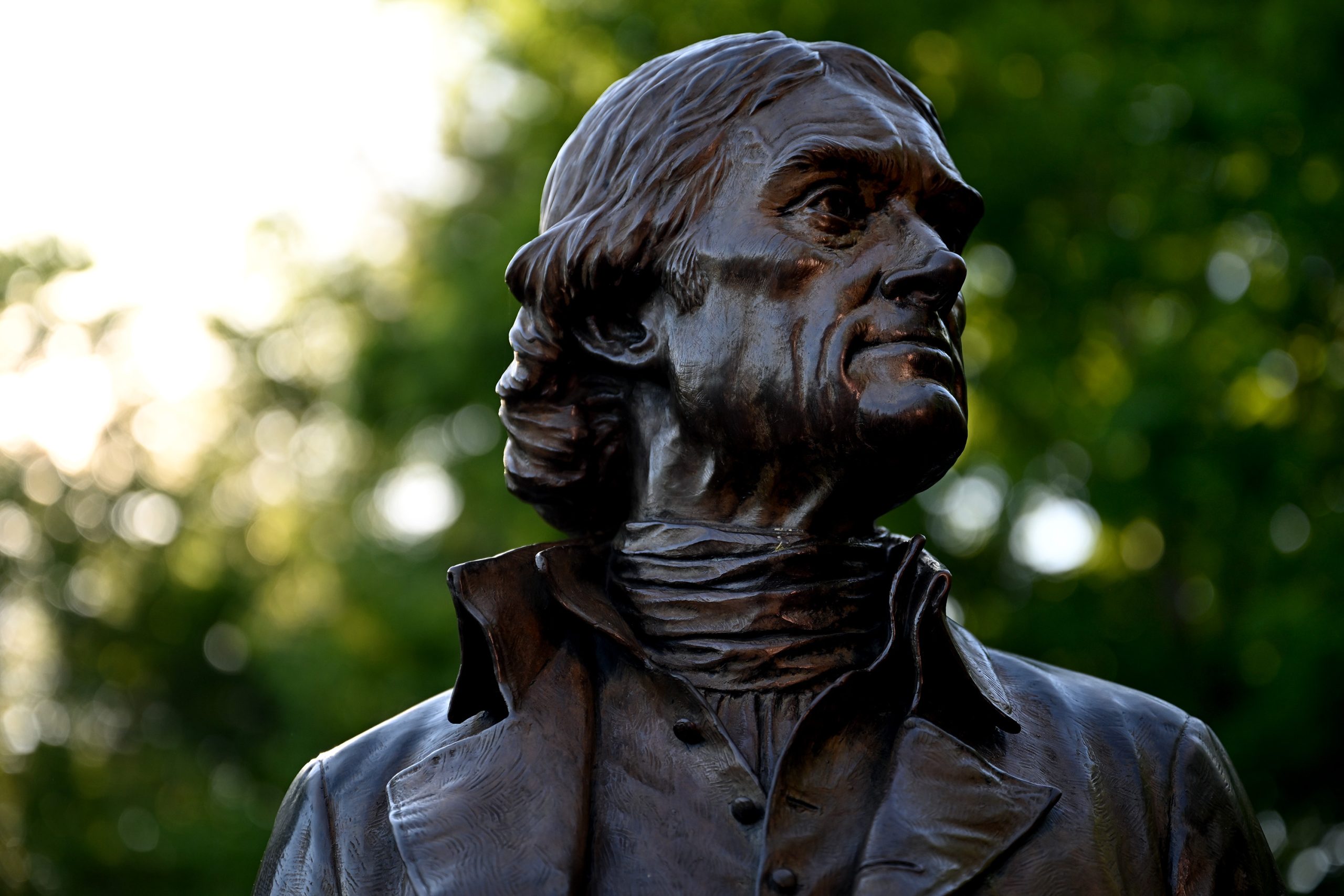
    Statue of Thomas Jefferson at Monticello, his primary residence and plantation of in Charlottesville, Virginia, April 22, 2026.Tom Gralish / Staff Photographer

    In his parlor, with the tall clock ticking and Bob tending to tea, Jefferson works fast, pulling from his own writing — including his recent draft for a new Virginia constitution — and also from a declaration of rights for Virginia, penned by pal George Mason. From the whirling stream of his intellect, he plucks at will the inspirations and ideals of the seminal works of enlightened thinkers like John Locke and David Hume, whose writings on natural rights and freedom (“Life, liberty, and property,” Locke wrote, before Jefferson amends it for the better) provide the bedrock for the revolution.

    Quickly, he begins to find his words. The rag paper fills.

    “We hold these truths to be self-evident,” writes the man from Monticello.

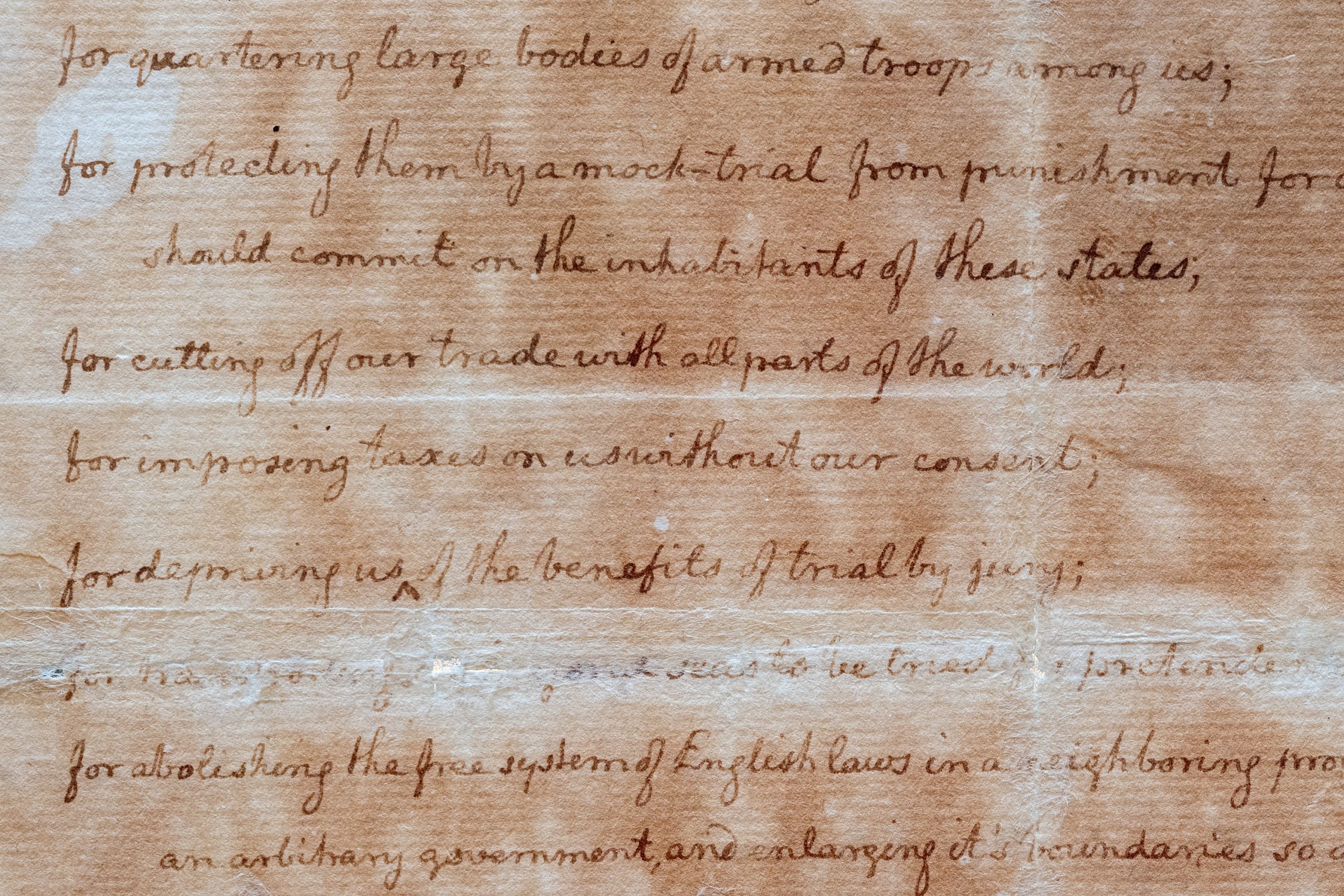
    A faded copy of a draft of the Declaration of Independence handwritten by Thomas Jefferson, known as the “Fair Copy,” on display at the American Philosophical Society Monday, June 15, 2026.Tom Gralish / Staff Photographer

    Dispatches from 1776, Part III will be published online on July Fourth. Read Part I here.

    This historical sketch is based on interviews with Tyler Putman, manager of gallery interpretation at the Museum of the American Revolution, and Michael Idriss, manager of the African American interpretive program at the Museum of the American Revolution, as well as J.M. Duffin, assistant archivist at Penn Libraries, historian and author Michelle Craig McDonald, and Stephen Nepa, history professor at Pennsylvania State University’s Abington campus. The author also based this series on historical newspaper accounts and research from “John Adams,” by David McCullough (Simon & Schuster, 2001), “Declaration: The Nine Tumultuous Weeks When America Became Independent, May 1-July 4, 1776,” by William Hogeland (Simon & Schuster, 2010), “American Scripture: Making of the Declaration of Independence,” by Pauline Maier (Random House, 1997), “The Revolutionary: Samuel Adams,” by Stacy Schiff (Little, Brown & Co., 2022), “Cocked and Boozy: An Intoxicating History of the American Revolution,” by Brooke Barbier (Chicago Review Press, 2026), “Thomas Jefferson: The Art of Power,” by Jon Meacham (Random House, 2012), “Rum Punch and Revolution: Taverngoing and Public Life in Eighteenth Century Philadelphia,” by Peter Thompson (University of Pennsylvania Press, 1999), “The Thomas Paine Reader” (Penguin Books, 1987), and “1776,” by David McCullough (Simon & Schuster, 2005).

  • Lotteries and other school equity reforms can have mixed results

    Lotteries and other school equity reforms can have mixed results

    As final grades post, lockers empty and end-of-year celebrations draw to a close, anxiety about the future looms. For many children in Philadelphia a lottery determined where they’ll head to school next year. The city is far from alone in adopting a practice that one online forum likened to “wading through some kind of toxic gas.” The goal, broadly speaking, is to ensure that any student anywhere can benefit from excellent schools despite entrenched housing segregation in many of America’s cities.

    Yet, despite the endorsement of the Nobel Prize committee, the question of whether these lotteries actually enhance equity is complicated.

    Consider the case of Washington D.C., where 76% of the public school system is Black and Hispanic, 43% of students are designated as “at risk” academically and 15% are English language learners. For more than a decade, the city has embraced what is called the “common lottery.” Families enter for a variety of reasons, including seeking a particular type of education—dual language immersion, or an arts-centric curriculum—or even looking for a school in close proximity to a caregiver’s workplace. For some students, the lottery has offered a ticket to a superior educational experience than the one at their neighborhood school. The history informing the adaptation of the common lottery, however, suggests that such a fix can both promote and evade equity, serving as a bandaid to old, not fully healed wounds.

    Over a half century ago, Washingtonians came together to rethink how place determined the quality of education. In 1967, local activist Julius Hobson successfully sued the superintendent of schools for discriminating against Black and poor public school children. Federal Judge J. Skelly Wright, who previously desegregated schools in New Orleans, ordered multiple remedies, including boundary revisions to foster racial and socioeconomic integration.

    To fulfill one of the court’s mandates, in February 1968, a group of 35 civic-minded residents from every section of the city formed a committee to redraw how the district set attendance boundaries. After several weeks of deliberation, the committee produced six maps and settled on two, one for junior high schools and one for high schools, to present to the board of education. On May 8, 1968, the nine-member board approved the changes, affecting approximately 9,000 of the District’s 146,000 students.

    Yet, the ink had barely dried on the new maps when the school board considered additional revisions to school assignments. Enrollment patterns explained some of the changes, such as long-awaited school construction to alleviate overcrowding. But other changes looked more like carving out loopholes, blurring the lines between families’ legitimate appeals and race and class biases.

    In July 1969, the school board laid out the list of reasons that might justify a student transferring from their assigned school to one outside of their assigned geographic boundary. They included “medical reasons,” “diplomatic requests” and “gross inconvenience to parents and/or family routine.”

    The board also unanimously approved shifting 21 students, 18 white and three Black, from Gordon Junior High, located in Georgetown, to Alice Deal Junior High in upper Northwest, a historically white and affluent area of the city. In 1970, Gordon Junior High was only 53% white, whereas Alice Deal was 60% white. School board member Albert Rosenfield proposed the change on behalf of his well-to-do, well-connected constituents. For Rosenfield, the city “must have a tax base,” and appeasing a few families, some with seats in Congress, could prevent their exit and help sustain the city’s coffers.

    Concerned white parents who believed the transfers “enhance[d] segregation” quickly sued the board, and the court agreed.

    Yet, the legal victory didn’t stop the school board from implementing quieter administrative measures which enabled parents to justify transferring their children to schools outside of their assigned boundaries to alleviate a purported burden. For the 1971-1972 school year, families submitted 700 appeals at the elementary school level and 1,639 for junior high and high school. The district approved 90% of transfer requests for elementary school students and over half of those coming from secondary students.

    And so, by the 1980s, even though the boundary changes were supposed to help equalize educational opportunities regardless of one’s address, a system of widespread exemptions had created had made that promise illusory for many families. For example, in the spring of 1983, a third of Alice Deal’s 987 students were from outside of the school’s geographic boundaries. Their families had successfully navigated the sysem, which now determined which students could get exemptions on a first come, first served basis. Parents could even claim that “curriculum offerings” necessitated a transfer. This approach to fairness spurred competition for entrance into some prestigious schools. In 1986, approximately 175 parents assembled overnight outside of district offices for a chance to claim a coveted spot in their school of choice.

    Over the next 40 years, families’ ability to navigate the public school system only grew more complicated: controversial school closures, expanding citywide (or magnet) school options and the emergence of charter schools all affected how students could pursue a public education. Recognizing the burden to families and school administrators, in 2014, D.C. Public Schools and most charter schools turned to a common lottery to streamline the application process. (That same year, the district also accepted recommendations for boundary revisions, the first since 1968.)

    The lottery was a well-intentioned step toward expanding educational opportunity—and it has worked for many families. For the 2026-2027 school year, 74% of the 20,987 families who tested their luck received good news: a chance to enroll at one of their selected schools. And in recent years, the district’s new Equitable Access option gives students who are “at-risk” academically a higher chance of success on lottery day.

    Of course, none of this matters for some families; indeed, according to the D.C. Policy Center, residents in the city’s Jackson-Reed High School feeder pattern were the least likely to use the lottery, opting instead to attend their in-boundary school assignment, or a private school. But for those who want, or need, the lottery, as the state superintendent remarks, it provides a chance to take advantage of “the strength of so many D.C. education programs and the meaningful learning experiences they create.”

    Made By History sponsors. FOR USE ON MADE BY HISTORY STORIES ONLY.Inquirer Staff

    Still, luck isn’t a guaranteed pathway to equity. The lottery made no matches for one quarter of this year’s applicants, who may or may not get off of waitlists.

    The good news is the district has witnessed the dividends of more systemic efforts to nurture students. In math, researchers recently crowned the nation’s capital first among 38 states for “academic recovery” following the Covid-19 pandemic; and the same goes for reading performance among 35 states. But the work continues. As the city prepares to search for new leadership over D.C. Public Schools, the district is still chasing pre-pandemic benchmarks, and despite evidence of progress, nationally, math (ranked 27th) and reading (ranked 45th) are two subjects ripe for growth.

    Philadelphia public schools, which also offers a lottery, is currently bracing for school closures and hundreds of teacher and staff cuts in response to a budget deficit. Lotteries can be useful additions to the equity landscape, but they can only do so much to reach the most vulnerable students.

    Erica Sterling is an assistant professor of history at the University of Virginia.

    Made by History takes readers beyond the headlines with articles written and edited by professional historians. Opinions expressed do not necessarily reflect the views of The Inquirer.
  • The United States had its first mutiny on this week in Philly history

    The United States had its first mutiny on this week in Philly history

    The Constitution was not written yet, and soldiers had not yet let down their guard, when the United States had its first mutiny.

    And, naturally, it all went down in Philadelphia.

    The weeklong saga started in late June 1783, when a group of unpaid Revolutionary War soldiers marched against the country’s primitive government, then called the Confederation Congress, and sent them fleeing from Philly to Princeton, N.J.

    There was a two-year delay between England’s surrender in 1781 and the end of peace negotiations that culminated with the signing of the Treaty of Paris in September 1783.

    And the troops who fought for independence and remained on duty wanted to get paid.

    Financial overseer Robert Morris thought it could take years to figure out the claims and payments for members of the Continental Army and state militias. So our new Congress, backed by Gen. George Washington, encouraged soldiers to go home and make money while the government got its act together.

    According to the history archives of the U.S. House of Representatives, members of the Pennsylvania militias in Philadelphia and Lancaster were among the least happy with the lack of back pay and their discharge dates.

    So on June 20, 1783, they mutinied.

    Fewer than 100 officers and militiamen from Lancaster marched toward the seat of the new government in Philadelphia, to meet up with the other disgruntled soldiers.

    The show of force, despite being nonviolent, combined with unfounded robbery rumors riled up the members of this crude Congress.

    New York’s Alexander Hamilton demanded that the leader of Pennsylvania’s state government, John Dickinson, call in members of the still-loyal state militia to put down the rebellion.

    Dickinson objected.

    So when the Lancaster troops arrived at the Philly barracks that night, Hamilton decided to try to talk to them, and urge them to return home.

    It did not go well.

    The troops took exception to Hamilton’s signature arrogance and condescending tone.

    The number of troops grew to about 400 by the next day, and they protested outside Independence Hall as their leaders met with Dickinson.

    Hamilton pushed for the Confederation Congress to meet for an emergency gathering.

    “Soldiers shook their fists and jeered when delegates peered out the windows,” according to House archives. “In the afternoon local tavern keepers, in an effort to calm and cheer the soldiers, gave away drinks — a tactic that unnerved Virginia Delegate James Madison inside.”

    Delegates, feeling unsafe and disgusted by the protest, announced on June 22 that the Congress would flee to Princeton.

    But when they arrived, the then-small town did not have enough beds for all of the delegates, who would return to Philadelphia four months later.

    Meanwhile, in Philadelphia, order was restored as mutiny leaders fled and remaining mutineers who stayed offered apologies for the attempted rebellion.

  • Parts of Fairmount Park were not only the site of America’s first paper mill, but also the country’s first company town

    Parts of Fairmount Park were not only the site of America’s first paper mill, but also the country’s first company town

    We take paper for granted now. But in the late 1600s, when Pennsylvania’s founder William Penn recruited German papermaker and preacher William Rittenhouse to manufacture the writing parchment in the New World, paper was a luxury.

    England’s King William III made it difficult for his subjects — at home and in the Americas — to have it. Like many monarchs of his day, he believed it was the Crown’s duty to record history.

    The English imported paper from other European countries. So, to make matters worse, colonists who managed to appeal to the king for paper were double and triple taxed. They got fed up and went about securing their own paper to document the goings on in the government, inform citizens, record history, and ultimately plan a revolution.

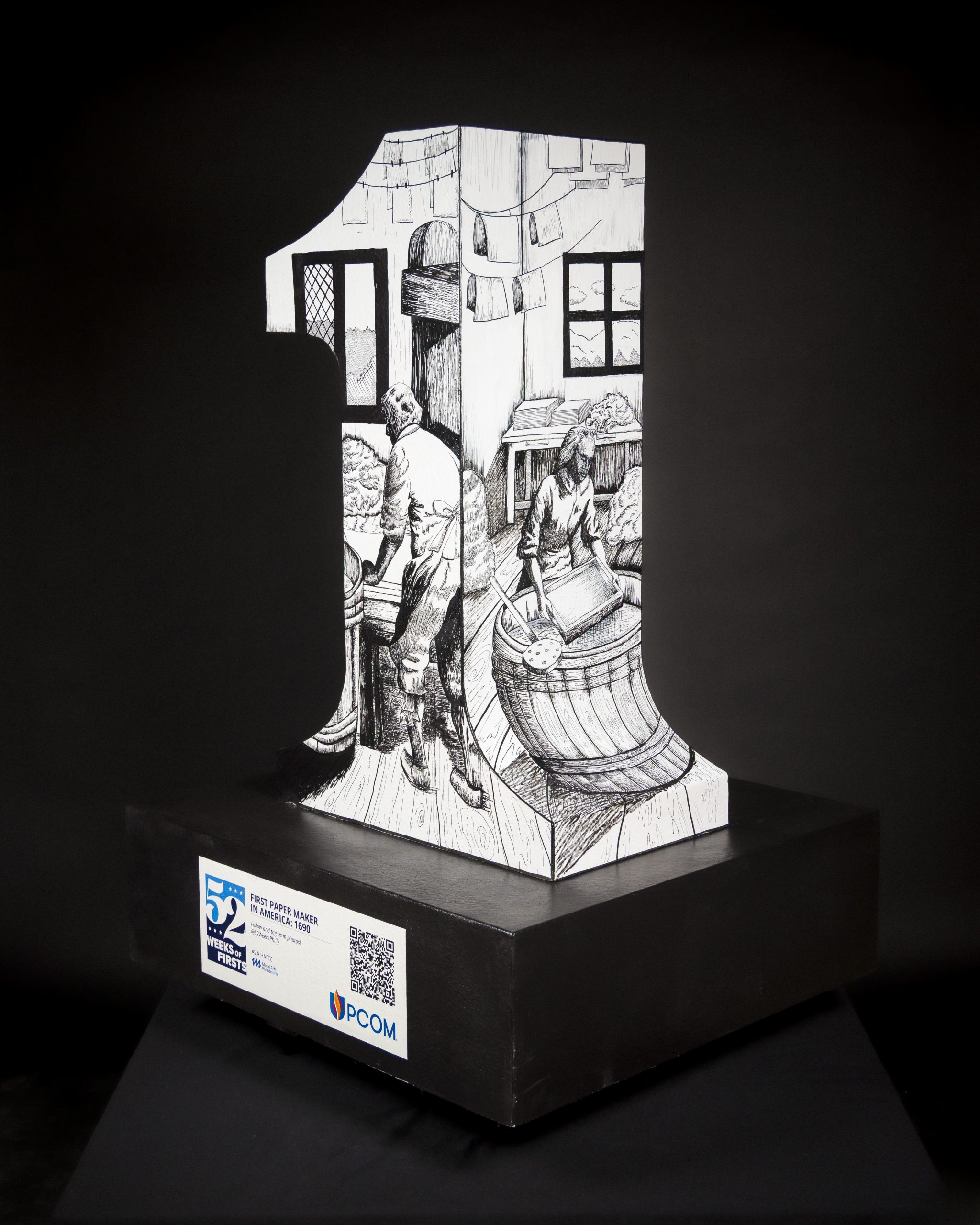
    Artist Ava Haitz’s No. 1 honors the country’s first paper mill, celebrating the invention and craftsmanship that made widespread written communication possible.Ava Haitz for Colibri Workshop

    In 1690, Rittenhouse partnered with Philadelphia’s first printer, William Bradford, to build America’s first paper mill, situated in northwest Philadelphia and powered by the Monoshone Creek, a tributary of the Schuylkill.

    The paper mill will be celebrated this Saturday at Historic RittenhouseTown, part of a series of weekly “Firstival” celebrations. Firstivals are the Philadelphia Historic District’s yearlong birthday nod to places and events with Philadelphia roots. The day parties are a hallmark of this year’s Semiquincentennial fetes.

    At the Rittenhouse mill, paper was made from linen rags fashioned from flax grown in Germantown, that were broken down and shaped into sheets. The mill grew quickly as Rittenhouse, America’s first Mennonite bishop, provided paper for Bibles and Quaker and Mennonite texts in German.

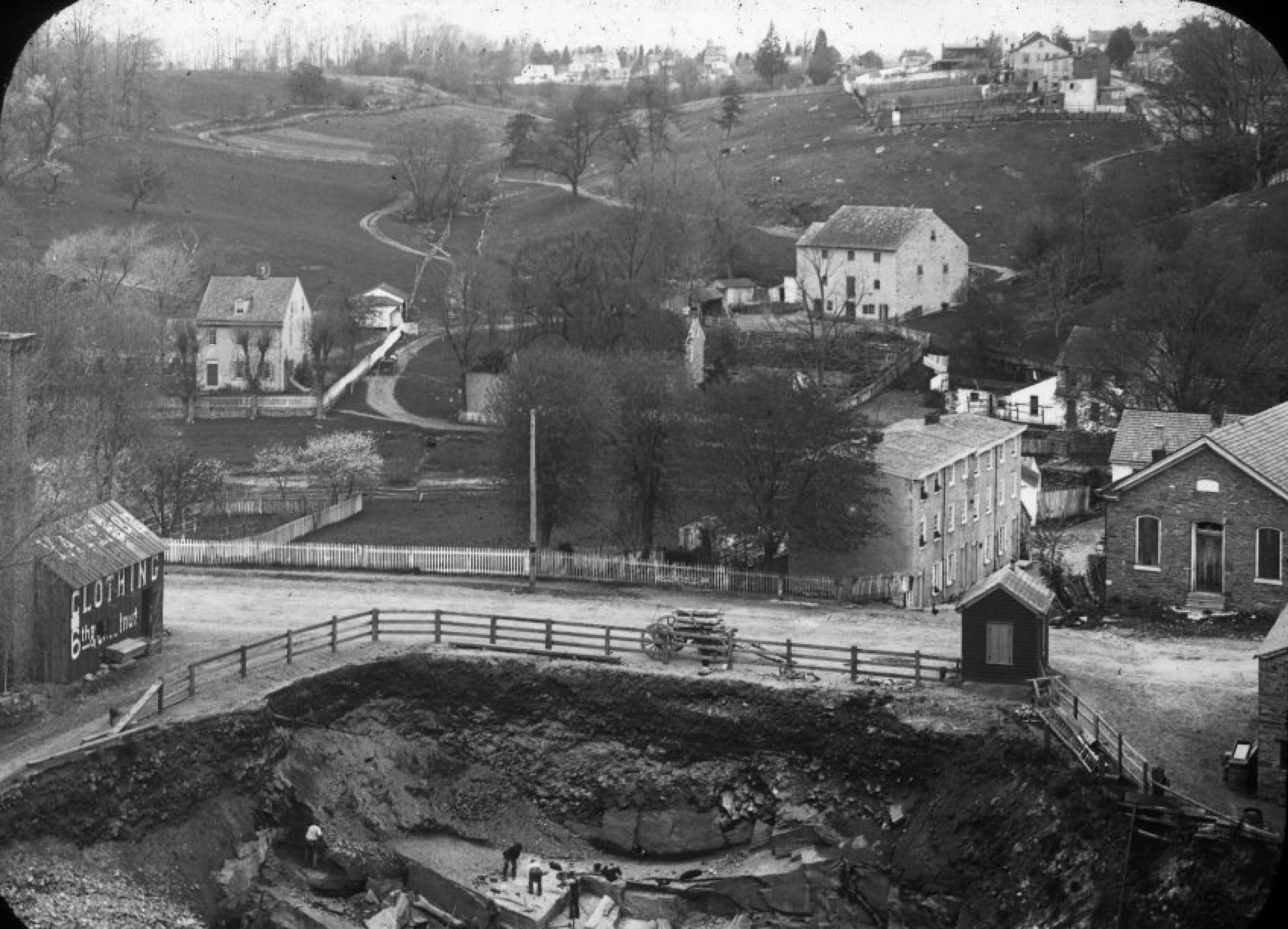
    An aerial view of RittenhouseTown circa 1840-1860. The site eventually grew to more than 200 acres.Historic Rittenhouse Town

    Rittenhouse’s first paper mill was destroyed by a flood, said Alexander Jones, preservation and education manager at Historic RittenhouseTown.

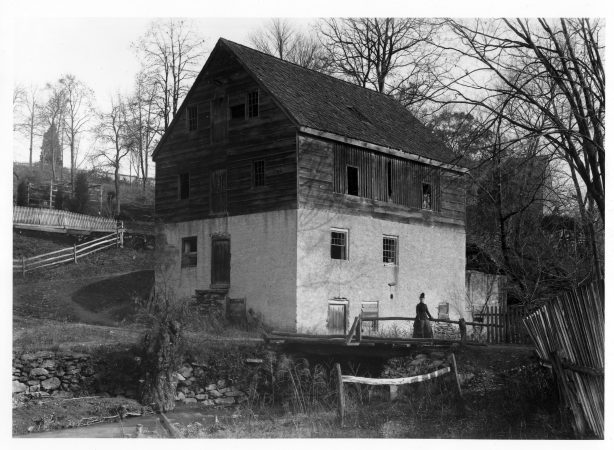
    Then “Rittenhouse rebuilds and he buys out his partner,” Jones said. “The paper mill becomes his sole enterprise. Instead of hiring workers, he recruits his family and it becomes a giant company town. There is a church, a blacksmith, stone houses, a bake house, and more than 40 buildings with five or six of them under what is now Lincoln Drive.”

    RittenhouseTown’s paper mill was the only source of paper in America for more than 40 years, Jones said. It would grow to more than 200 acres.

    David Rittenhouse — Rittenhouse’s great-grandson and the astrologer, clockmaker, and first director of the U.S. Mint after whom Rittenhouse Square is named — was born in his family’s RittenhouseTown homestead in 1732.

    The town thrived for more than a century.

    By the mid-1800s, the paper mill began to slow down as dyes from textile and carpet manufacturers and chemicals from blacksmithing started to pollute the Schuylkill. The filthy water made it nearly impossible to produce good quality paper at the mill.

    The Fairmount Park Commission began acquiring parts of RittenhouseTown through a series of purchases and donations from 1890 to 1917. The city demolished many of the town’s buildings, including a barn that, Jones said, was razed and rebuilt within a year.

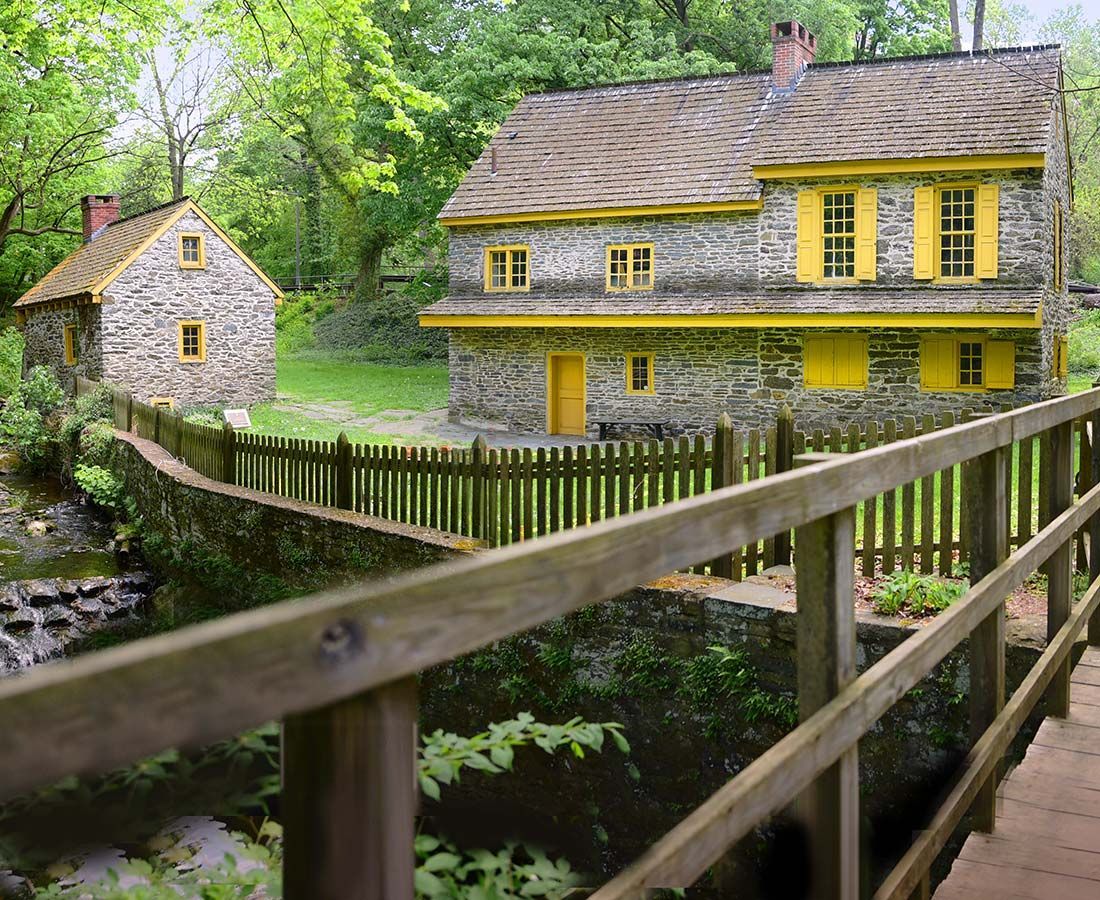
    RittenhouseTown’s homestead and bakehouse. The first permanent home for the Rittenhouse family and birthplace of David Rittenhouse, great-grandson of William Rittenhouse for whom Center City’s Rittenhouse Square is named.Al Cassidy for Historic Rittenhouse Town

    By that time, however, the Rittenhouse family had spread throughout the Philadelphia region from Center City to Blue Bell, Jones said.

    Today, RittenhouseTown spans 20 acres nestled in Fairmount Park right behind Lincoln Drive. Six of the original buildings remain, serving as a reminder that RittenhouseTown was the first building block of American industry.

    “The paper mill really got the ball rolling for Philadelphia,” Jones said. “And from that first came so many other American firsts in Philadelphia: the first Mennonite bishop, the first company town, and America’s first director of the U.S. Mint.”

    This week’s Firstival is Saturday, June 27, 11 a.m.-1 p.m., at Historic RittenhouseTown, 208 Lincoln Drive.

    The Inquirer is highlighting a “first” from the Philadelphia Historic District’s 52 Weeks of Firsts program each week. A “52 Weeks of Firsts” podcast, produced by All That’s Good Productions, drops every Tuesday.

  • The history of American Jews exposes the fundamental questions of citizenship

    The history of American Jews exposes the fundamental questions of citizenship

    The history of American Jews’ citizenship makes the president’s case to eliminate birthright citizenship, now awaiting a Supreme Court decision, no surprise—but this should offer little comfort.

    The central plotline of the story of Jews in the United States tends to revolve around citizenship: Jews arrived, gained citizenship, the end. Yet this story accounts for neither how citizenship has worked for Jews nor how it works in general. A far more accurate history of Jewish citizenship in the United States exposes the persistent political questions asked, answered, and unresolved when policymakers try to decide who is and isn’t “American.”

    For the past 250 years, American leaders have used citizenship law to draw and re-draw the lines of individual belonging through collective categories. From the beginning, Congress granted “any alien being a free white person” access to citizenship, writing into naturalization law in 1790 broad thresholds for membership. In 1868 the Fourteenth Amendment revolutionized citizenship by opening it to “all persons born or naturalized in the United States.” Yet Congress also legislated that for the purposes of naturalization, “all persons” only included “free white persons” and “aliens of African nativity…and African descent,” not Chinese people or “Asiatics.”

    Jews who immigrated from Europe tended to gain access to naturalization as “white” under citizenship law, but government officials found Jews a useful—and sometimes confounding—guide to help them apply the law, even when Jews were not directly involved.

    Take a 1909 naturalization appeal from four men, described in their rejected application as “Armenians by race.” The men were not Jewish, but Judge Henry Cabot Lowell, who presided over their appeal, nonetheless found himself contemplating Jewish citizenship. Harvard-educated and hailing from an elite Boston family, Lowell consulted scientific treatises to conclude that “Hebrews” and Armenians were both “Asiatic” in origin. Prevailing scientific racism of the day convinced him that neither met the threshold of whiteness. As he wrote in his decision, it was “hard to find loophole for admitting the Hebrews” to citizenship. But at least until Congress acted, he saw no reason to exclude Armenians if Jews could benefit from the loophole.

    Jewish leaders panicked when they witnessed high-level government officials slotting them into racialized categories other than “white.” They understood that the historical fact of citizenship would not necessarily protect Jews in years to come, especially as eugenicist ideas gained traction among policymakers designing new restrictive immigration laws. In the early 20th century, elite Jews lobbied politicians, filed reports, intervened in naturalization cases, and testified at congressional hearings to bolster Jews’ claims to citizenship. Their efforts met partial success. As passed in the 1920s, immigration quota laws dropped the classification of Jews as “Hebrews,” instead counting Jews among others of their same “national origin.” Still, the countries from which most Jews immigrated, such as Russia and Poland, now faced some of the harshest restrictions.

    In practice, the new quota laws reduced the number of Jews who could naturalize and raised suspicion about those who did. Foreign-born Americans from many different backgrounds experienced discrimination that legal status did not avert.

    But accusations of foreignness and dual loyalty clung to Jews in unique ways, as illustrated by a remarkable case from 1947. That year, a naturalized Jewish man sought to return to the United States after living in British-mandate Palestine for over a decade. Detained by U.S. border control agents, the Ukrainian-born man learned that his American passport had been revoked under a 1940 law that prohibited naturalized citizens from living abroad for over five years. Native-born citizens were not subject to the same law. The ACLU, American Jewish Committee, and American Jewish Congress seized on this fact to call the law unconstitutional and defend the Jewish man on his appeal. But for the Jewish organizations, the constitutional violation was a piece of a much larger threat to Jewish citizenship in the United States. When Congress authorized the 1940 statute, it did so under pressure from a State Department official who insisted that “these Zionists” regularly manipulated the protections of American citizenship for their own nationalist ends.

    The court rejected the Jewish man’s appeal, and in doing so diminished the distinctly Jewish dimension of the case by tying him to other naturalized Americans, such as Japanese-Americans, whose constitutional rights to equal protection could be overridden by national interests according to recent Supreme Court precedent.

    Citizenship debates routinely entangled Jews’ status with that of other groups because the categories of citizenship were neither self-evident nor self-executing. Only in motion, by scrutinizing groups, comparing them to one another, and gauging the changing winds of national interests, did government officials bend citizenship to their will.

    In a remarkable exchange on the Senate floor in the spring of 1964, two senators debated the exclusion of religion from proposed anti-discrimination legislation targeting federally-funded programs. Albert Gore, Sr., a Democrat from Tennessee, contended that Jews lacked shelter under the law’s categories of “race, color, or national origin” because Jews were a religion. Joseph Clark, a fellow Democrat from Pennsylvania, countered that those categories protected Jews just fine because many Jews lacked any faith, so whatever discrimination they faced must be race-based. Signed into law that summer as Title VI of the Civil Rights Act, the statute (unlike many others in the same law) did not include religion among its protected categories.

    For many decades, the question of Jews’ standing under Title VI seemed to be resolved in practice, as government officials and Jewish leaders agreed that its jurisdiction did not include Jews. But it was only a matter of time before the answer faded back into a question.

    Over the last two decades—and especially since Oct. 7, 2023—government officials and many Jewish leaders have argued that Jews should have standing in anti-discrimination laws on the basis of race, color, or national origin. Detractors argue that Jews—or certain expressions of Jewishness such as Zionism—do not fit squarely into those categories. The arguments matter because the categories of citizenship law are consequential, but their answers aren’t intrinsic to citizenship. Rather, citizenship remains a tool to ask questions about belonging; as political aims change so too will its meaning.

    Made By History sponsors. FOR USE ON MADE BY HISTORY STORIES ONLY.Inquirer Staff

    For American Jews, citizenship has not offered a singular point of arrival or a final answer to the puzzle of national belonging. This lesson from the history of American Jews may offer some reassurance that Trump’s bid to overturn birthright citizenship is just another stop on a zig-zagging journey. Whether the Supreme Court endorses the administration’s tendentious reading of the 14th Amendment or not, the twisted and entangled process of arguing over citizenship will continue.

    A less sanguine lesson from the same history should warn all American citizens that an attack against birthright citizenship is an attack against them. No one is naturally or natively a citizen, wherever they were born. Political leaders are constantly remaking citizenship—just look at how the categories used to define, question, or defend Jews have changed over time. The protections of citizenship are as mutable as they are unreliable.

    Faith in any fundamental meaning of citizenship not only misses the point but also carries profound risk. Even the most capacious understanding of citizenship will not resolve the question of human belonging, but the starkly narrow one on offer from the Trump administration today threatens our ability to keep asking the question.

    Lila Corwin Berman is a professor of history at NYU and author of Who Is American? Belonging and the Question of Jewish Citizenship.

    Made by History takes readers beyond the headlines with articles written and edited by professional historians. Opinions expressed do not necessarily reflect the views of The Inquirer.