Category: History

  • Will MLB’s outreach to Black fans with the HBCU Swingman Classic at Citizen’s Bank Park resonate?

    Will MLB’s outreach to Black fans with the HBCU Swingman Classic at Citizen’s Bank Park resonate?

    In honor of the nation’s 250th anniversary, Major League Baseball (MLB) is bringing the Mid-Summer Classic to the place where the Declaration of Independence was signed. Among the kick-off events is the HBCU Swingman Classic on July 10, an event showcasing the past and present of historically Black college and university (HBCU) baseball programs.

    The event, intended to increase interest in baseball among Black Americans, reflects MLB’s complicated relationship with Black fans. Across the 20th century, team owners and executives have tried periodically to draw Black fans to the ballpark. Yet, to maintain the game’s appeal to its traditional fanbase, much of it white, owners simultaneously created environments that did not fully welcome Black fans. This history shows that if MLB truly wants to draw more Black Americans to the game, it has to alter the culture of the game and do more than just stage one-off events like the Swingman Classic.

    Until the 1940s, some Major League teams racially segregated their ballparks. As early as 1920, Black fans could sit only in the outfield seats at Sportsman’s Park in St. Louis, home to the National League’s Cardinals and the American League’s Browns. Following decades of advocacy by St. Louis’s Black community, the policy changed in 1944. Yet even after it ended, Black fans who still felt the sting of being segregated did not go to Sportsman’s Park in large numbers.

    Even at ballparks where Black fans had not been formally segregated, MLB executives marginalized them by making it clear they did not believe Black fans deserved the same respect from players as white fans. For example, one Black fan recalled that as a child in the 1930s, “I was called a ‘black bastard’ by St. Louis Cardinal left-hander Clyde Shoun,” and in a demeaning move harking back to a common practice of slave owners, his “head was rubbed for good luck by St. Louis Cardinal right-hander Fiddler Bill McGee as he walked out of the clubhouse past the bleachers.”

    Racism permeated the sport, inside and outside the ballpark. In a radio interview in 1938, despite not actually working in law enforcement, Yankees outfielder Jake Powell (who ended his career with the Phillies in 1945) claimed that he stayed in shape in the offseason by claiming to be a police officer who would beat Black people “over the head with my blackjack.” His comments provoked outrage and although Powell was suspended and forced to apologize, he remained with the Yankees through the 1940 season.

    Yankees General Manager Ed Barrow told The Philadelphia Tribune, “No owner of a business permits his employees to be pert or insulting to the customers patronizing the business,” indicating that the team was happy to take money from Black fans but would prefer their players not share racist views on the air. Evidently, the team concluded that they should angle for revenue from Black fans—but keep Powell on the roster all the same.

    As Jackie Robinson tore up the minor leagues in 1946, several MLB owners had another concern: too many Black fans if he were moved up to the majors. As they wrote in what was intended to be an internal document, they feared that “the preponderance of Negro attendance in parks such as the Yankee Stadium, the Polo Grounds, and Comiskey Park could conceivably threaten the value of the major league franchises owned by these clubs.”

    The next year, when Robinson broke MLB’s color barrier with the Brooklyn Dodgers, Black fans regularly made up as much as one-third of the crowd at his games. But as scholar Gerald Early recognized, it was “not the desire of any major-league baseball owner to have blacks make up the kind of attendance percentage they did when Robinson debuted in 1947. It would, indeed, be a cause of unease, if not downright unrest.”

    Owners couldn’t stop Jackie Robinson and the waves of talented players of color who followed him to the majors. Instead, they made it more difficult for Black fans to attend games by building stadiums farther away from Black communities. Scholars Alan Sager and Arthur Culbert determined that the demographics of the neighborhood around a team’s ballpark was the deciding factor for whether or not a team moved in the decades after Robinson’s debut. Teams that moved between the 1950s and 1970s left neighborhoods that were on average 44.1 percent Black. By contrast, teams that did not move were in neighborhoods that were 17.6 percent Black. Almost all teams that relocated in this era moved to far whiter neighborhoods, including the Phillies who moved from Connie Mack Stadium in North Philadelphia to Veterans Stadium in South Philly after the 1970 season.

    By contrast, in Houston, owners of a yet-to-be-named franchise secured vital Black voter support for the bonds needed to construct what would eventually be called the Astrodome. They promised that unlike many other public accommodations in Houston in 1961, it would be desegregated. But MLB owners continued to display bias against Black fans. Roy Hofheinz, who led the franchise and was the driving force behind the Astrodome, told a reporter, “We did a lot of research before choosing the colors [of the luxury suites]. We made sure the color complemented the complexion and clothing of women. It took us two weeks to get the right color of blue. Many blues would give ladies a pasty-looking complexion.” His concern reveals that he did not expect Black women to sit in the most exclusive part of the dome.

    When the Baltimore Orioles opened Oriole Park at Camden Yards in Baltimore’s downtown in 1992, it seemed to signal a shift in ballparks’ relationship to urban spaces and their Black populations. Yet in other ways, the team continued MLB’s pattern of marginalizing potential Black fans. Maryland state representative Howard P. Rawlings noted that the Orioles had “neglected the city’s black majority” in the park’s opening festivities and argued “it’s a reflection of [the team’s] lack of awareness that” the city “is more than 60 percent African-American.” Ballparks evolved, but many MLB executives’ attitudes about potential Black baseball fans did not.
    Made By History sponsors. FOR USE ON MADE BY HISTORY STORIES ONLY.Inquirer Staff

    Even this year, new barriers to Black fan attendance were added, such as when the Texas Rangers installed the “One Riot, One Ranger” statue at their ballpark. The statue depicts a member of the original Texas Rangers, the state law enforcement organization the baseball team is named after, that was modeled on E. J. Banks, a ranger best known for being dispatched by the state’s governor to keep Black students from enrolling in an all-white public school in 1956. Banks stood by and watched as white segregationists threatened violence against any Black child who tried to enter the school.

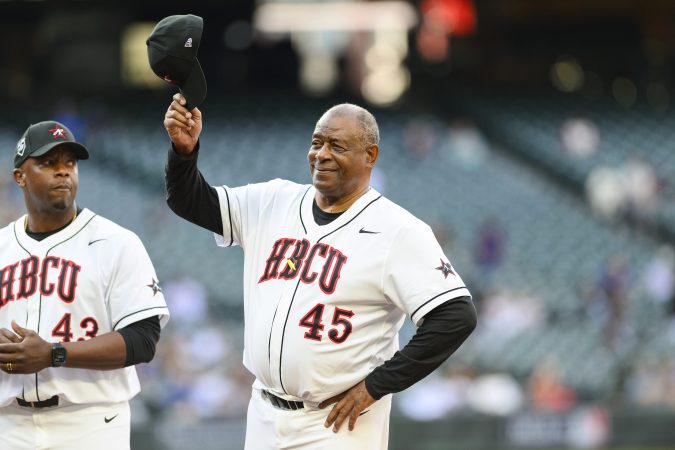
    Yet MLB is also making efforts to attract Black fans with events like the HBCU Swingman Classic at Citizens Bank Park. The Swingman Classic, named in honor of Black Hall of Famer Ken Griffey, Jr., is open to 50 current players from 17 historically Black Division I colleges and universities. The players will be divided into two teams, each coached by a Black former MLB player including, Phillies legend Jimmy Rollins.

    Unlike the Home Run Derby and the All-Star Game being played a few days later at Citizens Bank, tickets for the Swingman Classic are comparatively affordable and cheaper than some Phillies games, an admirable and encouraging choice. History cautions, however, that MLB is usually only interested in extracting revenue from Black fans when doing so does not threaten the game’s largely white fan base. While the Swingman Classic will likely draw a higher percentage of Black fans to Citizens Bank Park than an average Phillies game, only time will tell whether it helps to shift MLB culture towards greater inclusion of Black fans.

    Seth S. Tannenbaum is a Philadelphia native, historian, and associate professor of sport studies at Manhattanville University. His book, Bleacher Seats and Luxury Suites: Democracy and Division at the Twentieth-Century Ballpark was published this spring by the University of Illinois Press. He will be speaking at the Roxborough Branch of the Free Library of Philadelphia on Friday, July 17 at 3:30pm and at the Joseph E. Coleman Branch on Saturday, July 18 at noon.

    Made by History takes readers beyond the headlines with articles written and edited by professional historians. Opinions expressed do not necessarily reflect the views of The Inquirer.
  • Bingo was legalized in Pennsylvania on this week in Philly history

    Bingo was legalized in Pennsylvania on this week in Philly history

    The stampers were runnin’ wild, and state officials wanted their piece.

    So it was time to crack down on the ping-pong-ball pullers.

    On July 10, 1981, Republican Pennsylvania Gov. Dick Thornburgh signed the Bingo Law.

    The bill, which took effect on Nov. 9 of that year, would ensure the popular game remained a tool of charitable groups and remained small-stakes operations. This new law limited prize money to $250 (about $920 today) per game, $2,000 (about $7,300 today) for a so-called jackpot game, and $4,000 (about $14,700 today) in total for any one day.

    The bill also specified that only nonprofits that had been existence for at least two years could host the games, and that they could do so no more than twice a week.

    Traditionally, bingo games were put on by charitable associations — think church groups and senior centers — that were legitimate nonprofits. Still, it was a prohibited form of gambling, and law enforcement across the state chose to ignore this fact and instead allowed the parlor game to thrive.

    The bill, Thornburgh told The Inquirer in 1981, would “end this hypocrisy.”

    He added, however, that he was not “convinced that this is the absolute, ideal bill,” and that his administration would continue working with the General Assembly “to ensure that some of the loopholes that have been alleged to exist are addressed.”

    The bill-pushers were pumped. Legalizing bingo, they told anyone who would listen, would protect charitable foundations, civic groups, and legitimate nonprofits from what an Inquirer reporter called “unscrupulous bingo entrepreneurs.” It would, theoretically, keep those groups from having to pay taxes on the raised money, and keep it out of organized crime’s reach.

    But the bingo bill had noisy detractors, like future Philly Mayor Ed Rendell, then the district attorney, who astutely pointed out that the bill would allow anyone to organize a nonprofit and run bingo games. The bill did not provide much enforcement infrastructure, either.

    Today, bingo licenses run $100 for a year, or $15 for a three-day stint.

    The state only takes check or money order.

  • Philadelphia’s politics were reshaped by the effort to win the 1936 Democratic Convention

    Philadelphia’s politics were reshaped by the effort to win the 1936 Democratic Convention

    In late April, Ken Martin, chair of the Democratic National Committee (DNC), visited Philadelphia to assess the possibility of the city hosting the 2028 Democratic National Convention. He toured Xfinity Mobile Arena and met with Mayor Cherelle L. Parker and business leaders, who rolled out a “blue carpet” aimed at charming him.

    It seemed natural to see business leaders working with local politicians to try to convince the DNC to choose Philadelphia, as well as helping to raise the funds required for the city to be eligible to host the convention. Democrats dominate the city’s politics, and its elected officials tend to share local business executives’ visions for economic development.

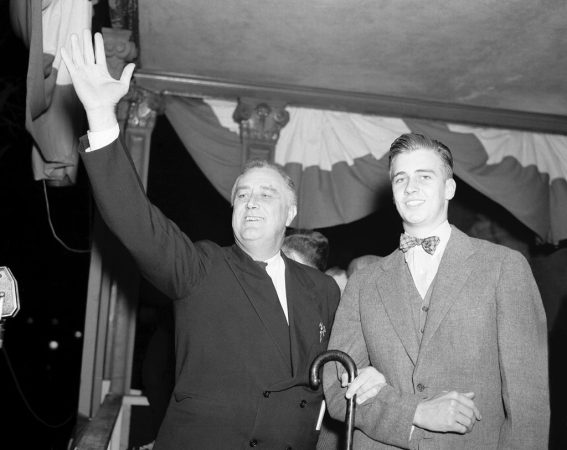
    But these groups weren’t always aligned. In 1936, when Philadelphia made a similar push to host the Democratic Convention, the effort aroused skepticism in a city that had been a Republican stronghold for decades. Much of the skepticism was centered in the business community — where many vehemently opposed the policies of President Franklin D. Roosevelt.

    It took a push by coalition builders like Albert Greenfield, a powerful business leader, to win over skeptics. Greenfield sold his fellow businessmen by framing the pursuit not as something partisan or political, but as a venture in civic boosterism. This argument proved compelling, and business support helped land the convention for Philadelphia. Today, Greenfield’s efforts provide a model for how to bring diverse interests together to boost a city, even in times of polarization.

    Before the 1930s, Philadelphia was firmly a Republican city. In this era, the national party’s platform was dominated by pro-business politics, aligned around policies aimed at enhancing economic growth and competition.

    A thoroughly corrupt political machine led by William Vare dictated the city’s politics. Each ward had Republican committee people who purchased individual votes at a going rate of one dollar. Loyal to the Vare machine, they also ensured voters headed to the polls on Election Day. In exchange, many of these committee people were rewarded with spots on the city payroll.

    The flow of money linked voters and committee people alike to Vare and the GOP. The machine’s dominance meant that the Republicans won most local elections, and the city gave its votes to their party in federal and state contests, including in every presidential election dating back to 1856. That even included in 1932 when Roosevelt was first elected by a large margin nationally.

    The Democratic Party — which, in other cities, drew power from local machines — remained weak and made little headway because Democrats, too, relied upon patronage favors from the dominant Republicans. That made them hesitant to rock the boat or wage an assault on the Vare machine and the status quo.

    At the beginning of Roosevelt’s first term, however, the city’s politics began to shift thanks to the new president and his New Deal. Struggling Philadelphians started to feel the tangible effects of New Deal policies at precisely the same moment that changes began to occur in both parties’ leadership locally. The result was a restoration of genuine two-party competition.

    The same Depression-era pressures loosening working-class loyalty to the Republican machine also began to pull Greenfield — who had once been a staunch Republican, but had soured on Herbert Hoover — toward the Democratic Party. The businessman benefited from several million dollars in funding from the Reconstruction Finance Corporation, the governmental lender of last resort, to prop up his business enterprises. Experiencing the benefits from New Deal policies firsthand, Greenfield started to express cautious support of Roosevelt.

    From his position as chairman of the Philadelphia Chamber of Commerce Convention and Tourist Committee, Greenfield also launched an effort to recruit the Democratic Convention to Philadelphia.

    His colleagues in the Chamber of Commerce shared Greenfield’s vision of landing a party convention in 1936 — but they didn’t care which party. Greenfield himself, however, remained focused on the Democrats in part because of his friendship with the liberal newspaper publisher J. David Stern.

    In December 1935, he began soliciting donations from the city’s business leaders with the goal of raising $150,000 (more than $3.6 million in 2026 dollars) to help lure the Democrats. He framed the convention not only as an opportunity to increase business activity, but also as a means of enhancing the city’s national reputation.

    Greenfield appealed to a wide range of constituencies, at times striking an unrelenting tone in his correspondence with business leaders. In one letter, Greenfield wrote that members of the Chamber, “feel that each individual enterprise has a moral obligation and responsibility with respect to the financial requisites for securing the convention.”

    Made By History sponsors. FOR USE ON MADE BY HISTORY STORIES ONLY.Inquirer Staff

    Greenfield’s efforts quickly bore fruit. Ledgers show contributions from both businesses and individual donors in sectors ranging from dentistry to distilling and hospitality. He also sold his fellow businessmen on their contributions being a non-partisan investment that would be “returned manyfold” to those who donated. This framing made it easier for many of his still staunchly Republican peers to support the bid.

    In January 1936, after the Chamber formally invited the Democratic National Committee to hold its convention in Philadelphia, news headlines reflected the importance of the incentive package organized by Greenfield. When Philadelphia won the bid — with a financial package that ended up totaling $200,000 — The New York Times characterized the proceedings as an “auction and now a poker game.” The money Greenfield raised ultimately compelled national Democrats to shift their preference from Chicago to Philadelphia as their host city.

    Greenfield soon became the chair of the city’s convention planning committee. In that role, he assembled a cohort of other prominent business and financial figures to orchestrate the programming surrounding the convention. He promised them pomp and circumstance — which he delivered.

    When the convention finally arrived in Philadelphia in June, flags bearing the names of U.S. states and festive decorations lined Broad Street; ceremonial stamps depicted a triumphant, sun-illuminated city; press photographers documented a ceremony in which city officials registered a donkey that was part of the New York delegation to vote. The city even suspended its blue laws to allow Sunday drinking.

    In bringing the convention to Philadelphia, Greenfield constructed his own alliance that worked to replace the system long sustained by Vare and the Republican machine. While he did not offer jobs and cash to individuals in exchange for loyalty like Vare did, he created a mechanism by which the success of the convention became materially valuable to the city’s business establishment.

    If members of the city’s business community sought to access the economic benefits of this national political event, they had to do so through Greenfield, further aligning Philadelphia’s commercial interests with an individual who wanted the convention to succeed not only financially but politically as well.

    What may have begun as tentative, pragmatic support for hosting the convention evolved into a more explicit embrace of the Democratic Party, with many businesses ultimately associating themselves with Democratic messaging. One newspaper advertisement praised the efforts of Roosevelt as a force behind Philadelphia’s economic revitalization. That message received endorsements from more than a dozen small businesses, whose names were featured alongside the message of support for the president.

    At the close of the convention, Greenfield told delegates that their enthusiasm might one day lead historians to view the city as a Democratic stronghold — a prediction that ultimately proved correct. By constructing a new network of support within Philadelphia’s business community, Greenfield helped rally backing for a convention that proved to be far more than an economic boost or mere “convention fireworks.” Instead, the gathering would serve as an engine for a realignment that would hold the city for the Democratic Party through the next two decades.

    The day after the 1936 election, the city of Philadelphia awoke to stunning results. Roosevelt had carried 43 of the city’s 50 wards and the city that the Philadelphia Bulletin had confidently described as unlikely to depart from “its long tradition” as a Republican stronghold had broken sharply with it. In 1940, when the city again explored hosting either the Republican or Democratic convention, the same committee which had led fundraising in 1936 initiated both efforts. Reflecting the changes in Philadelphia politics, however, the fundraising effort to attract the Democratic convention was far more successful than efforts to court its GOP counterpart. The business community in a city that had voted reliably Republican just four years earlier now raised three and half times as much money for potentially hosting the Democratic convention as the Republican one.

    As business leaders in Philadelphia work to bring the convention back to the city, they are drawing from Greenfield’s playbook 90 years ago that brought together a new alliance of business leaders in support of a convention that proved to be a political inflection point.

    Ethan Young is a rising senior at the University of Pennsylvania studying history and political science.

    Made by History takes readers beyond the headlines with articles written and edited by professional historians. Opinions expressed do not necessarily reflect the views of The Inquirer.
  • The real reason the colonists declared independence

    The real reason the colonists declared independence

    This month marks the 250th anniversary of the Declaration of Independence, an anniversary well worth celebrating. It is not, however, the anniversary of the start of the American Revolution. That began on April 19, 1775, with the battles of Lexington and Concord Bridge. It took over a year of fighting to convince colonists to accept that the time for compromise, for reconciliation, for any kind of reversion to the previous state of existence — for half-measures — was gone and the only path forward was independence.

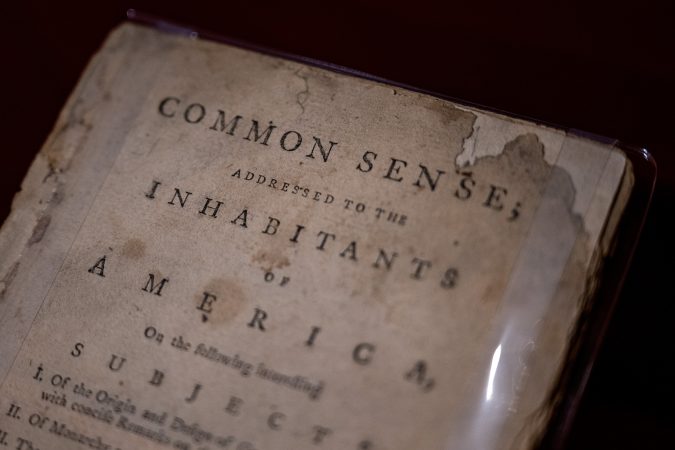
    That’s where Thomas Paine and Common Sense played a role. Since his arrival in Philadelphia in 1774, Paine had watched American politicians try to reason with England, hoping to reshape the relationship with George III and with Parliament, rather than to sever it. It did not work. “Why is it that we hesitate?,” Paine asked his readers. “From Britain we can expect nothing but ruin.”

    Paine wrote Common Sense at the end of 1775 — between when the Revolution began and when the colonists declared independence — and he wrote specifically to convince the colonists to break their ties with England. “Nothing can settle our affairs so expeditiously,” he told his readers, “as an open and determined declaration for independence.”

    In the winter of 1775-1776, a growing number of colonists were ready to meet the British Army on the battlefield. The colonists and the British government had been at odds with each other for a decade, fighting over taxes and over jurisdiction. The government in London, though, seemed only to be pushing things further to the brink, especially when they began stationing soldiers in Boston.

    Still, and much to Paine’s chagrin, through the rest of 1775 most colonists thought that declaring independence was a step too far. Three months after the fighting began, when the Continental Congress set out to explain the “causes and necessity of taking up arms,” they tried to assure “our friends and fellow-subjects” in the British Empire that “we mean not to dissolve that union which has so long and so happily subsisted between us, and which we sincerely wish to see restored … We have not raised armies with ambitious designs of separating from Great-Britain, and establishing independent states.”

    Five months later, when Paine wrote Common Sense, he still worried that “the sentiments contained in the following pages, are not yet sufficiently fashionable to procure them general favor.” And so, Paine made a case not just outlining England’s crimes, but also explaining why they had rendered any sort of half-measure or compromise impossible.

    We tend to associate the lead-up to the American Revolution with the colonists’ complaints about British taxes and duties, which certainly led to disputes about jurisdiction and the relative authority of the crown and the colonial governments. We also remember the catch-phrase of the era, “no taxation without representation.

    Those debates and those issues, though, were not part of Common Sense. Paine focused on what, for him, was Britain’s unforgivable crime: setting the British Army against the colony’s own citizens. “The independancy of America,” Paine wrote, “should have been considered, as dating its æra from, and published by, the first musket that was fired against her.”

    This was a point that Paine returned to again and again.

    “No man was a warmer wisher for reconciliation than myself before the fatal nineteenth of April 1775.” But once he learned that British troops had attacked the people of Lexington and Concord, he knew that “a new era for politics is struck; a new method of thinking hath arisen. All plans, proposals, & c. prior to the nineteenth of April … are like the almanacks of the last year; which, though proper then, are … useless now.” As for King George II, “I rejected the hardened, sullen tempered Pharaoh of England for ever; and disdain the wretch, that with the pretended title of father of his people can unfeelingly hear of their slaughter, and composedly sleep with their blood upon his soul.”

    Made By History sponsors. FOR USE ON MADE BY HISTORY STORIES ONLY.Inquirer Staff

    Paine’s message was clear: setting troops against the people demanded resistance. And this message was the key to getting the colonies to unite and declare independence. The disputes about taxes and jurisdiction went back to 1765. The colonists’ leaders had fought British policies on every issue, without ever wanting to stop being a part of the British Empire. But now that the British had sent their own army against the colony’s British citizens, Paine’s calls for independence found an eager audience among American readers.

    When Paine wrote of moderates calling for reconciliation with England, he urged them to think closely about the violence which the British Army had inflicted on the colonists, and if that level of violence had made reconciling impossible. “Tell me,” he wrote, “whether you can hereafter love, honour, and faithfully serve the power that hath carried fire and sword into your land?”

    In January 1776, his answer was no. In July 1776, that became the Continental Congress’s answer, as well — colonists from New Hampshire to Georgia were united enough in their horror at the British army’s violence that they declared their independence not as 13 colonies, but as 13 united states.

    This concern about state-sanctioned violence resonates again today. Paine’s reference to British soldiers as “Highwaymen and Housebreakers” brings up images of agents from U.S. Immigration and Customs Enforcement barging into homes without warrants and dragging out their terrified inhabitants.

    In 2026, there is no foreign power from which we can declare independence, but as state violence persists, so too does the legacy of resistance by colonists who heeded Paine’s call to reject Britain’s “long and violent abuse of power.”

    The “Road to 250” series is an initiative of Historians for 2026, a group of early American academics, public historians, archivists, and educators devoted to shaping an accurate, inclusive, and just public memory of the American Founding for the 250th anniversary.

    Noah Shusterman is associate professor of history at the Chinese University of Hong Kong. He is the author most recently of Armed Citizens: The Road from Ancient Rome to the Second Amendment.

    Made by History takes readers beyond the headlines with articles written and edited by professional historians. Opinions expressed do not necessarily reflect the views of The Inquirer.
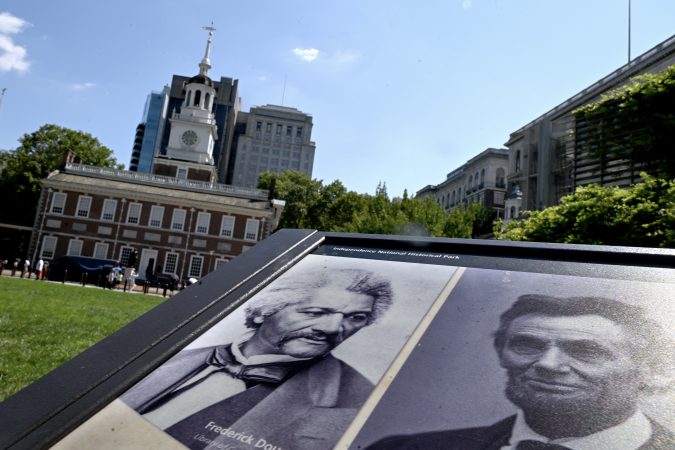
  • In 2026, like in 1770, standing armies in our cities erode freedom

    In January, Bruce Springsteen released a passionate anti-ICE ballad, “The Streets of Minneapolis,” in which he named U.S. Immigration and Customs Enforcement (ICE) “King Trump’s private army.” Dedicated to the memory of two protesters who died at the hands of armed government agents in a frigid Minnesota winter, the song invites comparisons to Paul Revere’s famous and equally passionate engraving of the 1770 Boston Massacre. Revere’s image depicts a bloodthirsty line of soldiers shooting directly into a crowd of unarmed Bostonians, killing five and injuring six more. In calling ICE a king’s private army, Springsteen drew on a long history of protest against standing armies, one built on the belief that accountability to the people and their representatives is the foundation for political liberty.

    Since the Magna Carta, Britons had been hostile to the idea of a standing or permanent army, one that existed even in peacetime, and that was paid for through taxes rather than staffed by volunteers. The 1689 Bill of Rights explicitly prohibited a standing army except with Parliament’s blessing. Within a few years, however, Parliament had softened its stance against armies in peacetime, since Britain was engaged in nearly continuous and often undeclared wars against France and Spain. In response, Britons firmed up other ground rules for a standing army: military power must always be subordinate to civilian authority, and some form of legislative consent was necessary. Without these guardrails, people feared, a monarch could simply turn his military might on his own subjects to quell dissent.

    The army could be used as a British police force, but not without complications. Magistrates and mayors regularly requested troops to come to their aid as they tried to catch smugglers and control rioting. Although a justice of the peace might occasionally be able to disperse a crowd by reading the Riot Act, those civilian authorities usually required military support. Eighteenth-century soldiers were trained for battle in the field, not to police civilians, and magistrates soon begged the war office to remove rowdy soldiers from their towns, and especially from the public houses where they were quartered.

    In 1768, the Massachusetts governor, like so many magistrates before him, asked the British War Office to send him troops in response to colonial protests against new tariffs set by Parliament. Bostonians felt deeply betrayed by the news of arriving troops. As one minister wrote: “To have a standing army! Good God! What can be worse to a people who have tasted the sweets of Liberty?” They were less concerned with the violence soldiers might bring than with the threat that a peacetime army posed to society and especially to the political rights of civilians.

    When the first two regiments of Redcoats landed in Boston Harbor in October 1768, they marched with flags flying and drums beating along the central Long Wharf into the heart of the city, where they appropriated Boston Common and Faneuil Hall as temporary campsites. Determined to demonstrate to the world that their peaceful town had no need of troops to keep order, Bostonians mostly refused to rise to the bait. For at least a while, there was nothing for the troops to do.

    Instead, the Sons of Liberty turned to the press to protest the troops’ arrival. In the year and a half that British soldiers lived in Boston, the newspapers were crammed with examples of how the very presence of a standing army could destroy every part of a civilized society, from church services (when the army band deliberately played music during the sermon) to parental authority (as young women defied their fathers to date Redcoats).

    Most of all, colonists feared the impact of a standing army on political freedom. How could a free people debate, much less protest, at the point of a bayonet? When the British army pointed its cannons at the door of the Massachusetts legislature, it was hard to escape the conclusion that a standing army was the king’s way of taking back political power. In sum, as the Massachusetts assembly complained to the governor in 1769, “establishing a Standing Army in this Colony, in a Time of Peace, without the Consent of the General Assembly of the same, is an Invasion of the natural Rights of the People.”

    The death of British protesters at the hands of soldiers was not uncommon in England, and colonists and officers alike knew that a violent clash was only a matter of time. On March 5, 1770, troops fired into a crowd of civilians in downtown Boston, killing Crispus Attucks, Samuel Gray, and James Caldwell immediately; Patrick Carr and teenager Samuel Maverick later died of their wounds. Even 256 years later, the exact sequence of events that led to the shooting is impossible to discover. Its importance for shaping the American Revolution, however, is clear.

    On the night of the shooting, the acting governor of Massachusetts rushed to the scene and was horrified to see people bleeding to death on the snow before the seat of governmental power, today the Old State House. He swore he would launch a full civilian investigation with local law enforcement, and he promised, “I will live and die by the law.”

    The governor was as good as his word. That night, the captain in charge turned himself in to the local jail, as did the men under his command. John Adams, urged by the Sons of Liberty to demonstrate Bostonians’ equally strong commitment to the rule of law, took on the defense of the British soldiers, successfully winning acquittals for most of them. Three years later, Adams reflected that defending the soldiers was “one of the most gallant, generous, manly and disinterested Actions of my whole Life, and one of the best Pieces of Service I ever rendered my Country.” And he was quite convinced that the jury verdict “was exactly right.”

    At the same time, Adams agreed that Boston should certainly “call the Action of that Night a Massacre.” In fact, he wrote, “[I]t is the strongest of Proofs of the Danger of standing Armies.” The experience of living with — and dying at the hands of — a standing army forever damaged Bostonians’ trust in the British empire.

    In 1776, Congress highlighted the Boston Massacre in its list of grievances against George III. The 11th complaint drew directly from the Massachusetts legislature’s complaint seven years earlier: “He has kept among us, in times of peace, Standing Armies without the Consent of our legislatures.” It was not the violence that so horrified colonists; it was the lack of legislative consent.

    Despite the striking parallels, the shootings of Renee Good and Alex Pretti in Minneapolis earlier this year were not just retreads of the Boston Massacre. For the Redcoats, face coverings and anonymity were not options; they had been living among Bostonians for a year and a half, becoming neighbors and sometimes even family. No one claimed the troops had legal immunity, and even the royal governor, who had requested the troops, believed in holding individual soldiers accountable for their actions.

    In those ways, the shooting in Boston defied fewer norms than the activities of ICE in Minneapolis two and a half centuries later. Even so, the Boston Massacre and its consequences were no small part of the forces that impelled colonists toward a final break with the British empire.

    Serena Zabin is the Stephen R. Lewis Jr. Professor of History and the Liberal Arts at Carleton College and the author of “The Boston Massacre: A Family History.”

    The “Road to 250” series is an initiative of Historians for 2026, a group of early American academics, public historians, archivists, and educators devoted to shaping an accurate, inclusive, and just public memory of the American Founding for the 250th anniversary.

    Made By History takes readers beyond the headlines with articles written and edited by professional historians. Opinions expressed do not necessarily reflect the views of The Inquirer.
    Made By History sponsors.Inquirer Staff
  • Frederick Douglass’ critical lesson for the 250th: ‘Contend, contend’

    Frederick Douglass’ critical lesson for the 250th: ‘Contend, contend’

    As the country moves toward the 250th celebration, the official directive from the Trump administration is clear: be proud, be grateful, and rejoice in our great nation. This rosy narrative overlooks the global political conflicts, fractured economy, and longstanding racial and gendered inequalities that have shaped our country from its founding. These difficult realities are not footnotes to American history but a reminder of all of the ways that our nation continues to fail to live up to its espoused values. This is why one of the greatest speeches in American history resonates this time of year and especially on the eve of our nation’s 250th birthday: Frederick Douglass’s “What to the Slave is the Fourth of July?”

    Born into slavery, Frederick Douglass escaped from bondage to become the foremost African American abolitionist, orator, and intellectual of the nineteenth century. His famous “Fourth of July” speech is a profound declaration of faith in the promise of America and its “saving principles.” In this speech, delivered pointedly on July 5, 1852, not July 4, in Rochester, New York, Douglass argues that the foundations of American democracy are not fundamentally rotten, just mistaken in their implementation, and that the values enshrined in the founding mythology and documents might yet redeem America from its sins. It is a galvanizing and patriotic text, and it anticipates what W.E.B. Du Bois would say in 1935 in Black Reconstruction in America: that “democracy died save in the hearts of Black folk.”

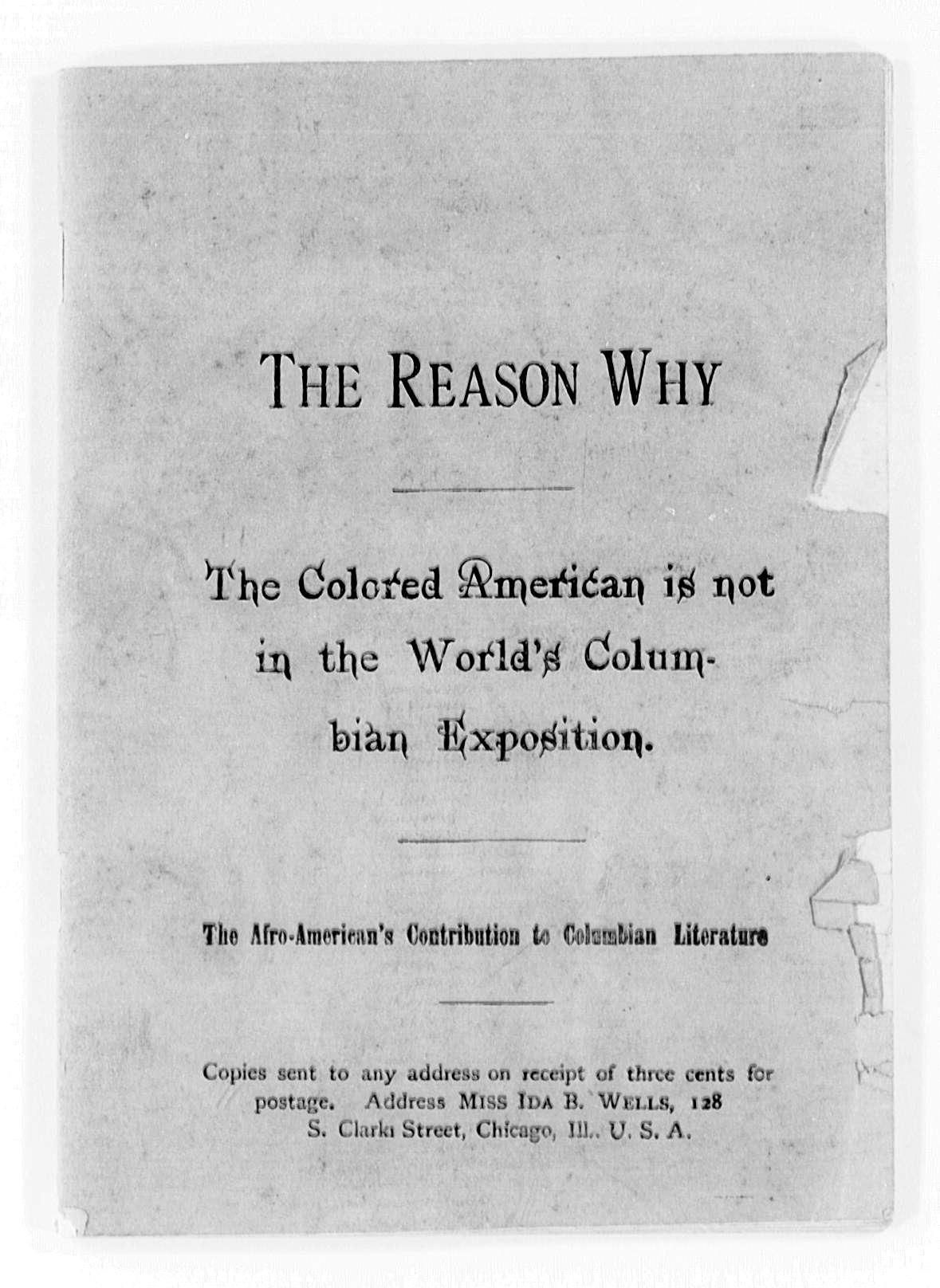
    But this year, a different piece by Douglass resonates: “The Reason Why the Colored American is Not in the World’s Columbian Exposition,” written in 1893, just two years before he died. In that pamphlet, Douglass criticizes another national commemoration that asked Americans to set aside painful realities in favor of a more flattering narrative. His argument—that the struggle against racial injustice must continue not because success is guaranteed, or even likely, but because it is the right thing to do when confronted with injustice—continues to matter today.

    The pamphlet, “The Reason Why: The Colored American is not in the World’s Columbia Exhibition,” had to be distributed and discussed from the Haitian exhibition space at 1893 World Fair in Chicago because African Americans were denied any real role in the Fair.Courtesy of NKCDC

    In this pamphlet, Douglass protested the World’s Fair in Chicago, a grand celebration of the 400th anniversary of Christopher Columbus’s 1492 arrival in the “New World.” The fair, Douglass argued, distorted American history by erasing the contributions of Black Americans whose labor and suffering had made that very “progress” possible. By this time, Douglass had witnessed the Emancipation Proclamation and Reconstruction and the violent undoing of Reconstruction. He had seen the Supreme Court strike down the Civil Rights Act of 1875. As white Americans imposed the brutal logic of Jim Crow across the nation, Douglass came to believe that the consciences he had spent his life appealing to had been so corrupted by white supremacy that they could no longer be relied on to redeem America.

    And yet, in the closing passages of the pamphlet, Douglass did not embrace despair or advocate for retreat. Instead, he offered the metaphor of a ship that must embrace the dangers of the open sea. The ship might remain safely anchored in harbor but this safety, he argued, is deceptive. The ship must weather the storm. And he followed it up with something even more profound: “Next to victory is the glory and happiness of…contending for it. Therefore, contend, contend! That we should have to contend and strive for what is freely conceded to other citizens without effort or demand may indeed be a hardship, but there is compensation here as elsewhere. Contest is itself ennobling. A life devoid of purpose and earnest effort is a worthless life. Conflict is better than stagnation.” For Douglass, the act of contending itself is meaningful. The struggle testifies to the injustice it intends to repair.

    Made By History sponsors. FOR USE ON MADE BY HISTORY STORIES ONLY.Inquirer Staff

    The origins and reception of the pamphlet reveal the fault lines in American society at the end of the 19th century. Douglass had appealed to Black communities across the nation for funds to print the pamphlet and had received almost nothing. Discouraged, he told his collaborator, Ida B. Wells, that he wanted to abandon the effort. It was Wells who insisted otherwise, organizing with many Black women’s organizations to raise the necessary resources. Ironically, the man who would close his pamphlet urging Black Americans to “contend, contend” had to be persuaded to continue contending himself.

    The reception of the pamphlet was divided and harsh. Many prominent white journalists called Douglass a complainer. Even within the Black press, there was hardly consensus. Some Black journalists endorsed his indictment of the fair while others argued that Black economic and educational enfranchisement were more important than another lament of prejudice. This was a broader debate within the Black community that Douglass did not settle in the pamphlet. What he offered instead was something harder and arguably more important today: the argument that we must continue to fight even when we are not winning the war.

    This is an extraordinary argument coming from Douglass at the end of his life. He had every reason to give up the fight. He had spent decades working to change America, and America had proven far more resistant to that change than he had originally hoped. And yet he insisted: contend, contend.

    At this moment of democratic fracture and racial retrenchment in America, Douglass’s argument deserves a second hearing. The Supreme Court has dismantled affirmative action, executive orders have unraveled federal civil rights commitments, and disparities in housing, education, healthcare, and criminal justice persist and deepen. The fight against racial injustice must continue not because we can be assured of our triumph but because our commitment to America’s “saving principles” should not falter even when those principles seem out of reach. Douglass’s refusal to abandon the fight—his willingness to steer into the storm—is not merely a biographical detail about an American at the end of his life. It is an argument about what it means to celebrate America and her saving principles.

    Happy 250th birthday, America. Contend, contend.

    Dr. Amy Gais is a Lecturer in the Department of Political Science and Comparative Literature and Thought at Washington University in St. Louis. She is the author of The Coerced Conscience (Cambridge University Press, 2024) and is currently working on a book project on dissimulation, resistance, and freedom in African American political thought.

    Made by History takes readers beyond the headlines with articles written and edited by professional historians. Opinions expressed do not necessarily reflect the views of The Inquirer.
  • Soil from Revolutionary battlefields was mixed at Independence Hall on this week in Philly history

    Soil from Revolutionary battlefields was mixed at Independence Hall on this week in Philly history

    It was a plotting mix.

    The U.S. government’s crusade to prevent the spread of communism on the Korean Peninsula coincided with the 175th anniversary of the Declaration of Independence.

    And in Philadelphia, where the founding document was birthed in 1776, city planners laid the groundwork for a four-day jubilee.

    Festivities kicked off July 1, 1951, and centered around an unorthodox ceremony to blend dirt, or “hallowed earth,” from Independence Square with soil scooped from Revolutionary War battlefields in each of the original 13 colonies.

    Judge Edwin O. Lewis, chairman of the city’s celebration, said the exercise would rededicate the states “to the principles of freedom.”

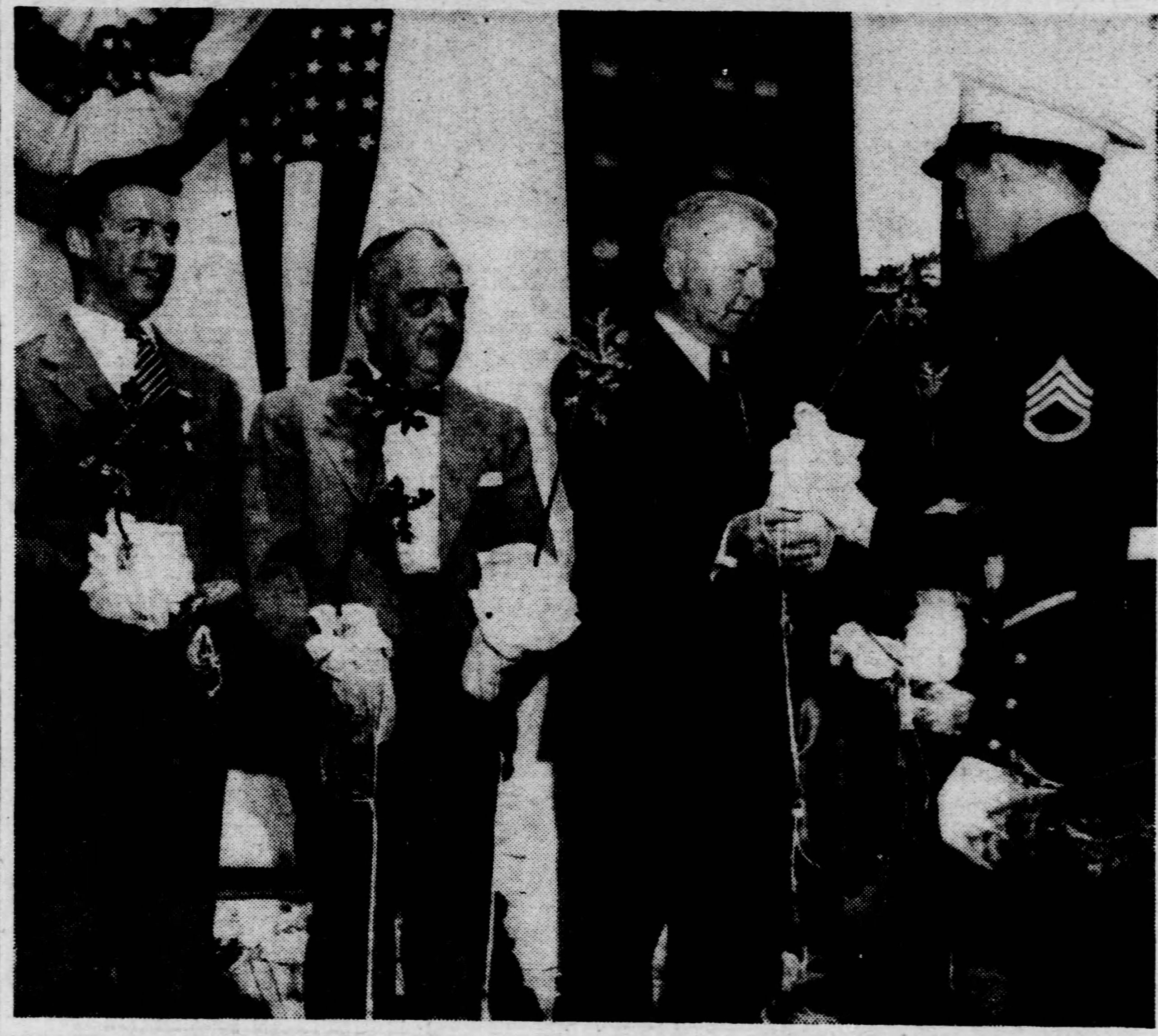
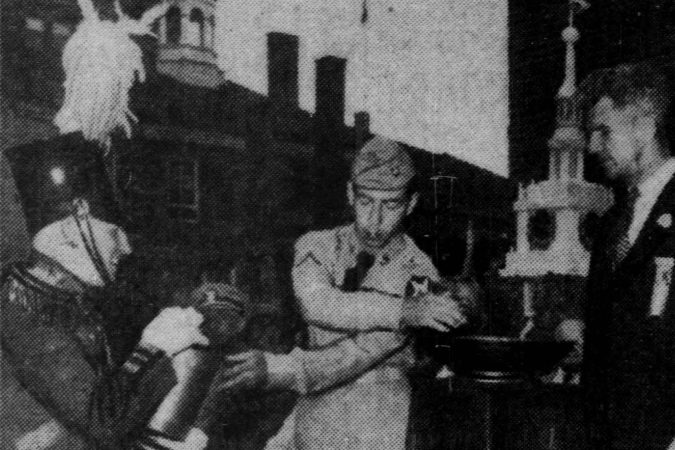
    The ceremony was held in the shadow of Independence Hall and featured 19-year-old Army Pfc. Francis R. Findley Jr., of Havertown, who had recently returned from the front lines of the Korean War.

    Each of the original 13 states sent representatives, who were dressed in replica uniforms from past conflicts and were escorted by a color guard, and took turns carrying an urn of battle-tested earth to the dais.

    Findley took a fistful of dirt from each urn and added it to a monumental mixture in a ceremonial pedestal bowl.

    Three days later, on the Fourth of July, the then-48 states received a growth opportunity: oak seedlings rooted in the mixed soil.

    Theodore Roosevelt III, (left), Philadelphia Mayor Bernard Samuel, and U.S. Sen. James H. Duff give out oak seedlings for the capitals of the then-48 states at Independence Hall on July 4, 1951.Inquirer Archive

    The seedlings were to be planted as memorials in each state’s capital city.

    After the dirt was mixed together, almost as part of a recipe for building democracy into a country’s bedrock, U.S. Sen. James H. Duff, a Republican from Pennsylvania, called upon an “American formula” to help challenge threats of tyranny and oppression.

    Historically speaking, subtlety hasn’t traditionally been a strong suit for leaders of the U.S. government.

    “We offer the world peace,” Duff said on the Fourth of July, “if we may have peace without appeasement and with freedom.”

  • Frank Rizzo wanted federal troops to patrol Bicentennial protests. They ‘neither came nor were needed.’

    Frank Rizzo wanted federal troops to patrol Bicentennial protests. They ‘neither came nor were needed.’

    Months before Philadelphia was set to celebrate the United States’ 200th birthday in 1976, Mayor Frank Rizzo was worried.

    The city, he said, stood to face massive unrest and potential violence during the Bicentennial parade on July 4. There were, he believed, cadres of radical leftists plotting to disrupt what should be a day of jubilance two centuries after the country’s founding in the place where it was born.

    They would come in droves from around the nation, Rizzo said. And to combat them, Philadelphia authorities didn’t just need to be vigilant — they needed thousands of federal troops to patrol the streets and quell the impending chaos.

    Those troops, despite Rizzo pursuing their deployment, never arrived. Nor did the bedlam he feared would come. And neither did the throngs of tourists the city expected for the Bicentennial, at least in part because of Rizzo’s warnings.

    The city, did, however, get plenty of leftist protesters — tens of thousands who held large, peaceful demonstrations in North Philadelphia on Independence Day of 1976. No blood flowed in the streets, and Rizzo, the man who claimed it would, that year became the first mayor in Philadelphia’s history to face a recall effort.

    Here is how The Inquirer and Daily News covered it:

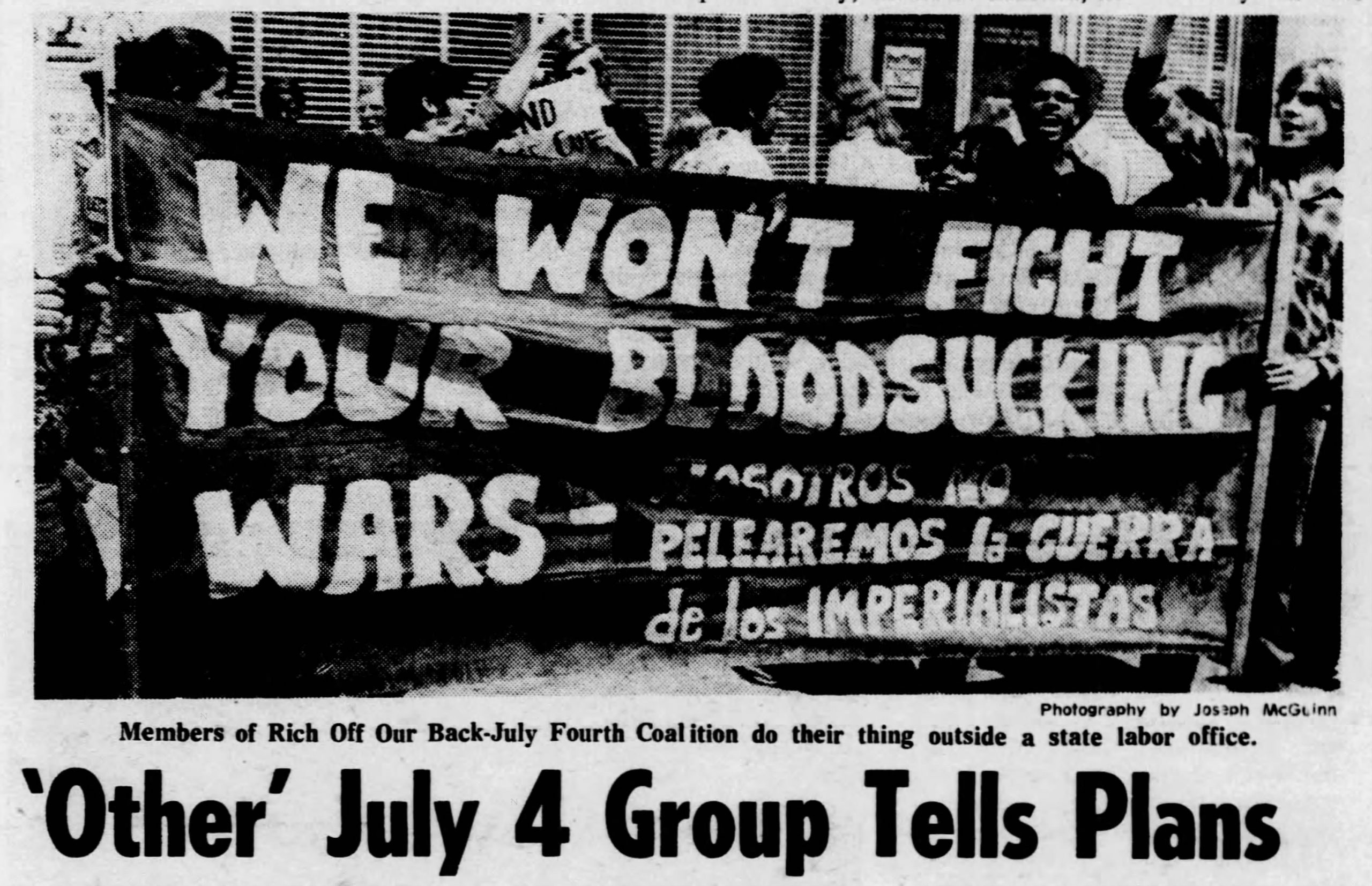
    Members of Rich Off Our Backs demonstate outside a state employment office in Germantown in June 1976, as shown in an issue of the Daily News from the time.Inquirer/Daily News Archive

    Two groups plan protests

    Rizzo’s perceived threat of chaos came from two similarly named, yet totally distinct, groups that planned demonstrations for Independence Day. Those were the July 4 Coalition and the Rich Off Our Backs-July 4th Coalition, two organizations that consisted largely of anti-war, socialist civil rights activists who hoped to offer some counter-programming for the holiday.

    The July 4 Coalition was larger, with some 100 subgroups making up its ranks, which it claimed would bring 60,000 marchers to Philadelphia for the Bicentennial. Rich Off Our Backs, meanwhile, expected only 5,000 people to show up for its Independence Day demonstration, but was the larger concern for the Rizzo administration because it was considered the more radical group.

    Ahead of the holiday, the city had reached an agreement with the July 4 Coalition, which planned to protest dozens of social ills ranging from racism and sexism to unemployment and military spending. Its demonstration would take place in North Philadelphia, miles away from the main festivities in Center City.

    Rich Off Our Backs, meanwhile, wanted to hold its demonstration in Center City and was believed to be “dominated by a tiny, one-year-old Marxist splinter called the Revolutionary Communist Party,” The Inquirer reported at the time. The group, reports said, planned to focus on unemployment.

    Those plans would have brought the group into direct conflict with the city’s Bicentennial activities, including Philadelphia’s official parade. But after a weekslong court battle, Rich Off Our Backs was denied a permit to parade in Center City, and agreed to an alternate route that would take the march through North Philly.

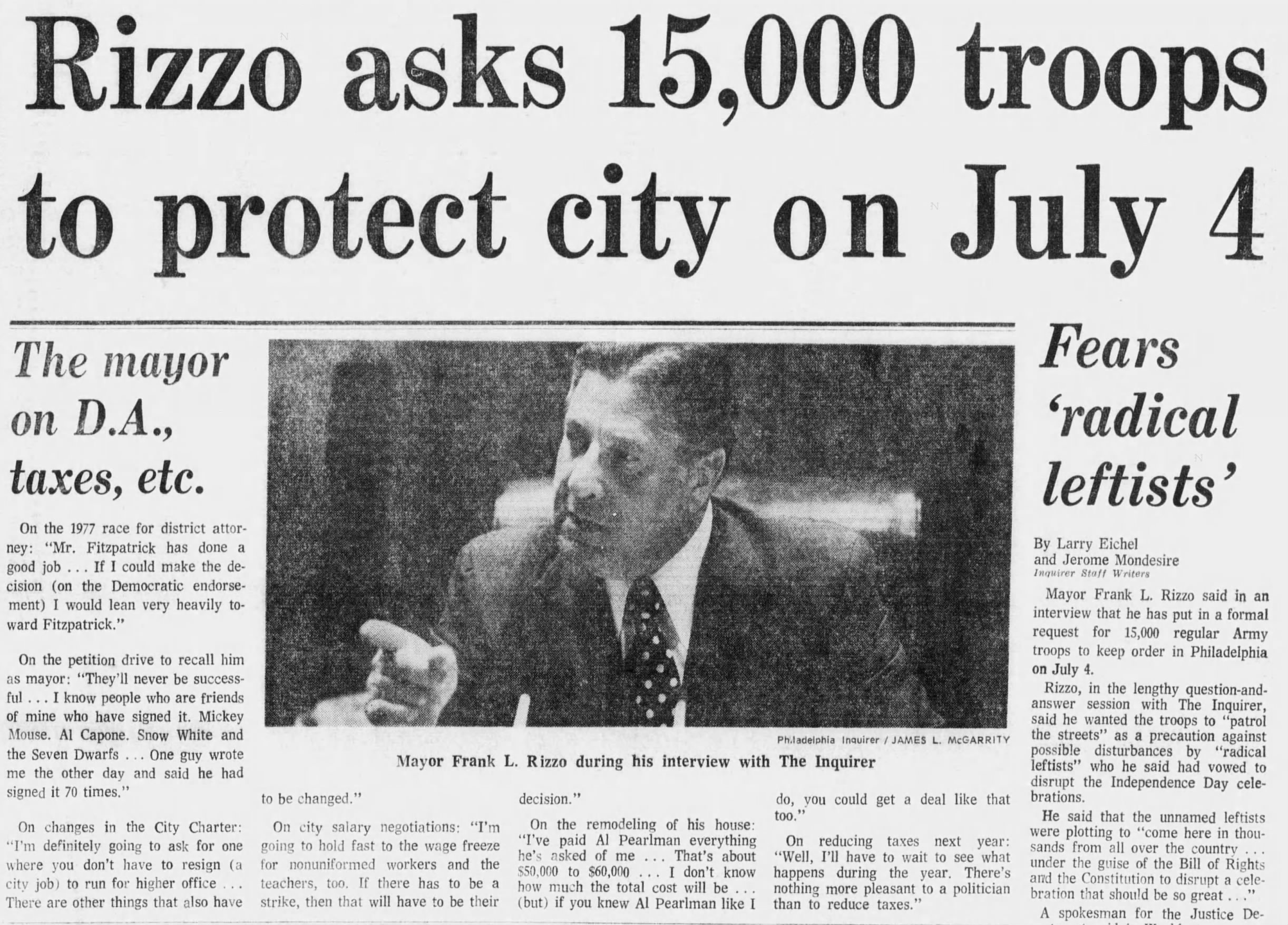
    The front page of the May 30, 1976, Inquirer details Mayor Frank Rizzo’s request for 15,000 federal troops to protect Philadelphia on Independence Day that year.Inquirer/Daily News Archive

    Rizzo’s call for federal troops

    In late May 1976, Rizzo told The Inquirer he would call for 15,000 Army troops to keep order in Philadelphia due to concerns over the planned protests and potential violence.

    Federal troops, Rizzo said, would supplement the city’s police force, which would be “spread too thin” due to the number of planned festivities on July 4. Bolstering the police, he added would not included armored vehicles or heavily armed forces, but would consist merely of “bodies” carrying sidearms to quell dissent.

    Deployment of federal troops, The Inquirer reported, would require approval from then-Gov. Milton J. Shapp, who supported the effort. And the FBI’s Philadelphia office said it was unaware of any federal investigation into the matter at the time of Rizzo’s announcement.

    Both the July 4 Coalition and Rich Off Our Backs called Rizzo’s move “fascist,” and insisted demonstrations would be peaceful. One activist, the Rev. David Gracie, known for anti-Vietnam War protests in the 1960s, said Rizzo’s request harkened back to the city’s treatment of anti-war demonstrators.

    And in late June, the Justice Department denied Rizzo’s call for troops, saying it failed to find substantive evidence of the radical activity the mayor feared would occur. There was, the FBI said, no “hard core” indication of impending terroristic activity, and no additional enforcement efforts were necessary.

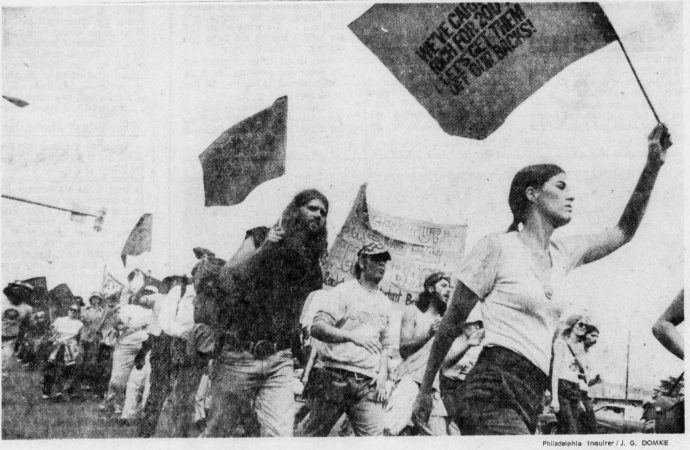
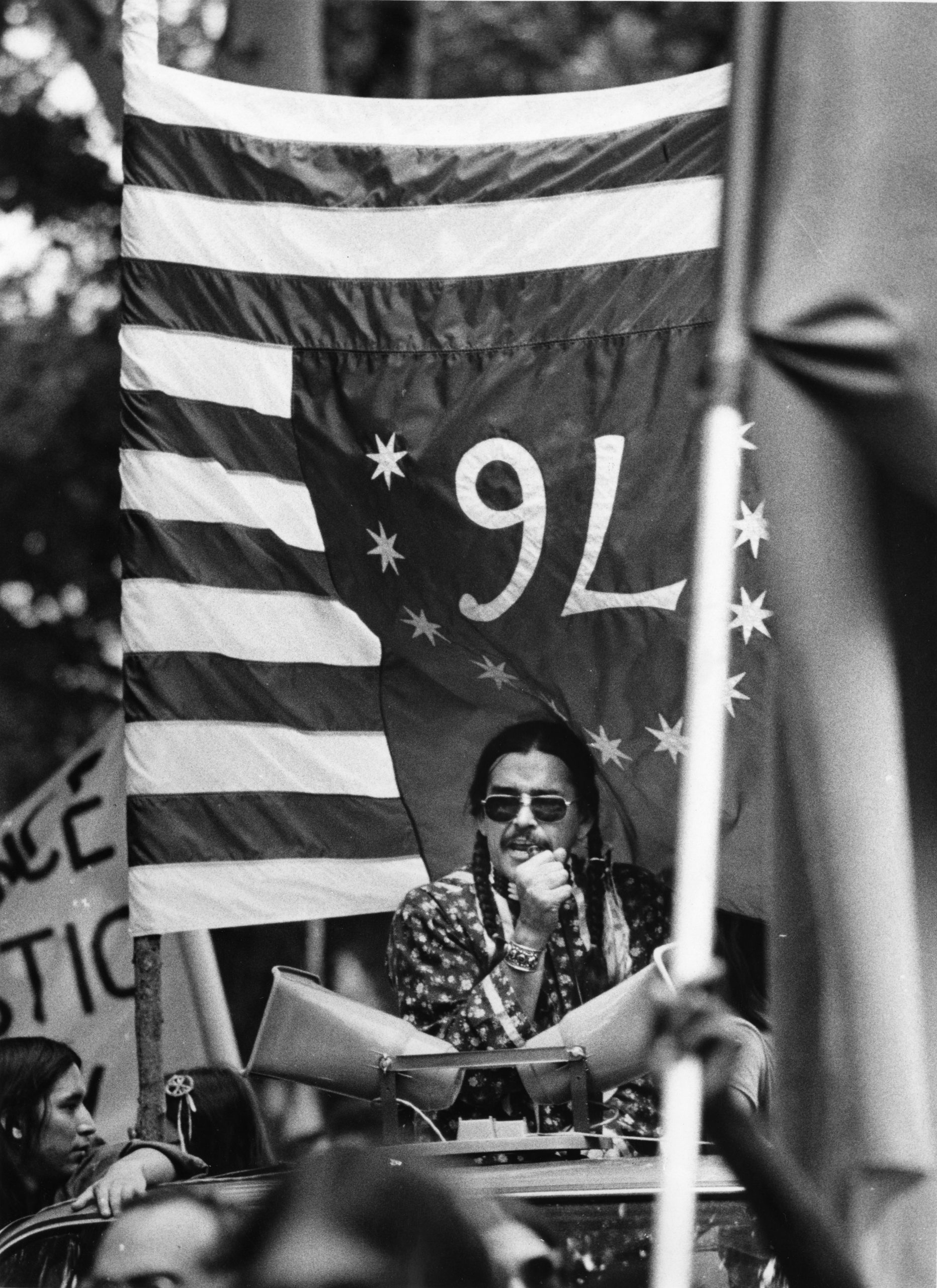
    A group of Native Americans lead a “July the Fourth Coalition” protest parade at 33rd and Diamond Streets in Philadelphia, on July 4, 1976.George D. McDowell Philadelphia Evening Bulletin Photographs

    The day of

    On Independence Day 1976, both groups marched through North Philadelphia without incident, The Inquirer reported at the time. There was not a single arrest or reported disturbance, with the only snafu being late starts to both marches.

    Rich Off Our Backs, despite the fervor over its planned activities, managed to attract about 4,000 participants, all of whom marched east along Girard Avenue from Broad Street before convening in Norris Square Park in Kensington. The July 4 Coalition held an 18-block demonstration along Lehigh Avenue ahead of a rally at 33rd and Oxford Streets in Fairmount Park.

    The coalition claimed to have drawn some 58,000 protesters, but Philadelphia Police, estimated the crowd at about 25,000 people, and observers pegged it at half that size.

    “We did it,” Rich Off Our Backs spokesperson Nick Unger said in 1976. “Thousands of working people walking through the city for miles where you couldn’t see the front of the march or the rear of the march.”

    Neither demonstration, meanwhile, resulted in any of the bloodshed, destruction, or disruption the Rizzo administration advertised. In fact, The Inquirer reported, both protests “drew little response from onlookers” along their routes, and the police who were deployed — clad in riot gear — were ultimately not needed.

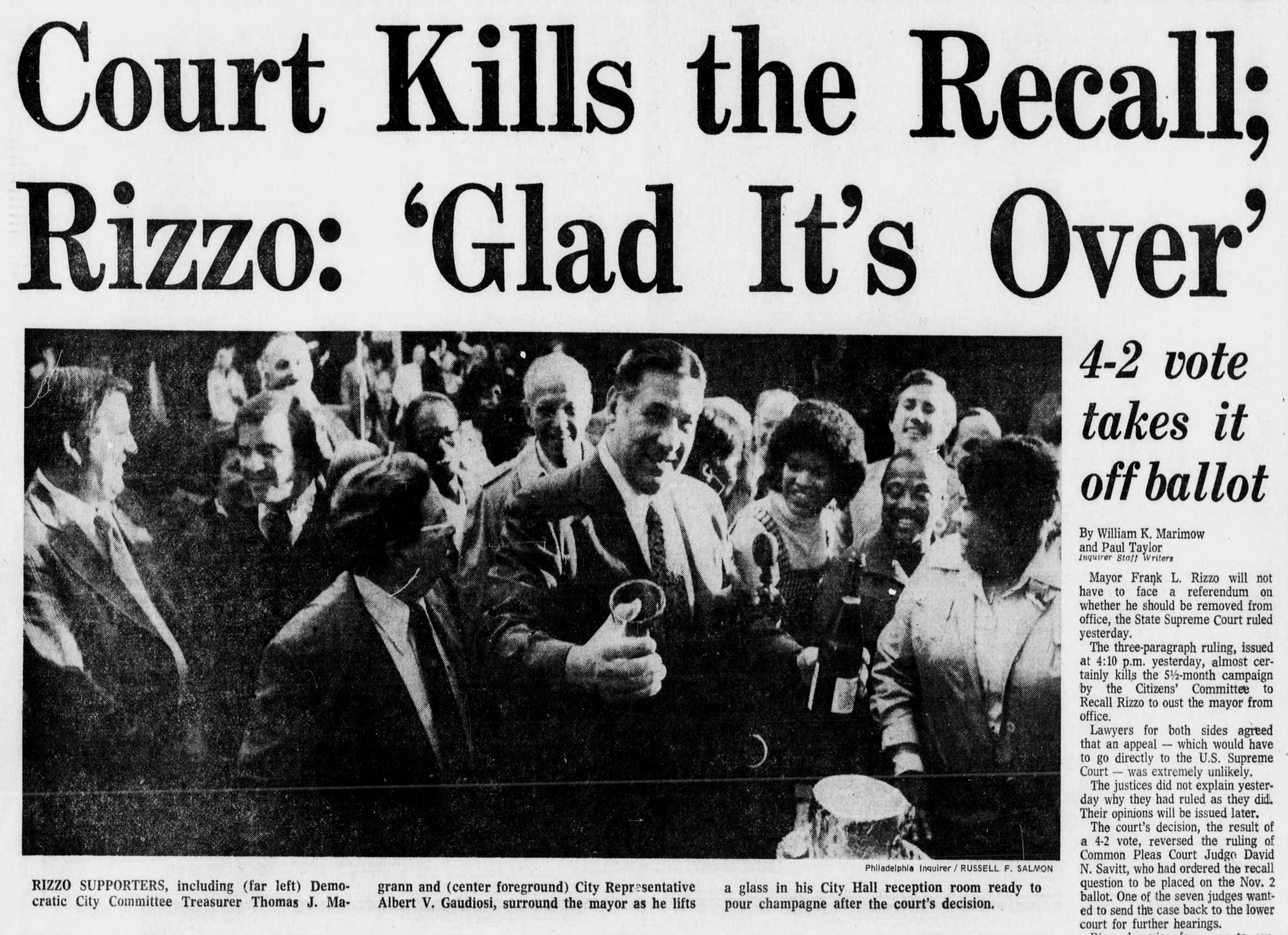
    An Oct. 1, 1976 edition of The Inquirer details Mayor Frank Rizzo’s reaction to the defeat of the recall effort that year.Inquirer/Daily News Archive

    Rizzo’s recall

    Rizzo’s treatment of the July 4 protests did not directly lead to efforts to recall him, but it certainly emboldened his critics. The mayor seemed to realize the error at the time, with Rizzo rarely showing his face publicly around Independence Day — a strategy largely believed to have been instituted by his top advisers.

    In fact, efforts to recall Rizzo stretched back to April 1976, weeks before his pursuit of federal troops ever surfaced. The recall move was largely due to Philadelphia’s flagging economy, as well as tax increases and a city budget deficit.

    An organization known as the Citizens Committee to Recall Rizzo organized a petition, garnering some 145,000 signatures by mid-April 1976. That figured swelled to more than 200,000 signatures following the Bicentennial, but only about 89,000 were found to be valid.

    In September, a Common Pleas Court judge found that Rizzo would need to face a recall — a decision later struck down by the Pennsylvania Supreme Court. Rizzo, as a result, was never officially recalled, and the summer of 1976 would be remembered as a “Buycentennial that wouldn’t sell” amid a “call for federal troopers that neither came nor were needed,” The Inquirer reported.

    And by late 1976, Rizzo expressed relief that the situation seemed to be resolved.

    “I never had any doubts that it would rule in my favor. The law is on my side,” he told The Inquirer. “I’m glad it’s all over.”

  • The Bicentennial didn’t go as expected. But it wasn’t exactly as bad as Philadelphians say it was.

    The Bicentennial didn’t go as expected. But it wasn’t exactly as bad as Philadelphians say it was.

    After decades of dashed grand plans, months of unmeetable expectations, and weeks of fearmongering over political violence that never materialized, Philadelphia had little chance to live up to the hype that the Bicentennial carried with it in 1976.

    And in the end, we didn’t. Not by a long shot.

    Up to 20 million people were projected to travel to the city for the United States’ 200th birthday throughout the year — but in reality, only about 7 million came. We were supposed to build a massive suspended platform at 30th Street Station to house an international exposition, and never got either.

    And instead of receiving due recognition as the birthplace of American democracy, we were given Legionnaires’ disease.

    Understandably, the result in ’76 was a level of municipal malaise that rivals any since. We threw a party all summer, we thought, and no one came. No one liked us, but we did care — a lot.

    Now, with five decades of hindsight, and another national anniversary this summer, perhaps the Bicentennial wasn’t as bad as Philadelphians say it was. It didn’t go off exactly as expected, sure, but maybe it wasn’t the abject failure we historically have believed it to be.

    After all, in some ways, it did give us some of the Philadelphia we know today. Here is how the Inquirer and Daily News covered it.

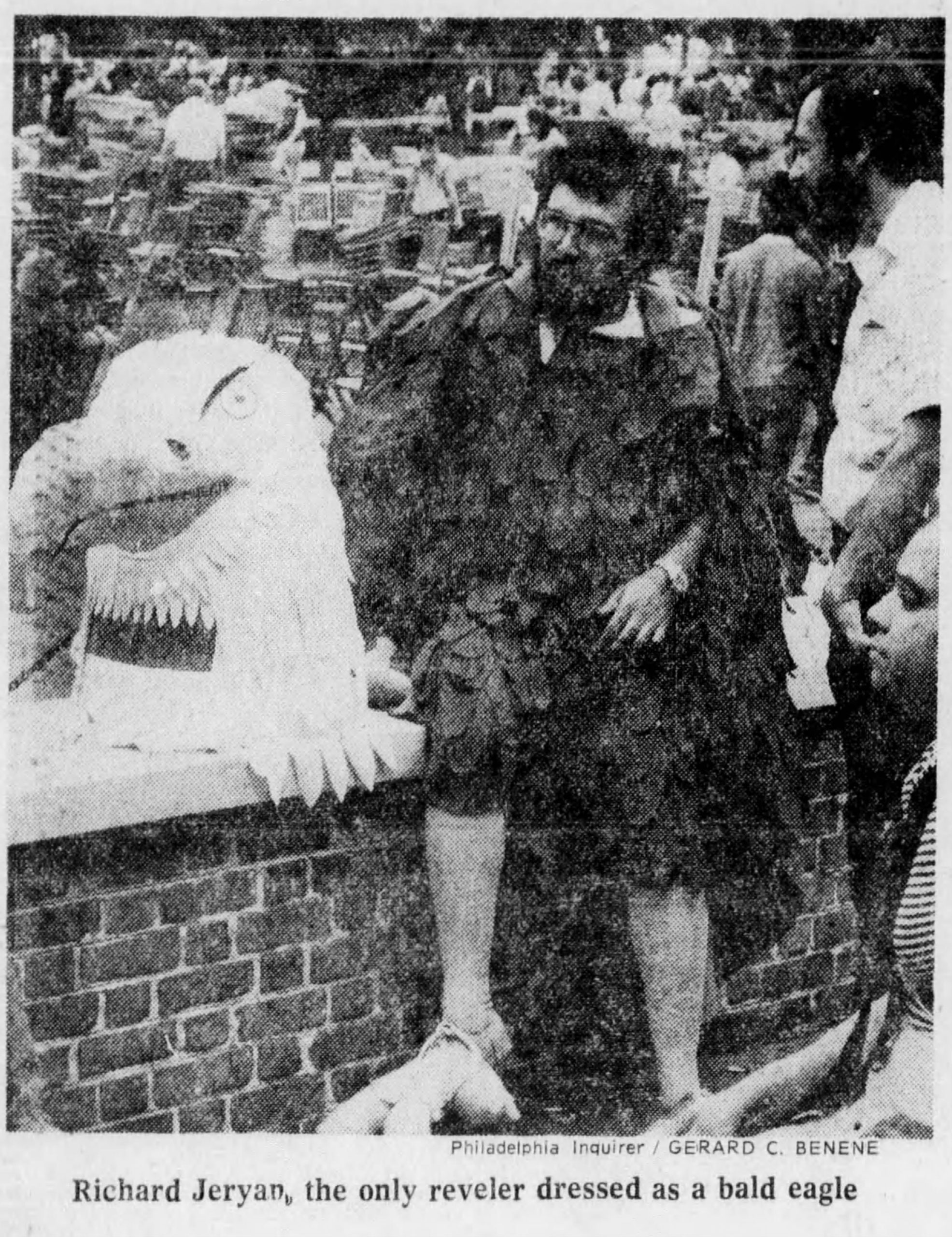
    An Independence reveler celebrates the holiday in 1976 dressed as a bald eagle, as shown in an Inquirer photo from the time.Inquirer/Daily News Archive

    False starts and unrealized projects

    Philly had big dreams for the Bicentennial as early as the 1950s, when planning tied the occasion to an international exposition that would bring travelers from all over the world. Some proposals ran into the neighborhood of $2 billion and had the exotic and impractical vision to match the price.

    Among them was an $8 million plan for a flower-focused theme park in Fairmount Park known as “Philaflora” that was quickly abandoned.

    Later, city planners proposed gimmicks like a large elevated platform over 30th Street Station that was to stretch more than four miles to West Philadelphia, the construction of concrete islands in the Delaware River, and converting swampland to solid ground in Eastwick to host the exposition.

    None of these grand plans came to fruition. And by 1972, the entire idea for an international exposition was dead, having been “scotched” by President Richard Nixon, The Inquirer reported at the time. The city’s Bicentennial corporation, Philadelphia ’76 Inc., however held fast to plans for a large celebration, but was left with relatively little time to plan one — and no idea of what it would look like.

    The result was a series of what The Inquirer in 1976 called “bread and circuses” efforts — essentially parades around town, plus a number of events and attractions on the Benjamin Franklin Parkway throughout the summer. These efforts, The Inquirer reported, were designed to give the illusion of tourist activity and interest, but without all the guff of actual planning and logistics.

    And while we did have a Bicentennial celebration, it sadly did not “live up to 20 years of empty visions,” The Inquirer reported. And only months after July 4, 1976, we were left with “this feeling of promises unkept, hopes unfulfilled,” reports from the time said.

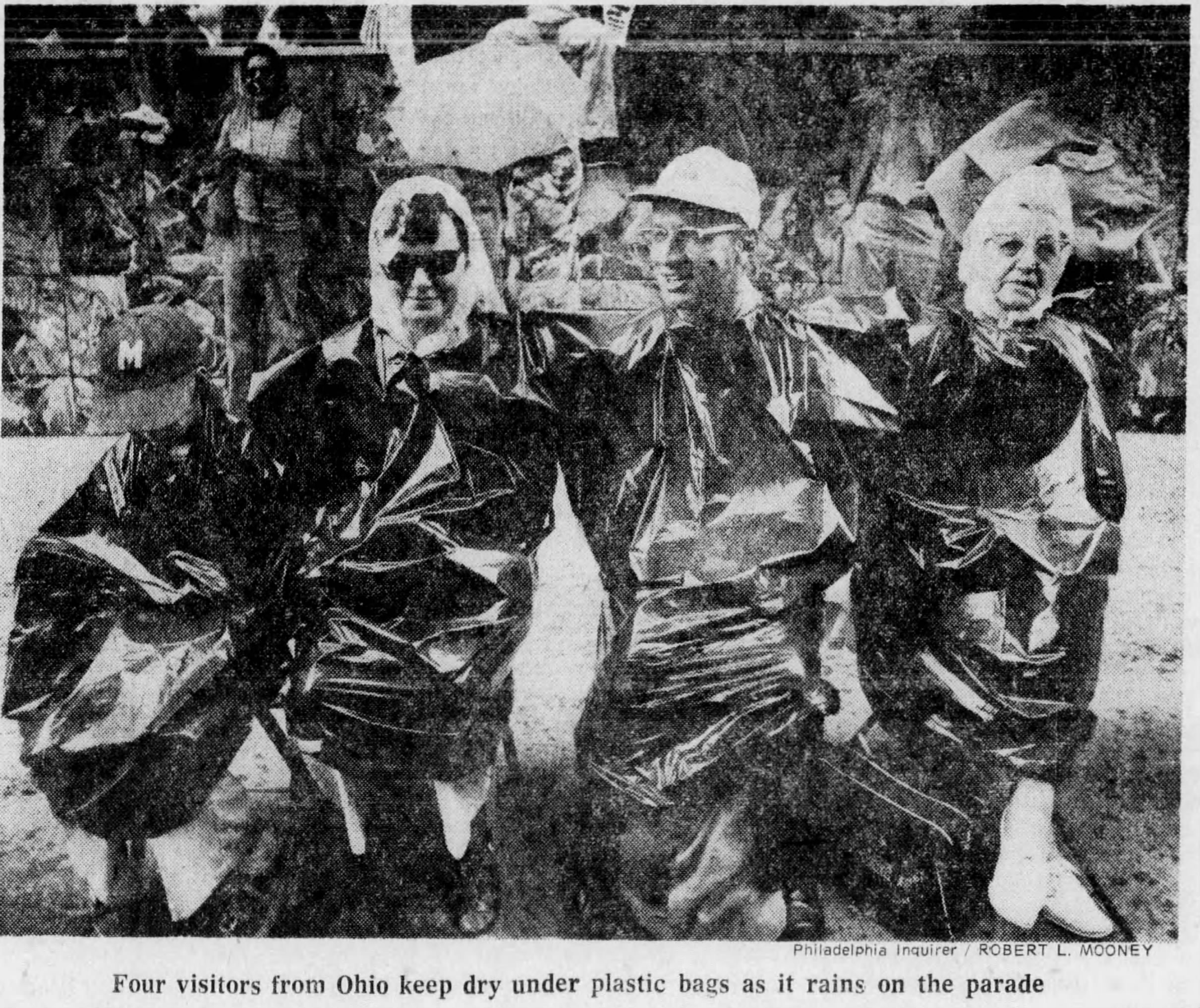
    July 4, 1976 celebrants stave off the day’s rain under plastic bags during the day’s parade, as shown in an Inquirer photo from the time.Inquirer/Daily News Archive

    An under-attended party

    Early estimates for tourism in Philadelphia in 1976 predicted 14 million to 20 million visitors for the year — figures that came from Sindlinger & Co., a Swarthmore-based research firm the city hired. The company conducted nationwide polling to determine the number of Americans who planned to visit Philadelphia in 1976.

    They were way off. By October ’76, roughly 7 million visitors had come, reports from the time indicate. Some 2 million toured the city on July 4 alone, with the rest coming amid a myriad of conventions throughout the rest of the year. According to reports from the time, tourism numbers didn’t pick up until post-Independence Day — a welcome development for hotel operators, who expected a sell-out season that never arrived.

    But that doesn’t mean Philadelphia fared poorly.

    At least compared to 1975. As of December 1976, Philadelphia showed a 300% increase in visitors over the year before, The Inquirer reported — a proportion that placed us “better than any other American city in attracting Bicentennial visitors.”

    The next closest city was Boston, which saw a mere 68% increase in tourism. No one else even came close.

    In fact, no one really did well nationwide. According to a Christian Science Monitor article from the time, every city that expected an influx of Bicentennial tourists — Philly, Boston, D.C., and the like — said tourism numbers were way below predictions. Experts attributed that to the country’s economic state.

    But tourism travel in the United States was high for the year, even though the Bicentennial boom never really arrived. The issue, experts said at the time, was that too much was expected. As Discover America Travel Organizations president William D. Toohey said at the time, the travel industry would have otherwise been “well-pleased.”

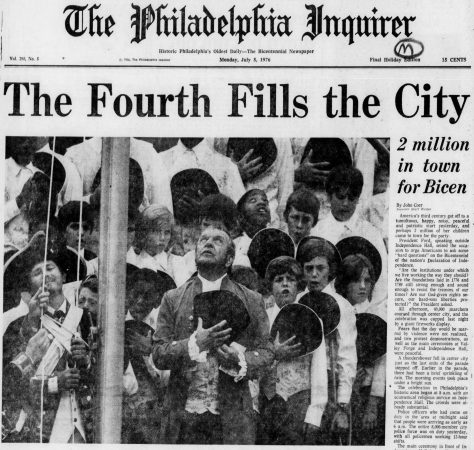
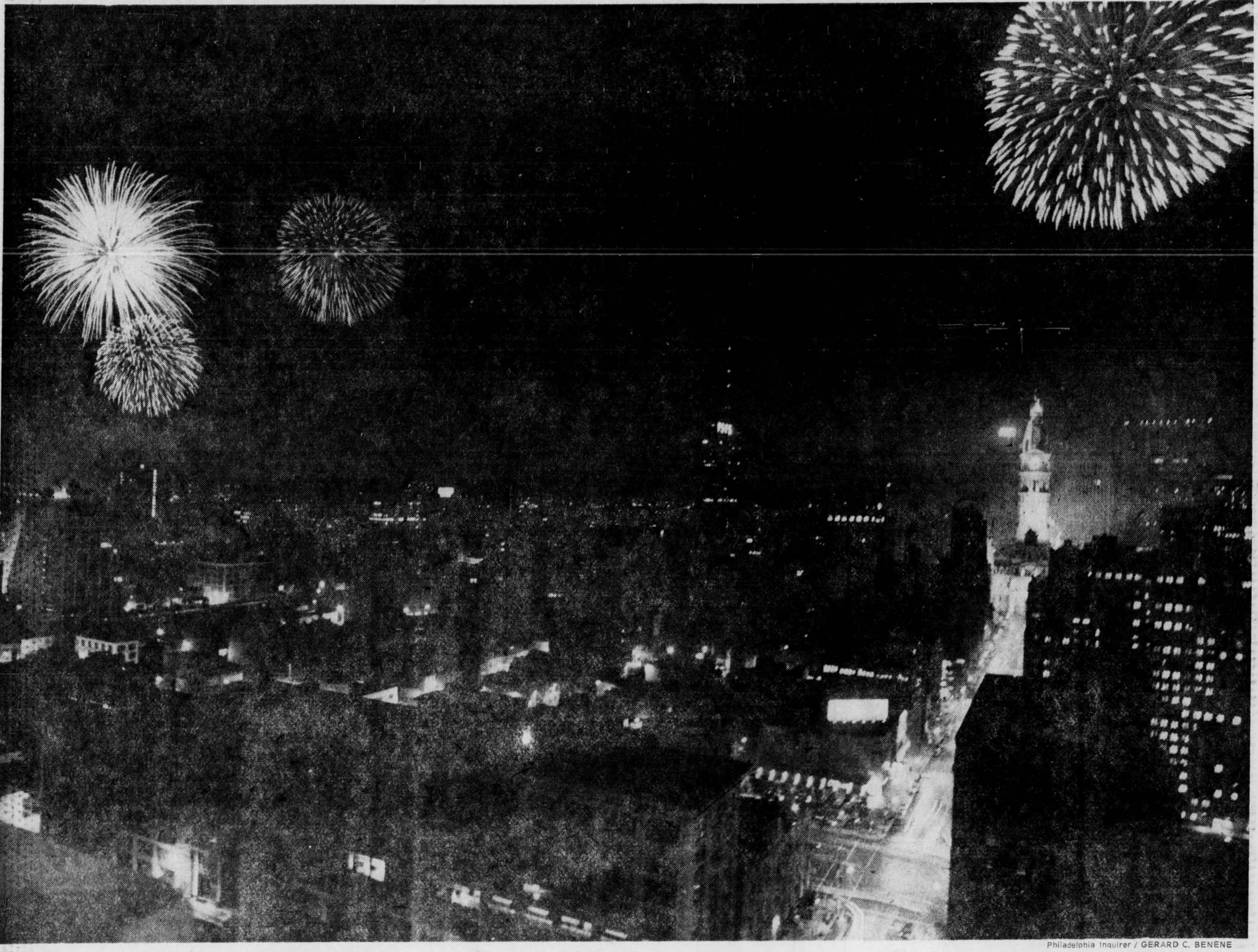
    Fireworks over Philadelphia on July 4, 1976, as shown in an Inquirer article from the time.Inquirer/Daily News Archive

    Why Philly fell short

    Philadelphia, however, was not blameless in its failure in 1976.

    Chief among the factors was Mayor Frank Rizzo’s insistence that political violence would erupt on July 4, thanks to a contingent of protesters who planned to demonstrate in North Philadelphia — miles away from the day’s primary celebrations in Center City.

    Rizzo was so worried that he called for thousands of federal troops to be earmarked to protect the city — a request that was ultimately not granted, primarily because investigators were unable to determine that a credible threat ever existed. And yet, when the holiday rolled around, the damage was already done.

    By late June 1976, some 30,000 participants scheduled for the July 4 parade had canceled their trips to Philly, with most citing fear of political violence as the reason for backing out, reports from the time indicate. Rizzo had been essentially telling tourists not to come, and they largely listened.

    Rizzo, however, wasn’t our only worry. In July, a slowdown by municipal workers caused trash to pile up in the streets for weeks. Workers refused to take overtime hours pending contract negotiations for a modest wage increase, and the dispute was not settled until early August.

    And then, there was the Legionnaires’ Disease outbreak — a famous, but sometimes overlooked, factor impacting tourism for the year. The late-July outbreak severely impacted tourism due to concerns over potential illness, but didn’t entirely crush the influx of visitors.

    “It was very clear that the Legionnaire’s Disease had a very sharp impact on tourism,” Philadelphia ’76 Inc. head William Rafsky said at the time.

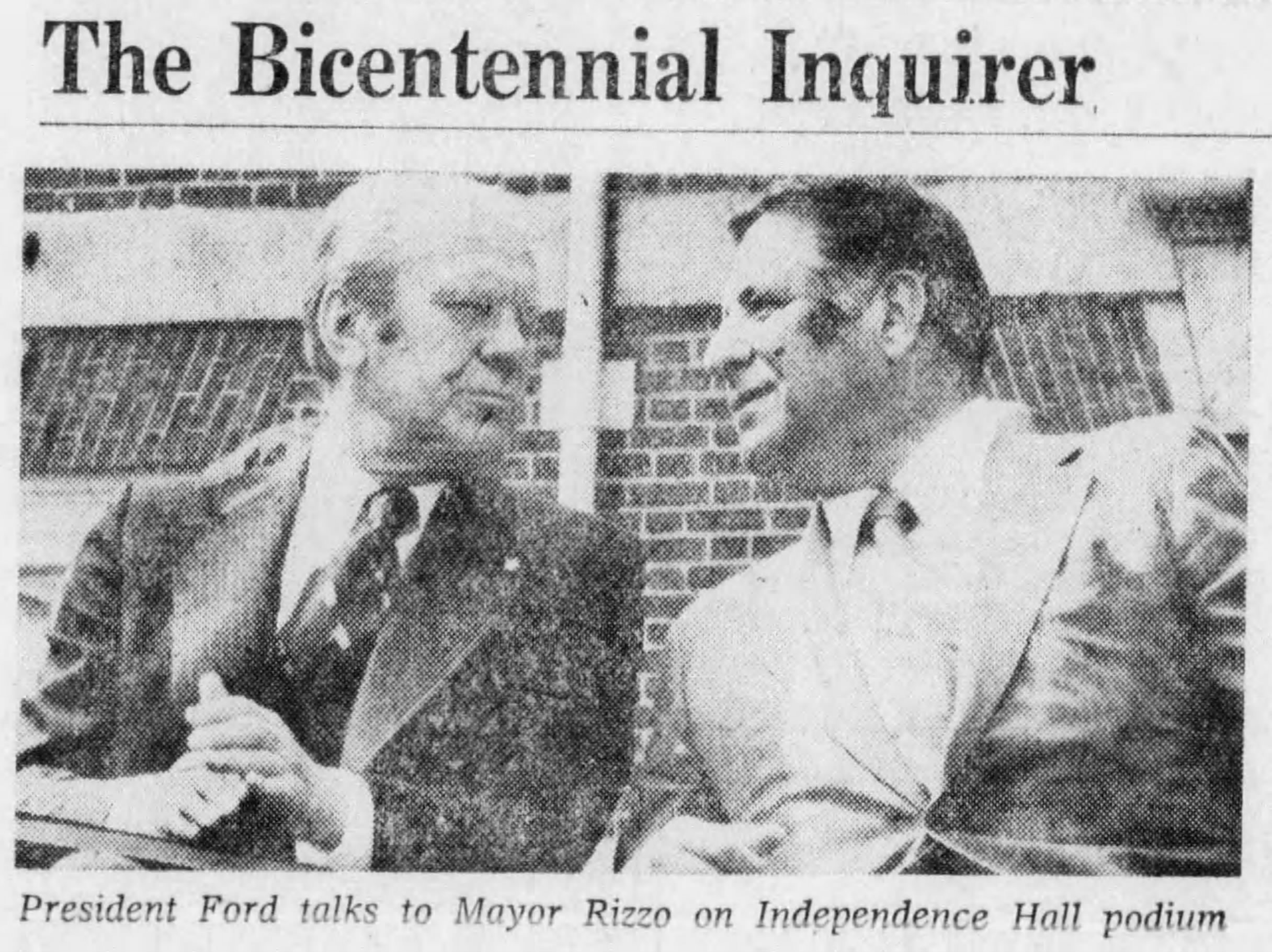
    President Gerald Ford talks with Mayor Frank Rizzo at Independence Hall on July 4, 1976.Inquirer/Daily News Archive

    Benefits abound

    Though the Bicentennial may have been something of a tourism bust, we didn’t walk away with nothing. In some ways, the city was enduringly altered — Philadelphia received an estimated $165 million in improvements for the country’s 200th birthday, a good bit of which was federal money that was not likely to be spent otherwise, reports from the time indicate.

    The National Park Service, for example, spent an estimated $30 million on what we know today as Independence National Historical Park, The Inquirer reported. Those federal dollars bought a new Liberty Bell pavilion, extensive repairs and improvements to historical buildings, the construction of City Tavern and the Graff House, and the creation of Franklin Court.

    Other improvements were also palpable. A number of subway stations were painted and rebuilt, institutions like the Philadelphia Museum of Art were improved, and places like the Mummers Museum and the Afro-American Museum (now the African-American Museum of Philadelphia) were established. Roughly 10,000 trees were planted in Fairmount Park.

    These lasting municipal improvements had an impact, even if the Bicentennial itself did not live up to contemporary expectations. By the time 1976 hit, virtually nothing could quell the public’s want for advancement in light of the country’s 200th birthday. And so, it was deemed a failure.

    But now, half a century later, perhaps we are overcoming that disappointment, or are at least willing to see what comes next — after all, the United States is 250 years old in 2026. And though tourism expectations for this year have been quieter, the city still stands, with hoards of visitors now reminiscent of our Bicentennial year.

    “The Bicentennial Year will be a great year for the United States,” Rizzo said in 1976. “And particularly for Philadelphia, where our nation was born.”

  • The biggest U.S. commemorations happen when we need them the most

    Though much has changed since America’s last notable birthday in 1976, there are many echoes of the Bicentennial’s circumstances and its opportunities in 2026. In yet another time of uncertainty and pessimism, this 250th birthday, like the Bicentennial 50 years ago, offers Americans an opportunity to reconsider their connection to the past and their vision for the future.

    Following one of the most fractious decades in American history, the years approaching the Bicentennial were marked by upheaval. In 1973, the OAPEC oil embargo created a gas crisis that contributed to a global recession and inflation as high as 12%. American lost confidence in their leaders, especially after Richard Nixon resigned from the presidency in August 1974, following two years of fallout over the Watergate scandal. The rights revolution of the previous decade brought issues such as race, gender, and sexuality into mainstream media. Countless laws and social norms changed, sparking backlash among conservatives.

    These circumstances caused many Americans to wonder what was worth celebrating in 1976. Many marginalized groups questioned whether they should celebrate the Bicentennial at all. A broad array of social and civil rights movements seized on the Bicentennial as an opportunity to challenge the triumphal narrative familiar to so many Americans. Their efforts brought into stark relief the paradoxical relationship between the rhetoric surrounding the nation’s founding and its history of oppression. And the conversations that emerged around confronting this more complicated history shaped the Bicentennial’s commemoration and its longer-term impact.

    The circumstances surrounding America’s 250th anniversary are strikingly similar. Political scandals have threatened to engulf the current administration, as the nation has again found itself mired in an unpopular foreign war and a gas crisis, with prices nearly doubling in the last year. Years of inflation have led to a cost-of-living crisis for many Americans. And the last twenty-five years have produced an even greater distrust of institutions such as the government, the media, and the church. A recent Pew Research Center poll shows that nearly 60% of Americans think the nation’s best years are behind us. As during the Bicentennial in 1976, many Americans are again wondering what about the nation’s past and present is worth celebrating.

    Challenging circumstances, however, are not unique to the last two anniversaries. In 1876, Americans commemorated the Centennial in the wake of an economic panic in 1873, increased immigration, the end of Reconstruction and the rise of Jim Crow, and a constitutional crisis brought about that year by one of the most fiercely contested presidential elections in the nation’s history. In such circumstances, the 1876 commemorations looked toward the future. They were marked by a growing sense of the United States being poised as an industrial power to take its place on the world stage, and by the efforts of African Americans and suffragists to realize a future of equal citizenship and rights.

    In contrast, there was much less enthusiasm during America’s 150th in 1926. With the economy booming, many Americans of the roaring 20s did not need the anniversary. In other words, anniversaries of the Revolution have mattered most during the nation’s most trying times. When the American experiment seems closest to failure, we have used our anniversaries to engage in conversations about the meaning of the past and the future we want to create.

    Federal funding also impacts how these anniversaries are celebrated, and in that regard, the Bicentennial and the 250th could not be more different. In the 1970s, the American Revolution Bicentennial Administration gave countless grants to small groups, institutions, and projects across the country. Those grants helped fund local programs, the preservation of local historical sites, and the creation of new sites and museums. In the years leading up to 250, however, there has been a rapid change in the federal funding landscape for historical sites and projects.

    Made By History sponsors. FOR USE ON MADE BY HISTORY STORIES ONLY.Inquirer Staff

    Significant cuts to the National Endowment for the Humanities and other agencies have meant fewer grants and resources to support similar local and historical projects like in the years leading up to 1976. As a result, institutions, historical sites, and museums—large and small—have had to take it upon themselves to both produce and fund meaningful programming for the public. From larger institutions like the Museum of the American Revolution to countless institutions in small towns and counties across the country, Americans have been forced to take responsibility for commemorating 250 for themselves and their fellow citizens. But following the model of 1976, they are working to foster conversations about the complexity of the past alongside visions of the future. And as with the Bicentennial, the greatest opportunities for reconnecting with the nation will come from the work done at the local level.

    Ultimately, the 250th is not just a historical anniversary; it is a civic opportunity. And that opportunity is not limited to July 4, 2026. Revolutionary anniversaries will continue on the national and local levels for more than a decade, eventually culminating with the bicentennials of the Constitution in 2037 and the Bill of Rights in 2039. And like the bicentennials for those events, these 250th commemorations will provide a platform for Americans to reconsider what the revolution and its ideals mean to them in the present moment. The work done by independent and local institutions and organizations across the country will again give Americans the tools and the impetus to engage with the past in meaningful ways. When we seize those opportunities, we become part of the nation’s long tradition of using our anniversaries of the Revolution to imagine a new and better future.

    Michael D. Hattem is the author of The Memory of ’76: The Revolution in American History and is an America250 Media Fellow of the Jack Miller Center.

    The “Road to 250” series is an initiative of Historians for 2026, a group of early American academics, public historians, archivists, and educators devoted to shaping an accurate, inclusive, and just public memory of the American Founding for the 250th anniversary.

    Made by History takes readers beyond the headlines with articles written and edited by professional historians. Opinions expressed do not necessarily reflect the views of The Inquirer.