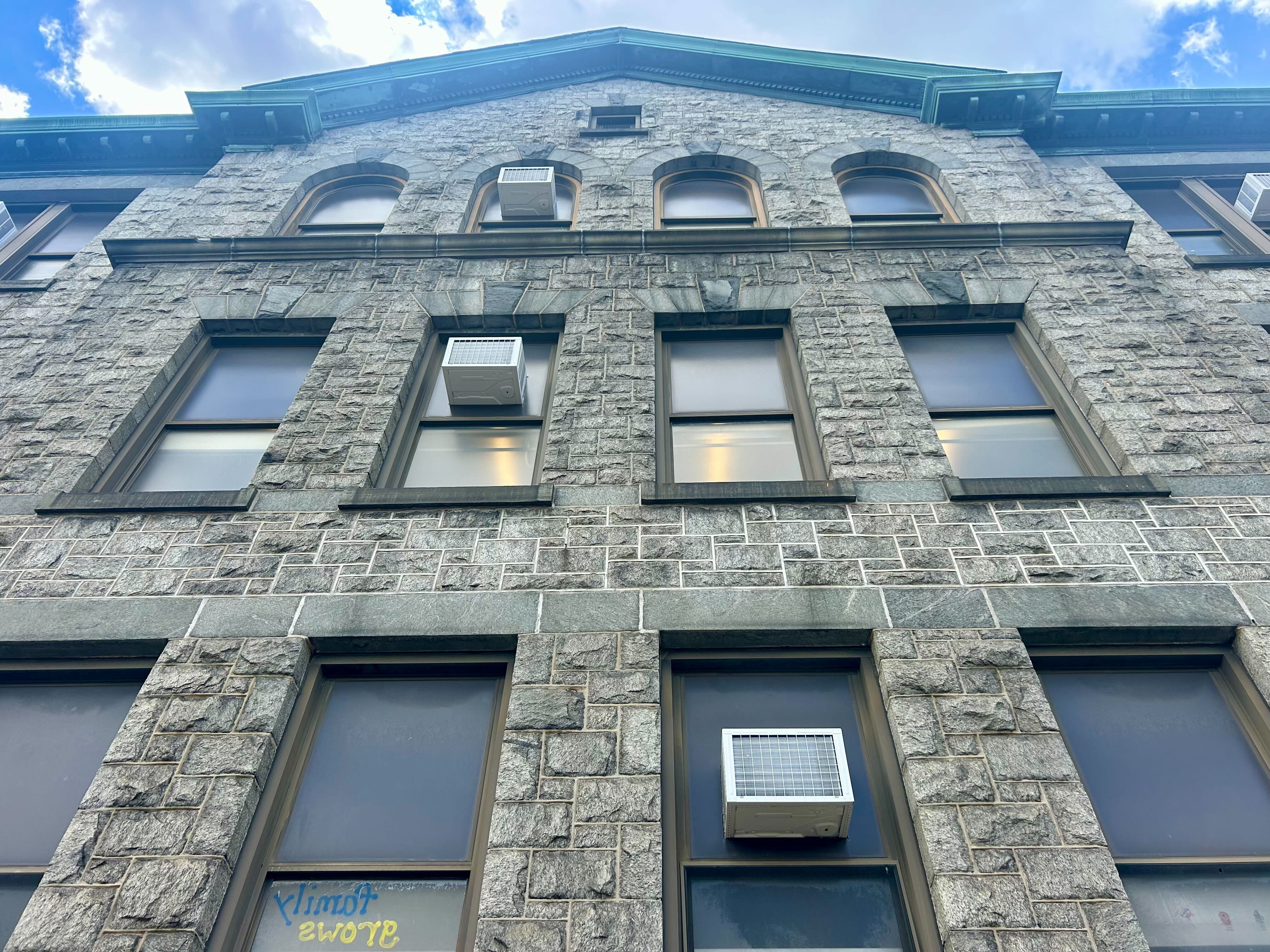
With temperatures expected to get close to 90 degrees later this week, some Philadelphia schools will dismiss early Tuesday.
Fifty-two schools still lack air-conditioning.
“The Philadelphia region is experiencing higher-than-normal temperatures, and while the district has made significant progress toward ensuring our schools are adequately cooled to provide safe and comfortable learning environments, some schools still have inadequate cooling systems,” Oz Hill, the deputy superintendent of operations, wrote in a letter sent to families Monday.
The Philadelphia School District’s extreme-weather protocol means that if temperatures are forecast to reach or exceed 85 degrees by noon, those schools dismiss early; if it hits 85 degrees by 9 a.m., the call is for remote learning.
That means an unequal experience for students across the system, with students in some schools not missing any instructional time when it’s hot, and those in a quarter of schools subject to interrupted schedules.
“While we know that in-person learning is the best environment for students, the safety and well-being of our students, staff, and families remains our top priority,” Hill wrote. “Thank you for your flexibility and partnership. Please take care, stay cool, and stay safe.”
The holdup in air-conditioning all district schools is not related to the cost of air-conditioning units, but rather upgrading old electrical systems in the 52 schools.
Such upgrades are tricky. An HVAC project at Kensington High went awry this summer, triggering asbestos issues that forced students and staff to relocate for the rest of the calendar year.
School officials said in 2022 they aimed to have all district schools fully air-conditioned by 2027. But on the cusp of that cutoff, that goal seems unlikely.
Which schools will dismiss early?
The 52 schools that will have a half day Tuesday are:
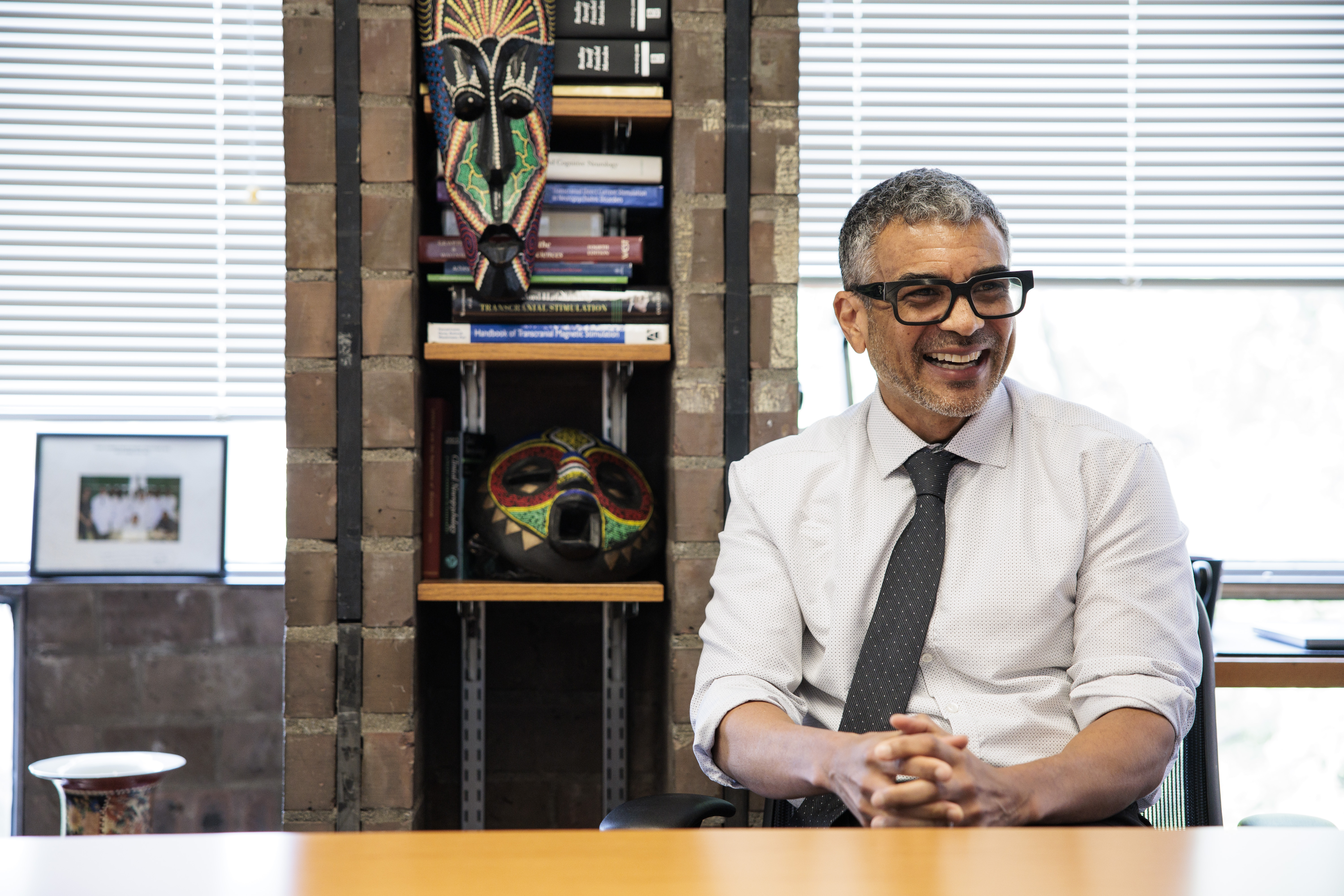
Roy Hamilton’s varied racial, social, and religious identities helped him in his former role as a chief diversity leader at the University of Pennsylvania— and now they will help him in his new role as chair of Penn’s faculty senate.
The behavioral neurologist at the Perelman School of Medicine is the son of a Japanese immigrant and an African American. He is married to a white woman who is Jewish, while he was raised as one of Jehovah’s Witnesses and now is a secular humanist. And one of the couple’s children is LGBTQ+; he is an ally. Add to that growing up in a lower middle-class family and learning to navigate an Ivy League education system, first as an undergraduate and then as a medical school student.
That background has made it easier for him to understand a range of factors in his own life and how they affect his thinking, Hamilton said, and more readily understand where others are coming from and look for common ground.
Those same skills, he said, will be just as valuable as he steps into a position leading Penn’s faculty senate, the representative body for the school’s approximate 3,000-member standing faculty in a system of shared governance.
Hamilton said one of his primary goals will be to make the faculty senate representative of the collective views of a vastly diverse staff and foster conversation across those views.
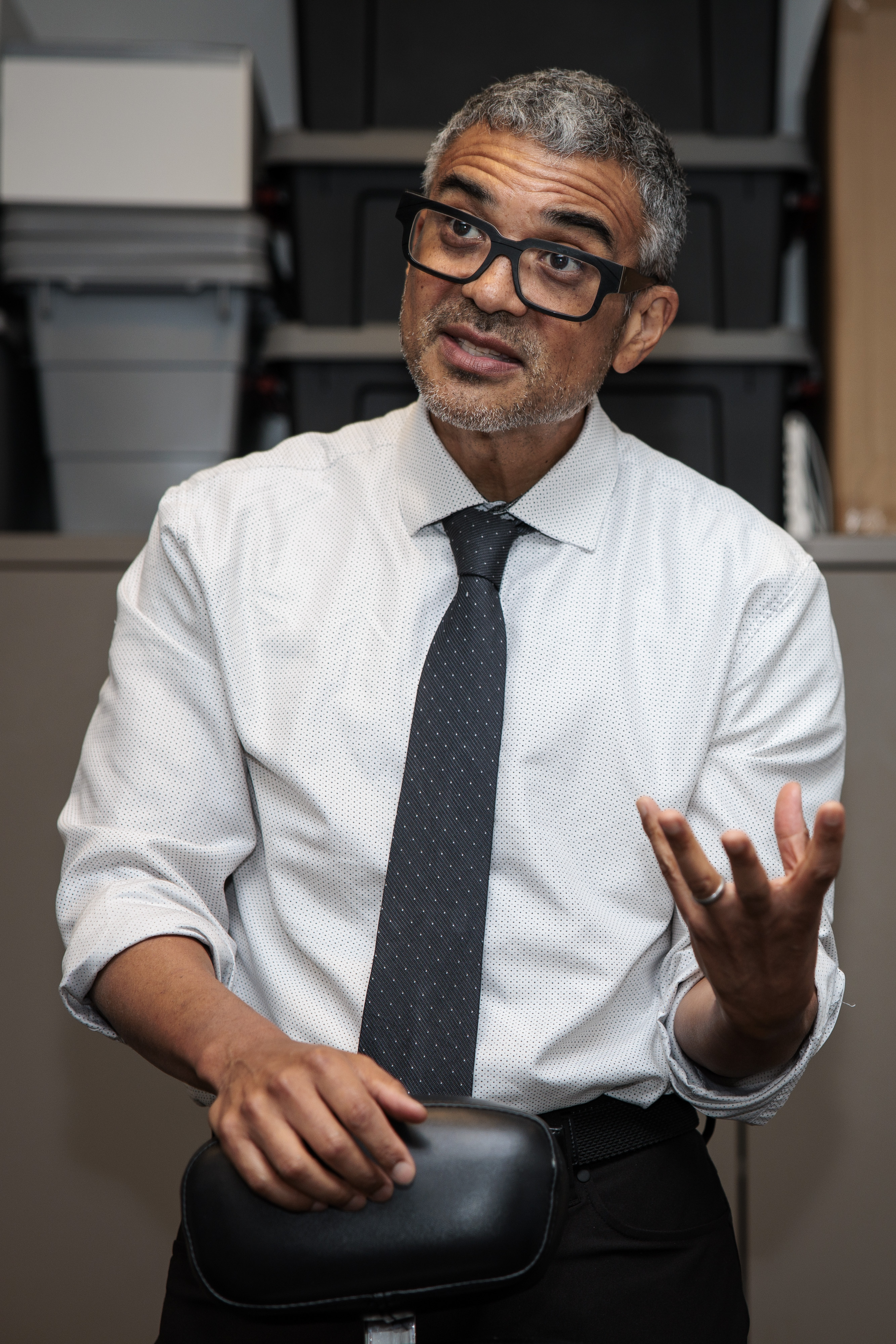
“It does call for a person who is interested in hearing and honoring a multiplicity of opinions and perspectives and then coming to some kind of collective consensus as to how to act in the face of that,” Hamilton, 53, said during an interview in his office this month.
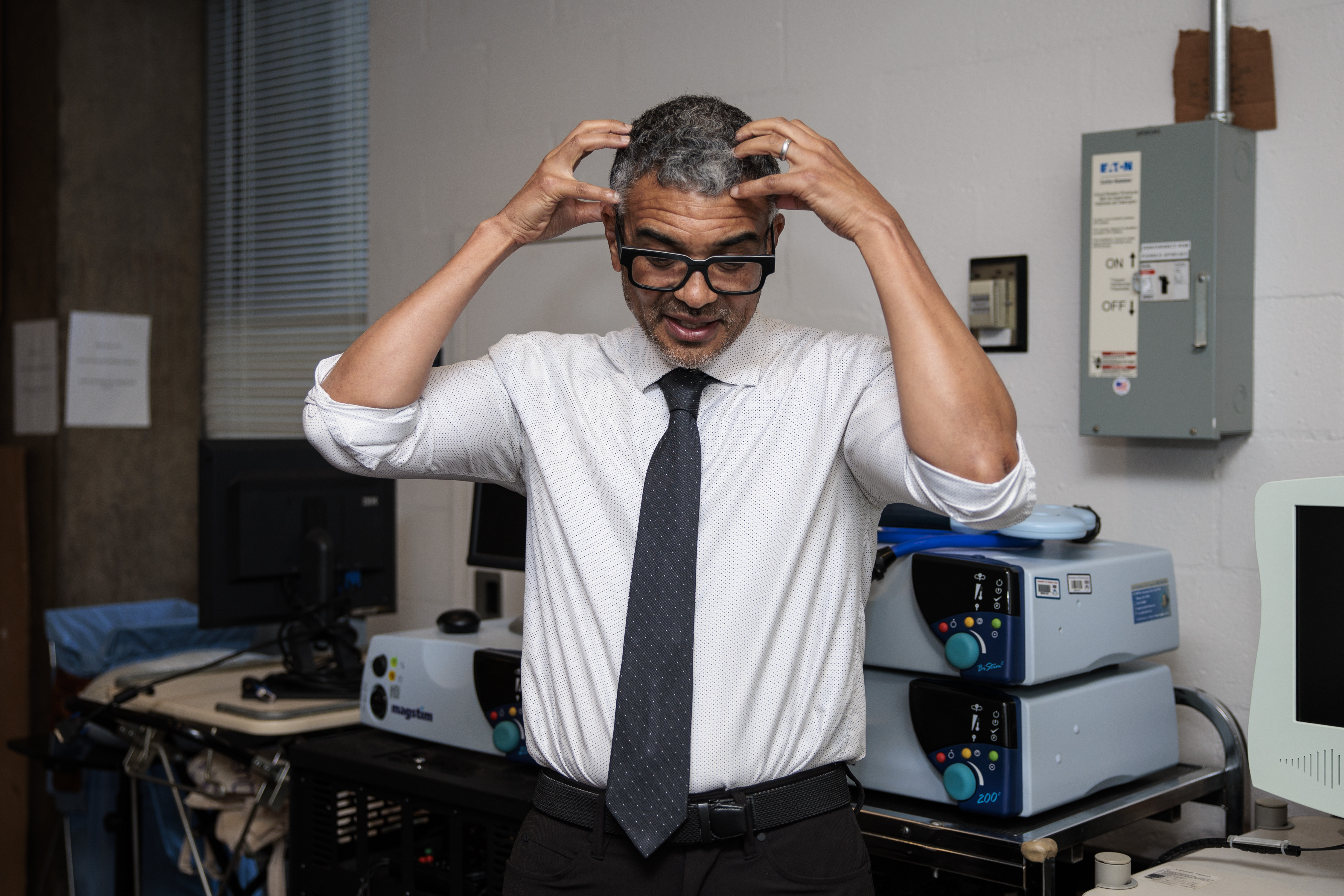
“Penn has acted judiciously in a difficult time,” when responding to Trump, said Roy Hamilton, faculty senate chair and a behavioral neurologist at Penn. “It’s trying to thread a needle. Time will tell whether that strategy ultimately pays off.” Monica Herndon / Staff Photographer
The senate plays a key role on campus discussing issues of faculty concern, making policy recommendations, responding to regular reports of university administrators, and providing oversight on issues that include academic freedom and research policy. AndHamilton, who has spent 24 years at Penn, comes in as chair at a pivotal time. The school is searching for a new president to replace J. Larry Jameson, who will step down next summer, and continuing to operate under the scrutiny of the federal government, which has targeted elite universities. There are ongoing concerns about access to federal research funding, and the school this year plans to adopt new guidelines for open expression on campus that have drawn strong objections from faculty.
“As Penn confronts the major questions of our time, the Faculty Senate’s contribution is not to provide a single set of answers, but to pursue a constructive process of thoughtful deliberation and principled engagement conducted in good faith,” he said in a message to faculty last week.
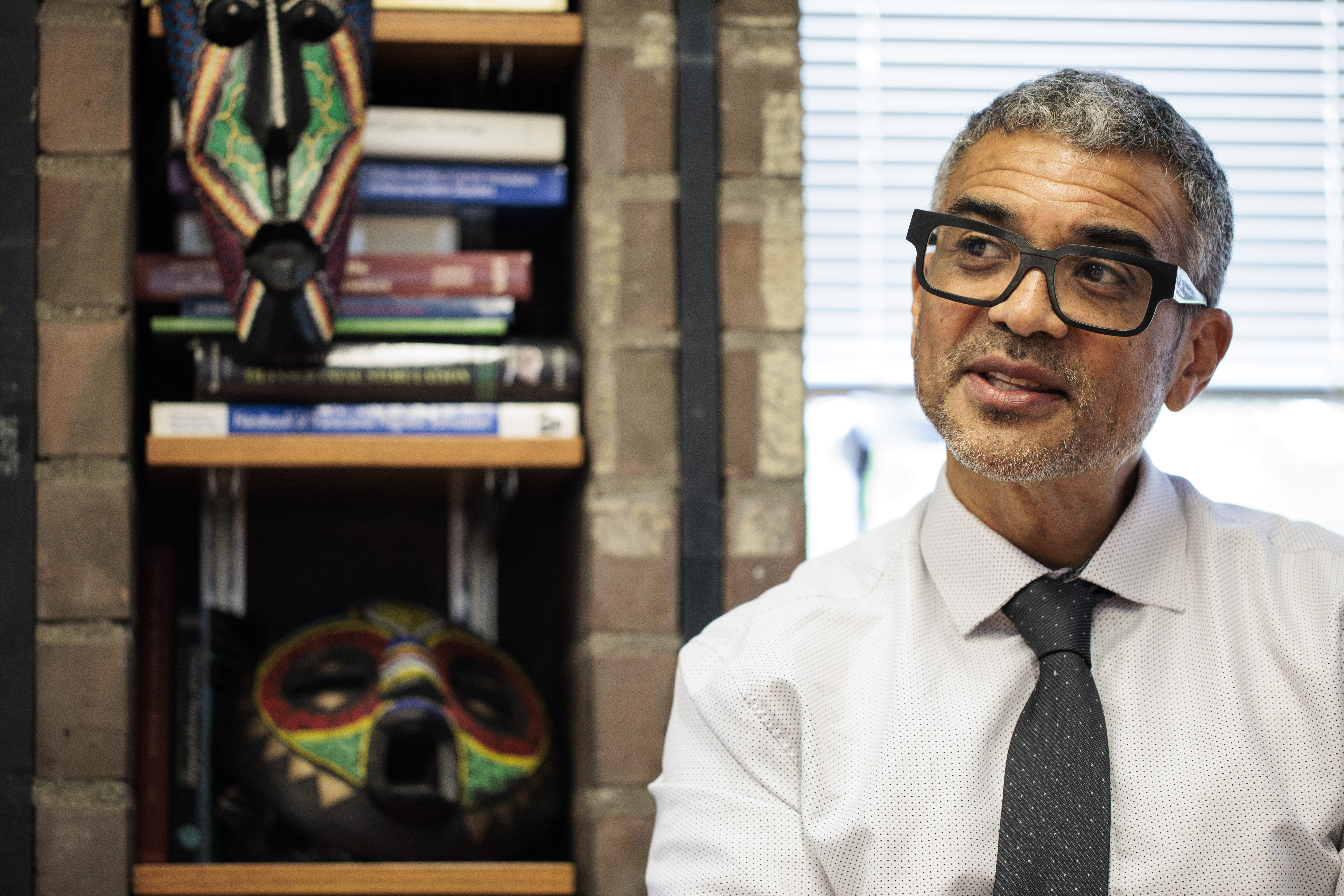
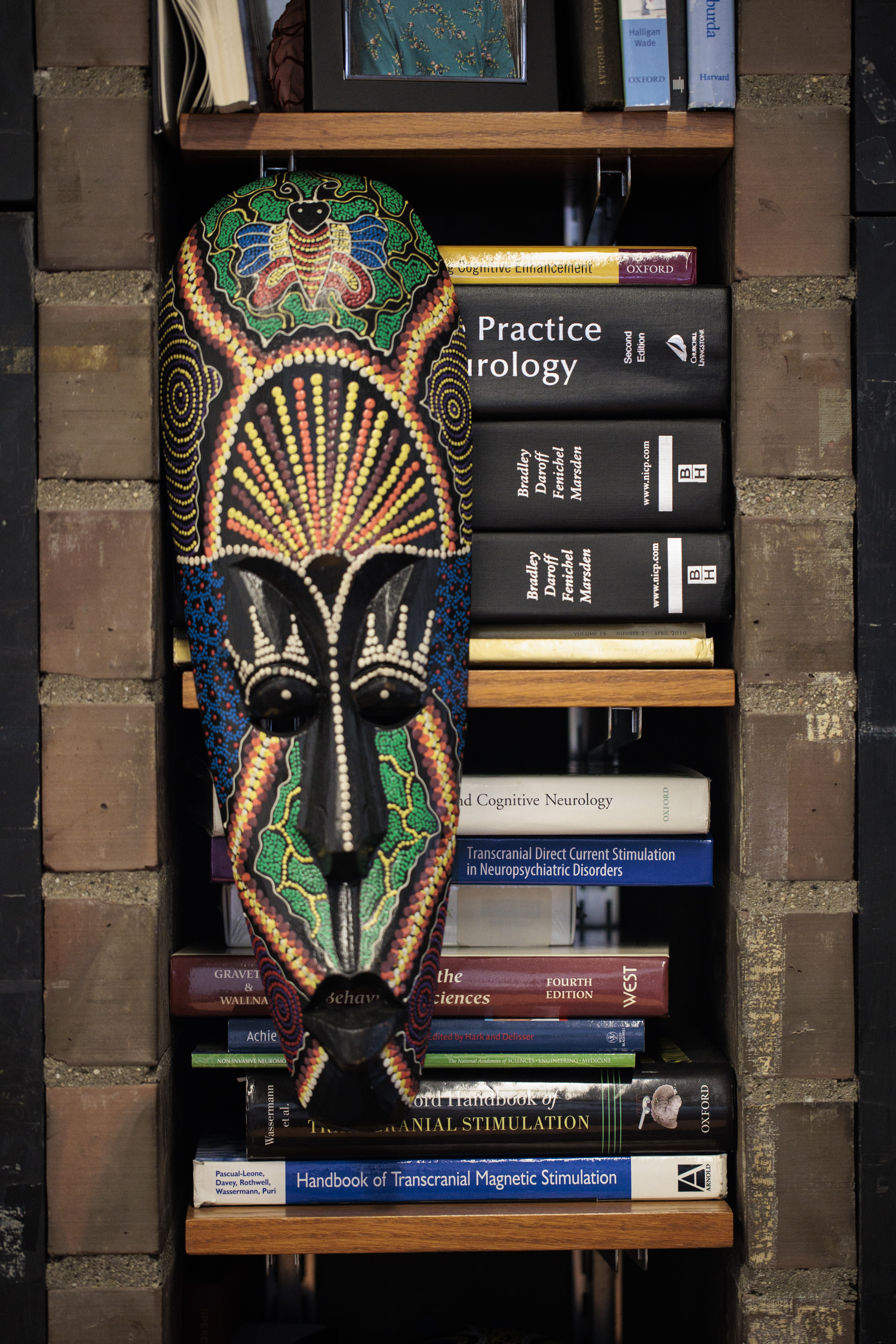
Roy Hamilton collects masks and his office is filled with pieces he has received from his students and mentees over the years. Monica Herndon / Staff Photographer
‘Trying to thread a needle’
Hamilton has been in the hot seat before. He was the medical school’s vice dean for inclusion, diversity, and equity when President Donald Trump’s administration last year cracked down on diversity initiatives in higher education and Penn scrubbed its websites of those programs. Hamilton’s own title was changed to special adviser to the dean.
“It would be disingenuous to say that it was easy,” Hamilton said. “It was a huge change. It was a difficult change. It was a change that I wish the institution didn’t feel like it had to make.”
But Hamilton — who for more than a decade held administrative roles centered on diversity and inclusion at Penn — said he understood that Penn felt it had to make changes, given its reliance on federal research funding. Hamilton pointed out that he gets National Institutes of Health funding for his work.
“If you jeopardize some of the fundamentals of how the institution works and runs, you jeopardize lots of positions and roles, including the roles of persons like myself and the very diverse lab that I run,” he said. “So I understand the Sophie’s choice that the medical school was faced with. That doesn’t mean I have to be happy about it.”
Roy Hamilton talks about his work as a behavioral neurologist.Monica Herndon / Staff Photographer
Still, he said, some of the work continues.
“We are the same people, and I believe that Penn’s values will endure,” he said.
Penn at times has stood up to the Trump administration and at times negotiated. It ardently opposed the Equal Employment Opportunity Commission’s quest to get lists of Jewish people on campus for its investigation into antisemitism. The EEOC dropped its subpoena last month and said it would not take further measures to seek the information through other means.
Last summer, the school entered into an agreement with the administration over the past participation of transgender athlete Lia Thomas on the women’s swim team. Penn met a number of the White House’s demands, including adhering to the Trump administration’s definitions of sex, female, male, women, and men only as they apply to athletics, and sending letters of apology to female athletes who felt aggrieved by Thomas’ position on their team during the 2021-22 season.
“Penn has acted judiciously in a difficult time” when responding to Trump, Hamilton said. “It’s trying to thread a needle. Time will tell whether that strategy ultimately pays off.”
“I was one of those guys, even as a small child, sort of door to door trying to talk to people about the Bible and what God had planned,” Roy Hamilton said, discussing his upbringing as one of Jehovah’s Witnesses. Monica Herndon / Staff Photographer
Hamilton’s upbringing was instrumental to his interest in diversity.
“Every step of the way has felt like I was … some kind of explorer finding some new territory,” he said. “I’ve historically been very interested in seeing to it that other people don’t have that level of alienness in the process.”
Raised as one of Jehovah’s Witnesses, then on to Harvard
Born in Long Beach, Calif., Hamilton grew up as one of Jehovah’s Witnesses. His late father worked in a brewery and his mother, who got her undergraduate degree in Japan, earned money as a seamstress, working from the family home. (She later returned to college, earned a master’s degree, and became a teacher.)
Neither of his parents was raised in the Jehovah’s Witnesses faith, but his father had several family members who belonged. When his mother emigrated from Japan, she told his father she would like to go to church, and he took her to a Kingdom Hall, the worship place of Jehovah’s Witnesses.
“By the time I was a small child, she was one of Jehovah’s Witnesses, and so that was the background in which I was raised,” Hamilton said. “I was one of those guys, even as a small child, sort of door-to-door trying to talk to people about the Bible and what God had planned.”
But he and his family parted ways with the religion when it came time for Hamilton to go to college. Hamilton was in the gifted and talented program as a child, did well in school, and wanted to continue. At that time, the faith generally discouraged higher education, he said.
He recalled congregation elders pulling him aside and questioning his intent to apply to college.
“It had the same kind of vibe as if I had been caught smoking in the boys’ bathroom,” he said.
Hamilton did not just go to college — he went to Harvard University. His father feared flying, so Hamilton took the train from California and arrived three days later in Massachusetts.
The Ivy League experience was “a huge adjustment,” he said. One of his roommates hung out with a son of media mogul Rupert Murdoch, he recalled. A student down the hall was dating then-Vice President Al Gore’s daughter.
He got his bachelor’s degree in psychology and graduated from Harvard’s medical school, where he said he felt a bit of “impostor syndrome.” He also got a master’s degree in health sciences technology from Massachusetts Institute of Technology.
At Harvard, his interest in the brain grew and was amplified when he worked in the lab of cognitive neuroscientist Nancy Kanwisher, whose work led to the discovery of the region of the brain that processes facial recognition.
“It’s the reason why we recognize incredibly subtle differences between faces,” he said.
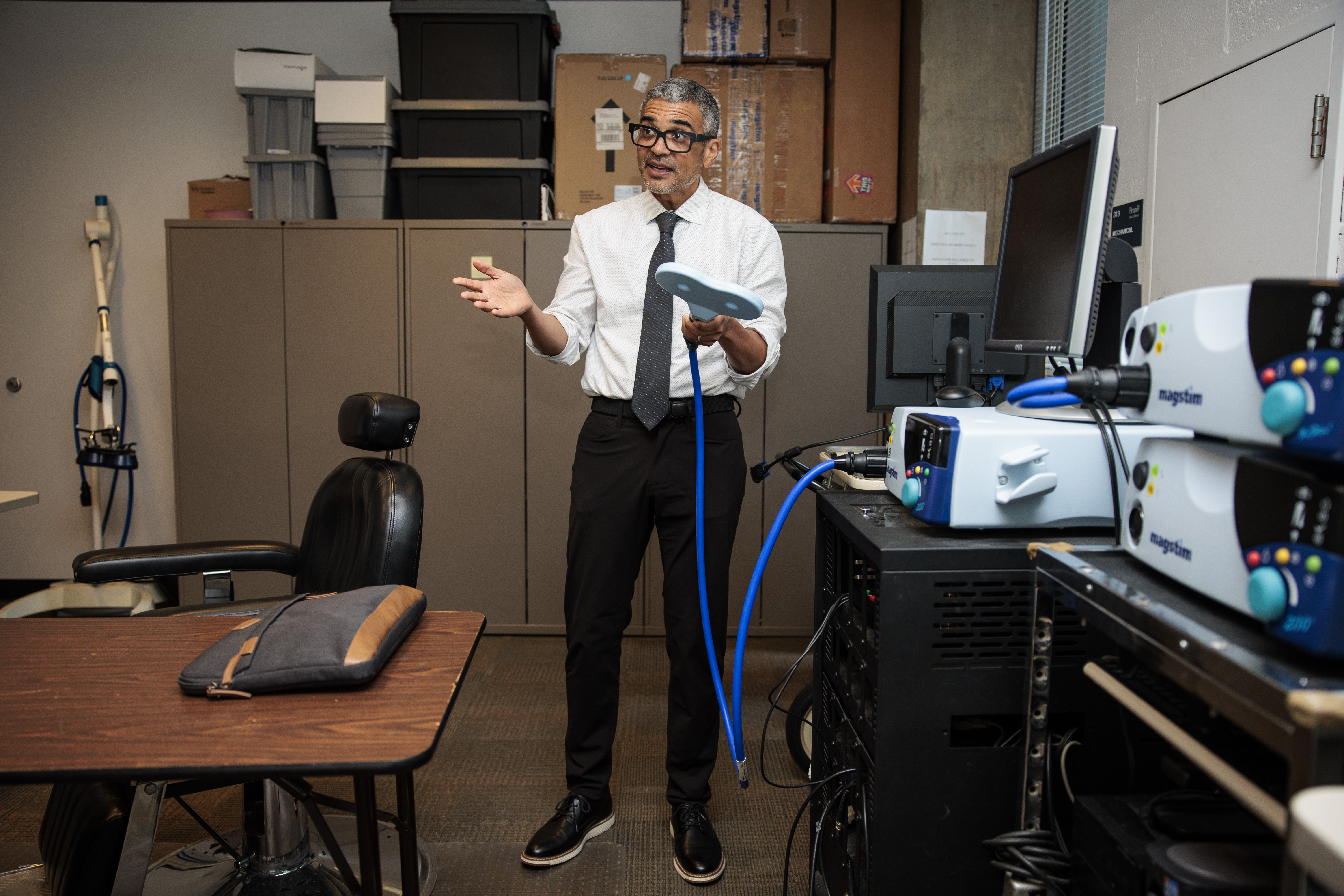
Roy Hamilton discusses how transcranial magnetic stimulation (TMS) units are used in helping to study the brain and develop new treatments for patients with conditions like aphasia. When a TMS device is triggered, the box-shaped main unit discharges a large current through the attached coil. This creates a magnetic field that, when placed against the scalp, activates electrical signals in the brain.
“You can basically force the brain to fire,” he said.
Monica Herndon / Staff Photographer
Another key moment came when neurologist Alvaro Pascual-Leone visited his medical school seminar and showed how magnets aimed at the head could temporarily affect behavior in the brain.
“I was like, ‘That is the most amazing thing I’ve ever seen in my life,’” he said. “‘I’m going to do that for the rest of my life.’”
Magnets and the brain
After an internship at UCLA, in 2002 he came to Penn, where he now runs the Laboratory for Cognition and Neural Stimulation, as well as the Brain Stimulation, Translation, Innovation and Modulation Center. Putting it simply, he said: “I take magnets. I put them on people’s brains and I make them think different things.”
He sees patients struggling with memory and cognition disorders, such as dementia and aphasia.
“The central but not sole clinical focus of my research is in persons with language loss,” he said.
He is married to Dawn Mechanic-Hamilton, a clinical neuropsychologist and associate professor in Penn’s department of neurology.
Last year, Hamilton became chair elect of the senate, which functions under tri-chairs — chair-elect, current chair, and past chair — all one-year terms for a three-year commitment.
The senate earlier this year was charged with naming faculty to serve on a committee outlining priorities for Penn’s next president. Among its priorities this year, the senate will focus on implications of artificial intelligence on teaching and learning, he said.
“While Penn’s future remains full of promise, the road ahead may not always be easy,” he wrote to faculty. “Difficult moments, however, provide an opportunity to think carefully about the principles that give purpose to our work and ought to guide our decisions.”
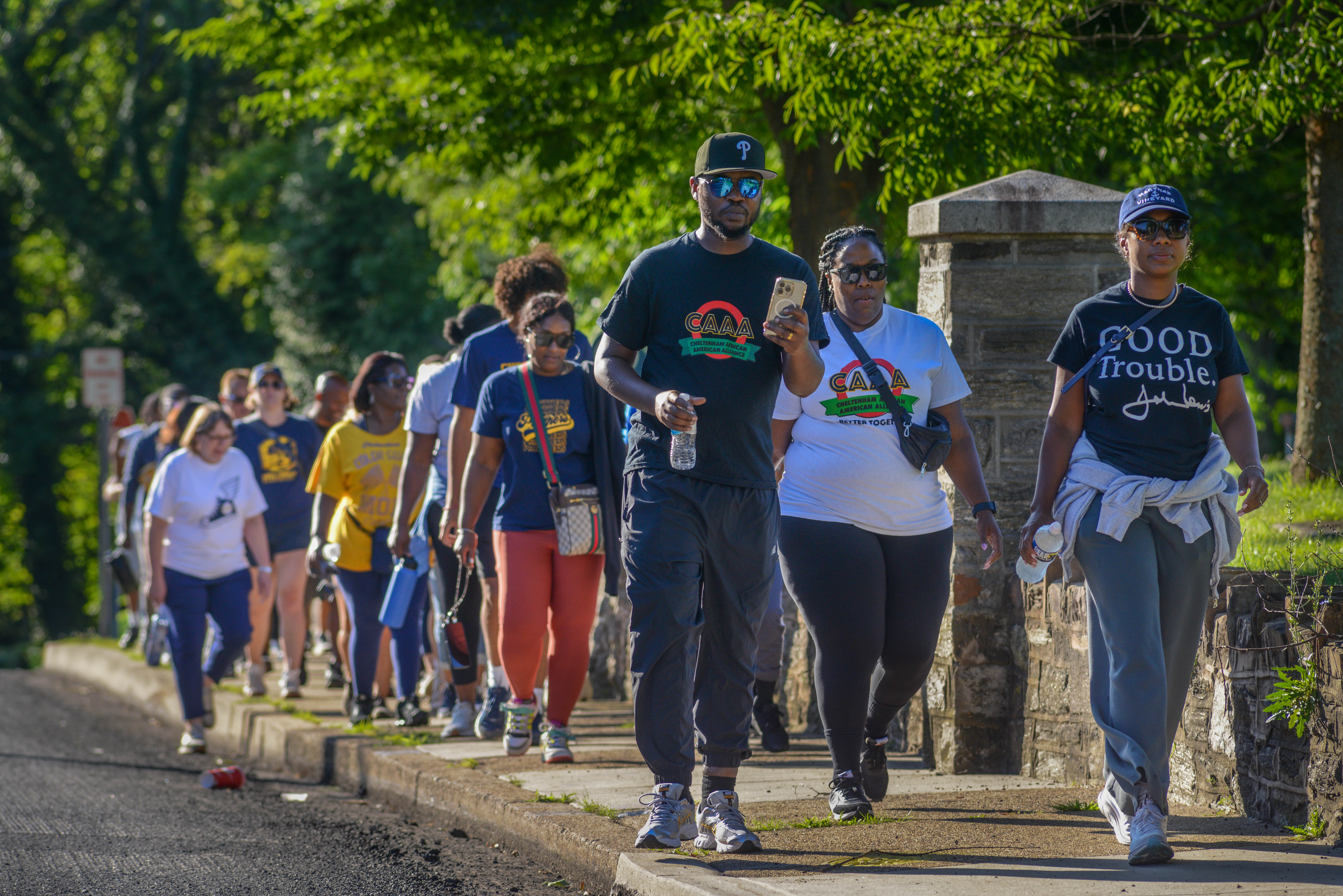
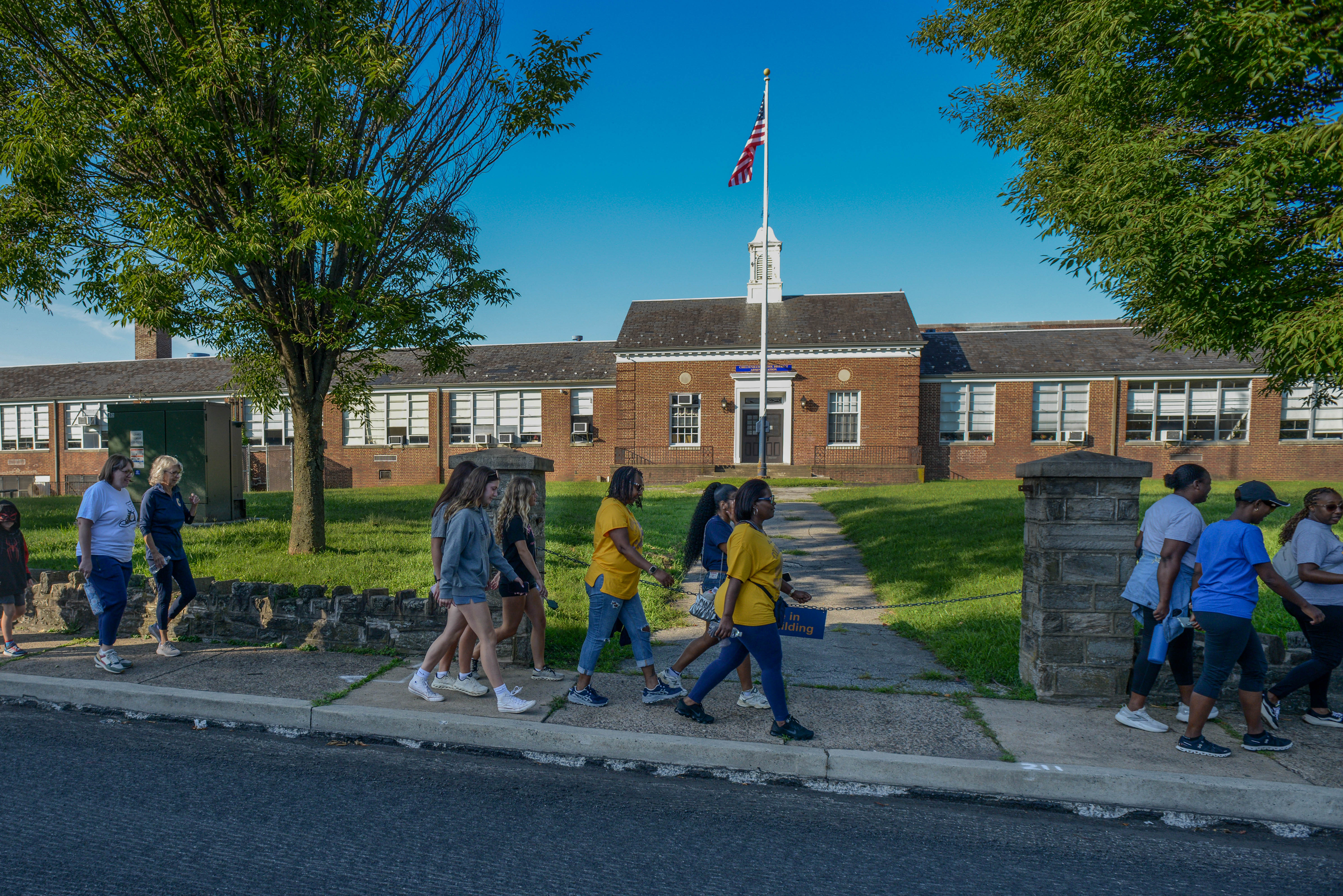
After a football hazing scandal led to criminal charges for coaches and players, about 35 Cheltenham School District parents, students, and school board members marched across town Saturday morning to show their support for students.
The purpose of the march, just days before school starts, was to show students that the community cares about what they are going through, and is calling on the school board to make needed changes, organizers said. Marchers also said it is important to portray the district in a positive light.
“We need to come together as a community, address needed changes, and also push back against some of the false information out there,” said Ikysha Dearry, president of the Cheltenham African American Alliance.
Dearry said the school has faced a barrage of negative attention online from opportunists who want to bring issues like race and the region’s changing demographics into the discussion. “That can have an impact, not just on how our district is viewed, but on how our students are viewed,” she said.
School board director Caroline Watts was one of the first to arrive in the parking lot behind the Cheltenham School District building Saturday morning. She wore athletic shoes for the nearly two-mile walk to the high school. Watts said the message of the march was a “delicate balancing act.”
”We’re addressing what happened, making sure it doesn’t happen again, and we’re starting the school year,” Watts said.
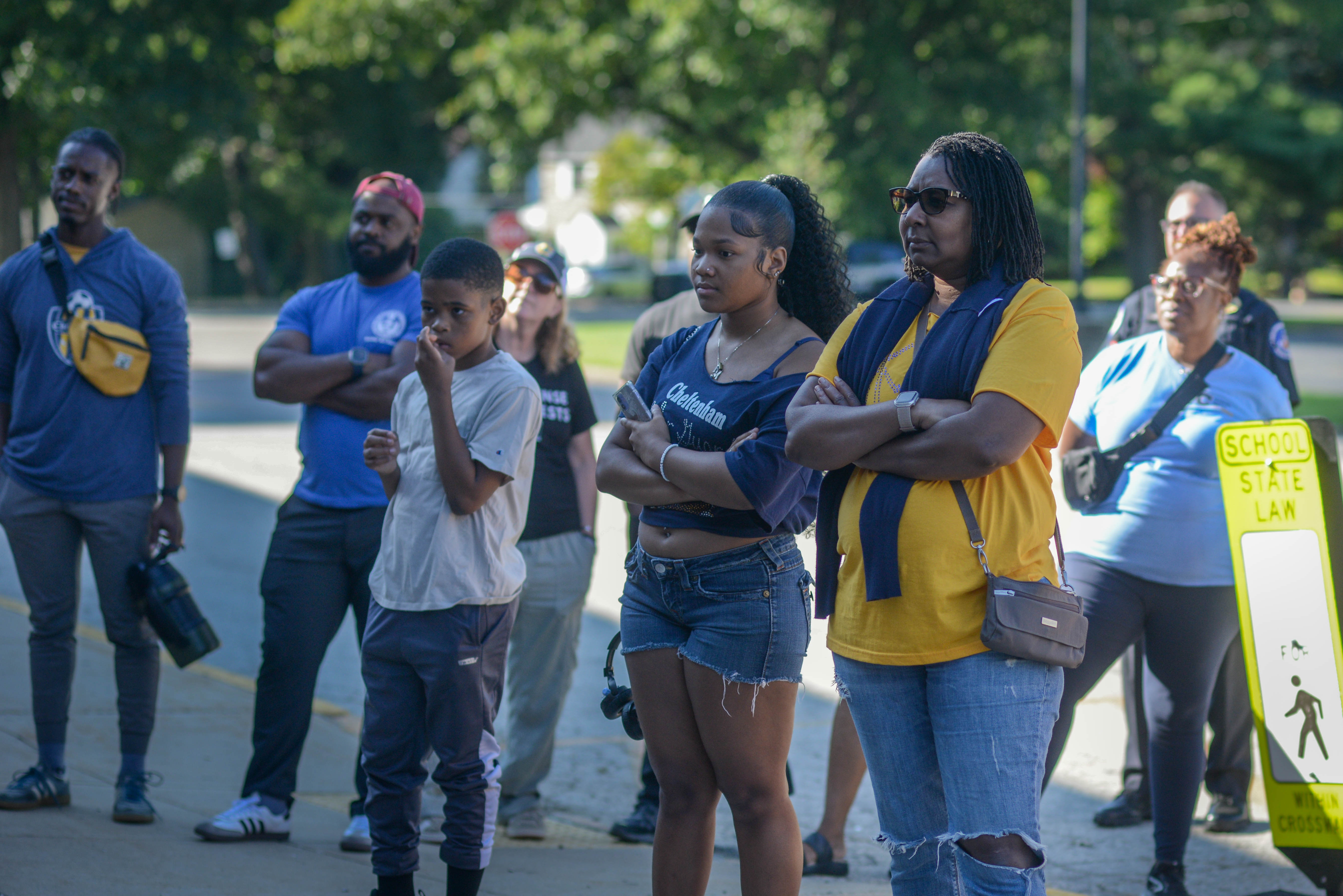
Participants listens as Ikysha Dearry, president of Cheltenham African American Alliance (not shown), addresses the crowd after a community march was held as residents are banding together before the new school year begins to advocate for students, Saturday, Aug. 29, 2026, on Ashbourne Road near the Cheltenham School District Administration Building in Elkins Park. Dr. Brian Scriven resigned as superintendent of the Cheltenham School District in the aftermath of Cheltenham High School football coaches and players being charged with assault in a locker-room hazing incident. Dr. Chris McGinley recently took over as interim superintendent.William Thomas Cain / For The Inquirer
“It’s horrific, what happened,” board vice president Jenny Lowman said before the march. “To think that it happened more than once, it’s also horrifying. Those coaches were responsible for these children. And two of the coaches were parents of students on the football team.”
According to prosecutors, the coaches urged the player not to tell his parents. And according to a grand jury report, high school employees downplayed a complaint from the player’s mother and took then-head coach Terence Tolbert at his word that he had not instructed the boy not to tell his mom.
The report faulted the district’s handling of the situation from the start, saying employees had included Tolbert in their investigation and failed to discover there were two assaults. Employees were also confused about their duties to report child abuse, and at least five football coaches did not have clearances related to mandatory-reporter training, according to the report.
A community march was held as residents are banding together before the new school year begins to advocate for students Saturday, Aug. 29, 2026, on Ashbourne Road near the Cheltenham School District Administration Building in Elkins Park. Dr. Brian Scriven resigned as superintendent of the Cheltenham School District in the aftermath of Cheltenham High School football coaches and players being charged with assault in a locker-room hazing incident. Dr. Chris McGinley recently took over as interim superintendent.William Thomas Cain / For The Inquirer
Cheltenham parent Aubria Nance said the alleged assaults have “absolutely shaken” the students. Nance, a board member of the Cheltenham African American Alliance, said students need to know their concerns are being taken seriously.
“We want the board and the interim superintendent to know that we are advocating for the safety of our students,” Nance said.
Cheltenham parent Kisha Rodwell-Green said the type of hazing she believes to have happened is called “broomsticking.” Searching online, she said, she learned that many other schools had dealt with this.
Rodwell-Green wants the board to approve funding to work with an advocacy group called Stop Hazing. She said the athletic department needs to build a “culture of trust,” one where athletes feel comfortable speaking up if something does not seem right.
“We know we have a lot to correct in our community, and we are starting to see that work being done,” said Rodwell-Green, who also serves as president of a parent-teacher organization called United Parents Group.
Jackson Scott, a student at the high school, speaks to a reporter after a community march was held as residents are banding together before the new school year begins to advocate for students Saturday, Aug. 29, 2026, on Ashbourne Road near the Cheltenham School District Administration Building in Elkins Park. Dr. Brian Scriven resigned as superintendent of the Cheltenham School District in the aftermath of Cheltenham High School football coaches and players being charged with assault in a locker-room hazing incident. Dr. Chris McGinley recently took over as interim superintendent.William Thomas Cain / For The Inquirer
Still, she said, the issues Cheltenham High faces are not unique to the school, and media attention from the hazing incidents has cast an unfair light on a good school.
“Comments on Facebook got very nasty,” Rodwell-Green said. “There’s a microscope on Cheltenham, and we want to take that microscope off.”
For some community members, the criminal charges added fuel to complaints that the district has not been taking safety seriously enough. Parents of football players said they had urged the district not to hire Tolbert, citing concerns he let bullying go unchecked during his one-year stint as Abington’s head football coach.
The district, which in May canceled the forthcoming football season, has responded to the charges by commissioning an outside investigation and hiring a new superintendent. Chris McGinley, a veteran educator who had served as Cheltenham’s superintendent two decades ago, was approved by the board on Aug. 18 to lead the district under a one-year contract. He replaces Brian Scriven, who resigned last month.
The changes also have forced high school students to grapple with the fallout.
Cheltenham senior Jackson Scott, 17, had mixed feelings. Scott, a soccer player, said it was unfair that his friends on the football team had their seasons canceled. Steps must be taken to stop such incidents from happening again, he said, but he also wondered if some of the details of the hazing incidents had been exaggerated.
Senior Isabella Pero, 17, said she was disgusted that other students said nothing despite knowing about the hazing.
Pero said she was shocked to learn that Tolbert, who taught one of her classes and seemed like a nice person, was involved. The same goes for the students involved in the alleged assaults, she said. She struggled to square her impression of the students with the violence.
“In my opinion, in the moment, you’re so hopped up in wanting to win a game, and have a good season, that you make those tainted, not good decisions,” Pero said.
Parent Michelle Gregorio said she hopes athletic director Sam Sheridan will help the district move forward. “And we don’t want to sweep under the rug what happened, but we want to let students know we’re addressing it.”
Inside a cavernous warehouse just off I-295 in Cherry Hill, Larry Abrams spread his arms, gesturing to the sea of industrial-size cardboard boxes that surrounded him.
“We’re sitting on a rocket ship,” said Abrams, a third-generation teacher.
Abrams’ rocket ship is composed of books: thousands and thousands of them — picture books and out-of-date science textbooks, cookbooks and battered novels. He sees them as a way to change kids’ life trajectories.
The BookSmiles van and a staffer’s car parked outside of BookSmiles new warehouse in Cherry Hill.Elizabeth Robertson / Staff Photographer
To date, BookSmiles, the nonprofit Abrams started out of his garage in 2017, has distributed five million books. It just outgrew its third location, expanding into a 14,000-square-foot space in Cherry Hill that is formally opening next week.
Book banks are not a new idea. But Abrams believes he’s got the secret sauce.
“We’re the only book bank in America that does this — we actively trade pallets of grown-up books for pallets of upcycled gently used children’s books,” Abrams said. “Never before has there been a low-cost way to get so many beautiful, upcycled books into the homes and hands of kids who need them the most.”
‘It’s simply about lack of book access’
Abrams served in the Navy — he was stationed on an aircraft carrier during the Persian Gulf War — and managed a copy shop. Then he settled into a career as an English teacher, working first in Moorestown, then in Lindenwold.
“I thought, ‘Why do most of the Lindenwold kids in my ninth-grade class read at a third- or fourth-grade reading level?’” Abrams said. “It’s simply about lack of book access. It’s not fair that some kids grow up with no access to books, and other kids have everything.”
Abrams thought long and hard about how to change that equation. What if he redistributed books from wealthy and middle-class communities to the places that didn’t have them?
BookSmiles founder Larry Abrams works in the loading dock area of BookSmiles’ new Cherry Hill warehouse on Friday, Aug. 28, 2026.Elizabeth Robertson / Staff Photographer
He put out a social media call for children’s books, and got thousands.
There is no market for reselling used children’s books online, Abrams found — you can’t sell them and make any kind of money. So the BookSmiles concept developed.
Now, people from all over New Jersey and Pennsylvania donate books — any kind of books, from old encyclopedias to nearly new novel series. The BookSmiles team (at first, just Abrams himself; now, it’s 11 people and a growing corps of volunteers) sorts through every single book.
The organization gets books in myriad ways: from folks dropping off what they salvage after cleaning out a bookshelf to donations of entire estates of books. BookSmiles accepts library discards and scrap paper, too.
Adult books, old textbooks, and kids’ books that are not in excellent condition are sold, not for cash, but for gently used children’s books that are distributed directly to teachers, daycares, and other nonprofits that get them in kids’ hands.
‘There’s a low-cost way to raise test scores’
BookSmiles grew so significantly that Abrams retired from teaching and now works full-time as executive director.
But his educator hat is always on. Research shows that access to books, and books in children’s homes, is a powerful determinant of kids’ educational outcomes and economic success.
“This comes from a place of me being a teacher, and seeing there’s a low-cost way to raise test scores,” said Abrams, dipping his hand into a cardboard box and fishing out an old dictionary that will end up being recycled for paper.
BookSmiles founder Larry Abrams among boxes of childrens books ready for young readers in BookSmiles new Cherry Hill warehouse on Friday, August 28, 2026.Elizabeth Robertson / Staff Photographer
The largest share of BookSmiles’ books moves out through its “Teacher Take” program. Teachers pay a nominal fee — BookSmiles asks for $35 annually — and can then take hundreds of books multiple times a year, either for classroom libraries or for distribution.
BookSmiles also sponsors “Fair Book Fairs,” where schools get enough books for every child to take home at least three volumes at no cost.
Schools that serve predominantly students from economically disadvantaged backgrounds are asked to kick in just $200 to get a Fair Book Fair. Others pay a little more.
In 2025, BookSmiles gave away half a million books to teachers and kids in Philadelphia schools. Another 500,000 went to New Jersey teachers and schools, and the remainder, about 250,000, were sent overseas.
With libraries often on the chopping block in low-wealth school systems — Philadelphia had fewer than five people working as full-time, certified school librarians last school year — classroom libraries are key, and teachers often need resources to build them.
“We can hook them up,” Abrams said. “I can’t give them school supplies, but I can give them books.”
Book joy
Abrams still gets struck by moments of “book joy” when he looks at the Teacher Take room, or the massive room of books waiting to be sorted or moved out.
“It’s almost like walking into Willy Wonka’s world, but it’s not candy, it’s books,” he said. “Sometimes, you can’t tell the difference between what Barnes & Noble is selling and what we’re giving away.”
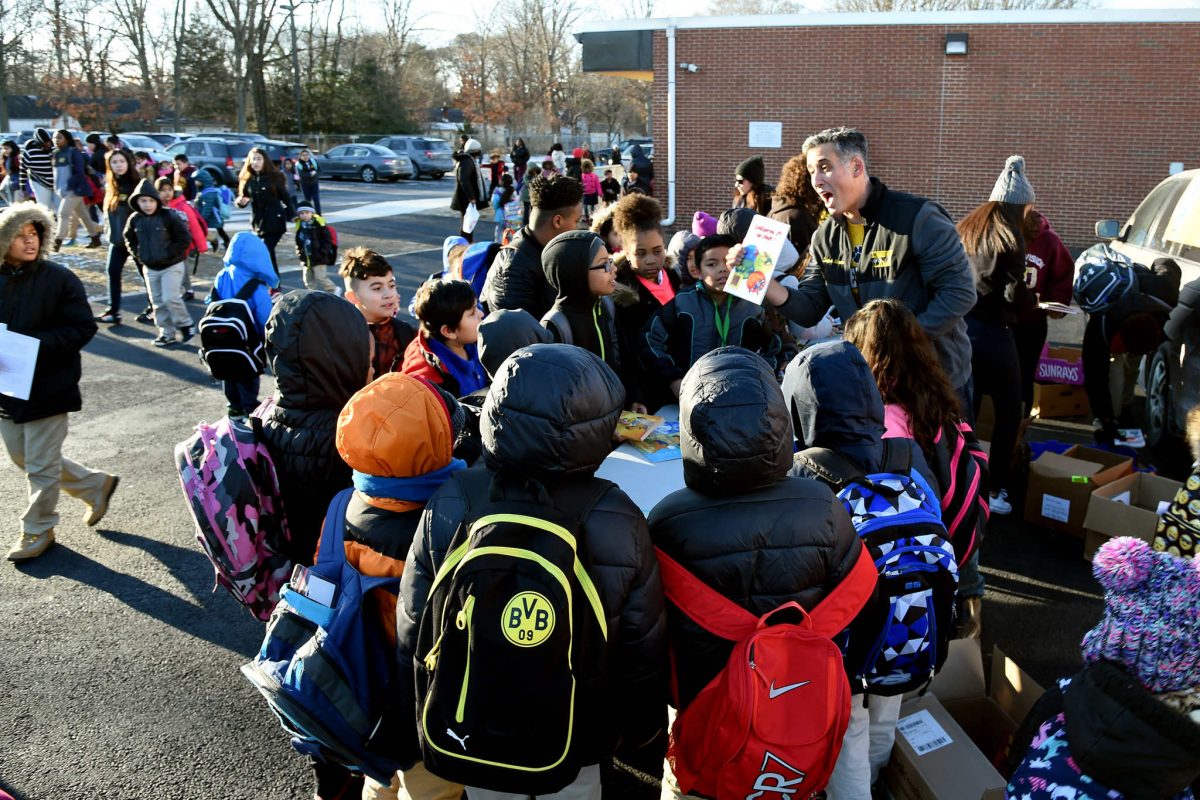
Larry Abrams shows BookSmiles books to Lindenwold Elementary School students in the nonprofit’s early days. This file photo is from 2018.TOM GRALISH / Staff Photographer
BookSmiles’ new space, across the street from the PATCO Woodcrest station, just off I-295, is a level up for the organization. It will allow BookSmiles to move from distributing 1.3 million books per year to five million books per year, and can accommodate more volunteers.
The music icon and humanitarian, who died Tuesday, was an inspiration for BookSmiles and a mentor to him, though he never met her.
Parton began her Imagination Library, a program that sends free books directly to children’s homes, as a tribute to her father, who never learned to read.
“I don’t know if I’ll ever get to 300 million books,” Abrams said. “But we know that if books are in the home, children will be more successful academically. We know that access to books changes equations.”
BookSmiles, 100 Melrose Ave., Cherry Hill, N.J., accepts book donations and volunteers. Its Teacher Take program resumes soon.
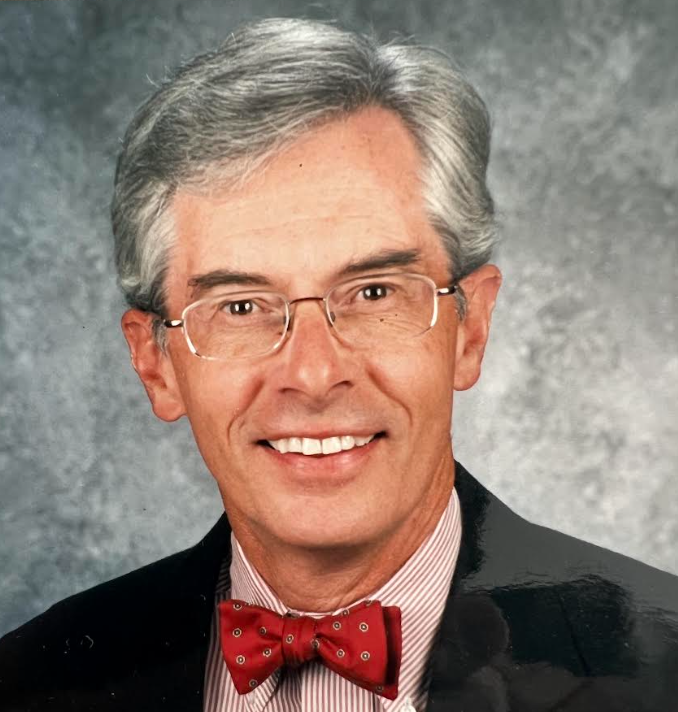
Reed E. Pyeritz, 78, of Radnor, pioneering medical geneticist, cofounder of the Marfan Foundation and the American College of Medical Genetics and Genomics, professor emeritus of medicine and genetics at the University of Pennsylvania, author, mentor, veteran, and nationally ranked masters triathlete, died Monday, Aug. 10, of interstitial lung disease at Bryn Mawr Hospital.
Dr. Pyeritz was a trailblazing expert on the diagnosis and treatment of Marfan syndrome and other inherited cardiovascular disorders. His 44 years of research and clinical work, from 1978 to 2022, advanced the understanding and management of the diseases, and extended the life expectancy of Marfan patients by 30 years.
“So many of us in the community owe Reed so much,” Bert Medina, board chair of the Marfan Foundation, said in a tribute. “His legacy lives on in all of us, thanks to his dedication.”
In an online tribute, a relative of former patients said: “Without this amazing doctor, I wouldn’t have my sister or dad. He changed the world for Marfan patients and their families.”
Dr. Pyeritz joined the faculty at Penn in 2001 and spent more than 20 years treating patients, teaching students, doing landmark studies on the value and social implications of genetic testing, and championing patient-centered care. He was codirector of Penn’s research center on hereditary hemorrhagic telangiectasia, onetime chair of the faculty senate, and a fellow at the College of Physicians of Philadelphia and other medical associations.
His “vision and scholarship fundamentally transformed the care of patients,” Nimesh D. Desai, director of the Penn Aorta Center, said on X.
Before Penn, Dr. Pyeritz spent nine years in Pittsburgh with what is now the Allegheny Health Network and 17 years at the Johns Hopkins University School of Medicine in Baltimore. In 1991, his team at Hopkins discovered that mutations in the FBN1 gene cause Marfan syndrome and followed up with new regimens to treat it.
He cofounded the Marfan Foundation in 1981 and the American College of Medical Genetics and Genomics in 1991. “It became clear that folks with Marfan syndrome could benefit by an organization that allowed them to communicate [and] to stimulate other physicians to become involved,” he said in a 2018 video interview.
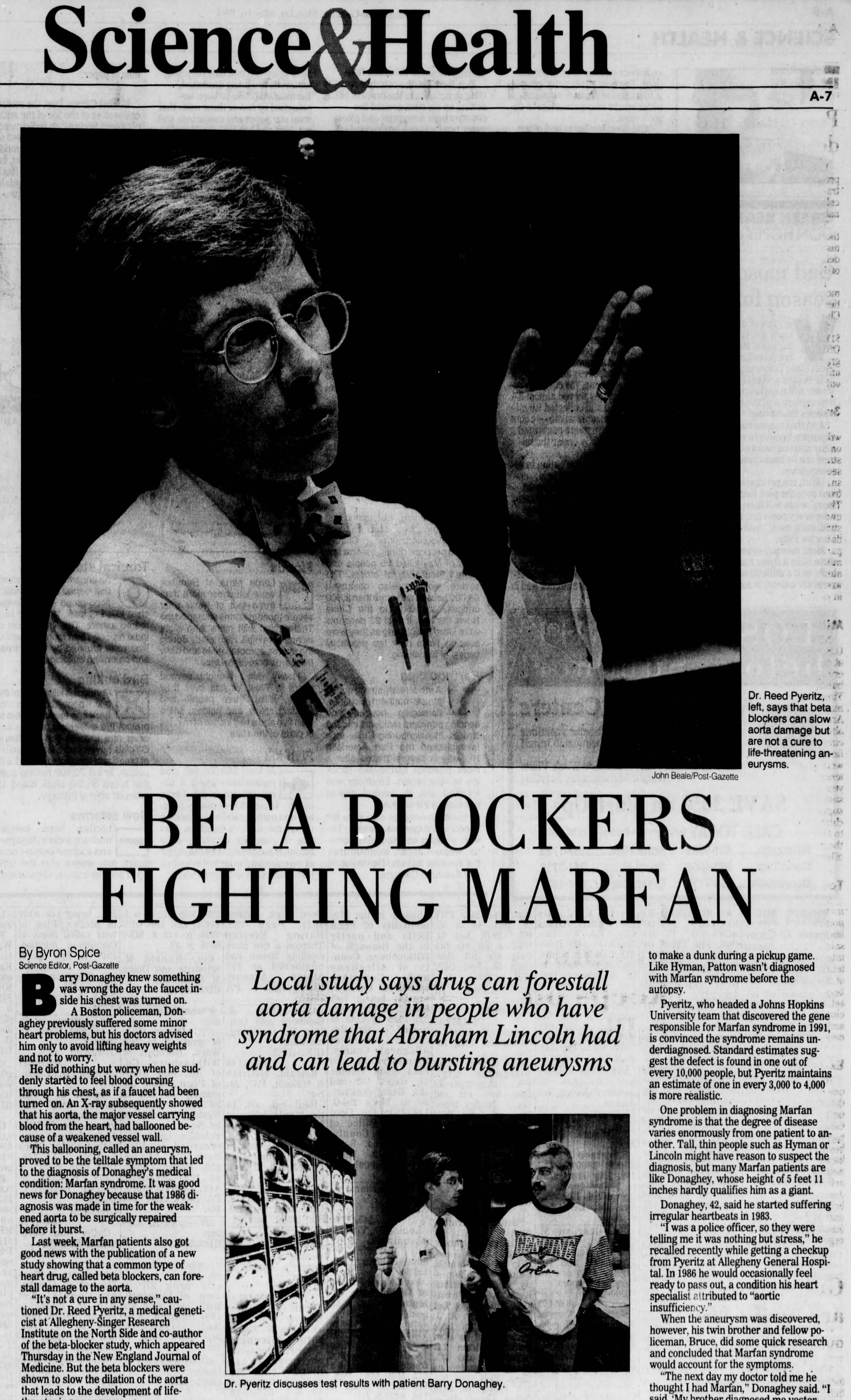
This story and photos about Dr. Pyeritz appeared in the Pittsburgh Post-Gazette in 1994.Newspapers.com
Colleagues, friends, and former patients called him “a phenomenal physician,”“a guiding light,” and “an extraordinarily reassuring presence” in online tributes. In 2018, he said: “The most gratifying thing is the fact that folks [with Marfan syndrome] are living their normal life expectancy.”
Dianna Milewicz, chair of the John Ritter Foundation advisory board, noted his “excellence in clinical care, teaching, and research” on Facebook. Michael L. Weamer, president and CEO of the Marfan Foundation, called him “a true hero” and said his “impact on our community is immeasurable.”
He served 13 years in the Army Reserve Medical Corps and earned lifetime achievement awards from the Marfan Foundation, the American College of Medical Genetics and Genomics, and other groups.
Dr. Pyeritz and his wife, Jane Tumpson, married in 1972.Courtesy of the family
On weekends, he did marathons and triathlons, and was part of a world record 100-man, 100-mile relay. His family said in a tribute: “He measured a successful life less by titles or awards than by what one gives, what one learns, whom one loves, and what one leaves behind in others.”
Reed Edwin Pyeritz was born Nov. 2, 1947, in Pittsburgh. He was fascinated by science and space as a boy, and he built rockets in his backyard and performed scientific experiments in his bedroom.
He earned a bachelor’s degree in chemistry at the University of Delaware in 1968, a master’s degree and doctorate in biological chemistry at Harvard University in 1972, and his medical degree at Harvard in 1975.
He met Jane Tumpson in first grade, and they graduated together from Mount Lebanon High School near Pittsburgh in 1965. They reconnected on the tennis court a few years later, married in 1972, and had daughters Allyson and Abigail.
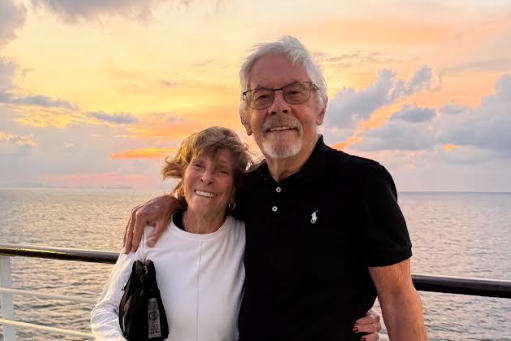
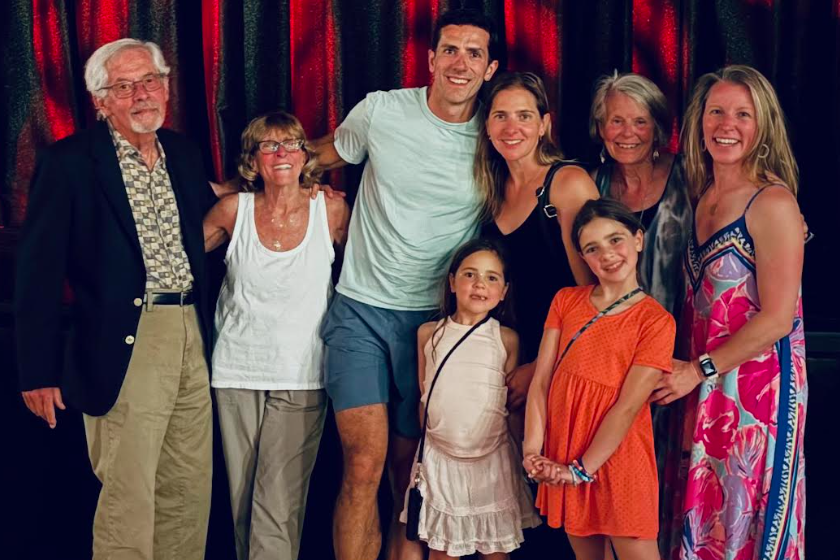
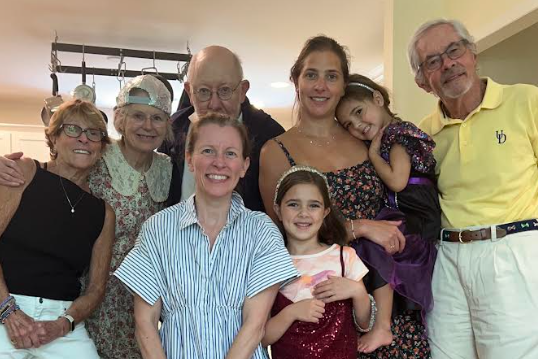
Dr. Pyeritz, left in the top photo and right in the bottom photo, enjoyed time with his family.Courtesy of the family
Dr. Pyeritz and his wife honeymooned on Mount Kilimanjaro in Africa and traveled the world together for years. In April, the whole family went to Spain.
He liked to wear bow ties, build stone walls, watch the news, and spend time outside with his dogs. He followed the Pittsburgh pro sports teams closely and enjoyed Manhattans and chocolate milkshakes.
“I will miss it all,” he told colleagues at Cure HHT when he retired a few years ago. “But I am certainly looking forward to spending time with my two granddaughters, Tallulah and Penelope.”
His daughters said: “Ever an adventurer, he instilled in us the importance of making the most of every day, watching the sunrise or sunset, and cherishing the time you have.”
His wife said: “He loved without exception and reservation.”
In addition to his wife, daughters, and granddaughters, Dr. Pyeritz is survived by son-in-law Keith Hopkins and other relatives. A brother died earlier.
A celebration of his life is to be held later.
Donations in his name may be made to the Marfan Foundation, 22 Manhasset Ave., Port Washington, N.Y. 11050.
Dr. Pyeritz “loved without exception and reservation,” his wife said.Courtesy of the family
Getting all prekindergarten students to consistently attend school has proven to be a challenge as the Cherry Hill district rapidly expands its program for early learners.
Absenteeism rates among the district’s pre-K students is second only to Cherry Hill high school seniors, the grade with the highest chronic absenteeism rate, according to state data. The district’s experience is similar to other districts rolling out pre-K programs with state funding, which reaches $1.4 billion in the latest budget.
“Unfortunately, I have to say that preschool had one of the highest rates of chronic absenteeism,” Farrah Mahan, assistant superintendent for pre-K to grade 12 and curriculum, told school board members at this week’s meeting. She explained some tactics being used to combat high absenteeism.
The chronic absenteeism rate, a widely used measure in education, shows the percentage of students absent 10% or more days in the school year.
In Cherry Hill public schools in 2024-25, the latest year available, the rate for Cherry Hill pre-K students was 23.5% compared with a statewide average of 29.9%, according to the New Jersey Education Department School Performance Reports.
Overall, the district’s rate was 14%, slightly less than the state average of 14.4%. However, 25.8% of all high school seniors were chronically absent — more than the statewide average of 21%.
The district’s preschool social workers and other staff members have been working with parents to get the youngest children to attend school, Mahan said.
“They’ve really been acting almost as like a social service agency, which is really sometimes what our families need, making sure that they are connected to the appropriate resources that are available in the community to ensure that their child is able to get to school on a daily basis,” she told board members.
Sometimes it is as simple as greeting students at the bus or as they’re exiting the family car in the morning or providing extra attention during the school day, she said.
“But we’ve also had some tough conversations like, this really matters,” Mahan said. “When you were in a private preschool location, maybe it was OK to take a vacation that second week, because it was more convenient and a little bit cheaper for families. But really expect your preschooler, if they’re enrolled in the program, to be in school.”
She said the focus has resulted in reducing the chronic absenteeism rates among the preschoolers.
Mahan joked that when schools open on Wednesday she looks forward to welcoming the Class of 2041.
Pre-K enrollment has increased sharply in Cherry Hill and some other districts as former Gov. Phil Murphy and Gov. Mikie Sherrill have supported free and expanded access to early childhood education.
Cherry Hill and other districts have had to rely heavily on private providers to help take on the growing enrollment as parents shift from privately paid to publicly funded preschool. The district has two district preschool locations and uses nine private providers.
With its expansion to 11 sites last year, the district was able to clear the initial wait list, Mahan said. All 559 students who applied for a pre-K seat were accepted, so the district opened up the list to additional families. A total of 93 applied and the district could offer spots for 34.
In the new school year, nearly 900 preschoolers have been offered spots. The total will include 740 general education seats, 55 preschool inclusion seats, and 96 disabled student seats, Mahan said.
The district’s program has grown from 17 classrooms after preschool expansion was announced in 2023 to 53 classrooms in the 2026-27 school year.
Mahan said the goal is to eventually expand to a projected 1,700 seats — more than a 90% increase over this coming year’s group. She said 110 classrooms will be needed to accommodate the enrollment.
The district’s private providers for the new school year are Adventure Kids, Cadence Academy, Discovery Corner, Goddard School, KinderCare, Lightbridge Academy. Primrose School, Chesterbrook Academy of Voorhees, Mosaic Early Learning of Oakland. The two in-district locations are at Kilmer Elementary School and the Malberg Early Childhood Center.
“Children who participate in early childhood education programs generally enter kindergarten with stronger foundational skills,” Mahan told the board. “The research in early childhood education states that early learning environments foster essential language skills, early literacy, and basic math concepts,” she said.
Supervision of curriculum and teaching at all 11 locations is important to the preschool program, she explained.
“It is imperative that we have consistency across all of our locations. So when we speak about our preschool private provider locations and our in-district locations, we talk about consistency across all of our guidelines, our curriculum,” Mahan said.
70and73.com is a hyperlocal news site focused on South Jersey, including the communities of Cherry Hill, Evesham, Mount Laurel, Voorhees, Medford, Medford Lakes, and Moorestown.
A growing number of colleges are offering three-year bachelor’s degree programs, providing students a faster and less expensive path toward graduation, but worrying critics who say the trend could devalue college education.
Instead of the typical 120 credits earned in four years, some programs now require students to complete around 90 credits. Proponents say that helps students get into — or back into — the workforce more quickly and with less debt. But some question whether the shortened degrees will be fully accepted by graduate schools, employers, and accreditors.
At least 70 U.S. schools are either already offering three-year degrees or are actively considering them, according to a report this year by the American Association of Collegiate Registrars and Admissions Officers, and multiple states have required or encouraged public universities to add them.
On Wednesday, Texas Gov. Greg Abbott (R.) took steps to join that group, directing the Texas Higher Education Coordinating Board to create a statewide framework for three-year-degree pathways.
“Every semester adds tuition, fees, housing, food, transportation, and other living expenses and delays students’ ability to begin their careers,” Abbott said in a news release. “Texas students deserve the option to receive a degree in a high-demand, high-wage field in less time.”
The trend is spreading in both red and blue states, as well as across many types of institutions, public and private, large and small. This summer, the Massachusetts Board of Higher Education approved applications from two schools to pilot three-year-degree programs.
In June, Grambling State University and Southern University Law Center, historically Black schools in Louisiana, announced a partnership that would allow students to accelerate their way to a law degree, with three years of undergraduate work and three years of law school.
Todd Wolfson, president of the American Association of University Professors, said the three-year degree is the wrong answer to a real crisis. He said decades of public disinvestment have shifted the cost of higher education onto students and families, and schools should not respond by shrinking the degree and asking students to make do with less.
“We need to address the problem at its root,” he said. “Reinvest massively in higher education and build a free public higher-education system that gives every student access to a full, high-quality college education without taking on crushing debt.”
Robert Zemsky, professor emeritus at the University of Pennsylvania’s Graduate School of Education who has been advocating for three-year degrees for more than 15 years, said many state agencies have now encouraged their public universities to explore the idea. Zemsky said he supports that approach.
“Don’t bet the whole bundle on an instant change from three-year degrees. Start a few experimental programs,” he said, and “see what happens.”
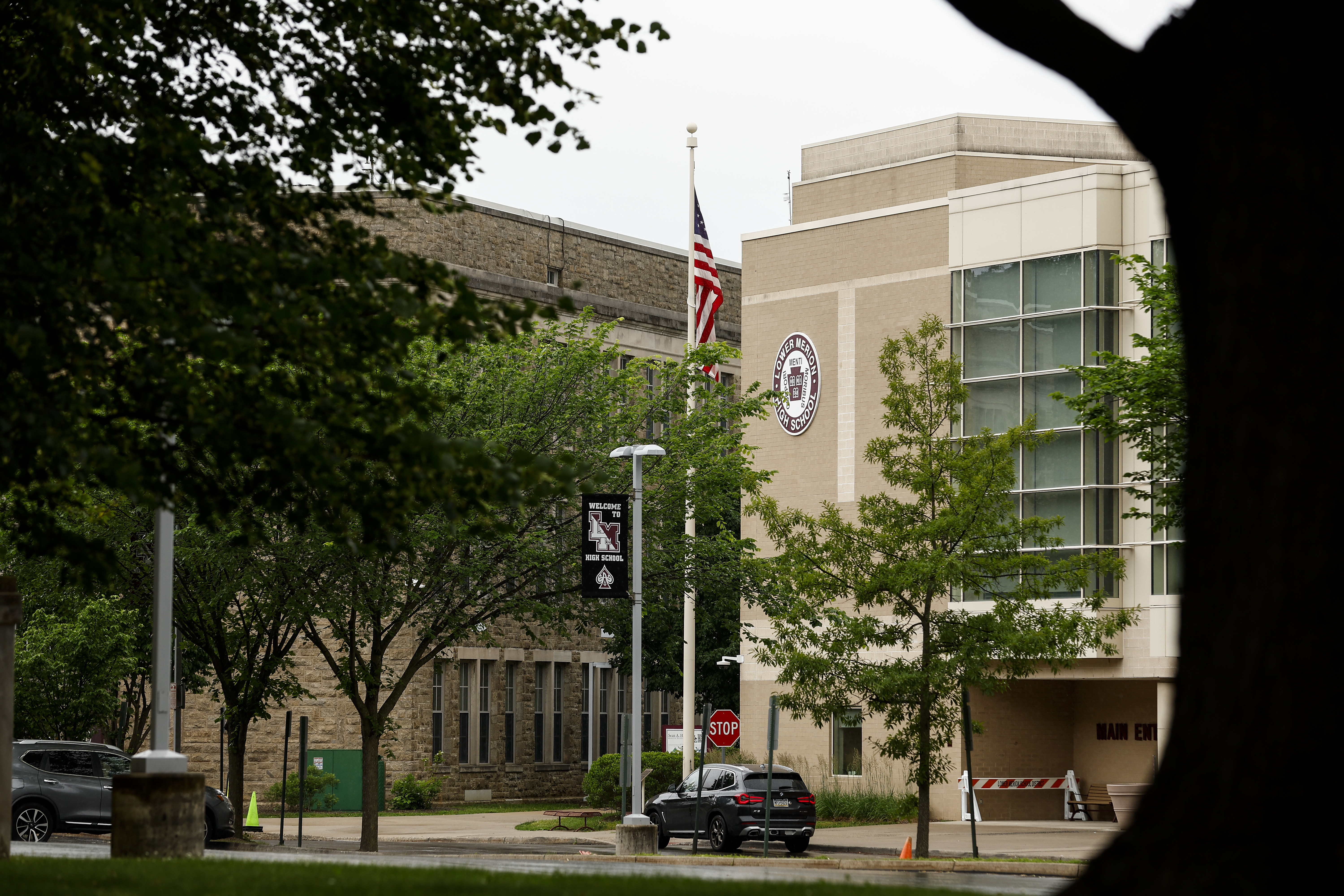
The Lower Merion School District violated the constitutional right of parents to choose what content their children are exposed to online by requiring students to use internet-connected computers without safeguards or controls, seven families with school-aged children say in a federal lawsuit.
The Lower Merion school board in June repealed a technology policy that allowed parents to opt their children out of using district-issued laptops and iPads. In August, the board adopted a new technology policy that doesn’t have an opt-out option, despite continued outcry from parents.
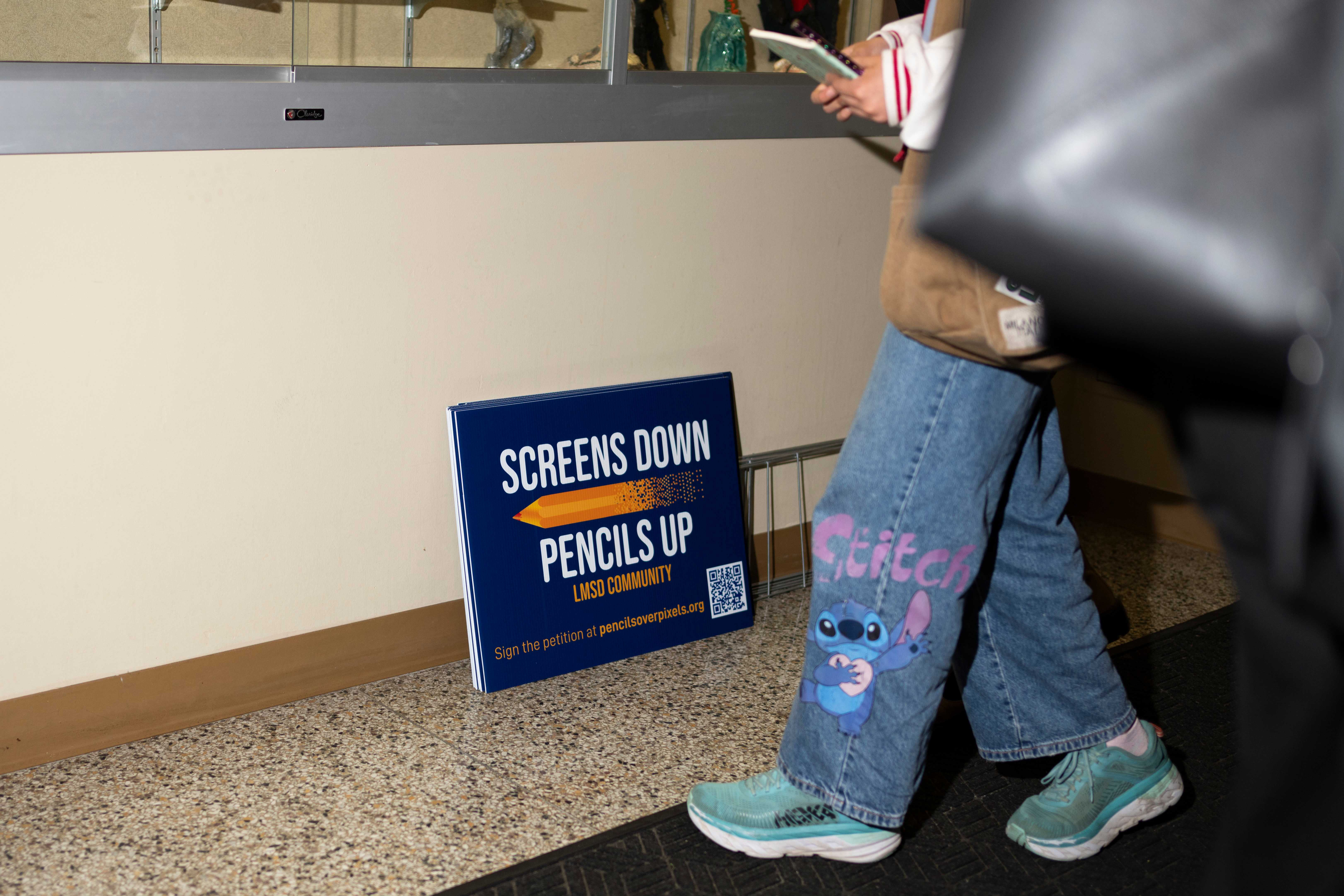
The parents, who are part of a grassroots group called “Pencils over Pixels” that objected to the policy change, say in the suitthat their children “encounter pornography, violent images, and violent or disturbing video games through their school devices.”
In addition to the exposure to inappropriate materials, the suit says that by having AI chatbots readily available, the district’s policy can “impede learning” and “encourage cheating.”
While three of the seven families behind the lawsuit have children enrolled inLower Merion School District schools,three have withdrawn their children from the district because of the policy.Another considered enrolling their children in Lower Merion schools, but decided not to because of the device-use requirement.
The families are being represented by the EdTech Law Center and Anapol Weiss, a Philadelphia-based law firm involved in multiple lawsuits against social media companies.
Lower Merion is aware of the lawsuit, district spokesperson Amy Buckman said in a statement.
“The District denies the allegations and will respond further through the judicial process,” Buckman said.
The lawsuit says“the environment in many classrooms in the District has become like a casino. Students sometimes sit and repeatedly hit keys or the spacebar while playing repetitive online games, creating a classroom environment that is loud, chaotic, and overstimulating.”
The heated public process that resulted in the repeal of the policy was a facade, the suit says, accusing the board of making its decision behind closed doors months before the summer. According to the complaint, Lower Merion superintendent Frank Ranelli “instructed” principals to refuse to accommodate technology opt-outs despite the “plain language” of the now-repealed policy before its repeal.
The fight over technology in Lower Merion has boiled over in recent months, as parents in favor of opting their children out of technology have found themselves increasingly at odds with the school board. Two parents were banned from school board meetings for “disruptive” behavior during meetings on the technology policy, a move legal experts said may infringe on the parents’ constitutional rights.
Andrew Liddell, attorney with the EdTech Law Center, said in an interview that plaintiffs “allege profound violations of parents’ rights and disruptions of family life caused by the district’s policies.”
“Here we have a school board, or at least seven members of the school board and a superintendent, who are determined to press forward with this policy that really does harm kids,” Liddell said.
Under the policy, kindergarten, first, and second graders will no longer receive personal iPads and laptops, and in-class technology time for the youngest grades will be limited to “specific educational purposes.” Third and fourth graders will have “teacher-directed” access to devices within the classroom. Fifth and sixth graders will be issued individual devices, which will stay in the classroom unless parents want their kids to bring them home.
Seventh and eighth grade students will be permitted to take their devices to and from school but will not be penalized for not doing computer-based homework. By high school, students will be assigned individual devices to carry with them throughout the day and take home.
The complaint accuses the seven school board members who voted to repeal the opt-out policy of acting in “contravention of their proper role as public educators and leaders of the District” and “thwarting” the ability of parents to protect their children. It asks a federal judge to issue an injunction that preserves the old policy by accommodating parents who wish to decline or limit their child’s use of internet-connected devices.
“A parent’s right to make decisions regarding their children’s care includes the right to make decisions to safeguard their health, safety, and privacy,” the lawsuit says.
The lawsuit was filed as social media and technology companies are facing a reckoning over the impacts their products have on the well-being of children and youth. Meta, the parent company of Facebook and Instagram, agreed this week to pay states up to $17.1 billion as part of a settlement over claims its platforms harmed kids. Pennsylvania is expected to receive more than $500 million from the payout.
This suburban content is produced with support from the Leslie Miller and Richard Worley Foundation and The Lenfest Institute for Journalism. Editorial content is created independently of the project donors. Gifts to support The Inquirer’s high-impact journalism can be made at inquirer.com/donate. A list of Lenfest Institute donors can be found at lenfestinstitute.org/supporters.
Jennifer Rivera, who has served on the school board for eight months, tendered her resignation from the board effective Tuesday, Amy Buckman, spokesperson for the Lower Merion School District, confirmed in an email Wednesday.
The board will vote on accepting the resignation at a special meeting Sept. 14.
Rivera could not immediately be reached for comment.
Rivera has been charged with theft, receiving stolen property, and related crimes in relation to funds she is accused of stealing from SMB Team, a Bala Cynwyd-based marketing agency that works with law firms.
An affidavit of probable cause for Rivera’s arrest said she used more than $25,000 in company funds to pay for airline travel and family vacations. Rivera also allegedly used SMB funds to pay a coworker to film a friend’s son’s bar mitzvah. Rivera used the company credit card to fly the same coworker and his wife to another employee’s wedding, where he was hired to be a photographer, according to the affidavit.
She was released on $25,000 unsecured bail and is scheduled to appear before a district judge for a preliminary hearing on Sept. 2.
Rivera also sits on the board of directorsof the Montgomery County Intermediate Unit, a Norristown-based educational service agency that supports local schools. Margaret Wright, Montgomery County Intermediate Unit board president, did not immediately respond to questions about whether Rivera was still serving on the board; however, Rivera’s name and photo were pulled from the intermediate unit’s website after a reporter’s inquiry.
In an announcement Thursday, the Lower Merion School District encouraged “qualified candidates with a strong commitment to public education” to apply for the vacancy.
Candidates must be 18 years or older, residents of Lower Merion or Narberth, and have lived in the school district for at least a year. They cannot be an employee of the district. Those interested in serving on the board are asked to submit application materials by Sept. 9. The school board will invite “highly qualified candidates” to participate in public interviews during a special meeting on Sept. 22.
The selected board member will serve until Dec. 5, 2027. The remaining years of the term will be filled by the winning candidate of the November 2027 municipal election.
This story has been updated with additional information on the process for filling a school board vacancy.
This suburban content is produced with support from the Leslie Miller and Richard Worley Foundation and The Lenfest Institute for Journalism. Editorial content is created independently of the project donors. Gifts to support The Inquirer’s high-impact journalism can be made at inquirer.com/donate. A list of Lenfest Institute donors can be found at lenfestinstitute.org/supporters.
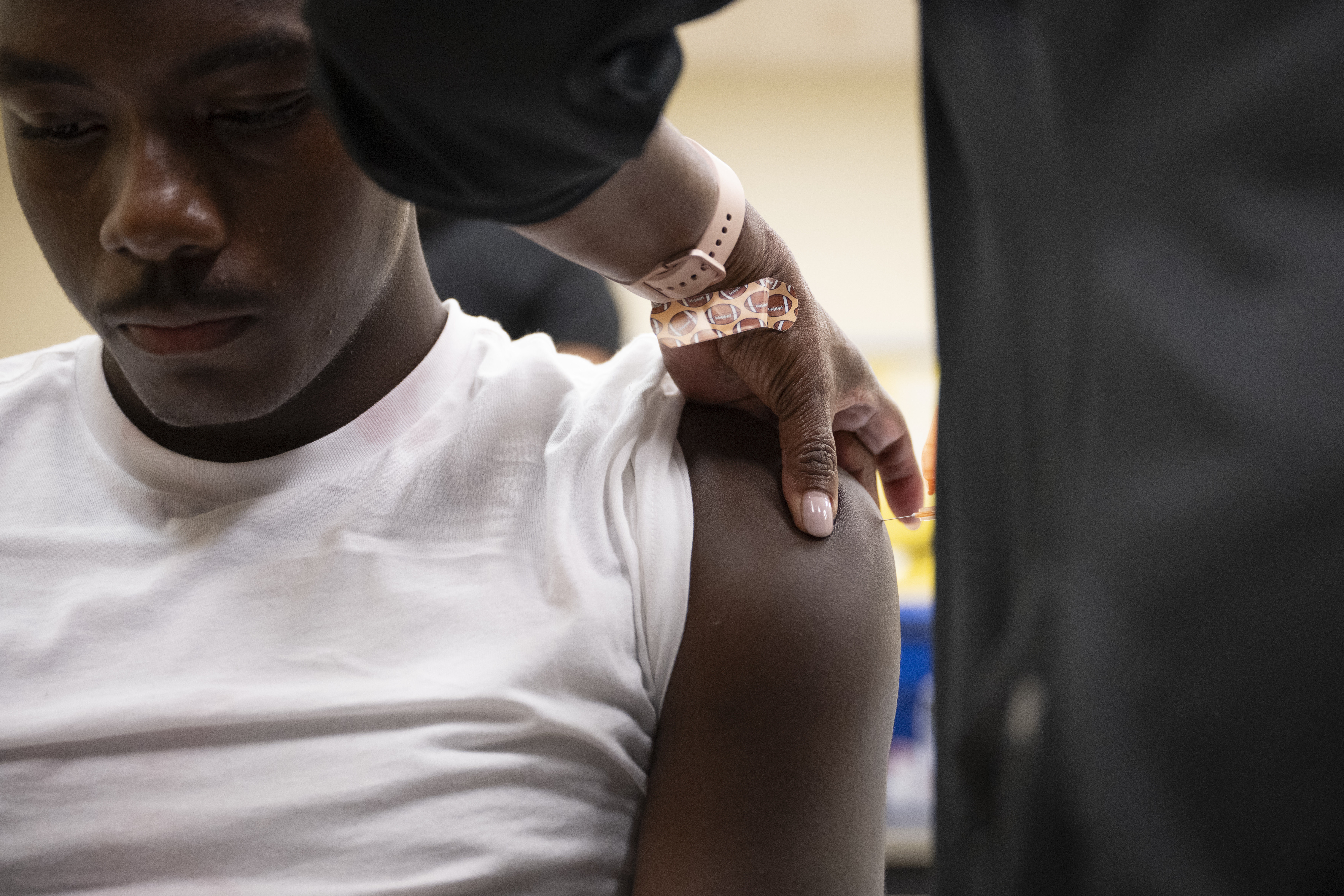
Families with kids in tow lined up Thursday at Benjamin Franklin High School for a one-stop shop: physicals, mental health services, vision screenings, and, perhaps most important, vaccines.
The Philadelphia School District is making a full-court press to get its vaccination rates up, amid a statewide measles outbreak and news that some city schools saw double-digit declines in kindergarten immunization rates in the 2025-26 school year — leaving communities vulnerable to further measles spread.
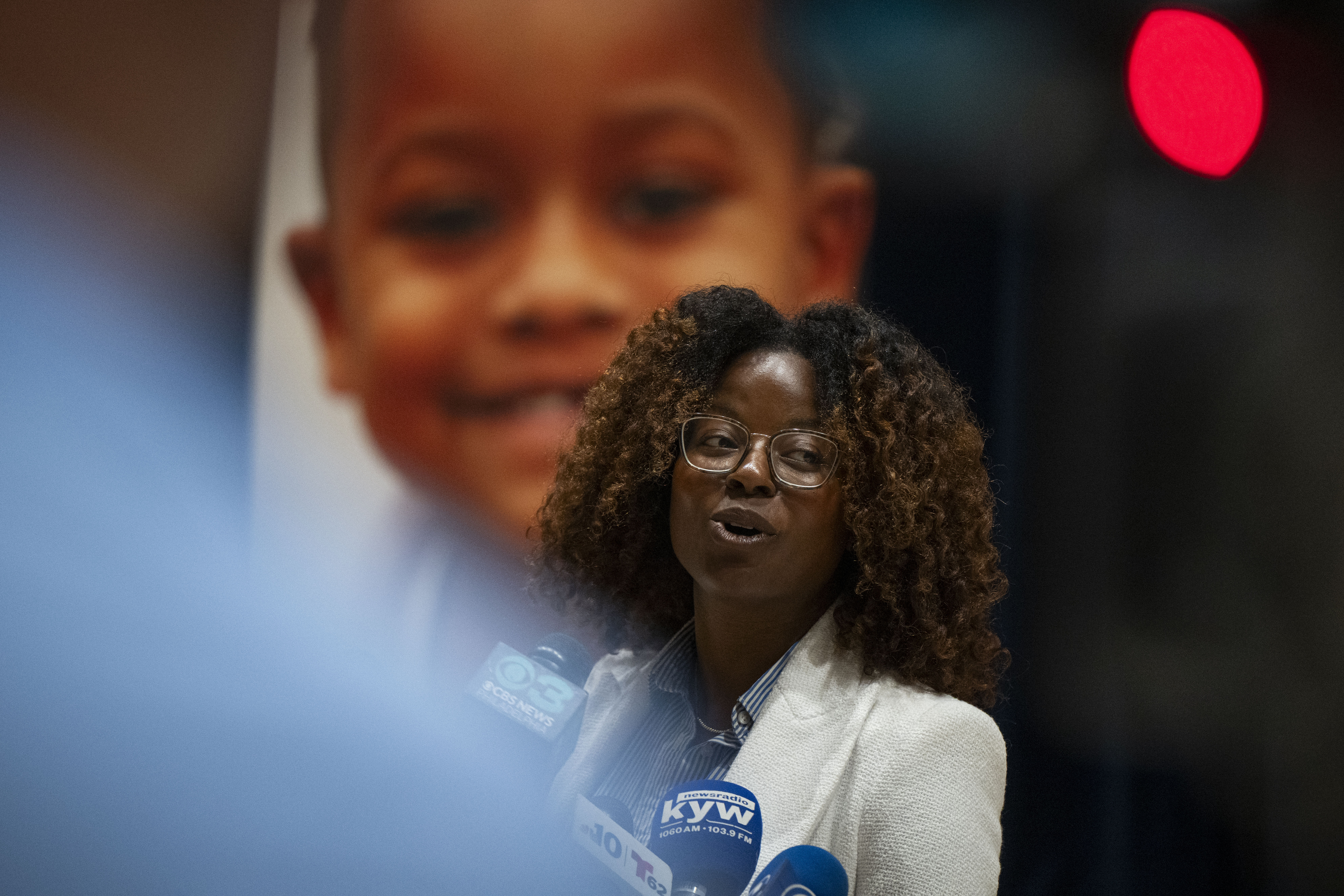
Kids must be healthy to learn, said Kendra McDow, a pediatrician and the district’s medical director, and vaccines against diseases like measles, whooping cough, and chickenpox are crucial protection.
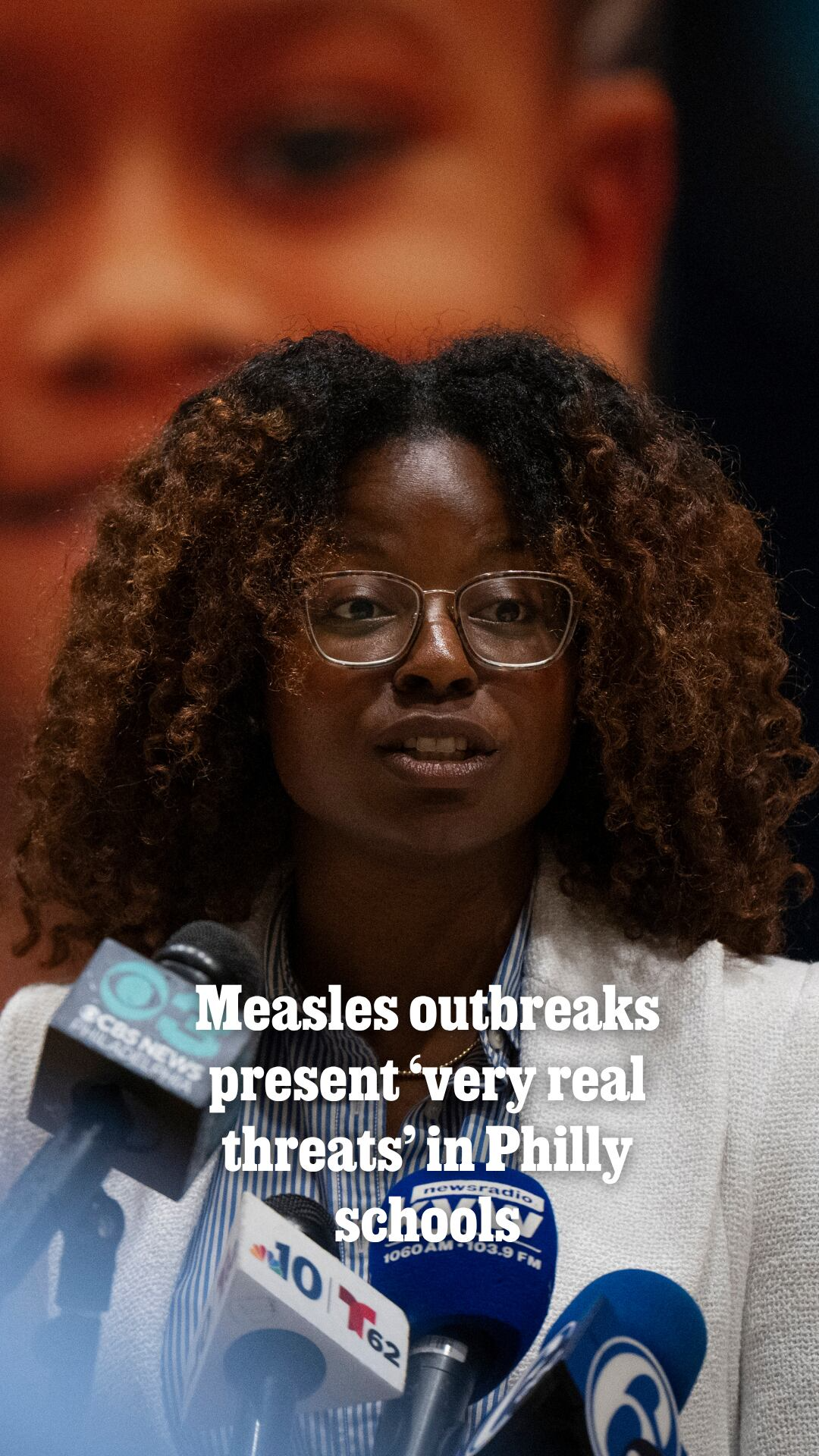
“In 2026, these diseases are very real threats to the health of children and communities,” McDow said. “We are seeing in real time the tragic consequences of children and adolescents not getting vaccinated.”
Medical Officer Kendra McDow speaks during press conference encouraging vaccinations for Philadelphia kids on Thursday at Benjamin Franklin High School in Philadelphia.Joe Lamberti / For The Inquirer
To achieve community protection, which scientists call herd immunity, 95% of a school population must be vaccinated. And though Philadelphia’s vaccination rates remain relatively strong compared with other pockets of the state, about 40% of kindergarten classrooms across Philadelphia and its surrounding suburbs became vulnerable to a measles outbreak last school year, up from a third of classrooms the year prior, according to an Inquirer analysis of state data.
To boost city immunization rates, the district is focusing on access — from a back-to-school bus tour this summer that came with a side of childhood vaccines to the Benjamin Franklin eventover two weeks, which runs through Friday.
Parents can register their children at the district’s Constance E. Clayton Education Center, at 440 N. Broad St., then walk up the block to Ben Franklin, at 550 N. Broad, to get their children vaccines and other preventive healthcare, including connection to mental health services and appointments to get eyeglasses.
Measles is now in 28 Pennsylvania counties, with more than 400 cases reported this year — nearly half in the last month. No cases have been reported in Philadelphia, but the highly contagious disease is circulating in suburban Chester County.
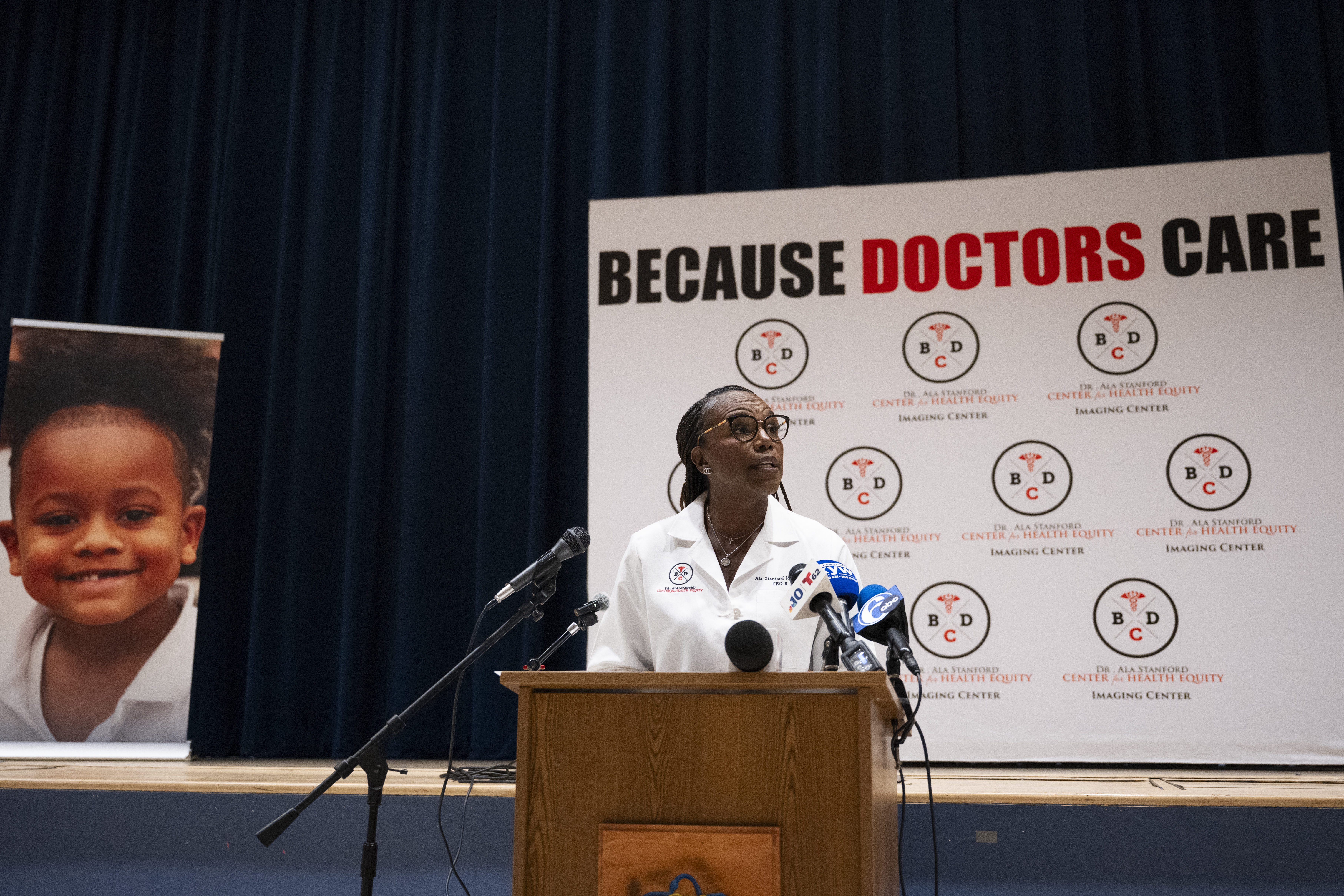
Pennsylvania had the most newly reported measles cases in the nation last week, said Ala Stanford, founder of the Black Doctors Consortium, and 73 state residents have been hospitalized.
Pennsylvania now has the highest number of cases reported in the state since 1991.
“This is not a mystery. It’s arithmetic,” Stanford said. “It takes 95% of us vaccinated to stop measles from moving through a community. Pennsylvania is at about 93%, and not one county in this region is at 95%.”
What parents need to remember, Stanford said, is that since children traditionally have not received their first measles vaccine until age 1, “every infant in the city, in the stroller, in the car seat, at the family reunion has no protection of their own. We are their protection. That is the entire system.”
In response to the current outbreak, state officials have started recommending that parents in affected areas vaccinate children as early as 6 months with a “zero dose” to provide extra protection against a disease so contagious that it will infect nine in 10 unvaccinated people who are exposed.
The benefits of community protection go beyond babies and children, Stanford said: “It’s the teacher. The lunchroom lady, the man who sweeps the floor, the security officer at the door — you do not know who they go home to at night. You do not know who is on chemotherapy, who has had a transplant, who is caring for a newborn.”
Video: Philly schools recommend vaccinations for students
‘Why so many?’
School officials plan to set up individual vaccine clinics at schools that have problematic compliance rates.
Emlen Elementary in Mount Airy, for instance, had a 100% vaccination compliance rate among incoming kindergarteners two years ago. Last year, it dropped to 80%. (Many Emlen families citedphilosophical or religious exemptions to vaccination.)
Ericka Hayes, senior medical director of infection prevention at Children’s Hospital of Philadelphia, said rampant misinformation about vaccine safety certainly contributed to lower vaccination rates.
“Parents should not let that sway them from giving their children one of the most tested and effective childhood interventions in history,” Hayes said.
Disruptions from the pandemic are another factor in lagging vaccine rates, Stanford said.
Dr. Ala Stanford of the Black Doctors consortium speaks during press conference encouraging vaccinations for Philadelphia kids on Thursday at Benjamin Franklin High School in Philadelphia.Joe Lamberti / For The Inquirer
At a recent clinic at Strawberry Mansion High, Stanford said, children from 30 schools across the city showed up for shots.
“We had 14- year-olds getting four shots, and we said, ‘Why so many?’” Stanford said. Families told care providers that they had fallen off on vaccine schedules, but were relieved to have a chance to catch up their children.
As word spreads about vaccine access, about ease and availability across the city, “more people show up,” Stanford said.
Kids can be excluded for vaccine noncompliance
Children can be excluded from school under Pennsylvania law if they are unvaccinated and their families have not formally filed for an exemption on religious or philosophical grounds.
According to state data, thePhiladelphia School District excluded 34 12th graders, five seventh graders, and three kindergartners last school year for vaccine noncompliance.
Far more students were labeled “noncompliant and attending” — 1,392 12th graders, 1,853 seventh graders, and 669 kindergartners. That means those students’ families have made a plan for them to get vaccinated, but have not yet followed up on it.
Students without vaccine exemptions can be admitted to kindergarten on a provisional basis as long as they have a plan to catch up on their vaccines. (State law allows exceptions for students living in foster care or without permanent housing.) They are listed as “non-complaint but attending” when families fail to adhere to that plan.
School officials have said they work with families in that category to help them catch up on shots, but unvaccinated kids may be asked to stay home if a communicable disease is identified at their school.
School nurses are key to the effort, officials said, on the front lines of ensuring students are vaccine-compliant. Every school in the district currently has a full-time school nurse, McDow said.
One of the district’s 277 school nurse positions is unfilled, but an agency nurse is covering that vacancy, and “we are working to have the position filled as soon as possible,” McDow said.
The act of getting vaccinated or vaccinating your children, said James Garrow, deputy commissioner of the city health department, is powerful.
“Your vaccination can help save lives,” Garrow said.
(function(){function e(){window.addEventListener(`message`,function(e){if(e.data[`datawrapper-height`]!==void 0){var t=document.querySelectorAll(`iframe`);for(var n in e.data[`datawrapper-height`])for(var r=0,i;i=t[r];r++)if(i.contentWindow===e.source){var a=e.data[`datawrapper-height`][n]+`px`;i.style.height=a}}})}e()})();