Category: Education

  • Penn State is selling its Wilkes-Barre and Shenango campuses

    Penn State is selling its Wilkes-Barre and Shenango campuses

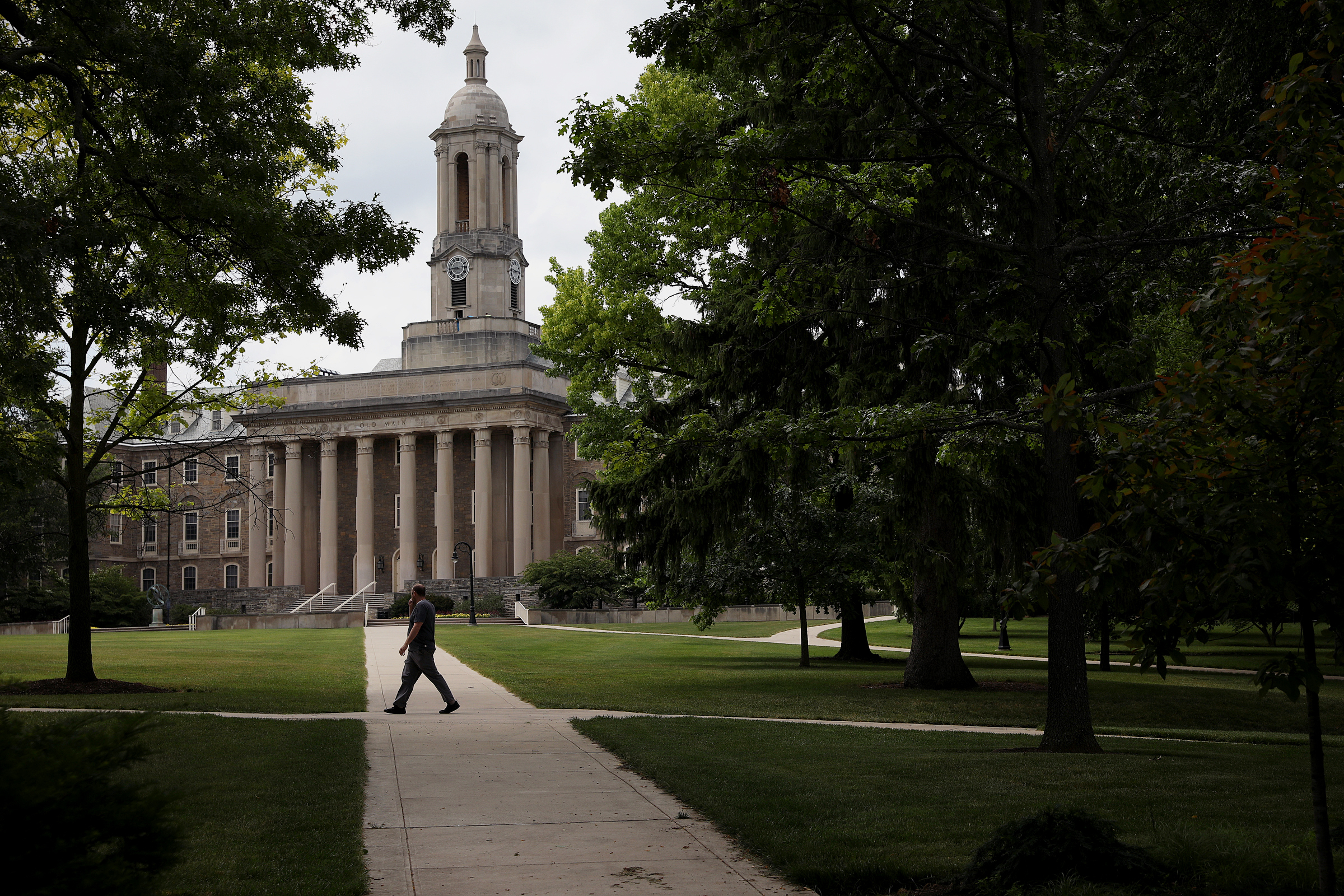
    Pennsylvania State University’s board of trustees agreed Friday to sell two of its closing Commonwealth campuses to developers for more than $6 million.

    Plans call for the Wilkes-Barre campus in Northeastern Pennsylvania to be developed into event and conference space for a nearby golf course and space for educational programming, while the Shenango campus in Northwestern Pennsylvania will be used for educational, cultural and workforce training purposes. The Shenango campus enrolled 309 students in 2024 and the Wilkes-Barre campus 329 students, according to a Penn State report on the closures.

    Sara Thorndike, Penn State’s senior vice president for finance and business and chief financial officer, told trustees at a committee meeting Thursday that discussions continue on the future use of the other five campuses: Dubois, Fayette, Mont Alto, New Kensington and York. The seven closing campuses are spread from Northeastern Pennsylvania to Western Pennsylvania. The campuses in the Philadelphia region — Abington, Brandywine, and the graduate education-focused campus at Great Valley — are not impacted.

    “Every campus is on its own path and own time line,” Thorndike said of the closing campuses. “Our goal is to find a positive path forward.”

    Penn State in May 2025 voted to close the seven campuses at the end of the 2026-27 academic year due to precipitous enrollment declines, marking the largest remake of the Pennsylvania flagship university’s Commonwealth campus system in its history.

    Since then, Penn State has been conducting meetings at each of the campuses with elected officials and others in the community to hear concerns about future uses, Thorndike said.

    The board approved the sale of the 13-acre, 12-building Shenango campus in Mercer County to JCL Development LLC for $1 million. It will be used for education, workforce training, economic development and cultural enrichment, Thorndike said.

    Penn State Wilkes-Barre’s 57-acre, 17-building campus in Luzerne County will be sold to HGC Development LLC for $5.25 million. HGC is a subsidiary of the Huntsville Golf Club, which is next to the campus. The property will be used for event space “complementary to the golf club,” the university said, and educational purposes, including a planned partnership with the nearby Misericordia University.

    Thorndike said the university considered community benefits, appraised values, deferred maintenance and the costs Penn State would have to pay if it held on to the campuses. Though both offers were below the value of the properties, she said the university determined they were the best overall offers.

    “Both proposals outline a vision for preserving the community-facing qualities of these properties while building on the educational impact the campuses have had for decades, and that’s an outcome we’re pleased to see reflected in each plan,” Renata Engel, vice president for Commonwealth Campuses and executive chancellor, said in a statement.

  • Bensalem school district selects a longtime administrator as its next superintendent

    Bensalem school district selects a longtime administrator as its next superintendent

    The Bensalem Township School District has selected longtime district administrator Victoria Velazquez as its next superintendent, after its previous superintendent resigned this spring amid a budget shortfall.

    Velazquez, who has worked for the district for 12 years, is expected to be appointed superintendent at a school board meeting Sept. 23, the Bucks County Intermediate Unit said in a statement Friday.

    “I am deeply honored and grateful for the opportunity to continue serving the Bensalem Township School District as district superintendent,” Velazquez said in a statement.

    Noting that her daughter graduated from Bensalem, Velazquez said, “It is my home, and it is a community I care deeply about and am incredibly proud to serve.”

    Velazquez was selected to lead the 6,400-student district after a search led by the Bucks County Intermediate Unit that drew 27 applicants from five states, according to the intermediate unit.

    Deborah King, the Bensalem school board president, said in a statement that she had watched Velazquez “lead with humility, diligence, integrity, and a genuine love for Bensalem.”

    “She knows this community, she believes in this community, and she understands that our students must remain at the heart of every decision we make,” King said.

    Velazquez has worked in Bensalem as assistant to the superintendent for K-12 administration, director of elementary curriculum and instruction/federal programs, and supervisor of data and assessment/federal programs.

    She has served as interim superintendent since April, after the district’s former superintendent, Samuel Lee, resigned amid a $12 million budget shortfall. The district eliminated more than 30 positions to help fill the gap .

    As interim superintendent, Velazquez worked with the board on organizational systems and fiscal stewardship “during a consequential period for the district,” the intermediate unit said in the statement.

    Before coming to Bensalem, Velazquez worked as a principal in the School District of Philadelphia and the Norristown Area School District. She received bachelor’s and master’s degrees from Temple University, a principal certification from Drexel University, and a doctorate in educational leadership, management, and policy and superintendent certification from Seton Hall University.

    If approved on Sept. 23, Velazquez will be sworn in as superintendent on Oct. 1 at Bensalem High School, the intermediate unit said.

  • MIT report warns AI is causing ‘cognitive surrender.’ Universities are in a bind.

    MIT report warns AI is causing ‘cognitive surrender.’ Universities are in a bind.

    The worries that artificial intelligence is degrading education have been building for months. Students are using it for everything, including cheating, and a recent report out of the Massachusetts Institute of Technology said it is triggering “cognitive surrender.”

    Many university leaders are embracing AI with enthusiasm anyway.

    As AI leaders warn about the dangers of their own technology, the dissonance between the optimism of university leaders and the fears of many students and professors may increase. Professors and students are often in a bind about what they should do: Use more AI to stay relevant, or dial back to preserve learning and thinking?

    While some politicians and AI leaders are warning about possible doomsday scenarios for humanity as AI models advance, many campus leaders are focused on the existential threat the technology poses to universities.

    The committee at MIT studying AI use released a number of alarming findings, including that the technology has caused “major shifts in campus culture,” isolating students who are skipping office hours and ditching communal studying. Getting answers from a bot can create “the illusion of learning” for students who reach for AI “at the first hint of struggle,” the MIT committee wrote in its August report.

    At the same time, “the potential of these technologies to augment work across campus is immense,” the committee wrote.

    The MIT report crystallized some of the thinking in higher education about AI, but top administrators have been embroiled in debates for several years. Administrators have often been the most eager to champion AI efforts, while many faculty and students remain more skeptical.

    “I think you have to lean in, but you have to do so in a way that’s thoughtful and ethical and asks the right questions,” said Wendy Hensel, the president of the University of Hawaii, where she presented an AI strategy to regents in July. “The right answer to AI is not just ‘no.’ It can’t be. It has to be approached with curiosity and understanding of the implications.”

    The hodgepodge of policies universities have created to respond to AI often reflect the confusion about how to proceed — with some clear do’s and don’ts, but often a lot of wiggle room for faculty and students to figure it out on their own.

    Experts warn that AI harms learning

    For a motivated student, an AI chatbot can function as a sort of tutor. Chatbots can break down the steps in a math problem, surface unexpected sources for research papers, and offer feedback on writing.

    Still, a growing body of research suggests that AI use can also harm learning.

    A recent study of 26,000 Chinese secondary-school students found that AI adoption led to an 18% increase in homework scores, but a 20% decline in scores on secure exams. The implication was that rushing through homework with help from chatbots degraded the deeper learning needed to perform well when the technology was not available.

    One 2025 study out of MIT found that people who used chatbots as writing assistants struggled to remember what they had written only minutes after finishing their essay. “You basically didn’t engage any of the memory networks that would actually help you remember,” said Nataliya Kos’myna, an MIT researcher who worked on the study.

    Other research has shown that people who have greater trust in AI and rely on it more are more likely to have lower cognitive engagement.

    But AI can be hard to avoid. Chatbots are embedded within the Google Classroom suite, which is nearly ubiquitous in schools, and within many online learning systems used by universities.

    Some tools block outright cheating or plagiarism and allow professors to toggle specific AI capabilities on and off. But the most popular chatbots among students will instantly complete entire assignments, including research papers, on a student’s behalf.

    Many universities are embracing AI anyway

    Sian Leah Beilock, the president of Dartmouth College, has argued that preparing graduates to use AI is an existential requirement of institutions of higher education.

    “In a world that promises to be defined by AI, universities that fail to produce graduates who can use it productively will consign themselves to irrelevance,” she wrote recently.

    Harvard University President Alan Garber said in public remarks this month that AI-backed research is on the cusp of a boom that may drive the pace of knowledge faster than at any other time in human history. Garber has said that researchers in many fields are now unlikely to be at the leading edge of their disciplines without AI.

    Ohio State is integrating AI into every major, with the expectation that every student will be fluent in their field of study by graduation. The university has directed every department and major — from business and engineering, to English and veterinary medicine — to train students on how to use AI in their respective fields, and when not to.

    “What is OK to off-load to AI, and what is not?” Ohio State University President Ravi V. Bellamkonda said in an interview in July. “The answer to that depends on the field and depends on your stage of learning.”

    Elizabeth Kiss, the president of Union College, said universities have to educate students on both the thoughtful use of AI and on the things AI doesn’t do, such as “lead teams, push the boundaries of knowledge.”

    Still, some schools are creating boundaries

    The University of Chicago has banned AI in certain required social sciences courses, while the university’s law school banned phones, tablets, and laptops in first-year classrooms. The university is one of a handful that recently adopted new academic integrity rules.

    The law school at the University of California, Berkeley, adopted a policy forbidding the use of AI “to conceptualize, outline, draft, revise, and edit” work submitted for credit.

    Cornell University has created a disciplinary process meant to correct AI cheating while avoiding black marks on students’ records. Now, students accused of minor misuse will be allowed to accept responsibility and complete a workshop and some reflective work.

    Steve Jackson, the vice provost for academic innovation, said the program would not be used for plainly egregious misconduct. “This is a chance to sanction something, catch it, not let it go unnoted or to let it pass,” he added.

    Like many institutions, Harvard does not have a central set of AI rules. David Deming, dean of Harvard College, wrote in a note to students arriving for the fall semester that he favors more AI where “it can deepen learning,” but that the school was also looking to AI-proof some assignments.

    That would mean more in-class tests, Deming said, and fewer take-home assignments, where the temptation to cheat is powerful. He said he intends to produce a set of guidelines for AI use at the college by the end of the academic year.

    For younger students, some school districts are proceeding cautiously. This month, the nation’s largest school district, in New York City, vastly limited student AI use in grades K-8, while the second-largest district, in Los Angeles, essentially banned student use of chatbots at every grade level.

    Policing ai use is hit or miss

    Students are often navigating this landscape without clear guidance from their colleges.

    Most institutions leave it up to individual instructors — who may have little experience with AI — to set rules on how the technology is used in each class.

    It may seem clear that submitting chatbot-generated text is cheating, while using a chatbot to revise one’s own writing is allowed. But the line between those two capabilities is thin, and much AI use lies in an ethical gray zone.

    Many educators “don’t even know where to start,” said Annie Chechitelli, chief product officer at TurnItIn, a company that makes software that can detect plagiarism and track and guide AI use. “What is OK? What’s not OK?”

    Many instructors have already moved to on-paper assignments in the classroom, or locked-down computer browsers that limit AI misuse. Others report success in using AI detection software, which has recently improved in its ability to flag chatbot-written text while avoiding false positives.

    Some see AI as a crucial partner for thinking and writing and put few limits on how students use the technology. Others subscribe to the notion of “AI literacy,” assigning students to use chatbots to produce an essay or poem, for example, and then critique and try to improve the output.

    In Australia, the University of Sydney has adopted the “two-lane approach,” seen as a global model. Across disciplines, students must complete some assessments in person, under secure conditions meant to restrict AI. But other assignments must use AI, to help familiarize students with the technology that is reshaping the economy.

    “It’s almost like sex ed,” said Anita Sarma, a professor of computer science at Oregon State who has studied the impact of AI on student cognition. “They will do it anyway,” she said. “How do we teach them responsible use?”

    This article originally appeared in the New York Times.

  • Lower Merion asks court to deny parents’ ‘fearmongering’ request to opt out of computers

    Lower Merion asks court to deny parents’ ‘fearmongering’ request to opt out of computers

    The Lower Merion School District has urged a federal judge to deny a request from parents to opt their children out of school-assigned computers, accusing them of “fearmongering” about technology in schools and abusing the legal process to get their way.

    In a filing in U.S. District Court, lawyers for the district and school board said seven families who sued the district last month were trying to force the district to align with their preferred approach to instruction.

    “There is no constitutional right for a parent to choose which technology their child uses in a public school,” the district said in the Monday filing. It called the lawsuit “just the latest attempt by a small — but vocal — minority of the district community to pressure the duly-elected members of the board of school directors to kowtow to their peculiar views on technology in the classroom.”

    The affluent Montgomery County district has been a focal point of a national battle around technology use in schools. Since the spring, Lower Merion parents have been raising concerns about how much their kids are on screens — from worries about children gaming and accessing inappropriate content on their district-issued laptops to complaints about the quality of the educational software programs used by the district and fears that kids’ cognitive abilities are diminishing.

    The district revised its technology policy last month, specifying that students in kindergarten through second grades would no longer be assigned individual electronic devices. It also implemented guidelines for screen time by grade level and announced new tools for monitoring what kids are accessing on their laptops.

    But the new policy did not include a provision that had previously existed, which specified that district officials would work to accommodate students whose parents did not consent to being issued electronic devices. Parents organized under a Pencils Over Pixels group had pleaded with the board not to eliminate that provision, which was repealed in June.

    In their lawsuit filed last month — which one of the plaintiffs’ lawyers said he believed was the first of its kind — seven families accused the district of forcing a “digital free-for-all” on students, and violating their parental rights by requiring their children to use internet-connected computers to access their education without adequate safeguards.

    They also filed a motion for a preliminary injunction, asking a judge to order the district either to allow them to opt their kids out of personal devices or to pay for them to attend private schools. Three of the families who sued withdrew their kids from the district.

    In its response Monday, the district said parents had mischaracterized its former policy. Families were never permitted to opt out of technology entirely, the district said. While the policy had said officials would make their “best efforts” to work with students whose families declined personal devices, they were not guaranteed specific accommodations, the district said.

    The district accused parents of trying to force the school system to bend to their beliefs — and said the court would be setting a dangerous precedent if it sided with them.

    “This court should decline plaintiffs’ invitation to convert the American public school educational system into a private school, whereby each parent has the right to hand-select each and every aspect of their child’s education,” the district said.

    A debate around parents’ rights

    In asking Judge John M. Younge to deny the families’ request for a preliminary injunction that would allow them to decline an internet-connected computer, the district said families had not made their case on a number of grounds.

    Six of the seven families do not have standing to sue, the district said. It said four of the families did not have children enrolled in district schools at the time the new technology policy was adopted.

    Two families, meanwhile, only had children in elementary schools, where they “would not have been eligible to receive a district-issued electronic device under the one-to-one electronic device initiative because they are not in 5th grade or above,” the district said.

    While elementary school students in Lower Merion have had access to personal electronic devices, the district said that its one-to-one program was “never formally extended” to those grades. A district spokesperson did not immediately respond to a question Tuesday about how the iPads and Chromebooks previously assigned to elementary schoolers were not considered part of the one-to-one program.

    Families also have not shown the district is permanently harming them, the district said. Although several of the families are now sending kids to private school or homeschooling, those decisions do not constitute “irreparable harm” warranting a preliminary injunction, the district said. It noted that families could be compensated with monetary damages if the court ruled in their favor.

    The district also said the harms of using computers alleged by the families were “vague and speculative.” In their lawsuit, families had described risks to physical and mental health, citing manipulative practices by technology companies, the dangers of artificial intelligence chatbots, and warnings from the U.S. surgeon general and the FBI about youth social media use and groups targeting minors online.

    While the district has revised its policies and placed more restrictions on what kids can access, Andrew Liddell, a lawyer for the parents, said in a recent interview that the changes “aren’t even the bare minimum of what the district should have been doing in the 20 years they’ve been giving internet-connected computers to children.”

    Liddell, an Austin, Texas-based lawyer whose wife founded the EdTech Law Center, said he believed the lawsuit was the first that had been brought alleging school computers were violating parents’ constitutional rights. Lower Merion still is not adequately restricting screen time, he said, and is “putting more burden on parents” to monitor what kids are doing online.

    While Lower Merion is a wealthy suburb, and some of the suing parents are doctors who can afford private school, Liddell said, “you have a right to a public education.”

    The parents “just want our kids to be able to go back to school,” Liddell said.

    In its response Monday, the district said parents do not have the right to dictate what is taught in public schools.

    “At most, the district’s new technology policy (Board Policy 141) only incidentally interferes with a parent’s limited right to direct their child’s education,” the district said.

    It also said that granting the parents’ request would cause a “logistical and financial hardship for the district,” requiring it “to develop a non-technological curriculum for each of plaintiffs’ children.”

  • Jalen Hurts donated $600,000 for AC at Philadelphia’s largest high school

    Jalen Hurts donated $600,000 for AC at Philadelphia’s largest high school

    Jalen Hurts was watching morning TV three years ago when he saw something that stopped him in his tracks.

    “I was very blown away by school not being canceled for snow, not for a hurricane or tropical storm, but for lack of AC,” the Eagles star quarterback said Tuesday.

    So Hurts went about doing something to fix that.

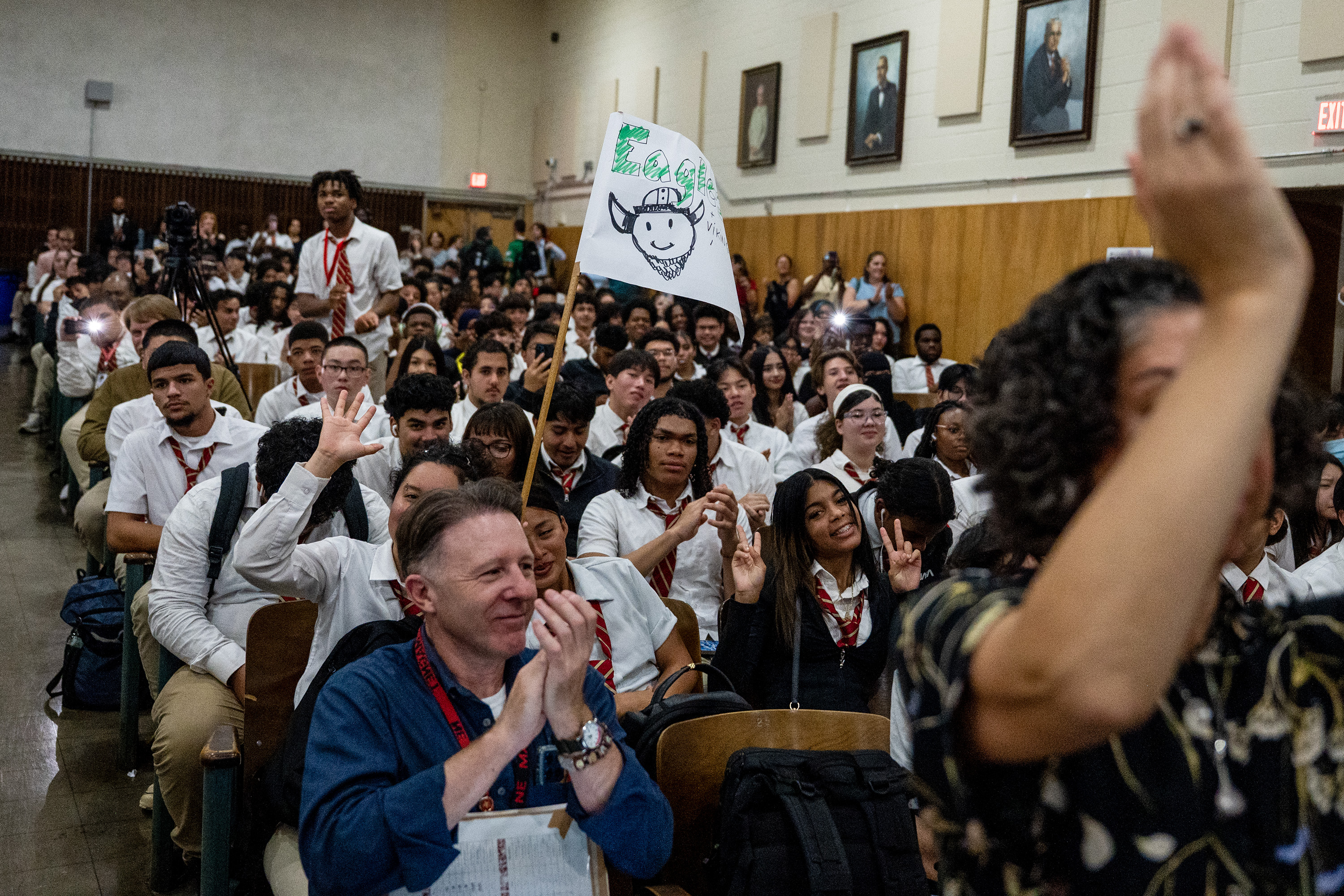
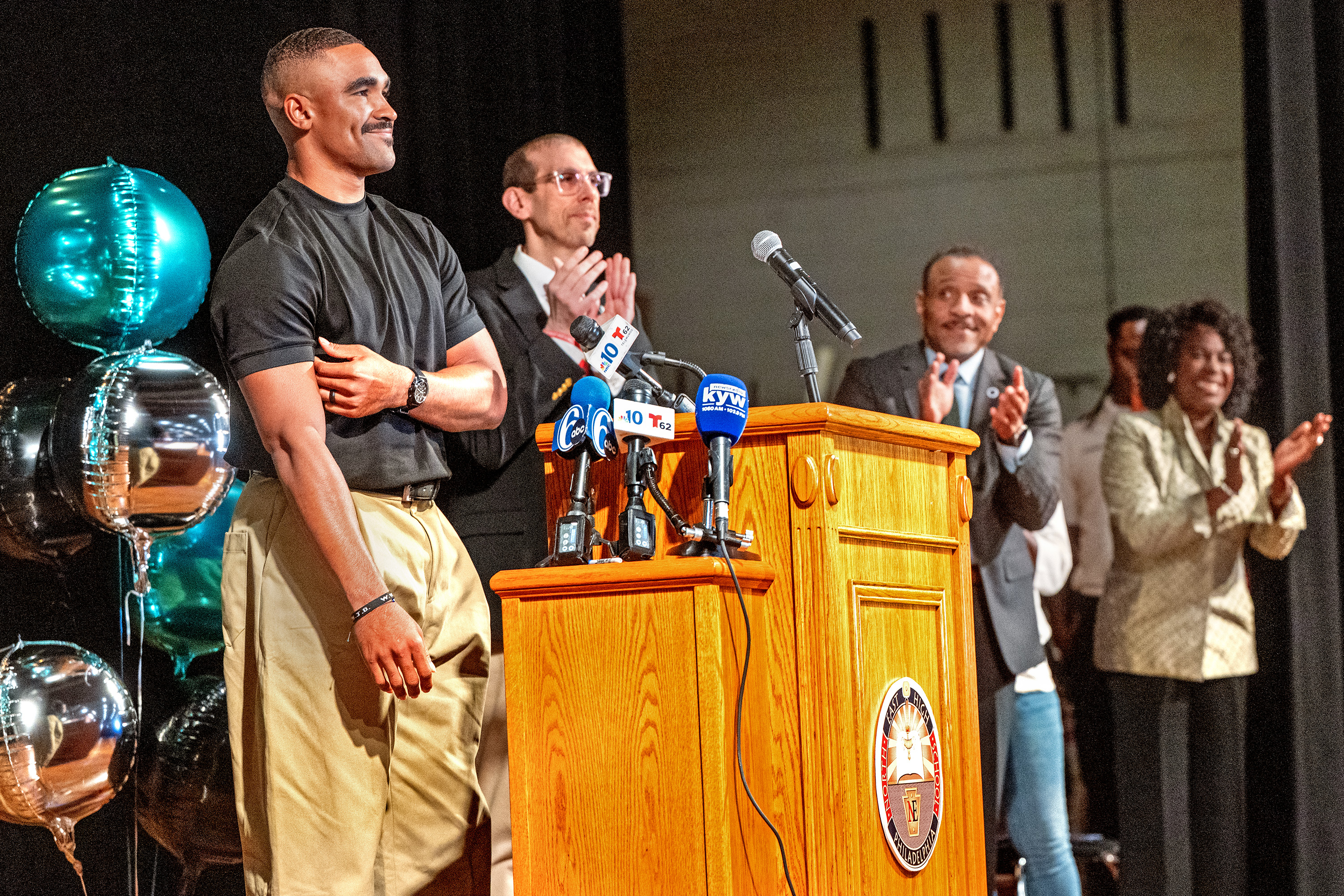
    On Tuesday, he stood on Northeast High’s stage to announce his foundation was putting up $600,000 to air-condition the school’s auditorium.

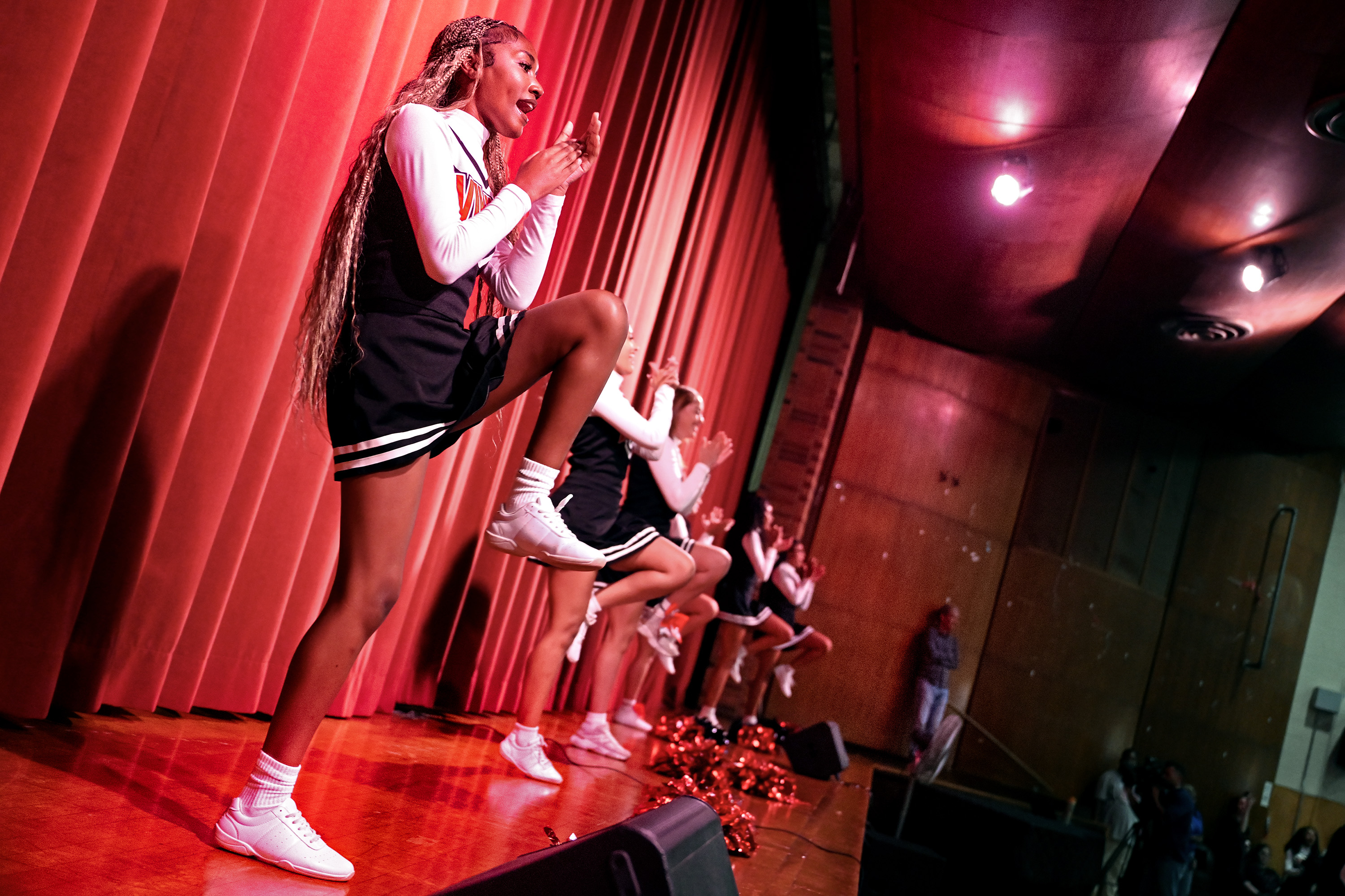
    The timing was good: Although temperatures were in the high 60s when Hurts made his announcement, it was sweltering in the auditorium, with more than 1,000 students, teachers, and dignitaries in the room. Sweat ran down the faces of members of the marching band toting heavy instruments and cheerleaders in long-sleeved uniforms. Mayor Cherelle L. Parker cooled herself with a small personal fan.

    When Hurts watched that TV spot, about half of the district’s schools were not air-conditioned. Hurts’ largesse has helped get the number down, but 52 schools — about a quarter of district buildings — still lack air-conditioning.

    Hurts, on Tuesday, said he wanted to move the needle more for Philadelphia schools.

    “Let’s get it to zero,” Hurts said of the number of schools without air-conditioning. “I want to get it to zero.”

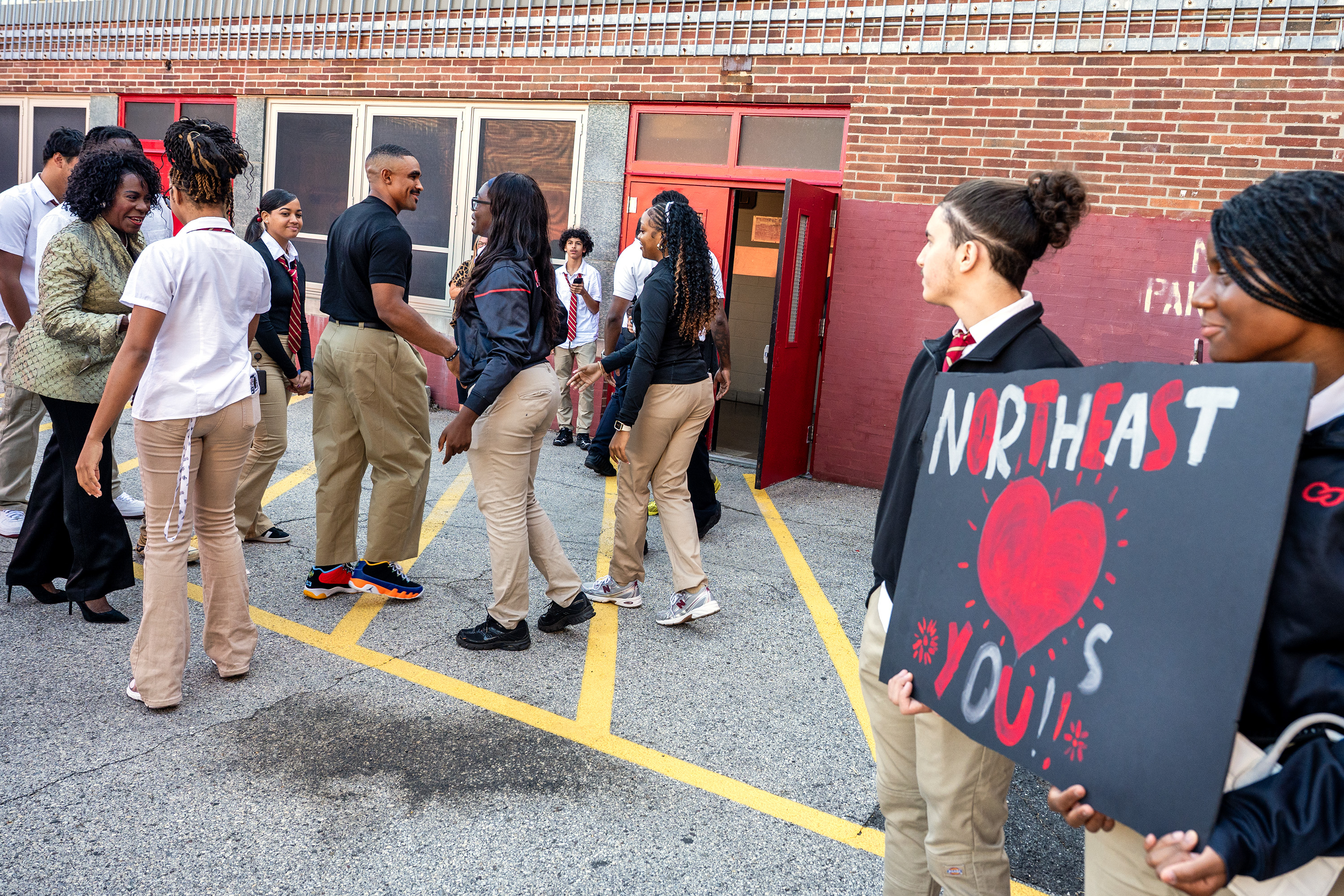
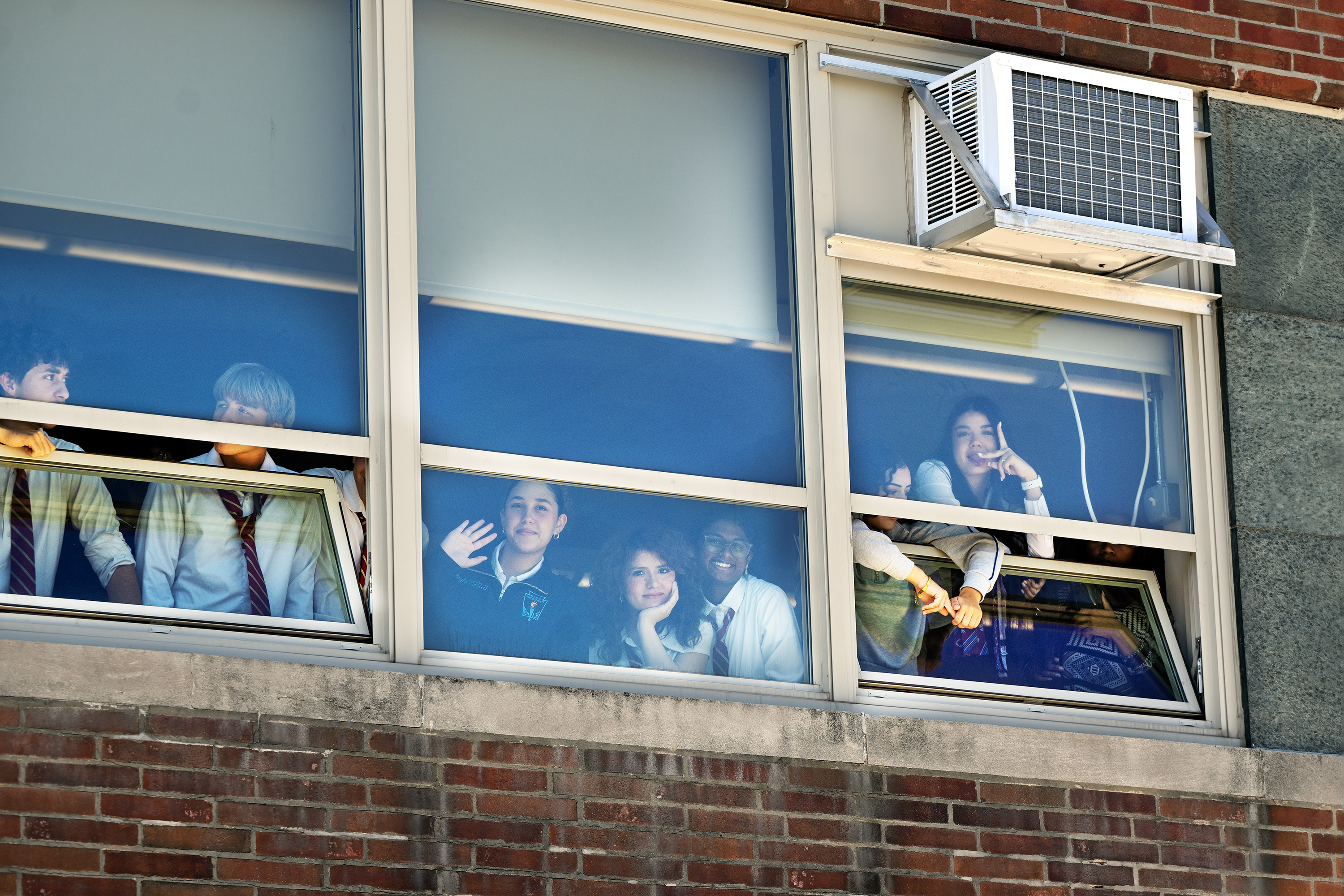
    Northeast High School watch from their classroom – with a window air conditioning unit – as Eagles quarterback Jalen Hurts leaves Tuesday, Sept. 15, 2026 following his appearance there to give the school $600k for an a new cooling system.Tom Gralish / Staff Photographer

    Asked why he was turning his attention to city schools, Hurts said he was influenced by his educator parents and the people who made a way for him.

    “It’s about service and showing up for those around you,” the quarterback said.

    Northeast High had window units cooling classrooms prior to Hurts’ announcement, but the auditorium, a hub of the school and the community, was tough to use in the spring and summer months, said Andrew Lukov, the school’s principal.

    “This changes everything for us,” Lukov said.

    A beaming Parker, who made sure to lead the adoring Northeast crowd in an E-A-G-L-E-S chant, spelled correctly, led the crowd in giving Hurts a standing ovation.

    “Jalen, on behalf of the entire city of Philadelphia, we say thank you for your gift,” Parker said. “You will have an impact on more than the 3,400 students who attend this school on a daily basis. You’ve also done something even more important: You’ve used your time, your treasure, and your celebrity to assist a constituency who will never be able to walk in your shoes.”

    Eagles quarterback Jalen Hurts as he appears at a rally in the auditorium at Northeast High School Tuesday, Sept. 15, 2026 to give the school $600k for an air conditioning system. With him onstage in the auditorium Northeast principal Andrew Lukov, School Superintendent Tony B. Watlington, Sr. and Mayor Cherelle L. Parker.Tom Gralish / Staff Photographer

    It feels a little surreal that a major space in an important school lacks adequate climate control in the United States, said Mekhriyona Ilkhomova, a Northeast senior whose speech earned a broad smile and a hands-over-heart gesture from Hurts.

    Hurts’ donation matters, not just because of the money but because of who he is, said Ilkhomova, a standout student and athlete.

    “It reminds us students of what we can become,” she said, “and what we can give back after becoming.”

    The state of the cool

    District officials had promised the entire system would be air-conditioned by 2027; the system appears off track to reach that goal.

    While Northeast is getting an upgrade, 52 schools lack air-conditioning.

    When temperatures are forecast to hit 85 degrees or higher by noon, those 52 schools are dismissed early. If the weather forecast calls for temperatures of 85 or higher before 9 a.m., those schools are closed for in-person instruction and remote learning days are called.

    That means unequal experiences, with students in some schools not missing instructional time when it’s hot, and those in a quarter of schools subject to interrupted schedules.

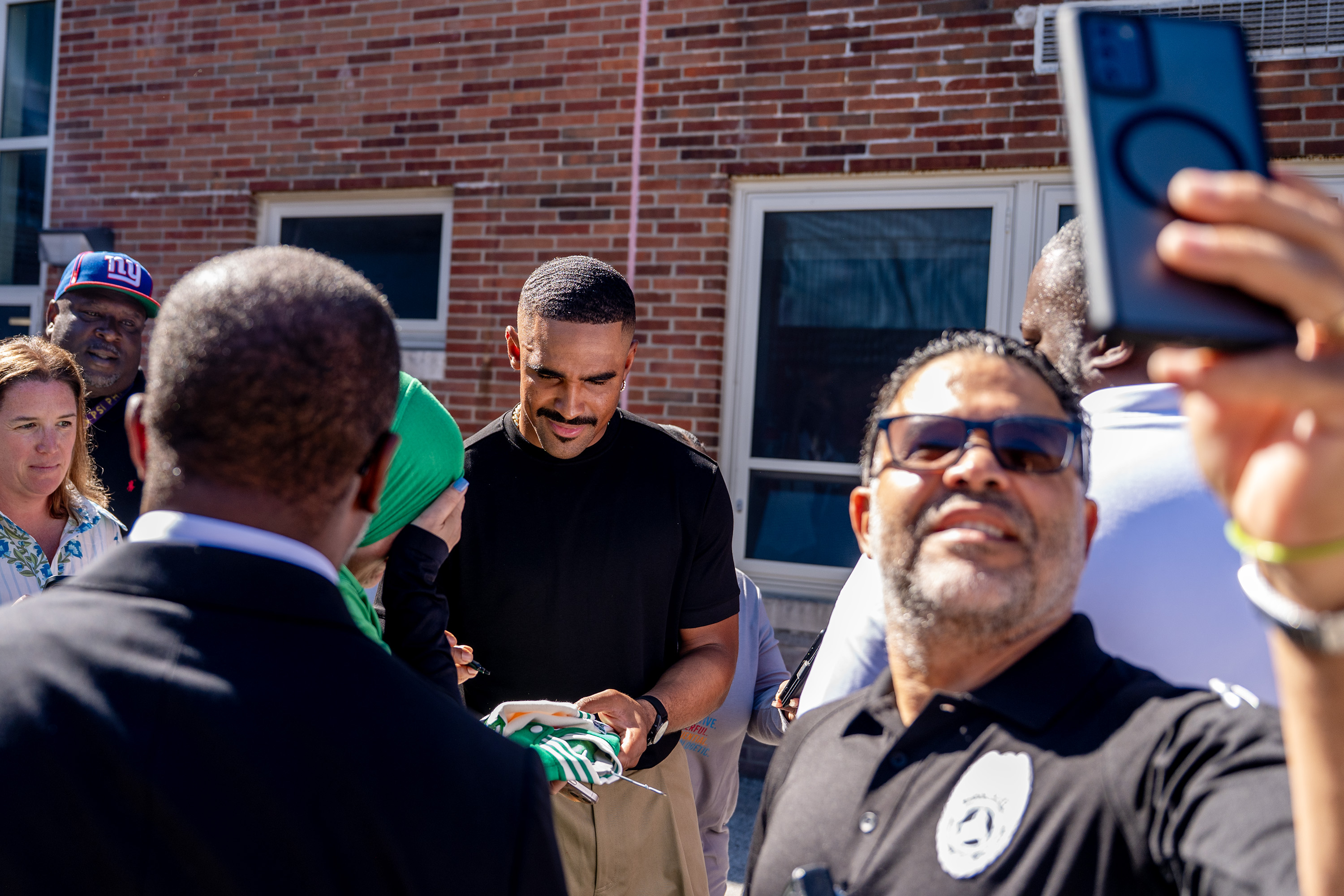
    School Superintendent Tony B. Watlington, Sr. (right) greets Eagles quarterback Jalen Hurts as he appears at a rally in the auditorium at Northeast High School Tuesday, Sept. 15, 2026 to give the school $600k for an air conditioning system. At left is Kathryn Epps, president & CEO, The Fund for the School District of PhiladelphiaTom Gralish / Staff Photographer

    Four weeks into a new school year, Philadelphia has had two heat-interrupted days at the 52 schools.

    Cooling the remainder of the 52 schools is not as simple as buying air-conditioning units: Many old buildings lack adequate electrical systems to support whole-school cooling.

    Those projects are complicated.

    An HVAC project at Kensington High went awry this summer, triggering asbestos issues that forced students and staff to relocate for the rest of the calendar year.

  • ‘The kids are not learning’: Employees inside a North Philly charter detail chaos inside their school

    ‘The kids are not learning’: Employees inside a North Philly charter detail chaos inside their school

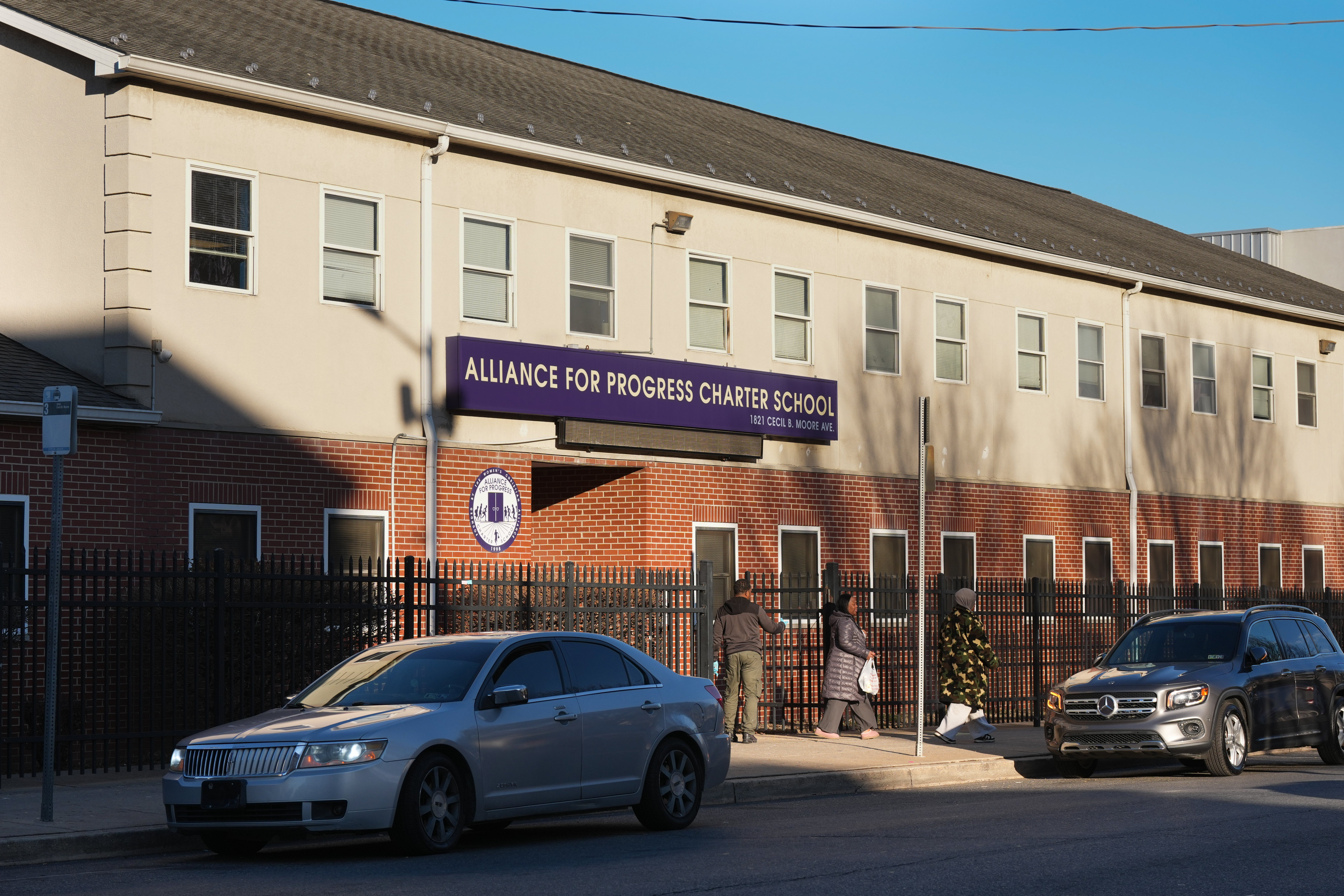
    The leadership meeting happened at midafternoon on a Tuesday at Alliance for Progress Charter School. It was a small huddle to discuss how the new school year was going.

    Unexpectedly, CEO Stacey Scott burst into the Aug. 25 meeting held inside the main office, disrupting the discussion.

    “You b—!” Scott said to the principal, Eric Langston, according to multiple people with direct knowledge of the meeting. She then spoke to the others in the room. “You can’t trust this snake! Motherf—!”

    Scott then walked out of the room, shouting, “F— this school,” and left.

    The extraordinary outburst, insiders say, shows Alliance for Progress, whose charter is up for renewal this year, is a school in turmoil.

    The Inquirer interviewed multiple people directly involved with the school, all of whom declined to be publicly identified because they fear reprisal.

    The North Philadelphia charter has churned through staff. Paraprofessionals — workers without college degrees or educational licenses — are providing instruction, those inside the school say. Students who never attended a day of school last year remained on Alliance’s rolls for the entire year, meaning the charter received payment for children it did not educate.

    Scott remains CEO, but is no longer working inside the building, according to the sources.

    Alliance, a K-8 school on Cecil B. Moore Avenue, had 616 students on roll last year.

    Both Scott and Larry Griffin, the president of the school’s board of directors, were asked to comment on the allegations. Griffin sent The Inquirer a statement. Scott did not respond.

    “Alliance For Progress Charter School continues our important work of educating our economically disadvantaged student populations,” Griffin wrote. “Respecting the privacy of all our AFPCS employees, we decline to comment on personnel matter.”

    Langston declined to comment.

    The Philadelphia School District’s charter schools office declined to comment. Officials from the charter office are expected to visit Alliance in late October to begin the enhanced review process that accompanies charter renewal.

    The school’s board of directors is scheduled to meet Tuesday night.

    Sounding an alarm

    Six weeks after joining Alliance as principal in July, Langston, who has spent time as a leader in the Mastery Charter system and at Northwood Academy, sent a confidential email outlining concerns he had about the school to the Alliance board of directors.

    The concerns, he said, according to the message obtained by The Inquirer, “have reached a level that gives me significant pause regarding leadership practices, organizational culture, transparency, and the long-term health of Alliance.”

    Langston asked for the board to shield him from possible retaliation. In 2025, the school’s former director of business and compliance filed a whistleblower lawsuit alleging he suffered reprisal — demotion — after reporting significant problems at the school.

    Raheem Harvey, who left Alliance last year, said he flagged to school and board officials violations of state and local bidding requirements, contracts issued without board approval, a student enrollment problem, skipped payroll taxes, and more.

    Scott told The Inquirer in December that Alliance officials “categorically deny all the allegations asserted by this disgruntled former employee.” That suit is still pending.

    Langston, in his email, laid out several issues raised by employees around ”Scott’s leadership and decision-making, including questions about whether decisions are consistently being made in the best interest of the school.” Alliance, he added, does not have “the level of psychological and professional safety necessary for adults to openly communicate, learn, disagree, grow and lead.”

    Different organizational structures are needed at the school, Langston said in the email. He proposed becoming chief schools officer — a promotion — which he said would result in “creating clearer lines of accountability and appropriately limit the extent to which Ms. Scott is involved in the daily instructional and operational decision-making of the school.”

    Langston also raised alarm over Scott instructing human resources to withhold the bonus an employee earned because the employee was taking family medical leave to care for an ill relative. Scott, he said, wanted to make sure the employee returned to Alliance after the leave.

    “I am deeply concerned that conditioning compensation already earned or otherwise due upon an employee’s return from protected leave may create significant legal, ethical and organizational exposure for Alliance,” Langston wrote.

    Langston also suggested Scott was misrepresenting staff vacancies and counting classes covered by substitutes as filled.

    “Our reporting should distinguish between FTE-filled positions, substitute-covered vacancies, and completely uncovered vacancies,” Langston wrote. “Anything less creates an inaccurate picture of our staffing reality. I believe the board deserves complete and transparent information upon which to make governance decisions.”

    ‘There are grave concerns’

    Four days after Langston sent the email to the board, Scott burst into his meeting shouting profanities, according to those with direct knowledge.

    Langston immediately notified the board of Scott’s conduct and asked for a meeting, which happened the next day.

    Some board members apologized for Scott’s behavior, but Griffin, the board president, neither offered an apology nor discussed the issues Langston raised, according to multiple insiders.

    Soon after the meeting, the board’s lawyer instructed Langston and the board to have no contact with each other. Alliance, at its lawyer’s instruction, has hired an outside consultant to investigate the situation.

    Langston remains on site at Alliance for Progress; Scott is working remotely, sending emails and issuing directives.

    Employees say Scott “has created a scope at the school where nothing can go on without her,” one employee said.

    The school’s atmosphere is “such a toxic working environment, not a healthy space. The kids are losing, the families are losing,” the employee said.

    “There are grave concerns,” the employee said. “We service families that come from challenging backgrounds, and we cannot assume that just the children have struggles. We have parents that cannot read. They do not know their children are not being serviced, their children are not being prioritized.”

    The employee said while the school’s climate is decent, Alliance lacks some organizational basics, including human resources processes and a formal student discipline cycle. Some students who never attended the school remained on roll all year, the employee said — an assertion confirmed by other employees.

    Some classes have been taught “for years” by unlicensed paraprofessionals, the first employee said.

    “It lacks stuff that a normal school understands,” the employee said. “It’s a very low tier, low level of support. The kids are not learning.”

    Just 9% of the school’s students meet state standards in reading, and 5% reached math standards. That is far below district and state achievement — in the Philadelphia School District, 33% of students were considered at grade level in reading and 25% in math; across Pennsylvania public schools, 50% of students are considered proficient in reading and 42% in math.

    A second employee, who also asked for anonymity for fear of reprisal, is particularly troubled by the school’s academic issues.

    “Our school is predominately Black and brown children, and they can’t read, and they’re just passed on to the next grade, and we go into these meetings, and they say, ‘These are the worst test scores I’ve ever seen.’ But what are we doing to make that different?”

    The second employee also expressed alarm about students on Alliance’s books who had left the school.

    “We noticed that students who’ve withdrawn were back on our roll. Students who haven’t been there for years. They literally lied on enrollment documentation,” the second employee said.

    Charters are allotted funding based on the number of students enrolled.

    “Something,” the second employee said, “is very wrong.”
  • Pope Leo will present Villanova University’s first-ever sustainability medal to a cardinal who founded an AIDS network

    Pope Leo will present Villanova University’s first-ever sustainability medal to a cardinal who founded an AIDS network

    A Czechoslovakian-born cardinal who is based at the Vatican will receive Villanova University’s inaugural sustainability medal for his work “at the intersection of human dignity, social justice, care for vulnerable communities and care for creation,” the university announced Monday.

    Pope Leo XIV, a Villanova alumnus, will present the medal named for him to Cardinal Michael Czerny on Oct. 13 at the university’s international sustainability conference in Italy.

    Villanova established the award earlier this year to honor someone whose work shows “exceptional commitment to ecological responsibility, social justice, care for the most vulnerable and responsible stewardship of economic and human resources.”

    The award is in part inspired by Pope Leo’s call to serve the poor and marginalized, said the Rev. Peter M. Donohue, Villanova’s president, who announced the winner at a news conference in Rome. Taking care of the environment and the poor are inextricably linked, Villanova said.

    “The Medal reflects a deeply held belief at Villanova: care for our common home and care for one another are inseparable,” Donohue said in a statement. “Cardinal Czerny’s work has shown us that care for creation cannot be separated from care for people.”

    The medal features Pope Leo on one side and Villanova University’s name on the other and is meant to highlight the pope’s commitment to sustainability, the school said. The winner can come from any field or discipline and is selected by a committee of members of the university’s Sustainability Leadership Council.

    The medal carries a $25,000 award to be used toward continued work in sustainability, the university said.

    Born in 1946 in the former Czechoslovakia, Czerny, 80, moved to Montreal with his family as a small child. His mother was Jewish and the family had converted to Catholicism, but several members of his family had died at the hands of Nazis, according to the National Catholic Reporter, which featured an article on Czerny in 2022.

    “My mother’s family — both parents and two brothers — were also Catholic but shared the Jewish origins that the enemy abhorred,” Czerny said in a homily, quoted by the National Catholic Reporter. “My maternal grandmother Anna, my grandfather Hans and my uncles Georg and Carl Robert, were all interned in Terezín, where Hans died… My grandmother and uncles were transported to Auschwitz. From here my uncles were sent to labor camps and eventually murdered there.”

    His mother and father were forced to work as farm laborers because of her Jewish ancestry and his unwillingness to divorce her.

    Czerny became a Jesuit priest in 1973 and got a doctorate in human sciences, social thought and theology from the University of Chicago in 1978. He was named a cardinal by Pope Francis in 2019.

    Over the last five decades, his work was focused on helping vulnerable people worldwide, the university said. In 1979, Czerny founded and led a center for faith and social justice in Toronto. He volunteered to be based in El Salvador during the country’s civil war, and from 2002 to 2010, he worked in Africa and founded the African Jesuit AIDS Network in Kenya.

    “That organization he led brought in a lot of hope,” said the Rev. John Abubakar, Villanova’s chief sustainability officer, who is from Nigeria. “It made a massive, massive influence or difference in the lives of people.”

    From 2022 until Sept. 1, Czerny headed the Vatican’s Dicastery for Promoting Integral Human Development as Prefect, a role in which he led the Church’s work on justice, migration, health and care for creation. Pope Francis in 2022 sent him to Slovakia to greet refugees fleeing Ukraine following the Russian invasion.

    Czerny said he was grateful for the medal and the honor it brings.

    “What’s most important I think is the commitment the university is making to include sustainability in how it is forming the future leaders of our church and in this case the United States,” he said in a video on the Vatican news site.

  • Three Wallingford-Swarthmore schools locked down Monday during a police search outside

    Three Wallingford-Swarthmore schools locked down Monday during a police search outside

    Students at Strath Haven High School and Middle School and Wallingford Elementary School sheltered in place Monday morning as police searched the area for a suspect who had fled during a traffic stop.

    The incident began when a Nether Providence Township police officer stopped an Acura at 9:07 a.m. Monday on South Providence Road, police said in a statement. The driver fled in the car, which police determined was stolen, and the officer lost sight of it.

    Then at 9:41 a.m., a resident contacted the police to report a car abandoned in a backyard on Hickory Lane, near the high school, police said. Officers determined the car was the same one that had been driven by the suspect, and police began searching the area.

    Police said they worked with school officials to place the three Wallingford-Swarthmore schools, which enroll about 2,600 students, “in a ‘Teach in Place’ status while officers searched the surrounding area.”

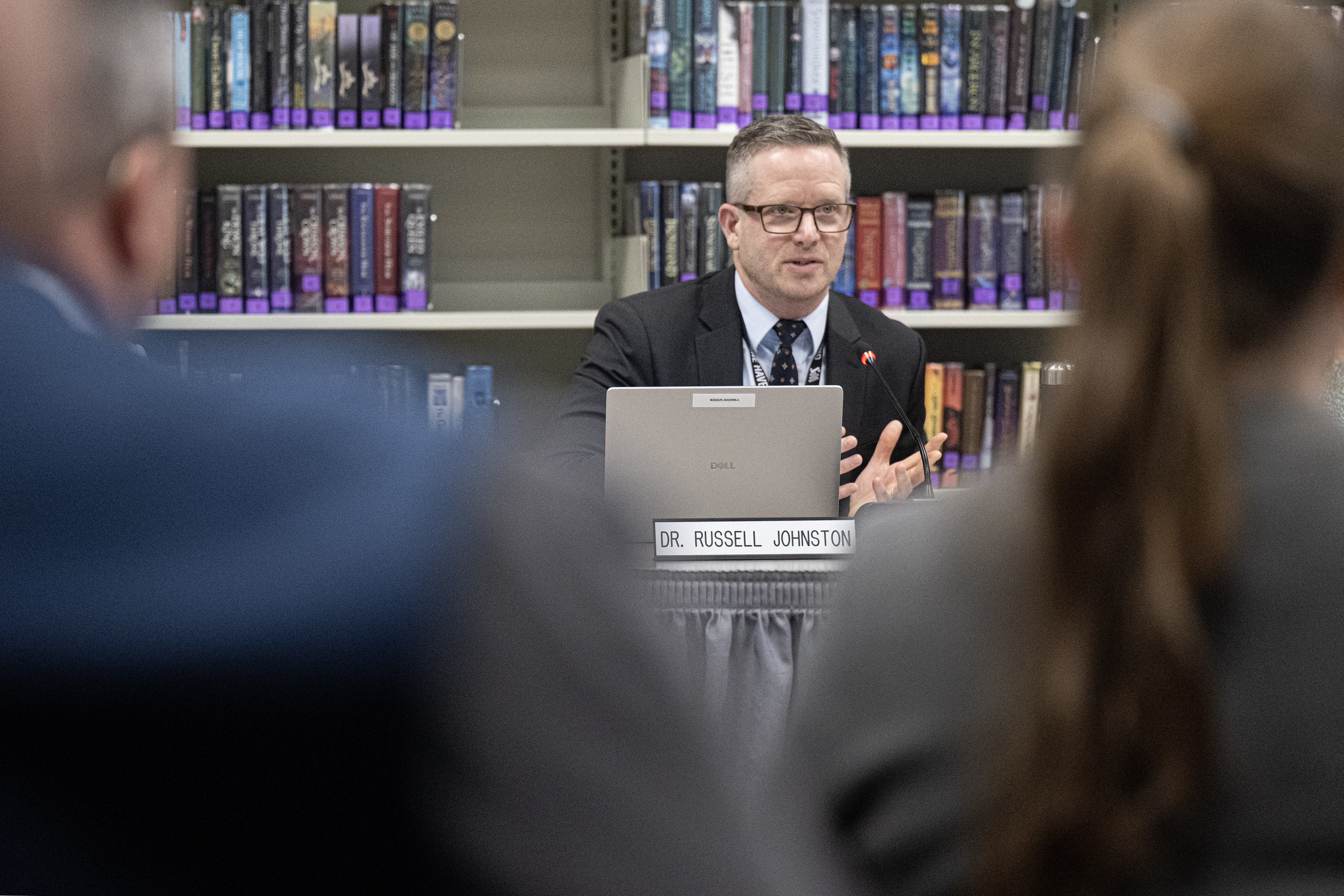
    Wallingford-Swarthmore Superintendent Russell Johnston said the lockdown “kept the kids safe inside the buildings” during the police search. Classes continued during that time, he said.

    “What we did was out of an abundance of caution,” Johnston said. He said school officials believed police had guns drawn during the search.

    Police reviewed video surveillance that showed the suspect “fleeing toward the rear of Strath Haven High School” before being picked up by another car. The schools returned to their normal status after it was clear the suspect had left the area, police said.

    Nether Providence Township police are still investigating the incident, and are asking anyone with information to call the department’s detective division at 610-892-2875.

  • Schools around Philly are no longer giving laptops to kindergartners and scaling back on screen time. It’s a tech backlash.

    Schools around Philly are no longer giving laptops to kindergartners and scaling back on screen time. It’s a tech backlash.

    As her children start second and third grades in the Colonial School District, Elise LaChapelle expects they will spend no more than 20 to 30 minutes a day on their Chromebooks — limits the Montgomery County district has announced to parents.

    Colonial also no longer allows elementary school students to take their laptops home at night. “That seemed to be an acknowledgment on the district’s end that changes were needed,” LaChapelle said.

    Amid a spreading backlash to screens in classrooms, public school districts across the Philadelphia region are placing more limits on technology use — including by pulling back on one-to-one device programs once touted as critical for ensuring every student had access to technology.

    The Tredyffrin/Easttown School District has stopped assigning iPads to kindergartners, and students across the district’s elementary schools will no longer take their tablets home at the end of the day.

    In Methacton, the district has transitioned from individual devices to a shared model for kindergartners and first graders, with Chromebooks available for center-based activities, according to a district spokesperson.

    The Phoenixville Area School District has ended its one-to-one device program for kindergarten through third grade, while in Wallingford-Swarthmore, kindergartners through second graders will take fewer online assessments, and kids up to fifth grade are no longer able to search and browse YouTube.

    Parents who have been pushing schools to scale back on computer use are applauding the new restrictions as a step in the right direction of promoting teacher-led instruction and reducing screen-based distractions.

    But they also question how much will change in practice, because children will still have access to devices in many classrooms. Some parents who have been battling for less screen time want schools to go further to address what they see as excessive reliance on technology at older grade levels.

    In Lower Merion, which adopted a new technology policy last month that no longer assigns personal devices to kindergartners through second graders, seven parents are suing the district for rescinding their ability to opt out of computers entirely. The parents argue the district is violating their constitutional rights by requiring their kids to use internet-connected computers without adequate safeguards.

    Yair Lev, a parent who opposes Chromebook use in Lower Merion schools, speaks at a March 23 forum at Harriton High School about technology use in the school district.Maddie Hanna / staff

    For many districts, reducing computer usage in elementary schools “seemed like the low-hanging fruit,” said Alex Bird Becker, a Wallingford-Swarthmore parent active in PA Unplugged, a statewide group with about 5,000 supporters that advocates for limits on educational technology. But “when you get to middle school, the device culture has become really ingrained with curriculum. That’s where it gets harder to disentangle.”

    Wallingford-Swarthmore, a 3,700-student district, has been soliciting applications from parents to join a new Technology Advisory Council that will advise the district on further changes, including related to device use in grades six to 12. (In Lower Merion, parents have been pressing the district to create a technology review committee that includes parent representation.)

    “We know there’s even more we want to do in this area,” said Russell Johnston, Wallingford-Swarthmore’s superintendent.

    Johnston said the district was trying to ensure its use of technology was “focused” — posting online for parents to see which portions of the district’s elementary curriculum will incorporate technology, with lessons connected to Pennsylvania standards.

    Wallingford-Swarthmore School District Superintendent Russell Johnston speaks during a Feb. 24 school board meeting in Wallingford.Jose F. Moreno / Staff Photographer

    Wallingford-Swarthmore is also reevaluating how laptops are used during “curriculum enrichment” time, Johnston said, when students are broken into small groups to receive extra help.

    In Phoenixville, which ended its one-to-one device program for kindergarten through third grade, “students will continue to have access to appropriate and approved educational technology for academic purposes only,” district spokesperson Nicole McClure said.

    Alair Southerton, a Phoenixville parent who has been pushing the district to make changes, said the school board had approved “strong language” around when devices should be used in classrooms.

    But “we’re still kind of crossing our fingers with the rollout,” Southerton said. She questioned whether teachers had clear guidance from administrators, and whether the district would consider educational technology apps that some parents object to as “gamified” as essential for learning.

    “We want to really fine-tune what needs to be done on a device on a screen,” said Southerton, who is a member of a new district Edtech Advisory Council.

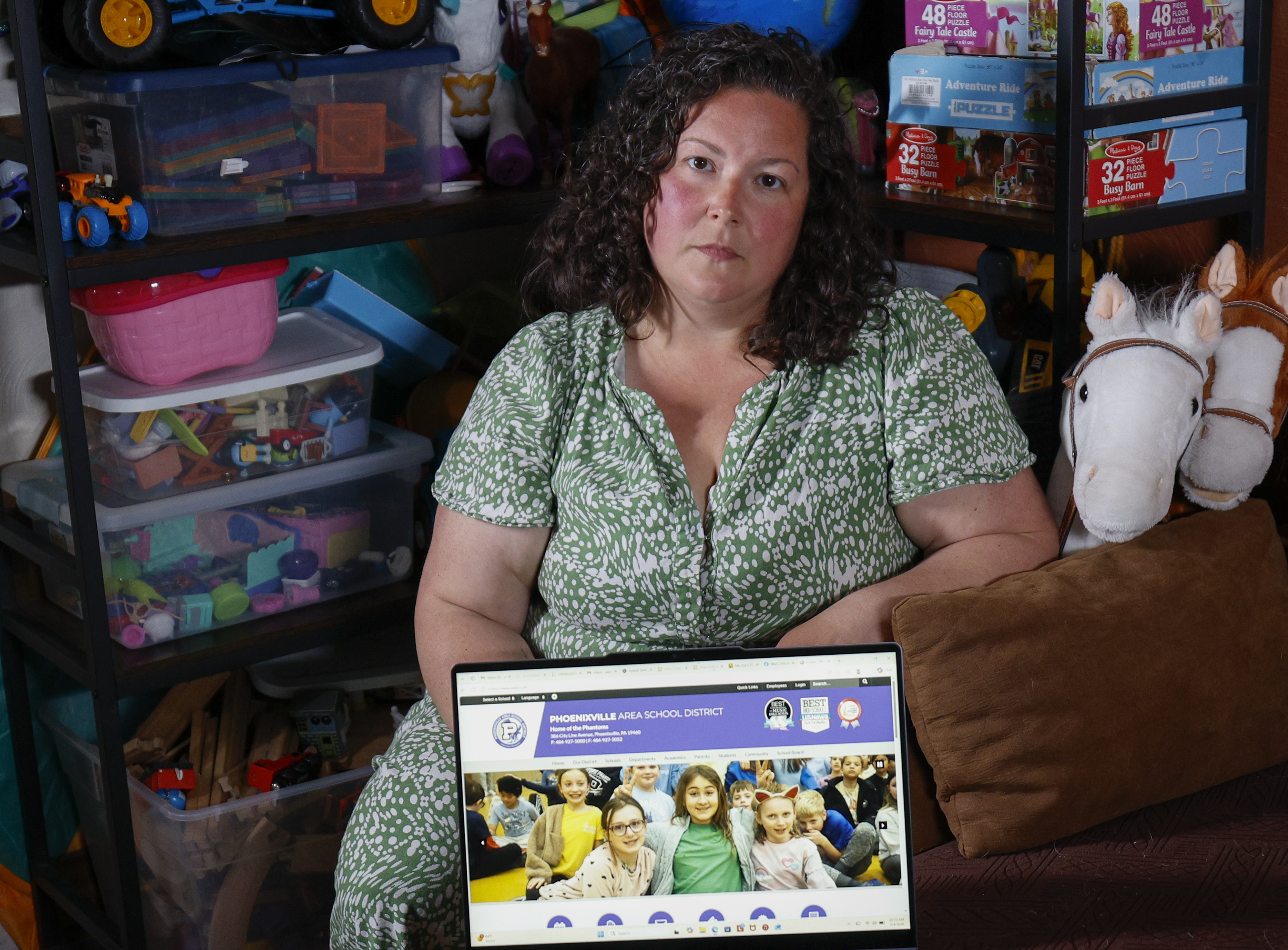
    Alair Southerton, pictured at her home in May with the Phoenixville Area School District website on her laptop. Southerton is leading a group of Phoenixville parents who are calling on their district to reduce screen time in school.Steven M. Falk / For The Inquirer

    While Phoenixville this fall adopted a new program, Qustodio, to let parents monitor their child’s device usage, Southerton said it has been less revealing than she hoped. The program reports which websites students accessed at 15-minute intervals throughout the school day but does not say how long they actually spent online, she said.

    In Colonial, LaChapelle is awaiting the district’s launch of a different program, Securly, that will also allow parents to monitor what their kids accessed.

    While the district has placed limits on screen time — 20 to 30 minutes in kindergarten through third grade, 40 to 50 minutes in grades four and five, and 2½ to three hours in grades six through 12 — “accountability and transparency are key,” LaChapelle said.

    Colonial spokesperson Jessica Lester said the district had “done more this year to try to communicate what our approach is” to technology.

    LaChapelle noted that in order to register her children for school, she had to consent to a list of more than 100 software programs used by the district; officials have since told her they plan to revise that, she said.

    LaChapelle hopes the district will continue to make changes. Taking an intentional approach to technology use could be a selling point for districts trying to show leadership, she said.

    “We’re doing and saying a lot of the right things,” she said. But “this isn’t a one-and-done conversation.”

  • Rachel Blau DuPlessis, experimental poet, literary scholar, and Temple professor emerita, has died at 84

    Rachel Blau DuPlessis, experimental poet, literary scholar, and Temple professor emerita, has died at 84

    Rachel Blau DuPlessis, 84, of Philadelphia, experimental poet and essayist, literary scholar and critic, Temple University professor of English and creative writing emerita, mentor, artist, and world traveler, died Wednesday, Sept. 2, of respiratory failure at Penn Presbyterian Medical Center.

    Professor DuPlessis was an eclectic experimental poet who grew up in New York, lived in Swarthmore and Philadelphia for more than 50 years, and taught a variety of writing and women’s studies classes at Temple from 1974 to her retirement in 2011. She wrote hundreds of poems — she called many of them “drafts” — about feminism, modernism, connectivity, imagery, and consciousness.

    She was an expert on cultural poetics and told The Inquirer in 2002 that her poems generally reflect her “awe at the universe, grief at the barbarity of modernism, and sense of how it was to be in the world.” She enjoyed poetic wordplay, reviewers said, and tinkered freely with conventional syntax, sound, tone, and form.

    “Reading her is an adventure,” reviewer Robert Long said in The Inquirer in 1997, “and poets this adventurous must be cherished.”

    Her poems were published in more than 30 books and in several languages, and also appeared in The Inquirer, other newspapers, magazines, journals, and anthologies. In tributes, fellow poets praised her “unique combination of erudition and exuberance” and her “generosity, brilliance, expansive thinking, and attention to so many possibilities of writing and art.”

    “From what I can tell, DuPlessis doesn’t write poems so much as build them,” reviewer Andrew Ervin said in The Inquirer in 2005. “The manner in which she does that is what makes the Temple professor one of the most exciting and inventive writers of our time.”

    She told the Oxonian Review in 2015 that “being a poet is not only writing poems. It is an address to the whole apparatus of and the traditions of poetic practice.”

    A book publisher said: “She brought such intelligence, generosity, and curiosity to everything she did.” Penn professor Al Filreis told Professor DuPlessis’ husband, Robert: “It’s hard to imagine the Philly poetry world without Rachel in it.”

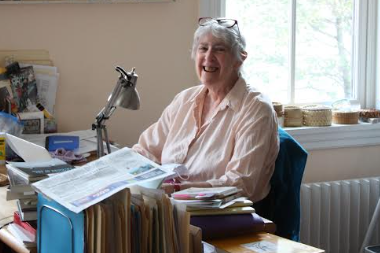
    Professor DuPlessis read her poems to people around the world. Courtesy of the family

    At Temple, Professor DuPlessis helped establish women’s studies classes and the school’s graduate program in creative writing. She mentored students and other professors, and the English department’s DuPlessis Lecture in Poetry and Poetics is named in her honor.

    “She loved being a mentor to people, to encourage them,” her husband said. “She loved being a poet and an academic. She prepared incredibly for her classes and was connected and attentive to her students.”

    Earlier, she taught briefly at what is now the College of New Jersey and Rutgers and Columbia Universities. She spent several of her research and study leaves from Temple working with students and colleagues at universities in the Netherlands, France, Belgium, and elsewhere.

    She was named a resident poet and distinguished visitor in Italy and New Zealand. She and her husband, a professor emeritus at Swarthmore College, visited every continent except Antarctica, and she spoke French and Italian as well as English.

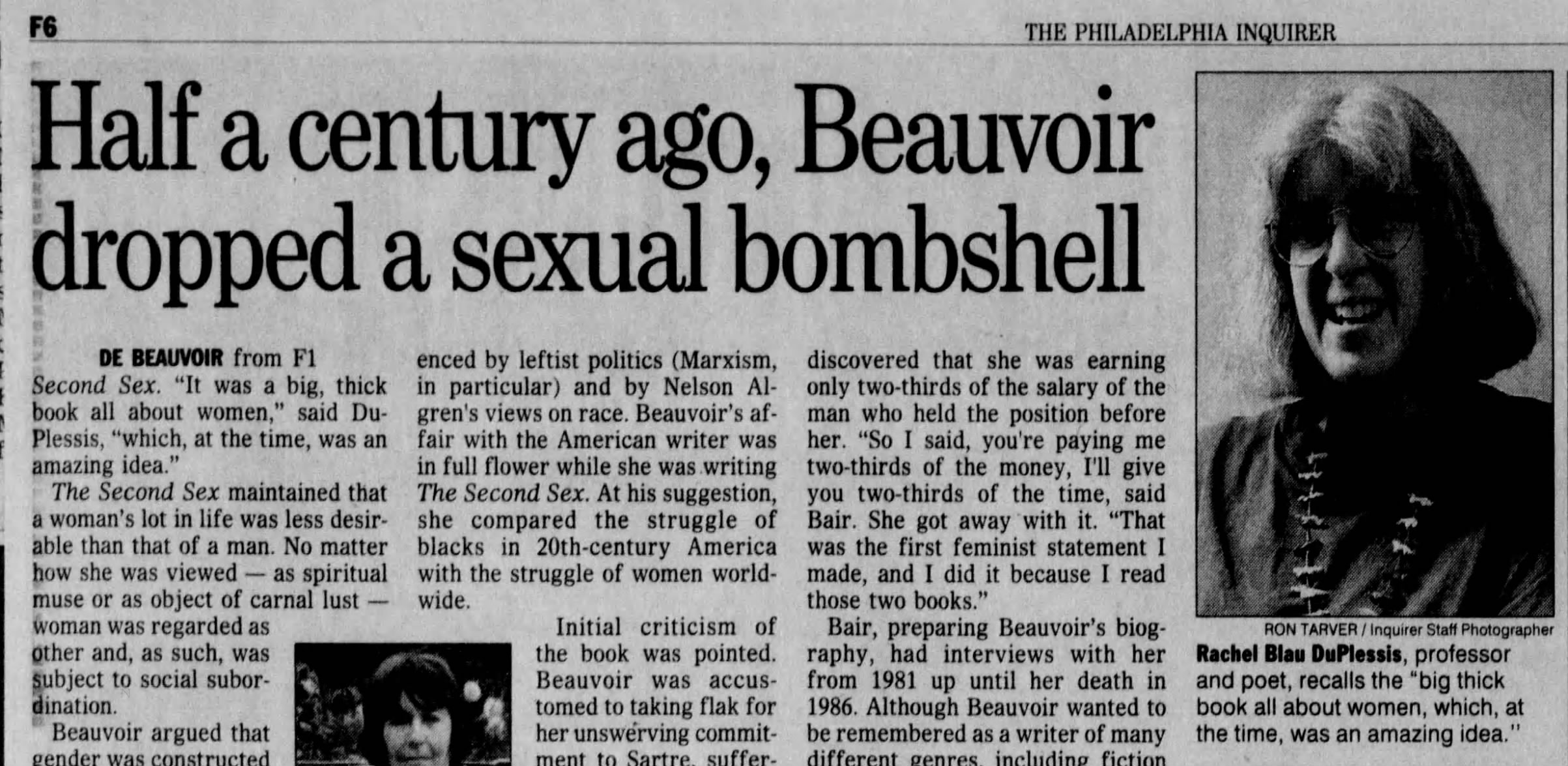
    This article featured Professor DuPlessis and appeared in The Inquirer in 1999.Newspapers.com

    She earned fellowships from the Pew Center, the Pennsylvania Council on the Arts, the National Humanities Center in North Carolina, and other groups. “She was constantly creating things,” her husband said. “She never stopped.”

    Professor DuPlessis also wrote and edited books and articles about writing and poetry, and she reviewed books for The Inquirer and other publications. She read her poems in public, was interviewed often, and earned achievement awards from Temple, the University of California in San Diego, the old Fund for Poetry, and other admirers.

    She created a comprehensive website, rachelblauduplessis.com, and made collage art that she augmented with poems. Thomas Devaney, a Philadelphia writer, called her “an important figure of American experimental poetry.”

    She told the Oxonian Review: “Poetry is an ethical practice as well as an aesthetic one. Just even thinking about what this means and how it is instantiated is a useful task.”

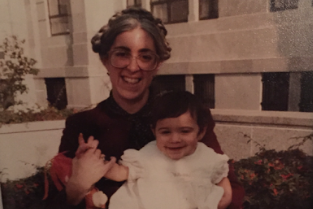
    Professor DuPlessis enjoyed time with her husband, Robert, and daughter, Kore.Courtesy of the family

    Rachel Maia Blau was born Dec. 14, 1941, in Brooklyn. She grew up in Queens and the Bronx, and earned a bachelor’s degree in English at Barnard College in New York in 1963 and a master’s degree and doctorate in English and comparative literature at Columbia in 1970.

    Her father was a professor, her mother a librarian. She met fellow Fulbright scholar Robert DuPlessis on a boat to France in 1966, and they married in 1968 and had a daughter, Kore.

    Professor DuPlessis enjoyed yoga, museums, art history, and long walks with her husband. They went to see and hear the orchestra, the opera, the ballet, and the theater.

    She doted on her daughter and grandchildren. “She always read me stories and sang me songs at night before bed,” her daughter said. “I would hold on to her leg because I didn’t want her to leave.”

    Professor DuPlessis started writing poems when she was 12, she said in an interview. “She was determined, hardworking, witty, and a lot of fun,” her husband said. “She was definitely intense.”

    Professor DuPlessis said she started writing poems when she was 12.Courtesy of the family

    In addition to her husband and daughter, Professor DuPlessis is survived by two grandchildren and other relatives. A sister died earlier.

    A memorial service is to be held from 1:30 to 3:30 p.m. Saturday, Oct. 17, at Temple University’s Charles Library, 1900 N. 13th St., First Floor, Philadelphia, Pa. 19122.

    Donations in her name may be made to Planned Parenthood, Online Services, Box 96771, Washington, D.C. 20090; Philabundance, 3616 S. Galloway St., Philadelphia, Pa. 19148; and the American Civil Liberties Union, 125 Broad St., 18th Floor, New York, N.Y. 10004.