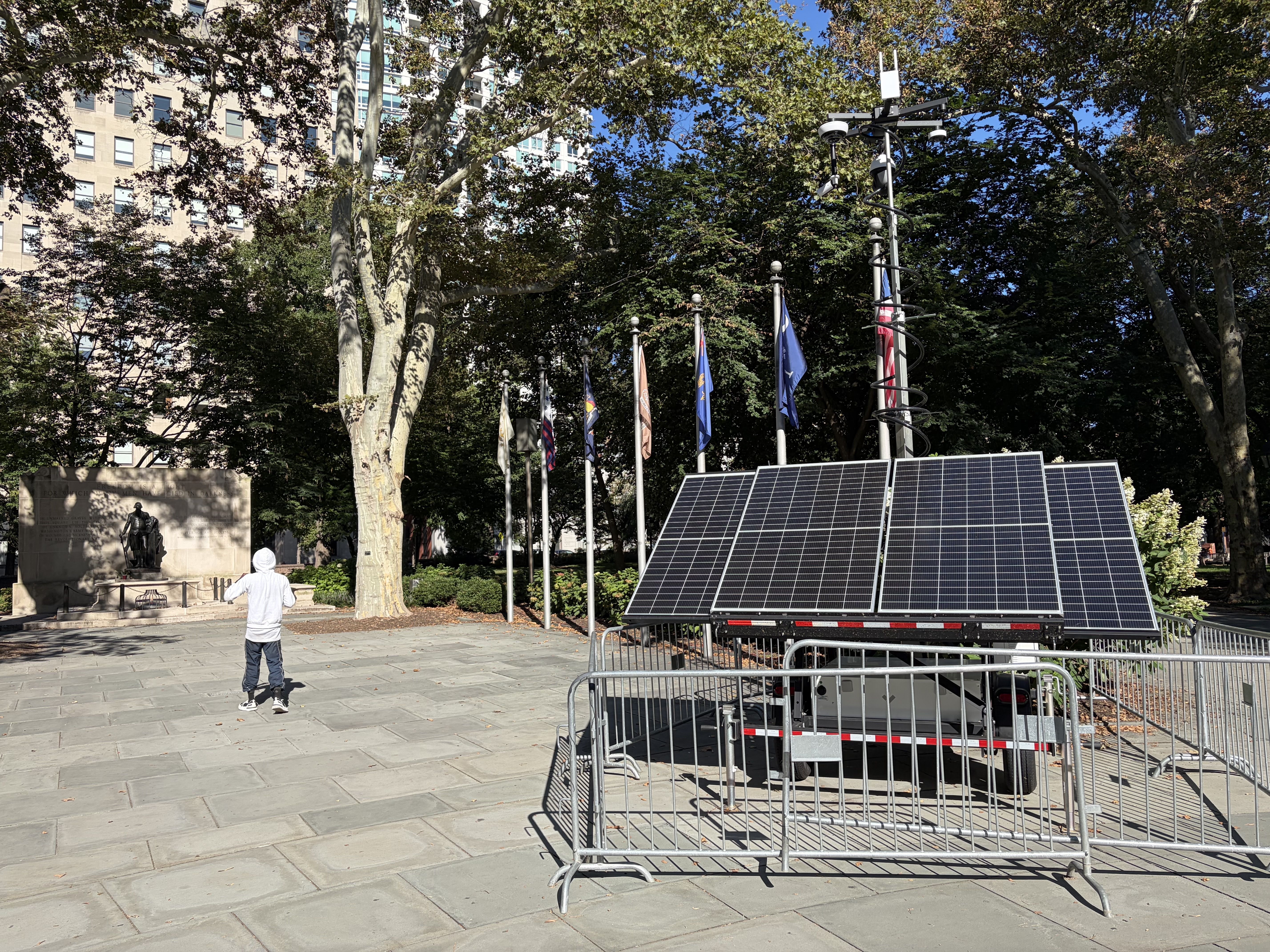
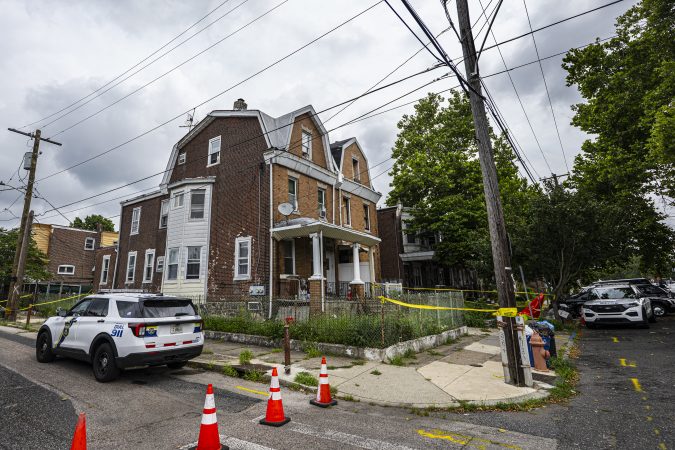
A new fixture is on Washington Square next to the Tomb of the Unknown Revolutionary War Soldier and the flags of the 13 original colonies — a fenced-off, solar-powered security camera.
Here is what you need to know about the new camera, which is not a Flock device.
Who installed the security camera?
Washington Square is part of Independence National Historical Park, and the federal government has jurisdiction over the park.
The camera was installed in July by the National Park Service in response to vandalism, according to City Councilmember Mark Squilla.
“The National Park Service has the responsibility to keep America’s most cherished places safe and free from damage for the enjoyment of the American people,” a spokesperson for the park service said. “In the past year, vandals have damaged the Tomb of the Unknown Revolutionary War Soldier.”
What do we know about vandalism in the park?
A handful of vandalism incidents in the Washington Square area have been reported this year, according to Philadelphia Police Department data.
One of the vandalism cases was in the early morning of July Fourth and was followed hours later by a separate incident.
Later that day, five people who participated in a protest were arrested. During the event outside Washington Square, an unidentified woman attempted to burn an American flag.
While the U.S. Supreme Court ruled burning an American flag is protected speech, it is a violation of city safety codes for public spaces.
The arrests followed police orders to the crowd to disperse, and the five people allegedly did not comply.
It is unclear if any specific incident led the National Park Service to install the additional surveillance measure.
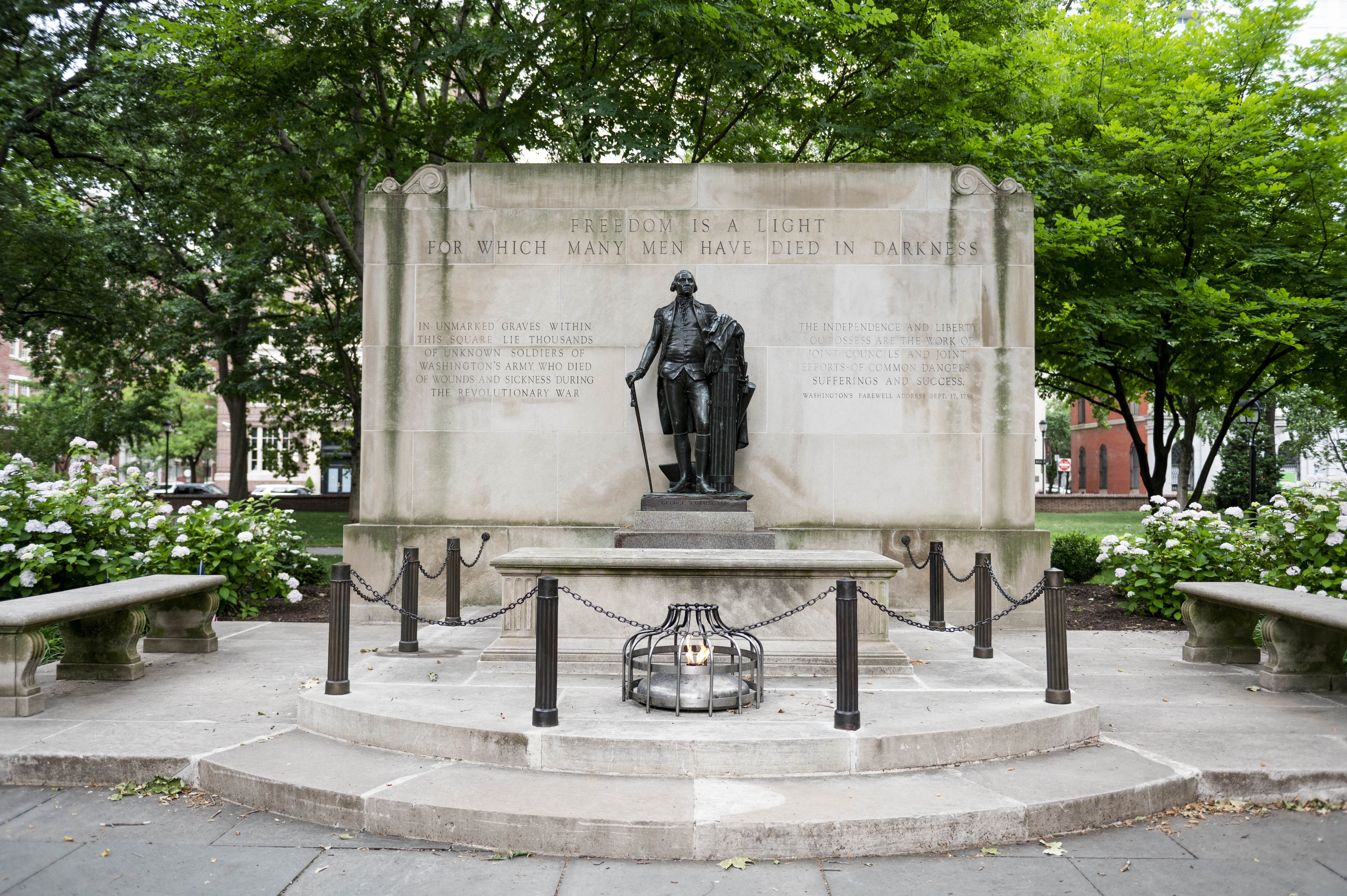
The Tomb of the Unknown Revolutionary War Soldier, which includes a statue of George Washington, was defaced with spray paint in 2020. Vandals wrote “committed genocide” on the memorial’s granite wall.
Tomb of the Unknown Soldier monument in Washington Square on Wednesday, June 14, 2023.Allie Ippolito / Staff Photographer
Is it a Flock camera?
The new surveillance equipment is not a Flock camera, the park service spokesperson said.
“Independence National Historical Park does not use Flock cameras. The park’s camera network is operated solely by the National Park Service on a standalone network with no connections to local or other federal agencies,” the spokesperson said.
The head of the conviction integrity unit in the Philadelphia District Attorney’s Office has stepped down from his supervisory role, sources said, days after a federal judge said his actions in a contentious post-conviction case could amount to crimes.
Assistant District Attorney Matthew Stiegler resigned from his position as supervisor of the unit on Thursday, said the sources, who spoke on the condition of anonymity to discuss a sensitive personnel decision.
Stiegler would remain a prosecutor with the office, the sources said, though it was not immediately clear what his role would be.
Stiegler did not respond to a request for comment. A spokesperson for the district attorney’s office also did not respond.
On Tuesday, U.S. District Judge Paul Diamond said Stiegler and Krasner may have broken the law in their handling of the case, and said he had referred the matter to the U.S. Attorney’s Office to investigate whether the pair should be charged with crimes including conspiracy or obstruction of justice.
Stiegler came under public scrutiny this spring over his unit’s handling of the case of Dennis Johnson, who was convicted of second-degree murder in 2009. Prosecutors for years had opposed his bid for freedom.
Then, in 2022, Assistant District Attorney Jaclyn Mason, who worked under Stiegler, filed a brief saying she had discovered problems with Johnson’s case, and recommended the conviction be overturned.
Diamond scheduled an evidentiary hearing on the matter this spring.
Ahead of that hearing, Mason’s colleagues in the office’s law division reviewed the filings in the case and found what they called “material misstatements” in the brief. They sought to withdraw Mason’s filing, and apologized to Diamond.
Mason resigned. Diamond called a hearing on the matter.
Stiegler, she said, had been “colluding” with Johnson’s defense attorneys from the Federal Community Defender Office and the Pennsylvania Innocence Project on the most effective paths to secure Johnson’s release. Neither of them had reviewed key evidence in Johnson’s case before seeking to overturn his murder conviction, she said.
“Matt told me: ‘If it’s good enough for the Innocence Project, it’s good enough for me,’” Mason said.
Stiegler denied this and said he has reviewed every case carefully.
In a subsequent hearing, supervisors in the law division testified that Stiegler, in an attempt to avoid blame, then suggested they review Mason’s cases to look for other errors in her work to paint her as a “rogue” prosecutor who was routinely making mistakes.
Those supervisors said Krasner later echoed that potential course of action, saying he had learned it from Stiegler and it was a “good idea.”
The supervisors refused.
Diamond said those actions were particularly troubling, and suggested Krasner and Stiegler were conspiring to “present a false narrative to the Court.”
Diamond also said he found Stiegler’s testimony “was often contradictory, evasive, or outright dishonest,” and that Stiegler may have committed perjury while on the stand.
In a statement Tuesday, Krasner said, “I respectfully and vigorously disagree” with Diamond’s findings.
“I look forward to appealing to the higher court as soon as the law allows,” he said, adding that he could not comment further because the case is pending.
Staff writer Chris Palmer contributed to this article.
A Camden woman working as a certified nurse’s aide admitted to spraying bleach into the face and eyes of a paralyzed elderly patient at a Cherry Hill nursing home, New Jersey Attorney General Jennifer Davenport said Thursday.
Simone Goldsboro, 37, pleaded guilty before Superior Court Judge Kurt E. Kramer in Camden to third-degree aggravated assault and fourth-degree assault upon an institutionalized elderly person.
State prosecutors will recommend that Goldsboro be sentenced to 364 days in jail in Camden County, Davenport said.
Goldsboro, who will permanently forfeit her license to be a certified nurse’s aide, is scheduled to be sentenced Oct. 30.
Erin Yerke, an assistant deputy defender representing Goldsboro, could not be reached for comment Thursday.
In 2023, prosecutors said, Goldsboro worked as a certified nurse’s aide at the Avista Healthcare Nursing Home in Cherry Hill.
On Aug. 17, 2023, Goldsboro was taking care of a patient who was more than 60 years old and was paralyzed on one side of her body from a stroke, prosecutors said.
“Goldsboro admitted she used more force than necessary while undressing D.S. so she could clean her and then left the room to retrieve a spray bottle containing bleach from the custodian’s cart,” the attorney general’s office said.
Goldsboro then intentionally sprayed bleach into the patient’s face and eyes, the attorney general’s office said.
“We have to trust the people who care for our loved ones at residential facilities,” Davenport said in a statement. “This defendant exploited that trust and physically assaulting a paralyzed patient in her care. We will not tolerate the abuse of elderly and vulnerable individuals, especially by those entrusted with their care.”
The parents of one of two teenagers charged with killing a Pennsylvania State University student in June drove him from Philadelphia to Colorado Springs, Colo., within hours of local television stations airing surveillance footage of the suspects police were seeking in the case, prosecutors said Thursday.
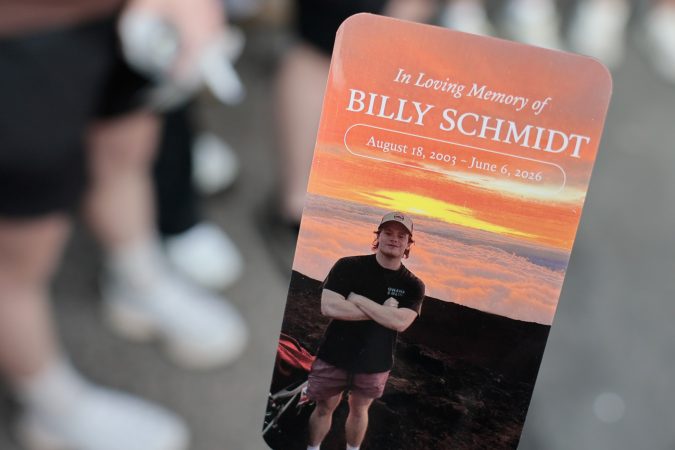
Kaiseem Smith, 16, and Azzubair Outen-Fleming, 16, are charged with murder, conspiracy, and related offenses in the shooting death of William “Billy” Schmidt, 22, who was killed June 6 after a robbery on a South Philadelphia sidewalk turned deadly.
Philadelphia police and the U.S. Marshals Service searched for Smith and Outen-Fleming for weeks before taking them into custody. Marshals found Outen-Fleming on July 1 in Colorado Springs. Smith surrendered to Philadelphia police the following day.
At a preliminary hearing Thursday, prosecutors detailed how Outen-Fleming’s stepfather, Donte Abdulmalik, 35, and mother, Milika Abdulmalik, 45, allegedly drove him more than 1,700 miles to Colorado Springs — a roughly 45-hour trip spanning several states — and how police detectives traced the journey through cell phone records and license plate reader data.
Donte Abdulmalik was arrested June 30 and Milika Abdulmalik on July 3. Both are charged with hindering apprehension, obstruction of justice, and related offenses.
After hearing the evidence Thursday, Common Pleas Court Judge Gregory Yorgey-Girdy ordered the parents to stand trial.
Detective Thorsten Lucke testified that the couple’s cell phone records showed they began the drive around 10:30 p.m. June 10, after surveillance videos and images of the suspects aired during local 10 p.m. newscasts.
That night, a phone registered to Milika Abdulmalik called and texted a Colorado Springs number, Lucke said, before beginning to travel west in tandem with a phone registered to Donte Abdulmalik.
The phones arrived in Colorado Springs on the evening of June 12, Lucke testified, and began heading east again June 14 before returning to Philadelphia.
Detective Frank Mullen, who also testified Thursday, said police arrested Donte Abdulmalik near a black Mercedes-Benz that investigators believe was used to drive Outen-Fleming to Colorado Springs. License plate readers captured the vehicle near the home where Outen-Fleming was later found, Lucke said.
Defense attorneys for the parents argued, however, that the evidence was thin and failed to connect their clients to the alleged crimes.
Donte Abdulmalik’s attorney, Carmen C. Nasuti III, made plain what he thought of the case during a cross-examination of Lucke: “So, essentially, what you showed us was two phones took a trip to Colorado Springs?” Nasuti asked.
“Yes, that’s correct,” Lucke replied.
Smith, Outen-Fleming, and Fleming also appeared in court Thursday but waived their preliminary hearings.
Schmidt, a Penn State senior, was walking home from a neighborhood bar where he had watched the NBA Finals when the two teenagers approached him near 20th and Wolf Streets around 1:30 a.m., according to prosecutors and surveillance footage described in court records.
Prosecutors have said Outen-Fleming grabbed Schmidt’s cell phone, punched him, and rifled through his pockets before the pair knocked him to the ground. As the teens walked away, Outen-Fleming threw the phone down the block.
A neighbor’s surveillance camera recorded Schmidt running after them, police have said. Smith then turned and fired a single shot into Schmidt’s chest, prosecutors said.
Authorities also connected Donte Abdulmalik to the case through a woman who was inside a South Philadelphia home searched by police while they were looking for Outen-Fleming’s brother, Kadafi Fleming, according to an affidavit of probable cause for Donte Abdulmalik’s arrest.
Fleming, 19, is accused of stealing the SUV the teens took to and from the area before and after the killing.
The woman, identified in the affidavit only by her initials, told detectives she recognized Outen-Fleming from news coverage of the case and identified the second suspect — whom she said was the shooter — as his cousin. She also told investigators that Outen-Fleming’s stepfather had driven him to Colorado, according to the affidavit, and showed officers a speeding ticket that had arrived in the mail: a citation for a June 14 infraction in Simla, Colo., issued to a Mercedes-Benz registered to a deceased family member.
Hours later, detectives interviewed the woman again while Donte Abdulmalik waited outside on the porch, according to the affidavit. She stood by her identification of the two teenagers but retreated from the rest of her account, telling them she did not know who had driven Outen-Fleming to Colorado.
Prosecutors did not call the woman as a witness Thursday or introduce evidence from those interviews.
In his closing argument, Nasuti said records showing a phone in Colorado did not necessarily place his client there. Donte Abdulmalik, he argued, could have handed the phone to his stepson.
“No one who can place my client in the car,” he said. “No one who can place that phone number in his hand. They need to do that, even at this level.”
Yorgey-Girdy, the judge, said he found the evidence persuasive, however. He also denied requests from Nasuti and Scott Gessner, Milika Abdulmalik’s attorney, to reduce the couple’s bail after Assistant District Attorney Lauren Crump argued they posed a “severe flight risk.”
“This whole case,” Crump said, “is about flight.”
The parents are each being held on $250,000 bail, court records show.
Smith and Outen-Fleming are scheduled to return to court in October, along with Donte Abdulmalik, Milika Abdulmalik, and Fleming.
On a rainy May morning, pedestrians and cars passed Liza Ridley on Kensington’s Allegheny Avenue as she stood with a suitcase by her side.
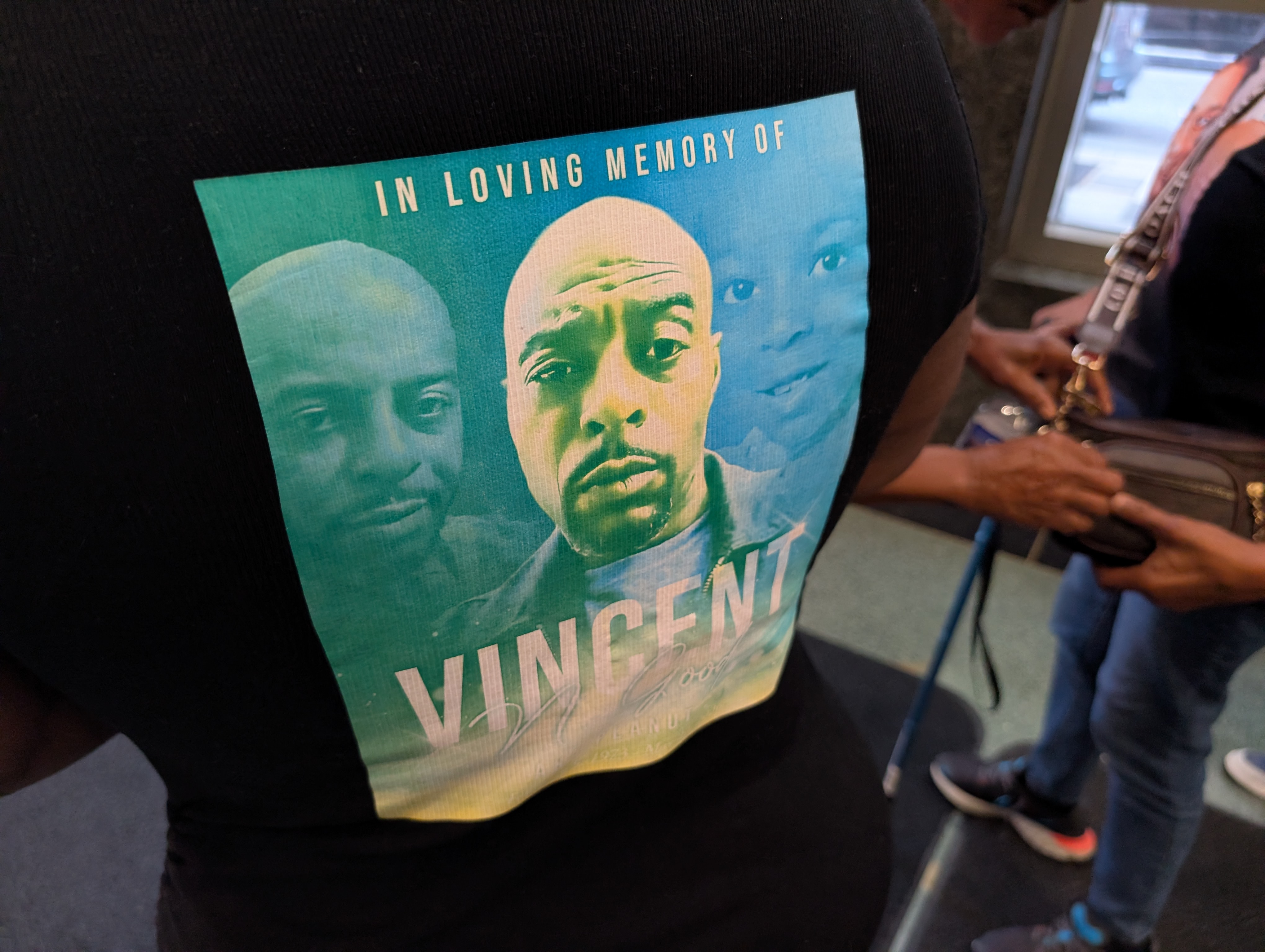
Those passersby, prosecutors said, were unaware that the decomposing and dismembered remains of Ridley’s longtime boyfriend, Vincent Good, were arranged inside.
Those horrific details emerged during Ridley’s preliminary hearing on Wednesday in Common Pleas Court, where prosecutors said Ridley, 54, admitted to shooting Good in the head and leaving his body in their Northeast Philadelphia apartment this spring before moving his remains using a Lyft rideshare.
Assistant District Attorney Cydney Pope said Ridley shot Good, 53, seven times in the head and left his body on the couple’s mattress in their Mayfair apartment, sleeping next to the corpse as it decomposed in their room.
The body was likely there for two weeks or longer, prosecutors said. They also accused three people living in Ridley’s home of being complicit in the crime, saying it would have been impossible to ignore that something nefarious had happened to Good.
For example, Pope said, the smell of Good’s decomposition on bedsheets that had been thrown in the trash was so severe, homicide detectives could not bring them inside a police station for evidence processing.
And Pope presented Judge Gregory O. Yorgey-Girdy with additional evidence she said demonstrated Ridley’s culpability in the case.
That included surveillance footage captured at the intersection of F Street and Allegheny Avenue, where, prosecutors said, Ridley got out of a black Toyota and waited with Good’s remains while speaking on the phone.
She had traveled there using Lyft, accessing the rideshare app from an account registered to her daughter Liza Robinson, who lived with the couple, Pope said, citing cell phone data. Ridley eventually abandoned the suitcase in an alley a block away on East Hilton Street and left in another rideshare.
The suitcase was discovered the next day by a passerby who alerted authorities.
“I opened it up, I think it’s a body,” the man told 911 operators on a recorded call played during the hearing. “Oh, my God.”
Liza Ridley wore denim overalls over a white T-shirt as Pope presented those findings.
Prosecutors said Ridley, who was being paid by a contractor to be Good’s home health aide, told investigators that she and Good, who had struggled with alcoholism, had gotten into a fight in April that had turned physical before she shot him once.
Police recovered a six-shot revolver from her apartment, Pope said. Prosecutors say they will show that Ridley fired multiple times.
After hearing that evidence, Yorgey-Girdy held Ridley for trial on charges of murder and nine additional crimes, including abuse of a corpse and tampering with evidence.
Meanwhile, the remaining residents of Ridley’s apartment — Ridley’s sister, Bernadette Ridley, Robinson, and Robinson’s boyfriend, Gnaeus Daniels — appeared as codefendants.
Pope said Bernadette Ridley, who had recently moved in with Liza Ridley after returning home from being incarcerated, helped her sister carry Good’s remains down a flight of stairs and load the suitcase into the Lyft.
When homicide detectives interviewed Bernadette Ridley, they testified, she initially denied knowing about Good’s corpse, saying Liza Ridley had told her the foul smell coming from her bedroom was from a nearby sewer.
After being presented with evidence of her involvement, Bernadette Ridley admitted to assisting her sister, prosecutors said.
“‘I know it’s over for me,’” homicide detectives said she told them.
Yorgey-Girdy held Bernadette Ridley for trial on charges of obstructing the law, conspiracy, abuse of a corpse, and related crimes.
But the judge said prosecutors had not presented enough evidence to charge Robinson and Daniels with conspiracy and tampering with evidence, and he dismissed those charges.
Good’s mother, Deborah Good, said in an interview after the hearing that she and other family members were pleased that Liza and Bernadette Ridley’s cases were moving forward, even if the cases against Robinson and Daniels did not stand.
“She did a good job on the case,” Good said of Pope.
The stunning remarks by U.S. District Judge Paul S. Diamond — that Krasner may be guilty of conspiracy or obstruction of justice, and that federal prosecutors should investigate — triggered uncertainty over the future of one of the city’s top elected officials, who is a nationally recognized leader of the progressive prosecutor movement.
Legal experts said Diamond’s decision to refer actions by Krasner and one of his supervisors to the U.S. Attorney’s Office would almost certainly lead to an inquiry of some kind. But the fate of any possible probe into Krasner not only was difficult to predict, they said, but could take months or longer to determine.
Political repercussions could arise as well.
While Krasner’s Republican enemies reiterated their long-held disdain for the reform-oriented prosecutor, no elected Democrats immediately came to his defense. And some Democrats in the city have quietly begun discussing potential contingency plans if Krasner is forced from office before the end of his third term in 2030.
Krasner, for his part, has denied wrongdoing, and said in a statement that he planned to appeal Diamond’s ruling, in which the judge also disqualified Krasner and a lawyer in his office, Matthew Stiegler, from participating in the underlying case — a matter in which a man is seeking to have his murder conviction overturned.
Here is a recap of what led to Diamond’s scathing filing, and what might be next for Krasner.
What happened in the underlying case?
The case at issue began in 2015, when Dennis Johnson — found guilty in 2009 of second-degree murder — filed a petition in federal court seeking to have his conviction overturned.
For years, the district attorney’s office opposed Johnson’s bid for relief. But in 2022, then-Assistant District Attorney Jaclyn Mason filed a brief reversing course and agreeing that his trial counsel had been ineffective.
This spring, while preparing for a hearing before Diamond about the case, Mason said, she reached out to new supervisors in the law division: Katherine Ernst, Steven Wildberger, David Napiorski, and Peter Andrews. And Ernst said when she reviewed Mason’s brief, she discovered it contained “significant errors,” and the supervisors decided they needed to try to withdraw it.
Mason thought they were setting her up to take the blame, so she quit. And in her resignation letter, she said that Stiegler — her onetime boss — had forced her to file a faulty brief and that she would not lie or mislead the court to protect him.
After that, the supervisors testified, Stiegler proposed an unusual path forward, effectively suggesting they find a way to cast Mason as a “rogue” prosecutor prone to making mistakes.
Stiegler also shared his proposal with Krasner, the supervisors said, and the district attorney told them he thought it was a “really good idea.”
But the supervisors rejected it, they said. Wildberger told Diamond he found the notion “tremendously inappropriate.”
From internal disagreements to potential crimes
Krasner ultimately did agree to let the supervisors try to withdraw Mason’s brief. But he and the supervisors then got into heated arguments about whether to refer the case to state prosecutors — something the supervisors thought was appropriate because of the internal drama consuming their office.
As the referral debate raged on, the supervisors said, Krasner told them the case needed to stay in-house so someone could “protect the office” and “control the proceedings.” He also threatened “consequences” if any of them told Diamond about their discussions — which they took to mean being fired.
Diamond, in his memorandum, said threatening people’s jobs when they are trying to tell the truth to a judge could amount to obstruction of justice, as could attempting to conceal the truth about Stiegler’s role in the drafting of Mason’s brief.
He also said Krasner’s attempts to work with Stiegler to create a false narrative about Mason could amount to conspiracy.
And while the judge said he found the supervisors and Mason to have testified credibly, he said Stiegler may have committed perjury, calling his testimony “often contradictory, evasive, or outright dishonest.”
Will Krasner actually face charges?
For those reasons, Diamond said, he sent the case to the U.S. Attorney’s Office to investigate if Krasner or Stiegler should be charged.
Diamond, as a judge, does not have the power to prosecute the case himself. And how or if prosecutors decide to proceed remains an open question — and one that might remain unclear for some time.
Legal experts said it is rare, though not unprecedented, for judges to refer potential wrongdoing to prosecutors. And any time that happens, they said, prosecutors take it seriously — reviewing any materials the judge disclosed, deliberating paths forward, and potentially empaneling a grand jury to begin calling witnesses.
Still, full criminal investigations often take months or years to conduct. And such probes — conducted in secret — can go in unexpected directions. Sometimes that might mean a broader discovery of wrongdoing than was initially expected. Other times, investigations can close without charges.
Also unclear is whether the local U.S. Attorney’s Office would oversee any potential investigation into Krasner — or if staffers from elsewhere in the Justice Department might be called on to handle it, since Philadelphia-based federal prosecutors often work on cases with lawyers in Krasner’s office.
A spokesperson for the U.S. Attorney’s Office declined to comment on Diamond’s memorandum.
Krasner has made no secret of his antipathy for President Donald Trump, and Trump, in his second term, has been unabashed about asking the Justice Department to prosecute political foes. It was not clear how or if that might influence prosecutors’ course of action in this case.
Whatever might happen, experts said, one thing was generally clear: A referral from a federal judge targeting an elected district attorney was practically unheard of.
“I really cannot think of an equivalent situation,” said Lauren Ouziel, a Temple University Beasley Law School professor and former federal prosecutor.
Michael Levy, who worked as a federal prosecutor in Philadelphia for nearly 40 years before retiring in 2019, said: “For a judge to do this, it’s really unusual.”
Could Krasner face other consequences?
Even if Krasner and Stiegler are not criminally charged, they could still face additional consequences.
If the case is referred to the federal court’s disciplinary committee, for example, a panel of judges could seek to determine whether any of the prosecutors involved behaved in a way that would warrant a suspension or disbarment from practicing in federal court.
That would likely be detrimental to Stiegler, who has spent much of his career working on federal cases. But it would be even more problematic for Krasner — and could raise questions about whether he could continue to serve as the city’s district attorney.
Still, similar to any criminal investigation, the disciplinary process — which is largely confidential — would also likely be lengthy. When some of Krasner’s deputies were disbarred or suspended in federal court in 2025, those outcomes came about three years after a federal judge said he was sending the case out for a disciplinary review.
Diamond did not specify if he was referring the matter to the region’s chief federal judge, the first step in a potential disciplinary inquiry. Legal experts said prosecutors — if they investigate — would likely prefer to have their probe take precedent over any potential disciplinary proceeding.
Will there be political fallout?
Outside of the legal realm, Krasner, a Democrat, has faced political attempts to oust him before.
In 2022, the Republican-led Pennsylvania House voted to impeach Krasner, saying he had not adequately enforced state laws and, by extension, had contributed to the city’s gun violence crisis.
State Rep. Martina White, a Republican from Northeast Philadelphia who led the impeachment drive against Krasner, on Wednesday called for him to resign, saying in a statement that “Philadelphia needs a reliable DA, not a defendant-in-waiting.”
Few top Democrats defended Krasner.
Mayor Cherelle L. Parker declined to comment this week, as did City Council President Kenyatta Johnson, who supported Krasner’s bid for reelection last year.
Some activists on the progressive left said they still support Krasner and see Diamond’s referral as politically motivated. Diamond was appointed by former President George W. Bush, a Republican, in 2004.
“This is unfortunately a continuation of the right’s assault on DA Krasner and the policies that he’s implemented,” said Robert Saleem Holbrook, executive director of the progressive political group Straight Ahead. “This is a judge using an internal conflict in the office to further the objective of removing Krasner from office.”
Krasner has proved politically resilient over the years, winning three terms despite the impeachment drive and opposition from elected officials in his own party, said Sergio Cea, political director of the progressive group Reclaim Philadelphia.
Krasner, he said, is “like Teflon.”
“He is somebody that has consistently, without the Democratic establishment support, won primary after primary,” he said. “And that is because he is wildly popular with Philly voters who are tired of status quo district attorneys who are more focused on filling jails than achieving justice.”
A ‘devastating’ environment
Krasner, meanwhile, is not in the office this week, according to people familiar with his whereabouts. First he was on a recruiting trip in Washington, they said, then he was headed on a pre-planned personal trip to Ireland.
Inside the office Wednesday, staffers said they were sharing feelings of dismay and fatigue from years of upheaval and political headlines under Krasner’s leadership. Several prosecutors, who spoke on the condition of anonymity to speak candidly about a sensitive matter, said they have endured the impeachment saga, mass firings, and the departure of veteran staffers.
And although some said Diamond’s ruling was not entirely surprising — the judge had signaled at a previous hearing that he might refer the matter to federal prosecutors — they also anticipated that any investigation could stretch on for months or even years.
One longtime prosecutor called the allegations “devastating” and said the reputation of the office “has been reduced to rubble.”
The case of Eugene Albert Horsch has captured national attention after he was arrested at what seemed like a routine traffic stop near Independence Mall.
And for weeks, it has only gotten stranger.
story continues after advertisement
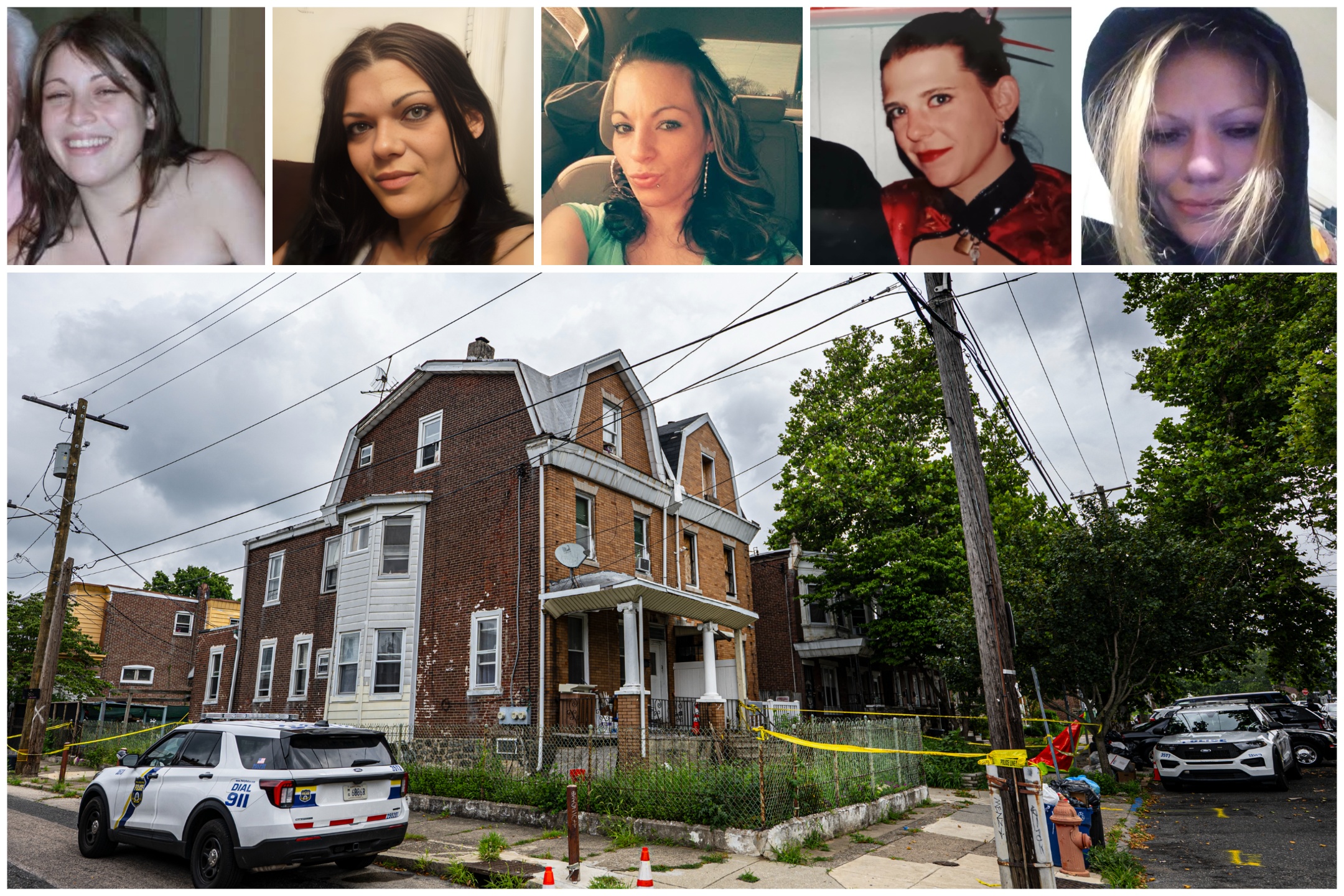
Police say they believe that at least three women were killed in Horsch's Olney home — a dilapidated, mysterious property at the center of the investigation. Horsch, 44, remains in federal custody on illegal gun possession and related charges, and has not been charged with any violent crimes.
For weeks, federal and local authorities have been searching his house on the 400 block of West Chew Avenue, turning up mountains of bizarre evidence. At least two other women connected to Horsch and his late father, Raymond "R.C." Horsch, were last heard from at the property.
Unknown chemicals, falsified law enforcement credentials, urns, and disturbing writings have been uncovered in the home since searches began two months ago. Answers into what exactly was going on there, however, remain elusive as the investigation continues.
Horsch's initial arrest in the case came after what started as a routine traffic stop near Independence Mall. A U.S. park ranger saw Horsch's black BMW stopped on Sixth Street in a restricted area, and approached the vehicle to speak with the driver.
The ranger, police said, heard a woman in the vehicle say, "You're going to hurt me." She then produced an ID identifying herself as Blair Tonzelli, a 38-year-old woman who was reported missing in February 2023 — an alias the passenger said she used because of open warrants for her arrest, sources told The Inquirer.
Police searched Horsch's vehicle, and recovered two firearms with obliterated serial numbers, along with cocaine, fentanyl, and marijuana, according to an affidavit. Police, sources said, also found a fake U.S. Drug Enforcement badge with Horsch's photo on it next to the name "Eugene Frederick Steiner," as well as switchblade knives, a cattle prod, and a collapsible baton.
Horsch was arrested and charged with illegal gun possession and drug crimes, and was held on $500,000 bail at Curran-Fromhold Correctional Facility. Federal drug enforcement officers, with assistance from Philadelphia police, began searching his Olney home that day.
Eugene Albert Horsch, 44, of Philadelphia.Courtesy of Philadelphia police
story continues after advertisement
June 26
Searching the Chew Avenue house
After a week of searching, investigators had uncovered a trove of bizarre items. Among them, Inspector Raymond Evers later said, were a home lab in the basement, a marijuana grow operation valued at about $280,000, and a number of containers filled with an unknown oily substance.
Investigators also found an illegal gun, a fake FBI badge with Horsch's photo, five urns containing what police believe are cremated human remains, bottles of liquid investigators could not immediately identify, and a 55-gallon drum with water lines leading to a hole in the ground, according to an affidavit. Additionally, the search revealed bank cards in Tonzelli's name, and an unsigned handwritten document that referenced serial killer Ted Bundy, among other items.
“We just don’t know what he’s doing, if he’s producing something, if he’s making something, if he’s irrigating something," said Deputy Police Commissioner Frank Vanore at the time. "We don’t know."
As the search continued, suspicions were renewed about Horsch's late father, Raymond Horsch, who died last year. The elder Horsch's ex-wife, Amy McHale, was reported missing in 2016, and, like Tonzelli, was last heard from at the Chew Avenue house. Police, however, said that it was too early to say whether any of the evidence recovered would reveal anything related to Tonzelli or McHale.
“This is much ado about nothing,” said Horsch’s attorney, Jerome Brown, of the missing persons investigation at the time. "They're barking up the wrong tree."
Investigators search the home of Eugene Albert Horsch on West Chew Avenue in Olney on June 26.Gabriel Coffey / Staff
June 30
Horsch held in federal custody
Horsch was arraigned on a federal firearms charge in connection with his June 19 arrest. Previously, city prosecutors charged him in the case, but with the federal charge, Horsch would be unable to post bail and would remain detained until trial.
During an appearance in federal court, Horsch spoke little beyond responses to routine legal questions.
“We believe Mr Horsch is innocent," Brown, Horsch's attorney, said in July.
July 22
Excavation at Horsch's home
In the month that federal and local authorities had been examining Horsch's house, investigators used a number of tools, including canine teams from the New Jersey State Police. But by late July, the focus turned to what was beneath the property.
Authorities announced they would unearth a pipe under the house, and examine it for "any evidence that may be present," said Philadelphia police spokesperson Sgt. Eric Gripp. That pipe, Evers later said, was a sewer line.
On the day of the excavation, investigators began digging early, tearing through a small, overgrown garden, as well as the sidewalk and street in front of the property. In the late morning, investigators, with assistance from the Philadelphia Water Department, pulled a piece of pipe from the ground and took it to be examined.
Workers and police investigators excavate a pipe at the home of Eugene Albert Horsch on West Chew Avenue on July 22.Jose F. Moreno / Staff Photographer
Days later, Evers said, more than 20 containers of an unknown substance found in the house were delivered to a lab in Chicago for testing and analysis.
Early August
Two new victims identified
During the search of Horsch's home, investigators discovered about 50 hard drives and other electronic devices, and sent them to the Regional Computer Forensic Lab. In total, those devices contained more than 60,000 images, 70,000 videos, and 10,000 pages of writings and drawings.
In early August, during the search of a hard drive, investigators found what Evers described as images and video of "what appeared to be two deceased females." Those women have been identified as Maribel Fresses, who was 27 when she went missing in February 2018, and Gabrielle Amarando, who was 22 when she went missing in September 2012.
Neither woman had previously been linked to the case, but police believe they were killed inside the Horschs’ Olney home. Investigators, however, had not recovered human remains in the home, Evers said. Police are trying to determine when the women died. They have stopped short of blaming either Horsch.
Evers added that after reviewing the photos and video, the Philadelphia Office of the Medical Examiner said that "if the images and the video are real and not altered in any way," the women were dead.
Gabrielle Amarando, (left) missing since 2012 and Maribel Fresses, 27, reported missing in 2018. Police believe they were killed inside the Olney home.Obtained by The Inquirer
Horsch had been in federal custody for more than a month at this time following his arrest in June. Neither Horsch nor his attorney appeared in court during the hearing where Assistant District Attorney Alyssa Amoroso withdrew the charges.
Hours before a news conference announcing the new developments, authorities contacted the women's families, Evers said. The "graphic and dark" depictions of what appeared to be their dead bodies, he added, seemed to confirm their deaths.
Ricardo Fresses, 61, said that deep down, he knew his daughter Maribel Fresses was dead.
“She called me every day. Absolutely every day she called me, and one day she stopped calling me,” he said. “And as the years went by I knew she was gone.“
Lora Timmons, Amarando’s stepmother, said she was devastated by the news.
”I always hoped I’d see her again," she said. “I didn’t want to think the worst.”
Because their bodies had not been found, the medical examiner's office cannot declare the two women dead. Authorities expect a "protracted" investigation, Evers said, and any declaration of their deaths would likely have to go through Orphans' Court.
In total, Evers said, authorities had served more than 95 search warrants on the property to discover an "astonishing" amount of evidence. Investigators, he added, had only reviewed about 5% of the digital materials, and it was not yet clear when the women died.
“Eugene lived there. He lived there for a long time. His dad lived there for a long time,” Evers said.
Inspector Raymond Evers speaks during an Aug. 12 news conference.Jessica Griffin / Staff Photographer
Aug. 28
Fifth missing woman linked to Olney house
As investigators continued to review digital evidence from the home on Chew Avenue, they found what they believed was video footage showing Raymond "R.C." Horsch killing a woman on camera, law enforcement sources said.
The footage, which police found on a hard drive inside Horsch's house in Olney, appeared to show the older Horsch strangling the woman at his home. Police did not disclose the woman's identity, but notified a relative, the sources said.
Investigators had not recovered the woman's body, and it was unclear when the footage was taken. But with the video's discovery, the woman became the fifth known missing person tied to the Chew Avenue property.
Sources told The Inquirer that police expected the number of missing women connected to the home to grow as the investigation continued.
An unidentified woman in what appears to be Raymond "R.C." Horsch's home on Chew Avenue in Olney. The image is among several photographs in his book "Eroto: To The Prurient Interest,” Volumes I & II.Obtained by The Inquirer
Sept. 11
Latest victim publicly identified
Family members identified the fifth missing woman tied to the Chew Avenue house as Nicole Amanda Fusaro, who had been missing since July 2018.
Fusaro was 27 when she went missing, and was last seen in Kensington. She was raised in Northeast Philadelphia, and attended George Washington High School, according to her Facebook page. A family member told The Inquirer that Fusaro's parents both struggled with addiction, and that she began using drugs in her late teens before drifting to Kensington.
Investigators previously recovered a video on a hard drive taken from Horsch’s home while in search of clues for other missing persons linked to the property. Law enforcement sources said they believed the video shows the older Horsch strangling Fusaro to death.
“Hopefully more attention will be made to missing persons so this doesn’t happen again,” said Jonathan Halloran-Koren, Fuscaro's cousin.
Nicole Fusaro was reported missing in 2018 when she was 27. Police believe she was killed by Raymond "R.C." Horsch in his Chew Avenue home.Courtesy of Jonathan Hallo
Sept. 16
Seven dead or missing women linked to Olney house
The number of dead or missing people linked to Horsch's Olney home increased to seven after investigators recovered images that appeared to show two more women dead inside the property, Deputy Police Commissioner Frank Vanore said.
Among the images, Vanore added, were photos that showed a 25-year-old woman unconscious inside the home with injuries on her body. Vanore declined to identify the woman at her family's request.
Additional images showed another woman who appeared to be dead inside the property, and investigators have not yet identified her. She appeared to be in her mid-20s, Vanore said.
In total, investigators identified 58 people in digital evidence collected from the home, Vanore said. Of those, 16 were located and interviewed by police, and 25 others were located but not yet interviewed.
FBI Philadelphia Special Agent in Charge Wayne Jacobs (center) looks to Deputy Police Commissioner Frank Vanore (left) during a press conference.Elizabeth Robertson / Staff Photographer
Staff Contributors
Reporting: Nick Vadala, Max Marin, Ellie Rushing, Barbara Laker, and Ryan W. Briggs
Editing: Molly Eichel, Dan Rubin
Copy Editing: Brian Leighton
(()=>{var Q=(e,t)=>()=>(t||e((t={exports:{}}).exports,t),t.exports);var A=Q(r=>{var X={0:”Jan.”,1:”Feb.”,2:”March”,3:”April”,4:”May”,5:”June”,6:”July”,7:”Aug.”,8:”Sept.”,9:”Oct.”,10:”Nov.”,11:”Dec.”};function L(e){return e===void 0&&(e=new Date),X[e.getMonth()]}var ee={0:”Jan”,1:”Feb”,2:”Mar”,3:”Apr”,4:”May”,5:”Jun”,6:”Jul”,7:”Aug”,8:”Sep”,9:”Oct”,10:”Nov”,11:”Dec”};function b(e){return e===void 0&&(e=new Date),ee[e.getMonth()]}function s(e){return e==null}function T(e){return typeof e==”number”&&isFinite(e)}function f(e){return T(e)&&Math.floor(e)===e}var te=[“one”,”two”,”three”,”four”,”five”,”six”,”seven”,”eight”,”nine”],ne=[“million”,”billion”,”trillion”,”quadrillion”,”quintillion”,”sextillion”,”septillion”,”octillion”,”nonillion”,”decillion”],S=[“th”,”st”,”nd”,”rd”,”th”,”th”,”th”,”th”,”th”,”th”],oe=[11,12,13];function M(e){if(s(e))return””;var t=+e;return f(t)?oe.indexOf(t%100)>-1?S[0]:S[t%10]:””}var ie=[“first”,”second”,”third”,”fourth”,”fifth”,”sixth”,”seventh”,”eighth”,”ninth”],re=new RegExp(/s+([^s]*)s*$/);r.apdate=function(e){return e===void 0&&(e=new Date),L(e)+” “+e.getDate()+”, “+e.getFullYear()},r.apdatetab=function(e){return e===void 0&&(e=new Date),b(e)+” “+e.getDate()+”, “+e.getFullYear()},r.apmonth=L,r.apmonthtab=b,r.apnumber=function(e){if(s(e))return””;var t=+e;return f(t)?t=10?e.toString():te[t-1]:e.toString()},r.aptime=function(e){e===void 0&&(e=new Date);var t,n,o=e.getHours(),i=e.getMinutes(),u=i===0;if(u){if(o===0)return”midnight”;if(o===12)return”noon”}return o0?o:12):(t=”p.m.”,n=o===12?o:o-12),u?n+” “+t:n+”:”+(i<10?"0"+i:i)+" "+t},r.capfirst=function(e){if(s(e))return"";var t=String(e);return""+t.charAt(0).toUpperCase()+t.slice(1)},r.intcomma=function(e){if(s(e))return"";var t,n=+e;return T(n)?((t=n.toString().split("."))[0]=t[0].replace(/B(?=(d{3})+(?!d))/g,","),t.join(".")):e.toString()},r.intword=function(e){if(s(e))return"";var t=+e;if(!f(t))return e.toString();var n=Math.abs(t);if(n<1e6)return e.toString();var o=Math.ceil(Math.log(n+1)/Math.LN10)-1,i=o-o%3,u=t/Math.pow(10,i);return(u=Math.round(10*u)/10)+" "+ne[Math.floor(i/3)-2]},r.ordinal=function(e,t){if(t===void 0&&(t=!1),s(e))return"";var n=+e;return f(n)?t&&n/Android|webOS|iPhone|iPad|iPod|BlackBerry|IEMobile|Opera Mini/i.test(navigator.userAgent);var g=(e,t=null,n=null)=>{n||(n=document.querySelector(“head”));let o=document.createElement(“script”);o.type=”text/javascript”,o.src=e,t&&(o.onload=t),n.appendChild(o)},q=()=>(window.PMNdataLayer?.[0]!==void 0&&window.PMNdataLayer[0])?.analytics?.user?.state===”Subscribed”,k=()=>{let t=(window.PMNdataLayer?.[0]!==void 0&&window.PMNdataLayer[0])?.analytics?.user?.state;return window.location.host.includes(“zzz-systest”)||window.location.host.includes(“pmn.arcpublishing.com”)||window.location.host.includes(“stage.fusion.inquirer.com”)||typeof t>”u”},j=()=>{let t=(window.PMNdataLayer?.[0]!==void 0&&window.PMNdataLayer[0])?.analytics?.user?.hasAdsFreeReading;return!!(t&&t==1)},v=()=>window.location.host.includes(“localhost”);var se=()=>{j()&&document.querySelectorAll(“.js-adbox”).forEach(t=>{t.classList.add(“is-hidden”)})},H={init:()=>{se()}};var a,y=!1,ae=()=>{a=document.querySelector(“.js-appendix”)},C=()=>{let e=document.querySelector(“.js-appendix-static-content”),t=e.querySelector(“.js-appendix-static-items”).getBoundingClientRect().height;e.classList.remove(“is-collapsed”),e.style.maxHeight=t+”px”},B=()=>{a.classList.contains(“js-appendix-sticky”)&&(a.getBoundingClientRect().top{y=document.querySelector(“.js-appendix-static-content”).getBoundingClientRect().bottom{y&&document.querySelector(“body”).classList.toggle(“is-open-appendix”)},ce=()=>{window.addEventListener(“scroll”,()=>{B(),D()}),window.addEventListener(“resize”,()=>{B(),D()}),document.querySelector(“.js-appendix”).addEventListener(“click”,()=>{P()}),document.querySelectorAll(“.js-appendix-expand-static”).forEach(e=>{e.addEventListener(“click”,()=>{C(),window.addEventListener(“resize”,()=>{C()})})}),document.querySelectorAll(“.js-appendix-link”).forEach(e=>{e.addEventListener(“click”,()=>{P()})})},N={init:()=>{ae(),ce()}};var m,le=(e,t)=>{m=m||window.PMNdataLayer,m?m.push({event:”misc_event”,eventAction:e,eventLabel:t}):window.location.hostname.includes(“localhost”)?console.log(“Analytics event:”,e,t,”(not actually being sent due to localhost)”):console.log(“Failed to push analytics event”,e,t)},I={event:(e,t)=>{le(e,t)}};var de=()=>{document.querySelectorAll(“.js-card-show-more”).forEach(e=>{e.addEventListener(“click”,()=>{ue(e)})})},ue=e=>{let t=e.closest(“.js-card”),n=t.querySelector(“.js-card-body”),i=n.querySelector(“.js-card-body-content”).getBoundingClientRect().height;t.classList.remove(“is-collapsed”),n.style.maxHeight=i+”px”,setTimeout(()=>{n.style.maxHeight=”none”},1e3),I.event(“expand_card”,`${t.dataset.id}`)},F={init:()=>{de()}};var c,$,pe=()=>{c=document.getElementById(“js-inno-toast”)},fe=e=>{if(!c)return;c.innerHTML=e,c.classList.add(“is-active”);let t=()=>{c.addEventListener(“transitionend”,me,{once:!0}),c.classList.remove(“is-active”)};clearTimeout($),$=setTimeout(t,5e3)},me=()=>{c.innerHTML=””},l={init:()=>{pe()},showToast:fe};var h,z=!1,he=async()=>new Promise(e=>{setTimeout(()=>{console.log(“simulating createShareLink for localhost”),e(“https://inquirer.com/interactives”),ge()},100)}),ge=()=>{let e=document.querySelector(“.js-gift-toast-receiver”);!e||!(e instanceof HTMLElement)||setTimeout(()=>{let t=e?.querySelector(“span”);t&&(t.innerHTML=”Gift link copied to clipboard“)},20)},ve=()=>{let e=window.services?.createShareLink;e&&(h=e),v()&&(h=he),h&&we()},ye=async e=>{let t=”text/plain”,n=async()=>{try{return await h(window.location.pathname)}catch{e.dataset.state=”error”,l.showToast(“Hmm, we couldn’t generate a gift link…”)}},o=new ClipboardItem({[t]:n()});await navigator.clipboard.write([o]).catch(i=>{console.log(i),l.showToast(“Couldn’t copy to clipboard, try again?”),e.dataset.state=”error”}),l.showToast(“Gift link copied to clipboard!”),e.dataset.state=”complete”},we=()=>{document.querySelectorAll(“.js-gift”).forEach(t=>{(q()||v()||k())&&t.classList.add(“is-available”)}),document.querySelectorAll(“.js-gift-button”).forEach(t=>{t instanceof HTMLButtonElement&&t.addEventListener(“click”,()=>{t.classList.contains(“disabled”)||(t.dataset.state=”loading”,z=!0,ye(t),setTimeout(()=>{t.dataset.state=”ready”},2e3))})});let e=document.querySelector(“.js-gift-toast-receiver”);!e||!(e instanceof HTMLElement)||xe(e)},xe=e=>{new MutationObserver(n=>{for(let o of n){let i=[…o.addedNodes].at(0);if(!(i instanceof HTMLElement))return;z&&l.showToast(i.outerHTML)}}).observe(e,{subtree:!0,childList:!0})},O={init:()=>{ve()}};var Le=()=>{window.addEventListener(“message”,e=>{if(e.data[“datawrapper-height”]){let t=e.data[“datawrapper-height”];for(let n in t)document.querySelector(`#datawrapper-chart-${n}`).setAttribute(“height”,t[n])}})},be=()=>{document.querySelectorAll(“.js-datawrapper-graphic”).forEach(e=>{g(`https://datawrapper.dwcdn.net/${e.dataset.id}/embed.js`,null,e)})},Se=()=>{window.addEventListener(“message”,e=>{let t=e.data;document.querySelectorAll(`iframe[src*=”${t.id}”]`).forEach(o=>{o.style.height=`${t.height}px`})},!1)},Me=()=>{document.querySelectorAll(“.js-pym-graphic”).forEach(e=>{if(typeof window{new window.pym.Parent(e.id,e.dataset.iframe)};typeof window.pym>”u”?g(“https://pym.nprapps.org/pym.v1.min.js”,t):t()}})},R={init:()=>{Le(),be(),Me(),Se()}};var p,Te=()=>{document.querySelectorAll(“.js-hover”).forEach(e=>{e.addEventListener(“click”,()=>{J(e)}),e.addEventListener(“mouseenter”,()=>{J(e)}),e.addEventListener(“mouseout”,()=>{V(e)})}),window.addEventListener(“scroll”,()=>{p!==null&&Ae()})},Ae=()=>{(p>window.scrollY+100||p{V(e)})},J=e=>{e.classList.add(“is-visible”),p=window.scrollY},V=e=>{e.classList.remove(“is-visible”),p=null},G={init:()=>{Te()}};var Ee=()=>{},W={init:()=>{Ee()}};var d,w,x=!0,qe=()=>{d=document.querySelectorAll(“.js-video-autoplay”)},ke=()=>{window.addEventListener(“resize”,()=>{Y()}),window.addEventListener(“scroll”,()=>{Y()}),d.forEach(e=>{e.addEventListener(“volumechange”,t=>{e.muted!==x&&!E()&&(x=e.muted,je())})})},Y=()=>{let e;d.forEach((t,n)=>{let o=t.getBoundingClientRect(),i=o.height/2;o.y-i&&(e=t)}),e!==w&&(w=e,d.forEach(t=>{t.pause()}),e?e.play():w=null)},je=()=>{d.forEach(e=>{e.muted=x})},_={init:()=>{qe(),d&&ke()}};var U={init:()=>{H.init?.(),N.init?.(),F.init?.(),O.init?.(),R.init?.(),G.init?.(),W.init?.(),_.init?.(),l.init?.()}};var He=()=>{},Z={init:()=>{He()}};var Ce=document.querySelector(“.js-inno”),K=()=>{U.init(),Z.init()};Ce?K():new MutationObserver((t,n)=>{if(document.querySelector(“.js-inno”)){n.disconnect(),K();return}}).observe(document,{attributes:!0,childList:!0,subtree:!0});})();
Police have recovered images they believe show two additional women dead inside the residence of the late Raymond “R.C.” Horsch, officials said Wednesday — bringing the total number of dead or missing women linked to the violent pornographer’s Olney twin home to seven.
The discovery marked the latest turn in a sprawling local and federal investigation into the drug, sex, and porn operation Horsch ran out of his home. Horsch left behind a digital archive of more than a million photos and videos that detectives now believe shows a mix of real and staged violence — as well as potential killings.
During a news conference Wednesday, Deputy Police Commissioner Frank Vanore said investigators recovered photos that showed a 25-year-old woman unconscious, with visible injuries, inside the Chew Avenue home where Horsch and his son, Eugene, lived for decades.
The woman, who was from Philadelphia, had not been reported missing, police said. Vanore declined to identify her at the request of her family.
Detectives also recovered images showing another woman lifeless with injuries. Investigators have not yet been able to identify her, Vanore said, but she appeared to be in her mid-20s.
Nicole Fusaro was reported missing in 2018 when she was 27. Police believe she was killed by Raymond “R.C.” Horsch in his Chew Avenue home.Courtesy of Jonathan Hallo
Vanore also confirmed that police recovered a video that appeared to show Horsch strangling a woman. Horsch used two cameras — one mounted in the room, and another that he held — to film the assault, he said. In the video, he said, the woman used drugs before Horsch gave her money and handcuffed her to the bed. He was naked and tightened a zip tie around her neck until she became unconscious, Vanore said.
Police last month also announced they recovered images that appeared to show two women dead inside the home: Maribel Fresses, who was 27 when she was reported missing in February 2018, and Gabrielle Amarando, who went missing in September 2012 at the age of 22.
Vanore said the metadata of those images shows both were photographed in 2017.
Police have not recovered any human remains.
Gabrielle Amarando, (left) missing since 2012 and Maribel Fresses, 27, reported missing in 2018. Police believe they were killed inside the Olney home.Obtained by The Inquirer
Horsch died last year at age 82 of lung issues.
Special Agent Wayne Jacobs, of the FBI in Philadelphia, said federal agents have been assisting city homicide detectives in downloading and sorting through the excessive amount of digital evidence. So far, he said, they have reviewed about 30% of the existing materials.
“The objective here is thoroughness, not simply speed,” he said.
Vanore said investigators have identified 58 people in the images and videos they have reviewed. Of those, five women appeared to be dead.
There are 10 other women who subsequently died of an overdose elsewhere, he said. Police have interviewed 16 people who are still alive, he said. They are still working to track down 25 others.
The investigation has been protracted, in part because Horsch spent decades producing pornography that often focused on the brutalization of women in addiction — producing photos and videos for books, movies, and his website that featured women in various staged scenarios, including being drowned, shot, and strangled.
“Some of this is playacting, and some of it we believe could be real,” Vanore said. “But we’re not there yet. We don’t want to end our investigation before it even — we’re not even in the middle of it. There’s a lot more to unpack.”
Police Commissioner Kevin Bethel (left) looks on as Ryan Gallagher, of the forensics lab, speaks Wednesday.Elizabeth Robertson / Staff Photographer
Police Commissioner Kevin Bethel also counseled patience. A large team of detectives, he said, was diligently and carefully reviewing the materials and working to ensure any identified victims and their families are handled with care.
“We have a duty to those families who are all concerned about whether their loved one lost their lives in that house, or maybe somewhere else,” he said. “And so we’re going to take the time, we’re going to put the effort in. We’re going to do all the things that we have at our disposal.”
Police started searching the home of Raymond Horsch, and his son Eugene, at 417 Chew Ave. in June. Jose F. Moreno / Staff Photographer
Police will search the home again
Police started looking into Horsch and his son, Eugene, in June, after a car stop near Independence Hall.
A U.S. park ranger encountered Eugene Horsch and a woman inside his black BMW on June 19, police said. When the officers questioned them, the woman produced a fake ID in the name of Blair Tonzelli, a woman who had been missing since 2023. Police searched the car and found two guns, drugs, a cattle prod, and a phony federal drug enforcement badge.
Local and federal law enforcement spent weeks searching the home on Chew Avenue and found additional drugs and weapons, as well as a basement holding vats of mysterious fluids and a 55-gallon drum leading to a water line.
Police also recovered five urns containing cremated remains. Ryan Gallagher, the police department’s assistant director of forensics, said authorities now believe those urns hold the ashes of Raymond Horsch, his sister, and a friend. Investigators are still working to identify the other two, he said.
Tests for DNA and of the chemicals in the basement remain ongoing.
FBI Philadelphia Special Agent in Charge Wayne Jacobs (center) looks to Deputy Police Commissioner Frank Vanore (left) during a press conference, regarding the Raymond “RC” Horsch case, at the Philadelphia Police Headquarters on Wednesday, September 16, 2026.Elizabeth Robertson / Staff Photographer
The case expanded when investigators learned Raymond Horsch’s ex-wife, Amy McHale, had been reported missing in 2016, and was also last seen at the home.
Police then excavated the yard of the home in search of physical evidence linked to the missing women.
Vanore said investigators have not recovered any digital evidence as to the whereabouts of Tonzelli or McHale.
Eugene Horsch, 44, remains in federal custody on drug and gun charges. Vanore said investigators have not found evidence that connects him to the dead or missing women.
Bethel said police intend to return to the Chew Avenue home in the coming weeks to recover additional materials, and will meet with neighbors.
Staff writer Barbara Laker contributed to this article.
A prominent Center City personal injury lawyer, known for his active TikTok account, choked his girlfriend and threw her to the ground during a dispute on a walking path in Lower Merion, according to police.
Thomas Bosworth, 37, has been charged with simple assault and harassment in connection with the Sept. 3 incident. He was released on $15,000 unsecured bail.
Bosworth, a resident of Gladwyne, did not respond to a request for comment. His attorney, Michael van der Veen, said in a statement that Bosworth “is presumed innocent, maintains his innocence and has full confidence in the courts.”
In the years since, he has opened his own law firm amid accusations from his former employer that he poached its clients and sanctions for his behavior from a federal judge.
Meanwhile, he has expanded his social media following through videos that give advice on everyday goods from his vantage point as a personal injury lawyer and the context for high-profile lawsuits he litigates.
On the day of the Lower Merion assault, four people told police they saw Bosworth attacking a woman on a section of the Cynwyd Heritage Trail behind Union Avenue in Bala Cynwyd, according to the affidavit of probable cause for his arrest. After choking the woman, the witnesses said, he threw her into bushes along the path, then walked away as she screamed.
The witnesses also said the woman slapped Bosworth and threw rocks at him while on the ground next to the trail, according to the affidavit.
Officers responding to the call found the woman with “redness on her cheeks and discoloration of the skin around her neck,” the document said. She told the officers she had fallen, and declined to speak with them further, as did Bosworth.
Witnesses later told police they overheard the couple arguing about Bosworth’s alleged infidelity, and the dispute escalated when the woman mentioned a text thread from his secretary he had deleted.
The assault took place in front of the couple’s newborn daughter, who was with them in a stroller, the affidavit said.
A judge ruled that attorney Tom Bosworth could keep displaying two TikTok videos critical of Penn Medicine, including the one from which this image is taken, in which he alleges that the health system’s radiology department is understaffed.
Bosworth’s arrest was not the first time in recent years that he has been the subject of scrutiny.
His separation from Kline & Specter in 2022 led to an ugly court dispute between the prestigious firm’s partners and their former young associate.
Tom Kline and Shanin Specter accused Bosworth of poaching clients, which he denied, and in return accused his former bosses of defamation. The parties reached a settlement in 2024 but have returned to court multiple times since, accusing each other of violating the agreement.
Kline and Specter are not the only ones who took issue with Bosworth’s conduct in the courtroom or online.
In 2023, Penn Medicine asked a Philadelphia judge to order Bosworth to stop posting on social media about a medical malpractice case he filed against the health system, saying he misrepresented facts and “poisoned” the potential jury pool. The judge sided with Bosworth.
That same year, a federal judge sanctioned Bosworth for “misconduct” during four expert depositions in a product liability case, saying the lawyer was “rude, demeaning, and obnoxious” to a female defense attorney.
And last week, the Pennsylvania Superior Court called Bosworth’s conduct in the courtroom “deplorable” even as it upheld the $19.7 million verdict he won while at Kline & Specter.
Bosworth had been accused of repeatedly ignoring the instructions of a Philadelphia Common Pleas Court judge during a medical malpractice trial in an attempt to inflame the jury.
“The courtroom is one of the only places left in our democracy where the everyday person can hold to task wrongdoers, no matter how rich powerful,” he said.
Bosworth is scheduled to appear for a preliminary hearing in the assault case Oct. 6.
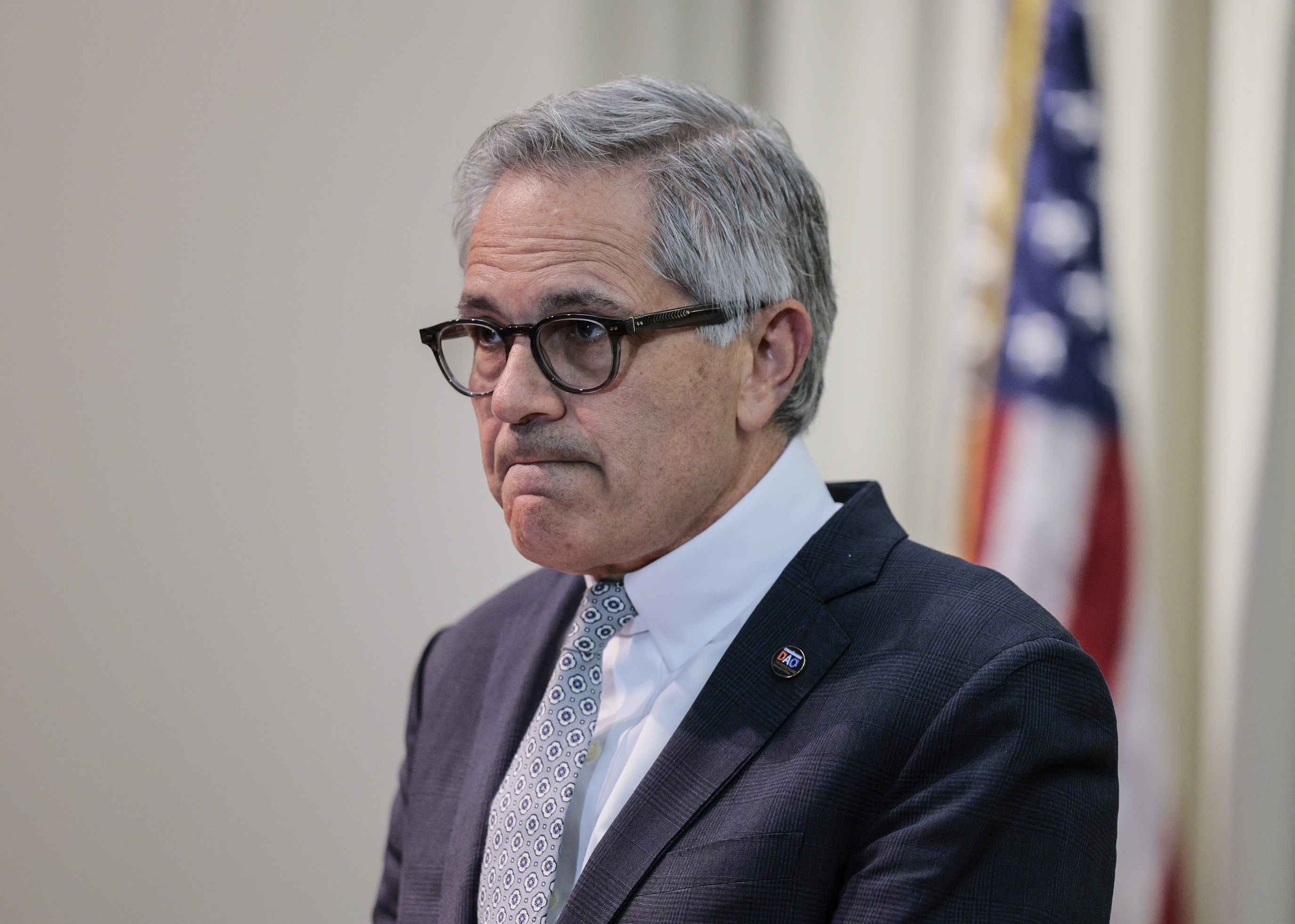
A federal judge said Tuesday that District Attorney Larry Krasner may have broken the law while overseeing a contentious post-conviction case, and he said he referred the matter to the U.S. Attorney’s Office to investigate whether Krasner should be charged with crimes including conspiracy or obstruction of justice.
U.S. District Judge Paul S. Diamond made those stunning statements in a memorandum in which he also ruled that Krasner and one of his top supervisors, Matthew Stiegler, could no longer participate in the case — a matter in which a man is seeking to have his murder conviction overturned.
Diamond wrote that over the last several months, as he conducted hearings to learn more about how attorneys in the district attorney’s office handled that case, testimony from some of Krasner’s staffers revealed actions by Krasner and Stiegler that Diamond called “troubling,” “disturbing” — and potentially illegal.
Those actions, he wrote, included pressuring other staffers to take steps to protect Stiegler and blame one of his subordinates, urging staffers to lie to Diamond in court, and threatening “consequences” for those who did not follow Krasner’s orders.
“I have thus reluctantly concluded that Philadelphia’s highest law enforcement official and one of his top assistants may have violated the law,” Diamond wrote. “In these circumstances, with the issuance of this Memorandum, I refer the DAO, Mr. Krasner, and Stiegler to this District’s United States Attorney’s Office for investigation and other appropriate action.”
In a statement Tuesday, Krasner said, “I respectfully and vigorously disagree” with Diamond’s findings, adding: “I look forward to appealing to the higher court as soon as the law allows.” He said he could not comment further because the case is pending.
Stiegler did not respond to a request for comment. A spokesperson for the U.S. Attorney’s Office declined to comment. That office would have to determine whether to open an investigation or file charges. Diamond, as a judge, cannot do so himself.
The filing was the latest explosive development in the case, which is centered on Dennis Johnson’s 2009 conviction for second-degree murder. Johnson has been fighting to have that conviction overturned, and the matter before Diamond began years ago as a routine petition in federal court.
But in recent months, the case has led to a series of unusual revelations about the inner workings of the district attorney’s office as various lawyers have worked on aspects of the case. And it comes as Krasner’s office has faced increasing scrutiny over the way it has acted in other murder appeals — including a forceful opinion from the Pennsylvania Supreme Court, which said Krasner’s office had misled judges so frequently and flagrantly in such matters that state prosecutors must now review instances when his office says a conviction should be overturned.
Diamond, in his filing Tuesday, said the assertions in his courtroom — made primarily by members of Krasner’s staff — were not only proof of significant internal disagreements about Johnson’s case, but also “evidence of possible criminal wrongdoing by Mr. Krasner and Stiegler.”
Contentious internal discussions
The origins of the controversy began to take shape in 2022.
That year, after the district attorney’s office had spent years opposing Johnson’s bid for freedom, then-Assistant District Attorney Jaclyn Mason filed a brief changing course.
In her filing, Mason agreed with Johnson’s lawyers that his trial counsel had been ineffective. She also said the office had discovered additional problems with the case while reviewing it again, and she recommended that Johnson’s conviction be overturned.
A federal magistrate — relying on Mason’s brief — agreed, but Diamond was the judge with the power to accept or reject the recommendations. And this spring, he scheduled an evidentiary hearing to evaluate some of the evidence before deciding how to proceed.
That led to a series of contentious developments within the district attorney’s office, prosecutors have since testified.
First, Mason’s supervisors in the law division reviewed her brief and found a series of what they called “material misstatements.” They decided they needed to try to withdraw Mason’s filing and apologize to Diamond for the mistakes.
They asked Mason to sign on to the filing with them, but she declined and resigned instead. She has since said she filed her brief only because Stiegler pressured her to do so, and she thought her supervisors, in preparing an apology, were angling to make her a scapegoat on Stiegler’s behalf.
During testimony before Diamond in recent months, her supervisors said that was not true. But the supervisors — Katherine Ernst, Steven Wildberger, David Napiorski, and Peter Andrews — said Stiegler and, eventually, Krasner did try to persuade them to direct blame toward Mason.
Potential crimes?
In the supervisors’ telling, Stiegler asked them to review every case Mason had handled to find other errors in her work. That way, Stiegler suggested, Mason could be painted before Diamond as a “rogue” prosecutor who was routinely making mistakes in problematic filings.
Krasner echoed that potential course of action, and even described it as a “good idea,” the supervisors testified.
Diamond said those actions were “troubling.” He wrote that Krasner “did not simply learn of the Stiegler proposal; he urged the Law Division supervisors — who serve at Mr. Krasner’s pleasure — to implement it and to present a false narrative to the Court.”
And Stiegler, he said, was “urging the DAO to present the Court with a false account to shield himself.” Diamond said that he found all of Stiegler’s testimony “contradictory, evasive, or outright dishonest” and that Stiegler may have committed perjury while on the stand.
In addition, Diamond said, as internal discussions continued about how to proceed in the case, Krasner repeatedly rejected requests by the law division supervisors to refer it to the attorney general’s office. The supervisors generally agreed that was the appropriate course because the inner-office drama surrounding the matter was hampering their ability to handle it properly.
But Krasner, they testified, was vehemently opposed — in part because of his disdain for people who worked in the attorney general’s office. And during some meetings, they said, Krasner said he wanted to “protect the office”; expressed opposition to telling Diamond about the referral deliberations; and said they would face “consequences” if they did so, which they took to mean being fired.
Diamond, in his memorandum, said such a threat “could amount to obstruction of justice.” And he said the efforts by Krasner and Stiegler to present a false narrative to the court “might amount to conspiracy.”
It was not immediately clear Tuesday if federal prosecutors would agree with Diamond’s assessment, or if they would seek to empanel a grand jury to evaluate it.
Johnson’s petition, meanwhile, remains on hold. Diamond said the district attorney’s office could continue to handle the case moving forward, but it was not clear who might do so.
All of the law division supervisors have already recused themselves, and Diamond said Tuesday that neither Krasner nor Stiegler could have any role in the matter. He also said he also would not allow an outside attorney selected by Krasner to handle the matter on his behalf.