Convicted former Philadelphia labor leader John Dougherty will remain in prison after a federal judge again denied Dougherty’s request to be released on house arrest to provide care for his gravely ill wife.
U.S. District Judge Jeffrey L. Schmehl wrote in a memorandum filed Thursday that Dougherty and his lawyers had failed to demonstrate that he was the only person who could provide adequate care for his wife, Cecelia, who for years has suffered from a debilitating brain injury.
In addition, Schmehl wrote, Dougherty did not sufficiently specify when a trust fund established to support his wife’s care would run out of money. Those factors, coupled with the “minimal amount of time” Dougherty has served in his six-year sentence, Schmehl wrote, “do not weigh sufficiently in favor of relief.”
The decision was a blow to Dougherty, 66, who for months has been contending in court documents and in testimony before Schmehl that his wife’s condition has significantly worsened while he has been imprisoned, and that if he is not released to care for her, she will likely die.
Dougherty’s attorney, George Bochetto, said in an interview Thursday that he was “deeply, gravely disappointed” by the ruling, and that he disagreed they had not shown the acute nature of the emergency that should qualify Dougherty for release.
“I thought the evidentiary hearing we had in front of Judge Schmehl was extraordinary, and it left no doubt in anybody’s mind” about the merits of Dougherty’s petition, Bochetto said.
The ruling followed another rejection in Dougherty’s ongoing bid for freedom. Earlier this month, President Donald Trump denied Dougherty’s request for a commutation, a legal avenue that could have cut Dougherty’s prison term short.
Schmehl, in his memorandum, did say that Dougherty could file a renewed motion in the future, “should the facts materially change.”
Bochetto said he would not wait that long. He was already working on his notice of appeal to the U.S. Court of Appeals for the Third Circuit, he said, and he intended to ask the court to consider the case on an emergency basis.
“This is why God invented appellate courts,” Bochetto said.
Dougherty was sentenced in 2024 to six years in prison after being convicted in separate bribery and embezzlement trials that centered on actions he took while serving as the head of his politically powerful union, Local 98 of the International Brotherhood of Electrical Workers.
But last year, Dougherty — known colloquially as Johnny Doc — filed emergency motions asking Schmehl to allow him to serve the remainder of his prison term on house arrest so he could be his wife’s primary caregiver.
In his first request, filed in the summer, Dougherty said that the trust fund established to pay for her care was about to run out of money, and that his daughters and other relatives were unable to provide the kind of around-the-clock assistance she needed.
Then, in December, he filed another motion, saying the situation had become more dire after the death of his father-in-law, who had been serving as the primary caregiver in his absence.
Prosecutors opposed Dougherty’s requests, saying that although they were sympathetic to his wife’s plight, they did not believe he had served enough of his sentence to merit release.
And in January, Schmehl denied Dougherty’s request, writing that he, too, recognized the significant health challenges, but that they did “not outweigh, at this point in time, the need for punishment that has been adjudged.”
Bochetto appealed that ruling. And in May, Schmehl held an evidentiary hearing to learn more.
At the hearing, Dougherty took the stand for more than an hour, and occasionally choked back tears as he described his wife’s myriad complications and detailed the efforts he had made in prison to help her, including by sending her dozens of letters and using all of his allotted monthly phone minutes to call her.
But prosecutors argued that Dougherty and his relatives had not sufficiently looked into alternative care arrangements that might be covered by Medicaid or other insurance. And they said that while many families across the country could benefit from having an incarcerated defendant released to help care for their relatives, Dougherty had not shown that he was the only person who could do so for his wife.
Schmehl, in his order, said that Dougherty’s wife is being cared for by private nurses and her two daughters, and that “neither party suggests that her current care is inadequate.” Beyond that, the judge said, Dougherty did not sufficiently specify when her trust fund would run out of money and did not adequately explain what would happen once it did.
The ruling will leave Dougherty, for now, to serve out the remainder of his term, which he is serving at a federal prison in Lewisburg, Pa. His projected release date is in June 2029, according to the Bureau of Prisons website.
For Minara Rahman and her husband, a move to Philadelphia was supposed to be a fresh start.
She and Md Mahfuzul Haque met while attending medical school in their native Bangladesh in 2000, married soon after, and remained nearly inseparable for 21 years,most of them spent in Canada.
Their love story came to a tragic conclusion early this month when Haque, a 43-year-old doctor who was driving for DoorDash to support Rahman’s optometry career, was shot and killed during a robbery outside a Southwest Philadelphia home.
It was one of at least three shootings involving delivery drivers in the city this summer.
“I still can’t believe it,” said Rahman, 43. “I’m crying, I’m mourning, I’m in grief, but I’m still not believing he’s not with me.”
Philadelphia had only recently become home for Rahman, Haque, and their 14-year-old son.
In 2023, the family moved from Vancouver, where much of Haque’s extended family lives, as Rahman began her studies at Drexel University’s optometry school, she said.
She and Haque had both been practicing physicians in Bangladesh and worked in the healthcare industry in Canada, where they moved in 2011 after receiving skilled immigration visas.
In Philadelphia, Rahman saw the opportunity to get an American medical license and earn enough to support her family.
Haque, she said, sacrificed his own professional ambitions to support that move, doing odd jobs and driving for DoorDash to earn money while she completed school.
Rahman graduated from Drexel last year and began practical training while the family worked to extend their U.S. visas. Part of her work involved conducting eye exams forpolice and security guards, she said.
“It was me who wanted to do something more, and he always supported me,” Rahman said of her husband. “Without him, it would have been impossible.”
A photo of Md Mahfuzul Haque.Minara Rahman
Though Rahman worried that Philadelphia could be dangerous, she said, she and Haque believed that life in the United States would offer their family safety and security.
She no longer thinks so.
Just days after Haque’s killing, police made an arrest in a separate homicide case involving a food delivery driver. They accused a 14-year-old Queen Village teen of luring the man, Anshul Kuncha, to an abandoned North Philadelphia rowhouse, where he was found dead with a gunshot wound to the head.
And on Tuesday, police said, a 31-year-old delivery driver was shot in the hand after getting into an argument with two women in Northern Liberties. He was placed in stable condition at a nearby hospital.
Since the July 7 shooting of Haque, Rahman has been in touch with police seeking to gather more information about her husband’s killing.
Officers responded to the 1000 block of South Ithan Street in the city’s Kingsessing neighborhood around 9:30 that evening to find Haque on the ground with a gunshot wound to the head.
His car was still running, investigators said, and a bag of delivery food was found nearby. They soon identified three suspects, masked men wearing dark clothing.
Johnson, of East Mount Airy, was charged with murder in Haque’s killing last Friday while he was in custody in connection with an unrelated crime. He is being held in prison without bail.
The teen is expected to appear in court for a preliminary hearing on Aug. 10.
Rahman said she was struck by the fact that the gunman who police say took her husband’s life is so young — just a year older than her own son.
“I can’t imagine any boy like my son’s age treating anybody else like that,” she said. “I have no idea what they were thinking — what was their motive, and how did they get that firearm that easily?”
Haque was buried in Vancouver, where Rahman and her son moved to be near his extended family, and she has abandoned her pursuit of a medical career in the United States.
In an interview, she spoke sorrowfully of plans abandoned: a family trip to Florida, an Atlantic City wedding anniversary celebration set for the last week of July.
And each day, Rahman said, she struggles with nagging worry that by moving her family to Philadelphia for her career, she was somehow responsible for her husband’s death.
The only thing she wants now is justice.
“We both did counseling for tons of patients,” Rahman said, recalling the years of challenging medical work caring for people at their worst moments.
“Now I’m in that situation,” she said. “I can’t take it anymore, and I need help.”
A nonfunctioning grenade was thrown into a Feltonville home early Thursday morning, according to the Philadelphia Police Department. The home was evacuated and no one was injured.
Police responded to the 400 block of West Courtland Street at 1:59 a.m. for reports that a grenade had been thrown into a residence. The home was cleared, and the Philadelphia Police Bomb Disposal Unit arrived at the scene around 3:35 a.m. to safely secure the device.
Following an examination, bomb squad officers determined the device to be nonexplosive, or inert, and posed no danger to the public.
Anyone with information about this incident is asked to call the Philadelphia Police Department’s tip line at 215-686-TIPS (8477).
Four Cheltenham High School football coaches and six players have been charged in connection with two assaults in the school’s locker room that injured a 15-year-old player and led to the cancellation of two football seasons, Montgomery County prosecutors said Wednesday.
In two violent assaults, District Attorney Kevin Steele said, multiple football players attacked a sophomore on the team, stomped on his chest and groin while wearing cleats, and used a broomstick to poke at his buttocks.
“The assaults on this victim were not typical goofing around by teammates, or horseplay, as some of the coaches in this case called it,” Steele said at a news conference Wednesday. “They were crimes.”
After the attacks, which took place last August and September, Steele said, coaches tried to cover them up.
Head coach Terence Tolbert, 55; associate head coach Darian McFadden, 42; assistant coach Benjamin Johnson III, 45; and volunteer coach Ralph Burnley, 60, have been charged with endangering the welfare of a child and conspiracy. The coaches are no longer with the district.
Two football players, Isaiah Simpson, and Josiah Peeler, both 18, have been charged as adults — Simpson with conspiracy to commit aggravated assault, simple assault, reckless endangerment, and related crimes for his role in the September assault, and Peeler with false swearing for being untruthful to police. The two were 18, Steele said, when the crimes they are charged with took place.
The four other players have been charged as juveniles, and were not identified by prosecutors or named in court records. Two of them face charges of conspiracy to commit aggravated assault and related crimes, because authorities say they took part in the attacks. The other two players are charged with false swearing.
Tolbert, McFadden, Johnson, and Peeler were released on $5,000 unsecured bail. The two other adults had not been arraigned as of Wednesday afternoon. Only two of the defendants, Johnson and Peeler, had attorneys listed in court records.
Johnson’s attorney, Richard J. Fuschino, said his client “has been humiliated by what occurred and absolutely had nothing to do with it.”
“I do believe there is a cover-up, and I absolutely do not believe Benjamin Johnson had anything to do with it,” he said. “In fact, quite the opposite: He went out of the way to cooperate with every investigator.”
Peeler’s attorney, Jessica Mann, did not respond to a request for comment. Attempts to reach the other defendants were not successful Wednesday.
Cheltenham Superintendent Brian Scriven said Wednesday that the district appreciated prosecutors’ work on the case and the filing of criminal charges. “While no legal outcome can erase the harm that was experienced,” he said, “we appreciate that after nearly a year, charges have been announced and those responsible are being held accountable through the criminal justice system.”
Prosecutors say coaches wanted incident ‘kept quiet’
Steele said the charges followed a grand jury investigation in which witnesses described two violent assaults.
The coaches are criminally liable for the assaults, Steele said, because, while they were not present, they learned of the September incident and encouraged the victim not to tell his parents.
Montgomery County District Attorney Kevin Steele at a press conference Wednesday.Tom Gralish / Staff Photographer
Privately, the coaches sent incriminating text messages to one another, Steele said, expressing concern that the incident “has to be handled and kept quiet.”
McFadden, the former assistant coach, wrote “if this gets out we are [expletive]. They will cancel the whole season,” according to the grand jury presentment.
The assaults occurred Aug. 15, after a preseason practice, and Sept. 3, Steele said. He said video footage of the August incident showed several students restraining the victim, while another student poked at his legs and buttocks with a broomstick.
Players are laughing and yelling in the video, and “at least one player is chanting, ‘broomstick him,’” Steele said.
A football player who witnessed the assault, but is not charged in the case, told the grand jury that the use of a broomstick was an apparent reference to a TikTok video featuring a Meek Mill song with the lyrics “broomstick all in his butt, tell him take that,” according to the grand jury presentment.
Steele said there was no evidence that it constituted sexual assault.
Players didn’t take the incidents seriously
Several football players who testified before the grand jury characterized the behavior as “horseplay” and said they did not take it that seriously. Others said the victim had a difficult relationship with his teammates and was viewed by them as “someone who did not follow the rules during practices.”
The Sept. 3 assault, witnesses said, happened after the teen took a pair of shoulder pads from another player’s locker after misplacing his own, an infraction for which the entire team had to do extra conditioning as punishment.
Steele said that investigators did not have a video of the Sept. 3 assault but that multiple players, including Simpson and two of the juvenile defendants, kicked and stomped the victim.
The teen reported told investigators that his teammates were “trying to poke him in the butt with the broomstick,” and that they made contact with his buttocks, Steele said. He said the assault broke up when school buses arrived, and teammates left to board them.
Burnley, one of the coaches, drove the victim home after the attack, and the teen broke down in tears, telling the assistant coach he had been jumped by teammates, the district attorney said.
Burnley then texted coaches in a group chat and called Tolbert, Steele said. McFadden and Tolbert called the teen and “told him not to tell his mother about the incident because they would handle it,” Steele said.
He said the coaches were deliberate and calculating in their decision not to report the assault.
‘Serious concerns about the response’
The incident came to light four days later, when the teen’s mother said he told her he had been jumped by teammates and had pain in his genitals. She said she took her son to an urgent care center and texted the high school’s assistant principal, who called her later that day.
A front view of Cheltenham High School in Wyncote.Tom Gralish / Staff Photographer
The teen did not tell his mom that his teammates used a broomstick in the attack. He was embarrassed and reluctant to share that detail, the mother said in an interview with The Inquirer in which she spoke on the condition of anonymity to protect the identity of her son.
She said her son told her that his teammates had tried “to mess with his manhood.”
She learned about the broomstick later in September, when Cheltenham Township police called to tell her that someone had called Pennsylvania’s Safe2Say hotline to anonymously report that students had used a broomstick during the attack, according to the teen’s lawyers, Alan Yatvin and Gabrielle Turley.
Sometime in October, the district obtained a video that had been circulating in the community and depicted an assault of the student with a broomstick, the lawyers said.
Investigators initially believed that footage was from the Sept. 3 assault. It was discovered during grand jury testimony in January that the assault was from August, prosecutors said. The teen, who said he was not shown the video until this spring, also identified it as being from August, revealing for the first time that he had been assaulted more than once, according to the lawyers.
“Our client and his family are grateful to the Montgomery County District Attorney’s Office, law enforcement investigators, and the grand jury for their careful and thorough work in bringing these deeply troubling events to light and pursuing charges,” Yatvin said in a statement Wednesday. He added that the grand jury investigation “also raises serious concerns about the response by some within the Cheltenham High School community.”
The district faulted inadequate supervision in the locker room, “a failure to prioritize student safety” by coaches and volunteers, and “a toxic and negative culture” within the football program.
District officials have said a Title IX investigation, required by law when sexual assault or harassment is alleged, is ongoing.
Scriven, the superintendent, said in a statement Wednesday that “every report brought to the district’s attention was addressed based on the information available at the time.” He noted that law enforcement and the grand jury had the power to issue search warrants and compel testimony, which “brought information to light.”
In April, the district approved separation agreements with Tolbert and McFadden. Officials say none of the coaches from last season is still affiliated with the district.
The victim, who switched to virtual school after being harassed by peers after the attacks, has continued to struggle, according to his mother. She said he avoids going outside because he fears being taunted about what happened.
During Wednesday’s news conference, Steele criticized the school district and said it had failed the victim.
In its report, the grand jurors noted that they — not the school district’s Title IX investigator — discovered that two separate assaults had taken place.
“I believe the Cheltenham School District has taken the position that they don’t want police in their schools or school resource officers, and so it’s on them to address these issues,” Steele said. “So the grand jury took care of what the school did not.”
Montgomery County District Attorney Kevin Steele arrives at a press conference Wednesday to announce multiple charges in connection with two assaults in a Cheltenham High School locker room.Tom Gralish / Staff Photographer
In addition to recommending criminal charges against the players and coaches involved in the case, the grand jury filed a separate report calling for a change in state law that would require teachers and coaches to report incidents of hazing as a form of child abuse.
“While the school district claims to ‘protect and prioritize safety and well being,’ their actions in this case say otherwise,” the grand jury report said. “The administration carried out three school-led investigations that were so flawed they failed to even identify that two separate instances of hazing occurred in the locker room.”
News researcher Ryan W. Briggs contributed to this article.
A 36-year-old Camden man was charged with soliciting sexually explicit photos from a 7-year-old girl after a specially trained K-9 dog found the phone the man allegedly used to message the victim, Camden County Prosecutor Grace C. MacAulay said Wednesday.
Elmer Lao was arrested on July 22 after a search was conducted at his residence and the phone was discovered in his bedroom by a K-9 dog named Rookie, who is trained to detect electronic devices, MacAulay said.
Lao was charged with second-degree attempted manufacturing of child sexual abuse material and third-degree endangering the welfare of a child. He was being held at the Camden County Correctional Facility pending a detention hearing, MacAulay said.
On July 20, the special victims and high-tech crimes units of the prosecutor’s office began the investigation after the 7-year-old girl disclosed that a man had begun sending her messages on TikTok and by text message, MacAulay said.
Investigators determined that Lao allegedly engaged in messaging conversations with the girl, whom he knew to be 7 years old, MacAulay said.
Lao allegedly sent nude videos of himself to the girl and requested that the girl send nude photos of herself in return, MacAulay said.
“Predators often use social media and messaging apps to target children, making parental involvement more important than ever,” MacAulay said in a statement.
“I urge every parent to regularly monitor their child’s messages on TikTok and other social media platforms and to have ongoing conversations about online safety and the risks of communicating with strangers,” MacAulay said.
Anyone with information that could be helpful to the investigation can contact Detective Jessica Minniti of the Camden County Prosecutor’s Office Special Victims Unit at 856-225-8537. Tips may also be sent to CAMDEN.TIPS.
Police recovered a vehicle on Tuesday believed to have been used in a fatal hit-and-run earlier this week.
Deputy Police Commissioner Frank Vanore said Wednesday that investigators found a black Dodge Charger Hellcat, a high-performance version of the standard Charger, in Upper Darby on Tuesday. Investigators also learned the vehicle had been stolen around an hour before its driver fatally struck Talyia Bernice Nesmith, 29, on Monday morning.
On Monday, just after 3 a.m., Nesmith exited a rideshare vehicle on the 7200 block of Elmwood Avenue in the Eastwick section of Southwest Philadelphia. As she attempted to cross the street, someone driving a black Dodge Charger Hellcat struck her at a high rate of speed, police said.
Nesmith was struck with so much force that she was thrown into the rear of a nearby unoccupied parked car. After striking Nesmith, police said, the driver of the Dodge continued east, striking another parked car before fleeing.
Police responded to the scene at 3:30 a.m. for reports of a multi-vehicle crash involving a pedestrian. Philadelphia Fire Department medics took Nesmith to Penn Presbyterian Medical Center, where she was pronounced dead at 4:05 a.m.
In the hours following the crash, investigators in Northwest Philadelphia found a report of a stolen 2019 black Dodge Charger Hellcat, a similar model to the one involved in the hit-and-run, Vanore said. Officers began tracking where the vehicle traveled after the theft and were able to identify the car in the area of the fatal hit-and-run.
Following that lead, investigators were able to further track the Hellcat into Delaware County. Vanore said that officers notified Delaware County law enforcement agencies of the vehicle they were looking for Tuesday, and that by 5 p.m., officers had recovered a 2019 black Dodge Charger Hellcat in a residential area of Upper Darby at Broadway and Oak Avenues. The vehicle will be processed for forensic evidence.
Police did not identify a suspect in the stolen vehicle or the hit-and-run, and no one is in custody. Investigators are combing through video evidence of the car theft and recovery and the fatal hit-and-run to identify a suspect, but are continuing to ask the public for any information.
“We still ask that anybody from the public who may know anything about this theft, who may know who was operating that Dodge Hellcat, we’re urging them to call us at our tip line or in our crash investigation division,” Vanore said.
Anyone with information can submit an anonymous tip by calling the police department’s tip line at 215-686-TIPS (8477). Tips can also be submitted electronically at phillypolice.com/tips.
(function(){function e(){window.addEventListener(`message`,function(e){if(e.data[`datawrapper-height`]!==void 0){var t=document.querySelectorAll(`iframe`);for(var n in e.data[`datawrapper-height`])for(var r=0,i;i=t[r];r++)if(i.contentWindow===e.source){var a=e.data[`datawrapper-height`][n]+`px`;i.style.height=a}}})}e()})();
The number of hit-and-run crashes, like the one that killed Nesmith, has fallen in Eastwick in recent years, according to Pennsylvania Department of Transportation data. There were nine hit-and-runs in 2025, down from 15 in 2023. But since 2019, nearly 100 hit-and-run crashes occurred in the neighborhood, resulting in 84 people injured and four deaths.
A guard at a federal prison in Fort Dix, Burlington County, had a lengthy sexual relationship with a prisoner and sometimes paid other inmates to act as lookouts while the two had sex in an office, according to federal authorities.
Jordan Pensak of North Brunswick was charged this week with sexual abuse of a person in custody, court records show.
Pensak’s relationship with the prisoner — whom authorities did not identify — began after she started working on his unit in 2024, according to a criminal complaint. A witness reported the pair’s suspected encounters to law enforcement, the complaint said, saying Pensak and the man had sex “multiple times” in an office as the paid lookouts stood nearby and watched for other corrections officers.
Investigators found more than 100 sexually explicit photos and messages that Pensak and the prisoner shared on Instagram and on cell phones the man apparently possessed while behind bars, the complaint said.
At times, the document said, Pensak was overt in the messages about her relationship with the prisoner, writing in a January message to an unidentified recipient that she had been in the relationship “for the past year” and that she didn’t intend to end it.
A month later, the complaint said, when someone else asked Pensak if she knew she could be criminally charged and go to jail for her actions, she wrote back: “Yes I know.”
Pensak also sent messages to people earlier this year in which she detailed a pregnancy scare, the complaint said. At one point, she said that if she were pregnant, the baby would be a different race than her husband, and that it “ain’t good for this investigation.”
A spokesperson for the Bureau of Prisons declined to comment on the allegations against Pensak, but did say Pensak had been placed on administrative leave.
Attempts to reach Pensak’s lawyer for comment Wednesday were not immediately successful.
A Havertown man was charged Tuesday with terroristic threats, ethnic intimidation, and related crimes after prosecutors said he left racist, threatening voicemails for the Delaware County sheriff.
Sean Keenan, 40, made 15 calls earlier this month to the sheriff’s office in a 24-hour period, according to the affidavit of probable cause for his arrest. Keenan left two voicemails, during which he used a racial slur to refer to Sheriff Siddiq Kamara, who is Black, threatened to hunt him down, and called for “death to Islam.” Kamara is a Muslim whose family came to Delaware County from their native Liberia.
Keenan was released on $100,000 unsecured bond. There was no indication he had hired an attorney. Keenan did not return a request for comment.
In announcing the charges, Delaware County District Attorney Tanner Rouse said Keenan’s words were “vile, disgusting, and completely unacceptable.”
“There is a time when language crosses the line into criminal behavior, and that is exactly what we have here,” Rouse said. “Threats of violence, most especially racially motivated violence, have no place in Delaware County, regardless of who the intended victim may be.”
Kamara, in a statement last week, said that he welcomes criticism as a public official, but that threats of violence cross the line.
Investigators said they used phone records to trace the numbers that made the call to two phones registered to Keenan, according to the affidavit. One of those numbers called 911 in February to report a car crash, and a recording of the caller’s voice matched Keenan’s.
After serving a search warrant on Keenan’s personal and work-issued cell phones, detectives found evidence that he had left the voicemails on July 18 and July 19, the affidavit said. In an interview with police, Keenan admitted to leaving the voicemails, the document said.
He is scheduled to appear before a district judge for a preliminary hearing on Aug. 7.
The phone rang at lunchtime, the way it did every day. Carisia Magobet answered within seconds.
An automated voice spoke first: This call is from a Pennsylvania state correctional institution.
Then his.
“May the peace, mercy, and blessings of Allah be with you, my love,” Matthew Garcia said in Arabic.
They had only 15 minutes, and for once, Magobet did not spend the first of them on small talk. There was no good way to tell him what she knew: State lawmakers had gone home the night before without taking the vote that the couple had hoped would bring him home.
Garcia was 18 in 1998 when he and four friends set out to rob a Hunting Park bar. He said he was the lookout and did not have a gun.
One of the teens pointed a sawed-off shotgun at a bartender and demanded cash. A retired Philadelphia police officer, Frank King, was inside the bar and grabbed for the gun. Another teen shot him with a pistol. King died on the floor.
By that time, Garcia said, he had already run.
It didn’t matter.
All five were convicted of second-degree murder — a killing committed during a felony, no matter who pulled the trigger — and sentenced to the only punishment Pennsylvania law allowed: life without the possibility of parole.
Magobet, who had known Garcia since they were kids in Hunting Park, was in the courtroom on June 21, 2000, the day he was sentenced. For decades, they did not see each other again.
Then, about two years ago, she found Garcia’s Facebook account, where he shared his writing and his work inside State Correctional Institution-Chester, the prison he called home. She reached out.
Garcia told her about a case before the Pennsylvania Supreme Court that could mean freedom for people serving life sentences in cases like his.
Derek Lee, a Pittsburgh man sentenced to life in prison for his role in a fatal robbery in which a coconspirator fired the fatal shot, had challenged the mandatory punishment as unconstitutional, saying it failed to account for individual culpability.
In March — six months after Magobet and Garcia wed in a prison visiting room — the high court struck down mandatory life sentences for second-degree murder.
It gave lawmakers until July 24 to write new sentencing guidelines for future cases and determine how, or whether, the ruling would apply to the roughly 1,100 Pennsylvanians already serving that sentence.
The stalemate places in limbo everything Magobet, 40, and Garcia, 45, have spent the last two years assembling in anticipation of a freedom both yearn for but neither can control.
Building together
She loved him first.
Magobet was 13 when Garcia’s sister got married and they were both in the wedding party. He was supposed to walk her down the aisle. But at the last minute, the pairs were swapped, and she walked with his brother instead. Magobet decided, quietly, that she was owed that walk one day.
She never told him. Not before his arrest, not for years after he went to prison. She found his social media accounts and saw what his life had become in prison.
He had earned college credits, started programs for young people, and launched a podcast to share his story.
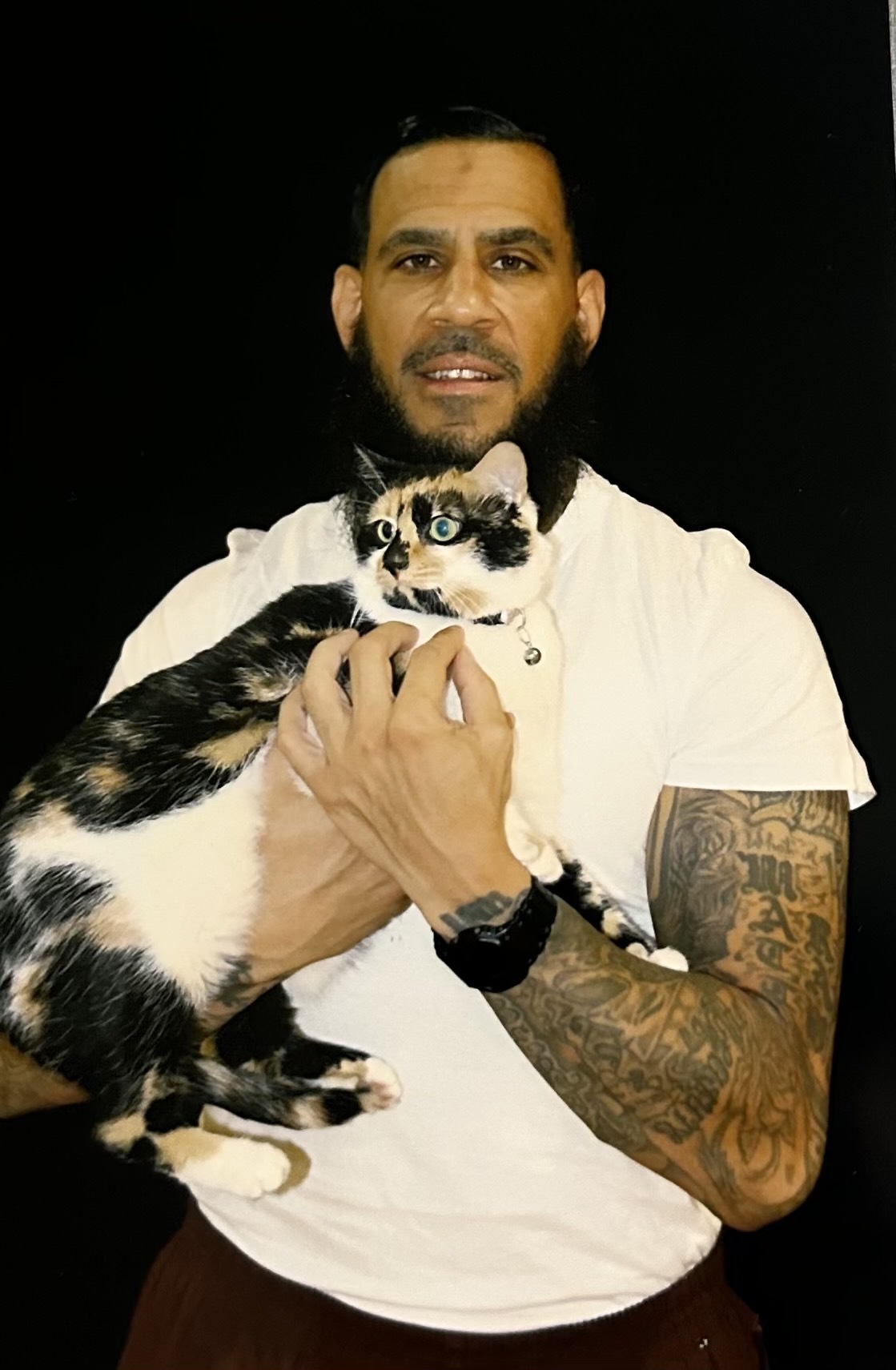
In a prison foster-cat program, Garcia adopted a calico, named her Lil Mama, and fed her until the name stopped fitting. “It’s not Lil Mama now,” he said in a recent interview. “It’s Fat Mama.”
Prison reform advocate Carisia Magobet shows photos of her husband, Matthew Garcia, who is serving a life sentence for second-degree murder, at her home in Northeast Philadelphia.Sarah Silbiger / For The Inquirer
The orange-and-black foster fail appeared often in Instagram photos. In one, a full-bearded Garcia wrote: “Me and Lil Mama, patiently waiting on our moment.”
By then, Magobet had four children, a house, a dental office she managed by day, and a commercial cleaning business she ran at night. Yet she found herself thinking often about Garcia. Seeing him there — older, broader, smiling beside a chubby cat — made him less a memory and more real. She emailed him.
Not long after, she took over his social media accounts.
Together, they began building a growing audience for Garcia’s work, a network of supporters, and, eventually, a life that felt shared despite the prison walls that separated them.
She posted his poetry. She built a website explaining the Lee case and a guide to contacting lawmakers about sentencing reform. He wrote children’s books, including one about Lil Mama that Magobet’s 21-year-old daughter, a digital arts student, illustrated.
A chance for ‘FREEDOM’
Garcia proposed on Aug. 1, three months after they reconnected. But it didn’t feel fast to Magobet. She had been carrying that moment since the wedding party.
They wed on Aug. 23. She is still waiting on prison paperwork to make it legal. But to them, Magobet said, it’s official.
Matthew Garcia and Lil Mama.Courtesy of Carisia Magobet.
He calls at least four times each day — when his cell door opens at 7 a.m., at lunch, after his work shift at the prison’s reentry program, at night. Each call lasts 15 minutes, the maximum allowed under prison policy, plus six video calls and four in-person visits a month.
On a video call last month, the couple discussed Magobet’s plan to join other families, formerly incarcerated people, and advocates in Harrisburg to support legislation in response to the high court’s decision that would allow people like Garcia to seek parole after serving at least 25 years. Not guaranteed release, but a chance to make their case.
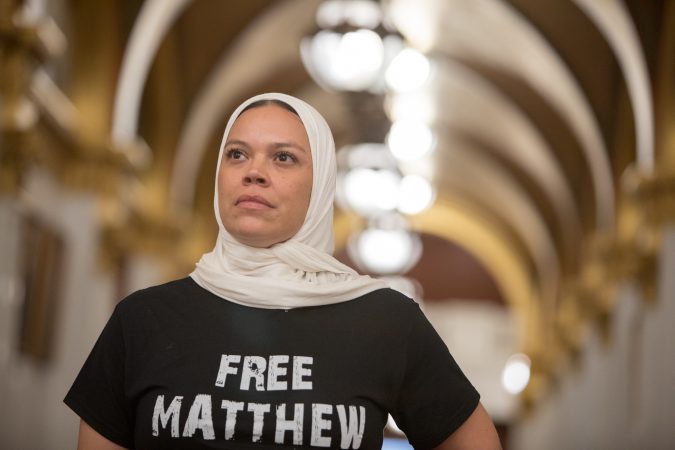
She told him about a poster she had printed to bring, with a photo of him holding Lil Mama and “FREEDOM” written in all capital letters. She had ordered a custom T-shirt, too, but it had not arrived yet.
“Will it come in time for Monday” for the trip to the Capitol? Garcia asked.
The call cut out before she could answer.
‘Do your job and legislate’
Carisia Magobet participates in a rally at the state Capitol in Harrisburg.
Magobet wore the T-shirt to Harrisburg two days later.
Beneath the Capitol rotunda, Magobet met Saleem Holbrook, the executive director of the Abolitionist Law Center, which represented Lee before the Supreme Court. He told Magobet he knew Garcia from their years in prison together.
“If there’s a person who’s earned being able to come home,” he said, “it’s Matt.”
In State Rep. Nikki Rivera’s office, Magobet read a speech from her phone. Her voice broke only once, when she told Rivera (D., Lancaster) that Garcia was her husband.
In the lobby of House Majority Leader Matt Bradford’s office, Magobet joined several others in a chant — “the time is getting late, do your job and legislate!” — that prompted the Montgomery County Democrat’s chief of staff to take Magobet and another person back to her office. The staffer had listened, Magobet said, promised nothing, and blamed the other side.
But Lil Mama made her laugh.
“The cat gets everyone,” Magobet said afterward. “We gotta get Lil Mama T-shirts for next time.”
Holding onto hope
Five weeks later, there was no next time to plan for.
Magobet learned that lawmakers adjourned July 12 without voting on the Democratic-sponsored measure she had supported, or the stricter Republican proposal.
She told Garcia on a phone call, and before the 15 minutes were up, he told her he couldn’t keep talking. It was the first time he had ever done that, she said.
A new measure, introduced by Democrats in an emergency session last week, did not earn a vote in the Senate.
The Supreme Court’s 120-day stay on new sentencings in second-degree murder cases expired on Friday, and judges can again hand out life sentences to people convicted of second-degree murder, but only in limited circumstances. But without a new law, there are no mandatory minimums or clear guidelines.
In the meantime, the next chapter will likely unfold in the courts for the more than 1,000 people already serving mandatory life sentences.
Bret Grote, an attorney with the Abolitionist Law Center who represented Lee in the Supreme Court case, said the high court has been asked in a separate case to determine whether the ruling applies retroactively.
He called the situation “a constitutional crisis.” But even under the most optimistic timeline, he said, a resolution could take years.
In the meantime, attorneys expect a wave of challenges from incarcerated people seeking relief. More than half of those serving the sentences are from Philadelphia.
Garcia said he will meet with his attorney to determine his next steps.
Prison reform advocate Carisia Magobet poses for a portrait at her home in Northeast Philadelphia.Sarah Silbiger / For The Inquirer
Magobet said she is holding on to hope — for the smaller things.
Walks together.
Coffee he brewed waiting for her in the morning.
Afternoons at a pool. (Garcia has not been in water deeper than a shower in nearly three decades.)
For months they talked about those plans as though they were approaching.
The founder of a security company in South Jersey has been charged in connection with embezzling $3 million from his business and causing a $9 million loss for a bank, U.S. Attorney Robert Frazier announced Monday.
Robert Cormier, 51, of Barrington, was arraigned on July 20 in Camden federal court before U.S. Magistrate Judge Elizabeth A. Pascal. He was charged in an indictment filed July 8 with embezzlement by bank agent, bank fraud, money laundering, income tax evasion, and failing to collect and pay over payroll taxes.
Cormier was still in federal custody on Monday, according to court records. A federal defender representing Cormier could not be reached for comment.
A second man, Richard Eisler, 38, of Clementon, who was the deputy director for the security company, was charged in a separate indictment in connection with embezzling over $2 million from the business.
Eisler was charged with embezzlement by bank agent, money laundering, income tax evasion, and witness tampering. Eisler was arraigned on Friday in Camden federal court before Pascal and pleaded not guilty, court records show. Eisler was released on $100,000 unsecured bail.
The lawyer representing Eisler could not be reached for comment Monday.
In 2017, Cormier started Erigere Rapidus Solutions, Inc. (ERS), a security services business based in Westville, prosecutors said.
On Monday, it was unclear if Erigere Rapidus Solutions was still operating as a business. The domain name used for the company’s website was available for sale.
In late 2019, ERS entered into an agreement with a local bank to collect, count, transport, store, and deposit cash, prosecutors said.
ERS employees, including Eisler, were responsible for picking up cash from various customers of the bank, counting and storing the cash, and providing daily reports about the cash to the bank.
On a daily basis, ERS stored varying amounts of cash in its vault ranging from $1 million to $12 million, prosecutors said.
The bank ended its relationship with ERS after determining that more than $8 million was missing from the vault, prosecutors said.
Starting in 2020 until 2022, Cormier allegedly stole at least $3 million in cash out of the vault, prosecutors said.
Cormier, who was the company’s chief operating officer, allegedly used the embezzled funds to cover business-related costs and to pay personal expenses for himself and his family members, including the installation of a deck and a pool, and household renovations, prosecutors said.
He allegedly failed to report the extra income to the Internal Revenue Service and did not collect and pay over payroll taxes for employees of ERS, prosecutors said.
From 2020 until late 2021, Eisler allegedly stole at least $2 million from the vault, prosecutors said.
Eisler allegedly used the embezzled funds to pay personal expenses for himself and his family members, including the purchase of a Porsche 911, two Audis, two trucks, and a recreational vehicle, prosecutors said.
He also allegedly used the money to pay for wedding rings, a wedding reception, and a roof for his residence, and to pay off an automobile loan, prosecutors said. Eisler allegedly failed to report the income to the IRS.
Prosecutors also allege that Eisler attempted to obstruct the investigation by attempting to persuade a witness to lie to federal agents.