Category: Columnists

  • For the World Cup or the Fourth of July, Philadelphia shows it’s the place to be | Shackamaxon

    Welcome to Shackamaxon, a weekly politics column focused on what’s happening at City Hall and in Harrisburg. It is named for the place where the Lenape chiefs would meet to conduct the people’s business, which is now known as Penn Treaty Park. This week’s edition looks at the ways Philadelphia has changed for the better since the Bicentennial — and the ways things have stayed the same.

    D.C. dud

    My fellow columnists Trudy Rubin and Jenice Armstrong have both pointed out how disappointing Washington’s celebrations for America’s 250th anniversary have been. My advice? Skip the city that didn’t even exist in 1776 and visit Philadelphia instead. Skip Boston, the small town with the tall tales, as well. If you are healthy and hydrated enough to withstand the brutal heat wave, the City of Brotherly Love and Sisterly Affection is the best place to celebrate the Fourth.

    Philadelphia embodies the story of America. Our city was founded by William Penn, a Quaker idealist who staunchly defended religious liberty. It was fostered by Ben Franklin, a writer and inventor who embodies our nation’s ingenuity and ambition. Octavius V. Catto, himself a Black man born free, fought for the rights of the enslaved, both before and after the passage of the 13th Amendment.

    A century before the Rev. Dr. Martin Luther King Jr., Catto became a martyr when he was shot and killed on Election Day in 1871 as part of a broader campaign of political violence against Black voters. Catto’s fiancée, Caroline LeCount, desegregated this city’s streetcars long before Rosa Parks did the same for buses across the country. Siegmund Lubin started one of the first movie empires, right here in the city. The iconic Stetson hat, long associated with cowboys and the Wild West? Another product from the city known as the “Workshop of the World.”

    There’s a case to be made that not only did America start here, but our city is the most American of them all. Everything that our country is known for, both for good and for bad, has happened here, as well.
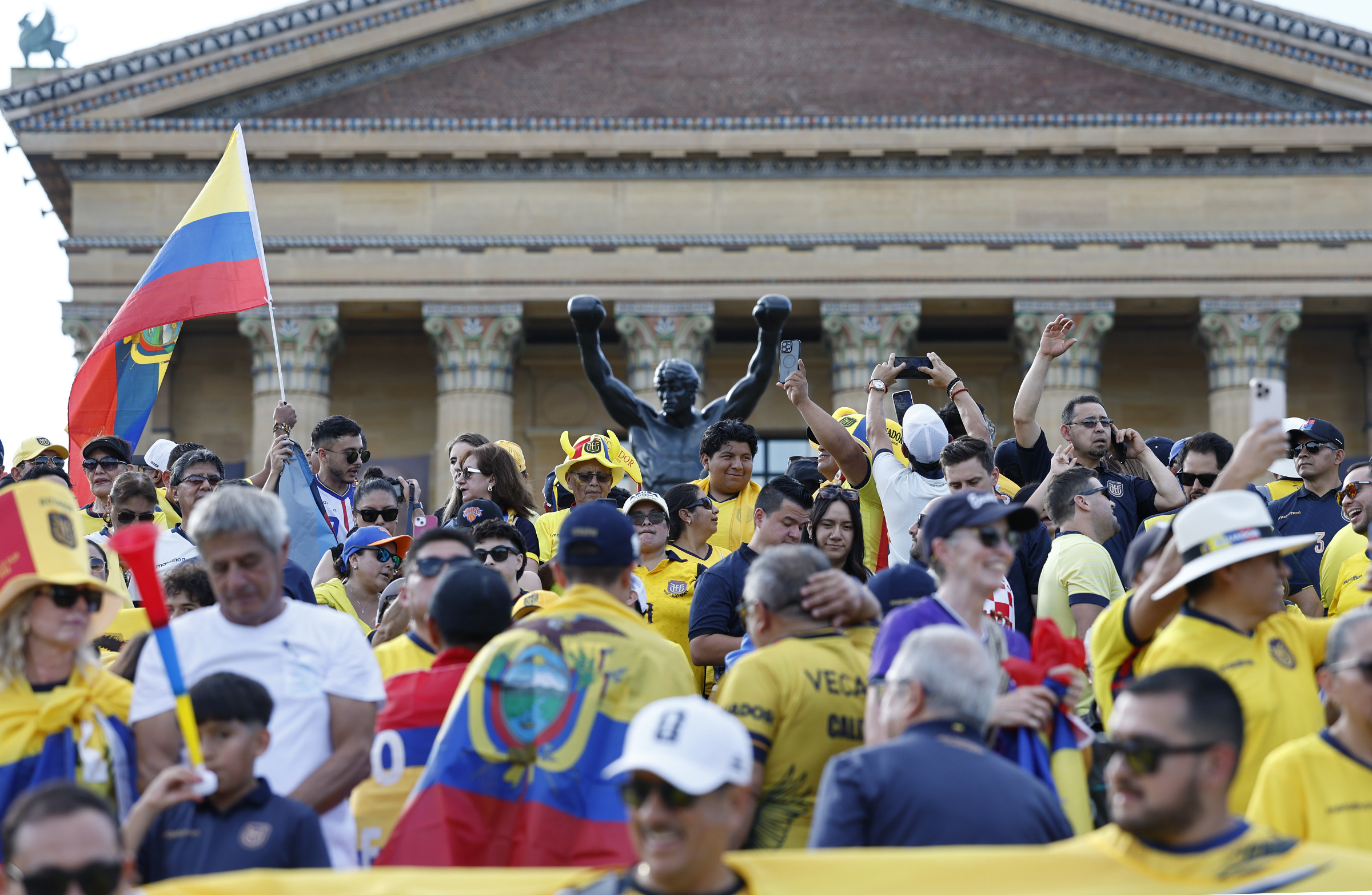
    Ecuadorian soccer fans attend a flag waving event at the Philadelphia Museum of Art steps along the Benjamin Franklin Parkway, ahead of their first round World Cup match against the Ivory Coast, on June 13.Yong Kim / Staff Photographer

    New narrative

    It always bothered me that our city’s greatest draw seems to be Rocky Balboa, the fictional boxer from the eponymous film. Beyond the fact that this city is where America began, Rocky also memorializes a very specific era of our city’s history, one of decline. The first movie was released in 1976, during a decade when Philadelphia lost over a quarter million residents. Crime, trash, and disorder dominated the city’s streets.

    It’s also worth noting that the film was released in the year of America’s Bicentennial. The celebrations that year were largely a misfire. Then-Mayor Frank Rizzo scared many potential visitors away, and there was an outbreak of Legionnaires’ disease.

    That’s not to say Rocky, or the city he inhabited, was without charm. Despite the challenges, Philadelphians were still full of heart and grit, qualities Sylvester Stallone’s creation exemplified well. But the place shown in the movie doesn’t capture the full spectrum of what Philadelphia had to offer, even during the tumultuous ’70s. Rocky may have run up the Art Museum steps, but he never stepped inside.

    Today’s Philadelphia is a dramatically different city. While the white working-class communities Rocky represented remain an important part of the city, they no longer dominate it. Rizzo would garner very few votes if he were on the ballot today. Philadelphia is now a multicultural, multiracial city on the rise. Rather than repelling visitors and residents, the city welcomes them.

    According to Sports Business Journal, the city’s FIFA Fan Festival is a pacesetter, leading the 13 other public World Cup viewing areas in North America in both single-day and overall attendance. Social media feeds are filled with international visitors praising the city’s culture and cuisine. Some Brazilian fans called it the most beautiful city they have ever seen.

    Throughout the year, city officials have expressed confidence in Philadelphia’s ability to recoup the investment made in hosting the World Cup and other events. The state tourism office has told The Inquirer that early indicators are positive, with flight bookings, Amtrak arrivals, and Airbnb rentals exceeding expectations. While the initial projections were for 500,000 World Cup visitors, we may end up seeing closer to 800,000.

    Beyond the number-crunching, however, there’s a more important goal at stake: changing people’s perceptions of our city.

    That’s something impossible to set a price tag on.
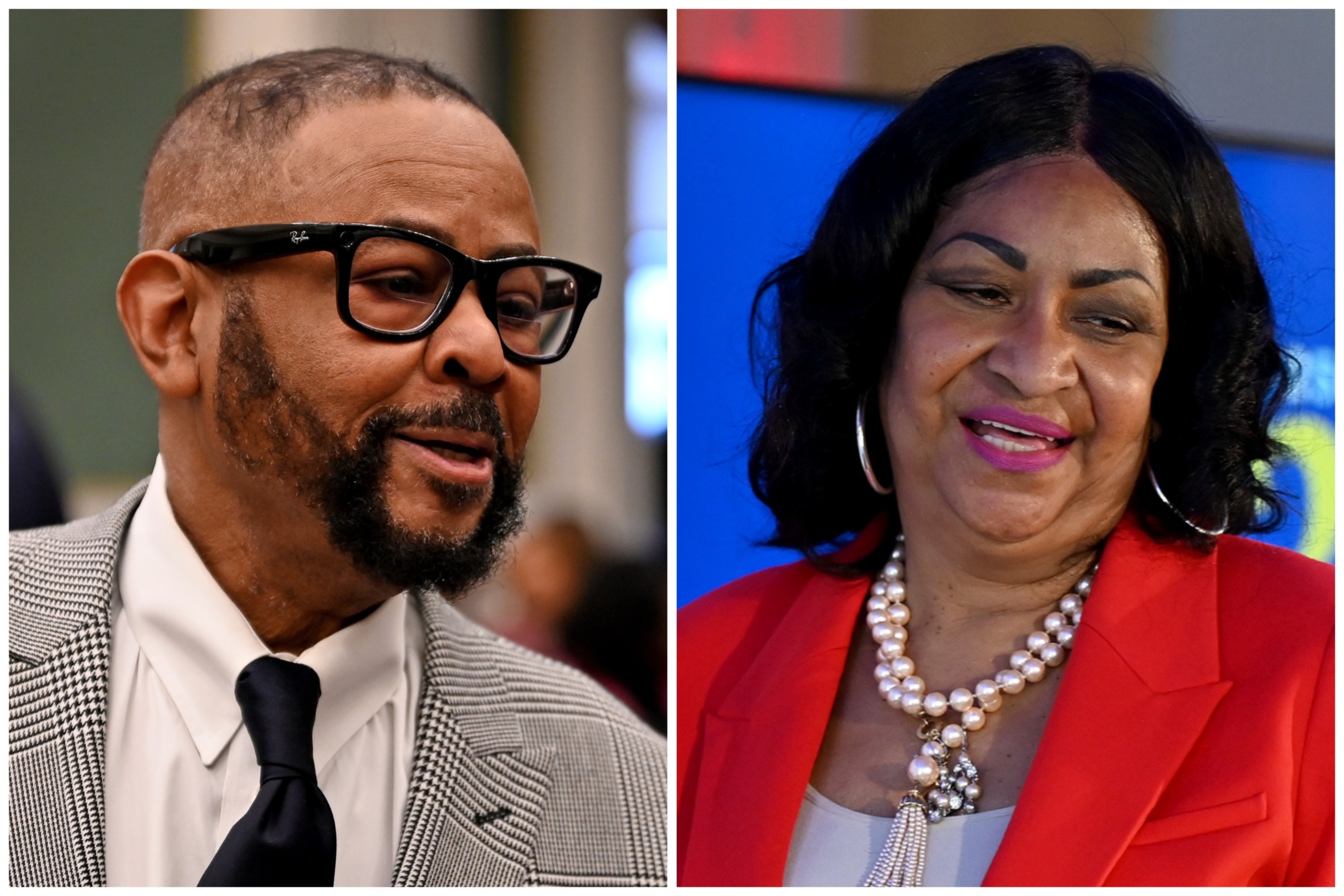
    Councilmember Curtis Jones Jr. and his wife, Jazelle Jones. The couple stand to collect up to $752,000 in combined retirement payouts while keeping their six-figure jobs.Tom Gralish / Staff Photographer

    Same old problems

    So far, one of the biggest reasons to be skeptical about Philadelphia’s future is City Hall. The city’s leaders too often serve their own interests, rather than those of the public.

    Take Curtis Jones Jr., who represents the 4th District on City Council. Jones is certainly capable of being an insightful public official. Since his colleagues passed him over as Council president, however, he’s displayed increasingly questionable behavior.

    Earlier this year, Jones asked Streets Department officials to consider delaying crucial bridge repairs until after his reelection, citing concerns that the public might blame him for their inconvenience.

    Jones, however, ignored the impact of public opinion when it came to his own personal finances. Both he and his wife, Jazelle Jones, who serves as city representative, are planning to take payments through DROP, a retirement program that was never meant to accommodate elected officials. The pair stands to collect up to $750,000 by retiring for a day — and then returning to their six-figure jobs. This may be a rounding error in a city that is planning to spend $7.1 billion in the next fiscal year, but it is also more than 10 times Philadelphia’s median household income.

    Asked about Jazelle Jones’ retention, Mayor Cherelle L. Parker cited the need to stay the course as a factor in making an exception for the city representative. Left unspoken was the fact that if Parker had blocked this payday, it would have likely complicated her relationship with Curtis Jones — one of the mayor’s most reliable supporters on City Council.

    This kind of cronyism only reinforces negative perceptions of the city. Anyone looking for evidence that Philadelphia is the same old parochial, self-dealing city it was known for being in the past has only to try to keep up with the Joneses.
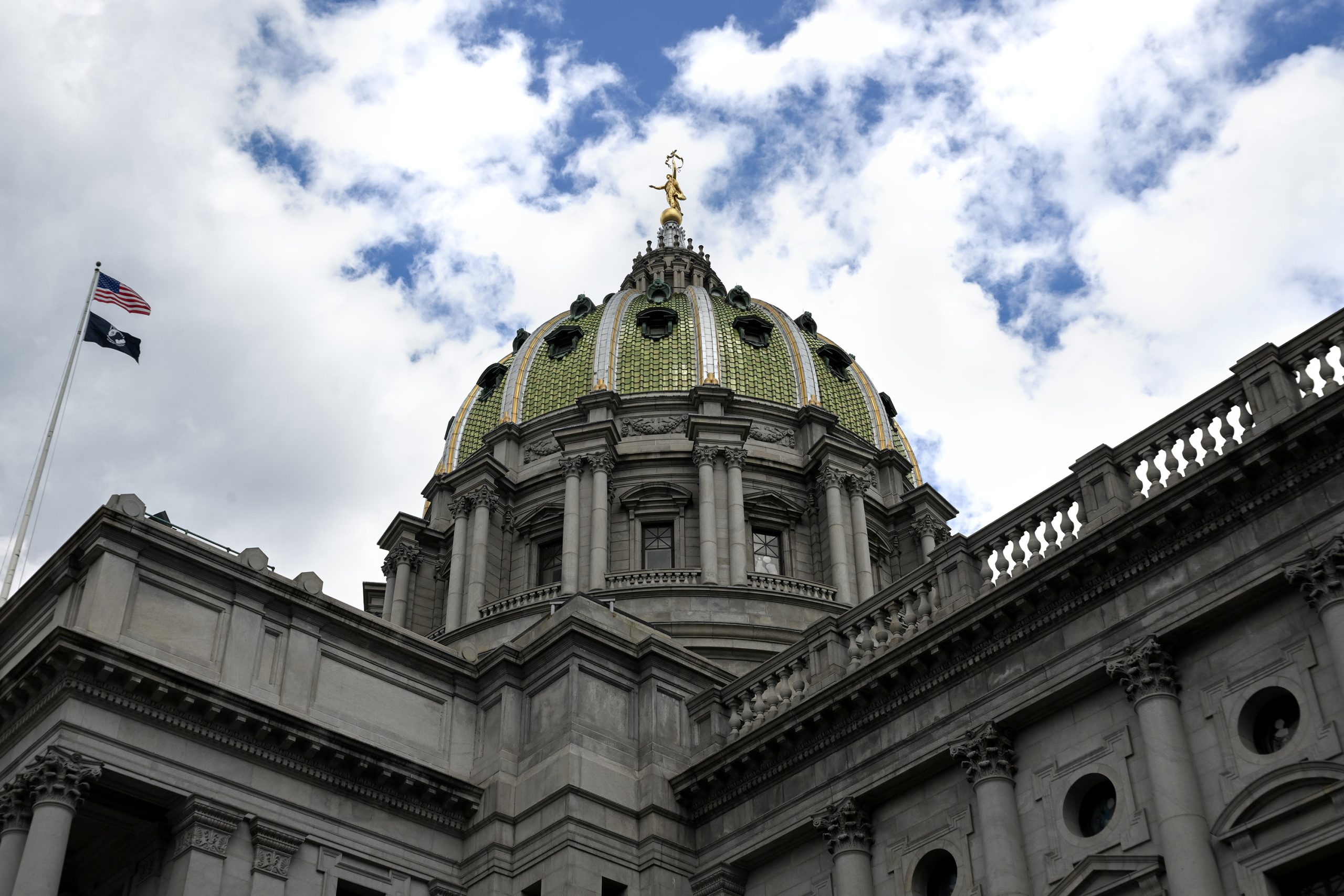
    The Pennsylvania State Capitol on Commonwealth Avenue in Harrisburg. Another year, another blown budget deadline by state legislators.Tom Gralish / Staff Photographer

    Harrisburg holdups

    To be fair, City Hall isn’t the only place that seems like it’s having a hard time getting its act together. Harrisburg has yet again missed its budget deadline.

    While local governments, school districts, and SEPTA are expected to submit their own spending plans in a timely manner, legislators have apparently decided that deadlines don’t apply to them. The Pennsylvania Senate went home early rather than finish negotiations that its own leaders have said are productive.

    Last year, the impasse went on into the fall, forcing some state services to grind to a halt and schools to take out loans in order to pay their bills. The commonwealth simply can’t afford to do that again.

    This year, rising revenues from existing taxes and a potential influx of money from so-called skill games have made the process easier. Still, it is July, and there’s no budget deal.

    What we need is a way to hold legislators accountable for failing to do their jobs. In the past, withholding pay was suggested as a leverage point. State Rep. Natalie Mihalek, a Republican from Western Pennsylvania, has said that failing to pass a budget should lead to a special election, a nod to the concept of “confidence votes” in Westminster parliaments.

    Maybe that will get the General Assembly to take its job seriously.

  • The America-turns-250 column Donald Trump doesn’t want me to write

    The America-turns-250 column Donald Trump doesn’t want me to write

    It was right after birthright citizen Folarin Balogun tapped in another game-winning goal for U.S. men’s soccer in the World Cup Wednesday night that I had a moment of clarity about where things are in America as our nation turns 250.

    I’d gone to Union Yards, the outdoorsy beer hall adjacent to Chester’s soccer palace, Subaru Park, not only to catch the game but also a vibe that I’d wanted to turn into this column.

    The euphoria after Balogun’s goal — a red-bearded man in a colonial tri-corner hat and the two older veterans who’ve saluted through all of the prematch “Star-Spangled Banner” jumping to their feet, as a little girl in cornrows danced on a table — was the bucket-list moment I’d come there for.

    I saw a beer-recipe melting pot of Americans cheering the immigrant-heavy rainbow coalition of U.S. soccer, showing yet again — just as we did in 1976, when I was 17 — that the people instinctively know how to celebrate what’s actually great about our country no matter how much our leaders try to muck it up.

    I’d joked with my editors earlier in the week that I might lose my columnist license (not an actual thing, although maybe it should be) if my piece that runs on the weekend of the United States Semiquincentennial wasn’t a Big Think essay on what the American Experiment all means — to the extent that anyone can actually think through the fireworks, traffic jams, and 100-degree temperatures.

    That’s when it hit me. That was exactly the column Donald Trump was counting on from me and every other opinion writer in America ahead of Independence Day. The 47th president needed a week when the pundits put on their wide-angle lenses and put away the magnifying glasses, while his “forgotten Americans” headed off to the beach or the fireworks show, or gorged themselves on six hours of World Cup soccer every day, and stopped watching the news.

    An international jewel thief needs to create a distraction. Because if you’d been paying attention during the nation’s summer vacation week, you’d have seen that Trump is robbing us blind.

    The July Fourth holiday gave the Trump regime an opportunity for the ultimate Friday news dump, the now time-honored tradition of releasing the worst stuff when people will be unplugged for a few days. In this case, the dump was a federally mandated financial disclosure form that revealed the stunning extent to which Trump has cashed in on his power and influence as president since taking office in January 2025.

    The top-line numbers defy belief. Trump, who reported earning at least $622 million in 2024, his last year as an out-of-power businessman, revealed that he made at least $2.2 billion in 2025, and it’s hard not to see a lot of this as coming from turning the institution of the American presidency into a cash cow.

    Consider the $636 million Trump made by releasing a so-called meme coin — an asset whose value is tied to nothing beyond its own hype — that depicted his fist-pumping reaction to the 2024 assassination attempt in Butler, Pa., and which was released literally hours before he took the oath of office again. Not only is this a staggering amount, but Trump pocketed this cash by fleecing thousands of middle-class folks who voted for him.

    Publicly available information from last year showed that some 764,000 individuals who bought the Trump meme coin after its launch lost money. How many investors profited from the $TRUMP coin? Just 58 — and no one got nearly as rich as the man pictured on the coin.

    Yet, Trump’s other sources of wealth are almost as troubling — especially the real estate and crypto deals with foreign nations that have an enormous stake in the president’s policy decisions. That’s especially true when the investment arm of the United Arab Emirates bought nearly half of the Trump family’s main crypto venture, World Liberty Financial, contributing to his at least $1.4 billion in crypto-related earnings. The U.S. and the UAE are (or were) key allies in the war-torn Persian Gulf.

    But the important thing to understand about Trump’s money: It’s not a case in which the issue is that these deals are a lot shadier than the financial profiteering by, say, Jimmy Carter or Warren G. Harding or whomever. None of Trump’s 44 White House predecessors seriously profited from the presidency while they were still in office.

    Carter put his peanut farm in a blind trust. On the flip side, Spiro Agnew pleaded no contest to a felony charge for accepting just a few thousand dollars in the White House — not billions. There is absolutely no precedent for Trump’s naked greed and for how he trades on his office for personal profit.

    Yet, the president thinks that by declaring his crimes on a public document, voters will think it isn’t a crime — even if he releases that form over July Fourth to hedge his bets.

    Indeed, the scale and scope of the president’s grift is vast and overwhelming, which is the point. I’m just now getting to a different Trump family scandal, in which the president approved a lucrative tungsten mining deal with Kazakhstan whereby his sons are key investors, propped up with up to $1.6 billion in loans from Trump’s Pentagon.

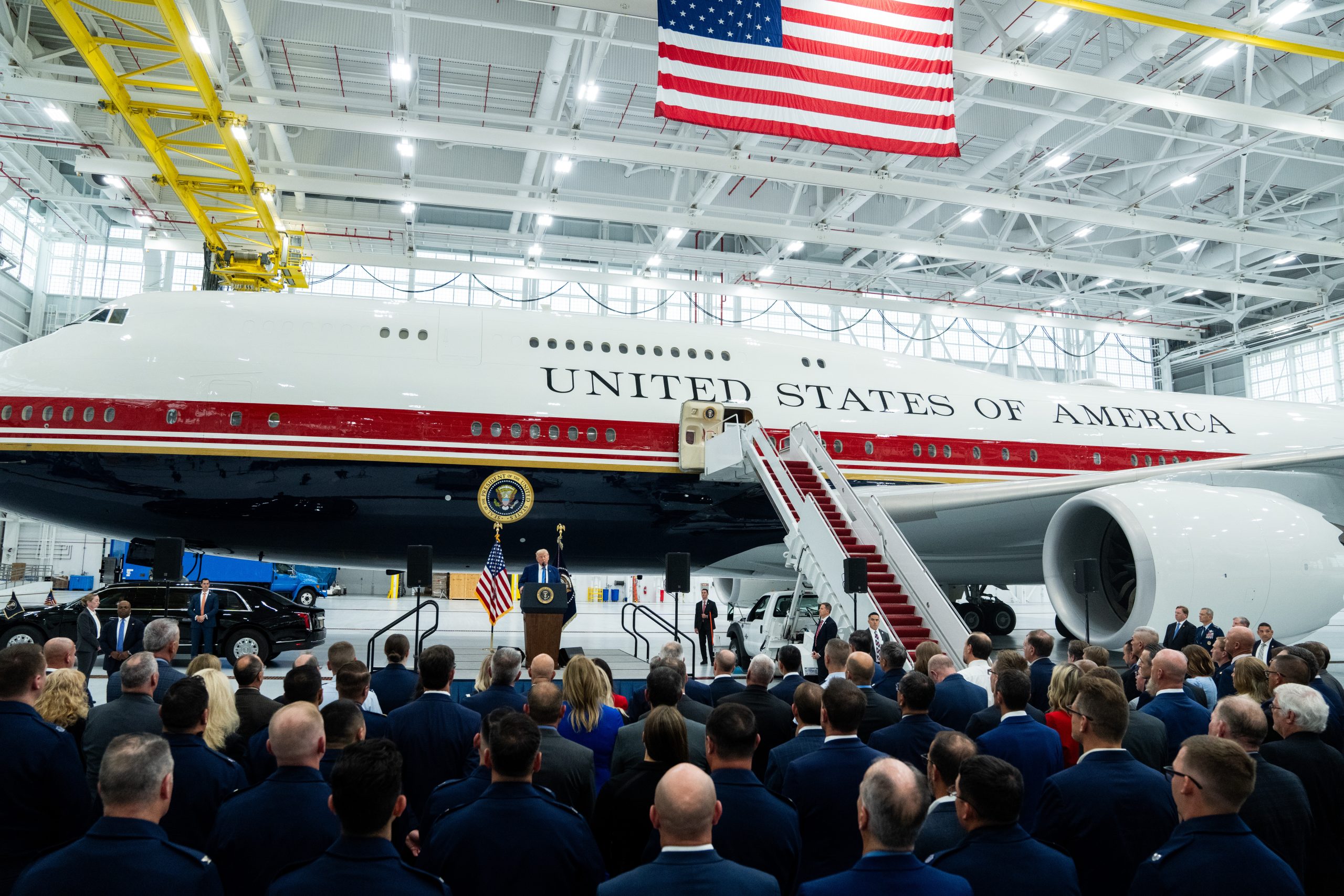
    Trump took questions about his family’s 2025 cash bonanza as — and you can’t make this up — he prepared to fly for the first time in the $400 million luxury jet that was gifted by Qatar and which, after a brief stint as Air Force One, is slated to go to Trump’s presidential library (a.k.a. Trump) in 2029.

    President Donald Trump delivers remarks next to the new red, white, and blue Boeing 747 jetliner donated by the government of Qatar that will be used as Air Force One, at Joint Base Andrews, Md., in June.ALLISON ROBBERT

    Still, the national media — and a lot of social media, as well — gave more attention to the Trump disasters that are easier to visualize, including troops guarding his green algae swamp at the Lincoln Memorial Reflecting Pool and empty fields at his Freedom 250’s disastrous Great American State Fair, which sits nearly empty while thousands pack bars for the international joy of the World Cup, or line the rainbow-colored routes of Pride Month parades.

    One of the many ironies here is that Trump is inadvertently doing America a July Fourth favor by highlighting a key part of the flawed wisdom of the nation’s founders. In declaring independence in 1776 and creating a government that aimed for people-powered democracy with checks and balances on unbridled autocracy, the mad scientists of the American Experiment also expressed their fears for our future.

    “The only path to a subversion of the republican system of the Country is, by flattering the prejudices of the people, and exciting their jealousies and apprehensions, to throw affairs into confusion, and bring on civil commotion,” Alexander Hamilton wrote in 1790. “When a man unprincipled in private life, desperate in his fortune, bold in his temper … is seen to mount the hobby horse of popularity, he may ‘ride the storm and direct the whirlwind.’”

    This Fourth of July week, I’ve been thinking a lot about the 1770s, but also the 1970s. For the second-half baby boomers like myself, it’s impossible not to experience the nation’s 250th anniversary without sepia-toned memories of July 4, 1976 — the U.S. Bicentennial.

    Things were both so similar and so different.

    Just as democracy stares into the abyss now, the assassinations, riots, and bombings of the late 1960s and early ’70s felt like the apocalypse to those who lived through it. But the Watergate scandal — yes, the very thing JD Vance and others on the far-right are dismissive of now — and the way courts and newsrooms and members of Congress responded had created a new hopeful yearning in the summer of 1976.

    That feeling is what made the day I enjoyed with my family as a 17-year-old a half-century ago — watching those glorious tall ships glide down the Hudson River from my dad’s high-rise office on 10th Avenue, then cramming into a subway to get to the fireworks over the Statue of Liberty — still bring back chills today. There was an unexpected sense of togetherness — and, naively in hindsight, that a storm had passed.

    It’s different in 2026. The whirlwind that Hamilton warned us about is directly overhead, and the man is still riding, however clumsily, the hobby horse. The institutions that saved us ahead of 1976 are shells of their former selves, as if a neutron bomb had struck.

    And yet, the fundamental essence of what can make America actually great someday remains intact: its people. This summer, millions of us are showing that Americans want things that can bring us together, and also to celebrate what makes us all different and all special, whether on a soccer pitch or a parade route laced with pink.

    The question is, how do we take this positive energy and stop the whirlwind? How do we celebrate a 250-year slow-bending of the arc of the moral universe without losing our focus on the ongoing crime scene at 1600 Pennsylvania Avenue?

    When the president’s Freedom 250 sets off 850,000 fireworks over Washington on Saturday, think of every single blast as about $2,000 that Trump pocketed for himself, and then it might be possible to comprehend the scope of his crime against our citizenry.

    Don’t let the president hijack the Fourth of July to rob the focus from what matters most, the things we need to write and discuss and march against every week: his unprecedented criminality. The bombs are bursting in air, but only when we unleash our people power and seek justice will we see the dawn’s early light of a new nation again.

    Happy birthday, America.

  • Trump’s Great American State Fair reveals how he has turned the Semiquincentennial into a celebration of himself

    WASHINGTON — The Great American State Fair on the National Mall should have been the rousing centerpiece of America’s 250th birthday celebration. Instead, it is a perfect tribute to President Donald Trump.

    With its cheap, slapdash imagining of Trump’s America and its constant political homage to POTUS and MAGA, the exhibit has little to do with commemorating the Declaration of Independence, U.S. history, or American culture. The exhibits lack even the delicious, tacky, lively atmosphere of state fairs (the few visible animals I saw were all fake).

    With few exceptions, it is a vapid, empty insult to the best aspects of this nation.

    When I remember the Semiquincentennial, I will be thinking more about scenes of Brazilian soccer fans visiting Philadelphia’s Independence Hall and warm interactions between locals across the country and visiting World Cup tourists. These personal exchanges may offset some of the hostility so many countries feel about Trump’s foreign policy.

    And yet, I’m glad I visited the fair on Monday because it reminds me of how different the president’s vision is from the real America that is ignored in this tribute to Trump.

    A true celebration could have displayed the best of this country, what the United States has gotten right, while providing the moment for serious reflection on what has gone wrong — and what needs desperately to be remedied at home and in our foreign relations. No matter how uphill that struggle seems under Trump.

    Instead, the Great American State Fair mainly consists of several long, white, one-story buildings fronted by fake Greek columns and punctuated by closed doors. The structures extend on either side of large expanses of mall greenery which were almost empty, as the 88-degree heat sent the scant numbers of visitors inside in in search of air-conditioning.

    The state of Delaware’s pavilion at the Great American State Fair Thursday in Washington, D.C.Sam Janesch / Staff

    Behind those doors are small exhibits by each state (11 of which, including Pennsylvania, opted out due to the politicization of the fair or cost concerns), or by U.S. government departments (including “WAR”) and agencies and religious groups. Most state exhibits are tourism displays with posters, literature, or videos, with a few exceptions like South Dakota, whose state historic commission mounted excellent posters about the vivid characters, including women and Sioux leaders, who settled its land.

    Towering over the few attendees out in the sun is a 110-foot Ferris wheel (which has been mostly stationary because of electrical problems) and a small mock-up of Trump’s planned and controversial Arch of Triumph topped by gold angels.

    The image portrayed is of a country isolated from its own people and the world.

    However, visitors can collect Trump literature from AMAC (the Association of Mature American Citizens), listen to a Bible lecture, and hear how “America shall be saved” from a group called “The Great Awakening.” They can bid for a $700 “marriage getaway,” sign up their children for a Trump savings account, or fill out a recruitment form for the U.S. military or U.S. Secret Service. They can also view a copy of the limited edition “Patriot Passport” with Trump’s photo on it inside a glass case at the U.S. Department of State exhibit and get a free paper copy.

    Trump, Trump, and more Trump. The Washington celebration of our 250th birthday wasn’t supposed to look this way.

    Congress started planning for this anniversary in 2016, when it created America250, a bipartisan commission that was supposed to program nonpartisan events for all Americans. The idea was to unify the country in celebration.

    Its original plans were focused on a parade through the capital with “diverse floats” and marching bands, along with an energetic festival of the nation’s cultural diversity on the mall organized by the Smithsonian.

    Anyone who has ever attended the annual Smithsonian Folklife Festival on the mall can imagine how wonderful this could have been. On one occasion when I was there, one side of the mall was celebrating the culture of India and the other Louisiana and Cajun culture, with bands of old-timers and their acolytes playing washboards, banjos, and accordions, while tents dished out Cajun food.

    This year, one side of the mall might have hosted cultures of the immigrants who have built America, and the other could have presented tributes to the Declaration of Independence, its impact around the world, and how its flaws regarding slavery and women were remediated by law.

    Instead, Trump squeezed out America250 by virtually replacing it with Freedom 250, which is partly funded with taxpayer money and partly by donors. The New York Times has detailed how donors were offered access to Trump for million-dollar contributions.

    Instead of funding projects connected to key moments in the fight for American independence, Trump’s group focused on his MAGA agenda, his love for spectacle, and his person. Thus, his vision of America’s 250th birthday celebration has centered on his arch, on a $60 million UFC match on the White House lawn, and on an IndyCar race through the capital scheduled for August. As for the fair on the mall, it has been focused on an opening (political) speech by Trump (after most planned musical acts withdrew due to the fair’s partisan nature), and another rally on July Fourth.

    Unity out. Division in. Who cares about celebrating our founding document and the aspirational values on which the country has been built, when Trump can have circuses that celebrate only him?

    And that is why I point to the World Cup games as a sign that Americans still know how to display their best qualities as a people. What particularly moved me was watching the huge kilted Scottish contingent break through sometimes insular Bostonians’ reserve when it belted out John Denver’s “Take Me Home, Country Roads” at Fenway Park.

    Americans are so much better than this sterile exhibition on the mall. In the warmth displayed across the country to World Cup visitors they have shown a welcoming nature still unsullied by Trump’s efforts to make people hate the other.

    Back in the states and cities, many celebrations of July Fourth will probably still capture that warmth. It still exists. In Philadelphia, history museums are doing a terrific job of commemorating the declaration.

    But you can certainly skip visiting Trump’s Great American State Fair, which reveals his total disdain for what this holiday really means.

  • The Ben Franklin Bridge turns 100. Don’t wait to walk it like I did.

    The Ben Franklin Bridge turns 100. Don’t wait to walk it like I did.

    I’ve driven across the Ben Franklin Bridge countless times but until last week I’d never walked across it, and I walked across the Brooklyn Bridge once, so I’ve quietly carried that shame with me for years.

    When I received a news release about the bridge turning 100 on July 1 and a subsequent anniversary party on July 11 that will close it to vehicles for public use for the first time since Pope Francis’ visit in 2015, I wanted to finally check walking across it off my Philly bucket list before the event.

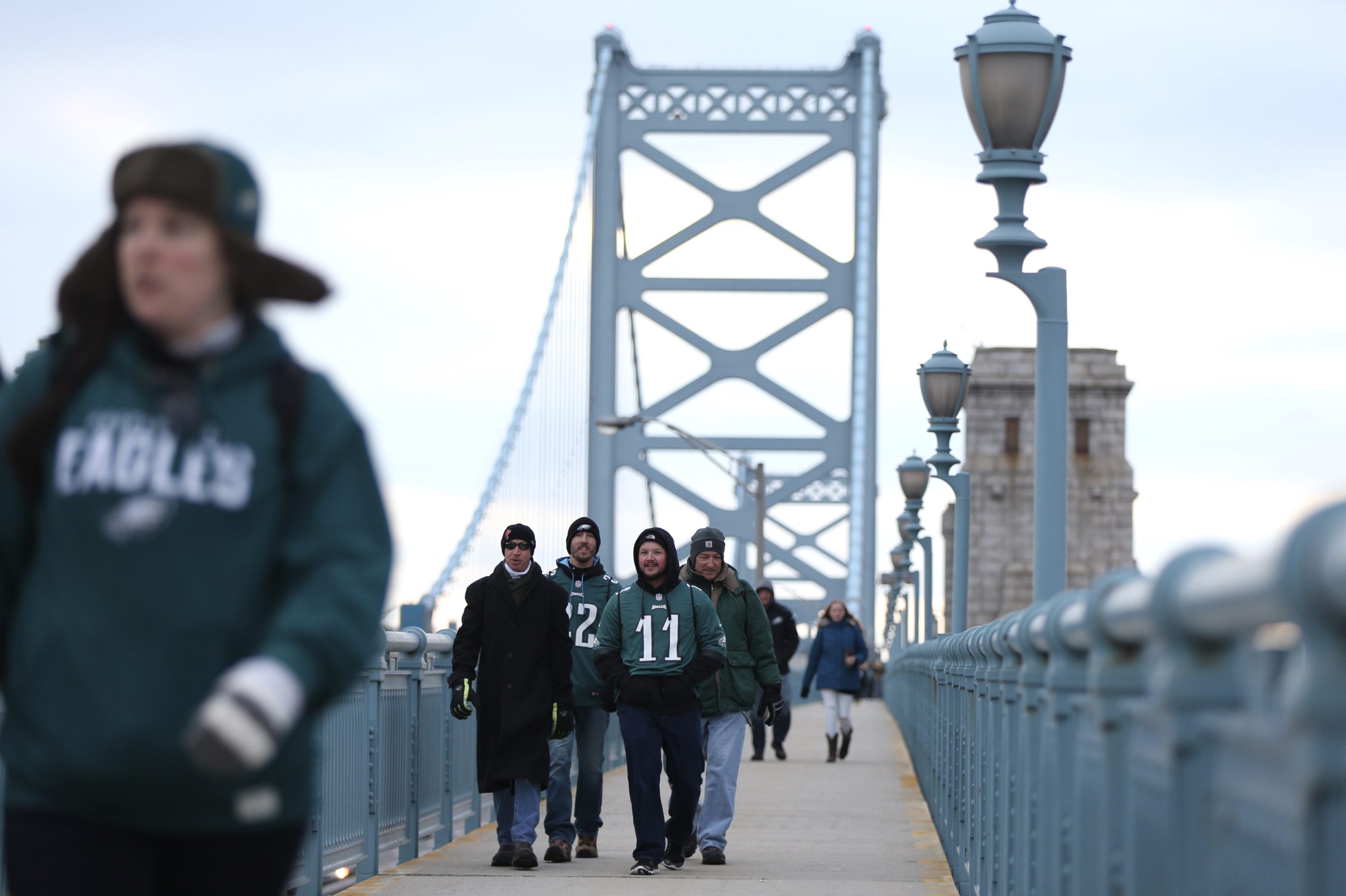
    Fans cross the Ben Franklin Bridge into Philadelphia on the morning of the Eagles’ Super Bowl parade in 2018.TIM TAI / Staff Photographer

    I was going to go it alone, but I decided to reach out to Mike Williams, spokesperson for the Delaware River Port Authority (DRPA), which manages the bridge, and he offered to schedule a walkway tour of it for me with DRPA principal engineer Michael Howard.

    I met both men at Fifth and Race Streets at the base of the bridge on the Philly side, but as luck would have it, we showed up on opposite sides of the heavily-trafficked span. We waved at each other across the cars and as I tried to figure out how to Frogger my way over to them, Howard and Williams disappeared.

    The men popped up out of a stairwell right next to me, having used the Fifth Street pedestrian tunnel under the bridge.

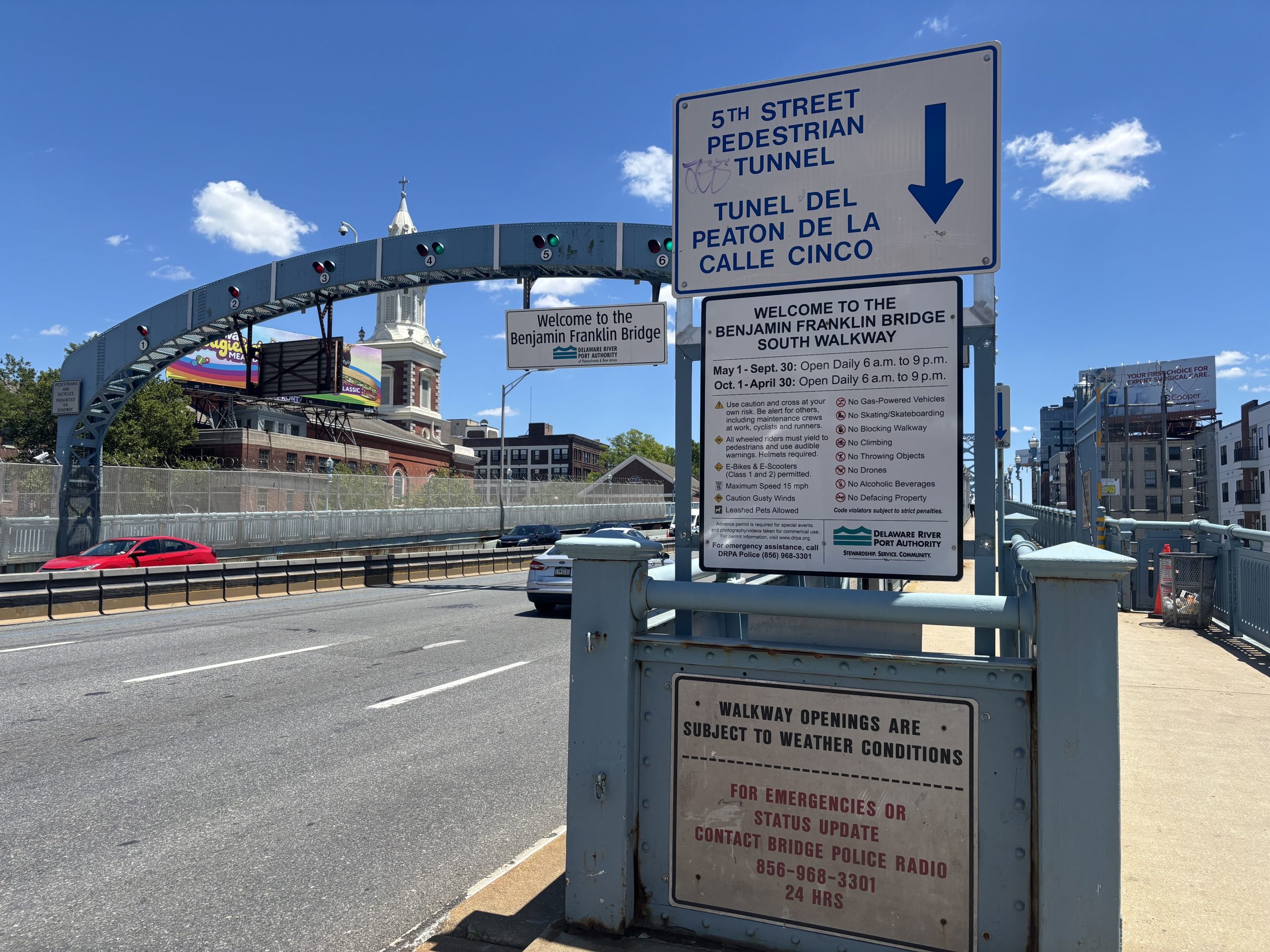
    The entrance to the Fifth Street pedestrian tunnel on the south side of the Ben Franklin Bridge in Philadelphia.Stephanie Farr / Staff

    “This was one of the original things that we incorporated into the bridge because we didn’t want people to try to walk across the traffic — because they would, you know,” Howard said, and I agreed.

    Obviously, it was the first place I wanted to check out.

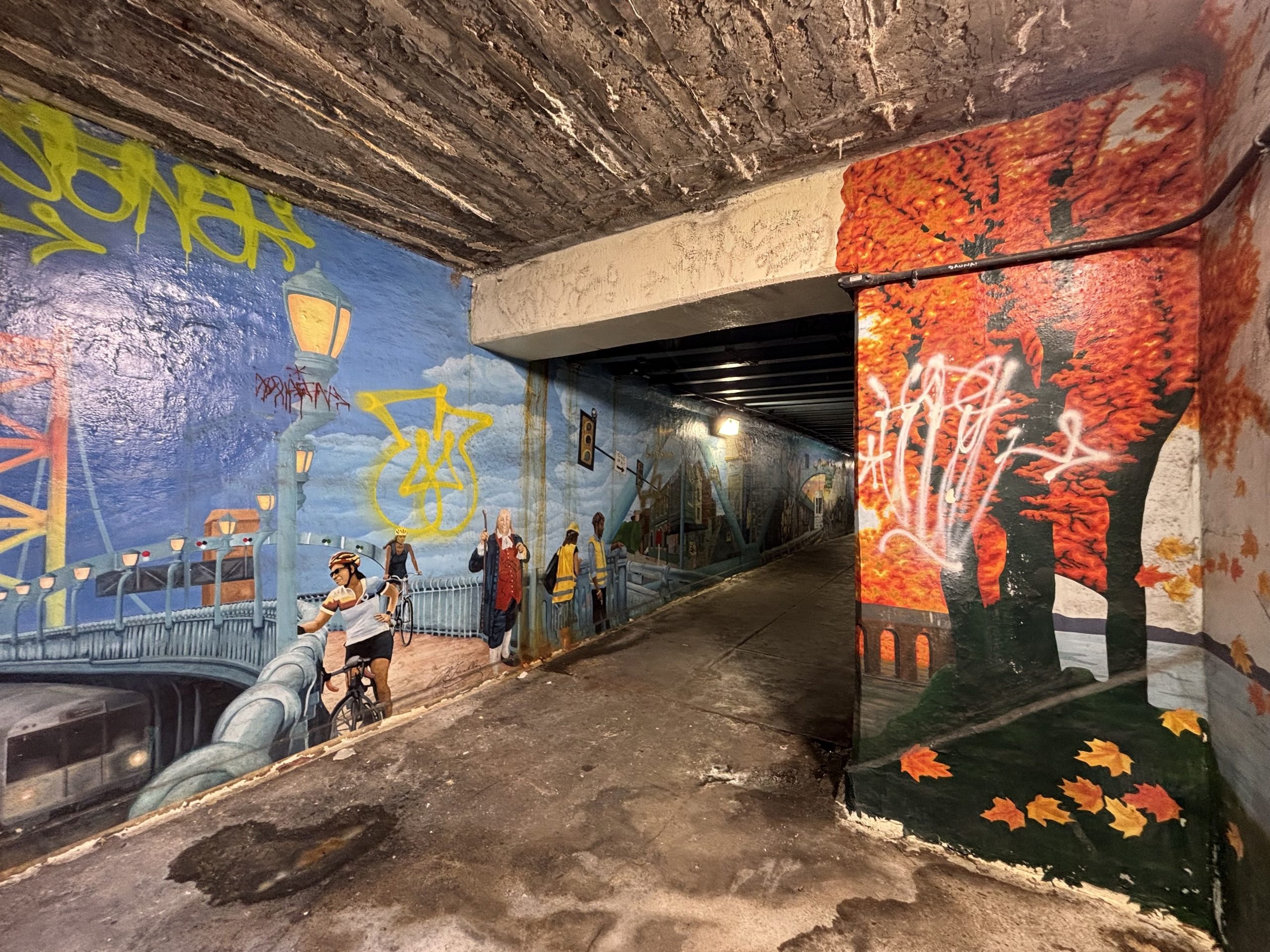
    The “Building Connections through Time” mural inside of the Fifth Street pedestrian tunnel on the Philadelphia side of the Ben Franklin Bridge.Stephanie Farr / Staff

    The entire length of the 91-foot-long tunnel was painted with a vibrant Mural Arts Philadelphia work by Brad Carney and Melissa Mandel. Created in 2018, Building Connections through Time shows people using the bridge, the building of it, and images of its early years. There are also paintings of Independence Hall, Benjamin Franklin, and other bridges that span the Delaware River.

    Finding one of the city’s most secluded murals felt like finding one of those wonderful Philly secrets the city gives sometimes, if you never stop exploring it.

    Come along with me as I explore one of Philly’s most secluded murals.

    [image or embed]

    — Stephanie Farr (@farfarraway.bsky.social) June 30, 2026 at 11:38 AM

    Mere feet

    Back on the surface, Howard said that while the bridge has two pedestrian walkways, for operational reasons, only one side is open at a time and it’s usually the south side. The walkway has restricted hours, so be sure to check the signs (currently, it’s open from 6 a.m. to 9 p.m.).

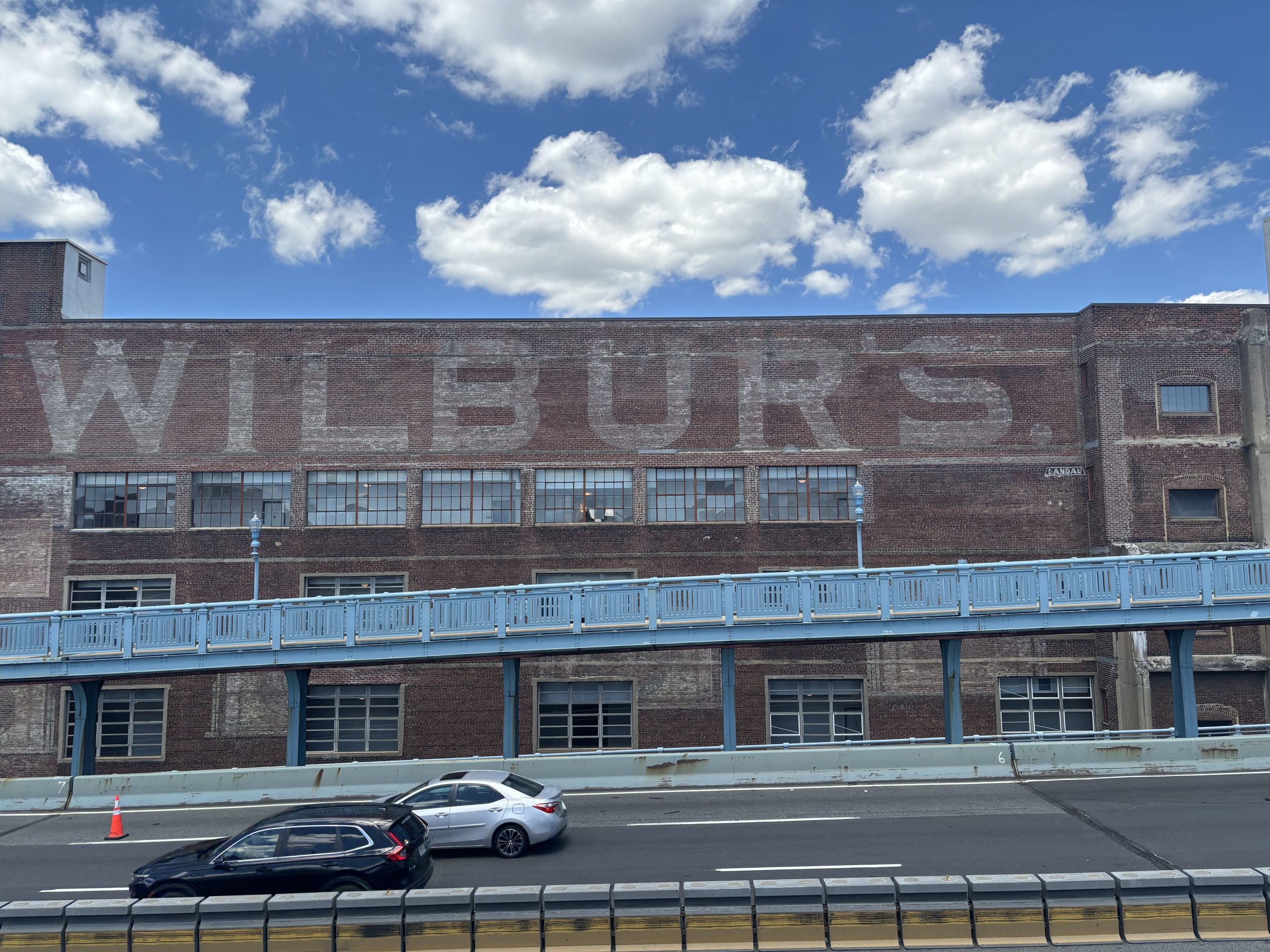
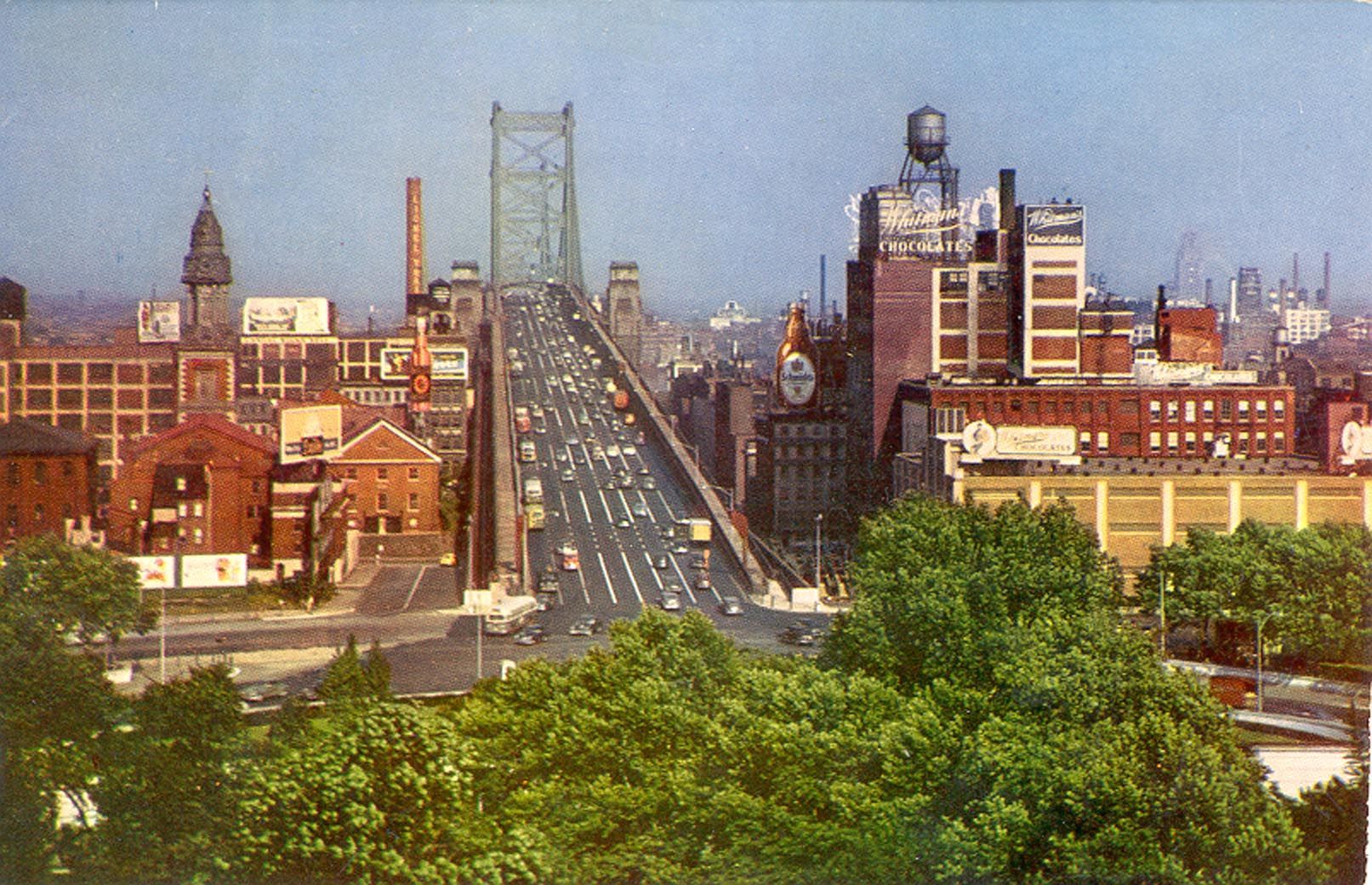
    Howard pointed out the old Wilbur Chocolate factory on Third Street and explained that a part was sliced off to make way for the bridge.

    “One of the things that we had to do when we were constructing was kind of take a surgeon’s scalpel to the area because you know with Old City, everything’s tightly packed and we wanted to make sure we took the bare minimum of structures,” he said.

    A piece of the former Wilbur’s Chocolate Factory had to be sliced off to make way for the Benjamin Franklin Bridge.Stephanie Farr / Staff

    Also under threat when the bridge was built was nearby St. George’s United Methodist Church on Fourth Street. Opened in 1769, it’s the country’s oldest Methodist church in continuous service.

    “Luckily, the engineers were able to just adjust the angle of the approach ever so slightly to avoid encountering the building,” Howard said.

    I marveled as I looked at the mere 14 feet that still separates St. George’s from Philly’s big Ben. The engineers left just enough room for the Holy Spirit.

    ‘Bridge angels’

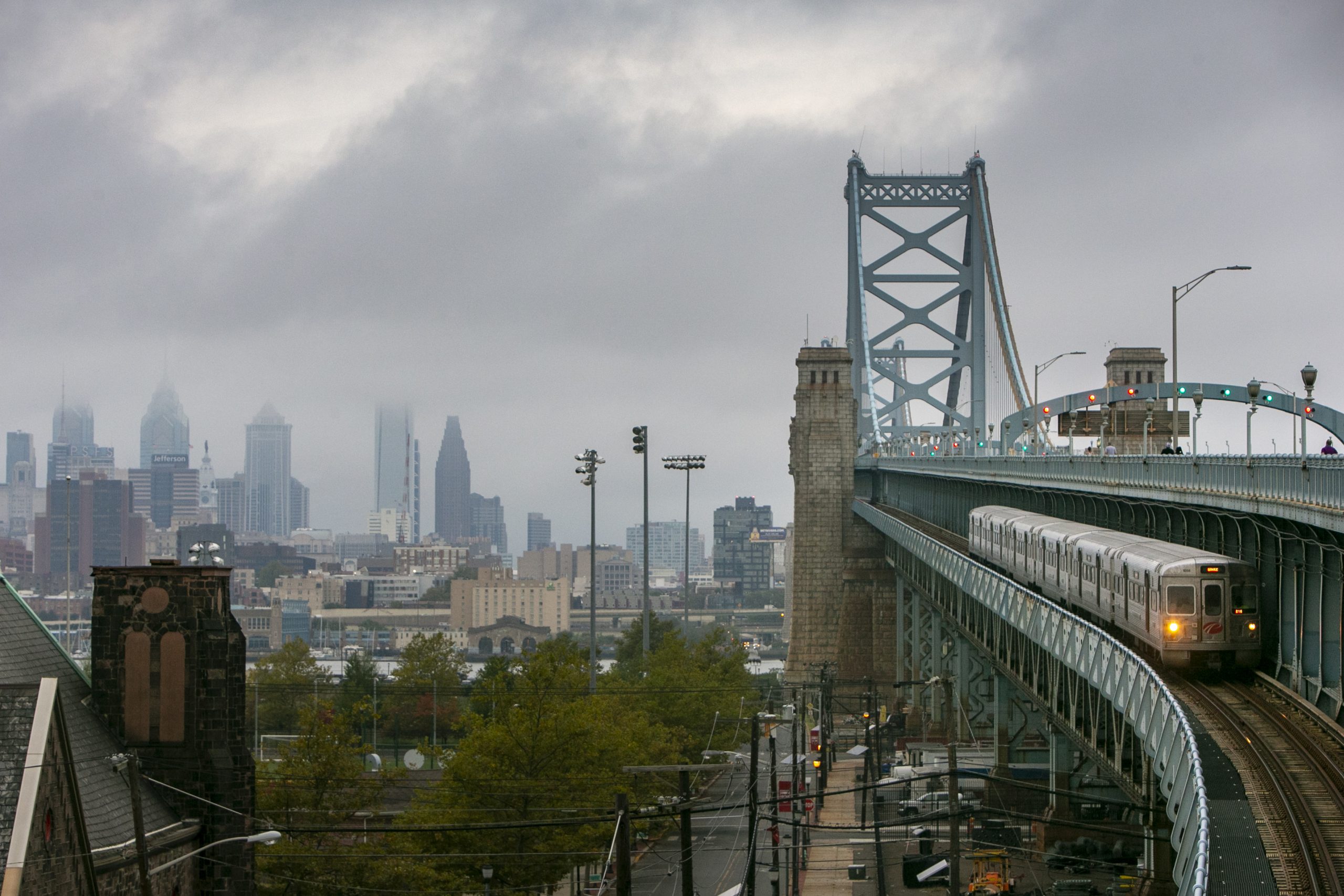
    As we began our journey across the bridge, Howard said it took about four-and-a-half years to build and it was designed by architect Paul Philippe Cret, who also designed Philly’s Rodin Museum. The bridge was constructed with eight lanes — six for traffic and two for trolleys, as well as two tracks for heavy rail.

    But in the time it took to build it, trolleys went out of fashion and buses came in. The trolley tracks sat unused until the 1940s, when they were paved over. A vast, empty space for a never-opened trolley station remains under the Bolt of Lightning sculpture near the base of the bridge.

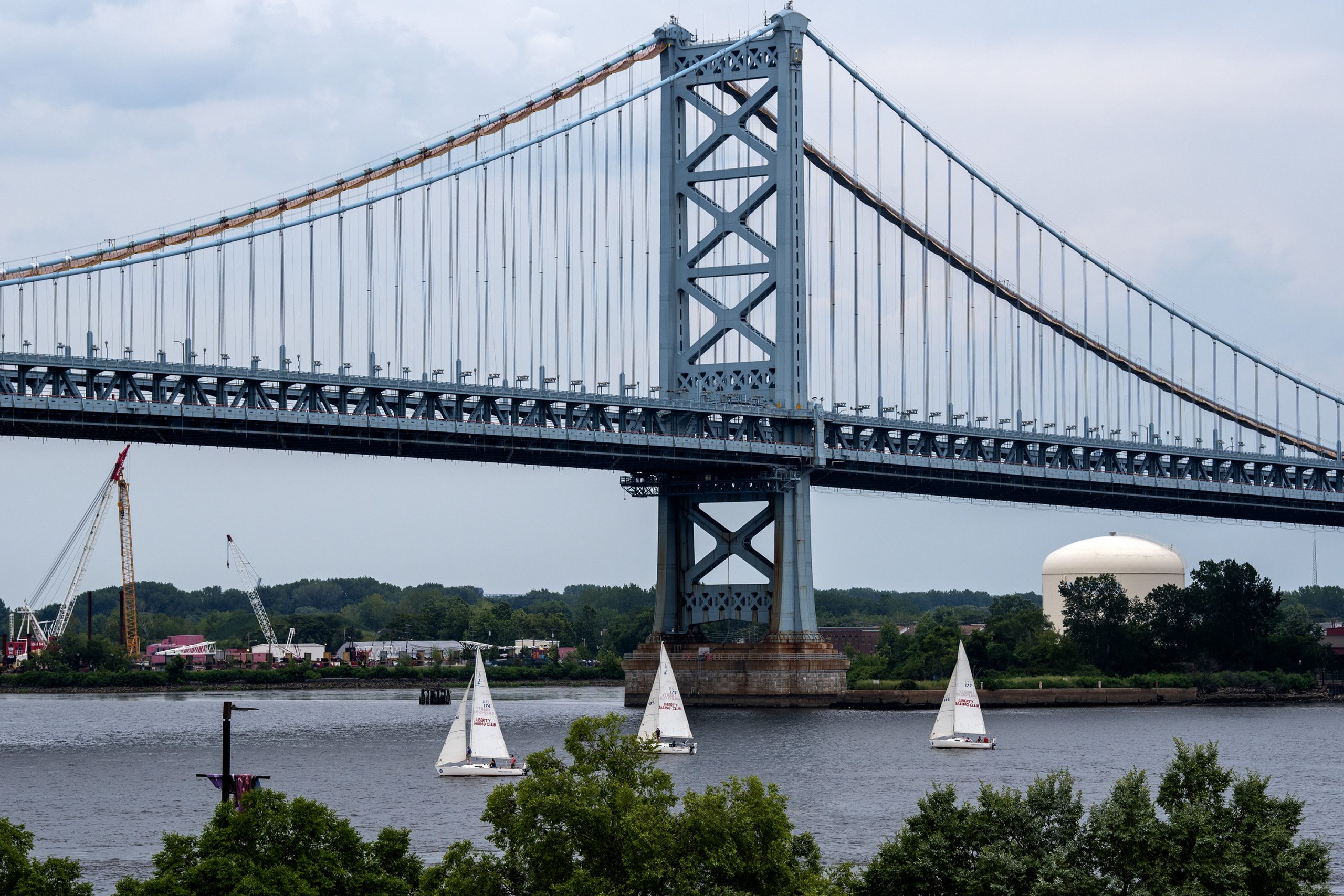
    Sailboats pass under the Ben Franklin Bridge in 2020.TOM GRALISH / Staff Photographer

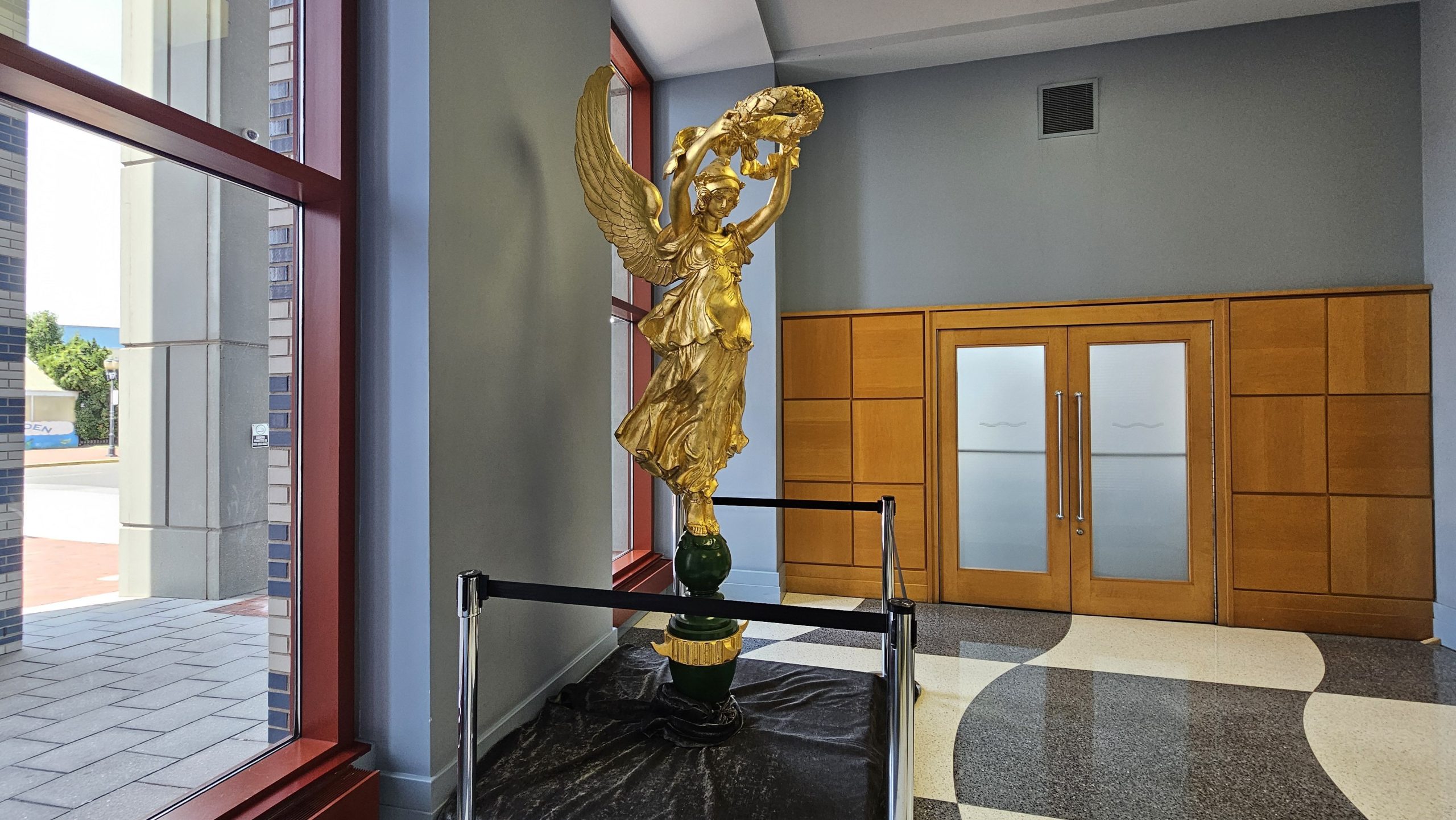
    Another original component lost when the trolley tracks were paved over were four 75-foot-tall pylons — two on either side of the bridge — that were topped with bronze angel statues called Winged Victory.

    One of the angel statues is in the lobby of DRPA’s headquarters and three are in storage, but one will be displayed at the upcoming 100th anniversary celebration, according to Williams.

    One of the four “Winged Victory” statues that used to decorate the Ben Franklin Bridge is now on display at the Delaware River Port Authority’s headquarters.Courtesy of the Delaware River Port Authority

    ‘A living beast’

    Shortly after we began our trek on the 1.3-mile walkway, I felt a PATCO train speeding beneath my feet and the bridge move ever so slightly.
    “The bridge is dynamic, almost like a living beast because the steel expands when it gets warm out and with traffic, it bounces,” Howard said.

    A PATCO train travels from Philadelphia to Camden underneath the pedestrian walkway of the Ben Franklin Bridge. ALEJANDRO A. ALVAREZ / Staff Photographer

    I got used to the sensations within minutes. That being said, I’m not afraid of heights. It could be unnerving if you are.

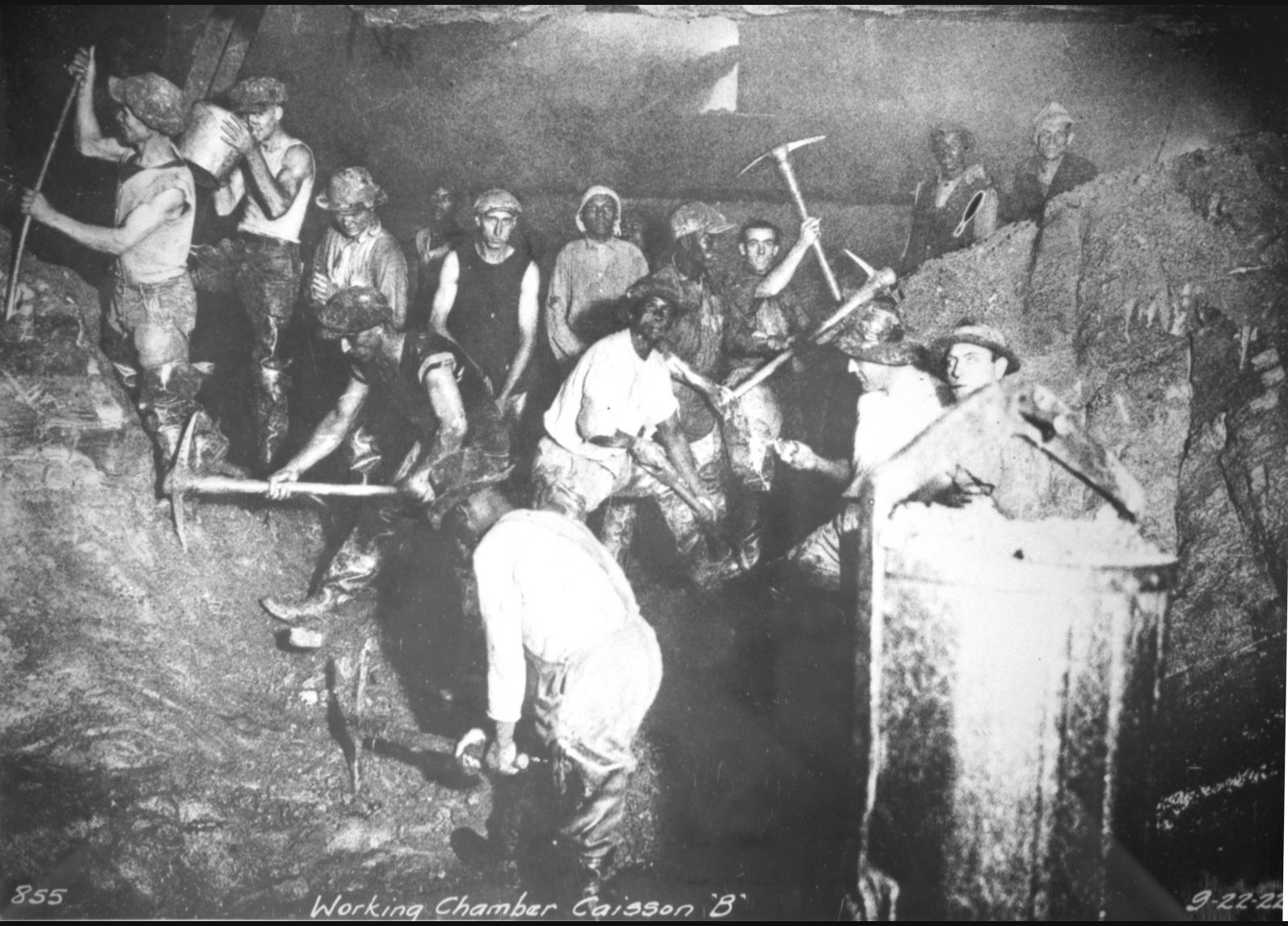
    It took $36 million and 1,300 people to build the 376-foot-tall bridge that extends an additional 100 feet or so below the river, Howard said. Guys known as “sand hogs” worked in submerged watertight structures called caissons where temps sweltered into the 90s, even in winter, to dig down to the bedrock of the Delaware River.

    In a photo dated 1922, men known as “sand hogs” work in a submerged watertight structure called a caisson to dig down to the bedrock of the Delaware River during the construction of the Benjamin Franklin Bridge.Courtesy of the Delaware River Port Authority

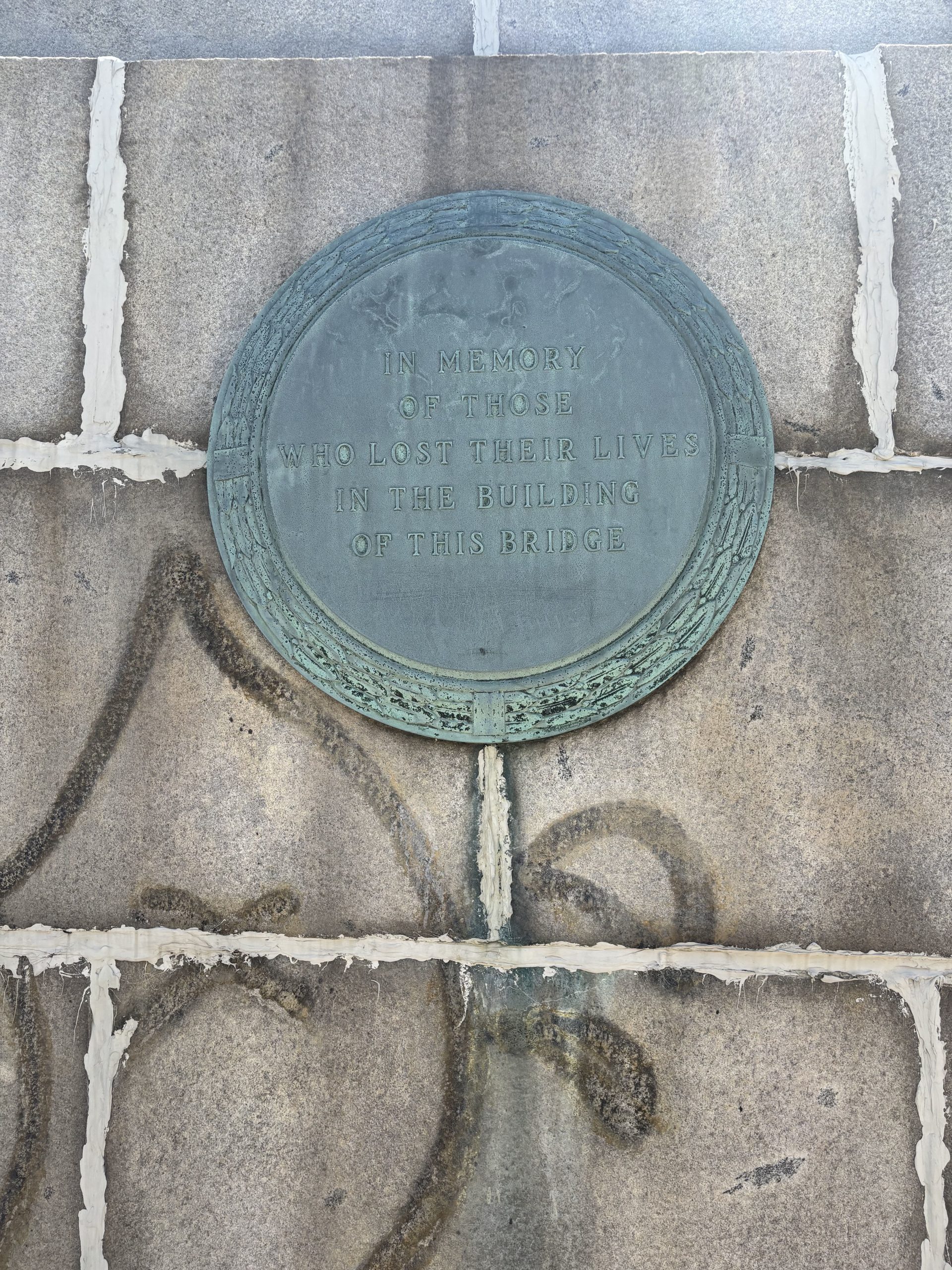
    Fifteen workers died in the construction of the bridge. We passed a circular plaque in their memory as we walked. I wondered who they were, how they died, and how they lived.

    “Unfortunately, the rule of thumb at the time was for every million dollars you’re spending, you expect to lose a life … so by that rationale you could have had 36 fatalities.” Howard said. “Nowadays, you know, one injury is unacceptable.”

    A plaque on the Benjamin Franklin Bridge is dedicated in memory of those who lost their lives while building it.Stephanie Farr / Staff

    Unique elements

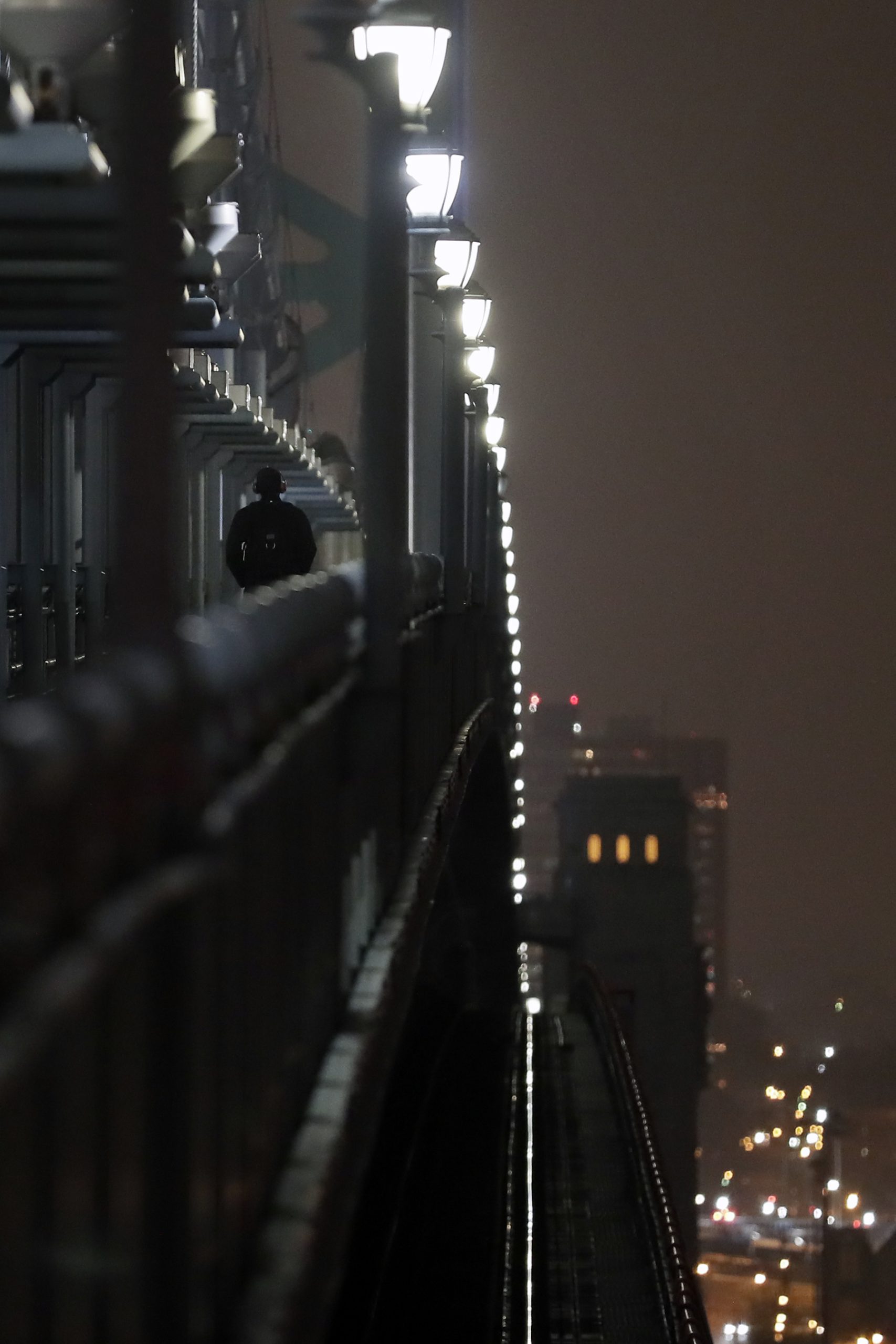
    Our pace was a steady stroll, so we were often passed by runners, walkers, and cyclists. Some appeared to be having a good time, and others looked like they were going through tough times. Some talked to themselves and some stopped to take photos. It was a microcosm of Philly and Camden, suspended high above the river.

    Howard said when the bridge was built, its chief engineer believed the walkways wouldn’t be used “in an increasingly or completely motorized age.”

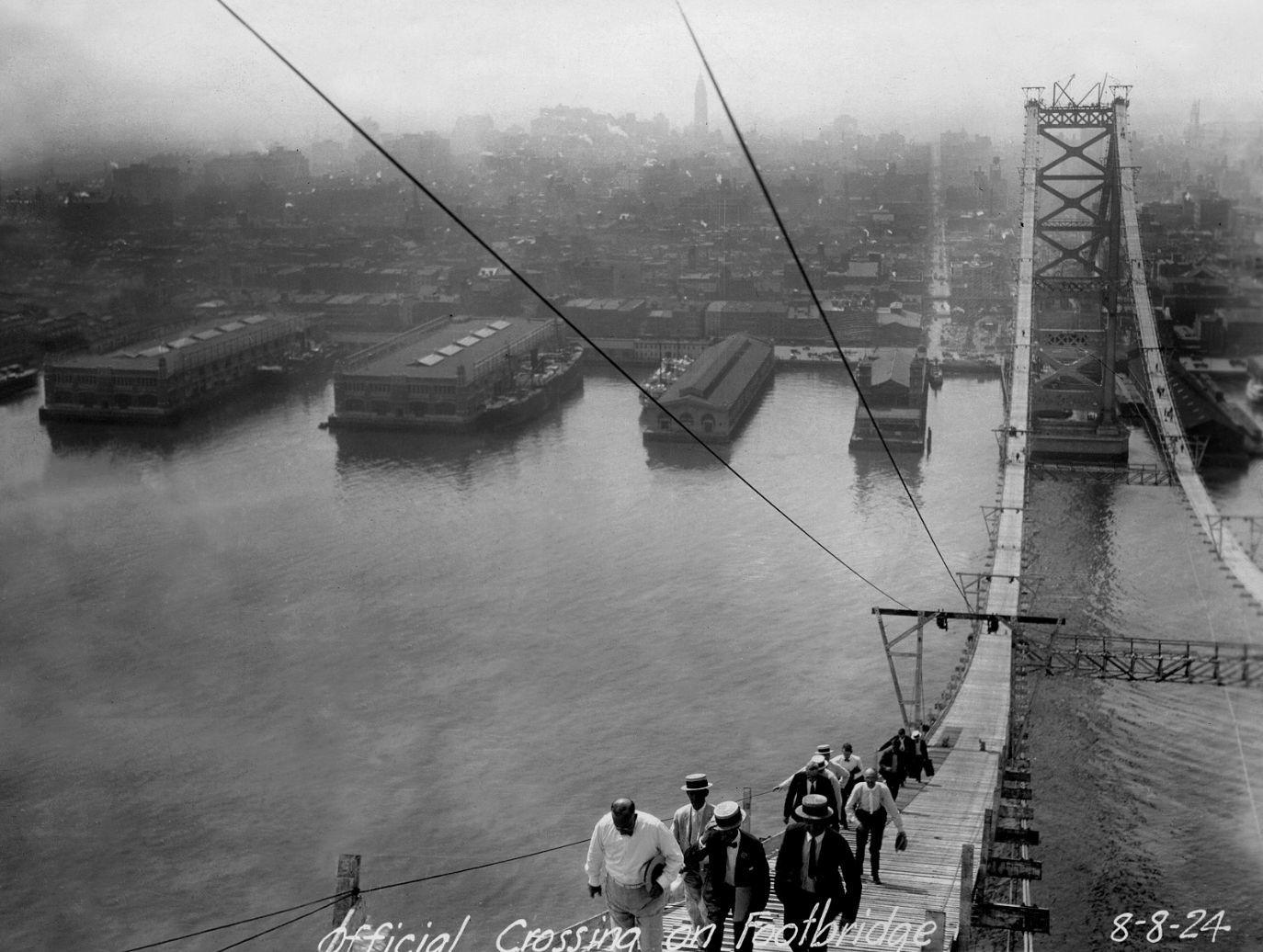
    A photo dating from 1924 shows the first official crossing of the Benjamin Franklin Bridge’s pedestrian walkway prior to the 1926 opening of the bridge.Courtesy of the Delaware River Port Authority

    “But you see today the amount of people that are using this walkway and it’s one of the unique elements of this bridge,” he said.

    I looked ahead to Camden and then back to Philly. I was so grateful for this walkway and this view. I couldn’t imagine not having it and I couldn’t believe it took me so long to see the city from this new perspective.
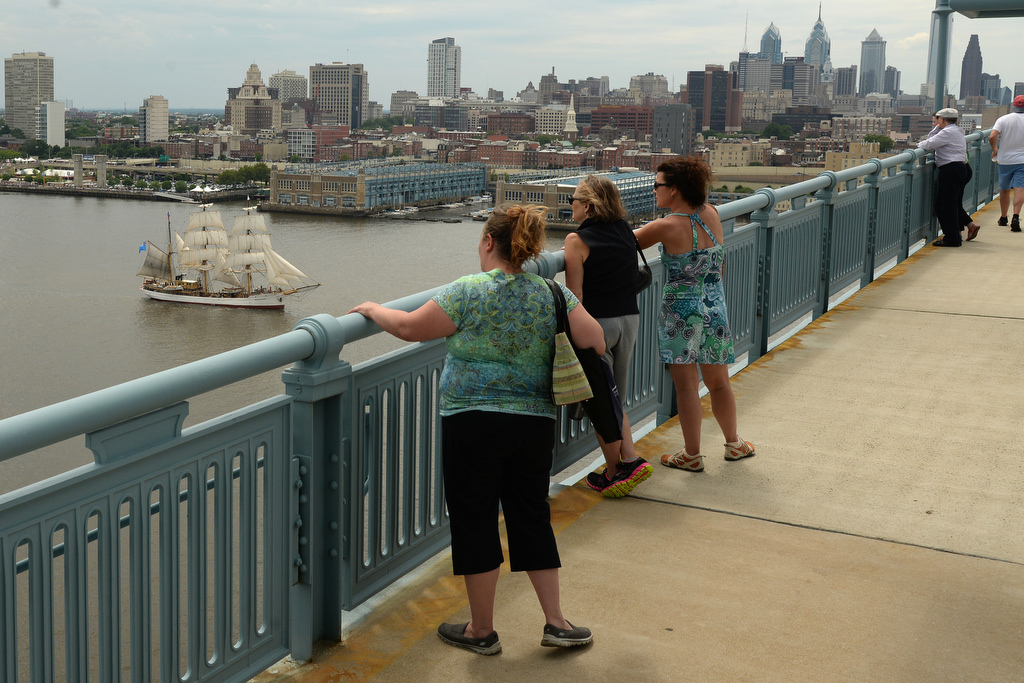
    Spectators watch from the Ben Franklin Bridge pedestrian walkway as the Picton Castle sails up the Delaware River in 2015 during the Parade of Tall Ships.

    The only thing I found worrisome and the thing that kept all three of us looking over our shoulders, were the e-bike and e-scooter riders we didn’t always hear zooming behind us. Skateboards and rollerblades aren’t allowed, but certain classes of e-bikes and e-scooters are. Gas-powered vehicles are also prohibited on the walkway, but a guy on a dirt bike definitely zoomed by at one point.

    In the bridge’s early days, horses and carriages were allowed on the main span alongside cars, according to Howard, but their slow pace proved dangerous and their excrement, troublesome, so they were banned in the 1940s.

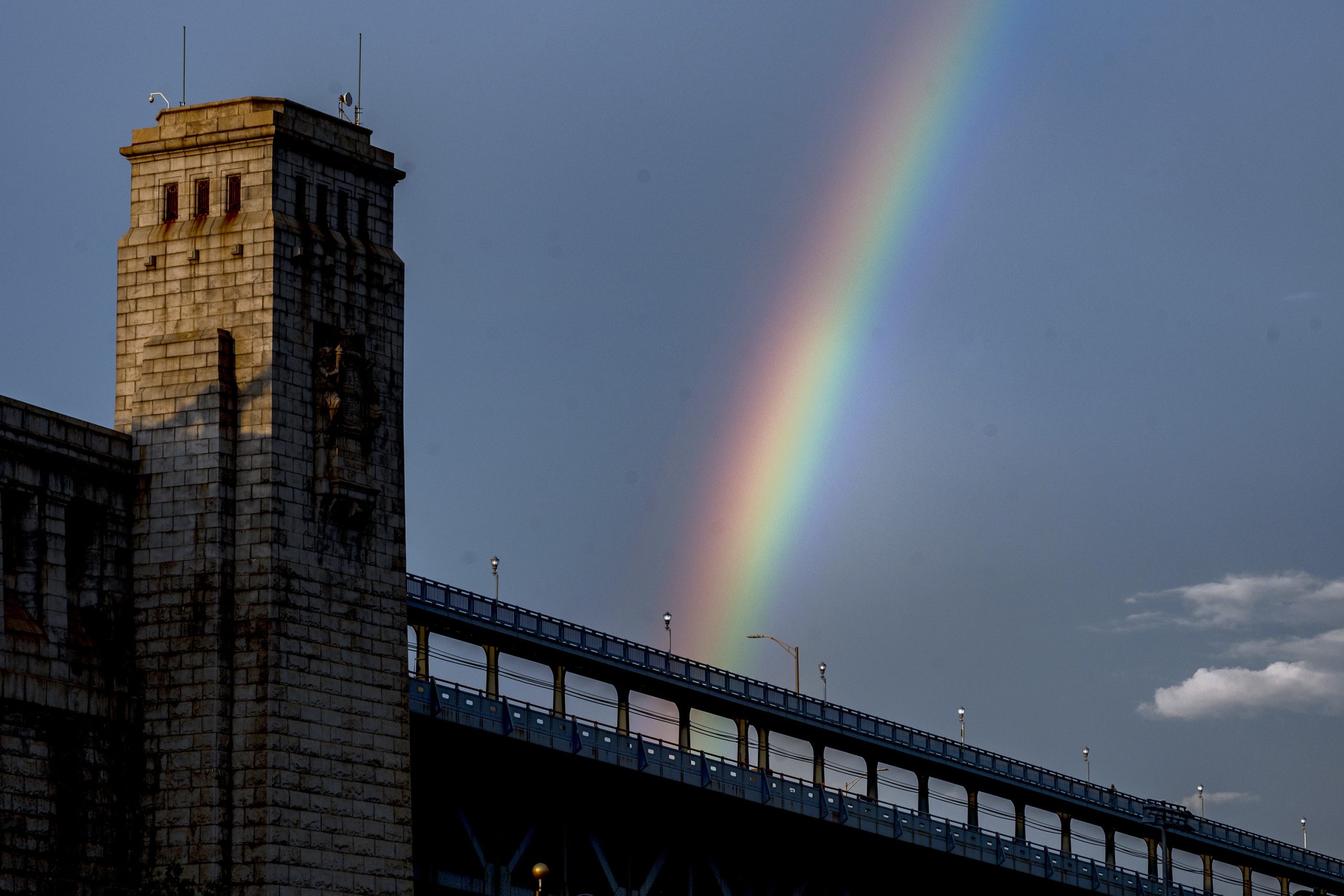
    A rainbow appears behind the Camden anchorage of the Ben Franklin Bridge after an early evening rainstorm passes through.TOM GRALISH / Staff Photographer

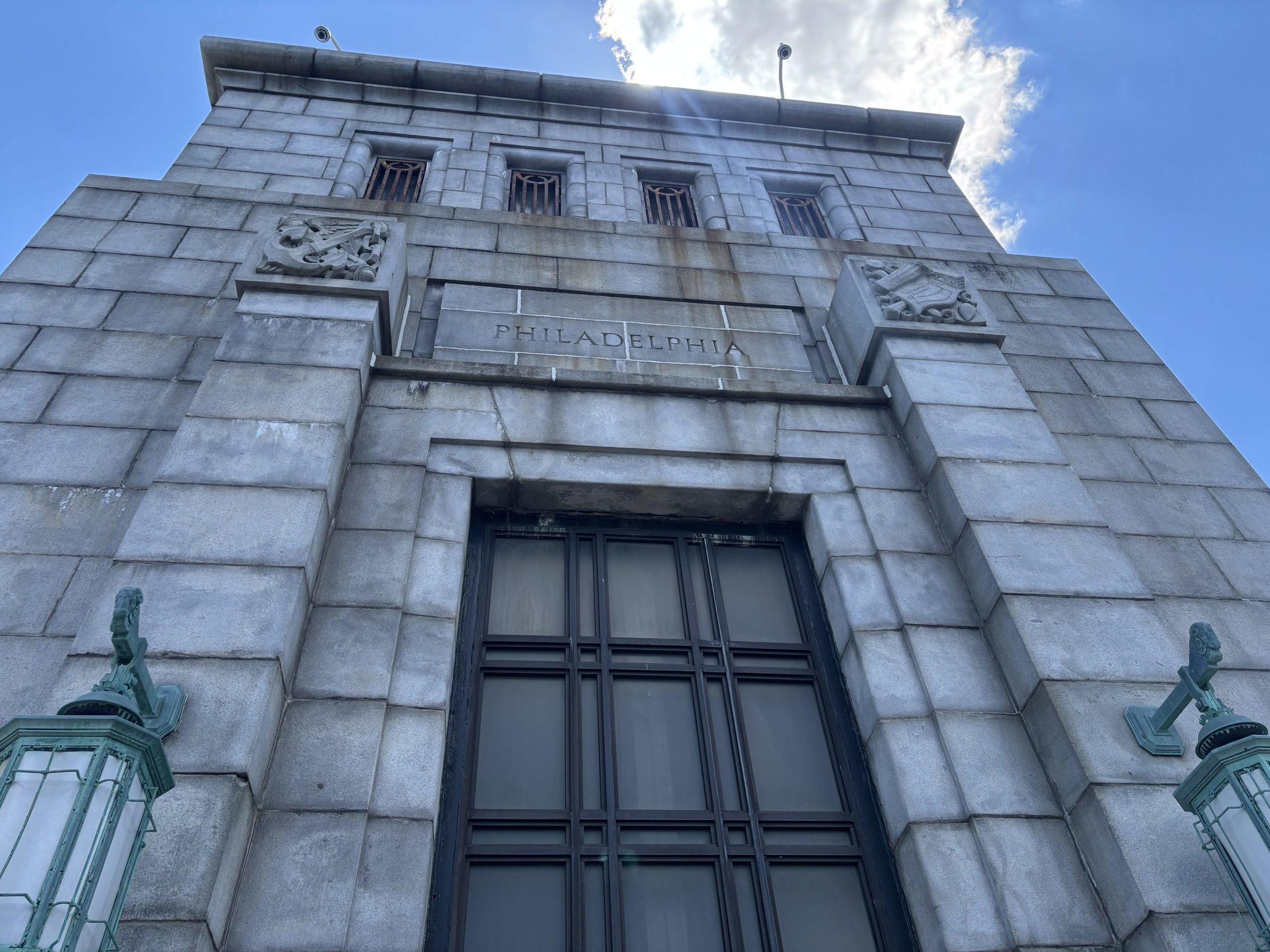
    We stopped at one of the Philadelphia anchorages, the massive concrete-and-granite structures where the bridge’s cables are anchored.

    These structures were made to house elevators for the trolleys. Alas, the anchorages are off-limits spaces, but Howard told me that each of the four have the same seven artistic tiles inside commemorating milestones in transportation, from one of a Conestoga wagon to one of the USS Shenandoah, the ill-fated dirigible that crashed before the bridge even opened.

    One of the anchorages on the Philadelphia side of the Benjamin Franklin Bridge as seen from the pedestrian walkway.Stephanie Farr / Staff

    Another name

    The Ben Franklin Bridge was the longest suspension span in the world, with a distance of 1,750 feet between the two towers, when it opened on July 1, 1926.

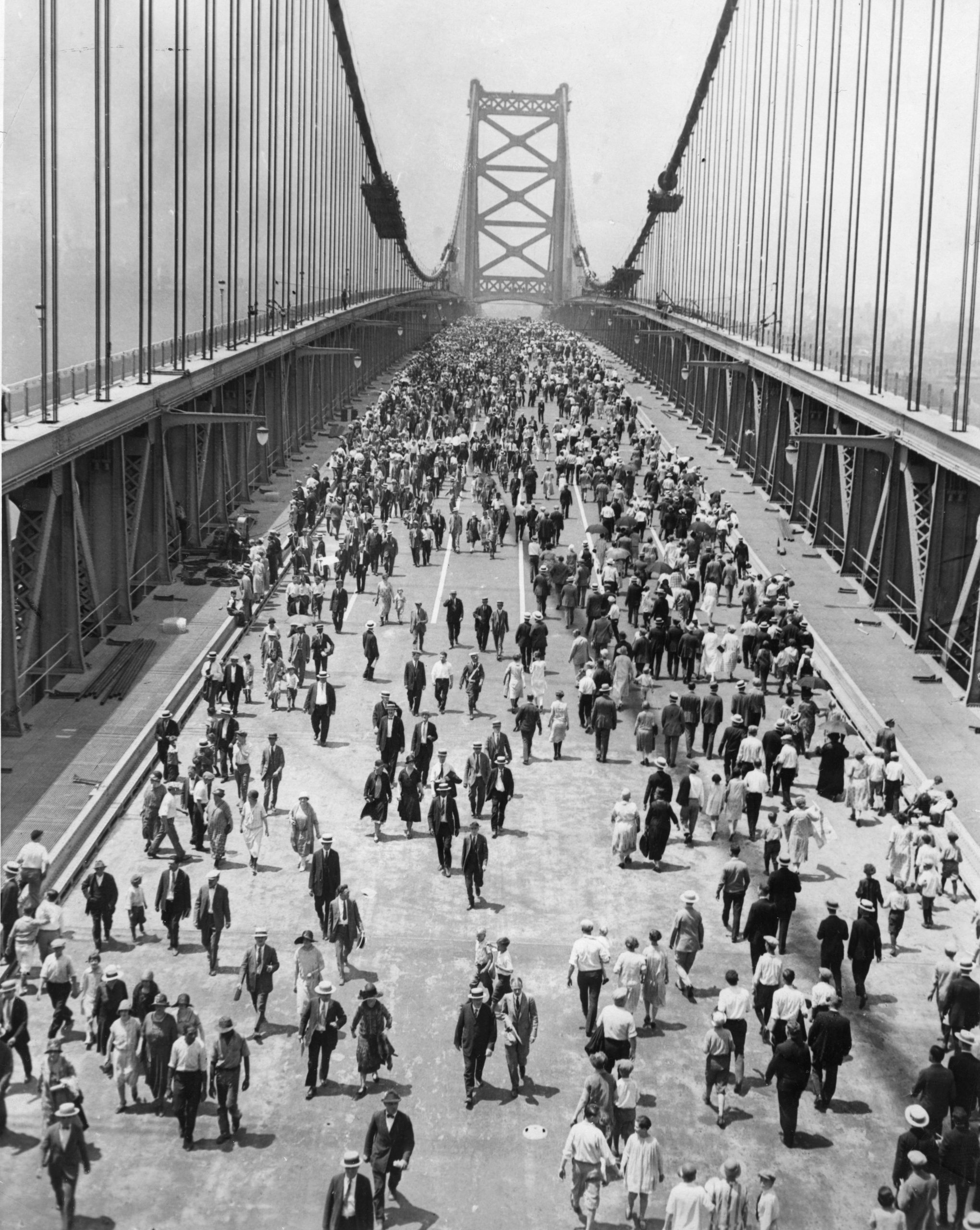
    In a front-page Inquirer report, journalist Richard J. Beamish noted 250,000 people crossed the bridge on foot opening day and that the structure was “beautiful as gossamer web and seemingly as frail.”

    Pedestrian cross the Delaware River Bridge on its opening day in 1926. Philadelphia Inquirer archive

    Howard, who quoted that report to me, then asked: “When do you think our first accident was?”

    I guessed July 2, 1926. I guessed wrong.

    “It was the day it opened,” he said. “People were jockeying to be one of the first to cross the bridge, and over in Camden, you had a fender bender.”

    Back then, the span also had a different name — the Delaware River Bridge. It was rechristened in 1956 to avoid confusion when the Walt Whitman Bridge was also built over the Delaware River.

    A view of the Benjamin Franklin Bridge in the 1950s.Courtesy of the Delaware River Port Authority

    The Ben Franklin Bridge wasn’t always blue, either. It was originally gray and was repainted to its current color just ahead of the Bicentennial, Howard said.

    ‘Calm and serene’

    As we stood talking, a man jogging by in Rocky Run T-shirt asked if we’d take a photo of him with the Philly skyline.

    Jim Bach of Voorhees works in Camden and likes to run the bridge during his lunch break.

    “It’s fantastic. I mean the views that you get when you’re up here, it’s just calm and serene,” he said.

    I too felt serene. It was quiet and peaceful on the bridge and being atop it helped me see the city I love in a new way.

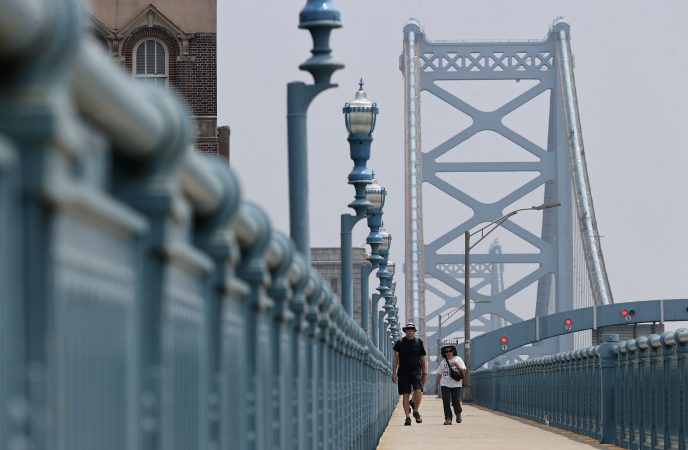
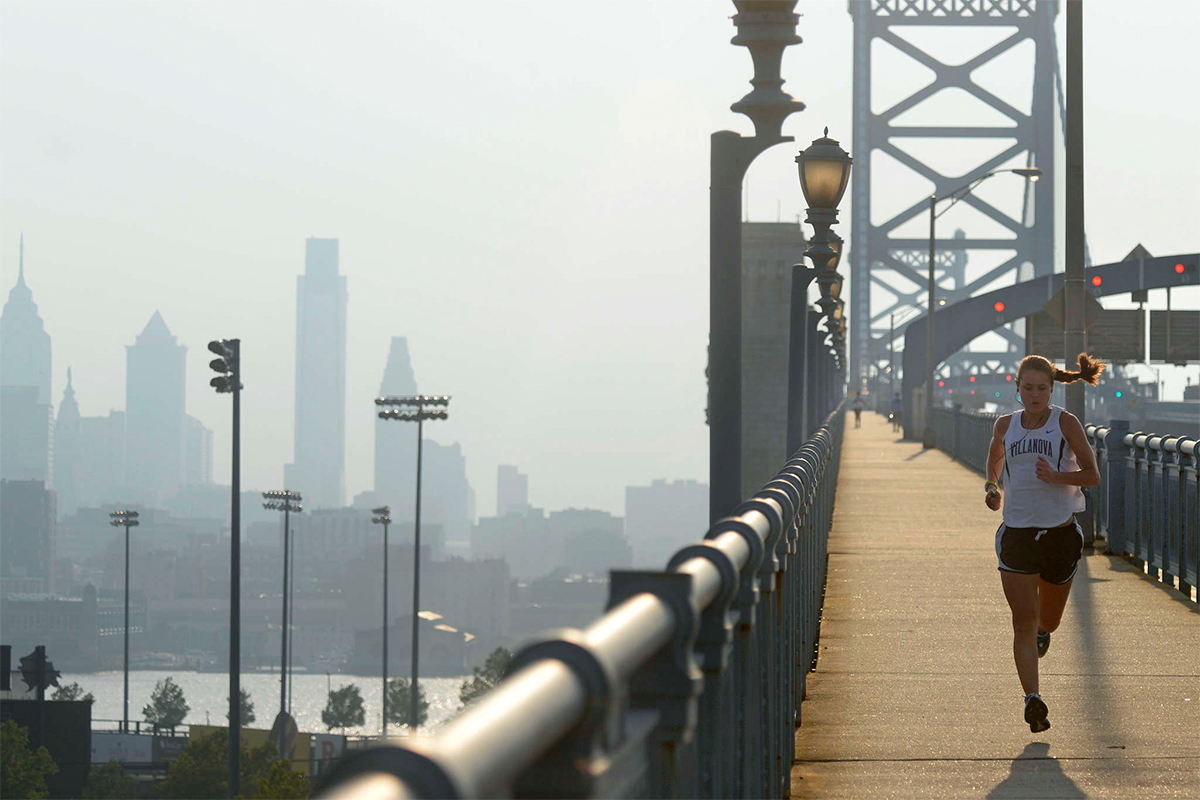
    A jogger runs across the Ben Franklin Bridge in an Inquirer file photo.TOM GRALISH / Staff Photographer

    Howard also helped me to see something else — the Betsy Ross, Walt Whitman, and Commodore Barry Bridges are all visible from the top of the Ben Franklin.

    “All bridges essentially become monuments to the area,” he said. This was most true of the one we were standing on.

    We talked about the Ben Franklin’s many appearances in television and movies, from Blow Out to 12 Monkeys.

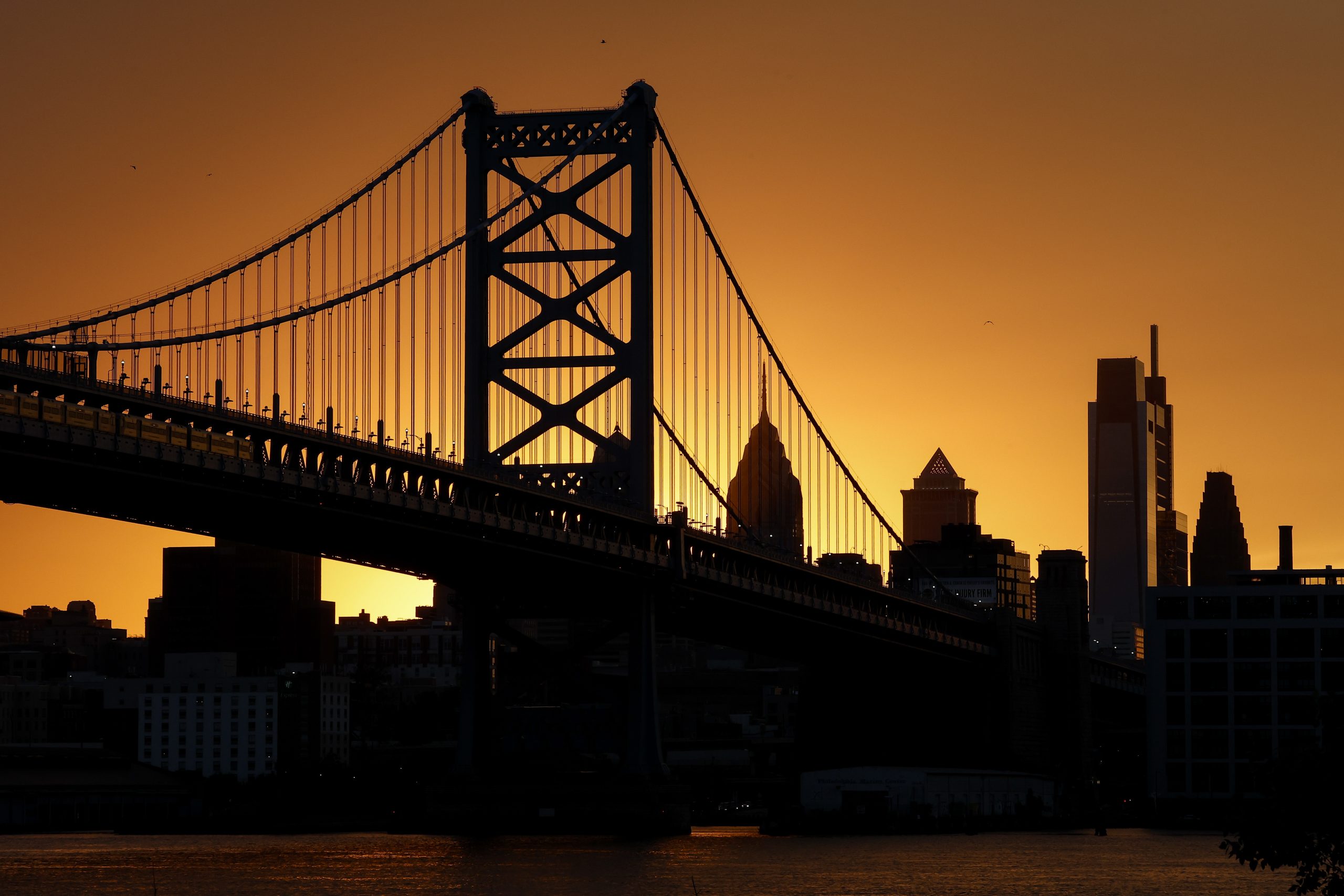
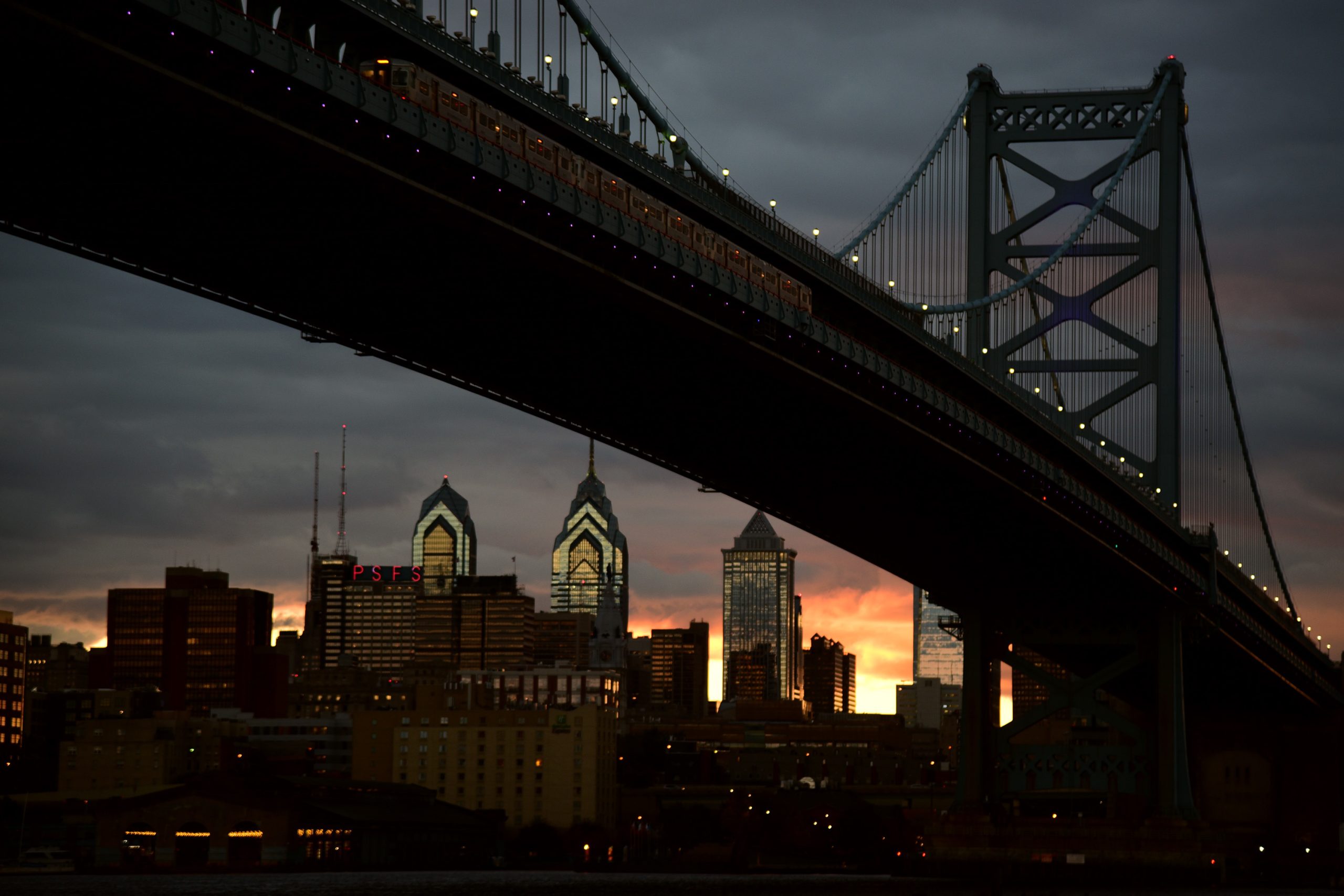
    The sun sets behind the Ben Franklin Bridge, seen from Cooper’s Poynt Park on Tuesday, Sept. 30, 2025 in Camden, NJ.Monica Herndon / Staff Photographer

    “Last year they kept coming back from commercial breaks during Monday Night Football and they showed one of three things — the Liberty Bell, someone making cheesesteaks, or the bridge,” Howard said.

    In its 100 years, the bridge has become a visual touchstone for the region. You see it and you know you’re in Philly, whether you’re watching a movie or coming back from a road trip. It’s given Philly its sense of place as much as the LOVE sculpture or Independence Hall.

    A great connector

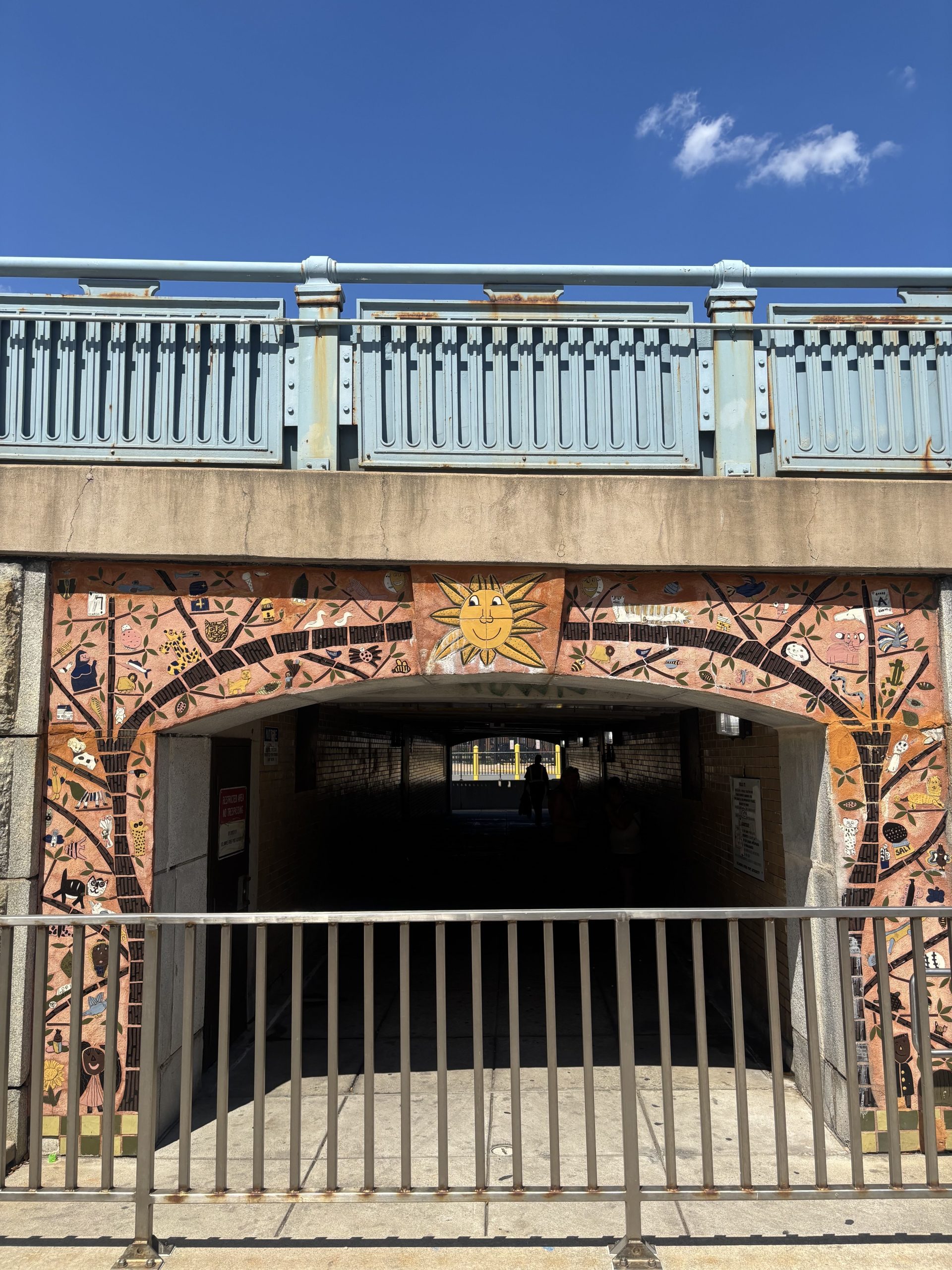
    When we got to Camden, we walked through the pedestrian tunnel on that end, too. It doesn’t have a mural, but the exterior is decorated with a bright mosaic of birds and animals created by Camden schoolchildren in the early 2000s.

    A mosaic created by Camden schoolchildren decorates the exterior of the pedestrian tunnel on the Camden side of the Benjamin Franklin Bridge.Stephanie Farr / Staff

    On our return walk, I asked Howard if he had a moment on the bridge that’s stuck with him. He said a few years ago, while he was leading a tour, there was a commotion on the Philly side. A kitten found its way onto the bridge and police were called. The feline then crawled into the engine compartment of a police cruiser, which had to be taken apart to get it freed.

    “I was like, ‘Yeah, so I gotta go adopt it,’” Howard said.

    And so he did, and he named the furry little girl Beanie.

    I thought of a poignant moment I had once on the bridge. I was a passenger in a vehicle years ago, when I looked over and saw that the car I was in was traveling at relatively the same speed as the PATCO train next to us.

    The sun sets over the Philadelphia Skyline behind the Benjamin Franklin Bridge looking southwest from Cooper’s Point Waterfront Park in Camden in this Inquirer file photo.Tom Gralish

    I locked eyes with a woman on the train, who looked a lot like me. We smiled at each other and I waved and she waved back. It’s a brief moment that’s always stuck with me. Maybe it’s because I felt like I could have been her in another life, or she could have been me.

    Walking the bridge and hearing its stories, I realized that it connects so much more than just Camden and Philly. It connects all of us to each other — in big and small ways — and it connects our future with our history.

    Today, I have a new story about the Benjamin Franklin Bridge, the day I walked across it. If you haven’t done so yet, I encourage you to walk it, too, and make a new memory with one of Philadelphia’s great old structures.

    A man walks across the Ben Franklin Bridge towards Camden in an Inquirer file photo.ELIZABETH ROBERTSON / Staff Photographer

    The anniversary celebration for the Ben Franklin Bridge will take place from 10 a.m. to 2:30 p.m. July 11. Details can be found at drpa.org/bfb100/.

  • Another Jan. 6 coup? Trump is screaming it out loud. | Will Bunch Newsletter

    What amazes me about the fact that America turns 250 on Saturday is that I’ve been alive now for 27% of U.S. history. When I was 17 and watched the Bicentennial parade of tall ships down the Hudson River from my dad’s conveniently located Manhattan skyscraper office on July 4, 1976, I thought I was celebrating ancient history. I was wrong. In a big, diverse world, the United States remains a young adult among nations. Like most young adults, we have a lot of issues.

    If someone forwarded you this email, sign up for free here.

    Trump thinks anything besides stealing the election is ‘a big yawn’

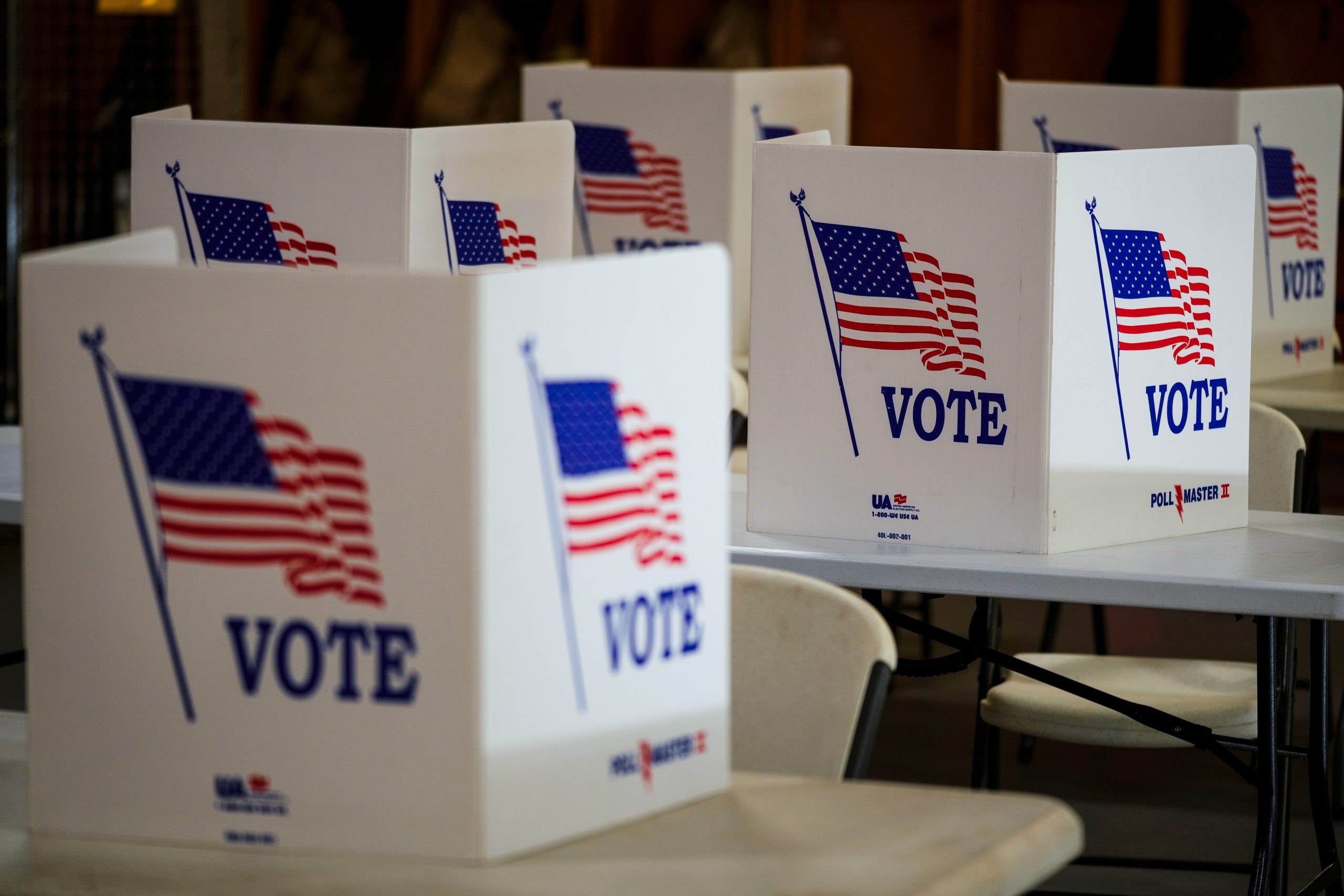
    Voting booths are set up at a polling place in Newtown in 2024.Matt Rourke

    Donald Trump gets a lot of flak, and deservedly so, for telling so many lies. On Monday, he held an Oval Office press availability, and much of what he said — false claims that other nations don’t have birthright citizenship or mail-in voting — was flat-out untrue.

    But nothing is scarier than when the 47th president speaks the truth about what’s really on his mind. Because the only thing that’s in Trump’s brain right now is stealing the November midterm election by changing the rules in his favor … or worse. If Trump’s vocal cords were not so weak and diminished, he’d have been screaming the quiet part out loud.

    A reporter asked the president about last week’s abrupt cancellation of a ceremony to sign a popular and surprisingly bipartisan bill to lower the cost of housing. Trump tied that move to an extortionary threat that Congress must pass his bill, which is called the SAVE America Act, but which could ruin democracy by suppressing votes.

    “Here’s what I would like to say,” Trump said of the still-unsigned housing bill, which passed in the House by a 396-13 vote. “It’s a yawn. Some people say it’s wonderful. To me, compared to the SAVE America Act, just about everything is a big yawn.”

    In quainter times, Trump’s disrespect for the housing bill — a grab bag of measures all geared toward encouraging contractors to build more units, which would lower both purchase prices and rents — might be the political gaffe of the year. Currently, only 29% of Americans think it’s a good time to buy a house, and nearly two-thirds are more likely to vote for a Congress member who helped lower prices. Republicans who voted for the bill are desperate for a win.

    Trump doesn’t care. He’s forgotten his “forgotten Americans” who think the rent is too damn high, not to mention the GOP members of Congress who’ve followed him off the cliff. But that’s not even close to the most alarming thing about Trump’s Oval Office moment of truth.

    The president says the only thing he cares about — even with his conflict in Iran becoming another “forever war,” and with the economy down the toilet for everyone who’s not a tech trillionaire — is a bill that critics say would be a disaster for free and fair U.S. elections. One report found that some 12 million people who fairly and successfully voted in the 2020 presidential election don’t have the documentation — such as a birth certificate or passport — that the bill requires.

    We don’t know how such a massive drop in turnout would change the election results, or whether a weakened Trump can pressure the GOP to find a way to pass a bill with zero Democratic support. But we do know this: The president’s maneuvers are not even the worst thing Trump has done this month on the steal-this-election front. Not by a long shot.

    The Trump regime has been signaling for months that it sees the U.S. intelligence community — spy agencies like the CIA — not as a tool for finding out what comes next in the Persian Gulf, or if or when China is invading Taiwan, or when Vladimir Putin’s Russian empire will fall. No, Trump wants secret agents who can creatively invent theories of foreign-born election fraud that would demand a strongman response.

    We saw this coming back in January, when the regime dispatched Trump 47’s first director of national intelligence, Tulsi Gabbard, to Fulton County, Ga., to oversee an FBI raid of voting materials from the 2020 election that Trump, with no evidence, continues to dispute. That link made it clear the regime is looking to create links to foreign actors.

    When Gabbard left the administration this spring, Trump named a temporary replacement who can serve through the November election: Bill Pulte, who also continues to lead the Federal Housing Finance Agency. Pulte lacks a key prerequisite for his new job — any experience in intelligence whatsoever — but has the only quality that matters to Trump: undying loyalty. Pulte’s main focus in the housing job has been combing through the mortgage records of the president’s political enemies, looking for undotted i’s and uncrossed t’s that could be used to manufacture criminal charges from nothing.

    In just a few days at intelligence, Pulte has not disappointed his boss. He showed up Monday and immediately began firing current staffers, with a rumored list of hundreds. The steep reduction in eyeballs on the world’s trouble spots is disturbing, but what’s even more alarming is the one person Pulte has hired.

    The newsletter SpyTalk described Pulte’s new chief of staff, Christina Norton, as “a party-loving MAGA activist with no background in national security issues but who last year boasted of running ‘the largest election integrity operation the Republican Party has ever seen’ …”

    The pairing of Pulte and Norton is an alarm bell that the national intelligence team under Trump will have one job: investigating fantastical “foreign election plots” that will be cited to justify radical measures like sending troops to polling places, seizing voting machines, or worse.

    SpyTalk noted that Norton, in her active Instagram feed, “talks about supervising more than 200,000 Republican poll watchers ‘standing guard’ at polling booths and vote-counting stations across the country” during her 2024 stint at the Republican National Committee.

    Yet, intelligence is just one of many tools in the federal government that the obsessive Trump is working to activate ahead of a November election that polls suggest will be a “blue wave” for Democrats hoping to retake Capitol Hill. Trump has issued several executive orders seeking to assert federal control over voting, which has been a state and local function throughout 250 years of American history.

    That effort suffered a bit of a setback Monday, when the U.S. Supreme Court ruled that states can continue to count mail-in ballots that are postmarked before Election Day but arrive after the polls have closed. But that will not stop the Trump regime from politicizing the U.S. Postal Service ahead of November.

    Last week, Postmaster General David Steiner told Congress that USPS plans not to deliver mail-in ballots in states that don’t turn their voter rolls over to the Trump regime, a demand many governors have resisted so far. “President Trump does not believe that elections he loses are valid,” Democratic Michigan Sen. Elisa Slotkin said after the hearing. “It’s all part of his authoritarian playbook.”

    This all feels very familiar. In the lame-duck days after Trump’s 2020 election loss to Joe Biden, the 45th president — instead of packing up to return to Mar-a-Lago — got busy putting in a new team at the Pentagon, ordering the U.S. Department of Justice to probe alleged voter fraud, challenging vote count certifications in court, and urging state lawmakers to seat rival slates of electors. Most pundits laughed this off, but I wrote a column — “So, is President Trump staging a coup, or what?” — that ran on Nov. 10, 2020, nearly two months before the actual attempted coup on Jan. 6, 2021.

    Now Trump is not only staging another coup, but he is yelling about it, in your face. There is nothing he won’t try over the next five months to prevent a Democratic Congress from investigating how he and his family have made billions of dollars off the American presidency.

    When Trump says anything that’s not election meddling is a “big yawn,” this should be our wake-up call. The time for a full-court press — lawsuits, public hearings, and investigative journalism — can’t wait until after the election. The new putsch has already begun.

    Yo, do this!

    • If you didn’t think I raced to download the new audiobook of Zayd Ayers Dohrn’s tale of growing up in the radical Weather Underground in the 1970s and ’80s — Dangerous, Dirty, Violent, and Young: A Fugitive Family in the Revolutionary Underground — then you must be new around these parts. Dohrn had already used his unique access to his parents — Bernardine Dohrn and Bill Ayers, revolutionary royalty — and their friends to tell a history of that era’s far left in 2022’s award-winning podcast, Mother Country Radicals. His new book aims to go deeper into the psychology of what it was like to be raised as a toddler on the run from the FBI, or whether bombings and bank robberies can change the world. That’s a question — also explored in this viral essay — with new resonance in the Trump era.
    • A few weeks ago, I suggested that folks see the new movie The Sheep Detectives. The film is already streaming on Amazon Prime (which produced it), and Sunday’s rare night off for the World Cup offered the excuse to finally watch. I can now highly recommend it. The movie — with an adapted script by the acclaimed showrunner of HBO’s Chernobyl, Craig Mazin — manages to merge police procedural cliches with moving thoughts about prejudice, existentialism, and what it means to belong to a flock. Even a flock of talking sheep.

    Ask me anything

    Question: Is Markwayne [Mullin, the Homeland Security secretary and former Oklahoma senator] the least qualified cabinet level official in American history? — Richard McGovern (@richardmcgovern.bsky.social) via Bluesky

    Answer: Good question from Richard, a fellow long-suffering Philadelphia Union fan. Not because I know the answer, when there are rivals for the title like Donald Trump’s war-losing “Secretary of War” Pete Hegseth, to name just one. But Mullin is now behind a move so outlandish that it showed me I haven’t lost my capacity for shock after all. This weekend, Trump nominated a previously unknown former Oklahoma state trooper named Lance Schroyer to run U.S. Immigration and Customs Enforcement, a powerful agency with 22,000 agents and a budget of around $30 billion a year. It turns out that just recently, Schroyer was heading a security detail for Mullin in Washington, D.C., and has become a close enough friend that he is an occasional dinner guest. Yes, he hired his bodyguard to run the equivalent of a large corporation. Stay tuned for all of this to unravel.

    What you’re saying about …

    I guess we’re not as close as we thought, as very few of you were eager to share your July Fourth plans with me or discuss what America’s 250th birthday means at such a dark moment. The ones who did reply are looking forward to spending time with family and friends, but all that patriotic jazz, not so much. “Probably, we will have our usual picnic and take the grandkids to see the local fireworks, but I have no intention to watch any special programming or parades, etc.” Marianne Zollers wrote. “It will just make me sad. Such a different feeling compared with the Bicentennial which was such a joyous and happy occasion for my entire family.”

    📮 This week’s question: One of the big stories of 2026 that’s finally getting a lot of attention is the success of more progressive Democrats, including democratic socialists, in key primary races against party moderates. Is this a good thing, lifting up candidates who’ll fight against Trump and for the working class? Or do you worry Republicans will capitalize against their opponents with more left-wing views? Please email me your answer and put the exact phrase “2026 progressive Democrats” in the subject line.

    Backstory on crossing the World Cup off my bucket list

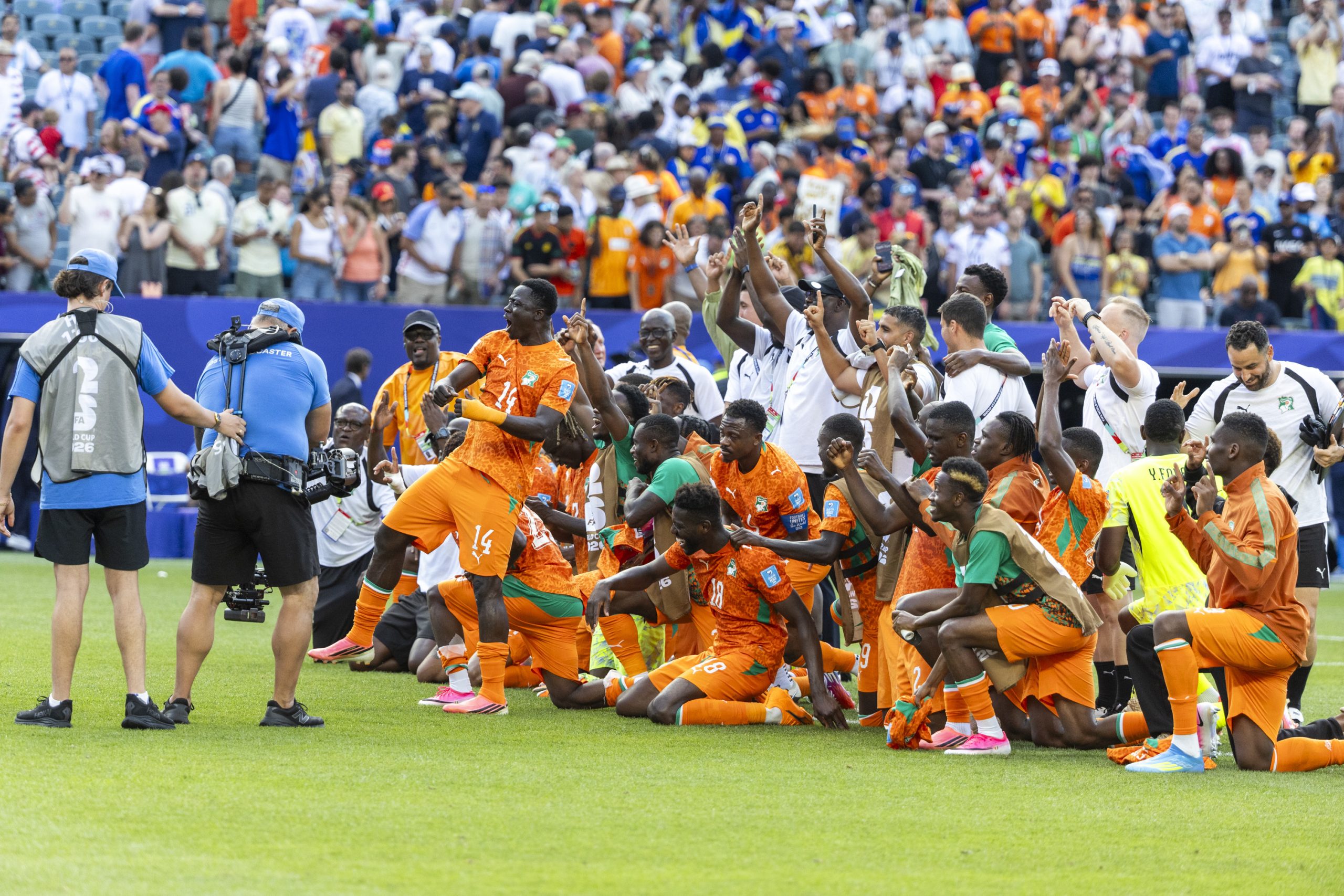
    The Ivory Coast team celebrates their win in the middle of the field against Curaçao with a score of 2-0 for the FIFA World Cup at the Lincoln Financial Field in Philadelphia on Thursday.Tyger Williams / Staff Photographer

    I can’t say exactly when, but at some point during my first-ever in-person World Cup match between Côte d’Ivoire and Curaçao, watching from the thin air of the top deck of the temporarily renamed Philadelphia Stadium, it struck me: My decades-long dream of being there for the world’s greatest sporting event was not like what I’d imagined.

    And yet, in some weird, quasi-religious acid test kind of way, it was even better.

    I’ve been to countless sporting events going back to 1968, but never one where the vibe was basically: So happy to be here. I’ve certainly never been to a game where the PA announcer uttered something before the match about giving a big hand to both teams — and the sold-out crowd obliged. Fans would have burned down Section 220, Row 27, where I was sitting, if this had happened during an Eagles-Cowboys game. During a tense match with a place in the Round of 32 on the line, the gathering repeatedly did the wave and threw their vocal cords more behind the halftime singalong of the Bruce Channel 1961 oldie “Hey! Baby” than either of the two decisive goals by Côte d’Ivoire’s Les Éléphants.

    Up in nosebleed country, many of the fans repped soccer jerseys, but they were for club teams like Liverpool or Christian Pulisic’s USA No. 10, joined by me in my Philadelphia Union T-shirt. We were Philly’s soccer aficionados, desperate to be a part of maybe the only time in our lives the World Cup would take place in the City of Brotherly Love. A match pitting the smallest nation to ever qualify for the FIFA tourney (Curaçao, population 158,000) and an African underdog was pretty much the only way to crash the party without a bank loan. (Full disclosure: I paid about $280 apiece for two seats on StubHub — much like buying a stock, it could have been more or less, depending on how one timed it.)

    No, this wasn’t much like the Eagles games played here, where excitement merges with pins and needles of anxiety. On a picture-perfect late afternoon in June, bookended by the Philadelphia skyline and a lazy Delaware River, it felt more like a rock concert. It wouldn’t have seemed out of place if folks had started batting a beachball around at this soccer Woodstock. There was a mind-meld of the faithful, who saw FIFA and its commercialization as the devil, with the loudest boos for the TV-ad-laden “hydration breaks,” but with — I swear to God — a loud roar for the announcement of the attendance: 68,324. In a city where a 1976 Bicentennial match of some of the world’s best players took place in a mostly empty stadium, soccer is indisputably here to stay.

    Fans walked out of Philadelphia Stadium beaming less over the final score and more about the instant karma of the afternoon. After years of tavern taunts and ridicule from sports-talk radio, local soccer die-hards lived long enough to see America’s founding city become the world’s co-capital of the sport that, for its true believers, passes all understanding. It was all too beautiful. If I can somehow make it to Spain or Portugal or Morocco in 2030 (because, hey, I need a new bucket list now), I will be sure to wear some flowers in my hair. Soccer time will be a love-in there.

    What I wrote on this date in 2019

    I’ve been writing about the topic of journalism reform since the mid-2000s, or around the time it became clear to me and a lot of other folks that newsrooms needed to change or die. My fear, circa 2006 or so, was that we’d start seeing entire communities without newspapers or the accountability journalism that flows from that — which is exactly what happened in Youngstown, Ohio, when its paper closed seven years ago. I wrote: “The loss of the Youngstown Vindicator every morning doesn’t mean that the region’s 200,000 people will no longer be getting information. It just increases the likelihood they’ll be getting bad information — intentionally manipulated, and sometimes out-and-out fakery.”

    Read the rest: “How the first U.S. city with no daily newspaper will help Trump in 2020.”

    Recommended Inquirer reading

    • Only one column this week, as I took a well-deserved day off to attend the World Cup. In that piece, I looked at the sorry state of justice in America on the eve of its 250th birthday, with an emphasis on the outrageous sentences — ranging from 30 to 100 years — handed down to left-wing anti-ICE protesters convicted of rioting in North Texas. The U.S. Department of Justice that pushed these virtual life sentences is also pardoning the right-wing rioters of Jan. 6, 2021, as well as billionaire fraudsters who donate money to MAGA players and causes. They’ve made a mockery of liberty and justice for all.
    • Let’s be honest: People — not to mention sheep (see above) — can’t get enough of a murder mystery, especially a real-life true crime. It’s been a while since a crime saga has riveted Philadelphia readers as much as the stench of possible foul play that is growing at a home on West Chew Avenue in the city’s Olney section that police have branded a crime scene as they search for clues in the disappearance of two local women. Since the case broke open last week, nearly a dozen Inquirer reporters have produced riveting articles about the discovery of drugs, chemicals, and “a significant amount of blood” at the Horsch family residence, profiles of the two missing women — Amy McHale and Blair Tonzelli — and interviews with neighbors who talked about living next door to “a house from a scary movie.” The backstory here is that — whatever you may have heard about AI — it still takes a lot of human shoe-leather to get to the bottom of a story like this. Subscribing to The Inquirer is a twofer: You get to hurdle the paywall to read compelling journalism and feel good about being a supporter.

    By submitting your written, visual, and/or audio contributions, you agree to The Inquirer’s Terms of Use, including the grant of rights in Section 10.

  • Five wacky things I saw on the Nic Cage bar crawl

    Five wacky things I saw on the Nic Cage bar crawl

    Like many, I’m big fan of Nicolas Cage’s work. How big? On my bachelorette party to New Orleans a few years ago I requested we tour St. Louis Cemetery No. 1 so I could get a pic of me and my girls with Cage’s nine-foot pyramid tomb.

    Not only can the man seriously act, he can also seriously overact. As a writer who loves puns ( especially bad ones), I appreciate someone who has fun with their art form to the point it causes eye rolls.

    And so, when I learned about Uncaged in Jenkintown: A Nic Cage cocktail crawl that happened on Sunday, I wanted to check it out. In some ways, it turned out to be like a lot of Cage movies — not a blockbuster, but still quirky and fun.

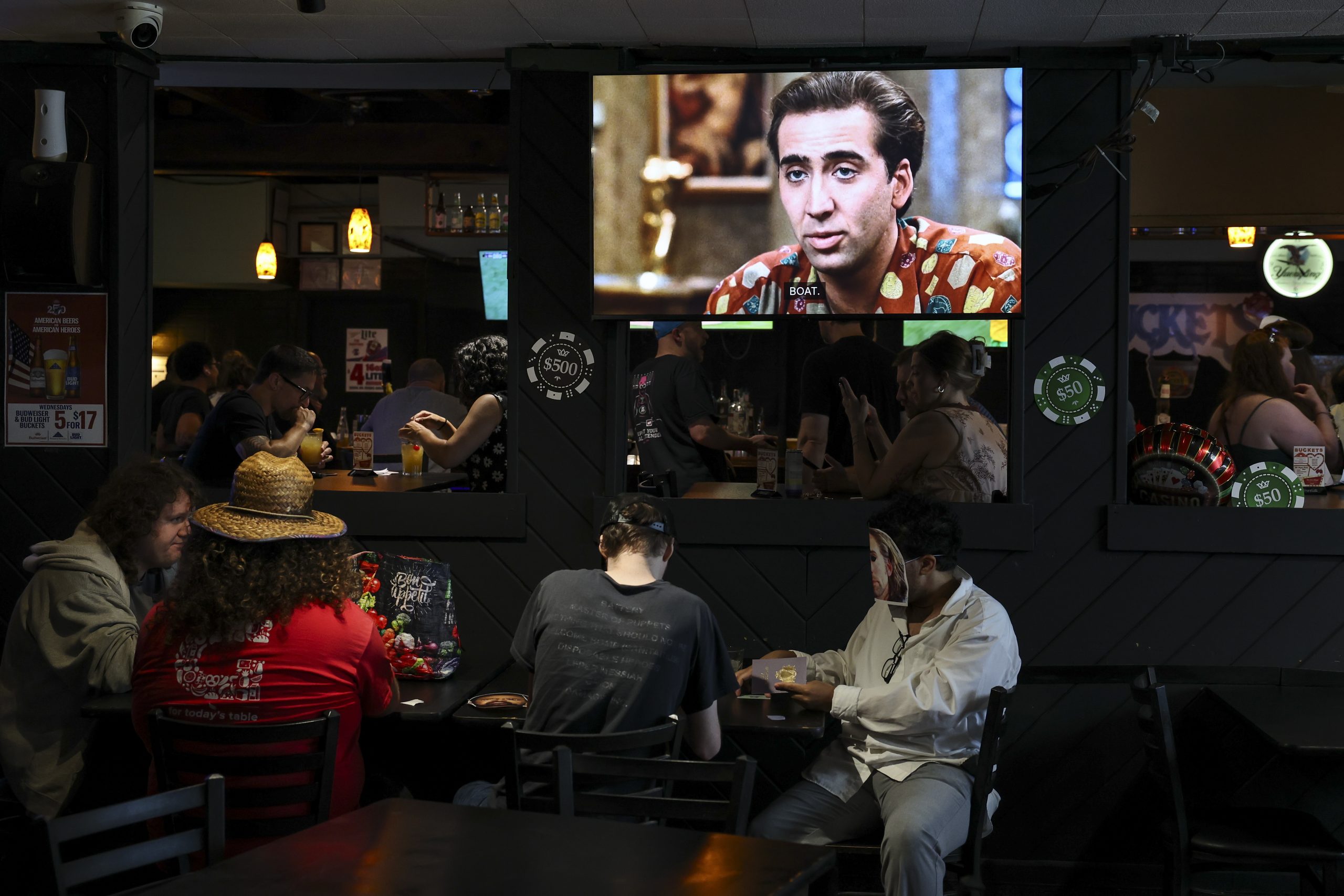
    “Honeymoon in Vegas” plays at Buckets Bar during the Nic Cage cocktail crawl on Sunday in Jenkintown. Monica Herndon / Staff Photographer

    The crawl was spread across four Jenkintown bars — the Keep Easy, the Drake Tavern, Buckets Bar, and King’s Corner. Each one featured Cage-themed cocktails and hosted a “Cage match,” where participants went head-to-head in challenges based on Cage films.

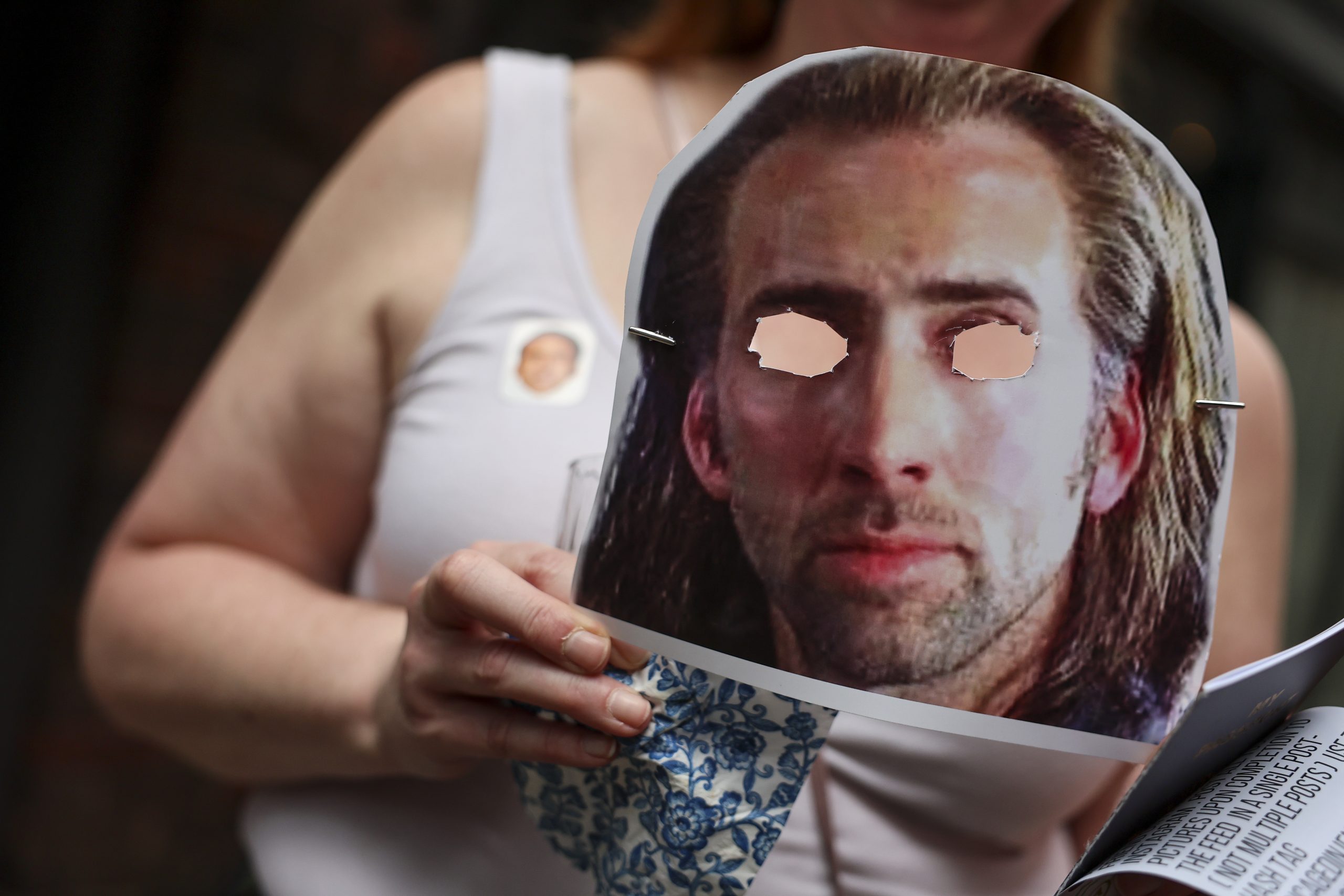
    Organizer Mel Hager, an owner of the Keep Easy, said she sold out of the 50 Uncaged kits she’d prepared for $15 a pop. While the crawl was free to attend, those who bought a kit — including yours truly — received a passport book, which got you a free Cage match at each establishment (otherwise they were $2 to play); a piece of Cage cash, which was good for one shot at any of the bars (it’s a tiny dollar bill with Nic Cage’s face on it, I’m never spending that); and one of a variety of Cage masks (I felt like I won the lottery when I got the Con-Air Cage).

    While I didn’t drink, I hopped around to the bars, tried my hand at the Cage matches, and talked with fellow Cage fans about what brought them out to the event. Here are five of the wackiest things I saw at the Nic Cage bar crawl.

    1. H.I. fashion

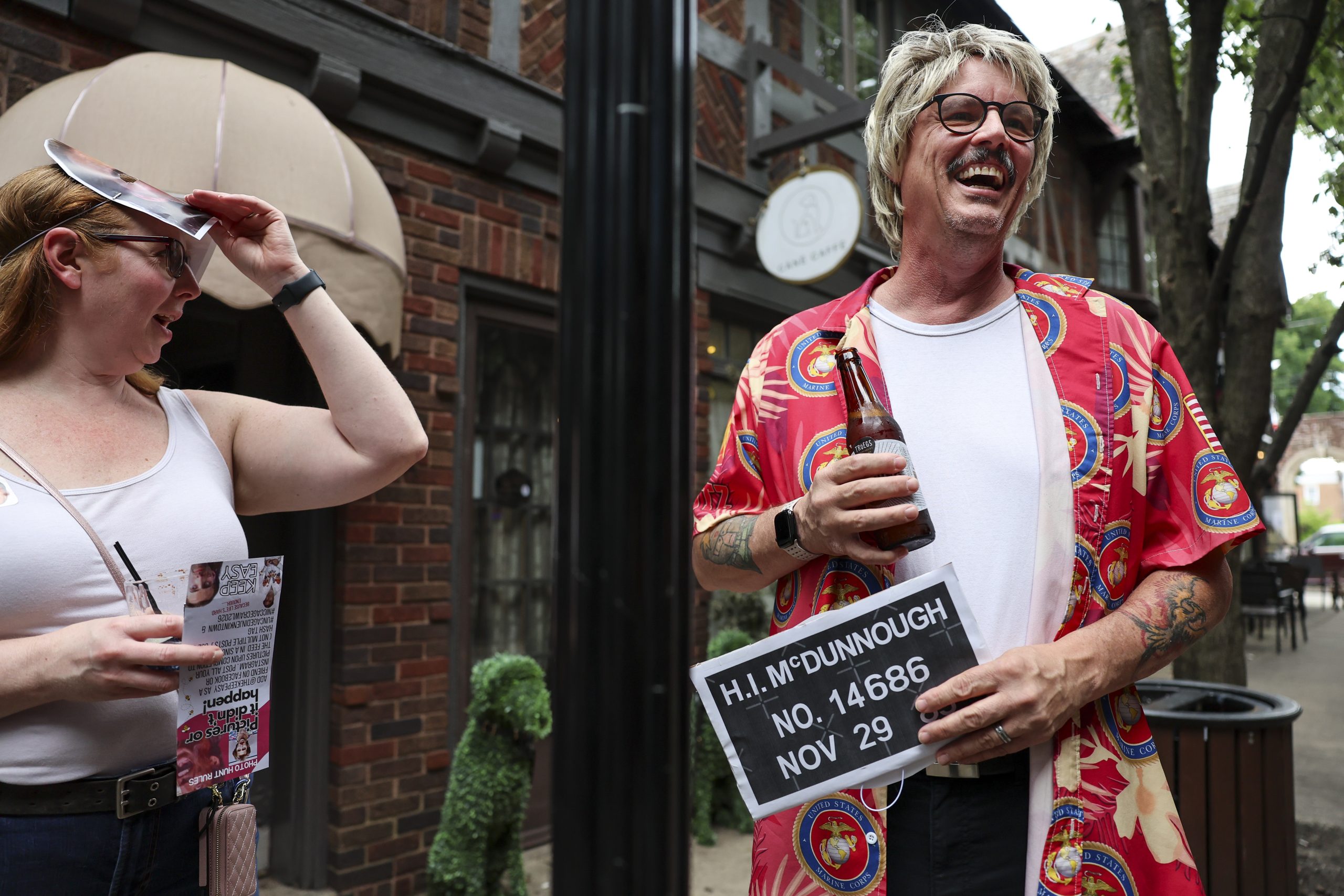
    Vicky and Mike Hutz, of Huntington Valley, at the Keep Easy during the Nic Cage cocktail crawl on Sunday in Jenkintown. Mike Hutz is dressed as Cage’s character from “Raising Arizona,” H.I. McDunnough.Monica Herndon / Staff Photographer

    When H.I. McDunnough kidnaps one of the Arizona quintuplet babies in the 1987 Cohen Brothers classic, Raising Arizona, he proclaims to his wife: “I think I got the best one.”

    Of the few Cage character costumes I saw Sunday — which included Ronny from Moonstruck, Cameron Poe from Con Air, and someone portraying Cage’s first role as an unnamed burger shop worker in Fast Times at Ridgemont High — Mike Hutz’s H.I. McDunnough costume was undoubtedly the best one. Hutz, of Huntingdon Valley, had the open Hawaiian shirt, a wig, and McDunnough’s mugshot board.

    “What else are you going to do on a Sunday afternoon when you have a Nicolas Cage crawl option?” he said. “There’s nothing he can’t do and he does it with maximum cheesiness, which is just perfect for people who love cheesy.”

    2. The faces

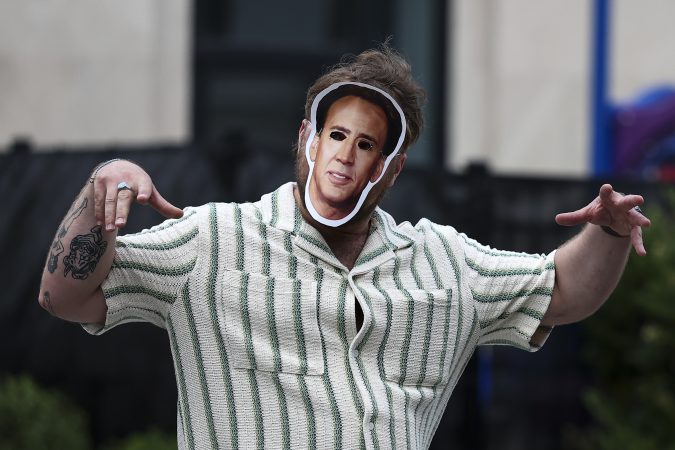
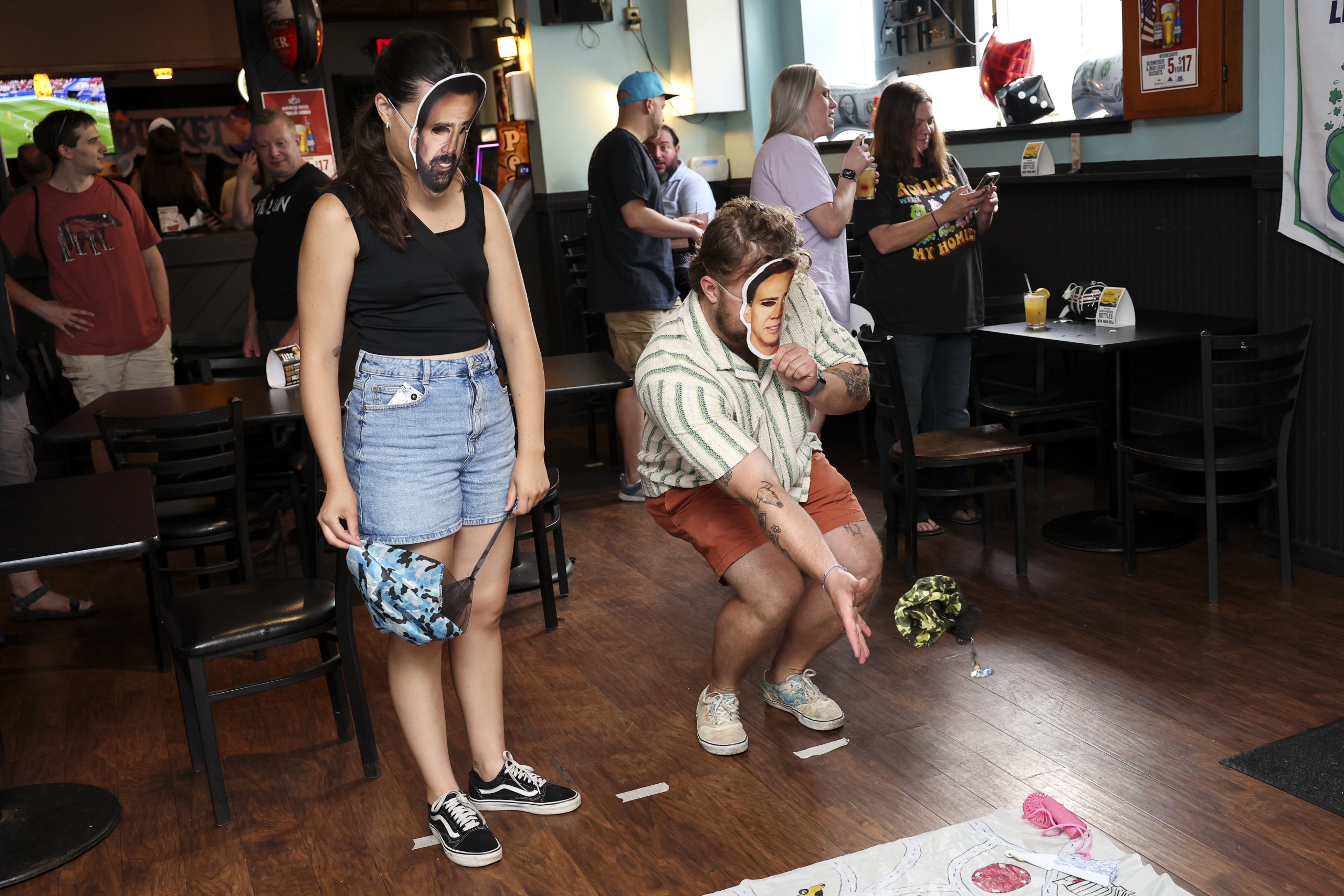
    Seeing people at bars and walking the streets of Jenkintown wearing Cage face masks was both highly amusing and mildly unsettling, mainly because the eye holes were cut out wonkily, giving them a ragged, creepy edge.

    Masks included Face/Off Cage, Con Air Cage, red carpet Cage, and Dracula Cage (from the movie Renfield).

    Vicky Hutz, of Huntington Valley, holds a “Con-Air” Nic Cage mask at the Keep Easy during the Nic Cage cocktail crawl on Sunday.Monica Herndon / Staff Photographer

    Julia Sousa and Josh Douglas traveled to the crawl from Roxborough because they love Cage and Jenkintown. Douglas walked from bar to bar with his Cage face mask on, which seemed to startle some passing motorists.

    “I’m pretty sure they thought I was Michael Myers,” he said.

    3. The Cage matches

    The games based on Cage films, while homespun, were clever and fun. At Buckets, the game was inspired by the scene in Honeymoon in Vegas where Cage skydives with a bunch of Elvis impersonators. Contestants had to throw toy parachute soldiers that were painted to look like Elvis onto particular spots of a mock-up of the Vegas strip for points.

    Julia Sousa and Josh Douglas, both of Roxborough, compete in the “Flying Elvis Cage Match,” at Buckets Bar during the Nic Cage cocktail crawl on Sunday in Jenkintown. Monica Herndon / Staff Photographer

    At King’s Corner, where the challenge was based on the movie National Treasure, participants had to solve little metal mind-bender puzzles.

    For the Spider-Noir Cage match at the Drake, you had to keep a balloon bouncing in the air while putting on a cape, mask, and fedora.

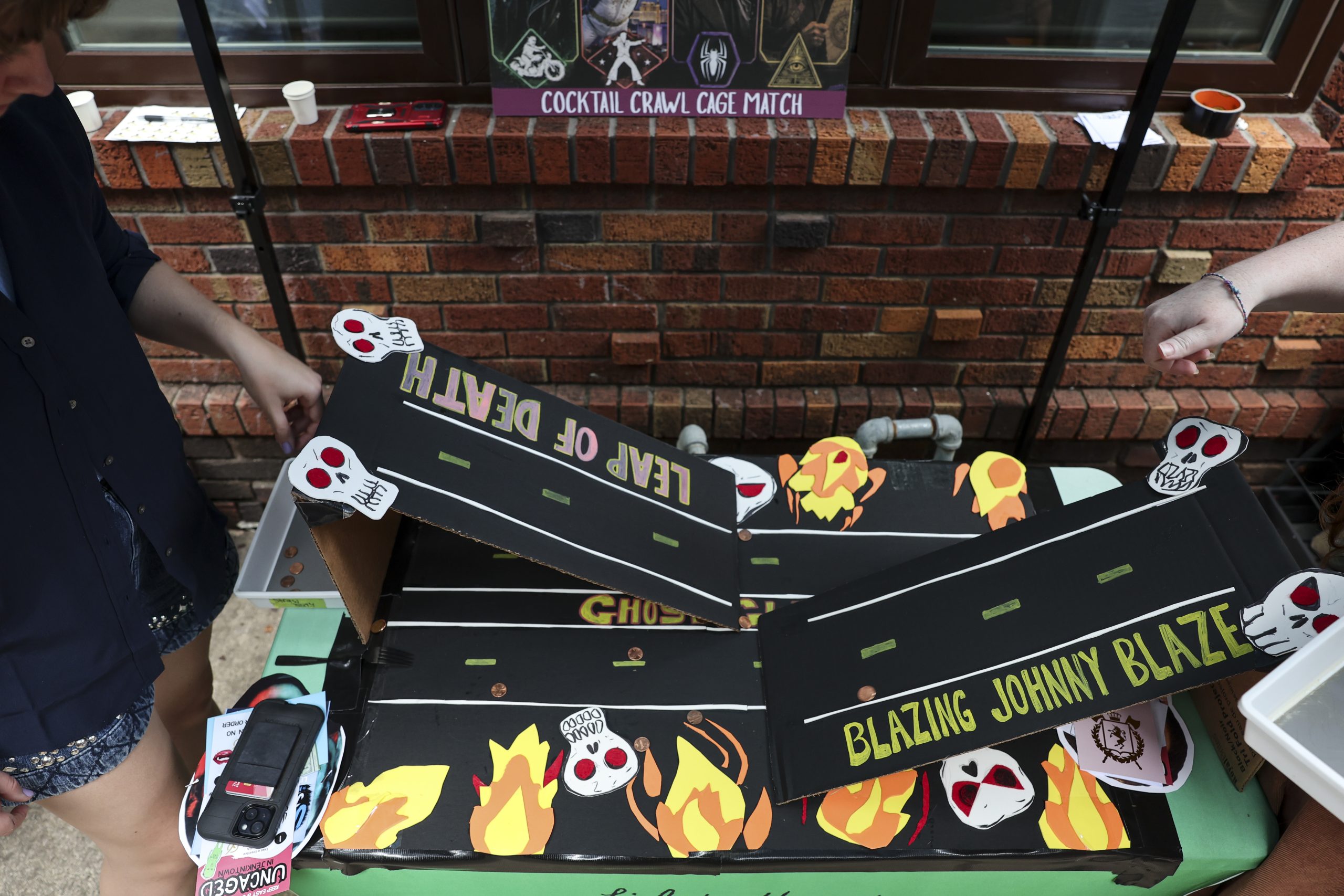
    I failed spectacularly at all three of those challenges — and I was completely sober! The only one I did succeed at was called Ghost Glider. Based on the film Ghost Rider, the challenge was to to roll a penny down an inclined surface made to look like a road and into the tongs of a fork at the other end.

    The “Ghost Glider” Cage match at the Keep Easy during the Nic Cage cocktail crawl on Sunday in Jenkintown.Monica Herndon / Staff Photographer

    4. Stickers and sage

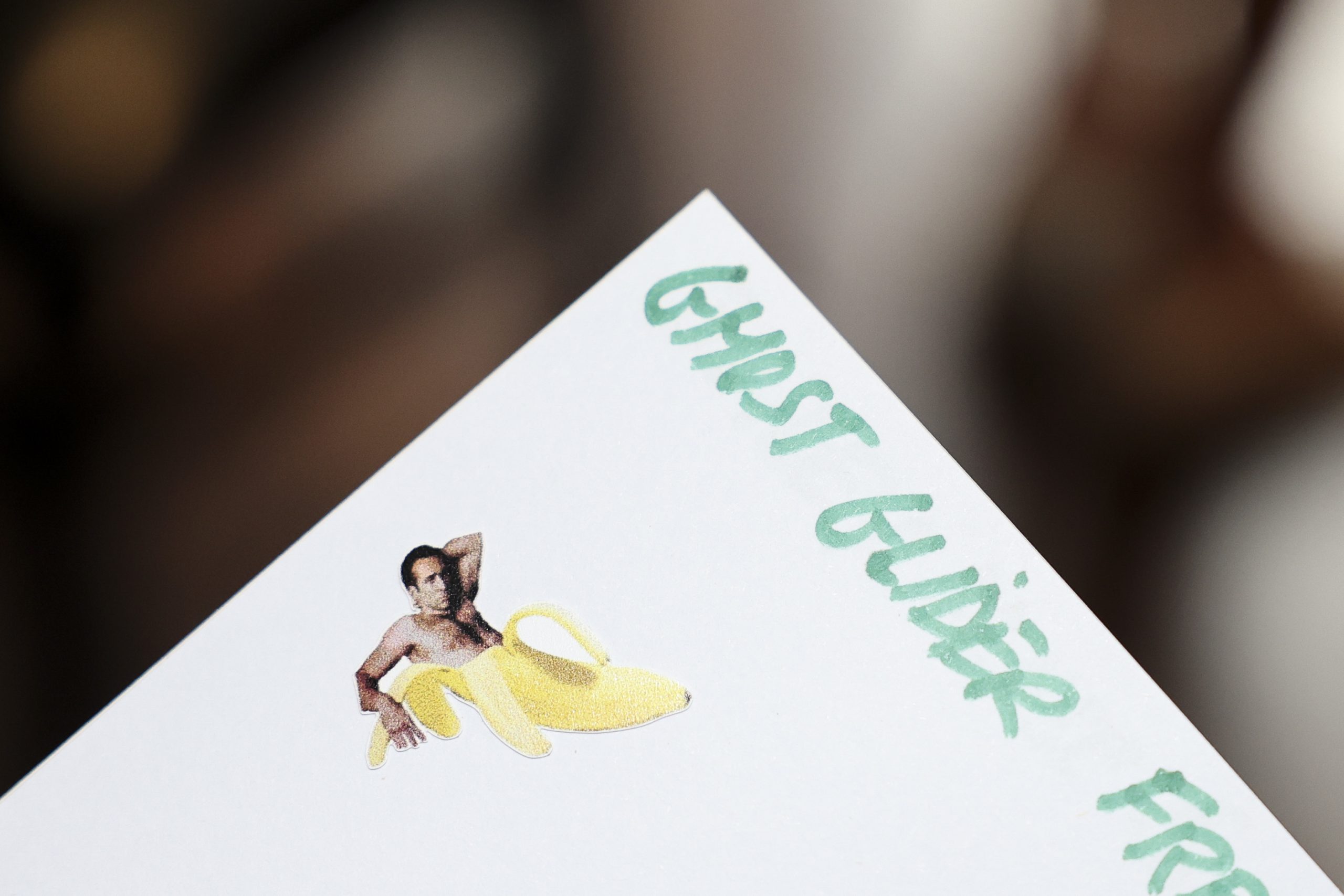
    For winning the Ghost Glider challenge, I received a bundle of sage and a sticker for my passport book of a shirtless, reclining Cage coming out of a banana.

    Let’s address the sage first: Nobody could tell me why this was my prize for winning the challenge, which somehow makes it even better. I have two theories — it could be because sage rhymes with Cage, or maybe it’s because you light sage and in Ghost Rider, Cage lights on fire.

    Whatever the reason, I’m gonna smudge some stuff up this weekend.

    An a-peeling sticker columnist Stephanie Farr received for winning a Cage match challenge at the Keep Easy during the Nic Cage bar crawl in Jenkintown Sunday. Monica Herndon / Staff Photographer

    Now onto this banana sticker — I don’t know why it exists, but I am so happy it does. Each bar gave a different sticker if you won a challenge, but this banana-Cage split one was, by far, the most a-peeling.

    Later at the Drake, I met Erica Adams of Bensalem and “her only friend of whimsy,” Amanda Knop, who’d driven from Baltimore to attend the Cage crawl with her. Adams had her own stickers of Cage’s head she was handing out like friendship bracelets at a Taylor Swift concert.

    “I just love his movies and doing silly, fun things,” Adams said. “Nicolas Cage himself is very unserious. He’s lived a million different lives in a short span already.”

    5. Picolas Cage

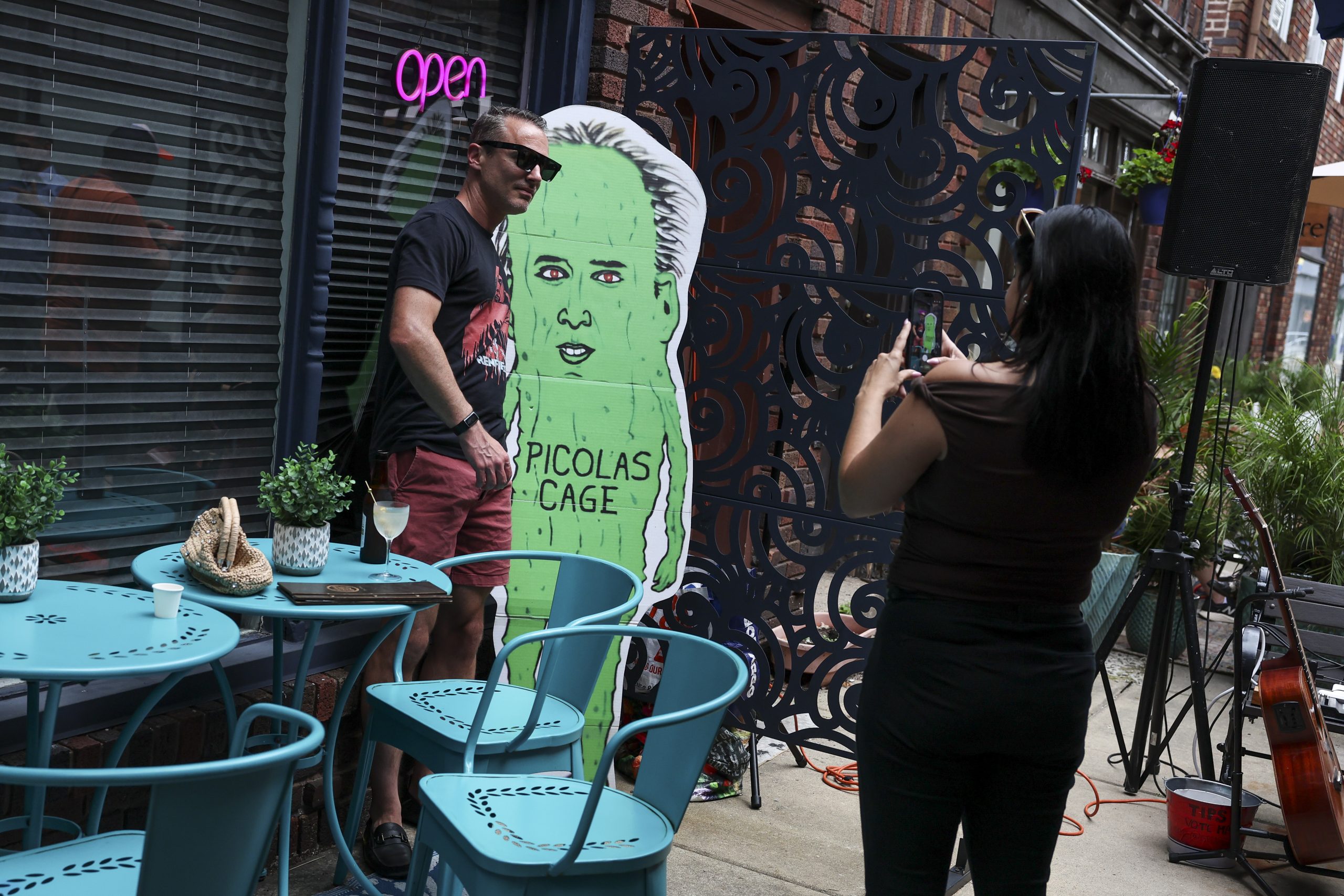
    Justin Walsh poses for a photo with “Picolas Cage” as Jessica Lopez takes the photo at the Keep Easy during the Nic Cage cocktail crawl on Sunday in Jenkintown. Monica Herndon / Staff Photographer

    A giant cut-out of Cage as a pickle, aka Picolas Cage, was stationed outside of the Keep Easy during the crawl. As someone who likes Cage and cucumbers — but hates pickles — it was a jarring experience. But I saw others relishing the photo op so I didn’t make a big dill out of it.

  • Assailed by right and left, the Peace Corps continues to make an apolitical difference

    Assailed by right and left, the Peace Corps continues to make an apolitical difference

    In 1983, I finished college and joined the Peace Corps. I was sent to Nepal, where I taught English in a remote village. To get there, you took an overnight bus out of Kathmandu and then walked for three days into the Himalayan foothills.

    My Peace Corps journey changed my life. It opened my eyes to cultural differences, and it taught me how to communicate across them. That’s been an invaluable tool for me, as an educator and a human being.

    But when I got to graduate school, I discovered that many of my fellow left-leaning students — and some of their professors — had a decidedly less rosy view of the Peace Corps. It was a neocolonial project, they said, designed to enhance America’s global power and to keep poorer countries in perpetual dependency.

    I’ve been thinking about their comments over the past few days, as news spread that U.S. Rep. Scott Perry (R., Pa.) had proposed to eliminate funding for the Peace Corps under amendments he submitted to a House appropriations bill. The York congressman was also an ardent supporter of Elon Musk’s dismantling of the U.S. Agency for International Development, which Perry called a “piggy bank for far-left causes.”

    Yet, the Peace Corps — like USAID — has also been the target of left-wing attacks, which bear a strong echo to Republican ones. Neither side believes Americans can be a force for good in the world.

    That’s why the Peace Corps matters. It’s based on the simple proposition that bringing different people together can help them thrive. And it’s a standing rebuke to cynics on the right and the left.

    Going back to Richard Nixon, GOP politicians have tried to diminish — or destroy — the Peace Corps. Their last effort to zero it out took place in 2019, when U.S. Rep. Mark Walker (R., N.C.) proposed to “put America first” by defunding the Peace Corps and devoting the saved dollars to disaster relief at home.

    Never mind that the Peace Corps represents 1% of our foreign aid budget, which is usually about 1% of total government spending. That means one out of every 10,000 federal dollars goes to the Peace Corps.

    But that’s too much for Perry, who has also proposed eliminating government funding for the Millennium Challenge Corp., which finances infrastructure and anti-poverty programs in poor countries, and for the Democracy Fund, which aids nascent democracies that are under strain.

    U.S. Rep. Scott Perry (R., Pa.) at a campaign event in front of employees at an insurance marketing firm in Harrisburg in 2024. He has proposed eliminating funding for the Peace Corps.Marc Levy

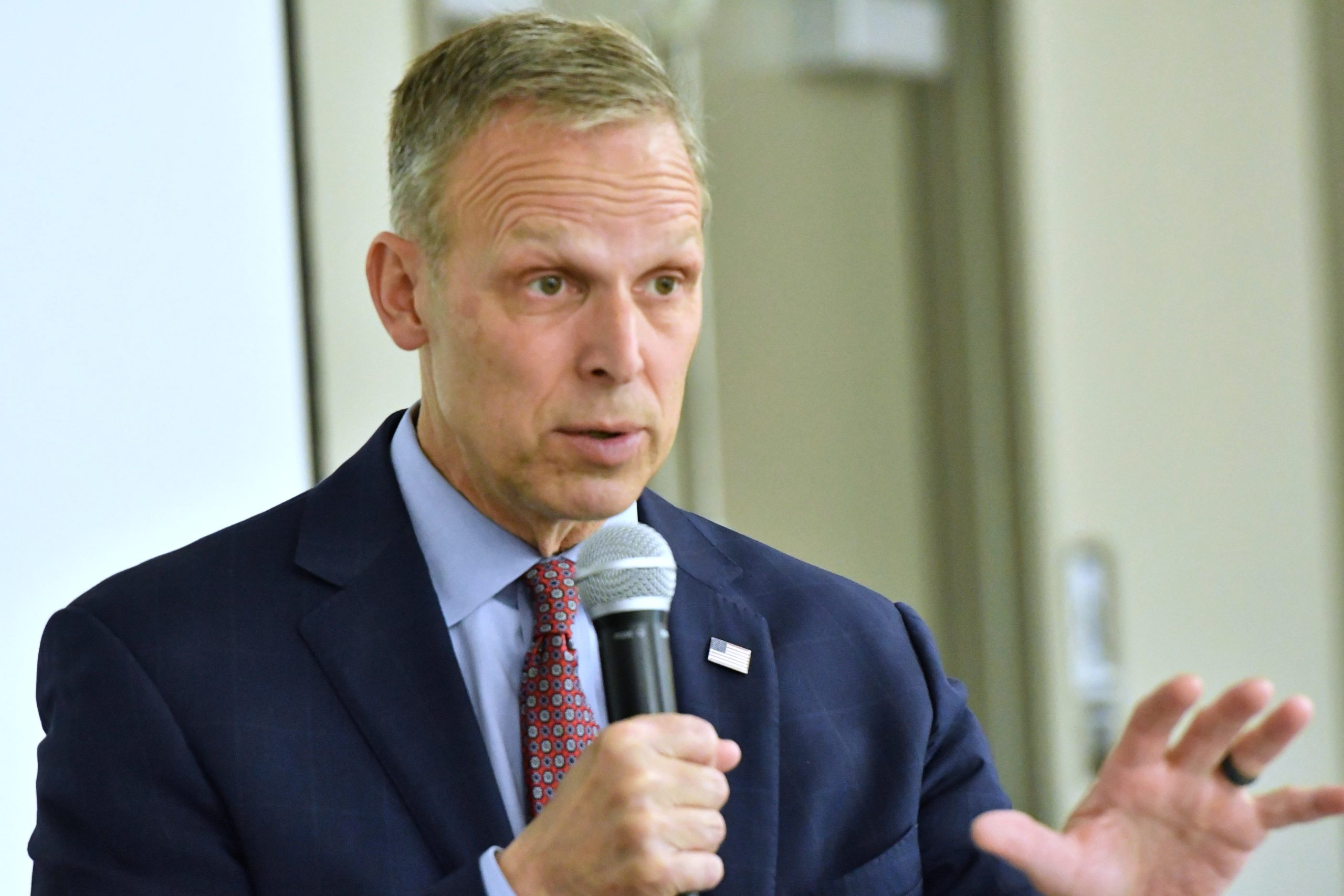
    America’s own democracy is under strain, of course, thanks to the likes of Perry. As his text messages showed, he tried to assist Donald Trump’s effort to overturn the results of the 2020 election. He’s also facing a tough reelection battle this fall against Democratic challenger Janelle Stelson, whom he narrowly defeated in 2024.

    Perry is betting that his campaign to defund the Peace Corps and other foreign aid will help him at the polls, and I hope he’s wrong. But I also think it’s wrong to dismiss the Peace Corps as an imperial power grab, as my grad student colleagues did.

    That critique has been revived in the digital age by “No White Saviors,” a social media campaign begun in 2018. When the Peace Corps evacuated all of its volunteers during the 2020 COVID-19 pandemic, No White Saviors said they should stay home.

    “No more pretending inexperienced young people are actually useful in countries and cultures they are alien to,” No White Saviors declared. “No more spending money on flights or evacuations, no need to teach language or culture.”

    That demand was taken up within the Peace Corps itself. Calling themselves “Decolonizing Peace Corps,” disillusioned volunteers called for the abolition of the agency. The Peace Corps was a scam, they said, spending scarce resources that could be better used at home.

    Scott Perry and Mark Walker couldn’t have put it better themselves. Whatever their other differences, America First Republicans and No White Saviors think the Peace Corps is a waste of taxpayer dollars.

    Please. The 250,000 people who have served in the agency have generated enormous goodwill overseas and huge benefits at home. More than 80% of them continue to volunteer in their communities. A quarter of them have started businesses.

    They’re also more diverse than No White Saviors assumes. In 1990, four years after I returned from Nepal, only 7% of volunteers were nonwhite; in 2020, 34% were.

    I didn’t go to Nepal to save anyone. I went to live, and to learn, and to grow. And 25 years later, I returned to my village with my 17-year-old daughter. A bus road had been cut into the hills, so the three-day walk was narrowed to about six hours.

    The school where I taught held an impromptu “welcome home” ceremony for us. I stood up to give a speech in my broken Nepali, but broke down in tears, overwhelmed by my good fortune to have known these good people. If we jettison the Peace Corps, fewer Americans will experience that kind of connection. I just don’t see how that can be good for America or for the world.

    Jonathan Zimmerman teaches history and education at the University of Pennsylvania. He is the author of “Schooling Citizens: How Education Can Save Democracy,” which will be published next spring by the American Philosophical Society Press.

  • Trump’s Reflecting Pool debacle mirrors what’s ailing America

    WASHINGTON — I arrived in Washington, D.C., on Wednesday and headed straight to the Reflecting Pool on the National Mall to see for myself what it looked like.

    At first glance, it appeared as if sand had been tossed into the newly renovated water basin located between the Lincoln Memorial and the Washington Monument. But my eyes were mistaken. “The sand” was actually the underlying surface showing through as the coating at the bottom started peeling off.

    As I bent down to get a closer look, I made a point to keep my hands close to my body. I knew better than to touch so much as a drop of that water, since people have allegedly been arrested for vandalism after touching the floating detritus.

    President Donald Trump blames “radical lunatics” for defacing his latest renovation project. “This isn’t random mischief — it’s targeted sabotage by anti-American crackpots who despise a strong, proud, and beautiful country. They cannot build; they can only destroy. They cannot celebrate our heritage; they can only deface it,” reads a statement released by the White House.

    I walked around the pool’s entire perimeter. I didn’t notice any stench, not even a whiff. But the reports are true, and Trump’s $14 million no-bid boondoggle to renovate the Reflecting Pool in advance of the nation’s 250th anniversary has faced one stumbling block after another.

    Depending on the angle of the sun and where you’re standing, the combination of the newly added dark paint that’s already chipping away and the algae blooms gives the illusion that the pool is a beautiful aquamarine color. I didn’t expect that.

    But it’s not what the president ordered.

    Nor is it what the American people want or need right now. We want the war with Iran to be over, but Trump is more concerned with putting a Mar-a-Lago-esque stamp on the nation’s capital. He has barely acknowledged that Americans are most concerned about how to pay for gas, food, and healthcare insurance premiums.

    The Lincoln Memorial Reflecting Pool was fine the way it was. Trump should have followed President Joe Biden’s lead and just left it alone. Same thing with the White House East Wing that Trump ordered torn down for a $600 million ballroom project. Same thing with the Kennedy Center for the Performing Arts before Trump made himself chair and slapped his name on the living memorial built to honor the late President John F. Kennedy.

    Trump’s gonna trump, though.

    Back in April, he announced plans to install an industrial-grade surface on the Reflecting Pool. He originally wanted it to be turquoise, but took the contractor’s advice and went with a darker color that he calls “American Flag Blue.” In typical Trump fashion, he claimed it would only take a week to rehab and cost about $1.5 million, only for the project to take months to complete and the cost to balloon to $14 million.

    Workers refilled the pool on June 9. The water quickly turned green, which the U.S. Department of the Interior blamed on “residual algae from the supply lines.” It has since been treated with hydrogen peroxide and ozone nanobubbles. And the blue material coating the bottom has started coming off.

    The century-old Reflecting Pool has had issues for years. But it’s still a beautiful thing to behold.

    Civil rights activists famously flanked it while listening to the Rev. Dr. Martin Luther King Jr. deliver his famous “I Have a Dream” speech in 1963. Same thing when Marian Anderson performed on the steps of the Lincoln Memorial in 1939, after the Daughters of the American Revolution refused to let the African American contralto sing in their concert hall because of her race.

    Under Trump, the Reflecting Pool has become a Rorschach test of where we are right now as a nation. Some only see its beauty, while for others, the bumbling rehab symbolizes yet another Trump failure.

    “I came to see for myself. I wanted to see what all the hoopla was about,” said Cedric Jackson, an Atlanta resident whom I spotted taking photos. “It’s not as green as I thought it was going to be. So they’ve obviously been doing some kind of work.”

    But then he added, “I think this is probably something that could have been avoided.”

    I couldn’t agree more. Like so much damage and harm the Trump administration has inflicted during this second term, it didn’t have to be this way.

  • DACA and TPS recipients pump billions into the U.S. economy. Trump wants them gone anyway.

    DACA and TPS recipients pump billions into the U.S. economy. Trump wants them gone anyway.

    Immigration is complicated. That makes polling on the topic difficult, as the same Americans who will tell you they support mass deportation one day will turn around and say they back a path to citizenship the next. So, which is it? Well, it depends.

    As crowded scenes of immigrants clustering at the southern border were endlessly repeated on TV, many Americans felt the Biden administration was not taking national security seriously and had flung open the golden door to anyone with a pulse and a sob story.

    Then, as U.S. Immigration and Customs Enforcement agents descended on Minneapolis, masked, heavily armed, and dangerously encouraged to ignore people’s constitutional rights — ultimately killing two U.S. citizens because they dared to question authority — even many Donald Trump supporters rose up to say this is not what they voted for.

    Unsurprisingly, most Americans fall somewhere in the middle — where balancing immigration control with humanitarian values looks at what makes the most sense for the country and for the people who are looking for a better life here.

    But that’s illegal immigration. On legal immigration, most Americans are all in, with only one in five opposing it. Why, then, is the Trump administration hell-bent on making life miserable for legal immigrants?

    Earlier this month, a court ruled against an administration decision that froze processing of immigration benefits like work permits and green-card applications for nationals of 39 countries targeted by a travel ban. These are people already in the United States legally who found themselves in limbo for months — many losing their jobs and risking deportation — after U.S. Citizenship and Immigration Services determined in January it would keep the $1 billion in fees these immigrants paid and give them nothing in return.

    Meanwhile, renewals under the Deferred Action for Childhood Arrivals (DACA) program for immigrants brought here as children have been hit with delays, and approvals of legal permanent residency applications, known as green cards, have fallen by around 16% — all part of the administration’s strategy of bureaucratic sabotage in the guise of “enhanced security.”

    The administration has also banned permanent legal residents from qualifying for government-backed small-business loans, while some immigrants, including DACA recipients, can no longer hold commercial driver’s licenses, regardless of possessing a legal work permit.

    Two U.S. Supreme Court decisions released last week will only continue to embolden the administration’s anti-legal immigrant push.

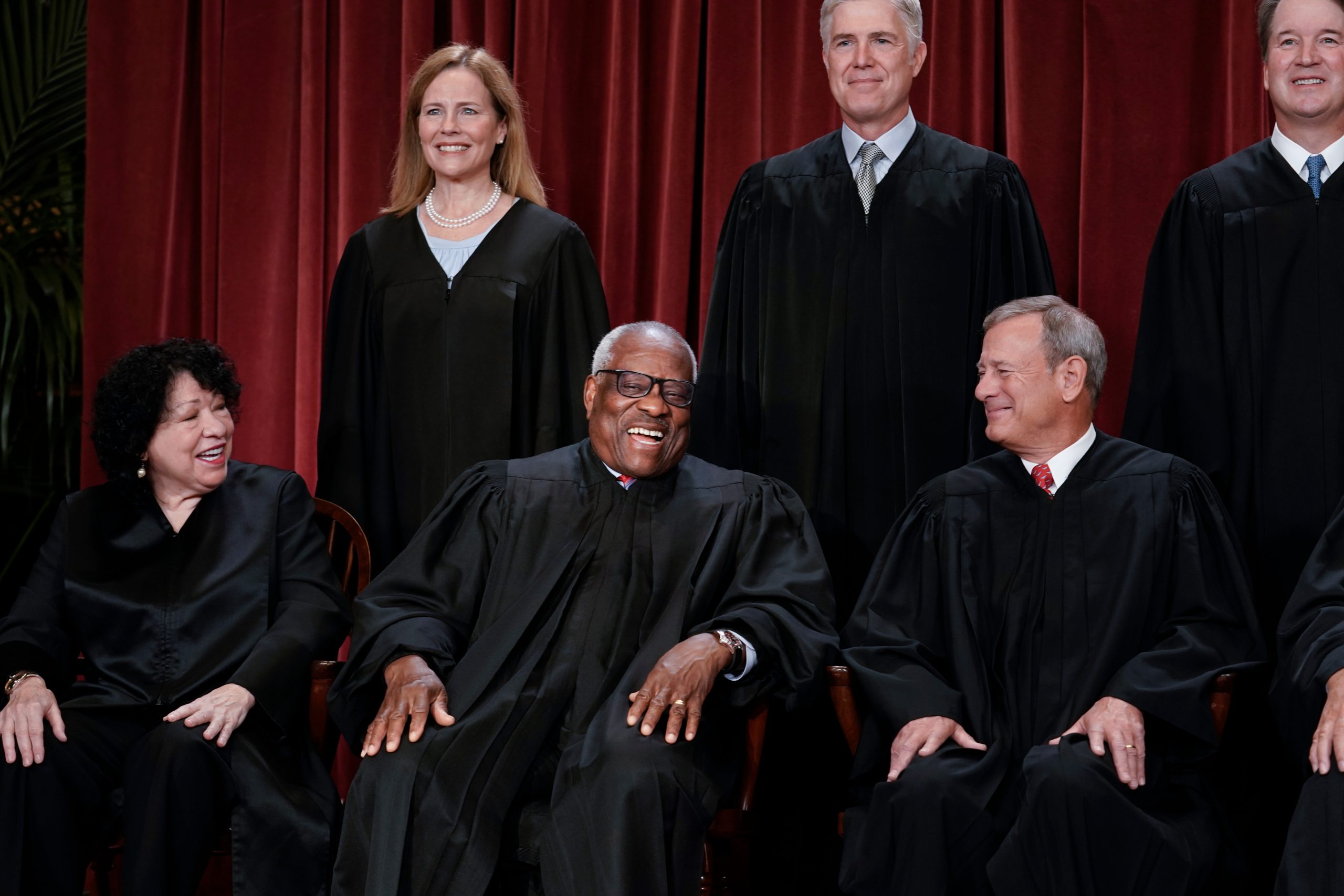
    Members of the Supreme Court sit for a group portrait in 2022. Bottom row, from left, Associate Justice Sonia Sotomayor, Associate Justice Clarence Thomas, and Chief Justice of the United States John Roberts. Top row, from left, Associate Justice Amy Coney Barrett, Associate Justice Neil Gorsuch, and Associate Justice Brett Kavanaugh.J. Scott Applewhite

    On Tuesday, the court’s conservative justices affirmed that border officers do not need “clear and convincing evidence” that a green-card holder seeking to reenter the U.S. has committed a crime to deny them entry. While I hope that one day the Clarence Thomas “border vibe check” joins the “Kavanaugh stop” in the annals of legal ignominy surrounding immigration enforcement, the court’s 6-3 decision makes a mockery of the idea that someone is innocent until proven guilty.

    Perhaps even more immediately concerning is the high court’s ruling Thursday allowing the president to end Temporary Protected Status, or TPS, for roughly 350,000 Haitians and 6,000 Syrians.

    The TPS program, a bipartisan congressional creation under President George H.W. Bush, gives immigrants work permits and protection from deportation if they come from countries determined to be too dangerous to go back to. While the word temporary is right there in the name, some program participants have been in the country for decades and have built lives here. For others, the nations they fled are still unsafe to return to, including Haiti, which is in the grip of gang violence and widespread hunger.

    That the conservative justices also found that Trump’s comments against Haitians were not “overtly racial” is absurd. Trump infamously referred to Haiti and African nations as “shithole countries” in the same 2018 meeting in which he wondered aloud why America couldn’t have more immigrants from places like Norway. For context, this is the same administration that considers white South Africans the only persecuted minority worthy of asylum in the U.S.

    For the moment, the court’s decision applies only to Haitian and Syrian immigrants with TPS, but it has opened the door for the president to do what he has wanted to do since his first term, which is to end the program wholesale. That would impact the 1.3 million TPS holders from around 17 nations and their families, many of whom are U.S. citizens.

    While the human impact on communities of this mass de-legalization effort is immeasurable, the economic damage of Trump’s anti-immigrant policies is not.

    The 500,000 or so DACA recipients, for example, contribute nearly $17 billion to the U.S. economy annually, also paying into federal social safety net programs they are not legally able to access themselves, according to the immigration rights group FWD.us. TPS recipients contribute about $29 billion a year to the economy and pay $7.8 billion in combined federal, payroll, state, and local taxes.

    An immigration policy calculator produced by the Manhattan Institute finds that the kind of policies favored by the administration would add $618 billion to the national debt over 10 years, and leave every American poorer.

    Reasonable people can disagree on immigration, but at the very least, Trump’s exclusionary ideas are an economic dead end.

  • America at 250: 50-year sentences for progressive protesters. Freedom for millionaires.

    America at 250: 50-year sentences for progressive protesters. Freedom for millionaires.

    A few months back, the Donald Trump-fried chair of the Federal Communications Commission, Brendan Carr, urged broadcasters to air patriotic programming for America’s 250th birthday — including regular on-air recitations of the Pledge of Allegiance.

    I couldn’t find any reports about TV or radio stations that have actually done this. Maybe they’ve figured out that the bit at the end — that stuff about “liberty and justice for all” — has been rendered into utter baloney by Carr’s strongman boss.

    For anyone who still believes the myth that the United States’ criminal justice system is the envy of the world, I say: Let them come to Fort Worth. In northern Texas, a crime committed by one man with the “wrong” politics gave the Trump regime the ammunition it craved for a free-speech crackdown that makes a mockery of America’s birthday bash.

    Ironically, it was on July 4, 2025, that a crew from the small but tight-knit left-wing community in the Dallas-Fort Worth (DFW) metroplex ventured 30 minutes south to the Prairieland Detention Center run by U.S. Immigration and Customs Enforcement to protest the squalid conditions and overcrowding there.

    The protesters dressed in black; some brought fireworks or medical supplies. The evidence shows they committed some minor crimes — vandalizing a vehicle, for example. But when local police were called, one man — Benjamin Song, an ex-Marine known to local activists as “Champagne” — committed a serious offense, firing a gunshot that wounded a town police officer in the neck. The officer later acknowledged he was pointing his gun at a fleeing protester when Song fired his weapon.

    The Prairieland incident came right as the Trump regime was striving to brand “antifa” — a loose ideology that fascism should be resisted by any means necessary — as some kind of highly organized terrorist cell. FBI agents fanned out across DFW, ultimately building a riot-and-terrorism case against nearly two dozen leftists, including the group — now known as the Prairieland 9 — that stood trial this winter at the Fort Worth federal courthouse.

    Among the evidence prosecutors presented to bolster their contention that the protesters were part of some kind of terror cell included their black garb, their Signal chats in which they discussed plans for a “noise protest” at Prairieland, or their decision to bring medical supplies with them to the demonstration, which occurred at a time when anti-ICE protests were meeting violent responses. One of the alleged coconspirators wasn’t even at the protest; he’d moved a box of anti-fascist magazines before agents visited his home after his wife called from jail.

    Tamera Hutcherson, a local activist who attended much of the trial as a paralegal for defendant Savanna Batten, told me by phone Saturday that the case against Batten “was based on the fact that she showed up to the protest wearing black, she had medical supplies on her, which included a tourniquet, and that she was there for a noise demonstration to set off fireworks.”

    Batten, Song, and the other seven were convicted in March, and their sentencing was decided by the trial judge — Mark Pittman, a Trump appointee — and his colleague, Reed O’Connor, a federal jurist so well known for his right-wing rulings that the Trump regime and allies like trillionaire Elon Musk look for excuses to bring cases before him.

    In this case, O’Connor was happy to say the quiet part out loud: that a repressive government is seizing on this case to send a message to anyone who wants to aggressively protest mass deportation or other abuses. He called the protest “an assault on democracy,” adding, “The need to deter this type of conduct is high.”

    Trucks drive at the Prairieland Detention Center in Alvarado, Texas, in September.Louis DeLuca

    Still, courtroom observers were stunned when the sentences came down. It wasn’t a total shock when Song, convicted of attempted murder, was given 100 years, but Batten, the black-clad medic, got 50 years — a virtual life sentence for dissent — as did several others. Daniel Sanchez Estrada, the magazine mover, got 30 years.

    Hutcherson, who was in the courtroom for last week’s sentencing, called O’Connor’s comments “chilling … to have the judge say this out loud, it really sunk in.”

    What’s sunk in is that the federal government is pouncing on the Prairieland 9 convictions to unleash a crackdown on left-wing protest that will make America’s past sins like the Palmer raids, McCarthyism, and the trial of the Chicago 7 look like child’s play.

    In recent days, we’ve seen federal charges against the Minneapolis 15 protesters who monitored the Minnesota ICE raids in Signal chats, and an indictment against two Atlanta protesters against the “Cop City” police training center — even after a local judge had essentially laughed state charges against them out of his court. When a state prosecutor offered evidence of criminality that the Cop City demonstrators wore black clothes and masks, Judge Robert Flournoy said, “Oh, that sounds like ICE.”

    There’s a lot going on here. The Trump regime — which last fall designated “antifa” (again, not an actual group) as a terrorist organization, abusing its vast post-9/11 powers as many of us feared it would — is aggressively clamping down on the First Amendment-protected right of dissent ahead of the November midterms, when its dictatorial-minded leader will stop at nothing to keep his party in power.

    But these 50-year prison sentences, which carry the sauerkraut stench of German cooking, circa 1933, are also an exclamation point on the death of even pretending there is anything resembling impartial criminal justice in America. We are now a land where left-wing dissenters will spend decades behind bars reading about the latest millionaire fraudster or Republican apparatchik to get out of jail free.

    Look, we’ve always been more than delusional about praising U.S. justice as the supposed envy of the free world despite the reality that rich kids or celebrities like the late O.J. Simpson who hire the best lawyers can walk free after people die, and white-collar crime is treated as a sport, while Black, brown, and poorer defendants form the backbone of one of the planet’s highest incarceration rates.

    But the Prairieland most-of-your-life sentences didn’t happen in a vacuum. They are the counterweight to Trump’s Day One pardons for the roughly 1,500 right-wing rioters on Jan. 6, 2021, who stormed and vandalized the U.S. Capitol in an insurrection blamed for five immediate deaths, with more than 140 police officers injured.

    And that’s not all. Trump has individually pardoned and granted clemency to well over 100 or so others in his second term — including just about every high-ranking Republican who’d been convicted of a federal crime, big-time donors to his political campaigns, or those who hired the president’s friends for big bucks.

    At the same time the Prairieland 9 were getting frontier justice, the New York Times reported that Trump’s Justice Department quashed a criminal probe into the circumstances behind the president’s clemency for a multimillionaire named David Gentile. The private equity executive had been sentenced to seven years in prison and ordered to pay $15.5 million in restitution for a $1.6 billion scheme that defrauded small investors. Many lost their life savings — arguably a greater harm than anything that happened at the Texas ICE detention center.

    But Trump granted clemency to Gentile after just two weeks in prison. Prosecutors were looking into the relationship between Gentile and a retired priest from Queens who has become a top supporter and personal friend of Trump and who lobbied the president for Gentile’s release. But higher-ups reportedly told New York mid-level prosecutors to end their probe into questions like whether the priest was paid.

    The Rev. Frank Mann speaks next to Donald Trump during Trump’s second inauguration at the U.S. Capitol on Jan. 20, 2025.KENNY HOLSTON

    In a matter of months, Trump has exploited the existing cracks in the federal justice system to make it a blunt instrument of personalist dictatorship — a “purge” for his criminal friends or bad guys willing to make a donation, while depriving those who dissent of their liberty.

    I’m just barely scratching the surface, as Trump’s injustice department also conducts high-profile investigations into law-abiding political opponents, including top Democrats or people like former FBI chief James Comey. Or consider this: No action has been taken against Jonathan Ross, the ICE agent who’s been publicly identified as the killer of unarmed Minneapolis motorist Renee Good. When a Syracuse, N.Y., woman ID’d Ross and asked why he had not been indicted in an Instagram post, federal agents entered a voting place where she was working as a poll worker and ordered her to take the inarguably true post down.

    The nation’s founders, who declared American independence 250 years ago this week, strongly believed that justice was the backbone of their experiment in democracy. The Bill of Rights they’d enact in 1791 is largely about the right to a fair trial, avoiding unlawful searches and seizures, and the essential liberty of protesting an unjust government. More than two centuries later, the White House seems more governed by George Orwell’s 1984, as they criminalize left-wing “thoughtcrime.”

    “I think it’s very symbolic … that this protest happened on the Fourth of July,” the Texas activist Hutcherson told me. “This year is the 250th year of America being America. And when we think about the inception of this nation, it was because of protest; it was because of dissent. And so it feels very contradictory that because someone has leftist or anti-fascist views that now they can be deemed criminal or a terrorist to the U.S. government. You know, we’re not seeing the same energy given toward people that have right-wing views.”

    The firecrackers of dissent that went off on Independence Day 2025 over an ICE gulag in Texas were much more of a tribute to what America was supposed to be than whatever Trump detonates over his morally empty National Mall on this July Fourth. In a United States with liberty for billionaires and justice for none, what are we even celebrating?