In 2008, it was partially demolished to make way for a $150 million Main Street-style mixed-use development. The property was rebranded as the Voorhees Town Center, which included the enclosed mall and the open-air complex.
The closed former Echelon Mail was photographed through a window in 2024.Tom Gralish / Staff Photographer
In recent years, Namdar officials have not responded to requests for comment about their plans for the property.
Had Hoboken Brownstone been able to get the tax break, the company had planned to buy the mall building from Namdar, Vallone said earlier this year. The sale would not have included Voorhees Town Hall or Boscov’s, the site’s sole department store.
On the site, Hoboken Brownstone had planned to construct more than 200 market-rate townhouses, as well as more than 100 units of affordable housing, both for-sale townhouses and rental apartments, according to township documents.
The company also wanted to build 38,000 square feet of new commercial and entertainment space; a parking garage with at least 1,300 spots; outdoor areas and bike paths; and a 30,000-square-foot indoor community space.
Voorhees Township officials did not respond Wednesday to requests for comment about the property’s future.
Township administrator Stephen Steglik told the Philadelphia Business Journal that Hoboken Brownstone’s withdrawal was “obviously disappointing.”
“We would like to see Namdar make corrections to the mall itself” and reopen, Steglik told the Business Journal, adding that township officials would also be open to other plans that include residential and retail uses. “It would be great if another developer could come and not need the tax credits. That’s one less hurdle.”
With more than 3,000 member-owners and a 55-year track record, the Mariposa Food Co-op looms large in West Philadelphia.But in recent years, many residents felt that it had lost its way — both financially and spiritually.
So when the co-op board announced late last month that its longtime controversial head was out, effective immediately, the news sped through the neighborhood. “Co-op executive officer” and general manager Aj Hess had managed the co-op since 2016, despite repeated attempts by volunteer board members and workers to oust them.
On social media, some neighbors rejoiced as if a despot had finally been removed from the throne. “I want to dance in the streets,” one wrote.
“It’s weird that someone who just basically ran a grocery store has so much ill will built up in the community that people are celebrating,” said Will Inglis, a local who was, himself, celebrating. Inglis worked at the co-op as an overnight stocker and helped organize a union there in 2022. He left in 2023 and was subsequently banned for life from the store for accusing Hess of wage theft in a public meeting.
Hess declined to comment for this story.
Mariposa moved to the former bank on Baltimore Avenue and opened to the public in 2012. Before that, only members could purchase food there. Allie Ippolito / For The Inquirer
Founded in 1971 as a buying club run by member consensus, the co-op inspires such fervor partly because it is owned by its neighbors. Anyone can buy a $200 stake in the cooperative and have a say in decision-making, although the general manager maintains wide latitude to run the store.
It is also the rare neighborhood institution that pitches itself as a meaningful alternative to some of the problems of our late-stage capitalist era. It is supposed to be a truly community-owned space, one that supports local farmers and food producers while offering neighbors healthy, affordable food. If there are profits, they flow to member-owners as dividends.
Yet in recent years, Mariposa seemed to drift from its ideals. Workers described a culture of vindictiveness, favoritism, and retaliation under Hess’ management, and a workplace teeming with surveillance cameras. Some members complained of unfair board elections that effectively kept Hess in charge.
“This is not what a neighborhood co-op is supposed to be,” Inglis said.
On a practical level, shelves were often bare, making it hard for even those devoted to Mariposa’s values to regularly grocery shop there. Sales tumbled, reflecting the resulting loss in customer traffic.
Now that Hess is gone, the question is whether Mariposa can return to its origins — and remake itself as the thriving co-op it once was.
Aminah Brinkley, a clerk at Mariposa, stocked bagels on a recent Friday. Allie Ippolito / For The Inquirer
Losing money and morale
Hayley Tintle, a West Philly resident and senior budget analyst at Penn, ran for the Mariposa board in June of this year because she wanted to understand what had happened to the grocery store.
The complaints she heard after she was elected as a board member were similar to those she had as a customer: The shelves were barren, the store wasn’t clean, there were missing staples. Staff turnover was noticeably high.
“It just felt kind of hard to shop there,” Tintle said. “It didn’t have the same vitality that it once did.“
Financially, the co-op was struggling. Since 2019, sales had plummeted by about 40%, from $7 million to $4 million, according to financial records The Inquirer reviewed. The amount of cash on hand — a figure that represents how long the business could survive if it stopped generating any income — dropped from seven weeks in 2025 to 4 weeks this year. Membership had plateaued around 3,700 people.
At the same time, worker unrest had repeatedly spilled into public view. In both 2018 and 2023, workers submitted statements of no confidence in Hess to the board, pointing to “high staff turnover, abysmal staff morale, inefficient store functioning, and financial risks incurred by both the co-op itself as well as our member-owners.”
After staff won its first union contract in 2022, some told The Inquirer their hours were cut in retaliation.
Aj Hess, the CEO of Mariposa Food Co-op, pictured outside the store in 2023.Tom Gralish / Staff Photographer
Hess, who had worked in cooperatives for more than 20 years, largely dismissed the staff concerns and told Grid Magazine last year that the pandemic, as well as “negative press,” had hurt Mariposa sales, but that “overall we are still doing well.”
Over the years, community members had tried to shake up the co-op’s board and oust Hess. But it had never worked, said Kitty Jauregui, who was elected to the Mariposa board in 2024 as part of a reformist slate. Within a year she was kicked off by her fellow board members for sharing an anti-Hess Reddit post, she said, and her membership was terminated.
The whole experience left her with such a sour taste that she avoids walking on the same side of the street as Mariposa these days. But looking back, Jauregui blames more than just Hess. The annual membership meetings were perpetually under-attended.
“The whole community, we all let it happen,” she said. “When only a handful show up, I think we kind of got what we deserved.”
Glenn Bergman, the interim manager for Mariposa, organized a staff field trip to the local Philadelphia Wholesale Produce Market in his first week. Allie Ippolito / For The Inquirer
Fresh perspective, old hand
Tintle and the board declined to comment on the nature of the separation with Hess, citing confidential personnel matters.
But in late September, Tintle reached out to Glenn Bergman, a veteran of Philadelphia co-ops, to ask him to temporarily take over the store. When Bergman became general manager of Weavers Way in 2004, that co-op was facing its own financial hardships; when he left 11 years later— to lead Philabundance as executive director — the co-op was an unqualified success. Today, Weavers Way has four grocery stores in Northwest Philly and Ambler.
Bergman, who used to live around the corner from Mariposa in the 1980s and has a soft spot for do-gooder businesses facing trouble, agreed to come out of retirement for three months to serve as interim manager. The board is now beginning its search for a permanent general manager.
“This place is too good to let it go. It’s sacred ground,” said Bergman, 75, on his second day. He was wearing a small red co-op pin buttoned to his corduroy shirt, with two pairs of reading glasses in his front pocket.
He was already full of ideas for how to revitalize Mariposa. More staff, more produce. The calendar should be full of music and classes, the place needs its own newsletter. He wants to revive the working-member program, in which members work volunteer shifts in exchange for discounts. In the first week, he planned a field trip for Mariposa staff to visit the Philadelphia Wholesale Produce Market, as well as a meeting between Weavers Way and Mariposa staff to trade ideas. Maybe the front cashier table could become a bulk olive oil station.
“I feel like it’s a new beginning,” said Bull Gervasi, a former Mariposa general manager who lives across the street and was instrumental in moving it to its current location in 2012.
In between pulling products forward on the shelves and ringing people up, Bergman greeted every customer who entered.
Talking to people was just a start, and there would be a long journey ahead. There were no bananas, Bergman noted. Refrigerator bins for dark ground turkey and white ground turkey were cleared out.
“It’s going to take a little time, but the plan is to have more produce — a lot more produce — more staff,” he told a customer.
“And are you planning to get quart-sized half-and-half?” she asked. He wrote down the idea on a little piece of paper and tucked it in his pocket. (A few days later, the requested half-and-half was stocked).
When Bergman arrived, some shelves at the Mariposa Food Co-op were bare. He’s building back the produce section. Allie Ippolito / For The Inquirer
He was sympathetic to residents who were upset about what had happened at Mariposa and he had already reached out on Facebook to those posting bad experiences, asking them to chat. (He quickly unbanned Inglis, the former union organizer.)
“It’s their money, it’s their investment, it’s their community store,” he said. “They should be upset.”
“That’s done,” he added about the controversies of the past. “I said to the staff, ‘We just gotta do good things for the people. We have to be trying really hard and they have to see us trying hard.’”
Local apples for a local store
One of the first problems to address was the apples.
A longtime member-owner who lives nearby had popped in to Mariposa buy apples. But, as she reported to Bergman, there were no local apples available, despite it being the middle of apple season in one of the states that grows the most apples in the country.
Bergman examined the varieties on offer: Pink Lady and Gala and Honeycrisp, shipped from thousands of miles away and selling for upward of $2.99 per pound. (Eastern apples often have to be sprayed with fungicide, so they’re technically not organic, he noted — but they’re straight off the tree and taste much better.)
“I don’t want any more apples coming from California or Washington state,” he told Mariposa’s purchasing manager. “I want only local apples here. And I want about 10 varieties.”
Two days later, he sent a photo from Mariposa’s produce section. The half-filled cardboard box of pumpkins that used to sit at the front of the store was gone. In its place were boxes upon boxes of green and red and yellow-flecked and golden apples, all grown at Beechwood Orchards in Biglerville, Adams County.
Mariposa was selling them for $1.99 per pound — with a special 15% discount for member-owners.
In a welcome development for motorists and merchants along one of the region’s densest mall corridors, the Pennsylvania Department of Transportation has announced that all lanes on a sinkhole-plagued stretch of Route 202 in King of Prussia are now open.
The southbound lanes in the vicinity of Henderson Road, closed since February for sinkhole repair, were reopened Wednesday, well in time for the annual holiday shopping tsunami.
Give nature an assist, PennDot spokesperson Brad Rudolph said. “The weather has been very cooperative this fall,” he said on the 17th consecutive rainless day in the Philly region. Plus, temperatures have been well above normal.
Nature arguably owed one to King of Prussia and PennDot. King of Prussia and other sections of Upper Merion Township have been battling a geological sinkhole problem that has been 500 million years in the making.
And even with this $22.4 million federally funded repair job, it is not going away. In intervals, the sinkholes have forced closings in both directions on 202 over the last two years.
“There is still more work to perform on the project,” Rudolph said.
“While major construction has been completed … drivers will encounter short-term lane closures as needed by the contractor to finish the entire project,” he said.
That stretch of highway is a critical access road to the phalanx of shops and malls on both sides of the road, including the King of Prussia Mall.
It also happens to be located above a geological sinkhole.
The township is situated in the heart of a narrow corridor of limestone bedrock, a “karst” formation. It extends from central Chester County across southern Montgomery County.
About 500 million years ago, a sea covered the area, explained Geoff Hickman, Upper Merion’s public works director. Over time, shells and other sediment settled on the sea floor, transforming to limestone and dolomite underlying the area today.
When moisture dissolves the limestone, hollow pockets form below the surface, causing sinkholes.
The repair work has been immensely labor-intensive. It has included burrowing down more than 100 feet to apply grout.
The Route 202 sinkholes, Hickman said, “are among the most significant in township history.”
The project has been a pain for commuters and merchants.
Pattie Malone, director of Marian’s Attic, a nonprofit thrift store on 202, said the construction and traffic signage have been a customer repellent for the entire area.
“We’re doing all right,” Malone said last month. But “I cannot even imagine what we would be doing if that road was open.”
President Donald Trump’s campaign to reshape the Federal Reserve and bend interest-rate policy to his will has hit a formidable firewall after Democrats won control of the Senate on Tuesday.
The flip in the Senate, a seismic political shift that once seemed unlikely, effectively blocks the White House from confirming loyalist nominees to the Fed’s seven-member Board of Governors, stripping the administration of its most direct lever to exert greater control of the U.S. central bank.
Under a Democratic majority, Massachusetts Sen. Elizabeth Warren is likely to assume the chairmanship of the Senate Banking Committee, handing the panel that oversees the Fed to a lawmaker expected to bottle up any nominees perceived as unduly pliable to executive pressure.
Though she has long pushed for stricter oversight and accountability, particularly regarding Wall Street regulation, Warren has defended the central bank’s autonomy to set interest rates free of political interference.
“What the Fed gets from a Democratic Senate is a stronger bulwark,” said Mark Spindel, an investment manager at Potomac River Capital who cowrote a history of Fed independence. “It gives the Fed a more full-throated defense from presidential pressure.”
The result could also provide the Fed, and Chairman Kevin Warsh, more freedom to fight inflation with higher interest rates.
“The election result means the president has less leverage — on Congress, on the country, and on the Fed,” Daleep Singh, chief global economist at PGIM, and a former senior official in the Biden administration, said in an interview on Bloomberg Television. “Voters are angry about the rising cost of living. You put those two thoughts together, and the Fed is uniquely positioned to do something about it.”
Pivotal shift
A Democratic majority marks a pivotal institutional shift, depriving Trump of a Republican-controlled Senate after nearly two years of unprecedented executive pressure on the central bank.
Beyond repeated public demands for steep rate cuts, the administration has tested the boundaries of its authority, with the president cheering on a Justice Department investigation into former Chair Jerome Powell that a federal judge and lawmakers across party lines characterized as an abuse of power.
Trump has also continued to wage a campaign to oust Fed Governor Lisa Cook, a Biden appointee. The president ordered a White House hearing to examine the unproven claim that Cook committed mortgage fraud. A top White House official said last week the hearing would likely take place in December.
Trump has made clear he hoped eventually to appoint a majority of the Fed’s seven-member board. The administration has also weighed options for increasing control over the Fed’s regional reserve banks. Trump critics have pointed out that a majority on the Washington-based board would have the power to fire regional presidents.
Yet even with Republicans in charge, the administration hit resistance from Senate Banking Committee members uneasy with executive overreach — most notably when Republican Thom Tillis stalled Warsh’s nomination to become Fed chairman until the Justice Department dropped its inquiry into Powell.
“The Senate is always a constraint on the White House,” said Vincent Reinhart, chief economist at BNY Investments and a former senior Fed official. “The fact that there was pushback on how they dealt with Powell tells you how precarious the situation was. The midterms will make that even harder.”
No vacancy
At present, there are no vacancies on the Fed board. Powell bucked tradition and denied Trump an opening by remaining on after his term as chair expired in May. His term as a governor runs until January 2028. Philip Jefferson’s term as vice chair expires in September 2027, but if he remains on the board after that, Trump will have to choose someone already on the board to fill the leadership role.
Warren declined to comment for this story. A White House spokesperson said in a written statement ahead of Tuesday’s election that Trump was focused on campaigning to maintain Republican majorities in Congress to protect his economic agenda.
As of Wednesday afternoon, Senate Democrats had clinched at least 54 seats, with just Alaska and Mississippi still unresolved. Currently, Democrats hold 47 Senate seats, including two independents who caucus with the party.
That political shift would dramatically constrain Trump’s ability to repeat tactics used last year. When Fed governor Adriana Kugler unexpectedly resigned in August 2025, the administration worked at breakneck pace with Senate Republicans to confirm Stephen Miran, a top White House economic adviser. Once seated, Miran dissented at all six policy meetings in which he participated, always in favor of steeper rate cuts, until he was replaced on the board by Warsh in May.
A Democratic majority robs the White House of any payoff if any current governor resigns or if the administration succeeds in creating an opening.
By law, a president may remove a Fed governor only “for cause” — a standard long interpreted by legal scholars as requiring proof of severe malfeasance or dereliction of duty, rather than policy disagreements. Trump is the first president to attempt to oust a sitting governor.
Limited insulation
If any vacancies appear on the Fed board — through a court decision or otherwise — a Democratic-led Banking Committee could simply refuse to advance a replacement, leaving the seat open rather than allowing Trump to install an ally.
Some Fed watchers argue a Senate flip offers only limited insulation against an aggressive executive branch. Democrats cannot prevent the White House from using pressure tactics — including the threat of dismissal — to cow sitting policymakers.
Moreover, if the administration successfully ousts disfavored officials and simply leaves those seats empty, that could still shift the balance of power at the Fed. A Democratic-run Senate provides “a marginal reduction in the threat to Fed independence, but it doesn’t strike me as a sea change,” said Michael Strain, director of economic policy studies at the conservative American Enterprise Institute.
“The bigger threat,” he added, “is weaponizing the criminal justice system in order to affect monetary policy decisions.”
CVS Health plans to split in two, in a major unraveling of the country’s largest healthcare conglomerate after years of rampant expansion, the company announced Wednesday.
Under the breakup, planned for the first half of 2028, a new spinoff company, to be called CVS Pharmacy, will house the conglomerate’s approximately 9,000 retail pharmacies, in-store clinics, and a warehouse-based operation that sends prescriptions through the mail.
A second company will retain the name CVS Health and house the major insurer Aetna and the giant pharmacy benefit manager Caremark, along with other businesses that provide home visits and primary care to older people.
CVS Health has been under mounting scrutiny from lawmakers, regulators and others who say the company — along with its peers, UnitedHealth Group and Cigna — has grown too dominant. Critics say the conglomerates have exploited conflicts to profit from their web of businesses, driving up medical costs and stifling competition.
Within the past two years, Arkansas and Tennessee have each passed laws that aim to prevent the conglomerates from managing prescription benefits and running retail and mail-order pharmacies. In Washington and other states, lawmakers from both parties have proposed similar legislation, which the conglomerates have fiercely opposed.
CVS Health generated over $400 billion in revenue last year. That ranked seventh among U.S. public companies, according to FactSet, a financial data provider.
The Financial Times on Tuesday reported the company’s plans to split itself up.
The planned breakup would end a nearly decade-long chapter in which CVS Health reached into nearly every corner of the healthcare system. That era began in 2018, when CVS and Aetna merged. That same year, Cigna bought Express Scripts, the pharmacy benefit manager.
Since then, CVS, UnitedHealth, and Cigna have increasingly touched more pieces of the machinery by which Americans receive healthcare. Each company now encompasses a major insurer, a giant pharmacy benefit manager, and a mail-order pharmacy, along with a vast array of other businesses. Critics complain that the conglomerates use their size and leverage to steer patients toward their own pharmacies.
But for CVS, merging its businesses have not met Wall Street’s demands for growth. At the end of 2024, the company’s market value fell to its lowest level in over a decade, though it has since rebounded.
Many investors see CVS’ pharmacy benefit manager as the shining jewel of the portfolio. But prospects have dimmed for the pharmacy business, amid changing consumer habits and industrywide challenges that have shuttered other major pharmacy chains like Rite Aid.
AI literacy is quickly becoming a required skill for many types of jobs.
Some workplaces are holding mandatory training sessions in artificial intelligence. Others are requiring employees to use a specific number of tokens or log a certain amount of time on AI platforms.
Major tech companies including Meta and Google are tracking employees’ use of AI. And Accenture requires managers to show use of new tech tools to get promoted.
But as companies try to get their workers up to speed and integrate AI into their work, a lot of employers are going about it the wrong way, said Arvind Karunakaran, an assistant professor of management science and engineering at Stanford University.
“You can consume a lot of tokens without creating a lot of value,” Karunakaran said. “People generate cat meme videos because it uses a lot of tokens, but that’s not creating the kind of impact companies want.”
The adoption of AI is happening faster than the adoption of the internet did, according to a new report from Stanford’s Institute for Human-Centered Artificial Intelligence. And many users report that AI tools have really helped — whether saving time and costs or increasing innovation.
The same report, though, found that one-third of organizations surveyed expected AI-related staff reductions in the coming year.
Especially in that context, simply mandating usage won’t spark excitement about the technology, Karunakaran said, and neither will insisting that employees use AI to cut turnaround times and ramp up productivity.
“People start asking questions like, ‘What am I as an employee getting out of it?’” he said.
The report he coauthored found that in the short term, mandating AI tools may ramp up productivity. But in the long to medium term, employees tend to feel devalued and disengaged. From there, people find ways to mindlessly check the box.
When employers present these tools and their use as an opportunity for employees to expand their skills and grow their careers, people are much likelier to use them, Karunakaran said.
He suggests that rather than requiring employees use a specific number of tokens, companies should encourage workers to experiment and share their own use cases and success stories.
Most workplaces are still shutting employees out of the conversation. More than half of employees said they have less of a say than they’d want on adopting new tech at work, according to a report from Gallup and Jobs for the Future, a work and education nonprofit.
“It’s reasonable for employers to expect people to learn and use new technologies,” said Molly Blankenship, associate vice president of strategy and impact at Jobs for the Future. “The bigger question is how they’re implementing those expectations, whether workers are involved in the conversation, and what support and training they’re providing.”
WASHINGTON — U.S. employers ramped up their job postings in September as stronger economic growth may be encouraging more hiring. Yet voters are headed to the polls Tuesday largely gloomy over an economy beset by higher prices.
U.S. job openings jumped to 7.5 million from a revised 7.19 million in August, the Labor Department reported Tuesday. It is the largest number of openings since May and up from a recent low of 6.9 million in March.
The department’s Job Openings and Labor Turnover Survey (JOLTS) also showed that gross hiring — job gains before subtracting people who quit or lost jobs — rose and layoffs fell in September.
The increases are a hopeful sign that hiring could improve, but the trend would have to continue for several months to suggest real progress. Hiring has been sluggish for nearly three years, though layoffs have also been historically low, a sign of meager “churn” in the labor market. Low churn means those who are employed are enjoying relatively high levels of job security, but it is much harder than normal for those looking for work to find a job.
Still, the number of job openings now exceeds the number of unemployed, a sharp switch from a year ago when there were more people out of work than available jobs.
“It’s an encouraging sign that despite all the headwinds right now with high diesel and gas prices and ongoing inflation problems, companies are slowly increasing their hiring,” Heather Long, chief economist at Navy Federal Credit Union, said.
Job openings rose the most in professional and business services, which includes high-paying jobs in engineering and accounting, as well as jobs in the temp industry. Manufacturers, shipping firms, and state and local governments also advertised for more workers.
Nicole Bachaud, a labor economist at ZipRecruiter, cautioned that with inflation still high and interest rates having increased since the summer, companies may not be able to ramp up hiring by much in the coming months.
“All of that added up together just makes it much more expensive to operate as a business and much more expensive to expand,” she said. “And so that will likely continue to be a downward pressure on hiring, until we see inflation really able to cool down.”
The government will issue the October jobs report on Friday, which is forecast to show that employers added 65,000 positions last month, according to data provider FactSet. That would be an improvement from 29,000 in September. The unemployment rate is expected to stay at a low 4.2%.
Typically, job gains of just 65,000 would be seen as a sign of a struggling economy, but with the giant baby boom generation retiring and immigration sharply reduced, the economy doesn’t need to generate as many jobs as it has in the past for unemployment to remain low.
In September, layoffs fell sharply to just 1.64 million, the fewest since March 2025. The number of people quitting their jobs rose to 3.37 million, the highest in about 18 months, and up from 3.04 million.
The rise in quits is generally a good sign because workers usually leave a job when they either have another lined up or when they are confident they can find new work.
The nation’s unemployment rate stands at about 4%. But it’s only 3.2% for workers in sales and related occupations.
That’s because even when business slows, many of my clients are reluctant to let good salespeople go. They’re counting on those employees to bring in new customers and keep existing ones.
But how should they pay them? For Philadelphia-area businesses, there’s no single formula. They might choose from several different approaches.
Base plus commission
One way is to keep compensation simple by paying salespeople a commission based on both new and existing customers.
This is how salespeople are paid at GLOBO Language Solutions in Wyncote, says senior vice president Jenny Esno. GLOBO helps organizations communicate with their employees, customers, partners, and suppliers across languages. The company uses thousands of linguists and employs about 15 salespeople.
“We compensate with above-average earnings through a built-in model that allows a senior account executive the opportunity to nurture and grow the accounts they serve,” Esno said. This structure is designed to retain high performers, she said.
New Jersey online retailer Adagio Teas pays their two salespeople a base salary and a percentage of sales.
“The plan aligns the company’s performance with salespeople’s compensation,” CEO Michael Cramer explained, adding that “high performers are rewarded with growing commissions.”
Anchor Pest Control in East Brunswick, N.J., also pays its salespeople a base salary plus commission. In addition, the company runs monthly sales contests, according to company president Carmen Reino.
“We’re a very competitive culture here,” he said, “so everything we do is based on competition.”
Project delivery
At First State Building & Design, a residential construction firm in Chadds Ford, a successful project delivery is just as important as making the sale, said general manager Micah Weeks.
“In construction, a sale doesn’t end when the contract is signed,” he said. “Poorly scoped or poorly priced work creates problems throughout design and production and ultimately affects the client experience.”
This is why, for him, it’s important to incentivize successful projects.
“Our approach keeps sales aligned with the overall success of the project, not just getting a contract signed,” he said. “That means selling work that’s properly scoped, appropriately priced, and positioned to deliver the quality and client experience we expect.”
Salary and bonuses
Mount Laurel-based Roosevelt Paper pays its 36 salespeople a salary plus monthly bonuses and incentives, CEO David Kosloff said. That makes the compensation split approximately 50% salary and 50% incentive pay. Newer salespeople receive a larger salary component.
“Our approach, starting over the last 10 years on the sales side, is a team concept with selling, where every account is shared between the inside and outside sales person,” said Kosloff, whose company has 350 total employees.
Although this approach is important, Kosloff wants to make sure he’s recognizing the best performers with a separate monthly bonus.
“Even though there’s a team concept with each account having two sales reps, there’s an individualized incentive,” he said.
Coaching and metrics
Several executives stressed that salespeople are not just motivated by compensation. Most want to be better at what they do. So a low-performing sales representative should not simply be terminated. Coaching could be a better solution.
At GLOBO Language, Esno says she works to distinguish those employees who need help developing skills from those who just lack motivation. She says that for lower-performing salespeople, the company evaluates whether performance issues stem from skill or motivation. Then it establishes a clear, time-bound improvement plan and provides hands-on coaching in the field. Reino is using AI to help train.
“We now have some AI programs so that for every call, a sales or customer service representative will get an email at the end of the day with feedback and suggestions for things they could have done better,” he said.
It’s important to make sure that reliable numbers are being used to best evaluate a salesperson’s results.
“In all cases, performance decisions are importantly guided by verifiable data,” Esno said. ”Because we rely on the success of our sales team, maintaining data integrity aligned with scorecard metrics is essential for measuring performance accurately.”
Anchor Pest Control’s Reino believes that clear performance expectations should extend beyond the sales department.
“Everyone has clear metrics from salespeople to customer service representatives, to management, to technicians and everyone knows what their numbers are supposed to be,” he said. “If they’re not meeting their numbers, we have an improvement program. We’ll put them through coaching.”
For business owners, the lesson is to decide what a successful sale looks like before deciding how to reward it. Build the compensation plan around that outcome, make the expectations clear, and give employees the coaching needed to meet them.
“Brian’s got deals to go forward, and he’s going to lose them,” said Marc Kaplin, an attorney for O’Neill, who declined to elaborate on the agreements or discuss potential tenants. “There is a lot of money involved, an incredible amount.”
Attorneys for Bryemere Holding, one of O’Neill’s many business entities, filed the lawsuit Friday against Upper Merion Township and its board of supervisors, who in August unanimously denied the developer’s five data-center proposals, saying they lacked specificity. O’Neill’s attorneys say the details that the officials requested are not required for a preliminary land development plan.
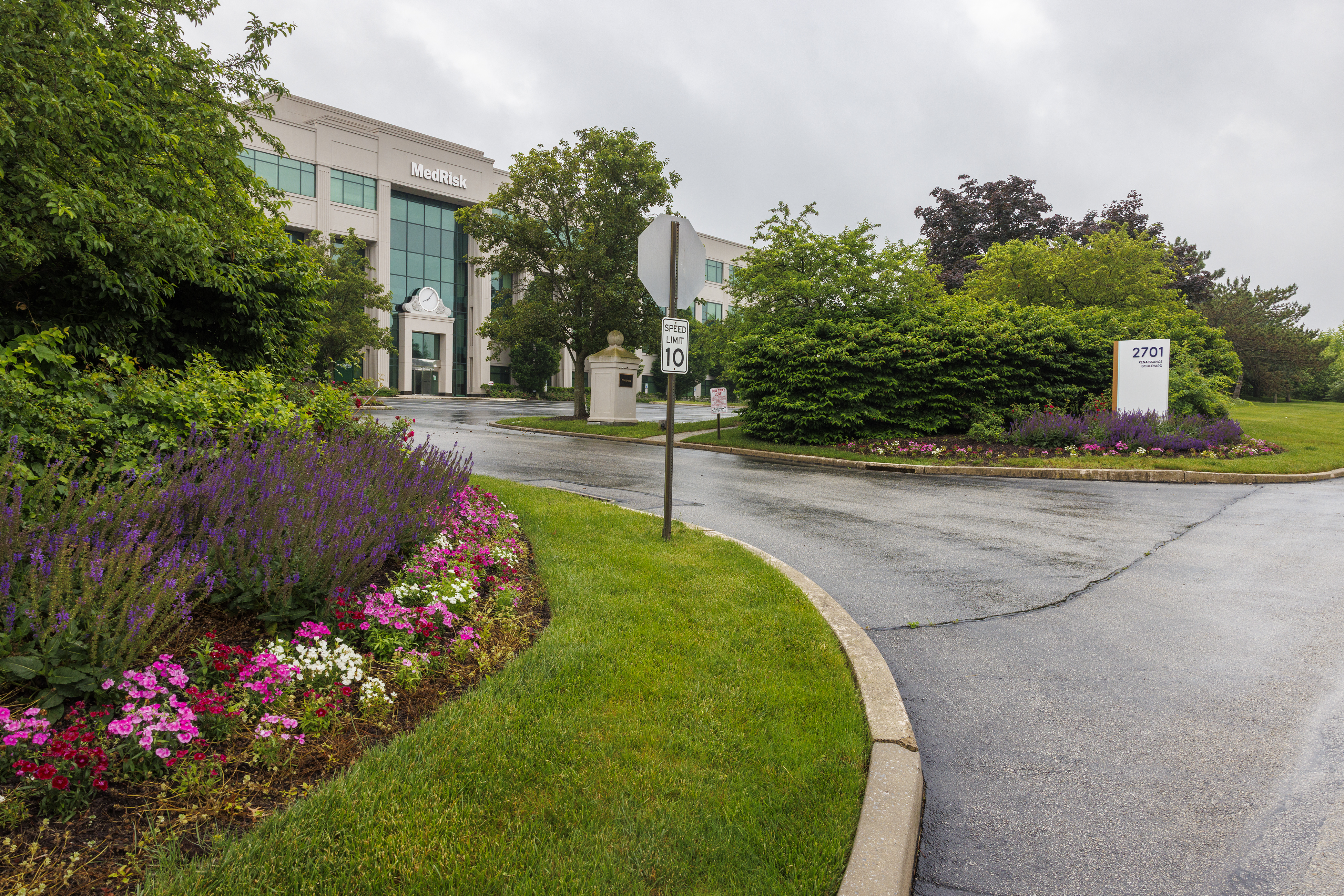
Brian O’Neill wants to build data centers on five sites in Upper Merion, including this property.
Upper Merion Township Manager Anthony Hamaday declined to comment Monday, saying officials were in the process of reviewing the filing. At the contentious meeting in which the board of supervisors rejected the proposals, vice chair William Jenaway accused O’Neill of “intimidation, coercion, and bullying.”
O’Neill’s lawsuit filed Friday was in regard to the rejection of his plan to build a 300,000-square-foot complex at 3200 Horizon Dr., currently occupied by an office building owned by Bryemere. In the next week, O’Neill’s attorneys expect to file four similar lawsuits, one for each of his properties on which he proposed a data center, on the same legal grounds, Kaplin said.
The lawsuits come two months after O’Neill’s team filed land-use appeals against Upper Merion Township and its board of supervisors in Montgomery County Court of Common Pleas and weeks after they withdrew specific township zoning appeals, which led to the cancellation of a public meeting and unsubstantiated rumors that O’Neill was giving up his fight in Upper Merion.
To Kaplin, the lawsuit filed Friday “paints a picture of the township just going off the ranch,” he said. “They completely folded to public pressure.”
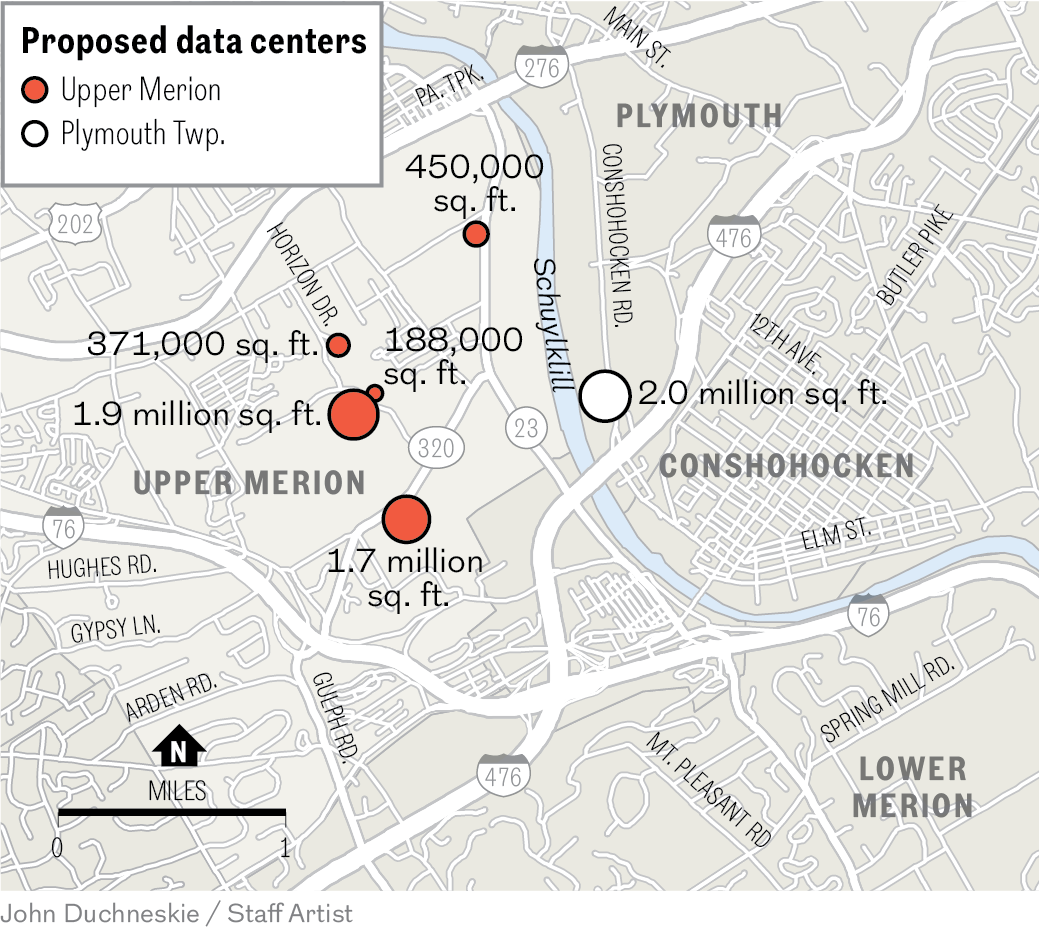
Brian O’Neill wants to build nearly 7 million square feet of data centers between Upper Merion and Plymouth Townships. This fall, he also applied to build a facility in West Conshohocken, a proposal in its early stages.John Duchneskie
O’Neill, a longtime developer who helped revitalize Conshohocken in the early 2000s, has proposed several data centers in the area surrounding the Montgomery County borough. He wants to build a 2-million-square-foot one on a closed steel mill in neighboring Plymouth Township, less than a mile from downtown Conshohocken.
In both Plymouth and Upper Merion Townships, O’Neill has faced fierce pushback from residents who have expressed concerns about pollution, light, noise, electricity prices, property values, and quality of life.
In May, lawn signs like these were displayed at some homes near the sites where Brian O’Neill wants to build data centers.
The opponents have packed township meetings and displayed lawn signs opposing the data centers. More than 18,000 people had signed a Change.org petition against the Upper Merion data centers as of Monday.
O’Neill has said his data centers would emit little light and noise, operate on a closed-loop system that requires no outside water, provide their own power, and bring jobs and tax revenue to the area.
The next zoning hearing board meeting on his Plymouth Township proposal is scheduled for Nov. 19.
Gov. Mikie Sherrill sent letters on Monday to a dozen port and terminal operators in New Jersey, warning them to “turn away” any tanker carrying Russian diesel or face what she called harsh penalties.
Sherrill, a Democrat, said that accepting the fuel would violate federal law and that she was prepared to use “every available legal and regulatory tool” to block any tanker from offloading Russian fuel in New Jersey.
It is unclear if any Russian fuel is headed toward New Jersey, but Sherrill’s position could put the state on a collision course with President Donald Trump, who last month lifted a ban on the import of Russian diesel as part of his efforts to bring down the cost of the fuel. Gasoline and diesel prices have risen since the United States and Israel attacked Iran at the end of February.
A Russian official has said that three tankers carrying diesel were en route to the United States, but it is not clear how many vessels are actually involved, or where they might be headed.
The owners of the diesel-importing facilities, some of which belong to large oil companies, would be forced to choose sides. Sen. Richard Blumenthal of Connecticut, a Democratic member of the Senate Armed Services Committee, has also demanded that two shipping companies recall tankers “carrying illegal Russian diesel.”
A White House spokesperson did not immediately respond to a request for comment on Sherrill’s warning.
Sherrill, who graduated from the U.S. Naval Academy and is a frequent critic of Trump’s, said port operators would be in violation of federal law if they allowed the vessels to dock or unload in New Jersey, an East Coast energy hub.
“In purchasing oil from Russia, a known supplier and financial supporter of Iran, Donald Trump is providing funding for a country that is engaged in hostilities with America, up to and including killing American soldiers,” she wrote, adding: “Any effort to profit from the illegal trade in Russian fuel will be met with harsh penalties.”
Among the recipients of Sherrill’s letter were IMTT, Kinder Morgan and Phillips 66, energy companies that have facilities in New Jersey. “As of now, we have not been notified of any shipment of Russian diesel to our terminal,” said Melissa Ruiz, a spokesperson for Kinder Morgan.
David LaPlante, a representative for IMTT, acknowledged receipt of the letter but declined to comment on it.
The terminal operators receiving the letter are not within the port system that is part of the Port Authority of New York and New Jersey, an agency run by a board selected by governors of each state.
Among shipping analysts, there is some agreement that one tanker, the Agioi Fanendes, is transporting the diesel. It was scheduled to arrive in the United States on Nov. 7, after leaving Primorsk, Russia, on Oct. 23, according to Kpler and TankerTrackers.com, two ship-tracking firms.
But the ship recently changed its destination from New York to “for orders,” meaning it did not have instructions on where to discharge, according to the tracking firms. It is currently in the North Atlantic.
According to Kpler, the Agioi Fanendes is owned by Eastern Mediterranean Maritime, an Athens-based tanker operator. The company did not respond to requests for comment.
The national average diesel price is $6.29 a gallon, up nearly 70% since the start of the war with Iran. The increase has weighed on businesses that use the fuel in trucks, vans and machinery. Though the United States produces more diesel than it consumes, the cost of the fuel is set on world markets. As a result, a global diesel shortage caused by the war with Iran has raised prices even for American consumers.
U.S. companies, fearing public outcry or legal action, may be unwilling to buy Russian diesel. The Russian government appears to have given financial backing to the diesel shipments. Last month, a Russian vice prime minister, Aleksandr Novak, said that the three tankers bound for the United States had the “significant support” of a Russian government-run investment fund.
In her warning letter to the terminal operators, Sherrill cited a federal law passed in 2022 that banned Russian energy products.
“You could be subject to millions of dollars in penalties long after Trump has left office,” Sherrill wrote.
The Treasury Department, which oversees sanctions policy, said on the social platform X last month that Trump’s waiver for diesel was “in compliance with all applicable laws.”
But Sherrill wrote that the 2022 law “does not grant the president or Treasury Department blanket authority to waive these sanctions.”