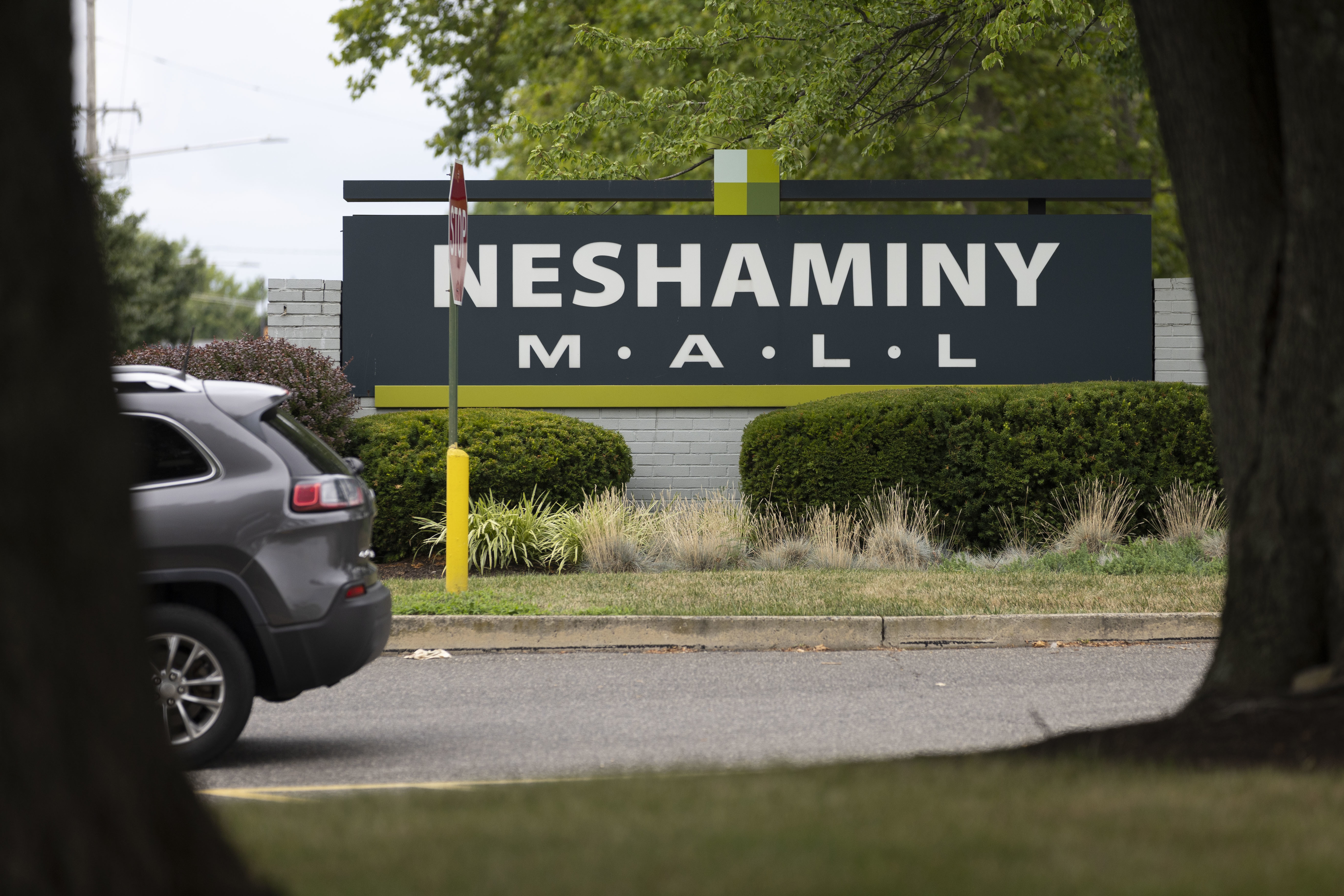
Neshaminy Mall, a 58-year-old Bucks County institution, will not see another holiday season, according to Bensalem Township Mayor Joe DiGirolamo, who said the complex will close by the end of October.
“It’s very bittersweet,” DiGirolamo said, “but the mall has been going downhill for the last few years.”
The 1-million-square-foot center has struggled with rising store vacancies and fewer customers, becoming fodder for TikTokers mourning their teenage stomping grounds.
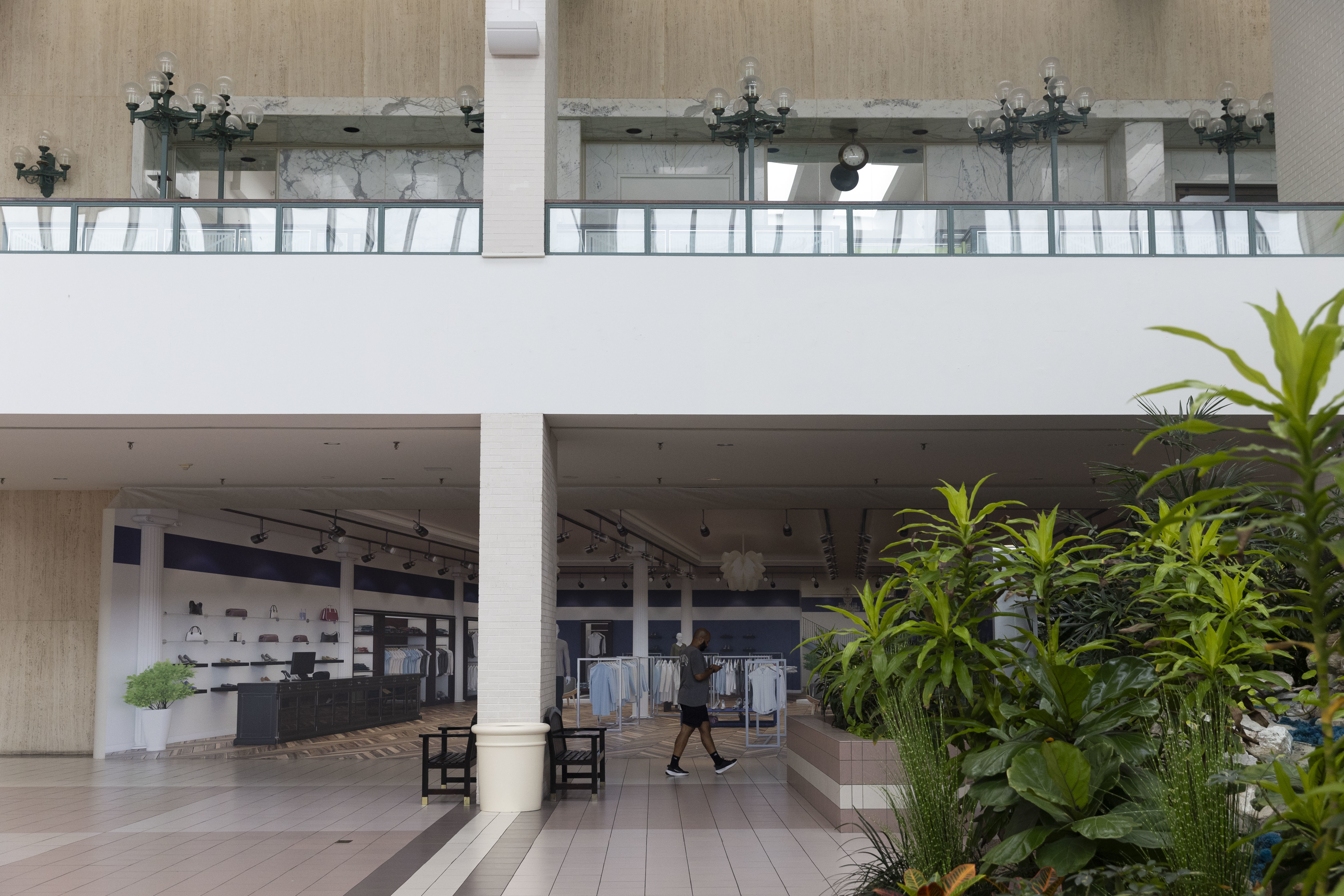
Neshaminy Mall in Bensalem, Pa., on Monday, July 22, 2024.Monica Herndon / Staff Photographer
Like in Exton, Neshaminy’s Boscov’s will remain open, DiGirolamo said, as will the AMC Movie Theater and Barnes & Noble bookstore.
A handful of other mall tenants must close up shop by the end of October, DiGirolamo said. In November, township officials plan to remove the mall’s dioramas, which depict key moments in U.S. history that took place in the Delaware Valley, as well as a bronze Native American statue, for preservation.
Historical dioramas in the Neshaminy Mall, as seen in 2024, will be preserved when the mall closes.Monica Herndon / Staff Photographer
The mayor said the property’s owners,Lakewood, N.J.-based Paramount Realty, want to knock down the mall and build something new in its place, though the company had not applied for a demolition permit or submitted redevelopment plans as of Tuesday. Such plans would require approval by township council.
The exterior of the old Macy’s at the Neshaminy Mall, as seen in 2024.Monica Herndon / Staff Photographer
A few have been transformed, or are in the process. In Media, Delaware County, the 1-million-square-foot Granite Run Mall was demolished in 2016 and replaced by a mixed-use town center with apartment buildings, new retail, and medical offices.
At the Neshaminy Mall site, near U.S. Route 1 and the Pennsylvania Turnpike, DiGirolamo said he’s “hopeful they are going to rebuild it in a way that most malls are rebuilt,” in the town-center style with housing and outdoor walkways.
As for the indoor mall’s final days, the mayor said he expects them to be quiet, with some tenants vacating before their leases expire.
DiGirolamo, a lifelong resident of Bensalem, said he remembers when the mall opened in 1968. It was a “regional mall,” he said, that attracted out-of-town visitors.
A faux storefront covered the old Macy’s at the Neshaminy Mall in 2024.Monica Herndon / Staff Photographer
A Philadelphia Daily News article about Neshaminy Mall’s opening called the $25-million complex “America’s most modern shopping center,” with the largest branches of Sears Roebuck & Co. and Strawbridge & Clothier at the time.
A few years later, the Oxford Valley Mall opened in nearby Langhorne. Oxford Valley, which is being partially redeveloped with apartments, will be Bucks County’s only enclosed mall once Neshaminy closes.
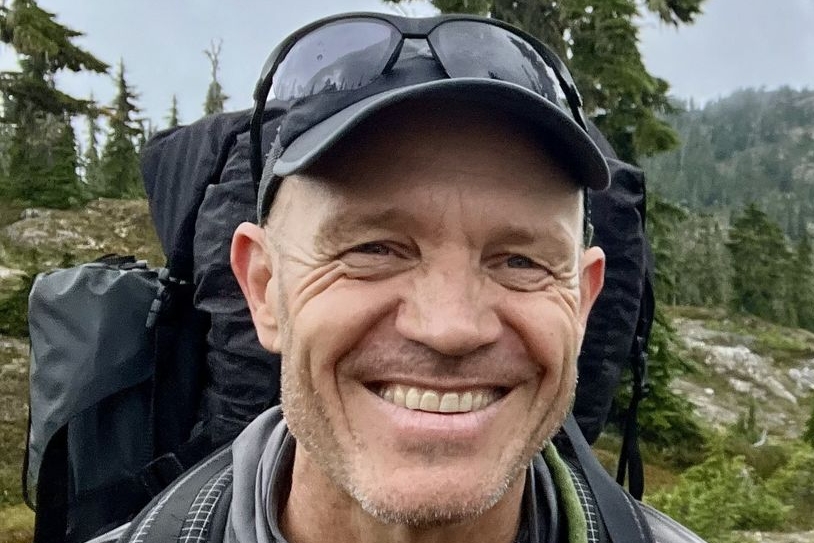
Peter D. Yeomans, 58, of Philadelphia, innovative clinical psychologist at the Corporal Michael J. Crescenz Department of Veterans Affairs Medical Center, founder of Cold Mountain Counseling LLC, worldwide mountaineer and backcountry adventurer, teacher, author, mentor, Quaker, and volunteer, died Friday, Aug. 28, of cardiac arrhythmia at the VA Medical Center in University City.
Dr. Yeomans was an expert in trauma, substance use disorder, moral injury, and spiritually integrated healthcare. He joined the Philadelphia VA Medical Center as a staff psychologist in 2009 and became director of its innovative PTSD outpatient team program in 2019.
He opened his own psychology practice, Cold Mountain Counseling, in 2021 and advised thousands of veterans, fellow backcountry adventurers, and other clients in need across the country. “He was instrumental in the healing process for so many veterans that it is hard to fathom the reach of his influence,” a VA colleague said in a tribute.
R. Tyson Smith, a friend and colleague, said several veterans told him: “Peter Yeomans saved my life.”
At the VA center, in addition to physical and mental ailments, Dr. Yeomans and others innovated a treatment for what are called “moral injuries” from military service. They connected therapists with VA chaplains to link emotional healing with faith rituals, and veterans in the program spoke appreciatively about shifting the guilt and shame of moral failures during war from soldiers in general to society at large.
“These are stories to hear and also for the public to wrestle with,” Dr. Yeomans told The Inquirer in 2019. His wife, Kate O’Shea, said: “He was the most responsible person you could imagine, and he felt he had a responsibility to humanity.”
Outside the medical center, Dr. Yeomans spent weeks at a time hiking, backpacking, packrafting, skiing, rock climbing, and mountain biking around the world. He reached summits in Alaska and Argentina, had to be rescued from a deep crevasse, and worked as a program supervisor and senior field instructor in the 1990s for the National Outdoor Leadership School in Alaska, Wyoming, Arizona, and Utah.
Later, he cofounded the local Wilderness Outdoor Leadership Force for teens in Kensington. Talia Young, a longtime WOLF member, called him “genuine and earnest … and joyful with kids.”
Dr. Yeomans was an avid cyclist.Bicycle Coalition of Greater Philadelphia
Longtime colleague Rob Riman said he was a “consummate adventure partner and wildly inspired guide.” On his website, coldmountaincounseling.com, Dr. Yeomans said: “Many of the fondest memories of my life are from adventures in the mountains.”
He earned a bachelor’s degree in psychology from Harvard University in 1991 and came to Philadelphia from Wyoming in 1997 to be with O’Shea. He earned a master’s degree in psychology from Lesley University in Massachusetts in 2001 and a doctorate in clinical psychology from Drexel University in 2008.
Dr. Yeomans traveled to New Zealand, Rwanda, Burundi, and elsewhere to train other counselors. He worked in state correctional institutions in Philadelphia and Chester, and earlier for the American Red Cross in Germany.
Dr. Yeomans and his wife, Kate, married in 2002 and had many adventures together. Courtesy of the family
He taught classes on moral injuries at Germantown Friends School, the University of Pennsylvania, and elsewhere. Longtime friend William Anninger said: “He was particularly good at creating emotional sharing among men.”
Friend Lila Berman said: “He exuded warmth and care for the people around him, and for the natural environment.”
Peter Douglass Yeomans was born Aug. 27, 1968, in Berkeley, Calif. The family moved to Massachusetts when he started high school, and he graduated from Concord Academy in 1986.
He met Kate O’Shea at an environmental ethics course in Utah in 1996, and they married in 2002 and lived in Germantown. He made her tea in the mornings and left love notes behind when he left the house first. They reared a daughter, Ada, and sons Josiah and Levi, and they all went on memorable adventures in Wissahickon Valley Park, across the country, and around the world.
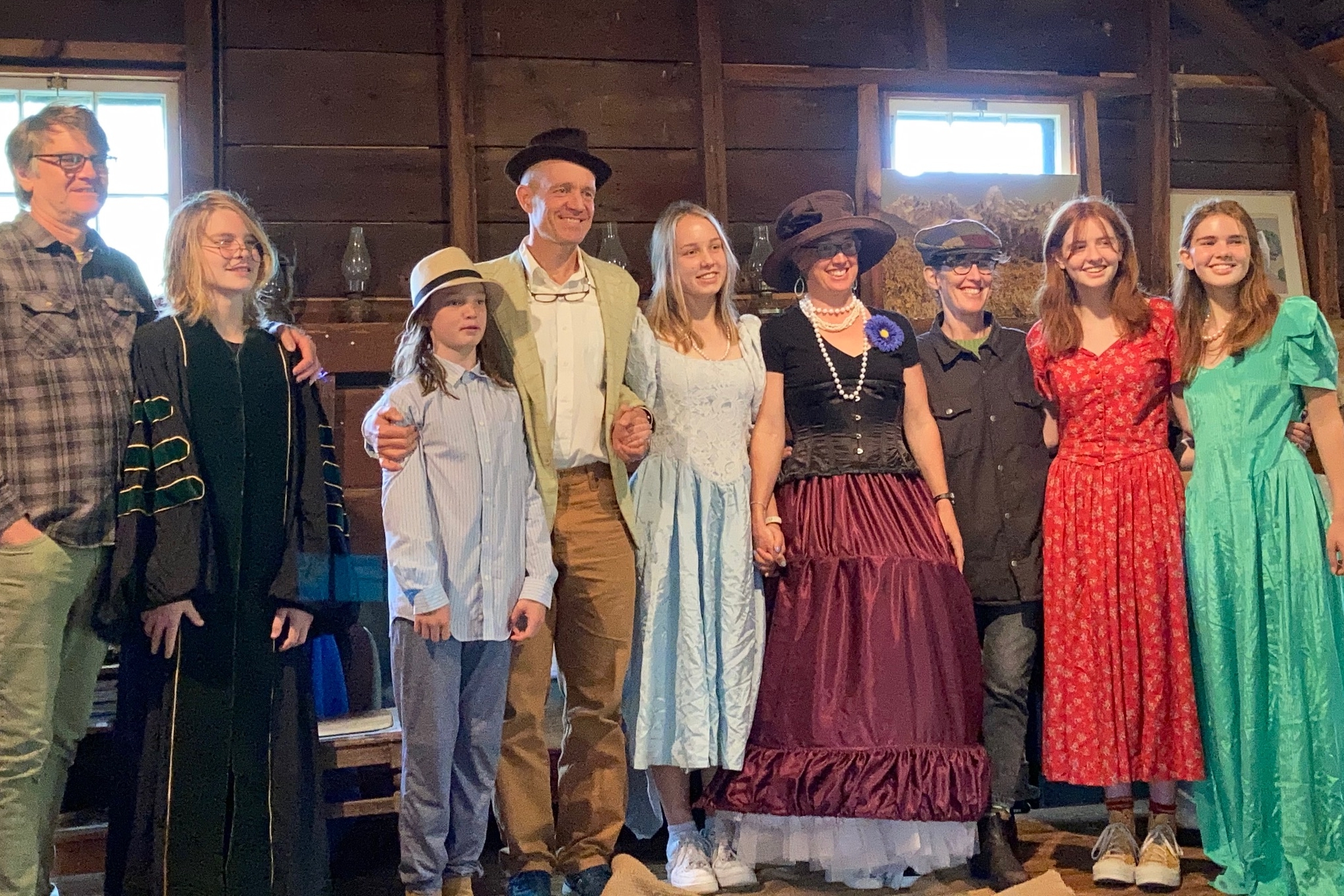
Dr. Yeomans, rear left on top and fourth from the left on bottom, enjoyed time with his family in the mountains and on stage. Courtesy of the family
“They complemented each other perfectly,” their daughter said. “He taught us how to read a map, find a campsite, and most importantly bake cinnamon rolls in the backcountry.”
Dr. Yeomans was a member of the Bicycle Coalition of Greater Philadelphia, and he rode his bike often from home in Germantown to work in University City. He went to Germantown Friends Meeting, played guitar, sang, and acted in theatrical shows in high school and later with community groups and his family.
He was inclusive and encouraging, his brother, Ben, said, “drawing out capacities in me I wasn’t yet trusting.” His parents, Anne and Tom, said: “It has been a great privilege to have been Peter’s parents.”
His mother-in-law, Margaret O’Shea, praised his “compassion, selflessness, nobility, and grace,” and his father-in-law, Dan O’Shea, said: “When our daughter met Peter she described him as ‘Mr. Perfect.’ Little did we know how perfect.”
“It has been a great privilege to have been Peter’s parents,” his parents said.Courtesy of the family
Kate O’Shea said: “Because of Peter, our world is a kinder, more generous, and more loving place.”
In addition to his wife, children, parents, brother, and in-laws, Dr. Yeomans is survived by other relatives.
A memorial service is to be held at 2 p.m. Saturday, Oct. 3, at Germantown Friends Meeting, 47 W. Coulter St., Philadelphia, Pa. 19144.
The U.S. poverty rate fell slightly last year as Americans’ incomes rose alongside rising prices, according to new census data published Tuesday. But the data from 2025 did not reflect cuts to social assistance this year that experts fear will cause a rise in poverty soon.
Just over 1 in 10 Americans lived below the poverty line in 2025, the Census Bureau found, a half-percentage point drop since 2024.
The median American household income rose more than 2% in inflation-adjusted terms, to $87,460. And the numbers reflected a narrowing of the income gap between men and women: Women’s earnings from full-time, year-round work rose about 3%, while men’s earnings remained mostly flat, meaning the average full-time female worker went from earning about 80% as much as an average man to about 83% as much.
Officials touted the lowest official poverty rates on record for children and for Hispanic Americans, at about 13% of both groups.
But advocates for people in poverty warned that the gains might be short-lived.
The report reflects the number of people in poverty in America last year, before significant changes to the social safety net, passed by Congress in 2024 as part of a major tax and spending bill, took fuller effect this year. Experts who reviewed Tuesday’s numbers said they expect next year’s census data to show a substantial increase in poverty, due largely to cuts to the food stamps program.
“The nature of an annual statistic might mask some of the volatility that families already started to experience,” said Megan Curran, a poverty expert at Columbia University. “We know the reality on the ground is going to be looking quite different from what the numbers were” a year ago.
“This was the situation that families were in on the eve of the full implementation of these major changes to the safety net,” she said. “But it’s not reflecting what life is like for families who rely on SNAP and programs like that in September of 2026.”
The Center on Budget and Policy Priorities found that 5 million people lost SNAP benefits between July 2025 and May 2026 as a result of the new legislation, which strengthens work requirements for food stamps and eventually shifts much more of the cost of the program onto states. In the first five months of this year, the organization found, the number of people receiving assistance fell in all but three states, and by as much as 20% in Arizona.
This year’s Supplemental Poverty Measure — a more sophisticated method that takes into account families’ expenses and government benefits, rather than just marking whether their income falls above or below the poverty line — remained basically unchanged since last year, designating about 13% of Americans as impoverished. Advocates said they expect the SPM to rise next year as well, as government benefits decrease.
Chastity Lord, president of an anti-poverty program for single mothers and their children, said rising prices have pushed women to take on more work this year to support their families, as reflected in the rising female income numbers. Overall, the average income for full-time, year-round work stayed flat this year while overall household income rose, reflecting more income from other sources including gig work, as well as retirement benefits and other inputs.
“You’re talking about rising gas prices, rising food prices, rising utility prices. Those are baseline expenses that when they don’t get paid, the engine doesn’t run of life, and folks are having to do what they need to do,” said Lord, whose organization — Jeremiah Program — supports working mothers in nine cities around the country. “Where you’re really seeing supplement around that employment is the gig economy. We call it the ‘survival economy.’”
She predicts a substantial increase in the SPM next year, when that gig work won’t be enough to replace widespread cuts to food stamps.
Tuesday’s data also showed that 92% of Americans had health insurance for some or all of the year, a near-historic high that has held fairly steady for the past decade.
But on health insurance, too, the 2025 numbers don’t reflect changes already underway this year. Substantial subsidies for people who buy their health insurance on the Affordable Care Act marketplace expired on Jan. 1, and the healthcare group KFF predicted that as many as 5 million people could lose marketplace coverage in 2026, either because high premiums deterred them from signing up or because they failed to make payments during the year.
Meanwhile, premiums for employer-sponsored insurance spiked this year and are set to climb more next year, leading more people to choose to go without insurance.
Tuesday’s data comes from the annual Current Population Survey, a sample conducted by the Census Bureau early each year. The full decennial census that counts every American will next run in 2030. Last week, the Trump administration proposed both adding a question about citizenship to the 2030 Census and leaving immigrants without permanent residency status out of the count.
Nearly 6 million Reading Terminal Market visitors, a mix of locals and tourists, spent $1.2 billion in Philadelphia last year, according to a new study on the economic impact of the historic Center City market.
It’s the first time the nonprofit Reading Terminal Market Corp. has commissioned such a report, and the stats solidify the market’s status as “a beloved civic institution, and a powerful and vital economic engine for Philadelphia and Pennsylvania,” said Annie Allman, CEO and general manager. With the report, Allman said she is encouraging “continued investment in the market, its merchants, and its infrastructure.”
It highlighted the market’s importance to lower-income residents, with 18 Reading Terminal merchants accepting SNAP and EBT benefits. This accounts for about 55% of the Center City merchants who accept food-assistance programs, according to the report. Reading Terminal Market is considered the largest EBT- and SNAP- redemption location in Pennsylvania.
“Every dollar spent here is a dollar invested in Philadelphia — in our merchants, our hospitality industry, our neighbors, and our future,” Allman said in a statement.
The “Feeding the City, Fueling the Economy” report — released Tuesday and conducted by the Philadelphia firm Econsult Solutions at Reading Terminal Market Corp.’s request — found that the market has contributed about $126 million worth of annual economic activity to the city of Philadelphia and $146 million to the Commonwealth of Pennsylvania. These figures include direct spending at the market’s more than 75 vendors, as well as the subsequent spending by those vendors and the employees they pay.
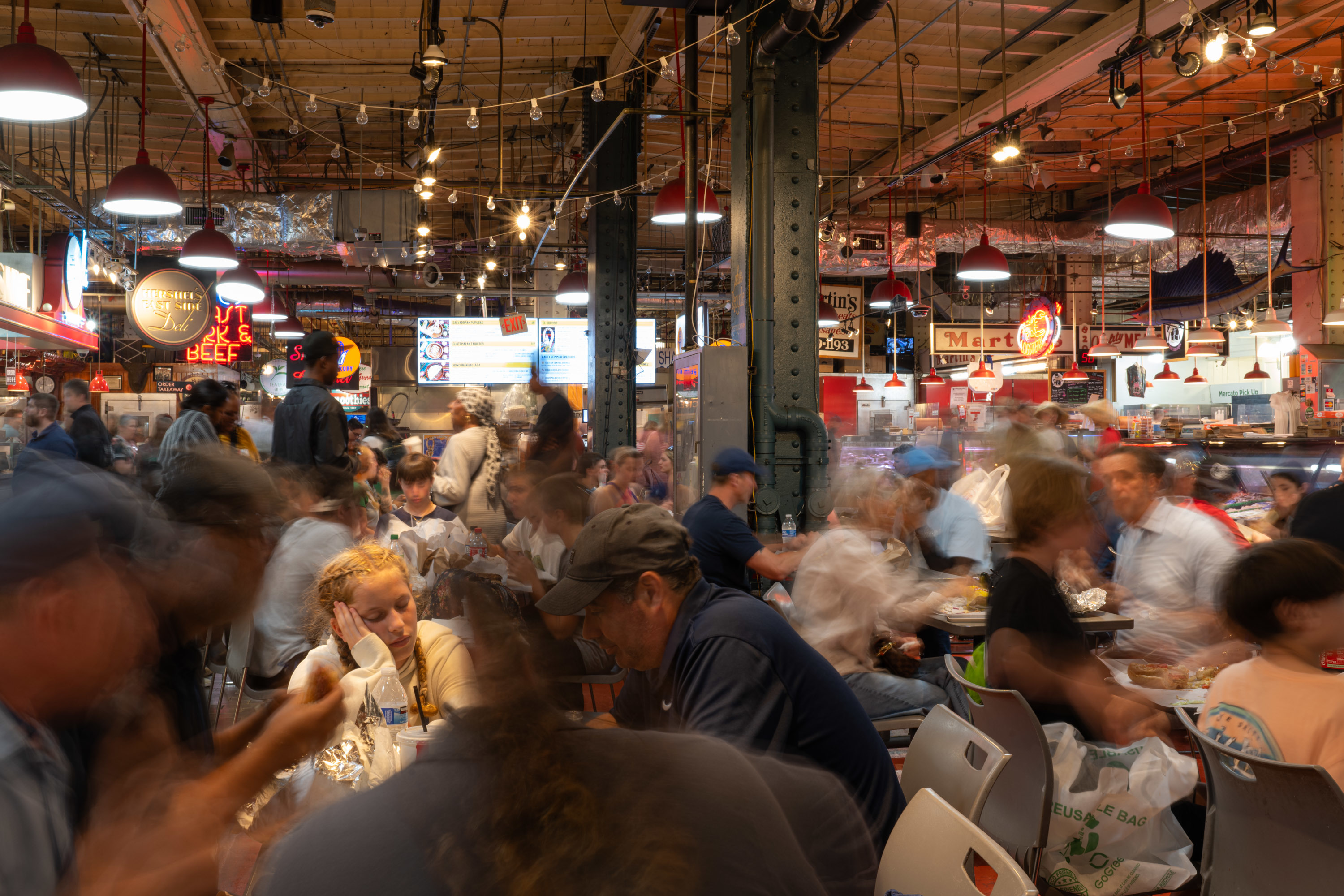
Diners at the Reading Terminal Market in June.Alejandro A. Alvarez / Staff Photographer
The new report found just over half of the market’s visitors last year, 3.1 million customers, were visitors staying overnight in the region, while the rest were Philly-area residents.
Some Reading Terminal customers may have first heard of the market online, on a podcast, or on TV and streaming programs: The report found that Reading Terminal reached 10.8 billion people through these kinds of media mentions, equaling $81 million in “publicity value.”
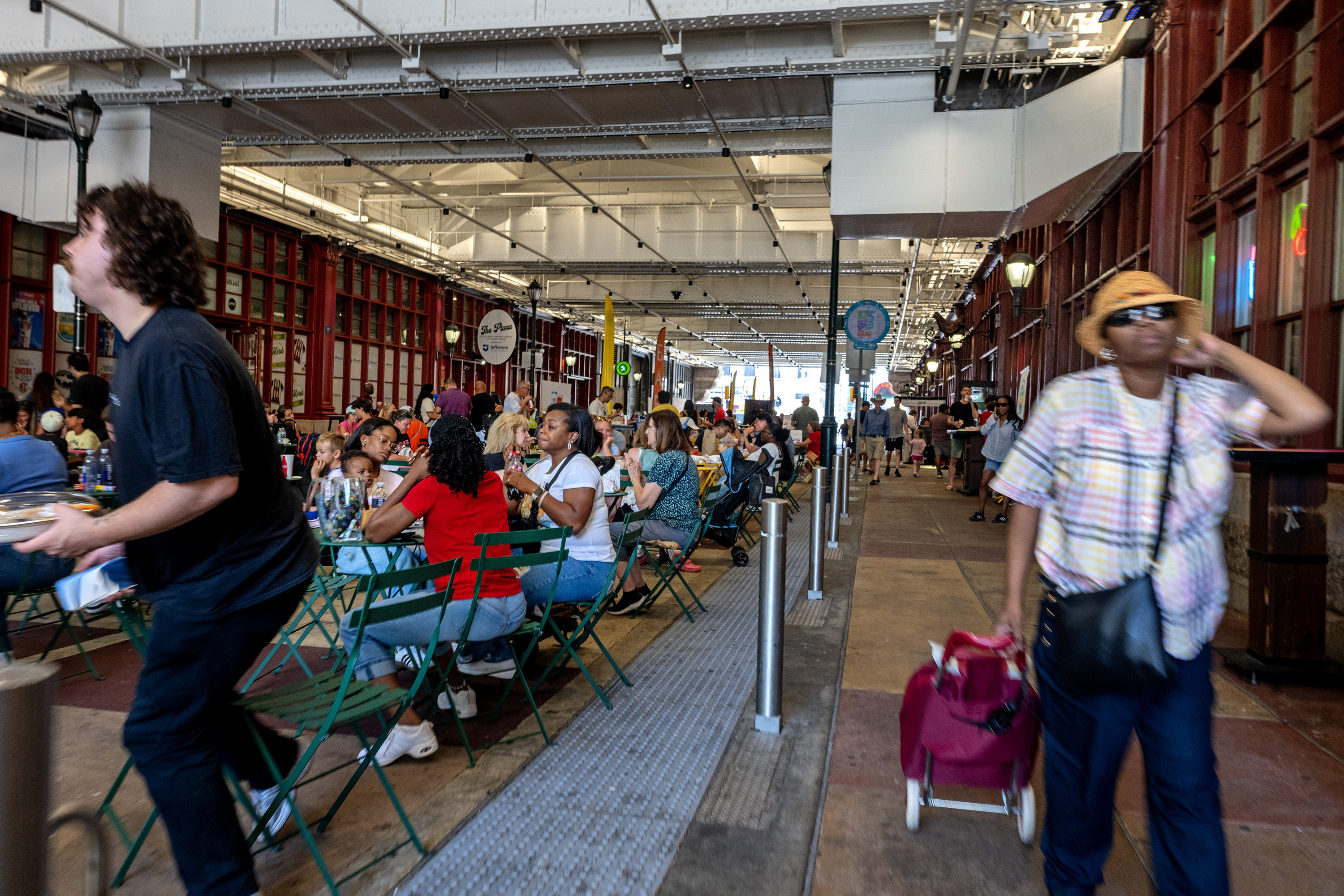
People enjoy the pop-up outdoor area on Filbert Street at Reading Terminal Market in July. Tom Gralish / Staff Photographer
Between the market’s merchants and the corporation that runs it, Reading Terminal pays nearly 700 full-time-equivalent employees a combined $39 million a year, according to the report.
And market partners spend about $6.1 million a year on capital improvements, which include mechanical, plumbing, and electrical upgrades, as well as larger undertakings like the 2022 Filbert Street Project that added 15,000 square feet of pedestrian-friendly outdoor space.
Founded in 1893, Reading Terminal is one of the country’s oldest continuously operating markets. Spanning nearly 80,000 square feet along 12th Street, between Arch and Filbert Streets, the market sells everything from fresh produce and seafood to meats and homemade baked goods.
At its quick-service restaurants, customers can find Caribbean cuisine, Asian street food, Filipino-fusion eats, Thai food, falafel, cheesesteaks, and vegan bites.
Allman, CEO and general manager, said 2026 “brought unprecedented global attention” to Philadelphia. This summer, the city hosted the World Cup, America’s 250th birthday celebrations, and the MLB All-Star Game. Any economic impact those events had on Reading Terminal Market, however, would be reflected in next year’s report.
Correction: This story has been updated to reflect that $1.2 billion is the estimated total spend by Reading Terminal Market visitors in Philadelphia, not in the market alone. It also reflects how much market partners spent on capital improvements.
As we enter the last quarter of this calendar year, many businesses are budgeting for pay raises in 2027. Most of my clients — and many other small businesses — also offer bonuses, which can provide extra financial incentives to employees.
According to HR consulting firm Korn Ferry, the average pay raise is expected to be about 3.3% next year. Professional services firm Marsh says raises should be about 3.5%.
Given the current rate of inflation, this may barely seem enough to cover the cost of living. But base pay isn’t everything, and bonuses can be a great motivator.
Here is how several area businesses use this tool.
Employees ‘write their own ticket’
At the Pest Rangers, a pest control company based in Hanover Township, CEO Jeff King utilizes several bonus and incentive plans, all with the aim of rewarding workers for reliability, customer service, and sales.
“Our technicians receive baseline bonuses for punctuality, weekly truck inspections, and avoiding customer complaints,” he said. “Employees who sell recurring pest-control plans share a monthly bonus pool based on their portion of total sales.”
The company also offers sales commissions and production bonuses with no cap on earnings, he said.
The company’s “raving customers” program rewards employees who receive exceptional customer feedback, King added. The company paid more than $18,000 in these bonuses in 2025, including more than $6,000 to its top technician.
“This method we’ve formulated allows the employee to write their own ticket. If you want to go above and beyond, you’re being recognized for that behavior,” he said. “We put money directly into the employees’ pockets, rather than spending on traditional marketing.”
Lowering costs while paying good managers what they’re worth
Chickie’s & Pete’s, the popular Philadelphia-based restaurant chain, offers several bonus programs, but focuses its rewards primarily on managers and supervisors.
“We award managers for things like developing hourly employees into supervisors and managers, training incoming managers at designated training locations, and keeping labor and food costs within quarterly budget targets without hurting customer service,” said vice president of operations Peter “Pete” Ciarrocchi III.
“Our plans were designed to help retain the staff that we have and also providing consistent quality services to our families,” he added.
Bonus plans have helped to reduce the company’s labor costs, Ciarrocchi said, but managers make 20% more on average since the restaurants started giving bonuses.
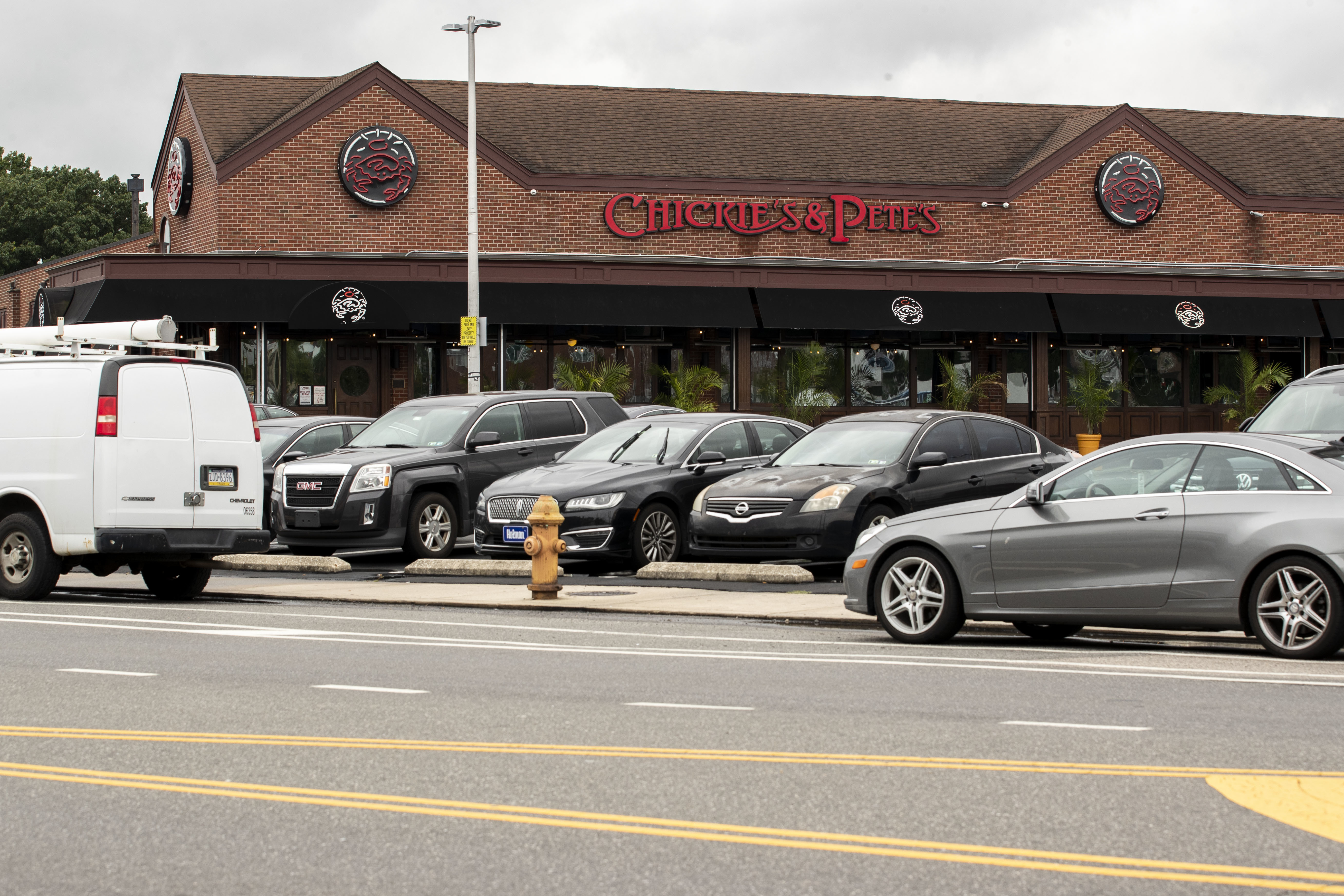
Chickie’s & Pete’s restaurant in South Philadelphia.MONICA HERNDON / Staff Photographer
Bonuses rewarding consistency
Werner Bus Lines in Phoenixville uses targeted bonus programs that are tied directly to the results or behaviors the company wants from each department.
For example, sales employees get paid based on bookings and mechanics get a bonus for punctuality.
“I tried to think about the systems I could design where my employees and the company are happy,” Werner’s president Heath Ochroch said. ”I asked what was the actual behavior that I wanted to see more of in each of these departments and that would be the common thread.”
Jamie Turner, founder and president of Acclaim Autism, focuses bonus programs on the people providing services.
Acclaim Autism’s “frontline workers,” who help provide behavior analysis and therapy, among other services, can earn up to $300 in bonuses per month, Turner said.
“Their bonuses are primarily based on consistently completing scheduled patient-facing hours, maintaining continuity and routine for patients, and meeting quality and compliance standards,” he said.
Turner said it’s critical for their employees to be incentivized to provide consistency in their patient-facing hours, “which our patients need on a regular routine basis.”
Using discretion to reward less quantifiable contributions
Many firms I know like to pay once-a-year bonuses based on management’s discretion.
Employees at PayUSA, a King of Prussia-based payroll processing firm, receive an annual year-end bonus based primarily on their individual performance. President and CEO Christian Hoyt said most established employees receive a bonus equal to at least one week’s salary, with a larger multiple for stronger performers. The largest bonuses are up to 2.5 times the employee’s weekly pay.
“The basic idea is to recognize a full year of hard work with an additional week or more of compensation,” he said. “If an employee worked really hard for 50 weeks, let’s pay them for 53.”
At Newtown-based JS Benefits Group, an employee benefits consulting firm, all 26 employees are eligible for discretionary bonuses, which can be as much as 5% of their salary, or about 2.5 weeks’ pay. Founder and CEO Jennifer Schaefer said there is no fixed formula.
“We generally consider three principal factors: the company’s overall performance, the employee’s individual contribution, and the employee’s years of service,” she said.
Schaefer deliberately keeps the bonuses discretionary because conventional productivity measures do not capture every valuable contribution. She considers how employees serve clients, support colleagues, solve problems, and strengthen the company’s culture.
“A formula can measure revenue, but it can’t always measure the employee who quietly solves problems, earns a client’s trust, or makes the entire team better,” she said.
WASHINGTON — The Federal Reserve is widely expected to lift its short-term interest rate Wednesday for the first time in three years to fight stubbornly high inflation, a move that would put the central bank at odds with President Donald Trump’s support for a cut.
A quarter-point increase in the Fed’s rate, currently about 3.6%, isn’t guaranteed because Fed Chair Kevin Warsh doesn’t provide the signals about next moves that his predecessors did. Still, most analysts and economists expect a hike after a speech two weeks ago at the Fed’s annual conference in Jackson Hole, Wyoming, in which Warsh argued that the Fed had not yet achieved its goal of putting inflation in check.
A rate increase would throw another sharp shift into a volatile period for the economy and financial markets. As recently as March, the Fed had forecast it would cut its rate once this year. But with the Iran war flaring up again and causing sharp increases in oil and gas prices, inflation is likely to remain higher than the Fed’s 2% target for even longer.
“I don’t see any end to the war in Iran right now,” Kristin Forbes, an economist at MIT’s Sloan School, said. “Given what everyone has been through in the last few years of high inflation, consumers are more sensitive, companies are more sensitive, they raise prices faster … The risks are much more on more persistent inflation than it falling quickly.”
All eyes are on interest rates before the midterms
The Fed’s potential rate hike comes just seven weeks before the midterm elections in which high prices and affordability have taken key roles. Trump has demanded that the Fed cut rates, a move that isn’t on the table, and on Sunday the president said, “the United States is so strong we should be paying the lowest interest rate in the world.”
Trump repeatedly attacked Warsh’s predecessor, Jerome Powell, in harshly personal terms, upending decades of tradition in which presidents treated the Fed as independent.
Kevin Hassett, Trump’s top economic adviser, said Sunday on CNN that Trump “100% respects the independence of Kevin Warsh.”
Yet at the same time, Hassett suggested in a Fox News interview that the Fed shouldn’t hike so close to the midterms.
“I’d be wary of a rate hike … I think if you want an independent Fed, then one thing the Fed does is it stays out of the way of elections,” Hassett said.
Financial markets expect that Warsh and the central bank will brush off such warnings. Traders now see a 90% chance the Fed will hike Wednesday, according to futures prices. That figure jumped after Friday’s inflation report showed that prices remain stubbornly high and core inflation, which excludes volatile food and energy, picked up in August from the previous month.
After that report, and Warsh’s tough talk on inflation late last month, most economists argue that Warsh will have to hike rates or risk undermining his credibility with financial markets. Longer-term interest rates, such as those on the 10-year and 30-year Treasury bonds, could spike if he doesn’t hike, as they did after a Fed meeting in late July when Warsh failed to convince markets he was willing to lift rates if needed.
“At the end of the day the Chair’s repeated stern warnings on inflation intolerance risk institutional credibility absent some action to back it up,” Michael Feroli, an economist at JPMorgan Chase, wrote in a preview of the Fed’s meeting.
A rate increase could raise other questions
Some members of the Fed’s interest-rate setting committee still expect inflation, outside of food and energy, to fade over time and may not feel a rate hike is necessary.
But Warsh has not made that argument. Instead, in his Jackson Hole remarks, he said recent inflation reports “do not tell me that underlying trends have improved,” adding that if such improvement wasn’t seen soon, “we have work to do.”
Ironically, by boosting Fed credibility, a rate hike could hold down longer-term interest rates that consumers pay for things like mortgages and auto loans. Some of the recent spike in mortgage rates has likely reflected concerns among investors that the Fed wasn’t committed to fighting inflation. Investors typically demand higher yields to own bonds when inflation is elevated.
Still, if the Fed does increase its rate Wednesday, then Warsh will face a new set of questions: How many hikes will the Fed implement? How effective will they be in reducing inflation when much of it stems from higher oil prices, something the Fed can’t control? What will they do if an AI slowdown threatens to slow the economy, which would typically get the central bank to cut rates?
Matthew Luzzetti, chief U.S. economist at Deutsche Bank, said it is rare for the Fed to lift its key rate just once, which is likely to have little impact on the economy, and so multiple hikes are likely.
But how the Fed characterizes possible rate increases on Wednesday could give clues to its next steps, he said. For example, if Warsh suggests the Fed is unwinding the three cuts it made in late 2025 — when it feared that unemployment was rising — that would suggest two more hikes would be needed.
Alternatively, Warsh could portray a hike as an act of “risk management,” Luzzetti said, with the Fed expecting inflation to cool but hiking rates to essentially ensure it falls. That could point to possibly just two increases.
Warsh has resisted providing such guidance so far. But Wall Street traders expect three hikes — in September, December, and March — according to futures prices.
U.S. investors face a novel question as warnings grow about the potential dangers of artificial intelligence: Is it bad for business and Americans’ stock wealth if AI leaders slow down the technology to avoid catastrophe?
Prominent technology moguls including the CEOs of ChatGPT-maker OpenAI and its rival Anthropic have said such a slowdown is necessary to tame the risks of expensive or deadly threats such as cyberattacks from out-of-control AI.
Technology stocks wilted Monday as investors focused on the ripple effects of any new AI controls. A self-imposed or government-ordered slowdown of AI development could douse enthusiasm for the expected initial public offerings of OpenAI and Anthropic and dent the AI boom that is boosting U.S. economic growth, corporate profits, and the stock portfolios of millions of Americans.
Ed Mills, a Washington policy analyst with the financial firm Raymond James, said AI-related companies have soared in stock market value as though there’s little risk of regulatory speed bumps to the technology. He said he’s spent the past week encouraging investors to take seriously a potential surge of AI regulation.
“The data center policy debate is going to seem quaint” compared to the coming showdown over AI regulation, Mills predicted. “Part of that process is going to cause investors to potentially re-evaluate the worth of these [AI] models and these companies.”
It’s plausible that little changes with how AI companies operate, some policy and technology analysts say. But the worries reflected on Wall Street underscore how much the nearly four-year-old AI boom is built on faith over facts.
The bull case for AI is that the trillions of dollars being spent to develop AI technologies and distribute them through data centers will reorder American life and unleash untold profits and economic growth. If AI development or corporate usage of AI slows, it could push the potential payday from the titanic AI bet even further into the future.
President Donald Trump noted the potential economic costs of an AI slowdown in one of several Truth Social posts Monday in which he attacked AI leaders backing the concept.
“When, in the History of Business, did anyone see the Leaders of an Industry call for Regulation that, if strongly implemented, will drive them into oblivion and bankruptcy?,” he wrote. “AI, and Data Centers, will be the Greatest Economic Development Engine in History - Bigger than Oil, Gold, Diamonds, or even the Internet.”
The Nasdaq stock index, considered a proxy for the investor enthusiasm for technology companies, fell Monday after a weekend of AI doomsday discussions. Multiple factors roiled markets, but analysts noted that prices of some companies heavily dependent on the AI boom, including computer chip maker Nvidia and Elon Musk’s rocket-and-AI company, SpaceX, dropped significantly.
Asian shares fell slightly Tuesday, with South Korea’s Kospi index down nearly 1% as Samsung and SK Hynix extended declines.
One of the biggest questions is what happens to planned initial public offerings by the two leading AI start-ups, Anthropic, which makes the Claude chatbot, and OpenAI. The companies have been collectively valued at close to $2 trillion by investors and are widely expected to jump significantly in worth when they list shares on public markets. (The Washington Post has a content partnership with OpenAI.)
Dario Amodei, CEO of Anthropic, warned about AI’s potentially catastrophic downsides, but he is also hoping to sell investors on an optimistic vision of AI as his company prepares for an initial public offering.Markus Schreiber
Dario Amodei, the Anthropic CEO who has long warned about AI’s potentially catastrophic downsides, now faces a contradiction partly of his own making.
He is simultaneously warning publicly that technology from Anthropic and its peers could be dangerous to human life and economic prosperity — while also hoping to sell investors on an optimistic vision of a profitable, glorious AI future.
It is “unprecedented” for a company preparing an IPO to offer a dueling narrative like that, said Nick Smith, a senior analyst at the research firm and IPO stock index Renaissance Capital.
He and other financial experts said it’s not unusual for companies to be candid about navigating concerns and regulatory scrutiny of contentious products, including from pharmaceutical and gene-editing companies.
But Smith said that it raises red flags for people buying a company’s stock when its top executive “notes issues that could cause real problems for the company, and more importantly calls for a slowdown in its technology’s development.”
Anthropic’s IPO could come as early as this fall, according to reporting by Reuters. The company has said that the listing will “depend on market conditions and other factors.”
Eddie Best, a partner at the law firm Willkie Farr & Gallagher who advises companies on IPOs, said he doubts that a potential industry slowdown or speculative fears of AI-caused extinction would derail Anthropic’s IPO.
He did say, though, that he and other corporate lawyers have been playing a “nerdy game” about whether AI end times could appear in the “risk factors” section of Anthropic’s IPO pitch document for investors. These are usually boilerplate legalese about the large and small potential roadblocks to a company selling its stock to the public.
Some technology companies already warn investors that AI could get them into hot water, though none appear to stray into the human extinction territory of Amodei’s weekend essay.
Google’s annual financial report says that “some uses of AI will present ethical issues and may have broad effects on society.” Risk factors from Microsoft outline the possibility that people could get hooked on using AI as companions.
Best said he couldn’t imagine lawyers crafting a doomsday scenario in the Anthropic IPO pitch document.
“I don’t really see a risk factor that says our product could blow up the world,” Best said.
Contractors for Delaware and its port manager, Enstructure LLC, have started work on a $669 million container port that leaders hope will attract thousands of jobs to the state’s industrial northeast near the Pennsylvania state line.
Delaware has agreed to pay $325 million of the container terminal cost, with Enstructure, which is financed by the Blackstone private equity group and other investors,committing $225 million. Federal grants are expected to cover the rest.
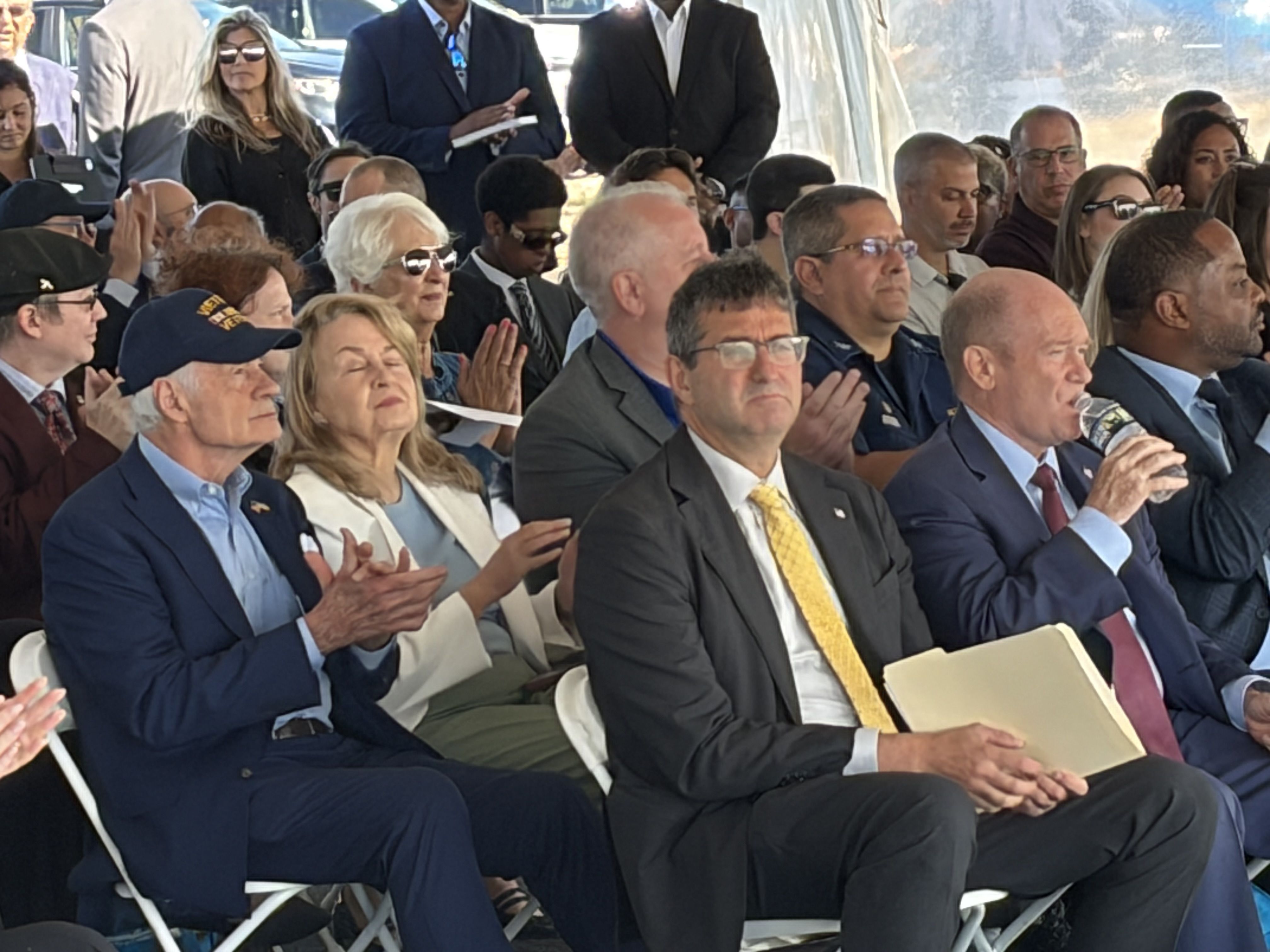
U.S. Sen. Chris Coons (D., Del.) told the crowd of construction and port workers and public officials at a groundbreaking Monday that the Delaware Container Port is designed to replace high-wage union industrial jobs lost when northern Delaware’s auto, steel, and chemical works shut over the past 20 years.
When the port is finished by late next year, “bigger ships will come to Delaware first,” Gov. Matt Meyer said, as container ships traveling the Delaware River to Pennsylvania and South Jersey terminals passed by.
Meyer said the new Delaware terminal would feature electric cranes and other equipment, instead of diesel power at “one of the cleanest, greenest ports in the world.”
Shippers have been “containerizing” cargo into trailers suitable for shipping by sea, rail, and truck since the 1950s, though union leaders complain that automated cargo handling reduces the need for labor. Port managers clear land, buy cranes, and pour concrete based on uncertain estimates. South Carolina earlier this year shut a four-year-old, $1 billion container port because it attracted few cargoes.
The site of Delaware’s new port is a former DuPont Co. titanium dioxide plant at Edgemoor, north of Wilmington. During Monday’s event, earth movers smoothed property east of a mound that sealed in contaminants left over from DuPont days.
ILA activists said they faced long opposition from political leaders concerned by the cost of a new port and from competing ports who sued to derail the project.
Litigation is ongoing, but the work is going ahead, said Delaware Secretary of State Charuni Patibanda-Sanchez, whose father was an engineer at the DuPont plant before its 2015 shutdown. “The very complex legal situations still continues, but we will work through it,” she said in an interview.
The new port is designed to handle 1.2 million Twenty-foot Equivalent Units (TEUs) — about 600,000 40-foot trailers. Meyer said that’s triple the capacity of the Port of Wilmington, three miles south.
And it’s more trailers than the port of Philadelphia handled in 2025, a record year. In Philadelphia, the state port authority says it has raised $266 million from the U.S. Department of Transportation to boost container capacity at the Mustin property it acquired last year and is also growing space at the Packer Avenue terminal. “Competition among neighbors working together is good for all,” said PhilaPort CEO Rich Lazer. he added that new terminal space anywhere on the river can boost the region’s market share.
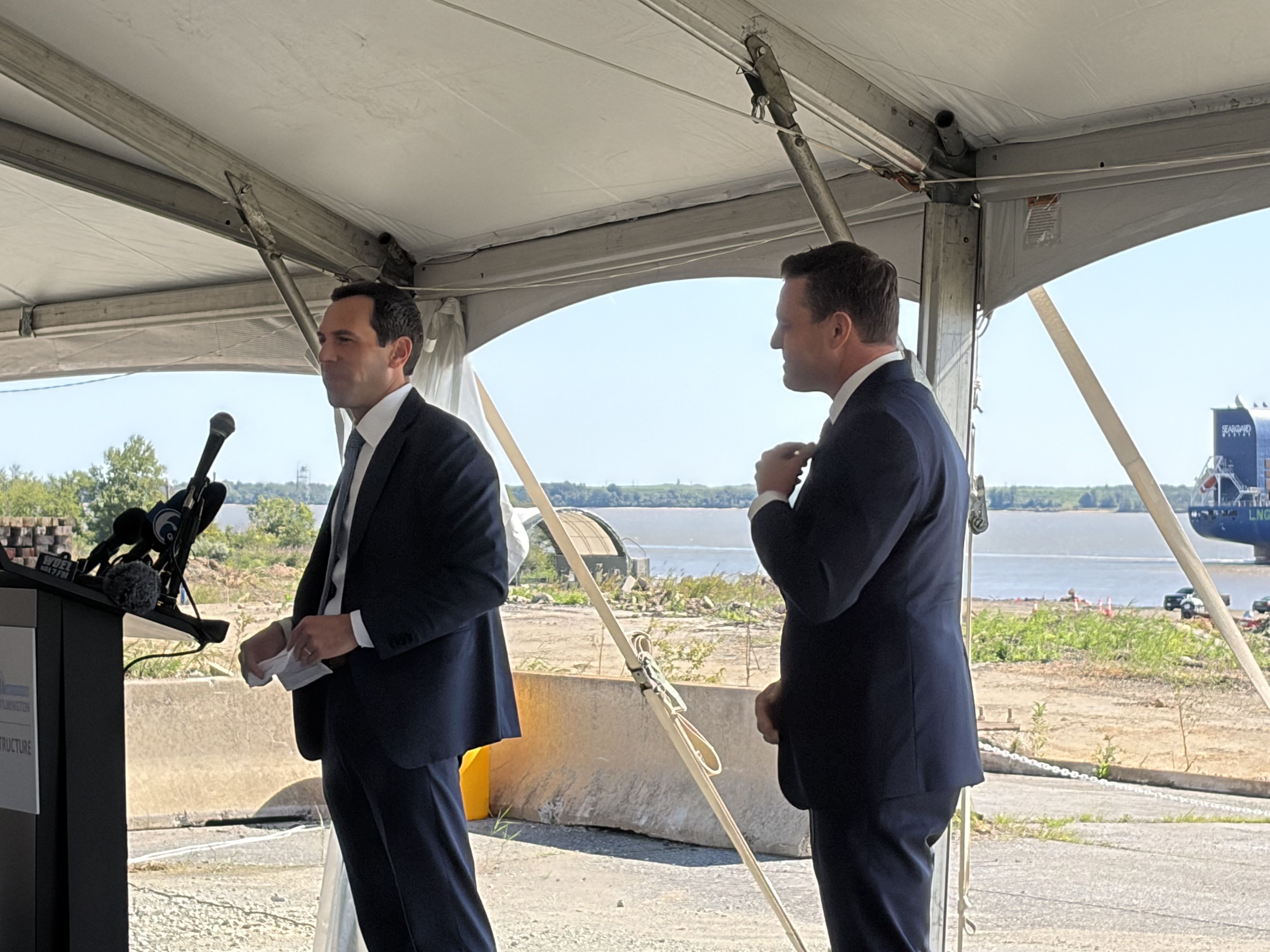
Matthew Satnick (left) and Philippe De Montigny, are co-CEOs of Enstructure, the port management company overseeing construction of Delaware’s planned port at the former DuPont Co. titanium dioxide plant at Edgemoor on the Delaware River.Joseph N. DiStefano
State officials did not present research supporting the need for the new terminal. Patibanda-Sanchez, who chairs the state-controlled Diamond State Port Corp. board that oversees the ports, said a study by University of Delaware researchers is not finished.
The port will support “2,500 to 3,000″ workers when fully open by 2028, according to Bill Ashe, international vice president of the International Longshoremen’s Association and president of ILA Local 1694, which he said represents 1,500 workers at the current Port of Wilmington.
He said the port’s rail service would be able to send stacked railroad cars to industrial sites in the region, such as the 4 million-square-foot Amazon warehouse in nearby Stanton, Del.
Holt Logistics and its affiliates, which manage facilities in South Philadelphia, Camden, and Gloucester City, is spending more than $200 million adding cranes and expanding its container storage and service areas, Leo Holt, president of the family-owned business, said in an interview last week.
Separately, PhilaPort, the city’s port agency, and state officials are considering a new container facility in part of the Mustin property whose $90 million purchase was announced last year.
With all these possible container ports in the works, Holt said, Delaware is waging an expensive “race to the bottom” and should cooperate with Pennsylvania and New Jersey instead of competing.
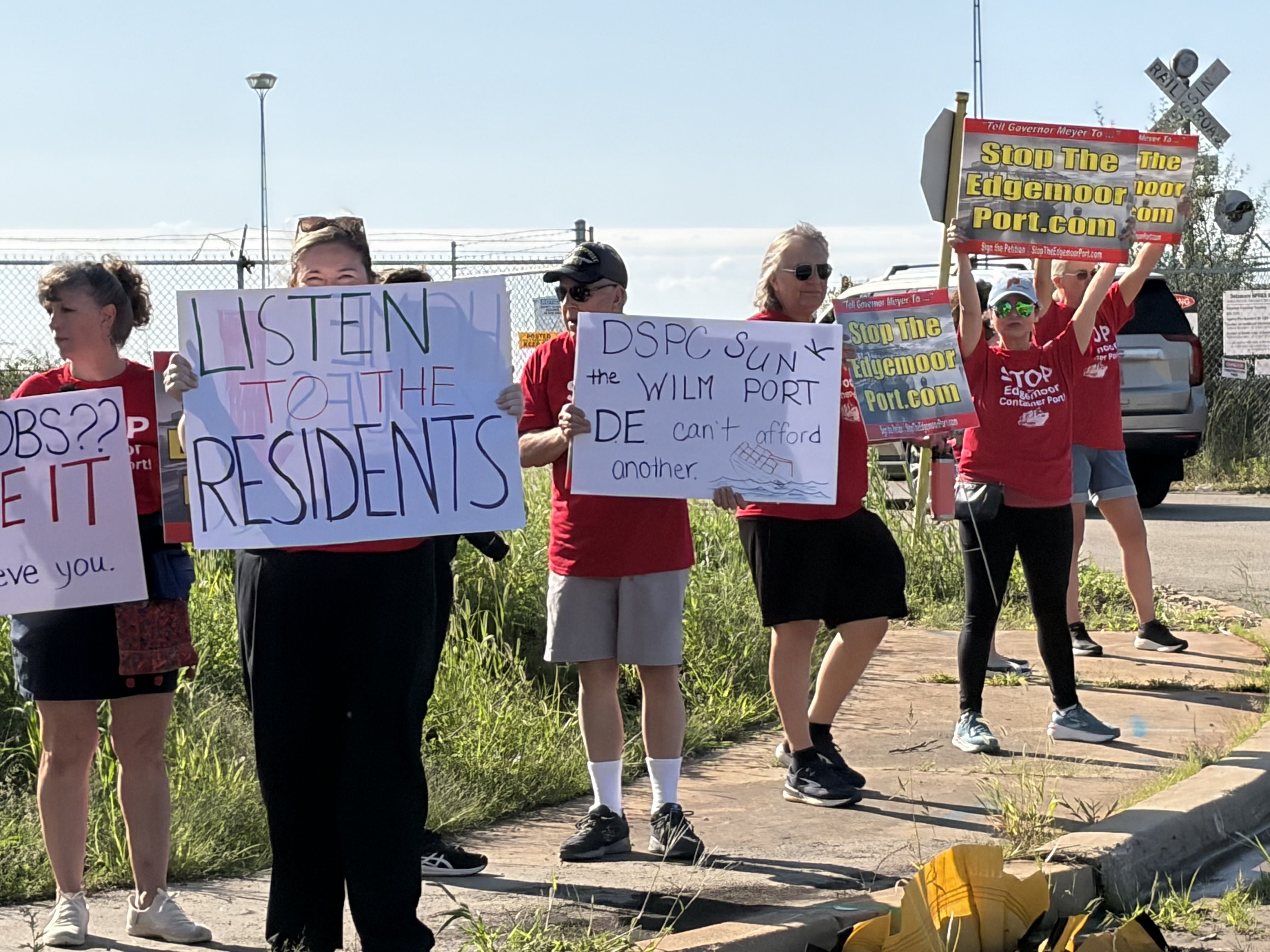
Protesters picket at the entrance to Delaware’s planned port at Edgemoor on the Delaware River during a groundbreaking Monday attended by federal, state, and local officials. Joseph N. DiStefano
As leaders arrived at the groundbreaking, protesters gathered at an entrance to the property holding signs urging officials to reverse the plan and backing candidates who are challenging incumbent Democrats in Tuesday’s primary.
Karen Hartley-Nagle, a former New Castle County Council chair, said neighbors were worried about increased ship and truck traffic.
Among the supporters who spoke after Gov. Meyerwas Daniel Elkins, head of the Bellevue Community Center, which runs youth and other programs near the port. He said Enstructure had supplied food for neighborhood families after the Trump administration stopped a federal food program. He said port jobs would boost the neighborhood.
“Thank you for bringing back opportunity,” he said.
Delaware Gov. Matt Meyer, in a yellow tie, waits for his turn to speak at the groundbreaking for his state’s long-proposed container port at Edgemoor on the Delaware River. Joseph N. DiStefano
Enstructure, the port operator, is a 10-year-old firm that operates more than 20 port facilities, including the port at the former U.S. Steel Fairless Works in Lower Bucks County.
Co-CEO Matthew Satnick told the crowd he and his partner had founded the firm in Winona, Minn., in 2016, and were used to being underestimated. He promised to complete the container port “on time and budget,” with “economic development to follow.”
Lorianne Moore always wanted to run her own business.
Two years ago, after decades in the corporate world, Moore began to think about opening a storefront in her home community of Havertown. She and her husband, Joe Singer, kicked around the idea of a coffee shop or gift store, something people were really “looking for,” Singer said.
When Moore brought her small-business dreams to Jeanne Angell, executive director of Discover Haverford, Haverford Township’s economic development organization, Angell said she knew exactly what Havertown needed.
Consumer data collected by Discover Haverford at the time had found that residents’ number one desire for the community was a local bookstore.
Moore, a “voracious reader,” figured her “love of reading and her passion for that would align awesomely with what the town was looking for,” Singer said. Moore Books opened in September 2024 and has since become a hub for readers, writers, and shoppers in one of Havertown’s core commercial neighborhoods.
“I don’t know if we would have landed on bookstore without Discover Haverford, but once [Moore] started talking with them, it just made sense,” said Singer, who’s now the bookstore’s manager and events coordinator.
The data that guided the opening of Moore Books was part of Discover Haverford’s biannual consumer surveys, which poll residents on the state of the local economy and help provide a framework for recruiting businesses to town, a partnership Angell said is exemplified in Moore Books’ story. Understanding what consumers want, Angell said, gives proprietors important information as they consider opening a brick-and-mortar business, a venture that can be economically risky, especially for small-business owners.
Discover Haverford’s newest survey, published in July, has given officials a fresh round of data regarding consumers’ vision for the community’s future. Sowhat do Haverford Township residents want most? Recent data points toward a desire for family-friendly businesses, communal spaces, and a revitalized streetscape.
What do Haverford residents want?
Discover Haverford conducted its biannual consumer survey in July, gathering data from 601 respondents about what types of businesses they’d like to see and how they feel Haverford Township’s commercial experience can be improved.
When it came to grocery and retail options, nearly 60% of respondents expressed a desire for a multi-vendor marketplace, and nearly 80% said they’d like to see an indoor farmers market.
On restaurants, 71% were interested in a bakery, 67% in a family restaurant, 63% in a Greek restaurant, and 57% in a BYOB restaurant.
When it comes to non-retail businesses, respondents also showed an interest in movie theaters, concert venues, and day spas.
(function(){function e(){window.addEventListener(`message`,function(e){if(e.data[`datawrapper-height`]!==void 0){var t=document.querySelectorAll(`iframe`);for(var n in e.data[`datawrapper-height`])for(var r=0,i;i=t[r];r++)if(i.contentWindow===e.source){var a=e.data[`datawrapper-height`][n]+`px`;i.style.height=a}}})}e()})();
Angell said she’s long heard residents ask for a multi-vendor market, a desire that falls in line with the growing appetite for “third spaces,” or communal places to socialize that aren’t work or home.
“I think people do need that, a place to feel that community,” Angell said.
She noted, however, that a multi-vendor market is “a very difficult thing to recruit for,” requiring a large space and considerable funding. A local movie theater is another feat Angell said is difficult to pull off due to space constraints.
(function(){function e(){window.addEventListener(`message`,function(e){if(e.data[`datawrapper-height`]!==void 0){var t=document.querySelectorAll(`iframe`);for(var n in e.data[`datawrapper-height`])for(var r=0,i;i=t[r];r++)if(i.contentWindow===e.source){var a=e.data[`datawrapper-height`][n]+`px`;i.style.height=a}}})}e()})();
How else should Haverford Township create a more vibrant business community?
Numerous respondents raised concerns over traffic safety. Some said the township needs more walkable town centers, safe bike lanes, and pedestrian crossings.
Some said parking inconveniences and costs deter them from shopping in Haverford Township, while others said older storefront facades need to be revitalized to beautify the township’s commercial strips.
This suburban content is produced with support from the Leslie Miller and Richard Worley Foundation and The Lenfest Institute for Journalism. Editorial content is created independently of the project donors. Gifts to support The Inquirer’s high-impact journalism can be made at inquirer.com/donate. A list of Lenfest Institute donors can be found at lenfestinstitute.org/supporters.
Clarification: The story has been updated to clarify the survey’s location.
Martina Lyons, 59, loves her job at Bud & Marilyn’s in Philadelphia International Airport, but she misses having employer-funded healthcare.
For 20 years, she worked at PHL’s Sky Asian Bistro, where staff was represented by a union and she had a pension. When the bistro shut down around three years ago, she became a bartender at Bud & Marilyn’s in Terminal C. She started paying for her own health insurance, until her premium nearly doubled this year and she couldn’t afford it anymore.
Lyons is one of the 160 workers at PHL’s outposts of Bud & Marilyn’s, Sabrina’s Cafe, Chick-fil-A, Insomnia Cookies, and Good Luck Bar & Restaurant. Many of them have signed onto an effort to unionize and get better benefits.
“I just always get so worried. God forbid, I have an accident … an emergency. It’s pretty scary to not have healthcare right now,” Lyons said.
On Monday, the group of cooks, dishwashers, cashiers, servers, and bartenders asked management to voluntarily recognize their affiliation with Unite Here Local 274.
Restaurateur Hakan Ilhan operates the five eateries. He did not immediately respond to a request for comment.
Unite Here Local 274 already represents 1,200 other food-service workers at PHL, as well as hundreds of employees of Philadelphia hotels.
According to the union, a super majority of the 160 potential new union members have signed cards to join.
What are the PHL restaurant workers seeking?
Health insurance has already emerged as a top priority among the group. Other unionized airport workers have employer-provided health insurance, said Rosslyn Wuchinich, president of Unite Here Local 274.
“We’ve made a lot of improvements over the years to the point where most of the union workers at the airport have free healthcare,” she said.
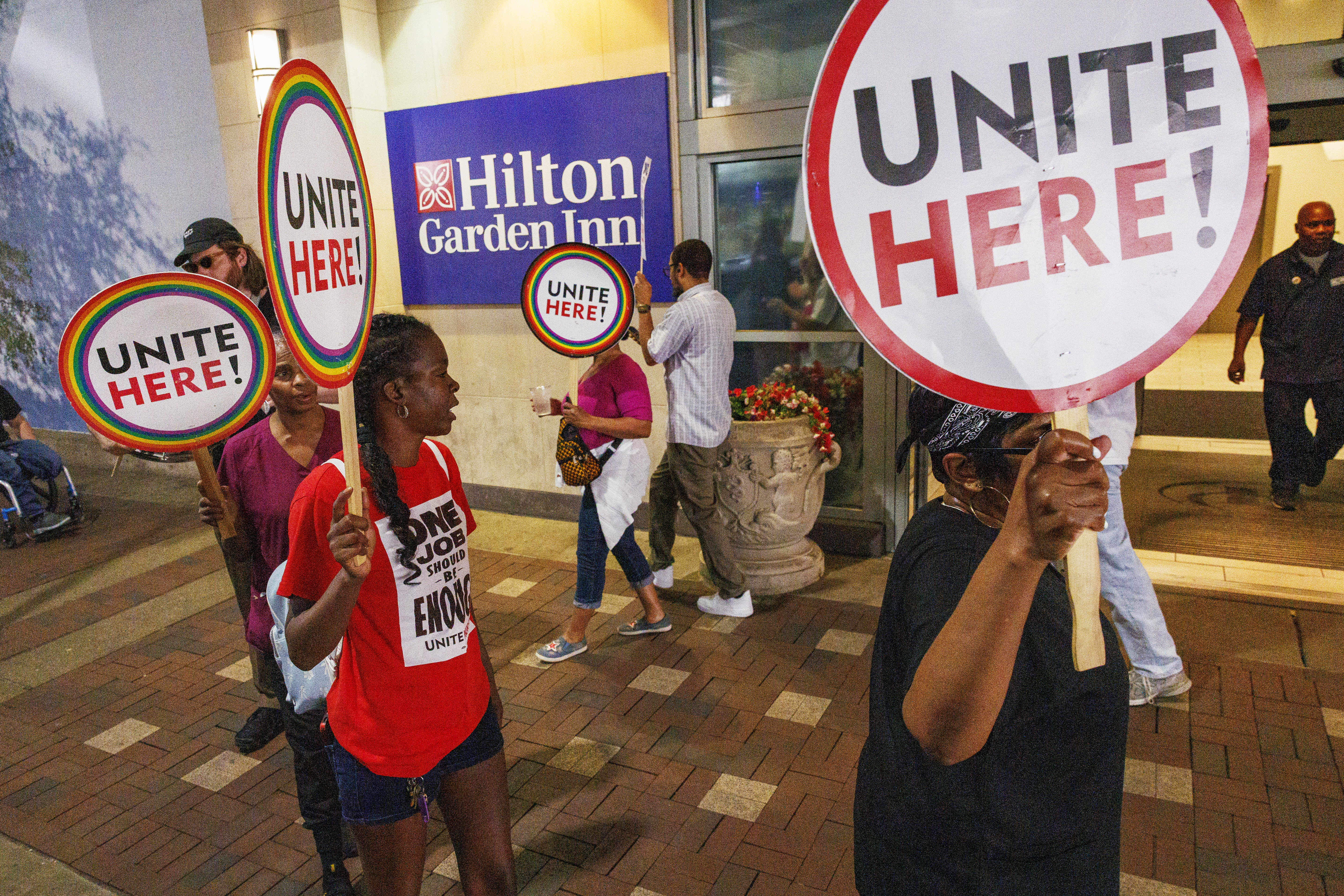
Unite Here Local 274 gather union organizers and employees outside the Hilton Garden Inn at 11th and Arch Streets to ask for higher wages before the festivities in 2026 for the nation’s 250th birthday, MLB All-Star Game, and FIFA World Cup.Alejandro A. Alvarez / Staff Photographer
Shymeik Ramsey, a busser at Sabrina’s Cafe in Terminal C, hopes a union can bring clearer rules so that workers have an “understanding on what you can and can’t do instead of coming in every week to new rules.”
He also wants set work schedules, with more advance notice. Shanah Moment, a server at Sabrina’s, said worker input on schedules is important too.
“We don’t have a set schedule so our days literally change like every week,” said Moment. “Even if we post our availability in our scheduling app, sometimes we don’t always get the days that we need off and we’re still scheduled outside of our availability.”
Moment also wants job security. She gave birth in April, and was unsure she would still have a position at Sabrina’s when she was able to work again, she said.
Overall, says Wuchinich, “the biggest issue for workers in organizing always is just having real respect and voice at work.”
PHL’s concessions workers were 100% unionized into the early 1990s, according to Wuchinich. Aramark operated those businesses at the time, she said.
Then the city brought in more food and beverage operators, she said, which meant some nonunion employers came in. Around that time Unite Here began to organize at the airport. Today, some 1,200 PHL concessions and catering workers are members of Unite Here Local 274.
The airport, meanwhile, has suffered from a poor reputation broadly, landing at the bottom of a national customer satisfaction survey for five years in a row. But food, beverage, and retail options were a bright spot, according to the most recent report.