Tag: Weekend initiative

  • How to have a perfect Philly day, according to Binding Agents cookbook shop owner Catie Gainor

    How to have a perfect Philly day, according to Binding Agents cookbook shop owner Catie Gainor

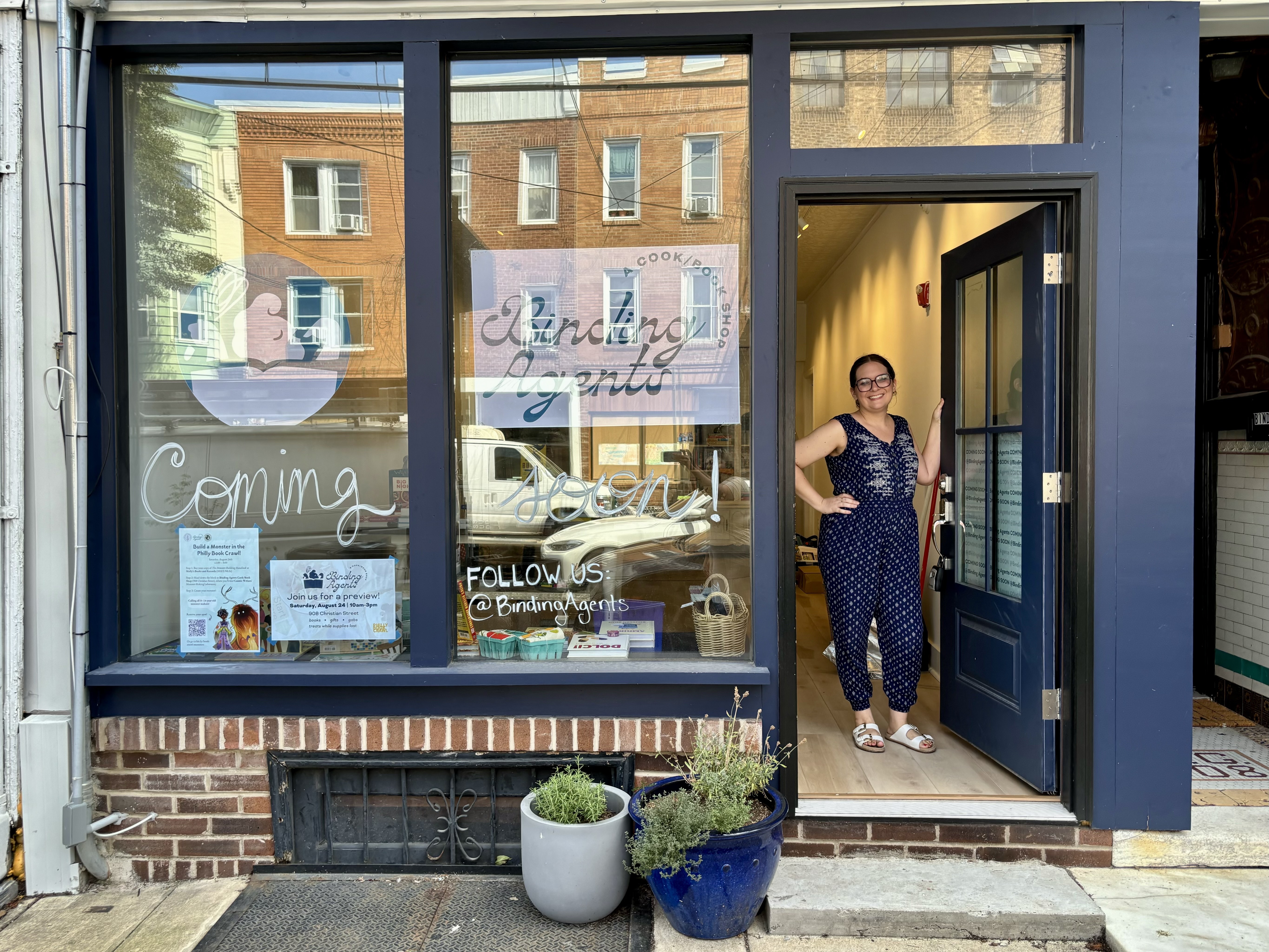
    Catie Gainor conceived the idea of a bookstore dedicated to cookbooks in a “fever dream” four years ago. Today, her 350-square-foot shop Binding Agents has become a destination for home cooks, chefs, and authors in the Italian Market neighborhood.

    “I really envision myself being a stop on the path in the Italian Market — pick up things on your way up and down Ninth Street and step in to [Binding Agents] to grab a book, whether it’s a beach read or a cookbook to plan your holiday,” she previously told The Inquirer.

    The shop has also become a community gathering space where Gainor hosts a monthly cookbook club and every guest brings a dish from a featured cookbook.

    On her perfect Philly day, Gainor loves basking in the abundance of the Italian Market. She makes quintessential stops, often running into her customers along the way, and ending the day by cooking an omelet.

    7 a.m.

    I am not a morning person, but I have a 3 year old, so I usually start clawing my way out of sleep when she wakes up. This is a perfect day, so it’s a Saturday. My daughter is jumping into bed with me for a snuggle and a chat before my husband, Matt — an early riser— takes over the morning routine. I’ll remain horizontal and half awake until about 8 a.m.

    8 a.m.

    I get up, get dressed, and trundle down the stairs. My husband and daughter have wandered up the street to Mug Coffee & Clay, so I step out to meet them. I love their iced coffee — but since we’re sitting in, I get a cortado. Matt and my daughter have been bringing in pastries from Rougarou Baking on the weekends. [It’s] a gorgeous apricot tart [today]. By the time I sit down, my child is completely covered in croissant crumbs and asking me the names of clay-shaping tools I’ve never seen before — bliss.

    9 a.m.

    We head over to Gold Star Park to enjoy the perfect weather for a bit. Miraculously, I remembered to bring lawn chairs. So, my husband and I set them up and I pull out a book. I usually have multiple books going, one we carry in the shop and one (or two) we don’t. A recent in-store fave was What I Made for Dinner by former Philly resident Krys Malcolm Belc. Another summer release I loved was Rainbow Rowell’s Cherry Baby — not at all culinary, but I liked it so much that I stocked it in the shop anyway.

    10:30 a.m.

    Then, I’ll walk my family back home and head up to the store. I feel connected to the neighborhood — and the city, really — in a way I never did before. I say, ‘Hi’ to some local customers and market pals as I make my way up Ninth Street. It’s the best.

    11 a.m.

    I arrive at the shop and flip the shop sign — and I’m holding back from hollering, “Cookbooks! Cookbooks for sale!” like some kind of deranged Eliza Doolittle. Folks slowly wander in. I love seeing coffee cups from all over, giant bags of Isgro’s Pastries, and hearing reports about the lunch lines at Angelo’s and Mawn. On a perfect day, I’m flinging book recommendations left and right, and everyone’s kitchen problems or gift-giving conundrums are solved.

    1 p.m.

    My best friend Kate arrives to help for the afternoon after her morning class at Movement Source Pilates (which I also love). She brings me a lavender lemonade from Gleaners and a tofu banh mi from Pho Skyline. I eat my sandwich in the back and eavesdrop while she beautifies the shelves and chats with customers. Someone’s going home with a copy of Dinner Changing the Game by Melissa Clark.

    3 p.m.

    Later, I’m leaving Kate behind at the store so I can run up to Kin Boutique. Whenever I need a clothing item for any reason/occasion, that’s where I’m starting. It feels like entering Cheers, and I immediately have a Diet Coke in hand and 12 things to try in the dressing room. Everyone in the store celebrates my grand sartorial successes. I love them.

    4 p.m.

    Shopping took less time than I thought, so I text Matt and a bunch of friends that I’m assembling snacks for a Di Bruno Bros. Piazza happy hour. I gather all my favorite things from Biederman’s, Claudio’s, Di Bruno’s, and Tortilleria San Roman, then raid Binding Agents for some cutlery, cups, and napkins. While I’m back at the shop, I grab an upcoming cookbook off the shelf of advance copies to take home — I’ll see if I can use it for meal planning next week.

    5 p.m.

    The shop closes and my crew descends on the Piazza. My kid gives me a full account of her day before becoming engrossed in the giant Connect 4. I pour Gulp Hablo Orange into cups. I am one with the universe.

    7 p.m.

    The party breaks up as my friends head off for evening plans about town. My family and I head to John’s Water Ice for a slouching-off-to-toddler-bedtime treat. Many years ago, Matt discovered the gelati combo of lemon water ice with raspberry chocolate chip ice cream. The ice cream has teeny tiny little chocolate cups with a dot of raspberry jam inside each one. It is transcendent, and that’s what I get.

    8:30 p.m.

    My daughter’s book selection is — unsurprisingly — very food focused. Lately Thank You, Omu [by Oge Mora] has been on repeat at bedtime. I love this one because I get to do lots of voices, and the lyrical repetition is so lovely.

    Once she’s down, I’m not truly hungry but I am a little peckish — and I am realizing I haven’t cooked today. Turning on the stove sounds good. I grab a half loaf of Mighty Bread Co. sourdough from the counter, pull some vegetable odds-and-ends out of the fridge, and make a French-ish omelet. I am not good at rolling them but enjoy both the process and the eating, so I keep trying. I assemble plates — and Matt and I dig in.
  • ‘The Mondrian House,’ Jon Batiste, and a Disney throwback for millennials are some of the best art you can enjoy this week

    ‘The Mondrian House,’ Jon Batiste, and a Disney throwback for millennials are some of the best art you can enjoy this week

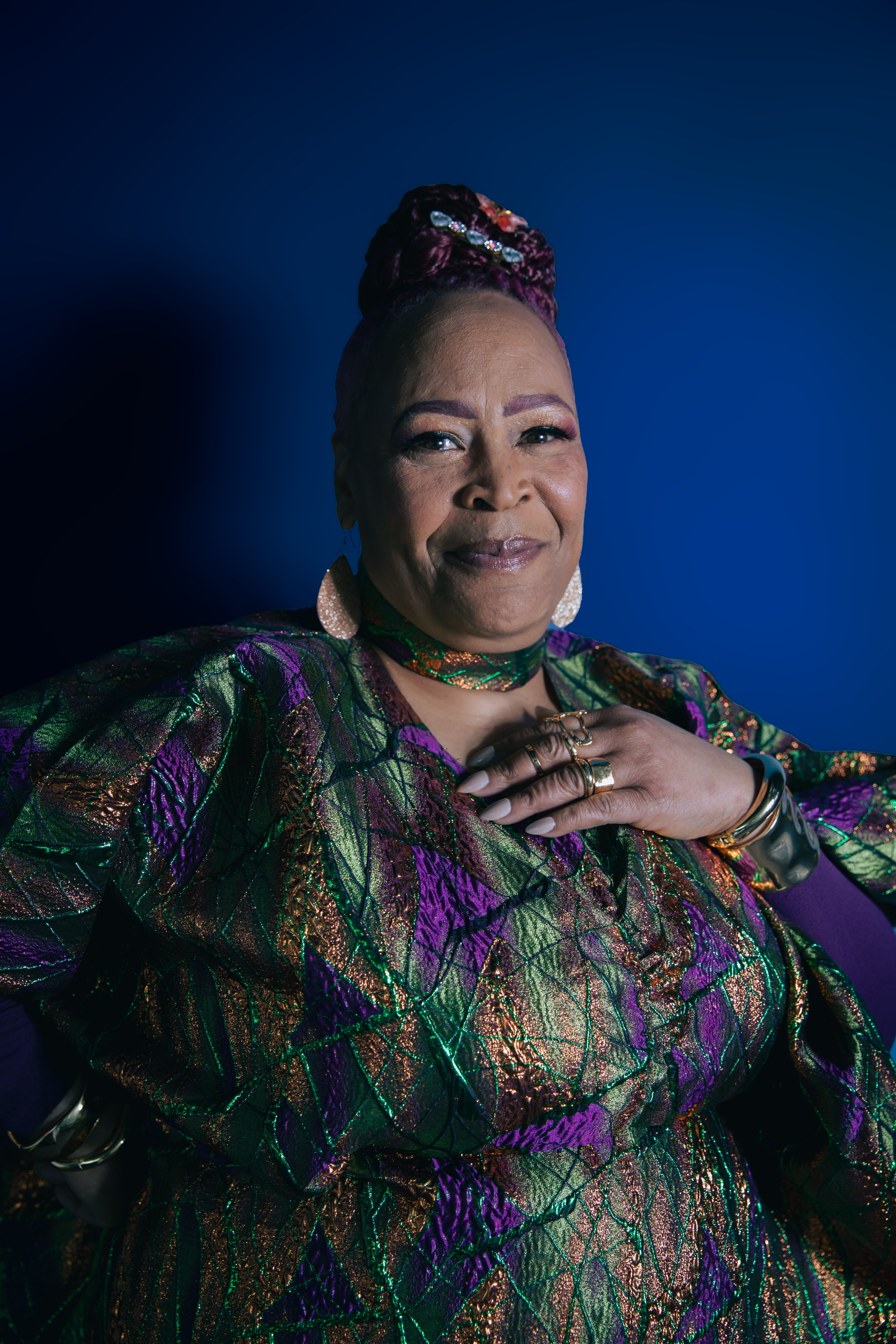
    Lady Alma’s newest Philly anthem

    The career of Philly house music singer Alma Hornton — who performs as Lady Alma — stretches back to the 1990s, when she was a featured vocalist at the now “Back 2 Basics” nights at Silk City Lounge and gave voice to projects like King Britt’s soulful “Sylk 130″ and British electronic duo 4Hero.

    Hornton had put music aside in the 2010s until a video of a fan dancing to her song “Let It Fall” went viral on Facebook, reviving a career that has gained momentum since, including her 2023 duet with the Eagles’ Jordan Mailata on “Merry Christmas, Baby.”

    Lady Alma’s “Liberty” is part of the “Philly Anthems” project by WXPN-FM (88.5) with Pew Center support.Paige Walter

    Now, she is a natural fit for the ongoing “Philly Anthems” project, an initiative of WXPN-FM (88.5) with support from the Pew Center for Arts & Heritage. Her song “Liberty” is the fourth to be heard from the project, which also includes “Better Times” by Eric Bazilian, “America the Beautiful” by the War on Drugs’ multi-instrumentalist Eliza Hardy Jones, and “Freedom” by XPN 24 Hour Song Challenge winners the Flying Vees.

    The “Philly Anthems” concept is to give Philadelphia artists “the opportunity to reflect on themes in the Declaration of Independence that resonate today through original music,” according to XPN station manager Roger LaMay.

    Hornton does just that in a pulsating dance track that’s a collaboration with esteemed old-school hip-hop producer Marley Marl and 88 Fingerz. “Need some answers for the madness” she sings over a house music groove that aims to find catharsis on the dance floor, “Seeing hope through the sadness.”

    In a statement, Hornton describes “Liberty” as “a song that offers an honest perspective on what the world needs right now. The song carries a sense of joy. Embrace the message and find light in the darkness. Celebrate unity, love and the belief that one day we will truly have liberty and justice for all.”

    The coming weeks will bring new “Philly Anthems” by Christian McBride and Devon Gilfillian, plus up-and-coming acts Grace Gardner, Black Buttafly, the Bul Bey, J.R. Everhart, Sug Daniels, and Moustapha Noumbissi. A 12-song album will be released timed to Record Store Day in April 2027.

    — Dan DeLuca

    An arty house in Queen Village

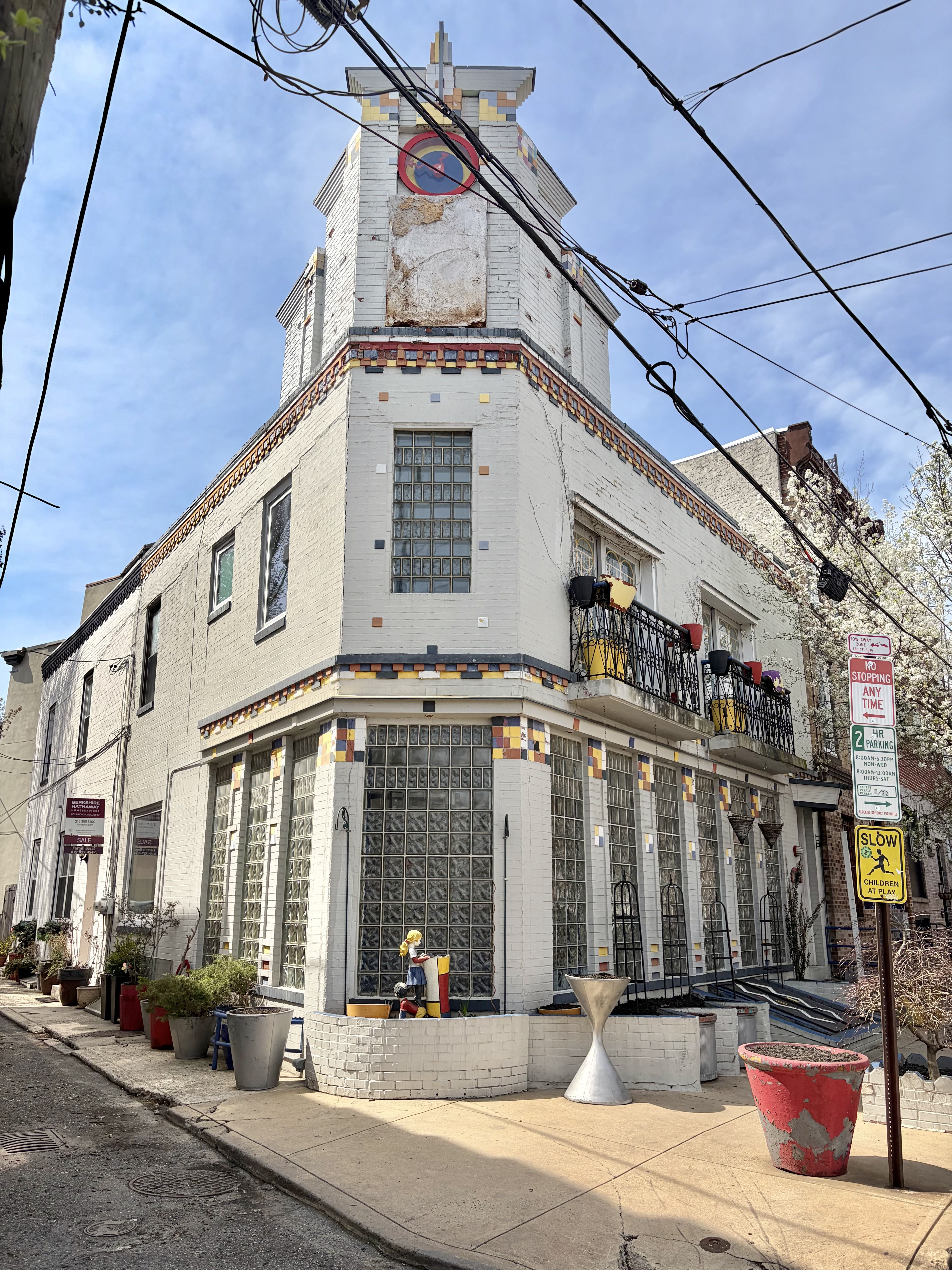
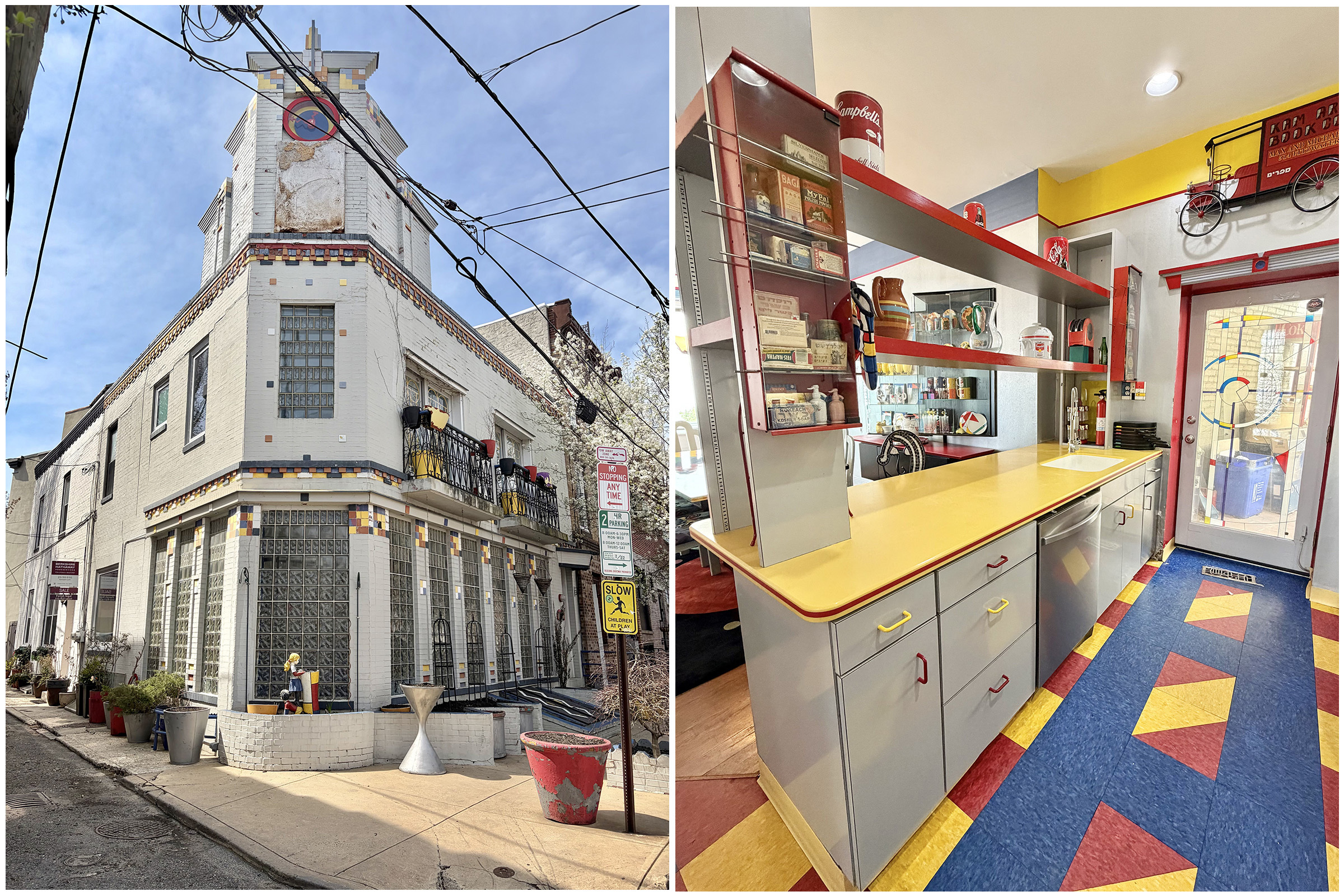
    A quirky home at 514 Fitzwater St. in Queen Village.Farrah Segal

    There’s a storied house in Queen Village that holds many names: Lego House, Clock-Tower House, Art Deco House, Mondrian (after Dutch painter Piet Mondrian) House. In a city full of architectural gems, it’s one of my favorites.

    The marvelous corner building is dotted with color, featuring a cornice of red, yellow, and blue bricks — evoking Mondrian’s signature style — and a clock on the roof. A small statue of a little girl with yellow hair and a blue skirt is hidden among the lush flowers growing in containers in front of the house. The home dates back more than 100 years and once served as a deli before an architect in the 1980s transformed it into this visual landmark.

    As striking as the home is on the outside, there’s now a rare chance for curious Philadelphians to get a peek inside, where the artistry continues with boldly colored staircases and decor. The house was sold earlier this summer and the doors are now open for an antique sale this weekend where you can explore the legendary home and find possible treasures within.

    The antique sale runs through Aug. 16, 10 a.m. to 7 p.m. 514 Fitzwater St., Phila.

    — Rosa Cartagena

    Jon Batiste performing at the Met Philly, Oct. 30, 2025.Elizabeth Robertson / Staff Photographer

    Jon Batiste’s ‘Black Mozart’ is a balm for the current times

    Alas, we didn’t get Jon Batiste in person this week. The pianist, bandleader, and TV personality no doubt disappointed many when, citing “personal circumstances,” he canceled Friday night’s scheduled appearance at the Highmark Mann Center.

    He “truly can’t wait to come back and perform for you soon,” Batiste assured fans in a message posted on the Highmark Mann website.

    But Friday did bring us Jon Batiste all the same, via the release of Black Mozart. The new recording finds the musician at the keyboard alone in a jazzy, gospel-y, contemplative (though still energetic) mood. Using Mozart tunes as the departure point, he develops the material liberally — harmonically, rhythmically, sliding back and forth across the centuries and genres, and doing so in a natural, fluid way.

    With 10 tracks totaling 35 minutes, Black Mozart’s source material is a Mozart piano sonata, a piano concerto, the Symphony No. 40, and other works. Batiste, who has two degrees from the Juilliard School, is at his best when he gets creative with the 18th-century composer.

    Gospel Andante uses the slow movement of Mozart’s Piano Concerto No. 21 in C Major, K. 467 as a framework. But it’s when the power of gospel asserts itself — where the genre line really blurs — that the music lifts off into another emotional dimension.

    There is nothing revolutionary about Black Mozart. Performers and composers have blended classical with jazz and other genres for decades. Batiste himself covered similar ground with his 2024 release, Beethoven Blues. But if Beethoven was a generally dramatic and soulful impetus, the quieter moments of Mozart transformed by Batiste are the appeal here. These are the easygoing pleasures that might be the counterprogramming you need in the current atmosphere.

    “Black Mozart” is available across all music platforms.

    — Peter Dobrin

    A road trip featuring Goofy and Max

    Odyssey this, Spider-Man: Brand New Day, that.

    What about the cinematic brilliance that is Disney’s 1995 classic, A Goofy Movie?

    The Philadelphia Film Society and Another Corner — a South Street novelty shop devoted to books, photography, coffee, and other specialties — are screening the movie next week for one night only.

    It’s part of the Film Society’s series on road trips and Another Corner’s hobby of the month focusing on “movie loving.” Shop owner Lee Frank will say a few words at the beginning and there will be zines and other film buff collectibles on hand.

    The movie, which is 31 years old (sorry millennials, I know that hurts!), focuses on Goofy and his son, Max, reconnecting as they head to a concert. They’re on their way to see the iconic fictional band, Powerline, featuring a “Michael Jackson-styled canine,” as described in the Miami Herald’s original review.

    The Herald review praised the film, adding that “this fast-paced movie has enough colorful characters and rollicking gags to keep the tykes from getting bored.”

    “A Goofy Movie” plays Aug. 20 at the Philadelphia Film Society Center, 1412 Chestnut St. Tickets are $16 and available on the Film Society’s website.

    — Emily Bloch

  • The best thing Mike Klein ate this week: Chicken roulade at Academy Grill

    The best thing Mike Klein ate this week: Chicken roulade at Academy Grill

    White-tablecloth restaurants in Eastern Montgomery County are few and far between nowadays, which makes the recent arrival of Academy Grill in Fort Washington something of a throwback.

    Tucked off Bethlehem Pike near Germantown Academy, the restaurant took over the building that for years housed Cantina Feliz. (Last year, the Mexican restaurant left Fort Washington for Ambler, 10 minutes away.) The sleek Academy Grill is taking a decidedly different approach: polished, contemporary American cooking with chef Jeffrey Power in the kitchen.

    Power is no stranger to the area. He was the longtime chef at Dettera, the ambitious Ambler restaurant that closed earlier this year, and before that worked at Blackfish in Conshohocken and Le Bec-Fin downtown. Though Power is turning out steaks and seafood at Academy Grill, one other dish connects those chapters of his career.

    Power’s chicken roulade — once a staple at Dettera — traces its roots back more than 20 years to Le Bec-Fin, though the technique has evolved. Power completely debones a whole chicken, removes the legs and thighs, and wraps the breast in its skin around a chicken mousseline studded with sun-dried tomatoes, oregano, basil, parsley, and scallions.

    At Le Bec-Fin, the roulade was rolled, tied in the old-school fashion, then pan-seared. Power now forms it into a cylinder using cellophane and cooks it sous vide, setting the proteins and helping the roulade hold its shape. It is then deep-fried to evenly crisp the skin around juicy chicken and herb-flecked mousseline.

    The dish is unabashedly rich, but its accompaniments have changed with its surroundings. At Dettera, Power plated it with English peas, smoked fingerling potatoes, and cremini mushrooms. At Academy Grill, pillowy potato gnocchi and earthy truffle crema add to its lushness. Cauliflower brings sweetness, while fava beans provide a fresh counterpoint — green, slightly nutty, and mildly bitter.

    In that sense, the roulade is both a new Academy Grill dish and a snapshot of Power’s career: a Le Bec-Fin idea refined at Dettera and carried into his latest kitchen.

    Academy Grill, 424 S. Bethlehem Pike, Fort Washington, 610-424-5000, academygrill.com.

  • VA loan helped two 23-year-olds buy a home in Germantown | How I Bought This House

    VA loan helped two 23-year-olds buy a home in Germantown | How I Bought This House

    The buyers: Mia Spolansky, 23, U.S. Air Force active duty military personnel, and Annabel Harp, 23, daycare worker and early childcare assistant

    The house: A 784-square-foot home in Germantown with two bedrooms and one bathroom built in 1950.

    The price: Listed for $250,000, sold for $265,000.

    The agent: Christine Mantwill with REMAX

    The ask: Mia Spolansky, originally from Willow Grove, and her partner, Annabel Harp, originally from Hagerstown, Md., were ready to move out of their one-bedroom rental apartment in Mount Airy and buy their first home. They both liked the area’s access to nature for running and biking in Wissahickon Valley Park, plus a location that allowed for easy commuting to their jobs. They didn’t want to stray too far.

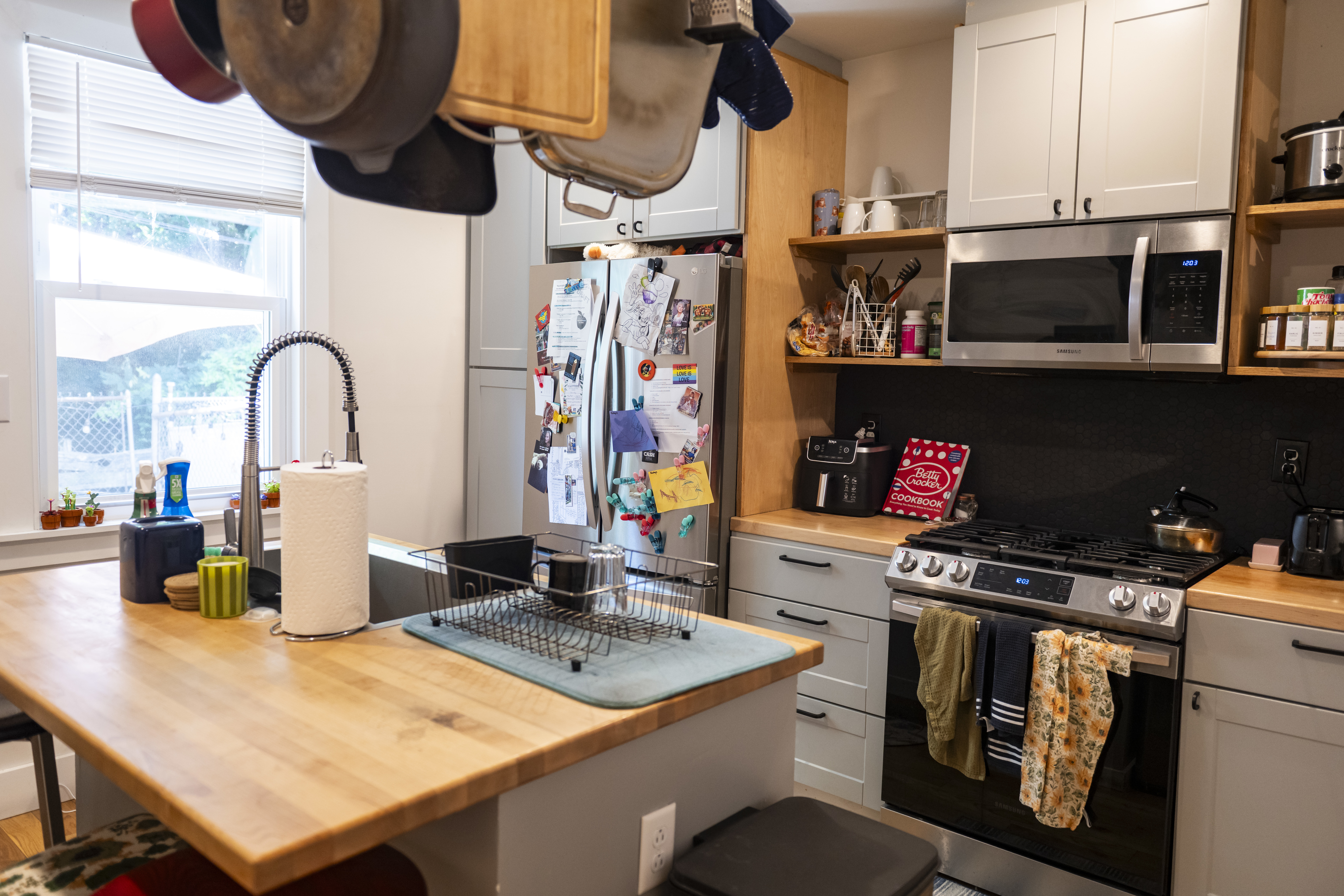
    The kitchen in Mia Spolansky and Annabel Harp’s home in Germantown.Allie Ippolito / For The Inquirer

    “We were looking to buy in Mount Airy,” Spolansky said. “Those prices were out of our range, so we decided on Germantown.” They started their search in November.

    The search: Harp and Spolansky began touring homes in East Germantown with their real estate agent. They wanted to be efficient with their space, so they narrowed the search to smaller homes. They were seeking a rowhouse for both the neighborly feel and value.

    “A lot of detached homes were out of our price range,” Spolansky said.

    They also wanted an older home “with some character” but with modern amenities. They toured six houses and all of them felt too large or had issues. Their agent helped Spolansky access the multiple listings sites used by real estate professionals so she could browse, and one house caught her eye.

    The appeal: With their agent’s help, Harp and Spolansky went to see the house that day. It was a two-bedroom with a front patio and backyard, which was not yet on the market.

    When they visited, they were delighted that “the neighbors actually came up and introduced themselves,” Spolansky said, “We were like, whoa, this is an actual community.”

    The empty lot next to their home, which the pair uses to garden, growing peppers and cucumbers.Allie Ippolito / For The Inquirer

    The house was an older style with new appliances — exactly what they were looking for — and the owners had renovated both the bathroom and kitchen and installed central air and heat in 2021. “It was nicer than I grew up with,” Spolansky said. The couple put an offer in right away.

    The deal: Harp and Spolansky made an offer on a Thursday. The sellers had an open house scheduled for the following Saturday. The sellers said they would accept the offer and cancel the open house if the couple agreed to go $15,000 over asking to beat the potential offers they might get from the open house.

    Harp and Spolansky agreed and closed in mid-April.

    The money: They purchased the home for $265,000 after negotiation. They used a VA Home Loan of $270,000 and put 0% down. The mortgage interest rate is 5.625%. They received a $5,500 seller credit for some repairs needed. The closing costs were $1,780. The monthly payment is $1,834 with escrow, interest, and principal.

    The move: They moved in late May, with a two-month buffer period until the lease on the apartment ended.

    They used a moving company to ease the process, which helped, because the home had small doors and tight corners.

    The inspector had found some rotten floor joists in the basement, but after move-in, the couple realized there was water getting in as well. They brought in a masonry company to waterproof the wall and added a chimney liner when their carbon monoxide detector started going off. They also had some electrical and AC issues.

    The dining room in Mia Spolansky and Annabel Harp’s home.Allie Ippolito / For The Inquirer

    “I’ve only ever lived in rentals,” Spolansky said. “My family doesn’t have experience with upkeeping a house. I think having a buddy or known contractor come on the inspection would’ve been helpful, especially for negotiations because I didn’t know how much it costs to put in a chimney liner.”

    However, the pair remain satisfied with their choice and their ability to manage repairs themselves, rather than rely on a landlord.

    Life after close: The couple and their cat, Morty, have adjusted well. After living in a one-bedroom, they love the space, including their backyard and front porch, especially in the summer for barbecuing and being outside. The Wissahickon is a five-minute bike ride away. The rowhouse is exposed on one side to an empty lot, which the pair uses to garden, growing peppers and cucumbers they got from their neighbors. They especially love the community.

    “We go to parties, clean up the block, do community events,” Spolansky said. “I never had that before. Knowing our neighbors has been the biggest plus. Having good neighbors, you can’t replace that.”

    Did you recently buy a home in the Philadelphia area or South Jersey? Share the story of how you did it. Email Inquirer real estate reporters at properties@inquirer.com.

  • LeBron James could live in New York while playing in Philly. Wilt Chamberlain did it first.

    LeBron James could live in New York while playing in Philly. Wilt Chamberlain did it first.

    The trolleys stopped running at midnight, so Tom Hoover waited outside the Philadelphia Warriors locker room for a lift back to Villanova. He was a teenage college student and his ride after sitting in the stands at Convention Hall was the passenger seat of Wilt Chamberlain’s purple Cadillac El Dorado.

    A 40-minute drive, Hoover said, became a 10-minute sprint as Chamberlain burned rubber before dropping his buddy off at the dorm.

    “Dippy had a heavy foot,” Hoover said. “Back then, you didn’t pay attention. You were just talking and riding. But you would be like ‘Damn, how’d we get here so fast?’ It was one of those kinds of things.”

    Chamberlain then jumped on the turnpike and headed for New York, as he lived in the 1960s in an apartment overlooking Central Park while playing in Philadelphia.

    He maintained a residence in Philly but spent most nights in New York, from which he’d commute for games and practices while owning a popular club in Harlem. Chamberlain even hitched a ride from Hershey back to New York in 1962 with Knicks players after his 100-point game.

    “He would do 90 to 100 [mph] all the way up the turnpike,” Hoover said of Chamberlain, who died in 1999. “And if he got stopped. ‘Oh, it’s Wilt Chamberlain. Can I get your autograph?’ Back then it was a different time. It was really different.”

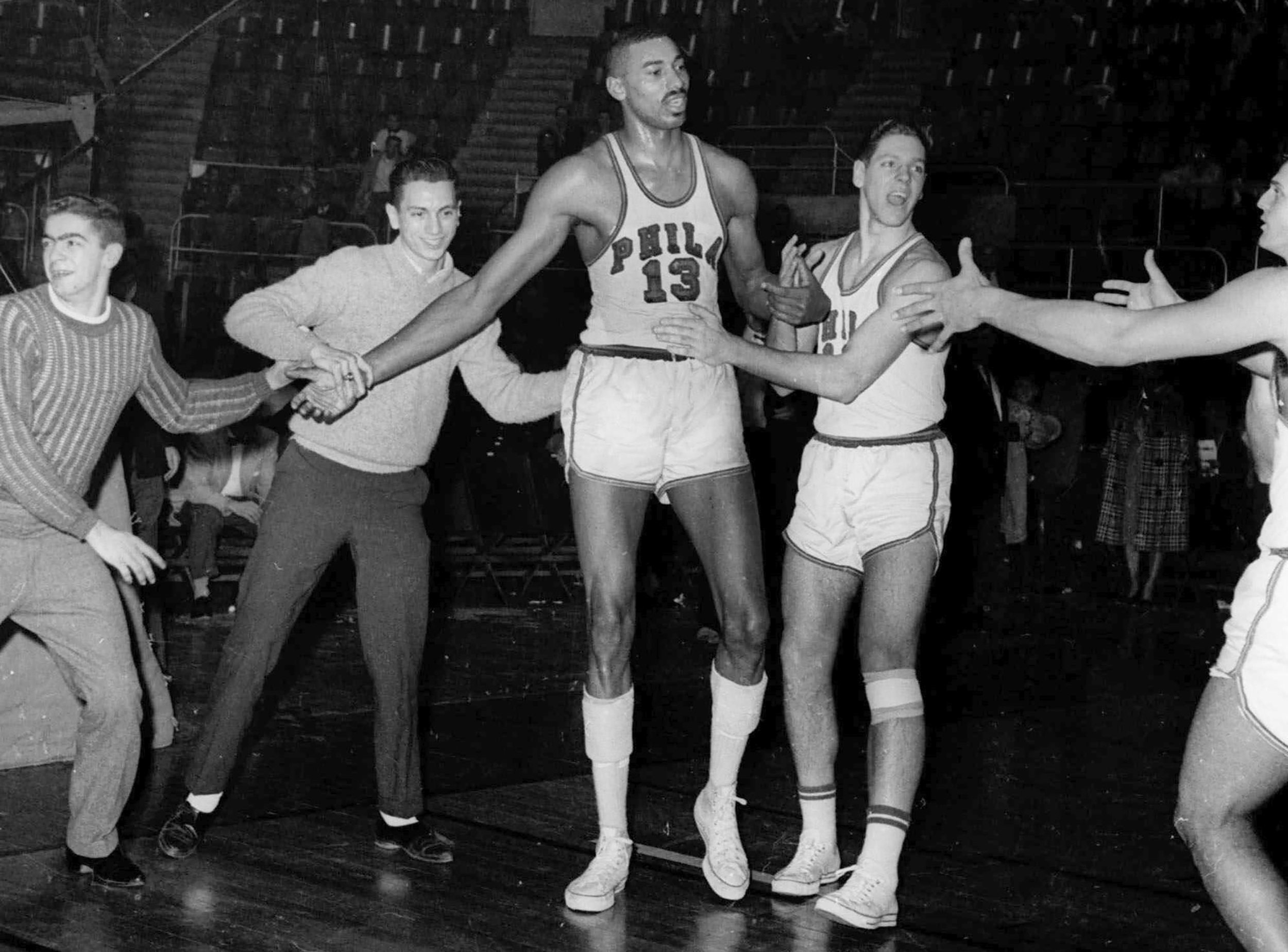
    Fans and teammates rush onto the court to congratulate Wilt Chamberlain after his 100-point game in 1962 in Hershey, Pa. He hitched a ride back to New York with Knicks players after the game.PAUL VATHIS / AP

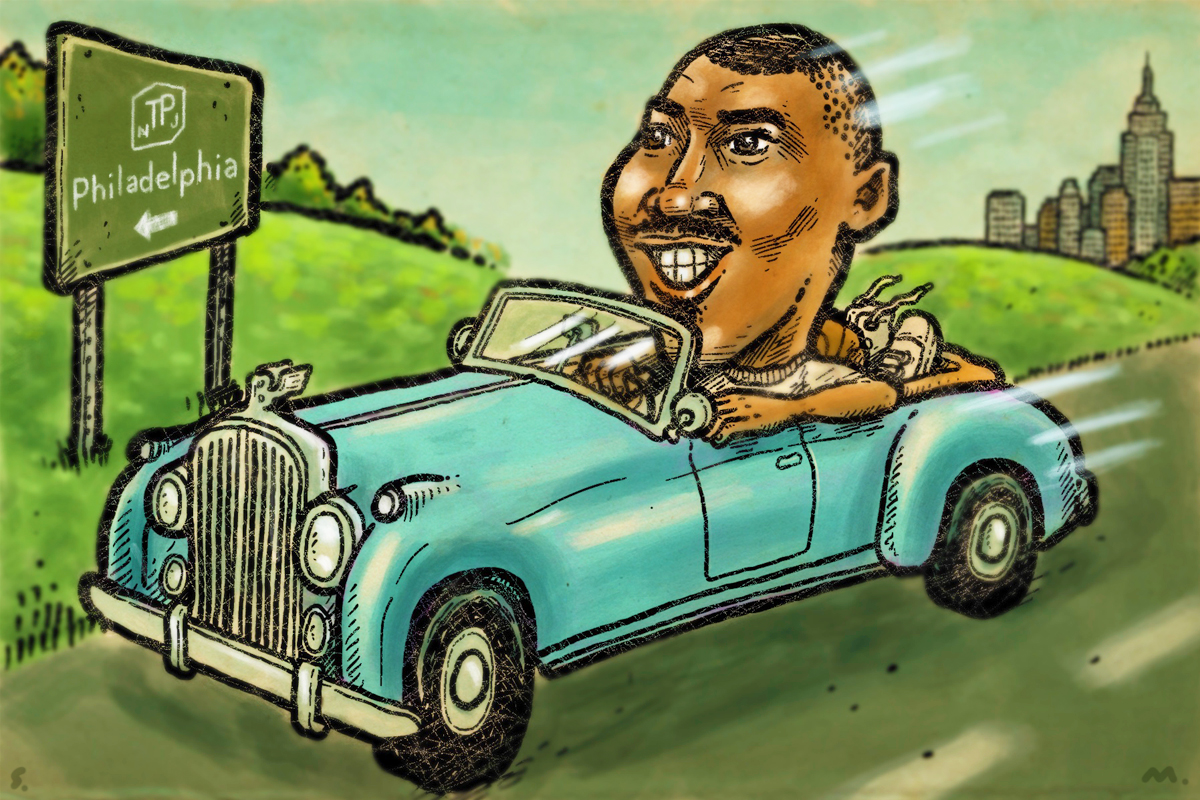
    Chamberlain’s commute could be copied this season as several NBA insiders reported last month about the possibility of LeBron James living in New York while playing for the Sixers. James, one report suggested, could use a helicopter to get to games and practices. Not even Chamberlain’s heavy foot could keep pace with that.

    “I was thinking LeBron might do the same thing,” said Hoover, who played for the Knicks after leaving Villanova and now lives in Manhattan. “Philly is not his kind of town. And that’s not a knock against Philadelphia. But I just think he’s a New York City kind of guy after living in L.A. That kind of lifestyle. So I can see him living in New York and making that trip back and forth.”

    A New York ‘magnet’

    Chamberlain purchased Smalls Paradise in 1959, spent $200,000 to renovate the club on Seventh Avenue and 135th Street, and renamed it Big Wilt’s Smalls Paradise. It became the spot.

    “Oh, that was jumping, man. You kidding me?” Hoover said. “That was just a wonderful time in my life and a wonderful time to be growing up as 20-some years old, living in New York, and hanging in that place.”

    Chamberlain told Ebony magazine that he spent 18 hours a day at Smalls to learn everything about owning a bar. Sammy Davis Jr. played Smalls, as did King Curtis, Jerry Butler, The Coasters, and Willis “Gator” Jackson. James Brown would perform at the Apollo Theater and then stop by Smalls.

    “Dip was a magnet for everyone,” Hoover said. “People just wanted to be around him. They would come in there and just look at him. They had never seen a guy who could dress like that and looked like that. He was a 7-foot athlete who wasn’t gangly and uncoordinated. Plus, that big diamond he wore on his finger. They never saw anything like that.”

    The club was a hub for Black entertainers, drawing “everybody who was anybody.”

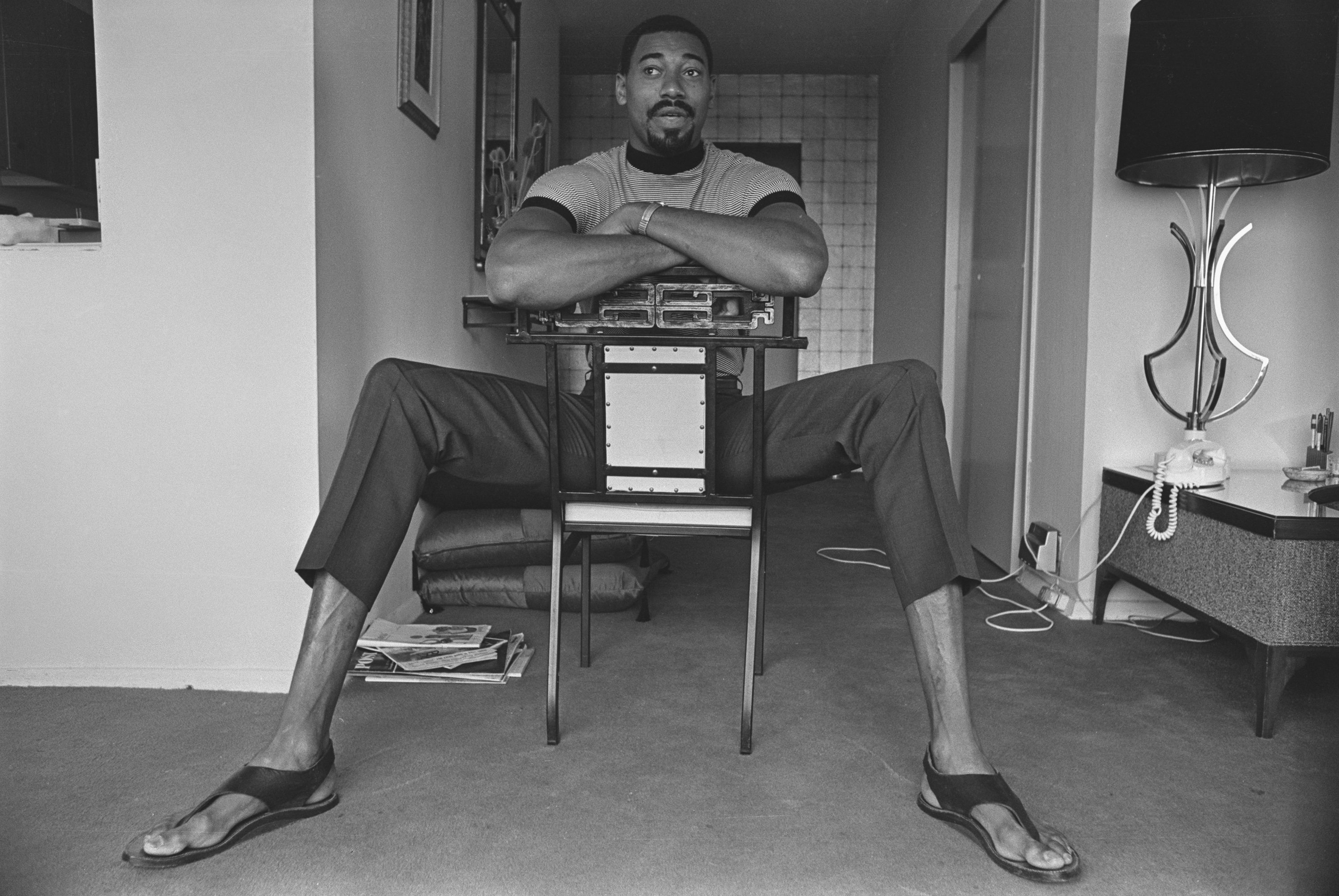
    Wilt Chamberlain “was a magnet for everyone,” said his friend Tom Hoover. “They had never seen a guy who could dress like that and looked like that.”Harry Benson/Express/Hulton Arch

    “My mother always tells the story that she met Sidney Poitier at the club,” said Gloria Miller, whose father, Vince, was Chamberlain’s childhood best friend and often drove with him back to Philly.

    Chamberlain’s Manhattan apartment was on the top floor of Park West Village, then a ritzy high-rise near Central Park. The apartment had a terrace and windows that overlooked the park with a view downtown of the Empire State Building.

    Kareem Abdul-Jabbar — who hung there as a high schooler still named Lew Alcindor — described the apartment as “the ultimate bachelor pad.”

    “A two-bedroom place done up in antique gold finish with a big couch in the living room, paintings on the walls, good stereo, great record collection,” Abdul-Jabbar wrote in his autobiography Giant Steps. “Wilt was known for his expensive taste, and the place showed it. I walked in and I clammed right up tight. I didn’t know what cool was, but I knew very strongly that I didn’t want to be uncool.”

    Abdul-Jabbar played “Dirty Hearts” at Chamberlain’s dining room table with Chamberlain, Hoover, and Cal Ramsey. Chamberlain’s crew used to close Smalls at 4 a.m. and then play cards at the apartment. Abdul-Jabbar called them “hearts junkies.”

    They ate sandwiches and swapped stories: What did Bill Russell say? What was Elgin Baylor complaining about? What’s up with Oscar Robertson? The loser of the card game had to chug a quart of water.

    “But he would never drink,” Hoover said. “So it was like a wrestling match with that big guy.”

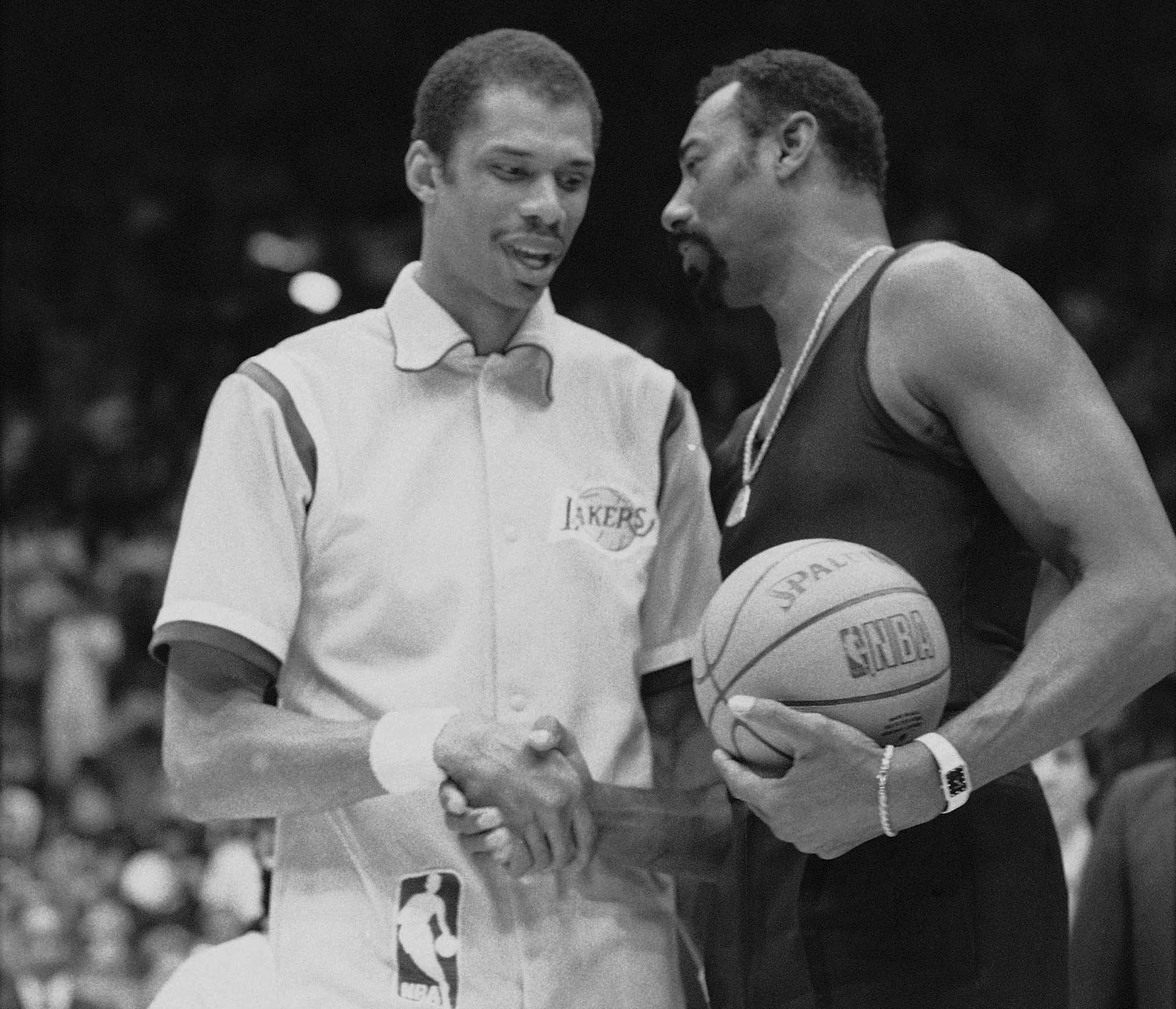
    Kareem Abdul-Jabbar (left) is congratulated by Wilt Chamberlain in 1984 after Abdul-Jabbar passed Chamberlain’s NBA all-time scoring record. LeBron James has since passed Abdul-Jabbar’s record.Mark Avery

    Living in Elkins Park

    The Sixers traded for Chamberlain in February 1965, bringing him back to Philadelphia after the Warriors had moved three years earlier to San Francisco. There were a few weeks left in the regular season, and Sixers owner Ike Richman didn’t want Chamberlain spending nights in New York.

    “He had a driver who he used to pay to take him up to New York,” said Richman’s son, David. “My father used to pay him under the table to not drive him to New York.”

    Richman instructed Chamberlain to live at his home in Elkins Park for the rest of the season.

    “I came home from Cheltenham High School and my mother, with our domestic helper, was putting my twin beds together and doing all this stuff to my room,” Michael Richman said. “I said, ‘What are you doing?’ She said, ‘Wilt’s moving in. Daddy’s making him.’”
    Chamberlain shot baskets in Richman’s driveway, hung out with the kids, and ate dinner with the family. Richman and Chamberlain usually drove together to Convention Hall, but once Richman had to be there early for a playoff game against Cincinnati. So he asked David — who had just earned his driver’s license — to drive Chamberlain.

    The 16-year-old usually drove a 1959 Austin-Healey Sprite, but that wouldn’t be big enough for Chamberlain. Neither would the Pontiac Tempest. So the teenager drove his dad’s Cadillac.

    “He used to sit in the back seat of the car and hang his body over the front seat,” Richman said. “It was like having a cobra in the car. He was in the back, but his head and body was in the front seat.”

    Gloria Miller as a child standing in front of Wilt Chamberlain’s powder blue Bentley.Gloria Miller

    The season ended that April when the Sixers lost to Boston in seven games. Chamberlain shared an apartment the next season with Miller on the Benjamin Franklin Parkway but spent most of his time in New York. He often commuted by train or driving to Philly with Miller in a powder blue Bentley that was delivered to his Manhattan apartment.

    The press ripped Chamberlain every time he missed a practice and chided him for living in another city. He once shoved a reporter into a locker after the writer kept asking him after a playoff defeat — in which Chamberlain scored 46 points — if he would have made more free throws had he not missed practice that week.

    “He wasn’t kidding when he played. He really meant it,” said Richman. “Whether he was going up to New York to party or whatever, when it came to game time, he was never half-hearted about it. He was really into it. When it was time to play ball, this wasn’t a game to him. It was a war.”

    Family in Philly

    Chamberlain drove after each season to Los Angeles, where he had built a beautiful house off Mulholland Drive in Bel Air.

    “He used to jump in his Bentley and drive for three days straight without stopping,” Richman said. “He didn’t need to sleep. Then he would get there. He was basically an insomniac.”

    The powder blue Bentley was there in the 1970s when the Millers — who lived in South Jersey — visited Chamberlain.

    “He called my father ‘Miller’ so he would call me ‘Little Miller’,” said Miller, whose father worked as a scout for the Sixers. “My mom was going to make dinner so we had to go to the store. He said, ‘Come on, Little Miller. Come to the store with me.’ I was getting my shoes on and he had no patience. He said, ‘You don’t need shoes. Come on.’ We got in the Bentley and we’re riding down the freeway and I’m like, ‘Why are they all looking at us?’ I didn’t realize I’m in a beautiful Bentley with Wilt Chamberlain. But it fit him.”

    Chamberlain retired in 1973 and spent most of his time in L.A. but still kept close ties to Philly. He was the best man in Miller’s wedding and became Gloria Miller’s godfather. The basketball icon kept a tight circle of friends from his childhood. Chamberlain, just like when he lived in New York, was always close to Philadelphia.

    “He was family,” Miller said. “He never forgot where he came from. Whenever Wilt came to town, he would come to my parents’ house and my mother would make him fried chicken and cobbler. Wilt and I would pick up the cobbler pieces together. It was just home. It was family.”

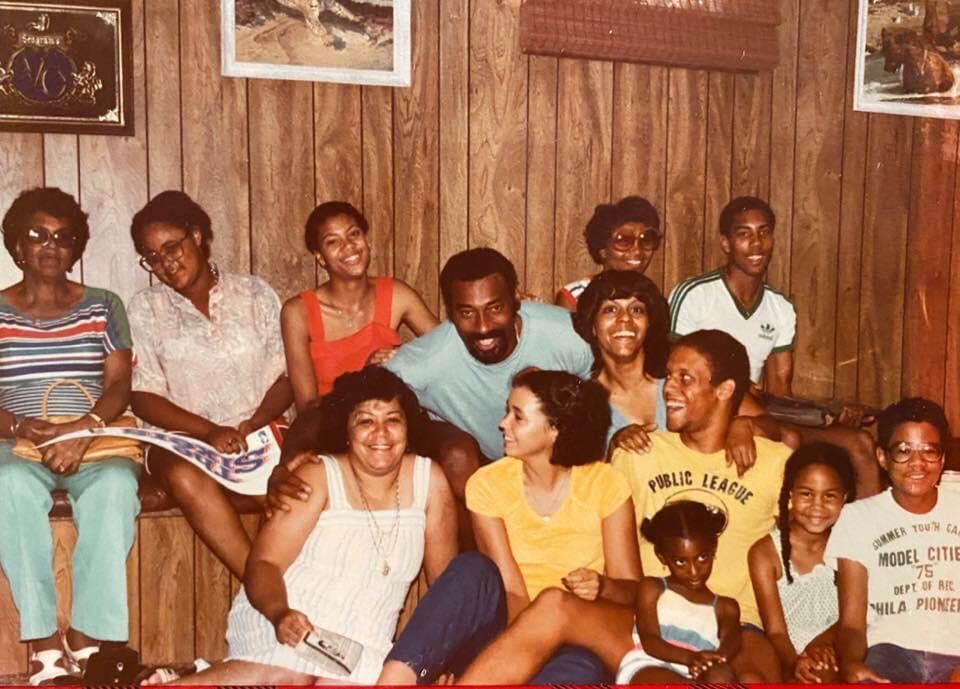
    Wilt Chamberlain visiting the Miller family in Philadelphia in the 1970s.Gloria Miller

    Hoover said he never thought much about Chamberlain living in New York while playing in Philly. The 7-footer belonged in the big city. And Hoover wouldn’t blame James for thinking the same.

    Hoover met Chamberlain when he was playing a summer game in New York — “Wilt Chamberlain knows my name,” Hoover thought after Chamberlain watched him play — and they soon became friends. Chamberlain dropped him off at his dorm and sped to New York. Hoover said no one even noticed the basketball superstar dropping off the college kid. It was normal.

    “Nobody saw me. It wasn’t necessary,” Hoover said. “The key to having relationships with guys is just having relationships. Not taking pictures, getting autographs, and jumping out saying, ‘Look who I’m with.’ That kind of thing makes you have lasting relationships with guys. If you’re always in front and always going to be out front with them, then that relationship is not going to last at all.”

  • Lucky tuna salad and fanny pack meatballs: What Phillies fans bring to Citizens Bank Park

    Lucky tuna salad and fanny pack meatballs: What Phillies fans bring to Citizens Bank Park

    “What is your spaghetti policy here?”

    Once a throwaway joke from a 2010 It’s Always Sunny in Philadelphia episode, the question has become shorthand for gauging whether a ballpark allows food from the great beyond — Ziplocked bags of cold spaghetti and red sauce included.

    Most do. At Citizens Bank Park and 26 other Major League Baseball stadiums, fans can bring in food as long as it’s sealed and can fit inside a stadium-approved bag (12 inches by 6 inches by 12 inches‚ in the Phillies’ case). Naturally, there are exceptions: The Athletics strictly prohibit outside food, while the Tampa Bay Rays and Detroit Tigers require a doctor’s note for a spaghetti bag. (The San Diego Padres even have a special exemption for food that “can be thrown as a projectile,” so hot dogs are no-go, at least in the hands of a Philadelphian.)

    Baseball’s lax food policies have long been viewed as a way to keep America’s pastime accessible, especially as ticket and concession prices continue to rise. Generally, most fans keep it simple: sandwiches, chips, fruit, or a bag of precooked glizzies.

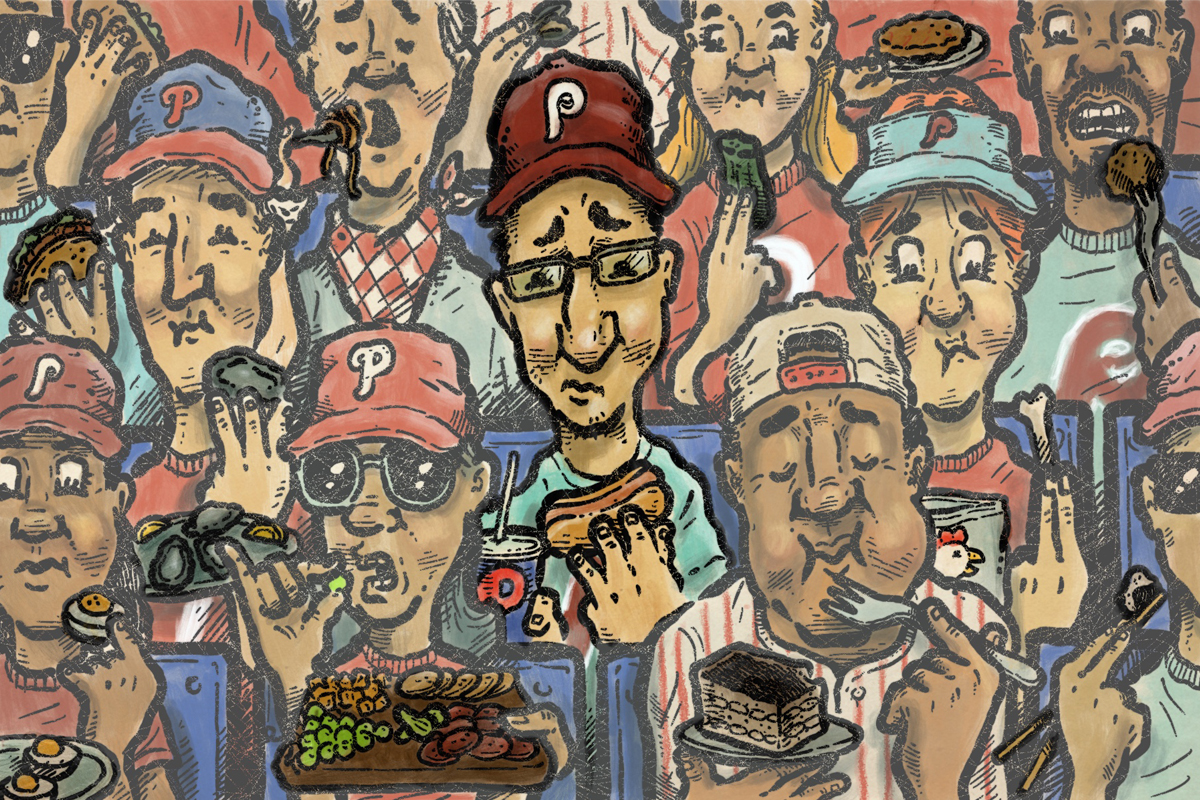
    But in Philly, the Bank’s spaghetti policy has taken on new life as Phillies fans redefine what’s considered acceptable ballpark food, smells and food safety be damned. For some, smuggling in tiramisu or seafood is a sign of dedication. For others, it’s about committing to a bit.

    Regardless, Philly wouldn’t have it any other way.

    “As much I as love ballpark food, I don’t want to miss anything because I’m waiting in line” at concessions, said Laura Bider, a season ticket holder who prefers to tote a fanny pack full of meatballs and what she called “pocket pickles.”

    (function() { var l = function() { new pym.Parent( ‘cbp-meatballs3__graphic’, ‘https://media.inquirer.com/storage/inquirer/ai2html/cbp-meatballs3/index.html’); }; if(typeof(pym) === ‘undefined’) { var h = document.getElementsByTagName(‘head’)[0], s = document.createElement(‘script’); s.type = ‘text/javascript’; s.src = ‘https://pym.nprapps.org/pym.v1.min.js’; s.onload = l; h.appendChild(s); } else { l(); } })();

    At the start of this year’s baseball season, we asked Phillies fans to tell us about the best food they’ve taken inside the ballpark. We fully expected to hear about supermarket rotisserie chicken, booze-soaked fruit, and the best BYO condiments.

    We did. But we also received 100-plus submissions of the most outlandish things we’d ever heard: fresh mussels, hard-boiled eggs, racks of ribs, and oysters tucked inside hoagie rolls, among others. (We don’t judge, we just listen.)

    “Bring whatever feels lucky to you, whatever is going to pack you with enough protein and joy to get you through a game,” said Sarah Dlugos, 28, of Graduate Hospital. She believes her curried tuna salad helped the Phillies sail to the National League Championship in 2023. She also had a retort for skeptics: “It’s none of anybody else’s business.”

    Actually, it’s our business. Here are the wildest foods people have taken inside Citizens Bank Park, for better or worse.

    Seafood, apparently?

    Ideally, a baseball game is like an airplane: You respect legroom, and never, ever eat smelly food that spoils easily.

    Not here. In Philly, fish and mollusks are totally acceptable ballpark fare.

    Dlugos packed a tuna salad sandwich on untoasted whole wheat bread to all eight Phillies games she attended during the 2023 season. And while the flavorings ranged from dill to sriracha and sesame, the outcome remained the same: Every time Dlugos bit into her mushy, slightly warm sandwich, the Phils won.

    (function() { var l = function() { new pym.Parent( ‘cbp-sardines__graphic’, ‘https://media.inquirer.com/storage/inquirer/ai2html/cbp-sardines/index.html’); }; if(typeof(pym) === ‘undefined’) { var h = document.getElementsByTagName(‘head’)[0], s = document.createElement(‘script’); s.type = ‘text/javascript’; s.src = ‘https://pym.nprapps.org/pym.v1.min.js’; s.onload = l; h.appendChild(s); } else { l(); } })();

    “I even had tuna salad for game two of the NLCS when the Phillies beat the [Arizona] Diamondbacks 10-0,” she said. “Lucky tuna.”

    Dlugos assured us that she downed her sandwiches quickly, to limit any odor, and she recommends copycats eat their tuna before the third inning at the latest. After all, her sandwiches had already survived several Broad Street Line stops before making it to the stands.

    Haters, she suggested politely, can go kick rocks. “Whatever you do is between you and the tuna,” said Dlugos.

    Not everyone is so lucky.

    It was June 2012 when Jersey resident Dom Ellis walked into Citizens Bank Park with a bag of fresh mussels taped to his back and a dream: for Chickie’s & Pete’s to steam his shellfish and top them with a drizzle of their cheese dip.

    (function() { var l = function() { new pym.Parent( ‘cbp-mussels2__graphic’, ‘https://media.inquirer.com/storage/inquirer/ai2html/cbp-mussels2/index.html’); }; if(typeof(pym) === ‘undefined’) { var h = document.getElementsByTagName(‘head’)[0], s = document.createElement(‘script’); s.type = ‘text/javascript’; s.src = ‘https://pym.nprapps.org/pym.v1.min.js’; s.onload = l; h.appendChild(s); } else { l(); } })();

    “For some reason that popped into my head, and I thought it sounded really good,” said Ellis, now 34, of Pennsauken.

    His hopes were dashed when the Chickie’s & Pete’s staff in section 126 refused to so much as touch the mollusks. “I remember the lady looking at me like I had three heads,” Ellis recalled. “The manager was like, ‘Do you think anyone here knows how to cook mussels?’”

    Ellis said he would’ve paid at least $50 for cheesy ballpark mussels. Instead, he dumped them in the trash. To date, Ellis is so scarred that he refuses to bring food inside any ballpark.

    “A lot of people lost that day,” Ellis said. “I lost. The Phillies lost.”

    More recently, someone did succeed in getting shellfish to the stands.

    Last year, Ty, a local influencer who goes by “the Hippie Meathead,” smuggled 60 oysters inside the Bank by stuffing them in hoagie rolls, shells and all. He wrapped the rolls in tinfoil to avoid any interrogation. (The 25-year-old Rittenhouse resident declined to share his last name out of fear that his seafood habits could hurt his career.)

    Once inside, Ty put the oysters on ice that he retrieved from concessions and shucked them with a screwdriver. He slurped some straight, while others topped hot dogs and pizza slices that were shared with strangers. A few went into a beer bat filled with Yuengling. Ty chugged it like an oversize shooter.

    “It tasted like the ocean,” he said. “Oh, and victory.”

    The home cook special

    Forget peanuts and Cracker Jack: The new frontier of baseball fandom is bringing elaborate spreads to the ballpark. Dozens of Inquirer readers responded to our survey with tales of dinners spread across several innings.

    A reader from Point Breeze prepped a full steak with potatoes and shrimp scampi for night games. Another wrote via Reddit that they managed to get a full barbecue spread — smoked brisket, mac and cheese, cornbread, and baked beans — inside for a World Series game.

    Kevin Kilroy’s most memorable Phillies game involved eating lasagna and tiramisu in the stands for a birthday party. It wasn’t exactly a five-star meal: The cold lasagna was “just edible.” The tiramisu, a family recipe, was a toppled mess. Not that Kilroy minded.

    (function() { var l = function() { new pym.Parent( ‘cbp-tiramisu2__graphic’, ‘https://media.inquirer.com/storage/inquirer/ai2html/cbp-tiramisu2/index.html’); }; if(typeof(pym) === ‘undefined’) { var h = document.getElementsByTagName(‘head’)[0], s = document.createElement(‘script’); s.type = ‘text/javascript’; s.src = ‘https://pym.nprapps.org/pym.v1.min.js’; s.onload = l; h.appendChild(s); } else { l(); } })();

    “Each Phillies game is special because of the people I’m with,” said the 33-year-old Olde Kensington resident. “The food is a way to celebrate that.”

    First-time season ticket holder Alex DiDonato, 28, has already built a reputation in section 317 for bringing ornate dinners: a rack of ribs, crab cake sandwiches with homemade aioli and grilled corn, a charcuterie board, and, more recently, a DIY taco kit with ground beef, guacamole, shredded cheese, and lettuce.

    (function() { var l = function() { new pym.Parent( ‘cbp-tacos__graphic’, ‘https://media.inquirer.com/storage/inquirer/ai2html/cbp-tacos/index.html’); }; if(typeof(pym) === ‘undefined’) { var h = document.getElementsByTagName(‘head’)[0], s = document.createElement(‘script’); s.type = ‘text/javascript’; s.src = ‘https://pym.nprapps.org/pym.v1.min.js’; s.onload = l; h.appendChild(s); } else { l(); } })();

    The new tradition started as a way for her to make each game feel special. The Spring Garden resident hasn’t had a single miss yet, she said, and has plans to bring a tray of baked ziti next. The only downside: her seats.

    “We sit at the edge of our section, so every time someone comes into our [row], we have to stand up and take all of our food and dips and drinks with us,” DiDonato said. “It’s a bit of a problem.”

    Bider, with her meatball-filled fanny pack and back-pocket pickles, isn’t into all the flash. The 46-year-old from Swedesboro just wants the Phils to make the playoffs.

    (function() { var l = function() { new pym.Parent( ‘cbp-pickels__graphic’, ‘https://media.inquirer.com/storage/inquirer/ai2html/cbp-pickels/index.html’); }; if(typeof(pym) === ‘undefined’) { var h = document.getElementsByTagName(‘head’)[0], s = document.createElement(‘script’); s.type = ‘text/javascript’; s.src = ‘https://pym.nprapps.org/pym.v1.min.js’; s.onload = l; h.appendChild(s); } else { l(); } })();

    The one time she splurged on a stadium hot dog and an ice cream helmet last year, the Phillies lost to the Los Angeles Dodgers in the first game of the division series, Bider said.

    “It was all my fault,” she said. “And, no offense to the stadium, the food was nasty.”

  • Building a file photo legacy

    Building a file photo legacy

    In late July when I covered Montgomery County’s District Attorney announcing charges in connection with two assaults in a Cheltenham High School football locker room, I knew the story was something we would be writing about for some time.

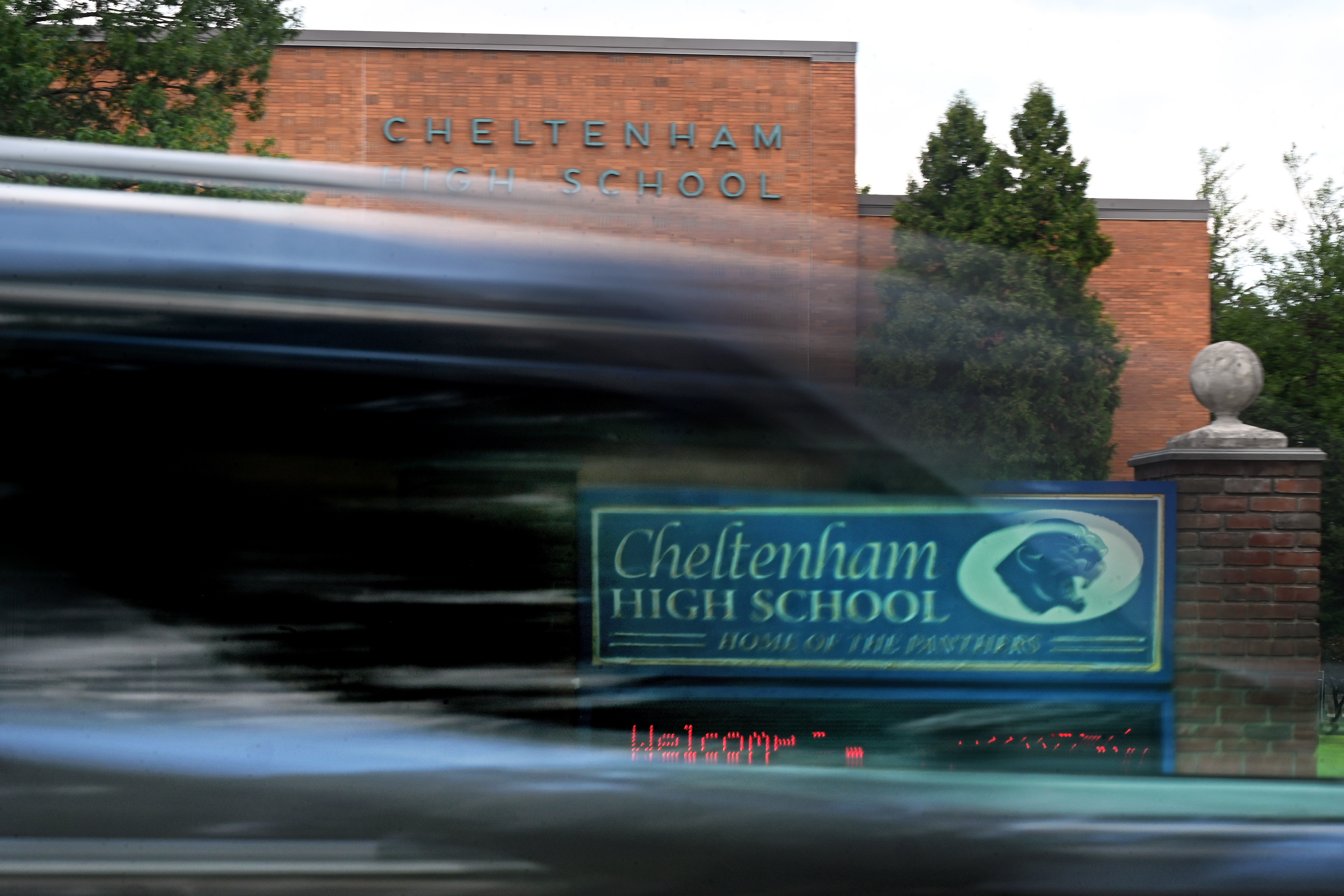
    Aware that we used the same photo, taken in 2018, with stories about the high school hazing leading up to the indictments, I left from the DA’s office across the street from the Courthouse in Norristown and drove to the school in Wyncote to take “fresh” ones.

    I wrote last week about the web’s appetite for photos. But there’s another kind of photo: the thumbnails that are attached to every story, whether or not they are “live” photos.

    Most of those little horizontal photos — none are verticals — of flashing police lights or yellow tape; headshots of politicians; city street scenes and skyline, or many, many photos of signs and buildings are file photos.

    Like the 2018 one of Cheltenham High School. And the July 2026 version — in a variety for views — that I made last week, that already have and will be used again and again.

    The frame at the top was made with a aperture of f/22 so I could get both signs in focus, at shutter speed of 1/15 second to blur the passing cars. Getting the window was just good luck.

    I thought of file photos this week when another one of mine was used in a story about N.J. Gov. Mikie Sherrill declaring a steak place in Camden has better cheesesteaks than the “millions” she has tried in Philly.

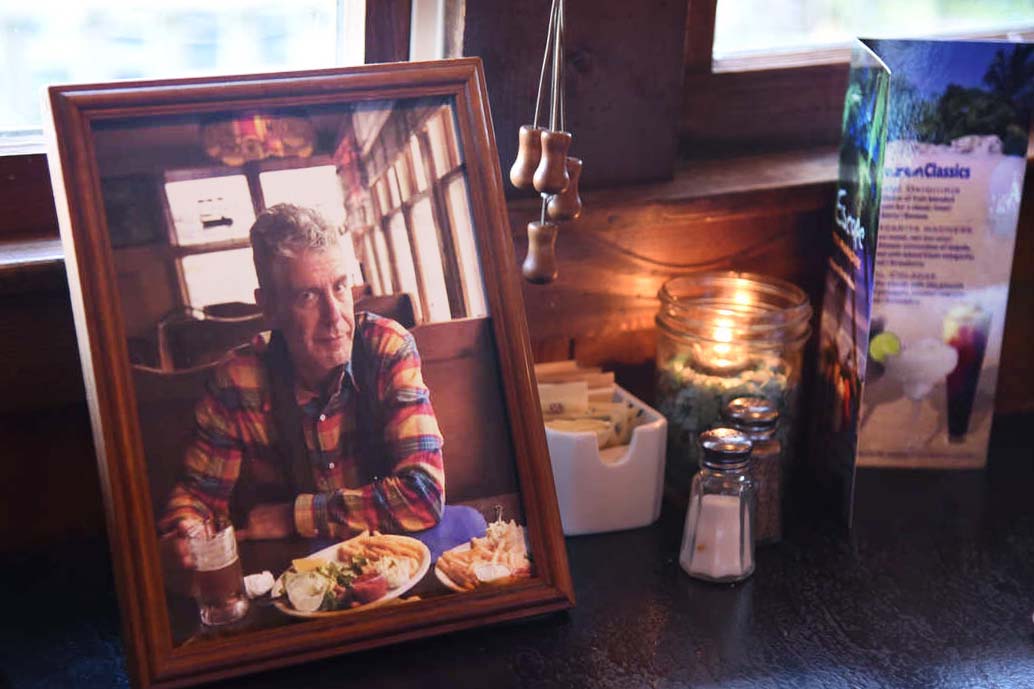
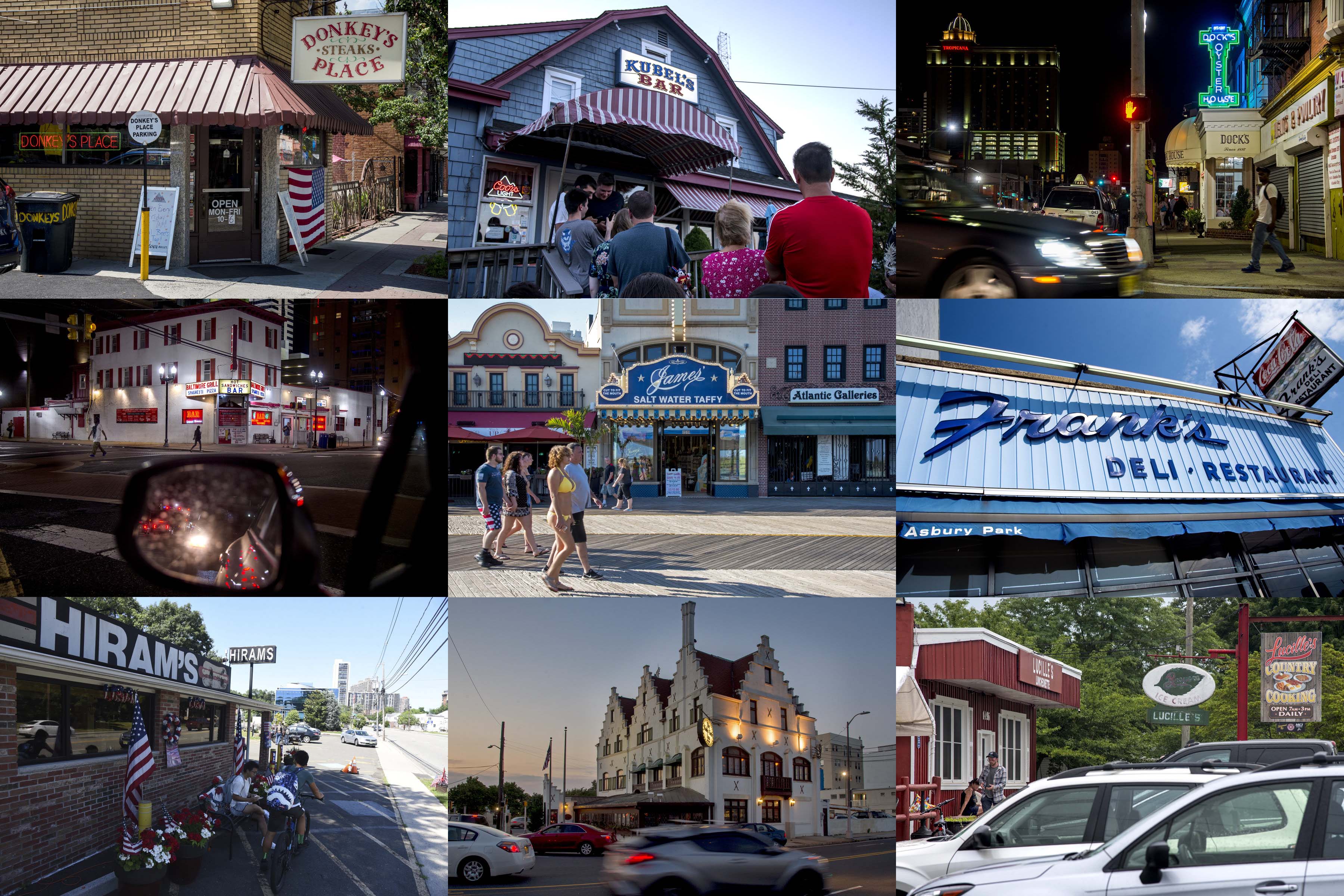
    After celebrity chef Anthony Bourdain died in 2018 I set out to photograph — and eat — at some of the food destinations he visited on his Emmy Award-winning CNN show Parts Unknown.

    The booth at Kubel’s in Barnegat Light, where Bourdain ate clams with his brother, Chris.TOM GRALISH / Staff Photographer

    Following in the footsteps of the globe-trotting adventurer, I flew not to some far-flung place with exotic cuisine but drove instead to all 10 spots he featured in an episode on the food and culture of his home state, New Jersey.

    It was one of my top 10 favorite stories of my career. Foodstagrammers had visited many of the places featured in the episode but I couldn’t find any foodies who had been to all of them.

    Each one had its own history, personality, and flavor, but together all captured exactly what Bourdain loved about New Jersey: community and authenticity, and incredible food without the pretense.

    Donkey’s Place in Camden was one of the most memorable. I made three trips there for the story, and took hundreds of photos while sitting at the bar with cheesesteak aficionados and talking with third generation owner Rob Lucas (his grandfather, Olympic boxer Leon Lucas, had a punch they said was like the kick of a mule).

    I could go on about the memories served at each of the places Bourdain was drawn to, but getting back on the file photos track, of all the photos I made that summer, the one image that gets reused the most often is one from Donkey’s, made as I was walking to my car after my last visit.

    I paused, waiting for anyone to walk in or out. I’d just spend a couple hours there, and it was slow by then, mid-afternoon, and the light wasn’t that great anyway, so I took a quick picture and left, figuring it’s close by (compared to the other places) and I could come back at lunchtime later.

    Of course that never happened before the story published, and the straightforward photo of the outside of the restaurant was used. I had lots of other really good photos (if you haven’t already, click through the embedded gallery). So, no big deal. Except that exterior view ends up being the only photo in our photo library with the Donkey’s sign so it gets used every time we write about the place! And the only picture among the dozens from all the other nine places that ever gets republished (I really need to go back and update).

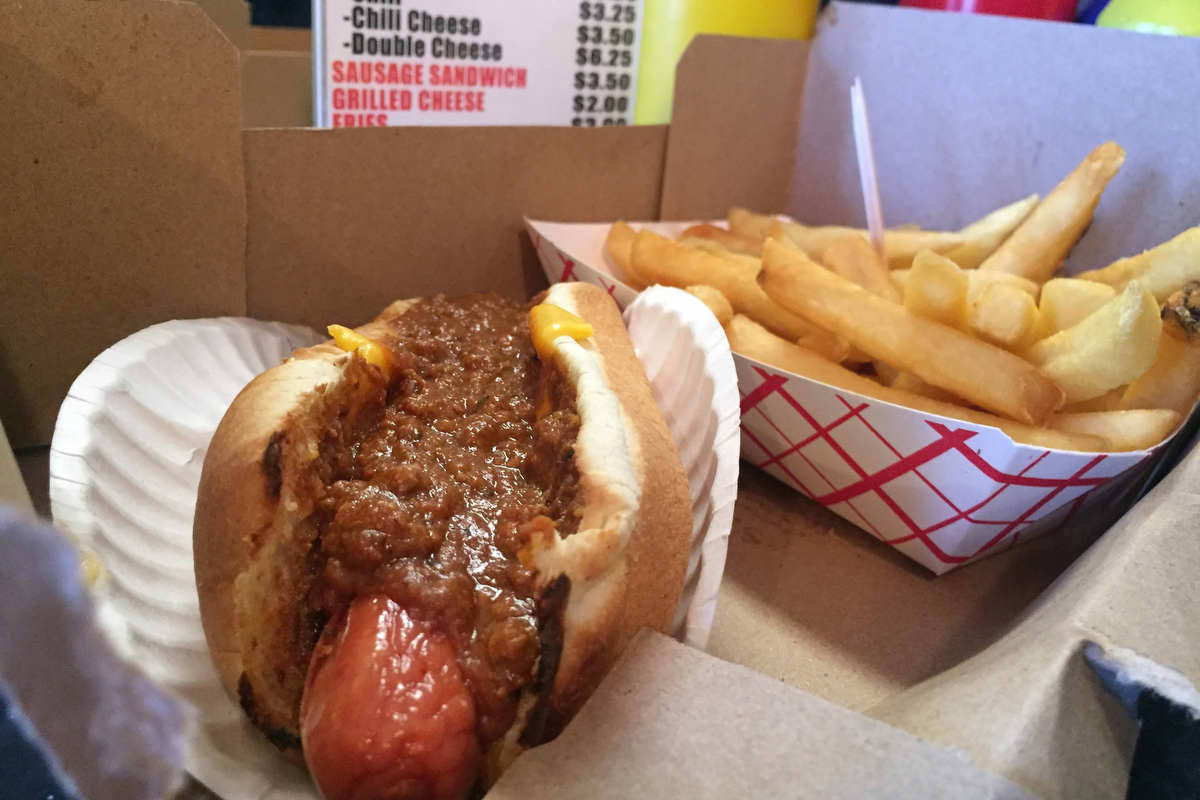
    The “ripper” fried hot dog and French fries (with wooden toothpick) at Hiram’s Roadstand, in Fort Lee, one of ten eateries Anthony Bourdain visited in a 2015 episode of his ‘Parts Unknown” TV show in New Jersey.TOM GRALISH / Staff Photographer

    Another file photo I have updated, among my most-published, is a photo I first took at the University of Pennsylvania. We do lots of stories there, and once while leaving a parking garage, I noticed a logo on the window of the elevator.

    I rode it up and down, over and over, looking for the cleanest spot on the glass, trying different camera exposures — just like with the Cheltenham signs — and getting different angles in the background.

    I have also photographed sculptures, signs, and scenes around campus when on other assignments, but the parking garage image seems a favorite whenever a generic Penn file photo is needed.

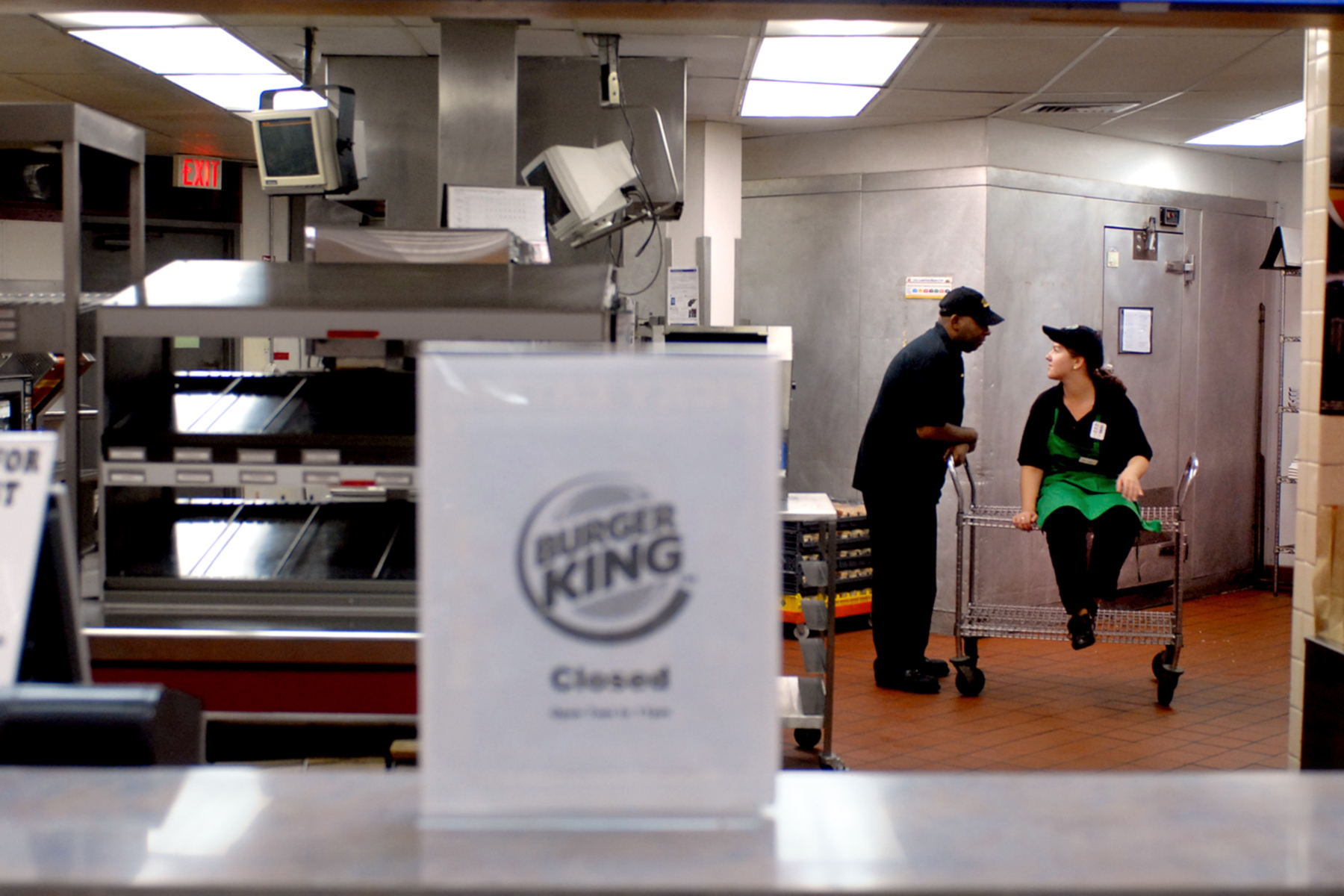
    Finally, in the early days of the web, my most-used file photo was one I made during this column’s first summer (then, in 2007, called a blog). While making weekly roadtrips and posting every day or two about the places and pictures I went, I spent one late night that faded into early morning.

    Rahsan Allen (left) and Tanya Krekmanova talk in the closed Burger King during a break at 4:45 a.m. July 19, 2007, on their night-shift jobs at the North Neshaminy Service Plaza, Westbound on the Pennsylvania Turnpike. They make up two thirds of the overnight shift at the rest stop. Allen works at the Travel Mart and Krekmanova is a Starbucks barista. She is a university student in Sofia, Bulgaria, one of twenty-four International students working at the rest stop. The others come from Russia, Turkey and the Ukraine, for four months with the U.S. State Department’s Summer Work and Travel Program.Tom Gralish / Staff Photographer

    I stopped at service plazas along the Pennsylvania Turnpike. The story is here — but with only one photo (a future column will lament how even when stories get archived by newspapers the pictures that accompanied them are often not saved).

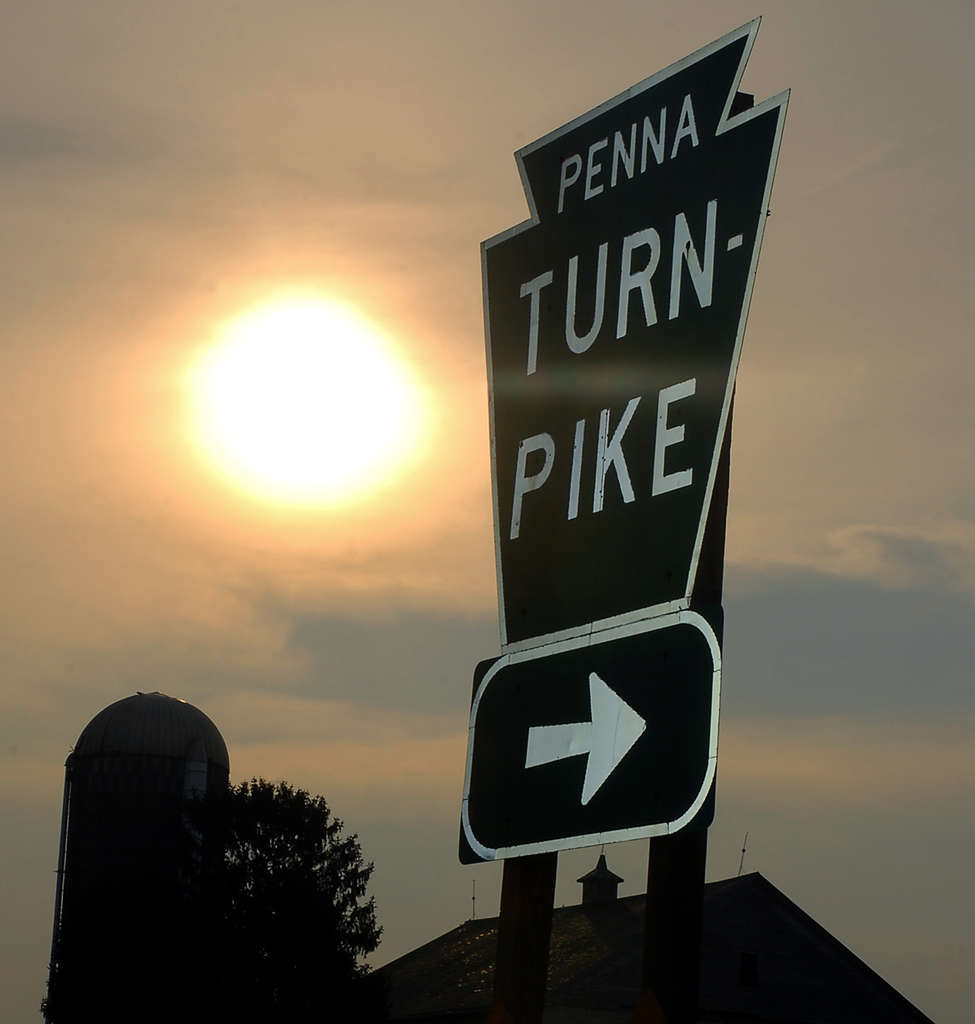
    While getting on and off the turnpike at different exits to backtrack, I photographed the sun rising behind a turnpike sign. It was a vertical, but has been recropped many times to fit the web’s 3:2 thumbnail ratio.

    I still drive the turnpike, and update that photo every once in a while. Versions are still used.

    I guess you could call it one of my “greatest hits.” My legacy.

    Since 1998 a black-and-white photo has appeared every Monday in staff photographer Tom Gralish’s “Scene Through the Lens” photo column in the print editions of The Inquirer’s local news section. Here are the most recent, in color:

    » SEE MORE: Archived columns and Twenty years of a photo column.

  • The Phillies’ grand experiment, Gov. Shapiro’s music video cameo, and another sweaty week | Weekly Report Card

    The Phillies’ grand experiment, Gov. Shapiro’s music video cameo, and another sweaty week | Weekly Report Card

    The Phillies’ game of musical chairs: B-

    The Phillies spent the trade deadline doing the baseball equivalent of rearranging an entire office while everyone was still working.

    Luis Arraez arrived to play second base. Bryson Stott moved to third, where he had all of two major league games of experience. Alec Bohm slid over to first. Bryce Harper returned to right field for the first time since 2022. Trea Turner, despite having the roughest defensive numbers of the bunch, stayed exactly where he was.

    Nobody complained.

    Stott’s response was basically: Tell me where to stand. Harper volunteered to move before the trade was even finished. When the two-time MVP agrees to return to the position where he tore his UCL four years ago because it’s what gives the team the best chance to win, everyone else loses the right to be precious about their assigned seat.

    For one night, the whole thing looked inspired. Arraez drove in two runs in his debut, Harper caught everything hit his way, and the Phillies won, 5-0. Then Wednesday arrived with an 11-inning loss, two injury scares, six runs allowed in the final frame, and a reminder that moving the furniture around does not repair the entire house.

    Still, the Phillies needed something different, and different is certainly what they got. Arraez has already brought the bat and the energy… the rest of the lineup just has to remember where it’s playing.

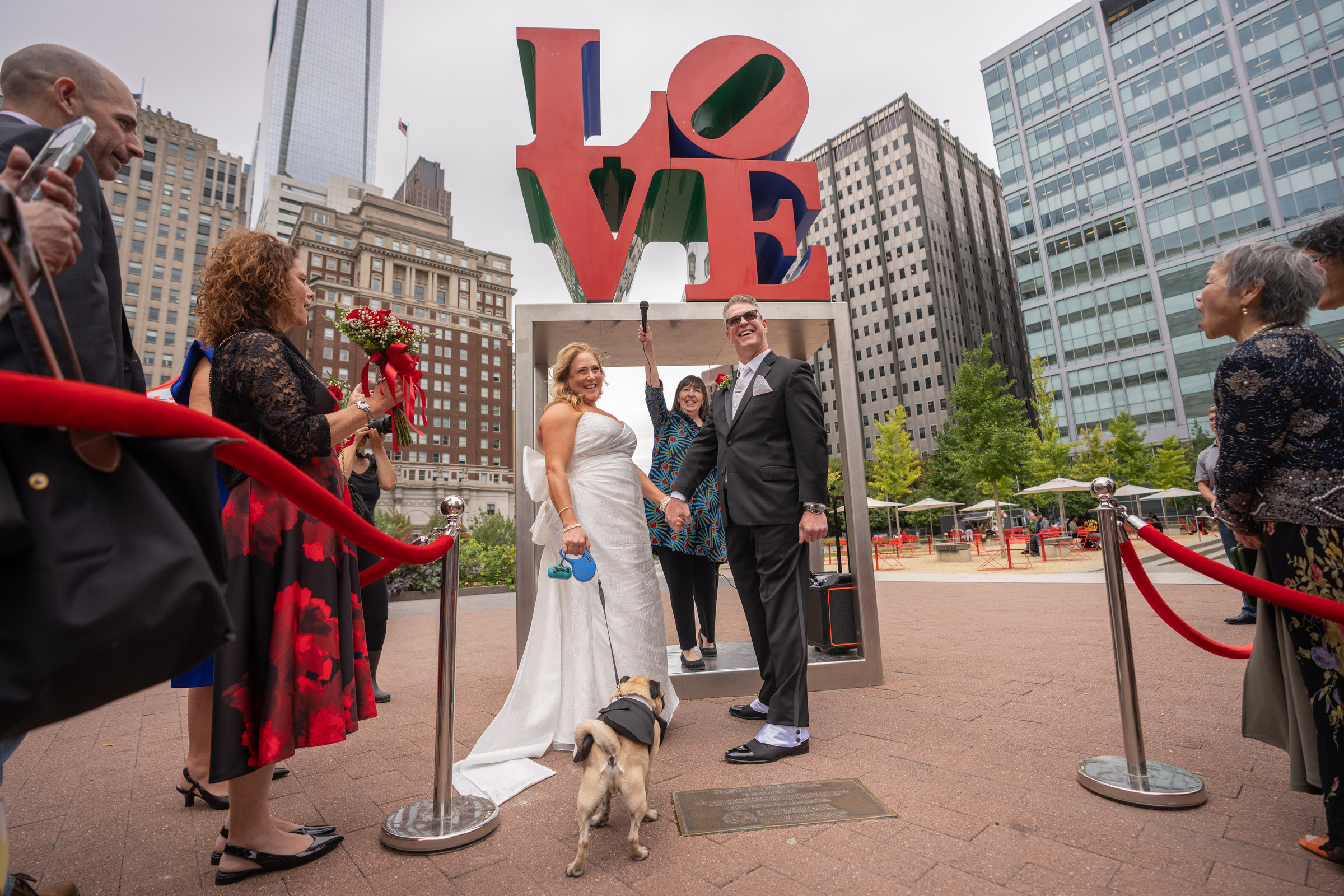
    Katherine Ross, left, and John Pacewicz, right, get married in Love Park surrounded by friends and family and their dog Hoagie, in Philadelphia, October 8, 2025.Jessica Griffin / Staff Photographer

    LOVE Park’s 1,000th wedding: A+

    The average wedding comes with a carefully curated guest list.

    A LOVE Park wedding comes with whoever happens to be walking through Center City that afternoon.

    Nearly 1,000 couples have decided that’s exactly how they want to begin married life, Philly Voice calculated, exchanging vows beneath one of Philadelphia’s most recognizable landmarks while the city keeps doing what it does around them.

    Maybe there’s a SEPTA train rumbling underneath. Maybe someone wanders into the background of your photos. Maybe a guy with a microphone decides this is also the perfect place for his performance. Whatever happens, it’s part of the ceremony, which really is part of the allure.

    Gov. Shapiro’s music video debut: B+

    There are plenty of places you’d expect to see Gov. Josh Shapiro.

    The Capitol, a Phillies game, maybe the Pennsylvania Farm Show judging the butter sculptures.

    A Meek Mill music video isn’t one of them.

    Shapiro’s cameo in the sequel to Dreams and Nightmares only lasts a few seconds, but it’s enough to make you rewind and ask, “Wait… was that Josh Shapiro?” Turns out it was. The footage came from a backstage meeting at the One Philly: Unity Concert.

    It actually makes perfect sense given Shapiro and Meek’s long relationship through criminal justice reform. But context disappears pretty quickly when you’re watching one of Philadelphia’s most iconic rap songs and the governor suddenly walks onscreen.

    The Great Cheesesteak Ketchup Debate: B

    There are certain questions guaranteed to start an argument in Philadelphia. Pat’s or Geno’s? Wiz or Cooper Sharp? Is Dallas Goedert underrated?

    This week, Reddit tackled another one: Does ketchup belong on a cheesesteak? The answer, according to multiple Philadelphians, is… maybe.

    The comments were surprisingly reasonable. Plenty of people argued that a great cheesesteak shouldn’t need ketchup, but a dry one absolutely benefits from it. Others pointed out that “salt, pepper, ketchup” has been a standard order for decades, while one former South Philly steak shop worker declared, “The ketchup pump is there for a reason.”

    The real plot twist wasn’t ketchup, though. It was the original poster casually revealing that his wife puts mayo and pickles on her cheesesteaks… and dips plain cheese pizza in ketchup. Suddenly, everyone stopped arguing about him.

    For once, Philadelphia found common ground.

    Los Angeles Dodgers’ Tarik Skubal reacts after a play at home plate during the sixth inning of game against the Chicago Cubs on Tuesday in Chicago. (AP Photo/Melissa Tamez)Melissa Tamez

    The Dodgers do it again: D

    The Dodgers traded for Tarik Skubal, because apparently the two-time defending World Series champions with Shohei Ohtani still needed the two-time reigning Cy Young winner.

    It’s the baseball equivalent of the kid who already got the biggest slice of birthday cake asking if anyone’s going to finish theirs.

    The Dodgers have built one of the best organizations in sports. They draft well, develop prospects, spend money, and somehow all at once. GOOD FOR THEM.

    It’s also exhausting (and boring). Part of what makes sports fun is believing more than one team has a legitimate shot. When the same handful of franchises keep adding MVPs and Cy Young winners, it starts to feel less like a pennant race and more like everyone else is competing for second place.

    Still, nobody in the clubhouse seemed interested in panicking. Stott said the Phillies aren’t scared of anyone, and Schwarber’s message was simpler: First, make the postseason. October has humbled plenty of superteams before.

    Still… it would be nice if the Dodgers took a trade deadline off every once in a while.

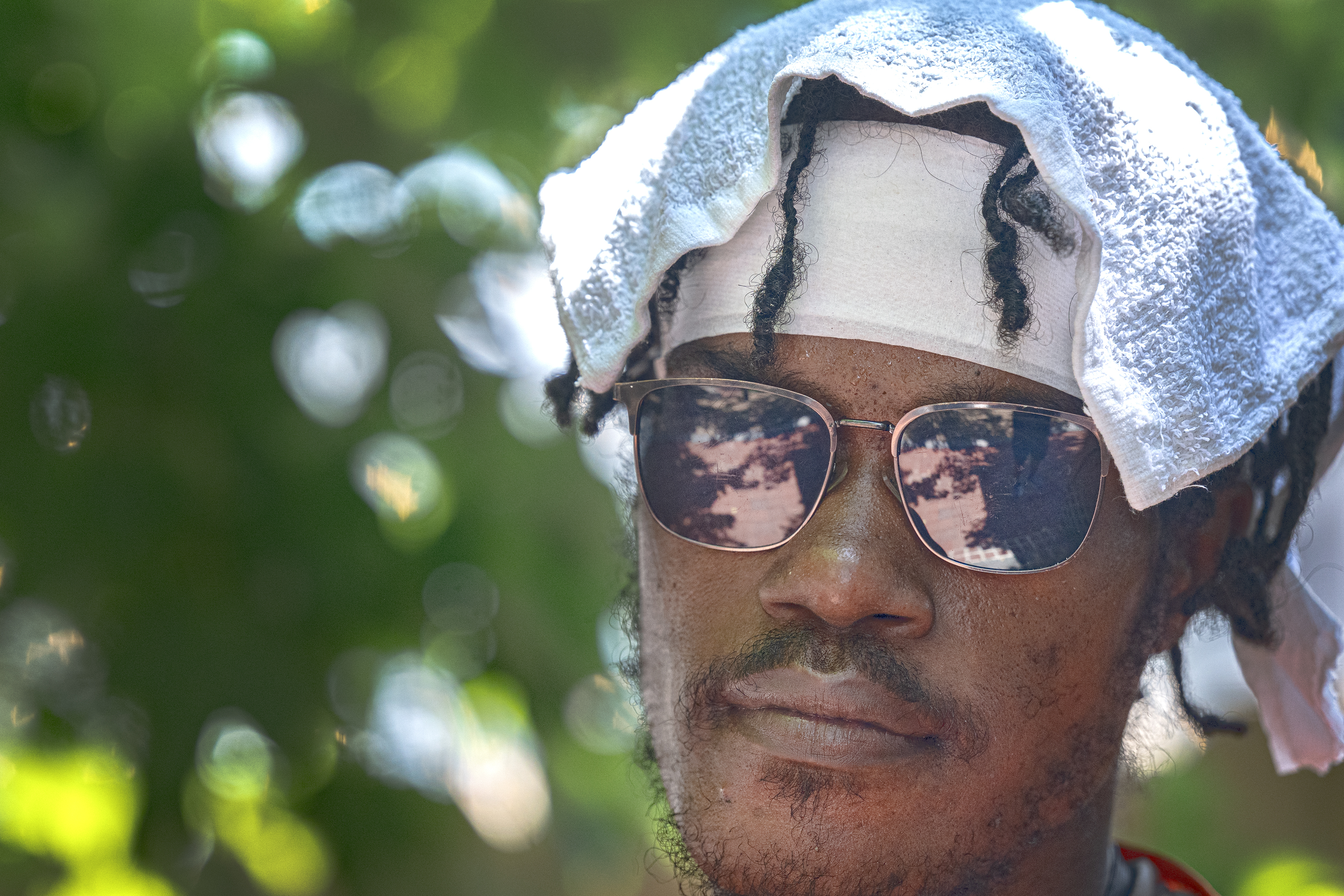
    David Elder cools off with a cold towel draped over his head as he walks through South Philadelphia on Thursday, Aug. 6, 2026. Forecasters are predicting a heat wave across the region over the next several days.Jose F. Moreno / Staff Photographer

    Summer’s greatest hits: F

    The forecast has basically been on repeat for weeks now.

    High around 90. Humidity that makes your shirt stick to your back before you finish your morning coffee. Then, somewhere between lunch and dinner, a downpour pops up just long enough to flood one neighborhood while the next one barely gets a sprinkle.

    The weather has reached the point where nobody asks, “Is it supposed to rain today?” We just assume the answer is yes and hope it doesn’t happen during the 15 minutes we’re outside.

    The worst part is the false hope. Every time the forecast teases a “slight relief,” it lasts about 12 hours and then we’re right back to sweating through our shirts and wondering whether the afternoon commute will include flash flooding.

  • He lives with his wife — and his husband, and his partner, in a 6-person polycule

    He lives with his wife — and his husband, and his partner, in a 6-person polycule

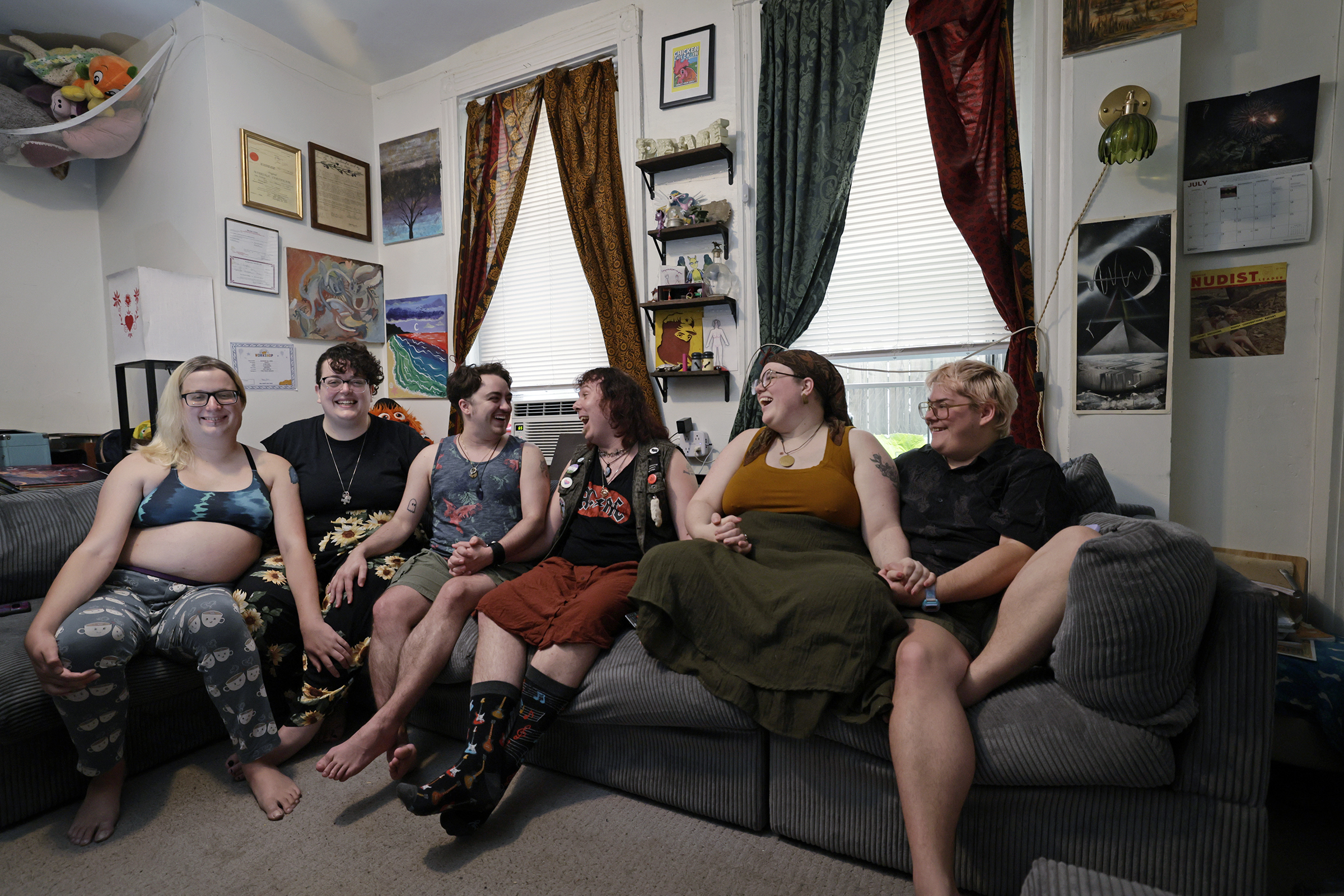
    Linden Curhart describes his home as a “spider web of connections.”

    There’s his husband, Teddy Ullrey-Curhart, whom Curhart met when he was an isolated teenager growing up in a conservative town in Virginia. The two always dreamed of getting married, and in June they celebrated their 13-year commitment in a big pink ceremony at Pastorius Park in Northwest Philadelphia.

    There’s Curhart’s wife, Travis Rosemarie Curhart-Higgins. They bonded as the two most sober people at a friend’s birthday bar crawl in 2019, and got married in 2023. (Curhart wears two stacked wedding rings on his left hand, one for each spouse.)

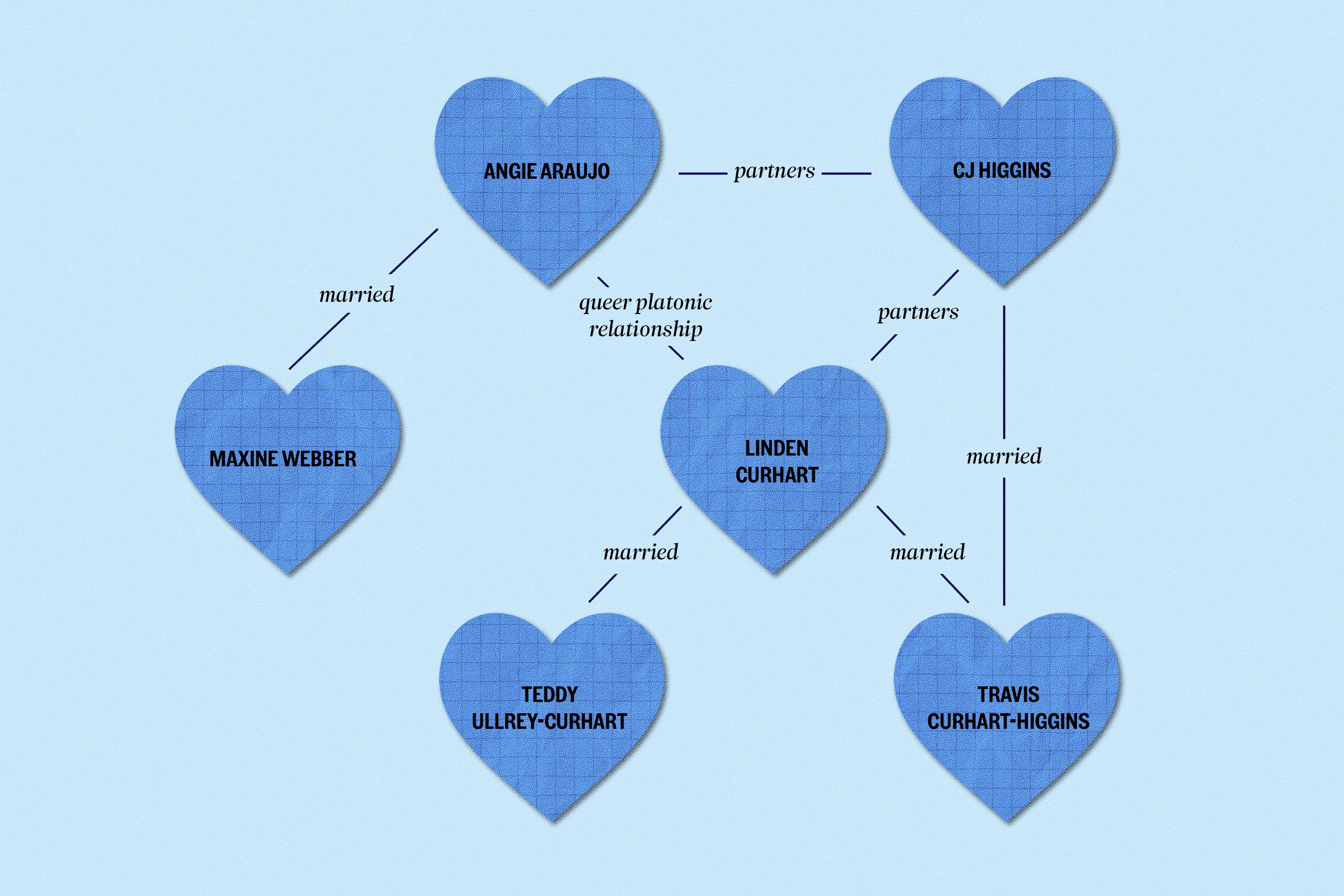
    Then there’s Curhart’s partner, CJ Higgins, who asked prospective dates to fill out a short Google Form expressing their interest, which Curhart did. Rounding out the group is Curhart’s best friend and “queer platonic partner,” Angie Araujo, who is married to Maxine Webber, and dating CJ. Travis and CJ are also married.

    “It’s a whole constellation,” Curhart, 28, said. Ullrey-Curhart is also in his late 20s; the rest of the crew are in their early 30s.

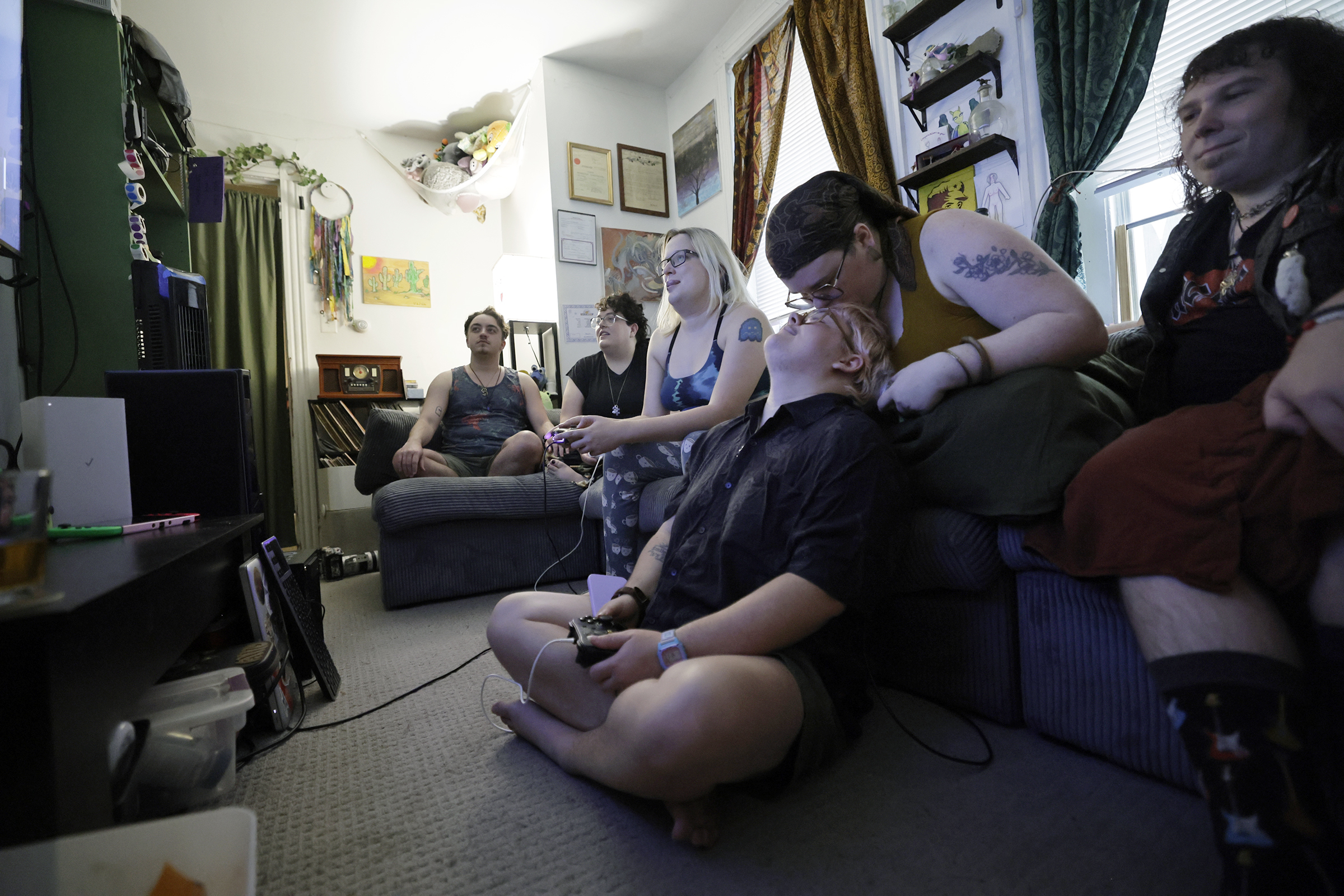
    The six live together as one family in a narrow, rented rowhouse near Drexel. They each have their own room.

    The polyculeJulia Duarte / Staff Illustration

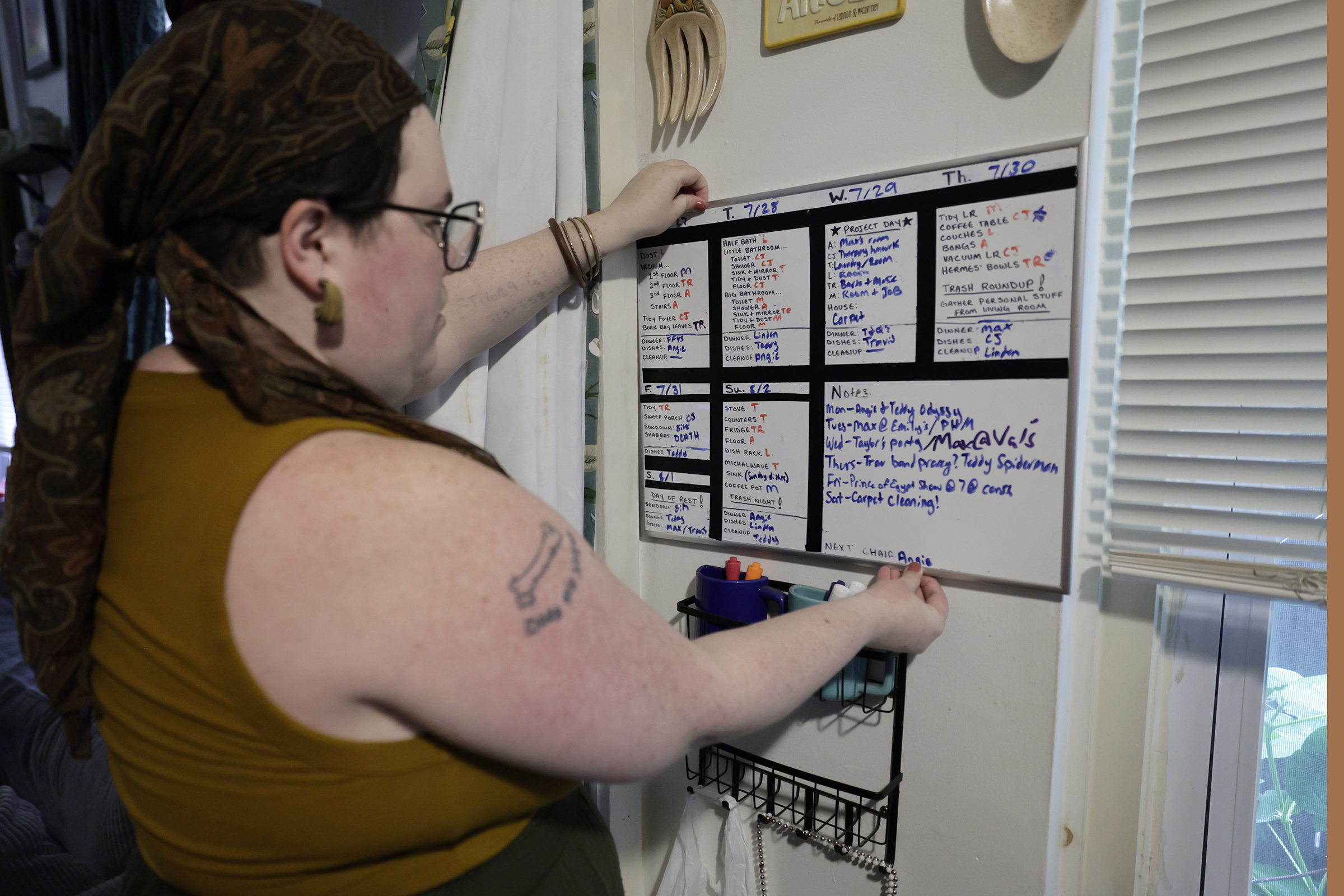
    The polycule — the textbook term for a group involved in polyamory together — shares costs, and meets weekly to discuss chores and meals (usually each person cooks one night a week). They also collectively care for three cats and a hermit crab named Linda.

    “Honestly, the biggest daily challenges that we deal with are just things like, ‘please rinse your mug before you put it in the sink,’” said Curhart.

    The household is Jewish and everyone is an anarchist, Curhart said. They keep the closets stacked with street medic supplies to bring to protests and homeless encampments.

    Some of the members work in theater and some in tech; some don’t work. (Curhart is disabled and relies on the polycule to support him; Ullrey-Curhart is looking for work.) They’ve lived collectively for two years.

    “As a species, humans are pack animals,” said Curhart. “That isn’t to say that everybody should be polyamorous, but I think everybody should live in community.”

    The following, as told to Zoe Greenberg by Linden Curhart, has been edited for length and clarity.

    On proposing marriage

    I had planned a big romantic public proposal for Travis, and then COVID lockdown hit. So instead I got flowers and made dinner at home. I set it up really romantically, with candles, and proposed. We both cried.

    Teddy proposed to me while the whole polycule was apple picking. He got down on one knee and did that dramatic thing where he said my whole name in front of everybody. He talked about how long we’ve been together and how much change we’ve been through.

    Travis and I got married on the winter solstice, so Teddy and I got married on the summer solstice.

    Travis Curhart-Higgins (left) and Linden Curhart show the tattoos they got after their wedding in 2023.Elizabeth Robertson / Staff Photographer

    On what marriage means

    When I’m talking to people who are not in the polyamorous world, I’ll describe it as a “commitment ceremony.” Because I’m not legally married to anybody. But within our own communities, we just say that we’re married.

    There’s this sense of security that comes with making that decision and having it witnessed by all of the people that you love.

    On leaving the state out of the polycule

    The way that I see it is that our personal relationship, who we share our lives with, who we have sex with, who we choose to raise our kids with, that’s not the government’s business.

    But even if you’re not getting the state involved, it’s a big decision to permanently entangle your life with another person. It’s not something that I am actively seeking to do again.

    On moving in together

    All of us were living in various apartments that we hated, scattered around West Philly. We all had landlords that were crappy.

    The pitch was: all of us are broke and we all love each other, and we’re already making dinner together three times a week. We might as well just all do that in the same place. So we came together and pooled our resources and found the rowhouse.

    All of us understood that this is a family commitment. I really want to have kids someday, and these are the people who will help me raise my kids.

    Linden Curhart kisses his husband, Teddy Ullrey-Curhart, while his wife, Travis Curhart-Higgins (right) looks on. Elizabeth Robertson / Staff Photographer

    On sharing money

    We haven’t officially pooled our finances because it’s important for all of us to have financial independence and some financial privacy.

    Somebody will go grocery shopping for the whole house and then calculate an even split. If somebody can’t contribute that amount, they’ll just say, “Hey, I can’t cover mine this week,” and that’s not usually a big deal. Somebody else will step up.

    Generally speaking, we try not to give each other loans. You don’t give somebody money unless that is money that you can afford to lose.

    On distributing labor

    We try to split the work: the financial labor, the actual physical labor, and the emotional labor, so that everybody’s contributing whatever they have the most of.

    Because I contribute less money, I try to make sure that I’m doing things like making big lunches that people can have during the week. I run a garden so we can grow some of our own food.

    The polycule meets on Sundays to discuss tasks for the week. Elizabeth Robertson / Staff Photographer

    On potential breakups

    Because we’ve been together for so long, we don’t really worry about that. We don’t have concrete contingency plans, but our overarching philosophy of how we treat each other doesn’t stop if we break up.

    Fun fact: Travis and Angie are exes. They broke up before we chose to live in a house together. They had dated for a few months and then decided they didn’t have romantic feelings for each other.

    On the most important house rules

    I was worried about us getting on each other’s nerves in close quarters.

    We have a rule that we don’t have serious emotional conversations in the living room. That’s a bedroom conversation. If a conversation starts in the living room and gets tense, one of us will be like, “Oh, I don’t think this is a living room conversation.”

    Don’t gossip. If somebody tells you something emotional, you assume that it’s for your ears only.

    You try not to drag everybody in the polycule into conflicts that are just between two people.

    On a future spare bedroom

    My 10-year vision is a house with a big vegetable garden and kids and maybe a dog. And hopefully a spare bedroom where we can host people who need a place to crash.


    This story is part of a new series about life partners across the Philadelphia area.

    If you want to share your story about who you’re navigating life with, romantically or otherwise, write to lifepartners@inquirer.com. We won’t publish anything without speaking to you first.

  • Should I run a cord across the sidewalk to charge an electric car?

    Should I run a cord across the sidewalk to charge an electric car?

    This week’s question (Have your own? Submit it here.):

    I’m thinking of getting an electric car even though I don’t have a driveway. I’ve seen some of my neighbors run the cords out of their rowhouses across the sidewalk to charge their cars. I’m intrigued! What’s the etiquette?

    Mike Newall, Life & Culture reporter

    Hey, Intrigued-by-Electric! I think it was Emily Post who wrote in her foundational 1922 text on manners and etiquette: “Don’t be a bozo and run electric chargers out of your rowhome!”

    Zoe Greenberg, Life & Culture reporter

    The etiquette is you must secure the wires to the sidewalk, but I have a stroller these days and the sidewalks are like an obstacle course.

    Mike Newall

    Do you want this young mom and her babe to jump rope over your car charger?

    Zoe Greenberg

    But electric cars are better for the babe’s future…

    Mike Newall

    It’s a tripping hazard and probably a city violation (and if there is one thing the city excels at, it’s enforcing violations).

    Zoe Greenberg

    Would you say electric cars are a no-go entirely?

    Mike Newall

    I love electric cars! (Disclaimer: I know nothing about electric cars except they are better for babies’ futures.)

    But when you live in a city, you have to think of your neighbors.

    Find a neighborhood charging station. If they’re filled up, you can always reserve one with a cone or folding chair (kidding… maybe).

    Zoe Greenberg

    I say you can run the cords from the rowhouse, but you have to REALLY secure it to the sidewalk. Make it like a ramp!

    Mike Newall

    Intrigued-by-Electric, you are making me and a wonderful new mom who has to jump over cables put on our public service hats.

    There aren’t enough public stations, but don’t run it from your house.

    If you have a garage, there are companies that will come out to your house and install a charger the right way so you don’t have parents and kids playing double dutch over your new plug-in wheels.

    But a little Googling has led me to another possible solution.

    Zoe Greenberg

    Look at you.

    Mike Newall

    The city seems to be planning a new program called ChargePHL where they will be installing 800 new charging ports across city neighborhoods by 2027.

    Zoe Greenberg

    Wow! So wait until 2027 to get your electric car.

    Mike Newall

    Like so many of these questions, the answer comes down to that famous passage at the end of Grapes of Wrath when Tom and everyone are walking on the road and someone talks about being part of a bigger collective struggle (they were driving a jalopy, not electric).

    When you live in a shining city like Philadelphia, you’re part of that collective struggle. You don’t thrive if your neighbor struggles.

    If you want to go electric (see above about babies’ futures) then be smart and responsible and do it in a way that doesn’t have everyone tripping.

    Zoe Greenberg

    In solidarity.

    Mike Newall

    Your heart is in the right place, Intrigued-by-Electric. Do it smart. Safe. Look up the private installations. Check out current neighborhood options, and possibly go gray waiting for the city. You came to us looking for help, so you obviously got your head on right. I trust you in this endeavor.

    Zoe Greenberg

    We’re in it together. Godspeed.