Tag: University of Pennsylvania

  • People under 30 are most concerned about the environmental impact of data centers

    People under 30 are most concerned about the environmental impact of data centers

    In recent months, the public’s backlash to the artificial intelligence boom has spilled over to a surprising place: college commencement stages. From Florida to California, students have booed speakers who praised AI or highlighted its growing role in today’s society.

    A cohort that historically has supported and quickly adopted cutting-edge technologies is now growing more skeptical.

    The backlash is hardly surprising since AI threatens to wipe out the kind of entry-level jobs that new college graduates depend on. But beneath that immediate threat lies another, less obvious one: the AI boom’s impact on climate change — an issue that young people have grown up worrying about and that has shaped how they view their future.

    In Pennsylvania alone, there are more than 130 AI infrastructure projects either under construction or in the approval pipeline. As demands for AI have increased, utilities and developers are racing to secure enough power to support them. Clean energy projects are already playing an important role in the AI infrastructure build-out.

    But many companies trying to meet energy demands are turning to new fossil fuel plants, reviving coal-fired power, and rolling back their corporate climate goals.

    Shown is the Northampton generating station in Northampton, Pa., in 2024. Gov. Josh Shapiro unveiled a plan to fight climate change Wednesday, saying he will back legislation to make power plant owners in Pennsylvania pay for their planet-warming greenhouse gas emissions and require utilities in the nation’s third-biggest power-producer to buy more electricity from renewable sources. Matt Rourke

    There is a stark contradiction at the center of this reality. AI is marketed as a 21st-century future-oriented technology, yet much of it is being powered by 19th-century energy sources.

    In addition to the energy demands, data centers can require up to five million gallons of water for cooling per day, including in regions already facing drought and water stress linked to climate change.

    A recent Pew Research Center poll shows that 54% of adults under the age of 30 believe data centers will have negative impacts on the environment. While older cohorts surveyed still express concerns about environmental impacts, it isn’t the majority of respondents as it is with younger people: 44% of those 30 to 49; 35% of people ages 50 to 64, and 26% of those 65 and older.

    The increasing backlash among younger people — which has found expression from college commencement speeches to community forums — points to what research has consistently shown: Younger generations are worried about climate change.

    They are already experiencing the impacts in Pennsylvania: hotter and longer heat waves, more dangerous flooding, worsening drought conditions, and the increase in certain diseases thanks to the territorial expansion of carriers, like ticks.
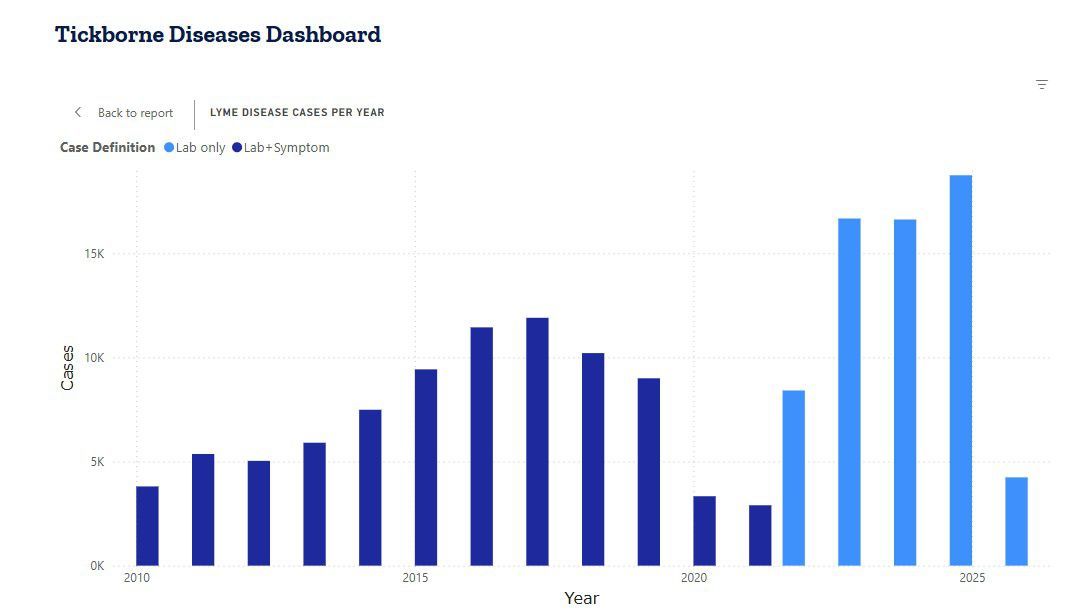
    Chart shows the rise of tickborne illnesses in Pennsylvania.Pennsylvania Department of Health

    If the growth of AI leads to more fossil fuel use, higher emissions, and worsening air pollution, young people are justified in questioning whether the technological progress is worth the future problems they will inherit.

    Leaders have a responsibility to usher in new development responsibly. One way to do that is to pair data center expansion with investments in clean energy sources. Clean energy is affordable, local, and reliable, and by producing homegrown power, Pennsylvania could potentially lower power bills and protect families from price spikes in the process.

    A clean energy standard for data centers would require that these Big Tech companies use clean energy in increasing percentages over time and that they pay for the required electricity system upgrades to support their operations.

    Another way is for the state to require greater transparency around the electricity and water use of these data centers, so communities understand the tradeoffs required for these proposals in their backyards before agreeing to them.

    Both of these are part of Gov. Josh Shapiro’s Responsible Infrastructure Development (GRID) Standards, approved by the Pennsylvania House on Wednesday, which codify guardrails to protect consumers and hold data center developers accountable. Companion legislation may be introduced in the state Senate in coming days.

    It is a positive move toward responsible development.

    Not all young people skeptical of AI are rejecting it; many are just questioning whether the race to build that future is happening with an understanding of the environmental consequences.

    For the U.S. and Pennsylvania to continue leading in technological innovation while protecting the planet on which young people will build their lives, leaders must take climate change concerns seriously. Young people deserve their future.

    Sanya Carley is the Mark Alan Hughes faculty director of the Kleinman Center. She is also vice provost for climate science, policy, and action at the University of Pennsylvania and presidential distinguished professor of energy policy and city planning at the Stuart Weitzman School of Design.
  • Forceful Pa. Supreme Court ruling constrains one of DA Larry Krasner’s signature initiatives

    Forceful Pa. Supreme Court ruling constrains one of DA Larry Krasner’s signature initiatives

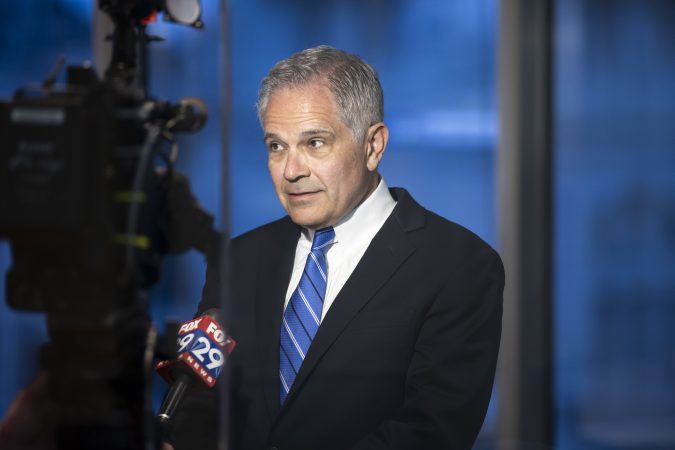
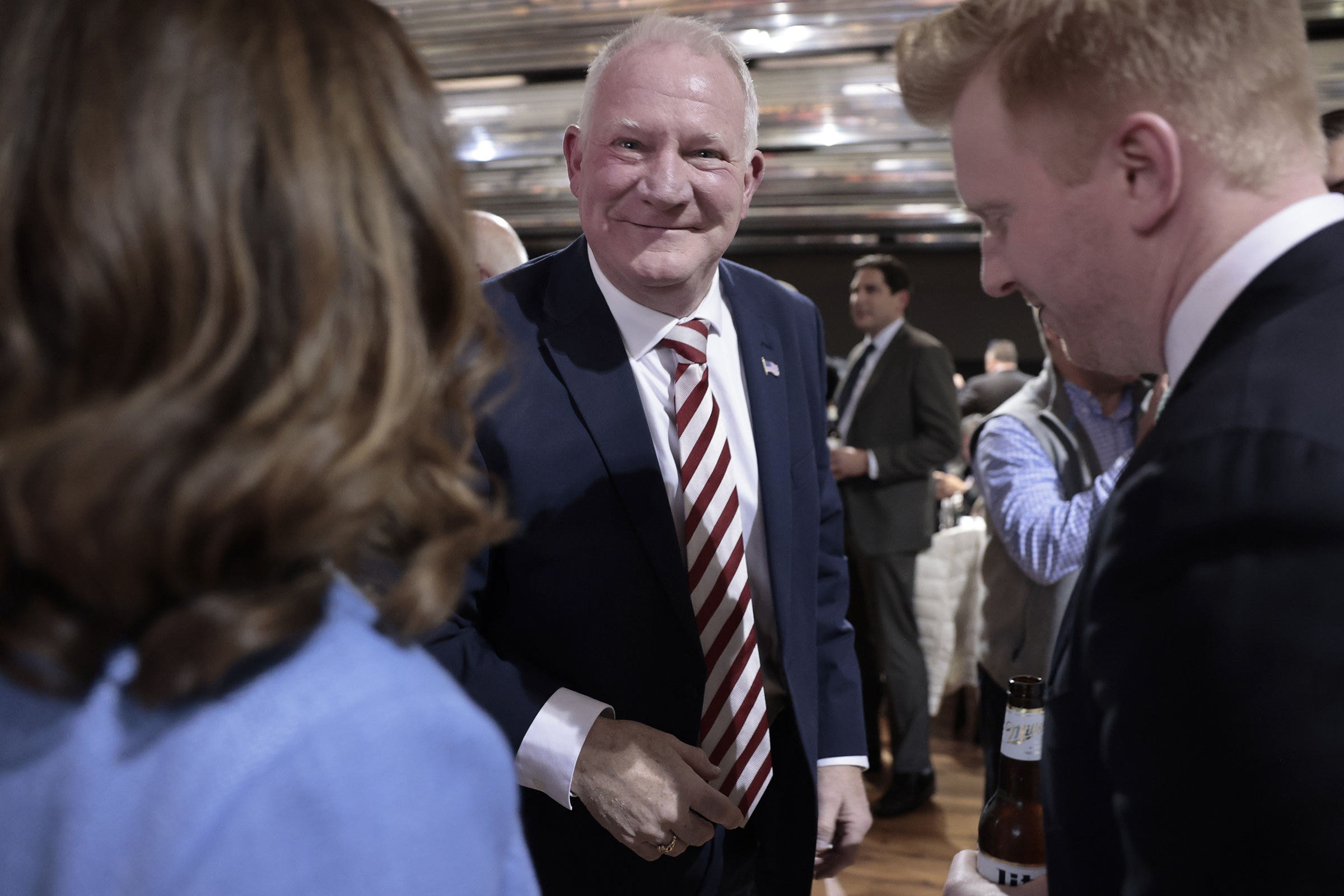
    The Pennsylvania Supreme Court’s decision to limit Philadelphia prosecutors’ ability to seek to overturn old convictions not only took aim at one of District Attorney Larry Krasner’s defining initiatives — it altered the work of an office he will one day leave behind.

    The high court’s ruling adds an extraordinary new layer of oversight to an issue that helped make Krasner one of the nation’s most prominent progressive prosecutors: correcting what he has described as injustices of decades past.

    But the newly established changes to the appellate processes in Philadelphia will outlive Krasner’s tenure and reshape the way the office reviews post-conviction cases for years to come. It could not only apply to high-profile exonerations in murder convictions, but also extend to cases that even Krasner’s more conservative predecessors were eager to undo, like drug and gun convictions linked to corrupt cops.

    It also deepens a yearslong conflict between Krasner and his critics in the justice system. Several justices, in dissenting opinions, raised concerns that the change could inject politics into a high-stakes legal process.

    Since taking office in 2018, Krasner has made post-conviction review a centerpiece of his reform agenda. His office said it has overturned the wrongful convictions of 59 people — almost all of them Black men. It has also struck deals that allowed defendants to plead guilty to lesser charges in dozens of other cases in which prosecutors did not say those charged were innocent, but agreed their original trials were unfair, often because of prosecutorial or police misconduct.

    But the high court, in a forceful majority opinion written by Justice Kevin Dougherty, said Krasner’s prosecutors had misled judges in several of those cases, that the prosecutors were not acting as the necessary adversaries to test the cases’ merit, and that the courts could no longer trust his prosecutors’ word when deciding whether to overturn a conviction.

    Pennsylvania Supreme Court Justice Kevin Dougherty greets supporters during an election night party in November 2025.Elizabeth Robertson / Staff Photographer

    Moving forward, the justices ruled, if the district attorney’s office agrees to alter a sentence or overturn a past conviction, judges must ask the state attorney general’s office to review the case before proceeding. The ruling applies only to Philadelphia; prosecutors in every other Pennsylvania county can continue to evaluate cases on their own.

    Krasner declined to comment this week. While it was not immediately clear whether he had a legal path to challenge the ruling, he said in a video statement last week that it “undermines the value of a vote in Philadelphia.”

    He compared criticism of his post-conviction review efforts to attacks that have been leveled against other social and racial justice movements.

    “We know where we are in the fight,” he said, “and once we get past the fight, we all win.”

    But the Supreme Court’s ruling sharply curtails part of that effort, and it is expected to significantly reshape — and likely slow — one of the most consequential parts of Krasner’s agenda.

    It was “an extraordinary remedy for something the court thought was an extraordinary problem,” said Aaron Marcus, chief of the appeals division at the Defender Association of Philadelphia.

    But, he added, “the remedy might go beyond what was necessary in the court’s mind to address the problem in front of it.”

    While the decision gives the attorney general broader authority to intervene when city prosecutors support post-conviction relief, it remains unclear how often — or when in the process — it will weigh in.

    Brett Hambright, a spokesperson for the office of Attorney General Dave Sunday, a Republican, said in a statement this week that officials were still evaluating the order and its potential impact. Because of the many unknowns, he said, “it may be difficult to fully assess … until the process truly begins.”

    Still, on Wednesday, Sunday’s office filed a notice of intervention in a murder case that Philadelphia prosecutors helped overturn just last month — setting up a potential test case for the new legal landscape around the issue.

    Marcus, of the Defender Association, said the ruling could cause confusion — and delays — in cases that the conviction integrity unit does not typically handle, such as weapons and drug-possession cases, as well as more routine matters, like correcting prison sentences that had been miscalculated.

    “There’s already too few attorneys with too little time and insufficient resources,” he said.

    Marissa Boyers Bluestine, assistant director of the Quattrone Center for the Fair Administration of Justice at the University of Pennsylvania’s law school, said that because the courts did not set a timeline for how quickly the attorney general’s office must review each case, the added oversight could draw out an already yearslong appellate process filled with delays. And, she said, it could create “confusion on who exactly is representing the state.”

    “Now you have two entities who are potentially in opposition to each other,” she said. “It raises confusion and diminishes the real trust in the criminal legal system.”

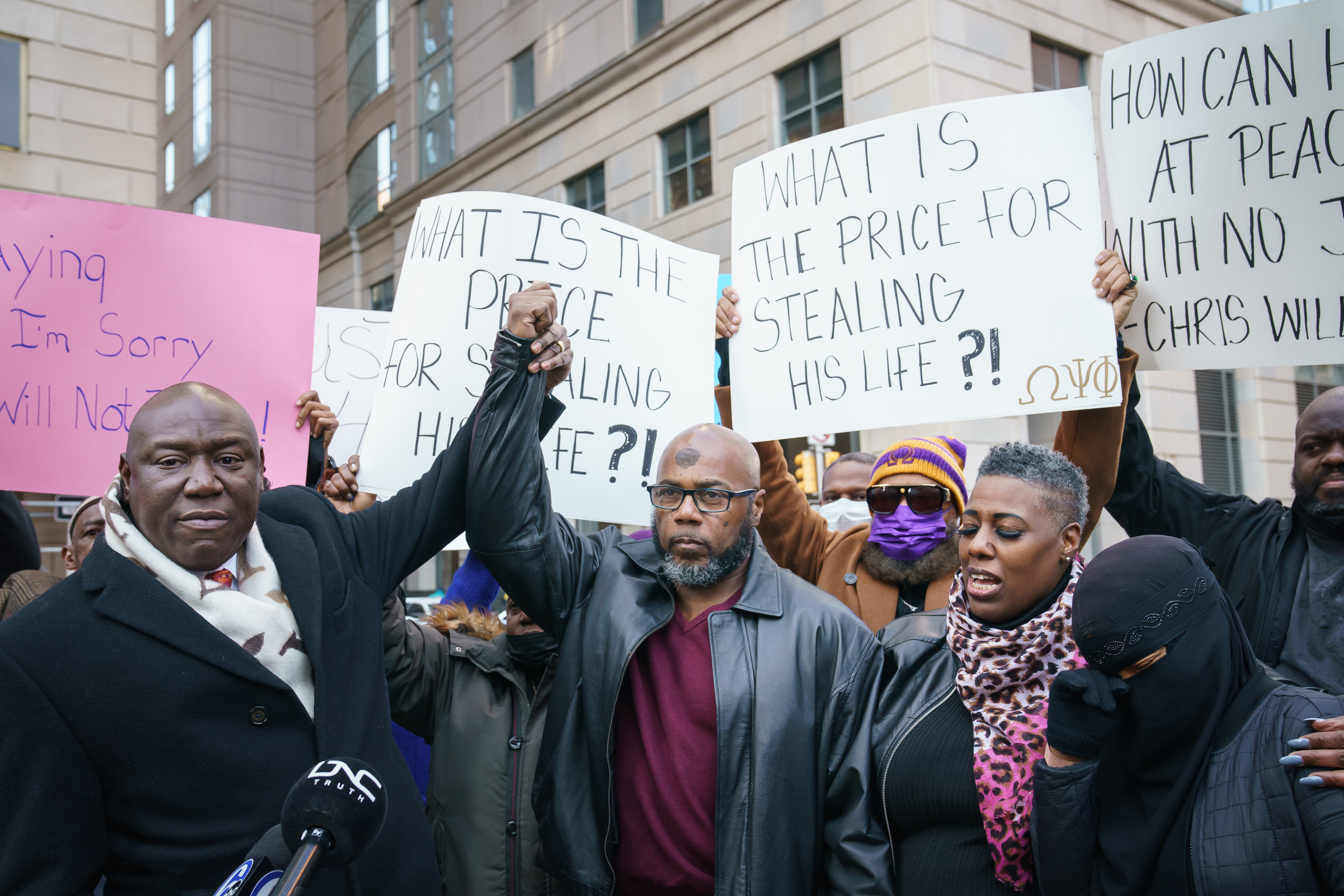
    Dozens of people have been released from prison in Philadelphia after prosecutors agreed their trials were unfair. In this 2021 photo, Christopher Williams, center, gathered outside the Criminal Justice Center to announce a lawsuit against the city of Philadelphia, police and prosecutors. Williams was exonerated and released from prison in February 2021 after more than 25 years on death row.JESSICA GRIFFIN / Staff Photographer

    Several defense lawyers who handle post-conviction cases were similarly concerned about the unknowns of the ruling — and said the majority opinion did not address the decades of problematic police and prosecutorial behavior that led to this moment.

    Michael Wiseman said Krasner’s office has opposed most of his clients’ petitions over the years. Like other district attorneys before him, Krasner is not perfect, Wiseman said, but the high court “is vexing in its willingness to ignore all the times when Krasner’s office got it right.”

    At the same time, he said, “It is similarly vexing for not recognizing the imperfections of past administrations, who, unlike Krasner, defended every conviction without regard to innocence or unconstitutional convictions.”

    Adding to the complexity of the issue, some justices believed the majority’s decision could threaten to reignite long-running feuds between Krasner and prosecutors he has clashed with in the past.

    In one of his first actions after taking office in 2018, Krasner fired dozens of veteran prosecutors, effectively describing them as unfit to serve in a reform-oriented administration. Some who were ousted then went on to work in the state attorney general’s office, and Krasner, in a remark that was widely criticized, jokingly referred to that office as “Paraguay,” a South American country where Nazis fled after World War II.

    Justice Christine Donohue warned in a dissenting opinion that the majority’s ruling could threaten to inject personal disputes between rival lawyers into a process that is supposed to be unbiased. In addition, she said, giving the attorney general’s office authority in those cases could give some state prosecutors a role in defending convictions they helped obtain when they worked for the city.

    “This is in stark contrast to acting as a friend of the court,” she said.

    Ben Lerner, a former Philadelphia Common Pleas Court judge and former chief defender, said Krasner deserves credit for creating a meaningful system to revisit convictions — something he said previous administrations largely failed to do.

    But state and federal courts have repeatedly raised concerns about the office’s methods, he said, including allegations that prosecutors excluded investigating officers and former trial attorneys from parts of the review process, and focused disproportionate attention on cases tied to prosecutors Krasner had clashed with during his years as a defense lawyer.

    “In my view, it’s a shame,” he said, “because this was basically a very important thing that he was doing that previous district attorneys had had no interest in doing.”

  • Need a lawyer for your small business? These Penn clinics offer legal help for free | Expert opinion

    Need a lawyer for your small business? These Penn clinics offer legal help for free | Expert opinion

    One of the biggest mistakes small business owners make is waiting too long to get legal advice. The problem is that many start-ups and entrepreneurs simply can’t afford it.

    Two clinics at the University of Pennsylvania can help business owners overcome that challenge — and may be one of Philadelphia’s best-kept business resources.

    One clinic offers help with general business issues, while the other is focused on intellectual property (IP) matters. Both offer their services at no charge for Philadelphia-area entrepreneurs and businesses. Services are delivered by Penn Carey Law students working under the supervision of experienced attorneys and professors and may not be the same level of service you would expect from a full-service law firm.

    Admission to either program is competitive, with each clinic seeking businesses that create positive social and economic impact in Philadelphia communities. Applications are generally reviewed in August and December for the following fall and spring terms.

    General legal help for Philly-area businesses

    The Penn Carey Law Entrepreneurship Legal Clinic helps small-business owners by reviewing and creating formation documents, customer contracts, and governance documents, as well as vendor, operating, and employment agreements.

    This clinic focuses on underresourced entrepreneurs who are “close to achieving something significant” but lack the legal support needed to move forward, said clinic director Praveen Kosuri.

    His team gets involved with many early-stage businesses to help them decide on the right business structure and determine what kind of structure — partnership, corporation, etc. — is right for the long term.

    “Choosing the right entity structure, ownership arrangement, and governance framework early can prevent significant problems later involving taxes, control, financing, and succession planning,” he said. “We spend a lot of time helping entrepreneurs think through that to build the architecture that will let them grow the way that they want to grow.”

    As a company grows it will likely need employees. And with this comes a new set of legal challenges. Many business owners aren’t prepared for the responsibilities of being employers, Kosuri noted.

    “Most entrepreneurs understand how to be workers but not how to manage employees, comply with employment laws, and build appropriate workplace policies,” he said. “We talk a lot about the responsibilities of being an owner and an employer.”

    The clinic’s lawyers work with business owners from start-up through growth with all the general legal issues that support expansion.

    But many business owners have more technical concerns around their intellectual property.

    An IP legal clinic for Philadelphia-area businesses

    The lawyers at the Law Entrepreneurship Legal Clinic can handle some low-level IP concerns, but it’s best to consider Penn Carey Law’s Detkin Intellectual Property and Technology Legal Clinic.

    This clinic helps small-business clients protect and monetize trademarks, copyrights, patents, licensing, and technology agreements. Lawyers at this clinic can perform most services related to IP, which includes preparing licensing, nondisclosure, and consulting agreements, as well as filing patent applications and drafting or reviewing specific software or artificial intelligence technology contracts and creating governance policies.

    “Business owners should ensure their name, logo, and branding can be legally protected and are not infringing on someone else’s rights,” said Cynthia Dahl, the director of the clinic.

    “Unfortunately, many businesses inadvertently expose themselves to risk by using copyrighted content, adopting a conflicting brand name, or failing to secure ownership rights from contractors and employees,” Dahl noted. “We help founders identify and protect these assets before they become vulnerable.”

    Dahl says her clients are often “incredibly underresourced, but on a precipice to do something really great — and if they only could afford the legal help, they could get over that hump.”

    Dahl’s clinic helps create and implement an IP strategy, which includes knowing when not to pursue legal protection. Dahl’s attorneys provide that advice too.

    “Many entrepreneurs assume they need patents but don’t understand the cost, complexity, or business value,” Dahl said. “Our clinic helps them determine whether patent protection is worthwhile.”

    Both Kosuri and Dahl have a long list of success stories with entrepreneurs in the area.

    For example, Kosuri’s clinic helped a nonprofit purchase a long-vacant grocery store in West Philadelphia and convert it into a food incubator.

    “Over a five-year period of time we helped them negotiate to acquire the property, get zoning approvals, draft architecture contracts, create kitchen and customer rental agreements, and with other general business and governance matters,” he said.

    Kosuri has also worked with companies on the other end of the life cycle with succession planning, ownership transitions, and best strategies for selling their businesses.

    Dahl’s clinic has helped small businesses ranging from an educational curriculum company to a nonprofit that specialized in jazz recordings.

    “For that client we helped document the rightful owners of more than 15 years of archived recordings, resolved inconsistent artist contracts, answered copyright ownership questions, and assisted in the plans to release a composition album,” she said.

    “If a business owner or entrepreneur doesn’t have a lawyer in their life for even simple questions, both clinics can be a very valuable resource,” Dahl said.

  • These athletes all received heart transplants. Now they’re representing Philadelphia at the Transplant Games of America.

    These athletes all received heart transplants. Now they’re representing Philadelphia at the Transplant Games of America.

    One Team Philly athlete underwent a heart transplant while experiencing homelessness at 14.

    Another is on his third organ transplant after a severe case of COVID-19.

    And a third received his new heart three weeks after his daughter was born.

    All are competing, from Thursday through this weekend, at the Transplant Games of America, an Olympic-style event for transplant recipients, living donors, and donor families. Held in Denver this year, the competition celebrates organ donation and showcases life after a transplant.

    The local nonprofit Gift of Life Donor Program organized Team Philly, whose 86 athletes hail from eastern Pennsylvania, South Jersey, and Delaware. They are competing thanks to transplants ranging from hearts and lungs to kidneys, livers, and other organs.

    The Inquirer spoke to three athletes about their journeys with heart transplantation and motivation to compete.

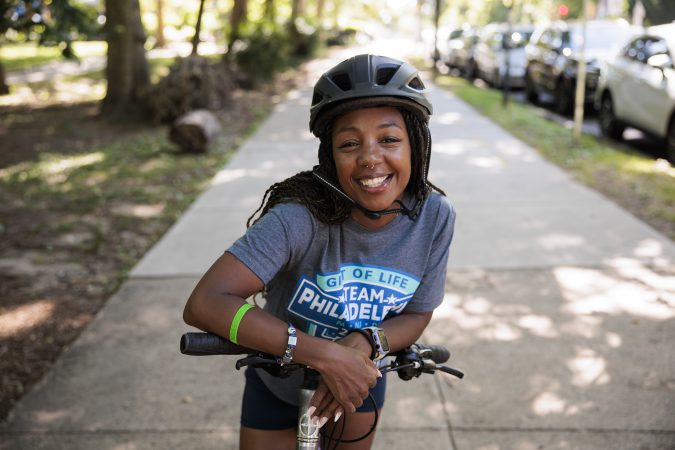
    Evett Hawks is competing in Denver this week as part of Team Philly.Monica Herndon / Staff Photographer

    Childhood as a two-time transplant recipient

    Evett Hawks stared at the mirror in awe.

    After months looking “white as a sheet,” the West Philadelphia native saw in the bathroom mirror a 14-year-old girl whose cheeks were rosy. Her skin was warm and she could feel her fingers.

    “I want to look like this forever,” she recalls thinking.

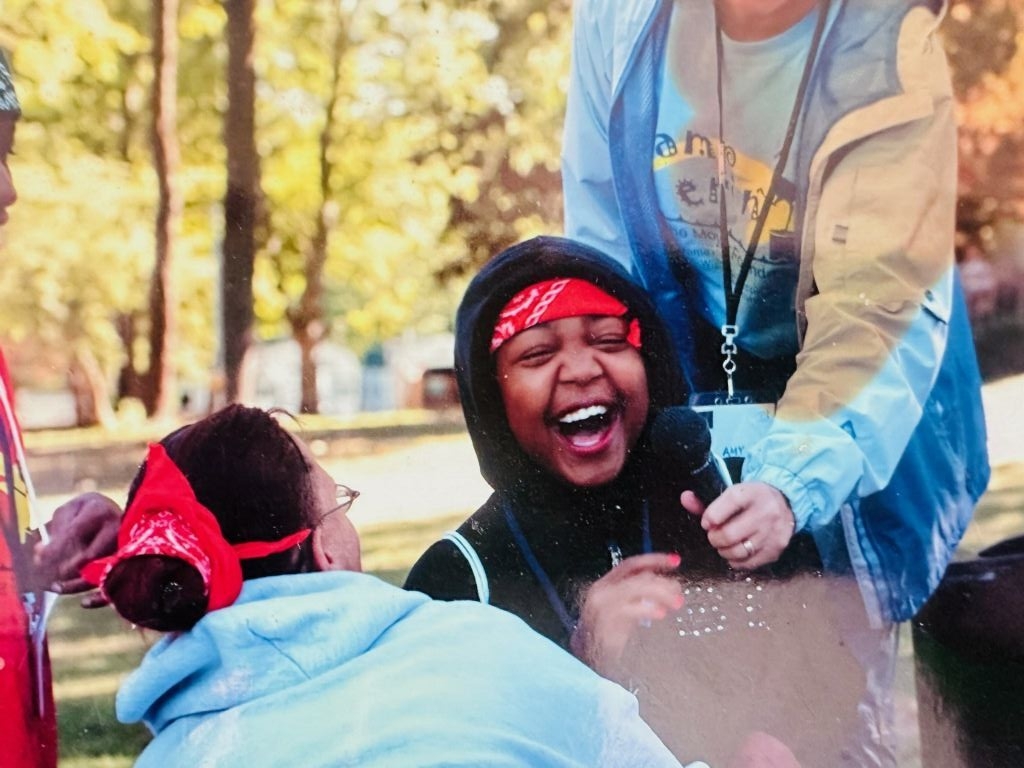
    A photo of Evett Hawks smiling after her second transplant at age 14.Courtesy of Gift of Life Donor Program

    Hawks, who was born with a hole in her heart, underwent her first transplant at age 3 after a cardiac arrest episode landed her on life support. The donor heart kept her healthy for a decade, until her body started shutting down again in 2006.

    Doctors diagnosed her with end-stage heart failure. At the time, she and her mother were living in a shelter without a permanent home.

    “Why me?” and “This isn’t fair” thoughts overwhelmed her, as she moved to Children’s Hospital of Philadelphia to wait for a new heart.

    She started to doubt her odds of finding a match as months passed. She watched other pediatric patients die before they could get their own transplants.

    “Oh, I’m going to die, too,” Hawks recalled thinking.

    After nearly a year at CHOP, doctors found her a heart.

    While recovering from her surgery, Hawks saw a little boy who was still on the transplant waiting list walking laps around the hospital floor.

    He abruptly stopped in front of her room and said, “I can’t do this anymore. It just is too hard.”

    His nurse took him back to his room.

    Hawks said to herself, if “he can’t do it, I’m going to do it.”

    Now, nearly two decades later, at 33, she is competing in her first Transplant Games in the cycling and singing events. She has trained by biking seven miles to and from her job as a registration specialist at Carvana.

    “The goal is just to do my best, and maybe come back with a medal,” she said.

    Evett Hawks will compete in the cycling and singing events at the Transplant Games of America.Monica Herndon / Staff Photographer

    Rebuilding his life after three transplants

    Leston Hall Sr.’s heart stopped in December 2022.

    Airlifted to Thomas Jefferson University Hospital in Center City, he learned from doctors that he could not leave the hospital without heart and kidney transplants. His organs had suffered major damage from an earlier COVID-19 infection.

    Hall, who lives in Bridgeton, N.J., had received his first kidney transplant in 2013 due to familial hypertension. At the time, he had an identified donor: his wife, Tonia.

    This time, he didn’t know how long he would have to wait for a match.

    Then in his 50s, he was so sick he required a scooter to get around. Mostly, he lay in bed.

    “I was barely holding on,” he said.

    Other patients would invite him out on walks, but he always declined. He finally agreed to go with them one day, thinking, “Maybe they’ll leave me alone.”

    They became an inseparable group of four that he now considers “family for life.” Their friendship helped him endure the difficult waiting period that lasted until June 2023, when doctors found him a new heart and kidney.

    After the surgeries, Hall struggled to adjust back to living at home. He hesitated to go down stairs for fear of not being able to get back up, and kept a chair by the stove whenever he cooked.

    Over time, he built his leg strength back up by using an elliptical machine.

    By early August, he was able to cook without the chair. He surprised his wife with a dinner of chicken breast, rice, broccoli, and green beans — the first full meal he had cooked since coming home.

    Leston Hall Sr. pictured with his wife, Tonia, and daughter, Shales.Courtesy of Leston Hall Sr.

    Hall celebrated the three-year anniversary of getting his new heart and kidney last week.

    At his first Transplant Games this week, he is competing in pickleball, cornhole, basketball, and poker.

    Hall said he is grateful “just to be able to accept that challenge.”

    Leston Hall Sr. celebrated his 60th birthday last October. He is pictured with his sons Lavon and Leston Hall Jr.Courtesy of Leston Hall Sr.

    Wanting to see his children grow up

    Todd French watched his daughter’s birth over FaceTime in October 2021 from his bed at the Hospital of the University of Pennsylvania.

    He had learned he needed a heart transplant earlier that month.

    “All I could think about was, ‘I would do whatever to get to watch them grow up,’” he said, referring to his son and newborn daughter.

    In October 2021, Todd French used FaceTime from his hospital bed at HUP to watch his wife give birth. His wife, Lauren, brought their newborn daughter to meet him before his transplant.Courtesy of Todd French

    The teacher from Milford, Del., had exhausted other treatment options for his cardiac sarcoidosis, an autoimmune disease where cells clump up in heart tissue and interfere with its functioning. For eight years, his heart would randomly beat out of control in episodes called “V-tach.”

    “It caused the electrical system in my heart to kind of go haywire,” French said.

    Doctors placed a defibrillator — a device that shocks the heart back into a normal rhythm — in his chest and conducted ablation procedures. However, the episodes recurred. Each time, the defibrillator would deliver a painful shock that felt like “a mule kick to the chest,” he said.

    After suffering 22 shocks in two hours in 2021, he was admitted to the hospital to wait for a transplant.

    On Nov. 11, 2021, three weeks after his daughter’s birth, French received a donor heart.

    With the help of a personal trainer and cardiac rehab, he rebuilt his lung capacity. Today, he teaches physical education at Milford High School.

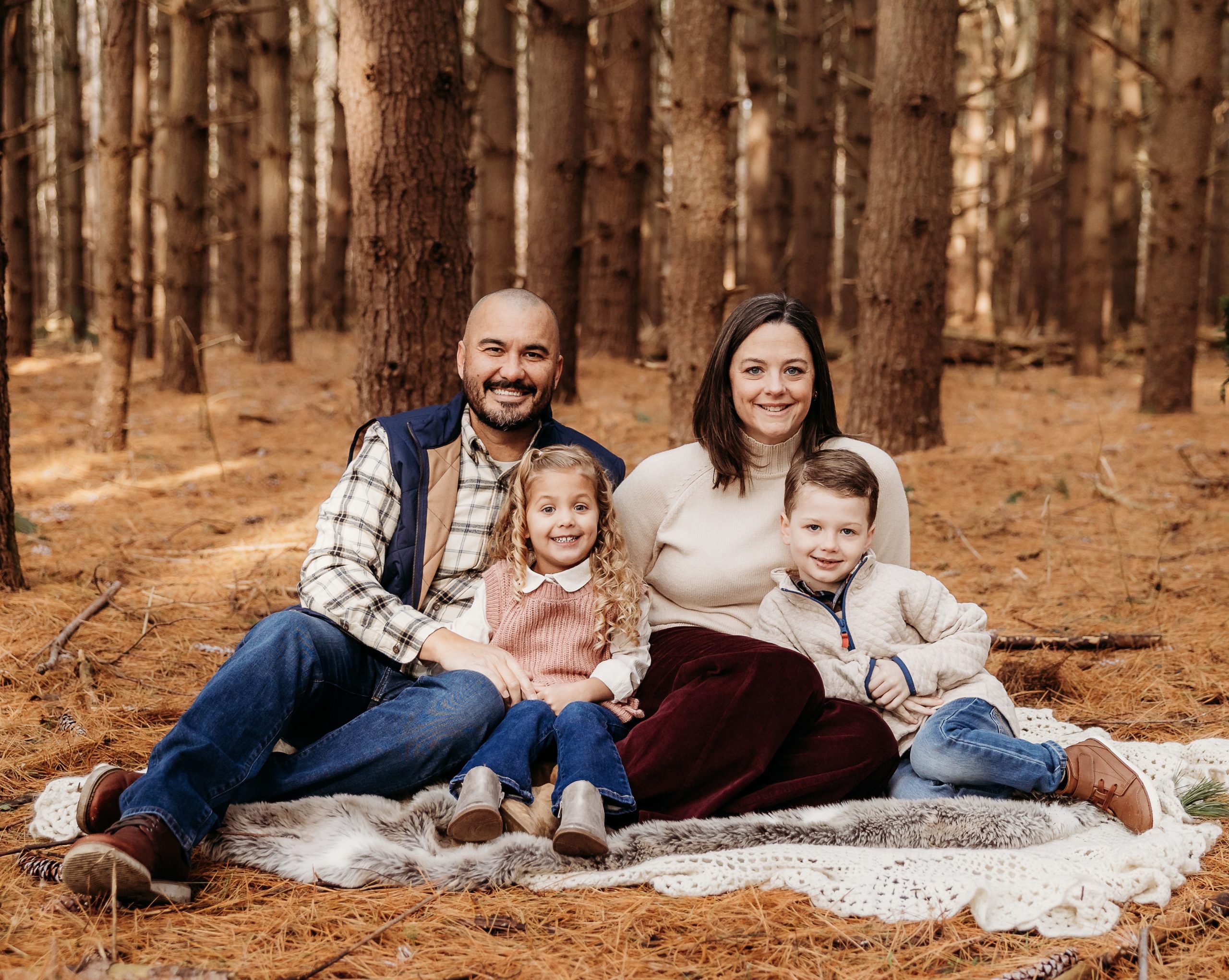
    A family photo taken in November 2025.Courtesy of Todd French

    Staying active and healthy is “a respect thing,” he said. “You want to honor the person that helped you and your family.”

    At his first Transplant Games in 2024, he won two gold medals in golfing events and a silver medal in Texas Hold ’em.

    He is hoping to win the golfing events again this year.

    “It gives an opportunity to shine a light on everything that a transplant does for people,” he said.

  • Roundup of third-quarter financial results for Philly-area nonprofit health systems

    Half of the nonprofit health systems in Southeastern Pennsylvania had operating losses in the first nine months of fiscal 2026, the systems’ latest reports to municipal bond investors showed.

    All had strong revenue growth, with the exceptions of Redeemer Health and Tower Health, the two smallest systems by revenue. The gains at Jefferson Health and Penn Medicine benefited from acquisitions in fiscal 2025.

    The reports are not perfectly comparable because of variations in accounting practices.

    For example, Jefferson, Main Line Health, and ChristianaCare changed their depreciation rates, which reduced their expenses relative to competitors. Jefferson includes investment income in its revenue, boosting its results.

    Here’s a summary in order of revenue, from the region’s largest to smallest systems:

    Jefferson Health had a $252.6 million operating loss, which it attributed to severe winter weather, restructuring costs related to layoffs, and shortfalls in insurance reimbursement. Total revenue was just shy of $13 billion, up from $11.6 billion last year, which included only eight months of results from Lehigh Valley Health Network.

    The University of Pennsylvania Health System’s operating income in the nine months ended March 31 rose to $238 million, up sharply from $163 million in the same period a year ago. Total revenue for the nine months increased nearly 15% to $10.1 billion from $8.8 billion last year. This year’s results include Doylestown Health, which Penn acquired in April 2025.

    Children’s Hospital of Philadelphia had a $271 million operating profit in the first nine months of fiscal 2026, up from $195.8 million the year before. Total revenue rose 9% to $4.1 billion from $3.7 billion, thanks to strong gains in payments for hospital patients and unspecified other operating revenue.

    ChristianaCare reported $76.4 million in operating income, up from $57.4 million the year before. Its revenue climbed to $2.64 billion from $2.5 billion. This year’s results include a new micro-hospital that opened last summer in Chester County and five former Crozer Health outpatient facilities in Delaware County.

    Temple University Health System had an operating loss of $9.9 million, recovering largely from a $50.5 million loss in the first half of fiscal 2026. In the same period a year ago, Temple had a $10.9 million operating loss. The health system’s revenue was $2.6 billion, up from $2.3 billion last year.

    Main Line Health reported a small operating profit of $214,000, following a winter quarter setback. The four-hospital nonprofit system recorded an $8.5 million loss in the three months that ended March 31. Severe winter weather reduced patient visits, and the health system increased its reserves for medical malpractice expenses.

    Tower Health swung to a small operating loss of $3.6 million. During the same period a year ago, Tower had a $4.2 million operating profit. Revenue increased 1.6% to $1.6 billion.

    Steep losses continued at Redeemer Health, which reported a $29 million operating loss, compared to a $33 million loss last year. Redeemer’s total revenue rose by less than 1%, to $332 million. Redeemer owns Holy Redeemer Hospital, a 239-bed facility in Abington Township, Montgomery County, not far from Jefferson Abington Hospital.

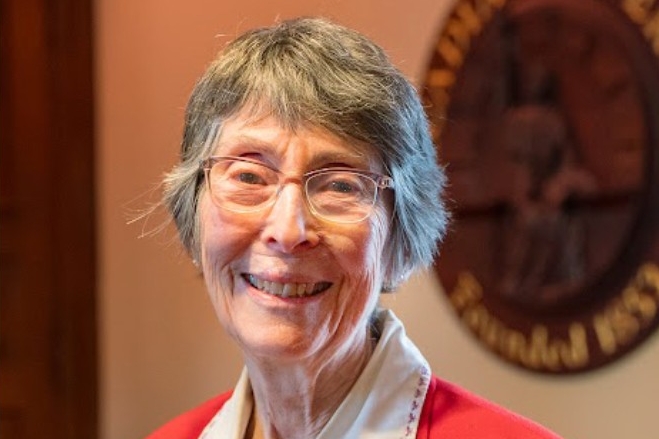
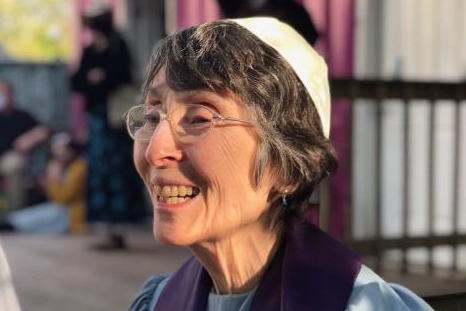
  • Phyllis Taylor, pioneering hospice nurse, celebrated prison chaplain, and renowned world peace activist, has died at 84

    Phyllis Taylor, pioneering hospice nurse, celebrated prison chaplain, and renowned world peace activist, has died at 84

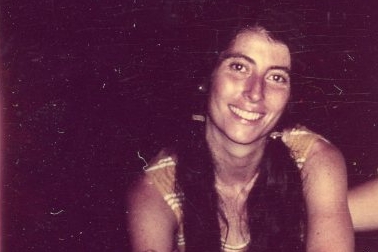
    As a young nurse in Philadelphia, Phyllis Taylor met dying people desperate for hospice care. So she did it.

    She met people in prison desperate for a healthcare advocate and an empathetic chaplain. So she did that, too.

    In 1963, she met Sarah Baker and her family as they struggled to live as the first Black family in Folcroft, Delaware County. The Bakers were desperate for fearless allies to help fend off months of racism and violence. She also did that.

    For nearly her whole life, Phyllis Taylor championed peace, justice, and human rights, and helped people who were desperate. She got arrested for civil disobedience, cofounded and directed several nonprofit social service programs, and, with her husband, Richard, helped establish Witness for Peace in Nicaragua, and the Movement for a New Society in Philadelphia.

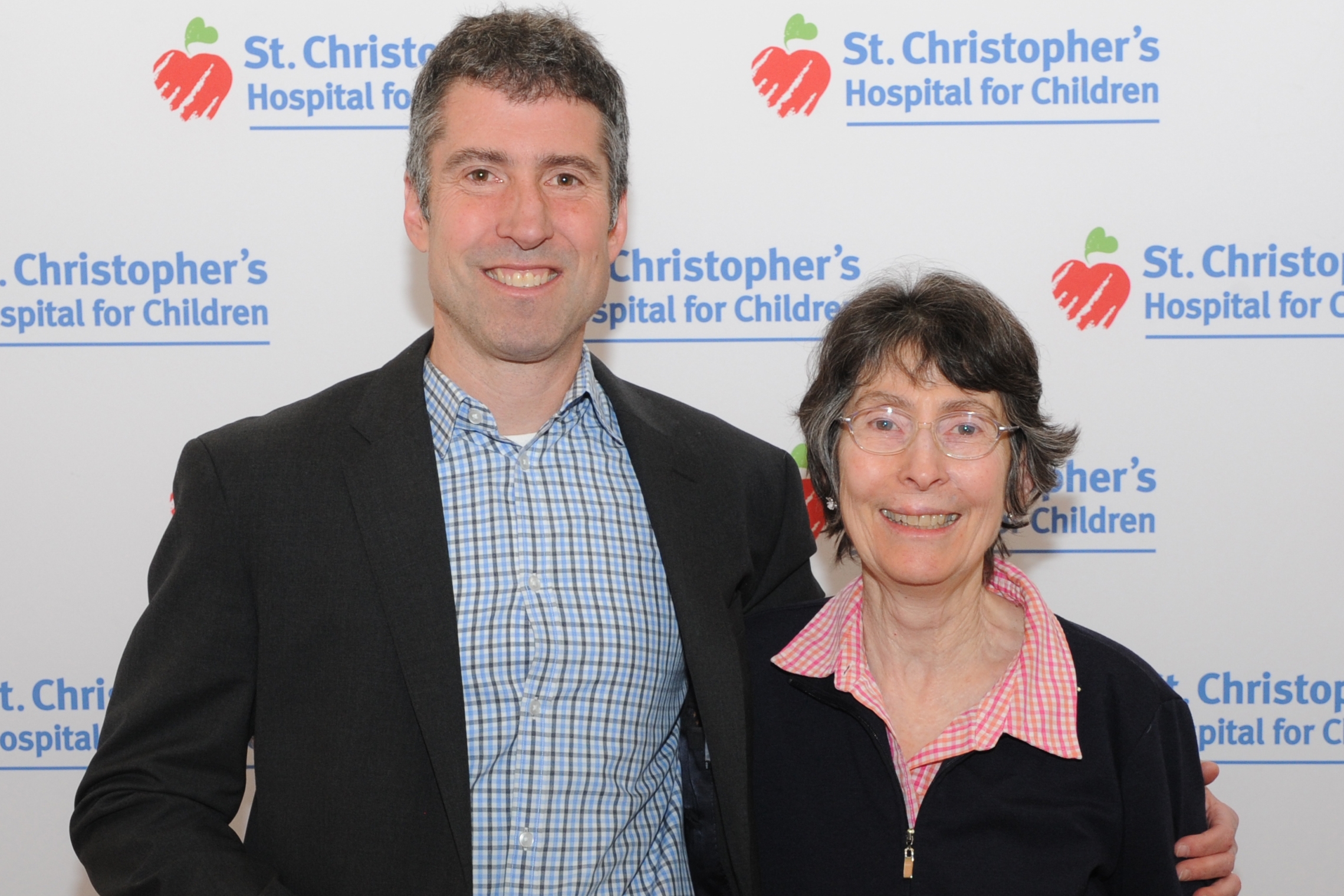
    She fed the hungry at St. Vincent de Paul Church, befriended immigrants and refugees with the New Sanctuary Movement, and comforted children and families at St. Christopher’s Hospital for Children. “Her entire life was about giving,” her son Dan said. “She refused to be someone who watched injustice and did nothing.”

    On Thursday, June 4, Phyllis Taylor died of endometrial cancer at KeystoneCare Hospice in Wyndmoor. She was 84.

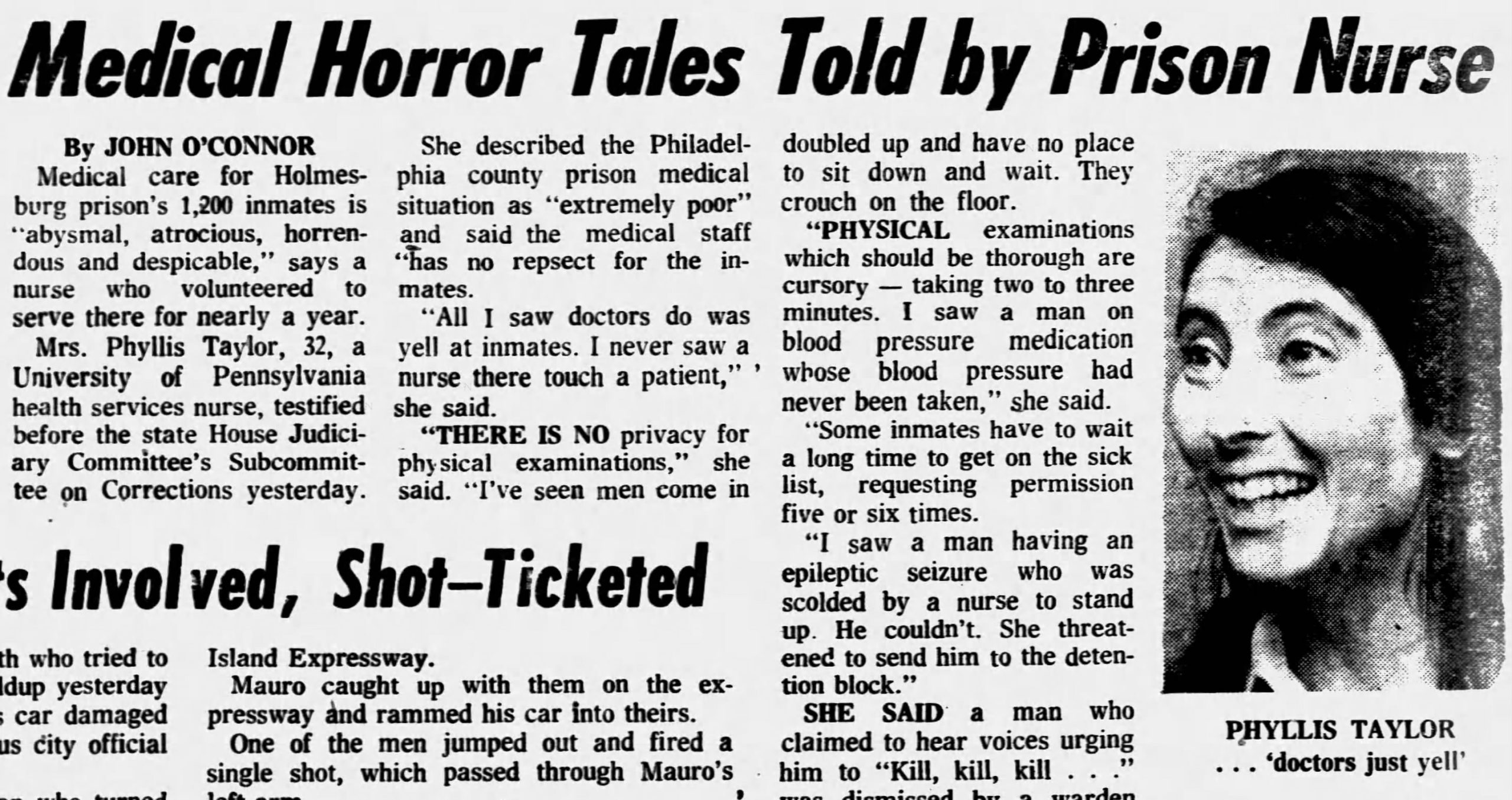
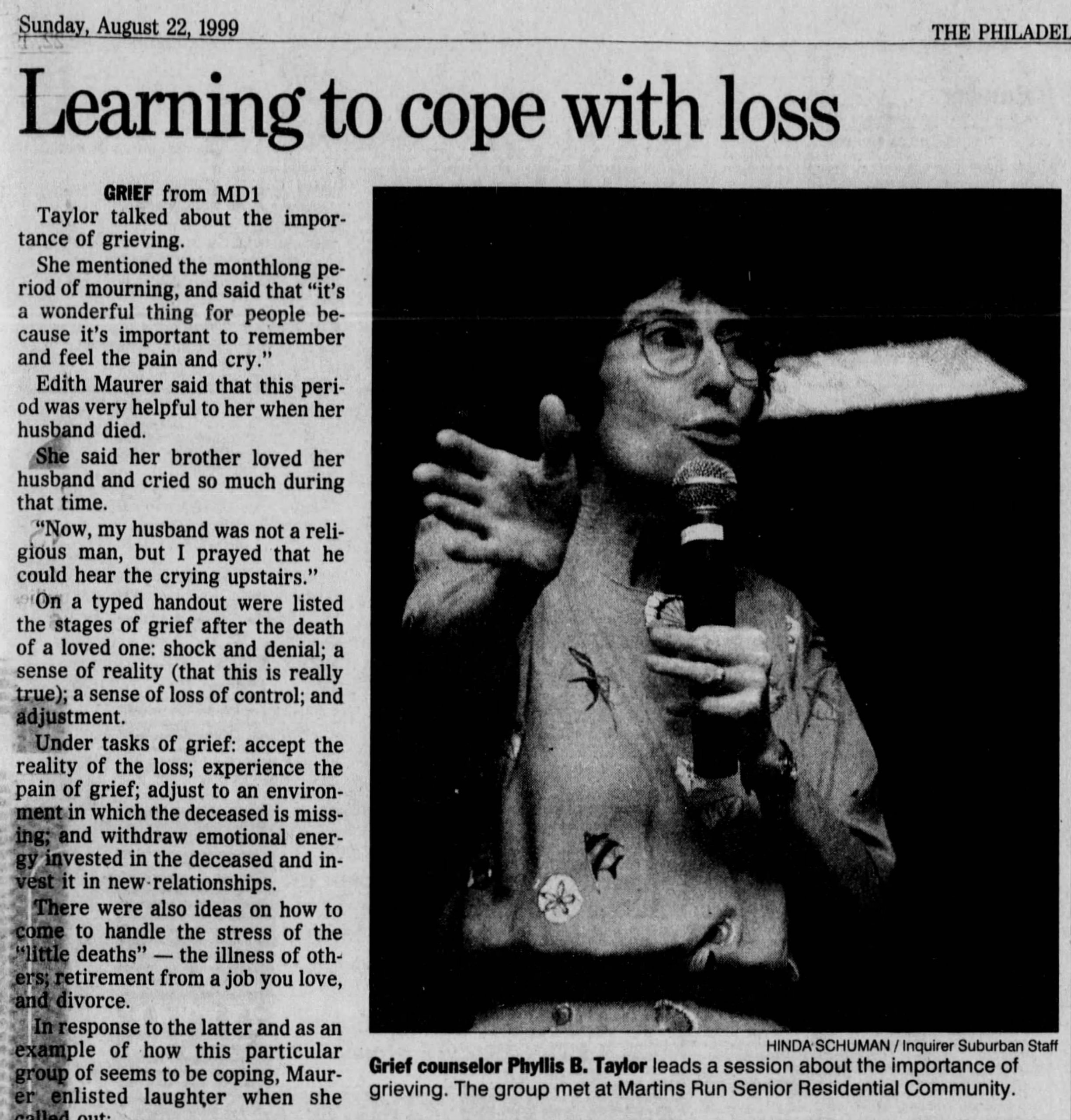
    The Daily News published this story about Mrs. Taylor in 1973.Newspapers.com

    “I really love what I do,” Mrs. Taylor told the Pennsylvania Prison Society in 2025. “I get the satisfaction of being able to journey with somebody, to let them know that they are not abandoned and alone.”

    Born in Brooklyn, N.Y., Mrs. Taylor earned a bachelor’s degree at what is now Arcadia University in 1963. After nursing school, she became a volunteer nurse and then a consultant for the University of Pennsylvania health services at Holmesburg Prison and elsewhere.

    She became senior counselor of hospice service for the new Death and Dying Program at Albert Einstein Medical Center’s Northern Division in 1978, and taught classes about death and grief, counseled parents whose babies had died, and comforted patients with terminal illnesses.

    Mrs. Taylor graduated from what was then known as Beaver College in 1963. It is Arcadia University now. Courtesy of the family

    She was featured in a 1980 story in the Sunday Inquirer called “The Gift of a Good Death” and said that her own health scares motivated her to embrace nursing. The horrors of the Holocaust, she said, compelled her to human rights activism, and the deaths of a friend, her brother, and her father moved her to hospice work.

    “It makes me happy to give someone the gift of a good death,” she told The Inquirer.

    Mrs. Taylor was also an enterostomal therapy nurse, head of the AIDS committee at the Philadelphia College of Osteopathic Medicine medical center, and director of education at the old Hospice of Delaware Valley. She wrote research articles for journals and letters to the editor, appeared on local TV and radio shows, and lectured often at conferences and seminars about death, grief, and medical and financial ethics. She never retired.

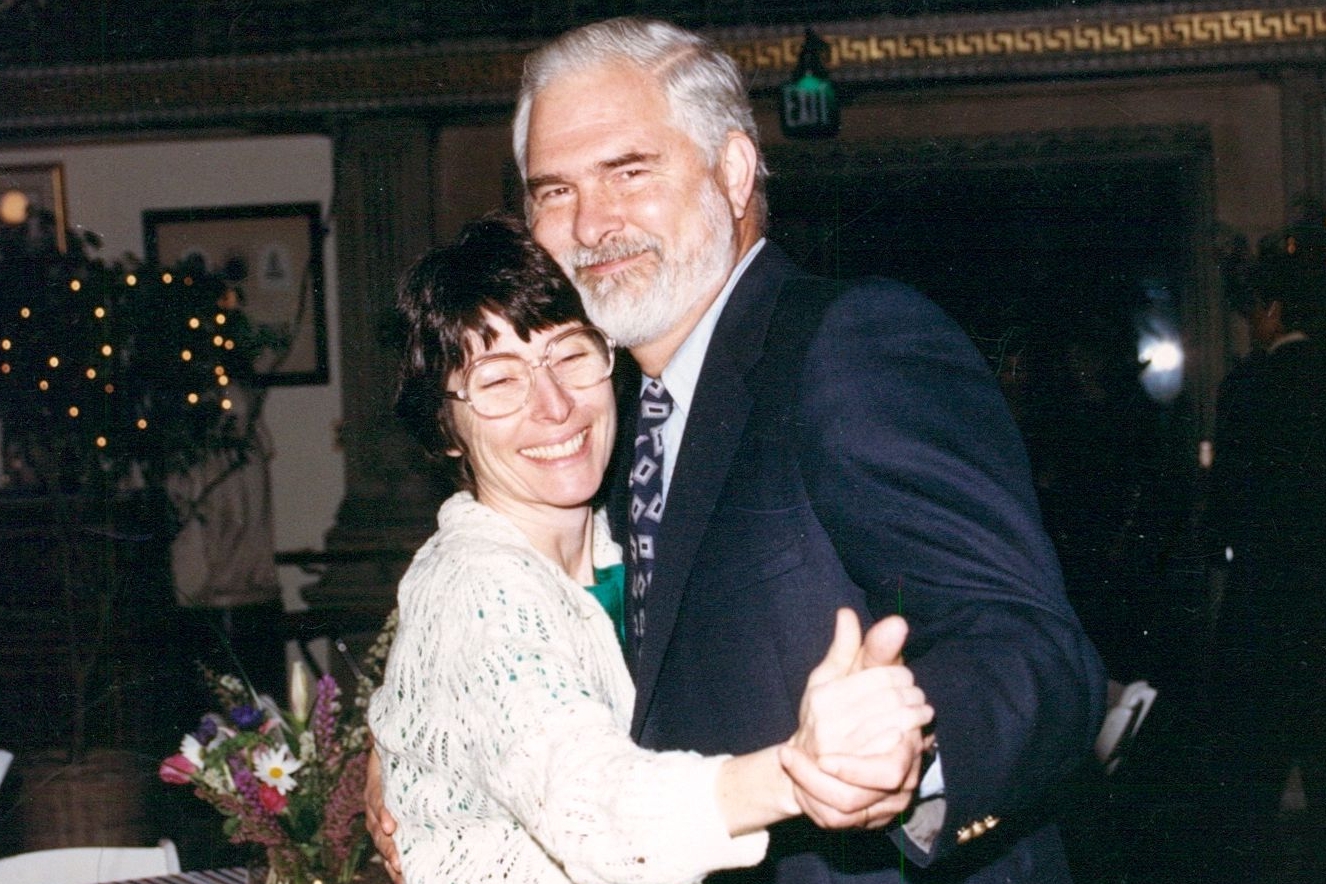
    Mrs. Taylor and her husband, Richard, traveled the world together fighting for peace, justice, and human rights. Courtesy of the family

    She went on Freedom Rides to integrate buses in the South and moved in temporarily with the Bakers as they sought to integrate Folcroft in the 1960s. In the 1970s, she demonstrated against the Vietnam War and America’s involvement in Iran and elsewhere.

    In the 1980s, she taught civil disobedience classes and protested violence at the border between Nicaragua and Honduras. In the 1990s and beyond, she volunteered to protect Muslims and Arabs from reprisals after the Sept. 11 attacks, traveled the world to decry pollution and unfair housing practices, and volunteered with Amnesty International and Planned Parenthood.

    She earned credentials as a chaplain and volunteered for decades with the Pennsylvania Prison Society to counsel and advocate for crime victims and prisoner rights. She was featured in the 2016 documentary Blockade, named the Prison Society’s Volunteer of the Year in 2022, and honored at Arcadia’s 2025 Women Who Lead Forum.

    As a chaplain, Mrs. Taylor officiated at weddings and funerals, and advocated for prison reform.Courtesy of the family

    “She felt a deep unwavering need to dedicate all her waking time to marginalized populations,” her son said. “Someone called her a merging of Ruth Bader Ginsburg and Mother Teresa.”

    Phyllis Claire Brody was born Aug. 10, 1941. She grew up Jewish in Lawrence, N.Y., and joined a Quaker meeting after she moved to Philadelphia.

    She met fellow peace activist Richard Taylor at a civil rights event in 1962, and they married in 1963 and lived in Germantown, Mount Airy, and West Philadelphia. They reared their son, Dan, and daughter, Deborah, and welcomed Blessing Mtshali and other children and families into their home for extended stays. Her husband died in 2024.

    Mrs. Taylor and her husband liked to hike and canoe. She lived with lupus and mailed handmade birthday cards to family and friends year after year.

    “What a life well lived,” her son said.

    In addition to her children, Mrs. Taylor is survived by her sisters, Margaret Noonan and Audrey Randolph, many grandchildren and great-grandchildren, and other relatives. A brother died earlier.

    Mrs. Taylor stands with her son Dan in 2017.Handout

    A celebration of her life is to be held at 2 p.m. Sunday, Sept. 20, at Germantown Monthly Meeting, 47 W. Coulter St., Philadelphia, Pa. 19144.

    Donations in her name may be made to the New Sanctuary Movement of Philadelphia, Box 46242, Philadelphia, Pa. 19160; and Face to Face, 123 E. Price St., Philadelphia, Pa. 19144.

    Mrs. Taylor was featured in The Inquirer in 1999.Newspapers.com
  • Penn launches $18 million facility to advance RNA technology’s role in health, agriculture

    Penn launches $18 million facility to advance RNA technology’s role in health, agriculture

    Inside Philadelphia’s new RNA manufacturing hub, scientists are working to create vaccines for fish, precision pesticides, and treatments to protect plants from extreme heat.

    The recently launched biofoundry at the University of Pennsylvania aims to expand biotechnological capabilities in the United States, funded by an $18 million federal grant. The National Science Foundation has invested in five such facilities nationally, each focused on a specific biological material.

    The term foundry traditionally refers to a factory where metal is melted and shaped into desired forms. Expanding the concept, Penn’s NSF AIRFoundry now offers a one-stop facility for designing and building RNA technology.

    All products under development involve ribonucleic acid, or RNA, a key molecule in living cells. Some consider it the cousin of the better-known molecule, DNA. Both can carry the genetic instructions for life.

    The facility opened in March at One uCity Square in University City. It builds upon Penn’s success with the 2023 Nobel Prize-winning development of an mRNA platform that led to the first COVID-19 vaccine.

    “We need to democratize this technology,” said Daeyeon Lee, a Penn professor of chemical and biomolecular engineering who serves as the foundry’s director.

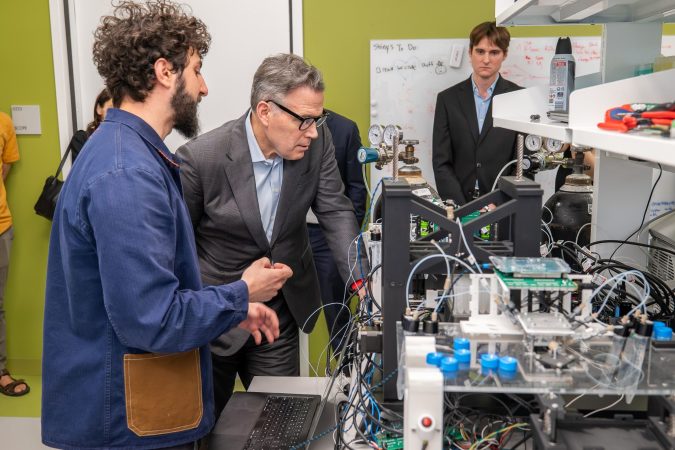
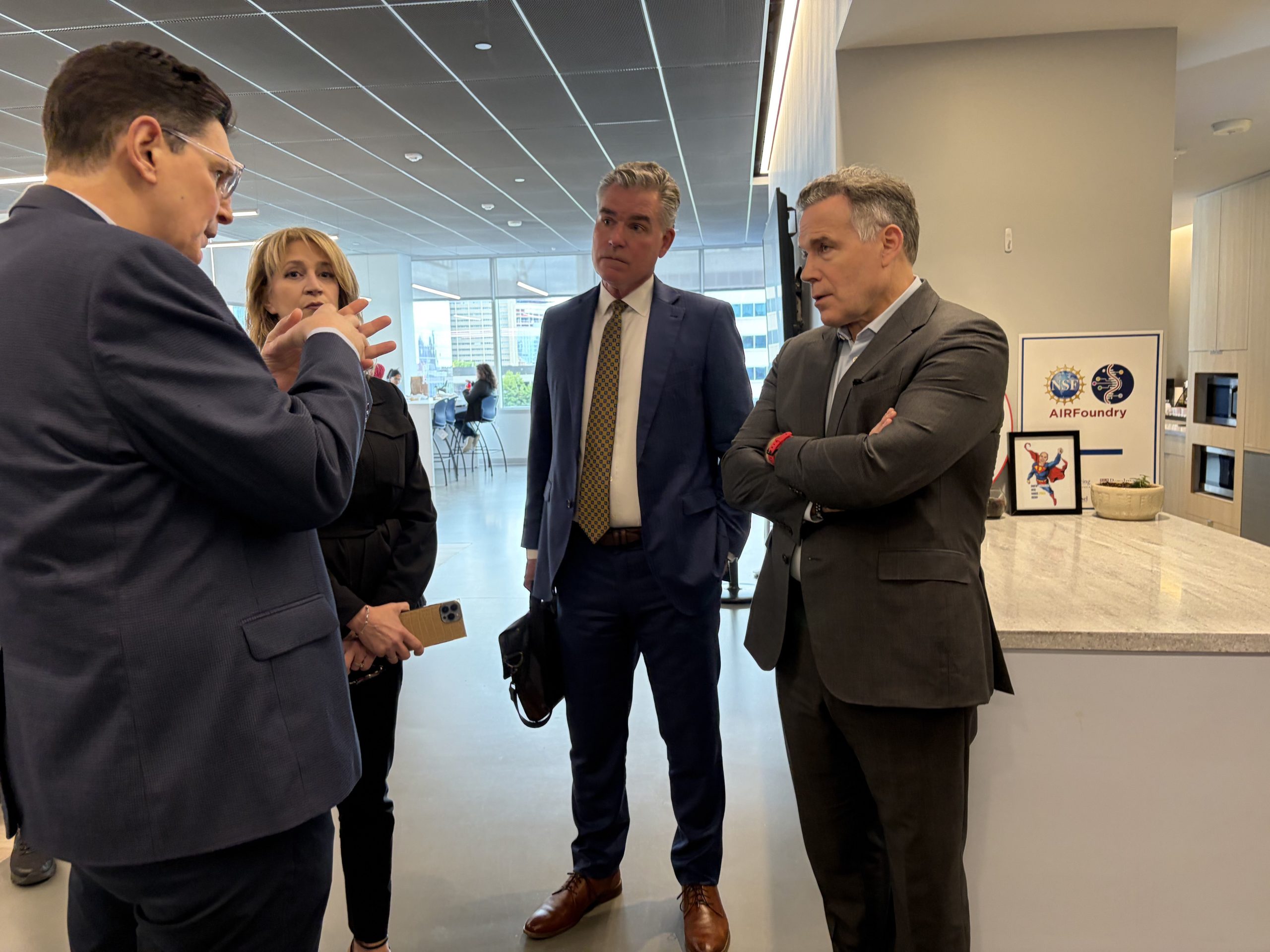
    Penn Engineering professor George Pappas speaks with Sen. Dave McCormick about the AIRFoundry.Kayla Yup / Staff

    AIRFoundry stands for Artificial Intelligence-driven RNA BioFoundry. Scientists hope AI will help them automate aspects of the design and manufacturing process, serving as a resource for researchers and commercial companies across the world.

    Penn’s mRNA work has continued to advance, even as Health and Human Services Secretary Robert F. Kennedy Jr. last year slashed $500 million designated for mRNA vaccine development.

    A longtime anti-vaccine activist, Kennedy has claimed the technology is unsafe and ineffective, despite scientific evidence finding the vaccines to be highly safe and beneficial.

    Now the foundry seeks to expand RNA’s applications in healthcare, agriculture and beyond.

    Lee compared the technology to a hammer — good for certain things, but not everything.

    “Our students and postdocs that get trained right now are going to be sort of the first generation of people to think about RNA as a tool for whatever problem they’re trying to solve,” Lee said.

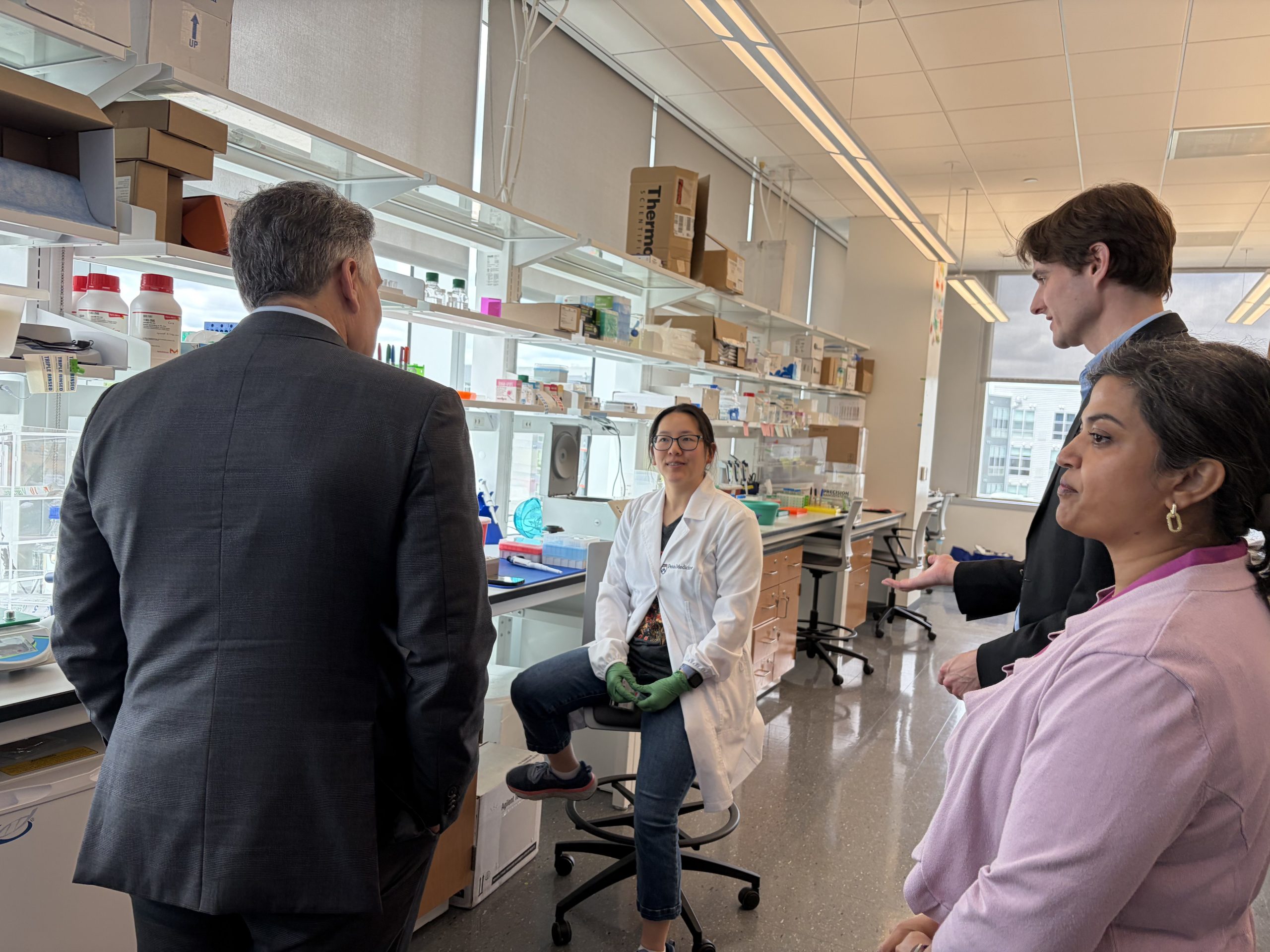
    An AIRFoundry scientist describes her work in the facility.Kayla Yup / Staff

    A foundry for RNA

    In the mRNA COVID-19 vaccines, injected mRNA provides the instructions for cells to build a harmless fragment of the viral protein. That trains the body to recognize and fight a future infection.

    Compared to traditional vaccines that use live or inactivated pathogens, mRNA vaccines can be produced more rapidly — useful in a pandemic.

    One of the Nobel laureates behind that effort, Penn scientist Drew Weissman, has operated a smaller scale version of the facility, mainly to make mRNA for his lab and collaborators. The foundry’s launch marked an expansion beyond Penn.

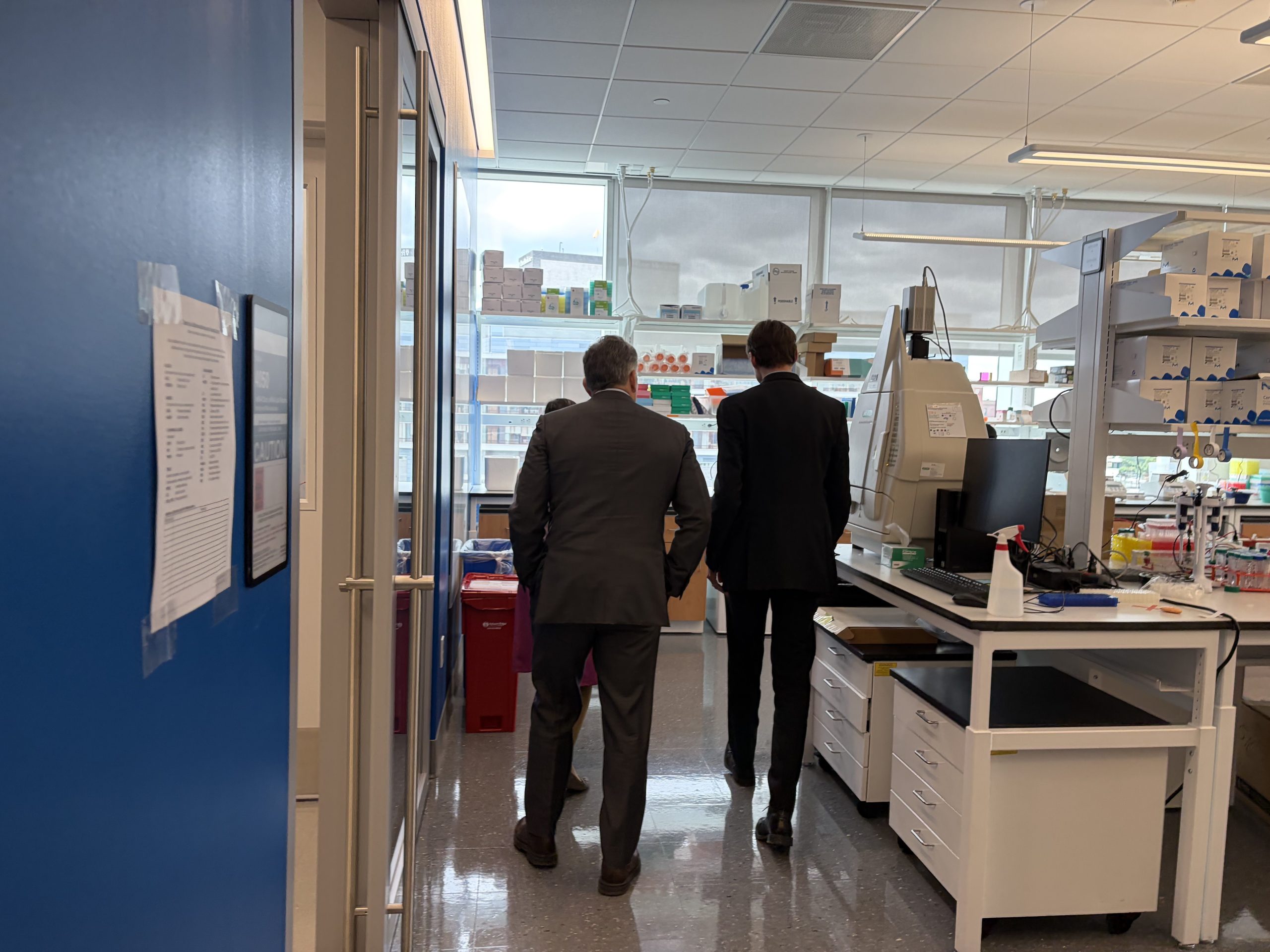
    Its sterile instruments and busy lab benches were on display last month as students and faculty walked through the manufacturing process.

    “It takes special facilities and skills to make RNA and associated materials,” Lee said.

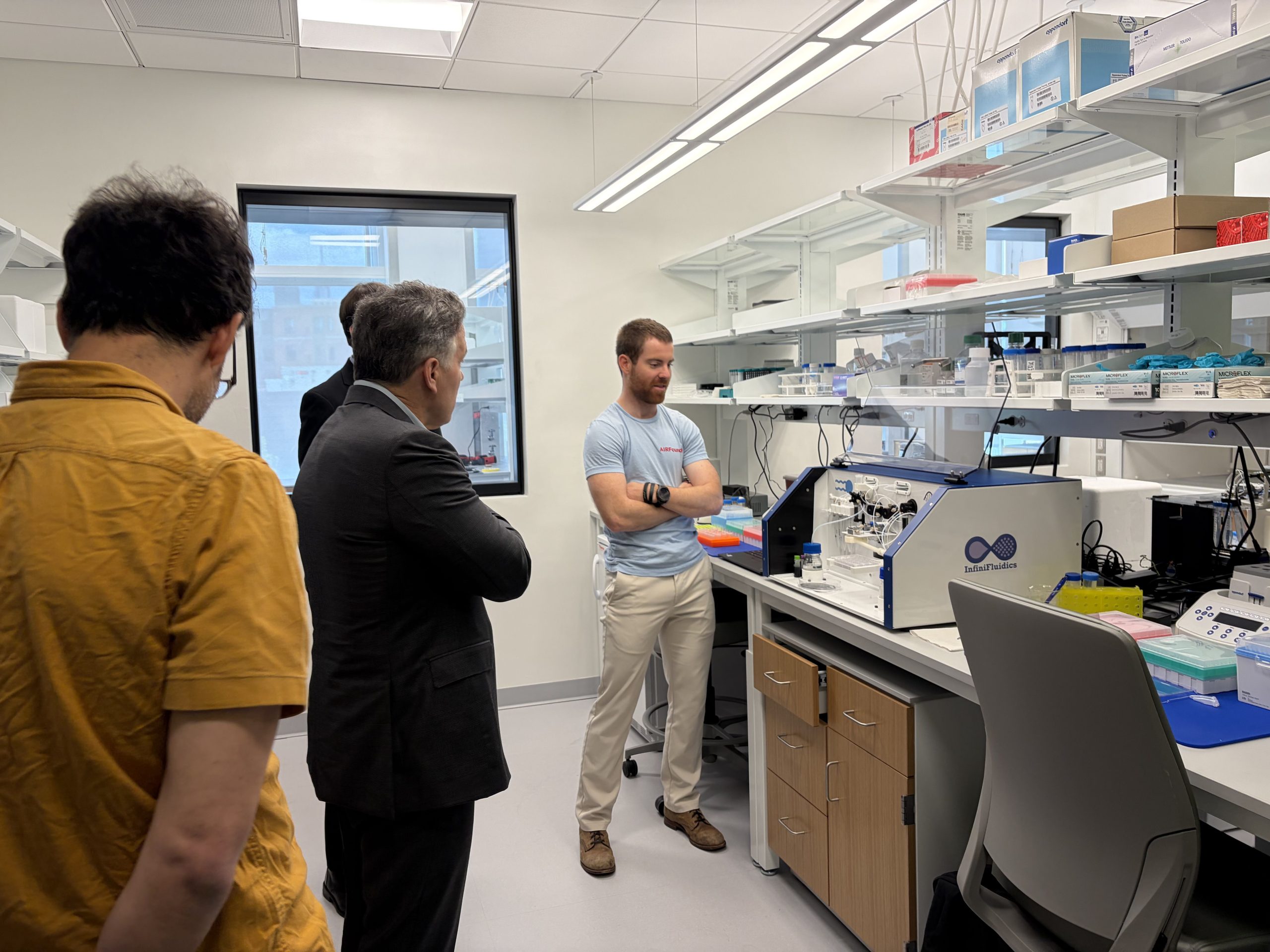
    Owen Land, an engineer at Infinifluidics (a Penn spinout), spoke about a device used to automate part of the process of creating liquid nanoparticles (a delivery vehicle for RNA).Kayla Yup / Staff

    So far, Penn’s facility has operated on a “fee-for-service” basis, where collaborators request a specific RNA technology and the foundry builds it.

    But its scientists hope to incorporate AI to help with synthesizing all the current knowledge, best practices and databases.

    They also want to reach a point where users can come to the physical facility and use the instruments themselves.

    Sen. McCormick toured the AIRFoundry in May.Kayla Yup / Staff

    The federal grant, which started in September 2024, supports the foundry for six years. Lee hopes it will eventually become self-sustaining through the services they provide.

    Projects underway include working on vaccines to keep fish healthy.

    Another collaborator is developing ways to deliver RNA into plants to benefit the agriculture industry. For example, designing RNA molecules that carry instructions for producing a heat shock protein could protect plants from high temperatures. The plant would produce the protein and theoretically have greater resilience against extreme heat.

    The molecule degrades over time, making its effects temporary. So if used during the summer months, the RNA could be gone by the time harvest rolls around.

    This transient quality could also make RNA useful for pest control, in lieu of chemical-based pesticides, Lee said.

    “We want to interact with everyone that’s interested in using RNA technology,” he said.

  • Trump’s homelessness plan could revive forced psychiatric commitment

    Trump’s homelessness plan could revive forced psychiatric commitment

    For most of our nation’s history, involuntary psychiatric commitment operated with sweeping and often unchecked power: State hospitals confined people for years or even lifetimes based on such broad claims as mental illness and “moral defect,” often with little legal recourse.

    Public outrage over abuses in overcrowded asylums — dramatized most famously in the book One Flew Over the Cuckoo’s Nest — helped propel the patient’s rights movement in the 1960s and 1970s toward successful deinstitutionalization. A series of court rulings limited the state’s power to confine people against their will.

    Now that balance is shifting again.

    Last summer, President Donald Trump signed Executive Order 14321, which purports to address homelessness by greatly expanding involuntary psychiatric commitments and encouraging police to arrest people experiencing homelessness.

    The order — its constitutional validity remains in question — undermines decades of court precedent and removes judicial constraints to hold people in institutions. It could resurrect the old ways as a national standard without debate or congressional action.

    A sprawling facility recently built outside Salt Lake City already shows the trappings of a prison camp for people experiencing homelessness. This spring, the administration started legal guardianships for hundreds of veterans — some of whom are homeless — that could drive more of them into institutional care.

    And in a historic shift, federal officials are slashing millions of dollars in homeless grants across the country, including in Philadelphia and its suburbs, forcing a broad swath of nonprofits to curtail their efforts to house unhoused people. The Philadelphia Furniture Bank, which gave free furniture and mattresses to more than 22,000 people facing homelessness, became the latest casualty, announcing it would close on June 30.

    The Philadelphia Furniture Bank, which gave free furniture and mattresses to more than 22,000 people facing homelessness, is set to close June 30.Heather Khalifa / MCT

    Past presidents couldn’t make these changes — even if they wanted to — because our system empowers the states to set laws for involuntary commitments. Trump’s order would undermine that by ending consent decrees that aim to ensure stays are safe, ethical, and clinically appropriate.

    His order also seeks to incentivize confinement by directing federal agencies to green-light grants to towns and states that get people off the street and into institutions. And those receiving federal homeless services would have to undergo mental health care as a condition for those benefits.

    If enforced, this order would worsen the problems we have while creating new ones.

    We know a lot more about mental illness than in 1962 when Ken Kesey published Cuckoo’s Nest. At the same time, homelessness is growing in the U.S. An estimated 700,000 people live unhoused every night.

    Involuntary psychiatric treatment is sometimes necessary, but open-ended and inappropriate commitment harms patients and creates a moral indignity that can have a lifelong negative impact. And even when it is appropriate, our system tailors commitment lengths to people’s health needs, as the U.S. Supreme Court has affirmed several times. Most states limit the first court-ordered commitment to six months or less. Removing those limits would subvert the Supreme Court’s authority and abandon patients to the whims of unchecked administrators.

    Another problem: The order violates the Constitution by impinging on the state’s authority to direct health and safety, including civil commitments.

    Those with disabilities should be concerned about this, too. They have the right to live independently in their homes, with access to state-funded services. But this order would threaten that.

    Importantly, the order could also force clinicians to break their fiduciary responsibility to serve their patients’ best interests first by pressuring them to inappropriately confine homeless individuals who might not be seriously mentally ill.

    History shows many examples of the political misuse of psychiatric power. Soviet communists invented the diagnosis “sluggish schizophrenia” to justify the imprisonment of political dissenters. Vladimir Putin continues to use psychiatric excuses to shackle his critics. More recently, U.S. police used the contested diagnosis “excited delirium” to justify giving controlled substances to calm down people resisting arrest. The diagnosis has since been discredited.

    Our system is far from perfect. Too many seriously mentally ill people end up unhoused, imprisoned, or cycling in between. But the executive order risks turning clinicians into Soviet-style apparatchiks, who violate their ethics to make the system run.

    Federal policy should encourage the advocates who run safe consumption sites and syringe distribution efforts to keep people alive until they get help, because these efforts have been proven to work. But the president would levy civil or criminal charges against these caregivers.

    The executive order also dismisses efforts like Housing First, which give housing without requiring treatment or sobriety. These programs help make people more likely to improve their mental health and stay in housing.

    By contrast, arresting and confining people is associated with more death, illness, and misery.

    It may be politically appealing in some quarters to sweep up, institutionalize, and resettle unhoused people who are barely surviving with mental illness. But this approach was recognized long ago as inhumane and impractical.

    The time is now to build a real mental health care system to support the most vulnerable in our society. Instead of issuing retrograde executive orders, the Trump administration should invest real money to advance evidence-based interventions and policies.

    Dominic Sisti is a senior fellow at the Leonard Davis Institute of Health Economics and associate professor in the department of medical ethics and health policy at the University of Pennsylvania. He directs the Scattergood Program for the Applied Ethics of Behavioral Health Care at Penn.

  • IBX and Highmark want to cut costs by moving more outpatient care to surgery centers

    IBX and Highmark want to cut costs by moving more outpatient care to surgery centers

    Independence Blue Cross, the Philadelphia region’s largest health insurer, launched this month a policy designed to move care into lower-cost surgery centers and away from hospitals and clinics that can generate payments twice as high for the same treatment.

    The policy started June 1 echoes Medicare’s efforts to slow federal healthcare spending by paying the same price for outpatient procedures such as colonoscopies and knee surgery in hospitals as in surgery centers.

    Pressure from employers to control costs has similarly motivated IBX and a newer regional competitor, Pittsburgh-based Highmark, which implemented a similar policy on Jan. 1. Both companies’ policies affect people with low risk of complications who are covered by commercial insurance or Medicare Advantage.

    When doctors seek insurance authorization for certain procedures, IBX reviewers will ask whether doctors can treat low-risk patients in a surgery center, according to the company’s chief operating officer Richard Snyder.

    “This is a gentle move,” Snyder said. “We’re not willing to force you to change doctors to have your colonoscopy or your service, but we want docs to get privileges in ambulatory surgery centers.”

    The region doesn’t have enough low-cost surgery center capacity for a large-scale move to that setting, Snyder said. That means the policy might not hit hospital finances right away.

    But the implication is that the policy could take a harder edge in the future. IBX’s goal is to spur the development of more surgery centers — either by the incumbent health systems or by new competitors, Snyder said.

    Even now, the potential for delayed care and denied coverage has several regional health systems worried. Temple University Health System, for example, does not own ambulatory surgery centers, so the time could come when it has to coordinate care with outside providers.

    The money at stake

    Surgery to remove torn cartilage on the knee can cost $7,190 when performed on an outpatient basis in a hospital, nearly three times the $2,477 cost in ambulatory surgery centers, according to Philadelphia-area commercial insurance averages from heath prices data firm Turquoise Health.

    Smaller gaps exist for hernia repairs and colonoscopies with a biopsy, Turquoise reported. Another data firm, Medscout, showed that a majority of those colonoscopies had already shifted to ambulatory surgery centers by 2024. The shift was far less advanced for hernia repairs — a procedure IBX is targeting.

    (function(){function e(){window.addEventListener(`message`,function(e){if(e.data[`datawrapper-height`]!==void 0){var t=document.querySelectorAll(`iframe`);for(var n in e.data[`datawrapper-height`])for(var r=0,i;i=t[r];r++)if(i.contentWindow===e.source){var a=e.data[`datawrapper-height`][n]+`px`;i.style.height=a}}})}e()})();

    Some physicians’ groups already are seeing opportunity in commercial and government insurers’ increased emphasis on surgery centers as a way to reduce spending — as well as regulatory changes that allow more procedures to be done in free-standing surgery centers.

    Southeastern Pennsylvania now has four relatively new cardiovascular surgery centers.

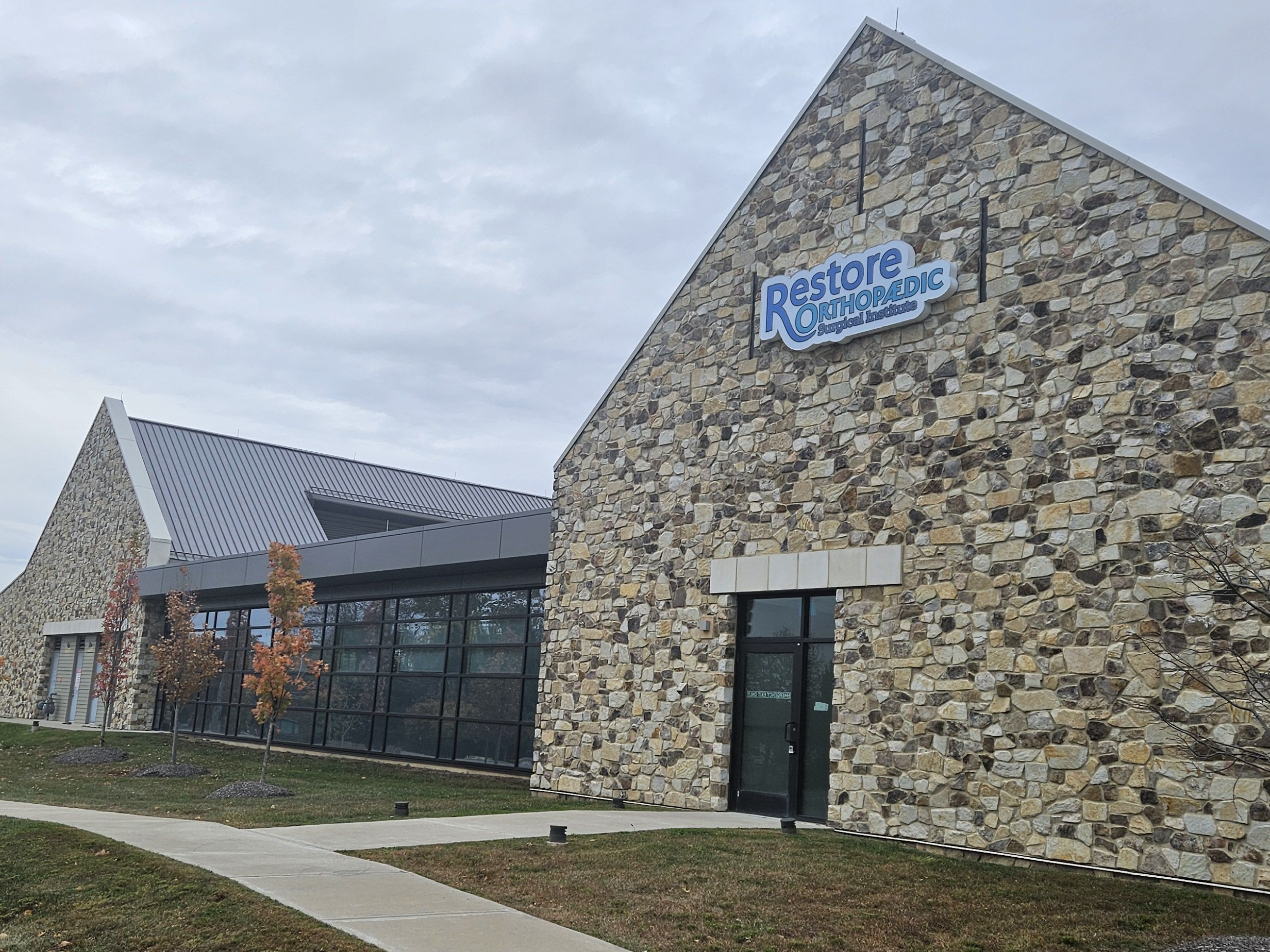
    Restore Orthopaedic Surgical Institute in Chadds Ford, founded by a group of Delaware doctors, has been quickly become a high-volume joint-replacement center.

    In the coming year, Rothman Institute plans to open three surgery centers in the Philadelphia region, the private practice’s CEO Christian Ellison said.

    Restore Orthopaedic Surgical Institute in Chadds Ford has grown quickly to become one of the top joint replacement destinations in Southeastern Pennsylvania after opening in March 2023. The center is positioned to take advantage of an effort by Highmark and IBX to move outpatient procedures from high-cost hospitals to lower-cost surgery centers.Restore Orthopaedic Surgical Institute

    Potential consumer impact

    Several major health systems said the new site-of-care review policies raise questions about the potential impact on patients, without commenting on the implications for their finances.

    Because Temple University Health System does not have any ambulatory surgery centers, “the policy will require certain studies and procedures to be referred outside the health system. This could create additional coordination requirements and may contribute to delays in testing, crucial diagnosis, and/or treatment,” Temple said in an email.

    Main Line Health also said it anticipates the policy “could disrupt established care pathways, including in circumstances where surgeons lack privileges at available free-standing surgery centers,” the nonprofit said in a statement. Main Line has ownership interest in three surgery centers in Philadelphia’s western suburbs.

    The University of Pennsylvania Health System said it will “advocate for our patients’ best interest and appeal any service denials based on the clinical and nonclinical exceptions outlined in the policy.”

    Additional concerns for consumers include complexity, confusion, and possibly more risk of having care denied to what can already be a burdensome prior authorization process, said Christine Monahan, assistant research professor at Georgetown University’s Center on Health Insurance Reforms.

    Monahan said she understands insurers’ impulse to steer people to lower-cost settings, but called policies like IBX’s “maybe not the most efficient way to handle the inefficient pricing in the system.”

    The economic and political backdrop

    The biggest increases in healthcare costs in 15 years are hitting employers this year, according to Mercer’s National Survey of Employer-Sponsored Health Plans.

    The average increase was 6.7%, according to the February survey of 161 chief financial officers, who were not identified.

    The increases are substantially higher than broader inflation. “It becomes more of a tax on employers,” Snyder said. “Next to salaries, many will tell you, that’s the biggest line item” in their expenses.

    IBX has taken other steps to reduce healthcare spending, such as in 2015 introducing a benefit design that includes a preventive colonoscopy with no out-of-pocket costs for the patient at what are called Preventive Plus facilities. Elsewhere, they have a $750 co-pay.

    Highmark and IBX have new policies designed to move more outpatient procedures and treatments out of high-cost hospitals and into lower-cost surgery centers.Pablo Martinez Monsivais

    Medicare has pushed for the last decade to pay the same for services in hospital outpatient departments as in doctors’ offices and surgery centers.

    Medicare prohibited most new off-campus hospital clinics from billing at hospital rates in 2017. So-called site-neutral payments expanded in 2019 to include clinic visits. This year, the government applied the standard to payments for drug administration, such as chemotherapy.

    Highmark Health Plans’ approach

    In the first five months of under new policy, Highmark Health Plans has found some health systems are willing to accept lower surgery center rates for procedures performed within hospitals.

    “What we’ve found is that a number have been willing to do that,” said Kate Musler, chief financial officer for Highmark’s insurance arm. “It may be advantageous for them to have that volume flow through the hospital and keep some volume there, it’s just not necessary in terms of the expense level.”

    Musler cited bariatric surgery as an example of how technology and surgical practices have advanced to the point where a hospital is no longer needed.

    It’s too early to say how much savings the new policy has generated, including in Southeastern Pennsylvania, Musler said. Highmark has seen its policy accepted at different levels across the five states where it took effect.

    Some hospital systems are proactively shifting care to surgery centers to reduce costs, said Musler, who oversees Highmark underwriters helping employers understand their health expenses.

    “We hear directly from employers who are making very difficult decisions,” she said. “It is now more than ever a question of whether they can afford employee health.”

  • Why we should listen to Robert Coles — and to each other

    Why we should listen to Robert Coles — and to each other

    In the spring of 1983, my wife graduated from Williams College. We weren’t married — yet — but I was already in love with her. So I was in the audience on a warm May morning to watch her receive her diploma.

    That’s also where I first encountered Robert Coles.

    Coles, who died June 4, was the commencement speaker. I’m embarrassed to admit that I didn’t know anything about Coles, perhaps the most influential psychiatrist in modern America. But as soon as he started talking, I was transfixed.

    He spent his life listening to children and their parents, particularly during moments of trauma or crisis. And he urged the rest of us to listen, too.

    When you listen closely, Coles discovered, every individual you meet becomes exactly that: an individual. They’re no longer a category or a caricature. They’re a human being, trying to make sense of the world. Just like you, and like me.

    That’s why Time magazine, in a 1972 cover story about Coles, congratulated him for “breaking the American stereotypes.” Wherever Coles looked, he saw people distorting — and demeaning — each other. The only antidote for that was conversation, which would “depolarize a divided society” (Time predicted) by allowing us to recognize the humanity in everyone.

    It’s easy to assume we have lost that spirit in America, which seems even more divided than it was a half-century ago. You can hear it in our heated political rhetoric, so full of anger and recrimination. She supports Democrats, so she’s a libtard. He votes Republican? Must be a fascist.

    But Coles reminded us that we can move beyond the vituperation and name-calling. Show compassion and curiosity toward everyone, he insisted. And listen to them before you judge them.

    Coles was best known for his interviews with Black children like Ruby Bridges, the 6-year-old girl who faced a mob of white racists in 1960 while integrating an elementary school in New Orleans. But he also warned against imagining Black people as noble victims, or Southern whites — including opponents of integration — as ignorant bigots.

    “Policemen are not pigs, white Southerners are not rednecks, and Blacks are not all suffering in exotic misery,” his Harvard colleague David Riesman told Time, summarizing Coles’ approach. “What he is saying is ‘People are more complicated, more varied, more interesting, have more resiliency and more survivability than you might think.’”

    Coles’ conversations with poor and right-wing whites confused his liberal friends, who wondered why he would spend so much time with “awful, vulgar, reactionary people,” Coles noted. The reason was both simple and profound: He wanted to understand them.

    “I don’t look upon them as good or bad,” Coles explained. “I look upon them as human beings, strong and sensible, weak and full of faults.” He readily acknowledged “the blindness, the distortions, the racism, the meanness” among them. But he refused to reduce them to that.

    You could find the same negative qualities in any group, Coles insisted. And working people “bore the brunt of change in American society,” he added. Dismissing them as racist was itself an unjust act, committed by people who imagined themselves as agents of social justice.

    In academia, meanwhile, these same tribunes of justice often wrote in impenetrable jargon that only their fellow professors could understand. Coles didn’t do that, either. He used ordinary language, just like the people he interviewed.

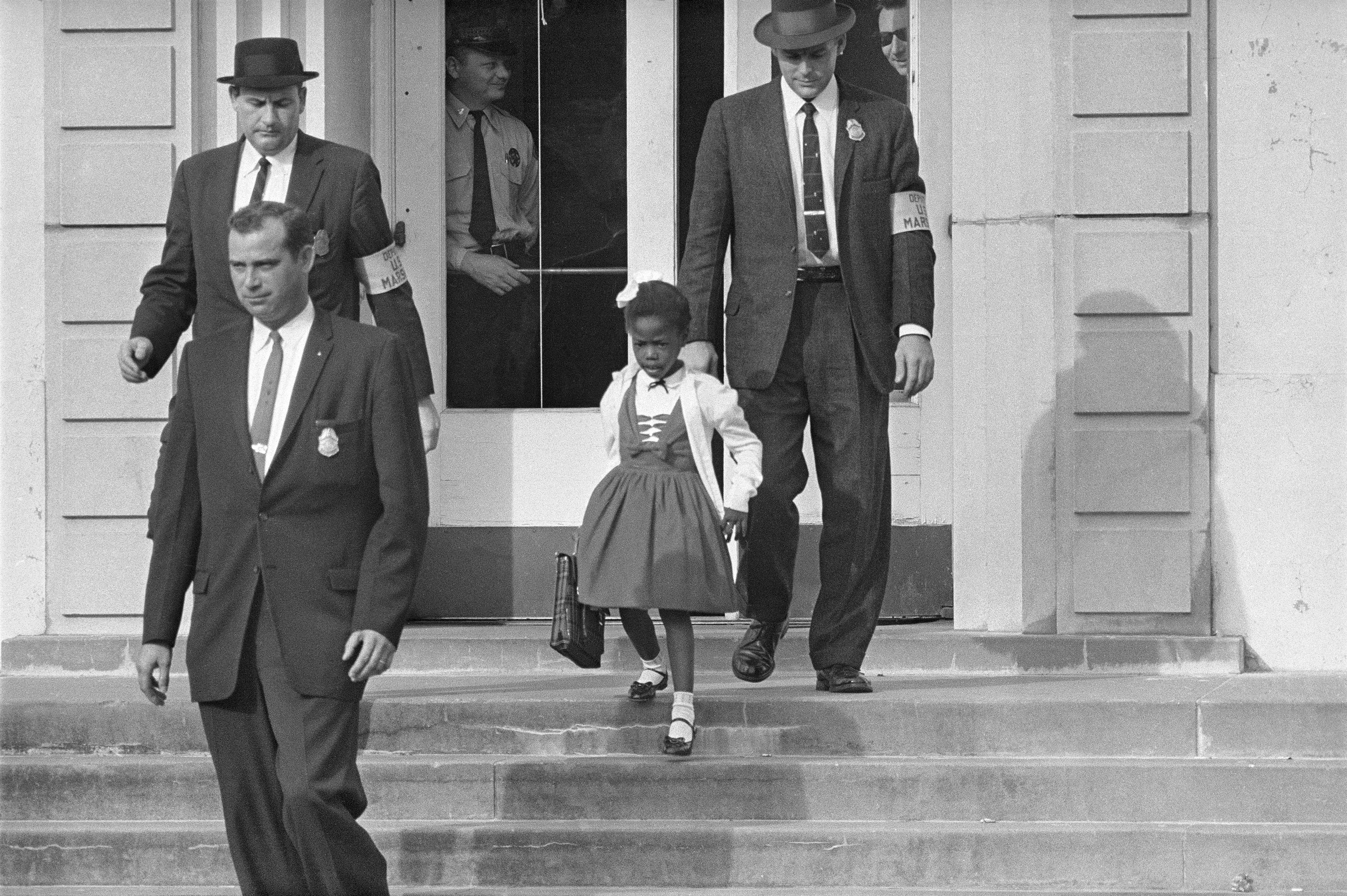
    Federal marshals escort 6-year-old Ruby Bridges from William Frantz Elementary School in New Orleans, in November 1960.Uncredited

    That spawned skepticism among some of Coles’ colleagues, who disparaged him as “unscientific” or — heaven forbid — a “popularizer.” But what’s the point of writing something that nobody — other than a small set of specialists — will ever read?

    Coles made a difference in the world precisely because his work was accessible to so many people. At the Williams graduation, he told us Bridges had been moving her lips as she walked past the mob protesting her for desegregating an all-white school. Later, Coles asked her what she had been saying.

    “I was talking for God and praying for the people in the street,” she replied. “I always pray the same thing. ‘Please, dear God, forgive them, because they don’t know what they’re doing.’”

    Bridges’ courage and compassion inspired Norman Rockwell’s famous painting, The Problem We All Live With, which appeared on the cover of Look magazine in 1964. And it inspired Coles to spend his life talking to people about how they experienced the challenges and contradictions of their world. In over 50 books and hundreds of articles, he taught us that everyone — especially children — had something important to say.

    We just have to listen to them. And, I hope, to Robert Coles.

    Jonathan Zimmerman teaches history and education at the University of Pennsylvania. He is the author of “Whose America?: Culture Wars in the Public Schools.”