This summer, a strange spate of posts popped upin neighborhood Facebook groups:
“Found a parrot in south philly,” one post said, “… anyone missing it? Singing its little heart out.”
“Lost bird!” said another.
Then another: “Please get this parakeet back home!”
In the last few months, the number of these posts — alerting people to loose or lost exotic birds, like parrots, parakeets, or budgerigars, throughout Philadelphia — has seemingly, anecdotally, increased. One person on Reddit noticed this trend and wrote, “WTH is with all these lost birds around Philly? Did a pet store close and just let a bunch of birds loose?”
No official entity could confirm or quantify this phenomenon: The Pennsylvania Game Commission deferred questions to local animal welfare groups. The Animal Care and Control Team of Philly, which gets less than a dozen calls a year about pet birds, a spokesperson said, hasn’t noticed an uptick in those calls.
Nor had any other avian-related groups, like the Audubon Society, Bird Safe Philly, or the Schuylkill Center for Environmental Education, which all noted they primarily or exclusively deal with wild birds. No one had asked the Philadelphia Zoo to take in any surrendered or lost exotic birds, a spokesperson said. And multiple pet store chains did not respond to questions about whether they lost a flock of birds.
Susan Tyson, an avian veterinarian and owner of Avian & Exotic Philly Vet in Old City, said her clinic has treated four loose budgerigars, or “budgies,” so far this year, including at least two since July.
“We’ve always had people finding loose animals,” Tyson said, “but I’d probably say in the last maybe four years it’s increased.”
Is there a bird liberation movement?
This isn’t a captive bird mutiny. Tyson believes most of these birds inadvertently escaped from homes or pet stores. Navin Sasikumar, president of the Delaware Valley Ornithological Club (DVOC), suggested some might have been intentionally abandoned by their owners.
“Probably other people who have pet birds saw [the posts] and thought, ‘Hey, these birds are being rescued — I have birds that I don’t want anymore, maybe they’ll be rescued too,’” Sasikumar said.
“Or it could just be extra attention,” he said. “There might have been other escaped birds around, but no one was really paying attention until one [post] caught on.”
Tyson agreed that social media might be feeding this perceivedproliferation. “It’s like monitoring for breast cancer,” she said. “We’re doing it more, so we’re seeing it more.”
In late September, one of these wayward fledglings found itself in George Armistead’s Upper Roxborough backyard. He was sitting on his porch about 5 p.m. on Sept. 22 when “this thing” — a baby-blue budgie — “dropped out of the sky.”
“I was just totally flabbergasted,” Armistead, 52, said. A lifelong birder and former president of the DVOC, Armistead said he’s seen only a couple non-native budgies and maybe a handful of other exotic birds loose on the streets of Philadelphia.
This budgie’s plumage seemed fresh and uniform, and it was banded with a small ring typically used for research, tracking, or breeding, which lead Armistead to think it wasn’t a house pet. Instead, he thought maybe “a crateful of these things got loose.” (Tyson said there have been cases of birds getting loose while being delivered or transported.)
On a recent September evening, “this thing” — a baby-blue budgie — “dropped out of the sky” and into George Armistead’s Upper Roxborough backyard.Courtesy of George Armistead
Armistead doesn’t support the caged bird trade — he called it “unnatural,” akin to keeping killer whales in aquariums — but he captured the creature, fearing for its own safety in the elements.
Think freeing pet birds is kind? Experts say it isn’t
The greatest risk these loose birds pose is to themselves, experts said: Tropical species will likely be picked off by raptors or killed by the Pennsylvania winter. And while releasing a caged bird might sound idyllic, “the reality is much more ugly,” said Victoria Sindlinger, a senior at the University of Pennsylvania and founder of its Quackers Bird Club.
“It’s just really not going to be suited for life outside or life in this climate, and it is going to die,” Sindlinger said, “and unfortunately, it’s probably going to not be the quickest death.”
Ultimately, rescuing and caring for these animals is up to “individual people’s goodwill,” Sasikumar said. Tyson advocates for all pet birds to be microchipped, like cats or dogs. Her military macaw, Suzy, is microchipped, she said. Sindlinger added that bird ownership should not be taken lightly.
Meanwhile, Armistead’s budgie — which he’s been calling “Pudgie” — has taken up a residence in his spare bedroom, away from the family’s very curious cat. He’s looking to find Pudgie a permanent, loving home.
For now, he said, “my wife has gotten rather attached to it.”
When famed violinist Lara St. John thought about the soundtrack for her new documentary, Dear Lara, she already had a classic composition in mind: Franz Schubert’s Death and the Maiden.
It’s a story about death coming for a young girl who begs him to stay away, but he tells her there’s nothing to fear, his touch won’t hurt. The perilous interaction has long fascinated composers, musicians, and artists who frequently sexualized the relationship in the retelling over some 200 years.
For St. John, the parallels felt strikingly relevant to her film as she completed interview after interview with survivors of sexual assault, most of whom were raped and abused as children by their classical music teachers in conservatories around the world.
It’s her story too.
In 2019, St. John came forward publicly with her experience from her time studying at Philadelphia’s Curtis Institute of Music, alleging in a Philadelphia Inquirer investigation that her violin teacher, Jascha Brodsky, assaulted and raped her.
At the time, Brodsky was 79 years old and she was 14.
Brodsky died in 1997 before accusations of his misconduct from St. John and other students came to light. His family said the alleged behavior was “completely inconsistent with the man we knew and loved.”
After speaking out, the Canadian violinist received a deluge of letters and calls from fellow survivors in the classical music world, primarily from women who were abused as girls by older, powerful men considered too talented to be stopped.
Hundreds of “Maidens” came forward to share their harrowing and haunting encounters with “Death.”
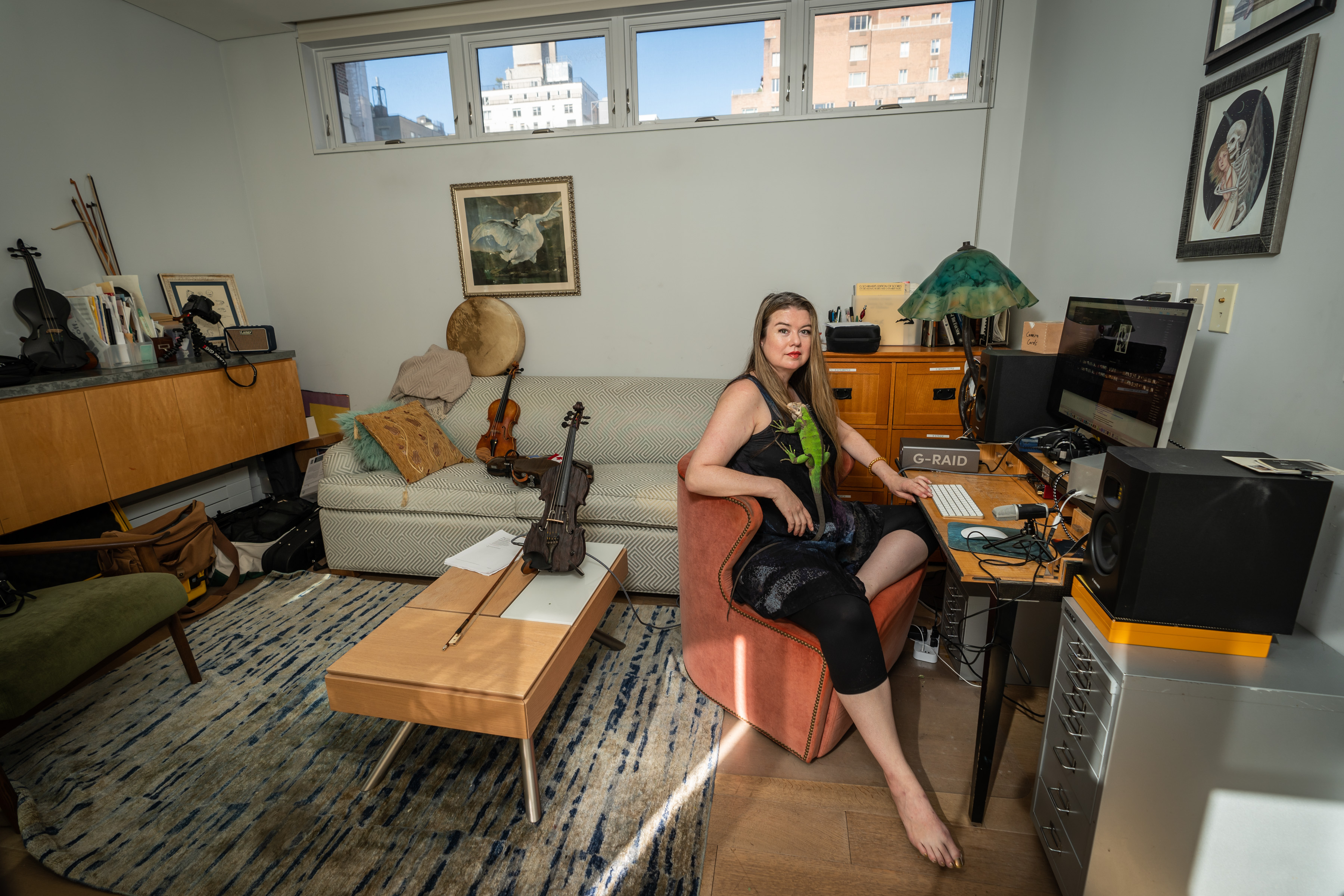
Lara St. John at her home in New York City on Sept. 10, 2024.Jessica Griffin / Staff Photographer
Their stories followed a familiar pattern, painting a horrific picture of systemic abuse and institutional complicity. Bright and skilled young girls enrolled in prestigious, competitive institutions to learn from world-renowned maestros treated with godlike reverence. In private lessons, those men forced themselves onto their students repeatedly, brazenly, and without consequence. They threatened their victims with expulsion or other punishments to keep the children quiet. If a girl did come forward to report her assault, school leadership rarely took disciplinary action against the abuser.
The men continued teaching, founded music programs of their own, racked up awards, and secured illustrious titles. The girls faced ridicule and retaliation, struggled to recover as their lives were derailed, and some stopped playing music entirely. Many attempted suicide. A few died that way.
Rewind, replay.
“It’s a small world, and I knew I wasn’t alone in this, obviously, but I didn’t realize the breadth of it — how global it was and just how endemic it was,” said St. John, 55, who now lives in Manhattan. “Once they knew about me, everybody had their own story that they wanted to share.”
St. John felt a profound responsibility to take action.
Three months after she went public with her own story, she picked up two cameras and began interviewing fellow survivors, starting a seven-year-long filmmaking process.
Dear Lara, which premiered earlier this year at the Santa Barbara Film Festival, features accounts of eight survivors of sexual abuse at the hands of teachers, concertmasters, and once-renowned classical music stars: Pianist Lusiana Lukman, violinist Lisamarie Vana, violinist Mascha van Sloten, double bassist Heather Bird, violinist Zeneba Bowers, oboist Katherine Needleman, opera singer Samuel Shultz, and the late cellist Robie Brown (as told through her widower, Frank Powdermaker).
Their stories are intertwined with archival footage and images as well as interviews with legal experts and journalists (including The Inquirer’s classical music critic, Peter Dobrin) who investigated assaults at various schools and orchestras. The film will have its Pennsylvania premiere on Monday, Oct. 5, with two screenings at the Free Library of Philadelphia on the Parkway.
It arrives amid renewed conversations about women’s safety on school campuses and criticism of educational institutions who shield perpetrators of sexual assault from accountability following the alleged rape of a Cornell University student by members of a fraternity house.
Lara St. John shooting in Philadelphia for her 2026 documentary “Dear Lara.”Courtesy of Lara St. John
“I certainly never set out to be a filmmaker … It was an ambitious undertaking. I made a lot of rookie mistakes [at first],” said St. John, whose previous film experience consisted of editing her own music videos. “I’m really glad that I set out on my own as early as October 2019 because various situations have changed, and I wouldn’t have gotten some of those stories if I had waited until I had a team together.”
The heart-wrenching film follows St. John on her interview trips to Toronto, Amsterdam, Winston-Salem, N.C., and Philadelphia. In some Zoom interviews, St. John’s pet iguana, Cain, made a cameo. (He died in 2021 but during our interview, St. John introduced her new baby iguana, Octavius.)
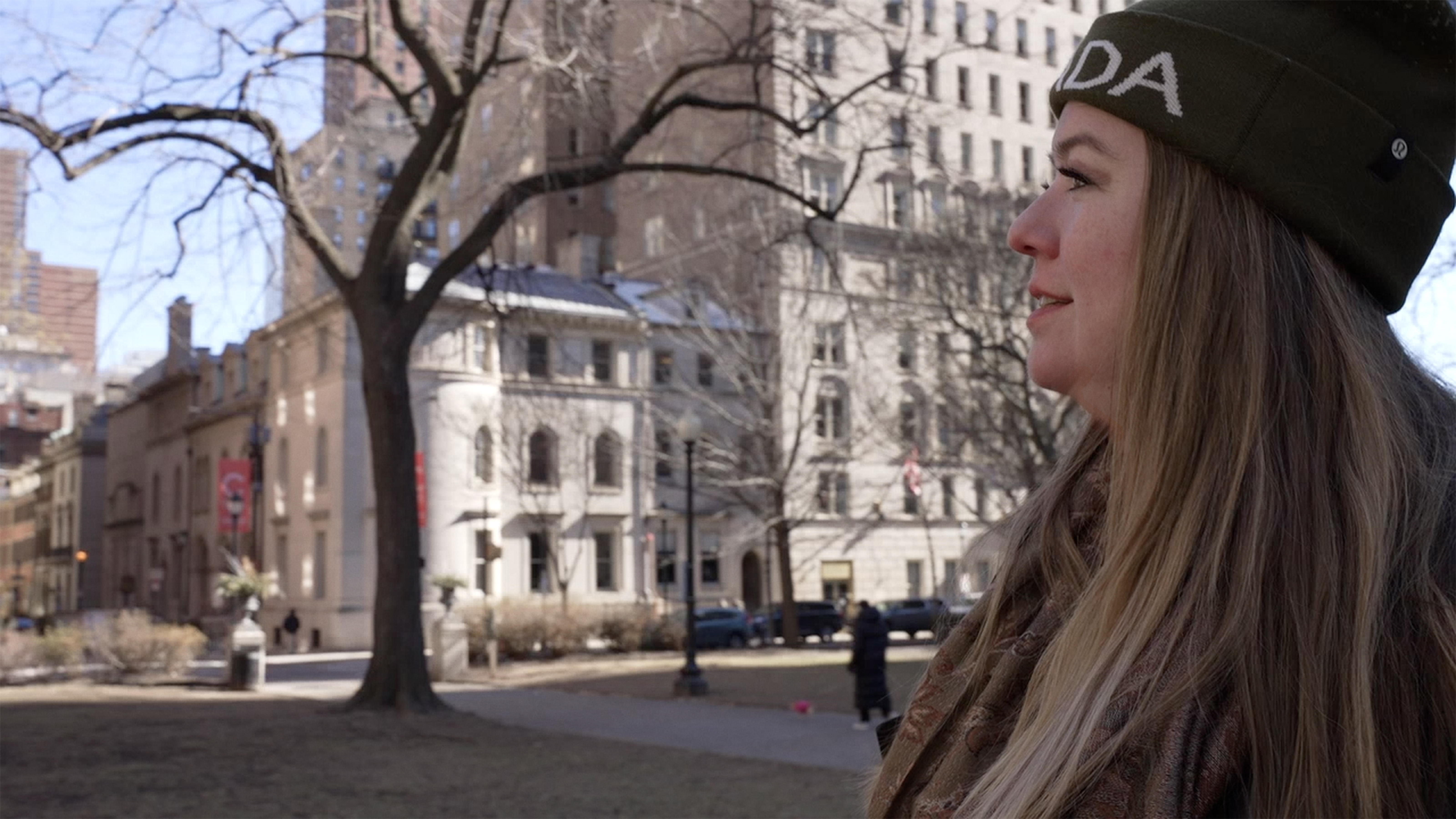
Shooting in Philadelphia was especially difficult. While standing in Rittenhouse Square, across the street from Curtis, she felt physically sick as she recounted attempting suicide during her third year. In the aftermath of her allegations, Curtis commissioned a report from law firm Morgan Lewis that concluded St. John was credible.
The school eventually apologized in a statement acknowledging that leadership “failed to provide her with a safe learning environment, failed to carefully investigate her claims, failed to communicate our grave disappointment in how she was treated by Curtis, and repeatedly failed to communicate the steps that were taken to prevent such abuse from occurring in the future.”
Curtis has since implemented policy changes, like disallowing private lessons at teachers’ homes, hired a Title IX coordinator, and established a trauma fund for free counseling for victims of sexual abuse within the Curtis community. In a 2024 statement to The Inquirer, the school said these efforts, among other changes, “have made Curtis an incredibly safe and nurturing place.”
A still from the documentary “Dear Lara,” picturing violinist Lara St. John in Rittenhouse Square discussing the abuse she experienced as a teenage student at Curtis Institute of Music.Courtesy of Lara St. John
Since the release of Dear Lara, another school was pressured to conduct an investigation.
In the documentary, Lukman, a pianist who left home in Indonesia at 14 to pursue music, detailed allegations of sexual assault by her teacher Boris Berlin at the Royal Conservatory of Music in Toronto in the 1980s. After the documentary screened in Canada, Lukman created a petition demanding an independent investigation into sexual abuse at the institution that earned thousands of signatures; the conservatory has since hired a law firm to investigate. Berlin died in 2001.
“I felt devalued and betrayed, because if anything is worse than being molested, is coming forward about these things and being betrayed by the people that supposedly protect children,” Lukman says in Dear Lara.
Lukman and St. John are continuing to pressure the school to make the report public when it’s completed. Their efforts are part of St. John’s relentless advocacy work beyond the documentary to support survivors and denounce music schools worldwide that have fostered what she calls a culture of silence and abuse.
“We’re trying to create a movement, really, to get rid of this ridiculous — well, honestly, it’s overused now, but — patriarchy in classical music. I believe many, many women have just been abused out of the field, and some men, obviously, as children as well,” said St. John.
The violinist is now deeply familiar with Pennsylvania politics as she’s traveled to Harrisburg three times to advocate for amending the statute of limitations for childhood abuse. In Dear Lara, St. John appears with ChildUSA founder and University of Pennsylvania professor Marci Hamilton at Philadelphia’s City Hall to garner support for House Bill 462, which would provide a two-year window for survivors to file lawsuits that otherwise could not be prosecuted because the statute of limitations has expired. While the bill passed in the House in 2025, it has stalled in the Senate.
A still from “Dear Lara” picturing Lara St. John at Philadelphia’s City Hall for a rally with Child USA to advocate for Pennsylvania to change its laws regarding the statute of limitations for childhood sexual abuse.Courtesy of Lara St. John
“If it’s murder, there’s no statute of limitations. … Child sex abuse is, in many ways, like the murder scenario because the victim is so disempowered as compared to the perpetrator, and the average age to come forward is in the early 50s,” Hamilton explains in the documentary. “Twenty years ago, 15 years ago, there were a lot of states where you had two years from the date of the act. So if you were six years old, you had two years to get a lawyer and press charges.”
St. John hopes that the film will encourage audiences to take action, too.
Dear Lara is a groundbreaking and searing examination of the classical music industry, which rarely is represented on screen.
(The Emmy-nominated Tár, which cast Cate Blanchett as a fictional, predatory lesbian conductor, is one recent and prominent example. St. John thought it was “ridiculous” and “idiotic” that the perpetrator was female. “There are thousands of men Társ out there, and they made this a woman, like come on,” she said.)
After serving as Dear Lara’s director, writer, cinematographer, and participant, St. John also contributed original music. In addition to using her arrangements of Death and the Maiden, she composed a theme song beginning with A and E strings as a nod to how every child first learns the violin.
Some of the featured musicians on the soundtrack include fellow survivors like Needleman, the principal oboist at the Baltimore Symphony Orchestra who discussed her experience of sexual harassment in the film, and Cara Kizer, a French horn player who was allegedly raped by two of her New York Philharmonic colleagues.
St. John plans to release a Dear Lara soundtrack with their recordings, including those she had to cut from the film, like an aria from Shultz, a participant who described being raped as a graduate student in Texas.
Eventually, St. John wants to create a foundation to support survivors pursuing justice against their abusers and the institutions who failed them.
“That will be my life’s work,” she said.
‘Dear Lara’ will screen twice on Oct. 5 at the Free Library of Philadelphia’s Parkway Central Library, 1901 Vine St., Phila., 833-825-5357 or libwww.freelibrary.org.
Three days after a loss to No. 7 Lehigh in Penn’s home opener, freshman quarterback Miles Teodecki celebrated his 18th birthday.
Teodecki’s performance was one he would rather forget, throwing two interceptions and being sacked four times.
Quakers head coach Rick Santos put it in perspective.
“The game moved fast for him,” Santos said, “And the quickest way for you to get sped up is to get hit in the mouth and get sacked a couple times, and the ball’s going to come out of your hand a lot quicker than the next time. I promise you that.”
Though he sees room for improvement, Santos also knows that Teodecki only has two games under his belt — and just turned 18.
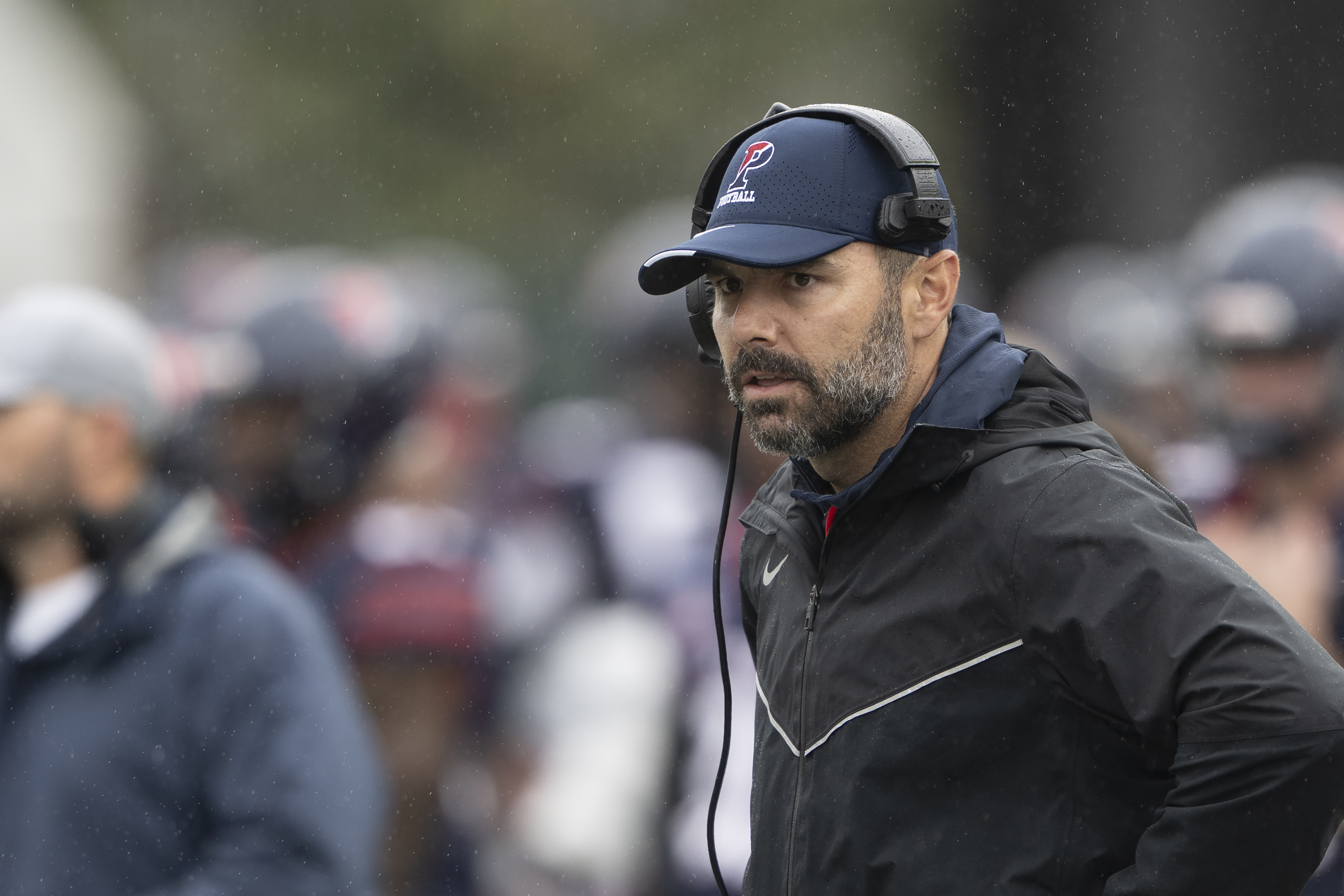
Penn head coach Rick Santos said that Teodecki’s maturity is one of his best assets in being able to learn from his mistakes. Jose F. Moreno / Staff Photographer
“He’s young, but he’s extremely emotionally mature for his age,” Santos said. “And I think, in a game where the elements were such, it was gust[s] of 40 or 50 [mph], it was raining half the game, we were forced to throw the ball almost the entire second half. So there was way too much pressure that was put on a freshman quarterback’s shoulders.”
Santos, who has “all the guys’ birthdays in [his] calendar,” made the team sing happy birthday to Teodecki, who gave a “pump-up speech” before practice.
Finding players who are committed to the game and to staying for all four years is what drew Santos to coaching in the Ivy League, and at Penn. The former University of New Hampshire head coach wanted the “ability to retain a lot of our rosters and really build a sustained culture here.”
Now, Santos will return to the Granite State as Penn (1-1) opens conference play against Dartmouth (0-2) on Saturday (1:30 p.m., ESPN+).
“I’m not going to lie, there’s a lot of nostalgia heading back up,” he said. “A lot of emotions.”
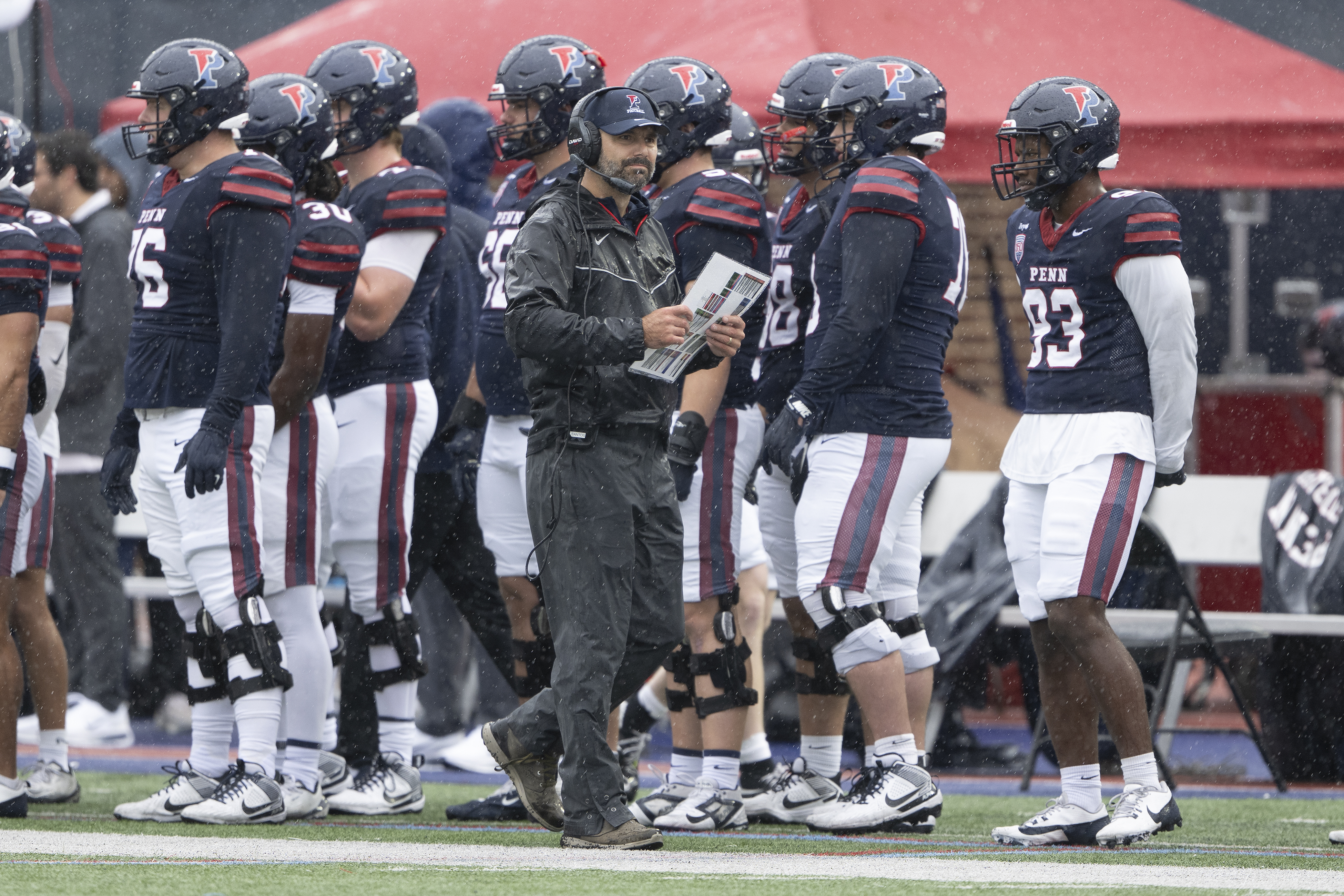
Santos (center) leads Penn now, but regrets not being able to bid farewell to his team at his former stop with the University of New Hampshire.Jose F. Moreno / Staff Photographer
Unable to tell his New Hampshire team in person his decision to leave for Penn, Santos had a Zoom meeting planned, but the decision broke the night before.
“That did not sit well with me, kind of how I left there,” he said. “So all those things are kind of playing over my head, but really it’s just the joy and the gratitude for my time at UNH.”
While Santos appreciates Penn’s academic emphasis, he likes that his players take their sport seriously, too.
“I just love the fact that they’re so well-rounded,” he said of Penn’s players, noting the smaller senior class this year. Santos says he looks for guys who will stay all four years, who are “a football player first who happens to be smart enough to get into a place like UPenn and not the other way around.”
Slowing down the game for Teodecki seems to be a focus for Santos and his staff. They decreased the number of first- and second-down plays, choosing instead to increase the number of times they elect to run the football on a single play so that “he can get every single defensive look that he might see.”
That patience and ability to see the game will be critical against Dartmouth.
“If you force the ball into coverage against this team, they’re going to beat you every single time,” Santos said. “So it’s a great opportunity for Miles and our offense to be patient, to be really efficient.”
Sammy McCorkle, Dartmouth’s head coach, is “defensive-minded, special-teams minded as well,” Santos said, adding: “They win on those two fronts.”
Noting Dartmouth running back Myles Craddock as a player to watch, Santos said that “he’s got long speed, he’s tough, he’s physical.
“They make you work the ball down the field … they do not want the ball to get behind their corners and their safeties.”
13 total tackles for senior linebacker Zach Darche on Saturday.
Santos hopes to build an offensive line that will improve the run game and a special teams unit that will place the offense and defense in prime positions on the field. So far, the defense has been the Quakers’ strength.
Now, he is looking to help the offense find its flow.
“The identity needs to fall on the shoulders of our offensive line and our running backs, and be efficient in terms of our running game,” he said.
Over five days in August, Pennsylvania health officials called the Lancaster County Coroner’s Office at least three times and sent an email asking to discuss the death of an infant who had tested positive for measles.
They did not connect with coroner Stephen Diamantoni before Gov. Josh Shapiro came to the county to announce at an Aug. 25 news conference that two unvaccinated Lancaster residents had died in a growing measles outbreak, the state’s first measles-associated deaths in 35 years.
Soon after, the county coroner — an elected Republican who has presided over the office for nearly two decades — was telling reporters the state had not talked to him directly, raising questions about the state’s communications.
His comments, coupled with his position that he did not believe one of the two infants affected had died from measles, kicked off a viral exchange of misinformation cited by anti-vaccine activists — and spiraling up to federal health leaders — to discredit the dangers of Pennsylvania’s growing measles outbreak.
Now emails from the coroner’s office, obtained by The Inquirer through an open-records request, show that state officials made significant outreach to Diamantoni, far beyond his prior statements acknowledging only that his deputy spoke with state officials shortly before the news conference.
In fact, doctors from the state health department had tried to contact his office about the case for days, with increasing urgency. At one point, a doctor told one of Diamantoni’s staffers that they were ready “24/7” to speak with someone from the office.
Yet two weeks after the announcement, he continued to emphasize the state’s lacking communication in an in-person interview with The Inquirer. “I have not received any information directly from the state [health] department,” he said on Sept. 9.
By then, his statements had enabled President Donald Trump’s health secretary, Robert F. Kennedy Jr., to question whether the deaths reported in Pennsylvania were real.
The Centers for Disease Control and Prevention for weeks omitted the first two deaths and those subsequently reported by the state in its national reporting, marking an extraordinary departure from public health norms. As of Thursday, the agency had updated its tally to recognize two deaths nationally this year, while Pennsylvania has reported five measles-related deaths.
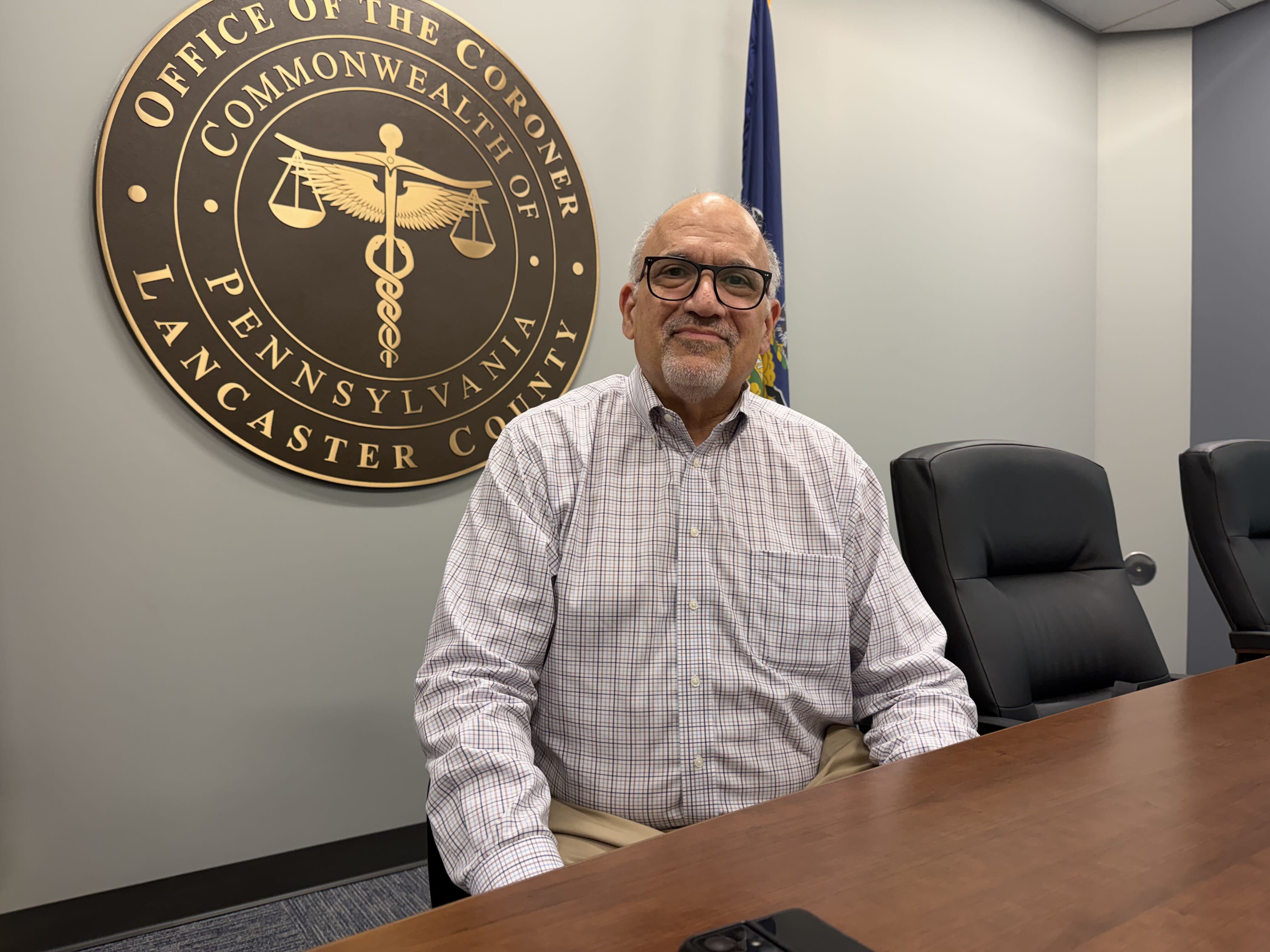
Lancaster County coroner Stephen Diamantoni poses for a photo in his office in September.Gillian McGoldrick
Asked to comment on the records, Diamantoni said he was not aware of the state’s outreach ahead of Shapiro’s announcement.
He said state officials should have been more explicit in the calls they made to his office staffers, who sent him and his deputy emails relaying messages. The communications did not make it clear that they needed to speak to him about a measles-associated death, Diamantoni said, adding that he is easy to reach.
“It didn’t sound like there was urgency. It didn’t sound like anyone indicated that there was a measles death that we want to talk to the coroner about,” he said.
Public officers like Diamantoni have an obligation to ensure staff can get timely messages to him, especially in a public health emergency like a measles outbreak, said Kathleen Hall Jamieson, director emerita of the Annenberg Public Policy Center at the University of Pennsylvania. Likewise, she noted, state officials must ensure communications with the public are transparent and easy to understand.
State officials did not immediately say how they define a “measles-associated death” and have provided few details on the deaths themselves, leaving county coroners to fill in the blanks.
Public health experts have noted that the politically charged back-and-forth and competing narratives around the deaths risks confusing the public at a time when clarity is crucial — amid the largest measles outbreak in the country, with state officials reporting nearly 1,000 cases and five measles-associated deaths.
(function(){function e(){window.addEventListener(`message`,function(e){if(e.data[`datawrapper-height`]!==void 0){var t=document.querySelectorAll(`iframe`);for(var n in e.data[`datawrapper-height`])for(var r=0,i;i=t[r];r++)if(i.contentWindow===e.source){var a=e.data[`datawrapper-height`][n]+`px`;i.style.height=a}}})}e()})();
The contradictory communications from the state and the local coroner’s office around the initial Lancaster deaths set the stage for Kennedy to attack Shapiro in an X post, claiming the Democratic governor may have “fabricated” two of the deaths in Pennsylvania.
Shapiro has sharply criticized Kennedy, a longtime anti-vaccination advocate, for spreading misinformation about vaccine safety and Pennsylvania’s outbreak, now the largest in the nation this year, with the most deaths reported by any state since 1992.
Asked for comment on communications with Diamantoni, state officials provided a statement by email saying Pennsylvania law bars them from providing further information on the initial measles-associated deaths.
The health department’s epidemiology team “thoroughly investigates and verifies” measles-associated deaths to ensure that they meet the state’s definition, and does not announce deaths until they have finished an investigation, health department press secretary Neil Ruhland said in an email.
He said state law does not require the department to report deaths to a coroner’s office; rather, coroners and “other certifiers” report deaths to the state health department.
“PA DOH has followed this explicit process for all measles-associated deaths in Pennsylvania,” Ruhland wrote.
‘No one looks good’
News outlets began calling Diamantoni as soon as the first measles-related deaths were reported in Lancaster, where he is a family medicine doctor and former Lancaster City Council president. First elected to the coroner’s office in 2007, he said he views his duties as apolitical and describes himself as a strong advocate for vaccination.
He told media outlets he had been surprised by the state’s announcement, as his office had not identified any deaths from measles.
The office had investigated the death of an infant who tested positive for the disease, but Diamantoni has maintained that the child had died from a lacerated spleen, not the highly contagious illness.
Diamantoni told The Inquirer repeatedly that state health officials had never spoken personally with him about the death of an infant later identified as Ivan Miller, who was hours old when he died on Aug. 14.
He said that state health officials had only reached out hours before their news conference, and that his deputy, Eric Bieber, had spoken to them.
(function(){function e(){window.addEventListener(`message`,function(e){if(e.data[`datawrapper-height`]!==void 0){var t=document.querySelectorAll(`iframe`);for(var n in e.data[`datawrapper-height`])for(var r=0,i;i=t[r];r++)if(i.contentWindow===e.source){var a=e.data[`datawrapper-height`][n]+`px`;i.style.height=a}}})}e()})();
Internal office records reveal that five days before the news conference, a staffer in the coroner’s office e-mailed Diamantoni, saying that an infectious-disease doctor with the state health department was looking to speak to “one of you” about “the positive measles case with the infant we just had.”
The state health department followed up on its initial Aug. 20 call with subsequent emails and calls on Aug. 21, a Friday, and Aug. 24, the following Monday, records show.
One doctor included his state-issued cell phone number in an email to a coroner’s office staffer and Bieber and emphasized that he was available “24/7” to discuss the case.
When Bieber spoke to representatives from the state health department on Aug. 25, the office did not realize that the state was about to announce two measles-associated deaths, according to Diamantoni.
Diamantoni added that since he did not believe Ivan Miller’s death was caused by measles, he had not been expecting any outreach from the state.
“I don’t think it would have brought a red flag to me. It just looked like a request we usually receive from different individuals, different agencies, requesting cause and manner information,” Diamantoni said.
Yet it is the responsibility of public officials to establish communication procedures at their offices, especially when a contagious disease is spreading and the public needs clear information, according to Penn’s Jamieson.
In public offices, she said, “you shouldn’t be seeing a situation in which the person doesn’t get the information, or is able to say, ‘I didn’t get it.’”
State officials could have communicated more clearly in announcing the deaths as well, she said, noting that they did not immediately define “measles-associated death” in an initial news release.
Jamieson said it is important for health officials to explain “what we know, what we don’t know, and how we’re finding out what we don’t know” in terms the public can understand.
“Anytime the public is listening to voices that are supposed to be speaking with authority, and the public, instead of hearing a clear message, is confused, you have a problem,” she said. “No one looks good.”
Measles-associated deaths in Pennsylvania
State officials have repeatedly cited state privacy laws in response to criticism of their communications, saying they cannot provide detail about how they investigated the measles-associated deaths.
The state defines a measles-associated death as one that occurs within 30 days of symptom onset in a person with clinical evidence of infection and a positive laboratory test for measles, and who did not die of another unrelated cause, like a car crash.
Officials have provided little information beyond the fact that none of the five people who have died were vaccinated, and their county of residence.
Local coroners like Diamantoni have offered more details.
For example, in early September, Jefferson County’s coroner, also an elected Republican, confirmed the death of a 40-year-old woman from measles. He disclosed that the woman also had severe respiratory conditions, including chronic obstructive pulmonary disease, that made her vulnerable to serious complications from a respiratory illness like measles.
Later in the same week, the Mifflin County coroner, another Republican, confirmed that an unvaccinated 18-year-old had died from a rare neurological complication of measles.
Diamantoni has shared that Ivan Miller, who died at a birthing center in Lancaster County, tested positive for a measles infection acquired before birth. His family, who is Amish, told the Atlantic that his mother had a severe case of measles and gave birth early.
Although Diamantoni did not consider measles to have caused the death, he said, measles was included on the boy’s death certificate in a section that lists “significant conditions contributing to death but not resulting in the underlying cause.”
Physicians have noted that measles can weaken the spleen, putting it at risk of rupture. Diamantoni cited a lacerated spleen as the primary cause of death.
The second death, another Amish infant, was not initially reported to Diamantoni; Lancaster’s Clinic for Special Children, which treats Amish children with genetic conditions, had treated the baby until her death.
Diamantoni’s office investigated the death about a week after the state’s news conference; he later told reporters that the baby was 6 weeks old and had Amish lethal microcephaly, a fatal genetic condition that makes respiratory illnesses particularly risky. Diamantoni said measles caused the baby’s death.
On Wednesday, state health officials announced a fifth death, a Lancaster County resident who tested positive for measles and died. Diamantoni told The Inquirer that he had not handled that death, but that state health officials had informed him about it. He said they provided no further information.
State officials did not say whether the person, who was unvaccinated, died in Lancaster County.
Diamantoni told an Inquirer reporter in early September that he was proud that his office was one of the first in the country to be certified by the International Association of Coroners and Medical Examiners.
“People may not always agree with our findings, but they’re well investigated and well thought out,” he said.
Staff writer Gillian McGoldrick contributed to this article.
After being dupedby Hannah Gann, one organization closely affiliated with the Philadelphia School District teacher and activist is dissolving, and another is on a two-month hiatus pending a decision about its future.
The moves come after Gann admitted she lied for years about her identity, claiming at times to be Palestinian, Tunisian, and Black — devastating both groups and drawing national attention to her deception. Gann recently admitted to being a white, Jewish woman, with relatives who she said were Israeli settlers.
“After much reflection, Philly Educators for Palestine has made the decision to dissolve,” a statement read. “We are deeply grateful to everyone who participated, supported, organized, learned, taught, and stood alongside us. We are proud of what we accomplished together and of the community that was built through this work.”
The group, which was not affiliated with the Philadelphia School District but whose members taught in the district, began in early 2024, after charter members, including Gann, organized a “teach-in” about Palestinian history and the conflict in Gaza.
The Racial Justice Organizing Committee,established as an independent group in 2020, is “taking a two-month hiatus to rest, process, and decompress,” the joint statement said.“A decision regarding its future and next steps will be shared by the end of the year.”
Gann’s deception was publicized by both groups earlier this month. The organizations’ members were “stunned, saddened, and angered by this betrayal,” they said at the time.
Gann, in a 10-minute video released after the groups revealed her yearslong hoax, said that she “allowed half-truths and obfuscations to grow into outright lies,” but that she “genuinely wanted to commit to the work I was doing in spite of those lies.”
She has said in a social media post that she was “so, so sorry. It’s so far from being enough, but I don’t know what else to say.”
‘Cosplaying Black’
Most of the teachers and activists who organized with Gann have asked for privacy as they sort through the complicated “why” around her deception.
But one organizer, furious at the damage done by Gann, shared details around Gann’s deception with The Inquirer. The activist asked that her name not be used because she feared reprisal from the community.
Gann sought her out, deliberately befriending her, the organizer said.
At times, the organizer said, Gann was “a little ambiguous” about her background.
“She has moments when she tries to act extra Black, like cosplaying Black,” the organizer said. Gann often wore African print clothing and large earrings, and used African American Vernacular English. “She told people she was mixed. She told someone she was Lebanese.”
But Gann seemed to act differently around different people, slipping on different identities as they suited her.
Gann once talked about having attended an international school in Virginia, the organizer recalled. When the organizer asked Gann how her family, who Gann said had few resources, managed that, “she said, ‘I just used my grandmother’s address; you know how we do.’”
And though it was not a secret that Gann attended the University of Pennsylvania, “she never ever talked about that stuff with me,” the organizer said. “She would always gloss over the Ivy League.”
In some ways, Gann “was such a good friend; she’d do anything for you,” the organizer said — cook a dish, do a favor, show up when you needed her.
But Gann also did things that, in hindsight, give the organizer pause.
“She is intricately involved in teenagers’ lives, and that is very, very concerning to me,” the organizer said. “I’ve seen kids stay at her house because they got kicked out. I’ve seen her going to kids’ parties as a chaperone.”
Members of the Racial Justice Organizing Coalition and the former Philly Educators for Palestine said in a statement they believed Gann, who teaches at the Workshop School, a project-based district high school, deserved consequences from her employer for her actions.
A school district spokesperson said that the district cannot comment on personnel matters, but that support is being provided for any Workshop student or adult who needs it.
The organizer agrees with the call from the Racial Justice Organizing Coalition and former Philly Educators for Palestine group for consequences.
“I think Hannah should get fired,” the organizer said. “This has got to be so traumatizing for those kids. This is a group of kids that don’t trust adults anyway, living in Philly at this time. And they had an adult they thought they could trust, and she was lying about something so fundamental.”
The organizer feels deeply personally duped, too.
“She was trying to get my perspective as a Black woman, and she was white that whole time,” the organizer said. “It was disgusting. The emotional labor that she has utilized from me is so unbelievable — I can never get that time back, I can never get that trust back. I will never speak to her again in my life.”
Further questions
Gann’s actions had troubled some Jewish families in the district long before her deception came to light.
Jason Holtzman, chief of the Jewish Community Relations Council of the Jewish Federation of Greater Philadelphia, said families in the district began raising concerns about Gann to the organization three years ago.
“The communities whose identities and experiences she misrepresented were wronged by that deception and deserve honesty and respect,” Holtzman said in a statement.
Gann’s admission that she lied about her identity “also raises serious questions about her conduct as a teacher,” Holtzman said.
“Ms. Gann taught and spoke publicly about Israel and Palestinians while invoking a personal identity and lived experience she now acknowledges were not her own. She testified before the Board of Education as a Palestinian teacher, speaking about ‘our homeland’ and ‘my family living in a war zone.’”
Black, Palestinian, and Tunisian communities “deserve to have their identities and experiences treated with honesty and respect,” Holtzman said. “Jewish students also deserve a classroom where they can be fully themselves, without feeling singled out or ashamed of their Jewish identity or their personal or familial connection to Israel.”
The Jewish Federation of Greater Philadelphia in 2024 filed a complaint against Keziah Ridgeway, another Philadelphia teacher, accusing Ridgeway of injecting antisemitism into the curriculum and using her personal social media posts to threaten some Jewish parents.
Ridgeway was ultimately kept out of the classroom for a year before she was reassigned to a new school. She has sued the district, alleging anti-Islamic bias. The suit is still pending.
Gann was a staunch defender of Ridgeway, who posted on social media that she confronted Gann when her lies came to light.
“I can no longer be in community with someone who caused so much harm,” Ridgeway wrote. “I hope that she gets the help that she needs.”
This article has been updated to include the name of Jewish Community Relations Council chief Jason Holtzman.
Just when you are tempted to assign sole blame for our growing reputation as human rights abusers to President Donald Trump and his misbegotten administration, up steps the Supreme Court of the United States.
The ruling, which was not signed by the justices, does not make a determination onthe legality of the process itself — the court will begin hearing arguments on that question in December. Nevertheless, it was, according to the New York Times, being celebrated as a victory by the Trump administration, which has deported more than 25,000 migrants to 29 “third countries.”
Yet, for those of us who look to our judicial system as a means to ensure this White House doesn’t get away with every human and civil rights violation it can think of, the court’s decision is deeply troubling.
Sarah H. Paoletti, the director of the Transnational Legal Clinic at the University of Pennsylvania Carey Law School, says the order is “yet one more example of the Supreme Court majority ceding exceptional deference to the Executive.”
“In granting the stay, the court has cleared the way for [the U.S. Department of Homeland Security] to disappear individuals overnight and transport them to countries without notice, and without the opportunity to be heard on their fear-based claims as to those countries, with callous disregard to the grievous rights violations they are likely to face,” Paoletti said via email.
Paoletti noted that the court’s ruling came on the same day 20 independent human rights experts appointed as U.N. Special Rapporteurs and a Special Rapporteur of the African Commission on Human and Peoples’ Rights condemned the practice of third-country removals.
Malka Older — writer, sociologist, aid worker, and executive director of Global Voices, the international newsroom made up of writers and human rights activists — sees the harms as part of a pattern of unethical national choices.
“The Supreme Court allowing the government to continue removing immigrants to third countries — countries where they know no one, have no safety net, no connections, no assistance, and may be under active threat for their identity or convictions — is allowing irreparable harm to continue being done to those people,” Older told me via Facebook. “This kind of deportation rips apart people’s lives, leaving them stranded, and it demonstrates the moral vacuity of U.S. policy, pushing people off somewhere else as though that absolves us of all responsibility.”
“It is the same dynamic that sees the U.S. export plastic waste, dangerous industrial byproducts, unappealing jobs, and increasingly data centers, hoping that if people can’t see the harm they’ll pretend it isn’t happening but in this case, the harm is happening very directly to human beings, to our neighbors.”
But anecdotally, and through the work of journalistshere at The Inquirer and at other media organizations, we know that most of those being detained for deportation — even to third countries — are mostly just ordinary human beings.
“There are people who have lived in this country for upwards of 30 years who are being deported because they lack residency,” Guatemalan-born and Brooklyn-based author and translator David Unger said via Facebook.
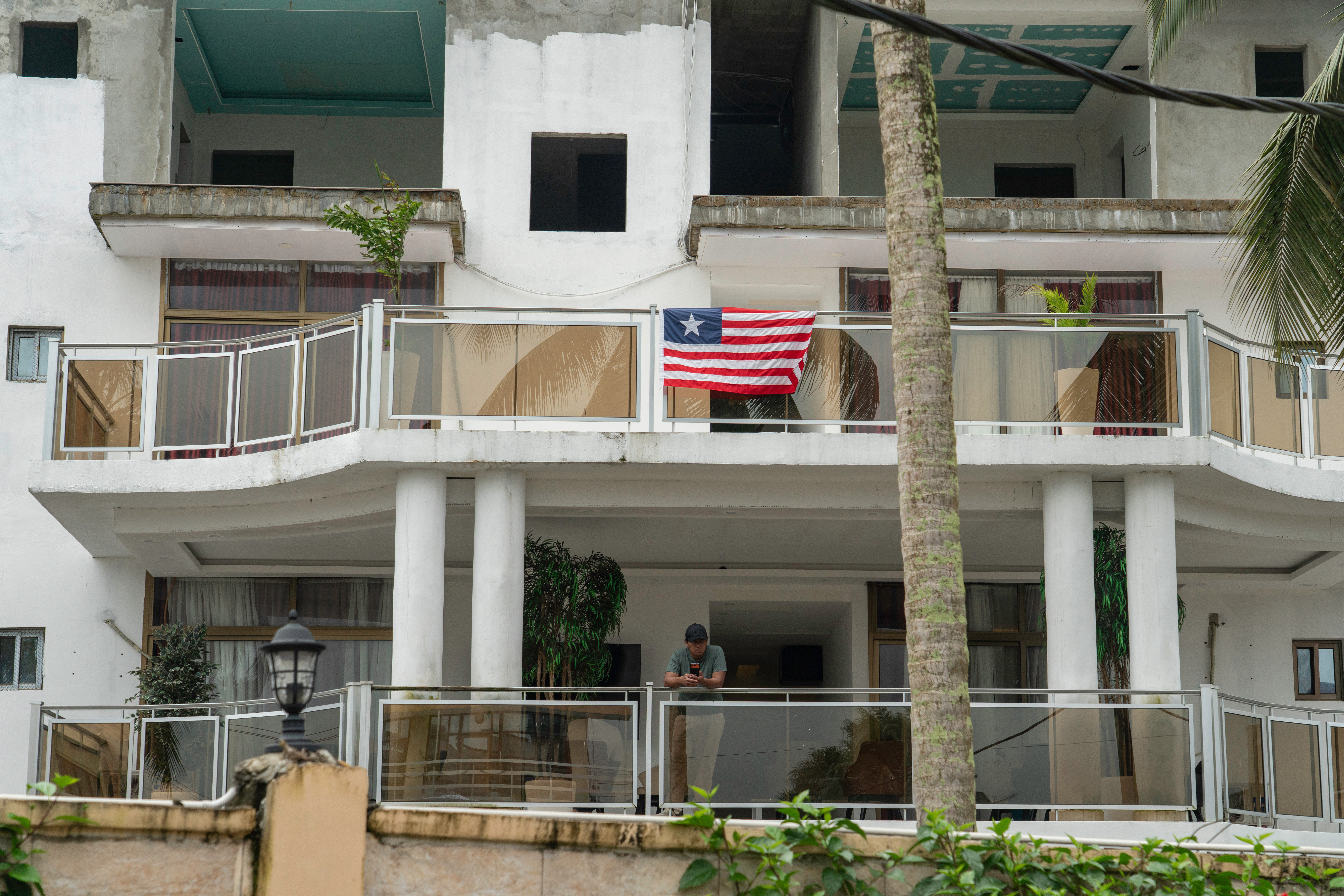
A deportee from the United States who was sent to Liberia stands on the balcony of a hotel in Marshall, Liberia, in August.CARIELLE DOE
“My daughter, an immigration lawyer, had a Jamaican client who was deported to Eswatini in Africa and held incommunicado for three months before finally being sent to Jamaica, where he has no living relatives,” he added. “Guatemala has accepted 2,000 deportees originally from Mexico. Who knows what danger they may be in when they finally reach their birth land. This is simply cruel and, possibly, lethal to them.”
Trump is fond of repeating that our nation is the hottest country in the world right now, but what I see is that we’re radioactive. Our ranking in the Human Rights Measurement Initiative rights tracker, which compares us with our peer high-income countries and fellow members of the Organization for Economic Co-operation and Development (OECD), is pretty terrible: 3.7 out of 10. And a number of the categories in which we are dead-last — “freedom from torture and ill-treatment,” “freedom from arbitrary arrest,” and “freedom from forced disappearance” — are tied directly to the administration’s mass deportation plan.
You know what to do. Thirty-three days from now, get yourself to a polling place and elect people willing to limit the executive branch’s morally disgraceful inclinations. And come December, pray the Supreme Court is willing to limit it, too.
Fleece fragments in a washer flow into a wastewater treatment plant. A plastic bag blows into a stream. A water bottle washes down a storm drain.
All can end up in the region’s waterways as microplastics smaller than a grain of rice and find their way into drinking water and the stomachs of animals and fish.
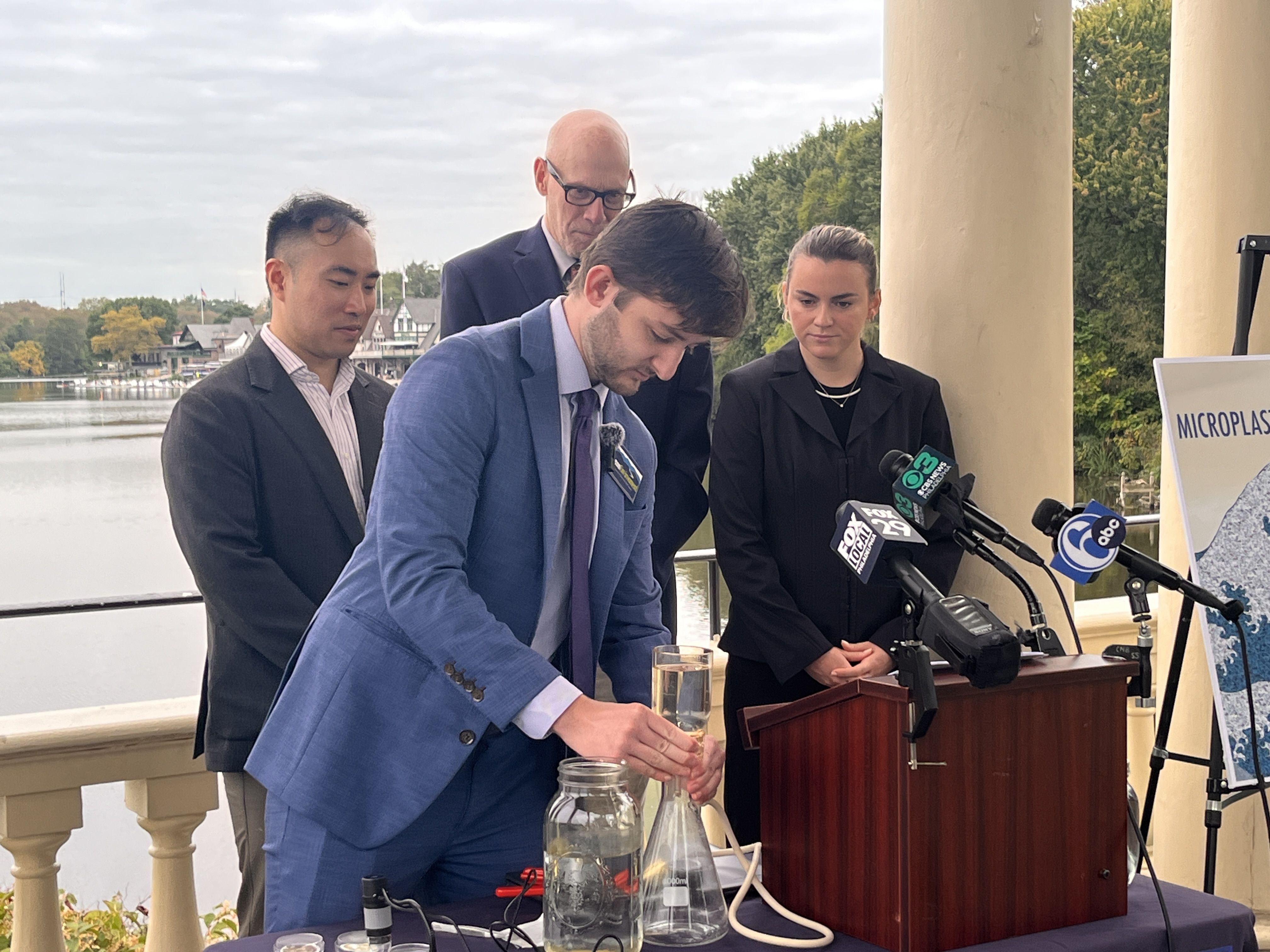
This kind ofmicroplastic pollution was detected in 22 stream and river segments across the Delaware River watershed, according to a new survey of waterways by the nonprofit advocacy group PennEnvironment Research and Policy Center.
Researchers analyzed water samples from sites along the Delaware River and its tributaries across Pennsylvania, New Jersey, Delaware, and New York.
The research was conducted in partnership with the nonprofit Environment New Jersey Research and Policy Center. Scientists with the Academy of Natural Sciences at Drexel University helped analyze the results, which were released Wednesday during a news conference at Fairmount Water Works.
Contamination was found in the Delaware and Lehigh Rivers and the Schuylkill. It was found in Neshaminy Creek in Bucks County, Brandywine Creek in Chester County, and Cooper River in Camden County. And it was found along the Christina River in Delaware.
Drexel’s lab analysis confirmed microscopic plastic at every sampled site, highlighting what the researchers say is a widespread environmental threat.
“We can look at a waterway, and it might be free of litter, it might be free of visible plastic pollution, but that doesn’t necessarily mean it’s clean,” said Faran Savitz, an advocate for PennEnvironment. “The big takeaway is that we should be concerned. The depth, the breadth of this plastic pollution is staggering.”
Faran Savitz with PennEnvironment demonstrates water testing. In the background from right are: Lizzy Mulvenna, with Environment New Jersey Research & Policy Center; David Velinsky, senior scientist, Academy of Natural Sciences; and Derek Ho, microplastics researcher, University of Pennsylvania.Frank Kummer
Where do microfibers come from?
Waterways in and around Philadelphia emerged as significant focal points in the survey results.
Samples drawn from the Delaware River in Philadelphia tested positive for multiple categories of microplastics including microfibers, microfragments, and microfilm, as did other waterways. Microbeads, often found in cosmetic products, were also found in the Christina River.
Microplastics are defined as fragments of less than 5 mm in length.
The synthetic microfibers came primarily from clothing and textiles. Rigid microfragments from items such as fishing line were found in 82% of locations. And flexible microfilm from bags and packaging appeared in 77%.
(function(){function e(){window.addEventListener(`message`,function(e){if(e.data[`datawrapper-height`]!==void 0){var t=document.querySelectorAll(`iframe`);for(var n in e.data[`datawrapper-height`])for(var r=0,i;i=t[r];r++)if(i.contentWindow===e.source){var a=e.data[`datawrapper-height`][n]+`px`;i.style.height=a}}})}e()})();
Microplastics have been found in humans
Researchers explained that laundering synthetic garments releases millions of microfibers that wastewater treatment facilities are unable to completely filter out before they are discharged into local streams.
However, because plastic does not biodegrade but continuously fractures into tiny fragments, filters capture only a portion of plastic entering a waterway.
Savitz said PennEnvironment’s study did not release the concentrations of microplastics because it did not want to compare one waterwayor state against another.
The findings carry ecological and public health implications, as microplastics can block digestive tracts in wildlife and absorb toxic chemicals like PCBs and PFAS that bioaccumulate up the food chain, the report stated.
On average, humans ingest approximately 5 grams of plastic weekly, which is roughly equivalent to the weight of a credit card. Microplastics have been found in human blood, lung tissue, and organs, the researchers said.
Plastics are also routinely found in wildlife, including sea turtles, birds, and whales. About 60% of all seabirds have ingested plastic, with that number rising.
The environmental advocates are urging state and local leaders to enact policies such as producer responsibility for plastic packaging, bans on single-use foam and plastic bags, strict limits on pre-production plastic pellets, and enhanced drinking water filtration systems.
Microbeads once used in personal care products were phased out under President Barack Obama in 2015. But many of those products still linger on household shelves.
File: A glass vial containing water and microplastic pollutionGetty Images
Philadelphia’s drinking water
Philadelphians get their drinking water from the Delaware River and the Schuylkill. Most microplastics are filtered out at the Philadelphia Water Department’s wastewater treatment plants, but some particlesstill get through.
In 2025, PWD removed 4.6 tons of plastic litter from the Delaware and the Schuylkill, alongside an estimated 1,000 tons of plastic extracted through sewer maintenance, the researchers stated.
PWD said in an online report that it is “unclear whether microplastics pose a danger to human health,” noting that the risk could depend on the level of exposure, the type of plastic, and the size of the particles.
But it noted that research suggests some are harmful to fish and animals and can build up in the organs or bloodstream over time.
“PWD is always investigating advanced treatment technologies that may eliminate microplastics and other impurities,” the report stated.
David Velinsky, a senior scientist at the Academy of Natural Sciences of Drexel University, said, “plastics and microplastics are everywhere, from our clothing to the ubiquitous water bottle.”
When plastics and microplastics are not properly disposed of or recycled, he said, they break down into ever smaller pieces.
They “can travel great distances through both the air and in the water,” Velinsky noted.
A plea for ‘producer responsibility’
To combat pervasive plastics, advocates are urging federal and state lawmakers to enact targeted reforms, including the federal Plastic Pellet Free Waters Act currently before Congress, and state-level producer responsibility legislation for plastic packaging.
Savitz emphasized that shifting financial and operational burdens back onto manufacturers is critical to curbing waste at its source.
At least seven states have passed producer responsibility laws, though not all are in effect, according to the Product Stewardship Institute. Those states include Washington, Oregon, California, Colorado, Minnesota, Maryland, and Maine.
“If we can shift the burden back onto companies that create this waste in the first place,” Savitz said, “we can actually reduce the waste, encourage recycling, and make these broader, more systemic changes.”
Last month, I saw a single mother in my medical clinic who had recently lost her SNAP food benefits. She was now struggling to afford enough food for her three children, including solid foods that her 9-month-old baby needed for growth and development. Stories like hers are becoming more common as federal SNAP cuts strain families at a time when food insecurity is higher than at the height of the COVID-19 pandemic.
As a pediatrician in Philadelphia, I care for many infants and families who rely on the Women, Infants, and Children (WIC) program for nutritional support. I referred this patient to WIC, but I can’t prescribe her the necessary childcare, transportation, and time off work to visit her WIC office every few months, as required in Pennsylvania to receive benefits. These logistical barriers have long challenged Pennsylvania participants, as well as many of the nearly 12 million people nationwide who are eligible for WIC each year.
For families already struggling to put food on the table, these are not minor inconveniences. They often determine if a family can access adequate nutrition at all. The good news is the pandemic showed us a path to overcome this.
In 2020, the U.S. Department of Agriculture issued emergency waivers allowing WIC agencies to offer remote appointments and services. Nearly all state agencies reported that the changes made WIC more accessible. They provided a lifeline for WIC families when in-person visits were almost impossible.
Earlier this month, Congress passed a temporary funding bill that keeps the program funded through the end of the year. Unfortunately, funding alone is not enough. Without action to extend remote services, families across the country risk losing WIC access due to work obligations, childcare needs, or travel barriers.
Congress should also support universal adoption of remote benefit loading. Pennsylvania is one of the few states that still does not allow participants to load their WIC benefits remotely, though it plans to introduce a digital WIC card in 2027. Research from the Children’s Hospital of Pennsylvania and the University of Pennsylvania in 2021 found a 14% improvement in WIC participation in states that allowed remote benefit transfer, compared to “offline” states.
Both the Modern WIC Act in the House and the 21st Century WIC Act in the Senate would formalize these changes, but neither has a clear path to passage. Like the National WIC Association and many public health organizations, I urge our lawmakers to prioritize these bills before the end-of-month deadline. All states should also commit to modernizing their WIC systems to make benefits and services easier for families to access.
In the last few years, WIC still hasn’t reached nearly half of those eligible. Traveling to appointments is consistently cited as a major barrier, especially for working parents, rural families far away from any WIC office, and those without reliable transportation.
Congress and state agencies must act together soon to protect families’ access to WIC, one of our country’s most valuable investments in maternal and child health. At a time when high cost of living and federal benefit cuts further threaten food security, we should strive to make WIC easier to use. No family should lose out on critical nutrition support because getting to a WIC appointment is harder than it needs to be.
William Zhuo-Ming Li is a pediatrician in his final year of residency training at the Children’s Hospital of Philadelphia. He is interested in neonatal health equity and infant nutrition advocacy.
A new, free educational program for West Philly small businesses is launching this fall, giving them access to faculty from the University of Pennsylvania, through a partnership with the Community College of Philadelphia.
The deadline to apply is fast approaching, with instruction starting next month.
Students of the Penn-CCP Entrepreneurship Academy will learn from Penn faculty, other entrepreneurs, and business advisers in three-hour weekly classes, as well as coaching sessions and office hours.
The initiative aims to increase the opportunity for businesses that are connected to the West Philadelphia area. Participants should be registered in the neighborhood, have operations there, or its owner can live there.
But the rules seem flexible: Because the program’s priority and focus is to help Philadelphia-based businesses, including nonprofits, interested owners are encouraged to apply even if they do not live in Philadelphia. Even businesses with no revenues can apply, but priority will be given to those generating revenue.
West Philadelphia has “no shortage” of entrepreneurial talent, said Franne McNeal, executive director of the academy, but what it lacks most is resources.
“Business owners here have less access to strategy, legal fluency, capital networks, and the kind of advice that turns a small business into a bigger one,” McNeal said. “The biggest gap I see is the owner with four employees who cannot figure out how to get to 14.”
The academy’s curriculum is divided into four stages: build the foundation, strengthen the structure, prepare for growth, and put the plan into action.
Students will learn about creating a business strategy, the right structure for their company, branding, and protecting intellectual property. Instruction will also cover financial literacy, workforce management, marketing and sales, and how to present to a potential investor.
“We’re going to cover the foundational elements of growing a business,” faculty director Praveen Kosuri said. “Everything from business planning and strategy to structuring and branding.
Besides learning how to build a business, participants are expected to gain confidence in identifying business risks, asking the right questions, and knowing when to seek specialized advice. The program is also intended to foster meaningful relationships between founders, faculty, practitioners, and members of Philadelphia’s entrepreneurial community.
Each business owner will submit a business plan and pitch, along with a 90-day action plan, for faculty feedback.
“They’ll have a funder-ready plan, the financial fluency to defend it, and practitioners in the room helping who know the Philadelphia capital landscape,” she said.
While the academy is tuition-free, McNeal and Kosuri noted that participants will have to put in significant time.
The 10 weekly sessions in West Philadelphia will take place from 6-9 p.m. beginning in late October through January.
“Participants need to show up each week to learn, to work on their businesses, and to support the others in the class,” said Kosuri. “We hope it sets them on a path that continues to lead them to their goals.”
Although start-up businesses can apply, the program seems more geared toward already established companies, whose owners want to take their companies to the next level.
Unlike other programs I’ve seen, the academy is establishing a specific measurable goal that will hold both its leaders and students accountable: getting the businesses involved to achieve between $1 million to $10 million in revenues within three years.
McNeal says the program is a pilot and its success will be measured by participants’ success.
“Attendance and satisfaction scores are easy to report but revenue and employment are slower and harder, and they are the only numbers that mean anything, so those are the ones we are building the tracking for,” she said.
“We will be judged on whether we come back,” she said.
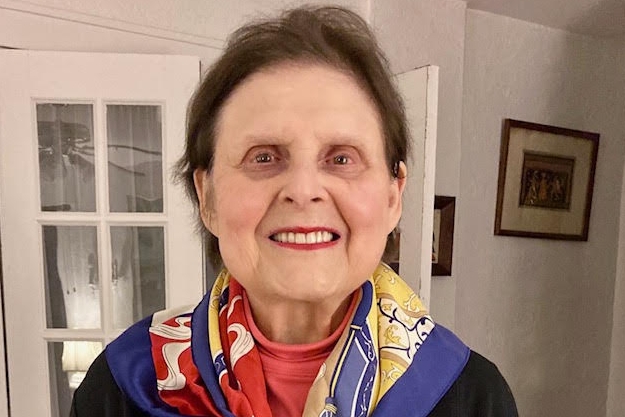
Lenora D. Wolfgang, 91, of Philadelphia, French professor emeritus at Lehigh University, literary researcher, author, teacher, mentor, and artist, died Thursday, May 14, of heart failure at her home near the Philadelphia Museum of Art.
Professor Wolfgang, or, as many of her Lehigh students and colleagues called her, Madame Wolfgang, planned to study art in Paris after high school and live as a painter. But, she told her family, she became so enthralled by the French language at Philadelphia High School for Girls that she curbed her art aspirations, earned three degrees in French at the University of Pennsylvania, and taught French and French literature at Lehigh for 26 years.
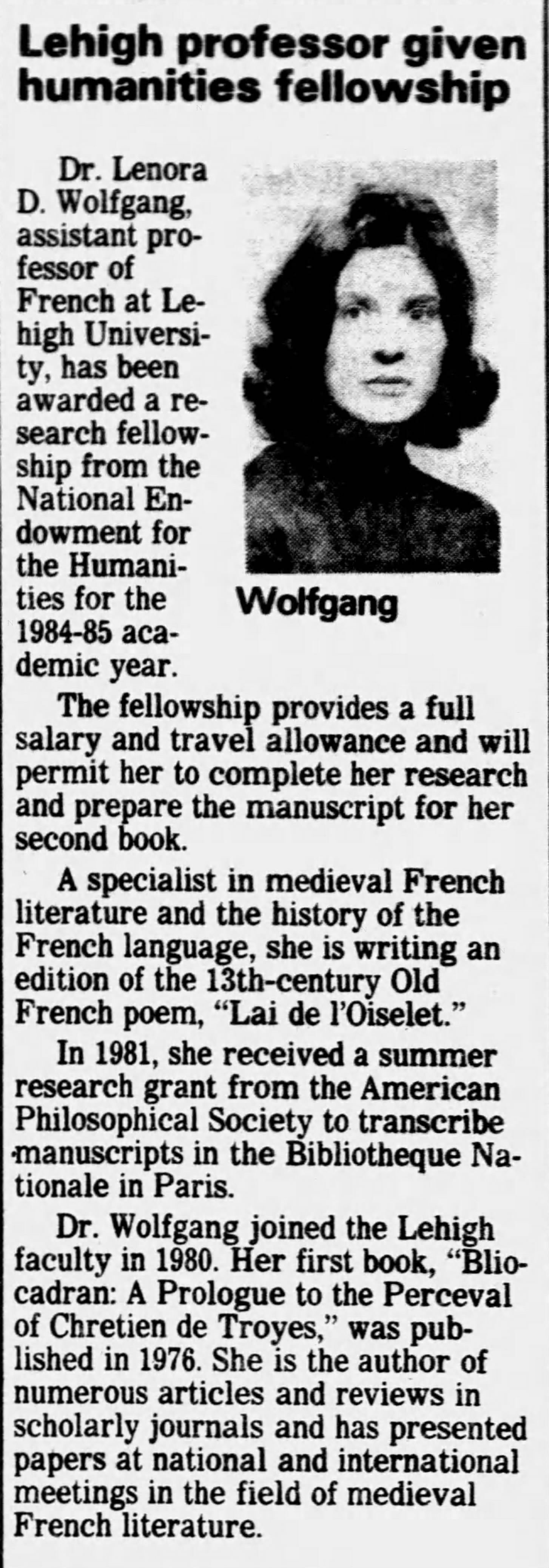
Inspired by professors at Penn, she became an expert in medieval French language and literature, and her doctoral dissertation and first book were an analysis of an 800-verse prologue to a 13th-century French poem. She studied in France on a Fulbright Scholarship in 1956 and ’57, and in Spain on a grant from the American Council of Learned Societies in 1978.
She wrote two books on French poetry, served research fellowships with the National Endowment for the Humanities in the 1980s and ’90s, and earned a grant from the American Philosophical Society in 1981 to transcribe manuscripts at the National Library in Paris. In 1990, reviewers at Penn’s French Forum journal said her second book, also on 13th-century French poetry, “provides the modern scholar with a standard text and thorough apparatus that will serve current and future generations well.”
This photo and story about Professor Wolfgang appeared in the Morning Call of Allentown in 1984.Newspapers.com
She belonged to many academic language and literature organizations, and was a student adviser and faculty committee member at Lehigh. In tributes, former colleagues called her “a true mentor” and “a real mensch.” One said: “It was clear that I had an ally in Lenora and that she wanted me to succeed.”
A former student said she was “a good friend and sounding board” in a 2025 interview with the Lehigh alumni relations department. “She was always ready to help, share her knowledge,” a former colleague said, “and always did it with tact and unselfishness.”
Professor Wolfgang earned bachelor’s and master’s degrees, and a doctorate in French at Penn. She taught French classes at Temple and Rutgers Universities, Penn, and high schools in Philadelphia before joining Lehigh’s Department of Modern Languages and Literature in 1980.
She commuted three hours round trip to Lehigh, in Bethlehem, Pa., from West Philadelphia three days a week and was promoted from assistant professor to associate professor in 1986, then to full professor in 1989. She retired from Lehigh in 2006.
Professor Wolfgang (center) traveled the world and enjoyed hosting dinner parties with family, friends, and academic colleagues. Courtesy of the family
After Lehigh, Professor Wolfgang taught continuing education classes about French playwright Molière and other topics to adults at the Osher Lifelong Learning Institute at Temple. After the COVID-19 pandemic lockdown ended, she returned to the institute briefly as a student.
Professor Wolfgang was adept at painting as a girl in West Philadelphia and won several art competitions, and later showed her photography at Penn’s Faculty Club. “She was a natural talent,” her family said in a tribute.
Lenora Divida Poden was born Sept. 25, 1934, in Philadelphia. Her parents emigrated from Poland and Romania, and her mother leftthe family when Professor Wolfgang was in junior high school.
She and her father had to hide their Jewish heritage and alter their last name to minimize antisemitic attacks. “Yet Lenora overcame these challenges,” her family said, “excelled academically, and rose to the top of her academic field.”
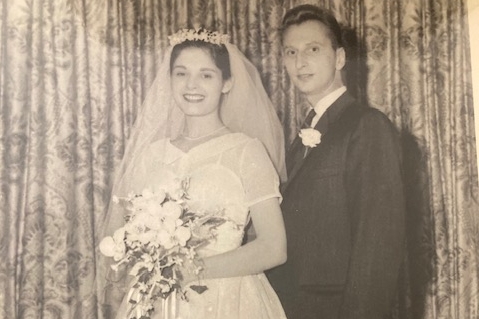
Professor Wolfgang married her first husband, Marvin Wolfgang (above), in 1957, and her second husband, Leon Salganicoff (below), in 2010.Courtesy of the family
An exceptional student, she was valedictorian of both her 1952 senior high school class at Girls’ High and her 1956 senior undergraduate class at Penn’s College for Women. She married Marvin Wolfgang, a professor at Penn, in 1957, and they had daughters Karen and Nina, and lived in University City.
In 1977, The Inquirer featured their house in a photo spread about its French-inspired Gothic style of architecture. Professor Wolfgang said: “Perhaps that is one reason I feel so very much at home.”
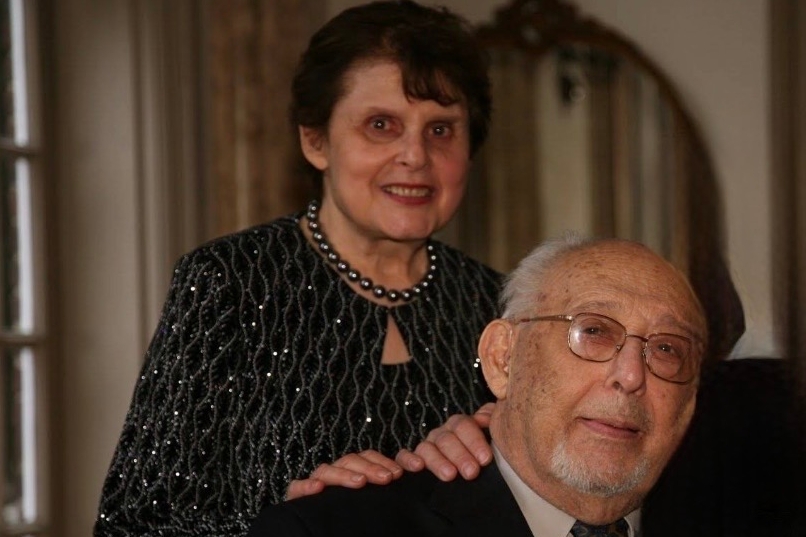
After her husband died in 1998, she married Leon Salganicoff, a professor emeritus at Temple, in 2010. He died in 2011.
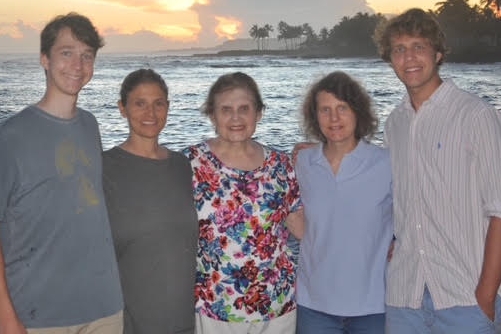
Professor Wolfgang was an avid reader. She traveled the world, listened to classical music, and enjoyed hosting dinner parties with friends and academic colleagues.
Professor Wolfgang (left) doted on her family and sent personalized birthday cards. Courtesy of the family
She almost went to law school in the 1970s before gaining her full-time teaching position at Lehigh. She doted on her family, sent personalized birthday cards, and kept in touch with teachers, colleagues, former students, and friends even after they parted.
“She was brilliant,” a longtime friend said in a tribute, “and she was fun.” Her family said: “Everyone loved her.”
In addition to her daughters, Professor Wolfgang is survived by two grandsons, a great-grandson, and other relatives. A brother died earlier.
A private celebration of her life was held earlier.