Tag: UniversalPremium

  • Jalen Hurts used his arm, legs, and mind to beat the Commanders. He also helped the Eagles mask some O-line issues.

    Jalen Hurts used his arm, legs, and mind to beat the Commanders. He also helped the Eagles mask some O-line issues.

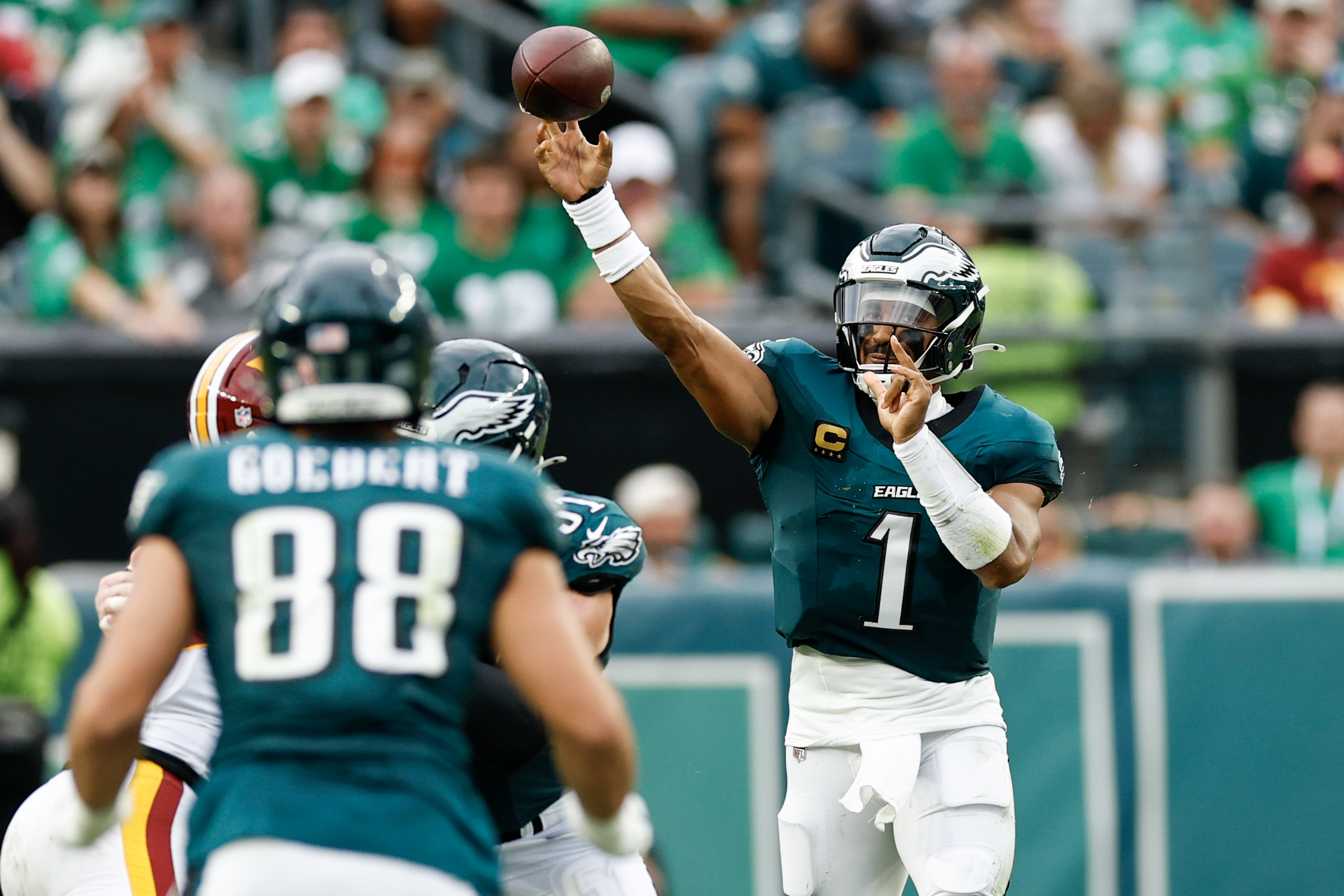
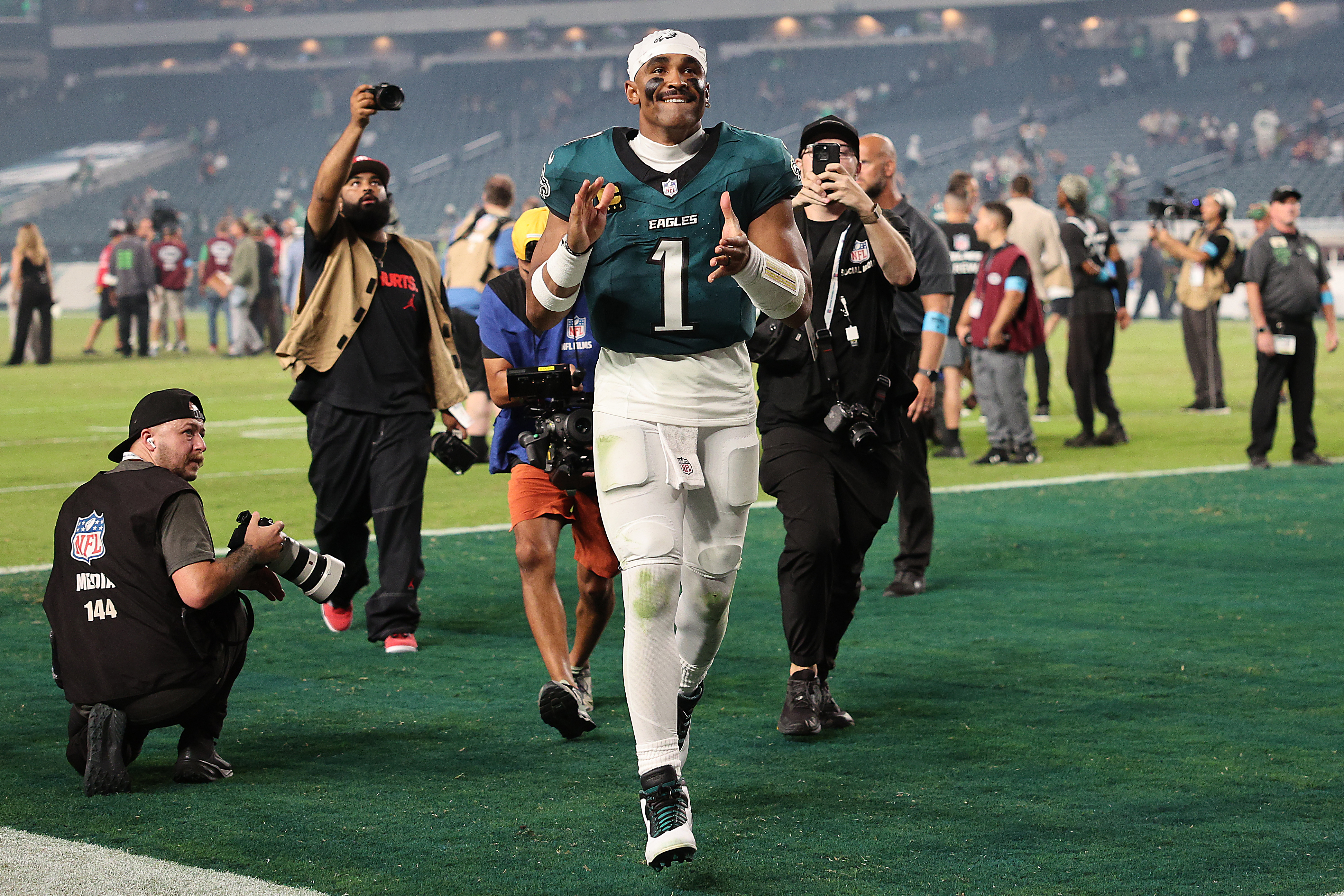
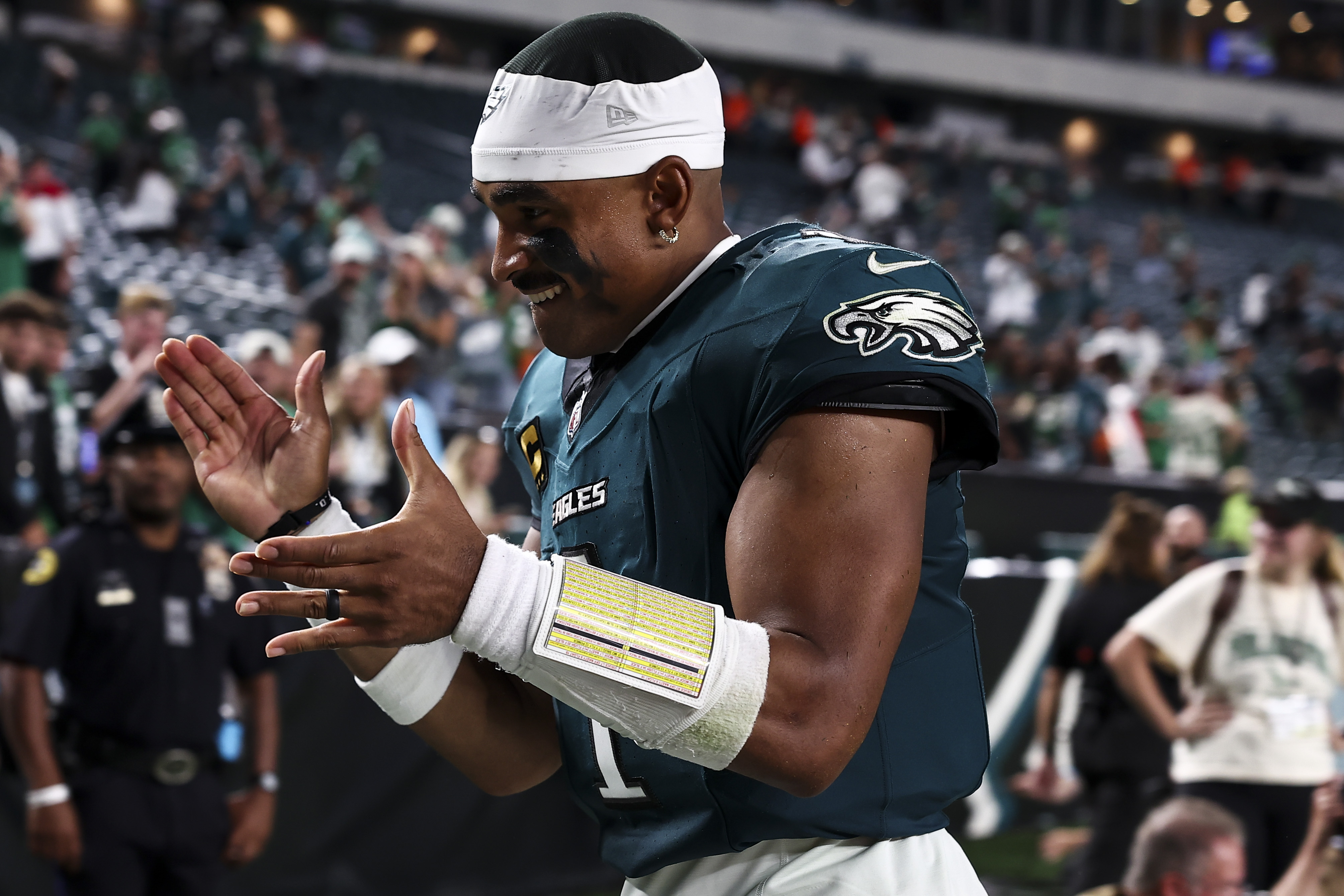
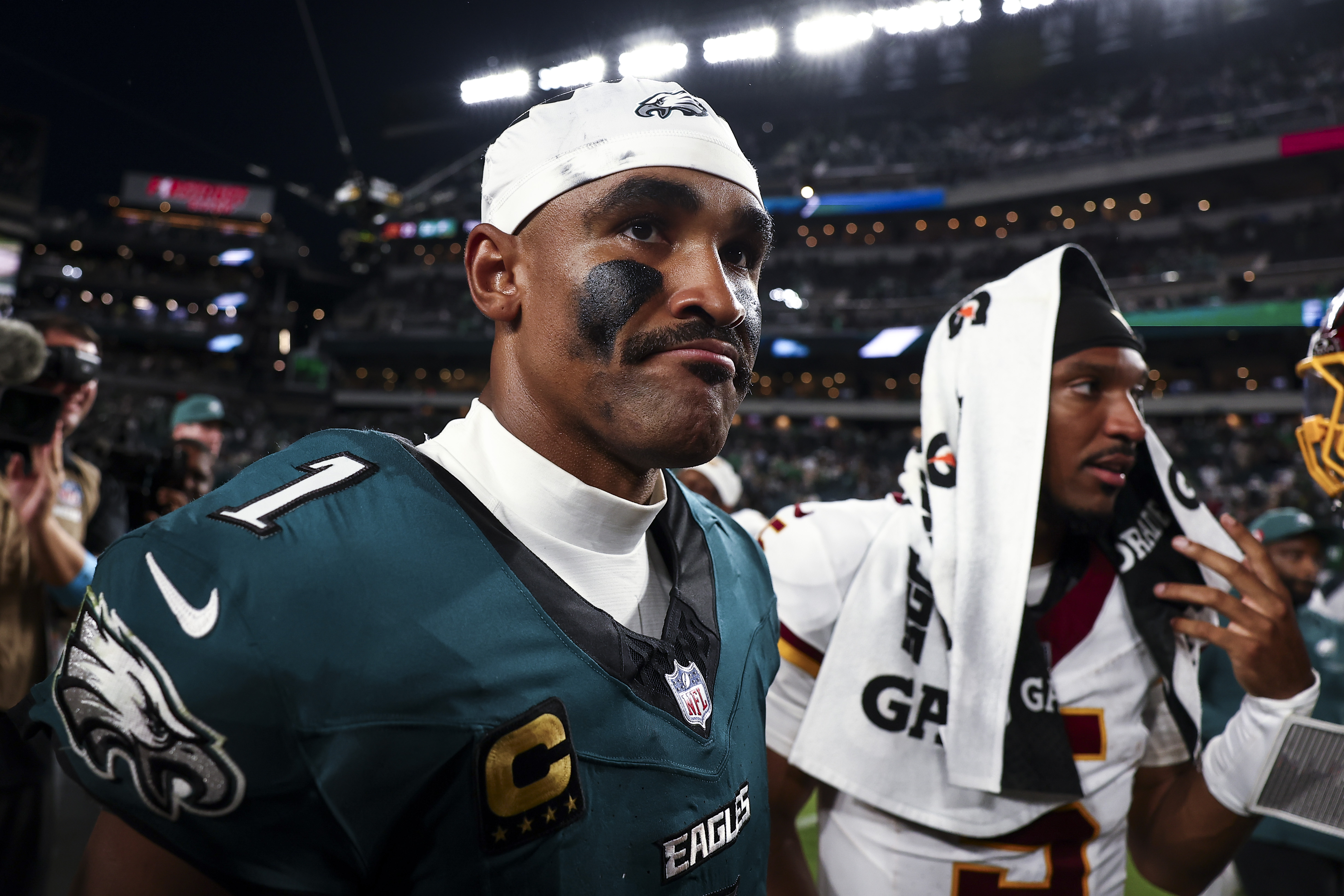
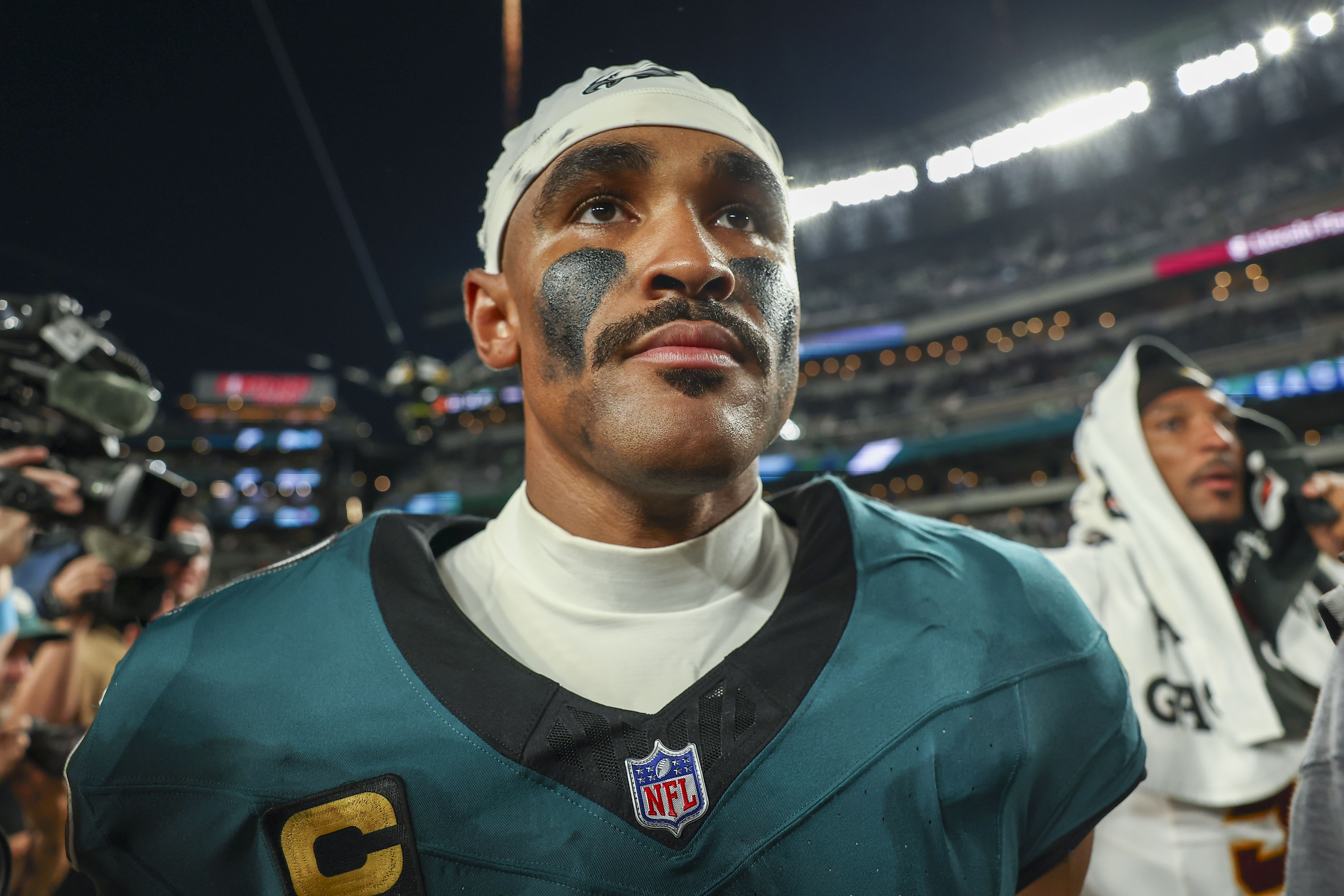
    Jalen Hurts did the famous Michael Jordan “I don’t know” shrug after his first touchdown pass and expressed the same whimsy when asked about the gesture after the Eagles’ 24-22 win over the Washington Commanders on Sunday.

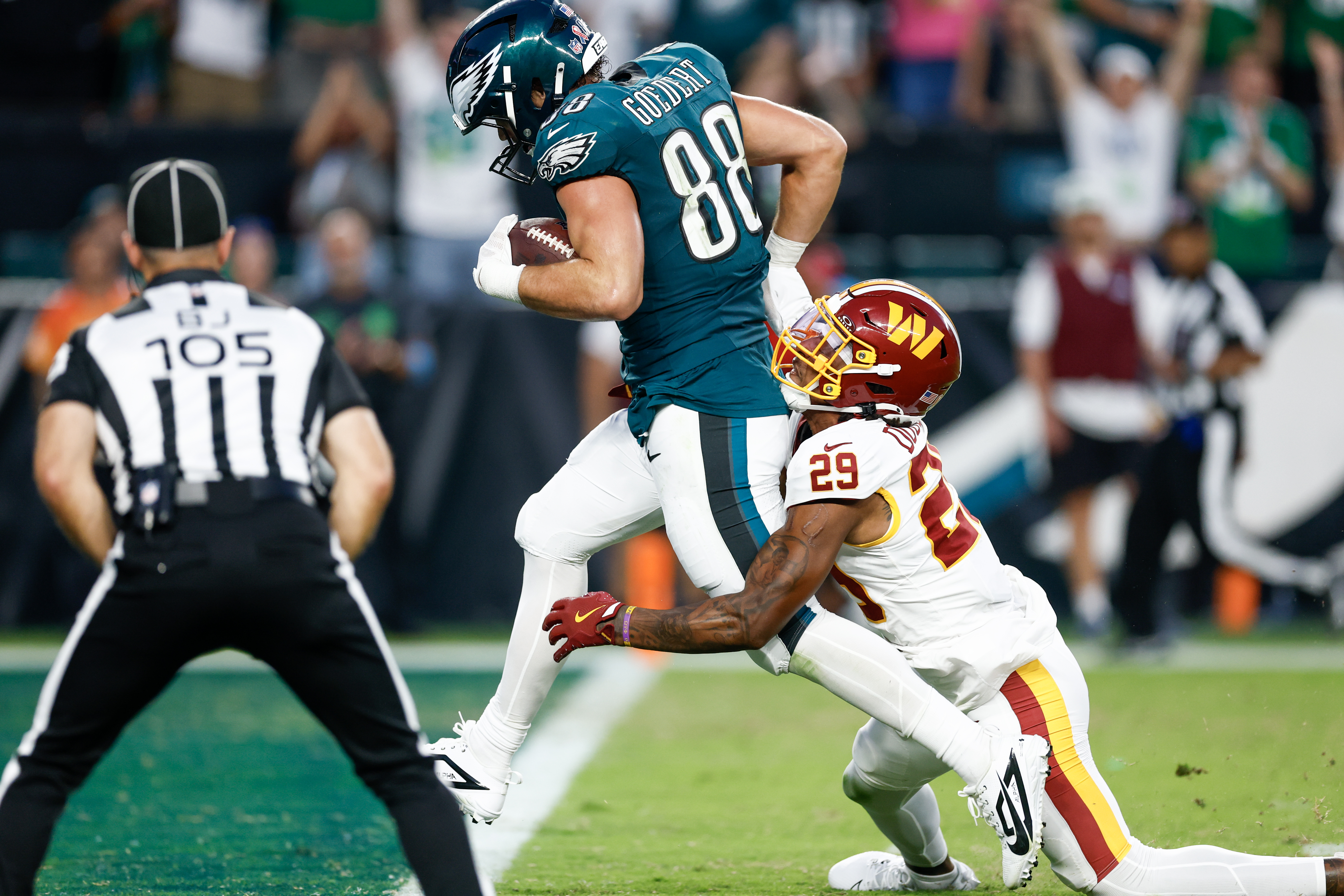
    But it didn’t take an expert in the art of understanding Hurts to interpret why the stoic quarterback shrugged toward the Eagles sideline after he strung a 17-yard rope to Dallas Goedert.

    “It’s a great play. A great play,” Hurts said to reporters. “Y’all [are digging]. Y’all trying to figure something out.”

    The figuring had already essentially been done. The touchdown came on a four-verticals route concept similar to the fateful play that resulted in the season-ending incompletion from Hurts to Goedert in the playoff loss to the San Francisco 49ers in January.

    There had been nine months of controversy over the play. Some ridiculed former offensive coordinator Kevin Patullo for making the call. Various reports said it was Hurts who suggested it and that it exemplified his imperious influence.

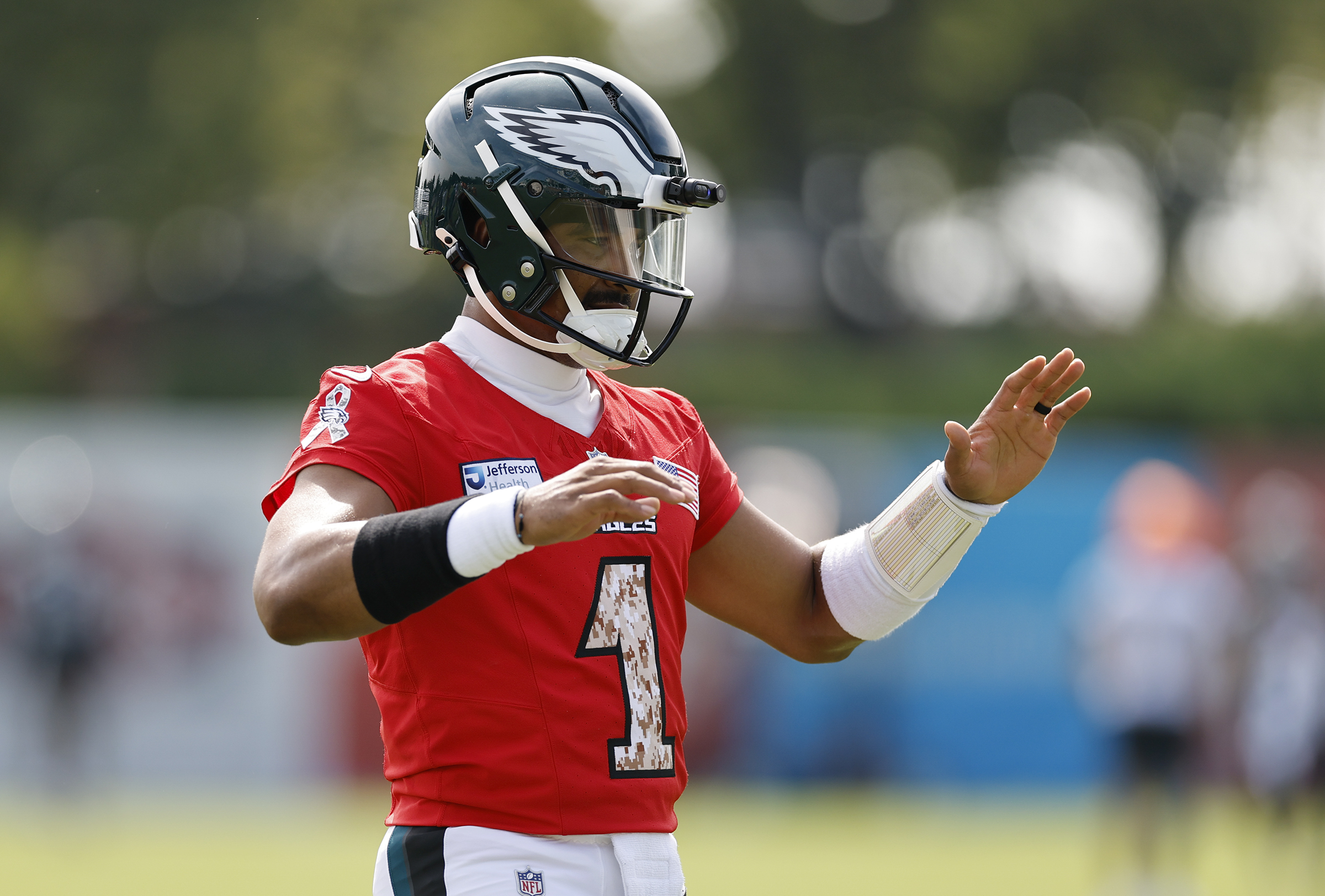
    But on this day, four verts worked because new play-caller Sean Mannion made the right call at the right time — or was it Hurts? — and the pass was executed flawlessly. The quarterback made several big-time throws against Washington, and at times looked like the explosive runner that had made him one of the most dynamic quarterbacks in the NFL.

    Hurts also answered some doubts about how he would adjust to yet another change in coordinator and scheme — at least for one week. But the game plan didn’t quite represent the dramatic shift that was anticipated with Mannion implementing a Kyle Shanahan-Sean McVay-type system as his base offense.
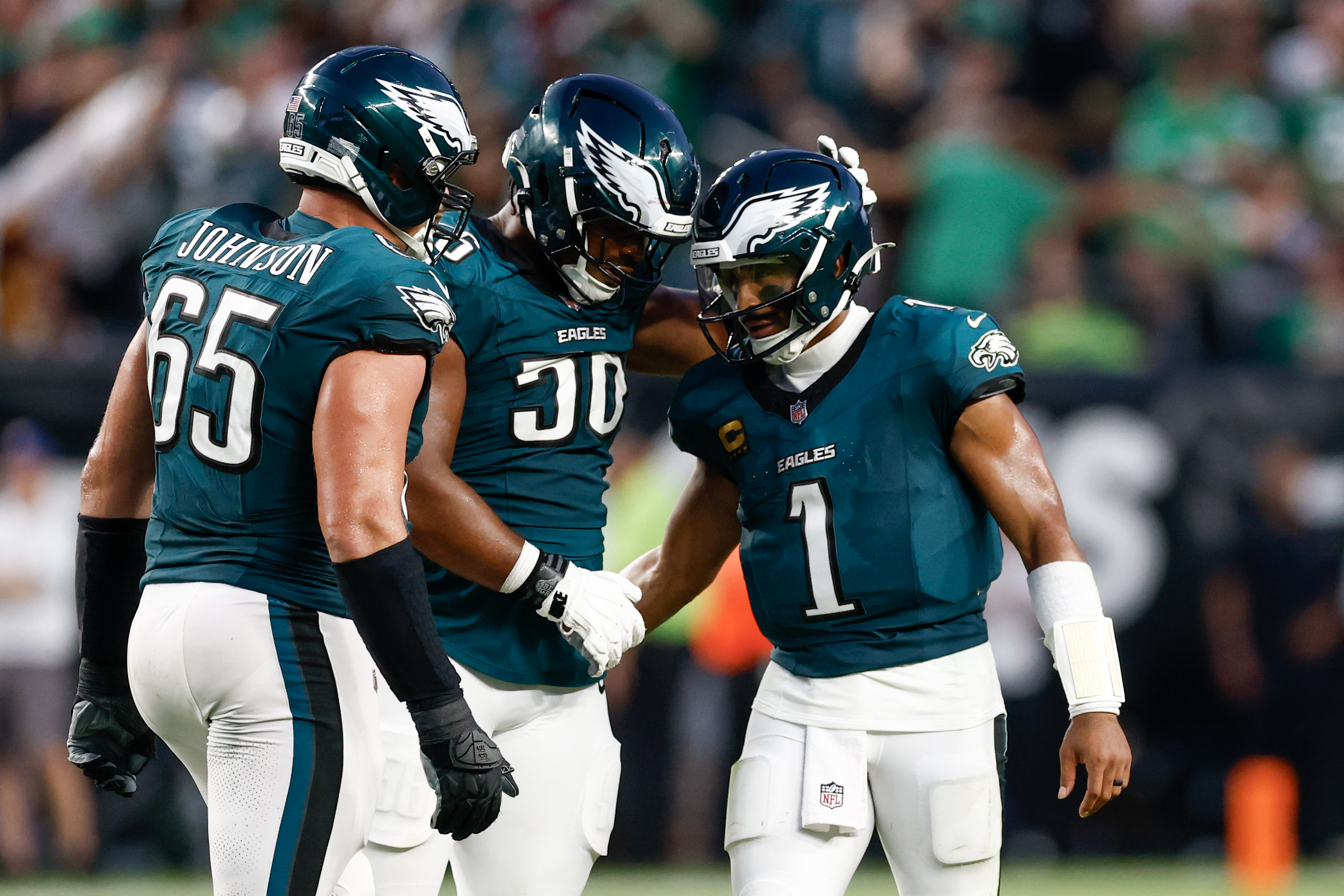
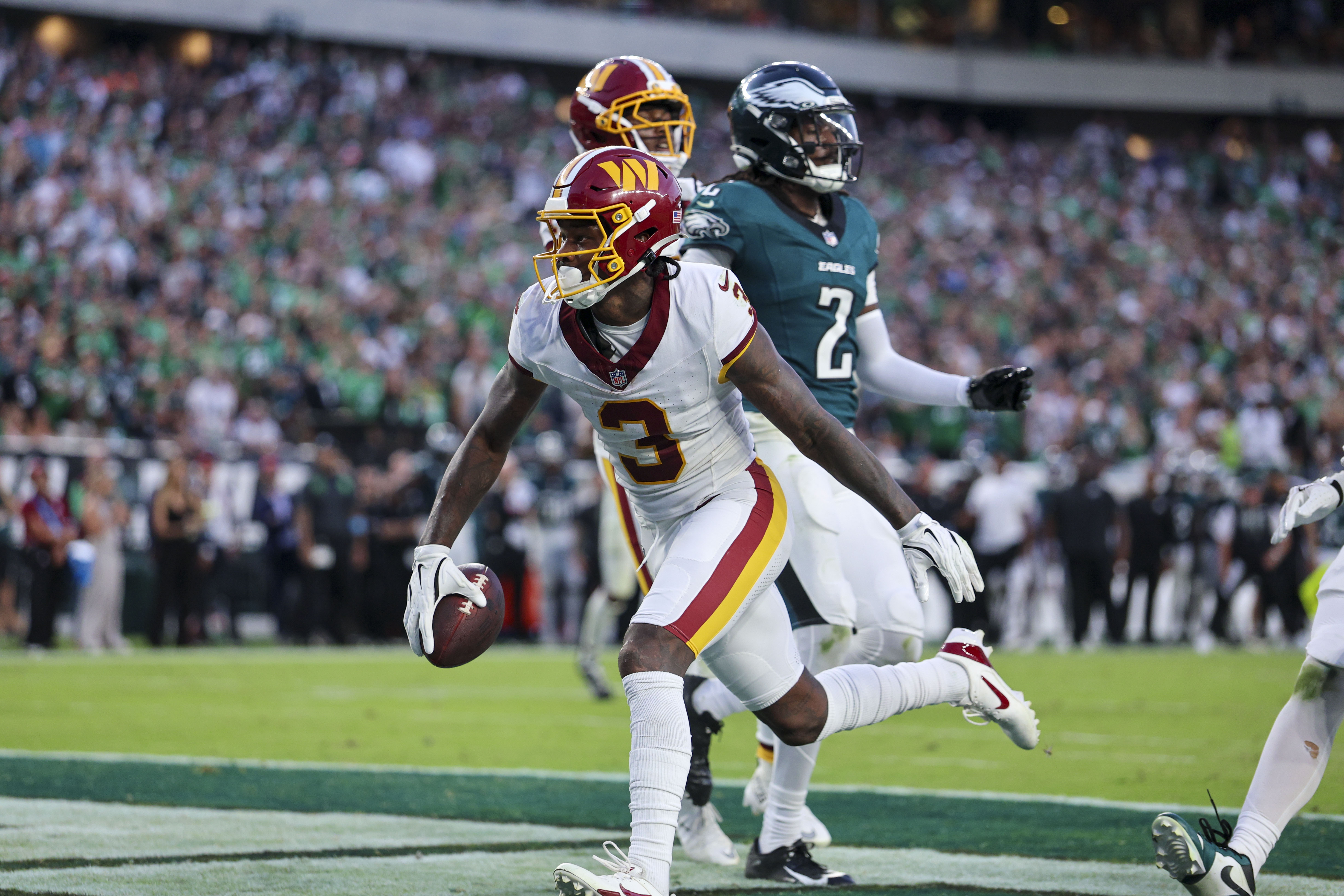
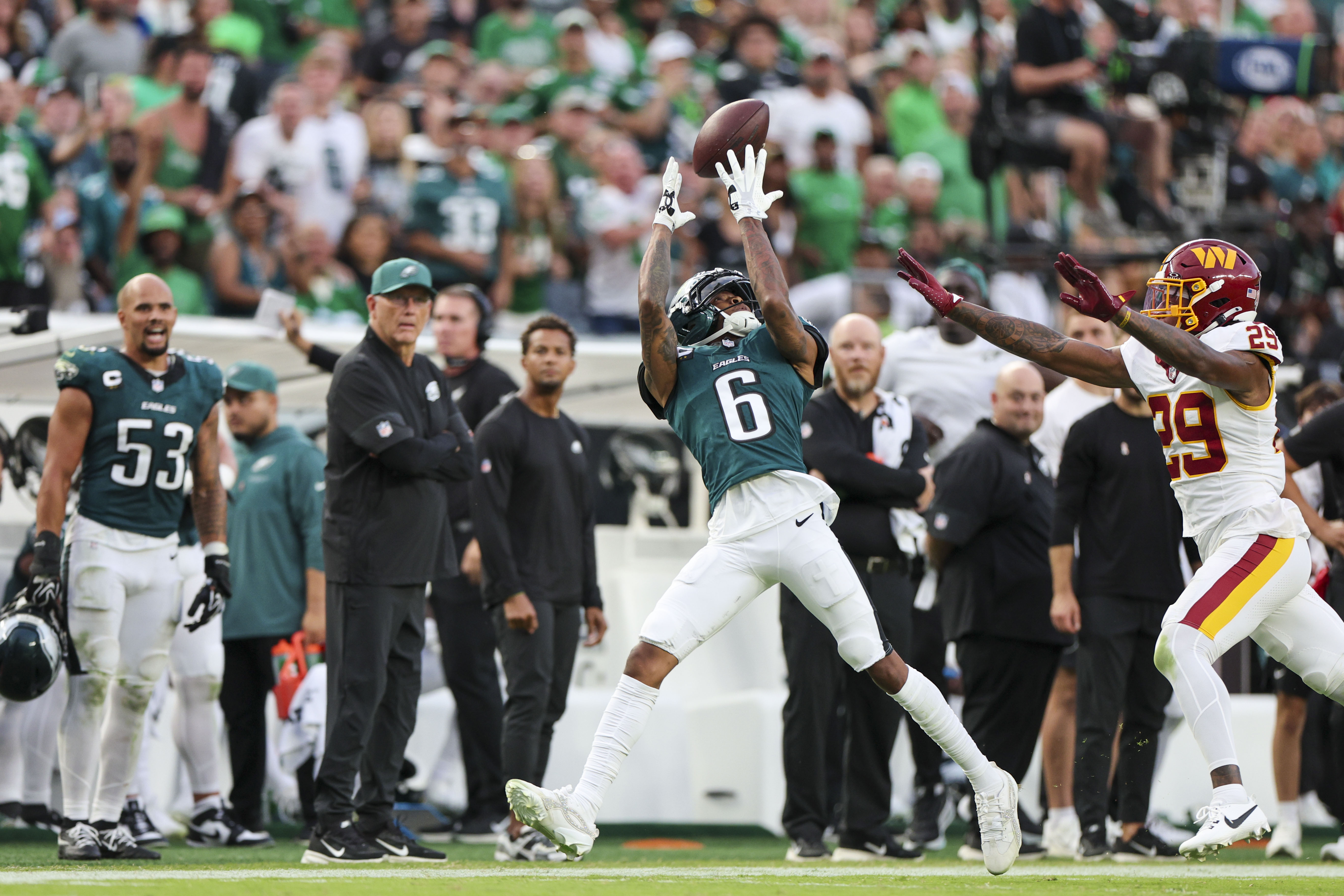
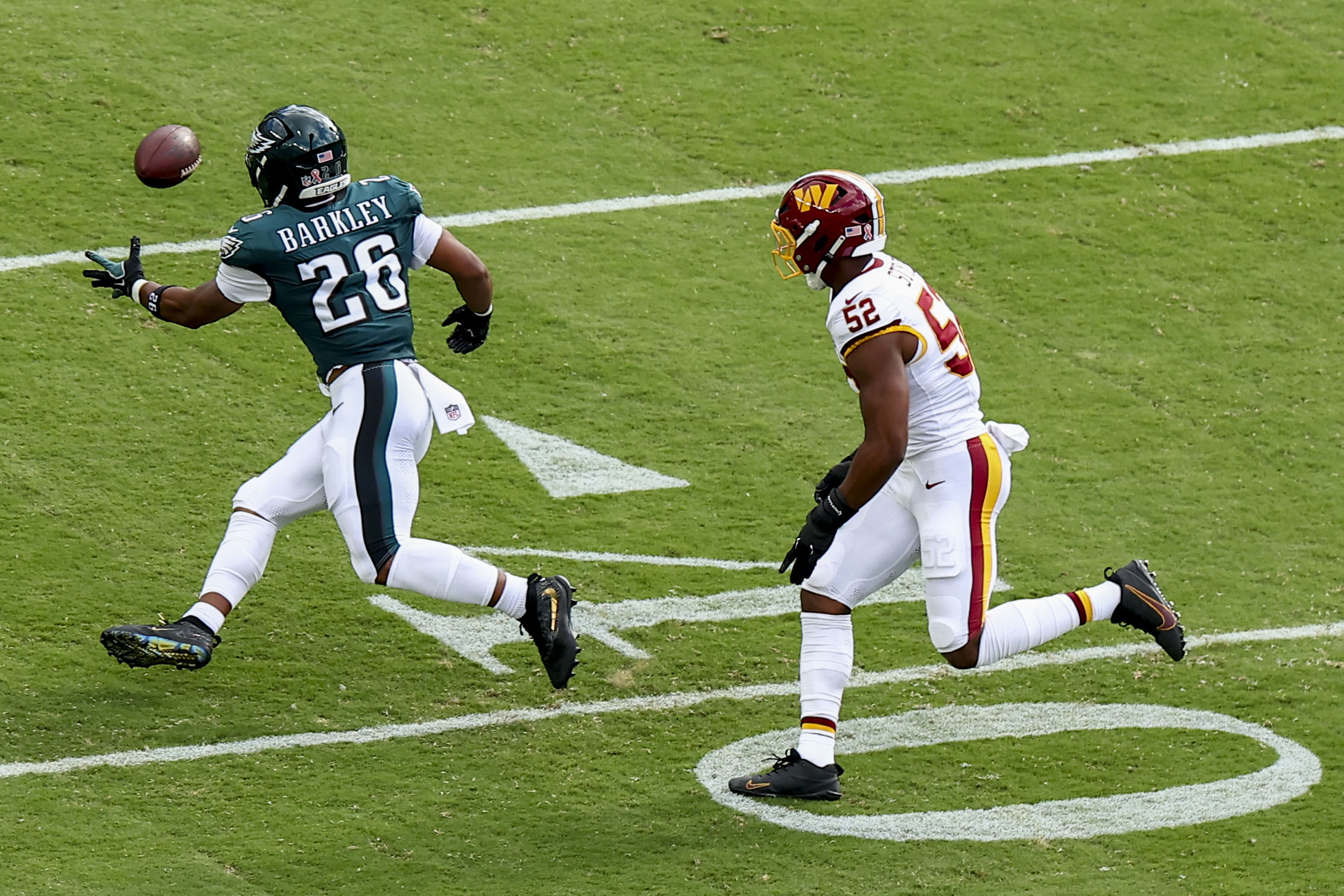
    The under-center, play-action game was certainly there. Hurts, for instance, connected with new receiver Dontayvion Wicks for 64 yards after a decent Saquon Barkley outside-zone run set up the first-quarter bomb.

    But Washington’s aggressive defense mostly took away the Eagles’ perimeter rush. And Mannion was never really able to consistently marry the run with the pass.

    A blending of the old and new was always to be expected. There was just too much more of the old bad than the good in Week 1. And that meant too many three-and-outs — three straight to open the second half — and too much of Hurts under pressure.

    “We’re going to have some work to do,” Eagles coach Nick Sirianni said of how the Eagles handled Washington’s blitzes and simulated pressures. “We’ll look at the tape, but we’ll see. You never want to have a free runner.”

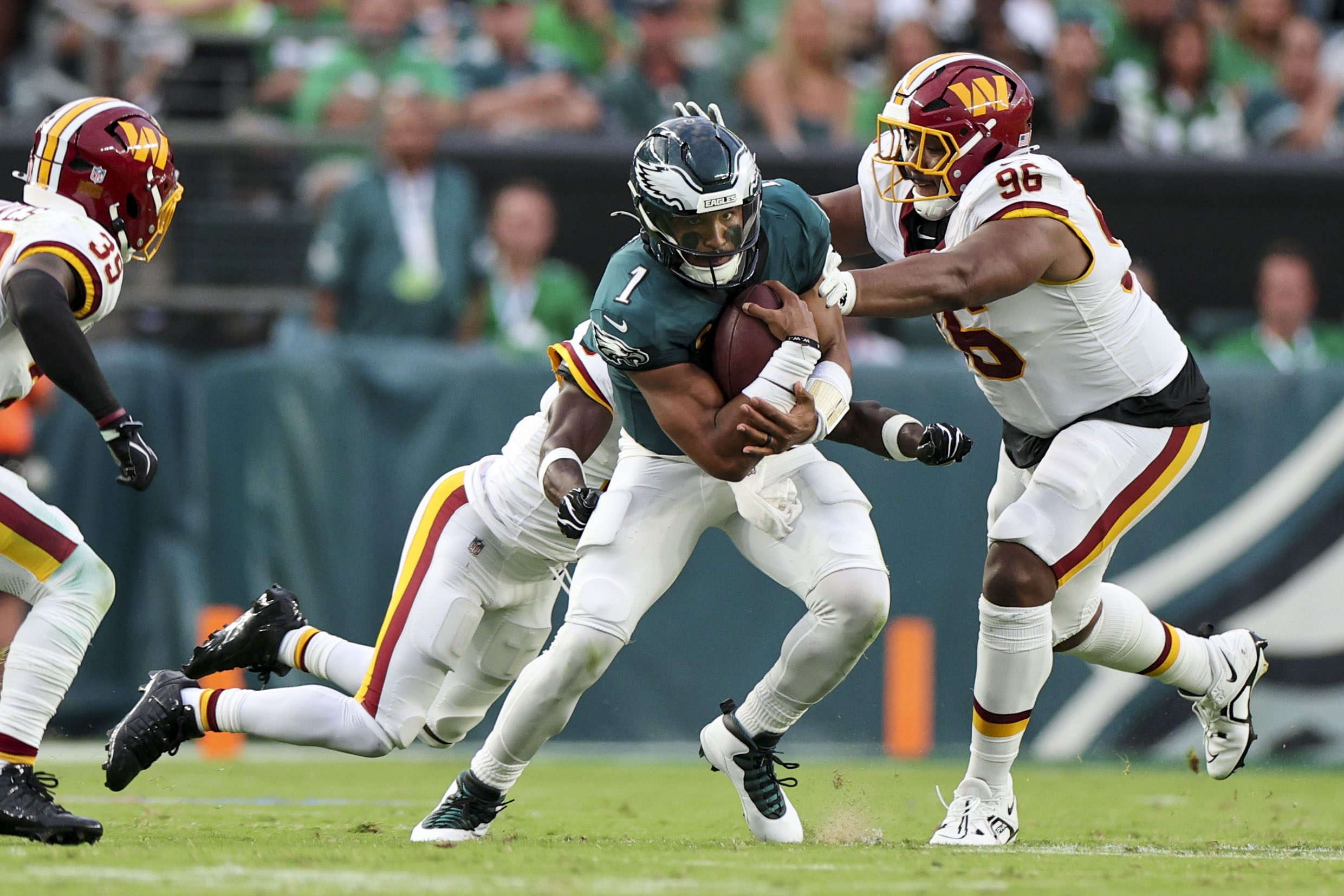
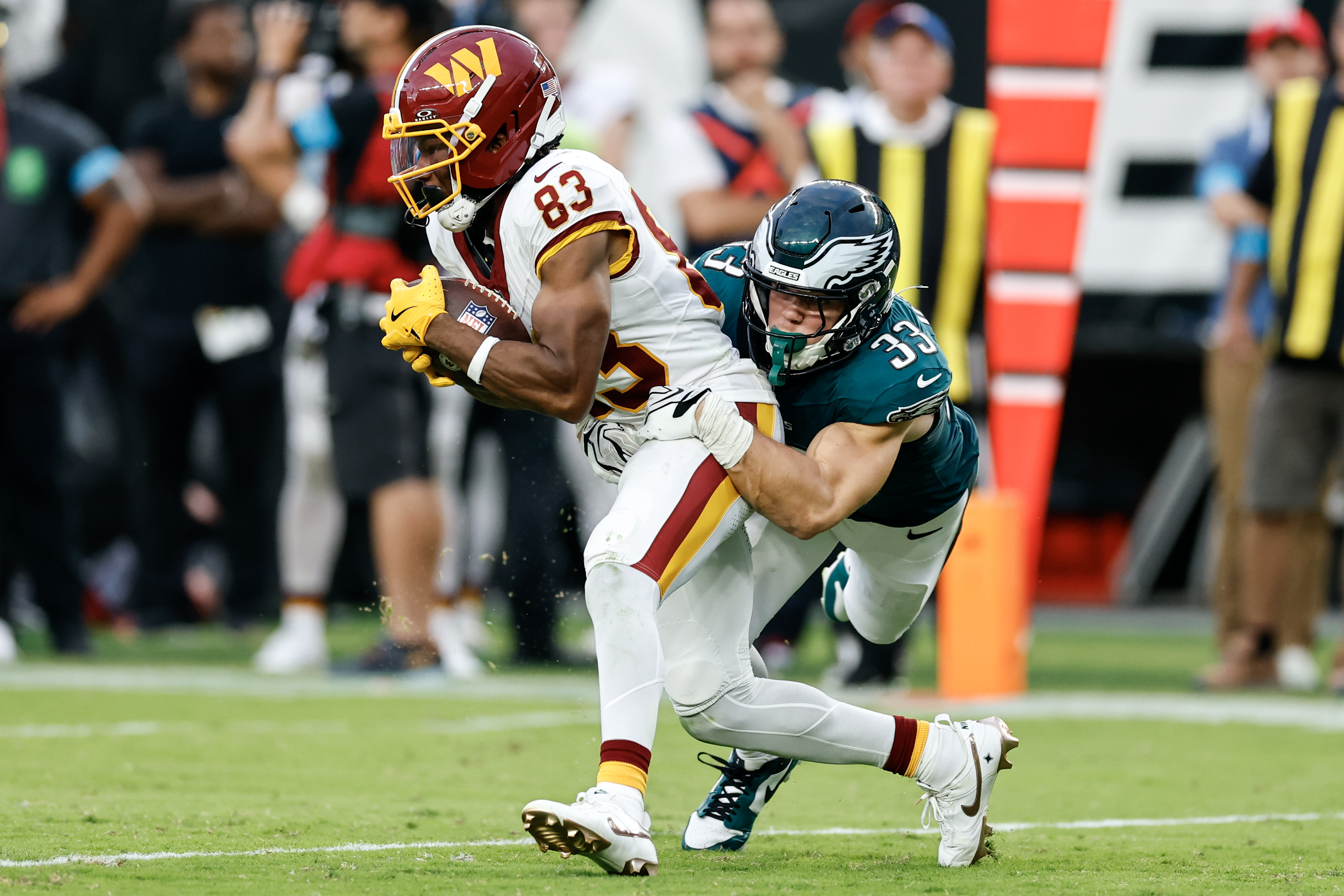
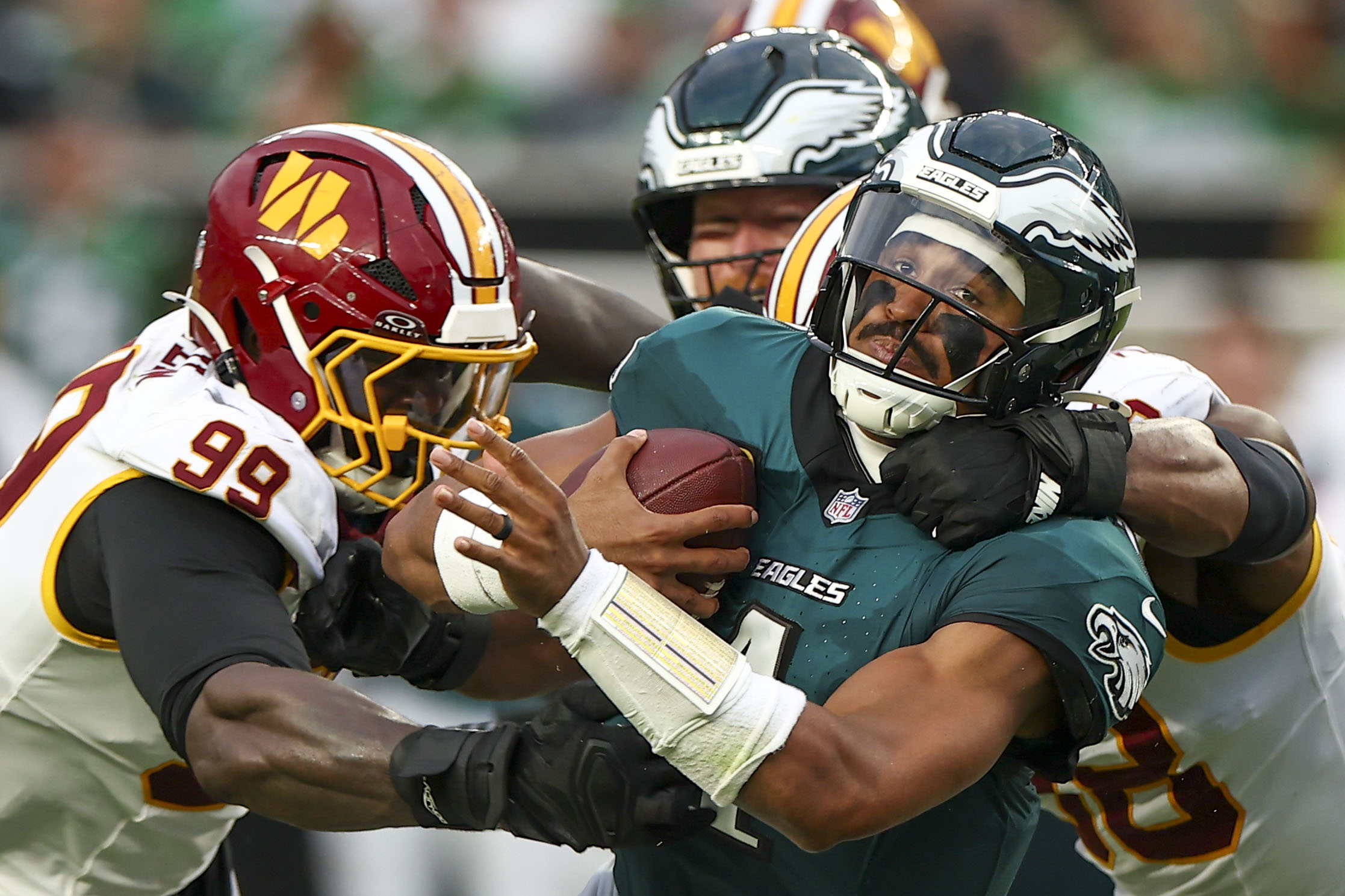
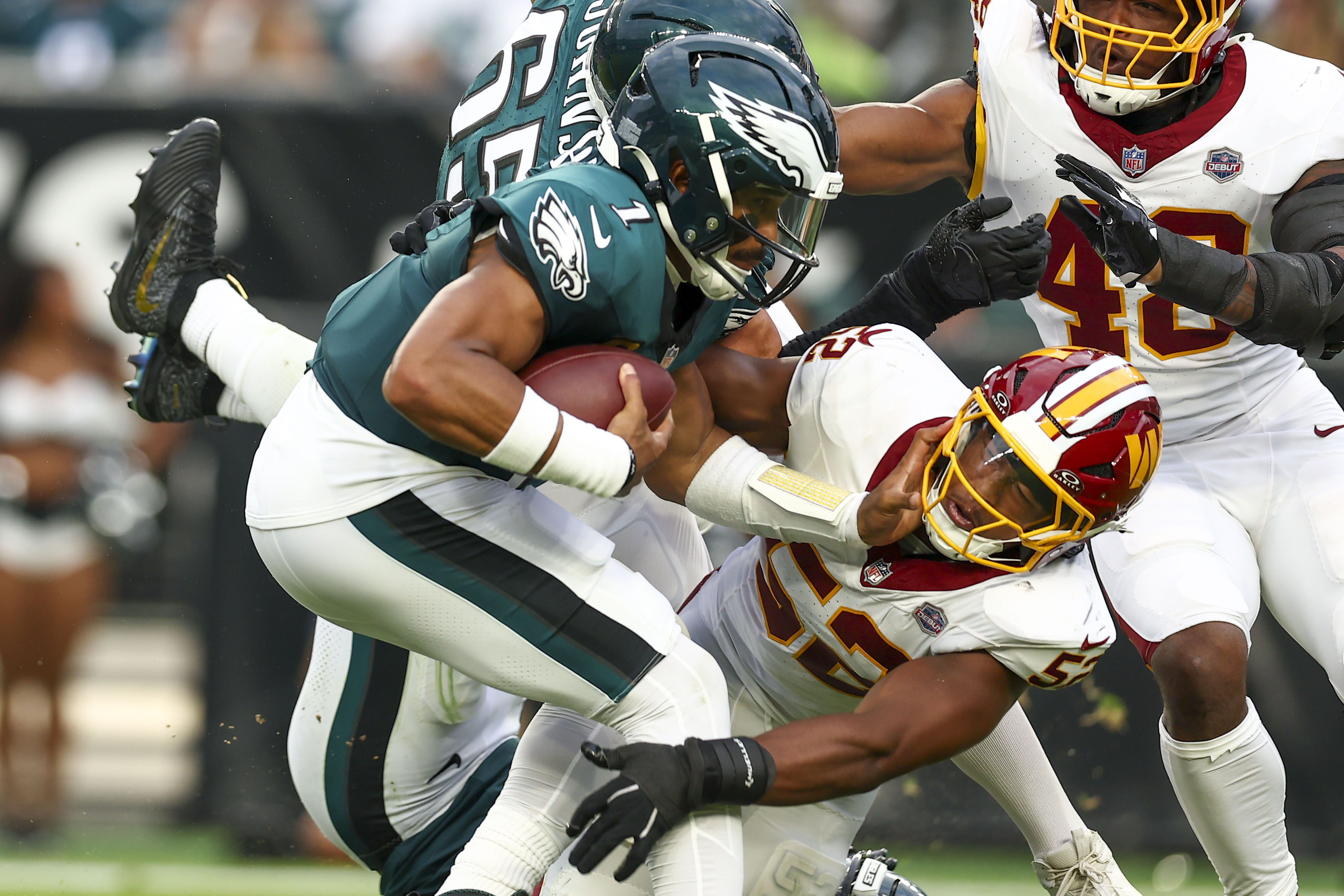
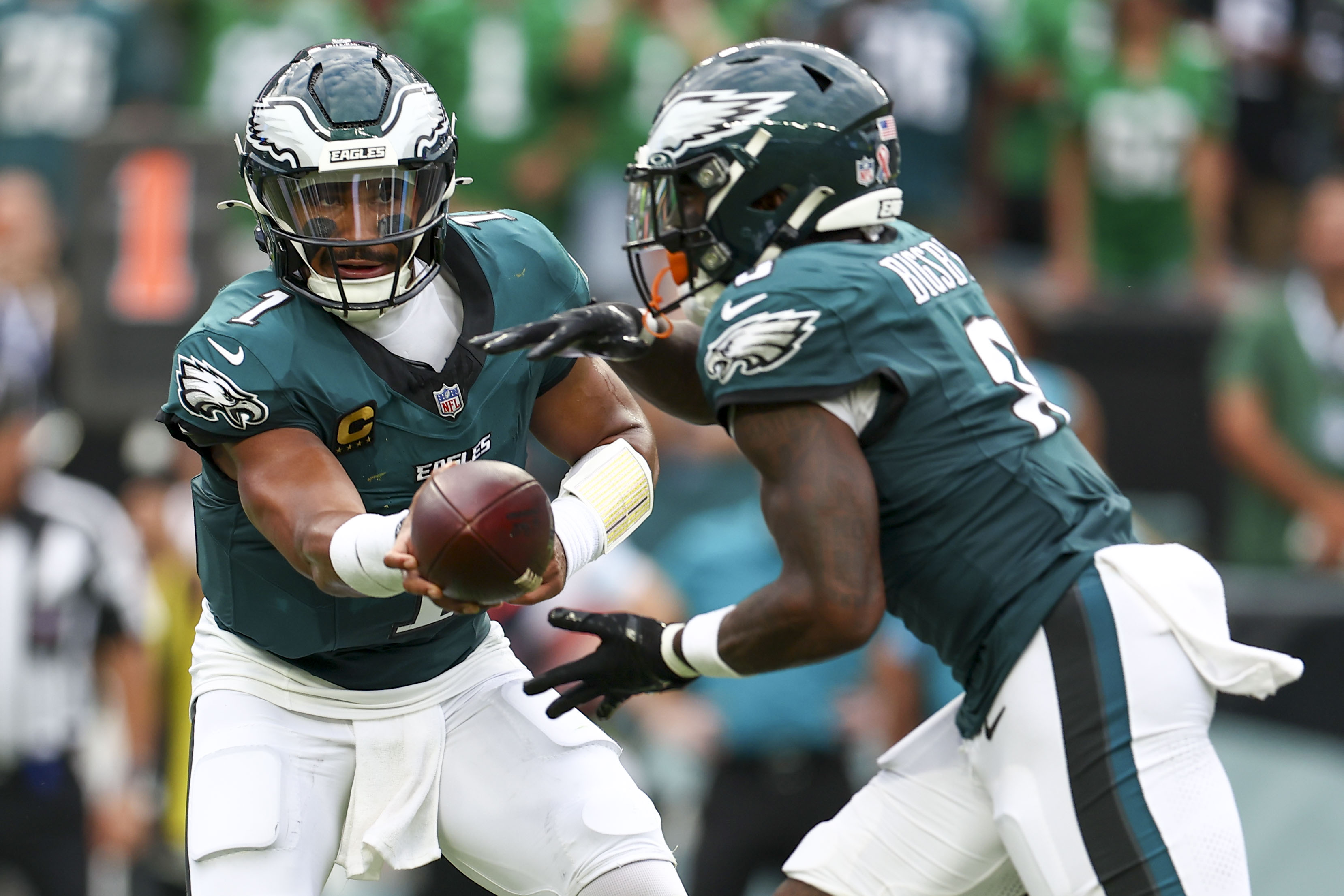
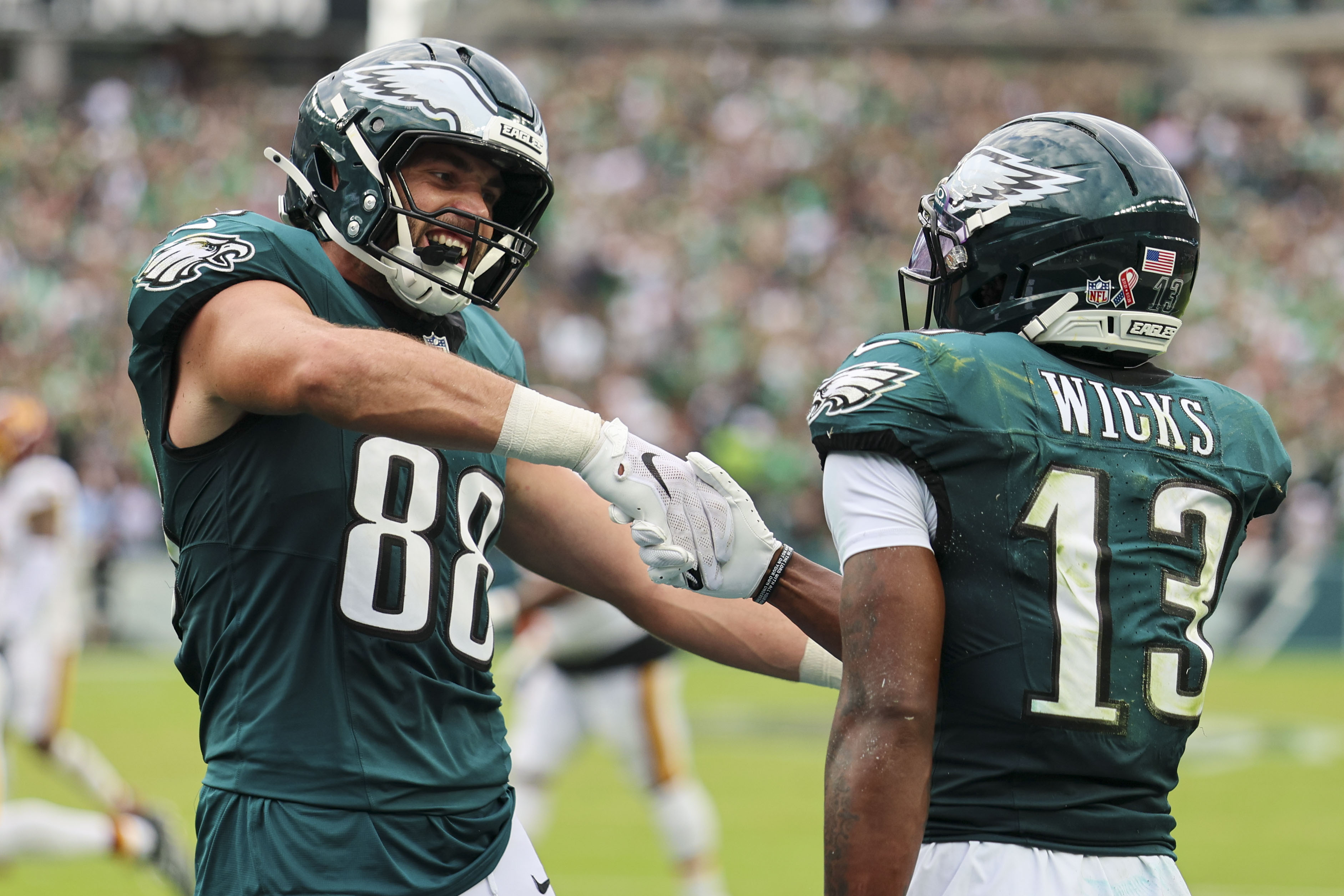
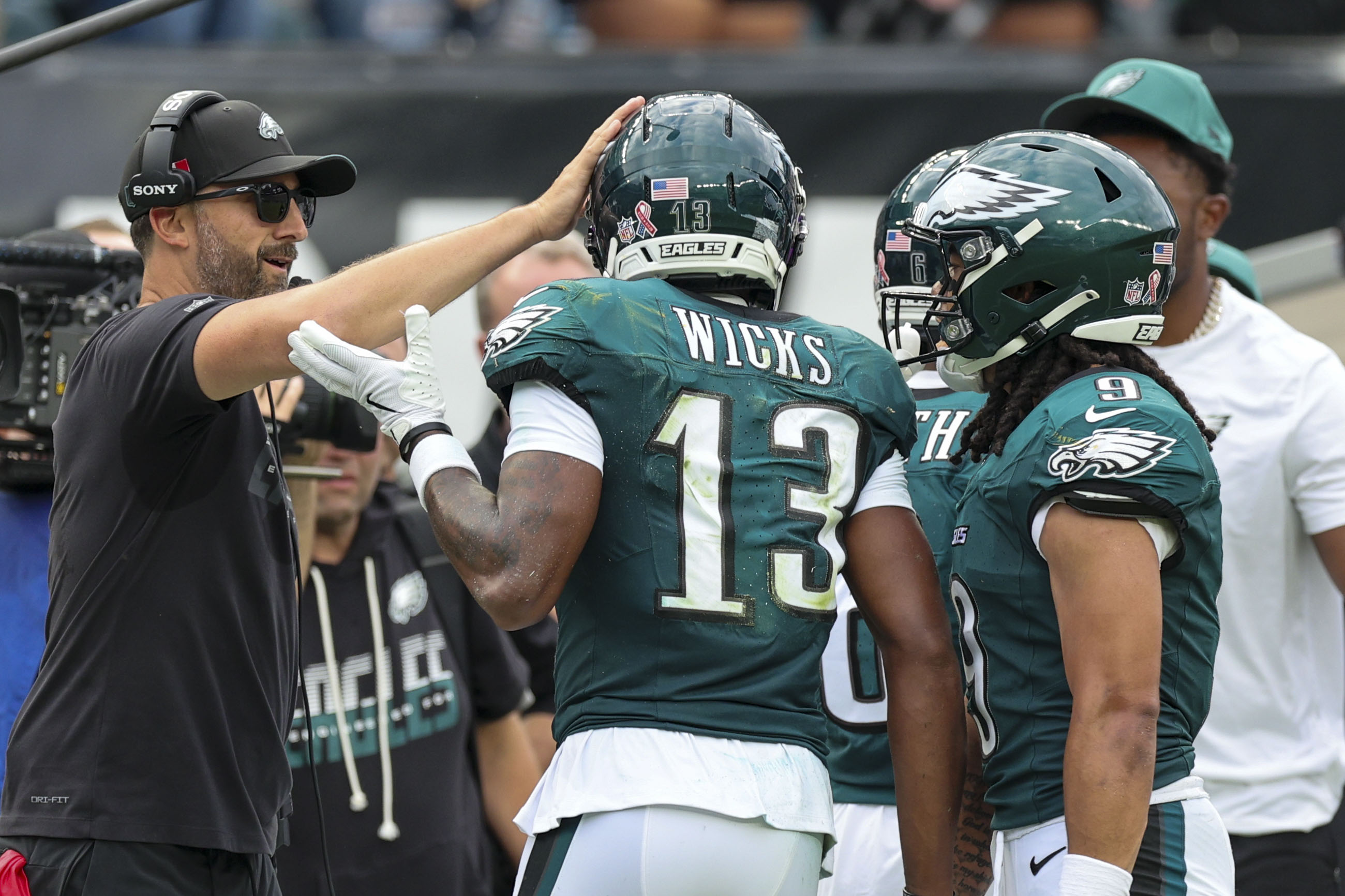
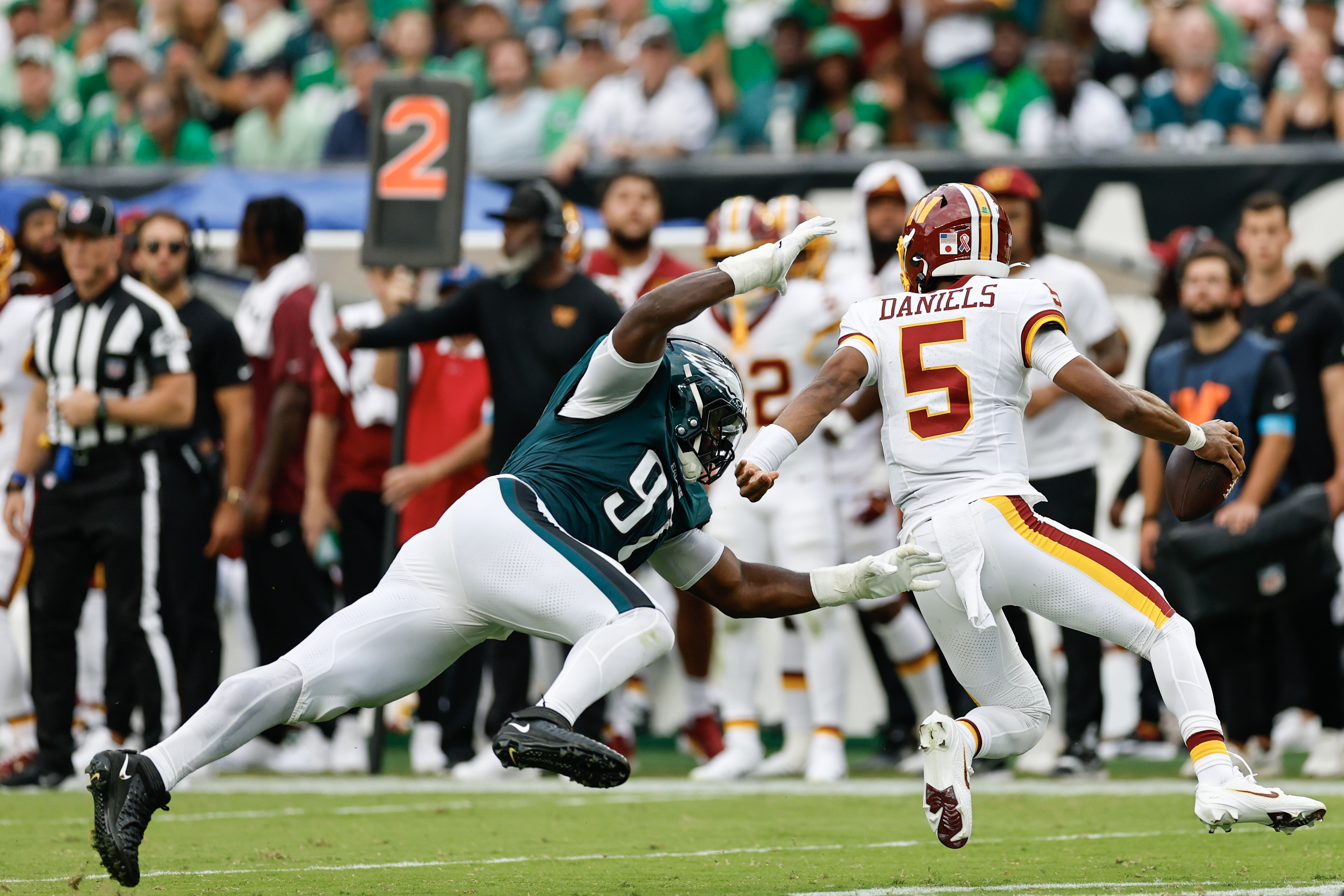
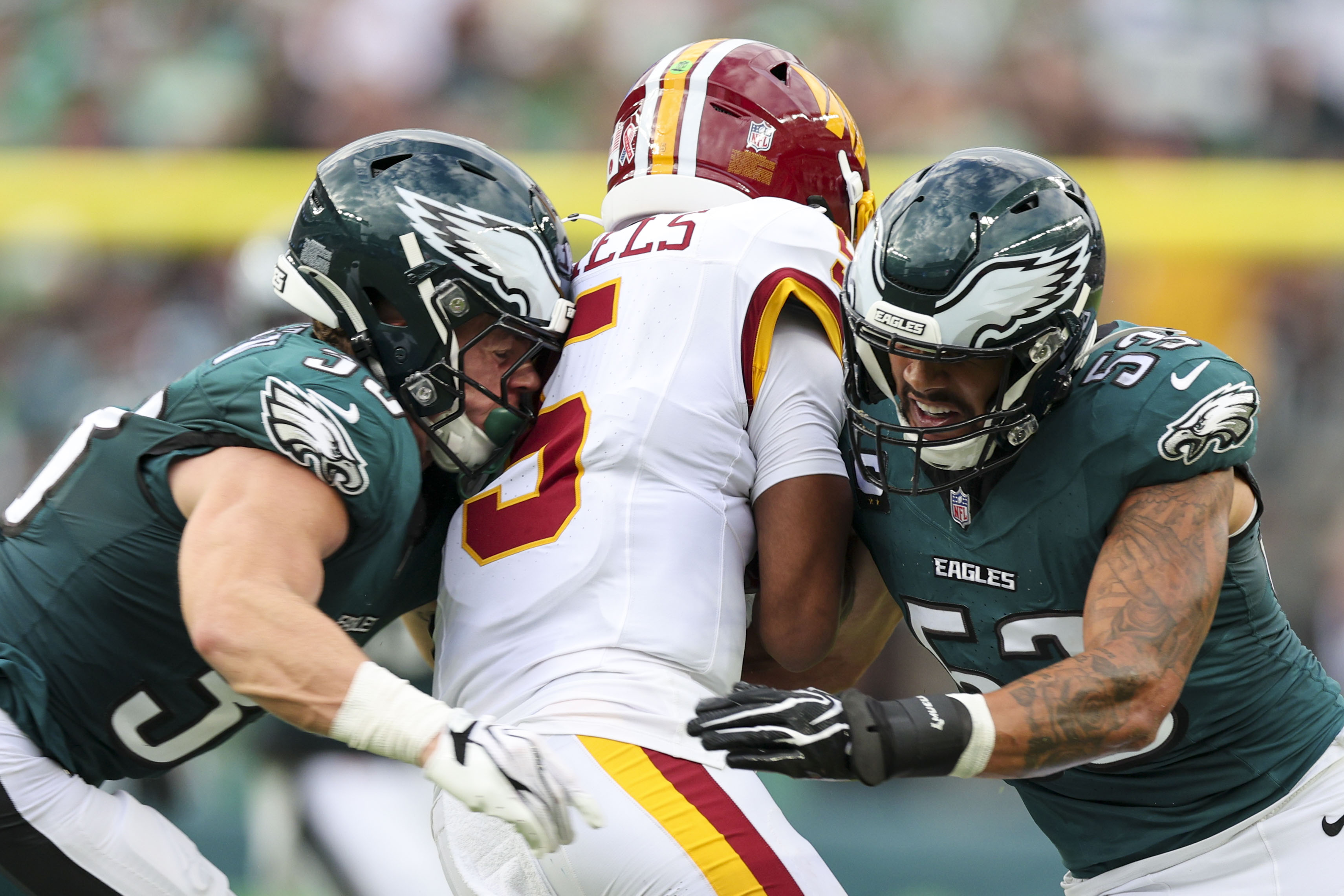
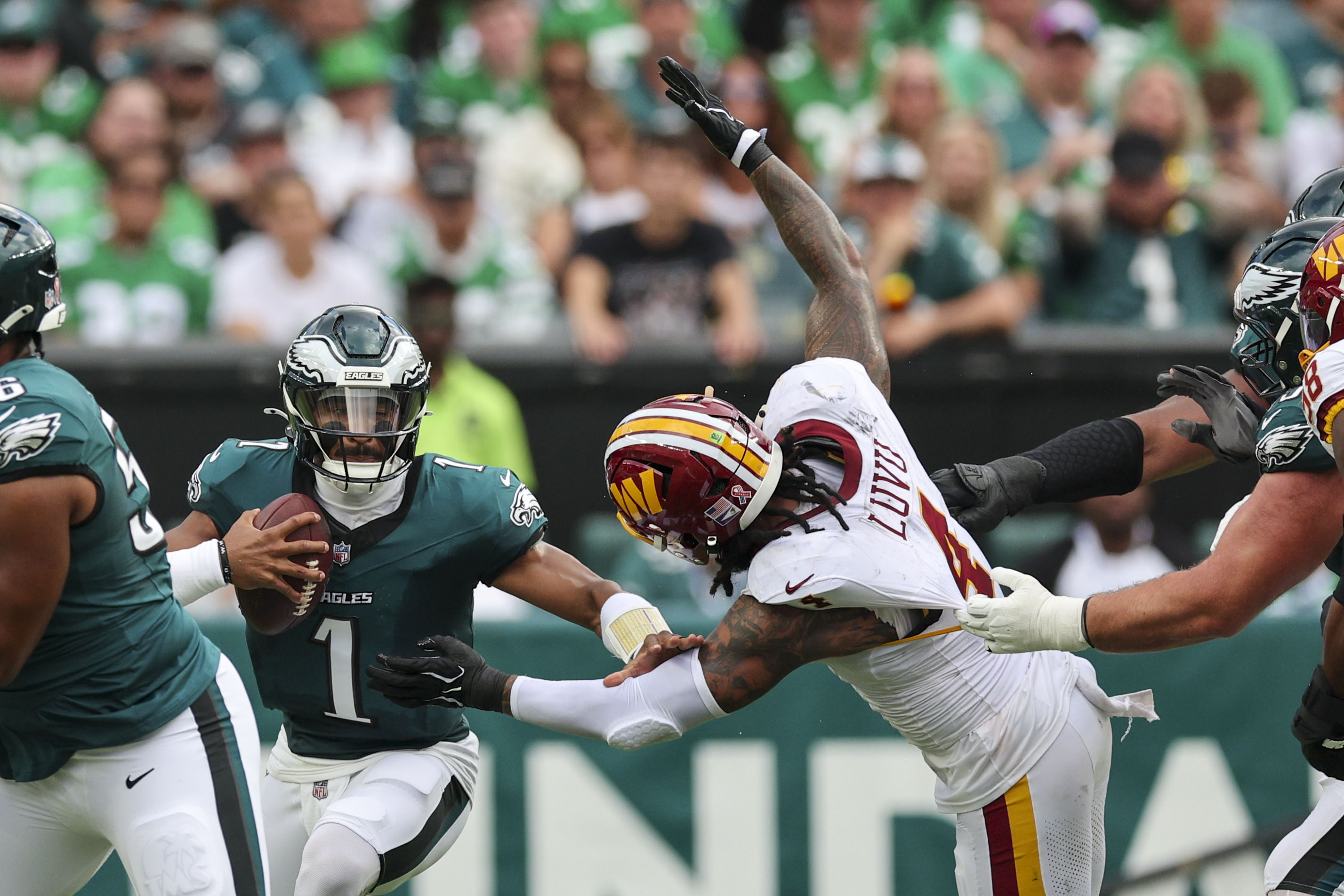
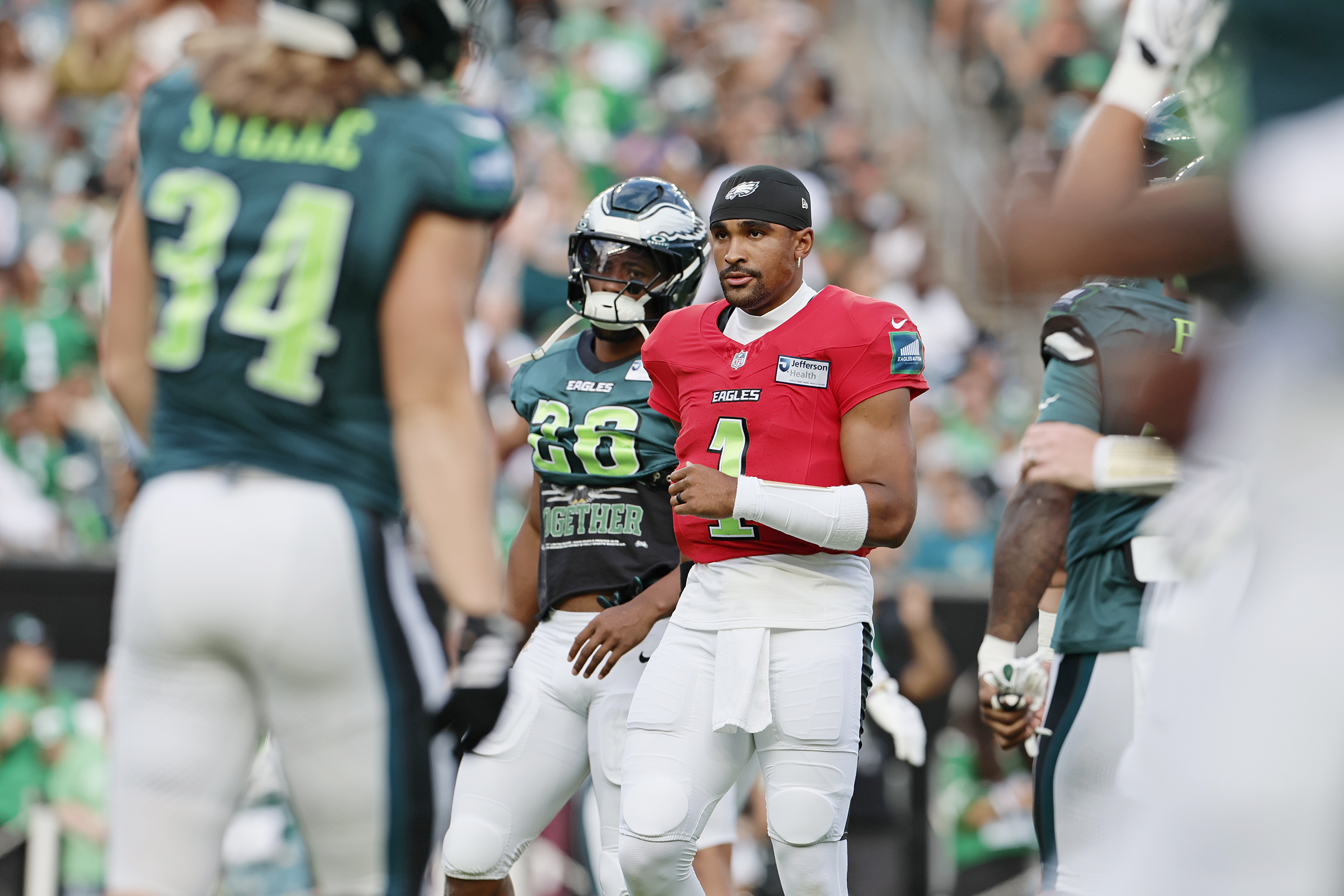
    Hurts was sacked three times, hit five times total, and was forced out of the pocket and into several throwaways. He also made some clutch throws under pressure — including hitting Wicks for a 9-yard touchdown with a rusher in his face — and scrambled five times for 48 yards.

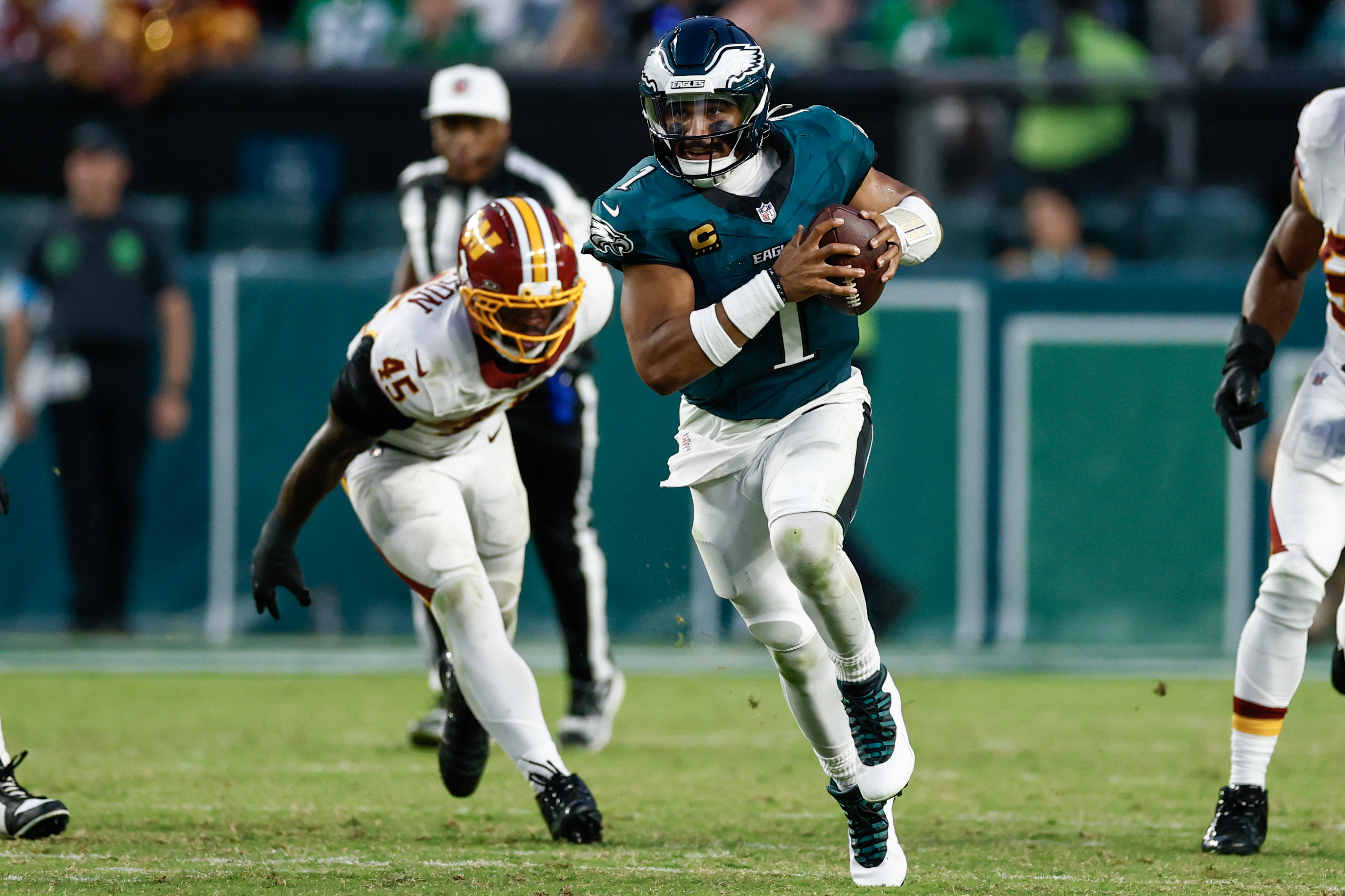
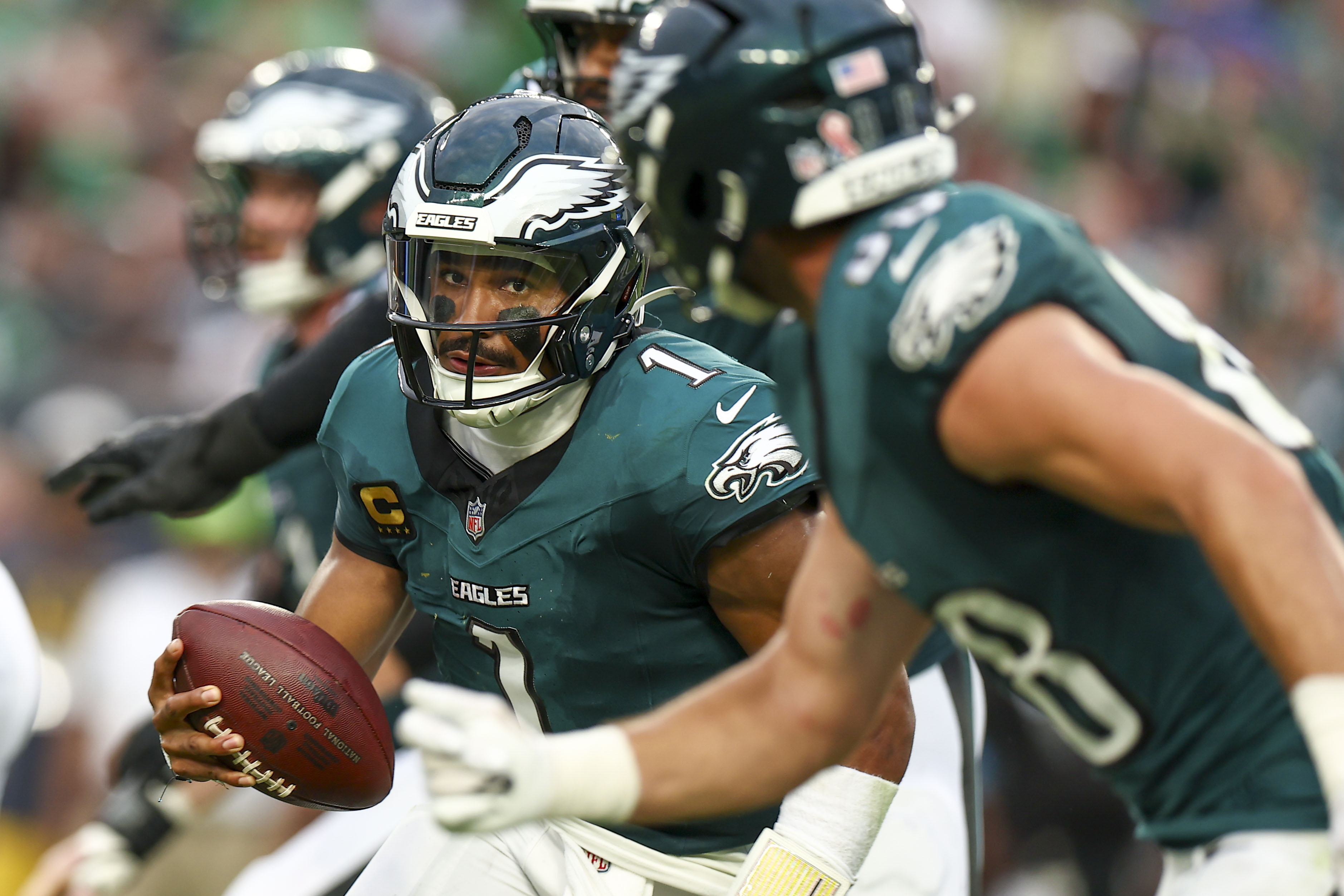
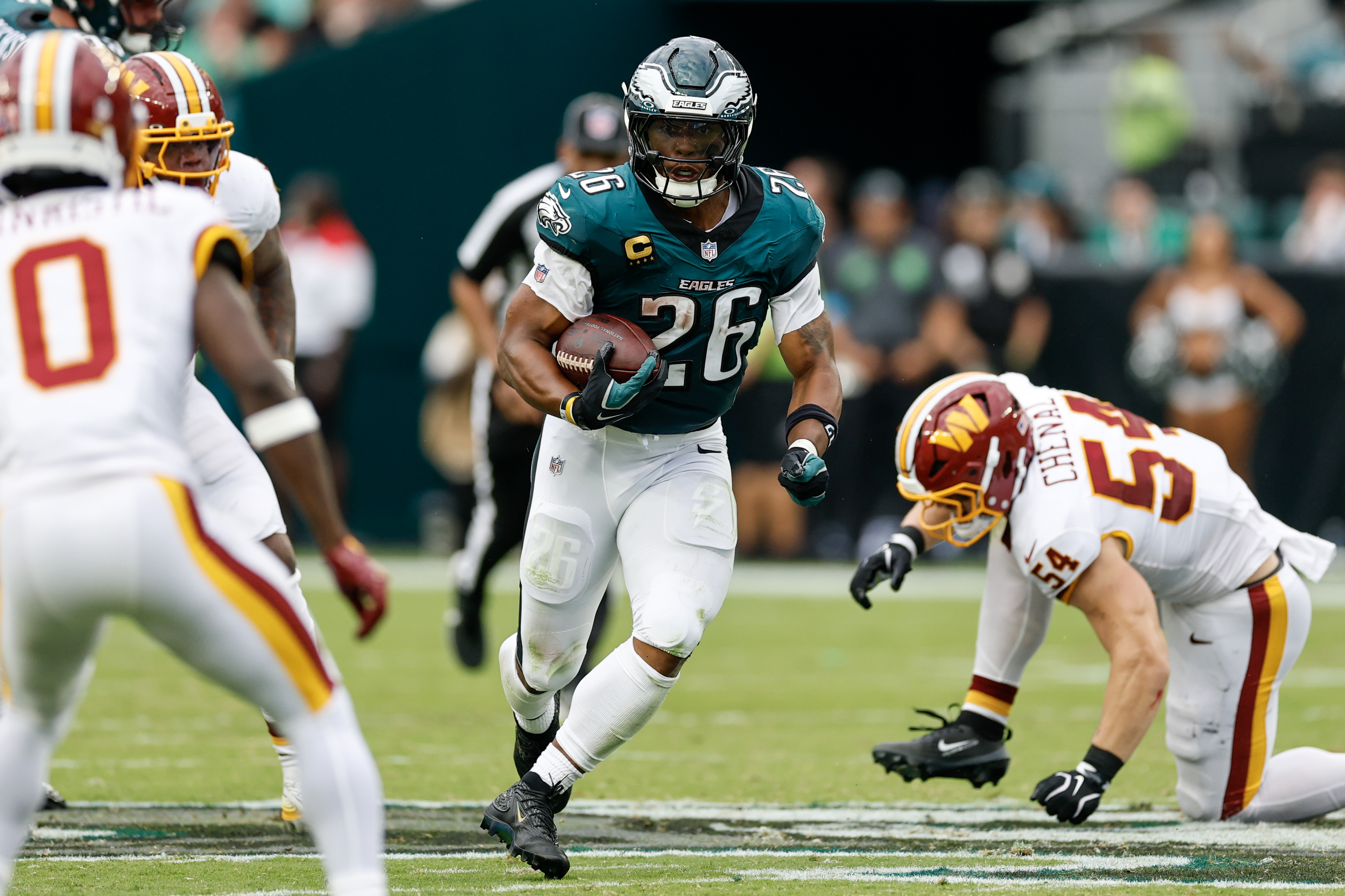
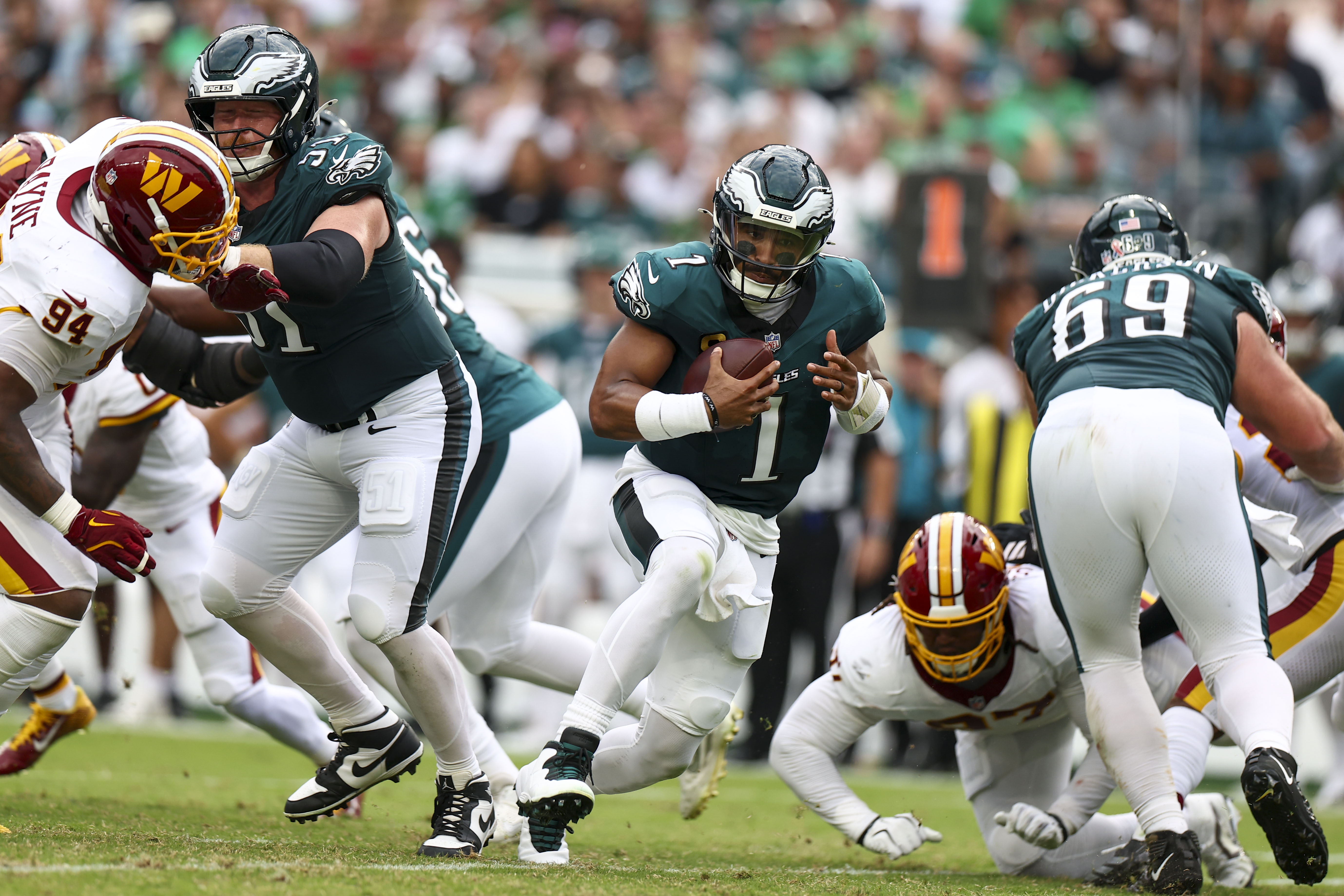
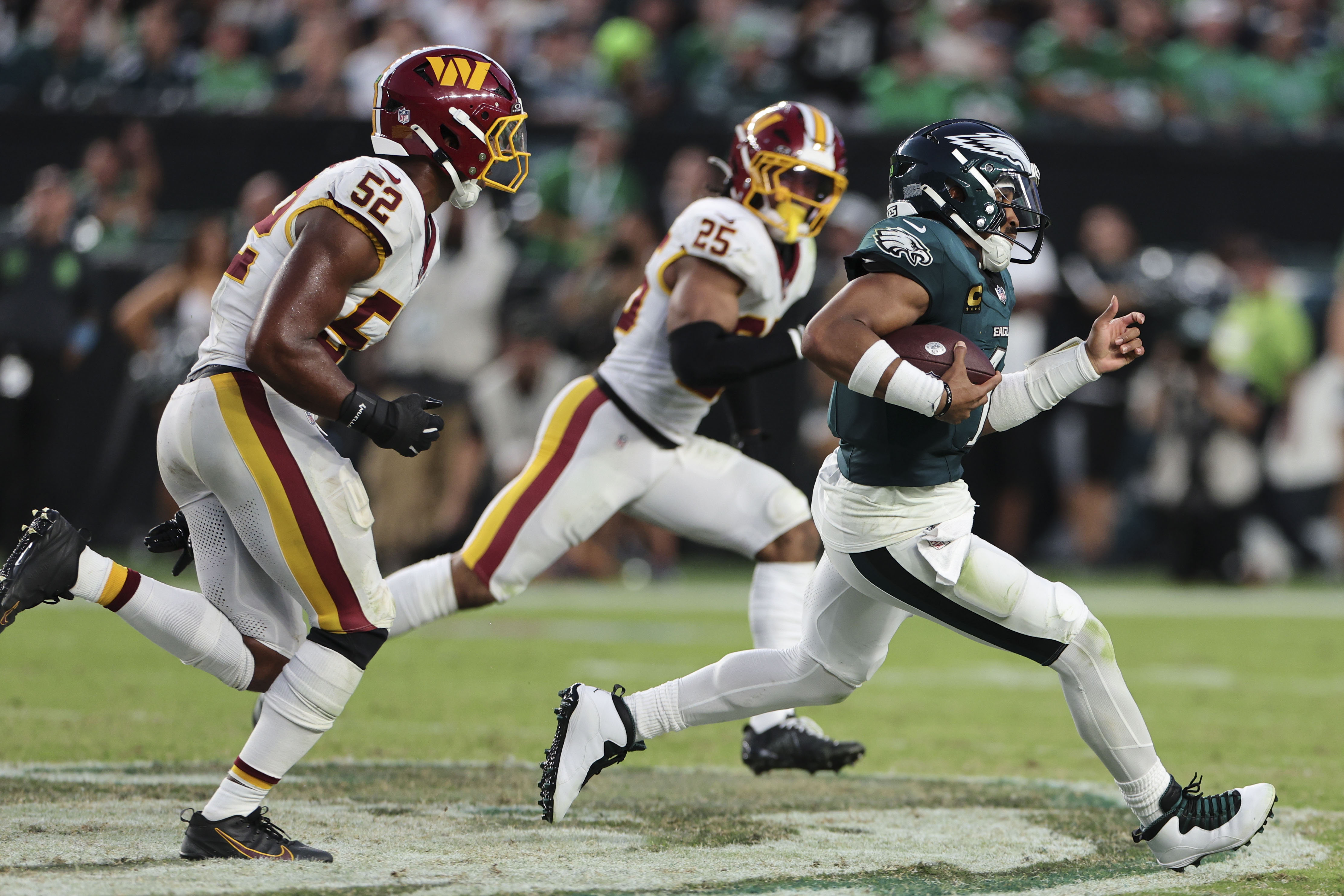
    His most impressive moment on the ground came on third- and-18 at the Eagles 31-yard line with about eight minutes left in the game. Hurts actually had a clean pocket. But Washington was in a deep zone and the quarterback decided to take matters into his own legs.

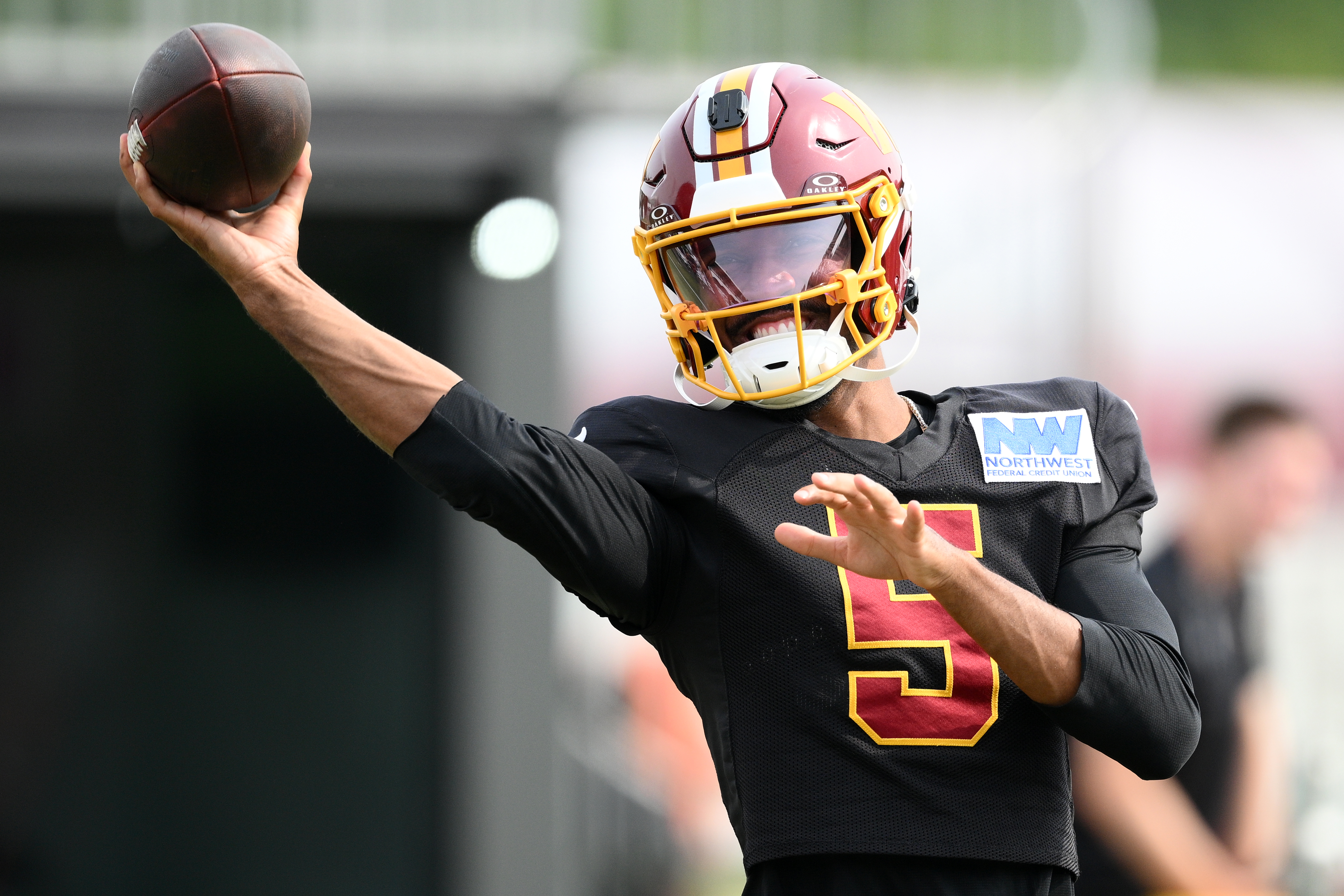
    Jalen Hurts looked more elusive in Week 1 than he did at times in 2025. Yong Kim / Staff Photographer

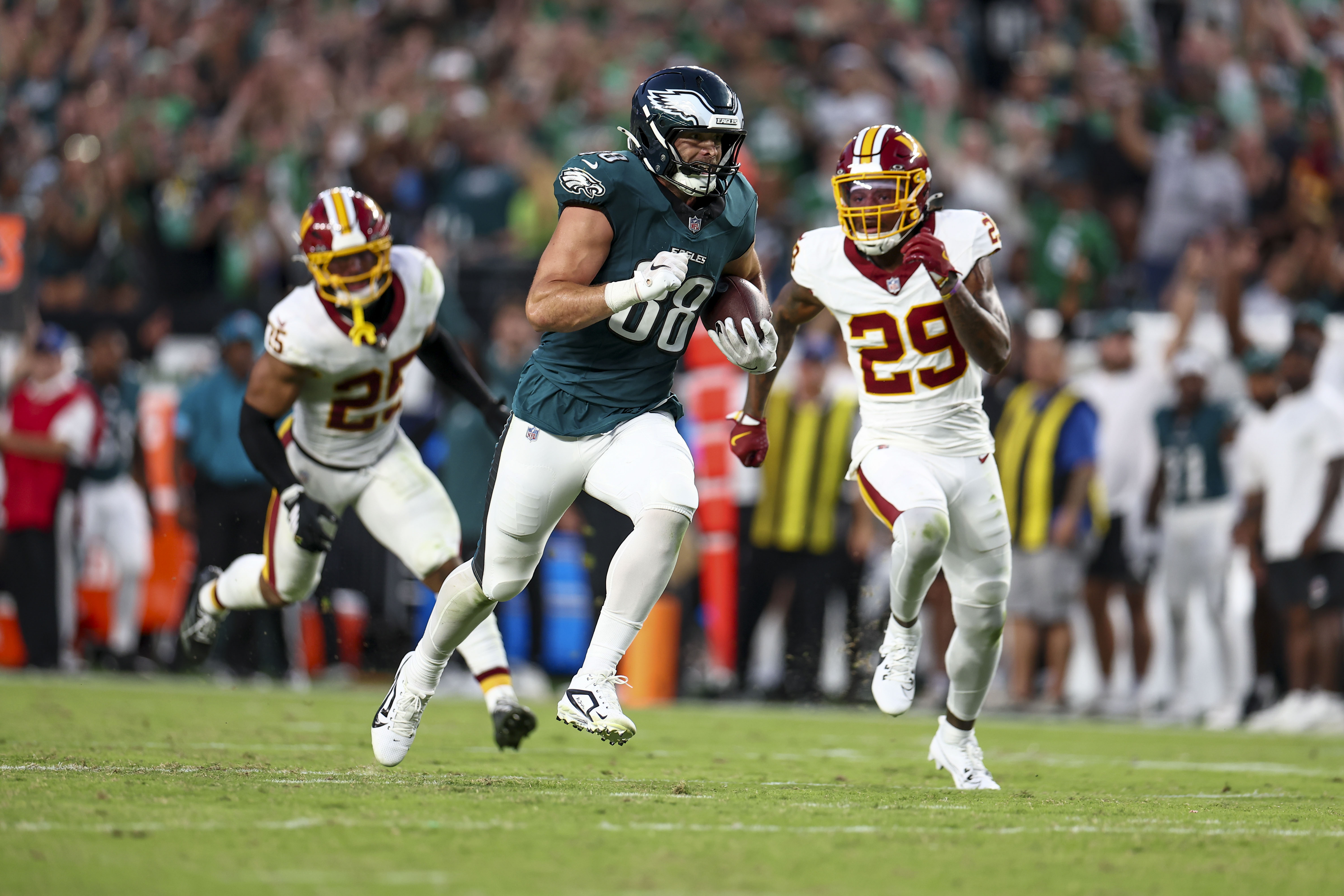
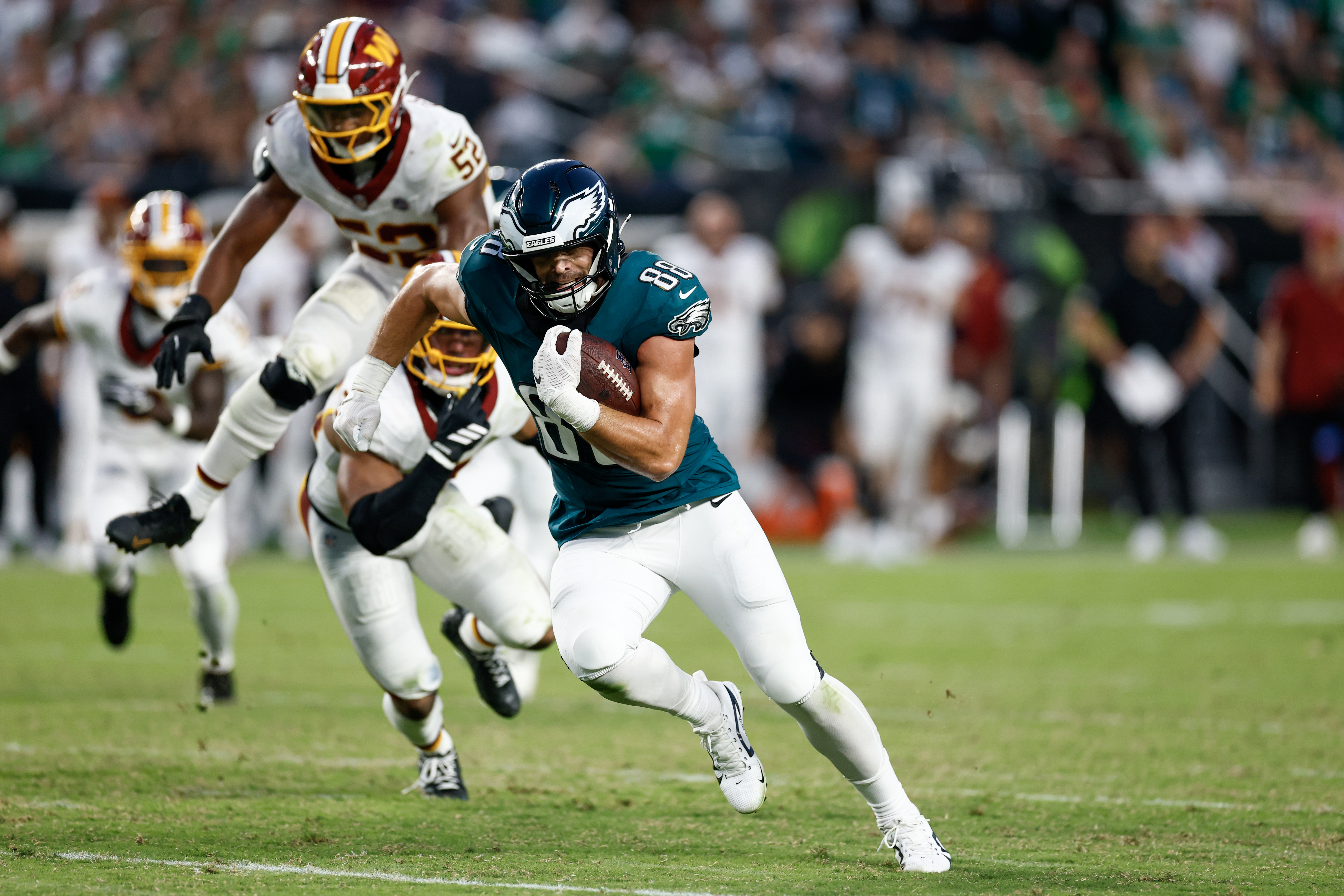
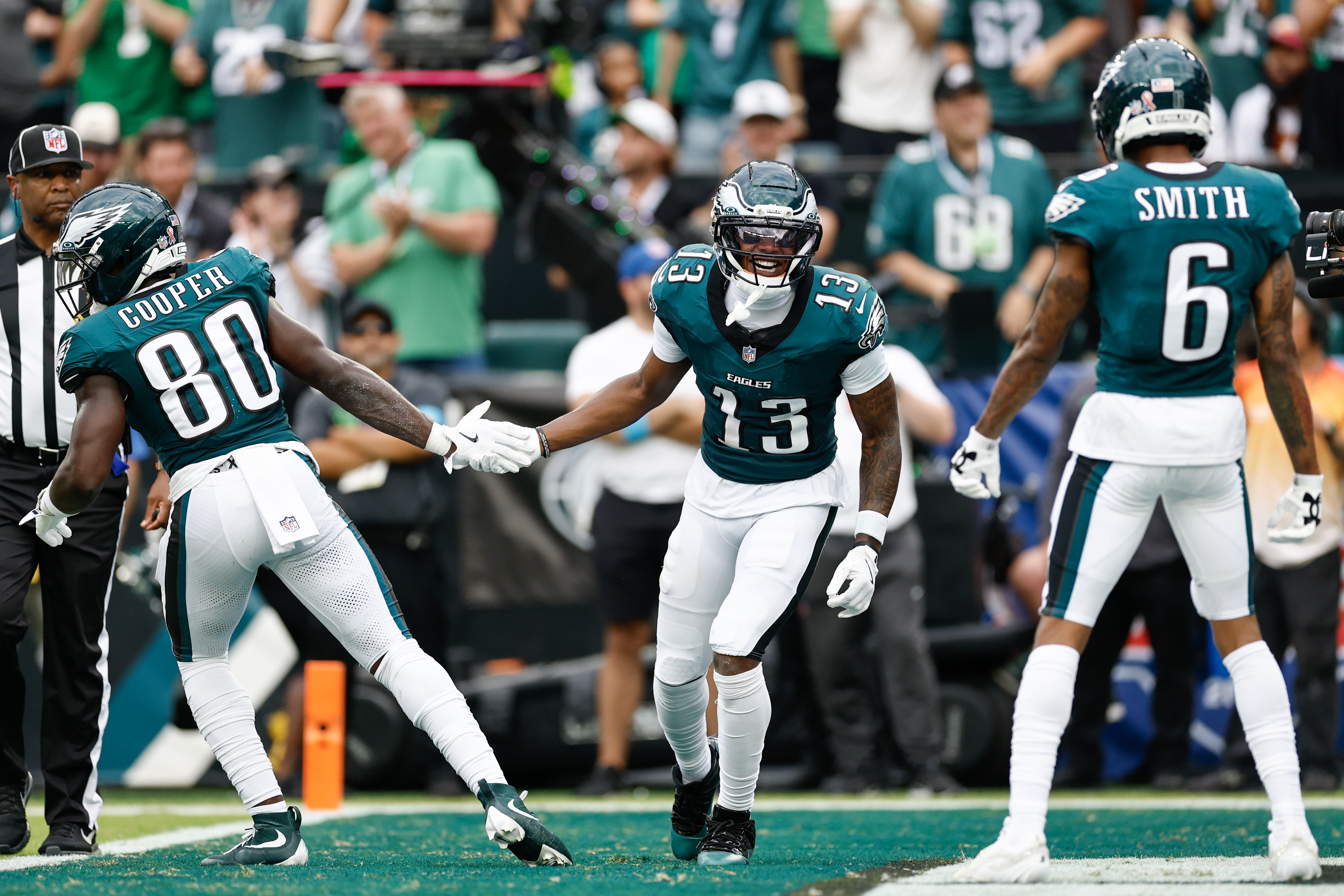
    Hurts scooted 22 yards up the middle and picked up the first down. And on the next third down, he laced another dart to Goedert — this time in between the hashes where Hurts had previously struggled to throw the ball — and the tight end took care of the rest for a 43-yard touchdown.

    “It’s just playing ball,” Hurts said initially about his 22-yard tote. Later on, he said it was a situation that required him to take over. “But it’s not something that’s forced,” he said.

    We’ve seen this early version of Hurts before. He’s had some of his best running performances in openers (see: at the Detroit Lions in 2022 and vs. the Dallas Cowboys in 2025). But the latter outing was a fleeting moment. Hurts hardly ever seemed completely comfortable last season on designed runs, or when he took off.

    Maybe he just didn’t have the same wheels.

    “You can see that he worked himself into shape to get back to how we know he can run the ball,” Barkley said, “and his legs came up big for us.”

    Vic Fangio and some Eagles defenders said he looked faster in camp, although Hurts said he didn’t feel any different nor had he done anything new in regard to his conditioning. Of course, after a season of often having interior pass rushers in his lap, maybe it was just prep work.

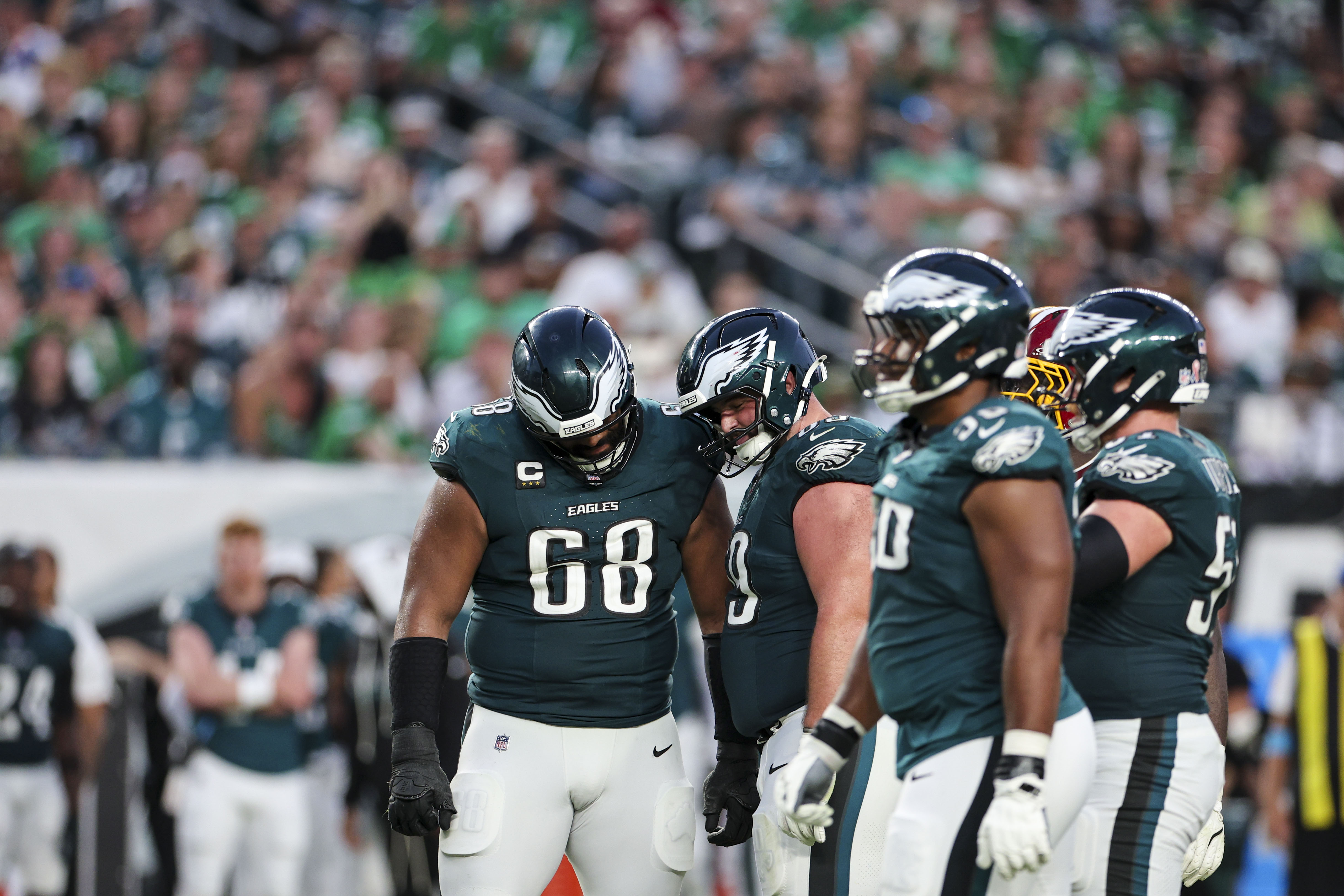
    Despite the narrative that left guard Landon Dickerson and center Cam Jurgens were healthy this offseason after playing through injury a year ago, the issues up the middle returned. Dickerson was especially porous in pass protection.

    Eagles guard Landon Dickerson (69), here making a block on a Jalen Hurts run, did not play well on Sunday and must continue to show growth in the Sean Mannion offense. Monica Herndon / Staff Photographer

    He was gone by the time the locker room opened, and in fact, left tackle Jordan Mailata said Dickerson had already disappeared by the time he got back to his locker stall post-shower. But Mailata took the blame for the sack when Commanders linebacker Frankie Luvu split the two offensive linemen in the first half.

    “There were times where I could have helped him a lot more, just on my set angle,” Mailata said. “Some of the games they were running. They got home on that one sack … and I just sat over the board too much.”

    All parties played a role in allowing too much pressure, with Hurts near the top of the list. He helps set the protections and only the quarterback can check out of bad plays. And there were many runs and drops that were D.O.A. That’s also on Mannion.

    “Sometimes they just get you and you have to figure out a way to execute the play when it might not be the best call for the play,” Eagles right guard Tyler Steen said. “It just happened with that defense.”

    Washington had first-time play callers on both sides of the ball. Coordinator Daronte Jones came from the Brian Flores school of pressure defense, so it wasn’t as if the Eagles weren’t prepared for the Commanders to crowd the line and change the picture for Hurts post-snap.

    But there were multiple times when the O-line and the blitz pickup crew weren’t on the same page in terms of blocking responsibilities. The new scheme under new O-line coach Chris Kuper has altered some of the rules. So there’s going to be a learning curve.

    And that applies to Mannion’s play calling, as well. Screens are a good way to offset interior pressure, but the Eagles seemed to force short passes to rookie receiver Makai Lemon just because of his first-round draft stock.

    Sean Mannion ran his scheme in Week 1 but mixed in concepts the offense has a track record of executing well. David Maialetti / Staff Photographer

    To his credit, the 34-year-old coordinator made adjustments. He went with an old bread-and-butter inside-zone concept to help spring Barkley for 42 yards on third-and-2. And there were other power runs with duo blocking that gained positive yards.

    But Eagles running backs averaged just 2.8 yards on carries other than the 42-yarder.

    “We were so close on hitting on some of those,” said Jurgens, who had two first-half holding penalties.

    Jurgens wasn’t the only Eagle to struggle. As dominant as Fangio’s defense looked through three quarters, there were cracks in the fourth quarter as Washington mounted a comeback. But the unit was on the field for 14 more plays and almost seven more minutes than the offense.
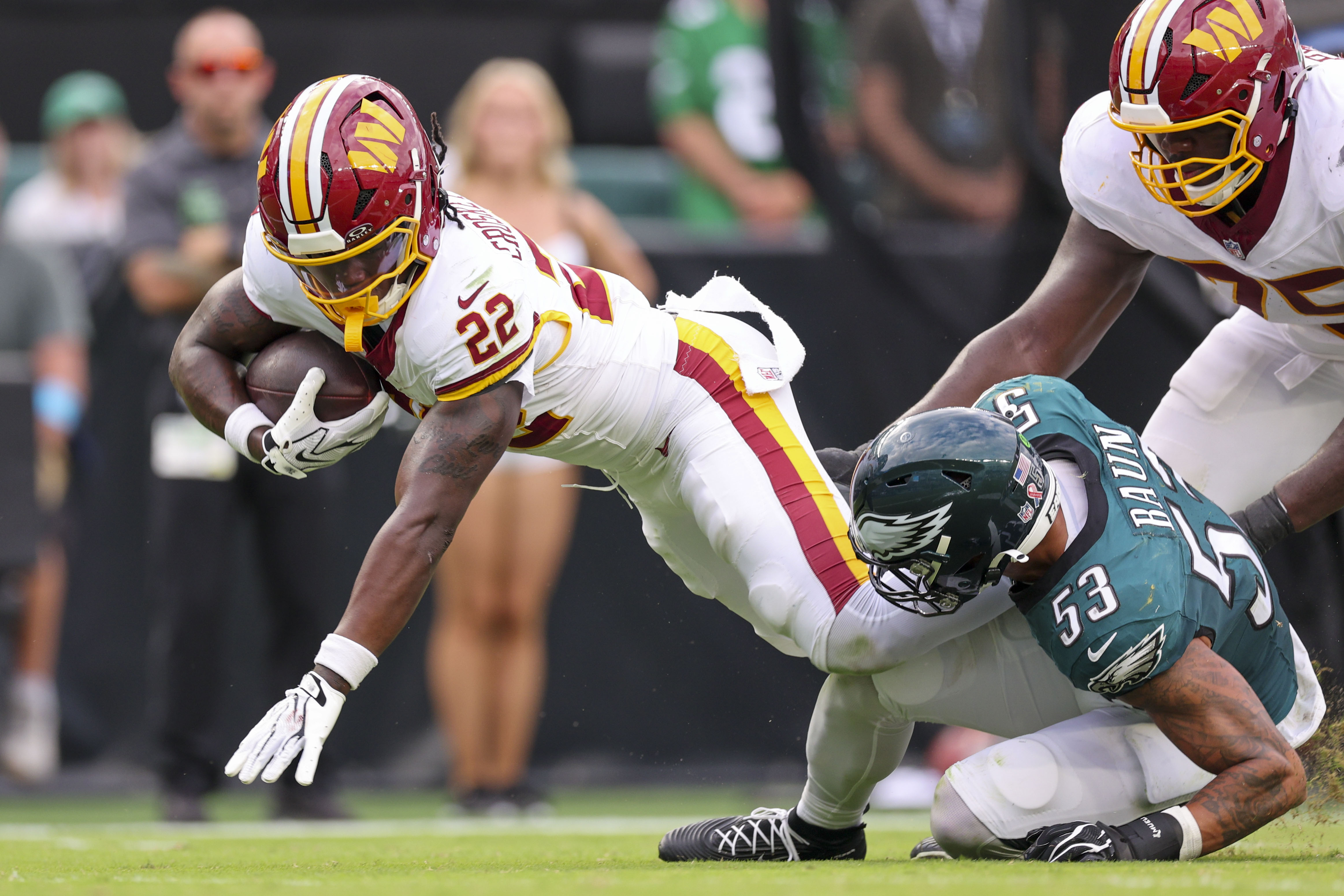
    It felt like a 2025 redux against an opponent beset by injuries and low outside expectations.

    Jalen Hurts’ big throws and leadership helped the Eagles start 1-0 for a sixth straight year. David Maialetti / Staff Photographer

    But there might have been a little Week 1 uncertainty in the outcome. Hurts didn’t know exactly what to expect with Mannion in his ear, but he said he tried to block out the variables outside his control.

    “I fixed my mind to not put stock into the minutiae,” Hurts said.

    There is little an individual can control in football. It takes a village. But Hurts plays the one position with the most power. He acknowledged as much when he referenced his Saturday production meeting with Fox analyst and quarterback G.O.A.T. Tom Brady, one of the best ever pre-snap.

    “A lot of it is about making sure you’re in the right play, when you’re doing the right thing that takes no talent,” Hurts said. “Are we in the best run? Are we protecting ourselves in protection? Is everybody aligned doing those little things first? That is the most important thing.

    “It’s more of an operation and being able to set the table and manage the things you’re tasked with managing as a quarterback and then all the other things that are to come. I ended on the note of it taking all 11 [players]. It takes all 11.”

    Sometimes it takes just one. The 28-year-old Hurts still has the ability to take over games with his athleticism. And he may have to do more of it as Mannion grows into his job and the offensive line adjusts to the changes.

    But he wants to be like Brady, even if he still idolizes Jordan.

  • This better not be the new normal for the Eagles offensive line

    This better not be the new normal for the Eagles offensive line

    There are lots of words one could use to soft-pedal a critique of the Eagles’ offensive line in Week 1.

    Uneven. Inconsistent. Uncharacteristic.

    They are words that allow a little leeway, words that grant some level of benefit of the doubt. That is to say, they are words that one may feel desperate to err toward after a performance like that of the Eagles’ run and pass blockers in their 24-22 season-opening win on Sunday. Landon Dickerson, Cam Jurgens, Jordan Mailata, Lane Johnson — these guys deserve every ounce of the political capital they’ve accrued during their time together as a unit. Let ye who hath never paved the way for a 2,000-yard rusher en route to a Super Bowl cast the first stone.

    And yet …

    The surest sign of the bottom line is the dancing you do around it. The bottom line for the Eagles run- and pass-blockers is this: They were not good enough in Week 1. Not even close.

    The final numbers don’t do it justice.

    Jalen Hurts was sacked three times, a total the Eagles surpassed in seven games even in 2024. But that total doesn’t come close to capturing the pressure the Commanders were able to generate throughout the game. Hurts scrambled seven times for 46 yards, mostly out of necessity.

    “I thought Jalen did a great job of making plays, especially when something wasn’t going right,” Jurgens said.

    Jalen Hurts (right) was on the run a significant amount in Week 1. David Maialetti / Staff Photographer

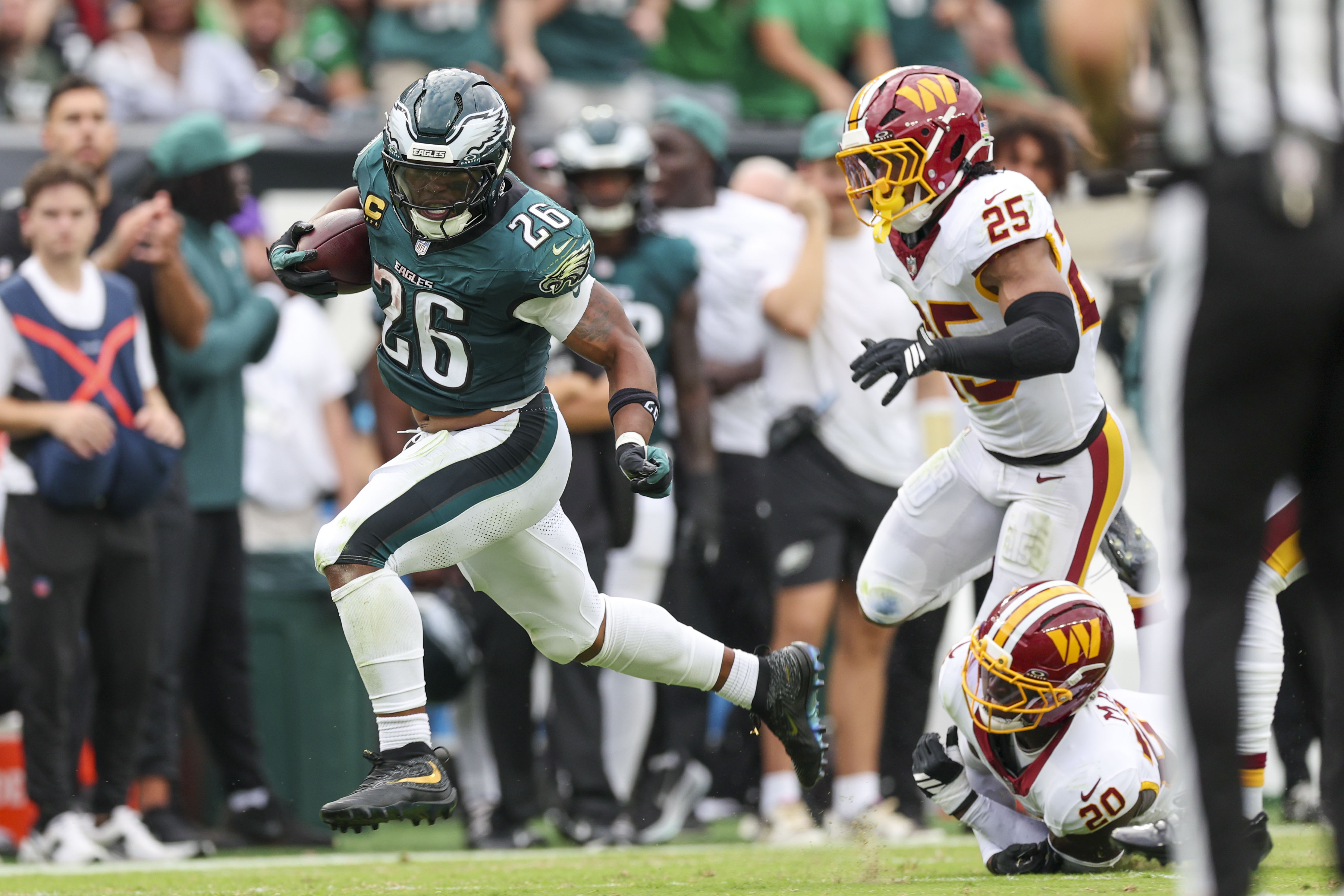
    Saquon Barkley averaged 5.5 yards per carry, which is something he did in just three games all of last season. But his 42-yard run off a vintage jump-cut in the first half is doing more than its fair share of work in padding the average. On his other 14 carries, he gained 41 yards.

    If you didn’t watch the game, all of this might sound like cherry-picking numbers and mathing the math to match a preexisting narrative bias. That’s not the case. If anything, the preexisting bias goes in favor of this offensive line. This was a game flow thing. It is a second-and-long, third-and-long thing. The Eagles faced way too many of those situations throughout Sunday’s win.

    “It’s tough to be in those situations,” Eagles head coach Nick Sirianni said. “We’ll look at the tape and see and evaluate that thing. But no doubt, to do everything you want to do as an offense, whether that’s some tempo that we did on the ball, whether that’s being able to take some deep shots down the field, get multiple guys carries. You’ve got to get into the flow of the drive. We know that’s important and we’ll be working like crazy to do everything we can do to get that fixed.”

    Hurts put it more succinctly.

    “We shouldn’t be in third-and-17,” the Eagles quarterback said.

    Unsaid was why they were there. Almost exclusively, it began up front. Two holding penalties on Jurgens. One on Dickerson. A false start on Mailata. Add in the sacks. Add in the negative runs. It adds up.

    You want to talk numbers? Here was the craziest one. One team had 10 tackles for loss. The other team had two. The team that had 10 was not the team with the vastly better defense.

    The funny thing about critiquing the Eagles offensive line is that it can be difficult to remember what fallibility looks like. Most of the NFL lives a life much worse than the one the Eagles lived on Sunday. At the same time, we judge this offensive line by the standard it has set, and we do it because that standard has been the foundation of their formula.

    This is an important point. The Eagles are a good team. It would take a heck of a lot of unforeseen circumstances for the season to truly go sideways. In today’s NFL, a team can lose only so many games when it has a dominant defense and a competent quarterback who doesn’t make mistakes and can make big plays. We saw that throughout Sunday’s win. As close as the score was throughout, as theoretically “in-the-game” the Commanders were, was there ever more than a fleeting doubt about the end result?

    Even when Washington was driving for a potential game-tying touchdown in the closing minutes of the fourth quarter, the odds still said somebody would make the play that Moro Ojomo did in stuffing Washington’s shovel-pass on the woulda-coulda-shoulda two-point conversion to even the score at 24-24. You only get that peace of mind by drafting superstars and pairing them with great coaching, The Eagles have done both of those things. Because of it, and a soft schedule, their bare minimum win total should be enough for a playoff berth. The floor of this team is set by its defense.

    The ceiling? That will be set by the offensive line. For as long as Hurts has been QB1 and Sirianni has been head coach, the Eagles offensive identity has been the same. The quarterback will manufacture a certain number of big plays on his own accord. The rest of the time, the offensive line will wear you down with a steady stream of four- and five-yard carries on first and second down. As smart as new offensive coordinator Sean Mannion may be, as needed as some of the ongoing changes to this offense are, it is naive to think that everyone can simply snap their fingers in unison and become a team with an identity dramatically different from what it has always been.

    To be clear, nobody inside the locker room seems to think that is what they are attempting. Sirianni, Hurts, Mailata — all understand what they need to be. The Eagles’ genius as an organization has always been their understanding of and prioritization of football’s longest-standing fundamental.

    “I really do think we can get back to where we were two years ago,” Mailata said. “We’re going to keep evolving this offense as we go. Today was a good start.”

    Let’s hope he can speak it into existence.

  • The Eagles considered pushing Dallas Goedert out the door. He keeps showing why they didn’t.

    The Eagles considered pushing Dallas Goedert out the door. He keeps showing why they didn’t.

    It goes too far to say that the Eagles have been trying to get rid of Dallas Goedert over the last two years, but it is fair to suggest that they’ve been open to other options. They signed him to a one-year contract before last season, then another one-year deal before this one, and those resolutions arrived with the feeling they had settled on him, that they were hesitant to commit to him as they had when he was younger.

    This offseason and preseason seemed to bring their own softly tolling bells for Goedert, who will turn 32 in January, and his time here. The Eagles used a second-round pick on a tight end, Eli Stowers — a move strikingly similar to their decision to draft Goedert in the second round of the 2018 draft, when Zach Ertz was in his prime. They signed Johnny Mundt to pick up much of the blocking slack whenever new offensive coordinator Sean Mannion might opt for a two-tight end set. And as Stowers struggled throughout training camp — a slog that culminated with the Eagles’ placing him on injured reserve 24.5 hours before their 24-22 season-opening victory Sunday over the Washington Commanders — Goedert has remained grounded amid the rumors that general manager Howie Roseman might increase the Eagles’ depth at the position by re-signing Ertz.

    “Howie’s the GM,” Goedert said just before exiting the Eagles’ locker room Sunday. “Got no control over that.”

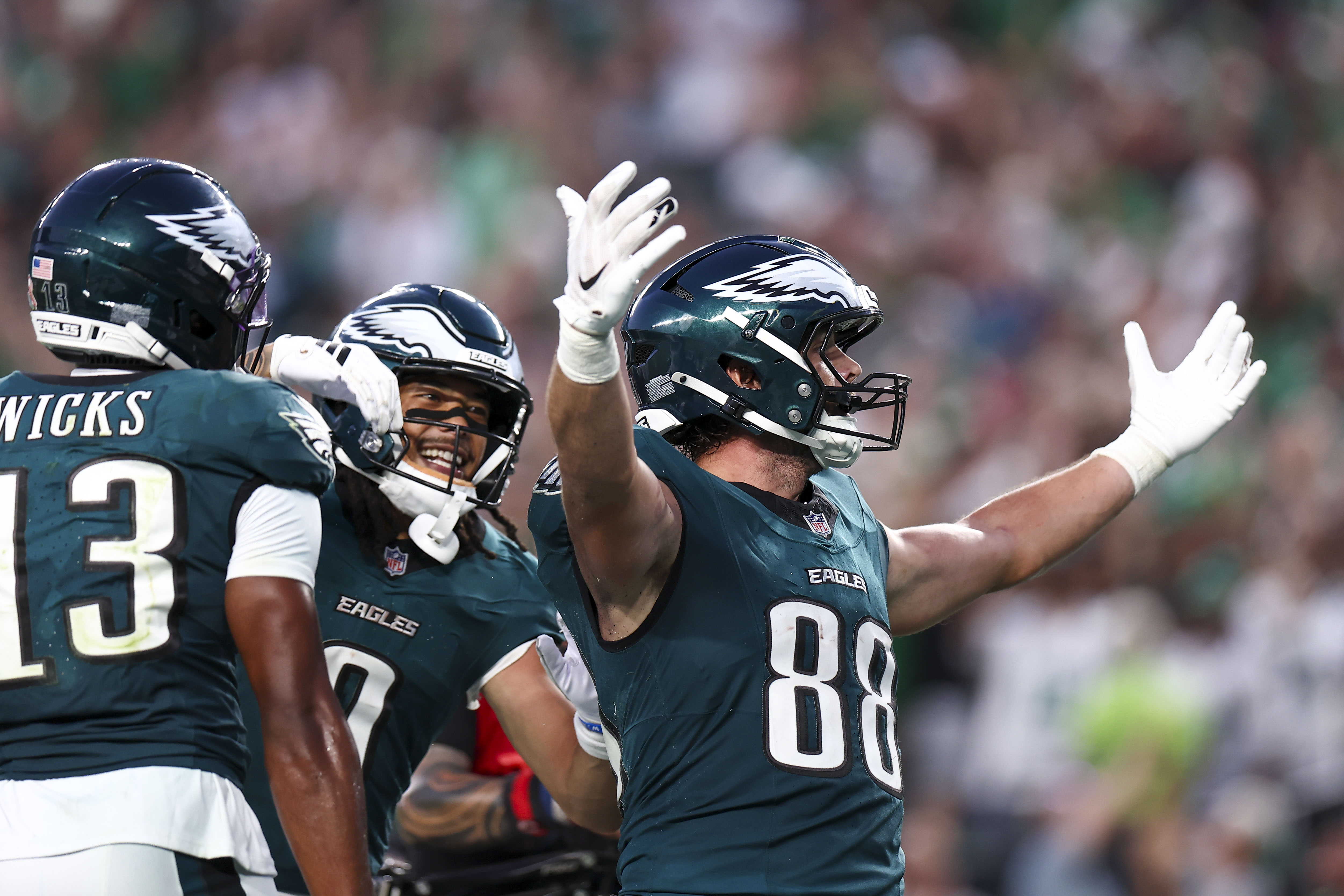
    His words were sharp and a bit defensive, and who could blame him? He and Ertz respected each other during their three-plus years as teammates but were not the closest of friends, and no NFL player wants to be told in so many words, and with one possible player acquisition, that he needs help doing his job. Besides, Goedert was just minutes removed from a powerful and productive performance against the Commanders: four receptions, 77 yards, and two touchdown catches that showed he still had the ability to pull off a big play or two.

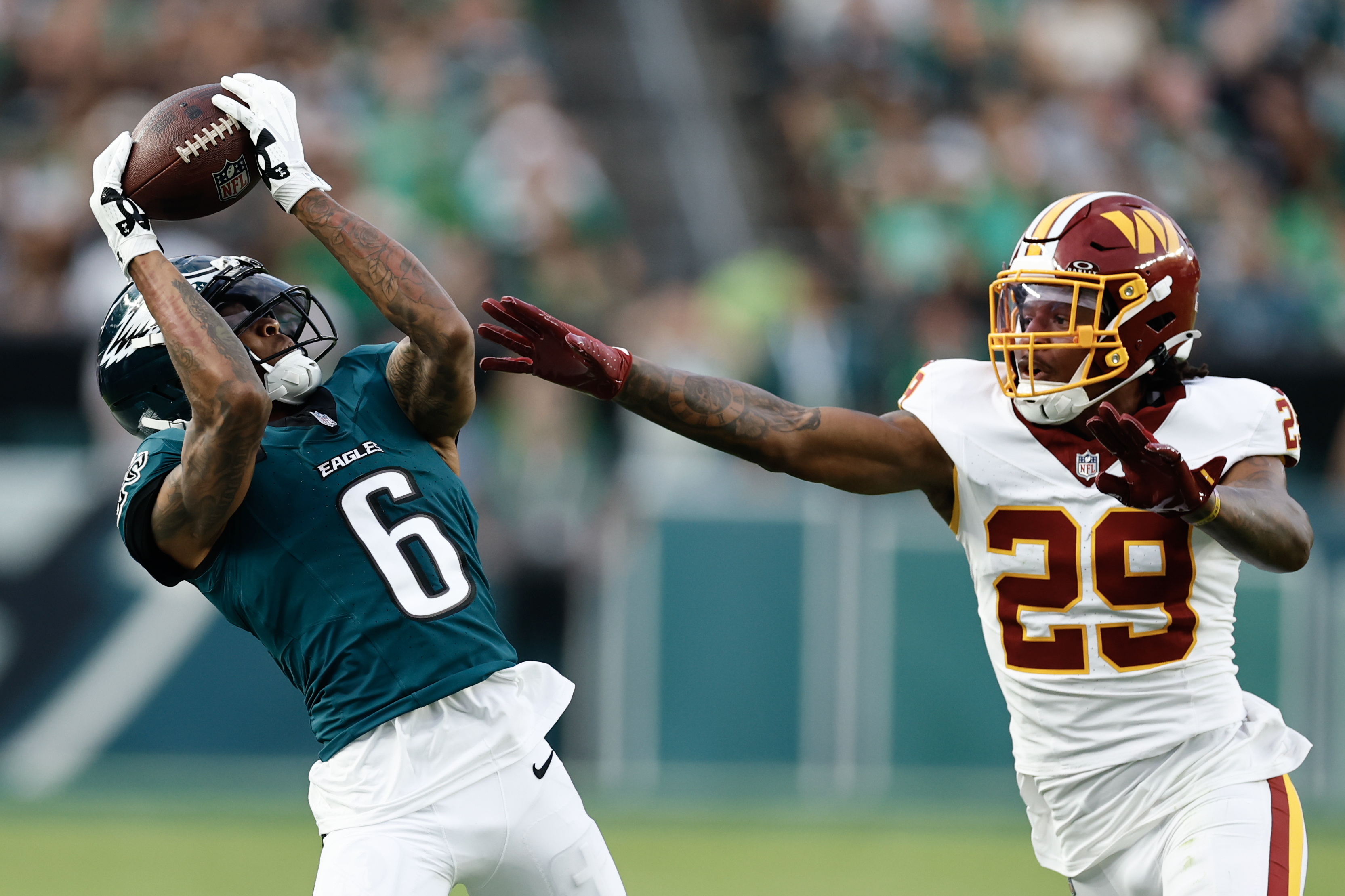
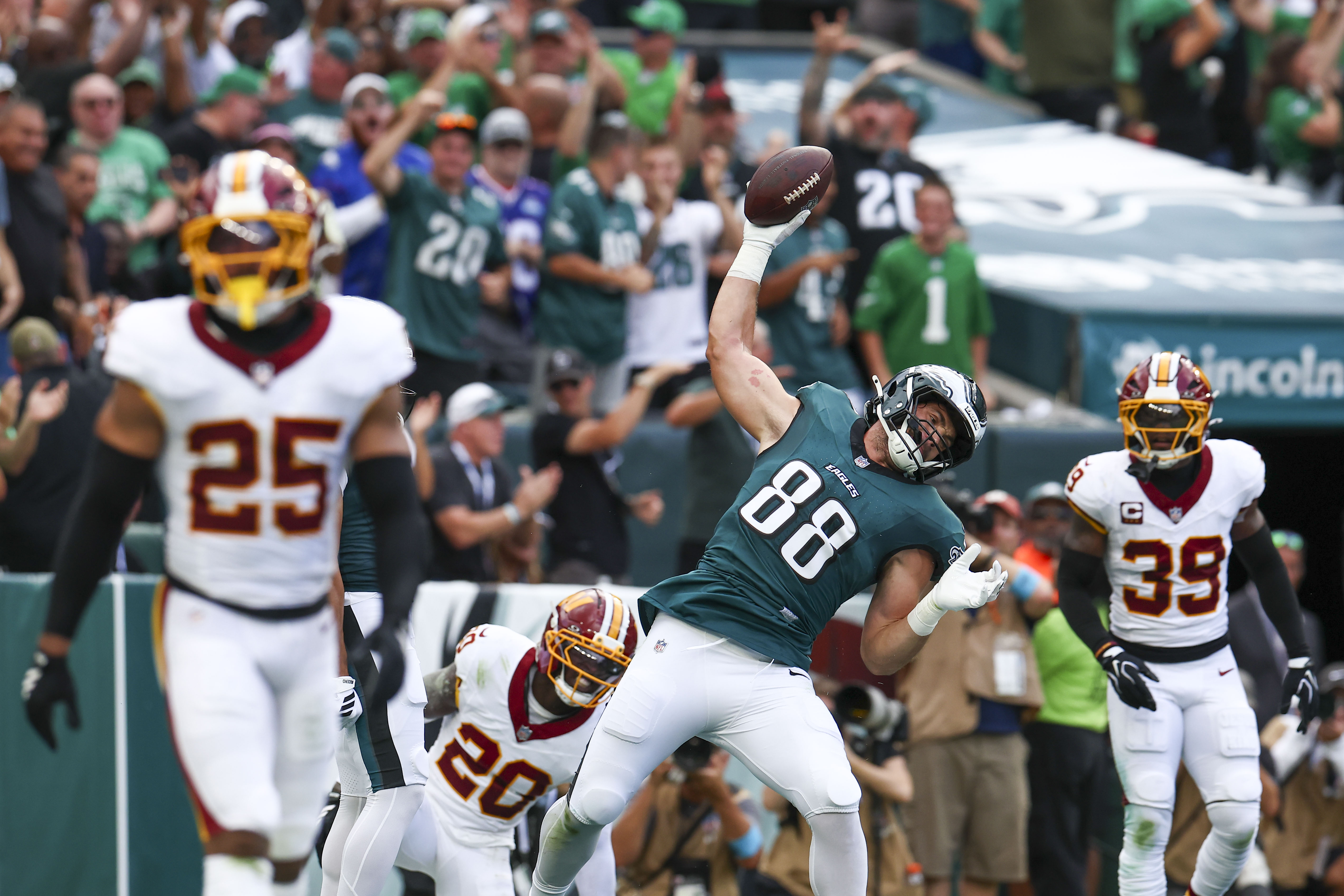
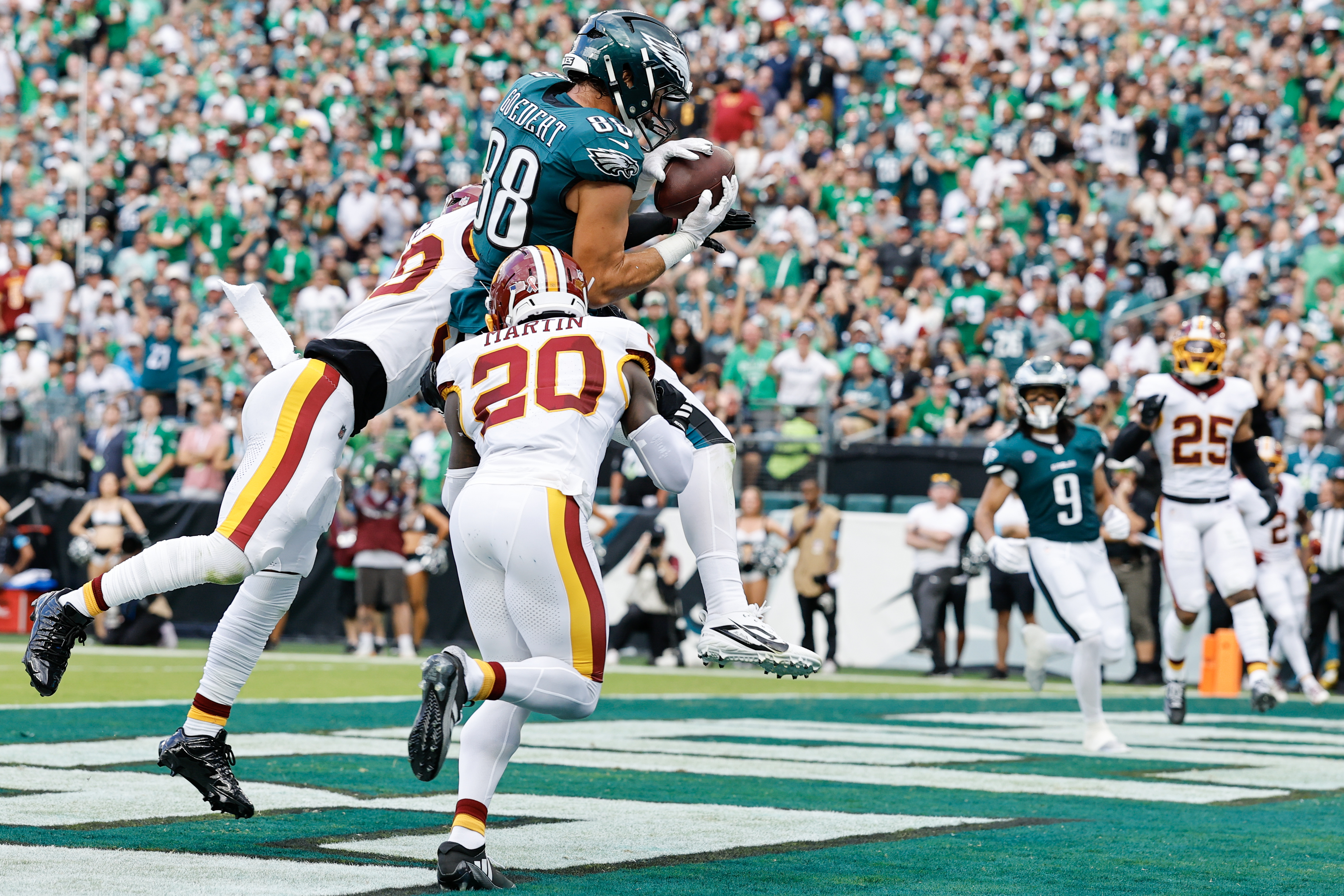
    The first was a 17-yard seam route on third-and-goal, just when it appeared the Eagles might settle for a field goal. The second was a 43-yard catch-and-run. What’s that country lyric from a few years back? I ain’t as good as I once was, but I’m as good once as I ever was. Goedert was that good. Twice.

    “Dallas is a phenomenal playmaker who, in my six years with him, just has always made plays in really big moments,” Eagles coach Nick Sirianni said. “He brings it every day.”

    He will have to. For now, the decision to draft Stowers looks like a mistake, a swing-and-miss on a player who might be too big and slow to be a good wide receiver but not stout enough to be a good tight end. His absence, whether for injury or ineffectiveness, puts more pressure on Goedert, on Jalen Hurts, on every player on the offense as they labor through mastering Mannion’s offense. And if Sunday is any indication, that process will take a long while.
    “It’s something we’re all experiencing together,” Hurts said. “We’ve got new coaches at almost every position on the offensive side of the ball, especially when it comes to instilling the values and philosophy of this new scheme. And we’ve got new players who are going to make plays for us in new, important roles. The best way to learn is from experience and to reflect upon that experience.”

    He has as much with Goedert as anyone else, and he’ll need it. The Eagles sure needed it Sunday, through three sacks of Hurts and two holding penalties by center Cam Jurgens and a rough game for guard Landon Dickerson. Up 17-16 midway through the fourth quarter, Hurts and Goedert brought that shared comfort and familiarity to bear in a big way. After tackle Jordan Mailata committed a false start penalty that pushed the Eagles back to their 31-yard line, Hurts ripped off a 22-yard scramble on third-and-18. Three plays later, Hurts zipped a pass over the middle on third-and-6 to Goedert, who spun to his left and chugged away from three Washington defenders to the end zone.

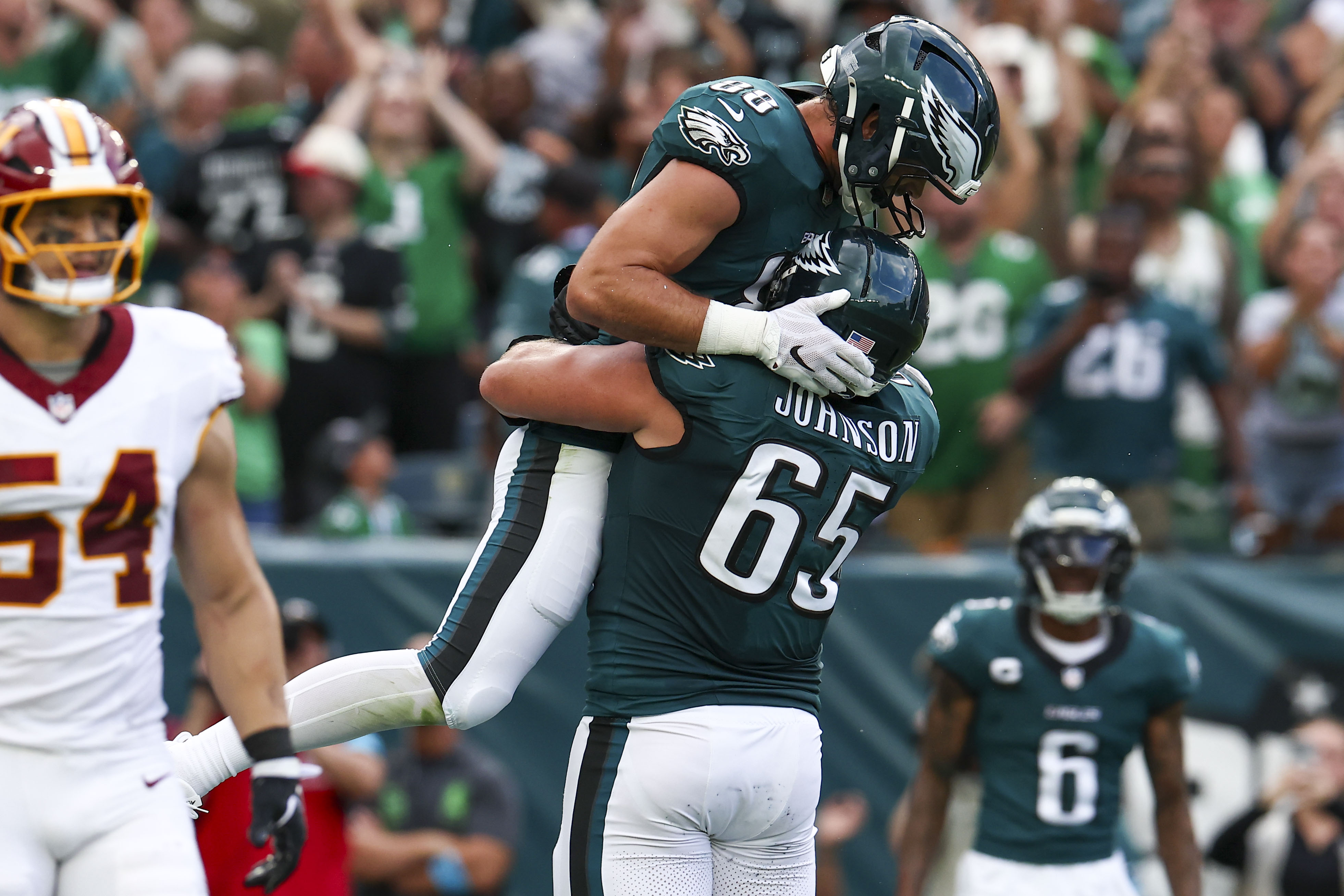
    “That’s my brother, man,” said Mailata, the Eagles’ final pick in the 2018 draft, the one in which Goedert was their first. “I was super excited that we brought him back. I was happy. I didn’t want to be the last one here from my draft class. So when Dallas came back, I was very thankful for that. Kudos to him for having a great night tonight. I went up to him after that second touchdown, to him and Jalen, and said, ‘Thanks for bailing me out after that false start.’”

    That he is still here to make such plays might seem a victory for him in and of itself. He does not view it that way.

    “I never lost confidence in myself,” he said. “I always think very highly of myself, and I think everybody in this locker room thinks the same about themselves. If I get an opportunity, I’m going to try to make the most of it.”

    After so much uncertainty about his future, with so much still lingering, Goedert will get more of those opportunities. The Eagles at the moment don’t have another choice, and that’s fine with him.

  • Foolish Commanders mistake by Stefon Diggs gifts Eagles a season-opening win

    Foolish Commanders mistake by Stefon Diggs gifts Eagles a season-opening win

    The late, great Denny Green said it first and said it best:

    They are who we thought they were.

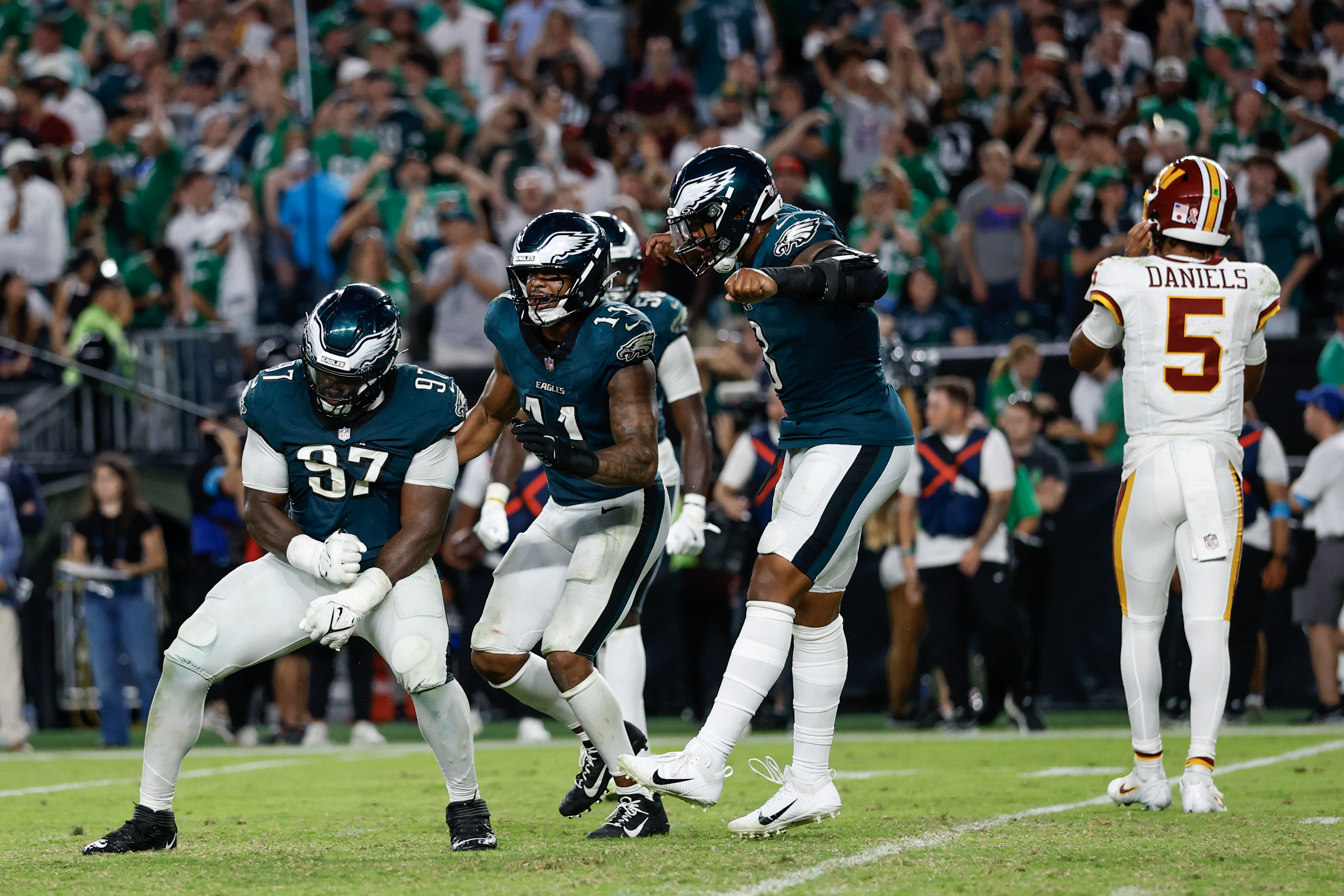
    The Eagles were pretty good, the Commanders were pretty dumb, and the Birds won, 24-22.

    They both are what we thought they were.

    Green said it in 2006, after his Cardinals blew a Monday Night Football lead, and he said it in frustration, but Eagles fans should be anything but frustrated after this one.

    The difference began with Jalen Carter, who blocked a point-after-touchdown kick in the second quarter.

    That played big.

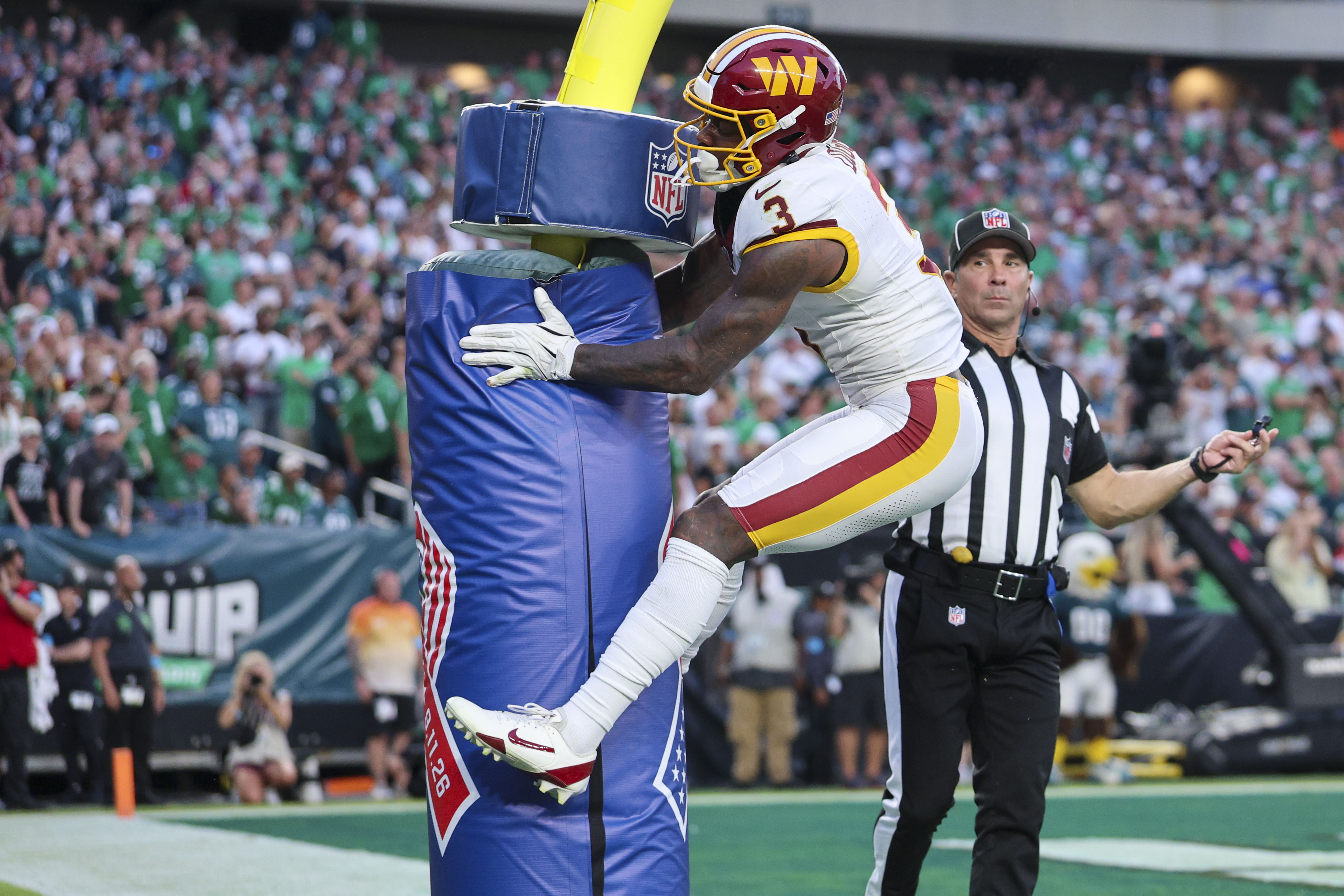
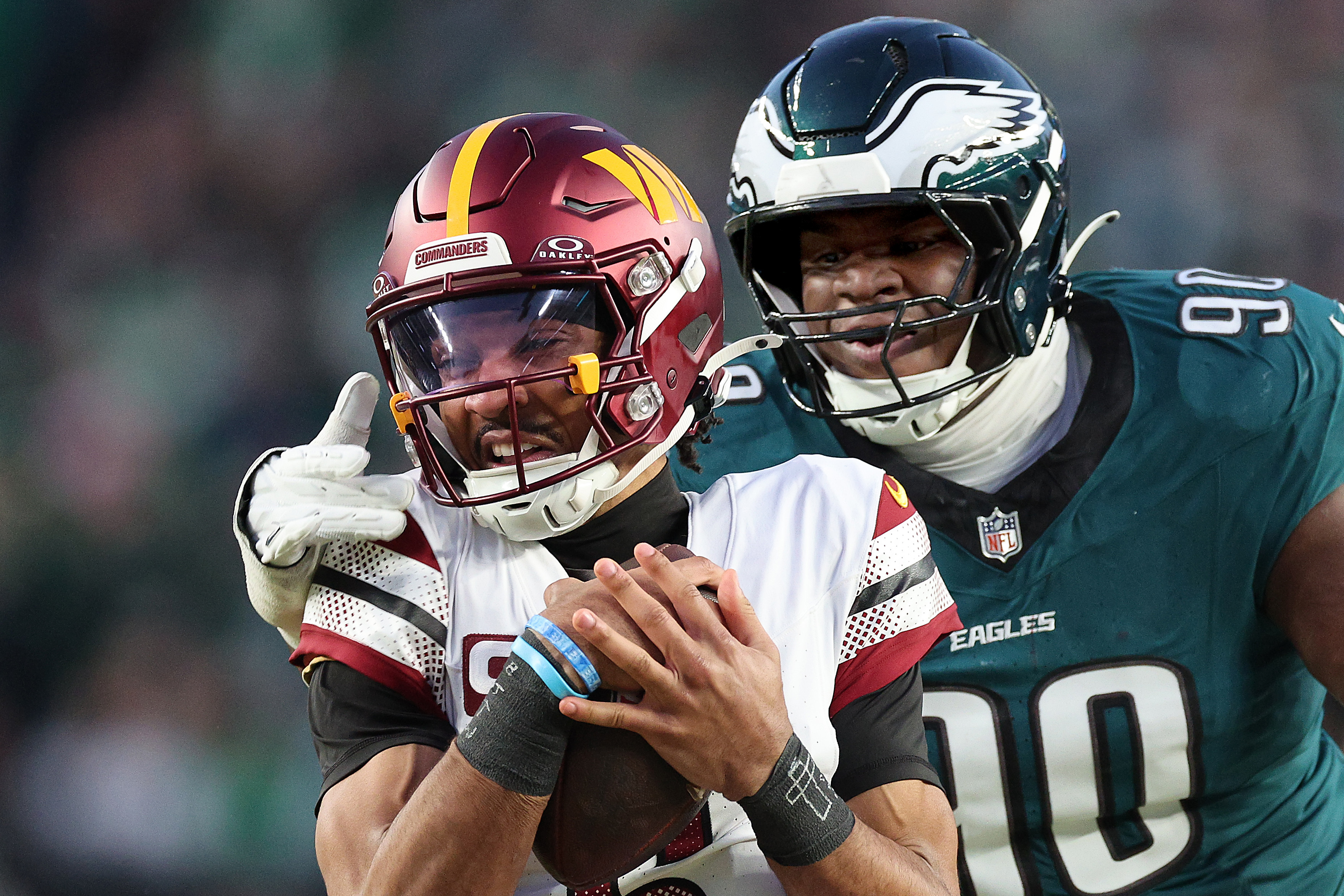
    Stefon Diggs caught a touchdown pass with 9 minutes, 59 seconds to play, but then hopped onto the goal post and gave it a brief, full-body hug. That behavior is illegal. The Commanders trailed by two points and had the Eagles on their heels after a nearly six-minute drive, so, they go for two, right? Well, the 15-yard penalty would have pushed a two-point conversion try from the 2-yard line to the 17-yard line, so they kicked the PAT and cut the lead to 17-16.

    The Eagles scored, but then so did the Commanders, with 1:01 to play. Forced to go for two, they failed, and that was that.

    “I got a little overzealous, I got a little excited, you know,” Diggs said afterward, smiling sheepishly. “Finally, when we clicked, after not clicking for a little while, it got to me a little bit. So just being smart[er].”

    Diggs recalls when such actions were legal.

    “As soon as I wrapped my arms around it, I’m like, ‘Oh!’ I forgot,” he said. “It’s not back in the day. You know, I’ve been playing for a long time. You used to could do that.”

    Actually, he could never do that. The NFL outlawed goalpost celebrations in 2014 after Saints tight end Jimmy Graham bent a goal post in 2013. But Diggs certainly had seen it done.

    It made a big difference Sunday evening against an Eagles team that was just good enough to win.

    The Eagles, with new offensive coordinator Sean Mannion and old defensive coordinator Vic Fangio, looked like a quality team with quality players that should contend for a Super Bowl berth. They beat a quality team in the Commanders, with a superior quarterback in Jayden Daniels. The Eagles’ head coach, Nick Sirianni, moved to 6-0 in season openers, as did his franchise quarterback, Super Bowl LIX MVP Jalen Hurts. The defense limited the visitors all day, and squashed a two-point conversion when Moro Ojomo sniffed out a shovel pass and tackled John Bates.

    Simply, events followed script.

    “We played a gritty game,” All-Pro cornerback Quinyon Mitchell said. “Obviously got some things that we got to clean up, but the fight was there, and the resilience was there.”

    So was the talent.

    A healthier offensive line gave Hurts enough time to throw three touchdown passes, two to tight end Dallas Goedert, who is a touchdown-catching machine. The line helped Saquon Barkley gain 83 rushing yards. Hurts had 203 passing yards, 46 rushing yards, and no interceptions.

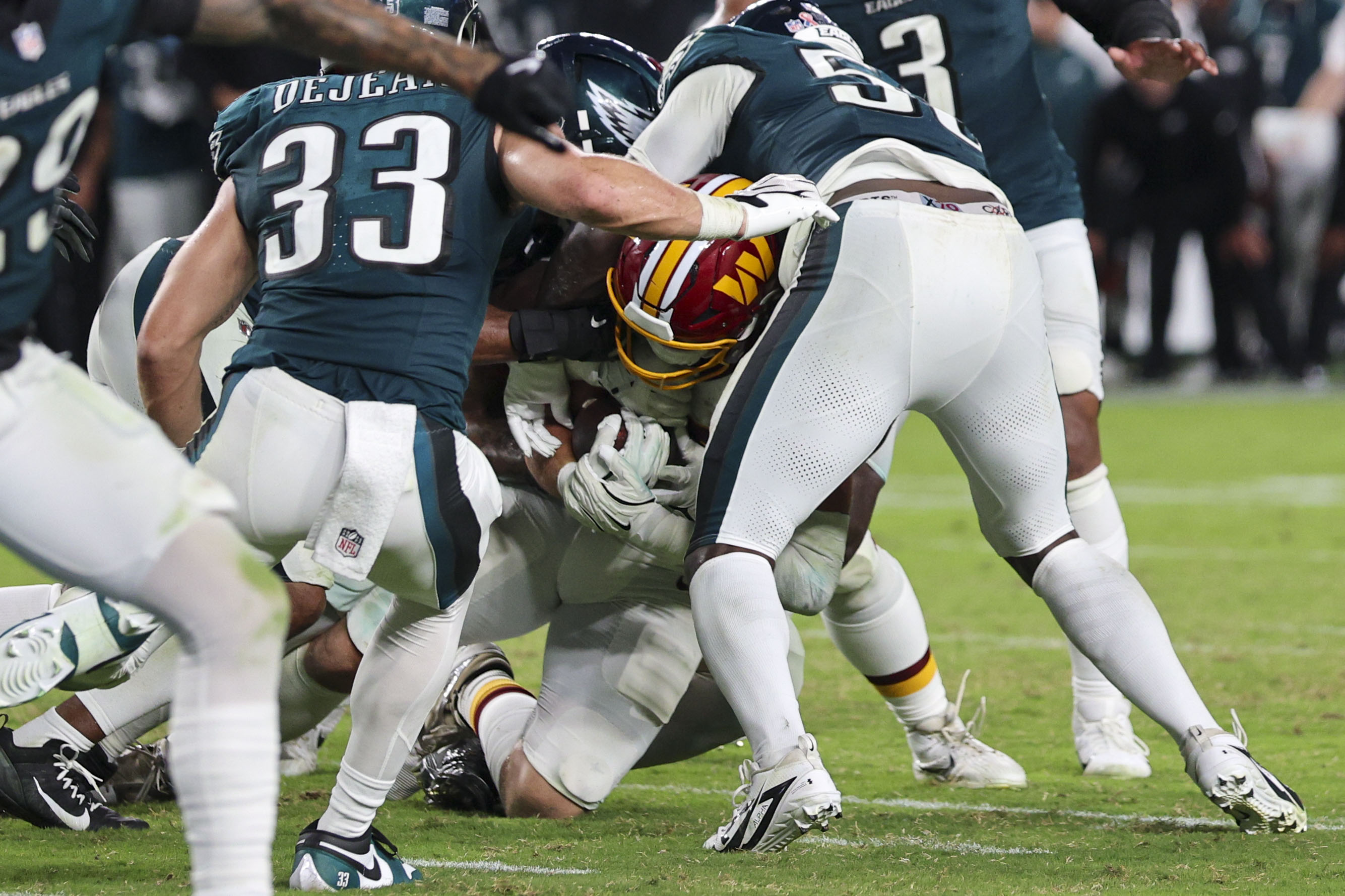
    Middle linebacker Zack Baun remained the team’s most consistent player, as he has been the past two seasons. He finished with 12 tackles, wrecked a third-quarter possession by himself, forced a false start on a fourth-quarter blitz, and deflected a touchdown pass late in the fourth, one of his two passes defensed.

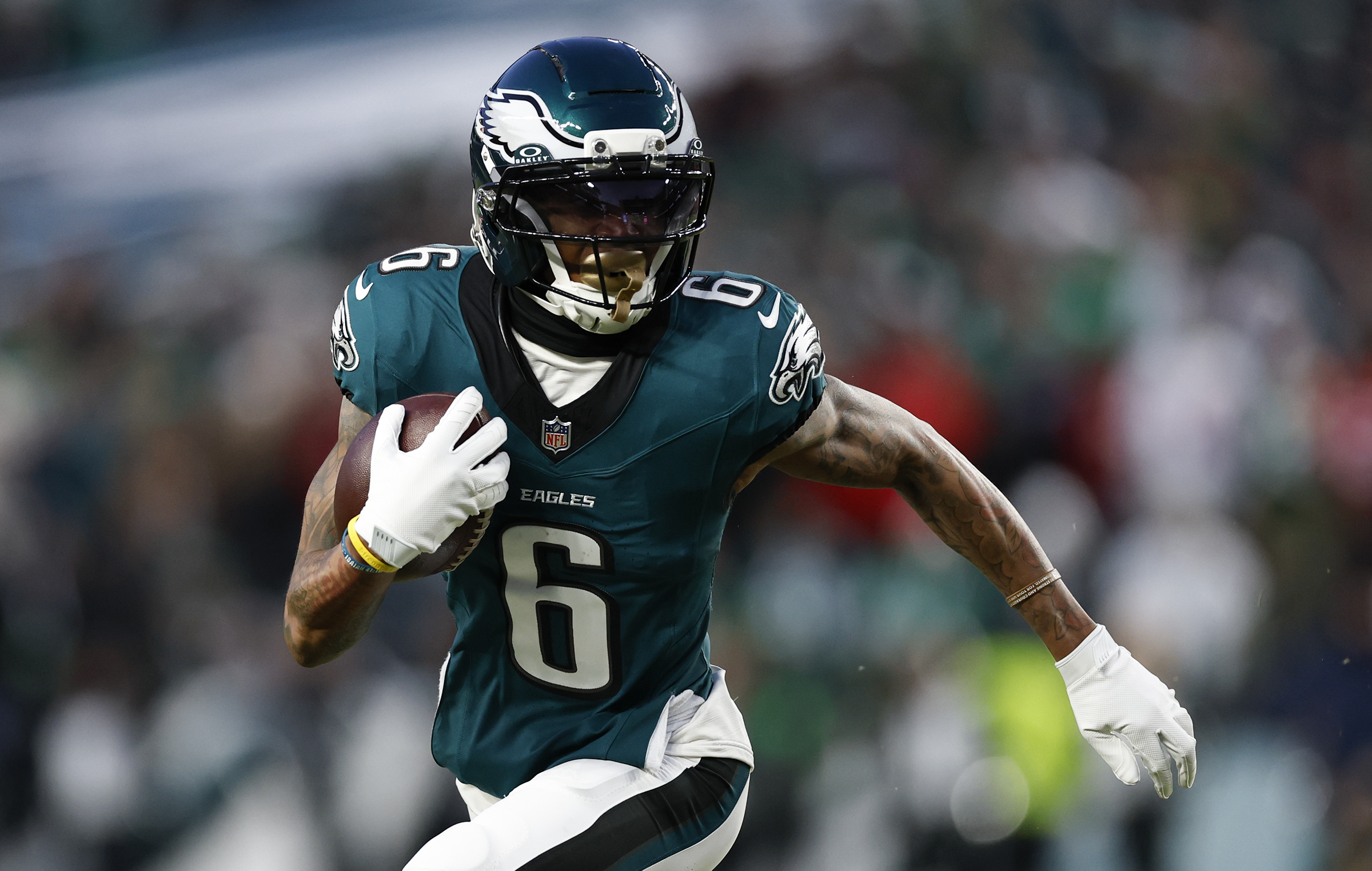
    The Commanders keyed on Barkley, who gained 41 yards on the 14 carries that didn’t include his 42-yarder that set up Hurts’ second touchdown pass. The Commanders cheated coverage toward DeVonta Smith, who caught three passes for 53 yards, but whose presence helped free Dontayvion Wicks for a 64-yard bomb and a 9-yard TD catch.

    It was not all rosy, but then, since Sirianni hides his starters in the preseason and since Mannion — a first-time coordinator who installed a mostly new offense — this essentially was a preseason game. Not bad for a dress rehearsal.

    Mistakes happened.

    Hurts misdiagnosed defenses, as Fox analyst Tom Brady repeatedly noted.

    The offensive line, healthy again, was pretty good, with the exception of Landon Dickerson. The sixth-year right guard seemed a bit slow off the ball and did not resemble the dominant player of 2023 and 2024; he committed a holding penalty in the third quarter. Dickerson, who exited college with a litany of surgeries, this offseason underwent stem-cell procedures on both knees and both ankles.

    Former full-time nickel corner Cooper DeJean, playing safety against two-receiver sets and nickel against trips, seemed lost. He committed two illegal contact penalties and gave up the fourth-quarter touchdown that cut the lead to 17-16.

    But the defense was good, the offensive line was competent, Hurts didn’t turn the ball over, completed 14 of 25 passes, and led the team to a win.

    Which is all they need to do. It’s seldom elegant, and almost never pretty, but a win is a win is a win.

    Jalen Hurts completed 14 of 25 passes in the Eagles’ season opener.Monica Herndon / Staff Photographer
  • Penn trial tests ultrafast form of radiation aimed at reducing cancer treatment side effects

    Penn trial tests ultrafast form of radiation aimed at reducing cancer treatment side effects

    Penn Medicine researchers are testing whether an ultrafast form of radiation therapy can treat cancers in the head and neck with fewer side effects.

    The clinical trial marks the first time the technology, conformal FLASH proton therapy, is being used in humans.

    Radiation therapy, one of the most commonly used cancer treatments, works by aiming high-energy beams at tumors. While this kills cancer cells, it can also cause damage to surrounding healthy tissues.

    Patients with head and neck cancers, for example, can develop ulcers in the mouth, damage to the jawbone, dry mouth, and scarring as a result.

    A trial launched this month at Penn Medicine’s Abramson Cancer Center will assess whether delivering radiation more than 100 times faster than typical therapies is safe and could lessen that damage.

    The pilot trial will enroll 10 people whose head and neck cancers have returned.

    These are patients who lack good treatment options and risk side effects that interfere with speaking, breathing, and swallowing.

    “Giving another full dose of radiation is very hard for these patients,” said Jonathan Schoenfeld, who directs the Head & Neck Radiation Oncology program at Mass General Brigham and is not involved in the trial. “This is a good population that could potentially benefit from this type of approach.”

    The specific type of FLASH radiation used in this study was developed by researchers at Penn and the Belgium-based Ion Beam Applications S.A. (IBA), which manufactures the platform and is sponsoring the study.

    In mouse studies, FLASH proton therapy reduced side effects while still killing cancer cells. Researchers have since tested the approach in a clinical trial involving dogs with cancer.

    However, promising results in animals often do not translate to humans. Even if the trial produces encouraging results, it could take years before the therapy becomes widely available.

    The hope, ultimately, is not only to preserve quality of life in patients, but to make radiation therapy more convenient and accessible.

    “Instead of 30 to 40 treatments, we can do the treatment in one to five treatments,” said Alexander Lin, a radiation oncologist at Penn and the trial’s lead investigator.

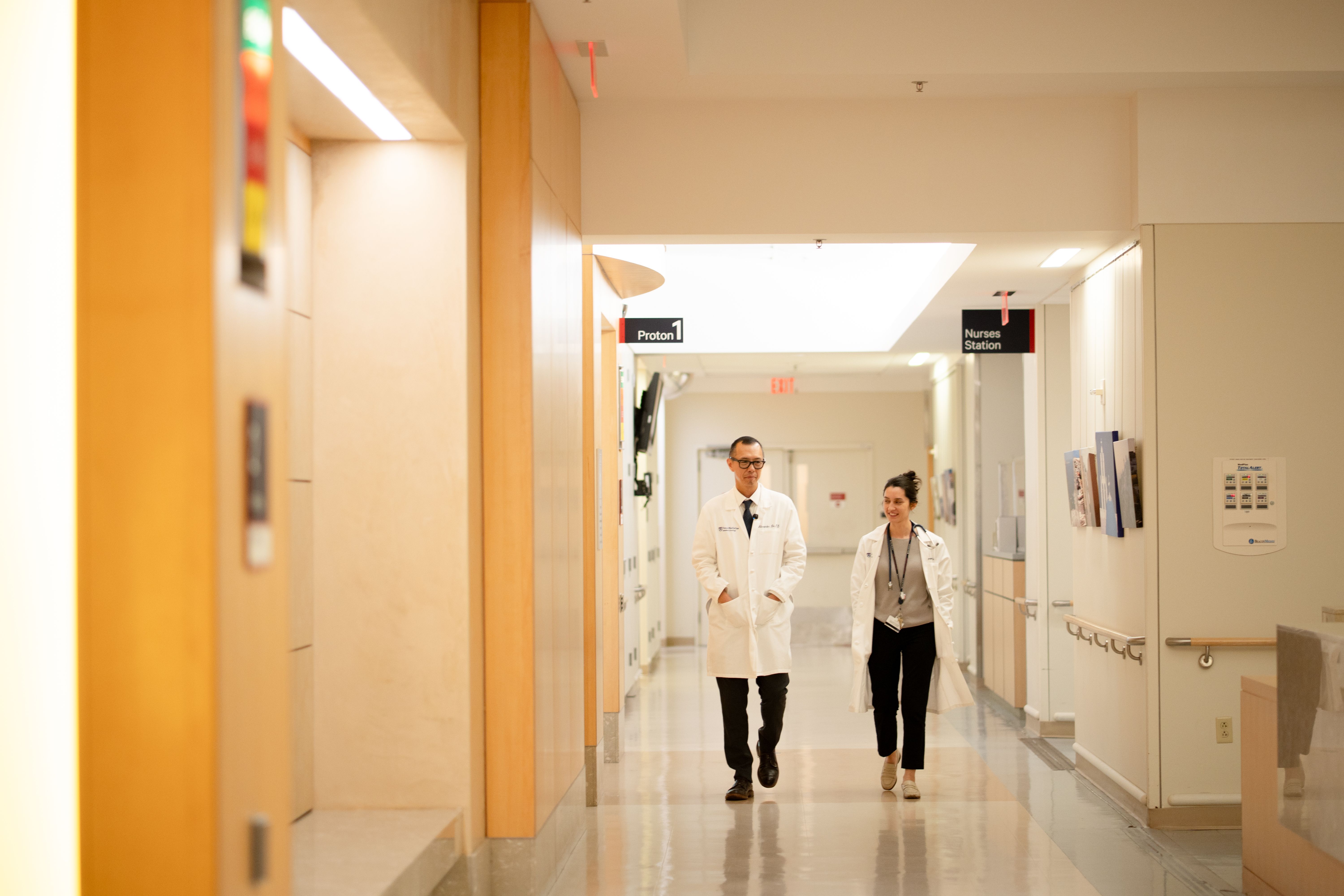
    Lin walks through the Roberts Proton Therapy Center.Credit to Margo Reed Studios

    Faster and fewer doses

    Doctors typically divide a patient’s radiation therapy into dozens of daily treatments over several weeks.

    FLASH radiation aims to accomplish that in fewer doses.

    Think of it like air travel: A trip from the East to the West Coast would take hours with today’s technology. But if you can fly at the speed of light, it would take less than a second.

    “We’re giving the same dose or similar dose, but the dosage rate changes,” said Constantinos Koumenis, the vice chair for research in Penn’s Department of Radiation Oncology and a developer of the therapy.

    Lin hopes this lighter schedule could alleviate some of the time and financial burden of treatment.

    The FLASH therapy builds upon a highly advanced radiation treatment, proton therapy, which uses protons to more precisely target tumors. Penn has heavily invested in the expensive technology, with its fourth proton therapy center — a $224 million facility at Penn Presbyterian Medical Center in University City — expected to open in 2027.

    The researchers are also incorporating a technique called conformal radiation therapy, which shapes the radiation beam to match the tumor’s three-dimensional size and location. This helps limit exposure to nearby healthy tissue.

    The exact biological explanation for FLASH radiation’s effects remains a mystery. However, scientists theorize that the treatment reduces damaging oxidation in healthy tissue while promoting faster recovery.

    “The hope is that, if this type of trial is successful, you can treat patients who need more radiation with much lower risks,” Schoenfeld said.

    But “it’s a new treatment that we don’t fully understand yet, so I would highlight that it’s still very early days,” he added.

    First trial

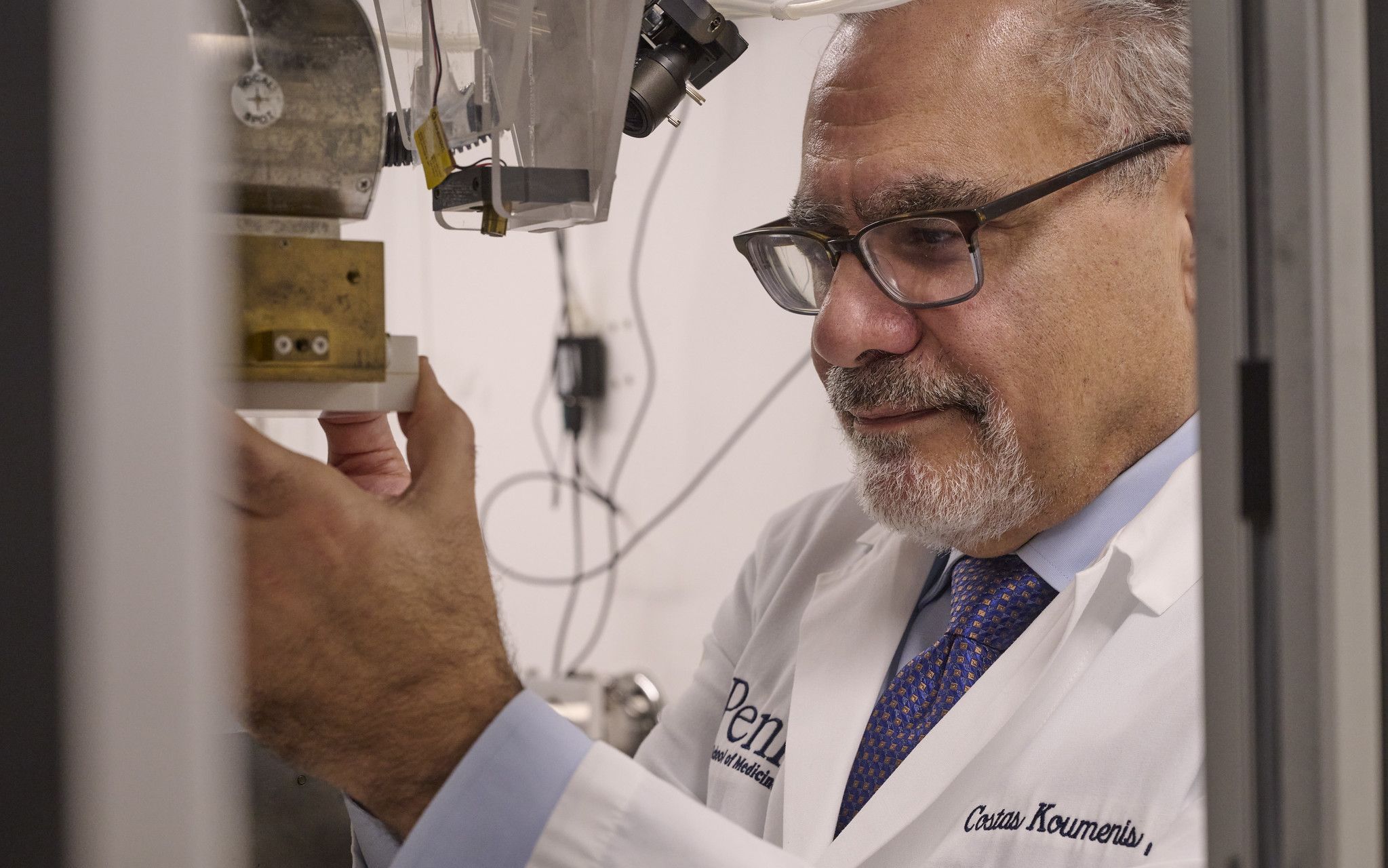
    Constantinos Koumenis is the vice chair for research in Penn’s Department of Radiation Oncology and a developer of the new therapy being tested.Credit to Peggy Peterson

    The primary focus of the Penn trial will be assessing the treatment’s safety and feasibility, with an eye on quality of life and cancer outcomes.

    Researchers will be taking a more cautious approach to begin, using a dose and schedule that have already been found safe and effective in patients. The only difference will be giving the radiation at the FLASH speed, Lin said.

    Schoenfeld said he would first want to see whether the team can deliver their treatment with the intended speed and precision — an accomplishment in itself for an early-stage trial.

    Then he would look at how the tumors respond to FLASH and whether patients develop side effects over a period of months to years.

    “Some of these side effects are longer term side effects, so it’s important to start to follow these initial cohorts of patients as long as possible,” he said.

    The Penn team will follow patients for at least five years.

    If the trial shows promise, the researchers hope to launch additional trials in other types of cancer, from gastrointestinal to liver tumors.

    “If these trials show that they’re safe, we want to target any solid tumor that we can target,” Koumenis said.

  • Expect the Eagles to win 14 games and return to the Super Bowl

    Expect the Eagles to win 14 games and return to the Super Bowl

    It’s astounding, in a matter of months, how bad a quarterback Jalen Hurts became, how ineffective a coach Nick Sirianni was revealed to be, how overwhelmed DeVonta Smith was sure to become without A.J. Brown, how formerly brilliant defensive coordinator Vic Fangio had devolved into mediocrity, how irrelevant an elite defense was projected to be, and how uselessly a suddenly healthier offensive line was projected to perform.

    Because all of these things need to happen for the Eagles to not win the NFC East and surge to a third Super Bowl in five years.

    A year ago, most prognosticators chose the Eagles to at least reach the NFC championship game if not to repeat as Super Bowl champions. So why are expectations so low for 2026?

    Currently, the forecasters rate as highly or higher than the Eagles: The Rams, whom the Eagles own; the Seahawks, the flukiest Super Bowl winner since the 2011 Giants; the Packers, after five straight years of postseason flops; and the Lions, who, well, are the Lions.

    This is madness.

    If the Eagles’ offensive line had been healthy in 2025 they would have won a second straight Lombardi Trophy. It’s healthy today. They should be everyone’s favorite. They should roll through 2026.

    What games worry you? At Dallas on Thanksgiving? OK. Seattle on Dec. 19? OK, but it’s a wintertime home game. At San Francisco on Jan. 3? The Silicon Valley Power electrical substation might have winnowed the 49ers to nothing by then.

    There’s no way this team should lose more than three games, four at the most. They’ve got a Pro Bowl quarterback, a superstar running back, a franchise receiver, and a genius running a defense with more talent than any defense in team history that didn’t include Reggie White.

    Yes, they lost in the first round of the playoffs last year, and, yes, they’re installing a new offense with a new coordinator, and all of that is scary.

    Kellen Moore (right) was new to the Eagles, just as Sean Mannion is, and helped engineer a Super Bowl win. David Maialetti / Staff Photographer

    You know what happened the last time they installed a new offense with a new coordinator?

    They won Super Bowl LIX.

    They begin their run to Super Bowl LXI at 4:25 p.m. Sunday, hosting the Commanders, who lost All-Pro left tackle Laremy Tunsil to injury in training camp. The Eagles should win by about 20 points.

    Maybe then the fog will lift from the minds of the deluded.

    No A.J.? OK

    It’s tempting and understandable to dwell on the departure of Brown, and it’s important to not diminish it. No Eagles receiver ever connected four seasons of at least 1,000 receiving yards, and Brown did so as Hurts’ No. 1 target. Hurts is a running quarterback whose passing offense did not average even 200 yards per game the past two seasons. A.J. in Philly was special.

    It’s tempting, but unwise. Teams occasionally lose top receivers but succeed nevertheless. The Chiefs lost Tyreek Hill after the 2021 season but still went to the next three Super Bowls and won the next two.
    DeVonta Smith is primed to take a major step forward this season. Yong Kim / Staff Photographer

    DeVonta’s moment

    Smith has 13 100-yard games in his five-year career (plus two more in the playoffs), and he played four of those years with Brown and two with Saquon Barkley, both high-volume offensive weapons. He’d have 25 games with 100 yards if he’d been option No. 1. Expect him to have five or six this season.

    Why?

    Because he’s a Heisman Trophy winner who has never been asked to be the best player on a great team, though he’s shown every capacity for the job. He’s a route-runner on par with Justin Jefferson. He finds the soft spots in zones with uncanny instinct. He’s mature, he’s a leader, and, at 27, he’s in the middle of his prime.
    Brown set the Eagles’ record for receiving yards with 1,496 in 2022. Zach Ertz set the record for catches with 116 in 2018. Terrell Owens set the record for TD catches with 14 in 2004.
    Smith could challenge each of these … or all of them.

    Run it up

    New coordinator Sean Mannion wasn’t hired to implement a new offense that would turn the Eagles into Air Coryell. He was hired to implement an offense that would emulate the general run-game efficiency of 49ers coach Kyle Shanahan and Rams coach Sean McVay. Expect that to happen.

    Jonathan Greenard won’t play in Week 1 but should be an upgrade off the edge once he does. David Maialetti / Staff Photographer

    Upgrade at end

    The Eagles signed Jonathan Greenard to a four-year, $98 million deal to improve the pass rush. His injured pectoral muscle is a concern, and maybe he won’t play for a while, but he’s going to be more effective than trade-deadline addition Jaelan Philips, who left via free agency to wails of consternation.

    Really, what did you lose … a guy with two sacks in eight regular-season games and zero tackles in a playoff loss?

    Coop = Dawk

    An undrafted free agent four years ago, safety Reed Blankenship’s superpower lay in his ability to understand the job and know where he was supposed to be. His Achilles’ heel, bless his heart, was his inability to get there rapidly and make plays once he arrived.

    There never was a doubt when the Eagles traded up 10 picks in the second round of the 2024 draft, that Cooper DeJean would become a safety. He played nickel corner his first two seasons, but he’s where he belongs now. He often will slide to nickel against certain teams. Cool. You know who else did that?

    Second-round safety Brian Dawkins, who’s now in the Pro Football Hall of Fame.

    Cooper DeJean will play safety in the Eagles’ base package this season. Monica Herndon / Staff Photographer

    O-line OK

    They played maybe three games with a fully functional offensive line. Even if Jalen Hurts doesn’t improve, and even if the offense doesn’t explode, there will be better efficiency, a better running game, more time for Hurts to find Smith and Dallas Goedert and Barkley.

    There’s a thought: Use the best player on the team more, and throw him the ball.

    Barkley, Part I

    Barkley was targeted 68 times per season his last two years with the Giants, when offensive maestro Brian Daboll was the head coach. He was targeted less than 48 times per season in his first two seasons with the Eagles, when Kellen Moore and Kevin Patullo called plays.

    There’s a reason Daboll is considered an offensive maestro, unlike Moore and Patullo.

    No Stout? No problem

    Normally, the subtraction of an elite coach like Jeff Stoutland would be crippling, but every offensive line starter has been coached by Stout for at least three years, and every one of them has never had another line coach. No matter how much the scheme changes, Stout’s replacement, Chris Kuper, isn’t going to fracture the foundation.

    Just because Sean Mannion hasn’t called plays doesn’t preclude him from being great in the role. David Maialetti / Staff Photographer

    On-the-job training

    There never was an indication that Patullo would be a competent offensive coordinator or play-caller. There remains no indication that Mannion will be competent, either … but, to be fair to both, there never was much indication that Shane Steichen would be competent, either. He’d done it for one full season in Philly before 2022, and his offense that season powered the Eagles to Super Bowl LVII.

    Barkley, Part II

    Barkley’s workload plummeted. In 2024, at the age of 27, he touched the ball 482 total times between the regular season and playoffs. In 2025, at 28, that number fell to 346, a difference of 136 touches, a decrease of roughly 28%. It was like getting four games of rest.

    Nick wins games

    Like him or loathe him, Sirianni wins games. Maybe that’s been because of Fangio’s genius, Howie Roseman‘s personnel management, or Jeffrey Lurie’s deep pockets. In any case, even if Sirianni isn’t a main reason they’re winning, he’s certainly not impeding their path to wins. And to argue that they’re winning in spite of him is as foolhardy as it is disingenuous.

    The winning begins Sunday.

  • Eagles-Commanders will be U-G-L-Y. At least they have an alibi.

    Eagles-Commanders will be U-G-L-Y. At least they have an alibi.

    You don’t need a weatherman to know which way the wind blows. You don’t have to be a longtime travel agent to have looked at the Los Angeles Rams’ Australia itinerary and thought, Hey guys, might be a tough turnaround there. And you don’t have to be a football savant to suspect that the Eagles’ season opener Sunday against the Washington Commanders is going to be a hard watch.

    If the first two games of this NFL season weren’t enough to tell you just how rocky these opening weeks will be, Eagles-Commanders ought to drive home the point. Matthew Stafford and Drake Maye were so terrible, so far from the MVP (Stafford) and MVP runner-up (Maye) they were last season, that it would have been fair to check whether either of them had signed an endorsement deal with a prediction market earlier in the week.

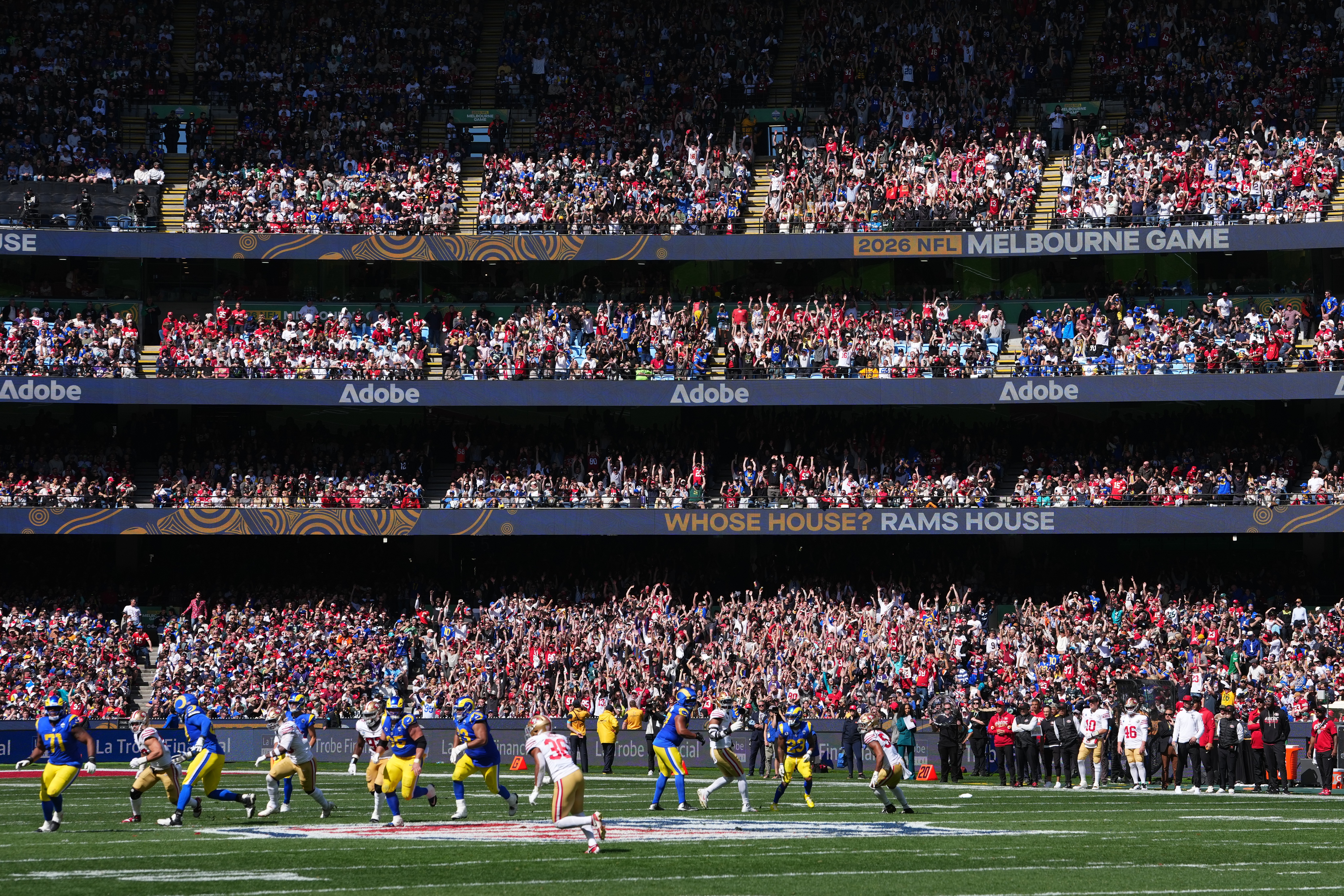
    The Patriots took a double-digit lead and couldn’t hold it. The Rams might as well have been on walkabout with Mick Dundee. Sam Darnold and A.J. Brown suffered serious injuries. Of the four teams that made up the NFL’s marquee matchups, only the 49ers were ready for prime time. Jeez, it’s almost like, even after a full offseason, having teams play on Wednesday and Thursday nights — or having two California teams start their seasons on a continent roughly 7,300 miles from their home state — leads to lousy football.

    The game between the Los Angeles Rams and the San Francisco 49ers in Melbourne, Australia, wasn’t pretty.Scott Barbour

    No one should expect the quality of Sunday’s game at Lincoln Financial Field to be much higher. The Commanders have a new offensive coordinator and a new defensive coordinator, neither of whom has ever coordinated anything in the NFL until now, and aside from Jayden Daniels, their roster resembles a piece of abstract art: You have to stare at it for a long time for it to make any sense (Odafe Oweh for as much as $96 million?), and in the end, it really doesn’t.

    The Eagles ought to win, and win handily, because their defense is so strong and, relative to these teams’ other units, so stable. Their offense is a mystery and will remain one until their new coordinator, Sean Mannion, starts calling plays and reveals whether he’s a rookie who’s out of his depth or a nascent genius who’s been sandbagging everybody since training camp began. And whether Jalen Hurts can thrive in this latest new system. And whether any wide receiver other than DeVonta Smith can make a big play.

    “Part of our goals for this week are to understand that … there are things that happen in Week 1 that you have to be ready for,” coach Nick Sirianni said Friday, “whether that’s live fundamentals, whether that’s errors in the kicking game, or whatever it may be. The standard doesn’t change [for] what we accept and what we require and what our guys do on the field. We practice like that every day. Anytime there’s something loose with the ball, or we miss a tackle, or whatever it may be, or miss our approach on a tackle, if we’re not tackling to the ground, it’s discussed. It’s watched. It’s critiqued. Our standard — your goal — is to be playing your best football by the end of the year. Our standard does not change.”

    No, but the circumstances will. Starters who spent most, if not all, of the preseason sitting out eventually will kick off all the rust. It’s just that eventually likely will take more than one game. That’s the NFL now, with its three-game preseason and its 17-but-soon-to-be-18-game regular season and its insistence that its teams journey across oceans and, quite literally, suit up on every night of the week except Tuesdays.

    The players themselves know better than anyone: You take the early victories if you can get them, and the crisp, clean performances probably will have to wait.

    “You’re always striving for that,” said wide receiver Hollywood Brown, who is in his first season with the Eagles but his eighth in the league. “But I’ve played a lot of football, so I know that they’ve got a new defensive coordinator, and we’ve got a new offensive coordinator. You can try to study each other as much as you want, but there’s not much out there to go off of. You can go out there with everything we’ve studied and they’ve studied, and it could be something completely different.

    “So it’s about knowing our principles, knowing what we’re trying to do, and knowing that’s just the stepping stone. Win or loss, it’s a stepping stone. You learn off it, and as we get into the year, you’re really trying to perfect your craft and identity.”

    At what point in the season do players and teams find that identity?

    “Usually, around Thanksgiving,” Brown said. “Around Thanksgiving, a lot of players are like, ‘That’s when the real football starts.’ That’s when we know what we are. We know what each team [is]. And it’s about executing the game plan and being at your best once December and January come around.”

    Until then, everyone will just have to suffer through some sloppy football. It’s the price of this multi-billion-dollar business now. So if the Eagles win ugly Sunday, even if they somehow lose, don’t panic. Yet.

  • Jeff McLane’s keys to Eagles vs. Commanders in Week 1 and a game prediction

    Jeff McLane’s keys to Eagles vs. Commanders in Week 1 and a game prediction

    The Eagles open the season against the Washington Commanders at 4:25 p.m. Sunday at Lincoln Financial Field. Here’s what you need to know about the matchup:

    When the Eagles have the ball: The biggest uncertainty coming into this season will be how Sean Mannion does as a first-time offensive coordinator and play-caller and how the Eagles — specifically, quarterback Jalen Hurts — adapt to his new scheme. We saw many of the changes throughout camp and in the preseason: more of Hurts under center, more outside zone runs, more motion, and more play-action. Expect more of all of it in the regular season. But how far will Mannion go, and how much of a previous Eagles offense that had highs and notable lows last season, will be kept? The Eagles have understandably kept the answer to that question close to the vest, with the element of surprise one possible benefit heading into the opener.

    unCovering the Birds: Is tight end the biggest area of concern?
    Video: unCovering the Birds: Is tight end the biggest area of concern?

    What wouldn’t be a shocker is a run-heavy offense, especially against a Commanders defense that is still not that imposing up the middle. The Eagles’ offensive line is about as healthy as possible. Mannion will likely lean on them and running back Saquon Barkley, despite the new wide-zone blocking scheme. Washington’s defense should be better than last season. It would be hard to be worse. They hired a new coordinator in Daronte Jones and went faster and more athletic with six new starters. Jones has worked under several notable coaches, but he was last with Brian Flores in Minnesota and is expected to employ Flores’ base system. That would mean a 3-4 front, lots of pre-snap disguise, and frequent blitzing.

    Daron Payne, who’s questionable with a knee injury, returns as Washington’s best interior lineman, but he’s never been a dominant force against the run and now the unit will be without veteran middle linebacker Bobby Wagner. First- round rookie Sonny Styles was drafted as his replacement, and could end up one of the better two-way linebackers in the game. But he’s young and an unknown. Frankie Luvu is a chess piece for Jones at the second level. And speedy edges Odafe Oweh and K’Lavon Chaisson were added in the offseason. But I don’t see a front seven that can match up with the Eagles’ O-line if Mannion plays it straight-up on the ground. Barkley has had some of his best outings against the Commanders. I’d stay with that formula.

    If forced to throw a lot in Week 1, how comfortable will Jalen Hurts look? Yong Kim / Staff Photographer

    Jones will likely want to be aggressive and not let the Eagles dictate the flow. If he can force Hurts and Co. to play behind the sticks then it could get interesting on offense, because the pass offense may not yet be where coach Nick Sirianni wants it. If there’s going to be a fair amount of play-action and Hurts turning his back to the defense — something he hasn’t done a lot of over his career — Jones could alter the picture post-snap by rotating his safeties. That was a Flores calling card, but it’s also worth noting that Hurts had one of the best throwing halves of his career against Flores and the Vikings last season.

    There’s little doubt that Jones will create pressure when Hurts drops. I’d expect more simulated blitzes than extra rushers considering how the Eagles struggled against that tactic last season. Will the protection adjust and will Mannion give his quarterback better answers than he had last season? If so, Hurts could have opportunities to exploit a secondary that isn’t strong on paper. Washington’s best corner, Trey Amos, is on injured reserve. Former Eagle Rasul Douglas is his likely replacement. I’d expect a double move or two from receiver DeVonta Smith when he lines up opposite the 32-year-old cornerback.

    When the Commanders have the ball: Washington’s other new coordinator is more of a mystery, because David Blough is so young. He’s an ex-quarterback only a few years removed from playing who’s been on the coaching express train. If that doesn’t sound similar enough to Mannion, he is also implementing a Kyle Shanahan-Sean McVay-type offense that will ask his quarterback to major in schemes he’s only minored in before. Jayden Daniels thrived in former coordinator Kliff Kingsbury’s shotgun-heavy, run-pass-option system as a rookie. But he put himself in harm’s way too much in his second season and missed tons of time to injury. Can Daniels remain as effective in an under-center system, while maintaining his mobility as a threat?

    Jayden Daniels is back after an injury-plagued 2025, but is working with a new offensive coordinator in David Blough. Nick Wass

    That’ll depend on how much Blough plans to take from Ben Johnson, under whom he played with the Detroit Lions. The expectation is that he will certainly adopt the marrying of the run and pass through the outside zone, but it’s unlikely he’ll want to make Daniels completely uncomfortable. Blough probably spent some time watching Johnson and the Bears rip the Eagles’ run defense apart last season. Chicago used movement up front to get the front out of its gap assignments and take advantage of overpursuit linebackers and safeties at the second level. Vic Fangio will know as much, and should have a counterplan. Will he lean on his preferred light box count that has prevented borrowing a safety in run support? Or will he help Jordan Davis, Jalen Carter, and Co. knowing that Daniels will still be a plus-one factor?

    Commanders coach Dan Quinn has typically favored a run-based attack. He has a couple of solid running backs in Jacory Croskey-Merritt (early downs) and Rachaad White (passing downs). The Eagles have mostly done well against dual-threat quarterbacks, but the edges have to keep their integrity on their rushes and when they’re backside vs. zone-read run plays. Could linebacker Jihaad Campbell or others spy on Daniels?

    Fangio doesn’t rotate his safeties post-snap as much as some other coordinators. But he can certainly mix that element in to confuse Daniels on play-actions. He has two trustworthy, veteran receivers in the returning Terry McLaurin and the arriving Stefon Diggs. The Eagles have one of the best cornerback trios in the league, but McLaurin got the best of Quinyon Mitchell two years ago, not so much last season. Cooper DeJean will have his hands full vs. Diggs when he lines up in the slot. Blough has a collection of versatile tight ends that could allow him heavy “12” personnel and further mask whether he’s calling run or pass. Safeties Andrew Mukuba and Marcus Epps are sure to be targeted on throws down the middle.

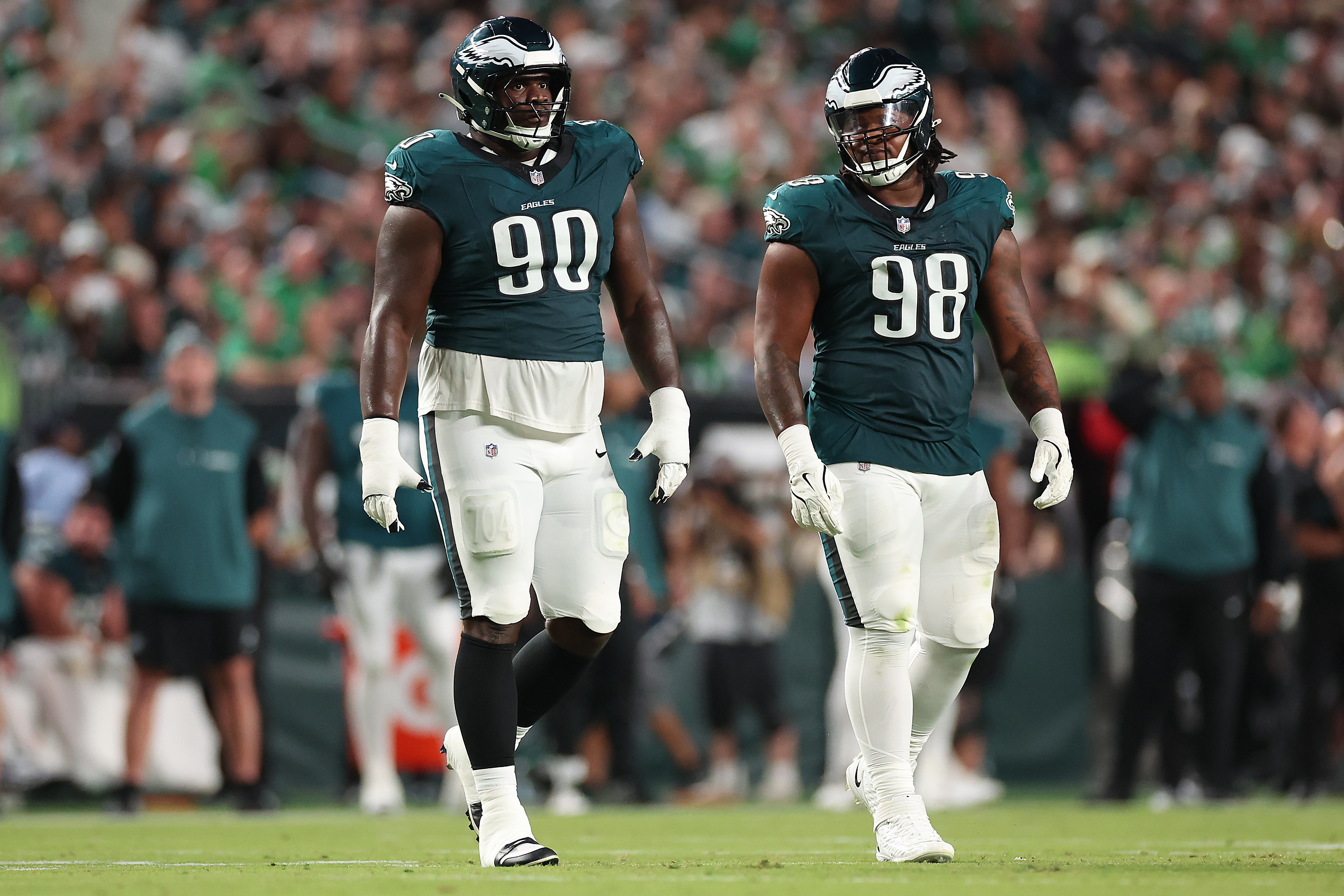
    Jordan Davis (left) and Jalen Carter (right) could cause problems for a Commanders O-line that is without its best player in Laremy Tunsil. David Maialetti / Staff Photographer

    The Eagles should have a decided edge up front. The Commanders lost their best O-lineman (left tackle Laremy Tunsil) early in camp and are suspect at several spots. Replacement Brandon Coleman moved from left guard. Right tackle Josh Conerly is coming off an underwhelming rookie season. And new center Nick Allegretti missed most of camp with a calf injury. Right guard Sam Cosmi is good. But Carter has to be licking his chops. If the apparently healthy defensive tackle can push the pocket — or one of the other interior guys, if Carter is doubled — Daniels will likely struggle and Fangio won’t have to blitz much.

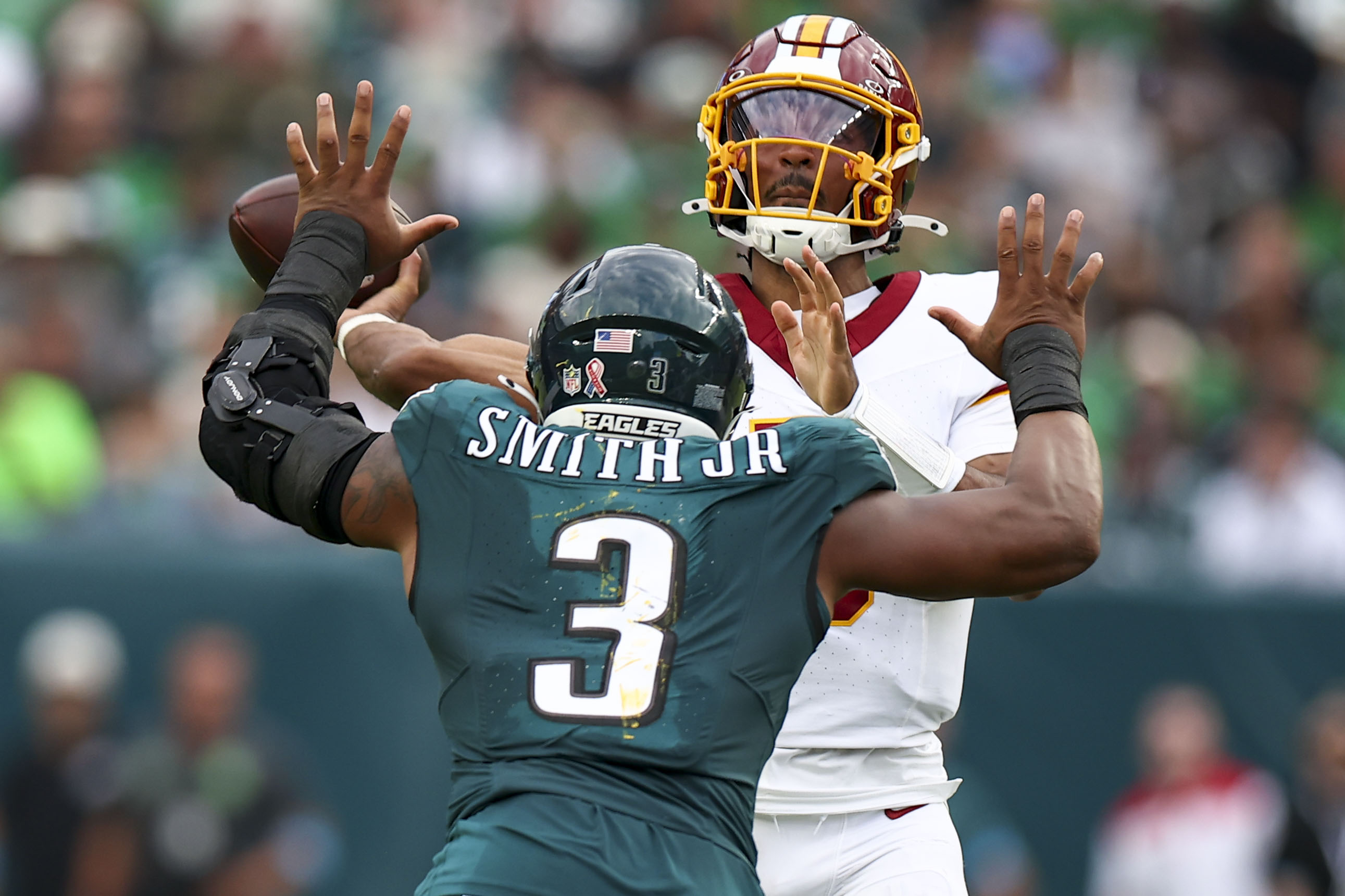
    Extra point: Jonathan Greenard was declared out on Friday after being a limited participant in practice all week. The outside linebacker missed all of camp with a pectoral injury and wasn’t expected to be ready by the opener. He also has to learn a new scheme that asks him to drop more than ever. The season is a marathon and Jalyx Hunt and Nolan Smith Jr. are more than capable on the edges in his absence.

    On offense, Mannion should be prepared for all scenarios, but Jones is probably going to stack the box to stop Barkley. It worked for most defenses last season, and until the Eagles show they can win consistently through the air, I don’t imagine opponents will drift from that approach. If Hurts has to drop more than expected, Mannion could go with a quick pass game to make Washington’s leaky secondary tackle in space.

    The Eagles are surprisingly only 5½-point favorites, but Vegas usually plays it safe in Week 1. Sirianni-Hurts are 5-0 in openers, though, and have mostly had their way against the Quinn-led Commanders. Unless amateur magician Blough can pull off some tricks, I see the Eagles pulling away in the second half and covering the spread.

    Prediction: Eagles, 27-20.

  • Why the Phillies should prioritize avoiding the Braves in the wild-card round. And one other baseball thought.

    Why the Phillies should prioritize avoiding the Braves in the wild-card round. And one other baseball thought.

    The Phillies are exactly where we probably should have expected them to be, which is exactly where they were a week ago. That is, four games behind the Braves with 15 to play heading into this weekend’s three-game series in Atlanta. That’s not necessarily a bad thing, believe it or not. Treading water is as important as making up ground.

    Right now, the Phillies number one goal shouldn’t be winning the National League East. It should be avoiding the Braves in the wild-card round. The NL playoff picture has changed considerably with the Dodgers winning seven straight and the Braves losing four of six.

    Now that L.A. has a 3½-game lead over Atlanta for the NL’s second bye, it’s looking increasingly likely that the eventual NL East division champs will end up hosting a best-of-three series against the No. 6 seed. Which means the Phillies should be just as focused on maintaining or growing their current 3½-game lead over the Padres, who entered Friday with a half-game lead over the Diamondbacks for the NL’s final playoff spot.

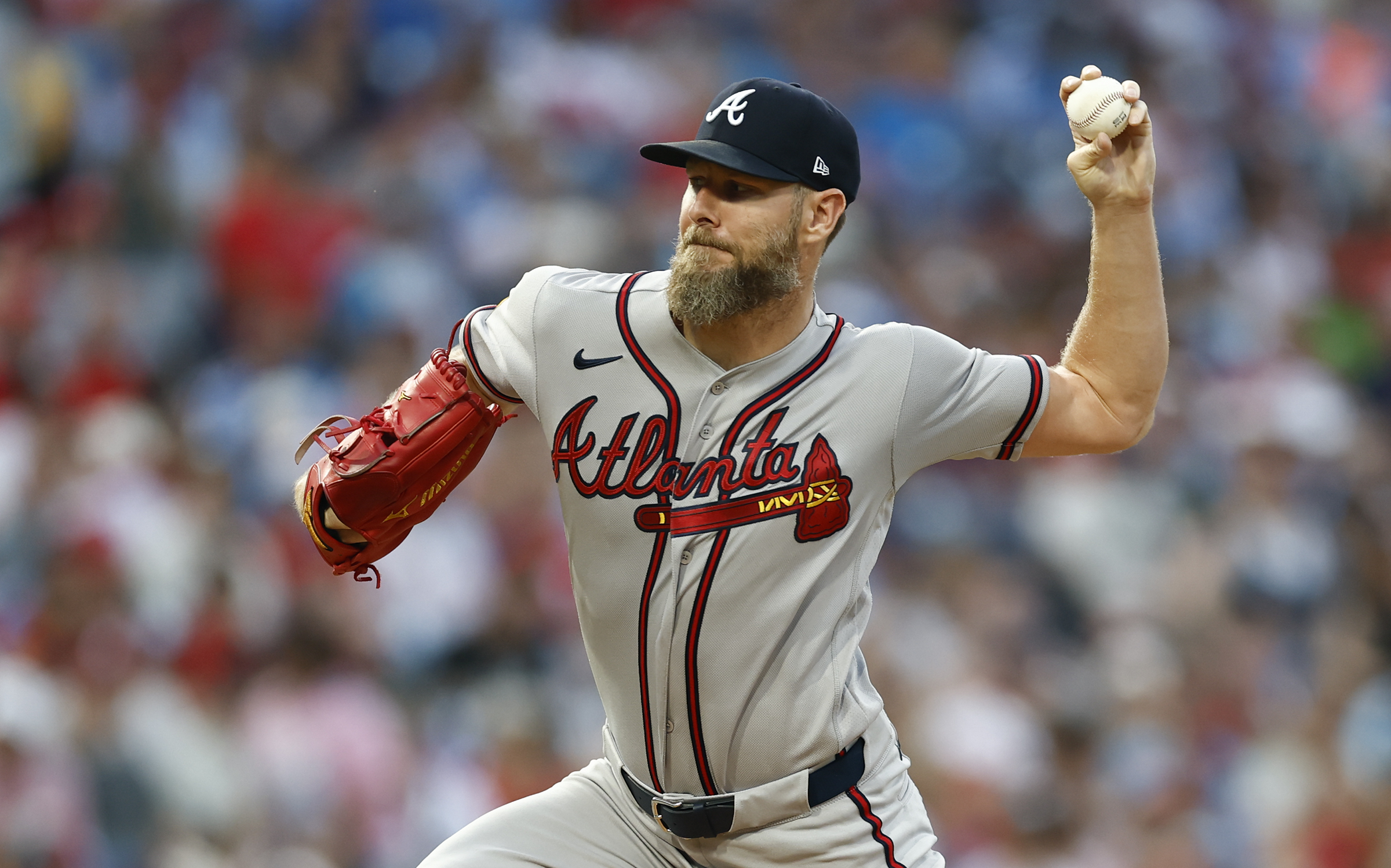
    Some folks will scoff at the idea of the Phillies fearing the Braves in an October series. But best-of-three is barely a series. This isn’t about fearing the Braves. It’s about fearing Chris Sale.

    Last weekend, the Phillies took their latest dose of medicine from one of the game’s all-time greats when Sale held them to two runs in six innings of a 5-2 Braves win. Atlanta’s presumptive Game 1 starter is not a problem the Phillies are magically going to solve just because the leaves are falling off trees.

    The Braves are 3-0 in Sale’s three starts against the Phillies this season and they’ve won five of his seven since joining the team in 2024. His numbers should make you gulp. In his last five starts against the Phillies dating back to May of last season, Sale has allowed a grand total of four runs in 31 innings. He has struck out 40 of the 118 batters he has faced. That’s 33.9%.

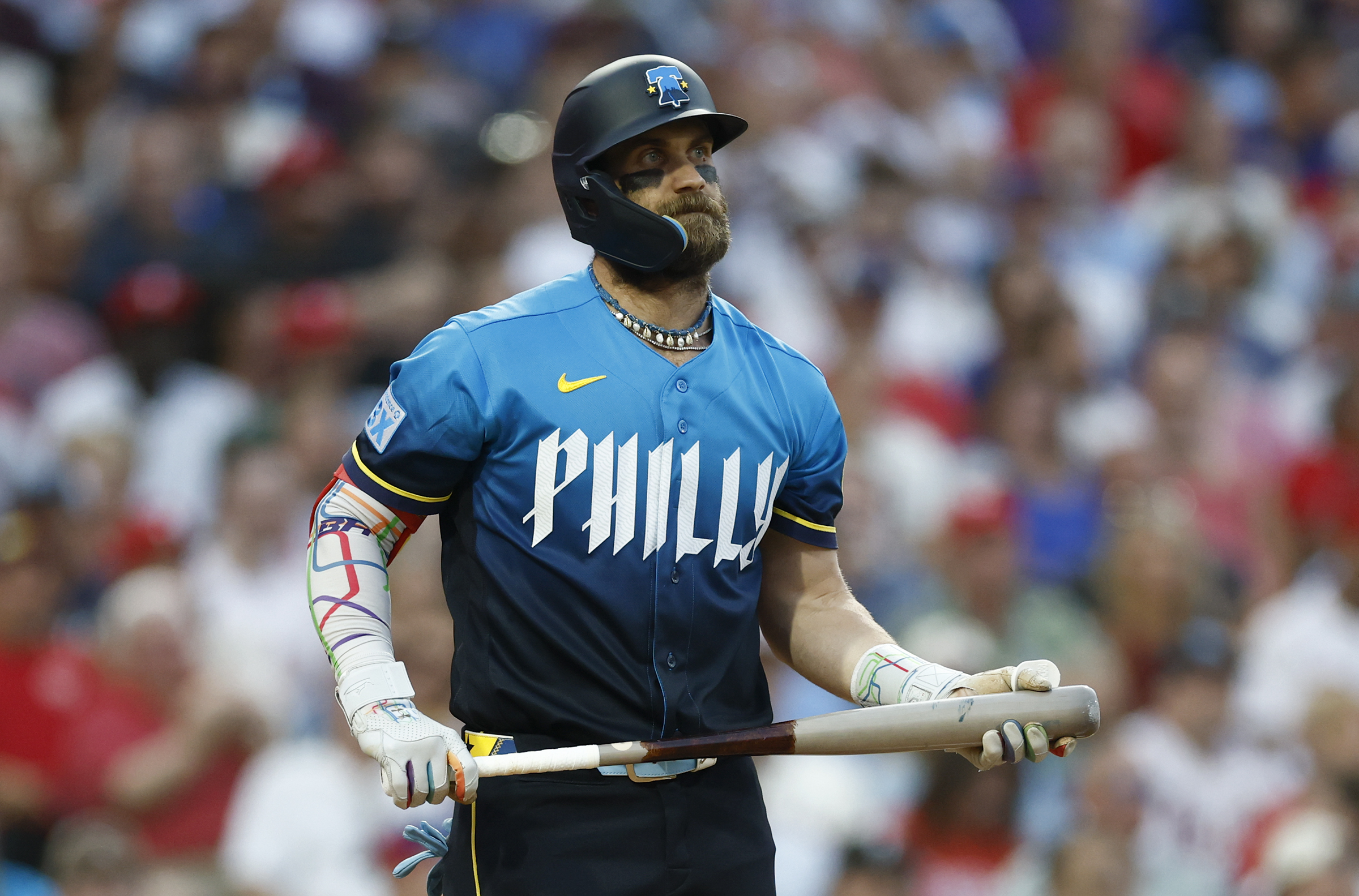
    Bryce Harper is one of the Phillies with bad career numbers against Chris Sale. He has just two hits in 18 at-bats against the lefty (.111).Yong Kim / Staff Photographer

    In a longer series, the Phillies would have a clear starting pitching advantage over the Braves. Grant Holmes and Tyler Mahle have both had some success against the Phillies, most recently holding them to a combined two runs in 12 innings of last weekend’s series. Holmes has allowed just five runs in 20⅔ innings against the Phillies over the last two seasons, while Mahle held them scoreless in seven innings and 5⅔ innings in two of his three starts prior to last weekend (albeit dating back to 2021). Regardless, the Phillies would have a significant advantage in three of the first four games of a five-game series.

    In a three-game series, Sale in Game 1 is a monumental equalizer of the odds. They’d much rather take their chances against the Cubs, who would presumably start Clay Holmes and Shota Imanaga, followed by a spin of the roulette wheel in Game 3.

    A sigh of relief

    Now, about that bullpen …

    Give interim manager Don Mattingly credit for getting Alex McFarlane back on the mound in the eighth inning on Wednesday. The 25-year-old right-hander got ground balls from three of the four Astros batters he faced to deliver an 11-7 lead to Jhoan Duran in the ninth. McFarlane didn’t record a strikeout but threw strikes on 12 of his 15 pitches. This wasn’t exactly a high-leverage situation, at least not compared to the last time he walked off the mound. But it was a situation where a true set-up man gets the ball, and Mattingly gave it to him. Which is exactly what the Phillies manager should be doing.

    Despite the homer he surrendered to Ronald Acuna Jr. last weekend, Alex McFarlane remains the Phillies’ greatest hope in the eighth inning.Elizabeth Robertson / Staff Photographer

    The underdiscussed aspect of McFarlane’s welcome-to-the-bigs moment against Ronald Acuna Jr. and the Braves on Sunday was the fact that he was on the mound at all. Mattingly easily could have pivoted after McFarlane allowed a one-out single to Mike Yastrzemski and a double to Drake Baldwin to bring Acuna up as the tying run in a 4-1 game with a base open. He had a lefty warming and Braves lefties Matt Olson and Michael Harris due up after Acuna. Conventional baseball wisdom says you don’t put the tying run on base. Still, it said something about the Phillies’ estimation of McFarlane that he both remained on the mound and challenged Acuna Jr. throughout the seven-pitch at-bat.

    It also says something that Mattingly didn’t flinch after McFarlane allowed a three-run, game-tying home run to Acuna.

    “I don’t think you learn anything yet,” Mattingly said after the Phillies’ eventual 5-4 loss. “I think we see how he responds. I feel about the way he’s going to respond. When everything’s going good it’s pretty smooth sailing. Everybody’s going to struggle, what happened to him today is going to happen to everybody if you play long enough. So we’ll see. I think he’ll be fine. He’s been a kid that’s handled everything. The disposition’s been good.”

    The Phillies are doing exactly what they should be doing with McFarlane. The first goal is to get to the postseason with an eighth-inning option that is something better than a flip of the coin. The second goal is to get there with somebody who actually gives them a significant advantage like the one they have in the ninth inning with Duran. On both counts, McFarlane is their best hope. Overwhelmingly so. There is nothing like exposure therapy for a big-league reliever. There will be plenty of big spots in October. The Phillies need McFarlane to become a guy who thrives in them.

  • ‘If you were in a stadium, you were a target’: Larry Bowa, Hugh Douglas, Doug Glanville recall 9/11 in Philadelphia

    ‘If you were in a stadium, you were a target’: Larry Bowa, Hugh Douglas, Doug Glanville recall 9/11 in Philadelphia

    As he commuted from South Jersey into Philadelphia on the afternoon of Sept. 11, 2001, Hugh Douglas kept glancing at the skies.

    “I remember driving across the Ben Franklin Bridge, I was looking in the air for those planes. You know, the next planes,” Douglas said. “Because that bridge is the biggest way into Philly, and I thought they would attack that next.”

    Douglas, then a star defensive end for the Eagles, was driving to the practice facility, summoned for a team meeting to address an emergency. By then, of course, the skies were empty. The FAA had closed U.S. airspace at 9:42 that morning, and by 12:15, only birds flew over America.

    Terrorists had hijacked four commercial flights that brilliant Tuesday morning and turned them into missiles.

    At 8:46 a.m., American Airlines Flight 11 crashed into the 92nd floor of the World Trade Center’s north tower. At 9:03 a.m., United Airlines Flight 175 crashed into the south tower. At 9:37 a.m., American Airlines Flight 77 crashed into the Pentagon. At 10:02 a.m., after a struggle between heroic passengers and hijackers, United Airlines Flight 93 crashed into an empty field in Shanksville, Pa., 200 miles west of Philadelphia.

    Nearly 3,000 people died as a result of the attacks, still the largest death toll of any terrorist attack on U.S. soil. It stunned the world, and it left the nation shocked and terrorized, and it left the sporting world in turmoil.

    Douglas had just turned 30. In his lifetime America had seemed invincible. Impenetrable. It was, by far, the most traumatic event he’d known.

    “I thought it was the end of days,” Douglas said.

    He was not alone.

    Phillies center fielder Doug Glanville is a year older than Douglas. He grew up in Teaneck, N.J., less than 20 miles from what became to be known as Ground Zero, where the towers collapsed. He’d visited the towers frequently as a boy.

    On 9/11, Glanville was with the Phillies in Atlanta, preparing for an important series against the Braves. When he heard that the terrorists targeted sites beyond New York, he worried about what might come next, and whether ballparks and stadiums were vulnerable.

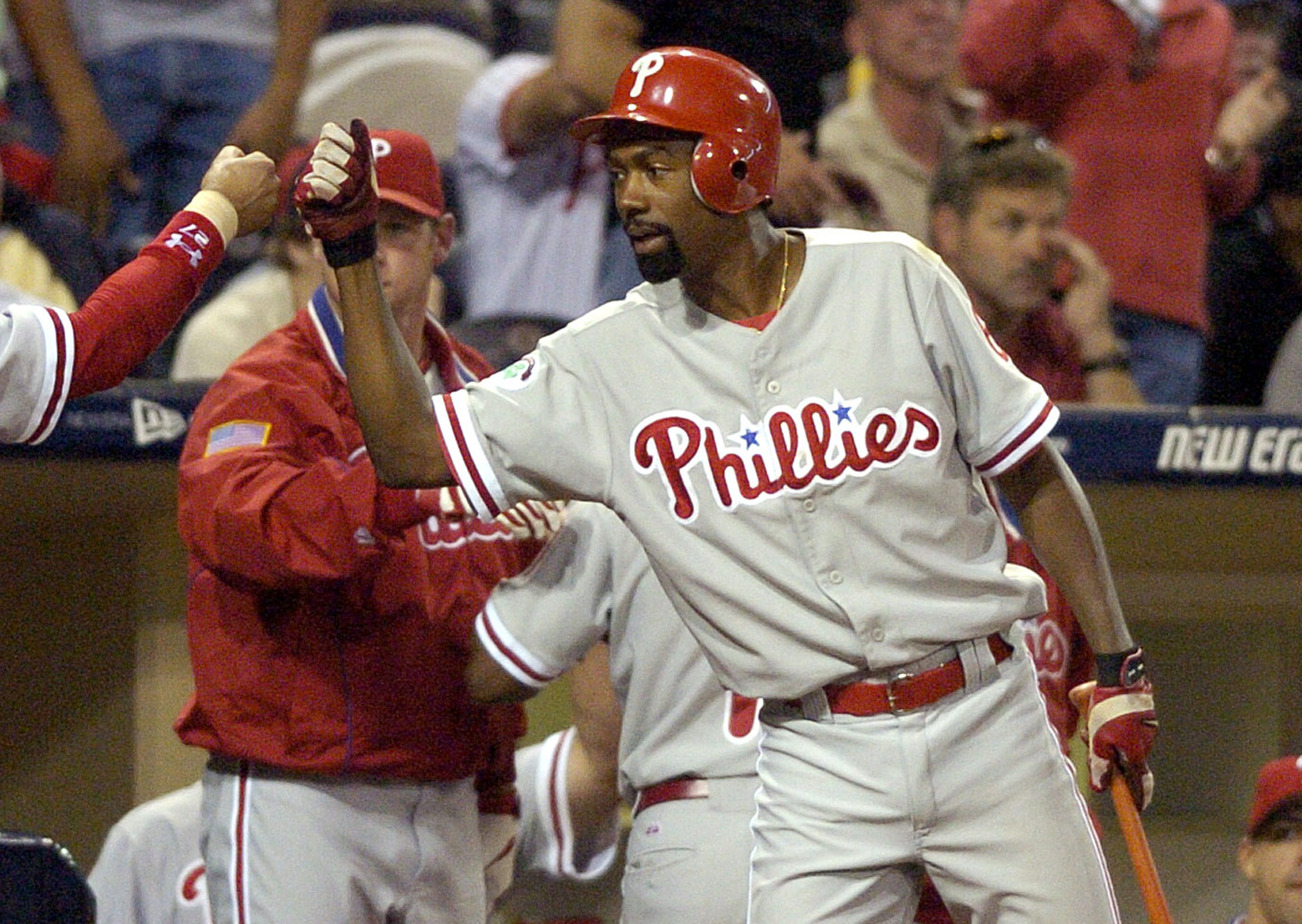
    Doug Glanville, here in a 2004 game in San Diego, played six seasons with the Phillies.DENIS POROY

    “We didn’t know what imminent threats were still there. We heard that they might attack Atlanta,” Glanville said.

    That worry persisted even when games resumed six days later, and beyond.

    “You felt like, if you were in a stadium, you were a target.”

    ‘I thought it was a movie’

    Douglas learned of the attacks from the movers helping him settle him and his wife at the time, Simona, into their town house in Marlton, N.J.

    “They blew up the tower,” one mover told Douglas. He wasn’t quite sure what the guy meant. The cable company hadn’t arrived yet, so the mover began to jerry-rig an antenna onto a television. Before he finished, another mover, still listening, announced, “They hit the other tower.”

    Finally, a fuzzy image appeared on the screen, the towers burning. A few minutes later, at 10:28, the north tower collapsed.

    Glanville had much better reception.

    Baseball players are a nocturnal breed, but Glanville is one of the few who relishes a hearty breakfast. Also, he’s a reader — he has an engineering degree from the University of Pennsylvania — so he rarely turns on his hotel TV.

    “There aren’t a lot of players who get up that early, except Kevin Jordan. So I go out of my room, get in the elevator, and Nina Jordan’s there, Kevin Jordan’s wife,” Glanville said. “I’m, like, ‘Good morning,’ with a smile. She’s like, ‘They hit the towers.’ ”

    Glanville flashed back to Feb. 26, 1993, when terrorists attempted to take down the north tower with a car bomb. They failed. Seven people died. Glanville assumed this was similar.

    “The first thing I thought is, ‘Oh, again?’ ”

    Not exactly.

    “We were in CNN country, so I came out of the elevator, I saw banks and banks of TVs,” Glanville said. “And then, of course, we were just, like, locked in.”

    Phillies manager Larry Bowa wasn’t watching TV in his room, either, but, with a teenage daughter, he always kept his phone close. When it buzzed that morning and he saw her number he was concerned, of course, but not as concerned as he soon would be.

    “She said, ‘Did you see the TV?’ And I said, ‘No.’ She says, ‘Turn it on,’ ” Bowa said. “And when I turned it on, I thought it was a movie.”

    ‘We took a vote’

    What happened in the next couple of days is a blur for most of us who lived through 9/11, and most of us weren’t star entertainers and their bosses walking the thin line of propriety.

    Would baseball be played Tuesday night? Would baseball or football, either college or pro, be played on the weekend?

    Flights resumed sporadically just two days after the attacks, but it was about a week before air travel resumed full throat. The Eagles and the rest of the NFL hunkered down.

    “We knew pretty quick we weren’t going to Tampa that weekend,” Douglas said. “So we just practiced. And it was weird, right? You get planes flying over South Philly all the time, because the airport is so close. There were, like, no planes that week.”

    It was as if everyone held their breath, just as they’d done after President John F. Kennedy was assassinated in November 1963, which paused most of college football and briefly paused the NBA and NHL.

    “Nobody knew what was the right time,” Bowa said. “Some people were saying they might cancel the whole season.”

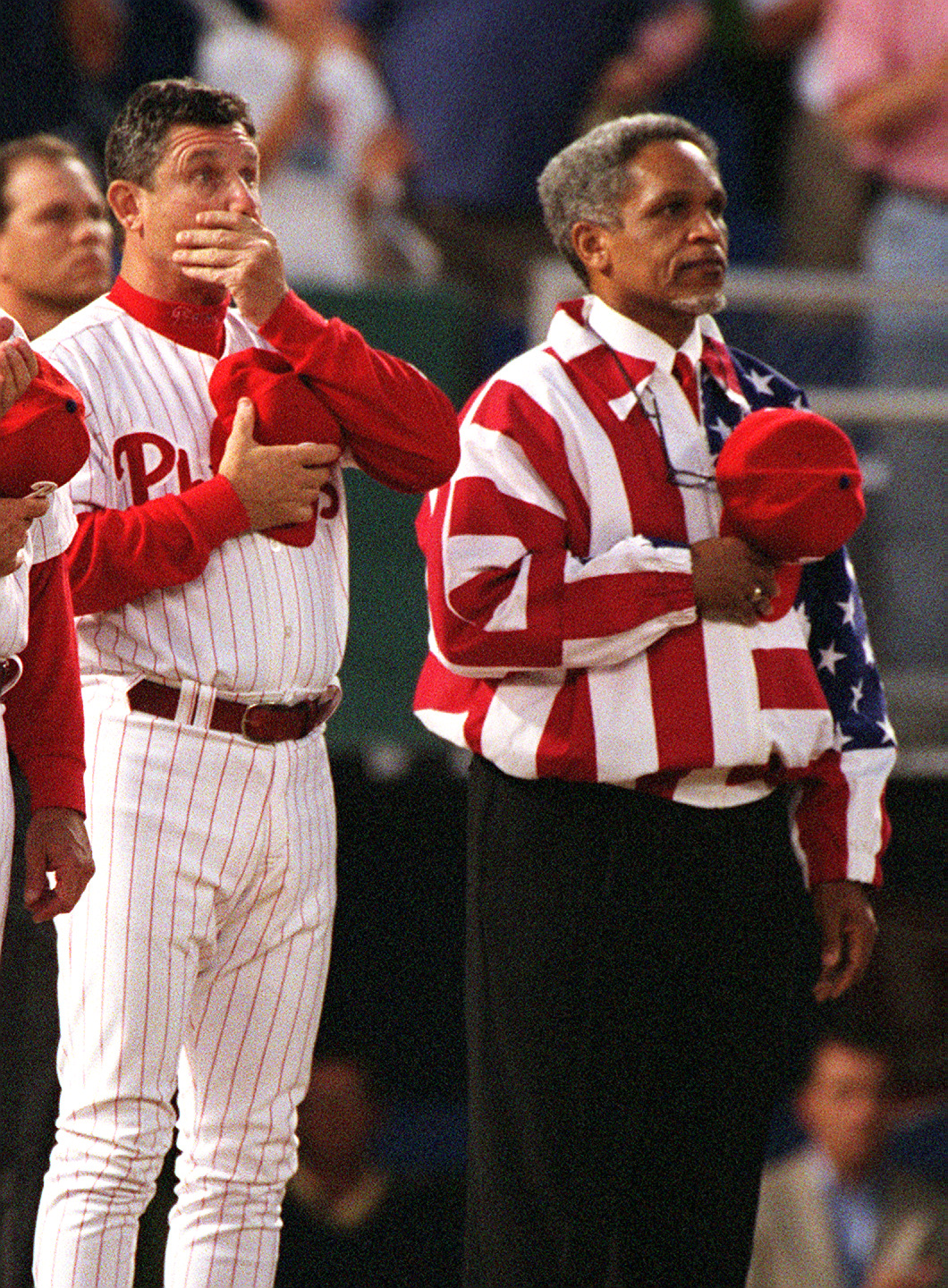
    Phillies manager Larry Bowa wipes his face standing next to Philadelphia Mayor John Street during a moment of silence before the Phillies-Braves game on Sept. 17, 2001 at the Vet.D

    As it turned out, baseball games resumed Sept. 17. The Expos hosted the Marlins with the first pitch thrown at 7:10 p.m., so baseball officially resumed first in Canada. But the Braves visited the Phillies and the Mets visited the Pirates, and both games went off at 7:19 p.m., so Pennsylvania co-hosted the return of America’s game in America.

    ‘We took a vote’

    Getting from 9/11 to 9/17 was quite a journey for the Phillies.

    Games were suspended immediately, but MLB dithered regarding when they would resume. The Phillies spent three days in Atlanta, then decided to bus to Cincinnati, where they were scheduled to play over the weekend. They were outside of Knoxville, Tenn., when they heard that those games might not happen, either.

    What now?

    They pulled the two buses into a rest stop. Players disembarked to try and get cellphone reception, which was poor on the buses, and check in with their families. At that point, mild chaos ensued.

    Should they reroute to Philadelphia? Should they return to Atlanta, where flights would be easier to arrange? Should they just continue to Cincinnati and maybe ride out the weekend?

    They couldn’t take the buses to Philadelphia because the bus driver had logged too many hours.

    “We took a vote,” Glanville said. “It was everybody, 40 or whatever, to 2. And the two were Bowa and (reliever) Dennis Cook, and Cook lived in Atlanta.”

    So, on to Cincinnati, where they discovered those games were, in fact, postponed. Inimitable traveling secretary Frank Coppenbarger, now retired, wheedled a chartered plane for the next day. The Phillies were home for supper on Sept. 15.

    MLB delayed the playoffs for a week. The Phillies made up the postponed games in Atlanta and Cincinnati after the regular season ended. Like their NFL counterparts, they played the rest of the season in a daze of heightened security and heightened anxiety.

    ‘A sense of pride’

    NFL players were used to being treated like royalty on their charter flights to games. A week and a half after 9/11, they found out what it was like on tarmacs in countries where terrorism is a constant threat.

    “We used to just park our cars at the facility, get on a bus, ride to the airport, get off, and walk right on the plane,” Douglas said. “Now, you went to the airport, man, and everybody was on high alert. There’s guys with machine guns or whatever, there’s tons of security. Even on the plane. And you had to watch your mouth.

    “I went to the bathroom and came back and told the fellas I blew it up,” he recalled, and was quickly admonished by security. “Yeah, you couldn’t say you ‘blew up the bathroom’ anymore.”

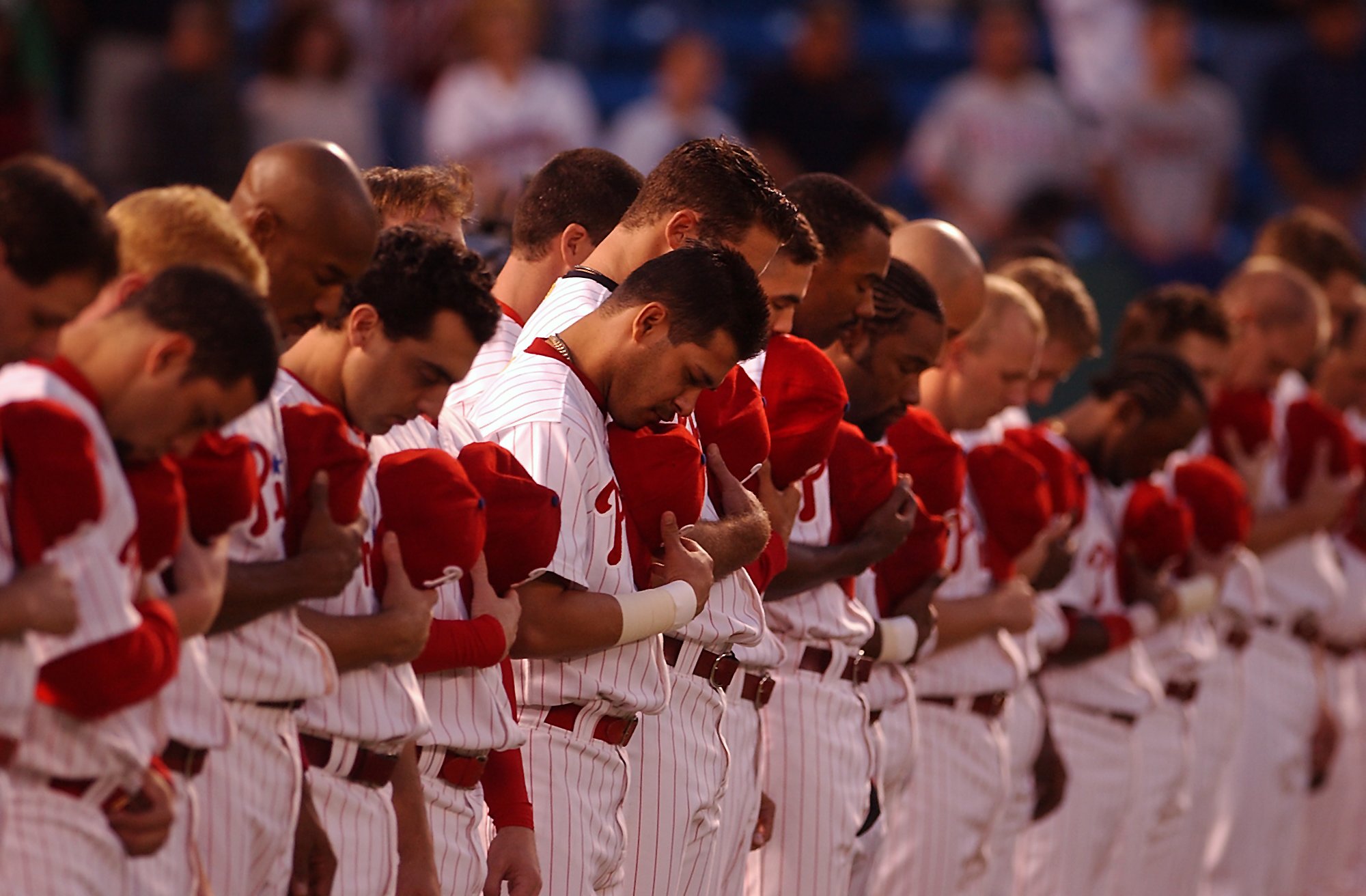
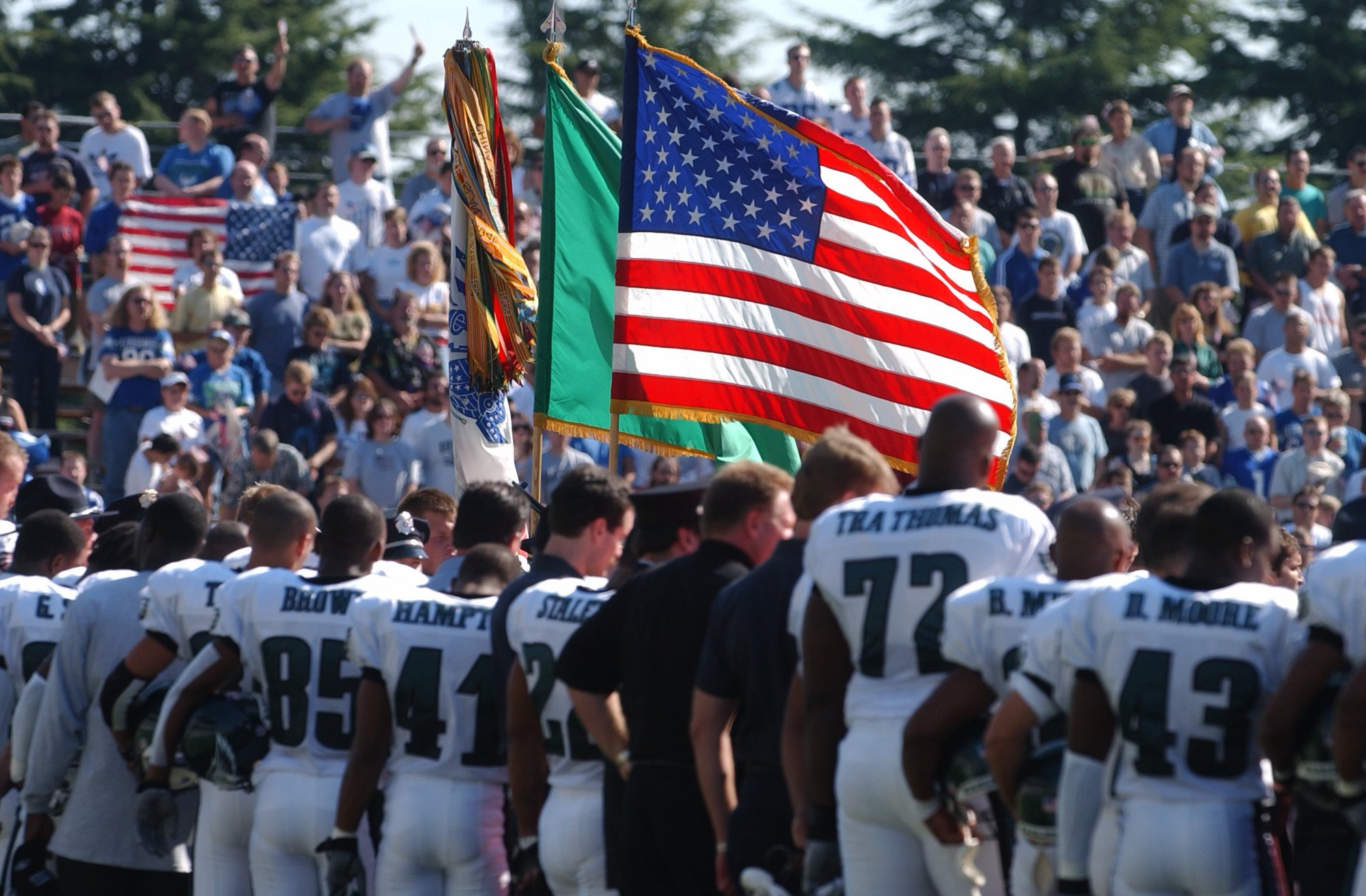
    Eagles players line up during pregame ceremonies before the Eagles-Seahawks game on Sept. 23, 2001, the teams’ first game after the attacks.Ron Cortes / Staff Photographer

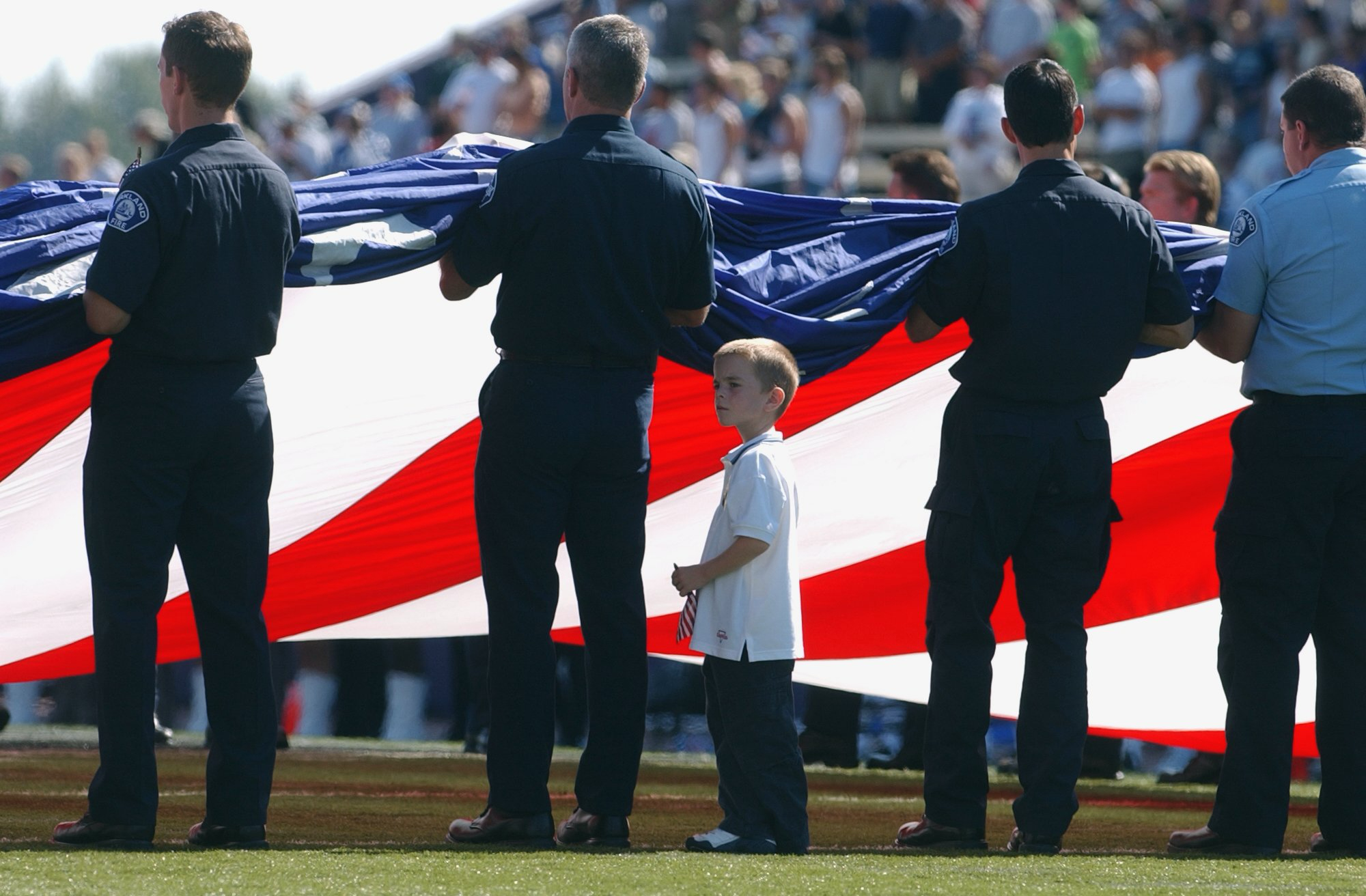
    As with MLB, NFL playoffs were delayed by a week, so the Eagles made up their postponed game at Tampa in January after their final scheduled game of the regular season. Their first game after the attacks was in Seattle, where they played the Seahawks at the University of Washington stadium while their new stadium was being built. As in many stadiums that day, the pregame national anthem was performed as a giant flag that covered the entire field.

    Who held it? Douglas, his teammates, and his coaches joined their counterparts from the Seahawks and dozens of first responders. Douglas had a hand on that flag, and he remains moved by that ceremony to this day.

    “Just, I don’t know,” Douglas said. “Just a sense of pride.”

    A giant American flag covers the field before the Eagles-Seahawks game at the University of Washington stadium during pregame ceremonies on Sept. 23, 2001.Ron Cortes / Staff Photographer

    ‘Tip your cap’

    Pride: That’s what Bowa felt on Sept. 17. He’s proud that Philadelphia, the cradle of American democracy, was part of the return to sport. He’s proud that the franchise he played for and managed was, with the Pirates, the first team in the U.S. to resume, and he’s proud that baseball, America’s game, was the first front-line sport to restart.

    Bowa is a hard man, but he understood the situation. He held a team meeting before the game and told the players that anyone who didn’t feel like playing didn’t have to; he understood. No takers.

    The pregame left Bowa and Glanville shaken. As late Phillies broadcaster Harry Kalas delivered a moving pregame address to viewers, a montage compiled by “Video” Dan Stephenson helped settle the 27,910 fans at Veterans Stadium into their seats.

    “People were in tears over that,” Glanville said.

    It was the music that got to Bowa. He’d served in the U.S. Army Reserve as a young man, and his patriotism runs deep.

    First, he recalled, there was Lee Greenwood’s “God Bless the USA” Then, right before the first pitch, with the teams lined up on the baselines, came “God Bless America” and the national anthem, performed back-to-back by — who else? — the star-spangled Valley Forge Chorus.

    Then, the game.

    Phillies ace Robert Person went eight innings, gave up two runs, Jose Mesa got the save, and the Phillies won, 5-2, and drew to within two games of the Braves in the National League East.

    Who’d they beat?

    Braves legend Greg Maddux.

    Glanville got a hit, Pat Burrell got two, rookie All-Star Jimmy Rollins scored a run, and MVP candidate Bobby Abreu tripled. But all of them — Person, Mesa, Glanville, Rollins, Abreu — they were just co-stars.

    Nobody in baseball met the moment like Scott Bruce Rolen.

    Chipper Jones’ homer gave the Braves a 1-0 lead in the first inning, but Rolen tied it with a leadoff homer in the second. He drove in Abreu from third base in the fourth for a 2-1 lead.

    Then, with two out in the bottom of the sixth inning, Rolen homered again. The Phillies led, 3-2. The Vet rocked and rolled as Rolen returned to the dugout and, as ever, humbly took off his helmet. The crowd was nearly tearing the old stadium down, begging for a curtain call, but that just wasn’t the sort of thing Rolen did. Ever.

    Bowa called Rolen over.

    “Scotty,” he said, “you got to go out and tip your cap.”

    Rolen replied, “Well, you know I don’t do that.”

    “Scotty,” Bowa said, “this is something different.”

    Rolen stood there. Paused. Relented: “OK, you’re right.”

    He scooted up the steps. Tipped his cap. The crowd went crazy. Even Bowa lost himself for a few minutes:

    “I can honestly say, as competitive as I was, that’s the first time I really didn’t care about winning or losing a baseball game.”