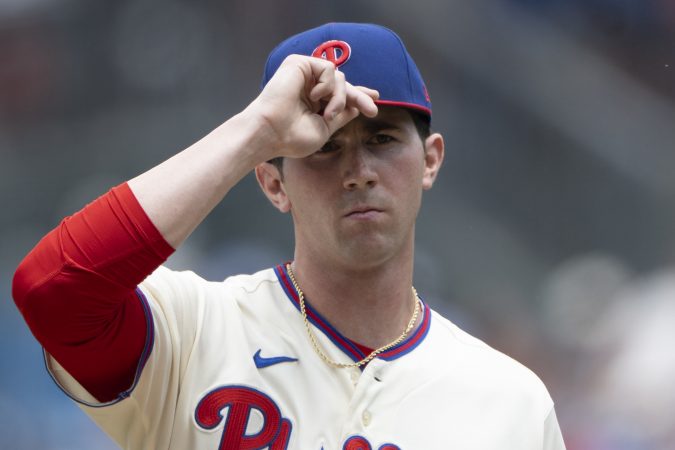
Somebody needs to tell Andrew Painter to remember one number.
10.64
He needs to say it out loud until it is ingrained in his memory, then he needs to take that memory with him.
Ten-point-six-four.
He needs to carry it, to own it, to believe in it. All the way down to Allentown and then to wherever his career takes him next. Buy a notebook, maybe. That’s what Roy Halladay did. Halladay knew that number better than anybody. He felt it. He owned it, rather than letting it own him.
That number — 10.64 — was Halladay’s ERA in 67⅔ innings as a 23-year-old big leaguer. It is nearly three runs higher than the ERA that just earned Painter a demotion to triple-A Lehigh Valley after allowing six runs in two innings of the Phillies’ 12-4 loss to the Marlins on Wednesday. Halladay ended up spending his 24th birthday facing class-A minor league hitters in Dunedin, Fla. As the old saying goes: It’s not how far you fall, it’s how high you bounce.
Painter is 25 days older than Halladay was when he lost his spot in the Blue Jays’ rotation in 2000. He is nearly a full year younger than Halladay was when he began the process of reinventing himself, both mechanically and mentally. It is a shame that Halladay is no longer around. He almost certainly would have shared all of this with Painter personally.
Failing is easy. The hard work is what comes next. It’s an endeavor upon which Painter must embark. The 65 innings he has logged as a major leaguer offer plenty from which to learn. They have told him that his fastball will not play in its current form, whether he grips it with four seams or two. Against the Marlins on Wednesday, Painter threw just 19 of them on 56 pitches. Ten of those fastballs prompted swings. None of them were whiffs.
Unlike a lot of young pitchers, Painter’s issues are not related to control. Heading into Wednesday, he was walking an average of 3.1 batters per nine innings, against 7.1 strikeouts. The big issue is the contact, a lot of it loud. The two-run home run he allowed to Kyle Stowers in the first inning was his 13th in the last 49⅔ innings. It is an unsustainable pace, grotesquely so. The Phillies had no other choice even without better options.
You aren’t going to win many games when your starter lasts only two innings, allowed eight of 14 batters to reach base, and allows six of those eight batters to score. By the end, the Phillies had used six relievers, two of whom threw 26-plus pitches. That didn’t include backup catcher Garrett Stubbs, the human white flag. He was one of two pitchers who didn’t allow a run.
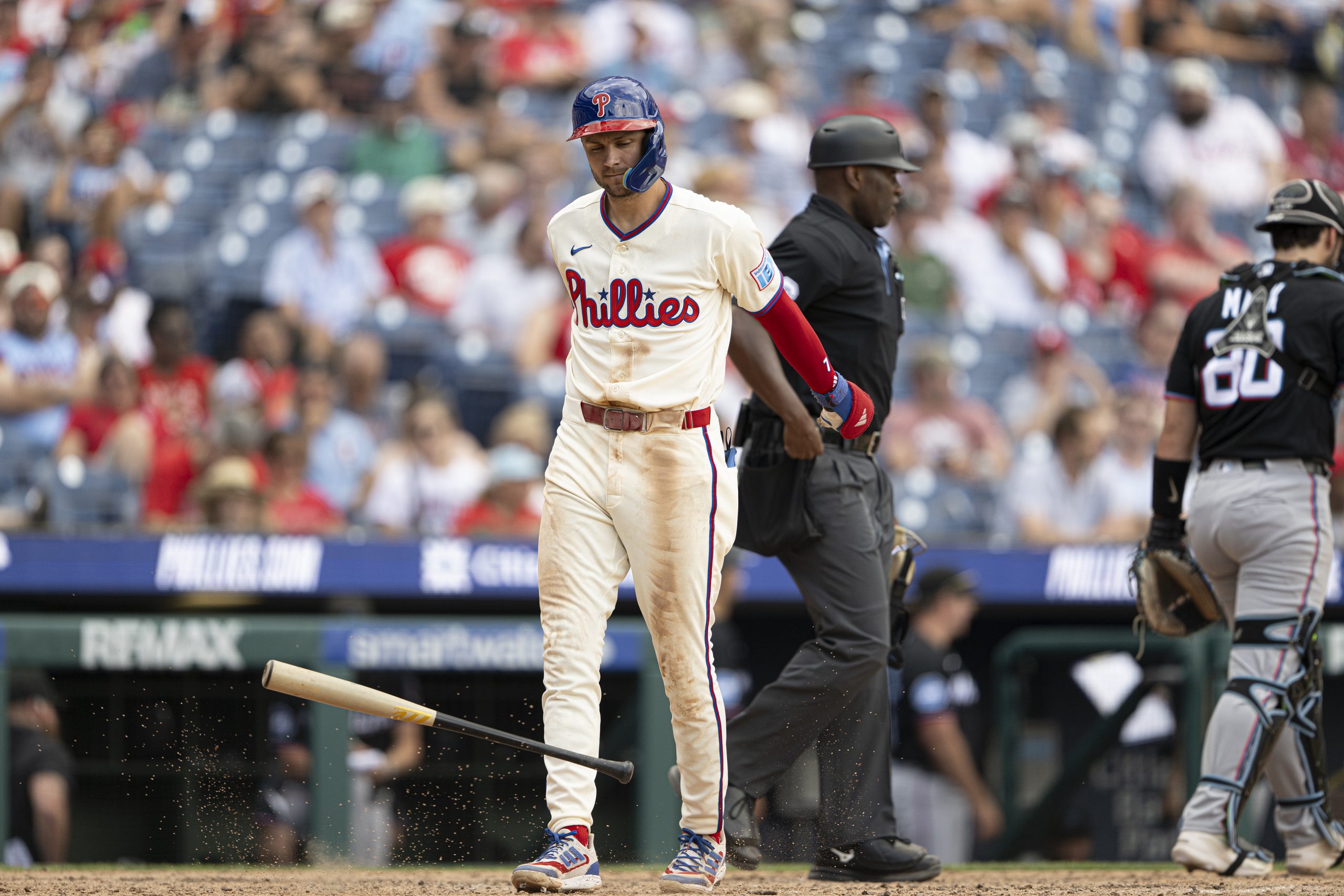
Trea Turner slams his bat down after striking out in the sixth inning. Jose F. Moreno / Staff Photographer
It was not a fun afternoon, especially for Don Mattingly. The Phillies interim manager got a good look at two of the biggest reasons his team may be destined to spend the rest of the season attempting to yo-yo away from .500 and toward 90 wins. It is very hard to break off a long winning streak when you have holes at the top of your lineup and the back of your rotation. In Painter and Trea Turner, the Phillies had both. Now, they have one.
On Wednesday, Mattingly went back to the old drawing board with Turner, his struggling leadoff hitter. Turner went 3-for-5 with a double, his first three-hit game since May 9. The Phillies desperately need it to be the start of something.
With Painter in the minors and no obvious replacement, the onus will fall even more squarely on Turner. He entered the day with a brutal .595 OPS. He has a lot more work to do to reestablish a rightful claim as a set-it-and-forget-it leadoff man. Mattingly can’t afford to be too patient, especially given the aftertaste of success from Tuesday’s experiment with Brandon Marsh in the one-hole.
If the manager’s latest exhibition of patience doesn’t result in a serious heater from Turner, he shouldn’t hesitate to climb back outside of the box and see what happens with Marsh setting the table. Three consecutive lefty-on-lefty matchups for an opposing bullpen isn’t ideal, but it can be better than anybody-on-Turner. I don’t know if that counts as a real solution. After all, Turner still has to hit somewhere.
It has been an unfortunate season for 24-year-old 40-man roster member Jean Cabrera, who has a 9.39 ERA in 13 starts between triple A and double A. Gage Wood, last year’s first-rounder, has pitched well in Reading. But a big-league promotion is a bit ambitious. The more realistic answer is to patch it together the way the Phillies did for much of 2024 and 2025.
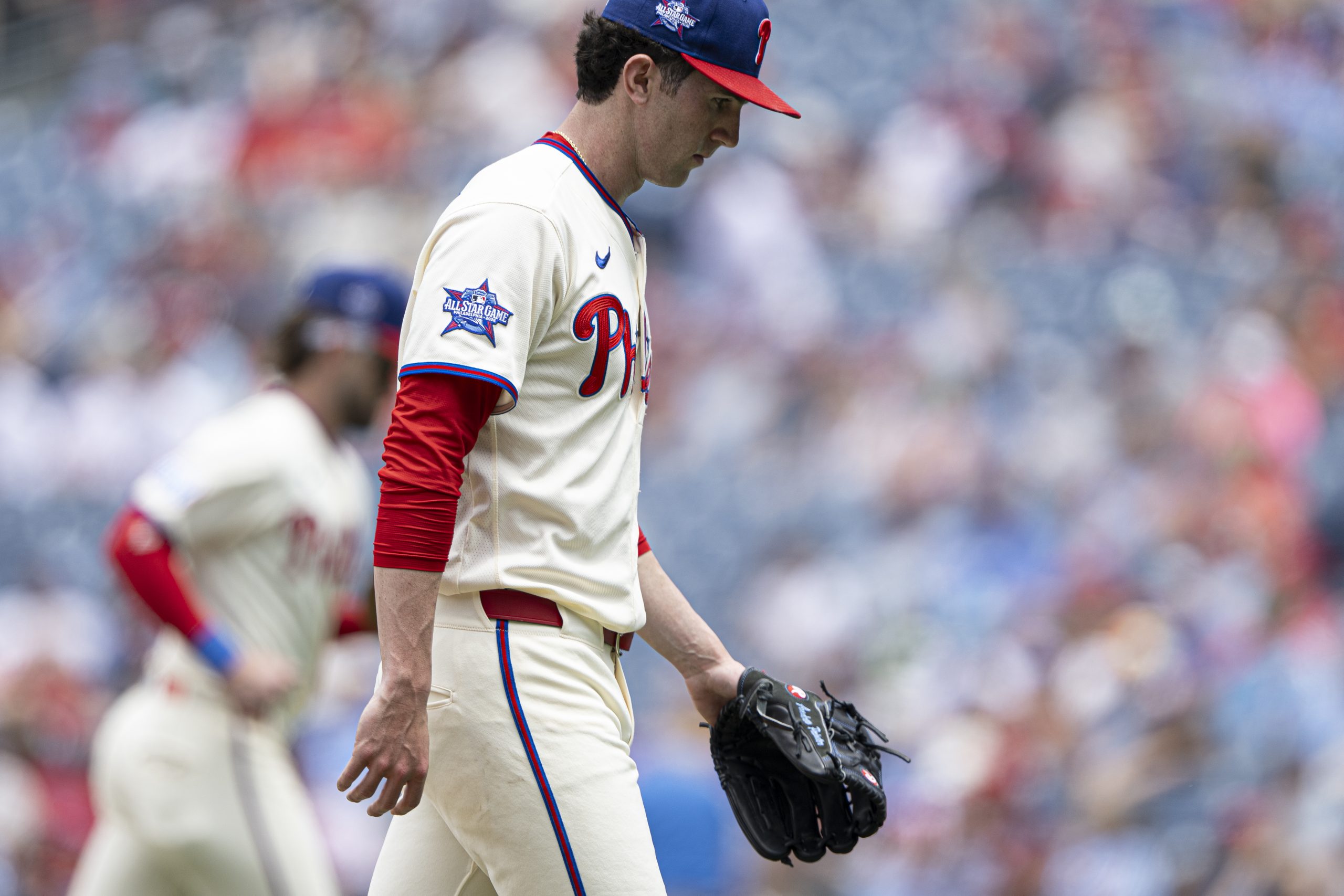
Andrew Painter gave up six earned runs on six hits, including two home runs, in two innings against the Marlins on Wednesday. Jose F. Moreno / Staff Photographer
The bigger concern is Painter’s future. The Phillies have clung to the hope of him for four years now. He has shown plenty to justify the belief. He was brilliant in his debut, more than adequate in his next two. He logged back-to-back quality starts as recently as late May. He has not recorded more than four strikeouts in any of his last eight starts. But the fastball is a problem, and he must figure it out. The velocity isn’t there like it was in his peak prospect days. But 94-96 mph is not a bad baseline.
Can it be fixed? If it can, it wasn’t going to happen at the major league level. With the All-Star break drawing near and Painter probably needing some form of workload management in his first big league season, it was hard to make an argument for keeping him in the majors. A lot of what comes next comes down to Painter. Responding to failure isn’t easy. But it is a personal choice.
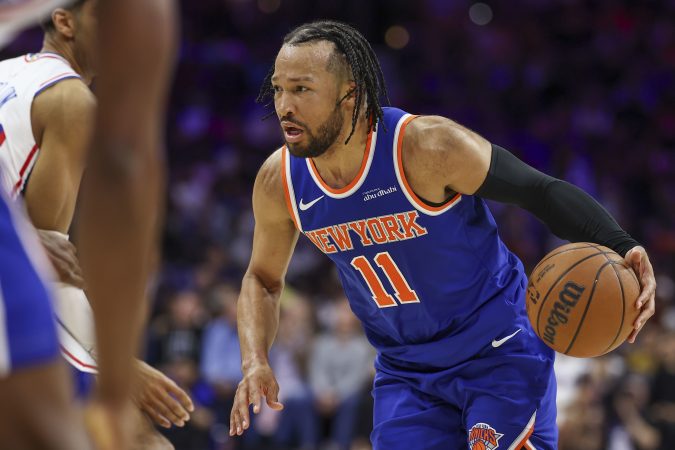
At 10 a.m. Thursday, Knicks superstar Jalen Brunson will ride up Broadway through Manhattan’s “Canyon of Heroes,” showered with the same sort of ticker tape that fell upon Teddy Roosevelt, John Glenn, and Queen Elizabeth II.
If Brunson has any sense of loyalty, he’ll wear his Jalen Hurts jersey. He’s done it before.
Why not? After all, Brunson and Hurts are essentially the same guy. Soft-spoken leaders. Tireless workers. Kind-hearted humans.
And, after the Knicks’ five-game series win over the Spurs in the NBA Finals on Saturday, they are both unlikely champions.
On Jan. 18, 2023, three nights before the Eagles hosted the Giants in a wild-card playoff game, Brunson entered Madison Square Garden wearing a midnight green Eagles jersey with the No. “1″ on the front.
It read, “Hurts” on the back.
The athlete whose mirror image Brunson has become.
As they left college and began their pro careers, experts measured everything about them — everything, that is, except grit, determination, work ethic, and heart. That didn’t seem to matter.
What mattered was that Brunson was too short, too slow, didn’t shoot well enough, couldn’t defend. What mattered was that Hurts was too short, his arm was too weak, he couldn’t run a prostyle offense, he’d never won the Big Game.
Sure, they won as amateurs. But on the pro stage? Bah. These guys weren’t going to win anything.
Now, they can compare rings.
Roots
Brunson went to high school about an hour north of Chicago, but he spent his preteen years in South Jersey. Naturally, he developed a passion for the Eagles.
When he wore the Hurts jersey to MSG three years ago he was trolling the New York fans as much as he was supporting the Birds. Brunson, a social media virtuoso with a mischievous personality, delights in this sort of subtle jousting.
Brunson also is an unlikely NBA success story, in the manner and mold of Hurts.
Both were viewed as athletes who likely had reached their peak in college. Neither was considered a viable option to lead a team to a title.
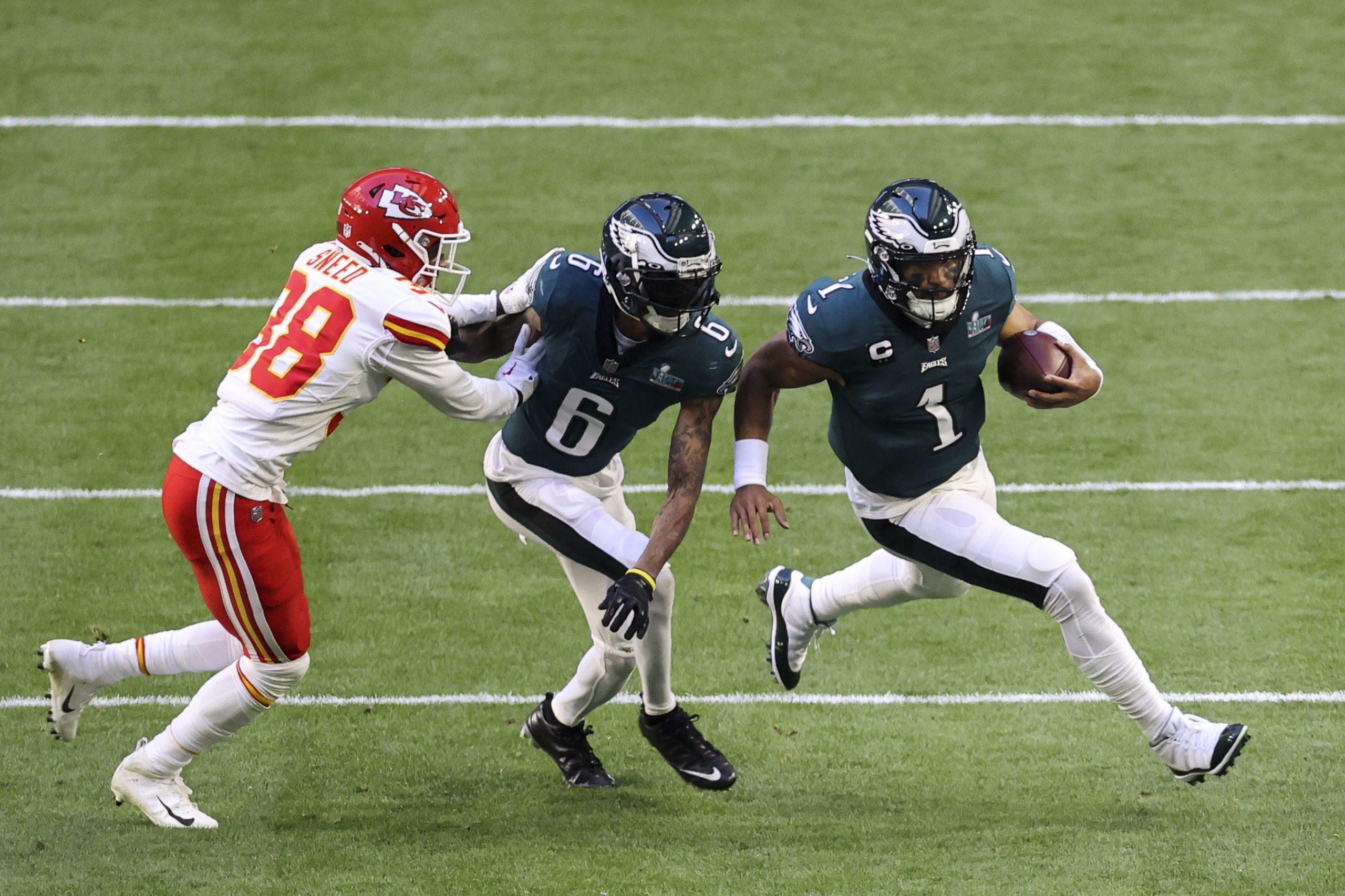
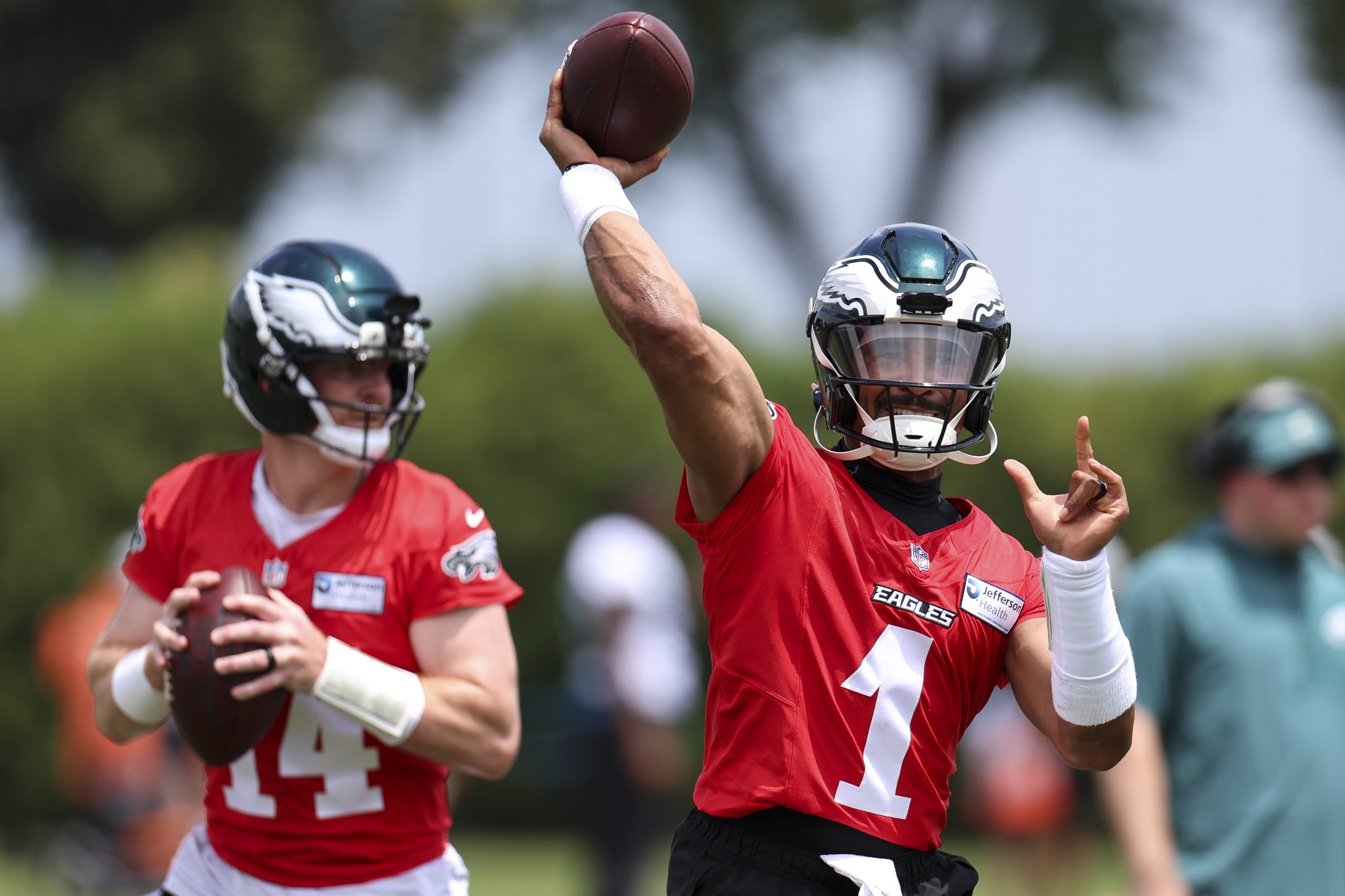
Jalen Brunson said that Jalen Hurts (1) motivated him after beating the Chiefs in Super Bowl LIX: “He just wants to win. So I commend him for that.”Monica Herndon / Staff Photographer
Who could know that, 3½ weeks after Brunson wore his jersey, Hurts would fall just three points short of winning Super Bowl LVII? Who could know that, two years later, Hurts would win Super Bowl LIX and the game’s Most Valuable Player award?
Did that inspire Brunson?
“Absolutely,” he told the New York Post after the Eagles beat the Chiefs for the Lombardi Trophy in Super Bowl LIX. “Obviously, all the criticism about Jalen Hurts and him not being a champ. And he’s said the whole time that he doesn’t care about anything individual. He just wants to win. So I commend him for that.”
Who could know that, 3½ years after Brunson wore Hurts’ jersey, that Brunson would lead the Knicks to their first NBA championship in 53 years? Who could know that he would score 45 points in a Finals closeout game, tied with Michael Jordan for third-most all time?
Nobody. That’s who. That’s why their parallel ascent to the top of their games thrills and warms your heart.
Brunson was a two-time NCAA Tournament champion at Villanova who, as a junior, swept player of the year awards in 2018, after which he declared for the draft. Mistake? He wasn’t drafted until the second round, the 33rd overall pick, by the Mavericks, who, in 2022, let him escape to the Knicks via free agency. (Don’t give the Knicks a pass: In 2018, they drafted Kentucky bust Kevin Knox 24 slots ahead of Brunson).
The 2018 draft was remarkably fruitful. It produced two-time reigning NBA MVP Shai-Gilgeous Alexander, who also won an NBA title last year. It produced six-time All-Star and two-time scoring champion Luka Dončić, for whom the Mavericks traded Trae Young and a first-round pick on draft night (then, insanely, traded again, to the Lakers, last year).
Luka went third in the draft. SGA went 11th.
However, eight years later, Brunson carries the greatest value of anyone in that draft. For that matter, Brunson is the greatest 33rd pick in league history.
Hurts might be the best 53rd pick in NFL history.
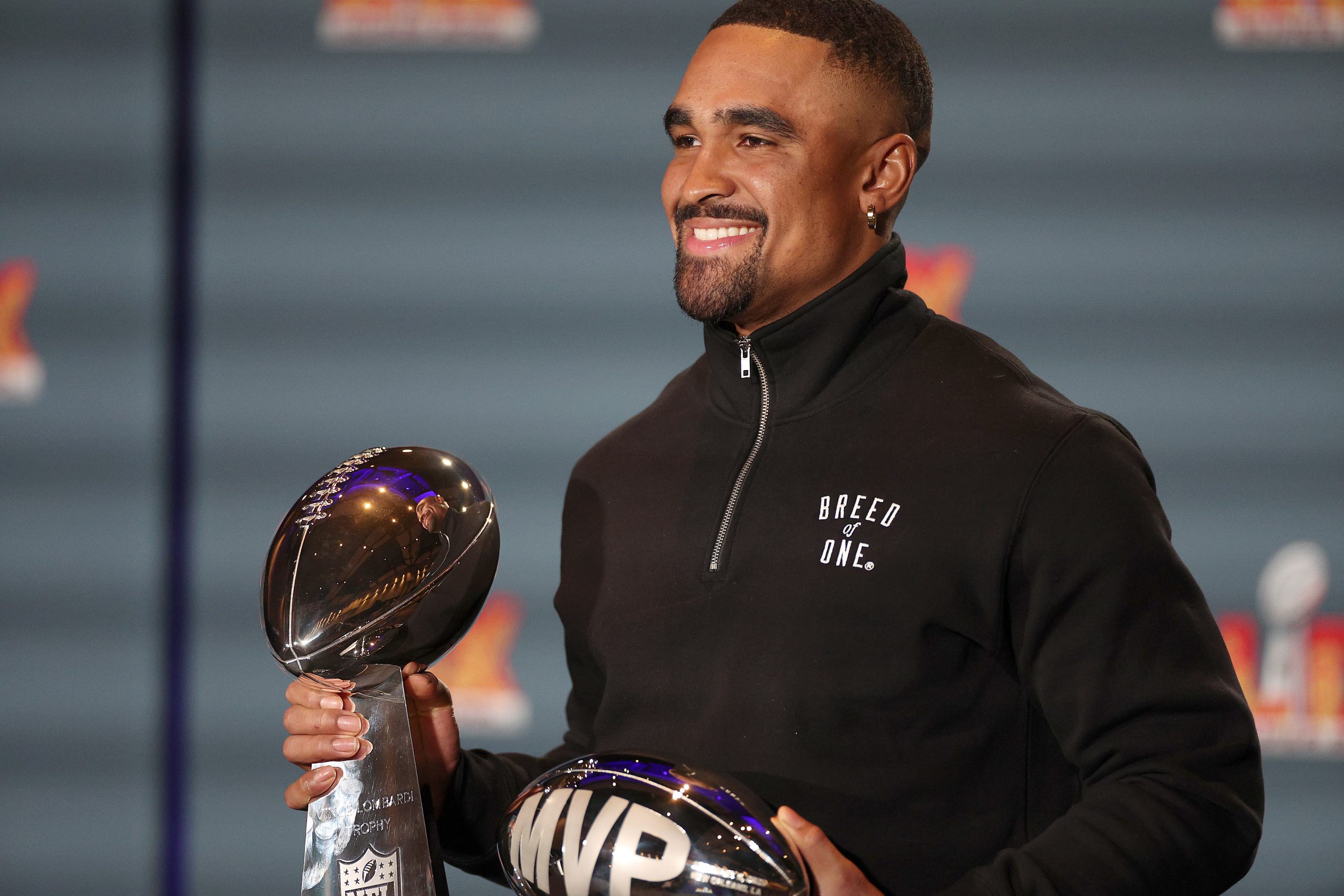
Jalen Hurts poses with the MVP and Lombardi trophies the day after winning Super Bowl LIX in 2025.David Maialetti / Staff Photographer
Winner, Part 2
Like Brunson, Hurts wins like he breathes.
He helped win a national title at Alabama as a sophomore starter but lost his starting job. After a final season with the Crimson Tide and early graduation, Hurts transferred to Oklahoma, where he led the Sooners to the four-team College Football Playoff and finished second in Heisman Trophy voting. Still, like Brunson, Hurts didn’t fit the NFL quarterback mold and fell to the Eagles in the second round, a team that announced they considered him a long-term solution as Carson Wentz’s backup. By the end of his rookie season, Hurts had stolen Wentz’s job.
Hurts might not be the best second-round player in NFL in history, considering Brett Favre and Larry Allen were second-rounders. In this moment, he might not be the best 53rd overall pick; wideout Davante Adams went 53rd in 2014.
But Hurts is, inarguably, the best value in the 2020 draft. That included Joe Burrow, Justin Herbert, CeeDee Lamb, and Justin Jefferson.
Those guys have two things in common:
They all were drafted at least 31 picks ahead of Hurts.
And none of those guys have rings.
Winner, Part 3
Brunson articulated the core trait that drives both of the Jalens when he said Hurts “just wants to win.”
Indeed, Hurts’ most consistent motto, often recited after ugly wins in which the Eagles’ passing game sputters, is: “Keep the main thing the main thing.”
This is how badly Brunson wants to win:
He left more than $100 million on the table when he signed a contract extension in 2024 instead of 2025, money that allowed the Knicks to pursue starters OG Anunoby and Karl-Anthony Towns, Brunson’s chief wingmen in the Finals against the Spurs.
Brunson can recoup some of that money in his next deal, but he risked injury for two years on a lesser contract, all so he could win.
Mission accomplished.
Reality check
No matter how deep his love for Philly’s football team, and no matter how strong his admiration for Hurts, there’s no chance that Brunson on Thursday will recognize the kinship with the man who shares his name. After all, Brunson’s Knicks and their fans swept the Sixers out of the playoffs and swept team president Daryl Morey out of his job.
But no matter what Brunson wears Thursday morning as he rides down Broadway, he and Hurts will forever be linked as storybook athletes who bucked the measurables, ignored the analytics, and, in their quiet, determined way, put two big-shoulder cities on their own broad shoulders, quieted their critics, and walked away as ultimate winners.
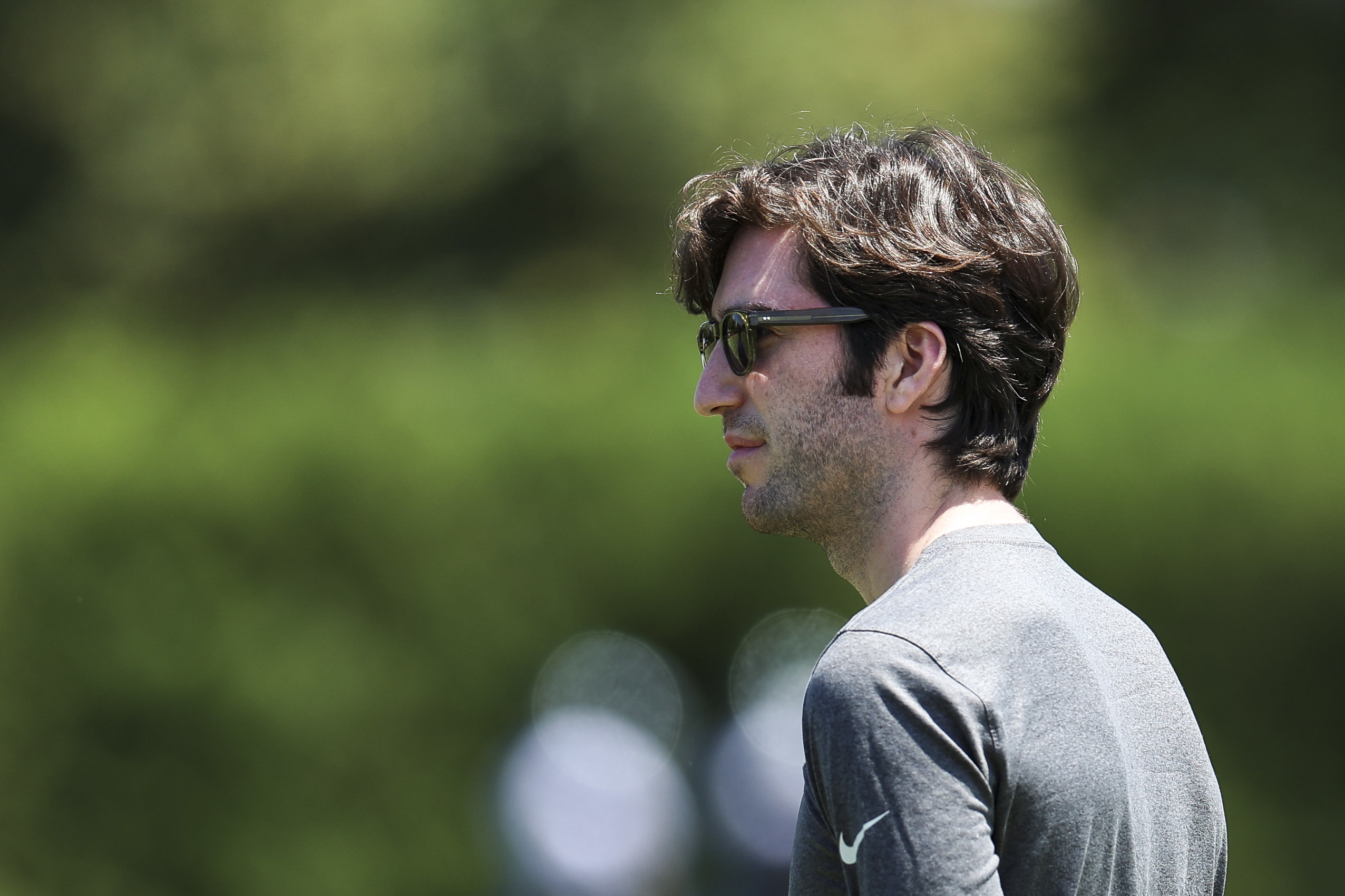
Julian Lurie wanted to push the Eagles beyond their normalities. Two years into his nebulously titled role in “business and football operations strategy,” the owner’s son had immersed himself in all facets of the team, but he had taken particular interest in — and authority over — original content and social media.
For NFL teams’ multimedia departments, schedule release day is their Super Bowl, and the Eagles’ creators had come up with a concept that was off-color by team standards. There would be censored curse words and jokes made at the expense of opponents.
Lurie loved the idea — which called for passionate Eagles fans to undergo psychological evaluations — and saw it as cutting edge. But a few senior leaders weren’t comfortable with the swearing and ridicule and liked it even less after watching the first cut. Lurie still advocated for the video, but he listened to counterarguments, and edits were made.
“There was a compromise,” a senior leader told The Inquirer.
Julian Lurie’s title with the Eagles is “business and football operations strategy.”Chris Szagola
Obscenities and insults were taken out — but not all of them. Asked how Lurie could hold that much sway without having an official executive role, a high-ranking team source gave the following explanation:
“His last name.”
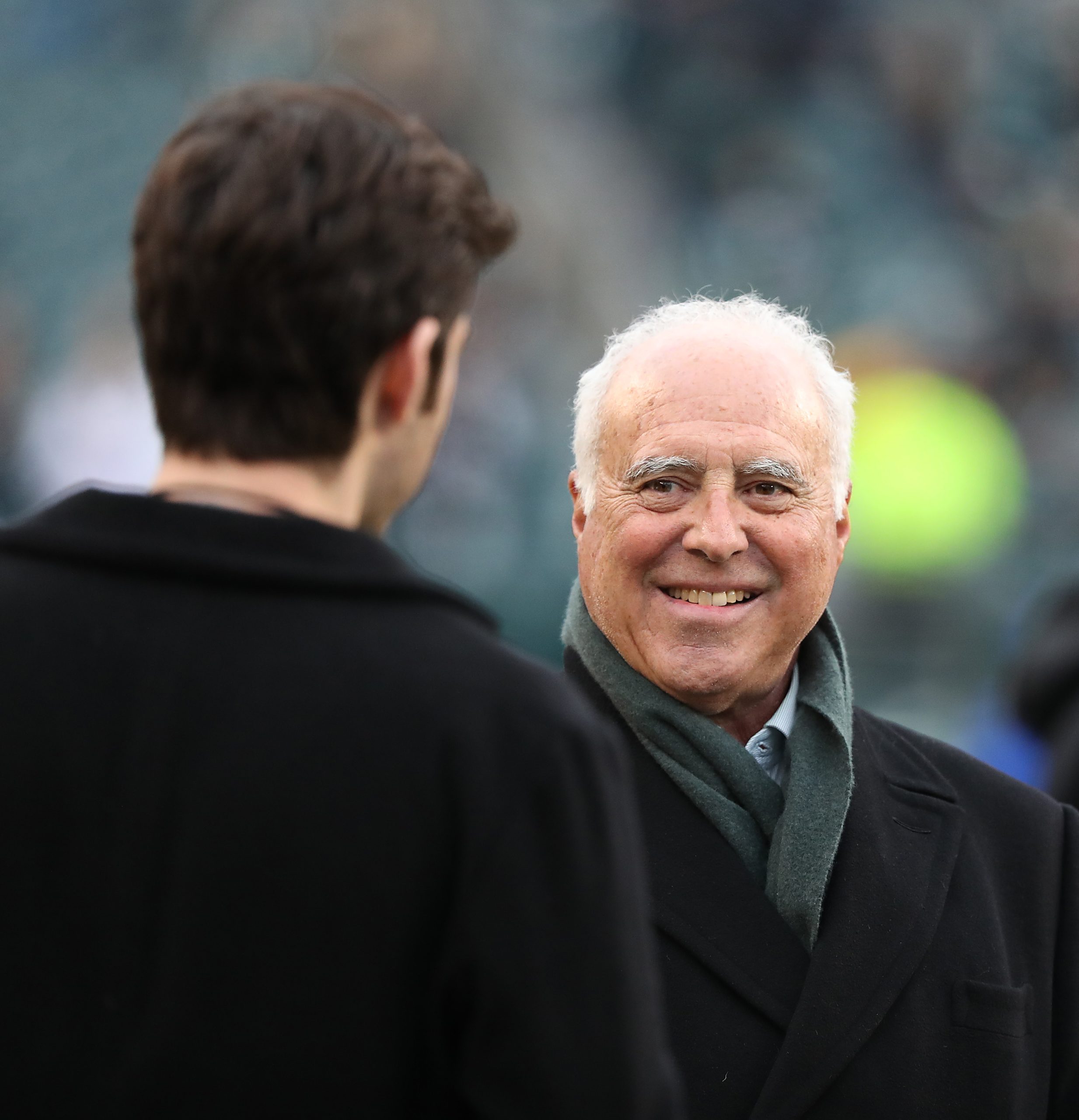
Lurie is not just Eagles owner Jeffrey Lurie’s only son, he is his successor. And while that reality has caused occasional challenges since he took a formal role in the family business four years ago — and as management navigates his increasing influence — many key figures within the organization believe the younger Lurie already has been an asset.
“He is really smart. He’s very creative. He’s very empathetic,” an Eagles source said. “He’s really good at putting himself in other people’s shoes. He’s fair, and he listens and is making a real attempt to understand everything about the organization.”
The Inquirer spent the last several months talking with nearly two dozen Eagles sources, past and present, as well as other NFL sources familiar with the team’s inner workings, about the 31-year-old Lurie. Many sources requested and were granted anonymity because they were not authorized to speak publicly on the subject or felt they couldn’t speak freely if named.
The Eagles declined interview requests for the Luries and other key members of the organization for this story.
The interviews with sources revealed Julian’s already considerable prominence. They also depicted an intense but thoughtful young man who was born not only into great privilege, but with a shared civic passion for the football team his father bought in 1994, the year before Julian was born.
“If I lived in Philadelphia and I was an Eagles fan, I would feel really good about him as a steward of the franchise in the future,” a team source said. “I really do think he cares about the team and the city and the players.”
To prepare for his eventual birthright, Julian has delved into the nuts and bolts of operations. From affairs as expansive as spending on the business and football sides to matters as minute as the strains of grass on the practice fields, he has asked the “why” behind the “what.”
His 74-year-old father remains chairman and CEO and has said he has no plans of ceding control, even if he now spends less time in Philadelphia than previously. But Julian has been a part of decision-making for some time now, which may come as a surprise to outsiders who know next to nothing about the Eagles’ future owner.
Inside the Jefferson Health Training Complex, his standing — if not his title — is clear.
“I didn’t even know he had one,” an Eagles staffer said about the younger Lurie’s job description. “To everyone here, he’s an owner.”
And as an owner, Julian can sit in on every high-level meeting. On the business side, it might be about the exploration of a new stadium concept or corporate sponsorships. On the football side, he may be present for team meetings or sit-downs on free agency and the draft. And he’s often in the building.
Jeffrey Lurie has final say and still exerts control when it comes to major decisions. But he has longtime direct reports in team president Don Smolenski and general manager Howie Roseman, whom he has empowered. The same applies to sixth-year coach Nick Sirianni.
In his first few years with the Eagles, Julian might have sat in the corner and said nothing. But as his understanding of the team has grown, so has his voice. Like his father, he is a questioner.
“He likes to ask the opinions of people,” a high-ranking team source said of the younger Lurie. “Some people here don’t like to be questioned. But he’s a smart guy, and he doesn’t think he has all the answers. He’s willing to change his mind.
“He says, ‘I’m not right all the time, but I want people to be real and be honest with me.’”
The initial ambiguity about his role and his relatively speedy inclusion into decision-making, however, led to an adjustment period and occasional bumps in the road. The biggest sticking point, according to several sources close to the situation, was over the budget.
“When you add another dynamic to that, there’s always growing pains,” a team source said, “but not to the point where relationships have suffered.”
The Eagles have been one of the most successful NFL franchises over the last decade, having won two Super Bowls and gone to the playoffs in eight of the last 10 seasons. Smolenski, who has overseen business operations since 2012, and Roseman, who was given full authority over football in 2016, have built a robust enterprise.
That growth has mirrored the increase in wins. But there has been some bloat, and Julian took it upon himself to examine the Eagles’ expenditures. Some of that was for his own knowledge in preparation for when he succeeds his father.
But the Harvard graduate also wanted to explore more efficient ways to allocate spending, team sources said. “Honest conversations” were had, according to one source close to the situation, and Julian eventually came to appreciate much of the existing process. He also was credited with making suggestions that contributed to on-field success.
“From where he’s started to now,” a team source said, “it’s like night and day.”
His more significant contributions have come in presiding over fan-facing parts of the franchise, like original content and image and likeness. Julian spent two years working for Overtime, a sports media company based in New York, before joining the Eagles. And before that, he was a member of the NFL’s Junior Rotational Program, a two-year undergraduate internship.
His bosses at both outlets said Julian was serious-minded, hardworking, and brought zero entitlement to the job.
“He’s quiet, but he has a sense of humor and he laughs, and he’s willing to use that constructively,” former Overtime CEO Dan Porter said. “It’s not like he fits hardcore into some archetype like that. He’s honestly just a young person wanting to add value and learn in the world.
“And he also just happens to, a) be really smart, and, b) his dad owns the Eagles.”
Jeffrey Lurie is widely considered one of the NFL’s best owners after his three-plus decades in the league. His son will have big shoes to fill when the time comes. Julian is an outside-the-box thinker like his father, but he also wants to bring a younger sensibility to the Eagles — as he did with the schedule release video — sources close to him said.
He’s also become the more visible Lurie at team headquarters. But the elder Lurie, who spends most of his time at his West Palm Beach, Fla., estate, said his absences aren’t representative of a loosening of the reins.
“Maybe I still have a lot of gray hair, but I am probably more involved than ever, ironically,” Jeffrey Lurie said in March. He added, “It’s not that it’s behind the scenes. It’s very overt. But I will talk to my executives more often and probably with more intensity because I have a son that’s growing and learning everything.
“And, so, he can both watch how focused and intense I am still and yet, at the same time, learn from all the executives we have.”
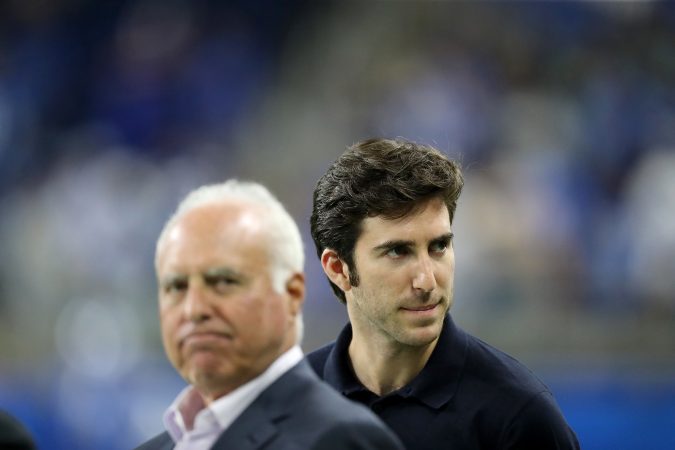
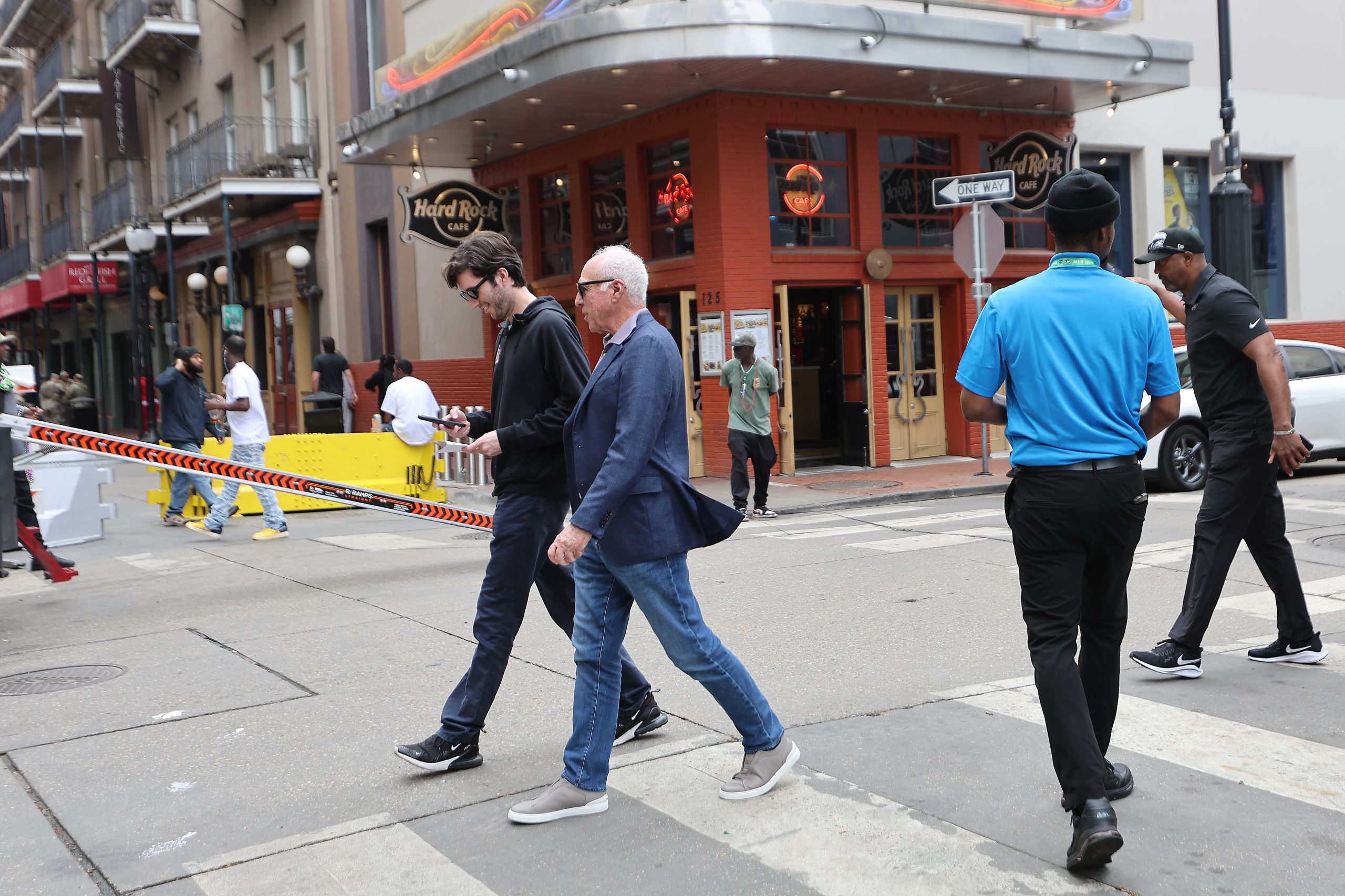
Julian Lurie (left) and his father, Eagles owner Jeffrey Lurie (right), walk across Bourbon Street during Super Bowl week in 2025.David Maialetti / Staff Photographer
Be a learner
Jeffrey said he has no plans to retire soon. When he talks about his good health in private, he often mentions his mother, Nancy Lurie Marks, who recently turned 99. But that hasn’t stopped some team leaders from wondering about a timeline regarding Julian’s succession.
“There’s no timeline, but I love the way it’s been going,” Lurie said three months ago at the league meetings in Phoenix. “He’s quite involved in the business operations, the football operations, philanthropic operations, marketing. He’s getting a great, great sort of feel for everything, and that’s the best way to do it.
“It’s not to speed it up.”
NFL owners recently approved succession plans for two teams. Last year, the Colts transferred Jim Irsay’s ownership to his three daughters following his death. And in March, the league affirmed the plan for Raiders owner Mark Davis, who doesn’t have children, to give a minority owner, Michael Meldman, the option to purchase a majority stake.
NFL ownership has long been a family enterprise. More than half the league’s 32 teams remain under family control, with prominent last names like the Rooneys, Maras, and Hunts having owned prosperous franchises for 60-plus years.
There also have been family-run teams that haven’t thrived or experienced generational decline.
The 49ers have not been one of them. Team owner Jed York, like Julian Lurie, was brought into the fold of his family’s franchise in his mid-20s. As “special projects manager,” he worked in every department of the 49ers and recalled that one of his first stints was in the equipment room, where he helped sew players’ names on jerseys.
By age 30, York had become CEO. While his Ohio-based parents, John and Denise York, remained principal owners until 2024, he effectively ran the organization.
“It was Undercover Boss without the undercover part,” York said.
He said his transition to power happened organically.
“I think the organization sort of accepted it and sort of dictated when it was going to happen more so than me or my parents,” York said in an interview with The Inquirer. “Like, it just became clear when people started coming to me for answers and not necessarily waiting until my parents came out from Ohio to be able to make decisions and move forward.”
Jeffrey may not be in Philadelphia as often, but he still returns for games, favorite events like the draft, and various other days. He was present for most of the workouts that were open to reporters this spring — at a much higher rate than last season.
Either way, team employees still look at the elder Lurie as being the boss.
“Julian is here every day, so we do see him more,” a team source said. “But Jeffrey is still viewed as the owner.”
Julian’s office at “the Jeff” is situated near his father’s and Smolenski’s. That is by design. Among senior leaders, he spends most of his time with Smolenski. But he has conversations with many staff members, even if he is described as naturally introverted.
He’ll drop into any office, not necessarily with a purpose, but just to chat, often about every staffer’s favorite team. Some sources consider his way with people one of his strengths.
“You got to be a learner,” said Porter, who recently stepped down as Overtime’s CEO. “You have to understand that as soon as I am the CEO, I’m in a bubble. I only know what the people who talk to me tell me, right? You [have to] make people feel seen and heard because you want them to give their all to an organization.
“But you also don’t want your experience of the company to be in a very small echo chamber.”
So while Smolenski continues to make final decisions on the nonfootball side, Julian will gather intel on his own. That might include talking to facility manager Chris DeBellis about operations at Lincoln Financial Field or vice president of grounds Tony Leonard about how to install heaters under the practice surfaces so they no longer freeze.
The Eagles’ practice facility, previously known as the NovaCare Complex, is undergoing renovations with an expansion of the training room and eventually the locker room. Julian has been a part of planning, but he’s also explored other possible changes like a full-length indoor field.
Many of his inquiries have been about the Eagles’ expenses.
“I don’t see what he’s been doing as any different to anyone whose dad said, ‘Here are the keys. Go in there. See what you think,’” a team source said. “This is going to be his team someday. He wants to understand how it works from a fundamental level.”
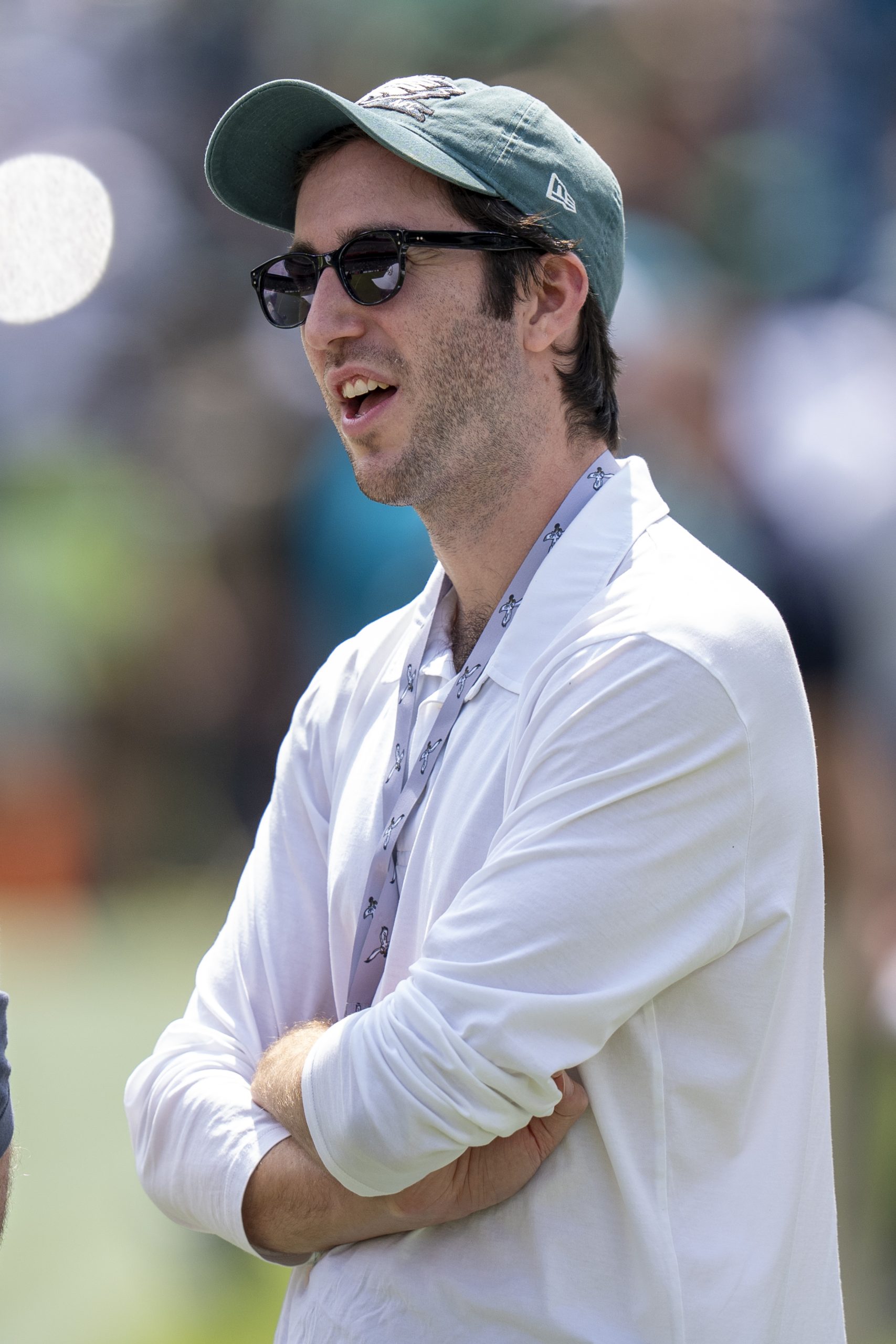
Julian Lurie has a way with people, some of his colleagues say.Monica Herndon / Staff Photographer
Productive conversations
While it’s unclear if Julian’s budget analysis was a Jeffrey directive or not, some staffers felt the team’s accounting could have benefited from a fresh set of eyes. In some cases, spending was cut. It could have been something sizable like the budget for food and beverage or something less significant like the number of hats ordered for employees.
The money often was then redistributed into other resources, such as the facility expansion. But other sources for revenue were explored as well, like selling naming rights to the cafeteria.
“I don’t think the goal was necessarily to cut costs. I think it was to understand what we’re spending on,” a team source said. “NFL teams — we’re not perfect in our spending. Things can get distorted over time. They can get out of whack. I think it’s healthy to evaluate that.”
The Eagles are always looking to be prudent. Jeffrey has long entrusted his lieutenants with fiscal responsibilities. But his son’s increased involvement and “probably being more into the bottom line,” according to one source, faced resistance from some staffers.
“The easiest way to impact the bottom line is by cutting expenses. And that is great in the short term, and you definitely improve margin,” an NFL source familiar with the Eagles said. “But if you have unlimited resources and the business is successful on the field, off the field, is that really a common-sense approach?”
Some of the excess could have been people. For instance, why have X number of full-time employees in the ticket office when it’s mostly a seasonal job? Did the Eagles really need to send as many staffers to the Senior Bowl and the NFL combine as they had for years?
On the football side, the Eagles have had considerable growth. That’s not exclusive to them among teams in the booming and hypercompetitive NFL. But Roseman has constructed a multifaceted operation that has depth in many departments.
Julian’s new oversight meant that staffing and salaries were questioned, like having three highly paid senior advisers in personnel when the Eagles brought back former Jets general manager Joe Douglas last year.
But Roseman’s modus operandi has been to have a deep bench in case there are departures. When former senior adviser Dave Caldwell left for the University of Florida in December, Douglas already was in the fold. Just recently, he was promoted to senior vice president of player personnel.
Last month, assistant general manager Alec Halaby stepped away from the Eagles, and the well-regarded Adam Berry was promoted into his position. Two years prior, vice president of football administration Jake Rosenberg left the Eagles, and Roseman had Bryce Johnston waiting in the wings to manage the salary cap.
Rosenberg sought other opportunities after seemingly reaching his ceiling with the team, but some Eagles sources wondered if his exit was precipitated by Julian’s deconstruction. The Atlanta Falcons poached Johnston in May. His replacement, Grant Reiter, is a relative unknown with far less experience.
Two sources compared staff reductions to playing Jenga.
“If there’s a high headcount, it’s hard to pull it apart and say, ‘This is responsible for this, this is responsible for that,’” one of the sources said. “You never know which thing you pull is going to be the thing that causes it to fall down.”
Rosenberg declined to comment. Johnston didn’t respond to an interview request.
It’s hard to argue with Roseman’s approach, considering the Eagles’ success, which has come with multiple head coaches and starting quarterbacks. Roseman hasn’t been perfect, of course, but Jeffrey Lurie has given him ample room to take big swings and make corrections when there are misses.
Julian made inquiries based partly on the Eagles’ staffing vs. other organizations. There was an acclimation phase with some give and take, and ultimately an understanding of Roseman’s process that has improved over time, team sources said.
“I think they have a productive relationship,” one source said. “I think they can walk into each other’s office and have productive conversations.”
The Eagles’ largest expense is on player contracts. There’s a salary cap, but no team has spent more on their roster over the last decade. According to Jeffrey Lurie, that aggressive mindset won’t change.
“This is where the emotional part probably gets in the way. I can’t help myself,” Lurie said in March. “Try to have every edge you can and willing to spend the cash. And I think we have a chance to win multiple more Super Bowls. There’s nothing I want more than that third Lombardi.”
Jeffrey remains integral to Roseman’s major roster decisions. After years together, the two can communicate in shorthand. The general manager still has his direct line to the owner, and their process is “overall, similar,” a team source said. There’s just now an additional layer.
“When it comes down to final decisions, I still feel like that’s totally Jeffrey,” a team source said. “But Julian has been a part of all of it.”
“Julian is here every day, so we do see him more,” a team source said. “But Jeffrey is still viewed as the owner.”David Maialetti / Staff Photographer
Roll up sleeves
When Jeffrey Lurie purchased the Eagles in May 1994, he was 42 and a longtime New England Patriots fan. He had tried to buy his boyhood team just the year before. But the Hollywood executive, who had worked for his family’s movie theater company, shifted his attention to the franchise located roughly 300 miles south of his native Boston.
Jeffrey and then-wife Christina Weiss Lurie, married for two years, arrived in Philly with daughter Milena when he bought the team. Julian was born the following year. When Jeffrey was first publicly asked about his son in March 2022, he focused on Julian’s inherited passion for the Eagles.
“Obviously, he grew up in the family that owns the team,” Jeffrey said then. “He’s an avid Philadelphia sports fan. He loves the Eagles, loves the NFL. He really has a great feel for many aspects of the sport.
“He’s going to have so much more going into it than I ever did if he chooses to want to someday own and run the team.”
Jeffrey had exposed his son to various aspects of the family business for years, but in January 2021, he had him participate in interviews for a new head coach. Julian handled questions related to analytics.
While it might have seemed peculiar at the time that he would be involved despite not having a formal role with the Eagles, associates describe Julian as an “analytical thinker.” At the league’s junior program, he rotated through four groups focused on strategy and development.
Grace Senko, currently vice president of media strategy and business development at the NFL, was one of Julian’s managers. They worked closely on the league’s licensing of media rights and spent time tracking performance in the burgeoning digital streaming of games. It sometimes was menial work.
“There was a lot of nights the two of us were here, the only people working to pull together very large amounts of data,” Senko said. “Because of how much we were pulling in together, we made a lot of mistakes. And Julian — he has a lot of integrity. If something is wrong or he makes a mistake, he owns it. … He is willing to roll up his sleeves.”
After the completion of the two-year rotation, Julian went to Overtime, a media company that says it “builds disruptive” content “at the next generation of sports fans and athletes.” The company is perhaps best known for Overtime Elite, its developmental basketball league for high school-age players. Porter, the former Overtime CEO and a Philly native, heard through an intermediary that Lurie was interested in his startup.
“Julian’s very intense, but he’s also very reserved,” Porter said. “He’s just very deliberate. And so, in our first conversation, I was like, ‘Oh, he’s clearly extremely smart and very, very focused, but he’s not that kind of person in an interview who’s going to, like, talk for 10 minutes straight.’”
Julian reported to Porter as senior manager of business strategy. He focused on analytics and helped create, for instance, a free-to-play app that took aspects of betting apps and was designed for consumers under 21, Porter said.
All told, Julian spent four years working in New York. Senko, who also had gone through the NFL’s junior program, said she worked with other family heirs and that Julian, like many who had connections, overcompensated to avoid claims of nepotism.
Porter said Julian was unassuming at Overtime’s Brooklyn office.
“He’s got a different burden, maybe, than most people,” Porter said. “He’s a serious guy, but he’s not unfriendly. Smiles. He’s just serious about his job. He was integrated in the culture. He wasn’t like some weird guy in the corner. He was a part of the company.”
Julian was in some ways shielded by his protective parents. When The Inquirer did a feature on Weiss Lurie in 2010, the names of her children were withheld from the story at her request.
Milena and Julian attended the Shipley School in Bryn Mawr. One teacher, in a school website post, recalled a junior-senior football rivalry game in which Julian and other seniors wore fake bushy mustaches like then-Eagles coach Andy Reid as Jeffrey watched from the sideline.
When Julian attended Harvard to study philosophy, he watched Eagles games at the Baseball Tavern, a local bar whose owner had been a fan of new coach Chip Kelly. Julian might have been among the progeny of one-percenters who went to the elite university, but he didn’t carry himself that way, a fellow student said.
“You’re around a lot of kids from billionaire families that are out of touch and act like their s— don’t stink,” a former Harvard classmate, who asked not to be named, said. “That wasn’t Julian. That card never got played.”
Dan Porter, Julian Lurie’s supervisor at Overtime, said: “He’s a serious guy, but he’s not unfriendly. Smiles. He’s just serious about his job.”David Maialetti / Staff Photographer
Going to the Eagles
Julian’s destiny was different from most, though. In early 2022, he decided to leave Overtime for an official post in the family business.
“One day he just called me and he said, ‘Thanks, it’s been amazing. It’s time to move on. I’m going to the Eagles,’” Porter said. “And I was like, ‘Yeah, of course.’”
Julian already had been spotted at offseason NFL events like the Senior Bowl in Mobile, Ala., that January, but the Eagles didn’t announce his role until June of that year. His listed title, which reads more like a department — “business and football operations strategy” — reflected the duality of his position as he went about learning both arms of the organization.
It took Julian some time to find his footing, team sources said. He initially latched onto the decade-older Halaby, a fellow Harvard graduate who oversaw the analytics department at the time. It was a natural entry point considering his mindset and experience.
But Julian also took an active interest and lead in Eagles media content. He began to flourish.
“He’d come in, sit in the corner, not say anything, so a few people felt uncomfortable,” a team source said. “But the more that he got comfortable, the more he got involved, he started to throw out ideas and people saw it.”
Julian oversaw promotional videos that captured the local zeitgeist. He heard quarterback Jalen Hurts use the phrase, “It’s a Philly thing,” and made that a rallying cry for the 2023 playoffs. And he was behind the “Yo” hype video ahead of the 2024 opener in Brazil.
He has become, in some ways, the point person for the Eagles’ social media team.
“He wants it to be a really good fan experience. He wants people to enjoy using the Eagles app or seeing their posts on Instagram,” a source close to Lurie said. “Social media is a big part of an NFL footprint these days. It’s how a lot of fans connect with the team.”
He is, after all, one of them. Porter, also an Eagles fan, said he knows not to text Julian after losses. Like his father, Julian also has a passion for football. Last season when the Eagles played the Packers at historic Lambeau Field, he opted to watch from the bleachers rather than in a suite with team executives.
“He wanted to experience the game from that vantage point,” a team source said.
Julian watches a lot of games and has an interest in all its intricacies. He’s a part of strategic meetings when it comes to personnel and scheme. He might ask why a certain draft prospect has a red flag for character concerns, for example, or why the Eagles have made certain schematic choices, sources who have been in those meetings said.
Julian has a keen eye for X’s and O’s and he will query coaches. He often does his own research and he comes prepared, a team source said.
“It’s never like, ‘I have answers,’” a coach said. “It’s like, ‘I want to understand this.’”
During interviews with offensive coordinator candidates this offseason, Julian handled questions pertaining to player performance. His father has allowed him to sit in on head coach interviews dating back to 2016, knowing how important that responsibility is for an owner.
But for some in the organization who have been around since Julian was young and may have viewed him through that lens, there was apprehension about his presence. Although most have appreciated his development, a few believe he’s overstepped at times.
“There’s growth that still needs to occur,” a source said.
Not only does Julian have to balance his increasing involvement with any perception that he’s meddlesome, but he also has to walk the delicate line between his long-term goals and the shorter-term thinking of current leaders.
There is a generational strain that can exist in succession plans. York said he had a mentor in Patriots president Jonathan Kraft, son of owner Robert Kraft, who has been his father’s right-hand man since 1994. York said he has spoken to Julian on occasion and wants to be a sounding board for him, like Kraft was for him.
“I know there aren’t many people in these positions that can help you think through, ‘Well, how do you tell your dad or your mom that you want to do something a little different than they did, and do it in a way that’s respectful?’” York, 46, said. “How do you handle those things?
“How do you see something as a younger person in the NFL that you want to take the league in a different direction than … a bunch of guys that are in their 60s or 70s or 80s?”
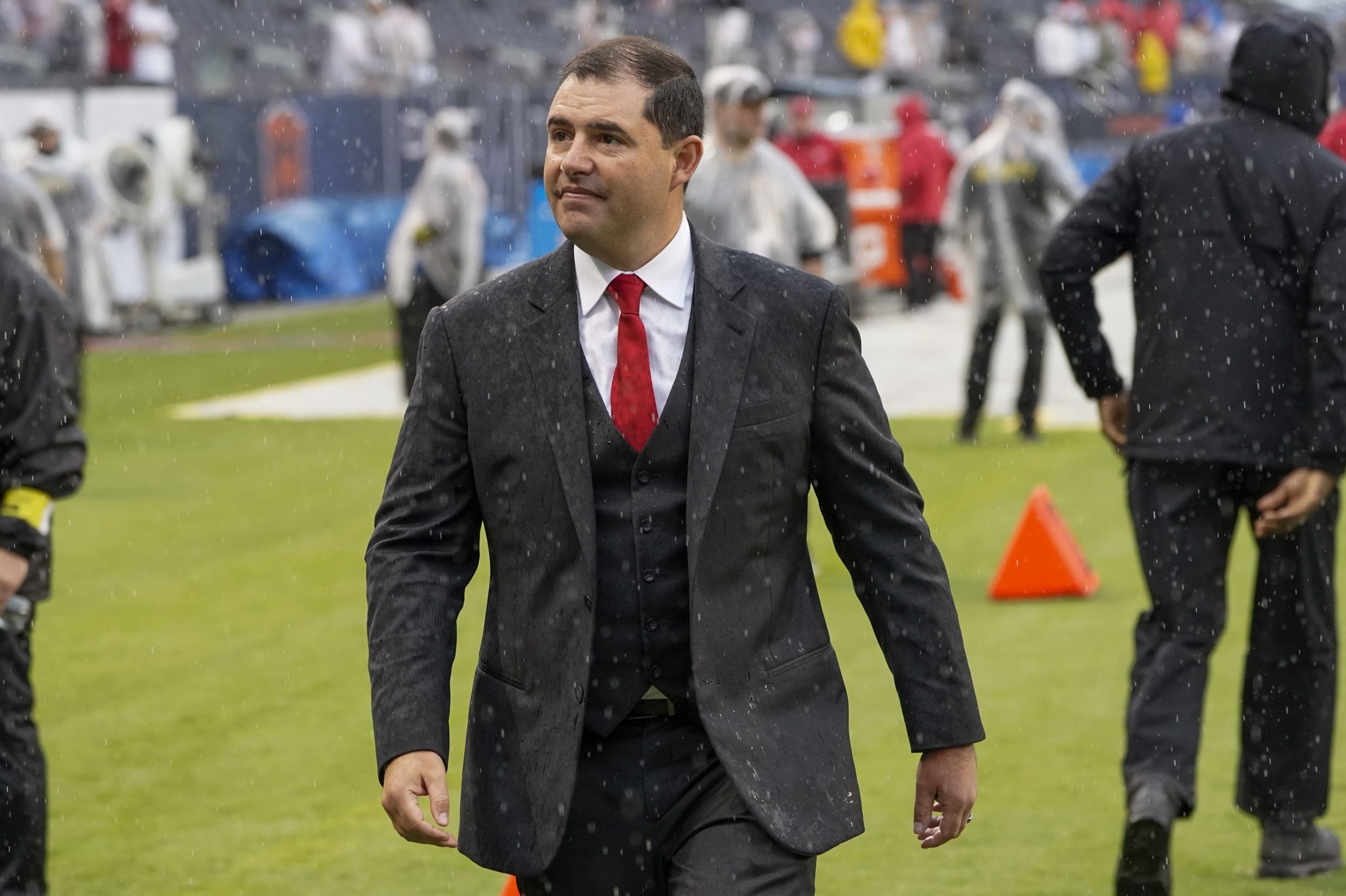
San Francisco 49ers owner Jed York, an example of a family generational transfer of power that has succeeded, already has a good relationship with Julian Lurie. Charles Rex Arbogast / AP
Own path
Julian, like his father, is willing to push boundaries to gain advantages. Jeffrey likes having different perspectives in a senior leadership team that now includes his son. Jeffrey still mostly defers to Smolenski and Roseman in major decisions. He often just wants to see the finished product.
But Julian has been more hands-on than his father when it comes to details, for instance examining the blueprints of the practice facility expansion into the former NovaCare rehab center.
“He has a mindset for how he wants to lead and that’s going to be different in some ways,” a team source said. “He’s not trying to be exactly like his father because that’s not entirely his personality. He is his own person.”
Julian is a foodie and avid golfer like his father, but he does not flout his privilege, those who have observed him say. He might have the second-best parking spot at the “Jeff,” but he doesn’t ask for police escorts or special accommodations on game days, sources said.
He may engage in “casual conversation” with players before or after games, a veteran said, but he isn’t overly chummy. That is in part deliberate. He knows his limitations. But it’s also Julian being true to himself. He’s not as outgoing as his father.
“You can’t read Julian as well,” a team source said.
That can make more unsure members of the organization at times uneasy. Many value his brevity.
“I think he has a very kind of quiet confidence around him and when he says things they have a lot of weight to them,” Senko said, “because he’s not one of those people that just like speaks to be heard. He speaks when he has something important to say.”
His voice carries weight because he’s viewed as an owner, even if he’s not yet the Eagles’ principal owner. Some senior leaders expect Julian to eventually have an executive role in the front office.
The 59-year-old Smolenski could stay aboard until the next stadium deal is in place. There are other internal candidates to succeed him, like former Eagles player Connor Barwin, who currently is head of football development and strategy.
It doesn’t matter what title Julian is given. He already is involved at a senior level. And while the Eagles have absorbed his inclusion — and won a Super Bowl in the process — there is some question of the future as Julian advances.
“It remains to be seen how that goes,” a team source said.
If he were to become president, would he, like Smolenski, stay exclusively on the business side? Would he cross over into football, like predecessor Joe Banner did during his roughly 20-year tenure? Would the title matter?
Jeffrey signs off on all major football decisions. He has, on rare occasion, pushed for his preferences in the draft, sometimes with great results (e.g. Hurts), sometimes not (J.J. Arcega-Whiteside). But he has by and large delegated to Roseman.
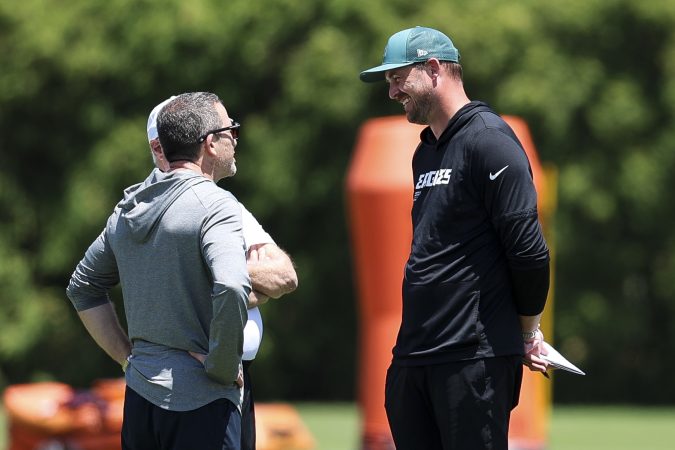
For years, Jeffrey and his general manager standing together on the sideline before games or at practices conveyed their abiding partnership. They still strike that image, but Julian might also be in the picture, or alone with his father.
Few Eagles sources expect the dynamic at the top to change as long as the Eagles keep winning. Jeffrey has given the 50-year-old Roseman as much autonomy as any general manager. But if that power were to be curtailed, the two-time NFL executive of the year would have obvious options elsewhere if he wanted to leave.
“We’ve been successful. We’ve done things the right way. Sometimes maybe not in the most traditional way,” a team source said. “But as long as Jeffrey’s in charge and likes the direction of the team, he’s going to think, ‘If it’s not broke, we don’t need to fix it.’”
And Jeffrey has no apparent plans of abdicating his power. There may be some uncertainty about how often he’ll be in Philly once work is completed on a yacht he is having built near his Florida home, but he has been more present this spring, team sources said.
“If you want to live a long time, I was always told don’t ever retire and keep that intensity going,” Lurie said in March. “I love owning the Eagles. I love trying to make us even better in every way and that’s what I’m focused on.
“That’s why my energy’s high.”
But Julian, as the NFL-approved heir, remains only a heartbeat away from the throne.
There will be no Succession-like maneuvering for future control among family members. Weiss Lurie stepped down as director of the Eagles Charitable Foundation in 2019 — seven years after the Luries’ divorce — although she remains a minority owner. Jeffrey married Tina Lurie in 2013, but she has no official role in the organization, nor does the 32-year-old Milena.
Few, if any, within the franchise believe it will suffer the decline that can occur when families bequeath assets. Julian himself is unmarried and without children.
His devotion, for the time being, is to the Eagles.
“I respect the way he’s grinding and going about it,” York said. “It is not easy to be in his position, in his situation, especially with how successful his father has been. He’s trying to make his own path, and he’s working as hard as he can, and I respect the heck out of that.”
His ownership is written, if not his future. But Julian continues to show maturation. In the Eagles’ most recent schedule release, senior leaders again didn’t like the direction of the video. Alternative ideas were offered, one of which Lurie agreed was better.
“He is open to listening,” a team source said, “open to evolving.”
There was cursing from players in the video that wasn’t bleeped out, but it generally was wholesome entertainment. It wasn’t as inoffensive as the 2023 version that predated the controversial psych evaluation concept, though.
The 2023 video featured an Eagles employee listed directly above Julian, deep into the staff directory, and the only one other than the leader of “business and football operations strategy” to work in his own department:
“Director of joy” — mini goldendoodle and team pet — Reggie White Lurie.
Main Line Health is adding a 108-bed patient pavilion to its Paoli Hospital campus as part of a push to expand its capacity in Chester and Montgomery Counties, the nonprofit health system announced Tuesday.
The building, expected to cost between $220 million and $240 million, is scheduled to open in early 2029. The project will expand Paoli’s capacity by more than 40%.
Patient rooms will occupy three of five floors. They will be convertible from standard hospital rooms into rooms for intensive care. One floor will be used for diagnostics, such as radiology and perinatal testing. The roof will have a landing pad for helicopters.
Beyond Paoli, Main Line is adding to its outpatient capacity in Downingtown, where a large facility that has township approval will include surgical care. The health system also has shared an early-stage proposal for outpatient offices in the Collegeville area, while it considers building there what would be its fifth hospital in Philadelphia’s western suburbs.
“While many communities face declining access to care, Main Line Health is moving forward with optimism, investing in this region’s future and reaffirming our commitment to exceptional care where people live and work,” Main Line CEO Ed Jimenez said in the announcement.
Paoli hospital currently has 261 licensed beds and employs nearly 1,400 people, according to Main Line. The hospital had 53,000 emergency department visits in the year that ended June 30, 2025. Main Line Health completed its last major expansion of Paoli Hospital in 2009, doubling the facility’s size.
Like other Philadelphia-area health systems, Main Line has experienced tough times financially since the pandemic, which led to broadly higher costs in healthcare. In the nine months that ended March 31, Main Line had a $214,000 operating profit on $2.1 billion in revenue.
More Main Line projects
Separately, about 12 miles west of Paoli Hospital, in Downingtown, Main Line plans to open a large outpatient facility next summer. Main Line Health Downingtown, at the intersection of Lloyd and Manor Avenues, willcost $150 million and include a surgery center and substantial imaging capabilities.
Incentral Montgomery County, as well, Main Line recently made a presentation to the Upper Providence Township Board of Supervisors about a major development in an area where the health system has seen substantial growth.
The long term could see Main Line builda 108-bed hospital, but more immediately itneeds to add outpatient office space in the Collegeville area, Main Line said.
Would Sixers owner Josh Harris have fired president Daryl Morey if the Knicks hadn’t rolled the Sixers?
Working big sporting events can be an exercise in frustration. The Olympics, the World Cup, the Super Bowl, the World Series are objects of spectacle and celebration for a sports fan but can be vehicles of exclusion and futility for a sports writer.
They also can be veins of golden intel. Such was the case last week in New York.
Thanks to the vanity of the New Yorker in Chief, entering the arena last week was a protracted challenge. An NBA source with ties to the 76ers told me in the hours before Game 3, as we waited for President Trump to arrive:
“You know, if the Sixers had won a couple of games against the Knicks, no way Morey gets fired.”
That piqued my interest. The Knicks had swept the Sixers in the second round of the playoffs. Morey was fired two days later, news that shocked the NBA world.
Did the Knicks’ storybook run to the hoop-crazed city’s first title in 53 years make Morey’s career an unlikely casualty? Did the sweep cost Morey his job? Was it at least the final straw?
Apparently so.
The Knicks weren’t considered elite when they rolled the Sixers. By Game 3 of the Finals, however, they were playing great.
Folks were talking: Was Morey’s firing less warranted than it seemed at the time?
I was eager to leave Madison Square Garden and try to track down Morey himself, see what he’d say. He’s going to continue to live in Philadelphia, but, since he got fired, he’s been hanging out in New York, feeding his Broadway addiction and waiting for the unemployment checks to come in.
Then, a few hours later, the Knicks had lost Game 3, the Spurs seemed to have turned a corner, and the assertion lost its legs.
But only briefly.
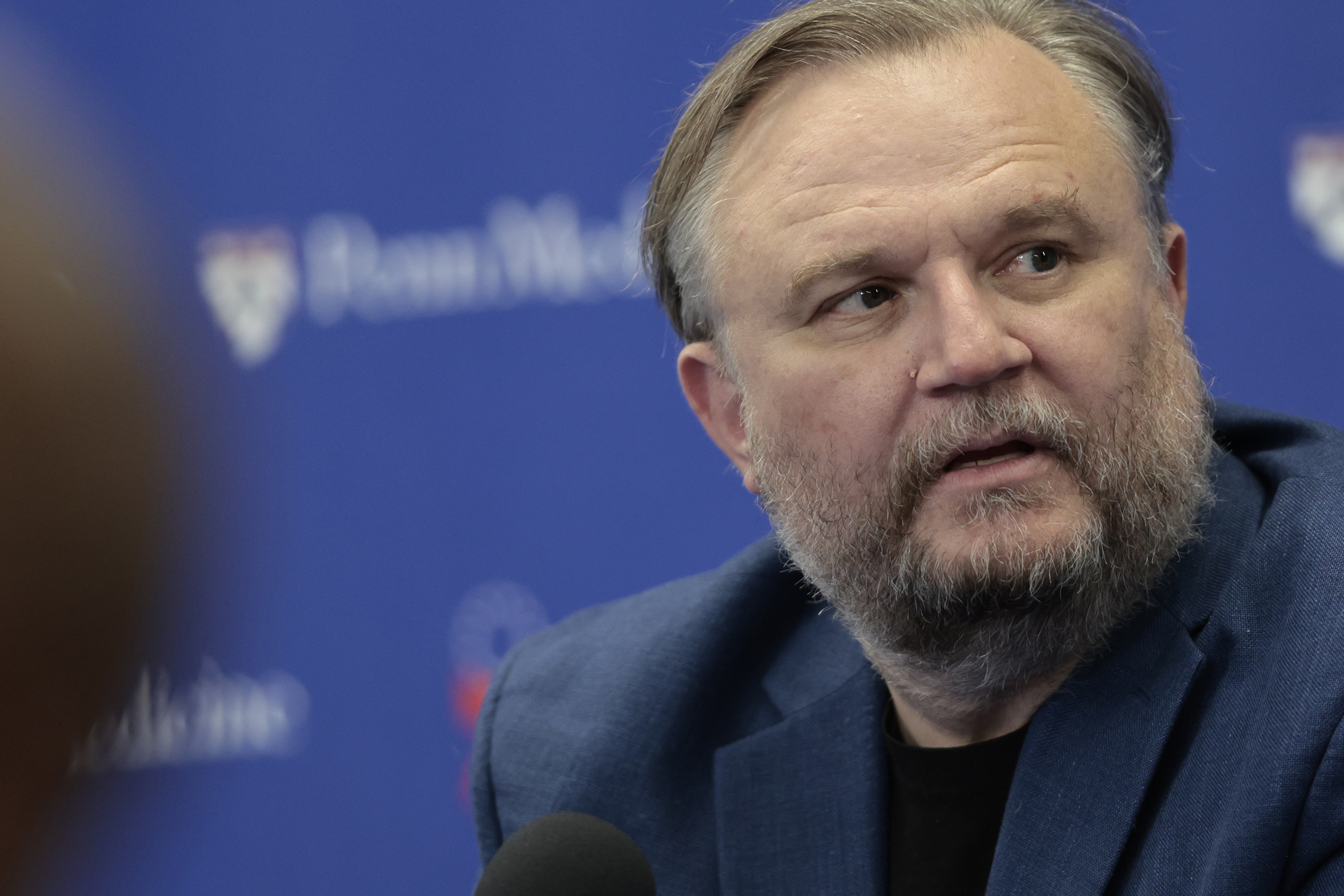
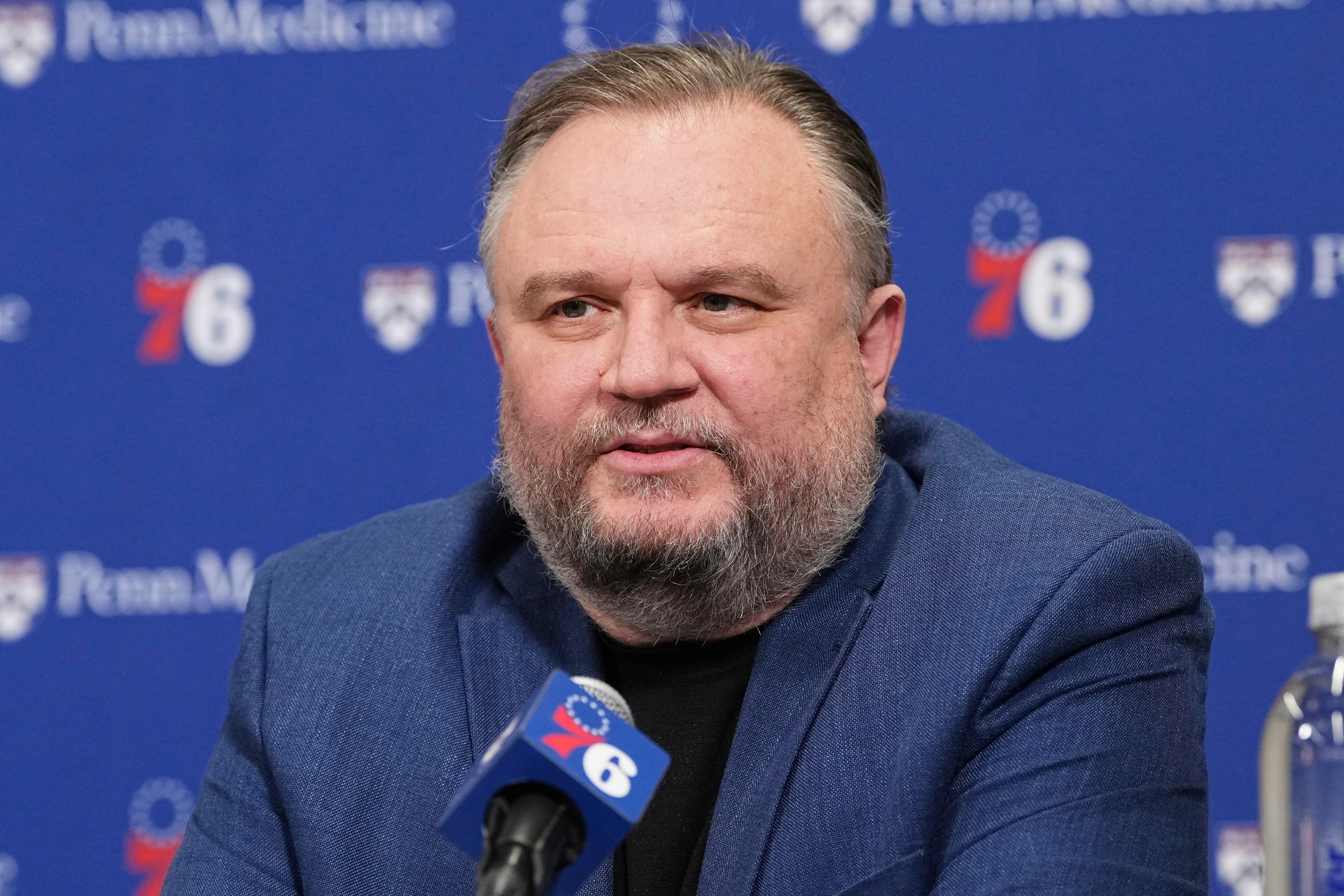
Daryl Morey did some things well, but the Sixers were also hamstrung by some of his decisions. Matt Rourke
Genius dismissed
A computer scientist with an MBA from MIT, Morey’s moves might draw criticism but his intellect never has been in question. Twenty-one years ago he co-founded the annual analytics nerd-fest at MIT, the Sloan Sports Analytics Conference, a stats-based Davos gathering of the smartest suits in the sports industry, designed to render obsolete knuckle-draggers like Doc Rivers and me.
Despite having never won a title, Morey is front-office royalty. As such, the NBA was rocked by Morey’s dismissal, especially coming, as it did, on the heels of such a dizzying postseason high.
The week before the sweep, the Sixers beat the arch rival Celtics in seven games to win their first-round series. Boston had held a 15-7 record in the teams’ playoff series and had won the last six; the last time the Sixers won was 1982. It was their first Game 7 win in 25 years. It was their first Game 7 road win in 44 years (the aforementioned 1982 series). It was the first time the Sixers won a series when trailing 3-1 in their last 18 tries, and the Celtics had won 32 times in a row when leading a series 3-1.
Euphoria barely describes the mood around the franchise after Tyrese Maxey dropped 30 points and pulled down 11 rebounds in that Game 7. Maxey was Morey’s first draft pick when he arrived in 2020.
Humiliation barely describes the mood around the franchise 10 days later. The Knicks won Game 1 in New York by 39 points. They won Game 4 in Philadelphia by 30 and, at one point, they led by 44. That wasn’t the worst of it. Xfinity Mobile Arena was inundated with Knicks fans for Game 3 and was predominantly pro-Knicks in Game 4.
Harris, a New Yorker for most of his adult life, was galled. More than anything else, according to the source, it was those two home losses and the Knicks fans’ takeover that cost Morey.
It didn‘t help, of course, that Morey traded popular shooter Jared McCain in February, after which McCain thrived in Oklahoma City. It also didn‘t help that, two years ago, Morey max-extended the contract of Joel Embiid and max-signed Paul George. Both have been injured and suspended since.
Both were bigger stars than anyone on New York’s team. Neither played well against the Knicks.
As it turned out, nobody would play well against the Knicks.
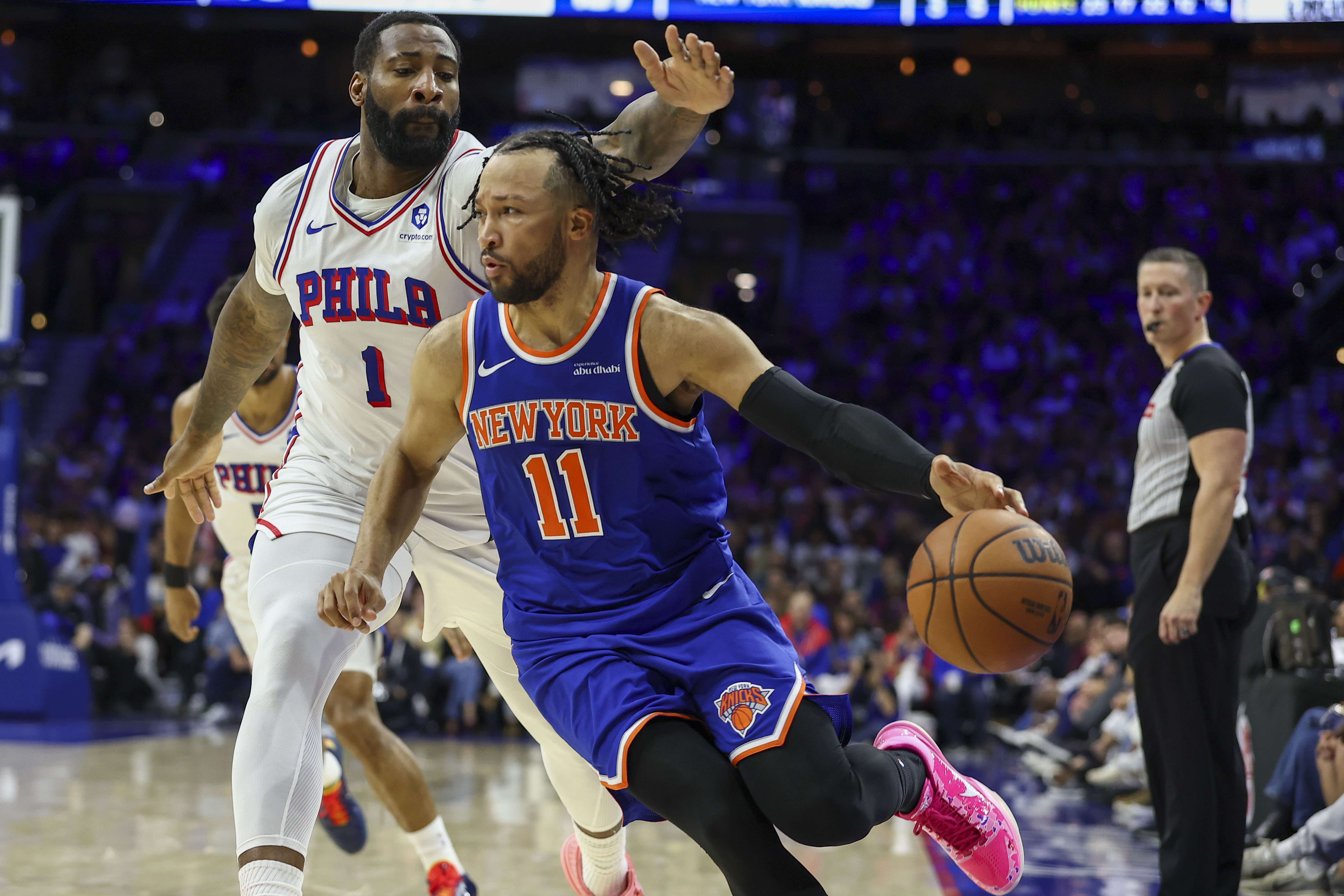
Jalen Brunson and the Knicks rolled the Sixers in a way that was humiliating for the team and the fan base. Monica Herndon / Staff Photographer
Juggernaut
The Knicks’ sweep of the Sixers included wins three through six of 13 playoff wins in a row, the second-best streak in NBA history and just two fewer than the Warriors in 2017. Those Warriors had Steph Curry and Kevin Durant, Hall of Fame scorers who’d been to 12 All-Star Games between them.
Again, at the time of the Sixers series, nobody considered any of the Knicks on par with Steph or KD.
Then, the Knicks swept the Cavaliers in the Eastern Conference Finals.
Then, they won Games 1 and 2 in San Antonio.
Then, after losing Game 3 at home, they executed a Finals-record 29-point comeback in Game 4.
Then, on Saturday, they won Game 5 and the title in San Antonio. Jalen Brunson proved himself the biggest star in the playoffs, capping his Finals average of 32.6 points with 45 in the closeout game, a record for a Knick in the Finals, tied with Michael Jordan for the third-most in a Finals closeout game.
The Knicks finished the playoffs with a point differential of plus-283, the biggest in NBA history. Of course, the Sixers contributed 89 of those positive points, and the Knicks played only one team from the superior Western Conference, but those arguments are thin gruel.
The 2025-26 Knicks were a powerhouse team: deep, talented, hungry, well-coached, and led by a bona fide, if unlikely, superstar.
That’s who beat the Sixers.
That’s who, according to an NBA source, ultimately cost Morey his job.
It’s new president of basketball operations Mike Gansey’s show now in Philly. Tom Gralish / Staff Photographer
So what?
I’ve always believed Morey to be a bit overrated as a team builder but I’ve always admired his innovation, his transparency, and intellectual capacity. These, I believe, burnished an image that was more impressive than the reality. He was, nevertheless, a very good basketball president.
Still, when a team with high expectations repeatedly fails to meet them, change is almost always good. Embiid just ate his way into wasting two more seasons. Paul George popped for PEDs. Both happened on Morey’s watch. Will it happen again under his replacement, Mike Gansey, who helped resurrect the Cavaliers after the LeBron James Era, Part 2? Will Gansey and his overseer, Bob Myers, the former Warriors president who runs all of Harris’ numerous sports franchises, keep the old guys from stealing more money?
Maybe a new sheriff in town who has no connection to either Embiid or George will serve as a catalyst for them to deliver more value for the combined $112 million they will make in the next season alone.
But maybe, had Harris known how humiliated his peers in Cleveland and San Antonio were going to be a month later, he wouldn’t have let go the man he’d introduced six years prior as “extraordinary,” an “innovator,” and a “visionary.”
Half of the nonprofit health systems in Southeastern Pennsylvania had operating losses in the first nine months of fiscal 2026, the systems’ latest reports to municipal bond investors showed.
All had strong revenue growth, with the exceptions of Redeemer Health and Tower Health, the two smallest systems by revenue. The gains at Jefferson Health and Penn Medicine benefited from acquisitions in fiscal 2025.
The reports are not perfectly comparable because of variations in accounting practices.
For example, Jefferson, Main Line Health, and ChristianaCare changed their depreciation rates, which reduced their expenses relative to competitors. Jefferson includes investment income in its revenue, boosting its results.
Here’s a summary in order of revenue, from the region’slargest to smallest systems:
Jefferson Healthhad a $252.6 million operating loss, which it attributed to severe winter weather, restructuring costs related to layoffs, and shortfalls in insurance reimbursement. Total revenue was just shy of $13 billion, up from $11.6 billion last year, which included only eight months of results from Lehigh Valley Health Network.
Children’s Hospital of Philadelphia had a $271 million operating profit in the first nine months of fiscal 2026, up from $195.8 million the year before. Total revenue rose 9% to $4.1 billion from $3.7 billion, thanks to strong gains in payments for hospital patients and unspecified other operating revenue.
Temple University Health System had an operating loss of $9.9 million, recovering largely from a $50.5 million loss in the first half of fiscal 2026. In the same period a year ago, Temple had a $10.9 million operating loss. The health system’s revenue was $2.6 billion, up from $2.3 billion last year.
Main LineHealth reported a small operating profit of $214,000, following a winter quarter setback. The four-hospital nonprofit system recorded an $8.5 million loss in the three months that ended March 31. Severe winter weather reduced patient visits, and the health system increased its reserves for medical malpractice expenses.
Tower Health swung to a small operating loss of $3.6 million. During the same period a year ago, Tower had a $4.2 million operating profit. Revenue increased 1.6% to $1.6 billion.
Steep losses continued at Redeemer Health, which reported a $29 million operating loss, compared to a $33 million loss last year. Redeemer’s total revenue rose by less than 1%, to $332 million. Redeemer owns Holy Redeemer Hospital, a 239-bed facility in Abington Township, Montgomery County, not far from Jefferson Abington Hospital.
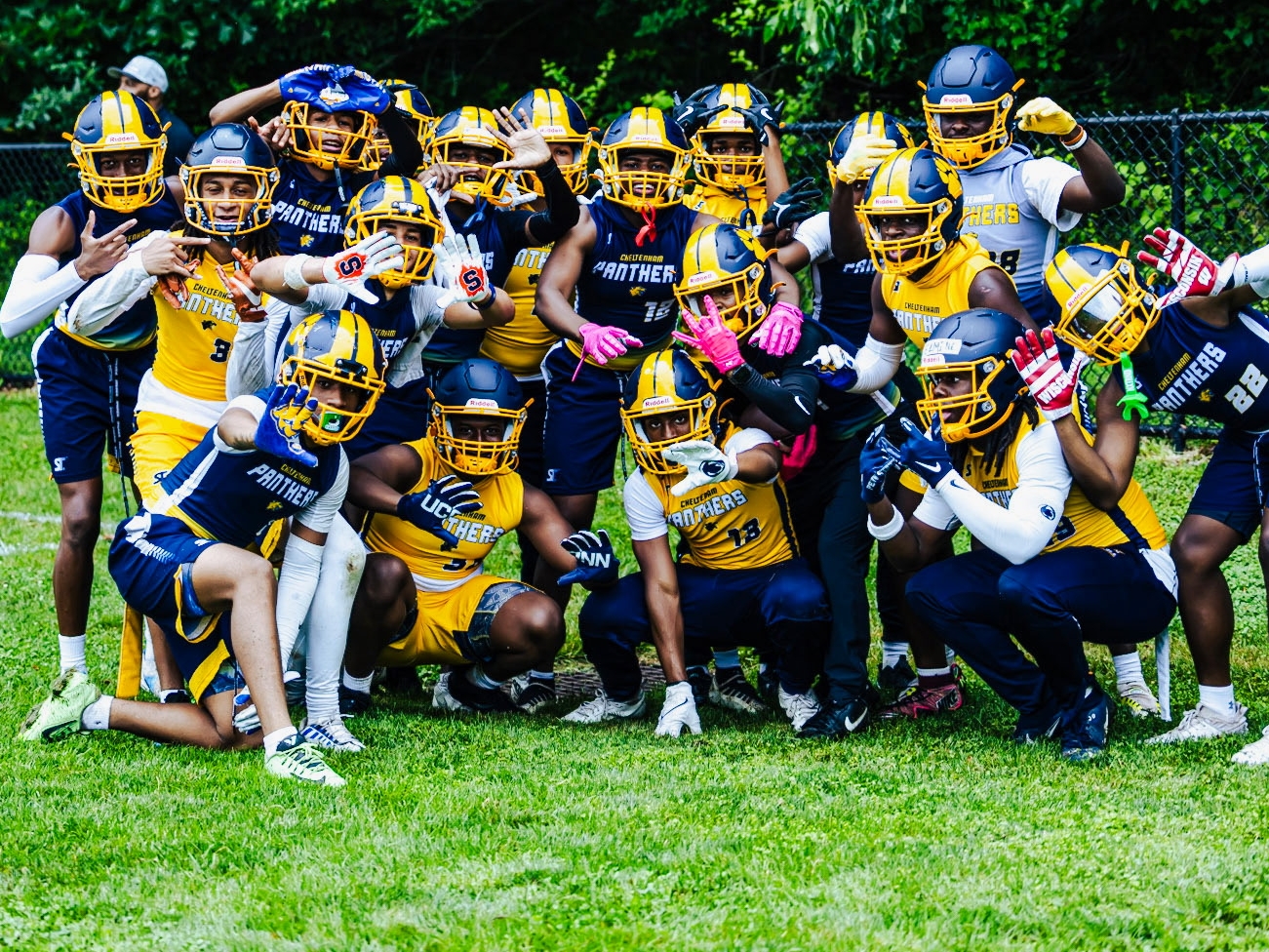
Cheltenham High School football players expected a major decision was coming following an ongoing investigation from an alleged hazing incident that terminated the 2025 season. But when the verdict arrived last month that the 2026 varsity and junior varsity seasons would be canceled, those associated with the program were shocked.
The news came in the form of an email from the Cheltenham School District on May 26, and the district said more work was needed to “reset the program” after about 20 students witnessed a student-on-student assault in a locker room in September, and no one tried to stop it.
“Until those investigations are concluded and their findings are known, it is not possible to define, develop, or execute the necessary corrective actions,” wrote Dr. Brian W. Scriven, Cheltenham’s superintendent of schools, in the release. “The district cannot build a path forward around unknowns. The scope and nature of what must be addressed will be determined by the evidence, and that process must be allowed to run its course before any meaningful next steps can be taken.
Prior to the ruling, about 50 players — 30 rising seniors and 20 rising juniors — at the Montgomery County school were wondering what to do next.
“We weren’t updated about anything,” said Kendall Jackson, a rising senior, who was a two-year starting quarterback at Cheltenham. “We’re sticking together. We’re trying to be there for each other, because no one else is. This has not only affected kids at Cheltenham, but the future kids thinking about coming to Cheltenham. Those kids might think Cheltenham is not the right place for them because of what supposedly happened. We’re all frustrated.”
The school district and Cheltenham declined to comment. Cheltenham will field a freshman team next season, and it’s unclear if it would field a varsity or junior varsity team in 2027, which will also impact the rest of the Suburban One League Continental Conference.
According to the school district, Cheltenham was set to debut its $13.4 million football stadium complex this season, which has been in the works since 2024.
‘I feel defeated’
When the announcement that the rest of the season would be canceled was made on Oct. 20, 2025, the players said then-Panthers coach Terence Tolbert, a former teacher at the school who could not be reached for comment, and his coaching staff were no longer around.
The players were not allowed to work out in the weight room or on the practice field because they did not have the supervision of a coach or an administrator.
The Inquirer also learned that the school district could not find a varsity coach for the Cheltenham football team. Two area coaches, who asked that their names not be mentioned, confirmed that they submitted their names for consideration to the district and later withdrew, with one citing the program’s “unstable” culture.
Jackson has been in contact with several area schools about transferring in the fall. Rosalind Jackson, Kendall’s mother, said the district told parents it would keep them informed about the situation, but she said that did not happen.
“I feel defeated,” she said. “My son and these other kids are paying a price for what others did. … The school district hasn’t provided any answers. These kids should have been treated with far better respect than they were. They should have been told in person by a school administrator about this news, [rather] than receiving an email at 4 in the afternoon. The school district let me down.”
Kyle Montgomery, a rising senior defensive end, had an idea something was coming. So in December, he took the Archbishop Wood entrance exam and was accepted in January. Montgomery said he did not like how the school district handled the investigation.
“They were taking a long time with the investigation and not telling us anything,” said Montgomery, who has attracted attention from Ivy League schools. “I thought that was a sign that they would cancel the season. I want to play in college, and I have moved on from this. I have already made plans. I can see where other guys who are stuck there feeling let down by the school and the school district.”
Brian Palmer-King, a wide receiver and cornerback, said the school provided counseling services after the 2025 season was canceled, but he claimed it did not offer direction or support on other options.
His mother, Brandi King, held out hope that her son would have a senior football season, but as a precaution, King and her son made other plans. He’ll attend Wood next season.
“You feel a little betrayed, because Brian grew up with Cheltenham and the football program,” Brandi King said. “Wood is a very good school and we’re happy about the move. But I’m a little sad, because Brian was hoping to graduate from Cheltenham and play his senior year.”
‘We’re working on it’
Elijah Stehman, a rising senior running back who also kicks and punts, pushed for answers this past year.
He said he repeatedly approached Cheltenham Principal Benjamin Hammond, went to school board meetings, and questioned Scriven. He said he received the same answer: “We’re working on it.”
“The administrators lied to us and lied to me,” said Stehman. “They said they would stand up for us having a season. We got nothing. I mean we got called all kinds of things on social media and in the classroom. I won’t forget my mom coming into my room after I saw they canceled the season and consoling me. My mom was more upset over how the adults handled the situation.
“The Cheltenham teachers have been great. They have been supportive. It’s everyone that is above them that has failed us. It’s not fun when you can’t trust the people who are responsible for educating you.”
Looking for a home for senior year Please Contact me! Class of 2027 3.48 GPA RB/P/KR pic.twitter.com/PDDB5pt0fD
Stehman said he emailed the administration and Scriven, and showed up at a school board meeting in January asking what would happen to the 2026 team.
He said he was told that Cheltenham would hire a coach in March and that they would open the weight room for football players.
No coach was hired, and he said they didn’t open the weight room.
“It does feel like we are in football jail,” Stehman said. “We’re paying a price for something we had nothing to do with. Every other football player in the state is preparing for the 2026 season. We can’t. We are going to be getting a new stadium. No one will be there to play.
“I tried to talk to Dr. Hammond and Dr. Scriven. They never gave me an answer.”
Stehman is looking to transfer to the Philadelphia Public League’s Martin Luther King, where his father, Kirk, was a longtime assistant coach.
What’s ahead
With Cheltenham off the schedule, Suburban One League Continental Conference schools have been in a scramble to replace those games. The SOL two-year schedule cycle was made in December, according to league officials.
This will not impact District 1 playoff seedings, since the point system can be divided by nine games instead of the traditional 10. But several SOL Continental athletic directors have said they prefer to play 10 games.
“With Cheltenham not competing next year, the teams impacted have the opportunity to reschedule that week with a different opponent. If a school is unable to find a contest, it will be considered a bye week,” said Jason S. Traczykiewicz, the Council Rock North principal and president of the Suburban One League. “Since the teams create their schedules on a two-year cycle, Cheltenham will need to inform the league of their intent for the fall of 2027 season by Aug. 31, 2026.”
As for the Cheltenham players looking to leave the school, they have a process ahead of them.
According to District 1 Chairman Dr. Michael Barber and District 1 Executive Director Sean Kelly, a student cannot transfer from one public school to another for athletic purposes, despite the extraordinary circumstances at Cheltenham.
The procedure includes the sending school signing off on the student-athlete and the receiving school signing off on accepting the transfer. If the sending school contests the transfer, a hearing is held in the school district to where the student-athlete is transferring. Both schools must sign off for the transfer to be accepted.
If a student-athlete transfers after his or her sophomore or junior year, that student-athlete would be deemed ineligible for the postseason. But considering Cheltenham’s unusual situation, postseason rulings would be addressed on a case-by-case basis, according to Barber and Kelly, by the respective PIAA district where the student-athletes intend to transfer.
As of early June, Cheltenham has not sent official transcripts or report cards to other schools, according to football coaches at Wood, Neumann Goretti, and Roman Catholic, which have received request of transfer from Cheltenham students. By PIAA bylaws, Cheltenham does not have to sign off on transfers until the student-athletes have physically left the school, with a two-week window that usually applies.
Three Cheltenham parents, who did not want their names published, are threatening lawsuits if the transfers do not come through.
“There have already been a number of missteps by the school district in this matter, and I have June 15 circled on my calendar, because if my son’s transfer does not go through, I’m going to be retaining a lawyer. I know a number of other [Cheltenham] parents who will,” said one parent. “I’m sure this is not over yet. I have no trust or have any faith in the Cheltenham School District.
“This is going to continue. They will have a freshman team in 2026, but ask yourself this, will they allow an all-sophomore team to play a Suburban One varsity schedule in 2027? No, this will go on for another year.”
Many rising seniors were looking forward to playing their final season at Cheltenham. Now they won’t get that chance.
“Everyone wants out, and we all learned something: The world does not stop,” said Jabriel Epps, a two-year starting defensive back who is talking to Kutztown. “ … I still want to play football. What’s sad is I’ll never wear anything with Cheltenham football on it again.”
Inside Philadelphia’s new RNA manufacturing hub, scientists are working to create vaccines for fish, precision pesticides, and treatments to protect plants from extreme heat.
The recently launched biofoundry at the University of Pennsylvania aims to expand biotechnological capabilities in the United States, funded by an $18 million federal grant. The National Science Foundation has invested infive such facilities nationally, each focused on a specific biological material.
The term foundry traditionally refers to a factory where metal is melted and shaped into desired forms. Expanding the concept, Penn’s NSF AIRFoundry now offers a one-stop facility for designing and building RNA technology.
All products under development involve ribonucleic acid, or RNA, a key molecule in living cells. Some consider it the cousin of the better-known molecule, DNA. Both can carry the genetic instructions for life.
The facility opened in March at One uCity Square in University City. It builds upon Penn’s success with the 2023 Nobel Prize-winning development of an mRNA platform that led to the first COVID-19 vaccine.
“We need to democratize this technology,” said Daeyeon Lee, a Pennprofessor of chemical and biomolecular engineering who serves as the foundry’s director.
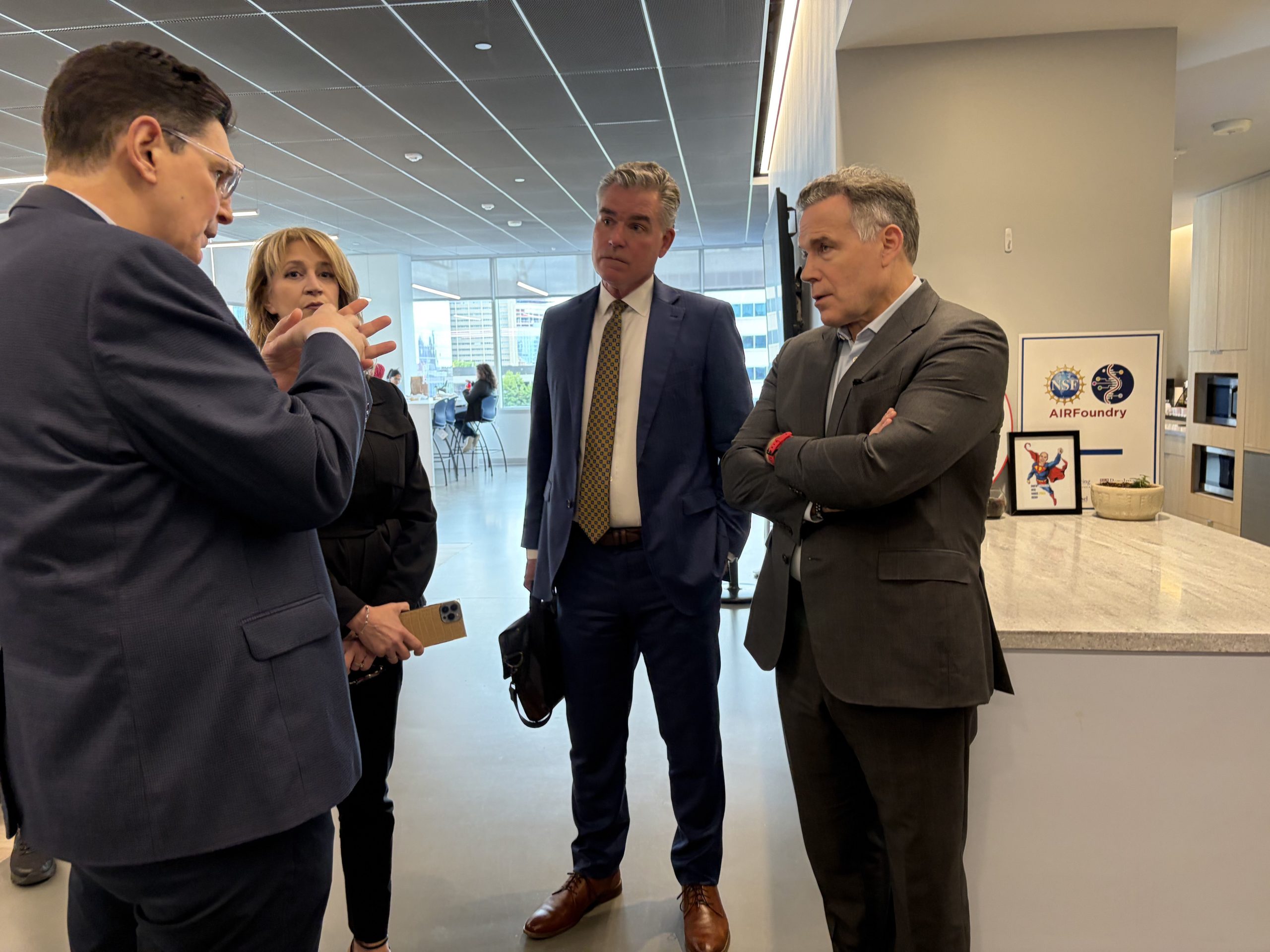
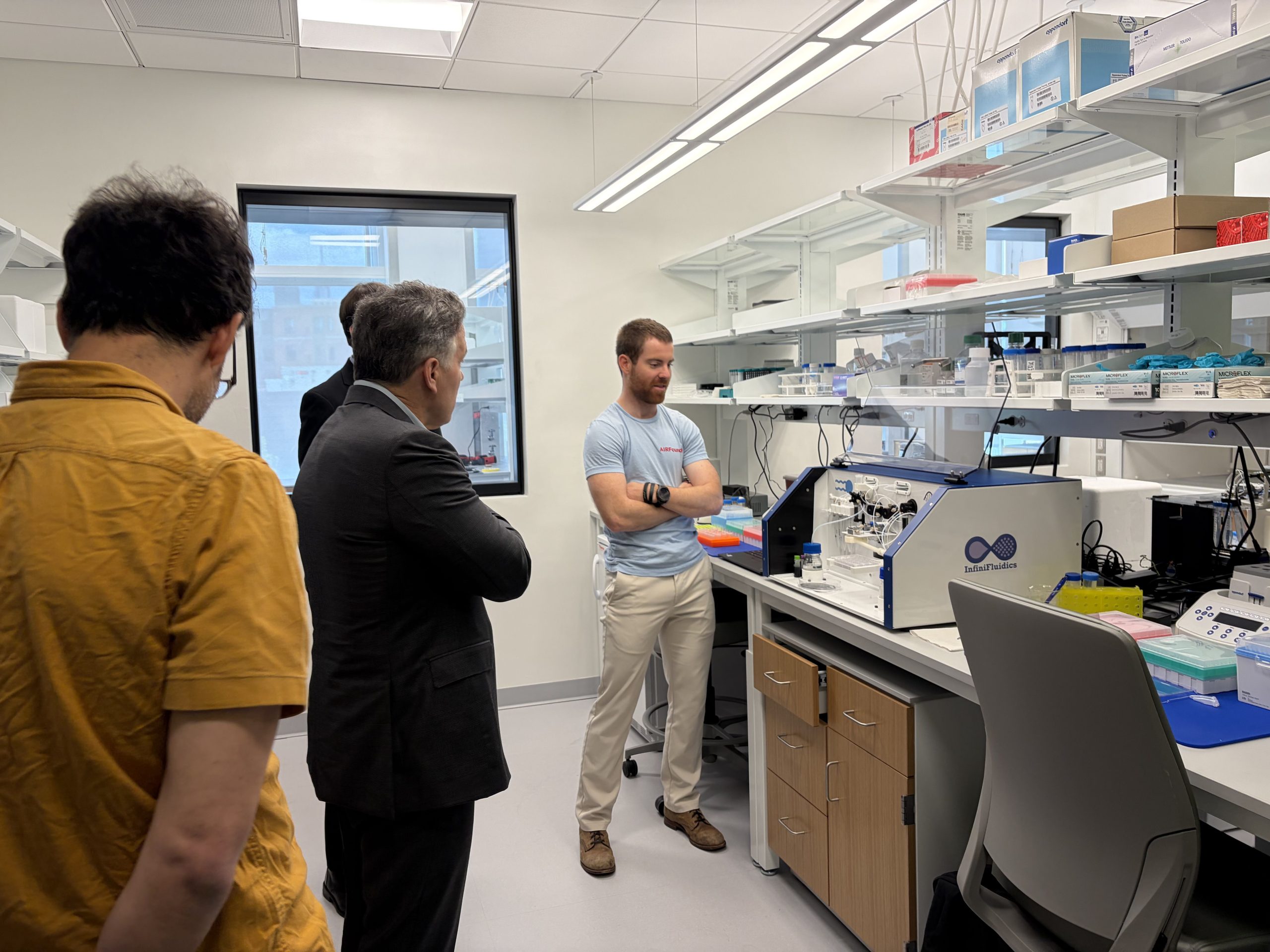
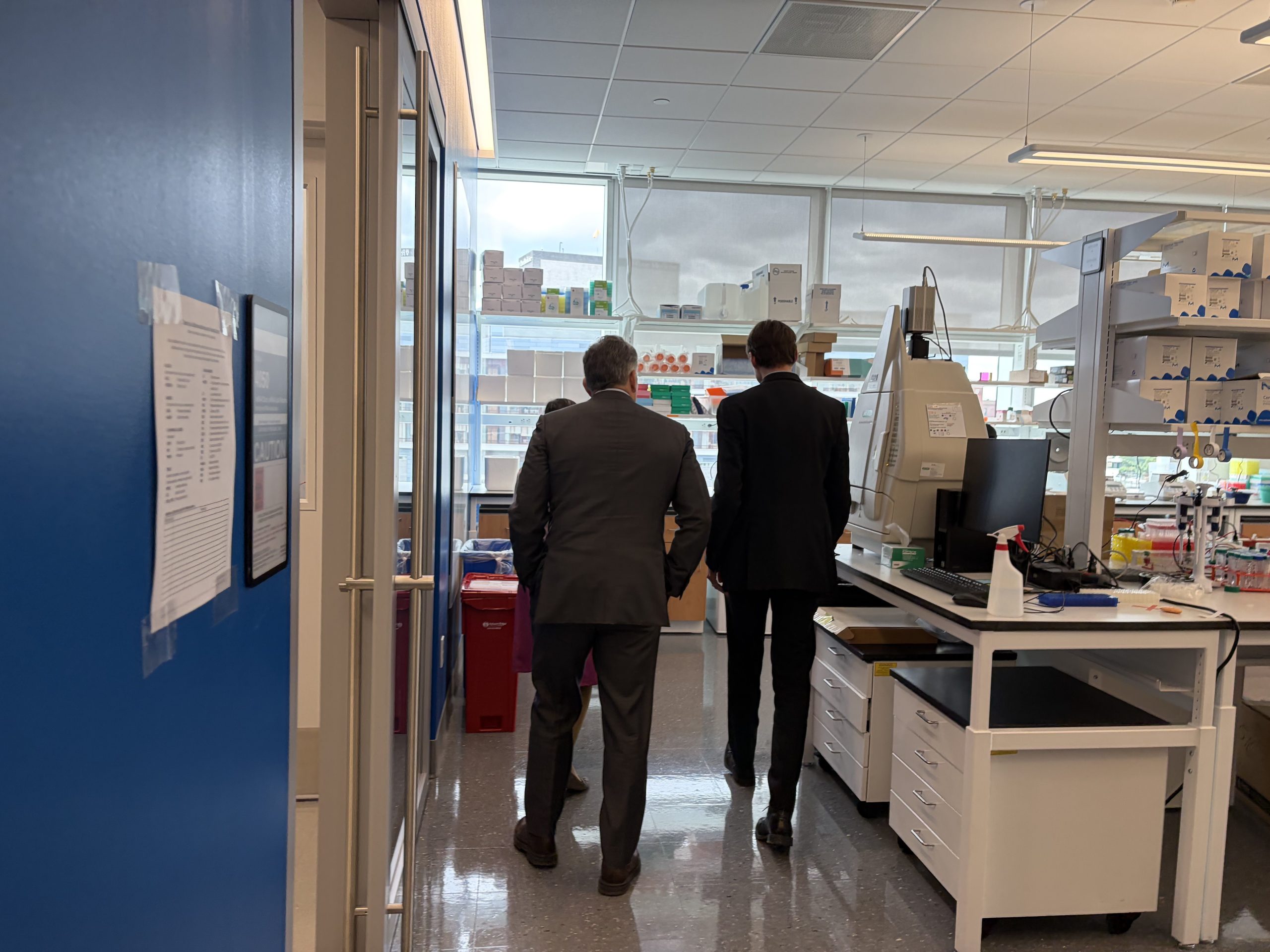
Penn Engineering professor George Pappas speaks with Sen. Dave McCormick about the AIRFoundry.Kayla Yup / Staff
AIRFoundry stands for Artificial Intelligence-driven RNA BioFoundry. Scientists hope AI will help them automate aspects of the design and manufacturing process, serving as a resource for researchers and commercial companies across the world.
A longtime anti-vaccine activist, Kennedy has claimed the technology is unsafe and ineffective, despite scientific evidence finding the vaccines to be highly safe and beneficial.
Now the foundry seeks to expand RNA’s applications in healthcare, agriculture and beyond.
Lee compared the technology to a hammer — good for certain things, but not everything.
“Our students and postdocs that get trained right now are going to be sort of the first generation of people to think about RNA as a tool for whatever problem they’re trying to solve,” Lee said.
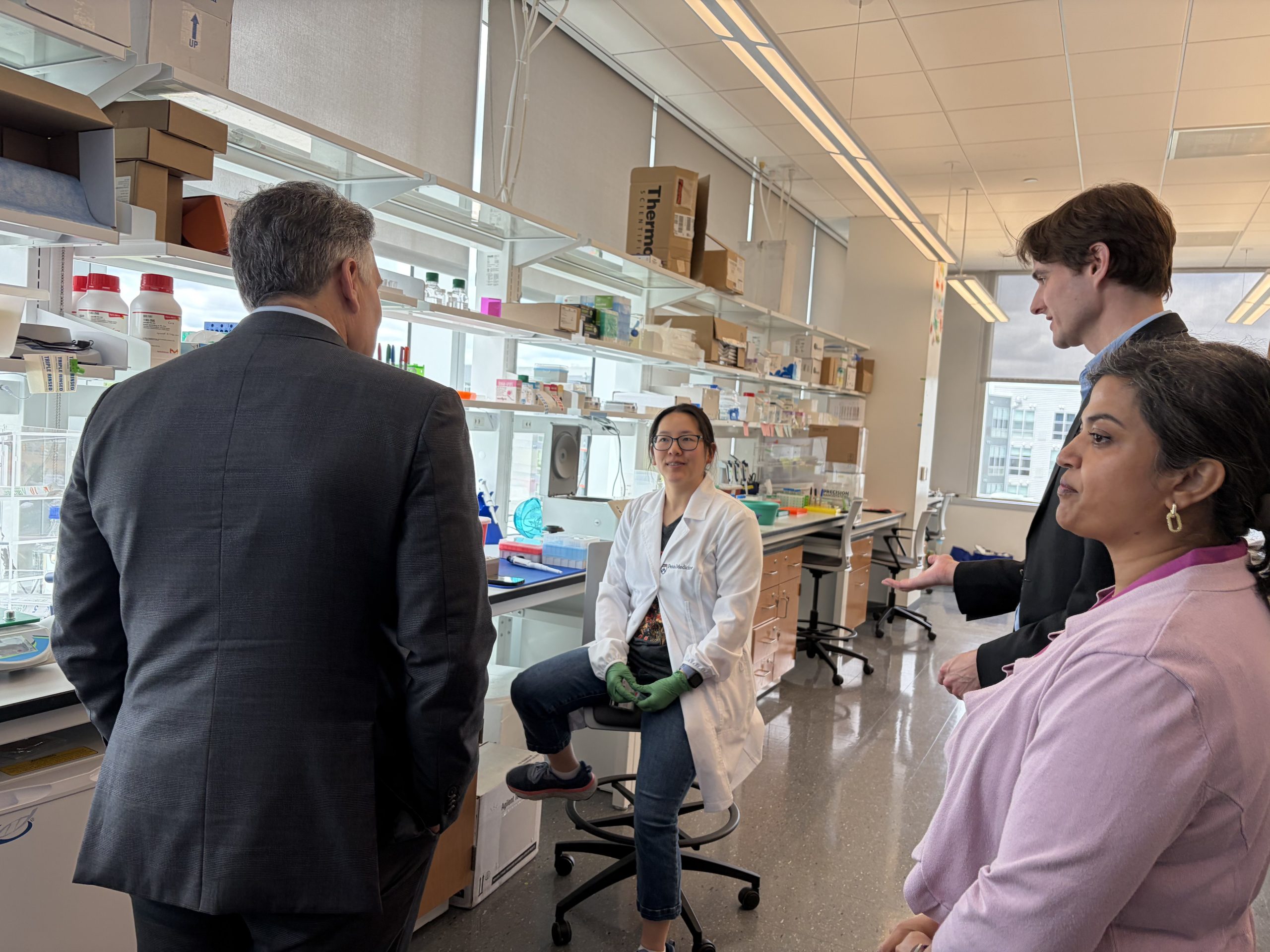
An AIRFoundry scientist describes her work in the facility.Kayla Yup / Staff
A foundry for RNA
In themRNA COVID-19 vaccines, injected mRNA provides the instructions for cells to build a harmless fragment of the viral protein. That trains the body to recognize and fight a future infection.
Compared to traditional vaccines that use live or inactivated pathogens, mRNA vaccines can be produced more rapidly — useful in a pandemic.
One of the Nobel laureates behind that effort, Pennscientist Drew Weissman, has operated a smaller scale version of the facility, mainly to make mRNA for his lab and collaborators. The foundry’s launch marked an expansion beyond Penn.
Its sterile instruments and busy lab benches were on display last month as students and faculty walked through the manufacturing process.
“It takes special facilities and skills to make RNA and associated materials,” Lee said.
Owen Land, an engineer at Infinifluidics (a Penn spinout), spoke about a device used to automate part of the process of creating liquid nanoparticles (a delivery vehicle for RNA).Kayla Yup / Staff
So far, Penn’s facility has operated on a “fee-for-service” basis, where collaborators request a specific RNA technology and the foundry builds it.
But its scientists hope to incorporate AI to help with synthesizing all the current knowledge, best practices and databases.
They also want to reach a point where users can come to the physical facility and use the instruments themselves.
Sen. McCormick toured the AIRFoundry in May.Kayla Yup / Staff
The federal grant, which started in September 2024, supports the foundry for six years. Lee hopes it will eventually become self-sustaining through the services they provide.
Projects underway includeworking on vaccines to keep fish healthy.
Another collaboratoris developing ways to deliver RNA into plants to benefit the agriculture industry. For example, designing RNA molecules that carry instructions for producing a heat shock protein could protect plants from high temperatures. The plant would produce the protein and theoretically have greater resilience against extreme heat.
The molecule degrades over time, making its effects temporary. So if used during the summer months, the RNA could be gone by the time harvest rolls around.
This transient quality could also make RNA useful for pest control, in lieu of chemical-based pesticides, Lee said.
“We want to interact with everyone that’s interested in using RNA technology,” he said.
To bring Philadelphia’s Centennial Exposition back to life, Peter Boyer and Mark Campbell could have created a nostalgic musical impression delivered like a sepia-toned postcard lost in the mail for a century and a half.
And, in fact, they have.
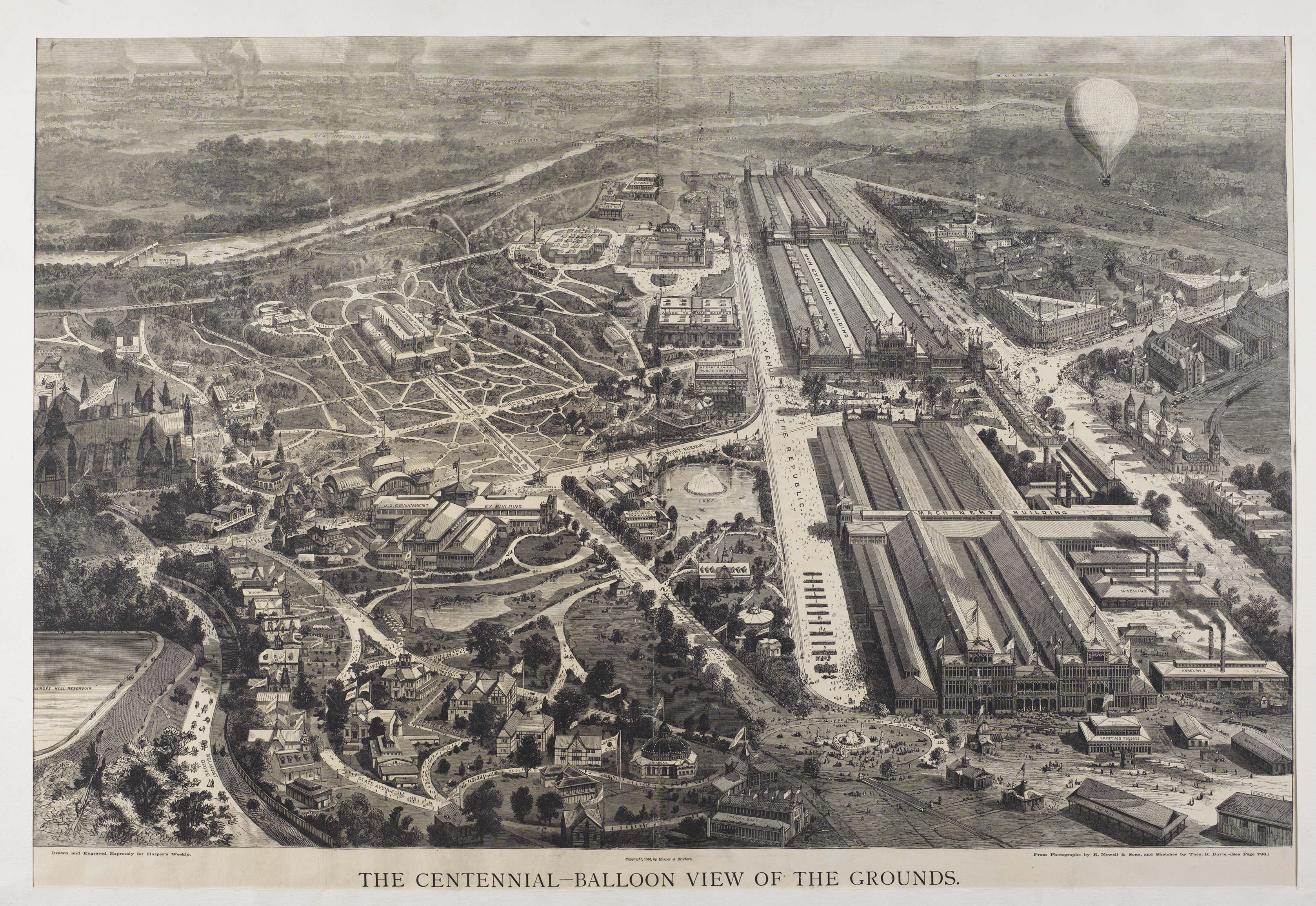
The oratorio will premiere Wednesday night at the Highmark Mann in Fairmount Park, the very site of the somewhat now-forgotten 1876 event that wowed roughly a fifth of the nation’s population with marvels of technology, agriculture, culture, and more.
But what the composer and librettist have created is something that is also more deeply personal than merely an account of a World’s Fair that introduced, among other things, an invention called the telephone and foods like Heinz ketchup and the banana.
The great U.S. Centennial Exposition is conjured in A Hundred Years On through five fictionalized characters and others who voice hope, a sense of ambition, progress, and prosperity but also uncertainty about the young country. With the Philadelphia Orchestra, the Crossing choir, vocal soloists, and conductor Anthony Parnther, the piece — commissioned by the Highmark Mann to celebrate its half century and the nation’s 250th — also humanizes the story of Americans who were denied a full voice in society.
In other words, although it celebrates the excitement of the Centennial Exposition, the piece in a sense collapses the span of time between then and now.
“It’s obvious, the relevance to our situation today,” said Boyer. “We’ve made some progress since the 1870s, and then in some ways we have made much less progress than we might have hoped.”
Map of the Centennial Exposition grounds and buildings, 1876.Courtesy of the Historical Society of Pennsylvania
“As I read about this World’s Fair, it was 10 years after the end of the Civil War, the country had just gone through a depression,” said Campbell. “This was a time when it was important for the U.S. to put its best foot forward, but it could not shake itself free from what had happened in recent history. And so there were some real dramatic possibilities there.”
Like Ignatius Thomas, a Black waiter at the exposition’s Restaurant of the South.
“Happy birthday, America,” the baritone sings, “but the speeches and the fireworks — they’re not meant for me.”
And a Polish immigrant named Marion Jozwiak, who sings in a mezzo soprano voice, says she came to America to “find a little hope” but found a “country divided, broken” — and yet still believes it’s a fair land.
“Yes, there are a few mean men who always find a way to speak the loudest and the longest. But after time, their voices die and they’re forgotten.”
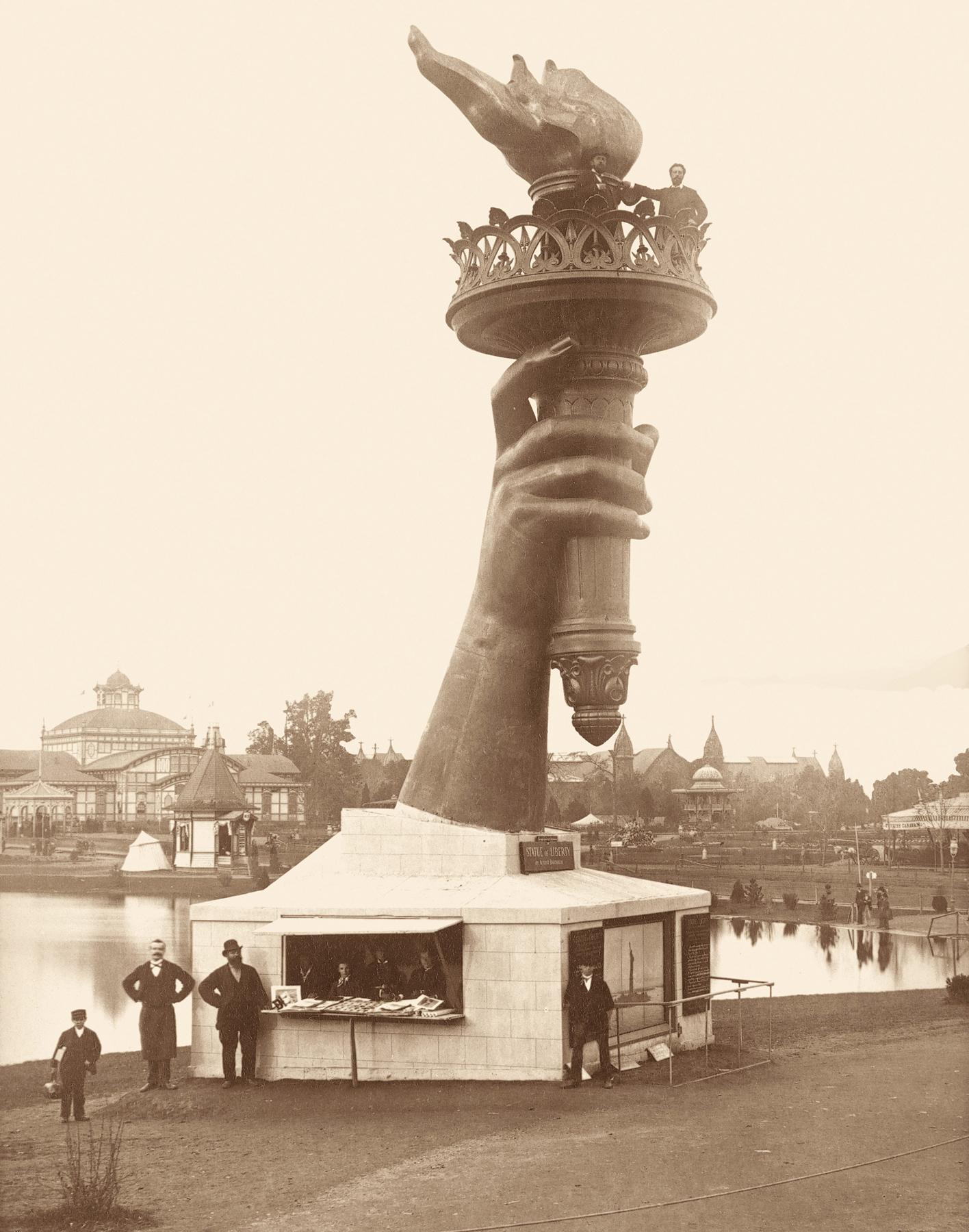
In the piece, Jozwiak is standing on the torch of the Statue of Liberty, which, with its raised arm, was displayed at the Centennial Exposition before the statue’s dedication a decade later in New York Harbor.
The Statue of Liberty’s torch at the Centennial Exhibition of 1876 in Philadelphia. As a way to raise funds to build a pedestal for Lady Liberty, visitors could, with a small donation, climb a staircase inside the statue and get a bird’s-eye view of the festivities.
“I think maybe it’s the most iconic image of this exhibition, it just says so much,” said Boyer. “It says ‘work in progress.’ We’re still a work in progress.”
That the progress is now in retrograde compelled Campbell to go back into the libretto and make changes a few months ago, long after it was finished.
“What we’re facing now — I’m sorry, I’m going to be very frank — with this terrible corrupt government we have, we are facing an autocracy — or, what is the word? Kakistocracy. So I wrote this in a very different place and I had to go back to the libretto and make it darker than it was when it was originally written. It was just sounding too positive to me.”
But if the piece acknowledges pain and exclusion, it doesn’t stinton idealism.
“The story certainly has humor in it, and joy and excitement about where America could be, where America could go, what America could be to the world, and I think that’s the soul of Peter’s music,” said Campbell.
In the way it deals with story, the new piece echoes Ellis Island: The Dream of America, Boyer’s work whose stirring, filmic musical language has generated about 350 performances since the piece’s premiere in 2002.
“I’m pretty clearly identifiable as an American-sounding composer, you know, which is an ambiguous term,” says Boyer, who cites Copland, Bernstein, and John Williams as influences generally.
Here in this new piece, “my love of Sondheim, my love of Bernstein, theatrically speaking, that sort of came through, because the libretto seemed to suggest it.”
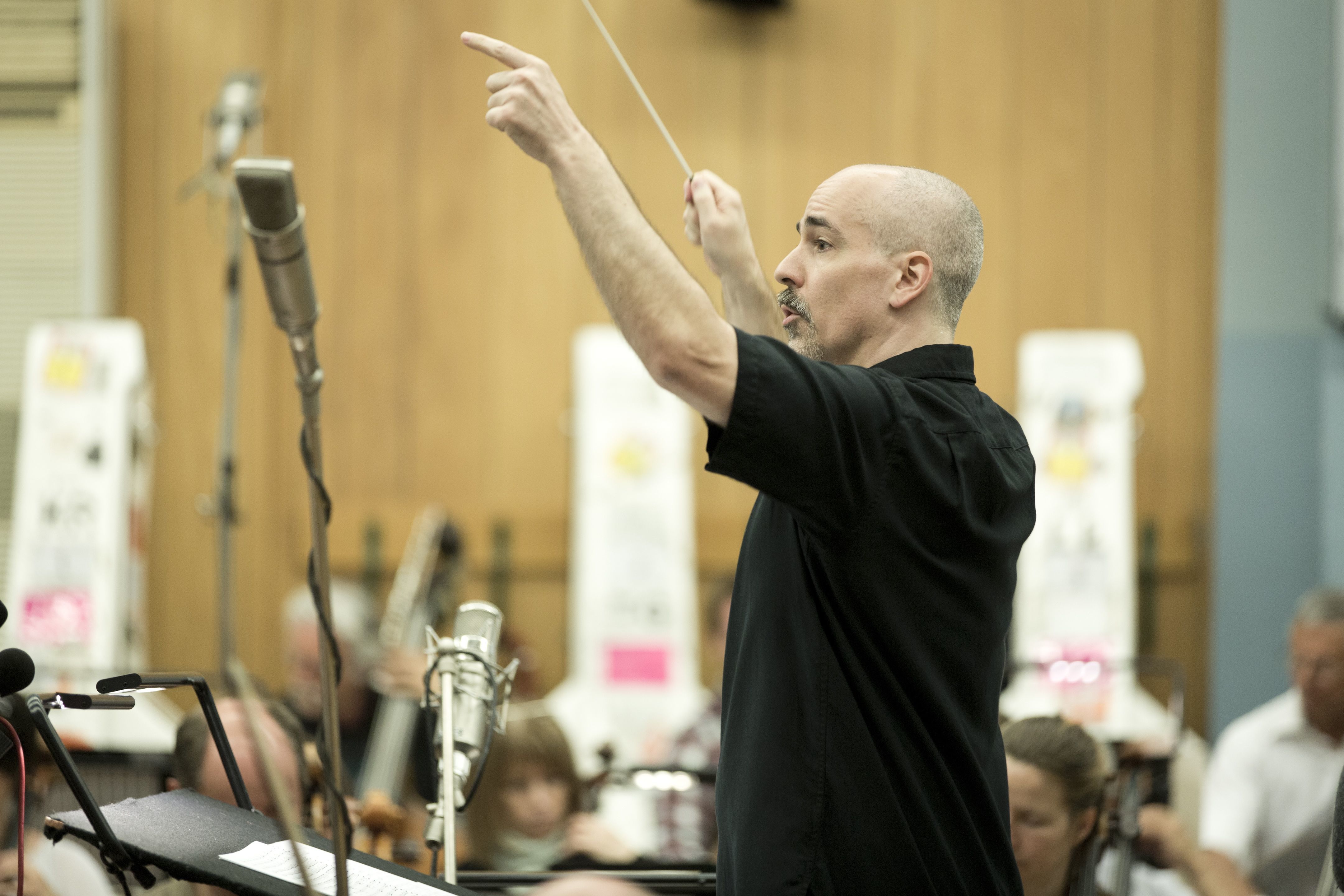
Composer Peter BoyerBenjamin Ealovega
Boyer and Campbell collaborated virtually on the piece — Californian and New Yorker, respectively, they’ve yet to meet in person — and they made separate visits to the Free Library of Philadelphia to research the 1876 exposition. They also did the bulk of their work at different times to fit in with other projects. Boyer composed the music while simultaneously writing American Mosaic for the Semiquincentennial. That piece was premiered by the National Symphony Orchestra in February at the John F. Kennedy Center for the Performing Arts.
Both works use visuals. American Mosaic is a collaboration with photographer Joe Sohm, and A Hundred Years On uses projections of images from the exposition designed by video artist Rasean Davonté Johnson, costumes by Millie Hiibel, and stage direction by director Tazewell Thompson.
“They’re similar and yet different in some fundamental ways,” says Boyer of his two pieces, “again with where we are in our country and here we are celebrating this incredible milestone in our history while simultaneously dealing with such disheartening times. And so, what is our role as artists and composers?
“I think it’s an opportunity that this piece can bring some history and some uplift, and that’s not a bad thing.”
“A Hundred Years On” is performed Wednesday at 8 p.m. at the Highmark Mann, 5201 Parkside Ave., along with Julia Wolfe’s “Liberty Bell” and other works. With vocal soloists Mary Dunleavy, Meredith Lustig, Eve Gigliotti, David Portillo, and Malcolm J. Merriweather. Tickets are $18.76 or $50. highmarkmann.org.
You could use the same four words to describe the Eagles offense in 2025 as you would Elmer Fudd.
Uses shotgun, rarely well.
So says the conventional wisdom, at least.
During the Eagles’ recently completed mandatory minicamp, there was a lot of talk about new offensive coordinator Sean Mannion’s affinity for operating from under center and the adjustment it might require for those closest to the ball (namely, the quarterback). The topic of conversation was certainly valid. Throughout the Jalen Hurts/Nick Sirianni Era, shotgun has been the Eagles’ baseline look, more so than all but a small handful of NFL teams. I’m just not sure that the change under Mannion will be as radical as people hope/expect.
What if I told you that Saquon Barkley has only had one fewer carry from under center than the Packers’ Josh Jacobs over the last two seasons, when Mannion was in Green Bay? Or that, in 2025, Hurts attempted more passes from under center than Joe Burrow and Patrick Mahomes, both of whom can make a case as the best in the game?
All of this talk about scheme comes from a good place. But I think the term itself tends to get misapplied when we talk about what makes good teams good and bad teams bad. The perception of “scheme” is that it is some static, word-of-God recipe book that each coach draws up like a wizard and then carries with him from stop to stop. In reality, I think it’s closer to a core set of principles and best practices that guide the concrete aspects of coaching: teaching and game-planning. The actual output of all of those things — the plays — will look a lot different from roster to roster and opponent to opponent.
Jalen Hurts attempted more passes from under center than Joe Burrow and Patrick Mahomes in 2025.Monica Herndon / Staff Photographer
“There’s things I believe in and there’s things that schematically I have a background in, but ultimately it’s going to be a blend and it’s constantly going to evolve,” Mannion said earlier this offseason. “It’s about maximizing things for the players. How do we make the Eagles the best team we can be, how we make the Eagles offense the best it can be and how do we put all of our players in a position to really, really succeed and maximize their strengths.”
Don’t get me wrong. There will be change. As I wrote last week, it will be real change, more so than at any point in Sirianni’s time as head coach.
Reality is, the NFL has become a shotgun league over the last decade. That’s true regardless of coach or quarterback. Last season, Matthew Stafford and Sam Darnold were the only two quarterbacks to line up under center on more than half their snaps. Both quarterbacks threw the ball out of shotgun roughly twice as much as they did under center.
The evidence hardly supports the idea that the Eagles’ heavy reliance on the shotgun in recent years is an ipso facto indictment of Hurts and/or the offensive scheme. At least, not if you accept as fact that Burrow and Mahomes are two of the best quarterbacks in the NFL. Mahomes attempted just 32 passes from under center in 2025, 12 fewer than Hurts’ 44.
The big difference between teams like the Seahawks/Rams and the Eagles was their preference for running from under center. The Rams ran out of shotgun just 64 times in 2025, for instance.
At the same time, the Eagles ran the ball from under center more than you might think. Two years ago, nearly half Barkley’s 2,005 rushing yards came from under center. His 6.1 yards-per-carry average was best in the NFL, and better than his 5.6 yards per carry out of shotgun.
Saquon Barkley is looking forward to running Sean Mannion’s system.Monica Herndon / Staff Photographer
Again, to be clear, we should expect to see a significant difference. One takeaway from the Eagles’ pre-camp workouts is that Mannion’s run game philosophy is closer to the Shanahan/McVay/Kubiak tree than Sirianni’s.
“It’s no secret what this system is about,” Barkley said earlier this offseason. “I look forward to doing that. It’ll probably be the most I’ve ever done it under center and outside zone and all that good stuff. It’s a challenge I’m looking forward to work on and getting better at and trying to be the best at it.”
As for the passing game, one suspects we’ll still see plenty of shotgun. Jordan Love attempted roughly 30% of his passes from under center in 2025 when Mannion was with the Packers. That’s more than three times as often as Hurts did.
We could be talking about an additional 5-7 passes per game from under center. That’s not nothing. But we’re probably not going to see something that looks completely foreign. As tight end Dallas Goedert said last week, “You can only do so much [different] on offense.”