Tag: UniversalPremium

  • Eagles practice observations: Sean Mannion’s offense starts clicking; Jalen Hurts under center; Jalyx Hunt hunts

    Eagles practice observations: Sean Mannion’s offense starts clicking; Jalen Hurts under center; Jalyx Hunt hunts

    The Eagles held their first practice of training camp on Wednesday at the Jefferson Health Training Complex. Here were my observations from Day 1:

    Healthy Birds

    The Eagles announced that outside linebacker Jonathan Greenard was placed on the Physically Unable to Perform (PUP) list just before practice. He apparently strained a pectoral muscle while lifting prior to camp. Greenard isn’t expected to be out long-term, but starting him on PUP allows the team to save a roster spot if he’s going to miss more than a month in the regular season.

    It’s unclear if the injury had anything to do with his recovery from December shoulder surgery. Greenard didn’t practice much in the spring after he was acquired via trade during the draft. He’s learning a new defense, but he’s been around the block a few times and shouldn’t be held back once healthy.
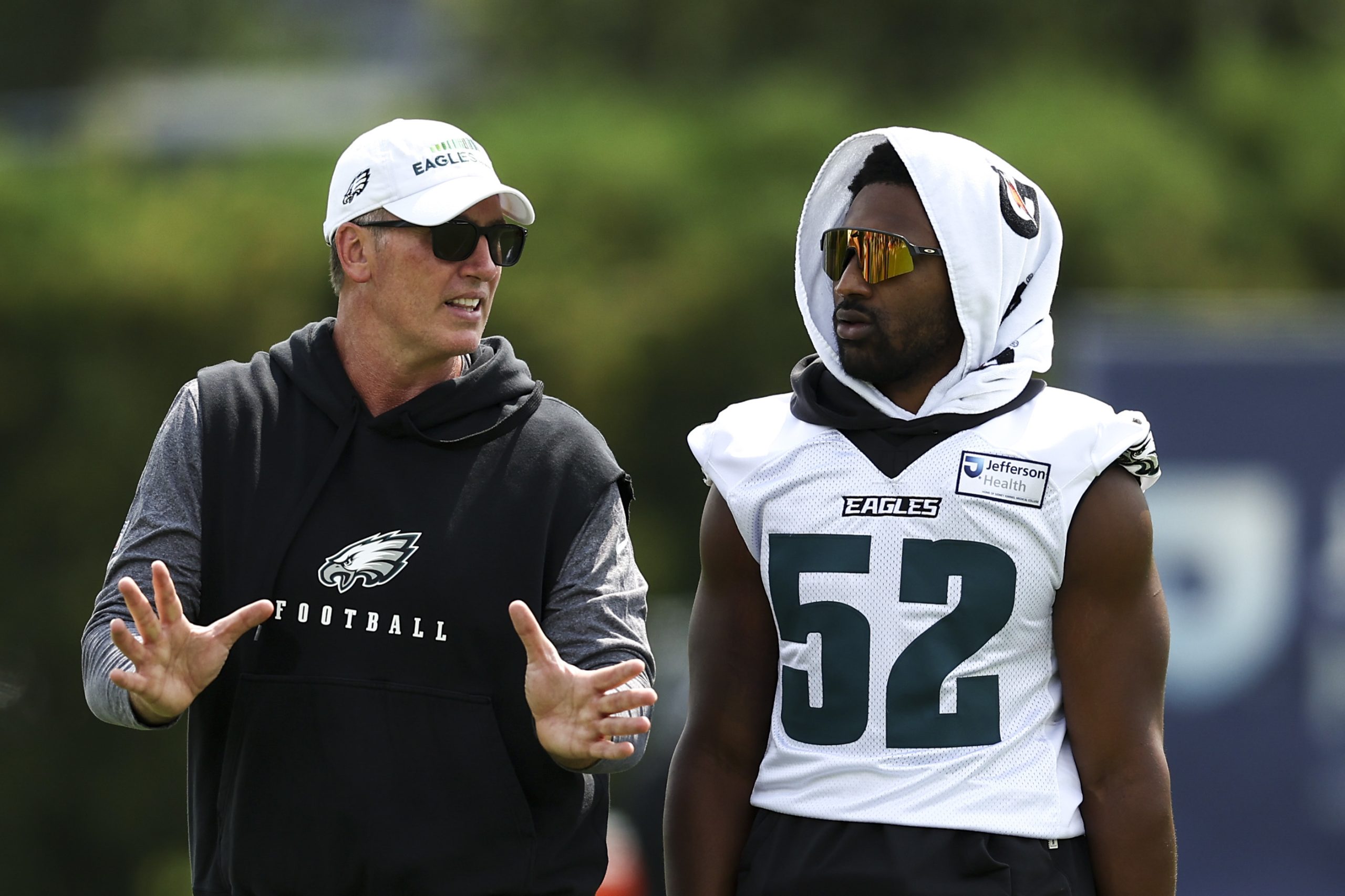
    Jonathan Greenard (right) was present on Wednesday but will remain sidelined indefinitely with a pectoral injury. Monica Herndon / Staff Photographer

    The Eagles were otherwise full-go. I don’t recall them being as healthy entering camp in all my years on the beat. Every player passed Tuesday’s conditioning test, as coach Nick Sirianni suggested before practice. Linebacker Jihaad Campbell (shoulder), wide receiver Makai Lemon (hamstring) and several other players who were limited in the spring were back in action.

    Campbell, by the way, switched his jersey number from 30 to 11. That should end all talk of the former Eagles wide receiver who previously wore the double ones. Right?

    Positional battles

    There’s really only one “starting” spot up for grabs and it technically isn’t a full-time job: safety. Cooper DeJean is expected to “start” at safety in base personnel alongside Andrew Mukuba. DeJean was there again on Wednesday. Marcus Epps filled the primary nickel role, however, with a splash of Michael Carter II at times. Those two appear to be the frontrunners. General manager Howie Roseman won’t be shy about trading for an upgrade if needed.

    There are some intriguing competitions further down the depth chart. Jonathan Jones was the first cornerback up when starter Quinyon Mitchell took a breather during team drills. Jeremiah Trotter Jr. and Smael Mondon were the backup inside linebackers behind Zack Baun and Campbell.

    A handful of receivers will be vying for the snaps that became available when A.J. Brown was finally traded to the Patriots. DeVonta Smith is the bona fide WR1, but new faces like Dontayvion Wicks, Hollywood Brown and Lemon, along with returnees like Darius Cooper and Johnny Wilson will be contending for playing time.

    Line ’em up

    The first-unit offensive line is set, but swing tackle along with a few other backup spots are up for grabs. New O-line coach Chris Kuper will work some reserve linemen at various positions to create versatility. Here’s how the units looked on Wednesday:

    A few notes:

    Jordan is new after the Eagles signed the veteran guard at the conclusion of minicamp in June. Bell was back in the lineup after sitting out the last day of minicamp. He and Fred Johnson are presumably battling for the swing tackle role, although Kuper could have both active on game days. Hollin Pierce and Jaeden Roberts were with the third unit at left tackle and left guard, respectively, during the period for developmental players.

    Mannion mirror

    New offensive coordinator Sean Mannion continued to implement many of the concepts we saw from the Kyle Shanahan-Sean McVay scheme he brought to the Eagles in the spring: a lot of under center sets, play-action and motion. I’d estimate that more than half of the plays came with the quarterbacks lined up under center.
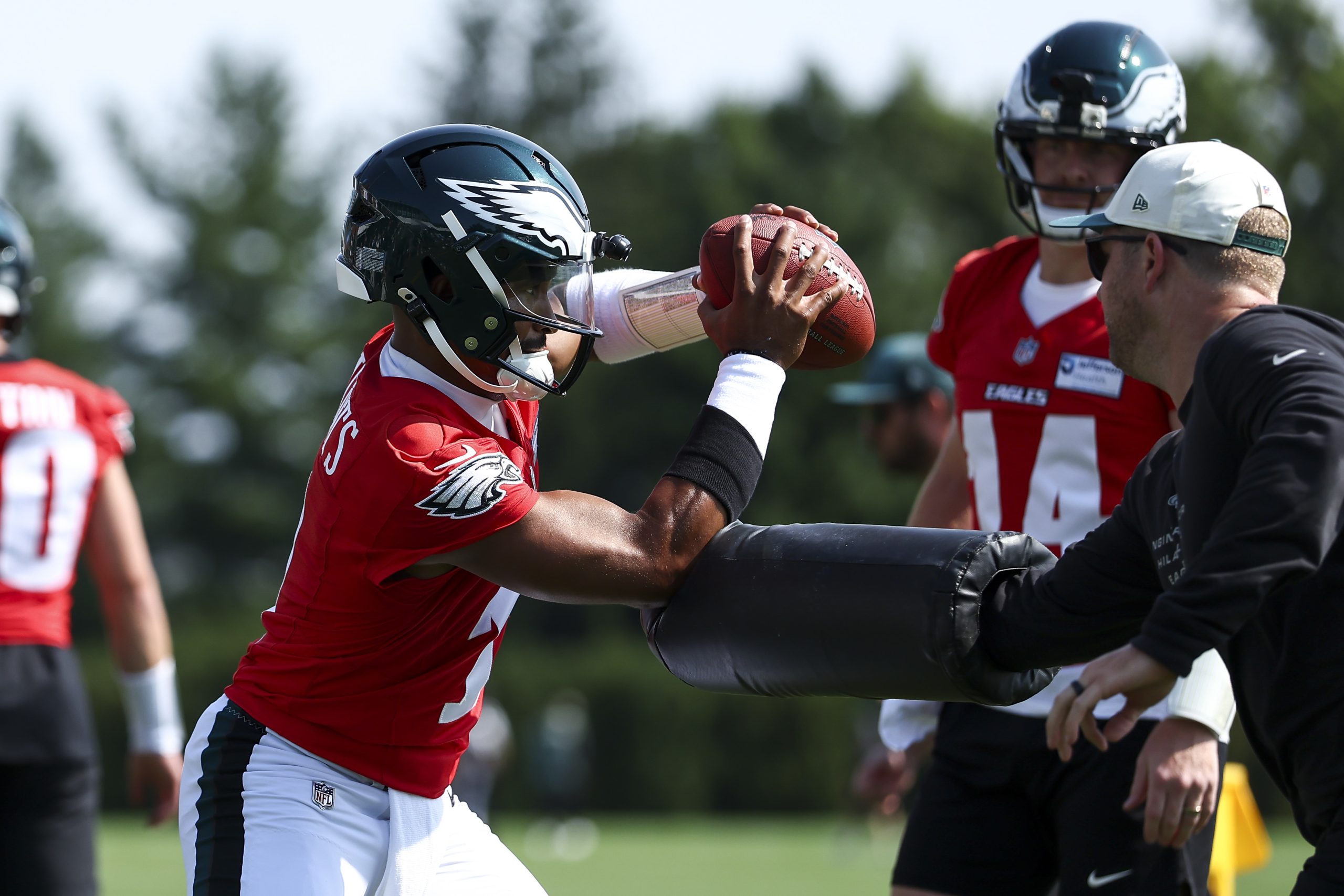
    Jalen Hurts continued to learn the intricacies of the new offense on Wednesday. Monica Herndon / Staff Photographer

    Jalen Hurts has improved from under center since entering the NFL, but he hasn’t done much of it, at least compared to rest of the league. There will be more of him turning his back to the defense on play action and naked bootlegs. An early awkward pass across Hurts’ body to Lemon illustrated that there will be some growing pains.

    Hurts to be…

    There will be an adjustment period for all involved, but mostly Hurts. He’s endured other previous changes in play-calling and scheme with varying results. The offense wasn’t sharp during the spring practices open to reporters. That came as little surprise, and neither should struggles during the summer.

    Hurts’ first pass of camp was a wobbler to Wicks that Mitchell nearly intercepted. But he had some strong moments in the later team portions with good ball placement on a toss to Wicks with cornerback Riq Woolen in coverage and a strike to a crossing Smith just over Mitchell.

    The catch of the day came during seven-on-sevens when Hurts hooked up with Cooper. The receiver got behind DeJean out of the slot and made a diving grab over the middle.
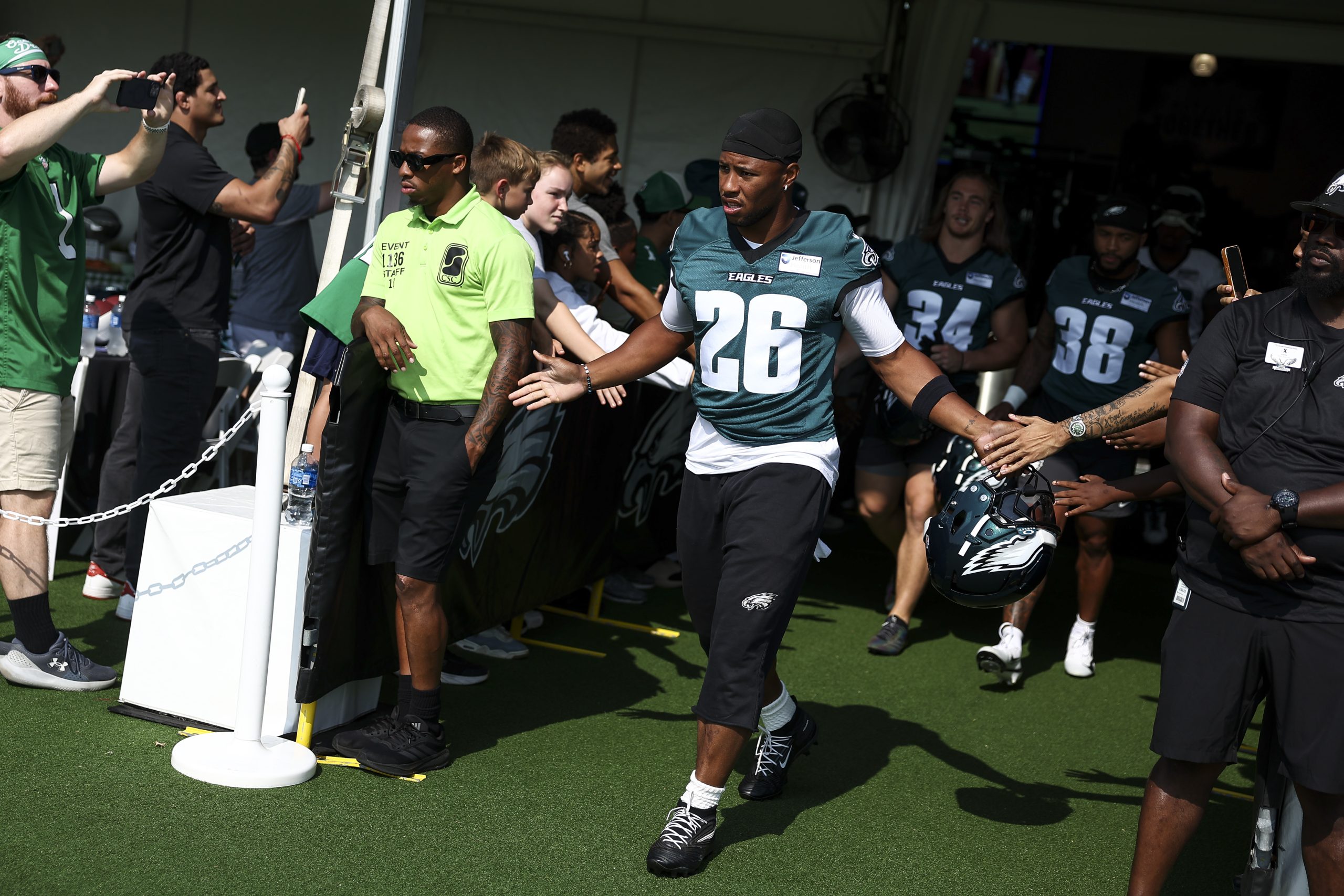
    Saquon Barkley’s ability to adapt to the wide-zone blocking scheme will be worth watching. Monica Herndon / Staff Photographer

    Run it back

    The Eagles won’t be in full pads until the fifth practice of camp on Tuesday, but they were able to incorporate more of the run game into team drills. Some of the biggest changes on offense will come with the move to more wide-zone blocking. Lane Johnson said the new system is “O-line friendly” and should theoretically place less stress on the group in pass blocking situations.

    Running back Saquon Barkley took the first handoff of camp and ran behind Johnson off tackle. He was met near the line of scrimmage by Baun on his next carry. Backup Tank Bigsby’s first touch came on a rush up the middle after Steen climbed to the second level. Could we see more of Bigsby as the inside complement to Barkley this season?

    Hunting season

    Greenard’s absence pushed Jalyx Hunt into the starting spot at right outside linebacker opposite Nolan Smith Jr. Hunt will likely play as many snaps as the other two this season. There’s an argument to be made that he should get more playing time than Smith. Nevertheless, he took advantage of his opportunities with Greenard out.

    Hunt shot into the backfield unblocked and forced Hurts to check down to Cooper on one play-action pass that came from under center. He blew up tight end Dallas Goedert with an edge rush and Hurts had to hurry a dump to Bigsby that wasn’t caught. And he beat Jordan Mailata on back-to-back rushes — one with an inside move and the other from the outside — that blew up pass plays.
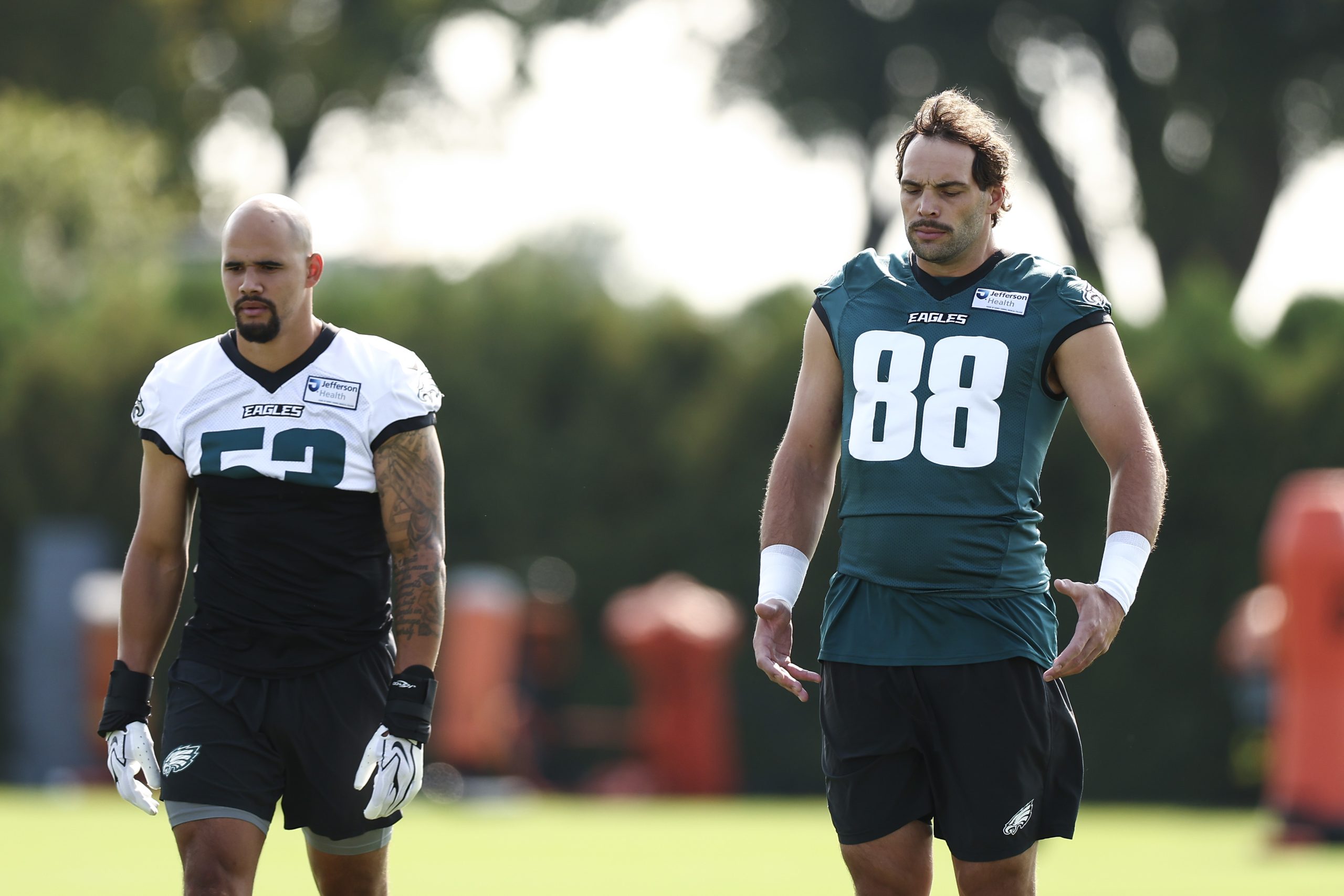
    Dallas Goedert (right) rebounded from an early drop in Wednesday’s practice. Monica Herndon / Staff Photographer

    Sloppy go droppy

    Defensive coordinator Vic Fangio enters his third season at the helm with little turnover on his side of the ball. He’s always evolving and will introduce new ideas, but the core of his unit remains intact. The defense should have the upper hand in competitive periods, especially with the offense still ironing out details.

    Mannion’s unit had a couple of false starts from Mailata and Landon Dickerson. Brown lined up illegally at one point. Defensive tackle Jalen Carter, fresh off his contract extension, was flagged for offsides at one point. He slipped by Steen for a would-be tackle of Barkley in the backfield earlier in the session.

    Goedert dropped an early pass, but rebounded later on a short crossing route. Hurts and Barkley had a miscommunication on a botched handoff.
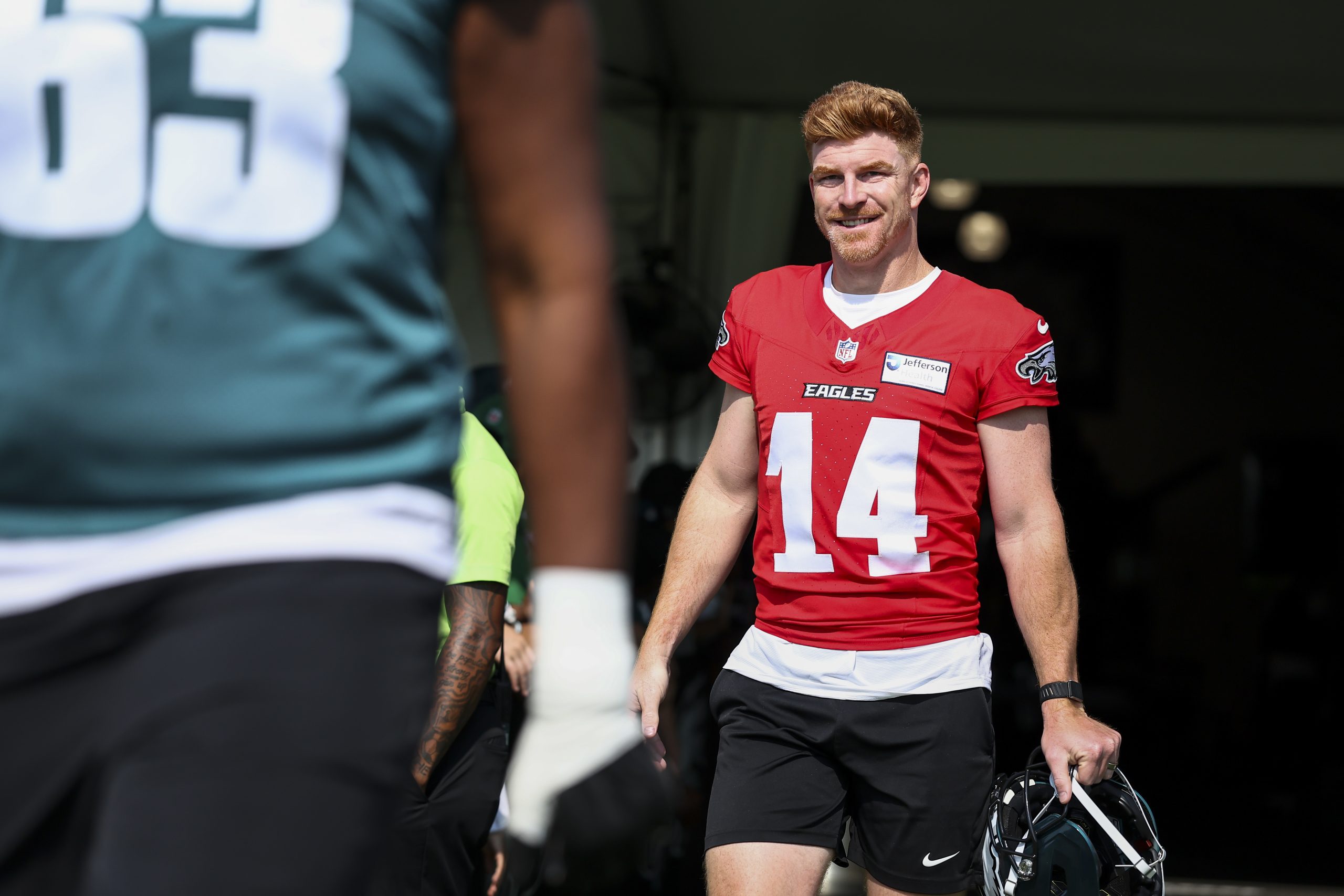
    Andy Dalton (14) is vying for the No. 2 quarterback job. Monica Herndon / Staff Photographer

    Back it up

    Quarterbacks Tanner McKee and Andy Dalton continued to split second unit snaps, much as they did in the spring. McKee’s first completion during seven-on-sevens went to rookie tight end Eli Stowers. Dalton hit Wilson over the middle with a pass only the 6-foot-6 receiver could reach.

    Trotter had a couple of run stops, one time seemingly filling a gap out of nowhere to stop Bigsby in his tracks. Former Texans running back Dameon Pierce was relatively quiet in the spring, but he had a nice cutback on an inside rush.

    Extra points

    Rookie quarterback Cole Payton had his ups and downs in the spring, but he continued to display a willingness to throw downfield a month later. He ripped a pass to receiver Quez Watkins during seven-on-sevens, and found receiver Britain Covey on a deep corner route. … Second-year defensive tackle Ty Robinson was relegated to snaps during the developmental period. Not a good sign. … Lemon fielded punts behind Covey and Elijah Moore. … The Eagles return Thursday for practice and will have a closed-to-reporters walkthrough on Friday.
  • Barclay Pies in Cherry Hill sets a new standard for gluten-free pizza in the Philly area

    Barclay Pies in Cherry Hill sets a new standard for gluten-free pizza in the Philly area

    It’s been a long time since Samantha and Mike Garbose have been able to truly enjoy the same pizza together. Ever since Mike discovered an intolerance to gluten in 2019, their pizza dates have resulted in this married couple ordering a “his” and “hers” situation with separate pies.

    Being relegated to the gluten-free alternative is not a fate Mike begrudges: “We both agree that each of us is totally entitled to the food that our diets and preferences warrant.” Then again, the contrast in quality between standard wheat-flour crusts and those made with gluten-free ingredients can be hard to ignore.

    “At places that have both gluten [-full] and gluten-free pizza,” says Samantha, “usually I get something that looks phenomenal and Mike gets something that looks like a cardboard circle — and then I feel guilty about that.”

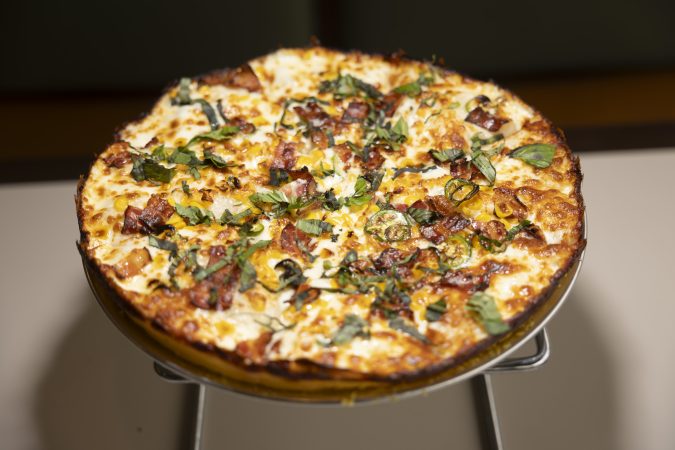
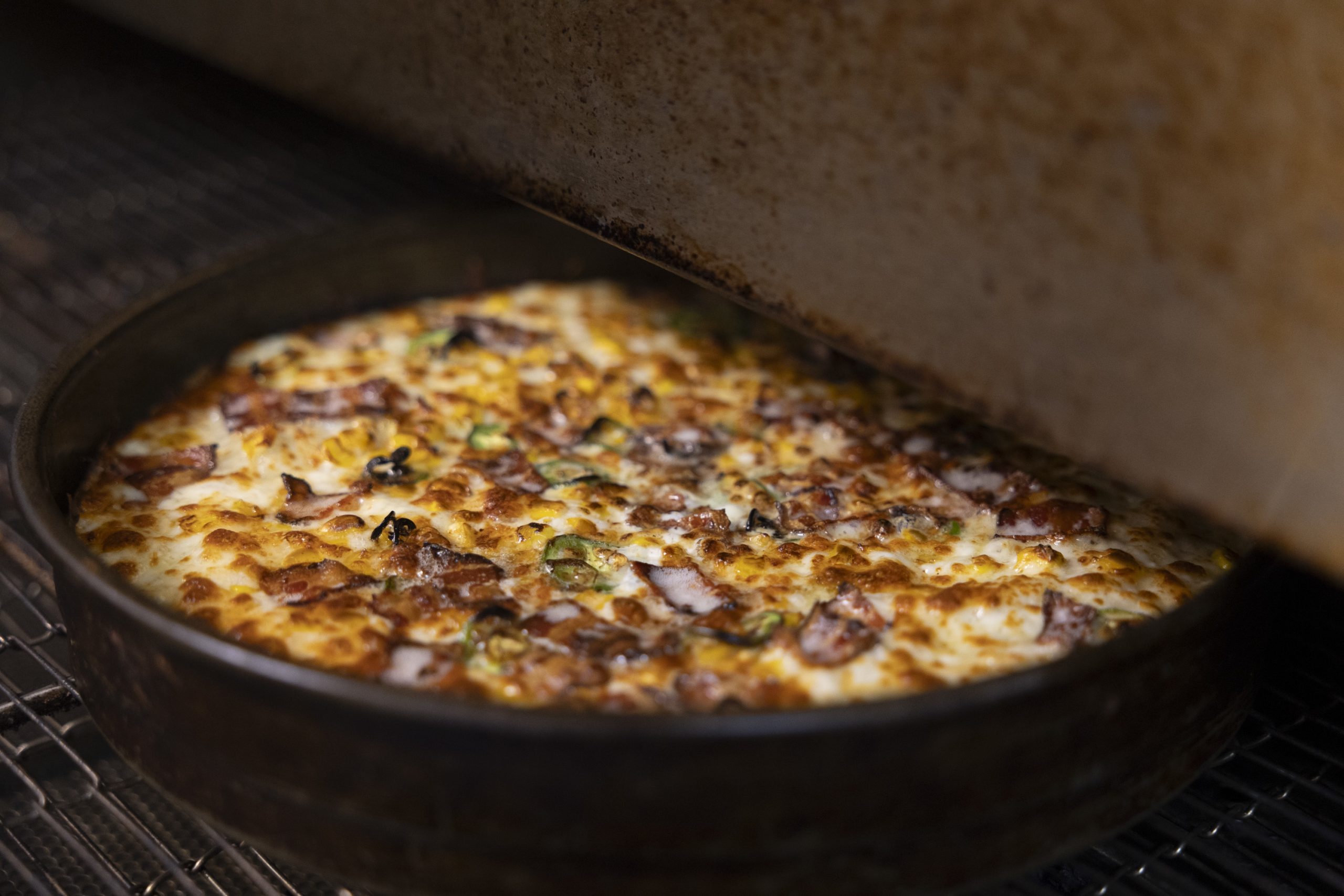
    Gluten-free pizza with summer corn at Barclay Pies in Cherry Hill.Tyger Williams / Staff Photographer

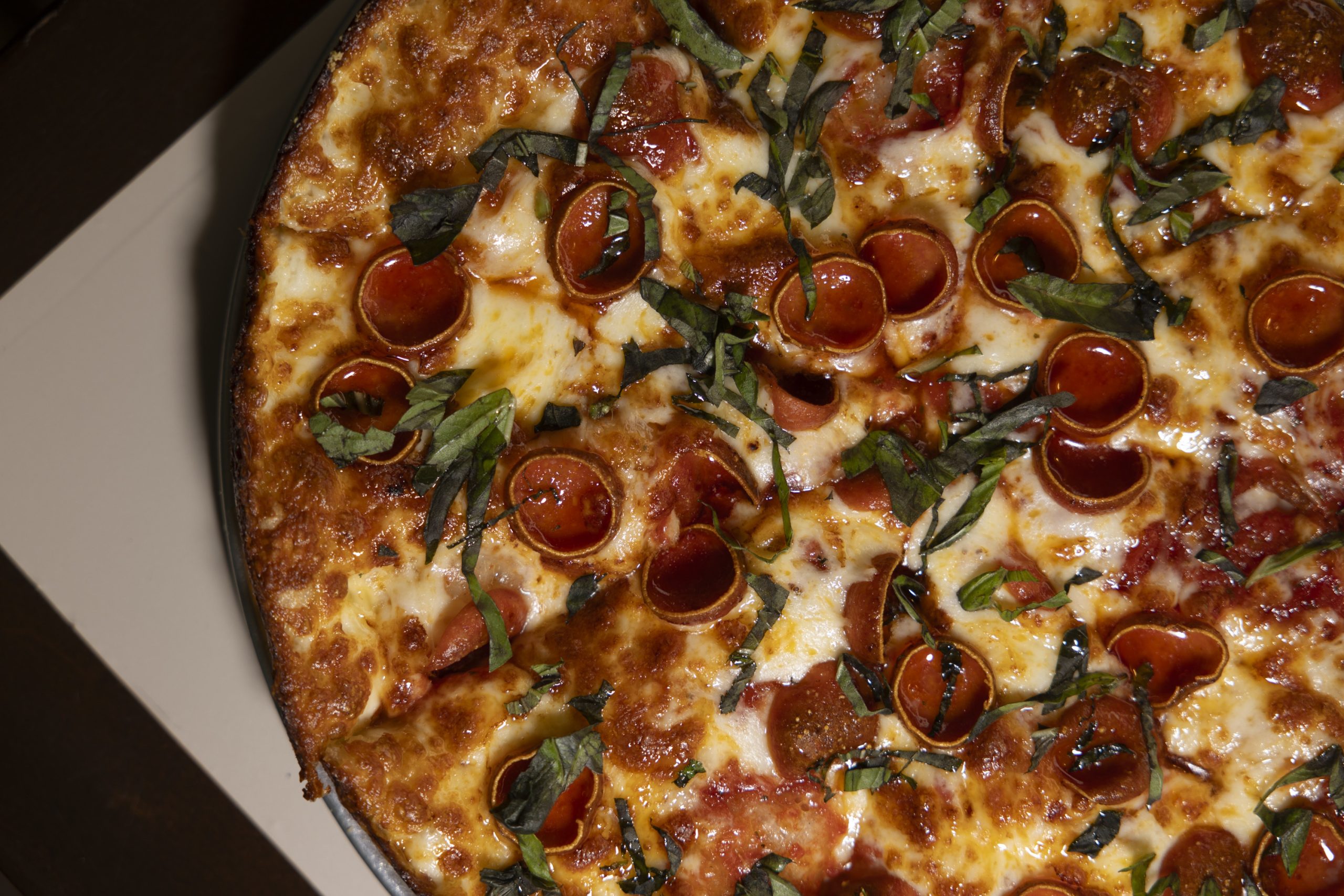
    But there would be no guilt tonight at Barclay Pies. Not once the first gluten-free pizza arrives at our table, its airy puff of a crust crisped around the edges to a tawny snap that beckons from under a crown of molten mozzarella topped with sweet summer corn, bacon, and chile peppers. Another pie arrives, this one zesty with a layer of red sauce bursting with bright California tomatoes and a whiff of oregano; fistfuls of cup-and-char pepperoni rounds are scattered over the top, then finished with honey and freshly ripped basil.

    “Oh wow, that does not even look gluten-free!” says Samantha.

    That’s been my exact reaction every time I’ve visited this pizzeria in Cherry Hill, initially with my daughter, Alice, who has celiac disease. Barclay also makes standard pizzas with glutinous flour, but it has generated a serious buzz within the gluten-free community over the course of its first year — for good reason.

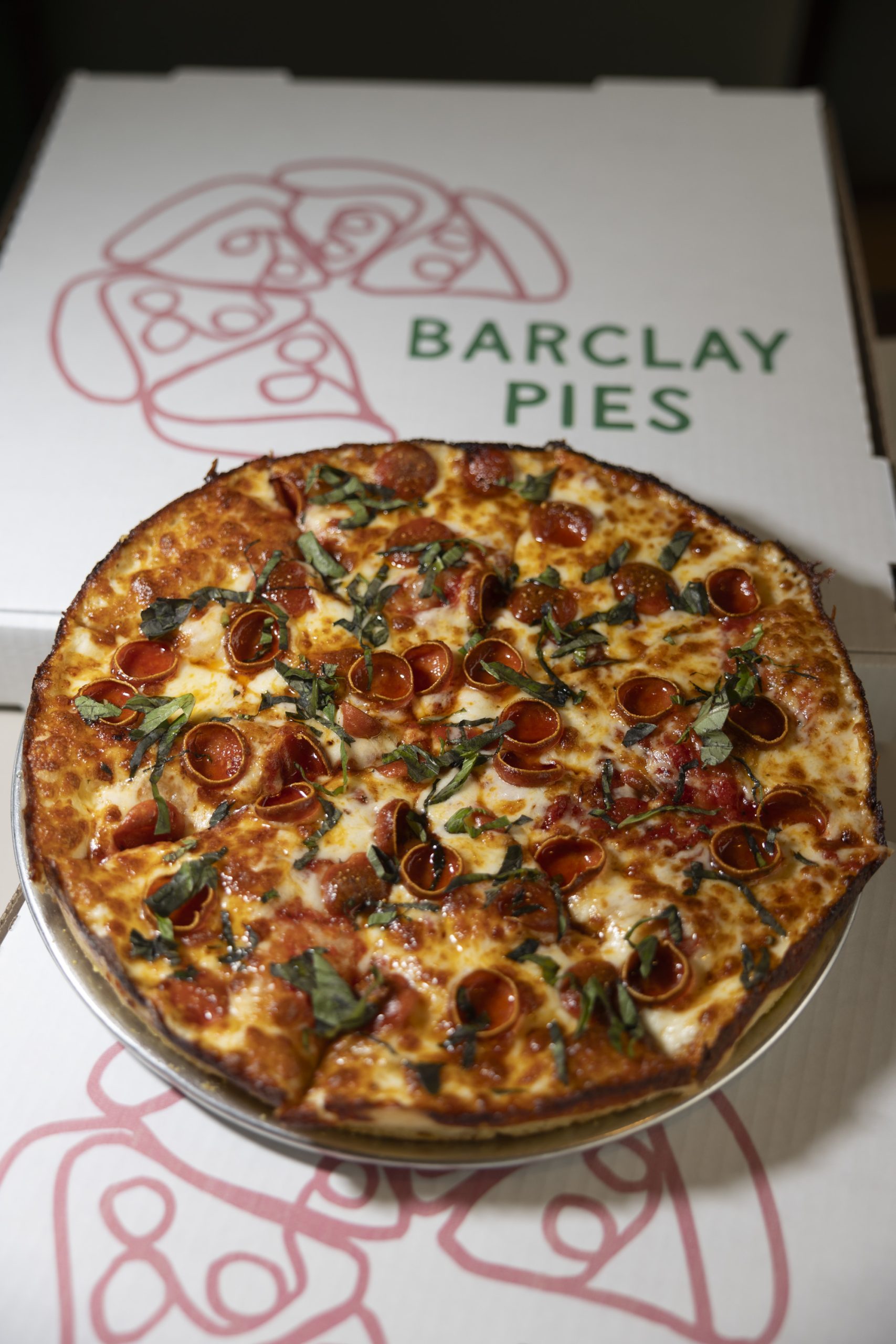
    Gluten-free pizza with pepperoni at Barclay Pies in Cherry Hill.Tyger Williams / Staff Photographer
    Co-owners Thomas “TJ” Hunton (left) and Daniel Romero at Barclay Pies in Cherry Hill.Tyger Williams / Staff Photographer

    Barclay Pies was launched last summer by friends Thomas “TJ” Hunton, a regional director of operations for Shake Shack, and Daniel Romero, a vice president in engineering for Aramark. Its remarkably good pizzas, careful protocols to avoid cross contamination, and outgoing hospitality have helped change the narrative about what’s possible in a fast-casual setting with gluten-free options that go beyond just the pies.

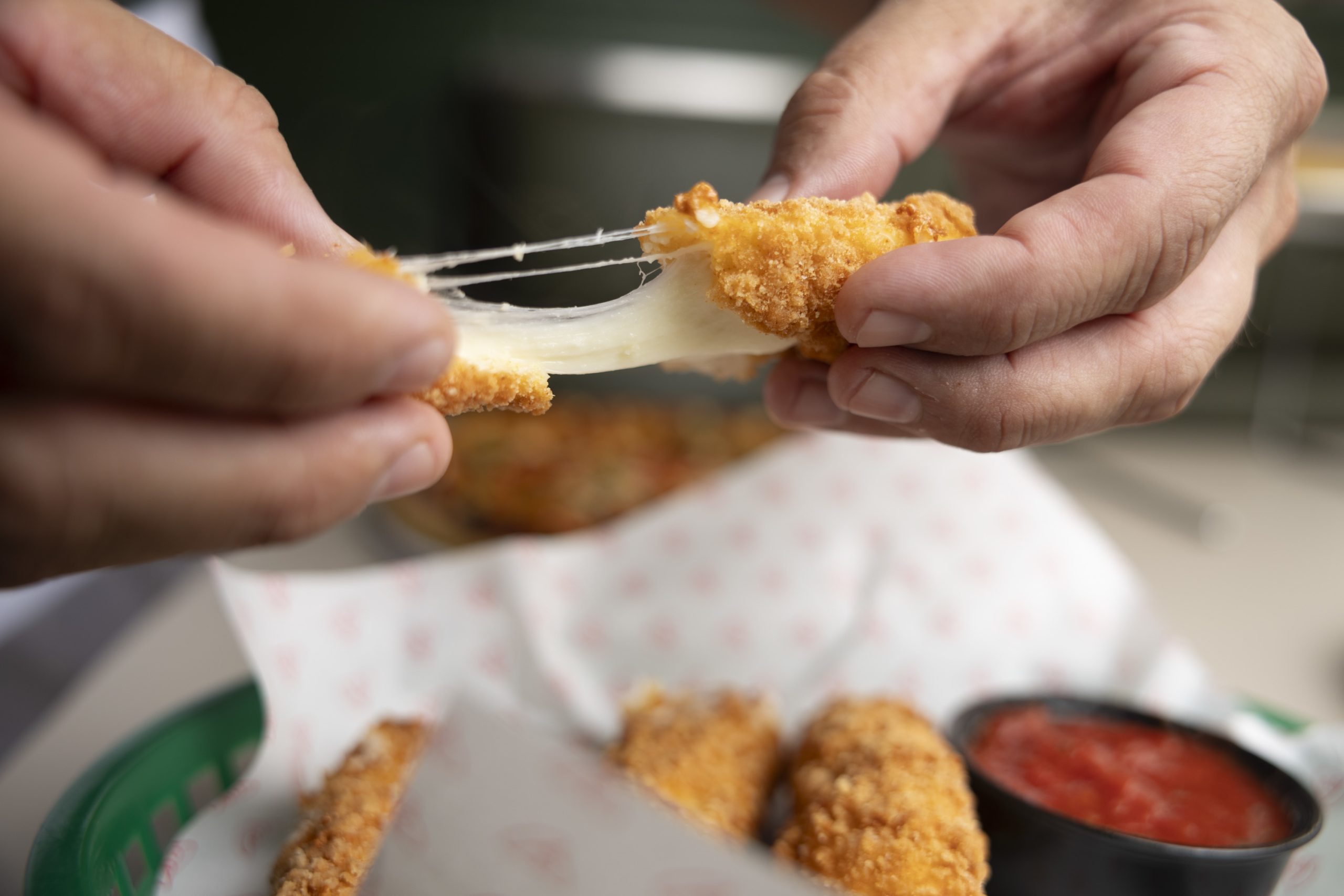
    Indeed, a mozzarella stick was the first bite to turn heads at our table. A safe-to-eat mozzarella stick is rare and coveted in the gluten-free community because deep fryers are common culprits for cross contamination. Not only are Barclay’s fryers completely gluten-free, these delicately hand-breaded sticks encrusted in potato starch, rice flour, and gluten-free panko crumbs are perfectly crisped. There is also a hunk of milky fresh mozzarella inside (another rarity: most use standard low-moisture varieties) that offered hot cheese-pull satisfaction from one side of the table to the next.

    Gluten-free mozzarella sticks at Barclay Pies in Cherry Hill.Tyger Williams / Staff Photographer

    The chicken wings were also superb, tender and juicy from a dry brine and par-bake, sealed inside a sheer crust of egg whites and rice flour, available in several good flavors, from punchy Buffalo sauce shaded with the richness of brown butter to lemon-pepper that sparkled in its craggy breading.

    My encounters on previous visits with boneless chicken tenders were far less inspired, including some overly brined meat so rubbery they gave me a refund. But I was heartened by a 360-degree turnaround on this latest visit. The team recently reworked their recipe, and the final results — expertly verified by Hunton’s 6-year-old daughter, Amelia — are stellar: a perfectly tender baton of meat in a flavorful crust ready for various house-made dips. The tangy ranch with buttermilk and fresh herbs was a favorite, though classic honey mustard also did the trick.

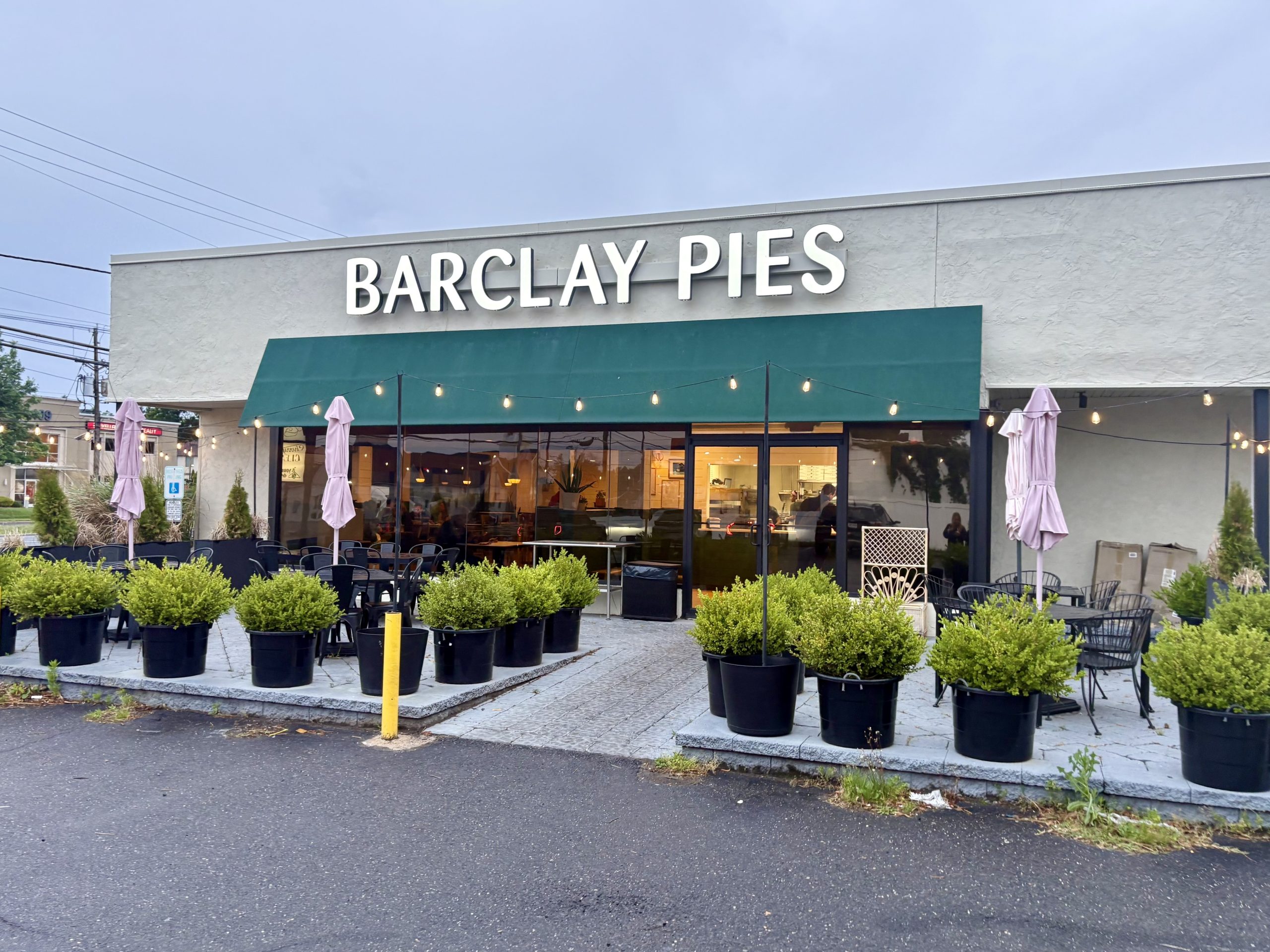
    Barclay Pies, located along Route 70 in Cherry Hill, has become known for its gluten-free pizzas.Craig LaBan / Staff
    Julie Romero (center right), of Cherry Hill, and Claire Ryder, of Collingswood, are enjoying some gluten-free pizza at Barclay Pies in Cherry Hill on July 21.Tyger Williams / Staff Photographer

    But pizza, of course, is the restaurant’s prime magnet. The duo decided to tackle the daunting gluten-free genre because Romero’s wife, Julie, has celiac disease. Making a gluten-free pizza worth the trouble is a major challenge. Gluten is a key protein found in certain grains — namely wheat, barley, and rye — that provides the structure to hold gas bubbles during fermentation and fosters a chewy, complex crust. Until recently, most GF versions of pizza I’ve tasted, whether made from alternative flours or cauliflower — and commonly outsourced in restaurants to avoid cross contamination — have been less than exciting, with textures ranging between pressboard and Styrofoam.

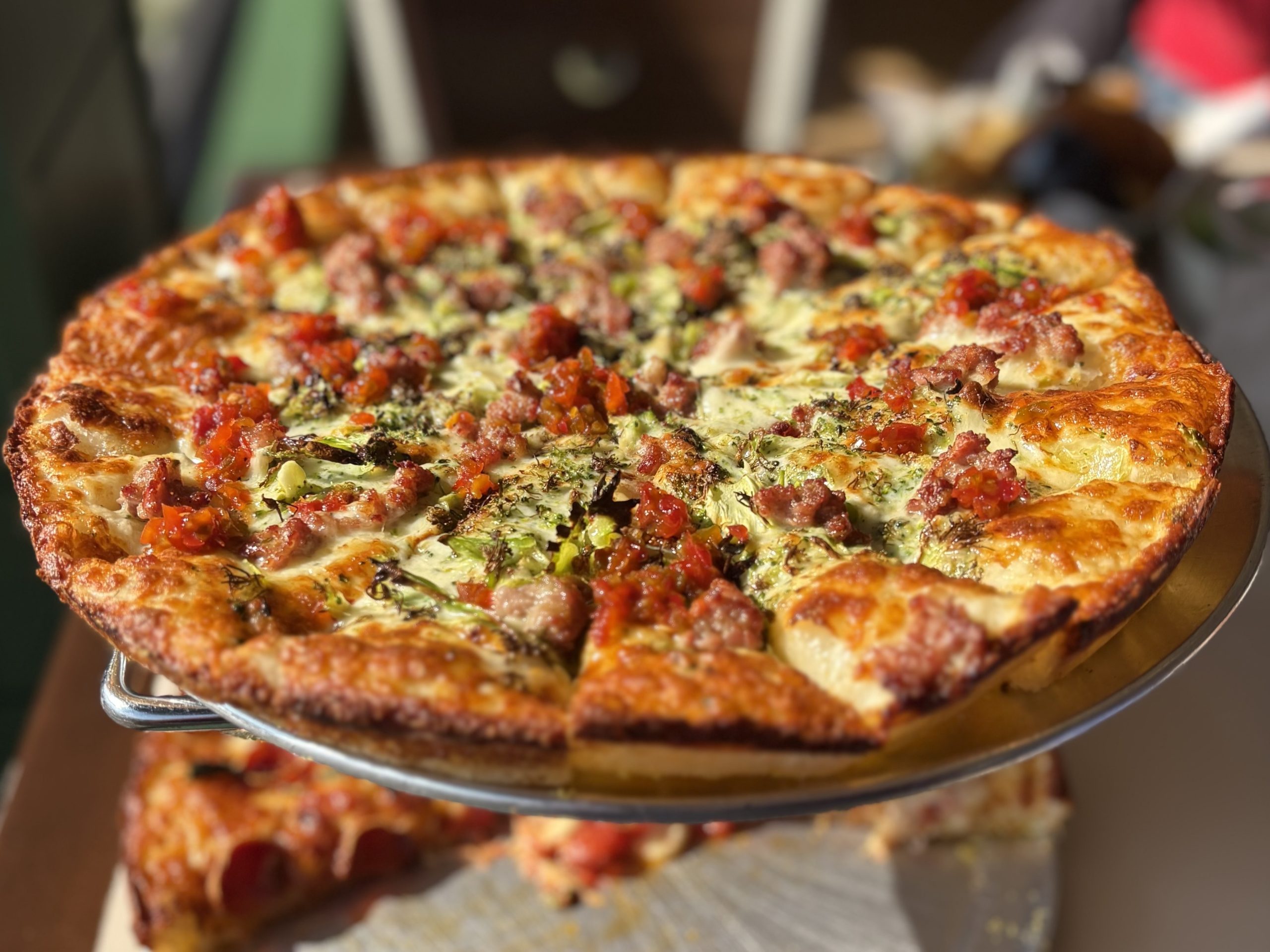
    Barclay’s gluten-free pies are not that. The Romeros worked for nine months to perfect a high-hydration crust that puffs like a supple focaccia. With a light dusting of cornmeal adding a delicate bottom crunch and the Detroit-style crispy frico cheese band around the edges, the pie achieves textural contrasts this gluten-free dough itself would not otherwise form. The pan-based format is helpful to prevent cross contamination, but having grown up in the Midwest, where deep-crusted pies are common, I found these to be completely satisfying platforms for Barclay’s toppings. I was impressed by the mushroom pie that blends thin-shaved creminis with caramelized onions over a white base of seasoned heavy cream and mozzarella. I also enjoyed the locally inspired combo of fennel sausage, broccoli, and zesty cherry pepper hoagie relish, the addition of Cooper Sharp lending the base of molten mozzarella some extra South Philly flow.

    The gluten-free broccoli and sausage pizza at Barclay Pies in Cherry Hill also comes topped with hoagie pepper relish.Craig LaBan / Staff

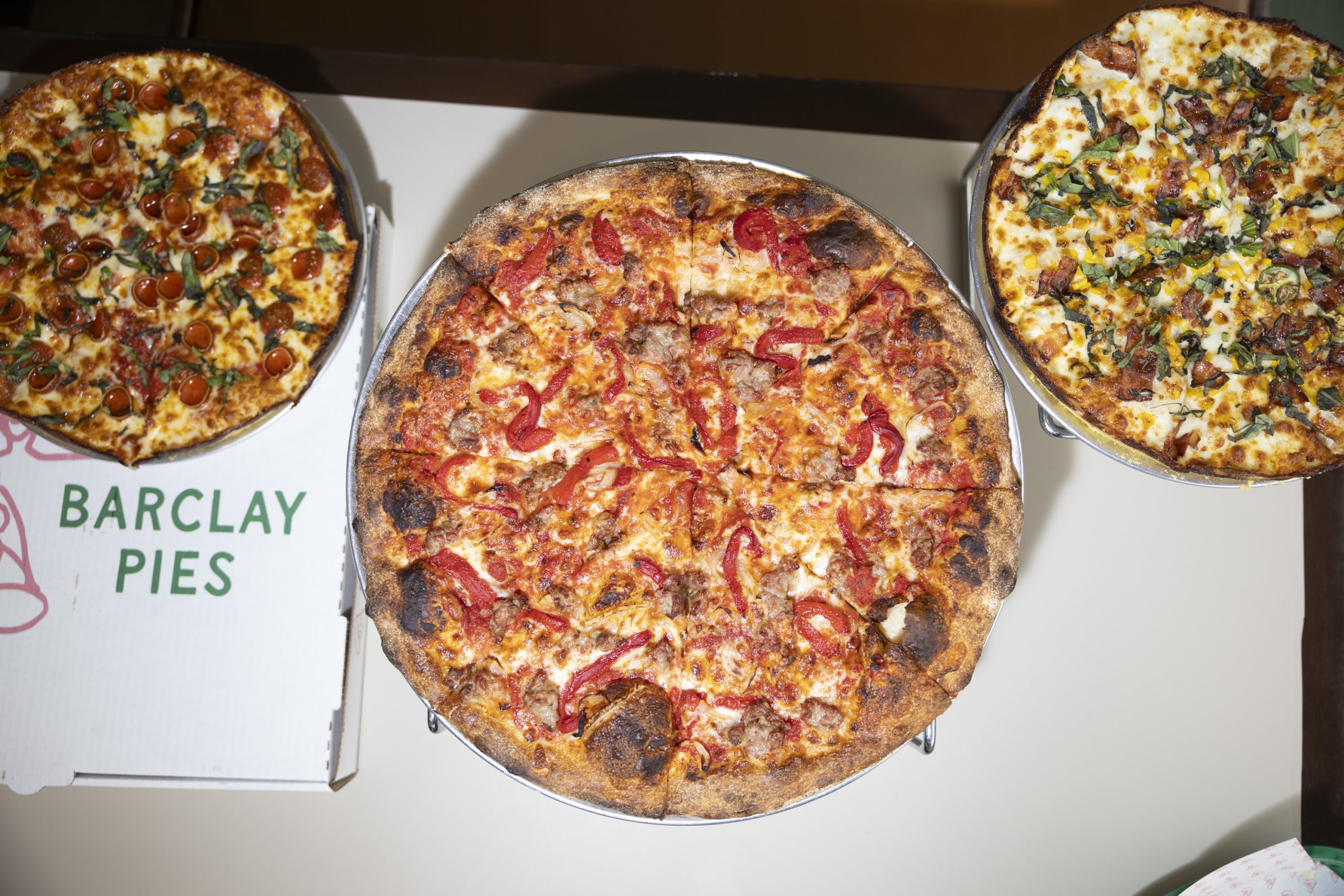
    I appreciate that Barclay is continuously tweaking its recipes, increasing the size of its fresh sausage chunks from the dried-out crumbles I found early on to the porky nuggets that dotted the roasted pepper-sausage pie we ordered on a traditional gluten-full round. That pizza had a perfectly fine, well-developed crust that was solid by neighborhood pizzeria standards. But the gluten-free pies are the draw, special enough to merit a regionwide pilgrimage.

    Samantha Garbose agreed: “Usually when we get gluten-free food together, I’m pretending it’s good, but I actually thought [Barclay’s] gluten-free pizza was better than the one that had gluten.”

    Standard gluten-full pizza with sausage and peppers at Barclay Pies in Cherry Hill.Tyger Williams / Staff Photographer

    Barclay’s sales numbers are starting to bear this out. Hunton says they initially anticipated selling only 10 gluten-free pies a day to supplement their traditional pizza sales. But gluten-free pies now account for a third of the pizzas they bake.

    “By the end of the first month we realized we’d really struck a chord,” says Hunton. “There’s a market need for a pizzeria that was truly inclusive.” Barclay also offers vegan pizzas with a cheese substitute made in-house from oat milk and tofu, deliberately avoiding nuts, an allergen ingredient commonly used in vegan cheese.

    There’s still a catch. One reason this dough is so good is because it uses Caputo Fioreglut, an Italian gluten-free flour blend that contains wheat starch whose gluten proteins have been removed. Fioreglut performs closer to wheat flour than most GF blends and is considered safe for most celiacs, but not for those who have an allergy to wheat.

    “We need to be pizza for everyone and we’re not fully there quite yet,” concedes Romero. “But that’s our North Star.”

    The gluten-free broccoli and sausage pizza at Barclay Pies in Cherry Hill also comes topped with hoagie pepper relish.Craig LaBan / Staff

    The past few years have been a vibrant era for local experimentation with better gluten-free pizza alternatives, though few compare to Barclay Pies’ crust. Emmy Squared has long made gluten-free versions of its standard Detroit pies in Queen Village. Corio in University City has been working on a potato-based dough for thin-crusted counterparts to its Neapolitan-style pizzas. Gluten-free pasta specialist Settantatré has mastered an airy gluten-free focaccia base for the tomato pies it sells at local farmers market stands and its Berwyn market-cafe. Perhaps the best gluten-free pizza I’ve ever eaten was created by 13th Street Cocktails caterer Aaron Gordon for the exceptional pan pies at his Agricola in Passyunk Square, but this quirky corner pizza atelier is not a reliable source for frequent orders, limited now to only private charity events (but perhaps reopening to the public this fall).

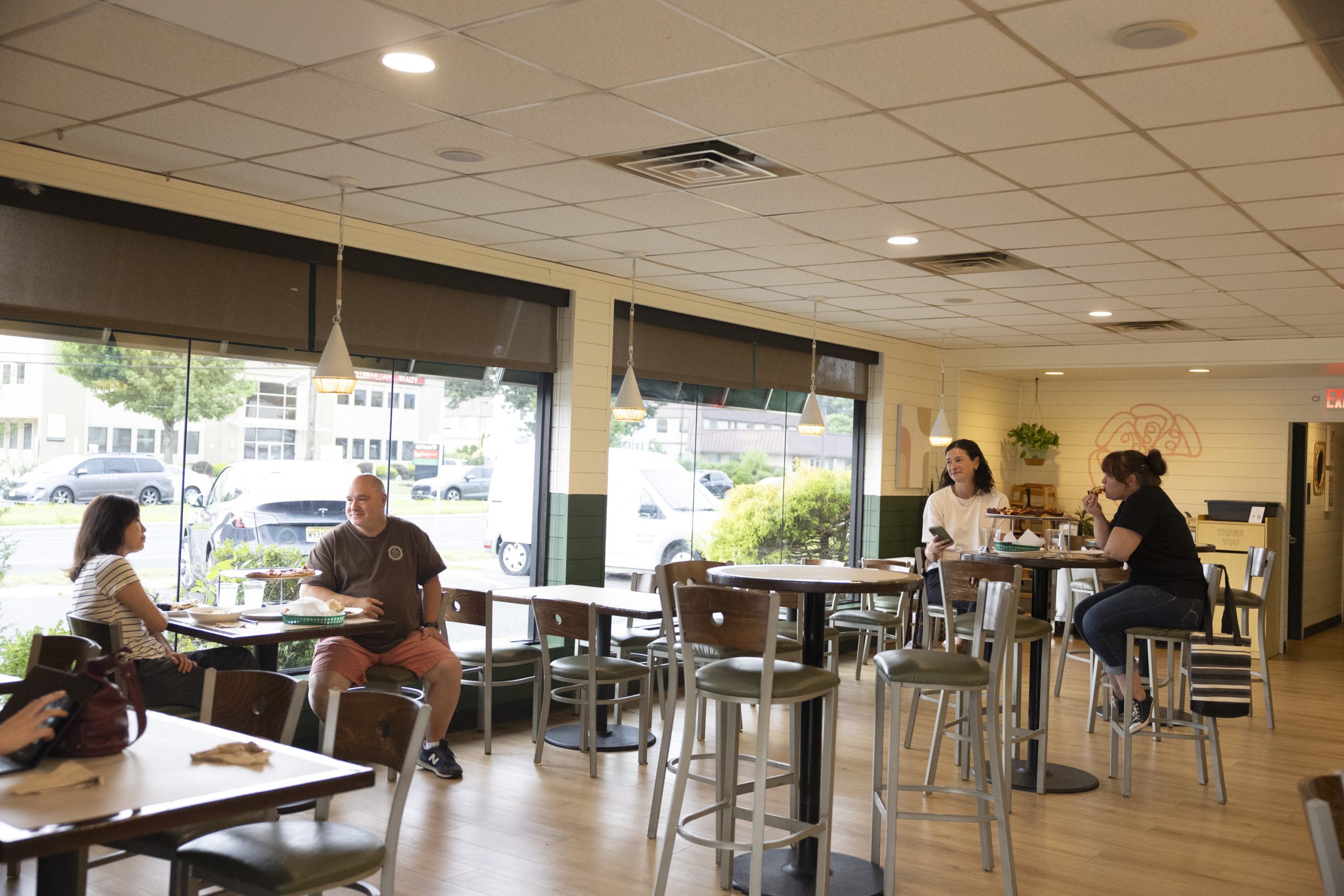
    Hunton and Romero have drawn on their professional experiences to quickly build Barclay Pies into the region’s most accessible hub for gluten-free pizza satisfaction. With its 50 indoor seats, 25 on its patio, and a bright pink-and-green makeover for the former Seasons Pizza, they’ve created a pleasant dining space with user-friendly systems for a cheerful and well-trained staff to operate efficiently while the owners, who are frequently there, also retain their day jobs. (Hunton, a Garces alum, still oversees operations at 70 Shake Shacks from New York to Virginia.)

    Most importantly, gluten-free customers can take comfort in knowing protocols have been put in place to minimize risks of cross contamination. The gluten-free dough is mixed first thing each morning in a separate GF-only mixer, prepped at a separate station, run through a dedicated conveyor belt oven, and finished at a separate station with color-coded cutters and spatulas. The gluten-free pies are also proofed and cooked in round pans to clearly distinguish them from the gluten-full Detroit pies that are cooked in square pans.

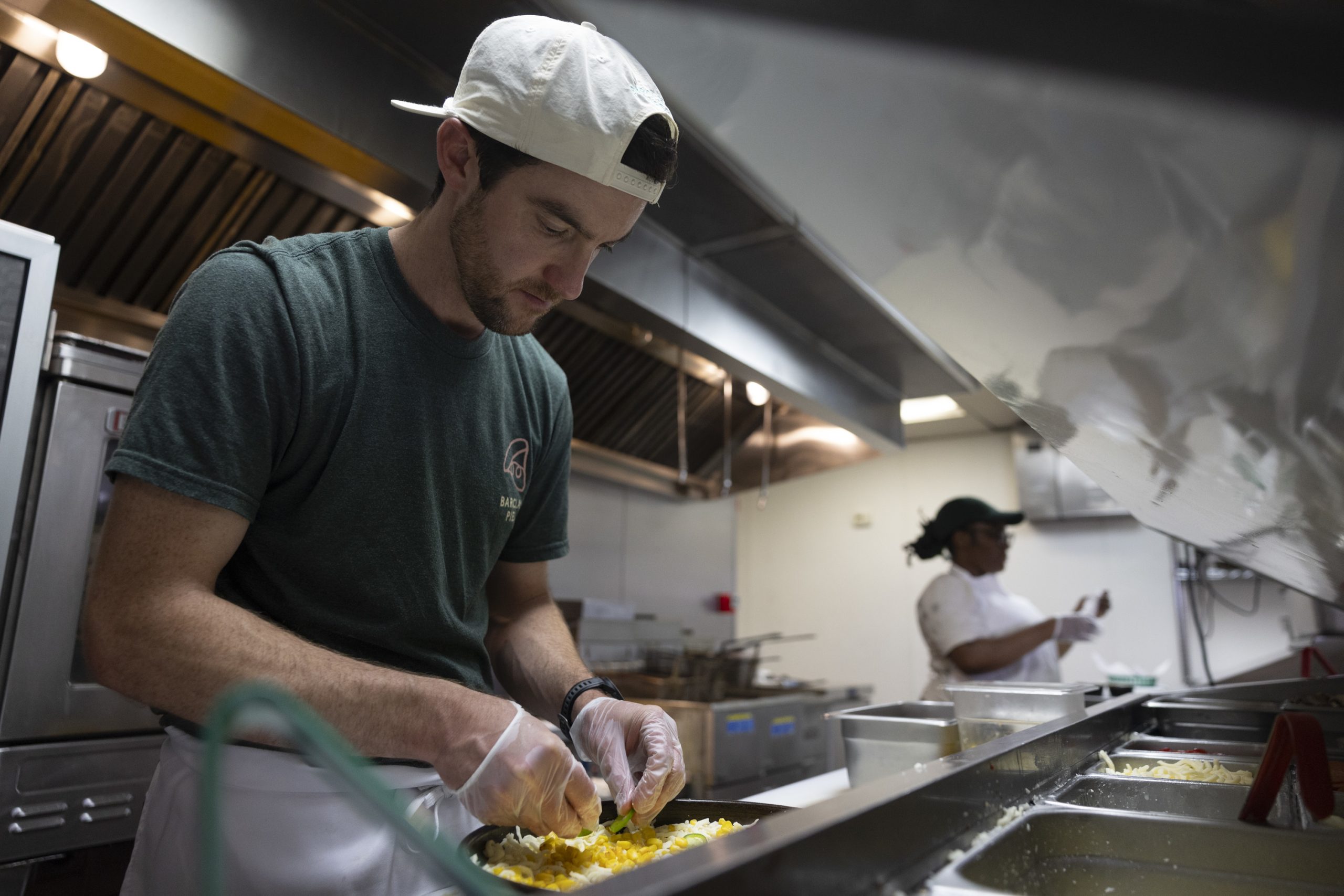
    Co-owner Thomas “TJ” Hunton making gluten-free pizza with summer corn at Barclay Pies in Cherry Hill.Tyger Williams / Staff Photographer

    While there will never be 0% risk as long as products with gluten are made in-house, and that may not suit those who are especially sensitive, my daughter ate there three times without incident. Hunton and Romero also strongly believe there is a broader community benefit to offering both options, as opposed to being entirely gluten-free. This way groups of diners with diverse needs and preferences can feel seen and safely served together without being singled out.

    This works especially well for the Garboses.

    “We’d prefer to go to a restaurant that has great options for both of us,” says Mike. “Life is too short for either of us to eat bad food.”

    But in the case of Barclay Pies, their “his and hers” pizza night had a different, guilt-free twist: “It’s been so long since Mike and I got to actually enjoy the same pizza,” says Samantha. “This was really a thrill.”

    Gluten-free pizza with pepperoni at Barclay Pies in Cherry Hill, N.J., on Tuesday, July 21, 2026.Tyger Williams / Staff Photographer

    Barclay Pies

    450 Marlton Pike, Cherry Hill Township, N.J. 856-712-1900; barclaypies.com

    Open Sunday to Thursday, 11 a.m. to 9 p.m.; Friday and Saturday, until 9:30 p.m.

    Pizzas, $19-$24 (plus $4 for gluten-free crust).

    Wheelchair accessible.

    Menu is almost entirely gluten-free. Standard pizzas with gluten-full flour are made in the same facility but extreme care and protocols are taken to prevent cross contamination.

    BYOB. There are several excellent liquor stores nearby. The restaurant also provides good-quality stemless plastic drinkware.

    Menu Highlights: Gluten-free pizzas; mozzarella sticks; wings; chicken tenders.

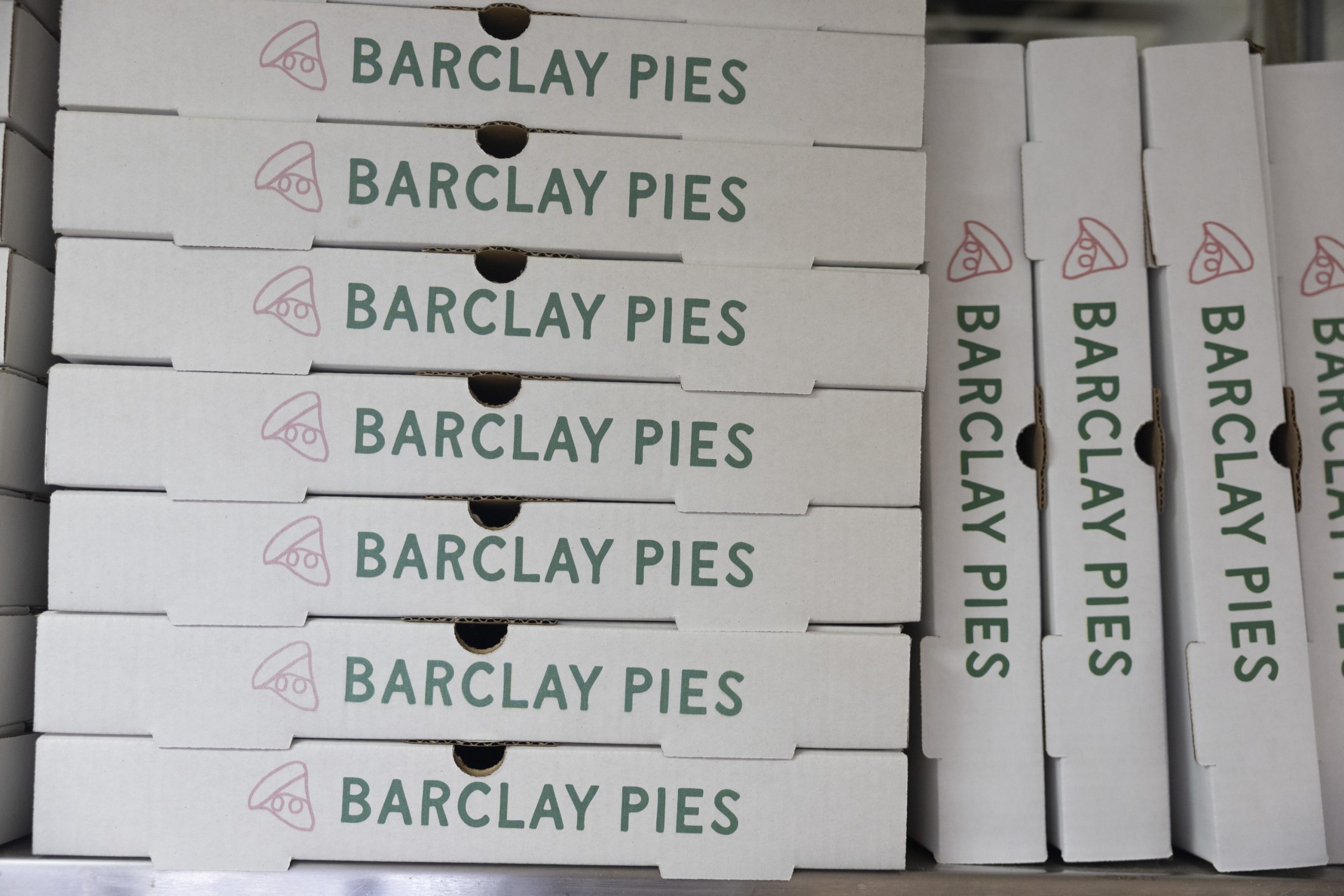
    Barclay Pies boxes in Cherry Hill.Tyger Williams / Staff Photographer
  • Draymond Green is right about VJ Edgecombe. But he couldn’t be more wrong about LeBron James.

    Draymond Green is right about VJ Edgecombe. But he couldn’t be more wrong about LeBron James.

    Draymond Green is wrong about one thing. VJ Edgecombe’s agent should be ecstatic. If he isn’t, then Edgecombe should find a new agent. There are only a small handful of people who have more to gain from LeBron James signing with the Sixers, and all of them own charter helicopter services that fly between New York and Philly.

    That’s not to say we should completely dismiss the concern raised by Green in a recent podcast episode.

    “If I’m VJ Edgecombe’s agent, I’m not sure I’m happy with the summer that the 76ers have had,” said Green, the star power forward whose Warriors were among a number of contenders that had hoped to land James. “Like you go from being sometimes the second option when [Joel] Embiid was out to sometimes being the fifth option. It’s a big, big difference.”

    Green isn’t wrong about the overarching issue. What he’s missing is that the issue predated James, and that James is much more likely to alleviate it than exacerbate it.

    Nick Nurse will need to be mindful of Edgecombe’s usage rate. On a team with three prime-aged players accustomed to getting 20-plus shots per game plus LeBron, the Sixers would be doing themselves a disservice if they allowed Edgecombe to pause his superstar progression to spend a couple of seasons as a glorified Josh Hart. I don’t know if I’d go so far as to call it a concern. But it is most definitely an unknown, one that carries some downside risk. Green is right about that.

    Edgecombe’s superstar flashes as a rookie occurred in moments and stretches where he operated as the primary option. We got the best glimpses of the guy he could become in the moments where the Sixers needed him to be that guy: when the offense ran through him, when the success or failure of the possession at hand was his to dictate. Remember the 20 points he scored in the first half against the Celtics in Game 2 of the Eastern Conference semis? Edgecombe scored five unassisted buckets during that heater. Four of them were pull-up jumpers, including a 27-footer from three-point range.

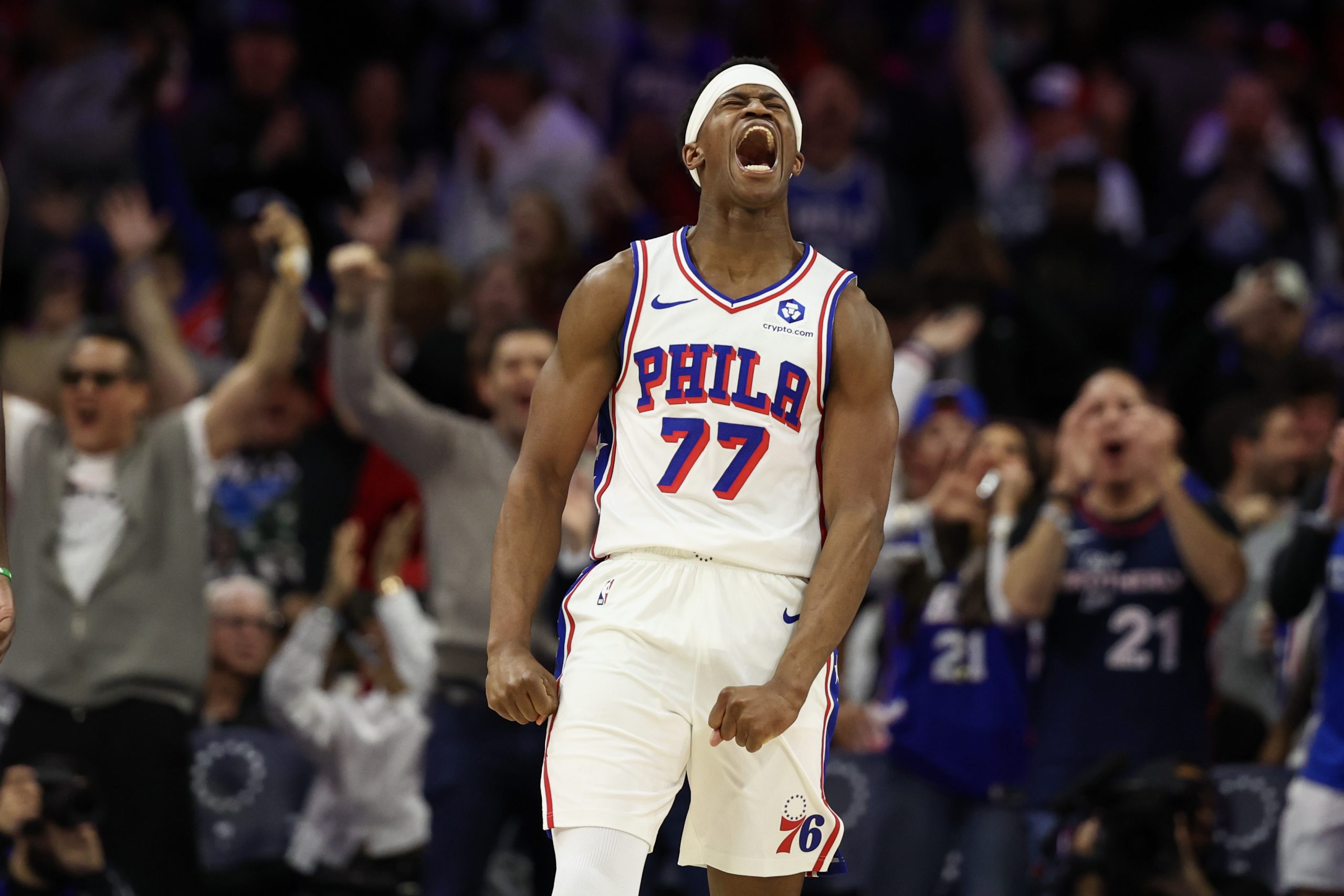
    Sixers guard VJ Edgecombe will be a key member of one of the NBA’s best five-man lineups.Monica Herndon / Staff Photographer

    That aspect of Edgecombe’s game is why NBA folks mention guys like Jimmy Butler and Dwyane Wade when talking about his potential. Neither is a perfect comp. Butler is a better one than Wade. They both make sense from a stylistic viewpoint. Wade and Butler are/were two of the best at methodically getting to their spots and then owning that spot. That’s something a player needs to develop, both in terms of feel and in terms of pacing. So, yeah, it’s a potential drawback if Edgecombe always gets last dibs on spots. I’m just not sure I agree with Green that LeBron compounds the potential issue. I actually think he could prove to be a godsend for Edgecombe.

    Two things you can say about James throughout his career. One, he recognizes talent; and, two, he is willing, even eager, to facilitate things for that talent. That’s especially true of young talent.

    Kyrie Irving flourished alongside James in Cleveland. So did Austin Reaves in Los Angeles. James has played with a slew of young up-and-comers who didn’t have nearly the talent that Edgecombe has. All had plenty of opportunities. Kyle Kuzma and Brandon Ingram both averaged at least 18 shots per 100 possessions when they were on the court with James during his first year with the Lakers. Malik Monk had arguably the best season of his career as a 23-year-old Laker. D’Angelo Russell’s most efficient seasons — really, his only efficient seasons — came during the 125 games he played with the LeBron Lakers.

    Two years ago, Russell, James and Anthony Davis all averaged between 14 and 18 shots per game, while Reaves and Rui Hachimura both got between 10 and 12. Keep in mind, James and Davis both played 70-plus games and 35-plus minutes per night that season.

    Nurse will be able to find spots to let Edgecombe do his thing. James only played in 60 games last season. Embiid has played in 96 total over the last three seasons. During the course of a game, you could see a lineup with Edgecombe, Dean Wade, Anfernee Simons, Kentavious Caldwell-Pope and a backup center on the court together.

    James shouldn’t be a drag on Edgecombe. He should be a force multiplier. There’d be a bigger reason for concern without him. Really, it’s what makes the signing of James so transformative. Before, there was some real reason to wonder how well Edgecombe and Maxey would mesh with a couple of ball-dominant alphas who both feel as if they have a lot left to prove. James’ biggest benefit to the Sixers is his ability to smooth that dynamic, not so much in the locker room but on the court with his style of play and commanding presence. There’s a very real world where he ends up serving as the bridge connector between the younger and older halves of the foursome.

    The biggest winners of last week’s wild turn of events were Edgecombe and his financial dependents. Them, and the Air Redick operators.

  • The Phillies must go through the Dodgers. To do it they’ll need to find a lefty reliever at the trade deadline.

    The Phillies must go through the Dodgers. To do it they’ll need to find a lefty reliever at the trade deadline.

    Whatever the prediction models say about the Phillies’ chances to win the World Series — 5.8%, according to FanGraphs; 1.5%, from Baseball Reference — let’s agree on one thing.

    The road will probably run through the Dodgers.

    It’s not only that the two-time defending champs are playing at a 102-win pace. They’re also finally getting healthy. With Edwin Díaz and Kiké Hernández due to return this week and Blake Snell soon to follow, who needs the trade deadline?

    At last check, five of the Dodgers’ seven best healthy hitters bat from the left side. The thought of running through a gauntlet of Shohei Ohtani, Freddie Freeman, Max Muncy, Kyle Tucker, and Dalton Rushing in the late innings has made one lefty reliever especially popular in trade talks leading up to Monday’s 6 p.m. deadline.

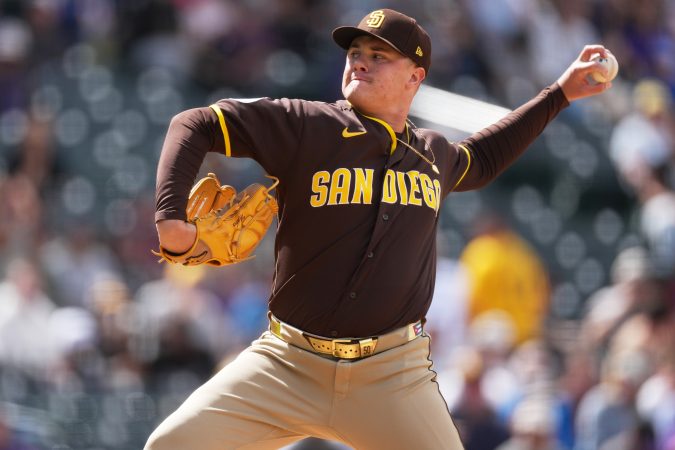
    Remember the name: Adrián Morejón.

    “Everybody” is asking the Padres about Morejón,“ a major league source said, “especially in the National League.” The 27-year-old pending free agent has a fastball that averages 99.4 mph and a 27.4% strikeout rate to go with a 3.20 ERA.

    Oh, and he has allowed one homer to a left-handed hitter (old friend Mickey Moniak of the Rockies) in the last two seasons.

    As constituted, the Phillies are a tough matchup for the Dodgers, especially in a seven-game series, because of lefty starters Cristopher Sánchez and Jesús Luzardo. Los Angeles gets considerably more production from the left side of the plate (.809 OPS) than the right (.720).

    But the Phillies’ best lefty reliever is José Alvarado, who has a 6.00 ERA despite allowing only one run in his last seven appearances. While team officials cite underlying metrics, such as batting average on balls in play (.412) and expected ERA (3.66), to claim that Alvarado has been unlucky, he also has given up a higher-than-usual rate of line drives and fly balls.

    Phillies lefty reliever José Alvarado entered the week with a 6.16 ERA in 44 appearances.Jose F. Moreno / Staff Photographer

    Tim Mayza, a groundball pitcher with his best strikeout rate (24.2%) since 2023, is the second lefty. He has an 8.68 ERA this month. Beyond that, Tanner Banks is out until at least mid-September with a strained left forearm.

    So, it would make sense for Morejón to top the Phillies’ list of deadline targets, though it remains unclear if he will even be available.

    The Padres are among the NL’s biggest underachievers, with a 53-53 record. But after sweeping the Marlins last weekend — aided by 2⅓ hitless innings from Morejón — they were two games out of a wild-card spot. And their last six games before the deadline are against the woeful Rockies and Giants.

    With a good week, the Padres could buy — or stand pat, at least — and take their chances with Morejón and star closer Mason Miller at the back of the bullpen. If they stub their toe again, moving Morejón’s expiring contract could be among their first trades.

    The Mets have two veteran lefties who are eminently available. And Brooks Raley (2.09 ERA) and A.J. Minter (2.45) auditioned for scouts against the Dodgers last weekend.

    Raley, 38, got three outs, including Ohtani, on seven pitches in the seventh inning Sunday, two days after giving up back-to-back hits to Tucker and Teoscar Hernández and a sacrifice fly to Ohtani. Minter, 32, allowed a two-run homer to Tucker in the eighth inning Friday.
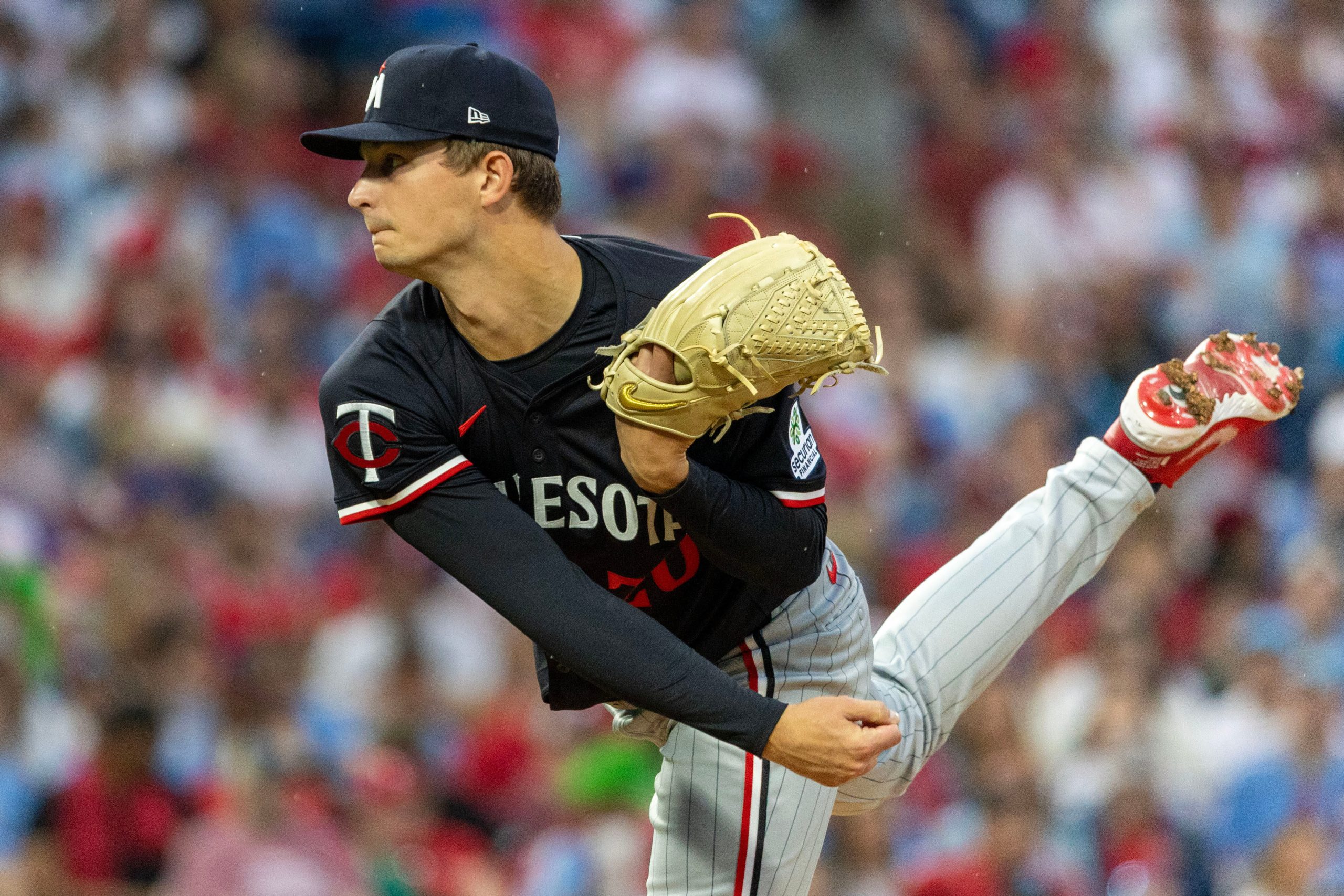
    Both lefties will get traded. But would the out-of-contention Mets deal them to a division rival?

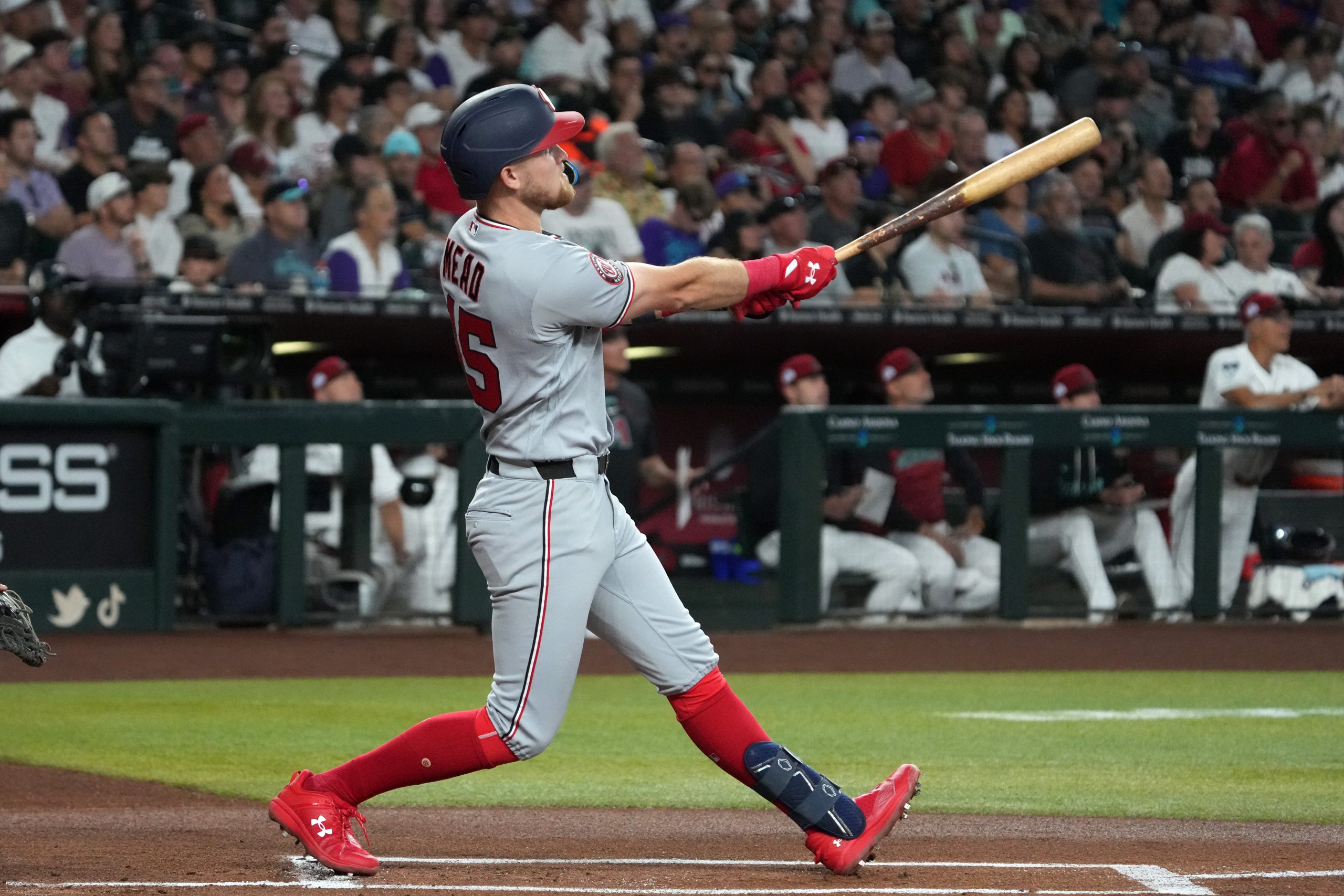
    The Red Sox paid a high price last weekend to acquire righty-hitting infielder Curtis Mead from the Nationals.Rick Scuteri

    The price for right

    In a one-for-one swap of major leaguers last Saturday night, the Red Sox acquired infielder Curtis Mead from the Nationals for Connelly Early, a 24-year-old lefty starter with six pitches and five years of club control.

    At first blush, three rival scouts said Boston overpaid.

    But it also appears to be indicative of the market for right-handed bats, with demand far surpassing supply. Mike Trout and Byron Buxton don’t seem inclined to waive no-trade protection; the Orioles have pending free agent Taylor Ward and a losing record but remain in wild-card contention. The Reds were listening on Spencer Steer before putting him on the injured list with a sprained wrist that may end his season.

    Nationals president of baseball operations Paul Toboni told reporters he was “not really expecting to consider anything for Curtis” until the Sox came with a “pretty darn aggressive” offer. Red Sox chief baseball officer Craig Breslow said it was “incredibly uncomfortable” to deal Early but called it a “need-for-need-type trade.”

    There isn’t a team that needs a right-handed bat more than the Phillies, last in the majors in on-base percentage (.280) and OPS (.640) from the right side of the plate.

    One option: the Royals’ Lane Thomas, who hits lefties and would be a platoon option with Brandon Marsh or perhaps Gabriel Rincones Jr. The Phillies looked into Thomas two years ago before he got traded to the Guardians.

    The Phillies had a scout in San Francisco over the weekend. The Giants are reportedly open to moving Heliot Ramos, more of an everyday solution. But given that he’d come with three years of club control, an overpay might be required to land the 2024 All-Star.

    Mets righty Clay Holmes is scheduled to make his second minor-league start Tuesday night in his return from a leg fracture.Jessie Alcheh

    Searching for Holmes

    With rain in the forecast Tuesday in the Northeast, the Mets relocated righty Clay Holmes’ minor-league rehab start to a low-A game in Florida.

    It will be heavily scouted.

    The Phillies dispatched a scout to Syracuse, N.Y., last week for Holmes’ first start in his recovery from a fracture in his right leg. If he’s healthy, the 33-year-old closer-turned-starter could help the Phillies in the rotation in the final two months of the regular season before possibly shifting to a late-inning role in the postseason.

    Giants lefty Robbie Ray (1.71 ERA in his last 10 starts) and Blue Jays right-hander Kevin Gausman (4.51 ERA) could also be on the move. Like Holmes, they are pending free agents.

    Two rival team officials theorized that the Phillies could reduce the prospect return for a pitcher such as Ray or Gausman by taking on the remainder of the salary. Both are owed about $8 million through the end of the season.

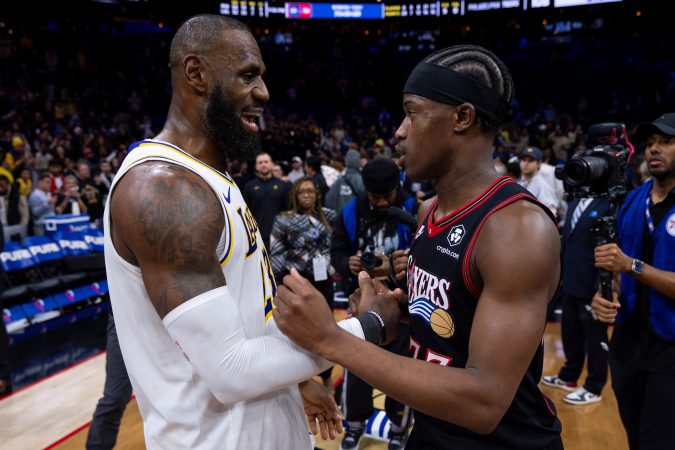
  • LeBron James believed he could win with Joel Embiid. The 2024 Olympics can show the Sixers how.

    LeBron James believed he could win with Joel Embiid. The 2024 Olympics can show the Sixers how.

    On a practice court in Paris early in the 2024 Summer Olympics, during the event that was supposedly a testament to his selfishness and opportunism, Joel Embiid glanced around the gym at the stars who soon enough would meet their expectations of gold-medal glory. There was Steph Curry. There was Kevin Durant. There was You Know Who.

    There was LeBron James.

    “This is a great setting for me because I’m playing with a lot of great players,” Embiid said then. “It’s all about finding ways to win. Whatever I can add to make sure we win, that’s all there is.”

    Two years later, with James’ decision last week to become Embiid’s teammate again, Embiid’s up-and-down experience during those Games should take on a new perspective and value. If the sacrifice of Embiid’s playing in those Olympics, dragging his body up and down the court for five games in that tournament, was a lost Sixers season in 2024-25, maybe the real upshot is that the entire experience and Team USA’s victory paved the way for James to stun everyone and sign with the 76ers.

    Only Embiid and James know how many text messages it took, how much pleading Embiid had to do to persuade James that Philadelphia was the place for him, that Embiid was healthy enough and committed enough for the two of them to win a title here. Whatever words and memes passed between them this offseason, they were enough that a source with knowledge of their interaction said that Embiid played “a significant role” in coaxing James to choose the Sixers.

    He wasn’t the only one. Bob Myers brought the necessary cachet and credibility, and Mike Gansey’s relationship with James from their time together in Cleveland helped, and Tyrese Maxey’s talent and connection to James through Klutch Sports mattered. Still, this was mostly a peer-led push from Embiid and Maxey to get James to see the possibilities here.

    Most importantly for the Sixers and the player who has been their centerpiece for the last 12 years, Embiid already had to have established a baseline of confidence with James for LeBron to take this leap.

    They’ve been in the NBA together since 2014, but when Embiid finally settled on playing for Team USA in ‘24 — after shopping his skills to France and Cameroon — his relationship with James could have fallen apart. And from an outsider’s view, it had the potential to crumble. It was a chore just to watch Embiid lumber around the floor, his left knee leaving his whole body wobbly and unstable, the sweat flooding his face.

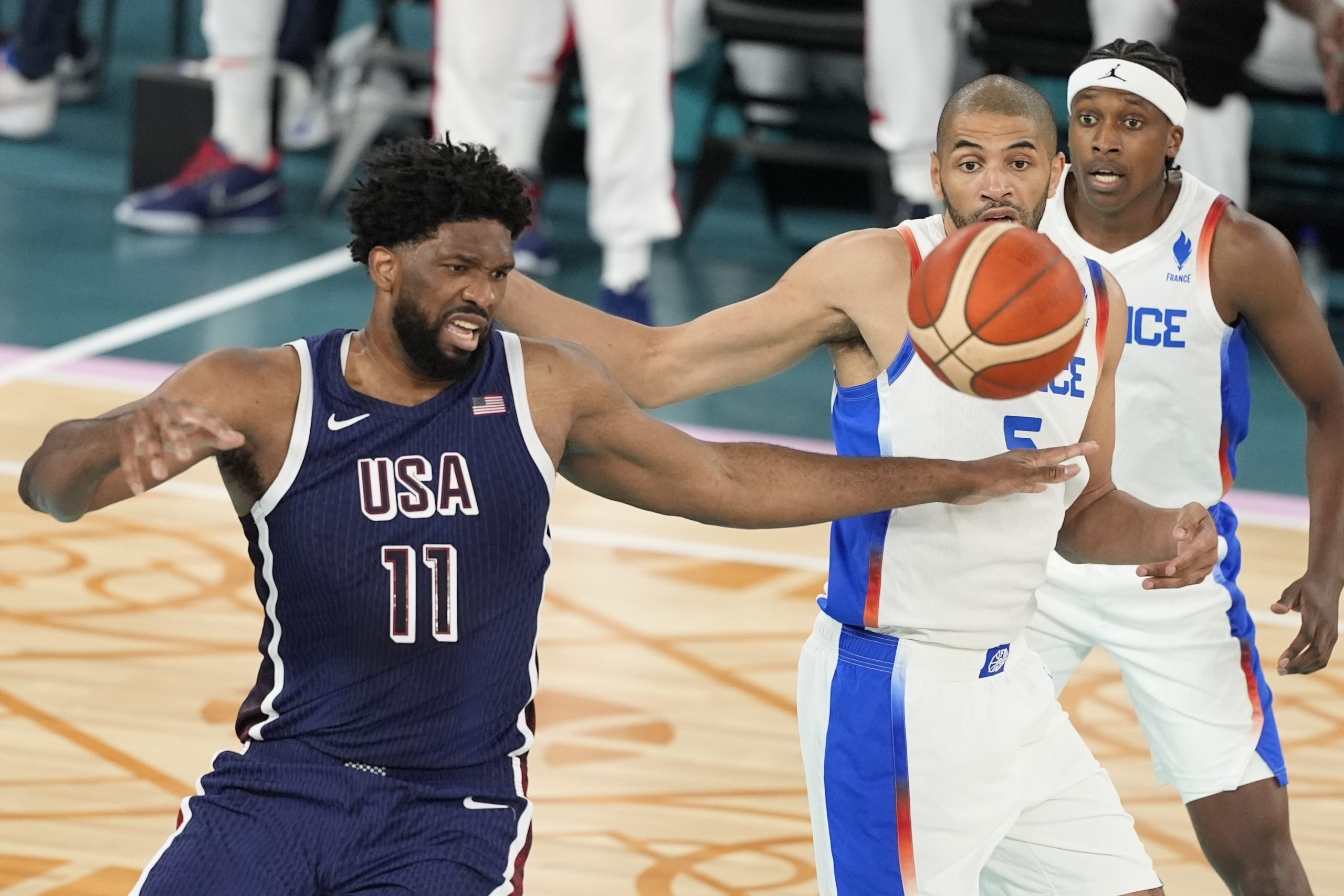
    Joel Embiid (11) was not physically at his best in the 2024 Paris games but his efforts were a step towards a future alliance with LeBron James. Michael Conroy

    The complaints that Embiid had put his own aims and goals — “It feels good to be part of winning something as a team,” he said after Team USA’s victory over France in the gold-medal game — above the good of the Sixers were to be expected around here. They also ignored the priority that Embiid’s Team USA teammates, James among them, placed on competing on that stage, for the right to call themselves the best in the world. In that context, there was an understanding that it took a lot for Embiid just to be out there playing, and there was an appreciation that, without him and his 19 points and second-half dominance of Nikola Jokić in the semifinals against Serbia, the U.S. wouldn’t have won gold at all.

    No, Embiid wasn’t the overall force that James or Curry or Durant was in Paris, but he apparently didn’t do anything to dissuade James from thinking that he could win with him. Now Embiid gets another shot to witness what James does each day to prepare, how much that preparation matters to him, and how he can model the habits and behavior on which James has built his remarkable 24-year pro career.

    “Even though I see a broken-down Joel — in the fourth quarter, if ever the verb ‘trudge’ would fit anybody, Joel just trudges up the court — even given all of that, I would say it is absolutely true it’s good to [be] around these guys who have won something — just getting a different kind of culture,” former Sports Illustrated staff writer Jack McCallum, the author of Dream Team, the definitive work on the 1992 U.S. Olympic men’s basketball team, said in a 2024 interview.

    “What those guys got from the other guys. I was sort of astonished to hear that. … ‘Oh, I really found out how Karl Malone worked out. Oh, I really found out about Larry Bird’s shooting drills. Oh, I watched [Michael] Jordan and [Scottie] Pippen play defense, and I took that back to my team.’ As much as [the Sixers] are probably going, ‘No,’ I would say play, because I think there’s a real positive aspect that he can get out of that.”

    The time to show what he learned is now. At 32, without having appeared in more than 39 games in any regular season since 2022-23, Embiid can’t be counted on and shouldn’t expect to be the primary focus of the offense every single time he’s in the lineup. The best-case scenario for the Sixers, of course, is that he won’t have to be — not every night, not even most nights. Among James, Brown, Maxey, VJ Edgecombe, and an improved bench, they have plenty of firepower even if Embiid isn’t their alpha and omega. “You’re used to being the guy,” he said in Paris. “Now you’ve got to be with these guys.” What they’ll likely need is what he gave Team USA against Serbia. What they’ll need is Embiid to pick his spots, to win them particular games against particular opponents. He’ll still be vital, but he might end up bearing a lesser burden, and the team might be better for it.

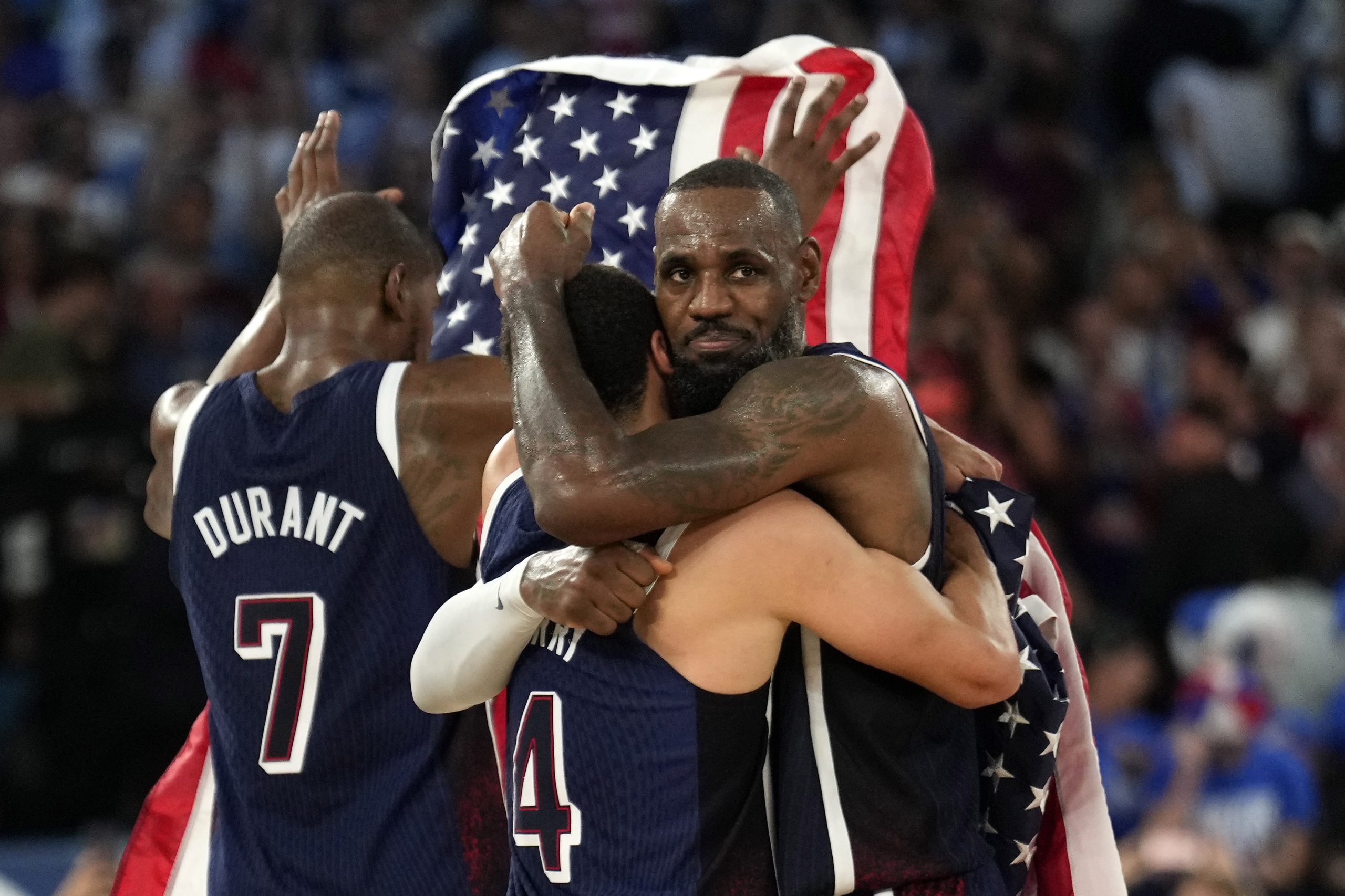
    Team USA’s superstars won a gold medal together, and their work habits rubbed off on one another. Mark J. Terrill

    “There’s a certain amount of relief that comes with not having to bear the full responsibility of the franchise,” Steve Kerr, who was Team USA’s head coach in Paris, said at the time. “These guys get to lean on each other. Every game is different. They get to throw all the other nonsense out the window because none of it matters. The only thing that matters is winning the gold medal.”

    The same standard applies here and now for James and Embiid, for the Sixers, for a city waiting 43 years and counting for its latest NBA championship. Joel Embiid’s performance in those Olympics was mostly a hard watch and a distant memory until these last few days. But come next spring, if there’s a celebration here unlike any since 1983, the windfall will have been worth the stiff investment.

  • LeBron James’ maddening process was everything the Sixers needed

    LeBron James’ maddening process was everything the Sixers needed

    LeBron James chose the Sixers the only way he could.

    By letting everyone think there was no way he would.

    It all makes a little more sense now, doesn’t it? The weeks of deliberations, the radio silence, the professions of ignorance from those close to James, the cryptic dispatches from the Man Behind the (Recording Studio) Curtain. For nearly a month, the world watched and waited and speculated amid a maddening self-muzzling interrupted only by the occasional communication via proxy. What we knew came almost entirely from a handful of podcast episodes where Rich Paul sounded more like a bystander than James’ agent and confidant.

    Eyes were rolled. Deep breaths were sighed. Every lapsed news cycle was another shell in the stockpile of the critics and skeptics and purists who prefer brands of basketball to basketball brands. James’ most hostile audience has always been those who would rather live in a world where the Greatest of All Time is not first and foremost a business, man. But let’s give them their due. Even someone who is unbothered by the primacy of the 1099 in sports could have found their patience tested by James’ monthlong melodrama.

    In hindsight, James’ actions seem perfectly reasonable. This wasn’t attention-seeking behavior. It was the private torment of a man who was about to choose, via his own free will, to move from Los Angeles to Philadelphia.

    But it is deeper than that. Everybody involved needed it to go down this way. The significance of James’ signing with the Sixers is that he had every reason not to. He had other options, all of which had won championships within the last decade-and-a-half. They had superstars, some of the greatest to ever play the game: Steph Curry, Nikola Jokić, Giannis Antetokounmpo, James Harden.

    They had stronger personal ties, more spotlight appeal. They had the tech scene, the outdoors, the party scene. James said he was looking for basketball bliss. Which means there is a lot of political capital in the fact that he chose the Sixers. The basketball is all they had to offer.

    LeBron James has a well-documented friendship with Tyrese Maxey with both being part of Klutch Sports.Chris Szagola / AP

    It’s perfectly valid to question whether James at 42 years old will create the on-court impact worthy of the hoopla surrounding his decision. There are plenty of scenarios where the sum of the parts exceeds the whole. That’s true even before you factor in age and injury. In James, Jaylen Brown, and Joel Embiid, the Sixers have three players who are accustomed to having the loudest voice in the room. In Tyrese Maxey and VJ Edgecombe, they have two young players who have been plagued by bouts of deference when sharing the court with more established veterans.

    Yet, therein lies the significance of James’ deliberate evaluation of his options. The great general Charles de Gaulle once said that silence is the ultimate weapon of power. For weeks, everyone wondered what he would decide, and why. They thus imbued his ultimate decision and explanation with a tremendous amount of power. It meant something when James finally picked Maxey, and Edgecombe, and Brown, and, yes, Embiid. Everybody assumed James wouldn’t pick the Sixers because they were the Sixers. But he did pick them, which automatically makes them something nobody thought they were before.

    Intentional or not, James’ decision-making process has empowered both his new organization and his new teammates before he has even arrived.

    You probably saw the social media video Maxey released in the wake of James’ signing. It was just a few seconds of him yelling spastically. You have to think that there was a little bit of that going on inside Brown and Embiid as well. At various points over the last few years, both players have allowed their veils to slip from their insecurities. Brown, passed over for the Olympic team after winning NBA Finals MVP, second fiddle to Jayson Tatum, inefficient, overpaid, not a real superstar.

    Embiid, injured, maybe finished, soft, selfish, supplanted by Maxey and Edgecombe as the heart and soul of a franchise. Who knows how those insecurities would have played in a power vacuum like that which could have existed without an unquestioned adult in the room. Insecurity is mostly thirst for validation. To be good enough for the best is a heck of a quench.

    Part of me wonders whether LeBron’s real attraction to the Sixers is an opportunity to lead. Not that he hasn’t always led, in both spirit and example. But the Sixers offer him a unique opportunity.

    More than any of the teams that pursued him this offseason, maybe even more than any team he has been on to this point, the Sixers were a team that genuinely needed exactly a player and a person like James is right now. It will be fascinating to see how the whole thing will look on the court, and what part James will play. Don’t be surprised if his biggest impact has already been made.

  • LeBron chose the hard, dramatic path when he picked the Sixers. Get ready for a wild ride, Philly.

    LeBron chose the hard, dramatic path when he picked the Sixers. Get ready for a wild ride, Philly.

    If LeBron James is to be believed, if he was telling the truth when he took to Twitter/X late Friday morning to explain why he had decided to shock the basketball world and sign with the 76ers, if he was speaking from the heart and not merely trying to sell a new city and fan base on his choice, then this could be a red-letter moment in the history of Philadelphia sports.

    LeBron to the Sixers is unlike anything that has happened around here. Those with long memories like to think that back on Pete Rose’s signing with the Phillies in 1978 or the Sixers’ trading for Moses Malone in 1982 are comparable, and it’s understandable why. Those superstars provided exactly what those teams needed to win a championship, and each of those teams promptly won one — the Phillies in Rose’s second season, the Sixers in Malone’s first.

    But James exists in a different stratosphere economically and culturally from the one Rose and Malone did then. His fame is global. His wealth makes him a multibillionaire. He is among the five best basketball players ever to walk the Earth and among the most famous people walking it now. And he is a perfect fit for this Sixers team, for a franchise that hasn’t won a championship since 1983 and is making an all-in move to end that drought.

    The most heartening aspect of James’ decision isn’t even that, at 41 years old, he should be the ideal power forward/point guard to play alongside Joel Embiid, Jaylen Brown, Tyrese Maxey, and VJ Edgecombe. He is a player unlike any other; he can bring the ball up, get it out of Maxey’s hands, run a halfcourt offense, and play at any pace.

    No, the encouraging thing about his announcement Friday was his reason for making it. He admitted that he had contemplated retiring, that he had spent time with his family and friends, “with all the people I love,” he wrote, “trying to figure it all out.” He wanted to keep playing, but he had to acknowledge to himself why.

    “I’m not going for money,” he wrote, which partially explains why his contract with the Sixers reportedly is just two years long and worth just $8 million. “I’m not going for family. What am I really playing for at this point? I still want to sacrifice. I still want to work. I still want to grind. I still want to compete, to win, and to have a chance at the feeling of winning another championship. I believe I can help make the Philadelphia 76ers a championship team, and I am so excited to energize a new fan base and start this incredible journey one last time.”

    That desire — to win an NBA championship — really was the only factor that stood a chance of drawing James here, and there was a case to be made that the Sixers didn’t even offer the best opportunity for him to win his fifth ring. The Miami Heat have Giannis Antetokounmpo and Bam Adebayo and Pat Riley and Erik Spoelstra and that vaunted Heat culture, and the Cleveland Cavaliers were just in the Eastern Conference finals last season, and he was familiar with both franchises and revered in both markets. He could have gone to either of those teams for sentimental reasons alone, never mind the rosters and the possibilities on the court, and no one would have been surprised.

    Instead, he chose a harder, more dramatic road. Assume he had decided to spend his final season or seasons with the Heat or the Cavaliers. Either of those teams could lose in the second round of the playoffs with him, and James’ legacy and reputation would remain untarnished. They love him in those places and always will. He helped build a dynasty in Miami. The championship he won in 2016 with the Cavs was Cleveland’s first in 52 years. Philadelphia is something else entirely, and not merely because the Sixers have gone so long without a parade.

    A franchise that hasn’t won a championship in more than 43 years, that was expected to win a championship for more than a decade in the aftermath of The Process and never got all that close, will be expected to win one because of James’ presence. People here had grown jaded about the Sixers, about all these iterations of the team, about a franchise that hasn’t had an identity since Allen Iverson was sacrificing his body every night for the sake of scoring 40. James’ decision has blended that cynicism with hope and created a powerful concoction. Ticket sales surely are skyrocketing already. The Sixers will be at the center of every hoops-related talk show, podcast, international news story, and dinner table conversation into the foreseeable future. Their roster will be a fascinating study in leadership and group dynamics, and it will test coach Nick Nurse and his staff like nothing they’ve encountered in their careers. The pressure on this team will be withering.

    LeBron James signed up for all of that. He did it because he wants to win and thinks he can with the Sixers. The stakes for this franchise, for pro basketball in this city, have never been higher. Get ready for a journey no one here has taken before. Get ready, win or lose with LeBron James, for the wildest ride you can imagine.

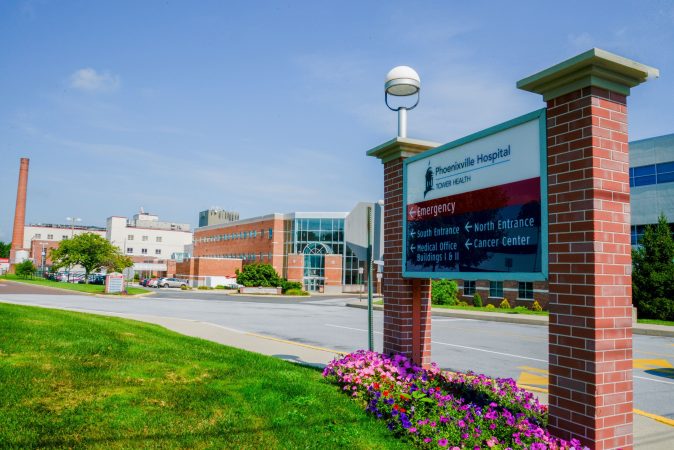
  • Tower Health and Jefferson Health have formed a clinical affiliation

    Tower Health and Jefferson Health have formed a clinical affiliation

    Tower Health and Jefferson Health announced Friday that they have formed a clinical affiliation that would expand access to advanced treatments in Tower’s markets northwest of Philadelphia.

    The two nonprofit organizations said Jefferson is not acquiring Tower, which is the biggest healthcare provider in Berks County and also owns two hospitals in Chester and Montgomery Counties.

    “Healthcare organizations today face unprecedented challenges, including inadequate reimbursement, rising costs, workforce shortages, and increasing competition,” Tower’s CEO Michael Stern said in an announcement to employees.

    “History teaches us that when an organization is confronted by challenges on multiple fronts, success depends on finding the right ally — one that shares our values, respects our strengths, and is committed to the same mission,” Stern’s note said.

    Jefferson said it routinely works with other health systems to provide high-level specialty care throughout the region it serves.

    “As part of that commitment, we are working with Tower Health to enhance access to advanced tertiary and quaternary services, bringing more specialized expertise, innovative treatment options, and coordinated care closer to the communities we serve,” Jefferson said.

    Details of the arrangement with Tower will worked out in the next few months.

    Jefferson is also among the Philadelphia-area health systems exploring a clinical alliance to support financially struggling St. Christopher’s Hospital for Children, which Tower manages and owns in a 50-50 joint venture with Drexel University.

    Turnabout for Tower

    For Tower Health, the potential collaboration with Jefferson represents a turnabout from a decade ago when the system based in West Reading plotted a move into the Philadelphia market. Tower spent $423 million for the acquisition of five community hospitals in Southeastern Pennsylvania from Community Health Systems Inc. in 2017.

    The idea then was that the health system’s anchor, Reading Hospital, would draw patients for the most advanced care to Berks County from the Philadelphia region. That deal led to massive losses as the anticipated patients didn’t materialize in Reading and then COVID-19 crushed health system finances nationwide.

    Tower sold or closed three of the five acquired hospitals, but remains saddled with a huge debt load. The interest payments leave the system with little money left over to invest in the new facilities and services. Last year, Tower instituted significant service cuts and layoffs at Pottstown Hospital.

    Jefferson has expanded through acquisitions from three hospitals to 33 since 2015. The most recent acquisition was Lehigh Valley Health Network two years ago, creating a network that stretches from South Jersey to near Scranton. The system has been losing money for years as management attempts to make the hospitals it acquired work as a financially sustainable system.

    This week, Jefferson sued Independence Blue Cross, claiming a series of five payment policy changes cost it nearly $100 million this year.

  • It’s concerning that the little things the Phillies and Dodgers did were quite the contrast

    It’s concerning that the little things the Phillies and Dodgers did were quite the contrast

    It’s time to talk about every baseball diehard’s favorite topic.

    The little things.

    They are often overlooked, and often deservedly so. The little things are the last bastion of managers, players, and fans when a team doesn’t do the big things very well. They are a coping mechanism. Often. But not always.

    We can’t ignore the little things anymore when it comes to the Phillies. The little things cost them dearly in losing two out of three to the Dodgers. You might write that off as happenstance, except that the Phillies are less than a year removed from a playoff loss to the Dodgers where the little things proved decisive.

    Last October, we saw Nick Castellanos get thrown out at third with no outs in the top of the ninth inning while representing the game-tying run. We saw Orion Kerkering react to a routine ground ball like he was an iPhone that had just been dropped in a toilet.

    These weren’t your average, everyday bad bounces and tough breaks. They were the kind of plays that leave you trembling at the heavens. You don’t expect to see something like that in a baseball game. You certainly don’t expect to see it again.

    And yet …

    The most disconcerting thing about the Phillies’ series loss to the Dodgers wasn’t the mistakes. It was that the mistakes looked remarkably similar to the ones they made while losing last year’s National League Division Series to the Dodgers.

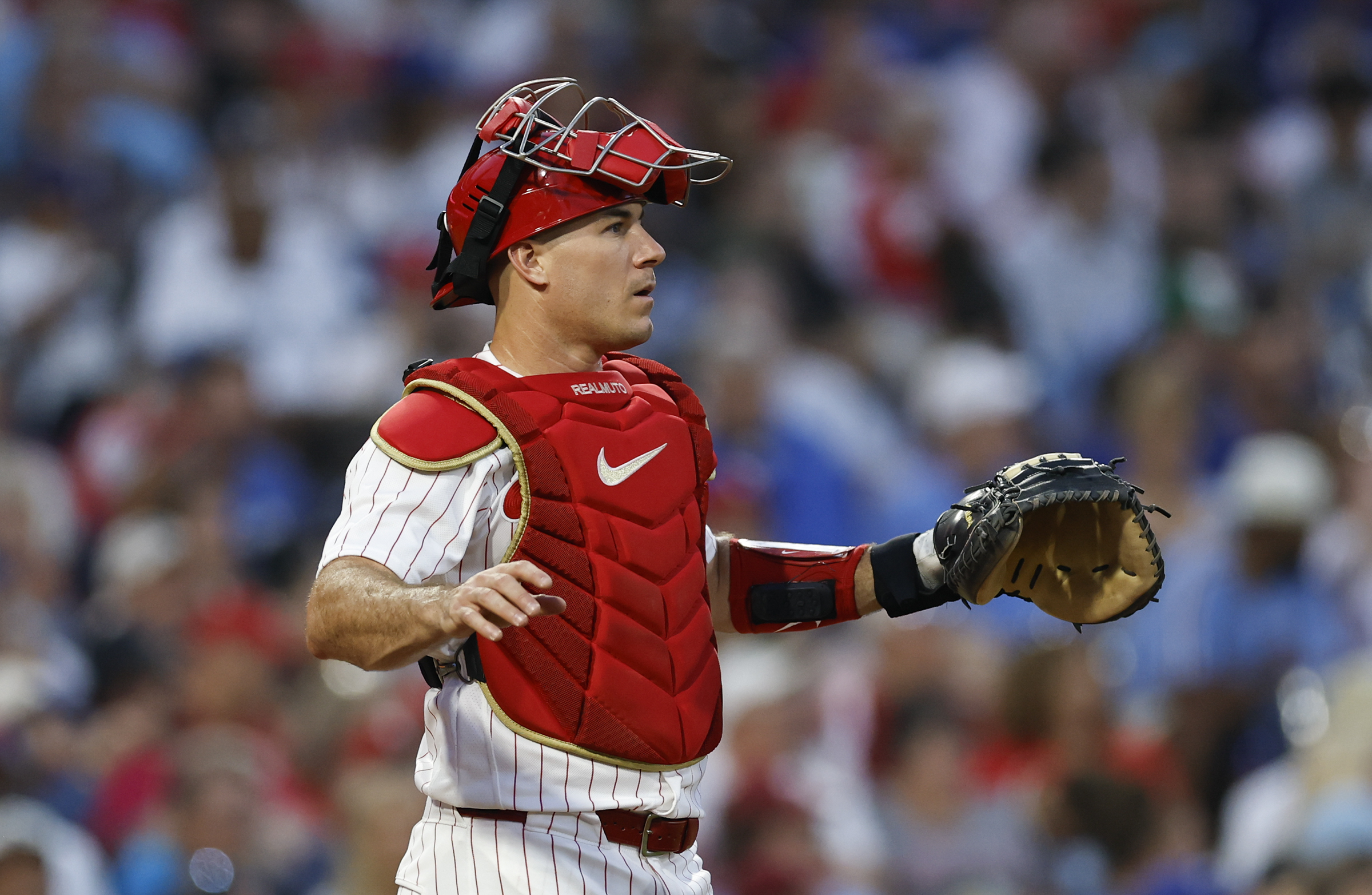
    The lasting image from October was J.T. Realmuto with his mask off pointing toward first base as Kerkering’s brain prepares to betray him.

    J.T. Realmuto in action during the Phillies series against the Los Angeles Dodgers this week. Yong Kim / Staff Photographer

    The lasting image from this week’s series was Realmuto running from third base back to second base as everyone else stares in disbelief.

    Realmuto’s game-ending gaffe on the basepaths in the ninth inning on Tuesday was only the most iconic moment. Other consequential miscues included:

    • Bryson Stott running into a non-forceout at third base on a ground ball hit in front of him in Wednesday’s 9-5 loss.
    • Rafael Marchán popping up a sacrifice bunt attempt earlier in Wednesday’s game.
    • Trea Turner misplaying four balls in the series opener.

    Turner made up for his rough defensive showing by driving in five runs during the Phillies’ 10-7 win on Tuesday. But even that victory ended in inglorious fashion, with closer Jhoan Duran scrambling to get warm after the Dodgers halved a six-run deficit against Chase Shugart.

    It’s bad enough to fail at the little things. It’s devastating when your opponent does the exact opposite. For all the bellyaching about the Dodgers’ payroll and the competitive behemoth that Andrew Friedman has built, the reality is they’d be an enviable organization even without their limitless capital.

    It’s true in the front office, where LA has made a habit of finding pitching like lefty Justin Wrobleski and is currently paying Max Muncy the same amount as the Phillies are paying Adolis Garcia. It’s also true in between the white lines.

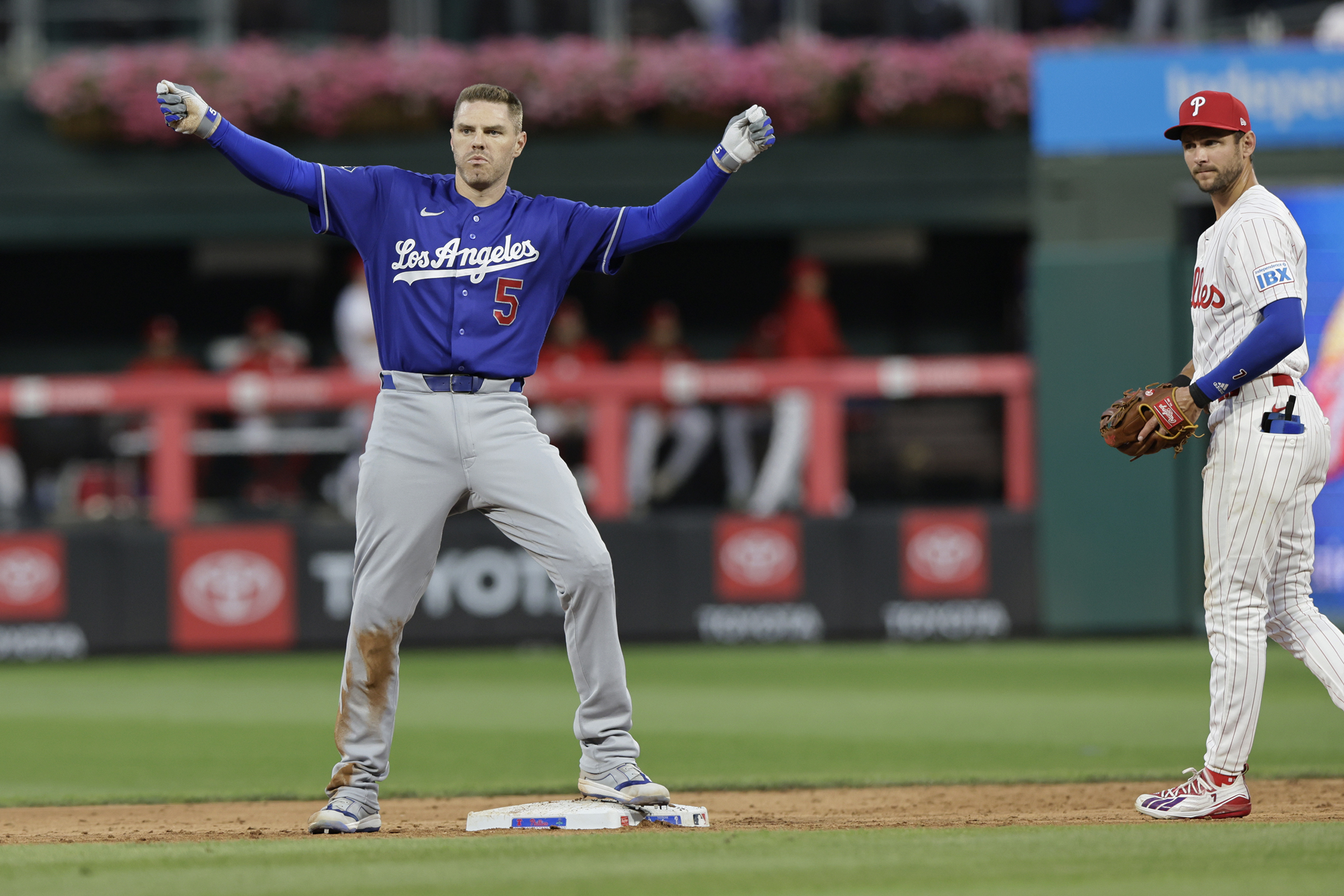
    Trea Turner looks on as the Dodgers’ Freddie Freeman goes into second base on a double in the fifth inning of Wednesday’s game.Elizabeth Robertson / Staff Photographer

    Baserunning? The Dodgers entered Thursday tied for second in the majors in extra bases taken and ranked fifth in efficiency. They also had the second-fewest outs on the basepaths. The Phillies rank 11th in extra bases but 24th in efficiency (credit where it’s due: They have the eighth-fewest outs on the basepaths).

    Situational hitting? The Dodgers rank 12th in productive out percentage (Phillies: 21st). They have 19 pinch hits compared with the Phillies’ nine.

    Fielding? The Dodgers have committed just 37 errors, tied for the fewest in the majors. Advanced metrics rank them even further as one of the better fielding teams in the majors. Not so for the Phillies. The Phillies have committed 50, which ranks 14th.

    “If we play well, we’re capable of beating anybody,” manager Don Mattingly said after Wednesday’s 9-5 loss.

    That’s less of a boast than it probably reads on paper. The “if” is the point.

    The bigger the games, the bigger the little things become. It’s hard to blame Mattingly for a problem that predates him. That said, he is the one who needs to figure out a fix before another October arrives.

  • It’s clear what the Phillies need at the trade deadline. Do they have the prospect capital to get it?

    It’s clear what the Phillies need at the trade deadline. Do they have the prospect capital to get it?

    Even at rock bottom — a 9-19 record, last place, the manager collecting a pink slip — Phillies officials figured they might still wind up buying at the trade deadline.

    But would they have the prospect capital for a big deal?

    “Well, there’s no doubt that we do,” Dave Dombrowski said back on April 28. “Yes.”

    Not everyone shares that opinion.

    With the deadline looming — set a calendar reminder for Aug. 3 at 6 p.m. — the Phillies are in playoff position and believed to be targeting late-inning relief, a right-handed bat, and a No. 4 or 5 starter. Or maybe, as one rival scout theorized this week, Dombrowski will attempt a bigger swing for higher-end starting pitching given the lack of available impact bats.

    In any case, the Phillies’ farm system is ranked 29th out of 30 teams, according to Baseball America’s recently released midseason assessment. But don’t take the word of one publication. FanGraphs pegs them with the No. 24 system; MLB Pipeline’s preseason ranking put them at No. 20.

    Many scouts are similarly unimpressed. One evaluator from a National League team, granted anonymity in exchange for candor, called the Phillies’ system “pretty barren,” while conceding they have a few “lottery ticket types” in the low minors.

    As another NL scout put it, “Their system’s thin at the upper levels.” While some teams “have guys who could come to the big leagues and probably perform at a high level, the Phillies don’t really have that at triple A at all.”

    Indeed, in trying to turn up right-handed hitting within the organization, the Phillies cycled through Otto Kemp (2-for-25, 10 strikeouts), Félix Reyes (6-for-38, nine strikeouts), switch-hitting Steward Berroa (1-for-7, four strikeouts), and now, veteran Bryan De La Cruz, who homered Wednesday night. They traded two minor leaguers last month for platoon outfielder Derek Hill.

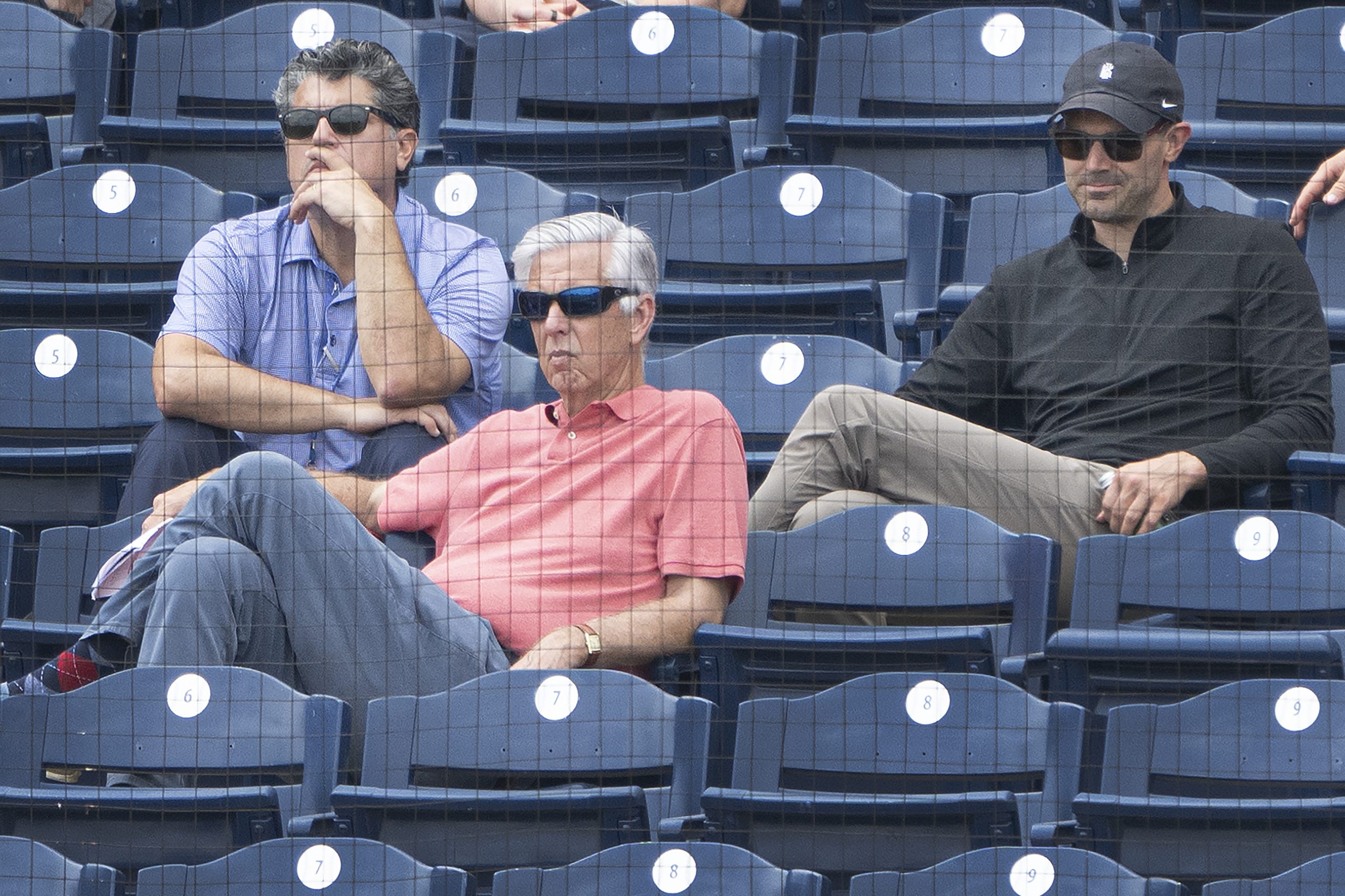
    Phillies president of baseball operations Dave Dombrowski (center) and general manager Preston Mattingly (right) push back against criticisms of the club’s farm system.Jose F. Moreno / Staff Photographer

    On the pitching side, untouchable (in past trade talks, at least) Andrew Painter lugged a 7.06 ERA back to triple A in June. The best in-house replacement: Alan Rangel, a 28-year-old righty who got released in the minors by the Angels two years ago and posted a 5.40 ERA before returning to Lehigh Valley this week.

    Dombrowski and general manager Preston Mattingly push back against criticisms of the farm system. Never mind, Mattingly says, that the Phillies have only two prospects (injured infielder Aidan Miller and righty Gage Wood) who are regarded among the top 100 in the sport.

    “A lot of times, you mention top-100 lists, that’s not necessarily what teams internally talk about and the players they ask about,” Mattingly said recently on The Inquirer’s Phillies Extra podcast. “They’re going with a lot of the information, the data that we have internally. And we feel really good where our system’s at.”

    Sure, but the Brewers and Dodgers feel the same about theirs, No. 1 and No. 3, respectively, in Baseball America’s rankings. The Braves and Cubs are closer to the middle of the pack, at No. 14 and No. 16, but still ahead of the Phillies.

    It’s shaping up as an extreme seller’s market, with 22 teams entering the weekend in playoff position or within 4½ games of a wild-card spot. Some will waive a white flag before Aug. 3; others will hold firm. Regardless, the demand for players will outweigh supply.

    “To me, it’s always about who can impact my team more rather than what’s my biggest need,” former major league general manager Jim Bowden said this week on Phillies Extra. “A starter probably helps the Phillies win the division more over a 162-game schedule. But to win in October, perhaps it’s the reliever or the right-handed bat that would be more important.”

    Relative to most of his counterparts, Dombrowski is willing to move prospects, though he has clung to Miller and especially Painter, whom he wouldn’t discuss at the deadline two years ago for Garrett Crochet. He probably will have to change that stance now for a starter who would pitch in the postseason — and certainly for Tigers ace Tarik Skubal, the marquee name on the market if Detroit makes him available.

    Even so, it’s fair to wonder if there’s enough in the Phillies’ minor-league stable to make meaningful additions to any area of the major league roster.

    “What’s fascinating about [Dombrowski’s] long, successful Hall of Fame career, which is what it’s been, is that he has made a lot of trades without having good farm systems,” Bowden said. “He did it in Detroit, he did it in Florida, he did it in Montreal.”

    It seems Dombrowski will have to pull another card from his sleeve this year.

    Phillies infield prospect Aidan Miller has not played since the end of last season because of a lower back condition.Jose F. Moreno / Staff Photographer

    Missing Miller

    As a nonroster invitee to spring training, Miller’s locker was in the high-rent district of the clubhouse, wedged between Bryce Harper and J.T. Realmuto.

    It wasn’t a coincidence.

    The Phillies hoped to bring Miller to the majors this year, especially after he batted .356 with six homers and 22 steals over the final two months last season. Instead, the 22-year-old former first-round pick hasn’t played at all because of a lower back condition involving a degenerating disc and joint swelling.

    Miller had a spinal procedure June 5, at which time the Phillies outlined “the goal to return to game activity in six to eight weeks.” Seven weeks later, updates are infrequent.

    ”He’s progressing,” farm director Luke Murton texted Thursday. “Back to playing catch. Some defense next week.”

    Even so, the treatment that Miller received — radiofrequency ablation of the facet joints — provides temporary relief and may need to be repeated. The uncertainty about Miller’s short- and long-term health creates multiple questions, not only about his status as the Phillies’ future shortstop but also his value in a potential trade.

    “If he was healthy,” an AL scout said, “he could lead a package.”

    And now? It’s doubtful Miller could anchor a deal for, say, Skubal or Padres closer Mason Miller. For a trade of that magnitude, the Phillies may have to use Painter as a headliner — and even then, the Brewers and Dodgers have the prospect depth to outbid them.

    But do they have the collateral in prospects to make a move for another starter, such as the Mets’ Clay Holmes, the Blue Jays’ Kevin Gausman, or Giants lefty Robbie Ray? Or will they have to aim lower, or fill a less costly need?

    Among their higher-end prospects, infielder Aroon Escobar entered the weekend with a .637 OPS in double A, and outfielder Dante Nori has been sidelined for six weeks with a lower body injury. Shortstop Bryan Rincon (13 homers, .834 OPS in double A) is having a nice year, but he profiles as a second or third piece in a deal.

    The top two positional prospects in the system — outfielder Francisco Renteria and shortstop Juan Parra — are 17 years old and in their first year of pro ball in the Dominican Summer League.

    The Phillies traded 2020 first-round pick Mick Abel to the Twins at the deadline last year for star closer Jhoan Duran.Laurence Kesterson

    Two years ago, the Phillies’ farm system was No. 14 in Baseball America’s midseason rankings. A partial list of trades since then:

    • Pitchers Sam Aldegheri and George Klassen to the Angels for closer Carlos Estévez.
    • Infielder William Bergolla to the White Sox for Tanner Banks.
    • Teenage shortstop Starlyn Caba and outfielder Emaarion Boyd to the Marlins for Jesús Luzardo.
    • Right-hander Mick Abel and teenage catcher Eduardo Tait to the Twins for Jhoan Duran.
    • Outfielder Hendry Mendez to the Twins for Harrison Bader.

    The Phillies haven’t been burned by any of those players … yet. And the Luzardo and Duran trades, in particular, were big wins. But a continuous drain of the prospect pool led to a cumulative erosion.

    “We’ve definitely been in a window where we’re acquiring players at the deadline,” Mattingly said. “We’re never recouping value, which is the state of where we’re at. It’s a great place to be, honestly, when you’re trying to compete for a championship every year.”

    And after having only 12 major league debutants over the last three seasons, fewer than any team in that span, the Phillies finally graduated Justin Crawford, Painter, and Gabriel Rincones Jr. to the majors this year.

    Crawford and Rincones are platoon outfielders for now; Painter, long viewed by Dombrowski as Justin Verlander 2.0, is expected back in the majors before the end of the season.

    In time, the Phillies believe all three will make a greater impact, though they could also be used in a trade.

    Either way, it takes time to replace them in the system.

    Right-hander Gage Wood, the Phillies’ first-round pick in last year’s draft, is the organization’s top pitching prospect.David Maialetti / Staff Photographer

    Gage-ing the system

    The deepest subset of the Phillies’ farm system, in the assessment of three scouts, is right-handed pitching.

    Start with Wood.

    Or maybe bring him out of the bullpen?

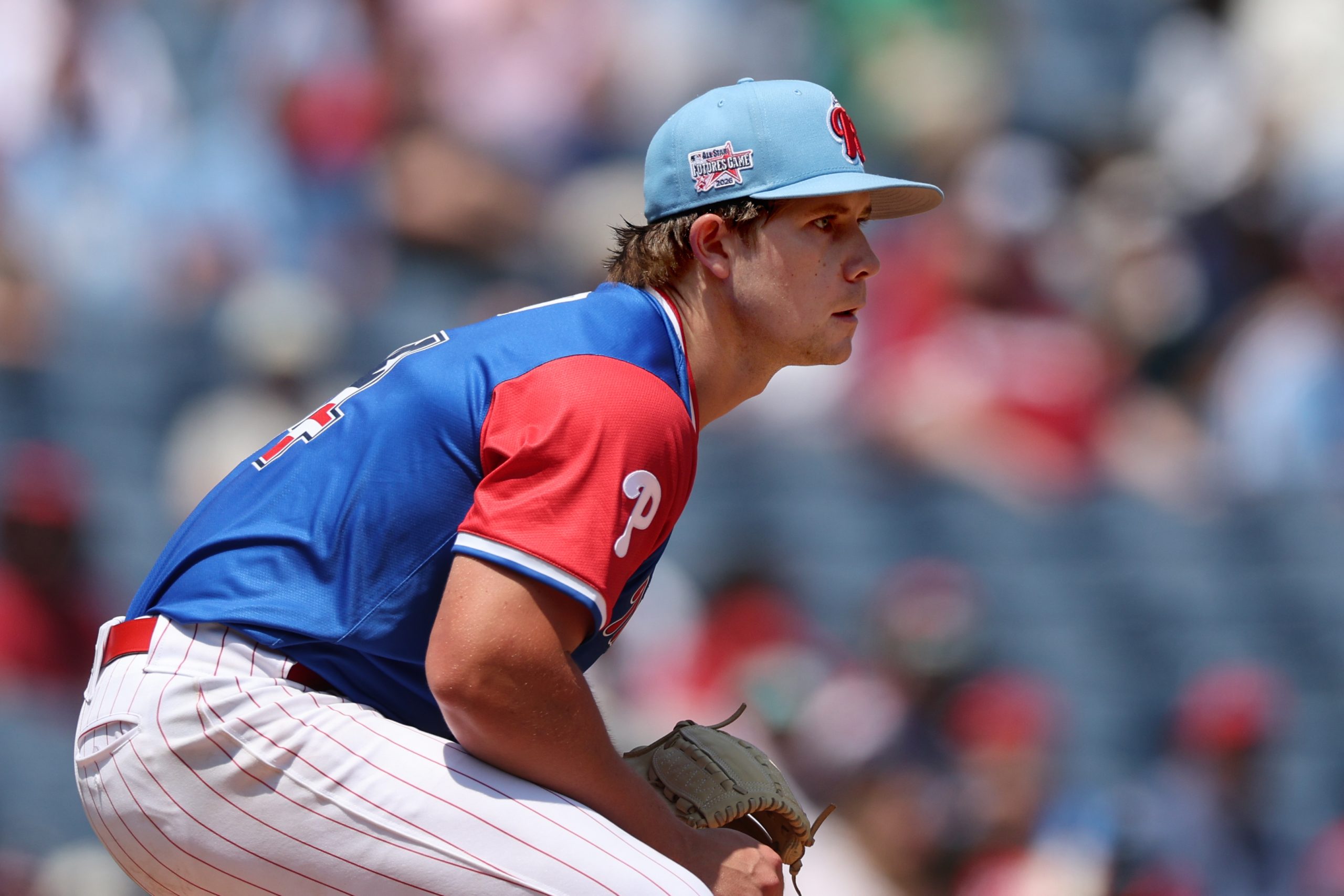
    Most scouts concur that Wood will pitch in the majors, but there’s disagreement about his optimal role. The 22-year-old is starting in the minors, though he has pitched more than four innings only once. He has a 3.58 ERA in double A and gained more national exposure two weeks ago by starting the Futures Game.

    There may be enough interest in Wood to anchor a deal for a needle-moving player. But Wood also appears to be on an accelerated track, with the Phillies jumping him two levels to double A in late May.

    “I don’t think about that stuff,” Wood said of being the subject of trade rumors. “I’m just here to play baseball.”

    Several other right-handers are getting attention from scouts, but most are in the low minors. Two scouts mentioned 21-year-old righty Brad Pacheco, who has a 4.05 ERA and 78 strikeouts in 73⅓ innings for low-A Clearwater. Wen-Hui Pan and Alex McFarlane, a hard thrower who made his major league debut this week, also get decent marks.

    A name to watch: Ramon Marquez. The 20-year-old righty entered the weekend with a 2.02 ERA in 10 games, including a 2.25 mark in four starts since moving up to high-A Jersey Shore.

    One scout called Marquez “probably their best pitching prospect right now.”

    Maybe he’s the Phillies’ best trade chip, too.