Tag: UniversalPremium

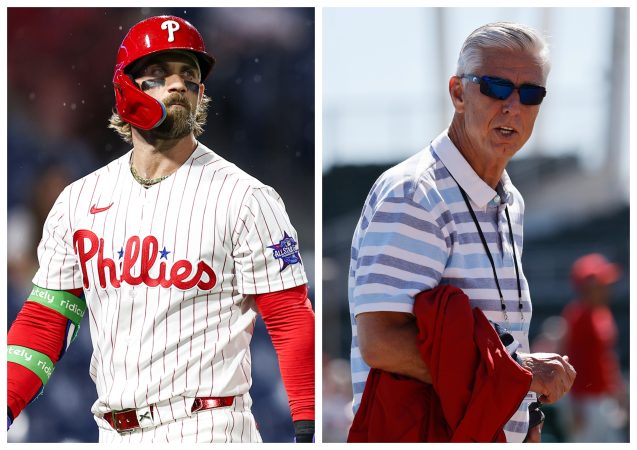
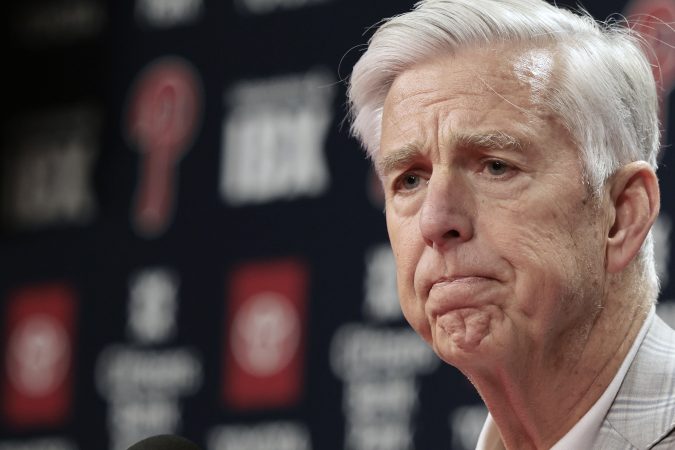
  • Dave Dombrowski’s no good, very bad year (tenure?) continues at the MLB trade deadline

    Dave Dombrowski’s no good, very bad year (tenure?) continues at the MLB trade deadline

    At some point, Dave Dombrowski is going to have to start being right.

    A .333 batting average might get you into the Hall of Fame as a hitter, but it’s a recipe for disaster as an executive.

    To understand why the Phillies were where they were on Monday afternoon, you need only look at the president’s scorecard.

    Justin Crawford as the everyday centerfielder?

    Whiff.

    Adolis García as the everyday right fielder?

    Whiff.

    Andrew Painter as the No. 4 or No. 5 starter?

    Whiff.

    Brad Keller as the bridge to Jhoan Duran?

    Whiff.

    What does disaster look like? Well, let’s start with what it sounds like, because it sounds a lot like Dombrowski’s voice.

    “Our first goal is to make the playoffs,” the Phillies president said Monday, prefacing an answer about the potential postseason impact of a day headlined by the acquisition of free-agent-to-be Luis Arraez for fast-rising pitching prospect Ramon Marquez, “so, I hope we’re dealing with clubs in the postseason.”

    Luis Arraez has won three batting titles and is leading the National League with a .324 average going into Monday’s games.Jeff Chiu

    The words that followed don’t really matter. What matters is the qualification. I have written this plenty of times before. Hope is not strategy. It is a lack of options, one that is usually a function of decisions made prior.

    Dombrowski has been the man in charge of making the Phillies’ baseball decisions for five-and-a-half years. Five-and-a-half years into Andrew Friedman’s tenure with the Dodgers, he was en route to his first World Series win, after having already lost two, one in seven games. He’d salvaged Max Muncy from the scrap heap, signed Justin Turner and Chris Taylor, traded for Kiké Hernandez, and then Mookie Betts, drafted Will Smith, Andy Pages, and Walker Buehler. Just as important, he’d swung a series of minor league trades that helped lay the groundwork for the Dodgers’ recent acquisition of two-time defending AL Cy Young Award winner Tarik Skubal.

    Long story short, Dombrowski has reached a point where the problems he must solve are all of his own making. He did not draft Alec Bohm or Bryson Stott, but he did not pivot off them, either. He signed Trea Turner to a $300 million contract. He oversaw the move of Harper from right field to first base. Four years ago, he could have leveraged top prospect Logan O’Hoppe in a trade for a young, cost-controlled right-handed hitter, or a young, cost-controlled pitcher instead of Brandon Marsh. He did not lose the trade. But, in the grand scheme of things, given the circumstances, did he win it?

    The circumstances are this:

    It isn’t necessarily a disaster to ask three-fourths of your infield to change positions midseason so that two players can continue to play a position where they aren’t the best defensive option.

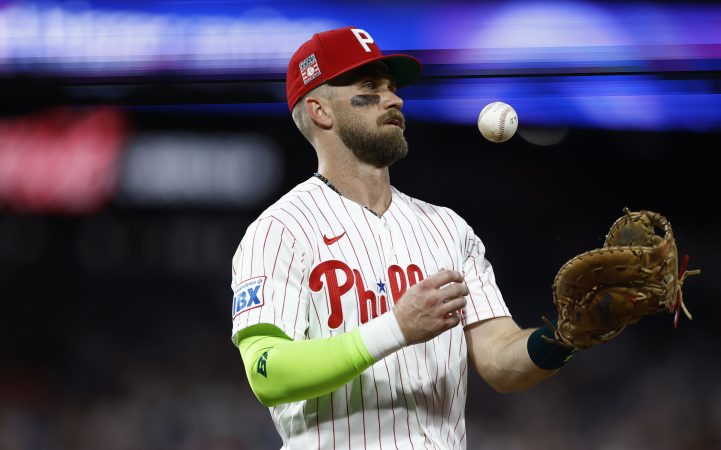
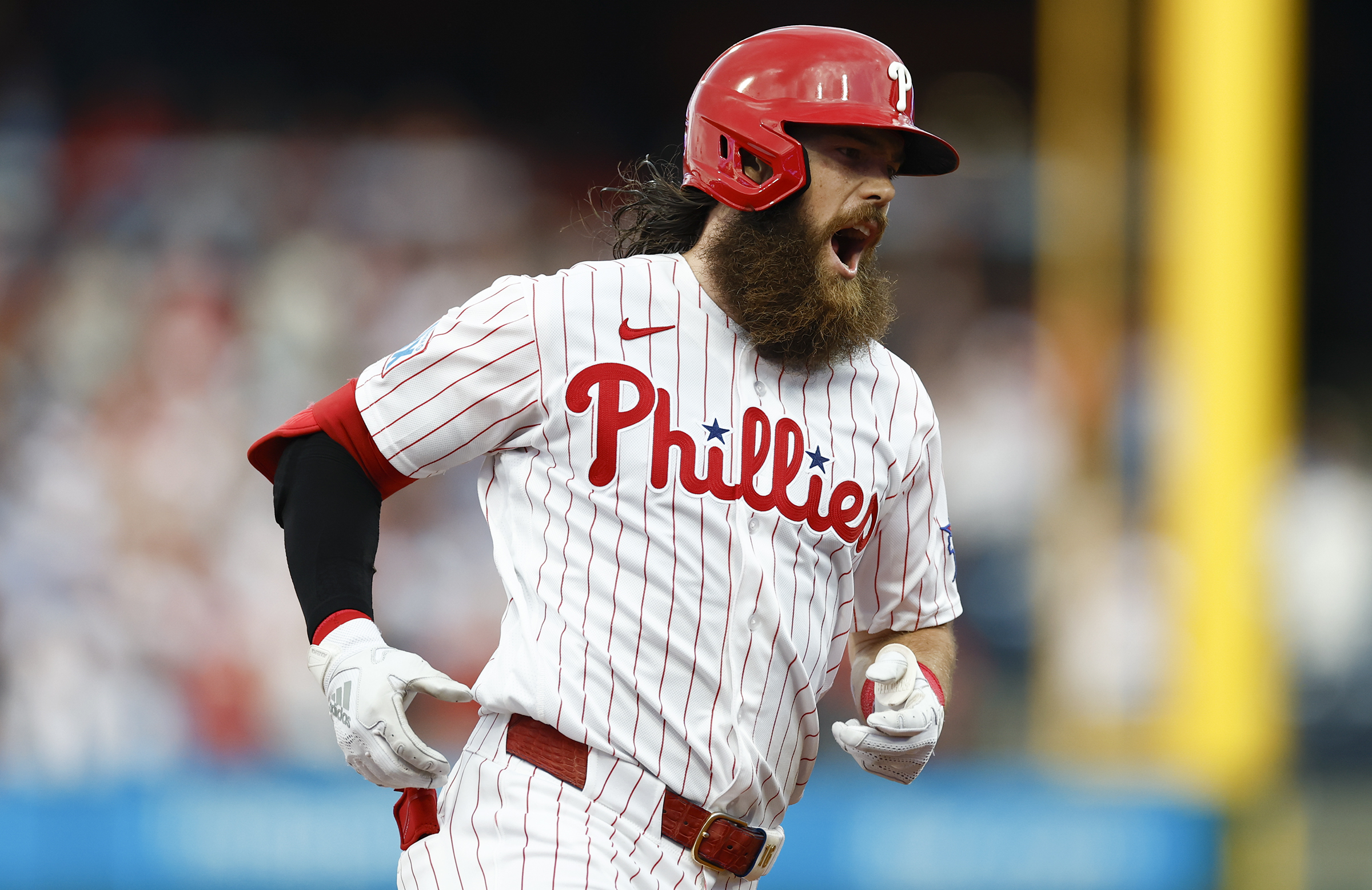
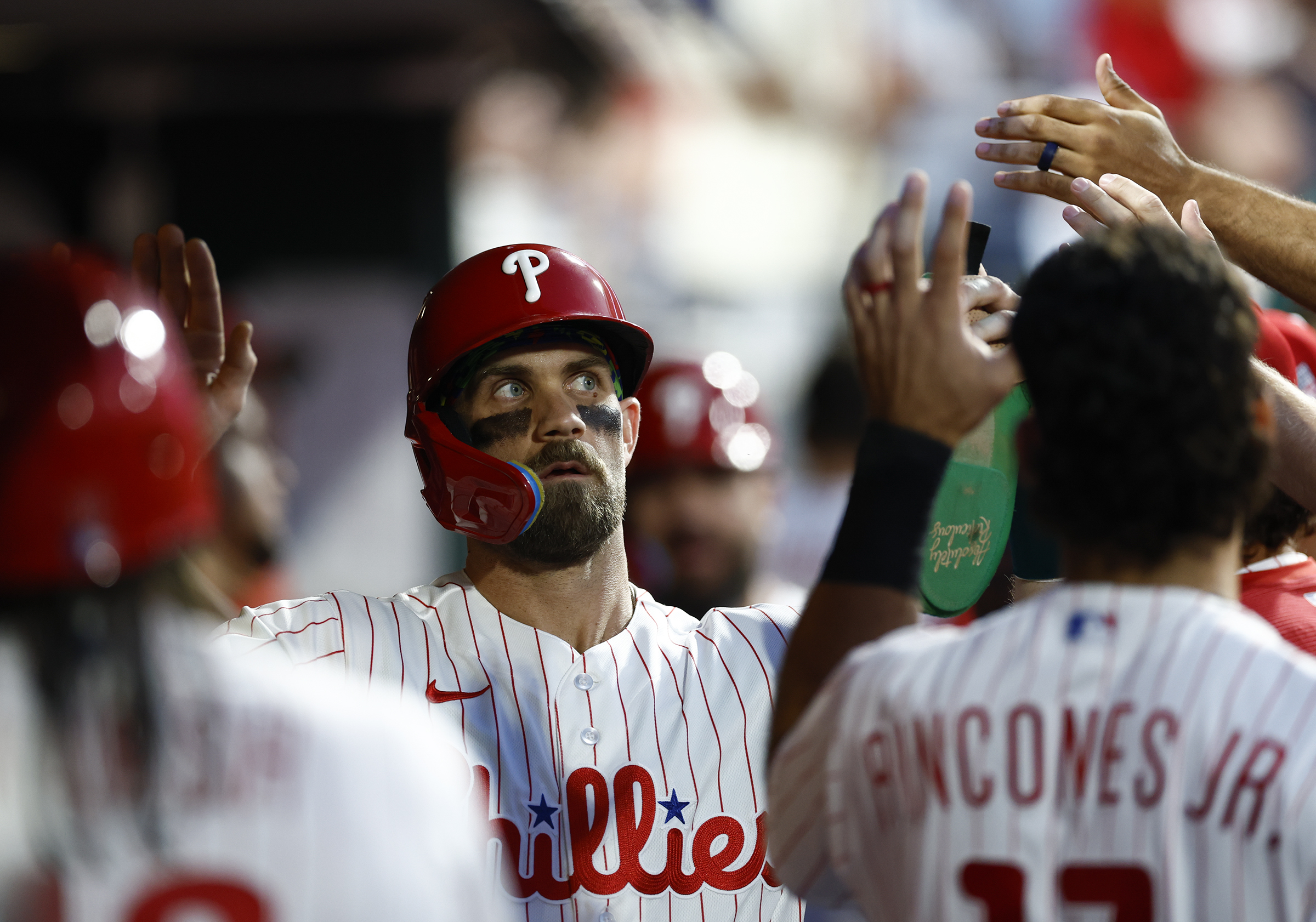
    As a result of the trade for Luis Arraez, Phillies first baseman Bryce Harper will move back to right field.Yong Kim / Staff Photographer

    It isn’t necessarily a disaster to move one of those players from the infield to the outfield, where he hasn’t played more than eight games since 2021. Nor is it to move another of those players (Stott) from second base to third base, a position where he has started just 12 games since high school.

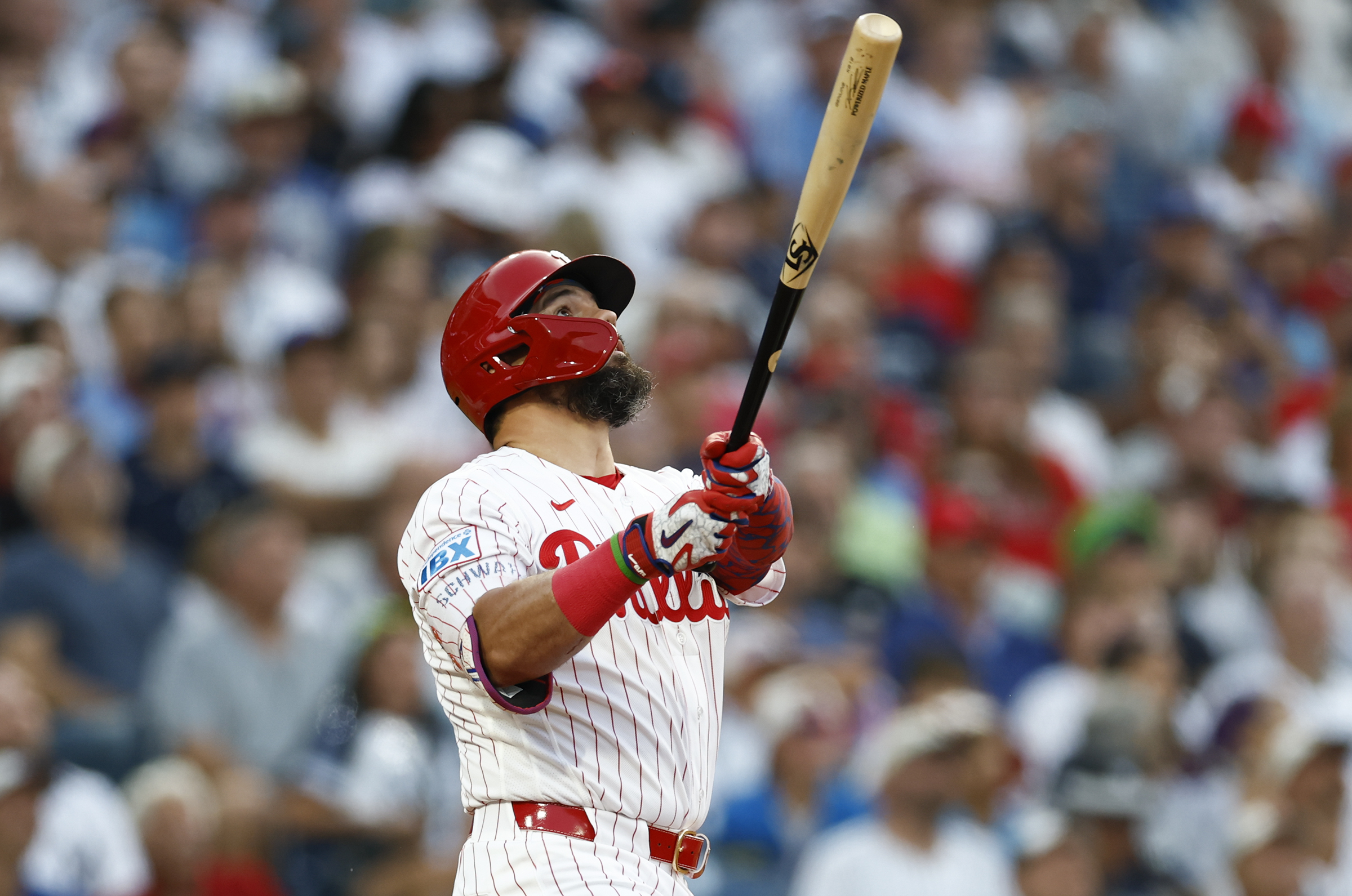
    It isn’t even necessarily a disaster to do all of these things in order to add another lefty bat to a lineup that already suffered from a glut of them. Nor it is necessarily a disaster that the new left-handed bat is a top-of-the-order bat, and thus does little to remediate the lack of middle-of-the-order thump behind Harper and Kyle Schwarber.

    Don’t get me wrong. Any one of these things could be a disaster. One might argue that, in sum, the odds are strong that they will be a disaster. But these are perfectly defensible moves in isolation, and maybe even in sum. The Phillies can, did, and will continue to argue that Arraez is exactly the kind of bat their lineup needed. They can, did, and will continue to argue that he can play good enough second base to warrant the downgrade there along with the question marks at third base and in the outfield.

    The real disaster is that the Phillies found themselves in a predicament where they needed to make these moves. The real disaster is that these moves so preoccupied their energy and resources that they failed to address what were arguably their two greatest needs. The real disaster, above all else, is the desperation premium that the Phillies and Dombrowski were forced to pay just for the hope that it might somehow work.

    Marquez may never amount to anything as a major leaguer. As devastating as his changeup is — the minor league strikeout rate is absurd — the fastball and the health are what matter first and foremost. He is 20 years old. He is befuddling class-A hitters. But the success or failure of the Arraez trade isn’t just a matter of who Marquez will be as a major leaguer. It is also matter of who else the Phillies might have traded him for.

    This past offseason, Arraez signed a one-year contract with the Giants worth $12 million. That’s roughly $2 million more than the Phillies paid to Garcia, for whom nobody would be trading, even if healthy. They did the same thing last season, albeit at a far lower price, acquiring Harrison Bader to help replace free agent mediocrity Max Kepler. In fact, the Phillies have done the same thing every season of Dombrowski’s tenure, to one degree or another. They are the little boy at the leaking dam, their fingers outnumbered by the holes they must plug. It is losing math, even before you factor in the market.

    Second baseman Bryson Stott will move over to third to make room for Luis Arraez in the Phillies’ infield.Yong Kim / Staff Photographer

    Dombrowski and his minions will argue that they could not have simply signed Arraez for $12 million. They had Stott at second base, after all. And they had Bohm at third. They couldn’t move either because they had Turner at shortstop and Harper at first. And yet, here they are.

    For nearly six years they’ve been here. Each of the last three have been as obvious as the last. Bohm, Stott, J.T. Realmuto, Justin Crawford, Marsh, Garcia — none of them has underperformed any realistic expectations. And yet, here they are.

    “We added the top hitter in the league to the offense, a different type of hitter than we have,” Dombrowski said of Arraez. “Somebody that gets on base, sets the stage for some of our big guys, doesn’t strike out as often, who can do things with the bat.”

    These are helpful things, no doubt.

    More helpful is to build an organization that avails you with those things before the panic sets in.
  • Eagles practice observations: Jalen Hurts has a day; Makai Lemon limited; Lane Johnson’s absence

    Eagles practice observations: Jalen Hurts has a day; Makai Lemon limited; Lane Johnson’s absence

    The Eagles held the fourth practice of their 2026 training camp on Monday at the Jefferson Health Training Complex. Here were my observations from Day 4 (and links to Days 1, 2 and 3):

    Lane’s whereabouts

    As expected, there were new names on the injury list. Outside linebacker Keyshawn James-Newby (ankle), guard Micah Morris (shoulder) and guard Jaeden Roberts (calf contusion) — all of whom suffered injuries on Saturday — didn’t practice. Each was in attendance. It was mildly shocking to see an upright Roberts, who had to be carted off the the field after his leg was bent back. I would have needed an amputation.

    Safety Cole Wisniewski remained out with a hamstring strain. Tackle Cam Williams (left knee contusion) was a limited participant. Linebacker Jihaad Campbell and wide receiver Elijah Moore returned after being excused from Saturday’s workout.

    Lane Johnson was excused for a second straight practice for a non-injury-related reason. The Eagles declined to offer more information.

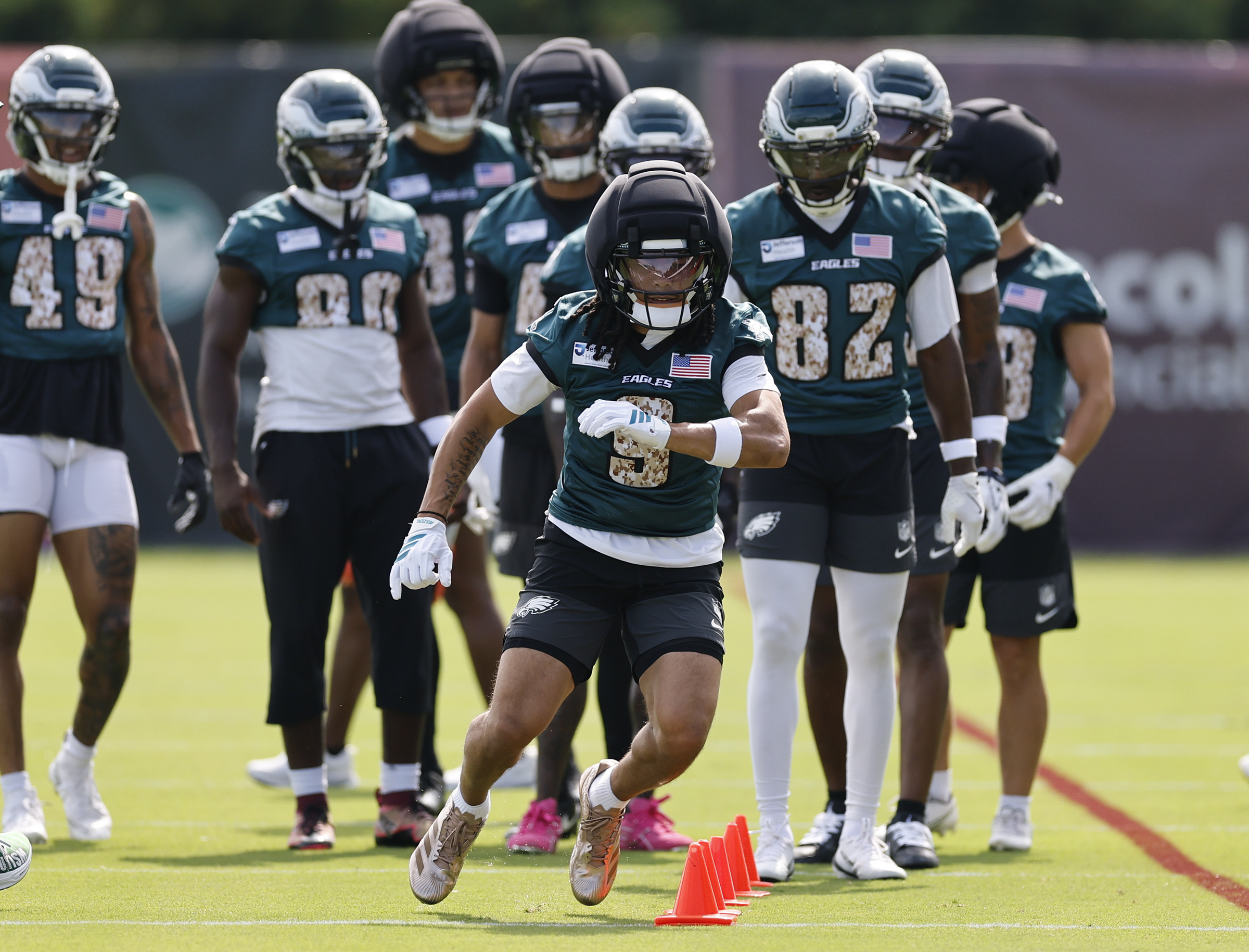
    Makai Lemon’s (9) injury is not believed to be serious. Yong Kim / Staff Photographer

    Lemon aid

    Makai Lemon was suited up and spotted in the early portion of practice, but he was missing during team drills. The Eagles didn’t offer an update, but I was later told he didn’t suffer a significant injury. The rookie wide receiver got knocked down a few times on Saturday, but spoke with reporters afterward and seemed fine. Lemon had a relatively quiet first few days of camp. It’s nothing to be alarmed by, but further time missed — after a hamstring sidelined him for June’s minicamp — wouldn’t be ideal.

    With Lemon out, Moore got extensive work in the slot with the first unit offense. Jalen Hurts targeted him several times in the first practice in full pads. A “hi-lo” route concept gave Moore second-level space and his quarterback hit him in stride. Hurts went back to the receiver on the first play of 7-on-7s, but an apparent miscommunication at least partly contributed to cornerback Quinyon Mitchell jumping the route for a would-be pick six.

    The pair rebounded to hook up several plays later after Moore beat safety Marcus Epps on a post route. Hurts threaded his pass through the middle of the defense and Moore — despite a slight bobble — hung on ahead of deep safety help.

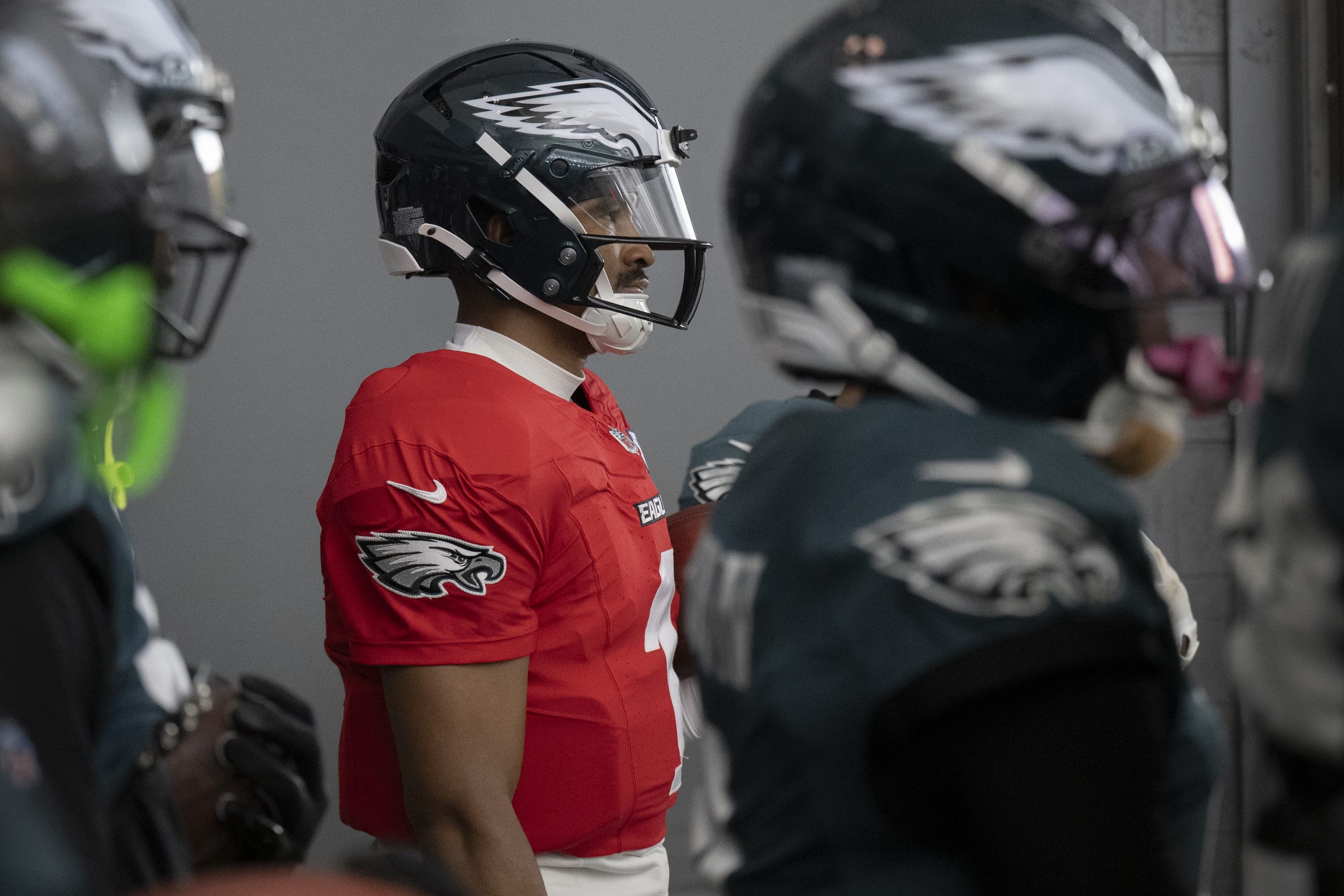
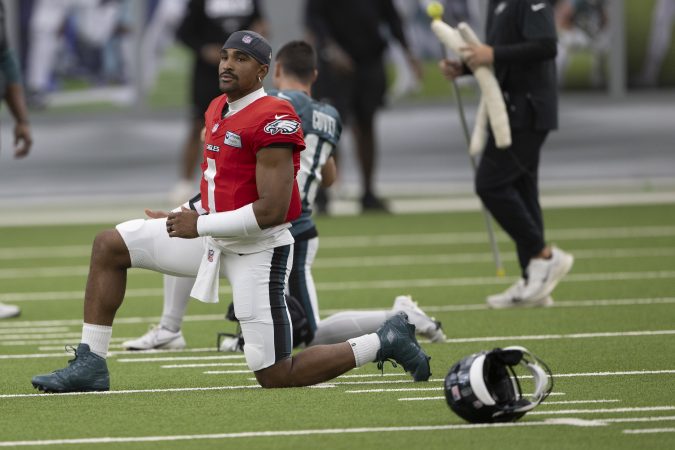
    Jalen Hurts looked comfortable in the Sean Mannion offense on Monday. Jose F. Moreno / Staff Photographer

    Hurts so good

    Hurts had probably his best day as a passer thus far, with Sean Mannion’s scheme seemingly providing him with more middle-field opportunities. He found receiver Dontayvion Wicks on a deep crosser during team drills. In 7-on-7s, he hit tight end Johnny Mundt on a pop pass concept that has long been featured in the Shanahan offense. Hurts also connected with a diving Darius Cooper after the receiver broke under cornerback Riq Woolen.

    The first unit offense had a strong showing in the red zone period. Hurts took advantage of Jonathan Jones spelling Woolen and went to receiver DeVonta Smith for a quick out touchdown just inside the pylon. On the next play, Hurts stepped away from pressure and threw across his body to a re-routed Smith for another score.

    Later on in an empty set, Hurts ran a draw and waltzed into the end zone. Tackle Jordan Mailata and guard Landon Dickerson celebrated by forming a London Bridge for guard Tyler Steen to limbo under.

    Running men

    The second unit defense had its revenge a set later when Byron Young stopped running back Tank Bigsby in the backfield. Young and fellow defensive tackle Gabe Hall mimicked the O-line’s bridge celebration but were lacking a third reveler as the ferry boat.

    While the offense overall may have been better through the air, it felt like Vic Fangio’s run defense had the edge on this day. Saquon Barkley and Bigsby converted in a few short yardage situations, but yards were hard to come by on early downs. Defensive tackle Moro Ojomo got to Barkley from behind after the tailback ran into a wall up the middle. Linebacker Zack Baun slashed to the sideline to cut off Bigsby on the outside zone run at one point.

    Hurts did have a decent pickup on a designed run with tight end Dallas Goedert as his lead blocker.

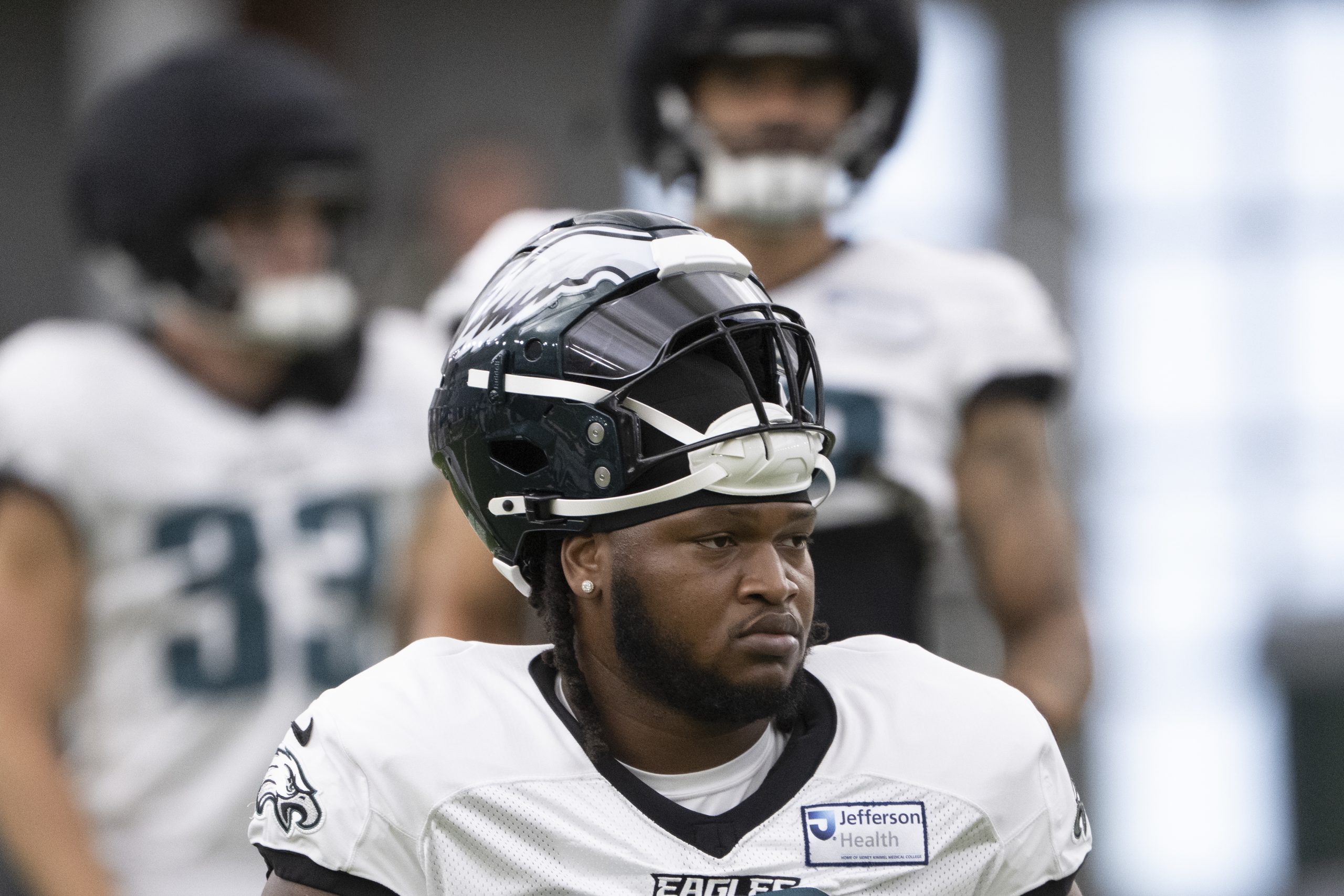
    Jalen Carter has had a strong training camp thus far. Jose F. Moreno / Staff Photographer

    For the defense

    Another day, another Jalen Carter highlight. The defensive tackle did his damage against the second offense this time around. It looked like he steamrolled guard Drew Kendall into tackle Myles Hinton, who ended up on his back. Carter nearly had an interception, but a Hurts pass sailed through his hands and still found its way to receiver Hollywood Brown.

    Edge Nolan Smith had what appeared to be his first sack of the summer. He beat tackle Fred Johnson on the outside and Hurts had nowhere to run after the pocket collapsed. Arnold Ebiketie dropped into coverage and impressively broke up an Andy Dalton attempt to rookie tight end Eli Stowers.

    Bell works

    Johnson started in place of Lane Johnson, but rookie Markel Bell also took repetitions at right tackle. Campbell returned to his spot with the first defense, but Jeremiah Trotter Jr. took snaps alongside Baun, as well. I noted a couple run stops for Campbell with each unit.

    Epps is still the primary safety opposite Andrew Mukuba in nickel personnel. Dalton was again first up under center with the second offense. Tanner McKee got work with the second group, but he hasn’t been as sharp as his competitor for the backup spot to Hurts. At least not yet.

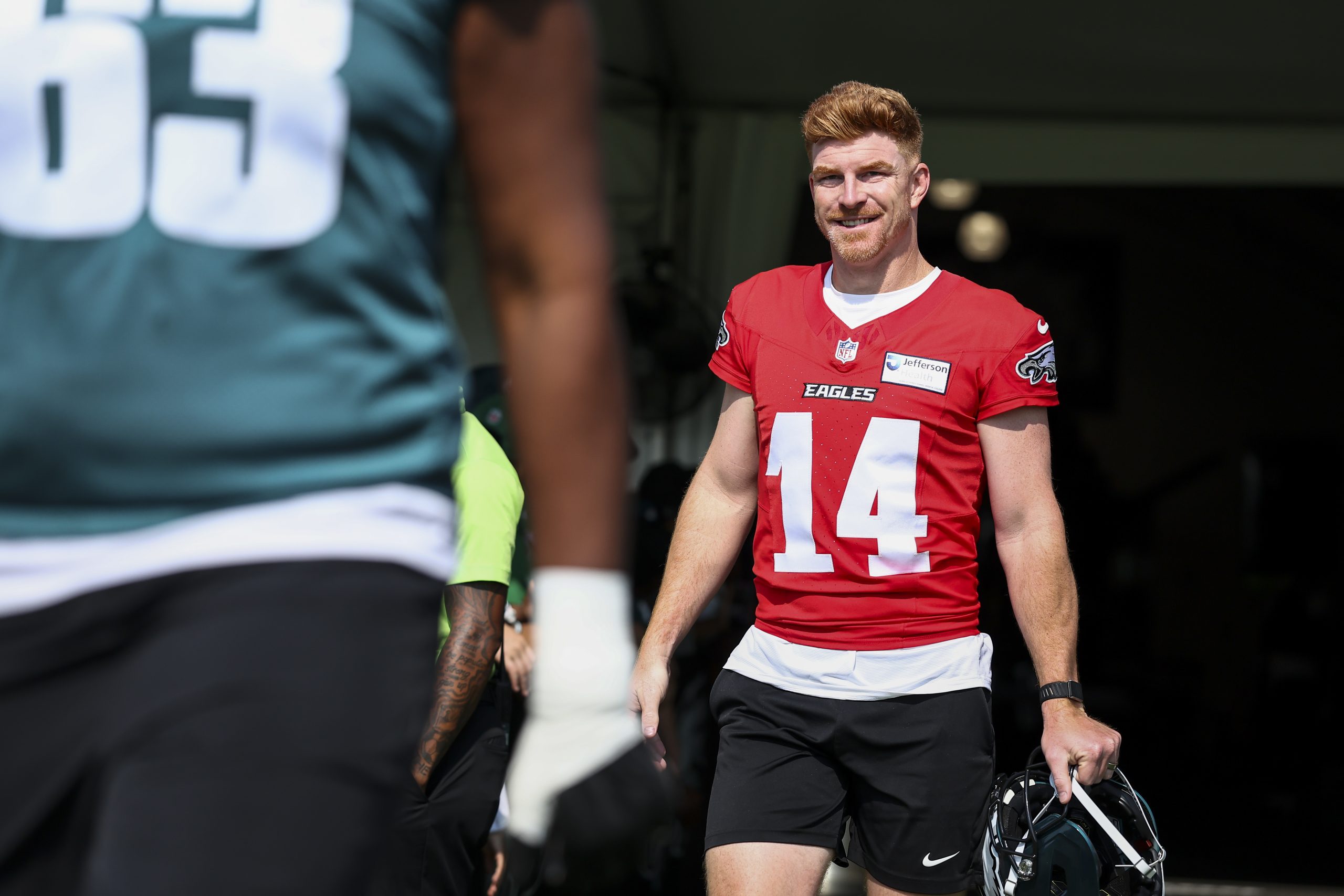
    Andy Dalton (14) is making his case for the primary backup job. Monica Herndon / Staff Photographer

    Dandy Andy

    The 38-year-old Dalton has been exposed to many systems, but it’s not as if he has a ton of experience in Shanahan-style offenses. He’s as new to Mannion as the other quarterbacks. But he’s still hanging around for good reason and one of them is that he can sling it. He threw a dart to receiver Johnny Wilson in rhythm and over the middle on a prototypical Shanahan play-action pass.

    During 7-on-7s, Dalton was a perfect 4 for 4 on his dropbacks with two completions to receiver Britain Covey. He was about as successful in the red zone as Hurts. He located a wide open Will Shipley for a walk-in touchdown after a busted coverage. And Dalton went to the opposite side on a quick out to Brown after he beat corner Ambry Thomas.

    Keying on McKee

    It’s still too early in camp to call any positional competition. I’d imagine either backup quarterback could be available to trade considering the circumstances. McKee has previously shown that he can execute an under-center offense. But this is a whole new bag and he doesn’t have the luxury of taking all the second-unit snaps like he did last summer before breaking a finger.

    The offense struggled during his red-zone set. He appeared to throw wide of receiver Quez Watkins in the post. A play later, McKee had nothing after his first reads were taken away and eventually threw the ball out of the back of the end zone. Rookie safety Maximus Pulley still managed to catch the ball but was out of bounds.

    McKee did well to find Shipley on a swing pass and with plenty of green ahead of the tailback. But he short-hopped a heave to an open Wilson a few plays later.

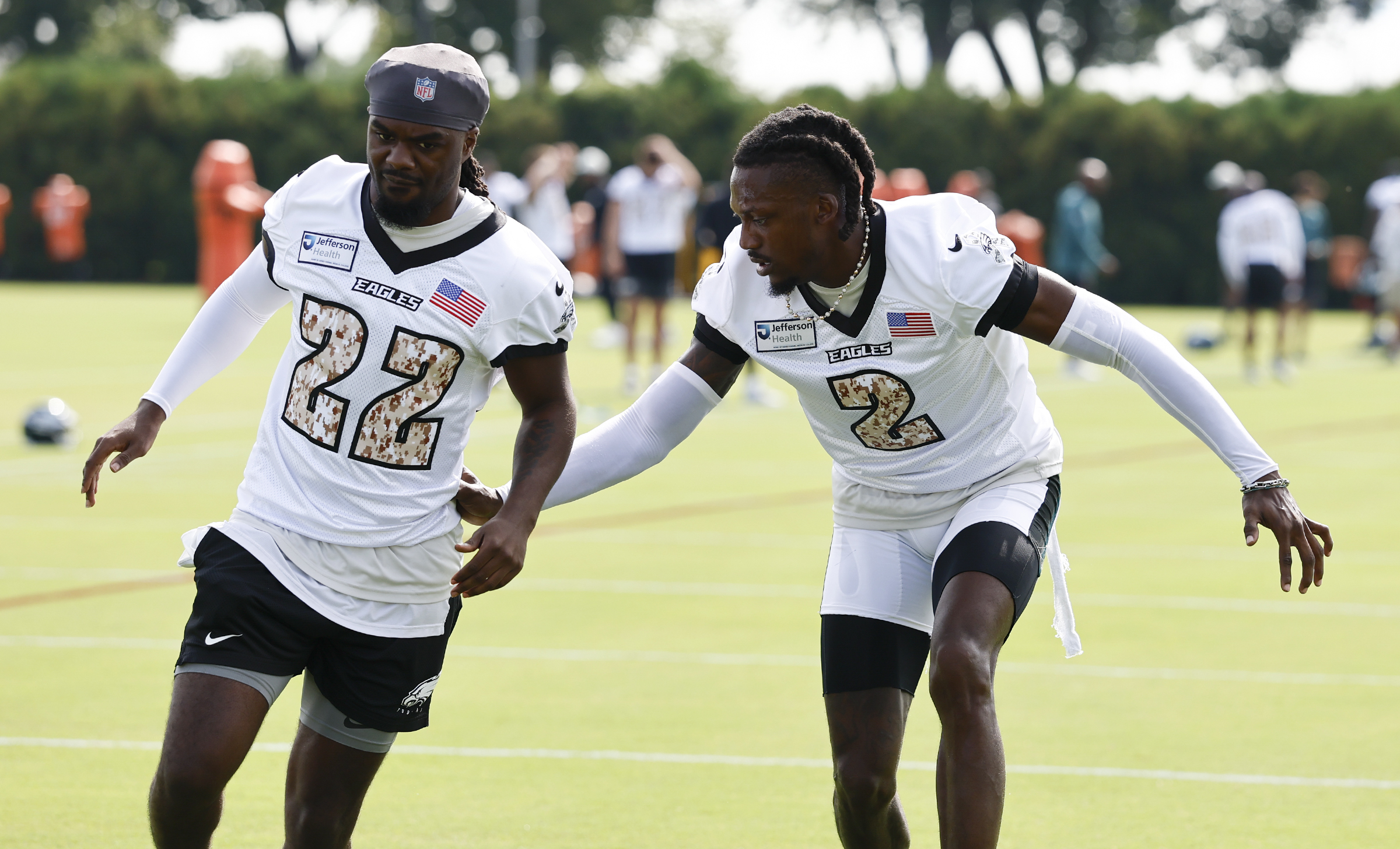
    Mac McWilliams (22, with Riq Woolen) has had an up-and-down first few days of camp. Yong Kim / Staff Photographer

    Draft letter

    While there’s a lot of intrigue about the incoming rookies, the 2025 draft class is far from a finished product. Campbell and Mukuba are slated to start again after promising first seasons, but injuries and expected inconsistencies mean that the jury is still very much out on their futures. The rest of the group is full of unknowns.

    The next two picks from that class — fourth-round defensive tackle Ty Robinson and fifth-round corner Mac McWilliams — enter their second seasons with a lot of unanswered questions. Robinson flashed for a second straight practice when he shot into the backfield to touch up Barkley when the second defense faced the first offense.

    McWilliams followed an up-and-down practice with another. He was the corner that trailed Wicks early on. But he played sticky man coverage when quarterback Cole Payton took a sack during the developmental period.

    Extra points

    Rookie defensive tackle Uar Bernard was credited with that sack. He might have benefited more from the back seven than his pass rush prowess, but any step forward for the newcomer to football can be deemed a positive. … Payton has no fear. He might have tossed a deep pass over the middle with four defenders in the area, but the ball still hit receiver Erik Ezukanma in the hands before Pulley swatted it to the ground. … Ezukanma later pulled in a deflected pass from Payton for a touchdown. … Taylor Swift brother-in-law Jason Kelce was at practice. … The Eagles are back to work Tuesday and Wednesday and will have a walkthrough on Thursday.

  • A humbling trade for Phillies as Dodgers leverage farm brilliance to add Tarik Skubal

    A humbling trade for Phillies as Dodgers leverage farm brilliance to add Tarik Skubal

    Nobody wants to admit it, but the Dodgers deserve Tarik Skubal. They landed him the old fashioned way. They drafted, developed, traded, and signed their way to a circumstance where they could trade a highly valued outfield prospect for three months of service that will only pad their odds of completing a three-peat that they were favored to accomplish anyway.

    That’s what you should focus on. The dignity of the deal. Not the Dodgers’ myriad other competitive advantages. The endless payroll. The creative accounting. The market size, location, and glitz. None of them matter as much as the fundamentals. The Dodgers are simply better at identifying and nurturing talent than any other organization. To focus on anything else is to give your own organization a pass.

    The Dodgers traded for Skubal because they could.

    They had four outfielders ranked among the 40 best prospects in the game, for crying out loud. Three of them were at double A already. Their big league outfield already includes young breakout star Andy Pages in center field and Kyle Tucker in right. Not only do they have high-end prospects that other teams want, they can afford to trade some of them. In fact, they almost have to trade some of them.

    From 2021 through 2026, the Dodgers had 22 players appear on at least one of the major national Top 100 lists. The Phillies had eight during the same time span. Only two teams in the majors had fewer than the Phillies. Only three teams in the majors had more than the Dodgers.

    General managers and scouting directors tend to roll their eyes any time they end up on the wrong side of the Top 100 math. These lists don’t come close to providing an expert-level understanding of a team’s farm system. They are prone to politics and groupthink and statistics without context. All of which is true. But you can’t argue with the market.

    The centerpiece of the Skubal trade is a good example of the Dodgers’ skill in this prospect thing. It’s also a good example of why it isn’t too early to expect more out of Dave Dombrowski’s farm system.

    Let’s start at the beginning …

    • February 2020 — Dodgers acquire Mookie Betts for two top-50 prospects, neither of whom is Gavin Lux, who enters the season as a consensus top-five prospect.
    • January 2022 — Dodgers sign Dominican outfielder Josue De Paula for $400,000 in international bonus money.
    • March 2022 — Dodgers enter season with six Top 100 prospects, including Michael Busch. Dodgers initially drafted Busch at No. 31 in 2019, four picks after the Cubs took college pitcher Ryan Jensen.
    • January 2023 — Dodgers sign Venezuelan outfielder Eduardo Quintero for $297,500 in international bonus money.
    • January 2024 — Dodgers trade Busch to Cubs for Zyhir Hope in what was basically a prospect-for-prospect deal.
    • January 2025 — Dodgers trade Lux to Reds for outfielder Mike Sirota and a competitive balance pick, which they use on outfielder Charles Davalan.
    • January 2026 — Hope, Sirota, Quintero and De Paula all enter season as Top 100 prospects. Davalan is ranked as the No. 7 prospect in the Dodgers organization and a potential 2027 Top 100 prospect.

    That’s a tidy snapshot of what makes the Dodgers the Dodgers. It isn’t just drafting and development. It’s knowing when to trade your own guys. It’s knowing who to trade for. It’s knowing how to spend international money. Look, a lot of those 22 Top 100 prospects have yet to turn into stars. Josiah Gray, Bobby Miller, Gavin Stone, and Keibert Ruiz are some of the names. But all it takes is one Pages or (potentially) Dalton Rushing to turn into a homegrown star.

    The Dodgers landed Tarik Skubal the old fashioned way.Paul Sancya

    With one day to go before the MLB trade deadline, Phillies fans again are looking to a highly variable and often prohibitively expensive market to remedy roster holes that will never truly be solved without an adequate farm system. Imagine plugging someone like Pages into the lineup. Imagine if Andrew Painter had Justin Wrobleski’s pitching line. More often than not, trade deadlines are won and lost long before they arrive. The losers are the desperate teams. The winners are the ones who can outbid anybody but do not need to unless a game-changing deal comes around.

    The Dodgers just struck such a deal. In adding Skubal, the two-time defending AL Cy Young winner, they have blunted the one competitive advantage the Phillies might have in a series. Even if Shohei Ohtani is unable to return to the mound this season, L.A. will still be able to go toe-to-toe in the first two games of a series.

    Skubal vs. Cristopher Sánchez in Game 1.

    Yoshinobu Yamamoto vs. Zack Wheeler in Game 2.

    Beyond that, the Dodgers could have some combination of Wrobleski, former AL Cy Young winner Blake Snell, and 2025 postseason standout Tyler Glasnow, the latter two of whom are expected to rejoin the rotation off the IL in the near future. Plus, whatever they can get out of Ohtani, another former Cy Young winner.

    The Dodgers’ big league depth is overwhelming. Their payroll has a lot to do with that. But a big payroll is no match for elite-level decision-making. Right now, that’s the Dodgers’ greatest competitive advantage.

  • Thomas Eakins turned Philadelphia’s medical history into high art. Philadelphians weren’t ready for it.

    Thomas Eakins turned Philadelphia’s medical history into high art. Philadelphians weren’t ready for it.

    In 1866, the realist painter Thomas Eakins was in Paris studying at the École des Beaux-Arts. While there, he wrote to Emily Sartain, a family friend and artist who, from 1886 to 1920, would go on to become principal of what is now the Moore College of Art.

    “I am proud to be a Philadelphian. … I feel 6 ft and 6 inches high whenever I only say I am an American,” he boasted.

    It took some years before Philadelphia accepted and loved the artist back.

    In 1870, Eakins returned to Philadelphia, where he began a career painting subjects of modern life in a straightforward manner without pretense or flourish. Establishing a studio at his family home on Mount Vernon Street, he hoped to find artistic success in Philadelphia.

    But his first paintings received mixed reviews and found no buyers.

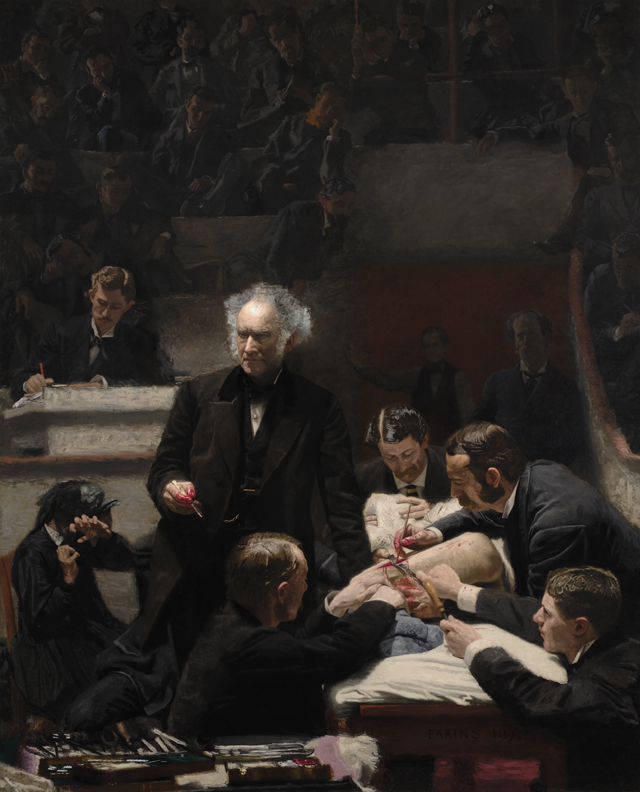
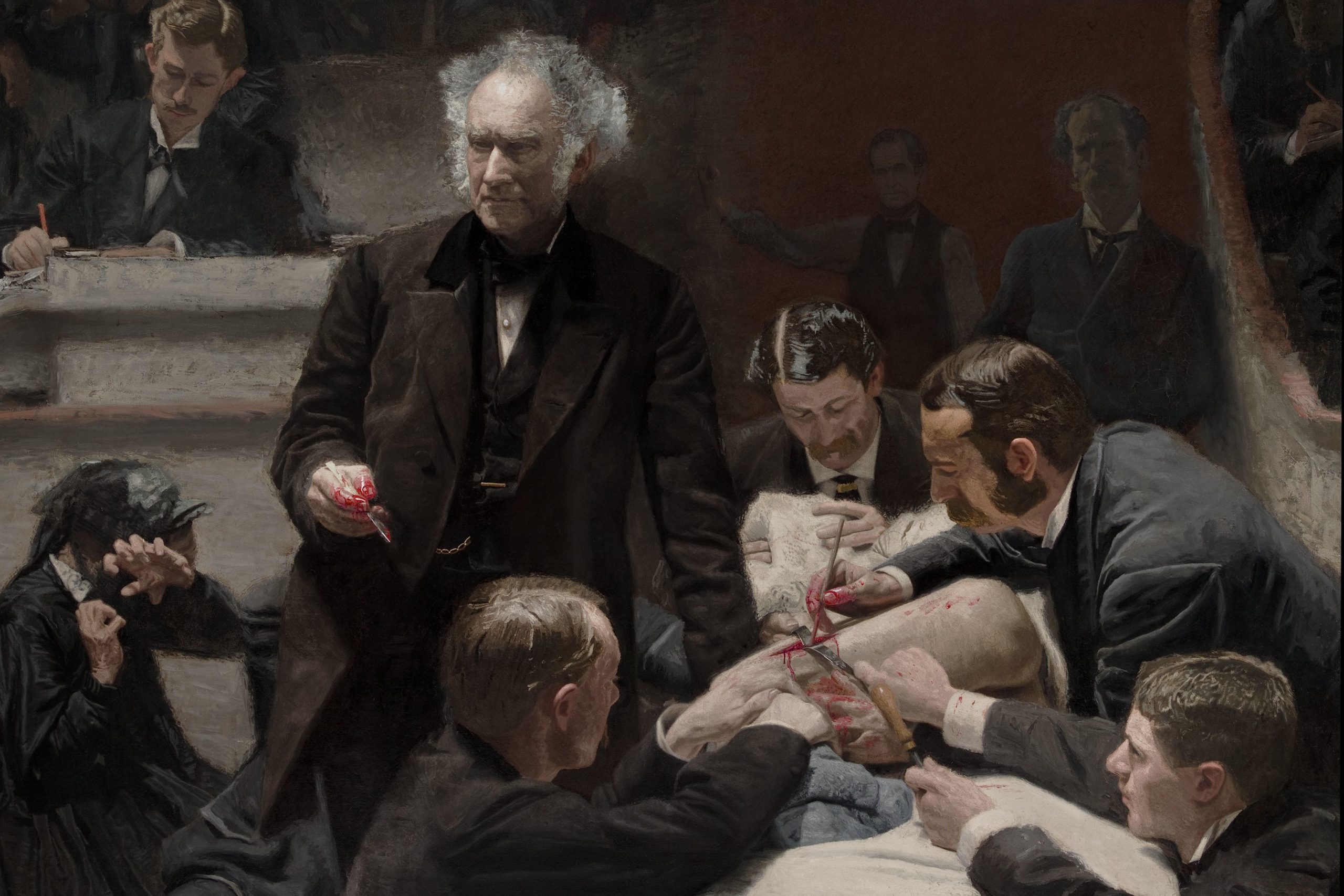
    Thomas Eakins, “Portrait of Dr. Samuel D. Gross (The Gross Clinic),” 1875. Oil on canvas, 96 x 78 ½ in. Courtesy of the Pennsylvania Academy of the Fine Arts, Philadelphia. Gift of the Alumni Association to Jefferson Medical College in 1878 and purchased by the Pennsylvania Academy of the Fine Arts and the Philadelphia Museum of Art in 2007 with the generous support of more than 3,400 donors.Courtesy of the Pennsylvania Academy of the Fine Arts
    ‘The Gross Clinic’

    In 1875, at age 30, Eakins began work on Portrait of Dr. Samuel D. Gross (The Gross Clinic), a noncommissioned oil painting of the eminent surgeon-teacher in clinical instruction at Jefferson Medical College, where Gross was chair of surgery from 1856 to 1882.

    Drawing the nude model was a central aspect of academic art training, and students were required to attend lectures on anatomy and study animal and human cadavers in dissection labs. To better his scientific realism, Eakins attended surgical demonstrations and anatomy lectures at Jefferson, and often observed surgical demonstrations by Gross.

    Detail from “The Gross Clinic” by Thomas Eakins. The painting was a gift of the alumni association to Jefferson Medical College in 1878 and purchased by the Pennsylvania Academy of the Fine Arts and the Philadelphia Museum of Art in 2007 with the support of more than 3,600 donors.Courtesy the Philadelphia Museum of Art and the Pennsylvania Academy of the Fine Arts

    The Gross Clinic, the 8-by-6.5-foot large oil on canvas, shows Gross and his assistants operating in their street clothes worn with long coats. The surgical tools and bandages lie unprotected on a table in the lower foreground. (Germ theory of disease was yet to become an influential factor on medical practice in the United States.)

    For this first clinic portrait, Eakins uses dramatic lighting that reflects off Gross’ forehead and his extended right hand. He holds a believably bloody scalpel, emphasizing how successful surgery requires intellect and manual dexterity.

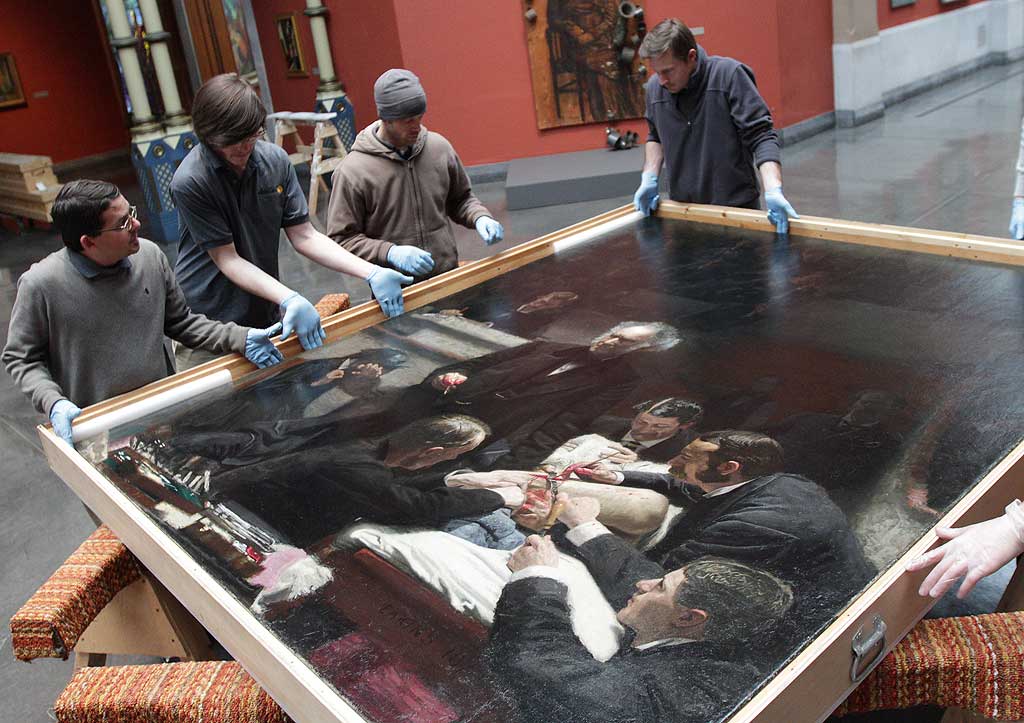
    Art handlers from PAFA and Atelier Art Services Inc. place “The Gross Clinic” in a packing crate in 2014. The painting was being moved for display at the Philadelphia Museum of Art. ( David Maialetti / Staff Photographer )

    The patient is a minor; the seated woman recoiling in horror is his mother. A chloroform-soaked cloth sedates the child .

    In this stopped-action moment, Gross is the commanding figure of the surgical amphitheater. While his assistants hold a retractor to keep the patient’s left thigh incision open, Gross calmly explains to his audience of students the modern practice of removing a piece of diseased bone caused by osteomyelitis.

    The moment celebrates stoic men performing surgery. Gross is a heroic savior giving renewed life to a patient who didn’t have to endure a brutal amputation and will retain use of both legs.

    Much of the amphitheater is cast in darkness, but a self-portrait of Eakins sits by a railing to imply authenticity of direct observation. He holds a pen or brush like Gross’ scalpel, suggesting that art making is akin to surgery.

    The artwork, Eakins believed, was “very far better than anything I have ever done,” as he wrote in an 1875 letter to Earl Shinn, a Philadelphia friend who had also studied at the Ecole in Paris.

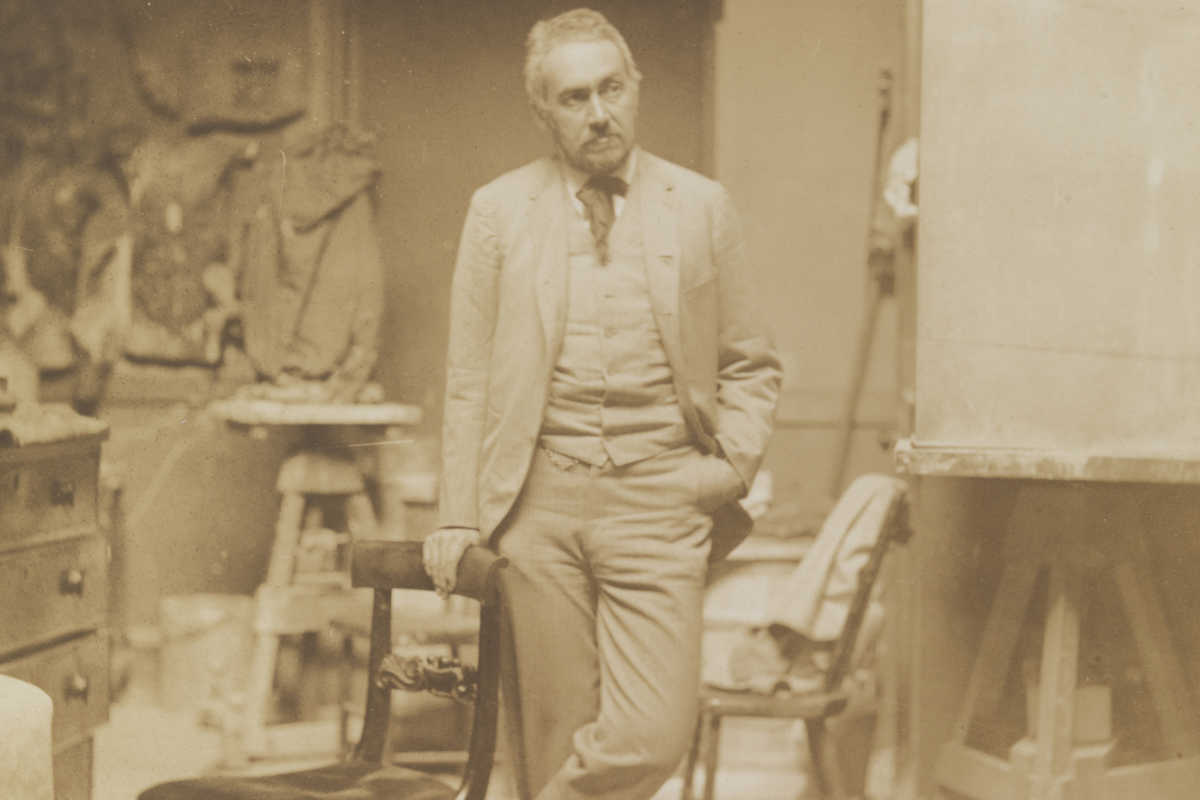
    Thomas Eakins in a Chestnut Street studio, 1891-92.Photo taken by Samuel Murray.

    Eakins had hoped the portrait of Gross would be seen at the large international art exhibition in Memorial Hall during the 1876 Centennial Exposition in Philadelphia, and help establish his reputation.

    It was rejected by the art jury, but was displayed as part of a medical exhibit in the U.S. Army Post Hospital. When the painting was exhibited later at the second annual exhibition of the Society of American Artists in New York, a New York Daily Tribune critic wrote: “It is a picture that even strong men find it difficult to look at long, if they can look at it at all.”

    Given the long-term relationship of Gross with Jefferson Medical College, the artist hoped the institution would acquire the painting for its art collection. It was only in 1878 that the Alumni Association of Jefferson Medical College purchased the portrait for $200 (approximately $6,660 in today’s dollars) and presented it to the school where it remained for 129 years.

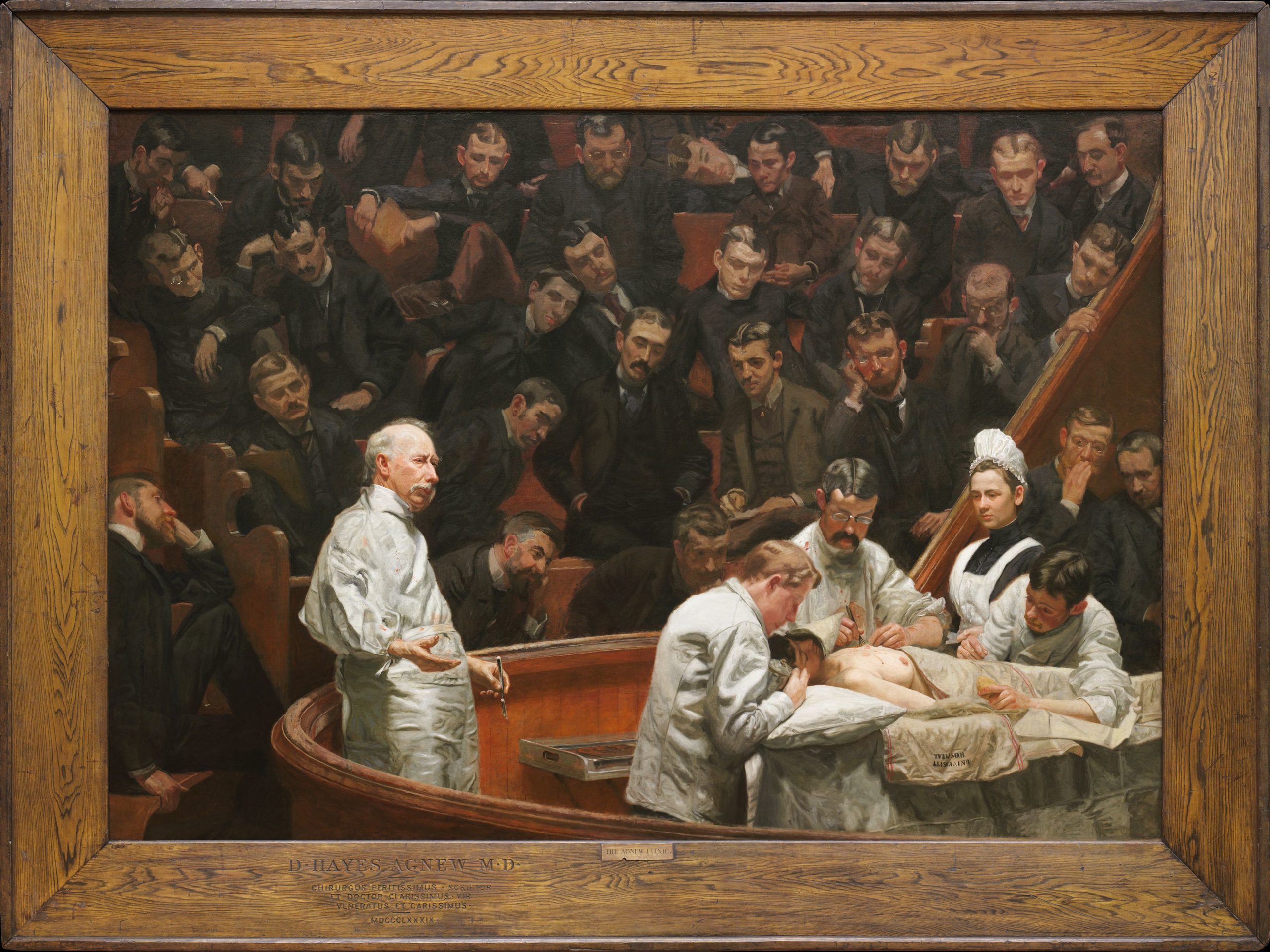
    “The Agnew Clinic” (1889) by Thomas Eakins. On long-term loan to the Philadelphia Museum of Art.Courtesy of the University of Pennsylvania Art Collection

    ‘The Agnew Clinic’

    Fourteen years later, in 1889, Eakins painted The Agnew Clinic.

    By then, he had taught at PAFA, which admitted women; a rarity in its time. Eakins believed all serious art students, regardless of gender, must work from the life model and learn anatomy.

    “I see no impropriety in looking at the most beautiful of nature’s work, the naked figure,” he said. His emphasis on nude life drawing and anatomical study was unsettling to Victorian propriety and his teaching methods eventually proved controversial.

    The last straw came in early 1886 when Eakins was giving an anatomy lecture during which he removed a loincloth from a male model in the presence of female students. As requested by the administration, the artist, who was the academy’s director, submitted his resignation, stating: “Was ever so much smoke for so little fire?”

    This was upsetting for him. In the summer of 1887, to overcome depression, Eakins made “a little trip to the West,” as he then wrote his friend and former student John Laurie Wallace, to experience “camp cure” at a ranch in the Dakota Territories.

    Back in Philadelphia, Eakins received a major boost when in February 1889, he was commissioned by a group of aspiring doctors from the University of Pennsylvania School of Medicine, the nation’s oldest, to paint their retiring teacher, David Hayes Agnew, a colleague of Gross. They offered the artist $750 (approximately $27,148 in today’s dollars).

    Eakins began work on The Agnew Clinic, his second clinic portrait.

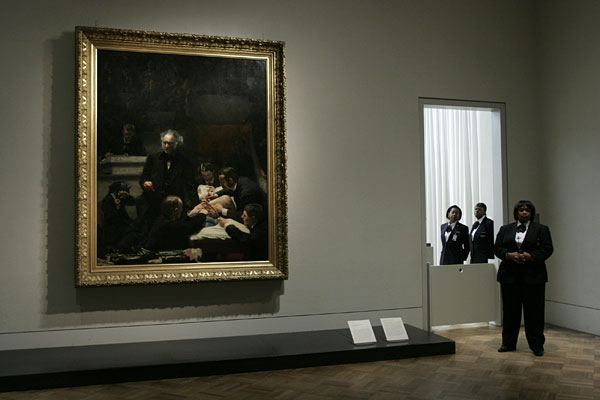
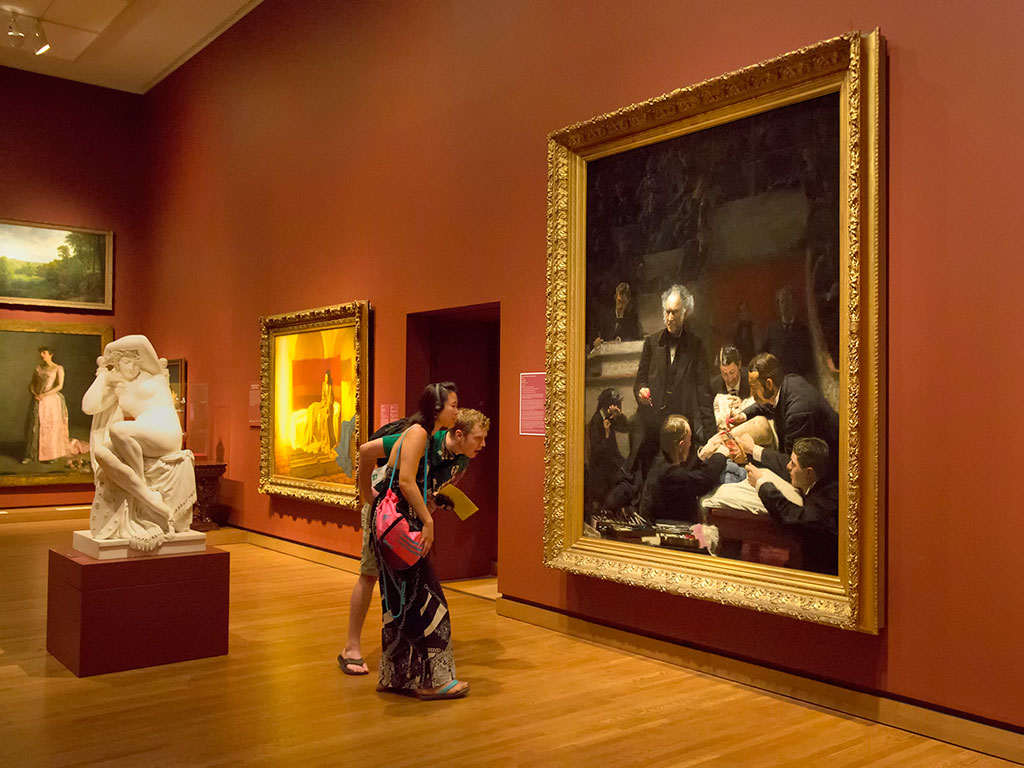
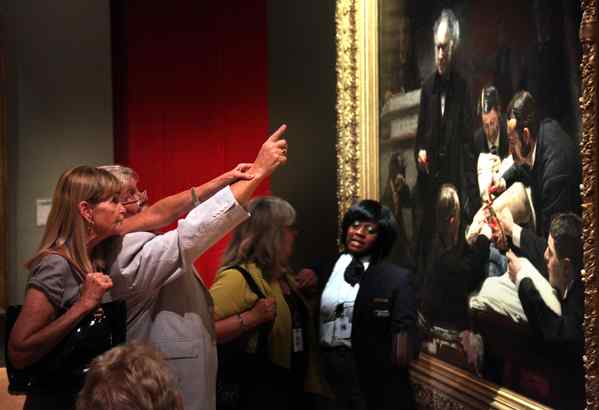
    Visitors look at Thomas Eakins’ “The Gross Clinic” in the newly redone American gallery at the Philadelphia Museum of Art in 2014.

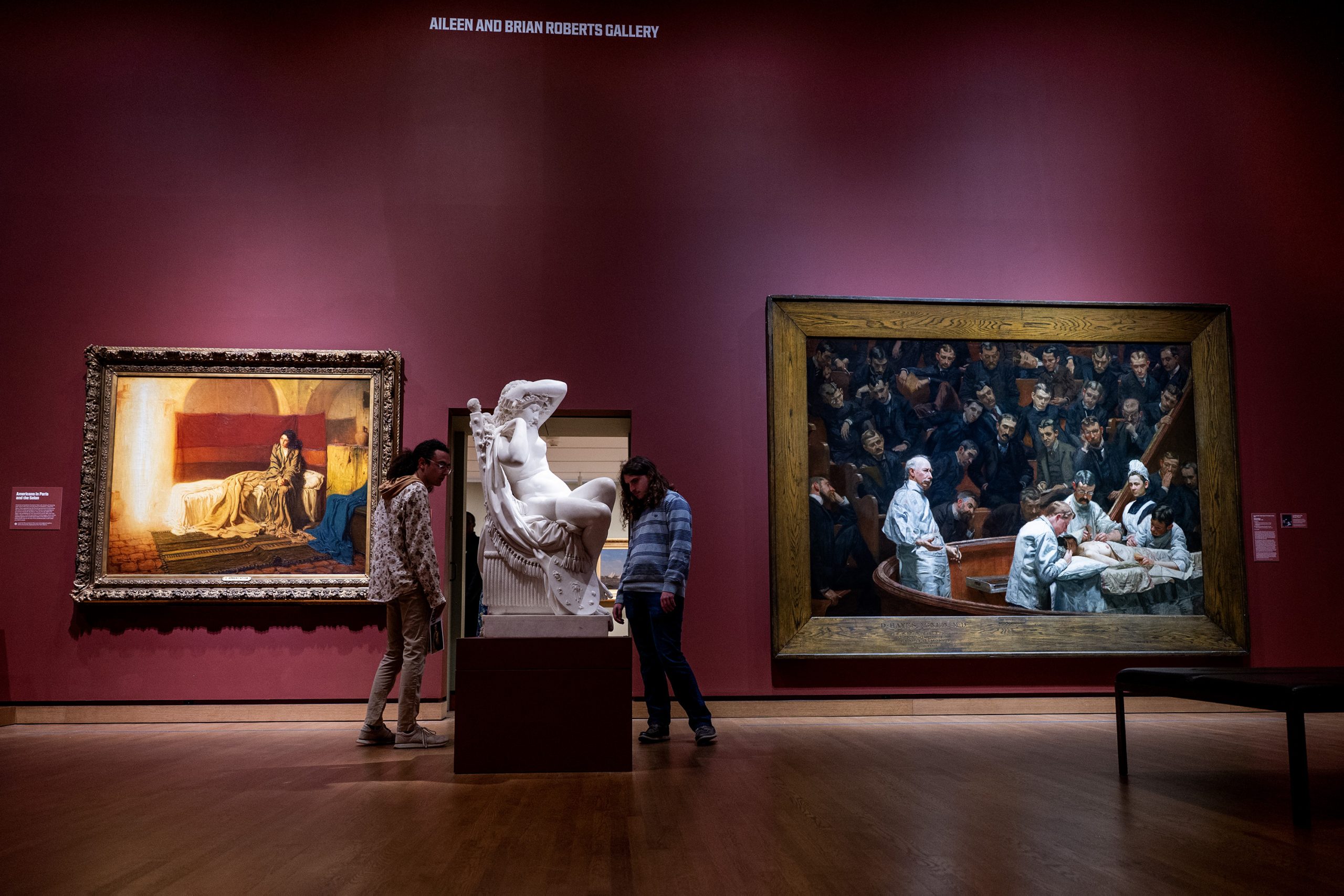
    Even larger, at 6 feet by 11 feet, the painting reveals some newly instituted aseptic practices. Surgeon Agnew and his team wear white gowns; sterilized instruments are placed in a covered tray. The operation has a nurse at the patient’s side, but no gloves or masks are seen being used.

    Because the canvas was too large for his easel, Eakins worked on the lower sections sitting on the floor, spending long days and nights (and occasionally falling asleep) on the studio floor. The work was completed in three months.

    With less dramatic lighting and looser brushstrokes than The Gross Clinic, Eakins shows Agnew in his pedagogical role operating with assistant physicians, a nurse from the HUP Training School, and more easily visible class members who are observing the surgery.

    Eakins places Agnew isolated at the left, lecturing. The patient, who has had a mastectomy, is having her incision sewn as a male assistant leans over her lower body. On the far right, the artist, who in this work was painted by his wife, Susan Macdowell Eakins, observes the nude woman sedated with an ether cone.

    Deemed “not cheerful for ladies to look at,” the painting is a most provocative choice of surgery for Agnew, who wasn’t a breast cancer specialist but an authority on gunshot wounds.

    The Agnew Clinic was given by the medical class of 1889 to their school.

    Marble sculpture “La Première Pose (center, 1873-1876) by Howard Roberts; and paintings “The Annunciation” (left, 1898) by Henry Ossawa Tanner and “Portrait of Dr. Hayes Agnew (The Agnew Clinic)” (right, 1889) by Thomas Eakins.in the “A Nation of Artists” show at the Philadelphia Museum Monday, May 4, 2026, in the newly renovated American galleries which were closed for several years.Tom Gralish / Staff Photographer

    Side by side

    Eakins is a distinguished presence in “A Nation of Artists,” the exhibition of 1,000-plus artworks organized by the Pennsylvania Academy of the Fine Arts and the Philadelphia Museum of Art to mark the 250th anniversary of the founding of the United States.

    The Gross Clinic at PAFA and The Agnew Clinic at the PMA are part of this expansive dual-venue survey of American artworks; each is a tour de force.

    The two medical portraits reveal the painter’s respect for the art of surgery, underscoring Philadelphia’s vital role in medicine and its preeminent medical schools. Anesthesia, which was newly introduced in the 19th century, is used in both operations.

    Both paintings were not well received and regarded as disturbing and unsightly. But both of those large clinical portraits were exhibited together at the 1893 World’s Columbian Exposition in Chicago.

    A Philadelphia Public Ledger writer complained that the “surroundings and accessories are scarcely in good taste for a public exhibition.” Another critic dismissed “the clinical horrors” as “ghastly symphonies in gore and bitumen” and mused: “To have hung the pictures at all was questionable judgment.”

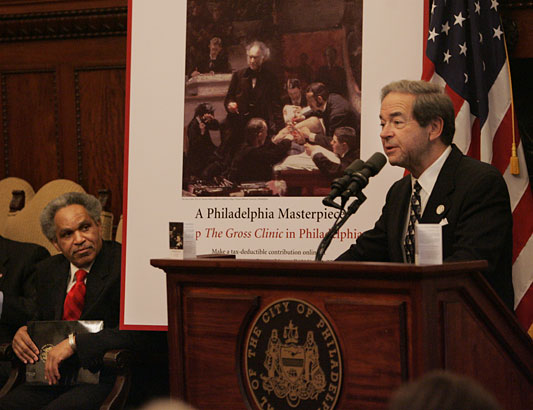
    In this photo from 2007, Herbert Riband, vice chairman of the board at the Pennsylvania Academy of the Fine Arts, speaks at City Hall as Mayor John Street listens during the announcement that the Philadelphia Museum of Art and PAFA are to acquire “The Gross Clinic.” Michael Bryant / Inquirer Staff Photographer)

    Afterlives

    In November 2007, Jefferson Medical College agreed to sell The Gross Clinic for the stunning sum of $68 million offered by Alice L. Walton, Walmart heiress and founder of the Crystal Bridges Museum of American Art in Bentonville, Ark.

    It set off a maelstrom resulting in a spirited fundraising campaign that successfully matched her price in a few weeks, keeping the masterpiece in Philadelphia. With a few thousand donations, PAFA and the Art Museum jointly acquired the canvas.

    The two institutions collaboratively share the painting on a five-year cycle; it will be at PAFA until 2031.

    On opening day of an exhibition at the Art Museum’s Perelman Building, visitors gather around Thomas Eakins’ “The Gross Clinic.” Photo from 2010.LAURENCE KESTERSON / Staff Photographer

    Unlike The Gross Clinic, Eakins was asked to paint the portrait of Agnew, creating his second clinic image and the largest canvas of his career. It was completed for presentation at the graduation ceremony that took place at the Academy of Music on May 1, 1889. Its original wood frame has a Latin inscription believed to have been carved by Eakins honoring Agnew as “the most experienced surgeon, the clearest writer and teacher.”

    Since 2000, the canvas has been on loan from the university to the PMA.

    While recent research has shed light on his pattern of sexual harassment, including allegations that he sexually molested his niece, Eakins continues to be appreciated as an individualist and one of America’s greatest painters. He maintained: “My life is all in my work.”

    “A Nation of Artists” runs through July 5, 2027, at the Philadelphia Museum of Art (2600 Benjamin Franklin Parkway, Philadelphia, 215-763-8100 or philamuseum.org) and through Sept. 5, 2027, at the Pennsylvania Academy of the Fine Arts (118-128 N. Broad St., Philadelphia, 215-972-7600 or pafa.org). Note: Exhibit admission is separate at each venue, though discounts are available to view both.

  • We are not part of Jalen Carter’s family, we shouldn’t care where LeBron lives, and other thoughts …

    We are not part of Jalen Carter’s family, we shouldn’t care where LeBron lives, and other thoughts …

    First and final thoughts …

    Jalen Carter said something very sweet and very incorrect during a news conference Wednesday. In answering questions about his new contract extension with the Eagles — an extension that reportedly guarantees him $106 million — Carter paused while answering a question and mentioned all the people to whom he was grateful.

    “Wanna slow it down,” he said. “First, I want to say I’m thankful to God for putting me on this earth. Thankful for the coaches, the players, Mr. Lurie.”

    Then he nodded toward the media members gathered in front of him.

    “Thankful for you guys, too,” he said. “You guys put out some good information, some good facts about me, stuff like that. We’re all one family.”

    No, we’re not.

    Now, some of the people in the media tent at that time definitely were. Members of Carter’s actual family were on hand, as were several Eagles staff members and his friend and teammate Jordan Davis. And some other people there either don’t mind thinking of themselves as members of the Eagles’ family or have bosses who would like them to be thought of that way.

    But a fair number of us weren’t there to congratulate Carter for his newly attained wealth or share in the optimism that he will fulfill his potential and become a Hall of Fame-caliber defensive tackle. We were there to listen to what he said, to listen to what Howie Roseman and Nick Sirianni and Carter’s teammates said, to listen to other people in and around the Eagles’ organization said about the signing, and to explain what happened and what it might all mean. We might even point out that Carter has made some pretty big mistakes in his life and football career, and those mistakes raise the possibility that he won’t live up to such a lucrative contract, and he and the Eagles ought to be held to account for such decisions and mistakes.

    We were there to tell people what’s really happening or what we really think. We’re not going to sit on information or a story because it might embarrass or anger a coach or player or make things more difficult for the franchise. We were there to report, not to support. There’s a difference, and when you note that difference nowadays, you risk coming off like a scold, a jerk, an egomaniac, or all of those things at once. You face the inevitable barrage of complaints from those who want to be told only what they want to hear; who presume that you root for the athletes and teams that you cover and, when they find out that you don’t, insist that you should; and who can’t comprehend how someone could report or write something in good faith that was critical of those hometown heroes. Which is OK. That complaining, even the nastiest of it, comes with the job, and you have to be able to take it.

    Put simply, we’re there to be as fair and accurate and honest as we can be, but we’re not part of the team. We’re not part of the family. We’re not supposed to be.

    Quick hitters

    Wilt Chamberlain lived in Manhattan while he played for the Philadelphia Warriors. JJ Redick lived in Brooklyn while he played for the 76ers. If you are genuinely dismayed that LeBron James might not live in Philadelphia or any of its surrounding towns and suburbs during his (brief) career with the Sixers, please get in your car, drive it north on I-95, and, for perhaps the first time in your life, continue past the Street Road exit. There’s a whole world up there. …

    Kudos to Tom McCarthy: Phillies TV play-by-play man, former radio voice of the St. Joseph’s Hawks, all-around gem of a human being. During Tuesday’s Phillies-Marlins telecast on NBC Sports Philadelphia, he delivered a brief and beautiful eulogy for Chris DiJulia, the son of longtime St. Joe’s athletic director Don DiJulia and as familiar a presence as anyone connected to the school’s athletic program. Chris, who had cerebral palsy, died Monday night. Tom even mentioned the moving tribute that former Inquirer staffer Mike Jensen wrote to Chris on Mike’s Facebook page. …

    Jeez, that whole Flyers-are-having-the-most-interesting-offseason-of-any-Philly-team thing sure fizzled out fast. …

    Probable NBA schedule on Christmas. You know, to maximize viewership:

    • Noon: Celtics at Sixers
    • 3 p.m.: Cavaliers at Sixers
    • 8 p.m.: Sixers at Knicks
  • Bryce Harper took the wrong approach. But that’s not saying he wasn’t completely right.

    Bryce Harper took the wrong approach. But that’s not saying he wasn’t completely right.

    Bryce Harper was right to be frustrated.

    He had the right diagnosis. He had the right prescription. He had the right motivation.

    He took the wrong approach.

    The first four of those things are the only ones that should matter to anybody invested in the Phillies’ approach to this year’s MLB trade deadline. That goes for the fan base and the members of the media, both social and mass.

    To the bloggers, the Twitterers and the TikTokers, the radio gabbers, the ink-stained goobers still typing with two hands, and to anybody else who has spent the last couple of days displacing their aggression upon a guy who desperately wants to win and has served honorably on the mission … let’s all heed the words of QB1 and “keep the main thing the main thing.”

    The main thing is this: Harper is right.

    “I think we need some help,” Harper told reporters earlier this week. “But you know, I think we’ve proved pretty much all year we’ve done a pretty good job. But anytime you can get some help in here and reinforcements, I think it helps.”

    The Phillies need all the help they can find. Rarely does a World Series contender arrive at August with this many holes. Dave Dombrowski will be doing his roster a massive disservice if he operates in triage mode. Starting pitching? Relief pitching? One outfielder? Two? Yes and yes and yes and yes. If the Phillies want to escape the slippery slope they are currently sliding down, they can’t afford to treat the deadline as an either-or proposition.

    “I think both,” Harper said when asked whether the Phillies need an arm or a bat. “Obviously, everybody knows what we need …”

    Phillies designated hitter Kyle Schwarber has been one of baseball’s best power hitters. But the question is, how long can he sustain this?Yong Kim / Staff Photographer

    Is it unrealistic to think that the Phillies can acquire everything they need over the next three days? Maybe. But they darn sure need to try. Harper, Kyle Schwarber, Zack Wheeler — all are at points of their career where they may never be as good again as they are right now.

    Factor in Jesús Luzardo and Jhoan Duran and Cristopher Sánchez and the Phillies almost certainly will never have another season with this much individual dominance among their stars. That group alone is enough to give the Phillies a near-even chance in practically any playoff series. But they need to get there, and they need to do it with enough depth to win three or four series in a row.

    Unrealistic? Maybe not when considering how low the bar for improvement is. The Phillies entered Thursday with the lowest on-base percentage in the majors. There’s no mystery why they seem to struggle to score runs. The fewer men a team puts on base, the fewer of them can score.

    Harper sees it. Think about your frustration level when watching it on TV. Now think about how you’d feel if you were watching it from the dugout, or the on-deck circle, or while standing on second base.

    Phillies left fielder Brandon Marsh (right) has been a consistent threat but is in the throes of a slump.Yong Kim / Staff Photographer

    The five most discouraging words in the human language are, “Now batting fifth, Edmundo Sosa.” The seven most discouraging words: “Now batting sixth, Bryan De La Cruz.” The Phillies lineup right now is Harper and Schwarber and a bunch of replacement-level players.

    That’s almost literally true, by the way.

    Besides Schwarber and Harper, the only two regulars with a positive offensive WAR are Bryson Stott and Brandon Marsh. The Phillies entered Thursday with MLB’s fourth-worst aggregate WAR among position players. That’s especially damning when you consider how good Harper and Schwarber have been. The only teams worse are the Mets, Rockies, and Reds. Just ahead of them are the Blue Jays and Angels. All will be selling off their rosters over the next few days.

    The Phillies shouldn’t need to bankrupt their system to bring in a line change at the trade deadline. Four years ago, they acquired Marsh, David Robertson, Noah Syndergaard, and Sosa midseason. Two years ago, they landed Austin Hays, Carlos Estevez, and Tanner Banks. Last year, they traded for Duran and Harrison Bader and also signed Robertson. Quantity is rarely an issue.

    Rarely has it been so sorely needed.

    The trade deadline’s dirty little secret is that it doesn’t matter nearly as much as everybody dreams it does. Baseball is too fluky a sport to expect two months of game-changing impact simply because you paid a high price. I would venture to guess that Dombrowski’s results haven’t been better or worse than the average GM.

    Former Phillies prospect Hao-Yu Lee, who was traded to Detroit for Michael Lorenzen is hitting is hitting .307 in his last 51 games for the Tigers.David Banks

    He won the Marsh deal, marginally lost the Hays deal, and more or less got what he paid for in aggregate. One exception could be the 2023 trade for starter Michael Lorenzen. Prospect Hao-Yu Lee is hitting .307 with an .817 OPS in his last 51 games for the Tigers. He bats right-handed, by the way.

    The overarching point here is the process. The smoke signals are at least promising. The Phillies scouted Mets righty Clay Holmes’ rehab outing earlier this week. He’s a guy who would make a ton of sense, both as a rotation stabilizer in the present and as a potential postseason swingman in the future.

    A report from the New York Post had the Phillies interested in Blue Jays outfielder Daulton Varsho. The son of former Phillie Gary Varsho, he had five extra-base hits in the Blue Jays’ American League Division Series win over the Yankees last October. He’s left-handed, but, again, the Phillies need help everywhere. Plus, he can play center field.

    Toronto Blue Jays’ Daulton Varsho (center), son of former Phillies outfielder Gary Varsho, is a player some say the Phillies are looking at.Nathan Denette

    The broader point about Holmes and Varsho is they are the guys the Phillies should be targeting. Each is a couple months way from free agency. Dombrowski and John Middleton both have a history of taking big swings on players with years of club control beyond the present season. Duran and Marsh both fit that profile.

    Before them: Hunter Pence, Cliff Lee, etc. The Phillies’ needs are broad enough that they can’t afford to pay a premium price for any single player. Rentals sure look like the way to go for a team in their situation. Add the Orioles’ Taylor Ward to the list.

    As for Harper? From at least one perspective, the debate about his comments is much ado about nothing. There’s nothing less consequential than a player’s relationship with his front office.

    From another perspective, Harper would be wise to reconsider his approach. Nothing that he says is going to change a thing about how the Phillies operate at the deadline. It’s far more likely that his outspokenness ramps up the pressure on the guys whom he has implicitly deemed to be not good enough.

    The issue is not so much clubhouse chemistry as it is individual psyche and its impact on performance. Sure, some guys need a kick in the butt. But many others need a comfort zone. Whatever Harper’s evaluation of the talent around him, however accurate it is, the Phillies are likely going to need at least one or two of them to perform to win a World Series.

    Next time, he’d be better off keeping his honesty off the record and taking comfort in the fact that the rest of us already know exactly what the Phillies need to do.

  • Eagles practice observations: Tank Bigsby and run game juice; expendable cornerbacks; Jake Elliott’s pressure

    Eagles practice observations: Tank Bigsby and run game juice; expendable cornerbacks; Jake Elliott’s pressure

    The Eagles held the second practice of their 2026 training camp on Thursday at the Jefferson Health Training Complex. These were my observations from Day 2 (and this reminder of Day 1):

    Kicking and redeeming

    I’m going to start with how practice started: Jake Elliott kicking field goals. It might not be as sexy as the new offense or how the rookies look, but the Eagles need Elliott to return to form this season. He’s coming off back-to-back down years, and yet the team didn’t add competition in camp. Kickers are essentially competing with whoever is on the street. But special teams coordinator Michael Clay’s comment about Elliott during the spring — that his job was to help the 10-year veteran “fall in love with the game again” — made me wonder if Elliott could have benefited from additional pressure.

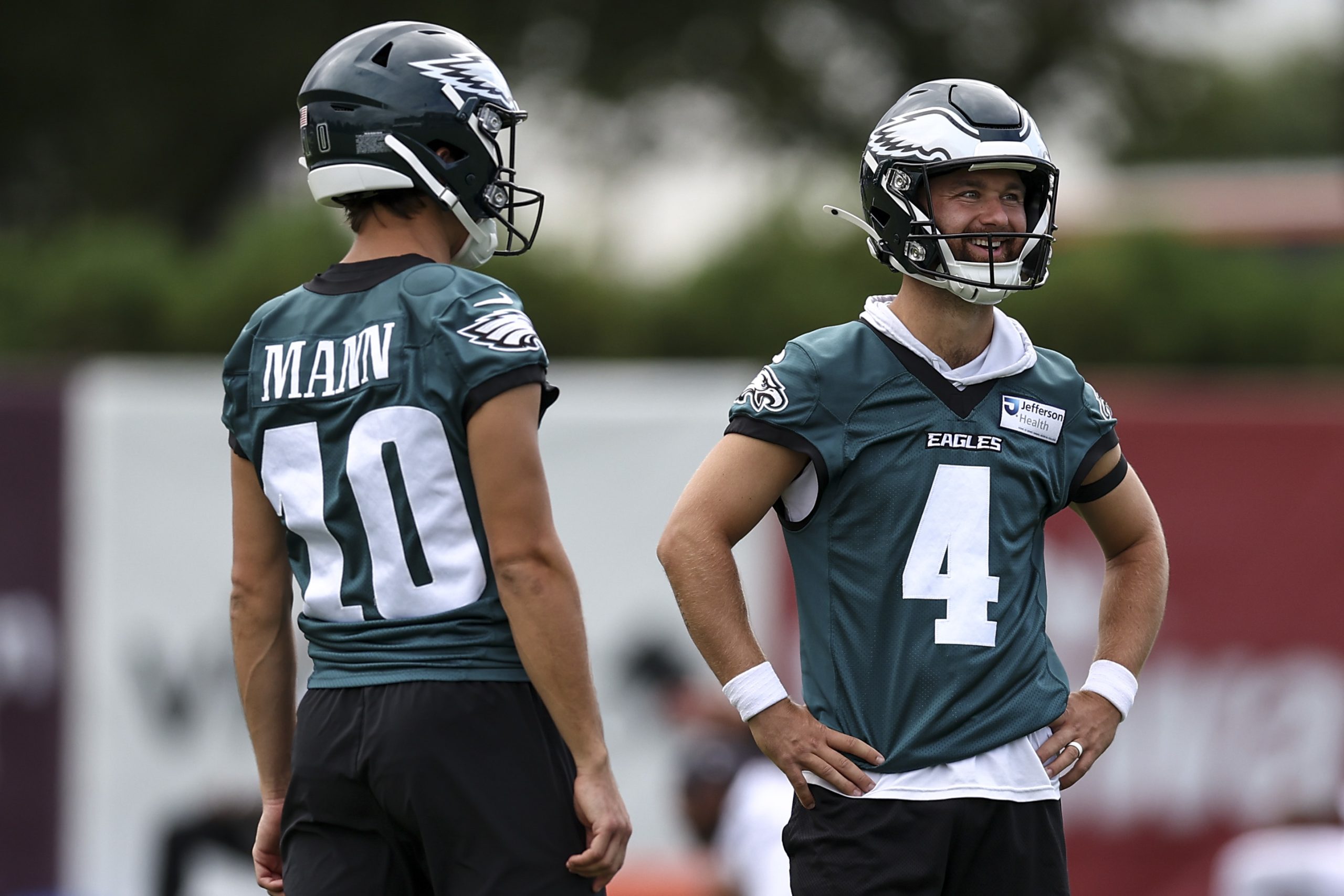
    Eagles punter Braden Mann (left) talks with kicker Jake Elliott during the second day of training camp at the Jefferson Health Training Complex on Thursday.Monica Herndon / Staff Photographer

    His camp got off to a solid start in windy conditions. He made 6 of 7 kicks, hitting from around 33, 35, 37, 43, 43 and 46 yards. He hooked a 40-yard try wide left. Elliott has a natural tendency to draw the ball, and the wind was blowing in that direction, so it was a tough kick from the right hash mark. Nevertheless, he has more riding on this summer’s performance than he has in years.

    Running it up

    The Eagles’ best (offensive) seasons during the Nick Sirianni–Jalen Hurts era have come with a dominant run game. Last season’s regression on the ground can be attributed to many factors, but the switch to the Kyle Shanahan-Sean McVay scheme could be just the medicine needed for a unit that has many of the same returning parts. There were positive signs on Day 2 with running backs Saquon Barkley and Tank Bigsby bolting into space on outside zone runs.

    There was one stretch when Barkley jetted through a gaping hole off the left only to be followed by Bigsby a play later turning the corner on the right. There was success up the middle, too. Bigsby benefited from wide receiver Makai Lemon’s misdirection motion and had a seam through the front seven into the secondary.

    The defense is still limited in terms of contact without pads. So I don’t want to get ahead of myself. But clearly the offensive line is already taking to the increased usage of wide zone blocking. How Hurts fits into the equation remains to be seen, but I can’t see the Eagles completely abandoning him as a plus-one factor in the run game.

    Some of the new looks should benefit quarterback Jalen Hurts and the offensive line. Monica Herndon / Staff Photographer

    Marrying kind

    That being said, there’s likely going to be less of Hurts on the ground on designed runs because of the marrying of the run with the pass off under-center plays. A perfect example of its effectiveness came off a play-action fake to the left as Hurts rolled naked to the right and hit a wide-open DeVonta Smith on a short crosser. These aren’t just layups for the quarterback, but also for the offensive linemen, who don’t have to necessarily block at the point of attack.

    There were still struggles in the pass game. Hurts completed just two passes on his first six dropbacks. He tucked the ball and scrambled on two pass plays and once threw the ball away — not necessarily “bad” decisions — but there was a toss to receiver Darius Cooper that linebacker Zack Baun deflected from underneath and a wounded duck to a double covered-Smith that fell short.

    Passing through

    Hurts and Smith had more chemistry during 7-on-7s. In fact, it looked like child’s play, even with the receiver up against Quinyon Mitchell. Smith flashed late hands near the sideline on a pass thrown just out of the All pro cornerback’s reach. Lemon has often lined up in the slot, but he motioned outside during one repetition, and caught a pass underneath corner Riq Woolen during 7-on-7s. Woolen nearly had an interception a play later, but Hurts’ forced throw sailed through his hands.

    The pass offense had some nice moments late in the workout. Hurts sidestepped a rusher and hit receiver Dontayvion Wicks at the second level in team drills. And Wicks ended the main portion of practice by high-pointing a jump ball his quarterback threw up for grabs.

    Mac McWilliams (22) and Riq Woolen (2) are part of a deep cornerback group. Monica Herndon / Staff Photographer

    Cornering the market

    The Eagles’ starters at cornerback are set, but they also have depth and could be open to moving players like Kelee Ringo or Jakorian Bennett if some youngsters develop and trade partners open up. Here’s how I see the depth chart at the position (knowing several players are cross training at outside/slot cornerback and safety):

    Safety plan

    Vic Fangio confirmed that the safety job opposite Andrew Mukuba very much remains a competition, although it will likely be a by-committee approach with Cooper DeJean at the spot in base personnel and maybe more than one guy filling the role in nickel.

    Marcus Epps and Michael Carter II have taken turns working alongside a combination of DeJean and Mukuba. Sometimes it’s just been the two of them at safety with the first unit. I think the best I can say about each of them is that neither has made a glaring mistake or busted a coverage.

    Fangio said both starting safeties — whoever they are — will take over the departed Reed Blankenship’s responsibility as the main communicator on the back end. Baun will once again wear the “green dot” on his helmet and call plays for the entire defense.

    Jonathan Greenard’s absence puts Nolan Smith Jr. and others under increased scrutiny. Monica Herndon / Staff Photographer

    Greenard days

    Fangio wasn’t as sanguine about the injured Jonathan Greenard as general manager Howie Roseman was the day prior. The Eagles don’t expect the outside linebacker, who recently strained a pectoral muscle, to be out long term. But what exactly does that mean? They wouldn’t have placed him on PUP if there wasn’t at least a chance he’d miss part of the regular season.

    No Greenard by Week 1 would likely mean the Eagles are back to where they were a year ago when it was clear they lacked a top-end edge: with Nolan Smith Jr. and Jalyx Hunt starting. Both have shown obvious promise, and there are options off the bench. But Fangio threw some cold water on the notion that all is well with Greenard.

    A few of the reserve edges stood out on Thursday. Arnold Ebiketie shed a block and stopped Barkley at the line on a run play. A.J. Epenesa was Johnny-on-the-spot after a Cole Payton pass deflected off receiver Danny Gray’s hands to him.

    Payton planning

    Payton had a rough day. While the Epenesa pick was hardly his fault, he tossed two other interceptions. Linebacker Chance Campbell undercut a seam route by tight end Dae’Quan Wright for one, while rookie linebacker Keyshawn James-Newby had the other on a poorly thrown pass during the developmental period.

    Carson Steele has gotten his share of handoffs, but not as a fullback. It’s unclear how much coordinator Sean Mannion will feature the position in his offense. Tight end Cameron Latu handled the job at times last season, but veteran tight end Johnny Mundt could fill the role. He’s been the primary second blocking tight end in “12″ personnel so far.

    Tanner McKee (16) has some competition for the No. 2 job from Andy Dalton. Monica Herndon / Staff Photographer

    Quarterback view

    Payton’s potential could factor into whether the Eagles feel comfortable enough to trade Andy Dalton. I can’t see Tanner McKee being on the market, although the two quarterbacks continued to split snaps with the second unit.

    Dalton hooked up with receiver Quez Watkins and rookie tight end Eli Stowers on short passes in team drills. Latu couldn’t hang onto a heave into traffic later in the set. McKee found receiver Britain Covey alone off play-action and later in the soft spot of a zone during 7-on-7s.

    Extra points

    The Eagles had their first injury of camp when second-year tackle Cameron Williams went down during team drills. He waved off a cart, then walked off the field with trainers. Williams never returned after a visit to the medical tent. … Fangio said rookie defensive tackle Uar Bernard, who never played organized football, was on the “PP plan — lots of patience, lots of persistence.” You don’t have to be an expert to see the native of Nigeria is extremely raw. … Eagles legend Brian Dawkins was in attendance and watched practice. … Friday’s walk-through is closed to reporters. We’ll be back at the Jeff for Saturday’s session.

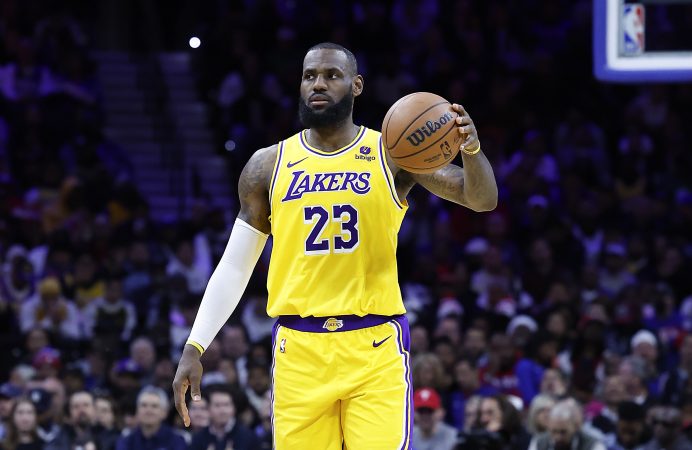
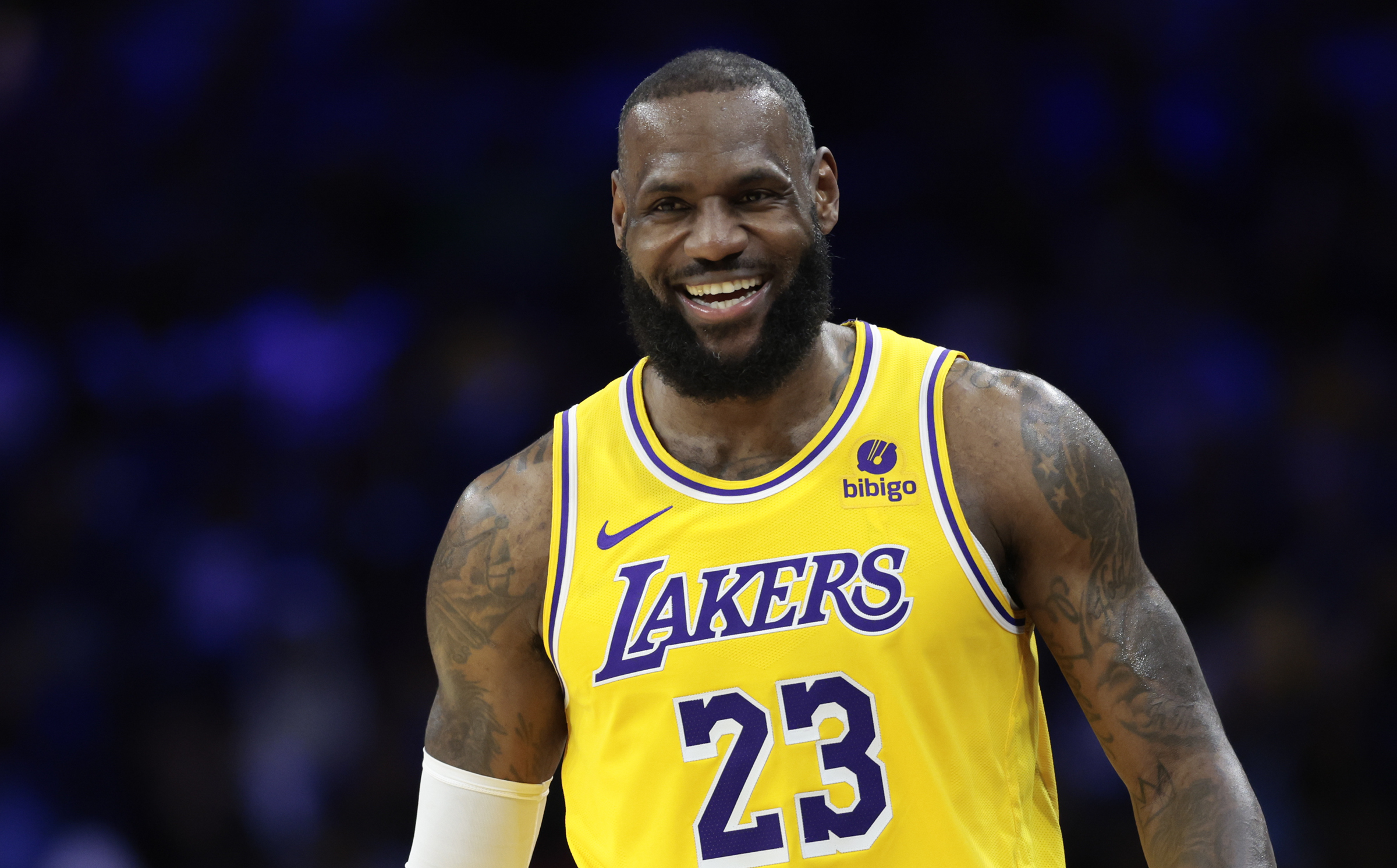
  • LeBron James chose underdog Philly like Bryce Harper, Pete Rose, and Saquon Barkley. He chose us.

    LeBron James chose underdog Philly like Bryce Harper, Pete Rose, and Saquon Barkley. He chose us.

    To witness the reaction to LeBron James’ decision to play in Philadelphia the next two seasons, you might have thought we’d beaten the Russians to the moon or ended the next world war. Folks drove down Broad Street honking their horns, heads hanging out of their cars. Total strangers standing on subway trains staring at their phones got the notification, looked up, and high-fived. Somewhere, lions lay down with lambs.

    This, for a 41-year-old coming off the worst of his 23 seasons?

    Yes. Yes. A thousand times, yes. But why?

    Because Philadelphians won. They won the LeBron Sweepstakes.

    The King chose Philly.

    The King chose us.

    James chose a franchise that hasn’t won an NBA title in 43 years, has only one title in almost 60 years, and hasn’t advanced past the second round of the playoffs in 25 years. He chose a city with three total championships since James was born in 1984; James himself has won four. He chose a city with a national reputation for abrasiveness, confrontation, and, above all, losing — a reputation resented by the residents of Philadelphia and its region.

    Still: He chose us. He might occasionally commute to Philly from Manhattan, but he’s paying his taxes here.

    If Joel Embiid and Tyrese Maxey and Jaylen Brown and VJ Edgecombe again fall short in the playoffs, LeBron still chose us. He could have joined Steph Curry in San Francisco, Giannis Antetokounmpo in Miami, James Harden in Cleveland.

    But no. We won. And we acted like it.

    Phil Martelli, revered basketball coach and lifelong Philadelphian, knows why.

    “I’ve had this in my head forever. People think we’re bad losers. That’s not what we are,” Martelli said. “We are insufferable winners.”

    Validation

    I’ve been a Philadelphian for 31 of my 57 years. Martelli’s been a Philly guy for all 71 of his. I told him that, in my three decades, I’ve observed that Philly has an inferiority complex, a chip on its shoulder, and a healthy sense of pride.

    “No doubt,” Martelli agreed. “No doubt.”

    So, when good things happen, a dam always breaks. From climbing greased streetlights to eating horse manure (this really happened), Philly fans have earned a reputation of, well, overexpression when the rare championship finally lands at their feet.

    It is that rarity, that desperation for validation, that generates euphoria when a big name decides that Philly is good enough for him.

    That’s the key: The decision must belong to the player.

    LeBron James validated Philadelphians when he picked us. Yong Kim / Staff Photographer

    That’s why Reggie White doesn’t qualify. Eric Lindros, Julius Erving, Moses Malone, Roy Halladay, all trades or purchases.

    Bryce Harper, however, already had won an MVP by the spring of 2019. The Yankees, Dodgers, Giants, and White Sox courted him. So did the Padres, until they signed Manny Machado, who, folks might not remember, was the Phillies’ first choice. But the fans always preferred Harp, and, ultimately, Harp preferred them. And he was only 26.

    Similarly, by the 1978 offseason, Pete Rose had been a National League MVP, but he also was the MVP of one of his two World Series titles with Cincinnati. He was a stone-cold winner, and, even though he would be 37 in 1978, he was still the top free agent. The Phillies’ four-year, $3.24 million offer was the worst he received — others included more money, a lifetime $100,000 annual pension, oil and beer investments, and racehorse ownership — but Rose saw a winner in Philly, and Philly utterly rejoiced.

    Compared with Harper and Rose, there was less excitement (and less competition) when Saquon Barkley signed with the Eagles in 2024. The Bengals, Texans, Ravens, and Bears contended but the Eagles won, and Barkley, a Lehigh Valley native, came home, to much rejoicing. That season Barkley produced record-setting numbers and pushed the Eagles to a Super Bowl win, so it’s tempting to recast his choice as being a bigger deal than it was. He’s still never going to have to buy his own beer in Philly.

    Saquon was the centerpiece of a run to the Eagles’ second Lombardi Trophy. Rose pushed the 1980 Phillies to the first World Series win in franchise history. Harper won a second MVP, in 2021, and led the Phillies to the 2022 pennant.

    They delivered on their promise.

    This seldom is the case.

    Unfulfilled promise?

    Age, injury, and Ryan Howard made Jim Thome redundant in the mid-2000s. Cliff Lee rejected the Yankees and took less to return to the Phillies in 2011, but to no good end. Jake Arrieta was a big-time bust, Lance Parrish was a late-80’s disappointment, Al Horford was a bad fit with Embiid, and Nnamdi Asomugha was cooked by the time he became a “Dream Team” Eagle in 2011.

    LeBron never will be classified among Philly’s worst signings, if only because his two-year, $8 million contract earns him 33% less than Anfernee Simons (for casuals, Simons is the new backup shooting guard). LeBron would be a magnificent value at $4 million a year if he was an assistant coach.

    Still, there are expectations. After LeBron signed, the Sixers’ aggregate odds to win the NBA title jumped from tied for sixth-best, at 20-1, to third-best, at about 9-1.

    “You know there’s people already staking out spots on Broad Street for the parade,” Martelli said.

    When Rose, Harper, and Saquon signed, everybody got excited. Nobody staked out spots on Broad Street.

    The LeBron-mania is palpable. Ticket and jersey sales have been inflated beyond sanity and availability, with no real end in sight. Don’t expect Knicks fans to take over Xfinity Mobile Arena this season.

    There has been excitement surrounding arrivals before, but never anything like this. The only arrival that might cause a similar disruption would involve a biblical rapture.

    Like that king, this King will be expected to raise his following from the dead.

    And, like that king, this King has chosen us.

  • The Phillies do ‘need some help’ by trades. But they also need some from Bryce Harper and his teammates.

    The Phillies do ‘need some help’ by trades. But they also need some from Bryce Harper and his teammates.

    Help!

    I need somebody …

    Help!

    … not just anybody …

    Help!

    … you know I need someone …

    Helllllllllllllp!

    Nine losses in 12 games over a span of 14 days will have an effect on people, especially when the trade deadline is bearing down.

    It caused Bryce Harper to channel John Lennon.

    “I think we need some help,” Harper told reporters in Miami — and that was before the Phillies gagged a 6-0 lead into an 8-6 loss Wednesday, the worst gut punch at the worst time.

    OK, before we continue: Harper isn’t wrong.

    Everyone can see that the Phillies need, at minimum, a right-handed hitter, a late-inning reliever, and another starting pitcher. The front office is aware; 29 other teams know it, too.

    Some of it is the consequence of bad luck. The Phillies’ most expensive offseason additions — right fielder Adolis García and reliever Brad Keller — went down with season-ending injuries. Mostly, though, it’s an indictment of Dave Dombrowski’s Jenga-tower roster that a team with a $317 million luxury-tax payroll has so many holes.

    And, well, take it away, Bryce.

    “I think we’ve proved pretty much all year, we’ve done a pretty good job, but any time you can get some help in here and reinforcements, I think it helps,” he said. “… I think obviously everybody knows what we need. We need both [hitting and pitching].”

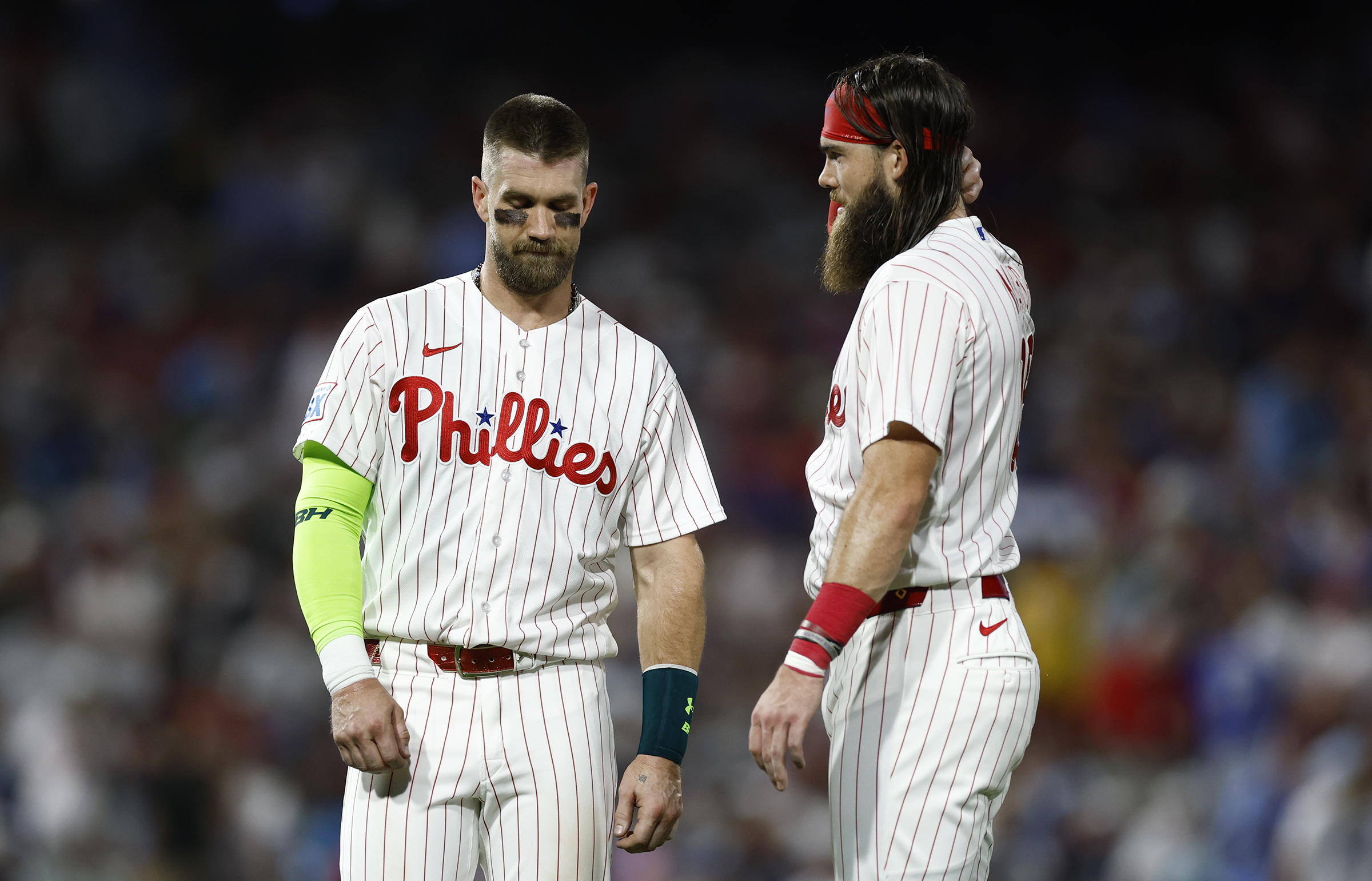
    Bryce Harper (left) and Brandon Marsh have struggled at the plate since representing the Phillies in the All-Star Game.Yong Kim / Staff Photographer

    Harper shared that opinion during All-Star week and reiterated it to MLB.com and The Athletic a few days ago. But because his latest comments were on camera, and because the deadline is Monday, his words were amplified.

    So, can the Phillies get everything they need?

    “I don’t know,” Harper said. “We’ll see. I mean, that’s a Dave question.”

    As in Dombrowski, who irritated Harper after last season by wondering if he was still elite. They talked it out in spring training, and as owner John Middleton said, “I’m confident that everything’s behind us now.” Clearly it isn’t. As long as Harper hits and Dombrowski builds a contending roster, they will co-exist. But Harper’s cry for help, five days before the deadline, likely annoyed the front office.

    In reality, there’s only so much help available on the trade market, with right-handed bats especially scarce.

    Entering play Wednesday, 22 teams were no worse than 3½ games out of a wild-card spot. Within that extreme seller’s market, neither Mike Trout nor Byron Buxton is willing to waive no-trade rights. Buxton (hip) went on the injured list Wednesday, and two more available right-handed bats — Spencer Steer of the Reds and the Giants’ Casey Schmitt — suffered major injuries this week.

    Last weekend, the Red Sox dealt Connelly Early, a 24-year-old lefty with six quality pitches and five years of club control, for infielder Curtis Mead, who was having a breakout season for the Nationals after getting designated for assignment in March. And even before Mead broke his wrist in his first game, rival scouts agreed that Boston overpaid to gain access to a right-handed hitter.

    There’s a larger supply of available starting pitching. The Phillies scouted Giants lefty Robbie Ray last weekend and Mets righty Clay Holmes’ two injury rehab starts in the minors. They reportedly sent scouts to observe the Blue Jays’ Kevin Gausman, the Nationals’ Foster Griffin, the Mets’ Freddy Peralta, and others.

    But the Phillies really need offense. They’re tied for last in the majors in on-base percentage (.303), including a worst-in-the-majors .279 mark and .639 OPS from their right-handed hitters.

    And even if there was a high-impact bat available, the industry consensus is that they lack upper-level talent in the farm system to anchor such a swap.

    In that case, no matter what Dombrowski does before 6 p.m. Monday, Harper’s plea for help must extend to his teammates, too. Because although he’s right about the need for reinforcements, it’s really the stars — three hitters, in particular — that must shine brighter.

    Phillies shortstop Trea Turner has made seven errors since the All-Star break.Yong Kim / Staff Photographer

    Trea Turner

    After winning the batting title and finishing fifth in the National League MVP race last season, Turner is playing at less than replacement level, according to Baseball-Reference’s WAR calculation.

    Turner’s value is dragged down by his defense. He has seven errors since the All-Star break and leads the majors with 19, a striking regression from the best defensive season of his career last year.

    Lately, the Phillies hold their breath on every grounder to shortstop.

    Help!

    “He’s just in a place where he’s searching, and he’s too internal with his thought process,” infield coach Bobby Dickerson said this week on The Inquirer’s Phillies Extra podcast. “The ball’s put in play, and he’s thinking more about what to do with his body than engaging with the ball. … You can see he’s a step late, not as aggressive, not as decisive.

    “Right now he’s in a bad place. And it puts us all in a bad place, really. We just need to get him back to what he can do, and it’s my responsibility to get it done.”

    Not coincidentally, Turner’s problems in the field have come in the midst of his career-worst season at the plate.

    Through June 15, he was batting .216 with a .268 on-base percentage and a .595 OPS. The last six weeks have been better. In his last 35 games, Turner is batting .296 (43-for-145) and slugging .524 with eight homers.

    A midseason position change isn’t under consideration. So, as the Phillies try to fix Turner’s defense, they need at least a high level of production at the plate.

    Turner, as intelligent and self-aware as any player, often overthinks his struggles. Dickerson wants him to “be an artist instead of a scientist.”

    “He wants answers scientifically a lot of times,” Dickerson said. “The more scientific he is, the more he locks himself up. … We had his confidence flying high last year. He felt real confident. Now, he’s almost anticipating, don’t mess up. We’ve got to get it right.”

    Phillies outfielder Brandon Marsh has struggled since starting the All-Star Game.Yong Kim / Staff Photographer

    Brandon Marsh

    It took only 19 days for the Phillies to climb from the 9-19 start that got Rob Thomson fired to the .500 mark.

    Marsh batted .381 during that stretch.

    Kyle Schwarber hit 32 homers before the All-Star break, and yes, Harper was elite. But there wasn’t a more consistent Phillies hitter than Marsh, who played himself not only into the lineup against lefties but also into the cleanup spot for Don Mattingly.

    But Marsh is 5-for-43 with one homer since the break. He stopped hitting lefties, too, and was on the bench last week against the Dodgers’ Eric Lauer and the Yankees’ Ryan Weathers, hardly Chris Sale and Tarik Skubal.

    Help!

    “I was talking to some guys around the All-Star Week, and I was like, ‘Would you rather be an All-Star or win a World Series?’ And the answer is easy. You’d rather win a World Series,” said Marsh, 4-for-30 against lefties since June 25. “… If that means having to take a step back and be more of a role player, then that’s what I’m going to be.”

    Actually, the Phillies need Marsh to be a costar again.
    Because Dombrowski could trade for, say, Lane Thomas from the Royals to split time with Marsh as part of a triple-platoon in the outfield. But it would be easier if the Phillies could count on Marsh every day and add lefty-hitting Daulton Varsho from the Blue Jays or Jake McCarthy from the Rockies, or righty-swinging Jo Adell from the Angels or Taylor Ward, if the Orioles sell.

    “I do believe that [Marsh] is going to be a guy that can be an everyday guy,” Mattingly said. “Something we talked about is understanding how to hit lefties and what you need to do. Understanding ball movement, what do you want to hit, where does [the swing] have to start. He’s a guy that, honestly, at the big league level has really not had the opportunity to continue to do that.

    “But at some point, we’re trying to win games. We need to be better against lefties.”

    Phillies first baseman Bryce Harper is 8-for-43 (.186) with 16 strikeouts since the All-Star break.Yong Kim / Staff Photographer

    Harper

    Help me if you can, I’m feeling down …

    … and I do appreciate you being ’round

    Help me get my feet back on the ground

    Won’t you please, please, help me?

    Harper’s candor is refreshing. He speaks his mind, even when it ruffles feathers.

    “I mean, Dave’s been doing this a while,” Mattingly told reporters Wednesday. “He’s never really backed away from trying to get guys. We’re going to try to get better at the deadline.”

    Asked if he was bothered by Harper’s comments, Mattingly, whose son, Preston, works under Dombrowski as general manager, said he only was concerned with what they implied.

    “If you say something about our team,” Mattingly said, “then you’re saying something about one of our players that you don’t like.”

    “Bryce is Bryce,” Mattingly continued. “He’s going to say what he wants. I’m not really concerned about it. I take it kind of with a grain of salt, knowing how players are over the years.”

    But Harper also isn’t satisfied with how he has swung the bat lately. He’s 8-for-43 (.186) with 16 strikeouts since the break, even after homering in the first inning Monday and tripling home a run in the fifth inning Wednesday.

    As Harper likes to say: “Not enough.”

    The Phillies need more, even if help is on the way.

  • Jalen Carter got his money. The Eagles have to hope he has grown up enough to earn it.

    Jalen Carter got his money. The Eagles have to hope he has grown up enough to earn it.

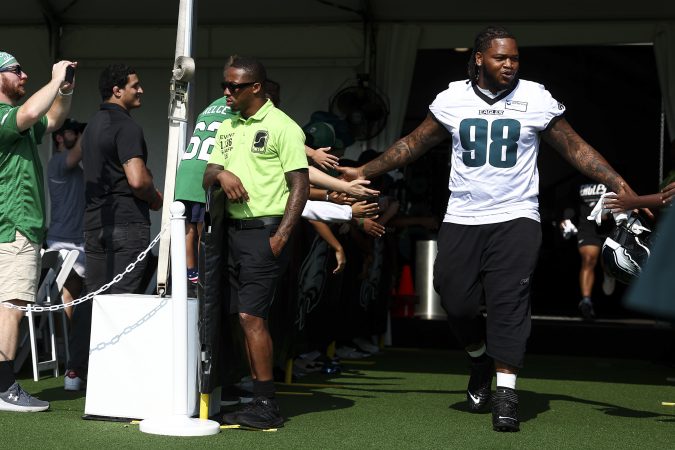
    Jalen Carter plodded off the dais late Wednesday morning with a look of relief on his face, as if he were a student who feared public speaking and had just delivered an oral presentation for class. The Eagles’ first practice of training camp, at the Jefferson Health Training Complex, had ended minutes before. It was humid, and Carter wiped his brow with a towel. To his left were Dom DiSandro, who is the Eagles’ chief security officer, and Toni Brown, who is Carter’s mother. Dom and mom. Maybe the two most important people in making sure that the Eagles get their money’s worth from Carter, who is, for the moment, the highest-paid defensive tackle in the National Football League.

    “I messed up a little bit,” Carter said to Brown and DiSandro, “but it was good.”

    The Eagles had announced Tuesday that they and Carter had agreed to a four-year contract extension that reportedly guaranteed him $106 million and could pay him as much as $160 million. When a modern professional sports franchise holds a press conference, it does so not just to acknowledge the news that has already broken. The point and purpose of the event, from the franchise’s perspective, are to send subtle signals about what the angle on the news is supposed to be.
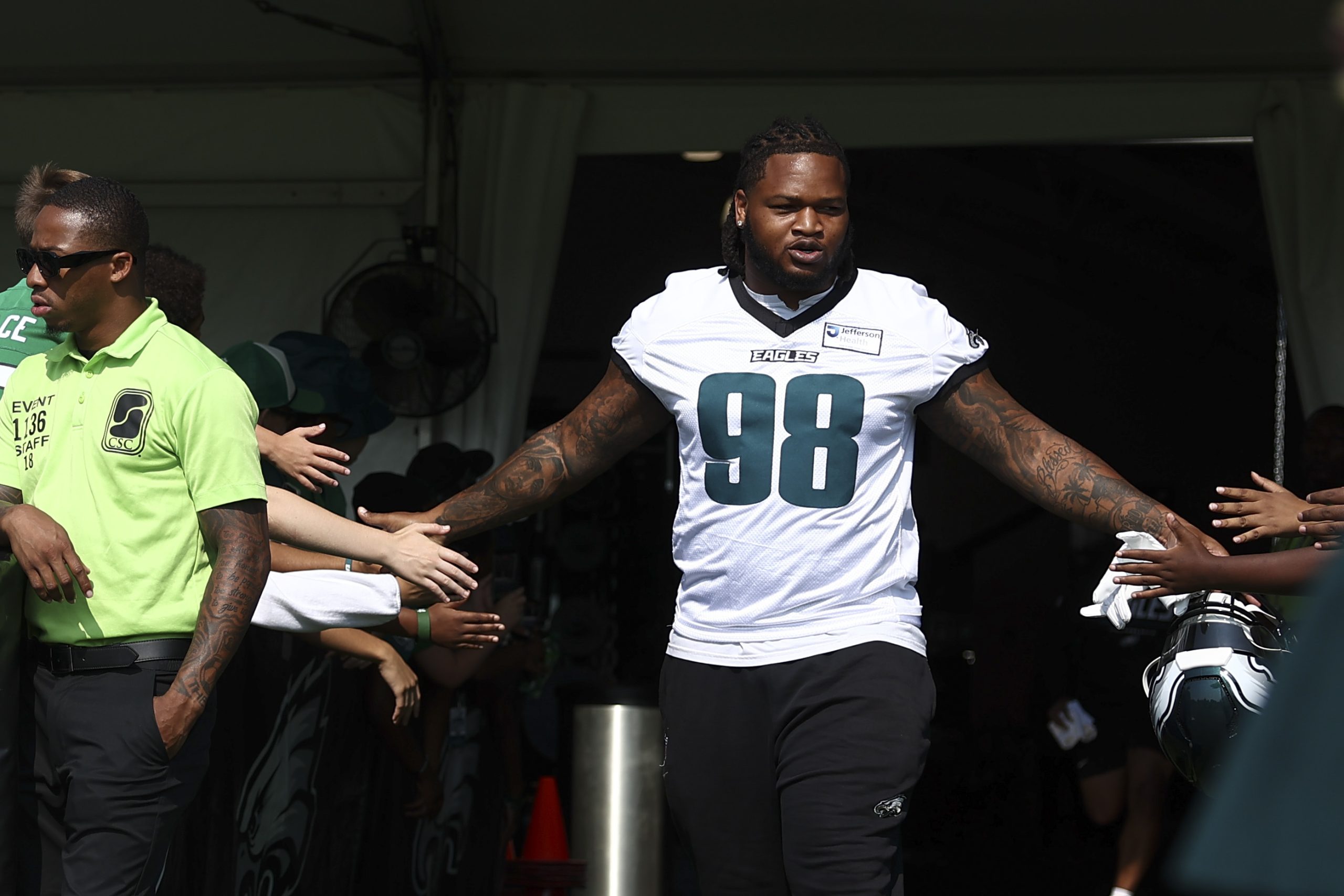
    So there was Brown near the dais. And there was tackle Jordan Davis, Carter’s teammate at the University of Georgia and with the Eagles, hanging near the back of the media tent, ecstatic for his friend. And coach Nick Sirianni and vice president Howie Roseman had been there hours earlier, making no mention of the risk the Eagles had taken on with this commitment to Carter.

    And there is risk here — plenty of it. Carter is just 25, and he has been a great player at times for the Eagles. He was the primary reason they beat the Los Angeles Rams in the 2024-25 NFC divisional round, and he has the power, strength, and raw talent to be the league’s best defensive tackle if he can stay healthy and keep his head on straight. But from the road-racing accident in January 2023 that led to two people’s deaths and caused him to drop far enough for the Eagles to trade in that year’s draft, to the decline in his play in the second half of his rookie season, to his dumb decision to spit in Dak Prescott’s face in last season’s opening game, to the two shoulder procedures that cost him a month of time, Carter has given the Eagles ample cause to cross their fingers here and hope.

    Roseman likes to consummate such deals — extending the contracts of players whom the Eagles want to retain for years — as early in an offseason as possible. Carter’s, though, took much longer, and the reasons go beyond the ones Roseman cited Wednesday, the suggestion that he and Drew Rosenhaus, Carter’s agent, were simply waiting for the market to settle.

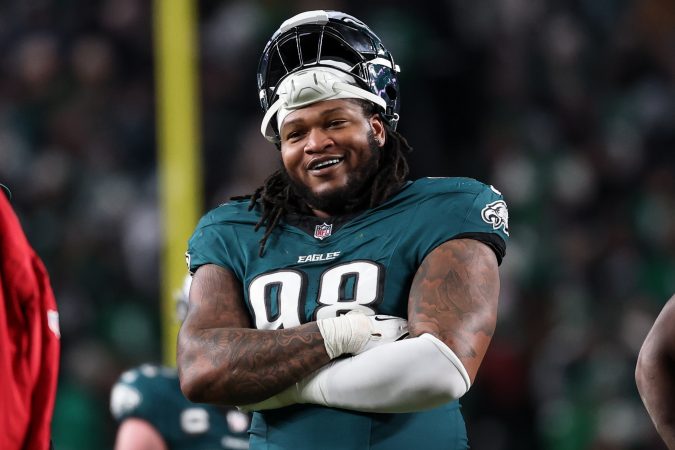
    At just 25, Jalen Carter has the power, strength, and raw talent to be the league’s best defensive tackle if he can stay healthy.Monica Herndon / Staff Photographer

    “We felt like [defensive tackle] was one of the strengths of our team,” Roseman said. “We want that to be one of the strengths of our team going forward. The defensive tackle position in the league, in college football — it’s a deficient position. It’s hard to find guys like that. So we feel like it was a priority.”

    Understand: That’s why Carter got this extension, and that’s why the Eagles didn’t have much of a choice in giving it to him. He’s that talented, that vital to Vic Fangio’s defense. “The attention he draws is incredible,” linebacker Zack Baun said. “You’ve got to have four hands on him,” meaning the opposing offensive line has to double-team Carter at all times, opening up possibilities for his teammates to make plays. There’s no replacing a player like Carter, and if he commits another awful mistake off the field, if he does something dirty on the field and the NFL doesn’t go easy on him again — as it did last season after the Prescott incident — he will cost the Eagles dearly. As Roseman and more than one player said Wednesday, the Eagles don’t pay you for what you’ve done. They pay you for what you’re going to do.

    To his credit, Carter said all the right things Wednesday, even pausing, after taking two questions, to thank the Eagles and chairman Jeffrey Lurie and even the media members in attendance. Any teacher or professor would have passed him on his assignment.

    “When you get picked in the first round, a top-10 pick, you get a little bit of decent money,” he said. “That didn’t change me. I still came here. I had a goal. I let the team know and the fans know that the goal was to get a championship. It happened, but it’s a new contract, and it’s time to get more championships for the city of Philly.

    “My goal wasn’t to come out and ‘Let me be the highest-paid defensive tackle.’ My goal was to build team chemistry and win a championship. I think that all falls in line with getting to where I’m at now.”

    The proof was never going to present itself Wednesday. The easy part is over for Jalen Carter. He got his extension, and now he has to earn it. Now he has to keep every day clean. “I don’t think money is ever going to change me,” he said. It was an assertion that could cut either way, for good or bad, and it’s on him, his support system, and the Eagles themselves to make sure they don’t regret that he said it.