Tag: UniversalPremium

  • World Series or bust? The surging Phillies should know that answer by the time they leave Arizona.

    World Series or bust? The surging Phillies should know that answer by the time they leave Arizona.

    In October of 2023, the Diamondbacks dashed the Phillies’ dream of winning consecutive pennants.

    In September of 2026, the Diamondbacks will serve as a benchmark as to whether these Phillies even have a chance of achieving what the 2023 Phillies came so close to achieving.

    Hard to believe, Harry.

    A month ago, as the Phillies foundered on the edges of relevance, none of this seemed to matter much. Today, the Phillies have found an identity grounded in smart at-bats, a solid starting rotation, and unexpectedly competent defense. Suddenly, what seemed like a wasted season through four months has transformed into a season of hope and expectations.

    As in, if the Phillies are playing this well now, there’s no reason to think they can’t win their first World Series in 18 years.

    We’ll know better by dinnertime Wednesday.

    The Phillies on Monday night begin a three-game series in Arizona that could determine whether the Phils host a wild-card series in October. The D-backs lead the season series after winning two of three in Philly in April.

    As this series begins, the Diamondbacks hold the final wild-card slot but stand 4½ games behind the Phillies. The Phillies are tied with the Cubs, but the Cubs won six of seven against the Phillies in the April games that exhausted the teams’ head-to-head matchups. Should the Diamondbacks surge and the Cubs stall, there’s a chance this week’s results provide the tiebreaker that gives the Phillies the top wild-card spot, the No. 4 seed in the National League playoffs, and home-field advantage over No. 5 that comes with it.

    Of course, the Phillies can render these scenarios obsolete if they clobber the Diamondbacks, pass the Cubs, and maybe even catch the Braves for the NL East title, in which case tiebreakers won’t matter. But the Braves lead by five games with 25 to play, so that seems a bit much to ask.
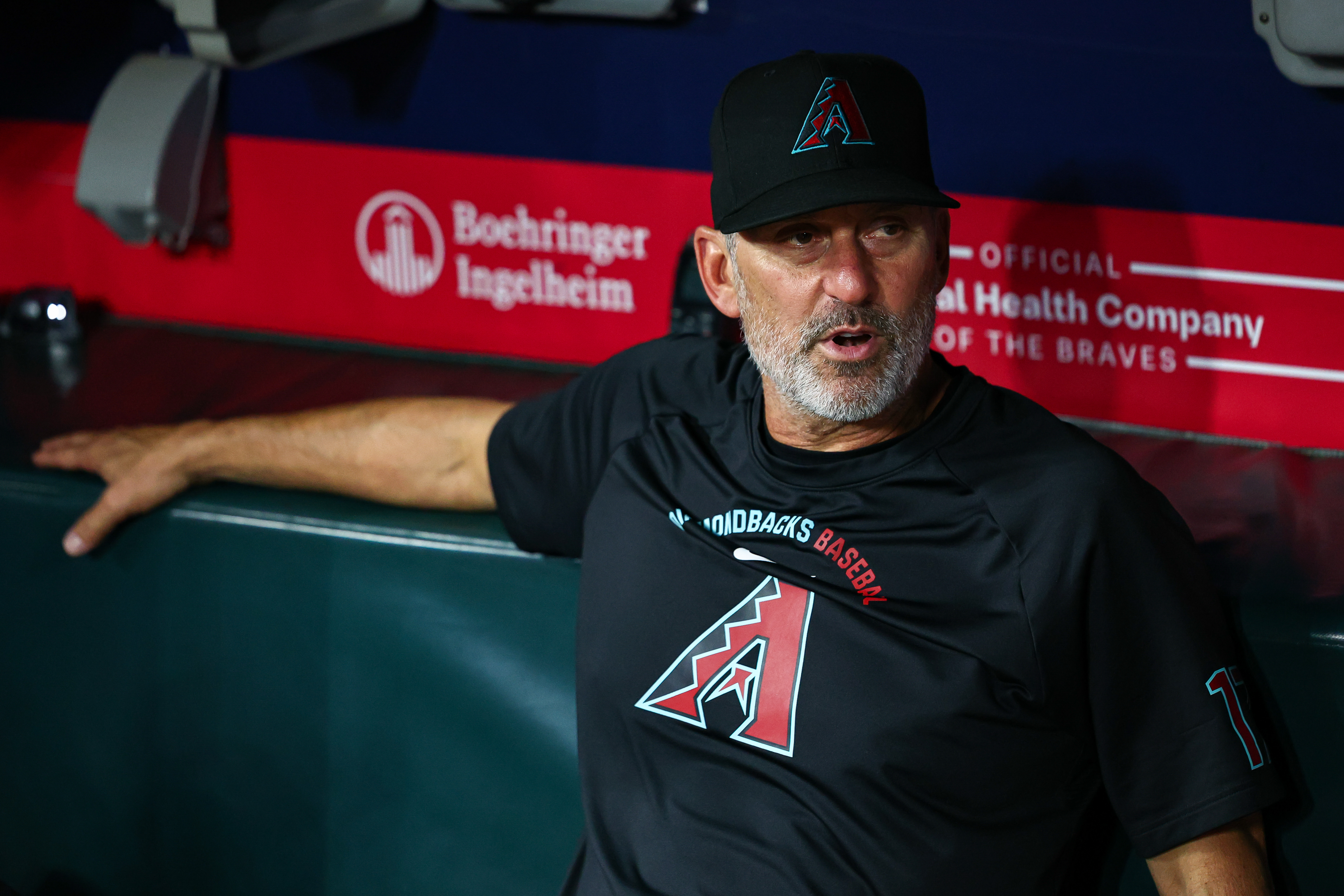
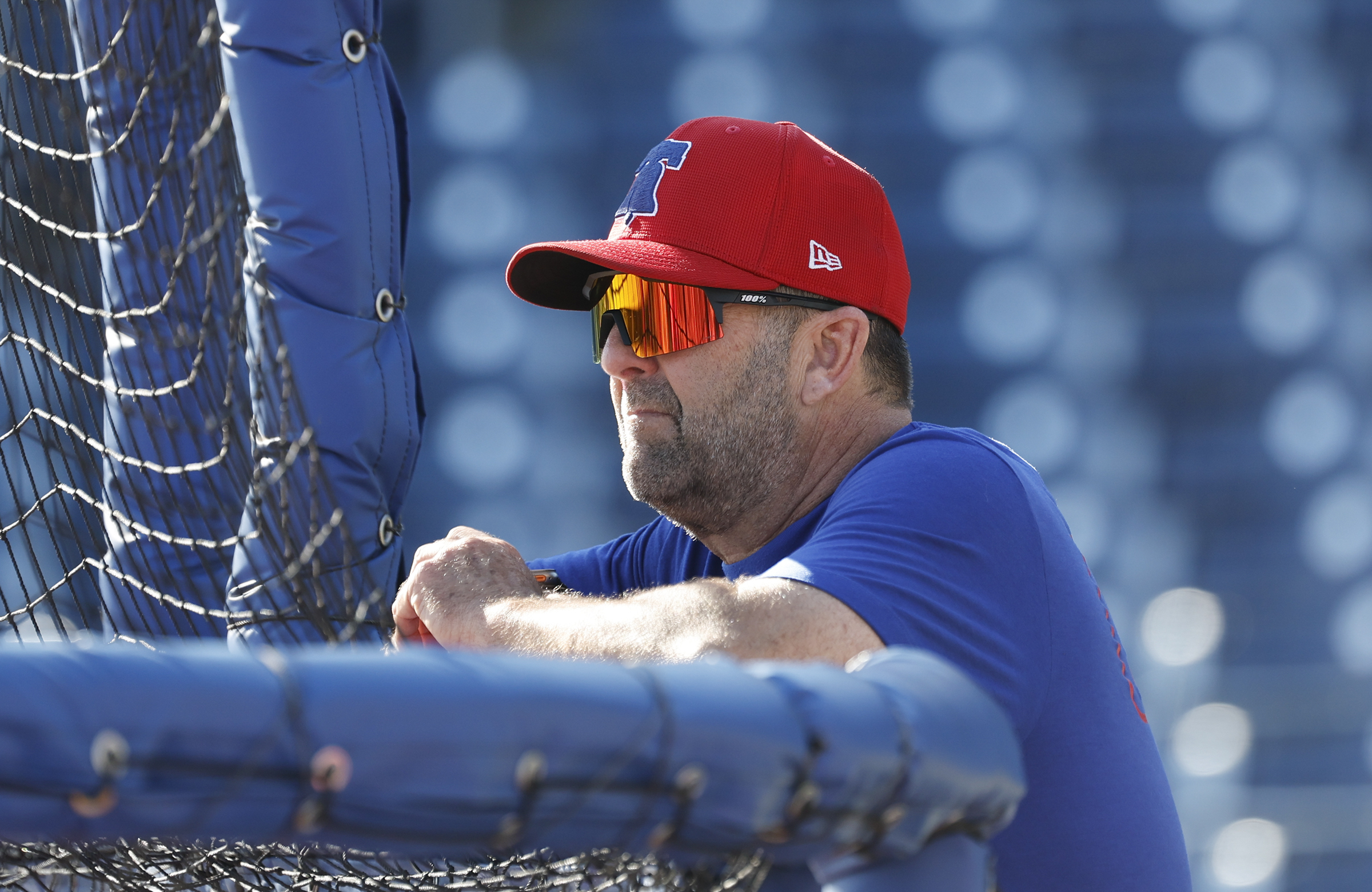
    Manager Torey Lovullo’s Diamondbacks have a half-game lead on the Padres for the third and final wild-card spot going into Monday’s series opener against the Phillies.Colin Hubbard

    For the moment, it’s more important to judge whether the Phillies can play excellent baseball on the road against a team that is 13-8 against them since Game 3 of the 2023 NLCS.

    The magnitude of the lows might skew the emotions, but the lows against the Diamondbacks seem to be lower than most of the other lows this Harper-Wheeler-Schwarber edition of the Phillies has delivered since 2022.

    It begins with that 2023 NLCS, when the Phillies’ bats deserted them and they lost Games 6 and 7 at home. The Phils haven’t won a season series against Arizona since, and their first meeting this season did not portend favorably.

    The Phillies struck out 16 times against the Diamondbacks on April 10, 16 games before the Phillies fired manager Rob Thomson and promoted new bench coach Don Mattingly to interim manager. The 16 Ks remain a season high, part of the 8.8 strikeouts per game that was among baseball’s worst rates.

    Now, though, they’re striking out 2.5 fewer times per game, the second-best rate in baseball. It is the most promising stat of a slew of numbers that indicate that this Phillies team might even be able to topple the Dodgers in the postseason.

    If it’s hard for you to believe, that’s completely understandable. Even in the middle of their recent nine-game winning streak, their longest in four years, the Phillies supplied little real reason to believe they might make another long run into October.

    Shortstop Trea Turner’s Season from Hell continued. The bullpen remained unreliable. And the two best pitchers weren’t the two best pitchers.

    Things change.
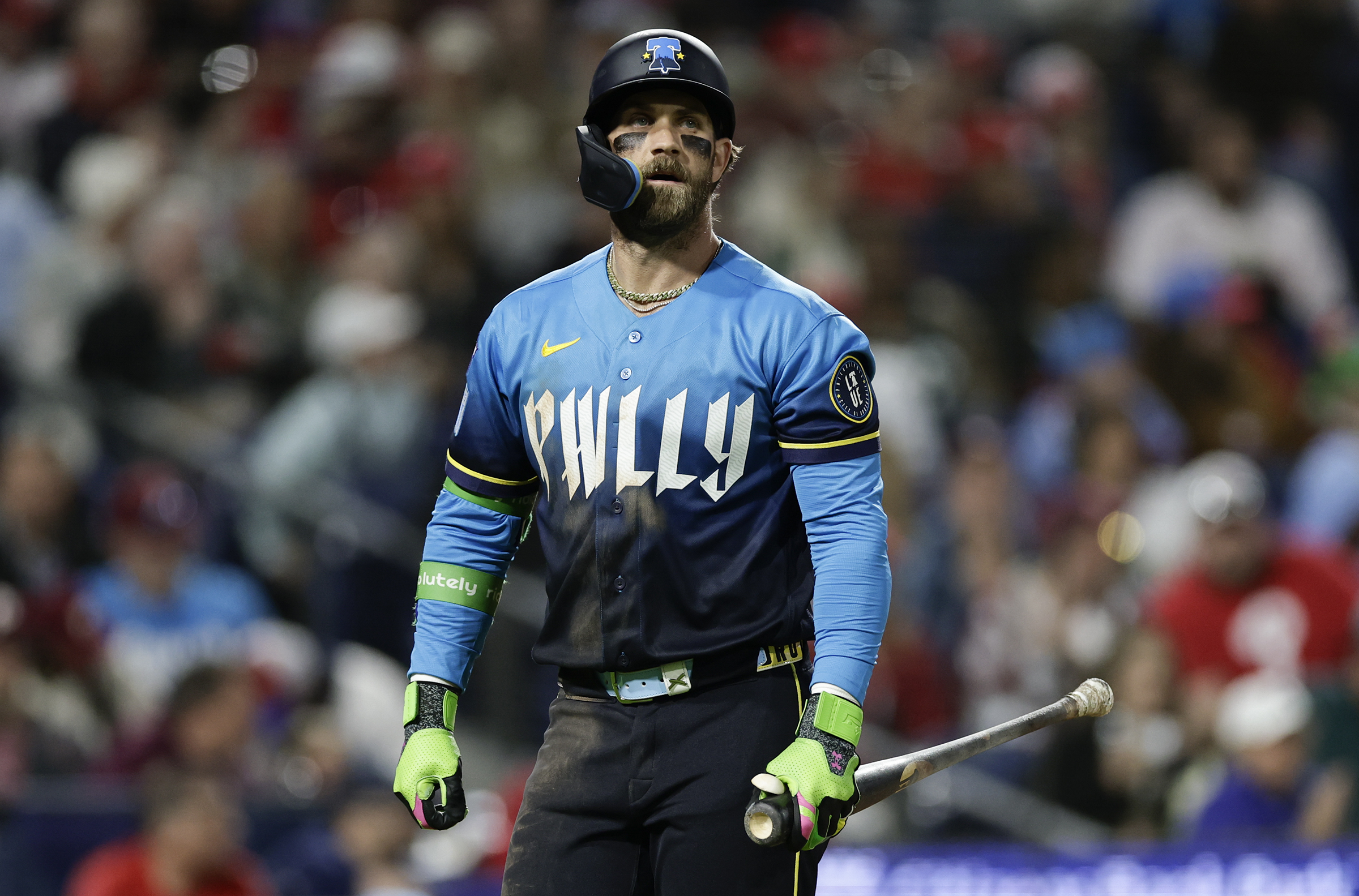
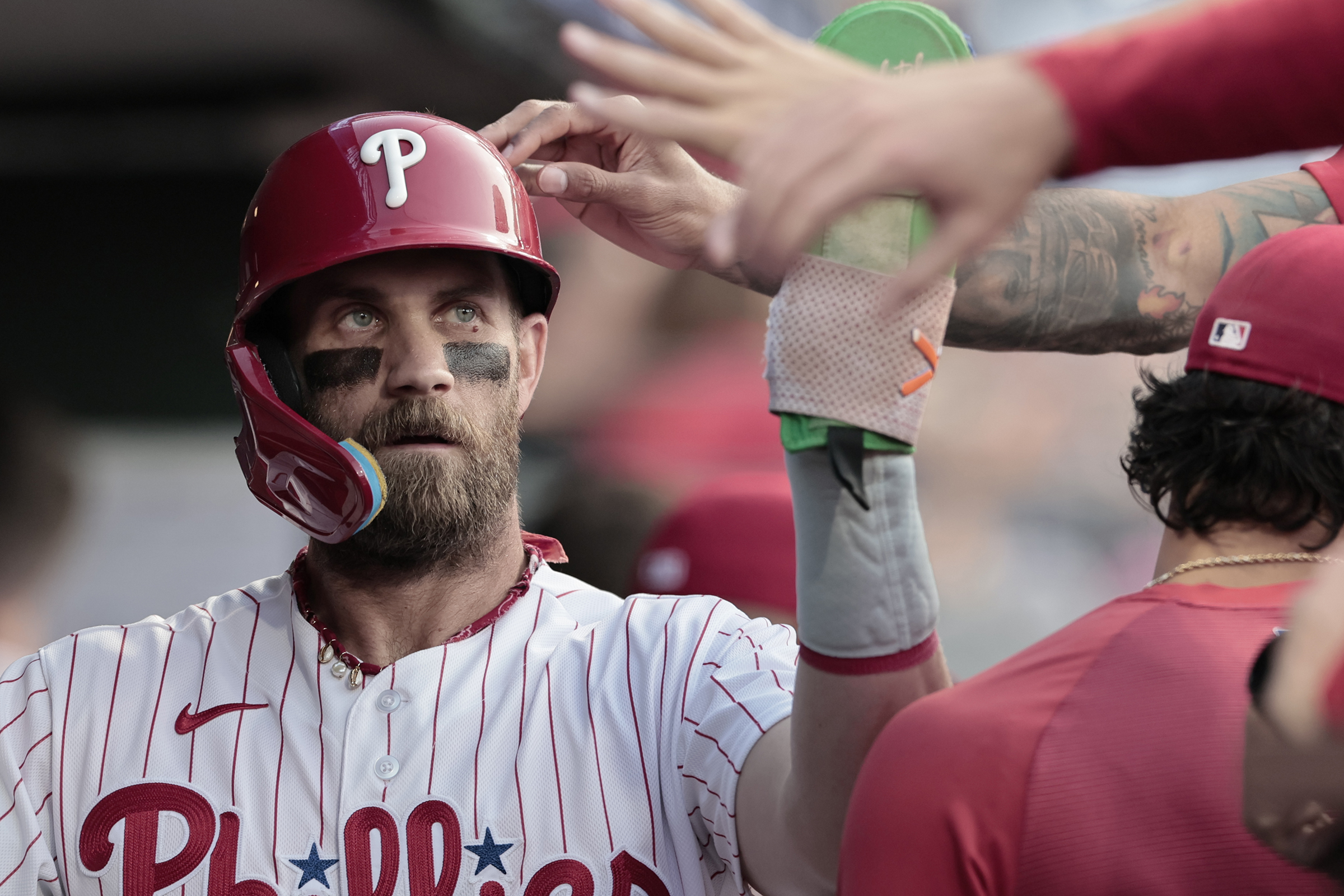
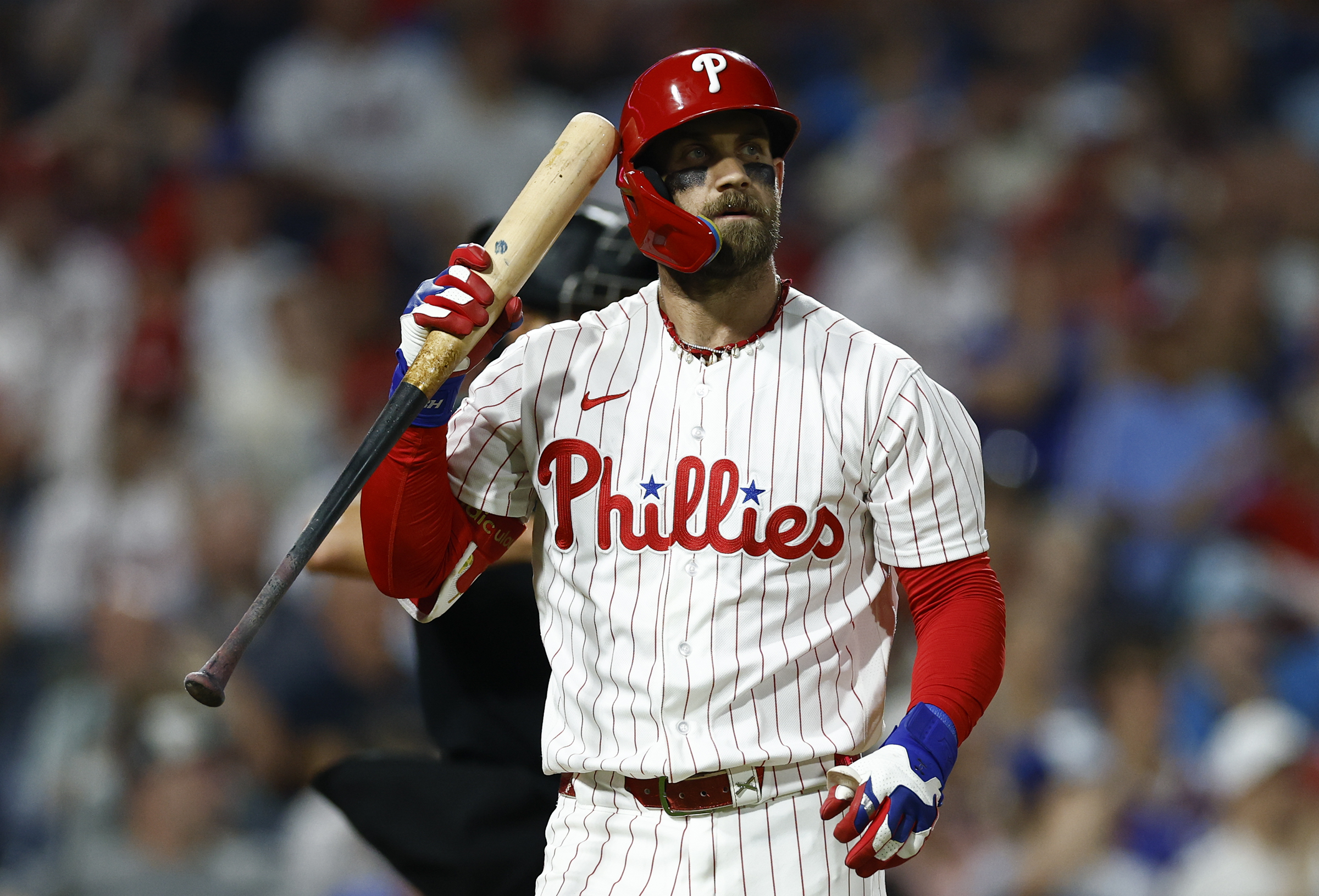
    Phillies first baseman Bryce Harper after striking out against the Arizona Diamondbacks on April 10.Yong Kim / Staff Photographer

    Struggling aces Cristopher Sánchez and Zack Wheeler just combined to allow one run over 13 innings Saturday and Sunday against the Angels. Which, of course, makes them formerly struggling aces Cristopher Sánchez and Zack Wheeler. Add in Jesús Luzardo’s seven shutout innings in Seattle on Wednesday, and that’s one run allowed for the Big Three in their last 20 innings.

    That’s just the icing.

    Consider the continued efficiency of No. 4 starter Aaron Nola, who’s on a six-game heater, and rookie Andrew Painter, who’s been better than a No. 5 in five of his six starts since his recall from the minors, and the Phillies transform from Lost Cause to Title Contender.

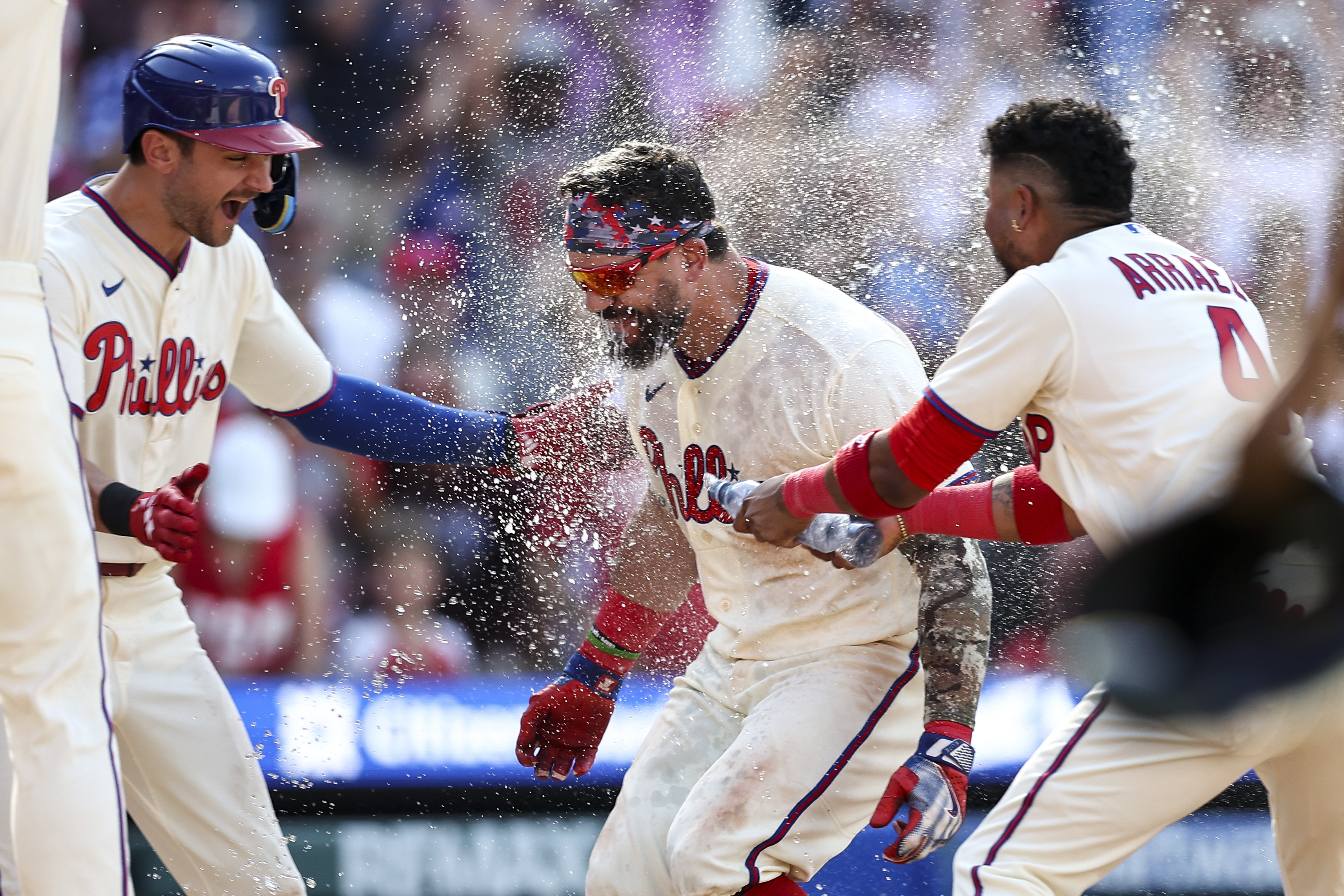
    They’ve won 13 of 15 games, six of those wins on the road, three of the last five in their last at-bat.

    Oh yeah.

    The hitting.

    Since three-time batting champ Luis Arráez played his first game Aug. 4 just after Dave Dombrowski’s latest deadline magic, the Phillies lead Major League Baseball with a .272 batting average and are tied with the Red Sox for the lead in on-base percentage, at .353, improvements of 35 and 48 points, respectively; their .305 on-base percentage had been third-worst. In that same span, they lead the National League with 100 walks. They are averaging 5.5 runs, an improvement of more than a run per game.

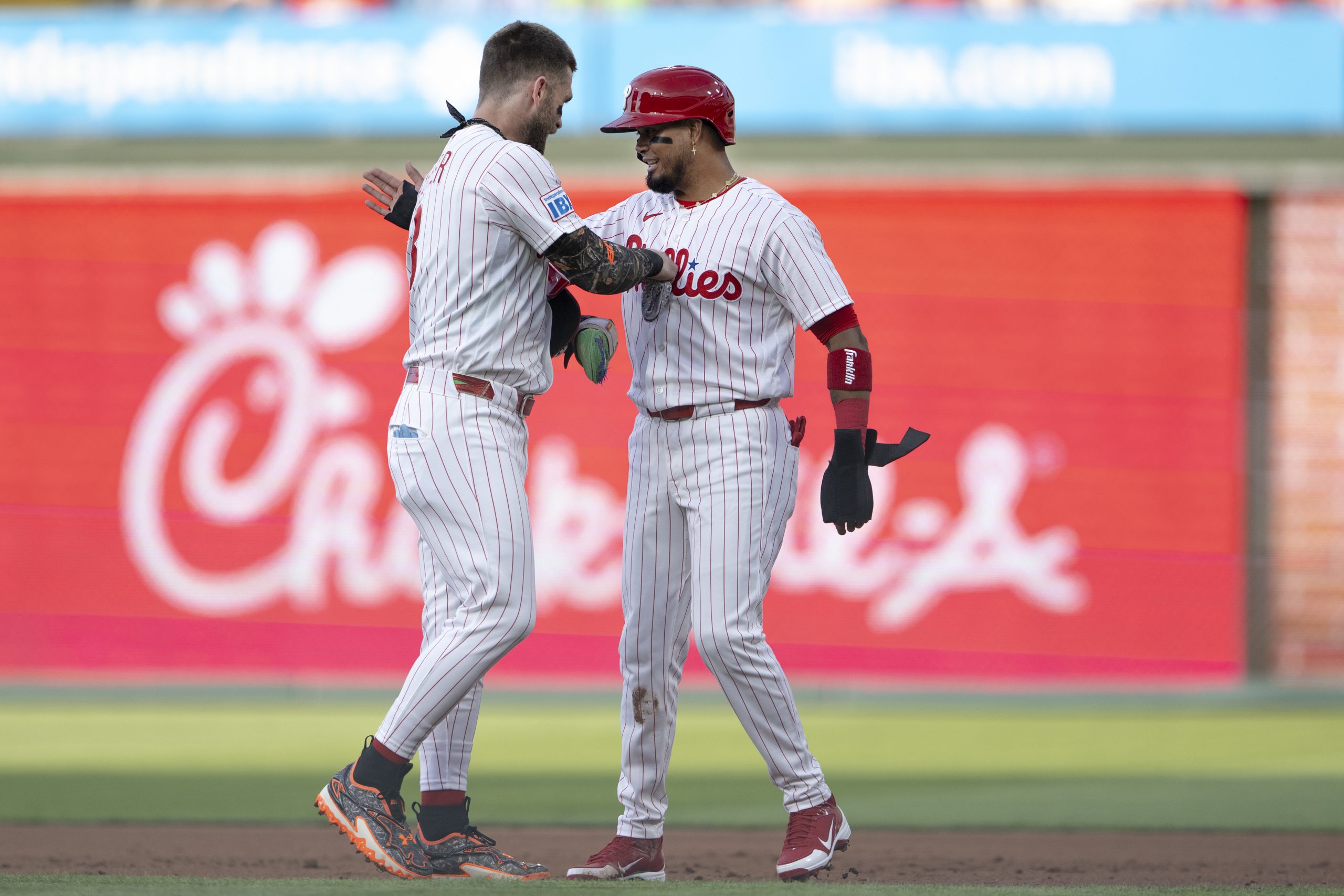
    Since Arráez slid into the cleanup spot they are 16-7, have gone from eight games above .500 to a season-high 17 games above .500, and are tied with the Cubs atop the National League wild-card standings going into Monday.

    Arráez’s arrival shuffled the defense, an unintended consequence that reaps daily rewards. Arráez is best at second base, so Bryson Stott moved to third base, where he has proved to be the best third baseman in baseball since the move. Third baseman Alec Bohm pushed first baseman Bryce Harper to right field, where both are at least average, whereas neither was average in his previous position.

    In the middle of it all, Harper has reached base in 32 consecutive games, a career best. A two-time MVP in the midst of his most efficient stretch of offense would be the biggest news of all on a team that didn’t have so much to win, so much to lose, and so much scar tissue since its NLCS collapse in 2023.

    Still.

    Listen, the Phillies aren’t the best team in baseball. They still make too many baserunning errors. Wheeler is still walking too many batters (three more Sunday). The bullpen is still thinner than the Arizona atmosphere.

    But if they take off from PHX on Wednesday night with two or three wins in hand, maybe overtake the Cubs if the Brewers beat up on them the next four days, and sustain this surprising run of professionalism and competence, then yes.

    Believe it.

    World Series or bust.
  • The QB2 fallacy, the need for a dynamic RB2, and other (initial) Eagles roster thoughts

    The QB2 fallacy, the need for a dynamic RB2, and other (initial) Eagles roster thoughts

    Thinking our way through the least climactic day on the NFL schedule. . .

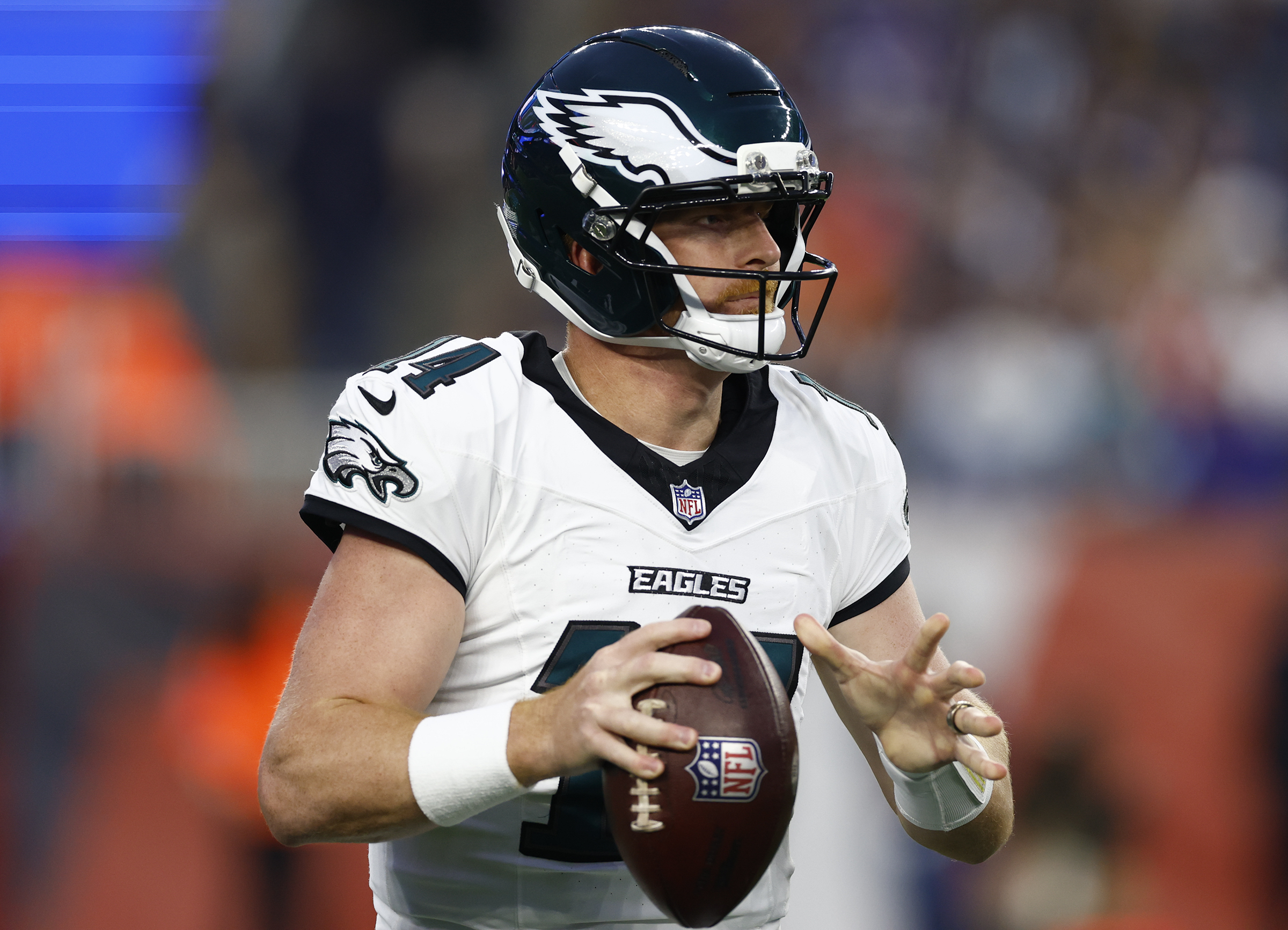
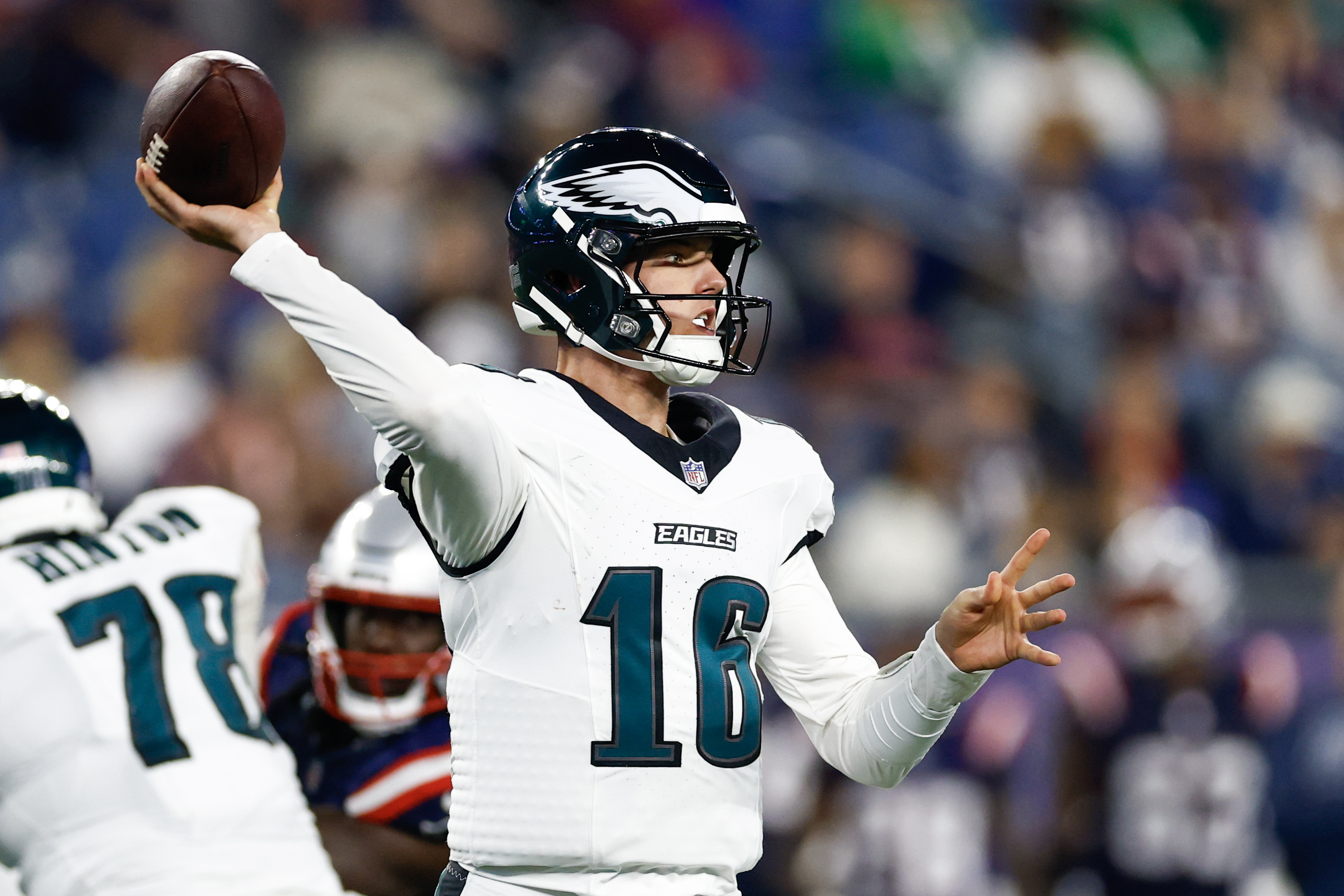
    The Eagles backup QB discourse has been a thrill ride over the last couple of years. We’ve gone from nothing-less-than-a-second-round-pick-for-Tanner-McKee to the Eagles trading for Andy Dalton to both-these-guys-stink to the Eagles keeping both quarterbacks plus rookie Cole Payton on their initial 53-man roster.

    The only meaningful takeaway isn’t really a takeaway at all. More so, it’s a reminder of the longest-standing conventional wisdom in the game. In a league where half the teams don’t have a capable starting quarterback, nearly every team is going to have worse than that as its backup quarterback. It’s silly to suggest that the Eagles could have a better backup quarterback if only they looked outside of McKee or Dalton. What you see is what you get.

    The devil is in the definition, as always. Gardner Minshew and Kenny Pickett were at the extreme upper end of capability among backups. Minshew has posted a .500 or better record in both of his seasons where he made at least 12 starts. Pickett (somehow) is 16-11 in his career. Yet, in their combined three seasons as Jalen Hurts’ backup, the Eagles lost three of the four games in which they attempted at least 16 passes.

    Virtually every team in the NFL will be screwed if its starting quarterback goes down for an extended period of time. The only somewhat reliable exceptions are those teams that have invested significant draft capital or significant cap dollars in the No. 2 man on the depth chart. Nick Foles was an outlier. Even then, the Eagles were paying him more than triple what they are paying McKee and Dalton.

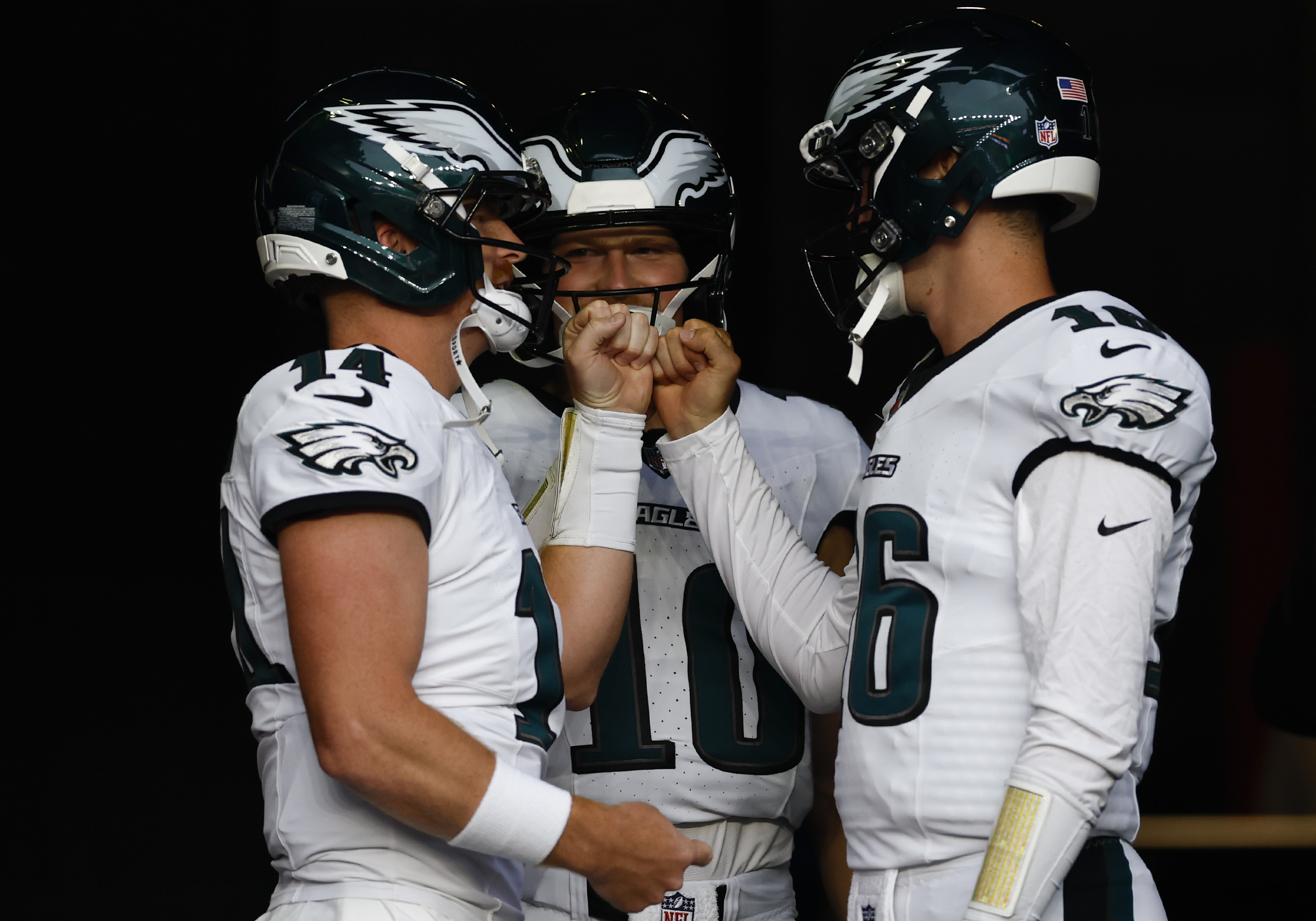
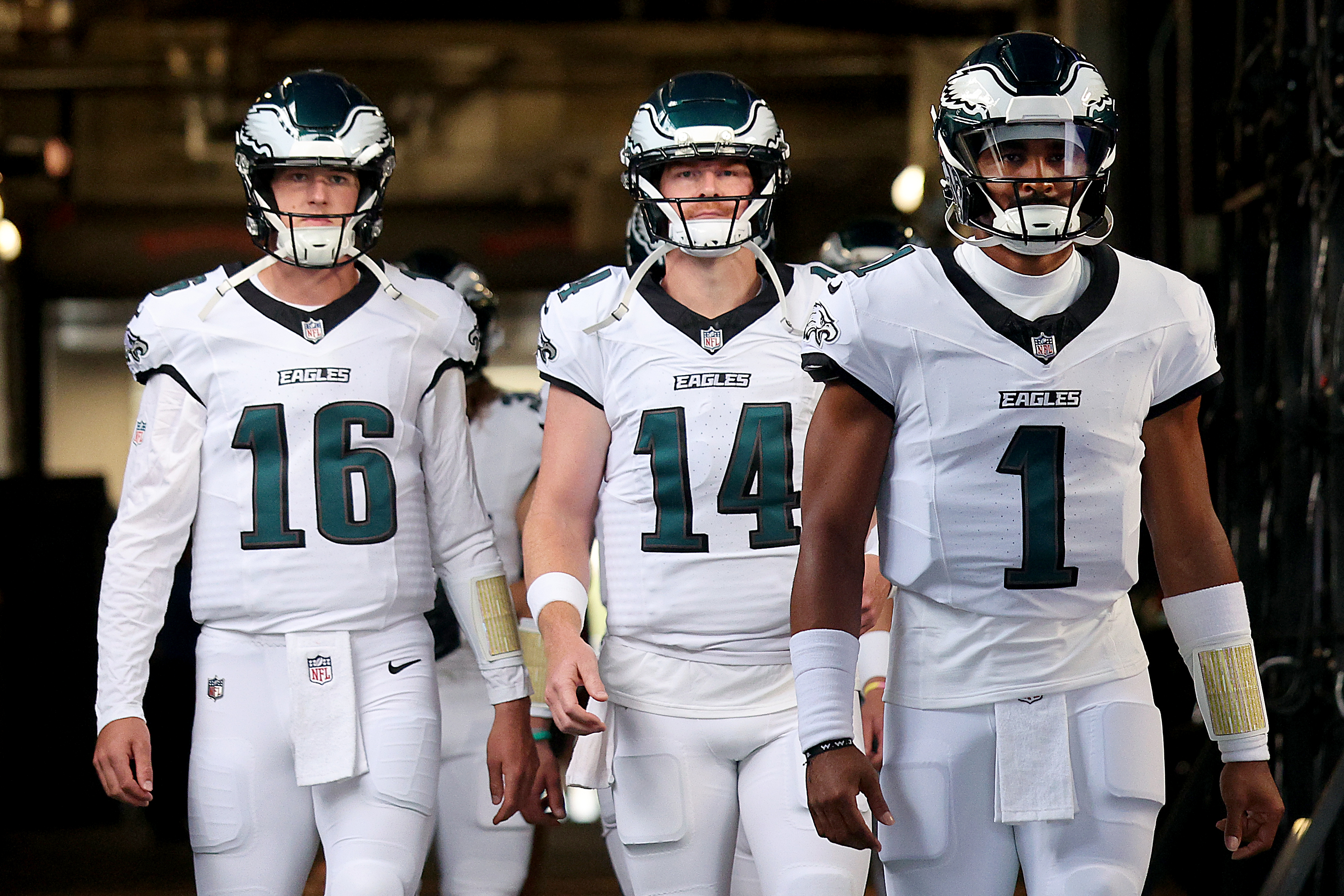
    Eagles quarterbacks (from left to right) Andy Dalton, Cole Payton and Tanner McKee are all on the roster … for now. Yong Kim / Staff Photographer

    The Eagles are at a point in their competitive and financial cycle where they can’t afford to be throwing around that Chase Daniel cheddar. The trade for Dalton was a workaround somewhat similar to the trade for Pickett. He is in the second-year of a two-year, $8 million extension, but the Eagles are responsible for a fraction of it.

    In a best-case scenario, they get a backup QB who has shown the ability to, at the very least, give a team a chance at remaining relevant through a short- or medium-term absence. Dalton is just 2-6 in his starts since going 6-8 as a 35-year-old with the Saints in 2022.

    But all of those starts were in relief of Bryce Young, who is just 14-30 himself over that span. That would be the equivalent of an additional three to four wins over 17 games compared to Dalton. Such a pace could be the difference between sneaking into the playoffs and giving up on the season for a team like the Eagles, who are expected to win 10-12 games with an upside well beyond that.

    The actual calculus of Dalton versus McKee versus keeping both is far too marginal to be conveyed in an expository sentence. At such a minuscule level, the expected value between the lines must be compared to a variety of factors outside of the lines, including the expected value in practice or the film room of Player X versus Player Y.

    That the Eagles have decided, at least for the moment, to keep both Dalton and McKee speaks to their regard for both. Ultimately, that regard, and the factors that compose it, will need to be weighted against the value of the additional roster spot that one of them will occupy. The real question isn’t Dalton versus McKee. It’s the other versus the lineman or defensive back or linebacker who isn’t currently on the roster because of them.

    On that note. . .

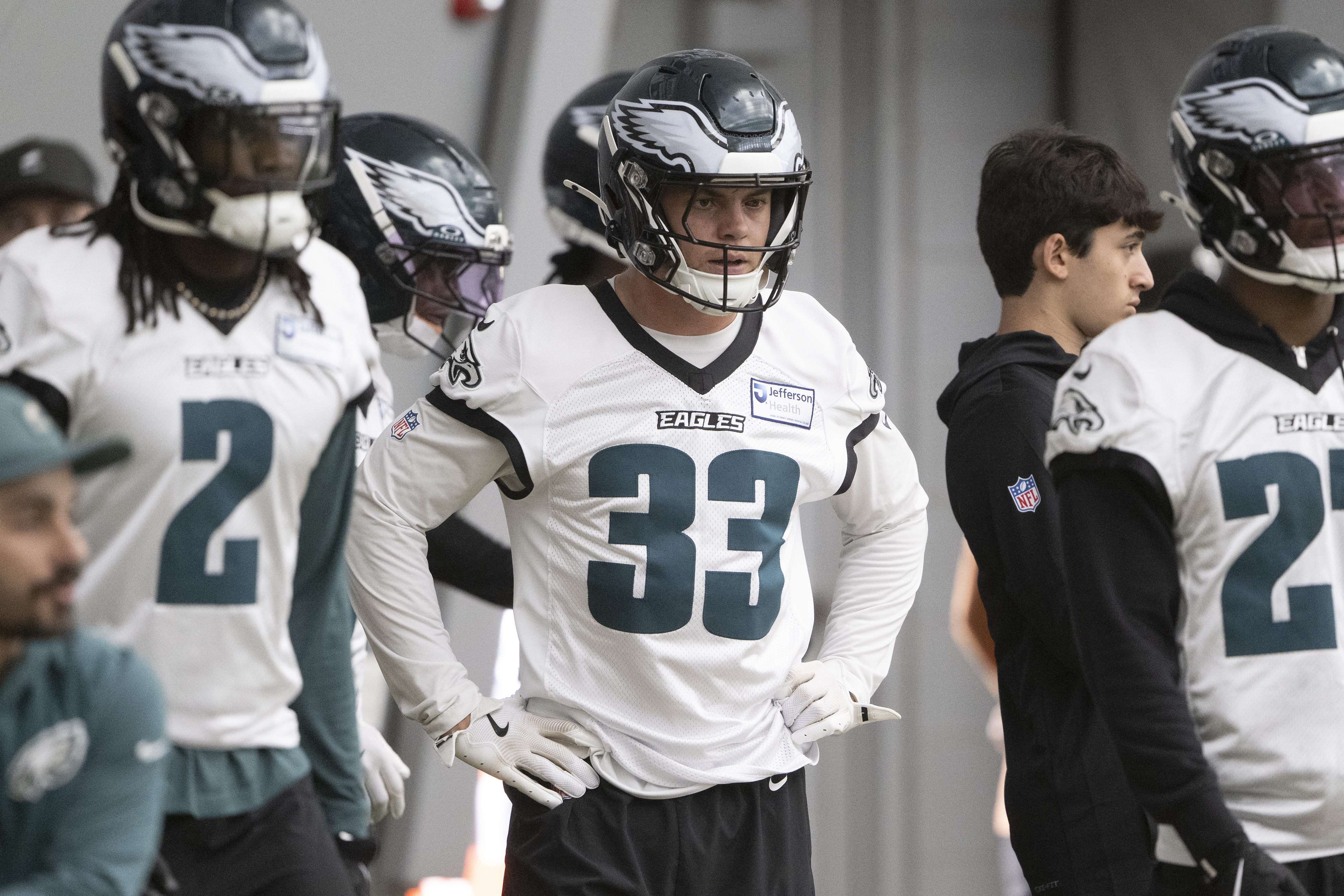
    Dollar for dollar, the biggest improvement the Eagles could make to their roster would be adding a running back who can do something different than Saquon Barkley and Tank Bigsby. Unless Will Shipley is that guy.

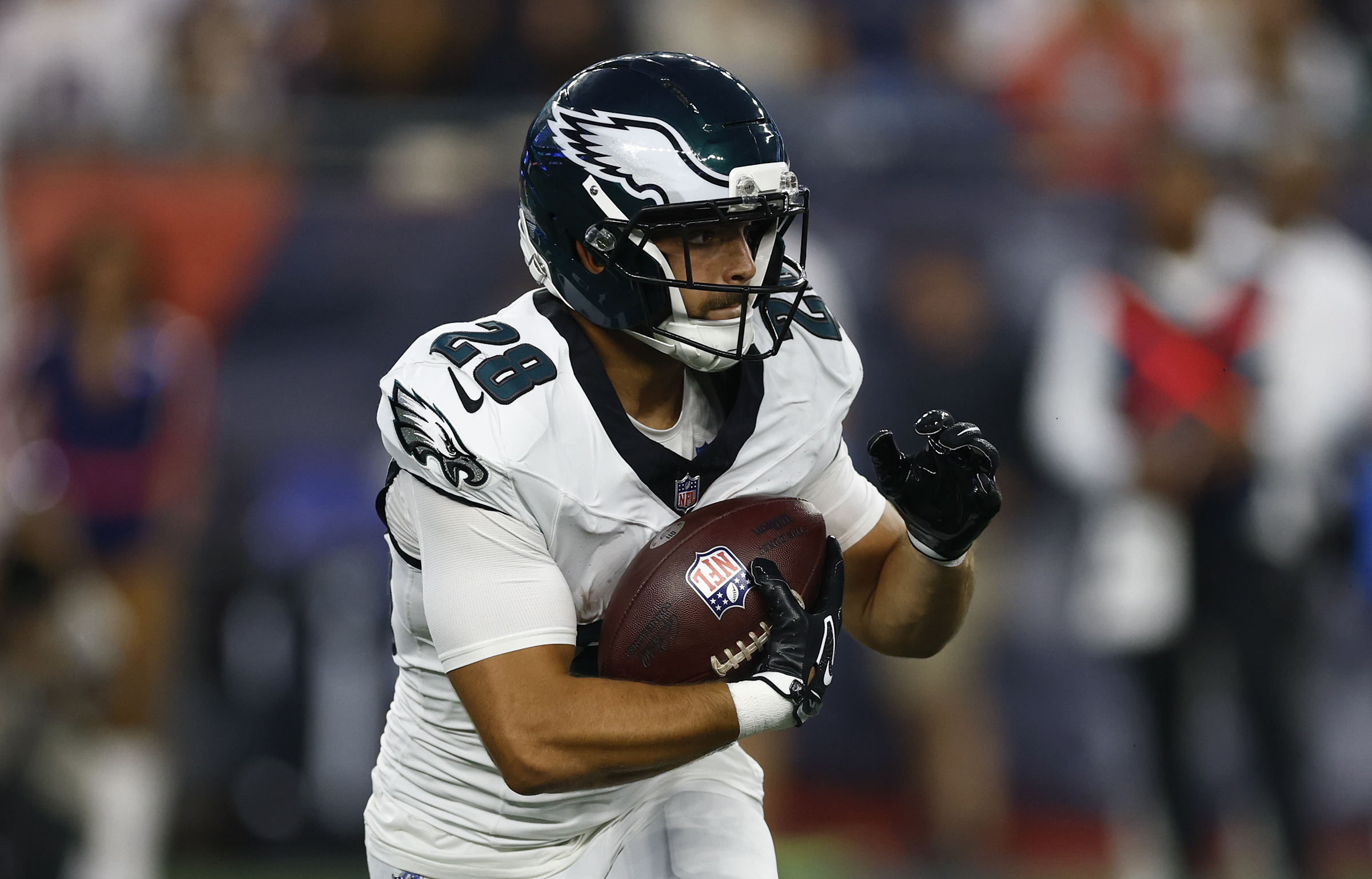
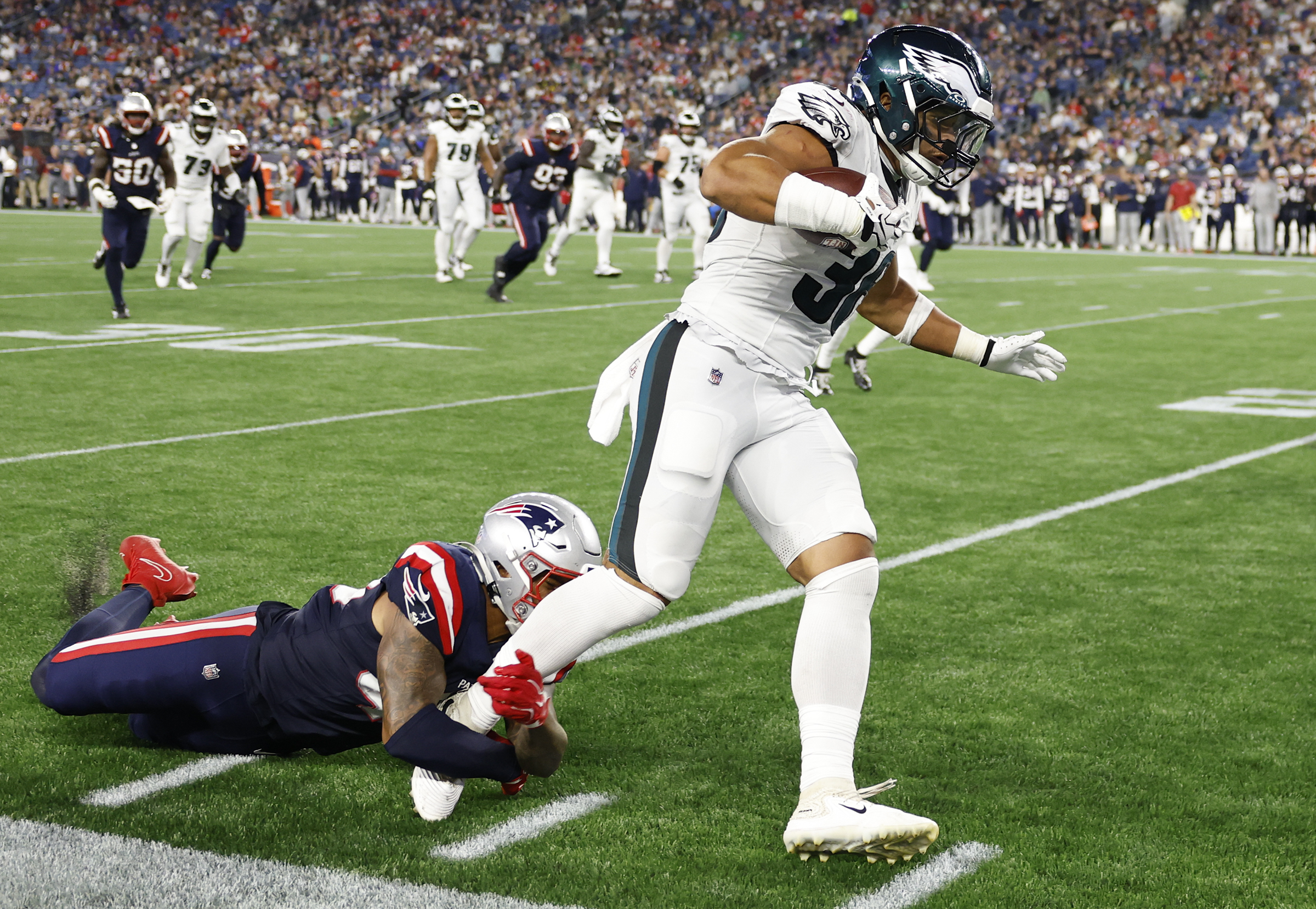
    Will Shipley has caught only nine passes with the Eagles.Yong Kim / Staff Photographer

    The most glaring anomaly on the Eagles roster is one that hasn’t gotten much attention over the last couple of years. Very few teams in the league have a less diverse running back room than they do. For the sake of the argument, let’s reduce it to a generalization that is overly broad and thus not entirely accurate. The Eagles don’t have a complement to Saquon Barkley, at least not one you’d classify as “pass-catching” or “change-of-pace.”

    Unless Will Shipley is that guy.

    I don’t necessarily think they need such a guy. I’m not even sure that such a guy would be attainable even if they thought they needed him. All I know is that they don’t have him. And, also, that his absence is worth contemplating for a team that should be looking for creative ways to distribute the touches that previously went to A.J. Brown.

    The Ravens’ Justice Hill is the guy I think of when I think of a guy the Eagles could use. Two years ago, he touched the ball 89 times and gained 38 first downs with an average of 6.9 yards per touch. To put that in perspective, Bigsby gained 17 first downs on 61 touches with an average of 6.2 yards per touch in 2025. Meanwhile, Shipley has touched the ball a total of 57 times in the two years since the Eagles drafted him in the fourth round. That, with 13 first downs and 3.9 yards-per-touch.

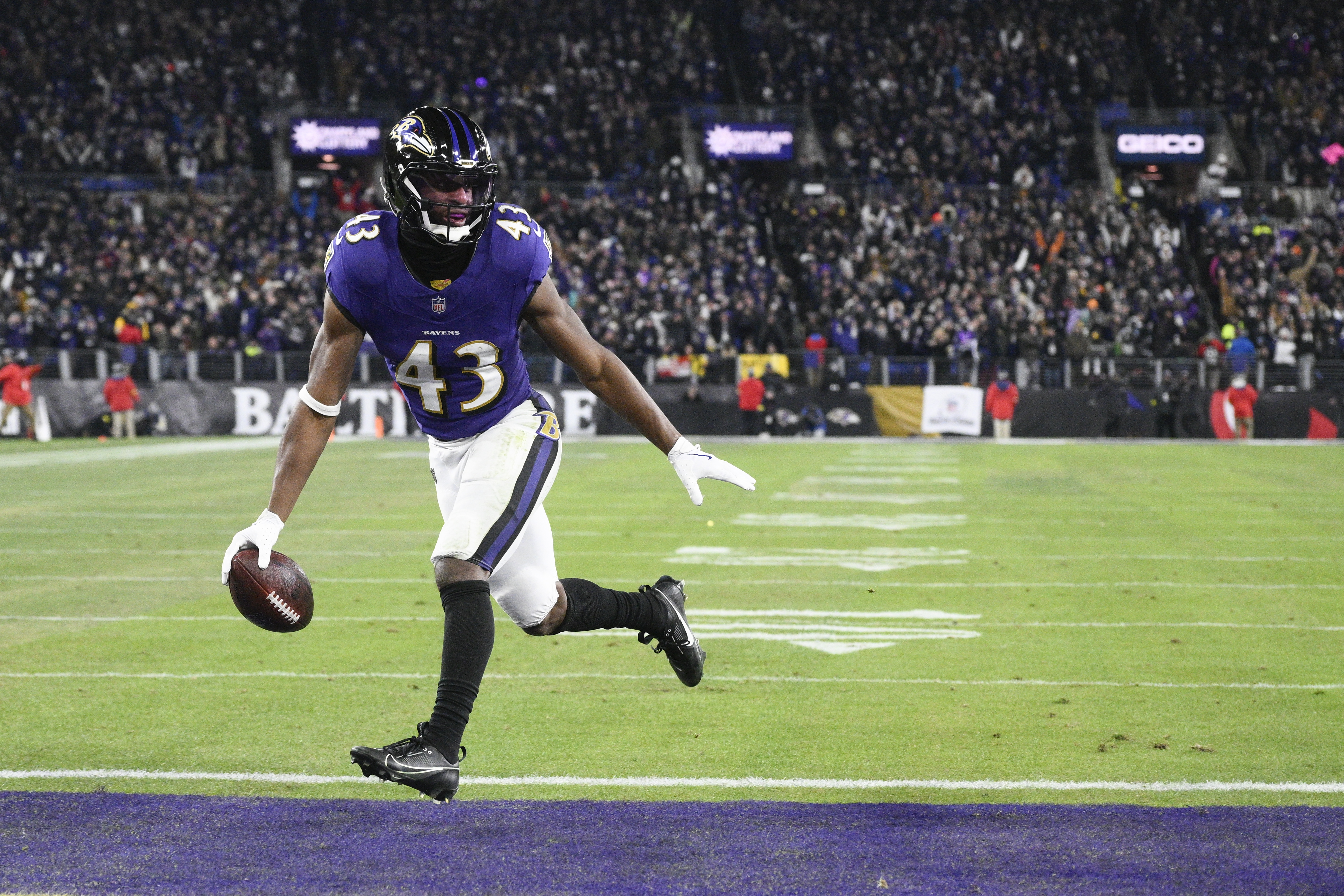
    Justice Hill caught 21 passes for the Ravens in 2025.Nick Wass

    Is it a big thing? Maybe not. But it’s certainly an area where the Eagles can improve. Last season, they were one of only four teams in the NFL who didn’t have multiple running backs catch at least 10 passes. That’s not necessarily a bad thing. The Rams scored the most points in the league without a traditional pass-catching running back.

    But the Eagles are clearly bucking convention in their backfield. We don’t even need to compare them to the rest of the league. Just look at their recent history. Even in 2024, when Barkley led the league with 345 rush attempts and 2,005 yards, Kenny Gainwell managed to catch 16 passes for 116 yards while carrying the ball 75 times for 290. Gainwell and Boston Scott were both members of the 2022 Super Bowl team. Go back to 2017. Think about Corey Clement’s touchdown catch.

    The modern NFL game is all about mismatches, both between and within personnel groups. Tight ends are in vogue because they thrive on those margins. While Shipley brings top-end speed, he has yet to display the feel, shiftiness or receiving chops that would make him a competitive advantage in a dedicated package. Bigsby is the ideal back-up to Barkley, a power runner who you’d be comfortable handing off to 15-20 times a game. But he has 11 receptions in three NFL seasons. It just feels like the Eagles are missing an element.

  • Penn Medicine reported a $337 million operating profit for the year ended June 30

    Penn Medicine reported a $337 million operating profit for the year ended June 30

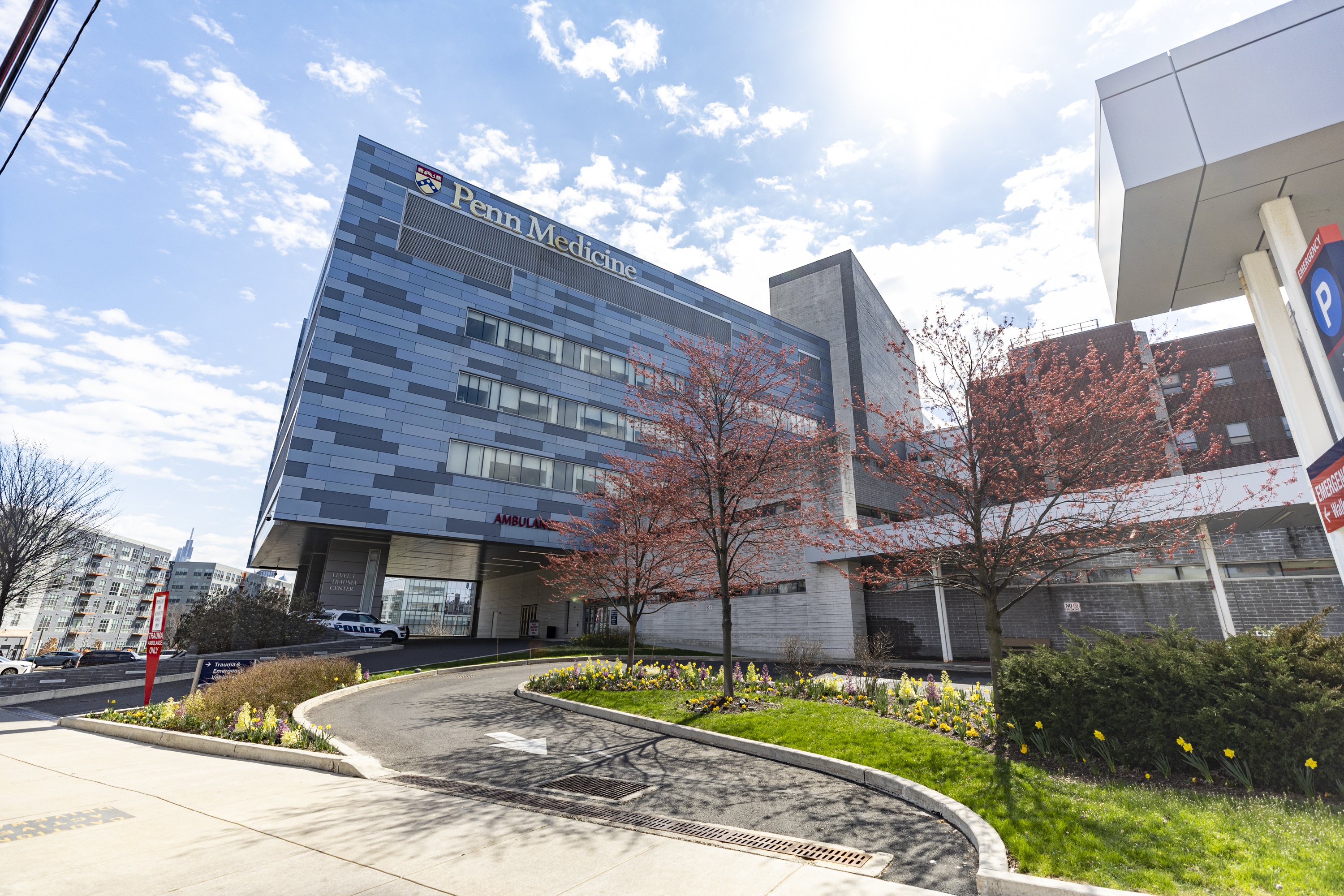
    The University of Pennsylvania Health System had $337 million in operating profit in fiscal 2026, up from $247 million the year before, the Philadelphia nonprofit reported to bond investors Friday.

    “We saw good growth in several of our clinical programs that helped us to generate the operating performance,” Julia Puchtler, the health system’s chief financial officer, said in an interview.

    That’s money “we’re going to be able to reinvest in the academic missions and in our clinical programs and our workforce,” she said.

    Here are more details:

    Revenue: Penn’s total revenue rose 13.7%, to $13.6 billion from $12 billion the year before. Revenue from patient care accounted for $11.4 billion of the total in fiscal 2026, according to Penn’s report to bondholders.

    Outpatient cancer care and outpatient surgeries by urologists and ear, nose, and throat doctors stood out as areas of growth, Puchtler said. On the inpatient side, neurosciences and transplants had notable increases, she said.

    Expenses: For the first time since 2021, the average length of time a patient spent in the hospital fell below 6 days. Longer stays have higher expenses, even though hospitals generally don’t get paid more for them.

    The average in fiscal 2026 was 5.93 days, from 6.14 days the year before. That looks like a small decline, but it adds up when spread over the health system’s more than 161,000 admissions in the year. The reduction helped Penn reduce expenses relative to revenue. It also freed capacity for more patients, Puchtler said.

    In employee benefits, Penn had an additional $20 million in expenses because it aligned retirement plans across the system, Puchtler said.

    Notable: Penn refinanced about $300 million in debt last month at a lower interest rate. That means the health system will save $28 million in interest payments over the next 9 or 10 years, Puchtler said.

  • Dispatch Bio launches its first clinical trial to develop a universal treatment for solid cancers

    Dispatch Bio launches its first clinical trial to develop a universal treatment for solid cancers

    A University of Pennsylvania biotech spinout recently launched its first clinical trial of an experimental cancer treatment for hard-to-treat solid tumors.

    Its approach builds upon groundbreaking work harnessing the body’s immune system to fight cancer.

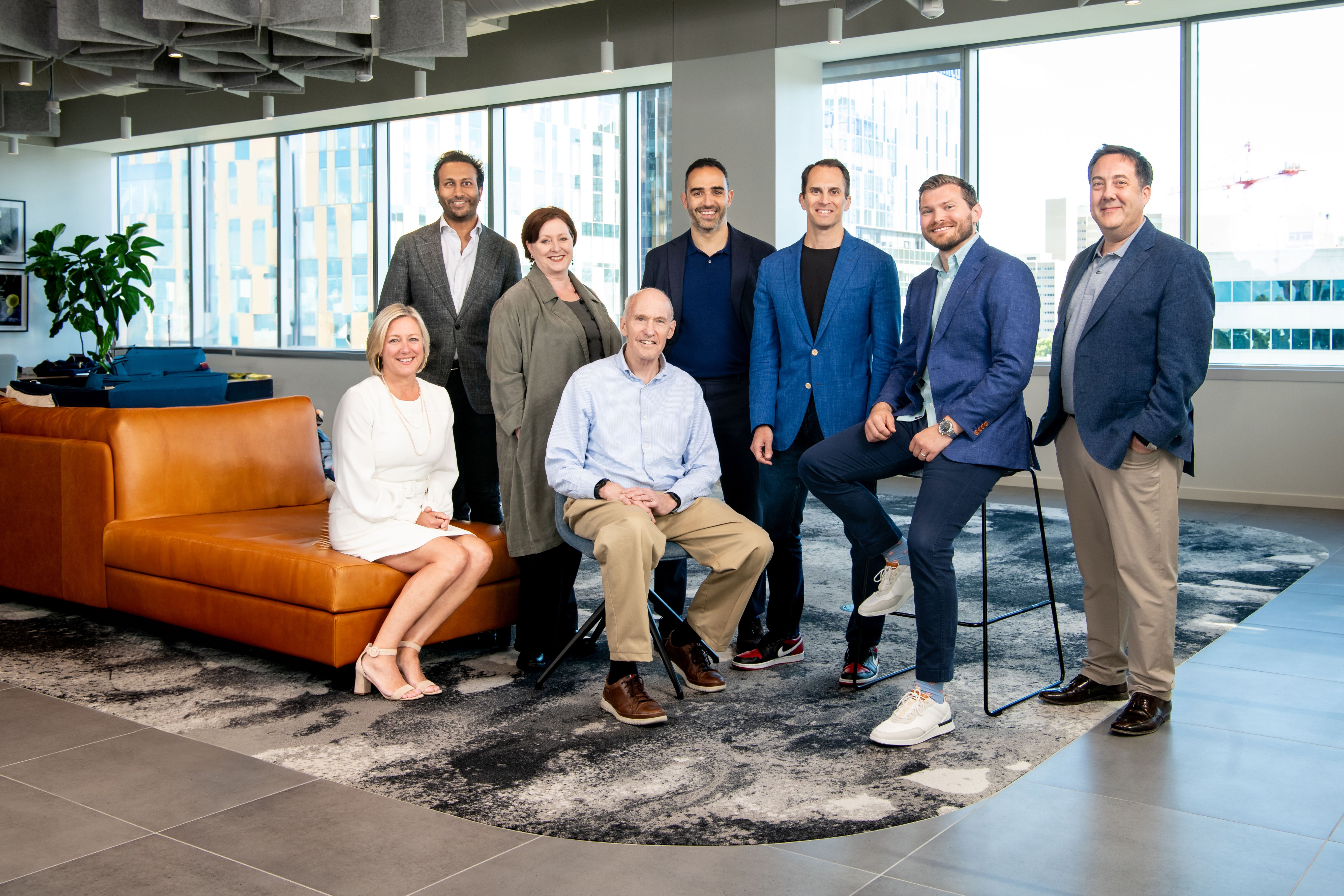
    Based in Philadelphia and San Francisco, the company, Dispatch Bio, launched a year ago with CAR-T pioneer and Penn researcher Carl June as a scientific co-founder and $216 million in funding from private investors.

    The company aims to succeed where CAR-T, an immunotherapy that genetically modifies a patient’s immune cells to recognize and attack cancer, has struggled.

    Although CAR-T has revolutionized the treatment of blood cancers, scientists have yet to replicate that success in solid tumors. By painting a target on tumors and revving up the immune system, Dispatch believes its platform could.

    It dosed its first patient earlier this month.

    “With one approach, we are addressing the two main challenges that we have faced over the last decade or so,” said Mauro Avanzi, the chief medical officer of Dispatch.

    Success is not guaranteed. Most exploratory scientific efforts do not advance to the point where they are found safe and effective in humans. Even if the results are promising, it could take years before a potential new treatment becomes widely available.

    Dispatch’s first clinical trial focuses on advanced gastrointestinal cancers, including cancers of the stomach, esophagus, and colon. The company also announced a clinical trial earlier this year in China that has not yet started dosing patients.

    If the treatment turns out to be safe and effective, Dispatch hopes to expand to other solid tumor types with significant unmet need.

    “As many patients as we can deliver that for, we will keep striving to do,” said Lex Johnson, Dispatch’s co-founder and chief platform officer.

    ‘A Trojan horse’

    Solid cancers are notoriously difficult to treat with immunotherapy for two main reasons: they’re hard to target, and they’re good at suppressing the immune system.

    To attack a cancer cell, you need to be able to find it. Sometimes cancer cells have more unique identifiable elements on the outside, but other times they don’t. Imagine trying to identify someone when all you know is that they’re wearing jeans.

    Many of the proteins found on solid cancer cells are also present in healthy tissue, making them potentially risky targets.

    Solid tumors are also good at building an environment around them that blocks and suppresses the immune system. Think of it like a protective shield.

    “They prevent your immune system from recognizing and clearing aberrant cells,” Johnson said, referring to cancer cells.

    Dispatch Bio’s signature treatment — called the Flare platform — is designed to overcome both of these challenges by tagging cancer cells with a unique target and boosting the immune system.

    The strategy revolves around a virus that, when injected intravenously, will traverse the body in search of tumor cells. Once the virus finds its target, it’ll take up residence inside the cell and tag it with a target protein called “the Flare.”

    “You can create that Flare protein to be something that is not present on healthy tissue throughout the body,” Johnson said.

    In colon cancer, for example, they would use a protein that is not present on any healthy colon cell, to avoid toxicity.

    At the same time, the Flare platform secretes chemical signals to re-engineer and reset the environment around the tumor. This enables the immune system to better attack the tumor.

    “It is a Trojan horse,” Avanzi said, describing the virus.

    When a tagged cancer cell is destroyed, it goes on to release thousands more viral particles carrying the Flare. That chain reaction helps spread the therapy’s effect across multiple sites.

    In animal studies, the platform has been able to completely clear out tumors without off-target effects or toxicity.

    But results in animals are often difficult to replicate in people, and the ongoing clinical trial is the first time the platform is being used in humans.

    The trial

    Mauro Avanzi is the chief medical officer of Dispatch Bio.Courtesy of Dispatch Bio

    If the virus successfully paints cancer cells with the target, CAR-T cells can then find and clear them. (CAR-T therapy uses what’s called a chimeric antigen receptor, a protein that recognizes a cell as cancer based on what’s on the outside of the cell.)

    The first phase of the trial involves escalating the dose of the virus alongside a standard dose of an approved CAR-T therapy to figure out the ideal regimen.

    Once Dispatch determines the safest dose of the virus, they’ll move into the dose expansion phase, where they test that dose in a bigger group of patients.

    “We are really trying to optimize the virus,” Avanzi said.

    There is no expected timeline yet for the trial.

    Dispatch is actively enrolling patients at City of Hope in California and the University of Cincinnati, and is in the process of activating four or five additional sites. They plan to open a site in Philadelphia, too.

  • Makai Lemon has all of the opportunity in the world. The Eagles need him to seize it.

    Makai Lemon has all of the opportunity in the world. The Eagles need him to seize it.

    There is a piece of math that makes it awfully difficult to assume anything about Sean Mannion’s offense.

    It’s a piece of math that is either working in strong favor of or in strong disfavor of Makai Lemon. It depends on how the rookie feels about pressure.

    The expectations for the Eagles’ 2026 first-round pick should be a lot higher. Because the bar is high. And he is the only one who has the skill set to clear it.

    Let’s start with the math. Specifically, with the number 142.9. That’s how many targets A.J. Brown averaged per 17 games during his four seasons with the Eagles.

    Add to that 34.5, the number of targets that Jahan Dotson averaged per 17 games in his two seasons with the Eagles.

    Our total is 177.4.

    Which brings us to the most critical number: 66.5.

    That’s how many targets Dontayvion Wicks has averaged per 17 games in three NFL seasons.

    As the signs will say in London in Week 5: Mind the gap!

    One thing you can safely say about the Eagles offense in its first year under Mannion: some wide receiver is going to have a breakout season, or the defense is going to need to win them a lot of games.

    The other options are outliers. Even if the offensive line recaptures the bodily spirit of 2024, are the Eagles really going to average nearly 5 yards per carry without somebody drawing Brown’s level of gravity opposite DeVonta Smith? If not, are they really going to run the ball 621 times while passing it only 448? If not, are the Eagles really going to put up championship-caliber point totals with Smith accounting for a third of the targets and yards?

    DeVonta Smith figures to be the main beneficiary among Eagles receivers after A.J. Brown’s departure.Elizabeth Robertson / Staff Photographer

    The breakout certainly could be Smith’s. Plenty of folks inside and outside of the Eagles organization have murmured Jaxon Smith-Njigba and DK Metcalf when hypothesizing about Smith in his post-Brown chapter. Last season, after the Seahawks traded Metcalf to the Steelers, Smith-Njigba’s target share jumped from 137 to 163 and his yardage from 1,130 to 1,793. In other words, he turned from Smith into a supersized Brown.

    In the event of such a breakout from Smith, the Eagles wouldn’t necessarily need anything greater than replacement-level production from the rest of the Eagles’ receiving corps. Last season, the only Seahawks receiver other than Smith-Njigba with more than 26 targets or 188 yards was the ghost of Cooper Kupp, who finished with 47 catches and 593 yards.

    But, like we said, that’s an outlier.

    One can argue that the Denver Broncos, Buffalo Bills, and Kansas City Chiefs offer alternate hypotheticals for life without a true No. 2.

    Denver made it to last year’s AFC championship game with Troy Franklin’s 65 catches and 709 yards in the second chair behind Courtland Sutton’s 74 and 1,017.

    The Bills had the second-highest scoring offense in the NFL in 2024 with Khalil Shakir leading the way at 100 targets and 821 yards. That was the year after they parted ways with Stefon Diggs.

    The Chiefs had the NFL’s highest-scoring offense in 2022, the year after they traded away Tyreek Hill. Their top wideout was JuJu Smith-Schuster, who had 101 targets and 933 yards.

    The rebuttals are easy.

    The Chiefs had Travis Kelce, who filled the Hill vacuum with a career-high 152 targets and 110 catches for 1,338 yards. If Dallas Goedert does that, great. He’s the breakout. Otherwise, Smith-Schuster’s 933 yards would be a heck of a season for Lemon or Wicks.

    The Broncos and Bills traded significant draft capital for receivers this offseason; Jaylen Waddle headed to Denver from Miami, and D.J. Moore went to Buffalo from Chicago. Both served as verdicts on a by-committee approach at wide receiver.

    There’s a lot we don’t know about Mannion and how his scheme will express itself. There’s even more we do not know about how Jalen Hurts and the rest of the Eagles’ talent will play without a generational wide receiver on one side of the field and Smith on the other.

    But we can venture to say that nobody besides Lemon or Smith has the potential to maintain the Eagles’ aggregate WR1/WR2 production. Ours is not the first fan base or media contingent to sell themselves on best-case scenarios for Wicks, Marquise “Hollywood” Brown, or Elijah Moore. Those players are here for a reason. Their sample sizes are more than large enough.

    That’s one of two reasons Lemon is the player most integral to the Eagles’ 2026 hopes. The second is that he has the ability.

    The Eagles traded up a spot and snaked the Steelers for a reason. He isn’t your typical late first-round receiver. There is plenty of maturity and present-day NFL value evident in his game tape. He doesn’t have the outlier physical or athletic measurable of a potential generational performer like Brown. But he has the technical skills and toughness that play immediately in the NFL.

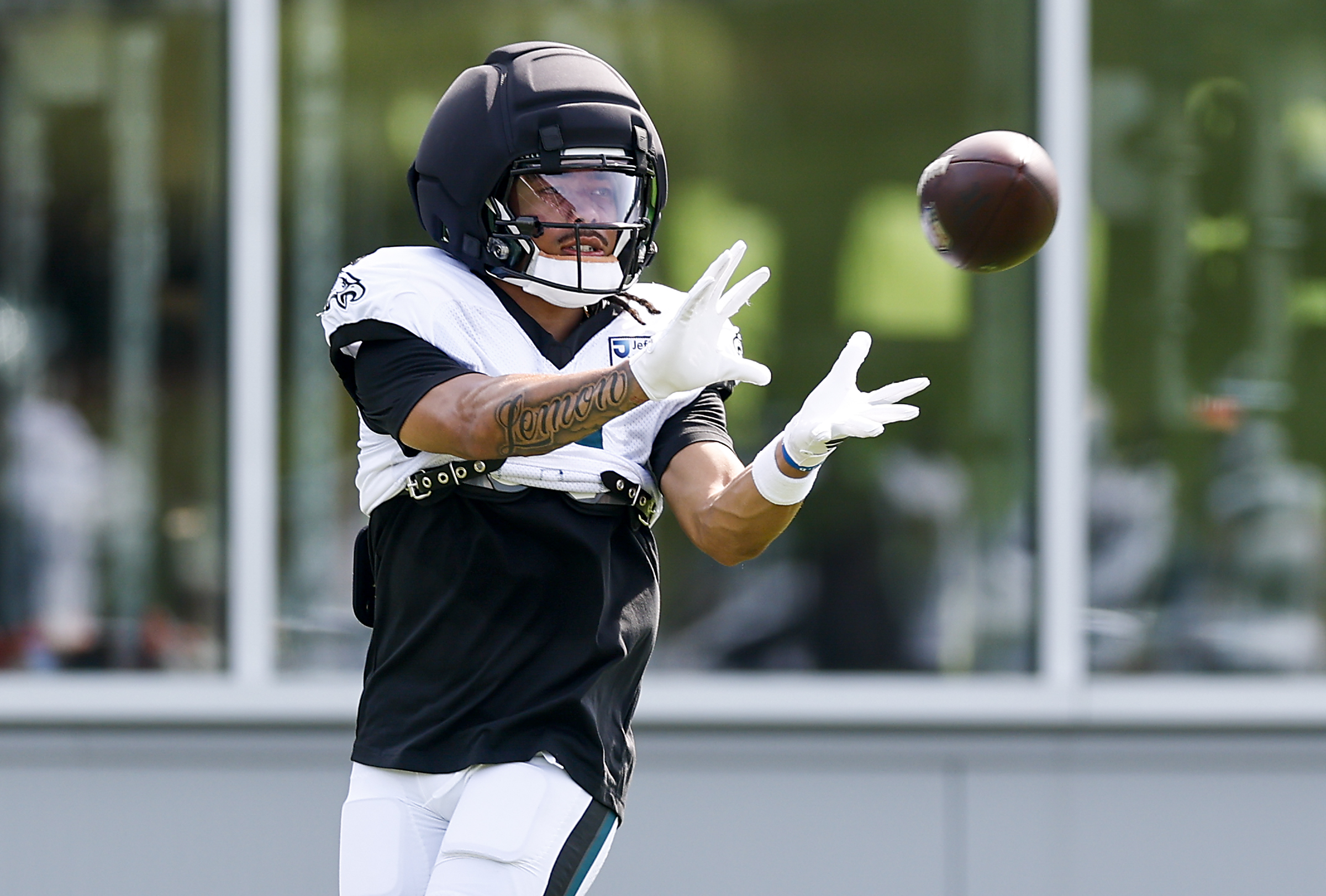
    We have not heard much of Lemon this last month. Summer-long soft tissue injuries have a knack of doing that to rookies. The big question is whether the time he has lost can quickly be regained.

    That’s true for Lemon individually. It’s just as true for the Eagles’ offense overall.

  • Violence against women in a Good Good ad stains slow responders: PGA Tour, Callaway, Golf Galaxy, Golf Channel

    Violence against women in a Good Good ad stains slow responders: PGA Tour, Callaway, Golf Galaxy, Golf Channel

    The only thing more disappointing about the slow and weak response by the principals in the Good Good Golf YouTube channel scandal was its utter predictability.

    There should have been immediate distancing and disassociation from Callaway Golf and Good Good Golf after they aired an outrageous commercial that endorsed violence against women. Instead, it took almost a week.

    Why?

    Because corporate America, the foundational structure for the golf industry, hoped it would all blow over.

    It did not.

    Last Friday, an ad aired online in which Good Good Golf co-founder Garrett Clark rushes across a tee box and levels a female golfer who is looking in his bag, then stands over her, points at her on the ground, and says, “Do not touch my new driver.”

    Who thought this was acceptable? Who thought this was funny? Who thought this was anything but horrific?

    Good Good, that’s who. Of course they did.

    It’s a frat bro content creator and apparel company with more than 2 million subscribers to its YouTube channel, making goofy videos. It also sells ugly hats and even uglier shirts. When you hear some idiot on TV scream, “Get in the hole!” when a pro golfer tees off on a par-5, dollars to doughnuts he’s wearing Good Good gear, hat on backward, shirt untucked.

    Then, the commercial.

    There was, appropriately, immediate backlash that convinced Good Good to delete the ad. The backlash snowballed into international outrage, with resounding consequences.

    Cool. It took far too long.

    The ad aired Friday.

    By Saturday night the PGA Tour, Tour CEO Brian Rolapp, Callaway, Dick’s Sporting Goods and Golf Galaxy, and Golf Channel all should have cut ties with Good Good. The fact that none did until they were forced by public sentiment tells you everything to need to know about these folks and how they view women.

    In case anyone wants to argue that this commercial was not an endorsement of violence against women, know that Callaway, as penance, on Thursday committed $1 million to support initiatives that combat violence against women.

    The club in question was a driver made by Callaway in collaboration with the new hip-and-with-it brand. The ad was vetted by both Callaway and Good Good. Incredibly, it raised no alarms at either place, with anyone, until social media began its cycle of outrage.

    The irony is few brands had done as much to promote women in golf than Callaway, which has perhaps the most potent brand-to-athlete recognition relationship in the women’s game, the one-time face of women’s golf, Annika Sorenstam. She condemned the ad but, sadly, did not condemn either Callaway or its leadership.

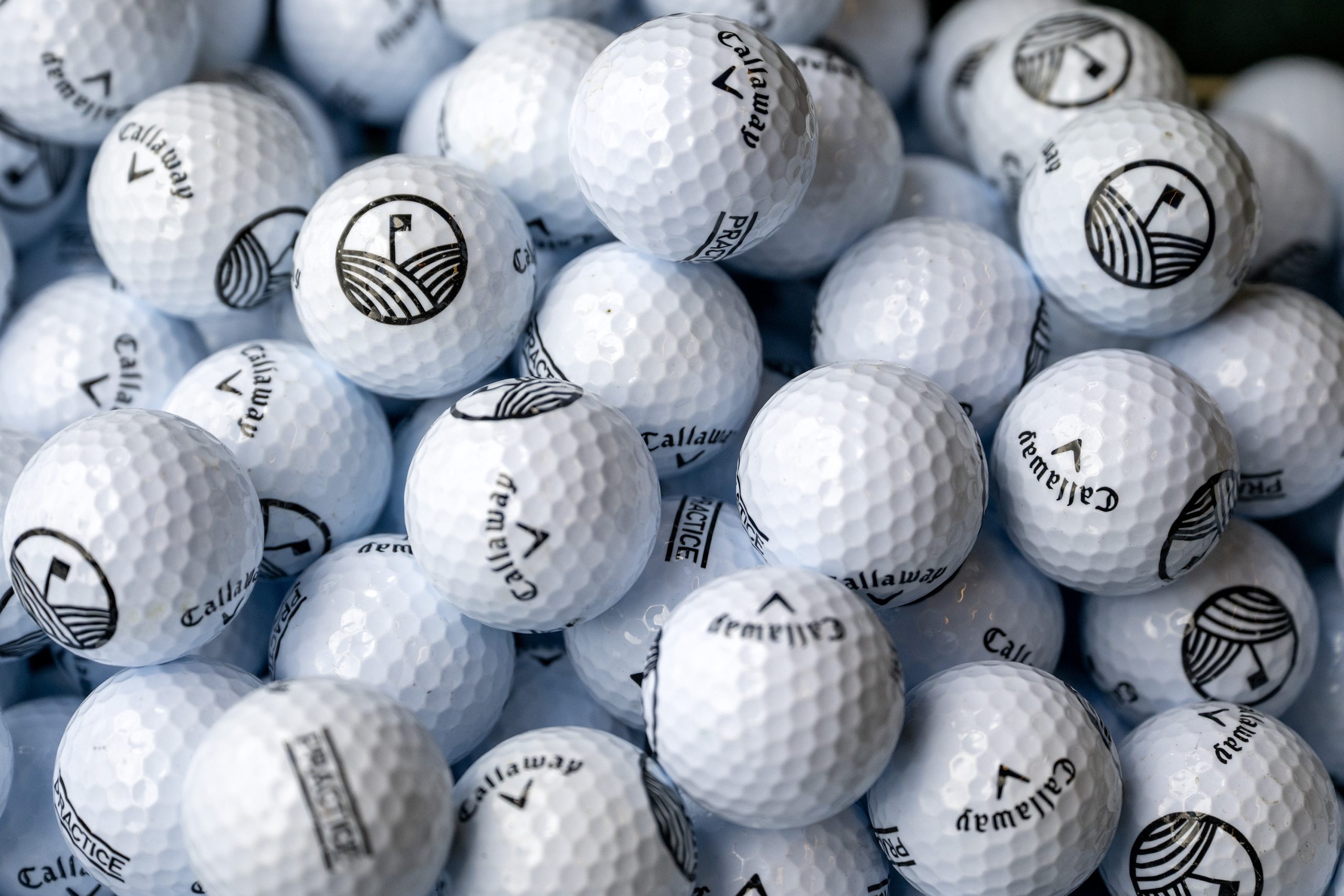
    Callaway Golf balls shown at the Cobbs Creek Golf Course.Tom Gralish / Staff Photographer

    This comes at the height of the Caitlin Clark era, when women’s sports are surging like never before. She’s a basketball player, but she loves to golf.

    Her involvement in the game might have helped spur the biggest growth spurt women’s golf has ever seen. The COVID-19 lockdown triggered massive growth in the golf industry in the United States, and the segment that has grown the most by both percentage and raw numbers is women’s golf, up 45% and 2.5 million golfers compared to 12% and 2.3 million for men, according to the National Golf Federation.

    Callaway just scored the worst own-goal in sports marketing history.

    More than 8 million women now play golf, but the chairmen of all of the entities in question — the Tour, Callaway, Dick’s, and Golf Channel — all are men. Which might explain the slowness and gradualness of the only acceptable responses.

    So we had the scramble, and the admonitions, and the apologies, and the disassociations. The problem with all of it is, nobody wanted to do the right thing unless they had to. Everybody wanted to try to ride it out. Which means they are all as guilty as they could possibly be.

    That includes the Tour, which, on Thursday, announced that Good Good would no longer be the title sponsor of a tournament in Texas in November.

    That includes Golf Channel, which needed four days to decide to not air the Good Good edition of “Big Break,” which was due to begin Tuesday but, after sponsor Golf Galaxy pulled out, was initially pushed back a week and has since been canceled altogether.

    That includes Dick’s Sporting Goods and Golf Galaxy, which needed five days to decide to pull Good Good merchandise from its shelves.

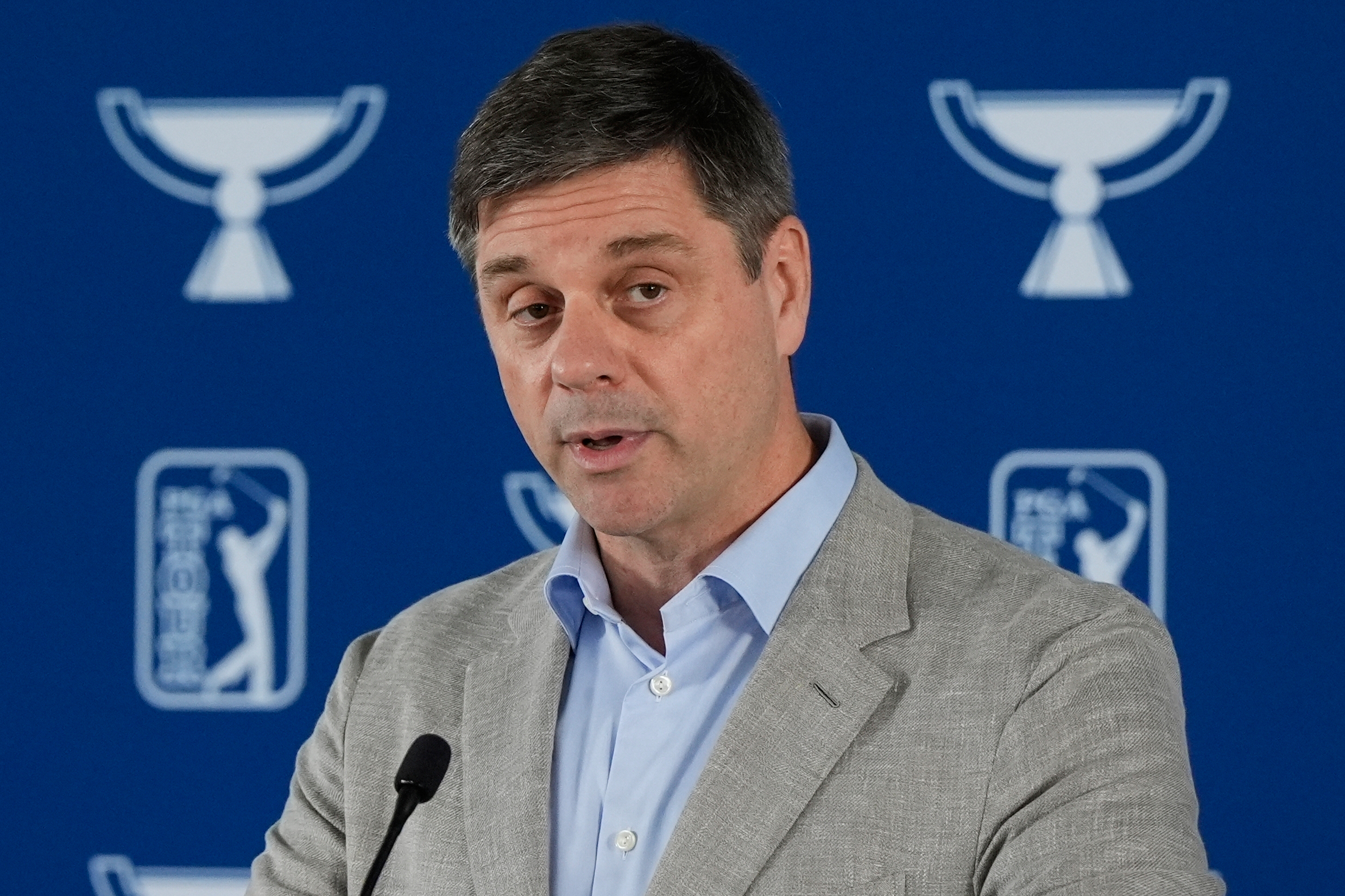
    That includes Rolapp, who only responded to the commercial’s misogyny when he was questioned at a press conference four days after the incident, then landed this stinging indictment: “I think what we saw was concerning.”

    Rolapp’s milquetoast response was a resounding reminder that, before moving to the PGA Tour last year, Rolapp spent more than two decades working for the NFL, America’s most notorious sports league when it comes to ignoring issues like domestic violence and sexual harassment in the workplace.

    That includes Callaway, whose executive roster looks like President Donald Trump’s cabinet. After one day, Callaway issued a chastisement … of Good Good. After three days, Callaway pulled the driver from its website. After six days, as its stock continued to lose value, Callaway finally cut ties with Good Good.

    Callaway’s abrupt about-face, after partnering with Good Good for three years, might have been prompted by Callaway being threatened with exclusion by huge retailers like Costco, which apparently removed access to Callaway products Thursday, at least temporarily.

    And, of course, there is Good Good.

    Clark is the general manager.

    He should resign.

    He should have resigned Saturday morning.

    Instead, five days after the commercial aired, as Dick’s, Golf Galaxy, and the PGA Tour Superstores began pulling Good Good stock from their shelves, Clark issued a rambling, 8½-minute “apology.” In it, he explains the process of the production of the ad, and insists that the woman was not injured, and that Good Good is women-friendly — as if any of this matters.

    At all.

    It does not.

    The obtuse and embarrassing statement just paints Clark and Good Good as defensive, tone-deaf, and completely uncomprehending of the gravity of the moment.

    As tone-deaf as Rolapp, the PGA Tour, Callaway, Golf Channel, and Dick’s/Golf Galaxy.

    All of them did the right thing, eventually, when forced to do so.

    But none of them did the right thing for the right reasons in the right time frame.

  • Bryce Harper had his best month as a Phillie, and even he is not quite sure how he’s done it

    Bryce Harper had his best month as a Phillie, and even he is not quite sure how he’s done it

    Bryce Harper banged an opposite-field two-run homer in the first inning Wednesday and doubled off a tough lefty reliever in the fifth.

    Yet he fixated on what happened in between.

    In his second at-bat of a 6-0 Phillies victory in Seattle, Harper lined out to left field on a full-count sinker below the strike zone from hard-throwing Mariners righty Bryan Woo.

    “He was really upset that he swung at it,” hitting coach Kevin Long said later. “That’s something he would do last year, the last year and a half, two years, where it really wouldn’t be that big of a deal. But now he’s back to where he’s making a conscious effort to make sure he’s taking what the pitcher gives him.

    “And it’s showing.”

    Is it ever.

    Objectively, without a trace of recency bias, Harper is having his best month in seven years with the Phillies. Entering play Friday, with four games left in August, he has gotten on base in 55 of 108 plate appearances, a mind-bending .509 clip, and reached in 29 consecutive games, the longest streak of his career.

    Some context: Guardians outfielder Steven Kwan has the second-highest on-base percentage among qualified hitters in August … at .463. Harper, fifth among active players with a .387 career mark, has only once carried a .500 OBP through a full calendar month — and not since April 2017 with the Nationals (.509).

    Harper has drawn 28 walks this month for a majors-leading 25.9% walk rate. But it’s not like he’s being overly passive at the plate. He’s batting .338 (27-for-80) and slugging .600 with six doubles, five homers, and an 1.109 OPS.

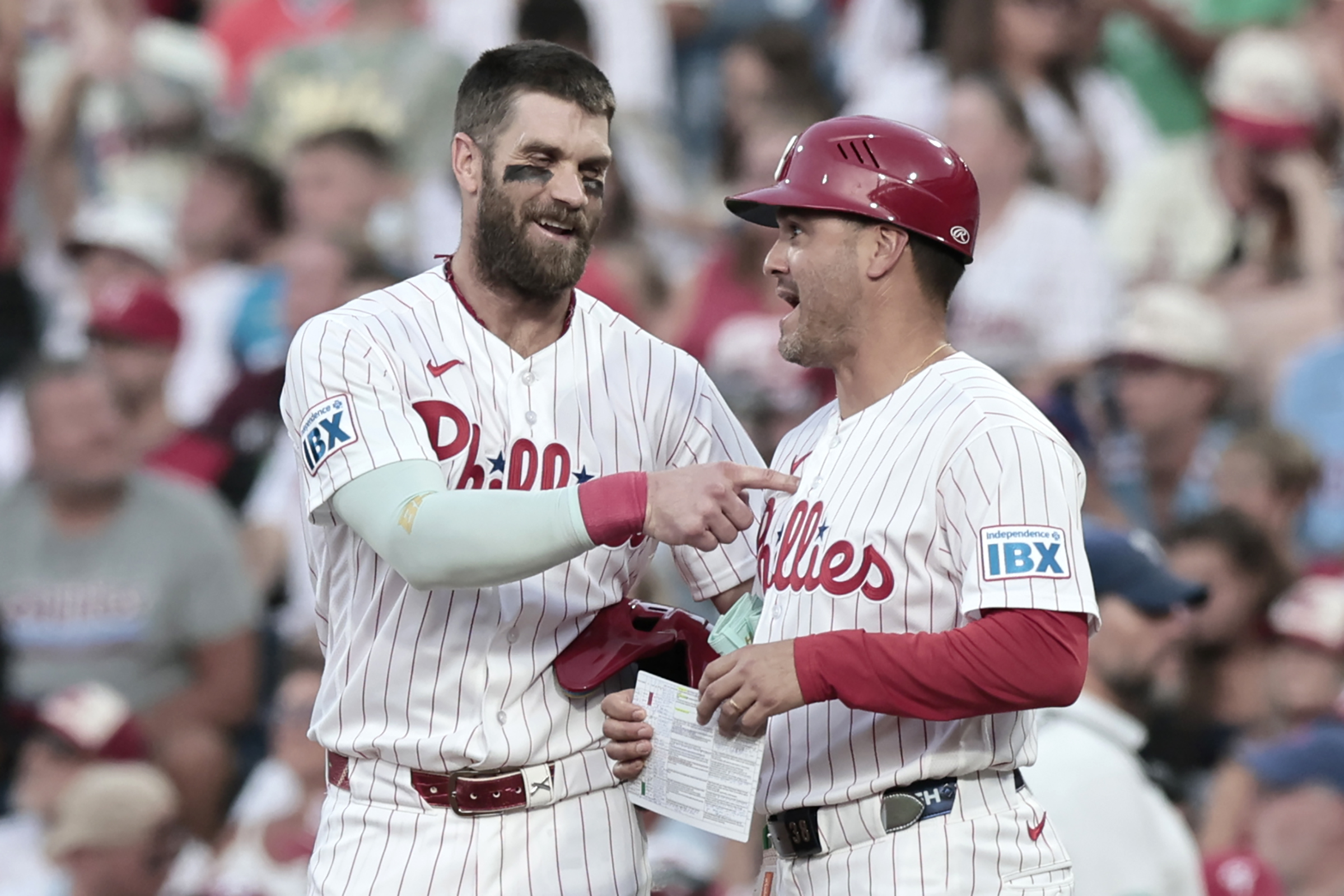
    Entering the weekend, Bryce Harper (left) reached base in 55 of 108 plate appearances this month, which means he’s seen a lot of first-base coach Paco Figueroa.Elizabeth Robertson / Staff Photographer

    Even Long, who has worked with Harper since 2018 in Washington, recently asked him how he’s doing it.

    “And I couldn’t really give him an answer,” Harper said before a game this week in Seattle. “He was just like, ‘Why are you doing what you’re doing right now?’ I just haven’t really thought about it. Obviously the walks have come in bunches the last three weeks. It’s a lot of walks. I’m not trying to walk. I’m not trying to do those things. I’m just trying to play the game, and if I’m walking, I’m walking.”

    Harper chuckled.

    “K-Long’s kind of stopped asking me about it,” he said, “because I haven’t really given him a great answer.”

    Long has some explanations, and we’ll explore those shortly. But Harper’s surge — he’s fifth in the majors with a .971 OPS since the All-Star break — coincided with his move back to right field, which enabled the Phillies to pull off a deadline trade for contact-hitting second baseman Luis Arraez. Harper has also started every game despite a sore left knee.

    And so, although the Cubs’ Pete Crow-Armstrong has emerged as the favorite in the National League MVP race over even Shohei Ohtani, it’s appropriate to wonder if Harper should be entered into the conversation given his value to the Phillies.

    OK, so maybe that’s a September question.

    But with a few days left in August, no less than a former MVP and .307 career hitter who was known as “The Hitman” is marveling at Harper’s combination of patience and aggressiveness this month.

    “I don’t think I’ve ever seen a guy that does what he does,” Phillies interim manager Don Mattingly said. “The base on balls, the attack with the swing, and being able to control the zone is something that’s rare.”

    Bryce Harper leads the majors with 94 walks entering the weekend.Yong Kim / Staff Photographer

    Walk this way

    Harper’s dad always tells him he’s at his best when he accepts his walks. The logic: Teams don’t want him to beat them, so they walk him or try to get him to swing at non-strikes.

    It’s been that way since he was a kid.

    “I was 10-11 years old, and a coach would try to play mind games of like, ‘Hey, we’re not going to pitch to you today,’” Harper said. “Whack, they’d throw a pitch right down the middle and freeze me a little bit. I never want that feeling. I always want to be prepared to hit.”

    And because he never knows when that strike will come, Harper tends to guard against being overly passive by chasing more pitches that he should lay off. It’s a delicate dance.

    Last season, Harper saw a lower rate of strikes (43%) than any hitter in the majors, though it was consistent with his previous six seasons with the Phillies (42.6%). But his out-of-zone swing rate climbed to 35.6% last season from 31% from 2019-24, while his walk rate dipped to 12.1% last season from a six-year mark of 14.4%.

    So, Harper went to spring training with a renewed aim to improve his plate discipline and only “hit that ball in that box.” He even set a goal to “walk 140 to 150 times.” It was ambitious. In the last 10 years, only Juan Soto walked that often in a season (145 times in 2021).

    But Harper’s intentions were clear.

    “I just need to make sure I walk and not just want to get hits all the time,” he said in March. “I want to hit. I want to be a hitter, obviously. I want to hit homers and hit doubles and all those things. But sometimes it’s better for me if I walk. I can do that a little bit more this year.”

    Phillies hitting coach Kevin Long has worked with Bryce Harper since 2018 with the Nationals.Yong Kim / Staff Photographer

    Through the end of July, not much had changed from 2025. Harper was still seeing a low rate of strikes (42.2%) and swinging a high rate of non-strikes (34.6%), according to Statcast, and walking at only a slightly higher rate (13.4%).

    But this month, at last, Harper is doing exactly what he intended to. He has swung at only 23.3% of pitches out of the zone and walked at a 25.9% clip.

    It’s hitting nirvana.

    “He’s doing it exactly how you should,” Long said. “It’s not taking away his aggressiveness. He’s still being ultra aggressive, especially in the zone. But the ones out of the zone, it’s almost like he’s not auto-swinging. He’s really making a conscious effort to make sure that the pitch is where he wants it.”

    It’s not like Harper hasn’t hit like this before. In 2021, when he won his second NL MVP award, he controlled the strike zone with a 24.9% out-of-the-zone swing rate and a 16.7% walk rate.

    To Harper, the road back to achieving those marks was adjusting his mindset.

    “[It’s] me just giving a crap about it, right?” he said in spring training. “Just making sure I do it. That’s a big thing for me. … It’s just buying in.”

    Said Long: “I’ve seen him take several borderline pitches where he goes, ‘Man, I just didn’t think that was a strike.’ Well, that’s what good hitters do, and that’s what he’s doing.”

    There’s another explanation, too, and it can be found in the on-deck circle when Harper bats.

    Luis Arraez (right) has batted behind Bryce Harper since the Phillies traded for him on Aug. 3.Jose F. Moreno / Staff Photographer

    The Arraez effect

    Even though Harper feels most comfortable in the No. 3 spot in the order, the Phillies didn’t add a cleanup hitter in the offseason.

    And Harper came to camp with lineup protection on his mind.

    “Whoever’s in that four spot,” he said in February, “is going to have a big job to do.”

    But after all these years, Harper uniquely understands that he’s the guy opponents will always pitch around, no matter the situation. Unless the Phillies summon the ghosts of peak Mike Schmidt and Ryan Howard to hit behind Harper, he’ll never get pitched differently.

    So, no, Harper isn’t suddenly seeing more strikes since the Phillies traded for Arraez on Aug. 3 and put him in the cleanup spot. Never mind that Arraez’s ability to put the ball in play is unrivaled in the sport. The rate of in-zone pitches to Harper with Arraez behind him (40%) is actually lower than the overall season rate (41.8%).

    “I think teams are going to pitch me the way they want to pitch me,” Harper said, “no matter who’s behind me.”

    Probably. But just because teams approach Harper with similar caution doesn’t mean that Harper’s mindset isn’t wildly different.

    To wit: In spring training, Harper noted that the Phillies’ “numbers in the four spot weren’t very good last year.” On some level, then, the implication was that he felt a burden to drive in runs ahead of Alec Bohm, J.T. Realmuto, Nick Castellanos, and others.

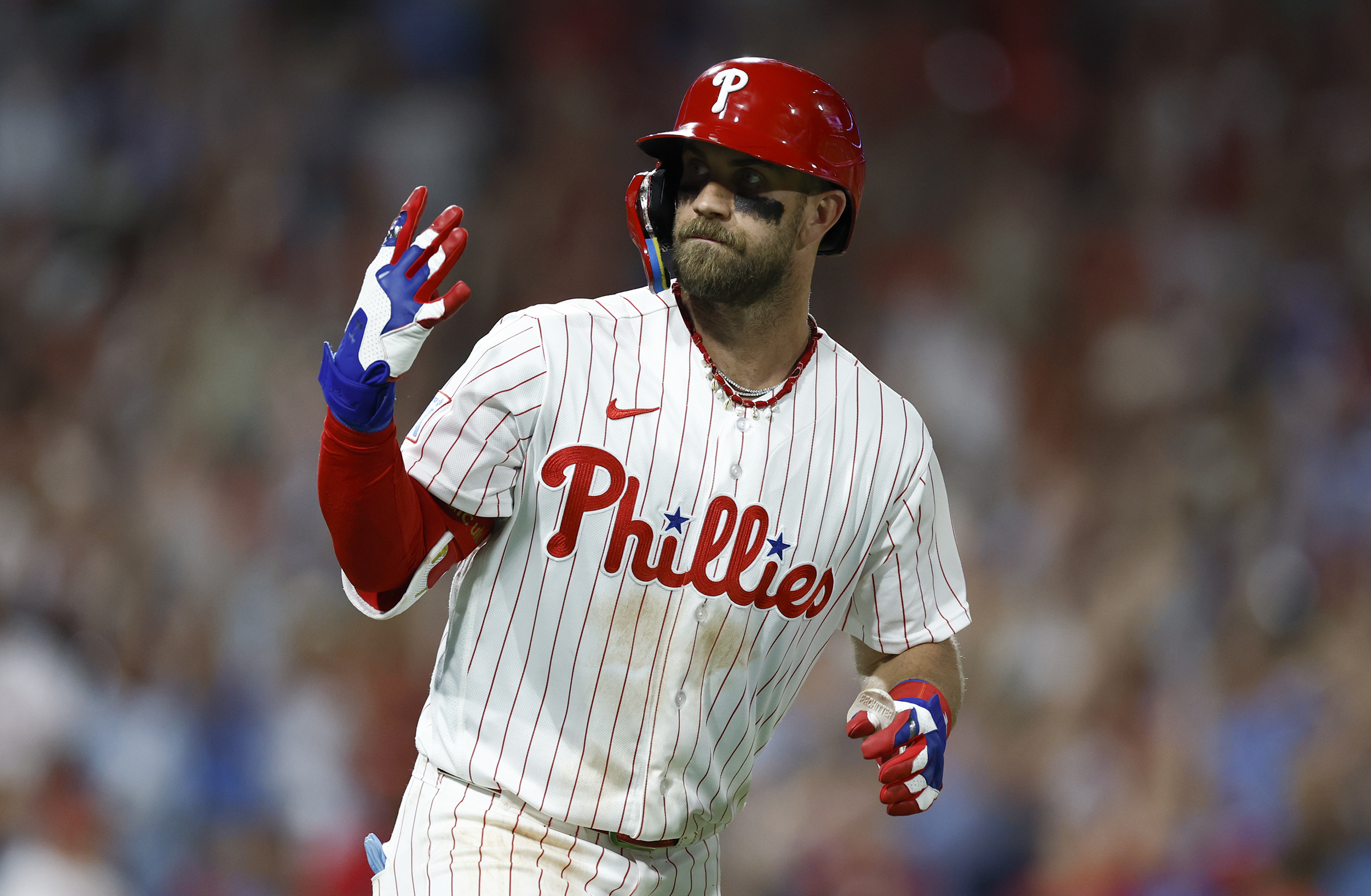
    Bryce Harper is having the best month of his Phillies career in August.Yong Kim / Staff Photographer

    Now, here’s how he talks about Arraez, who has struck out only three times in 89 plate appearances for the Phillies:

    “Having a guy like that behind me is definitely a different aspect just because I can kind of put all the faith in him to get the job done,” Harper said. “He’s going to put the ball in play; he’s going to have great at-bats; he’s going to see pitches.

    “It’s just a different type of baseball that he plays comparatively to a lot of the game nowadays. He’s an asset to our team completely just because of those reasons.”

    Surely, then, it’s easier for Harper to holster his bat and accept a walk rather than chasing after pitches off the plate and getting himself out.

    It isn’t perfect. Harper concedes he must be more productive against lefties (.207 average, .657 OPS). And Long said Harper “was concerned for a minute” over an 11-game stretch with only one extra-base hit. He has three doubles and two homers in his last five games.

    “I’m like, ‘This is really what you want. You’re getting on base every single day, two or three times, you’re making really good decisions,’” Long said. “I told him, ‘I’ve got to believe that the extra-base hits will come with all this — and they have. But it’s really about just making a conscious effort to hit better pitches.”

    For more than a month, Harper has done that as well as ever, maybe even at an MVP level.

  • Eagles 53-man roster prediction: How tough decisions at wide receiver, tight end and D-line will shake out

    Eagles 53-man roster prediction: How tough decisions at wide receiver, tight end and D-line will shake out

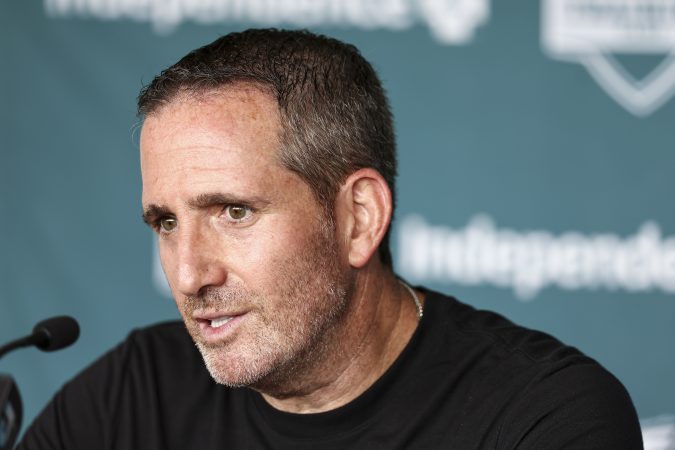
    Howie Roseman has all the pieces laid out in front as he whittles the Eagles’ 91-man roster down to 53 players ahead of Sunday’s 6 p.m. deadline.

    Most of the team is in place, but it isn’t like some piece of furniture from IKEA with specific parts. Roseman will build his makeshift roster by balancing the Eagles’ immediate needs with the long-term, while also factoring in injury variables, the salary cap, and other potential moves.

    The general manager is scanning the rest of the NFL for upgrades at positions in question. He’s yet to make any trades since camp started, but no one likes to wheel and deal as much as Roseman. C.J. Gardner-Johnson and Jahan Dotson are just two of the players Roseman acquired in and around this time.

    Wide receiver, tight end, and safety are among potential areas that could be addressed.

    The 16-man practice squad will also afford the Eagles a landing spot for vested veterans, players they will taxi up on game days, or prospects they hope to develop. So while only 53 will make the initial cut, Roseman considers his roster a 69-man outfit (70 if they have an international prospect).

    It is an ever-evolving list that will likely change ahead of the season opener vs. the Commanders on Sept. 13. But for one fleeting moment there will be those who make it, and those who don’t. Here’s one beat reporter’s predictions:

    Andy Dalton is a candidate to be moved, which would slot Tanner McKee in as the No. 2 quarterback. Yong Kim / Staff Photographer

    Quarterbacks (3): Jalen Hurts, Tanner McKee, Cole Payton.

    Traded: Andy Dalton.

    Practice squad: None.

    Dalton’s play this summer hasn’t earned him the No. 2 job. McKee has been only marginally better, but has shown improvement. The best man doesn’t always win. But the educated guess here is that Roseman will trade Dalton to a backup-needy team — of which there are many. He may need to keep all four quarterbacks past Sunday’s deadline to get what he wants in return, however.

    Payton has displayed more than last year’s rookie project — Kyle McCord — and probably wouldn’t pass through waivers if the Eagles consider stowing him on the practice squad.

    Running backs (3): Saquon Barkley, Tank Bigsby, Will Shipley.

    Cut: Dameon Pierce, Carson Steele, Jordan Mims.

    Practice squad: Steele.

    A position of strength, the top three running backs have virtually been locked into place since the start of camp. Shipley’s development made Pierce expendable. Steele’s preseason film could make him a waiver claim. His fullback experience — which he never got to show in camp — makes him a versatile practice squad possibility.

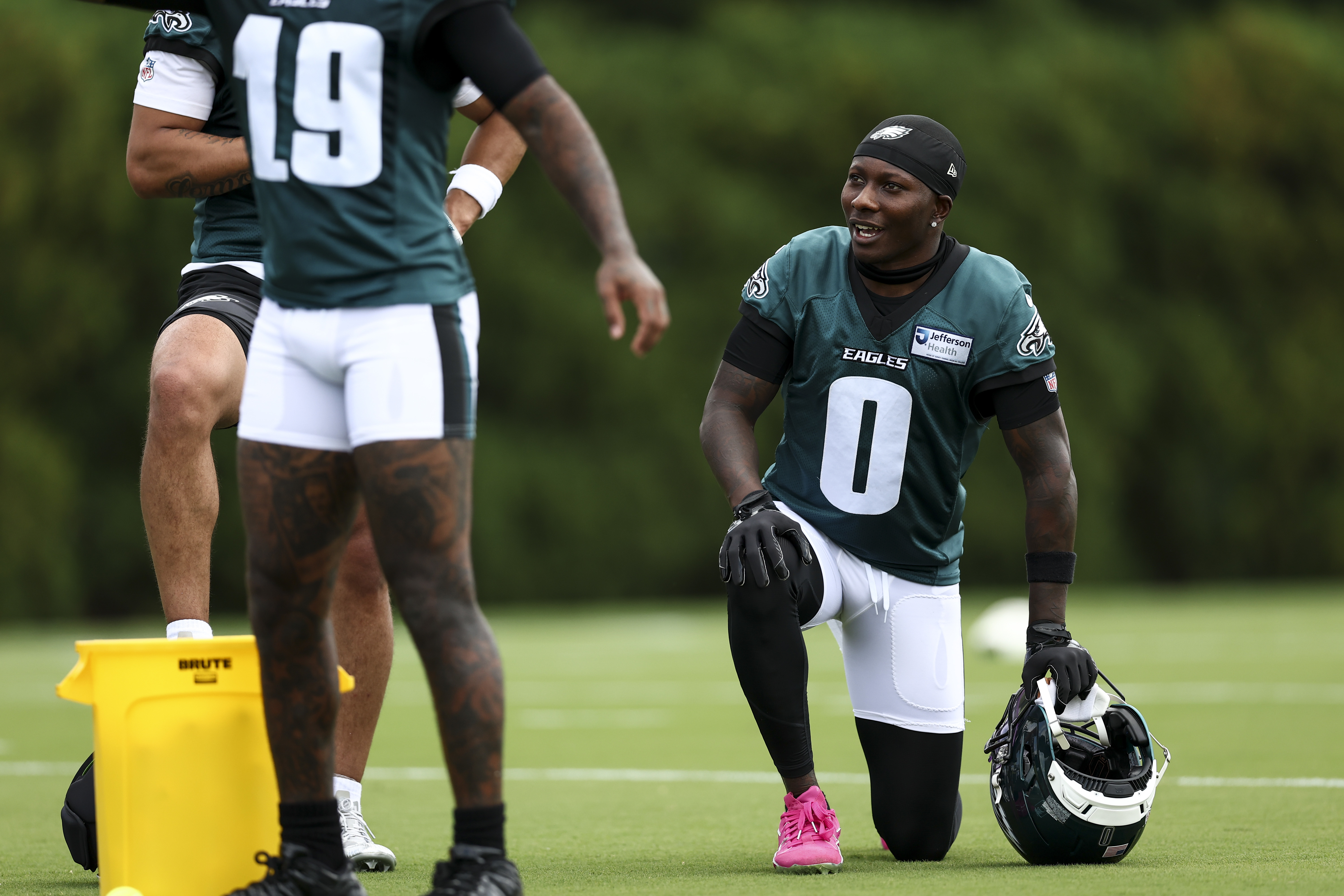
    Hollywood Brown (0) did not have the best training camp but the guess is that he stays.Monica Herndon / Staff Photographer

    Wide receivers (5): DeVonta Smith, Makai Lemon, Dontayvion Wicks, Hollywood Brown, Darius Cooper.

    Injured reserve: Johnny Wilson.

    Cut: Elijah Moore, Britain Covey, Quez Watkins, Danny Gray, Samori Toure, Erik Ezukanma, Tahj Washington.

    Practice squad: Moore, Covey.

    There was little chance the Eagles could replace A.J. Brown with just one player, so Roseman went the by-committee route with Lemon as the biggest investment. A nagging hamstring injury has stunted the first-round draft pick’s early development. Wicks solidified the No. 2 outside spot, but there’s a significant dropoff after Smith. That Cooper, who cooled off after a hot summer start, is the only receiver with some size could also be of concern.

    Moore performed better than Hollywood Brown in camp, but the latter is guaranteed $5 million. He also has a proven track record. Moore is also primarily a slot and that job belongs to Lemon — for better or worse. Maybe he’s an early-season practice squad call-up to offset the rookie’s expected learning curve. Covey’s been down this road before and could stick on the practice squad, unless Lemon can field punts right away.

    Tight end Cameron Latu’s ability to play fullback could help him stick on the roster. Yong Kim / Staff Photographer

    Tight ends (4): Dallas Goedert, Johnny Mundt, Eli Stowers, Cameron Latu.

    Cut: Grant Calcaterra, E.J. Jenkins, Stone Smartt.

    Practice squad: Calcaterra, Jenkins.

    Tight end has overtaken safety as the most likely area Roseman might address via trade or by some other means. The Eagles were probably expecting Stowers to need time, especially when it came to blocking. But he rarely practiced with Hurts, if at all, and recently suffered a setback with his hamstring. Redshirting the second-rounder would set off alarms, so it’s unlikely Roseman takes that route.

    But a swap — or signing a veteran like Zach Ertz off the street — would also speak volumes. Goedert is still a competent “Y” receiver, while Mundt will shoulder some of the “F” blocking responsibilities. But tight ends often need to be dual-purpose within Sean Mannion’s new Kyle Shanahan-style scheme and neither is as competent in the opposite discipline.

    If Stowers isn’t healthy by the opener, or is unable to contribute on special teams in the early going, Latu seems the likely fourth option. He can also fill the fullback role if Mannion adds that wrinkle to the offense.

    Offensive linemen (10): Lane Johnson, Jordan Mailata, Landon Dickerson, Cam Jurgens, Tyler Steen, Markel Bell, Drew Kendall, Willie Lampkin, Micah Morris, Fred Johnson.

    Cut: John Ojukwu, Jake Majors, Michael Jordan, Cameron Williams, Myles Hinton, Zeke Correll.

    Practice squad: Ojukwu, Majors, Williams.

    The starting five — among the best units in the NFL when healthy — has long been predictable. In question entering camp was if the youngsters would be viable backups. The answer appears to be a provisional yes after a promising summer of Bell, Kendall and Lampkin working with Jeff Stoutland replacement Chris Kuper. Ultimately, they have to go out there and do it against actual starters when called upon.

    And that time will most likely come. Jurgens has looked more nimble than he did a year ago after back surgery. But Dickerson may be put together by Scotch tape and chewing gum after multiple injuries, while the 36-year-old Lane Johnson is entering his likely final season. Bell may have beat out Fred Johnson for the swing tackle spot, but the latter has helped the Eagles through multiple injuries the previous two seasons. He’s the last guy on here, but may not survive.

    There also isn’t an obvious second reserve tackle with Williams and Hinton still not close to ready.

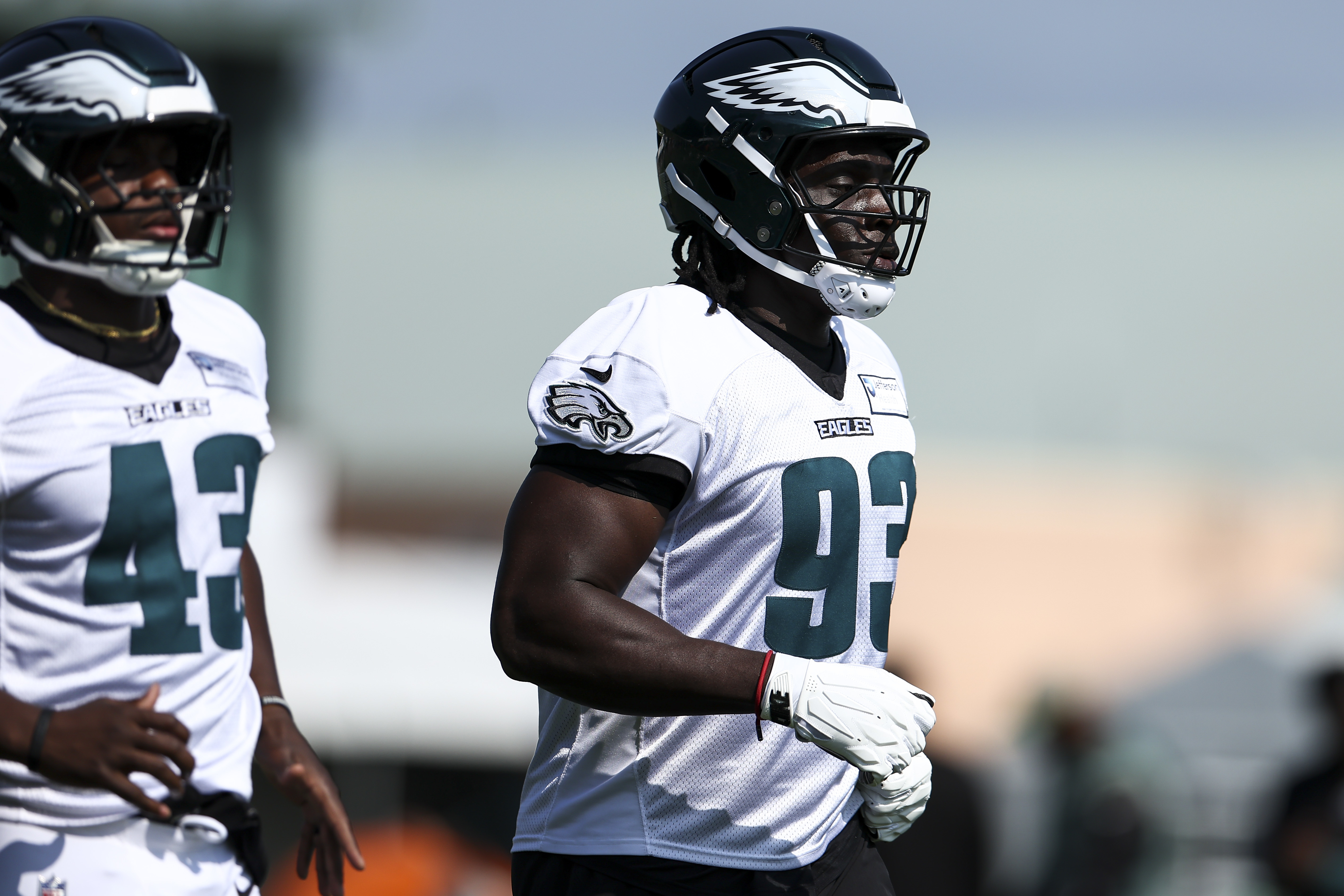
    How the Eagles will handle International Player Pathway program Uar Bernard’s (93) case bears watching. Monica Herndon / Staff Photographer

    Defensive tackles (6): Jalen Carter, Jordan Davis, Moro Ojomo, Byron Young, Ty Robinson, Uar Bernard.

    Cut: Gabe Hall, Zion Wilson, David Blay.

    Practice squad: Hall, Wilson.

    Roseman has balanced winning in the short term vs. building for the long term better than most franchises (see: Mailata). Bernard has a ways to go before he sees the field in the regular season. But the Eagles have that luxury with significant depth at defensive tackle.

    Carter, Davis and Ojomo give defensive coordinator Vic Fangio a formidable interior. Young and especially Robinson have taken steps forward in the offseason. Bernard, the International Player Pathway (IPP) program project the Eagles drafted in the seventh round, could befall injury and save a roster spot. But he wouldn’t be able to practice with the team while on injured reserve.

    Edges (6): Jonathan Greenard, Jalyx Hunt, Nolan Smith, A.J. Epenesa, Arnold Ebiketie, Joshua Weru.

    Cut: Keyshawn James-Newby, Jose Ramirez, Tarron Jackson.

    Practice squad: James-Newby.

    Roseman’s continued investment in the trenches influences the roster makeup. Fangio has said he can get away with just a three-man rotation on the edge, which would theoretically not make it necessary to stockpile at the position. But Greenard’s pectoral muscle tear and Weru’s potential ceiling should make keeping as many as six here a necessity.

    Fangio has hinted that Greenard may not suit up for Week 1, but if the veteran edge is going to be out for significantly longer he’ll likely stay on the Physically Unable to Perform (PUP) list. That would open a roster spot. Hunt and Smith, meanwhile, appear better equipped to start than they were a year ago.

    Epenesa was a solid late spring addition. Ebiketie hasn’t stood out, and could be a surprise cut. But Weru, like Bernard an IPP project, needs polishing and strengthening. There’s little doubt another team would be willing to snatch the undrafted rookie off waivers.

    Zack Baun (left) and Jihaad Campbell are linchpins of the defense. Monica Herndon / Staff Photographer

    Inside linebackers (5): Zack Baun, Jihaad Campbell, Jeremiah Trotter, Smael Mondon, Chance Campbell.

    Cut: Deontae Lawson, Brandon George.

    Practice squad: Lawson.

    Fangio has openly touted his depth at off-ball linebacker. He still harps on Jihaad Campbell’s mental inconsistency, but the former first-rounder has all the tools to thrive alongside Baun. Trotter has starter capabilities. He and Mondon will be core special teams performers.

    Chance Campbell has put solid preseason film out there. Could he or Mondon be trade bait for a tight end or safety?

    Cornerbacks (6): Quinyon Mitchell, Cooper DeJean, Riq Woolen, Jonathan Jones, Kelee Ringo, Mac McWilliams.

    Cut: Jakorian Bennett, Tariq Castro-Fields, Shaun Wade, Ambry Thomas, Isaiah Bolden.

    Practice squad: Bennett.

    Mitchell, DeJean and Woolen — provided the latter keeps ascending — give the Eagles an impressive trio. If the outside guys were to get injured, DeJean would likely be the replacement. Fangio might want his third corner to come off the bench, but no one has made a claim to that spot. Jones was the best candidate. He has 78 career starts. But a shoulder injury got in the way and he wasn’t all that impressive before the setback.

    Ringo can be a frustrating player on defense. But he has talent and length and ably fills the gunner role on special teams. McWilliams gets the benefit of being a former draft pick, but the second-year former fifth-rounder isn’t guaranteed anything. The same could be said for Bennett, who has also missed time to injury, and hasn’t justified the trade that sent Thomas Booker IV to the Raiders.

    Michael Carter II acquitted himself well in the starting safety competition but fell just short. Tyger Williams / Staff Photographer

    Safeties (3): Andrew Mukuba, Marcus Epps, Michael Carter II.

    Cut: Cole Wisniewski, Maximus Pulley, Andre Sam, Kapena Gushiken, Jaylen Mahoney.

    Practice squad: Wisniewski, Pulley, Sam.

    DeJean will play safety in base personnel, while Epps has all but won the nickel spot. Carter gave him a run for his money and may end up there at some point. But his versatility has been a blessing and a curse. He’s had to learn multiple spots in the secondary and never got the chance to major at safety. Carter allows Fangio the luxury of moving DeJean to outside corner if needed.

    Wisniewski has just been hurt too much to warrant a roster spot at this point. Pulley and Sam have done enough to sneak in, but extra safeties are what the practice squad is for.

    Specialists (2): Jake Elliott, Braden Mann.

    Cut: Rocco Underwood.

    Practice squad: Underwood.

    Elliott faced no competition in camp after successive down seasons. The Eagles believe he will return to form, but how long could his leash be if he continues to miss key kicks? He had a decent camp, but wasn’t as automatic as in years past.

    The flexibility of the practice squad has made it a more suitable spot for most long snappers. Underwood hasn’t made any glaring snafus, but experts can see he’s not yet elite. So the Eagles won’t have to worry about losing him to waivers and can scour the wire after teams with two long snappers get to 53.

  • Andy Dalton? Tanner McKee? Please. The Eagles lack a real backup quarterback. Unusual. Unsettling.

    Andy Dalton? Tanner McKee? Please. The Eagles lack a real backup quarterback. Unusual. Unsettling.

    The Eagles used to value the backup quarterback position, perhaps more than any other team in the NFL. Looking at their rosters in 2025 and 2026, it’s hard to believe they still do.

    This might not matter at all, except Eagles starter Jalen Hurts gets hurt a lot, and quarterbacks are the most important players in all of team sports.

    Still, it seems like a lot of energy to spend on a guy who won’t play much. Backup quarterback angst: The sort of nattering matter that makes the NFL preseason interminable; the sort of infuriating football geek-talk that fantasy nerds Snapchat about.

    You know. Guys like Lurie and Roseman.

    In 2017, the Eagles committed $11 million to their backup quarterback spot. So important was the position to owner Jeffrey Lurie that he told GM Howie Roseman to sign Nick Foles, whom Andy Reid had just cut from the Chiefs. It meant eating $7 million of the contract of Chase Daniel, whom the Eagles promptly released.

    Despite missing the playoffs in 2016 with rookie Carson Wentz at quarterback, Lurie saw 2017 as a real chance to win the franchise’s first Super Bowl, and he considered Foles, who’d had a strong run as an Eagle, to be a better option than Daniel, who’d never had a strong run anywhere.

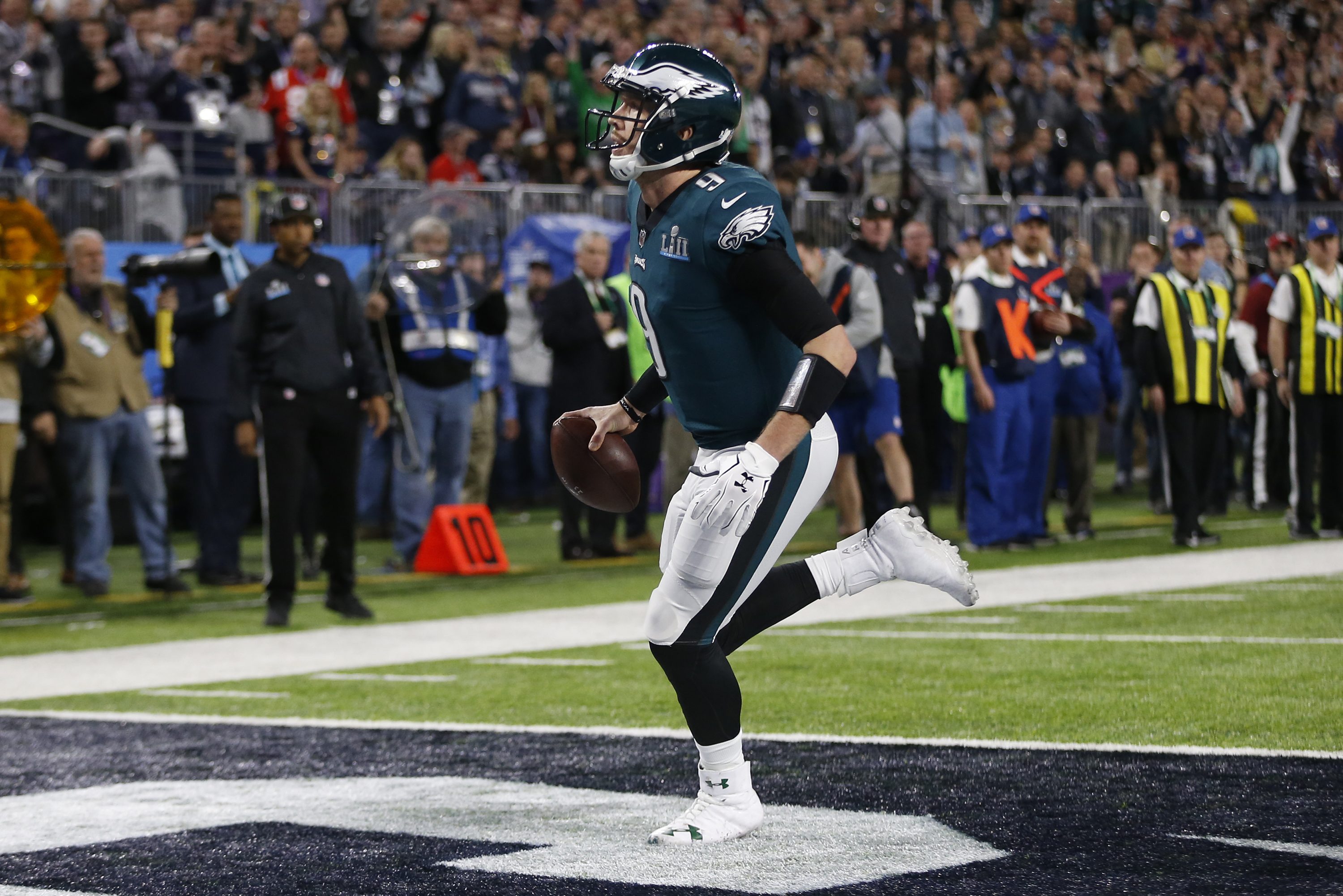
    The rest, as they say, is history: Wentz got injured, Foles replaced him, played well down the stretch, and won the MVP award inSuper Bowl LII where he outplayed Patriots legend Tom Brady and outfoxed coach Bill Belichick.

    Nick Foles became an unassailable Eagles legend, but that doesn’t mean all backup quarterbacks are created equal. Michael Bryant / Staff Photographer

    “Our priority, as you’ve seen, is to make sure we have the very best possible other starting quarterback,” Lurie said during Super Bowl week.

    That’s generally been true, and it’s generally made sense for the Birds, since Lurie prefers mobile quarterbacks, who, of course, are more likely to get hurt.

    Lurie signed Michael Vick out of prison in 2009, and Vick supplanted Donovan McNabb the next season and went to the Pro Bowl in his second of four years as an Eagle. Lurie drafted Hurts in the second round in 2020 with plans that Hurts would be the long-term backup to Wentz, but that’s before Ginger Jesus lost his job, and maybe his mind. Lurie sanctioned the recent, sensible acquisitions of Gardner Minshew, Marcus Mariota, and Kenny Pickett.

    But in 2019, Lurie also approved the signing of Josh McCown, a 40-year-old with a 79.7 passer rating with eight other teams. McCown replaced Wentz early in the Eagles’ home wild-card playoff game, played atrociously (predictably), and cost the Birds their postseason.

    Last season, Lurie allowed the Birds to enter the season with third-year sixth-round pick Tanner McKee as the backup of a team defending its second Super Bowl title. It didn’t matter, since Hurts stayed healthy. But McKee got to start game 17 against the Commanders, and he was poor: 21-for-40, 241 yards, one touchdown, one interception, with a forgettable fourth quarter that cost the Eagles their chance to win the game and capture a better seed. It looked OK in the moment, but upon further review, the Eagles (and I) decided that McKee is not the answer.

    The Eagles (not I) determined that Andy Dalton is the answer.

    They were wrong.

    The Eagles’ bet on Andy Dalton does not appear to be going according to plan. Yong Kim / Staff Photographer

    The Birds in March traded a seventh-round pick to the Panthers for Dalton.

    No player at Eagles preseason work or in training camp has been a bigger disappointment than Dalton.

    That isn’t really fair. There should have been minimal expectations of Dalton.

    He’ll be 39 in October. He’s 1-6 in his last seven starts over the past three years, during which time his passer rating is 84.5. Aberration? No. In the five seasons before that, his rating was 85.5 in 57 games. He’s been the backup in Carolina the past three seasons, essentially a big brother for Bryce Young, the underperforming No. 1 overall pick from 2023, and an assistant coach of sorts.

    That’s the role he was expected to serve in Philadelphia, where new offensive coordinator Sean Mannion has installed a new scheme. Dalton can help with the adjustment for Hurts, and you’d think Dalton would have a significant advantage over McKee in executing the offense.

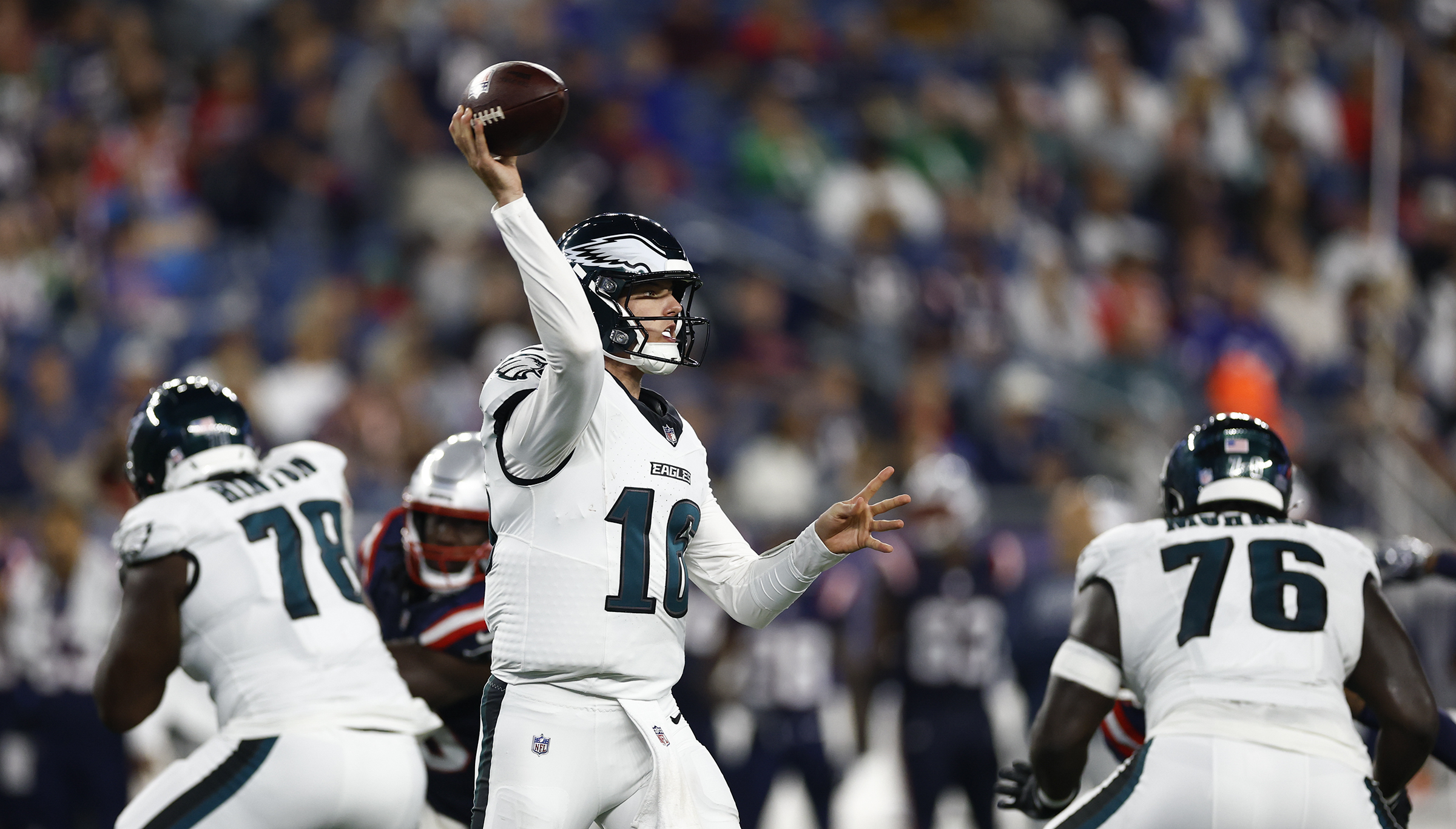
    Tanner McKee again appears to be the best backup option for the Eagles. Yong Kim / Staff Photographer

    But no. Dalton has looked appreciably worse than McKee — so much worse that McKee’s unremarkable performance looks good by comparison.

    Entering the third and final preseason game Friday, the competition, such as it is, for the backup job clearly tilts in McKee’s favor. Which delivers this uncomfortable truth:

    The Eagles, who have made the playoffs five years in a row, don’t really have a viable backup quarterback. That’s the fault of the front office.

    Roseman.

    Lurie.

    What should they have done?

    Maybe they should have signed Mitch Trubisky, who got two years and $10.5 million to back up Cam Ward in Tennessee. Maybe another dance with Minshew, who got $8.25 million to back up Jacoby Brissett in Arizona. Both would have cost a lot more than Dalton’s $1.5 million, but that’s also just about what Tua Tagovailoa got from the Falcons to be the emergency plan if Michael Penix Jr. wasn’t back in time from his knee injury.

    All three of those QBs are in spots where they will have a likelier chance to resurrect their careers. Maybe that’s why the Eagles weren’t able to land one of them, and why they had to trade a pick for Dalton.

    To be fair to Roseman and Lurie, the Birds also drafted a quarterback in April: Cole Payton, in the fifth round, out of North Dakota State, who currently is not close to being an option.

    To be fair to Payton, he might be as good an option as the other two.

  • Eagles practice observations: Trending up and down at the completion of camp; cornerback greatness

    Eagles practice observations: Trending up and down at the completion of camp; cornerback greatness

    The Eagles held the 17th and final open practice of their 2026 training camp on Wednesday at the Jefferson Health Training Complex. Here were my observations from Day 17 (and links to Days 1, 2, 3, 4, 5, 6, 7, 8, 9, 10, 11, 12, 13, 14, 15, and 16):

    Ouch couch

    Guard Landon Dickerson and tackle Lane Johnson were back in action and without injury designations after Tuesday night’s open practice at the Linc. Dickerson was given a rest day Tuesday, while Johnson left the scrimmage early, never to return. Cornerback Jonathan Jones also returned after an extended absence due to a shoulder injury. He was limited in what was a light practice without pads.

    The following players were still sidelined: tight end Eli Stowers (hamstring), tackle Markel Bell (thumb/leg), tight end Grant Calcaterra (back), cornerback Jakorian Bennett (knee), and safety Cole Wisniewski (concussion). Center/ guard Willie Lampkin appeared to tweak something late in practice and left team drills. He missed Monday’s workout after suffering a stinger in the second preseason game on Saturday.

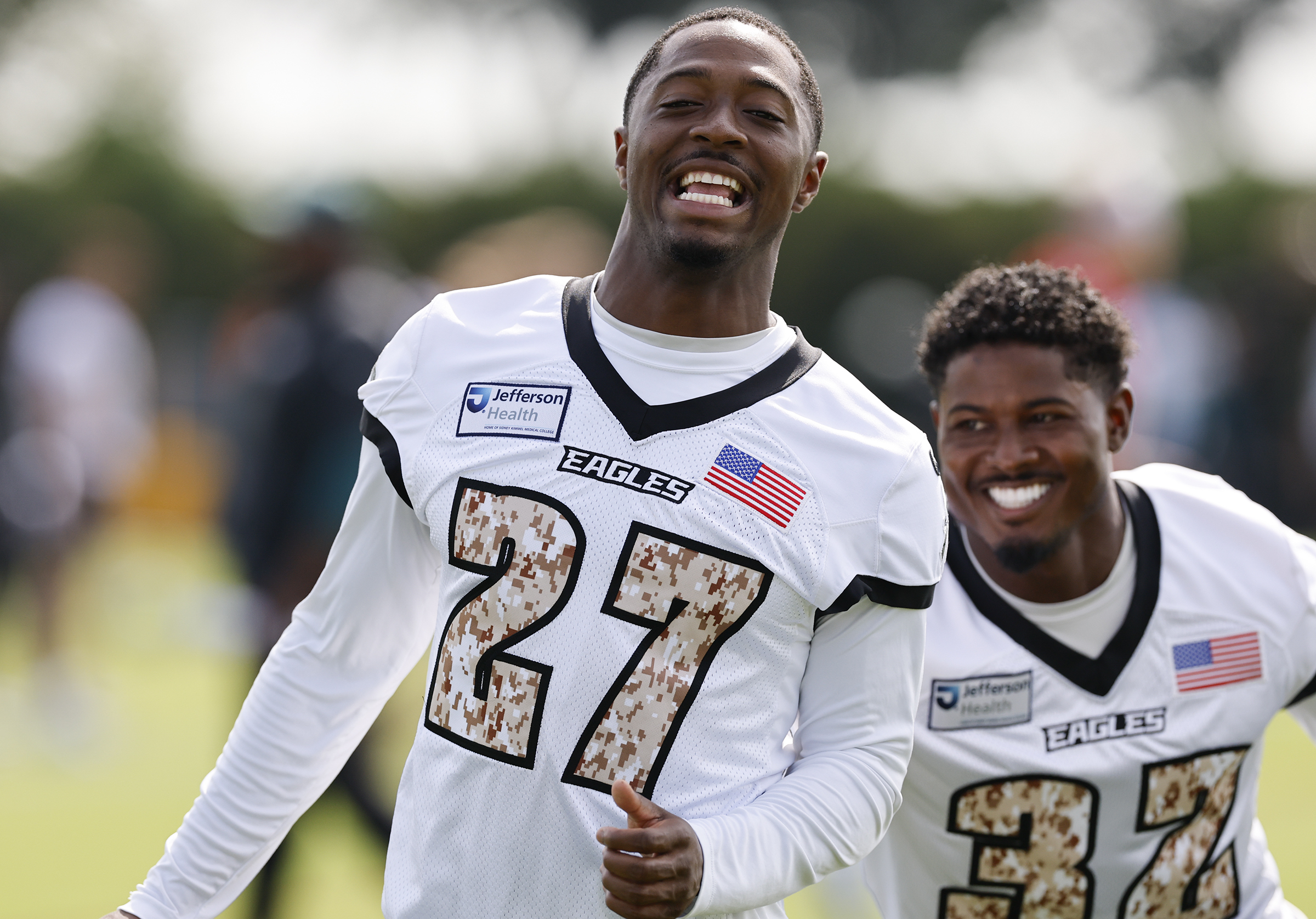
    Quinyon Mitchell (27) has looked every bit the All-Pro in his third training camp as an Eagle. Yong Kim / Staff Photographer

    Corner boys

    Now is as good a time as any to recognize the Eagles’ triumvirate of cornerbacks. They could have the best unit in the NFL, although only time will tell if Riq Woolen can be consistent enough to be mentioned alongside Quinyon Mitchell and Cooper DeJean. He’s had a good camp, with more than five interceptions at last count. There have been down days like the first joint practice in New England. Vic Fangio said before practice that Woolen can get “a little sloppy,” but overall he’s had a solid summer.

    More could be said of Mitchell and DeJean. The occasional struggles of Jalen Hurts and the first-unit offense, as Sean Mannion installs his new scheme, can be partly attributed to all three corners. Woolen broke up Hurts’ first pass in seven-on-sevens to receiver DeVonta Smith. In team drills, Mitchell had sticky coverage on receiver Hollywood Brown and notched a pass breakup. A little later, DeJean didn’t bite on a Smith double move and forced Hurts to throw the ball out of reach.

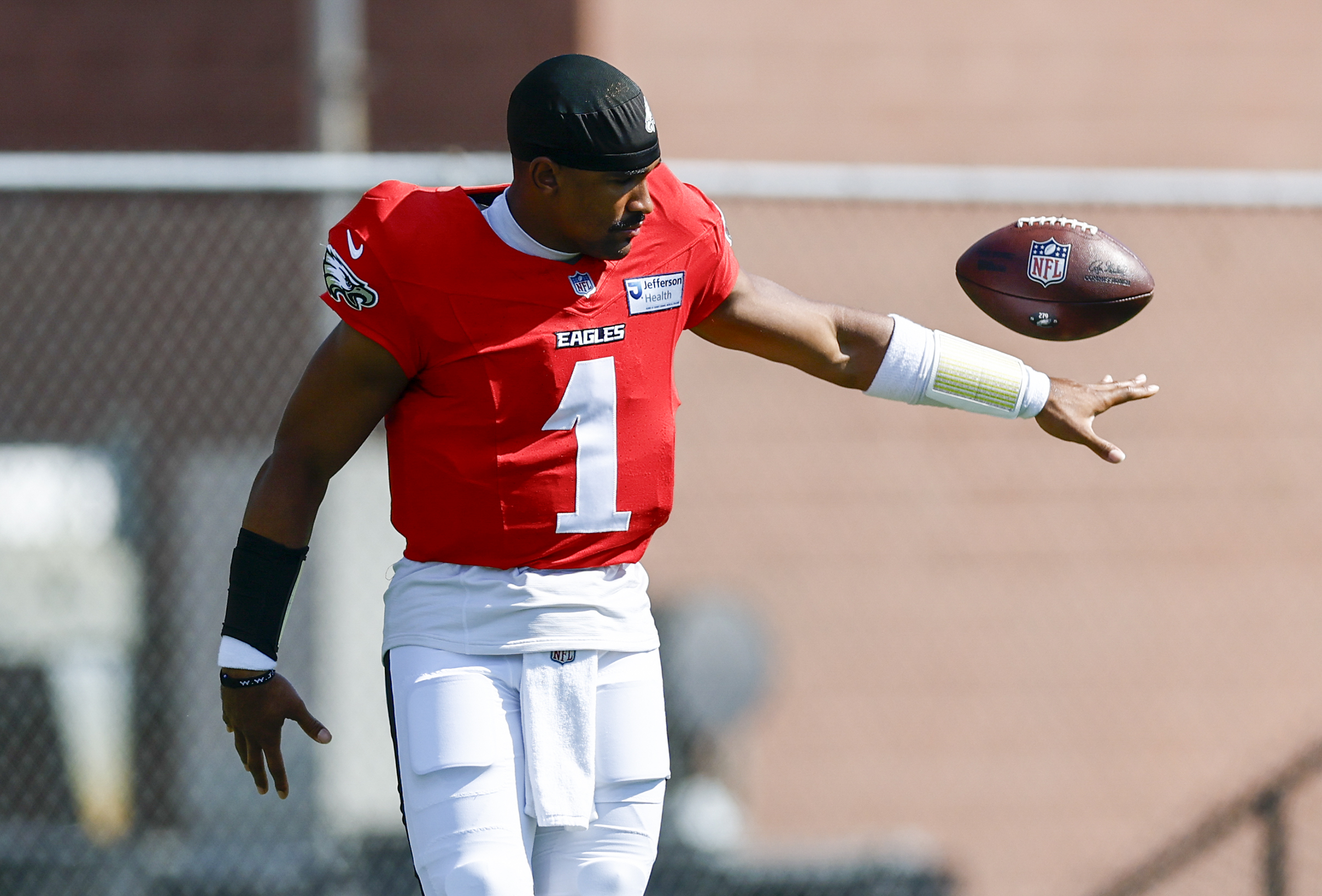
    It was another hot-and-cold practice for Jalen Hurts (1). Yong Kim / Staff Photographer

    Quick draw

    Hurts and the offense had some moments after a messy practice in front of fans at the Linc. He hit Smith on a post route in the back of the end zone vs. zone coverage in seven-on-sevens. Later, in 11-on-11s, Hurts did well to get the ball to an open Makai Lemon after his primary read. He had what appeared to be a touchdown himself off a draw. And in a later set, he dumped to tight end Cameron Latu, who had room after the catch.

    Mannion likes his offense to get out of the huddle and get the play off quickly at times. The change of pace can throw off a defense, although it denies Hurts the chance to read the coverage presnap. Mannion had a play dialed up on Wednesday that got Smith matched up against linebacker Zack Baun after a play-action fake. Hurts just flicked his receiver the ball for a decent gain after the catch.

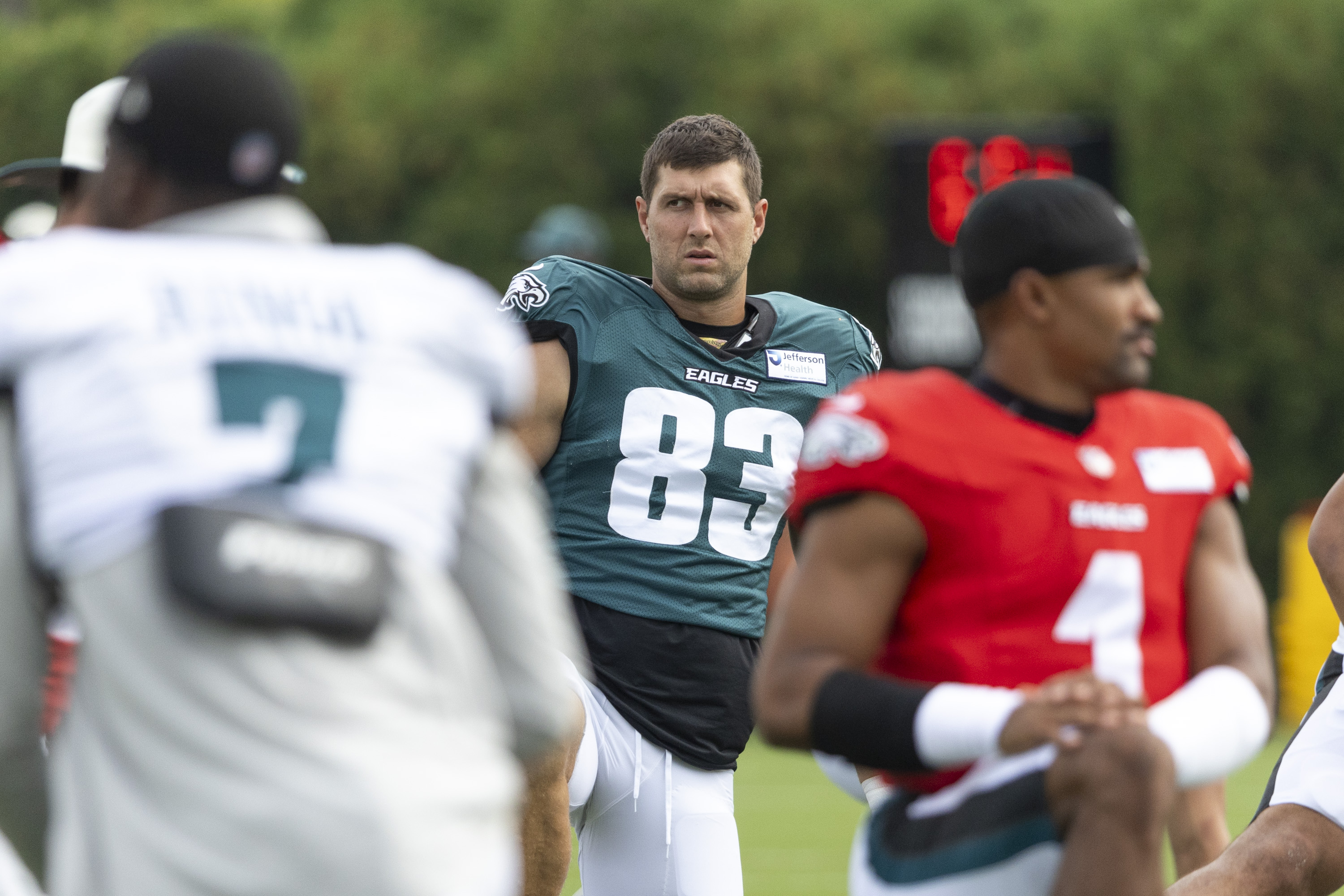
    Johnny Mundt (83) continues to try to build chemistry with quarterback Jalen Hurts (1). Tyger Williams / Staff Photographer

    Tight lies

    There were also unsuccessful moments, of course. Hurts appeared to have Lemon on a dig route over the middle — even if he wasn’t part of his initial read — and left the pocket and threw the ball away. Screens to running backs haven’t been a huge part of the offense in camp, but there have been intermittent sprinkles. Saquon Barkley got the ball in the flat in team drills and received a boundary block from Smith. But left tackle Jordan Mailata couldn’t square up safety Andrew Mukuba, who made the stop.

    Tight ends haven’t been as featured in the pass offense either, but that could come with time or be dependent upon the opponent. Hurts has history with Dallas Goedert. They have had their connections over the last month. Johnny Mundt is the clear “Y” blocking tight end, but when Hurts has gone to him through the air, there have been apparent miscommunications. There was another on a hitch route Wednesday when the ball flew behind Mundt.

    Eagles tight end Stone Smartt works out as special teams coordinator Michael Clay (left) looks on earlier in training camp.Monica Herndon / Staff Photographer

    This and that

    The tight end position is a little uncertain after the top two guys. One guy who hasn’t gotten much mention here, but has performed better the last few weeks is Stone Smartt. He has four years of NFL experience and has showed it of late. He had five catches vs. the New England Patriots on Saturday and a couple on Wednesday, including a snag just ahead of defender Michael Carter II.

    Keyshawn James-Newby missed most of camp with an ankle injury. But the rookie edge is back and he flashed for the first time when he rushed around tackle Myles Hinton for a pressure.

    Tanner McKee (16) appears likely to see action on Friday against the Bengals.Yong Kim / Staff Photographer

    Back to the future

    It seems likely that Andy Dalton and Tanner McKee will play in Friday’s preseason finale, if Nick Sirianni’s claim that the backup quarterback competition not being over is true. McKee was first up during seven-on-sevens. It was a mixed bag. He hit Brown underneath and then Lemon, who still caught the pass after it hit one of the simulated pass rushers. McKee then just oddly tossed a pass into the dirt. But he hooked up with running back Tank Bigsby for a touchdown.

    Both quarterbacks had their moments in team drills. Dalton lofted a touchdown pass to receiver Quez Watkins, while McKee hooked up with receiver Elijah Moore for positive yardage. Latu lost a defender with a double move, but McKee’s strike sailed through his hands. Watkins picked up more than a first down when he had blockers on a downfield screen.

    Trending up

    With camp officially over, and Wednesday’s practice short on competitive periods, here’s one beat reporter’s list for players trending up:

    Jalyx Hunt. The outside linebacker has been one of the best defensive players and drew raves from Patriots people after last week’s joint practices. On Wednesday, Hunt beat Mundt — as he should — and met Barkley in the backfield for a would-be tackle for loss.

    Drew Kendall / Lampkin. I’m splitting this entry between the two second-year interior O-linemen. They were relative unknowns coming into camp, but have seemingly solidified the center and guard backup spots. There are concerns about experience, size and durability with both, but new O-line coach Chris Kuper has them looking ready. Kendall and Lampkin had key blocks on two Dameon Pierce rushes on Wednesday.

    Moro Ojomo. The defensive tackle just keeps raising the bar. Ojomo is in a contract year and will likely price out the Eagles — who just extended Jalen Carter and Jordan Davis — next offseason.

    Tyler Steen. The right guard is another player entering the fourth year of his rookie contract. Steen has a better chance of staying in Philly than Ojomo, but his return could cost some if he continues to grow in confidence.

    Jeremiah Trotter Jr. The inside linebacker is entering his third season and is still a backup. But if either Baun or Jihaad Campbell goes down, Trotter should be able to step in without missing a beat. He’s been that good in camp.

    Honorable mention: Michael Carter II pushed in the safety chase and should be the dime defensive back. Outside linebacker Joshua Weru, despite his inexperience, has flashed enough potential to make the 53-man roster. Marcus Epps never let Carter supplant him at safety. A.J. Epenesa has done enough to earn the third edge spot — for now. Receiver Dontayvion Wicks locked down the No. 2 spot opposite Smith.

    Was down, now up: Ty Robinson was relegated to developmental period duty at the start of camp, but the light bulb went off and the defensive tackle started racking up sacks. Will Shipley didn’t exactly struggle in the early going, but he came on strong and was excellent in the joint practices. Cornerback Kelee Ringo might not have been on the outside looking in, but he needed to show he was more than just a good special teams gunner. He’s got liabilities but should be a roster lock.

    Hollywood Brown has a 1,000-yard NFL season to his credit but his play in training camp was not a revelation. Yong Kim / Staff Photographer

    Trending down

    Hollywood Brown. He’s probably on the 53-man roster, and may end up getting more playing time if Lemon needs developing. But Brown hasn’t popped like the speedster was expected to. He may need some time to adjust to a new scheme.

    Andy Dalton. The veteran quarterback didn’t ask to be traded here. That doesn’t excuse his spotty play in an offense he had experience with. But it’s hard to see why the Eagles felt it necessary to push McKee and cut into his repetitions in a new scheme. Maybe Dalton can turn it on at the end to win the job.

    Dickerson. No one can deny the left guard’s toughness and what he’s already accomplished. He still has gas in the tank. But of the five starting O-linemen, he may not be an ideal fit in the new wide-zone blocking scheme. As for whether he can make it through the season, that is to be determined. An example of Dickerson’s sluggishness in the new scheme came on Wednesday when he was late to the second level and Campbell plugged Barkley.

    Jonathan Greenard. The Eagles’ big offseason trade acquisition has missed all of camp with a pectoral muscle injury. Fangio indicated he might not be ready for the opener. Greenard should be the top edge when healthy, but his start in Philly has been underwhelming.

    Lemon / Stowers. Rookies should be given the benefit of doubt. Lemon and Stowers could end up delivering on their draft stock. But when you’re a first- and second-rounder, expectations are higher and you should be ready to contribute early. Lemon was out for three weeks with a hamstring injury. He’s back, but there’s going to be an obvious learning curve. Stowers was improving, but a recent hamstring injury has set him back. He’s not yet an NFL blocker and has hardly practiced with Hurts. How much can he realistically do early in the season?

    Honorable mention: Jakorian Bennett has been out since injuring his knee in the preseason opener. The corner didn’t look like a roster lock before the setback. Grant Calcaterra is a decent receiver, but blocking isn’t a strength. A recent back injury could end his roster hopes. Fred Johnson has stepped in and helped the Eagles win games the previous two seasons. But like Dickerson, the tackle may not be best-suited to the new scheme. The Eagles may be waiting for another team to cut a more NFL-ready long snapper rather than stick with a rookie in Rocco Underwood.

    Was up, now down: Darius Cooper shined early in camp, especially when Smith and Lemon were sidelined. But he’s been inconsistent of late. Case in point: He eased up on a route on Wednesday and allowed safety Andre Sam to tip the ball to Carter for an interception. Jonathan Jones seemed like the obvious first guy off the bench at outside cornerback. But a shoulder injury has clouded his future. Jones’ experience could keep him inside the bubble.

    Extra points

    Owner Jeffrey Lurie will be inducted into the Eagles Hall of Fame at halftime of the Oct. 26 game vs. the Cowboys at the Linc. … The Eagles will have a closed walkthrough on Thursday ahead of hosting the Cincinnati Bengals in Friday’s final preseason game. … Practices are now closed except for the warm-up and individual drills periods for the rest of the season. This will be my last batch of observations until workouts next spring. Thanks for reading.