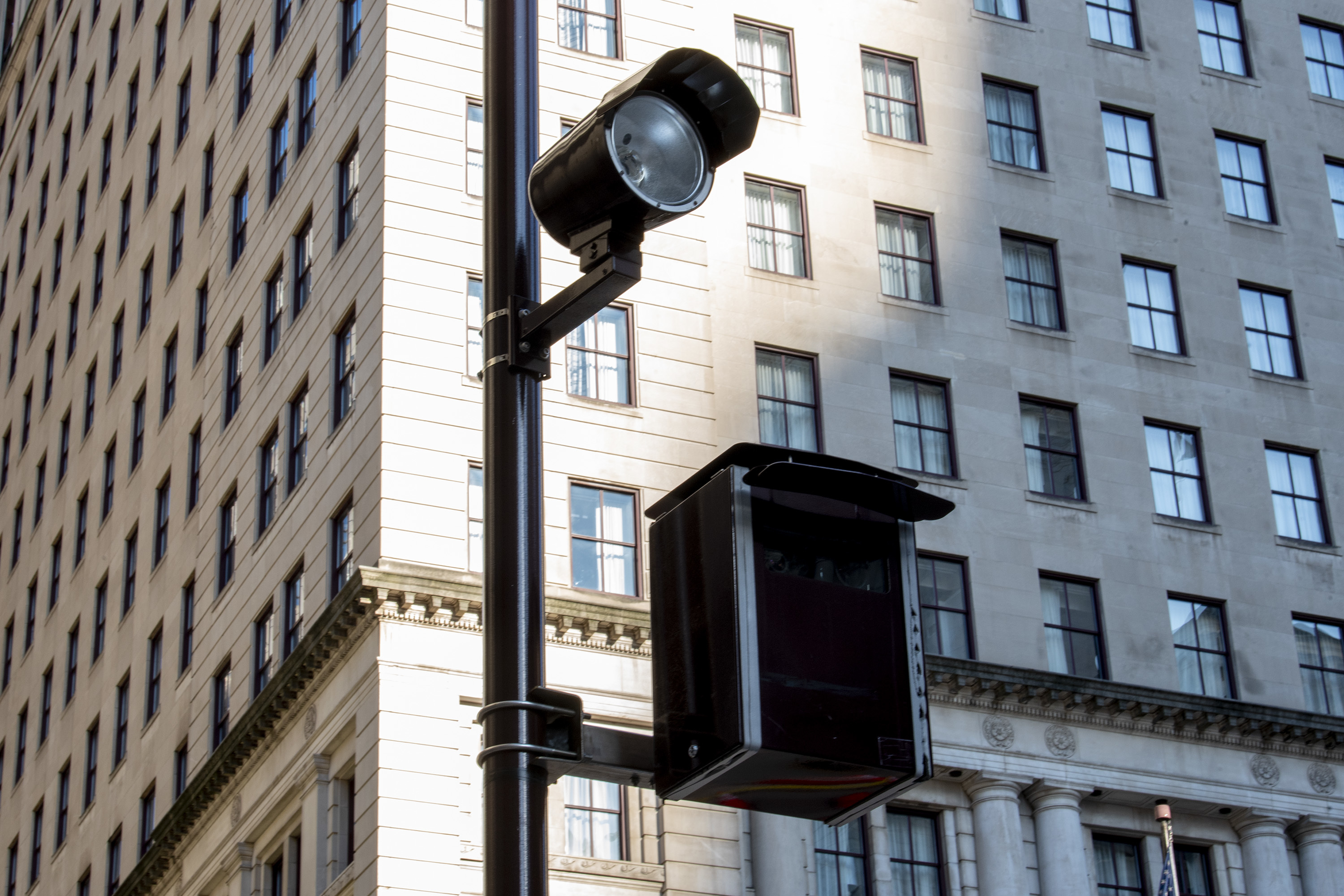
Automated red-light enforcement cameras caught up to 17.4% fewer violations this year than in 2025, according to the Philadelphia Parking Authority’s annual report to the state legislature.
Those cameras have been on guard in the city since 2005, but the program will expire next July, unless legislators renew the law that authorized them.
“The numbers speak for themselves, and our hope is that they see the benefit of it,” said Gabe Roberts, interim executive director of the PPA.
Recorded violations citywide declined from 340,931 in fiscal year 2025 to 338,979 in fiscal year 2026 — a decrease of 0.58%
However, four new intersections were added at different points during this fiscal year. For the PPA, the fiscal year runs from April 1 through March 31.
Excluding those four intersections, violations at existing program locations declined by 17.4%. Compared with 2024, they dropped 10.4%.
“The way we measure success is through consistent enforcement, demonstrated changes in behavior, fewer people running red lights, and safer streets,” Roberts said.
The red-light program has proved its worth, he said.
New locations
Over the 21 years of red-light cameras in the city, violations have trended down overall, Roberts said, though when a new location is added, tickets spike at first before leveling off and declining.
As of March 31, PPA was operating 160 cameras at 38 locations.
The newest locations are: 20th Street and John F. Kennedy Boulevard; Front Street and Hunting Park Avenue; Kelly Drive and Eakins Oval; and 58th Street and Baltimore Avenue.
Cameras there led to 50,589 warning notices and violations.
When a red-light camera is installed, there is a 45-day grace period when violators get a warning before tickets start. The fine is $100 per offense, but no points are assessed to a driver’s license.
There has been continued demand for red-light cameras in the city. PPA received requests for coverage of 19 intersections from the Philadelphia Office of Transportation and Infrastructure and City Council members through March 31.
Intersections are evaluated on the basis of crash statistics and a fresh traffic study that includes observations of violation levels there.
Also considered: sight lines, driveways, trees, wires, crosswalk visibility, and the condition of the surrounding infrastructure.
Usually an intersection gets some upgrades when red-light cameras are installed — new sidewalk accessibility ramps, new signal boxes, better lighting, more visible crosswalks, or the like, said deputy PPA director Corrine O’Connor.
“You’re not going to put cameras in and have old infrastructure out there,” said O’Connor, who is in charge of automated enforcement programs. “It’s an opportunity to make it better and safer.”
PPA says it typically takes one to two years to complete an intersection.
Speed cameras
In addition to the red-light program, PPA operates automated speed enforcement cameras.
A collection of Philadelphia grassroots nonprofits are suing the umbrella organization that lost them hundreds of thousands of dollars from years of mismanagement and poor accounting.
The 18 small groups have sued the Federation of Neighborhood Centers, a nonprofit that helped them and other small organizations manage grants. FNC, which operated as a fiscal sponsor for more than 100 Philadelphia grassroots nonprofits, collapsed last year after it was unable to distribute money owed to the groups.
After years of poor recordkeeping and spending itself into a deficit, and in some cases using money designated for one group to pay another, the organization froze outgoing payments by the end of summer 2025and ceased operations by the end of the year.
Each of the 18 organizations says it held a positive cash balance with FNC at the time of its collapse. The fiscal sponsor lost more than $426,000 belonging to 24 groups, a third-party audit found. The suit claims the groups had to shut down or cut back operations as a result of the nonprofit’s financial mismanagement.
The fiscal sponsor’s then-CEO, Michael Harbison, resigned in August 2025. He did not have relevant experience in an executive, management, or financial accounting role, and “does not know why he was hired” as CEO, according to the complaint filed last week in Common Pleas Court.
The complaint alleges the Federation of Neighborhood Centers should have known about its financial challenges by early 2024, and did not have an adequate workforce to meet the demands of administering fiscal sponsorship services for over 100 small organizations.
The current CEO, Demir Moore, acknowledged the nonprofit had grown too quickly and took on more clients than it could handle without proper financial guardrails, the complaint said. The collapse of the fiscal sponsorship program was due to a “lapse of management,” Moore previously told The Inquirer, a comment that was quoted in the lawsuit. Moore also said the downfall was “absolutely not attributable to malfeasance or embezzlement.”
Participants listen to speakers during a February town hall for projects affected by FNC’s collapse.Yong Kim / Staff Photographer
Moore did not immediately respond to a request for comment, nor did the plaintiffs’ attorneys with Ballard Spahr.
As the Federation of Neighborhood Centers collapsed and froze operations, Social Impact Commons, an organization that supports fiscal sponsors, came in to conduct the financial audit. It also assisted the fiscal sponsorship program’s shutdown, including helping some grassroots organizations transition to new fiscal sponsors.
By the time it finished working with FNC in February, Social Impact Commons found 34 projects had gone to new fiscal sponsors or independent nonprofits, 39 were closed or defunct, and 31 had yet to transition. It’s unclear what has happened to those remaining projects since then, or if they have found any financial relief.
The 18 organizations suing FNC represent a wide range of missions, like improving food access, empowering underrepresented young filmmakers, supporting mothers who have lost children to violence, animal rescue, and more.
Pressed recently on President Donald Trump’s expulsion of three news organizations from the White House, U.S. Sen. John Barrasso (R., Wyo.) shrugged it off as indistinguishable from Trump’s own past suspension from social media platforms, saying, “So it goes both ways.”
Huh? The senator is either remarkably ignorant of the Constitution from which he derives his power, or shameless enough to pretend to be.
What Barrasso didn’t appear to understand is that the First Amendment, like the rest of the Bill of Rights, doesn’t go both ways: It protects us from the government, not vice versa. Specifically, it guards the expression of citizens and publishers against state censorship and interference. Government officials can neither dictate what Facebook posts nor punish CNN for what it airs. If the First Amendment doesn’t mean news organizations can report on the government freely without being barred from public buildings and events as a result, it doesn’t mean anything.
Trump’s latest trampling of the Constitution is in that sense too clear to be muddied by senatorial sophistry. He expressly denied CNN, Politico, and MS NOW entry to the White House based on the content of their reports, in particular their failure to sufficiently glorify him. This is the essence of what the First Amendment prohibits.
It’s far from Trump’s first or most consequential authoritarian challenge to the country’s long-protected freedoms of expression and the press. Since his first term, he has derided legitimate journalism as “fake news,” encouraged violenceagainst reporters, and called the press the “enemy of the people,” echoing Josef Stalin and other despots. In his second administration, he has graduated to leveraging the power of the federal government against the media, using the Federal Communications Commission (FCC) to try to force late-night host Jimmy Kimmel off the air; wielding government power over mergers and more to reward corporations that rein in independent journalism; and menacing journalists and their employers with lawsuits, investigations, and arrests.
But the ban may be Trump’s most glaring violation of constitutional press protections to date. As the affected organizations noted in a lawsuit filed in federal court this week, the policy “could not be a more direct assault on the First Amendment.” The president himself called it a “ban on the free press” and attributed it to the organizations’ “negative” coverage.
The courts have blocked his earlier attempts to exclude individual reporters as well as a parallel Pentagon policy instituted by his defense secretary. Even the Trump-friendly U.S. Supreme Court could be hard-pressed to justify this one.
In addition to laying the groundwork for his next legal defeat, the president’s lockout gave the fractious press corps rare cause for collective action. With other networks declining to provide pooled camera coverage in solidarity with the banned organizations, the lack of competent recording at a ribbon-cutting for a new White House helipad this week ensured an idling chopper drowned out Trump’s remarks — not that very many people missed them.
It was the sort of pseudo-news event that only raised more questions about the value of broadcasting much of what the president says. Journalists who direct their attention elsewhere are bound to transcribe that much less fake news.
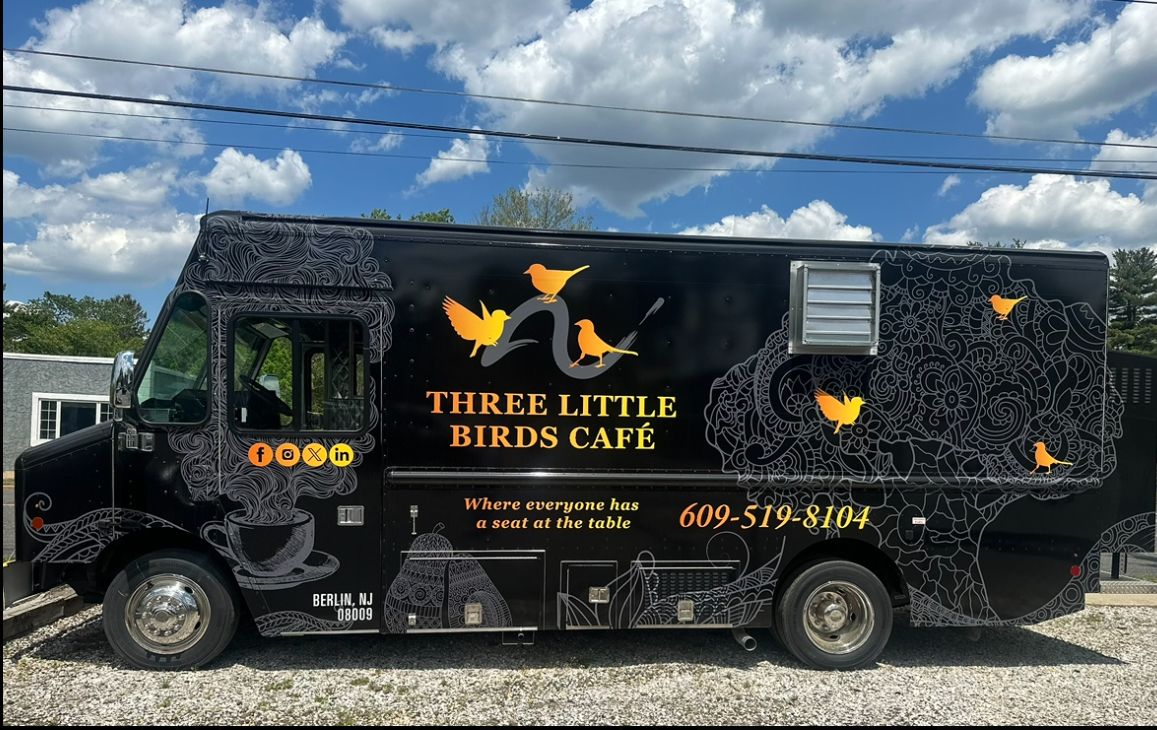
When the Three Little Birds Cafe is mixed in among other vendorsat local parks and festivals, it might be hard to tell at first that it’s not your average food truck.
Staffed entirely by people with disabilities, the food truck not only serves handmade American classics — think chicken tenders, smash burgers, and fries — but also embodies the values of the Arc of Camden County.
For nearly 80 years, the Berlin Borough nonprofit has been supporting individuals with intellectual and developmental disabilities and their families.
Today, the Arc provides services ranging from adult day programs to residential care with round-the-clock supervision for hundreds of people across South Jersey, said Michelle Schwarz, a finance specialist with the Arc of Camden County who handles the food truck’s licensing.
And while the food truck is a great place to grab some hand-breaded chicken wings for lunch, it also serves as a stepping stone for individuals hoping to eventually gain meaningful employment in the community.
Launched in the summer of 2025 as part of the organization’s occupational training program, the food truck offers hands-on work experience in food service, allowing people to develop the skills and confidence they need to succeed in a restaurant or commercial kitchen, Schwarz said.
The best way to connect people with jobs where they will thrive is to approach each person as an individual, she said, understanding that where one person may excel, another may struggle.
The Three Little Birds Cafe food truck serves as a rolling advertisement for the Arc of Camden County, a local nonprofit that provides services for individuals with disabilities.Courtesy of The Arc of Camden County
“We believe everyone has different skills,” she said. “Just because somebody can’t use their legs and they’re in a wheelchair, that doesn’t mean that they can’t go and work for a hotel and fold towels and put pillows in pillowcases.”
By providing training in various industries, including janitorial services and product assembly, the Arc has been able to connect countless people with jobs, she said.
The food truck was initially envisioned to serve primarily as a mobile advertisement for the organization, she said, with a QR code linking to the Arc’s website on the back to educate the public on its mission and potentially boost donations.
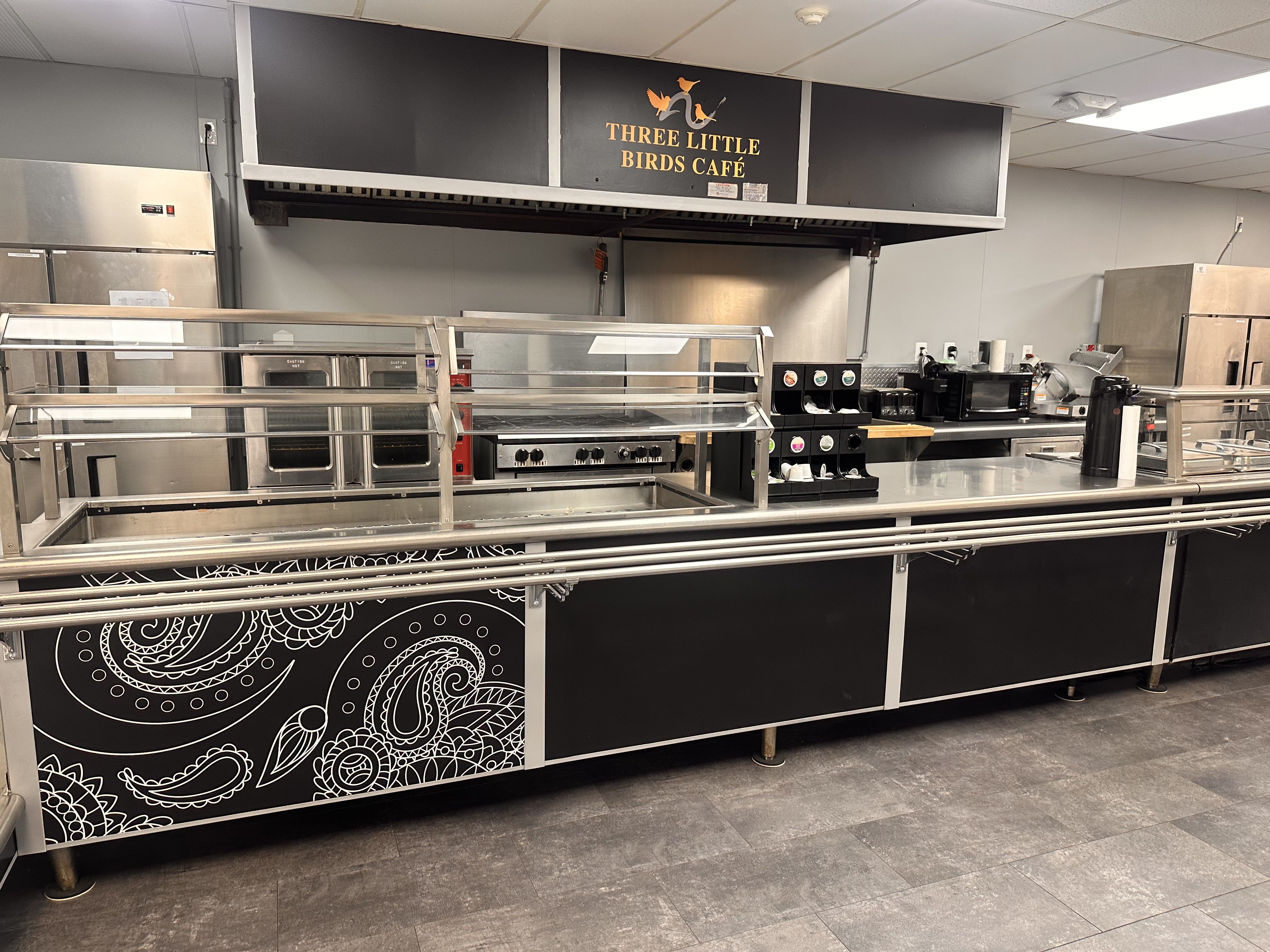
But it has been so popular — both in the community and within the nonprofit — the Three Little Birds Cafe has expanded into the cafeteria at the Arc’s occupational training center in Berlin.
Launching as a food truck in 2025, Three Little Birds Cafe has since expanded into the kitchen of the Arc of Camden County’s occupational training center in Berlin Borough, N.J.Courtesy of The Arc of Camden County
Under the expert guidance of kitchen and food truck manager Dana Bradley, individuals have not only learned how to keep a restaurant running smoothly, but also started to learn to cook for themselves.
“You immediately saw a shift in their confidence,” Schwarz said. “They were so excited to come in and learn something.”
After spending a couple of years as a group home manager with the organization, Bradley saw Three Little Birds as a way to tap into the passion for cooking that she developed working at Corinne’s Place, her mother’s award-winning soul food restaurant in Camden.
“I just love to cook,” Bradley said. Before she officially took over the cafeteria in 2025, she would often make elaborate meals at the Arc with whatever she could find lying around.
Now in charge of the Arc’s large commissary-style kitchen, Bradley is helping train people to work in kitchens across the region.
So far, three people have moved on from the Arc to work in restaurants and commercial kitchens in Camden and Gloucester Counties, Schwarz said.
“Here, we just really believe that everyone has abilities, and we focus on their abilities rather than their disabilities,” she said.
One in four likely Pennsylvania GOP voters has not heard of the state’s Republican candidate for governor, as Gov. Josh Shapiro continues to pull ahead with less than six weeks remaining until Election Day, according to a new poll.
According to the poll, Shapiro’s lead has now expanded beyond the advantage he held the month before the 2022 election against State Sen. Doug Mastriano (R., Franklin). Shapiro went on to beat Mastriano in that election by nearly 15 percentage points, or 800,000 votes — a drubbing that the GOP vowed not to repeat.
(function(){function e(){window.addEventListener(`message`,function(e){if(e.data[`datawrapper-height`]!==void 0){var t=document.querySelectorAll(`iframe`);for(var n in e.data[`datawrapper-height`])for(var r=0,i;i=t[r];r++)if(i.contentWindow===e.source){var a=e.data[`datawrapper-height`][n]+`px`;i.style.height=a}}})}e()})();
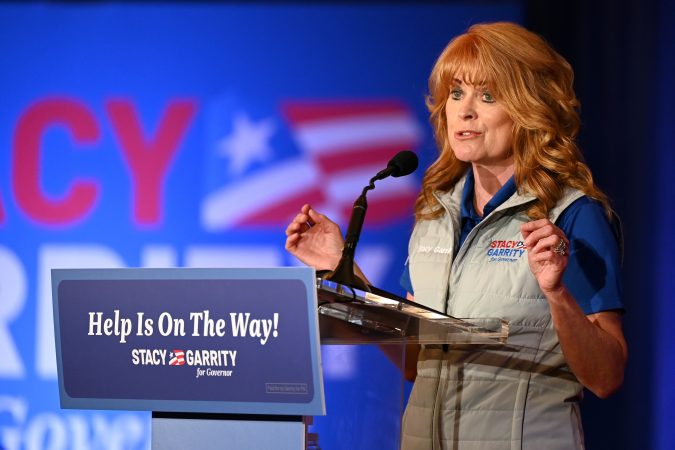
Pennsylvania Republicans endorsed Garrity in September 2025 — an unprecedented early nod to unify behind her in an effort to put up a stronger fight against Shapiro after the party largely withheld its support for far-right Mastriano. Garrity has won statewide twice and received the most votes in Pennsylvania history for a statewide office, a record previously held by Shapiro. In January, President Donald Trump endorsed Garrity, calling her “an America First Patriot.”
But building on that early enthusiasm has proven to be a challenge for Garrity, who for months has struggled to raise money, compete with Shapiro’s $60 million war chest, and gain name recognition in the critical battleground state where registered Democratic voters narrowly outnumber Republicans.
Garrity, 63, who entered politics in 2020 after a long career in the U.S. Army Reserve, raised only $1.8 million this summer and spent $1.5 million, according to her latest campaign finance filing, posted Tuesday. Shapiro raised $13.3 million during that time and spent $31 million.
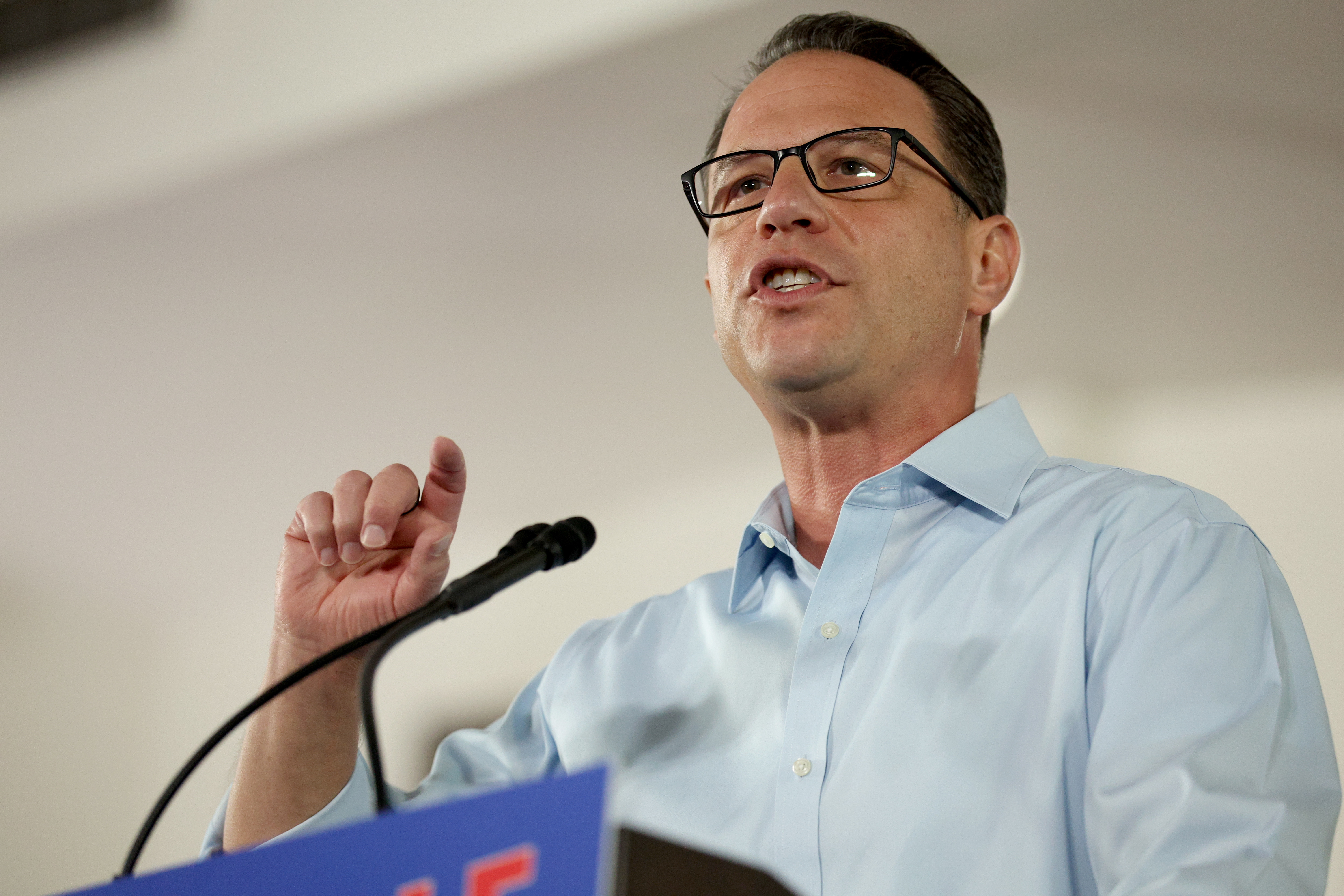
Gov. Josh Shapiro addresses the audience during a rally for congressional candidate Bob Brooks at the United Steelworkers Union Hall in Bethlehem, Pa. on Sunday, July 26, 2026.David Maialetti / Staff Photographer
And while Shapiro has dramatically increased his advertising spending on TV and streaming services to top $27 million this year, Garrity has spent a total of $744,000 on ads so far, according to media tracking firm AdImpact.
Both Shapiro and Garrity have released ads attacking each other for their past support for data center development, an increasingly unpopular issue among both Republicans and Democrats. Garrity’s ad criticizing Shapiro has been viewed about 802,000 times in the Philadelphia media market, according to AdImpact. Shapiro’s commercial labeling Garrity as “Pennsylvania’s number one fan of data centers” has been viewed 416 million times.
(function(){function e(){window.addEventListener(`message`,function(e){if(e.data[`datawrapper-height`]!==void 0){var t=document.querySelectorAll(`iframe`);for(var n in e.data[`datawrapper-height`])for(var r=0,i;i=t[r];r++)if(i.contentWindow===e.source){var a=e.data[`datawrapper-height`][n]+`px`;i.style.height=a}}})}e()})();
“Within the data right now, Josh Shapiro is a favorite son in the state of Pennsylvania, and they see him as doing a fantastic job,” said Don Levy, the director of the Siena Research Institute, which conducted the poll of 615 likely Pennsylvania voters from Sept. 15 to 21. “Barring double lightning bolts or a triple rainbow, he’s going to win.”
Garrity’s lack of campaign spending has allowed Shapiro to define her in the race, experts have said.
George Stanton, 77, a registered Republican from Lebanon County who participated in the poll, said he will support Garrity in November. He said Shapiro’s attack ad about Garrity’s past support for data centers, which he said he agrees with, helped him learn more about her positions.
Voters trust Shapiro more than Garrity on all of the top issues facing them, the poll found, including the state’s economy, the cost of living, data centers and artificial intelligence companies, and vaccine policy. In recent weeks, Shapiro has been embroiled in a battle with U.S. Health and Human Services Secretary Robert F. Kennedy Jr., whom he has blamed for spreading misinformation as Pennsylvania experienced a deadly measles outbreak. And at a summit in Pittsburgh last week, Shapiro called for more regulation of AI companies but said innovation of the technology should still be harnessed.
(function(){function e(){window.addEventListener(`message`,function(e){if(e.data[`datawrapper-height`]!==void 0){var t=document.querySelectorAll(`iframe`);for(var n in e.data[`datawrapper-height`])for(var r=0,i;i=t[r];r++)if(i.contentWindow===e.source){var a=e.data[`datawrapper-height`][n]+`px`;i.style.height=a}}})}e()})();
Scott Byers, 79, a Republican from Westmoreland County who supported Trump in 2024, is planning to vote for Shapiro this fall because “he just seems to be more in line with the public, with the feelings of his constituents.”
That includes Shapiro’s position on AI and data centers, which Byers believes should be more difficult to build. All he knows about Garrity’s views is what he catches on commercials — but it does not feel comprehensive, said Byers, who participated in the poll.
“I think technology in itself is going a bit beyond what is necessary. I feel that it’s hard to pinpoint, but I just feel that there’s too much emphasis on technology,” Byers said.
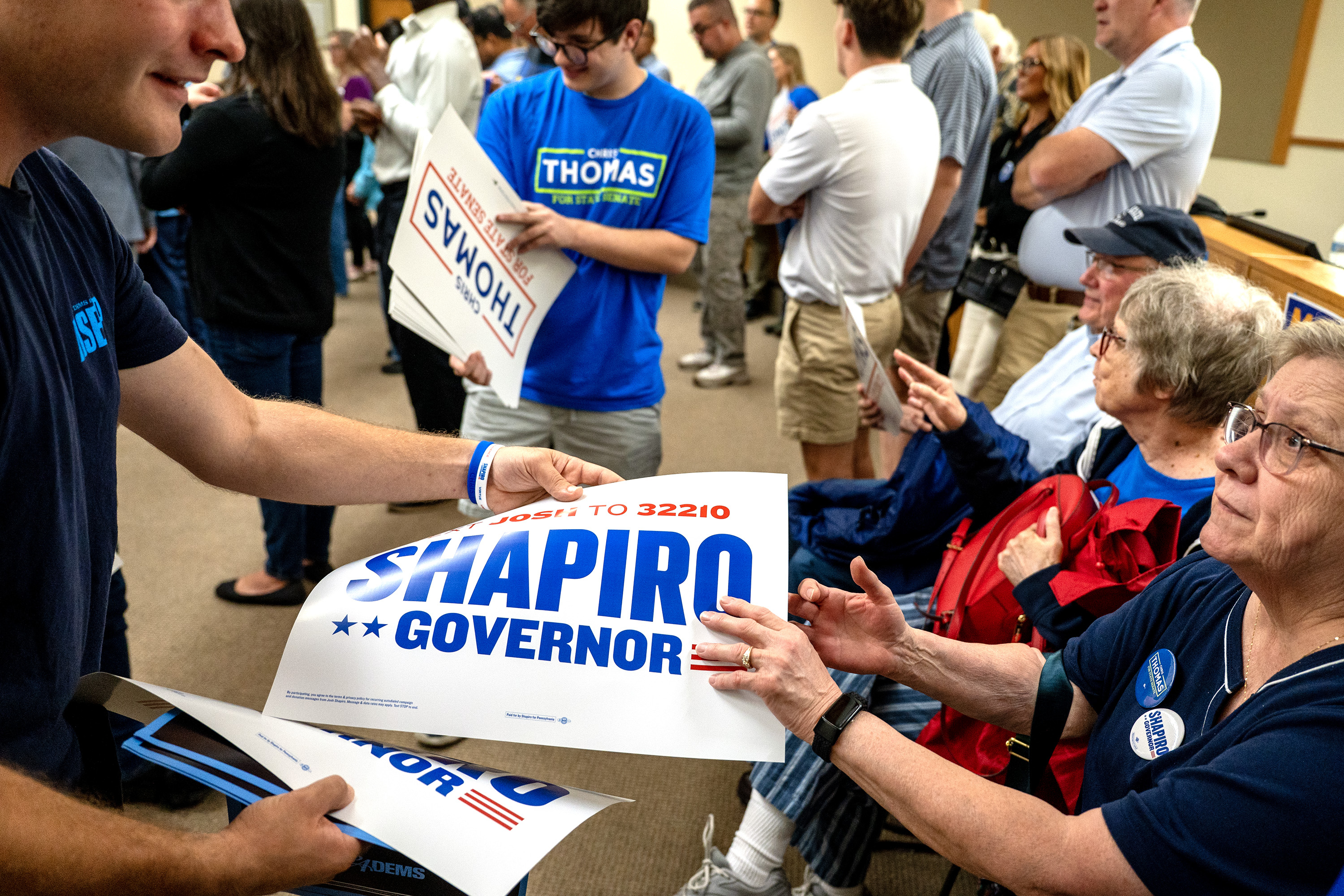
Campaign volunteers hand out signs to supporters of Gov. Josh Shapiro and Democratic Pa. Senate candidate Chris Thomas at a rally in Towamencin, Montgomery County before heading out to canvass on Sunday, Sept. 29, 2026.Tom Gralish / Staff Photographer
Approximately 60% of likely voters strongly approve or somewhat approve of the job Shapiro is doing as governor, according to the poll. That includes 30% of Republican voters, 89% of Democratic voters, and 59% of independents in the critical swing state where Shapiro maintains high popularity.
As a moderate politician, Shapiro has been able to capture most independent voters and even win over some Republicans, according to the poll.
Lesa Yeager, 63, considers herself an independent voter with centrist views who voted for a third-party candidate in the 2024 presidential election. She is an ardent union supporter and also thinks the nation should have a strong border. She said she trusts Garrity, as the state’s treasurer, to do a better job handling Pennsylvania’s economy.
But she is supporting Shapiro this November, in large part, because of his work on schools.
“I like that he’s very pro-education,” she said. “I am a fan of charter schools because I sent my kids to charter schools.”
Two of her children, now 35 and 37, benefited from smaller classroom sizes and adjustable curriculums, she said.
Yeager said she has also reached her limits with Trump’s behavior during his second term and believes Shapiro would continue to represent the state positively.
“I just think Trump is such a bully and so mean and just does whatever he wants, and I just want someone who isn’t that,” Yeager said.
She appreciates the Republicans who distance themselves from Trump. “But it’s tough to tell who is and who isn’t, a lot of times, and I would rather vote for someone I know isn’t going to support Trump on a lot of the things that he does,” she added.
Still, Garrity has found some backing among Pennsylvania’s electorate, though even some of those supporters say they don’t know much about her.
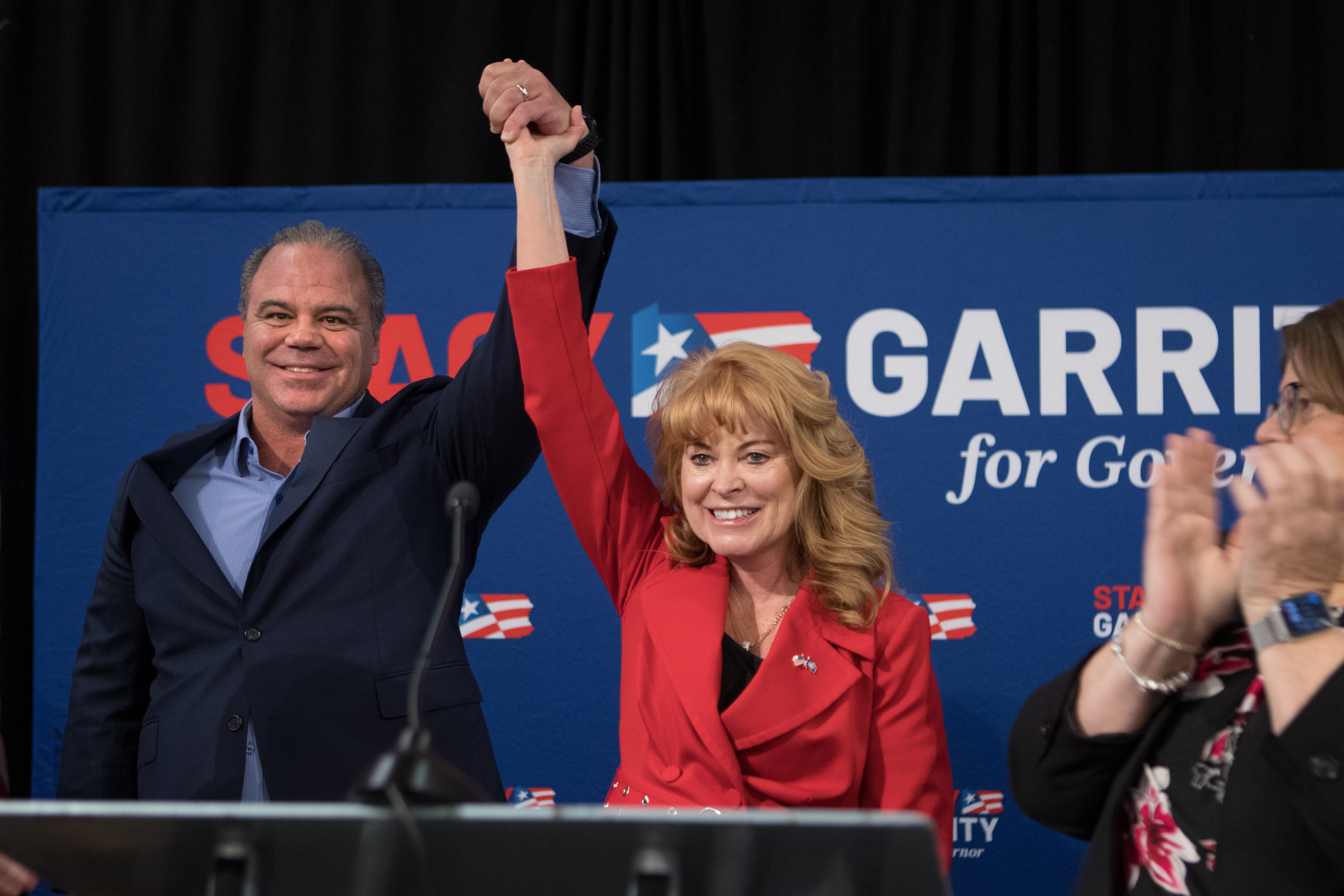
GOP gubernatorial nominee Stacy Garrity and her running mate Jason Richey hold up their arms in Harrisburg, Pa., Saturday, February 7, 2026. Kalim A. Bhatti / For The Inquirer
Susan Roller of Lancaster said she plans to vote for Garrity this fall because “she’s more responsible and will protect our freedoms.” Roller, who is retired, said she is particularly distressed about Shapiro’s positions supporting access to abortion and encouraging vaccines.
But as far as getting to know more about Garrity, Roller, 72, said she has not “seen a lot” of messaging on television about her.
In 2022, Shapiro did not participate in any debates while he maintained a double-digit lead over Mastriano, declining the Republican’s requests as an “unserious stunt.” Shapiro held a 13-percentage-point lead over Mastriano in a New York Times/Siena poll conducted that October — a closer margin than Shapiro’s lead over Garrity this year.
(function(){function e(){window.addEventListener(`message`,function(e){if(e.data[`datawrapper-height`]!==void 0){var t=document.querySelectorAll(`iframe`);for(var n in e.data[`datawrapper-height`])for(var r=0,i;i=t[r];r++)if(i.contentWindow===e.source){var a=e.data[`datawrapper-height`][n]+`px`;i.style.height=a}}})}e()})();
The 2022 midterm election was a much different political moment for Democrats, said Levy of the Siena Research Institute.
“That was a point in time when the Democratic star was on the decline,” he added. “Everything was a bit of a referendum on Democrats, on the job that [former President Joe] Biden was doing, how we were coming out of the pandemic.
“The overall political climate in which the ’26 election is taking place vs. ’22 is really kind of night and day,” Levy said.
Staff writers Joe Yerardi and Fallon Roth contributed to this article.
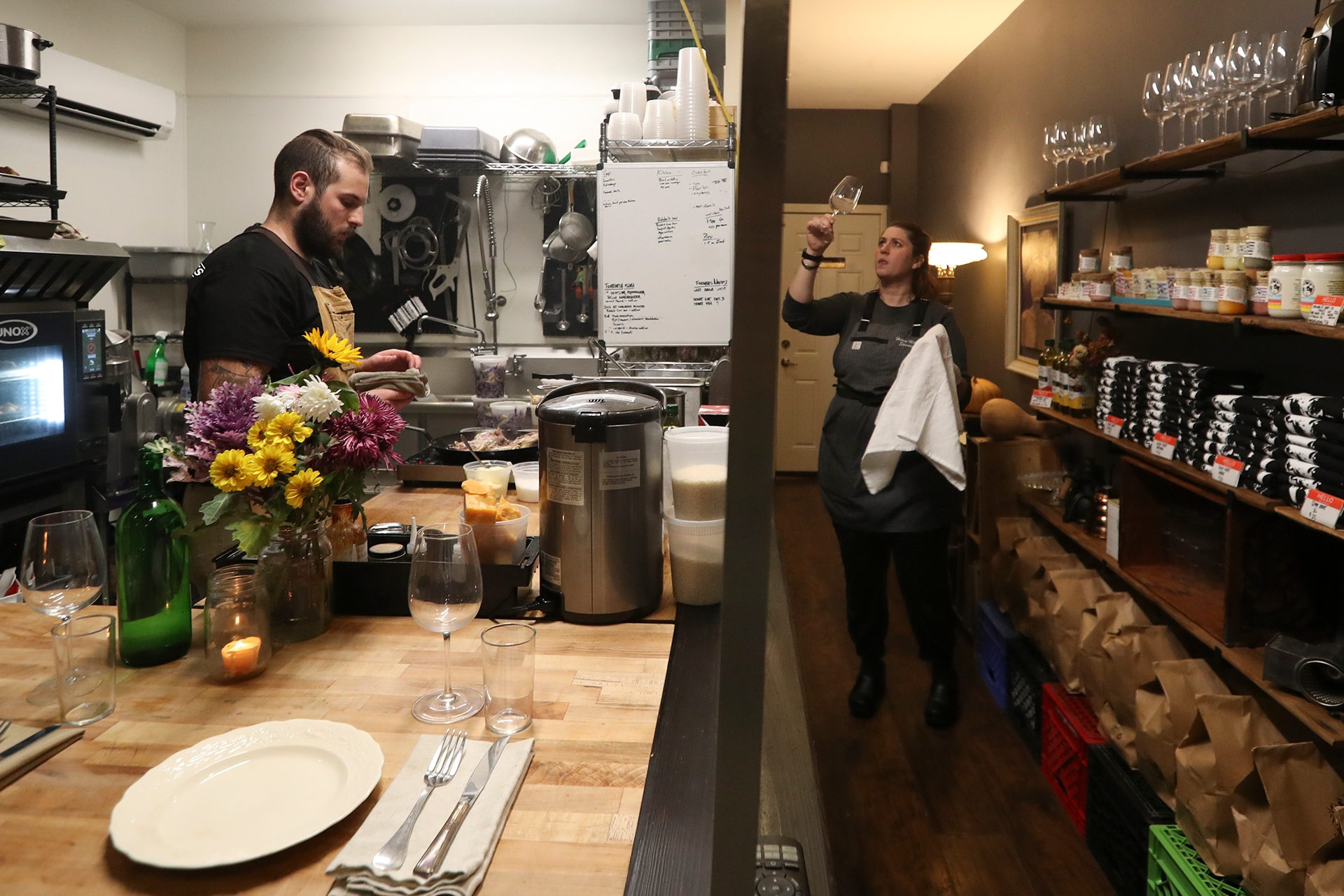
For the last eight years, Fridays at Stargazy on East Passyunk Avenue meant fish and chips, a weekly tribute to chef-owner Sam Jacobson’s East London roots.
That ended last month, when a city health inspection forced the English pie and mash shop to discontinue the special.
Stargazy had been cited twice in 2024 for operating its electric double countertop fryer without proper mechanical ventilation. But on Aug. 14, the Philadelphia Department of Public Health went further, citing the fryers as “unapproved” equipment and requiring Jacobson to submit plans for review before they could be used again. Translation: He’d need to install ventilation for his fryer if he wanted to continue slinging fish and chips.
The Friday fish and chips from Stargazy in 2021.Jenn Ladd / Staff
For restaurant owners, the consequences of an inspection can extend beyond whatever corrective action the city requires. Reports of closures, cease-operations orders, or serious violations — especially at popular restaurants — spread on social media, where the conversation often turns to claims that enforcement is unfair or not uniformly applied.
The health department disputes that contention, saying that there is no crackdown.
It’s in the process of rolling out a new Food Safety Inspection Guide, but while the format of the guide has been streamlined, the department said the underlying rules have not changed.
Inspections as a snapshot
Last month at Heavy Metal Sausage Co. in South Philadelphia, a health inspector ordered owners Patrick Alfiero and Melissa Pellegrino to remove the shop’s eight indoor seats and stop preparing food in the basement. Inspectors determined that neither activity was consistent with the establishment’s plan review, approved in 2022.
Heavy Metal had passed previous inspections, including one four months earlier, and its owners told The Inquirer the operation had not changed between the two visits.
Heavy Metal Sausage Co. owners Patrick Alfiero and Melissa Pellegrino preparing for a dinner in 2022.Yong Kim / Staff Photographer
Health officials interviewed this month said the differing outcomes illustrate a basic principle of the inspection system: Each inspection reflects only a snapshot of what an inspector observes.
During the April inspection, the department said, the inspector did not observe indoor dining or food preparation in the basement. On Aug. 21, both were taking place and could be cited.
More broadly, officials said, the absence of a citation during an earlier inspection should not be interpreted as approval of a practice.
Stargazy had been previously cited
At Stargazy, the record is different. The fryer had been cited before.
Jacobson was in England when the sanitarian — as the inspectors are known — arrived at Stargazy on the afternoon of Friday, Aug. 14. It was the same sanitarian who had cited the fryer during two inspections in 2024.
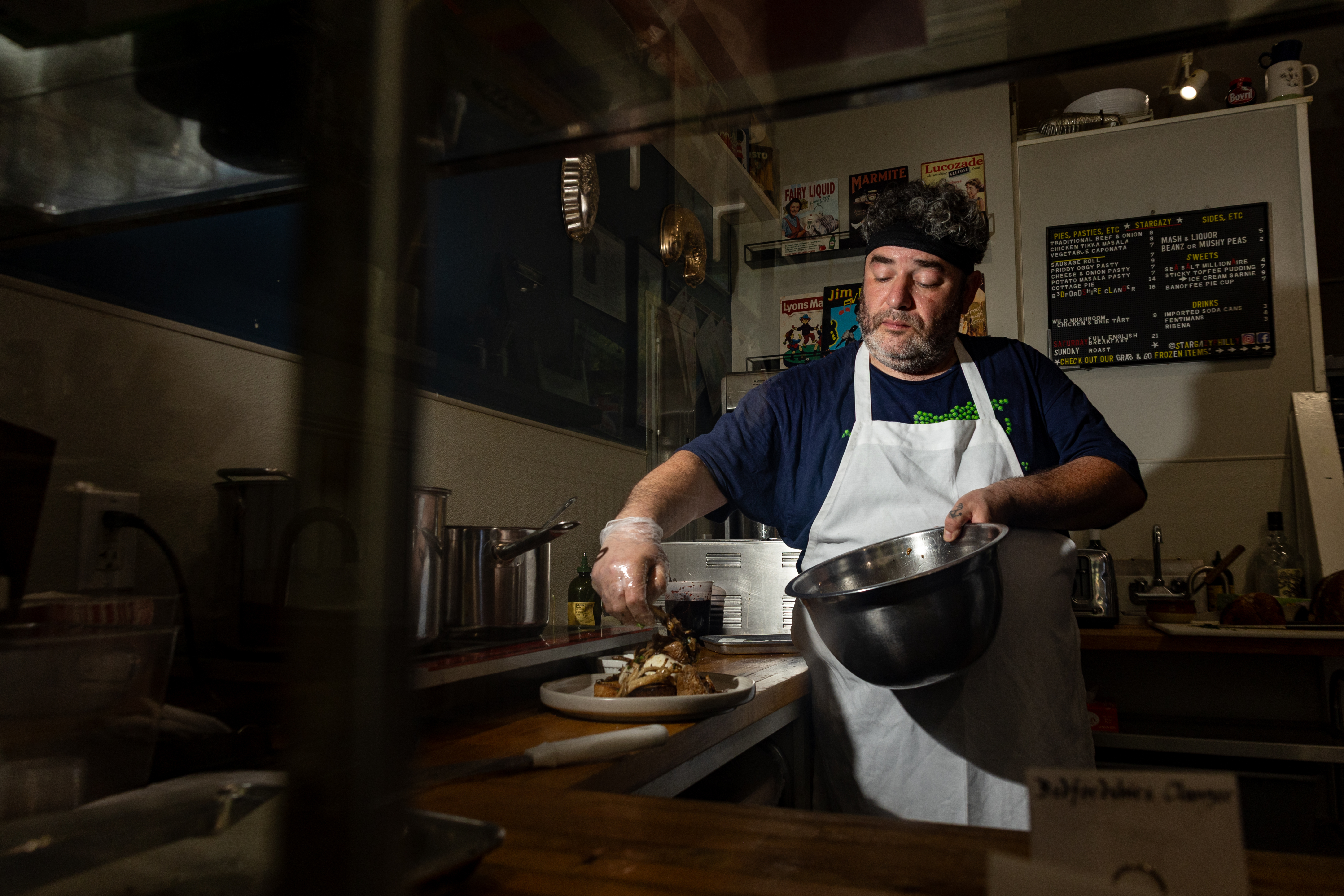
Owner Sam Jacobson cooking at Stargazy on Sept. 18, 2026. Aidan T. Gallo / Staff Photographer
“I did look back at sales reports for the day of the April 5, 2024, inspection and we had a good fish day — so the fryer was definitely on and in plain sight,” Jacobson said.
Jacobson acknowledges that the inspector told him in 2024 that the fryers were “not approved.” That point is noted on the reports. But Jacobson said he did not understand that to mean he had to stop using them.
The Health Department gave a different account to The Inquirer this month. Officials said Jacobson was verbally instructed in 2024 not to use the fryers because they lacked mechanical ventilation.
When the sanitarian found the same fryer still in use at its next inspection more than two years later, the department said, Jacobson was told to install mechanical ventilation, which would require a plan review — a lengthy process. This time, Jacobson removed the fryer in response. (Historically, the health department does not levy fines, preferring that businesses correct violations.)
Jacobson said Stargazy had never undergone a plan review when he opened in 2015 after taking over an existing bakery. He said a city employee advised him at the time to treat the opening as a change of ownership, and the restaurant passed its preopening inspection.
“We never did any alterations or construction before opening,” Jacobson said. “I simply took over the lease of an existing bakery, gave it a lick of paint and some other cosmetic touches, and opened up.”
Besides the fryer, he said the restaurant’s only substantive changes were moving the counter in 2019 to create more room in the dining room and installing a customer hand sink during the pandemic at the city’s direction.
Sanitarians have not received new instructions to interpret the code differently, the department said. The department said it has committed significant resources to uniformity training, intended to ensure that every inspector reviews the same conditions in the same way in all food businesses.
Supervisors and managers also review inspection reports, and sanitarians are not supposed to exercise individual discretion in deciding whether a condition violates the food code.
The new Food Safety Inspection Guide supports the department’s position that the underlying food-safety requirements are not new.
Deputy Health Commissioner Dawn Kiesewetter said the guide has been under development for six or seven months with the Mayor’s Office of Policy Planning and Delivery, the Commerce Department, and business and community groups. It grew out of Mayor Cherelle L. Parker’s PHL Open for Business initiative, launched in April 2024 to simplify city permitting, licensing, and other requirements for businesses.
Food businesses were an early focus. When Open for Business was announced, city officials said food businesses averaged nearly 24 government approval steps to open and operate. The administration subsequently developed multilingual food-safety materials and other guidance for operators.
The city aims to inspect every food establishment once a year but does not always meet that target, the department acknowledged. About 60 Health Department employees are authorized to inspect Philadelphia’s 10,427 food establishments, according to the department. Reinspections follow violations, while complaint inspections and investigations of possible foodborne illness take place as needed.
Staffing and complaint volume have remained relatively steady in recent years, officials said, while the number of food businesses remains below its pre-pandemic level.
When a repeat problem is ‘new’
Stargazy’s fryer was cited as a “new violation” in 2026, two years after its first citation. The department’s terminology on inspection reports can sometimes label a recurring violation as new. Health officials said that designation is automatically applied when more than a year has passed since the earlier violation.
Jacobson said it would not make financial sense for him to install the ventilation needed to resume frying. A permanent hood would require construction, he said, while a freestanding ventless system could cost more than $20,000.
Stargazy owner Sam Jacobson adding blackberry and fig sauce to his wild mushroom burrata toast, a substitution for his fish fry.Aidan T. Gallo / Staff Photographer
Since removing the fryer, he is considering longer hours and fish-and-chips pop-ups elsewhere to replace some of the lost sales. On Fridays, he has been offering specials that do not require a fryer, including wild mushroom burrata toast.
The city says one purpose of the new guide is to reduce the likelihood of surprises during an inspection.
“The more they understand what they need to do, the more likely they’ll pass,” the Health Department said in a statement. “Our number one goal is to ensure that food businesses can stay open safely.”
At the end of Gracie Sullivan’s freshman year at Drexel, the women’s soccer coaching staff approached her with a message: the starting goalkeeper position for next season was “up for grabs.”
Sammy Widnick was transferring and Zara Wickert was graduating, leaving an opening at goalie.
“That just pushed me because I felt like I knew I could do it,” Sullivan said. “It was just whether I wanted to do it or not.”
Sullivan did not see the field during her freshman season, but that is common for a first-year student adjusting to the collegiate level.
She used the season to learn from the goalkeepers ahead of her and spent the offseason working for her opportunity.
“You can always say, ‘Do you want this?’ And they’ll say, ‘Yes.’ But then in training, you need to see the want and desire to develop,” said Mike Paznokas, Drexel’s assistant women’s soccer coach. “It was awesome because in the one-on-one sessions we did, you got to see that. You saw [Sullivan] asking questions, you saw her working her butt off in those sessions to make sure that she’s getting better and understanding the concepts we went over.”
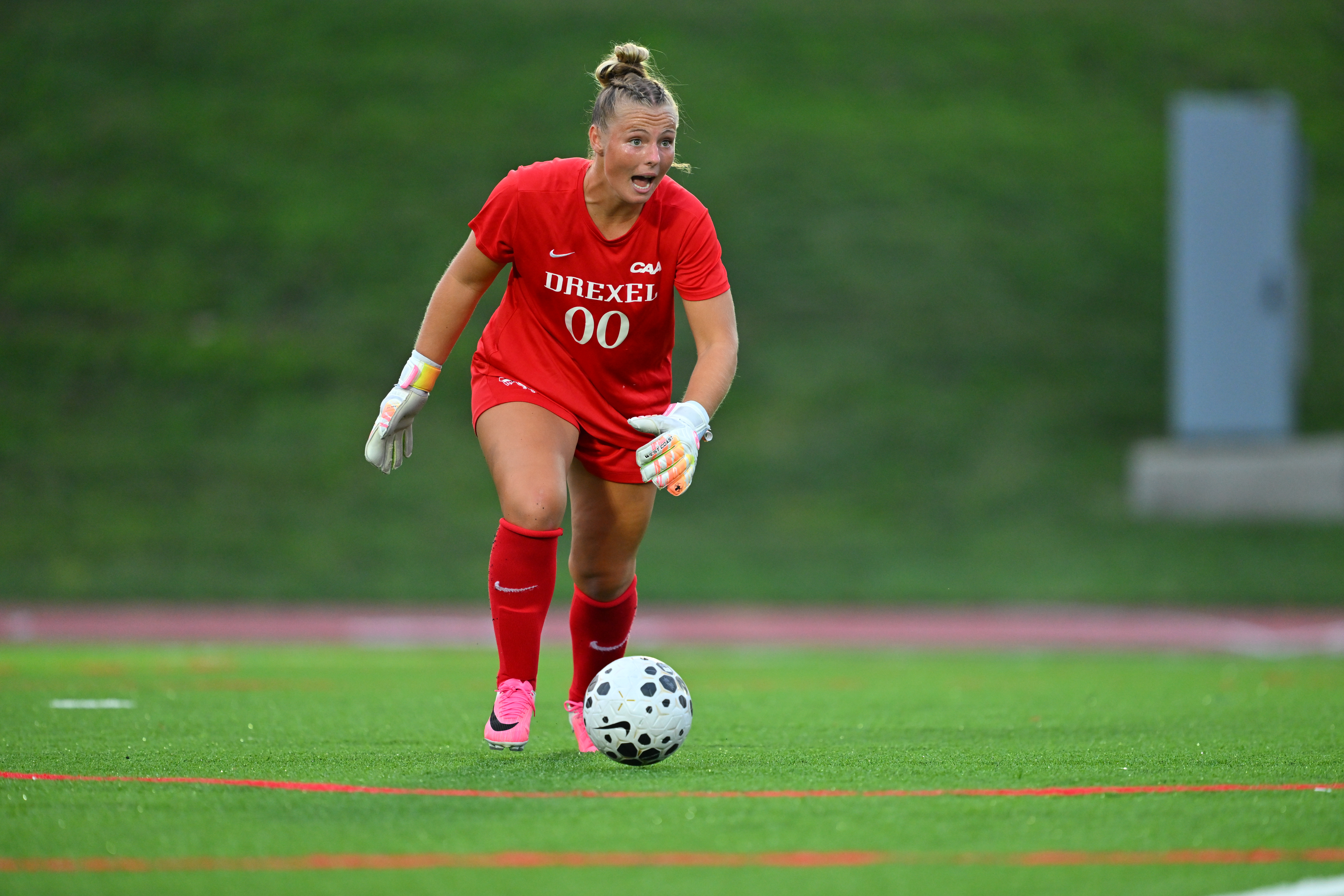
Sullivan is now the starting goalie for the Dragons and had a career-best 10 saves against La Salle on Aug. 28, which is the most saves by an individual Drexel keeper since 2017. Entering Thursday’s match against Hampton, Sullivan has 42 saves so far this season.
The sophomore’s accomplishment has come as no surprise to Paznokas.
“She is very level-headed and when she’s in the game and her brain’s turned off, she can perform amazing things as a goalkeeper,” Paznokas said. “So, not a shock to me she was able to achieve this in the slightest.”
The relationship she built with the other goalies fueled her desire to get better even though she wasn’t seeing playing time as a freshman.
“I really did look up to [Widnick], the starter goalie who was in front of me,” Sullivan said. “I really think she taught me and I just looked up to her during the sessions. There’s always a feeling of tension between goalies and last year there was three of us and there was no tension at all. Without them, I don’t think my freshman year would have been as enjoyable not playing as it was. But we were just so supportive of each other.”
During spring training, Sullivan had extensive one-on-one training with Paznokas, he said, where she improved her feet in possession, long distance distribution, and communication skills.
Soccer runs deep in the Sullivan family. Her grandfather and father played soccer at Holy Family and her second cousins, Cavan and Quinn, play for the Union. Cavan, 16, earned an invitation to the U.S. men’s national team last week.
“I would say that all of the Sullivans, no matter first or second cousins, we’re all very close,” she said. “It’s really exciting to see the different places soccer takes our family.”
Gracie Sullivan started playing soccer at 7 years old for Coppa at the Philadelphia Soccer Club. During her freshman year at Nazareth Academy, she started playing for FC Bucks, now HEX FC.
She originally started as a midfielder in youth soccer. But when she played in the Beach Blast soccer tournament at the Jersey Shore, it sparked her love at goalkeeper.
“I was crazy as a kid, so when we would play Beach Blast, I would be like no I want to play the whole game because I love diving around in the sand,” she said. “So ever since I was 10, I stuck to goalie.”
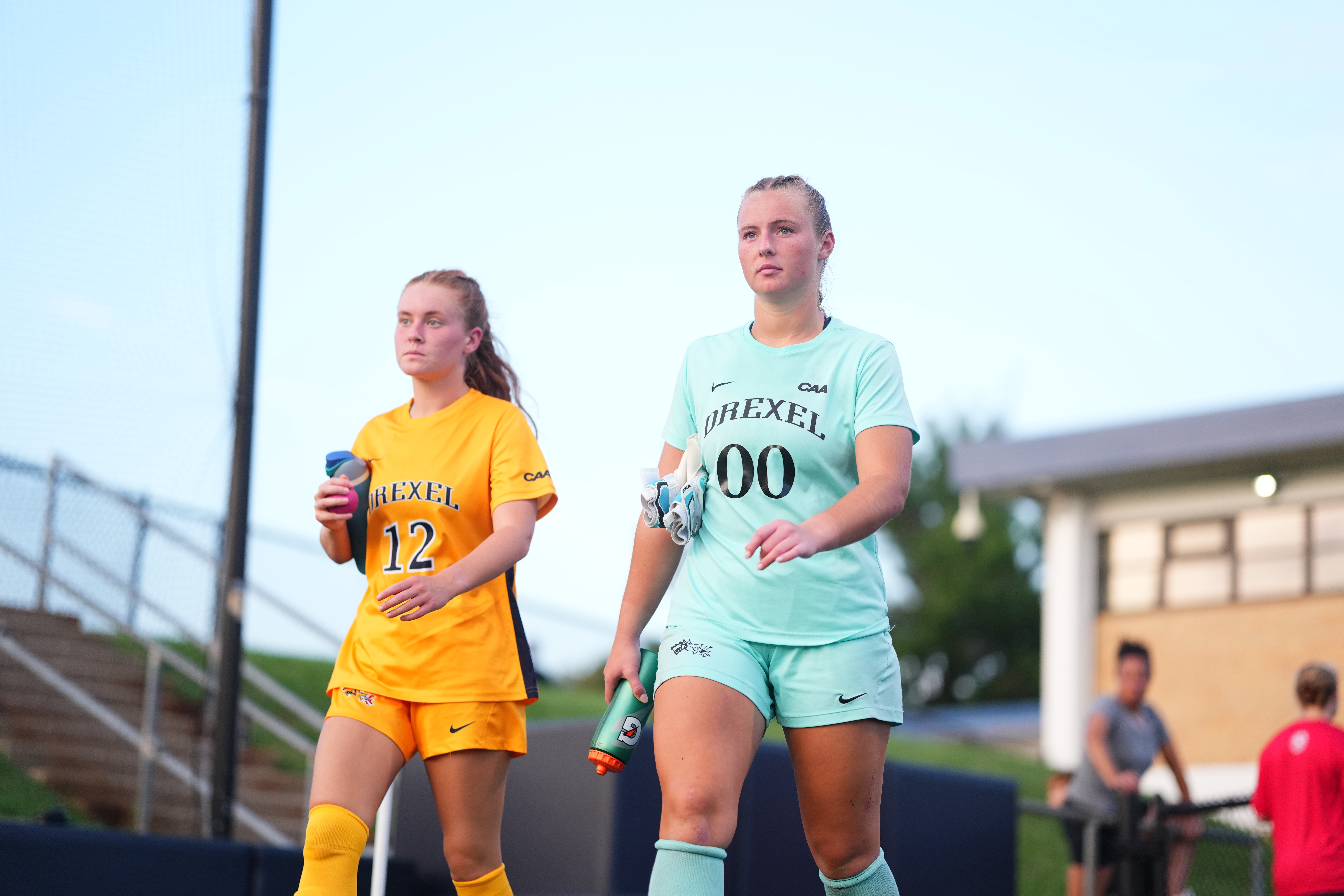
Gracie Sullivan (right) walks out to the field with teammate Riley Lukach (12).Drexel Athletics
This is Shannon Grogan’s first season at the helm for the 4-4-1 Dragons. Sullivan believes the culture shift has driven Drexel’s success.
“This year with the new coaching staff, [Grogan] just brought so much energy and really believes in us, which I think shines down on us and then we believe in ourselves,” Sullivan said. “The team culture has just been so much different and I think on and off the field we have been such close friends and I can really see that on the field and that’s helping us win games honestly.”
Playing goalkeeper comes with a unique pressure, Sullivan said. One little mistake can alter the outcome of the game.
“The hardest part of being a goalie is that we have to be turned on at all times because if we make one mistake that could lose us the game,” she said. “It’s different if a forward were to make a mistake because the ball wouldn’t go in the back of the net. So it’s really important that we have to be our best at all times because if we’re not, then we sometimes could cost our team the game. It just sinks in more to you than it does to anybody else because you feel like you let your team down.”
Though, the Dragons don’t dwell on individual mistakes, she added.
“We all take accountability whether you’re on the bench or you’re playing,” Sullivan said. “We can’t point fingers because that’s not how you’re going to win a game.”
Pennsylvania voters are giving President Donald Trump worse grades on key economic issues than they did a month ago — a sign of a potentially dimming outlook for Republicans as the president asks voters to act as if he is on the ballot this fall.
Trump’s overall job-approval rating among likely voters in the state has dropped 5percentage points since Augustand now sits at 34%, with 63% disapproval, according to a new Inquirer/New York Times/Siena University poll published Thursday.
His handling of the economy and the cost of living, which consistently rank as voters’ top concerns this year, is viewed negatively by a larger share of his own Republican supporters and of voters in general than it was last month, according to the poll of 615 likely voters conducted from Sept. 15 to 21.
Gas prices are Trump’s worst-performing issue amongall Pennsylvania voters and among those who voted for the president in 2024, when he won the swing state by nearly 2 percentage points.
That includes Robert Jenkins, 47, of East Stroudsburg, who said Trump is now running the country like a “cowboy” and has not lived up to the promises he made to bring down prices.
(function(){function e(){window.addEventListener(`message`,function(e){if(e.data[`datawrapper-height`]!==void 0){var t=document.querySelectorAll(`iframe`);for(var n in e.data[`datawrapper-height`])for(var r=0,i;i=t[r];r++)if(i.contentWindow===e.source){var a=e.data[`datawrapper-height`][n]+`px`;i.style.height=a}}})}e()})();
And with rising gas prices, the Republican is just thankful that his truck does not run on diesel.
“Now we’re at like $4.35, $4.40, and I just don’t understand it. I know we’re having the thing with Iran, but I didn’t ever feel in my life that we were that dependent on Iranian oil,” said Jenkins, who works in the registrar’s office at East Stroudsburg University.
As both parties go all-out to motivate their bases — especially in Pennsylvania, where four key races could determine control of the U.S. House — Democrats clearly have an enthusiasm advantage fueled by a backlash to Trump’s agenda.
Just under six weeks out from Election Day, about two-thirds of likely Democratic voters are “very enthusiastic” to cast their ballots, while just half of Republican voters say they feel the same way.
Alex Hansen, 35, a pharmacist and Democrat from Bucks County, said the midterms have become a “referendum” on the Trump administration.
“The things he’s said and done are just so beyond the pale and unacceptable. … I don’t think it should have to be a public referendum on the federal administration, but that’s what it’s become,” said Hansen, who participated in the survey.
(function(){function e(){window.addEventListener(`message`,function(e){if(e.data[`datawrapper-height`]!==void 0){var t=document.querySelectorAll(`iframe`);for(var n in e.data[`datawrapper-height`])for(var r=0,i;i=t[r];r++)if(i.contentWindow===e.source){var a=e.data[`datawrapper-height`][n]+`px`;i.style.height=a}}})}e()})();
Will voters punish Republicans for Trump’s agenda?
As Democrats look to win control of the U.S. House, they are targeting Trump’s handling of affordability issues specifically — mostly highlighting rising inflation and spiking gas prices due to the war in Iran.
Just 24% of voters approve and 73% disapprove of his handling of prices at the pump, the poll found. Half of Pennsylvania voters who cast their ballots for Trump in 2024 also disapprove.
Don Levy, the director of the Siena Research Institute, said as Trump’s approval rating continues to decline, he expects more GOP politicians running in competitive swing districts to distance themselves from the president.
“There’s tremendous frustration with the president,” Levy added.
Republican candidates have largely avoided talking about gas prices, highlighting instead the tax cuts and other economic policies the GOP-controlled Congress and White House haveenacted in the last two years.
A bipartisan Ratepayer Protection Act ushered through the House by Republican leaders last week, for instance, aims to prevent data centers from passing on energy costs to consumers. The National Republican Campaign Committee called it a “huge step” in statements praising Pennsylvania Republican lawmakers’ votes for the bill,which has yet to pass the Senate and might not do so before the election.
On the economy overall, Trump gets positive ratings from just 34% of all voters and 75% of self-identified Republicans — which is less than the 39% and 81% he got, respectively, in August.
Onthecost of living,25% of all voters and 62% of Republicans give him positive marks, an 8-percentage-point drop for all voters and an 11-point drop for Republicans from a month ago. At the same time, his positive approvals around immigration and the war in Iran, at 42% and 31%, respectively, have remained about the same.
(function(){function e(){window.addEventListener(`message`,function(e){if(e.data[`datawrapper-height`]!==void 0){var t=document.querySelectorAll(`iframe`);for(var n in e.data[`datawrapper-height`])for(var r=0,i;i=t[r];r++)if(i.contentWindow===e.source){var a=e.data[`datawrapper-height`][n]+`px`;i.style.height=a}}})}e()})();
Pennsylvania Republicans may now have to grapple with that reality at the ballot box.
They are defending four competitive districts out of Pennsylvania’s 17 U.S. House seats. And three are running for reelection in what independent election experts consider some of the few “toss-up” races nationwide — U.S. Rep. Ryan Mackenzie, in the Lehigh Valley and Poconos; U.S. Rep. Rob Bresnahan, in a Scranton-based Northeast Pennsylvania region; and U.S. Rep. Scott Perry, in a Harrisburg-based district.
U.S. Rep. Brian Fitzpatrick, a Republican facing a challenge from Democratic Bucks County Commissioner Bob Harvie, is also in a competitive race drawing national attention.
The vulnerable Republicans have taken different approaches. Mackenzie and Bresnahan spoke at the first-ever GOP convention in Dallas earlier this month, when Trump pleaded with his supporters to turn out as if he was also on the ballot. Perry, a staunch Trump ally, also attended.
U.S. Rep Brian Fitzpatrick (R., Bucks) and his Democratic challenger Bob Harvie (third from right) attend the Garden of Reflection remembrance ceremonies Friday, September 11, 2026 at Garden of Reflection in Yardley, Pennsylvania.William Thomas Cain / For The Inquirer
But how Trump’s approval ratings — and the fact that 56% of likely voters want to see Democrats control the House — factor into those races remains to be seen.
Jenkins, the East Stroudsburg Republican, said Trump’s handling of the economy will not affect his vote for Bresnahan because the lawmaker has regularly shown up to the events he leads at a veterans’ association in Monroe County.
Hansen, the Democratic voter from Bucks County, said he is leaning toward voting for Fitzpatrick in the 1st Congressional District race, but he said he could be open to picking Harvie once he learns more about the candidate’s priorities and “what he plans to do to oppose his Republican colleagues and Trump’s agenda.”
The pharmacist said he and his wife, who was laid off three months ago, are tightening their purse strings to deal with rising costs as they care for their young child and another on the way.
But he said he does not view Fitzpatrick as being totally roped into Trump’s negative perception.
The Bucks County lawmaker is the least loyal House Republican to the president and the GOP, but he has still voted with Trump and his party nearly 70% and 77% of the time, respectively, this term, a recent Inquirer analysis found.
“Fitzpatrick has put up at least a little bit of resistance, which is better than, you know, a lot of the sock puppets that Republicans have right now in Congress,” Hansen said.
Alex Hansen at his Bucks County home Tuesday, Sept. 22, 2026. He is one of the voters who participated in an Inquirer/New York Times/Siena University poll that showed dissatisfaction with President Donald Trump. Tom Gralish / Staff Photographer
How affordability became No. 1 for Democrats this fall
In the final weeks before the midterm elections, Harvie’s campaign plans to keep tying Fitzpatrick to the affordability crisis. That includes highlighting the Republican lawmaker’s vote to advance the One Big Beautiful Bill Act in the House(before voting against its final passage weeks later) — but also not necessarily aligning him with Trump.
“It is really about pointing out what Brian Fitzpatrick has done, the votes he’s taken, and how those votes have affected people in this district,” Harvie said in an interview with The Inquirer Editorial Board on Tuesday.
“Now, are they Trump priorities, too? They are, sure, but it’s not necessarily just hanging Trump around his neck. He’s kind of done that to himself.”
Harvie and his counterparts in the other swing districts are zeroing in on cost-of-living issues amid voters’ plummeting dissatisfaction with Trump’s handling of the economy.
Janelle Stelson, a former local TV reporter running against Perry, highlighted the cost of a cheeseburger in a recent ad that referred to Perry’s support of Trump’s tariffs and a separate proposal that would eliminate income and other taxes in favor of a national sales tax. The average cost of a pound of ground beef, which she pegged at $7.29, is more than the $7.25 federal minimum wage.
Stelson’s campaign said in a statement that Perry “has made life more expensive for Central Pennsylvanians, voting to raise the price of utilities, gas, and housing while gutting benefits for working people.”
In a statement, Perry said his platform on affordability includes eliminating taxes on tips, overtime, and Social Security. Perry also said he supports reducing electricity costs and raising child tax credits.
“We draw a strong contrast with our opponent on the kitchen table economic issues that are front and center with Voters,” Perry wrote in the statement,which also disputed Stelson’s ties in the district.
Spokespersons for Fitzpatrick and Bresnahan did not respond to a request for comment.
Paige Cognetti, the Democratic mayor of Scranton, who is running against Bresnahan, has contrasted Northeastern Pennsylvania voters’ struggles with rising costs against Bresnahan’s personal wealth and stock-trading while in office.
“While Rob’s cashing in, NEPA families are paying the price. His corruption is costing us and that’s why he will lose in November,” a Cognetti spokesperson said while noting “record diesel prices, cost-raising tariffs, and sky-high healthcare premiums.”
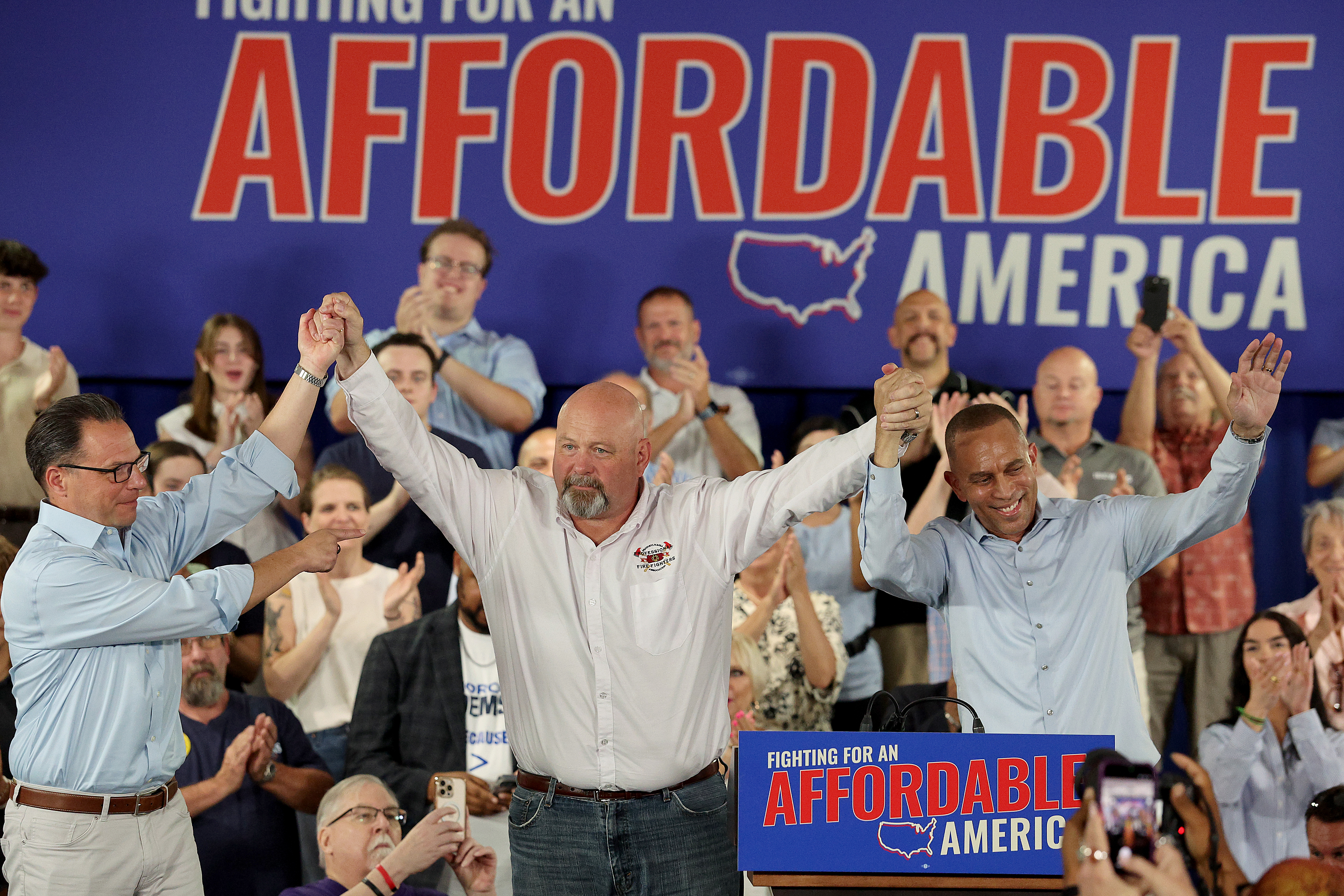
Governor Josh Shapiro (left) and Minority Leader Hakeem Jeffries (right) pose after rally for Congressional candidate Bob Brooks (center) at the United Steelworkers Union Hall in Bethlehem, Pa. on Sunday, July 26, 2026.David Maialetti / Staff Photographer
In Mackenzie’s district — where the freshman Republican squeaked through one of the narrowest races in the country two years ago — Ronalyn Birnbaum of Carbon County said she has been working since she was 13 years old. Now, at 69, she said, she has come to terms with not having the money to retire and afford groceries, Medicare, and her inhaler.
“I’m going to give [Brooks] a shot only because I know that Ryan Mackenzie sticks up for a lot of the Trump policies and procedures,” said Birnbaum, a Democrat.
Andres Weller, Mackenzie’s campaign manager, criticized Brooks’ platform in a statement and said Mackenzie favors “commonsense reforms” and is “running on his bipartisan record of delivering for our community.”
Benny Stanislawski, a Brooks campaign spokesperson, said in a statement that the Democrat is “running to bring costs down for working families Mackenzie has left behind,” including through the Republicans’ vote for the One Big Beautiful Bill.
As Democrats’ messaging appears to gain traction, 53%of respondents in The Inquirer/New York Times/Siena poll said they would be more likely to vote for the Democratic candidate in their congressional district, while 44% said they would choose the Republican. The poll did not ask about specific races.
Both parties still have work to do on their brands. A majority of likely voters see each party as focused on the wrong things — 51% for Democrats and 59% for Republicans.
Birnbaum said the problems she hopes voters can address at the ballot box — like the cost of living — have been a long time coming.
“This country should have been fixed a long time ago, but nobody seemed to care, and we’re finding that with the infrastructure here in this country, too,” Birnbaum said. “Nobody thought about these things. They thought about themselves, I guess.”
Staff writers Gillian McGoldrick and Joe Yerardi contributed to this article.
Clarification: This story has been updated to clarify the reference to a proposed national sales tax in Janelle Stelson’s ad attacking U.S. Rep. Scott Perry.
A majority of Pennsylvania voters view U.S. Sen. John Fetterman (D., Pa.) more as a Republican than a Democrat as he continues to heavily criticize his party and side with President Donald Trump in some major policy areas, according to an Inquirer/New York Times/Siena University poll published Thursday.
For the first time in polling conducted by Siena University on behalf of The Inquirer and the New York Times, a plurality of likely voters in the state have a negative view of Fetterman.
The senator is viewed “somewhat” or “very” unfavorably by 47% of voters and favorably by 42%, according to the poll of 615 likely voters from Sept. 15 to 21. That’s an 11-percentage-point swing since the organizations’ poll in August found Fetterman maintained an overall positive favorability rating.
Four years after he flipped a Republican-held seat with a promise to be Democrats’ 51st vote in the Senate, just 26% of likely voters consider Fetterman as more of a Democrat than a Republican, the poll found.
A majority — 57% — view him as more of a Republican.
(function(){function e(){window.addEventListener(`message`,function(e){if(e.data[`datawrapper-height`]!==void 0){var t=document.querySelectorAll(`iframe`);for(var n in e.data[`datawrapper-height`])for(var r=0,i;i=t[r];r++)if(i.contentWindow===e.source){var a=e.data[`datawrapper-height`][n]+`px`;i.style.height=a}}})}e()})();
“He insists that he’s not going to be changing parties. However, a lot of people are afraid of that because of the way he has voted,” said Sandra Boyles, a retired teacher and Democrat in Fayette City who believes “a lot of people feel betrayed” by the senator.
Nearly three-quarters of Democrats see Fetterman as a Republican. And roughly half of Republicans feel the same way, as do a similar proportion of independents.
Fetterman’s party loyalty has become a pressing question — not just for his own political future, but also for which party controls the U.S. Senate during the final two years of Trump’s presidency.
Democrats need to win at least four competitive Senate races in Trump-friendly states to win the majority, an uphill battle that has seemed like more of a possibility in recent weeks as the president’s popularity lags.
Independent election experts consider Democrats to have a real chance of winning states like Texas, Iowa, and Alaska. Ohio, North Carolina and Maine are also official Democratic targets. Even Kansas, which Trump won by 16 percentage points in 2024, appeared to raise some level of concern for Republicans when Vice President JD Vance tried to boost the GOP incumbent this month.
Neither of Pennsylvania’s U.S. Senate seats is on the ballot this fall. But if Democrats retake the majority by one or two votes, Fetterman’s role as a wild card — even one who votes with Democrats the vast majority of the time — could have an impact as his party tries to rein in or reverse the president’s agenda.
“That would definitely be a concern of mine,” said Boyles, 74.
(function(){function e(){window.addEventListener(`message`,function(e){if(e.data[`datawrapper-height`]!==void 0){var t=document.querySelectorAll(`iframe`);for(var n in e.data[`datawrapper-height`])for(var r=0,i;i=t[r];r++)if(i.contentWindow===e.source){var a=e.data[`datawrapper-height`][n]+`px`;i.style.height=a}}})}e()})();
Fetterman has not said whether he will seek a second term in 2028, and he has repeatedly rejected the idea that he would switch parties.
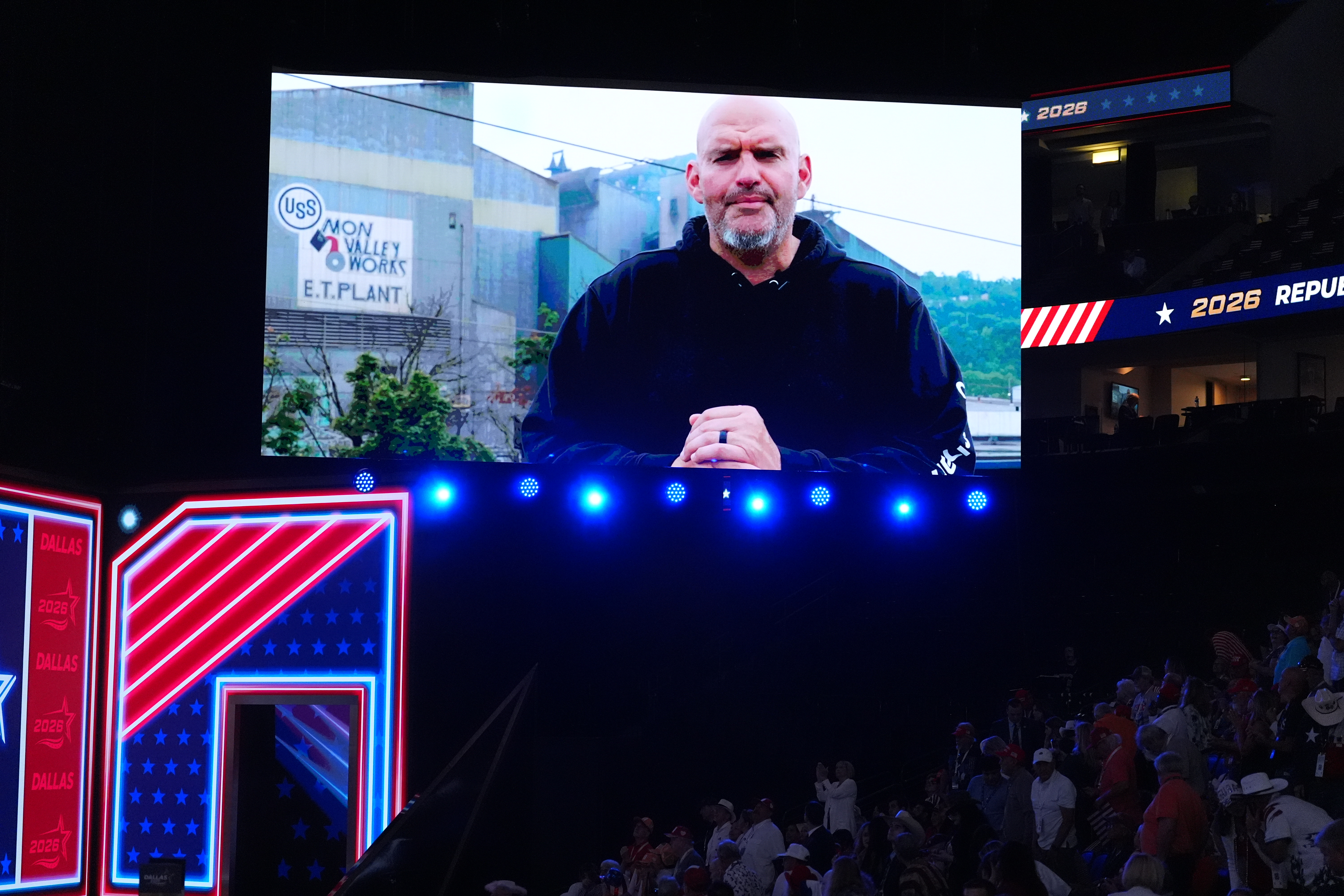
“I’m a lifelong Democrat who votes overwhelmingly with my party — and should the Senate flip in November, I will still be the 51st vote that I ran on,” he said in a statement while facing a new round of criticism for appearing by video at the GOP convention in Dallas this month.
Pennsylvania’s U.S. Senators John Fetterman (left) and Dave McCormick appear together on June 29 to promote the savings accounts for kids that were a signature piece of President Trump’s One Big Beautiful Bill Act.Tom Gralish / Staff Photographer
Fetterman’s Democratic colleagues have tried to keep him in the fold.
U.S. Sen. Kirsten Gillibrand, a New York Democrat and chair of the Democratic Senatorial Campaign Committee, said this week that Fetterman is a “very reliable Democratic vote.” As she leads her party’s effort to win the Senate races,Gillibrand said, she does not have, nor has heard others having, concerns about Fetterman’s role in a slim Democratic majority.
“I’m very grateful that Sen. Fetterman is serving in the U.S. Senate as a Democrat, and I think he will continue to do so,” Gillibrand said.
Still, Fetterman has supported parts of Trump’s immigration enforcement agenda, the war in Iran, and some of the president’s nominees. Senate Democratic leaders would likely try to act as a check on Trump in each of those areas if they win the majority for the next two years.
Fetterman has also left the door open to leaving the Democratic Party if it makes opposition to Israel an official party stance. The senator has not explained exactly what that situation would look like, though he has been highly critical of Democrats when they push back against the Israeli government’s war against Hamas.
With the three-year anniversary of the conflict approaching on Oct. 7, more than 70,000 Palestinians have been killed and nearly all Gazans have been displaced, according to the Council on Foreign Relations. Critics say Israel’s military response has been excessive, while Fetterman has said he supports the war in order to root out Hamas fighters who initiated the war by killing more than 1,200 people in Israel in a terrorist attack.
The latest poll of Pennsylvania voters shows Fetterman’s position is out of step with a majority of voters.
Among Pennsylvania likely voters, 60% are against the U.S. providing additional economic and military support to Israel, compared with 34% who support it.
Four in five Democrats, and about a third of Republicans, oppose the aid to Israel. In a sign that Fetterman would face a challenging reelection campaign, 63% of Democrats said they would support a candidate who opposed aid to Israel.
(function(){function e(){window.addEventListener(`message`,function(e){if(e.data[`datawrapper-height`]!==void 0){var t=document.querySelectorAll(`iframe`);for(var n in e.data[`datawrapper-height`])for(var r=0,i;i=t[r];r++)if(i.contentWindow===e.source){var a=e.data[`datawrapper-height`][n]+`px`;i.style.height=a}}})}e()})();
Victor Oyola, 47, of Philadelphia, said he considers himself a conservative Democrat and has no issues with politicians supporting Israel’s right to exist. But Fetterman has been more of a voice for the foreign nation than for his home state, he said, while also showing limited interest in other aspects of his position.
“You don’t want to do the job, but you’re strongly supporting Israel over Pennsylvania?” said Oyola, who works in retirement management. “Everything is Israel, Israel, Israel. But what about Pennsylvania, Pennsylvania, Pennsylvania?”
Reports of Fetterman’s lack of interest in doing routine aspects of his job as a senator also appear to have played a role in how Pennsylvanians view him.
In a widely circulated story earlier this month, the Wall Street Journal reported that Fetterman tried to evade meetings with leaders at Children’s Hospital of Philadelphia and with wounded veterans, as well as a funeral for three York County police officers who were killed while on duty.
Donald Harer, a Democrat from Northumberland who voted for Fetterman in 2022, said that he saw the story and that it seemed like the senator has “really not held his end of the bargain and done his job the way he’s supposed to.”
As an Army veteran who served in Iraq, Harer said, he was particularly disappointed in Fetterman’s reported refusal to meet with wounded veterans.
“When he campaigned, when he first started to run, he seemed like a go-getter,” said Harer, an operations manager for a grocerystore. “But he let a lot of people down. I kind of call him a traitor.”
Don Levy, the director of the Siena Research Institute, which conducted the poll, said he did not know if changes in Fetterman’s favorability ratings since last month could be attributed to the recent national attention on him.
But with recent polls continuing to show Fetterman’s widespread cross-party support, his position as a Democratic darling for the GOP and antagonist for Democrats “looks pretty baked in,” Levy said.
“The Republicans have now grown in their favorability for him, which may be a reflection of them starting to feel like ‘he’s one of us,’” Levy added. “And Democrats are even more upset with him for moving away from what they believe they elected him to do.”
Staff writers Joe Yerardi and Gillian McGoldrick contributed to this article.
Watching parents struggle to pay for lodging and food as their children underwent treatment for cancer in the early 1970s broke the heart of Children’s Hospital of Philadelphia oncology director Audrey E. Evans.
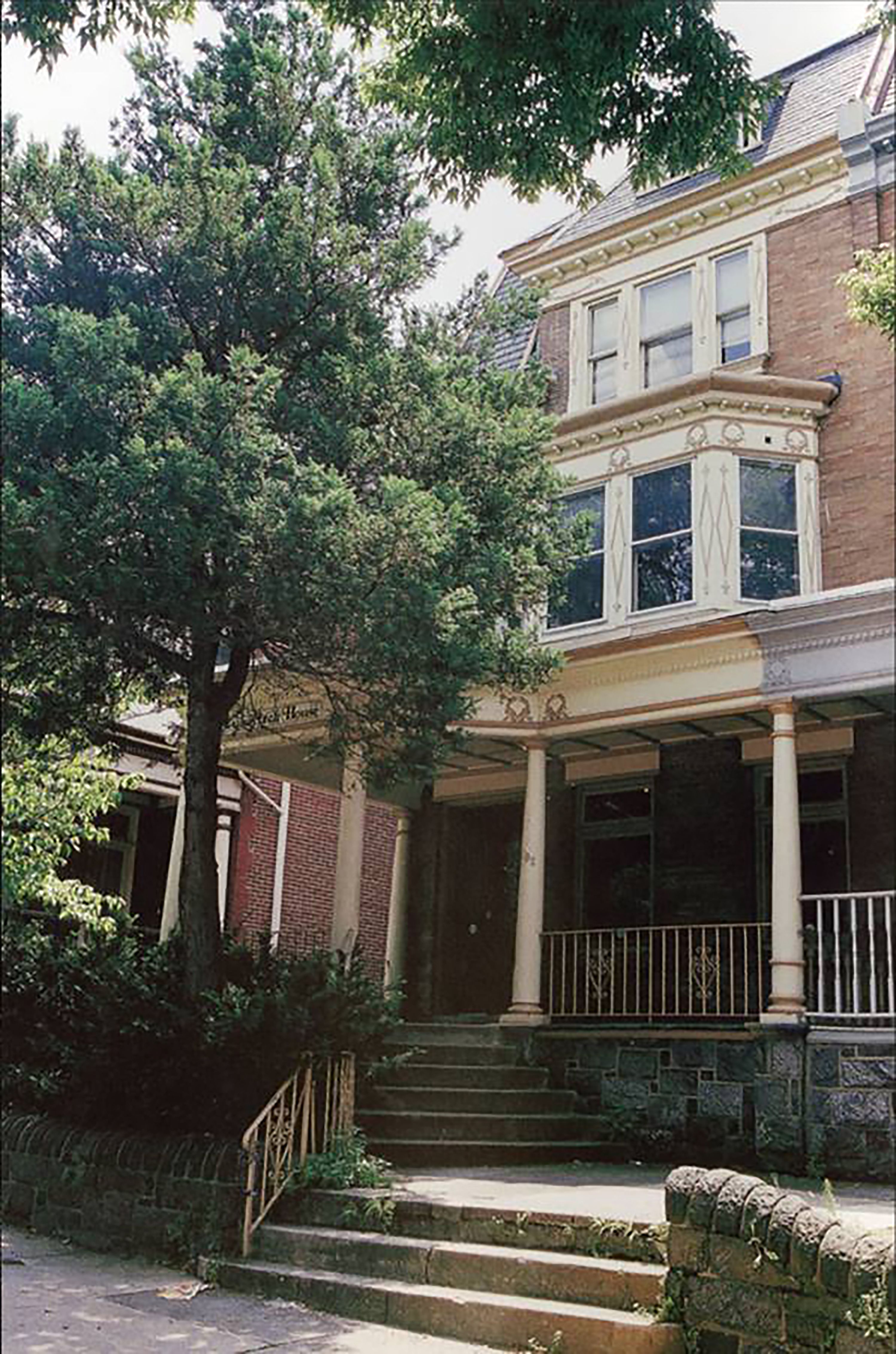
Evans, a British pediatric oncologist, wanted to do something to make the families comfortable during this terrible time. When she found a four-story, seven-bedroom house in West Philadelphia, she envisioned a space where beleaguered parents could stay, eat, and rest during the tough days and tougher decisions ahead of them.
She just needed $34,000 to buy it.
The Ronald McDonald House No. 1 was created by Alana Sxmone in a pop art, ’70s-inspired comic style to capture warmth and optimism. It features cofounders Audrey E. Evans and Jim Murray surrounded by families helped by the Ronald McDonald House.Alana Sxmone for Colibrí Workshop
In 1974, on the other side of town, at North Philadelphia’s St. Christopher’s Hospital, Eagles tight end and wide receiver Fred Hill’s 7-year-old daughter, Kim, was fighting — and beating — acute lymphatic leukemia.
Hill wanted to make a difference for families with sick children. With the help of the team’s then-general manager Jim Murray, he formed the fundraising nonprofit Eagles Fly for Leukemia. Together, Hill and Murray approached Kim’s doctor, Lawrence Naiman, who suggested Hill chat with Evans. She was in the midst of building CHOP’s state-of-the-art cancer facility and needed the money more than he did.
“The Eagles pledged a million to build the oncology ward,” said Ronald McDonald House CEO Susan Campbell. “That began Dr. Evans’ relationship with Fred Hill, Murray, and Eagles owner Leonard Tose.”
Evans didn’t stop there, said Campbell. “She told them, ‘I need to buy this house in West Philly. I need $34,000.′”
The original Ronald McDonald House, at 4032 Spruce St. in West Philadelphia.The Ronald McDonald House
The Eagles and McDonald’s, the fast-food chain, were clients of the same Philadelphia-based firm Elkman Advertising. Tose devised a deal: He offered to the then-regional manager of McDonald’s, Ed Rensi, his top players, including Roman Gabriel and Bill Bergey, as spokespeople for the Shamrock Shake. His ask? Maybe McDonald’s would donate a portion of the proceeds to Evans’ house.
“Rensi said that he would give Evans all of the proceeds if she would call it the Ronald McDonald House,” Campbell said.
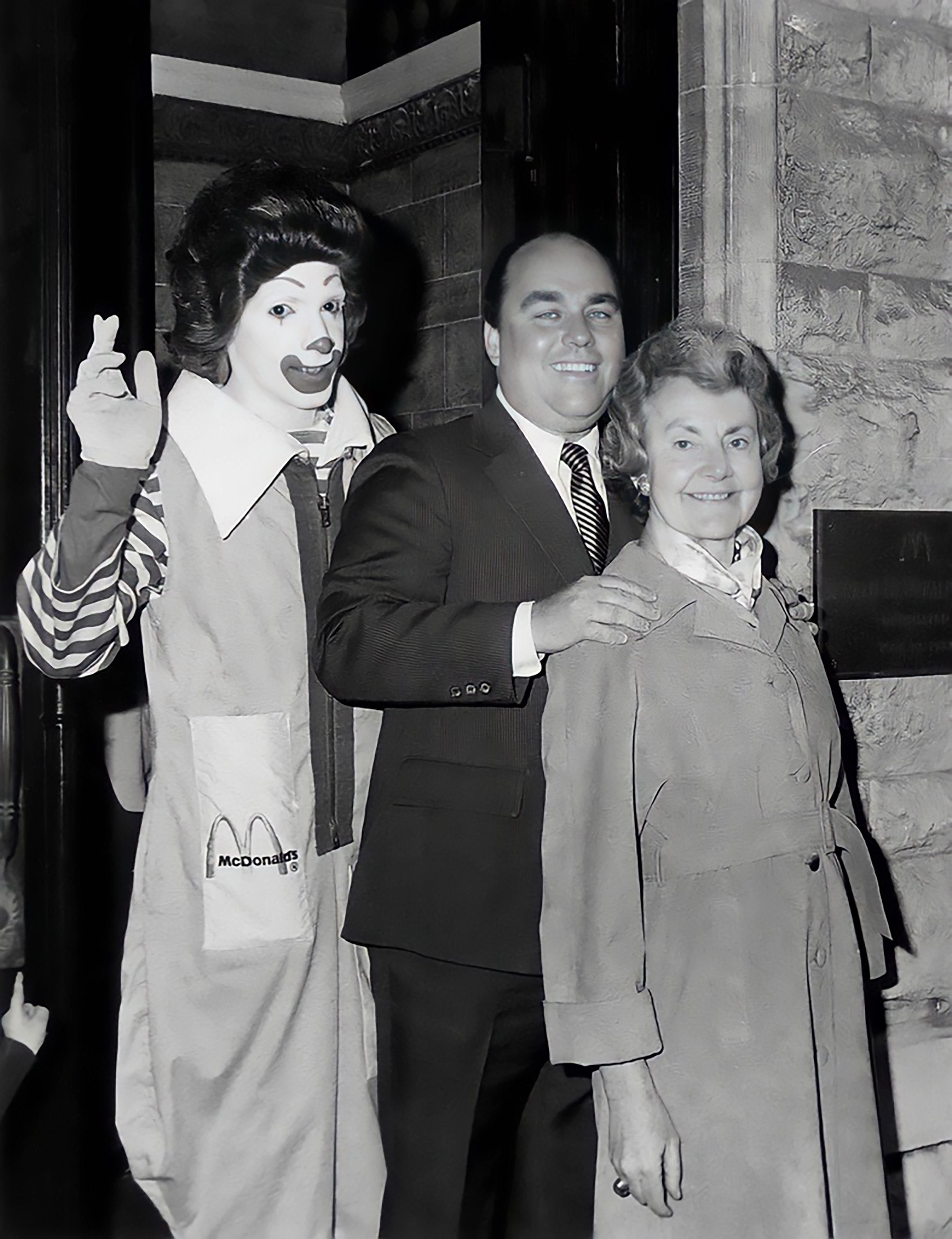
On Oct. 15, 1974, Tose, Gabriel, Bergey, then-chairman of McDonald’s Ray Kroc (the same Ray Kroc for whom the area Salvation Army Kroc Centers are named), and Mayor Frank Rizzo joined Evans at the ribbon cutting of the world’s first Ronald McDonald House, at 4032 Spruce St.
That ribbon cutting will be feted as a “firstival” from 11 a.m. to 1 p.m. Saturday at the Ronald McDonald House’s Chestnut Street location. Firstivals are weekly parties the Philadelphia Historic District is throwing each Saturday celebrating people, places, and things born in Philadelphia in honor of America’s 250th birthday.
There are more local connections: South Jersey builder John Canuso, whose daughter had leukemia, donated the elbow grease, furniture, appliances, and electrical wiring for the original Ronald McDonald House, helping it build its reputation as a sweet space for care and convalescence. By 1979, 5,000 people from 29 states and seven countries called Ronald McDonald House home during a difficult time.
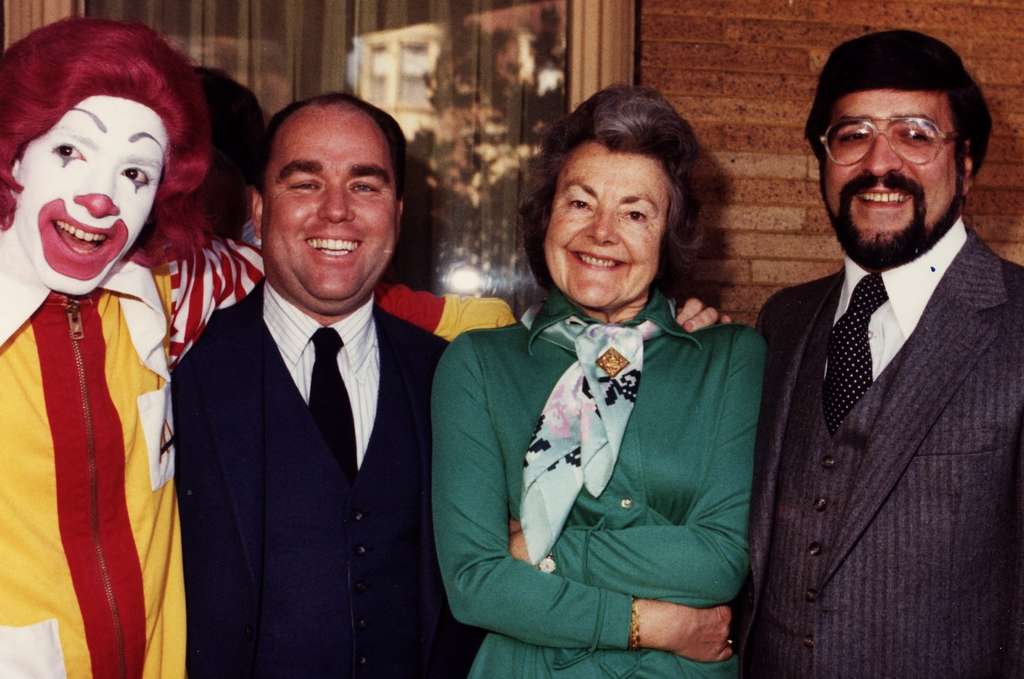
Ronald McDonald House Philadelphia cofounders Jim Murrary, Eagles general manager, and Audrey E. Evans, Children’s Hospital of Philadelphia oncology director, in the 1980s at the Chestnut Street location.The Ronald McDonald House
In 1981, the new Ronald McDonald House opened its doors at a 32-room mansion at 3925 Chestnut St. The new spot — also renovated by Canuso — replaced the original Spruce Street location. It remains open today and features 19 bedrooms, a kitchen, living room, library, and laundry room.
Kim Hill died when she was 44, in 2011. Radiation from her treatments for leukemia as a child caused brain tumors as an adult. Fred Hill is in his 80s and lives in California.
Today, there are about 400 Ronald McDonald Houses in 62 countries, including ones at 100 E. Erie Ave. in Juniata Park, in Camden, and in Wilmington. Families are given a room, three meals a day, and transportation to and from the hospital. The suggested rate is $25 a night, but no parent is turned away. All families with children facing life-threatening illnesses — and being treated at CHOP or neighboring hospitals — are welcome.
Carmen Montes, 17, participates in a game at the Ronald McDonald House of Southern New Jersey in Camden on Oct. 14, 2016.DAVID SWANSON / Staff Photographer
“The ultimate goal is that every child is healthy and that we wouldn’t need a Ronald McDonald House,” Campbell said. “But that isn’t the case. We are grateful that medical technology is advancing and that we’re able to support so many families on this journey.”
This week’s Firstival is Saturday, Sept. 26, from 11 a.m.-1 p.m., at the Ronald McDonald House at 3925 Chestnut St.