Tag: topic-link-auto

  • Russia and Ukraine agree to a large prisoner exchange as talks end with no major breakthrough

    Russia and Ukraine agree to a large prisoner exchange as talks end with no major breakthrough

    ABU DHABI, United Arab Emirates — Russia and Ukraine agreed to a large exchange of prisoners of war, both sides said Wednesday as two days of U.S.-mediated talks concluded with no major breakthrough on ending Moscow’s nearly 5-year-old full-scale invasion.

    Hopes had been low for any significant development in the first meeting in nine months between the delegations. Russia and Ukraine have from time to time swapped POWs but have remained far apart in their demands for accepting a peace settlement.

    U.S. officials say they are determined to revive Washington’s peace efforts that so far have failed to deliver significant results.

    Along with postwar security guarantees for both countries, other key hurdles are the fate of Russian-occupied Ukrainian territory and what role European countries will play in an eventual settlement.

    U.S. envoys to meet with Putin and Zelensky

    The session was the first such meeting since February on Russia’s invasion, which analysts and humanitarian organizations say has killed hundreds of thousands of soldiers and thousands of civilians.

    The talks lasted just under two hours Wednesday, after a four-hour session the previous day.

    “One of the positives is we agreed that we’re going to have the biggest humanitarian release of prisoners, which we’re going to finalize the numbers tomorrow,” said Jared Kushner, U.S. President Donald Trump’s son-in-law, after the Abu Dhabi talks ended.

    Vladimir Medinsky, head of the Russian delegation, and Rustem Umerov, who led Kyiv’s contingent, confirmed the planned POW exchange, although Medinsky noted the agreement was “in principle.”

    Alexander Zorin, a deputy chief of the General Staff’s information department who attended the talks, told Russian state TV it would be one of the biggest such swaps after the 1,000 soldiers returned home last year.

    The latest exchange could take place in the next two or three weeks, he said.

    Kushner said he and U.S. envoy Steve Witkoff will travel to Moscow on Thursday to meet with President Vladimir Putin, then fly to Dublin, Ireland, to meet Ukrainian President Volodymyr Zelensky.

    Medinsky said he felt the meeting helped Moscow and Kyiv edge closer to peace, while Kremlin foreign affairs adviser Yuri Ushakov described the talks as “substantive and quite useful.”

    European officials were excluded by Moscow from the talks

    Umerov said Kyiv’s delegation was expected to meet later Wednesday with representatives of European governments, the European Union, and NATO who were in the capital of the United Arab Emirates but did not attend the three-way talks.

    Moscow doesn’t want European countries, which are concerned about Russia’s conduct and broader intentions on the continent, involved in the direct negotiations. Kushner said one of the goals of the Moscow meeting is to try to get Europeans added to the talks.

    “Ukraine’s priority is to end the war as soon as possible with a dignified peace,” Zelensky said on X. “We believe that Europe must be represented at every stage of real diplomacy. It is essential that the United States have a strong position and exert influence on the source of this war — that is Russia.”

    Kremlin spokesman Dmitry Peskov said European representatives could eventually join peace talks but added their current statements “don’t indicate any desire on their part to contribute to movement along the path toward peace.” Moscow complains that Europe is financing and supplying weaponry to Ukraine.

    Kushner said both Ukraine and Russia needed clarity on postwar security arrangements. He said European countries, the EU, and NATO have to be involved in those discussions to build consensus on next steps.

    Ukraine wants to ensure that Moscow doesn’t invade again, and EU officials say any discussions on Europe’s security arrangements could only start after a ceasefire. Many in Europe see the inclusion of Russia in those plans as a concession to Putin, who has described NATO’s eastward expansion as a top threat to its security. Russia has demanded that the alliance pull back its troops from its borders.

    Russia’s security concerns were discussed at the talks, Kushner said, adding that Moscow was told it needs to provide different de-escalation proposals acceptable to Europe.

    “The reality is, is there’s no trust right now between the sides. And that’s to be expected after a conflict like this,” he said. But he posted on X later that the POW exchange “will reunite families, build trust and create momentum toward peace.”

    The talks were held in a new political atmosphere

    The context of the negotiations has changed since the February meeting in Geneva. The Trump administration now must reckon with Democrats taking over the U.S. Congress in January following the U.S. midterm elections, and they could demand more support for Ukraine.

    Also, Russia’s wartime economy is under heavy strain, and Ukraine is reeling from devastating aerial attacks on its power grid.

    Fighting continues on the front line, where little territory has changed hands this year. Both countries are battering each other with long-range missiles and drones.

    Three people died and 11 were injured after Russia launched a daytime attack on a market in the southern Odesa region, local authorities said. Residential buildings were damaged, said Oleh Kiper, head of the regional military administration.

    Overnight, Russia struck the Zaporizhzhia region in southern Ukraine and the eastern city of Kharkiv, wounding seven civilians and damaging property, Ukrainian officials said.

    Russia’s Defense Ministry said it downed 627 Ukrainian drones overnight, 150 of them over the region around St. Petersburg. Regional Gov. Alexander Drozdenko said the drones started a fire at the port of Ust-Luga, a main facility for Russian oil exports, injuring three workers.

    An Indonesian man is reportedly captured on the battlefield

    Meanwhile, a 49-year-old Indonesian man reportedly was captured on the battlefield in southern Ukraine’s Zaporizhzhia region after he claimed he was unknowingly recruited to fight for the Russian military.

    The Indonesian Embassy in Kyiv was seeking access to the man, who was in Ukrainian custody, according to Yvonne Mewengkang, a spokesperson for the Indonesian Ministry of Foreign Affairs.

    According to Ukraine’s “I Want to Live” project that offers Russian troops the opportunity to surrender, the man was taken to occupied Donetsk with no military training and then to the Zaporizhzhia region, where his unit was attacked and he was captured, according to the group’s post on Telegram.

    The man said he signed what he believed to be a contract to work in construction for one year in Moscow, the group said.

    Ukrainian and Russian officials made no immediate comment.
  • Black veterans of WWII fought fascism abroad and racism at home

    Black veterans of WWII fought fascism abroad and racism at home

    Paul L. Newman is an amateur historian of African American history. He’s currently working on a miniseries docudrama on the Civil Rights Movement of the first half of the 20th century.

    1946 should be remembered as a time when opportunities denied to “the Greatest Generation” by the Great Depression became available, as World War II veterans took advantage of the GI Bill’s four benefits.

    The first two benefits were assistance in finding employment and a weekly stipend until a job was secured. The third was a loan guarantee by the Veterans’ Administration (VA) for a home, farm, or business. The fourth was education or vocational training.

    But formidable obstacles blocked many African American veterans in the South from receiving their benefits, which were locally administered, allowing the same racists who’d been holding back their advancement since 1865 to continue doing so.

    After applying to the U.S. Employment Service for jobs, many Black veterans were offered low-paying, unskilled work regardless of the training or skills they may have acquired in the military. If they refused employment offers below their abilities, their unemployment stipend could be cut.

    Racism at home

    Some African Americans may have wanted a loan to buy a home or farm or to start a business. They soon learned that the VA merely guaranteed loans; it didn’t make them. VA loans would have to be secured from a local bank, which was generally not interested in improving the status of Black veterans.

    In the North, Black veterans hoping to buy homes were relegated to decaying older housing inside city limits, while newly built suburban tracts barred them from home ownership.

    White and Black colleges, as well as trade schools, were inundated with students taking advantage of GI Bill education benefits, but state-supported historically Black colleges and universities (HBCUs) didn’t receive the same increase in state funding as white schools. This situation led to severe overcrowding at Black colleges. Five Southern states refused to admit Black students to their law schools, but willingly established segregated, inferior ones to comply with the “separate but equal” doctrine.

    Getting admitted into Southern vocational training schools, except the few affiliated with an HBCU institution, was virtually impossible. Some unscrupulous entrepreneurs established trade schools to train Black veterans in the low-wage jobs they were relegated to before the war, instead of ones through which they could join the middle class.

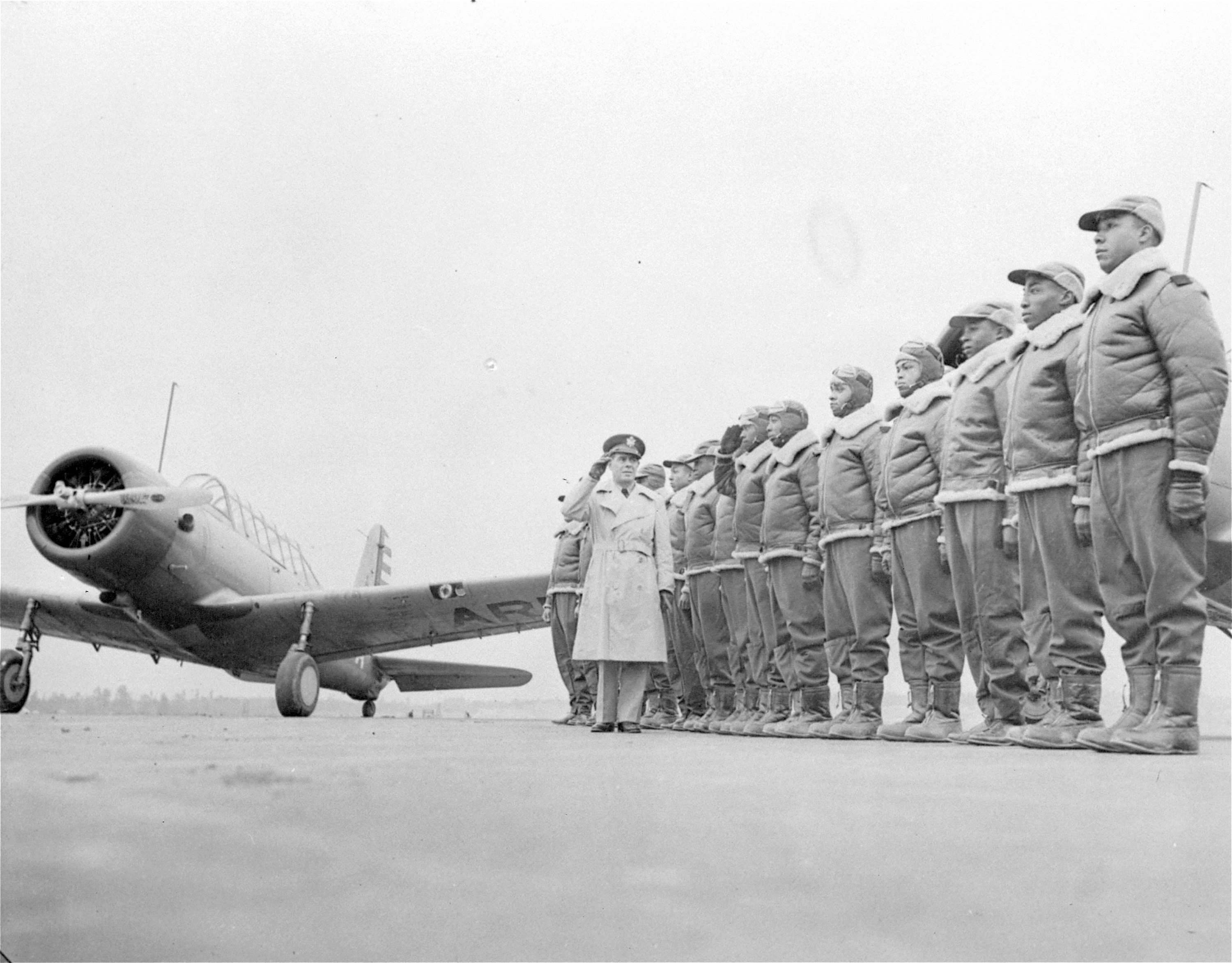
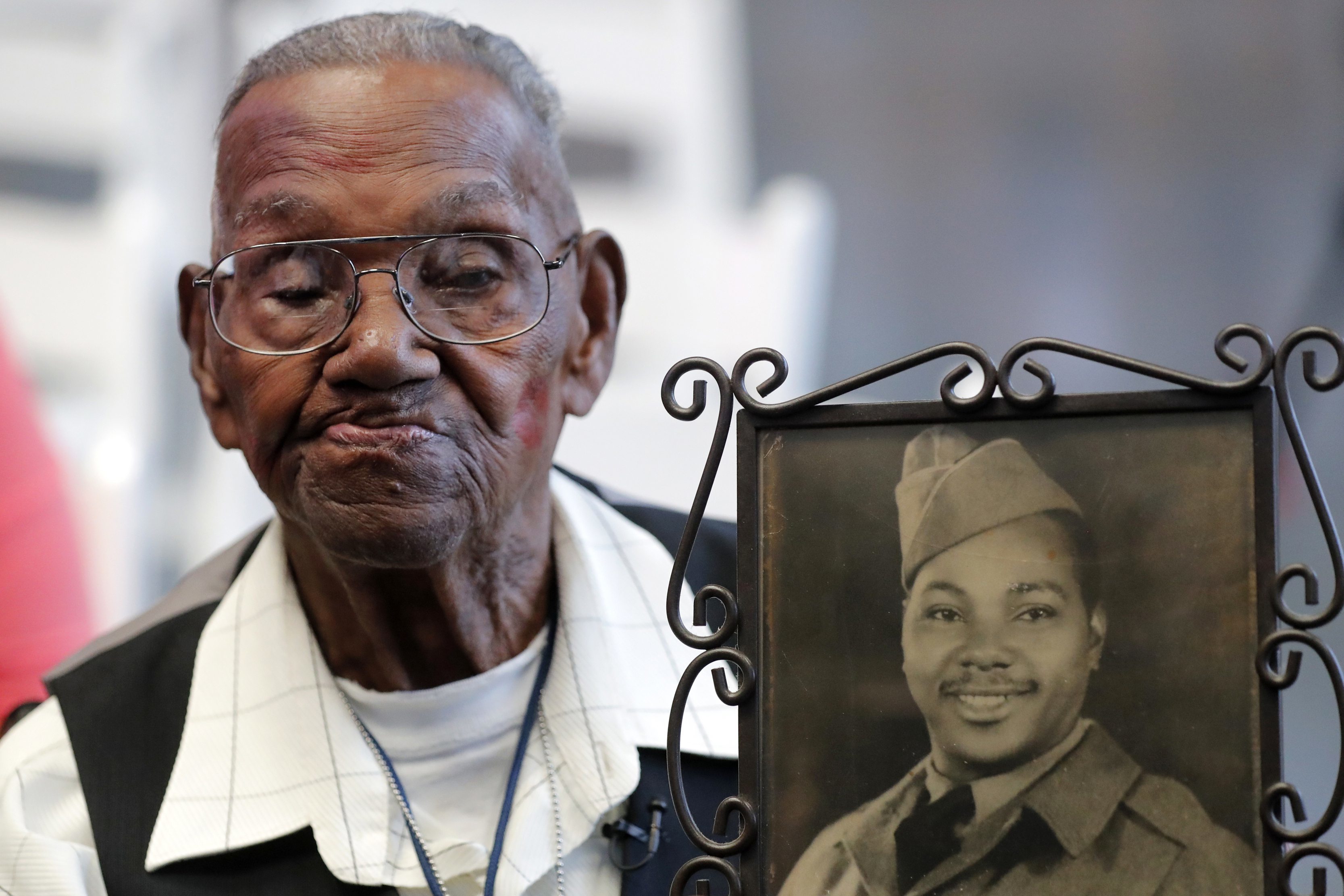
    U.S. Army Air Corps cadets line up for inspection at the airfield of the Tuskegee Institute in Tuskegee, Ala., in 1942. Even members of the legendary Tuskegee Airmen faced systematic discrimination when they returned home despite their service in World War II.Anonymous / AP

    Most Black veterans returned to their hometowns which, despite their wartime service, refused to acknowledge their full citizenship. Hosea Williams, disabled by combat wounds, was beaten so badly for using a whites-only drinking fountain in a Georgia bus station that a hearse, instead of an ambulance, was summoned. Williams later became a key organizer for the Rev. Dr. Martin Luther King Jr.

    In February 1946, a police officer blinded Isaac Woodard, a recently discharged veteran. Veteran Maceo Snipes had the audacity to be the first African American in Taylor County, Ga., to vote since Reconstruction. Snipes was murdered the next day. That year, there were multiple instances in which Black veterans were murdered with impunity during disputes over public transportation or accommodations in New York, Alabama, Georgia, North Carolina, and Louisiana.

    However, the Black veterans, who had defeated fascism in Europe and Asia, wouldn’t countenance a repetition of 1919’s Red Summer, during which more than 75 African Americans were lynched, and hundreds of others were killed in race riots that occurred in Chicago, Charleston, S.C., Washington, D.C., Elaine, Ark., and Omaha, Neb.

    Fighting back

    World War II’s Black veterans, who had faced death abroad, returned home unafraid. In February, Black veterans in Columbia, Tenn., defended their neighborhood against a police invasion. A hundred Black veterans tried to register to vote in Birmingham, Ala. In July, Medgar Evers and other Black veterans tried to do likewise in Mississippi. They had willingly put their lives on the line to ensure their constitutional rights and were now going to fight for their children’s future. Oliver Brown and Harry Briggs Sr., two of the plaintiffs in 1954’s Brown v. Board of Education, were fearless veterans who risked their lives and livelihoods for their children’s education.

    As we thank our veterans today, it is imperative we remember that the Black members of the Greatest Generation came home 80 years ago to fight for the civil rights of all African Americans and laid the foundation for every large-scale grassroots movement that followed.

    Their courage inspired others to march against the Vietnam War and to fight for the rights of women, LGBTQ+ communities, and other marginalized Americans.

    To those Black veterans, I say, “Thank you for your service.”

  • Mammoth crowds greet Pope Leo on return to Peru, his adopted homeland

    Mammoth crowds greet Pope Leo on return to Peru, his adopted homeland

    LIMA, Peru — He was born in Chicago. But when Pope Leo XIV touched down Wednesday in Peru for the final leg of his South American tour, the cleric previously known as Robert Francis Prevost came home.

    Upon landing at an air force base on the outer edge of the capital, the pope appeared emotional as he was greeted by ecstatic crowds. For a pope naturalized as a Peruvian citizen in 2015, a remarkable multitude of some 3 million people, according to the Vatican, citing Peruvian authorities — a record for his papacy — lined the route of his welcome convoy for miles into the city, some in tears, others lifting hands in prayer, most training cellular phones. They roared as their adopted son returned.

    The record-breaking crowd greeted the pope in Peru just days after he’d set a record for his papacy in Argentina, where some 2.5 million swarmed to his Mass in Buenos Aires on Monday. His 12-day trip is drawing by far the largest crowds of his papacy, propelling the new pontiff into the leagues of frantic popularity witnessed under Pope Francis and Pope John Paul II.

    If he rode a sentimental wave in the home country of the Argentine-born Francis, in Peru, the crowds are all about Leo.

    Peru was the backdrop for the formative years of Leo’s religious life, a discontinuous 20-year period that began in the 1980s, when the Andean nation was convulsing in a barbarous civil war between the Shining Path guerrilla movement and state security forces. A decade later, Leo — then an Augustinian missionary in the northwestern city of Trujillo — would take to the streets to protest human rights abuses under right-wing President Alberto Fujimori, the late father of Peru’s current leader, President Keiko Fujimori.

    She welcomed Leo at the air base, and later sat beside him at Lima’s Grand National Theater. Leo is not given to gushing, or expressions of nationality, whether as a Peruvian or American. But on Wednesday, he declared, “I can tell you, with deep gratitude, that I am … returning to my homeland.”

    He also issued what has become his trademark: veiled political criticism. Fujimori has stood accused by her opponents of lacking empathy, ignoring the underclasses facing natural disasters. “The solidarity that Peruvians demonstrate in the face of emergencies deserves to be matched by equally committed institutions, capable of preventing disasters and acting in a timely manner when a life is in danger,” he said.

    His naturalization in 2015 was a prerequisite for his elevation to bishop of Chiclayo, and the man-who-would-be-pope would mesh with this country in profound ways. He embraced its custom of popular religiosity — vibrant expressions of Catholicism rooted in Andean traditions, which he still champions, to the chagrin of some purists.

    As pope, Leo has surrounded himself with Peruvian aides — including Edgard Rimaycuna, the Chiclayo-born cleric so frequently by his side that it is said in Vatican City that only God and Rimaycuna are constantly with the pope. Leo often speaks in deeply fluent Spanish forged in Peru. One of his favorite meals is el frito: a hearty Chiclayo pork breakfast served on weekends.

    In his first speech as pope, he gave a shout-out to his C-town — Chiclayo, not Chicago. In a theoretical World Cup match between his native U.S. and his adopted Peru, Leo has said he would root for the latter.

    Peru has returned the favor, embracing him as an adopted son — including with the construction of a 46-foot giant statue of Pope Leo XIV in the port city of Callao, where the pope will visit on the final day of his trip.

    “You could say he penetrated our culture, he understood it, the thinking of Peruvians,” said the Rev. Ramiro Castillo Castro, a senior Peruvian Augustinian cleric who was a student and friend of Leo’s during his years in Peru. “You could say he became one of us, that he picked up the flavor of Peruvian culture, the customs of Peru and the way the people lived the faith.”

    Ahead of Leo’s visit, some Catholic critics appeared uneasy with the extent of Peru’s embrace of the pope himself. Commenting on the giant statue of Leo erected in Callao, John-Henry Westen, the conservative, Canada-based co-founder of LifeSite News, quipped on social media last week that “Catholics do not worship popes.”

    Leo’s homecoming spans six days — an extraordinarily long papal visit for a country the size of Peru — and notably comes before any visit to his birth nation. It is a trip set to show the world a different side of the White Sox-loving, U.S.-born pope — as a Peruvian and a global citizen.

    His connection to Peru, and to its people, will be on full display, said Véronique Lecaros, head of the theology department at the Pontifical Catholic University of Peru. “It could help solidify his image as a global pope.”

    He comes as Peru has declared a national emergency in much of the country as the effects of the El Niño weather phenomenon induce coastal flooding and extreme rains. Nevertheless, Leo is crisscrossing Peru, from the Amazonian town of Pucallpa to the high Andes. On Sunday, a 71-year-old pope who underwent lung cancer surgery only last month will visit the ancient Incan capital of Cusco, where the high altitude can induce breathing problems even in the young and healthy.

    In towns and cities across Leo’s itinerary, churches are redoing facades. Mobilizations of millions are planned, including potentially historic outdoor Masses in and around Lima and Chiclayo.

    Leo initially insisted on traveling to some of the remote mountain towns surrounding Chiclayo that he was known to access by horseback in years past. Local organizers tried on several occasions to fly helicopters to these areas to organize papal visits, but the logistics and weather made it too risky, said Hugo Gabriel Sánchez Romero, a Chiclayo priest who formerly worked closely with Leo and has been working on the papal trip.

    The pope, Sánchez said, was “not happy” about his inability to visit those communities, and so the Vatican decided to call surrounding residents to Zaña, a more accessible town of 14,000 people that will be flooded with upward of 300,000 people. It’s home to communities that have often been neglected by the government. It has no bank, no radio station, no hospital, no ambulance. But it is home to a historic chapel, of Santo Toribio de Mogrovejo. It is also where, as bishop, Leo helped oversee the construction of a church school and a well.

    That his visit is mobilizing vast crowds at a time when Peru is experiencing a weather crisis could complicate things for local authorities. But it has also surfaced memories of the days when Leo, both as missionary and later as bishop, would take a hands-on approach to Peru’s frequent natural disasters, rolling up his shirtsleeves and pitching in.

    “When he came [to Peru], they were still recovering from the Niño floods of ’83. He would see the people working together and worked with them,” said Bishop Daniel Turley, rector of the National Shrine of Saint Frances Xavier Cabrini in Chicago. A fellow Chicagoan and Augustinian who served for 52 years in Peru, he was Leo’s boss during the pope’s initial years there.

    Peru was formative for Leo, who in the 1990s forged a role as a budding human rights and pro-democracy activist of sorts, protesting Fujimori’s heavy-handed rule — establishing a distaste for authoritarianism that still echoes through his papacy today.

    “Peru in the ’90s was really spiraling downward,” said the Rev. John Lydon, director of Villanova University’s Mother Cabrini Institute on Immigration, who lived with Leo when they were both missionaries in Peru in the 1990s. Both focused on promoting human rights through their parishes, he said: “We participated in the marches for democracy, the restoring of democracy.”

    After Leo became pope, there was little doubt he would seek to return quickly to Peru. Sánchez recalled seeing Leo two days after the conclave anointed him. The new pope greeted him by his first name, asking about his mother’s health and about the parish he had entrusted to Sánchez back in Chiclayo.

    “We will be waiting for you in Chiclayo,” Sánchez told him.

    The pope promised him he would visit — and that it would be soon.

  • Trump trots out his chaotic greatest hits to a weary public

    Trump trots out his chaotic greatest hits to a weary public

    WASHINGTON — Coping with loss looks different for everyone, and President Donald Trump has processed the country’s nearly wholesale rejection of the Republican Party in the midterm elections in his own way.

    The last week has seen the president renew false claims about rigged elections, float a mixed martial arts executive as his new press secretary, muse about the beams in the White House ballroom, oust his chief of staff and call unannounced into C-SPAN.

    In other words, this is all unfolding exactly as expected. The news has been bad, and Trump knows it. Cue the mayhem.

    “We were having a very bad press day,” Trump told reporters Monday about why he suggested on social media that the CEO of the UFC should turn the briefing room into his personal octagon. “I said, you know, I think I’m going to get Dana White to be my new press secretary.”

    Trump loves to change an unflattering headline by whipping out a diversion. But his usual tricks seem particularly discordant in the face of the urgent challenges facing the White House. There is an effort to impeach Defense Secretary Pete Hegseth, wars in Ukraine and Iran that the president promised to resolve months or years ago, and an incoming Congress whose Democratic majority is hungry to hold administration officials to account.

    But so far, Trump’s answer to the pressure has been to take an unserious approach to some of the most serious topics. In recent days, he has left the country guessing what he may do, what he may say, or even when he may show up in public.

    His advisers say the president thrives on chaos. The problem is that the public may not.

    “We always talk about Donald Trump as the executive producer in chief,” said Doug Heye, a Republican strategist. “TV shows sort of run out of steam before they get to Season 6. That’s a big part of where voters are. They’re just exhausted.”

    This extends to Trump repeating his baseless claims about election fraud. “It’s just not a credible argument, to the point that nobody’s paying attention,” Heye added.

    Indeed, after the president on Monday revived claims that the midterm vote had been manipulated, conservative commentator Megyn Kelly had a two-word retort: “Just stop.”

    Beni Rae Harmony, a White House spokesperson, defended the president’s focus and productivity.

    “President Trump never stops working, and his momentum has only increased in the past week,” she said in a statement, adding that he had held seven policy meetings, met with the Qatari prime minister and signed several bills into law, including one that designated a museum in Missouri as a national historic landmark and one that changes the bankruptcy threshold for small businesses.

    One adviser, who spoke on condition of anonymity to describe the environment in the White House, called this moment a “natural transition phase.”

    This is a sanguine descriptor, given the abrupt departure of Susie Wiles, the chief of staff Trump replaced with Stephen Miller, a hard-line loyalist who has driven many of the policies voters rejected last week. A Republican fratricide has also been playing out on social media, where current and former Trump officials have spent the past several days blaming one another for the midterm failures, trading accusations of corruption and grift and threatening lawsuits.

    It is the Republican version of the scene in the 2004 movie “Mean Girls” in which the main antagonist makes public a book full of private insults, unleashing bedlam inside a high school.

    After spending a weekend at his Florida estate Mar-a-Lago golfing and delivering impromptu remarks at a conservative gathering there, Trump sought to distract from the bad headlines and the mounting congressional support for the impeachment of his defense secretary. On Monday, he startled reporters with an appearance in the White House briefing room.

    Trump riffed about his gambit of offering the press secretary gig to White, who accompanied him to greet reporters, and then began fielding questions of national and international import.

    Asked about the admission by Jensen Huang, the CEO of Nvidia, of an affair with a Chinese businessperson U.S. officials concluded was an intelligence operative for Beijing, the president seemed unconcerned, saying he bought Huang’s explanation.

    “He said, ‘I had no idea that she was a spy,’ and I really believe him,” Trump said.

    The president also discussed the death toll in the Russia-Ukraine war, framing his assessment of the carnage in terms he understood: crowd sizes.

    “I just think that Ukraine and Russia are tired of fighting. They’re tired of seeing dead young soldiers, mostly soldiers. Most of the people are soldiers. Think of it. They’re losing 25,000 — Dana, can you imagine 25,000? That’s like a stadium, Madison Square Garden. You have your fights, 25,000. That’s what it holds, and they’re losing that every single month — dead, young, beautiful people, and it’s, it’s got to stop.”

    The fun and games continued later Monday when Trump called into the premiere of a C-SPAN show, apparently without notice. A woman could be heard giggling in the background as the president’s call connected.

    For eight minutes, Mimi Geerges, the host of the program, tried to press Trump about news he had made in several other interviews since the midterm elections. What about that immigration deal he had suggested he could strike with Democrats? What about amnesty for some migrant workers, as he had suggested on “60 Minutes” over the weekend?

    His responses were not clarifying.

    “Frankly, a big problem we had is the mental institutions being dumped into our country. Some very dangerous people were released into our country, to put it mildly. So we have not put the same, uh, pressure, obviously, and, you know, the, uh, we call them the worst of the worst,” Trump said, by way of an answer. “We haven’t put the same pressure on waitresses and, and on farmworkers, et cetera. Not even close.”

    Natural transition phase or not, many Republicans are worried that the White House will not be able to deliver on the request made by voters last week, which was to get serious about addressing economic concerns, an unchecked war and accusations of rampant corruption among those in Trump’s orbit.

    The best-case scenario, said GOP strategist Whit Ayres, would be if the administration followed through “on Trump’s initial instinct to do something with the Democrats who are going to be running the place shortly.”

    But, he added, “I think the chances of that happening are somewhere between slim and none.”

    This article originally appeared in The New York Times.

  • Alina Habba Mildon faces discipline over settlement at Trump golf club in New Jersey

    Alina Habba Mildon faces discipline over settlement at Trump golf club in New Jersey

    The Office of Attorney Ethics in New Jersey recommended on Tuesday that Alina Habba Mildon, the former top federal prosecutor in the state, be disciplined for her role in settling a sexual harassment complaint brought years ago by a waitress at President Donald Trump’s golf club in Bedminster, N.J.

    The office’s determination allows the case to move forward to a hearing and could result in penalties ranging from admonition to disbarment.

    Kim D. Ringler, Mildon’s lawyer, noted that Tuesday’s complaint is “the first step in a long process.”

    “The claims are narrow, and we will work together to reach a fair and proportionate result, given the relatively less serious claims of professional misconduct from 2021,” Ringler said in an interview.

    The allegations of ethical violations are tied to interactions that took place in the months before Mildon was first hired as Trump’s personal lawyer — work that later led the president to install her as the U.S. attorney for New Jersey.

    At the time, Mildon was a member of Trump National Golf Club Bedminster and had befriended a club waitress, Alice Bianco.

    Bianco, then 21, had alleged that her boss at the club had engaged in a pattern of sexual harassment, including “quid pro quo sex in exchange for continued employment,” according to Tuesday’s filing.

    Mildon and Bianco traded a series of text messages and had one-on-one conversations that eventually led Bianco to drop her lawyer and accept a $15,000 settlement — “terms favorable to the golf club and unfavorable to Bianco,” the complaint states.

    Bianco was also required to sign a nondisclosure agreement, which the Office of Attorney Ethics noted is illegal under the state’s workplace discrimination laws.

    “Left without counsel, Bianco then relied entirely” on Mildon, who “convinced her that she should settle the dispute because Bianco’s perceived past indiscretions might be made public,” the complaint states.

    The complaint found several violations of attorney ethics, including a conflict of interest and Mildon’s “divided loyalties” as a dues-paying member of the club.

    Tuesday’s ethics complaint follows a three-year inquiry that included at least one interview with Mildon, who told investigators that she saw her role as a neutral third party. She asserted, according to the complaint, that her “job was to make everybody happy and make this move along so that everyone could get along with their lives.”

    Johanna Barba Jones, the director of the Office of Attorney Ethics, rejected that argument, finding that Mildon “could not have been a neutral in this matter.”

    Bianco later enlisted another lawyer, Nancy Erika Smith, to sue Mildon and the club, charging that Mildon had “fraudulently induced” her to sign an illegal nondisclosure agreement. That lawsuit resulted in a $400,000 settlement.

    In December 2023, Smith also forwarded her concerns about “potential ethics violations” by Mildon to Jones’ office for review, resulting in Tuesday’s complaint.

    “She’s unethical and she should be disbarred,” Smith said Tuesday in an interview.

    “She used this 21-year-old victim of sexual assault,” Smith said, adding, “It’s hard to think of a more severe ethical violation.”

    The complaint will now be reviewed by what is known as a special ethics adjudicator, who will conduct a hearing before making a recommendation about any potential penalty. The state’s Supreme Court is responsible for making the final determination on any discipline.

    Soon after Mildon helped broker the $15,000 settlement, she began working as Trump’s personal lawyer. She would go on to represent the president against bank fraud charges filed by New York’s attorney general, Letitia James, and in a defamation trial brought by writer E. Jean Carroll.

    In March 2025, after Trump was elected to a second term as president, he selected Mildon as interim U.S. attorney for New Jersey. Her time as the state’s top federal prosecutor was marked by extraordinary tumult that for months largely paralyzed the district courts.

    She stepped down as U.S. attorney in December 2025 after a panel of federal judges ruled that she had been serving in the position unlawfully. She was immediately appointed as a senior adviser to the attorney general, overseeing U.S. attorneys across the country, a role she held until early this year.

    The complaint by the Office of Attorney Ethics was not the only bit of bad news for Mildon this month. Earlier Tuesday, The New York Times reported that Mildon had been fired last week by a family company that had given her a $50 million contract weeks before Trump granted a pardon to the family’s patriarch.

  • World leaders urge stronger and faster action at U.N. climate talks over inadequate response

    World leaders urge stronger and faster action at U.N. climate talks over inadequate response

    ANTALYA, Turkey — World leaders called for urgent and decisive action on global warming Wednesday as formal talks began at the United Nations climate conference in Turkey, saying the crisis is disproportionately harming some of the world’s most vulnerable countries.

    “You might as well bomb us. That might have been easier than watching climate change tear apart our homes piece by piece,” said Surangel Whipps Jr., president of the island nation of Palau. “We are at war with a crisis we did not create. A war no peace treaty can end, only urgent action can.”

    The annual summit follows a year of deadly floods, heat waves, and other disasters. Leaders said geopolitical conflicts had diverted attention from climate change.

    Leaders of the world’s three biggest polluting nations — China, the United States, and India, which together account for more than half of global carbon dioxide emissions — skipped the summit at COP31.

    Their absence left a handful of national leaders and U.N. officials to press for action as a new report warned of a widening gap between countries’ climate pledges and actual emissions cuts.

    Scientists say global warming is likely to exceed 1.5 degrees Celsius (2.7 degrees Fahrenheit) above preindustrial levels. Limiting warming to that threshold was a goal of the 2015 Paris Agreement and remains a focus of international negotiations.

    “We know the truth. Now we must act on it because climate action is more than a fight over a number or a thermometer,” U.N. Secretary-General António Guterres said in an opening speech. “We are in the fight for our lives and our children’s future.”

    ‘Every fraction of a degree counts’

    Guterres outlined a framework for climate negotiations, saying they must prioritize ending fossil fuel reliance, adapting to a warmer world, increasing financial support for poorer countries bearing the brunt of climate change, and promoting cooperation over conflict.

    “We do not need countries to agree on everything. But we do need them to cooperate on the things no country can solve alone,” he said.

    But addressing climate change has been overshadowed by wars, inflation, and geopolitical conflicts, Brazil’s President Luiz Inácio Lula da Silva said. He pledged to protect the Amazon, the world’s largest rainforest, and urged world leaders to work together for a just, sustainable future. “Brazil is back to defend the continuity of a healthy planet,” he said.

    Micronesian President Wesley Simina said his country is already suffering irreversible losses of coral reefs that “protect our shores, sustain our fisheries, feed our families, and carry the stories and traditions of our communities.”

    He called climate change the “single greatest threat to the security, livelihoods, and well-being of Pacific peoples, but perhaps worse than what we’ve already experienced is what has yet to come” as temperatures continue to rise.

    “Every fraction of a degree counts. Every fraction avoided reduces risk. Every year in which we can slow the rate of warming provides more time for adaptation and reduces the pressure on ecosystems that are approaching their limits,” he said. “This is why the world must act not only deeply, but quickly.”

    Amy Pope, director general of the International Organization for Migration, called for more funding to help communities adapt to climate change and build resilience.

    Climate change displaced almost 30 million people in 2025, while hundreds of millions more live in places unprepared to withstand future risks, Pope told The Associated Press on the sidelines of the summit.

    “The issue that policymakers fail to understand is that making these investments in building resilience to climate in these vulnerable communities will actually save millions of dollars, millions of lives in the end,” she said.

    Leaders of some major polluting nations absent

    More than 70 world leaders and senior government officials are speaking at the summit, though what can be accomplished remains uncertain in the absence of leaders from key nations.

    “It really is a disgrace that just one of the seven G7 heads of state and only a handful of G20 leaders are attending this summit,” said Mohamed Adow, director of Power Shift Africa, a climate and energy think tank. “The world’s biggest economies should be leading the response to the climate crisis, not leaving it to others.”

    The United States, the world’s second-largest polluter after China, is absent from the talks for the second consecutive year. President Donald Trump, who has called climate change a hoax, has targeted offshore wind projects and removed rules limiting power plant emissions.

    European Commission President Ursula von der Leyen attended, but many leaders of European countries stayed away.

    “More than half of the top leaders of the EU countries are not showing up at the leaders’ summit,” Climate Action Network Europe Director Chiara Martinelli told The Associated Press. “If Europe wants to help steer the global transition, it needs to show up and be part of it.”

    Conference colored by fears over speed of climate action

    The gap between nations’ climate plans and action on the ground is widening, according to an annual climate change performance index published Wednesday by Germanwatch and the New Climate Institute.

    “Overall, current collective efforts are not enough to prevent catastrophic climate change. But we see clear potential for improvement,” said Jan Burck of Germanwatch.

    COP31 host Turkey and Australia, which is leading the negotiations, ranked among the worst performers in curbing emissions.

    The talks come as the war in Iran has driven up global prices for oil, gasoline, and products such as fertilizers and pesticides, prompting governments to rethink energy policies and investment in renewable sources such as wind and solar.

    Past talks have been criticized for producing promises that later went unfulfilled.

    Delegates at the 2023 conference in Dubai agreed to transition away from fossil fuels such as coal, oil and gas, the main drivers of climate change. But subsequent conferences in Azerbaijan and Brazil yielded little agreement on how to reduce their use. Last year’s conference in Brazil produced a compromise deal pledging more money to help vulnerable nations adapt to climate change.

  • A tale of two Mei Meis — and an EMei — stirs a restaurant-name dispute in Philadelphia

    A tale of two Mei Meis — and an EMei — stirs a restaurant-name dispute in Philadelphia

    For three years, Tony Ren worked to turn a former traditional Chinese-medicine pharmacy in Chinatown into an enormous restaurant, with three floors of dining, banquet, and private karaoke rooms.

    He named it Mei Mei, after his wife.

    He never got to see it open. Ren, a construction company owner who suffered a debilitating stroke in August 2024, died June 14. His wife, Mei, and their son, Atom, finally opened Mei Mei at 926 Arch St. last week.

    Without realizing it, they walked into a restaurant-name dispute.

    Customers line up for the $8.50 lunchtime buffet at Mei Mei, 926 Arch St. Tom Gralish / Staff Photographer

    Philadelphia now has two Mei Meis in Center City. To complicate matters, a third restaurant with a similar name, the popular EMei, is directly across the street from the newcomer.

    EMei owner Dan Tsao said he has seen confusion with the Old City Mei Mei, especially in online reviews. “When Mei Mei was closed after a flood [in February 2025], we got a few phone calls from their customers trying to book parties,” Tsao said. “Since their profile was not active for several months, EMei would pop up directly on the top when someone searched for Mei Mei.”

    The first Mei Mei, a stylish modern Asian restaurant and lounge at 33 S. Second St. in Old City, opened in March 2020 under Jay Ho. EMei — which opened at 915 Arch St. in 2011 and appeared in The Inquirer’s 2024 edition of The 76 — specializes in Sichuan cooking.

    Mei Ren and her son Atom at Mei Mei, 926 Arch St.Tom Gralish / Staff Photographer

    The similarities haven’t escaped Google Maps. Search for Mei Mei, and the Chinatown restaurant appears as “Mei Mei Restaurant.” Last week, Google added “Philadelphia” to the Old City restaurant’s name.

    For the owners of the two Mei Meis, the names are more than branding.

    “Mei Mei isn’t just a name to us, it’s our family’s legacy, dedicated to my own sisters,” Ho said of his Old City restaurant.

    Ho has contacted the Rens through an intermediary and hopes to meet them in person. He is not seeking immediate legal action.

    Jay Ho, owner of Mei Mei restaurant in Old City, shortly before its opening in 2020.Michael Klein / Staff

    “We truly want every new restaurant in Philadelphia to succeed,” Ho said. “Yet we owe it to our family, our team, and our guests to make sure no one is ever confused about whose table they’re sitting down at and that they’re getting the Mei Mei experience in Philadelphia. I very much want to come to a friendly resolution.”

    Tsao noticed the new restaurant’s sign going up across Arch Street before its opening.

    “We’ve had customers confuse EMei with Mei Mei in Old City [with online reviews], so naturally, I was concerned about another Mei Mei opening directly across the street,” he said.

    EMei at 915 Arch St. during a dinner rush in November 2025.Courtesy of EMei

    “I’ve known the Ren family for years, so I called Atom directly to share my concerns,” Tsao said. “Personally, I would have avoided choosing a name so similar to an existing restaurant, but I recognize they may have the legal right to use it.”

    Tsao said Atom Ren told him the restaurant’s signage and other materials were already finished, making a change difficult.

    Ren, who operates the Chinatown restaurant with his mother, said they did not know about the Old City Mei Mei before opening and were unconcerned about the similarities.

    His mother’s given name is Mei-qing, and she has gone by the nickname Yi-mei, also rendered as Mei, for more than 60 years.

    Degrees of difference

    Atom Ren pointed out that the three restaurants’ names, despite their similar English spellings, have distinct meanings in Chinese. His family’s Mei Mei uses characters associated with beauty. Ho’s uses characters meaning younger sister. EMei refers to Mount Emei, a mountain in China’s Sichuan province. The names also are pronounced differently in Chinese.

    (function() { var l = function() { new pym.Parent( ‘mei-mei__graphic’, ‘https://media.inquirer.com/storage/inquirer/ai2html/mei-mei/index.html’); }; if(typeof(pym) === ‘undefined’) { var h = document.getElementsByTagName(‘head’)[0], s = document.createElement(‘script’); s.type = ‘text/javascript’; s.src = ‘https://pym.nprapps.org/pym.v1.min.js’; s.onload = l; h.appendChild(s); } else { l(); } })();

    “They merely share similar Romanized spellings,” Ren said in an email. “In English, it is very common to have brands or names with similar spellings.”

    The restaurants themselves could hardly be more different.

    Mei Ren serves diners during the lunchtime buffet at Mei Mei, 926 Arch St.Tom Gralish / Staff Photographer

    Ho’s Mei Mei is a high-energy dinner destination with contemporary Asian cooking, cocktails, dramatic lighting, and a basement lounge.

    The new Chinatown Mei Mei is a sprawling, 300-seat operation whose ground-floor dining room serves a budget-friendly $8.50 lunch buffet combo of four dishes and soup. Selections include braised pork belly, mapo tofu, Chinese broccoli, and salt-and-pepper shrimp.

    Dinner emphasizes Cantonese dishes. Upstairs are banquet rooms; downstairs are karaoke rooms. The extensive renovation included transforming former apartments into restaurant space and installing an elaborate chandelier imported from China.

    The Rens are also partners in Grand Palace, the block-long restaurant and catering hall at Sixth Street and Washington Avenue in South Philadelphia.

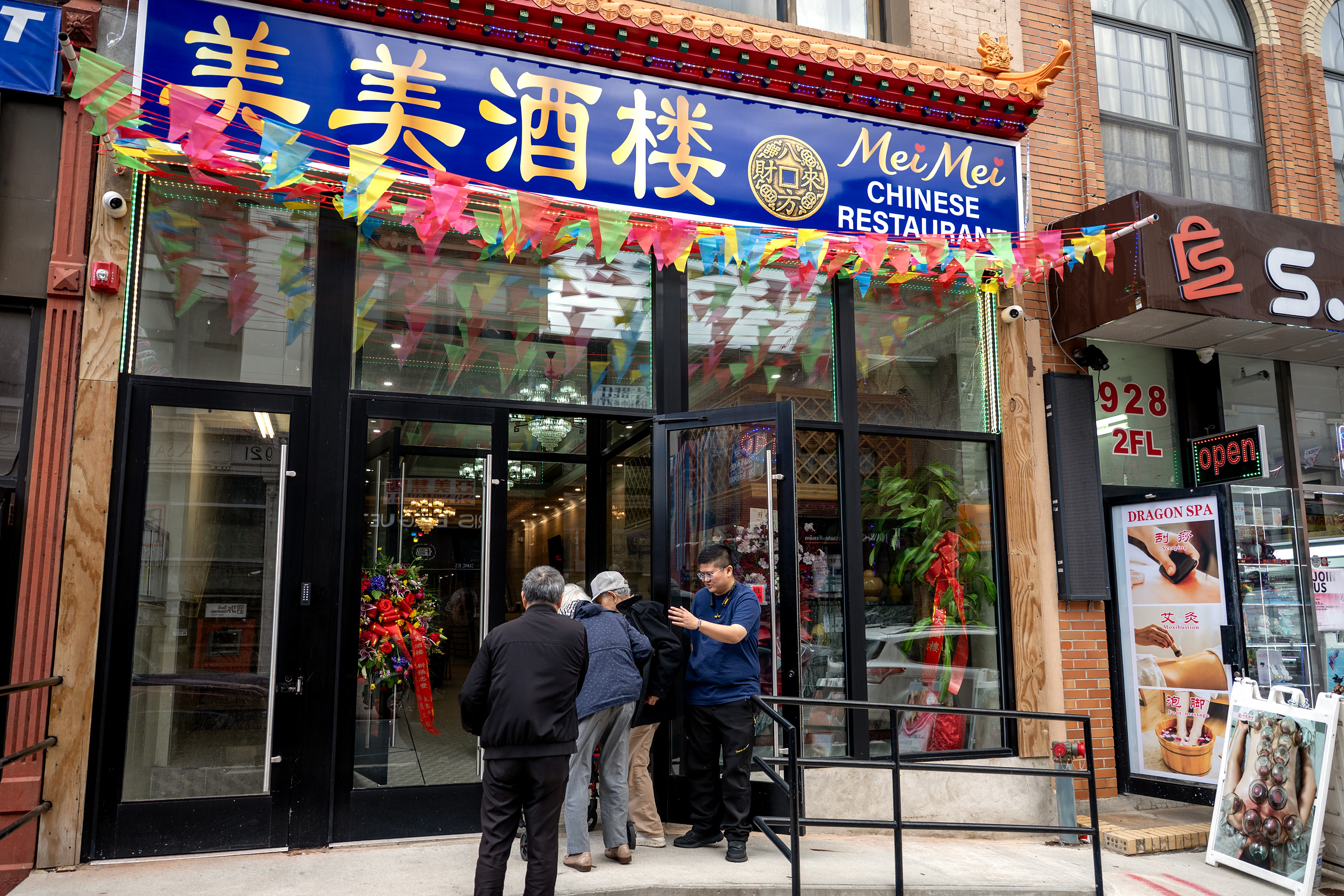
    Atom Ren (right) holds the door for diners entering Mei Mei, which is decked out for its opening.Tom Gralish / Staff Photographer

    “The culinary concepts and target demographics of these three restaurants are completely different,” Ren said. “We do not overlap or directly compete with the other two. Diners come for a specific taste and experience, not just a phonetic name.”

    Familiar territory

    Chinatown has been through this before — and the Rens have a connection to one of its more tangled restaurant-name disputes.

    Mei and Atom Ren were among the partners in the original Dim Sum Garden, which opened on 11th Street near Arch in 2008. After restaurateur Shizhou Da and her daughter, Sally Song, opened another Dim Sum Garden at 1020 Race St. in 2013, a legal fight erupted over the name. The 11th Street restaurant eventually became Tom’s Dim Sum. The Rens are no longer involved.

    The Tom’s name figured in another legal dispute in 2019, when competing restaurants called Tom’s Dim Sum Media and Tom’s Dim Sum Mania operated within feet of each other in Media.

    Other Philadelphia restaurant-name disputes have involved Middle Child and Garage/Garage Sale Vintage. At other times, similar names have coexisted without litigation, such as the myriad restaurants with “Fiore” in their names.

    For now, the owners of the two Mei Meis remain at odds, though the public disagreement could not be more civil.

    Shortly after Mei Mei’s grand opening, Tsao walked across the street and bought a $500 gift card from the Rens. “I understand their position, respect the challenges of opening a new business, and wish them all the best,” Tsao said.

  • Crowds celebrated the end of a war and what would become Veterans Day on this week in Philly history

    Crowds celebrated the end of a war and what would become Veterans Day on this week in Philly history

    There was victory in Philadelphia.

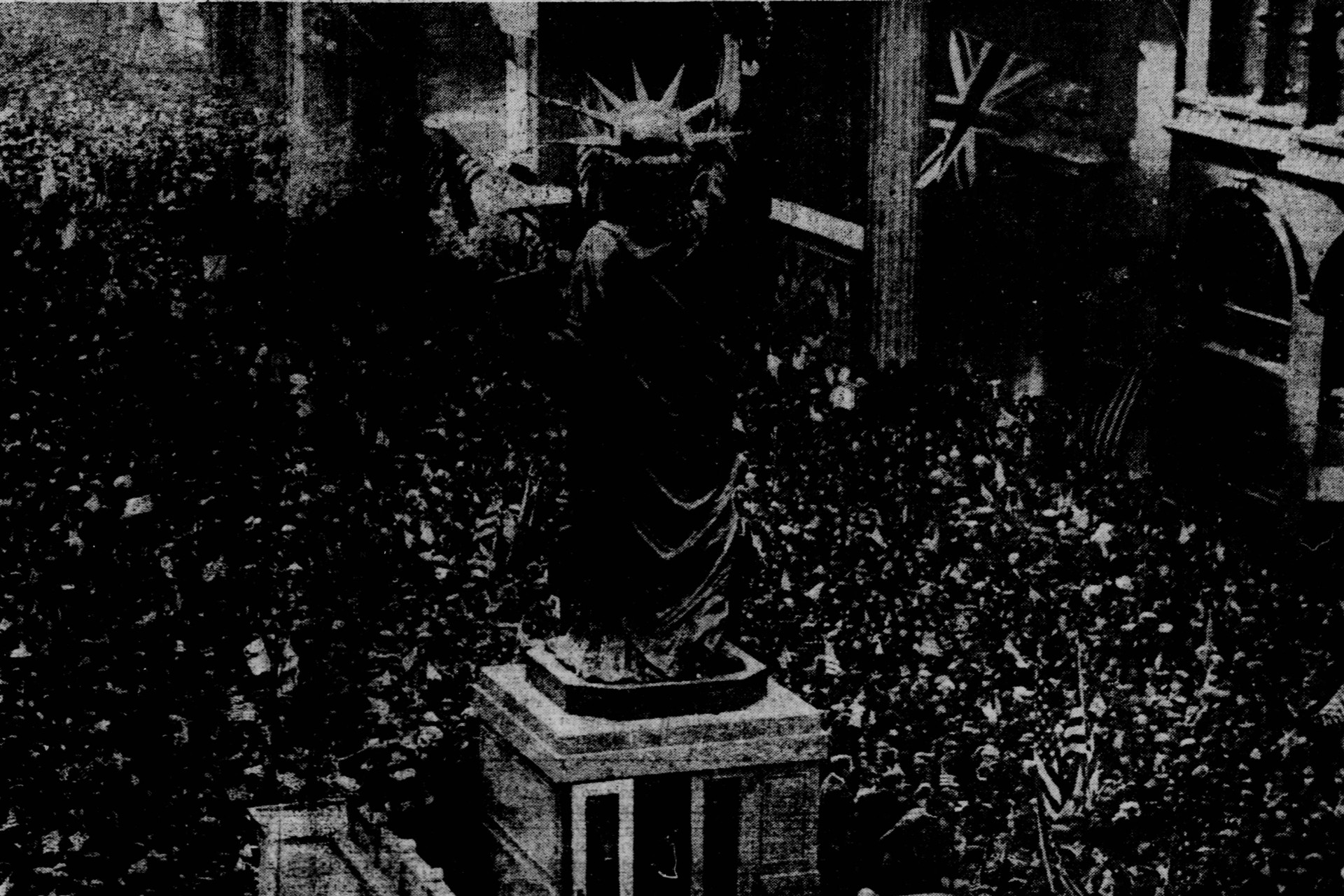
    Thousands made a beeline for Broad Street and South Penn Square to vent their cheers.

    They rallied around the city’s 29-foot replica of the Statue of Liberty in commemoration of the end of a worldwide conflict.

    The celebration surpassed any event in the city’s history up until that point, The Inquirer reported.

    Early-morning whistles, the paper wrote, carried the news of victory to sleepers.

    Business stopped while men, women, and children rejoiced with pomp and circumstance later seen for Super Bowl parades and papal visits.

    It was Nov. 11, 1918, the day the world’s mightiest military powers signed the armistice that ended World War I.

    From 3 a.m., when news of the deal hit the city, through midnight, the city “marched and sang and lifted up its souls and rejoiced,” The Inquirer reported.

    “A solid seething mass of humanity stacked shoulder to shoulder as far as you could see was jammed in the streets,” recalled attendee Morris G. Condon III, whose account was included in the 2016 Library Company of Philadelphia exhibition “Together We Win: The Philadelphia Homefront during the First World War.”

    “I can still hear my father swearing, pulling my mother through the crowds, and she, near tears, pulling me,” Condon said. “It seemed everyone in the city was jammed into the City Hall area in all directions.”

    People all over the country rejoiced in unison.

    Philadelphia’s monster celebration followed the devastating Liberty Loans Parade, a war-bond promotion that had brought 200,000 people into the city earlier that fall and helped spread the deadly influenza pandemic. The outbreak would go on to kill more than 20,000 Philadelphians.

    “Philadelphians came together publicly to show support for the war effort,” according to the Library Company. “From attending war bond rallies to participating in patriotic sing-a-longs to watching parades, Philadelphia residents honored those who were serving and encouraged the city to do whatever it could to help win the war.”

    And the celebration, which would become known as Armistice Day, would not end in 1918.

    On June 1, 1954, President Dwight D. Eisenhower signed legislation that made Nov. 11 a national holiday.

    Henceforth known as Veterans Day.

  • Workers have been striking for two months at a Montco plant that makes HVAC components. Here’s why.

    Workers have been striking for two months at a Montco plant that makes HVAC components. Here’s why.

    Workers employed at Lloyd Industries in Montgomeryville typically spend their days making components for HVAC systems, handling sheet metal, stainless steel, and fiberglass.

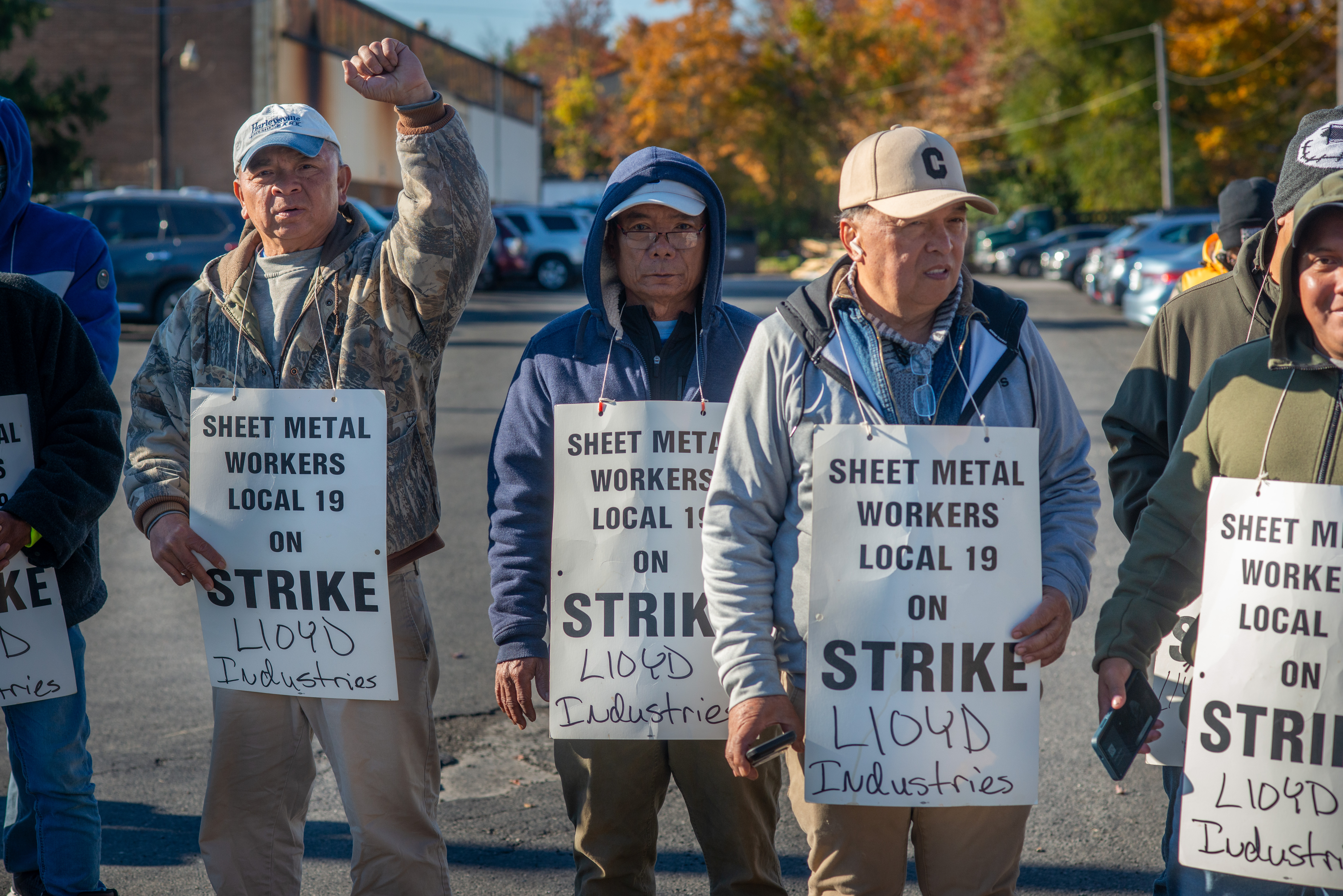
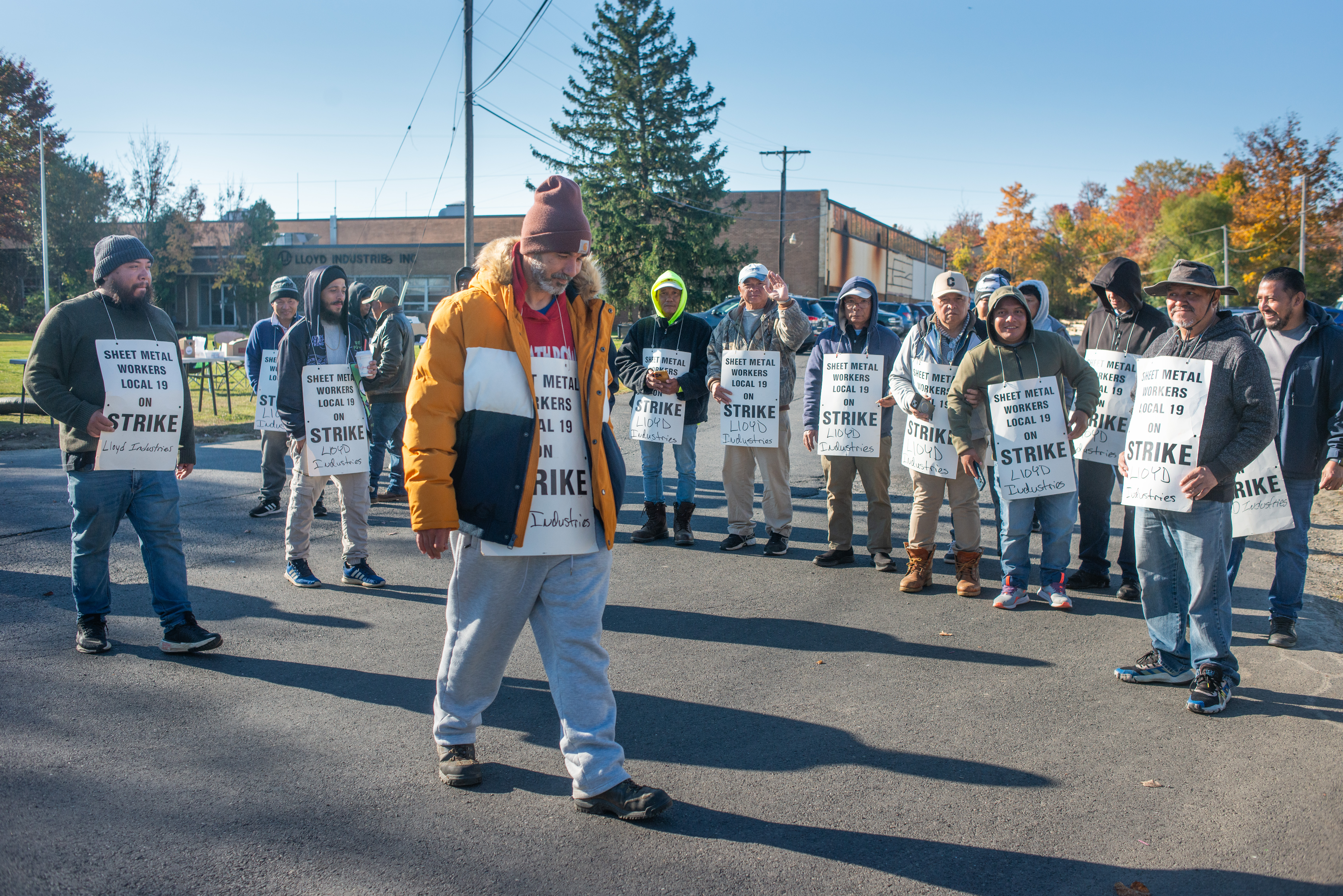
    But for the past two months, instead of building fire dampers that block smoke or fire from spreading, 22 of them have found themselves on a picket line. On a recent day in late October, workers stood outside the plant wearing posters indicating they’re on strike.

    Shop steward Ricky Boyer is among the 22, who have been showing up at 8 a.m. for the picket line, where the union is providing bagels, coffee, doughnuts, and lunch. He and his colleagues are seeking improvements to wages, healthcare, and working conditions after their most recent three-year union contract expired Sept. 1 and negotiations with the company broke down.

    Since the strike started, another 25 colleagues have opted to go back to work, lured by higher wages than they typically make, according to the union that represents them, Sheet Metal Workers Local 19. In total, the union represents 47 workers at the site.

    Boyer has opted to stay on strike because, he says, “I know you don’t cross the picket line.”

    “The reason we’re out there is for our benefit,” said Boyer, who has been with the company for roughly 16 years. “It makes no sense to cross the picket line.”

    Workers on strike are being financially supported by the union. Every week, workers “get more money from us than they’re getting inside [the company],” said Bryon Blum, business representative for Sheet Metal Workers Local 19.

    A representative for Lloyd Industries did not respond to a request for comment.

    Lloyd Industries has offered workers more money than they typically make to return to work and leave the strike, according to the union. William Thomas Cain / For The Inquirer

    Many workers have gone on strike in the Philadelphia area in recent years with short work stoppages. Peco workers went out for three days in July before reaching a deal with the company. Unionized hotel workers have gone on multiday strikes since they started bargaining for new contracts in 2025, and in 2024, Aramark workers went on strike for four days at all three South Philly stadiums.

    At Lloyd Industries, workers are on their 11th week of picketing.

    As the strike has dragged on, and despite the pay from the union, Blum says workers want to return to work.

    “They tell me every day they want to go back to work, but they realize the importance of standing out here and sticking up for their rights,” he said.

    What do workers want?

    Following three days of negotiations in August, Lloyd Industries owner, William “Billy” Lloyd, made a final proposal and walked away from bargaining, according to the union.

    Since then, Blum has been unsuccessful in getting the company back to the negotiating table. The union has filed several unfair labor practice charges against the company with the National Labor Relations Board, including for failing to bargain in good faith, said Blum.

    “We would be inside right now working and sitting down with a contract if the guys didn’t cross the line,” he said.

    Lloyd Industries offered a 50-cent increase to workers’ hourly wage in its one-year contract proposal, the union has said. Union workers there make on average $23.85 an hour, and many depend on overtime. William Thomas Cain / For The Inquirer

    Workers make on average $23.85 an hour, and many depend on overtime, he says. A worker in Montgomery County, where the company is located, needs to make $26.97 an hour to cover their basic needs, according to a calculator developed at the Massachusetts Institute of Technology. If that single adult has a child to support, that hourly rate rises to $50.74 to be considered a living wage.

    In their most recent contract, workers saw hourly wage increases of $1.50 in the first year and $1.25 in the following two years. This year, amid bargaining, the company offered workers a one-year contract with a 50-cent per hour increase, says Blum.

    Shop steward Boyer says workers aren’t “asking for a lot,” but the 50-cent offer just “wasn’t even talkable,” pointing to high gas prices and the rising cost of groceries.

    “We just want a fair contract,” Boyer said. “We want to be able to work, take care [of, and] provide for our families.”

    Employees have medical insurance paid in part through their employer but want a better plan. Some forgo the insurance because they can’t afford it, Blum said.

    They also want better working conditions, said Blum, who adds that the area they work in is “filthy” and that “nobody cleans in there.” Fiberglass, used for insulation, is floating around, he said.

    “The workers want the machines to be cleaner, the air to be cleaner. They want management to stop turning off the exhaust fans,” he said.

    Lloyd Industries was cited or inspected several times between 2000 and 2014 by the Occupational Safety and Health Administration (OSHA), The Inquirer has reported. The company was ordered to pay $1,047,399 in 2019, after firing two workers in 2014 and 2015 who cooperated with OSHA investigators. The company also faced allegations that it was racially discriminating against a worker who was laid off in 2015, and ultimately won his case.

    Local 19 has represented the workers for over 30 years, Blum said.

    “They’re just working men that want to see a better way of life,” he said. “The union’s here to give them that. We’ve been trying to give them that for years now.”

  • IBX payment cuts are creating pain for small physical therapy practices in Southeastern Pa.

    IBX payment cuts are creating pain for small physical therapy practices in Southeastern Pa.

    Physical therapists Katherine Dixon and Kristen Wilson have spent five years seeking higher rates from Independence Blue Cross for their four clinics in Southeastern Pennsylvania.

    They’ve gotten nowhere, they say. They believe their business, Action Potential LLC, is too small to sway the Philadelphia region’s largest insurer. Independence accounts for 20% of Action Potential’s business.

    Last December brought more frustration. Independence changed how it pays for sessions, effectively cutting the average reimbursement for 40 minutes of physical therapy by 17%, co-owner Kristen Wilson said. That’s significantly less than Action Potential’s rate through the government-funded Medicare program.

    “We’re taking a loss every single Independence Blue Cross patient,” she said. That leaves Action Potential weighing whether to leave the Independence network. (Wilson declined to share actual rates for fear of violating Action Potential’s agreement with the insurer.)

    Action Potential and other small physical therapy practices say they are suffering financially because Independence and other insurers don’t negotiate rates with the thousands of independent physicians and other clinicians in their networks. Instead, they use standard fee schedules to streamline benefits administration.

    The approach leaves small practices with little clout, and is among the forces leading many to join bigger companies. Nationally, the number of private-equity deals in physical therapy surged to 175 in 2023 from four in 2010, according to a study published last year.

    “You wonder why consolidation is happening,” Wilson said. “It’s almost impossible to run a business.”

    Local independent physical therapists are pushing for better reimbursement as Independence also faces demands from major health systems for substantially higher rates and pressure from employers to slow healthcare spending growth.

    Independence says its follows industry standards and pays physical therapy providers competitive rates that don’t vary based on the size of the organization, unless additional services are included. Providers can contact the company through a special portal or by phone if they’d like special consideration, the company says.

    Insurance contracts for small providers

    Contracts with hospital systems command attention from insurers because they have emergency departments and provide care not available elsewhere. They also employ hundreds or thousands of physicians needed for insurers to have adequate networks for the people they cover.

    Kristen Wilson (left) and Katherine Dixon are owners of Action Potential in Glen Mills.Steven M. Falk / For The Inquirer

    By contrast, when a small physical therapy center or physician office opens and wants to accept patients from Blue Cross or another insurers, it first must gain acceptance into the insurer’s network. That’s not guaranteed. Sometimes insurers say they already have enough providers.

    If the practice is approved as an in-network provider and its clinicians credentialed, it is given a “boilerplate contract” and a schedule of fees. That’s always been a take-it-or-leave-it proposition, according to three owners or managers of physical therapy companies who talked with The Inquirer in recent weeks.

    Independence says it attempts to pay competitive rates. Those reimbursement rates go up or down along with Medicare rates and as demand changes, said Richard Snyder, Independence’s chief operating officer.

    Fees for doctors, physical therapists, and other clinicians don’t vary for the same service based on the size of the company they work for, Snyder said. They might be different if “you’re giving some other services along with it, or there’s a bundling of services,” he said.

    Growing communication gap

    When Kinetic Physical Therapy started two decades ago, Kinetic had a representative at Independence to contact about billing issues, said chief operating officer Cyndi Hill James. “We had a name, and I could call that person any time and ask questions,” she said.

    The practice has grown to 10 locations in Philadelphia’s western suburbs and employs 23 physical therapists.

    Over the years, the relationship between Independence and Kinetic dwindled. It now has no specific contact to call or email. “We have no one to talk to, to say, let us explain why we should be able to renegotiate,” Hill James said.

    Snyder said Independence is willing to talk to providers about issues, acknowledging delays credentialing providers. By next month, Independence should be back to an efficient turnaround of 30 days, he said.

    In September, Action Potential led a group bid for Independence’s attention. Wilson organized six local physical therapy practices, including Kinetic, to send a joint letter to Independence asking for a meeting within 30 days to discuss their problems.

    Wilson received a written response dated Nov. 3 that reinforced the company’s policy decisions, though the insurer did agree to have a virtual meeting with the practices on Nov. 18, she said. The CEO of the American Physical Therapy Association, Justin Moore, is scheduled to participate, Wilson said.

    The financial impact of IBX’s policy change

    Independence’s change in the way it pays for physical therapy was among a series of policy changes in the past year affecting many healthcare organizations, as the insurer seeks to reduce costs for its employer customers.

    For hospitals, it no longer pays for readmissions within 30 days of discharge under certain conditions and is pushing to move surgeries that don’t require an overnight hospital stay into lower-cost surgery centers.

    Jefferson Health has sued Independence over those and other changes.

    Under the policy change dealing a financial blow to physical therapy, Independence only pays full price for one type of treatment during a physical therapy session. Sessions typically include three or four activities that last 10 to 15 minutes each. Examples are therapeutic exercise, neuromuscular reeducation, and gait training.

    As of last Dec. 1, Independence only pays the full price for one of the activities, and 75% for the others. For example, if a therapy center bills three activities at $30 each, it would be paid $75. That’s $15, or 17%, less than the full price of $90.

    Snyder said Independence is a relatively late adopter among its competitors of what is called multiple procedure payment reduction for physical therapy. Some costs for each part of a therapy session are shared and should not be reimbursed more than once, Snyder said.

    The change cost Elite Therapy Solutions $10 or $12 for every Independence session, said Patrick Kinzeler, an owner and director of administration at Elite, which has 10 Philadelphia-area locations and more in South Carolina and Louisiana.

    “Our reimbursement keeps getting squeezed,” he said.

    Meanwhile, rent, supplies, electricity costs increase 8% to 10% a year. Plus, Elite and other practices have seen even steeper increases in healthcare costs for their own employees.

    Elite works hard to be efficient, “but we’re not making any headway,” Kinzeler said.