Tag: topic-link-auto

  • Man charged with setting Spokane’s largest wildfire was contacted about 2 other blazes last year

    Man charged with setting Spokane’s largest wildfire was contacted about 2 other blazes last year

    SPOKANE, Wash. — A man charged with intentionally setting a wildfire that’s destroyed hundreds of buildings in and around Washington state’s second-largest city was contacted by law enforcement about two fires last year, though he wasn’t charged in either, court documents show.

    Aaron F. Farinacci, of Spokane, was arrested Monday and booked on suspicion of first-degree arson in connection with the Old Trails Fire, the biggest of three blazes that have destroyed at least 700 buildings and forced tens of thousands of people from their homes. According to court records, he denied setting the fire. His bond was set at $1 million and he was due in court later Tuesday.

    Authorities haven’t said what caused the other two fires burning around Spokane. No deaths have been reported.

    Farinacci, 37, served about a decade in prison after killing his father in Arizona in 2010. Last year, authorities questioned him about two fire-related cases in Spokane, according to a probable cause statement filed in Spokane County Superior Court.

    One involved several “bus-sized” fires in an area near Farinacci’s apartment in July 2025, police records in that case say. The other involved a wildfire in a state park that prompted evacuation notices the following month. In neither case was he arrested.

    A tip leads to an arrest

    On Saturday, a 64-year-old man who lives in a rural neighborhood northwest of Spokane was driving with his grandson when he saw a man standing along some railroad tracks and looking toward nearby trees, sheriff’s detective Michael Drapeau wrote in the probable cause statement. About 10 minutes later, as they were returning home, the man was still there, this time bending over as he faced the tree line. He stood up and acted “nervous” as the vehicle passed, the man told police.

    Soon after they returned home, the man’s daughter noticed smoke rising from the area and called 911. The man drove back there and gave a police officer a description of the man he had seen — bald, white, wearing a green shirt, and carrying a backpack.

    A responding sheriff’s deputy saw a man matching that description walking more than a mile away and detained him. Another deputy also responded, and the man who reported the tip showed up to identify the person in custody — Farinacci — as the one he had seen in the area of the fire, the document states.

    Farinacci had a backpack and a fanny pack, in which he had a pack of cigarettes, waterproof matches, and a butane lighter, it says. He told the deputies he didn’t start the fire and he denied having been in the area where it started. He was wearing a green T-shirt that read, “Who needs luck I have charm,” the detective wrote.

    The deputies were unaware of Farinacci’s prior fire-related contacts and the cause of the Old Trails Fire hadn’t been determined yet, so they released him to continue working on evacuation efforts, Drapeau wrote.

    But the following day, a wildland fire investigator for the state determined that the fire had started in the same area where Farinacci had been seen, the document says. The investigator ruled out other possible causes, including sparks from electric wires or passing trains, and police arrested Farinacci on Monday.

    “As it happens in so many critical cases, it was citizens who were paying attention to their surroundings, being aware, and willing to step up and say something that led to the relatively quick apprehension of Mr. Farinacci,” Sheriff John Nowels told reporters Monday.

    Farinacci remained jailed ahead of Tuesday’s hearing. The Spokane County Public Defender’s office will represent him during the appearance, and a lawyer will be assigned to him afterward if it’s determined he needs one, said its director, Colin Charbonneau. In an effort to get comment from Farinacci’s family, the Associated Press sent a message to a possible social media account for a brother.

    Police contacted him about earlier fires

    A detective investigating the Old Trails Fire ran a criminal history check on Farinacci and found that he had been contacted by law enforcement twice before during fire investigations.

    Spokane police responded to reports of several fires on July 8, 2025, near Farinacci’s apartment. The area near the Spokane River involved several “bus-sized” fires and prompted a significant emergency response, according to a police record.

    The Washington State Patrol made contact with Farinacci the following month while pursuing a suspect in a wildfire at Riverside State Park. They found him on a park bench, “seemingly out of breath from possibly running.” They took photos of him. He was wearing a green T-shirt just like the one he was seen wearing on Saturday, the document says.

    Convicted of manslaughter

    Farinacci, then age 21, shot and killed his father in Mesa, Ariz., during a 2010 argument about washing dishes, police said. Farinacci also shot himself but survived.

    He was charged with murder but pleaded guilty in 2012 to manslaughter and aggravated assault, records show.

    A judge in 2011 found that Farinacci was mentally fit to assist in his own defense, though defense lawyer Jose Colon continued to raise questions about his mental health and noted that he had been hospitalized multiple times for psychiatric treatment, court records show.

    In a letter to the judge, Beth Farinacci, who had married Farinacci’s father, said second-degree murder, not manslaughter, would have been a more appropriate way to resolve the case. But she went along with the plea deal because she believed a trial wouldn’t be beneficial to her family.

    “Manslaughter is for when someone accidentally kills another person. It is not for someone who intentionally points a loaded gun at their father and shots him in his face and back,” Beth Farinacci wrote.

    Farinacci was released from probation in Arizona in early 2024. A probation officer said Farinacci maintained a stable residence with his girlfriend and her family in the previous year, but also noted he hadn’t completed a mental health evaluation or domestic violence treatment.

    Residents return to destroyed homes

    The fires were among dozens across the Western U.S. that have stretched the ability of federal, state, and local agencies to fight them. More than 1,000 firefighters, many from outside of Washington state, were in the Spokane area Tuesday, and that number was expected to rise.

    Winds died down Monday and Tuesday, aiding the efforts of firefighters, but the weather was expected to get hotter by Wednesday.

    In one neighborhood, blackened vehicles, a boat twisted by the heat and melted plastic recycling bins remained. Across the street, lawns were still green and houses were spared, as residents continued to run hoses or sprinklers to water their properties.

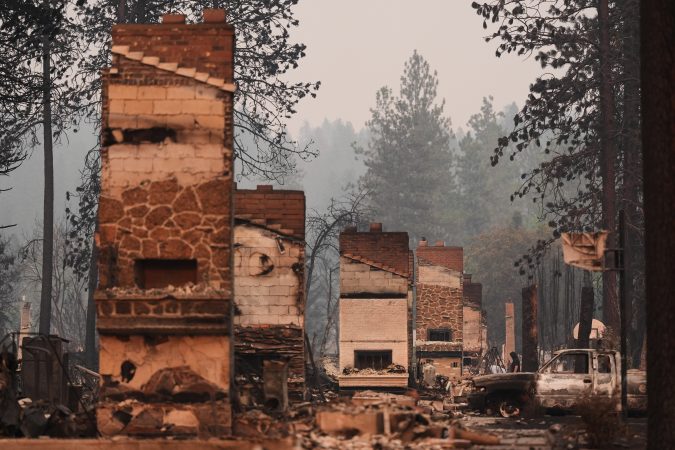
    Some residents who had to flee blazes over the weekend returned to find homes that had been burned to the ground. In some cases, only chimneys were left standing.

    “There’s nothing to save,” Miriam Sim, 76, said as she and her husband, Daniel Sim, surveyed the ruins of the home where they had lived since 2005.
  • School backpack overload: Heavy bags can strain kids’ bodies

    School backpack overload: Heavy bags can strain kids’ bodies

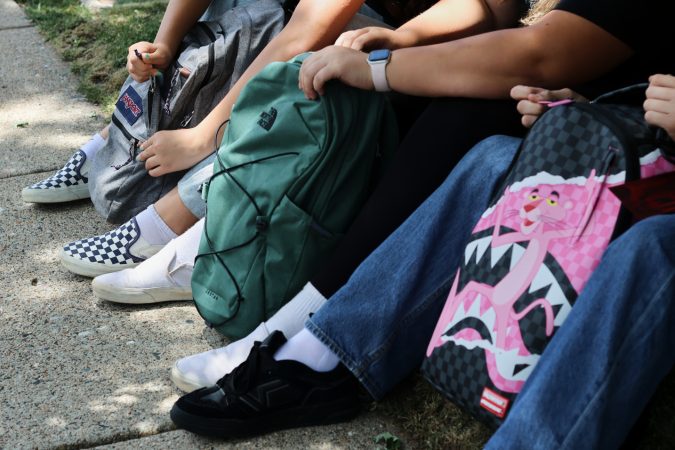
    Backpacks can be fashionable and functional, but they can also be too heavy — weighed down by digital devices, musical instruments, sports equipment and more. Some kids carry home a laptop or tablet and textbooks, too.

    It’s good to be prepared, but kids who walk to school or participate in extracurricular activities may be lugging more than their bodies can handle. Lockers and classroom storage aren’t available everywhere — and a child carrying too much weight might not be ready to learn.

    As families begin back-to-school shopping, here’s how to know if your child’s backpack is too heavy, and how to lighten their load.

    How heavy is too heavy?

    The modern school backpack has evolved, but it hasn’t necessarily gotten lighter. Whether students have textbooks, digital devices or both, they often are accompanied by notebooks, water bottles, lunch containers, workout clothes and more. Individually, those items may not seem heavy, but together they can add unnecessary strain to children’s bodies.

    According to the American Academy of Pediatrics, signs a backpack may be too heavy include a child leaning forward to support its weight or having difficulty walking. Straps should not dig into shoulders.

    Don’t wait for a child to express discomfort or pain to lighten the load, experts say.

    Dr. Sadika Kendi, a physician who chairs the academy’s injury-prevention efforts, says back injuries are uncommon but possible, particularly if a child falls while carrying a heavy backpack.

    “It’s worse if, for example, they trip and fall and they have a huge, heavy backpack on their back. Then that’s just more weight that could increase the severity of an injury,” she said.

    Although 10% to 15% of a child’s body weight is often cited as a backpack guideline, there isn’t enough evidence to establish a one-size-fits-all approach, Kendi said. Because children vary in size, strength, physical development and daily routines, caregivers should consider their child’s individual needs and, in general, keep backpacks as light as possible.

    Teachers say leave this stuff at home

    After families receive back-to-school checklists for classroom materials, they should take an audit of what a child really must carry every day.

    Samantha Ness, a history teacher in Phoenix, said parents should focus on making sure children have basic supplies rather than getting caught up in trendy, decorative or expensive items. Her students have access to classroom textbooks but are still expected to carry a laptop and charger each day. As technology becomes more central to schoolwork, some students have stopped bringing paper, she said. They rely instead on their devices, which can also become distractions.

    “When considering the things going into their backpacks, how is it going to help them be successful in the classroom?” said Ness, who has been teaching for about 10 years.

    In Fairfax County, Virginia, the school district is bringing back math textbooks after a backlash against technology. That was a win for the group Fairfax County Parents for Intentional Technology, but it also means hard decisions about weight in backpacks.

    Parents should think carefully about whether a child really needs to carry both books and a laptop every day, said mom Alix Fetch, a spokesperson for the parents group. Some elementary schools don’t require students to take computers home, while others allow parents to opt out, she said. Block scheduling can also mean older students don’t need every textbook every day.

    Fetch said her 7-year-old typically carries lunch, a water bottle and occasionally a folder with homework or notes from the teacher. Even that can feel burdensome, she said, particularly when students move between classrooms for activities such as art or music. And the inside of the bag can still be messy.

    “Kids are still kids. There’s food in their backpack and water, and they’re scrunching up papers,” Fetch said.

    As students get older, Ness said, backpacks can become more personal storage than school storage, carrying items such as makeup, nail polish and hair dryers.

    “They’re using their backpacks more as purses and like storage than they are actually using them for school,” she said.

    How to carry the load safely

    Experts recommend choosing a backpack that fits the child and has two broad, padded shoulder straps, a padded back, compartments to distribute weight and a waist or chest strap to redistribute the load. The American Academy of Pediatrics also recommends teaching children to pick up and carry backpacks safely, including bending at the knees rather than the waist when lifting heavier bags to avoid strain.

    Backpacks with wheels can be helpful, especially for children with injuries, but experts say they may be problematic in schools with stairs or crowded walkways, where they can pose a tripping hazard.

    Children should remove their backpacks before riding in a moving vehicle, Kendi said, because wearing one can interfere with how a seat belt works during a crash or sudden stop. Instead, place the backpack beside the child, even if leaving it on seems more convenient during drop-off.

    “Don’t wear it in a car or any form of transportation while that car is moving,” Kendi said. “It’s just incredibly dangerous.”

    Regularly cleaning out backpacks can also help reduce unnecessary weight and keep track of notes, permission slips and assignments. Some teachers recommend doing it weekly to catch missing work, spills from leaky water bottles and accumulating crumbs.

  • Trump’s National Guard deployment in D.C. set to cost additional $1.4 billion

    Trump’s National Guard deployment in D.C. set to cost additional $1.4 billion

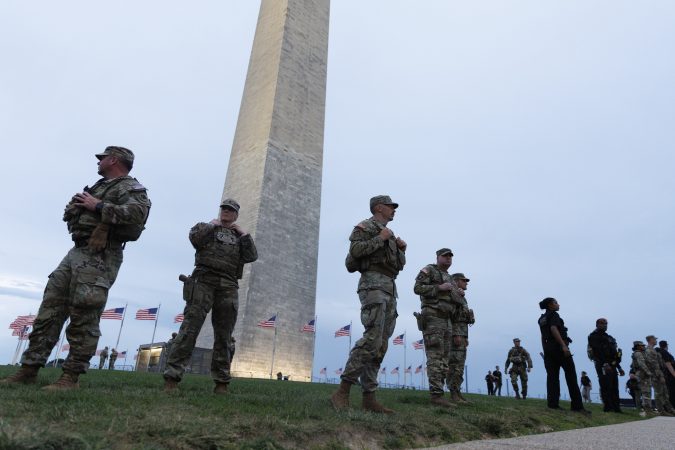
    The Pentagon’s deployment of National Guard troops to Washington, D.C., is set to cost an additional $1.4 billion through the end of the Trump administration, according to information provided to Congress and reviewed by The Washington Post.

    The estimate, which encompasses October 2026 through January 2029, adds to the hundreds of millions of dollars spent on the mission to date. While the administration has not disclosed the full cost of the mission so far, the new figure represents the most comprehensive accounting yet of the president’s unprecedented use of the military to patrol the nation’s capital — an operation fiercely criticized by many Democrats and civil liberty advocates.

    The information was provided to Sen. Elizabeth Warren (D-Massachusetts), a member of the Senate Armed Services Committee, by Jules Hurst III, Trump’s nominee to become the Pentagon’s comptroller, as part of his confirmation process. Hurst is set to be confirmed in a bloc of Trump administration nominees as soon as this week.

    The administration deployed National Guard personnel to Washington in August 2025, after Edward Coristine, a former staffer in Elon Musk’s U.S. DOGE Service initiative to slash the federal government, was assaulted in an attempted carjacking. The National Guard will maintain a presence in D.C. until January 2029 or “until the president says the mission is over,” Brig. Gen. Leland Blanchard II, the interim commanding general of the D.C. National Guard, told reporters in a news briefing Monday.

    The cost estimate provided to Warren assumes a deployment of about 2,500 National Guard personnel. There are approximately 4,600 service members in the city now, Blanchard said, part of a temporary surge coinciding with summer events to commemorate the 250th anniversary of the signing of the Declaration of Independence.

    Democrats have called the deployment a wasteful use of military resources and an infringement on Americans’ civil liberties, and they have pressed Defense Secretary Pete Hegseth to justify the mission as the Pentagon faces urgent budget shortfalls because of the Iran war and other military operations.

    “The National Guard are not pawns and taxpayer dollars are not a piggy bank for Trump’s political stunts,” Warren said in a statement.

    In testimony to the Senate Appropriations Committee last month, Hegseth acknowledged the Defense Department is facing financial pressure but repeatedly blamed the situation on the Biden administration’s management of the military.

    The Pentagon did not immediately respond to a request for comment.

    Since returning to office, Trump has deployed active-duty and National Guard units to American cities on controversial missions to stop crime or protect federal immigration agents. Academics and researchers who specialize in politicization and the military, along with local officials in some of the targeted communities, have argued that the operations violate laws barring the military from engaging in domestic law enforcement.

    Some state and local governments, including Washington, have challenged the deployments in court.

    The Congressional Budget Office estimated in January that the administration’s National Guard deployment in Washington cost $223 million through the end of 2025. It said deployments in Los Angeles, Memphis, Chicago and Portland, Oregon, together cost an additional $273 million in 2025.

    CBO has estimated that each additional month of deployment in Washington would cost about $55 million.

    Trump’s record $1.5 trillion defense budget request for fiscal 2027 includes $2.3 billion in funding for domestic use of the military, including $605 million for the National Guard mission in Washington.

    In a separate request to Congress for $67 billion in additional funding to help cover the costs of the Iran war, the Trump administration also requested $800 million for the National Guard. Sen. Patty Murray (Washington), the Appropriations Committee’s top Democrat, said during last month’s hearing with Hegseth that those funds would go toward extending the D.C. deployment.

    Blanchard, the National Guard general, defended the mission, noting that last month the Trump administration signed a $292 million contract to move National Guard members into local apartments from hotels in and around Washington. The move, Blanchard said, will save $90 million on lodging and transportation costs over the course of the contract.

    He said, too, that service members have responded to about 800 medical emergencies — performing CPR and applying tourniquets on gunshot victims, and administering 325 doses of Narcan, a drug used to treat overdoses.

    While Trump officials have repeatedly asserted the National Guard was necessary to help address a crime emergency in the city, D.C. police data shows violent crimes this year have remained about the same from this time in 2025. Property crimes, including burglary from cars and motor vehicle theft, have decreased by about a quarter. When the National Guard was deployed last year, crime rates were near a six-year low, according to federal data.

    National Guard personnel in Washington are supposed to yield to local police for law enforcement activities, such as arrests, said Michael Perloff, the senior staff attorney for the American Civil Liberties Union’s D.C. chapter. But their orders leave open gray areas, including how personnel should respond in an emergency or when under threat, he said.

    “National Guard members aren’t trained to handle those situations,” said Perloff, whose organization is challenging the mission’s legality in court.

    The service members deployed in D.C. have been tasked with a variety of missions, such as guarding the Reflecting Pool in front of the Lincoln Memorial and cleaning up garbage on city streets.

    In November, two National Guard personnel were shot while patrolling the city blocks away from the White House. One died from her injuries.

    Rahmanullah Lakanwal, an Afghan national charged in the shooting, pleaded not guilty in June. He is facing a possible death sentence if convicted.

  • Trump claims active ceasefire talks, but Iran denies direct negotiations

    Trump claims active ceasefire talks, but Iran denies direct negotiations

    The status of the Iran war remained in limbo Monday, as President Donald Trump insisted that talks between Tehran and Washington were “going on right now” while Iran’s Foreign Ministry spokesman said, “We are not currently holding negotiations with the United States.”

    Trump, who in a social media post earlier in the day called Iranian leaders “unbelievably duplicitous,” told reporters in the Oval Office that “we’re straight about” talks between the two countries, though “they deny. But they’re not denying it now. They just put out a statement, not denying it.”

    Asked where that statement could be found, a White House spokesperson referred The Washington Post back to the president’s remarks.

    Trump said Iran, along with other regional states, had “begged” for talks, leading him to call off what he had described as an imminent U.S. attack that would have been “harder than any attack … since World War II.”

    “We were going to hit them very hard yesterday, very, very hard,” Trump said. But “I want to give them every last chance before decapitation. It’s very tough to do what we have planned, still planned,” he said. “I’m very proud of the fact that I will give people a chance.”

    It was far from the first time since the war began on Feb. 28 that the two sides have offered differing versions of reality on damage done by their dueling airstrikes, what they have agreed to in on-again-off-again informal talks, or even whether those talks were happening.

    The conflict, which officials originally said would last only a few weeks but is now entering in its sixth month, has dragged down Trump’s poll numbers. Growing numbers of Republican lawmakers and voters have questioned both the rationale for the war and Trump’s strategy.

    Although Trump went into the war saying his goal was to destroy Tehran’s nuclear program — an objective he previously said was achieved after 12 days of U.S. and Israeli bombing last summer — Iran’s closure of the Strait of Hormuz within days after the conflict began quickly became the focus of administration attention. The narrow waterway is a chokepoint, bordered by Iran and Oman in the Persian Gulf, through which at least 20 percent of the world’s energy supplies transit.

    Iran refused to let ships pass without permission, said it was going to impose tolls, and began mining the channel and shooting at commercial vessels. In April, the U.S. imposed a naval blockade barring all ships from entering or leaving Iranian ports. Iran continued to menace international shipping while Washington responded by bombing Iranian defensive sites around the waterway and some infrastructure farther inland, leading Tehran to fire missiles and drones at its Persian Gulf neighbors that host U.S. military facilities.

    As the price of gasoline surged at U.S. pumps, the two sides agreed to direct talks in mid-April in Islamabad, with the U.S. delegation headed by Vice President JD Vance. Unable to reach agreement there, after subsequent lower-level negotiations they signed a 14-point memorandum of understanding in mid-June that included a pullback of the U.S. blockade, an easing of sanctions against Iran, and plans for Iran and Oman to jointly figure out a way to manage the strait, while Washington and Tehran moved to nuclear negotiations.

    The ceasefire collapsed within weeks, largely over Iran’s insistence on continuing its control over the strait. The U.S. reimposed its blockade and sanctions, as both sides resumed sporadic military attacks.

    In recent days, regional Arab powers — including Saudi Arabia, the United Arab Emirates and Qatar — have been in touch with Trump as they try to facilitate an end to the conflict, which is damaging their economies. Iran has also been reaching out to many of those same leaders.

    U.S. intelligence agencies have assessed that Iran is unlikely to change its own negotiating stance or be defeated in the near term.

    According to Tehran, there have been no direct negotiations with the U.S. since April, although both sides concede that messages have been passed through regional mediators.

    Last week, Oman sent Tehran a proposal for reopening the Strait of Hormuz that would divide maritime traffic 50-50 between routes along their opposite coastlines. Muscat also suggested a system of “voluntary” contributions from nonprofits, interested states and companies to pay for navigational aid, maintenance and environmental safeguards for the strait.

    Similar to a process used by Singapore, Malaysia and Indonesia, which border the Strait of Malacca, an international trade chokepoint between the Pacific and Indian oceans, the proposed system could be a face-saving way for Iran to move away from the tolls and controls that it has demanded and that Trump and other world leaders have said can never be allowed.

    In a press briefing Monday in Tehran, Foreign Ministry spokesman Esmaeil Baqaei said that Iran was negotiating only with Oman over ensuring the safe passage of commercial shipping through the strait and that there were no talks with the United States.

    “The strait was not closed because of disagreements between Iran and Oman,” Baqaei said. “It has faced disruption since last March due to the military aggression of the United States and the Zionist regime” in Israel.

    In his Truth Social post Monday morning, Trump was dismissive of the Iran-Oman talks. “They ask for a meeting, some would say ‘beg,’ talks begin, with more scheduled in the immediate future,” he said of Iran, “and they say, openly and proudly, that they’re not having any discussions, that nothing is being talked about, and they’re only dealing with ‘Oman.’”

    “They then go on to give their usual blather in saying, the Strait of Hormuz will be operated powerfully by them,” Trump said. But the United States has erected a “wall of steel” with its naval blockade, and “nothing gets through to Iran, unless we want it to, and nothing will get through, unless a Deal, or Total Surrender, is accomplished.”

    Isaac Arnsdorf contributed to this report.

  • House of the week: A condo in Washington Square West for $339,900

    House of the week: A condo in Washington Square West for $339,900

    Zachery McKinnon grew up in Michigan but moved to various places, always fostering a passion for art and home renovation.

    Now, after over a decade in the East, he is selling the Washington Square West condo he bought last year. He is drawn back home for a long stay to help his parents.

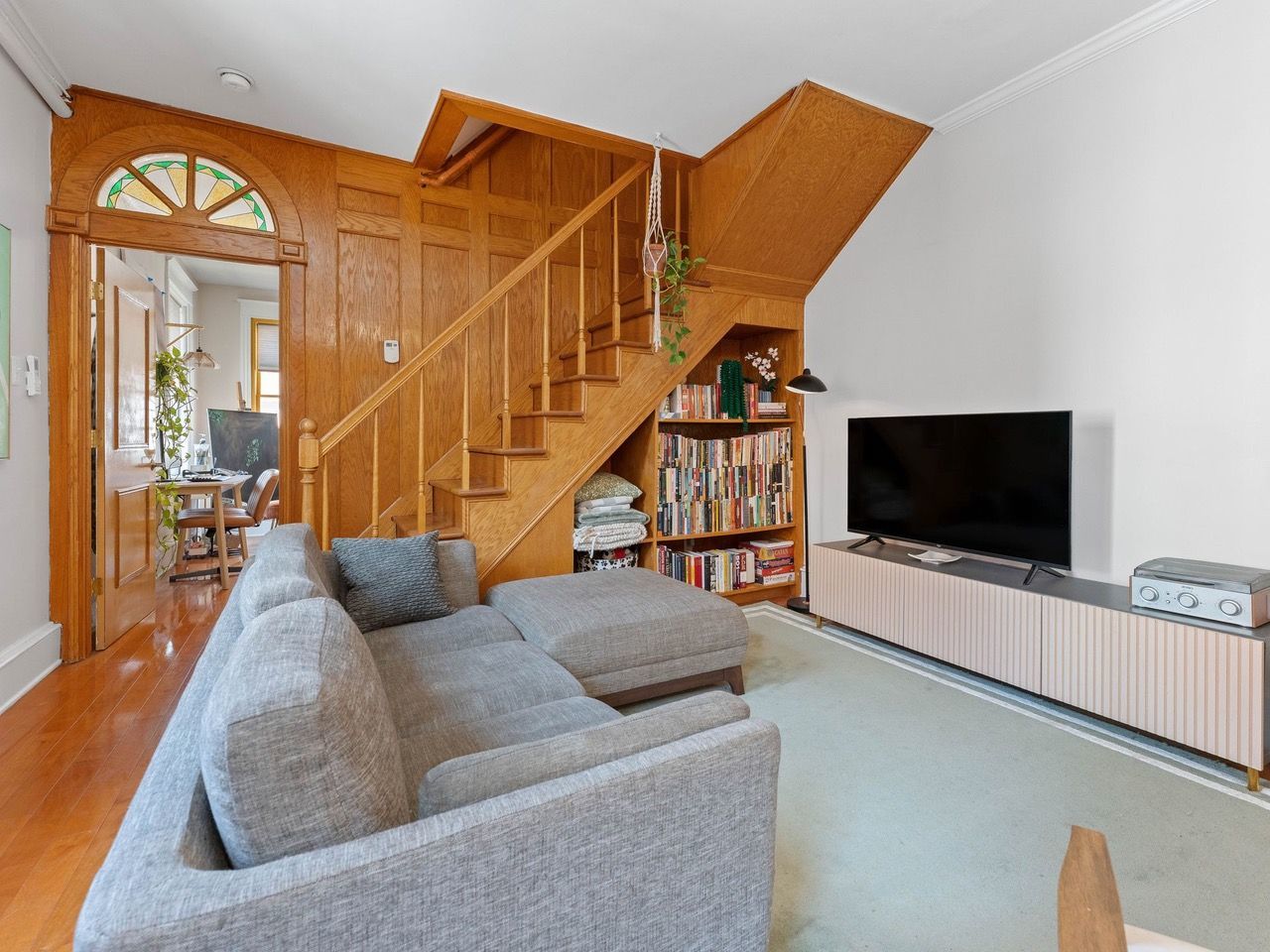
    Living room with stairway to rooftopCal Media

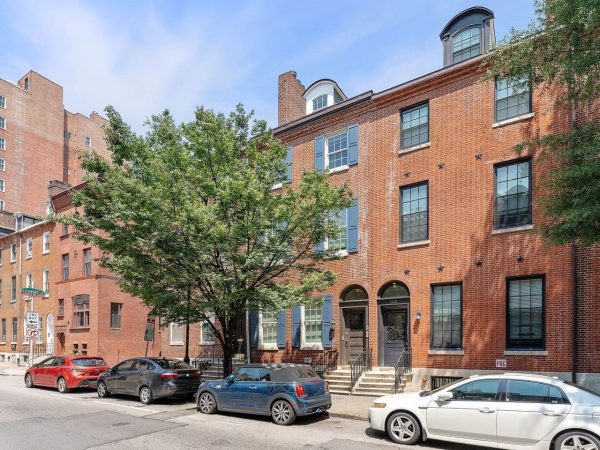
    His one-bedroom, one-bathroom condo spans 603 square feet. “The rooftop was really why I bought the place,” said McKinnon, who works in data analytics for an education nonprofit.

    The condo’s proximity to City Hall, Thomas Jefferson University Hospital, the Kimmel Center for the Performing Arts, Old City, South Street, Chinatown, and SEPTA Regional Rail were convenient for McKinnon, who doesn’t own a car.

    RooftopCal Media

    The six-unit building, the Aldrich, was built in the 1820s and is on the Philadelphia Register of Historic Places. It underwent a major renovation in 2021, including new floors.

    McKinnon did some work on the condo’s kitchen and added mosaics throughout the unit. He is an admirer of mosaic artist Isaiah Zagar.

    Mosaic by Zachery McKinnonCal Media/Aaron Cantu

    The unit has tall windows, high ceilings, an in-unit washer and dryer, and dedicated basement storage.

    There is year-round mini-split AC and gas heat.

    BedroomCal Media

    The condo building is pet-friendly.

    The unit is listed by James A. Olivieri of Penn Jersey Realty for $339,900.

    Editor’s note: This story has been updated to reflect a change in the listing price.

  • Does the American masculinity crisis have roots in Valley Forge?

    Does the American masculinity crisis have roots in Valley Forge?

    In the winter of 1777-78, after the Second Continental Congress hightailed it from Philadelphia following the British army’s attack on the city, the Revolutionary Army of the freshly minted United States hunkered down in Valley Forge.

    Soldiers dropped dead from disease and malnourishment, as they huddled for warmth in little wood huts. Lice ran wild.

    By the summer of ’78, American troops, under the leadership of General George Washington, emerged, battered but not beaten, reengaged the British, and turned the tide of the Revolutionary War.

    In that short time, Valley Forge became synonymous with American perseverance and resilience.

    The Marquis de Lafayette and Gen. George Washington, with whom he had a father-son relationship, at Valley Forge. From John Ward Dunsmore painting, 1909.From John Ward Dunsmore painting, 1909

    Reports of Washington, kneeling in the snow and praying for the Army’s salvation, became part of popular lore — a powerful image of the revolutionary American spirit, blessed by the grace of God.

    Historians debate whether such an appeal even happened. Records show the winter of 1777-78 was mild.

    This push-and-pull between myth and reality — between what the United States aspires to, and what it actually is — is embodied in the legendary status of Valley Forge in the American psyche.

    It’s a tension that, a new book argues, undergirds a current crisis in American masculinity.

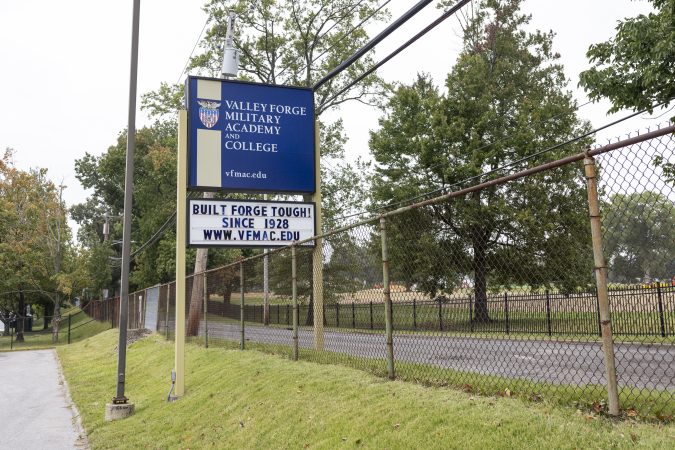
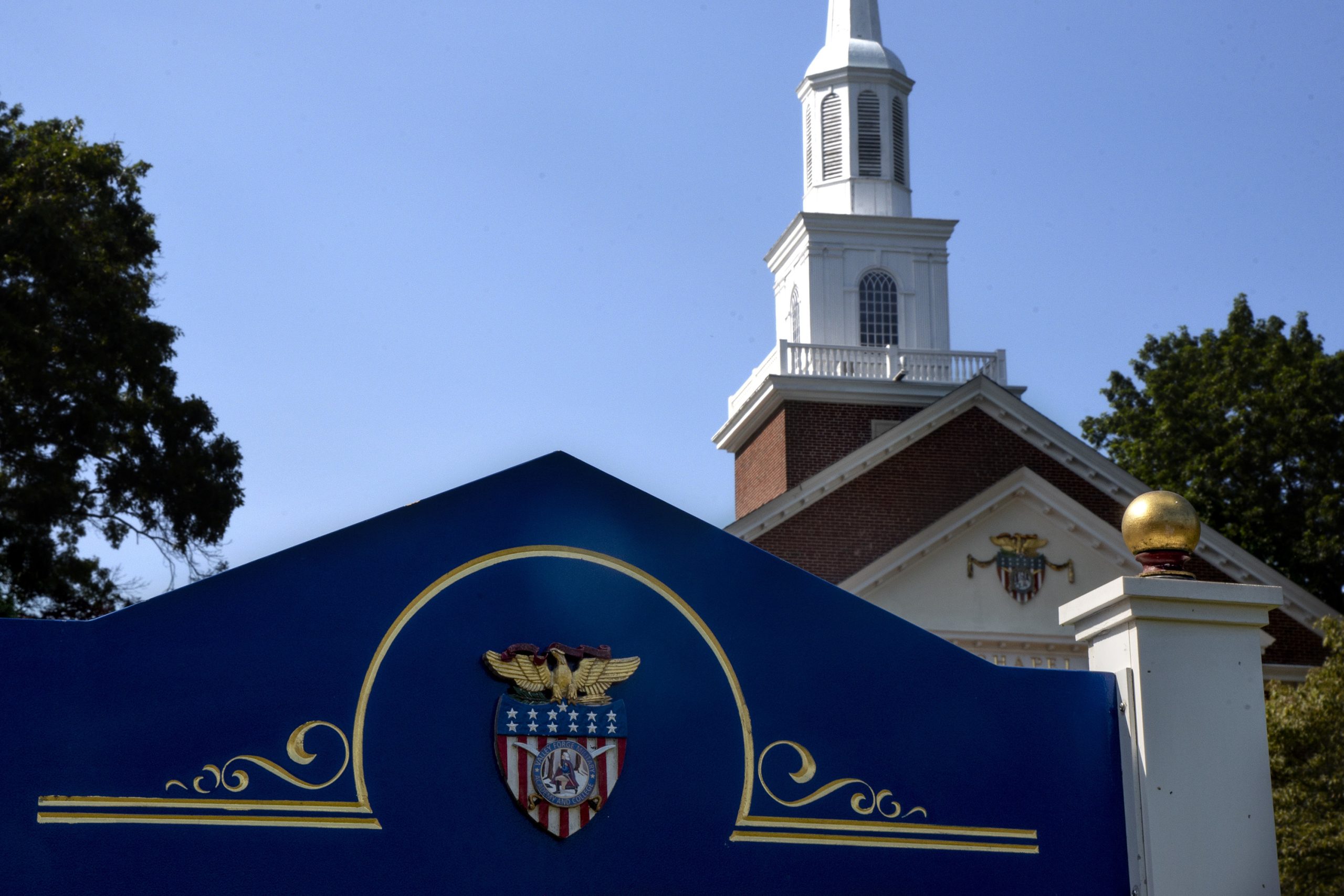
    Established in 1928 by a U.S. Armed Forces lieutenant general named Milton G. Baker, Valley Forge Military Academy (VFMA) in Wayne, Pa., promised parents: “Send us your boy and we will return to you a man.”Jasper Craven

    The George Washington school of American masculinity

    Journalist and author Jasper Craven argues that the figure of the American male, for better and worse, owes a lot to Washington. Or, at least, to the idea of him championing his country’s freedoms against all odds.

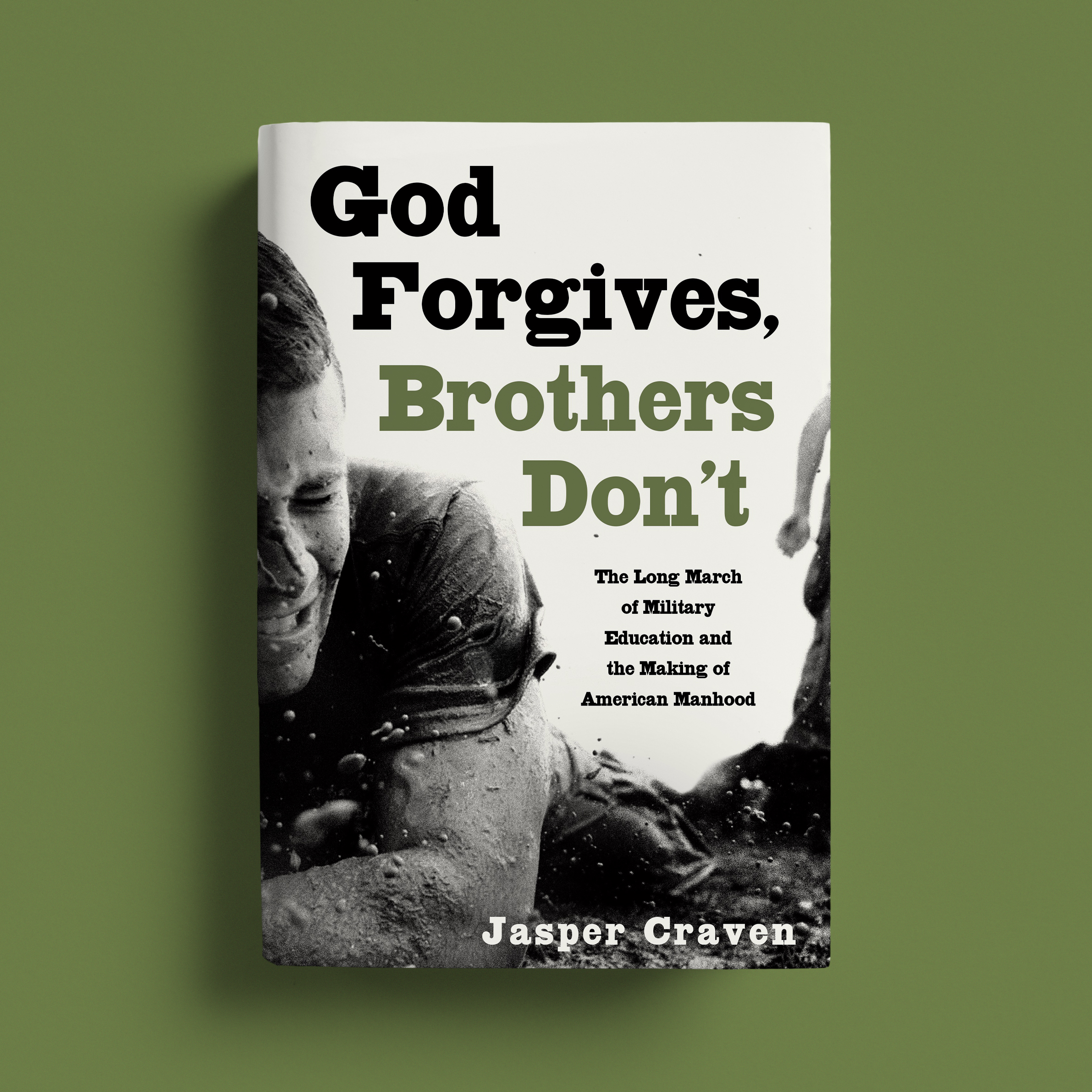
    In his new book-length history of American militarized machismo, God Forgives, Brothers Don’t, Craven locates a tension in Washington that proves foundational.

    “Washington made efforts to establish himself as a man who was stronger, mightier, braver than he actually was,” Craven said. “[He] captured the American imagination, and was an early, influential archetype on young boys.”

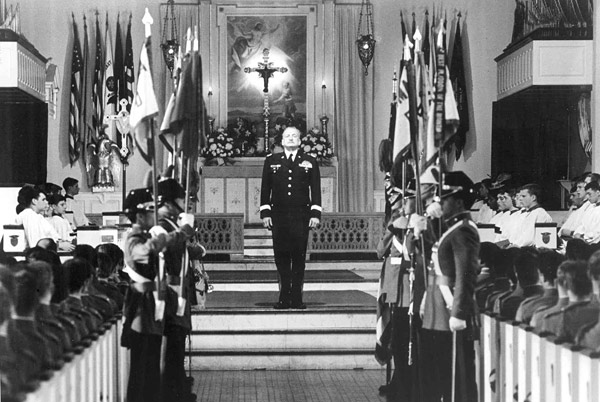
    So it followed that generations of boys would attempt to embody a Washingtonian archetype — resilient, brave, dignified — near the site of that mythic winter encampment at the Valley Forge Military Academy (VFMA) in Wayne. Established in 1928 by a U.S. Armed Forces lieutenant general named Milton G. Baker, Valley Forge promised parents: “Send us your boy and we will return to you a man.”

    Author Jasper Craven’s new book-length history of American militarized machismo, “God Forgives, Brothers Don’t” is a look into the fraught history and ominous future of military education in the USA, per its summaryCourtesy of Atria/One Signal Publishers

    Craven’s book argues that it was at schools like Valley Forge that the modern idea of the American male was made.

    “These military schools represent an extended, expanded, more pedagogical version of boot camp,” he says. “You arrive a young boy, a little bit reckless. Maybe you’re a bully. But very quickly, everyone is stripped of their identities, given matching uniforms, see their heads shaved, and are put into a very grueling hierarchy.”

    On paper, this pedagogical vision mirrors America’s notion of meritocracy: Everyone starts at zero, and scrambles for rank, and prestige, among the militarized hierarchy. Ribbons and bows are awarded to the most industrious scramblers.

    But, as Craven’s book reveals, that ostensibly fair model of achievement can be riven with dehumanization, corruption, and systemic emotional, physical, and sexual abuse. Even the nickname “The Forge” has a double resonance — suggesting both hammering something out in fire, and total fakery.

    Established in 1928 by a U.S. Armed Forces lieutenant general named Milton G. Baker, Valley Forge Military Academy in Wayne, Pa., promised parents: “Send us your boy and we will return to you a man.”Jasper Craven

    A history of abuse

    As Craven notes in his book: “Between 2015 and 2020, the Forge logged more than 30 incidents of alleged sexual misconduct, from stalking and fondling to rape, as well as fistfights, assault with a knife, even arson.” Cadets as young as 13 were driven to suicidal behavior.

    Craven played a key role in exposing these incidents.

    God Forgives, Brothers Don’t grew out of his 2022 reporting for Mother Jones magazine, which cast a piercing light on the school’s hallowed halls. His reporting captured not only the violence visited upon “plebes” (military slang for first year cadets) by upperclassmen, but the equally endemic corruption of the school’s administrators, who pocketed hefty tuition fees while essentially operating what one graduate called, “a sleepaway camp for troubled kids with very little supervision … more Lord of the Flies than The Catcher in the Rye.”

    The Chapel of St. Cornelius the Centurion at Valley Forge Military Academy & College in Wayne is photographed July 21, 2020.TOM GRALISH / Staff Photographer

    (Speaking of Catcher in the Rye: Author J.D. Salinger is among the Forge’s more notable graduates, and Craven traces the author’s conflicted relationship with the school, and its disciplinary culture, as a major influence on his fiction.)

    In 2025, the VFMA announced its closure; the May 2026 graduating class was its last. The neighboring Valley Forge Military College, a private military junior college, remains operational, having separated from the larger Academy in 2023, amid ongoing scandal.

    Last year, the VFMC became the first school in the country to offer support for President Donald Trump’s proposed Compact for Academic Excellence in Higher Education and received a $1 million federal grant earlier this year.

    More than a deeply researched and utterly harrowing inquest into how the American military turns boys into men, Craven’s book doubles as a critique of American masculinity itself: its valorization of violence, its codes of silence, its curated pathologies of aggression and shame.

    “While we have not read the book and therefore cannot comment on its specific arguments, we generally disagree with the author’s perspective on military schools,” the Valley Forge Military Academy Foundation said in a statement. “We believe military schools can have a profoundly positive and transformative impact on students by providing structure, discipline, leadership development, and a strong sense of purpose.”

    George C. Scott faces rebellious cadets in “Taps,” much of which was shot at Valley Forge Military Academy in 1981. After previewing the film, the academy repudiated it and nixed plans to host a premiere.

    It’s a dismal vision of chauvinist mock-virility that endures, culturally, Craven said, in everything from the prevalence of Punisher skull T-shirts and bumper stickers, to the vacant bellicosity of President Donald Trump (himself a military school alum who eventually avoided the Vietnam War draft), and the self-styled posturing of Pete Hegseth as “Secretary of War.”

    A workable alternative

    “Military schools across the country, including ours, have long lists of distinguished alumni who have gone on to achieve great success, many of whom credit their time at these institutions with helping shape their character, leadership, and future direction,” reads the VMAF statement.

    But in the course of his reporting, Craven was disillusioned of any idea that militarized men embody any sort of ideal.

    “The best evidence of my book’s thesis,” he said, “is that all these dudes who claim they’re the most macho and militaristic people around are all so jumpy, so self-conscious, and so uncomfortable with themselves.”

    “They are so clearly not happy with this identity they’ve constructed,” he said, “and yet are desperate to reinforce all the time.”

    Asked if there are any workable alternatives for this conception of the American man, Craven (who is a civilian) draws from a nonmythical figure in his own life: his father, the American activist and filmmaker Jay Craven.

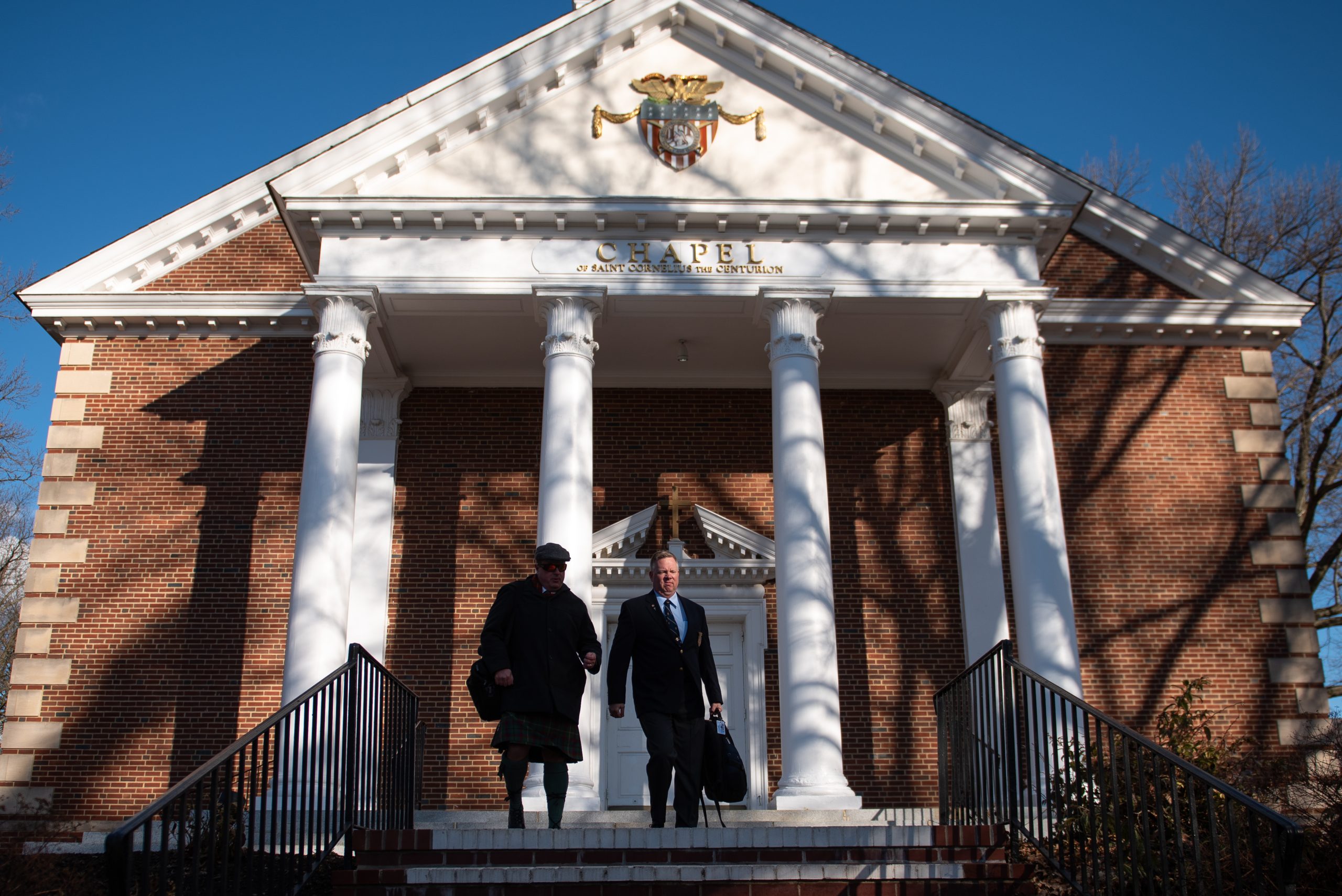
    Valley Forge Military Academy alums pass in front of the school’s chapel on their way to a board of trustees meeting held at the Wayne, Pa. campus on Saturday, March 16, 2019. Kriston Jae Bethel / For The InquirerKRISTON JAE BETHEL / For the Inquirer

    “My dad grew up in Pottstown, Pa., and almost went to Valley Forge, before finding a Quaker school and becoming involved in the anti-war movement,” he said. “There was a moment in America where the peacenik was the prevailing masculine pinnacle. He has his own ‘war stories.’ He was followed by the feds. He was imprisoned. He was beat up. He’s got some scars, which is cool. He even dated Jane Fonda for a bit.”

    In tribute — and, perhaps, in aspiration for the future of the American male — God Forgives, Brothers Don’t is dedicated, “To my dad, who taught me how to wage peace.”

    “God Forgives, Brothers Don’t: The Long March of Military Education and the Making of American Manhood” by Jasper Craven is available at online and physical bookstores. $29, 352 pages, Atria/One Signal Publishers.

    The article was updated to include comments from the Valley Forge Military Academy Foundation.

  • Pa. lawmakers have proposed dozens of ways to fix the state’s low housing stock. They’re making a database instead.

    Pa. lawmakers have proposed dozens of ways to fix the state’s low housing stock. They’re making a database instead.

    HARRISBURG — More than one million Pennsylvania households spend over 30% of their income on housing. And over the next decade, the state’s housing crunch is slated to intensify, with estimates that Pennsylvania will have nearly 185,000 fewer new homes than it needs to keep up with projected demand.

    State legislators have pushed to address the need, introducing bills that would increase the housing supply through accelerated approval processes and lifting restrictions on new developments — and urged leaders to include those initiatives in this year’s budget negotiations.

    Gov. Josh Shapiro also put housing at the forefront of his budget address in February, asking the General Assembly to ease restrictions for rental applications and to cap costs on manufactured home increases.

    But none of the proposed policies were included in the final budget deal, passed last month. Instead, the budget included the creation of a housing database — a move some lawmakers and advocates say falls short of addressing Pennsylvania’s burgeoning housing crisis.

    “I think the budget generally left a lot of questions unaddressed. And housing, one of the top three issues in terms of the cost-of-living crisis, was one of them,” said Sen. Nikil Saval (D., Philadelphia).

    Saval was one of six senators who voted against the budget. He has since said that was because it left many key policy issues, including housing, unaddressed. Sen. Katie Muth (D., Montgomery), the only other Democratic senator to vote against the budget, has also said she believes the budget left issues like housing, rising energy costs, and affordability unanswered.

    Shapiro’s office did not respond to a request for comment.

    (function() {
    var l2 = function() {
    new pym.Parent(‘pa_housing’,
    ‘https://media.inquirer.com/storage/inquirer/projects/innovation/arcgis_iframe/pa_housing.html’);
    };
    if (typeof(pym) === ‘undefined’) {
    var h = document.getElementsByTagName(‘head’)[0],
    s = document.createElement(‘script’);
    s.type = ‘text/javascript’;
    s.src = ‘https://pym.nprapps.org/pym.v1.min.js’;
    s.onload = l2;
    h.appendChild(s);
    } else {
    l2();
    }
    })();

    The new housing database — incorporated through a bill sponsored by Saval and authored by fellow Philadelphia Democratic Sen. Vincent Hughes — will be overseen by the Pennsylvania Housing Finance Agency. Saval said it will ensure more robust data collection to provide transparency on how much affordable housing is available across the state.

    Under the new legislation, the agency will be required to create an online searchable database of all publicly financed housing that is subjected to public assistance programs. It will include anticipated termination dates on properties’ affordability restrictions and will note if the property has been granted an extension on those restrictions.

    Saval said the publicly available database will ensure lawmakers have a better idea of the state’s affordable housing stock. Much of the affordable housing in the state was created with the help of low-income tax credits that are subject to expiration dates. As termination dates on these housing units loom, with many set to expire within the next five years, Saval said, the database will keep lawmakers aware of when housing is no longer affordable and allow them to see if restrictions can be extended.

    The database will be updated annually by the PHFA, with local housing agencies submitting data every year.

    Chris Anderson, communications officer for the PHFA, wrote in an email that the database is still in the early stages of being built, but that it will not pose any significant costs to the agency and existing resources will be used to create it.

    There are no penalties if the PHFA does not update the database, and the new law does not make it mandatory for local agencies to report information to the agency. The intended audience is primarily housing advocates and organizations, as well as policymakers, Anderson said.

    Saval said the database will help lawmakers know how much affordable housing there actually is in the state.

    But he said the state budget — where legislators often pass policies in addition to the yearly spending plan — was still a missed opportunity to address Pennsylvania’s housing concerns.

    “Anytime there’s a set of budget negotiations where there’s the potential to allocate funding, or create policy that would increase the supply of housing, or address the concerns faced by renters, and anytime that opportunity is missed as it was in this budget, I think it’s a step back,” he said.

    ‘Missed opportunity’

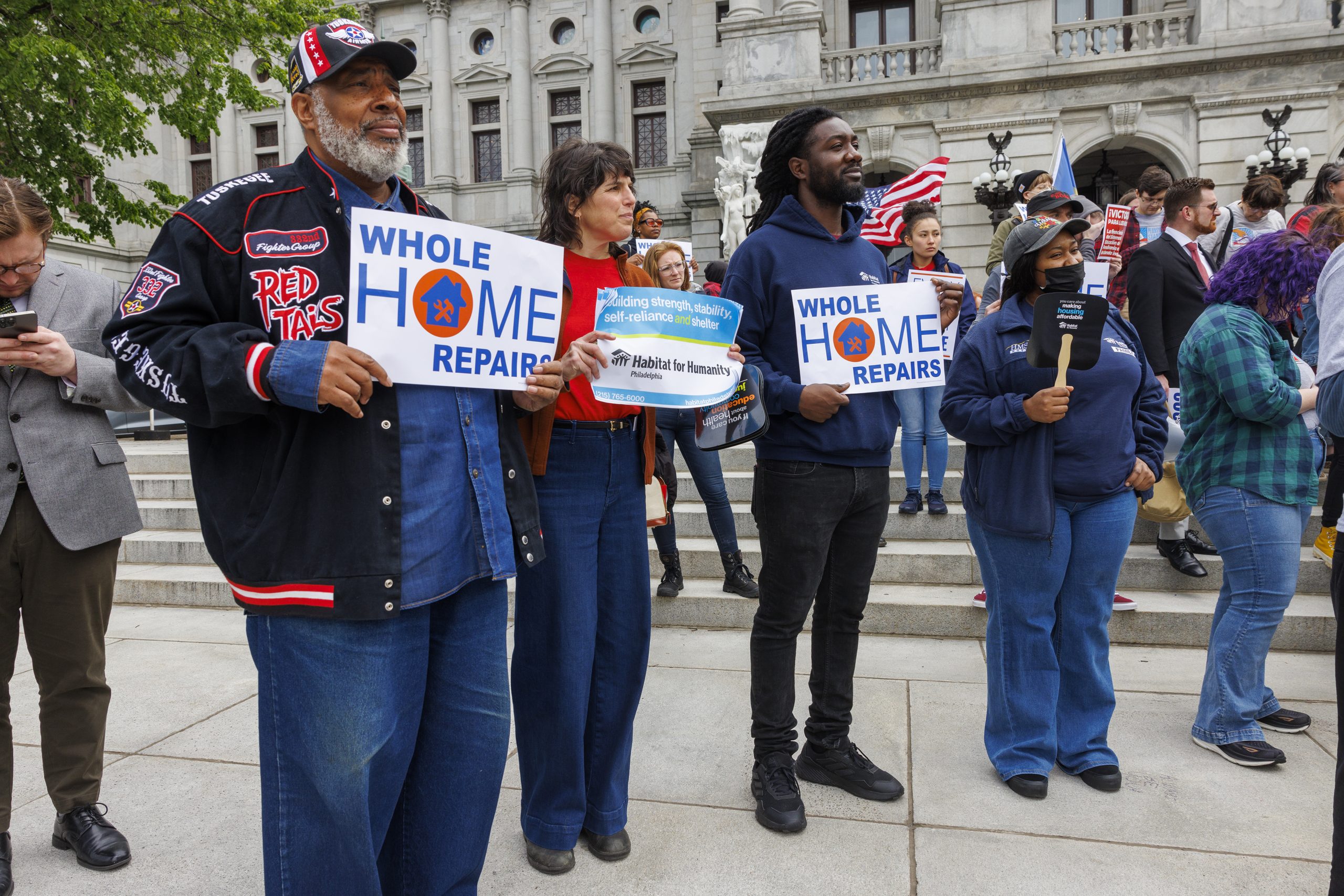
    Carrie Rathmann, vice president of strategic partnerships for Habitat for Humanity Philadelphia, said one initiative notably absent from the final budget deal was the PA Home Preservation Program, a grant administered by the Pennsylvania Department of Community and Economic Development to provide funding for construction cost gaps and keep homeowners in their houses through repairing outdated buildings. The initiative was last funded when it was signed into the budget in 2022, but has not received funding since.

    Previously known as the Whole-Home Repairs Program, the state allocated $125 million toward the program using American Rescue Plan dollars, repairing more than 2,600 affordable homes across the state.

    Douglas Paige (from left), Carrie Rathmann with Habitat for Humanity, Tyron Cheeseboro, and Danielle Paige on the steps of Pennsylvania Capitol during a 2023 rally for the Whole-Home Repairs Program.

    Housing advocates have pushed for the state to renew the funding, with the Housing Alliance of Pennsylvania calling it one of the organization’s biggest priorities.

    In an email, spokespeople from the housing alliance noted that the state funding in 2022 was not enough to support the number of people that applied for it, meaning there are still people waiting to have their homes repaired.

    “The program received far more applications from qualified homeowners than available funding could support, highlighting both the scale of unmet need and the importance of preserving existing housing,” the spokespeople wrote.

    The program has not returned in a line item in the state budget since 2022. Companion bills in both chambers supporting the program have received bipartisan support — the House bill passed 122-80 — but are sitting in the Senate Urban Affairs and Housing Committee.

    “That felt like it represented a huge missed opportunity to help thousands of Pennsylvanians stay housed and to keep homeowners safe and healthy in the homes that they already own, because without that dedicated investment, this crisis will only grow,” Rathmann said.

    Habitat for Humanity is a nonprofit that does not rely on state dollars, but Rathmann said state money goes to counties and housing providers like the Philadelphia Housing Development Corp. The money helps an “ecosystem” of housing organizations in the Philadelphia area, and Habitat uses it for a portion of the organization’s work. That included the Built to Last program, an initiative spearheaded by the Philadelphia Energy Authority that inspired the statewide initiative of Whole-Home Repairs in 2022.

    Rathmann said state initiatives that increase efficiency on building houses are key to developing homes faster and cheaper, which in turn increases the housing supply and can keep people in high-quality houses. This includes incentives like building lower density “by right,” meaning property owners can build low-density housing without special approval.

    “We see every day at Habitat that that impact is real, it’s tangible, it crosses different sectors like kids can get to school and do better,” Rathmann said. “Seniors are healthier. People are healthier. People feel less stressed. They have more money in their pocket for medication and food.”

    ‘Risk aversion on all sides’

    Lawmakers on both sides of the aisle in Pennsylvania’s divided state legislature have pushed for their own housing initiatives. Bills have passed through the Democratic-controlled House or Republican Senate, but have yet to move forward in the opposing chamber.

    Democratic-backed House bills sitting in Senate committees include proposals to remove barriers to building accessory dwelling units, lift restrictions on how many unrelated people can live in one home, and seal eviction records to help tenants.

    And the Senate GOP also has a number of bills sitting in the House’s committee, like creating an accelerated approval process for new housing, or establishing a Housing Regulatory Compliance Officer.

    Beth Rementer, spokesperson for House Democrats, wrote in an email that the House has sent 22 bills to the Senate Housing Committee, while the Senate sent two in June.

    The state’s lack of housing action marks a difference from the Republican-controlled federal government. In early July, Congress sent the ROAD to Housing Act to President Donald Trump’s desk — a bill that reduces barriers to home construction and modernizes housing programs alongside other initiatives, including a pilot of Whole-Home Repairs.

    Saval attributed the Pennsylvania legislature’s inaction to a desire to pass the state budget quickly without debate on hot-button policy issues ahead of the November election, when half the Senate and all members of the House are on the ballot.

    “Essentially, there was risk aversion on all sides,” Saval said. “And, understandably, an unwillingness to get into a budget discussion that would prolong the budget negotiation process.”

    Kate Flessner, spokesperson for the Senate Republicans, said in an email that the Senate supports a number of housing initiatives, but that underlying issues lie in how the state will pay for them in light of the roughly $5 billion structural deficit.

    “As we continue working to address the state budget’s serious structural deficit, we will be primarily focused on ways we can improve housing access that do not require vast sums of taxpayer money — and there are many of them,” Flessner said.

    Natalie Javitt is an intern with the Pennsylvania Legislative Correspondents’ Association. She can be reached at natalie.javitt@gmail.com.

  • Why Pennsylvania quietly repealed its 1929 midwifery law — and is now getting sued for it

    Why Pennsylvania quietly repealed its 1929 midwifery law — and is now getting sued for it

    HARRISBURG — Hidden deep in more than 600 pages of state budget documents, Pennsylvania lawmakers last month quietly repealed an unenforced 1929 law that allowed traditional midwives, the main group of midwives delivering home births, to practice.

    Now, traditional midwives — who differ from midwives usually found in hospitals, are not medically trained, and often serve religious minorities like the Amish — are worried they have no legal standing to work in Pennsylvania and are challenging the repeal and a new law in state court.

    The 1929 law had been on the books for nearly a century, asking traditional midwives to submit a paper application and a $10 fee to get a state certificate. But it had not been enforced for decades, and Pennsylvania, which has one of the highest rates of home births in the nation, was counted as one of 13 states that did not regulate the practice at all.

    Meanwhile, other forms of midwifery — such as nurse midwives and certified midwives, who are medically trained and are formally affiliated with a doctor or health system — are highly regulated by the state and its medical board. But these affiliations often prevent nurse midwives and certified midwives from offering home births, as the health systems see them as possible risks for medical malpractice lawsuits.

    The practice of traditional midwifery dates back to the Old Testament and has lived on through centuries of community knowledge and traditions. It can include Amish and Mennonite midwives, who are limited in the amount of education they are allowed to receive, as well as other unlicensed midwives who say they take only low-risk pregnancies.

    Some Pennsylvania traditional midwives say their practice is more necessary than ever, citing the United States’ maternal mortality and morbidity rate and cesarean section rates that outpace most of the rest of the Western world. They see their work as more holistic and personal than the American medical system, offering more personalized care to the new parent and baby for weeks after birth, as well as an answer to maternity care deserts as more hospitals and birth centers close.

    Medically trained midwives and physicians, who receive licenses from the state, argue the practice of traditional midwifery is potentially unsafe for mothers and babies, and requires little to no oversight in comparison to their medical training and licensure.

    A new law, and legal uncertainty

    There is no state law regulating home births — which are chosen by a variety of families for different reasons, from Amish who have religious beliefs about delivering at home to Black and brown women who have felt underserved or discriminated against by the modern healthcare system. But if traditional midwives — the primary group delivering babies in home births — cannot practice, some argue, home births will become inaccessible.

    The legal fight over midwifery began earlier this year, when the General Assembly approved changes to a separate law to include another class of midwife: certified midwives, who have all the same education training as nurse midwives except the nursing degree. To receive a certification from the Pennsylvania Board of Medicine, nurse midwives and certified midwives must provide proof of education and a collaborative agreement with a physician or medical institution.

    The law, the Midwife Modernization Act, was written to protect traditional midwives’ ability to practice, its author, Sen. Rosemary Brown (R., Monroe), said in a statement.

    Kate McHugh, a nurse midwife who has worked for a decade with lawmakers on updates to midwife regulations, said stakeholders approached traditional midwives during earlier iterations of the bill to see how they would like to be regulated. The different groups of traditional midwives could not agree, so the nurse midwives and certified midwives moved forward on their own.

    But the changes to Pennsylvania’s laws created a legal gray area, some midwives argued in a lawsuit filed last month.

    An anonymous group of two traditional midwives, a nurse midwife, and an Amish man whose family utilizes traditional midwifery filed a lawsuit in a state appellate court, challenging Brown’s law as unclear about their ability to practice, and asking the state to enforce the 1929 law already on the books.

    After the lawsuit was filed, legislators repealed the 1929 law as part of an overall state budget deal, creating more uncertainty for traditional midwives, according to their amended filing. Some lawmakers said they did not know they had voted to repeal the law, as the state budget is drafted in closed-door meetings among top leaders and fast-tracked through the legislative process with little time for rank-and-file members to review what they are voting on.

    The law was repealed as part of a request by Democratic Gov. Josh Shapiro’s administration, according to a source briefed on budget conversations. The administration works closely on legal matters with Republican Attorney General Dave Sunday’s office, which is defending the state in the case. Shapiro’s office declined to comment.

    “It’s not fair the way [the budget] is done,” said Rep. Dave Zimmerman (R., Lancaster), who said he unknowingly voted in support of the bill that repealed the 1929 law in an omnibus bill. “It concerns me a little bit that we repeal something in the fiscal code rather than right up front where it’s transparent.”

    “You have people in the Amish and Mennonite community that this is what they do. We have midwives that have been doing this for 30 and 40 years, They’re probably as good as anyone else doing it, certified or not,” Zimmerman added.

    The lawsuit

    The group of traditional midwives filed the lawsuit anonymously out of fear of retribution from the state for continuing to practice, said the group’s attorney, Jonathan Goldman, of the Goldman Law Team, based in Fort Washington. The midwives spoke with The Inquirer on the condition of anonymity for the same reason.

    One of the midwives, who serves south-central Pennsylvania with a largely Amish and Mennonite clientele, said she has delivered 1,600 home births over 38 years. She had practiced traditional midwifery in other states, before similar certifications were required there. At one point, she said, she was arrested and charged with a misdemeanor for continuing to practice home births in New York.

    Unlike medically trained nurse midwives and certified midwives, traditional midwives are prohibited from practicing medicine, which could mean dispensing medication or conducting medical procedures as simple as stitches. They have historically been investigated by state boards of medicine if this is called into question, making the group even more distrustful of state oversight.

    One of the anonymous traditional midwives, who has delivered an estimated 600 births around eastern parts of Pennsylvania, said her clients are often religious and want traditional models of care, such as no lab work and one ultrasound — a very hands-off approach compared to the highly surveilled pregnancies in modern medicine.

    The midwife, who delivered four of her 10 children in the hospital before finding an interest in home births, said her faith as a born-again Christian drew her to the “completely different model of care” that does not rely on pharmaceuticals, with a comfortable home setting and few restrictions like in a hospital.

    “In the hospital, it’s a fractured system. There are several midwives and physicians, you never know who you’re going to get, who is going to be on call,” said the midwife, who works with Amish and Mennonite populations in south-central Pennsylvania. “We are the community midwives. We know the secrets, we know the stories, we know what kind of care works. We know the family intimately. And it improves outcomes because knowing them intimately and emotionally allows us to provide that kind of specialized care.”

    Sunday’s office, defending the state in the suit, said in a July 24 filing that the midwives’ claims are a “misreading and misunderstanding of the current law,” and that traditional midwives “can continue to practice as lay midwives without certificates.” Sunday’s office did not respond to a request for comment.

    The case is scheduled for a preliminary injunction hearing to block the law from going into effect on Wednesday, where Brown and other lawmakers may be called to testify and a judge is expected to rule whether current laws prevent traditional midwives from practicing.

    Outside the medical system’s framework

    Obstetricians in hospitals and birth centers routinely work with certified midwives, who have an advanced degree in midwifery, and nurse midwives, who have a nursing degree in addition to specialized midwifery training.

    “As an OB-GYN physician, I absolutely respect somebody’s right to make a medically informed decision about how they take care of themselves in their pregnancy, and who they request assistance from in birth, and where they give birth to their babies,” said Holly Cummings, an OB-GYN in Philadelphia and chair of the Pennsylvania section of the American College of Obstetrics and Gynecology, a leading physician organization. “But I do also believe a hospital or an accredited birth center is the safest place to give birth. I don’t think in the U.S. in 2026 we can currently safely, uniformly support home birth.”

    ACOG does not support traditional midwives, who can also be known as lay midwives.

    But traditional midwives maintain they should be able to continue their work outside the medical system’s framework, citing it as a religious tradition and safe practice, and hope the judge rules in their favor.

    “Pennsylvania has a rich history of midwifery,” said the midwife listed in the lawsuit who serves parts of eastern Pennsylvania. “We have some of the highest home-birth numbers in the country. … It would be sad to see Pennsylvania not acknowledge the heritage in midwifery that we have here.”

    Staff writer Sarah Gantz contributed to this article.

  • A fugitive pornographer, his troubled son, and missing women: 5 takeaways

    A fugitive pornographer, his troubled son, and missing women: 5 takeaways

    What started as a routine car stop in Philly quickly evolved into a mystery concerning the fate of two missing women — and a boarded-up home in Olney that contained a confounding set of clues.

    In June, police encountered 44-year-old Eugene Horsch with a woman near Independence Mall, carrying drugs, illegal guns, and fake IDs. One of them featured the name of Blair Tonzelli, a woman who has been missing for three years.

    That led local and federal investigators to Horsch’s twin house in Olney, where they unearthed an array of disturbing evidence, including vats of chemicals, notes describing serial killings, and Tonzelli’s bank cards. Tonzelli’s case also resurfaced questions about Amy McHale, who was last heard from at the Olney house in 2016 and is the ex-wife of Eugene Horsch’s deceased father, Raymond “R.C.” Horsch.

    Eugene Horsch remains in jail on illegal gun and drug charges, as well as one count related to carrying fake federal law enforcement credentials. No bodies have been found, and police have not charged him with any crimes related to the women.

    Despite the disturbing evidence found in the Olney home, the investigation is clouded by the unusual lives and predilections of Eugene Horsch and his father, who was an erotic filmmaker and photographer obsessed with depicting sexualized violence against women in addiction — many of whom he lured to his home studio with drugs.

    To unravel the backstory behind the case, The Inquirer interviewed more than 30 people familiar with the Horsch family, reviewing hundreds of pages of police documents, court records, newspaper clippings, and archived interviews. The result is a portrait of a thrill-seeking criminal artist and his son as they navigated seaside New Zealand, rural Bucks County, and the drug markets of Kensington.

    Here are five takeaways from our weeks of reporting:

    Raymond ‘R.C.’ Horsch’s directorial debut was a violent pornographic film financed by a Philly mob associate.

    Raymond Horsch was a bookish engineer from Bucks County who underwent a sexual awakening during the so-called Golden Age of Porn in the 1970s. His 1973 film, The Erotic Memoirs of a Male Chauvinist Pig, was financed by Philly mob associate Sam “The Barber” LaRussa, a nightclub owner and friend of Nicodemo “Little Nicky” Scarfo, who went on to run the Philadelphia-area Mafia.

    The low-budget movie depicts rape, bondage, underage sex, and the titular character’s violent relationship with a drug-addicted woman.

    These hypersexualized themes would become a constant fixation of Raymond Horsch’s later life and artistic works.

    Raymond and Eugene Horsch have long criminal histories.

    In the late 1970s, Raymond Horsch was busted for printing counterfeit money, and then a few years later for running a methamphetamine lab. He skipped bail after the second arrest and absconded to coastal New Zealand after stealing the identity of a real-life chemist.

    He married a longtime girlfriend, who gave birth to his son, Eugene, while Raymond Horsch was an international fugitive. Raymond Horsch worked in the port city of Timaru at a chemical plant thanks to his adopted alias and a forged Stanford diploma.

    He was ultimately caught in New Zealand with five fake passports and fled back to the U.S. He was apprehended in Florida and returned to Philadelphia, where he was sentenced to federal prison.

    Raymond Horsch recruited dozens of women in addiction by trading drugs if they agreed to appear in his pornographic art.

    Between stints as a porn actor and director, Raymond Horsch searched the streets of Kensington for women in addiction to use, in his description, as models. He asked one of his son’s high school friends to star in one of his films. He recruited another woman with a classified ad for a housekeeper. He offered them cash and drugs in exchange for sexual favors and to appear in films or photographs, which often featured simulated acts of violence or death.

    After he was arrested in the 2000s on another drug charge, he lost his home in Chalfont. Both father and son moved into the home in Olney, which they had inherited from relatives, and Raymond Horsch allowed some of the women he recruited to reside in the home, sometimes for years.

    At least five women connected to Raymond Horsch died of accidental drug overdoses.

    Krista Killen lived off and on in the Horsches’ Olney house from 2016 until her death last year at the age of 47. Killen, who had been estranged from her family, told friends that Raymond Horsch was never violent toward her and that she cared deeply for him.

    But she told friends that she was scared of Eugene Horsch. She told two friends that one night, she was asleep when Eugene shattered her bedroom door and threatened to kill her. Raymond, then 80, had to pull his son away.

    In late 2024, within a span of a few months, doctors had to amputate part of Killen’s leg, her beloved tabby BabyCat died of a brain tumor, and Raymond Horsch died of a lung condition, leaving her alone in the Olney home with Eugene. Three months after Raymond’s death, Killen died of an overdose. Eugene Horsch shared the news on Killen’s own Facebook page. He wrote that he and Killen were in love and had planned to get married, something her friends said was not true.

    Raymond Horsch said his art blended facts with his violent fantasies, and he wanted people to wonder what was true.

    Investigators are reviewing Raymond Horsch’s films and self-published novels, some of which depict various ways to murder women. He casts himself in some of the stories as an “empathetic” serial killer who preys on addicted women and kills them to end their suffering. The books are billed as true stories that include both real details from Horsch’s improbable life story and passages that he concedes are fictitious — noting that he wanted readers to parse fantasy from reality.

    In a scene from one of his novels, Raymond Horsch describes how he dissolved a body with chemicals in a bathtub. Is it just another of his violent fantasies? Complicating that question is the fact that a woman told investigators that Eugene Horsch told her he knew how to dissolve a body with chemicals, making it small enough to flush down a toilet.

    Read the full story here.

  • The big theme ahead of this week’s annual Rumph Classic? Bridging the gap for a common cause.

    The big theme ahead of this week’s annual Rumph Classic? Bridging the gap for a common cause.

    Early Sunday afternoon, the Daniel E. Rumph II Recreation Center looked unassuming. The old Germantown basketball gym was empty outside of a few local kids shooting around. Every dribble sounded like three, with the bounces echoing off the building’s cement walls.

    A few hours later, it was nearly impossible to hear the ball bounce once.

    On Sunday, the center hosted three basketball games and a community barbecue. The event brought in a large crowd, quickly filling the hallowed hall with laughter, music, and friendly jeers.

    The event was held in partnership with the Hank Gathers Recreation Center. The two Philly rec centers share a mission to spread awareness for hypertrophic cardiomyopathy — a condition that makes it harder for the heart to pump blood. Most are unaware they have the condition until they receive a screening.

    The Rumph-Mallery Recreation Center hosted a youth game between Team Rumph and Team Hank Gathers Center on Sunday.Yong Kim / Staff Photographer

    Both Danny Rumph and Hank Gathers, the namesake for the respective centers, died from HCM while playing basketball. In 1990, Gathers, a Philadelphia native and standout at Loyola Marymount, collapsed on the court while playing against Portland in the West Coast Conference semifinals.

    It would be 15 years later when Rumph went into sudden cardiac arrest during a pickup game at the same Germantown gym that hosted Sunday’s event. It was later renamed after him.

    “Danny was at this exact rec center where he collapsed on a court, and it took a long time for an ambulance to come,” Janet Williams, a board member for the Daniel E. Rumph II Foundation, said. “There wasn’t an AED here. Even though they started CPR, it still wasn’t enough. So, we’re trying to bring education to the community at large, not just youngsters in sports.”

    The Rumph Foundation has provided every recreational center and Boys & Girls Club in Philadelphia with a defibrillator. They have also partnered with Youth Heart Watch, a program with a similar mission, to provide both CPR and AED training to the community. A majority of the foundation’s funding comes from the Danny Rumph Classic, a five-day pro-am basketball tournament.

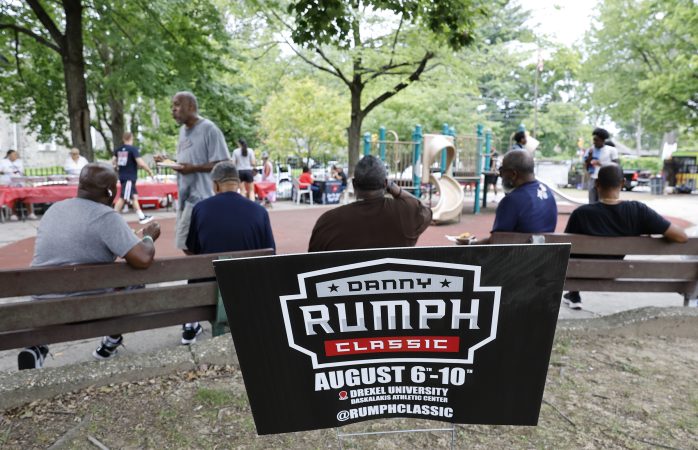
    This year, the 21st iteration of “The Rumph” will tip off on Thursday at Drexel’s Daskalakis Athletic Center. In the past, NBA stars like Jalen Brunson, James Harden, and Tyrese Maxey have graced the tournament’s floor. For the third consecutive year, the event will feature a women’s pro-am tournament, featuring local players.

    Team Rumph and Team Hank Gathers Center compete against another in a youth game on Sunday.Yong Kim / Staff Photographer

    Sunday’s event in Germantown acted as a way for the foundation to connect with the community and with those who have been crucial to its success. The afternoon started with a 50-and-over game — for the hoop veterans who have seen the foundation flourish over two decades.

    “The whole reason why a lot of us are still close to this day is the friendships that we built playing here as kids,” said Mike Morak, the foundation’s director of events. “How do we celebrate 21 years? And it was like, let’s come back to where we started.”

    “Let’s get everybody together,” Morak said. “People can come and go as they please. The reason we’re here and where we all started was because of this playground. So it was like no better way to just come back to the neighborhood, making sure we can all have a fun day together and then get ready for the full Danny Rumph Classic this week.”

    ‘It’s really a homecoming’

    When Morak had the idea to bring the Rumph and Gathers recreational centers together for Sunday’s event, he thought to invite Derrick Gathers — the younger brother of Hank.

    Derrick Gathers was a quick “yes,” having known Morak and the role the Rumph Foundation has played in the community. What Gathers didn’t know is that he would be given a full uniform at the door.

    “Well, I was set up by Mike,” Gathers, who played in the 50+ game, said with a laugh. “Mike set me up.”

    “I get up here, they talking about ‘suit up,’” Gathers added. “I ain’t played in a long time, but it felt good, you know, just to hang out with the guys, the guys I grew up with. … I think it’s a tribute to them for just keeping the Danny Rumph legacy going for so many years. That’s outstanding.”

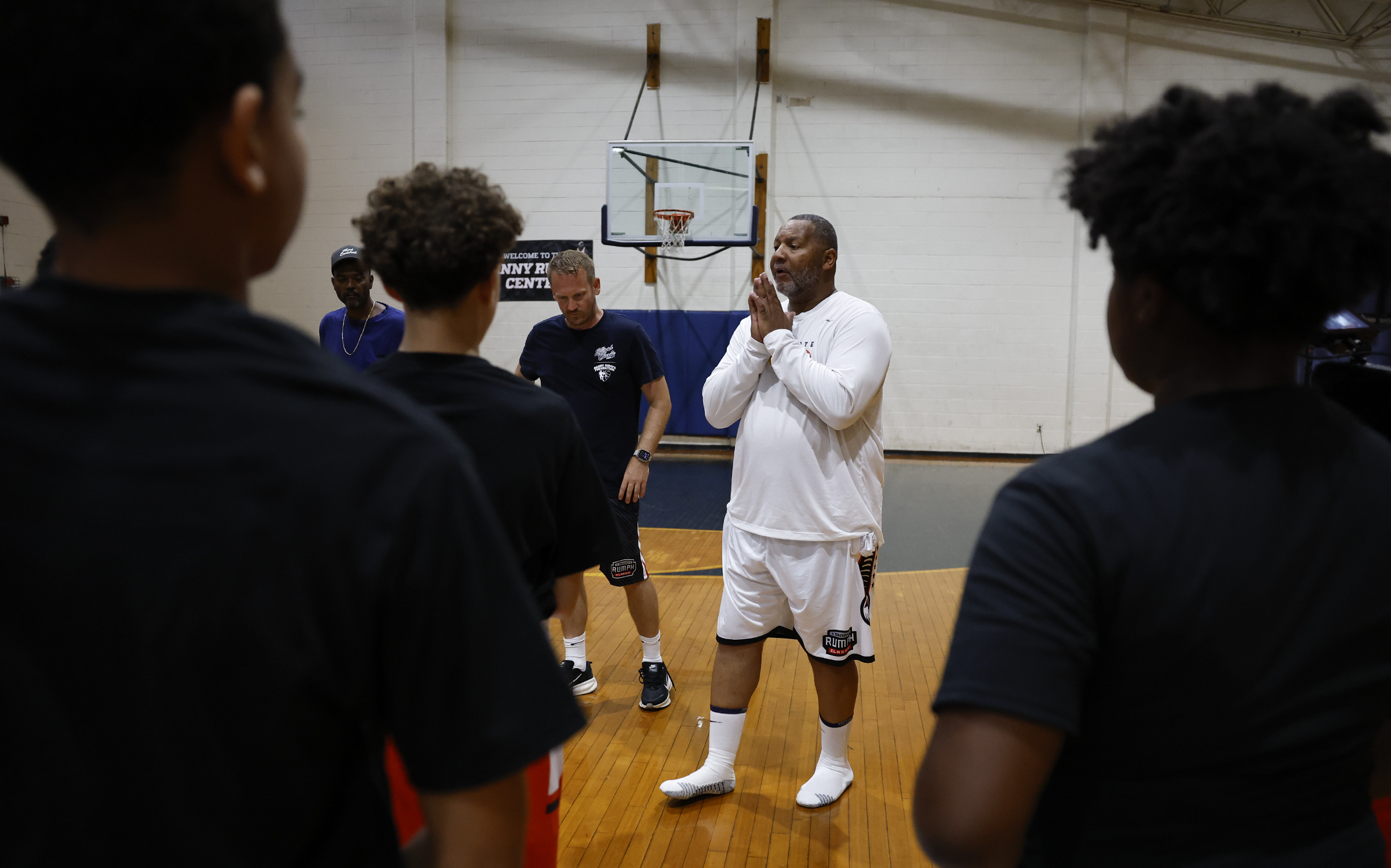
    Derrick Gathers addresses members of Team Rumph and Team Hank Gathers at the Rumph-Mallery Recreation Center on Sunday.Yong Kim / Staff Photographer

    After Gathers’ game, which his team won, he joined Morak at center court to address the 11-and-under and 13-and-under players before their games began. Kids who played at both centers were invited to participate — but with a twist.

    Instead of matching up against each other, the centers’ teams were combined, so the players would get to know one another.

    “A lot of these kids don’t know the similarities of the story, so we want to make sure [they do],” Morak said. “Man, bring those kids up here. Let’s also explain to them how they’re all interwoven. Some kids today don’t really realize what happened to Danny. They don’t realize what happened to Hank. They don’t realize how we’re all connected.”

    Added Williams: “It’s getting the generations together, the older and the younger, and passing it down. Showing the importance of community, showing not just the importance of sports, but making sure that you stay healthy.”

    Daniel E. Rumph II Foundation board member Janet Williams (left) and volunteer Carol Oliver (right) serve food during a BBQ after basketball games at the Rumph-Mallery Recreation Center on Sunday.Yong Kim / Staff Photographer

    Like the Classic, Sunday’s community event was powered by volunteers. Dozens of people worked behind the scenes to make sure the games and the barbeque ran smoothly. One of these volunteers was Shawn Werdt, who coached the “Team Rumph” 11U team. Werdt, who regularly runs clinics at the center, helped out because he “believes in the mission of the foundation.”

    “It’s really a homecoming,” Werdt said. “Guys always come back to this and either want to play or support it, and you just see a lot of old friends, old faces in the crowd, and it’s just a really good event. A really, really fun week of basketball.”