Yes, it was only one game, and these U.S. players know that better than anyone. But they also know how big this was.
It’s not an overstatement, especially for a fan base that has endured so much frustration over the last 12 years. It’s OK to savor a moment of real happiness, and the rest of the nation is welcome to join the party.
It’s especially worth saying that this team’s biggest players delivered on the biggest stage.
Christian Pulisic was dazzling, especially with his playmaking on the first two goals, before exiting at halftime as a precaution after a hit to his left calf.
Christian Pulisic celebrates after his playmaking helped force the Paraguay own goal that opened the scoring.Jayne Kamin-Oncea
Folarin Balogun again showed why he’s the striker the U.S. program craved, with clinical finishes on the second and third goals. Weston McKennie drove the play from the engine room, starting with a charge downfield to set up the first tally.
Tyler Adams was the midfield general, and Chris Richards was impeccable on the back line: 6 of 10 duels won, three clearances, and a perfect 84-of-84 passing. Gio Reyna, so long maligned, capped the night with a thunderbolt.
While the instinct at halftime was to compare this game to the Portugal one in 2002, the final whistle brought another comparison.
Just 15 months ago, many of these players left this Los Angeles-area stadium at a low point: humiliating losses to Panama and Canada in the Concacaf Nations League final four.
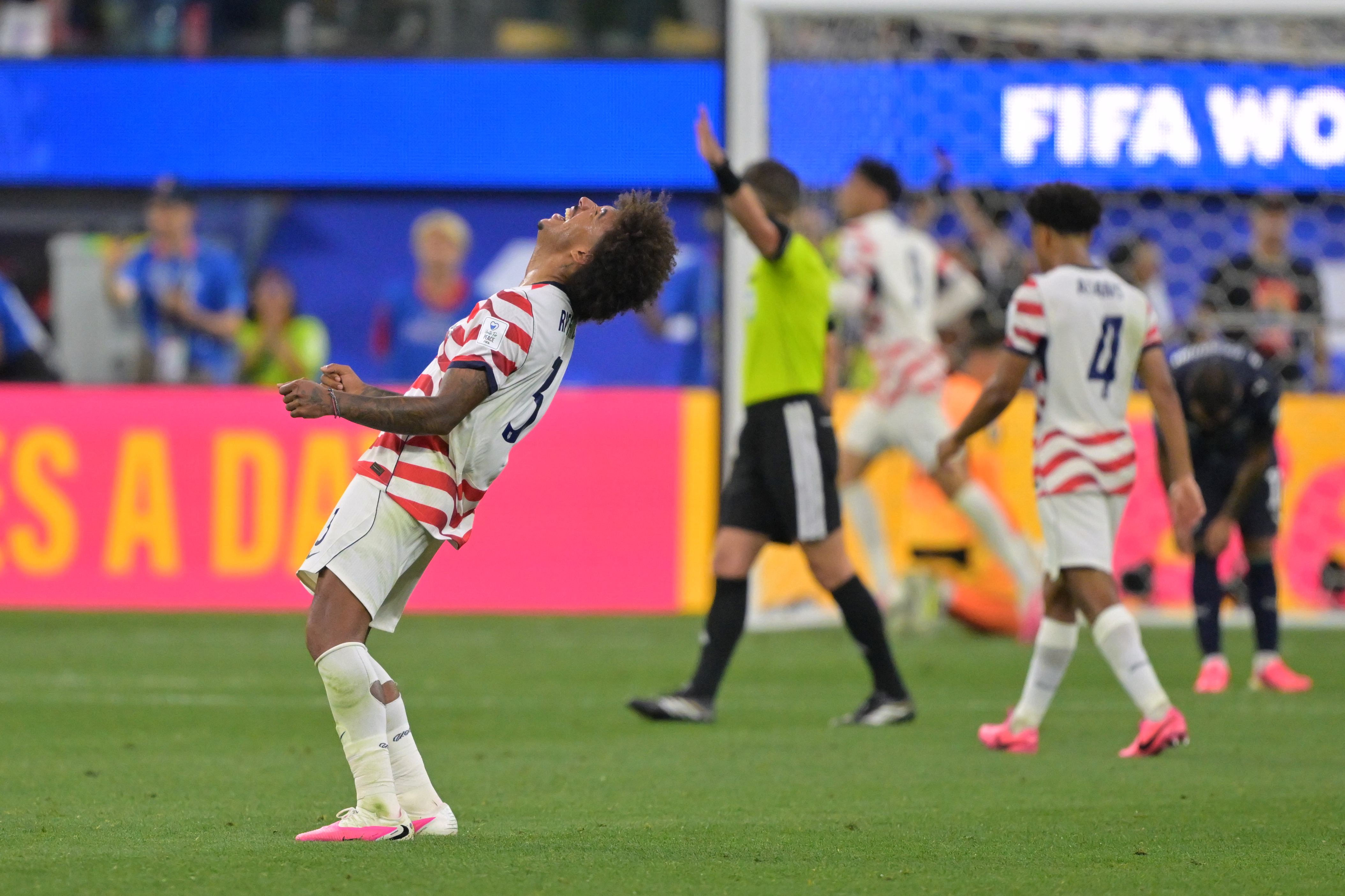
Chris Richards (left) celebrates after Gio Reyna’s late goal capped the U.S.’ win over Paraguay.Jayne Kamin-Oncea
Richards and Adams were asked if they thought about that time as they returned to the ultramodern venue typically known as SoFi Stadium, and both said they did not. But they had no doubt about how far their program has come.
“I think you’ve seen a complete culture shift,” Richards said. “There [were] a lot of question marks last March about if we have that fight, if we can do it, if we can go all the way, especially without having any real competitive games. But I think we proved it to everybody tonight.”
Adams spoke of the team’s growth “as players and individuals, but also just understanding what the manager wants, exactly how to instill that every single day, the culture of the team, bringing more players into the fold. We’ve come a very long way.”
It bears saying that Balogun missed those Nations League games because of injury. But the search for a marquee striker had gone on long before then. But it bears repeating: He has delivered.
¡TRIUNFAZO DE ESTADOS UNIDOS!
El equipo de las Barras y las Estrellas goleó a Paraguay en su debut en la Copa del Mundo.
— Telemundo Deportes (@TelemundoSports) June 13, 2026
“When I committed, and throughout the whole cycle and the whole journey to me being at this point, I’ve always said the fans gave me so much motivation, showed me so much support,” he said. “And for me, the most important thing has always been to be able to repay that. I feel like today’s a great opportunity, and I just want to continue to show the fans I made the right decision.”
He called it “a dreamy night,” and speaking soon after the final whistle meant he had only started to process it.
“I’ve not been able to take it all in,” he said. “When I get back to my hotel and I rest, I’m sure I’m going to really be able to be in the moment and experience how much of an amazing night this is.”
A true home advantage
Another contrast between last year and this one came from the stands. While the players were the best actors, the crowd of 70,492 played more than just a supporting role.
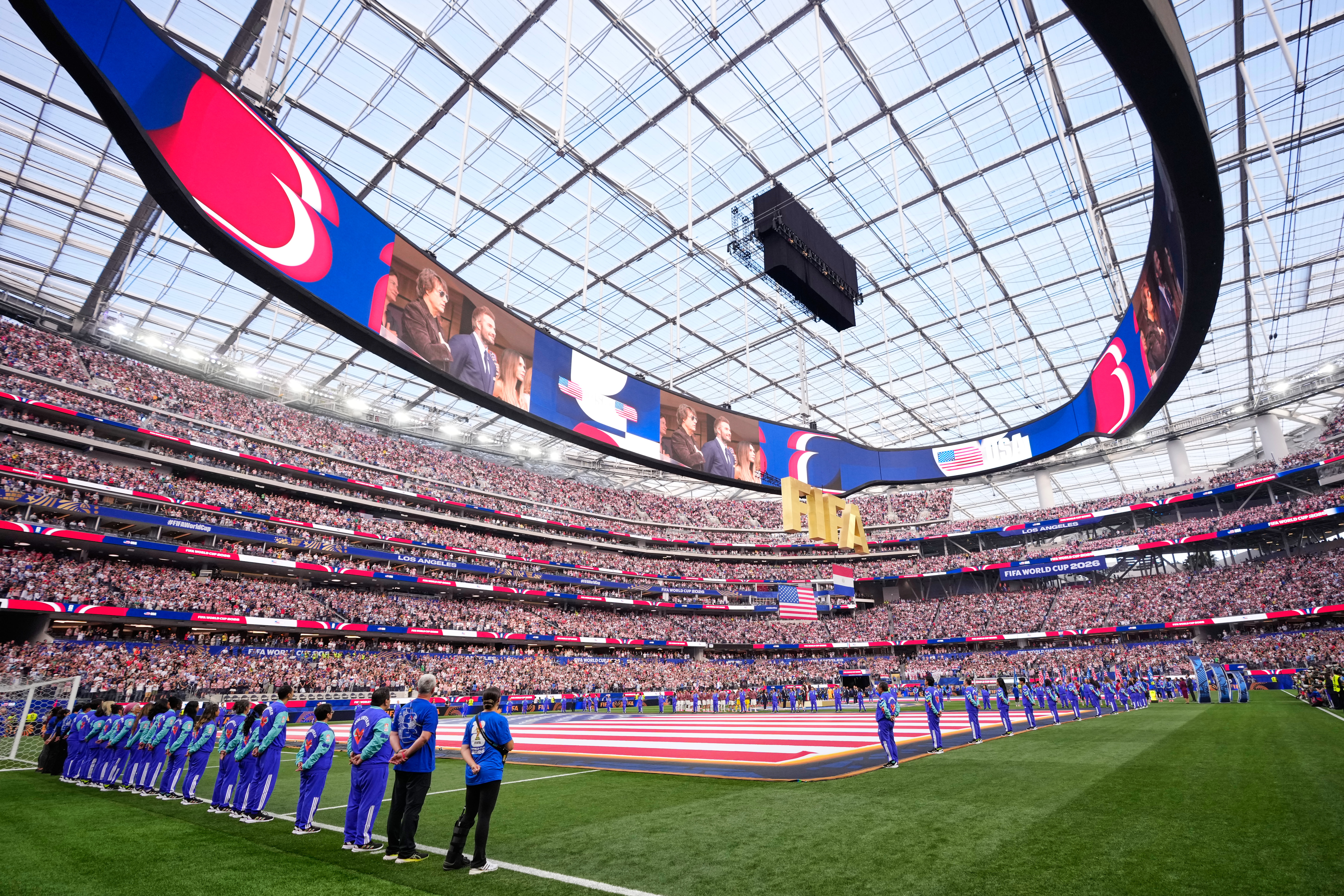
A view of the crowd from field level during the national anthems.Mark J. Terrill
The compounded fear of seeing laid-back LA pay FIFA’s exorbitant ticket prices vanished when the national anthem singers found themselves joined by a rising chorus. There were “USA!” chants all night, real and organic, from the moments before kickoff to a key stretch late in the game when the players needed a boost after Paraguay’s goal.
Player after player said they felt it on the field.
“Walking out to that makes it feel real,” Adams said. “Seeing that support, you don’t want to let the fans down and the country down.”
Pulisic said: “It meant everything for us. A half like that, for it to go as it did, and have the fans really excited about it our performance, it felt amazing.”
Some of the U.S. fans in the stands on Friday.Jayne Kamin-Oncea
Last summer, McKennie stood at the White House with his club team, Juventus, and watched President Donald Trump make that moment about something totally unrelated to his visit. This time, the Texas-born son of a retired Air Force staff sergeant could express his own form of patriotism.
“Hearing the national anthem and hearing the fans singing it, in that moment, it’s one of those things that just pushes the feeling even further,” McKennie said. “Where you’re like, ‘I’m proud to be American, this is my home, this is my country.’ And that’s something that is hard to describe — it’s something that as a player you just feel whenever you just see that.”
Medford’s Brenden Aaronson said the anthem gave him “goose bumps,” even though he was on the bench and didn’t play. Cristian Roldan, another unused substitute, called the atmosphere “beautiful.”
“I had gotten some texts from a few mentors that said, ‘Make sure you take a moment to take it in,’ because they know I otherwise I wouldn’t,” he said. “And so I did. I just looked up, and it was a breathtaking sight, I would say.”
Pochettino, an Argentine who has spent his coaching life in Europe, felt something, too.
“It was amazing for our fans to watch this type of game,” he said. “And today, I am so proud, and we are so proud, because I think we are winning a lot of fans, adding fans [of] that sport here in America.”
This was just one game, of course. But it was a big one, and not just because it was the highest-scoring U.S. men’s game in World Cup history. At the final whistle, it opened a path toward even bigger things to come.
The waterfronts of Chester and Wilmington are roughly 5,000 miles across the Atlantic Ocean from Abidjan, the Ivory Coast’s largest city. But, for at least three weeks during the FIFA World Cup, the Ivorian men’s national team will call the banks of the Delaware River home.
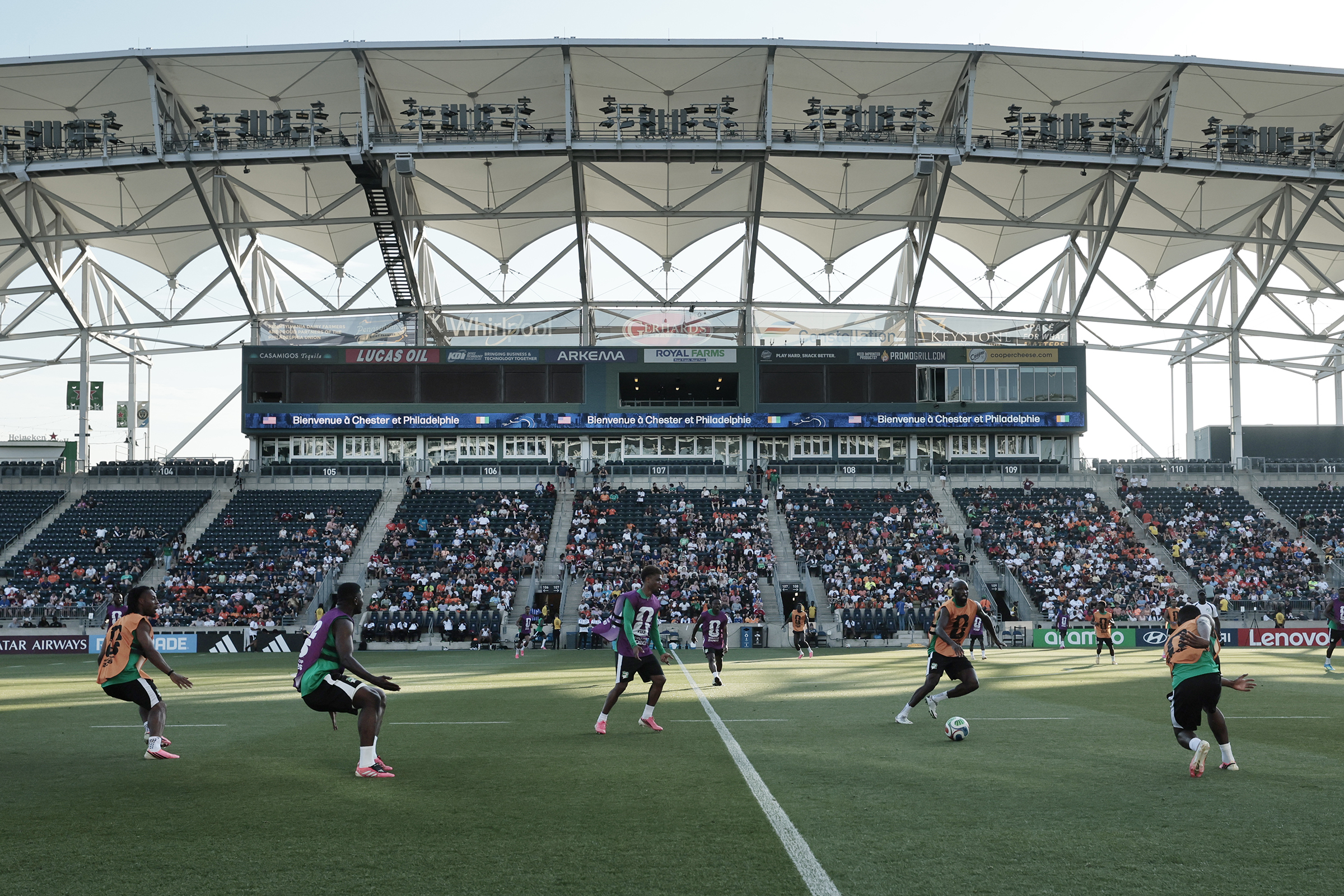
Les Éléphants hosted an open training session at Subaru Park on Friday evening, two days before they begins their World Cup campaign with a match against Ecuador at Philadelphia Stadium (aka Lincoln Financial Field) on Sunday (7 p.m., FS1).
Ivory Coast is the only nation scheduled to play at the Linc twice during the World Cup’s group stage, and it is the only team that will stay and train in the Delaware Valley during the tournament.
Ivory Coast is the only team with a base camp in the Delaware Valley during this summer’s World Cup.Elizabeth Robertson / Staff Photographer
The team has set up its base camp at Hotel Du Pont in Wilmington and will train at Subaru Park in Chester.
Ivory Coast’s open training session Friday evening was the second free event it has staged for the Philadelphia community. Les Éléphants beat Union II, 2-0, in a tuneup friendly on Monday that was open to the public.
The team took its official squad photo before a training session that featured some light 11-on-11 work before being welcomed to the region by a committee of representatives for Visit PA.
Ivory Coast manager Emerse Faé addressed the crowd briefly in French after the session, saying the team has received a “warm welcome” in the region since its arrival last Saturday.
“We were well-received by the delegation here,” Faé said through a translator. “We want to see you on Sunday for the win.”
For some, Friday night’s open practice was an opportunity to familiarize themselves before seeing Ivory Coast take the field for a match at the Linc.
Sam Shovers and Joe Santillo bought tickets to see Ivory Coast’s final group-stage match, a clash with Curaçao at the Linc on June 25.
“We wanted to get acclimated and support,” Shovers said. “I always wanted to go to the World Cup, so I’m trying to just get as invested and ingratiated in the vibes of it as possible.”
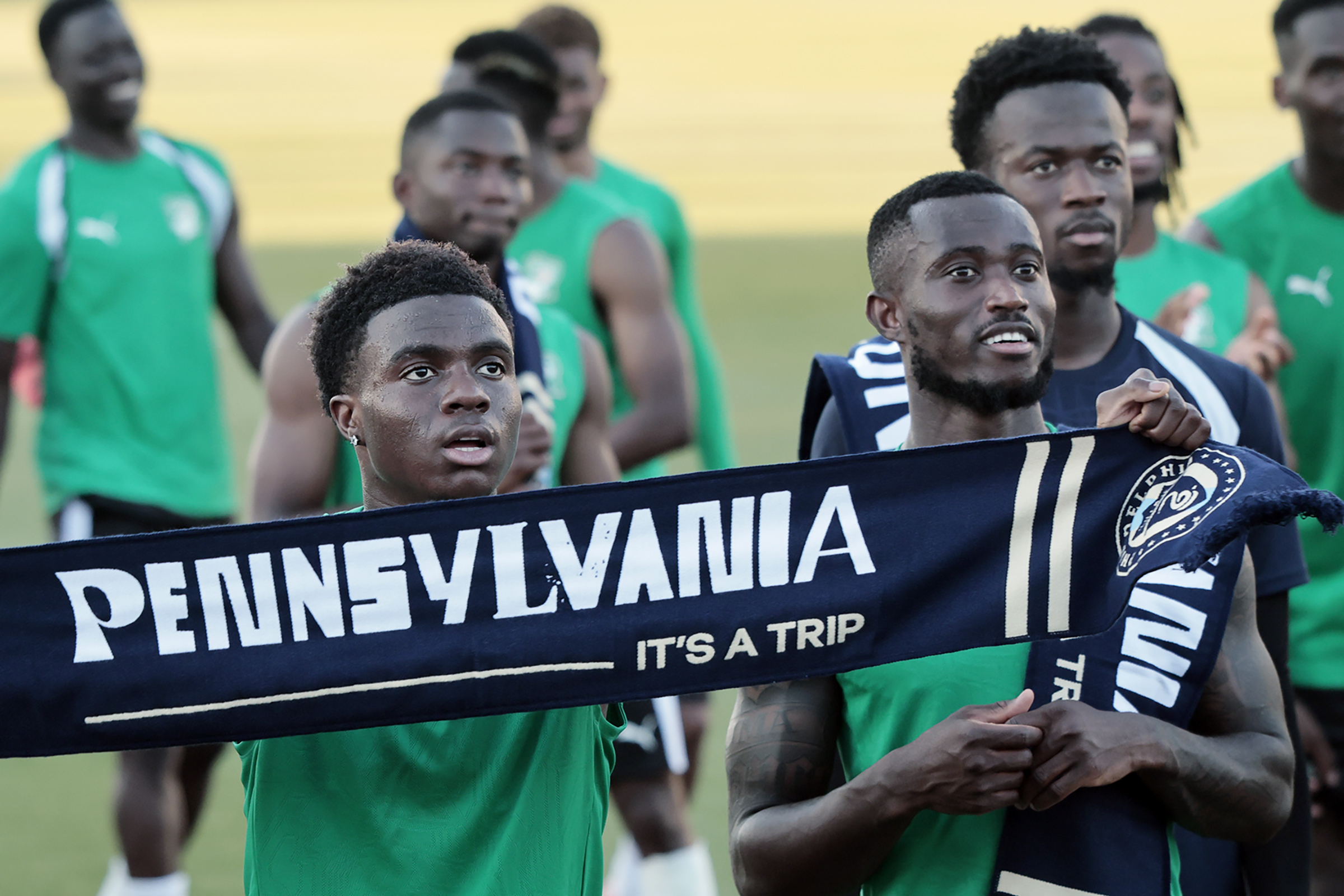
Members of the Ivory Coast national football team signed autographs and posed for photos following their practice Friday at Subaru Park. Elizabeth Robertson / Staff Photographer
Shovers was wearing a plain orange T-shirt, while Santillo sported an Ivory Coast-specific shirt he ordered from Amazon.
The friends said they plan on adopting the Ivorian team as one of their favorites for the tournament and have spent the last few weeks learning more about the nation and its culture — Santillo is quick to point out that Ivory Coast is home to the world’s tallest domed church.
The team is of special interest to Shovers, 30, who majored in African studies in college.
“Most of my studies were with sub-Saharan and English-speaking parts of Africa,” Shovers said. “This part of West Africa has been an exciting area to get excited about.”
Around the world
Many fans in attendance at the open training were sporting the orange Ivory Coast kit or other unofficial gear, but jerseys of all kinds popped up throughout the crowd of about 5,000 people.
Sam Haile, 47, showed up to Friday’s session wearing a red Liverpool jersey. He said he cherished an opportunity to watch a potential future star for his favorite club up close.
“It’s good to see a World Cup team coming to our community, letting us watch the free training,” Haile said. “They’ve got a couple of really good, top players.”
Haile said it was also an opportunity to get into the spirit of the World Cup without paying for an expensive match ticket. He planned on attending the Union’s Soccer Celebration to watch the U.S. match Friday night, and the FIFA Fan Festival later in the tournament.
Haile was born in Ethiopia before coming to Philadelphia to enroll at Drexel in 1997. He’s stayed in the region ever since, moving to Middletown, Del., in 2009. Haile said he will be supporting the Ivorians through their World Cup run, calling it “a pleasure to watch them.”
“I have a little bit of a feeling for them,” Haile said. “I hope they will go further in the tournament and stick around in Wilmington until the end.”
Cultural exchange
While Philadelphian fans got an introduction to Ivorian culture on Friday, the Ivorian squad got a taste of Philadelphia’s, too.
Jamie Pagliei, better known as The Philly Sports Guy on social media, gave the team an official introduction over Subaru Park’s public address system after the training session ended.
With his face painted red, white, and blue for the U.S. game later that night, Pagliei praised Philadelphia Soccer 2026 for helping to bring free events like Saturday’s training to the Philadelphia region during the tournament.
“I feel like that, out of every city that’s hosting, that Philadelphia and Pennsylvania is doing it right,” Pagliei said. “We are going to be the ones that might be the snapshot that FIFA uses, that says, ‘Hey, this is what we want out of our host cities moving forward.’”
As the Ivorian players walked off the field, some stopped to admire the West Powelton steppers and drum squad, which performed throughout the concourses and in the River End on Friday.
Antoine Mapp has been with the steppers since the group’s founding in 1991. He’s worked Sixers games and Phillies games as part of the teams’ official drum lines, but Mapp said drumming in front of Ivory Coast’s stars was the most starstruck he’s been.
“That was a surreal moment,” Mapp said. “I’ve been around the biggest stars in the NBA. That, right there, was probably the biggest moment I’ve ever felt, to have a whole football team standing there watching us perform. It’s an awesome, surreal moment.”
Elizabeth Bonker is a silent woman with a loud mission. She wants government agencies to cover the costs of training people with autism in a form of communication called assisted spelling. One problem: Leading professional organizations don’t believe it works.
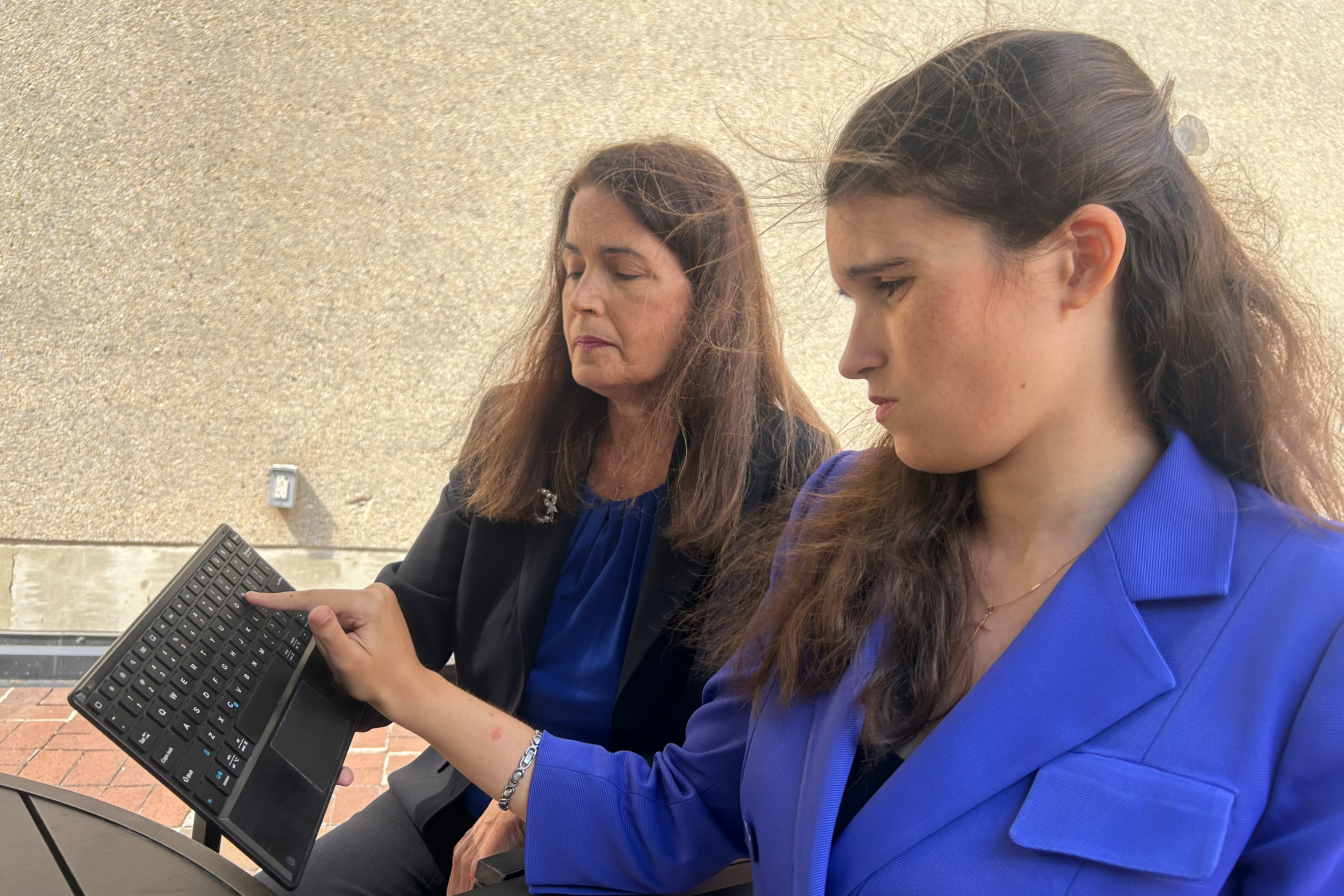
“All nonspeakers above the age of 5 should be given the opportunity,” typed Bonker, who is 28 and cannot talk. Her mother, Virginia Breen, held a wireless keyboard for her. They sat on a hotel patio before an April 27 meeting with a senior aide to Health and Human Services Secretary Robert F. Kennedy Jr.
“We are misunderstood and underestimated,” Bonker typed, occasionally humming or lightly groaning as she considered where to place a slender forefinger on the keyboard.
Assisted spelling is used to help nonverbal people communicate by pointing to letters on boards or using keyboards with physical help from another person.
Supporters say assisted spelling has improved the lives of thousands of people with autism, such as Bonker, and they have powerful allies. Kennedy appointed Bonker and another autistic “speller,” as they call themselves, to a 20-member autism panel made up largely of parents with children whose autism they attribute to vaccinations.
At the reconfigured panel’s first public session on April 28, three other members said their nonspeaking adult children were learning to communicate through spelling. The panel issued a resolution with language from Bonker stating that “robust” communications programs are essential for autistic people. Bonker has urged the Department of Health and Human Services to support training in assisted spelling for those who want it.
Other, validated methods enable nonspeakers to communicate through digital and analog pictures and letter boards. But assisted spelling isn’t autonomous communication, critics say: Consciously or not, the board holder may be influencing or responsible for the typed or pointed-at words — as with a Ouija board.
For many parents in Kennedy’s Make America Healthy Again community, the spelling controversy is angrily ringing the same bells as the notion that vaccines cause autism — which they refuse to consider debunked. As some people see it: Established medicine damaged them with vaccines and now refuses to accept a helpful treatment.
People with autism are “trapped in bodies that have betrayed them because the medical establishment has betrayed them,” said Louis Conte, who has a child with autism, in a September edition of a Kennedy-allied MAHA publication.
By limiting access to spelling, “you are not just limiting expression, you are erasing identity,” said Katie Sweeney, the mother of an autistic adult who is affiliated with an anti-vaccine medical group, at the autism panel meeting.
Mainstream autism experts and advocates in March convened the Independent Autism Coordinating Committee as a counter to Kennedy’s panel. At the new group’s meeting, one member spoke out against the spelling methods.
“In this underfunded disability environment, I don’t want a single penny diverted to debunked interventions like spelling,” said Amy Lutz, a senior lecturer in history at the University of Pennsylvania and an autism support advocate who described her 27-year-old son as “profoundly autistic.”
It’s not only a waste of time, she said later in an interview, but “people subjected to spelling are not given access to evidence-based education. Every interaction turns someone like my son into a puppet, and I find that very objectionable.”
A patchwork of perspectives
The universe of autistic people, their parents, researchers, advocates, and service providers is a broad, acrimonious spectrum. Some say that vaccines or chemical exposures caused a massive increase in autism, others that diagnostic changes account for most of the increase. Some seek mainstream or alternative treatments, some demand classroom inclusion, and others want residential treatment. Some people with autism say it’s a difference, not a disability.
“When I tell the parents of a young child they have autism, it’s a tragedy,” said Audrey Brumback, a child neurologist at Dell Medical School at the University of Texas-Austin. “When I give the same diagnosis to a teenager, it’s good news. It means, ‘There’s nothing wrong with you; you’re just autistic.’”
Scientific medicine has failed to deliver good treatments for autism. After four decades of concerted research, “the results have for the most part been very disappointing,” said David Mandell, a professor of psychiatry and pediatrics at the University of Pennsylvania.
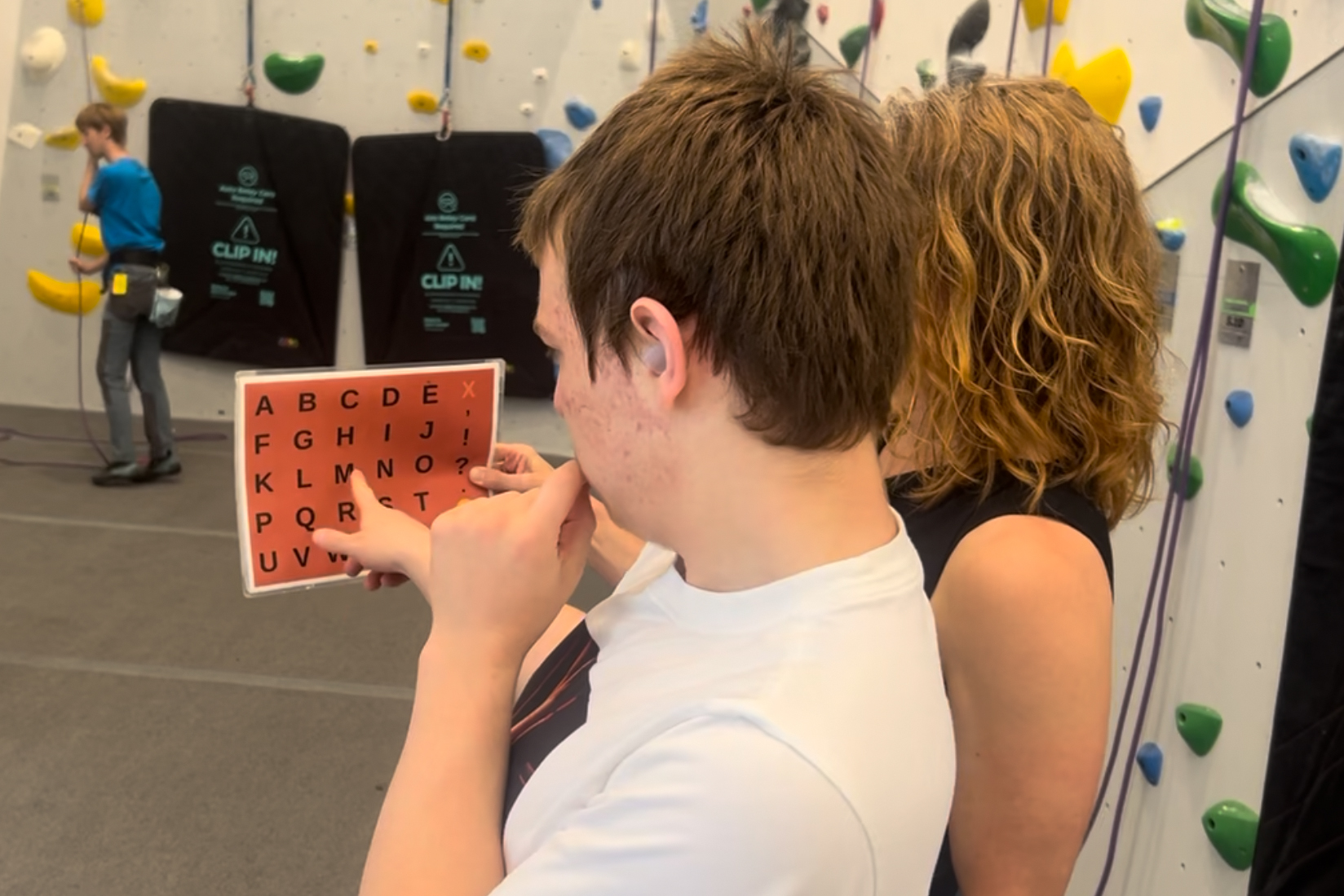
Noah Simmons has spent two years learning to spell and type. At a climbing center in Gaithersburg, Md., he communicated with the aid of his mother, Tracy Simmons, who is holding a laminated sheet with the alphabet. (Arthur Allen/KFF Health News)(Arthur Allen/KFF Health News)
Severely autistic children — those requiring round-the-clock care with ailments like epilepsy and generally lacking in verbal language — account for about a quarter of all U.S. autism diagnoses. Caring for them may mean dropping careers and spending vast sums on therapy. “They ought to spell special education with a dollar sign,” said Tracy Simmons, whose 17-year-old son, Noah, has autism.
Many parents of autistic children have tried vitamins and diets that exclude wheat, soy, or dairy. Some have turned to hyperbaric oxygen chambers, others to pig hormones to repair damage spuriously attributed to measles-mumps-rubella vaccines, and infusions of metal-leaching chemicals to remove traces of heavy metals in childhood shots. Recent regimens include camel milk, broccoli extract, and stem cell injections obtained at great expense in Panama and India.
In September, the White House touted leucovorin, used in some cancer care and for an ultrarare genetic condition. Marty Makary, then-commissioner of the FDA, said the drug could help 50% to 60% of kids with autism.
There’s little evidence behind any of these treatments, Brumback said. Many parents try multiple remedies at once; if a child’s condition improves, it’s hard to tell what worked — or whether the child simply grew out of a problem.
Noah the speller
During a Zoom session in which he typed on a keyboard held by his mother, Noah Simmons wrote glowingly about the world opened to him by two years of learning to spell and type.
“Im a new person. I have friends, I write, climbing,” he typed. “Conversation. I can have one. I have a say. Im human now.”
Later, at an indoor climbing center in Gaithersburg, Md., Noah scrambled nearly to the top of the wall before he slipped. He glided down the rope and slapped a high five with his climbing instructor as his mother approached. She carried a laminated sheet with the alphabet on it.
Tracy Simmons held the paper while Noah stabbed at the letters one by one, ending with a flourishing swipe at the exclamation mark: “Im going to crush it again!”
There, and at a later keyboard session at home, Noah seemed in control. But when Tracy stopped offering verbal prompts and encouragement, or stopped holding the board, Noah often got lost and signaled a need for help.
Tracy Simmons acknowledges that whoever holds the board could be steering a speller’s words. Despite his climbing prowess, Noah lacks fine motor skills, is anxious, and has trouble controlling his body, she said.
“He’s working on becoming an independent typer. He can do it short amounts of time,” she said. “But at times he gets overwhelmed.”
The method used by Noah and his mother came into use in the United States in the early 1990s. At first, trainers guided the arms or hands of the spellers as they pointed to a letter board. The idea was that the intelligence or literacy of severely autistic people was trapped in bodies they couldn’t control. They needed help physically learning to spell, first with a pencil or finger pointing at stenciled or printed letters, and eventually by typing on a keyboard.
Within a few years, however, dozens of experiments had shown that the facilitators, not the autistic people, were doing the spelling. A review published in 2018 found no evidence that the spellers could identify words or objects without their facilitators.
Next came the Rapid Prompting Method, devised by Soma Mukhopadhyay, an Indian mother of a boy with profound autism, who brought her system to the United States in 2001. Elizabeth Vosseller, a speech pathologist in Herndon, Va., launched a nearly identical method, Spelling to Communicate. In both, the facilitator, not the speller, holds the letter board. But each method relies on prompts.
Mukhopadhyay and Vosseller, who did not respond to requests for comment, have each declined to submit their systems to the kind of testing that disproved facilitated communication. Bonker said calls for such tests show a lack of respect for the disabled.
Asked why, after 23 years as a speller, she couldn’t communicate alone or without her mother holding the board, Bonker typed, “I can do it in certain environments that don’t include interviews with strangers.” Severely autistic people need coaches to help control their anxiety, Breen said.
Another star of the speller world, Woody Brown, spoke through his mother with Jenna Bush Hager on the Today show on April 1. The Browns were promoting his novel, Upward Bound, which became an immediate New York Times bestseller after its March release. During the segment, Mary Brown spoke in complete sentences that she said came from Woody, but the letters he typed, as far as the program’s viewers could see, did not correspond to her words and often looked like gibberish.
This raised questions about how Woody Brown could be the author of what critics described as a brilliant, sensitive novel. They pointed out that Mary Brown has worked as a Hollywood script analyst. The Browns did not respond to efforts to reach them for comment.
“Spellers” are best known to the public through the success of The Telepathy Tapes, which briefly unseated The Joe Rogan Experience as the country’s most popular podcast early last year. In The Telepathy Tapes’ first season, people with profound autism were allegedly revealed as clairvoyant superhumans.
The evidence for their telepathic abilities was produced through spelling. The host showed spellers and facilitators two things, and the speller, with the facilitator present, typed out what the facilitator saw. Viewers had to wonder whether this was evidence of telepathy or confirmation of what critics have said all along: that the facilitator is the one controlling the words, often by feeding the speller subtle cues.
Bonker said she appreciated the Telepathy Tapes’ host for including her nonprofit group’s information on its website. As for telepathic skills, “I believe nonspeakers have many gifts,” she said. “And I believe what they say.”
The debate over spelling is playing out in boards of education and courtrooms, where parents of autistic children seek aid for their children’s spelling lessons.
In New York state in March, anti-vaccine advocates for spellers showered scorn on state Sen. Patricia Fahy, the Democratic chair of the disabilities committee, after she inserted language into a disability rights bill requiring that payments go to “verified” communication methods that assured patient autonomy.
Vikram Jaswal, a University of Virginia psychologist who works with spellers, said he’s seen people with severe autism who can type independently, though only a handful have that ability out of the couple of hundred spellers he’s met. More research is needed to figure out who can best benefit from the technique, he said.
Tracy Simmons believes in the method, and so does her son — assuming he’s in control of what he types.
On a recent morning, Tracy read aloud a beautiful escape-from-Alcatraz story she said Noah had written with her help and that of his spelling trainer. “He writes all the time in his head,” she said, but it could take years for her son to consistently type independently.
KFF Health News is a national newsroom that produces in-depth journalism about health issues and is one of the core operating programs at KFF — the independent source for health policy research, polling, and journalism.
Nearly half of educator preparation programs are failing to adequately train future teachers in how to teach reading, according to a new report, even as states across the country have passed laws to overhaul reading instruction.
And in Pennsylvania, even more teacher preparation programs may be falling short, according to the National Council on Teacher Quality, which released a report this week reviewing whether colleges and universities had aligned their instruction for future teachers with the so-called science of reading.
Of 23 graduate and undergraduate programs evaluated in Pennsylvania, five received A’s, according to the report. Just as many received F’s.
Pennsylvania is “among the lowest-performing states in this analysis,” said Ron Noble, NCTQ’s director of teacher preparation.
Some colleges have criticized the group’s methodology, and literacy advocates had mixed reactions to the findings.
Still, progress has been made since 2023, Noble said, as more states have made changes to how reading is taught amid fierce debate over best practices and deepening concern about poor reading scores. Here is what the group found, and how Pennsylvania universities and colleges fared:
How reading instruction is evaluated
For decades, the predominant approach to reading in many schools, balanced literacy, sought to foster a love of reading in children by focusing on stories and de-emphasizing skills-based instruction.
The National Council on Teacher Quality scored education programs on how well they prepare teachers in the “five core components” of scientifically based reading instruction: phonics, fluency, vocabulary, comprehension, and phonemic awareness — the ability to identify units of sounds in spoken words.
The group, which evaluated course syllabi, curricula, and lecture schedules, also considered whether programs taught debunked practices, including “three-cuing” — prompting students to guess words based on context clues — and running records, an assessment that involves listening to a child read aloud to determine what level of book is appropriate.
Programs that earned A’s are adequately covering all five core components, Noble said, while not teaching more than three practices “that run counter to the science of reading.” Those that received F’s, meanwhile, are not adequately covering more than one of the core components, or teaching enough contrary practices that their letter grades were reduced, Noble said.
How Pa. colleges scored
Nationally, the percentage of programs receiving A’s more than doubled from 2023, from 26% to 53%.
(function(){function e(){window.addEventListener(`message`,function(e){if(e.data[`datawrapper-height`]!==void 0){var t=document.querySelectorAll(`iframe`);for(var n in e.data[`datawrapper-height`])for(var r=0,i;i=t[r];r++)if(i.contentWindow===e.source){var a=e.data[`datawrapper-height`][n]+`px`;i.style.height=a}}})}e()})();
Among them was East Stroudsburg University. Brooke Langan, dean of the university’s College of Education, said the school had produced more records in this review.
East Stroudsburg also reviewed its coursework after Pennsylvania required structured literacy competencies to be embedded in teacher preparation programs in 2022, Langan said.
“It really made us take a moment and think about: Did we structure those correctly? Are they scaffolded well for our students developmentally?” Langan said.
Other schools getting top grades were Carlow University, Millersville University, Pennsylvania Western University, and Shippensburg University.
At the other end, Cheyney University, the Commonwealth University of Pennsylvania, Lincoln University, West Chester University, and Widener University’s graduate education program received F’s.
Julie Stellfox, a spokesperson for Commonwealth University, said the school “does not subscribe” to NCTQ’s research methodology. She noted a statement about the report from the American Association of Colleges for Teacher Education, which voiced concern about relying “primarily on document review as a proxy for the quality of educator preparation.”
Nancy Gainer, a spokesperson for West Chester, said that school also disagrees with NCTQ’s methods. She noted that West Chester complied with an “open source request” from the group in 2023 and received a B in its report then; this time, the school did not receive such a request, and West Chester did not supply information, she said.
An NCTQ spokesperson said the group submitted a formal records request to West Chester.
Mary Allen, a Widener spokesperson, said the university had asked NCTQ to reassess the graduate education program “and include additional courses that focus on reading instruction, which were not included in their review.”
“Academic rigor and student success are our top priorities, and we have aligned our teacher education programs to all the required competencies related to structured literacy and the science of reading outlined in Pennsylvania Department of Education guidelines,” Allen said.
Noble acknowledged the criticism of a review process limited to records. But, he said, NCTQ is evaluating whether colleges adequately cover foundational reading skills, and it was “highly unlikely that something that doesn’t appear in course materials” is being taught.
Fewer Pennsylvania programs agreed to be evaluated by NCTQ this year — the program reviewed 33 in 2023, compared with 23 in the latest report. Overall, 63% of Pennsylvania teacher preparation programs did not participate.
Of schools nationally that declined to be reviewed after participating in 2023, NCTQ said, more than 60% had received F’s previously.
It also said that it identified textbook requirements for more than 80% of nonparticipating programs, and found they used textbooks misaligned with the science of reading at the same rates as programs receiving D’s and F’s.
Noble noted that the four largest teacher preparation programs in Pennsylvania either did not participate in this year’s review — Pennsylvania State and Temple Universities — or received F’s, in the case of West Chester and Commonwealth.
“It’s even more concerning: The places producing many of Pennsylvania’s newest teachers are either a black box for us or did not perform well,” Noble said.
Calls for more state oversight
Rachael Garnick, Pennsylvania Literacy Coalition manager with the Teach Plus group, which advocates for structured literacy implementation, said there was value in the report’s effort to evaluate how well colleges are preparing future teachers.
But “I don’t think it’s a conclusive verdict,” including about schools that did not participate, Garnick said, noting that one university she had spoken with said NCTQ had sent its request for information to the incorrect administrator.
Pennsylvania itself needs to do more to hold teacher preparation programs accountable for reading instruction, Garnick said. While the state now requires structured literacy in teacher preparation programs, it does not set requirements for the number of courses or hours of instruction.
And the state’s certification exam for new teachers has not been aligned with the science of reading. For instance, it still includes questions on three-cueing, Garnick said — even though Pennsylvania has banned that practice. The coalition is pushing the state to adopt a standalone exam to test teaching candidates on reading.
The failure of teacher preparation programs to adopt the science of reading has ripple effects, said Kate Mayer, a consultant with Keystone Structured Literacy Partners. Mayer, who has advocated for many Philadelphia-area families whose children are struggling with reading, said she sees area school districts working with universities to make changes to their reading instruction that still are not best practices.
“In my experience, the bar is even lower than it should be for what we’re looking at,” said Mayer, who served on a committee that worked with NCTQ on its scoring rubric in 2019. She said “there should be no excuses” for universities that are not adequately covering the five reading components.
Some states, including Ohio and Indiana, have significantly improved teacher preparation programs through new accountability measures, including audits and the prospect of revoking accreditation, Noble said.
“When you’re providing teacher preparation programs with really clear standards” and consequences for not meeting them, “that’s a recipe for pretty dramatic” changes, Noble said.
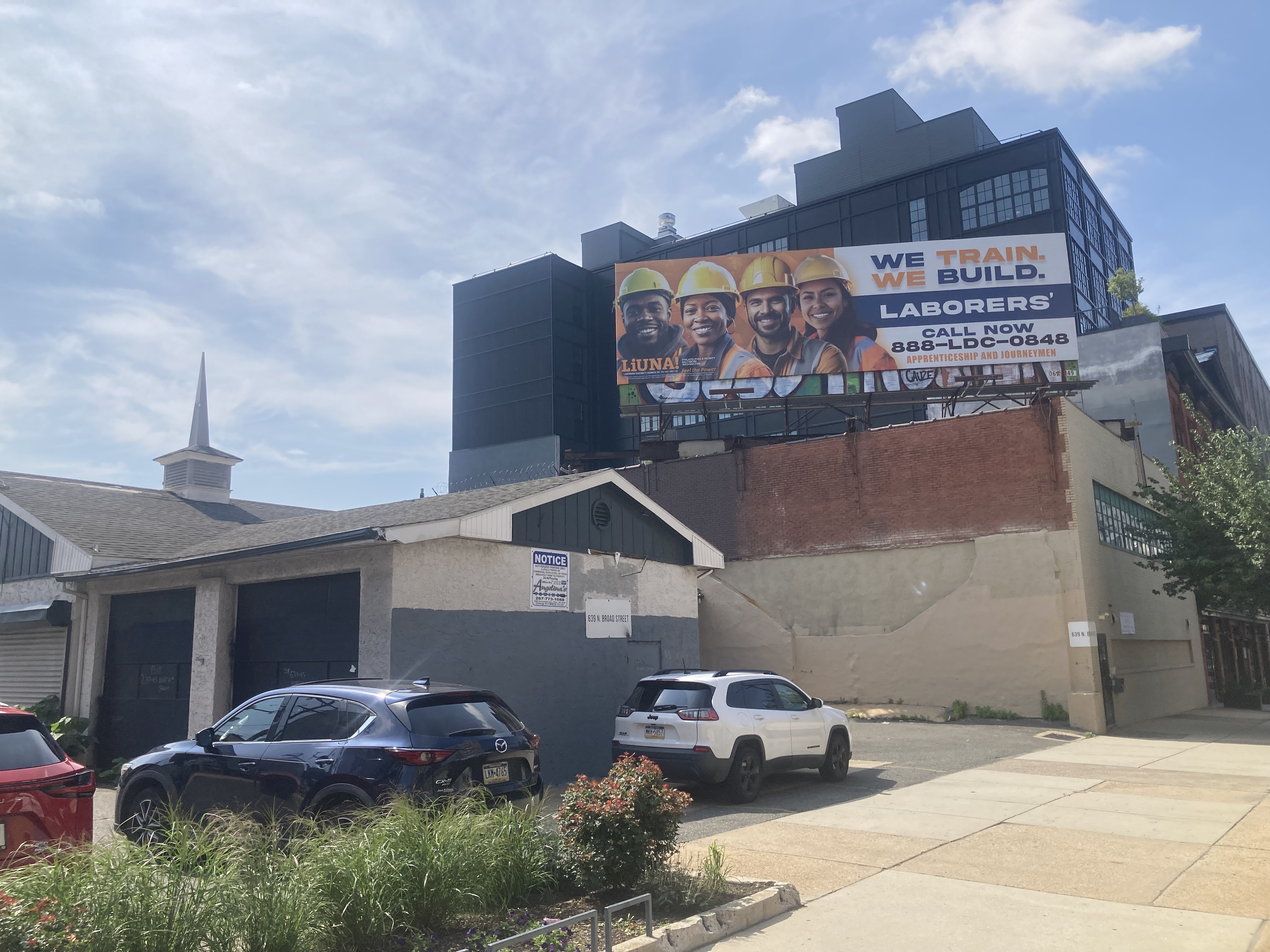
A Long Island-based developer is planning a six-story, 100-unit apartment building — with a rooftop pool — at 639-53 N. Broad St.
The property is owned by the Bill Wolf Petroleum Corp., which has expanded into retail and residential properties from its original focus on gas stations and other fuel-related real estate.
The company has already redeveloped smaller buildings in Philadelphia at Fifth and South Streets and 12th and Walnut.
The company acquired the Broad Street property in late 2021 for $6.9 million, according to city records. This week, Bill Wolf Petroleum obtained demolition permits for the existing auto-oriented and light industrial structures on the lot.
The architect for the project is Stuart Rosenberg of SgRA Architects, who has worked with Bill Wolf Petroleum on its other Center City buildings.
“They are looking for dense, urban, Center City development opportunities. They did not want to be on the outskirts like Northern Liberties or Port Richmond,” Rosenberg said. “They like Philadelphia. At the end of the day, you can build stuff here, so that’s why they’re investing in Philadelphia.”
Documents posted on the Department of Licenses and Inspections website show a 72-foot-tall project, which includes the potential for over 4,500 square feet of bi-level commercial space fronting on North Broad Street.
A parking garage is planned in the rear of the property with space for 33 vehicles as well as bike parking. It also sits directly above SEPTA’s Broad Street Line Fairmount Station.
The property has some of the most flexible zoning in Philadelphia, allowing Bill Wolf Petroleum to move forward easily.
The unit mixture will mostly be one- and two-bedrooms, with a few studio apartments. On the top floor will be between eight and 12 bi-level apartments.
For the exterior, Rosenberg is planning designs in keeping with the surroundings on North Broad Street.
“It’s going to be a classic, industrial type of vibe,” Rosenberg said. “It’s the aesthetic you’d see in a lot of New York or Philadelphia.”
The acclaimed interior design firm Stokes Architecture & Design, which has worked on properties such as Parc and La Colombe’s Fishtown flagship, is being retained as well.
The entrance to both the front lobby and garage will be on Wallace Street on the north side of the site. Retail will front on North Broad Street. In addition to the roof deck with a pool, there will be private balconies for the bi-level units on the top floor and a U-shaped courtyard on the second floor featuring additional outdoor space.
Bill Wolf Petroleum’s project is just the latest in a burst of apartment developments proposed on North Broad Street.
In the last eight months, 1,221 units have been permitted between City Hall and the southern border of Temple University’s campus. Much of the activity is clustered around the former Hahnemann University Hospital.
“This part of the city [North Broad Street] is just really dynamic right now,” Rosenberg said.
Some of the projects, however, are unlikely to break ground any time soon. Property owners like Brandywine Realty Trust obtained zoning permits after Councilmember Jeffery Young proposed a housing ban around the former Hahnemann campus.
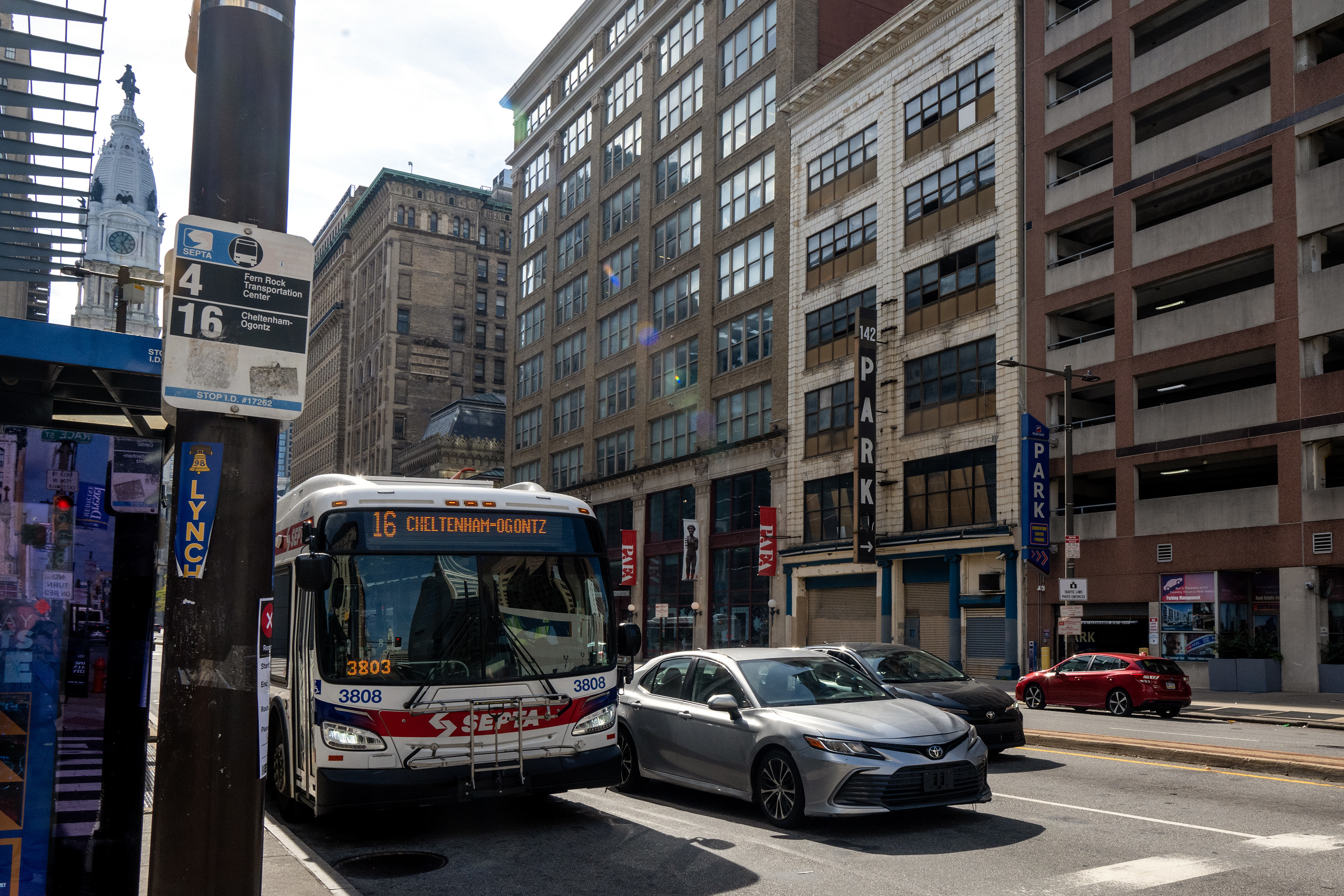
142-44 N. Broad St. is another property slated for apartment development. Tom Gralish / Staff Photographer
Although that bill was put on hold in the face of opposition from most stakeholders in the area — no one outside Young’s office ever publicly spoke in favor of it — the legislation prompted a rush to secure 824 apartment permits before it was shelved.
Bill Wolf Petroleum’s project, which is outside Young’s proposed ban area, stands out because it is one of the only efforts that would not involve redeveloping an existing medical, industrial, or office building for residential use.
The current interest in the North Broad Street corridor comes after an earlier boom, which saw developers like Alterra Property Group, Eric Blumenfeld, and Bart Blatstein scooping up struggling properties and vacant lots after the Great Recession.
Some of those projects came to fruition, such as Alterra’s 410-unit Tower Place at Broad and Spring Garden Streets. Others had a more circuitous fate.
North Broad organizations are watching the new developments with wary optimism.
“I’ve learned to not get excited until there are shovels in the ground,” said Shalimar Thomas, executive director at North Broad Renaissance.
But “it’s the main thoroughfare; it’s a great transportation hub, easy walkable,” Thomas said. “The potential and the bones and the structure are there. Maybe now more developers are starting to see that.”
There has always been a Church of Bruce. Now it has its own building.
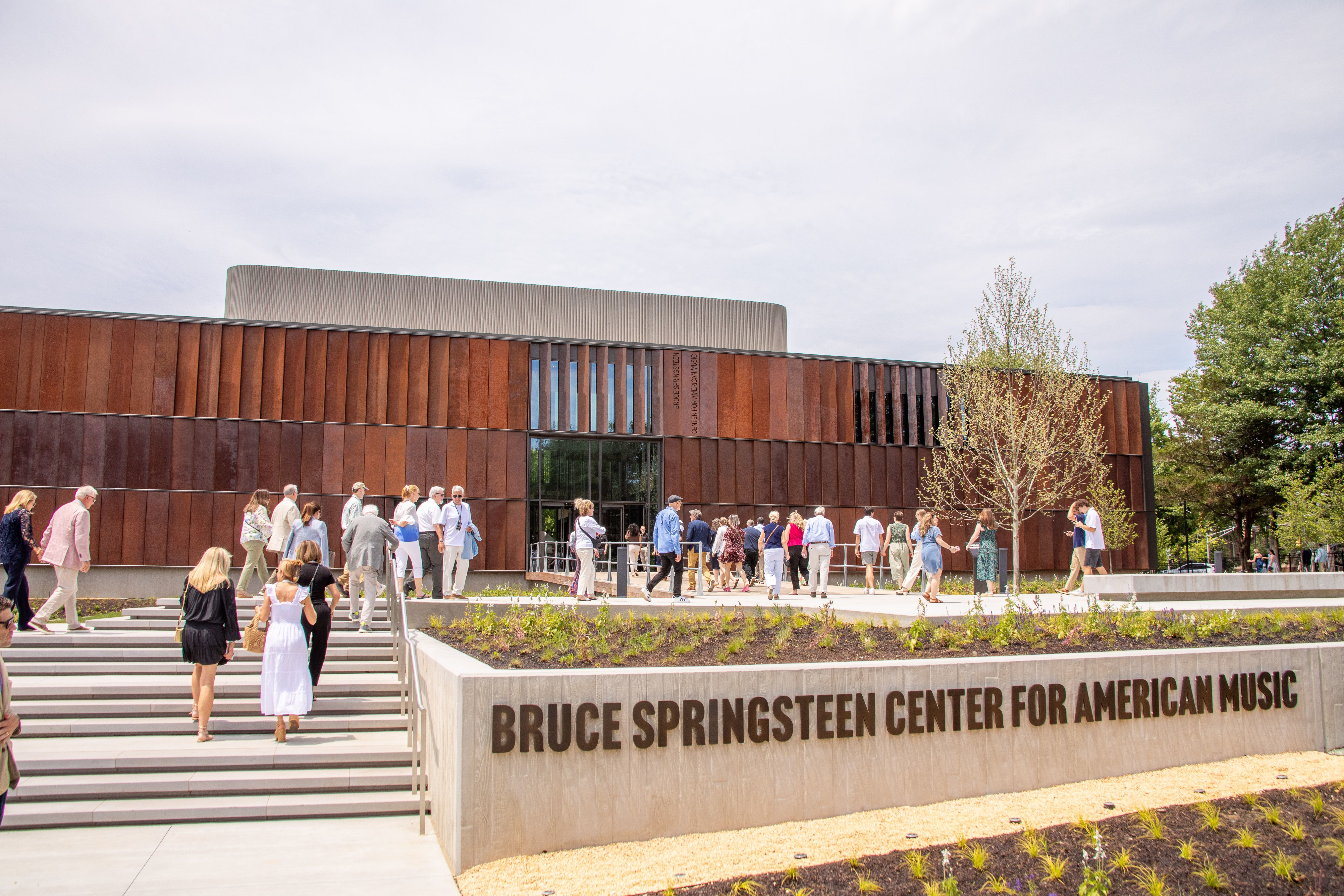
Officially called the Bruce Springsteen Center for American Music, it’s located on the Monmouth University campus, four miles north of Springsteen’s old Asbury Park stomping grounds. As the name suggests, the center — part museum, part archive, part concert venue — is seeking to broaden the conversation by situating the Jersey rocker along a continuum, one that starts with Indigenous drumming rituals and stretches into the hip-hop era.
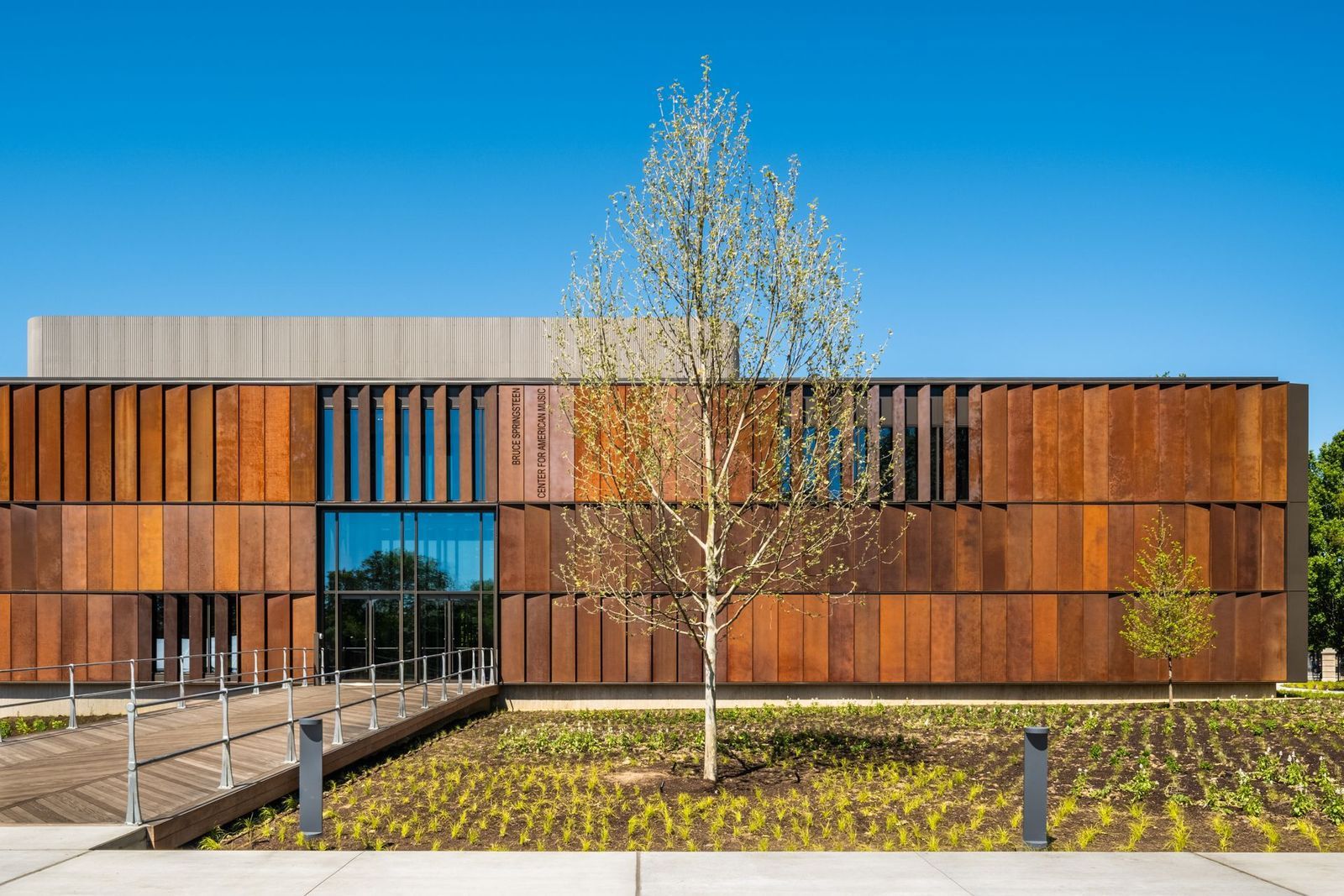
And yet, as you stride up the center’s boardwalk-style entrance ramp, past the memory tree that commemorates the one from Springsteen’s childhood home, and come face-to-face with the building’s rust-hardened steel walls, there’s little doubt that you are really entering Bruce’s house.
Springsteen has been such a cultural presence in American life over the last half century that it is hard to imagine it otherwise. Every detail of the building designed by New York’s CookFox Architects is keyed to some piece of his well-known biography. The joy in the architecture, particularly for the legions of Springsteen superfans, will come from decoding the references.
Guests gathered June 7 for the opening of the new Bruce Springsteen Center for American Music on the campus of Monmouth University in Long Branch, N.J.Monmouth University
There is the site itself, on the shady university campus where Springsteen played one of his first big concerts in 1969, at a time when most of his gigs were confined to dive bars. The simple rectangular building is put together with the same devotion to craft you find in Springsteen’s lyrics, and it’s similarly infused with grit.
On the facade, vertical slats of weathering steel angle in search of sun and shade. Their calloused red surface evokes the aging factories that stood on the edge of Springsteen’s hometown of Freehold, and that form a recurring motif on “Born in the U.S.A.,” an early and prescient elegy for America’s dying manufacturing towns and diminished working class.
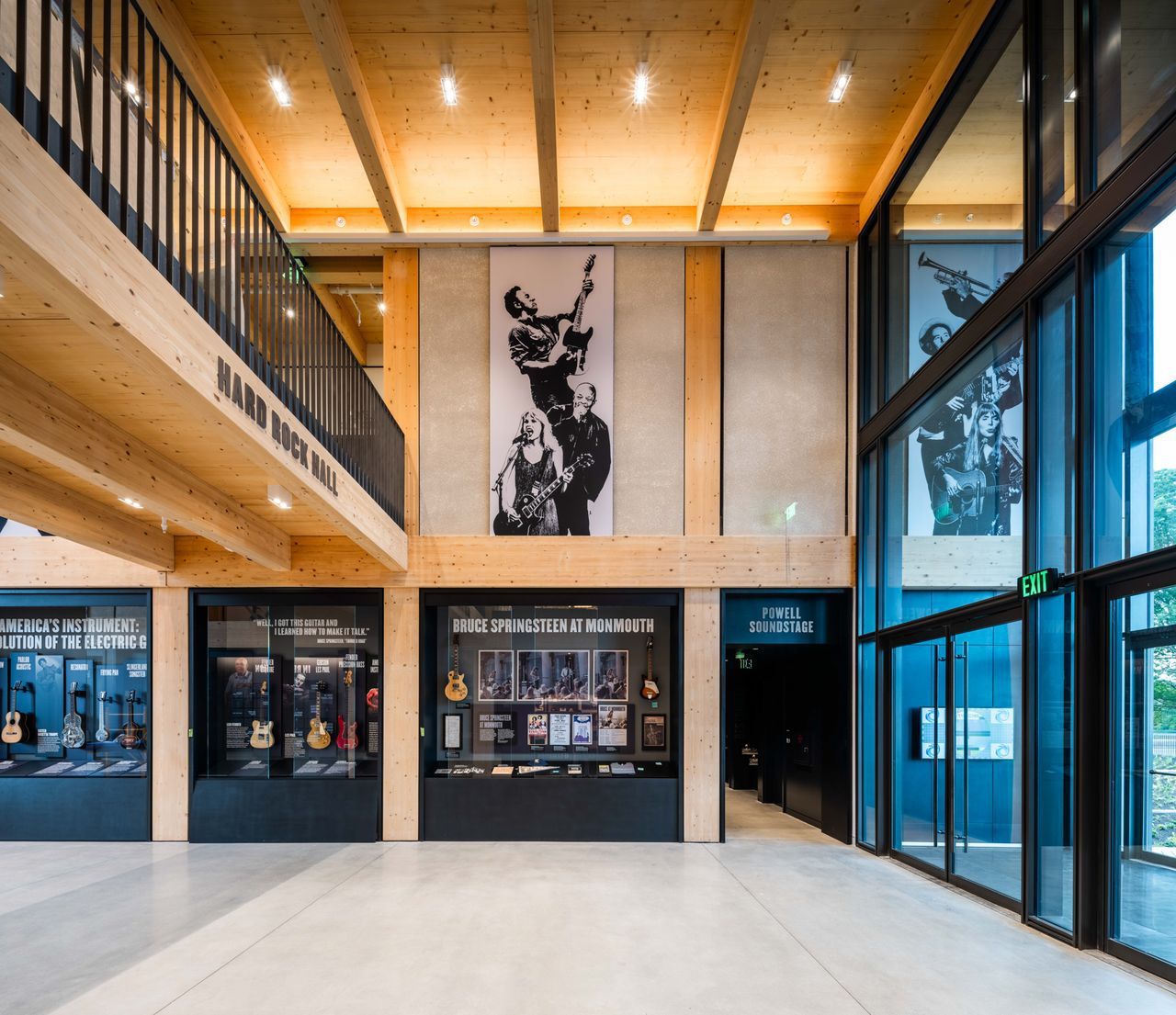
That industrial theme is reinforced once you step inside. Muscular columns and beams, made from environmentally friendly engineered wood, structure the interior. There are wood slats on the ceilings and chunky blocks on the theater floor. They are the same hardy, end grain cut that factories once used to support heavy machinery.
Why fans will come
While Springsteen’s work tends toward darkness, the new center, which opens Saturday, emphasizes the light, both in its design and in the content of the exhibits.
Most visitors probably won’t be making the pilgrimage to Long Branch for the architecture, good as it is. They’ll come for the same reason they have attended so many concerts over the years, standing for the Boss’ relentless, three-hour jams and chanting the lyrics by heart. His stories of yearning and defiance have become the soundtrack for their lives. The $50 million center promises to serve as a giant scrapbook for those memories.
The project’s origins go back to 2011, when a donor gave Monmouth University a collection of Springsteen memorabilia, mostly posters and magazine clippings. At the time, it seemed likely that Springsteen’s much larger personal archive would end up at the Rock & Roll Hall of Fame in Cleveland.
The university nevertheless continued to expand its holdings, and in 2016, several people connected with the collection decided to make a play for Springsteen’s personal archive. A delegation was sent to meet with the musician and make the case that the material belonged in New Jersey, not Ohio.
Springsteen’s longtime manager and friend, Jon Landau, “loved the idea,” recalled Eileen Chapman, the center’s director. Springsteen agreed to donate his archive to the university — gratis — and the university agreed to erect a suitable place to house it.
The Boss did make one stipulation: He didn’t want the exhibits to focus on him exclusively, said Robert Santelli, a Grammy-award winning music historian and Monmouth alum who is now the center’s executive director. Once again, the university agreed, and the center’s scope was expanded.
”The Bob Dylan archives are about Bob Dylan. The Woody Guthrie Center is about Woody. We felt the best way to tell Bruce’s story was to make him a chapter in an ongoing story of American music,” said Santelli, who has helped start several music museums, including the Grammy Museum in Los Angeles.
Everything went smoothly at first. CookFox Architects, who are known for their commitment to both green and healthy design, won the design competition for the center in 2018. Then the pandemic hit and fundraising slowed.
First exhibit: Protest songs
Although it has taken eight years to get to this point, there is a certain poetic alignment in the timing of the opening, as America celebrates its 250th anniversary. The center’s first special exhibit will be devoted to protest songs.
Richard A. Cook, the CookFox partner who oversaw the design, considers himself a casual fan. But he said he was deeply moved by the passages in Springsteen’s autobiography about his father, who struggled with bipolar disorder, as Cook’s father did. As an architect, he has embraced biophilic design, which uses sunlight and nature to shape soothing interiors.
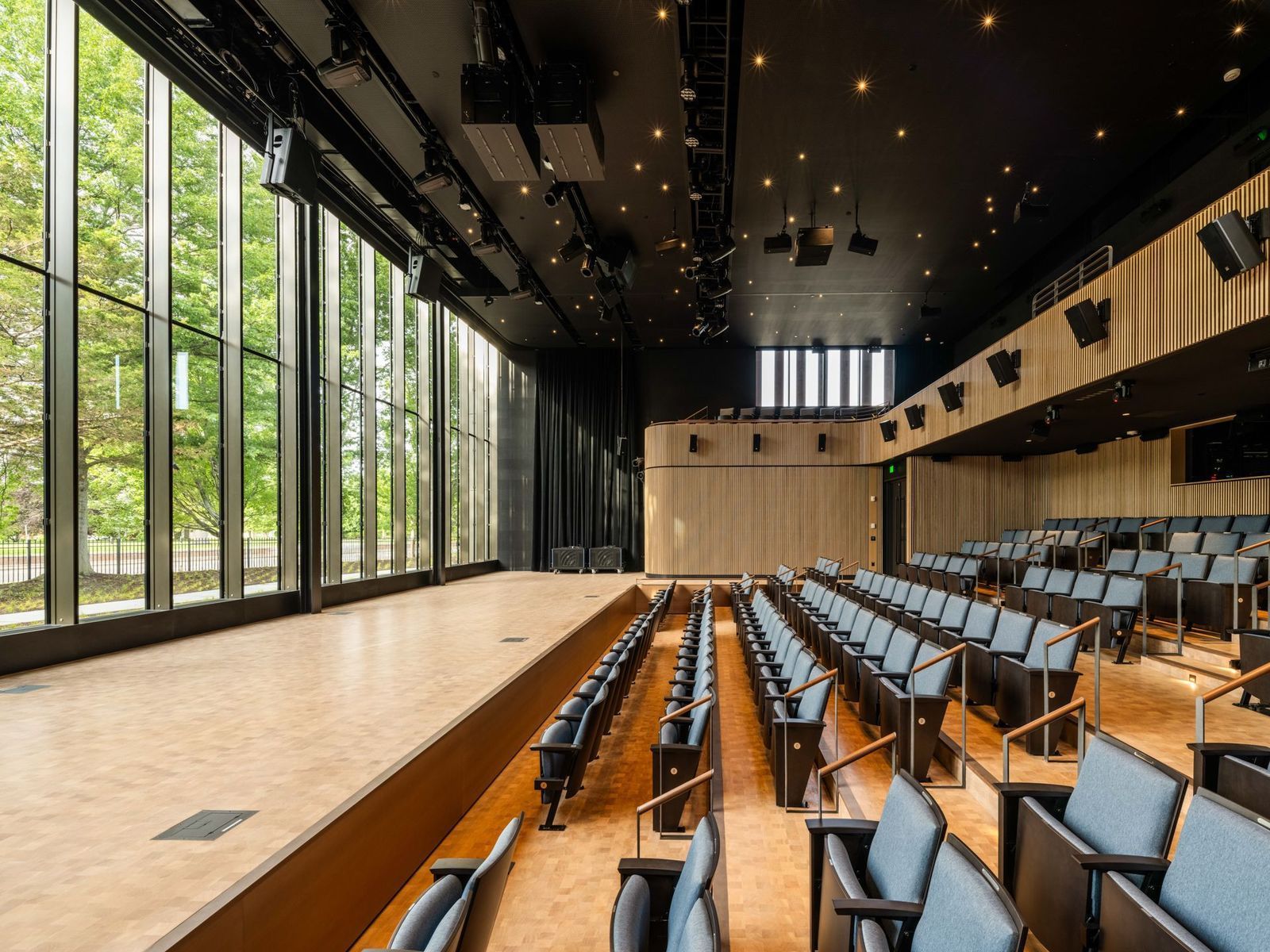
Entering the building from the boardwalk, visitors will be immersed in a calming, double-height hall flooded with natural light and smelling of wood. From there, they are directed to an intimate, 240-seat auditorium — where more light pours in from a floor-to-ceiling glass wall behind the stage — for an introductory film by Thom Zimny.
The theater is easily the most expressive space in the building. It is rare to see such large windows in a performance venue, which are typically hermetic boxes that overwhelm the street with blank walls. By offering views of the planted meadowland that encircle the center, Cook sets the mood for the entire visitor experience. Just before a film or concert starts, a curtain and screen will drop down, completely covering the wall.
Sound quality was a priority, and the theater is outfitted with the latest technology and acoustical materials. Unlike most stages, this one has no steps, which means performers who use wheelchairs can roll directly onto the platform. Even in this space, Springsteen’s presence is conveyed through the use of denim upholstery on the seats.
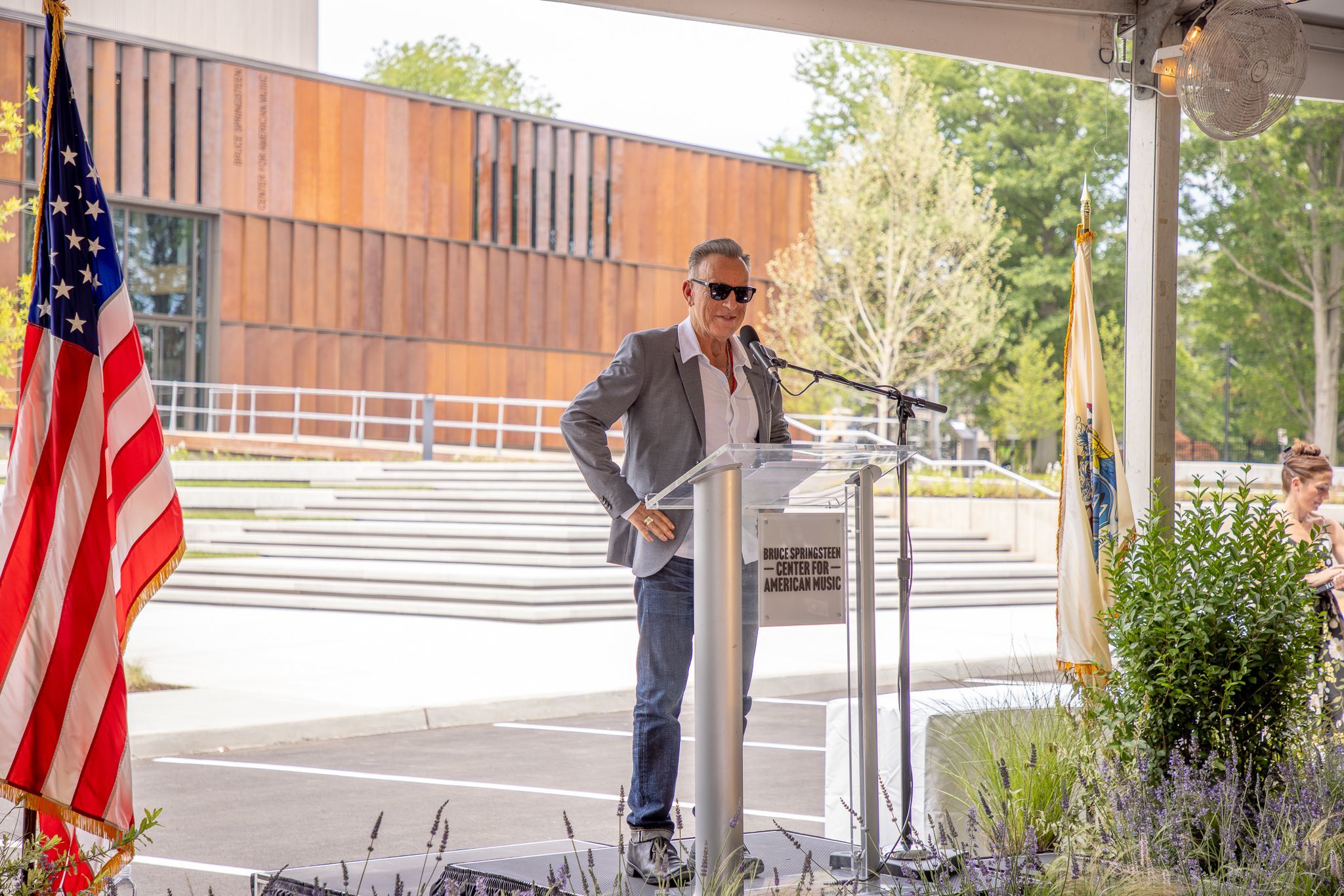
As Springsteen himself remarked at the June 7 dedication, “The building really feels like me, feels like where I came from.”
Springsteen’s archive, open to all
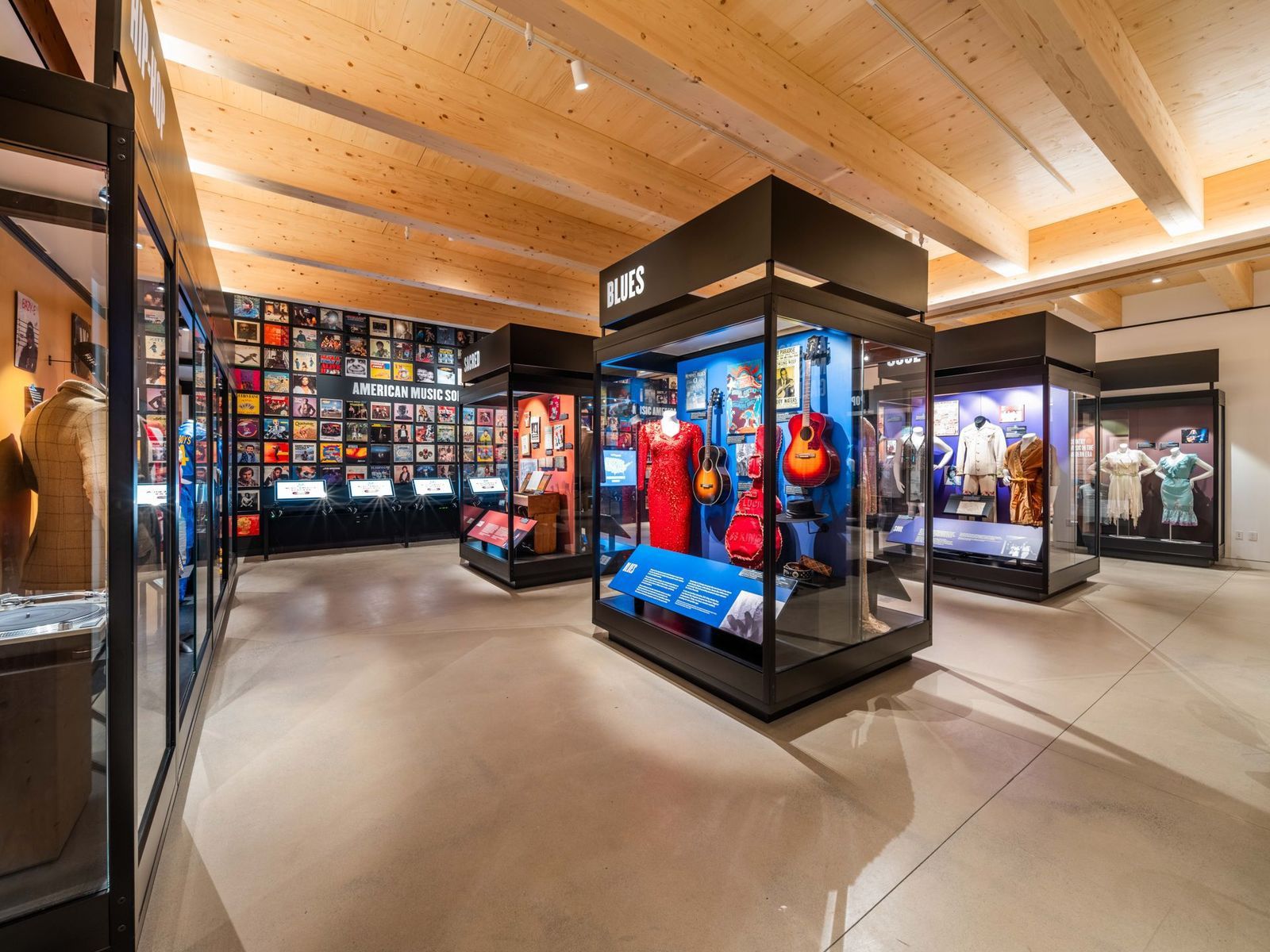
The rest of the building is divided neatly in half: A permanent exhibit on American music and a special exhibition gallery occupy the ground floor. Upstairs, it’s all Springsteen. Those second-floor exhibits include several interactive displays, including a room of instruments where visitors can don headphones and hear tips for replicating Springsteen’s music.
But the heart of the center is the archive. While many museums limit access to scholars, this one is open to everyone. Springsteen was known to labor for months on some songs, and Chapman says she wants to use the archival material to bring his artistic process to life.
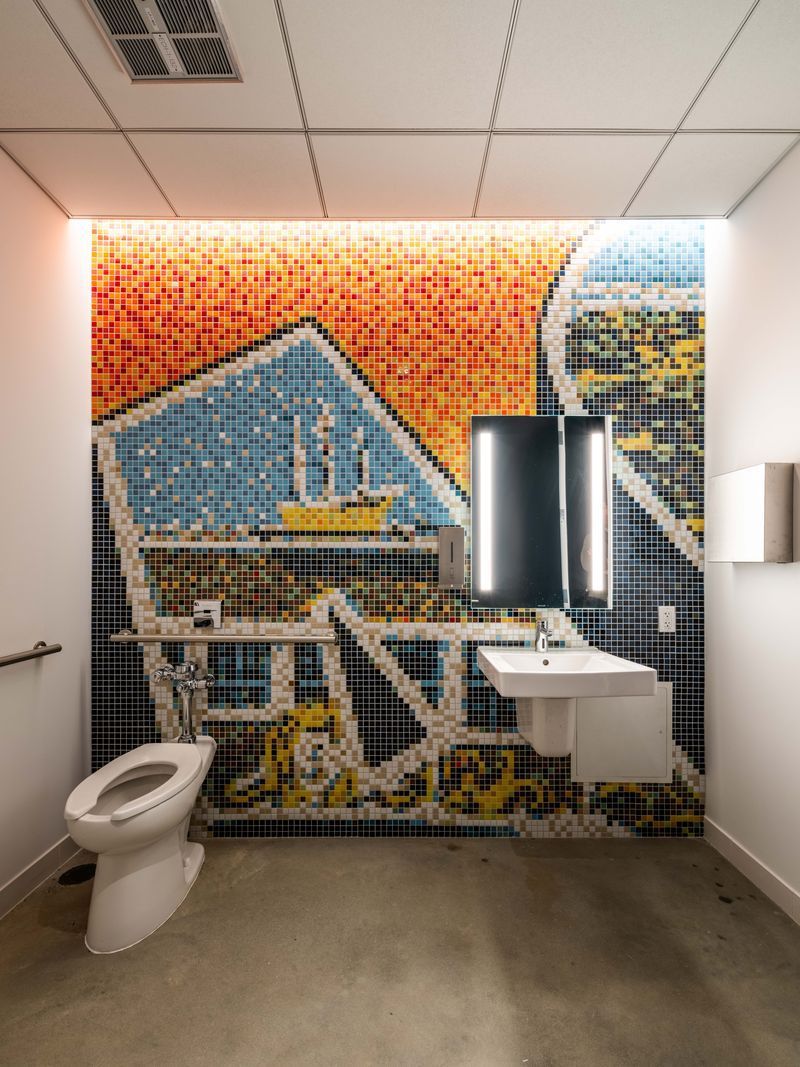
Probably the most literal reference to Springsteen’s work can be found in the restrooms. The architects converted the cover of Greetings From Asbury Park, N.J. into bathroom tile, then cut it into sections and installed a piece in each restroom. It’s a nice idea, but I suspect only hardcore fans will be able to recognize the source of the scaled-up, pixilated image. A room filled with iconic photographs of Springsteen, donated by Philadelphia lawyer Robert J. Mongeluzzi, also feels a bit padded.
Outside, the center, which received a Gold certification from the U.S. Green Building Council, is surrounded by a sustainable and biodiverse meadow by LaGuardia Design Group. A small concert venue has been tucked in amid the flowers.
Plenty of museums around the world are devoted to individual visual artists (i.e., Calder Gardens) and important historic figures, but exhibits focused on popular musicians seem to be growing by the day, perhaps in response to the increasing sophistication of audio and interactive technology. Along with museums covering specific musical genres, shrines are devoted to the work of Dylan, Guthrie, Johnny Cash, Louis Armstrong, and, of course, Elvis. The Springsteen Center won’t be the last.
Although Monmouth University is a 90-minute drive from Center City, the center is close to several Springsteen-specific sites, including the Long Branch house on West End Court where he wrote “Born to Run,” as well as several Asbury Park venues.
The Jersey Shore has been an incubator for musical talent for nearly a century, from Count Basie — the “Kid from Red Bank” — to Jon Bon Jovi, yet that legacy has never gotten its due. While Springsteen’s name is the one etched onto this building, the project is really a validation of New Jersey’s enormous contribution to the history of American music.
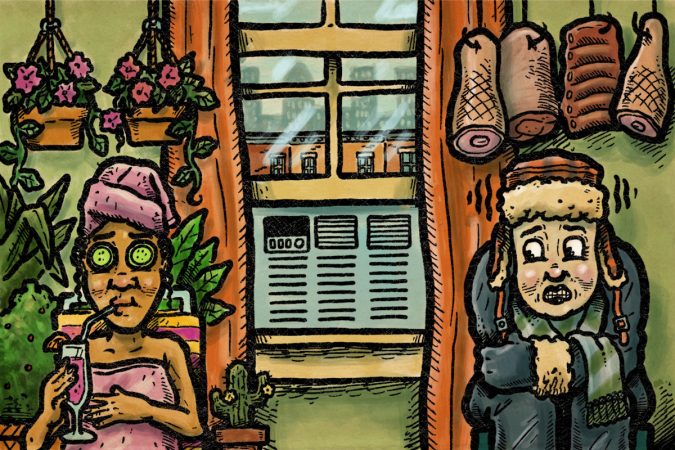
Hi we decided to write this together so you have both sides fairly represented. We recently moved in together and it’s going great (young, gay, in love!), but we only have AC in the bedroom. One of us prefers the room wayyyy hotter than the other at night (80 degrees vs. 70 degrees). One of us argues that at 70 degrees, the other person can just wear sweatpants. The other one argues that at 80 degrees it’s not that hot, it saves money, and the other person can focus the fan on themselves. What do we do?
Earl Hopkins, Arts & Entertainment Reporter
As someone who naturally runs hot, especially during the summer months, anything above 76 degrees is an absolute no go. I never understood why some people like to bake under their covers, but our bodies all operate differently.
I think an easy compromise is to place the AC somewhere in the middle. Maybe around 75? That seems reasonable to me.
Stephanie Farr, Features Columnist
First, I love that they wrote this together. It shows they communicate well and are willing to face problems openly and honestly, which is a great foundation for any relationship.
Second, it’s often said that one of the things couples argue about most is money, but I’m of the firm belief ambient room temperature ranks pretty high up on that list, too. It’s something you may not even think about until you move in with someone and realize they are the Human Torch or Mr. Freeze.
In my house, I am Mr. Freeze, so I’m fully siding with the partner who has the totally reasonable request to keep the AC at 70. 80 is way too hot. Heck, thanks to the Human Torch I live with I’ve discovered even 75 is too hot at night for me to sleep with a blanket on — and I need a blanket to sleep.
What’s your opinion on putting on more clothes vs. using a fan?
Earl Hopkins
I think it’s way easier to add a layer of clothes than it is to have the sound of a fan buzzing in your ear all night. It’s OK when there’s a heatwave and broken AC. But beyond that, I recommend throwing on a pair of sweats, a long sleeve shirt, or a beanie.
Also, I’m no electrician or HVAC specialist, but are you really saving that much money? I don’t know. Stephanie, how do you feel about cuddling as an alternative to 80-degree temps? I think there’s a cheat code there.
Stephanie Farr
Oh I love the cuddling idea! It promotes intimacy and is a good argument against keeping it warm in the room. Nobody wants to cuddle someone when they’re all hot and sweaty.
And I’m with you on more clothes vs. fan. You can always put more clothes on when you’re cold or pile up the blankets (and cuddle!), but when it’s getting so hot in there you’ve already taken off all your clothes and you’re still sweating, what then? Are you supposed to sleep with ice packs because a fan alone will not cut it?
Do you think that only having one room with AC — aside from the whole house — should factor into the decision?
Earl Hopkins
I think so! If there’s only one room your partner can truly get cozy in, give them free rein. It’s like giving your loved one the last slice of pizza or chocolate cake. Of course you want it, but it’s a lovely gesture that doesn’t require much sacrifice. A little chill at night won’t hurt!
Stephanie Farr
Agreed! The AC room should be considered a human refrigerator in this home — an arctic oasis where the one who’s Mr. Freeze can escape and find solace. The Human Torch partner already has all the other rooms nice and toasty, so they can go to sleep in one of them if they don’t like the cold.
I wonder if the partner who wants it 80 degrees at night may not be from the U.S. In that case, this makes a bit more sense. We’re very spoiled here. I remember a great column last year by Adrian Schulz, a journalist from Berlin who did a fellowship with us at The Inquirer last summer. He expressed shock, confusion, and mild horror at our AC habits here, writing: “Am I in a restaurant or in the Siberian Tundra? Am I at an airport gate or in a cryogenic chamber? Am I on the Broad Street Line or the Polar Express?” Meanwhile, when I went to Germany in September 2024, I was shocked, confused, and mildly horrified by the lack of AC everywhere amid sweltering heat.
It’s what you’re used to, I guess, but living with a partner means getting used to new things. I think Earl has the best idea — a compromise at 75 — to start out (then slowly inch the temp down from there by dangling the possibility of more cuddles).
When organizers announced two years ago that Philly’s FIFA Fan Festival site for the World Cup would be at Lemon Hill, many Philadelphians responded with a collective: Huh?
Located between the Philadelphia Museum of Art and Girard Avenue, the grassy site in East Fairmount Park hasn’t hosted many big public gatherings, though it was the staging and undressing area for the Philly Naked Bike Ride in 2022.
In my many years in Philly, I’d never covered an event at the site — and I’d never been to a FIFA Fan Fest either, which features live broadcasts of the games, entertainment, vendors, and soccer-related activities. So I went on Thursday, the opening day of the 39-day festival, to bring a minute-by-minute report of what I experienced to you.
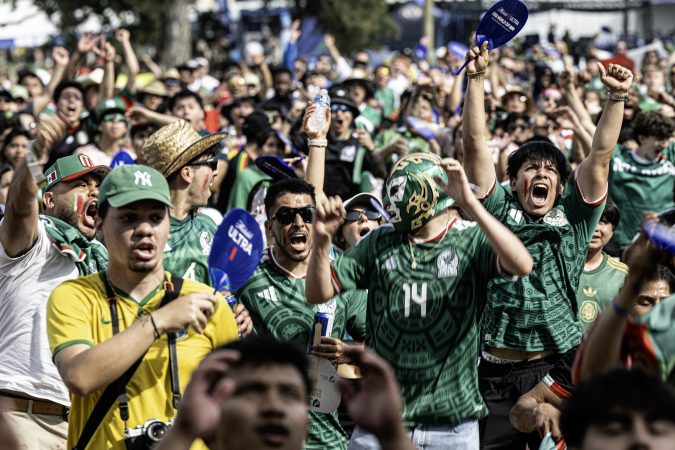
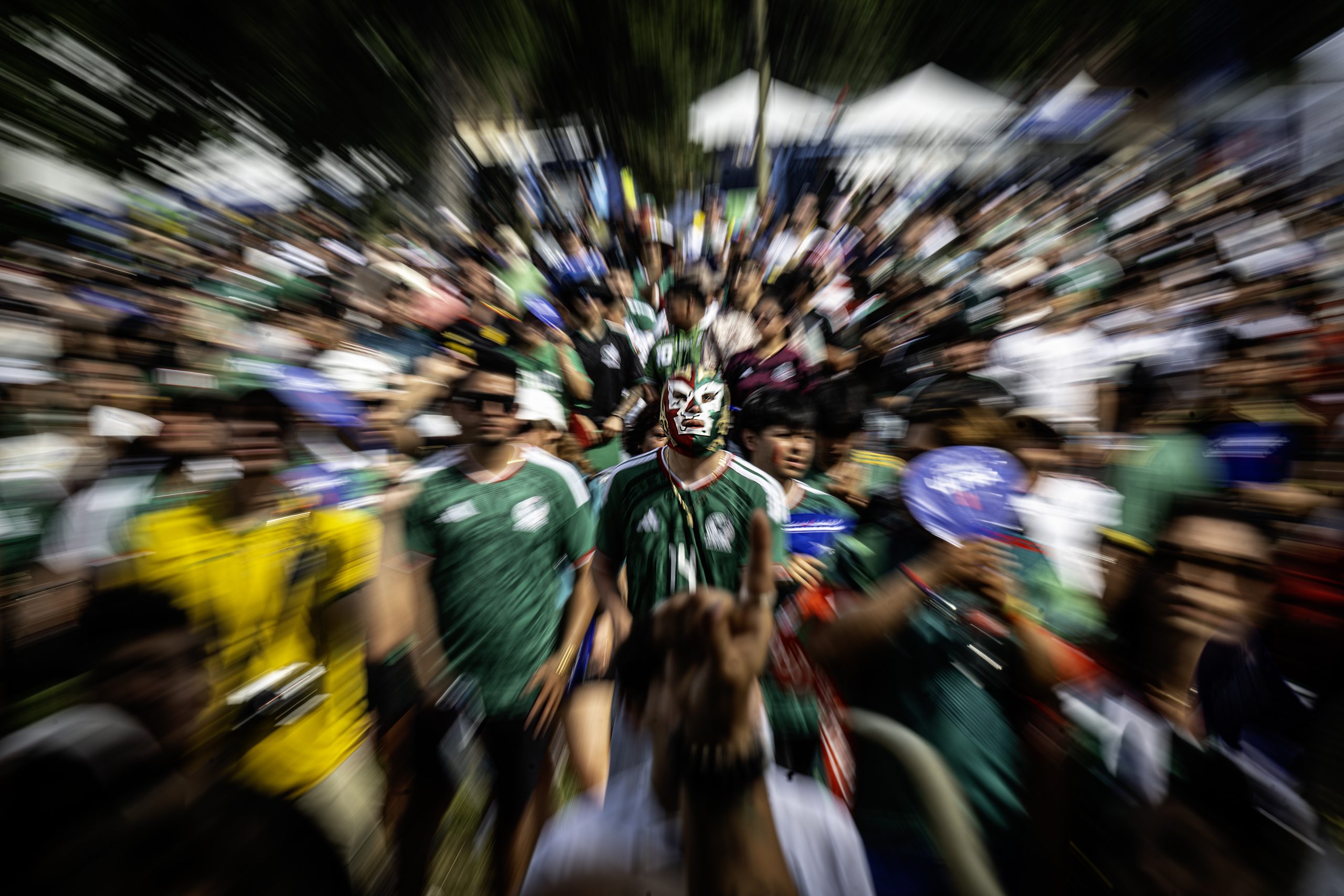
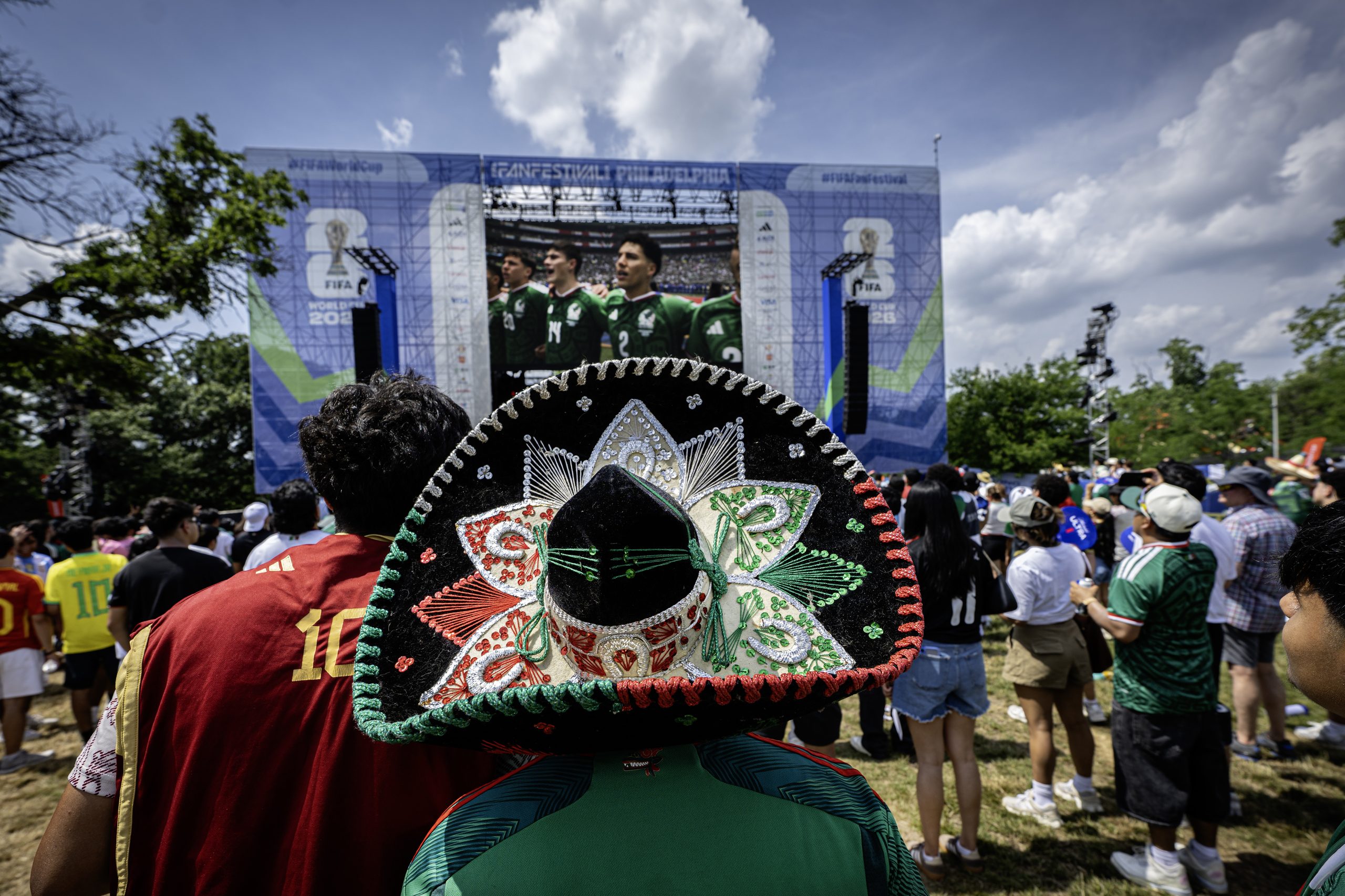
Using a zoom lens technique, Mexican fans watch the FIFA World Cup opening match between Mexico and South Africa on a giant screen during the opening day of the FIFA Fan Festival at Lemon Hill on Thursday.Jose F. Moreno / Staff Photographer
I knew the journey wouldn’t be easy. Not only were temps forecast to be in the mid-90s (with heat indexes over 100 and a heat health emergency in place), you can’t drive to the site, or get close with ride share apps. Roads around the venue are closed and street parking has been restricted to neighborhood residents.
To get to the event, the city is urging guests to take the Philly PHLASH bus, take SEPTA’s bus routes 32 or 48, use a bicycle, or walk. I chose the latter.
12:30 p.m.
I begin my journey at LOVE Park, where I see a group of five friends in their team Mexico jerseys — and a sixth in a white T-shirt and sombrero — getting their photo taken with the LOVE statute.
Alexis Arellano, 29, tells me they’ve come from Atlantic City to catch the Mexico v. South Africa game at the FIFA Fan Festival.
“It’s a once-in-a-lifetime opportunity. You’ve got to take advantage of everything they got going on. It’s in our backyard,” he said.
12:39 p.m.
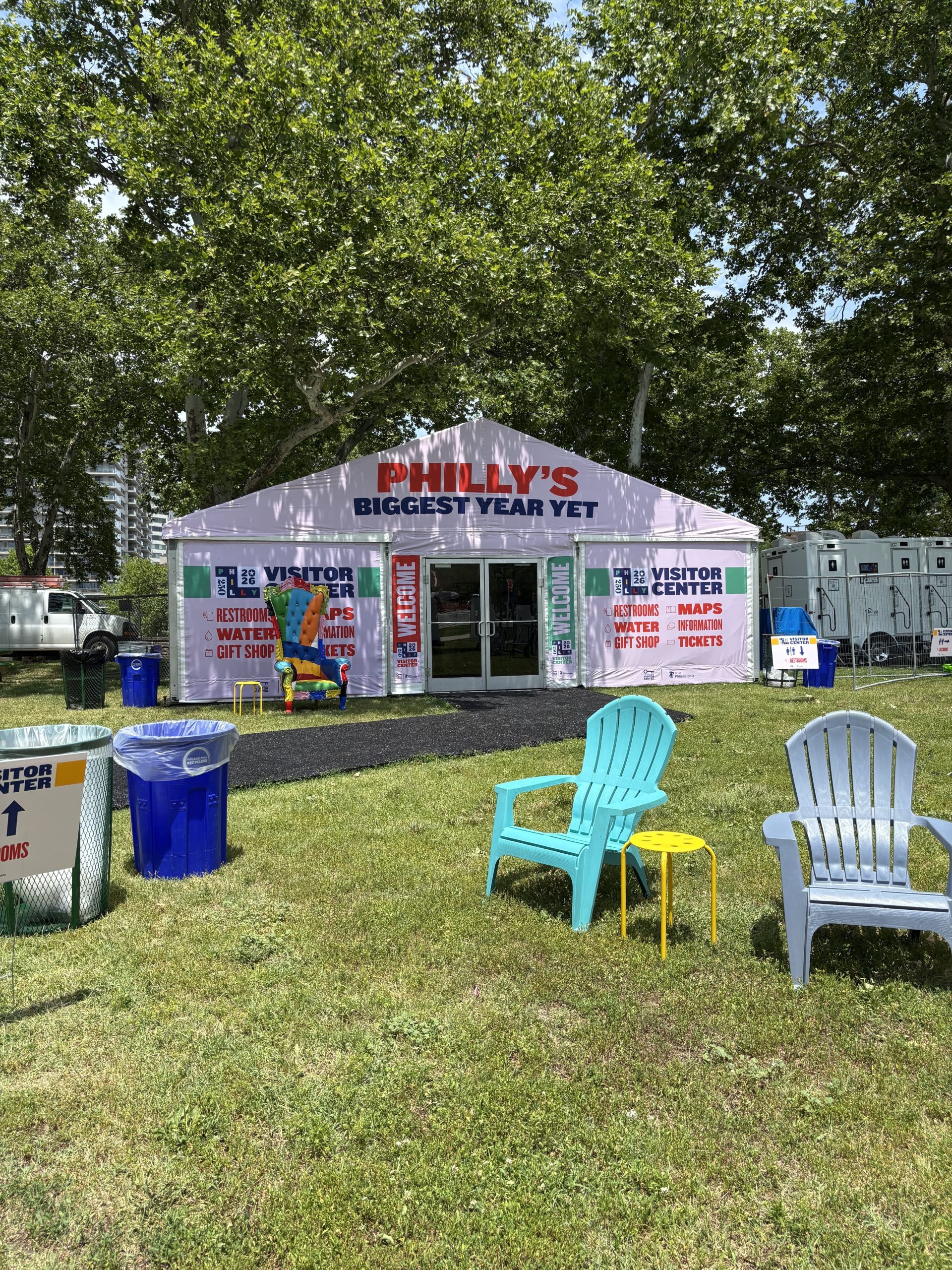
I stop into the pop-up Philadelphia Visitor Center hospitality hub at the park. The space is tiny, but the air-conditioning feels like silk sheets on my sweaty skin. I strongly consider buying the $14 portable fan that sprays wooder at your face and ponder at a bucket hat that reads: “Freedom has a Philly accent.”
12:45 p.m.
I head over to the public bathroom trailer that’s temporarily been installed in LOVE Park in front of the circular building known as flying saucer.
“What a waste,” I think, as I look up at the very cool saucer, which remains closed and empty, despite a call-out last year from the city for ideas to reactivate the space in time for the World Cup and the Semiquincentennial.
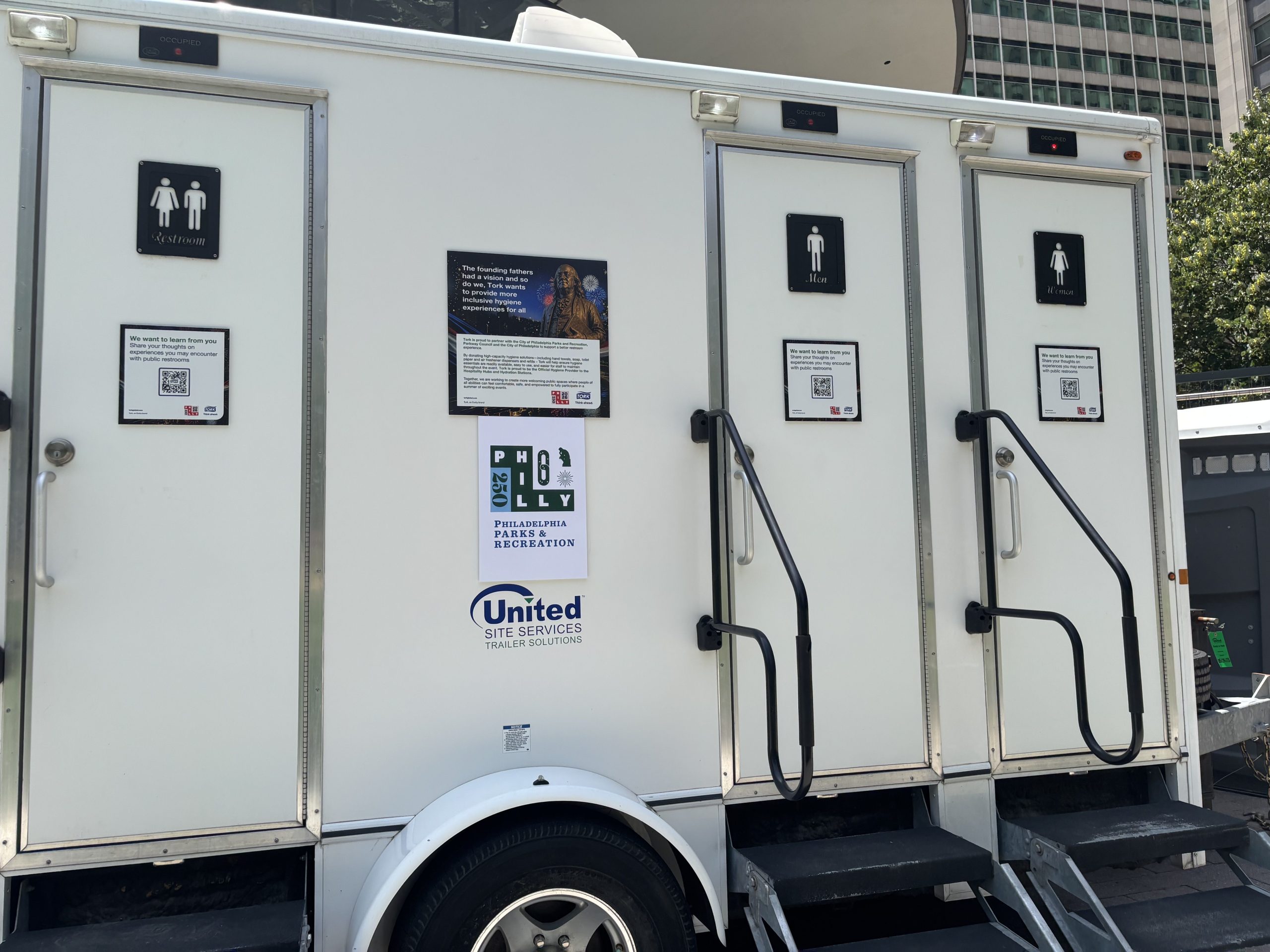
The new, temporary public bathroom trailer set up in LOVE Park.Stephanie Farr / Staff
I step inside the bathroom trailer. Not only is it air-conditioned, it’s outdoor-wedding-quality nice. Next to the trailer is a sink of water fountains and water bottle-filling stations.
1:15 p.m.
After making my way down the Ben Franklin Parkway, I spot another, larger hospitality hub across from Eakins Oval. This one has several large boards in front of it you can stick your face into to get a photo with Gritty, Rocky, or Patti LaBelle.
When I step inside the hub, I almost weep tears of joy because it’s so cold. It has much of the same items as the other, but with more Rocky merchandise (“Yo, Adrienne! Buy my stuff!”).
The pop-up Philadelphia Visitor Center hospitality hub across from Eakins Oval.Stephanie Farr / Staff
Outside of the hub, I meet Valentine Emeré, 20, and his parents, who are on holiday from France and had no idea the World Cup was in town. They’re in Philly as part of an East Coast tour of the U.S.
“It’s a very good city, it’s a living city,” Emeré tells me when I ask his thoughts on Philly. “We really like how many things there are to do.”
1:41 p.m.
I arrive at the FIFA Fan Fest welcome center tent. Aside from the oppressive heat, the walk was easier than I expected. I pass the Philly Phestival Marketplace, a row of vendors selling everything from nail polish to onesies that read “baby jawn.”
1:48 p.m.
At the Glitterbrush Facepainting booth, I chat up Martiza Quendo of North Philly, who wore a team Mexico shirt, and Marissa DeMatteo of South Philly, who was repping team USA. They’d just had their faces painted and told me they came to Fan Fest because they love free merch and “participating in Philly.” Mostly they were there for the live Luis Fonsi concert after the Mexico vs. South Africa game.
Martiza Quendo of North Philly, at left in a team Mexico shirt, and Marissa DeMatteo of South Philly, at right in a team USA shirt, pose after getting their faces painted at the Philly Phestival Marketplace.Stephanie Farr / Staff
1:52 p.m.
As several hundred people wait in line for the gates to open, visitors pose for pictures in front of a large soccer ball surrounded by fresh flowers, a photo-op that looks straight out of the Philadelphia Flower show. An enterprising street vendor nearby tries, without success, to sell umbrella hats.
“You think business would be better in this heat,” he says.
2:10 p.m.
Philadelphia Mayor Cherelle L. Parker joins fans in a Mexican chant before entering the FIFA Fan Festival at Lemon Hill on opening day of the FIFA World Cup 2026 on Thursday, June 11, 2026, in Philadelphia. Fans gathered to watch Mexico face South Africa in the tournament’s opening match.Jose F. Moreno / Staff Photographer
Gates open to the festival, a little behind schedule, but folks get in calmly, quickly, and with little trouble. Some come in singing, others run in waving Mexican flags. My colleague, photographer Jose Moreno, later shows me pictures of Mayor Cherelle L. Parker walking in with the crowds.
2:18 p.m.
I stop by the Home Depot activation, billed as “Beckham’s Backyard,” which features the facade of a home with a 12-foot-skeleton in front of it. An employee tells me this mimics a backyard with Beckham’s flair.
“He’s not here though, right?” I ask.
“I wish. This would be a lot more popular if he was,” he said.
Inside, there is a giant Home Depot bucket with a TV screen inside showing games. The nearby Casamingos stand selling margaritas for $17 appears to be far more popular.
2:26 p.m.
I ask an employee manning the Bank of America activation why the line there is so long. He tells me they’re letting people make their own bracelets — with very cool Philly and World Cup charms — for free.
2:28 p.m.
At the Visit PA pavilion, the lines for the free prize wheel and claw machines — which dole out Visit PA-branded merch — were very long.
But nobody was at the “Soccer Jawn” video game, which pits two players head-to-head in a Pong-like game of soccer on a big screen. I yell to a young woman passing by to battle me and she accepts my challenge.
Biance Yetta, 16, of Easton, beats me 5-4. In my defense, she plays soccer on a traveling team and I’ve never played before in my life (though I’ve probably played way more Pong).
2:38 p.m.
A message plays on the 60-foot-wide main screen of the festival from astronauts aboard the International Space Station. I’m too far away to hear everything they say, but I can make out the words: “Sharing one planet, one game,” and that makes me smile.
2:40 p.m.
I walk into the massive FIFA Fan Fest store, which is so well air-conditioned I almost fall to my knees and thank the gods of consumerism.
I browse for a bit, but when I check the price of a FIFA cropped women’s sweatshirt — $104.99 — I walk right back out.
2:56 p.m.
The national anthem of South Africa begins and crowds gather around the big screen. Folks try to hide under what little shade is available, but most of us are forced to swelter in the sun.
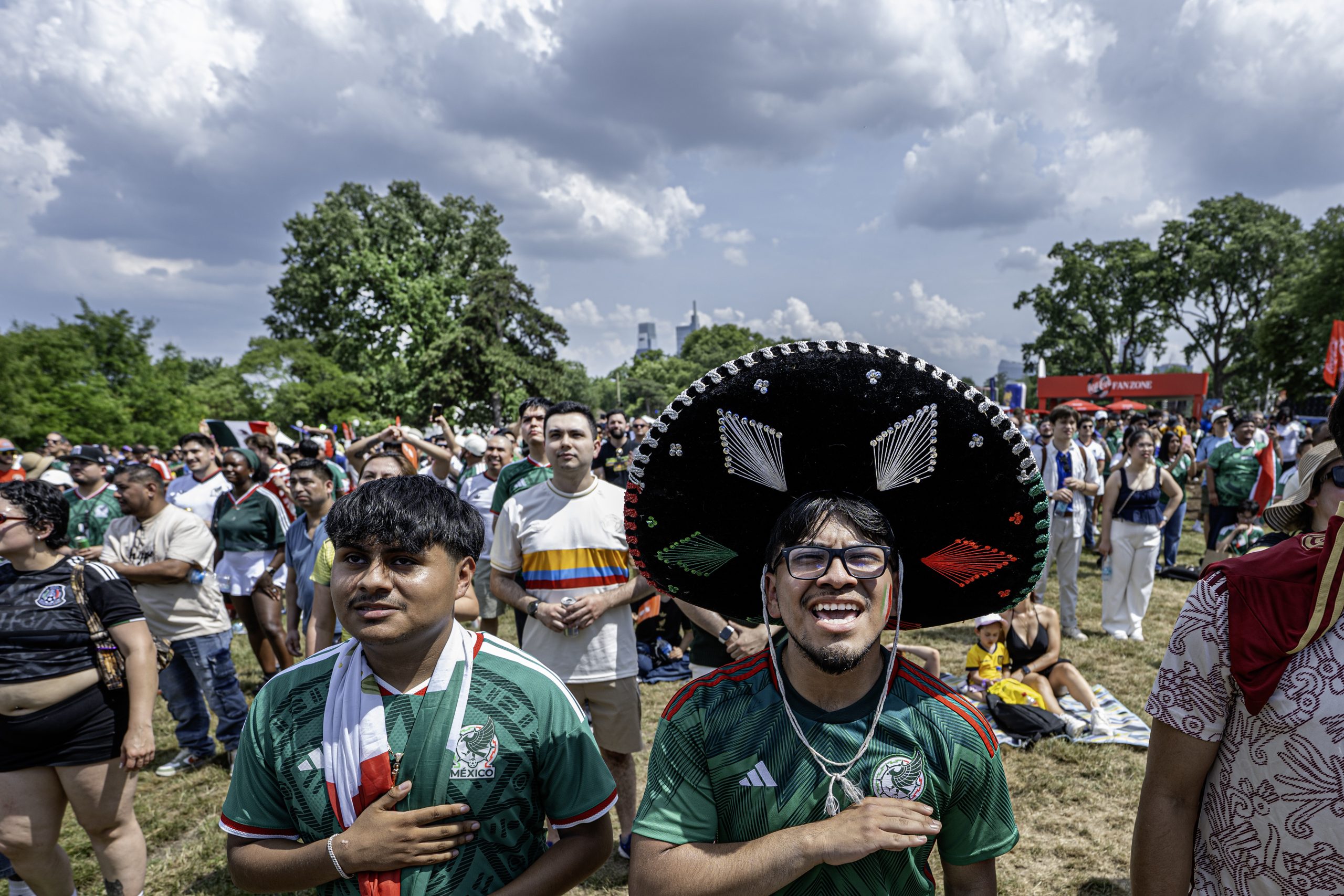
Shortly thereafter, the Mexico national anthem plays and many in the crowd — which now numbers in the thousands and is mostly team Mexico fans — sing along.
It feels electric being in the middle of them and watching the game begin, but I have more of the festival to explore.
Mexican fans sing the national anthem before the start of the FIFA World Cup opening match between Mexico and South Africa at the FIFA Fan Festival at Lemon Hill on Thursday.Jose F. Moreno / Staff Photographer
3:04 p.m.
I approach what looks like a nice little area called “The Orchard” and am immediately stopped by a security guard. I’m informed it’s a VIP-only area for sponsors (enjoy the perks, 12-foot Home Depot skeleton).
Next to it was another public viewing area with a smaller screen showing the game. This one had picnic tables under shade (huzzah!). Nearby was a food area with booths selling street corn, cheesesteaks, and churros — none of which sounded appetizing in 94-degree heat. I’d spotted a single water ice stand at another food vendor area across the way earlier, but the line was 42 people deep and there was one guy working the booth.
3:24 p.m.
I spot a woman in a Phamassador T-shirt, the Visitors Center program that’s recruited 10,000 volunteers to be ambassadors of Philly this summer.
Ruth Bangura, 19, tells me she’s a Philly transplant who’s “obsessed” with the city and wants to help others become obsessed, too. Despite the heat, she’s loving the “good energy” at Fan Fest and loves seeing people waving flags of all colors coming together.
“Everyone is different but at the same time, we’re all here for one game. This is the best thing that could ever happen to the United States right now,” she says. “This is the melting pot, this is what America is supposed to be instead of differentiating each other and dividing each other.”
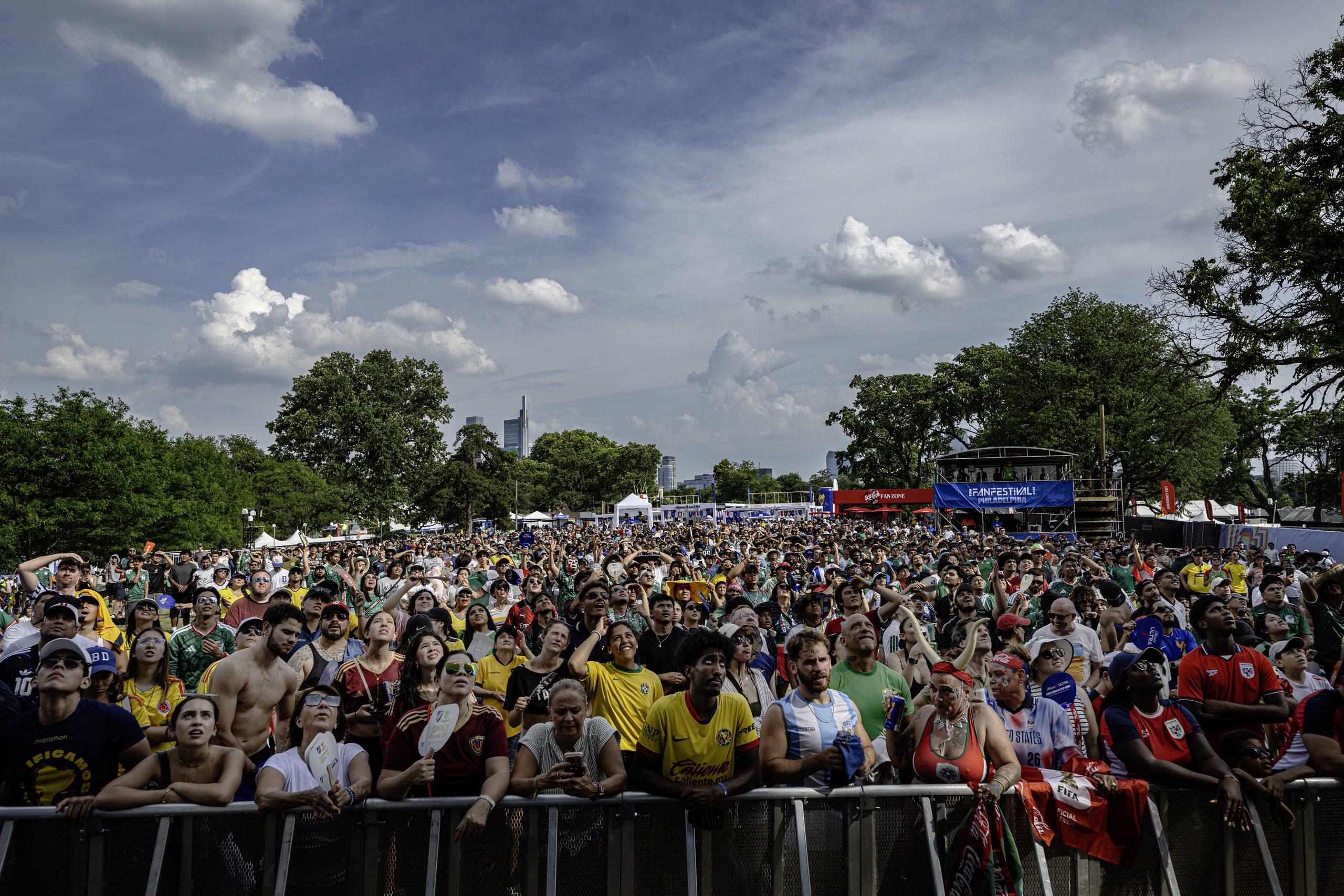
Soccer fans gathered to watch the FIFA World Cup opening match between Mexico and South Africa during the opening day of the FIFA Fan Festival at Lemon Hill on Thursday.Jose F. Moreno / Staff Photographer
3:31 p.m.
As I walk by an American Heart Association tent filled with CPR dummies, staffer Jennifer Russ asks if I want to learn CPR. She teaches me chest-compression as music that’s 100-to-120 beats per minute plays in the background. Like “Staying Alive,” these are songs you should time chest compressions to.
Russ’ manager tells me they’re on site because CPR is a skill they want people from all over the world to learn.
“And, honestly, sports is one of the main places cardiac arrests happen,” she says. “So this is great because it’s just such a big footprint.”
3:46 p.m.
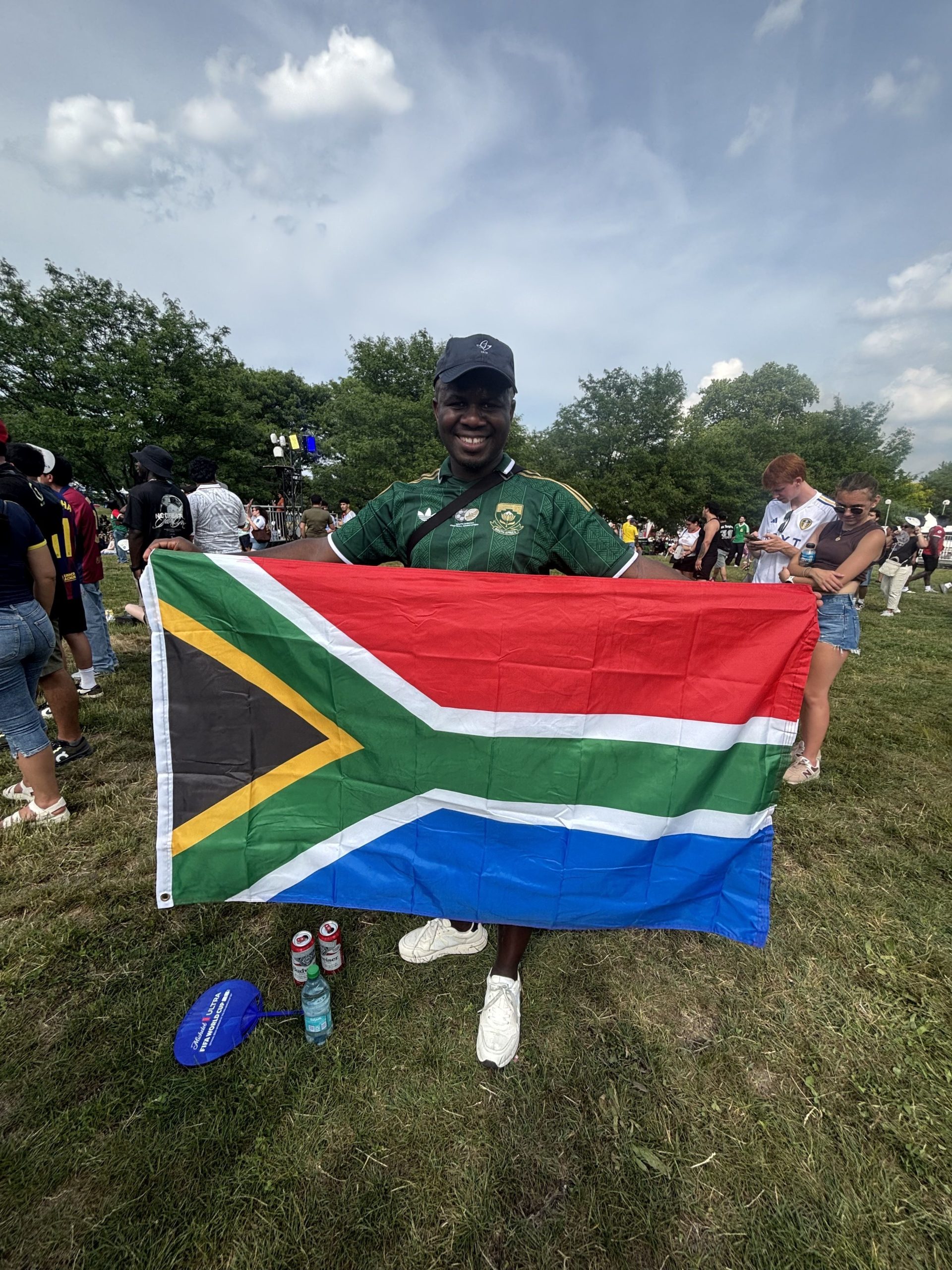
Back at the big screen showing the game, I introduce myself to Mla Mhlongo, 34, a native of South Africa now living in Claymont, Del., who came to support his national team. He tells me that when the World Cup was in South Africa in 2010, they showed all the games at outdoor parks, so Fan Fest feels like a small tase of home.
Mla Mhlongo, a South African native now living in Delaware, waves the South Africa flag in support of his home country at FIFA Fan Fest in Philadelphia.Stephanie Farr / Staff
“I’m enjoying the game with a lot of people; I’ve taken a lot of pictures with people from Mexico and people from around the world,” he says. “The World Cup is supposed to unite the world and it does that.”
4:06 p.m.
An Eagles chant breaks out in the crowd.
4:23 p.m.
I need to find shade. I head to one of the misting tents with fans, but the mist evaporates before it even reaches me.
4:38 p.m.
Once I cool down a little, I realize how hungry I am. I consider a jerk chicken wrap, until I realize it’s $24. I settle on a hot dog and soda for $14. I try to pay with cash and am told everything is card-only.
4:42 p.m.
As I sit to eat in the shade near the smaller screen, I realize that hardly a single person is on their phone. They’re tuned into the game or each other and I think about how nice — and rare — that is.
4:52 p.m.
I try my hand at the Philadelphia Union’s activations, which test your soccer shooting and passing skills by having you kick balls at a series of blinking lights. They’re fun — and one of the few activations that doesn’t require you to scan a QR code. I fail miserably at both games, at one point kicking the ball into the crowd outside the tent.
5:05 p.m.
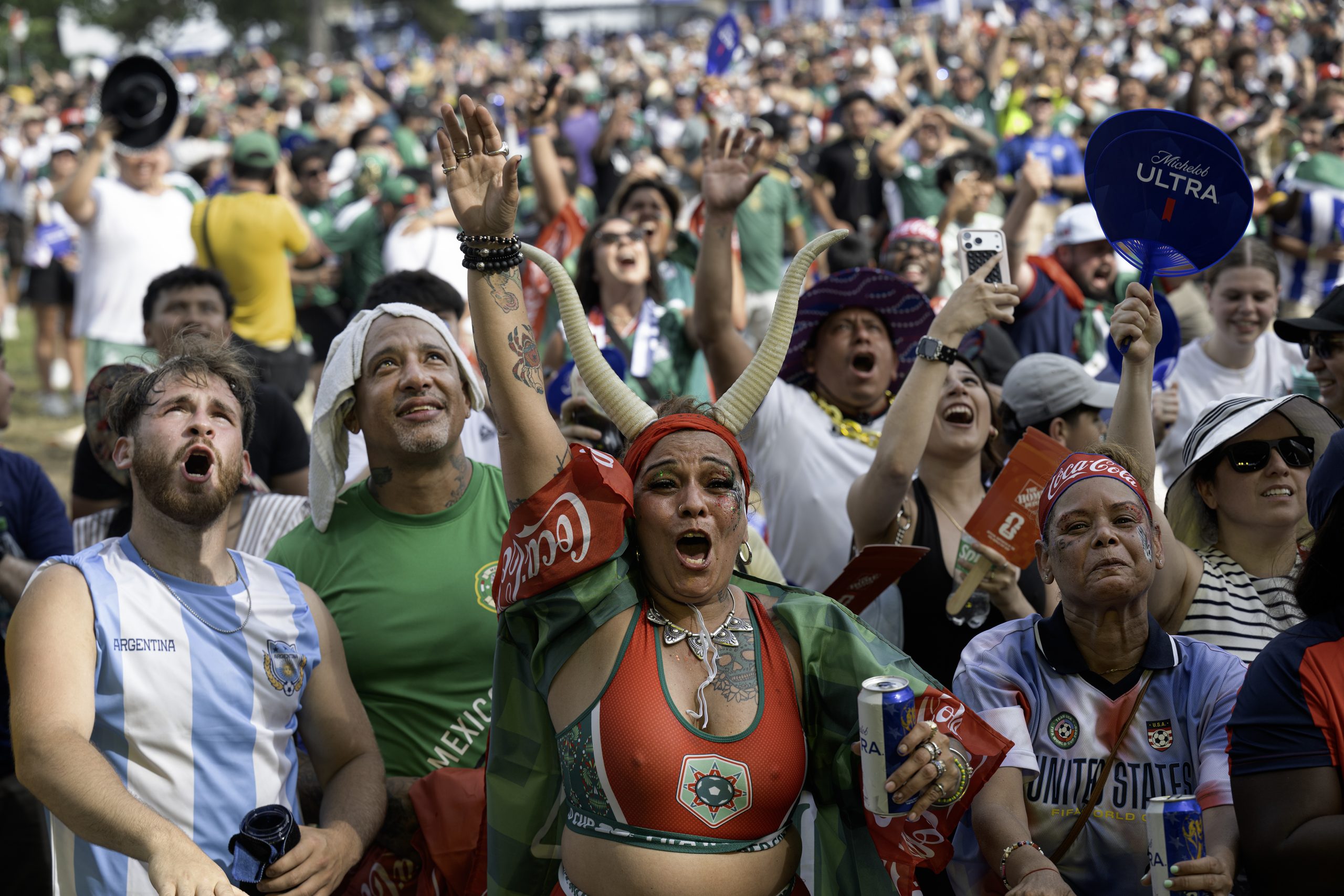
Mexican fans celebrate after Mexico scores against South Africa while watching the FIFA World Cup opening match on a giant screen during the opening day of the FIFA Fan Festival at Lemon Hill on Thursday.Jose F. Moreno / Staff Photographer
The match on the big screen ends and fans of Mexico cheer their team’s win. People make their way to the stage under the screen for the Luis Fonsi concert. I spot the two facepainted Philly ladies I talked to earlier right up against the stage barrier.
5:17 p.m.
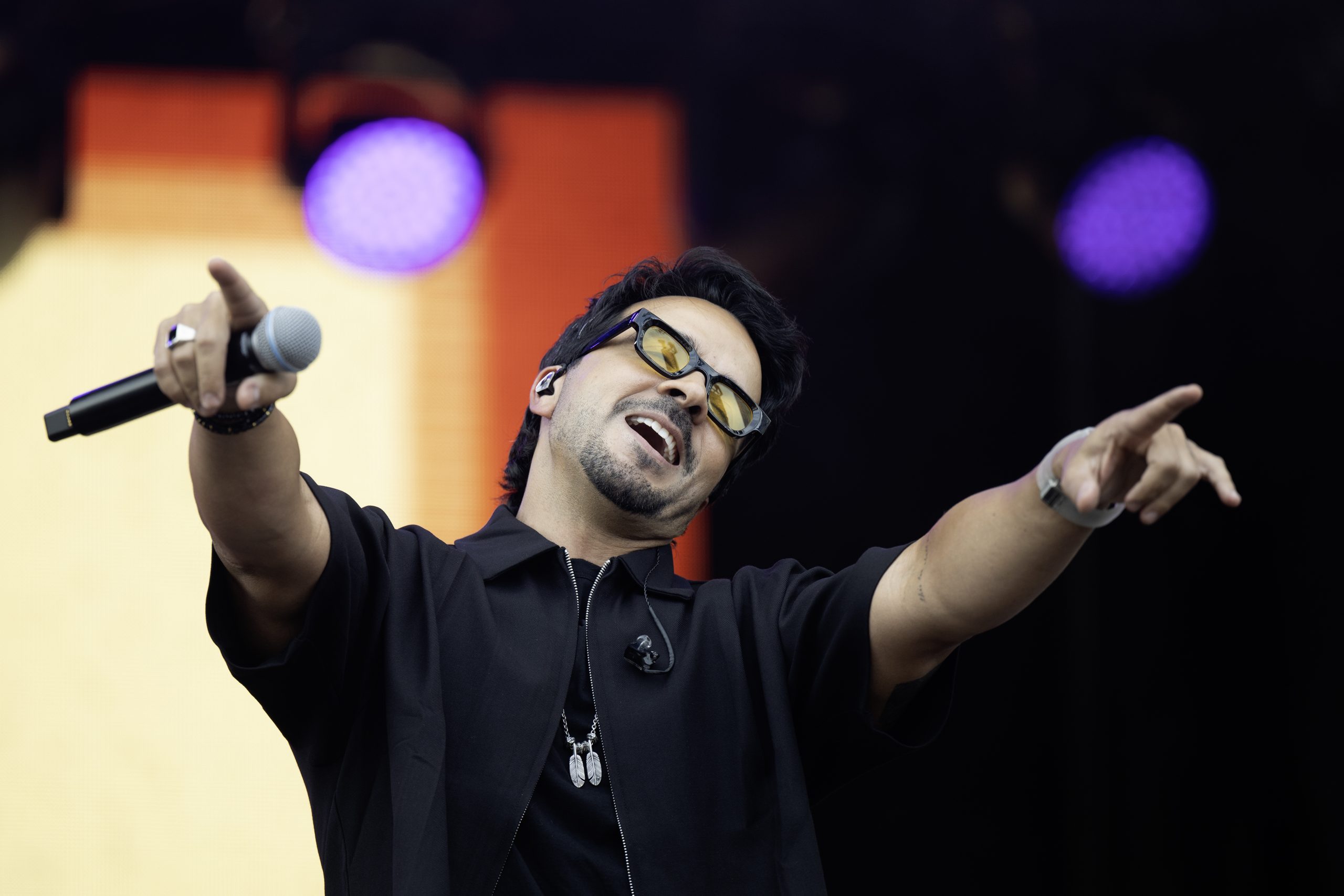
Singer Luis Fonsi performs during the opening day of the FIFA Fan Festival at Lemon Hill on Thursday.Jose F. Moreno / Staff Photographer
Fonsi takes the stage. A woman with a man in a Mexican wrestling mask, both of whom are wearing Mexican flags as capes, dance in front of me. I see a mom and daughter singing together in Spanish and a man dancing through the crowd, his arms raised. Everyone is happy and smiling.
5:30 p.m.
I leave early to beat the crowds and walk back. On my way out, I see a man at a picnic bench reading Booked by Kwame Alexander. He tells me the American Federation of Teachers is giving books away for free at the Philly Phestival Marketplace. I stop by the booth and talk with Leslie Koelsch, deputy director of communications for the federation.
“We launched the Summer Reading Cup and we’re giving away thousands and thousands of soccer-themed books this summer to get kids excited about reading,” she tells me.
5:42 p.m.
Just outside the fest, I see a sign for the “LOVE Park shuttle” and a row of four school buses. A driver tells me they’re giving free rides back to LOVE Park after the fest. It’s a wonderful service, but the buses don’t have air-conditioning and the first one isn’t anywhere near full yet, so I decide to continue on foot.
5:55 p.m.
Walking along the Parkway, I think about all the events I’ve covered there — the good and the bad, the celebrations and the protests — and I look at all the nationality flags waving in the warm breeze.
Soccer fans gather to watch Mexico play South Africa on a giant screen during the opening day of the FIFA Fan Festival at Lemon Hill on Thursday.Jose F. Moreno / Staff Photographer
I’ve had conversations with many people over the last few months who find it very hard — if not impossible — to consider celebrating anything amid the current climate of our country. But when you attend one of these events in Philly that brings people from all over the world together, you get something you don’t get when you sit at home and watch all the horrors of the news.
You realize how much people want to connect with one another, and how easily we still do, when we choose to.
Soccer fans gather to watch Mexico play South Africa on a giant screen during the opening day of the FIFA Fan Festival at Lemon Hill on Thursday.Jose F. Moreno / Staff Photographer
For Jane Golden, founder and executive director of Mural Arts Philadelphia, city life is like a large quilt.
The fabric of Philadelphia, she said, is pieced together by the people and communities that make up the region, and public art is the thread that best illuminates its beauty.
Every time Golden steps outside her home in Spring Garden, she’s reminded of its impact and grandeur. “I pay attention to all the stories our city has to tell, and the way art can help us see each other differently,” she said.
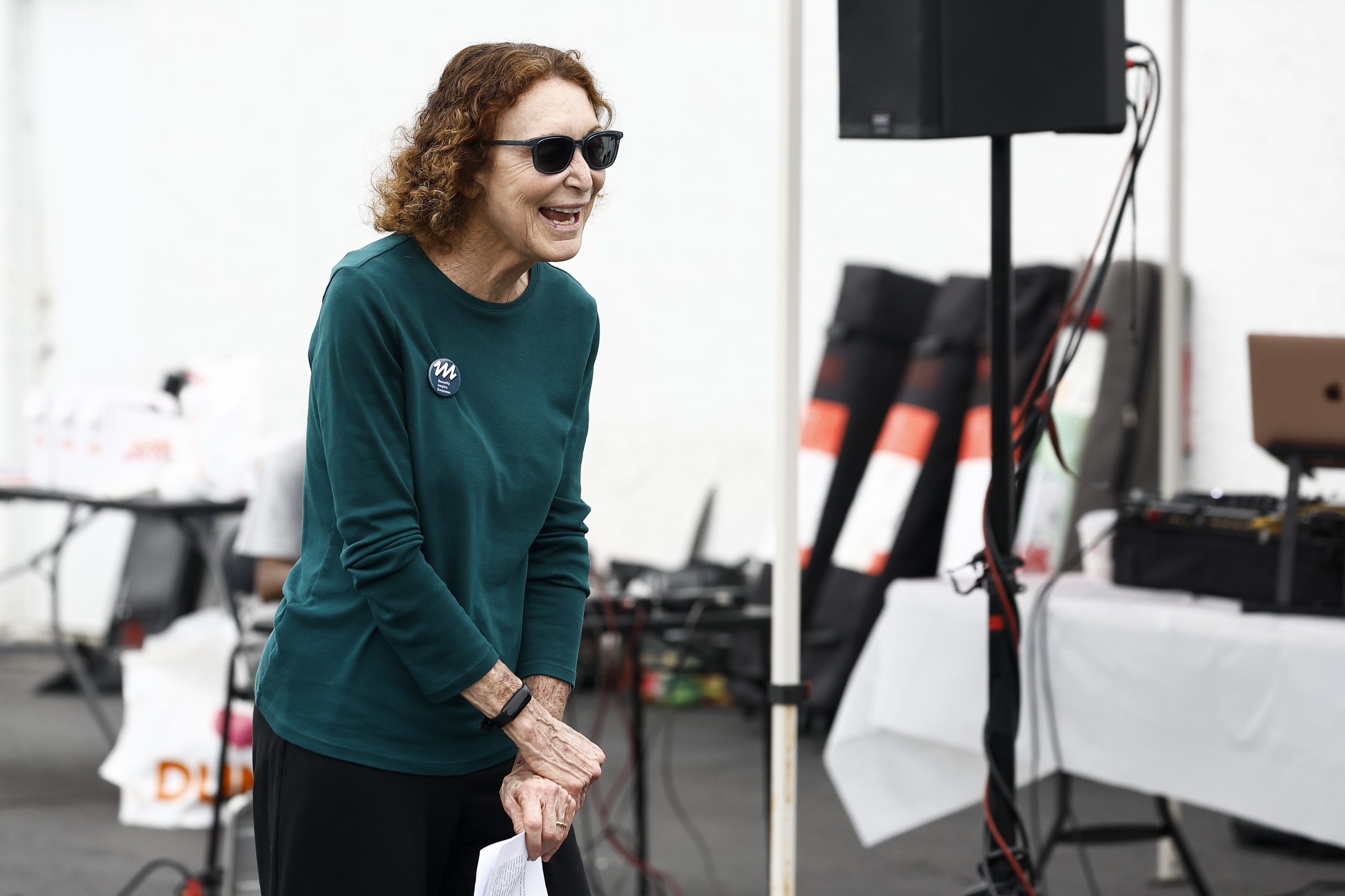
Jane Golden, Mural Arts Philadelphia, speaks at the Bells Across PA event in celebration of America’s 250th Birthday in Philadelphia, Pa., on Friday, Jan. 16, 2026.Tyger Williams / Staff Photographer
Next month, Golden will be moving into less familiar terrain.
After 30 years building Mural Arts into an international arts organization, the Fairmount resident is stepping down as executive director. The search for her successor is already underway.
For now, Golden is focused on rolling out Mural Arts’ Semiquincentennial plans, and is still carving out time to hunt for new walls in need of a makeover.
“I can’t help myself,” she joked.
In a perfect Philly day, Golden visits iconic murals, grabs dinner in Chinatown, and checks out new exhibitions sprawled throughout the city.
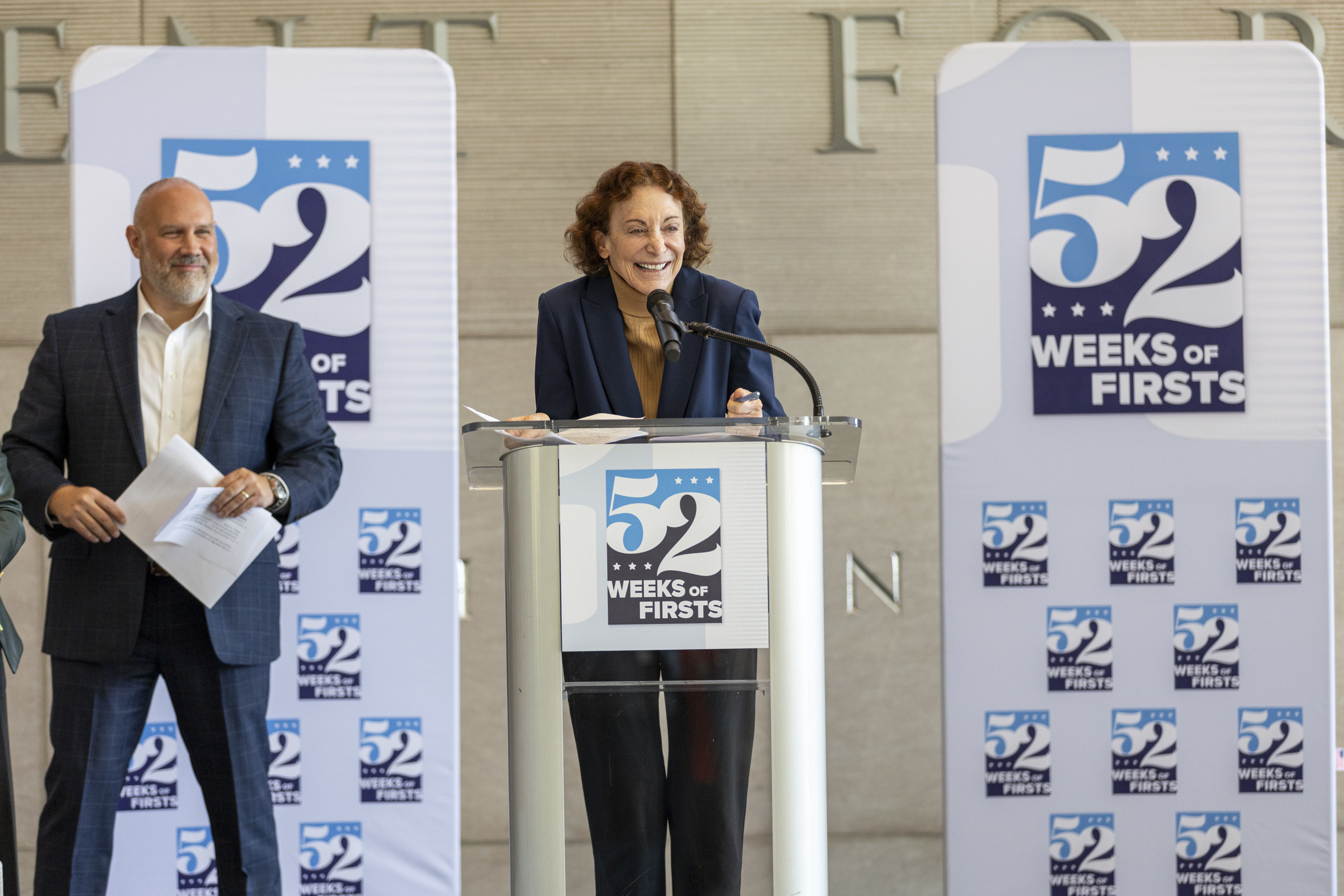
Jane Golden, Executive Director for Mural Arts Philadelphia, speaks at the announcement for the 52 Weeks of Firsts at the National Constitution Center in Philadelphia, on Thursday, Oct. 23, 2025.Tyger Williams / Staff Photographer
6 a.m.
I’m always an early riser, so I wake up at 5 a.m. and walk my dog, Cleo.
Sometimes I sleep until 7 a.m., but that’s a luxury. My cat Bella is one of the reasons I get up so early. She will take her paw, and go up and down on the blinds in my bedroom to get me up, or purr really loudly by my head. That’s better than an alarm.
8 a.m.
I walk from my place to the Philadelphia Museum of Art. I like to push myself, so I walk up the Rocky Steps and around the museum because I think it’s really pretty. Then I come back down by the Rodin Museum, and then we go to Twisted Grounds for coffee and a pastry because I have a sweet tooth.
If me and my husband Tony are really feeling energetic, we walk up to Lemon Hill.
10 a.m.
Tony and I go to Bartram’s Garden and walk around. I go to where FloatLab is at 56th Street, and if anybody is standing around, I tell them it’s there. And if we are energized, we will kayak. I’m always a little bit like the caboose, but he’s a good kayaker.
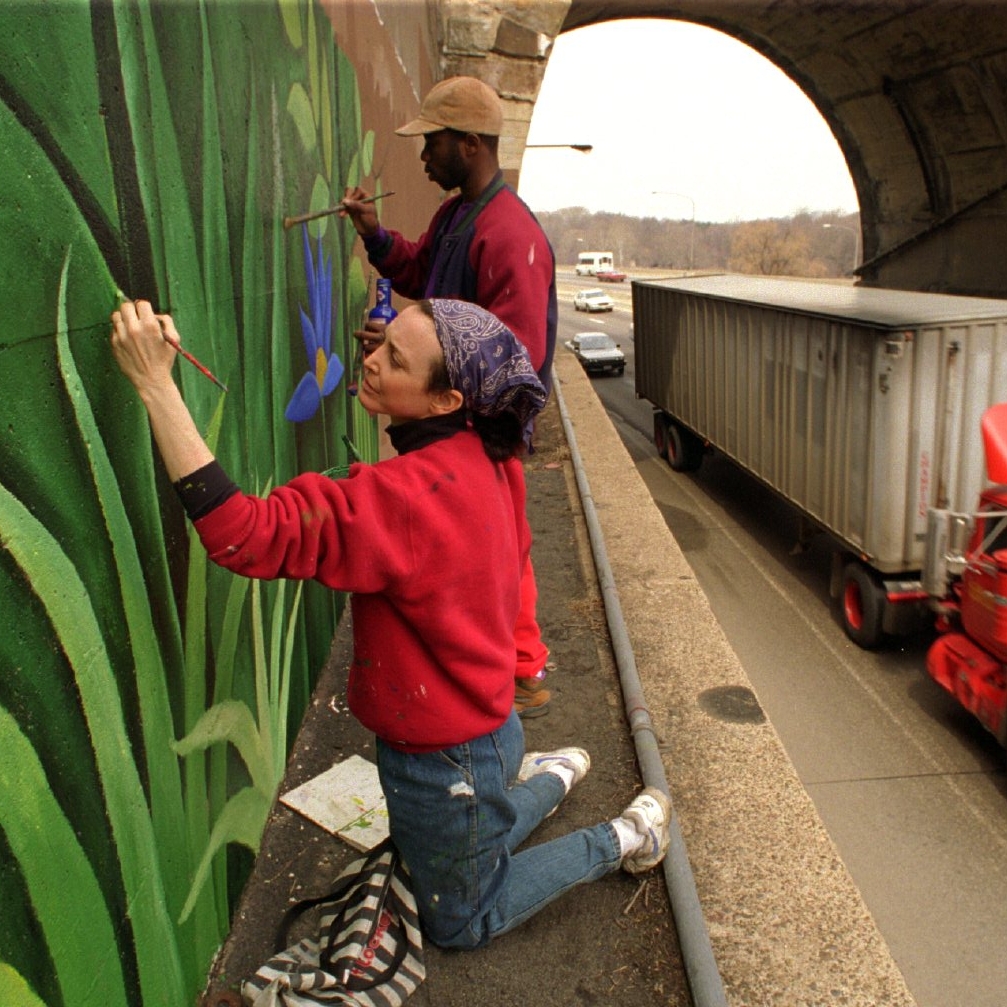
Jane Golden, artistic director of the Anti-Graffiti Network, works on a four-story mural with the help of Haisonn Shadding high above the Schuylkill Expressway near the zoo exit. Photo from March 25, 1994Andrea Mihalik
Noon
For lunch, I go to Frieda in Old City. I like Frieda because there are artists’ events there, and there’s always really interesting art on display. It’s good food, but also a delightful environment.
1:30 p.m.
Then I walk through Old City because wherever I am, I always like to check out great walls, murals, or murals in process.
At around 3 p.m., I’m going to Fishtown. There’s a new mural I have to see by Miriam Singer on the side of Mural City Cellars. They are great partners of Mural Arts. Then I’m going to walk over to 25 Oxford St. to see the new Matthew Henning mural because that’s fantastic. It’s joyful and captures the spirit of Fishtown.
Then I go to Cake Life Bake Shop. It has delicious sweets, and then I’m going to look at the mural there that’s a tribute to the trans community called We Are Universal by Kah Yangni.
3:30 p.m.
Next, I’m going back to PMA to see Paul Farber’s “Rising Up: Rocky and the Making of Monuments” exhibition. I will zip through it because I’ve seen it a few times, but I want to see it a few more times before it goes away.
Then I’ll go to the painting created by the artists at the State Correctional Institution – Phoenix. There used to be a three-story mural of Bernard Hopkins at SCI Graterford. But after SCI Graterford closed, we weren’t able to recreate it at SCI Phoenix because it’s a very different prison. So, we had the men recreate it, and now it’s on display at PMA with all their names listed, which is great. I look at that and get really inspired.
4 p.m.
I walk down the Parkway, and walk around the Swann Memorial Fountain. It’s just lovely. Then, I’ll slow up to look at the wall of the Sheraton, where we’re going to have a mural there soon. It’s a good wall.
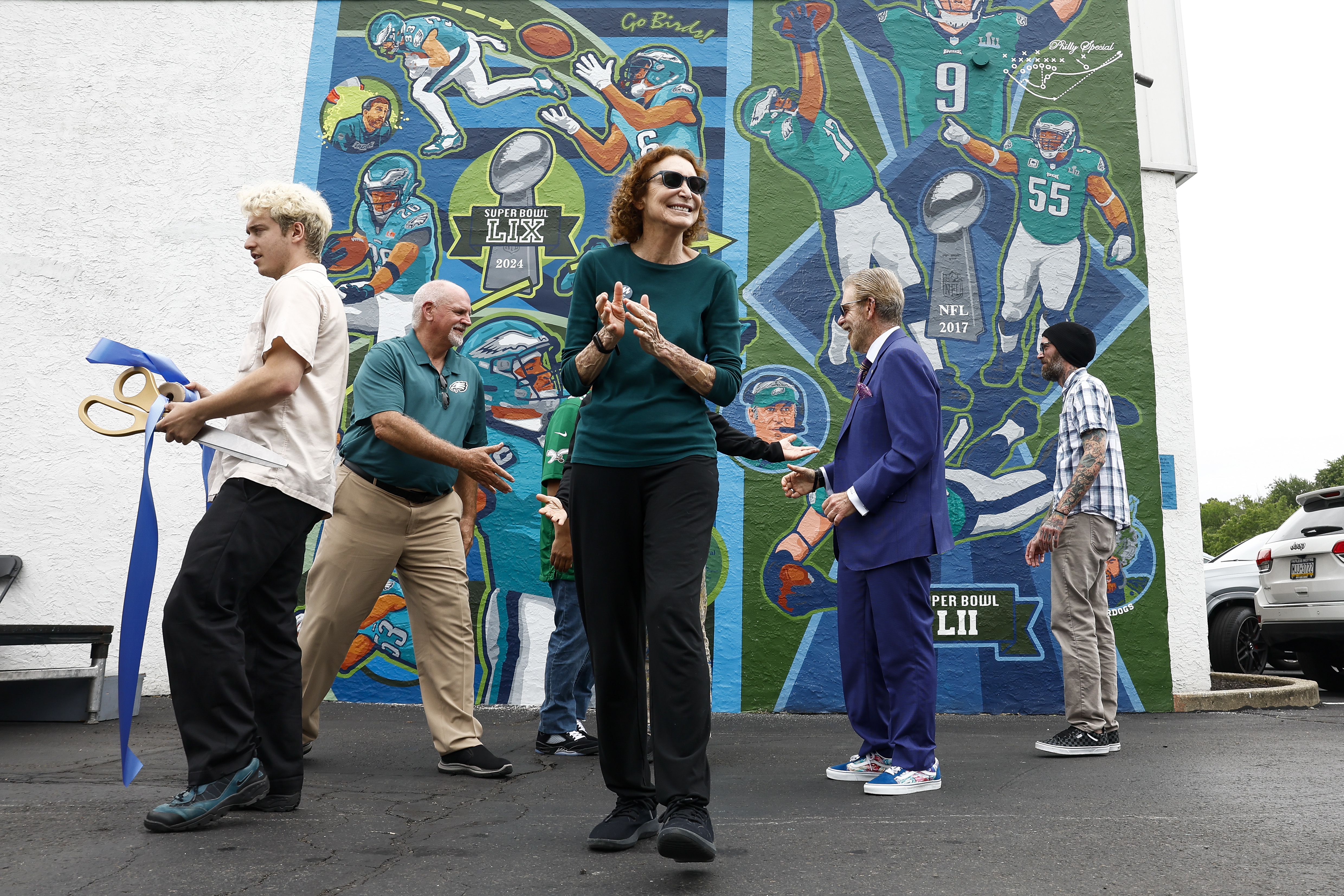
Jane Golden, founder and executive director of Mural Arts Philadelphia, takes the stage during the dedication of the Super Bowl LIX mural at Spike’s Trophies on Tuesday, June 17, 2025 in Philadelphia. The mural is an addition to the existing City of Champions mural series by David McShane.Monica Herndon / Staff Photographer
I always cheer people on who give work and opportunity to artists, and she commissioned like 100 artists to do work at [Ministry of Awe]. I just love the fact that I’ve seen her career grow and thrive, and now she’s running an institution.
8:30 p.m.
Oh, and because I still like sweets, I’m going over to Franklin Fountain for ice cream.
9 p.m.
At around 9 p.m., I’ll go home to watch British mystery movies and series like Karen Pirie and Broadchurch with my husband.
The conversation has been edited for clarity and brevity.
In late April, Joshua Good got a call from a parent at Ephrata Mennonite School: Two of their children had been diagnosed with measles.
Good, who heads the private religious school in Lancaster County, knew he had to act quickly to prevent further spread of the highly contagious disease. But he was not particularly surprised that measles had turned up at his school.
Ephrata Mennonite, a K-12 school with 375 students, is among the most under-vaccinated schools in the state. Less than half its 27 kindergarten students last school year were immune to measles, which can infect nine in 10 unvaccinated people.
Good, who vaccinated his own children, had watched over the last 10 years as more and more parents in his school and church communities had opted out. He knew firsthand how difficult it had become to change minds.
He contacted a local school districtnurse who works closely with Ephrata Mennonite, and then got “right away on a conference call with the state Department of Health.”
In neighboring Lebanon County, three people had arrived at a hospital days earlier with the highly contagious disease. State contact tracers quickly found eight more cases in the county.
Now the outbreak had come to Lancaster.
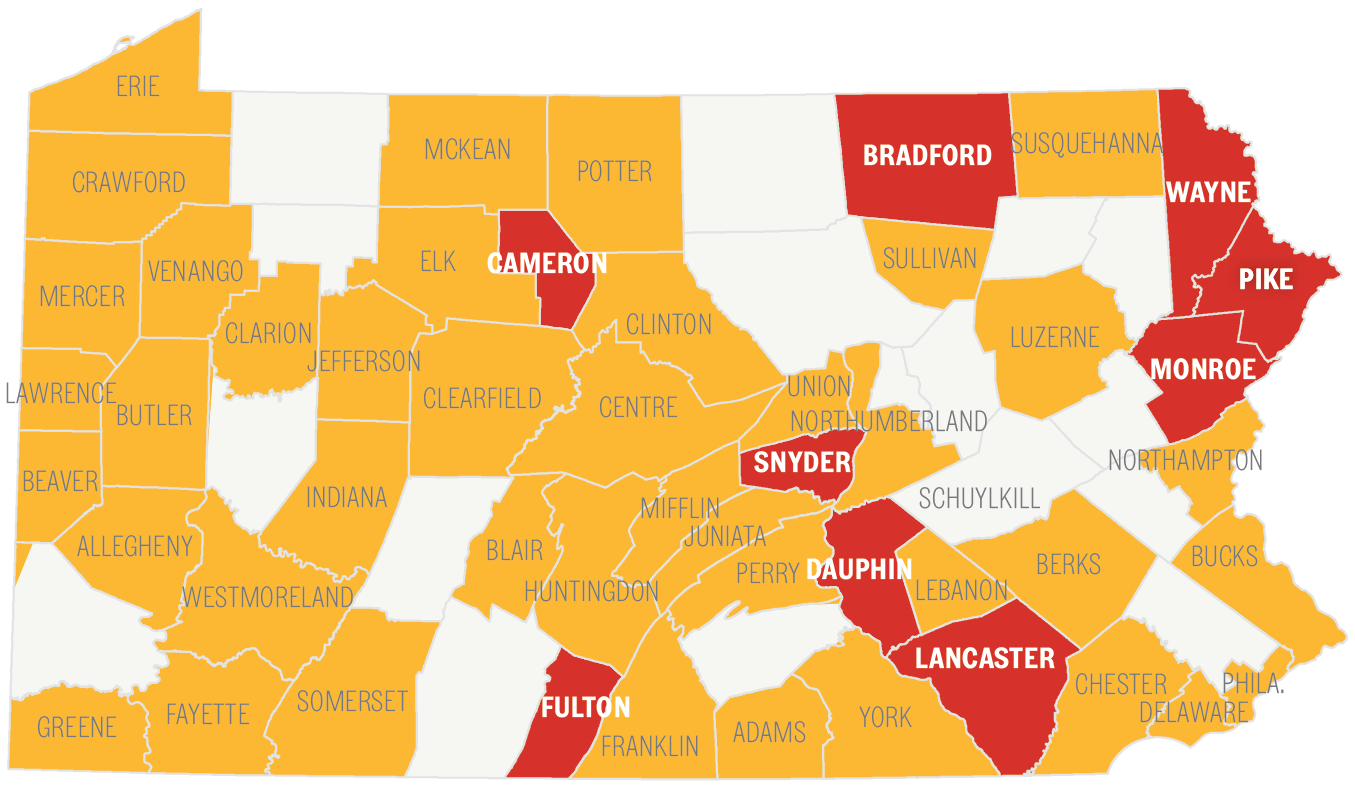
By this Friday, 53 measles cases had been detected in four counties in Southeastern and Central Pennsylvania, the state’s biggest outbreak in more than 30 years.
Lancaster, which has some of the lowest kindergarten vaccination rates in the state, has been a hot spot all year, with 39 of the 65 total measles cases reported in the state.
And healthcare providers there now worry that measles is circulating far more widely than anyone realizes in a county that, like most in the state, lacks a public health department, and where anti-vaccination sentiment runs high.
Good provided information to help state heath officials trace classmates exposed to the infected students in an effort to contain the spread.
The two students at Ephrata Mennonite have recovered, Good said, and there were no more cases at the school. He feels lucky: One of the infected students had never been at the school while contagious, and the school’s classes end around Memorial Day, so the virus no longer has a chance to spread there.
He welcomed a pop-up vaccination clinic on campus, but even measles cases so close to home were not enough to convince many parents who had not previously accepted shots to immunize their children.
“The measles continues to go around here in the Lancaster-Lebanon area,” he said. “Will that move things at all? I’m not sure.”
Pennsylvania’s first measles scare this year came in February, when eight people contracted measles in Lancaster County in an outbreak that expanded to neighboring Chester and Montgomery Counties, suburbs of Philadelphia. Twelve cases were ultimately reported, the bulk in Lancaster.
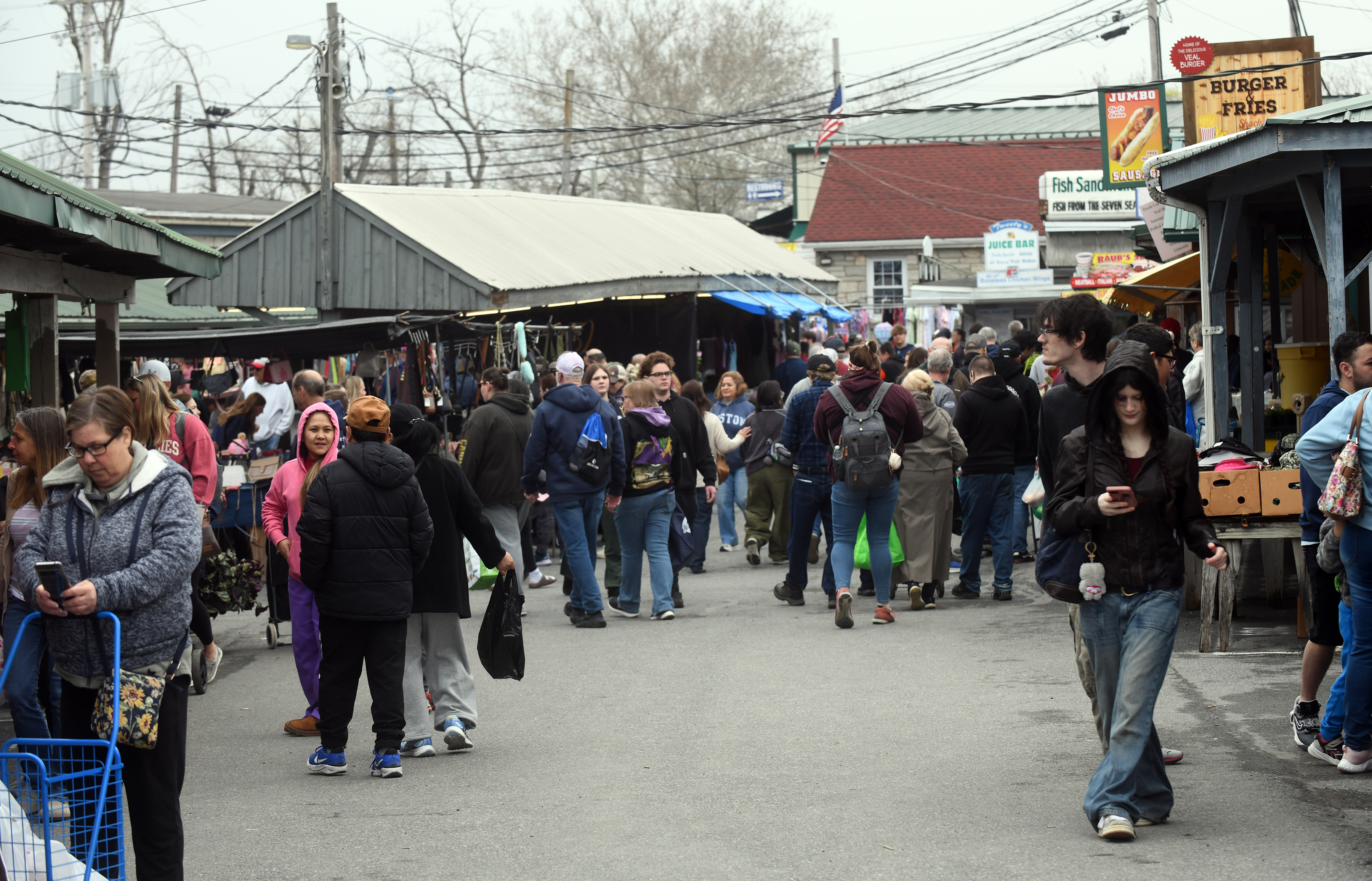
Yet few people were aware of the threat at Lancaster’s bustling flea markets and “mud sales” in late February. While area libraries posted signs warning of a measles outbreak, some parents said they believed the risks of vaccination are worse than the prospect of catching measles.
The Green Dragon Market in Ephrata bustles with activity in early spring. The area, in the north of Lancaster County, has seen several measles cases this year.Bob Williams / For The Inquirer
One Amish father, who had never been vaccinated himself, said his 23-year-old son got immunized only because he was born prematurely.
“God will send you what you want anyway,” said the man, who declined to share his name because he was speaking about private medical details.
Only 88.5% of the county’s kindergartners were immune to measles in 2024, the last year for which data are available — well below the 95% threshold scientists consider necessary to protect a community.
Several Lancaster parentssaid they’d vaccinated their older children and then had opted against immunizations for their younger children. Others said they’d always considered vaccination the best way to protect their children.
Lancaster’s Amish communities have presented a unique concern for health providers, who have long sought to increase their access to vaccination.
In 1991, these communities were at the center of an outbreak of rubella — a virus sometimes called “German measles” that produces a similar rash and fever to measles, and can cause severe birth defects in pregnant women. Today’s measles vaccines provide protection against rubella, too.
Lancaster General Hospital physicians vaccinated hundreds to stop the outbreak, launching the Child Protect Clinic, which provides free vaccines to uninsured children and builds trust in communities that have difficulty accessing medical care.
These days, about 70% of patients at the Child Protect Clinic are from Plain communities, Christian groups like the Amish and some Mennonite sects that adhere to modest dress codes and in some cases avoid modern conveniences.
Some members of Plain communities oppose vaccination, but opinions can vary widely, and the current outbreak is not centered in Amish households, said Pia Fenimore, Lancaster General Hospital’s vice chair of pediatrics.
Anti-vaccination sentiment has spread broadly across Lancaster — and is not confined to Plain communities — in recent years.
At Ephrata Mennonite, Good said, opposition to vaccination has become entrenched in a “significant portion of parents,” with concerns ranging from how vaccines are developed to their safety to resentment over the handling of the immunizations and public restrictions during the COVID-19 pandemic.
“And then you throw in messaging from key health people like RFK Jr.,” he said, referring to Robert F. Kennedy, Jr., the anti-vaccine activist at the head of the country’s public health apparatus.
Higher vaccination rates at Ephrata Mennonite among seventh and 12th graders speak to how “there’s been a big shift in the last 10 years,” Good said.
Good believes that vaccination is a parent’s choice, and supports Pennsylvania’s relatively lax vaccination exemption rules. Parents here can opt out of vaccinating children for religious, personal, or medical reasons.
He vaccinated his own children and recalls how when they were young, he would often try to convince others in his community to do the same.
“I would get into protracted conversations, trying to persuade people. But the amount of success that I’ve had in that has been pretty low,” Good said.
“When someone asks me for my opinion, I’ll provide it to them.”
Tracking cases
As Pennsylvania’s worst measles outbreak in three decades spreads in Lancaster County, Alice Yoder said she remains unable to convince her fellow county commissioners to post details on the county’s website informing residents of the spiraling case counts and urging vaccination.
The only Democratic county commissioner in Lancaster and a former nurse and executive at Lancaster General, she feels certain the county needs to do more to address the outbreak.
The county’s health advisory website is so outdated that it advertises an April 2025 meeting, ironically on measles preparedness, beside a fact sheet that merely mentions vaccination as a “highly effective” prevention measure instead of the best defense against the disease.
“If it wasn’t for our local newspaper, I don’t know how many people would be aware,” Yoder said.
So far, Lancaster has reported 31 cases in the current outbreak.
Twice in the last month, potential exposures in public places prompted state health officials to issue news releases. At a Kohl’s in Lancaster in late May, shoppers were potentially exposed to measles, which can linger in the air for up to two hours, over four days after an employee tested positive.
Neighboring Lebanon County, where vaccination rates for kindergartners are around 93%, has seen 19 cases. Berks and Dauphin Counties have reported three cases between them.
A map showing vaccination rates in kindergarteners for the 2024-2025 school year. Counties in yellow have vaccination rates between 95% and 90%. Counties in red have vaccination rates below 90%. To halt the spread of measles, at least 95% of a given community must be vaccinated against the disease.John Duchneskie
Last week, state health officials reported that they’d confirmed 20 cases. That alone surpassed the total of 16 cases statewide from all of last year.
The rapid case jump, coupled with Lancaster’s low vaccination rates, concerns Remy Pasco, a research associate at the University of Colorado who helped develop a measles outbreak simulator based on school vaccination rates.
Without more information on when and where patients developed symptoms, he said gauging future case patterns is difficult. Only three patients were still contagious as of Wednesday, according to the state.
Measles can incubate in patients for up to 21 days; more active infections means more residents of the county are currently at risk.
Local physicians fear cases are going unreported, and say communication remains a challenge as the outbreak spreads in a county without a local health agency to lead the response.
“There may be many more cases in the community that don’t come to light because people aren’t getting tested,” said Jeff Martin, a physician who heads the family medicine department at Lancaster General.
In some cases, patients may not appreciate why it’s important for health officials to track the spread of the disease, which typically presents with a fever and a rash but can cause brain inflammation and pneumonia in serious cases.
Others may be afraid that if they report a measles case, “there will be some kind of repercussion,” said Fenimore, a hospital pediatrician.
Could a local health department help?
Yoder has spent years calling for a local health department that could update county residents regularly on health threats and educate about the importance of vaccination and other public health measures. But there is little political will to do so, she said.
Lancaster, like 60 of Pennsylvania’s 67 counties, has no local health department, which makes it difficult for Martin and Fenimore to get the full picture of what’s happening.
State officials, who are largely handling the response,say they’re working diligently to contain the outbreak, by conducting contact tracing and hosting vaccine clinics in hot spots that have drawn residents by the dozens.
Martin tracks cases that come through Lancaster General Hospital and its affiliated provider offices. Despite serving on the county health advisory council, Martin learns of cases elsewhere in the county “through the newspaper just like anyone else.”
Martin said that the health department should give physicians details on cases near them regardless of the health system they are detected in.
And, he said, while state health officials are responsive to local physicians and “doing a very good job” at conducting contact tracing, sometimes residents are more receptive to information that comes from their local physician, instead of a state official.
“From a state level, trying to do this in a local community is a little more difficult. We know the providers really well and the unique cultural variations within the community,” he said.
Department of Health press secretary Neil Ruhland said the state is in regular communication with local health systems, working directly with providers to provide “resources and guidance” when cases are detected in an area. The state operates its own health centers in Lancaster and Lebanon Counties, which have “strong ties to the communities they work in.”
State officials have hosted 12 vaccination clinics across the region as the outbreak has unfolded, and local providers routinely offer immunizations at doctor’s offices, fire departments, and state-run health clinics.
Yet no details about the circulating measles threat have reached State Rep. Russ Diamond, a Republican who represents Lebanon County, even as cases in the community where the outbreak began have risen to 19.
“If folks are worried about it,” he said, “then get your kid vaccinated. That’s your right.”
“I don’t know how the state should respond.”
Encouraging vaccination
Parents who have opted against vaccinating their children because of misinformation about vaccine safety have become a focus for local pediatricians trying to halt the outbreak.
The parents coming to Lancaster General often ask about the long-debunked theory that vaccinations cause autism, or ask whether measles is truly dangerous.
In March, two members of Lancaster County’s health advisory board — a nonbinding group that meets every other month — falsely suggested measles vaccines can be deadly and raised long-debunked concerns about measles and autism, according to local news reports.
Neither of Yoder’s two colleagues on the board of commissioners returned calls for comment on the county’s approach to the outbreak.
As physicians race to increase vaccination rates among children whose parents have avoided immunization, they’re also trying to reassure parents in Lancaster whose children are too young to be vaccinated and concerned about the growing risks from measles.
Typically, children receive two vaccines for measles, mumps, and rubella at 1 and 5 years old, but Fenimore increasingly recommends that young children receive an extra early dose at six months, especially if they’re going to spend time around unvaccinated people.
The state is also considering whether to recommend that physicians deliver this “zero dose” to babies as young as six months old in affected counties, said Ruhland, the health department spokesman.
Physicians in Lancaster say it’s key to take time to listen to parents, hear their concerns, and provide accurate information about vaccine safety. These efforts can take several visits.
“We know scare tactics don’t work. What does work is developing a rapport,” Fenimore said. “The fact that we have a current measles outbreak makes this more imperative.”
Inquirer staff writer Gillian McGoldrick contributed to this article.