Tag: topic-link-auto

  • Former 6abc reporter Annie McCormick’s new book details South Jersey socialites’ 1929 deaths

    Former 6abc reporter Annie McCormick’s new book details South Jersey socialites’ 1929 deaths

    In the summer of 1929, Moorestown was rocked by the tragic shooting deaths of two young socialites in what officially was ruled a murder-suicide. The saga resulted in a scandal rife with money, alleged corruption, and death, and it captured sensational headlines for years.

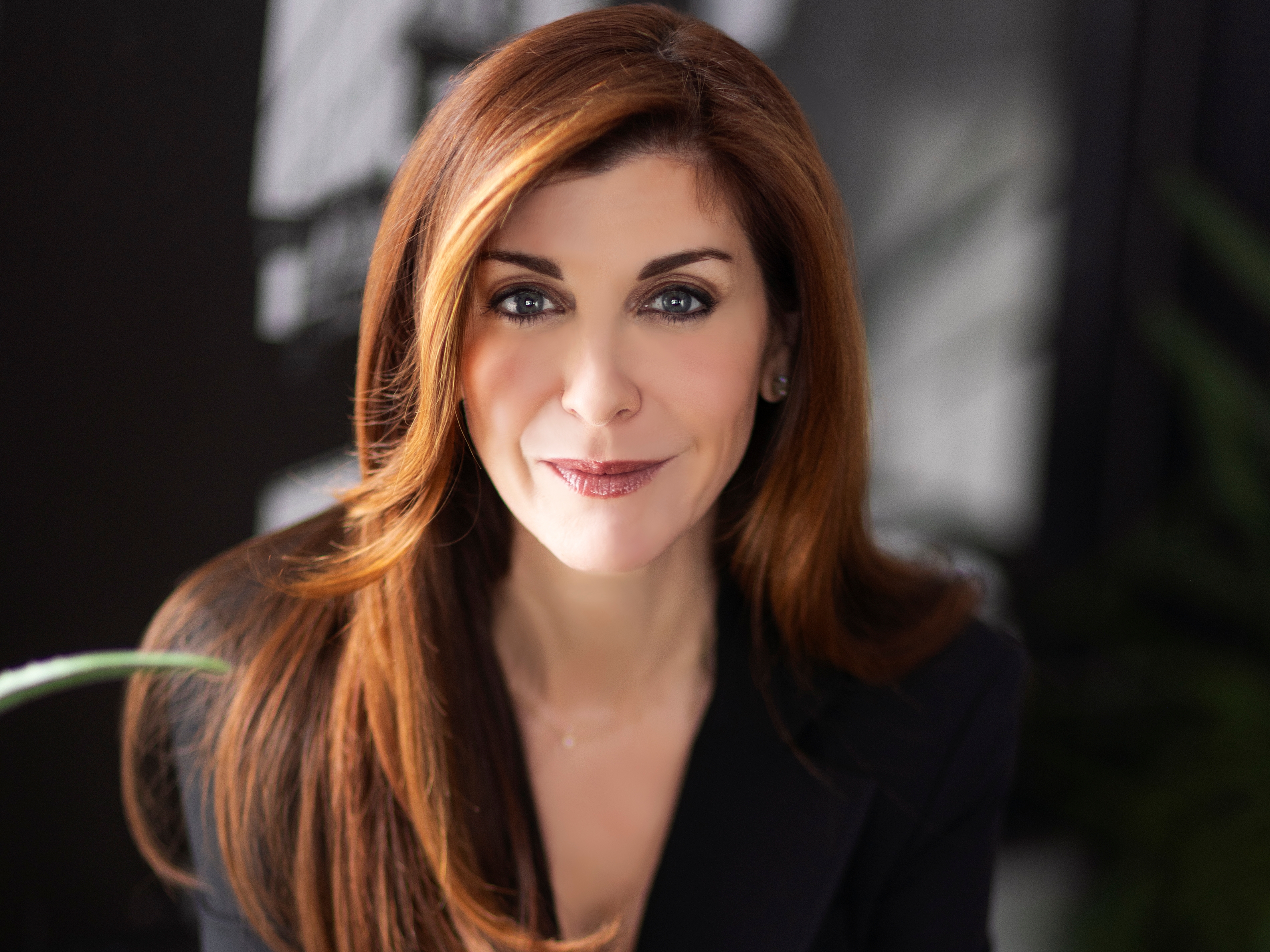
    Nearly a century later, though, the case has been all but forgotten. In fact, former 6abc reporter and Moorestown native Annie McCormick had never heard of it — until a 2021 New York Daily News article. Now, with the release of McCormick’s Restless Ghosts: Murder, Suicide, and the Case that Wouldn’t Stay Buried by Camino Books, the specters of Ruth Wilson and Horace “Reds” Roberts Jr. may yet stir again.

    “It’s crazy I never heard of it, growing up in Moorestown and doing what I do,” said McCormick, who left 6abc in December after 13 years at the station. “I started looking into it and got hooked. I thought, ‘How many legs does this case have?’”

    Many, it would turn out. And they range from bootlegging and political corruption to the unspoken truths of high society in South Jersey and the desperation of Depression-era America. Even Ellis Parker, the famed Burlington County detective once known as “America’s Sherlock Holmes,” plays a role.

    The deaths of Ruth Wilson and Horace Roberts Jr.

    At its core, McCormick’s Restless Ghosts has its roots in a case that dates back to June 1929. Early one morning that month, Wilson and Roberts — wealthy, twenty-something socialites from two of South Jersey’s most prominent families who until recently had been engaged to be married — were found dead in Wilson’s bedroom in her family’s Moorestown home.

    Wilson’s father, John Wilson, a prominent attorney and real estate developer, found the pair, nude and apparently suffering from gunshot wounds to their heads. Both died a short time later, with an investigation led by Parker later finding that the fatal shots came from a .22-caliber handgun discovered at the scene.

    Ruth Wilson, investigators found, had been shot in the head twice. Roberts, meanwhile, had at least three gunshot wounds to his head — and officials quickly ruled that the situation was a murder-suicide that occurred in the wake of Wilson calling off the engagement. According to official reports, Roberts shot Wilson in the head before firing multiple shots into his own while distraught over the state of their relationship.

    No autopsies were initially conducted. In the days and weeks that followed, rumors and speculations about the pair’s deaths cropped up in news coverage, with some reports insinuating that the situation was a double murder — one that involved Wilson’s father, though no such claims were ever substantiated.

    https://www.newspapers.com/article/the-philadelphia-inquirer/199199692/

    Article from Jun 3, 1929 The Philadelphia Inquirer (Philadelphia, Pennsylvania) <!— –>

    A coroner’s inquest

    While McCormick runs down the tragic history of the deaths in Restless Ghosts, she is careful to not take a particular side on what may have happened back then. Instead, the circumstances are thoughtfully, meticulously recounted from multiple perspectives, leaving the readers to decide. Still, some inconsistencies and details, McCormick said, give her pause.

    “It doesn’t make sense that someone could fire into their head multiple times,” McCormick said. “But at the same time, who else was there?”

    In 1929, officials and members of the public had similar questions — so much so that a coroner’s inquest was launched that resulted in the exhumation of Wilson‘s and Roberts’ bodies weeks after their deaths. But even after the extensive questioning of investigators, relatives, and friends and the coroner’s discovery that Roberts had four bullet wounds to his head, the original conclusion was upheld.

    And so, it seemed Wilson‘s and Roberts’ ghosts were left to rest for eternity, victims of a tragic murder-suicide over unrequited love. At least, until the death of Bradway Brown, a similarly high-profile socialite who died from gunshot wounds he suffered at his home in nearby Cinnaminson in 1933.

    https://www.newspapers.com/article/the-philadelphia-inquirer/199199753/

    Article from Jan 17, 1933 The Philadelphia Inquirer (Philadelphia, Pennsylvania) <!— –>

    The death of Bradway Brown

    Brown, a childhood friend of the victims and a former suitor of Wilson’s, was found dead in his home with multiple gunshots. Parker also headed up the investigation in this case, and initially told the press it was a suicide — a tactic McCormick reports was a method to throw the media off and prevent Brown’s actual killer from becoming too alarmed.

    Brown’s death stoked the fires of conspiracy, with rumors abounding that he had confessed to acquaintances that he had known who Wilson’s and Roberts’ true killer was. The rumor mill even said Brown had likely been behind anonymous phone calls to Wilson’s father accusing him of being the perpetrator.

    Again, though, none of these allegations were officially substantiated. And despite Brown’s death resulting in another investigation into Wilson and Roberts’ deaths, this time a grand jury probe, the original conclusion was again upheld: Roberts killed Wilson, and then himself.

    As the investigation into Brown’s death wore on, Parker gradually backed away from his suicide theory. Ultimately, three men were arrested — a group of gangsters Parker called the “After Dinner Burglars.” The trio, reports from the time indicated, had targeted Brown’s Cinnaminson home for a robbery, but were surprised by his arrival. One man who was found to have pulled the trigger was sentenced to life in prison, and had no known connection to the Wilson and Roberts deaths.

    Parker, meanwhile, ultimately died of a brain tumor in federal prison after having been convicted of masterminding the abduction of an attorney in order to coerce a confession in the 1932 kidnapping and murder of Charles Augustus Lindbergh Jr., otherwise known as the Lindbergh baby.

    https://www.newspapers.com/article/the-philadelphia-inquirer/199199831/

    Article from Apr 15, 1934 The Philadelphia Inquirer (Philadelphia, Pennsylvania) <!— –>

    No one left to ask

    In 2026, meanwhile, McCormick’s Restless Ghosts has the benefit of hindsight, and faithfully recreates the case largely from archival newspaper accounts. McCormick remains surprised that she had never learned of the case until starting work on the book, noting that the families involved had a lasting impact on Moorestown. The homes where the murders occurred, she said, remain in pristine condition.

    “These were all places I know and have driven by a million times,” she said.

    Still, while she didn’t necessarily set out to solve the case once and for all, its mystery remains intriguing for the author. After all, with the crime so far in the rearview mirror of history, virtually all of the people directly impacted are long gone. As a journalist, McCormick is particularly perturbed by that aspect of the project.

    “The most frustrating part is that I can’t ask anyone,” she said. “I have questions, and I don’t have anyone I can follow up with. I wonder if this was a present-day case if there would be more finality.”

  • Trump’s homelessness plan could revive forced psychiatric commitment

    Trump’s homelessness plan could revive forced psychiatric commitment

    For most of our nation’s history, involuntary psychiatric commitment operated with sweeping and often unchecked power: State hospitals confined people for years or even lifetimes based on such broad claims as mental illness and “moral defect,” often with little legal recourse.

    Public outrage over abuses in overcrowded asylums — dramatized most famously in the book One Flew Over the Cuckoo’s Nest — helped propel the patient’s rights movement in the 1960s and 1970s toward successful deinstitutionalization. A series of court rulings limited the state’s power to confine people against their will.

    Now that balance is shifting again.

    Last summer, President Donald Trump signed Executive Order 14321, which purports to address homelessness by greatly expanding involuntary psychiatric commitments and encouraging police to arrest people experiencing homelessness.

    The order — its constitutional validity remains in question — undermines decades of court precedent and removes judicial constraints to hold people in institutions. It could resurrect the old ways as a national standard without debate or congressional action.

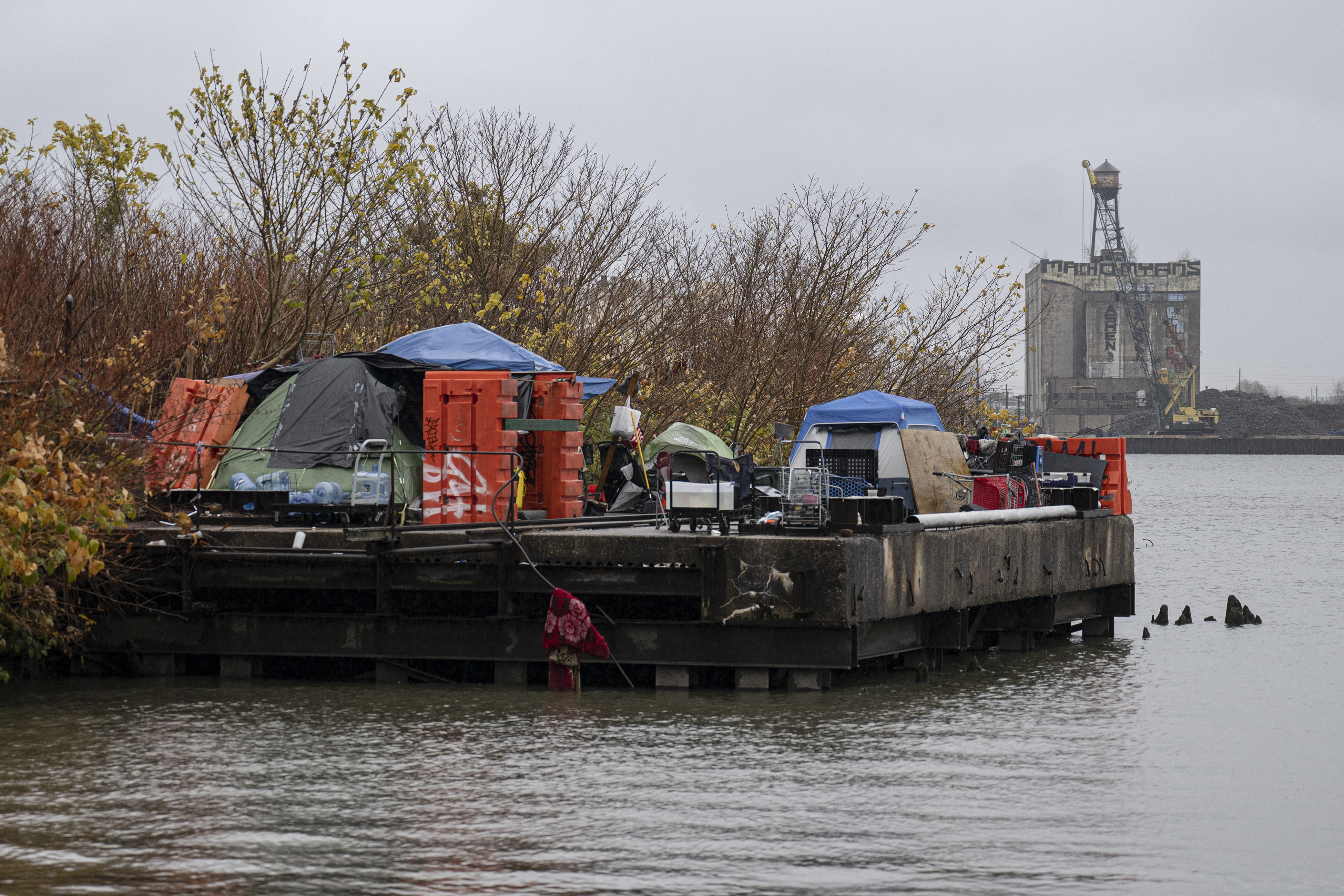
    A sprawling facility recently built outside Salt Lake City already shows the trappings of a prison camp for people experiencing homelessness. This spring, the administration started legal guardianships for hundreds of veterans — some of whom are homeless — that could drive more of them into institutional care.

    And in a historic shift, federal officials are slashing millions of dollars in homeless grants across the country, including in Philadelphia and its suburbs, forcing a broad swath of nonprofits to curtail their efforts to house unhoused people. The Philadelphia Furniture Bank, which gave free furniture and mattresses to more than 22,000 people facing homelessness, became the latest casualty, announcing it would close on June 30.

    The Philadelphia Furniture Bank, which gave free furniture and mattresses to more than 22,000 people facing homelessness, is set to close June 30.Heather Khalifa / MCT

    Past presidents couldn’t make these changes — even if they wanted to — because our system empowers the states to set laws for involuntary commitments. Trump’s order would undermine that by ending consent decrees that aim to ensure stays are safe, ethical, and clinically appropriate.

    His order also seeks to incentivize confinement by directing federal agencies to green-light grants to towns and states that get people off the street and into institutions. And those receiving federal homeless services would have to undergo mental health care as a condition for those benefits.

    If enforced, this order would worsen the problems we have while creating new ones.

    We know a lot more about mental illness than in 1962 when Ken Kesey published Cuckoo’s Nest. At the same time, homelessness is growing in the U.S. An estimated 700,000 people live unhoused every night.

    Involuntary psychiatric treatment is sometimes necessary, but open-ended and inappropriate commitment harms patients and creates a moral indignity that can have a lifelong negative impact. And even when it is appropriate, our system tailors commitment lengths to people’s health needs, as the U.S. Supreme Court has affirmed several times. Most states limit the first court-ordered commitment to six months or less. Removing those limits would subvert the Supreme Court’s authority and abandon patients to the whims of unchecked administrators.

    Another problem: The order violates the Constitution by impinging on the state’s authority to direct health and safety, including civil commitments.

    Those with disabilities should be concerned about this, too. They have the right to live independently in their homes, with access to state-funded services. But this order would threaten that.

    Importantly, the order could also force clinicians to break their fiduciary responsibility to serve their patients’ best interests first by pressuring them to inappropriately confine homeless individuals who might not be seriously mentally ill.

    History shows many examples of the political misuse of psychiatric power. Soviet communists invented the diagnosis “sluggish schizophrenia” to justify the imprisonment of political dissenters. Vladimir Putin continues to use psychiatric excuses to shackle his critics. More recently, U.S. police used the contested diagnosis “excited delirium” to justify giving controlled substances to calm down people resisting arrest. The diagnosis has since been discredited.

    Our system is far from perfect. Too many seriously mentally ill people end up unhoused, imprisoned, or cycling in between. But the executive order risks turning clinicians into Soviet-style apparatchiks, who violate their ethics to make the system run.

    Federal policy should encourage the advocates who run safe consumption sites and syringe distribution efforts to keep people alive until they get help, because these efforts have been proven to work. But the president would levy civil or criminal charges against these caregivers.

    The executive order also dismisses efforts like Housing First, which give housing without requiring treatment or sobriety. These programs help make people more likely to improve their mental health and stay in housing.

    By contrast, arresting and confining people is associated with more death, illness, and misery.

    It may be politically appealing in some quarters to sweep up, institutionalize, and resettle unhoused people who are barely surviving with mental illness. But this approach was recognized long ago as inhumane and impractical.

    The time is now to build a real mental health care system to support the most vulnerable in our society. Instead of issuing retrograde executive orders, the Trump administration should invest real money to advance evidence-based interventions and policies.

    Dominic Sisti is a senior fellow at the Leonard Davis Institute of Health Economics and associate professor in the department of medical ethics and health policy at the University of Pennsylvania. He directs the Scattergood Program for the Applied Ethics of Behavioral Health Care at Penn.

  • As a Black voter, Graham Platner’s ethics don’t bother me — my people can’t afford to wait for a perfect candidate

    As a Black voter, Graham Platner’s ethics don’t bother me — my people can’t afford to wait for a perfect candidate

    As a lifelong Democrat, I’m often exhausted by my party’s hand-wringing when it comes to the question of ethics.

    I certainly believe moral clarity is important. We should all seek to embrace a firm set of values. However, when it comes to politics, morality is often a mirage, and Democrats spend far too much time pretending it’s not.

    Perhaps that’s why I was encouraged by Graham Platner’s win in the Maine Democratic Senate primary. Platner presented himself as a rugged everyman who happened to be a progressive. However, a series of disclosures exposed Platner’s dark side.

    He wore a tattoo that resembled a Nazi death’s head symbol, but claimed he didn’t know what it represented.

    He sent sexually charged text messages to women, a fact his campaign confirmed.

    Several ex-girlfriends accused him of disturbing behavior, including one who said he forcefully grabbed her more than once. In response, Platner described himself as a “bad boyfriend,” but denied physically abusing women.

    These allegations, along with old Reddit posts that some described as racist and sexist, were not enough to cost him the election, and in my view, that’s a good thing.

    As a Black man in Trump’s America, I can’t afford to wait for the perfect candidate. Nor can I expect politicians to live on a higher moral plane. My people are being targeted by an administration that seems hell-bent on returning us to the age of Jim Crow, and at a time like this, we cannot waste a second playing holier than thou.

    We are literally watching a president with 34 criminal convictions treat the U.S. Constitution as a suggestion, so we don’t need choirboys. We need U.S. senators and representatives who will stand up to Donald Trump.

    For that reason, Platner’s background is less important to me than his ability to fight against racist policies. Could he turn out to be a John Fetterman — pretending to support Democrats while voting with Trump on important issues? Yes, he could, but while Platner might target Black people, Republicans are already doing so.

    With Trump in the White House and GOP majorities in the House, the Senate, and the U.S. Supreme Court, anti-diversity efforts are raging. Black congressional districts are being eliminated, and the Trump administration is using antidiscrimination laws against the very people they were meant to protect.

    In my view, MAGA was never solely about stopping undocumented immigrants from entering the country, because, contrary to right-wing conspiracy theories, undocumented people cannot vote.

    African Americans, however, are among the Democratic Party’s most loyal demographics. We have the power to sway national elections, and we tend to use that power against Trump.

    In 2016, 94% of Black voters cast ballots against Trump, according to the Pew Research Center. In 2020, 92% voted against him. In 2024, 83% voted against him.

    Some pundits say the shift means Trump is making inroads with Black voters. I believe the opposite is true. Democrats are losing us.

    When Black people come face-to-face with bread-and-butter issues like food insecurity and unaffordable healthcare, we don’t want to hear about studies by Ivy League scholars. We don’t want a doctoral thesis on poverty. We want solutions, and Democrats spend far too much time explaining problems rather than solving them.

    Even worse, my party is frequently consumed with constructing ethical obstacle courses that few candidates can navigate. Maybe that was cute back in the day, when you could lose the election and still count on guardrails to restrain the other side. Those guardrails are gone now, and while my party’s white elites can afford to theorize about the link between government and racism, I can’t.

    Racism is not a theory for Black people. It is a daily reality, and it plays out through systems that flourish when conservatives take power.

    Therefore, we must not bind ourselves by seeking perfect candidates. Instead, we must seek to free ourselves by uniting and fighting to win.

  • Letters to the Editor | June 15, 2026

    Letters to the Editor | June 15, 2026

    Lincoln’s legacy

    Just across from Boathouse Row, at the intersection of Kelly and Sedgley Drives, there is a statue of President Abraham Lincoln. At the base of the statue is a famous quote from his second presidential inauguration speech: “With malice toward none with charity for all … Let us finish the work we are in.”

    On the opposite side: “I do order and declare that all persons held as slaves within the states in rebellion are and henceforth shall be free.”

    As the center of America’s stage during this Semiquincentennial year, and a center of the world stage during this month of FIFA World Cup matches, we Philadelphians call on our national government to live up to our democratic principles and apply fair treatment to immigrants and descendants of immigrants, just as Lincoln called for bold actions on behalf of those who were once enslaved.

    Ina Asher, Merion Station

    Blame game

    Opinions critical of Philly schools’ “success” when 33% of students are proficient in reading, and 25% in math, are misguided. When I was codirector of the Laboratory for Student Success at Temple University, I was actually surprised to find that years of research in student success shows that school-related factors like teacher quality, curriculum, leadership, climate, and resources account for as much as 40% of student achievement. Factors beyond the schools have a much greater impact on individual student success. These include family income, stability, parent education, access to healthcare, neighborhood safety, exposure to stress, and trauma. What we are witnessing is simply a result of living in a country with the greatest economic inequality of any developed nation on the planet. The answers are there — but those in power seem to prefer to blame the victims.

    John Kovach, Wallingford

    Catholicism is growing

    Recently, I read about what sociologists call homophily: the tendency to develop friendships with those from similar backgrounds, identities, or socioeconomic classes. For young professionals in the city like myself, we’re often pulled into circles with peers from similar places of work or study.

    Perhaps one reason people are returning to the pews is that it shakes up these circles, bringing us hand-in-hand with those from places we’re unfamiliar with — and maybe there’s something exciting about that. Where else besides church might you find an older North Philly couple breaking bread with young Thomas Jefferson University students coming from a Center City high-rise?

    A recent article in The Inquirer raised the question of why people are turning to Catholicism. We may never know all of the reasons why, but I hope it comes with a community built across diversity.

    Maxwell Marshall, Philadelphia

    Join the conversation: Send letters to letters@inquirer.com. Limit length to 150 words and include home address and day and evening phone number. Letters run in The Inquirer six days a week on the editorial pages and online.

  • Dear Abby | Couple quarrels over sharing of inheritance

    DEAR ABBY: My father passed away and left me a large sum of money. One of the first things I did was pay off my husband’s debts totaling over $140,000. I also paid off my vehicle. I also paid $600,000 in cash for the home we live in.

    For Christmas, I want to give each of my three adult children $10,000 from me and their grandfather. My husband (of one year) asked if I was planning on giving his two adult children the same. I replied no, which was not well received.

    His children never even met my father. Am I wrong here? I don’t feel his adult children are entitled to my inheritance. My husband commented that my father (who married my mother and adopted me at 3 years old) gave me the same amount as each of my brothers and sister. Well, Abby, that man was my father for 57 years. I do not feel it’s the same as his adult children, whom I didn’t raise.

    I have met his son only a handful of times, and I have been more than generous to his daughter and our 2-year-old granddaughter. If I’m wrong, I will admit it and make amends. This is causing great stress on our relationship, and he refuses to go to marriage counseling with me. What do you think?

    — NOT THE SAME IN THE EAST

    DEAR NOT THE SAME: I agree with you that the situation is not the same. Your husband’s children are not entitled to a share of your inheritance. Because your husband refuses to see a marriage counselor with you does not mean you shouldn’t go, which is what I am urging you to do in order to find clarity and learn how to move forward from this extremely awkward situation.

    ** ** **

    DEAR ABBY: I’m a senior in high school, and I have had a certain friend since sixth grade. I’m a Democrat; she’s a Republican. Until lately, we’ve been able to put our differences aside, but recently, we’ve had a few clashes because of our political differences.

    Given how bad things are today and how much worse they might get, I struggle to ignore these issues. I’ve also noticed a few people say they dislike me because they think I believe the same way as her. I don’t want to end our friendship over something like this, but I don’t see how it can continue much longer. Please help me make the right decision.

    — MORALLY TORN FRIEND

    DEAR FRIEND: There’s an old saying that politics and religion are not appropriate topics for polite conversation. Now you know why. There are two ways to resolve this. You can sit down with your friend and agree to disagree. Then promise you will avoid discussing politics from now on. The other option is to thank each other for a friendship that was great while it lasted. Then let each other go.

    ** ** **

    DEAR READERS: Were you between 16 and 25 years old when you had a baby? A group of healthcare specialists who work with young parents and their children want young families to receive the best possible healthcare support and treatment. They need to hear about your experiences when you went to get healthcare for yourself or your children. Your experiences will be used to help improve the system. Please go to this site to share your experience: tinyurl.com/mr3rwj9f.

    — LOVE, ABBY

  • Horoscopes: Monday, June 15, 2026

    ARIES (March 21-April 19). You’re comfortable making choices that might seem unusual to other people because being true to yourself matters more to you than fitting in. Other people’s opinions change, and people drift in and out of your life, but you’re the one who has to live with yourself every day.

    TAURUS (April 20-May 20). Talking with the people you love will feel especially enjoyable. You reply quickly because you care. Like a pro, you keep conversations light, comfortable and positive and avoid topics that could create tension.

    GEMINI (May 21-June 21). Your timing is good even when it seems like it’s not. Delays protect you while fortunate coincidences speed everything else along. Go forward in full belief that everything is occurring in perfect synchronicity, and you will stop chasing and start attracting.

    CANCER (June 22-July 22). It seems efficient to hand off the mundane work to someone else while you follow your whim, but that would only slow down your productivity and block your creativity. The daily tasks move your imagination. Your genius is hands-on.

    LEO (July 23-Aug. 22). So many items live in your brain, waiting to be born into writing. When you get them down on paper, they start to take on a life of their own. Through writing you will not only get clear, but you will also learn yourself.

    VIRGO (Aug. 23-Sept. 22). You’re especially persuasive right now. Today shows you reading people with great accuracy, working rooms and leading situations toward the outcome you want. You never push because you don’t have to. Charm and emotional intelligence do the work for you.

    LIBRA (Sept. 23-Oct. 23). You hit a wall between you and where you want to go. But keep looking into it, pushing on it and believing there may be something more here. Seek the hidden door. Curiosity opens social, financial and creative passageways.

    SCORPIO (Oct. 24-Nov. 21). You’ll find yourself in a caregiving role. It is not possible to give care in one universal way because everyone’s needs are different. Also, a person’s needs can change by the day or the hour. Read the small signals and anticipate problems.

    SAGITTARIUS (Nov. 22-Dec. 21). Is the insect a pest, or is the insect another magnificent earthling? You could go either way, or both ways at once. You appreciate all, but if your territory is invaded, your perception and reactions change.

    CAPRICORN (Dec. 22-Jan. 19). There is information you’re willing to work for — to make it your business to know, your quest to discover. Then there’s the simple and inconvenient truth that’s right in the middle of the path, needing only to be faced.

    AQUARIUS (Jan. 20-Feb. 18). You’ll tap those puzzle-solving skills today. You may try the same solution repeatedly, just to verify the results. But if it doesn’t work after a few tries, you do it differently until you find what clicks.

    PISCES (Feb. 19-March 20). You’re aware of what’s going on, and you think you ought to react, though you may not be sure quite when or how. The takeaway isn’t clear. Let feelings settle. You have time on this one.

    TODAY’S BIRTHDAY (June 15). It’s your Year of the Threshold Test, in which the seeker must prove sincerity before entering the sacred realms. Sometimes you’ll be the one pursuing with persistence, and sometimes you’ll be the gatekeeper. Both scenarios bring powerful and lasting transformation. More highlights: A talent turns commercially viable. Applause and money for your confident performances. All the love you need. Capricorn and Aries adore you. Your lucky numbers are: 7, 20, 3, 14 and 41.

  • Philadelphia was the star in its men’s World Cup debut

    Philadelphia was the star in its men’s World Cup debut

    It took 96 years, but the most sacred version of the beautiful game came to Philadelphia.

    Both the city and the match met the moment.

    Extra public transportation, hydration stations, and modest traffic framed an evening of graceful and powerful football, the kind every other nation reveres except ours.

    Amid the spectacle of team jerseys, flags, and team benches covered by vibrant roofs identifying the sides in national colors, the grass was the star. The stadium’s normal turf is a ragged Bermuda thatched with 5% plastic to withstand the cleated NFL rhinoceroses who usually play there. For the World Cup, it was transformed into a flawless pitch, golf-course quality ryegrass and bluegrass, the sort of surface you on which could imagine Jason Kelce lying on his back and making snow angels.

    Ecuador goalkeeper Hernán Galíndez watches as the ball crosses the goal line on a shot by Ivory Coast’s Amad Diallo late in the second half of Sunday’s game.Jose F. Moreno / Staff Photographer

    Viewed through an international lens, even a soccer game this insignificant still was the most significant sporting event in the history of the city. A town that has seen two World Series titles and a Stanley Cup won within its borders has never hosted anything that riveted folks on six of the continents.

    What comes close? Maybe Rocky Marciano, when he knocked out Jersey Joe Walcott in 1952, and won the heavyweight championship. Maybe not.

    More moments will come, since the group-stage match between Ivory Coast and Ecuador is just the first of five such games. On July 4, Philadelphia will host an elimination game in the Round of 16, and then that will become the most significant sporting event in the history of the city.

    The difference was deserving of the night’s significance. At the top of the box, Amad Diallo, who plays for Manchester United, redirected a simple cross from Wilfried Singo with his left foot in the 90th and final minute of regular play. Given eight minutes of stoppage time, Ecuador could not break through.

    Three crucial points to Les Elephants, following the 1-0 final.

    After three days of pre-tournament watch parties and fan fests (the Cup began in Mexico City on Thursday), Philly’s hot, sticky, 90-degree moment finally arrived.

    The city, four weeks removed from the PGA Championship at Aronimink and four weeks from hosting the Major League Baseball All-Star Game at Citizens Bank Park, finally seemed to grasp the magnitude of the world’s biggest single-sport sporting event landing at its doorstep.

    The catalyst: How about the 4-1 thunderbolt win the United States laid on Paraguay in Los Angeles on Friday night.

    Ecuador hit the crossbar twice in a first half and nearly scored on a blast from Flamengo’s Gonzalo Plata just before the water break in the second half. Ivory Coast hit the crossbar six minutes into the second half. All of those shots drew gasps, but gasps of different timbre; either delight denied or disaster averted, because the gasps were almost completely Ecuadorian.

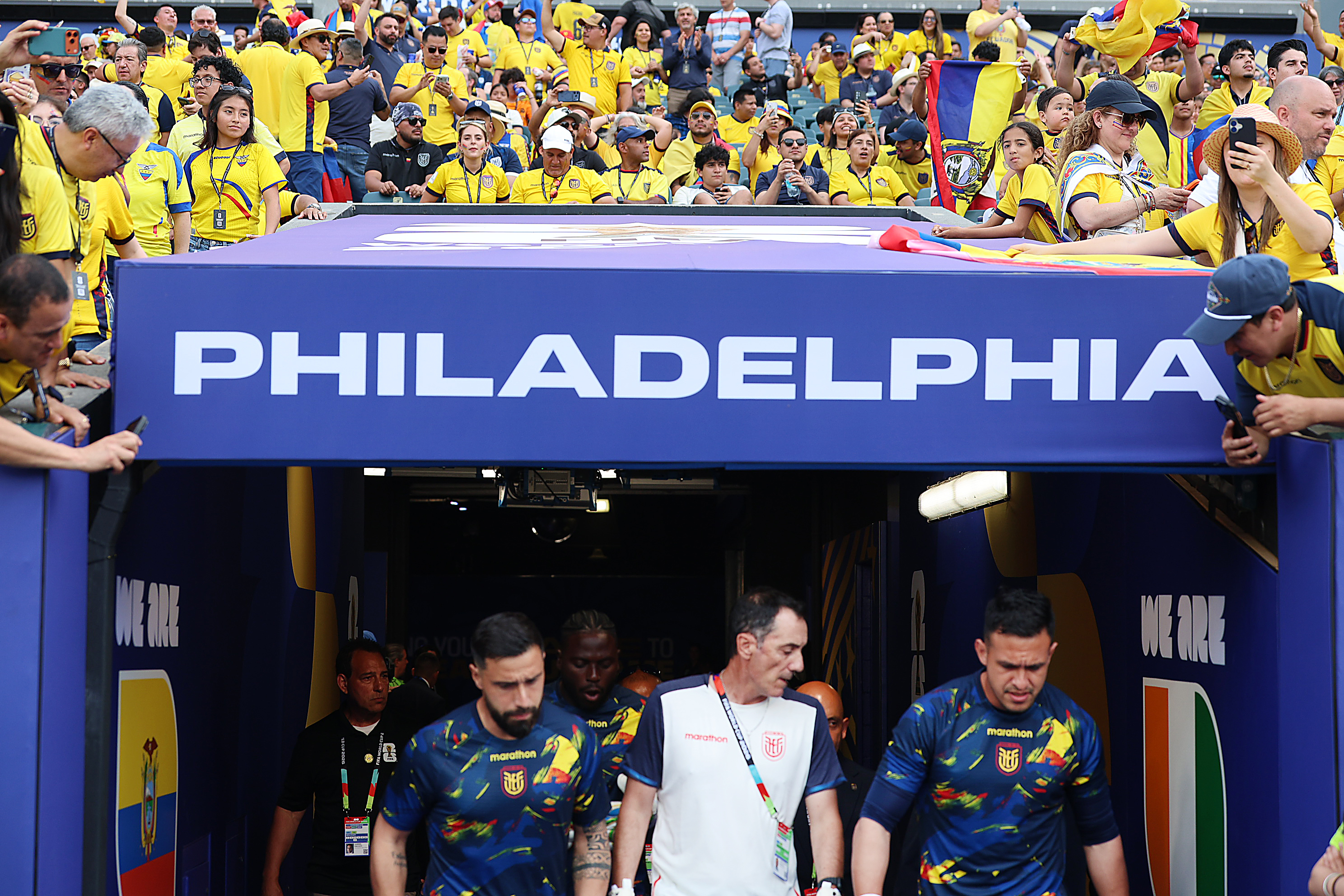
    Ecuador is nearly 3,000 miles from Philadelphia, but, for two hours, the stadium served as an Ecuadorian colony, its fans wearing yellow, accounting for 90% of the 68,247 fans in the seats. If they’d issued 60,000 pairs of goggles, they’d have had 60,000 Minions.

    Little wonder. About half of the approximately 850,000 people in the United States who claim a connection with Ecuador live in either New York or New Jersey. Most estimates of Ivorians in the U.S. don’t even reach 10,000.

    After the 5 p.m. SEPTA Broad Street Line express was taken out of service at Race-Vine because a door wouldn’t close, the 5:15 local train was inundated with Ecuador enthusiasts when it hit the City Hall stop.

    The cars were full to bursting by the time they hit Walnut-Locust, yellow jerseys shoulder to shoulder and chest to chest, men and women alike. As the train pulled out a song arose, full throat and deafening in the hot, cramped subway car:

    “¡Vamos, vamos ecuatorianos, esta noche tenemos que ganar!”

    Or:

    “Let’s go, let’s go, Ecuadorians, tonight we have to win!”

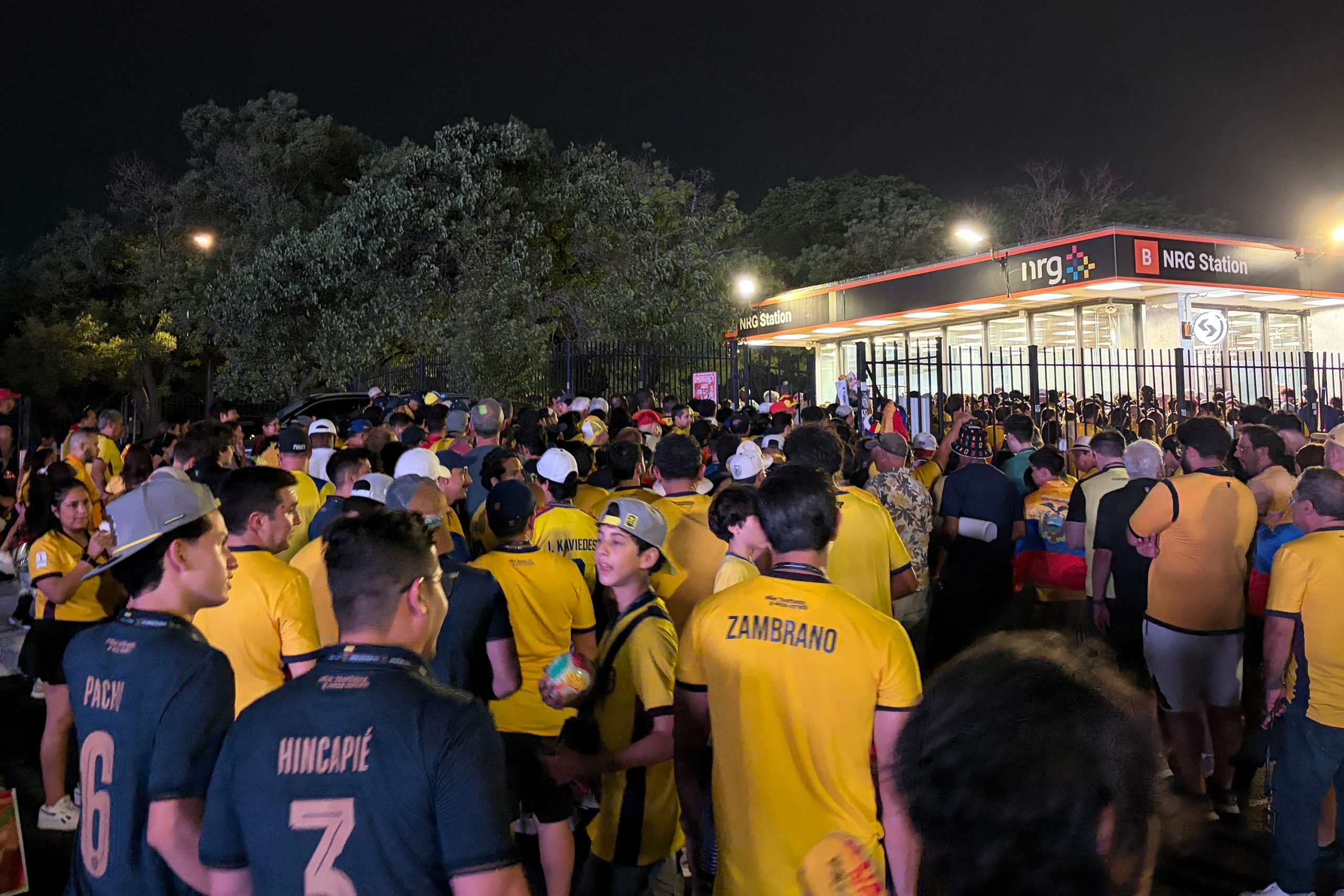
    As the throng exited up the stairs of NRG Station, their hearts and voices swelled again. The song rang out again and again during the match.

    Unfortunately, the Ecuadorians were not singing on the subway ride home.

    Fans wait outside SEPTA’s NRG Station near the stadium following Ivory Coast’s victory over Ecuador Sunday night.Michelle Myers

    Only the Olympics does a better job than FIFA capitalizing on nationalistic spectacle, and Sunday night was no exception. The stunning FIFA World Cup 2026 emblem tapestry laid on the ground covered the midfield circle. Replicas of the flags of Ecuador and the Ivory Coast took up most of the rest of the pitch in front of the goals, crescents cut in the extra fabric to frame the FIFA logo tapestry at midfield. The teams stood on their respective sides of the circle, facing the south stands, as the anthems played.

    The match occurred where the Eagles play, at Lincoln Financial Field, which must be referred to as Philadelphia Stadium during World Cup games. FIFA has a strict policy that prohibits references to sponsors who don’t give FIFA money.

    That said, Sunday’s affair was nothing like an Eagles game. It was far more elegant.

    When Ivory Coast dawdled, La Tri — a nickname for Ecuador’s fans, who wear the tricolor yellow, blue, and red of the flag — booed and whistled. It was not unlike the response of Eagles fans whenever the Cowboys score.

    Fans of the American version of football might balk at the contention that soccer is a bigger deal, and lovers of the Olympics might contend that the ever-shifting collection of summer and competitions matters more. They are wrong.

    Ivory Coast’s Wilfried Singo, right, defends against Ecuador’s Jean Michaël Seri during the second half of a FIFA World Cup Group E match on Sunday.Jose F. Moreno / Staff Photographer

    The World Cup is a different animal than the Olympic Games, concentrated and egalitarian. You don’t have to own a horse or skis to prepare to compete in the World Cup, just a ball.

    The only thing in America that reflects a World Cup is an NFL season. Consider the first 17 games, the regular season, the group stage. Consider the playoffs the knockout Round of 16.

    The NFL season in its entirety and intensity is the one comparison that might allow most Americans to understand the depth of investment and emotion other nations harbor for soccer.

    And, when you factor in the fact that virtually every man, woman, and child in many of these countries have played the sport, then you can better comprehend why soccer is, for so many people on earth, as much religion as it is diversion, and how sacred evenings like Sunday can be for anyone connected with the Ivory Coast or Ecuador.

    The folks who organized it all understood the gravity of the moment.

    Meg Kane, CEO of Philadelphia Soccer 2026, had measures of both delight and relief in her voice as she sat in the stadium parking lot Sunday night.

    “It’s been an exciting four days,“ she began, noting that there were 36 more to go. “I think everything we hoped this would be has been borne out.”

    The delight was easy to source: She had just seen a really good soccer game in a grand stadium with two excellent teams, snuck in just minutes before a thunderstorm, with little or no complication.

    The relief was probably based on the reception most of the millions of residents had given these unusual visitors.

    “People in Philadelphia are excited to be hosting something like this,” Kane said. “Philadelphians love when people choose to spend their time here.“

    The best news: Philadelphia gets to do this five more times.

  • ‘They fought, we won’: Ivory Coast’s World Cup win against Ecuador kicks off FIFA in Philly

    ‘They fought, we won’: Ivory Coast’s World Cup win against Ecuador kicks off FIFA in Philly

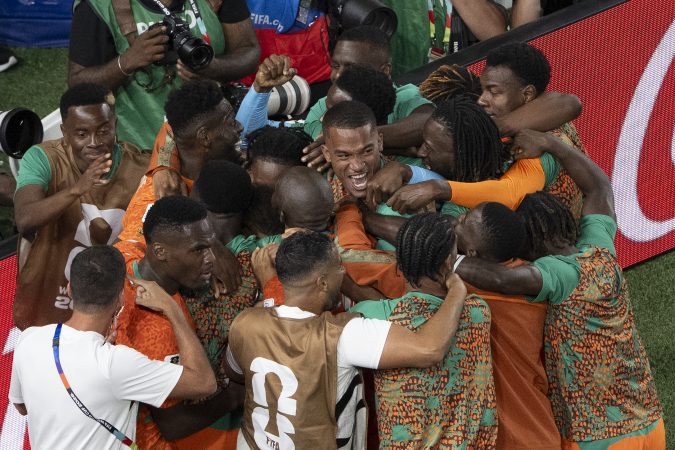
    Speckles of orange-clad fans leapt up from seas of yellow, wringing rally towels, whooping, and crashing into one another.

    This was the scene across Philadelphia Sunday night, as Ivory Coast defeated Ecuador with a single goal in the 90th minute of the first World Cup matchup at “Philadelphia Stadium” (better known as Lincoln Financial Field).

    After years of anticipation, ticketing woes, and infrastructure blunders, the world’s most beautiful game has landed in the City of Brotherly Love.

    And soccer fans are feeling it.

    The 68,274 attendees erupted when the West African nation broke the deadlocked game in the last seconds of regulation, leaving Ecuadorians stunned and distraught. Some covered their faces in disbelief.

    “They fought, but we won,” Ivory Coast supporter Glenn Feidanga said.

    Feidanga was the only person dancing in his section after spending the two halves surrounded by Ecuadorian fans. The momentary rivalry eventually gave way to high-fives and kudos.

    “Everything is good,” he said.

    While the Ecuadorian and Ivorian communities in the Philly-area are small — less than 15,500 residents claim Ecuadorian ancestry, and the number of Ivorians is difficult to estimate because the Census Bureau doesn’t tabulate them — their fans had no dearth of fervor or conviction.

    Anything for your team

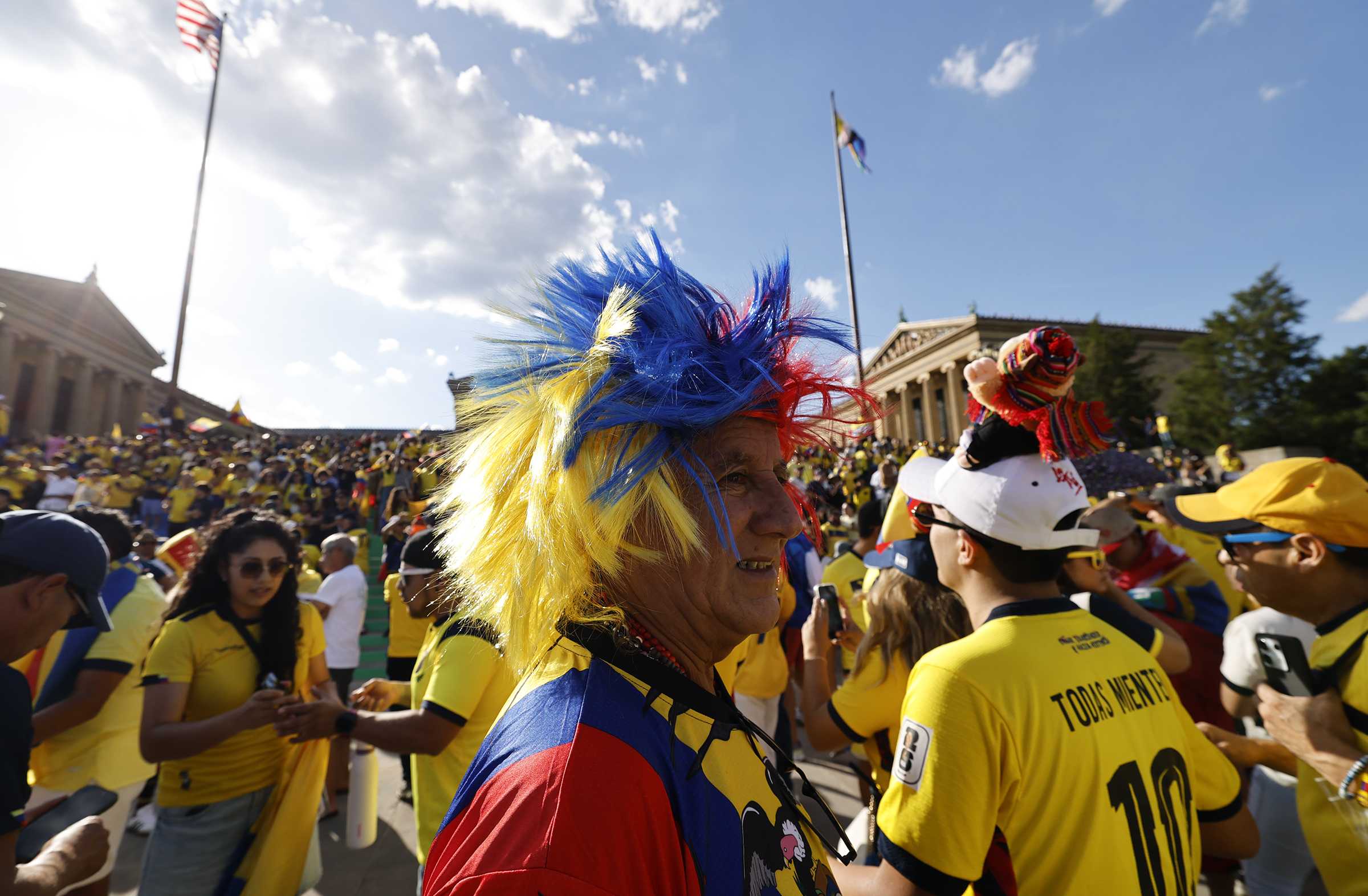
    In the days and hours leading up to kickoff, celebrations have spilled into streets and SEPTA stations across the city — and supporters have been undeterred by oppressive heat and threats of severe weather. On Saturday, a wave of yellow, red, and blue flooded the steps of the Philadelphia Museum of Art, as thousands of Ecuadorian fans rallied and basked in their pride.

    The Broad Street Line Sunday afternoon was inundated with Ecuador fans. Teeming train cars were full of yellow jerseys standing shoulder to shoulder, men and women alike. As the train pulled in, a song arose; full throat and deafening in the hot, cramped subway car.

    “Let’s go, let’s go Ecuadorians, tonight we have to win!“

    As the throng made its way out of the NRG Station, the fans’ hearts and voices swelled again.

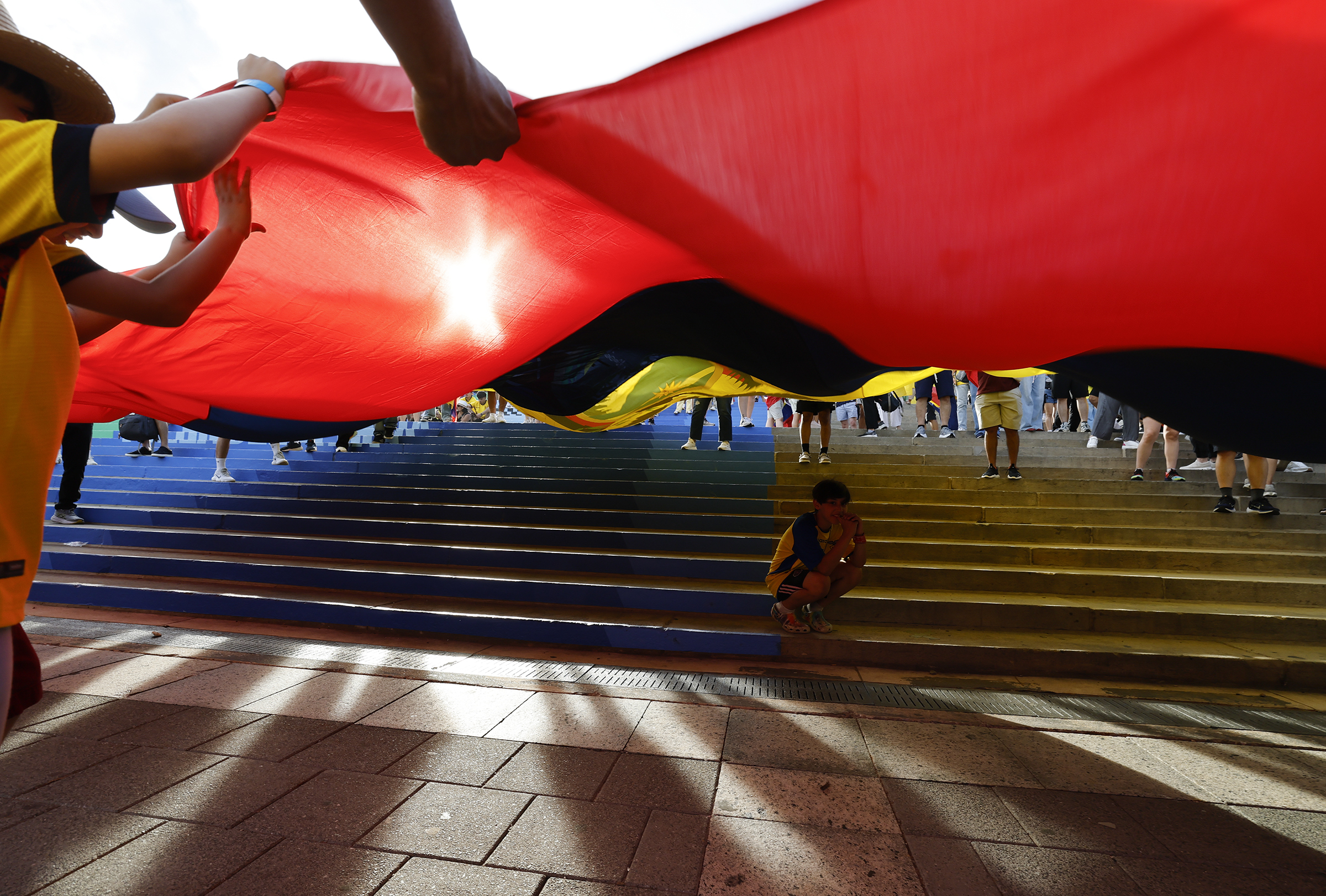
    A young Ecuadorian soccer fan sits under the Ecuadorian flag during a flag waving event at the Philadelphia Museum of Art steps along the Benjamin Franklin Parkway, ahead of Ecuador’s first round World Cup match against the Ivory Coast on Saturday, June 13, 2026.Yong Kim / Staff Photographer

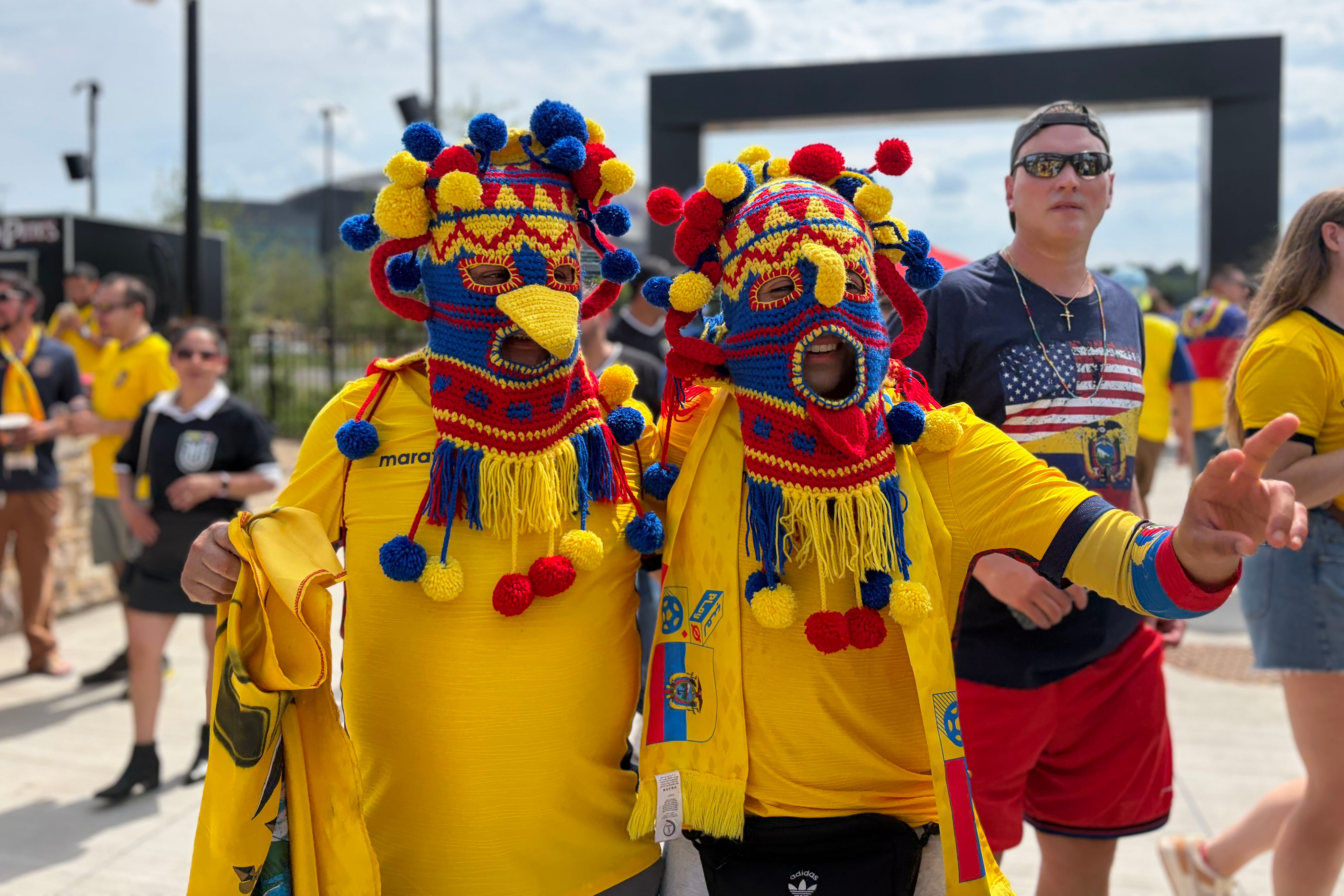
    Pacho Flores would go to any length for “La tri,” the nickname for the Ecuadorian national team. He had traveled from New York City and had paid $650 a ticket for his family of eight to see his team play in Philadelphia.

    “It’s the most beautiful thing in the world,” Flores, a 62-year-old Ecuadorian native, said. “We have to follow the team to every game. It’s a blessing to have them play so close.”

    Pacho Flores (left) and his son, Alex, dance wearing thickly knit Diablo Uma masks ahead of Ecuador’s World Cup match against Ivory Coast in Philadelphia Sunday, June 14, 2026.Michelle Myers /

    Despite the 90-degree day, Flores and his son, Alex, wore thickly knit masks of Diablo Huma — an Indigenous protective sacred figure from the highlands of Ecuador — to represent his native town of Cañar.

    “It’s not that hot inside the mask,” Alex said, wiping sweat from his brow, “and it’s worth it because we have to win.”

    “Either way, we will still love the team,” his father added.

    Ecuadorian soccer fan Demetrio Govrea watches fans during a flag waving event at the Philadelphia Museum of Art steps along the Benjamin Franklin Parkway, ahead of their first round World Cup match against the Ivory Coast on Saturday, June 13, 2026.Yong Kim / Staff Photographer

    The family won’t have too much time to idle: They head back to New York City on Monday morning to pack for La tri’s match in Kansas City on Saturday against Curaçao.

    Ivory Coast fans Justin Bambara, Samska Lejah, and Couby Ouedraogo flew from Niger to New Jersey, then drove two hours to Philadelphia, and were confident in their team’s chances.

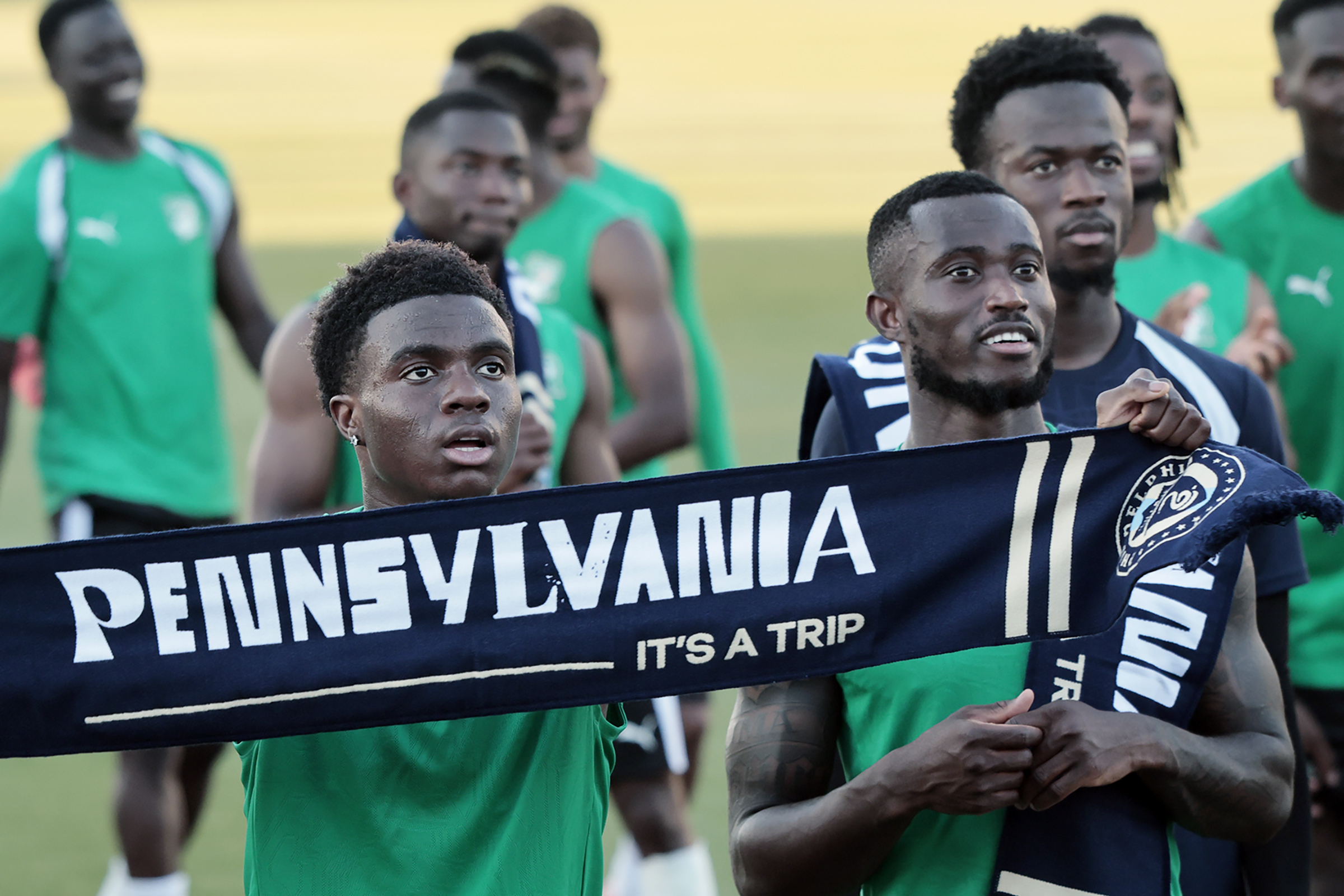
    Members of the Ivory Coast national football team react while watching the Sixers Stixers drum line perform following their practice at Subaru Park in Chester on Friday, June 12, 2026
    Elizabeth Robertson / Staff Photographer

    “The yellows,” Bambara, 49, said, referring to the Ecuadorian fans’ jerseys, “need their support; we don’t need that, we are going to win.”

    “We will invite them to beers once they lose,” Lejah, 55, said.

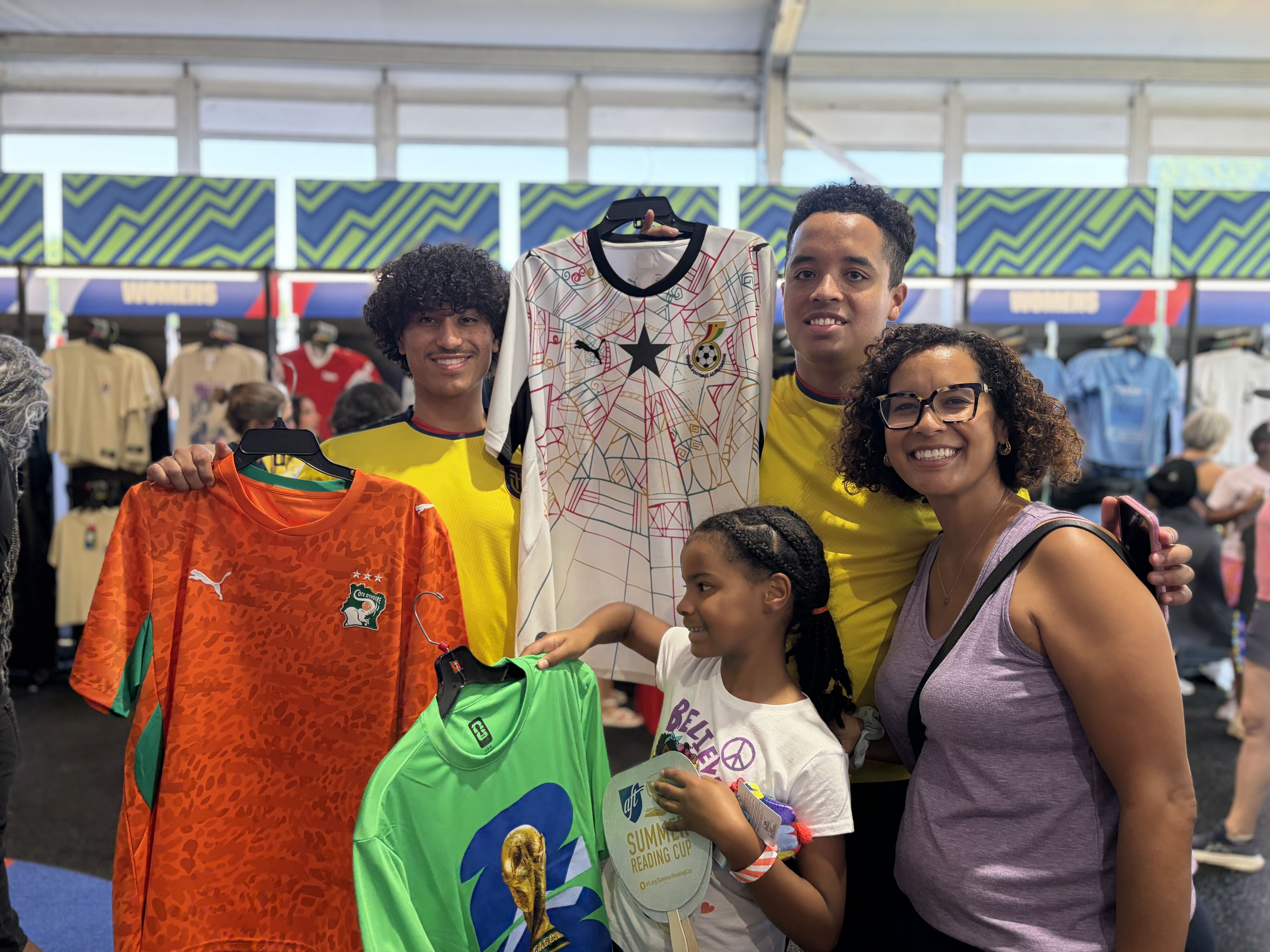
    In the middle of it all, there seemed to be a marriage being put to test. Aurora Brown of Jacksonville, Fla., was attending FIFA Fan Festival with her family Saturday and said she is cheering for her home country, Ecuador. Her husband, Jamaal Brown, who had to stay back in Jacksonville, recently found out through a DNA test that he has Ivorian connections and is rooting for Ivory Coast.

    Aurora Brown and the family pick out a soccer jersey for dad at FIFA Fan Fest in Philly. Dad Jamaal had to stay back home in Jacksonville, where he will be rooting for the Ivory Coast. But Aurora is sticking with Ecuador.Michelle Myers

    “If they weren’t playing against Ecuador, the whole family would be Ivory Coast fans,” Aurora said.

    “Ivory Coast is going to win and I will celebrate with some drinks,” Jamaal said over the phone.

    “We are winners.”

    Ticketing woes continue

    This is the most expensive World Cup ever, and astronomical ticket costs and “dynamic pricing” have been a big gripe for many soccer fans.

    Day-of, there were no tickets available for Ecuador v. Ivory Coast on FIFA’s last-minute marketplace, Ticketmaster, StubHub, Vivid Seats, and SeatGeek. Tickets for Friday’s match between Brazil and Haiti were selling for at least $1,600 on StubHub.

    Jayden Quezada, 17, and his parents spent $4,350 on Saturday to get three tickets to the next-day game through TickPick, a resale website. The trio traveled from Bensalem to Philadelphia hoping for an Ecuadorian victory. By the time they arrived at the stadium Sunday, the tickets were yet to be transferred to their FIFA app.

    They were turned away at the door.

    “They have been the biggest fans since before I was born and they don’t get to go back often because of work,” Quezada said of his parents who were trying to reach TickPick representatives on the phone. “We are probably going to try to get a refund but missing the game would be really sad because we were looking forward to feeling the Ecuadorian pride.”

    Like the Quezadas, more than 50 people waited for help with their failed tickets, including Monica Rojas and Jose Avil who bought a pair of tickets and parking on StubHub for $2,000, only to learn their purchase had been refunded.

    “I don’t know what we are going to do,” Avil said. “It feels defeating — now all we have is the tickets and the desire to watch them.”

    Fans wait outside SEPTA’s NRG Station near the stadium following Ivory Coast’s victory over Ecuador Sunday night.Michelle Myers

    Fan festivities

    Meanwhile, watch parties were underway from Spring Garden to South Streets.

    Ecuadorian singer Johann Vera commanded center stage at FIFA Fan Festival, roaring “¿Listos?”— “Ready?” — to a sea of yellow jerseys dotted by Ivory Coast orange.

    “I thought there were more Ivorians in Philadelphia but I guess not,” said Swann Nemin, a Temple University student from Ivory Coast, visiting Fan Festival with her two Ivorian friends, Ornella Kouame and Naïke M. Their friend, Phoebe Mattes, who they joke is “Ivorian by preference,” joined too.

    Ecuador takes the field for warm-ups before facing Ivory Coast in the World Cup Group E soccer match in Philadelphia on Sunday, June 14, 2026.David Maialetti / Staff Photographer

    The World Cup brought the friends together who were looking forward to dancing and celebrating with people from all over the world.

    “I feel like it’s not only people from Ecuador but also people from South America that are cheering for Ecuador, in the same way that people from all over Africa are repping Côte d’Ivoire,” Nemin said.

    Aleyda Alvarado, a Fishtown resident originally from Mexico, admitted that she isn’t the biggest soccer fan, but the World Cup always gets her and her friends to come out and celebrate.

    “Everyone is here from different countries, but during the World Cup, we’re all just fans,” Alvarado said before kick-off. “That’s how soccer bring people together, and what makes me love it.”

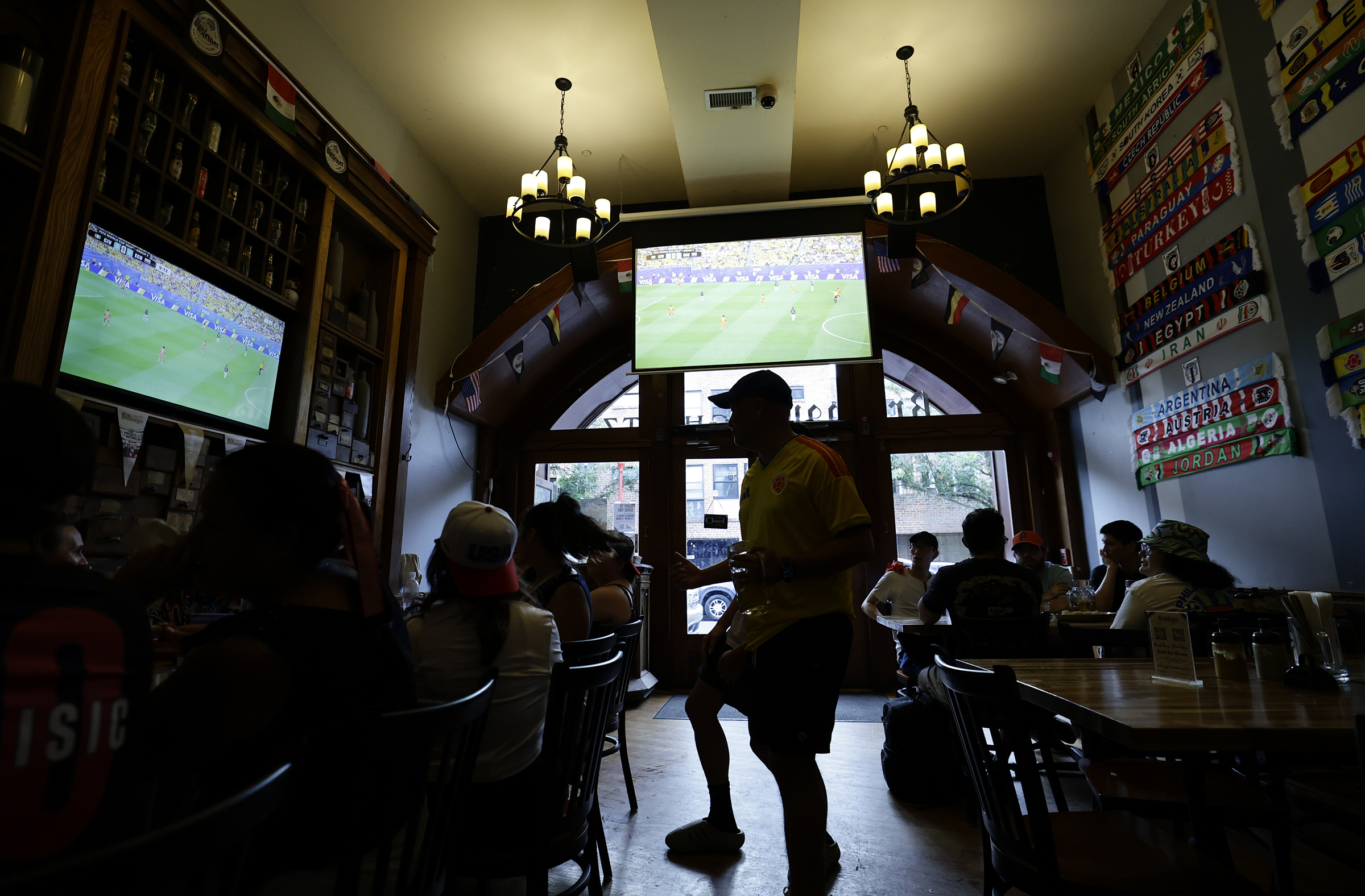
    At the dozens of tables across Brauhaus Schmitz, the German beer hall in South Philly, beer steins were dangerously close to empty. The Caddick family eagerly watched TV screens around the bar and rang cowbells as their team, Ecuador, closed in on the net.

    Soccer fans watch Ecuador take on the Ivory Coast during a World Cup soccer watch party at Brauhaus Schmitz on Sunday, June 14, 2026.Yong Kim / Staff Photographer

    Karina Caddick, 56, of Horsham, was born in Ecuador, just outside Guayaquil, a port city and the country’s largest metropolis. She moved as a baby, but her family made sure to instill in her the importance of and love for soccer.

    To watch her native country’s team compete on her home country’s soil is quite special, she said.

    “It’s unbelievable that we’re able to watch [the game] here,” Caddick said. “To be in Philadelphia and see all the yellow shirts, it’s incredible.”

    But not everyone gets the hype. Outside Brauhaus, a man was overheard asking, “Why does everyone like soccer so much?” For those with connections to one of the participating countries, the answer is obvious.

    “Soccer is everything to Ecuador,” Caddick said. “It is the main sport. It’s their spirit. It’s what calls them.”

  • Former ‘Love Island’ contestant reacts to Bethlehem mayor and police chief comments

    Former ‘Love Island’ contestant reacts to Bethlehem mayor and police chief comments

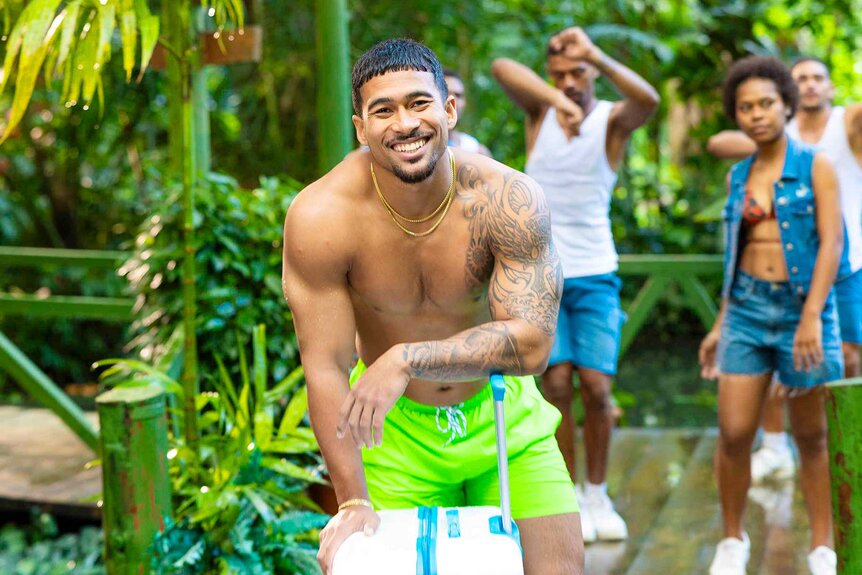
    A Love Island USA spinoff series revealed one Philly-area contestant’s reaction to the reactions of the audience, including the Bethlehem mayor and police chief.

    The unseen footage that aired Saturday on Peacock of former Lehigh Valley cop Sean Reifel aired on the inaugural Aftersun episode, a weekly talk show co-hosted by Ciara Miller, of Bravo’s Summer House, and internet personality Tefi Pessoa.

    Reifel, who was a police officer for the Bethlehem Police Department, came into the show as an original cast member. The 29-year-old had his eyes set on finding love on the show, leaving behind his job and his phone — contestants must forgo their phones for the duration of the show to participate.

    But six days ago, Reifel was left single and vulnerable, and was dumped from the Love Island villa after a dramatic recoupling. The next morning, the Aftersun crew filmed the former cop getting his phone back — only to find out his former bosses — the police chief and mayor — weren’t too happy about his TV debut.

    Former Lehigh Valley police officer Sean Reifel will be on the upcoming season of the hit reality dating competition ‘Love Island USA.’Peacock

    On the show, Reifel read aloud comments from Bethlehem Mayor J. William Reynolds, who swore Reifel in in August.

    “Mayor J. William Reynolds says ‘Sean Reifel resigned from the police department after the city spent thousands of taxpayer dollars on his training and police academy education,’” Reifel read. “He [Reynolds] called the departure disappointing. He said, ‘I never thought I’d see the day in America where a reality show participation wins out over being a police officer.’”

    “I guess he’s upset,” the former police officer said. “That’s interesting. I definitely had a sit-down with my job and told them exactly where I was going and what was happening, and they asked me to put in for unpaid leave.”

    Reifel also read his sister’s rebuttal: “‘This could have been a great opportunity for the mayor and police department to connect with the community instead they chose a response that will likely reinforce the stereotypes they should be working to change.’”

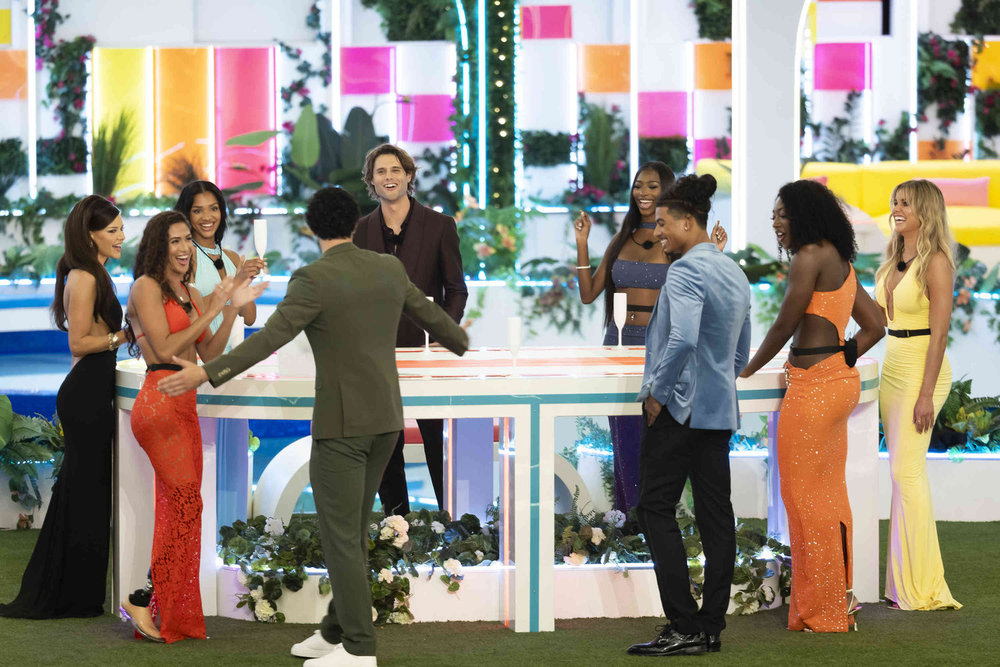
    LOVE ISLAND USA — Episode 801 — Pictured: (l-r) Ariana Madix, Beatriz Alexa Hatz, Melanie Moreno, Bryce Alakai Dettloff, Trinity Celeste Tatum, Sincere Nicholas Rhea, Aniya Harvey, Mackenzie “Kenzie” Brooke Annis — (Photo by: Ben Symons/Peacock)Ben Symons/PEACOCK

    Reading the mayor’s comments bothered Reifel. He, along with his colleagues, had reportedly won awards for “taking a lady out of a building on fire and talking someone off a roof that was mentally ill.”

    “So it’s like … to give me those and then do something like this? I just don’t understand. I don’t want to say anything bad about them. I know things can be taken out of context. Everyone in the department knew I was going.”

    Regardless, he hopes his colleagues appreciate him.

    Hosts of Aftersun also expressed their shock at the mayor’s comments.

    “I can’t even imagine what it’s like having the mayor of the town you live in come out and say that was trifling as f—,” Pessoa said.

    “You’re going to punish him publicly for making a decision on his life?” Miller said.

    “How much crime is there in Bethlehem?” Pessoa said.

    “Mary—” Miller added.

    “And Joseph. And the manger,” Pessoa replied.

  • Three Philadelphia police officers were wounded in a shooting late Saturday. The gunman was a retired firefighter.

    Three Philadelphia police officers were wounded in a shooting late Saturday. The gunman was a retired firefighter.

    Three Philadelphia police officers were wounded in a shooting late Saturday after an argument with a retired city firefighter escalated, and the man opened fire on them in the street, law enforcement sources and city officials said.

    The gunman was killed by officers in response, officials said.

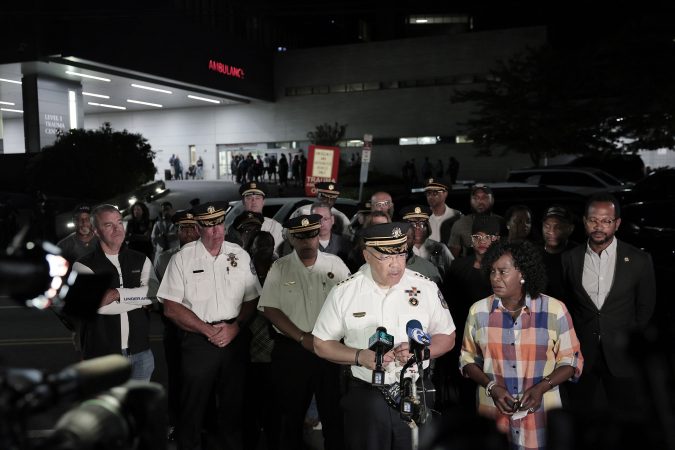
    Police responded to reports of gunfire at a car near North 54th and Arlington Streets in the Wynnefield section of West Philadelphia around 10:30 p.m., Commissioner Kevin Bethel said at a news conference early Sunday.

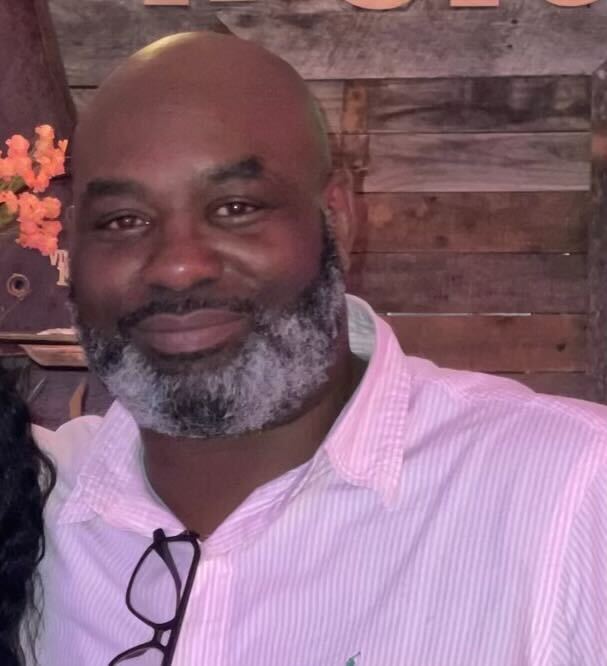
    A 57-year-old man — identified by police late Sunday as Eric Franks — then confronted four officers on the block and began arguing with them, according to video of the encounter obtained by The Inquirer.

    Officials said police were trying to explain to Franks that they needed to establish a crime scene, according to a news release Sunday evening.

    The video appeared to show an animated Franks yelling at officers while another man attempted to hold him back. Franks, according to the video, then pushed a sergeant.

    City Managing Director Adam K. Thiel (center, facing forward) at the emergency entrance of Penn Presbyterian Medical Center, where three Philadelphia police officers were taken after being shot.Elizabeth Robertson / Staff Photographer

    Bethel said the officers repeatedly told him to “stand down” before attempting to arrest him about 10:45 p.m.

    As the officers tried to detain Franks, the video showed him break free, then pull a gun from his waistband, and begin shooting at the officers in the street. In the statement released Sunday, police said Franks had a license to carry a firearm. It stated that the officers repeatedly told him not to draw the weapon.

    In the video, officers and several civilians could be seen diving behind cars and scattering for their lives.

    Four officers shot back at Franks, Bethel said. Three, including a sergeant, were struck by gunfire and taken to Penn Presbyterian Medical Center. One officer was shot in the face, one in the hip, and another in the leg, according to Mayor Cherelle L. Parker. The officers’ names have not been released by officials.

    All were reportedly stable Sunday and expected to recover.

    The video shows Franks stumbling down the sidewalk before collapsing. He was shot in the chest and leg. He died at Thomas Jefferson University Hospital at 11 p.m., Bethel said.

    Bethel said Franks was not involved in the initial incident for which police were called.

    “Why he elected to come into that scene and engage the officers — whether this was premeditated — we will walk through that process to see,” Bethel said. “But you don’t come to a situation like that … to engage the officer. We all can start to think of what potentially his intended purpose was.”

    Eric Franks, 57, a retired firefighter, was shot by Philadelphia police officers on Saturday night.Courtesy of the Frank family attorney

    Franks’ family attorney James Funt said Bethel should not have “insinuated” that Franks may have planned the shooting.

    “That’s just not true,” Funt said. “I don’t know where he got that information.”

    Funt said Franks was a community activist who had met with Philadelphia City Councilmember Curtis Jones Jr. and police to address an increase in drug crimes in the neighborhood.

    On Saturday night, Franks was managing a 16-year-old’s birthday party at his event space business at the other end of the block when his son called him to tell him that someone had shot a car, Funt said. Franks ran to the corner to see if he could help, he said.

    “He is not someone who would try to be an initial aggressor,” Funt said.

    Funt said he doesn’t know what led up to the confrontation captured on video, but it warrants a full investigation and the review of any additional video recordings to get the full picture.

    An investigation by the police department’s officer-involved shooting investigation unit and internal affairs bureau, and the Philadelphia District Attorney’s Office, is ongoing.

    “All we want is for the facts to come out,” Funt said.

    City payroll records show Franks retired from the Philadelphia Fire Department in September 2025 after nearly 20 years on the job.

    Mike Bresnan, president of the International Association of Firefighters Local 22, declined to comment Sunday. A city spokesperson for the fire department referred questions to the police.

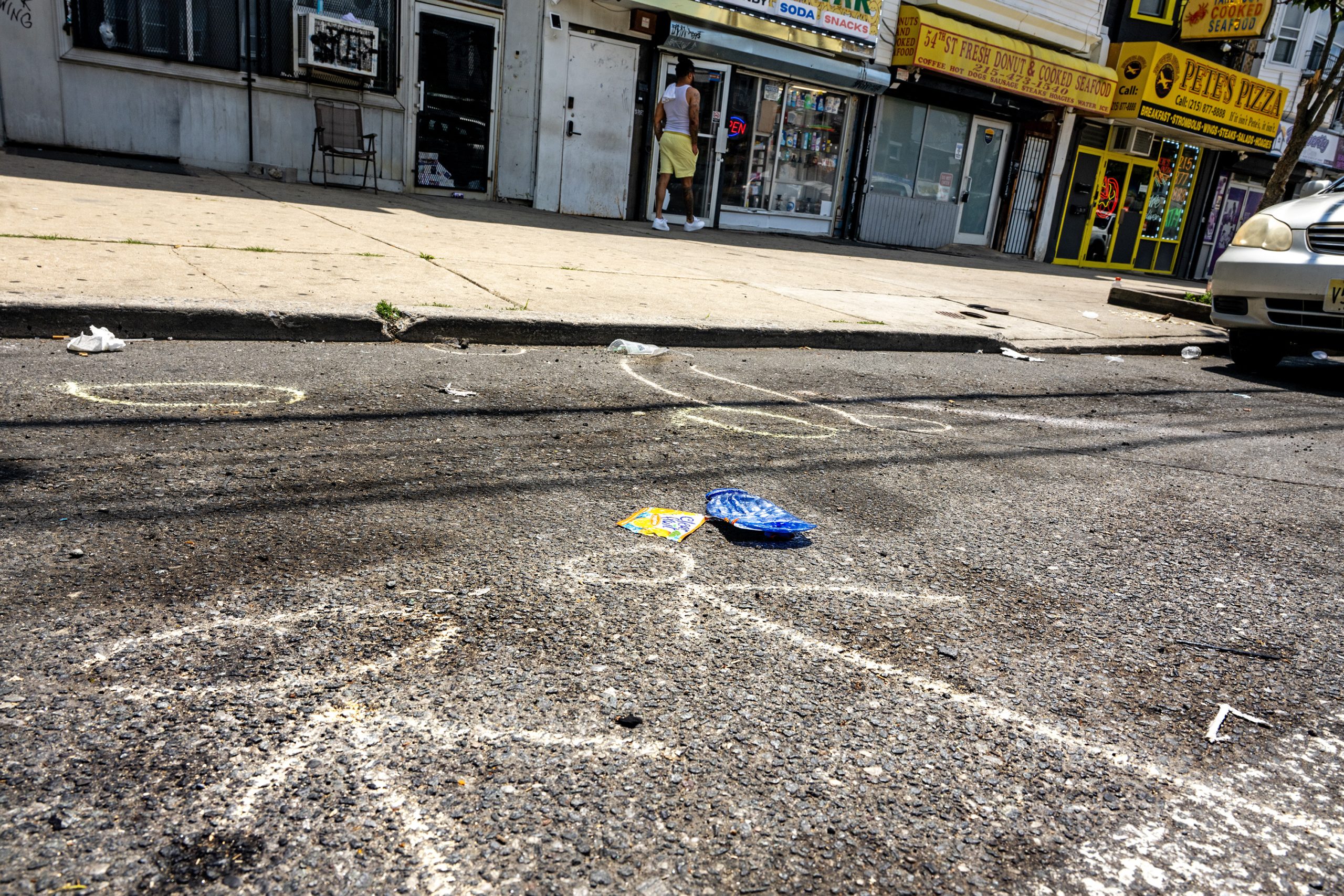
    Police evidence marks are along 54th Street in the Wynnefield section of West Philadelphia Sunday June 14, 2026, the morning after three Philadelphia police officers were wounded in a shooting late Saturday after a verbal altercation with a retired city firefighter.Tom Gralish / Staff Photographer

    The officers, ages 43 and 30, have worked as Philadelphia police for two and seven years, respectively. The sergeant, 39, has been with Philadelphia police for eight years.

    “These men and women give their lives for this work,” Bethel said. The mayor also commended the officers’ resiliency and resolve. “We’re just grateful that tonight, they will survive their injuries,” Bethel added.

    On Sunday, officers with the police department’s crime scene unit continued to comb the block — a street of porch-lined rowhouses and small businesses — for evidence and witnesses. Police pulled several fired shell casings, caked in mud, from a sewer drain.

    Across the street, a group of people who identified themselves as Franks’ relatives gathered outside the event space called Mingle, that the family owns.

    Franks’ wife, Michele, referred questions about the shooting to Funt.

    But in a brief phone interview, she tearfully described how they’d been together ever since they went to their senior prom at Overbrook High School in 1986.

    “He’s a husband, father, a man of the community,” she said.

    Editor Joe Berkery contributed to this article. The article has been updated to include PPD’s statement on the shooting, released Sunday evening.