Society Hill is known for its historic 18th- and 19th-century brick townhouses — and the newly listed 113 Pine St. is no different. It’s designated on the Philadelphia Register of Historic Places.
Yet, this five-bedroom townhouse blends past and present with its contemporary design.
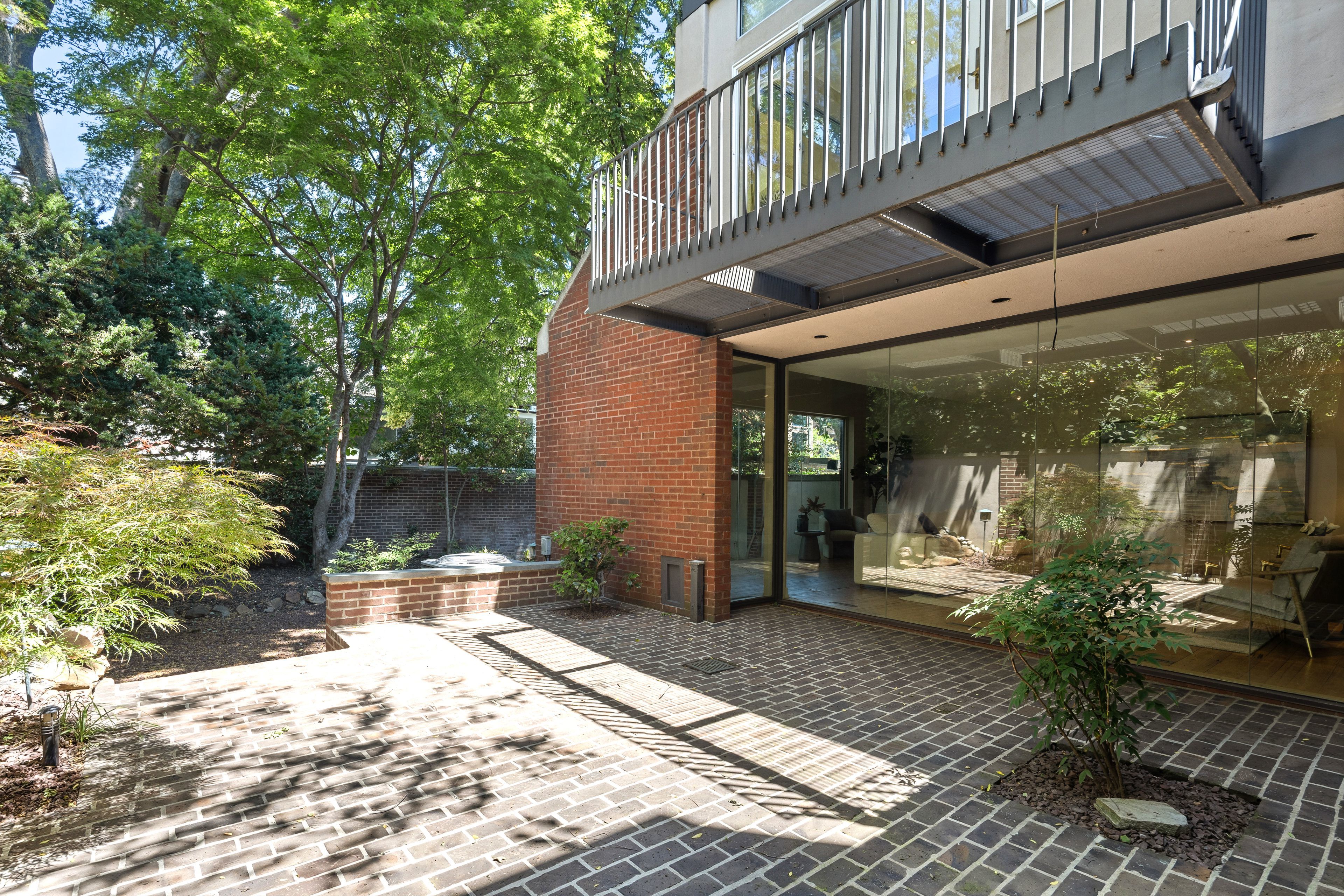
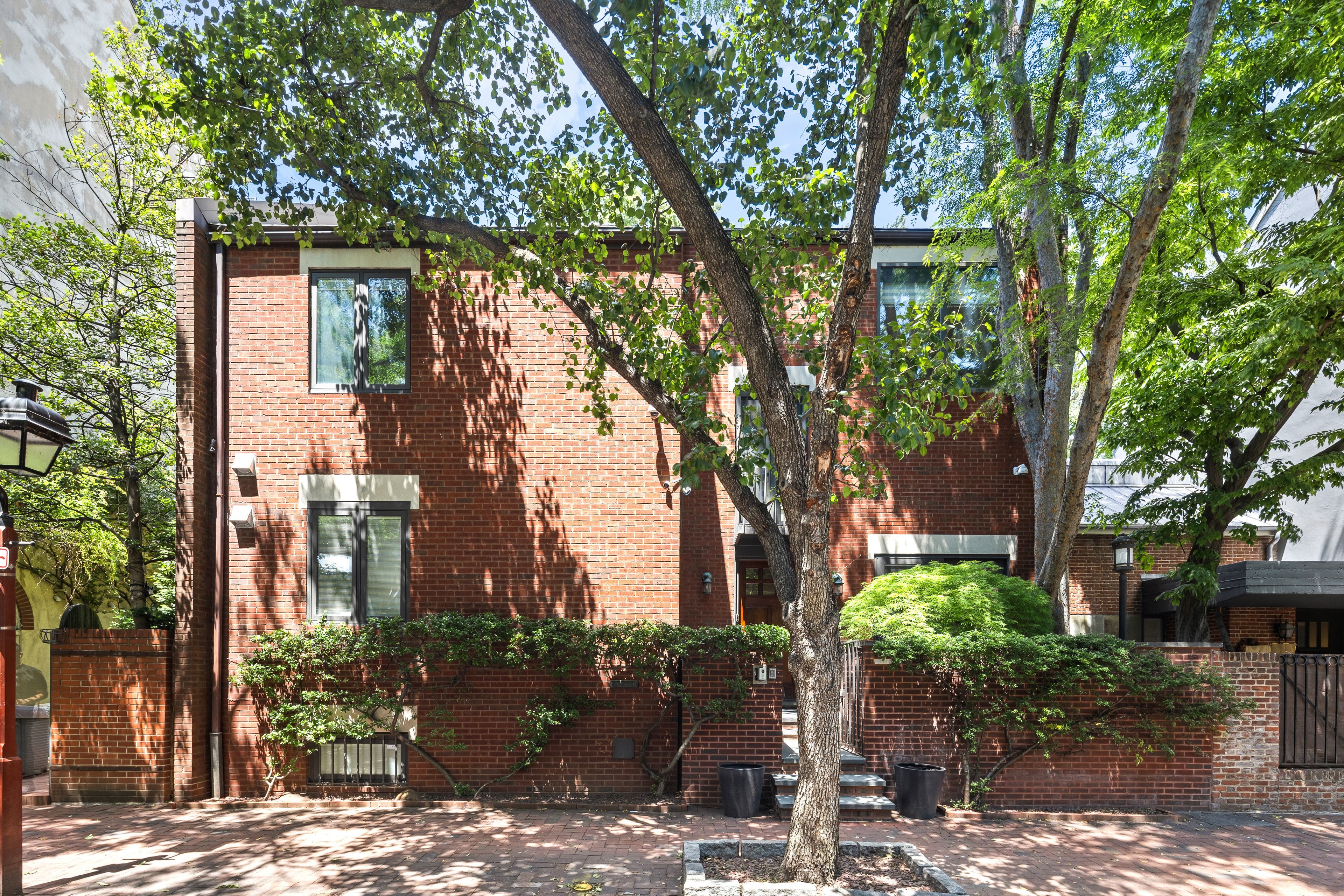
Listed for $2 million, the property sits on a double lot, which listing agent Rich DiNublia of CCL Real Estate said is hard to find. Featuring a walled-in manicured backyard, a spacious brick patio, and a gated-entry front courtyard, the home is made for indoor-outdoor living.
“What we’re hearing consistently is just the wow factor of the contemporary design, and having the privacy of the walled-in gardens,” DiNublia said.
The exterior of 113 Pine St. in Society Hill, featuring its private, gated-entry front courtyard.PLUSH Image Corporation
The 2,776-square-foot townhouse was built in 1960 with the outdoor area designed by renowned landscape architect Ian L. McHarg, a past chair of the University of Pennsylvania’s Department of Landscape Architecture. In 2019, Penn launched the McHarg Center for Urbanism and Ecology in his honor, establishing a research hub for landscape planning.
Glass exterior walls frame the townhouse’s living room, allowing for a complete view of the professionally landscaped backyard.
The townhouse’s living room, wrapped in glass exterior walls.PLUSH Image Corporation
The abundant windows filter natural light through the first-floor living space, reflecting off the townhouse’s reclaimed Amish farmhouse wood floors. Featuring not one, but two fireplaces, the home exudes warmth and sophistication.
The primary bedroom has high vaulted ceilings, broadening the feel of the room, and two balconies.
The en suite bathroom — one of three full and two half-baths — contains a steam shower and a custom walk-in closet.
The ensuite bathroom contains a steam shower and a custom walk-in closet.PLUSH Image Corporation
There are a fully finished basement and garage parking across the street.
A major draw of 113 Pine St. is its neighborhood, which DiNublia said has always been sought after.
Society Hill has easy access to the Headhouse Farmers Market, the riverfront, thoroughfares, and nearby neighborhoods such as Rittenhouse Square — making residents want to stay put.
“Homes don’t come on the market that often, certainly homes of this size,” DiNublia said.
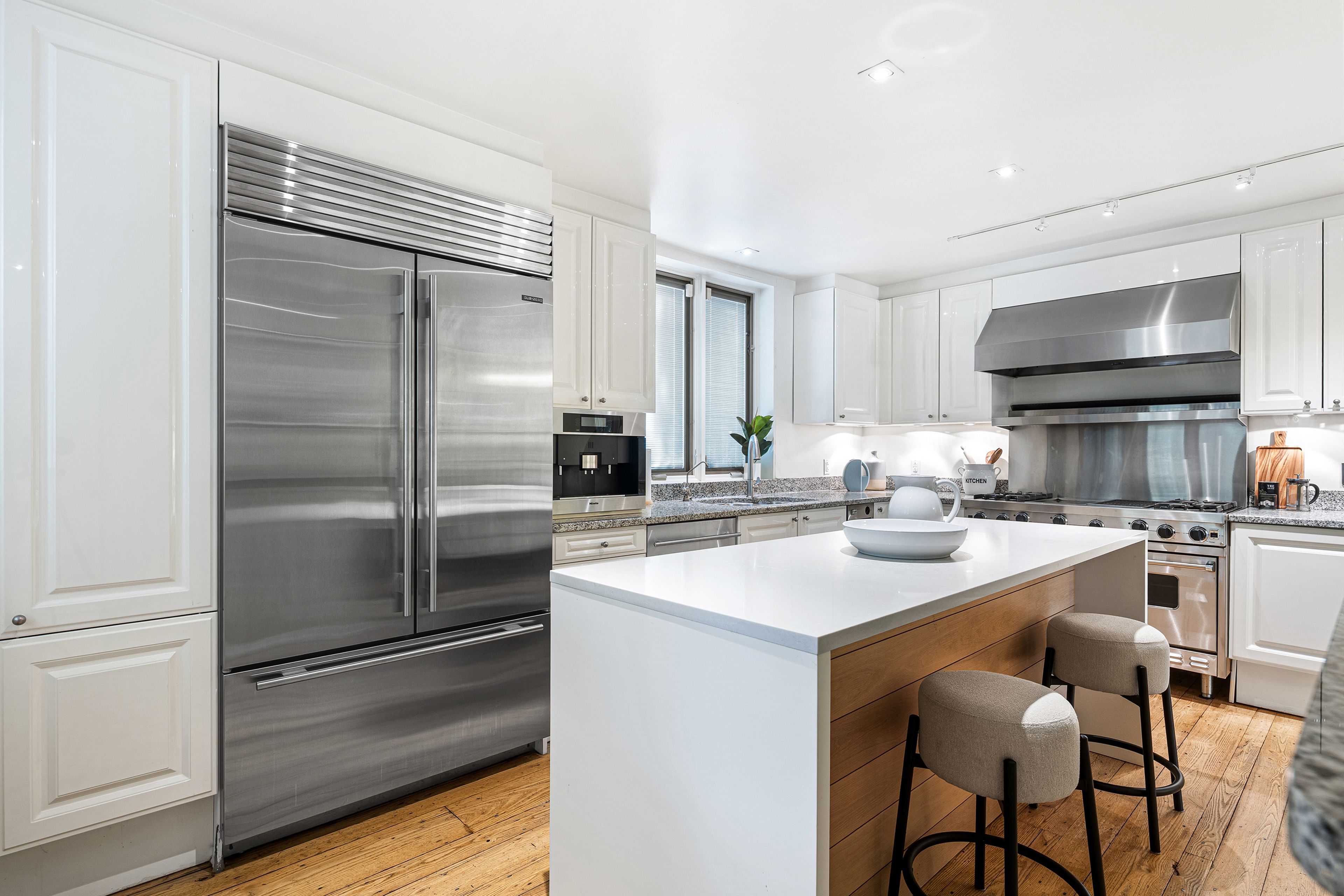
The kitchen at 113 Pine St. in Society Hill.PLUSH Image Corporation
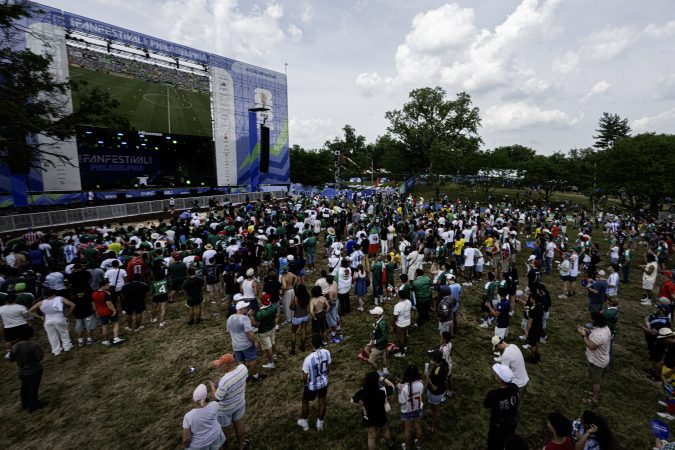
Crowds of Ecuadorian supporters lined the FIFA Fan Festival at Lemon Hill park Sunday during the Group E clash between Ecuador and Ivory Coast at Lincoln Financial Field on Sunday.
The Ivorian team is calling the Philadelphia region home for the World Cup, but Ecuador had an advantage in the 23 acres of festival grounds.
The festival, free and open to the public, streamed three of the day’s matches to a global crowd. Alongside Ecuador, supporters of Germany, Japan, the Netherlands, Ivory Coast, and Curaçao watched their teams compete from the festival grounds.
The festival ended its night with the first match of Philadelphia’s World Cup schedule, a 1-0 win for Ivory Coast.
Festival organizers declined to give a specific count for the number of people who entered the 15,000-person capacity festival grounds in its first weekend of operations, but organizers did say tens of thousands of fans have passed through the festival gates since they opened Thursday.
“People have come, and they’ve been blown away by what we’ve accomplished out here,” said Michael DelBene, the festival’s executive producer. “The energy is high, the crowds are big, the food is delicious, and the matches are great. We think we’re off to a great start.”
Fan Festival’s opening weekend
Hosting a crowd of fans for the first World Cup match in Philadelphia’s history was a checkpoint for festival organizers, but there’s little time for them to reflect on the three-year planning process that led to this point.
Philadelphia’s Fan Festival is the only festival open for all 39 days of the tournament. It will be back open on Monday for three matches, beginning with Spain-Cape Verde at noon.
Putting on the 39-day festival has its challenges, but DelBene said he would not mind if the festival were open for 100 days.
“The transformation of staring at a blank piece of paper to standing in the middle of the site and looking around at what we managed to build and create for our city and its guests is the most rewarding thing,” DelBene said. “That’s why I do what I do.”
The festival has had to contend with high temperatures through its opening weekend. Philly experienced record highs on Thursday before seeing thunderstorms that led festival organizers to move up the scheduled Luis Fonsi concert to beat the storms.
Singer Luis Fonsi is one of multiple musical acts that perform at Lemon Hill.Jose F. Moreno / Staff Photographer
Hot and humid conditions continued throughout the weekend, and more storms loomed over the region as Ecuador and Ivory Coast kicked off.
DelBene said public safety is a top priority, and pointed to Thursday’s scheduling change as evidence.
“If we can’t do it safely, we just won’t do it,” DelBene said. “We have comprehensive public safety and security plans when it comes to logistics, when it comes to heat, when it comes to rain and lightning, and we’ve had to exercise those plans already … Those things have gone smoothly, so we feel like we’re prepared.”
Fortunately for the Fan Festival and its organizers, the rain held off and the festival was able to host crowds for all three games it showed on Sunday and a few live music performances, including a concert from Ecuadorian singer-songwriter Johann Vera.
Ecuadorian fans announced their arrival to Philadelphia by wrapping the Rocky statue outside the Art Museum in a bright yellow Ecuadorian jersey on Saturday.
Fans of La Tri continued to have a strong presence on Sunday, filling the Fan Festival with yellow, blue, and red.
“They are a passionate fan base, and just wonderful, incredible people,” DelBene said. “We are just so excited to have them here in Philadelphia.”
Matt McKee was not one of the many native Ecuadorians on the festival grounds, but the resident of East Falls was cheering on Ecuador, sporting a jersey he bought on a trip there in 2012.
McKee said he was impressed with Ecuador’s presence throughout Philadelphia this weekend, especially considering its relatively small population, as compared with the other South American nations in the tournament.
“A ton of yellow, even earlier today in Center City,” McKee said. “You saw yellow shirts everywhere. It’s an impressive showing for not that large of a South American country.”
The Fan Festival had a celebrity fan on Sunday, too. Sixers center Adem Bona strolled through the festival Sunday afternoon during Germany’s defeat of Curaçao.
Ivorian fans were harder to spot, despite the team being scheduled to play two games at Lincoln Financial Field and setting up its training base in Chester.
Still, some fans have adopted the Ivorian team, which is the only team scheduled to play twice in Philadelphia during the group stage. They were rewarded Sunday as Amad Diallo netted a 90th-minute winner for Les Éléphants.
Naseef Sami, a lifelong fan of Germany, had traveled from Williamsport, Pa., to attend his first World Cup match. He stopped at the Fan Festival to watch the Germans dominate Curaçao, 7-1, in Sunday’s first game.
Sami said he valued soccer’s ability to serve as a bridge between cultures. He conversed with two Ecuadorian fans as they waited on the draw between Japan and the Netherlands to kick off.
“Especially in the current political environment, to see that happening right now,” Sami said. “People have all sorts of colors, all sorts of jerseys, it doesn’t really matter … [It is] cool to talk to people from all different places.”
Fox Corp. is buying streaming platform Roku in a cash-and-stock deal valued at approximately $22 billion.
The deal announced Monday will give Fox access to the Roku channel, first-party data and more than 100 million global streaming households. Fox is a media giant that includes sports, news and entertainment content as well as Tubi.
Fox will pay $96 in cash and 0.9693 shares of its Class A common stock for each Roku Class A and Class B share outstanding. The transaction is valued at $160 per Roku share.
Existing Fox shareholders are expected to own approximately 73% of the combined company and Roku shareholders will own about 27%, once the deal closes.
The deal is expected to close in the first half of next year. It still needs approval from Fox and Roku shareholders and also regulatory approval.
Since 2020, the White House’s southern facade has served as the backdrop for a Republican National Convention, a rally preceding a mob attack on the Capitol, and now, a mixed martial arts match celebrating President Donald Trump’s 80th birthday.
Trump opened his front lawn to his friend Dana White’s sports league for a live spectacle to air on his friend David Ellison’s streaming platform. A clawlike arched canopy loomed over the executive mansion’s iconic colonnade, evoking the spaceship on the movie poster for the 1996 film Independence Day, in what Trump ranked among “the most exciting days in the History of our fabled White House” on social media.
At least nine cabinet secretaries attended, along with uniformed military service members the Pentagon required to look the part as defined by a prescribed “height-waist ratio.”
The use of White House grounds for a violent sporting event sponsored by light beer and cryptocurrencies was overwhelmingly unpopular, garnering the support of just 31% of Republicans and 11% of independents in a Reuters-Ipsos poll. The president’s overall approval ratings hit a second-term low in a new NBC survey, and AP-NORC polling showed the blue-collar, independent, and young voters who swung to him in the last election increasingly deserting him and his party over dissatisfaction with inflation and the Iran war that worsened it.
Even in this setting where Trump could reliably expect a warm reception, a boo stuck out among the cheers as he entered.
The president wore a UFC lapel pin below his standard American flag as he and White walked out of the Oval Office, through the mansion, and emerged on a balcony as the band played “Hail to the Chief.” The president saluted during the national anthem, while the broadcast showed images of active-duty sailors, and a delta formation of 12 fighter jets roared over the White House as country artist Zac Brown sang “O’er the land of the free.”
“I have seen some surreal things in my life — this is the most surreal,” podcaster Joe Rogan said on the official broadcast. “It doesn’t seem real. None of it seems real. It’s so crazy.”
Sunday’s fight kicked off this summer’s D.C.-anchored celebration of the nation’s 250th anniversary, which has similarly become politicized by Trump’s central role. Trump allies sidestepped a bipartisan commission and congressional funding to fundraise and organize events through their own vehicle.
Musicians and states dropped out of participating in the 250 events, so that the headliner would be Trump himself holding another rally on the National Mall. Renovations of the Reflecting Pool, the Kennedy Center, parks and fountains, and the White House’s East Wing are absorbing the president’s attention — a distraction in the view of most voters and some Republican strategists and politicians.
Hours before the fight began, Trump heralded an end to the Iran war after months of false starts and shifting deadlines. But the details of the agreement remained concealed on Sunday, with talks ongoing ahead of an official signing scheduled for Friday. The last time the administration announced a deal to stop the bombing and reopen the Strait of Hormuz, it unraveled within days.
Trump spent the earlier hours of his birthday working to preserve the agreement after an Israeli attack in Lebanon. He also watched Fox News, criticizing an interview with Sen. Jack Reed (D, R.I.) and praising an appearance by former adviser Victoria Coates. He posted repeatedly on social media denouncing opposition to his embattled acting spy chief, Bill Pulte, and taking a swipe at his former lawyer, Michael Cohen.
Trump also held a small family dinner.
His 80th could not have been more different from his predecessor’s, the only other president to mark that milestone in office. Public doubts about Trump’s health and fitness have increased, polls show, but concerns do not rival those about Joe Biden.
The White House has called the president’s health “excellent.” Trump insists he feels the same as or better than decades ago, and that he’d be the first to admit if he ever felt otherwise. Still, he is frequently reminded of the friends around his age who are getting sick and dying, and he speaks more often of the memory of his parents and his own place in history.
Trump has used settings such as a UFC match, a Formula One race, a football game, or a frat house to project an image of enduring vigor, as well as to appeal to young men with unapologetic masculinity, daring critics to recoil so that his team can mock them as weak and effeminate.
“I just can’t believe that we’re at the White House watching UFC fights,” former UFC champion Daniel Cormier said during the broadcast. “I’m so filled with like testosterone I want to kick someone in the chest, it’s crazy.”
On Saturday night, White stood steps from the site of Martin Luther King Jr.’s “I Have a Dream” speech in front of the Lincoln Memorial as he separated two competitors about to brawl at the night-before news conference. Speaking to reporters ahead of Sunday’s fight, heavyweight Josh Hokit said he might take off his pants and throw his cup at the president, perhaps as a souvenir for the Oval Office.
Trump’s role has been divisive even within the world of UFC. Featherweight Diego Lopes chafed at reports that his Spanish-language walkout song might offend the president; the Marine Band ended up playing it after all.
One fighter not picked for Sunday’s lineup attributed the decision to his criticisms of Israel and the Iran war. Another said the government’s entry into sports entertainment was “desecrating its role in society.” UFC co-founder Rorion Gracie said he wouldn’t watch the White House event because the sport has gotten too violent.
“First and foremost, got to thank President Trump for making this happen,” middleweight fighter Bo Nickal said about winning his match. “It takes such a special person to be able to have the balls to do something like this.”
DUBAI, United Arab Emirates — The United States and Iran reached an initial agreement Monday that would extend their shaky ceasefire and lead to the reopening of the Strait of Hormuz, but significant challenges remain, including whether Israel will continue its offensive in Lebanon.
Details of the agreement were not immediately released, but it appeared that it would not be implemented until it is signed, which mediator Pakistan said would happen Friday in Geneva. Until then, shipping will likely remain restricted in the strait, which is a crucial passage for the world’s oil and gas and the closure of which has sparked a global energy crisis.
Israel’s defense minister said Monday that the country wouldn’t withdraw from land seized in Lebanon, where Israel is fighting the Iranian-backed Hezbollah militant group. Israel joined the U.S. in launching the war on Feb. 28, but it is not party to the deal. A spokesman in Prime Minister Benjamin Netanyahu’s office said Israel will continue to defend itself against any threat to its security.
That alone could scupper the deal, since Iran has insisted any agreement to end the war include an end to the fighting in Lebanon.
But the agreement also faces other major challenges. It gives just 60 days to decide what to do about Iran’s stockpile of highly enriched uranium and its nuclear program — which the U.S. and Israel worry could be used to build an atomic weapon, despite Tehran’s insistence that it is peaceful. It took years for Iran and world powers to negotiate a 2015 agreement to rein in Tehran’s nuclear program.
President Donald Trump unilaterally withdrew the U.S. from that accord in his first term, setting the stage for the tensions that culminated in the current war.
Despite the uncertainties, world leaders from Europe to China welcomed the deal to end a conflict that has killed thousands across the Middle East, including the top leaders of Iran’s theocracy, and raised the prices of fuel, food and other basic goods far beyond the region.
Still, some expressed concern that the deal would actually come about: Luxembourg’s foreign minister, Xavier Bettel, noted: “It’s a long time till Friday.”
The Strait of Hormuz won’t open until the deal is signed
Trump, who faced pressure to end the war ahead of congressional midterm elections in November, hailed the agreement on social media, saying that he had authorized the Strait of Hormuz to open and the U.S. blockade of Iranian ports to end. He later said the strait wouldn’t open until Friday.
Iran’s deputy foreign minister, Kazem Gharibabadi, confirmed the agreement on state television but said Iran would not start implementing it until it was signed.
Early in the war, Iranian attacks on ships brought traffic in the crucial waterway to a near standstill. Trump implemented a blockade in response.
The closure of the strait — through which a fifth of the world’s oil and natural gas passed before the war — and the blockade sent fuel prices skyrocketing, and the knock-on effects rippled throughout the world economy. It will likely take months before energy companies can resume operations to the point of meeting the world’s demand, according to energy experts.
Iranian and U.S. officials will hold preparatory meetings in Doha, Qatar, this week before the signing, said a diplomat with direct knowledge of the talks, who spoke on condition of anonymity to discuss the closed-door meetings.
Israel says it won’t withdraw from Lebanon
The success of the deal rests at least partially on what happens between Israel and Hezbollah in Lebanon. Israel’s bombing of Beirut’s southern suburbs on Sunday nearly derailed the negotiations, and a previous attack led Iran to fire on Israel and Israel to fire back.
Defense Minister Israel Katz, meanwhile, said Israel plans to stay “indefinitely” in land it holds in Lebanon, Syria and the Gaza Strip.
Katz also threatened that if Iran attacks Israel over its strikes in Lebanon, Israel will strike Iran with “great force.” Over the past 2 1/2 years, Israel has taken control of areas in Gaza, Lebanon and Syria amounting to 386 square miles of territory.
In response to questions about where Israel stands on the deal, David Mencer, a spokesman in Netanyahu’s office, told The Associated Press that Israel and the U.S. remain fully aligned on preventing Iran from obtaining nuclear weapons. But he added that Israel will not tolerate attacks from Hezbollah on its territory and will continue to act against those who seek to harm its citizens.
JIM THORPE, Pa. — Long considered one of Pennsylvania’s most popular and scenic hikes, the Glen Onoko Falls Trail was also one of the state’s most dangerous.
Many people have been injured on the steep rocky trail, 85 miles north of Philadelphia, in Jim Thorpe, Carbon County. Others have died. In 1983, David R. Carlyon, 23, of Hazleton, dove across the top of the falls, trying to save his 3-year-old nephew, Ian Russell. Both fell and died. Over the last 50 years, at least 10 hikers have died.
When the Pennsylvania Game Commission closed the trail in 2019, citing safety and trail deterioration issues, Thomas Russell recounted the tragic day his son died.
“I saw him,” he told The Inquirer in 2019. “I saw him clutching at vegetation, at a branch or something, and I guess his hands slipped, or it didn’t hold, and then he was gone.”
Russell did not want the state to close the trail, however.
Now, seven years later, it’s still closed and being transformed into a safer destination. The Pennsylvania Department of Conservation and Natural Resources’ Outdoor Corps has begun a project that will make the trail safer for hikers and more easily accessible to first responders who have to rescue the injured.
The project, according to DCNR, is expected to take anywhere from three to five years. When finished, the trail would reopen and become part of Lehigh Gorge State Park.
A portion of Glen Onoko Falls Trail is being reconstructed to allow for easier access in case of emergencies.Jason Nark
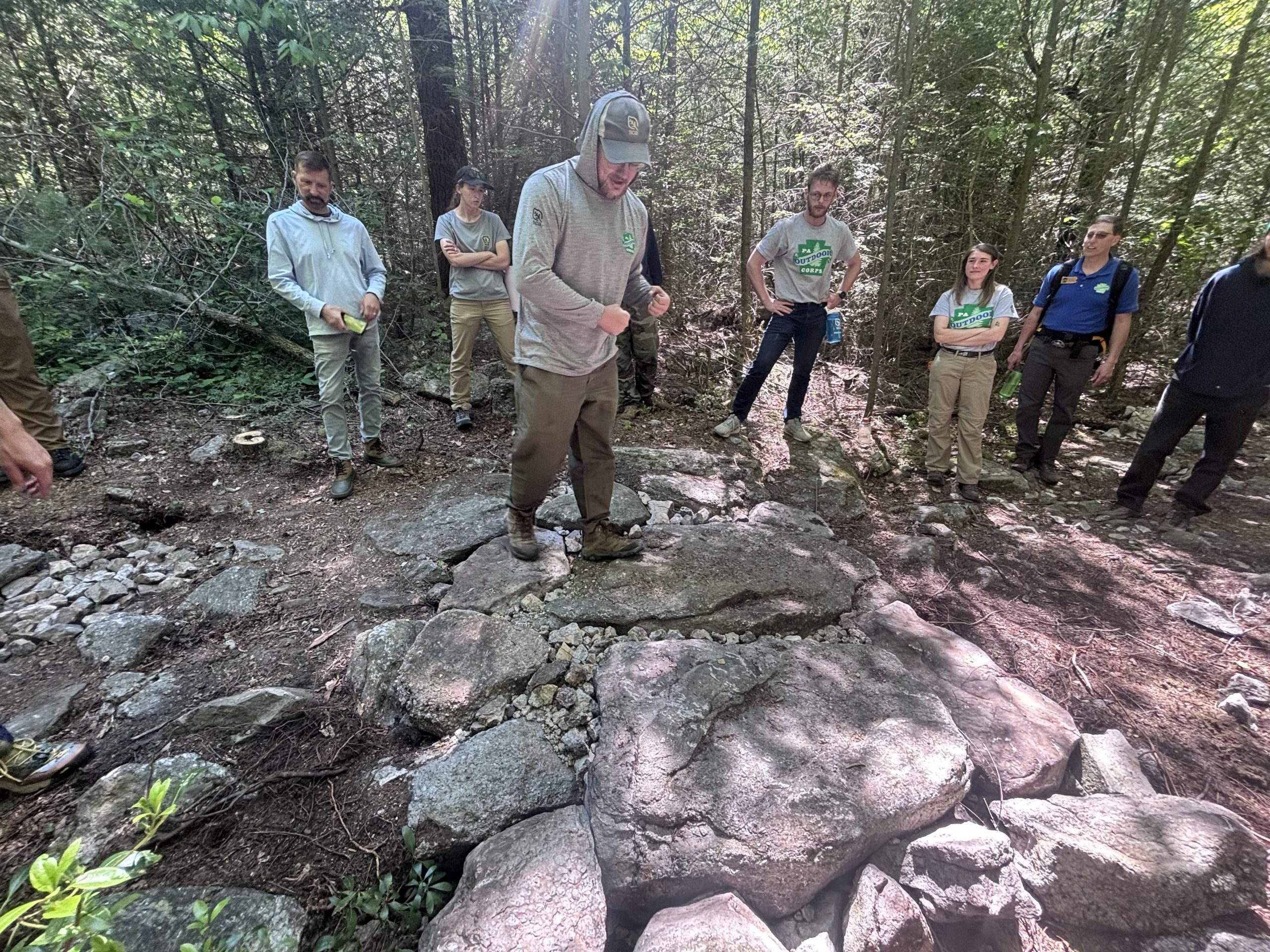
Members of the Outdoor Corps have been methodically moving or smashing large boulders on the upper portion of the trail, creating a safer route for first responders to reach injured hikers with UTVs. Many of the trails would be wider when the work is completed.
It’s sweaty, calculating work that often requires heavy hydraulics to move boulders that weigh more than cars. Some of the biggest rocks — most of them sandstone — have earned names, like Belinda, Gertrude, and Turkey Leg.
“When we crush a rock open, that’s the first time the inside of that rock has seen daylight in millions of years,” one Corps worker said.
Earlier this month, a worker with the Pennsylvania Outdoor Corps discusses boulders that will be removed or pulverized on the Glen Onoko Falls Trail.Jason Nark
In 2019, the Pennsylvania Game Commission cited overuse as an additional factor in the decision to close the trail. More than 8,500 people signed a petition at the time to keep the trail open.
Despite the closure and citations issued to hikers found on the trail, it has remained popular, officials said. Officials said the trail is even more dangerous, with hydraulics under high tension to move rocks, during the reconstruction process.
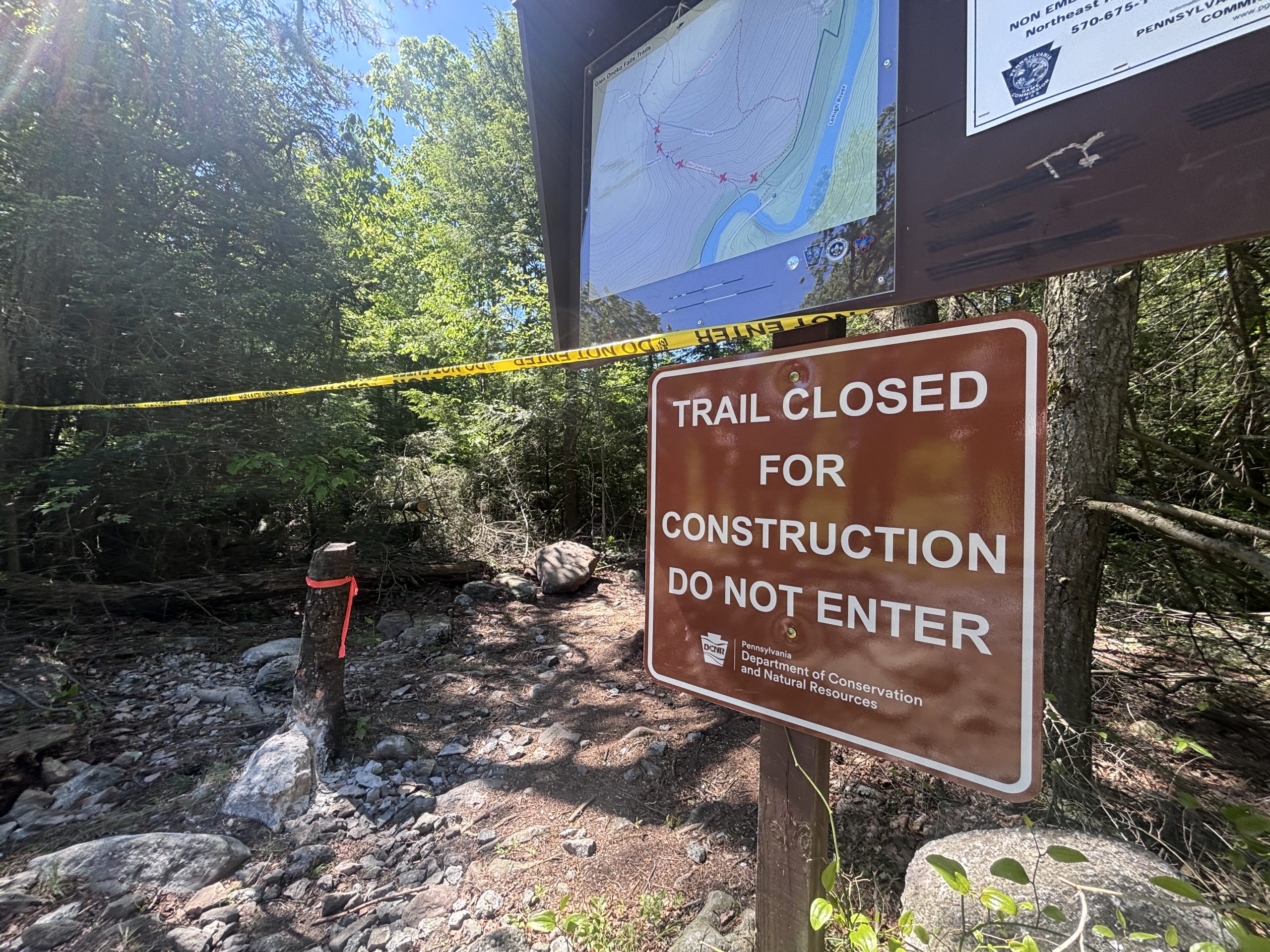
“Even though it’s closed, the public still comes on here,” said Rich Fritsky, regional supervisor for the Pennsylvania Outdoor Corps. “They ignore the signs. They duck under the ropes, but it’s extremely dangerous.”
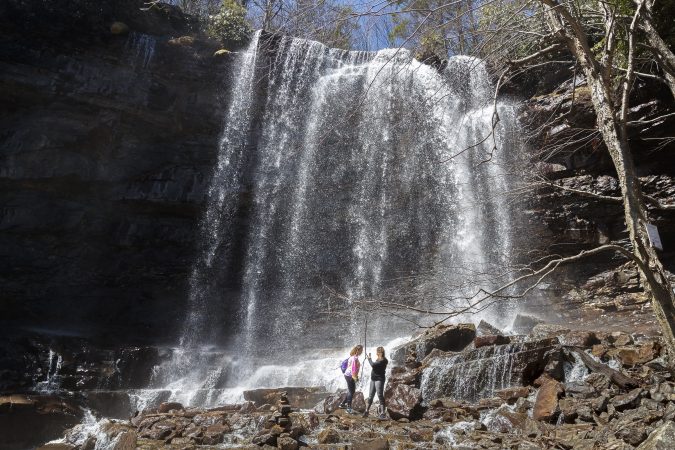
A hiker had to be rescued just a month after the trail closed, and in 2022, a 72-year-old hiker fell and died there. On a recent tour, two hikers were resting by the falls.
“Last winter, a guy was ice climbing and had to be rescued,” said Timm Berger, the district director for State Rep. Doyle Heffley.
On a recent gathering at the trail rehabilitation site, Berger said Heffley’s office has received countless calls over the years from hikers asking when Glen Onoko will reopen.
“People are anxious,” Berger said.
The popular website AllTrails.com lists Glen Onoko Falls as a difficult hike where proper shoes are required. The trail is a 3.7-mile loop and ascends easily, with flat terrain, for about a quarter-mile beyond the parking lot, following Glen Onoko Run closely. But it grows steeper and rockier as it goes upward, with some narrow ledges that appear to be eroding and some steep drop-offs. Often, hikers need to scramble over wet rocks.
AllTrails also warns hikers that the trail is “temporarily inaccessible,” but many are not heeding the warning.
“It started off fairly easy, but then got fairly difficult,“ one hiker wrote on AllTrails in March. “I can definitely understand why the trail is closed.”
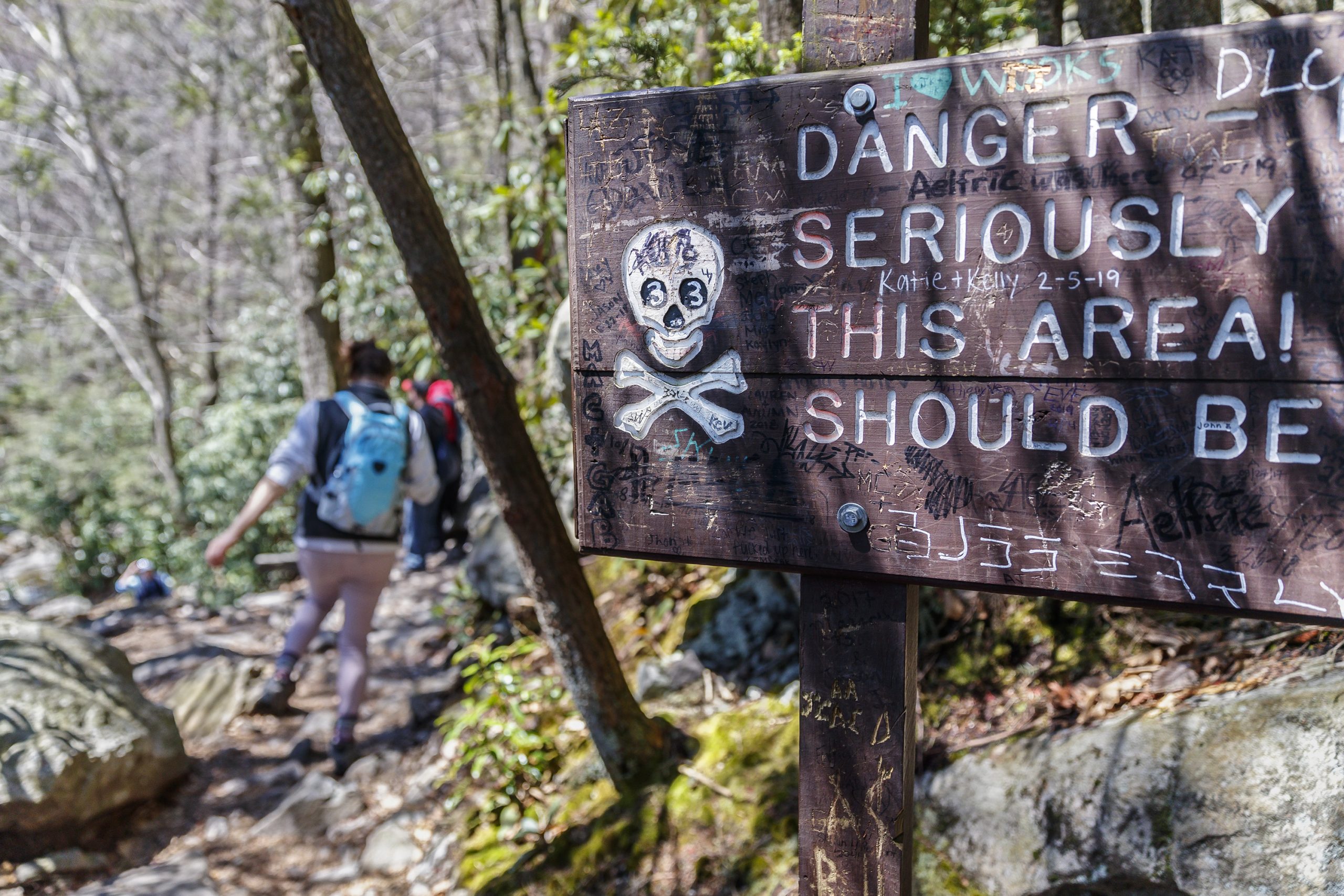
A sign near the middle falls on the Glen Okono Falls Trail uses a skull and crossbones to warn hikers just how serious the threat of danger exists on the trail at this point. The Pennsylvania Game Commission closed the main Glen Onoko Falls trail in Jim Thorpe on May 1, 2019.MICHAEL BRYANT / Staff Photographer
Constellation Energy crews have been laboring since 2024 to reopen Three Mile Island’s Unit 1 nuclear plant to meet spiking electricity demand. Planned data centers and other new demands have materialized since 2019, when the plant was shut because generating power there was too expensive to compete with cheap natural gas.
Now Constellation has moved up its own deadlines and says it’s approaching its goal to load uranium next spring and add electricity to the grid later in 2027.
That’s despite naysayers such as Neil Chatterjee, President Donald Trump’s former Federal Energy Regulatory Commission chair.
“It will never work” because of TMI’s aging technology and the complex U.S. and Pennsylvania energy bureaucracies, Chatterjee wrote in January in The Hill, which neglected to note Chatterjee had become a solar-power lobbyist.
In testimony submitted to regulators, environmental groups, including Eric Epstein’s TMI Alert, called the utility’s plans rushed and incomplete. Montgomery County-based PJM, which oversees power distribution for 13 states and the District of Columbia, warned it could be 2031 before the plant could connect to the power grid, Constellation chief executive Joe Dominguez told analysts and investors in March.
But Dominguez minimized that warning. “Normally, they start off with a pretty long timeline and shorten that up,“ he told investors in a conference call May 11, adding that he would work with states to speed connections.
Dominguez has moved up the original 2028 target date to next year, in part because of supporters like President Donald Trump and Pennsylvania Gov. Josh Shapiro, and because Microsoft has promised to buy as much power as the plant produces to run a growing array of data centers.
So Constellation is paying an army of builders, lawyers, and plant operators to prepare the plant.
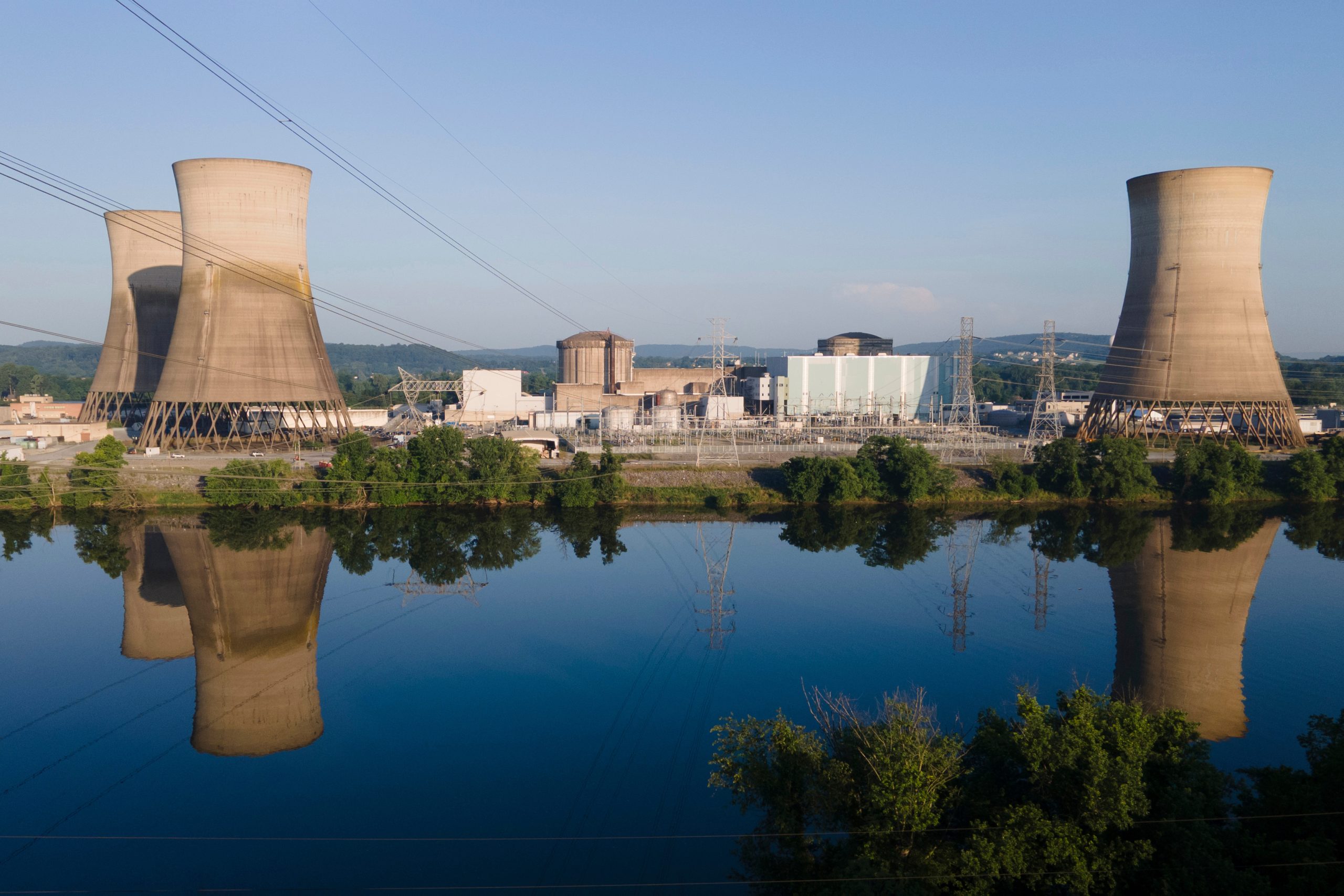
At Constellation’s nuclear power plant on Three Mile Island near Middletown, Pa., in June 2025. Ted Shaffrey
New equipment
Constellation bought three building-sized replacement transformers from manufacturer Hyundai in South Korea, to be delivered later this month, after reinforcing the bridge to the island to bear their weight. Two will be installed “later this year,” one kept as a spare, said spokesperson Paul M. Adams.
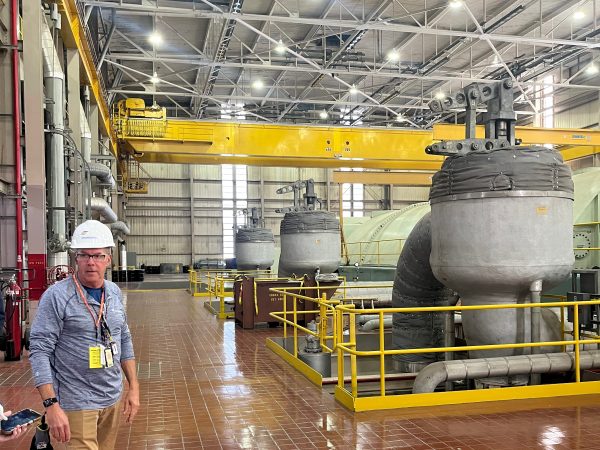
The company says crews are repairing the partly dismantled Bravo cooling tower and inspecting the reactor building and diesel motors on the site. They are restoring controls — originally analog systems made by manufacturers in Reading and other Pennsylvania cities.
The company has scheduled enriched-uranium fuel assembly deliveries from its supplier Framatome in Richland, Wash., later this year, so fuel can be loaded into the reactor core next spring. The uranium is sourced from U.S. and foreign mines.
The deal with Microsoft
Microsoft has promised to buy power equal to the plant’s entire production at prices above today’s levels for 20 years.
But that doesn’t mean the software and data-center giant is going to run wires to new, power-burning facilities in the neighborhood.
The Microsoft deal supports Constellation’s regulatory and investor arguments in favor of reopening. It confirms this major data-center operator will need more power in years to come.
Jobs for construction and plant workers
Constellation says more than 3,000 construction workers will help bring the plant, which it now calls the Crane Clean Energy Center, into service.
The company also has hired hundreds of permanent workers for the plant, named after the late Exelon Corp. CEO who spun off Constellation and championed nuclear power. More than 550 full-time employees are on site, including the current class of 80 operators being trained in federal Nuclear Regulatory Commission procedures.
About 145 of those employees are “boomerang” staff who worked at Three Mile Island before its 2019 shutdown, according to Constellation.
More than 400 hires livewithin 25 miles of the plant. They include about a dozen recent graduates of the Penn State Harrisburg campus nearby.
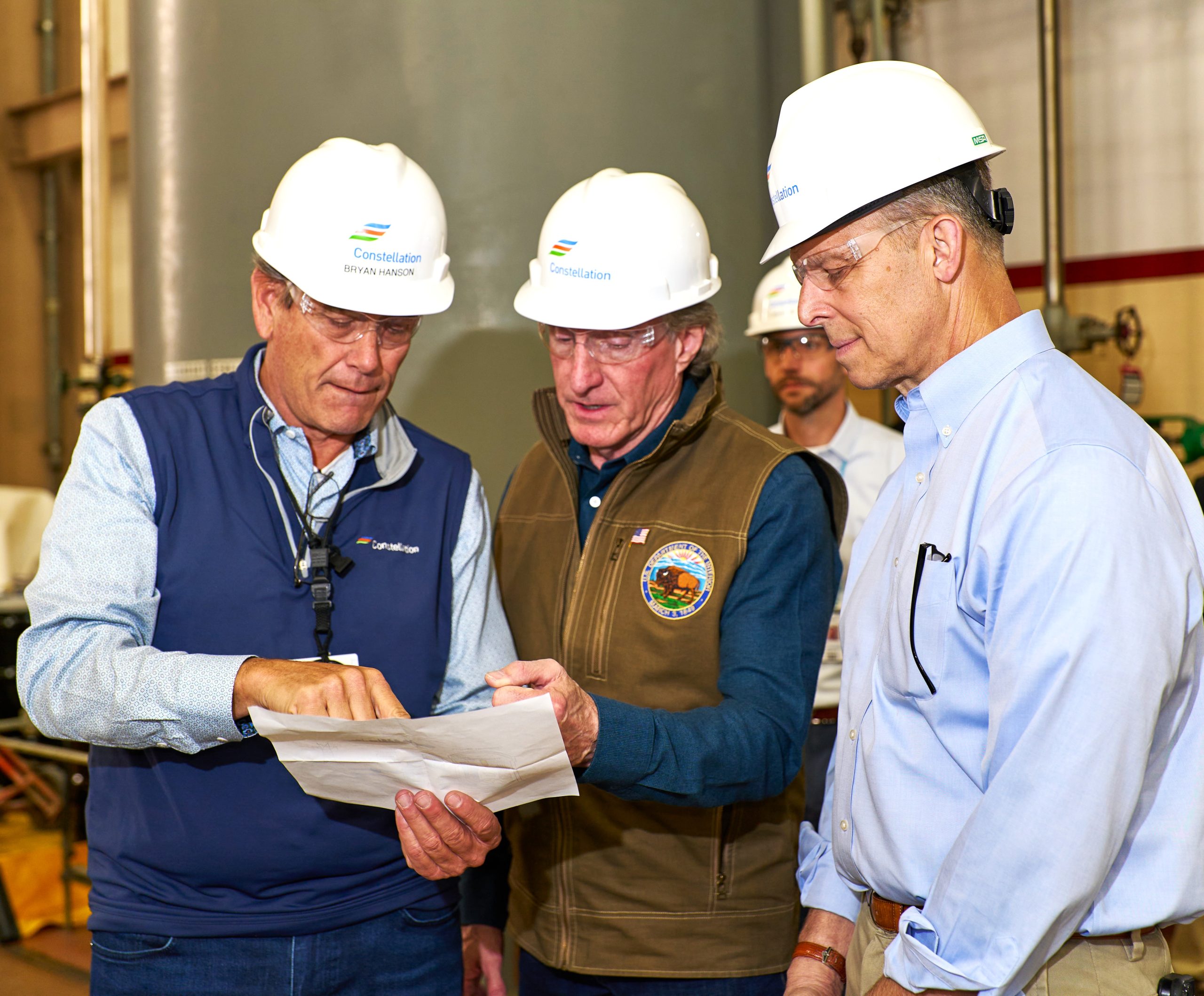
U.S. Secretary of Energy Doug Burgum (center) with Constellation Energy staff on May 1 at the Three Mile Island nuclear power complex Unit 1, which Constellation Energy plans to reopen as the Crane Clean Energy Center uranium-powered electric plant in 2027.Constellation
Shapiro, U.S. Energy Secretary Chris Wright, U.S. Interior Secretary Doug Burgum, U.S. Sen. Dave McCormick (R., Pa.), U.S. Rep. Scott Perry (R., Pa.), state legislators, and local officials have toured the plant to tout job and energy creation.
With permit applications pending before the NRC and other agencies, Constellation says it is “on track” to restart the plant next spring and deliver energy into the grid by summer or fall.
U.S. Sen. Dave McCormick with Tori VanderMeersch, senior manager, operations support for the Crane Clean Energy Center, in the control room at Three Mile Island Unit 1 nuclear power plant in early 2026.Constellation Energy
A workaround for PJM’s warning on connecting to the grid
In early June, the Federal Energy Regulatory Commission agreed to an unusual switch: It will let Constellation transfer “Capacity Interconnection Rights” from its diesel- and natural gas-burning electric power plants at Eddystone, Delaware County, to Three Mile Island, to speed the process of bringing the nuclear plant back online.
Constellation says it can do this without having to shut the Eddystone complex because the Trump administration gave the company special permission to keep Eddystone open, along with other fossil-fuel plants that were earlier scheduled for closing under a long-term program to reduce carbon-burning. It no longer needs the rights at Eddystone and can apply them at Three Mile Island.
An agreement on using water from the Susquehanna River
The Susquehanna River Basin Commission in early June approved Constellation’s plan for using river water at the restarted Three Mile Island nuclear plant.
Constellation plans to pull 73 million gallons per day from the river to control temperatures at the plant. That’s about one-third of 1% of the river’s average flow; an equivalent volume of water will be released and won’t, on average, cause “significant adverse impact to the ecosystem and other users,” notes commission spokesperson Stacey Hanrahan.
“Of course, we do not review a project based on average daily flow,” but on days the river is low, for example during a drought, she added. If the river gets too low for too long, Constellation could be ordered to stop using it.
Inside Philadelphia’s new RNA manufacturing hub, scientists are working to create vaccines for fish, precision pesticides, and treatments to protect plants from extreme heat.
The recently launched biofoundry at the University of Pennsylvania aims to expand biotechnological capabilities in the United States, funded by an $18 million federal grant. The National Science Foundation has invested infive such facilities nationally, each focused on a specific biological material.
The term foundry traditionally refers to a factory where metal is melted and shaped into desired forms. Expanding the concept, Penn’s NSF AIRFoundry now offers a one-stop facility for designing and building RNA technology.
All products under development involve ribonucleic acid, or RNA, a key molecule in living cells. Some consider it the cousin of the better-known molecule, DNA. Both can carry the genetic instructions for life.
The facility opened in March at One uCity Square in University City. It builds upon Penn’s success with the 2023 Nobel Prize-winning development of an mRNA platform that led to the first COVID-19 vaccine.
“We need to democratize this technology,” said Daeyeon Lee, a Pennprofessor of chemical and biomolecular engineering who serves as the foundry’s director.
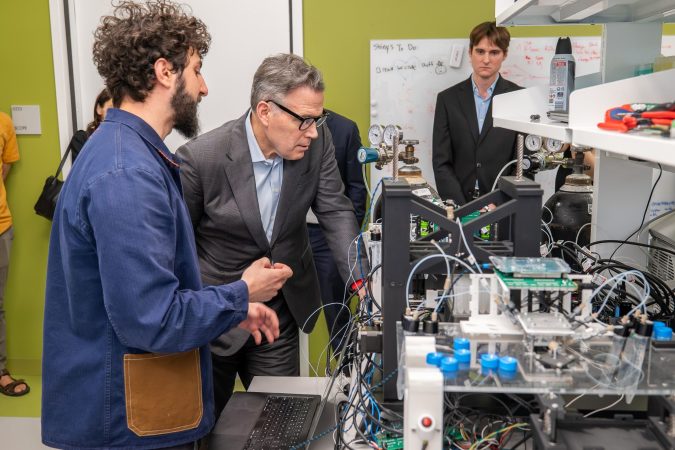
Penn Engineering professor George Pappas speaks with Sen. Dave McCormick about the AIRFoundry.Kayla Yup / Staff
AIRFoundry stands for Artificial Intelligence-driven RNA BioFoundry. Scientists hope AI will help them automate aspects of the design and manufacturing process, serving as a resource for researchers and commercial companies across the world.
A longtime anti-vaccine activist, Kennedy has claimed the technology is unsafe and ineffective, despite scientific evidence finding the vaccines to be highly safe and beneficial.
Now the foundry seeks to expand RNA’s applications in healthcare, agriculture and beyond.
Lee compared the technology to a hammer — good for certain things, but not everything.
“Our students and postdocs that get trained right now are going to be sort of the first generation of people to think about RNA as a tool for whatever problem they’re trying to solve,” Lee said.
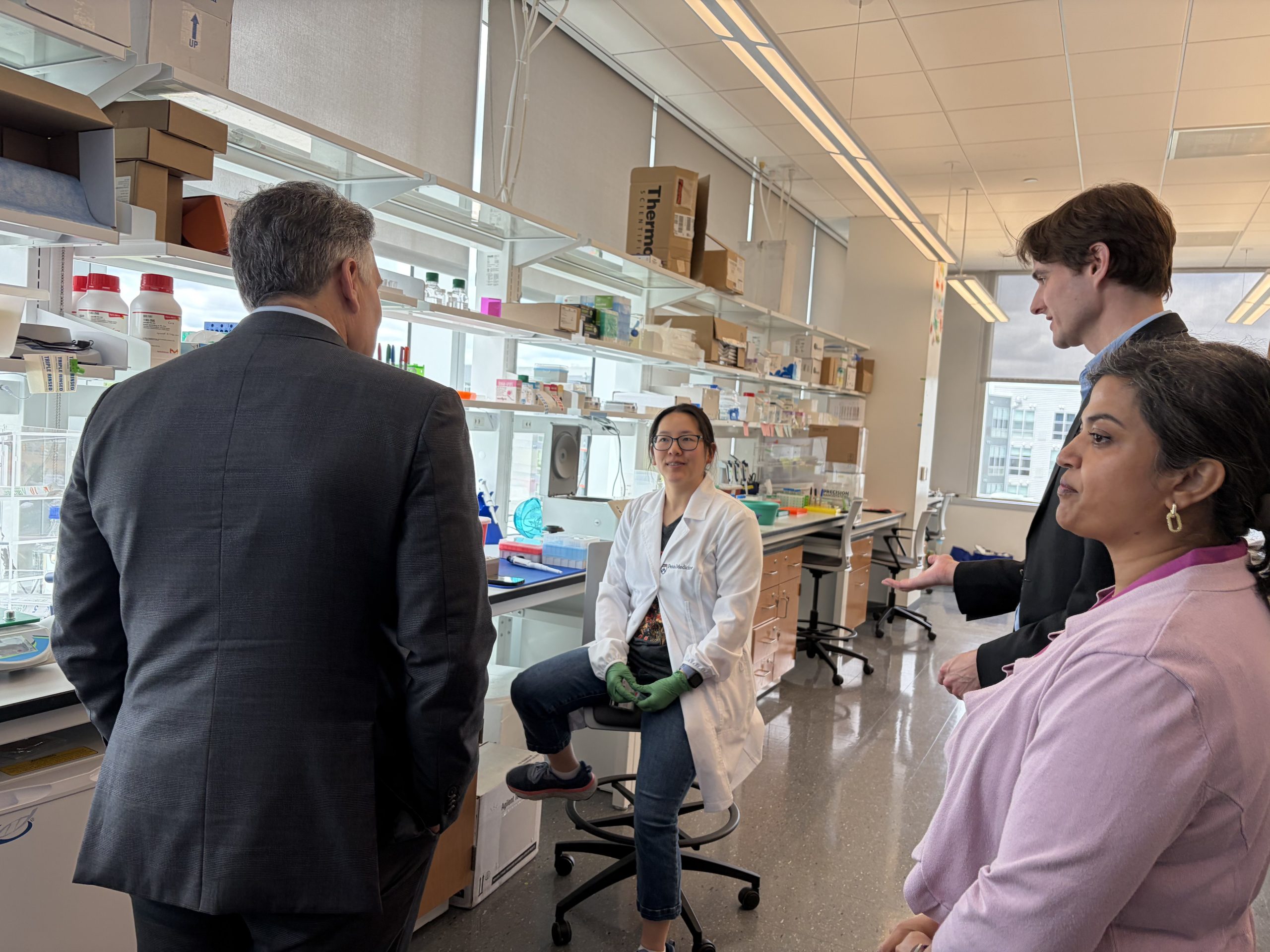
An AIRFoundry scientist describes her work in the facility.Kayla Yup / Staff
A foundry for RNA
In themRNA COVID-19 vaccines, injected mRNA provides the instructions for cells to build a harmless fragment of the viral protein. That trains the body to recognize and fight a future infection.
Compared to traditional vaccines that use live or inactivated pathogens, mRNA vaccines can be produced more rapidly — useful in a pandemic.
One of the Nobel laureates behind that effort, Pennscientist Drew Weissman, has operated a smaller scale version of the facility, mainly to make mRNA for his lab and collaborators. The foundry’s launch marked an expansion beyond Penn.
Its sterile instruments and busy lab benches were on display last month as students and faculty walked through the manufacturing process.
“It takes special facilities and skills to make RNA and associated materials,” Lee said.
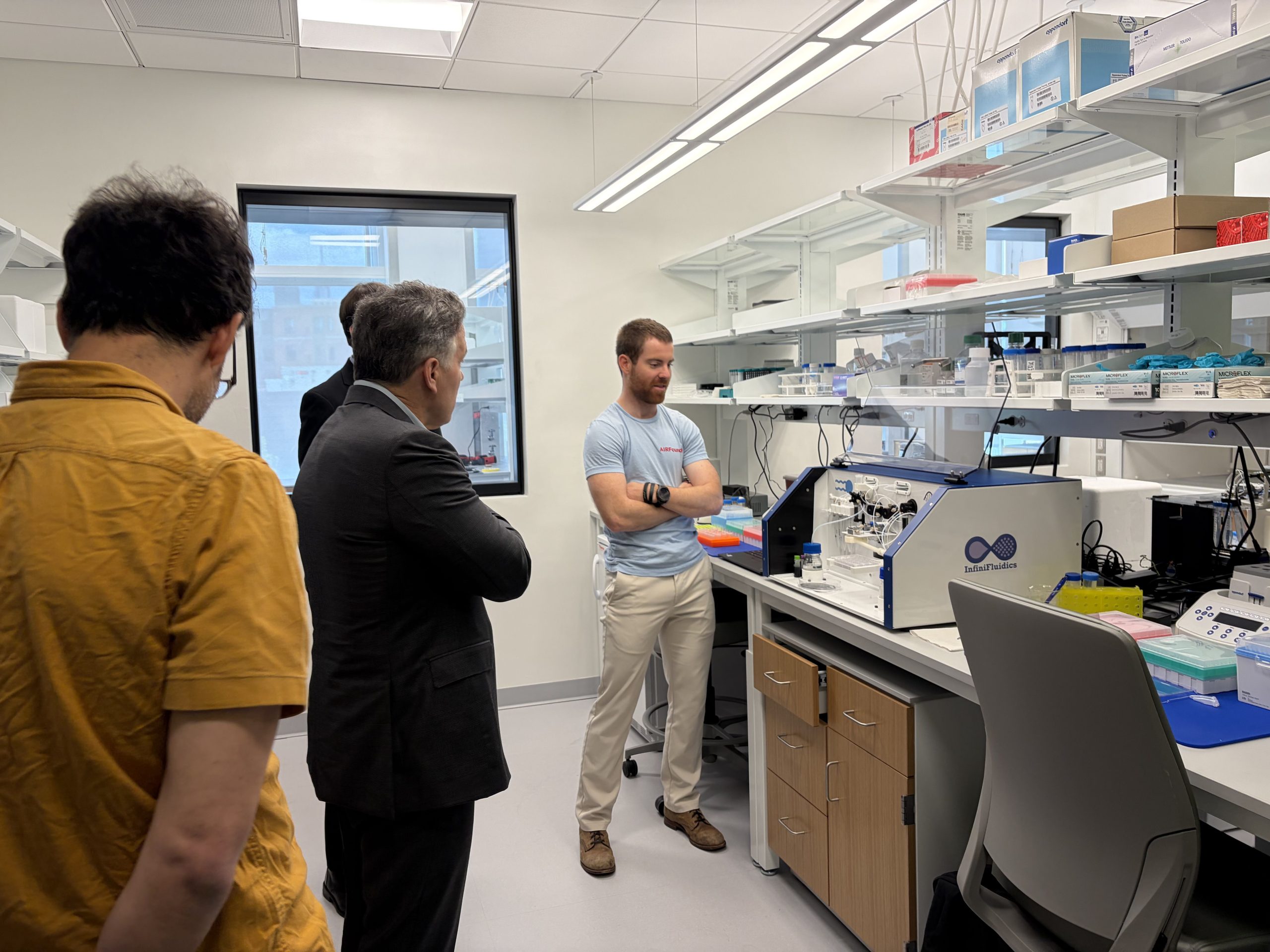
Owen Land, an engineer at Infinifluidics (a Penn spinout), spoke about a device used to automate part of the process of creating liquid nanoparticles (a delivery vehicle for RNA).Kayla Yup / Staff
So far, Penn’s facility has operated on a “fee-for-service” basis, where collaborators request a specific RNA technology and the foundry builds it.
But its scientists hope to incorporate AI to help with synthesizing all the current knowledge, best practices and databases.
They also want to reach a point where users can come to the physical facility and use the instruments themselves.
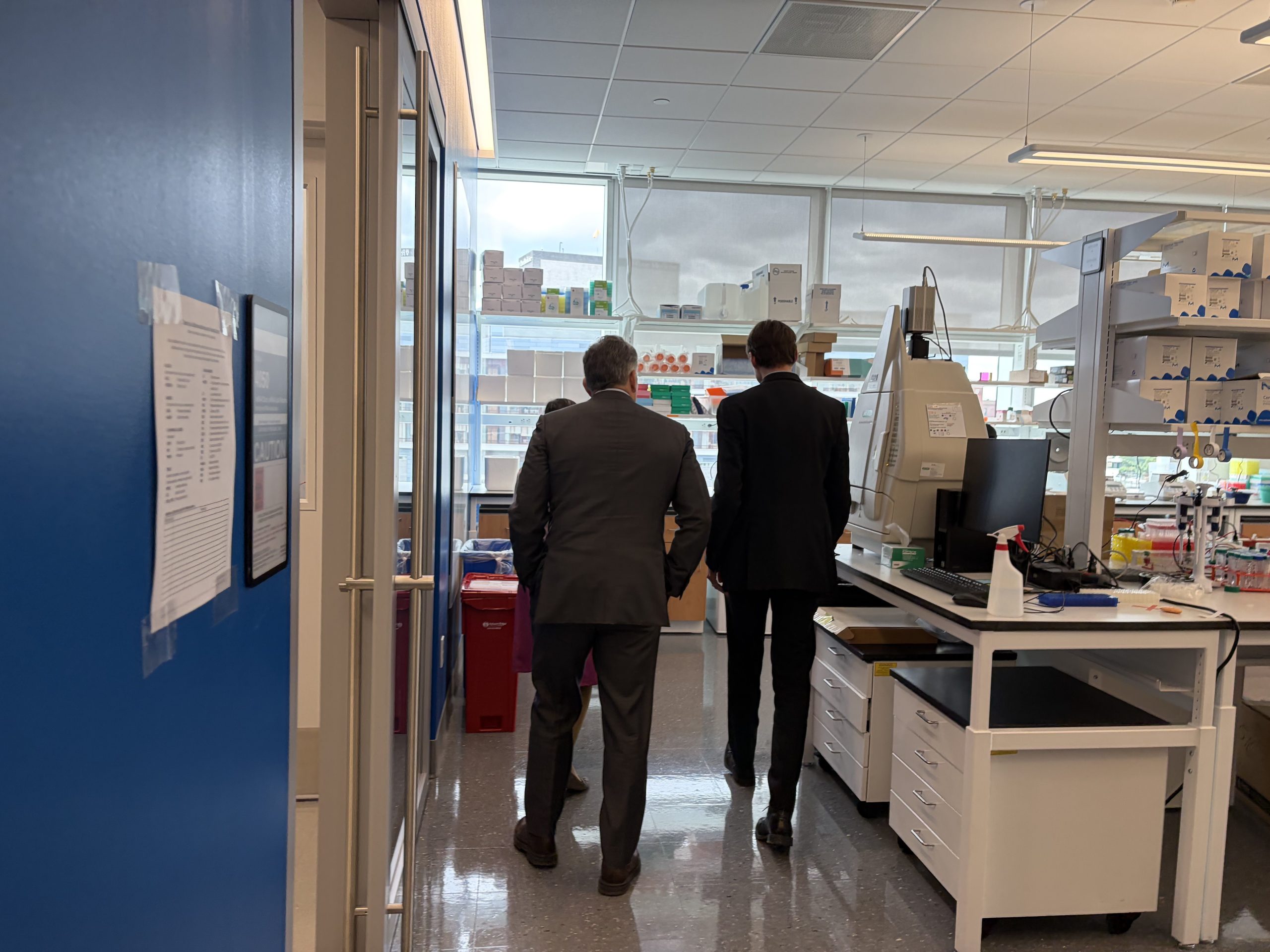
Sen. McCormick toured the AIRFoundry in May.Kayla Yup / Staff
The federal grant, which started in September 2024, supports the foundry for six years. Lee hopes it will eventually become self-sustaining through the services they provide.
Projects underway includeworking on vaccines to keep fish healthy.
Another collaboratoris developing ways to deliver RNA into plants to benefit the agriculture industry. For example, designing RNA molecules that carry instructions for producing a heat shock protein could protect plants from high temperatures. The plant would produce the protein and theoretically have greater resilience against extreme heat.
The molecule degrades over time, making its effects temporary. So if used during the summer months, the RNA could be gone by the time harvest rolls around.
This transient quality could also make RNA useful for pest control, in lieu of chemical-based pesticides, Lee said.
“We want to interact with everyone that’s interested in using RNA technology,” he said.
Conditions worsened by a drought last year, which continues in 2026, had a dramatic impact on wildfires in New Jersey, according to the state’s inaugural wildfire report.
However, of 1,322 wildfires that burned 27,229 acres statewide in 2025, nearly all were caused by humans, according to the report. That includes the massive Jones Road Wildfire in Ocean County that took 20 days to contain as the result of a bonfire set by youth.
The figures represent a 22% increase in the number of wildfires and an eye-popping 116% increase in acreage burned compared with the 20-year average.
To date in 2026, New Jersey has logged 589 wildfires that burned 648.5 acres.
Overall, the New Jersey Forest Fire Service’s first wildfire report details a historic, challenging, and highly destructive 2025 for the state’s wildlands.
That came after a demanding fall fire season in 2024. Severe blazes in 2025 not only stretched firefighting resources but also forced thousands of residents from their homes.
“Our wildland firefighters responded to an increased number of wildfires and spent weeks at a time battling fires, often under challenging weather conditions,” Bill Donnelly Sr., chief of the New Jersey Forest Fire Service, wrote in the report, which was released Thursday.
A major wildfire in New Jersey is classified as any blaze reaching or exceeding 100 acres. While the state typically averages 4.75 major fires annually, crews battled nine major wildfires in 2025.
The drought had a big impact as it created tinderboxes in areas such as the Pinelands. Not only did the dryness help spread fires, but it also forced the forest fire service to drastically reduce the amount of acres it intentionally burns in advance.
Firefighters use those prescribed fires, or controlled burns, in strategic areas to reduce dry brush and other vegetation, thus denying future fires fuel.
The drought continues into this June despite some recent heavy downpours. Data from the National Weather Service’s Middle Atlantic River Forecast Center show that Camden County is running a 13-inch rain deficit over the last 12 months.
Residents of the state are living amid a prolonged drought warning — the third of four levels of dryness monitored by officials. Parts of South Jersey have been under a drought warning since fall 2024.
But the biggest issue has been people.
Human activity was responsible for an overwhelming 99.6% of New Jersey’s wildfires in 2025, stemming from both accidental and intentional acts, according to the report.
“Whether through accident, carelessness, or even at times intentional acts, human behavior continues to be the primary driver of wildfire activity in our state,” Donnelly said.
Equipment use was the leading cause of fires by volume, sparking 486 individual wildfires that collectively burned 527.5 acres. Lawnmowers, weed trimmers, chain saws, welding tools, grinders, and agricultural harvesting machinery can all create sparks that ignite brush.
However, illegal and improperly managed campfires were responsible for the most devastating destruction, scorching a massive 15,263.75 acres statewide.
The largest incident of the year, the Jones Road Wildfire in Ocean and Lacey Townships, burned 14,949 acres and prompted the evacuation of 7,000 people.
Triggered by an illegal bonfire, the massive blaze threatened more than 1,300 structures and forced the closure of major thoroughfares, including the Garden State Parkway and Route 9. It destroyed a commercial building and triggered power outages affecting 30,000 residents.
Other large incidents included the Mines Spung Wildfire in Burlington County, which consumed 6,610 acres and closed portions of the Batona Trail, and the California Branch Wildfire in Camden County, which burned 2,336 acres.
Firefighters faced increasingly difficult environmental conditions throughout 2025. The report noted a growing trend of prolonged emergency operations, stating that 44% of the major wildfires in 2025 required more than five days to contain due to persistently dry weather.
In response to the escalating wildfire threat, the state’s fiscal year 2026 budget allocated an additional $1 million to the New Jersey Forest Fire Service, funding that is expected to be maintained in future budgets. That allowed the addition of six full-time positions.
The remaining $700,000 was used to buy equipment, including a bulldozer and fire engines, and to expand air base operations. The service is also upgrading its communication network by transitioning to a 700 MHz radio system to improve coordination with local and state agencies.
The $2 million, 133-foot structure replaces the decommissioned Lakewood tower and will serve as a vital vantage point to protect nearly 200,000 homes and more than 516,000 residents across Ocean and Monmouth Counties.
For a time, during his 10th grade year at West Philadelphia High, Smith didn’t know where he was going to sleep at night, or how he’d scrape together his next meal.
“I stopped coming to school,” said Smith. “I was not doing the right things. It got so bad that I used to come only for first period, and leave out.”
But Smith’s teachers noticed. They pulled him aside to ask what he needed and how they could help. They told him he was smart but he had to come to school andenvision a future for himself.
“That showed me I had people who cared about me,” said Smith. Those conversations, those educators, galvanized him. Coming to school steadily built opportunities — new skills, internships, paying jobs, anda solid future.
Smith graduated with honors last week after earning a citywide Philadelphia School District honor this winter and maintaining perfect attendance since 2023.
He’s employed full-time in operations with the Penn Medicine health system, a job with benefits and tuition reimbursement. He’s eyeing trade school after he socks away enough for his own car and apartment.
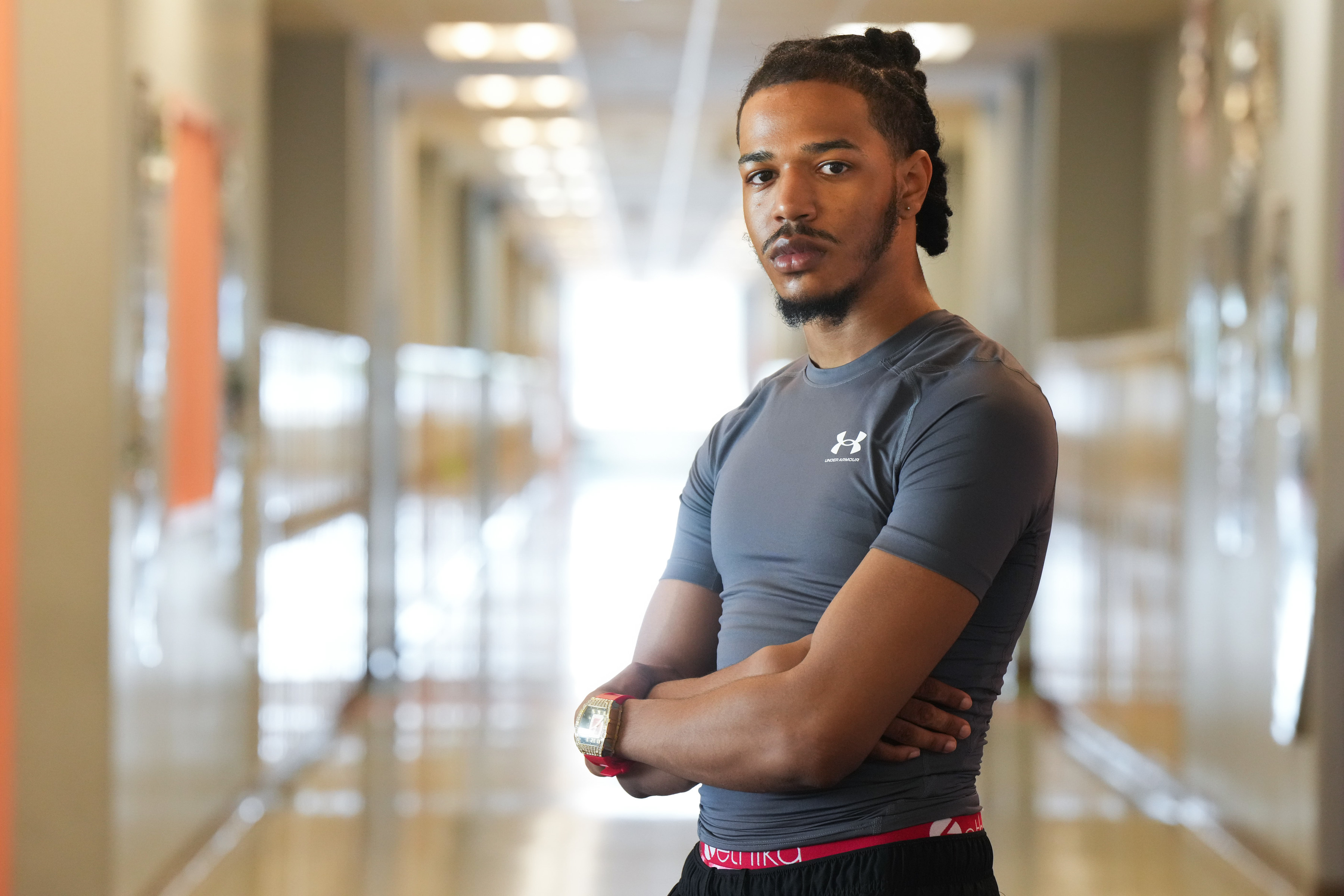
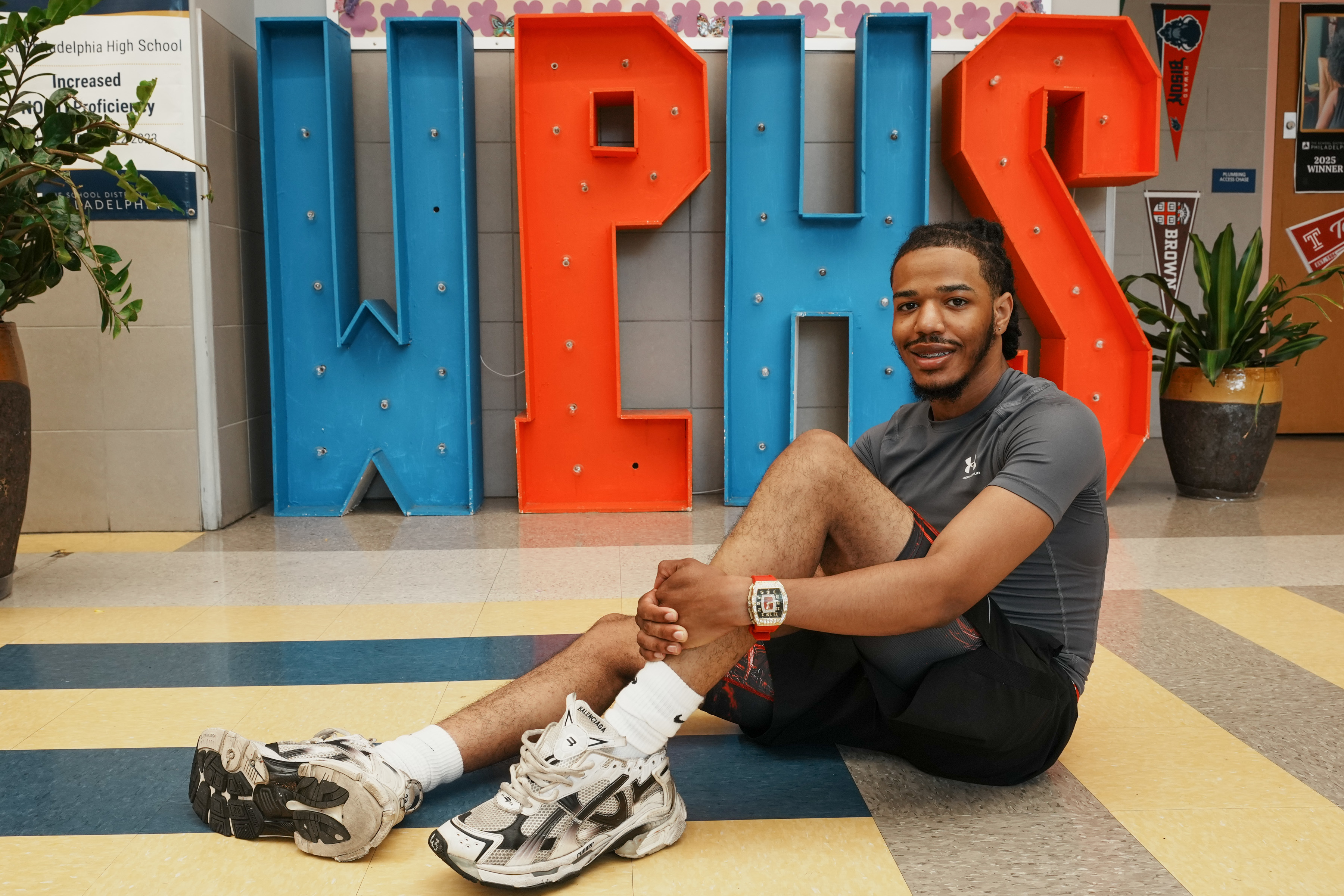
Jayzen Smith, a West Philadelphia student who has set a path of achievement for himself, at his school in Philadelphia, on Friday.Jessica Griffin / Staff Photographer
The diploma, the accolades, andthe steady path were not a given, said Smith, 19.
“Honestly, I thought I was going to be dead or in jail by now,” said Smith. “Everything still feels unreal.”
‘He just has this way about him’
Marie Wilkins-Walker, a veteran West Philadelphia computer networking teacher, knew there was something special about Smith, even when he was hardly showing up to class.
“He just has this way about him, he says hi to everybody, and I noticed he caught on very quick — he was very intelligent,” Wilkins-Walker said.
Wilkins-Walker and another teacher set up a meeting with Smith during those low-attendance days. Just come to class, they said. You’re so smart, they told him. West is good at connecting kids with resources to fill in the gaps that might exist at home, they said.
“When we started talking about college, he told me that no one had ever talked to him about college,” said Wilkins-Walker. “He was in 10th grade, and no one had ever talked to him about college.”
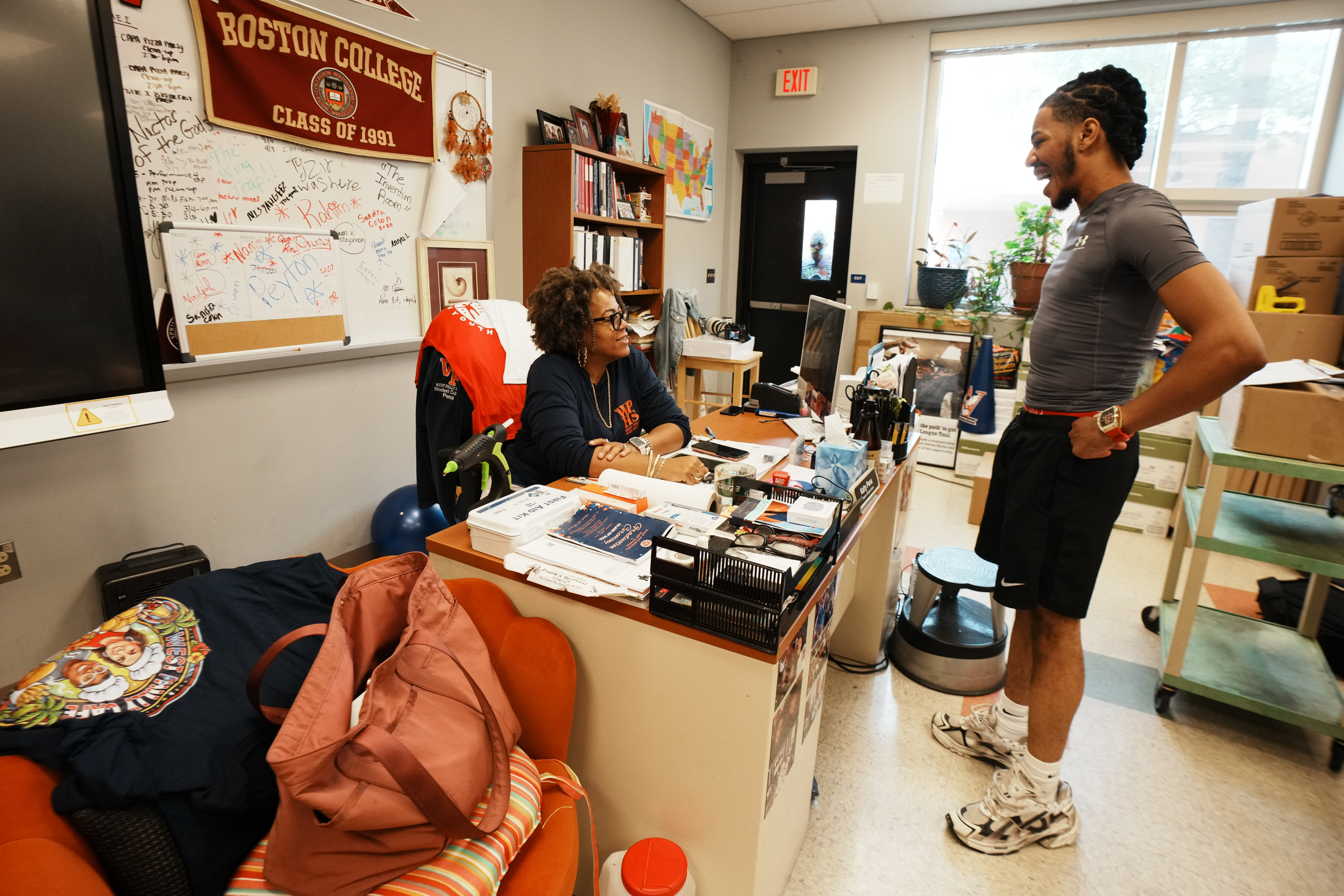
Marie Wilkins-Walker, a computer networking teacher at West Philadelphia High School, talks with Jayzen Smith.Jessica Griffin / Staff Photographer
Technology wasn’t on Smith’s radar — he made music and wanted to be a rapper. But he started spending more time with Wilkins-Walker, who also serves as West’s technology coordinator, and picked up some skills.
Smith doesn’t need prompting to seize opportunities. By his senior year, he was an invaluable member of West’s tech team, fixing Chromebooks and solving staff’s IT issues. He worked for the district supporting other schools installing computer security systems and fixing broken hardware. He volunteered his services to other schools, and he held two separate internships with Penn, leading to his full-time post-graduation job.
“He’s just been an amazing young man,” said Wilkins-Walker.
Smith’s resumé is impressive but what sets him apart is his soft skills — he’s the guy who, without prompting, makes the new student feel at home, speaks to everyone who walks in the room, and solves tech problems without making anyone feel less than.
Jayzen Smith became an invaluable member of the tech team at West Philadelphia High School.Jessica Griffin / Staff Photographer
When Wilkins-Walker’s own grandson began attending West, she wanted him to meet Smith, because she knew Smith would make the boy feel comfortable, and he did.
It’s not lost on Wilkins-Walker what Smith, as a young Black man in Philadelphia, might have become.
“For our students, the line is so thin,” said Wilkins-Walker. “You don’t even sometimes know you’re crossing over to the wrong side of the room — from friends or neighborhoods.”
Keeping busy
Opportunities are what set him apart from people from his West Philadelphia neighborhood who find themselves on the wrong side of that line, Smith said.
“Keeping busy, that’s what’s keeping me out of trouble,” said Smith. “You got to find something to keep you occupied. Certain people in certain environments, if they have time on their hands, it’s tough. I grew up with them, they’re still my friends, and I just try to tell them, do what I’m doing.”
Jayzen Smith, a West Philadelphia student who has set a path of achievement for himself, at his school in Philadelphia on Friday.Jessica Griffin / Staff Photographer
Smith doesn’t talk much about the dark times. He’s more interested in the future, he said.
Smith and his mom both narrowly avoided crying on graduation day, he said, because of a mutual pact to stay away from tears. But earning his diploma has made him reflect on what he came through to get there.
“Ms. Walker,” he said, “she probably saved my life.”