Ukraine hit a major Moscow oil refinery for a second time in a week and disrupted commercial flights at the city’s airports in one of its biggest drone attacks since Russia’s all-out invasion of its neighbor more than four years ago, Russian officials said Thursday.
The attack came hours after Ukrainian President Volodymyr Zelenskyy said he had held “an important coordination call” with the presidents of the United States and France, and had won key pledges of further support from the G7 summit this week.
Zelenskyy was expected in Brussels later Thursday for talks with NATO and European Union leaders, including discussions about the possible building of a continental system to protect against ballistic missiles. Russia has relentlessly struck Ukraine with those types of missiles, which air defenses struggle to counter.
Ukrainian Foreign Minister Andrii Sybiha said on X: “One of the most popular questions asked by Muscovites this morning is ‘What is going on?’ I can answer. Your country started a war of aggression against ours. For years, it has been killing our people. Now that you know what’s going on, ask Putin when he is planning to end it.”
Huge fires rage at Moscow refinery near Kremlin
Images and video released by the Russian media showed massive fires raging at the Moscow Oil Refinery, located about 15 kilometers (9 miles) from the Kremlin. Thick black clouds of smoke rose over the city.
The refinery is one of Russia’s biggest, according to its official website, and produces more than a third of the Moscow region’s fuel. It was last attacked by Ukrainian drones on Tuesday, catching fire, but officials said the blaze was swiftly put out.
Flights from four Moscow airports were temporarily halted, transport and aviation authorities said.
In the Moscow region, which surrounds but does not include the capital city, a drone hit a residential building in the town of Zhukovsky, and the building was being evacuated, according to Gov. Andrei Vorobyov.
Buildings elsewhere in the region were damaged by drone debris and 16 people, including two children, were wounded, according to Vorobyov.
Ukrainian drone attack embarrasses Putin again
The Russian Defense Ministry said that its air defenses overnight shot down 555 Ukrainian drones over multiple regions, with almost 200 intercepted as they were approaching the Russian capital.
That was roughly double the number of drones that Russia launched at Ukraine overnight, according to the Ukrainian air force.
The attack was the latest embarrassment for Russian President Vladimir Putin, after a Ukrainian drone attack on his hometown of St. Petersburg earlier this month just as he held a showcase economic forum in the city with foreign VIP visitors.
Putin on Thursday was in Kazan, some 700 kilometers (430 miles) east of Moscow, hosting leaders of the Association of Southeast Asian Nations as Russia seeks to bolster business and other ties with the nations of the regional bloc.
Zelenskyy said the attack on Moscow was part of Ukraine’s efforts to force Putin to the negotiating table. The Ukrainian president has accepted an unconditional ceasefire demanded by Trump but Putin has refused, and U.S.-led peace efforts have petered out.
“If Putin does not want to end this war and wants to continue it, we will not sit quietly — we will respond,” he added in a voice message to a group chat with journalists.
Ukraine disrupts Russian supply lines with drones
As well as pledges of more diplomatic and military help at the G7 summit, Ukraine recently has gained momentum on the battlefield against Russia’s bigger army thanks to its high-tech drones, Western officials and analysts say.
Longer-range drone strikes are choking Russian supply lines in occupied regions of Ukraine, in addition to disrupting Russian oil production.
Macron said the G7 summit was “very important for Ukraine” because its supporters — crucially including the United States — vowed to help it, although the French president provided no details. The U.S. under Trump has cut back assistance to Ukraine, leaving the Europeans as the biggest suppliers of military and financial aid. Trump and Zelenskyy have had an at times strained relationship.
“America is with us on Ukraine, that is very important,” Macron told reporters as he and Trump left the Palace of Versailles near Paris.
BRUSSELS — U.S. Defense Secretary Pete Hegseth lashed out at NATO allies on Thursday, announcing a six-month Pentagon review of American forces in Europe whose outcome will depend on how fast the Europeans take responsibility for their own security.
“This will be a real review. It will be designed to ensure that NATO is moving fast and irreversibly toward Europe leading, stepping up to take primary responsibility for the defense of Europe,” he told his NATO counterparts in Brussels.
Hegseth lambasted European allies for failing to provide U.S. forces access to bases in Europe to launch attacks on Iran, calling it “shameful.”
“These allies, they put America’s sons and daughters, our sons and daughters, at risk by denying them the predictable access, basing and overflight that never should have been in question at all,” he said.
Taking the microphone at the top of the meeting, Hegseth also railed against migration and gender equality policies in Europe, in remarks reminiscent to those of Vice President JD Vance in February last year that angered many Europeans.
“Instead of tanks and fighters and air defenses, the focus has been on gender equity and climate change and defense austerity. Europe’s borders flew wide open, welfare states expanded, defense budgets cratered. Along with Europe’s belief in itself and its civilization,” Hegseth said.
Hegseth’s comments largely mischaracterized European policies today. On defense, European allies and Canada have launched an unprecedented effort to boost defense spending and expand their armed forces. NATO Secretary-General Mark Rutte noted on Thursday that they spent $90 billion more on defense last year, a 20% increase over 2024. And while Europe accepted large numbers of migrants and asylum seekers more than a decade ago, most countries have tightened their borders since.
The Trump administration now wants a reboot of the 32-nation organization to turn it into a “NATO 3.0” capable of deterring any threat, Hegseth said.
Hegseth’s remarks came a few weeks after the United States told its allies that it would no longer supply certain warships and aircraft if one of them comes under attack. European allies and Canada are trying to work out how to plug the gaps.
NATO’s supreme allied commander, an American, is working on backup plans to defend Europe after the U.S. signaled on June 3 that it would no longer supply an aircraft carrier and support ships, aerial refueling planes and dozens of fighter jets, among other military assets, in a crisis.
The Trump administration insists that it needs to be able to plan for two simultaneous conflicts and wants more military resources at hand should a conflict break out with China in the Indo-Pacific region.
Under NATO’s collective security guarantee – Article 5 of its founding treaty – the 32 allies pledge that an attack on one of them will be considered an attack on all. It does not oblige them to provide military support, although many likely would.
In essence, the United States is scaling back how it might help should an ally trigger Article 5. The U.S. has by far NATO’s biggest armed forces. It does not intend to withdraw its nuclear weapons in Europe, which are key to NATO’s deterrence.
To underscore that point, NATO’s Nuclear Planning Group issued its first statement in 19 years after it had assembled at Thursday’s meeting.
In the statement, it “recalled that the strategic nuclear forces of the Alliance remain the supreme guarantee of Allied security and underpin NATO’s extended deterrence architecture.”
The ministers “agreed to continue enhancing NATO’s nuclear deterrence mission by modernizing NATO’s nuclear capabilities, strengthening its nuclear planning capacity, and adapting to achieve its security interests.”
CAIRO — The interim deal reached by the United States and Iran to end their war will reopen the Strait of Hormuz and bring the two adversaries back to the negotiating table over Tehran’s nuclear program, according to details released by both countries. It will also give Iran an immediate benefit, allowing it to sell its oil freely again.
Besides the new oil revenue for Iran, the two sides are more or less back where they were 3½ months ago — before Israel and the U.S. launched their war, which has left thousands dead across the region, triggered a global energy crisis and shaken the American economy.
Iran and the U.S. will enter a 60-day period of negotiations, and hanging over them will be the question of whether U.S. President Donald Trump can wrest a better deal than the 2015 nuclear accord he scuttled eight years ago.
Here’s what to know based on details released by U.S. officials and Iranian state media:
The interim deal would get the oil flowing again
Trump signed a physical copy of the deal Wednesday while dining with French President Emmanuel Macron at the Palace of Versailles.
In Tehran, President Masoud Pezeshkian signed the document, according to the state-run IRNA news agency, which posted an image of him holding up the deal with his signature and Trump’s.
Under the agreement, the Strait of Hormuz will reopen, and the U.S. will lift its blockade of Iranian ports — both of which should push gas prices down. Passage through the waterway will be toll-free for 60 days, and the deal doesn’t preclude fees after that, according to U.S. officials who spoke on the condition of anonymity to read details of the draft, which has not yet been officially released by Washington.
Iran’s closure of the strait, through which around a fifth of the world’s traded oil supplies passed before the war, proved perhaps its strongest weapon. It drove up global fuel prices, made food and other products like fertilizer more expensive, and helped push U.S. inflation to 4% ahead of this fall’s midterm congressional elections.
With the deal in place, the Islamic Republic has survived the most serious attempt ever by Israel and the United States to topple its government, despite the thundering opening volleys of the war that killed Iran’s supreme leader and other top officials.
Iran will be able to sell oil freely
The deal immediately waives, but doesn’t eliminate, sanctions that Trump imposed on Iran’s oil exports, allowing it once again to sell its crude on the world market and restoring a revenue stream worth billions.
Last year, Iran earned an estimated $45 billion from oil sales. But it had only one major buyer, China, and had to ship its crude through a shadow fleet of tankers to elude sanctions, eating into its profits. Under the blockade since April, its exports have nearly ground to a halt.
With the waiver, Iran will likely be able to find more customers and sell its oil for higher prices.
Iran got promises for the future
The draft agreement calls for Iran’s highly enriched uranium to be “downblended” — or diluted — under the supervision of the International Atomic Energy Agency. The two sides will work out the details during their negotiations as well as generally discuss Iran’s enrichment program, which it says it has a right to continue.
Iran developed the material in response to Trump’s scuttling of Tehran’s 2015 nuclear accord with world powers that prevented it from enriching uranium to high levels. He criticized the deal for giving Iran a huge windfall. But the interim deal outlines even more lucrative incentives if Iran reaches a new nuclear agreement.
One is the eventual lifting of all international sanctions, which would seem to go further than the 2015 accord. That agreement lifted sanctions related to Iran’s nuclear program but kept others in place over what the U.S. alleged were Tehran’s support for terrorism and rights abuses.
The interim pact also promises a $300 billion fund for postwar reconstruction. It’s not clear where that money will come from — but Trump said the U.S. would not contribute.
To give a sense of the extraordinary scale of the fund, the World Bank estimates that Syria, after 13 years of civil war, needs $215 billion for reconstruction; the Gaza Strip, largely flattened in two years of war between Israel and Hamas, needs $53 billion.
The deal also promises to unfreeze billions of dollars worth of Iranian assets held abroad under a procedure the two sides will work out, according to the text provided by U.S. officials.
Iran’s missiles and support for proxies don’t seem to be on the table
The Trump administration said its war aims were to “obliterate” Iran’s missile arsenal, “sever its support” for armed proxies in the region, “annihilate its navy,” and ensure it never acquires a nuclear weapon.
The seven weeks of U.S.-Israeli bombardment are believed to have heavily damaged Iran’s missile arsenal and production facilities as well as other parts of its military. How heavily isn’t known, though, and Iran continued to fire on Israel as recently as last week. Meanwhile, Iran’s ties with its militant proxies — Hezbollah in Lebanon, the Houthis in Yemen and Shiite militias in Iraq — appear as strong as ever.
Neither the missile arsenal nor Iran’s support for its allies appears to be on the table in the upcoming negotiations.
War in Lebanon could threaten the deal
The deal calls for an end to the war in Lebanon, where Israel has been fighting Hezbollah.
However, Israel and Hezbollah aren’t parties to the agreement. Iran insists Israel must withdraw from the large swath of southern Lebanon it is occupying, but the interim deal doesn’t explicitly require that and only ensures Lebanon’s “territorial integrity.”
Israel has vowed to keep troops in Lebanon, while Hezbollah says it is committed to resisting Israel “until full withdrawal is achieved.” Fighting between the two could derail the deal unless the U.S. and Iran can rein in their respective allies.
US-Israeli ties have been strained
Israel was squeezed out of the negotiations with Iran, and Israelis from across the political spectrum have called the deal a disaster, directing their fury at Prime Minister Benjamin Netanyahu.
Tensions between Trump and Netanyahu, meanwhile, have occasionally spilled into the open, including when the American president described the Israeli leader as “crazy.”
At the G7 summit in France this week, Trump said that Netanyahu “has to be more responsible with respect to Lebanon.”
Netanyahu is left in a precarious situation ahead of national elections later this year. His relationship with Trump may require downscaling a military campaign in Lebanon that is broadly popular in Israel.
Much depends on the final agreement
The 2015 agreement negotiated by the Obama administration severely limited Iran’s nuclear program for 15 years. During that period, Iran could only enrich uranium to a low level, far below what’s needed for a weapon. It could only stockpile 300 kilograms (660 pounds) of the material and had to sharply reduce its centrifuges carrying out enrichment. It was also put under stricter inspections by the IAEA.
One main criticism was the 15-year time limit, after which opponents said Iran would be able to quickly ramp up its ability to produce a bomb. Iran insists its nuclear program is for peaceful purposes.
A key question now will be whether the U.S. can win stricter limits for a longer term.
Federal prosecutors have charged a man in connection with a van striking an immigration officer this week while agents in New Jersey sought to make a traffic stop.
The suspect, Eduardo Cruz Garcia, had refused to roll down his window when he was pulled over by Immigration and Customs Enforcement agents Monday morning and then drove away, striking an ICE agent standing next to the van, according to a criminal complaint filed Tuesday in U.S. District Court in New Jersey.
The agent was injured when he was briefly “wedged” between the van and an ICE vehicle, the complaint said. The court documents included images of the agent’s scraped shin and bruised thigh.
The Department of Homeland Security said that the agent had fired his weapon.
Cruz Garcia, 39, was struck in the back of his right arm, according to Benjamin West, his lawyer. West said that federal prosecutors had told him the agent fired three shots.
Cruz Garcia was arrested a day later, and charged with assaulting and injuring a federal officer. Federal officials said he was from Mexico and in the United States illegally.
Robert Frazer, the U.S. attorney in New Jersey, said that Cruz Garcia had “weaponized his vehicle” against the federal agent.
“Law enforcement must be able to carry out their duties without fear of obstruction or even worse, assault,” Frazer said in a statement Wednesday.
The incident initially led to confusion about the driver’s identity.
While Cruz García was at large, the Homeland Security Department released a statement saying that the agents had been “conducting a targeted vehicle stop” in order to arrest a different person, a Peruvian immigrant named Friedrich Castillo Ormeño.
But Castillo Ormeño, 30, was not in the United States: He had self-deported to Peru with his girlfriend and 1-year-old daughter in March, he told The New York Times in an interview.
“My aunt who lives in the United States told me my name was all over the news in connection with an attempted homicide in New Jersey, and I told her, like, how? I’ve been here for three months now,” he said in a phone interview from Peru, in Spanish. “They were saying I had run over the ICE agent.”
Castillo Ormeño said he had entered the United States illegally in July 2022 along with his girlfriend, filed an asylum application and moved to New Jersey, where he found a job in a restaurant. He and his girlfriend had a baby. The family had decided to fly back to Peru on March 2, after an immigration judge ordered him to leave the country.
He said that they had received $5,200 from the Homeland Security Department about a month after returning to Peru, as a reward for self-deportation. Castillo Ormeño, who also spoke to Noticias Telemundo, shared pictures of his plane ticket and of the family on the flight to Lima, the capital of Peru, with the Times.
On Wednesday, the Homeland Security Department said that federal agents had shown up at Castillo Ormeño’s last known address in Manahawkin, a community in Ocean County along the Jersey Shore, where they saw someone “who looked similar to the target get into a van that departed the residence.”
Federal officials did not reply to questions as to why agents were seeking to arrest someone whom the Homeland Security Department had given a monetary award for voluntarily leaving the United States.
Castillo Ormeño said he was familiar with the driver of the van, Cruz Garcia, and that he was a cousin of his former housemate in New Jersey.
Surveillance footage from a restaurant reviewed by the Times shows that the agents had stopped the van near a busy intersection, not far from where Castillo Ormeño had lived.
The criminal complaint said that agents wearing vests identifying them as ICE agents surrounded the van and attempted to speak to Cruz Garcia and another person in the van’s passenger seat. The agents told them to lower their windows, but the men did not comply, the complaint said.
As the van rolled forward, video footage shows it appearing to swipe an ICE agent standing by the driver’s side door. The complaint included still images from body camera footage that show the side of the white van appearing to make contact with the agent.
The Homeland Security Department said in a statement that the driver’s actions had resulted “in the officer discharging his weapon.” The gunfire appeared to shatter the van’s rear window as it drove away, according to local police scanner traffic reviewed by the Times.
Experts said that firing at a moving vehicle is a risky form of lethal force that can lead to stray gunfire or cause vehicles to lose control, threatening bystanders.
Marc E. Brown, a use-of-force expert and former instructor at the Federal Law Enforcement Training Centers, said that shooting and potentially killing a driver could leave “2,000 pounds of metal, basically uncontrolled.”
“I’ve never seen an agency train to shoot at a moving vehicle,” he said. “I’m not saying it isn’t out there, but it’s not something general for most officers in basic marksmanship.”
A Homeland Security Department memo from 2023 on the agency’s use-of-force policies generally prohibits officers firing at a moving vehicle solely to disable the vehicle or “to prevent the escape of a fleeing subject.”
They are allowed to use deadly force if the officer “has a reasonable belief” that the target “poses an imminent threat of death or serious bodily injury” to the officer or another person, according to the memo.
The agency’s policies and the training of officers came under scrutiny this year after the fatal shooting of Renee Good in Minneapolis, which prompted questions about whether an ICE officer had been in danger as Good drove her vehicle forward.
When you live in the city of eds and meds, the ins and outs, ups and downs, successes and stumbles of the educational journey make a seasonal backdrop. Just as the sights and sounds of caps and gowns, family photos, and generational pride, joy, and accomplishment are in the air around us this time of year, the cycle of applications restarts.
And so, too, do requests for letters of recommendation. Being asked to write a letter of support for any of my students is an honor. It’s also a responsibility I don’t take lightly.
For those I’ve written to medical schools, the task feels even weightier. I only want the best future doctors, clinicians, and colleagues caring for patients. But I also want what is best for the students I have come to know and value.
For the first time this year, I caught myself almost trying to dissuade a student from applying to medical school. Not because they lacked ability or mission. But because they had the very qualities that make someone an extraordinary physician — intelligence, empathy, curiosity, selflessness, ethical centeredness, creativity, and a desire to serve.
The U.S. healthcare system can be punishing to people with those qualities. My inclination is to protect the students who may be at risk of experiencing the moral injury I have come to know.
The question in my mind is not whether they are good enough to be accepted into medical school. I now question whether the world of healthcare is worthy of them.
The understood pact
I am hard-pressed to think of another degree that immediately conveys demonstrated intelligence and accomplishment in the way a medical degree does. It transcends culture, ethnicity, and geography.
Beyond the respect and prestige, medicine used to offer a near-sacred promise, especially noted by first-generation and immigrant families: work hard, distinguish yourself among the best students nationally, endure the training, become a doctor, and you will have security, standing, and a life of meaningful contribution and fulfillment.
That bargain seems to have changed.
Misdiagnosis and politics
On May 19, U.S. Rep. Greg Murphy, a physician and congressman from North Carolina, responded to a study in the Permanente Journal looking at clinically inactive physicians for factors associated with their attrition. On X, Murphy issued an indictment of medical schools. He wrote that anyone unwilling to commit to clinical practice for 20-25 years should not be in medicine.
A year ago, almost to the day, on May 20, 2025, Murphy introduced legislation to ban DEI in medical schools — the Embracing anti-Discrimination, Unbiased Curricula, and Advancing Truth in Education (EDUCATE) Act. He and those who supported the legislation saw diversity, equity, and inclusion in medical school and the medical profession as “discrimination,” “politicization,” and “woke ideology.”
Murphy’s EDUCATE legislation frames increased diversity as a threat to merit and excellence, and his recent X post suggests physician attrition is a failure of admissions screening. Together, his position seems to be that the wrong people are being let into medicine and that this is the key cause of healthcare’s attrition crisis.
It shows Murphy’s lack of awareness of the current realities of healthcare. To tell anyone that they must commit to decades of full-time practice without scrutinizing the systems dictating that practice is not workforce planning — it is a coerced loyalty oath. There are harsh truths we in Philadelphia know well.
From Hahnemann/Drexel, to Jennersville and Brandywine Hospitals of Tower Health, to Crozier Health System, we have been witnesses to the closures and collapse of hospitals and entire systems because of poor leadership, incompetent management, and systems-dismantling by private equity. We may be watching this process unfold in real time at Our Lady of Lourdes in Camden.
At no point was this failure one of commitment or dedication from the impacted trainees, physicians, clinicians, or caregivers.
Nurses, physicians, and support staff can do everything “right” and still be discarded by the institutions that once seemed permanent. Murphy chastises students for not committing to medicine for 25 years, but no academic institution, hospital system, corporate employer, or political leader is asked to commit 25 years to that student in return.
A curious distinction
I was serving on the board of trustees of the College of Physicians of Philadelphia when I left my position as associate professor in academic medicine. At one board meeting, a trustee turned to me: “What’s new? I heard you left.” Before I could answer, she turned to another trustee at the table, saying, “Women these days just aren’t as committed to medicine.”
In that moment, it became clear that “leaving” was called “leadership” for some and “a lack of commitment” for others.
Associate deans who no longer care for patients do not see themselves as having left clinical medicine.
Graduates of prestigious medical schools who use their MD as a credential to move into consulting, venture capital, insurance, or government aren’t usually judged on whether they were worthy of medical school admissions and a coveted seat — even if they didn’t finish residency training or get board certified.
“Leaving” and the attendant opprobrium are reserved for those who do the lion’s share of patient care and clinical work before they go.
Is this the new reality?
Doctors increasingly work inside systems designed by people far from the bedside.
Doctors are accountable for patient outcomes, patient satisfaction, documentation, throughput, billing, safety, and liability — yet, they have little control over staffing, scheduling, payer rules, hospital finances, closures, corporate strategy, or leadership decisions.
I’ve had a front-row view of all of these in the last 25 years.
Medicine wants the A+ student: the one who excels academically, volunteers, leads, researches, listens, and cares. The one who is a driven self-starter, adaptable, and gets tasks accomplished with minimal oversight or direction. But once on the other side of the years of education and training, agency and autonomy are stripped away. More and more, doctors are forced to be the face of, and the shock absorbers for, decisions they have no say in making.
In the setting of AI in healthcare, the corporate practice of medicine, insurance-driven permissions and protocols, do we really need the best and brightest to spend nearly a decade in education and training, only to then treat them like cogs or widgets?
The selflessness, ethics, and humanity that make the best doctors are also the traits most likely to be wounded by a system that rewards productivity over presence, margins over missions, silence over candor, and institutional protection over accountability.
To be clear, the physician shortage is real. Emergency departments are full of people who turn to us when the next available appointment is months away. Entire swaths of rural areas have seen their hospital close or their doctors leave. Communities need doctors to care for them throughout their lives and particularly as they age.
The solution won’t come from a myopic focus on who we let into medical school. Instead, we should focus on building a career trajectory that physicians can sustain, survive — and ideally thrive.
Retention is not built by threatening the pipeline, but by addressing the leaks and reconfiguring the parts that are broken.
The people drawn to medicine for the right reasons will always exist. They are the ones who show up and step up. They teach, heal, listen, advocate, sit with families, mentor others, and build new paths when the old ones fail. And they are not easily dissuaded — from their goals, missions, values, or calling. When they are free to be the doctors their patients need, the rest of the hassles of the job feel bearable. If not, the hassles can feel insurmountable.
The silver lining is not that doctors will keep enduring anything simply because of their drive or values — nor should they. That is not hope; that is exploitation.
The silver lining is that medicine still attracts people who want to use their gifts in service of others. Our obligation is not to test how much harm they can withstand. It is to build a profession aligned with the values we claim to admire.
Priya E. Mammen is an emergency physician, healthcare executive, and public health specialist who helps the nation’s most impactful companies integrate clinical integrity at scale.
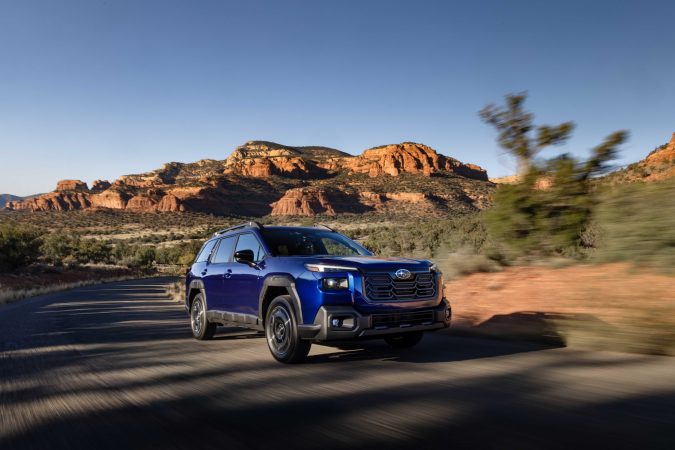
2026 Subaru Outback Touring XT vs. Toyota Crown Signia Limited: New ways to get around.
This week: Subaru Outback
Price: $49,445 as tested
What others are saying: “Highs: Spacious rear seat and cargo area, decent off-road capability, friendly dashboard controls. Lows: Base engine provides unhurried acceleration, handling is not engaging, no longer looks like a wagon,” says Car and Driver.
What Subaru is saying: “Love never looked so good.”
Reality: Most of the best features are kept, but then so are most of the not-so-best.
What’s new: It’s a whole new redesign for the Outback. Beyond the new face up front, it gets a boxier profile and flatter roof for more passenger and cargo space.
The Outback and brother Forester tend to bring a feeling of trustworthiness to every drive, somewhere in the putt-putt engine, just-right handling, and interior design. Will the redesign upset that balance?
Up to speed: The Outback as tested features a turbocharged version of the 2.4-liter Boxer four-cylinder engine, making 260 horses. It gets the vehicle to 60 mph in 6.2 seconds, according to Car and Driver. The standard 2.5-liter four-cylinder creates 180 horsepower and gets there in 8.8 seconds, Car and Driver estimates.
A morning in the 20s was accompanied by some occasional hesitation — from the Subaru, not just Mr. Driver’s Seat — when pulling out and while in motion.
Shiftless: The Outback continues to transfer the power to the road with a continuously variable transmission. There’s no real excitement, but it just adds to the feeling of trustworthy canine companion somehow.
The shifter is the old-fashioned handle style. Paddle controls on the steering wheel and a manual mode offer the illusion of control.
On the road: The Outback visited the Sturgis household during frigid temperatures and an unusual midwinter snowpack. I wasn’t driving through the snow, which would have been a very Subaru-worthy test indeed. Unfortunately, I faced icy roads only when it got dark, so I never had the chance to put it to a real test. Still, the SUV did just fine, hugging the curves and making me confident that it would follow my steering inputs quickly.
I never found any drive modes and didn’t really miss them, but there is a snow mode.
The interior of the 2026 Subaru Outback keeps its classy look and does away with the vertical center pod.Subaru
Driver’s Seat: The interior is all new as well, although it’s not radically different from Outbacks of yore.
The seats in the Outback were quite comfortable and roomy — and luxurious. The adjustments are handled on the door, not my favorite setup.
The Outback handles the cold with some real bun burners for seat heaters. I could hardly keep it set to 2, while the Lovely Mrs. Passenger Seat relished 3.
Friends and stuff: Rear seat passengers should be pleased with their accommodations. There’s tons of legroom, foot room, and headroom. The seat is almost as supple and inviting as the front.
Cargo space is 34.6 or 80.5 cubic feet, depending on the seat origami.
Play some tunes: Subaru literature advertises a 12.1-inch infotainment screen, but it sure looks larger than that. It’s also attractive and easy to operate, with a dial for volume and button icons that are easily visible and get you around the functions. And it’s also not the vertical screen of yore.
Sound from the Subaru Multimedia system is OK, about a B+, maaaaybe an A-. It seemed to miss a lot of the parts of songs I know to look for.
Keeping warm and cool: Dials control the temperature and buttons handle everything else. There’s a display that tells you what’s going on without taking over the main screen.
Again, those seat heaters. Wow.
Fuel economy: I averaged about 19 mpg on side roads until I took it out on the highways and got close to 21. Subarus can be thirsty, and this Outback is less station wagon and more SUV than ever.
I didn’t have it out too much, though, so there may be some more room for improvement.
Where it’s built: Gunma, Japan
How it’s built: The Outback gets a 3 out of 5 for reliability from Consumer Reports.
In the end: My love for the Outback has grown over the years, especially the Wilderness model. This one offers much the same experience. The turbo adds a lot of fun, but also drinks a lot of fuel.
Next week: See how the Crown Signia Hybrid compares.
Jasmine Jackson sat on her couch at her home in Winslow Township, watching a broadcast of the nation’s fastest high school hurdlers competing at the 2025 Brooks PR Invitational. As she watched, she made it her goal to be on that track, competing in the race.
After a year of training and dropping time, her invitation arrived in the mail, making her the first athlete in Winslow Township history to earn a spot in the prestigious event.
“It was a big accomplishment when I got the invitation,” she said. “I was ecstatic. To know I was the first to do this showed it was a stepping stone to something even greater.”
And something greater came at this year’s Brooks PR Invitational on June 7 in Renton, Wash.
The Winslow Township High School sophomore claimed the 100-meter hurdles title with a time of 13.33 seconds. It came days after winning the New Jersey Meet of Champions and running a personal-best 13.28 seconds.
Jasmine Jackson set a personal record in the 100-meter hurdles at the New Jersey Meet of Champions.Jose F. Moreno / Staff Photographer
Her personal record currently ranks No. 3 in state history, No. 3 all-time on the wind-legal list for sophomores, and No. 3 in the nation this season. Jackson continues to climb the ranks as one of the nation’s fastest hurdlers and wants to accomplish more.
Her love for hurdling began at a young age. Jackson grew up going to the track with her dad, Tyree Jackson, who was a sprinter and relay runner at Camden High School and Rowan. He is now a track-and-field coach at Pennsauken.
When she was 5, she saw a hurdle on the track and asked her dad if she could try to jump over it. Tyree initially said no, worried she might hurt herself, but she persistently asked, so he finally gave in.
She cleared the hurdle with her right leg leading and left leg trailing, the form she still uses today.
“It was perfect,” Tyree said.
Starting out, however, he wasn’t convinced that hurdles would become her event.
“There were a lot of times where I thought that maybe hurdles weren’t for her because she was too timid and scared to actually run through the hurdles,” he said.
Tyree scoured the internet for drills and training ideas to help his daughter develop as a hurdler. His former teammates offered advice on technique and form, and they soon progressed from wickets to smaller hurdles. She joined Winslow Elite Track and Field at age 8 to keep improving.
By 14 years old, Jasmine broke the national record for the 100-meter hurdles with a time of 13.72 seconds at the 58th AAU Junior Olympic Games in Greensboro, N.C. That race gave her a newfound confidence.
“That race pushed her over the edge as far as her demeanor and her confidence level because in order for her to win and break the record, she had to beat some really talented athletes she had never beaten before,” Tyree said.
And as her confidence has grown, her times have dropped.
Part of that growth has come from racing against the nation’s best, including one of her biggest competitors, Nia Armstrong from Tampa, Fla. The hurdlers have developed a friendly rivalry over the years since they typically compete in the same races and push each other to faster times.
“Whenever those two compete against each other, it’s like I don’t care who else is on the track, the race is going to be between them,” Tyree said.
Before the Meet of Champions earlier this month, Jasmine was nervous. The meet featured the toughest competition she faced all season. But as she set up on the line, she reminded herself that she belongs here and is built for the moment.
“I just tell myself I’ve been here before. It’s just a track. I know how to run. I know how to hurdle. I know what I’m capable of,” she said. “I believe in myself, I’m ready for this moment, and not to let an opportunity pass by because you might not get it again.”
Developing self-belief in a mentally challenging sport, Jasmine says, has been one of her biggest areas of growth.
“She’s always been good. She just didn’t have the confidence to know that she’s good,” said Shawnnika Brown, Jasmine’s high school coach. “Now, she is running with a purpose.”
That purpose is reflected in her daily routine. Jasmine trains with her team after school, goes to the gym to lift weights, and does additional hurdle sessions with her dad on the weekends.
Having Tyree as her coach has also been an important part of her success.
“I try not to let the coach interfere with the father,” Tyree said. “I’ve learned how to talk to her and get her motivated to the best of my ability without her being upset with the father.”
After Jasmine won at Brooks, Tyree let his daughter enjoy the moment before turning their attention to the next race.
“She knows I’m going to focus on the flaws first before I celebrate her and give her roses because I sometimes have to be the coach first and then dad second,” he said.
That approach is shaping one of the nation’s fastest high school hurdlers, but Jasmine’s goals go beyond state titles and national championships.
Jasmine Jackson will compete at the New Balance Nationals at Franklin Field this weekend.Jose F. Moreno / Staff Photographer
“The ultimate goal is to go to the Olympics,” Jasmine said. “Knowing I have that goal in mind, no matter how I feel, I know I have to work for it. It’s not going to be given to me. I have to earn it.”
For now, the 15-year-old can check the Brooks PR Invitational off her list. Up next is the New Balance Nationals running until Sunday at Franklin Field. Jasmine will run the 100-meter hurdles and 4×400-meter relay championship. She is looking to earn her first national title at the event.
“I’m tired of being second at this event,” she said, laughing. “I’m going up against pretty tough girls, so it’s going to take a lot to win. I believe I can do it if I put my mind to it.”
The offseason program is over, and the next time the Eagles get together at the Jefferson Health Training Complex, it will be for training camp — the official start to the 2026 NFL season.
The longest stretch of downtime around the league is right now, so it’s a good time to take stock of what we just saw during organized team activities and mandatory minicamp.
The workouts allowed for a first look at new offensive coordinator Sean Mannion’s offense and a few new key players for the Eagles, but they also left some lingering questions about the team during the break.
Here are some of the things we’re still thinking about:
How long should the probationary period be for the new-look offense?
The short answer: Longer than will probably be allowed.
Eagles fans read and watched analysis here and probably elsewhere that told them Mannion’s offense was little match for Vic Fangio’s defense during the recent practice sessions open to reporters.
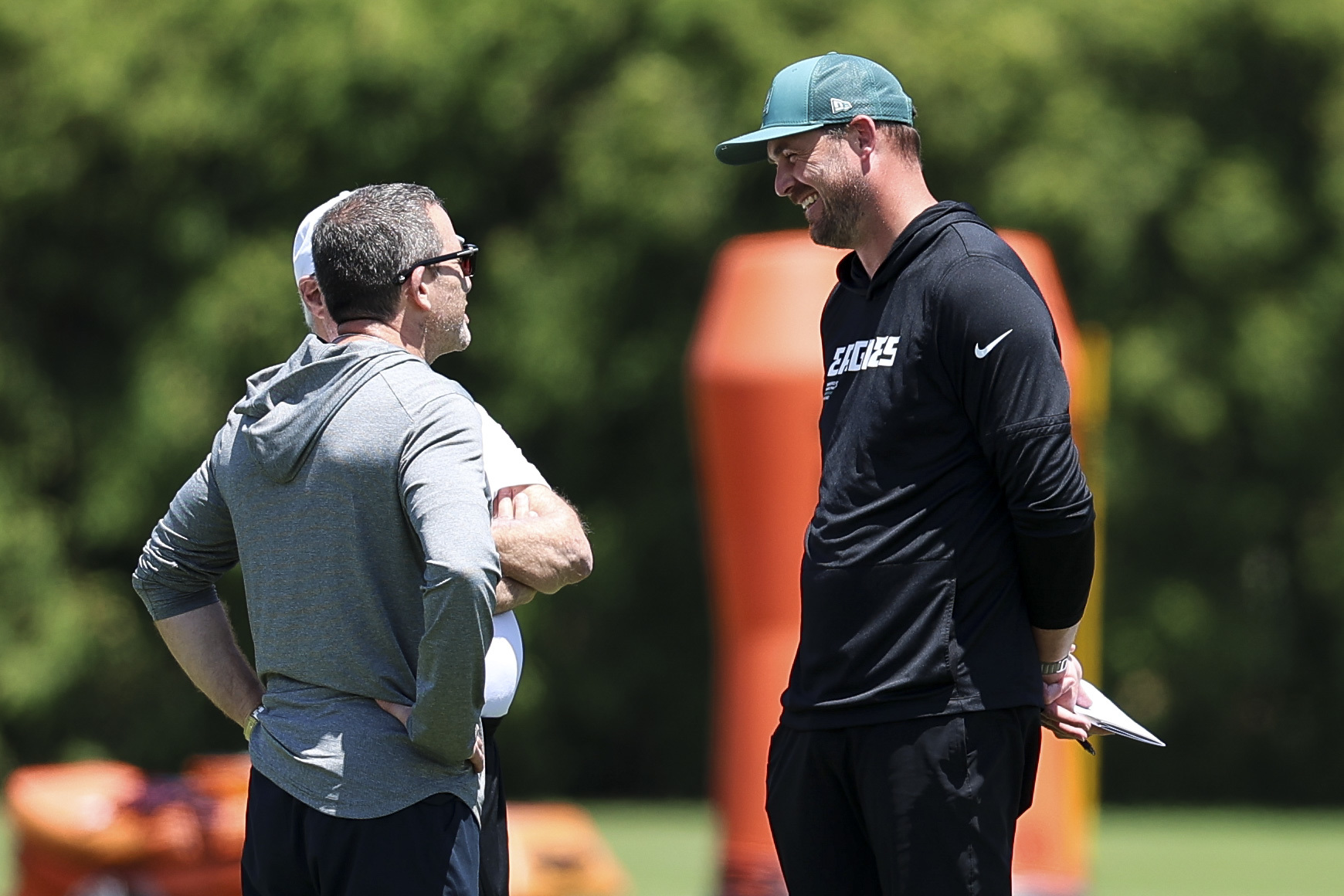
Jeffrey Lurie and Howie Roseman speak with Sean Mannion (right) during mandatory minicamp.Monica Herndon / Staff Photographer
What’s the reaction going to be if the offense looks sloppy a few practices into camp? It’ll be an outsized one, for certain. But it shouldn’t be.
There are a few reasons why:
Fangio’s defense might be among the best in the NFL this season.
The Eagles are installing a new offense with new blocking schemes.
Jalen Hurts is taking more snaps from under center.
The Eagles are using more play action and more motion.
Football is football, and some players will say as much, but there are going to be some growing pains before the offense is firing on all cylinders.
Plus, while the focus of many will be on the play-calling and what the playbook looks like, it may all just come down to the health and force of the offensive line anyway.
That’s not what the question asked, though. How long should the probationary period be? The view here is that drawing major conclusions about Mannion’s offense won’t have enough context until at least three games into the regular season. Patience levels are personal, right?
Is it possible that the A.J. Brown trade was such a foregone conclusion that the biggest roster storyline in an otherwise pretty standard offseason program was the backup quarterback position?
Andy Dalton and Tanner McKee are splitting reps behind Hurts, Nick Sirianni says, but the coach wouldn’t commit to saying McKee is the backup quarterback, the spot on the depth chart he held last season. He doesn’t have to commit to anything in June or even July or August.
But the fact that Dalton took so many reps with the second-team offense was interesting.
Quarterbacks Andy Dalton (left) and Jalen Hurts work out during mandatory minicamp.Monica Herndon / Staff Photographer
It’s fair to wonder if McKee will be on the roster by the time camp breaks, and the Eagles are crunching numbers to get to their initial 53-man roster. The Eagles used a fifth-round pick on quarterback Cole Payton after sending a seventh-round pick to Carolina for Dalton.
It’s hard to imagine they will keep four quarterbacks on the roster, and it’s hard to imagine them wanting to expose a fifth-round pick to waivers unless Payton has the type of uninspiring training camp sixth-round pick Kyle McCord had last year.
The guess here is that Howie Roseman is hopeful McKee puts some good play on tape in the preseason, and the Eagles get some draft value back in a trade for their 2023 sixth-round pick, who is entering the last year of his contract.
Is a quiet spring from top Eagles rookies concerning?
It shouldn’t be.
But their first three picks were hampered by injuries.
First-round pick Makai Lemon, who will be asked to contribute in a big way right away with Brown out of town, missed some time with a hamstring injury but is expected to be ready for camp. Sure, he didn’t get a ton of on-field reps, but it wasn’t like he was on an island somewhere while the Eagles were installing stuff in the meeting rooms.
Makai Lemon was bothered by a hamstring injury during minicamp. Tyger Williams / Staff Photographer
Eli Stowers, the second-round pick out of Vanderbilt, did not stand out in early workouts despite the Eagles raving about his athletic traits after selecting the tight end at No. 54. He then wore a sleeve on his right leg during the final workout of minicamp and sat out some drills.
Markel Bell, the big tackle the Eagles took in the third round, also missed the last practice of minicamp.
As for Stowers, Sirianni continued to have a lot of good things to say about him on the last day of the spring session. The former college quarterback is still only a few seasons into playing tight end, and while the Eagles are high on him — “He has an unusual skill set at the tight end position with the matchups that he is going to be getting,” Sirianni said— they also know he has a lot of work to do.
It’s way too early to be alarmed about the rookie class.
Will there be any roster additions before training camp?
Roseman kind of answered that question just hours after the final on-field workout finished when he signed former Bills edge rusher A.J. Epenesa. That move made some more sense on Tuesday, when the Eagles placed free-agent signing Joe Tryon-Shoyinka on the reserve/retired list.
Epenesa, who was drafted one spot after Hurts in 2020, originally signed with the Browns, but that deal did not finalize after Epenesa’s physical. Edge rusher was one spot, however, where the Eagles needed some more talent for some bottom-of-the-depth-chart competition. There’s a clear trio at the top in Jonathan Greenard, Jalyx Hunt, and Nolan Smith, and then there’s Arnold Ebiketie. Epenesa, who had six-plus sacks in three consecutive seasons from 2022 to 2024, figures to be in the mix for a roster spot.
A.J. Epenesa, seen here as a member of the Bills, is a recent addition to the pass rushing depth chart. Gary McCullough
Where else could the Eagles upgrade?
Safety might be the only position on the team that still has some question marks. The Eagles plan to use Cooper DeJean at safety in their base defense with Quinyon Mitchell and Riq Woolen manning the outside corner spots. But that leaves around 75% of the reps next to Drew Mukuba for someone not named DeJean. Right now, it’s Marcus Epps’ spot to lose. But Epps is 30 and was available as a practice-squad addition last August.
Behind Epps is Michael Carter II, who has played mostly nickel, and J.T. Gray, another 30-year-old with mostly special teams experience. Then there’s a mix of young and unproven players.
Fangio has expressed confidence in Epps, and thinks Carter has the chops to play safety, but don’t be surprised if Roseman adds some more talent to the group before camp.
Seth Friedman was watching the NBA Finals on Saturday night in Graduate Hospital when he heard a familiar refrain.
It came from Leon Rose, the mild-mannered architect of the New York Knicks. His team had just won its first title since 1973.
Rose, 65, was asked how he felt knowing he’d built a roster that had ended a 53-year-drought. The Knicks president shook his head, shrugged his shoulders, and pivoted to his players.
He praised their brotherhood, their grit, their empathy. He talked about their care for one another, and their selflessness, and how it allowed them to reach new heights.
Friedman, sitting on his couch next to his wife, began to tear up.
“It sounded like he was talking to us,” he said, “back when we were 13 or 14 years old.”
The setting was vastly different. Instead of holding two-a-days for high schoolers, Rose was standing on a platform in San Antonio, Texas, with a sparkling trophy beside him.
But the message was nearly identical. Friedman listened to it himself when he played for Rose in the mid-2000s at his local Jewish community center.
“He literally preached that same mentality,” Friedman said. “That family mentality.”
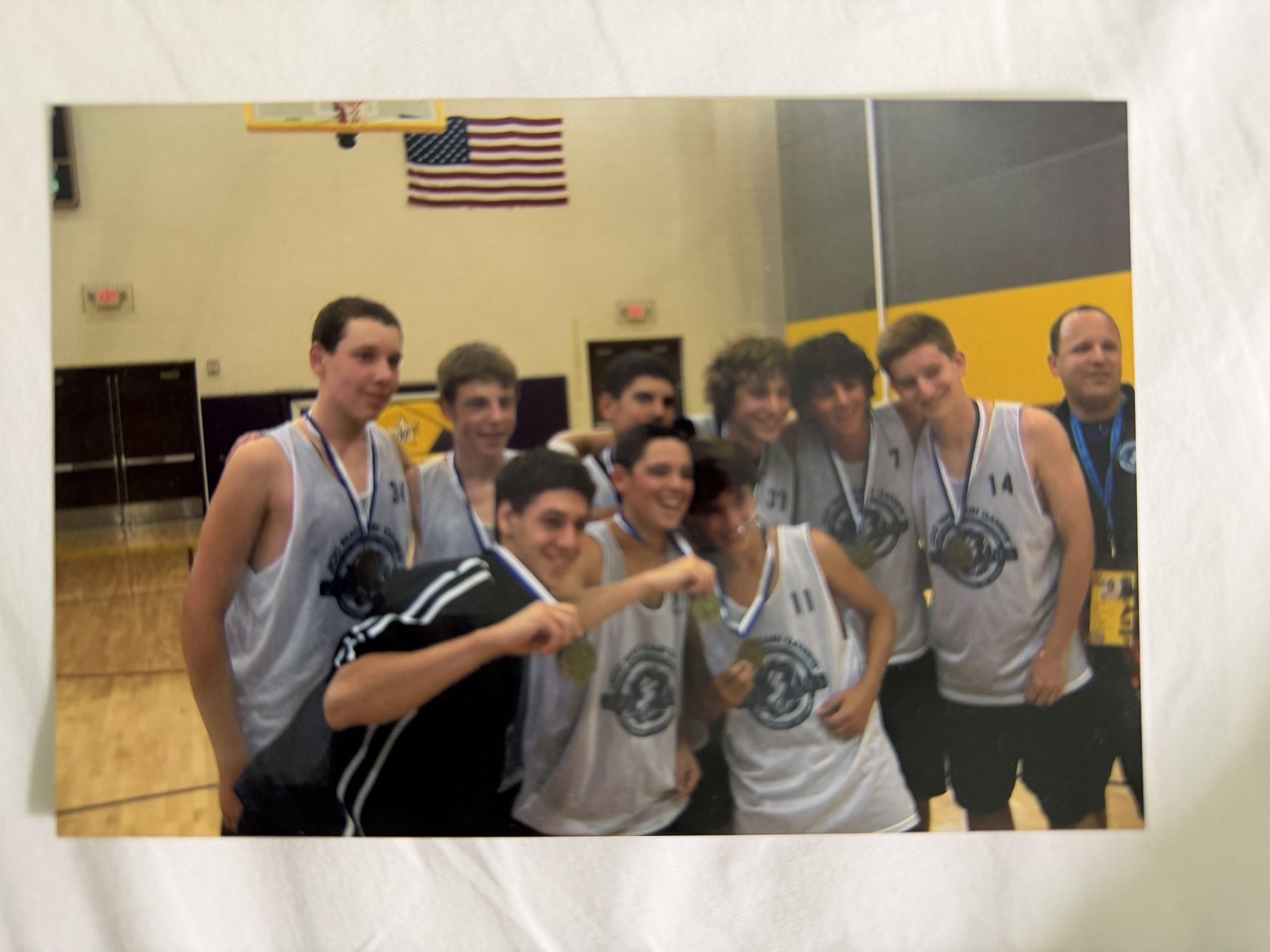
Leon Rose coaching at the Katz JCC in 2005. Seth Friedman is pictured in the bottom row, second from the right.Photo courtesy of Katz JCC
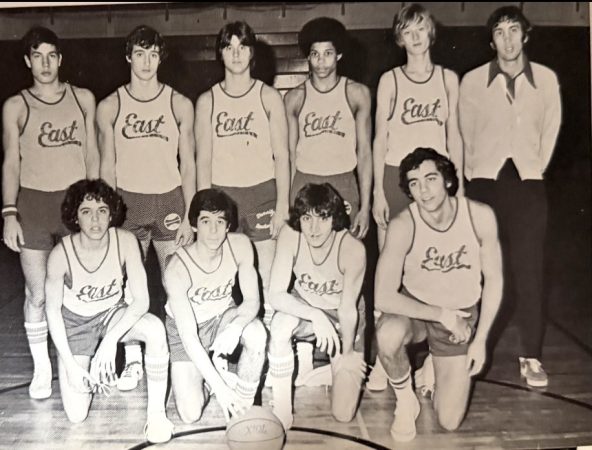
For decades, the future Knicks president was a mainstay in his Cherry Hill basketball community. He played under head coach John Valore at Cherry Hill East from 1975 to 1979 and joined Valore’s staff in the early 1980s while studying atTemple’s law school.
He moved on to work as an assistant coach through the late 1980s at Rutgers-Camden, a short commute from his day job at the Camden County prosecutor’s office.
He’d leave collegiate coaching in 1988, but Rose would always find time for the sport, even as he ascended the ranks of the NBA. In the 1990s, while he transitioned to sports management, Rose often could be found playing pickup hoops at the Katz JCC in Cherry Hill.
By the mid 2000s, he’d assembled a Rolodex of star-studded clients, including Allen Iverson and LeBron James. But that didn’t keep him away from the gym. For the better part of a decade, Rose served as a volunteer coach at the Katz JCC, preparing teams to compete in the Maccabi Games.
The Knicks executive has achieved a lot since then. But those who know him best say he is the same understated guy who’d wear baggy sweatshirts and run his team through tap drills and sprints.
“He was Coach Leon,” Friedman said. “He was one of us. Even now, you see him down the Shore, and you’d never know that he’s the person that he is.”
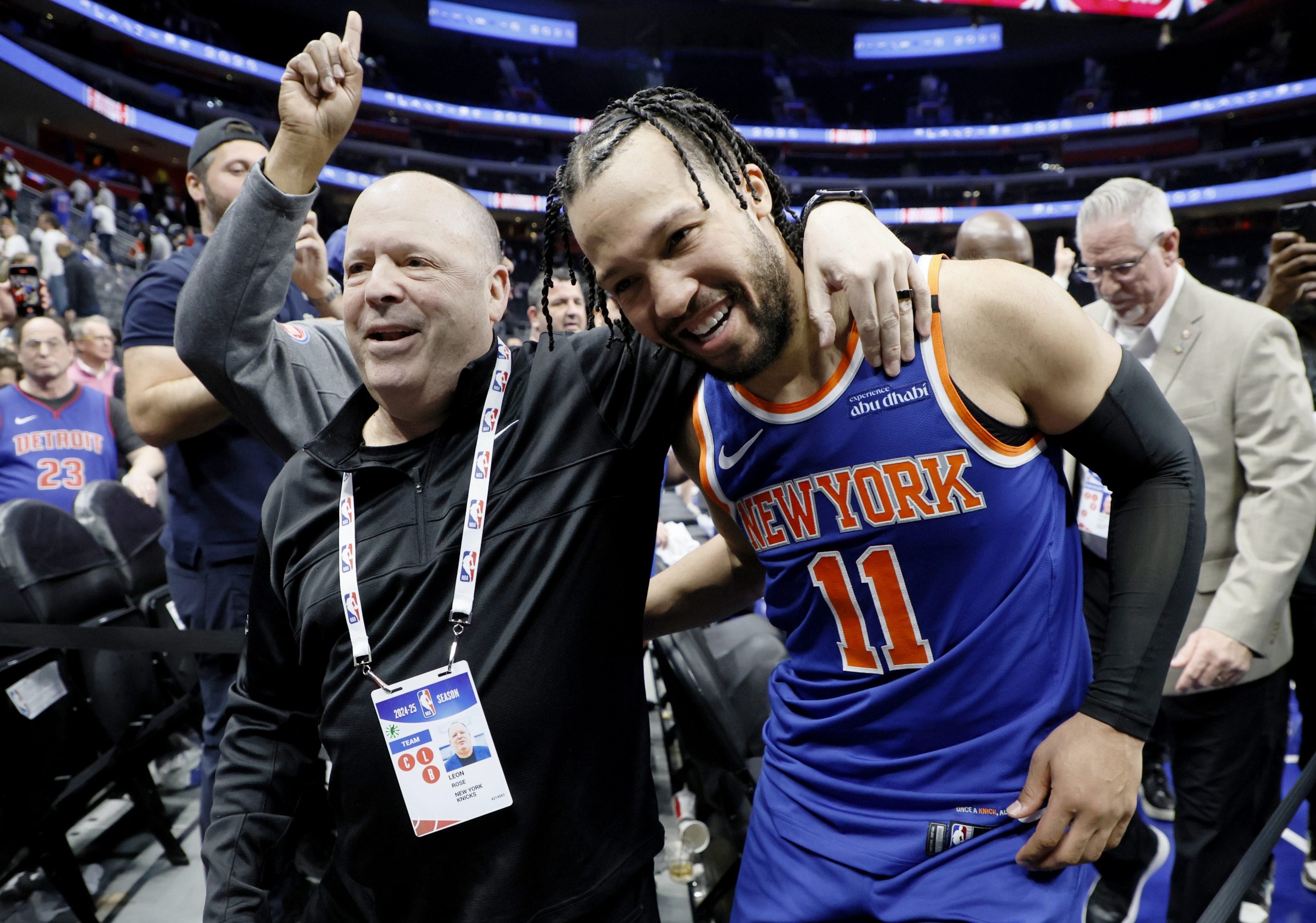
New York Knicks Leon Rose (left) hugs guard Jalen Brunson (11) as they leave the court following a Game 6 win against the Pistons in the 2025 playoffs. Duane Burleson
‘A gym rat’
Valore met Rose in 1975 when he was coaching junior varsity at Cherry Hill East. The freshman was undersized compared to his teammates, but he played above his stature.
If there was a loose ball, the point guard would dive for it. If there was a charge, he would take it. Valore admired his toughness. So when he got the varsity job in 1976-77, he decided to bring Rose with him.
The sophomore made the most of his opportunity. Cherry Hill East was a relatively new program at the time and largely was viewed as a “doormat,” in Valore’s words. Rose helped change that, building an unselfish culture from the ground up.
He wasn’t a vocal leader, but he showed interpersonal skills that would serve him later on. The future NBA executive was direct and honest. He could have difficult conversations with teammates if he needed to about roles and behavior on and off the court.
Rose also set a standard through his style of play. Cherry Hill East was up against stiff competition in South Jersey from teams like Camden and Haddon Heights, which boasted players who were 6-foot-2, 6-3.
The point guard was unafraid to battle them.
“He was a player that had to compete harder and tougher than the person he competed against,” Valore said, “because he was 5-7, 5-8, 5-9. That shows you the toughness he had within him.”
Leon Rose at Cherry Hill East.Courtesy of John Valore
Cherry Hill East’s culture quickly translated into wins. When Rose arrived, the varsity team finished just above .500. By the time he graduated, it was one of the best teams in its conference.
But above all, Valore was most impressed by his pupil’s character. During a practice in 1979, the coach called his co-captain over. Valore’s wife, Joyce, had just given birth to their first child, J.C.
The coach wanted Rose to be the boy’s godfather.
“[Leon] was 17 years old,” he said, “and I saw everything I wanted to see. He was an exceptional person with relating to other people. He was something special.
“He went back to his dad and explained the situation, and his dad gave the thumbs-up. And the rest is history.”
After a few years studying and playing basketball at Dickinson College, Rose rejoined his high school team as an assistant coach in 1983. The 22-year-old was just as impactful on the bench as he’d been as a point guard.
Over Rose’s three seasons with Cherry Hill East, the program produced four Division I players. One of those four, Nick Katsikis, ended up contributing to Seton Hall’s run to the 1989 NCAA championship game.
Valore can see similarities in what Rose accomplished with the Knicks. When the agent was hired by James Dolan in 2020, the team was en route to its seventh straight losing season; “a doormat,” just like Cherry Hill East.
Then Rose came along, and everything changed.
“He was a gym rat,” Valore said. “He just loved the game.”
Leon Rose coaching for the Katz JCC in 2004. Ed Vernick is pictured on the far right.Photo courtesy of Katz JCC
From Maccabi gold to an NBA title
Ed Vernick moved from Philadelphia to South Jersey in the early 1980s, the same time Rose was coaching with Valore.
Unsurprisingly, the men became friends at the gym. Vernick was about to go on a trip to Ocean City and wanted a good place to work out. Rose overheard him talking, ripped off a piece of paper, and scribbled down an address.
Vernick had no idea who the young lawyer was, but he took him up on his suggestion. A few days later, while he was running on a treadmill in that Ocean City gym, he saw Rose walking by.
“He goes, ‘I just wanted to make sure you got here,’” Vernick said. “What a nice guy. I’m thinking, ‘Who does that?’ It was just one of those things that caught me.”
About two decades later, when Rose was starting to coach basketball at the Katz JCC, he asked Vernick to be his assistant. Together, they spent the summer of 2004 preparing Cherry Hill-area kids for the Maccabi Games, a youth athletic competition for Jewish athletes from all over the world.
Parents and players said Rose took this as seriously as the NBA Finals. He’d carefully craft his rosters, thinking hard about how each piece would fit.
Once the team was constructed, he’d spend July running them into the ground with many of the methods Valore used at Cherry Hill East: switch drills, sprints, tap drills.
Leon Rose coaching at the Katz JCC in 2005.Photo courtesy of Katz JCC
The week before the Games was by far the toughest. Players would be required to train twice a day and would arrive at the gym at 6:30 a.m. and return at 2 p.m.
“He got into us,” Friedman said. “But it got us ready. It got us prepared. It got us in shape. I hated it during it, but, looking back, those were memories I’ll never forget.”
This was a major time investment for one of the most high-powered agents in the NBA, but Rose was deeply involved. He continued to coach before and after his son, Sam, and daughter, Brooke, were eligible to play.
And he went far beyond what was expected of a volunteer. One year, Friedman said Rose took the team up to the Poconos for an exhibition game at Pine Forest Camp, which was known for its basketball program.
“He’s driving us up to play an exhibition game like it’s an NBA team,” Friedman said. “He didn’t have to do that as a coach. But he did whatever he could to get us prepped and ready to win a gold medal.”
About “80% of the team” came from Cherry Hill East, in Vernick’s estimation, and Rose often would be on the phone with Valore, asking about certain players.
Like his former coach, Rose gravitated toward toughness, and that style emanated from the teams he built. In 2004, South Jersey’s 16-and-under Maccabi team faced Washington, D.C., for the gold medal.
Leon Rose (in 2006) made his name as a superagent to the likes of Allen Iverson and LeBron James, but he did not flaunt that status to his young players. APRIL SAUL
It was a low-scoring game, one that came down to the buzzer. Washington was bigger and more talented, but Rose’s group challenged every bucket.
“I remember I could hear sneakers squeaking the whole game,” Vernick said, “and I just smiled. And I thought, ‘This is the way you play defense.’”
South Jersey fell, 42-40, but it won gold the following year in Minneapolis.
Rose spent six summers coaching at the JCC throughout the 2000s, winning two gold and two silver medals. He looked and acted like any other coach, donning Cherry Hill East basketball gear and sweatpants.
He rarely — if ever — talked about who he represented, or what he did for work, but the players occasionally got a glimpse.
When Friedman was a senior at Cherry Hill East, Rose arranged a surprise for his alma mater.
It was March 2010. The Cleveland Cavaliers were in town. After practice, their coach swung by to talk to the high school basketball team and answer any questions they might have.
It ended up being the coach who would lead the Knicks to a championship 16 years later.
“He had Mike Brown come over,” Valore said. “He was fantastic. Off the cuff, not scripted. He gave a wonderful speech to the kids.”
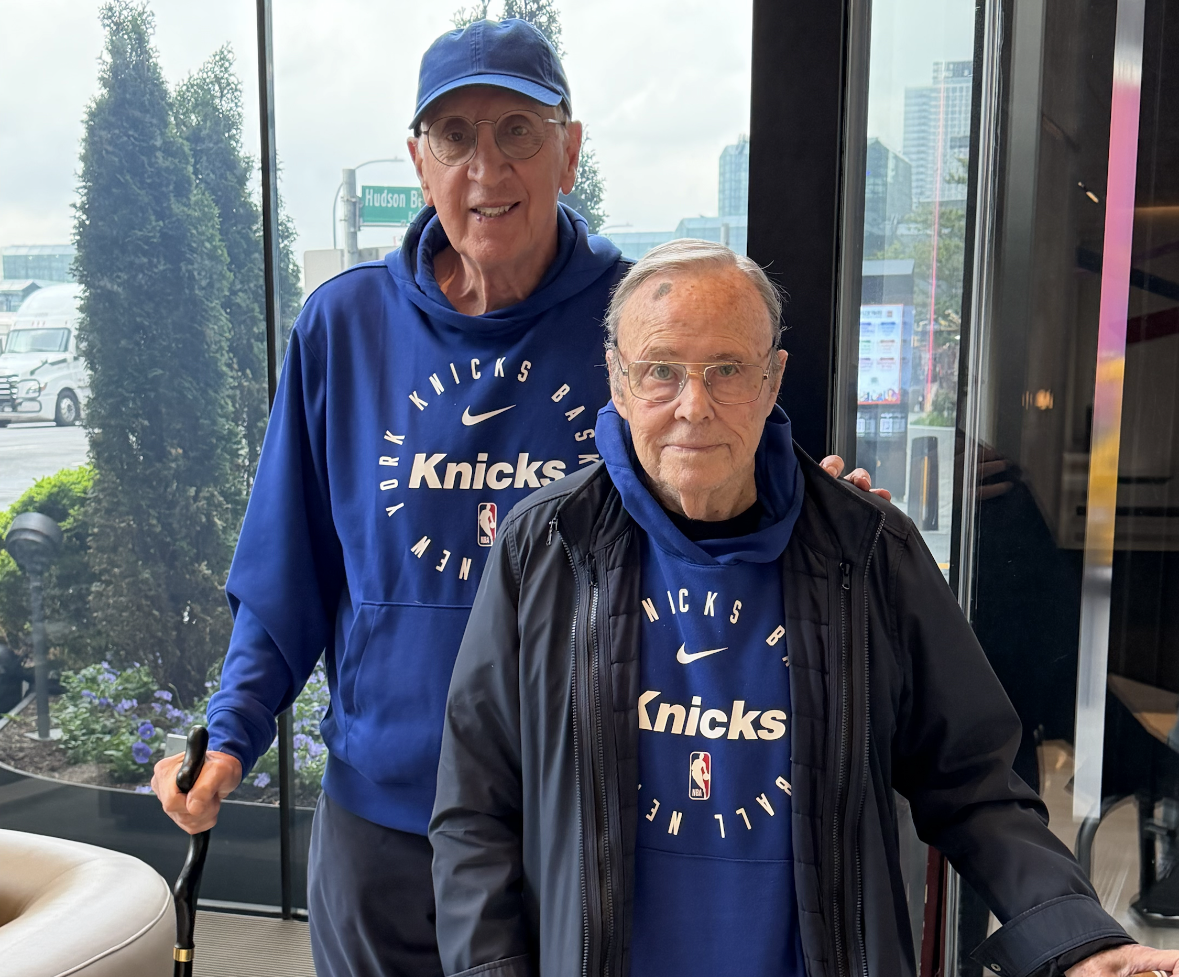
John Valore (left) and Zev Rose before a Knicks game in the early part of their 2026 playoff run.Photo courtesy of John Valore
Cherry Hill at the Garden
Rose and his family now live in New York, but they’re never too far from Cherry Hill. His 88-year-old father, Zev, still resides in the area, and is a regular at the Katz JCC.
Every once in a while, his son will send a limo to drive him and the 81-year-old Valore to Madison Square Garden. They were in the building for Game 4, sitting near the team president.
At first, it looked bleak for New York. The Knicks fell behind early and trailed by 29 points in the third quarter. But they came storming back in the fourth and completed the comeback on an OG Anunoby tip-in.