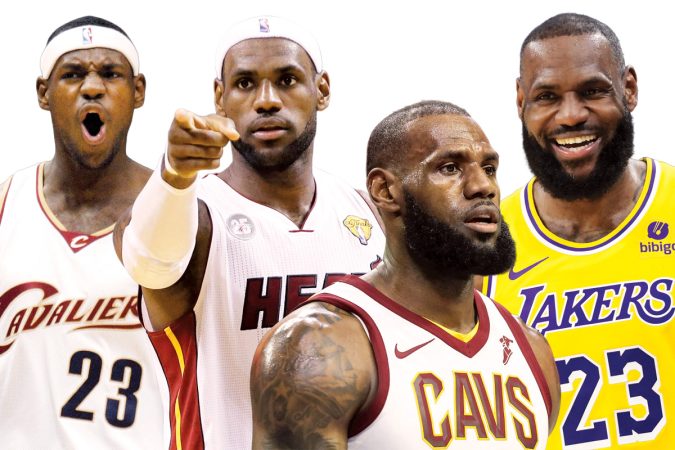
T-shirt hawkers have captured LeBron James’ name, image, and likeness.
The face of the newly minted Philadelphia 76er and all-time NBA legend has already wound up on unauthorized merch outside stadiums and down the Jersey Shore, as seen in social media posts.
“coming to you live from the wildwood boardwalk,” they wrote, alongside a photo of two T-shirts with LeBron’s face (likely) photoshopped onto No. 23 Sixers jerseys. The tweet has more than 3,500 likes.
A video from TickPick, a ticketing marketplace, also showed LeBron gear being peddled outside the Phillies’ game Saturday.
For decades, hawkers have been a fixture outside stadiums before and after games and concerts. And at the Jersey Shore, the staple mildly offensive and oft-vulgar garb has taken on its own culture.
These merchandisers are not beholden to trademark restrictions, capitalize on fan — not corporate — interests, and press catchy slogans onto cotton at lightning speeds.
That’s probably how King James landed at the Shore before the ink dried on the deal.
There’s math games and math art. Math theater and math music. Math for the family. Math for the kids. Mathdramatics. Math on stage. Math movies. Math podcasts. Math murals. Math rock stars. Math awards. Math in sports. Math in culture. Philly math.
Ancient math. Existential math! Asking whether it would even matter if machines solve the greatest math questions of all time but no human understands how. The beauty of math. The patterns and excitement. Ubiquity and mystery. The undeniable logic and truth. Of Math.
Welcome to the Super Bowl of Math. It’s in Philly, if you didn’t already know. For a limited time only.
The second level of the 2026 International Congress of Mathematicians at the Convention Center on Saturday, July 25, 2026, in Philadelphia.Aidan T. Gallo / Staff Photographer
“It’s like the Olympics of math every four years,” said Thomas Sumner, a local official for the International Congress of Mathematicians, held this year at the Convention Center, from July 23 to 30, with public events from July 24 to 28. “Celebrating the beauty and ubiquity of all things math.”
The International Congress of Mathematicians is a big deal. Among the largest math gatherings in the world, it is where the Nobel Prize of math — the Fields Medal — is awarded. Hosted in rotating nations, like the Olympics, the prestigious affair this year marks the first time it has been held in the United States since 1986, when it was hosted in Berkeley, Calif. Previously it had been held in Cambridge, Mass., in 1950.
Controversy and awards
It was not without some controversy that the eminent math event returns to America. In March, Tarik Aougab, an associate professor of mathematics and statistics at Haverford College, circulated a petition — eventually signed by more than 2,600 mathematicians — to boycott the nearly 130-year-old conference this year if it was not moved out of the United States.
Petitioners expressed concern that some international colleagues would be unable to get visas to enter the United States due to President Donald Trump’s administration mostlysuspending entry for citizens of dozens of countries. Other concerns included fear of U.S. Immigration and Customs Enforcement and reluctance to travel to the United States at a time when the nation is embroiled in a war in the Middle East.
In response the International Mathematical Union, which oversees the conference, assured attendees it was committed to providing a safe and welcoming environment for all participants and had made “additional arrangements to help mitigate risk.”
On Saturday, at the Convention Center, crowds filled the event’s free math festival in the center’s exhibit hall. Sumner said that while some potential attendees did experience travel issues, over 3,000 mathematicians from all over the world made it to Philly .
“This is where they give out the top prizes,” said Sumner, managing editor for the Simons Foundation, one of the largest charitable mathematics organizations in the United States, and the congress’ main organizing partner. “This is where the most important talks in math are happening.”
Veer Mehta (center), 11, of Lower Merion, listens to a keynote panel discussion with headphones alongside his mother, Pooja Kapadia (to the left), during the 2026 International Congress of Mathematicians at the Convention Center on Saturday in Philadelphia.Aidan T. Gallo / Staff Photographer
Indeed, the congress’ Philly locale did not come up at all at a jammed-packed news conference Thursday when Sumner introduced the four mathematicians under 40 — including ones from the U.S., Canada, and China — to become Fields Medals recipients. The prizes are accompanied by a $10,600 award and a gold medal with the face of Archimedes, an ancient Greek math whiz. This year represented the first time the winners included more than one Asian mathematician — and also included just the third woman to ever be honored with a Fields: Hong Weng, 35, a New York University professor, awarded for breakthrough work in harmonic analysis.
‘How do we adapt?’
The conference comes as the discipline — like so much else — faces existential questions about its future from the threat of AI. On Friday, Terence Tao, an Australian American mathematician considered a rock star in the math world — and awarded the Fields in 2006 for his contributions to partial differential equations — offered a keynote address in the hall on “Mathematics in the Age of AI.”
“It’s starting to solve math problems that have been stumping people for decades,” Sumner said of AI. “How do we adapt to this future?”
But on Saturday, the Convention Center floor was filled less with the angst about the future and more with the everyday joys and esoteric wonders of math. Families from all over crowded into the math festival — as symposiums and lectures continue through Tuesday.
Math magicians performed magic card tricks while budding mathematicians from the world over struggled through math proofs on portable chalkboards, Good Will Hunting-style. On a stage, a sports analytics panel — with representatives from every Philly sports franchise — discussed how math helps them make their moves.
Magnus Postle, 5, of Waterloo, Canada, builds a tensegrity kit, which is a system of balancing tension and compression to create architectural pieces to appear to “float” during the 2026 International Congress of Mathematicians conference Saturday in Philadelphia.Aidan T. Gallo / Staff Photographer
In a bustling nook, renowned Duke University mathematician Ingrid Daubechies — another math rock star — showcased her world-famous multimedia art installation, Mathemalchemy. The 20-foot-long whimsical math wonderworld features tiny creatures and structures embodying complex mathematical concepts. She had created the installation with 23 other mathematicians and artists to showcase the beauty and creativity of math. Like a little model cat named Arnold who bakes perfectly rounded pi-cookies.
“People are constantly surrounding it,” Daubechies said, as crowds moved in.
At the festival, some mathematicians posed Philly-related probabilities. Like picking a random seat at Lincoln Financial Field that just happens to be in the premium club section (0.16), the likelihood that Kyle Schwarber hits a home run during the next Phillies game (0.36), or getting into the University of Pennsylvania (0.05).
“So it’s harder getting into Penn than it is getting a club seat,” explained Alissa Crans, a professor of mathematics at Loyola Marymount University, working the booth. “Got to have some Philly math fun!”
Others, like Ariana Chin, 26, who studies algebraic combinatorics at UCLA — an area of pure math that uses abstract algebra to solve elusive counting and structural problems — talked about what they love about math, and the hope it can bring, even amid the uncertainty.
“The beauty is the connections,” she said in the quiet of the crowd. “The beauty of mathematics is expanding those connections between things you wouldn’t expect to be connected.”
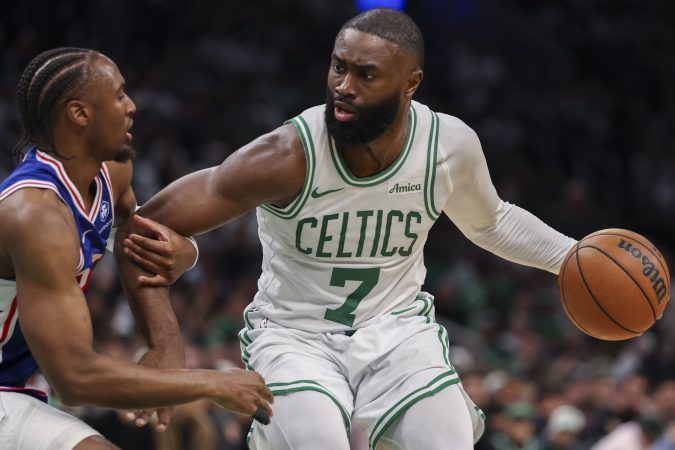
Jaylen Brown has yet to play a game for the 76ers, following the stunning blockbuster trade from the Boston Celtics earlier this month.
Yet a significant Brown-related decision already faces the Sixers. The All-NBA wing on Sunday became eligible for a one-year contract extension that could be worth nearly $69 million, which would keep him signed through the 2029-30 season.
If Brown does not sign the one-year extension this offseason, he will become eligible for a three-year extension in the 2027 offseason.
This all further demonstrates the financial investment the Sixers are making in Brown, who last season finished sixth in voting for the NBA’s Most Valuable Player award and is a five-time All-Star and former Finals MVP. He has three years remaining on his current supermax deal, with salaries of $57.7 million for the upcoming season, $61.7 million in 2027-28, and $65.6 million in 2028-29.
It also aligns with the rationale given by Celtics president of basketball operations Brad Stevens for why he dealt Brown in his prime.
Had Brown stayed with the Celtics, he instead would have been eligible for a two-year, $142 million extension. Stevens cited a reason for the trade was that Brown and fellow star Jayson Tatum — who has four years remaining on his current contract, including a $71.4 million player option for 2029-30 — would take up approximately 70% of the Celtics’ salary cap. That makes it increasingly more challenging to build out a roster with strong complementary players under the league’s new collective bargaining agreement, with “apron” penalties including trade restrictions for high-spending teams.
Stevens repeatedly used the word “optionality” when describing the roster-building reasons for the move that shocked the NBA.
“I might be wrong. I’m not going to stand up here and be defensive about that,” Stevens said at a news conference following the trade. “But the path [to winning a championship] looked a little bit more challenging. … You have to do a great job of building out depth that can hopefully replace the irreplaceable individual.”
But Brown being traded to the Sixers knocked his extension eligibility down to one year, because players on new teams are only allowed to extend their contracts out to four total seasons. According to NBA cap expert Keith Smith, the salary figure Brown can earn on that additional year is the greater number of either the max salary for a player with 10 years of NBA service, which Spotrac projects to be $66.9 million in 2029-30, or a 5% raise on the final year of his current deal, which is $68.9 million.
Though adding Brown is a bit less of an immediate financial burden for the Sixers, it still creates a top-heavy salary cap sheet for multiple seasons.
Former NBA Most Valuable Player Joel Embiid is slated to make $57.7 million on his max extension in the upcoming season, then $62.4 million in 2027-28 and $67 million in 2028-29. All-NBA guard Tyrese Maxey also has three years remaining on his first max contract, at $40.8 million for the upcoming season, then $43.6 million in 2027-28, and $46.4 million in 2028-29.
Though both contracts are scheduled to come off the books in the 2029 offseason — barring another max or supermax extension for Maxey — standout guard VJ Edgecombe will be eligible to sign his first (potentially max) extension in the 2028 offseason.
It is possible the Sixers could persuade Edgecombe to take the same route that Maxey once did. Instead of signing a max extension when eligible entering the final year of his rookie contract, in 2023, Maxey waited a year before inking a max deal. That gave Maxey a smaller cap hit in the 2024 offseason, and more financial flexibility for the Sixers that they ultimately used to sign Paul George to a four-year max contract.
Today that George deal is considered even more of an albatross than Brown’s contract, because George is older (36), no longer a perennial All-Star, and has struggled to stay on the court in recent seasons. But he will come off Boston’s books sooner, with two years remaining on his deal including a player option. That contract also becomes increasingly easier to trade the closer it gets to expiring.
Just because Brown is now eligible for the one-year extension does not mean that it will be offered by the Sixers and agreed to immediately — or at all.
Yet it is a reminder of at least part of the Celtics’ justification for trading Brown. And it gives the Sixers a Brown-related decision before he even steps on the court for his new team.
When Herman Welker came to Washington in 1951, he had what seemed to be the ideal résumé to become a man of influence.
The Republican senator from Idaho was an unwavering conservative — a former prosecutor and World War II veteran — whose opinion counted on matters including war, national security, and U.S. Supreme Court seats.
But Welker’s path to power and prominence — serving as a close ally and faithful wingman to Republican Sen. Joe McCarthy in his abusive, power-hungry, and attention-seeking campaign to root out American communists — undid him in a single term. Welker, known in the Senate as “Little Joe from Idaho,” was implicated in another senator’s blackmail-driven suicide. When McCarthy faced censure in the Senate, Welker tried to delay, dissuade, and, according to accounts at the time, bully others out of officially expressing their disgust.
Welker lost his seat in the next election, then, after a brief illness, died.
That’s the thing about influence attained through a grand bargain with those who wield power in ways that defy the law, norms, and anything approaching restraint: It requires a grasp of time and mortality few humans can reliably claim. Which is precisely the risk Sen. Lindsey Graham, a lawyer and a veteran of the wars in Iraq and Afghanistan, ran until his sudden death this month.
Unlike Welker, Graham transformed in full public view from a man who was once one of Donald Trump’s most strident and vociferous critics into a dependable MAGA workhorse in Congress.
Now, Graham’s legacy will be forever bound up with that of the 47th president, who took pains to tell NBC News that his faithful wingman’s death would be a “big blow” to the passage of the SAVE America Act.
In 2015, Sen. Lindsey Graham described Donald Trump as a bigot. Much changed over the next decade, Janell Ross writes.Jacquelyn Martin
In 2015, Graham was a third-term senator from South Carolina vying for the Republican presidential nomination — a field that included more than a dozen others — en route to being crushed by Trump.
Graham, for his part, described Trump as a bigot, interested in anti-American policy, and a malignancy that, if nominated, would destroy the GOP.
Given that, when Graham offered his pithy prescription for America in a December 2015 appearance on CNN, I wasn’t exactly surprised.
“You know how you make America great again?” he said. “Tell Donald Trump to go to hell.”
It was a riff on the recycled bit of American political sloganeering that Trump had pushed into the zeitgeist, again. Trump’s vision was to make America more like it was in the past: less diverse, more exclusionary, with group suspicion as public policy, and strict racial and gender hierarchies governing national life.
In 2015, Graham’s position on Trump seemed clear and immutable. He told reporters he did not vote for Trump in 2016. Then, Trump won the election, and Graham spent most of the decade since transforming into one of the president’s most steadfast defenders.
There was a brief interregnum, a wobble of sorts on Jan. 6, 2021. After Trump supporters invaded the U.S. Capitol, Graham gave a speech. On the Senate floor, Graham seemed to point the finger of responsibility directly at Trump.
Sen. Lindsey Graham (R., S.C.) speaks with reporters during the second impeachment trial of former President Donald Trump in February 2021 at the U.S. Capitol Building.Stefani Reynolds
“Trump and I, we’ve had a hell of a journey,” Graham said. “I hate it to end this way. Oh my God, I hate it. From my point of view, he’s been a consequential president. All I can say is count me out. Enough is enough.”
But Graham, converted MAGA bannerman and, his critics say, Trump-era opportunist, soon returned.
Graham’s devotion to Trump was so sweeping and so sudden that the more conspiracy-minded have embraced the idea that Graham was the victim of blackmail or controlled by some sort of kompromat.
In death, Graham’s defenders — a group that, in these contentious times, notably includes Republicans and Democrats — have described his Trump transition as pragmatic, even admirable; what a skilled legislator must do.
Graham, they say, managed, in the final days of his life, three substantive foreign policy victories. He hammered out the details of a Russian economic sanctions bill Trump has said he will sign. He secured U.S. approval for Ukrainian strikes in Russia. And with these agreements, Graham effectively shored up NATO and its fundamental goal of staving off world war. Of course, all of that is contingent upon a mercurial president remaining uncharacteristically disciplined and consistent.
Sen. Lindsey Graham (R., S.C.) with President Donald Trump at a rally in Charlotte, N.C., in March 2020.DOUG MILLS
And therein lies the public lesson for us all. Time can and will run out. Redemption arcs, periods of public reconsideration, and book-tour explanations are not guaranteed.
Entirely honest assessments of the dead are rare. Many will offer familiar strings of superlatives, words of admiration, mutual respect, and sympathy — perhaps in the hope that those sentiments will be reciprocated when their time comes.
Others might just say our passing was a “big blow” to one of their pet projects.
Ultimately, though, our actions and associations will speak unvarnished truths about us long after we are gone.
Visit the block where Welker lived in Washington, D.C. Today there is not so much as a plaque. There’s just a Marriott.
Janell Ross is a former senior correspondent at Time magazine who frequently writes about race, politics, and identity.
Three major trends have dominated recent cultural discourse: charms, food and fashion collaborations, and mini totes. The tote from Wawa and Lands’ End harnesses all three into one sandwich-sized bag. And I’m obsessed with it.
Labubu bag charms took the world by storm in 2025, inspiring almost everyone with a handbag to personalize theirs with dangling dolls. The post-Labubu era isn’t so much a reaction to the somewhat cumbersome creatures dangling from key chains, but an evolution into a fixation with different charms, like a bracelet proclaiming one’s devotion to the World Cup, the cities in which games were played, and one’s willingness to wait for many hours in line to procure one from a Bank of America sponsor tent.
Lands’ End was paying attention to all three trends, leading to the Wawa and Lands’ End limited-edition tote. It debuted Wednesday on both the Lands’ End website, where it immediately sold out, and in select Wawa stores in New Jersey (which allegedly still have them in stock). This is an aggression toward the beautiful city of Philadelphia, but I digress.
It’s called the Shorti® Tote. It costs $39.95 for the tote itself and a matching bag charm that features an enamel hoagie, tomato, Wawa coffee cup, and “East Coast” charm. The collaboration also includes a Wawa branded T-shirt from Lands’ End ($44.95) that comes wrapped up like a hoagie (of course). Wawa provided me with a sample bag for this review.
The collaboration celebrates the Jersey Shore and encourages you to take a Wawa hoagie to the beach, where it will be duly protected from the elements by the thick, high-quality cotton canvas of a dedicated bucket-shaped tote bag. As someone who does not ever go to the Jersey Shore, I found that the tote has numerous other merits: It’s perfectly sized for a small water bottle, my wallet, keys, flashlight (with which I snap food photos because I am a food writer), and other bits of detritus.
Unlike the Trader Joe’s tote, it has a drawstring opening that can keep all your belongings firmly inside. It’s entirely made of canvas (worthwhile to note because canvas totes with plastic handles are the absolute worst), with metal grommets to secure the drawstring. The embroidered graphic collage of cassette tape, wired headphones, a Shorti, analog camera, cup with straw, feels pretty ‘90s-coded (also so trendy right now), and the Wawa and Lands’ End logos are small and demure. True to its name, it also fits two hoagies very nicely.
It’s comfortable to hold on my forearm, and I have found that it’s also the perfect BYOB bag as it holds all the contents of my purse along with a bottle of wine. The only drawback I see is that it does not fit my Chihuahua, Coconut, whom I also generally like to throw into a tote bag.
The Shorti® Tote next to Coconut the Chihuahua, who does not fit inside the mini tote.Kiki Aranita / Staff /
But perhaps the greatest part of possessing this tote is the envy I have inspired.
“When you’re done reviewing it and need to give it to someone, I am available,” said my colleague Beatrice Forman as I slowly backed away from her.
Get your own.
Wawas that received totes are in Sea Isle City, Stone Harbor, Avalon, Somers Point, Cape May, Ocean View, Brigantine, Ship Bottom, Wildwood, North Wildwood, Ventnor, Marmora, Dorchester, Ocean City, Manasquan, Rio Grande, Normandy Beach, Margate, Villas, Long Beach Township, Barnegat, and Neptune.
Editor’s note: This article has been updated to correct the spelling of Lands’ End.
Lilly Chen, 30, wants people to stop thinking local government software “sucks.”
The cofounder and CEO of Philadelphia-basedFSH Technologies once worked at Facebook writing software that trains AI models, lived in a monastery as a teen, and is now on a mission to make local government technology more efficient.
In the last two years, her company has raised $5.5 million from venture capital, and secured a contract with the city’s Department of Commerce.
“We’re so gung ho about local government, which is like a weird thing to say, but it’s true,” said Chen.
The business just moved into a new office at 2400 Market St., where Aramark is headquartered, and opened a smaller outpost in New York City this month. Chen hopes to hire 40 workers by early 2027, adding to the current 12-person staff, to work on contracts the company has alreadysecured. She’s looking for software engineers and client strategists — positions that can come with a starting salary of $150,000 at FSH Technologies, as well as a signing bonus and equity, she said.
The company is “winning government contracts at a clip,” said Chen, who was born in New Jersey and went to college in Colorado. She was working in San Francisco when the pandemic started, and decided to move closer to her parents in Media.
She declined to share how much the company brought in last year in revenue but says “it’s in the millions.”
The Inquirer interviewed Chen on a hot July day over the phone while she enjoyed an ice cream from 1-900-ICE-CREAM. The following conversation has been edited for clarity and brevity.
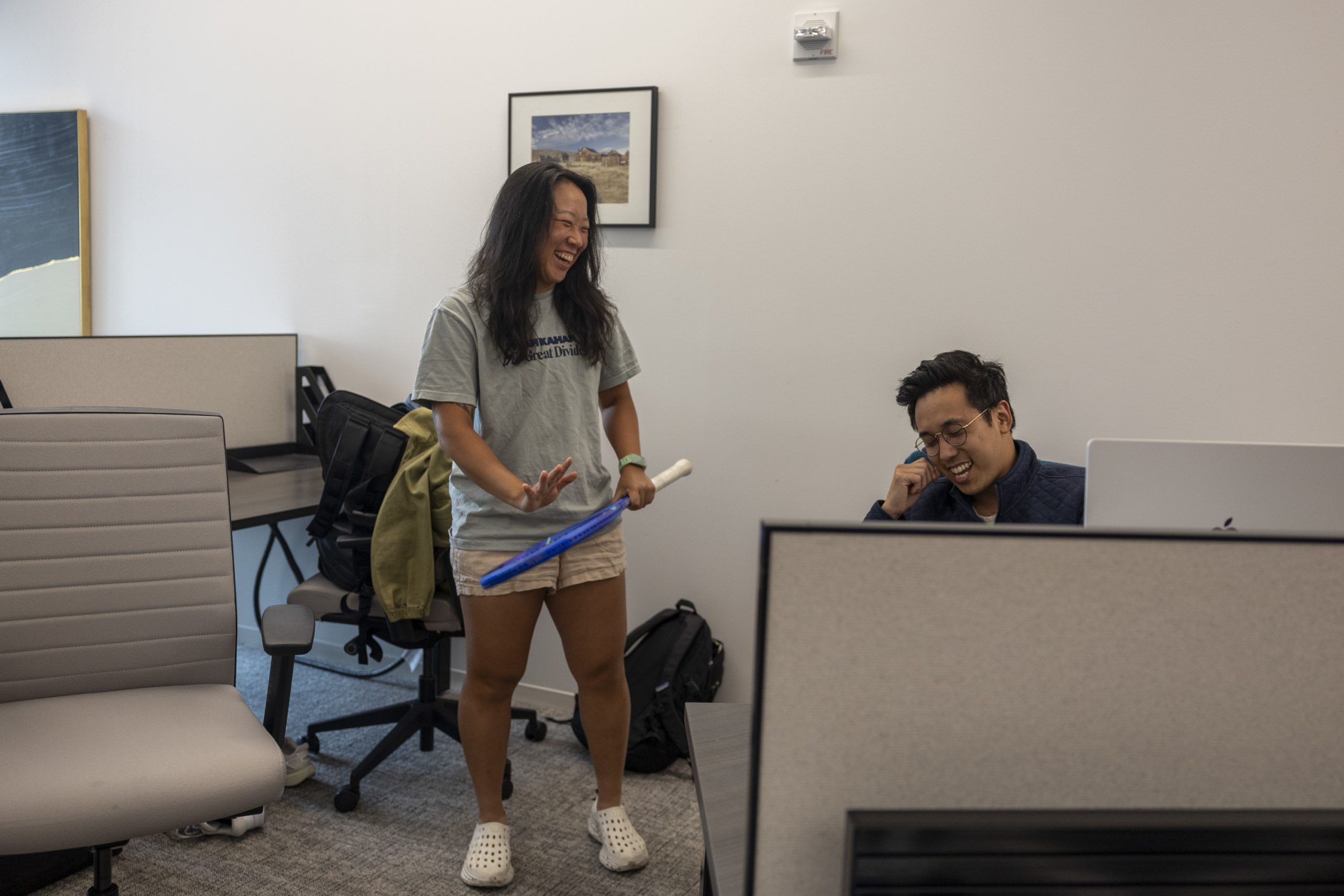
FSH Technologies cofounder Lilly Chen chats with COO Jason Chen in their Philadelphia office.Tyger Williams / Staff Photographer
Why did you start this company, FSH Technologies?
I used to work at Meta… when I worked there it was called Facebook. I was just very disenchanted with the apathetic nature of tech bros and the real-world impact that technology has on regular people.
FSH technologies is focused on creating software for local government. Why this niche?
I was [thinking about] what is a net positive on society that I can feel very good about, that I think technology is a good solution for. I landed on local government because it’s the one thing that universally everybody in America has to interface with, and the technology is so outdated. If you’ve tried to pay a parking ticket, get a permit, just try to navigate your local municipality, it’s so hard, it’s so complicated. Usually the software doesn’t even exist. It could be a manual paper thing.
In the last year there was a lot of talk in the Donald Trump administration of making the federal government more efficient. You’re talking about efficiency at the local government level. Did any of that narrative impact you?
There was actually no technology involved in the DOGE effort. When you drive real efficiency in government, it’s not rip and burn things. It’s actually getting into the weeds to understand the current process, who’s doing it, how they’re doing it, why they’re doing it, and then iteratively improving and wherever possible digitizing the relative components of that.
It’s not at all just being like, “Let’s just fire these people and see what happens.”
What about the name FSH Technologies? Where does that come from?
I used to be a Buddhist monk. I dropped out of high school when I was 16, and I moved to China and I lived in a monastery….We had a pond where we kept fish, and [my sensei] … would describe to me: “You are the pond, not the fish.”
If you can kind of separate yourself from the immediate feelings and see things as a bigger picture, as a system, you actually have a much more cohesive understanding and view of the problem.
You were a monk?
I was a real troublemaker in high school. I actually ended up getting very sick — I had an autoimmune disease … I was missing a lot of class, I was kind of misbehaving. My mom at one point threw her hands up in the air and was like, “We’re now Buddhists, we are moving to China, we’re going to live in a monastery, we’re shaving our heads.”
Can you tell me more about your work for the Philadelphia Department of Commerce?
We build software for the entire Department of Commerce, actually.
We standardized and unified all their forms into one platform, and then we created business profiles so that businesses would have to input, for example, their EIN number…once, and it’s there. If you put in your revenue, it will show you what you qualify for.
Prior, if you think about a Google form and you fill it out, you don’t actually know if you qualify, because anybody can open the form, anybody can submit it. It creates a lot of bureaucracy on both ends. You, as the business, don’t know if it was worth your time to fill it out, so you just fill it out – or you don’t fill it out. You, as the city, don’t know if this business is eligible, so you just spend time reviewing stuff for people who don’t qualify. Everything becomes slower and like sludge because the interface is really bad for actually streamlining the process.
The city spends so much less time reviewing applications now because they only get access to the ones that are actually qualified.
How are you managing the company’s work with your current staff of 12?
We have actually won a ton of contracts that are coming down the pipeline, but we haven’t started them yet. We have time to staff up, which is what we’re trying to do. If I can hire 50 people, I would.
Why can’t you?
What we do requires two things. One, is a deep passion and empathy for communities, civil servants, public good. You really need to care about the details because if you don’t care about them, you’re going to let people fall through the cracks.
That’s actually kind of hard to find because … people hear government software and they think it’s boring. They don’t necessarily realize how much impact you can have if you care deeply about this boring thing.
The second thing is software skill — the craft of building software that just works is hard.
The Venn diagram of skill and care is hard because a lot of people who are highly, highly skilled in technology end up at these AI frontier labs, which are paying a million dollars in salary.
What do you want the company to look like in five years? What’s the goal?
The goal is being able to have people no longer think local government software sucks.
Most days during the summers — sometimes well into the evening — Delores Lawrence is outside her home in Germantown weeding, watering, and otherwise tending her garden.
Her small front yard is where she grows tomatoes, blackberries, purple daisies, and orange and yellow lilies, all planted closely together. There’s also a narrow strip on the side where Lawrence cares for a mix of potted calla lilies, peonies, and other vegetation.
The land around her home is her peace.
It’s her little slice of the American dream.
But instead of being able to enjoy another summer growing season, Lawrence is livid about how the construction of a new apartment building next door has disrupted life on the block where she has lived for more than 30 years.
Her garage is no longer standing, her brick driveway damaged, and the construction noise at times was absolutely unbearable.
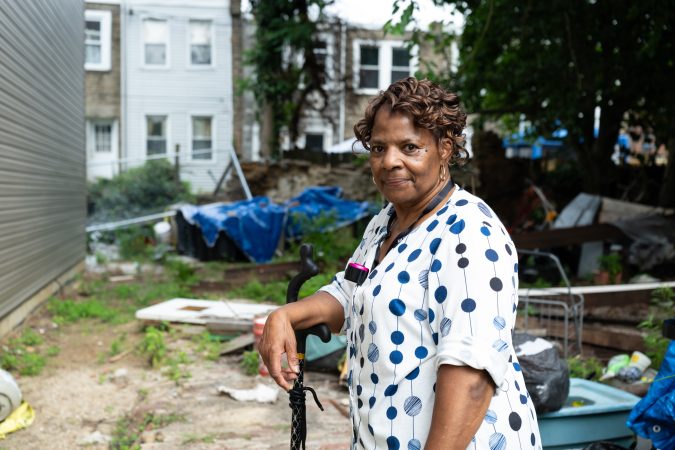
Lawrence, who worked in nursing before being injured, doesn’t know what to do. “I want my garage built back up. I want my driveway reconstructed,” she told me recently over the phone. “It makes me angry. It makes me upset. I even went to the doctor. I can’t even sleep.”
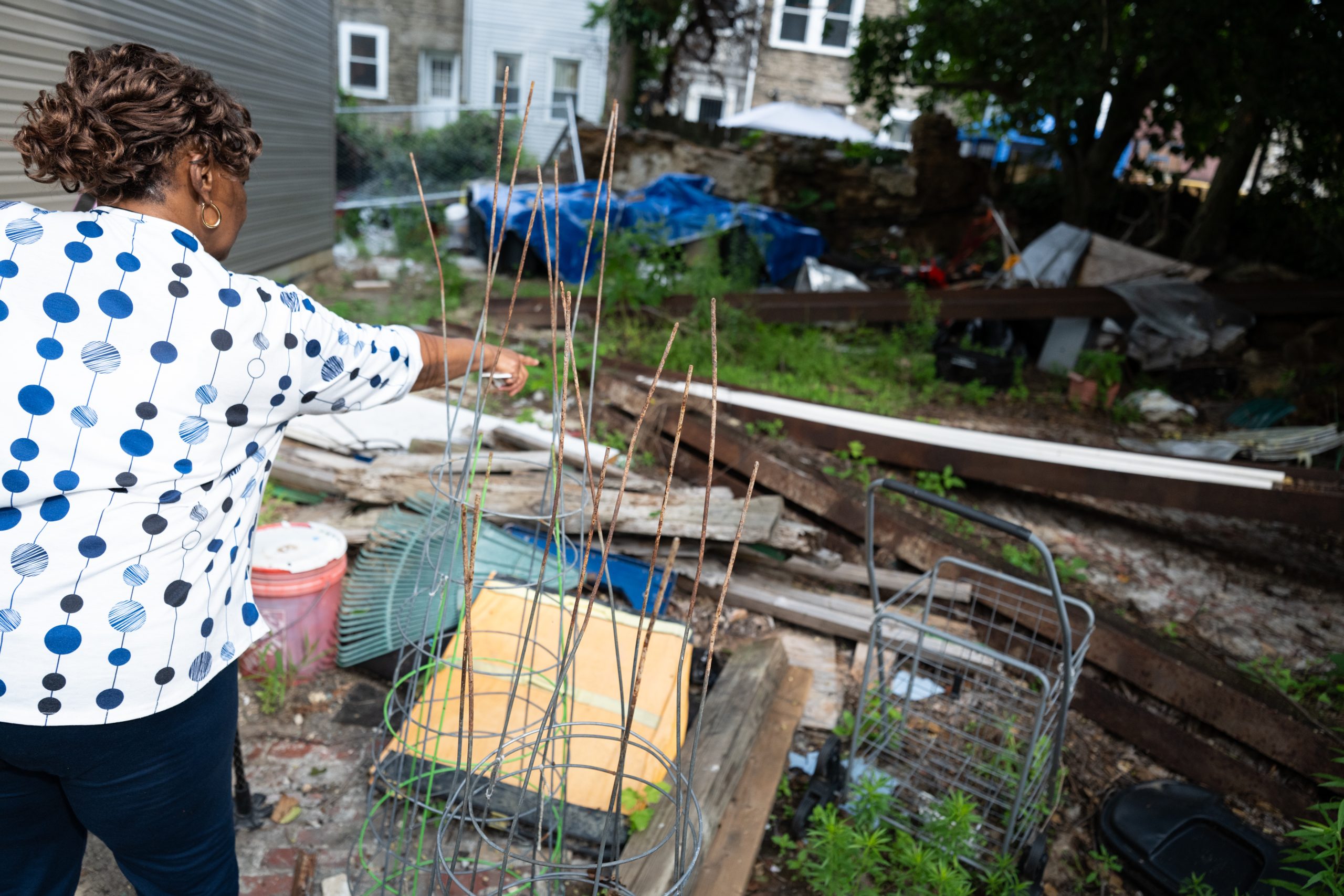
I recently paid a visit to the 200 block of East Bringhurst Street and walked with Lawrence as she pointed out the shambles the construction had made of her beloved yard.
There was a stack of old bricks that had been removed from her driveway. The remnants of an old stone garage where she would do arts and crafts projects. “These are iron beams that they took off the roof,” she said. “It was a building back here.”
There was more — a tree trunk lying on its side with its roots exposed, what looked like electrical cables in the rear, and containers of paint that she said belonged to the builders working next door.
Delores Lawrence points to the remains of a garage where she used to do arts and crafts projects amid the detritus of a construction project next door. The project — a 15-unit apartment building — has been underway since 2024.Erin Blewett / For The Inquirer
Taking in the scene, I thought to myself that this is a whole situation — and I saw how it has turned into a court fight that is shaping up to be as messy as Lawrence’s backyard.
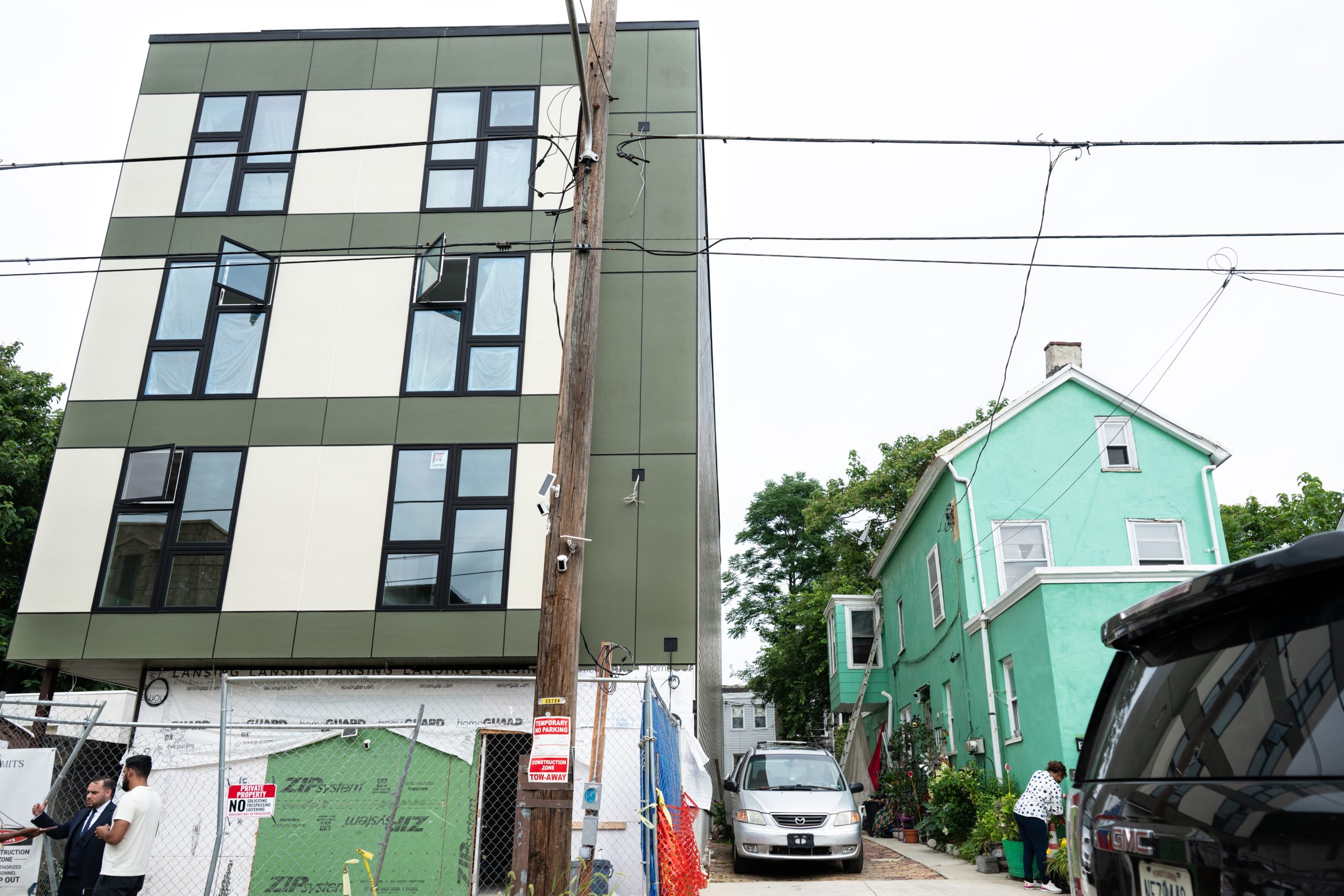
On one side, there’s Lawrence, a 70-year-old homeowner who has filed a lawsuit demanding compensation for damage to her property caused by the construction of a new four-story, 15-unit building immediately adjacent to her driveway.
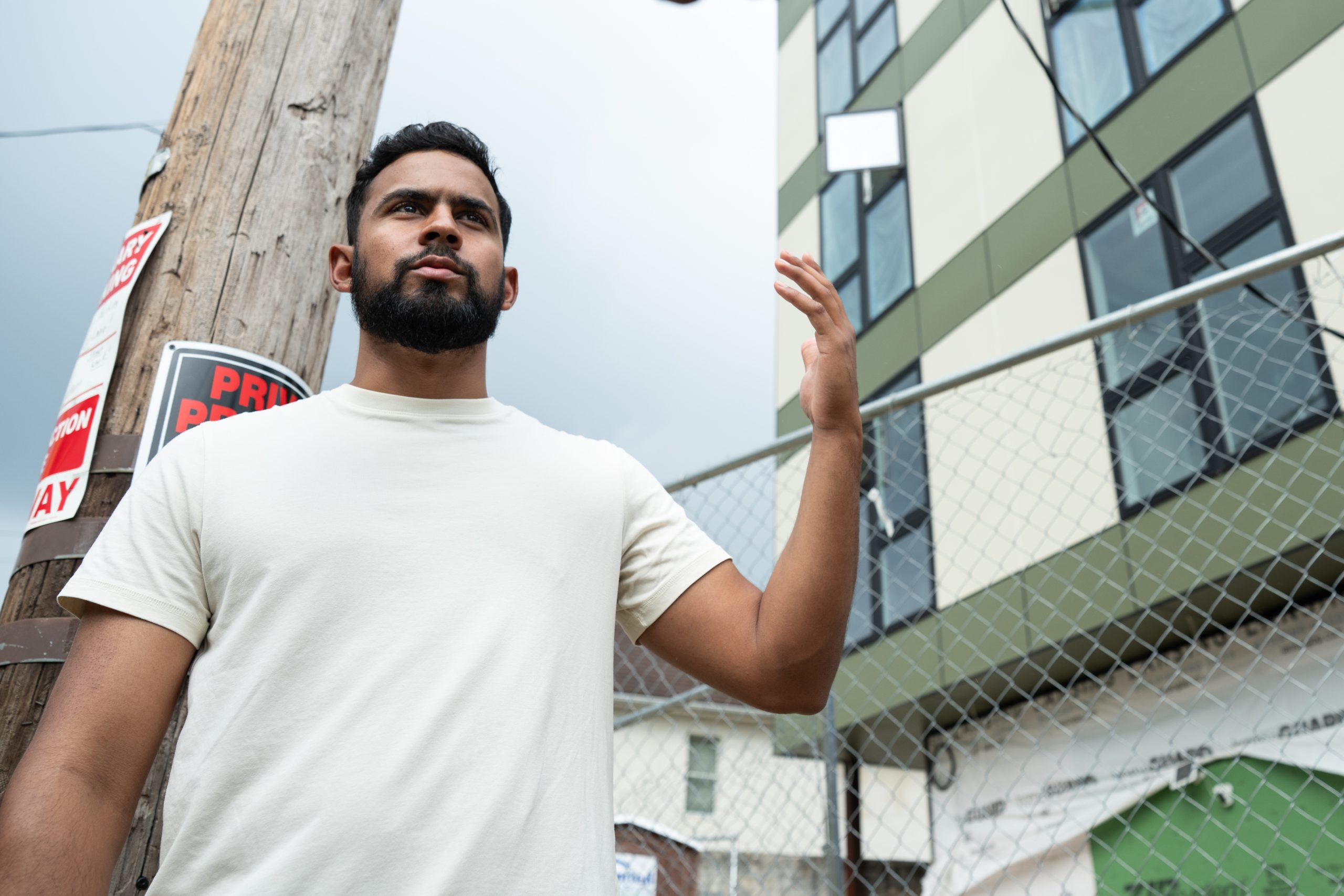
On the other side is Danilo A. Burgos, the cofounder of Burg Properties and the 29-year-old son of State Rep. Danilo Burgos, a Democrat who was first elected in 2018 and who serves the North Philly neighborhoods of Kensington, Hunting Park, and Feltonville. The four-story, 15-unit building is under the charge of the younger Burgos and has been in the works since 2024.
Given everything going on in Philly right now, it would be easy to ignore the situation between a politically connected developer creating much-needed affordable housing and a senior citizen upset about its impact on her property. But I can’t help but feel for Lawrence.
Besides, hers isn’t an isolated situation. What’s happening to her in Germantown is actually emblematic of similar struggles playing out between residents and developers in neighborhoods around the city.
Residents of Chinatown successfully pushed back against a proposal to build a new Sixers arena along Market Street. In Northern Liberties, several neighbors on Brown Street are suing a developer, claiming their homes were damaged by the construction of a nearby apartment building. In 2024, my colleagues at The Inquirer produced an entire series called Crumbling City about how housing redevelopment created construction issues among some rowhouses.
Whatsets the situation in Germantown apart is the reality that the developer is the son of a state legislator.
“This is about entitlement and privilege,” Kevin L. Valentine, Lawrence’s attorney, told mein an email.
Property owner Danilo A. Burgos speaks to the press outside his affordable housing project under construction in the Germantown section of Philadelphia on Thursday, July 9.Erin Blewett / For The Inquirer
I reached out to Burgos, the state representative, who said: “My son has not done anything wrong. The lady, she’s suing him, and they’re in court. That’s it.” He added, “They have everything documented, and when the court case comes, everything will be squared away, God willing.”
As for the son, he says he’s doing good for the community by providing affordable housing. Philly is in the midst of a “severe housing crisis,” which is why Mayor Cherelle L. Parker has made building and restoring roughly 30,000 homes a cornerstone of her legislative agenda.
But developers still need to respect neighbors in the communities where they build. Christopher Edwards, a block captain and president of the Baynton Hill Neighbors Association, is deeply concerned about the impact the new Bringhurst Street apartment building will have on the narrow street with limited parking.
“We can see where this thing is going to become very unpleasant, especially for those of us who have lived there for years,” he told me.
After meeting with residents who aired their concerns, Burgos, a Temple University graduate, said he purchased a nearby lot that he intends to convert into a parking lot for his tenants’ use. Neighborhood residents, he said, will have priority when it comes to renting units.
As far as the garage in the rear of Lawrence’s home that had been negatively impacted, Burgos said that “it wasn’t a structure. It wasn’t a garage. It was like freestanding walls scattered [around]. Because some were up. Some weren’t.”
He said his workers knocked down a party wall the properties shared. “We notified her of the wall that we were going to knock down,” Burgos told me as we stood with his attorney in front of his new apartments. “Everything we did, we didn’t do it behind her back; we did it with her knowing what we were going to do.”
Attorney Saury A. Mejia and property owner Danilo A. Burgos (left) speak to the press outside Burgos’ affordable housing project under construction as neighbor Delores Lawrence (right) tends to her garden in the Germantown section of Philadelphia on July 9. Lawrence says construction of Burgos’ low-income housing project next door damaged her property.Erin Blewett / For The Inquirer
I liked hearing him say he was prepared to fix any of the property damaged by his workers. But Burgos said he is awaiting permission from Lawrence to do it.
“We’re willing to put it back to its prior condition,” Burgos said, adding that he’s willing to negotiate. “We’ve been open to dialogue the entire time.”
It sounds to me as if a meeting with all parties involved needs to happen quickly.
“I want him to sit down with my client and for him to make her whole,” Valentine said. “I’m just trying to get some justice for this woman.”
Councilmember Cindy Bass is willing to convene such a gathering. “If we can get all parties together, we’re certainly willing to do that and to do it soon,” she said.
Meanwhile, the proverbial clock continues to tick. Time is money. That’s not something Lawrence, who worked at Shriners Hospital for Children, has much of.
The more I think about what Lawrence is going through, the angrier I get. I’ve never been in her situation personally, but who would want workers coming onto their property and damaging it? People work hard for what they have. Your home is supposed to be your sanctuary. You may not have a say in what goes on around you, but you’re the custodian of what goes on inside your proverbial picket fence.
“I’m here minding my business. I’m not bothering nobody,” Lawrence told me. Her voice broke into sobs as she added, “How long do I have to put up with this?”
A new visitor center aims to root Germantown more firmly in its own history, showcasing it as the site of a major Revolutionary War battle and a place with important ties to religious freedom, abolition, and the Civil Rights Movement.
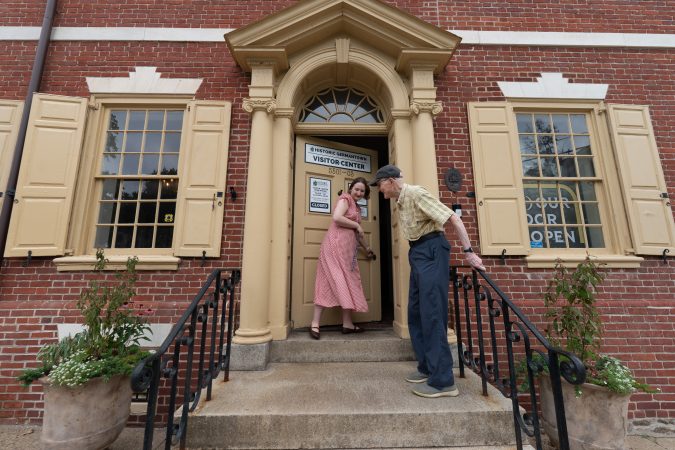
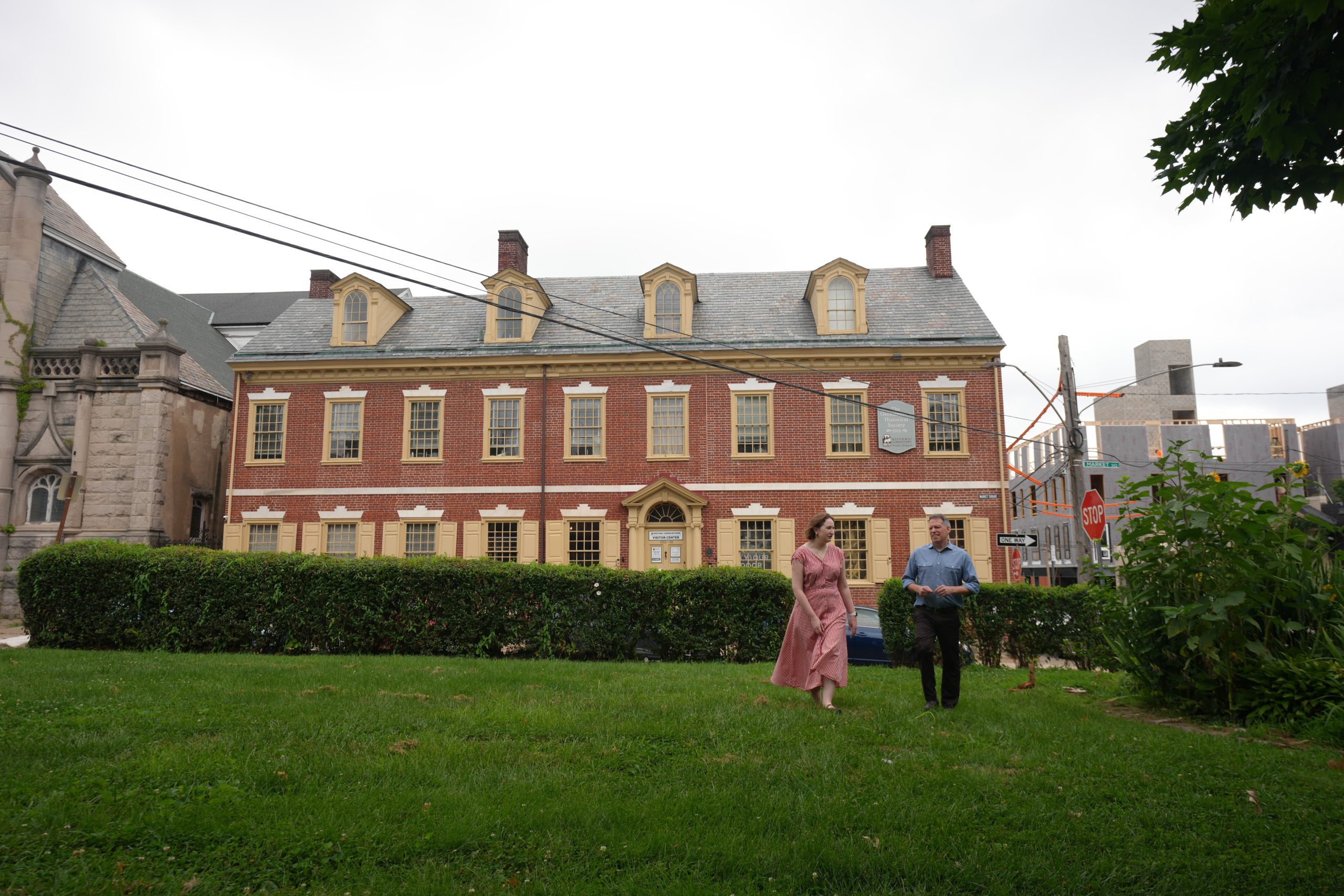
The center opened in a two-story redbrick building at 5501 Germantown Ave. earlier this month. Owned by the Germantown Historical Society, it is intended to serve as a starting point for visitors and residents alike.
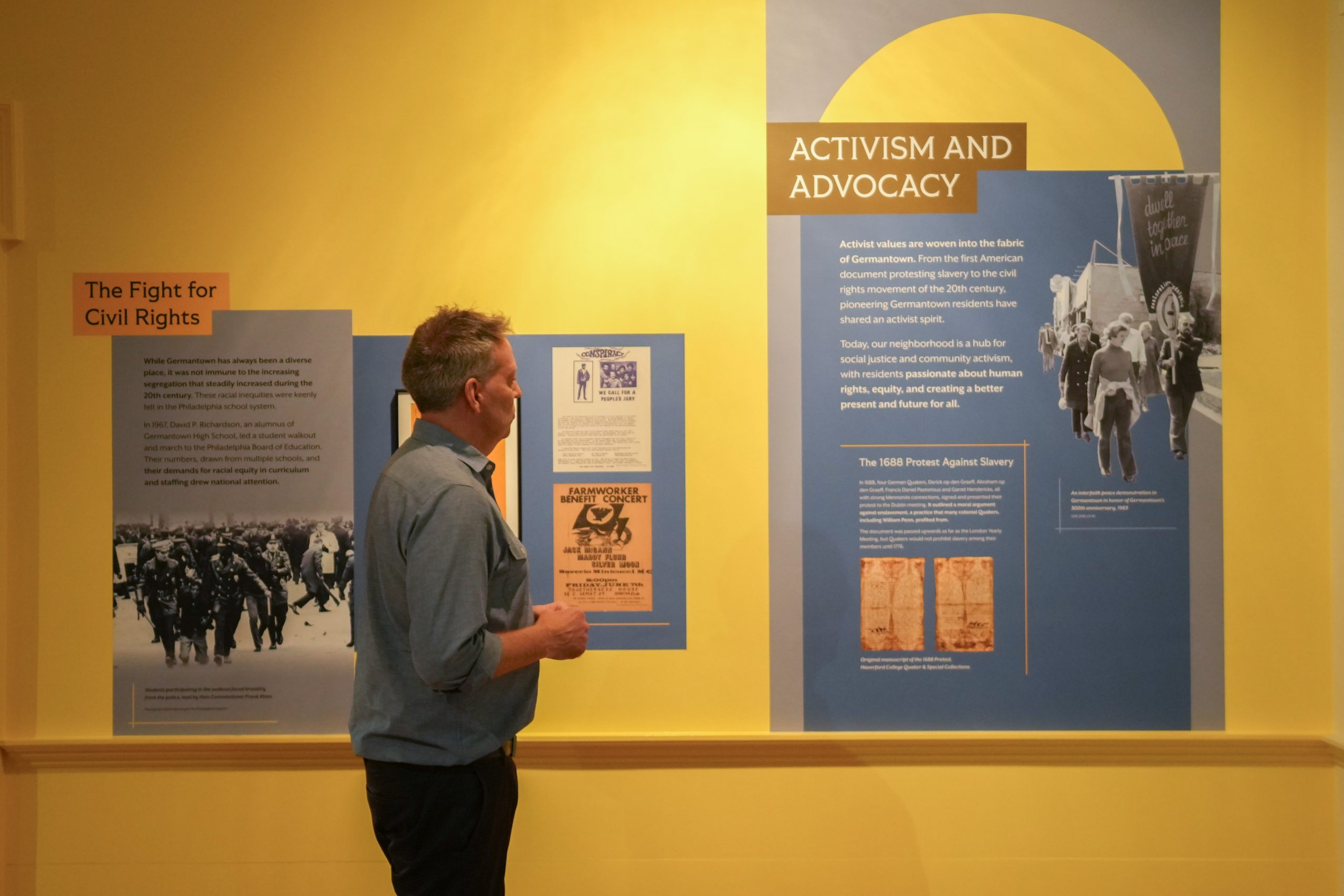
The exhibitions were curated using a process of community conversations in which neighborhood residentsshared what was important to them, said curatorKaila Temple. The main exhibit highlights major themes in Germantown’s history. Sections like “Activism and Advocacy” focus not only on the 1688 Germantown Quaker Petition Against Slavery, but also on a student protest in 1967 that was met with violent police opposition.
Tuomi Forrest, executive director at the Germantown Historical, in the new exhibit.Jessica Griffin / Staff Photographer
German immigrants first settled in Germantown in the late 16th century, fleeing Europe in search of religious freedom. Germantown played a central role in the American Revolution and later became the site of strong abolitionist advocacy, and robust student youth activism during the Civil Rights Movement.
The visitor center hopes to both connect residents of Germantown with their local history and draw visitors from elsewhere. Visitors will be directed to visit the many historical sights in the area with maps available for walking tours. Director Tuomi Forrest hopes the visitor center can be a resource for neighbors and bring in more visitors from outside Philadelphia, citing those as “twin” goals.
The visitor center received about 200 people the first week it opened and hopes for more. It recently collaborated with Neighborhood Jawnts Tour Series, a Philadelphia-based tourism effort, to bring in visitors from around the city.
It has also worked closely with neighbors who want to learn more about their own homes and their ancestors. One neighbor found a wedding invitation from 1912 during home renovations and wrote to the center to ask for documents that would shine more light on who used to live in the home; another wanted more information of how his mid-1800s home came to be an institution for orphans; others ask to come to the center to do research on their ancestors.
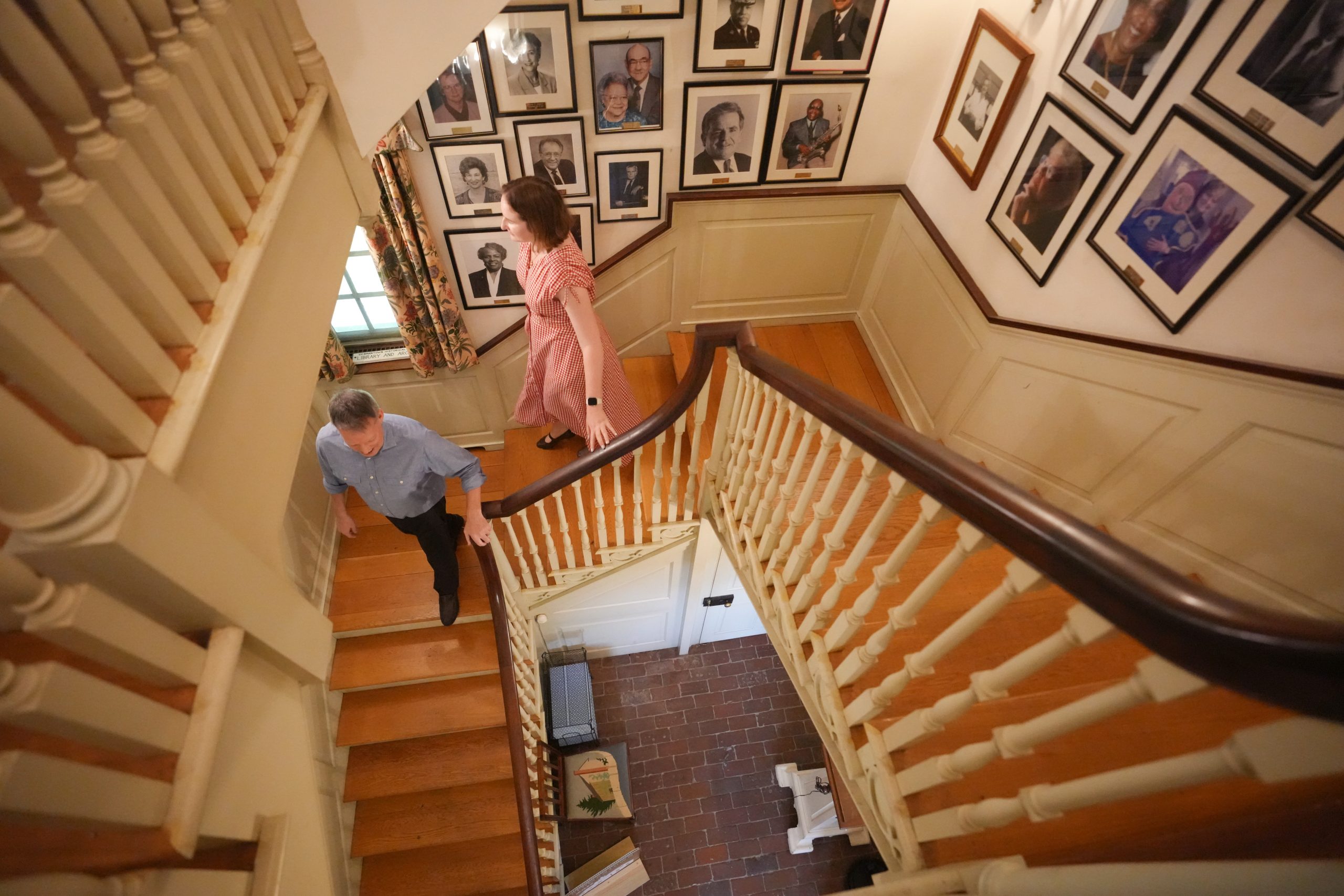
Tuomi Forrest, executive director, and Kaila Temple, curator, at the Germantown Historical Society building.Jessica Griffin / Staff Photographer
The square where the visitor center sits dates to 1703. George Washington lived across the street from it in 1793, and when Philadelphians wanted the federal government to stay locally, they touted the square as an asset.
The Colonial Revival building where the visitor center is now housed was constructed in the 1790s and restored around the 1940s and ’50s.
Visual markers of the Colonial Revival style, a result of the 1876 Centennial Exhibition’s reawakening of Americans’ desire to connect architecturally to their colonial past, still dominate the historical section of Germantown. Along Germantown Avenue, gray stone churches stand beside pale yellow, redbrick, and coral-colored houses.
But the visual character of the historic section of Germantown that houses the new center is not uniform, especially as new developments begin to populate empty lots.
A neighborhood ‘at an upswing’
As the local visitor center leans into Germantown’s past, some nearby residents and businesses — many of whom were not aware of the new center — said they were concerned with the direction of their neighborhood’s future.
Van Brooks, operations manager of a coffee shop kitty-corner from the visitor center, worries about development just down the street — afour-story apartment building that is visiblefrom the window of a visitor center gallery. “A lot of folks in this neighborhood don’t want this space to exist here,” he said. He worries the modern, flat apartment complex will begin to gentrify the neighborhood.
Nicholas Thaete, who has lived in Germantown for 46 years and runs an antique repair shop, says the neighborhood has gone through different periods. “It goes up and down. Right now, it is at an upswing,” he said.
And yet, as Debbie Curry, who works in a nearby fabric store, remembered, Germantown used to have more commercial activity: “There was a time when there were a lot of department stores. … You didn’t have to go to Center City to do your shopping.” Curry, 66, grew up in Germantown but moved from the neighborhood when she married. She is happy something is finally being done about empty lots.
“A lot of people thought for years that Germantown would see new development, but now it has,” Forrest said, standing in front of the visitor center.
Kaila Temple, curator of Collections at the Germantown Historical Society and Tuomi Forrest, executive director at GHS, outside the new Historic Germantown Visitor Center.Jessica Griffin / Staff Photographer
Some of the world’s best women’s basketball players were in Chicago for the WNBA All-Star Game, and, as usual, the fashion didn’t disappoint.
The WNBA orange carpet on Friday had heads turning to get a glimpse at this year’s All-Stars ahead of Saturday’s game. From top rookies like Azzi Fudd to superstars like Paige Bueckers, the All-Stars pulled out all the stops.
Playing for “Team Spoon” in the All-Star Game, the Las Vegas Aces center stunned on the orange carpet in one of the most formal looks of the evening. Alongside a bedazzled basketball, the sheer all black attire was chic, cool, and confident — all attributes of the four-time WNBA MVP, eight-time All-Star, and three-time champ with the Aces, including the 2025 crown.
Ahead of the Shooting Stars competition on Friday, Johnson arrived in a matching denim set with faux sticky notes with affirmations like “be intentional” and “out work your excuses.”
The rapper and Seattle Storm rookie said in an interview on the orange carpet that they were for “some positive energy and big four energy.”
Fudd, who was this year’s first overall pick in the WNBA draft, stepped onto the orange carpet with a cool street style pairing a black leather bralette and distressed jeans with a casual gray blazer. With a Coach Tabby bag to match, the Dallas Wings rookie was fitted to make history when she became the first rookie to win Friday night’s three-point contest, scoring 30 out of 40 possible points.
Fudd’s teammate, the second-year fan favorite Bueckers pulled out the stops with another iconic carpet look for her second WNBA All-Star Game.
Donning an ever-chic slicked-back bun and shades, the guard wore a sleeveless light blue button-up with a tan tie and baggy trousers, with crisp white Air Force 1s completing the basketball star’s ensemble.
The All-Star Game had some local flair, too. North Philly native Kahleah Copper pulled up to the Windy City — her WNBA home for seven seasons — in a silver-studded suit. The five-time All-Star was one of multiple players wearing the street style brand GRÉVYI, with the logo etched onto the cuff.
After starring at Prep Charter, Copper took her talents to Rutgers and the W, where she’s played for the Washington Mystics, Sky, and now the Phoenix Mercury.
In perhaps the most adorable look of the night, the New York Liberty star stepped out on the carpet with her whole family in matching fashion.
Her wife, Marta Xargay Casademont, a retired Spanish professional basketball player who also spent two seasons with the Mercury, and two children sported black and blue ensembles. Both women wore deep-cut blazers, and Stewart sported matching shorts and pearls.
The award for most colorful and sparkly on the orange carpet goes to Ogwumike. The Los Angeles Sparks forward dazzled in a green and purple asymmetrical dress, a cascade of fringe highlighting the ensemble that was complete with simple heels and diamond studs.
Howard had one of the most impactful looks of the night, decked out in purple in support of lupus awareness, a tribute to a close friend. The Atlanta Dream guard wore a custom suit with fine embroidery. Both legs were inscribed with a lilac “Think Within,” matching with beaded basketball hoops on each side of the chest. An autism awareness logo stood out on the back tying together Howard’s motivations before she headed out onto the court.
Ahead of her third All-Star Game, the Atlanta Dream star donned baby pink from head to toe. Complete with a feathered shawl trailing right down her pink platform heels, Reese was surrounded by an air of confidence entering the game, in which she was a forward for Team Coop.
Of course, one orange carpet guest who stood out more than the rest.
Ellie, the New York Liberty mascot and social media sensation, strutted on the orange carpet wearing a custom dress with her name on the side. Her nails and hair matched in the Liberty’s green, and the outfit was tied together with hoops and a New York-themed Coach Tabby bag. The best-dressed elephant around, Ellie was giving the pros a run for their money.