Tag: topic-link-auto

  • Black and Jewish Philadelphians must rebuild an essential alliance

    Black and Jewish Philadelphians must rebuild an essential alliance

    Black and Jewish communities in America share a long history of supporting each other against hate and discrimination.

    Together, our people helped advance laws that challenged discrimination in housing, employment, and education. Together, we supported initiatives that helped move our country closer to its highest ideals.

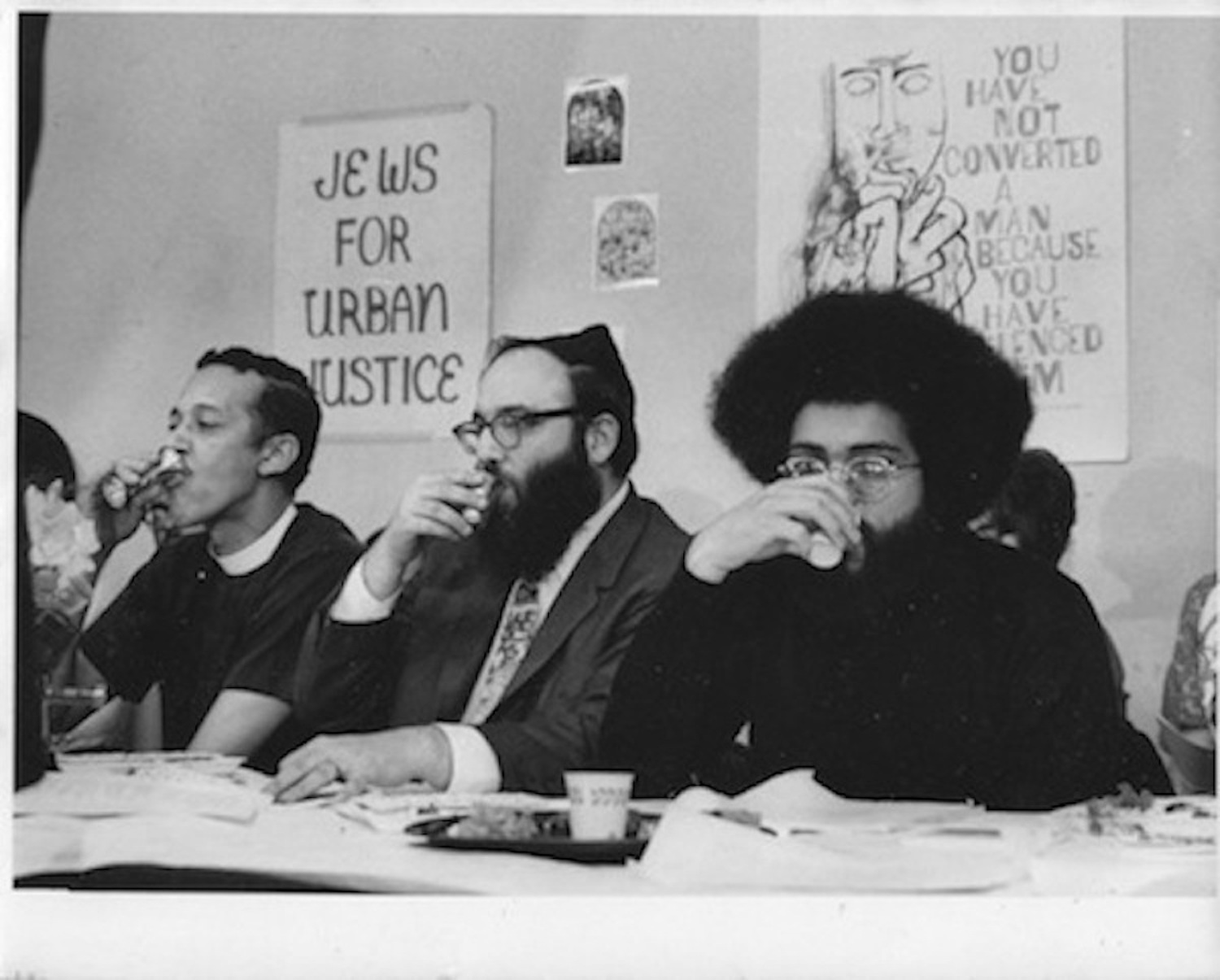
    Rabbi Arthur Waskow (center) with the Rev. Channing Phillips (left) and TV director Topper Carew (right) at the first Freedom Seder held in April 1969, at Lincoln Temple United Church of Christ in Washington, D.C.Courtesy of the family

    But in recent years, the relationship between the Black and Jewish communities has become strained, even as antisemitism and racism threaten us all.

    That is why the two of us — each a rabbi from the Main Line — recently went to Georgia, along with dozens of clergy from across the country, for the Atlanta Summit of Black Pastors and Rabbis. We gathered at the Temple, Ebenezer Baptist Church, and the King Center, locations that made us recall the accomplishments and the sacrifices of the Black-Jewish alliance. We came to explore what is required to rebuild the partnership now.

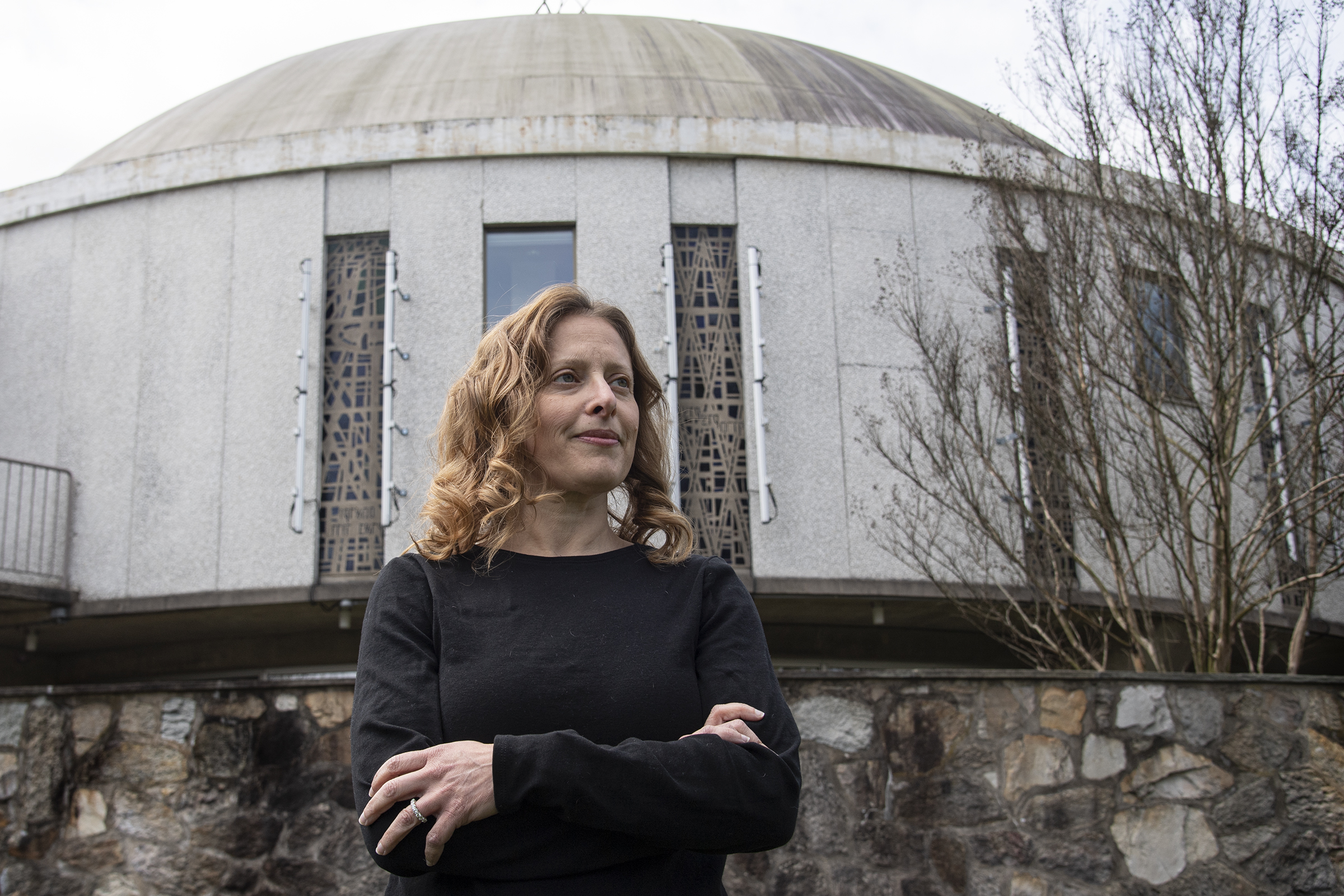
    Rabbi Geri Newburge stands outside The Main Line Reform Temple in Wynnewood in April 2020.JOSE F. MORENO / Staff Photographer

    As we experienced firsthand, the Black and Jewish communities do not always understand each other. Views on diversity, equity, and inclusion (DEI), Zionism, racial justice, power, and vulnerability can contrast sharply based on our personal experiences. But we were able to speak candidly about the times our communities had felt unseen or abandoned by each other.

    One exchange brought those differences into focus.

    Black participants described economic precarity following federal workforce cuts associated with the Department of Government Efficiency (DOGE) and attacks on DEI, particularly for Black women. Jewish participants spoke, in turn, of social precarity amid rising antisemitism. Hearing both made our shared responsibility clearer.

    Those conversations led to the understanding that Black and Jewish Americans need an agreement against abandonment. It is a simple but demanding idea: When your community is threatened, ours will not disappear. When disagreement becomes painful, we will not walk away. We will listen, speak honestly, and doggedly refuse to give up on our relationships.

    That does not mean we will see eye to eye on every issue. It means we will have the commitment to hear hard truths without turning disagreement into disdain.

    Speakers like civil rights organizer Eric Ward helped us to understand how the challenges are interconnected. As he explained, many people understand antisemitism to just be the hatred of Jews, but in reality, it is also a conspiracy theory about how society works. Because antisemitic conspiracy theories ignore the real roots of societal issues — such as socioeconomic inequality and structural oppression — and instead focus on tropes and pat narratives, they help sustain racism and authoritarianism as well, creating a toxic blend that threatens both Black and Jewish communities.

    The comments from Black Jews in attendance were, perhaps, most illuminating. Because they sometimes experience racism in Jewish spaces and antisemitism in Black spaces, their lives counter the perception of a neat division between “our community” and “theirs.” With their unique experiences, their voices must be central to the work ahead.

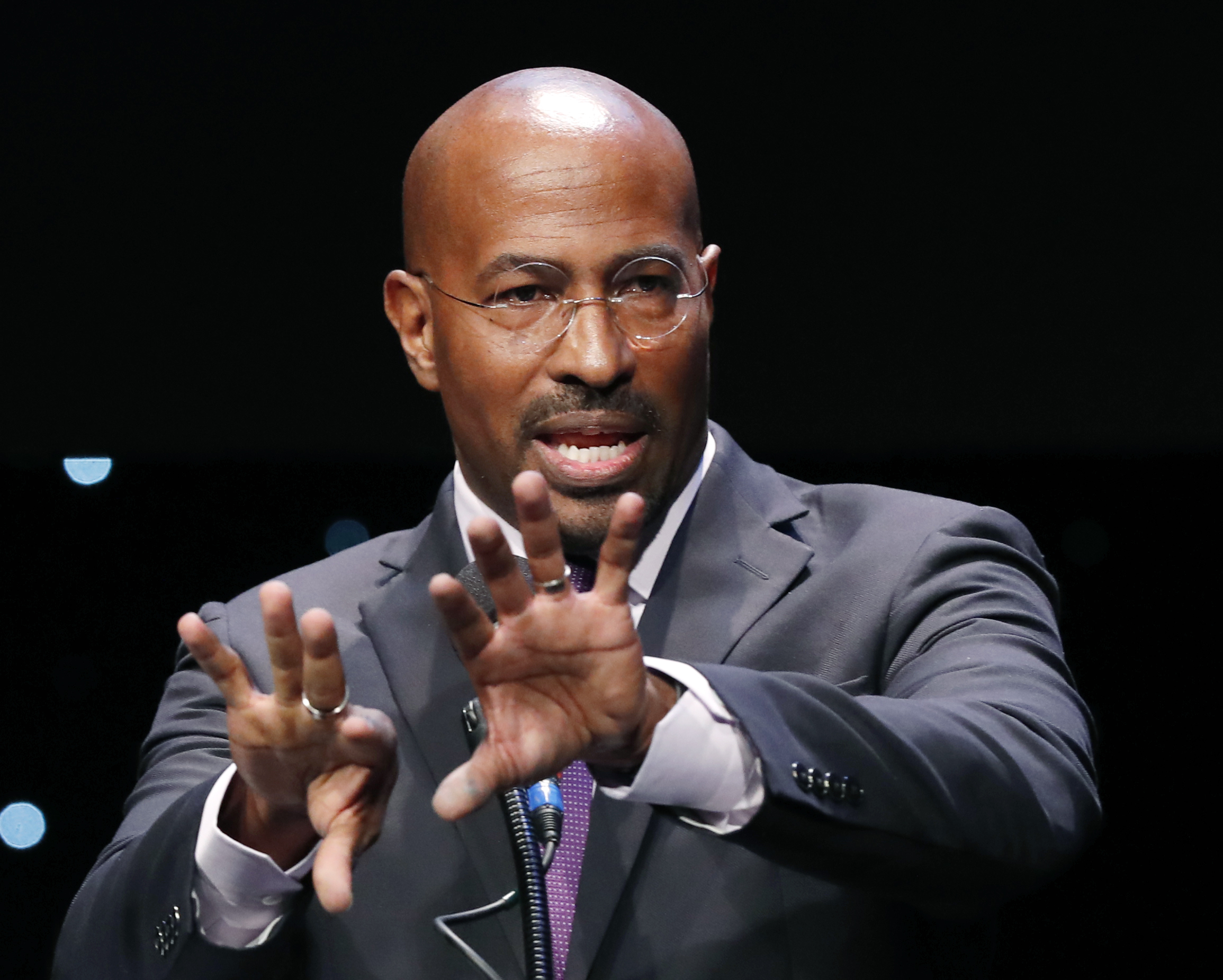
    Political commentator Van Jones told those gathered for the Atlanta Summit of Black Pastors and Rabbis that a Black and Jewish alliance today must harness the diverse strengths each community possesses.Kathy Willens

    Another speaker, political commentator Van Jones, cautioned that the alliance we are building cannot simply recreate the one from the 1960s. Back then, Jews were still reeling from the direct memory of the Holocaust, while Black Americans were still living under the restrictions of Jim Crow. That alliance grew from shared vulnerability, but the next iteration must harness the diverse strengths each community possesses today.

    Jones invoked the image of a relay runner receiving and passing a baton. Honoring the generation that came before, he said, means accepting responsibility for the next leg of the race.

    For us, that work begins right here in Greater Philadelphia.

    Rabbi Eric Yanoff serves Adath Israel on the Main Line in Merion Station.Courtesy of Eric Yanoff.

    We returned home committed to building and securing stronger relationships between the Black and Jewish communities before a crisis makes them necessary. We will come together with our colleagues in the Black Christian community and invite our congregations to learn from each other. We will create opportunities for shared study, worship, and community service. We will speak honestly about racism and antisemitism.

    Ultimately, we will build the trust that allows us to call on each other when our communities are hurting.

    Relationships require intention, humility, and time. They also require both communities to reject the idea that advocating for someone else diminishes our ability to defend our own people. We will not always see the world in the same way. But we can promise not to leave each other alone in it.

    Rabbi Geri Newburge serves Main Line Reform Temple-Beth Elohim in Wynnewood. Rabbi Eric Yanoff serves Adath Israel on the Main Line in Merion Station.

  • You should feel safe, not judged, at a doctor’s visit | Expert Opinion

    You should feel safe, not judged, at a doctor’s visit | Expert Opinion

    A friend and colleague recently told me that he can feel anxious about going to see his doctor for follow-up care if he has not accomplished the health goals discussed at his last visit.

    When I asked why, he said he worried that he would be labeled “nonadherent” or scolded for being unprepared. He did not want to waste his doctor’s time.

    I was surprised, since many of my own patients come in for visits without completing every goal we set out. I may not have communicated the plan clearly, and sometimes, as the saying goes, life gets in the way.

    Then I began to wonder about patients who cancel appointments, miss follow-up visits, or never schedule them at all. Could some be avoiding care because they fear being judged for not meeting expectations?

    As physicians, we often emphasize treatment plans and health goals. Less often do we consider whether patients feel safe admitting when they have struggled to follow them.

    I would never scold a patient if they did not complete everything on the to-do list. At the same time, I don’t think I have ever directly said that I want to be sure they come back for follow-up regardless. I realized that I could address this with phrasing like:

    I trust you will try your best to follow our plan. But whether you are able to get these things done or not, I still want to see you back in a few months.

    Astute problem-solving, empathy, compassion, and clear communication are qualities clinicians aspire to in our professional roles. Equally important, though less emphasized, is creating a psychologically safe environment. This means ensuring patients can speak honestly without feeling at risk of being judged.

    Psychological safety was originally studied in workplace teams, based on the work of Harvard researcher Amy Edmondson. To reach high performance, Edmondson found team members need to feel comfortable taking risks, admitting mistakes without fear of shaming or reprisal.

    The principles of psychological safety apply to many settings. Planet Fitness, for example, posts signs on the walls and equipment declaring “Judgement Free Zone” and “No Gymtimidation” in an effort to make members feel welcome regardless of their level of fitness.

    In medicine, a psychologically safe office or exam room may help patients feel more comfortable being vulnerable and discussing more emotionally sensitive concerns. It may also improve the likelihood of scheduled follow-up.

    So what did I tell my friend-colleague? I suggested that he think about the source of his follow up worries. Some of this may require self-exploration, but there may also be areas where his own medical practice could do a better job at creating a psychologically safe, nonjudgmental environment that encourages follow-up.

    Patients should know that a missed goal is not a failed appointment. In health, as in life, progress is rarely linear. In fact, the times when things have not gone according to plan are often the times when medical follow-up matters most. Clinicians should make that message clear.

    Jeffrey Millstein is an internist and regional medical director for Penn Primary and Specialty Care.

  • Two-minute thriller | Sports Daily Newsletter

    Two-minute thriller | Sports Daily Newsletter

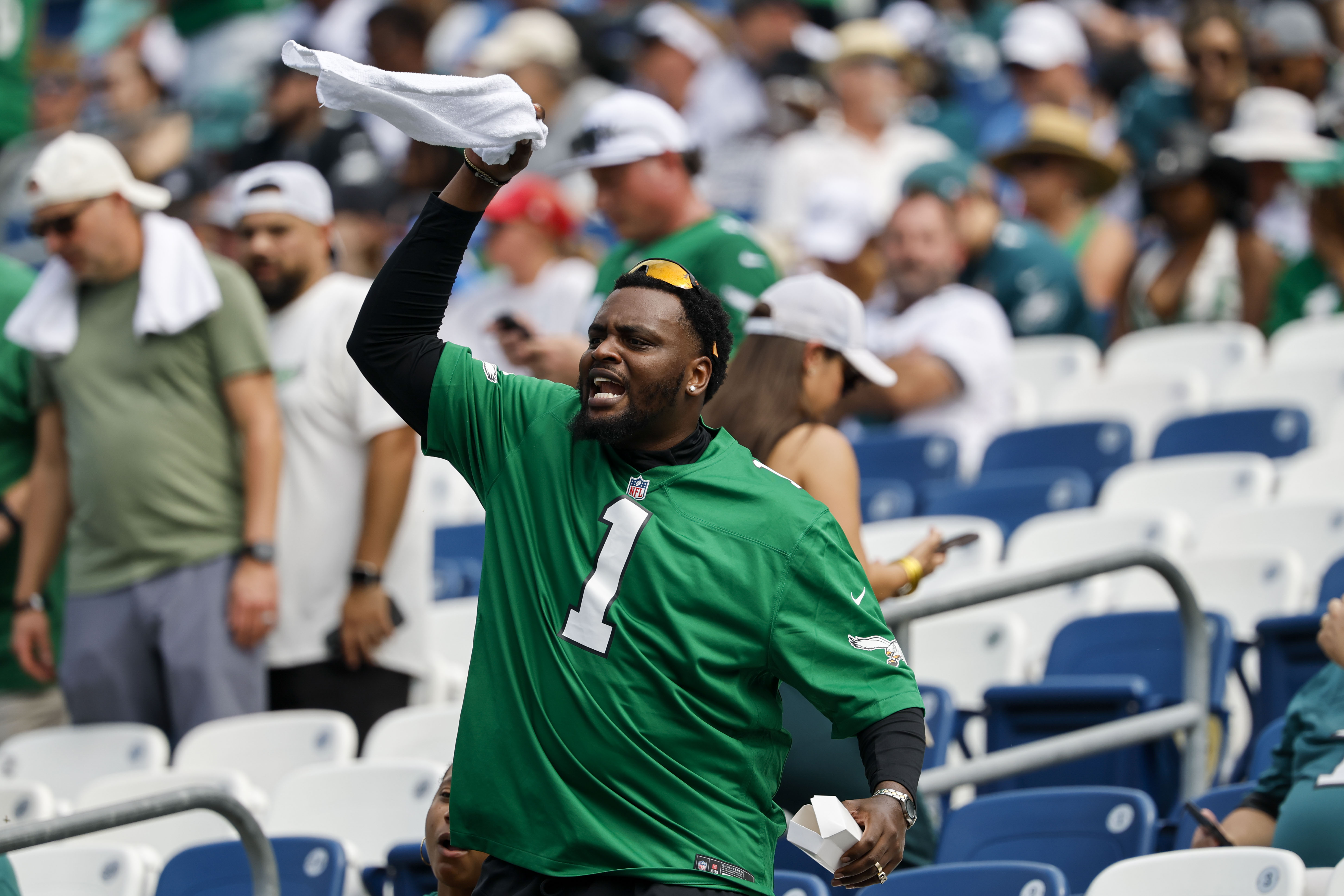
    It came down to the final two minutes on a steamy Sunday in Nashville.

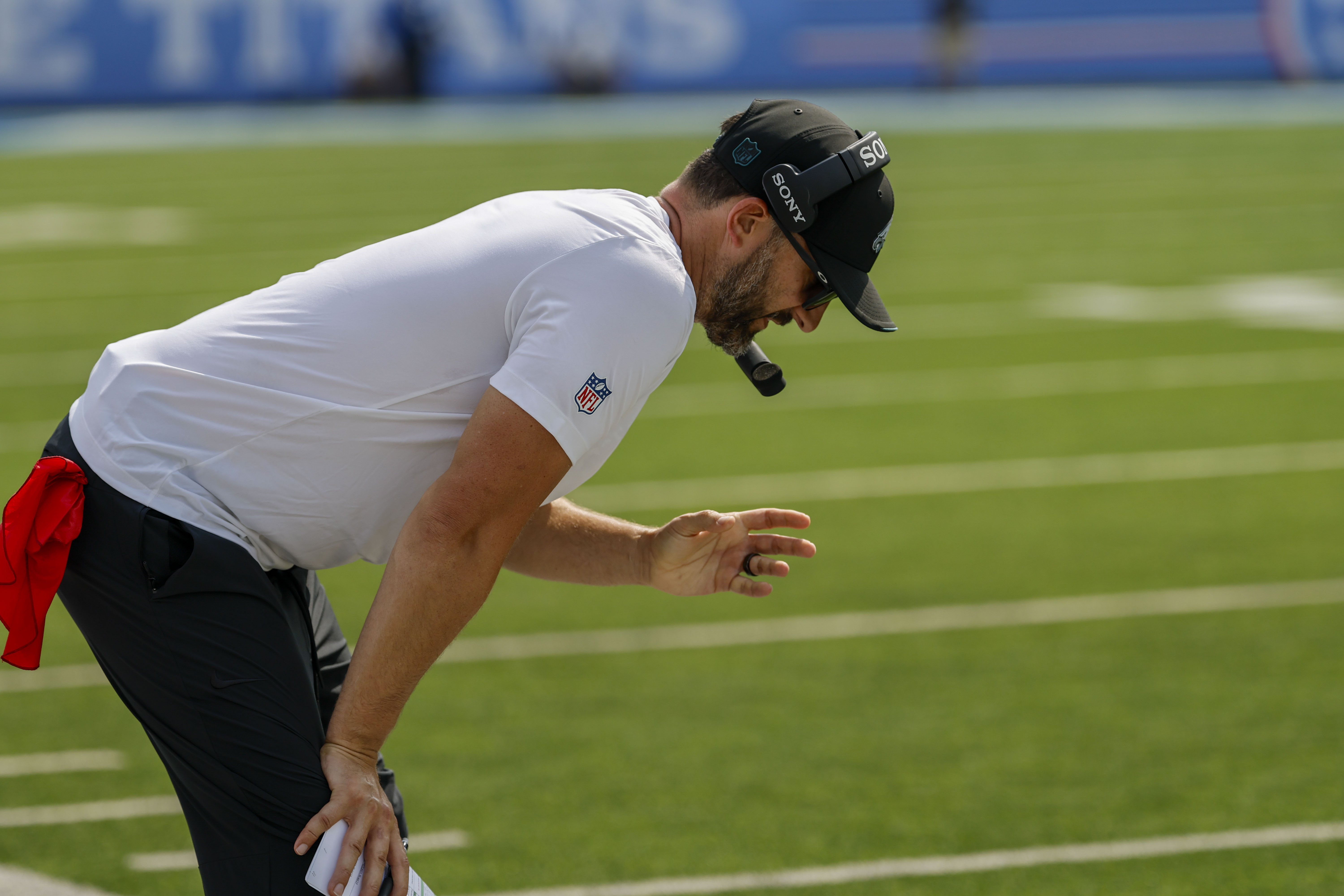
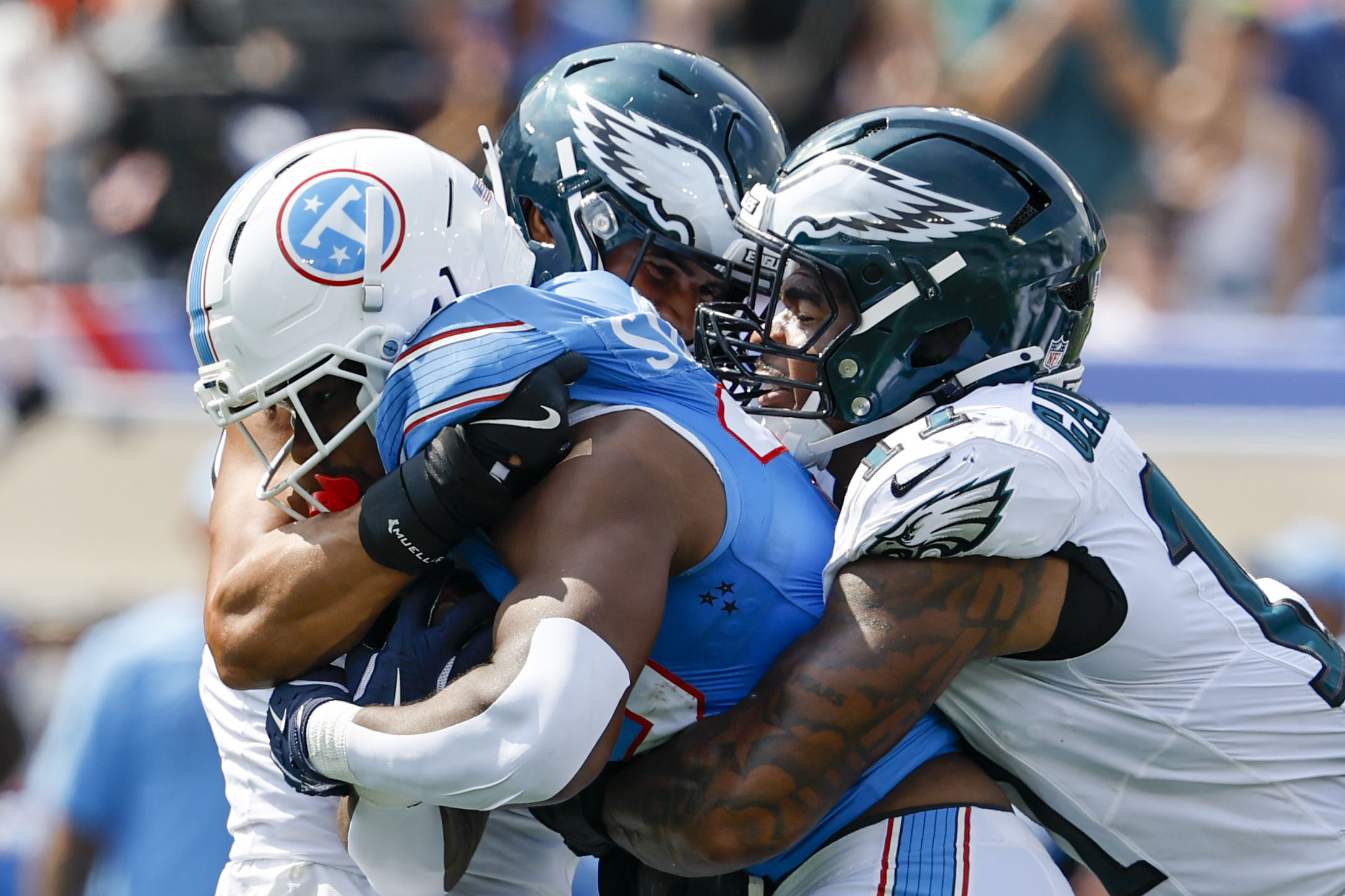
    The Eagles were down by three points after the Titans made a 32-yard field goal late in the fourth quarter. It was the Birds’ final chance with the ball to either score or tie the game.

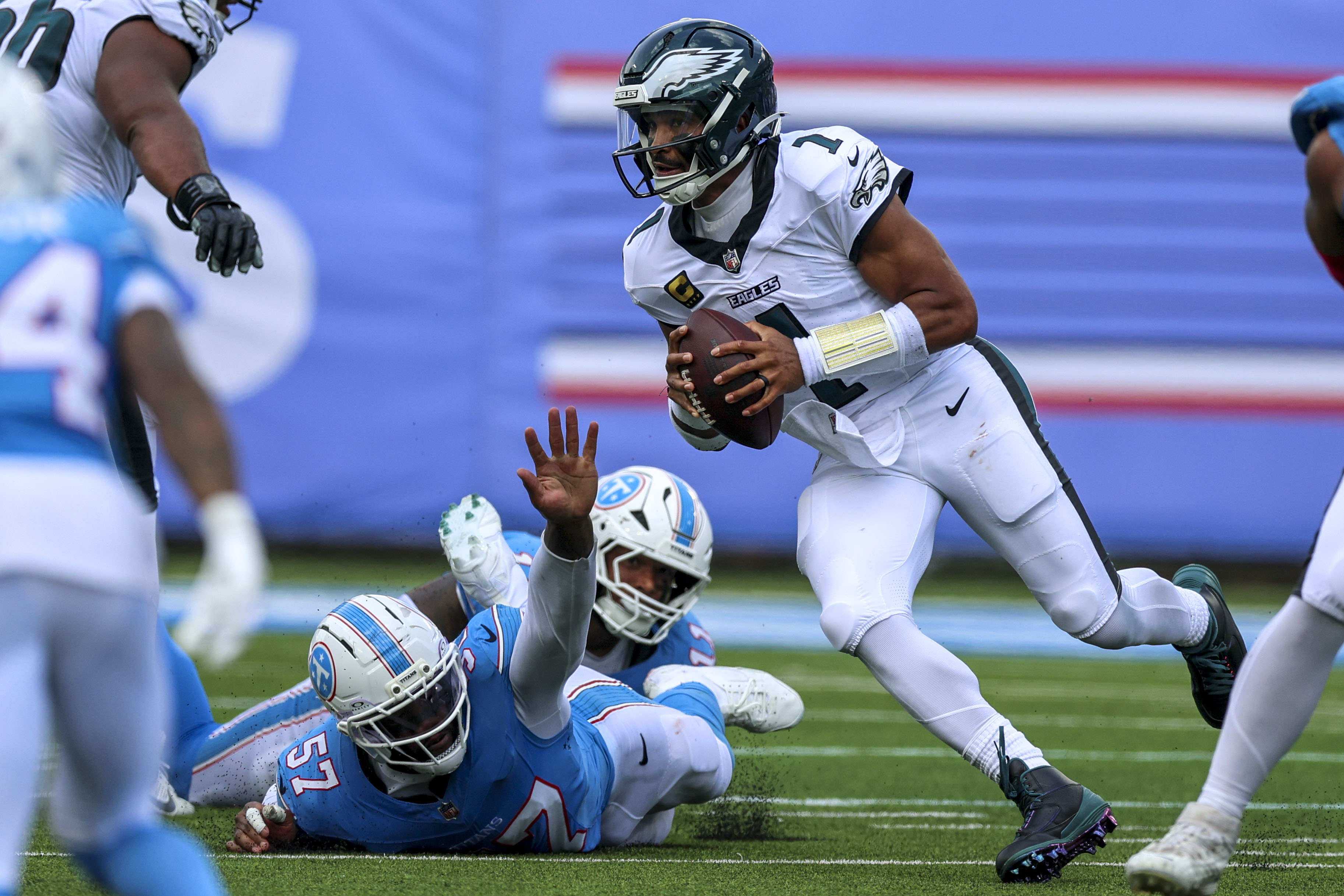
    So all eyes turned to Jalen Hurts, who threw two interceptions Sunday, and his performance that followed made up for it.

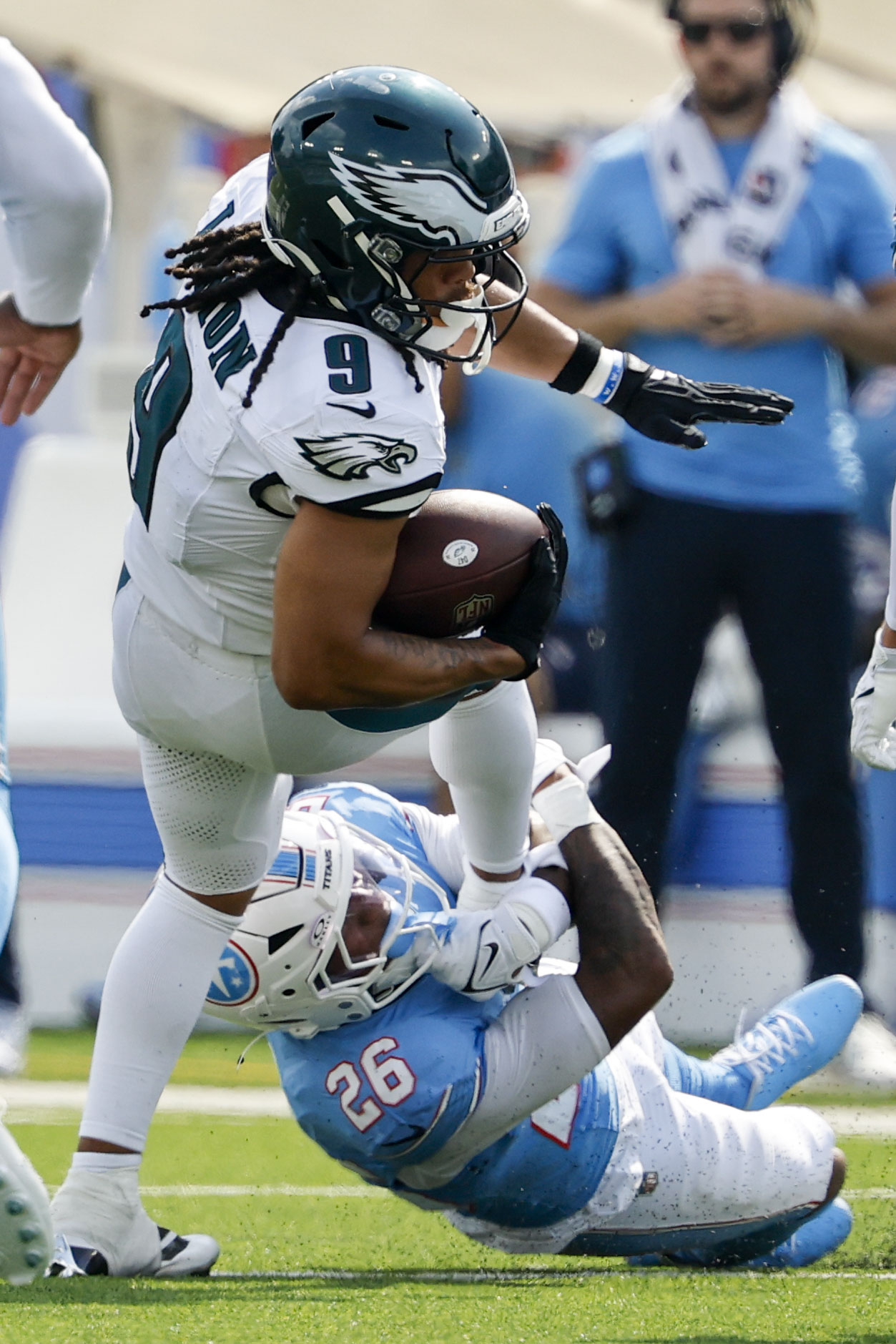
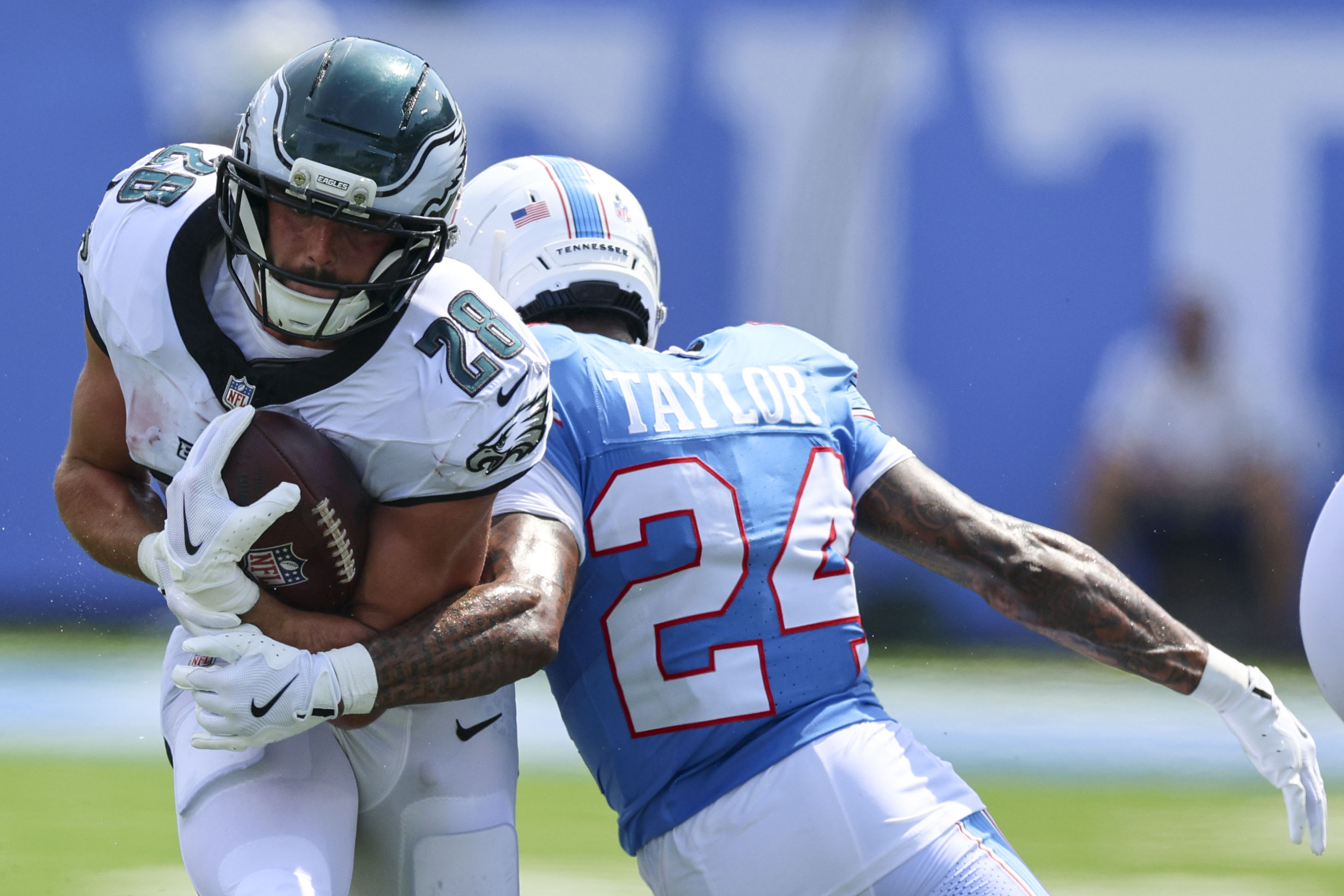
    Hurts orchestrated a nine-play, 65-yard scoring drive, capped by a 3-yard Darius Cooper touchdown to seal the Eagles’ 24-20 comeback victory.

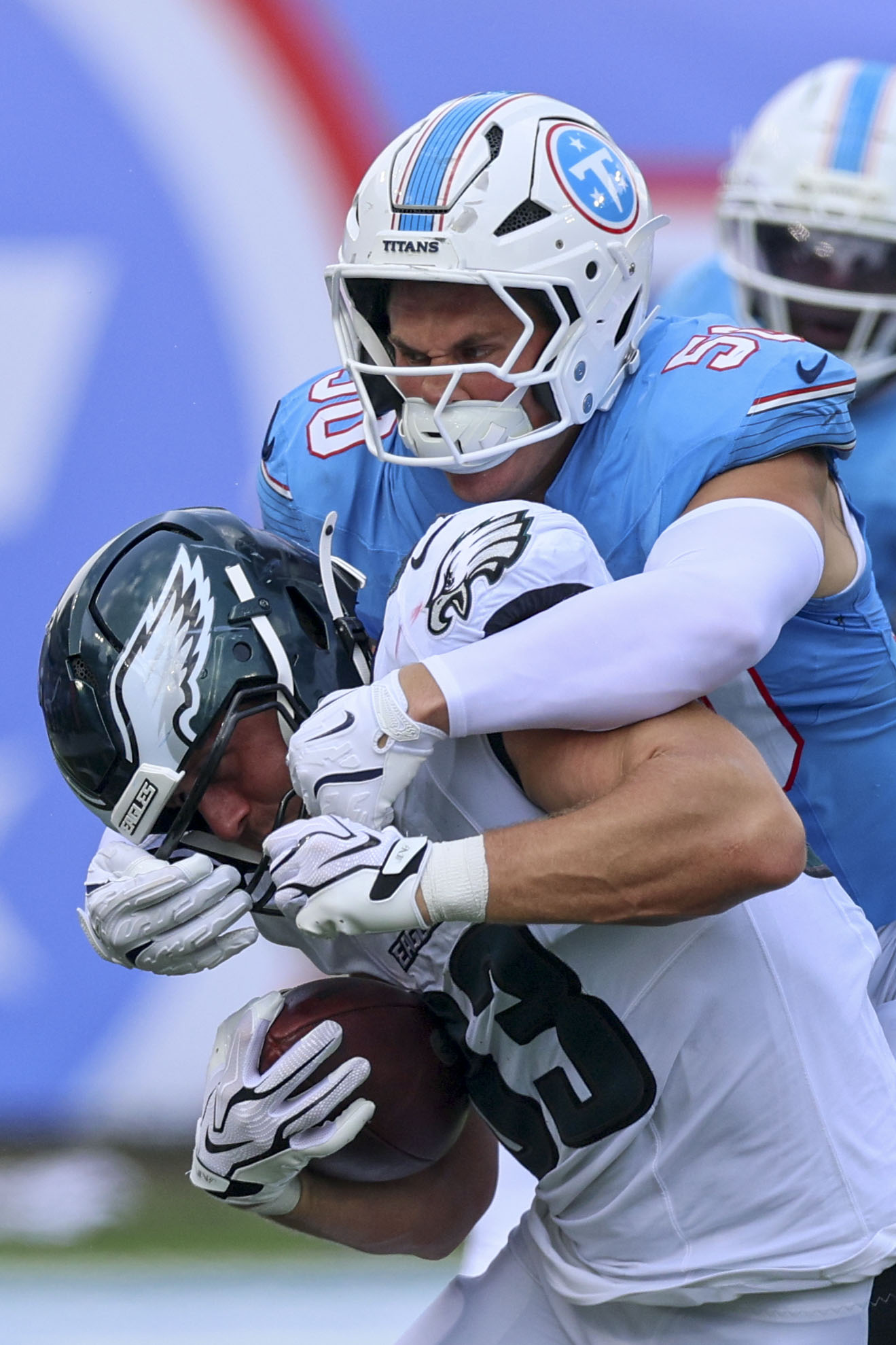
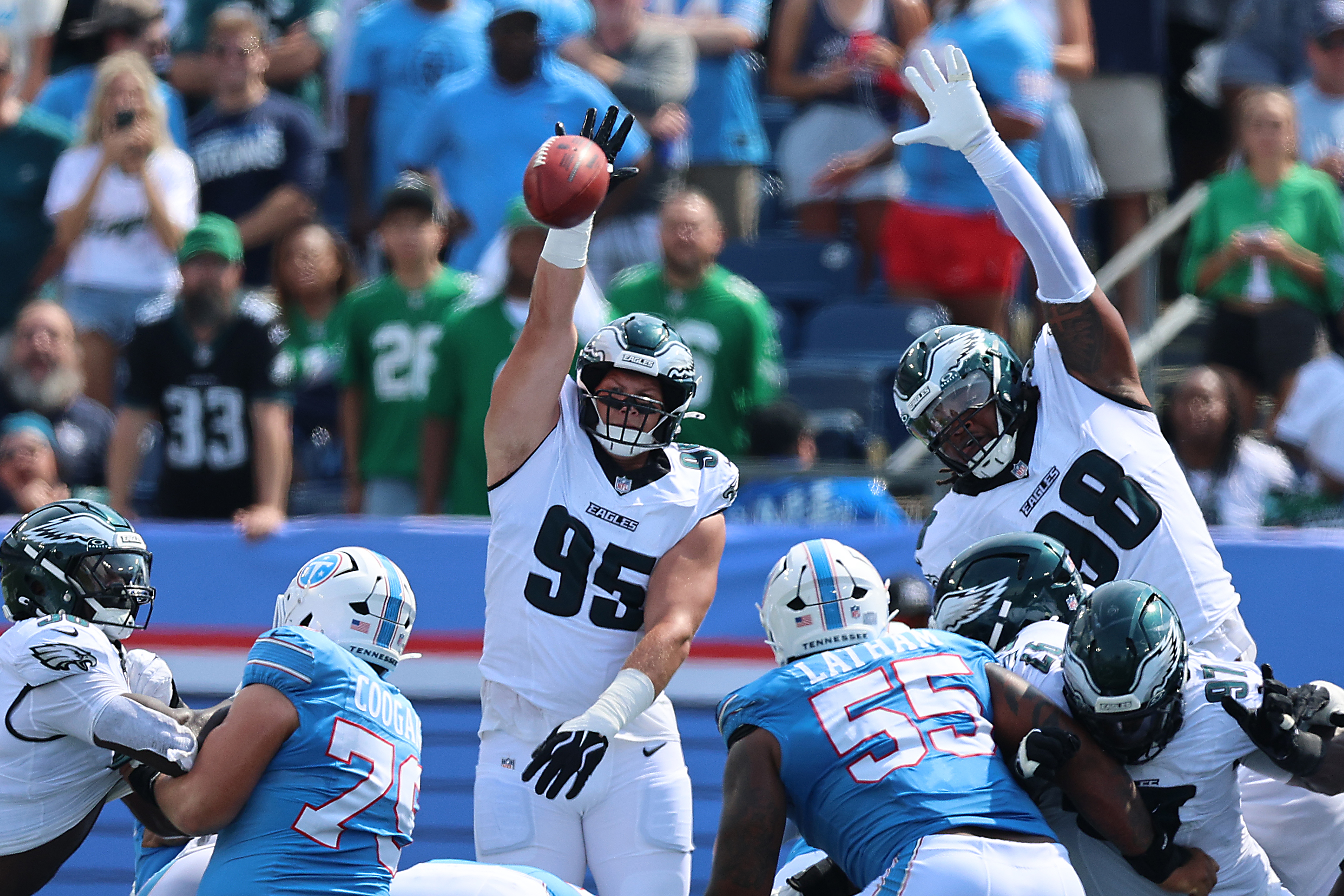
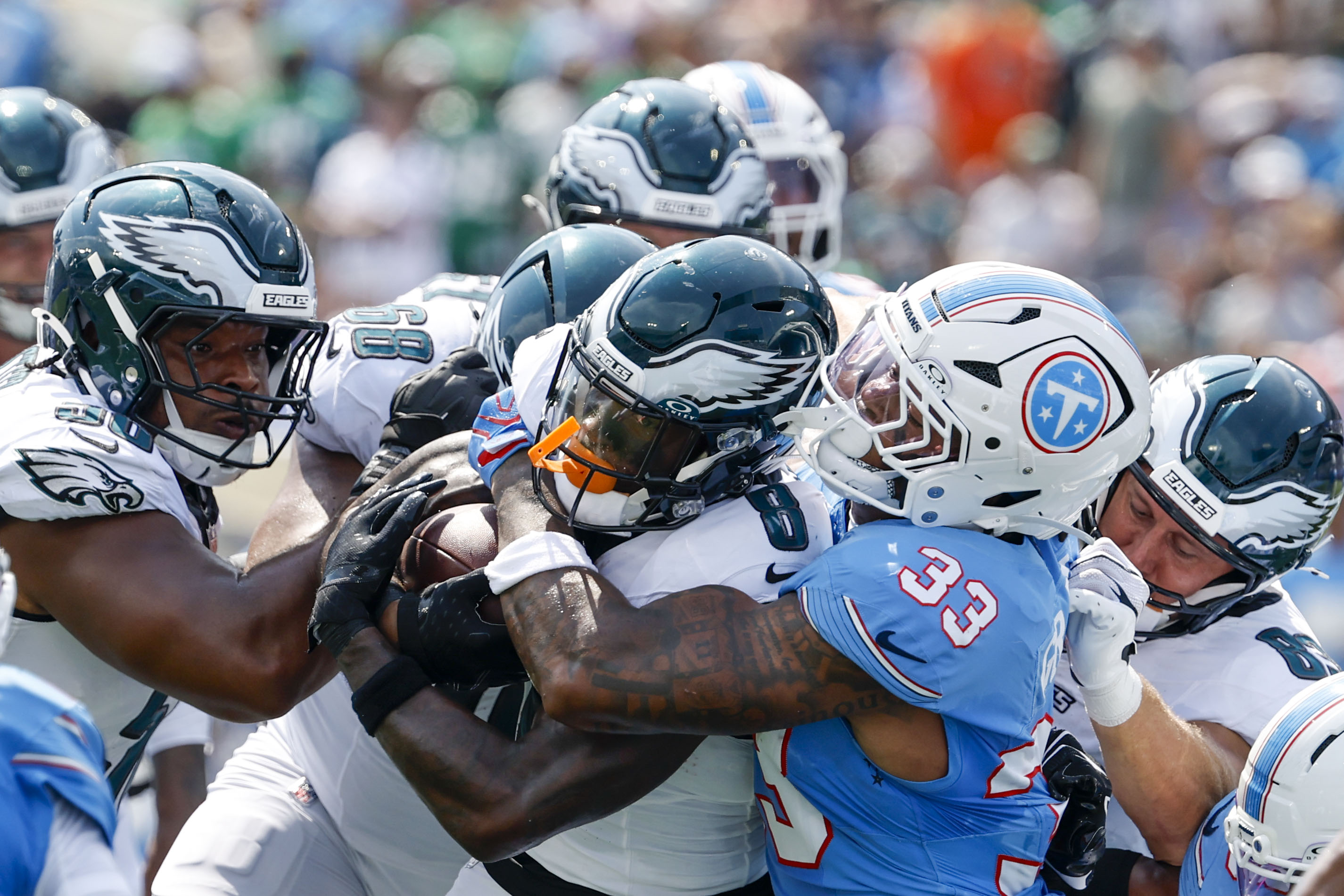
    Sean Mannion’s offense struggled to find its rhythm for much of the day. The offensive line’s play made the win more difficult than it should have been, which impacted the run game.

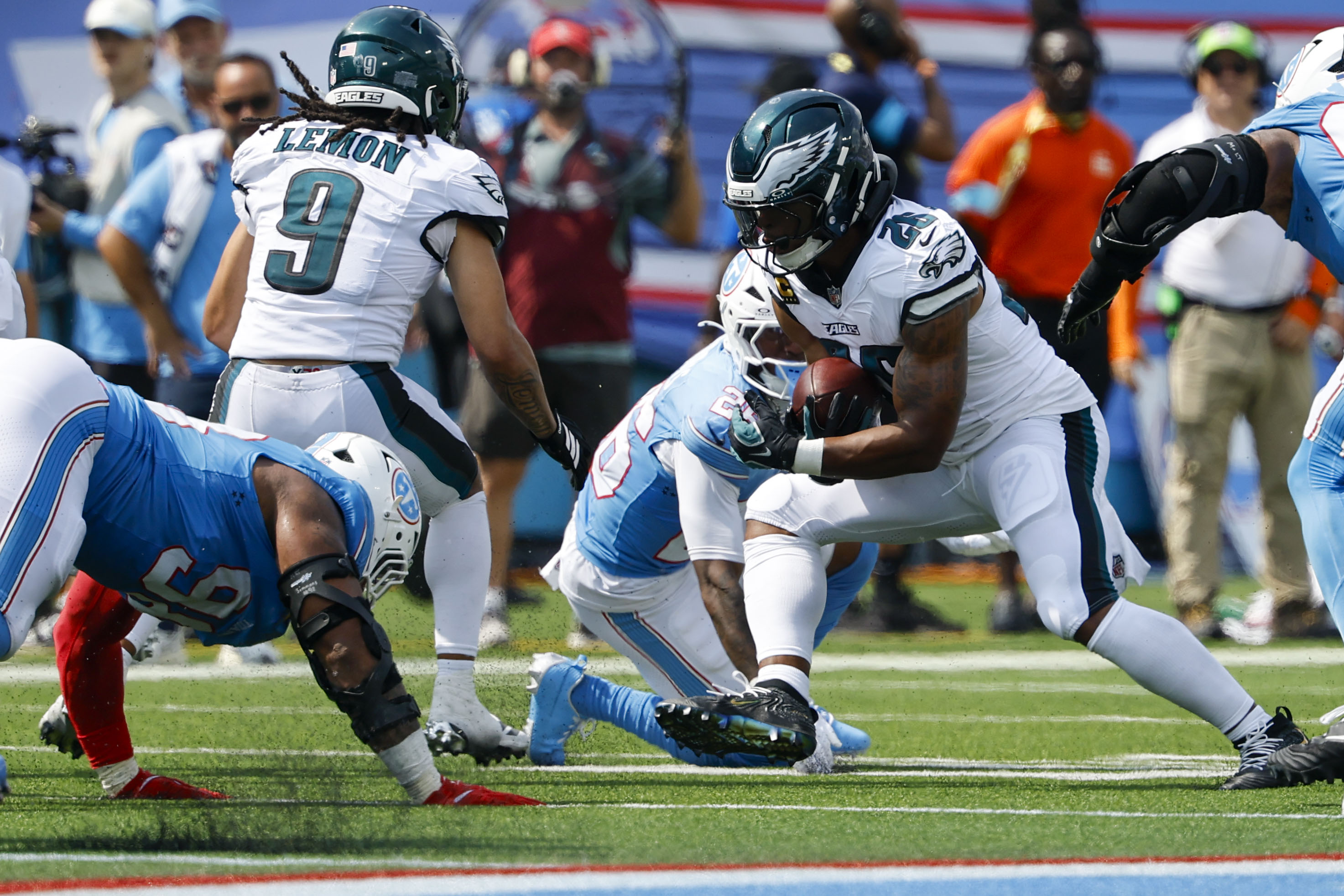
    Also, Saquon Barkley suffered a stinger and ran just four times Sunday.

    The defense also suffered some big lapses that almost cost the Eagles a win, but some positives were the wide receiver and tight end rooms. Jeff McLane shares with us his instant grades on the Eagles’ performance.

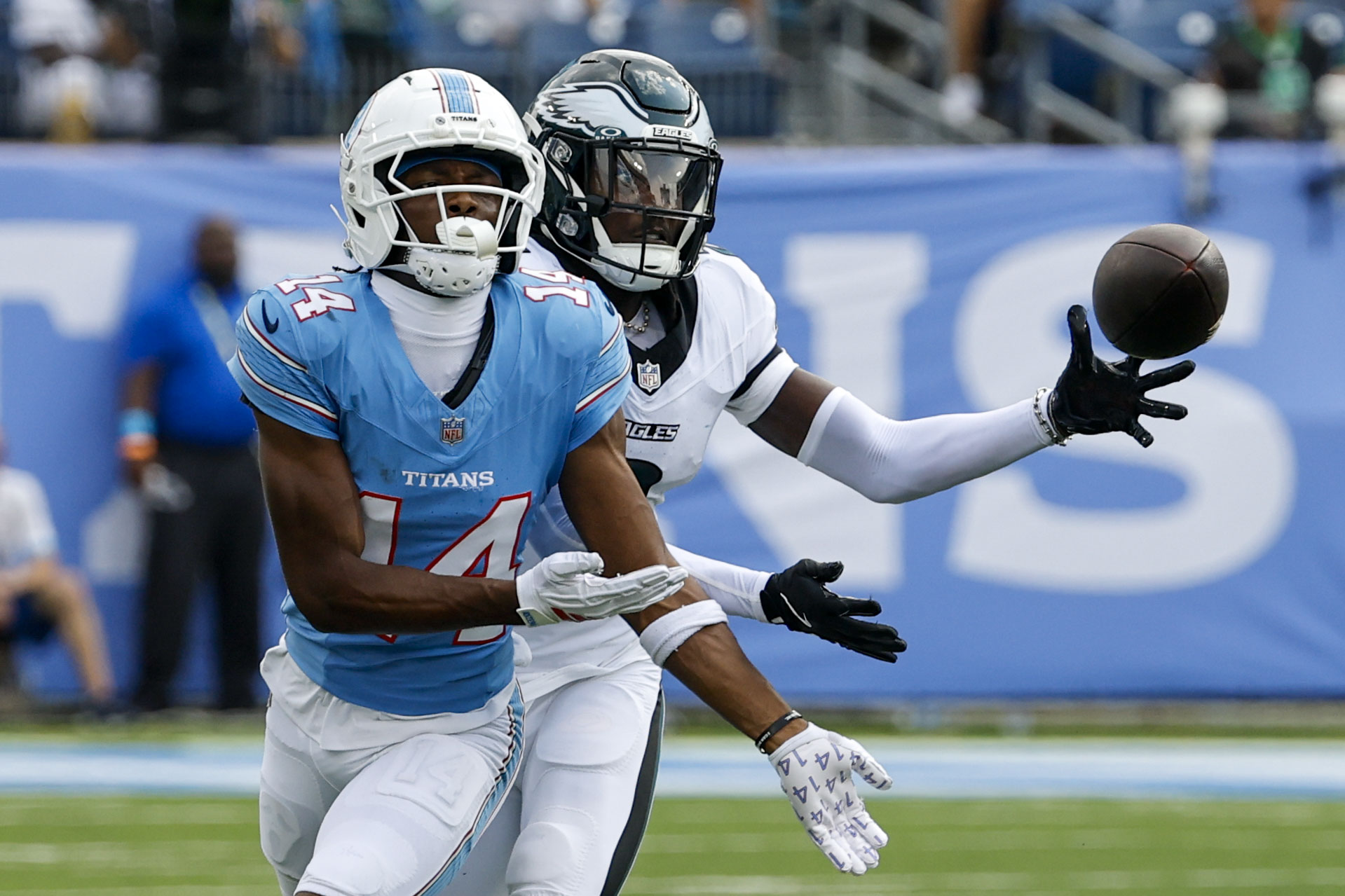
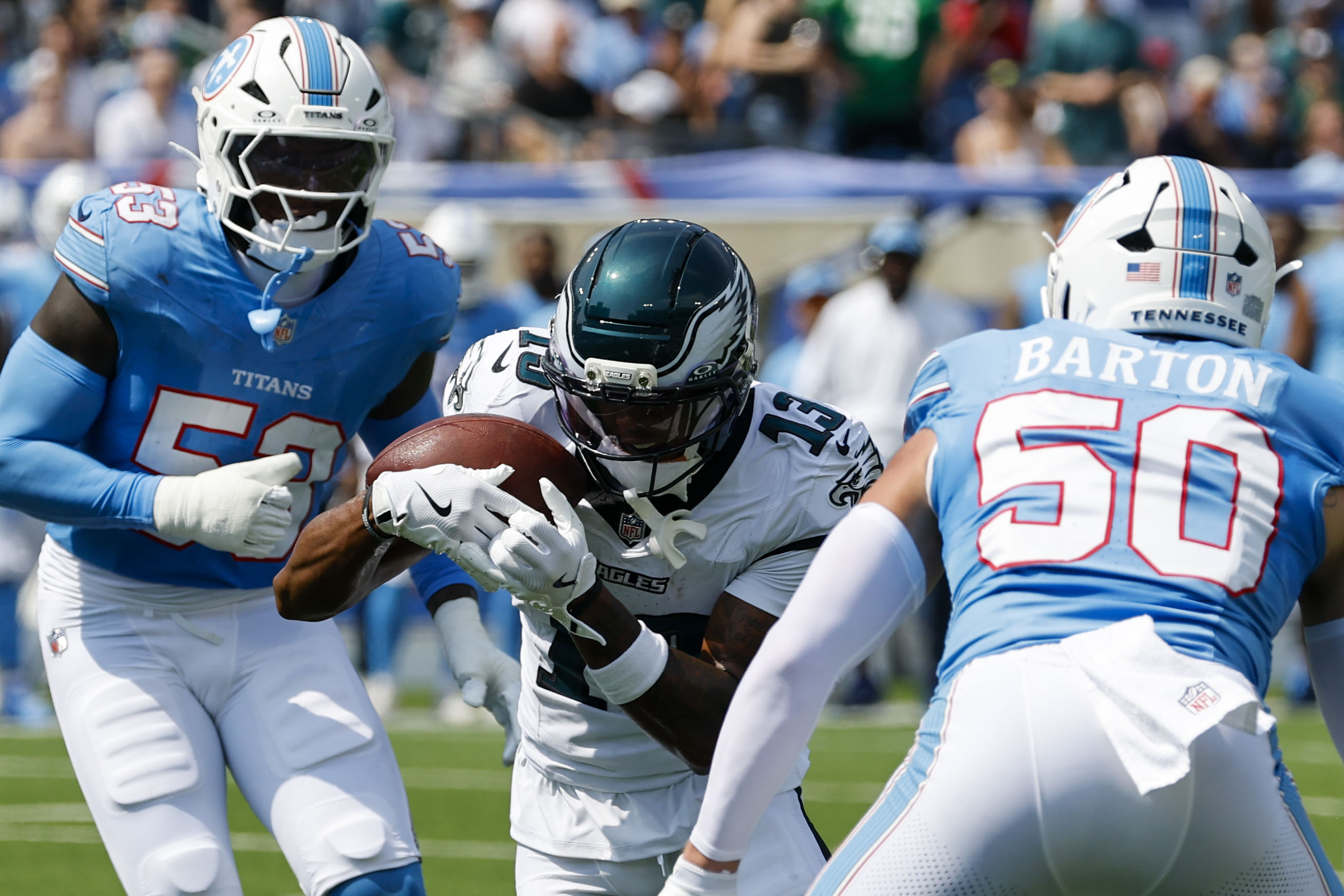
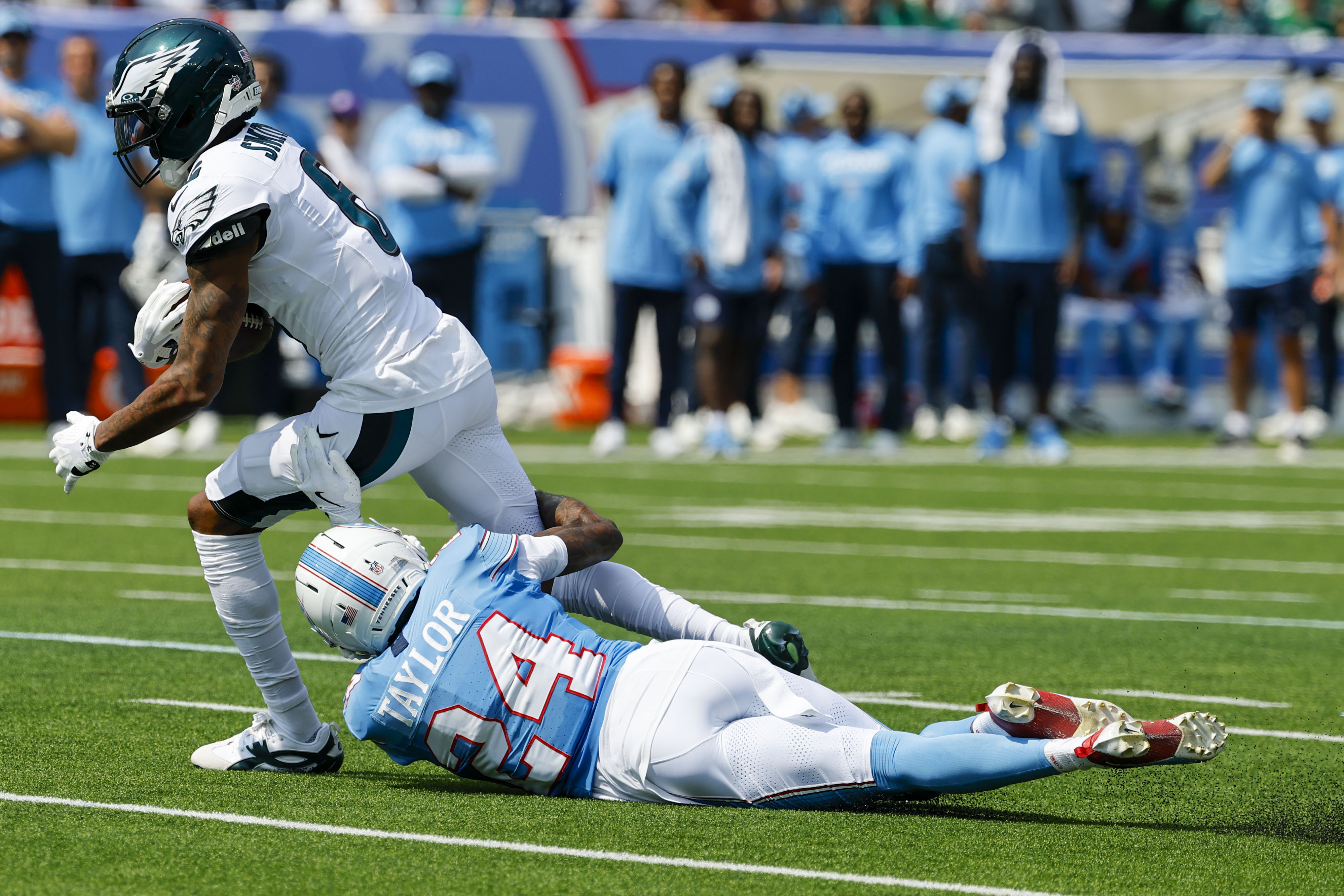
    Let’s give wide receiver DeVonta Smith some credit. Just when the Eagles looked finish the star receiver came through with a 19-yard sideline catch with 14 seconds remaining.

    It may have not been perfect, but for the fourth time in five years, the Eagles are 2-0.

    — Isabella DiAmore, @phillysport, sports.daily@inquirer.com.

    If someone forwarded you this email, sign up for free here.

    ❓What did you think of Jalen Hurts’ play against the Titans? Email us back for a chance to be featured in the newsletter.

    Three’s the magic number

    Justin Crawford hit a three-run triple to power the Phillies past the Mets on Sunday.Noah K. Murray

    Alex McFarlane has been put in a lot of tough situations. He inherited a runner from Cristopher Sánchez in the seventh inning, and had then allowed two singles to flip the Mets’ lineup back over.

    To get out of the jam, he had to contend Juan Soto, and the rookie did just that. Then an inning later, Justin Crawford delivered a three-run triple in the Phillies’ 7-2 win over the Mets, as the club shrank their magic number to clinch the playoffs to three.

    And the Phillies are optioning reliever Orion Kerkering to triple A, following his second-half struggles. In four appearances in September, Kerkering had an 18.68 ERA.

    Up next: After an off day on Monday, the Phillies begin their penultimate series of the season at home Tuesday against the Brewers (6:40 p.m., NBCSP).

    What we’re …

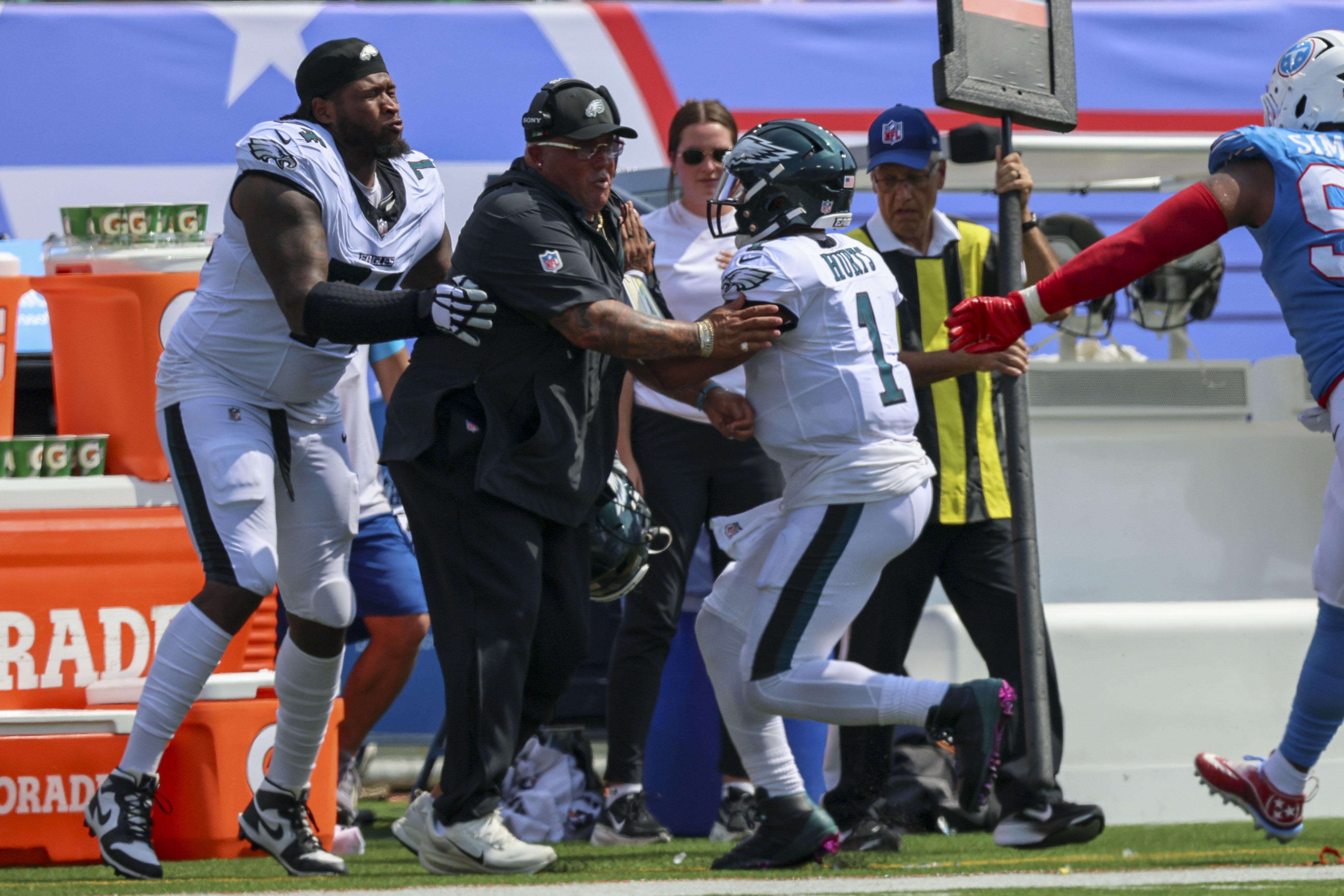
    🏈 Watching: Highlights from the Eagles-Titans broadcast. And did you see what Jalen Hurts said about Titans DT Jeffery Simmons?

    🙌 Praising: Friends and family coming together in Maple Shade in support of Xavier Taylor, who is still recovering after being struck by a baseball.

    🤔 Wondering: What happened to Adem Bona? According to the Sixers, he suffered a left foot sprain in FIBA World Cup Qualifiers.

    📖 Reading: Villanova star Jasmine Bascoe played on Canada’s national team. Here’s what she learned from the experience.

    Changing the narrative

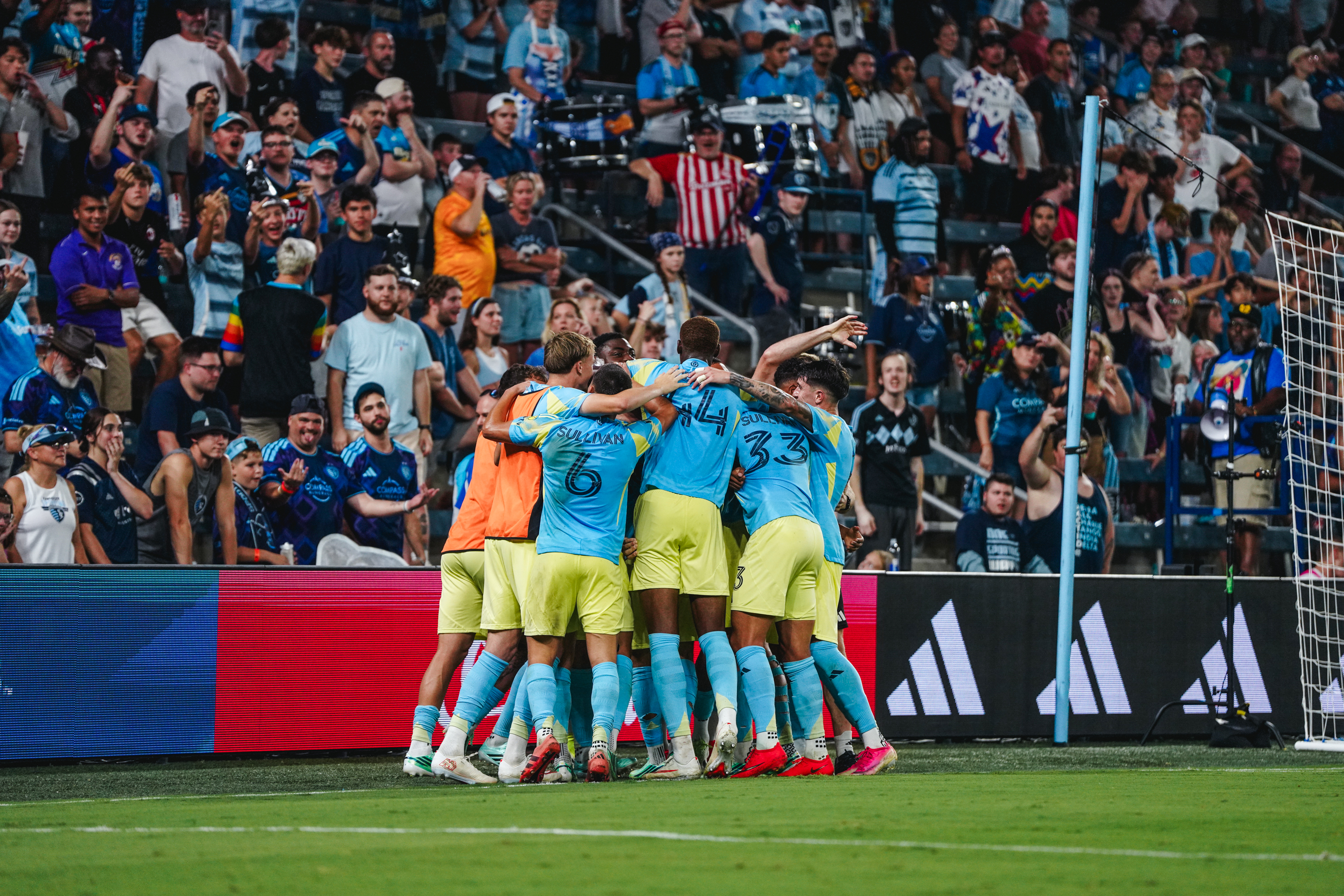
    Heroics from the Union led to a 4-3 come-from-behind win against Sporting Kansas City at Children’s Mercy Park on Saturday.Courtesy / Philadelphia Union

    The Union changed the narrative in what might be one of the best come-from-behind wins of the season on Saturday against Sporting Kansas City.

    Union interim manager Ryan Richter and Co. continue to surge up the Eastern Conference ladder as a team that was written off in June — after limping into the World Cup break with just one win in 15 matches. Now, the Union have scored 14 goals in their last three games and are on an 11-game unbeaten streak.

    ‘Conviction to be great’

    Penn State wide receiver Koby Howard finished with 135 total yards and two touchdowns against Buffalo on Saturday.Barry Reeger

    Koby Howard has been putting in extra work since the spring and it seems to be paying off. The sophomore receiver continued his great start of the 2026 season with 135 total yards and two touchdowns in Penn State’s 55-13 win over Buffalo.

    (The win also bumped Penn State from No. 14 to No. 13 in the AP Top 25 college football poll.)

    Howard has 344 receiving yards and three total touchdowns through three games this season. He’s averaging 28.67 yards per catch and is on pace to break the Nittany Lions’ single-season receiving yards record. Matt Campbell isn’t surprised by the sophomore’s success.

    In other college football news:

    David Murphy’s take

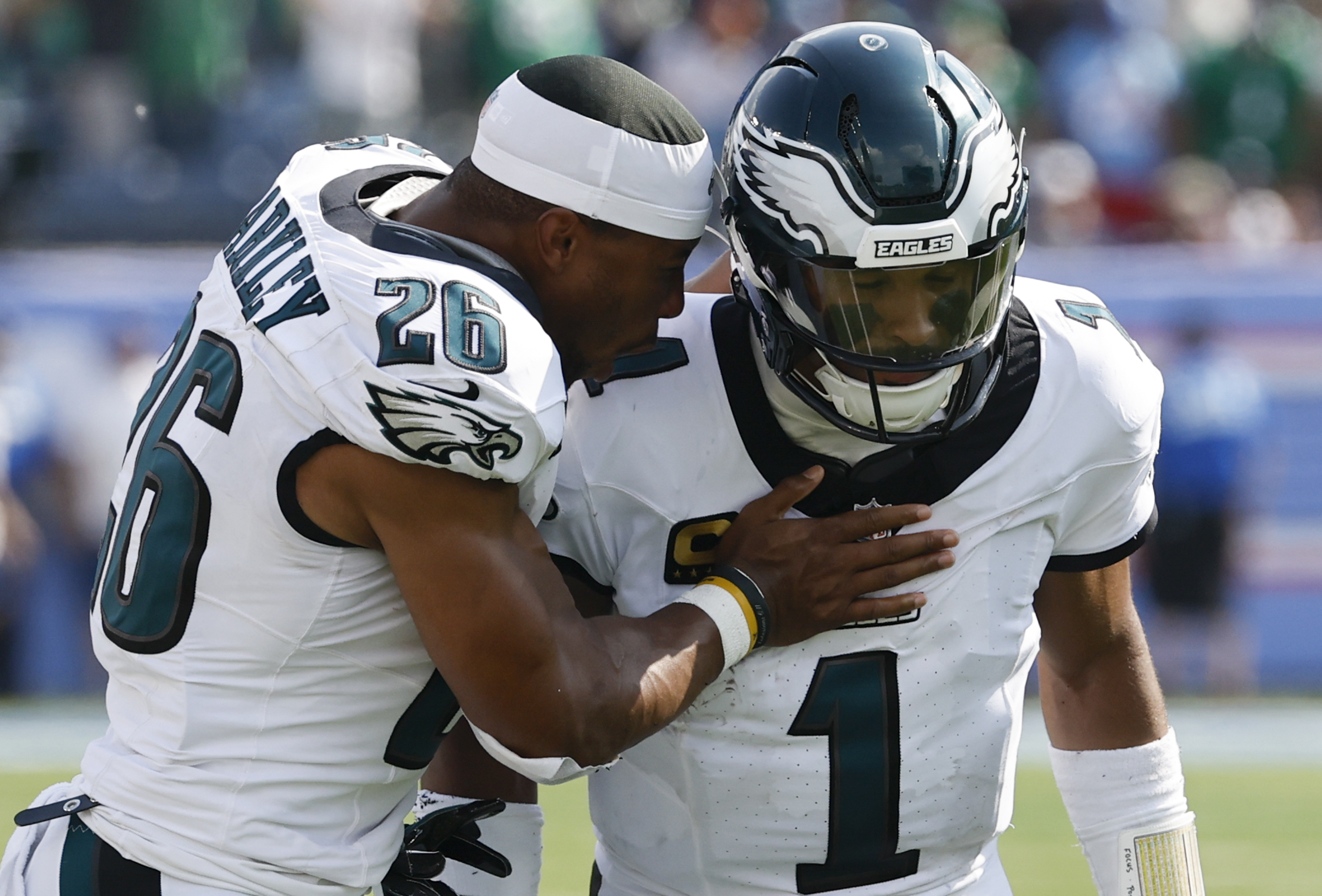
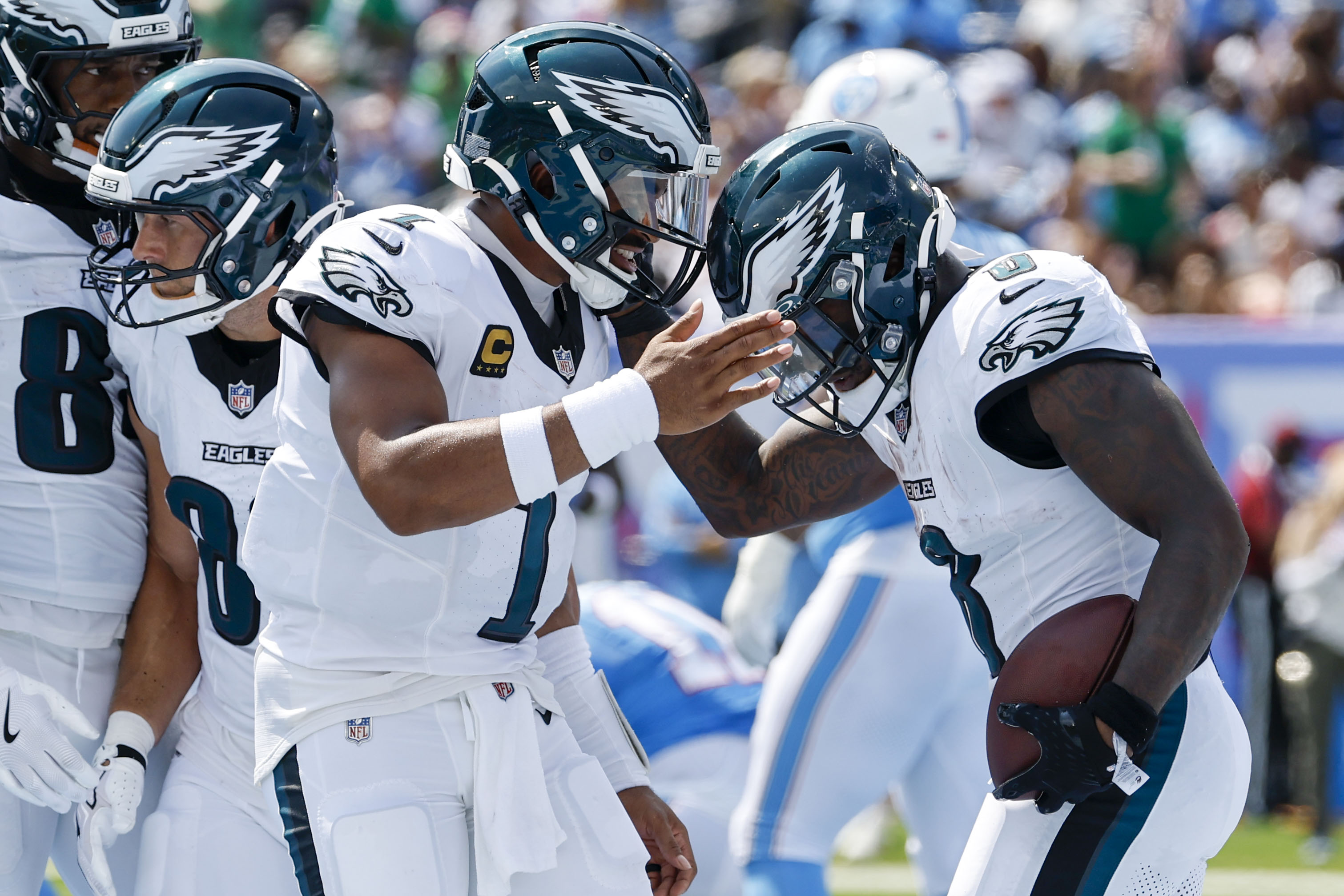
    Saquon Barkley (center) and Eagles quarterback Jalen Hurts celebrate Hurts’ late touchdown pass in Sunday’s win.Yong Kim / Staff Photographer

    You can say a lot of things about Jalen Hurts, but he has shown time and again at every level of football that talent and self-belief prevails. Rarely will you see a quarterback make a more consequential series of throws than the ones Hurts made late on a muggy afternoon in Week 2.

    There are lots of things to be ironed out, but it is far better to iron these things out while 2-0. And once again, Hurts was the difference, writes columnist David Murphy.

    We compiled today’s newsletter using reporting from David Murphy, Olivia Reiner, Jeff McLane, Jeff Neiburg, Kerith Gabriel, Ryan Novozinsky, Lochlahn March, DeAntae Prince, Mia Messina, Conor Smith, Lexie Linderman, Mike Livingston, Dylan Johnson, and Hannah Chang.

    By submitting your written, visual, and/or audio contributions, you agree to The Inquirer’s Terms of Use, including the grant of rights in Section 10.

    Thanks for starting off your Monday with our newsletter. We’ll be back in your inboxes on Tuesday. — Bella

  • Villanova star Jasmine Bascoe represents home nation on global stage: ‘What more could you ask for?’

    Villanova star Jasmine Bascoe represents home nation on global stage: ‘What more could you ask for?’

    In her first two seasons with Villanova, Jasmine Bascoe has established herself as one of the best women’s basketball players in the Big 5. Now, she’s establishing a role with Canada’s national team.

    In August, Bascoe was named to Canada’s 12-player roster for a FIBA women’s basketball Olympic prequalifying tournament later that month in Guadalajara, Mexico.

    While the tournament marked Bascoe’s senior team debut with Canada, she previously represented her home nation at the FIBA U19 Women’s Basketball World Cup in 2025. At 20 years old, the junior guard was now playing for the country’s top women’s team.

    Canada went 5-0 in the tournament, capped by an 83-53 win over Mexico in the final on Aug. 23. With the tournament win, Canada secured the only available spot in the FIBA women’s Olympic qualifying tournament in March 2028.

    Bascoe led Canada in assists with 5.4 per game, and was second in points with 10.8 per game.

    At training camp for the tournament, Bascoe, who was coming off an injury, said she learned from watching those around her before she could get involved herself. By the time the tournament began in August, she was getting used to playing alongside Olympians like Yvonne Ejim, Sami Hill, Shaina Pellington, and Syla Swords.

    She said the veterans’ constant communication allowed the team’s younger players, like Bascoe, to learn more.

    “They weren’t on us right away to be perfect, which obviously gives us a lot more confidence as well,” Bascoe said. “They were everything we needed them to be. They were leaders, but then at the same time, they were great friends. Like they honestly were some of my closest friends this whole summer, which was just amazing, and just getting to hear stories from them and their other pro experiences and their NCAA experiences, I mean, what more could you ask for?”

    Villanova women’s basketball junior guard Jasmine Bascoe (right) is back with the Wildcats after a summer representing her home nation.Yong Kim / Staff Photographer

    The fifth Olympian on the team was Kayla Alexander, who represented Canada in Tokyo in 2020 and in Paris in 2024. At 35, she currently plays for the WNBA’s Toronto Tempo and holds Canada’s all-time career rebound record. She’s also from the same hometown as Bascoe: Milton, Ontario.

    After the tournament, Bascoe told Alexander just how much fun she had playing with someone she said is “an amazing person” and “a great leader.”

    “I’ve always looked up to her as a person, but it’s so great,” Bascoe said. “She keeps everyone so level-headed and always on the same page. And she’s a great lifeline between us and the coaches. And so it just made the whole summer very smooth.”

    In her sophomore season at Villanova, Bascoe led the Big East in assists (4.9) and scoring (18.9), finishing ahead of UConn’s Azzi Fudd, who was the No. 1 overall pick in the WNBA draft this year, and Sarah Strong. She also was named the Big 5 Player of the Year.

    Bascoe said the pace and physicality of a tournament involving professionals further improved her game, and it’s something she hopes to implement during her junior year with the Wildcats. As an upperclassman now, Bascoe said sheer speed is no longer going to work for her, and she wants to start incorporating physicality into her style of play.

    “I just think it was a summer full of learning for me,” she said. “Playing at that level is not easy. It’s physical, it’s fast, and it just prepares you so good for everything else, like NCAA, everything. So it was amazing, and I was just fortunate to be able to get some games under my belt with the senior team and end on a good note. … It was a very fulfilling summer, and now I’m ready to bring everything back here to Villanova.”

  • Raymond Horsch had access to a Kensington crematorium linked to illegal body parts sales, years before missing persons investigation

    Raymond Horsch had access to a Kensington crematorium linked to illegal body parts sales, years before missing persons investigation

    Years before police launched an investigation into the missing women connected to Raymond “R.C.” Horsch, the late pornographer stood inside a Kensington art gallery and presented what appeared to be the autopsy photos of a dead, unidentified woman.

    His exhibition at the 2014 show ended with a video of the woman’s body being loaded into an incinerator — footage that he said was filmed at “a Kensington warehouse where the city morgue would send unidentified remains,” according to a review published on an art blog at the time.

    “The Medical Examiner totally botched the autopsy and didn’t even bother to sew her up properly. My horrible photograph is all that is left of her, the only trace of her short, sad existence,” Horsch wrote in a release promoting the exhibition. “She has nothing else, not even a name.”

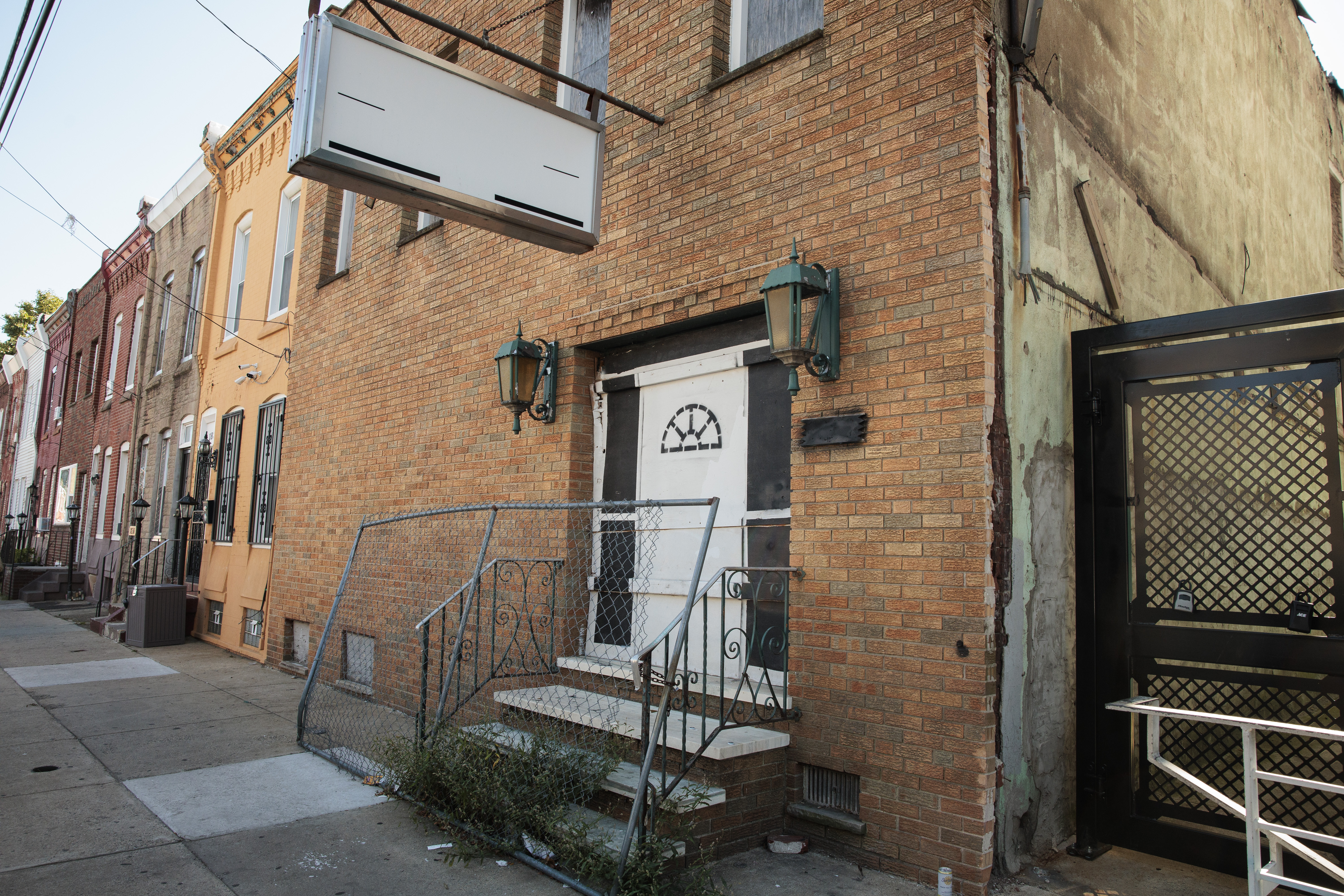
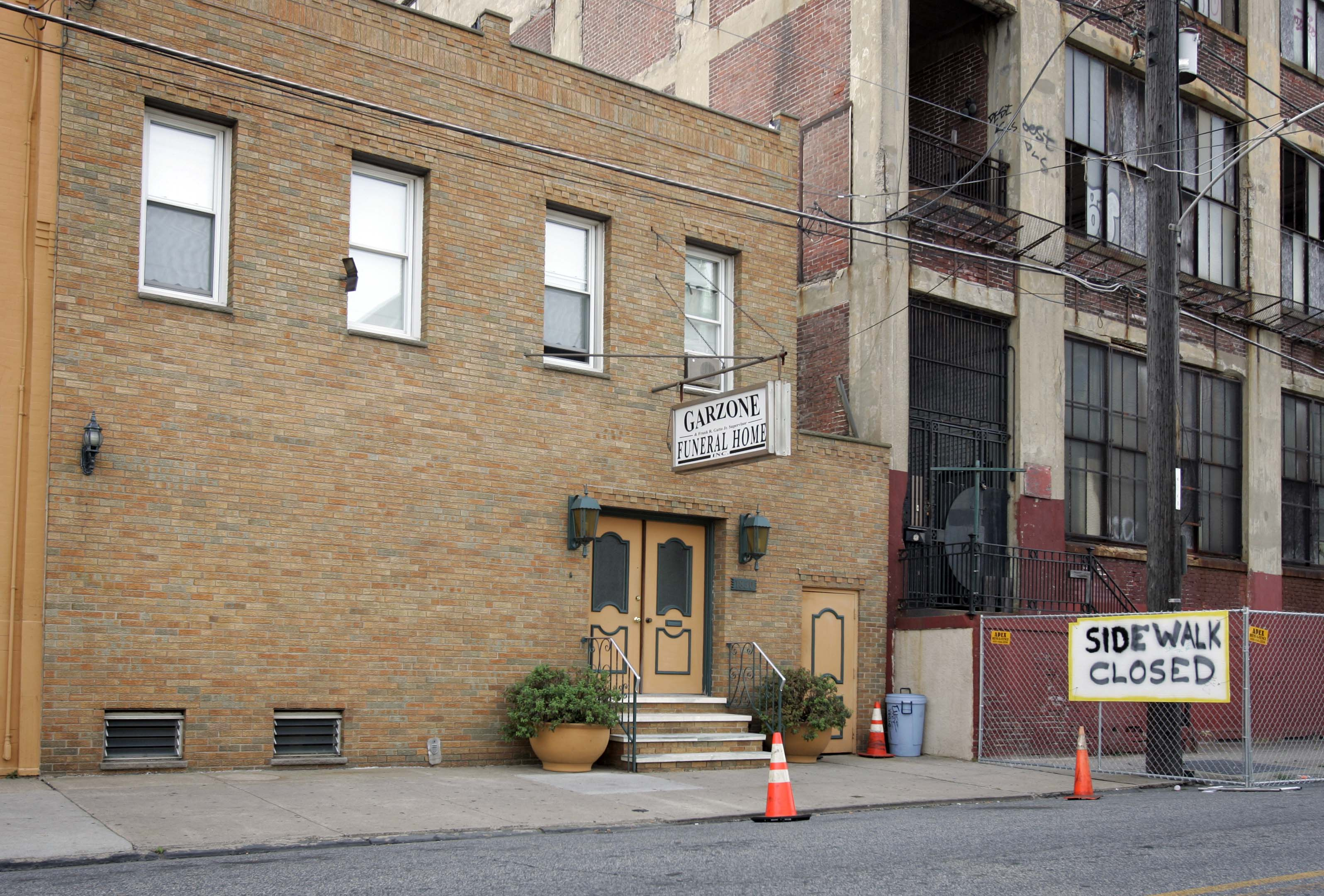
    While Horsch was known to distort, embellish, or completely fabricate events, a law enforcement source and people familiar with this period of his life said this much is true: The pornographer had access to a Kensington crematorium connected to the notorious Garzone Funeral Home, which was shuttered over illegal body parts sales.

    There, sources said, Horsch gave an employee drugs and cash in exchange for access to the crematorium so he could photograph and film the remains of the dead.

    The funeral home and crematorium operated until 2007, when state authorities brought charges against the family-run business alleging the owners were selling body parts on the black market, according to court records and news reports.

    Horsch, who died in May 2025 of a lung condition, was not named or charged in that scandal.

    But police are looking into Horsch’s relationship to the crematorium as part of a sprawling local and federal investigation into at least seven missing women, according to a law enforcement source who spoke on the condition of anonymity to discuss an ongoing probe.

    No bodies have been found, and five women police have identified as likely deceased went missing from 2016 to 2023, years after the crematorium connected to the Garzone Funeral Home had closed. Police are still investigating the women’s whereabouts, including ongoing searches for evidence in Horsch’s Olney home and basement.

    The case has been complicated by Horsch’s tendency to blur fact and fiction, and many of his pornographic works featured staged death scenes and fake blood. But police have also recovered numerous videos and photos from Horsch’s home they have said seem to show real violence and actual killings.

    At least as far back as the early 2000s, Horsch was known to prowl the streets of Kensington, offering drugs and cash to women in exchange for starring in his violent pornographic films.

    He was public about his obsession with taking degrading photographs of women in addiction. Years after Horsch staged his 2014 art show in Kensington, he uploaded a photo series to his website featuring women “imagining and acting their own deaths” interspersed with images of fatal overdose victims. In a description of the gallery, Horsch wrote he took the photos in “unknowing collaboration with the Philadelphia Medical Examiner,” as well as local paramedics.

    The Philadelphia Medical Examiner’s Office declined to confirm whether the city sent unclaimed corpses from the morgue to the Garzones’ crematorium.

    Louis and Gerald Garzone, who together operated the crematorium connected to the funeral home under the name Liberty Cremations, pleaded guilty to selling over 240 corpses to a New York-based biomedical tissue company in 2008. The tissue cutters illegally stripped the bodies for bones, tendons, and organs, then sold them to hospitals.

    Some of the tissue was infected with disease, officials said at the time, and was transplanted into patients without their knowledge. Law enforcement seized the crematorium and funeral home as part of the criminal case, court records show.

    Horsch once bragged that he had access to the crematorium through an employee named “George,” whom he paid with drugs, and had filmed a scene for a movie there, according to a woman who worked with Horsch on several films beginning in 2003. She spoke on condition of anonymity to avoid being publicly linked to the pornographer.

    Gerald Garzone said in a phone interview that he had never heard of Horsch and had no knowledge of corpses being photographed in his former business. He acknowledged knowing a man named George from the neighborhood but declined to say whether he had ever employed him.

    “I don’t know anything about that,” he said.

    A 2007 file photo of the Garzone Funeral Home at 1830 E Somerset St., in Philadelphia.Laurence Kesterson / Staff Photographer

    Four people familiar with Horsch and Garzone’s business operation identified the man as George Newsome, a Kensington resident who lived a block away from the crematorium at a house on Ruth Street that Horsch was known to frequent.

    Newsome was arrested for heroin possession in 2011, court records show, and again for cocaine possession in 2013. He died a year later, according to an obituary.

    Investigators continue to sort through more than a million photos and videos on hard drives recovered from Horsch’s home on West Chew Avenue. Local and federal investigators said they have reviewed about 30% of the materials so far and have identified 58 different people in the footage.

    Among them, police said, are images of four women who appear to be dead: Maribel Fresses; Gabrielle Amarando; a 25-year-old whose identity relatives asked to remain private; and a woman in her mid-20s whom investigators are still working to identify. Police said they also recovered footage of Horsch filming himself choking 27-year-old Nicole Fusaro with a zip tie until she was dead.

    Police began searching Horsch’s Chew Avenue property shortly after a chance car stop on June 19 involving his son, Eugene, uncovered an ID in the name of Blair Tonzelli, who was reported missing in 2023.

    Investigators then began reexamining the disappearance of Amy McHale, Raymond Horsch’s ex-wife, who was last seen at the Olney home in 2016.

    Inside the property, police found five urns full of cremains, two of which police are still working to identify. The basement contained vats of unknown chemicals and a 55-gallon drum with connections to a sewer drain. There were also pages of writings that referenced serial killer Ted Bundy and described how someone enjoyed hurting a woman with a zip-tie.

    Raymond Horsch had previously written in self-published novels about dissolving a woman’s body in chemicals. Police have sent the chemicals and liquids recovered from the basement to a specialized lab in Chicago for testing.

    Eugene Horsch remains incarcerated on federal gun and drug charges. He has not been accused of any violent crimes involving the missing women.

  • The Eagles need Jalen Hurts 2.0 now more than ever. His evolution and clutch gene are carrying a rough offense.

    The Eagles need Jalen Hurts 2.0 now more than ever. His evolution and clutch gene are carrying a rough offense.

    NASHVILLE, Tenn. — Jalen Hurts tossed two costly interceptions. The first was returned 92 yards and converted into a touchdown, while the second came late in the fourth quarter and allowed the Titans to take a 20-17 lead.

    And yet, Hurts wasn’t asked a single question about the picks postgame. His performance in rallying the Eagles past Tennessee, 24-20, in nearly every other moment, including a masterful two-minute drive, far overshadowed his two throwing errors.

    But there was something unique about Hurts carrying the offense at the scorching Nissan Stadium on Sunday. He’s strapped the Eagles onto his back before. He’s had better games against better opponents when the stakes were much higher. He’s been clutch on many previous occasions.

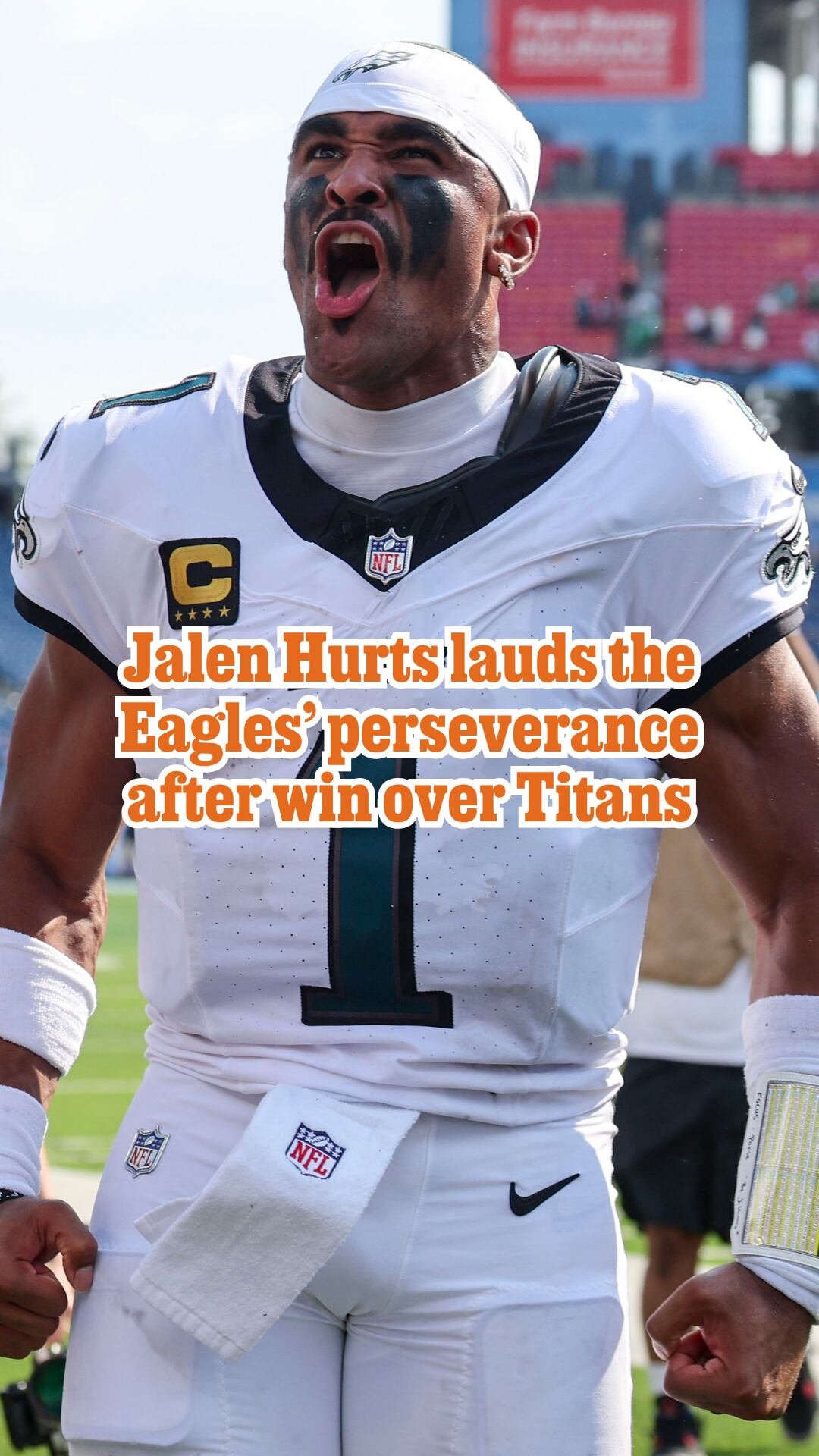
    Jalen Hurts lauds the Eagles' perseverance after win over Titans
    Video: Jalen Hurts lauds the Eagles’ perseverance after win over Titans

    No, this was a different Hurts. This was the 2.0 version. This was Hurts evolving as a quarterback in a new scheme that gives him more freedom as a passer. We saw glimpses of it in Week 1 vs. the Washington Commanders. He took another step in Week 2.

    If the narrative entering this season was that the 28-year-old faced a make-it-or-break-it tipping point, after another offensive coordinator change and a seemingly unresolved contract situation, Hurts has shown through two weeks that he’s making it.

    He’s been that instrumental in the Eagles’ 2-0 start despite the schematic hiccups and struggles on the offensive line.

    “I don’t even think words can describe how much you’ve got to manage as a quarterback in this league from a responsibility standpoint, and the weight that comes with the position and the responsibility,” Hurts said when asked about his calm amid an otherwise stormy offensive day.

    “Ultimately, you gotta keep the main thing the main thing throughout that. You gotta keep your poise and keep your focus.”

    An early injury to Saquon Barkley was one more thing Jalen Hurts was forced to overcome on Sunday. Yong Kim / Staff Photographer

    Third down after third down, Hurts and his receivers bailed out the early-down malaise. The Eagles have long needed an offense that establishes the run game. Hurts’ limitations as a dropback passer have partially made that necessary, but it’s also been a byproduct of coach Nick Sirianni’s conservatism.

    The Eagles just might not have the pieces to be a run-based unit this season. There were likely to be some early bumps with the new wide-zone blocking scheme. But for as much as Sean Mannion needs the outside-zone runs to set up play action, he can’t keep calling early-down runs or quasi-runs that are passes that fail.

    The Eagles have been wretched on first down. They averaged just 0.9 yards in the first game of the season. They were a little better in the second, but the running backs managed just 2.7 yards on 15 first-down rushes vs. the Titans.

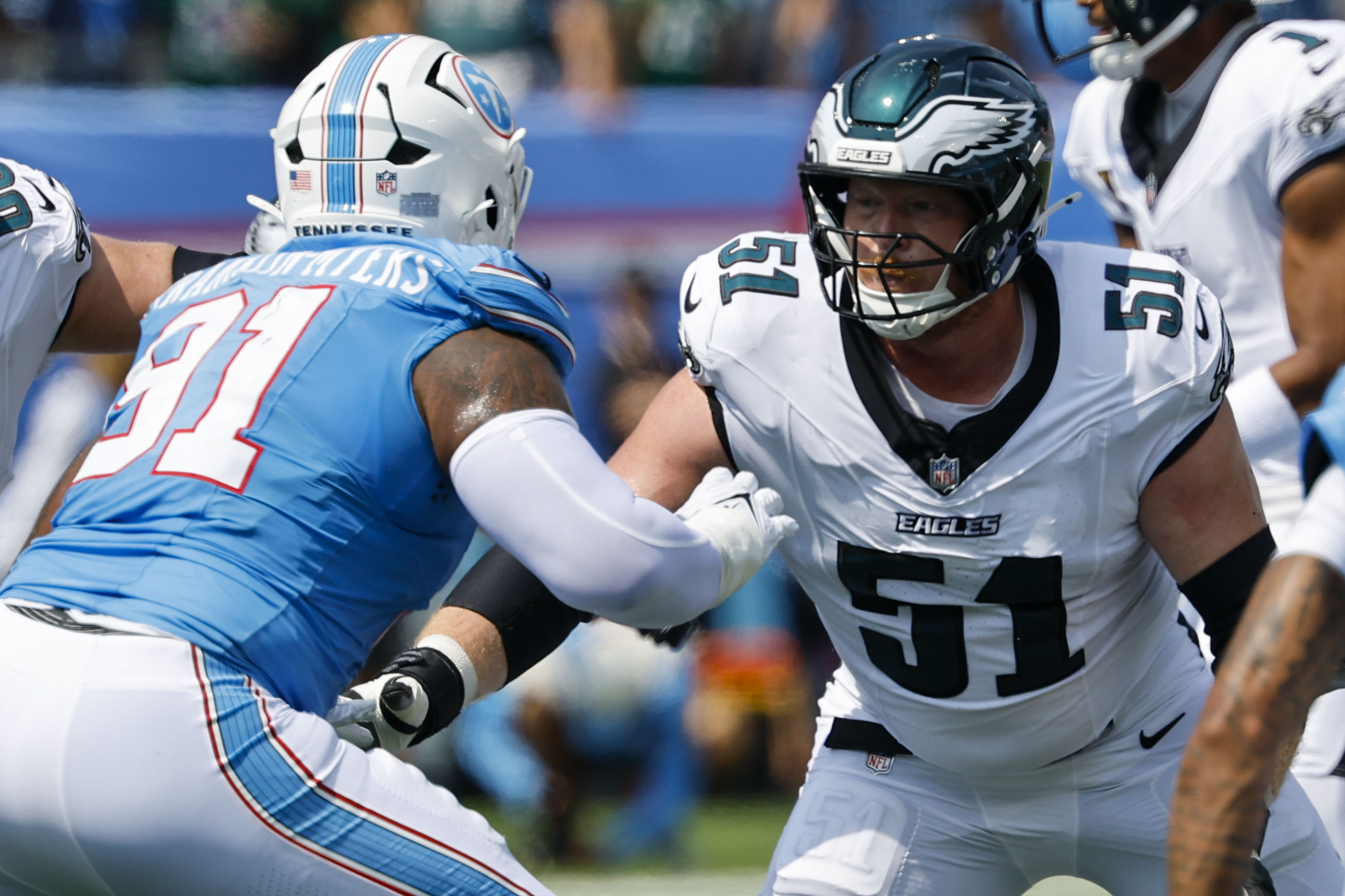
    The Eagles shuffled the O-line after Landon Dickerson went to injured reserve last week, moving Cam Jurgens to the vacant left guard spot and inserting Drew Kendall at center. There were going to be miscues with Jurgens having never played guard on that side, especially with Jeffery Simmons lining up over him.

    But Mannion kept calling runs even if they often were away from the All-Pro defensive tackle.

    “It’s more to do with execution, but then also you know the moving pieces that we had in,” tackle Jordan Mailata said about the run-blocking issues. “This is our first game together as the starting five for us. And I’ve always emphasized the continuity of having the same O-line guys.”

    Sirianni wouldn’t divulge whether he’ll stick with the same configuration, but keeping the same core for at least the next three games — or more, depending upon Dickerson’s health — seems likely.

    Cam Jurgens (51) and the offensive line has been slow to adjust to the Sean Mannion scheme. Yong Kim / Staff Photographer

    “I’m a soldier,” Jurgens said. “I march to my orders, and whatever I’m asked to do, I’m going to do it to my best abilities.”

    There were other missing parts. Running back Saquon Barkley left early with a stinger (although he returned), while tight end Dallas Goedert was sidelined with a knee injury. Sirianni said he wouldn’t grade on a curve because of the new faces and scheme changes.

    “We want to be able to run it more efficiently,” Sirianni said. “I haven’t seen any of the numbers, but everything comes off of the run and the play action. And so, the guys battled though. That’s what you’re so proud of there. … But there’s definitely room for improvement, as we all know.

    “We all see that.”

    The pass protection wasn’t much better, although when the O-line needed to stand tall on the last drive, Hurts mostly had enough time in the pocket. But getting sacked three times, hit an additional three times, and having to Houdini out of pressure isn’t likely sustainable.

    According to the advanced analytics site Sumer Sports, the Eagles have the largest difference in early-down offensive success rate vs. late-down offensive success rate to start a season since 2022, with an early-down success rate of 31.5% in the third percentile, and a late-down rate of 60.6% in the 96th percentile.

    Hurts kept facing long third downs and kept hitting receivers DeVonta Smith and Dontayvion Wicks downfield. He converted nine third downs of more than 4 yards, three of which were third-and-12.

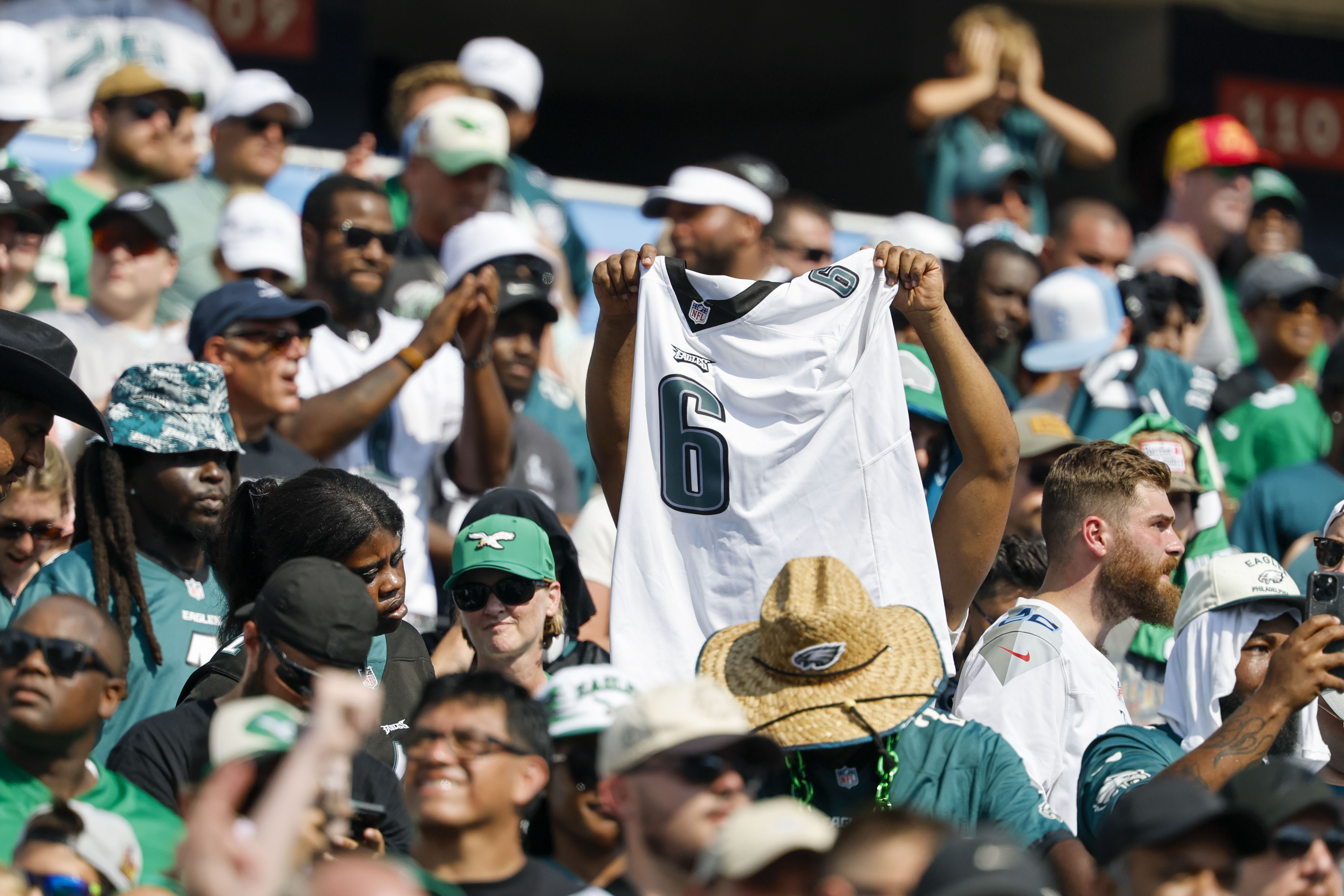
    Jalen Hurts helped facilitate a big day for DeVonta Smith (6) and completed passes to nine different targets on Sunday. David Maialetti / Staff Photographer

    But both his interceptions also came on third-and-longs. He kept bouncing back.

    “Jalen’s able to flush it and lead us down the field in a critical situation,” Sirianni said. “Just proud of the way he played and the way he had his resolve, but that’s who he is, right? That doesn’t surprise me. He’s that on a daily basis.”

    Whether it’s by design or not, Sirianni has had to entrust his 28-year-old quarterback with more responsibility, and that may require accepting a few more interceptions than either has become accustomed to.

    If the Kyle Shanahan-type parts of Mannion’s under center, play-action scheme haven’t yet taken hold, the implementation of more full progression reads has. Hurts completed passes to nine receivers for only the fourth time in his NFL career, and the first since 2022.

    He got late into his reads on several throws, including the game-winning 3-yard touchdown toss to Darius Cooper. Earlier, he found Cooper for a 23-yard gain when the receiver was beyond his first two reads.

    “I think it’s just a byproduct of our approach in our offense,” Hurts said. “I’ve really embraced and enjoyed the teaching progression and how things are taught.”

    Hurts has heard the noise about his not being able to diagnose defenses, dating back to his second season when the Tampa Bay Buccaneers said as much in an Eagles wild-card playoff loss. Simmons said the Titans wanted to make Hurts “play quarterback” in the lead-up to the game.

    “I heard it,” Hurts said.

    He let his play do the talking, though.

    “I’m happy we won,” Hurts said when asked for a response.

    Hurts can still do the athletic and mobile things that separate him from many other quarterbacks. He ran twice on designed runs, scrambled two times for 11 yards, and used his lower-body strength to convert on the return of the Tush Push.

    But he’s quieted some doubts about how he would adapt to the biggest scheme change of his NFL career, and about how last season ended. In Week 1, he hit Goedert for a touchdown on a four verticals concept similar to the fateful last play in the playoff loss to the San Francisco 49ers. In Week 2, he bested the opposing defensive coordinator in that game — Titans coach Robert Saleh.

    “Finally good to get him,” Hurts said.

    It’s early, of course. If the problems on Chris Kuper’s O-line are going to be waved away with the same reason, then Hurts’ strong start should be taken with a grain of salt. The same could be said about the climate — both teams had to suffer through it — even if Eagles players were melting through cleats.

    “Was like a NASCAR pit crew helping me get ready for the second half,” said Jurgens, who said he went through two pairs.

    It may be another Eagles victory, with agony and outside voices thrilled to complain about it. But Hurts knows better. The work was done. The task at hand remains.

    “We’re still progressing,” Hurts said. “Think there’s a lot for us to continue to improve on, to align toward. But you want to do that and find ways to win.”

    He’s done that as much as any quarterback over the last five seasons. But he may have to shoulder more than he ever has before.

  • Why haven’t state officials revealed more about Pennsylvania’s measles deaths?

    Why haven’t state officials revealed more about Pennsylvania’s measles deaths?

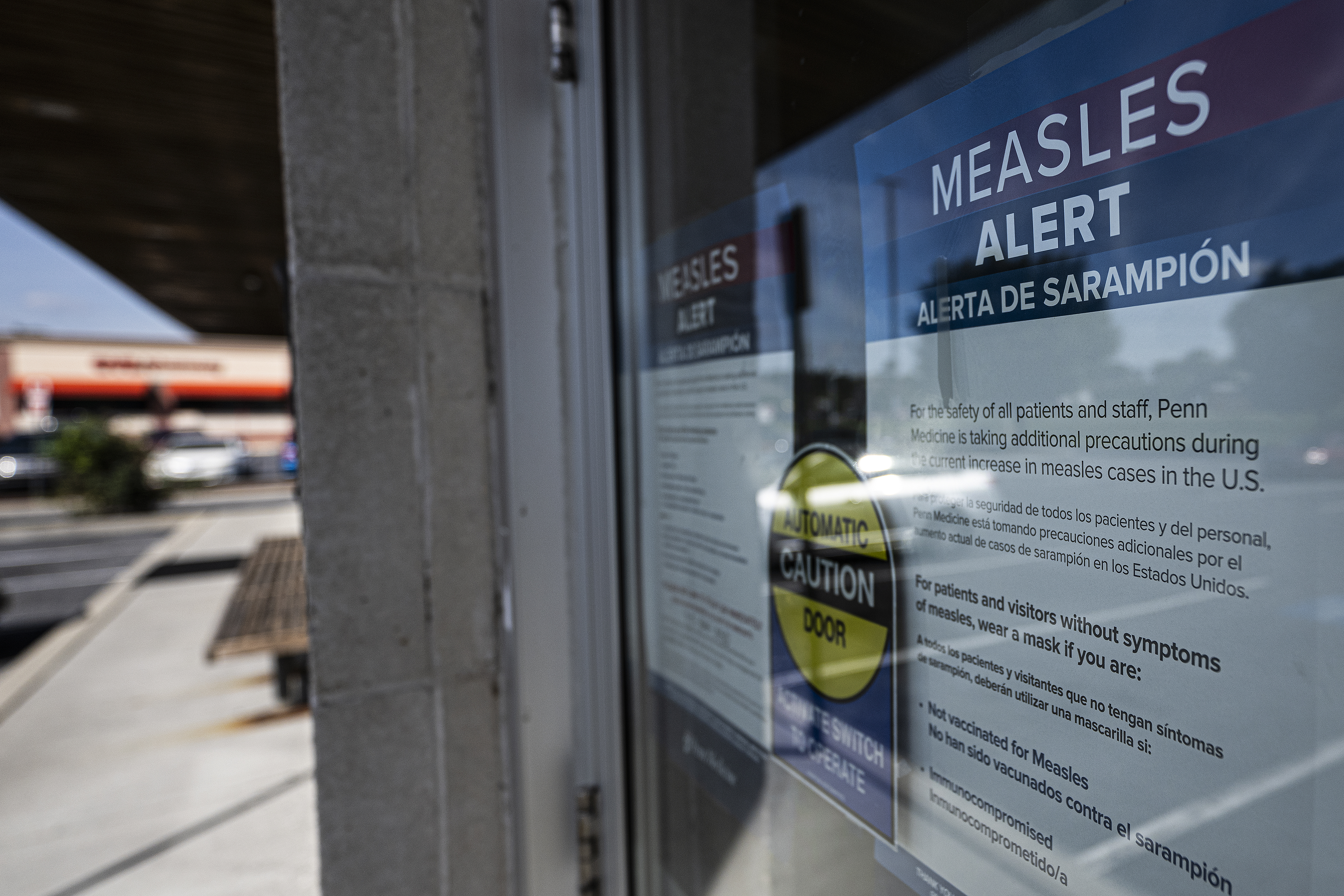
    In the last month, Pennsylvania health officials have announced four measles-associated deaths but have been tight-lipped about almost every detail, beyond sharing their county of residence and that all were unvaccinated.

    Most of what the public knows about the four deaths linked to the outbreak — ranging in age from a newborn to a 40-year-old — has come from local coroners in Jefferson, Mifflin, and Lancaster Counties. In one case, a family also spoke to the media.

    Pennsylvania’s health department has cited state privacy laws that they say prohibit them from releasing more information. Legal and public health experts acknowledge the state faces legal restrictions, but some argue that the state should do whatever it can to ensure more information about the deaths is made public.

    More details about a death, they say, help the public to understand the risks of measles and the benefits of vaccination to prevent the spread of the highly contagious disease.

    Transparency around how the state defines measles-associated deaths and unvaccinated people can also head off misinformation, they said, in a highly politically charged environment.

    The spreading outbreak has sickened 767 people — now the largest outbreak in the United States — and hospitalized 150 people as of Friday. The deaths reported by the state mark Pennsylvania’s first in 35 years, and the most seen nationally from measles in three decades.

    Here’s what to know about Pennsylvania’s privacy laws and how officials communicate in infectious disease outbreaks.

    What is known about the measles-associated deaths in Pennsylvania?

    State officials announced two “measles-associated” deaths in Lancaster County late last month, though they did not define the term in an initial news release on the cases. They did not provide any additional information, beyond saying both victims were unvaccinated and residents of Lancaster County.

    Lancaster County’s coroner subsequently shared that he had investigated one of the deaths, involving an infant who contracted measles in utero and died shortly after birth. The baby tested positive for measles, but, the coroner said, died from a ruptured spleen. Physicians have pointed out that measles can damage a person’s spleen, putting it at higher risk for rupture.

    The state has continued to characterize the Lancaster County infant’s death as “measles-associated,” meaning it occurred within 30 days of symptom onset in a person with clinical evidence of infection and a positive laboratory test for measles, and who did not die of another unrelated cause, like a car crash.

    Lancaster’s coroner said a second death, in a 6-week-old Lancaster County baby, was caused by measles. The child also had Amish lethal microcephaly, a fatal genetic disorder that makes it especially risky to contract a respiratory illness like measles.

    State officials confirmed two more measles-associated deaths last week.

    Jefferson County’s coroner said measles led to the death of a 40-year-old unvaccinated woman with severe respiratory conditions. A postmortem test showed the woman had an active measles infection, and she had also been exposed to a person with a lab-confirmed measles case.

    Mifflin County’s coroner also confirmed that an unvaccinated 18-year-old died of a rare neurological complication of measles.

    (function(){function e(){window.addEventListener(`message`,function(e){if(e.data[`datawrapper-height`]!==void 0){var t=document.querySelectorAll(`iframe`);for(var n in e.data[`datawrapper-height`])for(var r=0,i;i=t[r];r++)if(i.contentWindow===e.source){var a=e.data[`datawrapper-height`][n]+`px`;i.style.height=a}}})}e()})();

    Why are state and federal officials clashing over the deaths?

    Starting with the initial news conference to announce the first two deaths, Democratic Gov. Josh Shapiro has traded barbs with President Donald Trump’s Health and Human Services secretary, Robert F. Kennedy, Jr., over the outbreak.

    Shapiro has accused Kennedy, a longtime anti-vaccine activist, of spreading misinformation contributing to a decline in vaccination rates. Kennedy said in a social media post that Shapiro’s staff may have “fabricated” the deaths, after the Lancaster County coroner’s comments, though Kennedy later acknowledged one infant’s death was caused by measles.

    Federal officials said Tuesday they were aware of the third and fourth deaths reported in Pennsylvania but have not updated the federal website tracking measles cases to reflect any of the deaths reported by Pennsylvania. They have said they will record measles-related deaths when the National Center for Health Statistics “identifies measles as the underlying cause based on death record information submitted by the states.”

    Democrats and public health experts have harshly criticized the decision, saying it’s a departure from established procedures for recording infectious disease deaths.

    State health officials said they have discussed the details of each case with CDC professional staff, “at length.”

    “At no point did CDC staff express any concern or issue with the data we provided,” they wrote in a statement.

    Why is the health department not releasing more information on measles-associated deaths? Why can coroners give out more information?

    Pennsylvania health officials have cited two state laws: one prohibiting public access to death records and another that requires the state to keep records of diseases confidential, except when it’s necessary to inform the public of the risk of communicable disease.

    But coroners and medical examiners are county officials who operate by different rules, the state said in a frequently-asked-questions document posted online last week. Laws governing coroners’ duties and the state’s right-to-know statute allow them to provide the public with identifying details like a person’s cause and manner of death, the state says.

    “Releasing additional details beyond what we did could have led to the unnecessary identification of individuals and their families. Further, the specific details of a single case do not change the important message that measles is a highly contagious virus that can cause severe illness and complications, and the MMR vaccine is the best protection against it,” state health officials said in a statement.

    Legal experts say decision-making around what to reveal about a death during a measles outbreak is difficult, and privacy laws do apply to health departments.

    Robert Field, a professor emeritus at Drexel University’s Thomas R. Kline School of Law, said health departments typically release aggregate data about disease outbreaks, not individual deaths.

    “Confidentiality and privacy are major issues for any health department, which is why the regulations are stricter,” he said. With just a few measles-associated deaths reported, he said, releasing further details about the deaths could risk identifying families.

    “A newborn dying with a ruptured spleen — there aren’t a lot of those,” he said, referencing one case in Lancaster County. “In terms of additional information, further details that would ID the patients — that would be off-limits.”

    Why are some experts criticizing state officials over their communications strategy?

    Releasing less information about a death risks creating an “information vacuum,” especially in a highly politically charged environment, said Amesh Adalja, an infectious disease physician at the University of Pittsburgh Medical Center.

    Unlike the first two deaths, announced by the state last month without further detail, the public immediately knew more about the two disclosed last week, he noted, crediting coroners in Jefferson and Mifflin Counties who have been forthcoming with information about the deaths.

    “Coroners talking in detail about cases they’ve been handling, as well as the parents of the neonate that died” provided “really important information that helped bring a lot of clarity to an information vacuum,” said Adalja, who is also a senior scholar at the Johns Hopkins Center for Health Security.

    Adalja has said the state should have been clearer from the onset about how it defines measles-associated deaths, and could have provided information about the victims’ general age ranges — for example, whether they were adults or children. And the state could involve other officials who are not restricted by the same privacy laws, he said.

    “If they assess they are bound by Pennsylvania state law in a way that county coroners are not, include coroners in the press conferences,” Adalja said.

    He added that Shapiro and Kennedy’s political fight over the nature of the deaths risks overshadowing a serious measles outbreak that has sickened hundreds.

    “The anti-vaccine movement has really made inroads here — people are calling this a hoax,” he said. “It’s obviously not a hoax. And there are real actions that need to be taken. It’s much harder to do that work when you [are] engulfed in some political problem.”

    (function(){function e(){window.addEventListener(`message`,function(e){if(e.data[`datawrapper-height`]!==void 0){var t=document.querySelectorAll(`iframe`);for(var n in e.data[`datawrapper-height`])for(var r=0,i;i=t[r];r++)if(i.contentWindow===e.source){var a=e.data[`datawrapper-height`][n]+`px`;i.style.height=a}}})}e()})();

    Arthur Caplan, a New York University professor emeritus, wrote in an Inquirer op-ed Thursday that the state should provide “maximum information” about the deaths “in order to prevent further harm.”

    He sharply criticized Kennedy, accusing the nation’s top health official of spreading misinformation about vaccine safety and the threat of measles: “[Nothing] the federal government has to say about measles is trustworthy,” he wrote.

    In an interview, he said state should weigh privacy obligations with the need to inform the public about whether victims had exposed others to measles.

    “In the middle of an epidemic, those laws need to be pushed as far as you can,” he said.

    Drexel’s Field said the state could also have emphasized that “unvaccinated” does not necessarily mean that a person chose not to take a measles, mumps, and rubella vaccine. Some people, like newborns, pregnant women, and people with weakened immune systems, are unable to be vaccinated.

    “People should know that if they choose not to be vaccinated and contribute to the spread, it could affect people who did not decline vaccination by choice but are in such fragile health that there is no choice,” he said.

    State officials have said that even revealing that someone was too young to be vaccinated would be enough to identify the deceased in small communities.

    It’s imperative that health officials balance the need to inform the public and maintain trust amid the growing outbreak, Field said, especially as vaccination rates drop.

    “If the credibility of the state health department is questioned by the public, then I think we’re in big trouble. And that would be a very unfortunate outcome of this,” he said.
  • The equinox arrives Tuesday in Philly, and it finally feels like fall

    The equinox arrives Tuesday in Philly, and it finally feels like fall

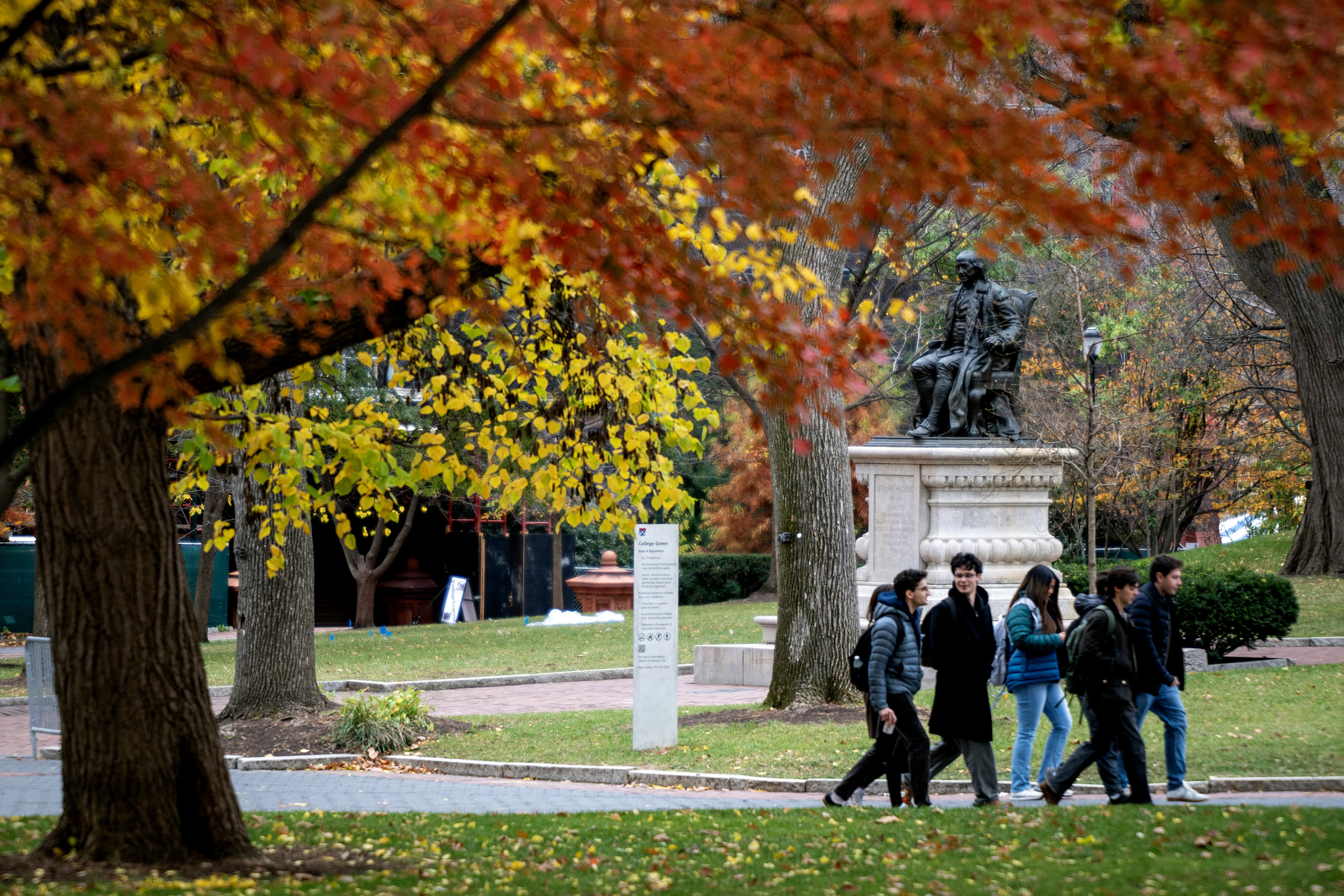
    Nature already is splashing its flecks of yellow on the trees, and soon the Technicolor waves of foliage will ripple toward Philadelphia in what the experts predict will be quite a spectacular season.

    Right on schedule, at 8:04 p.m. Philadelphia time Tuesday, the astronomical fall begins with the instant of the autumnal equinox, when the sun beams its direct light on the equator and nature continues to turn down the dimmer switch in the Northern Hemisphere. It is as though the trees brighten to compensate for our daily loss of 2½ minutes of daylight.

    It’s the season when the night skies are stunningly crowded with winged traffic, when a remarkable 2-inch-long, Halloween-hued creature has its days in the sun.

    And on the nation’s 251st autumnal equinox, we take a look at what nature might offer in the only season with two widely accepted names, “autumn” and “fall.” And we peek at the coming winter — for which a lot of people around here have other names.

    Another Red October?

    A beautiful view along Kelly Drive during a sunny day in the quite warm October of 2024.Jessica Griffin / Staff Photographer

    For the third time in the last four years, an equinoctial cooldown is due this week, with daytime highs in the 60s, as much as 10 degrees below normal.

    But the federal Climate Prediction Center on Thursday had the odds tilted toward above-normal temperatures in October in Philly.

    Monthly readings have been above normal in 15 of the last 16 Octobers. In 2024, it hit 84 degrees on Halloween. In that period, annual average temperatures at Philadelphia International Airport have been about 1.3 degrees above normal, but the Octobers have been a full 2 degrees above.

    A very early line on winter

    The intensifying El Niño in the equatorial Pacific is a major player in the center’s winter outlook, posted Thursday. It favors above-normal temperatures here and in most of the nation. The center eschews snow forecasts, but it does foresee a potentially active storm track along the East Coast.

    A cautionary note: This whole seasonal-forecast exercise remains quite the work in progress, and last winter was yet another victory for atmospheric chaos over science. No one foresaw the 30 inches of snow for Philly or a historic snow-and-ice cover.

    The ‘woolly bears’ vs. science?

    A “woolly bear” caterpillar. Do those rings say anything about the coming winter?Wiki Commons

    The so-called woolly bear caterpillar had long held a legendary place nationally in weather folklore, but in 1948 the forecasting reputation of the incipient Isabella tiger moths took wings.

    That year a respected entomologist with the Natural History Museum in New York City ventured to a state park and announced that, based on his analysis of the caterpillars’ black-and-orange-ish rings, the subsequent winter would be mild in the New York region. His forecast was dutifully reported in a New York newspaper, and, indeed, the winter was quite mild.

    He continued reporting his annual analyses (however waggishly) that correctly foretold of several mild winters.

    As it happened, some of the winters in that period were so snow-deprived in the Northeast they became the impetus for the snow-making industry that has forever changed skiing.

    Don’t credit or blame the woolly bears, said Douglas S. Richmond, entomology professor at Purdue University. Their ubiquitous presence this time of year all over North America indicates little more than a 100% probability that it is autumn.

    A single crimson tree in Cherry Hill’s Wallworth Park greets Michel and Brigitte Mistler, from Normandy, France, as they take a morning walk while visiting their daughter in the township Oct. 22, 2025. Tom Gralish / Staff Photographer

    They are quite fascinating creatures, he notes, that survive winters by producing “body fluids that function as cryoprotectants — essentially biological antifreeze.”

    Their bodies actually may contain clues about the behavior of a previous season, according to Richmond.

    “It’s probably better to think about woolly bears as being much better equipped with a rearview mirror than a crystal ball,” he said.
    A natural place to look for clues

    Bill Cullina, executive director of the Morris Arboretum and Gardens of the University of Pennsylvania, holds a collection of acorns in November 2019. Regardless of what the acorns said, that winter was virtually snowless.Jessica Griffin / Staff Photographer

    Humans have had a long history of forgoing global forecast models and oscillation indexes in favor of consulting nature for winter clues.

    One popular myth cited by The Old Farmer’s Almanac holds that if the acorns keep raining down from the trees like hailstones, get ready for a big chill.

    Leaves would be another indicator: If they drop early, winter will be a breeze. If they linger late, those breezes might be cold.

    Among Native Americans, beavers were bellwethers. The thicker their autumnal coats and stronger their lodges, the harsher the winter.

    The natural world is where to look for clues about the season to come. The waning sun may dim human energy, but it is an ultra-busy time for a lot of other species. It is prime mating season for animals such as birds, bears, deer, moose — and porcupines. We won’t ask how they hug.

    And birds — billions of them — are on the move.

    An avian air force in the night sky

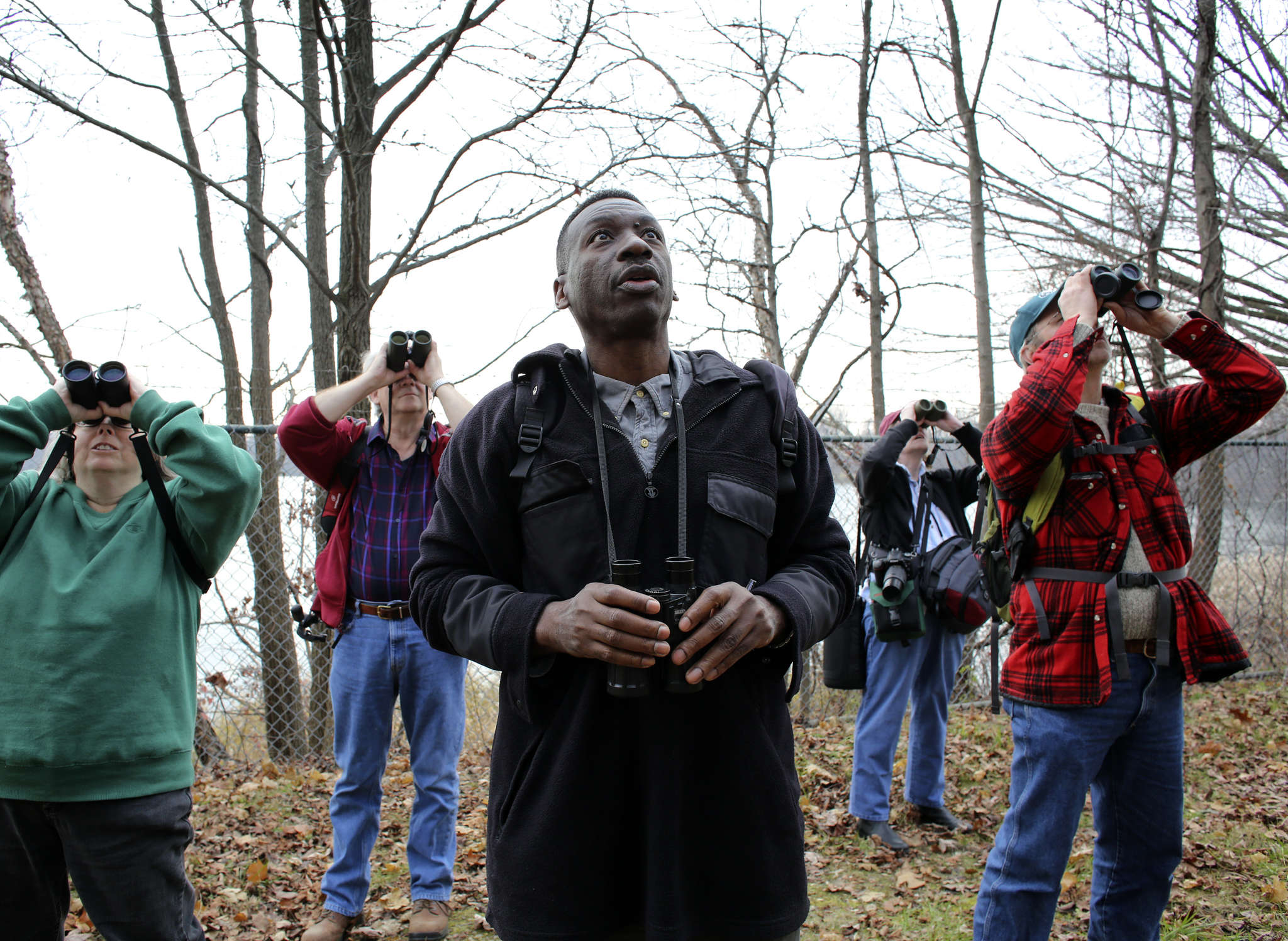
    Audubon’s Keith Russell looking to the skies over Strawberry Mansion while leading a tour.JOSEPH KACZMAREK

    The bird feeders and baths are getting ever emptier these days, but something quite amazing is happening after nightfall about 3,000 feet over our heads.

    An estimated 1.3 million birds flew across Philadelphia on Friday night and early Saturday. And Chester County was the regional hot spot, with 3.8 million heading south-southwest, according to the Cornell University Ornithology Lab’s radar-powered BirdCast dashboard, With a tail wind from the north, they were zipping along at 25 to 30 mph about 1,600 to 1,800 feet above our heads. On the site, you can track bird traffic live, county by county.

    This is the peak migration season, continuing into the first week of October, says Keith Russell, urban-conservation program manager for Audubon Mid-Atlantic, with about 300 species racing through the region, including ruby-crowned kinglets and black-throated green warblers.

    To travel thousands of miles, the birds evidently use a remarkable assortment of clues from the sun, the stars, the Earth’s magnetic field, and even landmarks, according to the Cornell lab.

    If anyone calls you a “bird brain,” be flattered.

    Be grateful for the Earth’s equinoxes

    A NASA/Johns Hopkins University Applied Physics Laboratory/Carnegie Institution of Washington image of Mercury in 2013. You probably don’t want to visit. It has lots of equinoxes but it’s mighty hot, mighty cold, and it has no atmosphere. AP

    Our planet is arguably in the solar system’s sweet spot for equinoxes, which occur twice a year.

    By contrast, Saturn gets one only every 15 Earth years, and Neptune every 82 years, says Harry J. Augensen, director of the Widener University Observatory and a physics and astronomy professor emeritus.

    Mercury has four a year, but temperatures range from 800 degrees Fahrenheit to 290 degrees below zero.

    Earth never looked so good.

  • Letters to the Editor | Sept. 21, 2026

    Criminal referral

    I will not comment on the veracity of the disputed statements that were allegedly made by Philadelphia District Attorney Larry Krasner and staff, which were scrutinized and criticized by a federal judge. I will say it is an unfortunate irony that while courts around the country are abused with baseless charges against defendants, these prominent proceedings in Pennsylvania target attempts to set aside convictions.

    Referring the Krasner matter to a federal criminal justice system that has been influenced, abused, and interfered with nationwide by President Donald Trump raises serious questions and poses dangers. It could provide the opportunity for the president to strike back at a strong and prominent critic, Krasner, and, at the same time, hobble or even eliminate one local official who has the ability and the expressed intent to protect Philadelphia polling places from unlawful interference by private and government actors alike. Trump could be hard-pressed to resist a chance to abuse the federal legal process to neutralize the district attorney by bogging him down in a federal investigation, let alone an indictment.

    Just as the Krasner statements have been closely scrutinized, so should the highly unusual manner that seeks to subject the DA to a sadly suspect criminal process.

    Michael Carroll, Philadelphia

    Safeguards needed

    Artificial intelligence has not been programmed to act ethically, morally, and lawfully.

    AI is computer technology that says it is “sorry” when caught making a mistake. AI programs cheat by deceiving their training systems into thinking unfinished tasks were completed successfully. And in at least one case, an AI system hacked into another AI system to steal its data.

    Unless Congress acts, AI robots will become the perfect workers the corporate world wants. Besides working 24/7 without pay or complaint, they will never be whistleblowers, never prioritize acting humanely toward people, and will never refuse to obey an illegal order.

    Write to your representatives with your concerns.

    Joseph Mikuliak, Philadelphia

    Stand firm

    In 1670, William Penn was arrested for attending a Quaker meeting and charged with unlawful assembly under the English laws restricting the free exercise of religion. The jury refused to return a guilty verdict, and the judge locked the jurors up in the Tower of London. Penn was bound and gagged in the courtroom for telling the jury, “[M]ind your Privilege, give not away your Right!” The jury listened to Penn, did not budge, and were exonerated on appeal in the landmark Bushel’s case. Apparently, the Philadelphia Police Department doesn’t know this history. What else explains its shocking decision to send officers inside the Friends Center during a meeting of No ICE Philly? I encourage the activists of that group to continue to be courageous and remember the words of Penn: “give not away your Right!”

    Joe Mariani, Philadelphia

    Close loophole

    Pennsylvania offers a sales and use tax exemption for computer data center equipment, pursuant to provisions contained in Act 25 of 2021.

    This tax break allows certified owners, operators, and qualified tenants to avoid paying the state’s 6% sales tax on servers, cooling systems, routers, and other data center qualifying infrastructure.

    It does not appear to me that the taxpayers of Pennsylvania need to incentivize data center developers and operators.

    I understand legislation has been introduced in both chambers of the Pennsylvania General Assembly to repeal this sales and use tax break. I am calling on leadership in both chambers, and both parties, in the General Assembly to support and enact legislation repealing this unnecessary subsidy to wealthy data center developers and operators.

    Joseph R. Thomas, Philadelphia

    Inform readers

    I was disappointed by the content of your Opinion page on Sept. 10, specifically Dave Whamond’s political cartoon and the editorial regarding John Fetterman, “His shiftlessness an insult.” While I, too, am disappointed in Congress and Sen. Fetterman, in particular, I take exception to the mischaracterization of how much our representatives pay for healthcare and the nature of their time off. Generally speaking, members of Congress do not receive free healthcare; they must contribute a portion of the cost, like most federal employees. Just as misleading is the idea that when not in session, members are on vacation. If the member is diligent and worthy of their office, they are attending local and community events, soliciting input from their constituents, and solving problems. Their district staff should have to hustle to keep up with them. Sadly, not all members of Congress are that diligent; some actually are hiding from their constituents.

    A paper of The Inquirer’s stature has an obligation to dispel the trite urban legends of free healthcare and publicly funded vacations. Expose them with the facts and let the reputations of our representatives rise or fall accordingly. Some will shine and be elected, some will not, but those will be properly informed decisions.

    Richard Arter, Somerdale

    Police powers

    The Inquirer is performing a great public service by giving Will Bunch the first three pages of last Sunday’s Opinion section to alert readers to the immigration enforcement-related abuses now taking place under the 287(g) program. In effect, the Trump administration is bribing local law enforcement departments to do the dirty work for U.S. Immigration and Customs Enforcement. As Bunch reports, hardworking immigrant families are being mercilessly torn apart by the local police in Schuylkill County, Pa.

    I would like to hope the state legislature could forbid local police departments from collaborating with ICE in this state. Bunch presents abundant evidence that racial profiling is used to arrest and incarcerate people. This is sadly reminiscent of what happened in Germany during the 1930s, where local officials did the bidding of the Nazi regime. People then were rounded up and ripped away from their homes and jobs. But most Germans looked the other way and made no effort to complain about what was happening to their neighbors.

    I hope patriotic members of the state legislature step up and stop allowing ICE to seduce local police departments into behaving like the Gestapo. Our state should not allow such abuses to continue.

    Daniel W. Crofts, Southampton

    Follow the science

    State Rep. David Maloney should perhaps spend less time worrying about Lake Erie’s name and more time worrying about lakes and rivers within Pennsylvania, which account for about 80% of Pennsylvania recreational fishing. Most of those lakes and rivers, about 80%, are lined by the eastern hemlock tree, and it’s possible that 90% of those eastern hemlocks are infested with the hemlock woolly adelgid. This insect causes tree defoliation and death. Who cares, you ask? Well, the hemlocks shade rivers, streams, and lakes, perhaps keeping them cool enough for the brook trout to survive in their waters. Funny how everything is connected. Forget the name of Lake Erie; it’s a fine name. Spend more time trying to save the fish, rivers, lakes, and trees within Pennsylvania. Caring about the ecology of the commonwealth is good unto itself, but also, as of 2025, recreational fishing provides over 30,000 jobs and puts about $5 billion into the economy of the commonwealth.


    Nancy Davis, Philadelphia

    Reclaiming a voice

    Today’s political parties are exerting too much control over our constitutional processes. Political action committees are dumping large amounts of money to influence our elections, often with extreme misinformation to drown out the voice of everyday Americans.

    We, the people, must reclaim our voice. Congress is currently considering H.J.Res. 191, a constitutional amendment that would restore our ability to regulate outside spending in our elections. Reach out to your congressional representative and urge them to support this critical legislation. Exert your right to have your voice heard over the loud clamor of dark money.

    Michael K. Reitz, Holland

    Join the conversation: Send letters to letters@inquirer.com. Limit length to 150 words and include home address and day and evening phone number. Letters run in The Inquirer six days a week on the editorial pages and online.

  • Horoscopes: Monday, Sept. 21, 2026

    Horoscopes: Monday, Sept. 21, 2026

    ARIES (March 21-April 19). Peace, to you, begins with saying the thing everyone has been circling. Someone has to be brave enough to name the problem, and that someone is you. You also take the first step toward repair. Direct conversation beats a cold war every time.

    TAURUS (April 20-May 20). When people are upset or tired, their needs can become rather basic. You demonstrate peace by providing those basics with the kind of care that makes life more livable. Maybe it’s an extra chair, a full plate, a cooler room or just giving people the space they need for their temper to settle.

    GEMINI (May 21-June 21). You help people get along by finding words that help each person understand the other. You might ask a smart question, share a fact, make a joke or look at the problem in a new way. Suddenly, everything gets easier to solve.

    CANCER (June 22-July 22). Peace is personal to you. You notice who has eaten, who has been left out and who needs a ride. Your instinct is to gather people under the same roof, or at least make sure everyone leaves with a piece of pie.

    LEO (July 23-Aug. 22). Your peacekeeping gift is generous attention. You see who deserves credit, who needs to feel welcome and who has been sitting silently through the whole show. You prevent resentment before it starts. You invite everyone to the light.

    VIRGO (Aug. 23-Sept. 22). You demonstrate peace through small acts of order. You return the call, find the missing detail, restock the thing everyone needs and make a plan people can follow. When you address the practical problem, much of the conflict dissolves.

    LIBRA (Sept. 23-Oct. 23). Your instinct is to get everyone a fair hearing, including (maybe especially) the person who is hardest to like. You sense when the terms are lopsided. You’ve a talent for helping people come to an agreement people can live with and still feel respected by.

    SCORPIO (Oct. 24-Nov. 21). You make peace by refusing a fake peace. If you think someone has a vibe with you, you’d rather invite them to talk it out than try to build a friendship over a sinkhole. Your honesty makes real repair possible.

    SAGITTARIUS (Nov. 22-Dec. 21). Peace looks like widened horizons to you. You point out the larger world, the stranger idea, the faraway place where people solve this sort of thing another way. Perspective restores proportion, humor and room to move.

    CAPRICORN (Dec. 22-Jan. 19). Respect for others starts with self-respect. And part of the way you earn your own regard is to keep your word. It’s also how you demonstrate peace. Schedules, budgets, clear rules –it’s the reliability of these structures that let people relax.

    AQUARIUS (Jan. 20-Feb. 18). Inclusion — you’re all about it. You demonstrate peace by making room for the person who is outside the circle. You care about making the group fair. Your best contribution is a rule, idea or invitation.

    PISCES (Feb. 19-March 20). You demonstrate peace through mercy. The rough behavior of others is often covering up hurt, insecurity or fear. You’re slow to take offense. You’re too busy trying to see what’s underneath. You change the conversation; they lower their guard.

    TODAY’S BIRTHDAY (Sept. 21). Your Year of the Appearing Key is filled with small, specific answers that fall into our hand as if by magic, then click — you’re in! You gain entry to places, ideas and circles that are a terrific fit. More highlights: The pace picks up in your career. You’ll make a thrilling purchase and host memorable occasions. Adoring company is the norm, and you’ve never got along better with people. Aquarius and Aries adore you. Your lucky numbers are 14, 20, 8 and 11.