Tag: topic-link-auto

  • Semiquincentennial freedoms are upheld daily by citizen airmen in N.J.

    Semiquincentennial freedoms are upheld daily by citizen airmen in N.J.

    Two hundred and fifty years ago, a group of ordinary men walked into a brick building in Philadelphia and signed their names to the most consequential document in American history, the Declaration of Independence. Throughout this year, and all across the nation, Americans are gathering to celebrate those first steps toward freedom.

    Last month, while I listened to the concerts on the Parkway and watched the fireworks over the Art Museum, I found myself thinking about the people who have kept it going ever since.

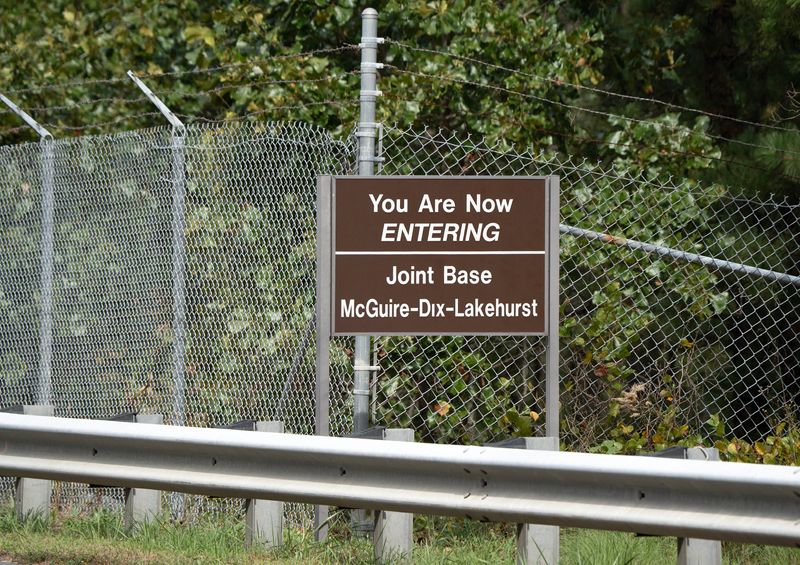
    Joint Base McGuire-Dix-Lakehurst is shown along Route 539, Whiting-New Egypt Road, Manchester Township, N.J. The author has served nearly all of his 26-year Air Force career at the 514th Airlift Wing at Joint Base McGuire-Dix-Lakehurst.Doug Hood/Asbury Park Press

    I have spent nearly my entire 26-year Air Force career right here, at the 514th Airlift Wing at Joint Base McGuire-Dix-Lakehurst in South Jersey, affectionately known as the Freedom Wing. That name has always meant something to me, but this anniversary year, it carries a particular weight.

    Freedom is not a monument or a date on a calendar. Freedom is a daily act of service, renewed by ordinary people who choose to do an extraordinary thing: raise their right hand and pledge to lay it all on the line for their fellow citizens.

    The members of the Freedom Wing are your neighbors. Truly and literally. They teach your children in Philadelphia classrooms. They run toward the smoke when your house is on fire. They wear a SEPTA uniform in the morning and a flight suit in the evening. They are nurses, corporate executives, police officers, and small-business owners. They coach Little League in the summer and strut down Broad Street on New Year’s Day.

    And then, when the nation calls or the mission demands, they put on the uniform and get to work. They leave their families, their jobs, and their routines, and they go where they’re needed. No questions asked.

    In the Air Force Reserve, we call them citizen airmen. I call them my chosen family and the best people I have ever known.

    Since this wing was originally designated in 1949, our citizen airmen have answered the call in every major conflict our country has faced — Korea, Vietnam, Iraq, Afghanistan — and in humanitarian missions across the globe. The Freedom Wing has never sat on the sidelines of history.

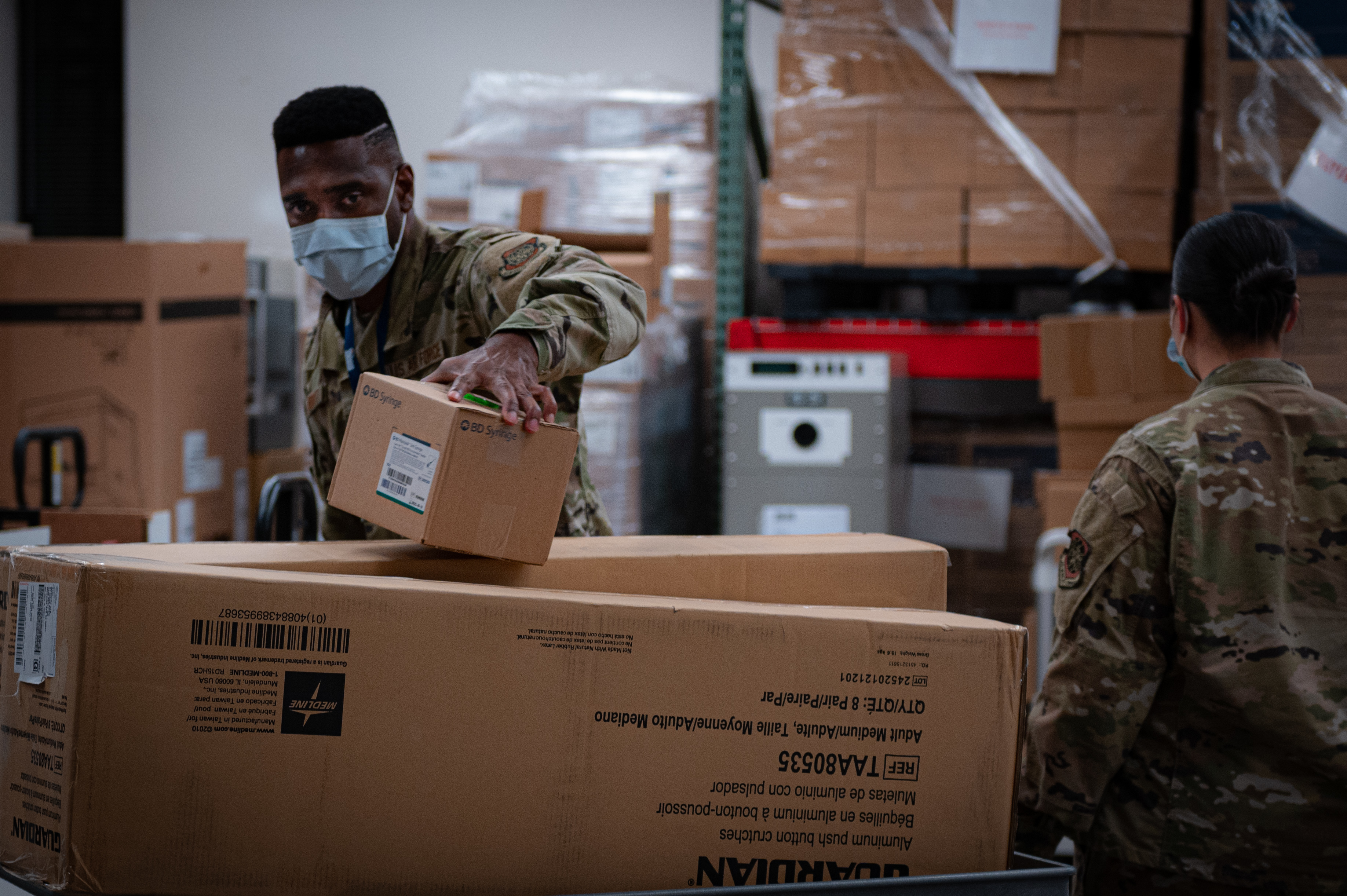
    Task Force McGuire-Dix Airmen prepare personal protective equipment to aid in the arrival of Afghans in support of the U.S. Department of State-led Operation Allies Refuge at Joint Base McGuire-Dix-Lakehurst in New Jersey in 2021.U.S. Air Force photo by Airman 1st Class Joseph Morales

    After more than a quarter century standing alongside these individuals, what strikes me most is not the mission accomplishments, though they have been extraordinary — it’s the sacrifice that surrounds each one.

    It’s the spouse who holds the household together for a sixth month of deployment. It’s the firefighter who tells his crew he has to leave again, and the crew that jumps to cover his shifts. It’s the teacher who builds training plans instead of lesson plans in the back of an aircraft at 30,000 feet, and the students who send hand-drawn cards and care packages.

    The uniform isn’t what makes these people and their loved ones remarkable. Their character does. Their grit does. This city is known for it, and so are our citizen airmen.

    As Philadelphia continues to celebrate 250 years of this improbable, magnificent country, take a moment to consider how we got here.

    Look around for the people who have dedicated their lives to preserving our freedom — they are already among you. Tell them you see them. That recognition costs nothing, and to a citizen airman who has given up more than most will ever know, it means everything.

    The truest way I know to celebrate Freedom 250 is not just to enjoy the freedoms we have inherited, but to honor the people who are still out there, right now, making sure we keep it.

    Col. Thad Amundson is the deputy wing commander of the 514th Airlift Wing, the “Freedom Wing,” at Joint Base McGuire-Dix-Lakehurst in New Jersey. The Philadelphia resident has flown combat sorties in Operations Enduring Freedom, Iraqi Freedom, New Dawn, and Inherent Resolve. He is a command pilot with over 4,000 flying hours, 800 hours flown in combat, and more than 5,000 flying hours as a civilian airline pilot.

  • A potentially ‘historic’ El Niño may become the biggest on record, NOAA says

    A potentially ‘historic’ El Niño may become the biggest on record, NOAA says

    The rapidly developing El Niño is likely to become a “historic event” that could become the most-intense in the period of record, the government’s Climate Prediction Center said Thursday.

    The El Niño warming in the tropical Pacific, coupled with how it is affecting the atmosphere, is all but certain to have dampening effects on the Atlantic hurricane season, researchers said.

    While it is likely to be disruptive and destructive during the next several months, during the tropical storm season it may mean fewer scares for East and Gulf Coast and Caribbean residents, and perhaps fewer flooding threats in the Philly region.

    El Niño already is making its presence evident thousands of miles away in the Atlantic Basin, said Philip Klotzbach, tropical storm specialist at Colorado State University. Colorado State’s forecast methodology has been the prototype for the outlooks issued by the National Oceanic and Atmospheric Administration and commercial companies.

    In his update last week, Klotzbach predicted the season would produce nine named storms, those with winds of at least 39 mph — down from 13 in the April outlook. NOAA also subtly trimmed its numbers. The long-term average is 14.

    Even with above-normal temperatures that usually would be favorable for storms in the hurricane-development regions of the Atlantic, what’s going on in the Pacific is going to dominate, he said.

    “El Niño is definitely the story of this season,” he said, and NOAA says the Pacific warming is likely to persist through April.

    (Even The Farmers’ Almanac has noticed. The winter outlook it has cooked up appears to be right out of the El Niño recipe book, calling for wetness and storminess in the South, typical of El Nino. Helpfully, it said the forecast up our way is “tricky.”)

    How does warmth in the Pacific affect Atlantic hurricanes?

    El Niños, which occur every two to seven years as part of a natural process, agitate the overlying air and disrupt atmospheric circulation worldwide. It is part of the so-called El Niño Southern Oscillation, or ENSO, and since oscillations do oscillate, El Niño periodically shares the stage with La Niña, during which the waters are cooler than normal.

    The climate center reported Monday that in the key El Niño region of the east-central Pacific, sea-surface temperatures over a 2.4 million-square-mile area were more than 3 degrees Fahrenheit above normal.

    That air-ocean interaction generates strong west-to-east upper-level “shearing” winds that can keep tropical storms from maturing into hurricanes.

    Klotzbach said that last week, the 30-day average of wind shear in the western Atlantic was higher than in any other 30-day period dating to 1979.

    Other players in the atmosphere affect tropical storm activity, but El Niño “usually becomes the dominant factor,” said Matt Rosencrans, the weather service’s lead hurricane forecaster.

    During the top six most-intense El Niños in records dating to 1950, tropical-storm numbers were significantly below normal.

    Is this El Niño yet another symptom of a warming planet?

    “There is still considerable debate in the scientific community on how warming may affect ENSO behavior,” said Michelle L’Heureux, physical scientist with NOAA’s Climate Prediction Center and the head of the ENSO team.

    El Niños likely have been occurring for eons, but the period of record dates only to 1950 because “much fewer observations” are available before then, she said.

    “It would take much more research to compare El Niño events in the older records,” she added.

    El Niños in which the temperatures reached 3.6 degree Fahrenheit — averaged over three-month periods — occurred in 1965-66; 1972-73; 1982-83; 1991-92; 1997-98, and in 2015-16.

    The warmest three-month average, 4.3 degrees Fahrenheit, was recorded in the 1982-83 event, and the climate center sees a 69% likelihood that this will exceed that level.

    But L’Heureux cautioned that “intense El Niño events are not totally unexpected.” The top six list shows that they have reappeared every 10 to 15 years.

    Thus, she said, “There’s a reasonable argument we were due.”

    What might all this mean for the Philly region’s weather?

    Tropical storms or their remnants “are especially notorious for flash-flooding impacts” in the region, said Sarah Johnson, warning coordination meteorologist in the weather service’s Mount Holly office.

    In 2020 and 2021, the region was affected by six such storms or remnants, including the devastating Ida, in September 2021.

    The 2020 season was quite active, and 2021’s hyperactive. Logically, fewer Atlantic storms would reduce the odds of remnants heading this way.

    With the exception of 2012, the year of Sandy, Johnson said that all the years with below-average flash-flood warnings issued by the Mount Holly office coincided with seasons in which no tropical storms or remnants have affected the region.

    We wouldn’t mind an encore.

  • Self-policing loading zones have worked in Center City, the PPA says, so they’re adding more

    Self-policing loading zones have worked in Center City, the PPA says, so they’re adding more

    The Philadelphia Parking Authority is expanding tech-enforced smart loading zones in Center City beginning Monday, citing reduced curb congestion and faster travel on two corridors over the last 15 months.

    Average traffic speeds are up 32% compared to historical averages on Chestnut Street and 28% on Walnut Street since the PPA installed the loading zones in May last year, according to a study by INRIX, the transportation analytics firm.

    During the middle of the day, that means vehicles are moving at around 10 mph, on average, vs. 7 mph before.

    High-res cameras track how long a delivery truck or a car stays in the zone, and software calculates a 10-cent-per-minute fee. That is then charged to the driver’s wallet on the CurbPass app. If needed, license plate pictures are used as evidence to issue $51 tickets for staying longer than the one-hour limit.

    “Really, the goal is ensuring curb space is available for the folks who need it most … and improving traffic flow through some of the most congested parts of the city,” said Gabe Roberts, interim executive director of the PPA.

    Turnover of vehicles is the key. It is a kind of EZ-Pass for curbs.

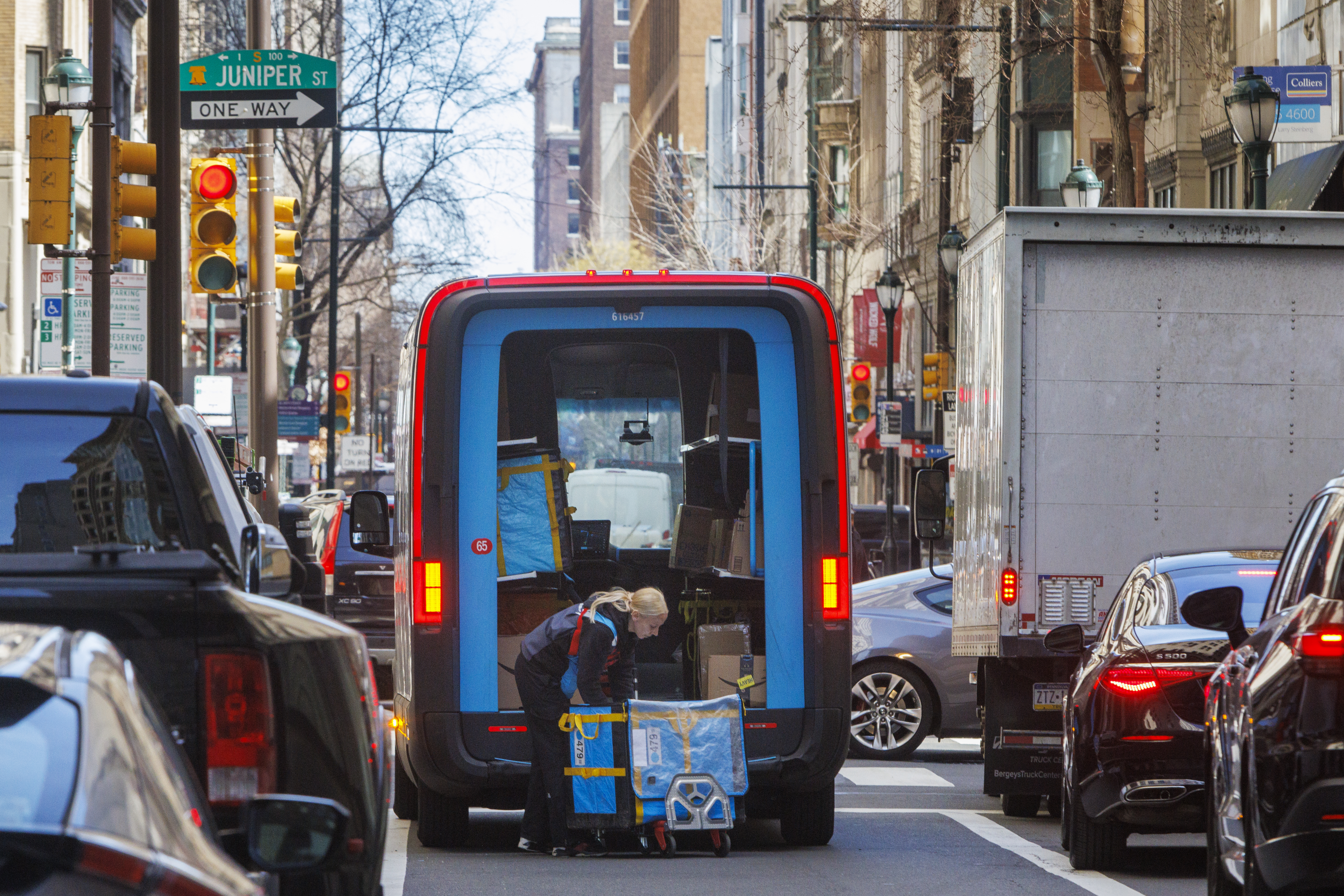
    The Philadelphia Parking Authority is adding 30 new smart loading zones in Center City, for a total of 52. Officials say the first set improved traffic flow.Philadelphia Parking Authority

    The system was developed by Los Angeles-based Automotus, a pioneer in curb management used in cities across the country, including Pittsburgh. PPA and the company installed smart loading zones on 22 blocks in May 2025.

    On Monday, the loading zones will begin operating on 30 blocks across Center City, PPA says. No tickets will be issued in the new spaces during a monthlong warning period.

    Darting delivery vehicles from DoorDash, Amazon, FedEx, UPS, and the like — along with Uber, Lyft, and regular drivers — have proliferated beyond the supply of curb space in Philadelphia and other cities in recent years, slowing through traffic to a crawl.

    Philadelphia has had business and passenger loading zones for years, but they had been overflowing, forcing some delivery trucks to double park in the traffic lane.

    Existing smart loading zones have effectively added curb space for 730 additional vehicles a day because vehicles are moving in and out instead of sitting for a long time, PPA says.

    PPA says it has seen a 97% increase in commercial freight and delivery trucks using the loading zones, cutting down on double parking that blocks traffic.

    The technology also captures plenty of vehicles double-parking in the zones, which are marked by purple, red, and white signs. That results in a $76 e-ticket.

    “Enforcement is much more exact and consistent,” Roberts said. “It develops an expectation” that can change behavior, he said.

    Indeed, PPA says about 78% of violators have received only one citation.

    CurbPass accounts are not limited to commercial vehicles. Anybody can sign up, including rideshare drivers. The first three minutes are free, so a driver can pull in and create an account on the spot from a QR code before the toll starts.

    In addition to loading zones, PPA is enforcing parking violations that block transit lanes and stops with AI-powered cameras mounted on bus and trolley windshields in Center City and West Philly.

    Roberts stressed cameras only capture data necessary for enforcement and, in the case of loading zones, billing: license plate, time in, time out, and location.

    “Our goal is to monitor the vehicle, not the person,” he said.

  • 2026 Hyundai Elantra N: When speed alone wins the race

    2026 Hyundai Elantra N: When speed alone wins the race

    2026 Volkswagen Jetta GLI Autobahn vs. Hyundai Elantra N vs. Mazda 3 2.5T Premium Plus AWD Hatchback: Let’s have some fun without breaking the bank.

    This week: 2026 Hyundai Elantra N

    Price: $38,345 as tested; just $500 extra for paint.

    What others are saying: “Highs: Sports sedan handling, rip-roaring turbo four, fuel efficient in real-world testing. Lows: The crease-heavy design isn’t for everyone, some dual-clutch clunkiness at low speed, adaptive cruise control isn’t on the menu,” says Car and Driver.

    What Hyundai is saying: “Our high-performance sport sedan.”

    Reality: Pretty high performance.

    What’s new: The front-wheel-drive Elantra continues without much change since its 2024 refreshing.

    The Elantra has really grown up in the last few years and is probably bigger if you haven’t checked one out in a few years.

    Be aware there’s a high-performance Elantra N like this one and a lesser-tuned N Line.

    Competition: In addition to the comparison vehicles, there are the Honda Civic Si, Honda Civic Type R, Toyota GR Corolla, Volkswagen Golf GTI, and Volkswagen Golf R.

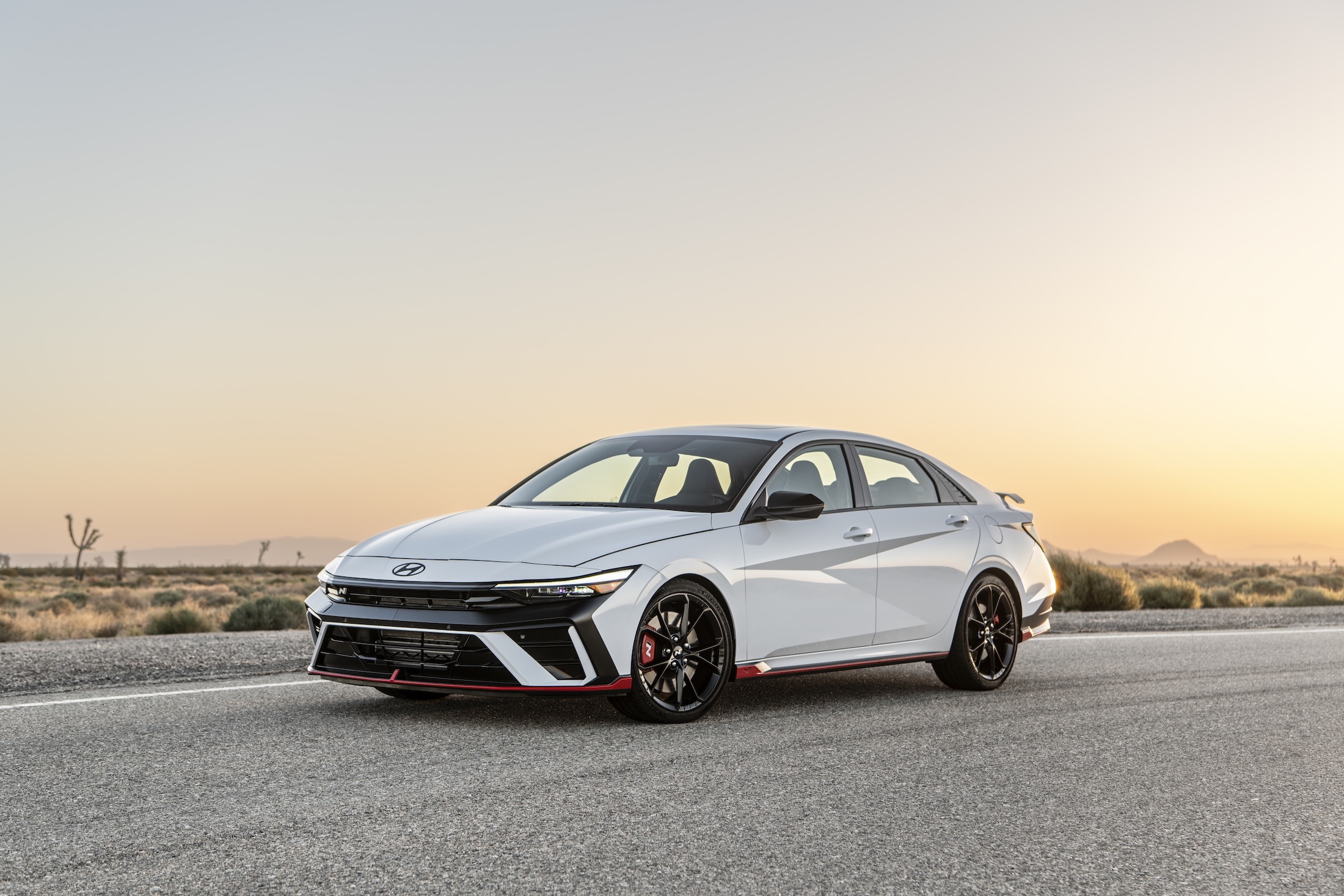
    Up to speed: Yeehaw! The Elantra N sedan really takes its work seriously, employing its 276-horsepower turbocharged 2.0-liter four-cylinder engine to full effect. There’s a mild turbo lag when pulling out, but the engine will make up for lost time quickly.

    The Elantra N gets to 60 mph in a zoomy 4.8 seconds, according to Car and Driver. That dusts the Jetta GLI by almost a second, and the Elantra N didn’t rock and roll under hard acceleration like the Volkswagen did.

    Shifty: The Elantra N came in 8-speed automatic form. It features an old-style PRND shifter with upshift and downshift accessed via a snap to the left.

    I thought only Mazda and BMW gave us pull-to-upshift anymore, The Way It Should Be, but lo, Hyundai does as well. Sadly, the Elantra N shifter had all the feel of your arm after you sleep on it for about five hours and really wasn’t worth the trouble. Paddles on the steering wheel are also available.

    I found shifting overall not worth the bother; the dual-clutch transmission handled the work smoothly, with just enough feel to add some fun when it shifted up or down, especially in Sport mode (which comes with nice sound effects). It holds lower gears a little too long, but I’ve felt worse. Advantage, Elantra N.

    I was excited the Elantra N comes with a 6-speed manual available as well, until I saw Car and Driver’s 0-60 report — that takes almost another second and a half, 6.1 seconds. That would make a noticeable difference.

    On the road: The Elantra N was niiiiiiice on the right roads. I’ve been loath to share my favorite spots in 15 years, but two creekside highways — one in Chester County and one in Berks — featuring plenty of 15 mph curves showed the best parts of the Elantra N. This part of the experience challenges Mazda, Mini, and Volkswagen just fine. It gives the Jetta GLI a run for its money, maybe even besting it.

    On highways, though, it hit seams and bumps pretty hard, but overall the Pennsylvania Turnpike was just fine. Here, though, the Jetta shone.

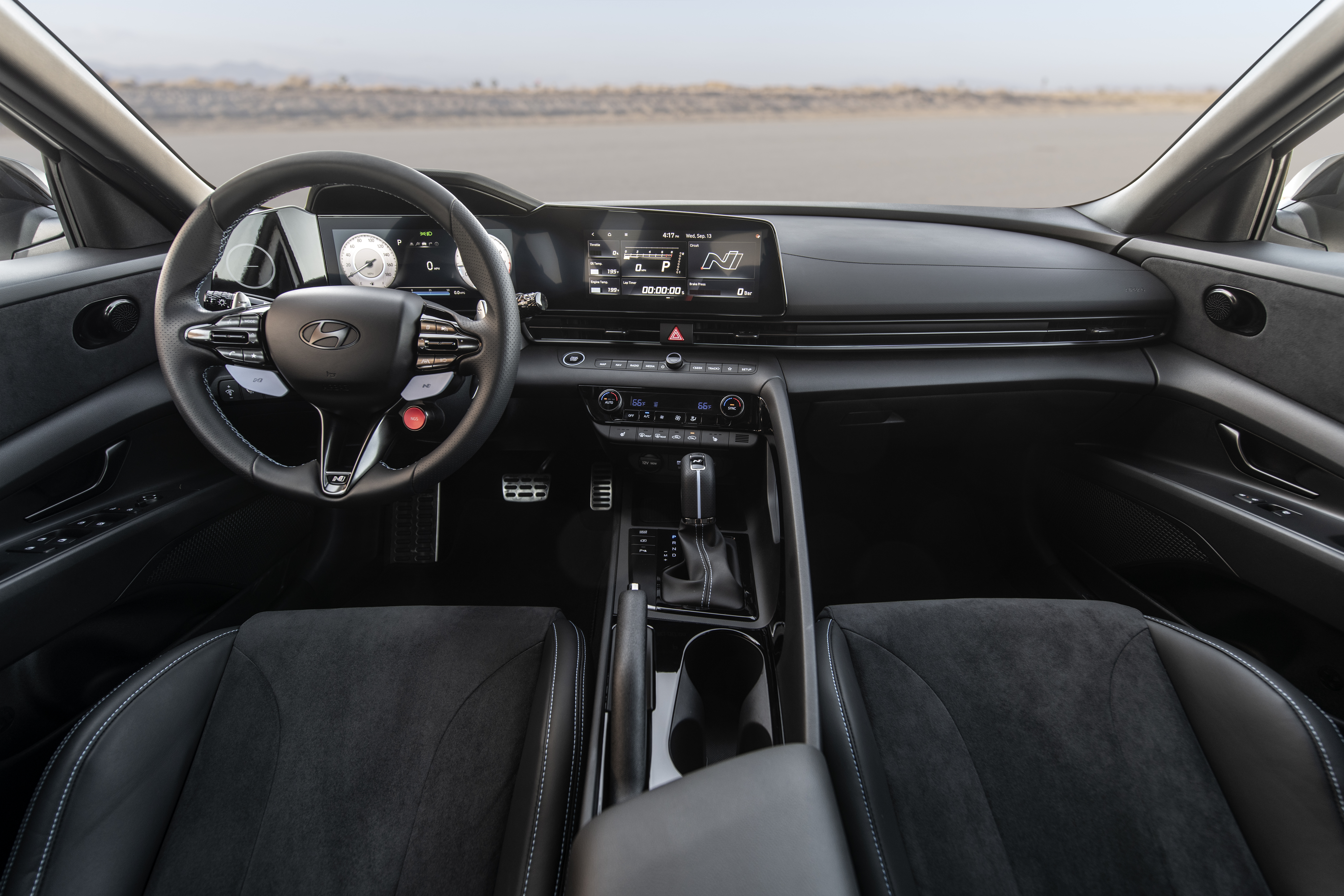
    The interior of the 2026 Hyundai Elantra N features a larger screen than the Volkswagen Jetta GLI, but the fabric could be a dealbreaker for pet owners.DREW PHILLIPS

    Driver’s Seat: This is a firm one, with tight contours that don’t move for you. In fact, the seat was manually adjusted and lacked ventilation, a nod to the vehicle’s price point. Advantage, Jetta.

    The passenger seat gets a cool console grab bar for The Lovely Mrs. to hang on to.

    Friends and stuff: The rear seat is perhaps a little firmer than the front, and it features almost as much contour, so woe befalls the loser stuck in the middle.

    Legroom and foot room are good, but headroom can be a bit challenging.

    The rear seat folds, but only as a single unit. You have to pull both left and right levers from the trunk and then go back to the seat and pull it down. The velour coverings mean pet owners might look for fabric upgrades or a different vehicle altogether.

    Cargo space is 14.2 cubic feet, a tenth of a cube bigger than the Jetta GLI.

    In and out: We rode off to visit Best Friend 1.0’s 91-year-old mom this week, so the first thing I did was test out entry-exit when the vehicle arrived. She has a 35-year head start on me, but I felt like the seat would be easy enough to access, with a wide door. I’m pleased to report no nonagenarians were harmed in the making of this review, but note that she still drives herself and does her own shopping, so your nonagenarian’s mileage may vary.

    Cool looking speakers that resemble giant on-off toggles on your phone are placed in the door, where they make you think they’re door handles at a glance. But no, those are awkwardly down by the armrest. It’s all worth it if the sound system rocks, right?

    Play some tunes: Alas, there will be only the standard level of rocking out in the Elantra N. Sound from the system reflects the price point — it’s a B at best. I couldn’t make the songs show off their hidden gems, but everything sounded as it should. The Jetta wins here.

    The 10.25-inch touchscreen has more than 2 inches on the Jetta’s, but both are easy enough to navigate. A volume dial is all you get outside of the screen.

    Keeping warm and cool: Dials control the temperature and buttons control everything else. Real buttons, too, not touch pad or ebony faux buttons. Advantage Elantra N.

    Fuel economy: The vehicle averaged almost 24 mpg over its lifetime, sucking down almost 20% more fuel than the Jetta.

    Where it’s built: Ulsan, South Korea. Parts are 85% Korean and 0% U.S. or Canadian.

    How it’s built: The Elantra gets a 3 out of 5 reliability rating from Consumer Reports for the 2026 model year.

    In the end: The Hyundai Elantra N provides a whole lot of fun for the price, but the Jetta GLI stuffs in so many more creature comforts — leather, ventilated seats, adaptive cruise, and a more everyday-worthy ride — for an even lower price, that’s tough to turn down.

    Next week: How will the Mazda3 Turbo compare?

  • Sizing up the 2028 Democratic presidential contenders

    Sizing up the 2028 Democratic presidential contenders

    The Democratic field for president is still wide open and unsettled. The very early list includes former presidential candidates, governors, senators, House members and celebrities. While no one on this list has officially declared, some candidates have been more open than others about wanting to run.

    Ahead of November’s midterm elections, the field is starting to take shape as a major debate roils the party: Is the surging progressive movement helping or hurting Democrats’ chances to take back the White House in two years?

    Some Democrats argue it’s time to embrace bold, progressive policies to boost their party’s popularity among working-class voters. Others think centrists will stand out.

    “I think Democratic voters are going to get incredibly pragmatic when it comes to 2028,” said John Anzalone, who served as the chief pollster for President Joe Biden’s winning 2020 campaign.

    Here’s how the field is shaping up. (This is our fourth ranking so far. Our most recent ranking of potential Republican candidates is here.)

    The standouts

    Jon Ossoff, Wes Moore, Raphael Warnock and other newish names: The Democratic base seems hungry for new leaders right now. Ossoff, the 39-year-old Democratic senator from Georgia, is fitting that bill in a big way. He’s getting millions of views for his sharp social media posts and campaign speeches that mercilessly criticize President Donald Trump.

    “This is the cruelest and most arrogant group of people who have ever ascended to high office in modern American history,” Ossoff told supporters in July.

    He is running for reelection in Georgia, and his race will be one of the most competitive in the country.

    Other Democrats point to Ossoff’s fellow senator from Georgia, Raphael Warnock, as a potentially strong contender. (Warnock is not up for election in November.)

    “For the first time since Obama, there’d be a candidate that unites the progressive Democratic lane and Black voters,” Texas-based Democratic pollster Nancy Zdunkewicz said.

    Moore, the first-term Maryland governor and only sitting Black governor, is described by some Democrats as young and vibrant.

    “Ossoff is currently on fire,” Anzalone said, “and Moore is also the type of guy who could really catch fire.”

    Kamala Harris: This summer, Democrats recommended South Carolina vote first in the 2028 Democratic nominating process. That boosts Black voters’ representation in picking the nominee and Harris’s fortunes, given the former vice president and 2024 nominee is probably the candidate on this list with the most support among Black women. She’s been rallying voters for the midterm elections by touting her “controversial” plan to abolish the electoral college and add justices to the Supreme Court. “They are ruthless! We need to be ruthless too,” she said recently of Republicans. Some Democratic insiders don’t see her as a viable candidate, given she lost to Trump.

    Gavin Newsom: The other California Democrat on this list aside from Harris has used his position as governor of the largest Democratic-run state to consistently oppose Trump. This summer he announced he and his wife were under federal investigation. (The Post has reported prosecutors are looking into potential tax crimes related to a nonprofit Newsom’s wife is linked to.) Newsom framed it as a compliment: “He’s coming after me because I’m considering running for president,” Newsom said of Trump.

    Josh Shapiro: The popular Pennsylvania governor has had a relatively low-profile summer compared to other candidates on this list. He appeared in a music video. He has declined to take sides on the progressive-versus-centrist split in the party (at least for now). His breakout moment may be coming. He’s up for reelection in November and is trying to help Democrats take back control of the House by helping his party win four of the most competitive races in the nation, all in his state.

    Alexandria Ocasio-Cortez: Democratic socialists are having their own moment. After helping elect New York City’s mayor earlier this year, they and the broader progressive movement ousted longtime members of Congress in deep blue cities and won a hard-fought primary in Michigan. Ocasio-Cortez, a congresswoman from New York, was one of the first members of the Democratic Socialists of America to win federal office, and she’s an obvious pick for the broader progressive movement to get behind if she runs for president. She hasn’t ruled it out, though she could also run for Senate.

    Mark Kelly: The senator from Arizona has emerged as a forceful pushback against his party’s turn to the left. He’s also a candidate some Republicans say scare them: He’s a former astronaut (at a time when astronauts are cool again) and an astronomical fundraiser from a swing state.

    Pete Buttigieg: President Joe Biden’s transportation secretary is cited by Democrats as one of the party’s best messengers and another young candidate who can catch fire. Despite not currently holding office, he’s near the top of several polls of Democratic primary voters.

    The middle of the pack

    Any other number of governors: JB Pritzker, the billionaire governor of Illinois, has urged his party to focus more on economic issues than Trump: “You don’t win elections talking to the public about democracy,” he said.

    Kentucky’s Democratic governor Andy Beshear has been pitching himself as someone who can turn rural America against Trump. When Sen. Mitch McConnell (R-Kentucky) was hospitalized for weeks without many updates, Beshear demanded McConnell prove his “capacity to serve” or resign his seat.

    Jared Polis is on his final year as governor of Colorado. He’s a wealthy businessman who has received some credit for turning a reddish state more blue. He recently shocked his party by commuting the prison sentence of former election official Tina Peters, who was convicted on charges tied to Trump’s efforts to stay in power after losing the 2020 presidential election.

    No longer on our list is Gretchen Whitmer. This year marks her final term as governor of Michigan, and she’s repeatedly indicated she’s not interested in running.

    Any other number of U.S. senators: Sen. Cory Booker of New Jersey is a fiery presence in the Senate. Last year he broke the Senate record for the longest individual floor speech. This month, in a committee hearing he declared Republicans’ food stamp cuts as “effing ridiculous.”

    Sen. Elissa Slotkin of Michigan, one of the few women on this list, served combat tours as a CIA analyst and represents a swing state. She’s crisscrossing the Midwest to connect with voters. The centrist could play an interesting role in trying to help left-wing Democrat Abdul El-Sayed win the state’s other Senate seat in November.

    Sen. Chris Murphy of Connecticut has been a prominent Democratic voice on foreign policy for many years. Like many candidates on this list, he’s been critical of Israel’s violence in the Gaza Strip. He also made headlines recently saying he’d support a “bad deal” with Iran to end the war.

    “There’s only a couple of Democrats that are thinking of running for president that have won red states,” Sen. Ruben Gallego of Arizona said recently. “I’m one of them. There’s only a couple of Democrats that can speak to working-class America, especially Latino men. I’m one of them.”

    Rahm Emanuel: The former Chicago mayor was previously President Barack Obama’s chief of staff. Emanuel is leaning hard on policy. He outlined a proposal for Israeli-Arab peace while traveling to Israel last month. Back home, he’s proposed a national social media ban for children, a mandatory retirement age for federal politicians and judges, and bringing back accountability systems for teachers.

    Ro Khanna: The congressman from California has the eye of some progressives for being one of the first voices in the House to speak out against Israel’s military action in Gaza, for playing a leading role in bringing the Justice Department’s Jeffrey Epstein files to light, and for being willing to regularly go on Fox News.

    The dark horses

    A celebrity or other political figure: ESPN commentator Stephen A. Smith is considering a run as a centrist. United Auto Workers president Shawn Fain is popping up as a possibility among some on the left.

    Democrats I’ve talked to say to leave room for surprise candidates. “There may be someone running we’ve never thought of,” Anzalone said.

  • Record El Niño to give Earth a preview of its warmer future

    Record El Niño to give Earth a preview of its warmer future

    This year’s record-smashing El Niño will do more than just shift and enhance patterns of heat, extreme rainfall and drought around the world.

    It will also give the planet a preview of the late 2030s.

    That’s because this El Niño will act like a climate time machine, temporarily pushing global temperatures to levels that might not otherwise be reached for another decade or so.

    According to an analysis by climate scientist Zeke Hausfather that was shared with The Washington Post, there’s around a 95 percent chance that 2027 will become Earth’s hottest year on record — soaring past the last record in 2024 — because the combination of El Niño and climate change could spike global temperatures to around 1.76 degrees Celsius (3.17 degrees Fahrenheit) above preindustrial averages.

    Described as “stunning” by Hausfather, who researches and analyzes the climate for Stripe, Carbon Brief and Berkeley Earth, this value would be so far above the warming trend of the last decade that it could bring global temperatures to levels not otherwise expected under that trend until around 2037.

    “I’m not sure folks have realized just how crazy the second half of 2026 and 2027 will be for global temperatures — on the back of a record-smashing El Niño event,” wrote Hausfather on X.

    It’s currently close to a coin flip whether or not 2026 would become the warmest year on record, according to Hausfather’s analysis, which considers the average of several different temperature datasets. It’s possible that 2026 sets a record in some, but not all, of these datasets.

    Jim Hansen, director of the Program on Climate Science, Awareness and Solutions at Columbia University, said he expects 2026 to become the warmest year, but to only hold that crown until 2027 exceeds it.

    There is a much stronger signal for record warmth in 2027 because increasing air temperatures caused by El Niño lag slightly behind increasing ocean temperatures.

    A global temperature of 1.76 degrees Celsius above preindustrial levels in 2027 would be about 0.29 degrees Celsius higher than what’s expected based on the warming trend of the past decade.

    According to Hausfather’s temperature predictions for next year, the middle 50 percent of forecasts range from 1.67 degrees Celsius to 1.85 degrees Celsius above the preindustrial average.

    At the high end of that range, global temperatures in 2027 would jump roughly 13 years ahead of the recent warming trend, reaching levels that might otherwise become typical around 2040. The low end would represent a 7-year-boost, to around 2034.

    Hausfather said that this El Niño event is happening on top of a “strong acceleration in the rate of warming associated with continued emissions of greenhouse gases.”

    Both Hausfather and Hansen also mentioned that decreasing atmospheric aerosols — which have historically offset some warming — are contributing to the acceleration in warming.

    Although Hausfather expects 2028 to be cooler than 2027, he added that “human emissions are adding a permanent El Niño worth of heat to the climate system each decade.”

    In other words, global temperatures in 2027 will take a big but temporary upward stairstep, and they are unlikely to permanently continue at or above those levels for now.

    These temperature increases will also have consequences for atmospheric water vapor. Because the water vapor-carrying capacity of air increases at a rate of 7 percent per degree Celsius, it’s possible — if not likely — that 2027 also sets a new global moisture record, surpassing 2024. In 2025, The Post mapped the planet’s rising moisture zones and showed how they are closely connected to an increasing risk for rainfall extremes.

    The role of El Niño

    During El Niño, huge stores of ocean heat from the western Pacific spread eastward, eventually reaching the west coast of South America. Thunderstorm activity shifts with that warmth, transferring heat from the ocean and pumping it high into the atmosphere. Winds and atmospheric circulation then redistribute that heat beyond the tropical Pacific and around the globe, raising global temperatures.

    That’s why strong El Niño events often appear as an upward stairstep in long-term plots of global temperatures.

    But this El Niño isn’t just going to be strong. Boosted by the planet’s long-term warming trend, it’s probably going to dwarf the six strongest that came before it in 2015, 1997, 1982, 1972, 1888 and 1877 — the latter contributing to a global famine that caused 3 to 4 percent of the global population to perish.

    Ocean temperatures in the central equatorial Pacific, where El Niño’s strength is measured, have already broken records for 75 days straight.

    That streak isn’t expected to end anytime soon.

    Temperatures in the equatorial Pacific Ocean may surge more than 4.0 degrees Celsius above average (7.2 degrees Fahrenheit) by December, breaking the previous record by more than a degree Celsius.

    The Post is tracking these records on a regular basis — and mapping the potentially significant weather ripple effects — in an El Niño tracker.

    Those weather effects will vary from place to place.

    But the temperature spike will briefly push the entire planet into its warmer future.

  • Prescription drug prices record sharpest drop in more than 60 years

    Prescription drug prices record sharpest drop in more than 60 years

    Prescription drug prices recorded the biggest year-over-year drop in more than 60 years in July, a startling reduction experts chalked up to an array of factors, including more generics and discount GLP-1 weight-loss drugs.

    While overall costs for medical services continued to rise, prices for medicinal drugs fell 2.7% over the 12 months ending in July, the largest annual drop on record, according to Bureau of Labor Statistics data released Wednesday. Prescription drugs, part of the medicinal drug category, fell by 3.1%, the steepest annual decline since March 1963.

    The White House took credit for the good news, saying President Donald Trump’s efforts to slash drug prices were working. Some experts said a Biden-era policy that requires Medicare to negotiate prices for some popular prescription drugs is more likely to be driving down costs.

    The drop in prescription drug prices is one of the few bright spots in the U.S. Consumer Price Index, which provides a snapshot of inflation. “Just what the doctor ordered!” Renaissance Macro, an investment research company, posted to X on Wednesday.

    Inflation has been running high for more than five years, sparked by the economic disruptions of the coronavirus pandemic and Washington’s response to it. More recently, prices have been rising because of energy pressures fueled by the war with Iran.

    Prescription drug prices, on the other hand, have slid sharply over the past six months, Renaissance Macro said, at a seasonally adjusted annual rate of 6.6% — “the sharpest six month drop on record.”

    While the results are stark, teasing out the cause is complicated, independent experts said.

    President Donald Trump has long pledged to bring down prescription drug prices, and the White House made the case Wednesday that the president’s pricing agreements with drug companies and a new initiative, the direct-to-consumer site TrumpRx, are responsible for the lower prices.

    “No president in modern history has been able to drastically reduce prescription drug prices across the board except for President Trump,” White House spokesperson Kush Desai said in an email. “This is a direct result of the President’s willingness to push the envelope with bold policies that actually put Americans and America First.”

    White House officials pointed particularly to the costs of GLP-1 weight-loss drugs, which Trump calls the “fat drug.” TrumpRx, which launched earlier this year, offers GLP-1 drugs for as low as $150 for a starting dose. And under a Medicare pilot program that the administration launched in July, drugmakers Novo Nordisk and Eli Lilly agreed to charge the government just $245 a month for their products, Wegovy, Zepbound, and Foundayo.

    Monthly prices charged to insurance companies previously had topped $1,000. Trump and the drug companies began negotiating last year and announced the rough outlines of the deals in November.

    “In a matter of months, we got up and running these discounts in a way that they were meaningful for American patients,” said a White House official, speaking on the condition of anonymity because administration staff are not authorized to speak publicly.

    But bigger trends in the GLP-1 marketplace were already driving down prices independent of Trump’s negotiations, according to experts on drug pricing. Spotty insurance coverage for Wegovy and Zepbound for weight loss has produced enormous demand for lower consumer prices. And cheaper compounded drugs have posed genuine competition for the brand-name companies, adding even greater downward pressure.

    Richard Frank, a senior fellow at the Brookings Institution and a professor emeritus of health economics at Harvard University, said he doubts Trump’s initiatives are behind the drop in drug prices.

    “If I was a betting guy on what mattered most, it would be probably stuff around the Inflation Reduction Act,” Frank said, adding that Trump’s efforts “wouldn’t be where I’d place my money.”

    The Inflation Reduction Act was a signature accomplishment of former President Joe Biden, a sprawling measure enacted in 2022 that aimed to lower prescription drug prices by requiring Medicare, the federal health program for the elderly, to begin negotiating the prices it pays drugmakers for an array of popular and costly prescription drugs.

    The first price reductions took effect at the beginning of this year. Using 2023 prices as a benchmark, the Centers for Medicare and Medicaid Services has estimated taxpayer savings of $6 billion from that first round.

    The Trump White House argues that the Inflation Reduction Act gets too much credit for lowering prices, in part because it took four years to take effect.

    Stacie Dusetzina, a health policy professor at Vanderbilt University, said the Inflation Reduction Act is a more plausible contributor to the decline in prices than Trump’s initiatives.

    While only 10 drugs have had their prices negotiated so far, they are commonly used ones “and their prices would likely be reflected in the prescription drug index,” she said via email. TrumpRx, on the other hand, covers “a limited number of branded drugs,” Dusetzina said, and “aside from GLP1s, they may not be high enough volume to be included.”

    Dusetzina said another Trump policy — most-favored-nation pricing, which ties U.S. prices to lower ones paid abroad — could not explain the drop in prices either, “as the models that are supposed to use this form of pricing haven’t even launched.”

    The Bureau of Labor Statistics category for prescription drugs does not track what drug companies charge. It tracks how much a pharmacy actually receives when it fills a prescription. That means it includes a customer’s payment at the counter plus whatever is paid by their private insurance or by Medicare Part D, the program that pays for drugs picked up from a pharmacy.

    A drop in this index does not necessarily mean drugmakers have cut their prices. It can also reflect insurers and Medicare striking better deals or people switching to cheaper drugs.

    Which brings up another, less glamorous source of lower prices: generics. When a brand-name drug loses patent protection, BLS waits about six months, swaps the brand in its sample for the cheaper generic and records the difference as a reduction in price.

    A wave of blockbuster drugs lost exclusivity over the past year, and Dusetzina said that could be pushing the index down — “especially if the drugs were commonly filled.”

  • Chatbots are doing the work of Congress with little oversight

    Chatbots are doing the work of Congress with little oversight

    The amendment was one of hundreds filed this summer to an annual defense bill making its way through Congress. Along with her proposed change, Rep. Anna Paulina Luna’s office had sent a summary of what it would do.

    But the first line made no sense.

    “increasing example specific factors. Identical to H.R. 100 (118th Congress).11:25 AM????Claude responded:”

    One of Luna’s staffers had copied a chatbot’s answer — time-stamp and all — and pasted it into the public record of the National Defense Authorization Act.

    As a screenshot of the garbled text circulated on social media, the Florida Republican was nonchalant.

    “Not a shocker,” she wrote. “Most staff use it.”

    Asked later about the incident, Luna went further. “A lot of staff will use ChatGPT, Claude, Grok. I personally like Grok better, but my staffer prefers Claude,” she told The Washington Post. “I’m not gonna knock him for that. There’s nothing illegal about him doing a summary.”

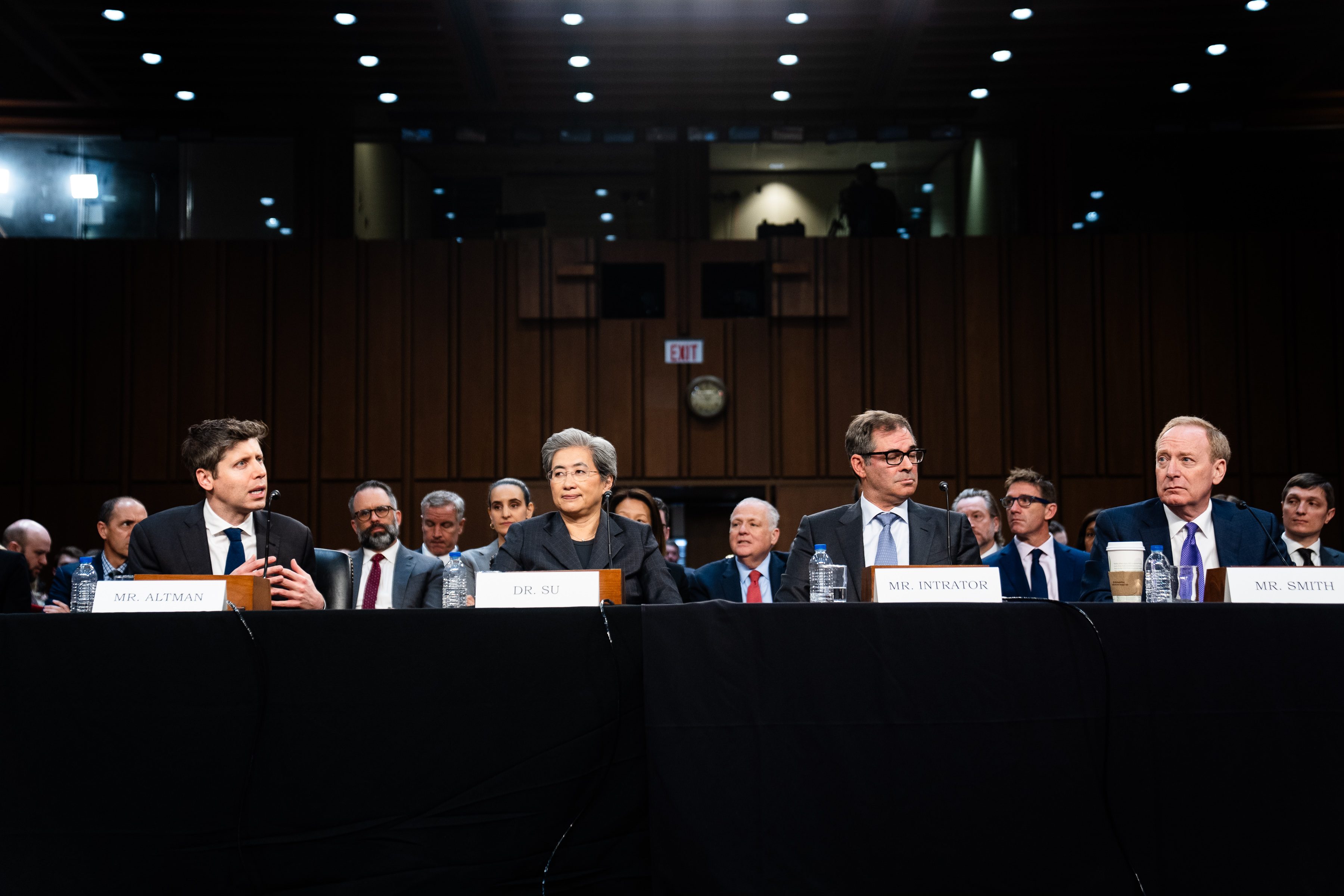
    Across the Capitol, lawmakers and staffers are using artificial intelligence to write speeches and news releases, sort constituent mail, prepare questions for congressional hearings and draft amendments.

    Even as politicians are debating how to govern AI for the rest of America, Congress has already settled how it will use the technology: quickly, broadly and with little oversight.

    Both chambers have cleared members and staff to use chatbots — Copilot, ChatGPT, Gemini and, in the House, Claude — for official work, with more under review. The House bought 6,000 Microsoft Copilot licenses last year and encouraged staff to use them.

    Having someone else put words in a lawmaker’s mouth is nothing new. For almost as long as Congress has existed, staffers have been ghostwriting speeches for their bosses. But a speechwriter can be summoned or fired. Chatbots are products built by the tech companies lawmakers are in charge of regulating.

    Amid the rapid adoption of AI on the Hill, lawmakers face a key question: How much of their responsibilities are they willing to hand over?

    Interviews with more than two dozen lawmakers and staffers — some of whom spoke on the condition of anonymity to discuss internal operations — along with internal House and Senate policies obtained by The Post, show that the institution has left that question largely unanswered. The few House and Senate rules that exist are poorly understood and seldom enforced. In practice, AI use is left up to the hundreds of individual congressional offices to settle for themselves. It’s not clear how many offices have internal written policies on AI.

    And no one The Post asked knew of any instance where a staffer was formally disciplined by the House or Senate for breaking its rules.

    Luna was right. There was nothing illegal about having AI edit, spell-check — or even write — legislative materials. It wasn’t against House rules, either.

    Her staffer’s only mistake was letting Claude sign its work for others to see.

    Congress’s newest staffer

    Sen. Tommy Tuberville has found a new way to pass the long drives across Alabama: talking to ChatGPT.

    He asks it about Medicare and Medicaid, and listens as the machine’s voice talks back.

    “It’s kind of like you can sit there and talk to an expert,” said the Alabama Republican. “You don’t know whether or not they’re 100 percent correct. But they put you on the right path.”

    Rep. Mike Flood (R-Nebraska) said he consulted a chatbot while working on a bipartisan housing bill that passed this year, asking it where private equity was buying up single-family homes. Sen. Elizabeth Warren (D-Massachusetts), who has proposed stricter legislation on tech companies, uses ChatGPT to look up demographic information.

    One GOP staffer’s boss uses chatbots to generate the occasional cartoon of himself, she said with a laugh. Her explanation: “He’s a boomer.”

    But the real power users are the thousands of staffers who do most of Congress’s work.

    Earlier this year, Rep. Cleo Fields (D-Louisiana) had a town hall coming up in Natchitoches, a city in his district that his press secretary didn’t know well.

    So that aide, Sydney Broome, asked Claude for a list of TV stations in town, its newspapers, and reporters’ names and contacts. Then, she started calling each one.

    At 22, Broome is the youngest full-time staffer and only press secretary for Fields. AI saves her three or four hours of work a week, she said. Her boss does not use it at all.

    ChatGPT first emerged when Broome was still in college. Her professors, unable to stop students from using AI, urged restraint and ran their assignments through AI detection. Students could use it for research, they warned, but never to write from scratch.

    Congress has no such checks. So Broome has imposed them herself.

    She’ll use Claude to find a reporter’s email, but not to write to them. She doesn’t use it to produce anything in her boss’s name. “That’s just kind of a bit of a gray area,” she said.

    Many staffers say they are aware of AI’s limitations. The tools occasionally invent nonexistent bills. Other times, the writing is formulaic and clunky. Still, chatbots help speed up their work.

    A GOP aide in another office said he uses Copilot to write appropriations amendments. The subcommittee he works for used AI to suggest witnesses for a hearing and to help generate the questions lawmakers should ask them.

    Another Republican aide has taken AI even further. He exported all his phone contacts and text messages — years of conversations — into a personal Claude account and told it to build a database of every reporter he has ever dealt with: what he pitched them, which ones they accepted, which exchanges went badly. The chatbot auto-updates itself with each new conversation.

    Recently, his boss wanted to do a TV interview about surveillance law. The aide asked Claude whether he had ever pitched a TV booker on that topic and how it went. It came back instantly with a contact.

    Claude also runs that staffer’s office’s communications budget — the taxpayer-funded mail and ads sent to constituents. “I don’t really have to touch the data in Excel much anymore,” he said.

    The aide said he’s not sure what exactly is permitted by congressional rules. “You’re still not supposed to put constituent data into AI,” he said. “There are weird things around where the rules are. I don’t know all of them.”

    When nobody’s looking

    In 2024, the House Administration Committee convened a private, bipartisan meeting with House officers and outside AI experts to talk through how far to let AI into the legislative process. About 150 chiefs of staff attended.

    Out of it came the first AI guidance for Capitol Hill.

    Internal House and Senate policies obtained by The Post and interviews with people familiar with them show how Congress has embraced the use of AI.

    Last summer, the House bought 6,000 Copilot licenses. The tool was a natural fit for a chamber that already ran on Microsoft and a more secure way to keep congressional work inside a single system, officials believed. Starting in January, offices could sign up for access.

    They came with a major guardrail built into the system: Copilot is designed to refuse political requests. Ask it to criticize a party, politician or political group, and the machine declines.

    “I can’t create content that criticizes or condemns political parties, politicians, or political groups,” read one Copilot response shared by a staffer. “That includes writing tweets that attack Democrats, Republicans.”

    Roughly half the licenses are now in use, and House officials have extended the deal.

    The rules Congress wrote for itself are loose. Off limits under current House guidance: putting sensitive material such as constituent information into a chatbot, generating deepfakes, making personnel decisions and finalizing legislation.

    A machine may help write a bill but may not be the last hand on it. It may draft a reply to a constituent but can’t be told who the constituent is.

    In theory, a staffer breaking those rules can be stripped of access to AI tools, suspended, fired, even fined and imprisoned.

    But no one could name a single case of that happening. People familiar with House operations said they’re not aware of any enforcement action by the chief administrative officer. A spokesperson for the CAO said the office can’t comment on potential enforcement actions. A spokesperson for the Senate sergeant at arms didn’t respond.

    Catching violations largely falls on staffers, who would have to report a colleague, or themselves.

    Most said in interviews that they don’t know the rules. A former senior Republican House staffer said that his office subscribed to both ChatGPT and Claude and that staff used them however they liked. He wasn’t sure what the rules were, or whether his team followed them. “We just had a free-for-all,” he said.

    The House and Senate encourage individual offices to implement their own written AI policies. If a House office wants Copilot, in theory, it must have a policy in place.

    One reason Congress has moved so quickly to adopt AI tools is to keep pace with the executive branch, said people familiar with internal House operations. The Trump administration has spent the past year and a half pushing AI into every corner of the government.

    “If we are not keeping pace with how the executive branch is functioning,” one person said, “then we’re not performing effective oversight.”

    AI for everything

    The new frontier has left some lawmakers pondering how to proceed.

    “We want to make sure we’re using AI, and AI isn’t using us,” said Rep. Jamie Raskin (Maryland), a constitutional law professor and the top Democrat on the House Judiciary Committee.

    Sen. Elissa Slotkin (D-Michigan) recently worked with her staff on a new policy for her office. They can use AI to “enhance and streamline” work but not to generate “final products” — like floor speeches or public remarks. They have to take AI training. Nothing with personal information about constituents or the senator can be uploaded. And her office is holding unannounced “spot check” inspections.

    “We didn’t want to prohibit the use of the newest tools, but we also didn’t want absolute schlock showing up in my memos,” Slotkin said. “What I’m not willing to do is put my head in the sand and pretend that my young staff aren’t going to find new and interesting ways of doing this.”

    In recent months, one Democratic staffer said his office has been exploring something new: feeding AI his boss’s past statements so the tool can write in the lawmaker’s voice. He heard another office was pulling it off and wanted to try himself.

    In the same building, a GOP press secretary whose office has stricter AI limits said it’s unfair other offices get an advantage. “We could churn out so many op-eds if we were more comfortable with AI,” she said.

    Recently, she found her own press assistant using AI in violation of their office’s policy. “We had to have a very robust conversation about how not to use AI for things in [the boss’s] voice,” she said.

    A preview of what more rampant AI use could look like already exists in state legislatures — many of which have no rules or policies at all.

    Amber Hulse serves in the South Dakota state Senate, where money is tight and lawmakers have no full-time staff. Hulse, a Republican, uses AI for almost everything — policy research, constituent email, speeches, writing legislation.

    Lately, she said, the signs of AI’s effects are getting easier to spot.

    “It’s funny,” Hulse said, “how your ears will start to pick up on the floor someone who’s giving a speech that was very clearly written by AI.”

  • Trump’s vibes-based vaccine order promises to kill more kids | Editorial

    Trump’s vibes-based vaccine order promises to kill more kids | Editorial

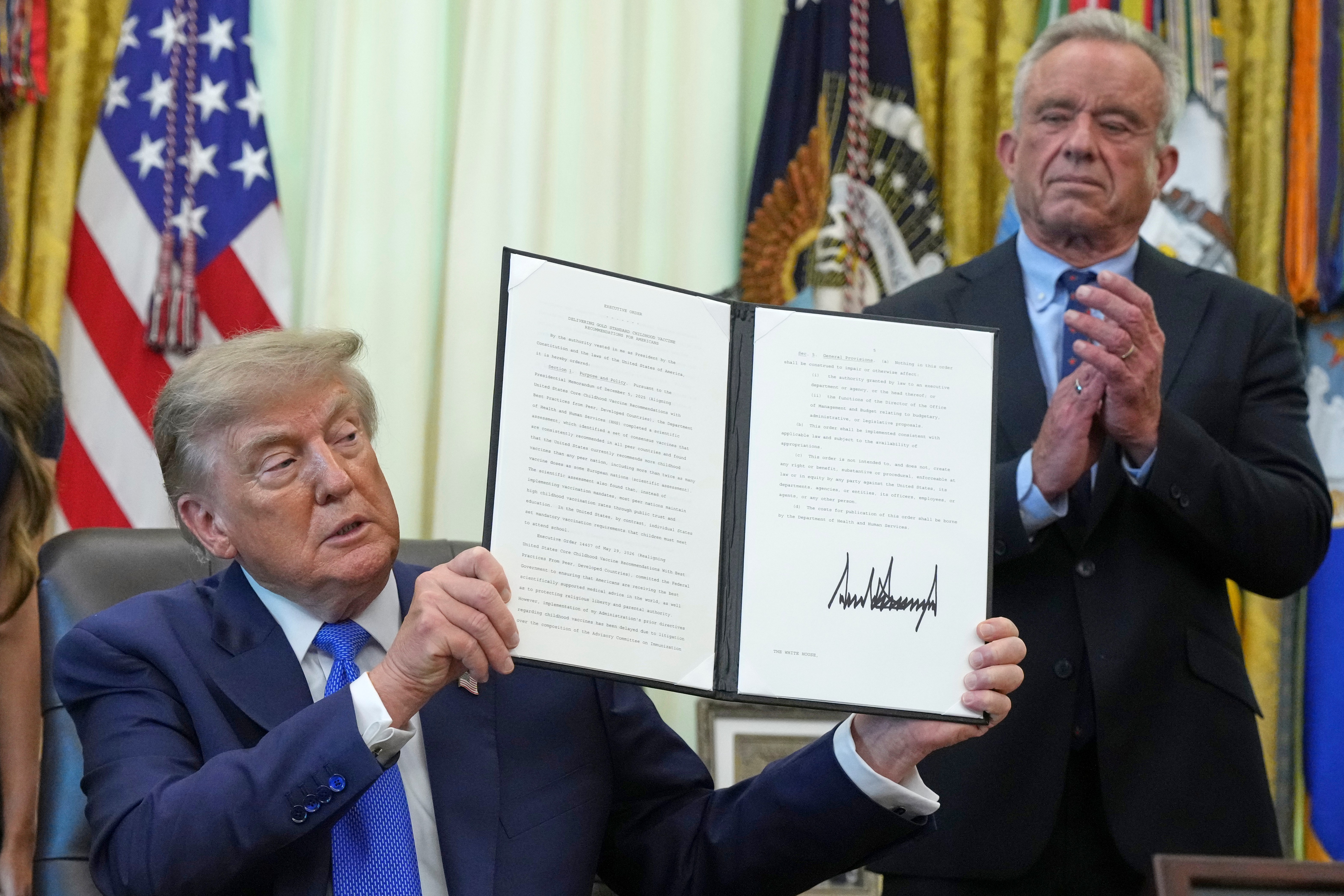
    The American Academy of Pediatrics noted this week that Donald Trump’s new “Gold Standard Childhood Vaccine Recommendations” are “not based on gold-standard science.” This is accurate but understated: They’re not based on science at all.

    The executive order, like the rest of the anti-vaccination crusade led by the president and Health and Human Services Secretary Robert F. Kennedy Jr., rests on vibes, superstitions, and folklore. It would be tempting to compare it to witchcraft if not for the risk of defaming witches.

    Trump’s directive seeks to reduce the number of vaccines recommended for children by more than a third, from 18 to 11, exposing many more to the worst outcomes of hepatitis B, influenza, and COVID-19. It also recommends that each vaccination be administered in a separate appointment, and that the measles, mumps, and rubella (MMR) shot be split into immunizations for each of the three diseases, which are not available as such in the United States.

    Reprising an earlier Health and Human Services policy that was blocked by a federal judge, Trump’s order is on dubious legal as well as scientific footing. But even if it doesn’t survive judicial scrutiny, the administration’s continued muddling of vaccination messages has obvious risks.

    Likewise, making child immunizations that much harder for working parents by requiring more appointments can only bolster the president’s remarkable success in making America measly again. More people have already contracted measles under this administration than in all the preceding years of this century combined.

    Cases of pertussis, also known as whooping cough and commonly prevented by a combination vaccine, hit a 13-year high in 2025. This year, a flu outbreak sickened hundreds of Air Force trainees and killed one after Defense Secretary Pete Hegseth made vaccinations optional. It’s all too foreseeable given Trump’s disastrous mismanagement of the pandemic, which killed more than a million Americans.

    Childhood vaccinations, meanwhile, saved more than a million lives over the past three decades. A federal study found that they also prevented 32 million hospitalizations, half a billion illnesses, and $2.7 trillion in direct and indirect costs.

    So why is the White House so determined to undermine what the Centers for Disease Control and Prevention called “one of the greatest achievements of biomedical science and public health”?

    Apart from the endlessly debunked myth that vaccines cause autism, Trump, Kennedy, and Co. seem strangely preoccupied with the number and volume of shots. This week, they claimed that the previous schedule subjected children to a total of 57 shots — or 72 or 94. The president said that entails “large amounts of, like, vats” of fluid “pumped into your child’s body.”

    That is about as medically sound as his infamous Clorox cure for COVID. The most expansive understanding of the shots required to attend school yields about 35 doses over the first five years of a child’s life. At about half a milliliter each, that amounts to a bit more than a tablespoon.

    Trump has acknowledged that his objection to the measles, mumps, and rubella shot is “based on what I feel.” Asked this week to explain his contention that the injection could be “quite lethal,” contradicting half a century of use and study of the vaccine, he replied, “What I’ve heard is that there are some people that say it is that way.”

    But no one has to believe what the president heard some people say when it comes to the lethality of measles itself: The disease has already killed two unvaccinated children on his watch. How many more will follow?

  • Philly Folk Festival, Foo Fighters, a free Snacktime show, and the other best Philly music this week

    Philly Folk Festival, Foo Fighters, a free Snacktime show, and the other best Philly music this week

    It’s Philadelphia Folk Festival weekend, and this week also includes Snacktime on the Delaware River waterfront, a record release party at Chris’ Jazz Cafe, a Flo Rida concert after a Phillies game, and the Stray Cats and Booker T. Jones down the Shore.

    Thursday, Aug. 13 through Sunday, Aug. 16

    Philadelphia Folk Festival

    Folk Fest weekend at the Old Pool Farm begins, as always — this is the venerable gathering’s 63rd iteration — with a campers-only concert Thursday night. This year’s is a particularly good one, with three Philly bands with roots in the rock and roll spirit: Ben Arnold & the 48 Hour Orchestra, Roberta Faceplant, and Lazy Villains.

    On Friday, the Folk Fest as an all-day event gets going with highlights that include country-folk duo Kieran Kane and Reyna Gellart, blazing bluesy guitarist Eddie 9V (whose Down Here debut on the Easy Eye Sound label is due in November), Brooklyn bluegrass trio Damn Tall Buildings, Italy-born classically trained songwriter Valentina Sounds, plus contra dancing with Rose Clancy, Max Cohen & Friends.

    Mary Gauthier will perform at the Philadelphia Folk Festival on Saturday and Sunday.Alexa Kinigopolous

    Saturday standouts include Martin Stage headliners Leftover Salmon, as well as longtime festival regular Tom Rush, Celtic roots group Runa, Terrance Simien & the Zydeco Experience, the Tisburys, and Sug Daniels. Plus, a Topical Songs workshop that features the always great and incisive Mary Gauthier, whose new album, The Reckoning, is due next month. Then there’s John Flynn, who will also serve as main stage emcee throughout the fest. (If you run into him, share your best dad joke, so he can tell it on stage, carrying on the Gene Shay tradition).

    On Sunday morning, Sacred Steel with the Campbell Brothers provides excellent motivation to be at the Camp Stage in time for the 11 a.m. start. And the Campbells will also be on the Martin Stage later in the day, as will York, Pa.-native and “The Scrapple Song” composer Robbie Fulks, as well as Gauthier (who is also doing a Writers in the Row guitar pull with Flynn, Fulks, and Joe Jencks).

    Before Flynn finishes off the fest with a benediction, the final main stage act is Sam Bush, the Kentucky mandolin and fiddle player and innovator who helped reshape bluegrass with his band, New Grass Revival. Thursday at 7 p.m., Friday at 8 a.m. and Saturday and Sunday at 9 a.m., Old Pool Farm, 1323 Salford Station Road, Harleysville near Schwenksville, folkfest.org.

    Ben Arnold plays the Philadelphia Folk Festival this weekend.Courtesy of the Artist

    Thursday, Aug. 13

    Gregory Porter

    Elegantly soulful jazz balladeer Gregory Porter has one of the most pleasing voices in pop music. The Bakersfield, Cal., native is one of the highlights of the Dell’s summer season. He is joined by Lalah Hathaway, daughter of Donny, whose 2024 album, Vantablack, included guest spots from Common, MC Lyte, Michael McDonald, and Willow Smith. Carol Riddick and Jamison Ross are also on the bill. 8 p.m., Dell Music Center, 2400 Strawberry Mansion Drive, dellmusiccenter.com

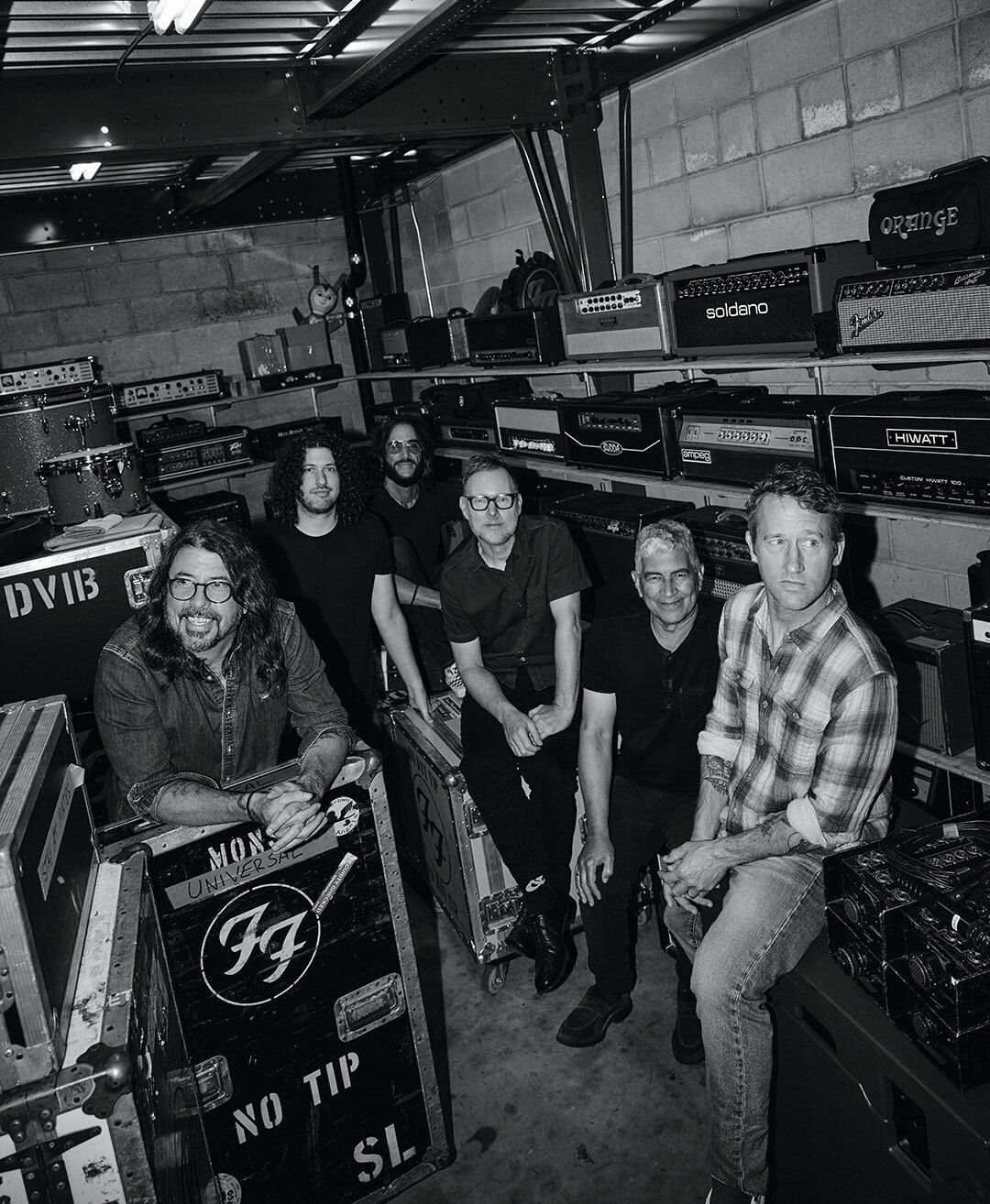
    Foo Fighters play Lincoln Financial Field on Thursday on their “Take Cover Tour,” with Queens of the Stone Age and Mannequin Pussy opening.Elizabeth Miranda

    Foo Fighters

    The Foo Fighters are smack in the middle of their yearlong “Take Cover” tour, which started in Mexico in January and ends in Australia next January. It’s the Dave Grohl-led band’s first tour with new drummer Ilan Rubin and it supports the band’s refreshingly punchy new album, Your Favorite Toy. All this month, the band is being supported by Queens of the Stone Age and Philadelphia’s own Mannequin Pussy, playing its biggest ever hometown show. 5:30 p.m., Lincoln Financial Field, One Lincoln Financial Field Way, lincolnfinancialfield.com

    Wax Jaw

    Philly five-piece band Wax Jaw put out one of the standout local releases of 2025 with It Takes Guts!, which indeed it does — as well as smarts — to craft high-speed New Wave-era tunes that land with an unguarded emotional wallop. This free show is the Shane Morgan-fronted band’s last Philly appearance before it heads out on a European tour next month. 7 p.m. Spruce Street Harbor Park, 301 S. Christopher Columbus Blvd., delawareriverwaterfront.com.

    Friday, Aug. 14

    Snacktime

    Fresh from performances at two marquee festivals — Newport Folk in Rhode Island and Lollapalooza in Chicago — Philly R&B and soul party band Snacktime is back home for a free show. 7 p.m., Spruce Street Harbor Park, 301 S. Christopher Columbus Blvd., delawareriverwaterfront.com.

    Things Can Only Get Better

    At least, that’s what this 1980s-themed tour promises. The quadruple bill gathers together four British acts from the New Wave era, with Howard Jones, whose 1985 hit gives the tour its name. Plus, Modern English, the English Beat, and Wang Chung. 8 p.m., Borgata Event Center, One Borgata Way, Atlantic City, borgata.mgmresorts.com

    Orrin Evans at his home in West Oak Lane on Nov. 25, 2024. He plays two shows a night on Friday and Saturday with the Trash Gadget Trio at Chris’ Jazz Cafe.Tom Gralish / Staff Photographer

    Friday, Aug. 14 and Saturday, Aug. 15

    Orrin Evans Presents Trash Gadget Trio

    Philly pianist and bandleader Orrin Evans, bassist Matthew Parrish, and drummer Byron Landham are old friends who have been playing together for 30 years. They’re celebrating their new album on Evans’ Imani Records label with two shows at Chris’ Jazz Cafe with guests Bill McHenry and Caleb Curtis, and Duane Eubanks on trumpet

    The shows will also spotlight the new Imani Records All-Stars album Stories and Flavors From the Garden. And if the music makes you hungry, the Imani crew will celebrate Evans’ wife Dawn Warren Evans’ new cookbook, Summer Time Jazz Kitchen at Studio 176, at 2131 N. American St. from 2 to 5 p.m. on Sunday. 7:30 and 9:30 p.m., Chris’ Jazz Cafe, 1421 Sansom St., chrisjazzcafe.com

    James Smith and Yard Act play Free at Noon at World Stage on Friday and Underground Arts on Saturday.James Winstanley

    Yard Act

    The band from Leeds, England, fronted by vocalist James Smith, that bears the influence of post-punk acts like Gang of Four and the Fall, has a new album that is its most stylistically varied and yet called You’re Gonna Need a Little Music. They’re in town for two shows. Friday at Free at Noon, World Stage, 3025 Walnut St., xpn.org and 8 p.m. Saturday at Underground Arts, 1200 Callowhill St., undergroundarts.org

    Valentina Sounds plays the Philadelphia Folk Festival on Friday.Courtesy of the Artist

    Saturday, Aug. 14

    The Stray Cats

    Stray Cats leader Brian Setzer is healthy after battling an autoimmune disease that prevented him from playing the guitar. The rockabilly revivalists are back on the road with the original lineup of Setzer, drummer Slim Jim Phantom, and bassist Lee Rocker. 8 p.m., Ovation Hall, Ocean Resort, Atlantic City, 500 Boardwalk, TheOceanAC.com

    Jack Harlow

    The Louisville, Ky., rapper, who broke big at the start of the decade with his Thats What They All Say debut and starred with Sinqua Walls in a 2023 White Men Can’t Jump remake, has taken a turn away from straight-up hip-hop into neo-soul on his newest, Monica. James Savage opens. 8 p.m., Fillmore Philly, 29 E. Allen St., thefillmorephilly.com

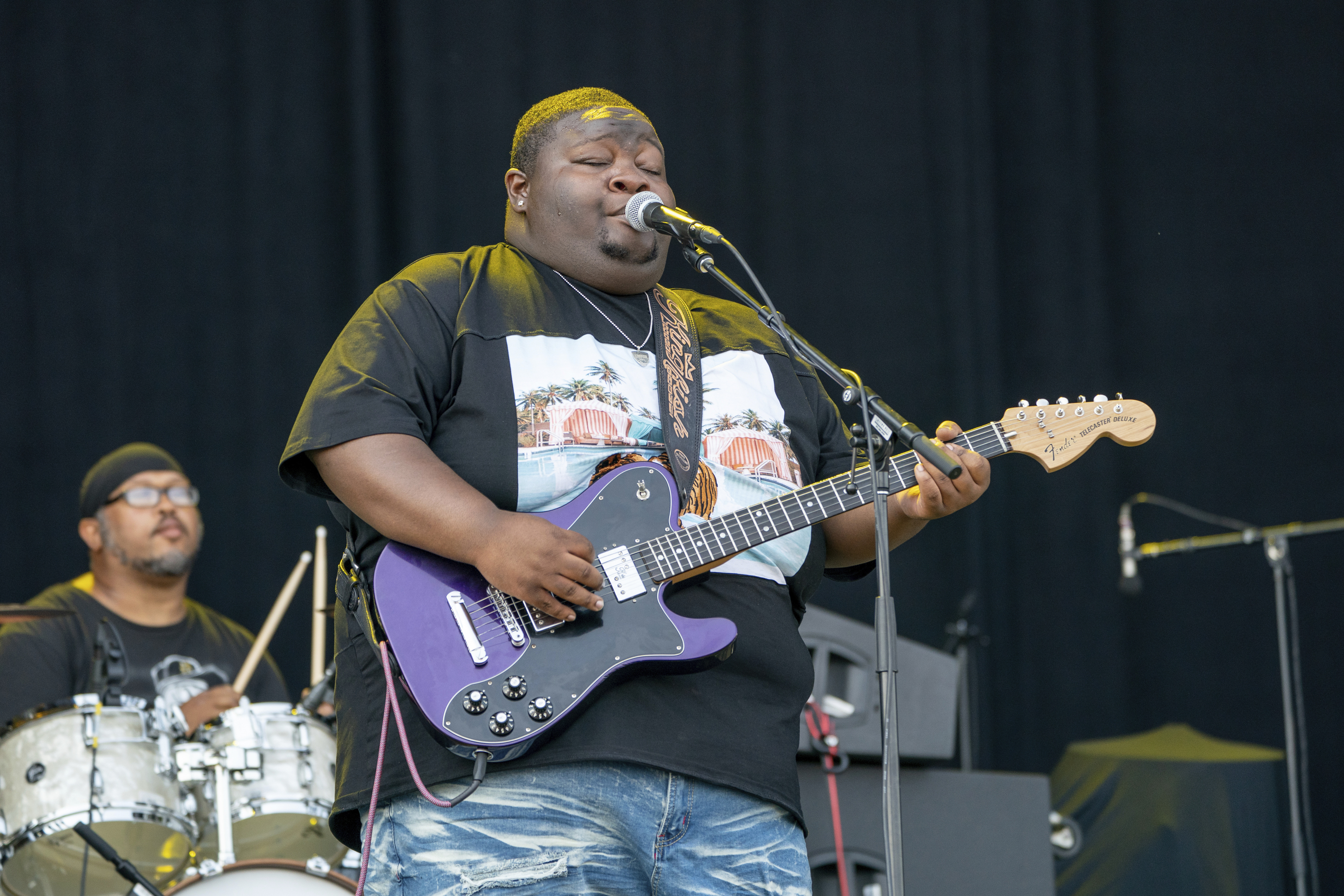
    Christone “Kingfish” Ingram performs in Louisville, Ky., in 2022. The Mississippi blues guitarist will perform at Concerts Under the Stars in King of Prussia on Sunday. (Photo by Amy Harris/Invision/AP, File)Amy Harris

    Sunday, Aug. 15

    Christone “Kingfish” Ingram

    Just 27, Christone Ingram has been a blues guitar sensation for a dozen years now. And while the Mississippi native’s playing still conveys plenty of flash, he shows growing confidence as a singer and songwriter on 2025’s Hard Road. Mathias Lattin opens. 6 p.m., Concerts Under the Stars, 175 W. Valley Forge Road, concertsunderthestarskop.com

    Tuesday, Aug. 18

    Flo Rida

    The Miami rapper born Tramar Lacel Dillard scored a number of party anthem hits, such as “Low” and “Right Round” in the late 2000s. Hopefully, the Phillies will score some runs on Tuesday against the Miami Marlins, after which he performs. Game starts at 6:40 p.m., Citizens Bank Park, One Citizens Bank Park Way, mlb.com/phillies

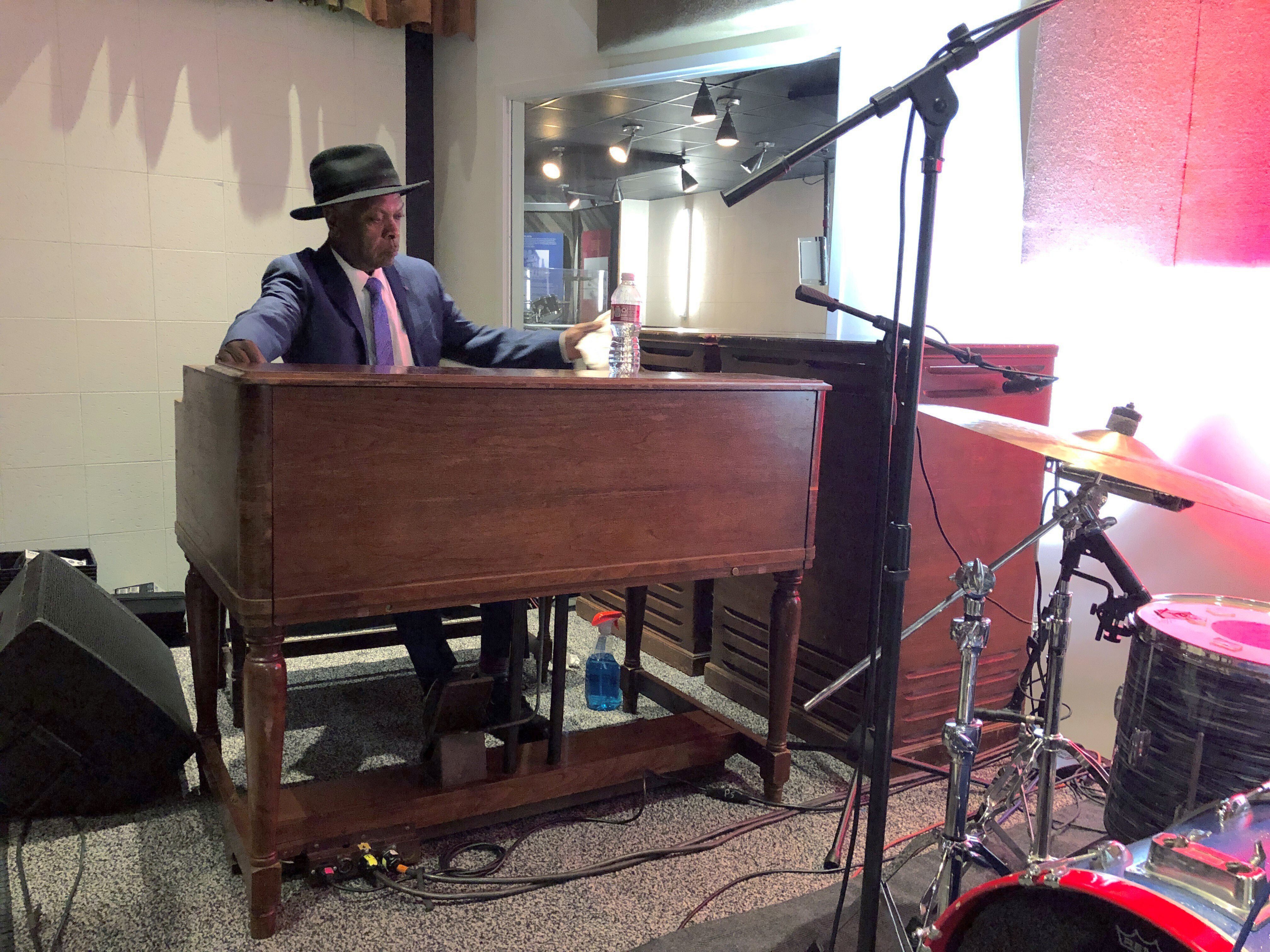
    Master keyboardist Booker T. Jones prepares a Hammond B3 organ before a performance at the Stax Museum of American Soul Music on Wednesday, Sept. 14, 2022, in Memphis, Tenn. (AP Photo/Adrian Sainz)Adrian Sainz / AP

    Wednesday, Aug. 19

    Booker T. Jones

    The organist and leader of the great 1960s Memphis Stax / Volt instrumental soul band Booker T. & the M.G.’s also sings, plays guitar, and has stories to tell from a legendary life in music. With the Billy Walton Band and the Plaid Salmon Horns. Free. 7 p.m., Tony Marts presents Mardi Gras on the Boardwalk, Kennedy Plaza, Atlantic City, tonymart.com

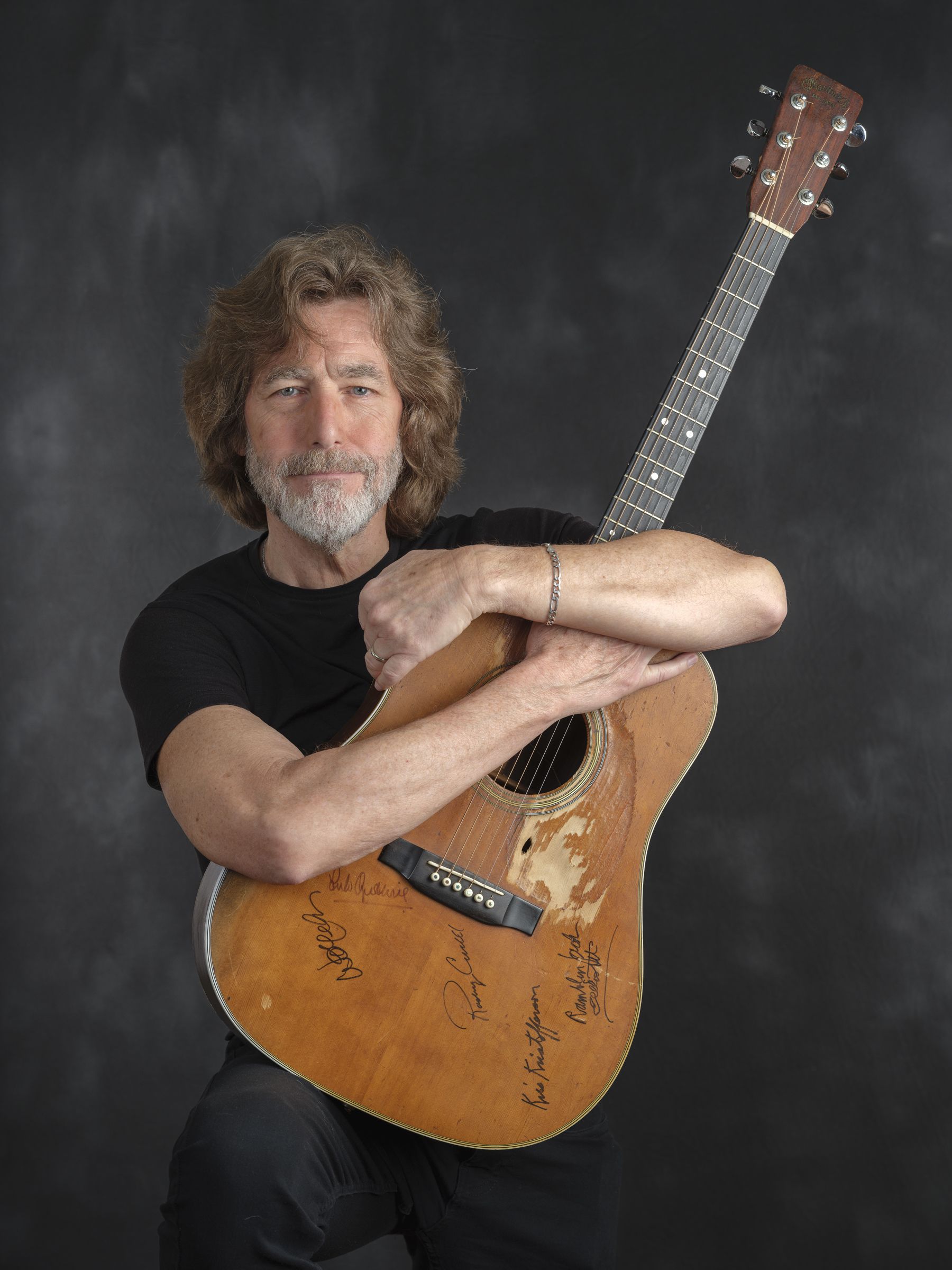
    John Flynn will perform and also be the main stage emcee at the Philadelphia Folk Festival.Courtesy of the Artist