In 1795, an Irish pastor went down a hole in Central Pennsylvania and discovered a vast underground cave full of stalactites, stalagmites, and frigid water.
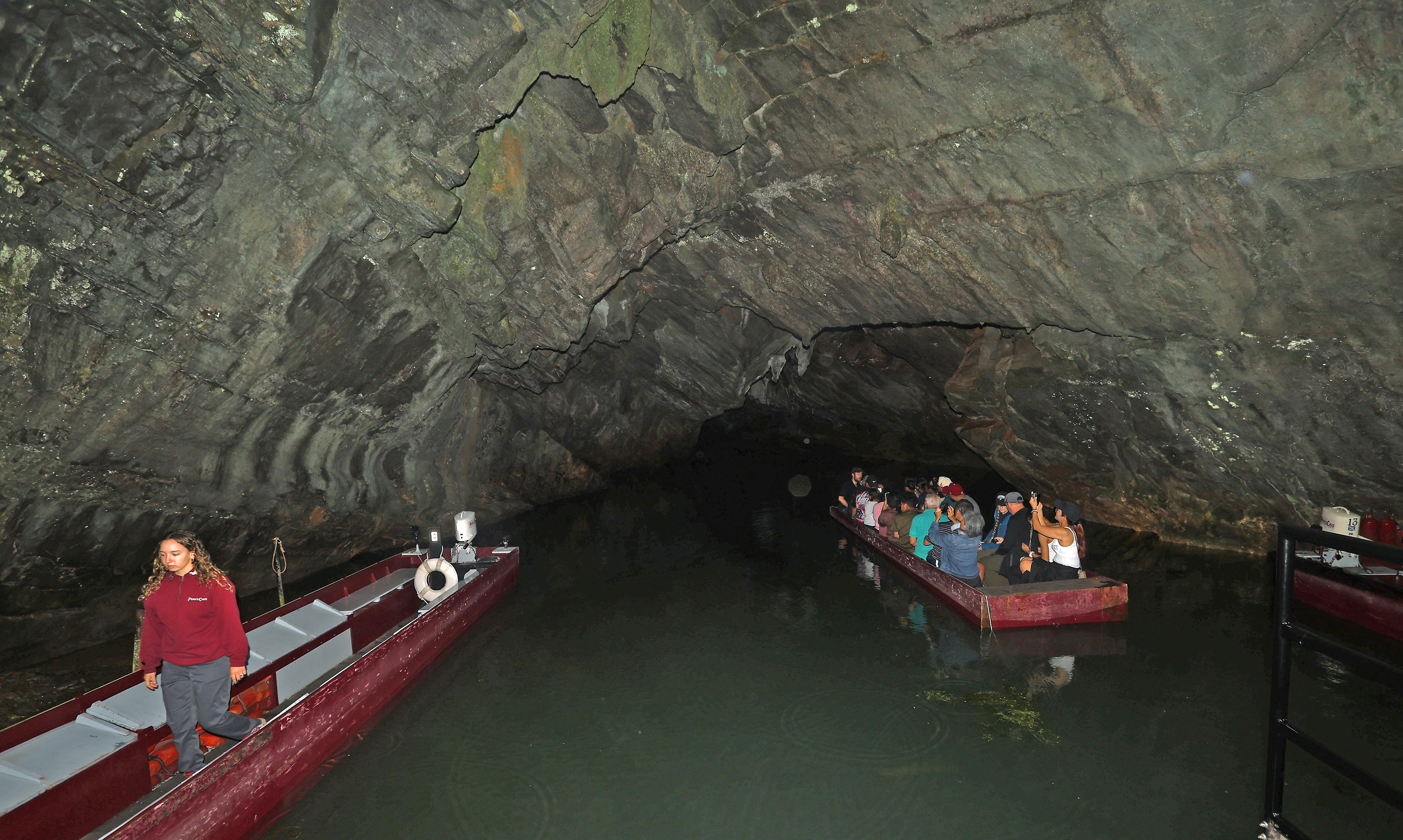
On a recent Sunday morning in July, visitors simply had to go through the gift shop to visit Penn’s Cave, the only all-water cavern in the country. The boat tours in the cave and the adjoining 1,400-acre wildlife park full of bison, wolves, elk, and one very large black bear attract thousands of visitors per year just east of State College in Centre County.
According to several published reports in recent months, Penn’s Cave and Wildlife Park, which opened in 1885 and has been run by the same family since 1908, is hoping to become Pennsylvania’s 126th state park by transferring the property to the state’s Department of Conservation and Natural Resources. Penn’s Cave ownership and management declined to comment during a recent visit, directing The Inquirer to public statements made earlier this summer.
Penn’s Cave CEO Russ Schleiden, during a July 7 Centre County Commissioners meeting, said the decision was “difficult.”
“But we feel that it’s a very important part of not only Centre County, but the Commonwealth of Pennsylvania, and that it should be preserved in perpetuity.”
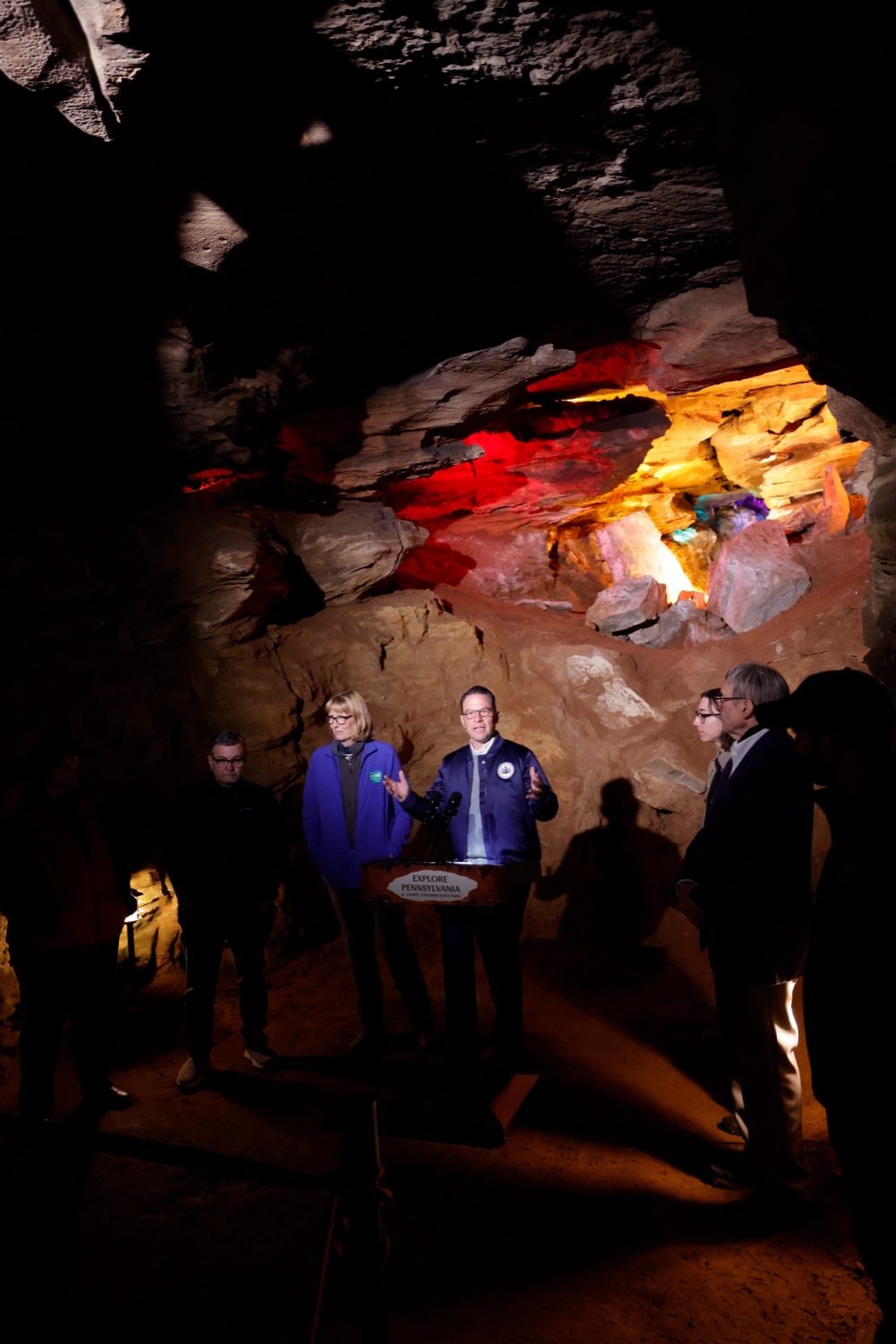
The Colored Lights Room during a boat tour of Penn’s Cave on Aug. 9.Craig Houtz / For The Inquirer
Schleiden’s daughter, Jeanine Watson, was brought to tears when she spoke to the commissioners.
“We want it to be preserved and to be taken care of,” Watson said. “We’ve always felt we were the stewards of that. We would hate to see this go into development and, unfortunately, that would be the alternative.”
During the meeting, Watson said Penn’s Cave had been discussing the proposal with DCNR for several years. She did not say why development would be the only alternative.
The proposal received the support of Centre County’s commissioners and State Rep. Kerry Benninghoff, (R., Bellefonte).
“I can’t think of a better time in our country and our county’s history at the Semiquincentennial to make this reality,” Benninghoff said in July, according to statecollege.com. “If you want to look at Americana in its best, the park I think exemplifies that.”
Benninghoff told The Inquirer that his proposed legislation did not make it into the state budget by July.
“It just didn’t work out in this budget cycle. My ultimate goal is to preserve this property,” Benninghoff said. “You couldn’t ask for a better place to preserve.”
Wesley Robinson, a DCNR spokesperson, said department staff has visited Penn’s Cave and engaged in discussions about “potentially taking over stewardship of this significant geoheritage site.”
“Penn’s Cave’s natural and cultural resources could make it a strong addition to Pennsylvania’s state park system and provide expanded opportunities for the public to access and enjoy the site,” Robinson said in a statement.
Robinson said acquiring Penn’s Cave may require legislation and that the agency would continue conversations with stakeholders.
Penn’s Cave is an all-water cavern, a historic 1,300-foot limestone show cave with tours by boat.Craig Houtz / For The Inquirer
Coincidentally, Pennsylvania’s 125th state park is a former privately owned cave. Laurel Caverns State Park, in Fayette County, opened in April and is the first cave system to become a state park.
Laurel Caverns, the biggest cave system in Pennsylvania, opened as a tourist attraction in 1964. It’s also home to the biggest bat hibernaculum — where animals can hibernate in winter — in the Northeast.
“Parks like Laurel Caverns give our kids a new place to learn, our families a place to make memories, and all of us a chance to get away, take a breath, and just enjoy nature,” Gov. Josh Shapiro said in April during a press conference in the cave.
Laurel Caverns was donated to the state. It’s unclear how DCNR would take ownership of Penn’s Cave if the process moved forward or what its operating costs would be. The attraction employs dozens of seasonal and full-time workers and includes a large gift shop and snack stand.
Gov. Shapiro and DCNR Secretary Cindy Dunn open Laurel Caverns State Park, Pennsylvania’s first subterranean state park, in April.Provided
On a tour of Penn’s Cave in July, a lone bat flapped around between the stalactites, but the experience is quite different from Laurel Caverns and would present a unique challenge to operate as a state park.
For one, visitors to Laurel Caverns walk through the cave system. Tours of Penn’s Cave are conducted via boat with a guide, on a frigid, subterranean offshoot of Penns Creek that’s filled with large rainbow trout.
“To the left here, we have our tallest stalagmite. We call this one our Statue of Liberty,” guide Kara Hoffman explained.
Hoffman also discussed the cave’s geology, early attempts at tours with torches, and its earliest visitors, the Indigenous Seneca who used the cave for shelter.
Kara Hoffman gives a boat tour of Penn’s Cave on Aug. 9.Craig Houtz / For The Inquirer
Laurel Caverns, with 400 acres above ground, does not offer camping. The Penn’s Cave property is 1,500 acres, and consists of rolling farmland and animal enclosures. It’s unclear if the state would maintain the wildlife exhibits, which include large elk, Texas longhorns, and mountain lions, but Benninghoff said he believed camping would be part of the state park.
In 2024, The Inquirer wrote about DCNR’s plan to build a campground in Chester County and the pushback it received from a vocal group of residents concerned about traffic and campers.
Robinson said that the project is still in the works and currently in “cultural review.”
Meanwhile, Penn’s Cave, about 190 miles northwest of Philadelphia, remains open for tours, and Benninghoff said he hoped to draft legislation for the next budget.
Mountain lions are part of the farm-nature-wildlife tour at Penn’s Cave and Wildlife Park.Craig Houtz / For The Inquirer
Penn Medicine researchers are testing whether an ultrafast form of radiation therapy can treat cancers in the head and neck with fewer side effects.
The clinical trial marks the first time the technology, conformal FLASH proton therapy, is being used in humans.
Radiation therapy, one of the most commonly used cancer treatments, works by aiming high-energy beams at tumors. While this kills cancer cells, it can also cause damage to surrounding healthy tissues.
Patients with head and neck cancers, for example, can develop ulcers in the mouth, damage to the jawbone, dry mouth, and scarring as a result.
A trial launched this month at Penn Medicine’s Abramson Cancer Center will assess whether delivering radiation more than 100 times faster than typical therapies is safe and could lessen that damage.
The pilot trial will enroll 10 people whose head and neck cancers have returned.
These are patients who lack good treatment options and risk side effects that interfere with speaking, breathing, and swallowing.
“Giving another full dose of radiation is very hard for these patients,” said Jonathan Schoenfeld, who directs the Head & Neck Radiation Oncology program at Mass General Brigham and is not involved in the trial. “This is a good population that could potentially benefit from this type of approach.”
The specific type of FLASH radiation used in this study was developed by researchers at Penn and the Belgium-based Ion Beam Applications S.A. (IBA), which manufactures the platform and is sponsoring the study.
In mouse studies, FLASH proton therapy reduced side effects while still killing cancer cells. Researchers have since tested the approach in a clinical trial involving dogs with cancer.
However, promising results in animalsoften do not translate to humans. Even if the trial produces encouraging results, it could take years before the therapy becomes widely available.
The hope, ultimately, is not only to preserve quality of life in patients, but to make radiation therapy more convenient and accessible.
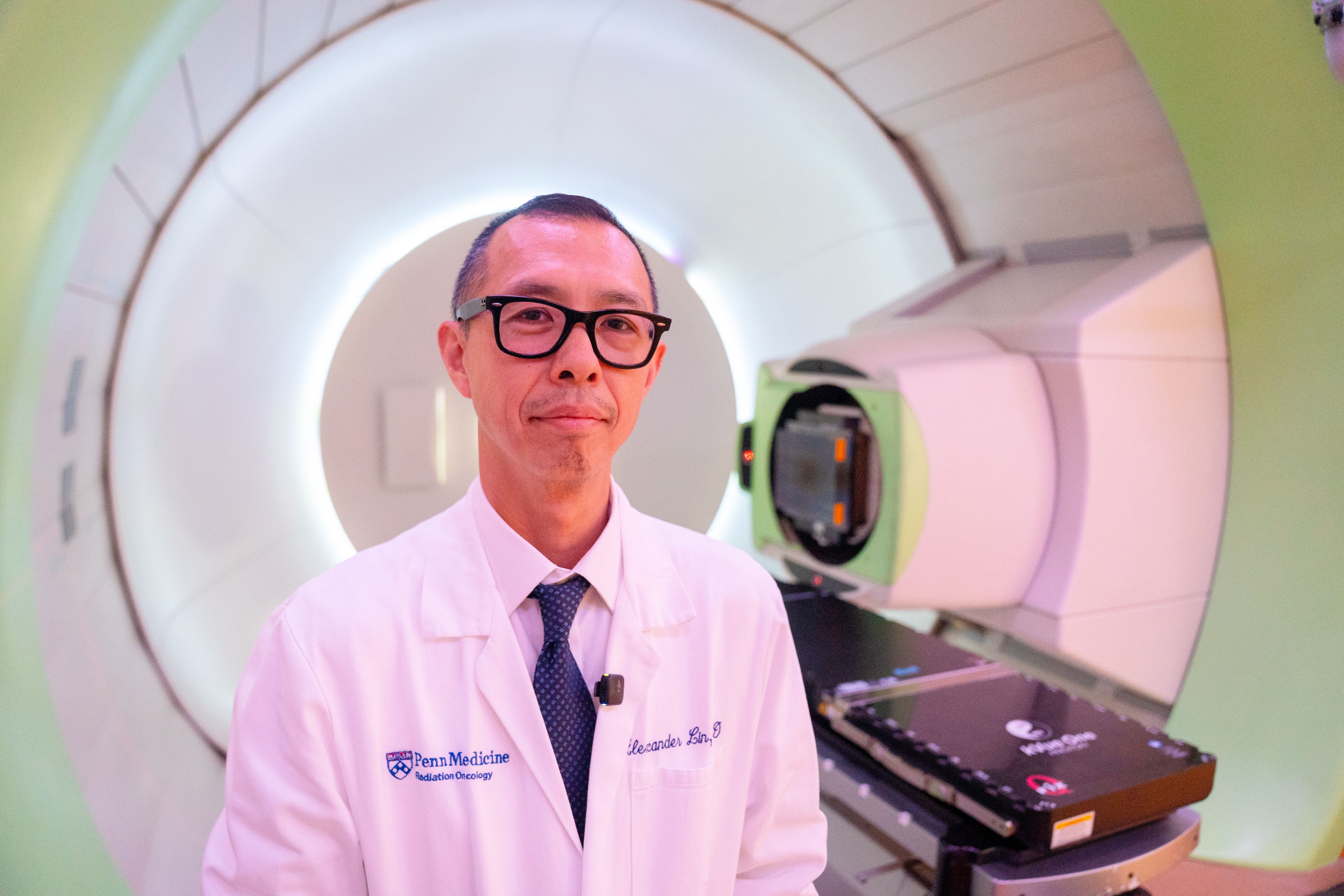
“Instead of 30 to 40 treatments, we can do the treatment in one to five treatments,” said Alexander Lin, a radiation oncologist at Penn and the trial’s lead investigator.
Lin walks through the Roberts Proton Therapy Center.Credit to Margo Reed Studios
Faster and fewer doses
Doctors typically divide a patient’s radiation therapy into dozens of daily treatments over several weeks.
FLASH radiation aims to accomplish that in fewer doses.
Think of it like air travel: A trip from the East to the West Coast would take hours with today’s technology. But if you can fly at the speed of light, it would take less than a second.
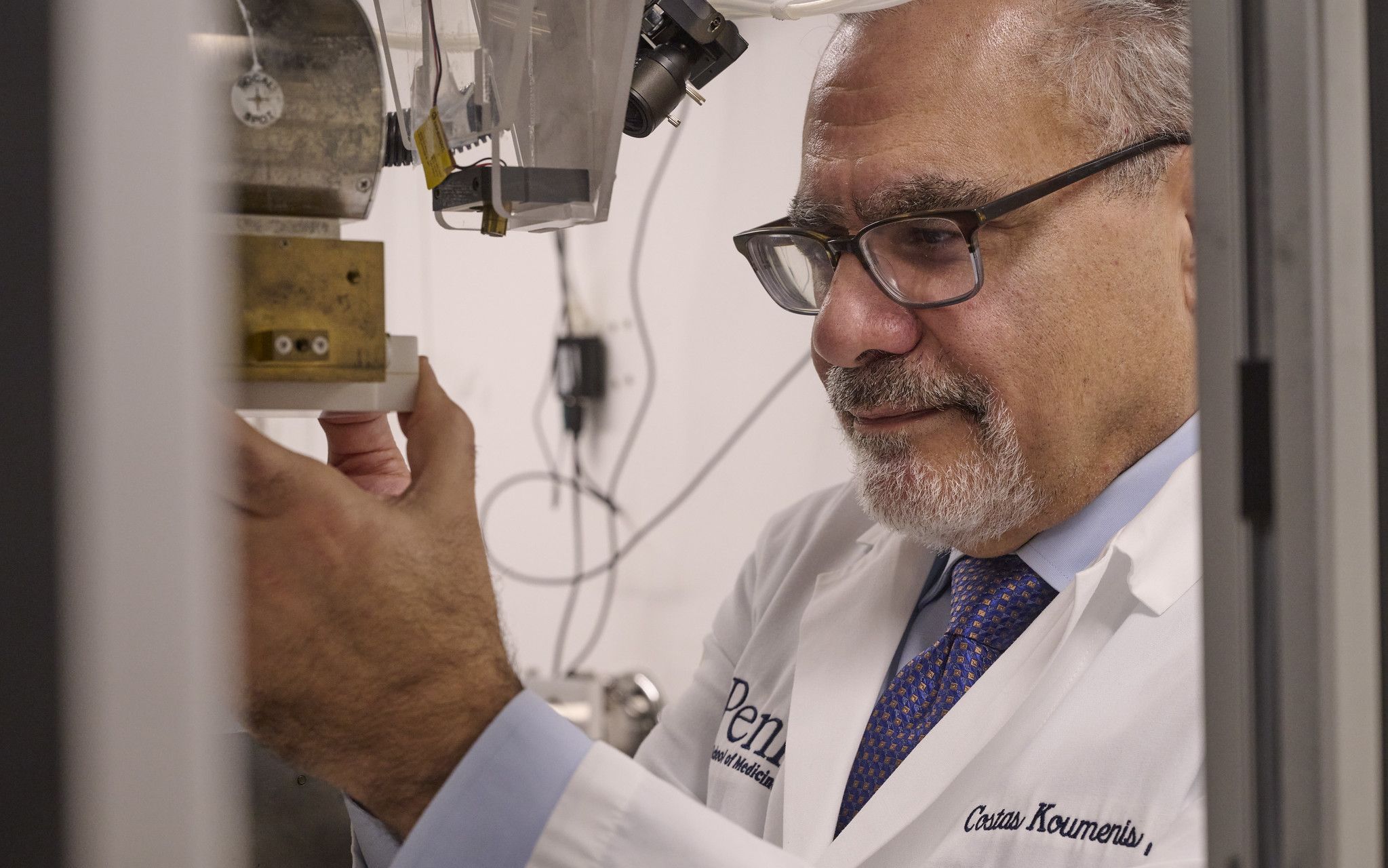
“We’re giving the same dose or similar dose, but the dosage rate changes,” said Constantinos Koumenis, the vice chair for research in Penn’s Department of Radiation Oncology and a developer of the therapy.
Lin hopes this lighter schedule could alleviate some of the time and financial burden of treatment.
The FLASH therapy builds upon a highly advanced radiation treatment, proton therapy, which uses protons to more precisely target tumors. Penn has heavily invested in the expensive technology, with its fourth proton therapy center — a $224 million facility at Penn Presbyterian Medical Center in University City — expected to open in 2027.
The researchers are also incorporating a technique called conformal radiation therapy, which shapes the radiation beam to match the tumor’s three-dimensional size and location. This helps limit exposure to nearby healthy tissue.
The exact biological explanation for FLASH radiation’s effects remains a mystery. However, scientists theorize that the treatment reduces damaging oxidation in healthy tissue while promoting faster recovery.
“The hope is that, if this type of trial is successful, you can treat patients who need more radiation with much lower risks,” Schoenfeld said.
But “it’s a new treatment that we don’t fully understand yet, so I would highlight that it’s still very early days,” he added.
First trial
Constantinos Koumenis is the vice chair for research in Penn’s Department of Radiation Oncology and a developer of the new therapy being tested.Credit to Peggy Peterson
The primary focus of the Penn trial will be assessing the treatment’s safety and feasibility, with an eye on quality of life and cancer outcomes.
Researchers will be taking a more cautious approach to begin, using a dose and schedule that have already been found safe and effective in patients. The only difference will be giving the radiation at the FLASH speed, Lin said.
Schoenfeld said he would first want to see whether the team can deliver their treatment with the intended speed and precision — an accomplishment in itself for an early-stage trial.
Then he would look at how the tumors respond to FLASH and whether patients develop side effects over a period of months to years.
“Some of these side effects are longer term side effects, so it’s important to start to follow these initial cohorts of patients as long as possible,” he said.
The Penn team will follow patients for at least five years.
If the trial shows promise, the researchers hope to launch additional trials in other types of cancer, from gastrointestinal to liver tumors.
“If these trials show that they’re safe, we want to target any solid tumor that we can target,” Koumenis said.
The city’s surviving legacy organizations are now working overtime to increase their visibility and bring in new audiences with community events and crowd-pleasing programs.
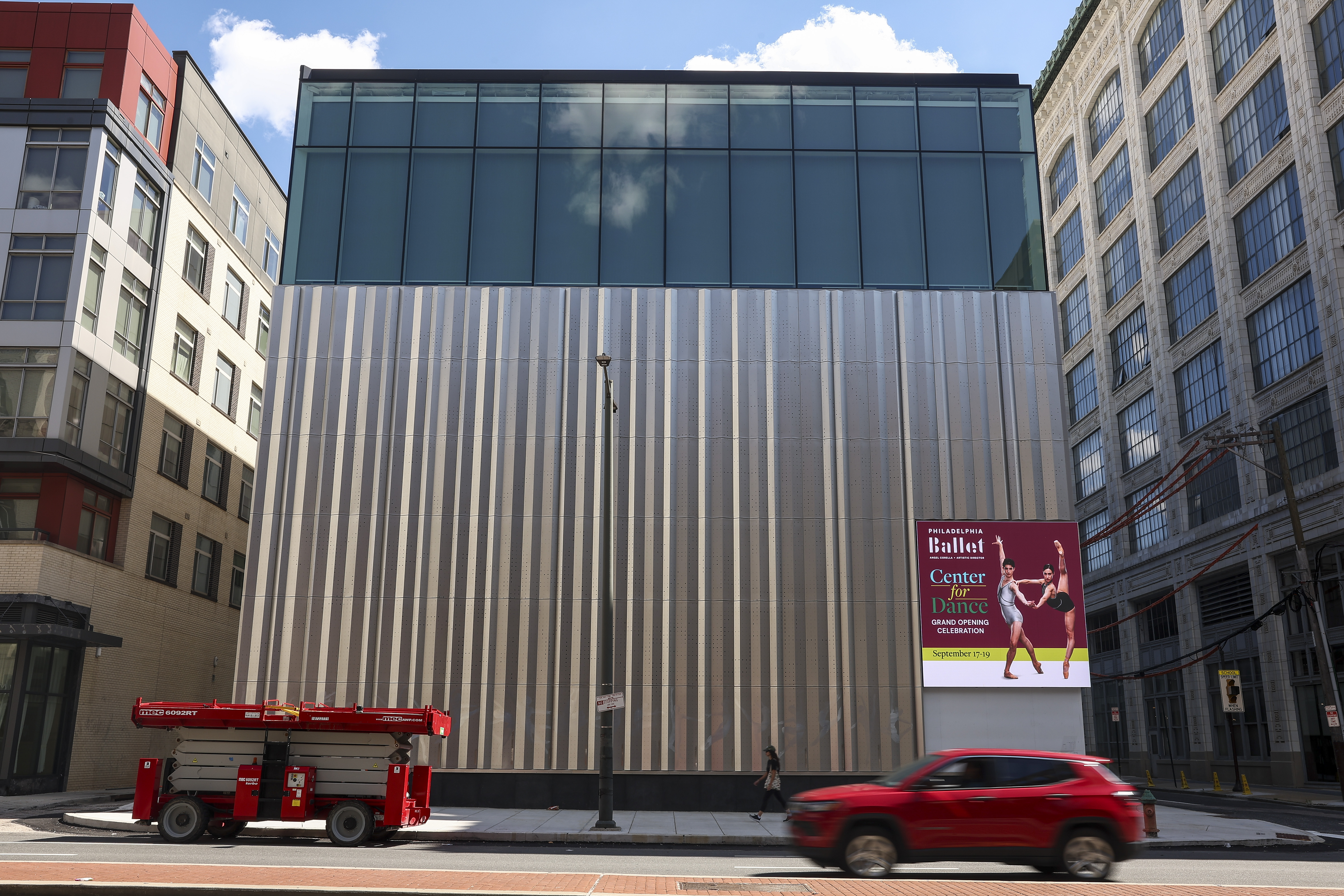
Nothing captures the public imagination quite like a new building, especially one with an address on Broad Street, the long, straight boulevard branded the Avenue of the Arts. After 19 years of trying, the Philadelphia Ballet will formally open its eye-catching new home just north of the Vine Street Expressway with a gala on Sept. 17.
In times like these, any new arts building in Philadelphia is cause for jubilation, whatever its flaws.
Although the Philadelphia Ballet Center for Dance is primarily a working building that provides the company with modern practice studios and support services, it also allows the ballet to operate its own public theater for the first time in its 63-year history. Shelly Power, the group’s CEO, rightly views the 150-seat space as a major opportunity for community-building outreach.
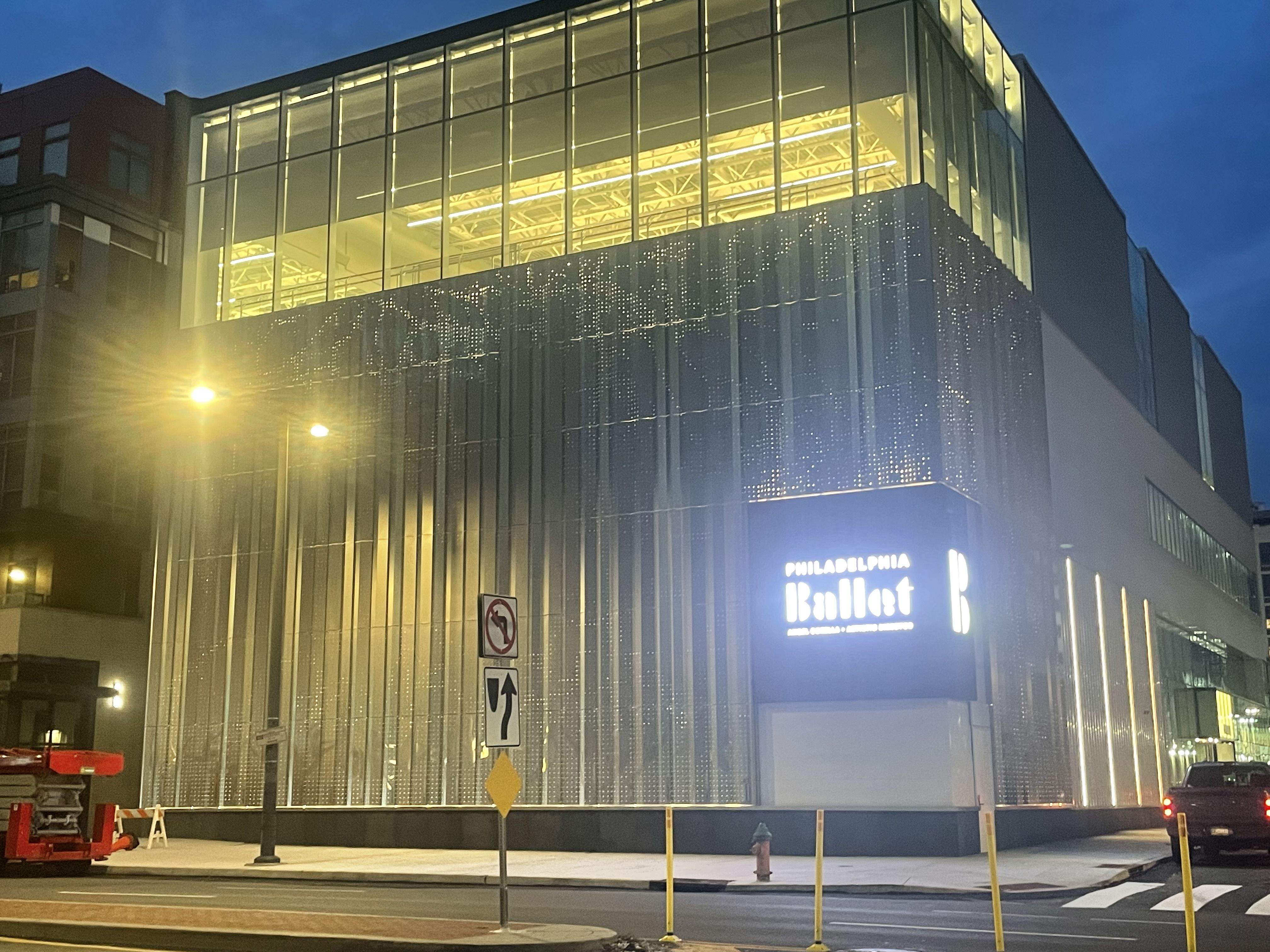
So, it’s frustrating to see the ballet repeat the architectural mistakes of an earlier generation of cultural venues. With its glass-enclosed rooftop studio and pleated metal facade, the building initially dazzles with shimmer and light, especially at night. But it quickly becomes clear that this is just another hermetic box that walls itself off and sabotages its own efforts to engage the public.
The absence of street-level windows on North Broad Street is particularly galling given the corridor’s spectacular revival over the last decade, including hundreds of apartments, the Met concert hall and the award-winning Honeysuckle restaurant.
With its glass-enclosed rooftop studio and pleated metal facade, the Philadelphia Ballet’s new Center for Dance initially dazzles us with shimmer and light, especially at night.Inga Saffron
Rising to new heights
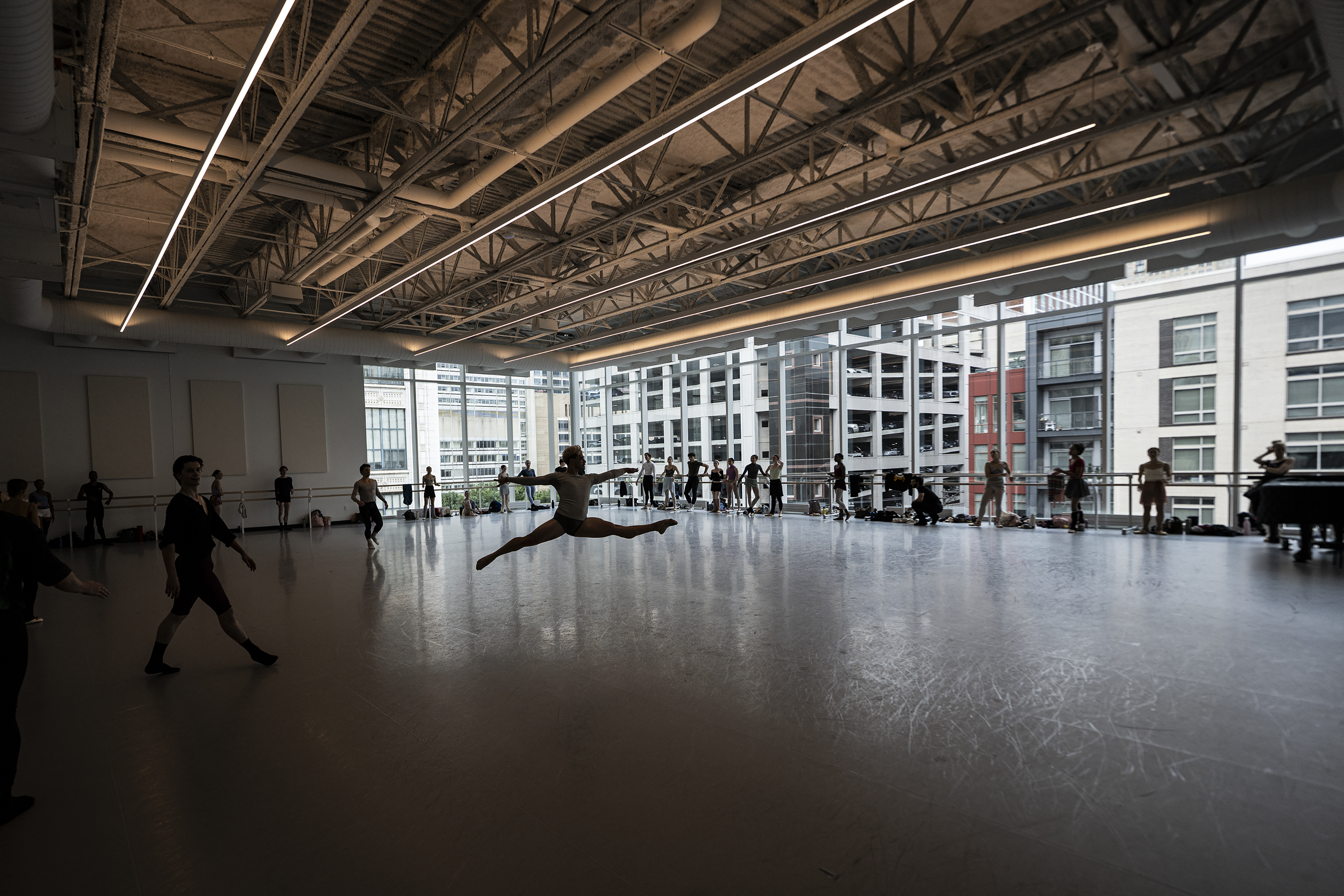
Designed by Varenhorst, a Philadelphia firm that toggles between high-end suburban homes and downtown apartments, the $45 million building is, in some ways, everything a big city ballet could want. The five-story structure does a great job at integrating the soaring, light-filled practice studios for elite dancers, with a dedicated classroom wing for the ballet’s school. Dancers are so energized by the scale of the new space, Power said, they can “jump higher.”
While the majestic Academy of Music will remain the ballet’s main performance space, the stripped-down, black box theater gives the company the opportunity to experiment with more intimately scaled works. And because the performance area is the same size as the Academy stage, the ballet can also do dress rehearsals there.
The new Philadelphia Ballet Center for Dance was built with four soaring practice studios, including this light-filled, double-height rooftop space overlooking North Broad Street.Jose F. Moreno / Staff Photographer
Having access to such an assortment of quality spaces promises to lift the ballet to new creative heights. Although the corps regularly ranks among America’s 10 best classical ballet companies, its dancers and school became itinerant after financial troubles forced the company to sell its old home at Broad and Washington in 1992. For many years, the school was housed in one location, dancers practiced in another, and administrators worked out of a third space. The lack of a stable home made it more challenging to woo top talent.
In 2007, the ballet purchased two small buildings at the corner of Wood Street with the goal of consolidating its operations under one roof. The Avenue of the Arts was just taking shape, and the location promised to give the northern stretch — always a bit of an afterthought — a marquee destination. As a longtime occupant of The Inquirer’s former North Broad Street home — the big white Tower of Truth (now the police headquarters) — I couldn’t wait to see human activity return to those sad blocks above Vine Street.
The design and the architects changed several times. The ballet, which, it is worth pointing out, received no city money for this important project, even lost its financing at one point. Architect Stephen Varenhorst, who signed on around 2016, deserves credit for sticking with the ballet through its many ups and downs.
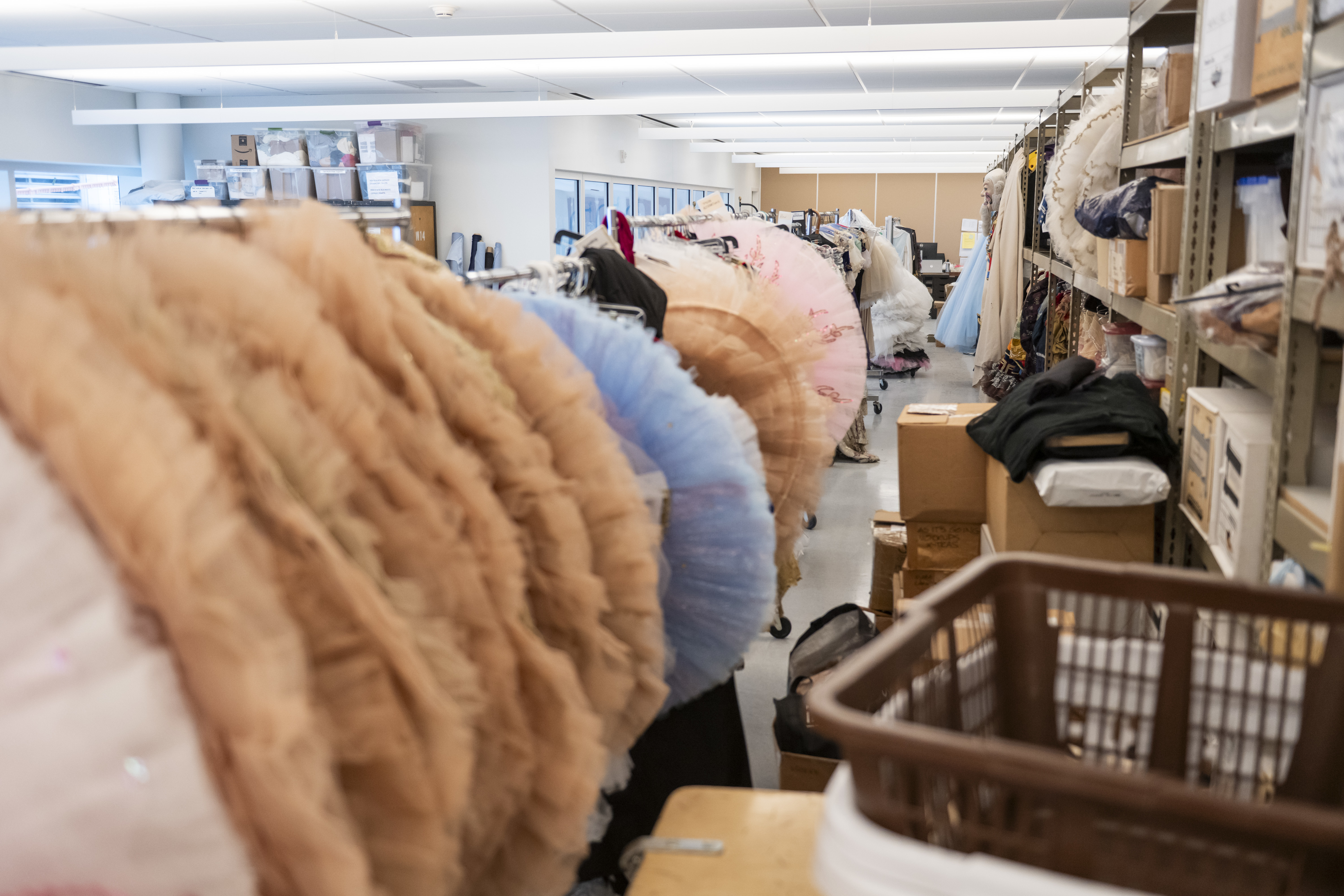
Maybe because the ballet was space-deprived for so long, his design was driven by a desire to make sure the company had the best of everything. Along with four large practice studios, the building is outfitted with a sprawling costume department, workshops for storing and dyeing dance shoes, a music room, and a generously equipped wellness spa.
Costumes line the wall in the wardrobe room in the Philadelphia Ballet’s new building on Broad Street.Allie Ippolito / For The Inquirer
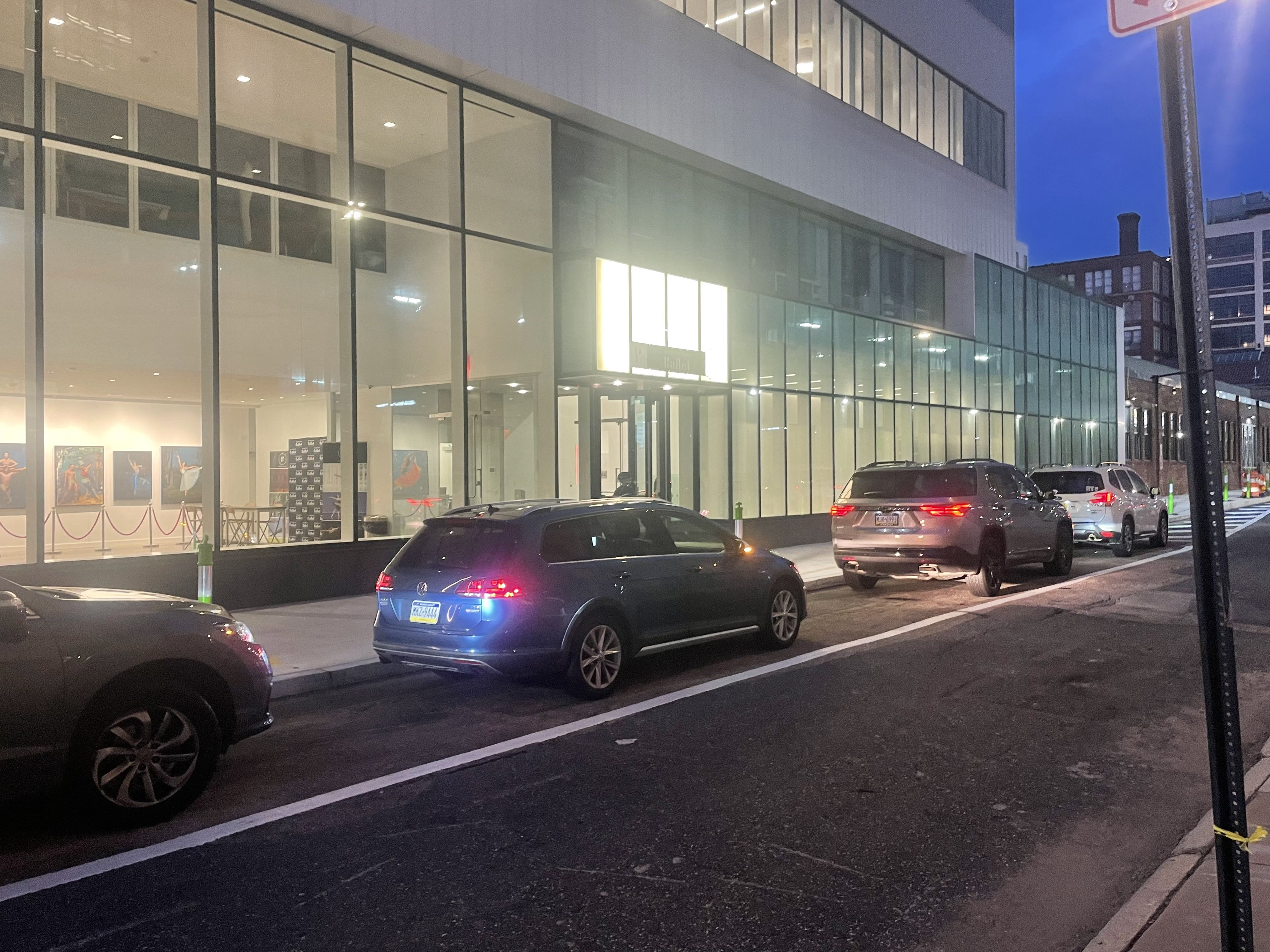
To pack all this onto the deep, narrow site, Varenhorst put the ballet’s front door on Wood Street. Architects often prefer to locate the main entrance on the long side of a building because it’s easier to organize the interior circulation.
That arrangement definitely makes things more convenient for dancers and visitors, since Wood Street now effectively serves as an automobile drop-off. But it badly shortchanges the pedestrian experience on North Broad Street.
A daunting facade
Early in the design process, the ballet decided it would install the black box theater at the Broad Street end of the building. As the name suggests, black box theaters have no windows. That meant the most important facade, the one facing the Avenue of the Arts, would be a blank wall.
By putting the main entrance to Philadelphia Ballet Center for Dance on Wood Street, instead of North Broad Street, the architects at Varenhorst were able to create an automobile drop-off, a convenience for parents dropping off their children at the ballet school.Inga Saffron
To enliven the solid, four-story expanse, Varenhorst has covered the surface with a crimped, stainless-steel screen. The treatment is meant to suggest a theater curtain. Unfortunately, it’s a closed one.
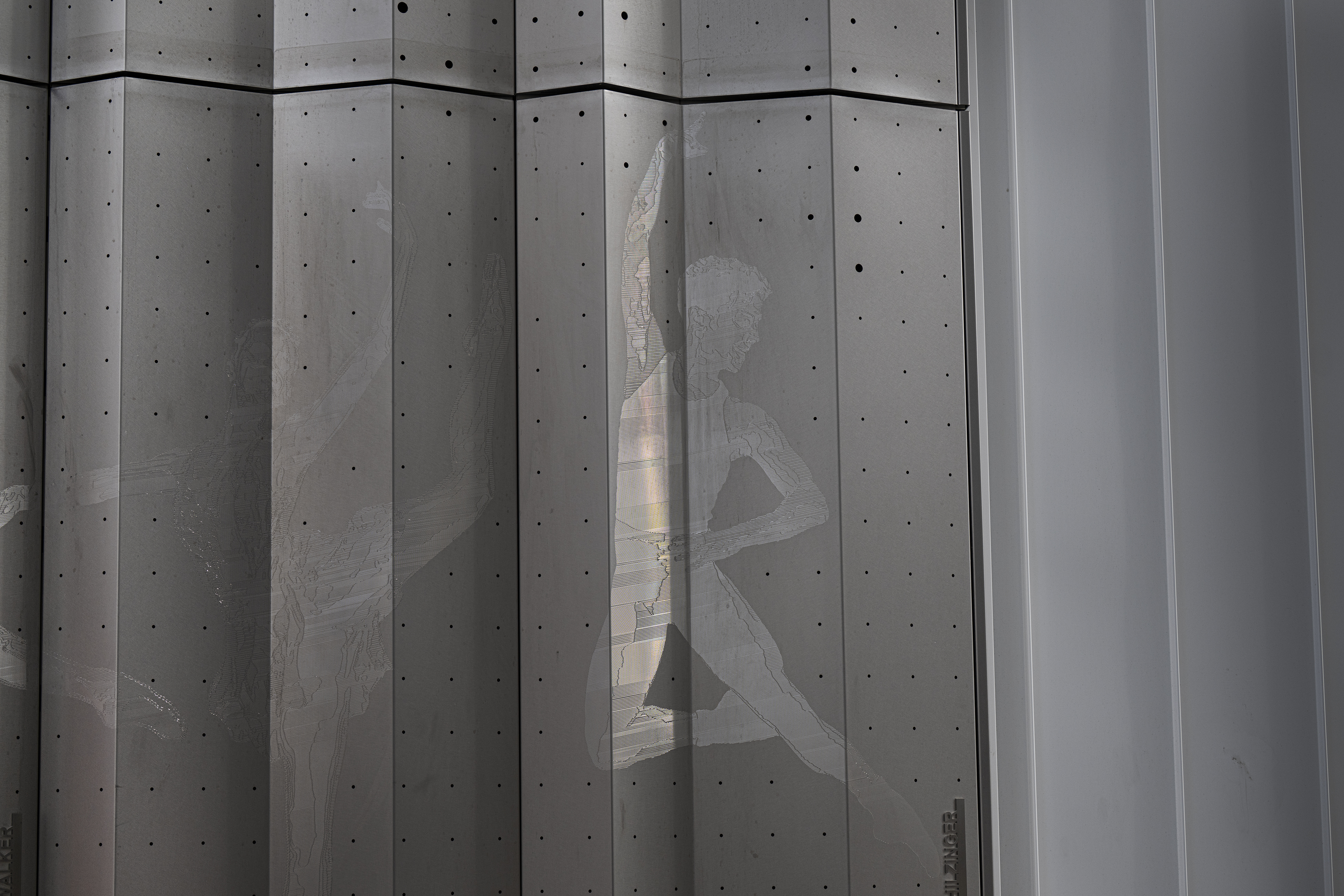
Varenhorst and the ballet have gone to great lengths to dress up the metal scrim. The stainless steel is good quality, manufactured by Zahner, the same firm that did Frank Gehry’s metalwork. The pleats are etched with ghostly figures of the corps’ dancers and perforated with pinholes that sparkle with fairy lights at night. If you crane your neck, you might be able to see dancers moving around the glass-walled studio on the top floor.
It’s about as good as a blank wall gets, but it’s still a daunting cliff.
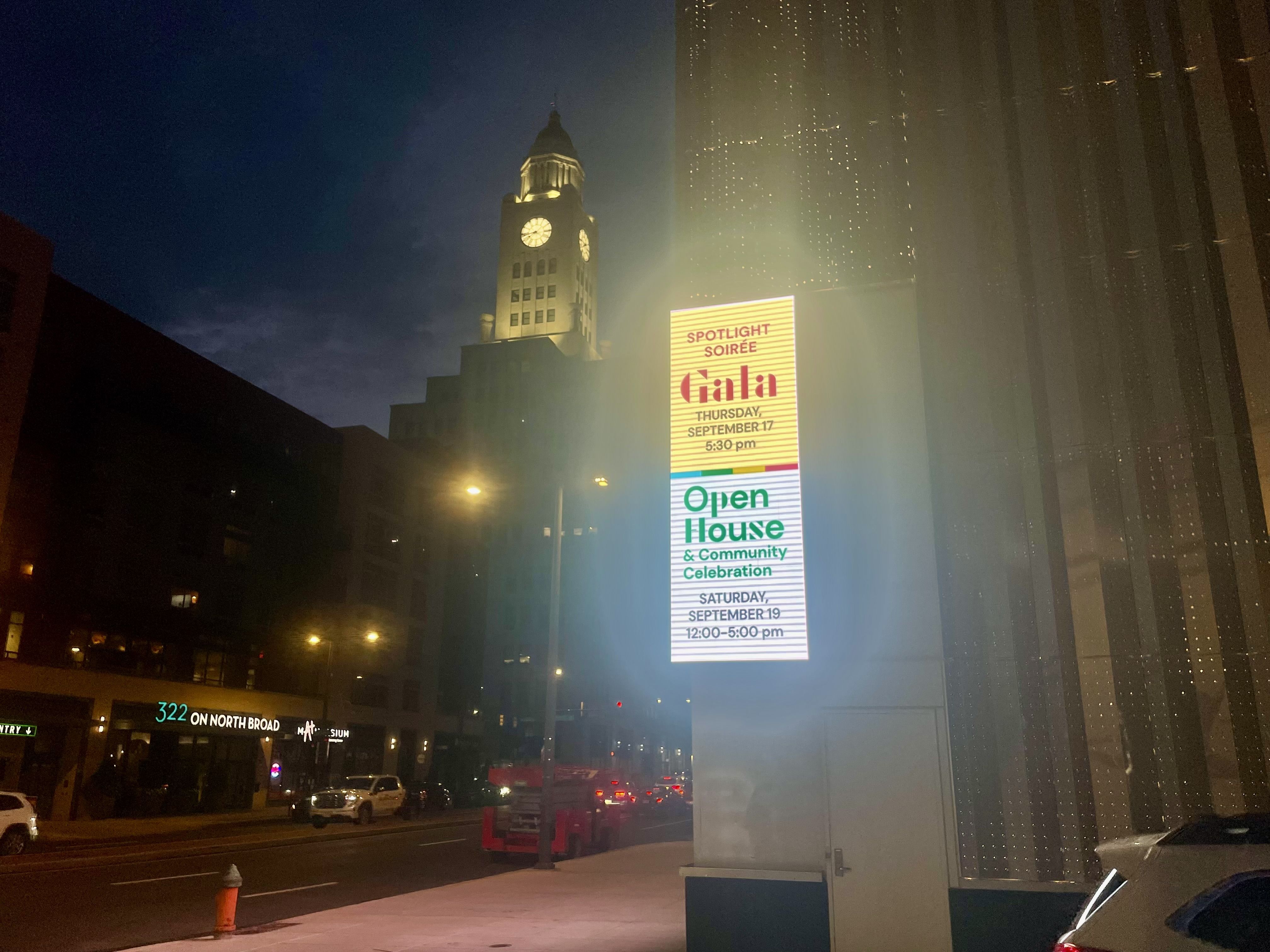
To activate the large expanse of metal, the ballet clamped a digital sign onto the corner. The dance company plans to use it to advertise upcoming shows and display videos of dancers. We could just as easily stare down at our phones to get the same content.
Ghostly images of dancers have been etched into the pleated, stainless steel facade of the new Philadelphia Ballet Center for Dance on North Broad Street.Jose F. Moreno / Staff Photographer
What’s most disappointing about the design is that the ballet is not the first venue on the Avenue of the Arts to treat Broad Street as an afterthought. Although the Kimmel Center can at least claim a Broad Street entrance, its heavy brick facade was similarly unfriendly, especially when no performances were taking place. Those solid walls were one reason the Kimmel floundered in its early years. It took a series of interventions — a cafe, restaurant, and, yes, a digital sign — to make the large building feel more alive.
Moved by the same reasoning, the Wilma Theater also retrofitted its building to create a ground-floor cafe on Broad Street.
Arts administrators always promise us lively sidewalks when they announce a new building, yet there seems to be something in Philadelphia’s architectural DNA that produces the opposite result.
Take the Weitzman National Museum of American Jewish History on Sixth Street. Although it faces Independence Mall, a symbol of democratic openness, that facade is sheathed in opaque glass. Its main entrance is around the corner on Market Street.
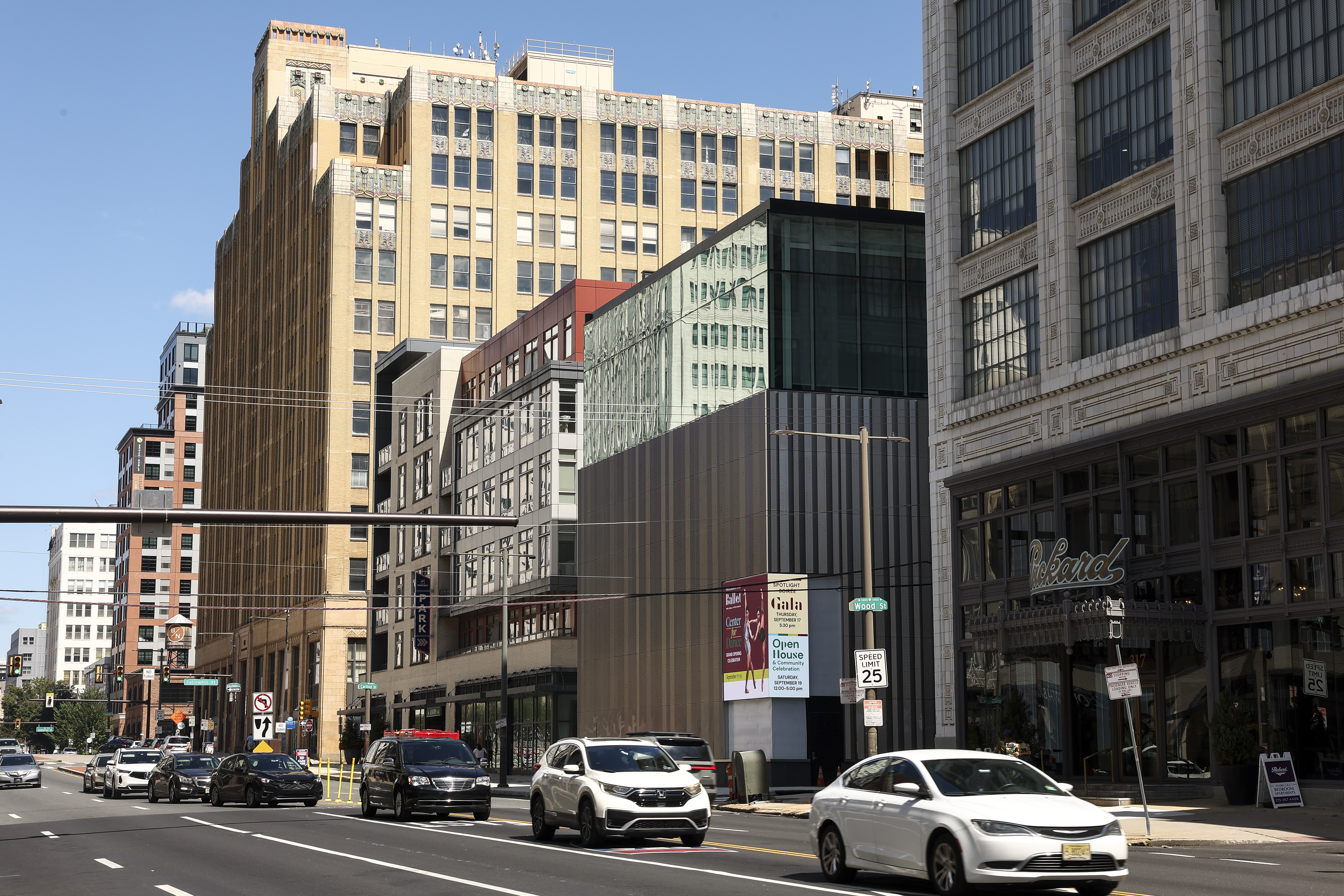
The new Philadelphia Ballet Center for Dance is bracketed (left) by the Hanover apartments, which opened in 2017, and the former Packard Motor Car building, which was converted to apartments in 1986.Monica Herndon / Staff Photographer
Ironically, the three buildings — the ballet, Kimmel, and Weitzman — all follow the same format: Each features a transparent glass structure at the top, far from the madding crowd.
Why couldn’t the ballet have reversed this arrangement and put its black box theater on the upper level? That way, a glass-fronted practice studio could have faced Broad Street. Even if Wood Street remained the main entrance, the transparency would have enlivened the ground floor and made the ballet a visible presence in the city. Instead, the blank wall reinforces the idea that ballet is an elite form of culture.
Power and Varenhorst told me they briefly considered, then rejected, the arrangement because the company’s dancers would have objected to being put on display during stressful rehearsals.
But who says that a ground-floor studio could be used only by the ballet’s professional dancers? The Alvin Ailey American Dance Theater in Manhattan, which opened a six-story practice facility and school in 2005, got around that problem by making its transparent ground-floor studio a space for public classes. Watching the dance students go through their moves there has become so popular, Alvin Ailey installed a bench outside.
To compensate for the solid facade on its new North Broad Street building, the Philadelphia Ballet Center for Dance installed a digital sign at the corner of Wood Street. The former Philadelphia Inquirer tower, now the police headquarters, can be seen across the street.Inga Saffron
Like other cultural leaders, Power is now focused on using the building to build a community of dedicated ballet supporters, much as Anthony Roth Costanzo has done at Opera Philadelphia. She wants to hold public events with dancers on Wood Street and is looking into making Carlton Street a pedestrian walkway.
“Our challenge is this: How do we activate the building?” she said.
Good question. Unfortunately, the ballet missed a big opportunity to show, as well as tell, what’s going on in the Center for Dance. In sacrificing public urbanism for its own private needs, the ballet does everyone a disservice.
In response to Wim Orth’s recent op-ed, his suggestion that the U.S. should have a multiparty system has merit.
I would suggest returning to the way we elected presidents during the 1960s and earlier — that is, choosing our leaders at the conventions vs. anointing candidates via the party bosses. Any number of candidates could run for president, giving voters many more choices of candidates with different views.
At the end of the conventions, roll call votes can be taken, and the candidate with the majority would be the presidential candidate. We need many more candidates and perspectives involved in debates right up until the conventions. That would make for a much more democratic process.
Brian Reilly,Medford
Fund caregivers
I have, for many years, been a supporter of wages for housework, including wages for parents who care for their children, clean, cook, and do all the kinds of work needed at home. That work is real work and deserves monetary support. Some people pay others to do that work, which is proof of its financial value. Surprisingly, our government has embarked on a plan to pay stay-at-home parents.
One catch is that the wages will come from money earmarked for childcare subsidy programs, programs that already exist and are desperately needed by people who must work outside the home to survive. The other catch is that the money will go to married couples, while the current subsidies largely go to single mothers.
This robbing Peter to pay Paul scenario is utter cruelty — the same kind of cruelty that reduces money from Head Start, from Medicaid, from the Affordable Care Act, from the U.S. Agency for International Development, and many other programs. There is potentially enough money to pay wages for housework and to support childcare subsidies. To state the obvious, we just have to change our priorities. Why not create a special childcare tax for the rich? It’s past time for them to pay their fair share, and even a small tax could probably cover those who choose to work as full-time homemakers and those who must work outside the home to make ends meet, married or not.
Lynne Yermanock Strieb, Philadelphia
Great timing
It was interesting to note that during their recent trip to Ukraine, Steve Witkoff and Jared Kushner had a “delightful trip” and a “great time.” What’s more interesting is the fact that Russia and Ukraine stopped firing at each other while Witkoff and Kushner were visiting each country. If that is what it takes to have a ceasefire, perhaps they should have stayed longer.
Susan Ward,Marlton
Join the conversation: Send letters to letters@inquirer.com. Limit length to 150 words and include home address and day and evening phone number. Letters run in The Inquirer six days a week on the editorial pages and online.
ARIES (March 21-April 19). You’re doing what you intended to do! You’ll get proof. The people you wanted to reach are paying attention, and you’re connecting with them. As you achieve goals, you’ll make new ones, because now you know more.
TAURUS (April 20-May 20). You hope to know the heart of another, but each heart is a unique, vast and mysterious emotional expanse — it’s hard enough to know your own! Any connection we make, however brief or tenuous, is very much worth the effort.
GEMINI (May 21-June 21). This is a day when patience is required. No one can learn everything at once. Information takes time to sink in and even more time to become applied knowledge. And the wisdom to predict patterns takes the longest time of all.
CANCER (June 22-July 22). You do the work as well as you can, because it matters now and may matter in ways you cannot see yet. Even if you don’t feel like you’re exerting influence, people are watching you for tips and cues they can follow.
LEO (July 23-Aug. 22). There’s only one battle that deserves your energy today, and you’ll know exactly which one that is. Handle this one thing and the others will either fall in line with the solution or become nonissues — not your problem to solve.
VIRGO (Aug. 23-Sept. 22). You don’t expect things you want to come to come to you easily. You’ll do the work that’s uncomfortable, but not unsafe. Avoiding some kinds of pain keeps life good, while avoiding other kinds keeps it small. You know the difference.
LIBRA (Sept. 23-Oct. 23). The design of social life is an art. You’re so good at figuring out the conditions under which people talk, work, play or get along well. But it does take practice, and nothing that works once is guaranteed to work every time. Keep experimenting.
SCORPIO (Oct. 24-Nov. 21). You’ll hear the words, but they make no sense on their own. You’ll be intrigued enough to listen with your deep emotional intelligence to try to break the code and get to the true meaning.
SAGITTARIUS (Nov. 22-Dec. 21). You’re fair. You have taste. They’ll ask for your assessment and advice. They’ll ask you to mediate, judge and critique. It’s work! And to appreciate the contributions of others without having to rate them — that’s a day off!
CAPRICORN (Dec. 22-Jan. 19). You will feel pulled to demonstrate your value, but resist that impulse. If you have to prove yourself, perhaps the other person isn’t observant enough. When it’s really a match, you don’t have to do somersaults for them to see you.
AQUARIUS (Jan. 20-Feb. 18). Negative space can be seen. It is the area around a subject, helping to define its shape. Negative space can also be felt, as you’ll notice today when there’s not quite enough of it to get clarity.
PISCES (Feb. 19-March 20). You can be the glue that brings everyone together and gives them a reason to stay connected. But today, you’ll be the grease that has everyone moving easily. You keep small differences from grinding the whole thing to a halt.
TODAY’S BIRTHDAY (Sept. 13). It’s your Year of the Coin in which your “riches,” whether financial, emotional or relational, seem to have a beautiful symmetry and weight, a specificity that tells you where they are from and a size that allows you to invest in the increments that best suit you. More highlights: Close time with usually distant friends, success in games and sports, a remarkable healing that opens up a whole new world. Capricorn and Aries adore you. Your lucky numbers are: 7, 10, 3, 34 and 1.
DEAR ABBY: I am a person with a million-dollar heart and a 5-cent bank account. I have big dreams that I know could change lives. I want to write a book about my experience with emotional abuse so I can help others heal. I also dream of starting a soda stand to build something tangible with my kids. The problem is that my current life is exhausting. I’m raising kids and stepkids, navigating co-parenting drama and working a job I hate just to survive. By the time I finish the daily grind, I’m broke and bone-tired. I know there is more out there for me, but I’m struggling to stay focused when my reality feels like a trap. How can I start these projects when I’m just trying to keep my head above water? I don’t want to escape into my dreams; I want to build them.
— SODA STAND DREAMER
DEAR SODA STAND DREAMER: If you try to write a book and start a business on top of everything else, you may not do any of it well. Choose one dream and put the other on hold for now. If you choose the book, set aside some time each day (or week) and dedicate yourself to writing during that time — no excuses. If you choose the soda stand, get a part-time job at a similar business where you can learn the ropes and earn some startup money. Either dream will require a lot of work and perseverance, but don’t give up!
** ** **
DEAR ABBY: My husband and I have a blended family. When he received child support for his daughters, I didn’t think it was any of my business what he did with the money. When I received child support for my sons, he thought I should tell him what I spent it on. I don’t think it’s any of his business. Who’s right? Please advise me, as this has been an ongoing argument in our relationship for 20 years. Mind you, our children are grown now with children of their own, and it’s time to put this to rest. Who is right?
— HAPPILY MARRIED EXCEPT FOR THIS
DEAR HAPPILY MARRIED: You are right. You are also entitled to some privacy if it’s important to you. In light of the fact that the child support money your husband received was not a subject of discussion, I see no reason why he should feel he has the right to know how you spent yours. What matters in both cases is that the money went toward caring for the children. I truly hope that’s what happened.
** ** **
DEAR ABBY: I was invited to my nephew’s wedding in a small town. Without my knowledge, the mother of the groom verbally offered my hotel room to the mother of the bride of a different wedding! (The connection is that they both used the same wedding planner.) When she approached me, I declined to give up my room and move to a different hotel. Subsequently, she unilaterally withdrew my wedding invitation. Am I obligated to send a gift?
— TOTALLY STUNNED
DEAR STUNNED: What the groom’s mother did is appalling, but don’t take it out on your nephew unless you have reason to believe he was complicit in these shenanigans.
ATLANTA — Bryson Stott had a brief moment of hesitation.
As the ground ball bounced into his glove at third base, he paused to take a peek over at second. But Braves infielder Austin Riley was already sliding in, and it was clear Stott’s only play would be across the diamond.
After he double-clutched, Stott’s throw to first was low, and Alec Bohm couldn’t come up with it off the hop. Instead of ending the inning, yet another run scored for Atlanta.
And that’s about when the inning spiraled completely out of control.
The Braves exploded for eight runs in the fourth on Saturday, en route to a 12-2 rout of the Phillies that all but dashed their hopes of catching the National League East leaders. Seven of those runs came with two outs in the inning.
“Obviously, that’s a really good team over there,” Bryce Harper said. “They’re pitching the ball really well right now, hitting in timely situations. But also, we got baseball to play, so we can’t get down. We can’t wonder what’s going to happen or what-ifs. We just got to keep playing.”
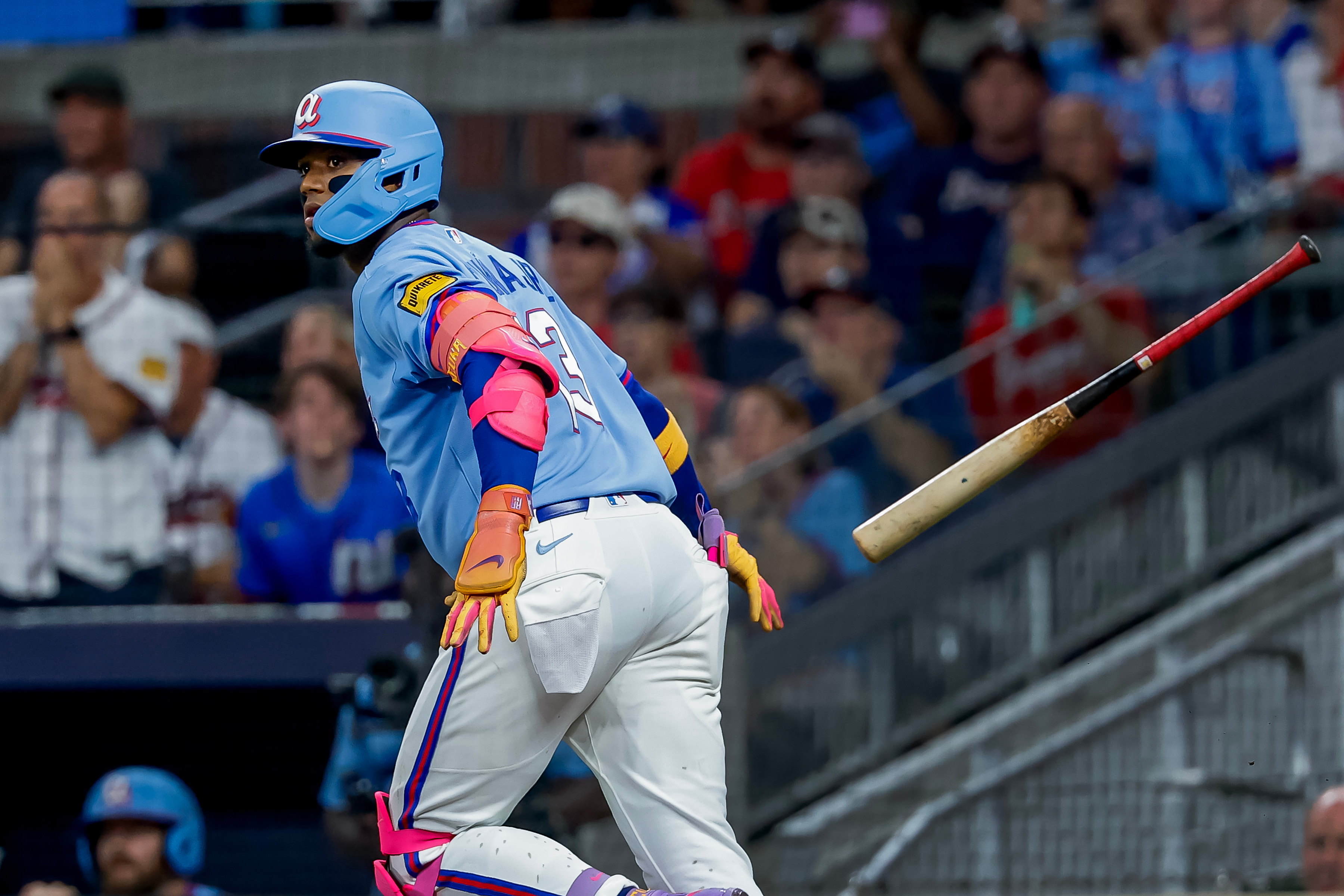
Atlanta’s Ronald Acuña Jr. (13) flips his bat after hitting a solo home run during the fourth inning.Erik S. Lesser
Scratching Jesús Luzardo, one of the NL’s most dominant pitchers, the night before and replacing him with a bullpen game was always going to make securing a win on Saturday a tall task. But the Phillies were hardly even competitive.
The Braves’ lead on the division has grown to six games over the Phillies, with 13 games remaining in the regular season for both teams. With the Cubs’ victory over the Pirates earlier on Saturday, the Phillies have now fallen behind Chicago into the second wild-card spot.
“You always set out the year, you want to win your division,” said interim manager Don Mattingly. “And you’d like to set yourself up with a bye if you can. But none of that guarantees anything, even if you do that. So now, the focus is really to win every day. We got to get ourselves in, and then if you’re good enough, you win.”
The fourth-inning meltdown completely erased the work done by Tim Mayza, who was billed as an opener but was efficient enough to complete three scoreless innings for the first time this season. Mayza used 31 pitches to face the minimum, as the infield turned two double plays to erase the only two hits he allowed.
Harper even gave him a lead to work with, responding to the resounding boos from the Braves fans with a first-inning homer off Tyler Mahle, 426 feet to straightaway center.
Harper took his time rounding the bases, just like Ronald Acuña Jr. had after his game-tying blast earlier this week in Philadelphia. The Braves star also popped out on the top step of the visitors’ dugout at Citizens Bank Park for a curtain call to further taunt Phillies fans. Harper didn’t go quite that far, but still relished the villain role in Atlanta.
“They’re going to boo me when I come in here. They love their players. They love their team,” Harper said. “… We’ve had a heated rivalry for 15 years now, me and them.”
But Acuña had the last laugh this time. Once Brooks Raley took over for Mayza in the fourth, he matched Harper with a homer of his own, right into the visitors’ bullpen in left field.
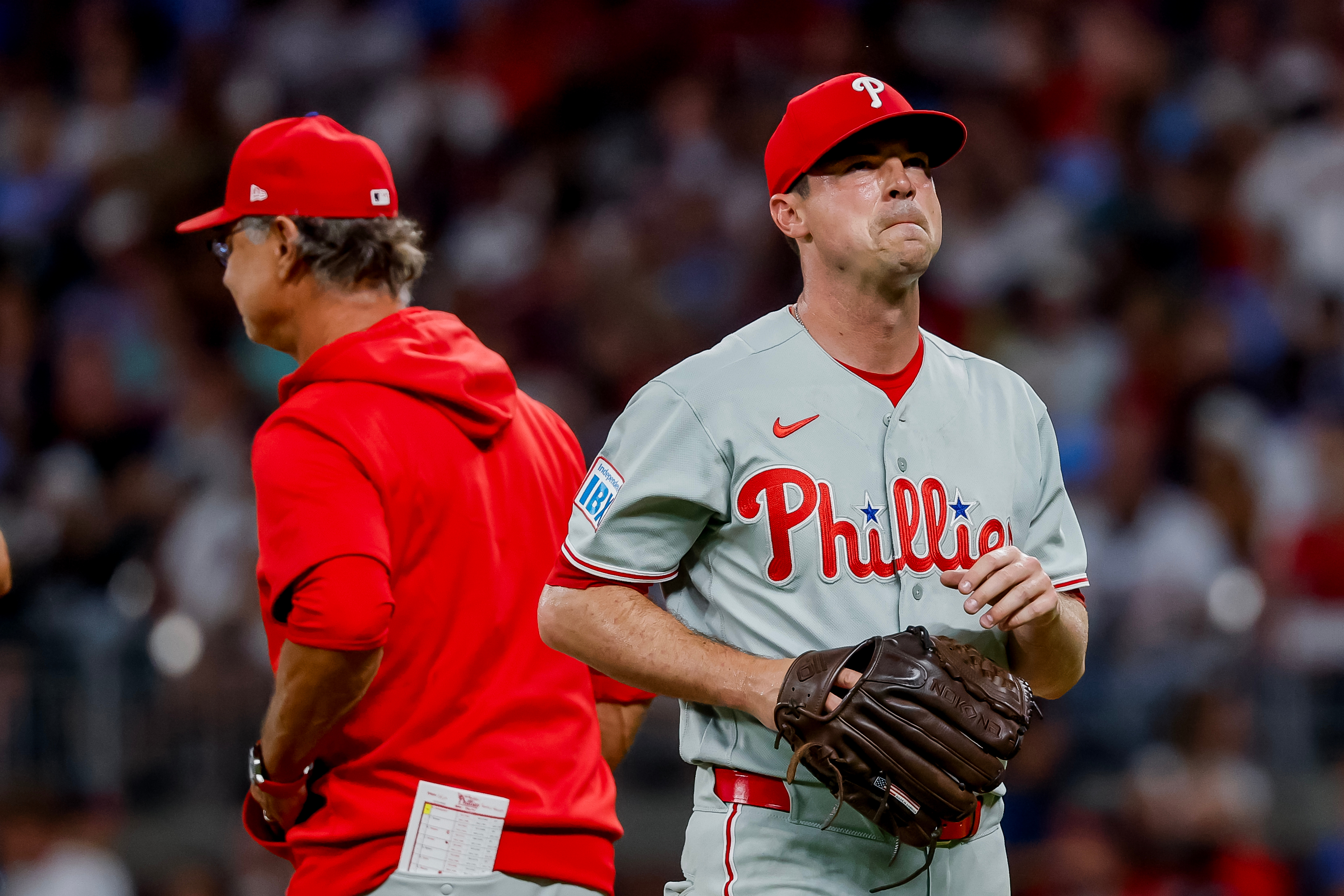
Raley had been one of three Phillies pitchers charged with a blown save in Friday’s 11-inning game, and the veteran left-hander also took the loss when Drake Baldwin walked him off. Raley didn’t fare much better Saturday.
“Not the success I would want, especially how last night finished and today,” Raley said. “But all you can do is execute pitches and go about your day and put your head down the next day and go back again.”
Phillies pitcher Brooks Raley reacts after getting relieved by interim manager Don Mattingly during Saturday’s fourth inning against the Atlanta Braves.Erik S. Lesser
He managed to secure two outs, but still left runners on the corners for Grant Holman, the next man up in the bullpen.
Holman had been added to the Phillies roster after it expanded on Sept. 1, taking the extra pitcher slot. But since then, he had waited in the bullpen for 11 days to be called on.
He allowed both inherited runs to score right away, on a single from Mauricio Dubón through the left side of the infield.
“It seems like every ground ball they hit found a hole tonight,” Mattingly said.
Riley hit another single, before Sean Murphy sent the grounder to Stott for what could have been the third out. If Stott had made a higher throw, or if Bohm had been able to pick it, the Phillies would have kept Atlanta’s lead to a manageable 3-1. But instead, Murphy was safe at first and the tailspin continued.
Stott has been the Phillies’ most reliable infielder this season, even after switching positions to third after the trade deadline to open second base for new acquisition Luis Arraez. The error was his fourth of the season.
Phillies third baseman Bryson Stott, seen here with an error in the Sept. 2 game against the Arizona Diamondbacks captured his fourth error of the season in the loss to the Braves on Saturday.Ross D. Franklin
“To me it just looks he just didn’t set his feet,” Mattingly said. “He still had time with Murphy running, just kind of threw it quick, obviously. Anytime he makes an error, really, it surprises me because he’s been really, really good over there.”
A walk, a wild pitch, and two more hits later, and the Braves had run up the score to 8-1 before Holman finally stopped the bleeding with a fly out.
Because of the error, none of the runs he allowed were earned.
Orion Kerkering made his first appearance since Sept. 4 in the fifth. He loaded the bases in the fifth on a single and two walks, but managed to end it without further damage with a lineout from Ha-Seong Kim.
Kerkering wasn’t so fortunate after returning for the sixth. A walk and another error, this time from Bohm, put runners on the corners and Atlanta tacked on another run with a sacrifice fly. With the bullpen already thin after Saturday’s extra-innings loss, Mattingly had had no choice but to push Kerkering for 1 ⅓ innings, even after a long layoff for the right-hander.
“We were definitely right on the edge of everything tonight,” Mattingly said. “If something went bad, like it did, then we were stuck.”
Don Mattingly said the Phillies felt “stuck” in Saturday’s loss to the BravesYong Kim / Staff Photographer
Justin Crawford hit his third homer of the year in the eighth inning, but by then the Phillies had already functionally conceded the game. They had put catcher Garrett Stubbs on the mound with two outs in the seventh to finish it off. Stubbs surrendered a three-run shot to Michael Harris II.
Now that the division has all but slipped away, the wild-card race comes to the forefront as the season enters its final two weeks. According to Harper, though, the Phillies must focus on themselves rather than scoreboard-watching.
“You can’t worry about what other teams are doing, especially when you’re in this situation,” he said. “So we got to play better baseball. If we don’t, we’re not going to be in. So I mean, I think as a team, we just got to look in the mirror, understand what we need to do on a nightly basis, and guys got to grind. … We got to take care of business as a team, and if we don’t, then we’re not going to be there.”
Police are investigating after a man and a woman were shot and killed in North Philadelphia early Saturday evening, police said.
Police said they are investigating the incident as a “domestic-related murder-suicide.”
The shooting happened on the 2300 block of North 18th Street around 5:31 p.m. Saturday, according to police.
Officer Tanya Little, a spokesperson for the police department, said police took the man and woman to Temple University Hospital, where they were pronounced dead at 5:54 p.m.
A firearm was recovered at the scene, Little said. No further details were available, and the investigation is ongoing.
ATLANTA — If Jesús Luzardo had his way, he would have pitched on Saturday.
The Phillies left-hander was scratched from his scheduled start against the Braves due to left shoulder stiffness. As the calendar flipped to September and the innings started to pile up, Luzardo said he started feeling sore, and it worsened after his two-hit shutout against Atlanta on Sept. 7.
An MRI on Friday evening revealed no structural damage, and Luzardo said if needed, he would have taken the ball and felt confident he’d be able to get outs. But with the postseason in mind, the Phillies staff chose caution and opted to give the 28-year-old pitcher extra rest.
“That was a conversation I had with them: If today was Game 7 of the World Series, I’m throwing no matter what,” Luzardo said. “But I think to get to that point, it’s probably better to be smart now than it is to throw [Saturday] and then see my body getting worse throughout the next couple weeks, so I think we’d rather get it right now.”
Luzardo reacts to the third out in the eighth inning against the Atlanta Braves at Citizens Bank Park earlier this month.David Maialetti / Staff Photographer
The lefty dealt with plenty of injuries earlier in his career, undergoing Tommy John surgery before he was even drafted in 2016 and hitting the injured list several times during previous stops in Oakland and Miami. But since arriving in Philadelphia via trade in December 2024, Luzardo had never missed a start until now. He pitched a career-high 183 ⅔ innings in 2025 and already has 178 ⅔ this season.
Luzardo said he believes inflammation is the root of the issue. He has not taken any injections such as a cortisone shot, which would require him to be shut down for a few days afterward. He is taking a few anti-inflammatory medications.
The Phillies have no plans to place Luzardo on the 15-day injured list at this point. They hope that rest will resolve the stiffness and that he will be able to start next week. The Phillies also have an off day on Monday, which gives Luzardo an extra day.
Interim manager Don Mattingly said he was “really encouraged” about Luzardo’s MRI results.
“It’s kind of what we thought,” he said. “We didn’t feel like there was anything truly going on other than the inflammation, which was causing the stiffness and things like that. I do think it was the right thing to do for sure. … He would have taken the ball, but we just didn’t know if that pushes to the next one, and then we’re doing this the rest of the year. So it feels better to take care of it now, get it knocked out, and then just have Zeus be Zeus.”
Jesús Luzardo had never pitched into the 9th inning before today …
Luzardo isn’t sure the complete game, which was the first of his career and required 109 pitches, was the cause of the stiffness.
“If you ask me, I think it’s a coincidence, especially because I felt good in the moment,” he said. “Yeah, I honestly don’t know. Maybe it didn’t help, but again, it’s September, so it could have really been anything.”
Adding to the frustration is the fact that Luzardo had been hitting his stride in the second half. The shutout against Atlanta had just been the latest in a dominant stretch for the left-hander, who has a 1.84 ERA and 0.85 WHIP in 10 starts since the All-Star break.
“I would like to get back to action as fast as possible for the team, for the organization,” Luzardo said.
With Luzardo down, the Phillies instead went with a bullpen game on Saturday with Tim Mayza opening. Orion Kerkering was also expected to appear, although he has been dealing with “turf toe” since his last appearance on Sept. 4 that has kept him in a walking boot away from the field.
Orion Kerkering recently pitched a bullpen session that gave manager Don Mattingly hope that he’ll return to form soon. Yong Kim / Staff Photographer
“He threw a [bullpen session] that went good, and so really since then it’s just been choosing whether to use him or not,” Mattingly said of Kerkering. “So we feel good about him. He feels good about pitching and all that stuff. He may be a little sore to run, but it’s not like something that he’s going to do any damage to it or anything like that. So the pitching part is fine.”
Extra bases
Tanner Banks (left forearm strain) joined the team in Atlanta and is expected to be activated from the 60-day injured list Sunday. … Nestor Cortes was scheduled to pitch an inning for triple-A Lehigh Valley on Saturday. … Andrew Painter (3-9, 5.71 ERA) is scheduled to start Sunday’s series finale opposite Atlanta right-hander Grant Holmes (9-5, 3.46).
At halftime Saturday, Temple honored the standard it has spent nearly a decade trying to reclaim.
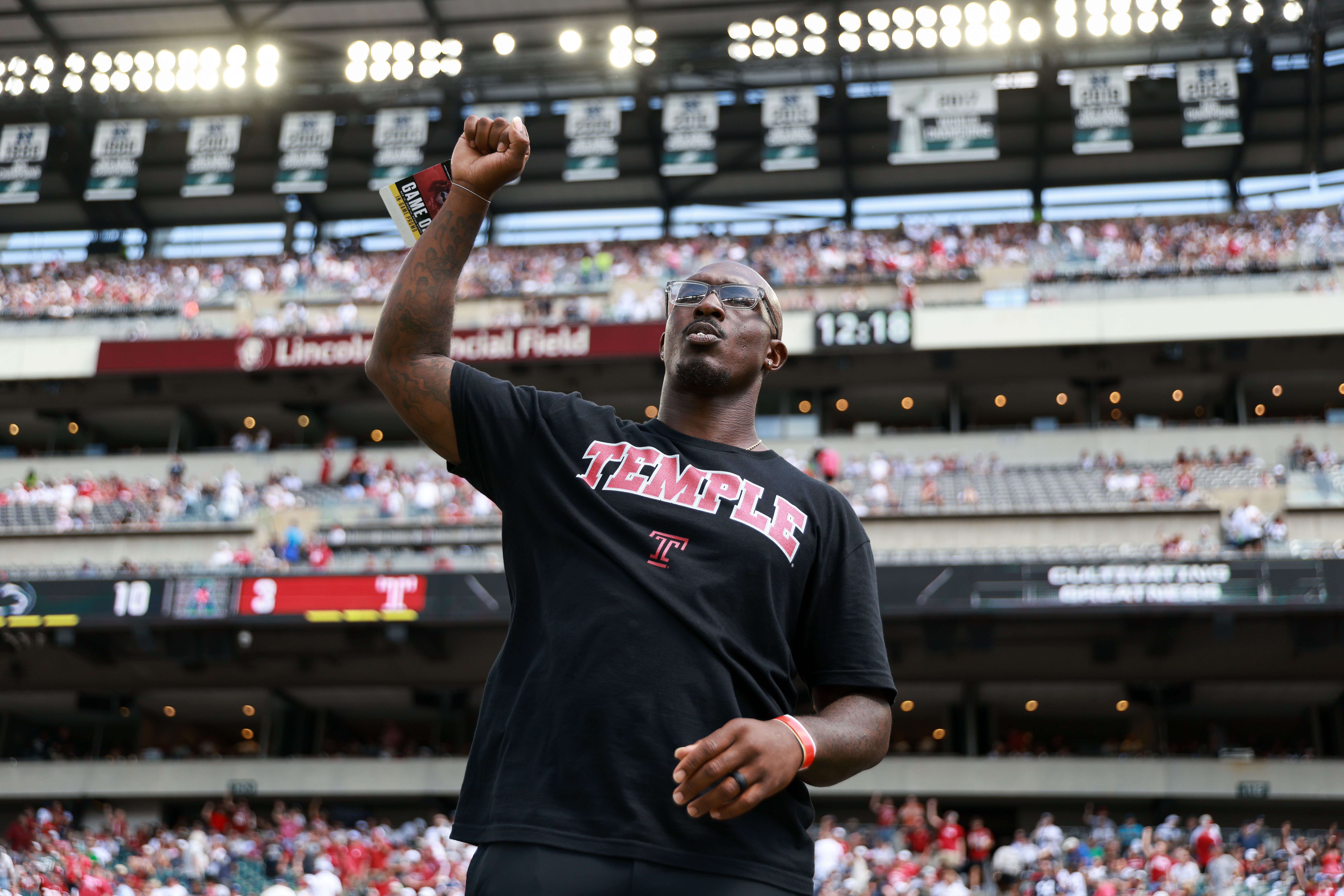
Members of Temple’s 2016 conference championship team returned to Lincoln Financial Field during the Owls’ 27-9 loss to Penn State and gathered in an end zone for a halftime recognition.
The reunion celebrated the defining accomplishment of Temple’s modern era while recalling the toughness, resilience, and brotherhood that transformed an uneven start into a conference title.
Nearly a decade later, those qualities offer a blueprint for a program that is attempting to recapture its former success in its second season under coach K.C. Keeler.
Former Temple quarterback P.J. Walker says it’s a thrill to be honored for the successes during his time with the program.
“It means everything [being recognized],” said P.J. Walker, quarterback of the 2016 team. “I think it’s a great opportunity for the guys to get back and understand the value of the success we had while we were there playing and the appreciation we received.”
Temple entered 2016 carrying expectations created by the previous season, when the Owls started 7-0, defeated Penn State, 27-10, at Lincoln Financial Field, and reached the conference championship game. Their return trip did not follow the same path.
The Owls opened with a loss to Army and fell to 3-3 after losing at Memphis. With their hopes of an undefeated season gone, Walker said the team narrowed its focus to the goal still within reach.
“We were finally able to settle in and focus on what was important, and that was winning the conference,” Walker said. “One thing led to another and led to us being able to play in the conference championship and win it.”
Temple did not lose again during the regular season. The Owls won their final six conference games before defeating then-No. 20 Navy, 34-10, in Annapolis, Md., to complete a seven-game winning streak and capture the championship of the American Athletic Conference (now the American Conference) .
The turnaround was rooted in lessons learned before 2016. Walker arrived during coach Matt Rhule’s first season in 2013, when Temple finished 2-10, and developed alongside players who eventually formed the core of consecutive 10-win teams.
“We were battle-tested,” Walker said. “The resiliency we showed day in and day out — we were pushed by Matt Rhule at a high level. When I say pushed, we were pushed, and we respected that. We knew the work we put in was a lot, and we weren’t going to let that work not pay off when it came to Saturday.”
That standard had become embedded within the locker room by 2015. Former Temple offensive lineman Kyle Friend and defensive lineman Matt Ioannidis, leaders on the team that preceded the championship group, said players became responsible for maintaining it.
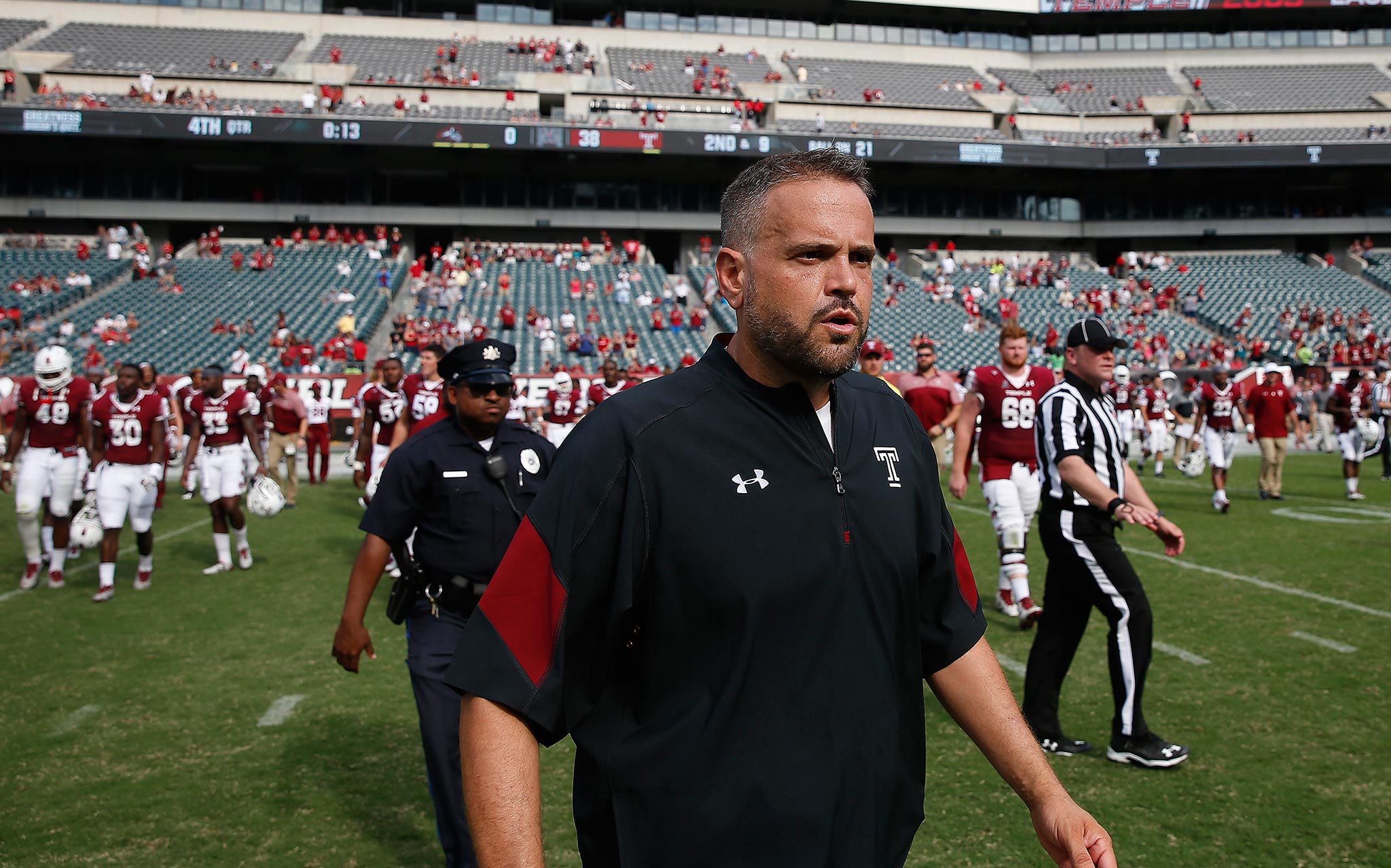
Players from Temple’s 2016 championship team say that the standard created by former Owls coach Matt Rhule (pictured) was at an all-time high.
“We pushed each other to the point where the coaches didn’t need to push us,” Ioannidis said. “We were harder on ourselves than the coaches could have been on us. We held each other accountable, and we stuck together in the tough games.”
Saturday illustrated the distance Temple still must travel and the possibility of beginning that climb. The Owls entered as considerable underdogs against Penn State but kept the game competitive throughout the first half before the Nittany Lions pulled away after halftime.
The loss on Saturday dropped Temple to 1-1, but its ability to remain within striking distance of a ranked team offered a glimpse of the toughness its predecessors considered essential.
However, doing so has become more complicated in a college football landscape reshaped by the transfer portal and name, image, and likeness compensation. Friend and Ioannidis were developed from lightly recruited prospects into NFL players, a path that defined Rhule’s Temple teams but has become increasingly difficult for subsequent Owls teams to replicate.
“It’s exciting to have a new coach who has a good track record,” Friend said. “I think it’s an interesting dynamic with NIL. That has changed the game drastically.”
Former Temple players believe that, like Rhule, Owls’ current head coach, K.C. Keeler, has the tools to bring success back to the program.Isaiah Vazquez / For The Inquirer
For Walker, however, the foundation of Temple’s success was not dependent upon the era.
“I think the brotherhood meant more than anything,” Walker said. “The way we went out there and fought for one another and battled for one another made a huge difference during those 2015 and 2016 seasons.”
Walker believes Keeler can restore that culture by recruiting players willing to compete for opportunities and commit to one another. And, while the former Owls returned Saturday to celebrate their own achievement, Walker said their role now is to support the players attempting to create the program’s next successful era.
“I think Coach Keeler is a great coach,” Walker said. “I think he’s the right coach for this program. To see those guys continue building that legacy and building who they are as a unit — it’s awesome to see. I think they are doing it the right way.”