Tag: topic-link-auto

  • We don’t talk enough about Trump’s $850M pay-to-play slush fund

    We don’t talk enough about Trump’s $850M pay-to-play slush fund

    There’s actually three things that are pretty certain in life: death, taxes, and the fact that the 22nd Amendment to the U.S. Constitution explicitly bars Donald Trump from seeking a third term as president.

    Even Trump, for all his occasional pep-rally bluster and online merch about running in 2028, has kind of, sort of, begrudgingly acknowledged this reality. “You know the law is very strong on that,” the president admitted to reporters during a gaggle just last month.

    That’s actually a good answer for Trump, because it avoids the obvious follow-up of how a president who’ll be 82 on Election Day in 2028, can barely stay awake now during important moments like a 9/11 memorial service, has probably consumed more Big Macs than the late Morgan Spurlock — and, oh, has a 32% approval rating — could expect to win, or even make it up the steps of his Qatari bribe jet in two years.

    Still, I wish that one of those tarmac journalists would throw on a Peter Falk-style overcoat and ask, Columbo-like, just one more thing of the 47th and possibly last president:

    If you’re not running for office ever again, why have you raised some $850 million — and counting — in campaign funds since your last and supposedly final campaign? Why are you sitting on most of this money? Are you planning to take it with you on Jan. 20, 2029?

    I’d been mulling this column for a while when it was announced late last week that Trump’s best-known political action committee, the super PAC called MAGA Inc., with about $400 million in the bank, is finally cracking open the vault, slightly.

    MAGA Inc. just transferred $49 million to yet another new PAC, No Going Back Inc. — the more money laundering, the better, apparently — that’s actually going to buy ads supporting some GOP candidates in the November midterms, especially in tight Senate races in Texas, Michigan, Ohio, and New Hampshire.

    Indeed, expenditures like that are the only legitimate argument for Trump to have such a large political slush fund — to elect sympatico lawmakers who can support the president’s agenda, whatever that is. Whatever else happens in this election, two more years of a Republican-led Senate would allow Trump to keep appointing right-wing judges and at least limit the investigations of his gross misconduct.

    Still, even some Republicans are acknowledging the $49 million, and presumably some additional funds over the next seven weeks, are too little and too late. In August, when voter opinions tend to harden ahead of the fall campaign season, MAGA Inc. spent a piddling $825,000 to prop up the new, Trump-supported South Carolina Sen. Darlene Graham in a GOP primary battle, and nothing more.

    “Our threat level should be up and people are going to have an expectation that you deploy all your resources,” one GOP donor told Politico, before the $49 million drop was announced. “He’s sitting on hundreds of millions of dollars, not doing that. We’re in September.” Interestingly, MAGA Inc. has spent virtually nothing on House races, even though a Democratic House is likely to impeach Trump for the third time in 2027.

    Republicans should be alarmed. We all should be alarmed, for a number of reasons. Boomers like me remember, vaguely, an old-school TV game show that was called You Don’t Say, with a tagline I’ve never forgotten: “Remember, it’s not what you say. It’s what you don’t say.”

    When it comes to MAGA Inc. — and several other massive piles of Trump-connected cash — political reporters ought to realize it’s not what you spend. It’s what you don’t spend.

    If Trump is freeing up $49 million to try and sway close Senate races, where is the other $800 million going? And where am I getting this figure? It was buried in a recent MS Now article, which noted, correctly, that there is a separate, so-called dark-money arm of MAGA Inc. called Securing American Greatness that’s believed to hold as much as $450 million, most from secret donors.

    That figure comes from Trump himself, who told reporters last month at an airport press gaggle: ”I’ve raised a lot, and nobody knows what it is, but I will tell you it’s about $850 million. I’ll be spending a lot of that money for — and my own money — but I’ll be spending a lot of that money for candidates that I think are good, Republican candidates.”

    Nobody knows what it is. You can thank Trump’s pals on a right-wing rogue U.S. Supreme Court for a generation of bad rulings that have sold American elections to the highest, secret bidders.

    The other thing about Trump’s comments is that, despite what he said, he’s actually so far not spending a lot of that money. Even though, by laws that are now honored in the breach, there’s supposed to be a clear separation between Trump and these super PACs, the president sees these funds as his own money.

    “This is my money, that I control,” Trump told reporters earlier this month. Increasingly, anxious Republicans and other political observers worry Trump is hoarding the money not to elect GOP candidates, but to spend on his legal defense once those candidates lose and investigation-minded Democrats retake the House and maybe the Senate.

    The law does say Trump can’t legally pocket the money when he leaves office. And we all know what a stickler Trump is for following the law, right?

    Protest organizers gather in August 2025 outside the Moshannon Valley Processing Center, an ICE detention center near Philipsburg, Pa., run by the GEO Group, which contributed more than $1.4 million to a Trump-aligned PAC in June.Tom Gralish / Staff Photographer

    It’s worth noting there are other piles of cash we know far too little about. For example, Trump’s 2025 inaugural committee raised a staggering $250 million — more than double his 2017 record — from the usual assortment of billionaires, tech companies, etc., and yet there’s been virtually no accounting of how that money was spent. And Team Trump is hoping to raise a gobsmacking $950 million by next year for his utterly amorphous plans for a presidential library, honoring a POTUS who doesn’t read.

    Add it all up, and you’ve got a potential slush fund of roughly $2 billion. That’s appalling, but even worse with the knowledge that — and this cannot be repeated enough — with Trump never running for office again, the donors to these funds are almost all millionaires and billionaires who simply want something from the government for themselves or their corporations.

    Earlier this year, reporters used tax records and other available reports to sleuth out three of the donors to the secretive Securing American Greatness Inc., including the Bitcoin Advocacy Project, which gave $2 million as Trump was boosting that industry through deregulation. The tech firm Qualcomm had been outed earlier as a $1 million donor to this massive fund that is largely a mystery.

    There are numerous examples of donors giving money to MAGA Inc. around the time of favorable government actions. For example, a subsidiary of the private-prison giant GEO Group gave $1.4 million to the Trump-aligned PAC in June at the same time U.S. Immigration and Customs Enforcement was awarding the firm $165 million in additional contracts. Michelle D’Souza, the chief executive officer of Pentagon contractor Unified Business Technologies, gave MAGA Inc. $4 million last October.

    That’s in addition to the family members of those seeking presidential pardons, who made huge donations to MAGA Inc. right before Trump granted clemency to their relatives. That tally includes $3.5 million from the daughter of a Venezuelan billionaire who’d reached a plea bargain on federal bribery charges before he was freed by Trump, or Paul Walczak, a convicted tax cheat pardoned after his mom gave $1 million to MAGA Inc.

    Many of MAGA Inc.’s donors are billionaires, and while some surely share Trump’s authoritarian worldview, many of them want something from the White House — and they are getting what they want. It is legal graft, a massive pay-to-play scheme that gets a giant shrug in the unholy world created by a right-wing master plan.

    It’s time to stop shrugging. When Democrats retake the House, an almost certainty at this point, an investigation into Trump’s $1 billion to $2 billion in assorted slush funds, and whether any corruption laws were violated in raising all this cash, needs to pole vault to the top of their very long list of possible probes into this rogue president.

    It’s kind of nuts when you think about it: A president corruptly raising hundreds of millions of dollars he’ll end up spending to hire lawyers to defend himself from the looming corruption charges. Maybe it would have been better — not just for the sake of democracy, but for Trump himself — not to have gone down this road in the first place?

    But then, nothing makes sense anymore. And nothing makes less sense than the lack of energy, so far, in accounting for Trump’s pay-to-play dollars and how they are being spent. Keeping an American republic depends on answering these questions, and then making sure this never, ever happens again.


  • Ben Brahmer becomes ‘heartbeat’ of Penn State’s offense to push through slow start

    Ben Brahmer becomes ‘heartbeat’ of Penn State’s offense to push through slow start

    Matt Campbell preached all offseason that he’d know the true identity of this Penn State team when it first faces adversity.

    That moment came against Temple at Lincoln Financial Field on Saturday. The Nittany Lions failed to score on their first two red zone opportunities, missed a 33-yard field goal, and were tied 3-3 with the Owls deep into the second quarter.

    But Penn State responded in a big way with 27 unanswered points en route to a 27-9 win over Temple.

    “I felt like nobody flinched, nobody wavered,” Campbell said. “There was no complaining.”

    Quarterback Rocco Becht said he was glad to face some difficulties. Now Penn State knows it’s capable of overcoming them and what it needs to work on moving forward.

    “I thought it was a good game for us to have,” Becht said. “I think to be humbled coming off of a good win, coming out here and playing Temple, a good team, and we just started off a little slow. I think we needed this early before we got into conference play.”

    Ben Brahmer steps up

    Tight end Ben Brahmer said Tuesday his position is the “heartbeat” of offensive coordinator Taylor Mouser’s offense, but he and his fellow tight ends were relatively quiet in the passing game against Marshall last weekend.

    Saturday against Temple, Brahmer flipped the script and showed why he was a John Mackey Award semifinalist last year. The senior led Penn State with 79 receiving yards and two touchdowns, both of which were 23-yard scores.

    “It’s been great,” Brahmer said. “Just kind of keeping my head down and working. I know the ball will come to me when it happens, and I just got to be ready for that. Just got lucky today and got open a couple times.”

    Brahmer’s first touchdown Saturday was arguably the most important. With just seconds on the clock before halftime, Campbell decided not to call a timeout.

    Becht found Brahmer wide open over the middle of the end zone to put Penn State up, 10-3, as it headed into the locker room.

    “Just setting the tone for the rest of the game going into half,” Brahmer said. “It’s huge, winning the middle eight, kind of just staying on the same page, keeping our head down. [Mouser] was making a lot of good calls. We just had to execute those.”

    Penn State’s defensive end room

    Campbell announced postgame that redshirt sophomore defensive end Max Granville is out for the season after injuring himself at practice this week.

    Granville, who missed all of 2025 with an undisclosed injury, was expected to play a big role this season as a young edge rusher with loads of potential. He initially joined the Nittany Lions in 2024 after reclassifying and appeared in seven games.

    “Obviously, a really tough blow for our football team, and most importantly, a really tough blow for Max,” Campbell said. “The thing I love about Max is he’s kind of been a pillar of glue for the unity of our football team over the last nine months. Who he is, what his character is, and I think that’s why we’re all really convinced that he’ll come back better than ever.”

    The depth in Penn State’s defensive end room was already thin, with sophomore LaVar Arrington II out for four to six weeks, so Granville’s injury stings.

    The Nittany Lions will have to lean on redshirt senior Ikenna Ezeogu, sophomores Yvan Kemajou and Alex McPherson, and redshirt senior Caleb Bacon, who recently switched positions from linebacker to defensive end.

    Penn State linebacker Tony Rojas (13) reacts with the team after an interception during the first quarter against Temple on Saturday.Isaiah Vazquez / For The Inquirer

    Penn State has three sacks through two nonconference games. Freshman Jackson Ford, a Malvern Prep graduate who recovered a fumble against Marshall, could see more playing time moving forward.

    “Max is like a rock to us, and he will be for the future,” said linebacker Tony Rojas. “Just having him along with us on away games is going to be awesome for us and something we need.”

  • Main Line art dealer is accused of helping sell fake Andy Warhol paintings

    Main Line art dealer is accused of helping sell fake Andy Warhol paintings

    A Main Line art dealer, whose gallery was raided by federal authorities this summer, is named in a new lawsuit, for allegedly participating in an international “pipeline” to sell fraudulent artwork.

    Nathan “Nicky” Isen is among half a dozen people being sued by a Florida family who says they were scammed into buying fake Andy Warhol paintings and prints by a network of “suppliers, fake authenticators and distributors.” According to the lawsuit, filed last week in Miami, the enterprise stretched from Isen’s gallery, Dane Fine Art in Haverford Township, to Florida and Peru.

    Isen’s lawyer, Patrick Egan, said in a statement Sunday that “the claims in this lawsuit are just that, claims.”

    “My client categorically denies any wrongdoing and any connection with any alleged conspiracy,” the statement said. “We look forward to the opportunity to challenge these claims in court.”

    The lawsuit, filed by Richard and Judy Perlman, alleges that Isen had developed a “toxic” reputation among collectors and appraisers after he pleaded guilty to money laundering in 2015. He rebranded his then-gallery, I. Brewster & Co., to Dane Fine Art. (A website for I. Brewster & Co. now redirects users to Dane Fine Art.)

    But, despite the rebrand, the lawsuit contends Isen’s “modus operandi remained unchanged.” He was “selling pages torn from art books as authentic prints.”

    According to the 42-page lawsuit, Isen then “formed a conspiracy” with Leslie Roberts, an art dealer in an affluent Miami neighborhood.

    “This conspiracy provided what each needed: Isen got a gallery front in Florida with no connection to his toxic name, while Roberts got forged inventory,” the lawsuit filed by the Perlman family alleges.

    The Perlmans also sued Roberts in 2024. That case settled in January for an undisclosed amount, according to the Wall Street Journal. Roberts also pleaded guilty to art-related wire fraud and is scheduled to be sentenced later this month, the news outlet reported.

    Between 2023 and 2024, Isen’s gallery repeatedly invoiced Roberts’ gallery for, what the lawsuit called, “forged” Warhol works, which the Perlmans then purchased. Roberts told the Wall Street Journal he believed the Warhols were genuine at the time.

    In July, the FBI conducted “court-authorized law enforcement activity” at Dane Fine Art, in the 2300 block of Haverford Road.

    It’s unclear why the FBI searched the business. Isen’s lawyer did not respond to questions about the FBI raid and declined to comment on the matter to the Wall Street Journal.

  • Black winemakers are few and far between. These Philly-area business owners are working to boost their ranks.

    Black winemakers are few and far between. These Philly-area business owners are working to boost their ranks.

    Four years ago, Keyanna Wilson’s family opened a winery in Hatboro to develop new wines and cultivate a new generation of Black winemakers.

    Through Cyrenity Sips Winery, Wilson’s family aims to boost the number of Black winemakers in Pennsylvania by 15 in the next 15 years. To accomplish this mission, they are identifying entrepreneurs and supporting their entry into the industry through a nonprofit.

    “It’s making those connections, teaching people how to make wine, the process of it, the social skills,” said Wilson, who owns Aurora’s Vines, a brand launched by Cyrenity Sips.

    People browse the offerings at Aurora’s Vines during the annual Philly Black Wine and Spirits Fest held at Girard College Saturday.Bastiaan Slabbers / For The Inquirer

    She was among the sellers at the fourth Philly Black Wine and Spirits Fest at Girard College in North Philadelphia Saturday.

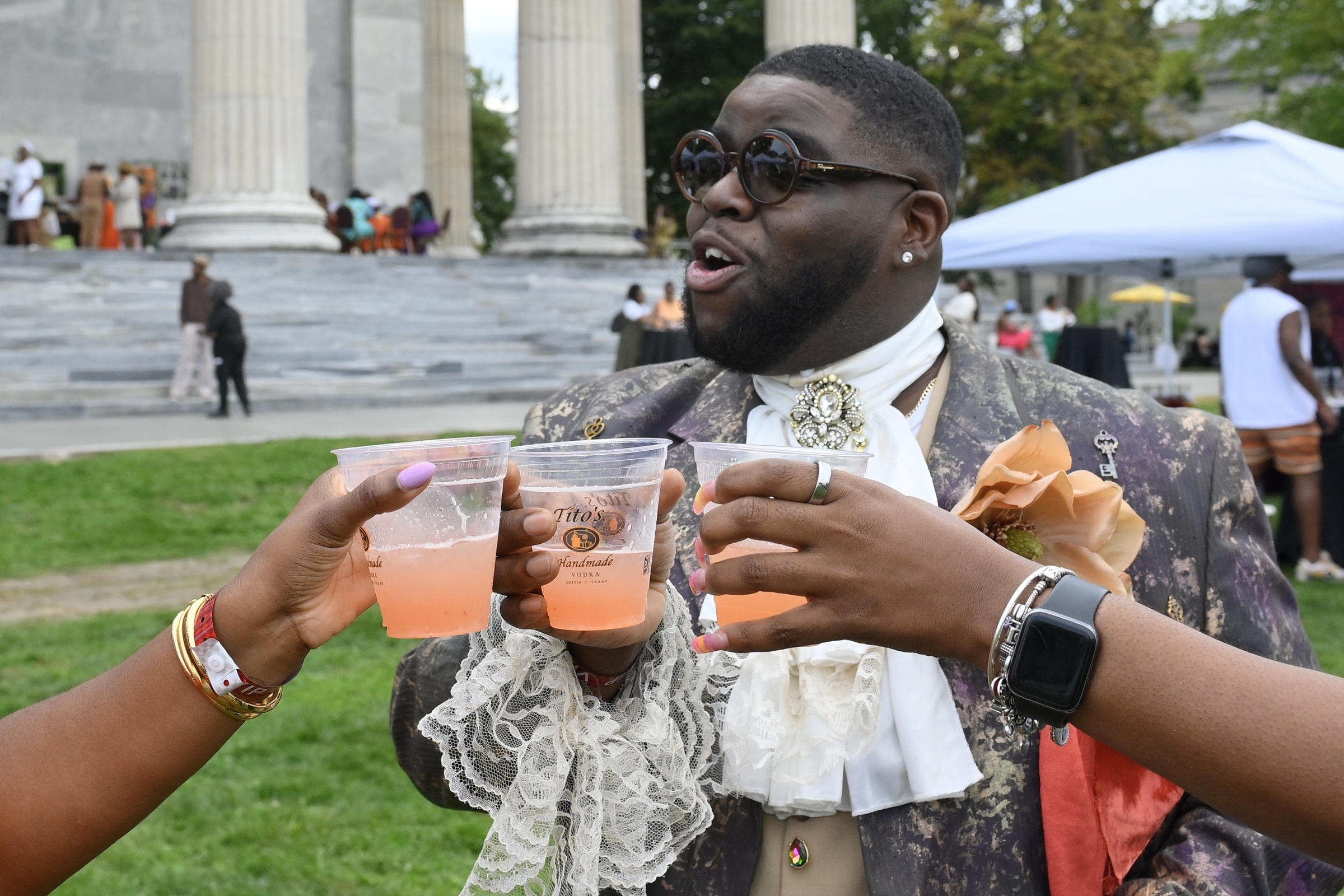
    Inside Founders Hall and outside at booths sprawled across the boarding school’s lawn, guests sipped wines, bought bottles and sampled food from different vendors, while a DJ spun music from a stage.

    Sonia “Sunny” Blount, the event’s founder and owner of Kabila Events, said she launched the festival four years ago in part to promote Black-owned businesses in a white-dominated industry.

    Inspired by the “history and richness” of a wine tasting event at a vineyard in Barcelona, Blount, a Mount Airy native and Temple University graduate, said she wanted to bring that experience to Philadelphia, while also spotlighting Black-owned wine and spirits makers.

    Black ownership remains rare in the wine business

    As of 2020, fewer than 1% of American winemakers and winery owners were Black, according to the Association of African American Vintners.

    Some of that is due to challenges faced by many Black-owned businesses, Blount said.

    “There’s a lot of bureaucracy, a lack of resources and access to capital,” she said.

    But it also reflects a less tangible barrier, related to perceptions of the wine industry and inclusivity, she said.

    People want to experience wine “in a way that is approachable,” Blount said. “If it’s all historically been one way, there has been a bit more of a challenge in trying to get people interested.”

    Saturday’s event, however, had an eager audience. Many dressed up in purple, gold, and green in keeping with the event’s Mardi Gras theme, “From Bourbon Street to Broad Street.”

    “We needed a weekend out,” said Shavonne Carter, who attended with her friend April Howard. The Brookhaven residents were enjoying tasting the variety of wines and shopping. Carter bought perfume, while Howard bought a craft syrup for cocktails.

    While the friends said they had gone to other festivals featuring Black-owned businesses, Saturday’s was on “a larger scale,” Howard said.

    “It’s a work of love,” Howard said of the vendors. “These are regular people. This is their dream, and it’s nice to be able to support them.”

    Attendees including April Howard, far right, and Shavonne Carter, second from right, outside Founder’s Hall at the Black Wine and Spirits Fest at Girard College.Bastiaan Slabbers / For The Inquirer

    Charles and Lakisha Honesty, who live in Washington, D.C., said they bought tickets to the event after seeing an Instagram post.

    “We’re not wine-every-day people,” Charles Honesty said, but they were drawn by the promise of a fun event. The couple were enjoying samples from Hedon State Wines, a business also from Washington, D.C., that had a booth set up.

    Michael Goode, Hedon State’s managing partner, said he started getting interested in wine after going out to eat and feeling intimidated by a restaurant wine list.

    He started going to wine school after work, where he was “the only brown person in the room,” he said.

    Blount hopes the festival will expand to different cities and eventually “provide some space for education and resources for people who want to get into the industry.”

    Jenear Monts, Raymond Lynn, and Shayna Cassel of Philadelphia attend the Philly Black Wine and Spirits Fest at Girard College Saturday.Bastiaan Slabbers / For The Inquirer

    There’s a “lack of knowledge” around what it takes to start a winery, Wilson said, including navigating the liquor laws in Pennsylvania.

    But it’s doable, said Wilson, who specializes in wines with unconventional flavors — like blackberry and mango green tea. “I would come up with these crazy concepts and ideas, and my family was like, ‘You should start a business around that,’” she said. On Saturday, attendees were lining up to try her new sangrias, including a strawberry watermelon version.

    Wilson, whose business sources fruit from New Jersey and grapes from California, said she often encounters people who don’t think they like wine, but as she introduces them to “more fruity flavors, everybody’s palates usually open.”

    She hopes more Black winemakers will open their minds to the possibilities of joining the industry.

    “If you have the ambition to come behind it, we’ll get you there,” Wilson said.

  • President Trump’s new strategy on the Iran war: Pretending there isn’t one | Editorial

    President Trump’s new strategy on the Iran war: Pretending there isn’t one | Editorial

    During a recent cable news appearance, Commerce Secretary Howard Lutnick claimed no American lives had been lost in the Iran war, an error he blamed on confusion with President Donald Trump’s earlier invasion of Venezuela. And perhaps it is difficult to keep one’s wars straight in an administration that has attacked seven countries in less than two years.

    But while Lutnick’s claim was horribly wrong in fact, it was an accurate reflection of the administration’s consistently reprehensible diminishment of the costly war it started more than six months ago without congressional authorization or public support. The day after the secretary’s gaffe, Vice President JD Vance denied the very existence of the conflict, telling reporters, “I wouldn’t call it a war,” just days after an American bomb killed five civilians attending a wedding in southern Iran. The day after that, Trump himself dismissed the war as “small potatoes,” adding, “There’s no fighting,” even as the conflict continued to escalate, drive up energy prices, and threaten to draw in other countries.

    In reality, the war has had tremendous repercussions for U.S. service members and civilians in the Middle East, American security and credibility, and global trade and stability. The only aspect of the conflict that is not serious is Trump’s handling of it.

    Despite the administration’s best efforts to obfuscate the human cost of the conflict, the war has killed 18 American service members and wounded nearly 800, taken thousands of lives in Iran and the Middle East, injured tens of thousands across the region, and displaced hundreds of thousands. And the fighting has likely cost American taxpayers more than $100 billion in direct spending, with energy and other economic repercussions that could approach $1 trillion in the United States alone.

    The intangible costs aren’t small potatoes, either. Iran remains under the control of an emboldened regime able to fire on U.S. bases in the region, impede traffic through the crucial Strait of Hormuz, and resume its pursuit of a nuclear weapon without the international limits and monitoring Trump dismantled during his first administration.

    The war has also depleted the military’s supplies of critical munitions, leaving us more vulnerable to adversaries, and strained our forces with marathon deployments and logistical disruptions. Rather than responding to these problems with the urgency they deserve, Defense Secretary Pete Hegseth appears preoccupied with hunting for those who disclosed them to the press, purging ranking personnel who might disagree with him, and blocking promotions of Black and female officers. The Army has lost half its four-star generals, its chief of staff, and its top civilian leader — Army Secretary Dan Driscoll — who reportedly warned the president of the force’s flagging experience, readiness, and morale on his way out.

    Nor does the administration appear better prepared to end the war than it is to win it. Trump told the Republicans’ midterm convention Wednesday that the conflict was necessary to prevent an Iranian bomb and nearing its final stages. But peace negotiations have fizzled, the countries are exchanging strikes on warships and tankers, and Energy Secretary Chris Wright recently acknowledged that another deal on Tehran’s nuclear program may never be reached.

    The trouble is that Trump and his lieutenants don’t appear to have a strategy for waging war on — or making peace with — Iran. What they have instead is a plan to manage the public relations fallout of the conflict by lying about its casualties, costs, and extent in the hope voters won’t punish their party for it in the midterm elections. It’s not even good PR, let alone defense or diplomacy.

    In that sense, it’s not surprising Trump and Co. can’t figure out how to get out of the war they began. They would have to start by acknowledging they’re in it.

  • Eagles-Commanders: Two familiar voices and a departure at NBC Sports Philadelphia

    Eagles-Commanders: Two familiar voices and a departure at NBC Sports Philadelphia

    After a long offseason, the Philadelphia Eagles are finally back in action Sunday, taking on the Washington Commanders to kick off a season filled with “Super Bowl or bust”-level expectations.

    “There’s no way this team should lose more than three games, four at the most,” writes Inquirer columnist Marcus Hayes. “They’ve got a Pro Bowl quarterback, a superstar running back, a franchise receiver, and a genius running a defense with more talent than any defense in team history that didn’t include Reggie White.”

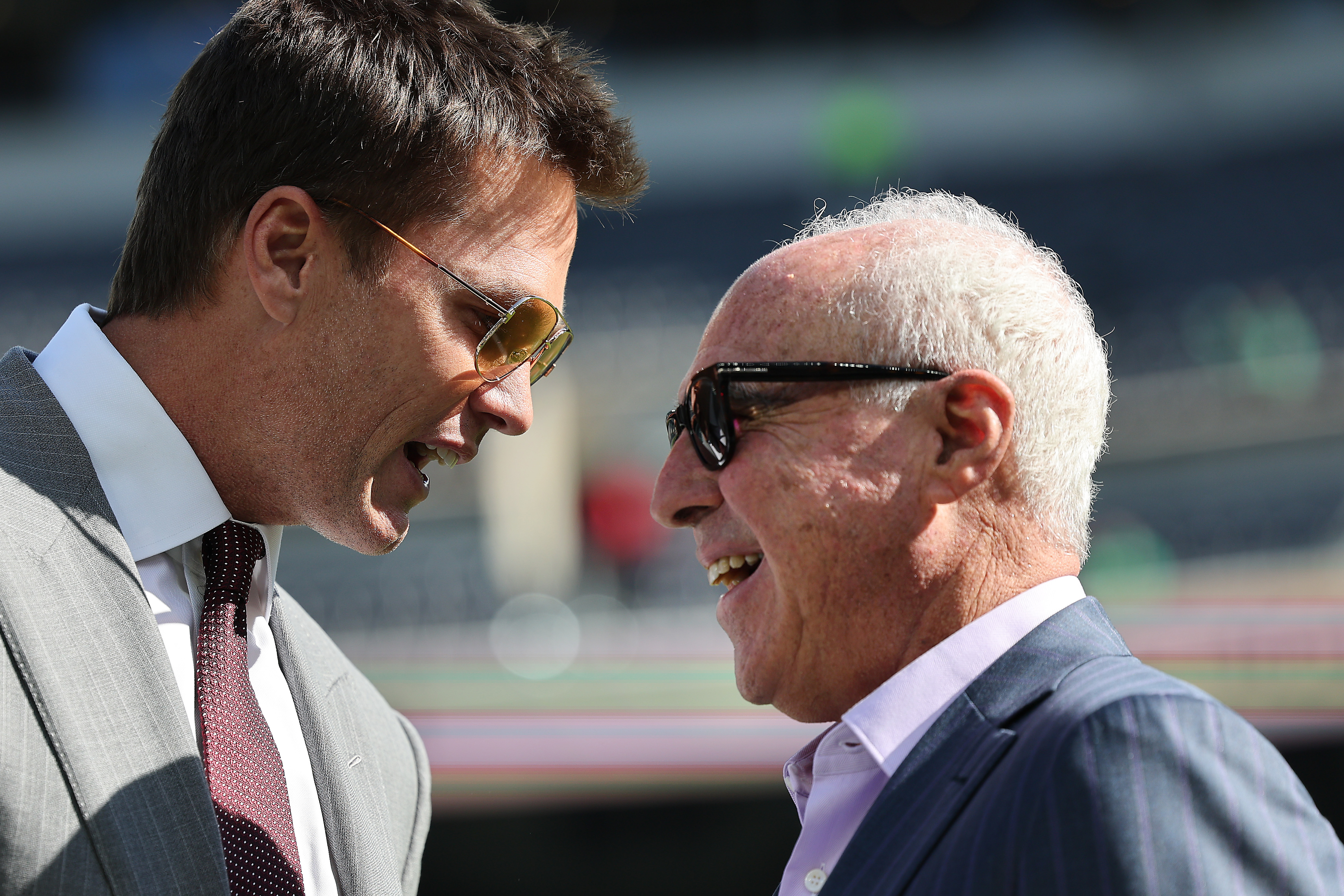
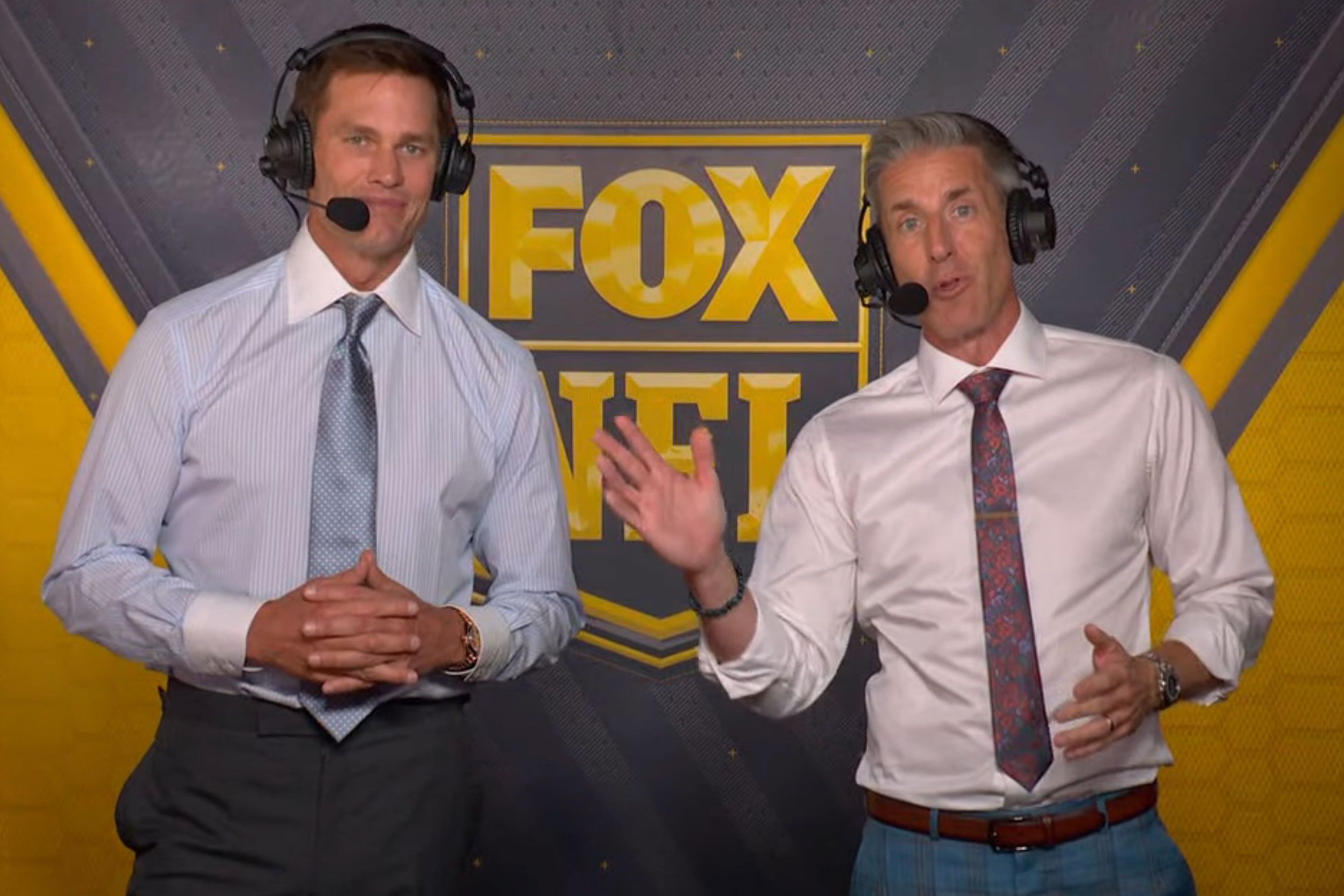
    Calling the Birds’ season opener on Fox is a familiar figure — former Super Bowl villain turned top broadcaster Tom Brady, who is entering his third season as the network’s top NFL analyst.

    To Brady’s credit, he made steady improvement in the booth last year, developing into one of the best analysts currently calling games. The future Hall of Famer worked six Birds games last season and is in line to call at least four this year, including the Eagles’ Thanksgiving Day matchup against the Dallas Cowboys.

    “There are parts of the game where he just takes over — getting inside the mind of Tom Brady at the line of scrimmage before a play,” Fox NFL producer Richie Zyontz told Front Office Sports at the end of last season. “Anticipating, not just reacting.”

    Despite his other commitments outside the booth, which include being a minority owner of the Las Vegas Raiders, Brady expects to fulfill the 10-year, $375 million deal he signed with Fox in 2024.

    “I have a lot to prove to myself, to my teammates. I have a lot to prove to the executives,” Brady told the Sports Business Journal. “I want to go earn it and I don’t want anything given to me. I hope they’ll have me through the end of this contract.”

    Here’s everything you need to know to watch or stream the Eagles’ season opener against the Commanders.

    How to watch and stream Eagles vs. Commanders

    Tom Brady (left) and Kevin Burkhardt will call Eagles-Commanders on Fox Sunday.Fox Sports

    Sunday’s Week 1 game between the Eagles and Commanders is scheduled to start at 4:25 p.m. Philadelphia time on Fox.

    Alongside Brady will be veteran play-by-play announcer Kevin Burkhardt, a North Jersey native who grew up rooting for the Eagles in Giants country.

    Erin Andrews and Tom Rinaldi will report from the sidelines at Lincoln Financial Field.

    The game will stream on Fox One, the network’s subscription streaming service. It’s also available on any so-called skinny bundle that carries Fox, including fuboTV, YouTube TV, Hulu + Live TV, Sling TV, and DirecTV Stream. Most offer a free trial.

    If you live in Philadelphia or any other TV market where the game is airing, you can also stream the game on NFL+, the league’s subscription streaming service, which runs $6.99 a month.

    If you’re looking to stream the game for free and you live in or around Philadelphia, your best option is to use a digital antenna, since the game will air on broadcast television on Fox 29.

    Merrill Reese and Mike Quick back together on radio

    How Merrill Reese, the voice of the Eagles, prepares to go on air
    Video: How Merrill Reese, the voice of the Eagles, prepares to go on air

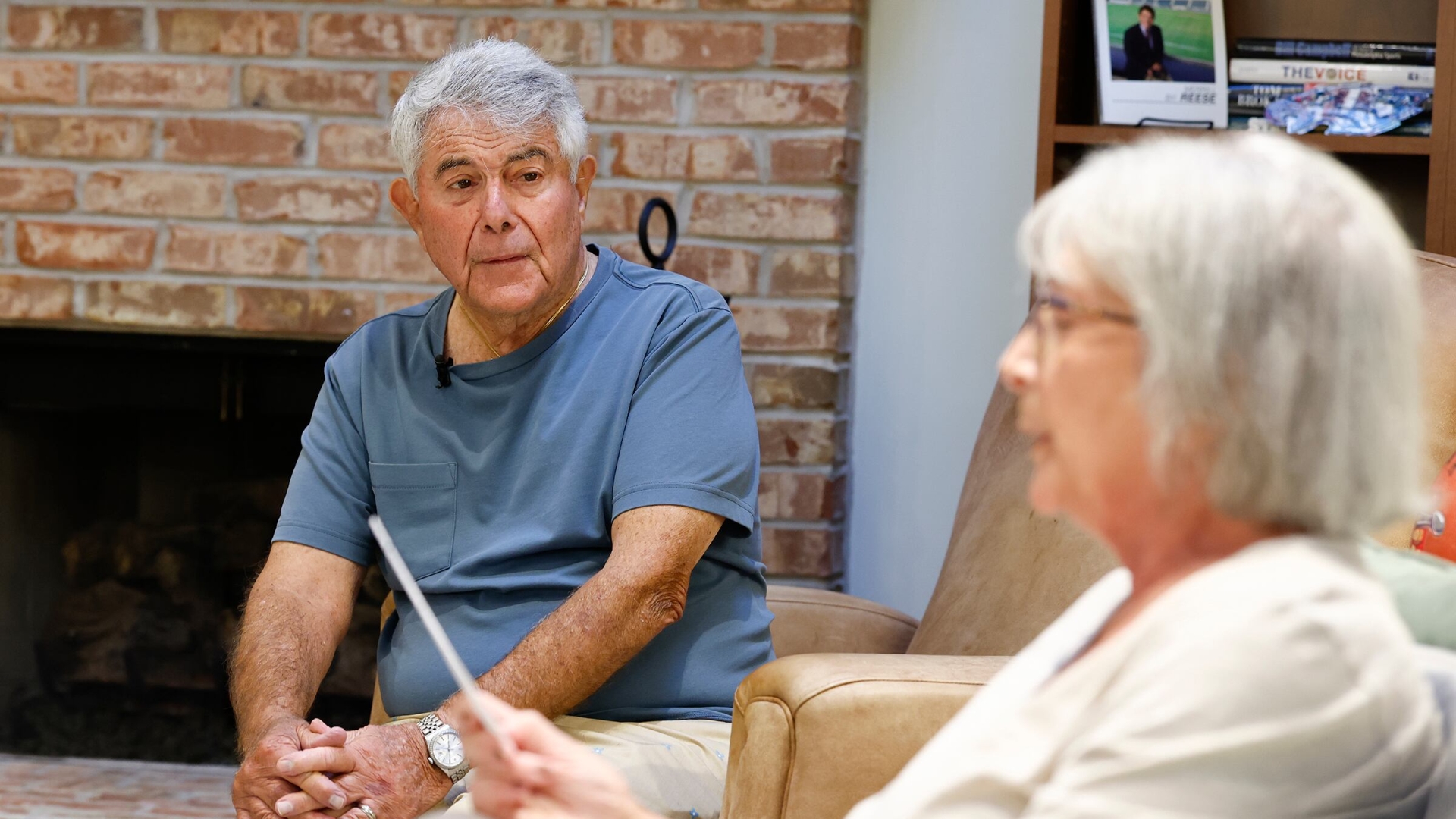
    Another familiar voice returning this year is Merrill Reese, who is back for his 50th season calling Eagles games on 94.1 WIP.

    Reese began his long career as the team’s pre- and postgame radio host before being promoted to color analyst in 1975. He became the voice of the Eagles suddenly in December 1977 after his partner Charlie Swift died by suicide, and has remained in the booth ever since.

    While Reese, 84, is by far the longest-tenured announcer in the league, he has no intention of this being his last season in the booth.

    “I always kiddingly say they’re going to have to remove me with a crane,” Reese told The Inquirer’s Matt Breen in a lengthy interview. “My greatest pleasure is to sit there and broadcast an Eagles game. There’s nothing I love more. I even enjoy doing the preseason games. … I have no intention of stopping.”

    Merrill Reese (left) and Mike Quick promoting their own beer in 2022. ELIZABETH ROBERTSON / Staff Photographer

    Back alongside Reese is former Eagles wide receiver Mike Quick, who joined the booth in 1998. Reese has had a number of broadcast partners over the years — Jim Barniak, Bill Bergey, Stan Walters — but none had the staying power of Quick.

    “I believe we’ve become like members of the family,” Reese said. “We’re like their old friends who’ve been with them for many, many years. … They can identify with us. They feel comfortable with us.”

    One big change on WIP’s Eagles broadcasts is the absence of a sideline reporter. Devan Kaney, who served as sideline reporter last season and during the Eagles’ Super Bowl LIX run, was laid off by WIP in March as part of company-wide cutbacks by Audacy.

    Former WIP host Howard Eskin became the station’s first Eagles sideline reporter in 2011, but abruptly left the station in December 2024 following an incident with a female staffer during a remote broadcast at a Chickie’s & Pete’s in South Philadelphia and was replaced by Kaney.

    Ron Jaworski not returning to NBC Sports Philadelphia

    Ron Jaworski, seen here speaking with Former New Jersey Gov. Chris Christie before an Eagles game. NBC Sports Philadelphia

    Ron Jaworski, the former Eagles quarterback known to most fans simply as “Jaws,” won’t be part of NBC Sports Philadelphia’s pre- and postgame coverage this season.

    The former Eagles quarterback and longtime NFL analyst made the decision to pull back on his broadcasting duties last week after four years with the network.

    “It’s been a great run!” Jaworski wrote on social media last week. “Thank you all, and Go Birds!”

    Michael Barkann, who has hosted Eagles pre- and postgame since the Comcast SportsNet days, is back for his 30th NFL season. He’ll be joined by Reuben Frank and two former Birds players — offensive lineman Barrett Brooks and wide receiver Jason Avant.

    Elsewhere, former Eagles star Brandon Graham will join PHLY’s postgame coverage for certain games this season, rotating with former Birds defender and Super Bowl champ Vinny Curry.

    Seth Joyner is also back to offer postgame analysis on YouTube alongside longtime Birds reporter Derrick Gunn and sports talker Marc Farzetta.

    WIP, 97.5 The Fanatic, and JAKIB Sports also have their own postgame shows, as do the Eagles themselves.

    Live Eagles coverage from The Inquirer

    Predictions for the Eagles' season opener versus the Commanders
    Video: Predictions for the Eagles’ season opener versus the Commanders

    Staff writers Jeff McLane, Olivia Reiner, Jeff Neiburg, and Ryan Novozinsky will be covering the action live on Inquirer.com.

    Notes and observations about the game can be found at Inquirer.com/Eagles. Don’t forget to subscribe to our free Sports Daily newsletter.

    Other NFL games on TV in Philly Week 1

    Dak Prescott and the Cowboys will take the field Sunday night. Julio Cortez
    Sunday
    • Bills at Texans: 1 p.m., CBS3 (Ian Eagle, Ross Tucker, Evan Washburn)
    • Falcons at Steelers: 1 p.m., Fox29 (Joe Davis, Greg Olsen, Pam Oliver)
    • Packers at Vikings: 4:25p.m., CBS3 (Jim Nantz, JJ Watt, Tracy Wolfson)
    • Cowboys at Giants: 8:20 p.m., NBC10 (Mike Tirico, Cris Collinsworth, Melissa Stark)
    Monday
    • Broncos at Chiefs: 8:15 p.m., 6ABC and ESPN (Joe Buck, Troy Aikman, Lisa Salters, Laura Rutledge)

    Five things to read about the Eagles

    Girard Elementary students in front of the school’s Eagles mural in South Philadelphia.Aidan T. Gallo / Staff Photographer

    Eagles 2026 TV schedule

    • Week 1: Commanders at Eagles — Sunday, Sept. 13, 4:25 p.m. (Fox)
    • Week 2: Eagles at Titans — Sunday, Sept. 20, 1 p.m. (Fox)
    • Week 3: Eagles at Bears — Monday, Sept. 28, 8:15 p.m. (ABC, ESPN)
    • Week 4: Rams at Eagles — Sunday, Oct. 4, 1 p.m. (Fox)
    • Week 5: Eagles at Jaguars (London) — Sunday, Oct. 11, 9:30 a.m. (NFL Network)
    • Week 6: Panthers at Eagles — Sunday, Oct. 18, 1 p.m. (CBS)
    • Week 7: Cowboys at Eagles — Monday, Oct. 26, 8:15 p.m. (ABC, ESPN)
    • Week 8: Eagles at Commanders — Sunday, Nov. 1, 8:20 p.m. (NBC)
    • Week 9: Giants at Eagles — Sunday, Nov. 8, 1 p.m. (Fox)
    • Week 10: Bye week
    • Week 11: Steelers at Eagles — Sunday, Nov. 22, 4:25 p.m. (CBS)
    • Week 12: Eagles at Cowboys — Thursday, Nov. 26, 4:30 p.m. (Fox)
    • Week 13: Eagles at Cardinals — Sunday, Dec. 6, 4:05 p.m. (Fox)
    • Week 14: Colts at Eagles — Sunday, Dec. 13, 1 p.m. (Fox)
    • Week 15: Seahawks at Eagles — Saturday, Dec. 19, 5 p.m. (Fox)
    • Week 16: Texans at Eagles — Thursday, Dec. 24, 8:15 p.m. (Prime Video)
    • Week 17: Eagles at 49ers — Sunday, Jan. 3, 8:20 p.m. (NBC)
    • Week 18: Eagles at Giants — TBD (TBD)
  • Could EVs be on the rebound after the post-rebate cliff?

    Could EVs be on the rebound after the post-rebate cliff?

    Followers of automotive industry news would think the end of electric vehicles is at hand.

    Honda has dropped its Prologue and taken a huge hit financially. Hyundai, Kia, and Volvo have also dropped models or EV trim levels from their lineups.

    The cancellation of $7,500 federal tax credits and the subsequent nosedive in sales last October made the automakers’ choices and the conventional wisdom seem sound.

    But even in the darkness, some glimmers of hope shine through for EVs: Sales have rebounded slightly; two popular brands have added models; used EV prices are experiencing a surprising change, and the largest retail chain in the U.S. is adding more EV chargers across many locations.

    “Now we’re starting to see the demand pick back up,” said Sam Fiorani, vice president of global vehicle forecasting for AutoForecast Solutions in Chester Springs. Shoppers are “finding the prices aren’t going to be that much different than they were even with the incentives a year ago.”

    ‘Underlying demand’ for electric cars

    EVs numbered just under a quarter-million units in the second quarter of 2026, according to Kelley Blue Book, compared to 3.5 million or so combustion-engine cars and hybrids.

    EV sales volume was down 20.5% year-over-year. But second-quarter sales rose 14.7% over the first quarter.

    Even working with small numbers, that’s a hefty rise in demand.

    (function(){function e(){window.addEventListener(`message`,function(e){if(e.data[`datawrapper-height`]!==void 0){var t=document.querySelectorAll(`iframe`);for(var n in e.data[`datawrapper-height`])for(var r=0,i;i=t[r];r++)if(i.contentWindow===e.source){var a=e.data[`datawrapper-height`][n]+`px`;i.style.height=a}}})}e()})();

    “There’s still an underlying demand for EVs,” Fiorani said. “It’s just that we pulled ahead six months’ worth of sales [right before rebates ended] and now the market is right-sizing itself and balancing out in the post-incentive world.”

    In the Philadelphia region, EV sales dropped 28% from the first half of 2025 to the first half of 2026, mimicking the national trend. The market share of EVs went from 5.2% in the first quarter of 2026 to 6.3% in the second. But that’s down from a high of 9% in Q3 2025.

    “The driving force now behind electric vehicles is more economy,” said Mike Gempp, executive director of the Auto Dealers Association of Greater Philadelphia. “Whenever gas prices get high, people start to look at alternatives to try to not tap into the pump as much.”

    Stephanie Valdez Streaty of Cox Automotive said she expects 2026 to end with a 6% national market share for EVs.

    “The next phase of EV growth will likely be driven not only by advances in the technology itself, but by how effectively automakers translate those advances into products that meet consumer expectations for affordability, utility, performance, and ownership experience,” Valdez Streaty, a director of industry insights, wrote in a recent Cox report.

    Add in rising prices at the pump after the Iran war started in February, and consumers are starting to consider alternative modes of power.

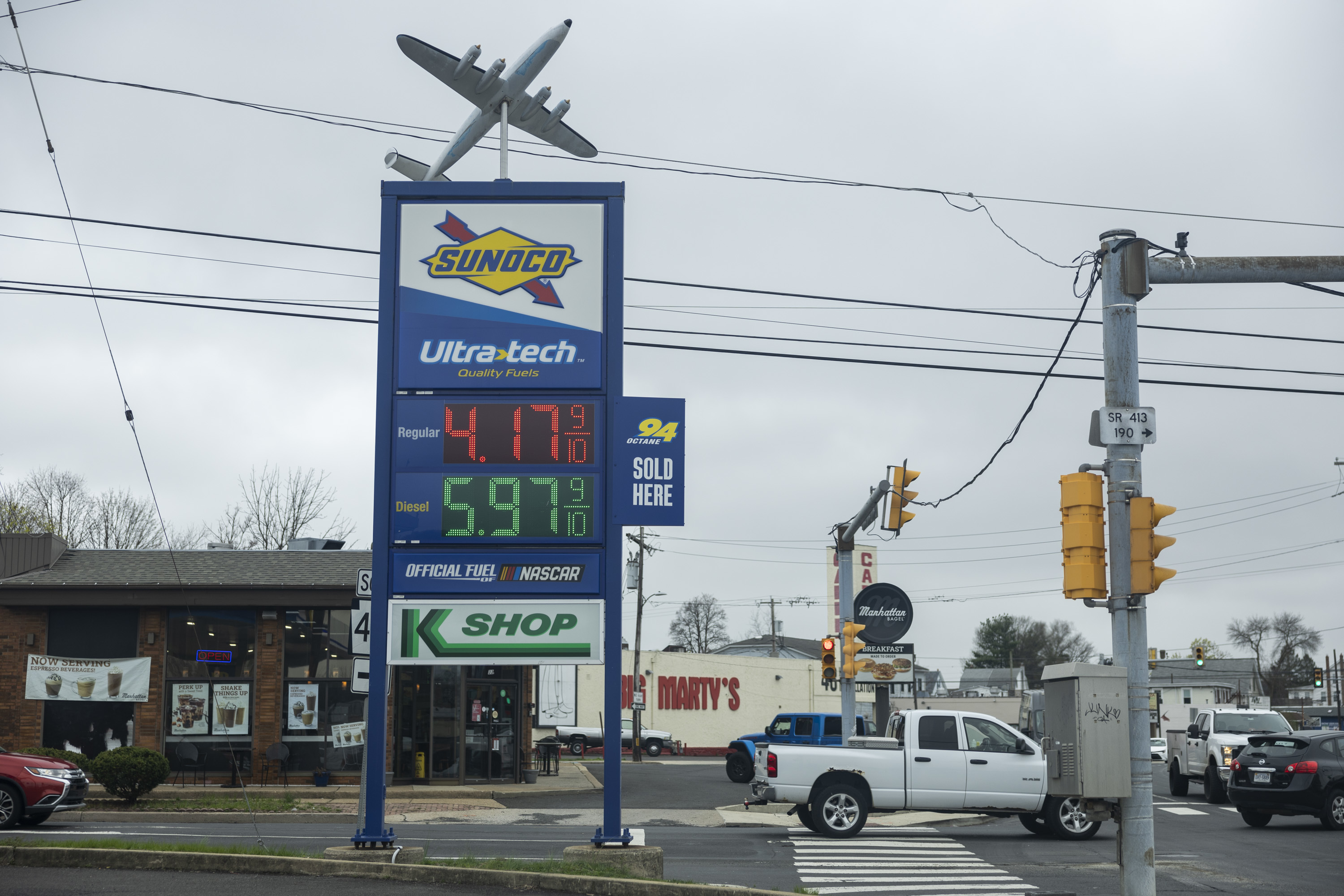
    The price of regular gas had already hit $4.17 at this Bucks County gas station by April. Prices remain high as the war on Iran continues.Tyger Williams / Staff Photographer

    Gasoline prices in Pennsylvania averaged $4.45 per gallon on Sept. 10 and $4.36 per gallon in New Jersey, AAA reports. That’s up from $3.36 and $3.17, respectively, one year ago.

    Which hybrids and EVs are drivers buying?

    Analysts agree and the numbers show that people have been turning more toward hybrids these days.

    Hybrid vehicles, which feature a battery and motor recharged and powered by the engine, regenerative braking, and other features, can stretch gasoline usage by 20% or more.

    In the Philadelphia region, hybrid sales were up 13% in the first half of 2026, comprising 18.1% of new vehicles sold, according to Gempp.

    But EVs have another factor going for them in 2026: Two of the most trusted brands have gotten into the EV market in a big way this year.

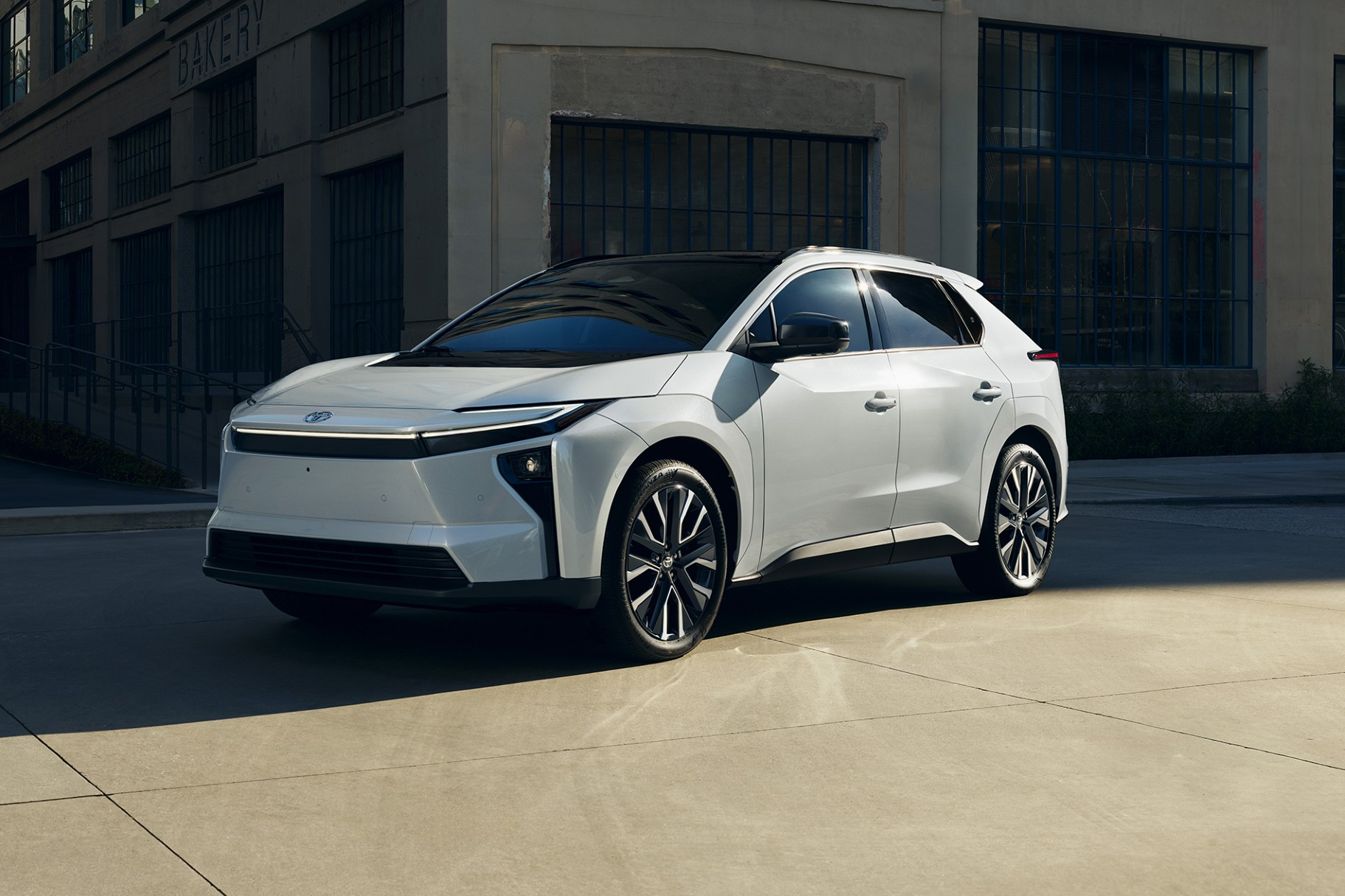
    This photo provided by Toyota shows the 2026 bZ. The 2026 Toyota bZ isn’t flashy, but a comfortable cabin and intuitive tech make it a great daily driver.Uncredited

    Toyota and Subaru have teamed up to make four shared EVs for each brand. The small Toyota CH-R and Subaru Uncharted; midsize Toyota bZ, Subaru Solterra, and Lexus RZ; and Toyota bZ Woodland and Subaru Trailseeker SUVs are on showroom floors now. The three-row Toyota Highlander and Subaru Getaway SUVs are scheduled to arrive in the fall.

    This shows through in market share, Valdez Streaty points out: Toyota’s EV sales are up 124% year over year.

    Toyota and its luxury marquee, Lexus, have been showing up as the most reliable brands in surveys for years. Toyota also has a lot of experience in electrification with hybrids, as a pioneer when it brought the Prius to the United States in 2000.

    Subaru has developed its own niche among outdoorsy, eco-conscious buyers (with a fondness for dogs) and reached number two on a recent Consumer Reports reliability survey of new vehicle brands, between Lexus and Toyota.

    “Subaru has a standard clientele that would be very easily added to the EV market,” Fiorani said. “They’re typically a little more eco-friendly. They like the idea of going outdoors but not rock crawling, but the products that Subaru and Toyota have come out with fit into that mold perfectly.”

    Subaru dealers are seeing that interest in EVs and hybrids.

    “Although we are seeing a very slight uptick in EV interest with Subaru, I don’t necessarily credit that to increased market demand for EV as a whole,” said Jeff Glanzmann, general manager of Glanzmann Subaru in Willow Grove.

    The real surge in demand has been for the new Subaru hybrid models, now offered in the Forester and Crosstrek, Glanzmann said.

    Yet more evidence of the interest is reflected in used EV prices.

    Used EV prices — which generally experience a horrendous depreciation over new prices — are up 7% for the year through mid-July, CNBC reports.

    Increasing convenience for EV drivers

    And in a final piece of the EV positive news puzzle, charging may get a little more reliable outside of metro areas.

    In Pennsylvania, Gov. Josh Shapiro’s administration announced this week that $11 million of federal funding through the National Electric Vehicle Infrastructure (NEVI) program will be used to add EV chargers in the central region of the state, filling in a real gap for EV drivers. The state has already built 50 chargers under the NEVI program, more than twice any other state, and has 41 more under construction, according to the Pennsylvania Department of Transportation.

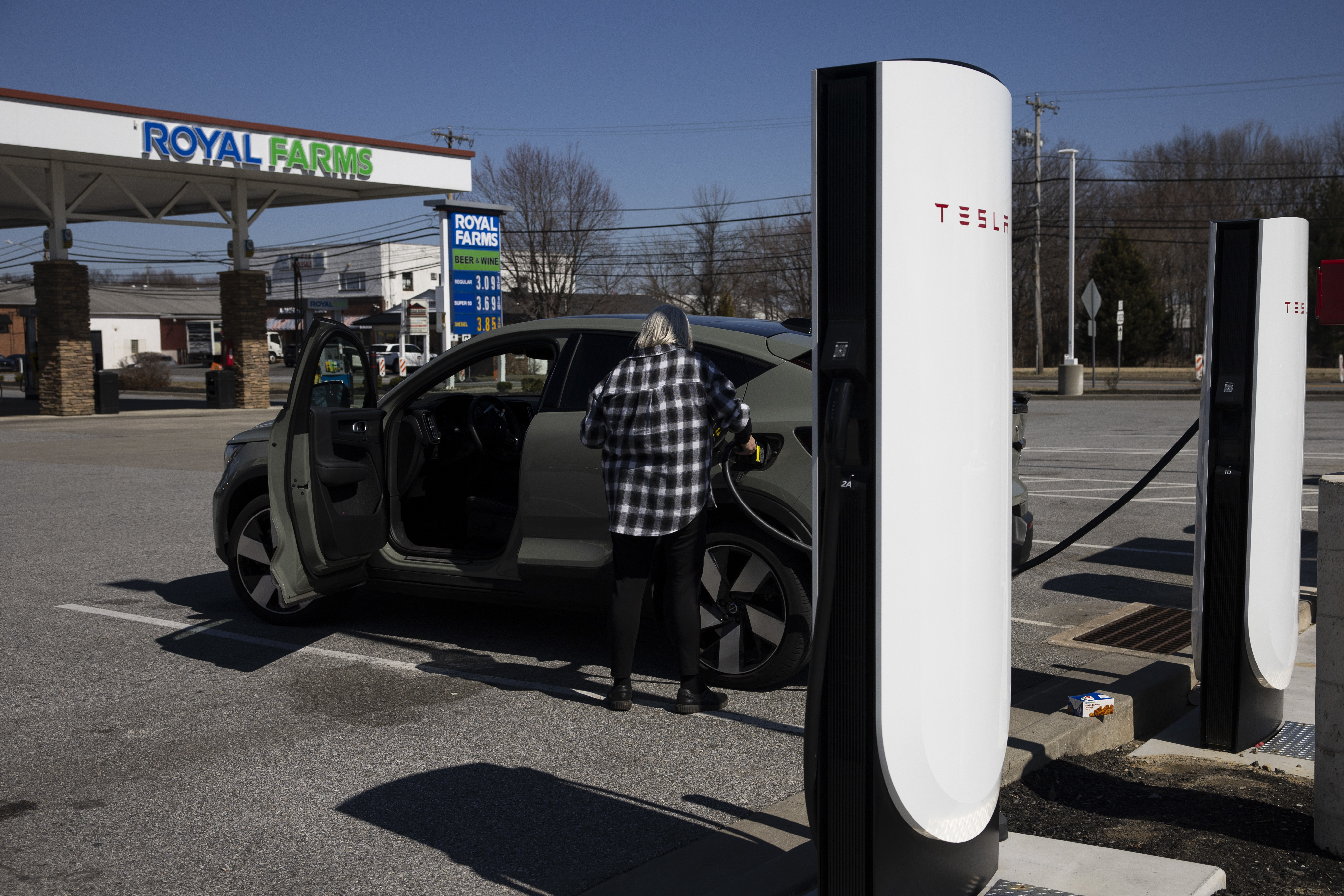
    Signage points to the EV charging station at the Royal Farms in Upper Chichester, Pa.Monica Herndon / Staff Photographer

    Other charger changes are also afoot. While Tesla has long been the charging leader in the U.S., Walmart is now number two, according to Bloomberg. Between January and June, Walmart added 46 public charging stations with 380 plugs.

    A Walmart spokesperson said via email that it has chargers at more than 75 stores and plans to continue expanding, noting that many sites will feature eight to 16 fast-charging stalls.

    Though Walmart declined to elaborate on its plans, automotive industry publication Jalopnik reports 145 new charging locations are coming soon. The greatest expansion will be in Texas with 37 new locations, Florida with 15, Illinois with 14, and North Carolina with 13.

    Currently, the only Walmart in Pennsylvania with charging is in Cranberry Township, outside Pittsburgh. In New Jersey, the sole location is in Freehold.

    Gempp sees how charging speeds — usually requiring 20 minutes to an hour depending on the charger and the vehicle — could be a win-win for consumers an Walmart, though he wondered if the company had outlined its EV charging strategy when more EVs were selling.

    “Inherently it’s a smart idea, but the investment to get those charging stations installed in a market that is shrinking or has shrunk is one that I’m sure that Walmart is reassessing,” Gempp said.

    But on a planet where 25% of new car sales are EVs, the United States’ 5% is an outlier.

    Fiorani is not an EV owner but is a fan, having tested so many in his role as reviewer for AutoForecast Solutions that he has installed a 240-volt charger in his garage.

    “The more experience people get with an electric vehicle, the more they’re going to realize that it fits into their lifestyle and that it’s not that inconvenient for them,” Fiorani said. “The conveniences outweigh the inconveniences by a long margin.”

  • The owners of Penn’s Cave want it to become a state park. Otherwise, they say it would be developed.

    The owners of Penn’s Cave want it to become a state park. Otherwise, they say it would be developed.

    In 1795, an Irish pastor went down a hole in Central Pennsylvania and discovered a vast underground cave full of stalactites, stalagmites, and frigid water.

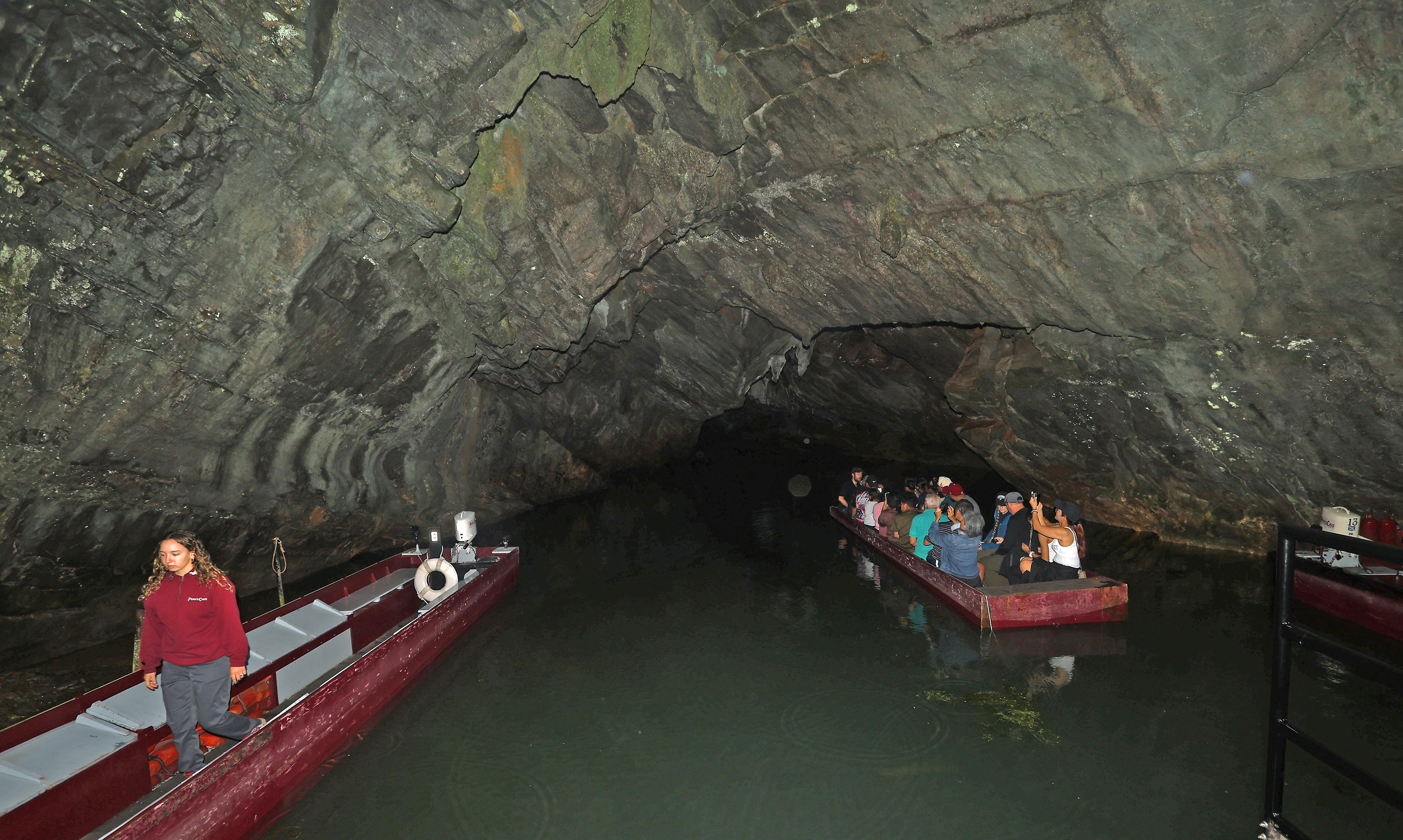
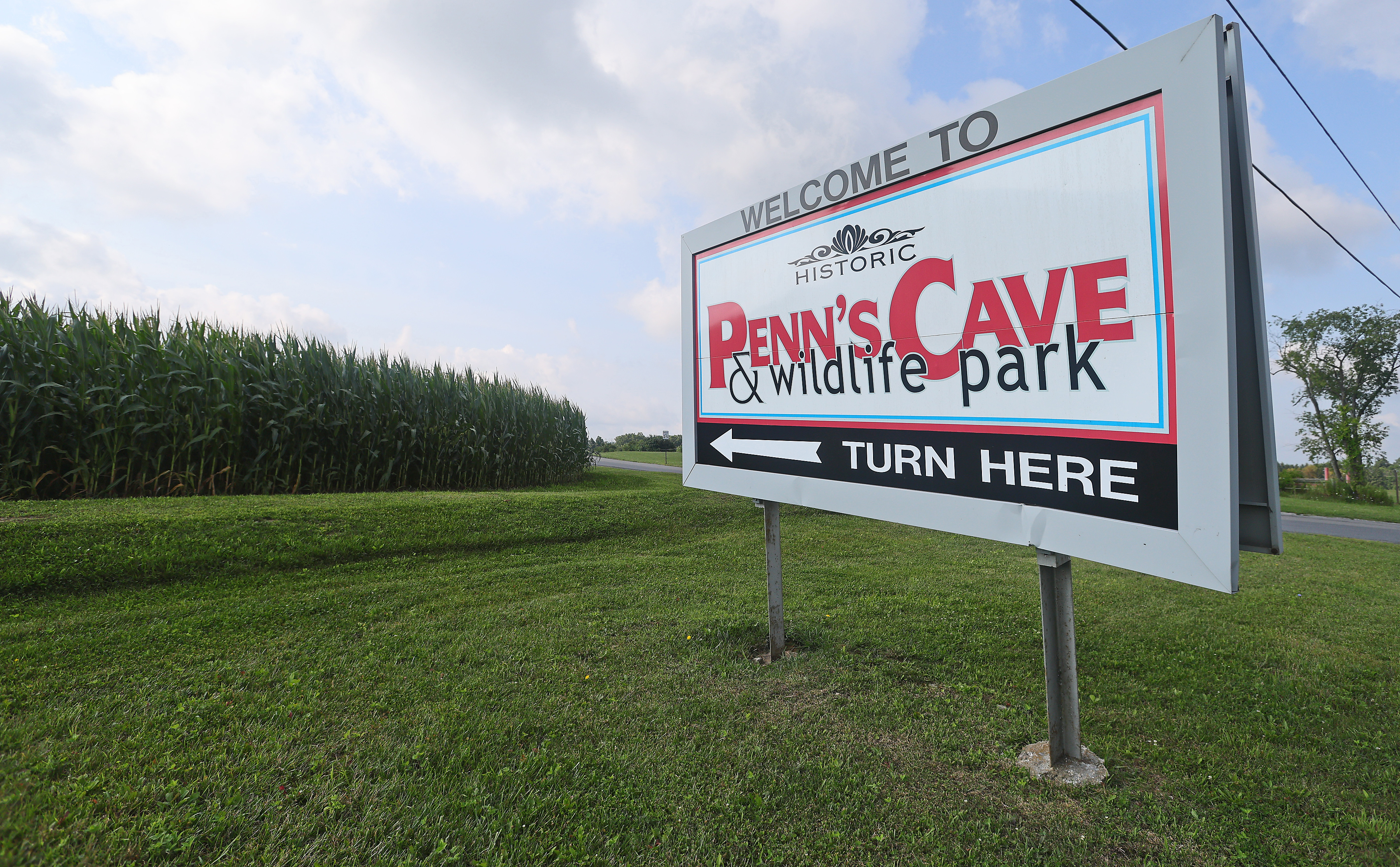
    On a recent Sunday morning in July, visitors simply had to go through the gift shop to visit Penn’s Cave, the only all-water cavern in the country. The boat tours in the cave and the adjoining 1,400-acre wildlife park full of bison, wolves, elk, and one very large black bear attract thousands of visitors per year just east of State College in Centre County.

    According to several published reports in recent months, Penn’s Cave and Wildlife Park, which opened in 1885 and has been run by the same family since 1908, is hoping to become Pennsylvania’s 126th state park by transferring the property to the state’s Department of Conservation and Natural Resources. Penn’s Cave ownership and management declined to comment during a recent visit, directing The Inquirer to public statements made earlier this summer.

    Penn’s Cave CEO Russ Schleiden, during a July 7 Centre County Commissioners meeting, said the decision was “difficult.”

    “But we feel that it’s a very important part of not only Centre County, but the Commonwealth of Pennsylvania, and that it should be preserved in perpetuity.”

    The Colored Lights Room during a boat tour of Penn’s Cave on Aug. 9.Craig Houtz / For The Inquirer

    Schleiden’s daughter, Jeanine Watson, was brought to tears when she spoke to the commissioners.

    “We want it to be preserved and to be taken care of,” Watson said. “We’ve always felt we were the stewards of that. We would hate to see this go into development and, unfortunately, that would be the alternative.”

    During the meeting, Watson said Penn’s Cave had been discussing the proposal with DCNR for several years. She did not say why development would be the only alternative.

    The proposal received the support of Centre County’s commissioners and State Rep. Kerry Benninghoff, (R., Bellefonte).

    “I can’t think of a better time in our country and our county’s history at the Semiquincentennial to make this reality,” Benninghoff said in July, according to statecollege.com. “If you want to look at Americana in its best, the park I think exemplifies that.”

    Benninghoff told The Inquirer that his proposed legislation did not make it into the state budget by July.

    “It just didn’t work out in this budget cycle. My ultimate goal is to preserve this property,” Benninghoff said. “You couldn’t ask for a better place to preserve.”

    Wesley Robinson, a DCNR spokesperson, said department staff has visited Penn’s Cave and engaged in discussions about “potentially taking over stewardship of this significant geoheritage site.”

    “Penn’s Cave’s natural and cultural resources could make it a strong addition to Pennsylvania’s state park system and provide expanded opportunities for the public to access and enjoy the site,” Robinson said in a statement.

    Robinson said acquiring Penn’s Cave may require legislation and that the agency would continue conversations with stakeholders.

    Penn’s Cave is an all-water cavern, a historic 1,300-foot limestone show cave with tours by boat.Craig Houtz / For The Inquirer

    Coincidentally, Pennsylvania’s 125th state park is a former privately owned cave. Laurel Caverns State Park, in Fayette County, opened in April and is the first cave system to become a state park.

    Laurel Caverns, the biggest cave system in Pennsylvania, opened as a tourist attraction in 1964. It’s also home to the biggest bat hibernaculum — where animals can hibernate in winter — in the Northeast.

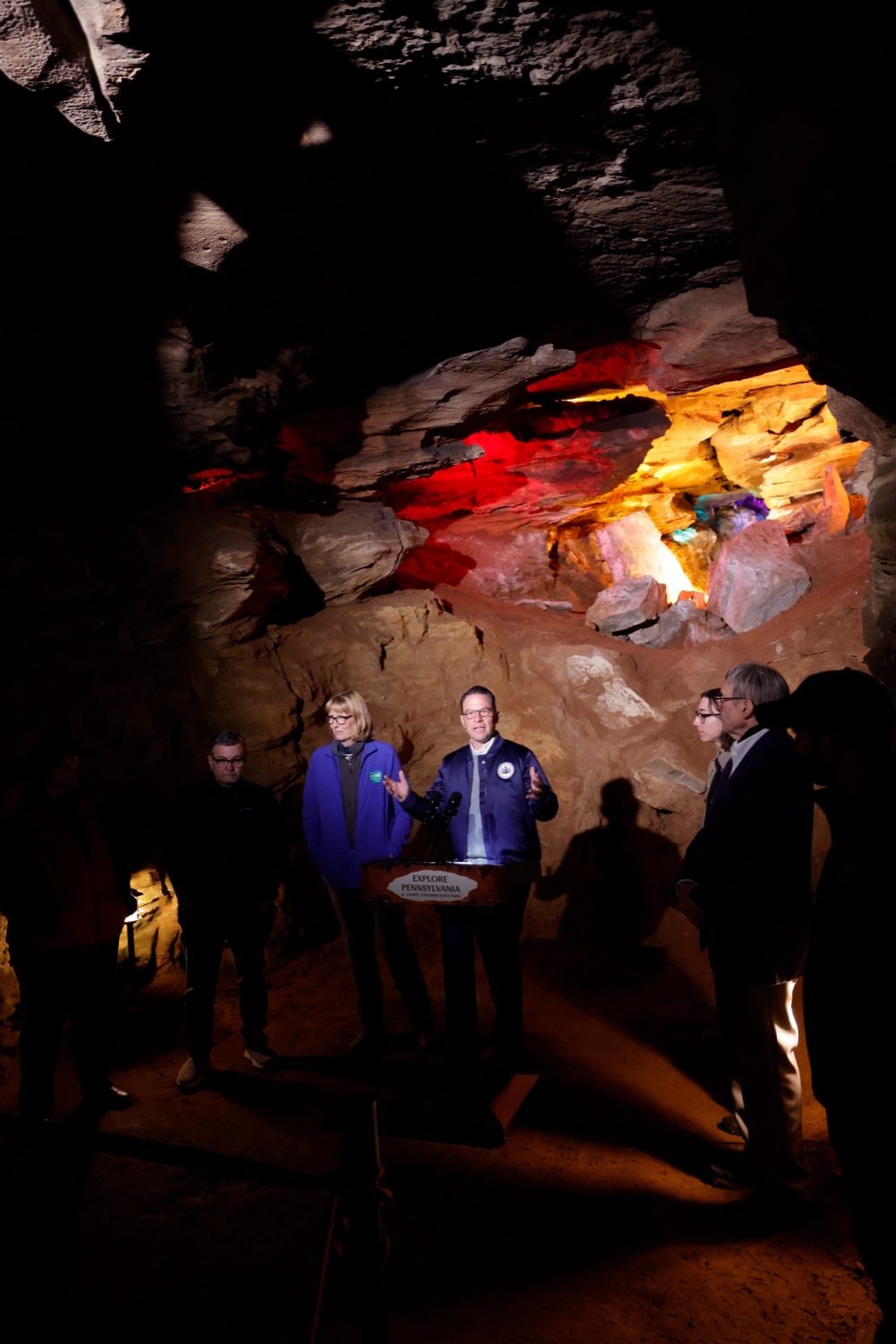
    “Parks like Laurel Caverns give our kids a new place to learn, our families a place to make memories, and all of us a chance to get away, take a breath, and just enjoy nature,” Gov. Josh Shapiro said in April during a press conference in the cave.

    Laurel Caverns was donated to the state. It’s unclear how DCNR would take ownership of Penn’s Cave if the process moved forward or what its operating costs would be. The attraction employs dozens of seasonal and full-time workers and includes a large gift shop and snack stand.

    Gov. Shapiro and DCNR Secretary Cindy Dunn open Laurel Caverns State Park, Pennsylvania’s first subterranean state park, in April.Provided

    On a tour of Penn’s Cave in July, a lone bat flapped around between the stalactites, but the experience is quite different from Laurel Caverns and would present a unique challenge to operate as a state park.

    For one, visitors to Laurel Caverns walk through the cave system. Tours of Penn’s Cave are conducted via boat with a guide, on a frigid, subterranean offshoot of Penns Creek that’s filled with large rainbow trout.

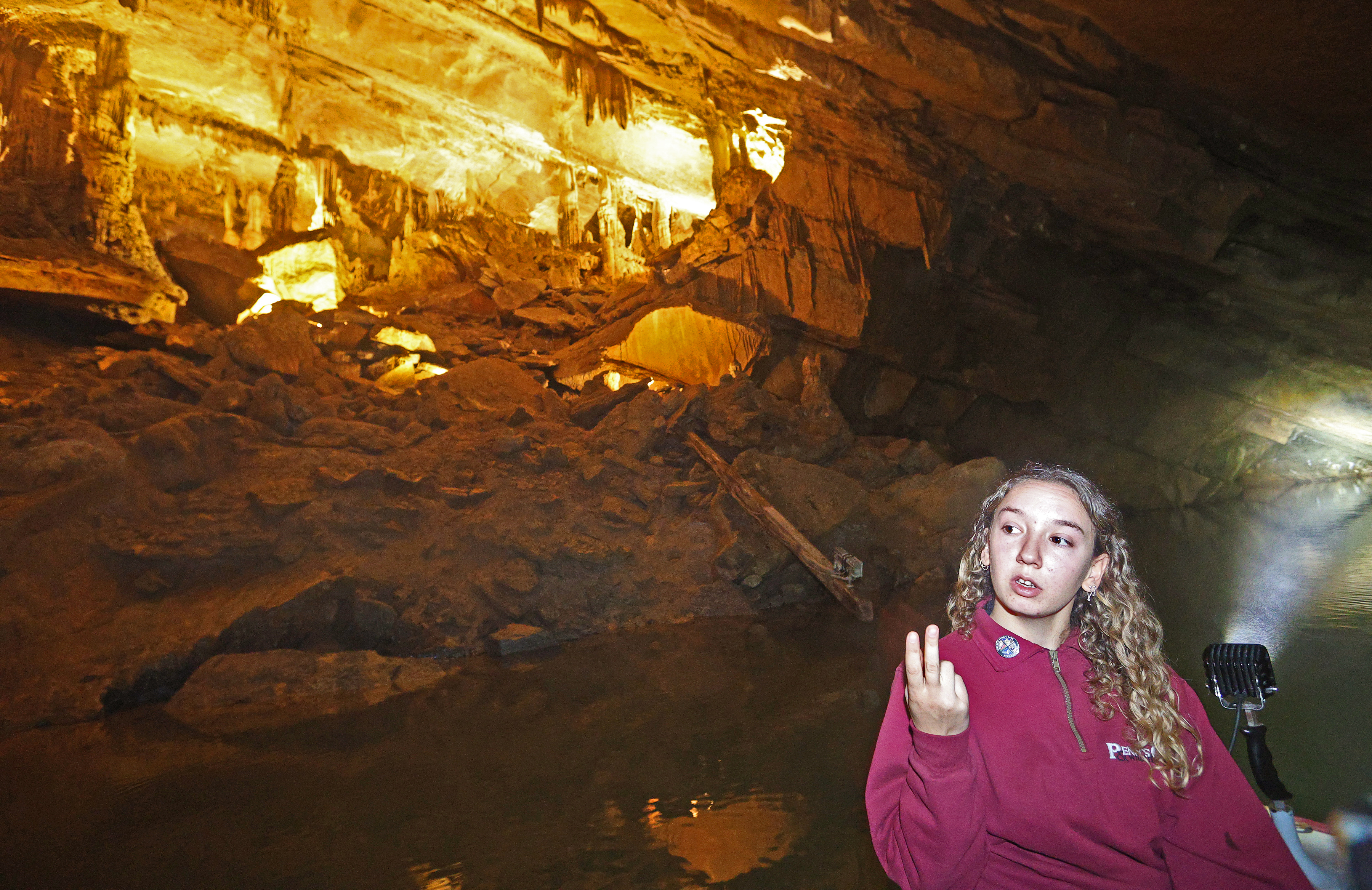
    “To the left here, we have our tallest stalagmite. We call this one our Statue of Liberty,” guide Kara Hoffman explained.

    Hoffman also discussed the cave’s geology, early attempts at tours with torches, and its earliest visitors, the Indigenous Seneca who used the cave for shelter.

    Kara Hoffman gives a boat tour of Penn’s Cave on Aug. 9.Craig Houtz / For The Inquirer

    Laurel Caverns, with 400 acres above ground, does not offer camping. The Penn’s Cave property is 1,500 acres, and consists of rolling farmland and animal enclosures. It’s unclear if the state would maintain the wildlife exhibits, which include large elk, Texas longhorns, and mountain lions, but Benninghoff said he believed camping would be part of the state park.

    In 2024, The Inquirer wrote about DCNR’s plan to build a campground in Chester County and the pushback it received from a vocal group of residents concerned about traffic and campers.

    Robinson said that the project is still in the works and currently in “cultural review.”

    Meanwhile, Penn’s Cave, about 190 miles northwest of Philadelphia, remains open for tours, and Benninghoff said he hoped to draft legislation for the next budget.

    Mountain lions are part of the farm-nature-wildlife tour at Penn’s Cave and Wildlife Park.Craig Houtz / For The Inquirer
  • Penn trial tests ultrafast form of radiation aimed at reducing cancer treatment side effects

    Penn trial tests ultrafast form of radiation aimed at reducing cancer treatment side effects

    Penn Medicine researchers are testing whether an ultrafast form of radiation therapy can treat cancers in the head and neck with fewer side effects.

    The clinical trial marks the first time the technology, conformal FLASH proton therapy, is being used in humans.

    Radiation therapy, one of the most commonly used cancer treatments, works by aiming high-energy beams at tumors. While this kills cancer cells, it can also cause damage to surrounding healthy tissues.

    Patients with head and neck cancers, for example, can develop ulcers in the mouth, damage to the jawbone, dry mouth, and scarring as a result.

    A trial launched this month at Penn Medicine’s Abramson Cancer Center will assess whether delivering radiation more than 100 times faster than typical therapies is safe and could lessen that damage.

    The pilot trial will enroll 10 people whose head and neck cancers have returned.

    These are patients who lack good treatment options and risk side effects that interfere with speaking, breathing, and swallowing.

    “Giving another full dose of radiation is very hard for these patients,” said Jonathan Schoenfeld, who directs the Head & Neck Radiation Oncology program at Mass General Brigham and is not involved in the trial. “This is a good population that could potentially benefit from this type of approach.”

    The specific type of FLASH radiation used in this study was developed by researchers at Penn and the Belgium-based Ion Beam Applications S.A. (IBA), which manufactures the platform and is sponsoring the study.

    In mouse studies, FLASH proton therapy reduced side effects while still killing cancer cells. Researchers have since tested the approach in a clinical trial involving dogs with cancer.

    However, promising results in animals often do not translate to humans. Even if the trial produces encouraging results, it could take years before the therapy becomes widely available.

    The hope, ultimately, is not only to preserve quality of life in patients, but to make radiation therapy more convenient and accessible.

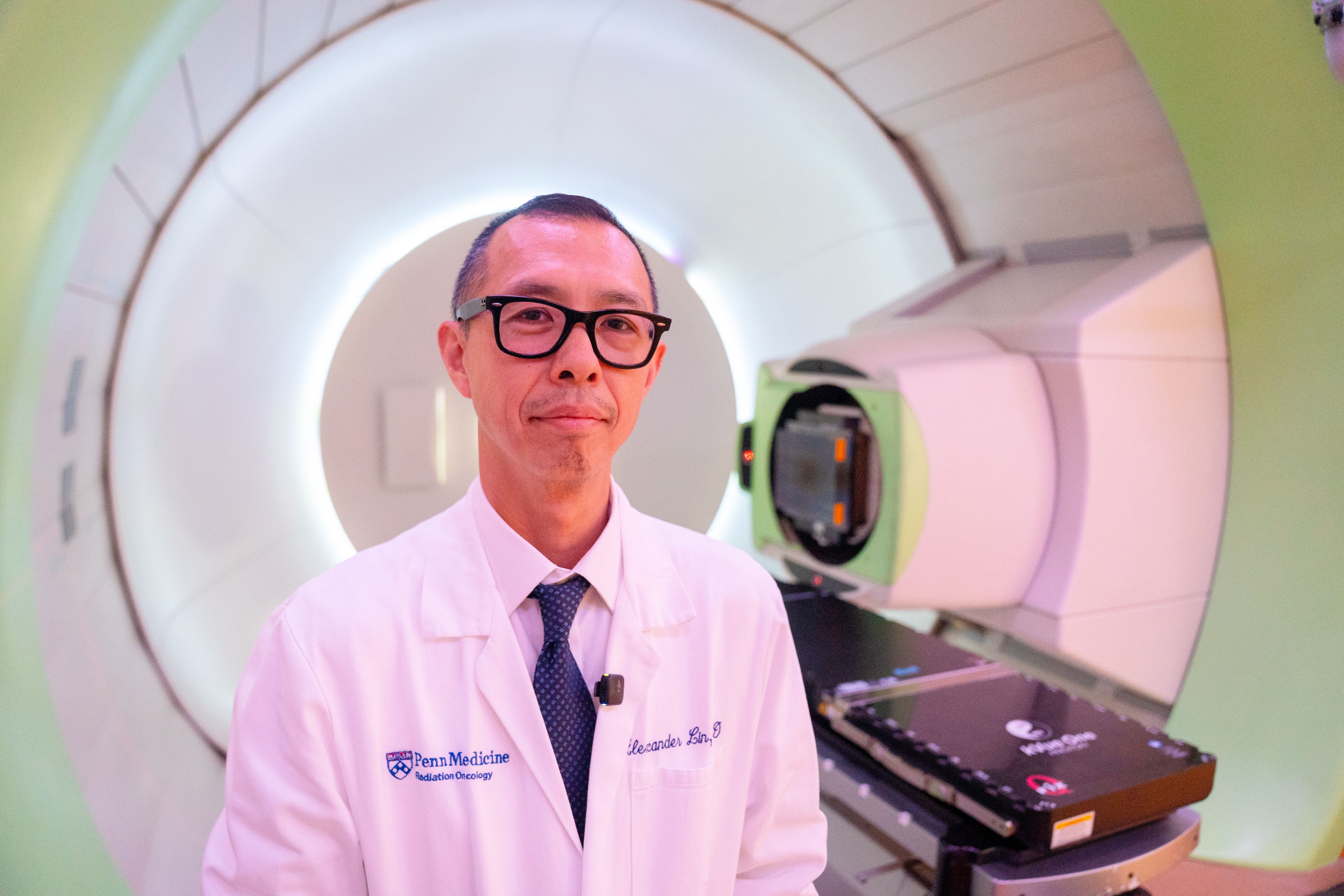
    “Instead of 30 to 40 treatments, we can do the treatment in one to five treatments,” said Alexander Lin, a radiation oncologist at Penn and the trial’s lead investigator.

    Lin walks through the Roberts Proton Therapy Center.Credit to Margo Reed Studios

    Faster and fewer doses

    Doctors typically divide a patient’s radiation therapy into dozens of daily treatments over several weeks.

    FLASH radiation aims to accomplish that in fewer doses.

    Think of it like air travel: A trip from the East to the West Coast would take hours with today’s technology. But if you can fly at the speed of light, it would take less than a second.

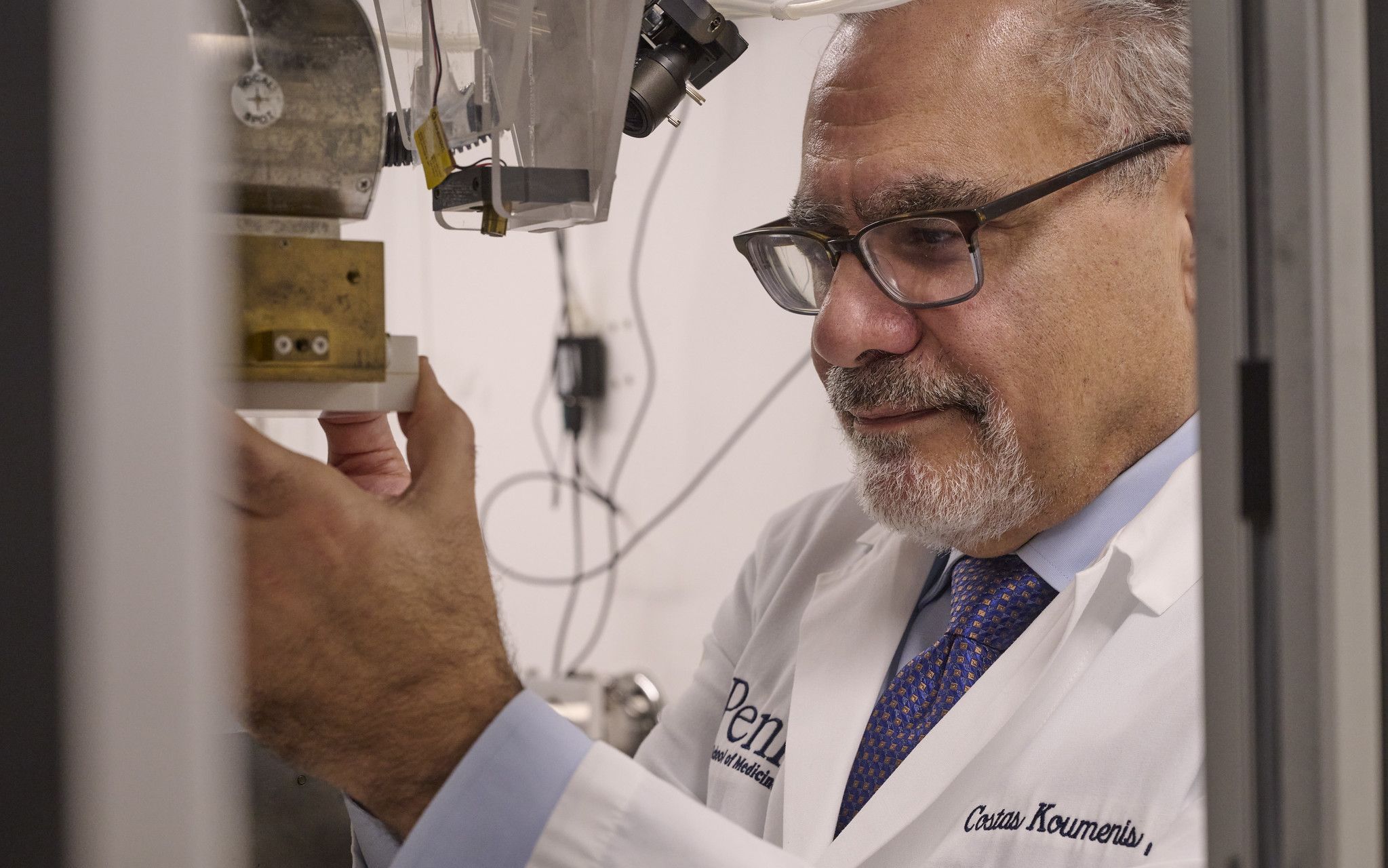
    “We’re giving the same dose or similar dose, but the dosage rate changes,” said Constantinos Koumenis, the vice chair for research in Penn’s Department of Radiation Oncology and a developer of the therapy.

    Lin hopes this lighter schedule could alleviate some of the time and financial burden of treatment.

    The FLASH therapy builds upon a highly advanced radiation treatment, proton therapy, which uses protons to more precisely target tumors. Penn has heavily invested in the expensive technology, with its fourth proton therapy center — a $224 million facility at Penn Presbyterian Medical Center in University City — expected to open in 2027.

    The researchers are also incorporating a technique called conformal radiation therapy, which shapes the radiation beam to match the tumor’s three-dimensional size and location. This helps limit exposure to nearby healthy tissue.

    The exact biological explanation for FLASH radiation’s effects remains a mystery. However, scientists theorize that the treatment reduces damaging oxidation in healthy tissue while promoting faster recovery.

    “The hope is that, if this type of trial is successful, you can treat patients who need more radiation with much lower risks,” Schoenfeld said.

    But “it’s a new treatment that we don’t fully understand yet, so I would highlight that it’s still very early days,” he added.

    First trial

    Constantinos Koumenis is the vice chair for research in Penn’s Department of Radiation Oncology and a developer of the new therapy being tested.Credit to Peggy Peterson

    The primary focus of the Penn trial will be assessing the treatment’s safety and feasibility, with an eye on quality of life and cancer outcomes.

    Researchers will be taking a more cautious approach to begin, using a dose and schedule that have already been found safe and effective in patients. The only difference will be giving the radiation at the FLASH speed, Lin said.

    Schoenfeld said he would first want to see whether the team can deliver their treatment with the intended speed and precision — an accomplishment in itself for an early-stage trial.

    Then he would look at how the tumors respond to FLASH and whether patients develop side effects over a period of months to years.

    “Some of these side effects are longer term side effects, so it’s important to start to follow these initial cohorts of patients as long as possible,” he said.

    The Penn team will follow patients for at least five years.

    If the trial shows promise, the researchers hope to launch additional trials in other types of cancer, from gastrointestinal to liver tumors.

    “If these trials show that they’re safe, we want to target any solid tumor that we can target,” Koumenis said.

  • Philadelphia Ballet’s new home makes a daring leap onto North Broad Street. Will its solid facade keep people away?

    Philadelphia Ballet’s new home makes a daring leap onto North Broad Street. Will its solid facade keep people away?

    The last decade has done a number on Philadelphia’s legacy cultural institutions.

    Venerable names that we assumed would be around forever — the Philadelphia History Museum, the University of the Arts, and, most recently, the Academy of Natural Sciences — have been winking out like dying stars, casualties of the pandemic, changing leisure habits, funding cuts, and Philadelphia’s peculiar dearth of deep-pocketed patrons.

    The city’s surviving legacy organizations are now working overtime to increase their visibility and bring in new audiences with community events and crowd-pleasing programs.

    Nothing captures the public imagination quite like a new building, especially one with an address on Broad Street, the long, straight boulevard branded the Avenue of the Arts. After 19 years of trying, the Philadelphia Ballet will formally open its eye-catching new home just north of the Vine Street Expressway with a gala on Sept. 17.

    In times like these, any new arts building in Philadelphia is cause for jubilation, whatever its flaws.

    Although the Philadelphia Ballet Center for Dance is primarily a working building that provides the company with modern practice studios and support services, it also allows the ballet to operate its own public theater for the first time in its 63-year history. Shelly Power, the group’s CEO, rightly views the 150-seat space as a major opportunity for community-building outreach.

    So, it’s frustrating to see the ballet repeat the architectural mistakes of an earlier generation of cultural venues. With its glass-enclosed rooftop studio and pleated metal facade, the building initially dazzles with shimmer and light, especially at night. But it quickly becomes clear that this is just another hermetic box that walls itself off and sabotages its own efforts to engage the public.

    The absence of street-level windows on North Broad Street is particularly galling given the corridor’s spectacular revival over the last decade, including hundreds of apartments, the Met concert hall and the award-winning Honeysuckle restaurant.

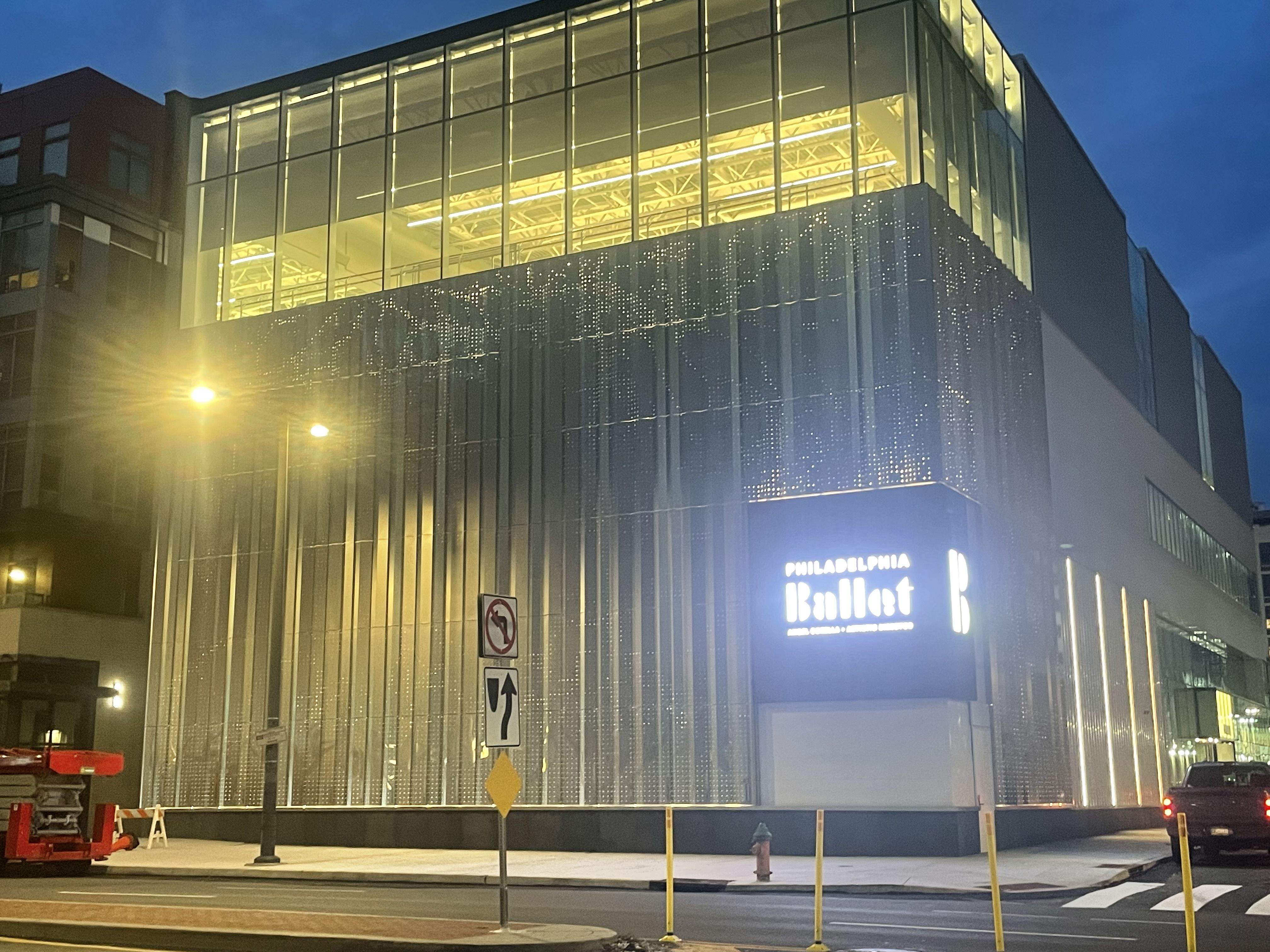
    With its glass-enclosed rooftop studio and pleated metal facade, the Philadelphia Ballet’s new Center for Dance initially dazzles us with shimmer and light, especially at night.Inga Saffron

    Rising to new heights

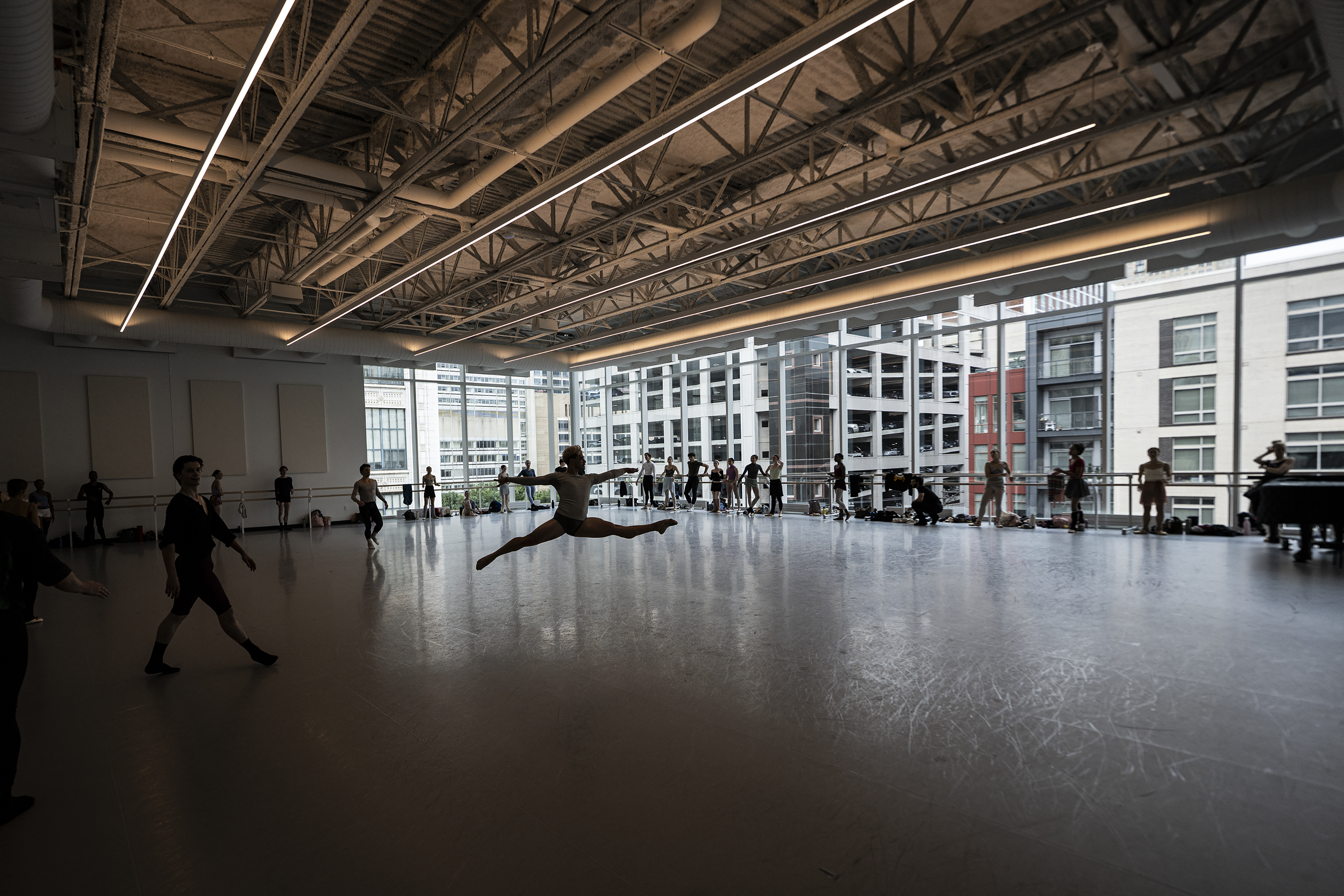
    Designed by Varenhorst, a Philadelphia firm that toggles between high-end suburban homes and downtown apartments, the $45 million building is, in some ways, everything a big city ballet could want. The five-story structure does a great job at integrating the soaring, light-filled practice studios for elite dancers, with a dedicated classroom wing for the ballet’s school. Dancers are so energized by the scale of the new space, Power said, they can “jump higher.”

    While the majestic Academy of Music will remain the ballet’s main performance space, the stripped-down, black box theater gives the company the opportunity to experiment with more intimately scaled works. And because the performance area is the same size as the Academy stage, the ballet can also do dress rehearsals there.

    The new Philadelphia Ballet Center for Dance was built with four soaring practice studios, including this light-filled, double-height rooftop space overlooking North Broad Street.Jose F. Moreno / Staff Photographer

    Having access to such an assortment of quality spaces promises to lift the ballet to new creative heights. Although the corps regularly ranks among America’s 10 best classical ballet companies, its dancers and school became itinerant after financial troubles forced the company to sell its old home at Broad and Washington in 1992. For many years, the school was housed in one location, dancers practiced in another, and administrators worked out of a third space. The lack of a stable home made it more challenging to woo top talent.

    In 2007, the ballet purchased two small buildings at the corner of Wood Street with the goal of consolidating its operations under one roof. The Avenue of the Arts was just taking shape, and the location promised to give the northern stretch — always a bit of an afterthought — a marquee destination. As a longtime occupant of The Inquirer’s former North Broad Street home — the big white Tower of Truth (now the police headquarters) — I couldn’t wait to see human activity return to those sad blocks above Vine Street.

    It’s an understatement to say that things didn’t go smoothly.

    The design and the architects changed several times. The ballet, which, it is worth pointing out, received no city money for this important project, even lost its financing at one point. Architect Stephen Varenhorst, who signed on around 2016, deserves credit for sticking with the ballet through its many ups and downs.

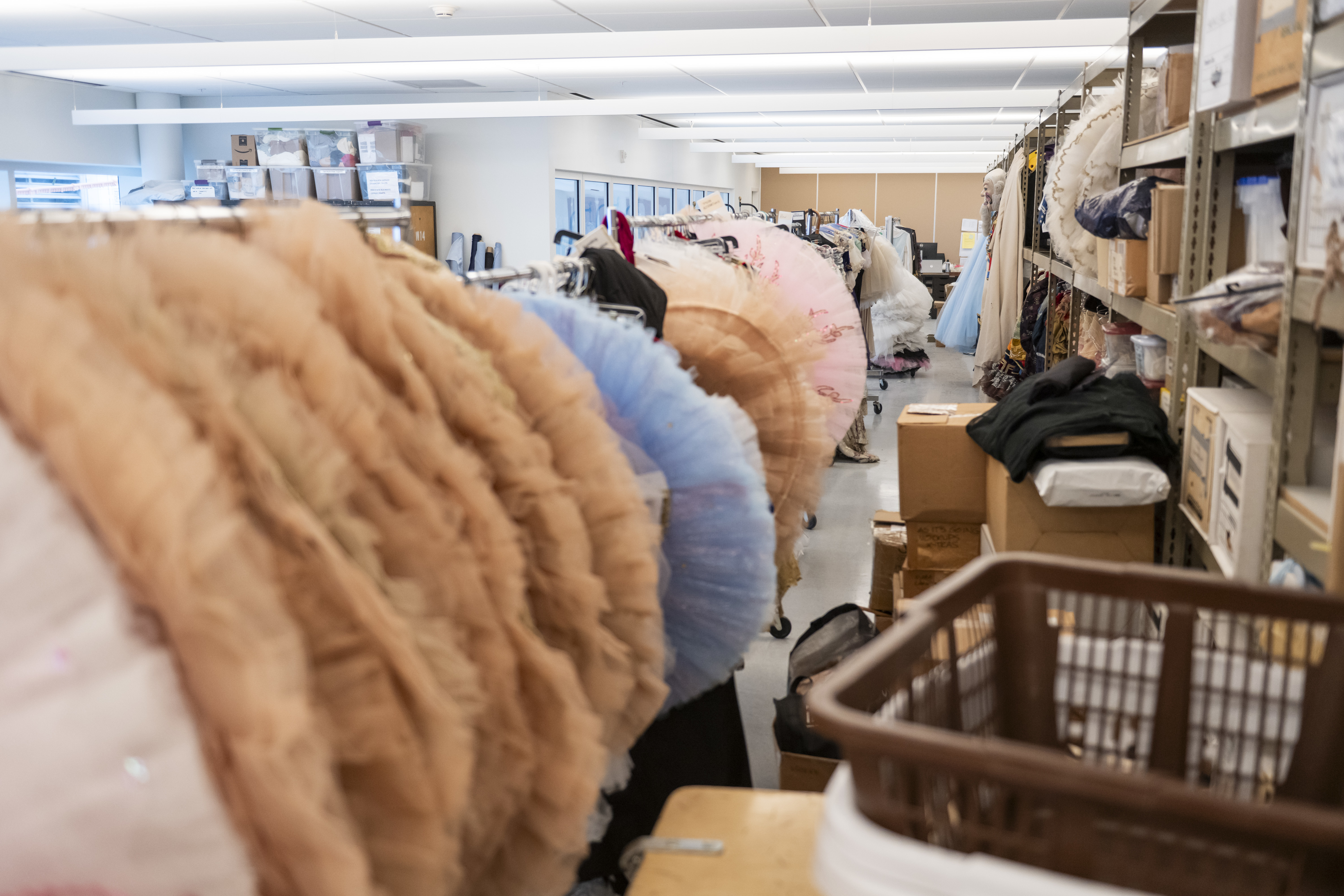
    Maybe because the ballet was space-deprived for so long, his design was driven by a desire to make sure the company had the best of everything. Along with four large practice studios, the building is outfitted with a sprawling costume department, workshops for storing and dyeing dance shoes, a music room, and a generously equipped wellness spa.

    Costumes line the wall in the wardrobe room in the Philadelphia Ballet’s new building on Broad Street.Allie Ippolito / For The Inquirer

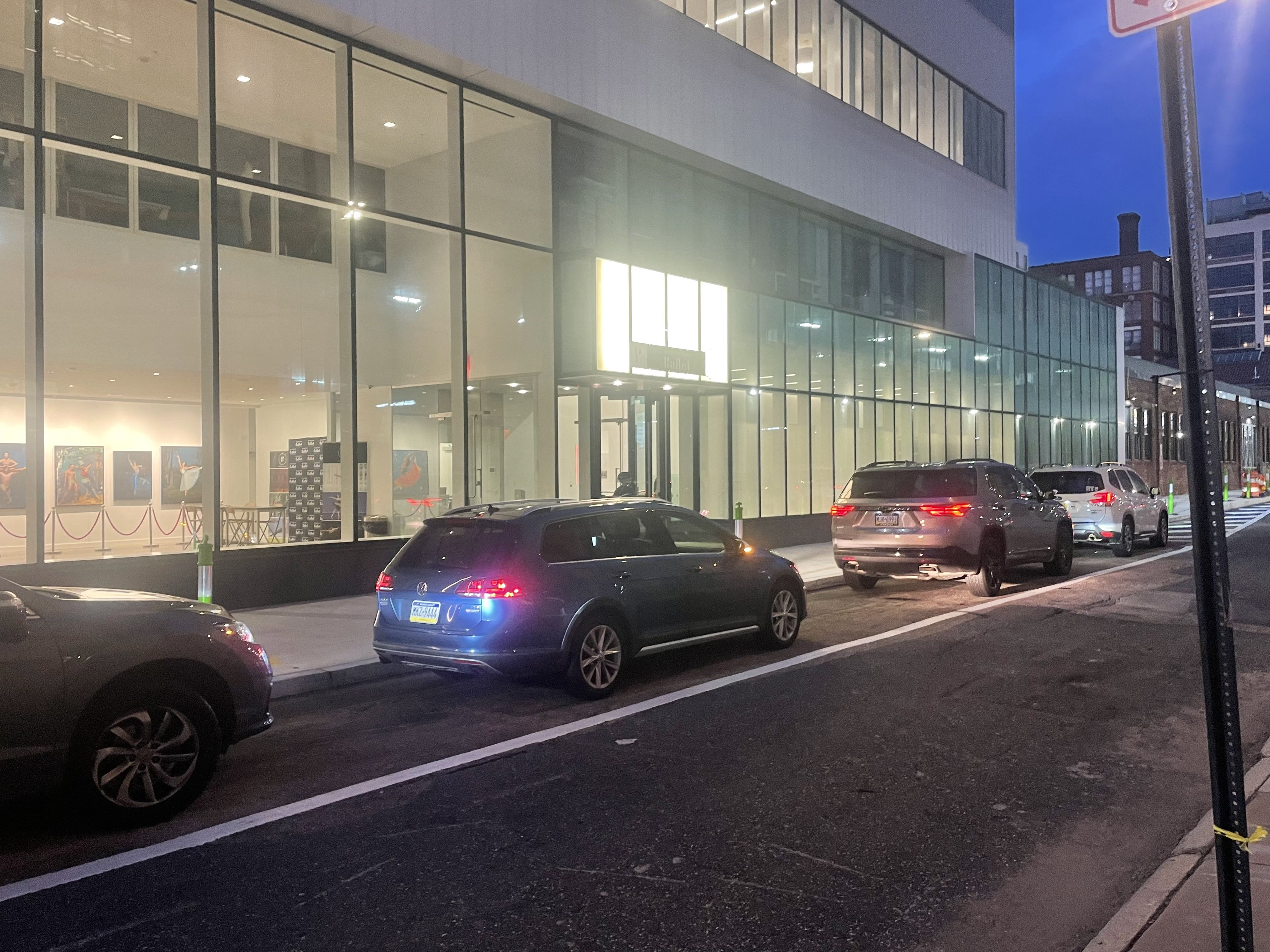
    To pack all this onto the deep, narrow site, Varenhorst put the ballet’s front door on Wood Street. Architects often prefer to locate the main entrance on the long side of a building because it’s easier to organize the interior circulation.

    That arrangement definitely makes things more convenient for dancers and visitors, since Wood Street now effectively serves as an automobile drop-off. But it badly shortchanges the pedestrian experience on North Broad Street.

    A daunting facade

    Early in the design process, the ballet decided it would install the black box theater at the Broad Street end of the building. As the name suggests, black box theaters have no windows. That meant the most important facade, the one facing the Avenue of the Arts, would be a blank wall.

    By putting the main entrance to Philadelphia Ballet Center for Dance on Wood Street, instead of North Broad Street, the architects at Varenhorst were able to create an automobile drop-off, a convenience for parents dropping off their children at the ballet school.Inga Saffron

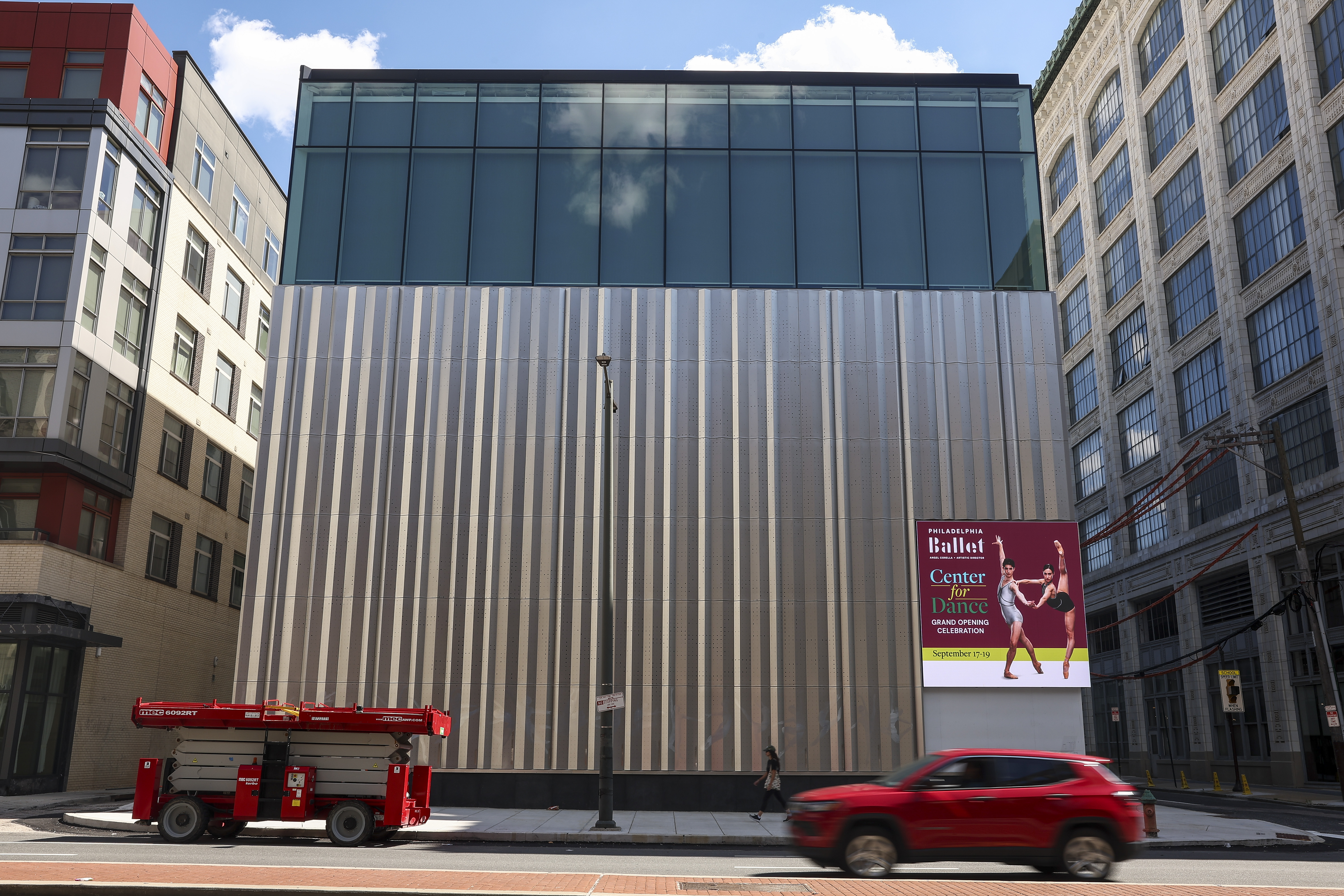
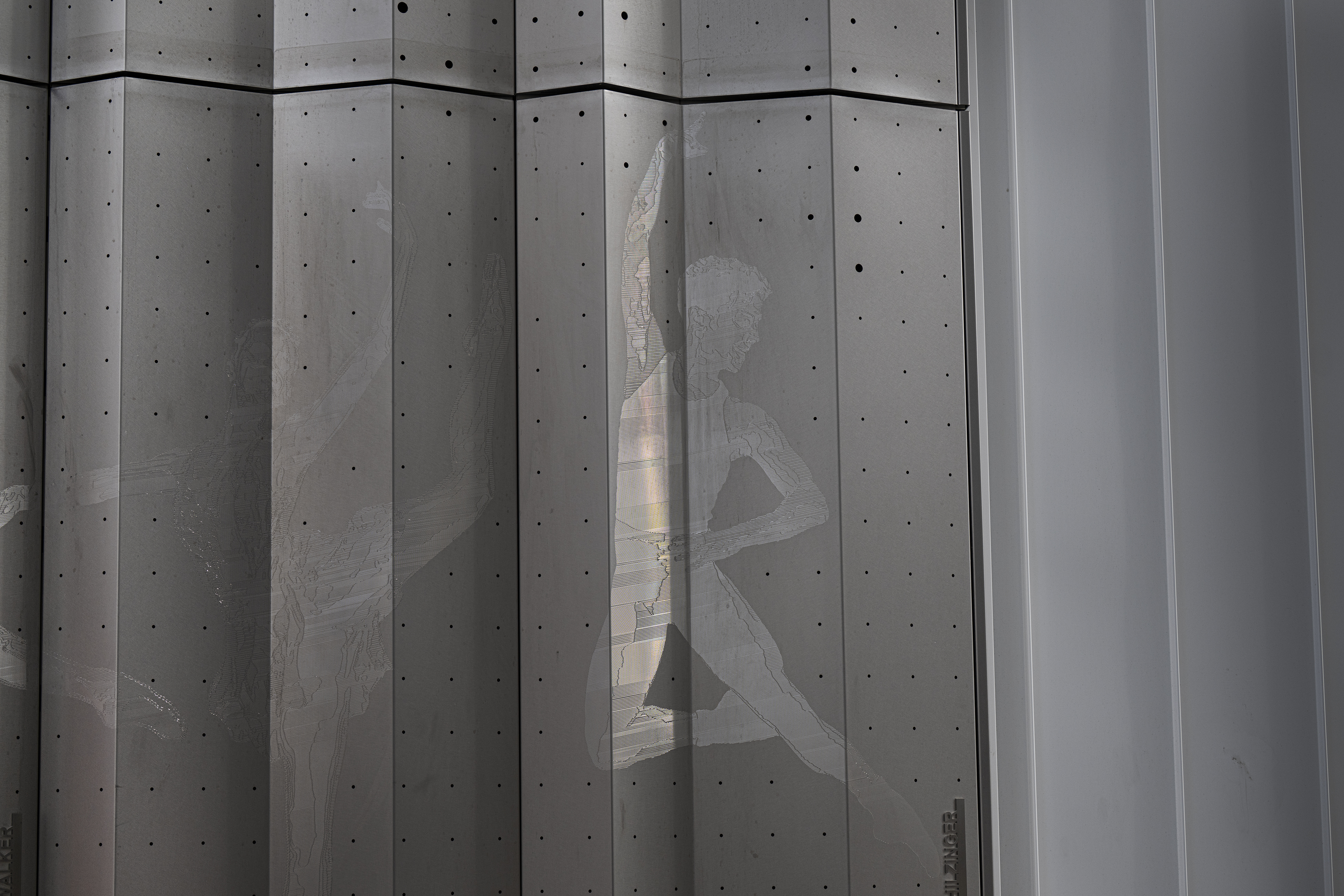
    To enliven the solid, four-story expanse, Varenhorst has covered the surface with a crimped, stainless-steel screen. The treatment is meant to suggest a theater curtain. Unfortunately, it’s a closed one.
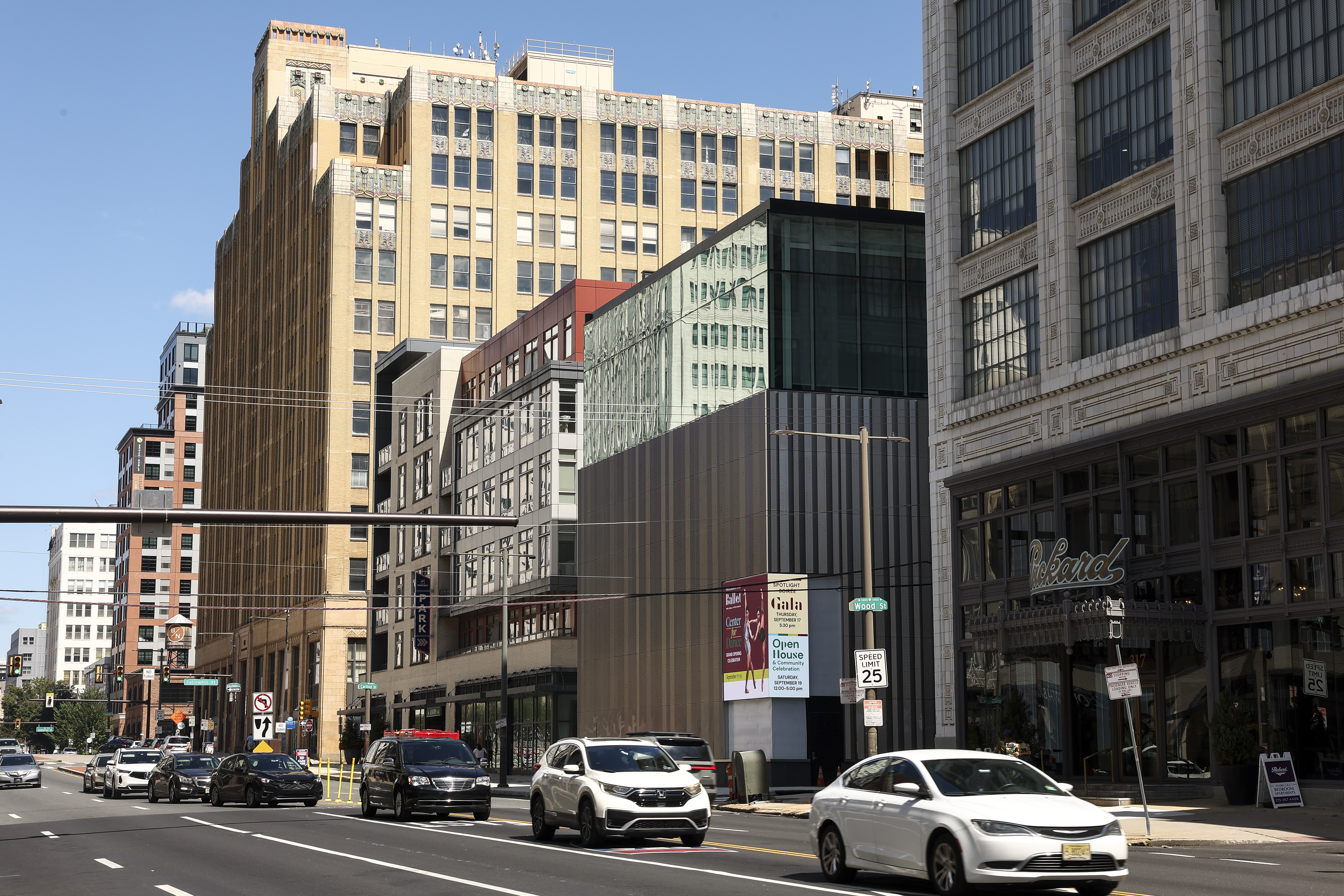
    Varenhorst and the ballet have gone to great lengths to dress up the metal scrim. The stainless steel is good quality, manufactured by Zahner, the same firm that did Frank Gehry’s metalwork. The pleats are etched with ghostly figures of the corps’ dancers and perforated with pinholes that sparkle with fairy lights at night. If you crane your neck, you might be able to see dancers moving around the glass-walled studio on the top floor.

    It’s about as good as a blank wall gets, but it’s still a daunting cliff.

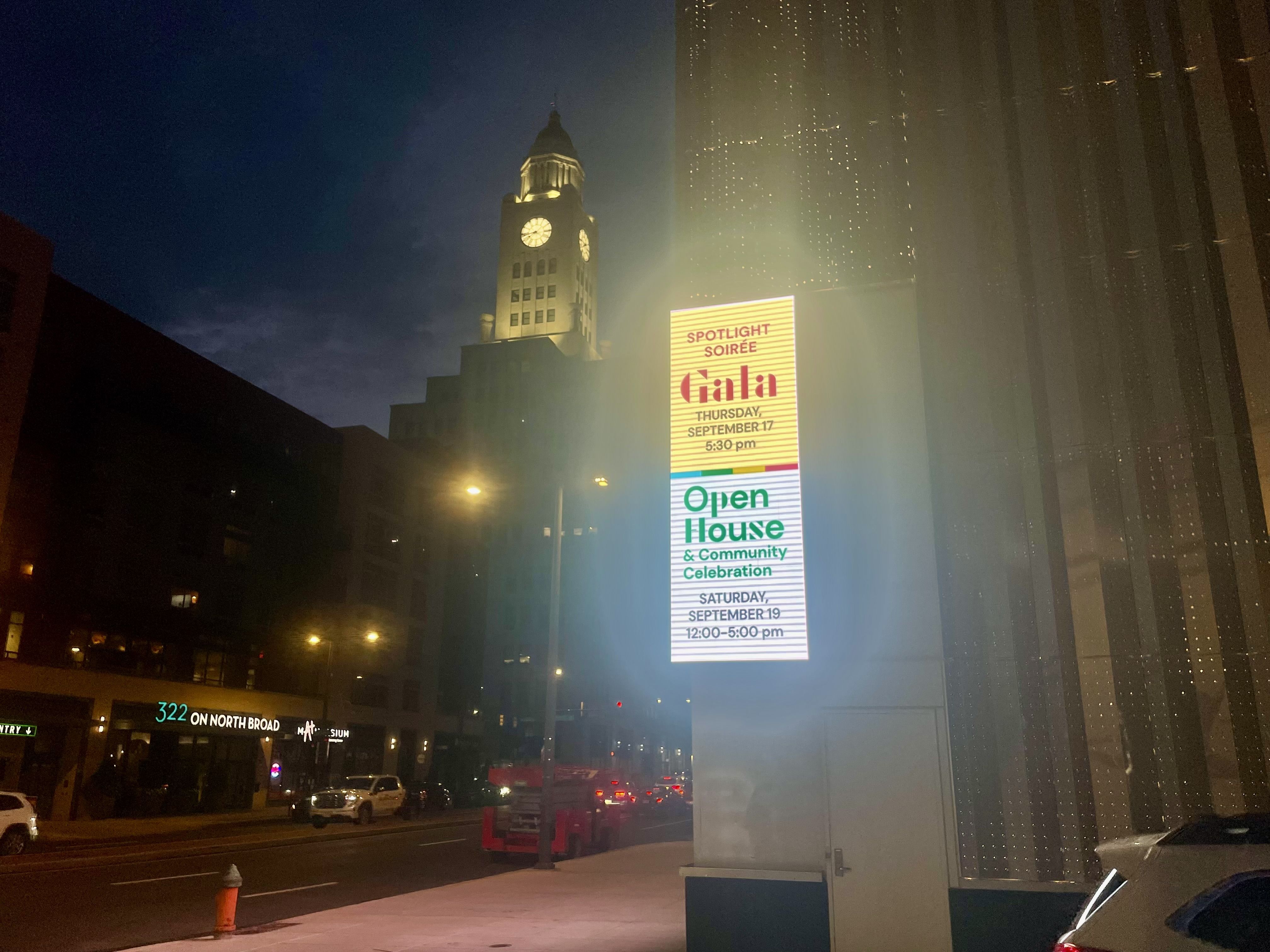
    To activate the large expanse of metal, the ballet clamped a digital sign onto the corner. The dance company plans to use it to advertise upcoming shows and display videos of dancers. We could just as easily stare down at our phones to get the same content.

    Ghostly images of dancers have been etched into the pleated, stainless steel facade of the new Philadelphia Ballet Center for Dance on North Broad Street.Jose F. Moreno / Staff Photographer

    What’s most disappointing about the design is that the ballet is not the first venue on the Avenue of the Arts to treat Broad Street as an afterthought. Although the Kimmel Center can at least claim a Broad Street entrance, its heavy brick facade was similarly unfriendly, especially when no performances were taking place. Those solid walls were one reason the Kimmel floundered in its early years. It took a series of interventions — a cafe, restaurant, and, yes, a digital sign — to make the large building feel more alive.

    Moved by the same reasoning, the Wilma Theater also retrofitted its building to create a ground-floor cafe on Broad Street.

    Arts administrators always promise us lively sidewalks when they announce a new building, yet there seems to be something in Philadelphia’s architectural DNA that produces the opposite result.

    Take the Weitzman National Museum of American Jewish History on Sixth Street. Although it faces Independence Mall, a symbol of democratic openness, that facade is sheathed in opaque glass. Its main entrance is around the corner on Market Street.

    The new Philadelphia Ballet Center for Dance is bracketed (left) by the Hanover apartments, which opened in 2017, and the former Packard Motor Car building, which was converted to apartments in 1986.Monica Herndon / Staff Photographer

    Ironically, the three buildings — the ballet, Kimmel, and Weitzman — all follow the same format: Each features a transparent glass structure at the top, far from the madding crowd.

    Why couldn’t the ballet have reversed this arrangement and put its black box theater on the upper level? That way, a glass-fronted practice studio could have faced Broad Street. Even if Wood Street remained the main entrance, the transparency would have enlivened the ground floor and made the ballet a visible presence in the city. Instead, the blank wall reinforces the idea that ballet is an elite form of culture.

    Power and Varenhorst told me they briefly considered, then rejected, the arrangement because the company’s dancers would have objected to being put on display during stressful rehearsals.

    But who says that a ground-floor studio could be used only by the ballet’s professional dancers? The Alvin Ailey American Dance Theater in Manhattan, which opened a six-story practice facility and school in 2005, got around that problem by making its transparent ground-floor studio a space for public classes. Watching the dance students go through their moves there has become so popular, Alvin Ailey installed a bench outside.

    To compensate for the solid facade on its new North Broad Street building, the Philadelphia Ballet Center for Dance installed a digital sign at the corner of Wood Street. The former Philadelphia Inquirer tower, now the police headquarters, can be seen across the street.Inga Saffron

    Like other cultural leaders, Power is now focused on using the building to build a community of dedicated ballet supporters, much as Anthony Roth Costanzo has done at Opera Philadelphia. She wants to hold public events with dancers on Wood Street and is looking into making Carlton Street a pedestrian walkway.

    “Our challenge is this: How do we activate the building?” she said.

    Good question. Unfortunately, the ballet missed a big opportunity to show, as well as tell, what’s going on in the Center for Dance. In sacrificing public urbanism for its own private needs, the ballet does everyone a disservice.