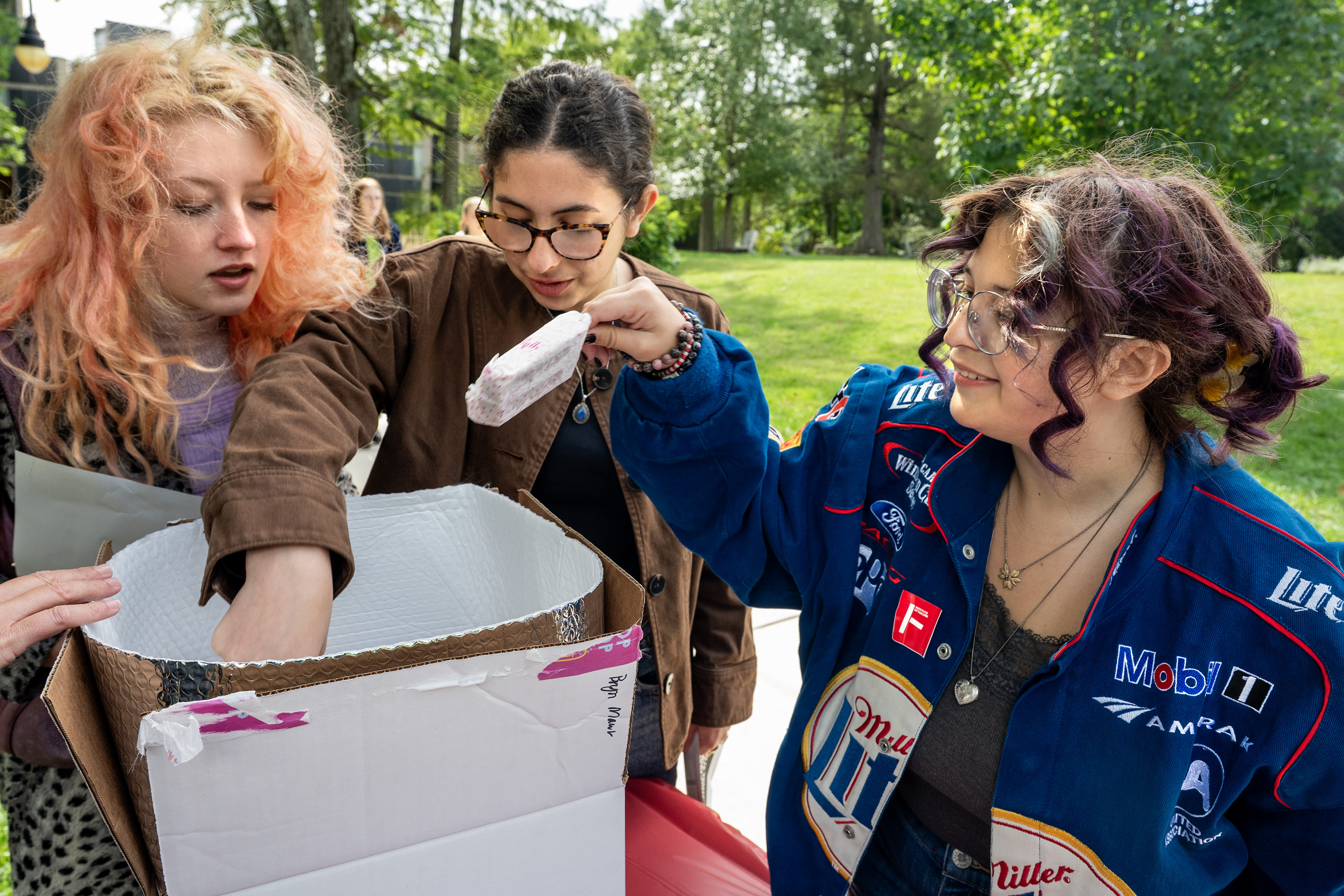
At Bryn Mawr College, professors, staff, and students recently gathered to try challenges, such as puzzles and painting, some of which they most surely would fail.
And that was just fine. Fitting, in fact, for a fall festival with failure as the focus.
“It’s not failure fest if you don’t fail,” freshman Fable Gunther, 18, said as she and her friends tried Jenga, cornhole, and othertasksduring the event held outside Bryn Mawr’s wellness center in late September.
In a world where students increasingly are striving for perfection, educators at Bryn Mawr who have created an “Institute of Failure” are teaching students that failure is part of life and that a fear of it should not discourage them from trying new things.
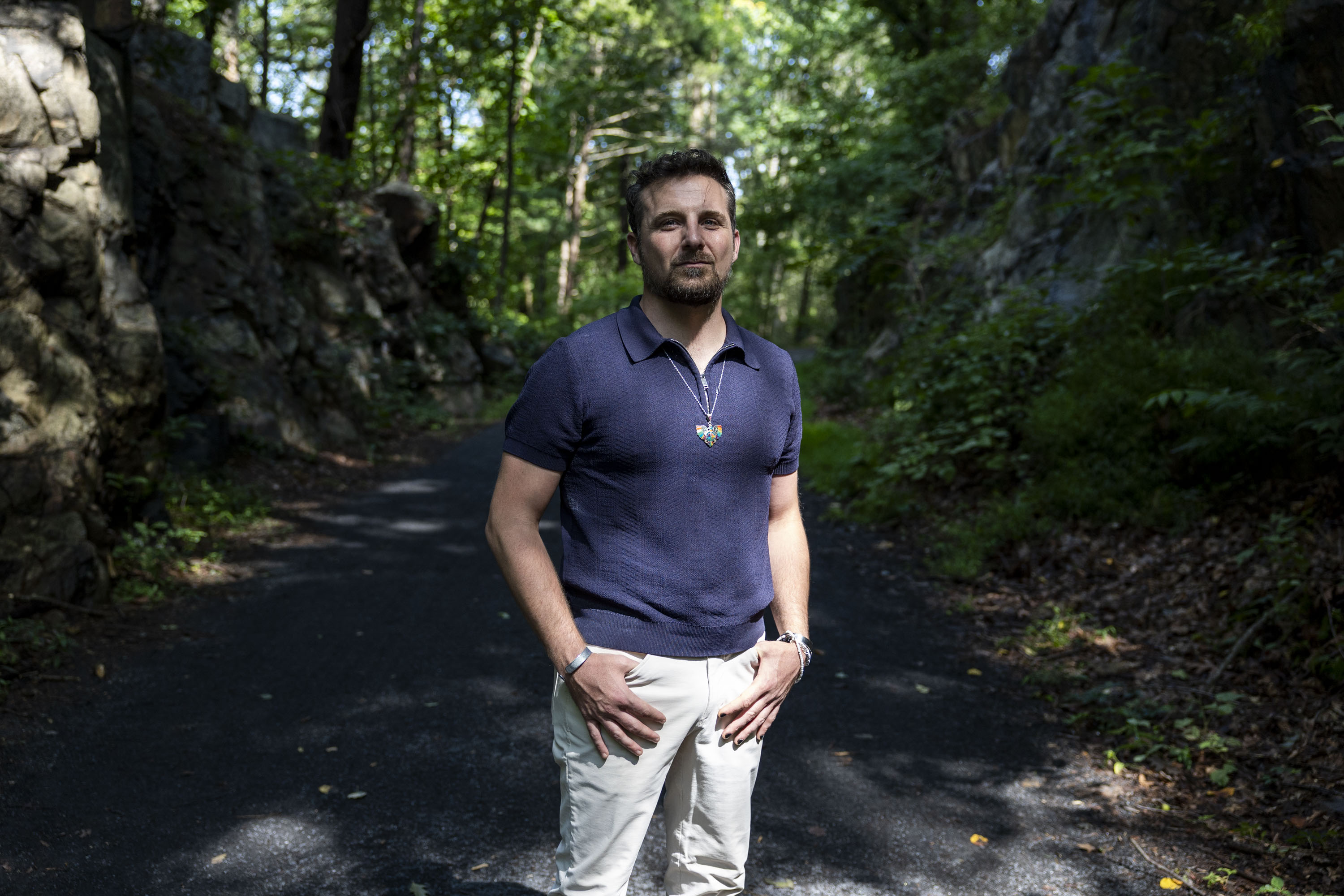
José Vergara, professor of Russian, talks about how he and his colleagues developed the Institute of Failure at Bryn Mawr College. Tom Gralish / Staff Photographer
“We are trying to change the culture around failure, to destigmatize and normalize failure,” said José Vergara, an associate professor of Russian. “When we get too concerned with perfection, that can inhibit growth and prevent us from achieving something new and exciting that we might not otherwise reach.”
What they are not striving for, Vergara said, are stories where failure leads to success, though that is a fine outcome.
“What we want is to sort of sit with and deal with that failure,” he said, “to think about what it felt like and potentially … share and discuss how that failure does inform a person’s work or art.”
Students entering Bryn Mawr — a selectivewomen’s college that enrolls about 1,300 undergraduates — often come from high-performing academic backgrounds with a string of achievements, and some struggle with not hitting those same marks when they enter Bryn Mawr, said Baru Roberson-Hornsby, who helps guide the experience of juniors as an assistant dean.
“Often our students will not reach out when they are failing,” he said, and that is why activities such as the failure festival are important.
Frances Matthews, 17, a freshman from St. Paul, Minn., attempts to catch randomly falling batons during a “failure festival“ at Bryn Mawr College. Tom Gralish / Staff Photographer
The idea of focusing on failure is not new. Duke University has a “learning to fail” course. At Temple University in 2019, then-professor Doug Webber, now a senior economist in the Consumer and Community Research Section of the Federal Reserve Board, touted his rejections and stalled projects on a “failure CV.”
But Vergara said he and his colleagues wanted something ongoing and deeper that would cross the campus.
The idea was born about three years ago, on Mount Roberts in Alaska, when Vergara and several colleagues were on a hiking trip. They were making their way on narrow trails with little room for error and started talking about students’ fear of failure and how that can inhibit experimenting and taking risks, he said.
About a year ago, a handful of faculty decided to launch an institute, and it was one of several projects that received $9,860 in funding from the college to pilot as part of a new initiative launched by president Wendy Cadge.
Since then, the college has held several “monologue” events in which faculty and staff share their failures and how they have shaped or impacted their lives. Michelle Francl, an emeritus chemistry professor, discussed failing a physics exam and how it has affected her response to students who struggle. Claire Scanlon, head soccer coach, shared how she was cut from the Irish national team before an international match.
A student who “failed at failing” by guessing an outcome correctly signs in during a “failure festival“ at Bryn Mawr College. Tom Gralish / Staff Photographer
“She talked about how it’s always on her mind as she’s making decisions about who plays and who doesn’t and how many minutes they get,” Vergara said.
On the institute’s website is a collection of failure stories submitted by employees and students.
Akirah Fenimore, assistant dean for the senior experience, wrote about falling asleep in a math class that met after lunch and ultimately failing it. Student success coordinator Caroline Northcutt shared her inability to climb an indoor rock wall but vowed to keep trying. Cadge, the president, posted a rejection letter she received for the Fulbright Scholar program, just six months before she became Bryn Mawr’s president.
While it is not on the website, Vergara said he had his own failure trek when he was a visiting professor at Swarthmore College, which is surrounded by streets named after other prestigious colleges, including Harvard and Yale. Each day, he would pass the signs of colleges that had rejected him for full-time work.
“It felt like a kind of cosmic cruelty,” he said.
Students paint failure squares during a “failure festival“ at Bryn Mawr College. Tom Gralish / Staff Photographer
At the festival, Gunther, who is from Berwick, watched as her friend Ruth Pournelle, 18, a freshman from Washington, painted a unicorn.
“I can see it,” Gunther said encouragingly.
Then they tried cornhole. They couldn’t sink a bag. Building a house of cards on a windy day proved particularly tricky.
The students said they liked trying, but even more so the idea behind it.
“Education is so focused on ‘always do your best,’” Pournelle said. “It’s important to make mistakes on your way to your best.”
Vergara and his colleagues hope to grow the institute over time.
“Right now we’re in the process of hiring a couple of what we’re calling failure interns,” Vergara said.
He and colleague Selby Hearth, an associate professor of geology, plan to coteach a class on failure in the spring.
“I’ll bring a geologic perspective,” Hearth said. “He’ll bring the perspective of Russian literature. Both of these perspectives have something interesting to say about failure, systems failure, … physical failure, rifts and dam breaks, and collapse of whole economic systems.”
Students at the festival collected stamps as they finished each station. They turned their cards in for a prize that proved even failure can be sweet.
“At the end of the day, you can get a Popsicle if you fail,” Pournelle said.
Freshmen Ruth Pournelle (from left), Frances Matthews, and Fable Gunther select a frozen dessert after successfully completing the stations during a “failure festival“ at Bryn Mawr College. Tom Gralish / Staff Photographer
Passyunk Square resident Dylan Wise was talking with a friend about the Strait of Hormuz — the contested Persian Gulf shipping chokepoint that has been central to the United States’ ongoing tensions with Iran — when he got the wild idea of opening a video store.
“I was talking to someone about the strait,” he remembers. “And I thought, ‘I’m an idiot. I shouldn’t have an opinion on that. Why do I even know about this?’ I need to get a little more myopic. I need to focus on myself, and my family, and my community.”
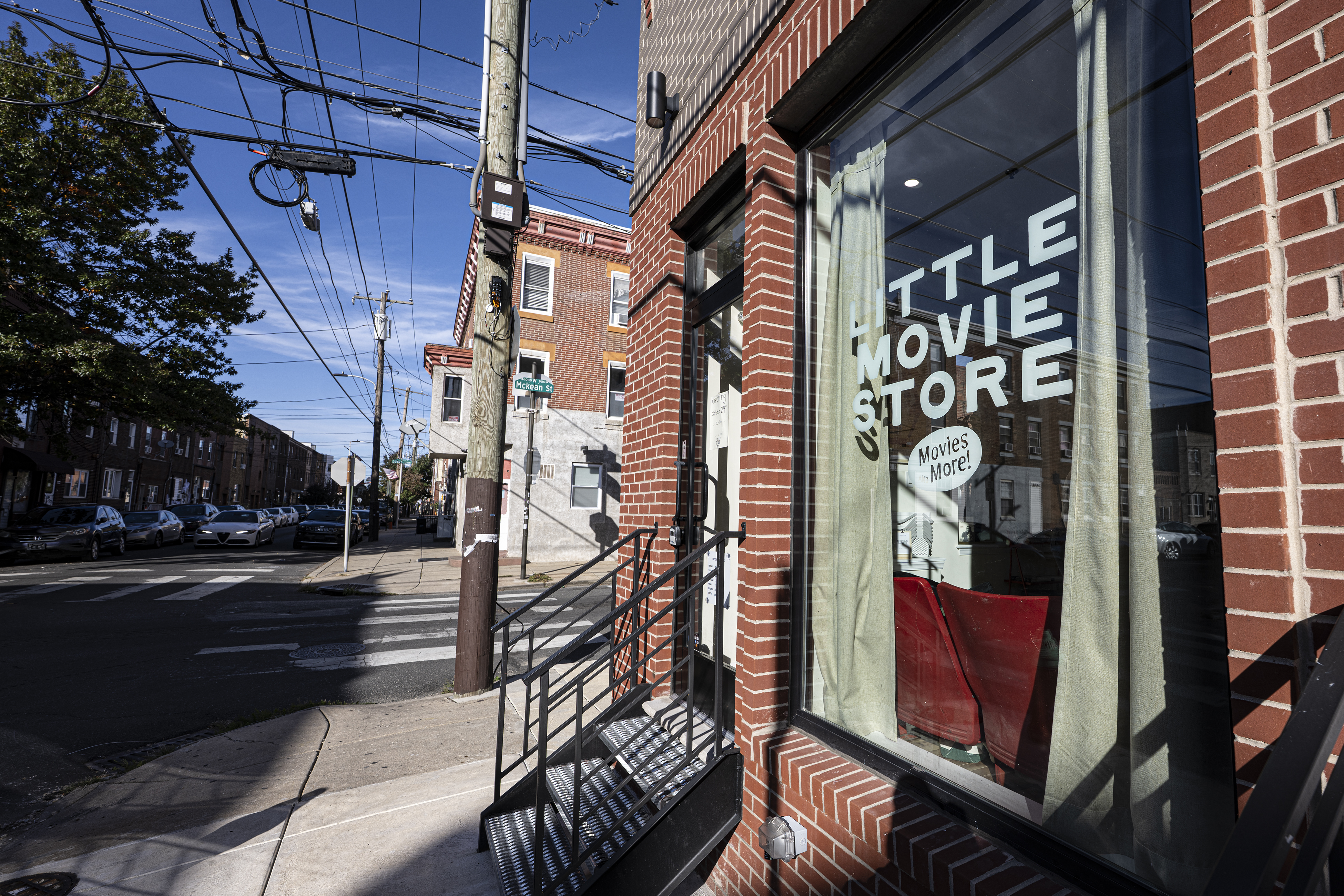
And his way of doing that was to open the Little Movie Store in South Philadelphia.
Opening a video rental business in 2026 can seem a little foolhardy. They were once a staple of communities across the country — in 2000, the Video Software Dealers Association census tallied nearly 28,000 video rental storefronts in the United States, per Billboard.
Little Movie Store owned by Dylan Wise and his wife, Keri, is shown in Philadelphia on Oct. 21. Jose F. Moreno / Staff Photographer
But today, the video store is now about as defunct as, well, the videotape.
Blame the rise, and subsequent tumble, of big chains like Blockbuster, which bullied mom-and-pop stores out of business before collapsing themselves. Blame the Netflix mail-order rental model, which ended in 2023, and the ascent of at-home streaming platforms. Blame the financial pressures of the COVID-19 pandemic.
The video store is no longer a salable retail model or community space where cinephilia is nurtured and lifelong passions for the so-called “seventh art” take root. These shops are now more typically spoken of in the past tense, and are the subject of eulogies, odes, and nostalgic paeans to times gone by.
Wise and his partner (in business and in life), Keri Wise, hope to change that. At least in their corner of the world.
“It is a wave that’s happening,” said Dylan Wise, brimming with the optimism of a small-business owner who is also a true believer. “I can feel it in the air. The physical media resurgence.”
The Wises looked at a number of retail spaces along Passyunk Avenue, but had difficulty persuading landlords that their video store and physical media retail idea was viable. Their current landlord, who lives above the store, was considering turning the space into a cafe, but worried it wouldn’t have a big enough footprint.
A large selection of movies in various formats fills the shelves at Little Movie Store, the new video store owned by Dylan Wise and his wife, Keri, in Philadelphia on Wednesday, Oct. 21, 2026. Jose F. Moreno / Staff Photographer
Wise eventually put together what he regarded as a “solid business plan,” and was able to persuade the landlord. Keri Wise already has experience managing retail spaces in Boston and New York City, where the couple lived before moving to Philly in 2020, during the peak of the COVID pandemic.
“This is a huge decision for us,” said Wise. “I see comments on our Instagram saying, ‘Oh, what could go wrong?’ I always think, what could go right! You think we didn’t think through this? Of course we did!”
The Wises believe that their Little Movie Store can follow the template set by bookstores and record shops, which have benefited from a renewed interest both in nondigital media consumption and in-person interactions.
In addition to selling and renting movies (using a subscription model, where for $160/year customers can rent up to three movies at a time), the Wises are planning to host screenings and even curate a little nook with a coffee table and coloring books to entertain neighborhood youngsters, while their parents peruse the shelves of Blu-rays, DVDs, and even VHS cassettes.
“Every Friday night my family would go pick out our movies,” Keri Wise remembered fondly. “We’d eat on the couch, and have a few movies to watch. It’s a deep memory. When I talk to other people in the neighborhood, they all tell me they can’t wait to come and look around, and bring their kids.”
Dylan Wise and his wife, Keri, at their video store, Little Movie Store, in South Philadelphia.Jose F. Moreno / Staff Photographer
For her, owning the store is about curating an interesting collection of physical media. The Little Movie Store has already collected 5,000 titles: everything from new releases from boutique Blu-ray labels like Arrow Video and the Criterion Collection, to a whole collection of old-school Warner Bros. snap-case DVDs. The titles were largely amassed from donations from social media followers, who were hip to their mission and eager to chip in. They also came from private collections, including one belonging to a former video store owner.
The Little Movie Store is not totally without precedent. While cavernous Blockbusters offering walls of Hangover 2 rentals may have come and gone, smaller video rental shops have sprouted across the country. There’s Scarecrow Video in Seattle, Beyond Video in Baltimore, and Night Owl Video in Brooklyn, to name a few.
A nascent network of revivalists has emerged, providing business (and emotional) support to one another.
“There’s enough new video stores popping up that we’re now in an Instagram group chat with one another,” said Wise. “We’re talking about what’s working, what’s not working, and how we’re handling certain problems.”
Some of these problems include a point-of-sale software from the ‘90s that only runs on outdated operating systems.
A large selection of movies in various formats fills the shelves at Little Movie Store, the new video store owned by Dylan Wise and his wife, Keri, in Philadelphia on Wednesday, Oct. 21, 2026. Jose F. Moreno / Staff Photographer
More than pure nostalgia, the Wises believe that physical media sales and rentals respond to a new problem that has been created by the ever-more-sprawling digital media landscape.
Anyone in the mood to watch a movie at home has had the experience of cycling through potential titles across half a dozen streaming platforms, from Netflix to Amazon Prime to Tubi and Shudder and Paramount and the Criterion Channel, before tuckering out and just heading to bed. The sheer accessibility, and frictionless ease, of watching a movie at home has itself become a dilemma.
There is, simply, too much to watch.
Dylan Wise and his wife, Keri, are photographed at their video store, Little Movie Store, in South Philadelphia on Wednesday, Oct. 21, 2026. Jose F. Moreno / Staff Photographer
“Why is the algorithm deciding what I’m going to watch?” Wise said. “That’s why we want a store: to have a place for people to see each other, and hang out, and pick a movie together, and take recommendations.”
“These are real, physical things that you can hold, and touch — and smell, if you want. It’s not nostalgia for a thing. It’s nostalgia for a slower way of living.”
From photographs documenting Black cowboy culture to artwork made with ancient tree rings, Philadelphia’s galleries offer plenty to explore this fall.
Some of the most interesting exhibitions are happening outside the city’s major museums, in smaller galleries and independent arts spaces.
Whether you’re interested in photography, textiles, painting, or Philadelphia history, here are 14 exhibitions worth checking out. Be sure to check exhibition dates: Some close this month, some in December, and others in early 2027.
At the Print Center, the work of Pulitzer Prize-winning photographer Ron Tarver is on display through Nov. 14.Courtesy of Ron
The work of Pulitzer Prize-winning photographer (and former Inquirer photojournalist) Ron Tarver comes to the Print Center in an exhibition based on his book, The Long Ride Home: Black Cowboys in America.His large-scale images document Black cowboy culture from the southern plains of East Texas to the urban pathways of North Philadelphia.
“Still Taking Minutes,” an exhibition at Vox Populi Gallery, explores how artists form, sustain, and leave creative communities.Courtesy of Constance Mensh
Curator Logan Cryer interviewed 13 Philadelphia artists about their experiences working in artist collectives for “Still Taking Minutes,” an exhibition of prints at Vox Populi Gallery that explores how artists form, sustain, and leave creative communities. Among those featured are Vox members Aaron Terry, Ollie Goss, Gregory Donell Parker, and catia colagioia, who reflect on the challenges and rewards of working collaboratively. Part of the larger “An Endless Meeting” project, the exhibition examines the history of Philadelphia’s DIY arts community and what its future might look like.
🕒 Through Nov. 15, 💵 Free, 📍319 N. 11th St. 3rd Fl., Philadelphia, Pa. 19107, 🌐 voxpopuligallery.org, 📞 215-238-1236
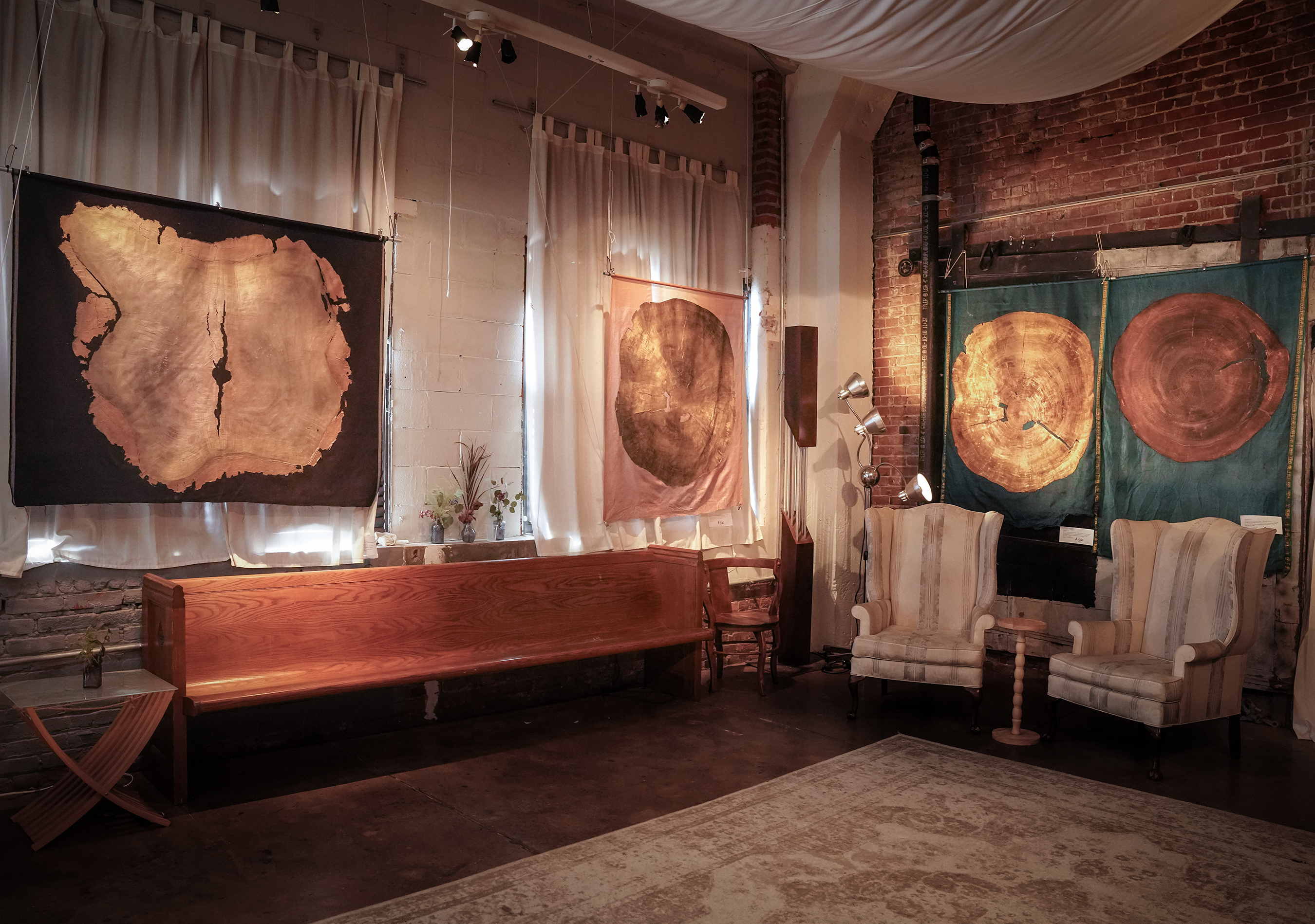
Prism Arts Philadelphia’s exhibition “Notes from the Forest Archive” explores the histories of ancient trees and humanity’s relationship with the natural world.Courtesy of Robert Neroni Photography
The exhibition “Notes from the Forest Archive,” at Prism Arts Philadelphia, explores the histories of ancient trees and humanity’s relationship with the natural world. Artist Larry Wood’s work features imprints of cross-sections of coastal redwoods and giant sequoias felled in California. Their growth rings reveal centuries of environmental change.
🕒 Through Nov. 20, 💵 Free,📍1021 Hamilton St., Philadelphia, Pa. 19123, 🌐 prismartsphiladelphia.com, 📞 215-645-2796
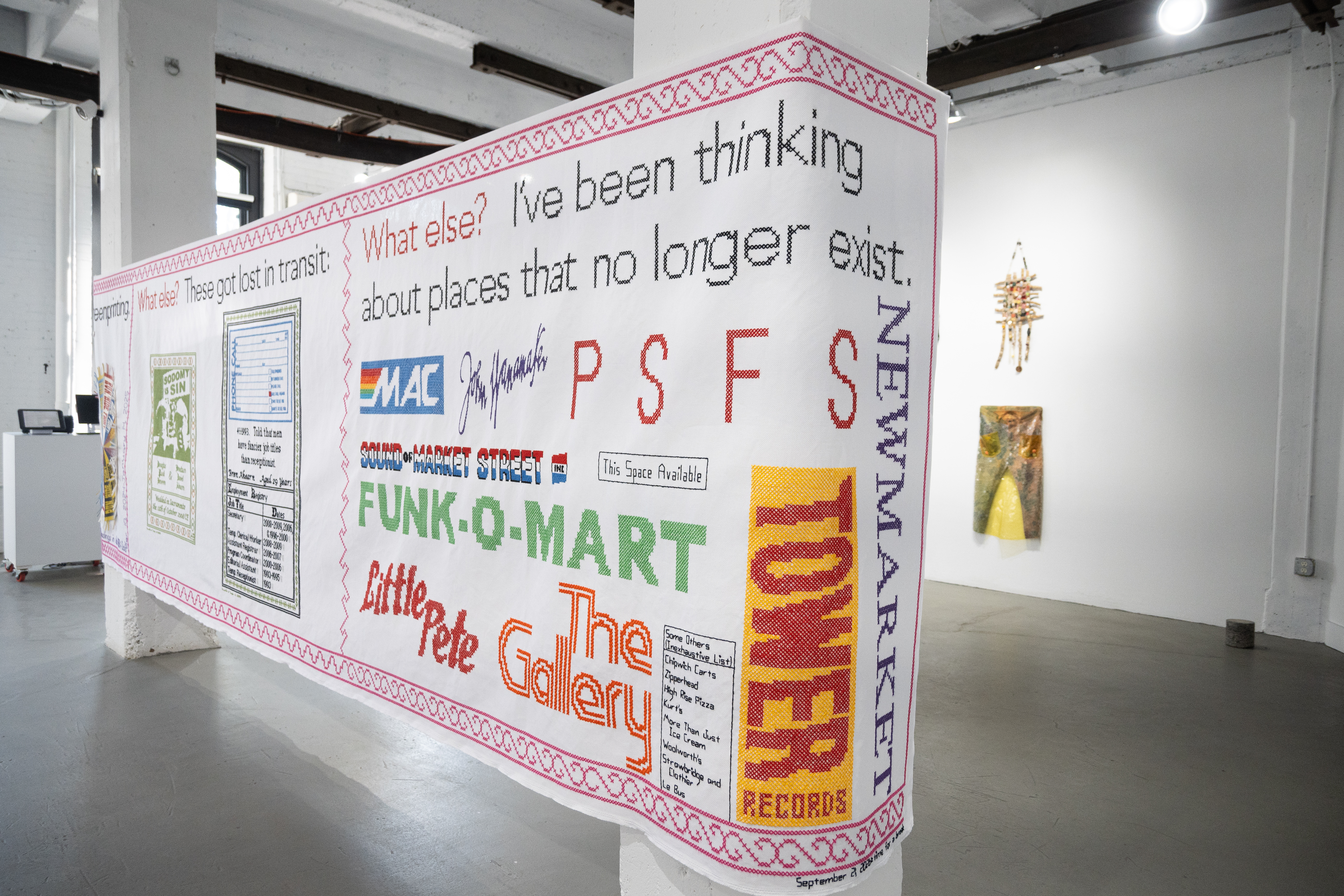
InLiquid’s exhibition “Let’s begin in the middle” explores how fiber arts can tell stories and preserve memories.Courtesy of Sam Davis
The work of artists Bren Ahearn, Rebecca Kelly, Beau McCall, Caitlin McCormack, Barbara Schulman, Amy Orr, and Julie Woodard explores how fiber arts can tell stories and preserve memories. Using materials ranging from cotton and embroidery thread to bones and found objects, the artists explore personal histories and ancestral traditions.
🕒 Through Nov. 28, 💵 Free, 📍1400 N. American St., Philadelphia, Pa. 19122, 🌐 inliquid.org, 📞 215-235-3405
Artist Rami George’s “from every river to every sea” is a film archive that includes “raw” footage of flags and “flashes of police surveillance” from the pro-Palestinian protests in Philadelphia and Washington, in 2023 and 2024. According to the Asian Arts Initiative website, the goal of the exhibition is to showcase the varied layers of resistance and chart a path toward a decolonial future.
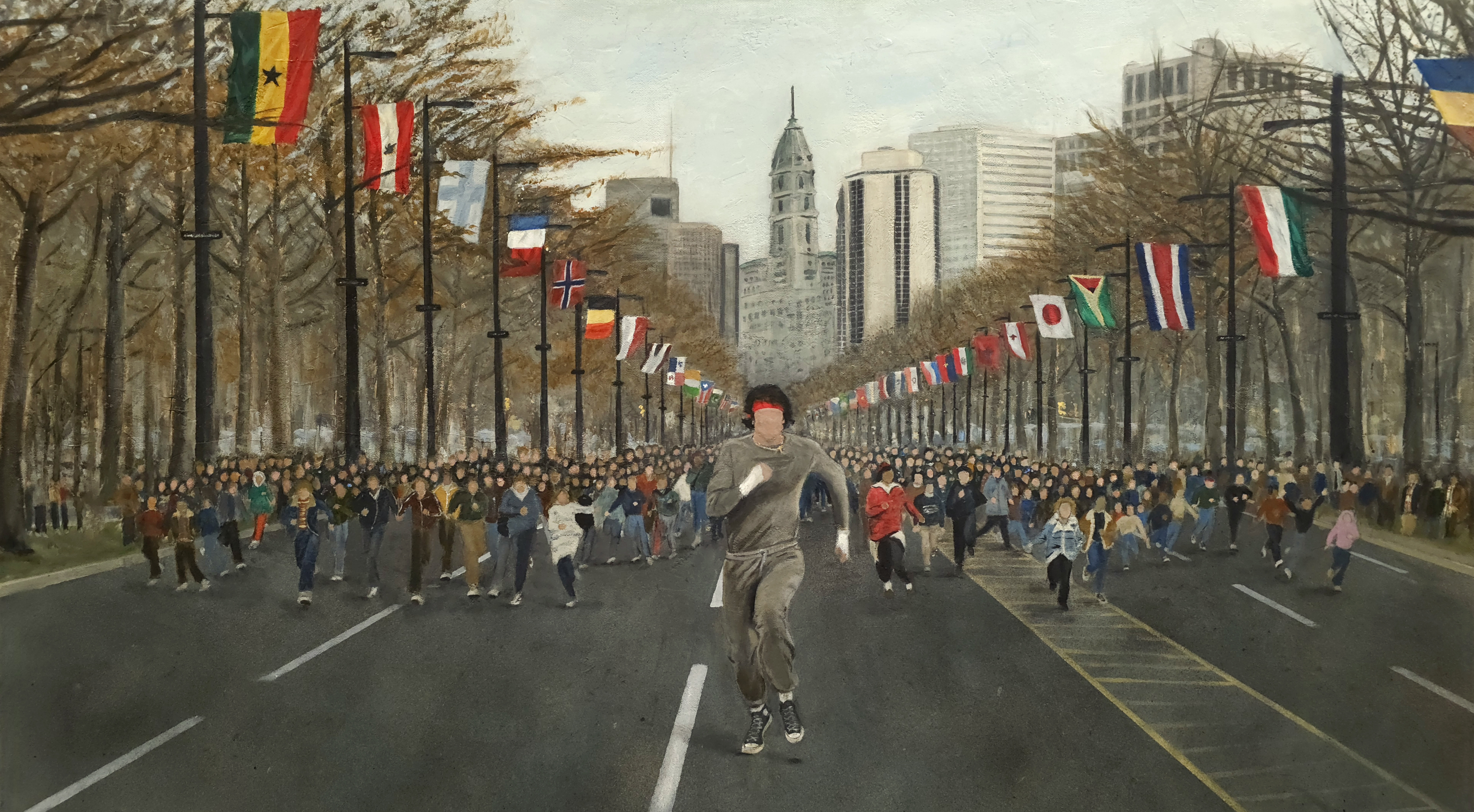
Artist Neil Anthony Edwards’ second solo exhibition at Morton Contemporary explores decades of fashion with odes to two iconic Philly sports figures.Courtesy of Neil Anthony Edwards
Neil Anthony Edwards, a former NBA player and oil painter, returns to Morton Contemporary for a second solo exhibition. In his latest show, “Evanescence: We Are All Still Fading,” Edwards focuses on the evolution of fashion from the 1910s to the 1960s, and how those styles influence contemporary fashion. The exhibition also offers odes to Rocky Balboa and LeBron James, two figures who have become symbols of Philadelphia.
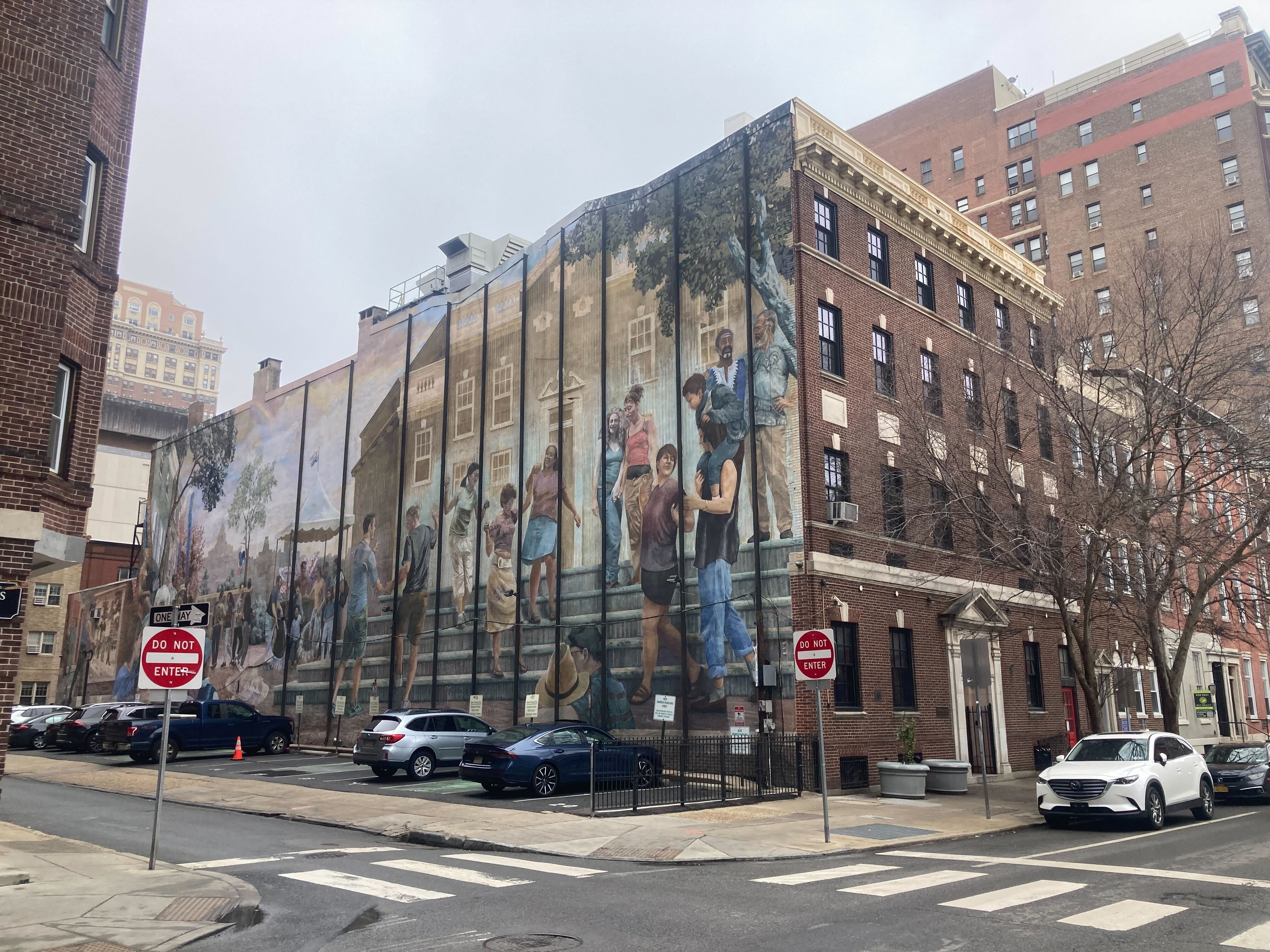
Each year, three artists are selected for the William Way LGBT Community Center’s art exhibition. This year’s artists are Philly-based LGBTQ artists Jordan Artim, D’Shon McCarthy, and Dave Tavacol, who will each showcase their work at Northern Liberties’ Huddle arts gallery for the 20th annual exhibition.
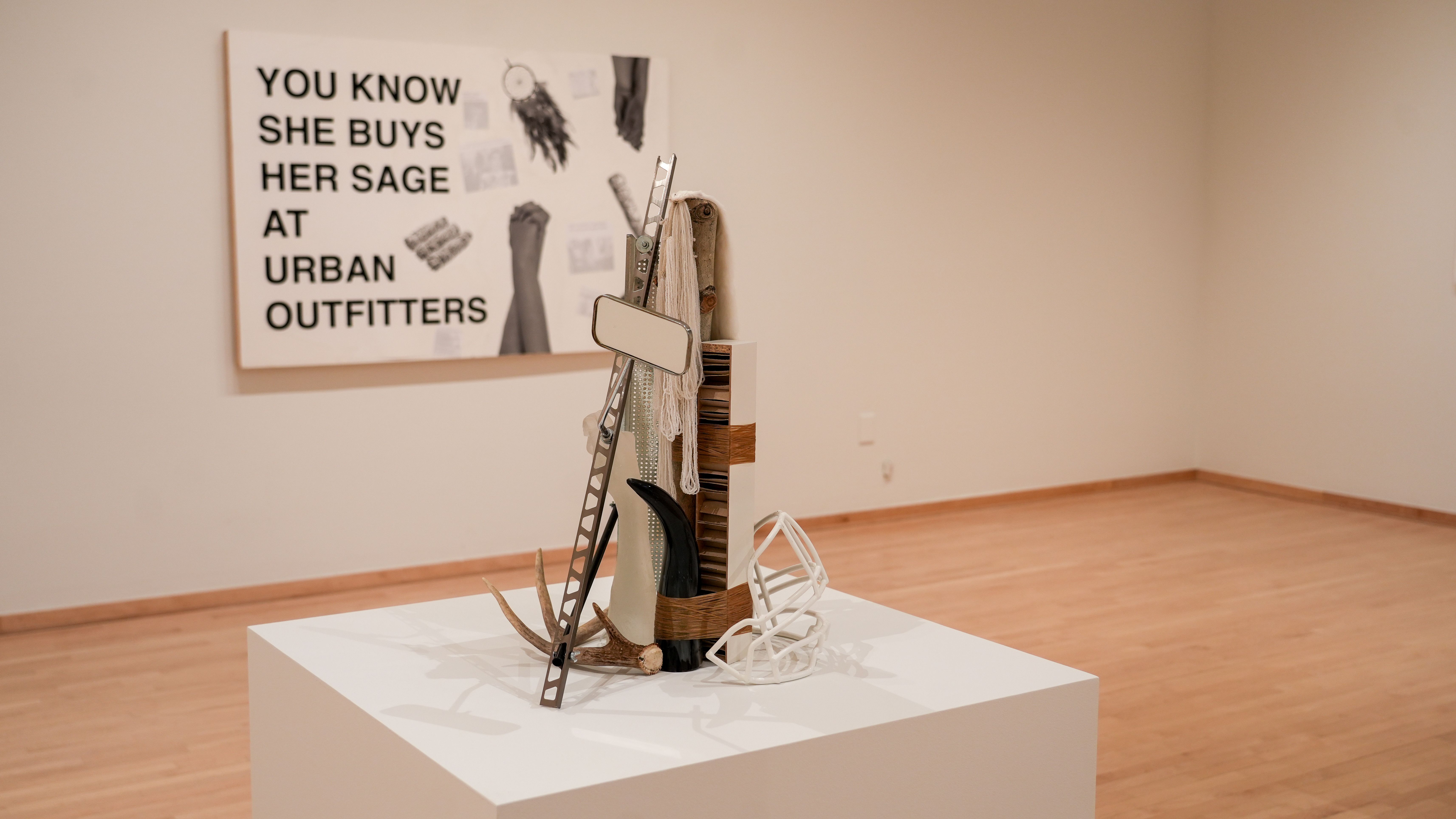
“She Dares You to Steal Her Hair,” a sculpture from the “Indigenous Irregularities: Anna Tsouhlarakis” exhibition, at Temple Contemporary, 2001 N. 13th S., Philadelphia, on Temple’s campus. The sculpture is made from glass cast, found metal, horsehair, hardware, shed antler, bicycle mirror, beads, artificial sinew, ermine, an Ikea remnant, curtain rod, steer horn, rope, thread, football face mask, adhesives, paint, marker nail, and a toy velociraptor.Amara Johnson
What do an Ikea furniture remnant, a toy velociraptor, a steer horn, and a curtain rod have in common? They’re all materials used in artist Anna Tsouhlarakis’ sculptures at Temple Contemporary. A citizen of the Navajo Nation and Creek Tribe who is also of Greek descent, Tsouhlarakis combines everyday objects, animal remains, and glass casts of body parts to explore Indigenous identity, cultural expectations, and her own experiences. Her unconventional sculptures resist straightforward narratives, inviting visitors to make sense of seemingly disconnected objects. The exhibition also features black-and-white collages that use humor to challenge stereotypes about Indigenous identity.
🕒 Through Dec. 5, 💵 Free, 📍2001 N. 13th St., 🌐 now.temple.edu
Artwork from furniture to sculpture to graphic design are on view in “Noguchi to Asawa: Designing Postwar America,” through Jan. 10 at the Barnes Foundation.Courtesy of the Barnes Foundation
From sculptural furniture to intricate wire sculptures and jazz album covers, some of the most recognizable elements of American midcentury design have roots in a painful chapter of U.S. history. At the Barnes Foundation, “Noguchi to Asawa” explores the work of six Japanese American artists, including George Nakashima, Isamu Noguchi, and Ruth Asawa, whose lives and careers were shaped by the incarceration of Japanese Americans during World War II. The exhibition brings together furniture, sculptures, and graphic design to show how these artists helped define modern American esthetics, even as their personal histories were often overlooked.
🕒 Through Jan. 10, 💵 $30 adults, $28 seniors, $5 college students and ages 13—18, free for children 12 and under (admission valid for two consecutive days), 📍2025 Benjamin Franklin Parkway, 🌐 barnesfoundation.org, 📞 215-278-7000
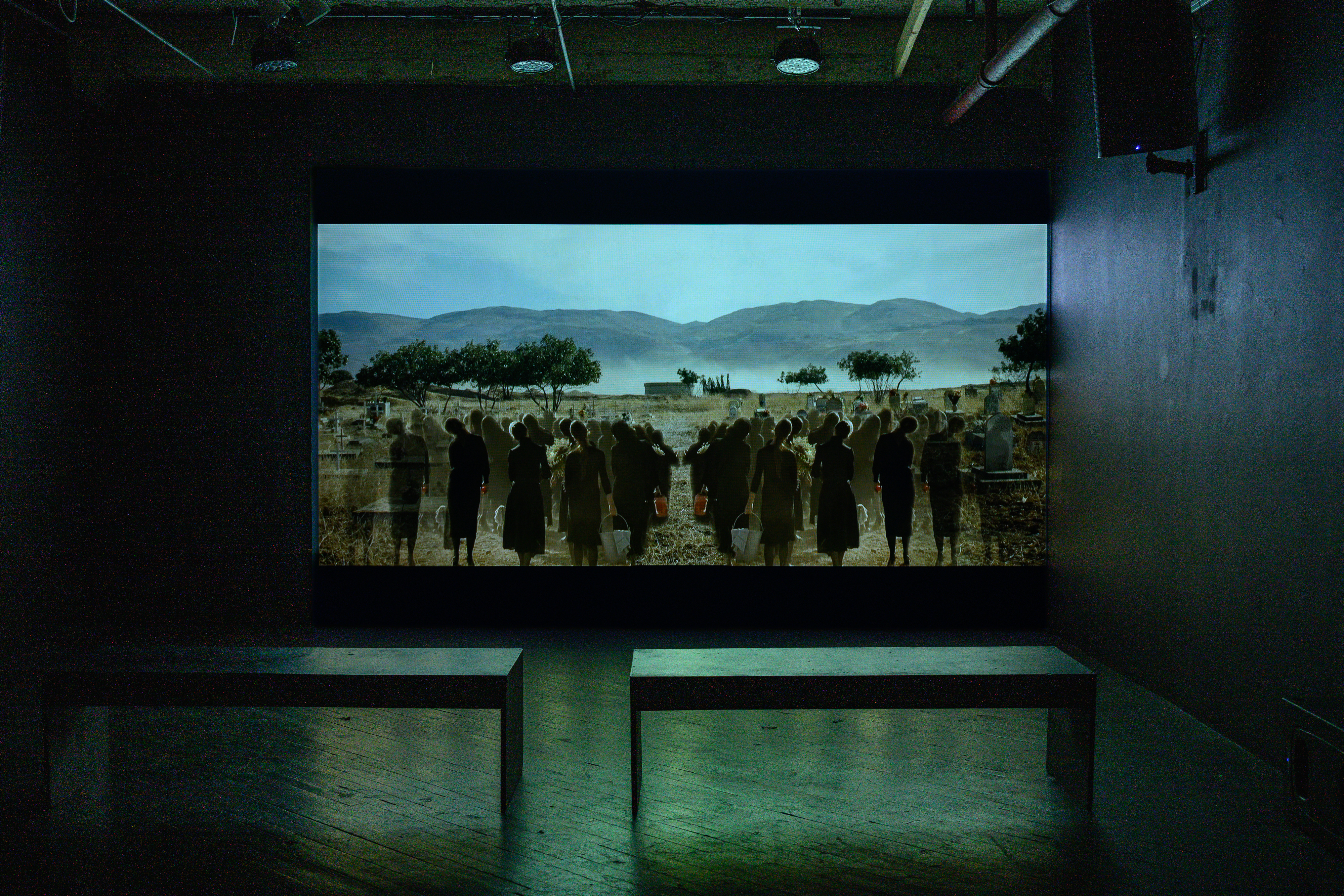
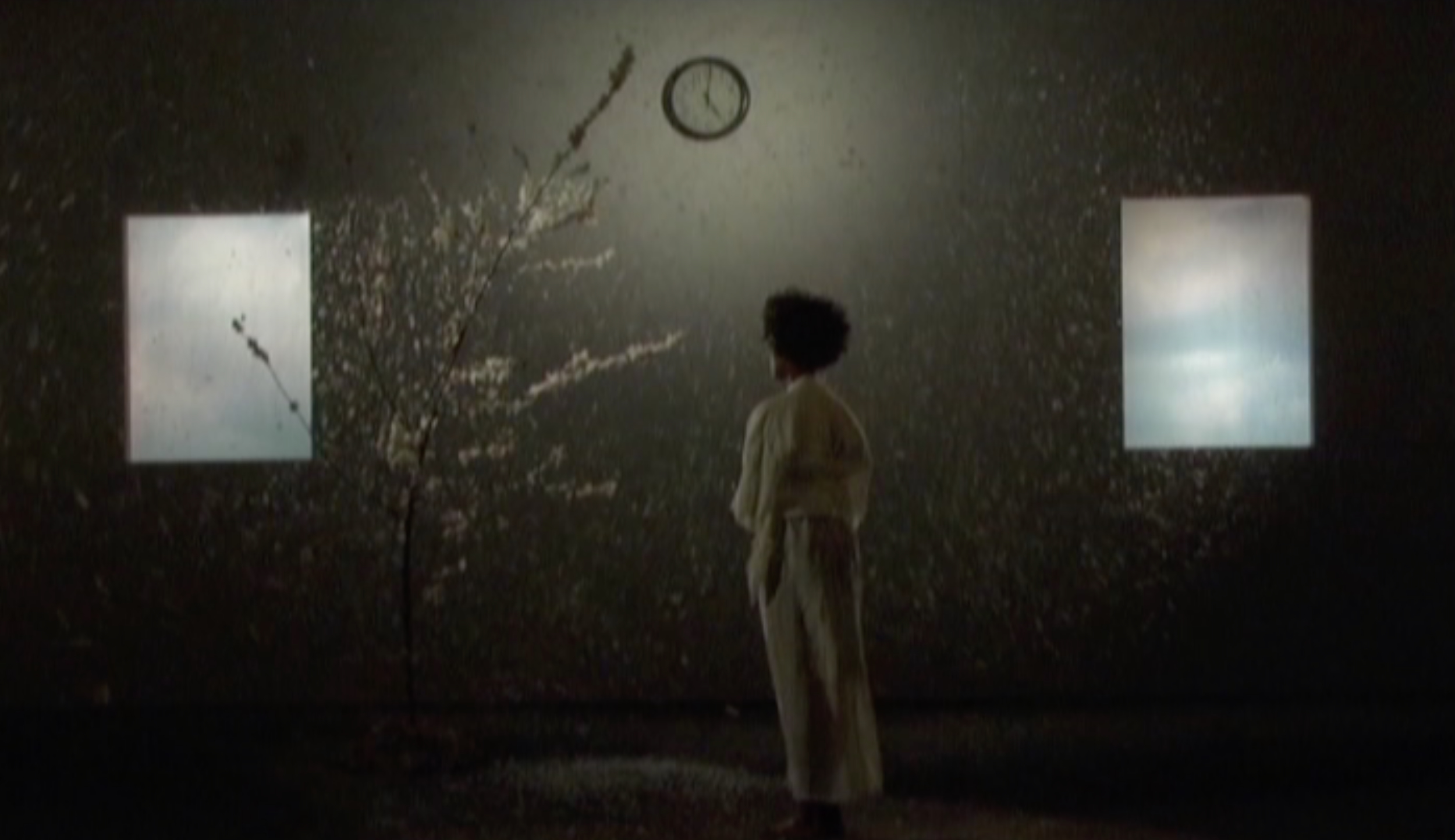
This Twelve Gates Arts’ new exhibition, “Extended Constellations,” brings together artists Carrie Mae Weems, Sama Alshaibi, and Lali Khalid for a multimedia project that examines displacement, belonging, and representation.Courtesy of Carrie Mae Weems and Gladstone Gallery, New York, Fraenkel Gallery, San Francisco, and Galerie Barbara Thumm, Berlin
This Twelve Gates Arts exhibition brings together artists Carrie Mae Weems, Sama Alshaibi, and Lali Khalid for a multimedia project that examines displacement, belonging, and representation across racial, legal, and geographic boundaries. “Extended Constellations,” curated by Zehra Zehra, brings together photography, video, installations, and archival materials.
🕒 Through Jan. 16, 💵 Free, 📍106 N. Second St., Philadelphia, Pa. 19106, 🌐 twelvegatesarts.org, 📞 215-253-8578
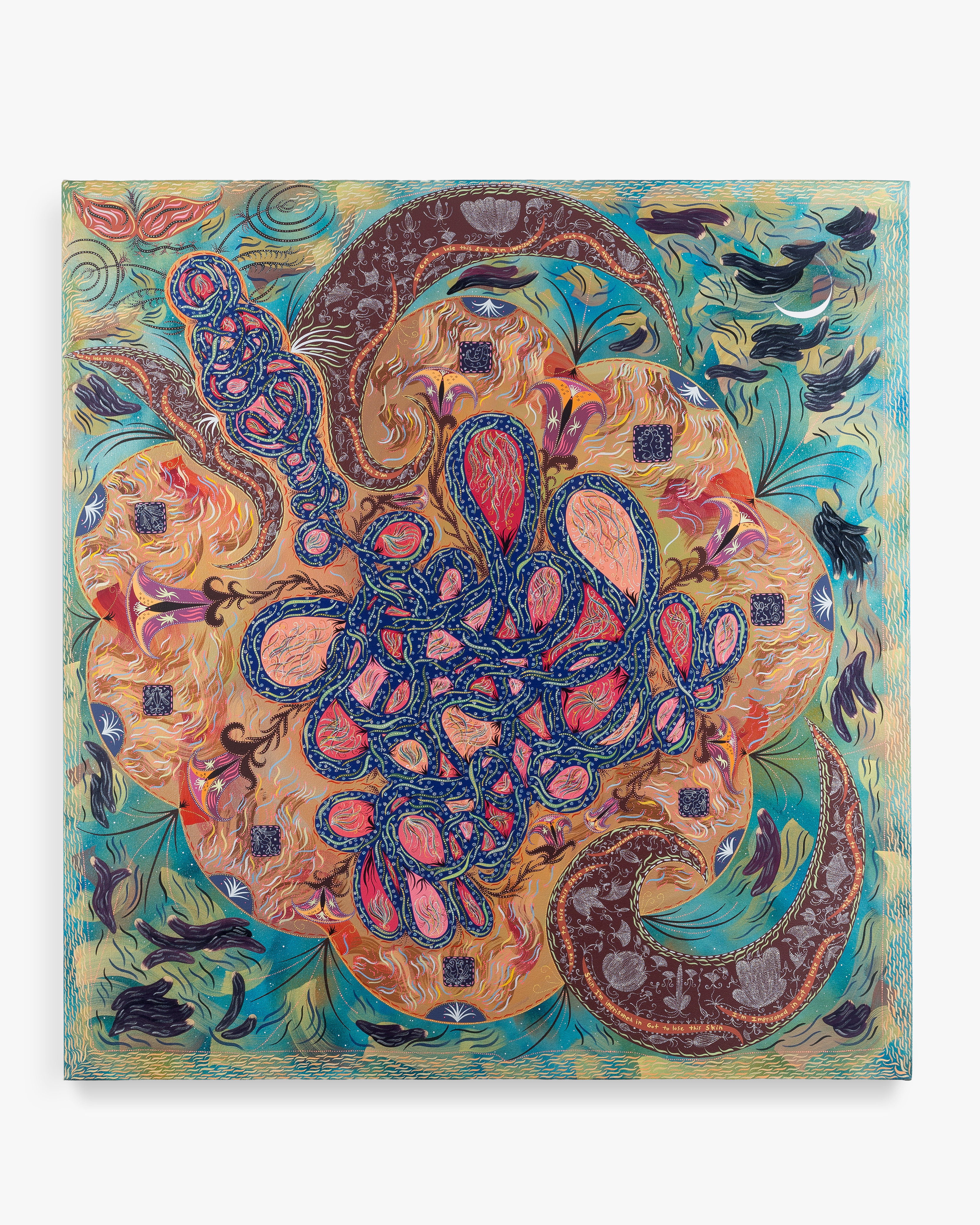
At Fleisher-Ollman Gallery, artist Molly Metz will present a collection of paintings evoking aquatic and extraterrestrial life-forms.Courtesy of Molly Metz and Fleisher/Ollman
For her third exhibition at Fleisher-Ollman Gallery, artist Molly Metz will present “Rock Garden,” a collection of paintings that evoke aquatic and extraterrestrial life-forms. Her paintings feature biomorphic shapes, wormlike figures, and structures resembling veins and capillaries.
“Bouquet of Stories” opens at the Athenaeum of Philadelphia on Nov. 6, tracing three centuries of Philadelphia’s gardening history.Courtesy of Pennsylvania Horticultural Society
“Bouquet of Stories,” opening Nov. 6 at the Athenaeum of Philadelphia, traces three centuries of Philadelphia’s gardening history through photographs, rare objects, and stories about the people who helped shape the city’s gardening traditions. The exhibition will also examine how gardening has been a source of creativity and community building for generations of Philadelphians, and Philadelphia’s influence on American horticulture. The Pennsylvania Horticultural Society presents the exhibition as part of its 200th anniversary celebration.
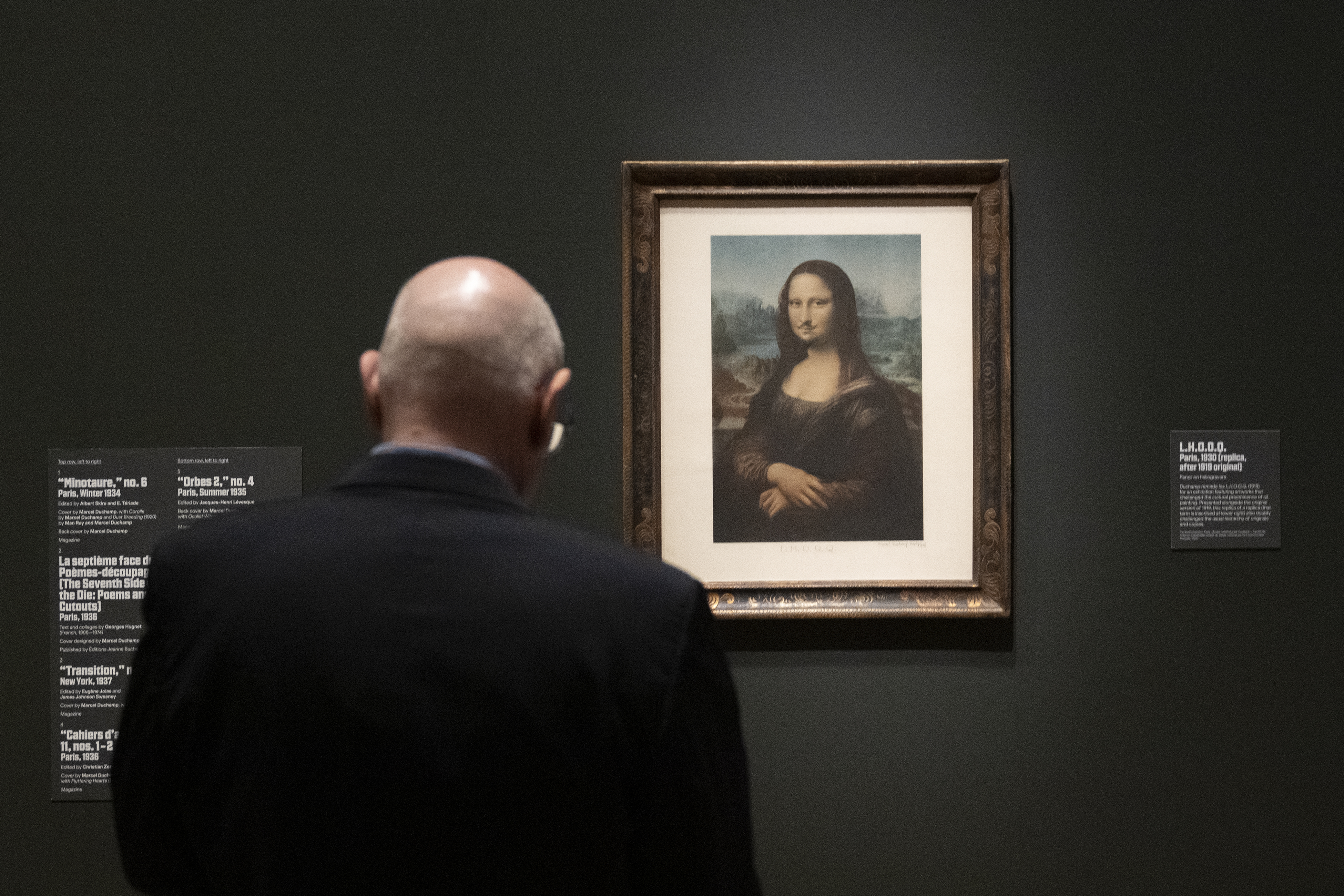
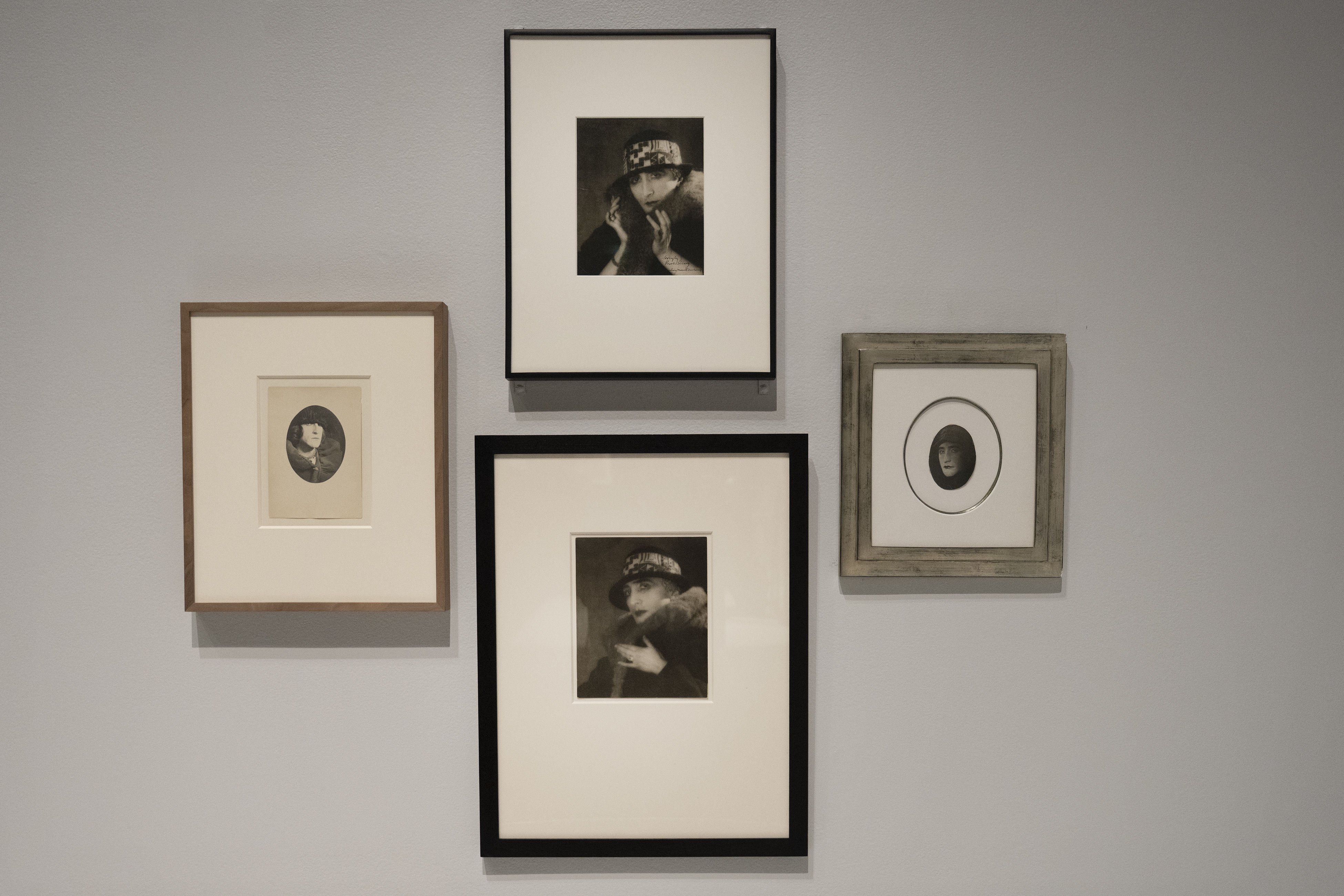
A series of silver gelatin portrait photographs of Marcel Duchamp is displayed as part of the exhibition at the Philadelphia Museum of Art in Philadelphia on Thursday, Oct. 8, 2026.Jose F. Moreno / Staff Photographer
One of the most influential artists of the 20th century is getting a major retrospective in Philadelphia, home to the world’s largest collection of his work. At the Philadelphia Museum of Art, “Marcel Duchamp” brings together 300 works spanning painting, sculpture, photography, film, and the artist’s unconventional “ready-mades,” everyday objects transformed into art. The exhibition includes some of his most famous creations, such as Nude Descending a Staircase (No. 2), The Large Glass, and Étant donnés. It’s the first major U.S. retrospective of the French American artist in more than 50 years, offering a rare look at how Duchamp challenged traditional ideas about what art could be.
🕒 Through Jan. 31, 💵 $35 timed ticket (includes museum admission), 📍2600 Benjamin Franklin Parkway, 🌐 philamuseum.org
Daniel Garber (1880-1958), “Over at Byram,” 1940. Oil on canvas mounted on Masonite, 30 x 30 inches. James A. Michener Art Museum. Gift of Oliver Pearson.Courtesy of the Michener Art Museum
Who knew Pennsylvania’s old stone quarries could inspire an art movement? At the Michener Art Museum in Doylestown, “Abstractions of Nature” explores how the industrial landscapes of Bucks County shaped Pennsylvania impressionism in the early 20th century. Inspired by European painters such as Claude Monet and Paul Cézanne, artists including Daniel Garber, Edward Redfield, and William Lathrop turned the region’s quarries into subjects for their paintings, capturing dramatic rock formations, shifting light, and the effects of industry on the natural world. The exhibition also features works by Letitia Maxwell Ely, whose paintings offer a closer look at the labor that took place inside the quarries.
🕒 Through Feb. 28, 💵 $15 adults, $13 seniors, $8 college students, $5 ages 6—18, free for children under 6 and museum members; free admission for all on the second Sunday of each month in 2026, 📍138 S. Pine St., Doylestown, 🌐 michenerartmuseum.org
In one form or another, eyeglasses have existed for centuries.
Ancient Roman scholars and medieval monks used blown glass to magnify manuscripts. Paintings from the 17th and 18th centuries depict well-to-do folks sporting eyeglasses, including Benjamin Franklin, who invented bifocals. Leonardo da Vinci conceptualized contact lenses as early as 1508.
Glasses and contacts have come a long way since. The 75% of American adults who need some sort of corrective eyewear can choose between comfortable contacts and thousands of fashionable frames.
Still, shopping for new specs and contacts can be a hassle.
Nonprofit Delaware Valley Consumers’ Checkbook’s surveys of local consumers reveal sizable differences in customer satisfaction. In general, chains and franchise operations were rated lower than independent firms, but there was variation among each outlet type.
You’ll want to shop around for price. Checkbook’s undercover shoppers collected prices for 18 models of eyeglasses (with single-correction lenses) and found that some outlets charge twice as much as others. For example, for a pair of Ray-Ban RX5286 eyeglass frames with lenses, prices at surveyed stores ranged from $166 to $487. For eyeglasses, the least expensive sellers were usually online.
Not all eyeglass retailers sell the same products, so it’s difficult to compare prices among some of the largest chains for the exact same frames. Comparing costs is further complicated by the dominance of EssilorLuxottica, which not only manufactures millions of pairs of glasses from dozens of brands annually, but runs thousands of retail stores where it markets and sells eyewear, including For Eyes, LensCrafters, Pearle Vision, Sunglass Hut, and the optical department at Target.
For the limited selection of specs they carry, Checkbook’s shoppers found Costco, Walmart, and Warby Parker offer low prices, and Costco and Warby Parker also get fairly high ratings from their surveyed customers.
Checkbook researchers also collected prices for six brands and models of contact lenses and found even larger store-to-store differences. For example, prices for a one-year supply of Biotrue ONEday daily disposable contact lenses (plus exam and fitting), ranged from $460 to $1,150. Among brick-and-mortar outlets, BJ’s, Costco, For Eyes, and Walmart had the lowest prices for contacts.
We found the lowest contact prices online, but some internet sellers were more expensive than the lowest-priced local brick-and-mortars. If you’re replenishing a year’s supply and not changing brands or type, there’s little reason not to grab the savings by buying from a low-cost supplier.
If you are buying glasses, choosing the type of frame is a major decision. Consider comfort, positioning, durability, appearance, and price.
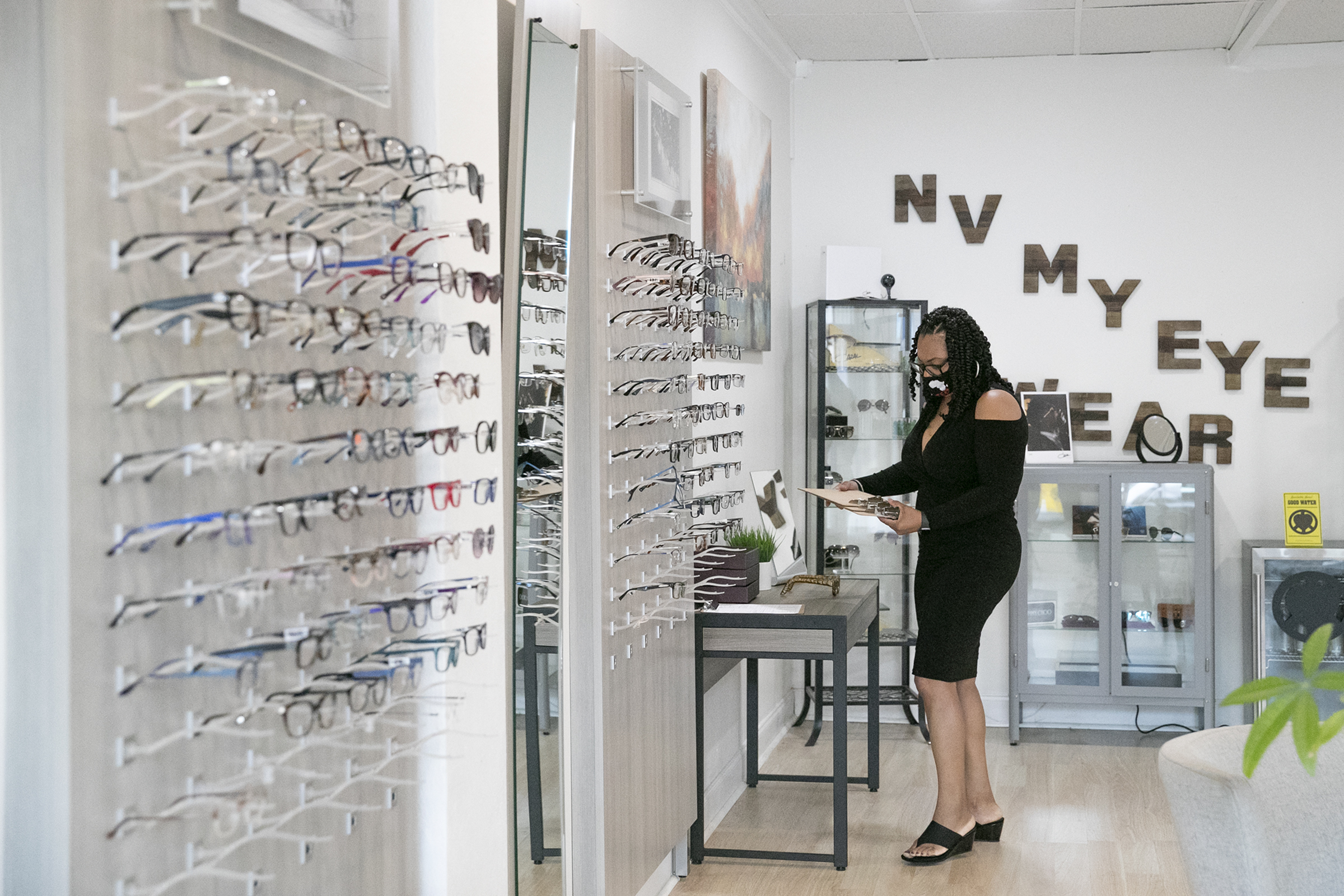
Eyeglasses on display at Warby Parker in Philadelphia.
How they feel
Check for comfort at the bridge of the nose and ears, where glasses touch your face. The lightest glasses are usually the most comfortable. Look for thin plastic or metal frames.
With metal frames, know that they have a nosepiece of rocking pads (small adjustable plastic pads) that are unlikely to slip and can be easily adjusted — an advantage over plastic frames, which usually have a rigid nose support. But rocking pads concentrate the weight on a small surface, which is uncomfortable to some people.
How they are positioned
Eyeglass frames are designed to position lenses to provide maximum visual acuity. Some frames may position lenses too far from your eyes, or too high or too low. If the frames slide down your nose, you won’t get the full benefit. The stronger your prescription, the more critical the positioning.
If you wear your glasses for driving, sports, or other activities requiring peripheral vision, make sure the “temples” (the two side parts of a frame that extend behind the ears) are located above or below the eyes, not directly alongside them.
How long they will last
Barring accidents, glasses should last three or four years, and many wearers want to change styles at least that often. If you plan to keep the frames longer — or the frames get knocked around a lot — strength and durability are important. Both depend on the frame materials, thickness, and craftsmanship.
The strongest metal frames are usually made of titanium, with flexible hinges and smooth welding wherever two pieces of metal are joined. The strongest plastic frames are made of nylon, but these tend to be thick, heavy, and plain. Among other plastic types, the strongest usually have at least moderate thickness, metal reinforcing within the full length of the temple, and flexible hinges.
How they look
Whether you buy specs in person or online, you’ll need to try them on to ensure they suit the shape of your eyebrows and cheekbones, spacing of your eyes, height of your nose bridge, and size of your head.
The best approach? Try on multiple frames and choose what you like. Then look at prices, and if your favorite costs too much, ask a staffer to show you a similar-looking cheaper frame.
How much they cost
Frame prices vary tremendously. Prices for decent-quality frames range from less than $40 to more than $1,000.
Shopping around is key to getting a good deal.
Delaware Valley Consumers’ Checkbook magazine and Checkbook.org is a nonprofit organization with a mission to help consumers get the best service and lowest prices. It is supported by consumers and takes no money from the service providers it evaluates.
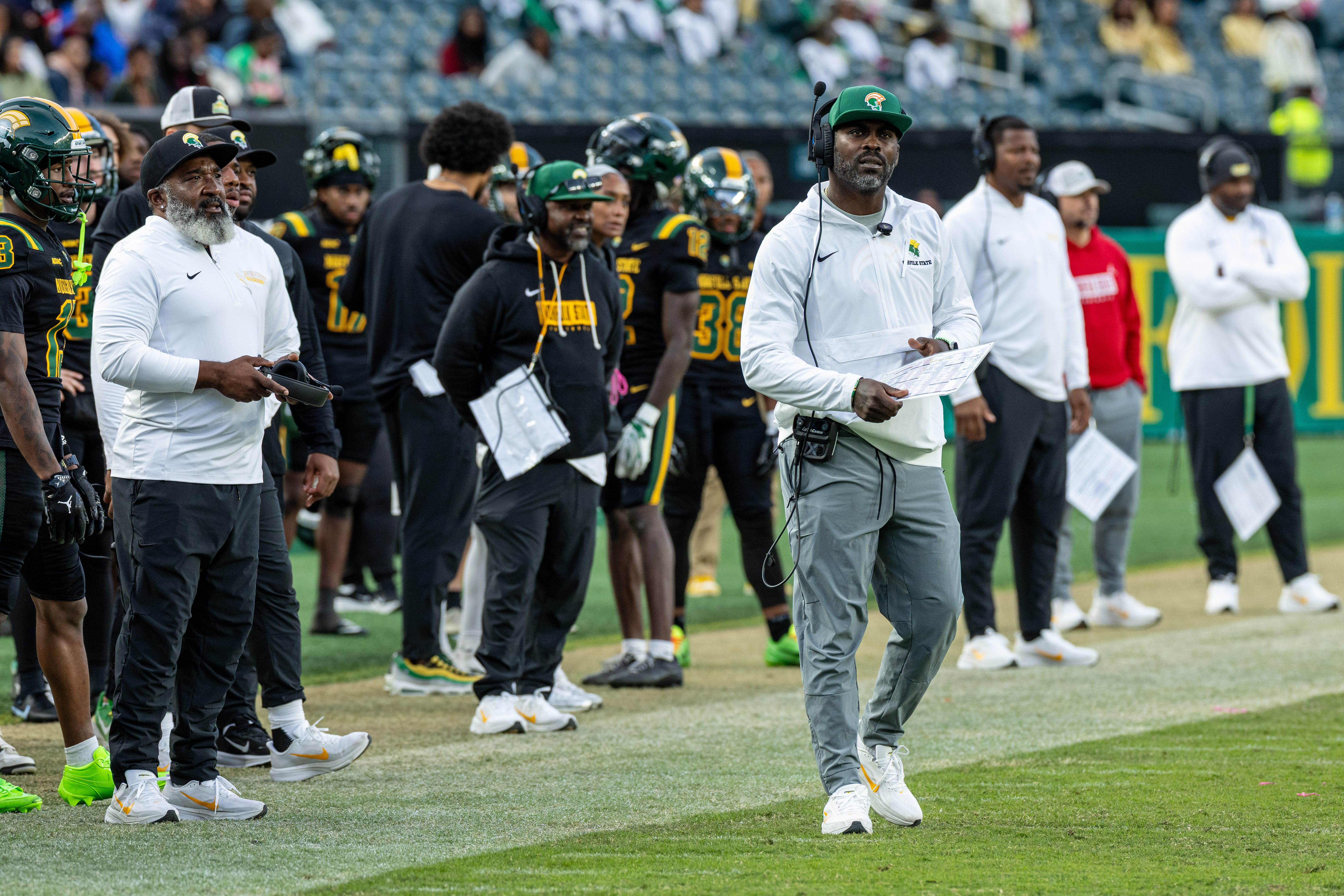
Marqui Adams grinned ear-to-ear as he stood near the 40-yard line of Lincoln Financial Field on Saturday evening, and was told by a passing Delaware State teammate that he was “the best QB in the MEAC.”
He was recounting the steps behind Delaware State’s dramatic 36-33 comeback victory, down 17 points in both the first and second halves. The Delaware State quarterback and Neumann-Goretti graduate was benched earlier in the game after being sacked twice and with the offense stuck in neutral.
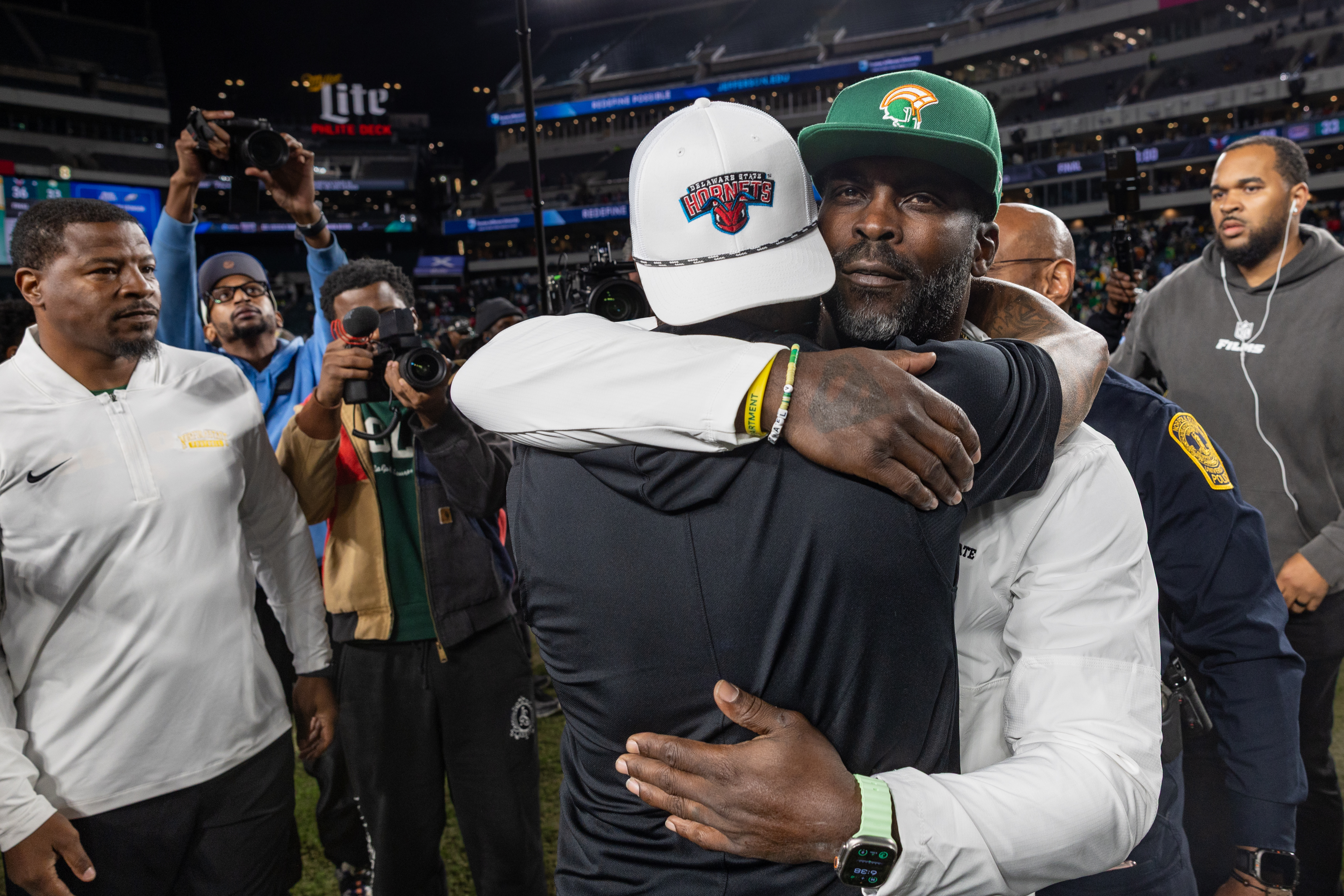
His head coach, DeSean Jackson, said he gave the fifth-year quarterback — who was once a starter in 2023 and 2024 and tore his ACL last season — a pep talk. It worked, as Jackson’s Delaware State once again took down Norfolk State, coached by Jackson’s former Eagles teammate, and friend, Michael Vick, with a game-winning kick as time expired in the second annual HBCU Classic.
“It just felt like a blessing to come back to my home city,” Adams told The Inquirer as Delaware State’s band played its sweet victory music. “I had to put on for my city. … It just really felt like a dream come true. [I] had to go out there and ball.”
Vick and Jackson, beloved Eagles players now in their second seasons at the helm of their respective schools, treated the 32,567 fans in attendance to another quality game at the Linc. Last year’s 27-20 Delaware State win featured two teams going in opposite directions, with Delaware State finishing with an 8-4 record and Norfolk State at 1-11.
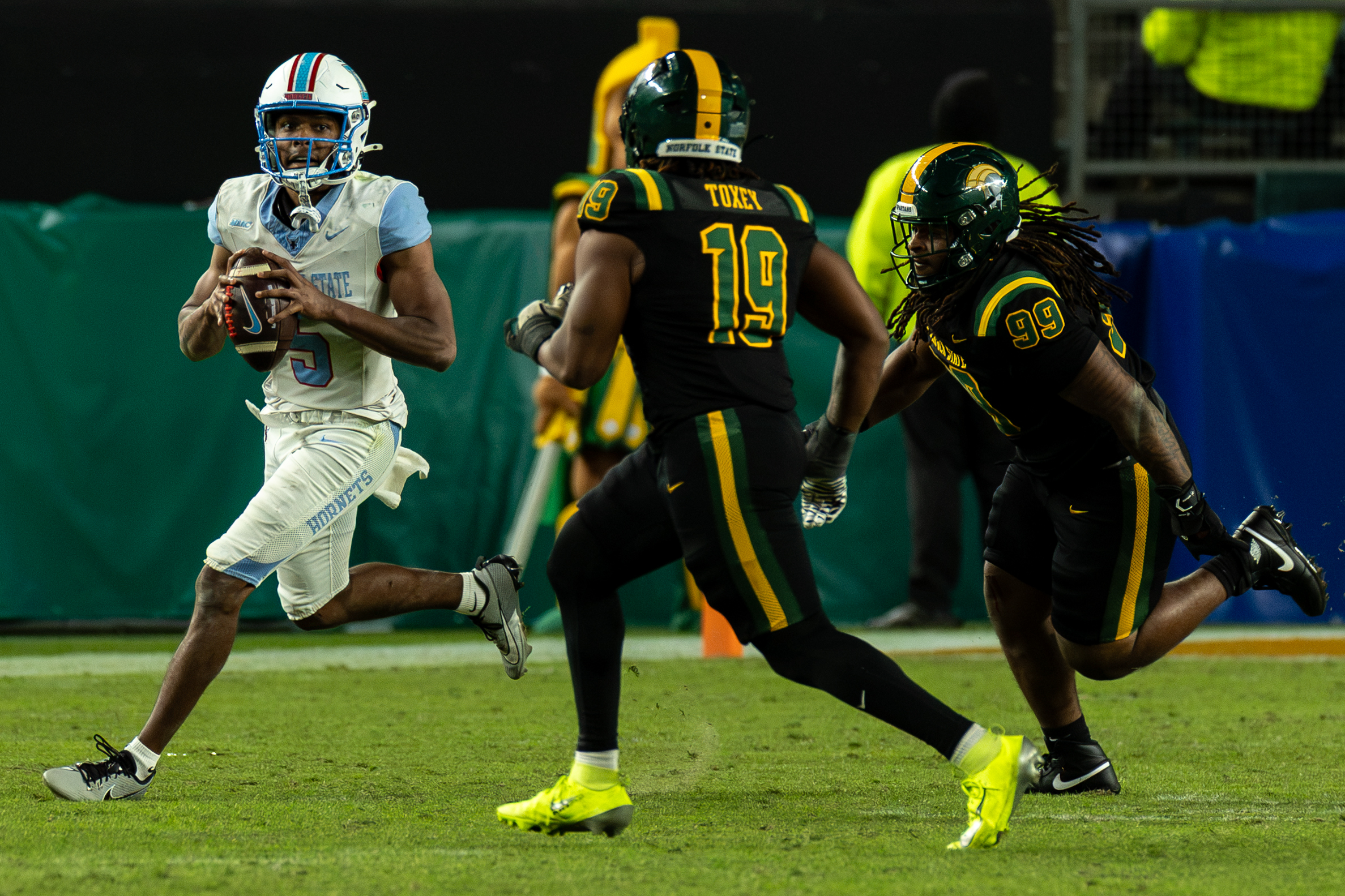
Delaware State quarterback Marqui Adams (center) looks to throw downfield during Saturday’s HBCU Classic game against Norfolk State.Aidan T. Gallo / Staff Photographer
This year, the stakes were higher, with both teams entering the game at 4-4 overall and 0-1 in Mid-Eastern Athletic Conference play. The festivities surrounding One Philly HBCU Week added to the excitement, bringing step shows, a battle of the bands, career fairs, and two football games to the Linc.
One of those games featured Mayor Cherelle L. Parker’s alma mater, Lincoln University, where she graduated in 1994. Lincoln fell to Virginia Union, 62-0.
Saturday’s game was more than keeping each team’s Mid-Eastern Athletic Conference championship hopes alive.
“I just got a disclaimer. This stadium is now called the Delaware State Eagles,” quipped Jackson, who is now 2-0 against Vick. “A challenge that I put on my team [was] if we lose any more games going forward, we can chalk it up for the rest of the season with our chances for MEAC championship play. We’ve got a lot of Philly guys on this team, man. You know the heart and soul of my career and what I meant and what Philadelphia has meant to me. So it’s just opportunity and to play in front of Philadelphia fans.”
Michael Vick and DeSean Jackson embrace after Delaware State’s dramatic walk-off win to comeback from down 17 twice. pic.twitter.com/YcnxgjPKN1
Of the Philly kids on Delaware State, Adams shined brightest. He completed 17 of 23 passes for 243 yards and four touchdowns, with his final TD tying the game, 33-33, midway through the fourth quarter. He stepped up through the right side of a collapsing pocket and flipped the ball to Kyree Benton for a 20-yard score.
Adams was far down the depth chart to open the season and became the fifth quarterback to play this year. His play in the final 33 minutes may make him a mainstay for Delaware State’s quarterback room.
Marqui Adams magic! Delaware State comes back from down 17 to tie the game at 33-33 with 7:47 left in the fourth quarter. pic.twitter.com/2cOrpK0t3h
“Since I’ve been here, it’s been hard times for [Adams],” Jackson said. “We missed him all last year, and just [him] fighting to get back, I felt lately [he’s] been doing a good job of getting back to his normal. … If it wasn’t [for] him [Saturday night], we wouldn’t win this game. And obviously, the team effort, everybody on the team did a great job. But his play at quarterback, man, kept us in the game, and obviously came back and won the game for us.”
Former Eagles quarterback and Norfolk State coach Michael Vick at the HBCU Classic at the Lincoln Financial Field on Saturday.Aidan T. Gallo / Staff Photographer
The mood was much different for Vick as he sat down in a familiar press conference room to take questions after the loss.
Just 366 days ago, Vick spoke of looking “forward to better days” after dropping his eighth game in nine tries. It appears those better days have arrived a year later, despite the loss.
The disappointment still stings, he says, but the program is “in a better place.”
“I do think it’s a lot of room to build, going through last year,” Vick said. “This year, getting a chance to really observe where we [are] at, who’s in position, where we can get better, what areas where can I get better. … It’s part of the decision-making, and I have to be accountable for. And it’s the fun part of it, you know. But [we have] three critical games left. I will say it’s very important, I think, that we finish strong.”
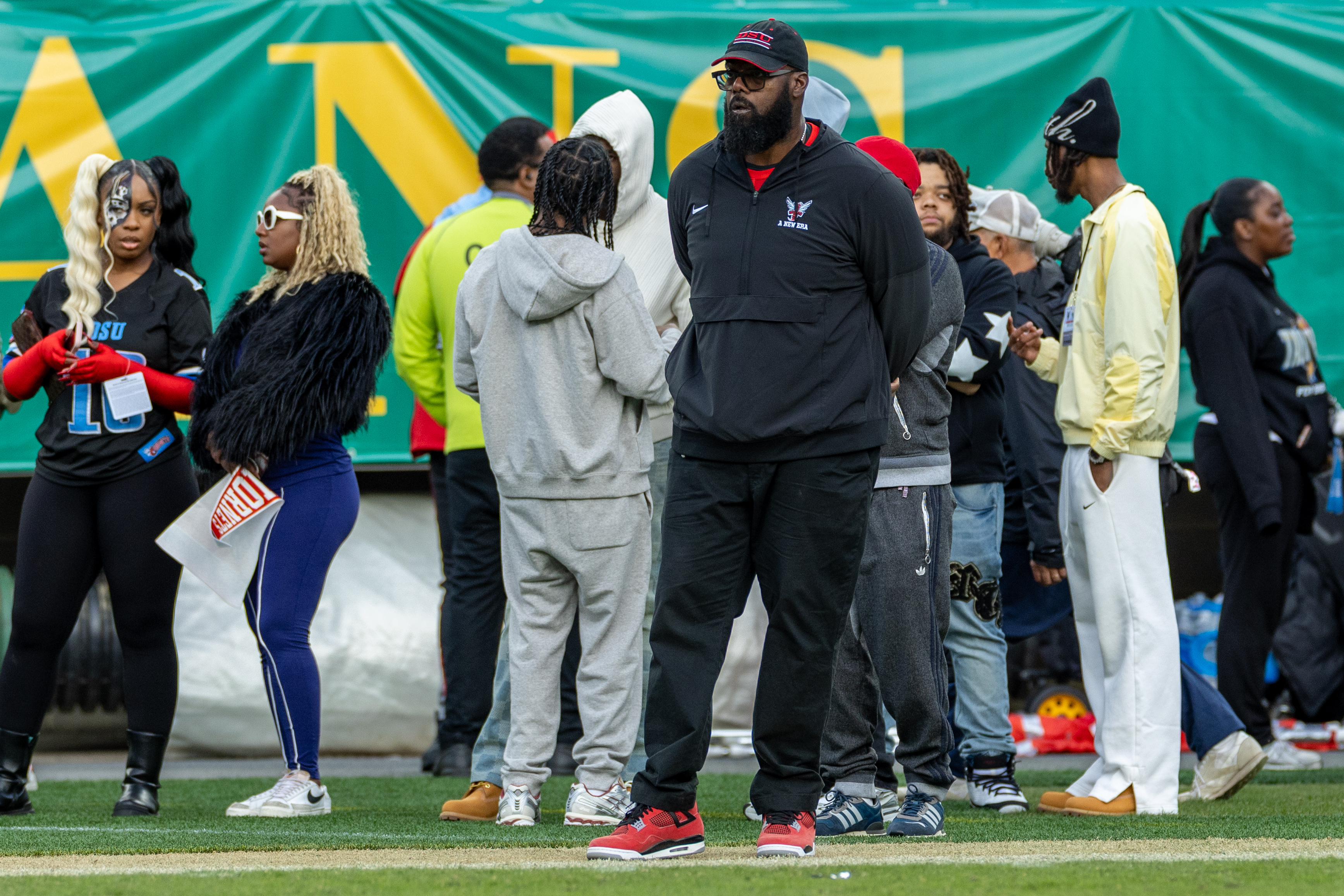
Lost in the excitement was the return of former Eagles offensive tackle Tra Thomas to the Linc, this time on the sidelines as a coach.
Thomas, who spent 11 seasons with the Eagles, joined Jackson’s staff earlier this year as an assistant offensive line coach. He exchanged pleasantries with Vick before and after the game. Thomas and Jackson also were teammates for one season with the Eagles.
Former Eagles offensive lineman and now Delaware State assistant Tra Thomas watches from the sidelines on Saturday.Aidan T. Gallo / Staff Photographer
Thomas says he earned his degree at Florida State a few years ago so he could coach at the college level and use the “12 years of [NFL-playing] experience and [try] to pour all that into the guys.”
“Coming back to the Linc, it brings back so many memories and emotions, because you spent so much time on this field,” Thomas told The Inquirer, noting that both of his parents went to Florida A&M, an HBCU in Tallahassee, Fla. “Just coming back and being a part of this — this is the reason why I wanted to come back and coach on the college level. … To have this opportunity is extremely special.”
Two former #Eagles catching up pregame. Norfolk State head coach Michael Vick and Delaware State assistant OL coach Tra Thomas. pic.twitter.com/I469T5vDO9
Jackson told The Inquirer earlier that he appreciates Thomas’ “dedication to these players” and added that “the amount he knows [about offensive line play] is definitely a great addition to have.”
Will the Classic return to Philly again?
Philadelphia has placed a renewed emphasis on celebrating HBCUs with an annual HBCU Week. Mayor Parker worked for years to bring HBCU football back to the city, reviving a tradition that dates to 1919.
Could the HBCU Classic expand beyond the two games the Eagles helped host this week?
Spartans ‘Legion’ Marching Band Mellophone section leader Amiya Suber (center right) hypes up her section before performing their halftime showcase on Saturday.Aidan T. Gallo / Staff Photographer
“[I’m] not necessarily sure, we’ll kind of see where it goes,” Frank Gumienny, the chief operating officer for the Eagles, said earlier this week. “We love the local [connection], obviously [with] Lincoln being sort of in our backyard, so to speak. And really, what excited the Eagles and myself and the whole Eagles organization is like this is not just [two] football games. … It was really the combination of everything: The football game, obviously the two great [programs] playing on the field, but then also the career fair, the job fair. We had a step show, and really I learned a lot about the HBCU culture and how exciting it really was.
“The city is committed, and Mayor Parker specifically is committed. And we are Philadelphia; wherever we can, play a role to enhance the city of Philadelphia, we do.”
Both Norfolk State and Delaware State appear committed to participating, as long as Vick and Jackson remain on the sidelines. Even Vick, who said “no” last year when asked about making the game an annual event, changed his tune following Saturday’s loss.
“Just going back and thinking about it, it’s just a great opportunity for the players. The stage is as big as it’s going to get on our level, and we got to take advantage of that,” Vick said. “And the opportunities being created. Shout out to the city of Philadelphia, Philadelphia Eagles for making this happen, giving us an opportunity to play in the presence of Lincoln Financial.
“It’s a no-brainer, man. It’s a blessing to be able to do this, and I hope the players feel that.”
On the topic of keeping a Jackson-Vick matchup at the Linc, Gumienny noted that the Eagles have had “discussions with the mayor about expanding it to different HBCUs.” Scheduling will always be a challenge with the Eagles and Temple football sharing the Linc and needing an open date on the calendar, says Gumienny.
But for the second year in a row, the budding rivalry between the two former Eagles teammates stole the show, even with an HBCU Battle of the Bands held earlier in the day.
‘Approaching Storm’ Delaware State drum major Zuri Brown, 23, performs during the HBCU Classic at the Lincoln Financial Field on Saturday.Aidan T. Gallo / Staff Photographer
“We’re trying to build it and have a lot more excitement around the HBCUs, and hopefully it continues to grow and take different directions,” Gumienny said. “But I think having two guys like Michael Vick and DeSean definitely shines a light on the game.”
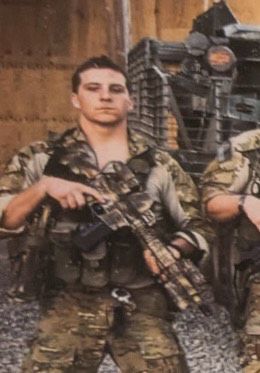
Ian Austin, like so many Americans, watched the video of an Immigration and Customs Enforcement agent fatally shooting Renee Nicole Good in January. But unlike most people, the 36-year-old U.S. Army veteran knows how it feels to shoot someone while wearing a uniform.
“I can still see myself on the firing line, and I can still feel what I felt in my stomach then. I couldn’t identify it at the time, but I knew it didn’t feel right,” Austin said.
After watching the video, Austin drove from his home in Bryn Athyn to Minnesota, where he participated in a protest inside a St. Paul, Minn., church. He soon became a defendant in the high-profile federal case alleging protesters infringed on churchgoers’ rights. Former CNN anchor Don Lemon is one of the codefendants.
To Austin, his trip to Minneapolis is part of a much longer journey that began during his military service in Afghanistan. Killing people at war, he said, traumatized him and led him to seek healing and spiritual renewal. It’s a road he’s still very much on, as he lives with post-traumatic stress disorder and bouts of depression.
Austin said watching Good’s killing brought back the guilt, shame, and rage he was trying to overcome. Mixed in, he said, was outrage — a federal agent shot someone, and top officials, rather than launching an investigation, quickly blamed the dead woman. This, he said, was fascism.
“I cannot sit here,” he recalled thinking. “I cannot stand by. I have to act.”
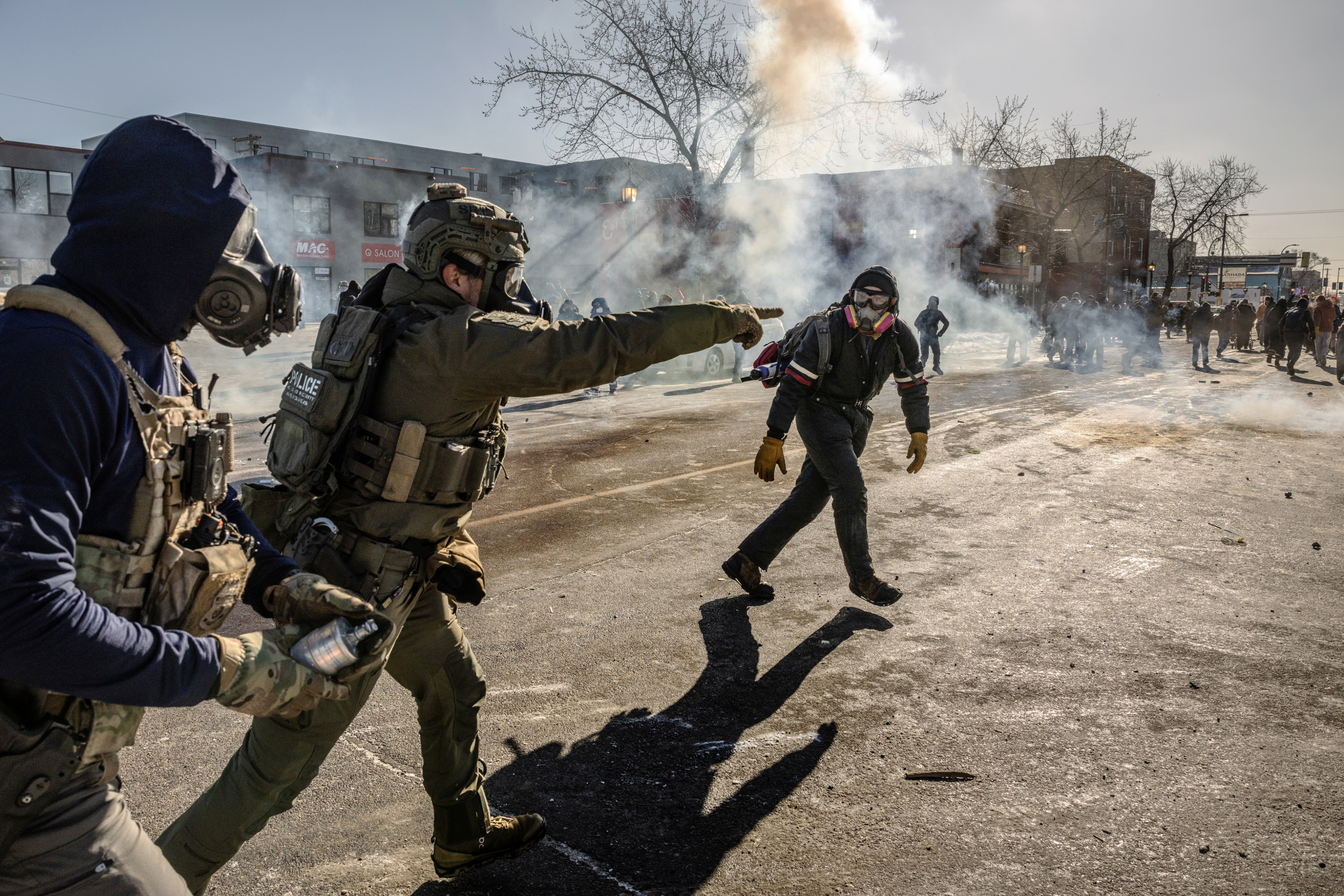
FILE — A confrontation between federal agents and protesters near the location where Alex Pretti was fatally shot in Minneapolis on Jan. 24, 2026. He was one of two civilians killed by federal agents in the city in January during the Trump administration’s immigration enforcement operation, known as Metro Surge. (David Guttenfelder/The New York Times)DAVID GUTTENFELDER
Austin must return to Minneapolis for hearings this week as he seeks to have his case dismissed. If convicted, he could face up to 10 years in prison, his attorney said, though she doesn’t expect that outcome.
Defense attorneys in the case call it an unprecedented misuse of the Department of Justice to silence critics of the Trump administration’s immigration policies. The DOJ did not respond to requests to discuss the case.
Austin’s story provides one glimpse into the lives of the 38 people now facing felony charges over the protest. For him, any consequences are worth it. He said his need to protest goes back to the American ideals he thought he was defending overseas.
“What I’m doing now is actually fighting against the things that they said we were going to fight against over there,” he said.
A ‘course correction’
Austin grew up in Huntingdon Valley and Bryn Athyn, where he excelled at baseball and wrestling. He said he joined the military after an arm injury quashed his dreams of securing an athletic scholarship. He also believed that if there was a war, he should do his part.
From 2008 to 2014, Austin served in the U.S. Army, where he was part of the prestigious 1st Ranger Battalion. He was deployed to Afghanistan six times, his military records show, and was honorably discharged. Among his awards is a joint service commendation medal with “V” device, given to those who showed heroism while engaged in combat.
But he said his Afghanistan deployments left him with “crippling” depression, treatment-resistant PTSD, and moral injury — psychological, spiritual, or social distress experienced when someone causes, witnesses, or fails to prevent something that violates their value system.
His unit’s job involved going after high-value Taliban or al-Qaeda targets. His team of Rangers was often dropped into the mountains by helicopter at night, where, backed by air support, they pursued small groups of Afghans. One soldier would shout “gun” — meeting their rules of engagement — and they would open fire, Austin said.
This detail shot of an undated family photo shows Ian Austin while serving in the U.S. Army 1st Ranger Battalion.Family photo
“That, to me, is murder, whether they’re combatants or not,” Austin said.
After completing his Army service, Austin focused on his mental health. This has included everything from inpatient and cognitive behavioral therapy to MDMA-assisted treatments and the psychoactive drink ayahuasca. He spent time with horses — equine therapy — which he said was surprisingly effective, and traveled to India for Vipassana meditation and cold exposure therapy on the Stok Kangri mountain.
But as Austin grappled with the larger forces that drew him into serving inthe Army, he began to see parallels with his experiences as a soldier and what he saw happening in the U.S. under the Trump administration.
“They’re making it more and more normal that there’s Army in the streets,” Austin said. “That’s just them getting people accustomed to that. And now the National Guard is walking around with ICE in D.C. It’s absolutely insane.”
After George Floyd’s murder in 2020, some of Austin’s classmates at La Salle University got involved in the protests and were pepper sprayed. Austin joined them, serving as an ad-hoc medic providing water and supplies.
This began what he called a “course correction” in his life. His therapist had often asked him to envision what a life worth living looked like. Increasingly, his answer to that question required that he protest the government.
“It’s morally difficult to not be just protesting constantly,” he said. “I don’t see a future where I can be sane unless we stem the fascist tide. Nor do I see freedom for myself.”
People gather at the street where 37-year-old Renee Nicole Good was shot and killed at point blank range on January 7 by a U.S. Immigration and Customs Enforcement (ICE) agent as she apparently tried to drive away from agents who were crowding around her car, in Minneapolis, Minnesota, on Jan. 8, 2026. (Photo by CHARLY TRIBALLEAU / AFP via Getty Images)AFP via Getty Images
The protest at a St. Paul Church
Austin traveled to Minnesota at the height of Operation Metro Surge, a series of ICE and Border Patrol arrests targeting the Twin Cities. As ICE activity increased, so did opposition from members of the public. After Good was killed Jan. 7, protesters and federal law enforcement frequently clashed outside the Bishop Henry Whipple Federal Building, where people were being detained.
That’s where Austin went first, and within a day, federal law enforcement detained him. Austin recalled, another protester told him about an upcoming protest. This would lead him to Cities Church in St. Paul, where one of the pastors was a local ICE official.
The DOJ indictment says that inside the church, Austin was part of a group of “approximately 20-40 agitators” who were part of a “coordinated takeover-style attack and engaged in acts of oppression, intimidation, threats, interference, and physical obstruction.”
Then-Attorney General Pam Bondi at a Senate hearing on Capitol Hill in Washington, Oct. 7, 2025. Bondi led the DOJ when the Cities Church protesters were indicted. President Donald Trump fired her from the position in April. (Kenny Holston/The New York Times)KENNY HOLSTON
Protesters shouted “ICE Out!” “Hands Up, Don’t Shoot!” and other chants, the document states, “while gesturing in an aggressive and hostile manner, which congregants and the pastor perceived as threats of violence and a potential prelude to a mass shooting.”
Austin and others interfered with churchgoers’ ability to move freely, the indictment says, and Austin “approached the pastor and congregants in a menacing manner … and loudly berated the pastor with questions about Christian nationalism and Christians wanting to have their faith be the law of the land.”
A slow-moving case
Austin’s attorney, Sarah Gad, filed a motion to dismiss his case. She said her client’s actions did not violate the two federal laws he is charged under.
“For example, it’s not an offense to stand in a church and chant. And so it feels like the DOJ really stretched some preexisting federal laws to kind of turn this conduct of protesting at a church into a crime,” Gad said.
Defendants are charged with violating the Civil Rights Act of 1871, enacted to protect Black people from the Ku Klux Klan and other violent white supremacist groups.
Gad noted that protesters are also charged with violating the Freedom of Access to Clinic Entrances (FACE) Act — a law established to protect people entering abortion clinics, but which also includes a provision for those in places of worship.
Last year the Trump administration pardoned 10 antiabortion protesters who were convicted of violating the same law when they blockaded a clinic in Washington, Gad noted. This apparent double standard led her and colleagues to pen a “selective and vindictive prosecution” motion to dismiss, she said.
With 38 defendants, the case, still in its pretrial phase, has moved slowly, Gad said. The defense has filed several more motions to dismiss, while the federal government has sought delays. At least five prosecuting attorneys have withdrawn from the case, court documents show.
This week, however, the case kicks into gear with a string of hearings, Gad said.
Ian Austin, of Bryn Athyn, Pa., poses for a portrait on Friday, Aug. 28, 2026, in Philadelphia. Ian has been protesting ICE in Minnesota and in New Jersey, which has now caused him to be barred from leaving Pennsylvania as he awaits a resolution on the Minnesota case.Tyger Williams / Staff Photographer
To Jordan Kushner, the attorney for lead defendant Nekima Levy-Armstrong, the case is part of a “concerted effort” by the Trump administration to target anti-ICE protesters and other critics of its policies. He pointed to the “Minnesota 15” case, the “Broadview Six” case in Chicago where charges have since been dropped, and the recent investigation of U.S. Rep. Ilhan Omar of Minnesota as other examples.
“This is part of a very serious political offensive, using the criminal justice system in a way that hasn’t been used in this country,” Kushner said.
Kushner saidthe prosecution offered protesters a chance to plead down to misdemeanor offenses. No one has accepted that offer yet.
For the moment, Austin has stopped protesting — but only on a judge’s orders. Austin was charged with disorderly conduct in June after demonstrating against ICE near the Delaney Hall detention center in New Jersey. As a result, the judge in the St. Paul case barred him from leaving Pennsylvania.
He said the actions of protesters at Delaney Hall helped defend their neighbors, who were being rounded up and detained. Even more than in Minneapolis, he said, he felt like that protest stood a chance of making a difference — but people got worn out, and the movement fizzled.
Austin said it’s hard for him to imagine what tomorrow brings beyond the federal case, but he believes that the future must be about more than just himself.
“Maybe this is a bit grandiose, but I would like to live in a world where our laws and systems reflect our actual values.”
Clarification: This story has been updated to clarify how Ian Austin learned of the protest at a church in St. Paul.
One by one, the eggs are rolling off the production line, 250 a minute, at Zitner’s Fine Confections’ new chocolate factory in Hatfield, Montgomery County.
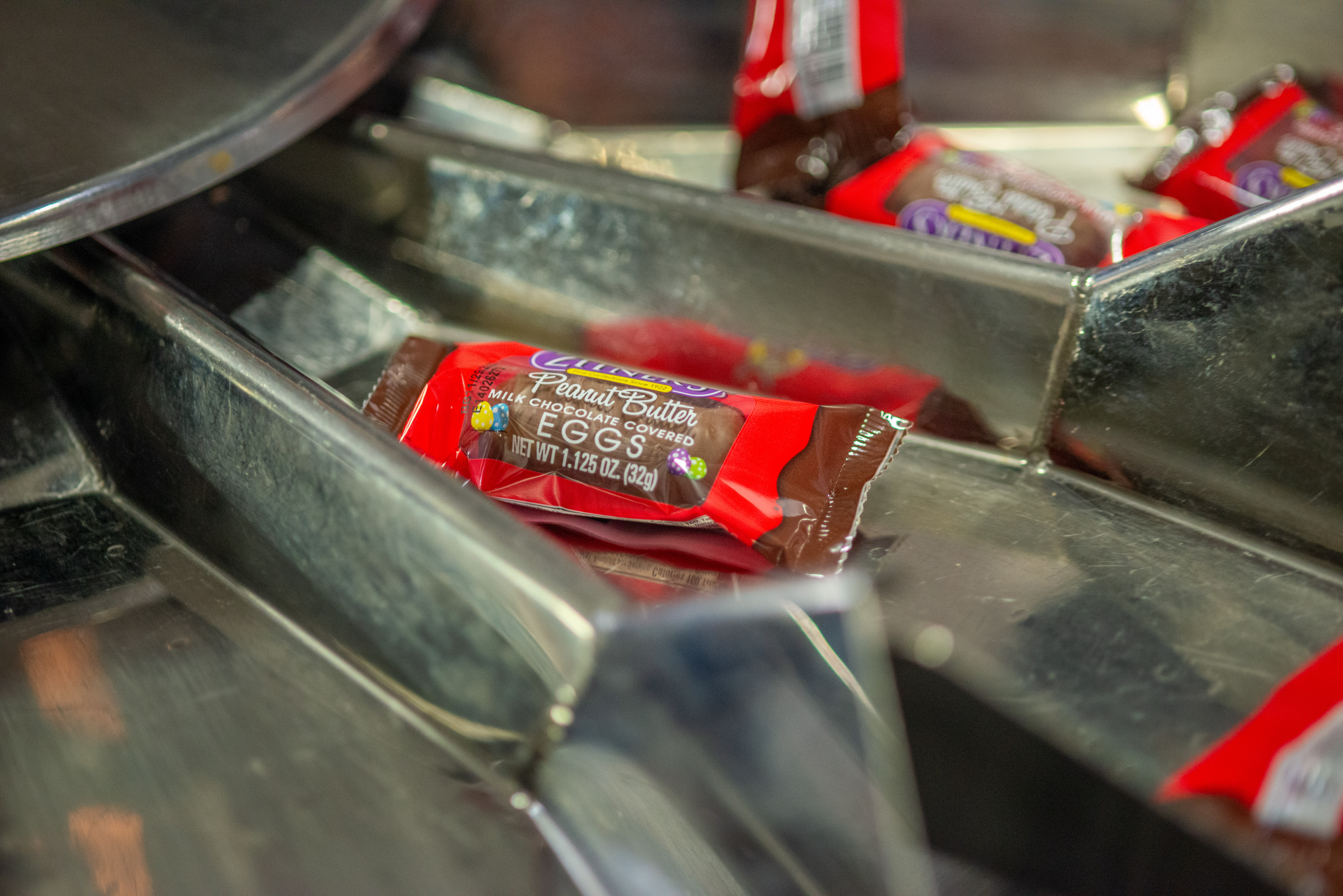
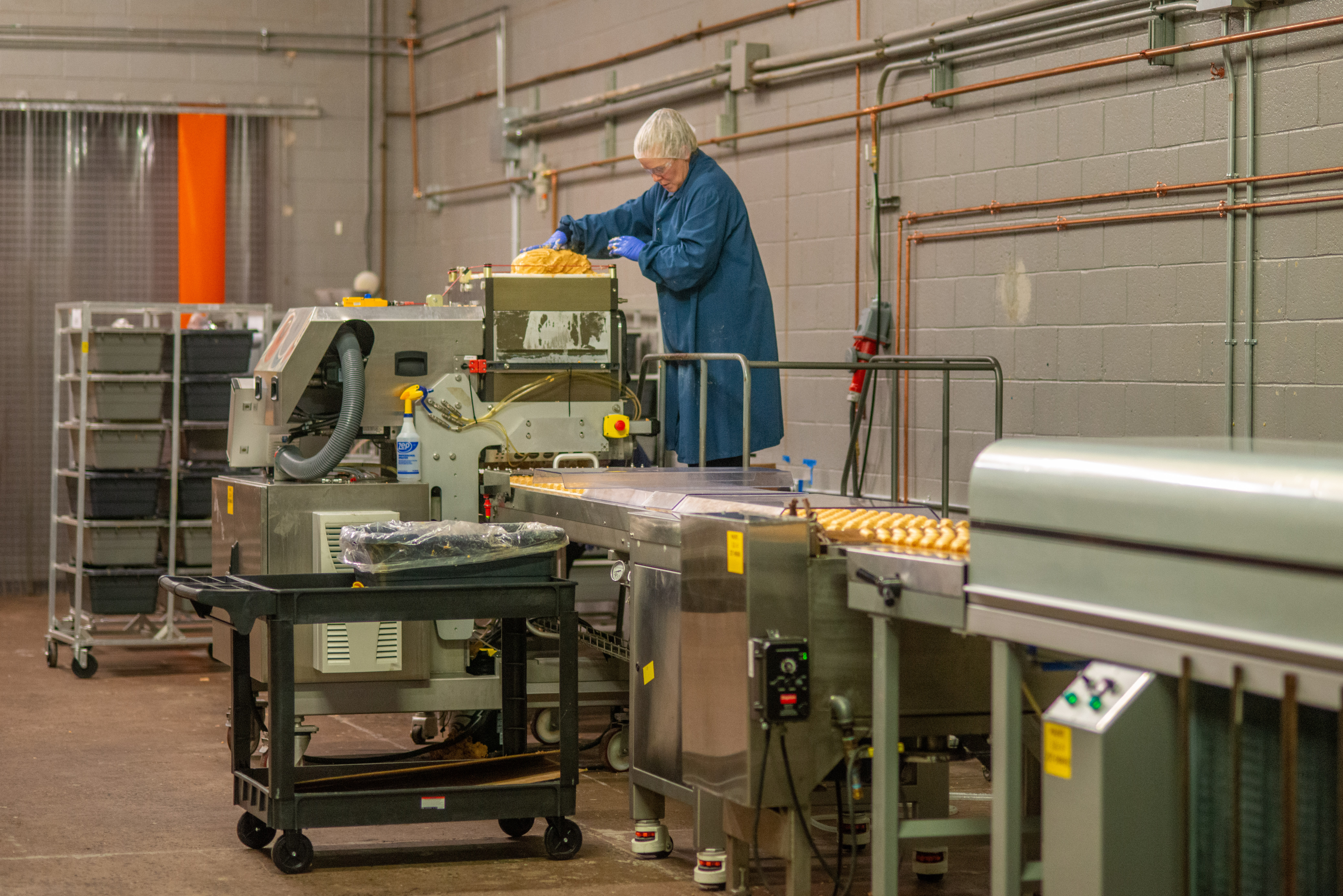
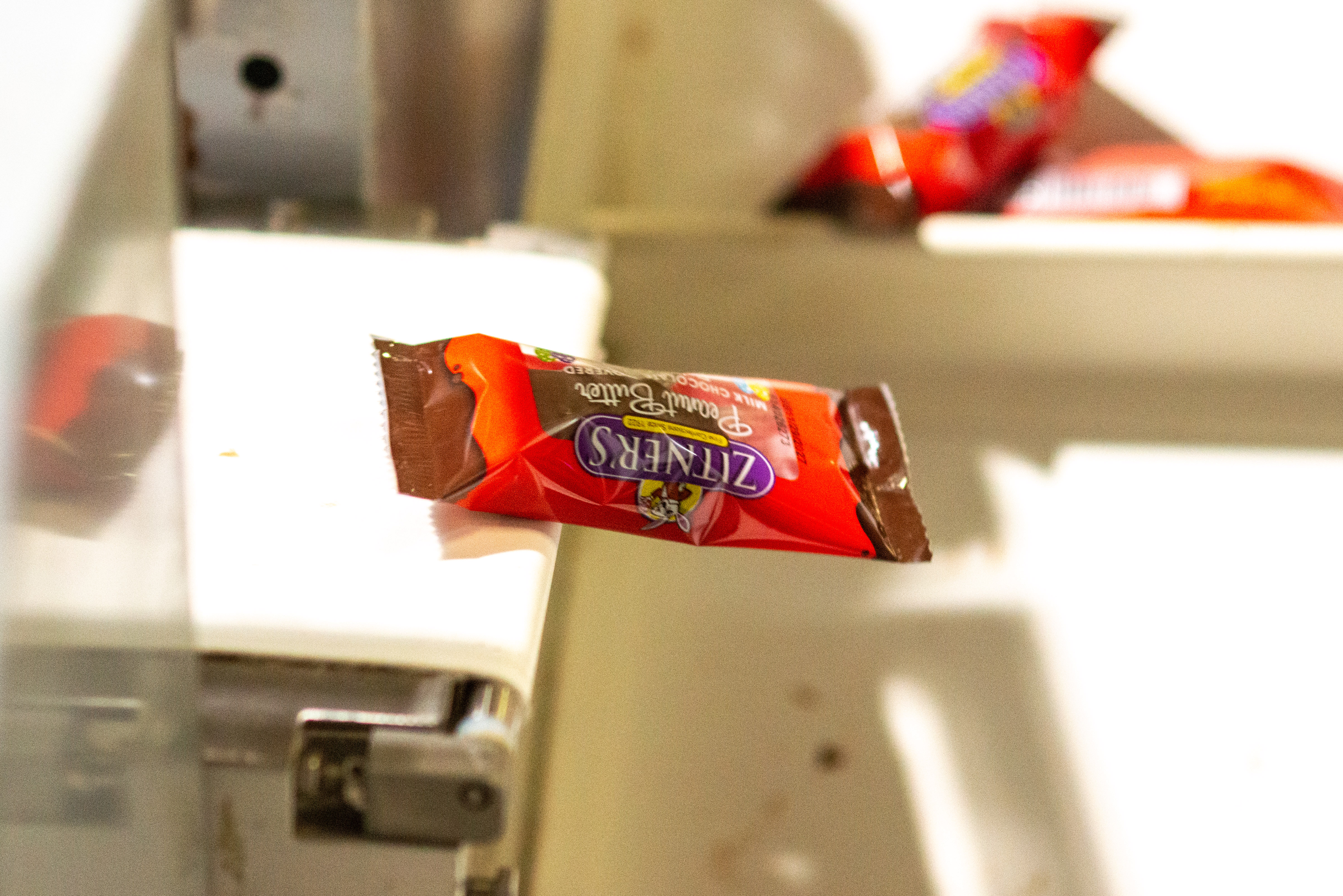
First come peanut butter eggs. Hair-netted and jacketed workers feed peanut butter cream from 50-pound tubs into a machine that forms it into eggs, coats them in chocolate, and sends them — like the old I Love Lucy bit — toward a whirring wrapping machine.
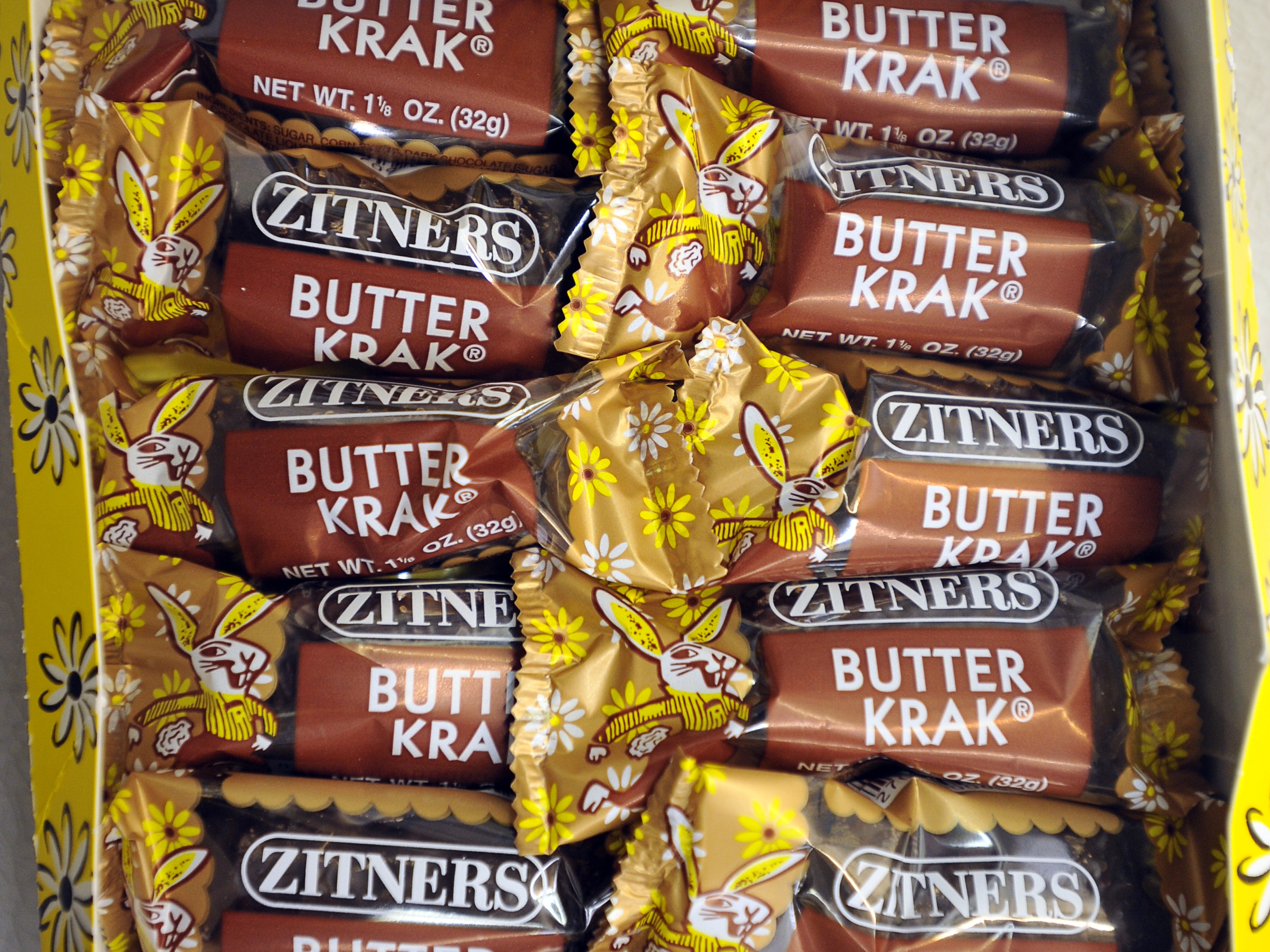
Next up will be Zitner’s dark chocolate specialties: Butter Cream, Coconut Cream, Double Coconut, and — the crown jewel — Butter Krak, a sweet amalgamation of everything.
For Evan Prochniak, Zitner’s CEO, this has been a long time coming.
Video: Inside Zitner’s new chocolate factory
The century-old Philadelphia candy company, whose cream-filled eggs have been Easter basket fixtures for generations, is back in production after missing the 2026 holiday season. Its products are expected to return to Philadelphia-area grocery shelves in December, possibly before Christmas.
While the factory is new, Prochniak insists the candy won’t be any different. Zitner’s is using the same recipes and ingredients that customers remember.
The comeback follows the closure of Zitner’s longtime North Philadelphia factory and the acquisition of Kargher Chocolate, a Hatfield manufacturer, by Prochniak, 55, and his business partner, Phil Priolo, 54.
The 25-mile move required hauling 10 truckloads of machinery up Route 309, installing new electrical service and compressed-air lines, and reconfiguring a 100-foot production line. It gives Zitner’s a modern home and room to expand.
Production began in September at about 220 eggs a minute. Prochniak has since increased the pace and hopes to reach 275 soon.
“We are really humming now,” he said last week. “There were a lot of little odds and ends that I tweaked, and we’re just cranking that candy out.”
Phil Priolo (left) and Evan Prochniak, business partners and onetime college roommates, along the production line at Zitner’s plant. William Thomas Cain / For The Inquirer
Butter Cream production began last week, with Coconut Cream or Double Coconut next. Prochniak plans to make Butter Krak, the company’s top seller, from early December through New Year’s.
“There’ll be no Christmas for me at all,” he said. “It’ll be Easter.”
Chocolate season
Zitner’s starts its Easter production in the fall with peanut butter eggs, its only milk chocolate-coated variety. Making them first allows the company to thoroughly clean the equipment of peanuts afterward to prevent allergen cross-contact.
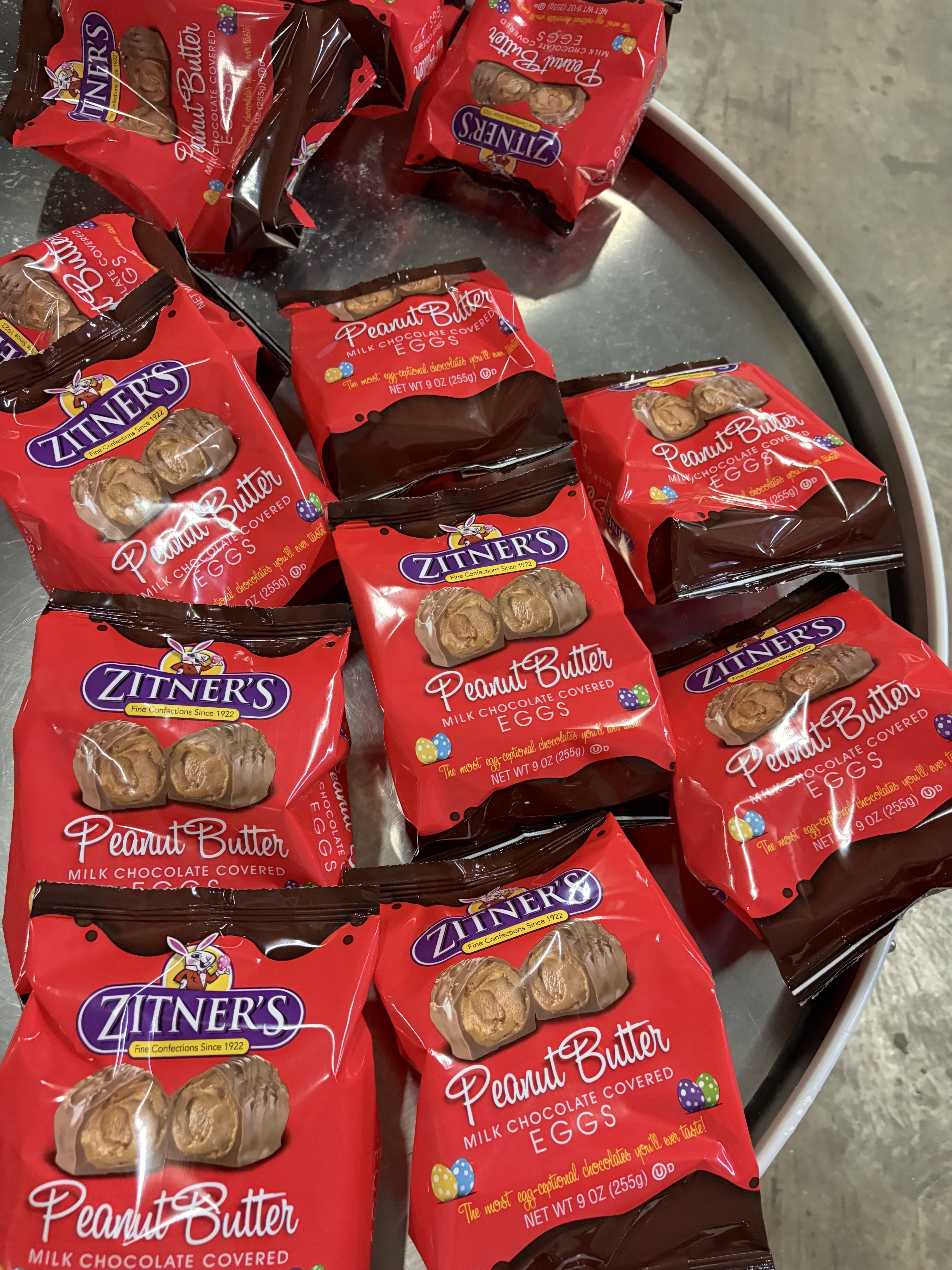
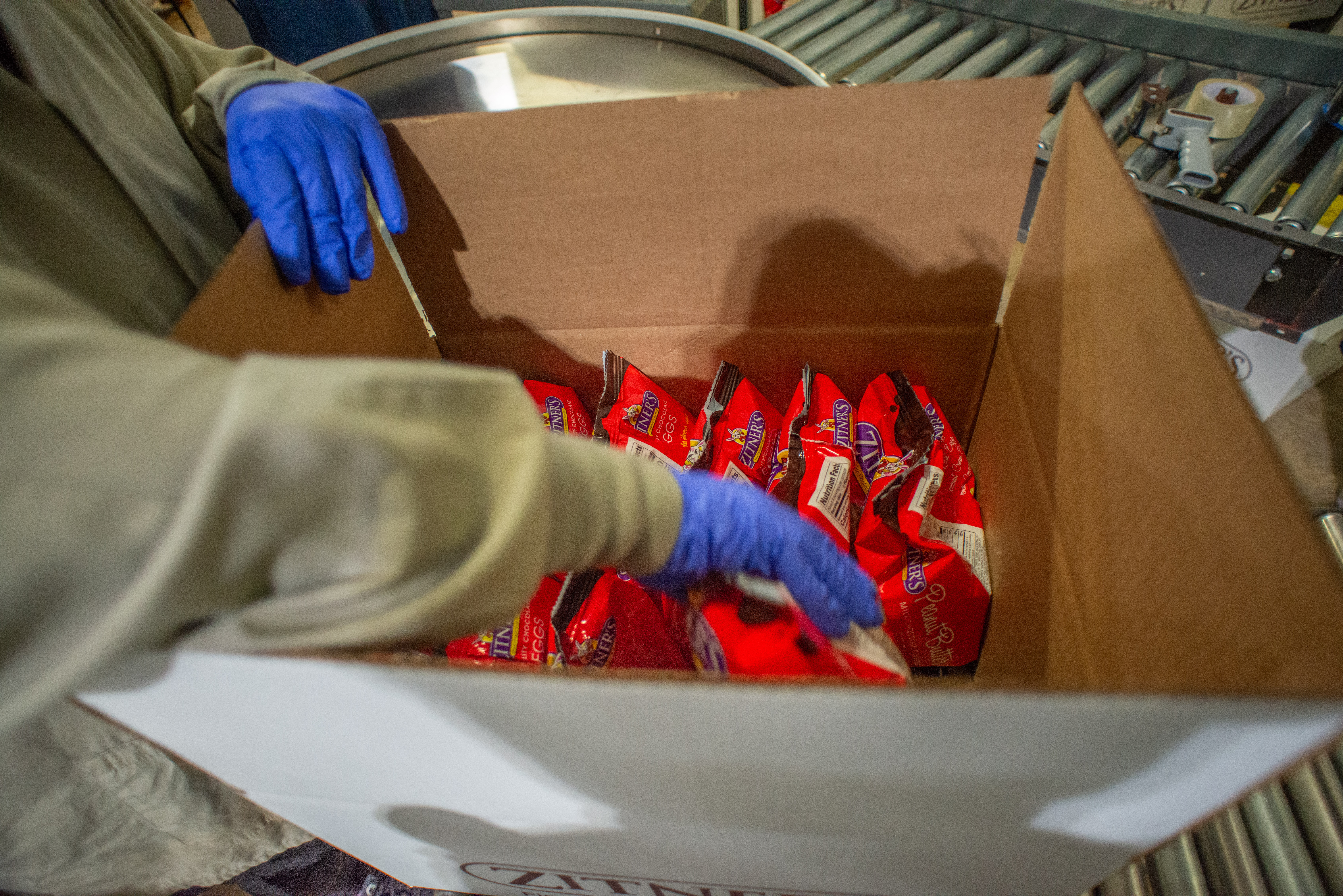
The peanut butter filling — made in-house from Virginia peanuts, salt, sugar, and other ingredients — is fed into machinery that forms, coats, cools, and wraps the eggs. They’re packed eight to a bag, 12 bags to a case.
The company has substantial orders from Acme and Weis Markets scheduled for shipment during the first two weeks of December, Prochniak said. ShopRite has placed large orders for early January.
Wrapped batches of Zitner’s eggs are boxed for shipping at the factory in Hatfield.William Thomas Cain / For The Inquirer
Prochniak said he brought samples to an Acme representative last week. She told him the chain would put the candy on shelves as soon as it arrived.
Retailers have increased their orders even though Easter falls relatively early this year, on March 28, ordinarily a reason to order less because of the shorter selling season.
Prochniak said customers treat Zitner’s eggs differently from typical Easter candy.
“This is something people eat every week,” he said. “They go to the grocery store, put it in their shopping cart, eat it, and go back the next week for more.”
Some customers stock up before Easter and freeze it to last until the following year.
A factory in crisis
Zitner’s last manufactured candy at its factory near 17th and Clearfield Streets in summer 2024. Prochniak said the building, occupied since the 1960s, had deteriorated.
“If you go back and look at the Bizarre Foods episode we were on [in 2015], you can see the roof was already falling in back then,” he said.
The first test batch of Zitner’s peanut butter eggs at the Hatfield facility, as they came off the line on Sept. 9, 2026.Courtesy of Evan Prochniak
A neighboring salvage operation also displaced the factory’s shipping and receiving area, forcing workers to load trucks on 17th Street.
Zitner’s outsourced production for Easter 2025 but couldn’t relocate in time for Easter 2026.
After an attempt to acquire another candy business in the Harrisburg area fell apart, Prochniak approached Douglas Kargher, who was looking to retire from his family-owned chocolate business.
Kargher wanted to sell outright, so Prochniak enlisted Priolo, his longtime friend and roommate back at Penn State, to be his business partner. They established Cocoa Ridge, a holding company, to acquire Kargher Chocolate’s assets. The deal closed in March.
Priolo, formerly an executive at Exelon, is president and CEO of the Kargher operation. His business card identifies him as Chief Chocolatier.
Zitner’s remains a separate company, and Kargher has its own private-label business making and selling chocolate chips and nonpareils.
Wioth production stepping up, “there’ll be no Christmas for me at all,” says CEO Evan Prochniak. “It’ll be Easter.” William Thomas Cain / For The Inquirer
The arrangement also gives Prochniak something he has long wanted: greater control over chocolate manufacturing. Zitner’s has traditionally purchased chocolate made to its specifications by outside manufacturers. In the future, the partners plan to connect Kargher’s chocolate-making equipment to Zitner’s production lines.
A new beginning
Ingredient costs remain a challenge. Sugar, essential to the cream centers, has risen from about 57 cents a pound to nearly 78 cents, Prochniak said, and could reach 80 cents.
The production equipment represents years of experimentation.
Sixteen years ago, Prochniak was a real estate attorney eyeing up Zitner’s’ North Philadelphia property for redevelopment. When that plan fell through, he studied the then-88-year-old candy business and discovered it was turning away orders because it couldn’t make enough. He acquired Zitner’s with partners in 2010.
Butter Krak eggs, which date to the 1930s, are the company’s top seller.Sharon Gekoski-Kimmel / Staff Photographer
Starting around 2013, Prochniak worked with European equipment makers to automate production of Zitner’s soft centers, then added equipment for coating, cooling, and wrapping.
The line eventually stretched to 100 feet. In Philadelphia, it ran straight across the factory. In the Hatfield plant, where Zitner’s took over a Kargher storage area, workers cut an opening in a wall so the line could pass through, turn around, and continue in the opposite direction. It’s now about twice the size.
The peanut mixture, cut to shape and size, is covered in chocolate to make a batch of Zitner’s eggs.William Thomas Cain / For The Inquirer
For all the modernization in production, Prochniak is adamant that the new equipment has not changed what goes into Zitner’s eggs; it just enables the factory to make more of them.
Butter Krak, the company’s top seller, dates to the 1930s. Annie Zitner, who founded the company in 1922 with her husband, Sam, in Kensington, taught her nephew Leon Sherman to make the combination of buttercream, shredded coconut, toasted coconut, and bittersweet chocolate. The eggs originally sold for a nickel.
Prochniak, who grew up in Southwest Philadelphia, remembers receiving Zitner’s candy at Easter, although his mother was strict about sweets.
Chocolate-covered eggs for Easter produced by Zitner’s in 2018. CEO Evan Prochniak wants to bring back the large, decorated ones.Alejandro A. Alvarez / Staff Photographer
His childhood favorite was Butter Cream. Today, it’s Butter Krak.
He has plans for more storage, possible expansion, and eventually reviving older Zitner’s products, including marshmallows and those big decorated buttercream and coconut cream eggs. He also wants to restore the small counter displays that once sold individually wrapped eggs at places such as Wawa.
But first, there are supermarket orders to fill.
The eggs keep coming
During a September visit, a worker kept the eggs lined up as they approached the wrapping machine.
“She’s also looking for flaws in the candy — pieces sticking together, cracks, incomplete chocolate coatings,” Prochniak said.
Rejects were pulled off the line and tossed into a bin. Each wrapped egg received a quality-control stamp.
A worker loads peanut butter mix into a machine that presses it into egg shapes at Zitner’s factory in Hatfield.William Thomas Cain / For The InquirerThe peanut filling is covered in chocolate to make a batch of Zitner’s peanut butter eggs at its factory in Hatfield.William Thomas Cain / For The InquirerThe peanut mixture is covered in chocolate to make Zitner’s peanut butter eggs at its factory in Hatfield.William Thomas Cain / For The InquirerZitner’s peanut butter eggs, newly coated in chocolate, roll down the line at the Hatfield factory. William Thomas Cain / For The InquirerPeanut butter eggs approach the wrapping machine at Zitner’s Fine Confections.William Thomas Cain / For The InquirerA wrapped Zitner’s egg is ready to be bagged at the factory in Hatfield.William Thomas Cain / For The InquirerZitner’s CEO Evan Prochniak in his safety garb at the factory, the home of Kargher Chocolates.William Thomas Cain / For The InquirerA worker inspects Zitner’s peanut butter eggs before they reach the wrapping machine. William Thomas Cain / For The InquirerWrapped Zitner’s peanut butter eggs are ready to be boxed.William Thomas Cain / For The InquirerEight eggs to a bag, 12 bags to a case: Wrapped batches of Zitner’s eggs are boxed for shipping at the plant in Hatfield. William Thomas Cain / For The InquirerEmployees box the bagged eggs at Zitner’s factory in Hatfield.William Thomas Cain / For The InquirerWrapped batches of Zitner’s eggs are boxed for shipping at the factory. William Thomas Cain / For The Inquirer
“I can tell you the day that egg was made and trace it all the way back to the sugar that went into it,” Prochniak said. “Everything is tracked.”
Surely, it must be tempting to eat candy all day.
“Not good for your waistline,” Prochniak said. “But I’m tasting it all the time. I have to make sure the recipe is exactly what it’s supposed to be.”
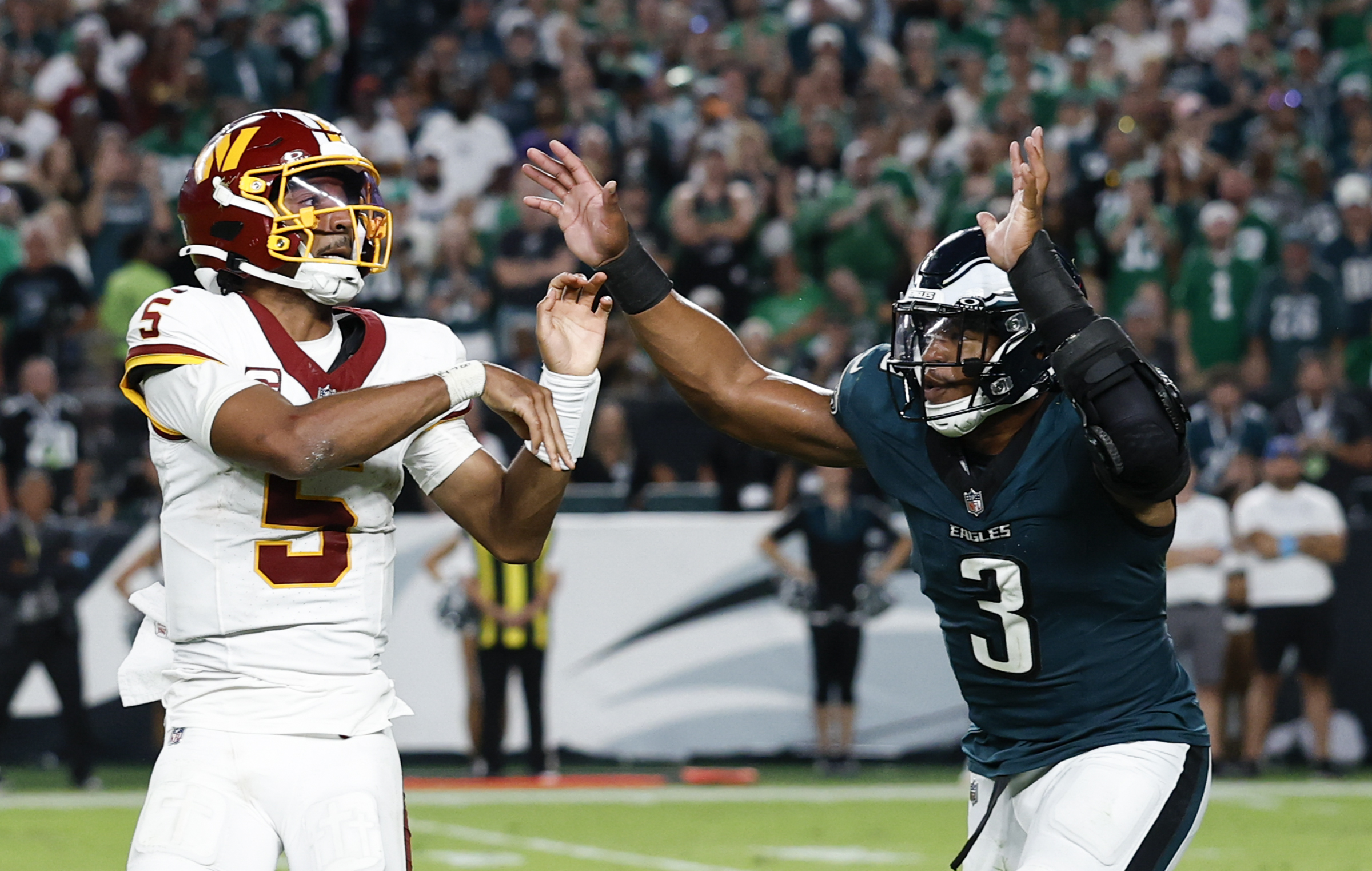
The Eagles will travel to face the Washington Commanders at 8:20 on Sunday night at Northwest Stadium. Here’s what you need to know about the matchup:
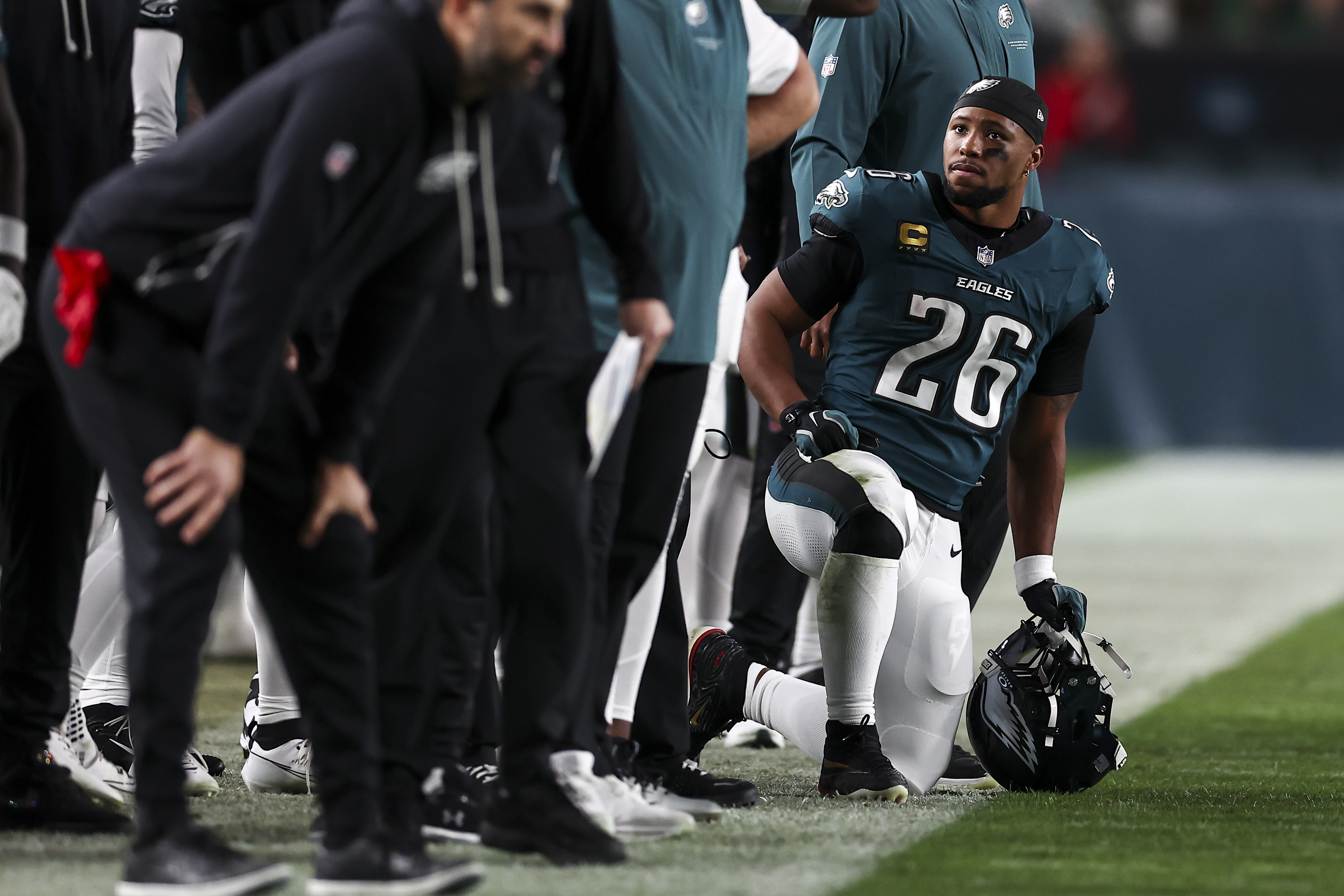
When the Eagles have the ball: The Eagles know they have to run the ball effectively to have any chance of resurrecting their offense, and for the first time this season, they actually showed some life on the ground last week vs. the Dallas Cowboys. It’s a shame Saquon Barkley couldn’t stay on the field because he looked explosive and decisive whenever he got the ball out of the backfield. He returned on Friday after missing the first two days of practice this week, but it’s unclear how much he’ll be hindered by hamstring and back injuries if he can go. The Eagles’ running back room has looked like a MASH unit. The latest casualty to go on injured reserve was Dameon Pierce. If Barkley is out or limited, Elijah Mitchell or Jaydon Blue could be tabbed as the lead ball carrier. Yikes.
A healthy Saquon Barkley (26) would give the Eagles a fighting chance in Week 8. Monica Herndon / Staff Photographer
Sean Mannion’s commitment to the outside-zone run game is admirable, though not entirely sensible. The Eagles simply don’t have the personnel to consistently employ the scheme. They did have greater success between the tackle box in left guard Landon Dickerson’s return last week. If this is to be the starting five up front for the remainder of the season, Mannion has a chance to build off that continuity. The Commanders’ run defense isn’t great. They rank 20th in expected points added (EPA) per rush, but are holding running backs to just 3.8 yards a carry. Aside from a Barkley 42-yard jaunt on an inside-zone run, Washington held Eagles tailbacks to just 2.8 yards on their 17 other rushes in the first meeting in Week 1. Longtime defensive tackle Daron Payne is out for the season with a foot injury, a major blow to the unit.
The Commanders’ run efficiency numbers have been weighed down by their struggles to contain scrambles. Defensive coordinator Daronte Jones plays a lot of two-high safety shells, which can allow for mobile quarterbacks to break containment. Jalen Hurts gained 48 yards on five scrambles in Week 1 vs. Washington. Alas, his replacement Tanner McKee poses no such threat. McKee showed improvement as a passer in his second start, but there were still misfires, misreads, and misadventures whenever he had to drop on passing downs. Mannion did well to get the ball out with schemed-open first reads, particularly on money downs. The Eagles went 7-of-15 on third and fourth downs.
The downfield passing game was lacking, however, without receivers DeVonta Smith (hamstring) and Dontayvion Wicks (ankle). They will be sidelined for a second consecutive week. Rookie Makai Lemon stepped into the vacancy and continued to show why the Eagles drafted him. He’s not afraid to stick his nose in tight spaces and make tough grabs. He’ll likely be McKee’s top read, along with tight end Dallas Goedert, who could be showcased again ahead of the trade deadline. Jones has tried to implement fairly exotic coverage schemes, but there have been busts in the back end partly as a result. Trey Amos is back at corner, while safety Quan Martin is the secondary’s weak link.
Commanders defensive coordinator Daronte Jones likes to blitz. Nick Wass
The Commanders don’t have a strong four-man pass rush. If they’ve gotten pressure, it’s come more from blitzing. Jones worked under mad genius Brian Flores in Minnesota, and Washington is second only to the Vikings in blitz rate (42.3%). The Cowboys only blitzed McKee on 10% of his drops last week, which boggled the mind. The Eagles had another unblocked pressure on the first play last week and managed to complete the pass, but there’s little doubt Washington will send overloads and simulated pressures at a unit that still doesn’t have enough answers against exotic pressures. Commanders linebacker Frankie Luvu is Jones’ chess piece in the blitz, but rookie linebacker Sonny Styles looks like a star in the making.
When the Commanders have the ball: Jayden Daniels is a good quarterback. He’s not the one-year wonder some have painted him as amid various injuries. He’s back from an elbow injury that sidelined him a few weeks, and despite not having much around him, he’s still managed to keep the Commanders in games. He lost top receiver Terry McLaurin (knee) for the season recently, however, and needs all the help he can get behind a porous offensive line. It’s no wonder he’s looked hesitant in the pocket at times, especially early in games. But he still has a savvy veteran receiver in Stefon Diggs and a couple of capable downfield threats in rookie Antonio Williams and former first-rounder Treylon Burks.
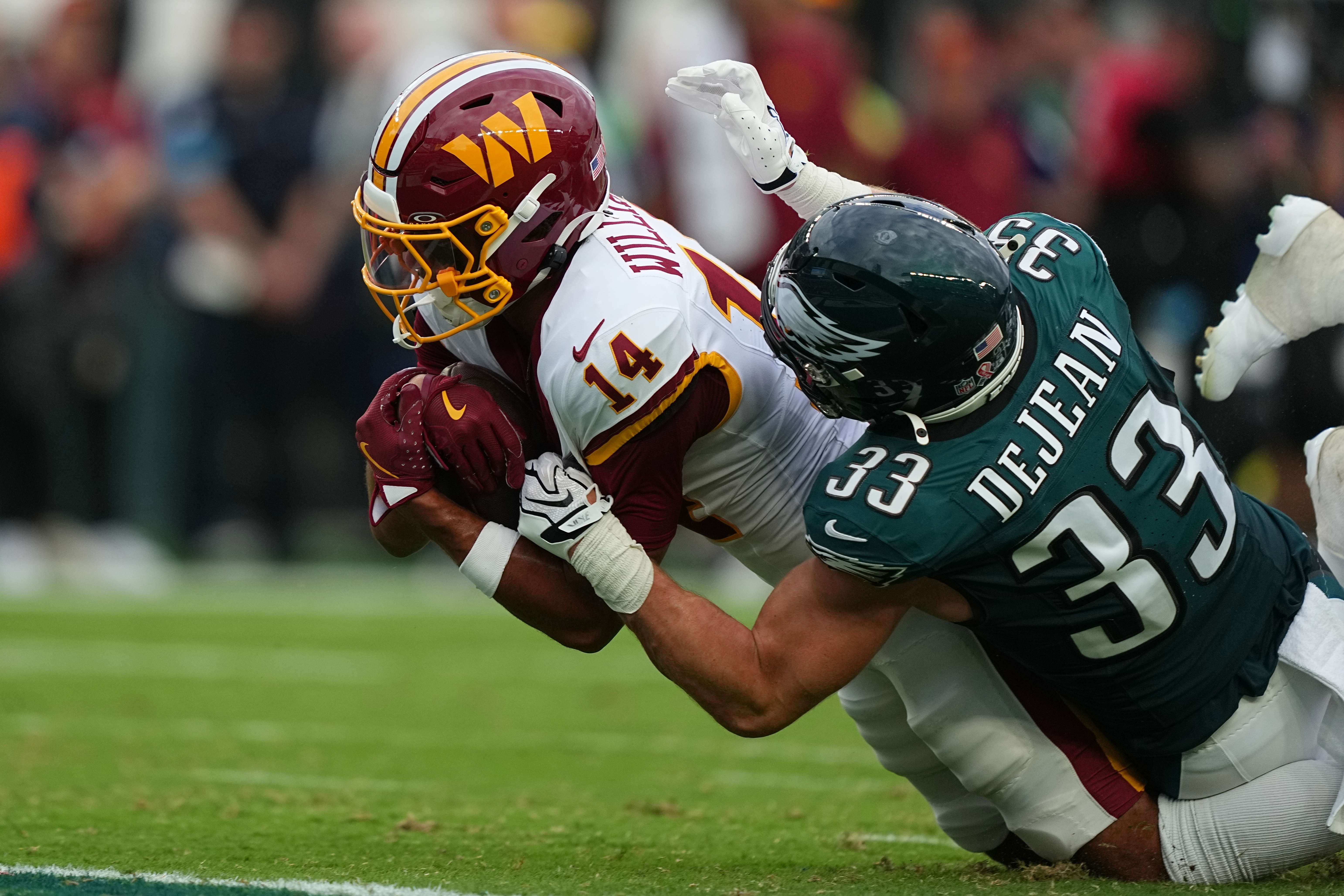
Cooper DeJean (33) had a rough time against Antonio Williams and Washington in Week 1 in a season that as been a step back for the All-Pro. Matt Rourke
Diggs got the better of Cooper DeJean back in September. The Eagles slot cornerback’s struggles in that game weren’t a one-game blip. I wouldn’t be surprised to see Washington offensive coordinator David Blough go after him in man coverage situations. Blough’s system hasn’t leaned into the under-center stuff that many predicted before the season. Daniels is often in shotgun or the pistol. But he still has a lot of early reads over the middle and will take advantage of second-level linebackers who bite on play-action. Jeremiah Trotter Jr. may be an overall upgrade over Jihaad Campbell (hamstring/quad), who is out, but Trotter is still lacking in experience.
The Commanders, like the Eagles, have struggled against the blitz. But the Eagles, unlike Washington, don’t have effective blitz packages or blitzers. This is where not having Nakobe Dean might have hurt the most. A toothless blitz has hindered a Vic Fangio pass rush that is last in quick pressure rate. Dak Prescott wasn’t touched once last week. Defensive tackles Jalen Carter and Jordan Davis have taken a lot of heat for the pass rush inadequacies, but the lack of pressure from the edges is of bigger concern. Jonathan Greenard has been either hurt or unproductive, while Jalyx Hunt and Nolan Smith Jr. haven’t won enough one-on-ones. Smith should be back after missing a game because of a concussion.
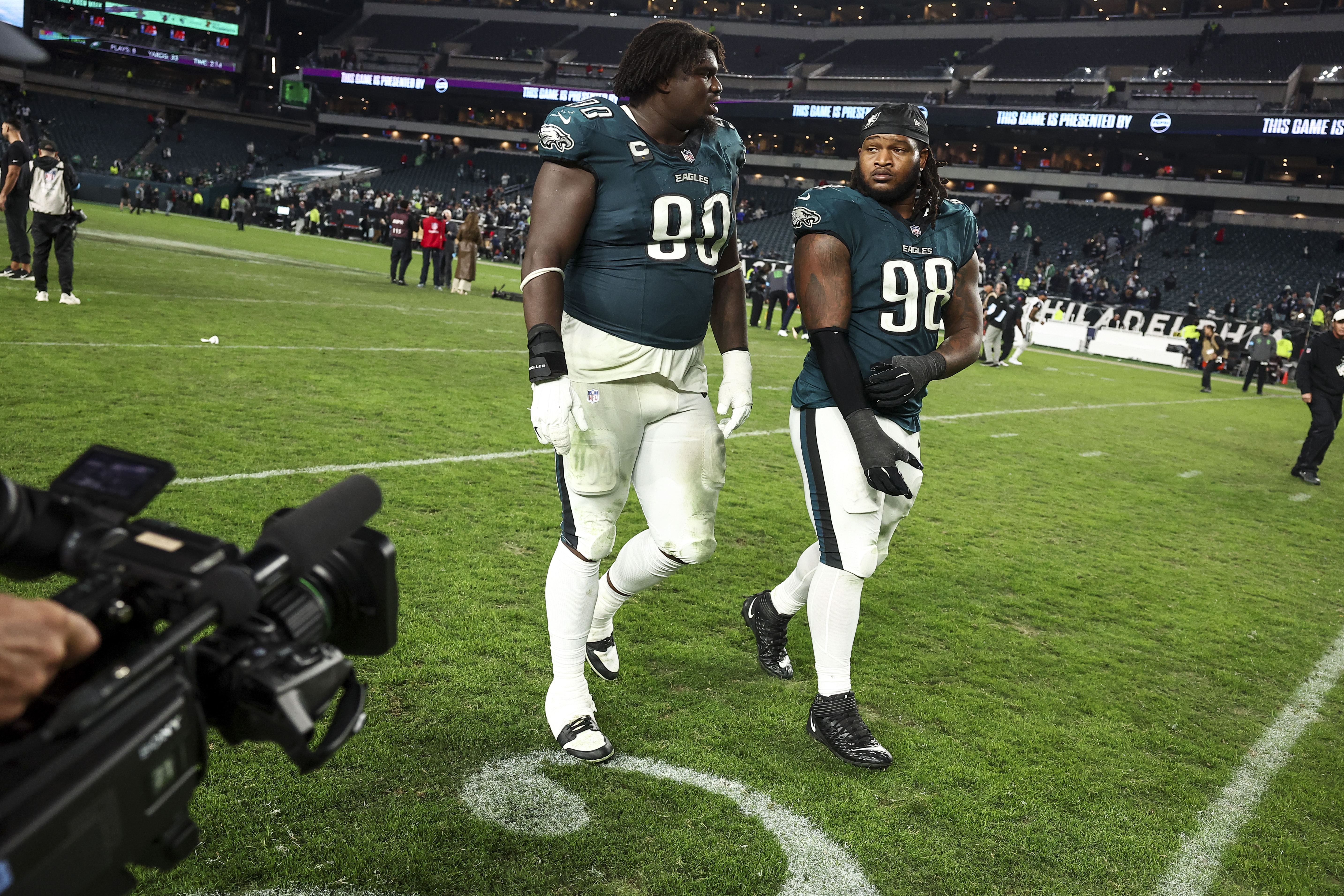
Jordan Davis (center) and Jalen Carter (right) will face scrutiny on Sunday after a weak outing on Monday Night Football. Monica Herndon / Staff Photographer
The Eagles face another set of below-par tackles after failing to capitalize on matchup advantages on Monday night. Left tackle Brandon Coleman, who was forced into the lineup after Laremy Tunsil suffered a triceps injury in training camp, has been a turnstile. We’ll see if Carter has enough pride, as Fangio said he would, to rebound from a career-low performance. He’ll mostly encounter right guard Sam Cosmi, Washington’s lone top-tier blocker, and Carter has faded in their earlier matchups.
Washington’s run offense isn’t strong and recently lost top tailback Jacory Croskey-Merritt. Rachaad White, formerly of the Tampa Bay Buccaneers, has been passable as his replacement. A heavy zone-blocking scheme hasn’t opened enough holes and has struggled against five-man fronts. I can see Davis and Co. bouncing back from last week’s disastrous outing. But they also have to contend with Daniels’ mobility. He can knife defenses on the ground, and Fangio’s scheme has historically had issues keeping running quarterbacks in check.
Extra points: The 1-4-1 Commanders are coming off a much-needed bye. They aren’t quite as banged up as the Eagles, but they’ve gotten off to another bad start with a coach in Dan Quinn who is teetering on the edge of getting fired. Somehow they’re 5½ point favorites, which speaks volumes more about the Eagles than anything else.
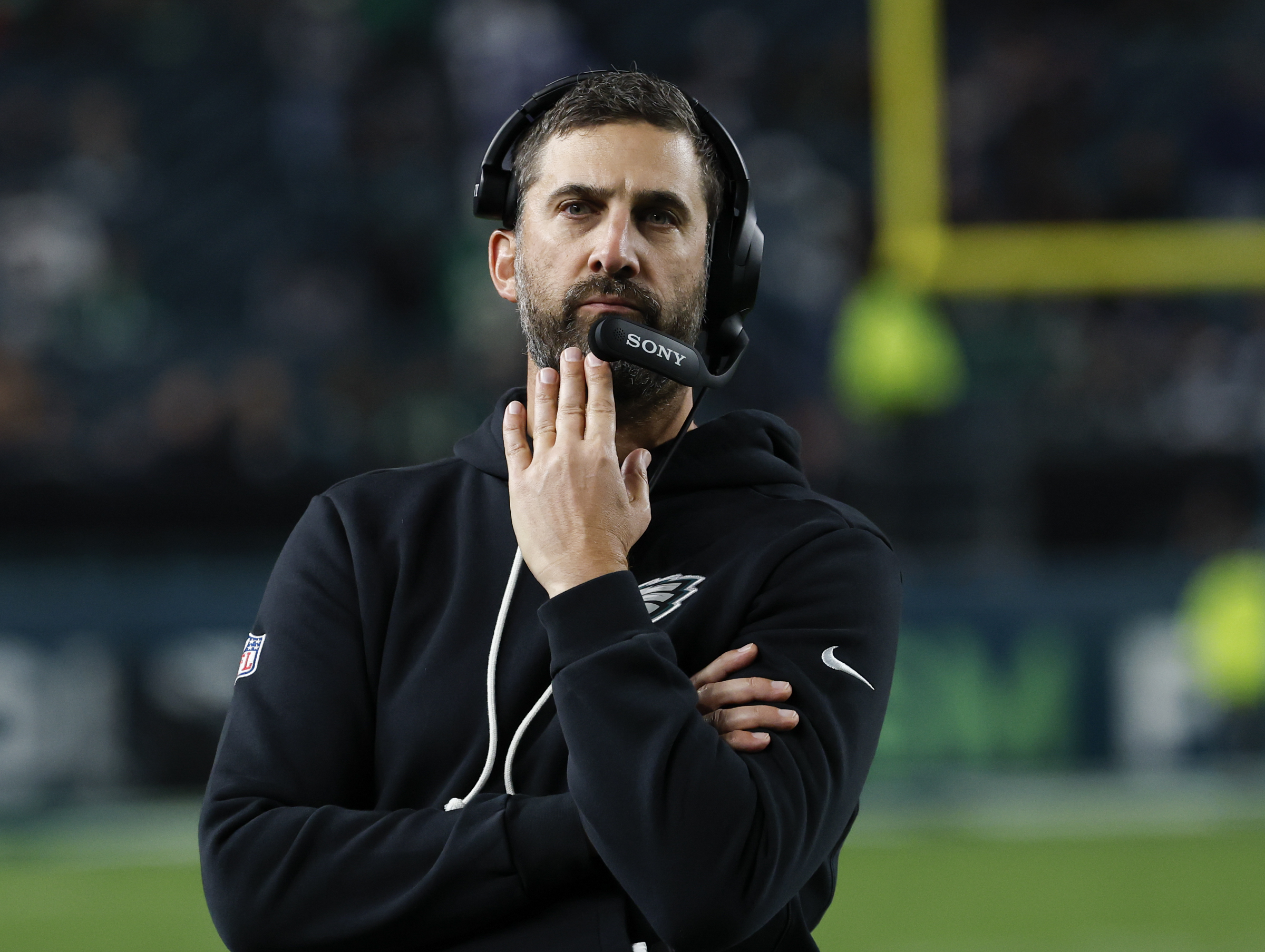
Nick Sirianni needs his team to demonstrate effort before Sunday night’s primetime audience. Yong Kim / Staff Photographer
Nick Sirianni didn’t call out his players for their effort vs. Dallas, but there were clues that some guys may be checking out. It’s understandable, with half the starting offense injured or gone. But Sirianni’s future could ride on how his team fights in the face of adversity. The culture stuff is supposed to be his strength. If he can’t at least get his squad to play hard, there really isn’t much left to keep him here. That may sound harsh. He certainly does more than that, but after repeated changes to his staff and scheme, there’s little doubt owner Jeffrey Lurie is questioning his coach’s future. He came close to firing him before, although I doubt such a move would come in-season.
As for the outcome of this game, can I pick both teams to lose? Maybe a tie? I won’t chicken out, so let’s go with the home team.
Lacey Bachart is caught in the vast gulf between the nation’s two major political parties, neither of which is appealing to her to join.
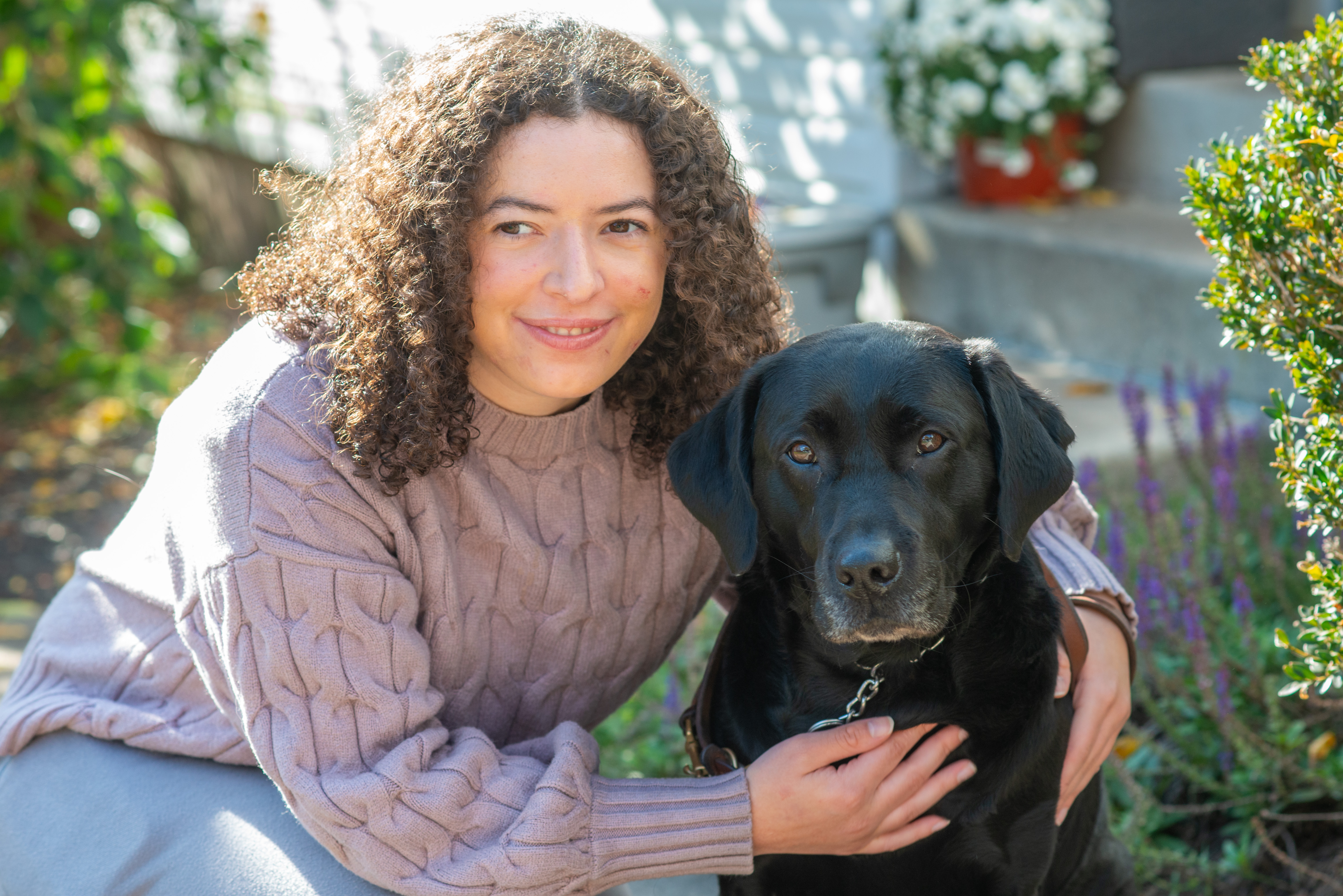
“Money hungry, I see that on both sides,” said Bachart, who is legally blind and works at Wawa part-time. “They get power and say they’re going to do this and that, and it just does not happen.”
Two years ago, Bachart, a 22-year-old Sellersville resident, decided not to register with either major political party.She is one of 1.2 million unaffiliated voters in Pennsylvania, the fastest-growing group of voters in both the state and her Bucks County-based congressional district. Roughly 78,000 Pennsylvania residents registered without a political affiliation in the last year alone.
Bachart and other unaffiliated voters are poised todecide the outcomes of four hotly contested congressional races on Tuesday,including the 1st Congressional District, where she lives.
These voters have outpaced new Democratic and Republican registrations in each of the four swing districts.
And while they represent a smaller share of the state electorate than Democrats and Republicans, their total is four times larger than the gap in registered voters between the major parties.(There are 230,000 more voters registered as Democrats than Republicans in the state.)
(function(){function e(){window.addEventListener(message,function(e){if(e.data[datawrapper-height]!==void 0){var t=document.querySelectorAll(iframe);for(var n in e.data[datawrapper-height])for(var r=0,i;i=t[r];r++)if(i.contentWindow===e.source){var a=e.data[datawrapper-height][n]+px;i.style.height=a}}})}e()})();
What this means is that unaffiliated voters have never been more important to swinging the vote in places like the 1st District.
There, Republican U.S. Rep. Brian Fitzpatrick and Democrat Bob Harvie, a county commissioner, are competingin a race that could be decided by a few thousand votes.
Bachart said she is leaning toward Harvie as Election Day approaches, hoping to put a check on President Donald Trump.
“I think it’s time for a change. We’ve had Brian Fitzpatrick for a while, and I’m a huge disapprover of Trump,” she said. “I don’t think Brian Fitzpatrick is a huge disapprover of Trump, as much as he says he might be.”
Outpacing both parties
Over the last year, according to an Inquirer analysis, Republicans lost about 900 voter registrations in the 1st District, and Democrats added about 3,100 voters after a renewed focus on voter registration efforts.
But 5,400 new voters in the district have registered as unaffiliated since October 2025, outpacing both parties combined.
Now, there are about 84,000 total unaffiliated voters in the 1st District — 14.6% percent of the electorate. That is more than nine times the difference between Democrats and Republicans in the swing district, where the GOP currently holds a roughly 9,000-voter advantage.
(function(){function e(){window.addEventListener(`message`,function(e){if(e.data[`datawrapper-height`]!==void 0){var t=document.querySelectorAll(`iframe`);for(var n in e.data[`datawrapper-height`])for(var r=0,i;i=t[r];r++)if(i.contentWindow===e.source){var a=e.data[`datawrapper-height`][n]+`px`;i.style.height=a}}})}e()})();
Understanding what drives these ideologically diverse voters, however, is complex.
Like Bachart, they tend to be younger than those registered with a party. Statewide, the median unaffiliated voter is 39.That is 11 years younger than the median Democrat and 16 years younger than the median Republican.
Regardless of age, many unaffiliated voters are driven by their dissatisfaction with the two major parties and the status quo.
Joseph Macary, 79, an unaffiliated voter who lives in Doylestown, said heis “fed up” with everyone in politics.
The son of a Christian Arab immigrant from Lebanon, Macary said he inherited his father’s view that regardless of who occupied the White House, U.S. policy in the region has failed Arab people.
“What’s been going on [in the Middle East] drives me crazy,” Macary said.
Though he plans to vote for Democrats, Macary said, Harvie does not necessarily inspire him. “I have no real views on him,” he said. “But I’ll probably vote for him anyway.”
Fitzpatrick, on the other hand, “sides too much with Trump, who’s a lunatic,” Macary said.(The incumbent votes with Trump and Republicans less than any other House Republican, though it is still about 70% of the time, an Inquirer analysis found).
“Even if he’s against Trump, his voice is drowned out among Republicans. His vote is meaningless,” Macary added.
(function(){function e(){window.addEventListener(message,function(e){if(e.data[datawrapper-height]!==void 0){var t=document.querySelectorAll(iframe);for(var n in e.data[datawrapper-height])for(var r=0,i;i=t[r];r++)if(i.contentWindow===e.source){var a=e.data[datawrapper-height][n]+px;i.style.height=a}}})}e()})();
In addition to voters officially registered as unaffiliated, many in Pennsylvania who are still registered as a Democrat or Republican no longer feel a deep attachment to their party. Their registration is not keeping up with their ideology.
Bryan Canonica, an IT consultant from Southampton, is registered as a Republican but identifies as an independent voter. He plans to vote for Harvie, the Democrat, in the 1st District race, though it is more of a snub to Fitzpatrick.
“He’s just been in office too long,” Canonica, 46, said. “And he’s too close to Trump, even if Fitzpatrick voted against him sometimes. We need a shake-up.”
Meanwhile, Zbigniew Chrzanowski, 63, a registered Democrat in Newtown who identifies as an independent, plans to vote for Fitzpatrick.
Chrzanowski, a former member of Poland’s parliament who became a U.S. citizen in 2006, has come to know Fitzpatrick personally. He appreciates the congressman’s support for Ukraine amid its war with Russia.
Fitzpatrick, he said, “is trying to be independent from the psycho [who] is in the White House right now,” referring to Trump.
The fight for unaffiliated voters
One of the only Republicans to publicly admit he did not vote for Trump in 2024, Fitzpatrick told The Inquirer during one of his last campaign rallies that his closing message to voters in one of the most purple districts in the nation is “I’m one of them.”
“Nobody’s questioning my independence. And there’s no member of Congress, Democrat or Republican, that is more independent than I am,” he said in a separate interview.
He also said he would “100%” register as an independent if it were not for the closed primary system, which prevents unaffiliated voters in Pennsylvania and seven other states from casting their ballots in primaries. The five-term GOP lawmaker,who has not campaigned with Trump this year, introduced the Let America Vote Act to allow unaffiliated voters to participate in primaries for federal elections.
Harvie has not shied away from his Democratic bona fides, campaigning with Gov. Josh Shapiro and other party leaders, but he said in an interview with The Inquirer that he believes his voting record on the Bucks County Board of Commissioners, which is composed of two Democrats and one Republican, speaks to his independence. He pointed to votes on mental health, public safety, and sustainability issues.
“All those things have been done in a bipartisan way, and I think people recognize that,” Harvie said.
Eugene DePasquale, chair of the Pennsylvania Democratic Party, said he sees the growing trend of unaffiliated voters across the nation and believes it is the party’s job to show them why they should become Democrats.
“I think there’s still a chunk of people that want to make sure that we prove that we’ve heard them, we’ve heard their concerns, and we’re ready to deliver,” he said. “What hopefully we’re going to have in November will give us the opportunity to show people we’ve gotten the message and we’re going to deliver.”
Since DePasquale took over as state party chair, Democrats have reversed a downward trend on registrations, solidified their statewide lead, and outpaced Republicans, including in the vote-rich Philadelphia suburbs.
(function(){function e(){window.addEventListener(message,function(e){if(e.data[datawrapper-height]!==void 0){var t=document.querySelectorAll(iframe);for(var n in e.data[datawrapper-height])for(var r=0,i;i=t[r];r++)if(i.contentWindow===e.source){var a=e.data[datawrapper-height][n]+px;i.style.height=a}}})}e()})();
Meanwhile, thePennsylvaniaGOP’s executive director, James Markley, said Fitzpatrick’s record will sway unaffiliated voters in Bucks and Montgomery Counties on Election Day.
“When independent and unaffiliated voters go to the polls, we believe they base their votes on job performance, real results, and a desire for pragmatic solutions,” he said in a statement.
Changing the entire system
If unaffiliated voters want real change, they should stop voting for the two parties and forge their own path, said Chris Gambino, a 39-year-old unaffiliated voter in Doylestown who is mounting an independent campaign for a state House seat.
“It is very clear to me that both parties care solely about power and fundraise based on outrage,” he said. “There’s very little desire to find common ground and solutions, and that’s problematic to me. That’s not the world I want to live in.”
There is no independent candidate in the 1st District race, but there will be independent optionslower on the ballot in some races.
Gambinois runningoutside the two-party system to represent the 143rd state House district, which includes parts of Bucks County. Gambino, a former Delaware Valley University professor who now researches agriculture funding, is facingGOP StateRep. Shelby Labs and Democrat Tim Hayes, who works for an environmental advocacy group and previously served as the president of the Dublin Borough Council.
Butas a voter, Gambino is facing a binary choice in the 1st District race and has not yet decided whom to cast a ballot for.
Fitzpatrick, Gambino said, “seems pretty happy being embedded in the Republican Party.” But in examining Harvie’s positions and record, he said, he is asking: “Is this person going to be able to vote against their party line if the time comes?”
Gambino said true democratic representation can get lost in a system that props up two parties.
“We are beholden to whatever the party says and does, and then we lose the ability to be accountable,” he said.
Lacey Bachart, an unaffiliated voter in Bucks County, poses outside her home with her service dog, Leah, her home in Sellersville, Pa. William Thomas Cain / For The Inquirer
It is a message that resonates with Bachart.
Bachart, who lives on disability in addition to her Wawa income, said her voice and others in the disability community often get overlooked as parties focus on winning, rather than serving the needs of everyone in the community. It is one reason why she has not affiliated with a party.
“We struggle to survive even when the entire country as a whole isn’t struggling to survive,” she said.
CHARLOTTE, N.C, — Less than 24 hours after beating the New York Knicks at Xfinity Mobile Arena, the 76ers cleared out of another locker room, victorious, this time in Charlotte.
Since this was North Carolina, the remains of the trip included half-empty buffet trays of barbecue from a local restaurant, Noble Smoke. That savory meal will help make up for all the calories they burned on this back-to-back, which concluded with a 109-104 comeback victory over the Hornets.
Even if back-to-backs are a facet of everyday life in the NBA, they’re not fun for those involved, young, old, or in between.
“Back-to-backs are hard, man,” guard Tyrese Maxey said. “Especially a team like [Charlotte]. They play fast. Put you in a lot of actions. We just had to make it through, make it to the fourth. As long as it’s a game in the fourth.”
For some teams, that might just be a mantra without meaning. For these Sixers, it has been a way of life on their journey to a 6-1 record. Once again, the Sixers came back from a double-digit deficit, as they have in four of their six wins.
Once again, the Sixers were the better team in clutch-time situations, even with Joel Embiid and LeBron James both out for rest. And once again, coincidentally, VJ Edgecombe hit a dagger three to put the Sixers up four with under 40 seconds to play, as he did against the Knicks. Edgecombe said he “owed” the team that one after scoring just 10 points on 4-for-13 shooting, but that, as the shot clock was winding down, he wanted to give the ball back to Maxey.
“I’m going to be honest, ’cause like I said, I wasn’t making. But I said the team trusts me. They trust me in the clutch, and obviously I trust myself, and so … I looked at [Tyrese], and he was like, ‘Go,’ so I just went.”
VJ Edgecombe on his second straight dagger three in as many nights. Said he was looking to get the ball back to Tyrese Maxey. pic.twitter.com/rQtBpjfVL2
That trust might be one reason the Sixers have prevailed in these close games. Forward Dean Wade said that’s what happened on defense in the final three minutes – that there was a trust the team had that just clicked in, even after the second half had mostly gone Charlotte’s way. The way the Sixers want to play defense, Wade said, requires that trust.
“We just locked in and truly trusted each other,” Wade said. “Our biggest thing is physicality. When we’re physical on defense, we’re at our best. When you’re physical on defense, you’re going to get beat sometimes, and then that whole trust thing comes in — people on the backside, rotations on the backside. So that was the biggest thing is we trusted.”
After the Sixers trailed 101-94 following a timeout, they found another gear they hadn’t had all night. Anfernee Simons hit a three-pointer off an offensive rebound by Wade, who finished with a career-high 10 assists. Then Simons got a steal. Then Jaylen Brown got a steal. Then Wade got a block. Before anyone knew it, the Sixers were up 102-101 before Edgecombe all but ended it with his three.
Sixers guard Anfernee Simons battles for the ball against the Hornets’ Grayson Allen during the first half of Saturday’s game in Charlotte.Nell Redmond
Why didn’t the Sixers play like that from the start on Saturday? Well, the schedule didn’t do them any favors. It’s not an excuse for them, just a fact. Simons has been in the NBA for nine years. He has seen other teams in the Sixers’ situation Saturday just play out the string on the game. Chalk it up to a schedule loss and move on.
However, there is something different about this group, he said.
“That’s one thing that’s kind of special about this team — nobody wants to give up the game,” Simons said. “Especially when we’re on this run like this right now. I think everybody understood that.”
A big difference Saturday is they did it without Embiid and James, who Maxey has said is a “calming influence” in the guts of the game. James couldn’t provide that security blanket against the Hornets. This shorthanded group had to figure it out on its own. From the start of training camp, coach Nick Nurse repeatedly said the Sixers have been “connected.” So far, they have shown that trait when it matters most.
“Just our competitive nature,” Maxey said. “I think we have a lot of competitive guys on this team. Guys that want to compete and [are] not going to lay down.”
Even when that may sound tempting to do Night No. 2 of a back-to-back.