Nearly two years after Chesterfield Township approved a plan to build a warehouse on a shuttered golf course, construction still has not begun.
The Old York Country Club was purchased by New Jersey-based real estate developer Active Acquisitions in 2022 with plans to build at least one warehouse totaling up to about 1.1 million square feet, according to the redevelopment agreement. The project currently includes plans for a single building, but a second warehouse could be permitted — with the two buildings totaling up to 1.3 million square feet — if it were to be dedicated to cannabis cultivation or manufacturing, according to the township.
Four years later, the developers are still working to obtain the final approvals and permits needed to start construction at 228 York Rd., with hopes to finally break ground early next year, Active Acquisitions founder Seth Gerszberg said.
The developers have not identified a tenant for the future site, but Gerszberg said that regardless of who moves in, the property will operate as a traditional warehouse or logistics center with large trucks coming and going from the building throughout the day.
The anticipated work at the 156-acre property was approved in November 2024 and comes more than six years after the township designated the site as an “area in need of rehabilitation” in May 2020.
The sprawling golf course closed in 2021 in part due to pandemic-era drops in revenue and memberships. In the years since, the township’s redevelopment efforts have drawn some public pushback.
Following the initial approval of a redevelopment plan for the site in October 2022, a neighborhood group called Save Old Yorkfiled a lawsuit against the township. While it was ultimately dismissed in court, the lawsuit argued that the redevelopment plan did not conform to the township’s master plan and amounted to “spot zoning” from agricultural to commercial.
But Chesterfield administrator George Jackson, who began working in the township in 2024, argues that the project presents a rare opportunity for the township to welcome a new taxpayer with deep pockets.
Much of Chesterfield’s 21 square miles is preserved farmland that is unable to be developed, Jackson said, which significantly limits new commercial development opportunities. The tax rates for preserved farmland are also much lower than the rates for residential or commercial properties, he said.
“You need the balance in your ratables,” Jackson said of the township’s tax base. The warehouse “could take some of the burden off of our residential taxpayers.”
In a town with a municipal budget of roughly $6.7 million in 2026, the potential yearly tax revenue generated by the new warehouse is expected to be around $2 million — roughly 30% of the total budget, he said.
“Our opportunities to increase our tax base are very, very limited, and this is an opportunity to really increase it dramatically,” he said.
As the developers work to secure an end user for the future warehouse, both Gerszberg and Jackson emphasized that the one thing they know for sure is that it won’t be an Amazon fulfillment center.
The redevelopment agreement specifically prohibits that type of warehouse use on the site, while also requiring that vehicles exiting the property make a left turn onto Old York Road in an effort to keep truck traffic out of the center of town, Jackson said.
Additionally, the site’s location about a half mile from Route 206 and adjacent to two existing warehouses across the street make it “a prime location for warehouse development,” Jackson said.
“The township went through some great measures to ensure that it doesn’t turn into a big commercial trucking route in certain areas of the township,” he said. “They want that traffic to go out to the highway.”
The sound inside the locker room was already overwhelming, Father Judge’s coaches and players shouting and singing after their 52-46 victory over Archbishop Wood in the Philadelphia Catholic League boys’ basketball semifinals last February. And every time someone opened the door to exit, the noise in the room rose, because a sold-out Palestra crowd was now roaring over the night’s second game: Neumann Goretti vs. Bonner-Prendergast.
Still, the kid who had been the primary cause of the celebration, the 6-foot-4 senior guard who had made the night his, was calm. Derrick Morton-Rivera had scored 27 points on an array of three-pointers and pull-up jumpers, leading the Crusaders back from an early 16-point deficit.
“Playing in front of 10,000 people every year, there’s nothing like it,” Morton-Rivera, now a freshman at Temple, said after the game. “I never knew about the PCL until my eighth-grade year. That’s when I learned.”
How did he end up at Judge?
The coaches “recruited me,” he said.
Father Judge graduate Derrick Morton-Rivera after he sank a three-point shot during the 2026 Catholic League boys’ championship.Elizabeth Robertson / Staff Photographer
With that one verb, recruited, Morton-Rivera touched the live wire that crackles among coaches, parents, administrators, and players throughout the high school sports scene in Pennsylvania. House Bill No. 41 — a measure that would allow the PIAA to create separate postseasons, one for public schools and one for private, parochial, and charter schools — passed the Pennsylvania State House of Representatives in April. And of all the factors that play into the longtime dispute over whether boundary and non-boundary schools should compete against each other for championships, none generates as much heat and controversy as recruiting.
“It’s two different worlds,” longtime Lower Merion boys’ basketball coach Gregg Downer said. “If you don’t put massive talent out in basketball or football or soccer or lacrosse, you’re going to get run over.”
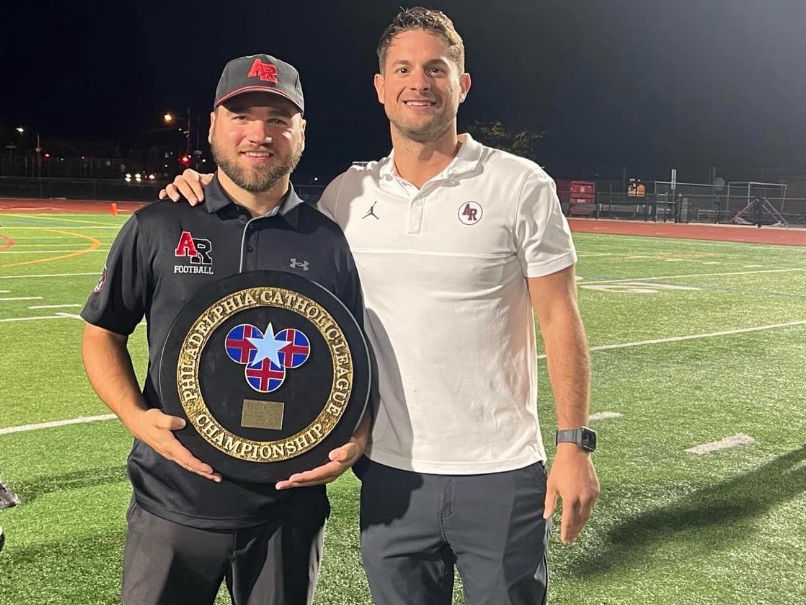
Mark Ostaszewski with Archbishop Ryan athletic director Joe Zeglinski after the Raiders won the Catholic League Blue Division title in 2024.Courtesy of Archbishop Ryan
‘Philly is Philly’
Since the Catholic League joined the PIAA in 2008, just one of its coaches, Archbishop Ryan football coach Mark Ostaszewski, has been suspended for recruiting violations. At a January 2025 football camp, Ostaszewski asked a student from the Bensalem School District if he wanted to apply to Ryan. District 12, the association’s umbrella for the Philadelphia Catholic and Public leagues, banned Ostaszewski for a year; he has returned to his role this season.
Locally, recruiting accusations often put programs from District 12 at odds with those from District One, which comprises schools in Philadelphia’s suburbs. And that confirmed example is tame compared to the more intense efforts that coaches have allegedly made to coax athletes to their programs.
A former basketball standout who graduated recently from a District One public school and his father told The Inquirer on the condition of anonymity that, while the student was in eighth grade and throughout his high school career, representatives from three Catholic League programs pursued him. One head coach offered him free tuition, a stipend, and the use of an apartment near campus. The coach also had his team’s star player send several direct messages on Instagram to the player in an attempt to persuade him to attend the school.
Another program had an assistant coach and a parent take the player’s father out to lunch twice, telling him at both meals that he would not have to worry about paying any tuition for his son. The third program’s head coach told the father that, if his son helped the team win the Catholic League championship, a booster would provide a house for the player. Each of the three schools were located between 15 and 35 miles from the player’s home.
Gregg Downer has spent three decades as the Lower Merion boys’ basketball coach.CHARLES FOX / Staff Photographer
“They can twist this however they want,” Downer said. “These kids are targeted because they’re good at sports. I could list 50 examples of kids who have been recruited.”
Morton-Rivera’s path to Father Judge captures the murkiness of the entire issue. Jim Meredith, a 1992 Judge graduate who became its president in late July, noted in a recent interview that while in eighth grade, Morton-Rivera had visited the school and taken its entrance exam — and that he grew up and lived in Lawncrest, just a mile-and-a-half from Judge.
“I can say with full confidence that we’re following PIAA rules and regulations,” Meredith said. “We’re trying to put out an excellent product for our school and our students. Part of that is making sure we adhere to the guidelines that are prescribed to us.”
When asked how Morton-Rivera ended up choosing Judge, head coach Chris Roantree pointed out that Morton-Rivera’s background and family history made it natural for him to consider attending a school with a strong basketball program. D.J. Rivera, his father, finished his high school career in 2006 as Neumann Goretti’s all-time leading scorer before playing Division I ball at St. Joseph’s and Binghamton.
Father Judge coach Chris Roantree noted that Morton-Rivera’s background and family history made it natural for him to consider attending a school with a strong basketball program.Elizabeth Robertson / Staff Photographer
“Philadelphia basketball is a very small community,” Roantree said. “There are different relationships that everybody has. When somebody shows interest in us, we sell the school. When we bring guys in, we show them our career-pathway center. We show them our academic center. …
“Ultimately, ‘recruiting’ is a very broad thing. It’s going to be questioned because we’re a Catholic and private school. He’s within a mile or two of the school. To me, that’s no different from [a public-school coach] talking to someone from a Plymouth Whitemarsh middle school or an Abington middle school. He’s not a transfer. We didn’t aggressively go after him like that.”
Under Article VI, Section 11 of its bylaws, the PIAA forbids “recruiting [that] is materially motivated in some way by an athletic purpose. Recruiting for athletic purposes is directly contrary to fundamental interests of PIAA and its member schools, and any school engaged in such conduct should do so with the expectation that it will be treated harshly upon proof of such conduct.”
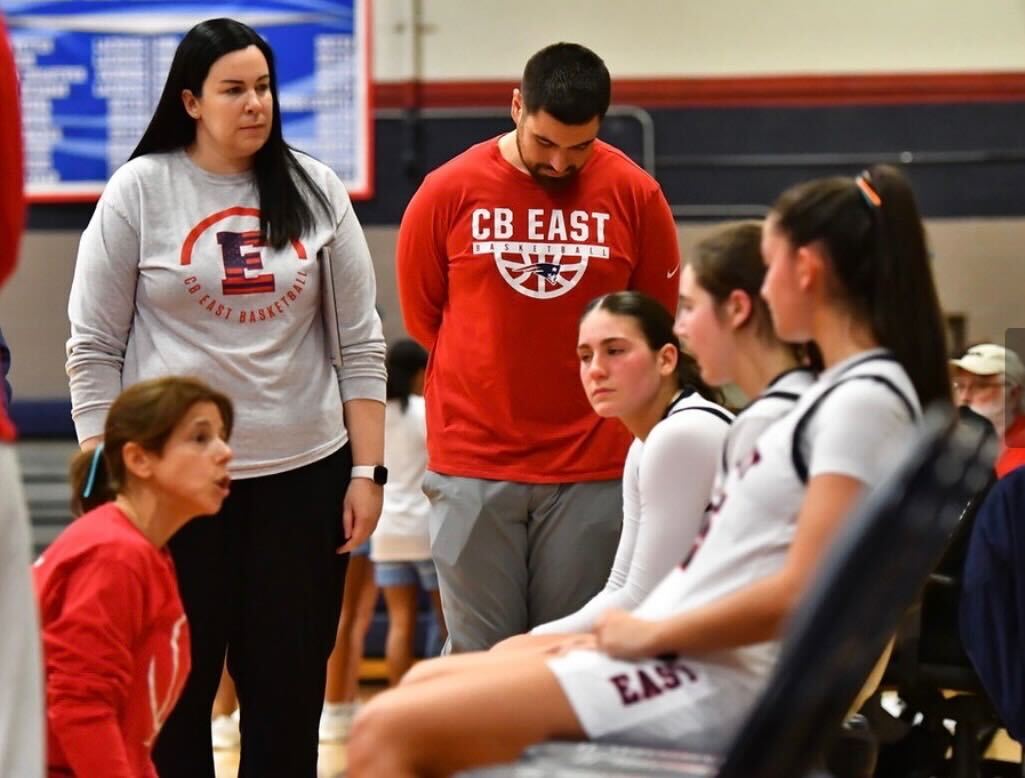
Liz Potash retired earlier this summer after 13 years as Central Bucks East’s girls’ basketball coach.Courtesy of Diane BarryShe said, “If I wanted to recruit, I wouldn’t be a public-school coach.” Courtesy of Diane Barry
As clear as that excerpt might seem, determining whether a student’s decision to attend a particular school was “materially motivated” by athletics requires hard and fast evidence, such as text or direct messages between a coach and the athlete, said Sean Kelly, District One’s vice chairman.
If a principal or athletic director files a formal complaint charging an opposing program with violating PIAA bylaws, the association’s corresponding district committee will hold a hearing on the matter.
“Sometimes I’ll get a call from a coach or an AD or somebody who’s associated with one of the schools who says, ‘Hey, this is what we’re hearing. We’re hearing Student A is going to go to this school,’” Kelly said. “I just ask them, ‘What evidence do you have? Are you saying they’re just transferring, or are you saying they’re being recruited?’ We take some time to make sure we pump the brakes because people get very sensitive and very emotional.”
Neumann Goretti and Father Judge boys’ basketball play in South Philadelphia on Feb. 1, 2026.Yong Kim / Staff Photographer
Article VI, Section 11 applies to both boundary and non-boundary schools, but suburban public school coaches bemoan what they see as an inherent imbalance in the system: To play a varsity sport at a public high school, a student must live in that school district. But private, parochial, and charter schools, such as those in the School District of Philadelphia and the Archdiocese of Philadelphia, can draw their students from anywhere. Too many of those institutions, several District One coaches said, bend the rules to do it.
“It’s just not fair,” said Joe Dempsey, who has been the boys’ basketball coach at Spring-Ford High School in Royersford since 2021. “They have the ability to go and get players, to which I say: Let them do that. If they want to go play in that sandbox, let them go.”
Dempsey had previously coached at La Salle College High School for 27 years, including 14 as the program’s head coach. At CYO games, he would see a promising seventh or eighth grader, he said, then approach the player’s parents without talking to the player.
Joe Dempsey previously coached at La Salle College High School for 27 years.
“La Salle made it very clear: Don’t step over the line. Don’t get us in trouble,” Dempsey said. “Once a couple of schools took the gloves off, the pressure came. The pressure was on me at La Salle. I went to the administration: ‘Are you looking around the Catholic League? I can’t just sit on my hands and wait on some wonderful 6-foot-7 kid who can pay a lot of tuition and go to school with all boys and get bused here. It ain’t going to happen by accident.’”
That archdiocesan schools compete for students within District 12’s open-enrollment landscape only complicates matters further. Consider one example: Bonner-Prendie, nestled in Drexel Hill in Delaware County, won the 2024 PIAA Class 4A football championship. Of the top six zip codes from which the school drew students that year, five were within Delco, and the other was just nearby — the Overbook section of Philadelphia — according to Steve Clement, the chief administrative officer of the archdiocese’s Office of Catholic Education.
How many of its football players did Bonner-Prendie recruit, if any? How many did it have to recruit, given the school’s proximity to West Philadelphia? And if a school such as Bonner-Prendie draws students from the city or St. Joseph’s Prep draws them from Camden — less than five miles away — how different is that from the dynamic at a public school in an especially large district?
“The reality,” Clement said, “is that these schools are still serving the areas they were intended to serve.”
Similarly, parents can and do contact the School District of Philadelphia to ask what high schools would best fit their children’s skills and interests: maybe sports, maybe drama, maybe career and technical education. Starr Davenport, the district’s director of finance for athletics, said she frequently fields phone calls from parents of rising ninth graders who ask her about the quality and array of athletic programs at a particular school, and she is happy to answer their questions.
“It’s not a recruitment strategy,” Davenport said. “It’s just transparency. When they want to know, it means they’re trying to find their school home. That selection process seems equitable because we’re not putting it out there, ‘Go to this school if you like football.’ But if a parent or student-athlete inquires, we are definitely transparent in terms of the full gamut of what is offered at a school.”
As for making competition across the state and the Delaware Valley more equitable — that is, giving boundary schools a better chance of beating non-boundary schools — it doesn’t matter much whether gifted athletes who already live within the city’s borders attend public or non-public schools. As long as it stays in Philadelphia, that talent will reveal itself in the results one way or another.
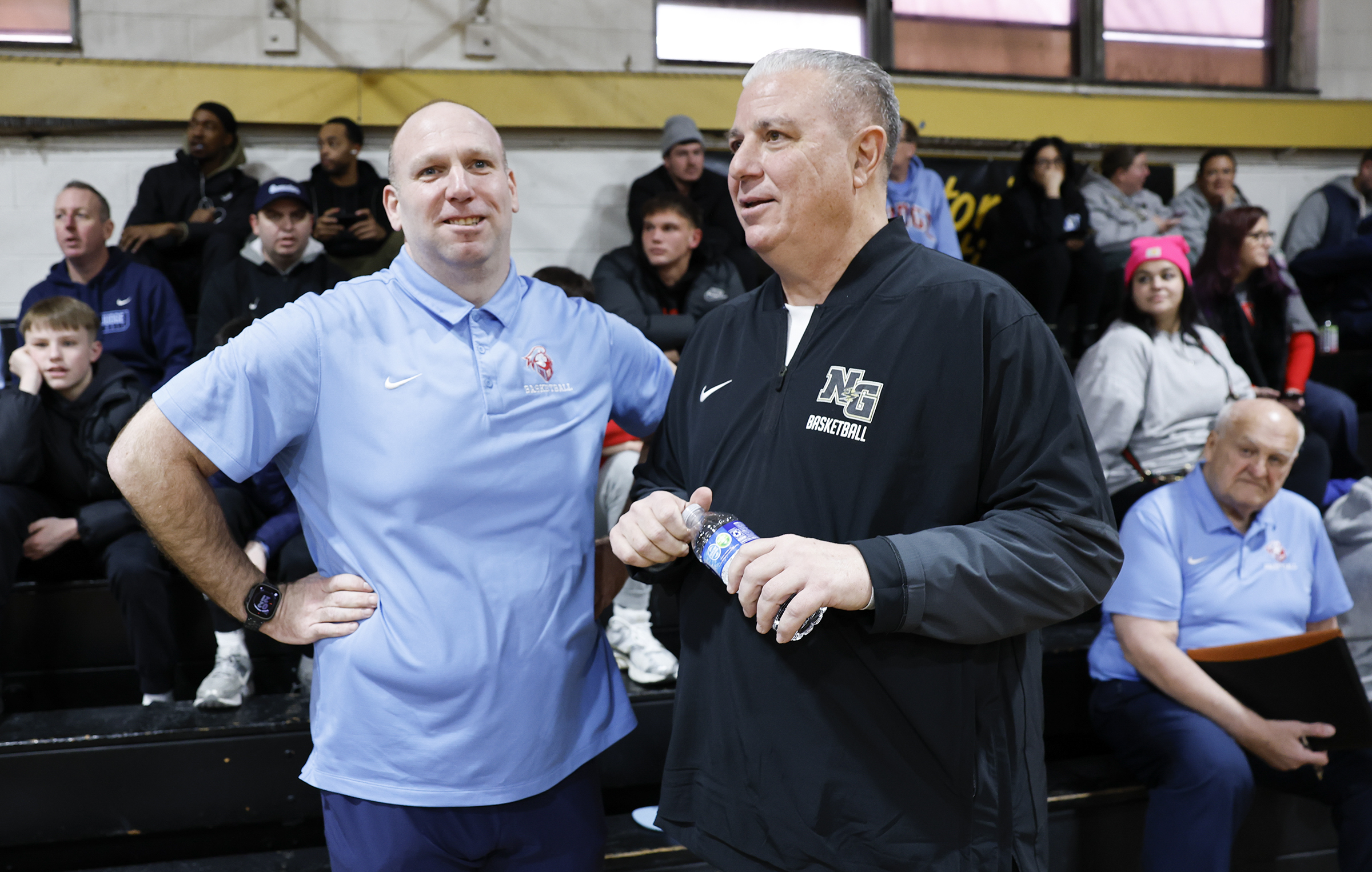
Neumann Goretti head coach Carl Arrigale (right) meets with Father Judge head coach Chris Roantree before the two teams played each other in February 2026.Yong Kim / Staff Photographer
“Here’s the thing: Philly is Philly,” Roantree said. “So if you want all the Philly kids to go to public schools, they’re still going to dominate. There are six, seven, eight, 10 good teams in the Catholic League. If they’re in the playoffs, they’re going to make some noise” in the state tournaments.
The primary complaint among suburban public school coaches and administrators, of course, is that non-boundary schools don’t limit themselves to drawing talent from the city or the neighborhoods that surround them. To some public-school coaches, the notion of recruiting is an alien concept, one they wouldn’t consider if for no other reason than they or the athletes’ families would have to make the necessary arrangements for the athletes to live within district boundaries — say, finding a long-lost aunt whose house was within walking distance of a school bus stop.
Liz Potash, who retired earlier this summer after 13 years as Central Bucks East’s girls’ basketball coach, said she never sought out players to refill her program’s talent pool. “If I wanted to recruit, I wouldn’t be a public-school coach,” she said. “I’m not going to beg an eighth grader to come to East.”
But another coach might.
“Everyone’s doing it,” said Daniel DiBerardinis, who spent 11 years as a Catholic League athletic director — six at Roman Catholic, five at St. Joe’s Prep — before becoming Penn Charter’s AD last year. “Public schools are recruiting. They recruit. People move to different zip codes all the time.
“I’m not going to put any school on blast, but I know intimate situations — I know families who got an address to be a part of a district. I’m not going to say any schools, but I do know it happens. The rules are super-gray, and people are always going to find workarounds.”
Father Judge takes on Archbishop Wood during in the Catholic League boys’ basketball semifinal at the Palestra on Feb. 18, 2026.Isaiah Vazquez / For The Inquirer
Technicalities
Football, boys’ basketball, girls’ basketball: It’s within the worlds of those three sports that the debates and bickering around recruiting are the loudest and have the most relevance. Rep. Scott Conklin, a Democrat who introduced House Bill No. 41 and represents the 77th district, in State College, all but admitted that the bill was aimed at stopping private, parochial, and charter schools from recruiting — and from continuing to move into the next frontier: wielding sponsor dollars or name, image, and likeness deals to entice athletes.
“Technically, yes, public schools could cheat,” he said in a phone interview. “But we know how difficult that is. I’m 67 years old, and I can win the high-jump competition — technically. But we all know it’s never going to happen.”
In that Palestra locker room back in February, Roantree snickered at the mere mention of the subject. “Everybody says it’s an unfair advantage,” he said. “What I say is, every kid’s got a dream of playing Division I, and there are a lot of coaches in our league who can make that happen. We don’t have to recruit as much as kids want to come and play for us.”
Four days later, behind a team-high 14 points from Morton-Rivera, Father Judge beat Goretti to win its second straight PCL championship. The Crusaders advanced to the semifinals of the PIAA Class 6A tournament, where they lost to a city rival, Imhotep Charter, which then lost in the championship game to Harrisburg’s Central Dauphin.
The little bird of an idea to open a restaurant circled the blue skies of Fred Mogul’s imagination for many years while he was preoccupied with other passions. The first few decades of his career were spent in journalism, working in print and at wire services from Nebraska to Jerusalem, then in public radioas a news reporter, first at WHYY, followed by 18 years at WNYC in New York.
But that little bird persisted, which is how this cheerfully quirky all-day cafe and restaurant in Chestnut Hill — the Blue Warbler — eventually came to be. Having been steeped so long in the perpetual turbulence of the media industry, Mogul was not deterred bythe famously daunting risks of building a restaurant.
“I wanted to do something else for social good and contribute to the world in having a communal gathering place while feeding people,” he said, conjuring a destination that combined the best attributes of a bakery-cafe, a diner, and a local tavern. “But I also want it to be a little surprising, playful, and unpredictable.”
To open such an intriguing place in Chestnut Hill, especially,would absolutely be a good deed. That neighborhood’s chronically underperforming dining scene, despite its abundance of well-to-do residents and quaint retail district lining Germantown Avenue, is such an enduring enigma that the last time I wrote something really nice about a restaurant there was nearly a decade ago when I reviewed Mica, which sadly did not survive the pandemic.
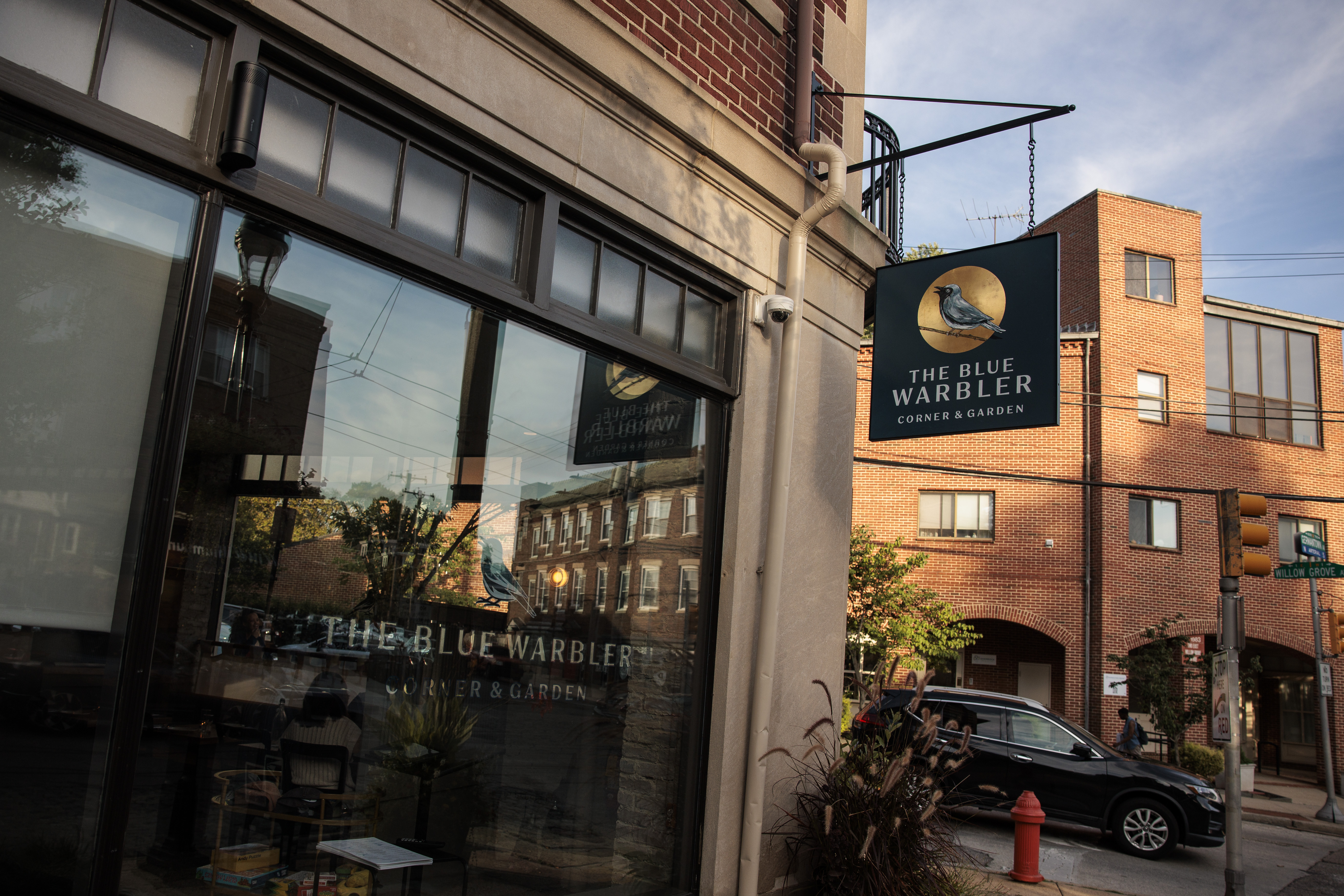
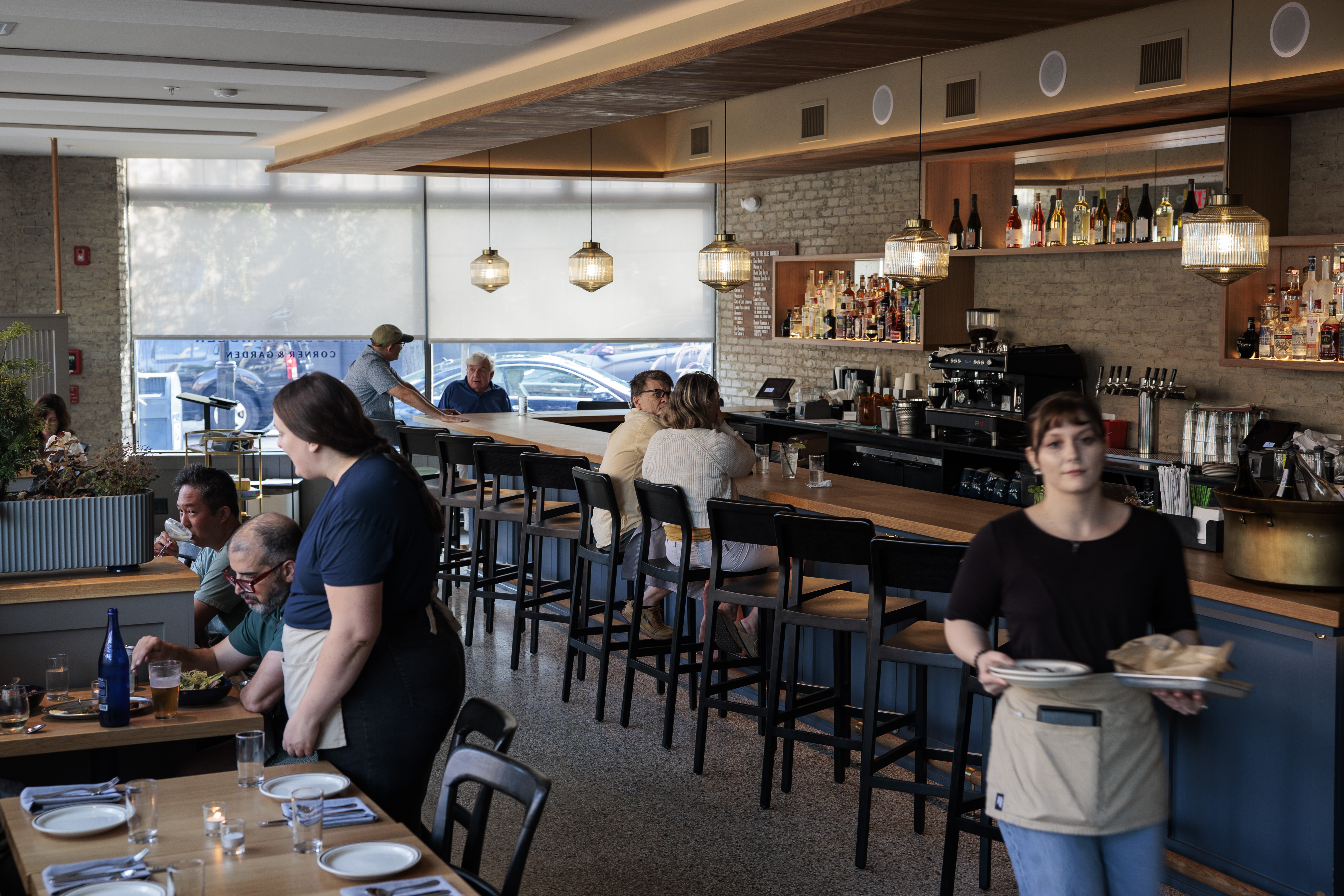
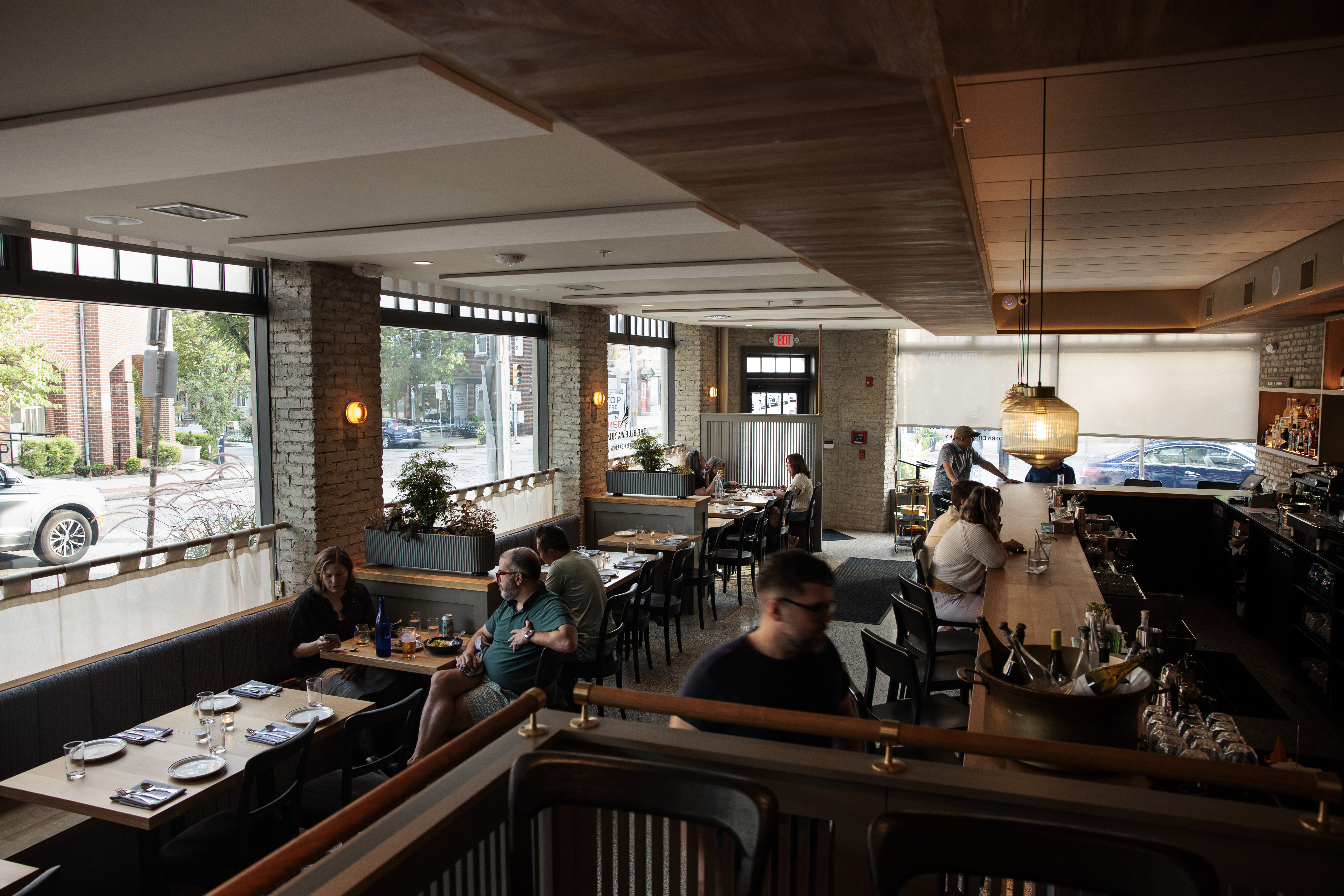
The dining room at the Blue Warbler on Thursday, Sept. 3, 2026 in the Chestnut Hill section of Philadelphia.Monica Herndon / Staff PhotographerThe dining room at the Blue Warbler on Thursday, Sept. 3, 2026 in the Chestnut Hill section of Philadelphia.Monica Herndon / Staff Photographer
But here was Mogul’s vision of the Warbler come to life with such vibrant warmth on a Saturday night, and it was as if this bustling three-month-old newcomer had been ensconced at the corner of Germantown and East Willow Grove Avenues for years.
The slate-blue bar trimmed with white oak was lined with customers sipping Cardamaro spritzes, blushing pink Clover Clubs, and sage gose beer from Germantown’s Attic Brewing Co. Meanwhile, eager diners waited patiently near the front door for their turn in the 71-seat dining room, where comfortable banquettes along the window and a cluster of tables on a raised rear platform create a sense of intimacy within the open space.
As a world-beat soundtrack pulsed with tunes from Brazil, Nigeria, and Afghanistan, the Warbler’s eclectic dinner menu — ranging curiously from Middle Eastern meze to smoked arctic char spread, mushroom kebabs, a tuna melt sandwich, and a faux-meatloaf platter — ultimately landed on the table less chaotically than it reads.
The bacalao, salt cod croquettes with green yogurt and lemon relish at the Blue Warbler.Monica Herndon / Staff Photographer
We swiped rounds of fluffy pita through silky hummus topped with cuminy Moroccan carrots and a spicy-smoky drizzle of harissa crunch. I savored the oceanic tang of warm salt cod fritters against the refreshing coolness of yogurt sauce greened with parsley, dill, and mint.
I’ll admit to the lowest expectations possible for the “meatloaf” made with Impossible meat. But this kitchen, run by chef Daniel Berret (formerly at CO-OP in the Study hotel in University City and Chestnut Hill Brewing Co.), seasoned that loaf nicely with a sweet onion and herb boost, lacquered it with a molasses-ketchup glaze, then added appealing sides of plancha-roasted king oyster mushrooms and fresh-cooked frites with a sriracha mayo dip. It was a comfort winner I’d return for.
Yes, there’s a vaguely retro sensibility to this globe-hopping collection of flavors, as well as the unabashed offering of tofu steaks and wheat meat as entrees in an era when vegetarian cooking has grown into a more vegetable-focused phase. The fact that there is no red meat or poultry on this menu, which does include fish, will be a no go for some.
But as Mogul told my colleague Michael Klein at the Warbler’s opening, he refuses to define this space by “what it lacks” or simply as “that vegetarian place” so much as a neighborhood-centered hub that is inclusive. The handsome dining room and breezy backyard patio are inviting. The service is genuine and outgoing. And the kitchen brings earnestly wrought flavors to everything it makes — including the hand-rolled bagels that anchor much of its daytime cafe menu.
It clearly has the neighborhood’s full attention, as evidenced by the customer who noted that an early version of cinnamon rolls for breakfast was topped with a wave of chai frosting that reminded them of “a Trump combover,” says Mogul. “That image could not be unseen, so we went to DIY schmearing with the frosting in ramekins instead!”
Chocolate hazelnut babka, chai cinnamon roll, and griddled cornbread at the Blue Warbler on June 11. The presentation of the cinnamon roll has since been changed with the frosting served on the side.Jessica Griffin / Staff Photographer
As a restaurant novice, Mogul still has a lot to learn — but he has eagerly embraced input from those with expertise. Just as he turned to Ambit Architecture and In House Studio to tastefully transform the longtime Foster’s Drugstore into its first use as a restaurant (note the salvaged original terrazzo floors and a serious ongoing attempt at soundproofing), he engaged restaurant consultant Arthur Cavaliere to translate his broad vision for the food into workable menus.
It all comes down to execution by Berret and his crew, and for me, the dinner service was the most successful. Aside from the tasty meze nibbles — including salty-sweet haloumi-stuffed dates and a smoky baba ghanoush topped with crispy cornmeal-fried Japanese eggplant — there is an appealing array of grilled skewers to start.
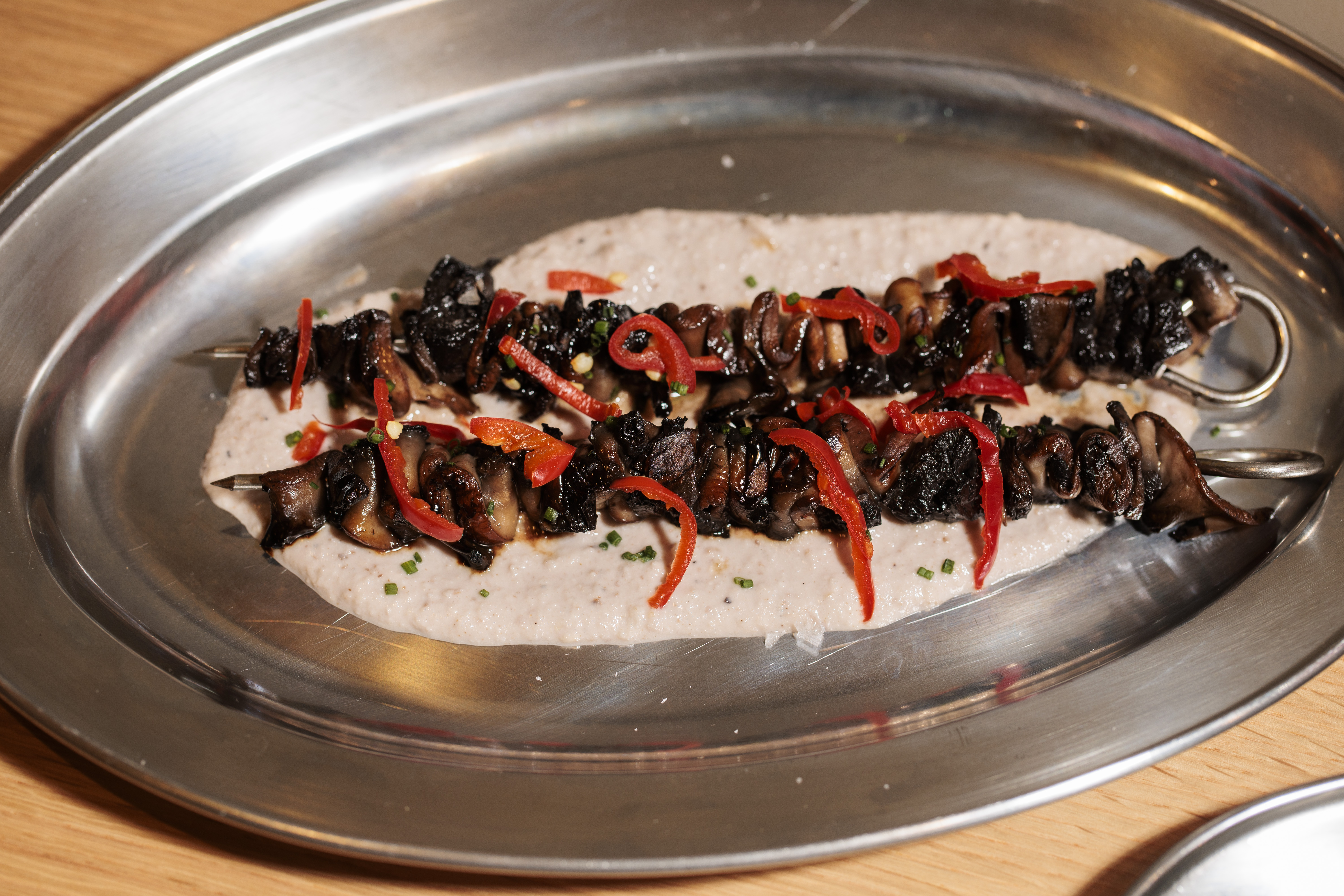
I especially enjoyed the “Chesco” portobello kebab whose long ribbon of mushroom is threaded like an accordion onto the skewer, glazed with date molasses and tamari, then served over a walnut tarator sauce. I also unexpectedly loved another Impossible meat creation: a version of kofta zestily seasoned with onions and garlic in the style of a Balkan ćevapi sausage, garnished with an herbal chimichurri over tzatziki yogurt.
The Chesco skewers at the Blue Warbler on Thursday, Sept. 3, 2026 in the Chestnut Hill section of Philadelphia.Monica Herndon / Staff PhotographerThe Balkan kebab skewers at the Blue Warbler on Thursday, Sept. 3, 2026 in the Chestnut Hill section of Philadelphia.Monica Herndon / Staff Photographer
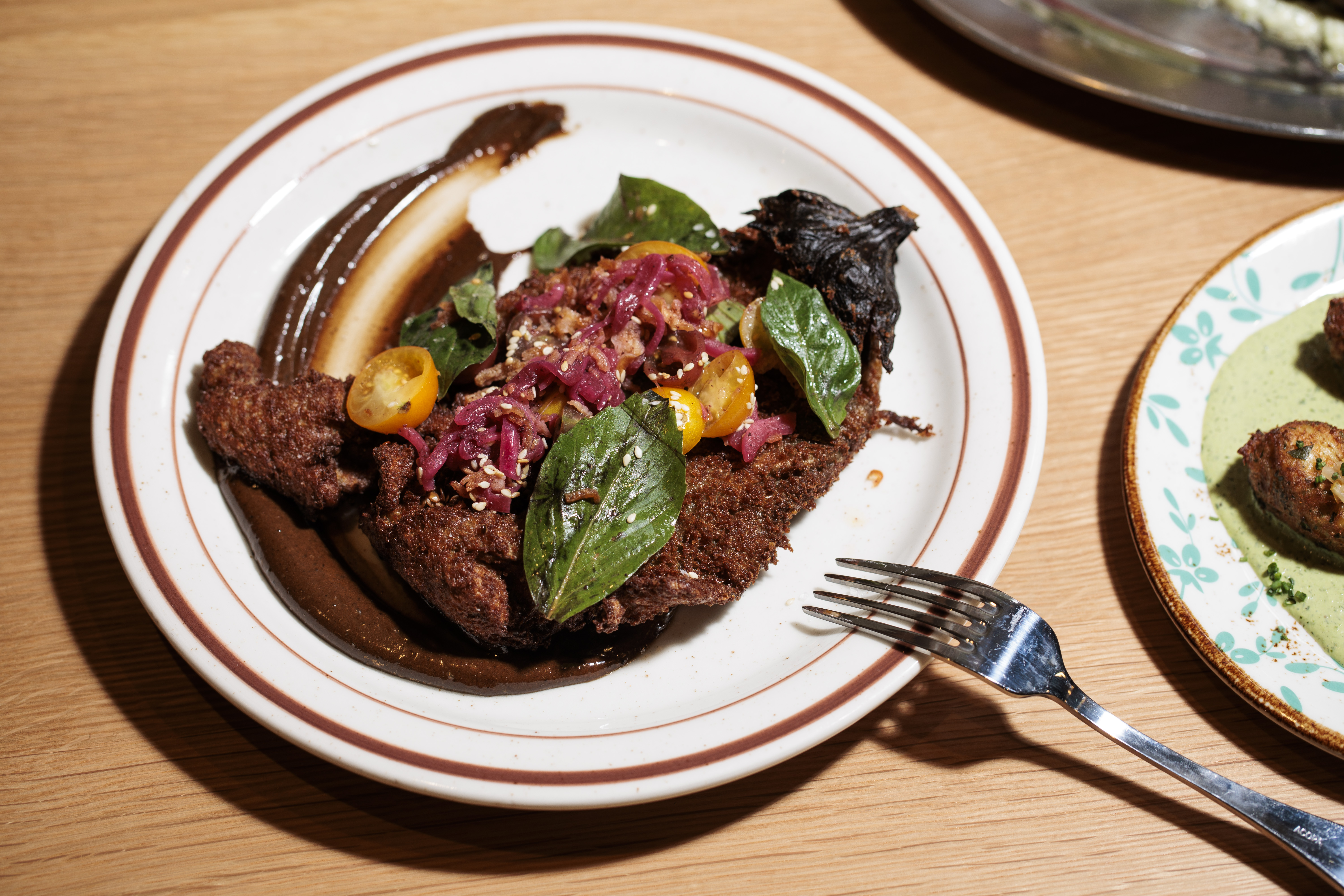
Such mock-meat successes opened my mind to the panko-crusted, lemon-infused tofu steak. It was not bad, especially over a colorful pile of sauteed asparagus and watermelon radish. But it was a bit boring compared to the most satisfying entree here, a whole smoked eggplant that’s deep-fried into a schnitzel, then placed over a black garlic aioli beneath a juicy tumble of fresh heirloom tomatoes tossed with Thai basil, sesame, and tart sumac.
The grilled whole branzino was a perfectly fine option for those craving fish, but it, too, was ultimately less engaging than that eggplant.
The smoked eggplant schnitzel at the Blue Warbler on Thursday, Sept. 3, 2026 in the Chestnut Hill section of Philadelphia.Monica Herndon / Staff Photographer
The desserts begin with two solid renditions of crème brûlée, including a classic vanilla custard, stylishly dusted with dried rose petals, and a seasonal variation that has so far ranged from strawberry to matcha and corn. I was most impressed by chef de cuisine Renee Rowlett’s creative deconstruction of a peach crisp into something lighter and more seasonal: A half peach caramelized with demerara sugar was posed over a crunchy mound of brown sugar-toasted almonds and buckwheat groats (a nod to the Ashkenazi Jewish thread woven through the Warbler’s menu) beside creamy maple soft-serve.
The peach crisp at the Blue Warbler on Thursday, Sept. 3, 2026 in the Chestnut Hill section of Philadelphia.Monica Herndon / Staff Photographer
Breakfast, lunch, and brunch are obviously key to the Blue Warbler’s success as an all-day cafe. And while this corner room soaks in the sunshine and exudes a pitch-perfect laid-back aura — I’d happily hang out here and drink that bold Cuban roast brew from Mayorga — our daytime meal was not the layup it should have been.
I would have loved my well-cooked omelet with zucchini, onion, peppers, and feta (and especially that side of cuminy tomato shakshuka sauce) but the kitchen forgot to add the zucchini. I’ll never pass up a socca chickpea pancake, but the Warbler’s rendition was unfortunately thick and scorched. The classic American-style pancakes with butterscotch were doughy. The cheddar biscuits were dense. Next time, I’ll definitely try the Turkish breakfast of eggs, tomatoes, and cucumbers over labneh with harissa.
Turkish breakfast at the Blue Warbler, in Philadelphia, June 11, 2026.Jessica Griffin / Staff Photographer
I’ll give the Warbler bonus points for hand-rolling their own bagels, even if the overly fluffy sourdough interior is not my ideal (not to mention the heat bubbles blistering its crust, which should be smooth). It nonetheless worked well enough as a vehicle for a breakfast sandwich stuffed with cheddar, eggs, arugula, and red pepper aioli. I especially liked that bagel hollowed out and stuffed with zesty green herbal tofu purée and tangy red peppadew peppers for the Herbivore sandwich.
All these flaws can surely be fixed with some tweaks. And considering how well the kitchen infuses seasonal creativity into the grab-and-go items that cycle onto the counter display on the bar throughout the day — from the muffin-shaped herb-and-feta “egg bites” to a fig- and fontina-topped schiacciatta bread still warm from the oven — such modifications are easily within their reach.
Mogul has already been so dialed in to all the details since embarking on making his restaurant dream a reality, I’m hopeful the Warbler will do that soon. There is already so much to appreciate at this promising — and needed — new addition to Chestnut Hill, I’ll look forward to watching it grow.
A schiacciata topped with figs and fontina at the Blue Warbler in Chestnut Hill.Craig LaBan / Staff
Breakfast and lunch 7 a.m. to 2 p.m. Monday through Friday. Dinner 5 to 9 p.m. Sunday, Wednesday, and Thursday, until 10 p.m. Friday and Saturday. Brunch 9 a.m. to 2 p.m. Saturday and Sunday. No dinner Monday or Tuesday.
Main plates, $15-$32 (including sharing platters).
Wheelchair accessible.
About a third of the menu is gluten-free or can be modified.
Menu highlights: Dinner: trio of meze dips; bacalao fritters; haloumi dates; smoked arctic char spread; Balkan and Chesco skewers; eggplant schnitzel; Impossible meatloaf; peach crisp. Breakfast-lunch: omelet; the Herbivore; egg bites; schiacciatta.
Drinks: Fresh and fruity takes on classic cocktails — Clover Club, Mai Tai with fresh orgeat, a pear martini, an amaro spritz, a spicy margarita, and fizzy Sgroppino — are worthwhile, alongside a selection of thoughtful N/A options. Local beers on draft and an international selection of well-priced wines by the glass ensure there’s something for everyone.
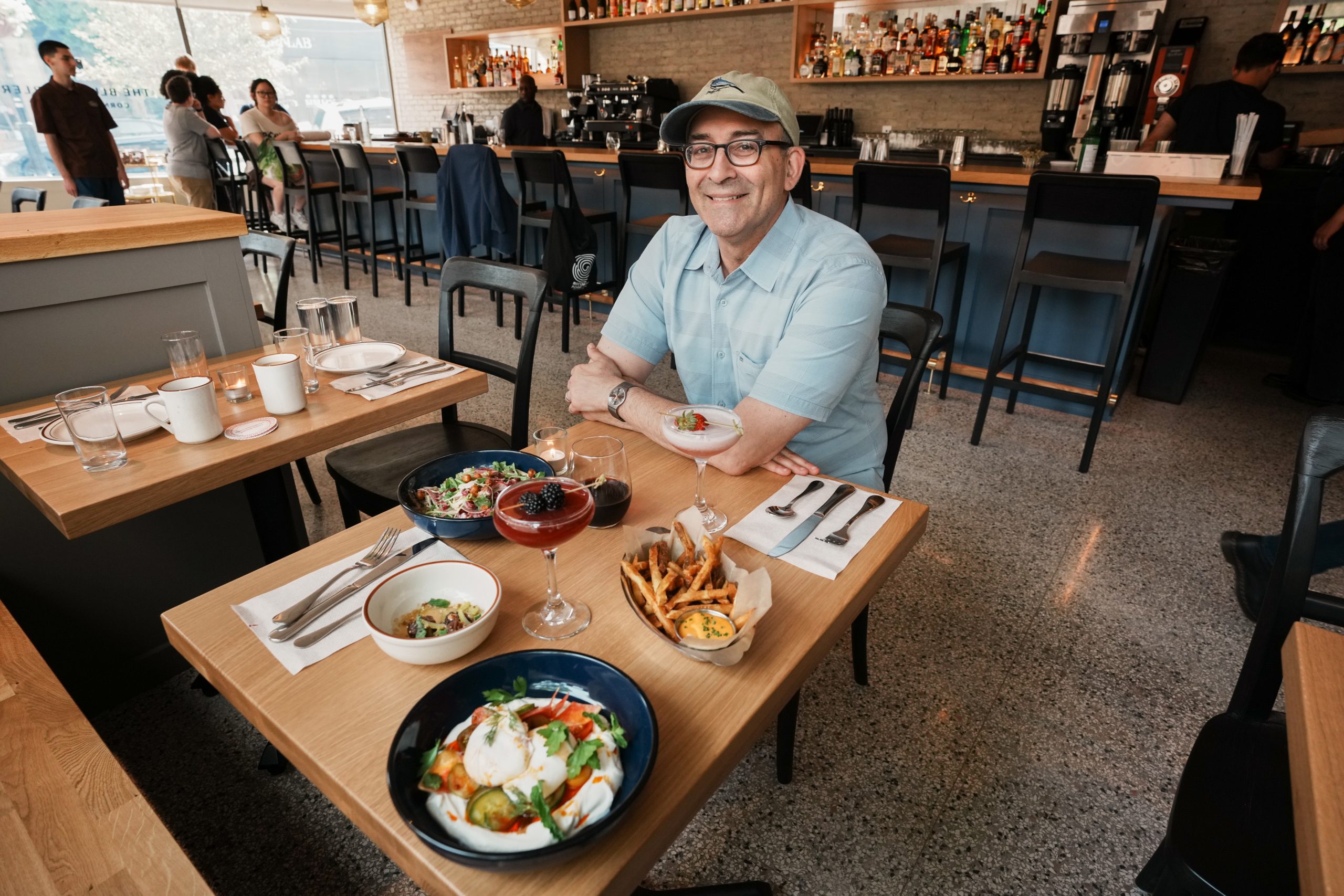
Owner Fred Mogul at the Blue Warbler, in Philadelphia, June 11, 2026.Jessica Griffin / Staff Photographer
The Eagles hit the road for their first away game of the 2026 season when they take on the Tennessee Titans on Sunday.
Coming off an uneven 24-22 victory over the Washington Commanders, the Eagles are big favorites over the Titans, with most sportsbooks and data sites giving them an advantage of about a touchdown.
The Titans lost a 23-10 home game in Week 1 to the New York Jets and have some issues on both sides of the ball. The Eagles should have plenty of advantages on Sunday.
Where might their biggest edges be?
Here’s a look at the numbers that could prove to be important Sunday afternoon in Nashville:
Tennessee Titans quarterback Cam Ward (1) scrambled a great deal in a Week 1 loss to the Jets. George Walker IV
41%
That’s how often second-year Titans quarterback Cam Ward was under pressure when he dropped back Sunday vs. the Jets, according to Next Gen Stats. He was 3-for-10 for 17 yards when under duress.
Ward is in the bottom tier of NFL quarterbacks, and he’s protected by an offensive line that Pro Football Focus ranks 29th in the NFL. That’s not a recipe conducive to a lot of success.
Rookie right guard Fernando Carmona allowed three pressures on 39 pass blocking opportunities in his NFL debut, according to PFF. Left guard Peter Skoronski is probably the best of the five starting linemen, but the Eagles should have an edge up front, inside and out.
The Jets applied pressure to Ward on six of their nine blitzes and had a pressure rate of 33.3% when they sent four or fewer pass rushers, according to Next Gen. It all added up to a pass rush win rate of 65%, according to ESPN, third-highest in the NFL in Week 1.
Vic Fangio said Tuesday that he thought his unit’s pass rush was “inconsistent and really wasn’t good enough.” But the Eagles pressured Jayden Daniels on 19 of his 38 dropbacks. Fourteen of those 19 pressures, and a 48.3% pressure rate, came with a four-man pass rush. They did only get Daniels to the ground once, though.
It remains to be seen if the Eagles get a boost with Jonathan Greenard’s return Sunday against the Titans, but they have the personnel up front to cause havoc Sunday regardless.
Jalen Hurts and the Eagles passing game will be in search of greater consistency Sunday. Yong Kim / Staff Photographer
176
Jalen Hurts threw for 203 yards in Week 1, and 176 of them came on throws that traveled at least 10 air yards, according to Next Gen, which counts any throw of 10 or more air yards as a “downfield” pass.
Hurts completed six of his nine downfield attempts and the Eagles scored all three of their touchdowns that way.
The running game struggled, and Hurts faced too much pressure, but the explosive plays to Dontayvion Wicks, Dallas Goedert, and DeVonta Smith showed some of the potential of the new-look offense.
The Titans allowed the sixth-most downfield passing yards last season, according to Next Gen, and they didn’t show in Week 1 that they’ll be less susceptible to it in 2026. The Jets completed four of their five downfield throws for 111 yards.
Cooper DeJean (left) did not have a banner Week 1 against the Commanders and was absent from the practice field on Wednesday. David Maialetti / Staff Photographer
16
That’s how many times Cooper DeJean lined up across Wan’Dale Robinson last season when the receiver was with the New York Giants. Those reps amounted to zero targets in Robinson’s direction. DeJean, according to Next Gen, was the only defender with at least 10 snaps against Robinson to go without a target. Robinson ran 25 routes from the slot against the Eagles without DeJean as his primary defender last season and caught six of seven targets for 90 yards and a touchdown.
Only nine receivers have accounted for more receiving yards from the slot than Robinson since he entered the league in 2022, according to Next Gen. The Jets did a good job against him in Week 1, allowing only two catches on three targets for 18 yards from the slot.
The third-year defensive back mentioned his eyes can sometimes “get bad” in coverage and it can hurt him.
“I think it can happen at times and at times it’s helped him, too,” Fangio said Tuesday when asked about DeJean’s comments. “He’s just got to make sure he can stay tight enough to his assignment and not let his vision get too skewed to where he gets out of position.”
It’ll be an interesting matchup with Robinson and DeJean Sunday, given their history and DeJean’s struggles in Week 1.
The Rev. Jay Bergen was at the sign-in table inside the Friends Center, where No ICE Philly was holding its regular public meeting last week, when a police civil affairs officer appeared.
Bergen asked what was happening, and said the officer responded, “We’re just here to make sure everyone’s safe.”
The activist group was preparing to serve cake, to celebrate its one-year anniversary.
Bergen, who leads No ICE Philly, was concerned that the officer brought his gun into the Center City facility, which includes a Quaker meetinghouse. The pastor escorted the officer down the hall to the door, explaining that he could attend the public meeting if he wished ― then noticed a second civil affairs officer outside.
The two officers stayed there, watching, for the duration of the three-hour gathering, Bergen said, their presence leaving those inside feeling confused, intimidated, and surveilled.
“Who gave the order, and what was the goal?” Bergen asked in an interview. “Why are we more of a threat than ICE agents are? … It’s another instance of the Philadelphia police being interested in targeting Philadelphians instead of protecting Philadelphians.”
The police department said in a statement last week that “the Sept. 9 event was identified as a scheduled protest.” Civil affairs officers routinely attend demonstrations as part of their duty to public safety and the First Amendment, and “their presence was not specific to No ICE Philly,” the statement said.
But on Monday, Staff Inspector Frank Palumbo, who oversees the civil affairs unit, said he would open an investigation into the matter.
Palumbo said he did not know why an officer would have entered the Friends Center. That would be outside department policy, he said, unless there was a disturbance inside.
The Friends Center at 15th and Cherry Streets.Alejandro A. Alvarez / Staff Photographer
If the group had gathered outdoors, Palumbo said, the department would have sent more officers ― including some in uniform. It did not do so, he said, because “there was no indication whatsoever that there would be destruction of property, violence, or anything that would even result in civil disorder.”
He added, “This will not continue to occur.”
Civil affairs units are specialized teams of officers designed to act as neutral liaisons between sides during what might be contentious protests, labor actions, or big public gatherings. Like other officers, they always carry their guns while on duty.
In Philadelphia, the police department says, civil affairs officers operate in a diplomatic and impartial capacity to ensure that constitutional rights are protected for all. The officers prioritize protection of life and property while preventing vandalism, assaults, or other illegal acts not covered by First Amendment rights, the department says.
Niles Wilson of the Center for Policing Equity, a California-based research and reform group, said a key question of any investigation into the matter should be why the officers were at the meeting at all.
“What intelligence did the police department have that would either lead these officers to do this, or were these officers acting on their own?” he asked. “That needs to be answered.”
The stakes reach beyond any particular meeting, he said.
A civil affairs unit is an asset, one that can help “towards transparency and building trust between the police department and the community,” Wilson said. But “anytime the public trust is lost in that service, then it disrupts public safety everywhere.”
Philadelphia civil affairs officers are commonly present at demonstrations led by No ICE Philly, which in the last year has emerged as perhaps the boldest and most visible of the city’s pro-immigrant organizations.
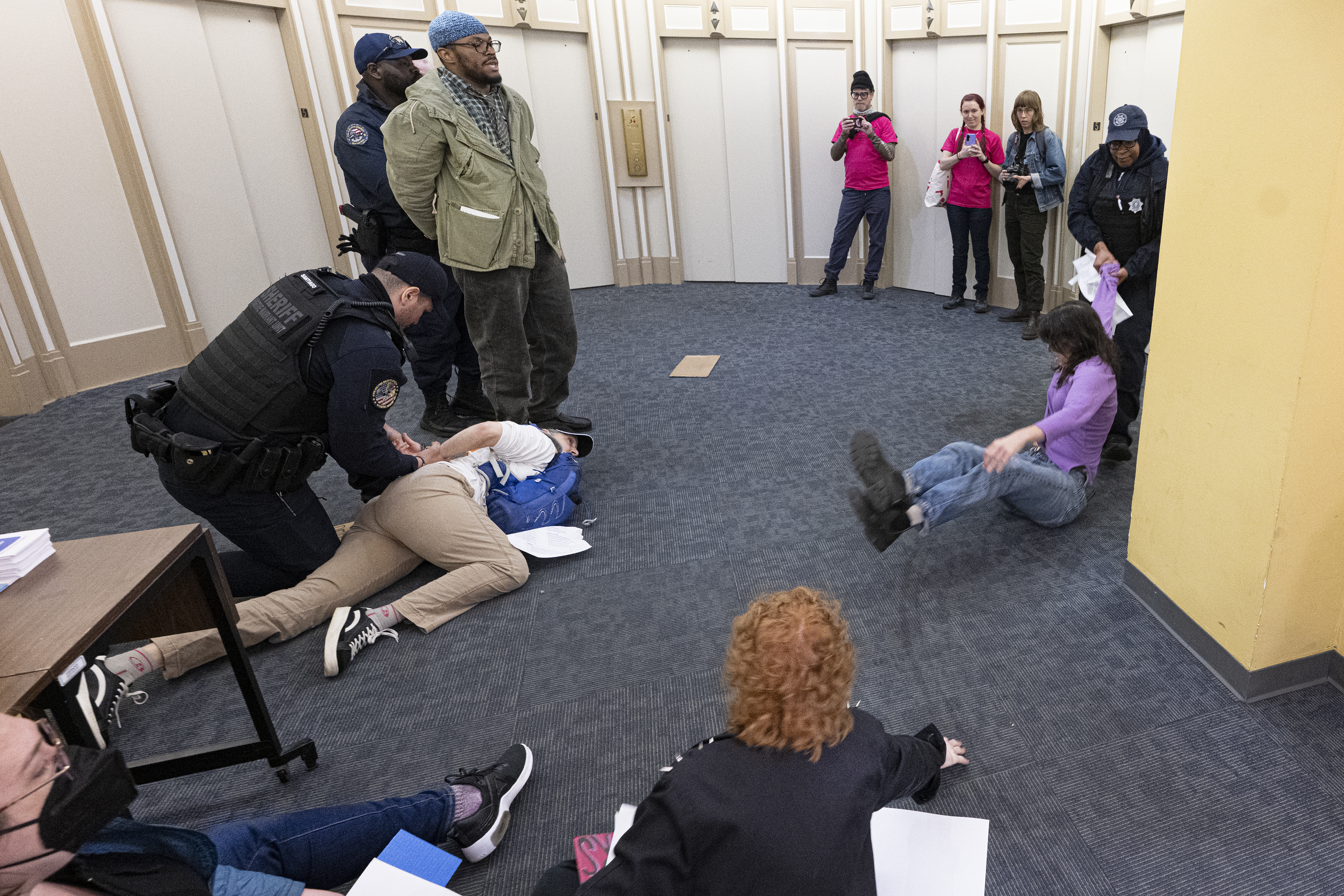
No ICE Philly activists and supporters are handcuffed and taken into custody at a sit-in outside the office of Sheriff Rochelle Bilal in April 2026.Jose F. Moreno / Staff Photographer
The Sept. 9 gathering, however, was a regular meeting, generally held twice a month, open to all, and advertised in advance on social media. Other meetings have drawn far more people than the 60 or so present at this one, organizers said, which made the police presence puzzling.
“It felt kind of like a threat, like, ‘We’re watching,’” said Em Auerbach, a group member who attended. “It made people feel on edge.”
As the meeting was ending, Auerbach said, one of the officers approached a Friends Center employee at the front desk and asked: “Are you good? Do you need anything?”
The worker answered that she was fine, Auerbach said.
No ICE Philly members waited for the employee to finish her work, and then everyone left together, Auerbach said.
“It was weird,” Auerbach said of the officers’ presence. “I think they were there to intimidate us. … Unless there was a threat against our group, I don’t think this was a good use of taxpayer funds.”
Bergen described at one point asking the officers, “‘Why are you surveilling us?’ They said, ‘We’re not surveilling.’ I said, ‘That’s what a body camera is for.’”
The pastor said that as people entered the meeting, they said the police officers had asked who they were and why they were there.
Palumbo said if that happened, it would fall outside department policy, that even at combative street demonstrations people generally are not asked their names “unless it is necessary to determine who they are for the purposes of an investigation. This was not an investigation.”
Palumbo said the relationship between the police and No ICE Philly has been cordial. He estimated that police have cited protesters twice in the last year, issuing citations with $100 penalties that are similar to parking tickets.
Those citations, he said, are “the most extreme police enforcement we’ve ever done with this group.”
Correction: This story has been updated to correct the pronouns used by Rev. Jay Bergen and Em Auerbach.
Even in an age where driving is as safe as it has ever been, hundreds of people still die on New Jersey roads each year.
Across South Jersey, an analysis shows, there are seven corridors that are particularly problematic — stretches where four or more people have died in crashes in the last seven years.
The Inquirer analyzed about 330 fatal crashes across South Jersey’s limited-access highways, which led to more than 360 deaths between 2019 and July 2026, according to New Jersey Department of Transportation data.
Drive north along I-76 to Philly or take Route 42 south to the Shore, and you will likely cross one of South Jersey’s most dangerous sections. The interchange where I-76 meets Route 42 and I-295, in Camden County, has recorded some of the highest rates of fatal accidents in the region, as city commuters, long-haul truckers, and beachgoers navigate a snarled intersection.
(function() {
var l2 = function() {
new pym.Parent(‘risk_corridors_map_4’,
‘https://media.inquirer.com/storage/inquirer/projects/innovation/arcgis_iframe/risk_corridors_map_4.html’);
};
if (typeof(pym) === ‘undefined’) {
var h = document.getElementsByTagName(‘head’)[0],
s = document.createElement(‘script’);
s.type = ‘text/javascript’;
s.src = ‘https://pym.nprapps.org/pym.v1.min.js’;
s.onload = l2;
h.appendChild(s);
} else {
l2();
}
})();
I-76 in South Jersey runs five lanes wide in both directions and spans only three miles, but each mile has seen fatalities. And within a 1.3-mile stretch, 10 fatal crashes occurred, more deaths than on any other highway segment. On the mile of I-295 leading up to the I-76 merge, four fatalities occurred.
“There are a whole bunch of reasons why, around intersections, you have crashes,” said Chris Pollard of the Delaware Valley Regional Planning Commission.
Highways like I-76 with tricky merges, heavy congestion, and sharp bends are more likely to be fatal than calmer sections of road, Pollard said. When cars go around curves or merge at high speeds around other, slower-moving vehicles, accidents are more likely.
“It’s often based on the geography of the road,” Pollard said.
I-76 in Camden County near the I-295/I-76/Route 42 Interchange construction on Thursday, Sept. 17, 2026 in Bellmawr, NJ.Monica Herndon / Staff Photographer
Distracted driving played a role in nearly half of South Jersey’s fatal car crashes, contributing to more than 140 deaths, while alcohol was a factor in more than 75 fatal accidents.
Other dangerous hot spots in South Jersey include a mile stretch of I-295 in Oldmans Township, Salem County, where seven fatal crashes occurred, a half-mile stretch of the New Jersey Turnpike in Mount Laurel Township, Burlington County, with four fatal crashes, and a 0.6-mile stretch of I-676 before the Ben Franklin Bridge, with four fatal crashes.
(function() { var l = function() { new pym.Parent( ‘sj-crashes3__graphic’, ‘https://media.inquirer.com/storage/inquirer/ai2html/sj-crashes3/index.html’); }; if(typeof(pym) === ‘undefined’) { var h = document.getElementsByTagName(‘head’)[0], s = document.createElement(‘script’); s.type = ‘text/javascript’; s.src = ‘https://pym.nprapps.org/pym.v1.min.js’; s.onload = l; h.appendChild(s); } else { l(); } })();
A recent call for safer highways
A string of fatal crashes on one of South Jersey’s safer highways this summer has legislators asking questions.
Since July, four crashes have killed five people on Route 55, a 40-mile freeway that runs from Cumberland County up to the Route 42 entrance in Deptford.
In response to the string of crashes, Assemblyman William Moen, a Democrat in the New Jersey Legislature, cosigned a letter with eight other politicians to NJDOT, urging the department to examine how Route 55’s design could have led to the deaths.
Moen’s social media post about the highway reached more people, about 200,000, than any post he has made in his decade as an elected official, he said. The interactions showed him the public wants answers, too.
“There’s always that question of, ‘Could there be things that are being used on other highways that the state operates that simply aren’t in place on Route 55?’” Moen said.
Unlike some of the region’s more complex roadways, Route 55 is onlytwo lanes, and has few, if any, sharp bends.
Still, 46 people have died on the highway between 2019 and this July. One 0.64-mile-long segment of Route 55, by Mantua Township, Gloucester County, has seen a high volume of fatal crashes, four total, in recent years. That included a crash that killed a Bridgeton resident in a wrong-way crash in July.
As a result of the letter, NJDOT is in talks with legislators to “identify safety improvements needed along the corridor,” according to Steve Schapiro, an NJDOT spokesperson. Miranda Toner, Moen’s spokesperson, said the assemblyman has since been briefed by NJDOT on the matter and has received an official letter from the department outlining plans for Route 55.
Route 55 near the Pitman Road overpass on Thursday, Sept. 17, 2026 in Pitman, NJ. NJ DOT sent a letter to concerned legislators about Route 55 in Gloucester County, saying new safety improvements would be added.Monica Herndon / Staff Photographer
In January 2025, the legislature approved the New Jersey Target Zero Commission, created to eliminate “all traffic fatalities and serious injuries” on public roadways by 2040.
Part of that law required NJDOT to track the state’s fatal crash data through its High-Injury Network, which flagged one-mile segments of public roadways with seven or more fatal or serious-injury crashes between 2021 and 2023. Since NJDOT updates the map every three years, recent crash data will not be available there until 2028.
No segments of Route 55 are currently featured on the network, but various miles of roadways throughout Camden, Gloucester, Burlington, and Cumberland Counties made the list.
Schapiro said 90% of state-maintained, one-mile segments on the High-Injury Network, which includes 88 locations, are currently undergoing projects, and the rest will start safety projects, too. Plus, the department regularly uses its data to identify high-risk areas, crash patterns, trends, vulnerable populations, and driving times.
Correction: This story was updated to correct the Gloucester County municipality with the high-fatal-crash corridor on Route 55.
The flu season is upon us. How many will turn away from vaccination, clinging to some politicized belief that they have the “right” to distrust validated medical science? It is a regrettable legacy for the Kennedy name — one that risks associating it not with public service, but with the resurgence of preventable diseases.
Richard O’Connell, Philadelphia
Building bridges
What is wrong with a representative who is willing to cross party lines when they agree with the other party’s position? Isn’t this what we want them to do to reach a compromise to get things done instead of this stalemate we currently have?
We need more representatives like John Fetterman, not fewer. He should be praised, not criticized.
Robert Mattern,Wilmington
Expand imagination
As board chair of Arts Holding Hands and Hearts, I want to draw attention to an extraordinary milestone in our community: More than 11,500 children in Chester County are now registered for Dolly Parton’s Imagination Library. Thousands of others in the Philadelphia metro area are currently enrolled through local library systems and funding partners. This number represents far more than books — it represents hope, opportunity, and the belief that every child deserves the chance to dream more, learn more, and be more.
To honor Parton’s life, along with the announcement that Sept. 25 will be “Give Like Dolly Day,” Pennsylvania has an opportunity right now to expand this impact statewide. Senate Bill 459, which would support the statewide expansion of the Imagination Library, is currently before the legislature. I urge readers to contact their state senators and ask them to vote yes on SB 459. This is not a political issue — it is a commitment to our children’s futures.
I also call on Gov. Josh Shapiro and leaders across Pennsylvania to champion this effort. Dolly Parton has shown what is possible when we invest in children without hesitation or division. We should follow her example and ensure every child in our commonwealth has access to the tools, support, and opportunities that early literacy provides.
Our kids are ready. Our communities are ready. Now we need our leaders to be ready, too.
Doug Doerfler, Kennett Square
Join the conversation: Send letters to letters@inquirer.com. Limit length to 150 words and include home address and day and evening phone number. Letters run in The Inquirer six days a week on the editorial pages and online.
ARIES (March 21-April 19). One piece of your life will click into place today, and the rest of the day will go a little better because of it. A solved problem at work may give you more patience at home, or the other way around.
TAURUS (April 20-May 20). You’re still getting to know someone. Social media posts, dating profiles and resumes project one image. Reputation sheds a more objective light, and some interactions produce another take entirely. Each angle informs, but none tell the whole story.
GEMINI (May 21-June 21). Because you really want the best for the group, you’re trying to see projects with a more communal eye, blurring the benefit of any particular individual in hopes you can sense the overall good. You’ll have some success with this.
CANCER (June 22-July 22). The reason you pause before making even a seemingly small choice? You know how small things escalate, sometimes delightfully so. Once upon a time, you said, “I’ll try the …” and that isolated moment has informed a hundred other decisions.
LEO (July 23-Aug. 22). Each mind makes its own pictures. Light comes from the outside, but the appearance of it comes from the inside. Today, you’ll have an entirely different impression of things than the next person, and it’s important to say your version.
VIRGO (Aug. 23-Sept. 22). In Greek cosmogony, khaos was the gaping space before the formed universe. When you witness a bit of chaos today, think of it not as the dismantling of order or the breakdown of a system but instead as the moment before creation.
LIBRA (Sept. 23-Oct. 23). Your opinion of yourself can change by the minute, but it’s better for the work at hand if you stick to one confident stance today. You know what you can do and you can be unwavering in that knowledge. Now’s the time.
SCORPIO (Oct. 24-Nov. 21). There is a powerful pleasure in knocking down something that is smug, showy or acting superior. Today, a puffed-up claim may give you the opening. One well-placed joke may make your point and get a laugh from the right people.
SAGITTARIUS (Nov. 22-Dec. 21). Music has no practical purpose, and neither do most of the best things from candy to kisses. Devote some of the day to the impractical and purposeless things that make life delicious.
CAPRICORN (Dec. 22-Jan. 19). You’ve reason to be confident about your route, although it may not be something you can prove on paper yet. You can trust your gut today — good, because you won’t have time to wait around for the perfect instruction.
AQUARIUS (Jan. 20-Feb. 18). Of course we can only see what’s on the surface of others, but you wouldn’t for a second believe that’s all there was. You’ve never met a “shallow” person in your life. There’s always more, and your deep respect for this will inform today’s decision.
PISCES (Feb. 19-March 20). There are some things you’d rather not think about, but it’s not particularly helpful to ignore the entire chapter of life because of a few bad paragraphs. Memories can hurt, but they can also give you comfort, strength and a new plan for going forward.
TODAY’S BIRTHDAY (Sept. 17). In your Year of Creative Competence, you pour your innate genius into tangible forms, mastering craft and expanding the reaches of what’s possible. Projects, relationships, career and home thrive inside your vision. More highlights: You’ll publish, you’ll take part in an unforgettable event that will repeat for years, and you’ll make big sales and domestic upgrades for better daily living. Libra and Leo adore you. Your lucky numbers are: 20, 5, 14, 29 and 3.
DEAR ABBY: My husband (80) and I (72) have been married 25 years. This is the second marriage for both of us. Until three years ago, I felt I had a wonderful relationship with his family, so it’s hard to deal with what he’s done to me and my relationships with them. A new daughter-in-law, “Jean,” who has a granddaughter, “Sophie,” has fostered a secret relationship between my husband and this child, who is now 4. I was shocked when they came over on his birthday last year and Sophie was all over him, calling him grandpa, etc. It was apparent what had been going on. I felt humiliated at being excluded but said nothing, as I had been looking forward to getting to know the child. I believe Jean has her eyes on my husband’s money. I suspect he used our joint checking account to buy a life insurance policy with this little girl as a beneficiary. I believe Jean thinks my husband (and I) should foot the bill for Sophie’s college education.
Now my husband wants a divorce. We’ve had some rocky years due to his health, but this takes the cake. This DIL is greedy and brazen. My husband did not want his son to marry her in the first place, but she had a plan. I have done nothing wrong (though he accuses me of cheating), and it is heartbreaking that his family is ghosting me. How do you fight a liar?
— ILL IN ILLINOIS
DEAR ILL: Dealing with a manipulator like Jean can be a nightmare. If you haven’t consulted a divorce lawyer, do so now, and make sure the insurance policy is the first thing you mention. A lot of your story is Jean’s word against yours, but if such a policy was created without your knowledge, your husband could be in big trouble. It may be of utmost interest to your attorney.
** ** **
DEAR ABBY: My oldest son, “Mitch,” from a previous marriage, passed away six months ago. He had five children and two grandchildren. Admittedly, I hadn’t been the most attentive grandparent over the years. I got along well with them, but I wasn’t always around because I was raising my own family. Since Mitch’s death, I haven’t heard a word from any of them. His kids are grown; the youngest is 24. Mitch’s wife has made it known that I am not needed in their lives. She said she needs time and space. I’m respecting that, but I’m not happy that I don’t get to see one of my great-grandsons. Should I force the issue and show up at her door one day? I don’t want to alienate them, but it’s becoming obvious that I’m out of their lives forever. These are sad times. I miss my son as much as they do, but they don’t care about me.
— DOWN AND OUT IN INDIANA
DEAR DOWN AND OUT: You mentioned that you “weren’t the most attentive” grandparent over the years. Did this include forgetting them on birthdays, Christmas, graduations and so forth? If the answer lies between “maybe” and “yes,” then it shouldn’t be surprising that your grandchildren learned to do without you in their lives. Allow me to offer this suggestion: Rather than show up unannounced, it might be more effective to reach out to them individually.
Political parties in Philadelphia can now spend unlimited amounts of money in coordination with their chosen candidates, according to a new board of ethics policy approved Wednesday.
For instance, in next year’s city elections — when Mayor Cherelle L. Parker and all 17 City Council members will be up for reelection — the candidates endorsed by the Democratic City Committee could be able to access major financial advantages over their Democratic primary rivals, if the party chooses to coordinate with them.
Candidates are still bound by the city’s strict campaign finance rules limiting the size of donations to their campaigns — no more than $3,700 per year for individual donors, and $14,800 for organizations — and prohibiting them from coordinating with independent expenditure committees, or outside groups that spend money on candidates’ behalf.
But endorsed candidates will now be the only primary contenders allowed to coordinate with a group that has no restrictions on how much money it can collect: the party. The candidates, for instance, will be able to work with the party on messaging strategy, the timing of TV ads, and where to deploy door-knocking canvassers.
While the policy does not allow donors to require that parties spend their money on particular candidates, endorsed politicians with deep-pocketed backers can encourage donors to contribute to the party, with the understanding that the party will ultimately decide how the money is spent.
The Philadelphia Council members inside the caucus inside City Hall in Philadelphia, Pa on Thursday, June 11, 2026.Aidan T. Gallo / Staff Photographer
The impact of the new policy will depend on how aggressively candidates, parties, and donors seek to take advantage of it. But it has the potential to steer power in some elections back toward the city’s Democratic establishment after a period in which labor unions, special interest groups, and progressive super PACs have become increasingly influential.
“This Supreme Court ruling is going to have the effect of shifting power back to political parties and away from independent expenditures in a lot of ways,” said Philadelphia elections lawyer Adam Bonin.
In National Republican Senatorial Committee v. Federal Election Commission, the Supreme Court in June overturned limits on how much money parties could spend in coordination with candidates, citing parties’ free speech rights. The 6-3 decision, with the conservative justices in the majority, was widely seen as the latest in a series of cases that have demolished longstanding rules around money in politics.
But the NRSC case centered on a law related to general elections for federal office, and it was not initially clear whether the Philadelphia Board of Ethics would determine the ruling applied to local elections and to primaries.
The board, in a 4-0 vote with member Nelson Diaz absent, approved a policy that answered both of those questions affirmatively, meaning local political parties are now able to coordinate with their chosen candidates in primaries.
In deep-blue Philadelphia, where Democrats hold a 7-1 voter registration advantage over Republicans, the party’s primary contests usually determine the outcomes of elections.
The new policy holds that the party can only coordinate with its nominees in general and special elections. In primaries, the ethics board will allow the parties to set their own rules for determining their preferred candidates that they can coordinate with. The Democratic City Committee determines its endorsements by holding a vote among its ward leaders.
The policy, meant to clarify the city’s rules in advance of next year’s municipal elections, is temporary. The full details of the new rules will be fleshed out in regulations the board will tackle in the coming months.
Philadelphia Democratic Party Chairman Bob Brady on May 18, 2026.Tom Gralish / Staff Photographer
Democratic City Committee Chairman Bob Brady said the party was “still reviewing the new guidelines.”
“Protecting constitutional rights remains a priority of the Democratic Party, especially the right to participate in our democratic process,” Brady said in a statement. “We will continue the work to ensure that the final implementation of these policies and laws will right the wrongs that have too long infringed on First Amendment rights.”
To be sure, there are significant roadblocks for candidates hoping to benefit from the new policy. In crowded primaries, for instance, the Democratic City Committee often declines to endorse when a majority of ward leaders fail to coalesce around one candidate. And the candidates and parties would have to find donors willing to give large sums knowing that they cannot control how the money will be spent.
Additionally, Bonin said, the new policy may still be more restrictive than what the Supreme Court decision appears to have envisioned because the board is seeking to maintain many of the city’s existing campaign finance rules.
“They are doing it in a way in which, initially, it seems they’re trying to change their rules as little as possible, while still recognizing they need to act,” he said.
The policy could also have an impact on elections for the two seats on Council that are set aside for minority-party or independent candidates. Republicans held those seats for about 70 years before Councilmembers Kendra Brooks and Nicolas O’Rourke of the progressive Working Families Party won them in the last two election cycles.
City Council candidates Kendra Brooks and Nicolas O’Rourke celebrate after the Working Families Party declared victory at their election night gathering at Roar Nightclub in Philadelphia, Pa. on Tuesday, Nov. 7, 2023.Monica Herndon / Staff Photographer
Before Wednesday, it appeared possible the ruling could create an uneven playing field, with the Republican City Committee being allowed to coordinate with its nominees while the Working Families Party was unable to do so because it is not a major political party under state law.
The language of the board’s approved policy, however, effectively gives the Working Families Party the same rights as the Democratic and Republican Parties because it fielded candidates in the most recent municipal election.
Republican City Committee chairman Vince Fenerty celebrated the ethics board’s decision.
“I’m very happy,” Fenerty said. “It will make our candidates be able to interact with other groups easily, and hopefully it will be a good day for the Republican Party of Philadelphia when we can have good funding to be victorious in some municipal elections.”
A Working Families Party spokesperson said this summer that the party opposed the Supreme Court’s attacks on campaign finance law, but did not rule out the possibility of the progressive group taking advantage of any new policy.