I have been faking it for 25 years. Not about the people and issues that matter to me. Not my work or anything like that.
But in the way everyone tells you to “fake it till you make it.” Get up. Go to work. Act like you’re doing fine when you’re not, hope nobody notices, and hope you’ll eventually get better.
When I got to ground zero late on Sept. 11, 2001, nothing felt real. Therapists have since explained that I may have slipped into what they call a dissociative state, and it was frightening.
I hadn’t exactly lost my grip on reality, but I felt detached, like I was living in a movie, feeling uncertain about what was real and what wasn’t.
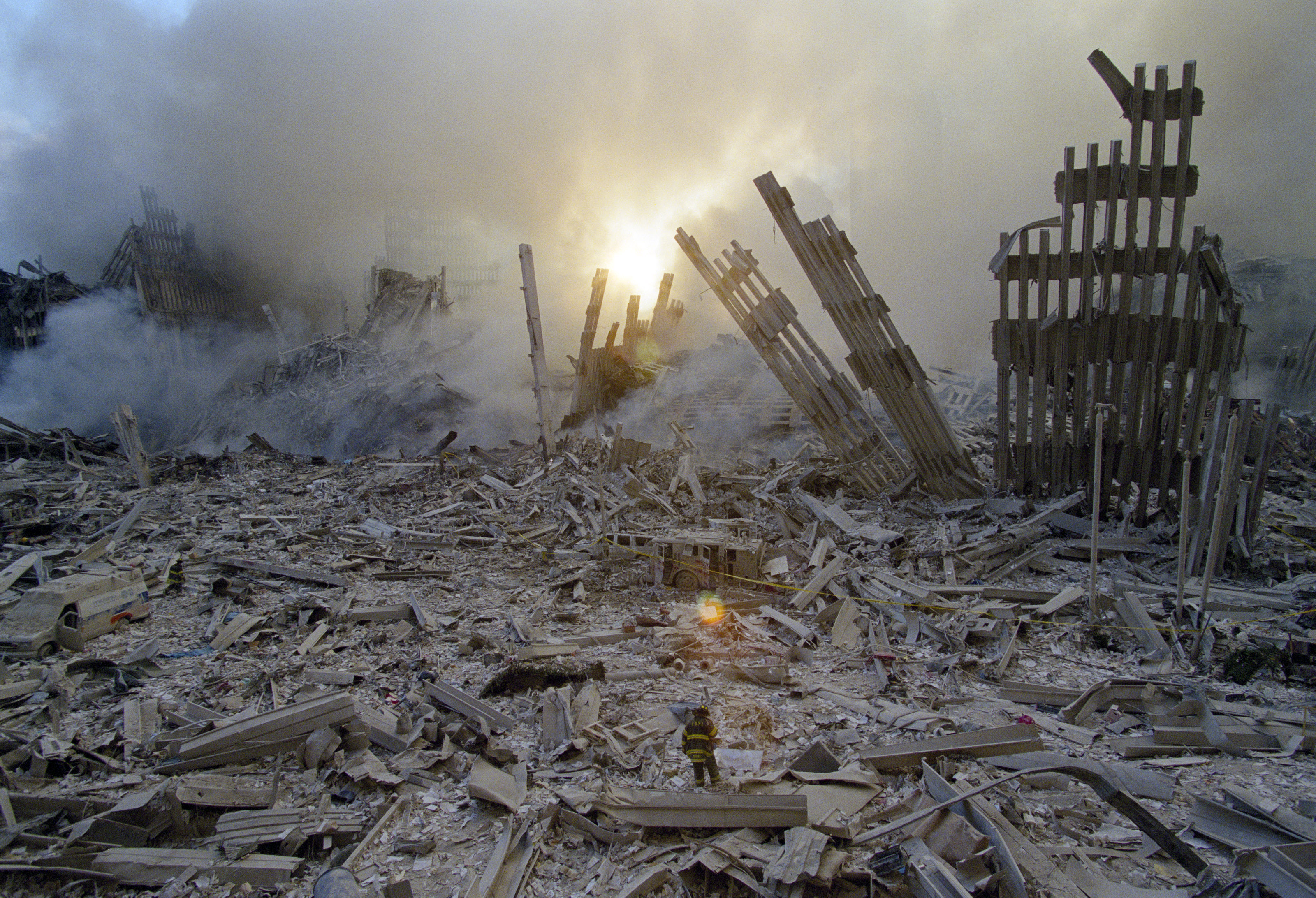
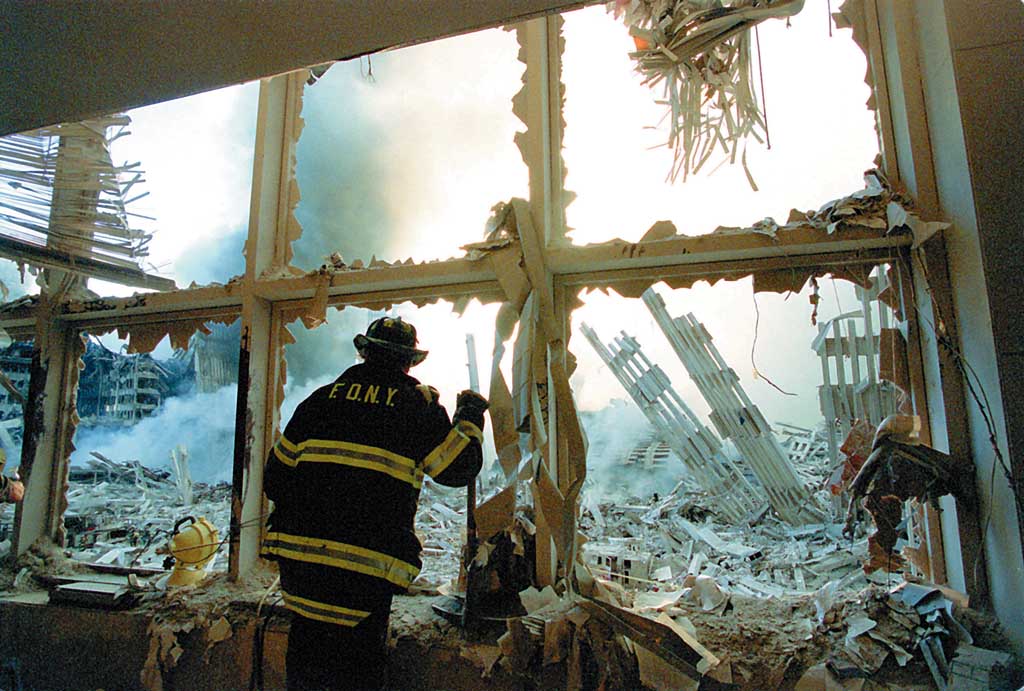
A New York City firefighter looks out onto the collapsed World Trade Center on the morning after the attack of Sept. 11, 2001. Chronicling the devastation there has haunted the author over the years.
I managed to keep taking pictures, leaning into the parts of myself that were still working, as I have in some ways every day since.
My friend and colleague Chris Brennan, the reporter with whom I had gone to the scene for the Daily News, later wrote about our journey together and the early aftermath.
A harrowing aftermath
The next 18 months were the worst for me, filled with flashbacks, nightmares, extreme insomnia, memory blackouts, mood swings, and broken relationships.
Serendipitously, a psychiatrist wrote to me in early 2003 about acquiring some of my photographs for instructional use. She also sensed what I was going through, and provided the treatment I needed to get the most crippling symptoms under control.
But that wasn’t the end of the story. Far from it.
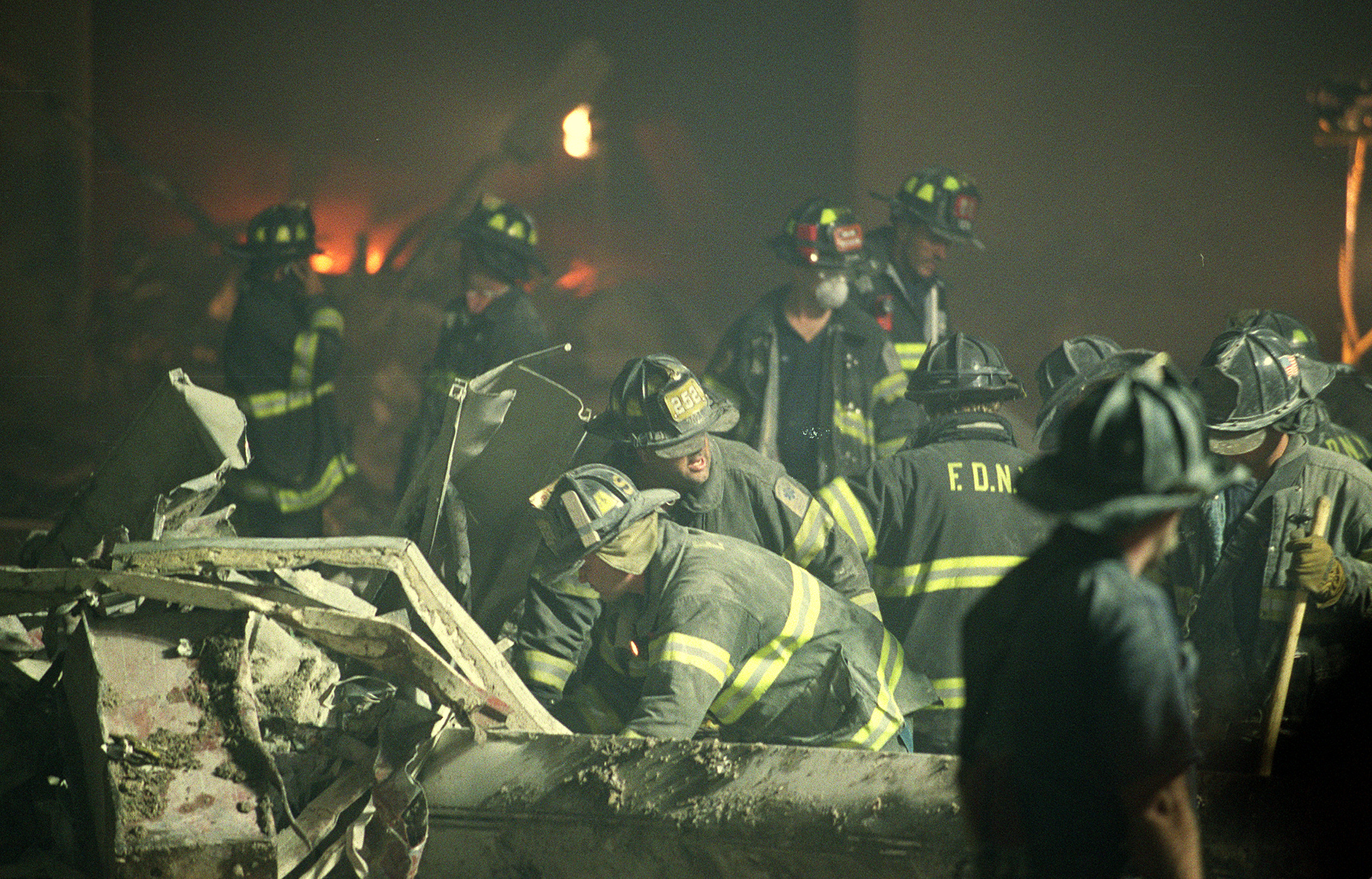
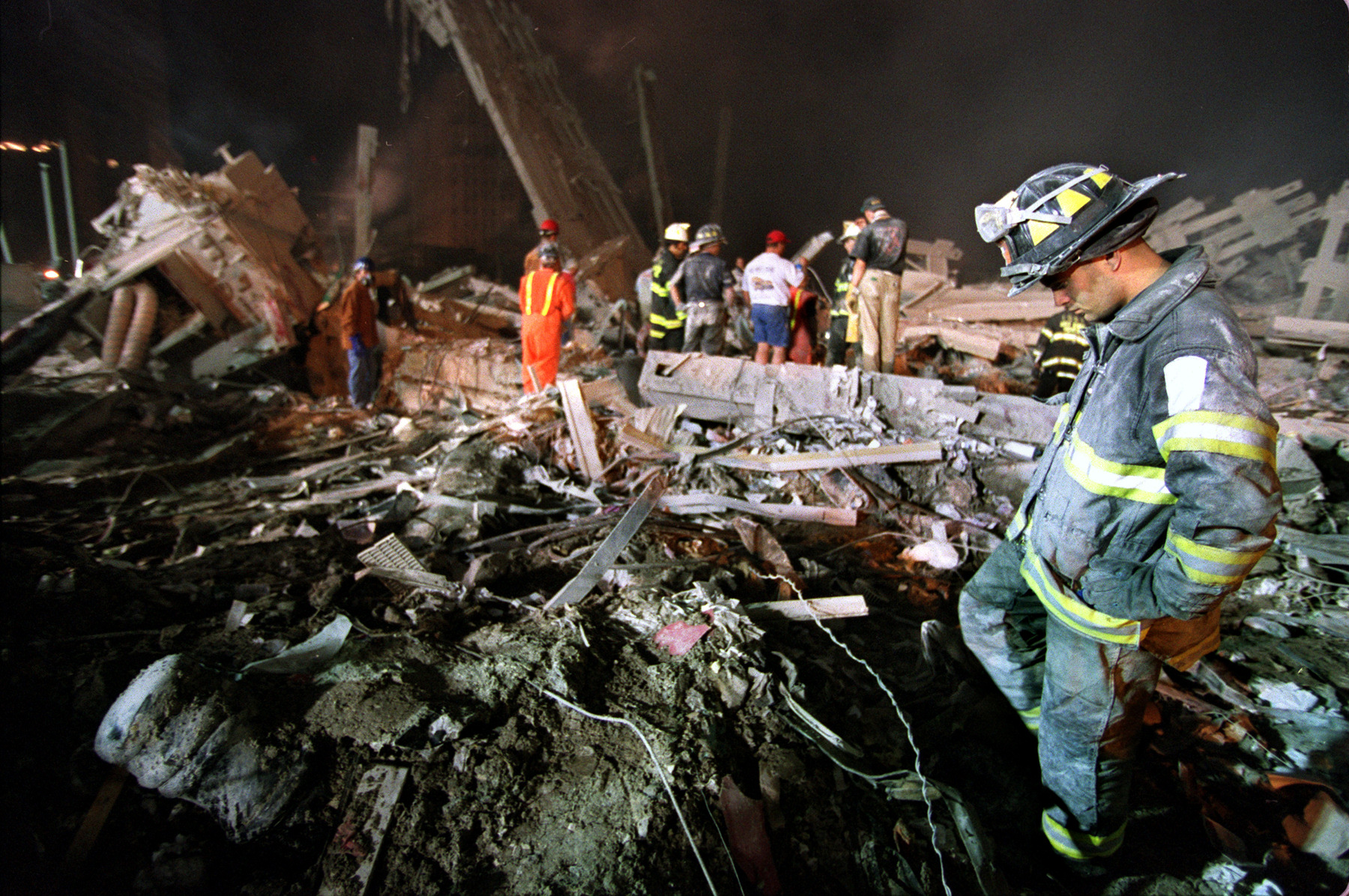
New York City firefighters sift through the rubble of the World Trade Center on the evening of Sept. 11, 2001.Jim MacMillan
From the outside, what followed looks almost ridiculously good: a career filled with fellowships, faculty appointments, and even a Pulitzer Prize in 2005 for my photographs from the war in Iraq.
I had accompanied U.S. troops on hundreds of combat missions over the course of a year, feeling indestructible following my initial recovery, but then some new and old symptoms emerged, and I needed more care when I got back. I got better again, although I still overreact when startled.
One of my pictures from 9/11 went on to have a remarkable life of its own. The New York Times wrote about the time it toured alongside some of the great artworks of the 20th century. My alma mater, Tufts University, hung it in a gallery next to a Picasso.
Looking back now, it feels painfully obvious that I have also spent the past 25 years stockpiling accomplishments as if to prove I was OK, probably to myself as much as anyone else.
We talk a lot in the news about surviving terrible events and their immediate aftermaths. And we love stories of recovery. But we don’t talk much about the long tail of trauma.
Our traumatic pasts aren’t so easily fooled. There is no unseeing what we have seen.
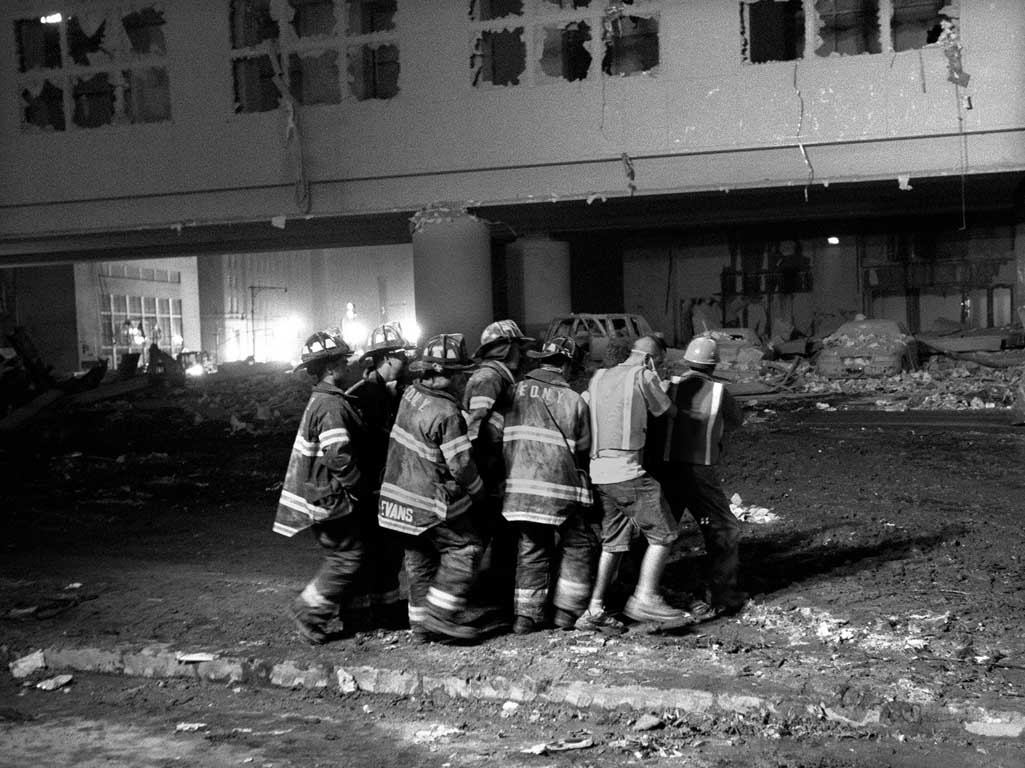
Rescue workers carry a body from the ruins of the World Trade Center to a temporary morgue at the heavily damaged Dow Jones Building in the early morning after the Sept. 11 attack.
I still have occasional nightmares and persistent phobias that seem obviously related to things I saw at ground zero.
And random reminders can bring me back there in every sense. The smoke and rubble appear behind my eyelids in an instant. I can hear the sounds and taste the dust. My breath deepens, and my skin crawls again.
Giving back
Most of the time I am completely fine. Sometimes I get triggered, and I’ve got my hands full again for a couple of days or a couple of weeks. I had a bad year not so long ago.
Living my best life takes maintenance, just as I imagine countless people quietly manage other long-term health challenges.
Since 2006, I have also spent a lot of time studying and teaching students and journalists about trauma. Giving back has felt both cathartic and critical to maintaining my well-being.
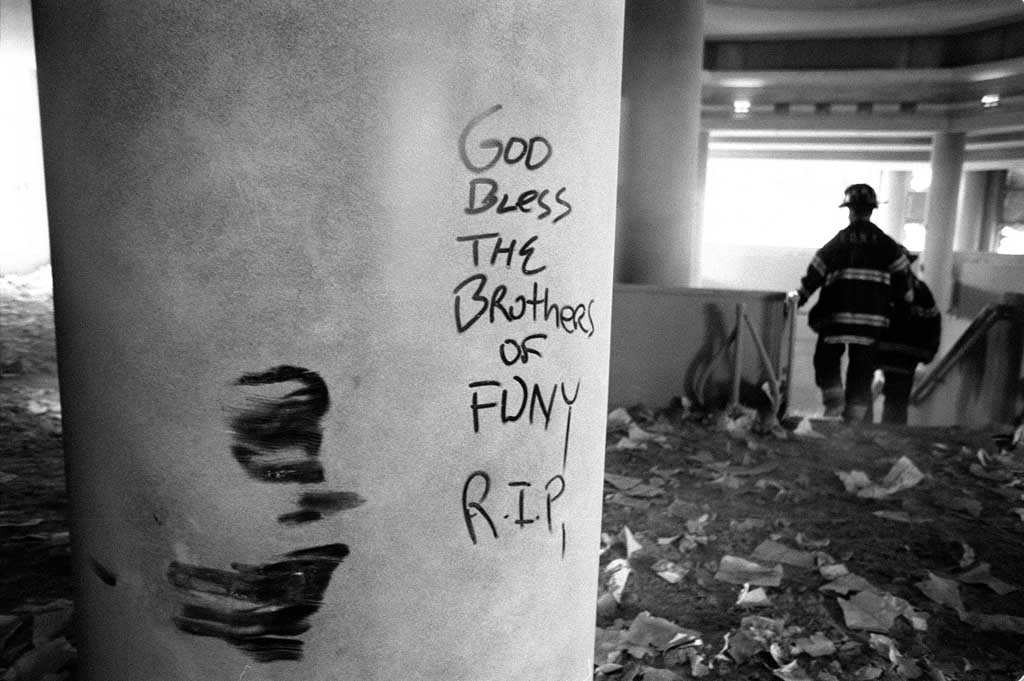
A message is scrawled in ash on a column inside One Financial Center, adjacent to the World Trade Center ruins at ground zero.Jim MacMillan / Staff Photographer
But while journalists and other first responders are frequently invited onto stages for these conversations, most people carrying trauma will never get the spotlight.
Domestic violence and other crimes can alter lives without ever making the news. Trauma can accumulate alongside structural violence, from racism and concentrated poverty to overpolicing and mass incarceration.
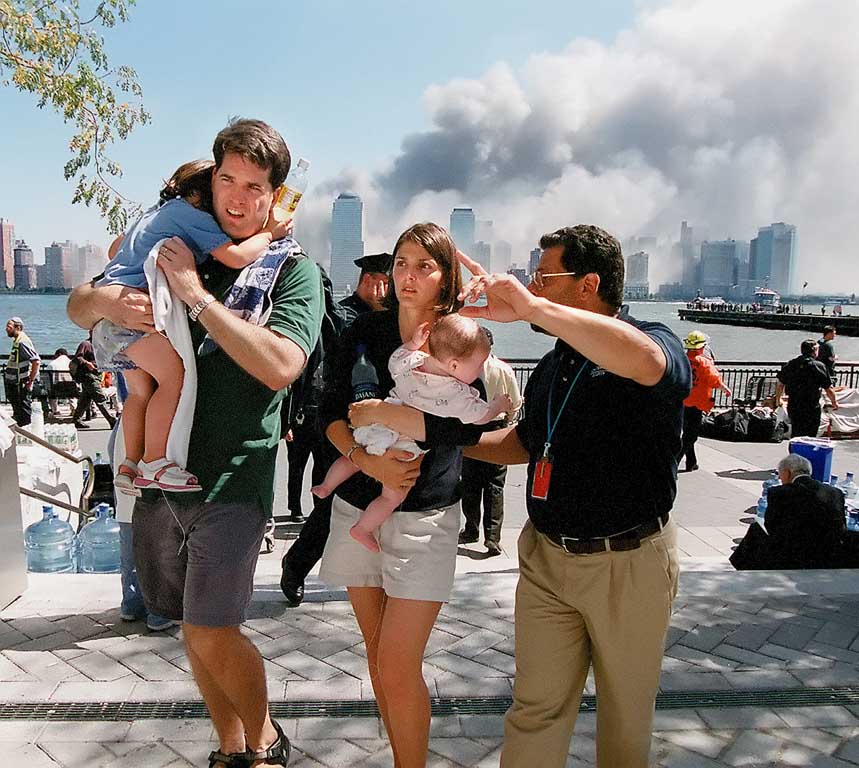
Rescued from Lower Manhattan, a family lands in Liberty State Park in New Jersey hours after the attack on the World Trade Center. The trauma from that day lives on for survivors and witnesses.
Communities most vulnerable to trauma are often the least likely to have access to the kind of care that helped me endure.
Too many are left to carry their burden alone, while resources seem perpetually overstretched, and horrifying headlines keep coming at us with relentless frequency.
If nobody is coming to save us, we’ll need to get better at taking care of one another, now more than ever.
I’m no clinician, but I can tell you what I needed: Listen when people tell you about their struggles. Don’t turn up the heat or ask when they’re going to get over it. Ask what they need, ask how you can help, and help them find more support.
A New York City firefighter surveys the wreckage of the collapsed World Trade Center on the evening of Sept. 11, 2001.Jim MacMillan
I recently moved to Ireland, where my grandparents were born, thinking I might have one more chapter to write in my career and that, for once, I might step away from all the trauma.
Instead, every new relationship and opportunity seems to be leading me back to the same work: helping journalists stay safe and healthy while reporting responsibly on survivors.
The distance has also helped me see more clearly what I’ve carried all these years, and what we can’t fake.
Jim MacMillan spent 17 years as a photojournalist at the Daily News. His photographs from ground zero now reside in the Special Collections Research Center at the Charles Library at Temple University, and one was acquired last year by the National September 11 Memorial and Museum. He founded the Philadelphia Center for Gun Violence Reporting in 2019 and served as its director until June.
Philadelphia-area health systems are warning residents to beware of an online phishing scam that mimics MyChart, the secure online patient portal used by most leading health systems.
The scam involves emails and text messages that encourage people to claim a “MyChart Medicare Kit” by clicking on the embedded link to complete a survey. The resource kit is fictional, and clicking the malicious link could give hackers access to their MyChart portal, which stores identification information, including birth dates and addresses, and private health details, such as medications, medical conditions, and doctor conversations.
Penn Medicine, Jefferson Health, Temple Health, Main Line Health, and Virtua are among the local systems that have posted warnings on their websites and sent notices to patients urging them to not to share passwords or other personal information through email links.
Attorney General David Sunday has also urged people to “stay on the lookout for this new scam tactic.”
Phishing emails are becoming more sophisticated, as artificial intelligence does away with misspellings, grammatical errors, and graphics irregularities that were once telltale signs of a scam.
Phishing attacks have grown more than 40-fold since ChatGPT, an AI program that can draft emails and letters based on a prompt, was introduced in 2022, according to a 2026 trend report from HoxHunt, a cybersecurity risk management and training company.
Scams that relate to people’s healthcare or insurance can be especially dangerous because of the type of information they may expose and because of the urgency people may feel to respond to the message, said Tom Gordon, chief information officer at Virtua Health.
“The leverage with healthcare is you’re going to have a certain reaction,” Gordon said. “It drives an emotion, it affects people’s defenses.
A screenshot of a MyChart Medicare Kit phishing email shows one of the ways scammers attempt to obtain personal information.Sarah Gantz / Philadelphia Inquirer
Philadelphia hospitals take action
Philadelphia-area health systems work together to track scams and alert patients, said Lou Dignam, Virtua’s vice president of cybersecurity.
Virtua is part of Health Information Sharing and Analysis Center, known as Health-ISAC, a nonprofit membership organization for hospitals, insurers, pharmaceutical companies, and other health security professionals across the country to share real-time threats and best practices.
When Digman and Gordon heard about the MyChart Medicare scam, they turned to their group chat with security officers at Penn, Jefferson, Cooper, Inspira, Main Line Health, and others. They talked about what to do, even coordinating what to write in online notices and emails to patients.
“People may look at these organizations as competitors, but on this type of thing, it’s very collaborative and unified,” Gordon said.
Cohesive communication across health systems is especially valuable in the Philadelphia area, where a high concentration of providers means patients may see doctors at multiple systems, he said.
Their main message: Always be curious and cautious.
How to avoid phishing scams
Cybersecurity experts say vigilance is the best protection against phishing scams.
“Scammers are always looking for new ways to obtain as much of your personal information as possible,” Attorney General Sunday said in a statement.
Sunday and Gordon offered consumers some tips:
Be skeptical of unsolicited free offers and rewards.
Hover over email addresses and links, which can be disguised to appear to be from a trusted sender.
Avoid clicking links in emails and text messages. Instead, go directly to the website or mobile application.
Do not “unsubscribe” from emails that you suspect could be phishing attempts, as the “unsubscribe” link could also be malicious. Instead, delete the email.
Report phishing attempts sent to work email to your employer.
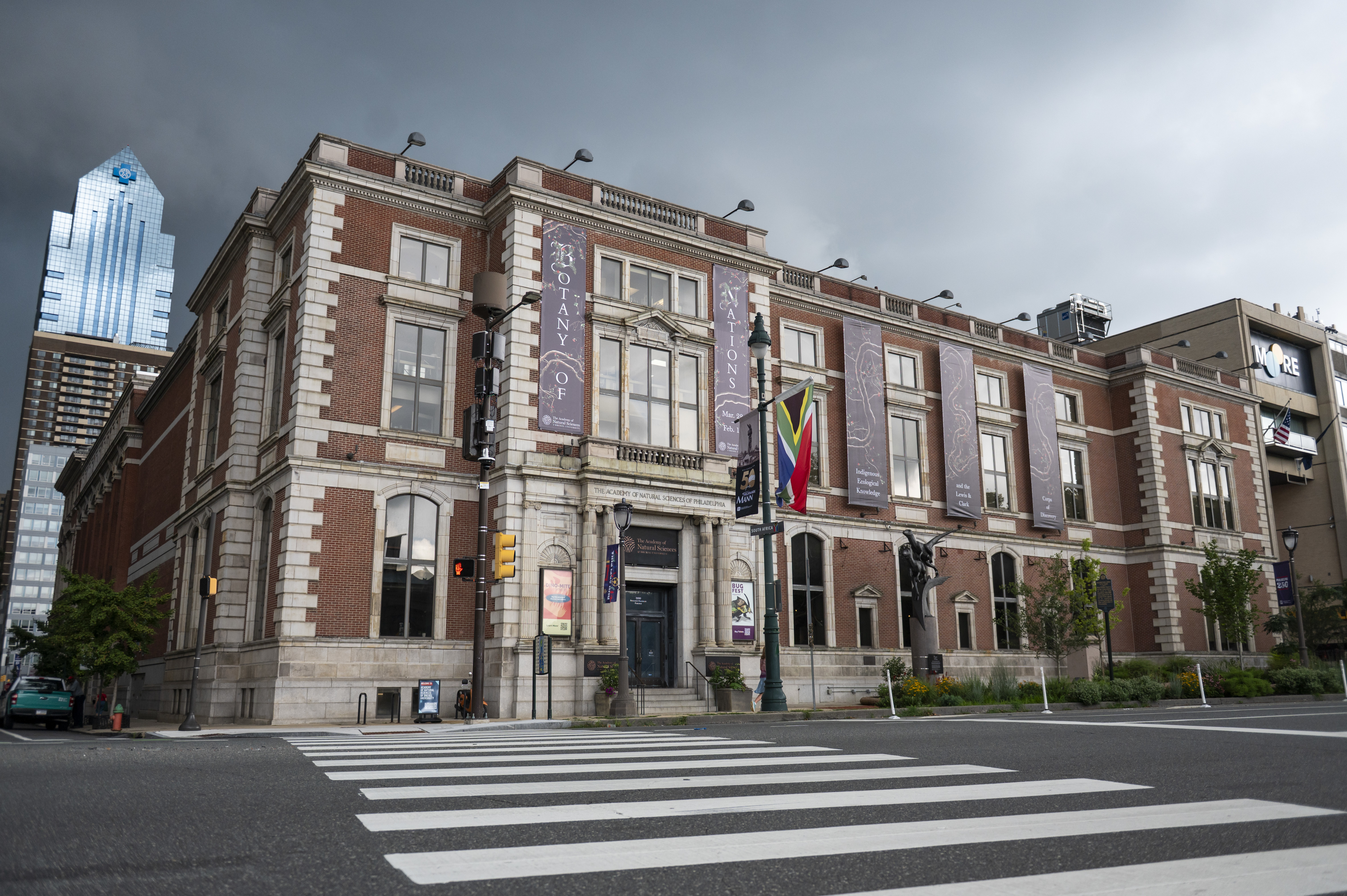
The museum opened in 1828, and moved to its current location on the Benjamin Franklin Parkway in 1876. Its last day with regular hours for the public will be Sunday, Sept. 27.
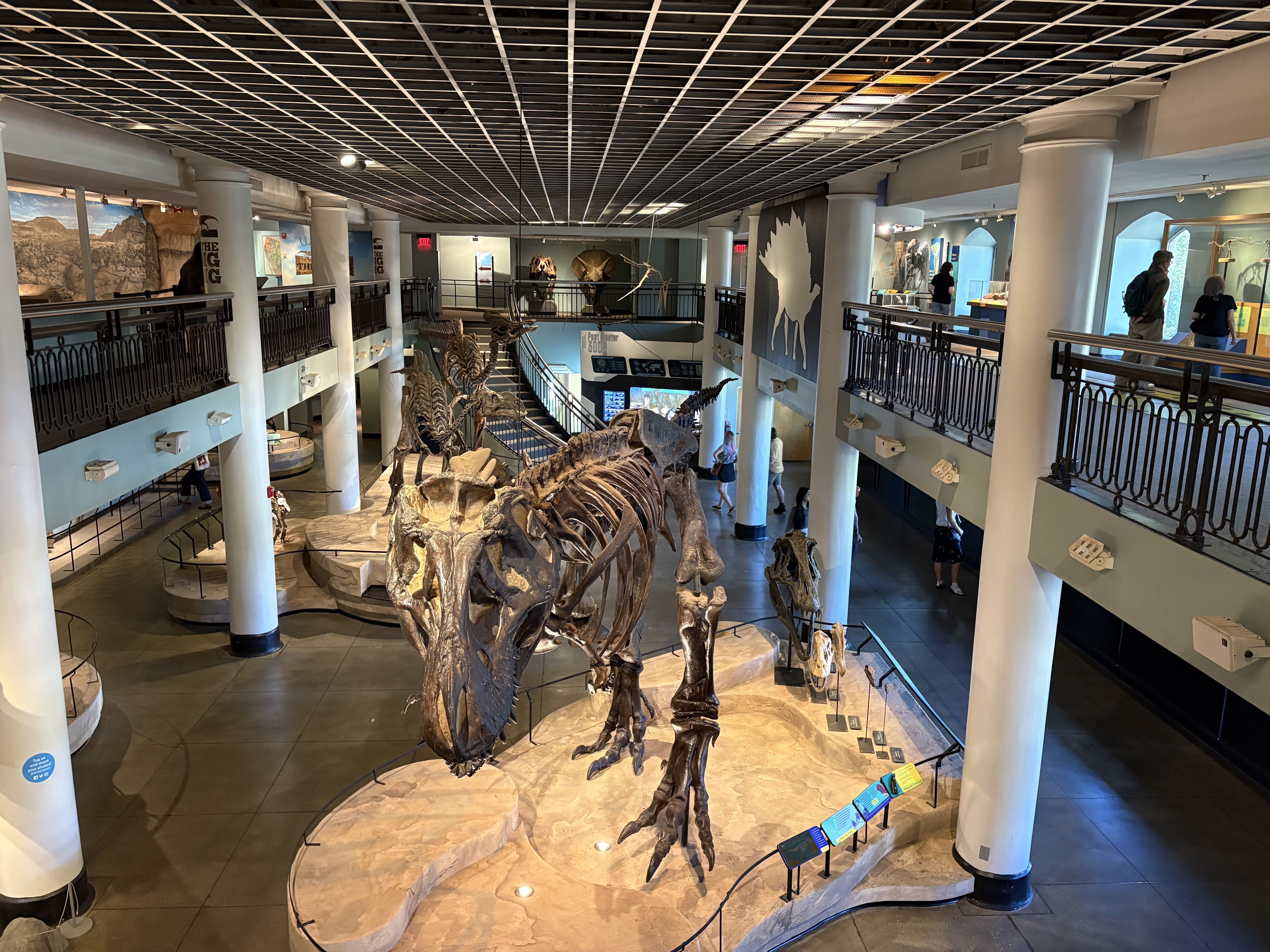
For some, the greatest loss was the sense of wonder children get when they peruse the museum, see bugs squirm, explore enormous nest displays and dioramas and, of course, lay eyes on the gigantic dinosaur skeleton.
“I’ll always remember the first time I went to the museum and I saw the dinosaur bones,” said Sakura Okuri, a 53-year-old retired FBI special agent who grew up in Germantown. “I’m just sorry that young kids aren’t going to be able to have that memory.”
Okuri, who now lives outside Pittsburgh, took comfort in knowing that if he missed something in one of the rich, expansive exhibits he’d have another chance because “it would always be there for me,” he said. “Apparently that’s not the case.”
The exterior of the Academy of Natural Sciences on Aug. 5.Allie Ippolito / For The Inquirer
The news landed hard for 9-year-old Mira Thompson, who was leaving the Free Library of Philadelphia’s Parkway Central branch with her dad Tuesday afternoon when she got word. She’d gone to the Academy museum on multiple school field trips recently and was looking forward to more visits.
“That’s where I learned about pH testing last year,” Thompson said. “I didn’t know how to do that before going. I’m going to miss just being there.”
For many, it was a site of family bonding. Temple University senior Sean McClendon recalled fond memories there with his Opa, his grandfather, who worked at the museum taking care of owls and birds. Michael Ginsberg, a 60-year-old Northeast Philly native, remembers zealously volunteering to hold a hissing cockroach during a presentation at the museum to “get a rise out of my daughter.”
“My wife was not a fan of that,” he recalled. “‘Go wash your hands,’” she instructed.
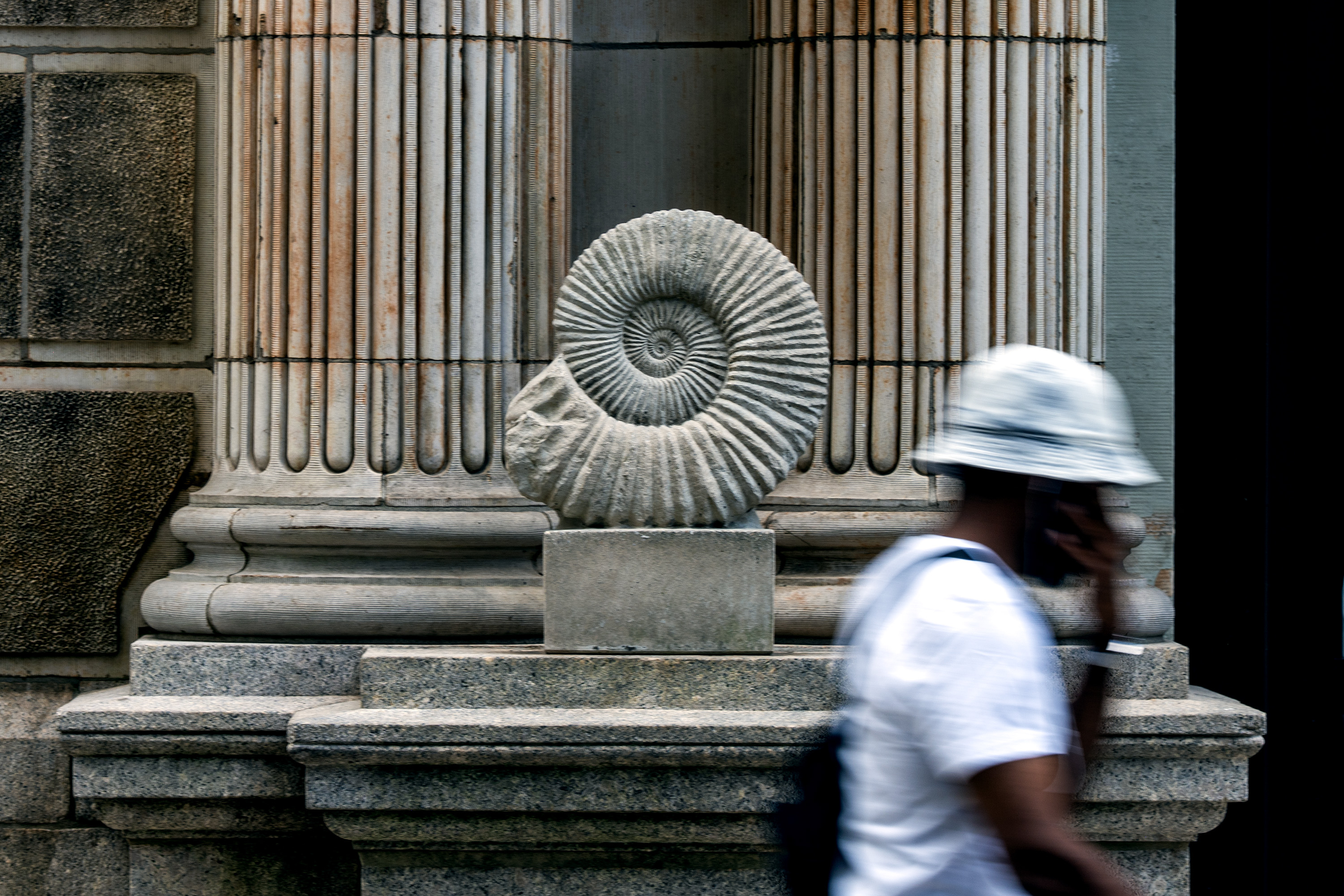
One of two shell sculptures placed on either side of the entrance on the 19th Street entrance to the Academy of Natural Sciences of Drexel University.Tom Gralish / Staff Photographer
Ginsberg’s dad took him there when he was in first grade. Seeing the dinosaur bones in real life was a thrill after only knowing them on the pages of library books. He was shocked to see they were brown and not white like in renderings.
When he became a dad, himself, he started bringing his daughter.
“Dad, why are all the animals dead?” he remembered his then-toddler asking.
“They’re stuffed, hon,” he explained to her. “It’s a really cool art. It’s a way to get you closer. Just trust me, this is really cool stuff.”
The aim , ultimately, is to relocate the Academy’s collections and sell the building, which has a lot of deferred maintenance needs, said a source close to the talks between Drexel and the Academy, who asked not to be identified.
The interactive “Ocean Bound” exhibit at Academy of Natural Sciences in 2023.Courtesy of the Academy of Natural Sciences of Drexel University
Online, tributes poured in. Some said the museum inspired them to study museum education, others brought their kids there when they learned to walk, they said, or when the air-conditioning in their homes broke in the summer. Some parents considered it a seminal part of parenthood in Philadelphia; others relayed fond memories of bringing their kids with disabilities to the sensory friendly hour.
Kim Lynne, from Drexel Hill, often brought her 18-year-old son, Ethan, who is on the autism spectrum, to the museum starting around age 3. He appreciated the dinosaurs and bugs; she appreciated the discount Ethan’s medical needs access card granted them on the admission fee.
“He loved the third floor where they had the children’s area, the insects,” Lynne said. “He was into it early on.”
Colleen Hall, 45, often marveled at the museum when she passed by it during her years at Community College of Philadelphia. She then ventured in for social events and was wowed by the dinosaurs, butterflies, and polar bears. She enrolled at St. Joseph’s Museum and Cultural Heritage education graduate program in hopes of working there one day.
It’s hard to wrap her mind around the notion that the museum is really closing.
“My brain just isn’t going there yet,” she said when asked how she felt about the closure.
“It’s not the 11th hour yet,” she added.
For longtime Philadelphians, the loss of the museum marks another step in the city losing its character as shiny new facades slowly replace the old and storied institutions closing their doors.
“We are losing some of the things that make us a historic city,” said McClendon, the Temple senior. “I think that’s really something that’s part of Philly’s brand or image, not just cheesesteaks, and I think people might forget how much history there is because it’s so modernized.”
To those who’ve gone with parents and kids like Ginsberg, the facility is a generational treasure and one of the few places that Philadelphians of all ages, races, and socio-economic classes can enjoy.
“Our city is losing abig part of its heart,” he said.
Eleven years ago, Carlton Williams was, to some, a symbol of government dysfunction.
He was leading the troubled Philadelphia Department of Licenses and Inspections, an agency engulfed in controversy over safety lapses and staffing issues following the deadly 2013 Market Street building collapse. The city controller called on Williams to resign, and Jim Kenney, then a candidate for mayor, promised that he’d get rid of him.
And yet Williams remained.
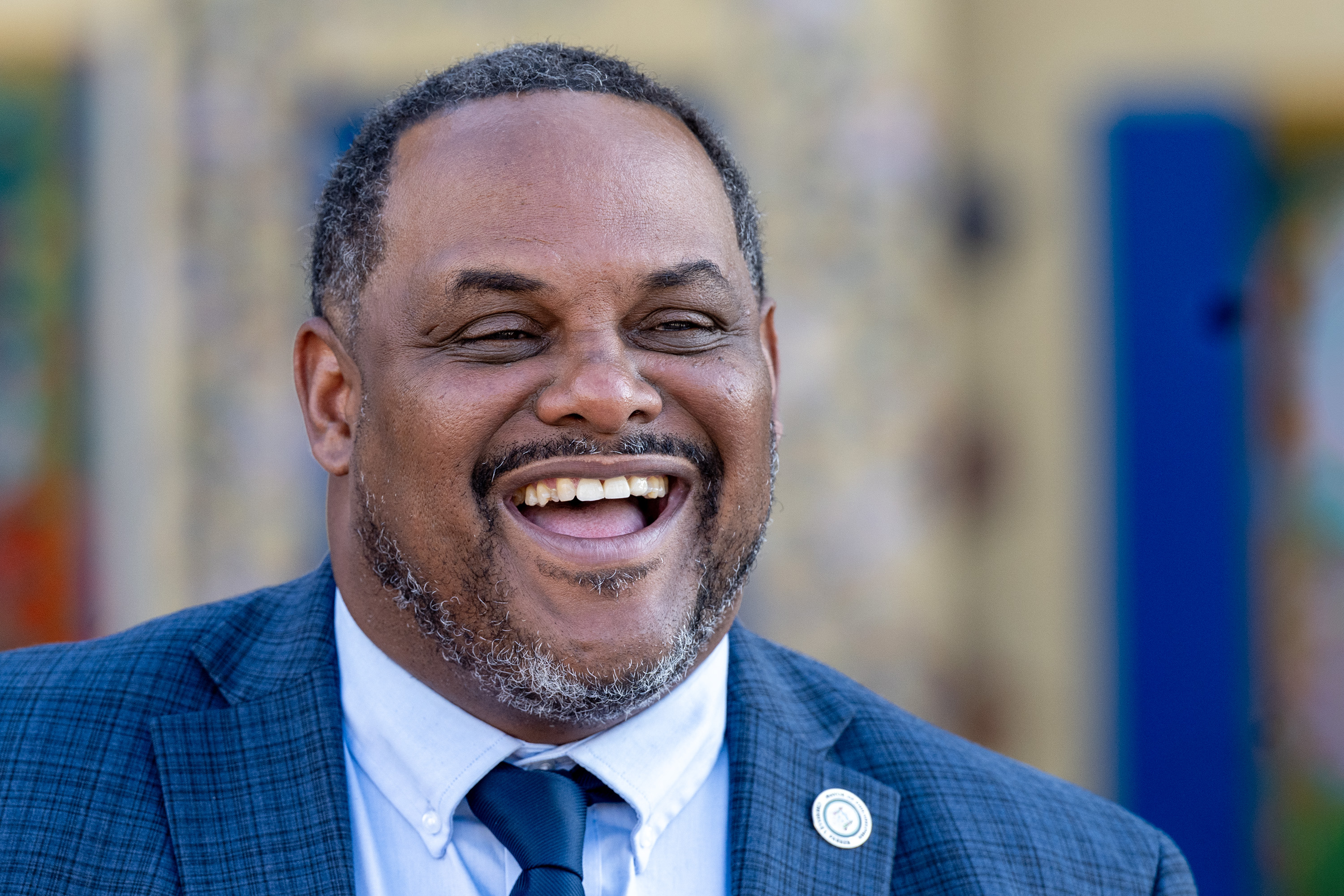
In July, he was named Philadelphia’s managing director, one of the most powerful positions in city government, second only to the mayor. He is assuming responsibility for L&I again, plus dozens of other agencies and thousands of employees who carry out the day-to-day operations that make the city run.
It is perhaps an improbable outcome for a longtime city employee who absorbed a level of scrutiny that could have easily ended his career.
But Williams proved durable, cycling through leadership positions across several departments while establishing himself as a City Hall insider. He has politically powerful allies and a reputation among City Council members as someone who will quickly act on their needs. That goes a long way with 17 politicians who value responsiveness and omnipresence, traits that they did not see in Williams’ predecessor, Adam K. Thiel.
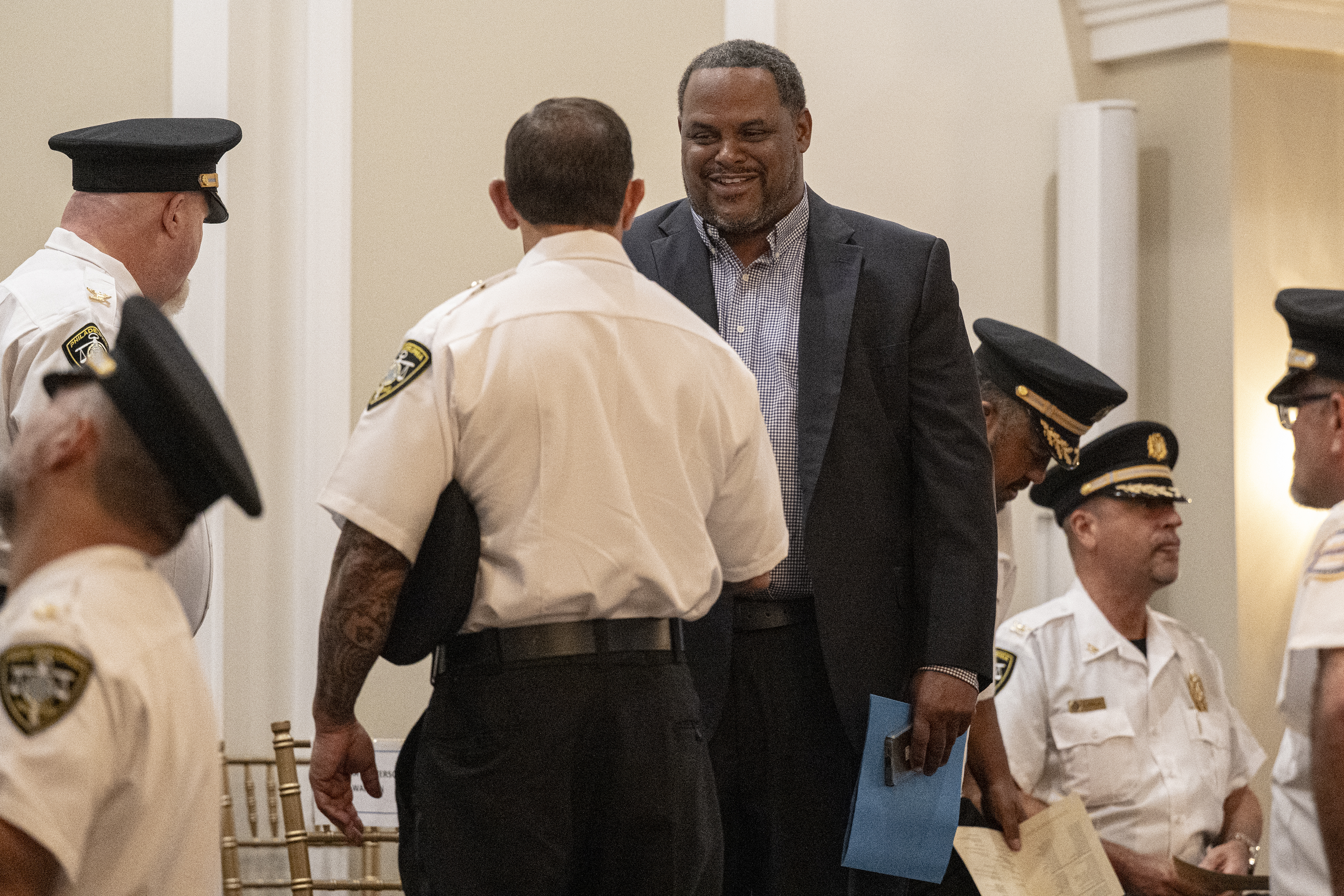
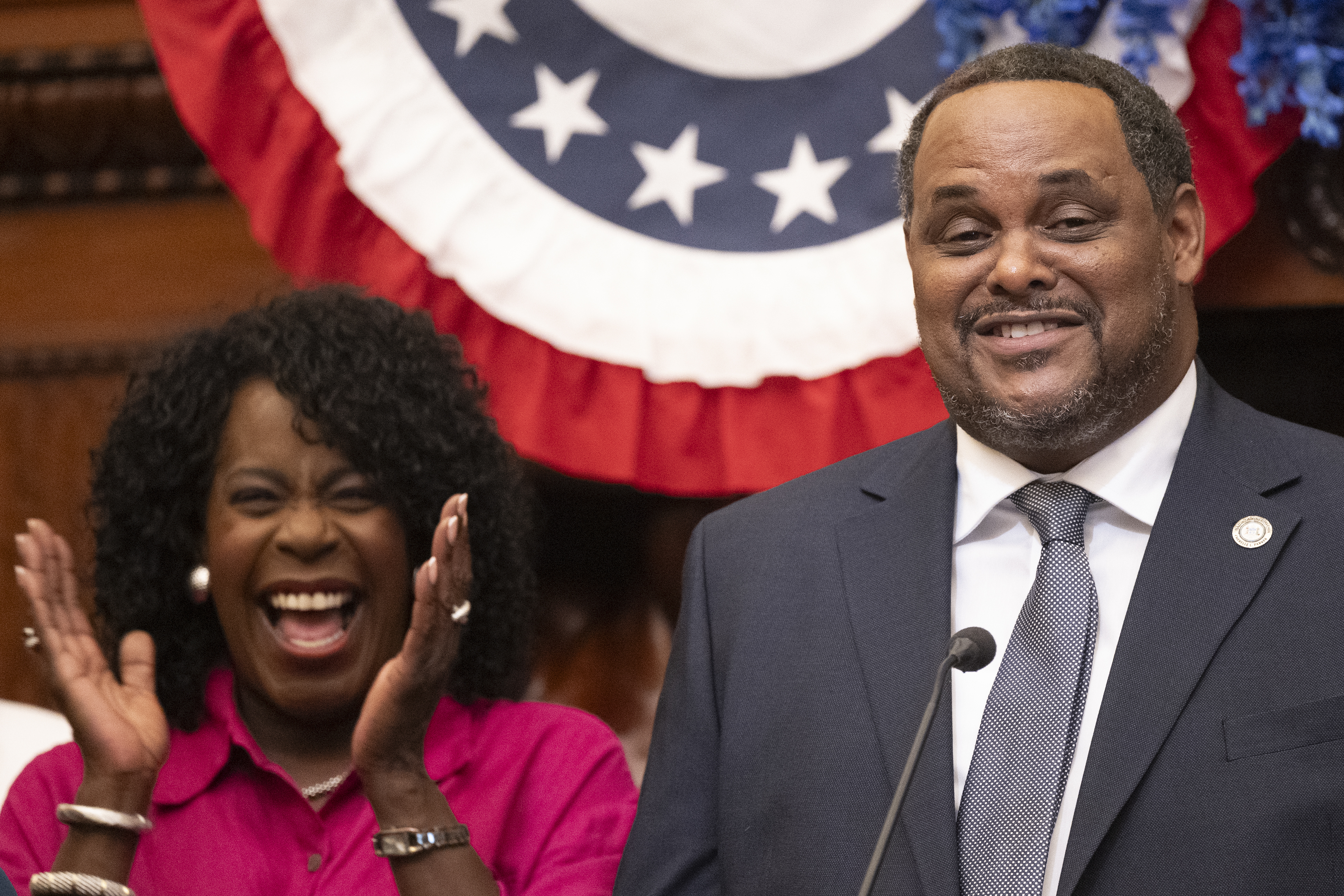
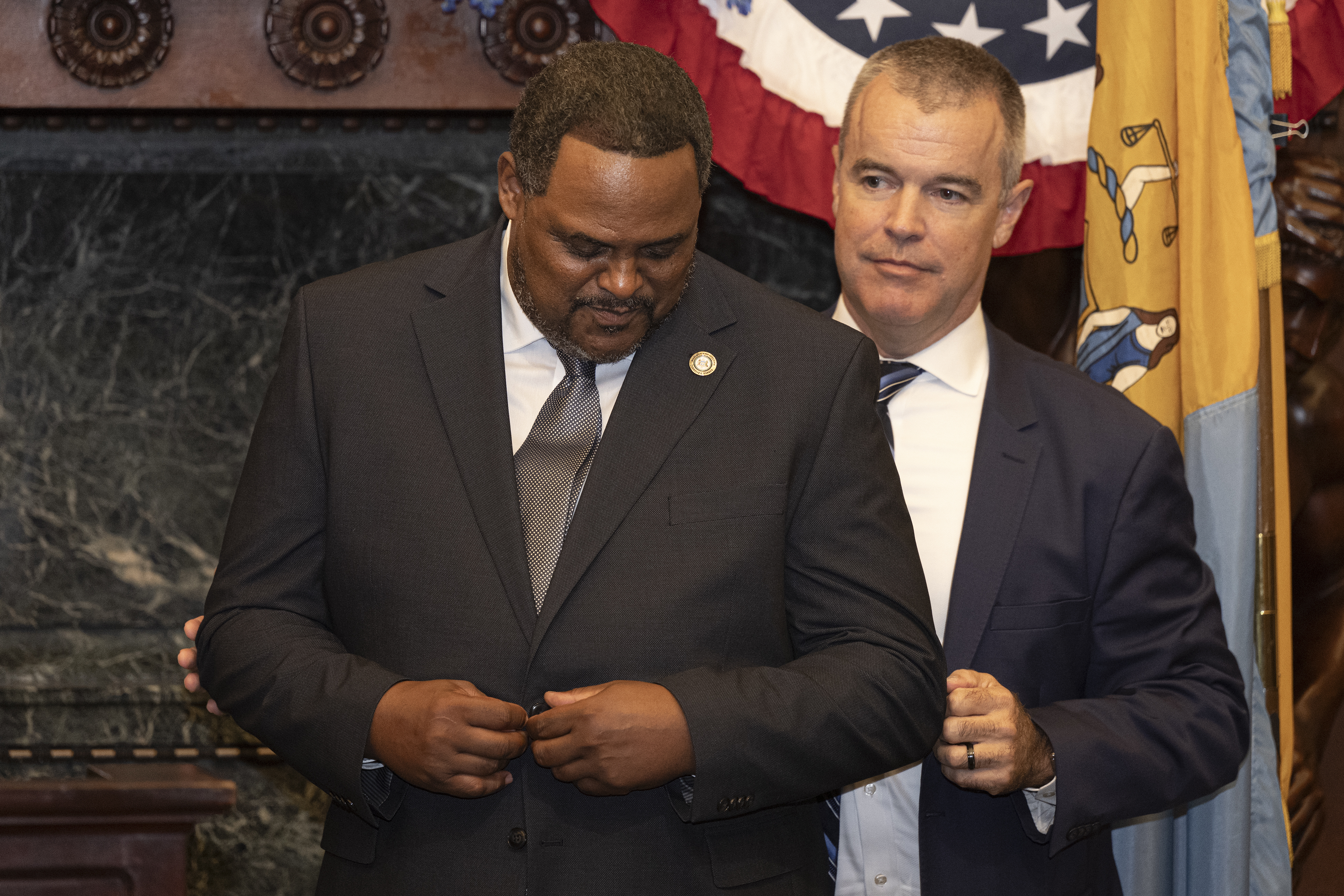
Newly appointed Managing Director Carlton Williams interacts with city officials during a correctional officer graduation ceremony at FOP Lodge 5 in Philadelphia on Friday.Jose F. Moreno / Staff Photographer
Perhaps most importantly for Williams’ ascent: he is all-in on Mayor Cherelle L. Parker.
The ties between Parker, 53, and Williams, 57, stretch back to their childhoods in Northwest Philly — he played football for the Oak Lane Wildcats, and she was a cheerleader. The team remains a part of both of their identities: Williams has led the Oak Lane Youth Association for 20 years, and the mayor often says proudly that she is a “Wildcat for life.”
Later in life, both found allies in the storied Northwest Coalition, a powerful political family. Williams said that he has known for 20 years that Parker would one day sit atop City Hall. And he most recently led Parker’s Office of Clean and Green Initiatives, overseeing the implementation of some of her key campaign promises.
“I’m bringing the ‘One Philly’ brand to the managing director’s office,” Williams said in an interview, echoing the mayor’s oft-used slogan. “Not to say it wasn’t being done under my predecessor. But I want to make sure it’s completely aligned with the mayor’s goals, because I believe in that vision.”
New Philadelphia Managing Director Carlton Williams speaks at the podium after being announced by Philadelphia Mayor Cherelle L. Parker during a July 28 news conference at City Hall.Jose F. Moreno / Staff Photographer
His appointment as managing director marks a new stage for the Parker administration that has seen significant turnover at its highest levels. And it is indicative of what Parker values in her inner circle: vast institutional knowledge and loyalty.
For the mayor, trust in Williams’ ability to operate within the bureaucracy and advance her priorities may outweigh his mixed record of management.
“Whenever we had a crisis of any kind in this city, he has been on my speed dial,” Parker said when she announced Williams’ appointment last month. “No matter who’s been leading, I’ve always called him for his counsel.”
Overseeing ‘a very broken’ L&I
Parker’s bet on Williams would have seemed almost unimaginable a decade ago.
A year after Williams was appointed to lead L&I, an excavator demolishing a wall on Market Street in Center City toppled the building onto an adjacent Salvation Army store, killing six people and injuring a dozen more. The inspector responsible for the demolition project died by suicide a week later.
Calls for reform abounded and questions swirled about whether the city’s agencies were responsible. There were multiple investigations launched and commissions convened to probe the disaster, and within days, Council members were pressing Williams to institute reforms that would bolster safety on private construction sites.
In response, Williams sought to hire more inspectors, increase their training, raise demolition standards, and create new specialized units within L&I.
Today, he says the collapse on Market Street was “one of the saddest moments” of his time in government.
“You have to lead through some tough challenges when you’re a leader,” he said. “You don’t get to pick and choose when you lead.”
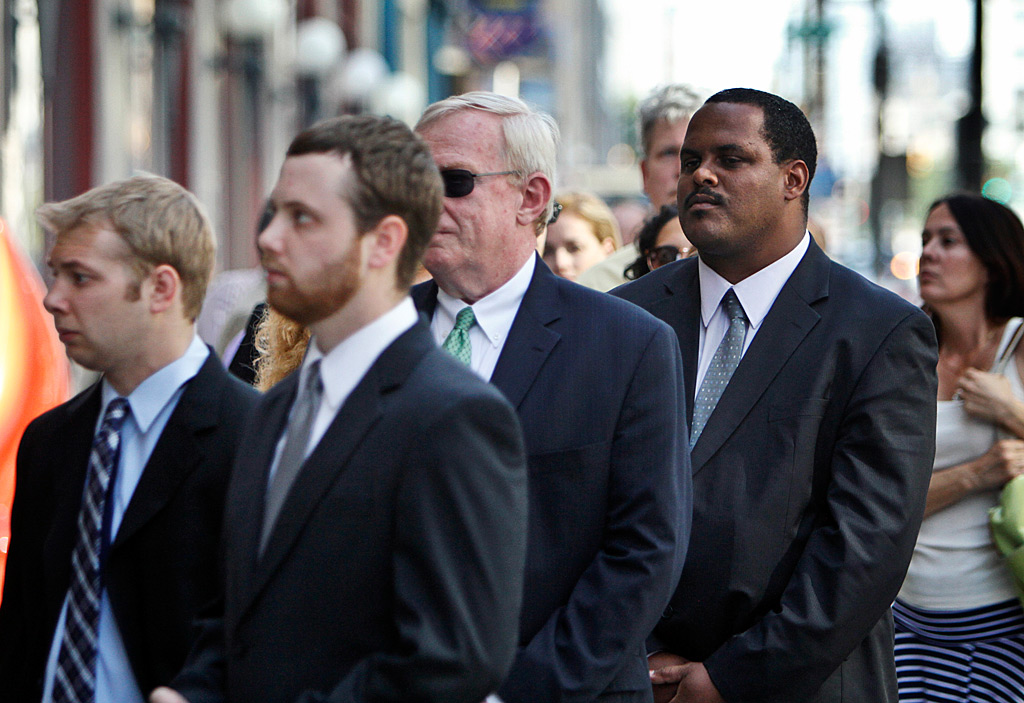
In this June 2013 file photo, then-Philadelphia Commissioner of the Department of Licenses and Inspections Carlton Williams (second from right) waits in line to attend a memorial service for Anne Bryan, who was among the victims of the Market Street building collapse.JOSEPH KACZMAREK / Associated Press
By fall 2015, then-City Controller Alan Butkovitz was calling on Williams to be fired. He said at the time that L&I had long been troubled, but that his office’s audit of the agency found that Williams had not made enough improvements.
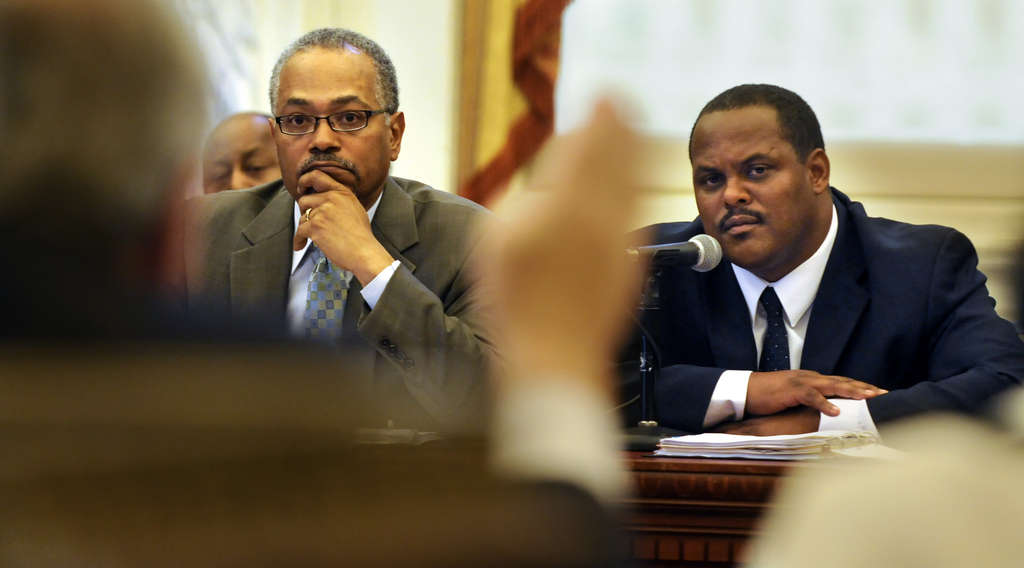
In this 2013 photo, then-Deputy Mayor Everett Gillison (left) and then-Commissioner of Licenses and Inspections Carlton Williams listen to members of City Council during a hearing.TOM GRALISH / Staff Photographer
Butkovitz now says that he blames former Mayor Michael Nutter instead, and that Williams was “caught between the mayor and me.” He said Williams had promised to provide the controller’s office with documents to assist in an audit, and then did not.
“I took it out on Carlton Williams at the time,” Butkovitz said.“His inclination was to cooperate with me, but at the time, it looked to me like duplicity. And I don’t think it was. I think he was overridden by higher authority.”
Nutter did not respond to a request for comment.
Estelle Richman, a former Philadelphia managing director who has held a variety of roles in local, state and federal government, said L&I is “one of the most difficult city departments.” She noted that past agency leaders have been pushed out, fired, indicted, and jailed.
“We can go back and say ‘maybe [Williams] should have done this or that,’ but the reality is it was a very broken department,” she said. “I think he did more to try to get it restabilized and back on track than any other commissioner at that time could have done.”
‘You have to be accessible’
Before taking the helm at L&I, Williams was a career bureaucrat.
Born in North Philly and raised in West Oak Lane, Williams started with the city at age 19, working in Fairmount Park as one of the first-ever members of the Philadelphia Ranger Corps. The program paid for part of his tuition to attend Temple University and marked his foray into public service.
Jeffrey Montague, who led the Philadelphia Ranger Corp. and has been a mentor to Williams for decades, said that at a young age, Williams showed potential.
“He didn’t try to fit in. He always stood out on his own independence,” Montague said. “He wasn’t trying to fit into a crowd.”
After working as a ranger, Williams spent three years running a Harrisburg youth program for AmeriCorps — the first and last time Williams lived outside the city.
He returned to Philadelphia to work for the Parks and Recreation Department, rising to become a deputy commissioner in both the recreation and streets departments.
Then came the four-year stint leading L&I, and when Kenney took office in 2016, he moved Williams back to his old job as a deputy in the streets and sanitation department.
But it didn’t last. Five months after Kenney took office, the streets commissioner was arrested for assault. Williams ascended to the role, and suddenly, the person who Kenney said he wouldn’t retain to lead L&I was in charge of one of Philadelphia’s most visible departments, overseeing transportation and sanitation operations citywide.
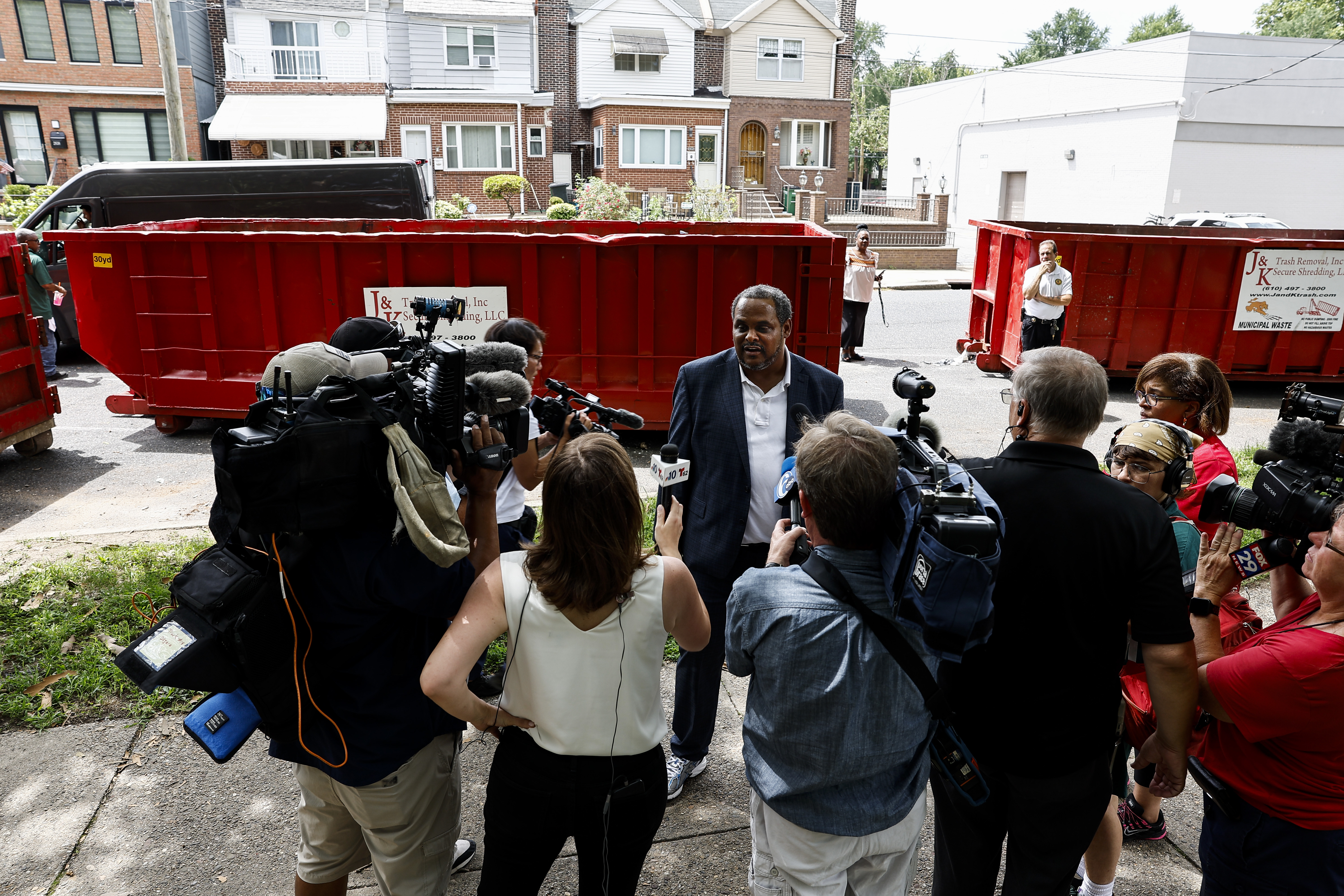
Carlton Williams, then the director of the Office of Clean and Green Initiatives, speaks during a news conference at Bigler and South 15th Streets on July 7, 2025.Monica Herndon / Staff Photographer
It was there where Williams solidified himself as a City Hall fixture. He said that as an administration staffer,he has “one primary that I listen to” — the mayor — but he has always tried to be attentive to Council.
That may be a key difference between Williams and Thiel, his predecessor. Thiel was the former fire commissioner and a nationally recognized expert in emergency management who was seen as a skilled behind-the-scenes operator.
But Council members said thatThiel did not foster close relationships with members of the city’s legislative body who are often conduits between residents and the mayor’s administration.
In addition, Thiel was often absent during major events in the city and he was frequently on leave — he joined the Army Reserve eight months into his tenure, and held several jobs outside city government, including as a consultant and professor.
That was a departure from prior administrations, when the managing director was often the public face of city operations.
On several occasions during the Parker administration, it was Williams who was in the spotlight. As director of the Office of Clean and Green Initiatives, he played a key coordinating role during the eight-day municipal worker strike that halted city services — most visibly, trash pickup.
And he oversaw the city’s response to a severe winter storm earlier this year that left much of the city encased in ice, despite weather emergencies typically falling under the managing director’s purview.
New Philadelphia Managing Director Carlton Williams (left) stands near the former director, Adam Thiel, before an introduction by Philadelphia Mayor Cherelle L. Parker during a July 28 news conference at City Hall.Jose F. Moreno / Staff Photographer
City Councilmember Anthony Phillips, whose district includes Northwest Philadelphia, said that prior to Thiel’s resignation, members of Council were “gravely concerned” about his frequent leave.Some members said that, in Thiel’s absence, Williams was their primary contact among Parker’s top staff.
“You can’t get certain things done and you can’t expect an efficient and effective city when you’re not present,” Phillips said. “Carlton is going to be the complete opposite of that.”
Williams said that his role as managing director is his only job aside from volunteering.
“It’s a full-time, 24-hour, seven-day-a-week job,” he said. “You have to be accessible.”
Williams’ coziness with elected officials has also drawn criticism.
A former city employee who previously worked for Williams said his relationships with Council amount to a “favor machine.” The staffer spoke on the condition of anonymity in order to preserve relationships.
“There is this cycle of Council getting calls from constituents, like ‘there’s a pothole,’ and then they get it fixed, and that’s the main work,” the former staffer said. “It’s not actually setting up systems that are solving the problems. It’s reacting to them.”
But Williams said some of his proudest achievements have resulted in systemic change: he led the installation of some of the first spraygrounds in the city, overhauled the recycling program, had BigBelly trash cans placed throughout Philadelphia, and started the annual Philly Spring Cleanup.
“He is probably one of the most well-prepared managing directors that the city has had,” Richman said. “He knows not only how operations work within the city departments, he knows the political structure of the city. And I believe a managing director has to know both.”
John Dougherty, the former leader of the politically powerful Local 98 of the International Brotherhood of Electrical Workers, and his ally, ex-Councilmember Bobby Henon, were on trial for bribery and other corruption charges. Prosecutors accused Henon of taking official actions as a Council member at Dougherty’s behest in exchange for a salaried, no-show job with the union.
One of the schemes prosecutors presented during the trial focused on efforts by union officials in 2015 to halt the installation of an MRI machine at the Children’s Hospital of Philadelphia, a project that was being completed with nonunion labor. Williams, at the time, was at the helm of L&I.
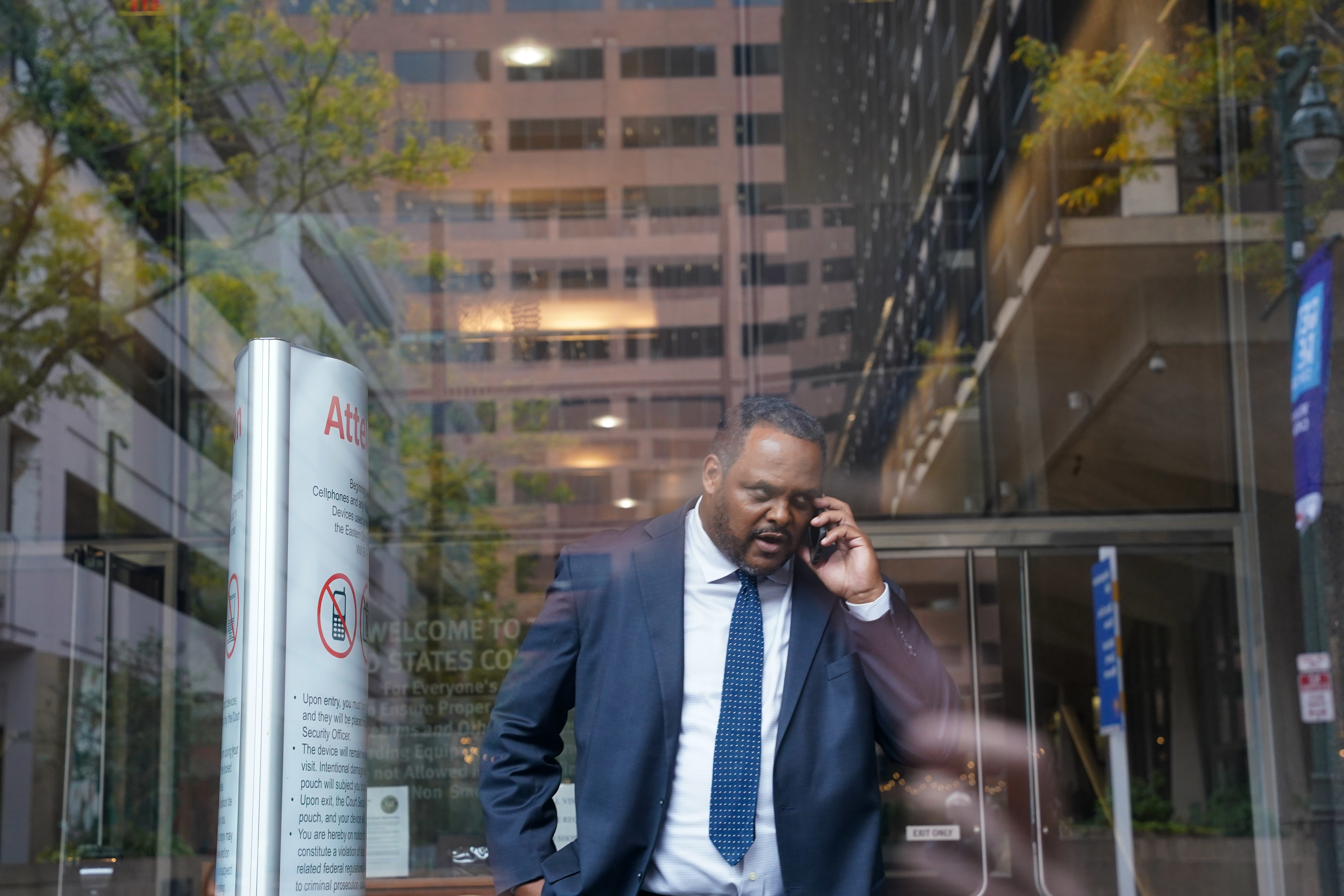
Department of Streets Commissioner Carlton Williams exits federal court on Oct. 12, 2021, after testifying in the John Dougherty and Bobby Henon bribery trial.Thomas Hengge / Staff Photographer
During the 2021 trial, Williams was called to testify. He told the jury that Henon called him in August 2015 to report that an unlicensed contractor was working at CHOP, and that he dispatched an inspector to investigate.
The inspector, Williams testified, issued a stop-work order on the construction of the MRI machine. But he insisted that he did not direct the inspector to do so, and told the jury that responding to complaints from Council members was a routine part of his job.
Ultimately, L&I reversed the stop-work order, and the MRI machine was built.
Prosecutors said Dougherty paid Henon to be his “man on the inside” in City Hall and used the episode at CHOP to establish evidence of a corrupt agreement between the two.
“You heard what happened,” Assistant U.S. Attorney Frank Costello told the jury during closing arguments. “Henon contacted Carlton Williams, Carlton Williams sent inspectors out and they issued orders — they issued orders to shut the job down.”
But defense attorneys said one public official asking another to take action doesn’t constitute a crime.
“Carlton Williams was the recipient of information just passed on to him about the MRI and the unlicensed contractor,” said defense attorney Brian McMonagle. “That ain’t a crime.”
During the 2023 mayoral campaign, when a half-dozen Democrats could have plausibly won the party’s nomination, Williams nearly left the city.
He said he got a job as the public works director in San Francisco, but before he accepted, Parker won the primary election. Williams decided to stay.
“I wanted to work for Cherelle Parker,” he said. “I believed in her vision.”
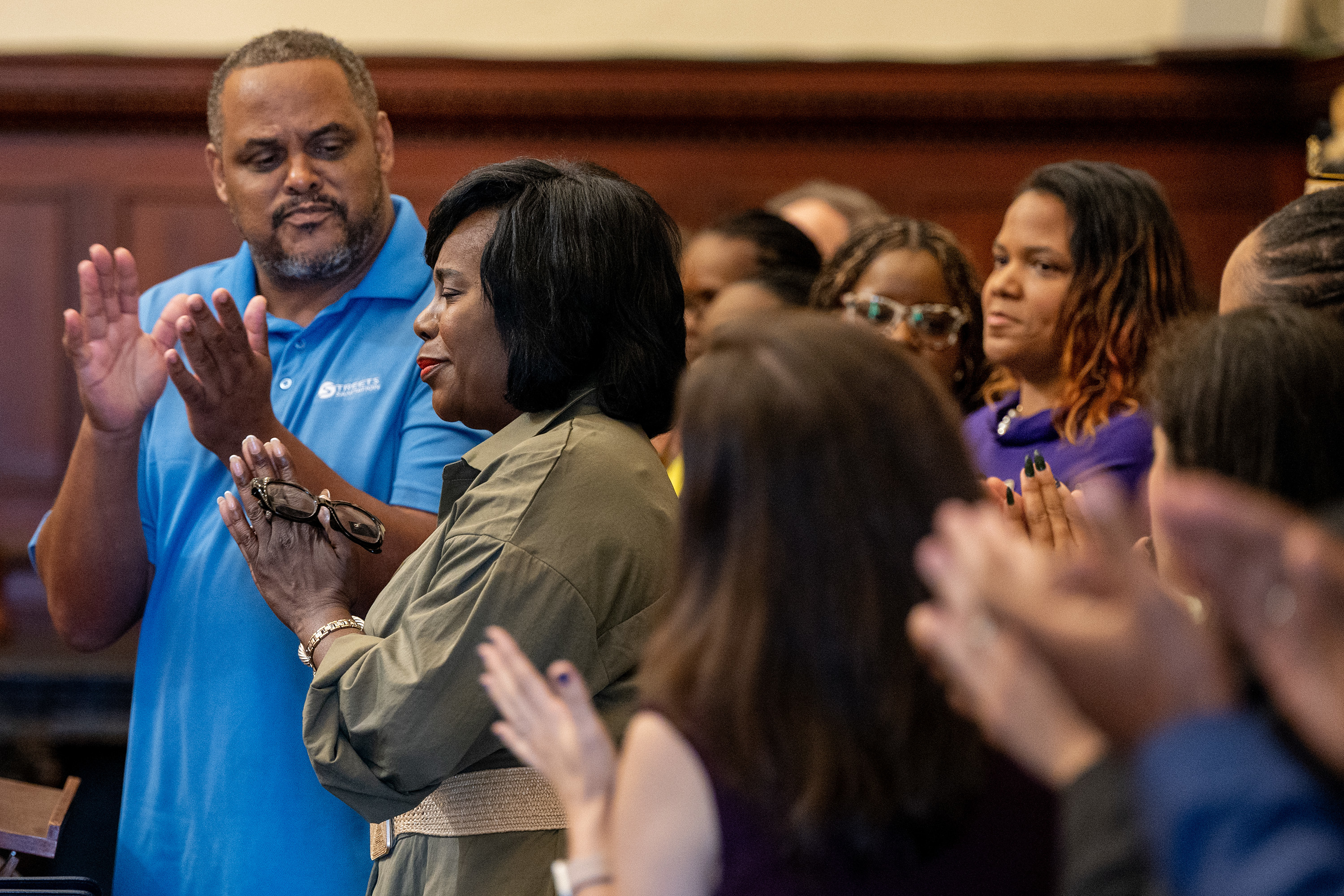
Mayor Cherelle L. Parker is applauded by members of her administration at City Hall on July 9, 2025, hours after reaching a tentative contract agreement with District Council 33 leaders overnight, ending the workers’ strike. At left is Carlton Williams, director of the Office of Clean and Green Initiatives. Chief Deputy Mayor Sinceré Harris is behind the mayor at right.Tom Gralish / Staff Photographer
Parker took office in 2024 and created a new role: director of the Office of Clean and Green Initiatives. Williams would carry out her campaign promise to rid the city of its “Filthadelphia” moniker by implementing twice-weekly trash collection, an expansion of illegal dumping enforcement, and a biannual citywide program to clean every block.
As managing director, Williams’ portfolio will grow substantially. He will be responsible for the city’s response to public health and homelessness, as well as overseeing large agencies like the fire department and the prisons.
He will also coordinate the city’s strategies in Kensington, the beleaguered neighborhood and the site of an open-air drug market that the Parker administration has spent more than two years working to shut down. Williams said there is inherent pressure that comes with being responsible for addressing such long-entrenched issues.
“But I work best under pressure, and so I take that as a badge of honor,” he said.
Williams said he intends to prioritize communication with residents because they “understand that everything can’t get fixed at one time.”
“But at least we can say what needs to be done, when it’s going to [be] fixed, what’s the timeline,” he said. “I manage through the eyes of everyday citizens. I want what they want.”
The lines are long. The branding is adorable. The drinks are bright green, as are the lacy swirls of matcha-seasoned soft serve. This is the formula for Kyo Matcha, which opened in August in Chinatown.
The same trappings can be found at both Matcha Panda Cafe, which opened in 2022, and Matcha Cafe Maiko, which opened in 2023 — years before high-end Japanese tea became so in-demand that suppliers couldn’t keep up. But there’s something a little curious about Kyo Matcha, a chain that is also known as Kyoto Matcha, with locations in Maryland, Pittsburgh, Virginia, and Massachusetts, as well as in Spain, Vietnam, and Turkey.
The inside of Kyo Matcha.Tyger Williams / Staff PhotographerA soft serve ice cream matcha mix at Kyo Matcha.Tyger Williams / Staff Photographer
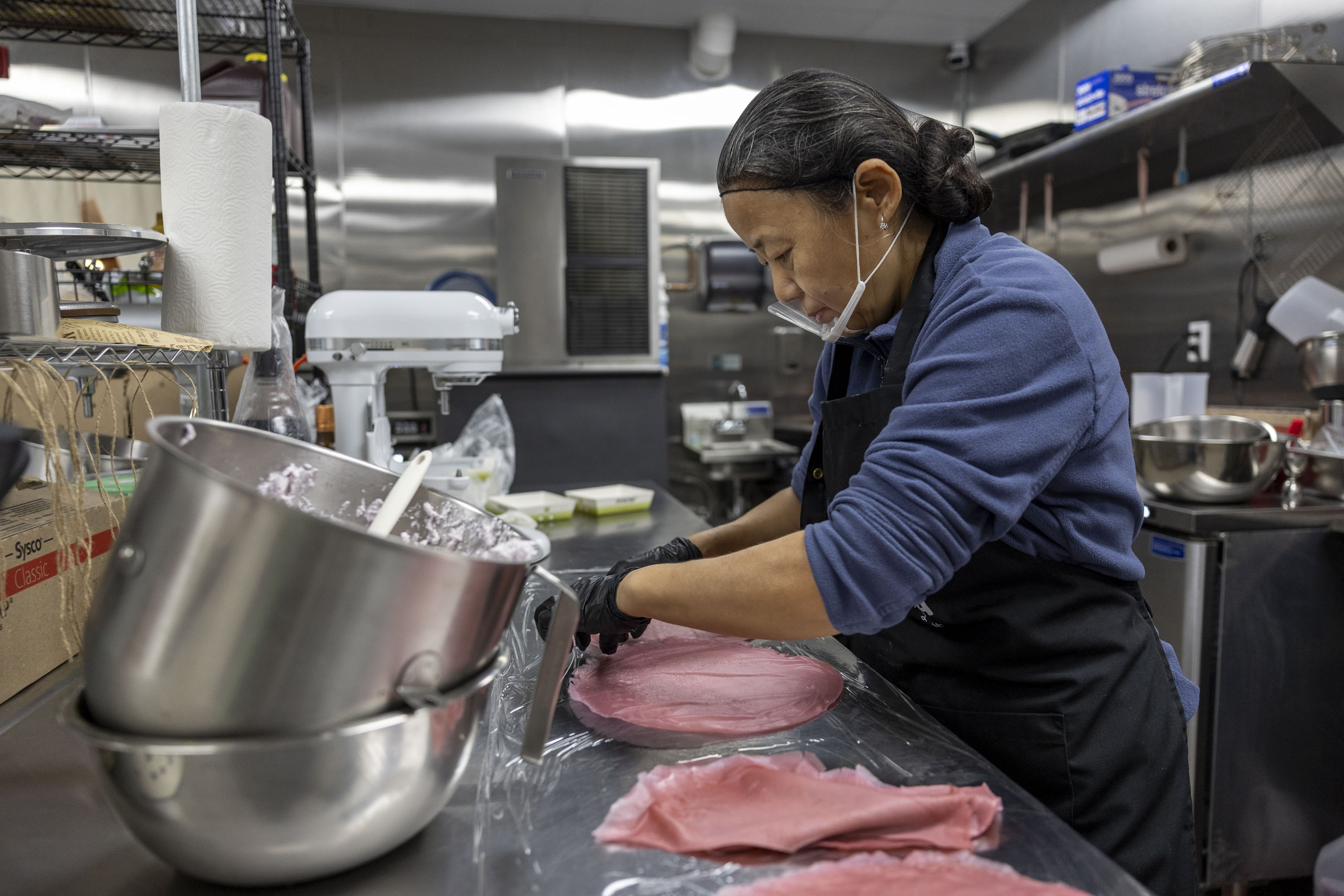
Indeed, the students who work the front of house are just as bubbly as the ones who serve similar ice creams and tea drinks at the other matcha-focused shops in Chinatown. But in the kitchen at Kyo Matcha, a small crew of older Chinese chefs who previously worked at dumpling stores or preparing food in retirement homes are painstakingly making matcha and ube crepes, then layering them into cakes or rolling them into desserts by hand.
The franchise is a project that brought two mainland Chinese couples into business together: Tom Kang, 34, and Danya Li, 30, who met studying hospitality at Temple University; and Alex An, 32, who also owns an international trading business, and Jing Xiong, 31, a UX lead designer.
Mrs. Jiao is making a fresh Ube Tower Cake at Kyo Matcha on Wednesday, Aug. 26, 2026, in Philadelphia.Tyger Williams / Staff PhotographerA Ube Tower Cake at Kyo Matcha on Wednesday, Aug. 26, 2026, in Philadelphia.Tyger Williams / Staff Photographer
Kang also owns and operates Stay at Luna, a collection of 10 apartment hotels mostly clustered around Chinatown. (There’s a Stay at Luna located above Kyo Matcha.)
Located on 11th Street between Race and Vine Streets, in the former Vietnam Palace space, Kyo Matcha is a little off Chinatown’s beaten path. “We felt that if we created a beautiful space and offered something a little different, it could become another reason for people to come to this part of Chinatown,” said Kang.
A Creme Brûlée Matcha at Kyo Matcha on Wednesday, Aug. 26, 2026, in Philadelphia.Tyger Williams / Staff Photographer
He became enamored with Kyo Matcha due to both its high-quality matcha powder and its menu, equally balanced between beverage and desserts.
And why did four young people choose to open a franchise instead of creating their own brand?
“Starting a brand from scratch is so hard,” said Li.
While menu items all have to be approved by Kyo Matcha’s corporate office, the business arrangement still leaves room for the owners to innovate as they develop desserts for Philly customers.
As at other beverage chains, you can specify your preferred level of sweetness when ordering a drink here. There’s only one option, a simple iced matcha, where you can try matcha unadulterated by milk or syrup, to appreciate its grassiness. All beverages are served cold.
A Matcha Crepe Cake at Kyo Matcha on Wednesday, Aug. 26, 2026, in Philadelphia.Tyger Williams / Staff Photographer
The matcha trend shows no sign of abating, though global shortages persist as the tea’s leaves take four to five years to mature. The obsession with the bright green Japanese tea has manifested in a slew of matcha-driven beverages and desserts in Philly’s Chinatown, where there’s also been a wave of beverage shop openings.
Kyo Matcha opened the same week as Arch Street’s branch of Heytea, a Chinese brand operating over 4,000 locations worldwide. They join over a dozen tea-focused shops in the neighborhood.
The inside of Kyo Matcha on Wednesday, Aug. 26, 2026, in Philadelphia.Tyger Williams / Staff Photographer
But there stillseems to be plenty of appetite for approachable matcha offerings. “Matcha is especially popular among younger customers, and we see a lot of students and younger professionals, but we’ve also seen families, tourists, Chinatown residents, and people who have never tried matcha,” said Kang.
Kyo Matcha, 222 N. 11th St., kyotomatcha.us. Hours: Noon to 10 p.m. Monday to Thursday, 11:30 a.m. to 10:30 p.m. Friday and Saturday
If you have ever considered giving up your car, now is the time.
There’s the price of gasoline, which has shot up by more than 35% since President DonaldTrump launched the war against Iran in February. Even if you never start the ignition, simply owning a car will now set you back an average of $8,000 a year in insurance, maintenance, and loan payments.
And those are just the immediate costs. As a major source of greenhouse gases, cars contribute significantly to climate change, which is already pushing up the price of food and everyday purchases.
So, let’s say you’re ready to ditch your money pit on wheels. Then what?
I’ve been struggling with this question since I moderated a panel this spring with Sarah Goodyear and Doug Gordon, the duo from the popular podcast The War on Cars, who just published a rousing call to arms, Life After Cars: Freeing Ourselves from the Tyranny of the Automobile. The event, held at the capacious Resurrection Philadelphia church in Center City, was sponsored by Philly Bike Action and 5th Square Advocacy, two groups dedicated to promoting alternatives to driving.
Resurrection’s sanctuary was packed — with the converted. When Goodyear and Gordon asked the audience who had traveled to the event by car, only a few sheepish hands went up.
While their bookdoes a great job of detailing the ways cars “ruin everything,” there is little in it to help the car-dependent kick the habit. The problem is, most people have no idea where to start.
Even in the Philadelphia region, which has better-than-average transit and cycling infrastructure, the prospect of living without a car can seem a little like trying to swim without arms and legs. How will you take the kids to sporting events, look after elderly parents, and buy groceries without a vehicle? Our local transit services — SEPTA, NJ Transit, and PATCO — don’t serve every nook and cranny of the region and don’t run as frequently as they should.
Like everything else in America these days, the debate over the role of cars in our daily lives tends toward extremes. Philadelphia urbanists can sometimes come off as unsympathetic, as if they expect people to go cold turkey and swap their vehicles for bikes and SEPTA. Meanwhile, the pro-car lobby keeps insisting, against the evidence, that the car-free life is not practical outside a few transit-rich neighborhoods, like Center City.
But who says it has to be all or nothing?
‘Habituate walking’
My advice: Keep your car — for now, at least — but look for opportunities to get around by other means. Walk to the grocery store. Ride a bike to dinner at a nearby restaurant. Think of these excursions as a trial run. Once you feel comfortable, take the train or bus to work. You may never give up your car permanently, but you will save a bundle on gas and maintenance, reduce congestion, and boost your step count.
That’s how Jane Murray started weaning herself from the car. The Ardmore resident, who now runs a popular Instagram account called @Janewalksardmore, first began taking long walks as a way toexperience her Main Line town on a deeper level. To give shape to her Instagram project, she decided to visit every block in Ardmore and document her travels.
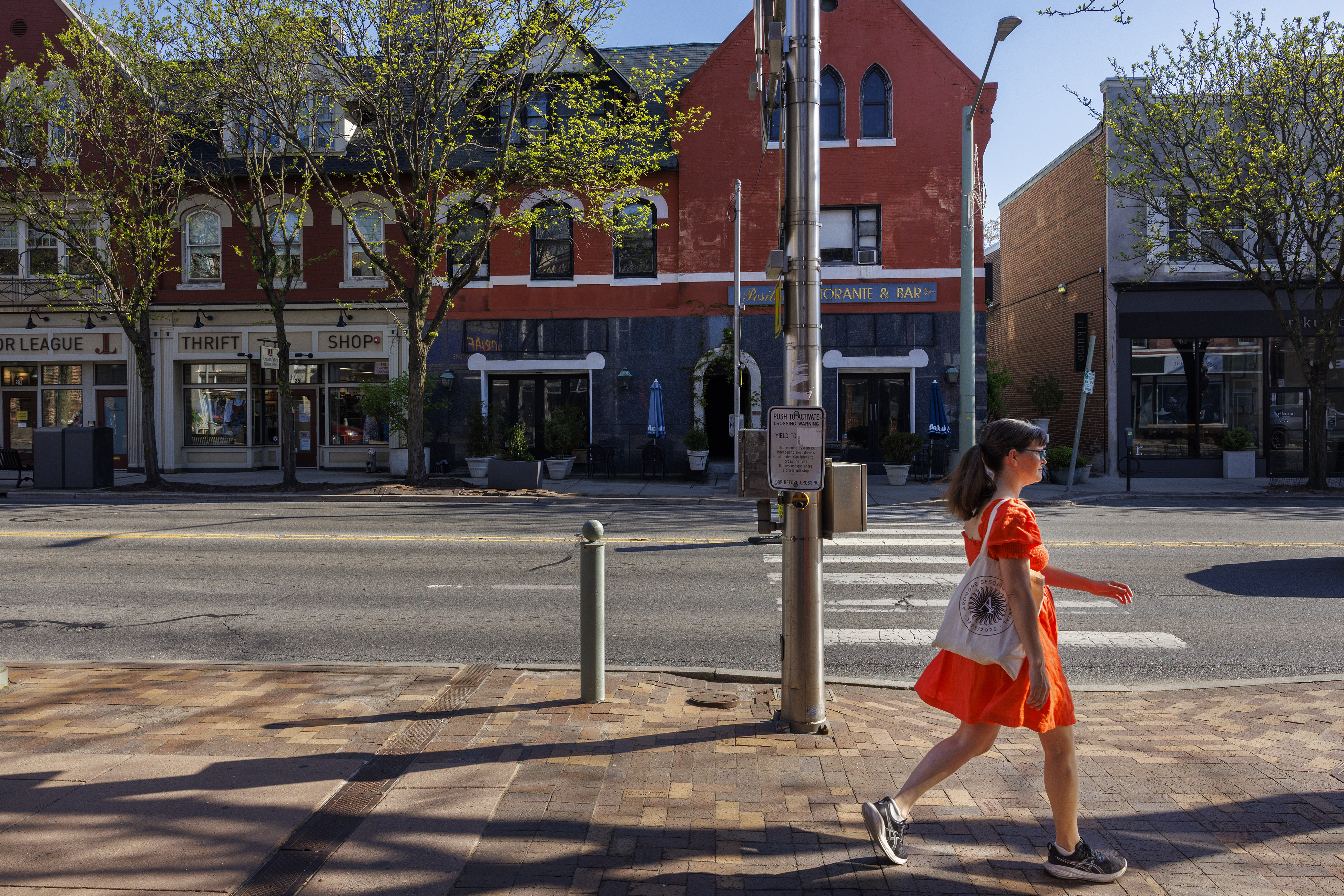
Jane Murray walks along Lancaster Avenue in downtown Ardmore, as part of a project to to walk every street in the Main Line town.Alejandro A. Alvarez / Staff Photographer
The more she walked, the more comfortable she felt leaving her car at home. She now wheels a “granny cart” to Trader Joe’s, a 15-minute walk from her house. Not long ago, she hopped a SEPTA bus to meet friends for quizzo in a pub a few towns away. At the end of the night, she took an Uber home.
Murray’s kids still have to take a bus the four miles to their middle school and she drives them to distant sporting events, but makes a conscious effort to “habituate walking” into her routine. Before leaving the house, she checks her transit apps to see if she can get to her destination without driving. Sometimes, she mixes it up: When she’s running errands, she’ll drive part of the way, then walk the last few blocks. Her Instagram has inspired her neighbors, who pepper her for tips about safe walking routes.
A mobility menu
Living in America without a car is often portrayed as a hardship, something that people on the margins are forced to endure. But, for me, living without a car has been a joy.
I didn’t know what to expect when I impulsively decided to get rid of my aging clunker 30 years ago after being presented with an expensive repair bill. Before then, I had rarely taken taxis or splurged on Amtrak to visit family in New York. Since I would no longer have to pay for car insurance, I promised to allow myself those indulgences. My husband and I were living in Center City, which certainly made our experiment more doable. (I should mention that I was pregnant at the time. I took a taxi to and from the hospital.)
Besides saving a lot of money, not having a car has liberated me in ways I never could have imagined. Bike lanes were virtually nonexistent in Philadelphia in the ’90s; today my bicycle is my main form of transportation. Thanks to the city’s mostly flat terrain, I can easily cycle to interviews and events in far-flung neighborhoods. My ride is equipped with side baskets, allowing me to do my grocery shopping by bike. When my destination is beyond biking distance, or when I have to look presentable, I’ll take SEPTA or reserve a Zipcar from the local car-sharing company. In a pinch, I can always summon an Uber, a Lyft, or a taxi. I still walk a lot, and it’s no exaggeration to say I run into people I know on every outing.
The key here is to think of mobility as a menu of options, rather than a car/no-car binary. While low-speed electric bikes have made it easier to cover long distances, not everyone can, or wants to, bike. Even transit can be daunting for a novice. The fear of crime also deters some people from using SEPTA, even though serious incidents have fallen dramatically in the last decade.
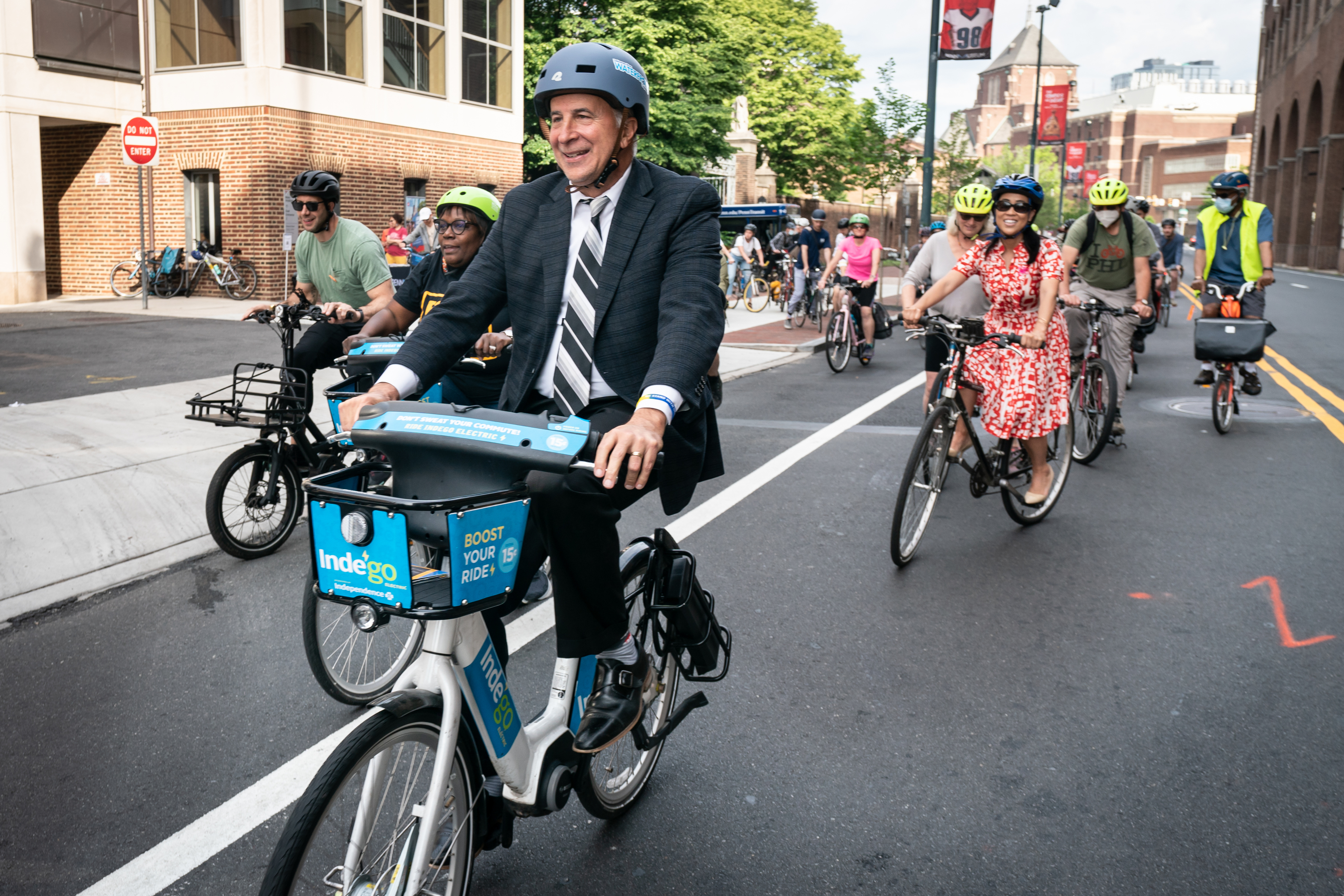
In 2022, Councilmember Mark Squilla (center), former Eagle Connor Barwin, Councilmember Kendra Brooks, and Councilmember Helen Gym took part in a Bike to Work Day event sponsored by the Bicycle Coalition of Greater Philadelphia to promote cycling as a means of transportation.JESSICA GRIFFIN / Staff Photographer
Eden MacDougall vividly remembers his trepidation when he started commuting from Langhorne, in Bucks County, to Temple University on SEPTA’s Regional Rail. “I kept thinking, how will I know it’s my stop?”
By the time MacDougall graduated in 2022, he was a super-commuter. To get to his new job at Mastery Charter School, where he is an AmeriCorps reading instructor, he had to use three forms of transportation: He started his day by biking two miles from his home to the Langhorne station. After taking a SEPTA train to Fern Rock, he changed to the Broad Street subway, getting off at Erie. The trip took an hour and 45 minutes, but MacDougall, who never learned to drive, loved it. “I’d open up my book and read the whole way.”
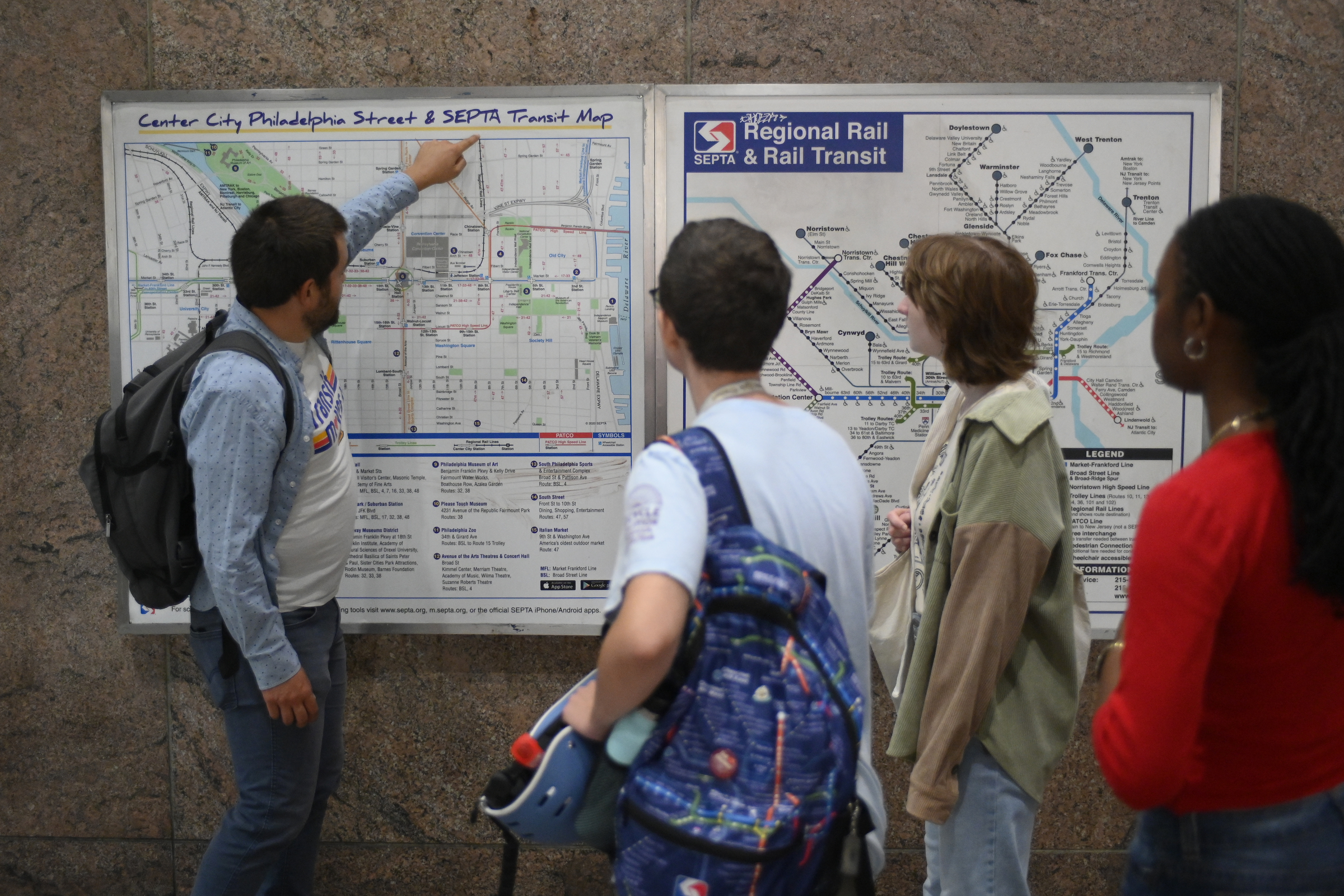
Stephen Bronskill, coalition manager for Transit Forward Philadelphia, shows incoming Temple University students how to navigate SEPTA during a tour organized at the start of the new semester. Bastiaan Slabbers / For The Inquirer
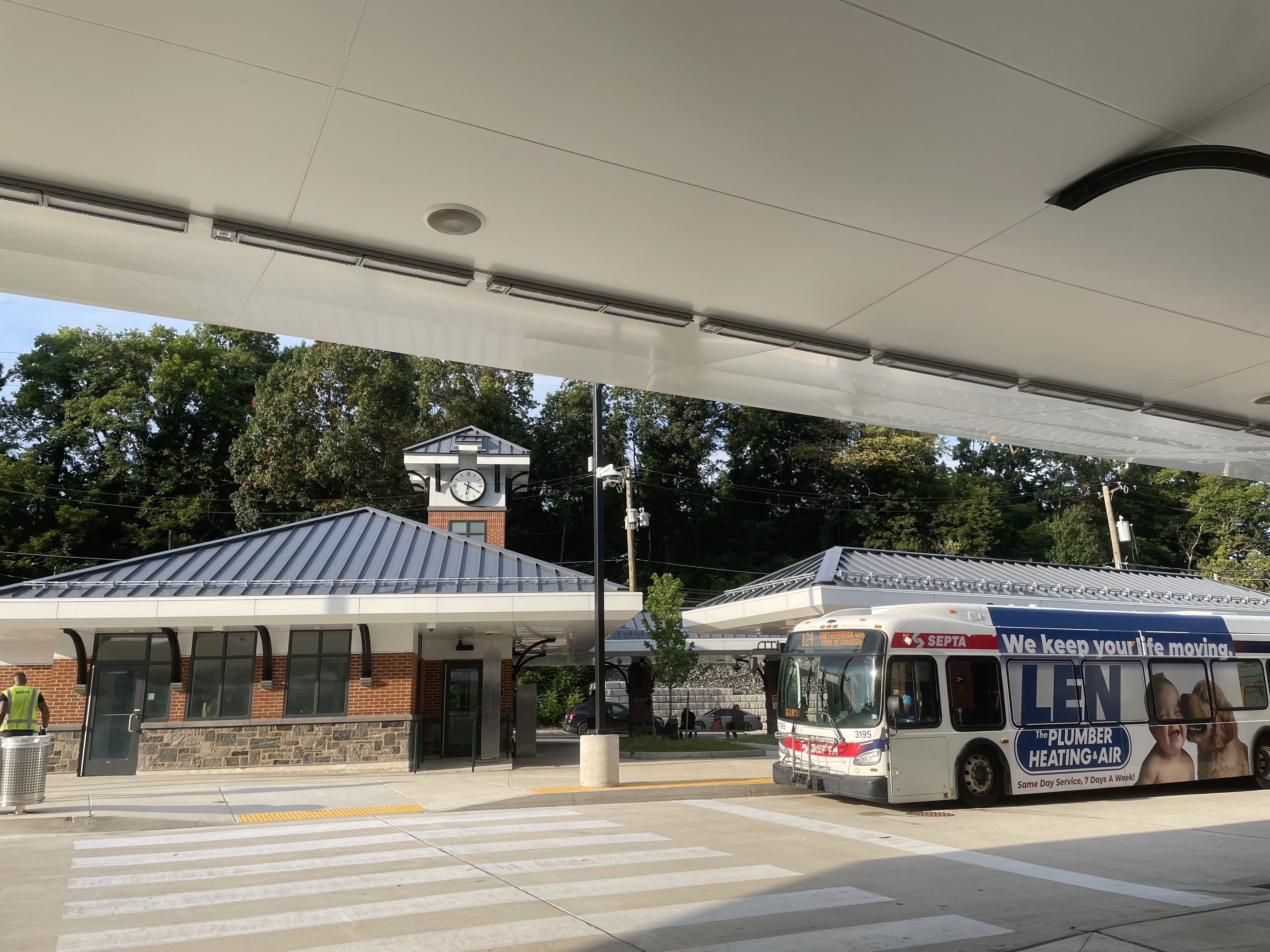
Now he lives in Philadelphia and volunteers as an instructor for Transit Forward Philadelphia and the Bicycle Coalition of Greater Philadelphia, which run Saturday tours to help people feel more confident riding SEPTA. Although the events provide practical advice, like how to use a transit app, they’re intended to be fun excursions. MacDougall recently shepherded a group from Roxborough to the Clark Park farmers market, showing them how to change from the Route 9 bus to a West Philadelphia trolley. Along the way, the group got to see SEPTA’s efficient new Wissahickon Transit Center on Ridge Avenue, where 11 bus routes converge.
The two groups, which have been lobbying the state legislature to help SEPTA secure much-needed state funding, started the Saturday tours as an extension of their advocacy work. They believe the exposure to SEPTA’s system can help reset public perceptions.
SEPTA’s new Wissahickon Transportation Center on Ridge Avenue in Manayunk is a major upgrade for the city’s bus riders. The sprawling, $50 million station opened in January 2026 and allows 5,000 passengers a day to switch between 11 bus lines. (photographeed Aug. 2026)Inga Saffron / For The Inquirer
“People had a lot of negative experiences during the pandemic,” Julio Rodriguez, the Bicycle Coalition’s policy director, told me. So, when SEPTA announced it was implementing its long-awaited schedule changes this summer, the transit advocates saw a chance to change the conversation.
Helping SEPTA boost ridership isn’t their only goal, however. Because they believe fewer cars will make Philadelphia a safer, more livable city, they’re organizing similar outings to get people comfortable with bike commuting.
Changing habits
Even while these advocates are gaining adherents, many skeptics remain convinced people will never give up their cars.
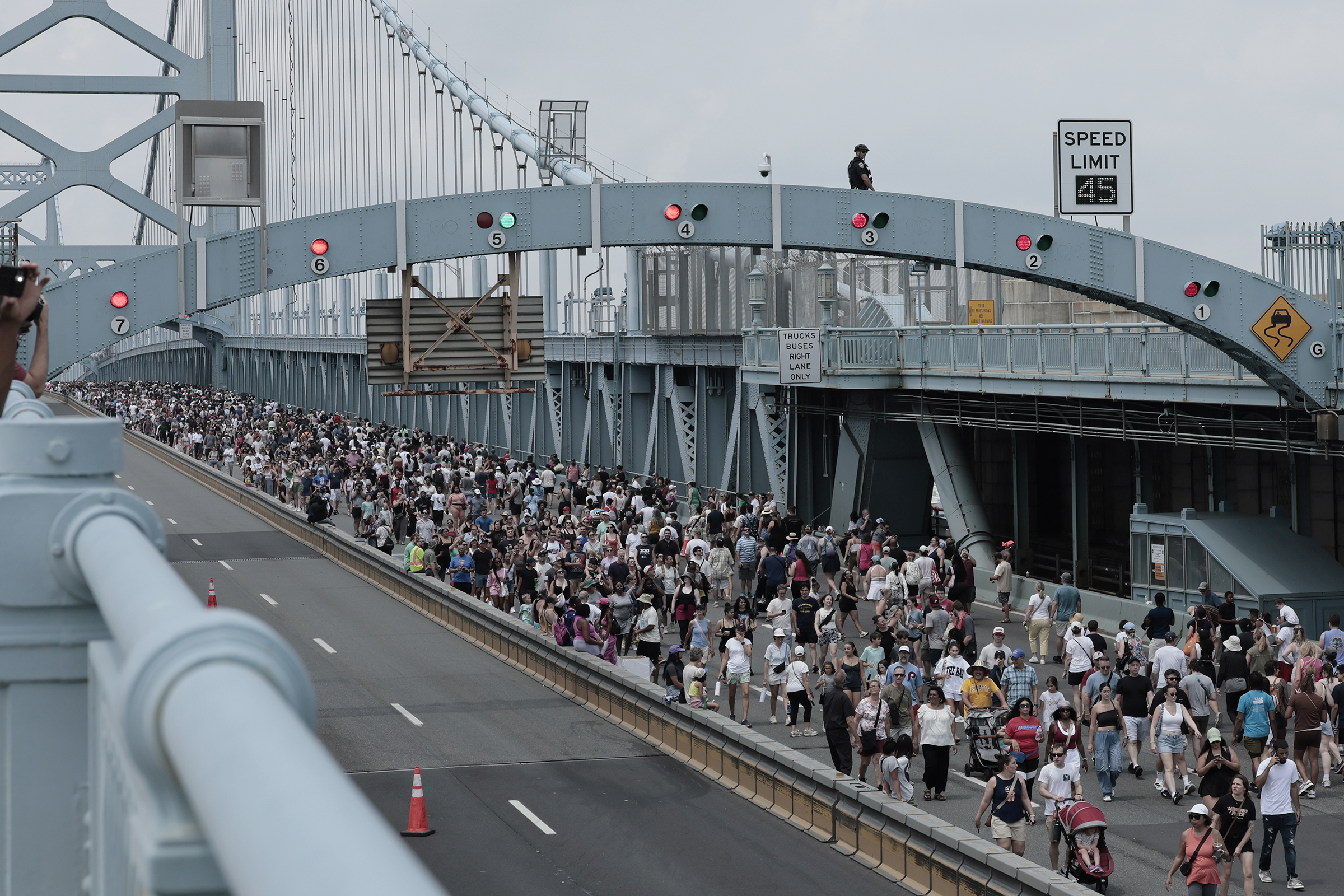
But the public’s cheerful response to this summer’s car-free celebrations around Philadelphia suggests that habits can change. Almost 600,000 people converged for World Cup watch parties at Lemon Hill in Fairmount Park during the 39-day FIFA Fan Festival — even though parking was banned. After the games ended, I saw hundreds of people streaming along the Schuylkill River Trail to 30th Street Station, a distance of 1.5 miles. Thousands took transit, rode bikes, or walked to the Ben Franklin Bridge to celebrate its centennial in July.
Thousands of people took transit, biked, or walked on July 11 to parade across the Ben Franklin Bridge to celebrate the 100th anniversary of its opening.Elizabeth Robertson / Staff Photographer
For people who switch to alternative forms of transportation, the payback is immediate. But Philadelphia and the region also have much to gain from having fewer cars racing through the streets: cleaner air, less noise, more casual social encounters with neighbors, and less wear-and-tear on infrastructure
The impact on climate change is a different story. Individual actions can only do so much to slow the dramatic shifts in global weather. It’s also a frustrating chicken-and-egg situation. People won’t see car-free living as truly feasible until there is intensive government investment in transit, bike infrastructure, and pedestrian safety.
Until that happens, carry a fare card, sign up for car-share, install a transit app on your phone — and don’t forget to wear ahelmet.
K.C. Keeler is a family man who has built his coaching foundation on the lessons and influence of those he played and coached under.
He has, what some would say, an old-school approach when it comes to running a football program: Juniors and seniors deserve the opportunity to play, academics and community service are just as important, and building a locker room starts with relationships.
As the winningest active head coach across all divisions of college football, Keeler’s philosophy has certainly worked. The second-year Temple coach surpassed 275 career wins (currently at 276) last season and is turning around a program that before last season finished 3-9 for four consecutive years.
In 2025, Temple posted a 5-7 record — one game short of reaching a bowl game, which it hasn’t made since 2019 — and had one-point losses to Navy and Army.
So, where does the program go from here? Well, for the first time in a long time, this program has a real sense of cohesion.
Before Temple’s season opener on Saturday against Rhode Island (2 p.m., ESPN+), Keeler sat down with The Inquirer, where he expressed his commitment to the Owls. He purchased a home in Wilmington, becoming the first Temple coach since Bruce Arians in the mid-1980s to do so. Keeler, who turned 67 in July (and is the third-oldest active FBS coach), wants to finish his college football coaching career on North Broad. But first, his focus is bringing back greatness to Temple.
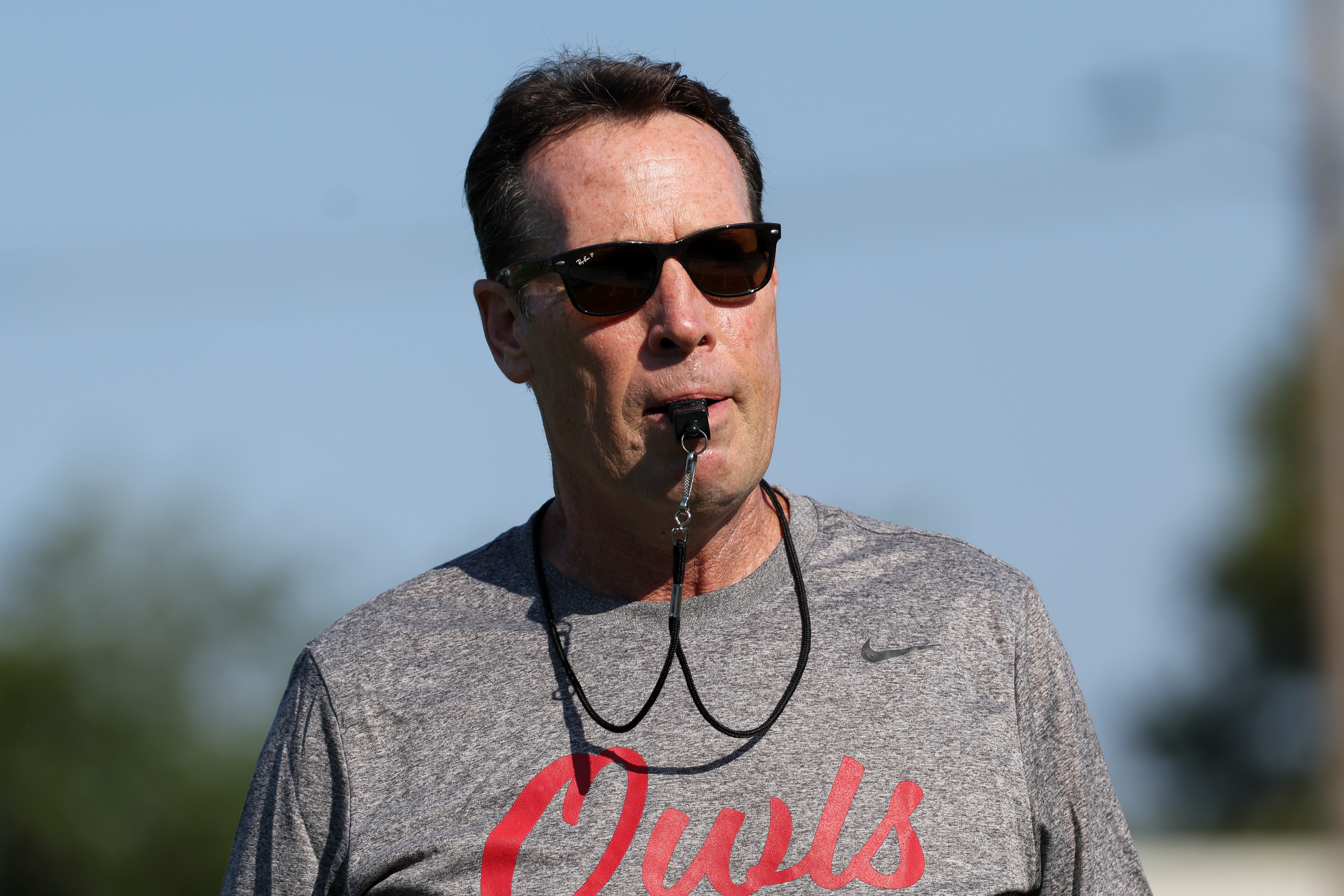
K.C. Keeler enters his second year as Temple’s head coach. In his first season, the longtime college football coach led the Owls to within one win of bowl eligibility.Isaiah Vazquez / For The Inquirer
Q: [Throughout] your coaching career [at] Rowan, Delaware, and Sam Houston State, you’ve established a track record of building winning programs. How have you shifted or changed as a coach to stay competitive?
A: One of the things that I’ve always done a really good job of is problem-solving. The other thing I’ve always done a really good job of is recognizing talent, not just on the field, but also coaches I’ve worked with. When I got to Rowan, and I got an opportunity at 34 years of age to be a head coach, I had some really good players I had recruited when I was an assistant there. … I learned from my former coach Tubby Raymond [at Delaware], a lot about building a culture, understanding that when you play for, at the time Rowan University, you play for the people who played before you, you play for the people you’re with in that locker room right now, you’re also playing for the people who are going to come after you. You try to develop this sense of belonging, so everywhere I’ve coached, I’ve always tried to emphasize this is a family. It’s its own unique family, but it’s a family, and this family ranges beyond just the guys in this locker room.
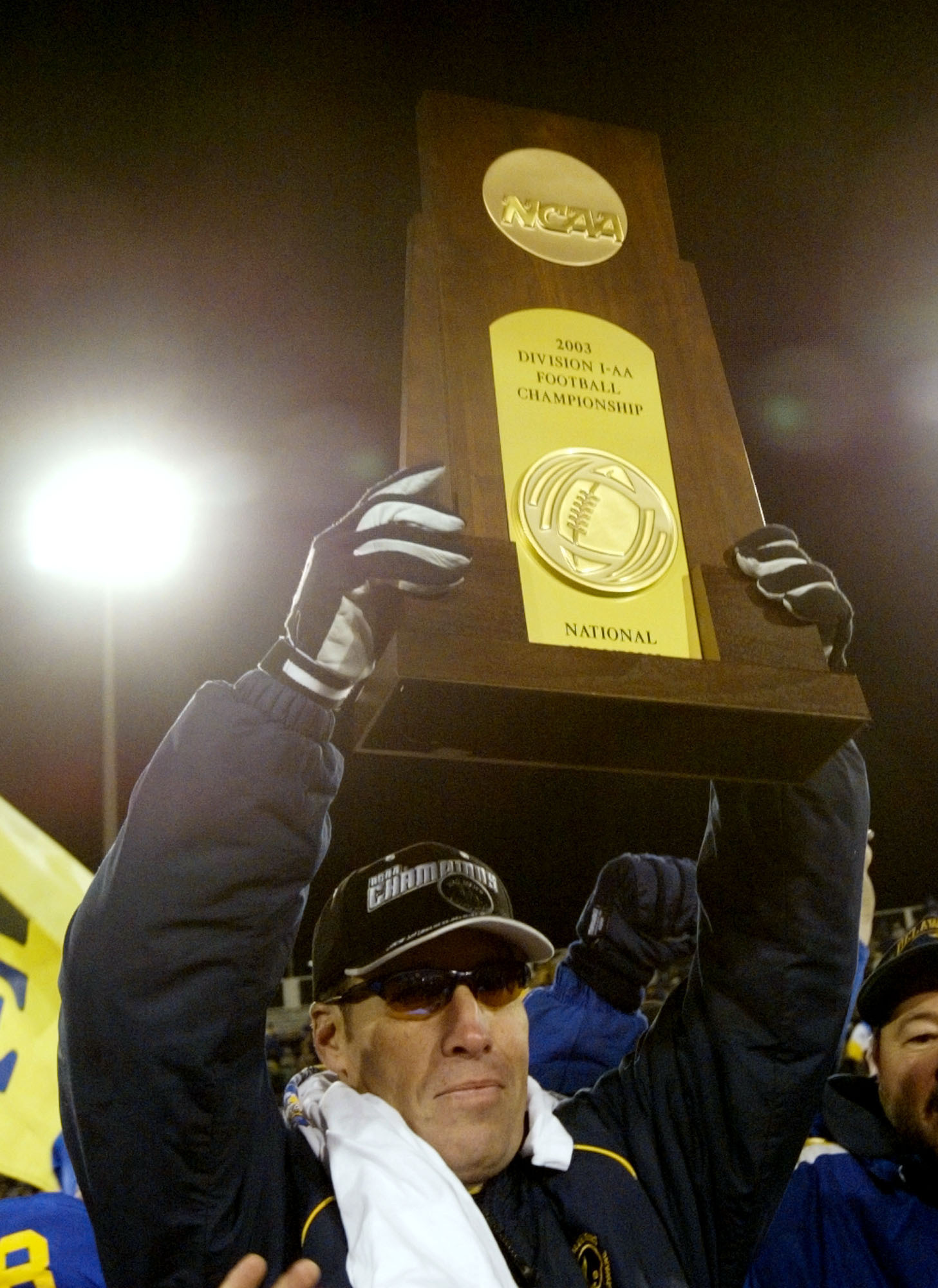
K.C. Keeler after Delaware defeated Colgate for the NCAA Division 1-AA Championship in 2003.AP Photo/Wade Payne
Q: You spent more than a decade at Delaware. How special was it to coach at the school you once played for?
A: Well, nowadays there’s no way that Delaware would hire a Division III coach, just with the headhunters and all the things that people go through now to figure out what coach they’re going to hire. But I was blessed that I had a president and an athletic director. The athletic director — Edgar Johnson, didn’t believe that. … For 11 years, when I pulled up to that stadium, in my office, I pinched myself. I probably had black-and-blue marks for 11 straight years. People always wondered who was going to follow Tubby. I mean, they have his name on the field. He had 300 wins, three national championships, and a guy that I respected in terms of creating that culture. I always say that his 300 wins or him inventing the Wing-T with Ted Kempski, those weren’t his greatest accomplishments. His greatest accomplishment was the culture that he developed.
Q: You’ve also dealt with adversity and losing seasons during your time at Delaware before you were let go in 2012. What was that departure like?
A: Me being fired had nothing to do with wins and losses. It was really more I had become a bit like Tubby did in that small state. Everyone knew what car I drove. Walking in a restaurant, my wife and children would go to the back for dinner, and I would have to stop at all the booths. There was a sense that maybe the administration, the people who were running the place at the time — they didn’t stay much longer after they fired me — they didn’t embrace the fact that I had developed a legacy there. It was hard. It was hard being fired, and I remember very vividly my daughter coming home after me being fired, and she said to my wife and I, ‘You guys are in your uniform, huh?’ Still had our pajamas on. … Then when we were out and we ran into an acquaintance on the street, and I went into my woes of being fired, and I said, ‘How are you doing?’ [They replied], ‘I’m battling cancer right now.’ My wife and I were like, let’s put this in perspective. We got fired from a job. We need to move on.
Q: What was your biggest lesson learned from Year 1 at Temple?
A: I told the guys when I first took over, I don’t want you to be realistic. [Temple] winning whatever it was, 13 games in five years, no one thinks we’re going to do much because we weren’t changing the roster much. It wasn’t like we came in, gutted the roster, brought new players in. We just felt there were so many upperclassmen that wanted to get their Temple degrees and that wasn’t the right thing to do. I still believe in education, and I believe that even though I wasn’t the coach that signed their scholarship papers when they came to Temple, I still represent Temple, I’m not going to cut you and try to get a player who’s that much better. So 5-7 was very disappointing, because we were so close to being a 7-5 team. But at the same time, I do know that there were some limitations because of how much we could change the roster. Those limitations actually led to us keeping all of our starters [this year].
Q: Your team was one of the few Group of Five schools to keep their starters from entering the portal. What does that say about what you’re building here?
A: We believe that our program is built on love and trust. I always explain that you can’t love somebody, you can’t trust somebody, until you know somebody. We work really hard at knowing each other. We’ll do the three H’s: Who’s your hero? What’s your hardship? What’s your history? We’ll do a trivia night where the guys are all mixed up with different positions and different players and coaches, and Clayton [Barnes, Temple’s general manager] leads it. It’s a lot of fun, and it’s a way to be together. … We work really hard in these four walls to develop relationships with our players. The great thing about us going into this year is that the whole strength staff is together, whole coaching staff stayed. … This building has a lot of cohesion.
Q: With the rising power of Name, Image, and Likeness, how have you managed the new landscape of college sports?
A: I wouldn’t have taken this job unless [Barnes] came with me. I know my skill set. I am a problem solver, but I’m not going to be the guy who’s going to be dealing with the agents. I’m not the guy who’s going to figure out the charts in terms of how much money we should allocate to each position and what starters are making at different positions. … That’s not my skill set. That’s [Barnes’] skill set.
I don’t call the offense anymore. I don’t run the defense anymore. I was an offensive coordinator, scored a ton of points — I got too many other things going on. … I’ve turned those things over; same thing with Clayton and the roster. Now we talk about it every day. It’s not like I’m not making final decisions, but I have enough trust.
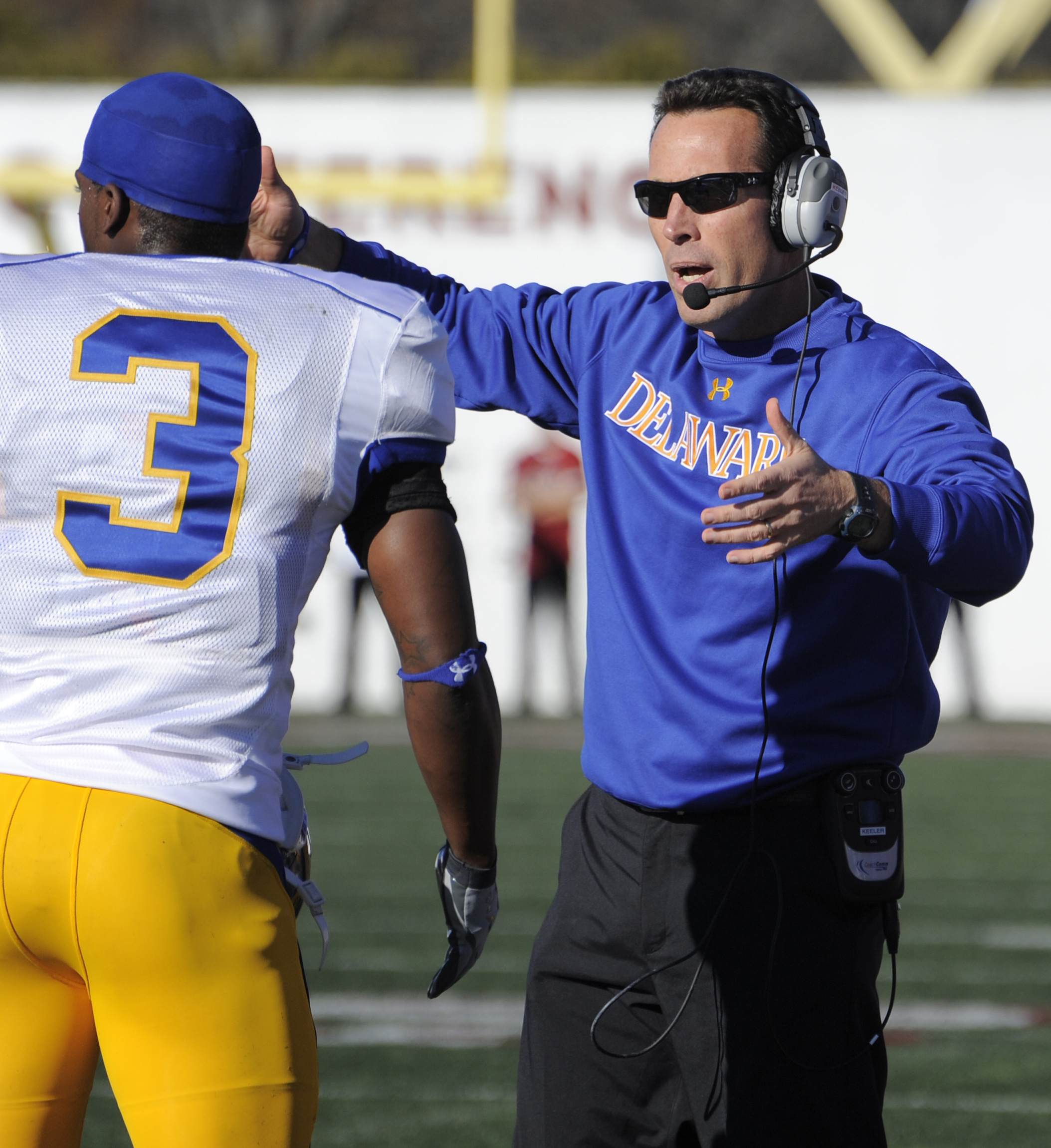
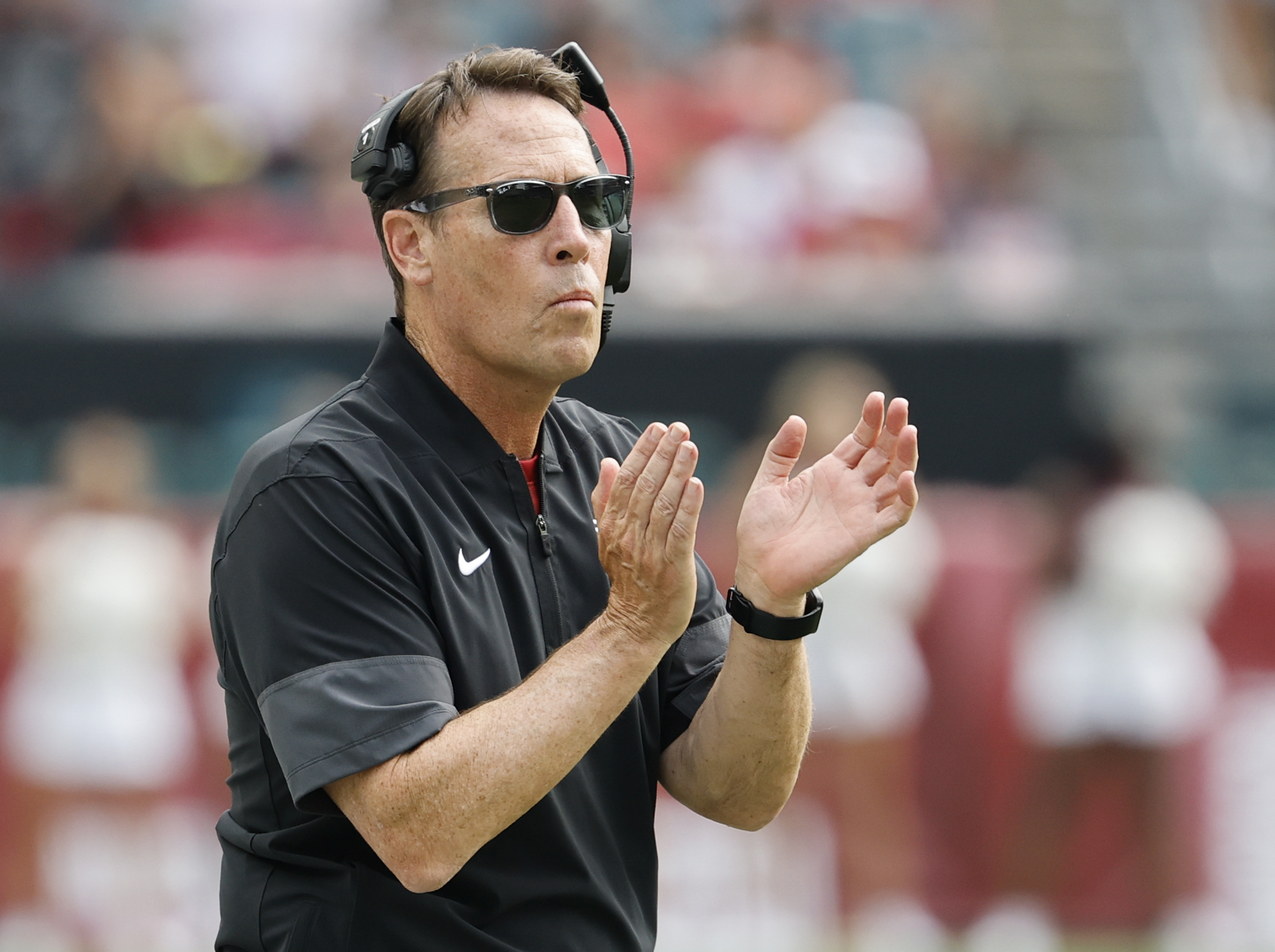
Q: Your sunglass look became a trademark at Delaware. What is the backstory about the sunglasses?
A: I have very sensitive eyes, so the lights really bother me — and I like sunglasses. I have six pairs of Ray-Bans in my backpack right now, so I like to change them up a little bit too. They have a bobblehead of me with my sunglasses on. I’ve been known to support the sunglasses. It’s a little bit of a trademark, but also the sensitive eyes go along with it.
K.C. Keeler spent 11 seasons as the head coach at Delaware.AP Photo/Nancy Palmieri
Q: As someone who grew up in Lehigh County and spent the bulk of your coaching career out East, what does it mean to come back after 11 years at Sam Houston State?
A: My wife’s a Penn grad, we met in the city. I was with the Eagles as a last cut [under] Dick Vermeil, and so we met in the city, fell in love in the city. … We have three grandchildren, and my wife and son-in-law are in Wilmington — this is home. I always tell the story that when the deal was finally done, we had just beaten Liberty Friday night to clinch a 9-3 season and a good bowl game. It was [my wife’s] birthday. I get the call from my agent that the deal’s done. I come back in and tell her, “Hey, listen, we are going back East,’ and she cried for an hour. I’m trying to explain to everybody in the restaurant, these are happy tears.
Q: There’s a lot of anticipation around this team. What would you say to fans about the direction of where this program is heading?
A: There’s been greatness here before. It’s not like I’m trying to reinvent anything. … One of my most vivid memories of any situation in my entire career was a locker room after we played Temple. We [Delaware] were the No. 1 team in the country in 1978 — don’t do the math — going to play Temple at the old Veterans Stadium, and they just embarrassed us. It was a different, physical brand of football that we weren’t used to, and they also just had this tremendous talent. Then the next year, that team I played on at Delaware, we won the national championship. We went 13-1. Our loss? To Temple. I have a pretty good perspective of where this place has been — and Temple can do it again. We had the No. 1 recruiting class in the conference. I don’t remember Temple doing that recently.
K.C. Keeler led the Owls to a 5-7 record in 2025.Yong Kim / Staff Photographer
Q: This year will mark 10 years since Temple last won an American championship. What stands at the forefront when you think about goals this season?
A: We want them to think about winning enough games to go to a bowl, winning a bowl, and maybe we can win enough [games] to get [to] that conference championship game. That’s kind of where I’m trying to set their sights. … If you’re realistic, don’t play for me. I want you to be unrealistic. I want you to dream dreams that are bigger than you possibly could imagine, because life is short. When I was at the FCS level in my first press conference at Delaware and Sam Houston, I talked about winning a national championship. … Our goal here at Temple is to be the best football program in the country. … I do believe we can become a team that can be playing in that conference championship game, and there’s a good chance that team plays in the big tournament.
The reality is that everyone knows we play Penn State the second week. I know it because that’s all I got asked when I was at media day. … But we got to worry about playing Rhode Island.
Sheri Herman, 71, formerly of Philadelphia, pioneering internet and cable TV executive, former senior vice president of content and business development for E! Entertainment Television, former president of internet startup American Cybercast, founder of SLH Communications, tech prophet, and dancer, died Thursday, Aug. 6, of heart failure at her home in Telogia, Fla., about 35 miles west of Tallahassee.
A magna cum laude communications graduate at Temple University, Ms. Herman went to New York after college to produce commercials for an ad agency. Over the next 27 years, she relocated to Denver and Los Angeles, successfully marketed, programmed, and developed dozens of TV networks and online companies, and pioneered the integration of TV and the emerging internet.
She was “mesmerized” by Apple cofounder Steve Jobs, her sister, Nadine, said, and predicted in the 1970s that one personal device would eventually take pictures, send messages, stream content, and still make phone calls. Jarl Mohn, former president and chief executive officer at E!, called Ms. Herman “a pioneer in incorporating new technologies and branding in entertainment.”
He said: “She also brought passion and conviction to everything she worked on.”
Ms. Herman founded her own firm, SLH Communications, in 1999. Courtesy of the family
Ms. Herman helped turn the startup Movietime channel into E! Entertainment Television in 1990 and told the Los Angeles Times: “We’re going to totally reposition the network. You won’t recognize us.” Over the next few years, E! grew its subscriber base from two million to 55 million, and Ms. Herman won industry awards for her marketing campaigns.
At American Cybercast, she championed The Spot, a groundbreaking interactiveonline reality show, in 1995, and told the Los Angeles Times in 1996: “We’re creating a new medium, but we’re kind of a cross between publishing and broadcasting in that we’re going to be advertising driven. If we were a movie studio, we’d be Miramax with a little more edge.”
Russell Collins, founder of American Cybercast, said: “Sheri Herman was nothing if not fearless. Her determination was boundless and fierce.”
Ms. Herman was especially effective at fundraising for projects and combining online content with ads and product placement. She trailblazed new internet publishing formats that included text, photos, and videos, and predicted the collision of TV and internet content. In 1996, she told Variety: “Eyeballs will move from TV to PC.”
Ms. Herman (left) oversaw the development of the Discovery Channel, the Fashion Channel, QVC, and other networks.Courtesy of the family
As director of programming for the United Cable Television Corp. in the mid-1980s, Ms. Herman collaborated with dozens of networks and oversaw the development of the Discovery Channel, the Fashion Channel, QVC, and other networks.
As senior vice president of programming and production for the Access Entertainment Network in the late 1990s, she reintroduced popular music videos and, according to Variety in 1998, gained six million subscribers in the network’s first three months of existence.
Shefounded her own firm, SLH Communications, in 1999 and contracted with TV Guide, Barnes & Noble, Hilton Hotels, musicians Quincy Jones and Jon Bon Jovi, and other entertainers and businesses. In New York, in the 1980s, she worked with cosmetics mogul Estée Lauder.
Temple officials noted her “influential career” in a tribute, and longtime friend and colleague Martin Lewis said: “She had a relentless thirst for charting new paths forward. She proselytized new media, new approaches, new everything.”
Ms. Herman (right) enjoyed time with her family.Courtesy of the family
In 2007, Ms. Herman reduced her daily responsibilities after being seriously injured in an auto accident in California. She moved to Florida in 2021.
Lewis said: “She was inventive, creative, exhilarating.”
Sheri Lynn Herman was born May 21, 1955, in Philadelphia. She grew up in Overbrook Park with her parents and older sister, and graduated from Philadelphia High School for Girls.
Her family featured several singers, and she spent many holidays singing songs and playing guitar around the piano at her grandparents’ home in Wynnefield. She loved music, studied ballet when she was young, and performed later with the Janosik Polish Dance Ensemble.
Ms. Herman was a magna cum laude communications graduate at Temple University.Courtesy of the family
Stylish and social, Ms. Herman enjoyed traveling and entertaining. She was a skilled seamstress who made her own clothes, an accomplished chef, and adept at interior decorating. She doted on her cats and dogs.
She married and divorced twice, and, after Philadelphia, lived in New York, Denver, and Los Angeles before Florida. Her sister said: “She was brilliant.”
In addition to her sister, Ms. Herman is survived by other relatives.
A celebration of her life is to be held later. Family, friends, and colleagues can connect at www.SheriHerman.com.
I was chatting with a friend recently whom I’ve known for a long time when she used the term woke as if it meant something disgusting.
I was so stunned that I didn’t bother trying to correct her. But I hung up the phone thinking about how the concept has become a political football, with even some Dems kicking it around.
African Americans created this vernacular. It preexisted MAGA’s hijacking of it by decades, dating back to the days of civil rights activist Marcus Garvey, founder of the Universal Negro Improvement Association. It has long been a part of pop culture, showing up in musical performances by everyone from Depression-era blues singer Lead Belly to Erykah Badu in her 2008 song, “Master Teacher.”
I first heard it during the early 1990s. Back then, if someone said, “You’re not woke,” it was considered the ultimate insult, right up there with being an Uncle Tom — or worse. Being woke refers to being alert to racial transgressions. The opposite of woke is to be asleep, and therefore oblivious to systemic racism and injustice.
No matter how President Donald Trump and Secretary of Defense Pete Hegseth attempt to vilify the term, I stand by the notion that being woke is a good thing. As in the exhortation, “Stay woke, brother.”
It’s galling to watch politicians bastardize it. U.S. Rep. Alexandria Ocasio-Cortez recently brought it up during an ABC News interview when she said, “I have a local city councilman that has this saying: ‘Woke 1 was crazy.’”
She was talking about Francesca Hong, a progressive candidate running for governor of Wisconsin with a history of making radical statements, and was also quoting New York City council member Chi Ossé, who used the “woke 1” term on social media. I get that Ocasio-Cortez was referring to far-left calls to defund the police — which most Black people never fully supported — among other extremist ideas. But her words still stung.
I have an awful lot of respect for Ocasio-Cortez. I recognize she may be weighing a run for the presidency in 2028 and trying to center herself politically. But this kind of virtue signaling won’t be as beneficial as she hopes if it also alienates African Americans.
M.K. Asante said that “the idea of staying woke became associated with consciousness,” but that the meaning of the term has changed after being co-opted by the mainstream.
For insight, I reached out to M.K. Asante, a professor at Morgan State University whose father is Molefi Kete Asante, a renowned professor of Africology at Temple University. “The idea of staying woke became associated with consciousness,” Asante told me, but added that the term was co-opted around 2020 following the widespread uprisings after the murder of George Floyd by a police officer.
Asante pointed out, “Now it does not have the same meaning in the mainstream.”
He declared an all-out war on diversity, equity, and inclusion efforts in both federal and private sectors, and hasalso taken aim at museums he says are “essentially, the last remaining segment of ‘WOKE.’” Trump also has cut funding from key government programs that support DEI.
Even the military hasn’t been immune. Trump summarily dismissed Air Force Gen. Charles Q. Brown Jr., who was the second Black person to serve as chairman of the Joint Chiefs of Staff, and set about renaming military bases after Confederate generals.
Earlier this year, Pentagon spokesperson Sean Parnell announced on X that officials were targeting Stars and Stripes, an independent newspaper that covers the military, in part to “refocus its content away from woke distractions that syphon morale.” Since then, the paper’s publisher, editor-in-chief, and a reporter have all been terminated, ending 155 years of editorial freedom, as my colleague Will Bunch reported.
Meanwhile, the United States is at war with Iran, Canada, our closest ally, has announced retaliatory tariffs on U.S. products, and American consumers are wondering if the influx of tariff-free foreign beef imports Trump is pushingwill be safe to consume.
Yet, Trump says woke is the enemy.
Despite the president’s best efforts, he can’t stamp the term or its real meaning out.
As Asante pointed out, “You can co-opt a word, but the spirit of what ‘stay woke’ means is alive and well.”
But for thousands of residents, many of whom live in North Philadelphia, next year’s tax bills are expected to soar.
Nearly 6,000 homeowners in Philadelphia saw their property assessments this year climb by more than 50% compared with two years ago, the last time the city conducted a mass revaluation, according to an Inquirer analysis of city property assessment data released in June.
Of those homeowners, more than 2,200 saw their assessments more than double.
That is likely to result in sticker shock come tax time next year, because property tax bills in the city are calculated based on home values. The revenue is split between the city and the Philadelphia School District.
Homeowners across the city saw a median 3% increase in their property assessments this year compared with the 2025 tax year. Jumps were higher in neighborhoods that border gentrifying areas, such as in parts of Kensington and West Philadelphia.
But this year, two other areas of the city had the densest concentrations of homes where property assessments increased by 50% or more, according to The Inquirer’s analysis.
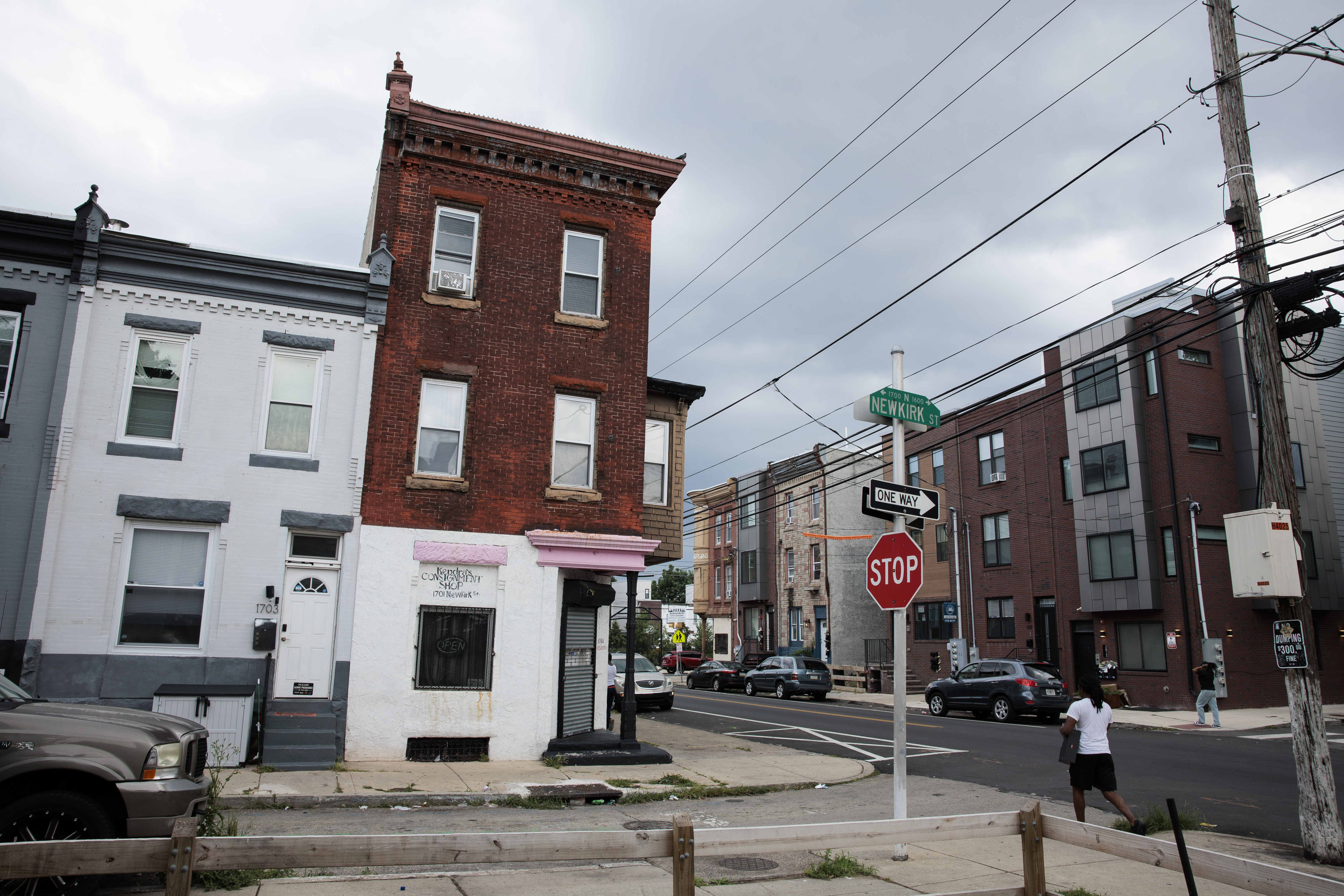
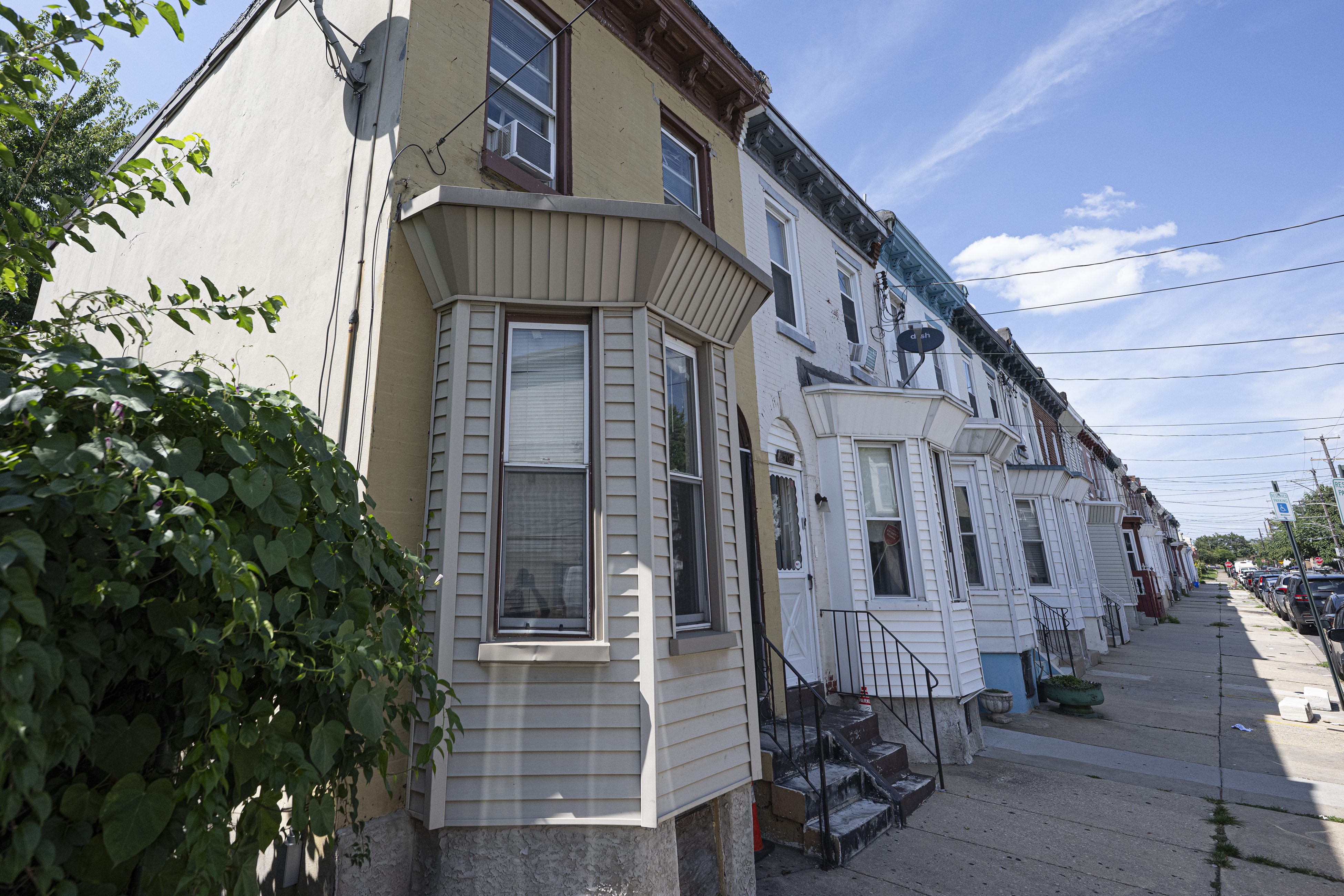
The steep rises are clustered in the southern end of Strawberry Mansion, the historically Black neighborhood along the Schuylkill, and in the tiny Hartranft neighborhood north of Temple University and east of Broad Street, where residents are predominately Latino.
(function() {
var l2 = function() {
new pym.Parent(‘html_sandwich_2026_property4’,
‘https://media.inquirer.com/storage/inquirer/projects/innovation/arcgis_iframe/html_sandwich_2026_property4.html’);
};
if (typeof(pym) === ‘undefined’) {
var h = document.getElementsByTagName(‘head’)[0],
s = document.createElement(‘script’);
s.type = ‘text/javascript’;
s.src = ‘https://pym.nprapps.org/pym.v1.min.js’;
s.onload = l2;
h.appendChild(s);
} else {
l2();
}
})();
Housing experts and advocates for low-income homeowners have long criticized the city’s assessment system as systemically biased, leaving Black and brown homeowners to pay disproportionately high property taxes. Mayor Cherelle L. Parker convened a task force in 2024 to study the city’s revaluation system, and that group’s recommendations are expected to be released later this year.
Monty Wilson, a senior attorney at Community Legal Services who sits on the task force, said the Philadelphia Office of Property Assessment is the best in the state and has “worked really hard to become more and more accurate.”
But he said bias persists in part because of the unique challenges that assessors face in low-income neighborhoods that can cause volatility in home values, such as higher rates of vacant lots, foreclosures, and other factors.
A 2024 CLS report found that errors were clustered in lower-value neighborhoods where a majority of residents are people of color.
“That means when a property is overassessed,” Wilson said, ”it tends to occur in a Black and brown neighborhood.”
(function(){function e(){window.addEventListener(`message`,function(e){if(e.data[`datawrapper-height`]!==void 0){var t=document.querySelectorAll(`iframe`);for(var n in e.data[`datawrapper-height`])for(var r=0,i;i=t[r];r++)if(i.contentWindow===e.source){var a=e.data[`datawrapper-height`][n]+`px`;i.style.height=a}}})}e()})();
The Parker administration did not respond to requests for comment.
In response to a previous article about this year’s property reassessments, city officials emphasized that some lower-income homeowners pay relatively low tax bills because of the popular homestead exemption tax break. The program, which any homeowners can apply for and obtain if they live in their house as their primary residence, exempts the first $100,000 from a home’s taxable value.
That means that some homeowners in working-class neighborhoods previously paid little to no property taxes. A sudden increase in valuation, like the ones seen this year in pockets of North Philadelphia, could require they pay bills next year that are several hundred dollars more than in the past.
Take the 2500 block of North Marshall Street. The residential North Philly street sits between West Kensington and Broad Street, and nearly every home saw its assessment increase by 60% or more, according to The Inquirer’s analysis.
Most of the homes there had previously been valued at less than $100,000, meaning owners with the homestead exemption owed no property taxes. Now, many of the homes on the block are valued at about $140,000, an amount that would next year yield more than $500 in yearly tax bills for owners with the homestead exemption.
More than 40% of the Hartranft neighborhood’s residents are below the federal poverty level, which is $33,000 a year for a family of four, according to U.S. Census data.
At Left a property on 2500 N. Marshall St., Philadelphia, PA 19133 is shown Wednesday, Aug. 19, 2026, in Philadelphia.Jose F. Moreno / Staff Photographer
City Councilmember Quetcy Lozada, whose district includes parts of Kensington and North Philadelphia, said the Hartranft area is not like sections of Kensington that have seen an influx of development in recent years and where increases in property assessments may be expected.
It is possible, she said, that lower-income residents who have been displaced from parts of Kensington looked to move west of the neighborhood, increasing demand in the Fairhill and Hartranft areas.
Lozada — who has held workshops in the neighborhood to connect residents with property tax relief programs — said she fears her constituents are being asked to pay disproportionately high taxes and not seeing better city services and stronger public schools.
“How is it possible that someone in Fairhill is paying a higher tax for a property that has not had any investment, in a neighborhood that is not as safe, whose school system is not as great, as somebody that lives in Chestnut Hill, for instance?” she said, referring to the upscale Northwest Philadelphia neighborhood with a $109,000 median household income. “There has to be a better way of doing a more accurate evaluation in every neighborhood.”
In Strawberry Mansion, community leaders said that increased assessments are likely a result of market pressure from Brewerytown to its south, a comparatively whiter and higher-income neighborhood.
“The city has to be super transparent about this assessment system so people can better understand it and not feel that sticker stock,” said Tonnetta Graham, president of the Strawberry Mansion Community Development Corp. “If we know how they came to their number, it’s easier to chew.”
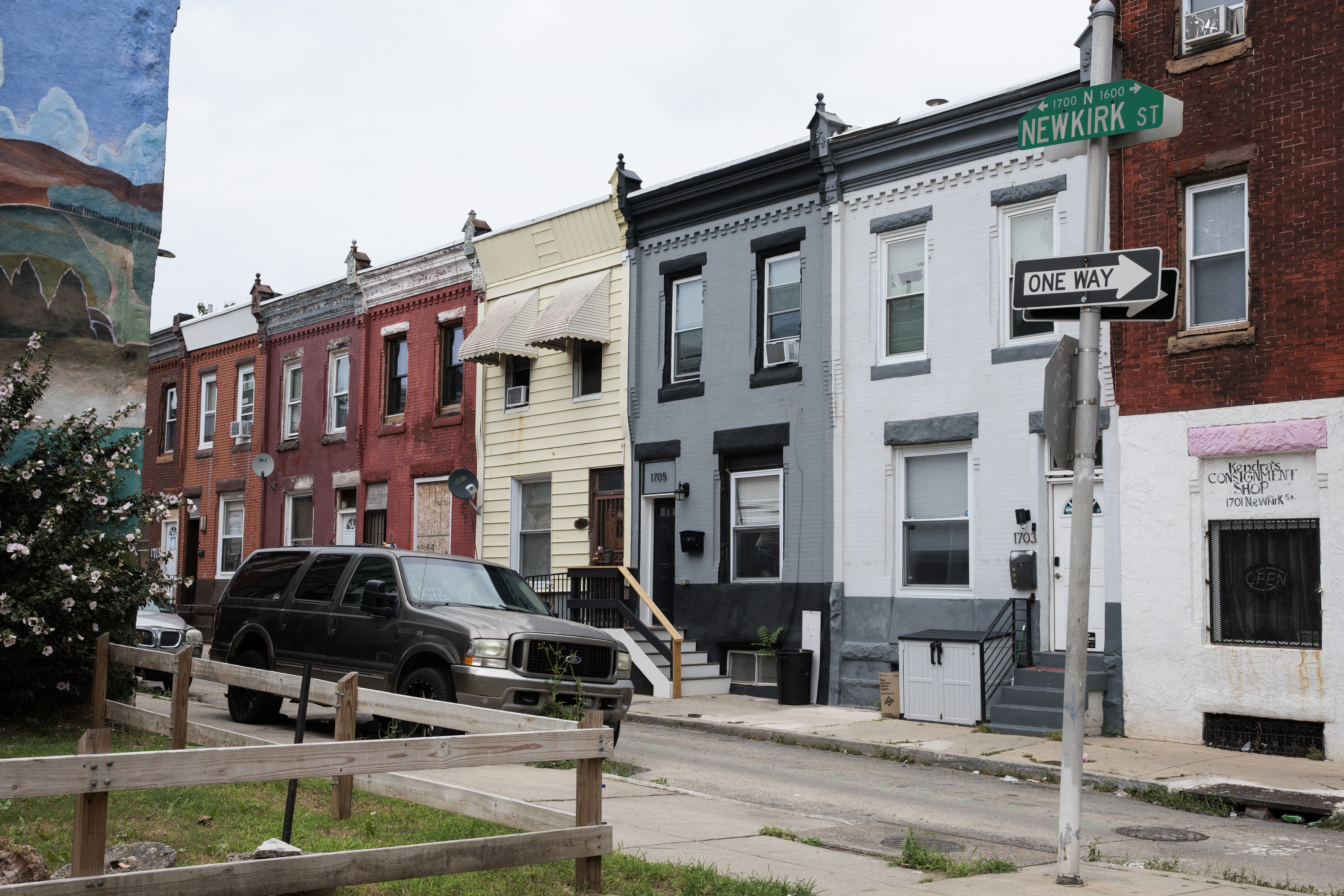
The 1700 block of North Newkirk Street on Thursday, Aug. 20, 2026 in Philadelphia.Monica Herndon / Staff Photographer
Councilmember Jeffery Young Jr., whose district includes both Strawberry Mansion and parts of Hartranft, did not respond to requests for comment.
Jalon Alexander, a Strawberry Mansion native who this month launched a campaign to challenge Young for his Council seat next year, said he was recently at a block party in the neighborhood where he heard repeatedly from older homeowners who were concerned about their increased assessments.
“They feel taken advantage of, and they feel like it’s coming out of nowhere,” Alexander said. “This is an area where there’s high levels of poverty, and there is not a lot of political or government attention in this area. I’ve spoken with many people whose rates have almost doubled. It’s the biggest issue in the neighborhood.”
Staff writer Michaelle Bond contributed to this article.