Tag: Temple University

  • Philly protesters rally for sexual assault survivors as the Cornell rape case receives national attention

    Philly protesters rally for sexual assault survivors as the Cornell rape case receives national attention

    Dozens galvanized on Saturday morning in Center City to decry rampant sexual abuse on college campuses and support Jane Doe, the former Cornell University student who said she was gang-raped at a fraternity house in 2024.

    The Cornell allegations have recaptured the spotlight after the woman, identified only as Jane Doe, recently filed a lawsuit, roiling the Ivy League school, and renewing the national debate about colleges’ handling of sexual assaults and campus safety.

    In recent weeks, those conversations have reverberated across social media, in private chats and group texts nationwide, on prime-time broadcasts, and, now, 230 miles away, in Rittenhouse Square.

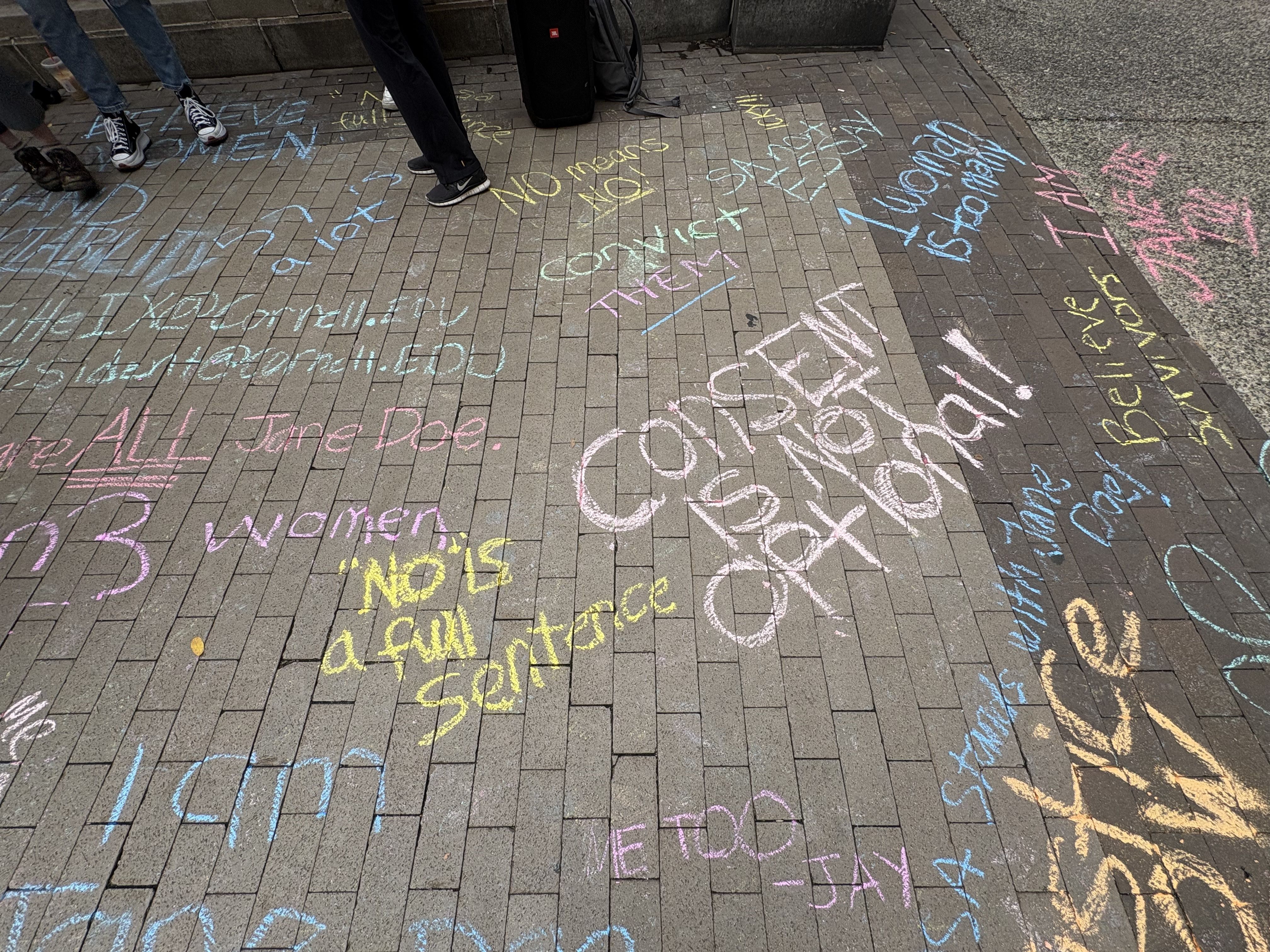
    On Saturday, the group of mostly young women protesters — many of whom said they had experienced sexual violence — held up signs and scribbled messages in sidewalk chalk, sharing stories of their own survival while expressing their frustration, exasperation, and collective grief. Scores of passersby, there for the weekly Rittenhouse Farmers Market, paused to listen or watch.

    “I want people to be angry,” said organizer Delaney Brannon. “I want to make people who are afraid to talk about [sexual assault] uncomfortable because we need to talk about it.”

    Brannon, 26, said she has felt sick, on edge, and “in fight or flight” mode hearing about developments in the Cornell case this week.

    “There’s something about this specific case that’s so deeply disturbing and unnerving,” she said.

    The latest in the Cornell rape investigation

    In September, Jane Doe sued the university, the fraternity, and seven men she alleged were involved, as well as others, claiming she was plied with alcohol and drugs and repeatedly assaulted. One of the men sent a crude Snapchat message inviting other fraternity brothers to join in, according to a screenshot included in the lawsuit.

    Campus police and administrators and the local prosecutor are also under scrutiny for their handling of the 2024 case, including their failure to pursue criminal charges against the accused men despite Jane Doe’s unequivocal assertion to police that she had been raped.

    At the time, Cornell launched its own investigation that resulted in some of the students being expelled or suspended, while others were ordered to write essays, according to the lawsuit. Cornell doesn’t deny that the essays were part of the punishment for some of the men but has declined to give details on how each were sanctioned.

    The criminal investigation was reopened this week and is being led by New York’s attorney general.

    Many at Saturday’s demonstration called the allegations — and Cornell’s response — shocking and horrifying but said they were “not surprised.” The refrain “I am Jane Doe” has become a rallying cry on social media in solidarity with Jane Doe, while also illustrating the pervasiveness of sexual violence. According to a World Health Organization report, one in three women worldwide have experienced physical or sexual violence in their lifetimes.

    “This problem is not isolated — it is everywhere,” said Ray Epstein, a consent and prevention specialist who founded Student Activists Against Sexual Assault (SAASA) while a student at Temple University.

    “I guarantee you even if you don’t think that you know a Jane Doe in your life, you do — you absolutely do,” she said. “It is everywhere.”

    The group also voiced dismay at officials’ initial response and the lack of consequences.

    “No one is held accountable — universities don’t do anything,” said Jacqueline Hill, a Temple student and SAASA’s marketing director. “When they know they can get away with it, they’re going to keep doing it.”

    To Hill and others, “actual accountability” is the only effective deterrent. Attendee AJ McCormick, 26, added: “Silence is how systems like this survive.”

    Jo Buyske, a third-generation Cornellian woman, said drinking and Greek Life was central to the school’s culture when she was a student. Seeing Jane Doe’s allegations, she’s “sure that exact thing happened while I was there.”

    “I’m horrified, I’m embarrassed,” Buyske, 66, said of her alma mater, asking, “Where are the grown-ups? The university is the grown-up in absentia.”

    Brannon, the organizer, was surprised at Saturday’s showing, saying she expected to be — and was willing to be — standing alone. For some, the turnout was encouraging but bittersweet.

    “I’m so sorry that we all relate,” Brannon said.

    Epstein added, “I hope we can find some form of hope in how many people are rallying now.”

    “Isn’t it kind of moving?”

    The Associated Press contributed to this article.
  • I’m a nurse who helps sexual assault survivors. Jane Doe’s texts from Cornell sound like what I hear in Philadelphia.

    I’m a nurse who helps sexual assault survivors. Jane Doe’s texts from Cornell sound like what I hear in Philadelphia.

    I am a sexual assault nurse examiner in Philadelphia. For the past 10 years, I have also studied how people heal after sexual harm, and I answer anonymous questions from survivors on Our Wave, a free online healing platform for people who have experienced violence. In both places, the question I hear most often is “Does this count?”

    Cornell University’s Jane Doe spent three weeks asking herself that question.

    Title IX records obtained by the New York Times show the sophomore, who says she was assaulted by multiple men at a fraternity house in October 2024, texting with some of the men she would later accuse.

    The Chi Phi fraternity house at Cornell University in Ithaca, N.Y., where a Cornell student reported being gang-raped in 2024. A special prosecutor has recently been appointed by New York state to investigate the allegation.HEATHER AINSWORTH

    According to the Times, two days after the party, she reassured one of them that none of the sexual stuff was illegal. Two days after that, she wrote that her reputation was destroyed and that all she could do was sleep and cry. She later told investigators that things shifted when she read an anonymous post online. She said it was the first time she had heard anyone say “that I wasn’t a whore and that I was assaulted.”

    Those texts are now being used against her.

    The Tompkins County, N.Y., district attorney declined to bring charges in 2024. He has since said his office never saw the transcript of her police interview, in which she reportedly said she was certain she had been raped, and he has reopened the case. The New York attorney general is also reviewing how Cornell handled it.

    The legal process will decide what happened that night. As a nurse, I recognize the weeks that followed.

    Healing after sexual harm rarely starts with the word rape. My research has followed the healing journeys of survivors across the globe, including hundreds here in Philadelphia. Survivors have taught us that there are multiple pathways people may move through as they heal. Two of the earliest are normalizing, when violence feels like just what happens, and minimizing, when a survivor knows something was wrong but insists it wasn’t that bad.

    On campus, survivors often normalize and minimize because of what hookup culture has taught students to accept, so pressure, coercion, and sex with someone too drunk to consent can feel like just part of a night out.

    People move back and forth between these pathways for months or years, and each one helps them get through the day. But our systems tend to treat whatever a survivor says during them as the whole story.

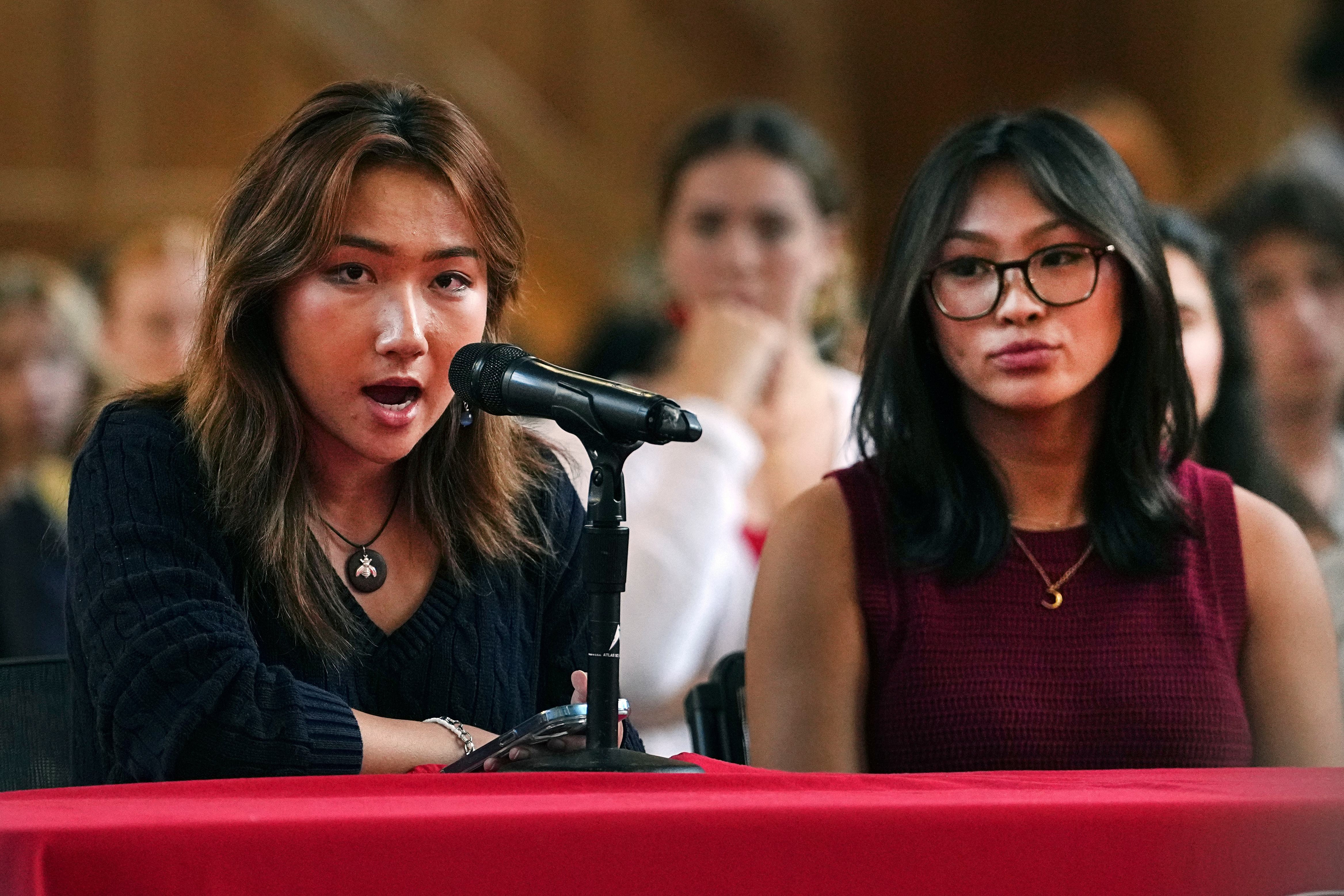
    Cornell University students and American Civil Liberties Union student chapter members Jane Wang (left) and Sophia Riley Sim speak about sexual violence on campus during a student assembly meeting at the university on Oct. 1.Matt Rourke

    I first saw this as a student working at the University of Michigan’s sexual assault center. Women who came in late at night almost never started with the word rape. They usually started with “I’m probably being dramatic but …”

    Jane Doe’s texts read like the normalizing and minimizing I have seen again and again in my research. Many survivors tell us they didn’t realize they had been sexually assaulted until after they had time to process. What helped survivors move forward was connection, and sometimes one supportive person was enough. For Jane Doe, it was a stranger online who finally called it assault. The way we respond to survivors really does matter.

    At Our Wave, where I direct research and survivor support, survivors share their stories so others can see themselves in them and make sense of their own experiences.

    The questions survivors send us show how often doubt comes first. When my team searched the nearly 1,000 questions submitted to our Q&A for the language of doubt, phrases like “does this count,” “am I being dramatic,” “it was my fault,” and “I froze,” we found it in about one in four.

    Survivors are everywhere, but we do not always recognize their experience as survival, and survivors do not always recognize it in themselves. Perhaps that is why so many people have been posting “I am Jane Doe” this week. They see themselves in her story.

    We ask survivors to make one big decision — whether to report — at the moment many are least able to make it. A survivor who is still minimizing what happened is not going to file a police report. She might read another survivor’s story at 2 a.m., ask an anonymous question, or come in for medical care and an exam, which she can have without going to the police.

    Survivors need a menu of options that meets them where they are in their healing journey. Some need anonymous support first, like a hotline or an online Q&A. Some need medical care and evidence collection now, with the decision about reporting saved for later.

    Some need a confidential campus advocate who won’t automatically open an investigation. Those who are ready need formal Title IX and criminal processes. And some want restorative options, in which the person who caused harm must take responsibility and face consequences outside the criminal legal system, such as losing campus housing or leadership roles.

    More options can also mean more accountability. In the Cornell case, with no criminal charges, the university’s process was the only accountability available. One woman in my research said she wished her school had “more teeth.” In my experience, survivors who know they have options are more likely to come back when they are ready.

    Philadelphia can lead on this.

    We have dozens of colleges and universities, including Temple, Penn, Drexel, and La Salle, and our city’s rape crisis center, WOAR, already offers a restorative justice program, although recent funding cuts have threatened its sustainability. As faculty adviser to Students Activists Against Sexual Assault at Temple, I know students here are ready for this conversation. Our campuses should build the full menu, and every student should hear that they don’t have to be sure it counts before they ask for help.

    Healing isn’t linear, and in my experience, naming isn’t, either. Jane Doe needed three weeks to find the word. That is common. To survivors who are still asking whether it counts, your story matters, and healing is possible.

    Together, we can create a more supportive healing world for survivors, one where people are still listening, and options are still open when they get there.

    Laura Sinko is an associate professor of nursing at Temple University’s College of Public Health, faculty adviser to Temple’s Students Activists Against Sexual Assault, a sexual assault nurse examiner in Philadelphia, and the director of research and survivor support at Our Wave.

  • John Baer, award-winning longtime Inquirer and Daily News political reporter and columnist, has died at 79

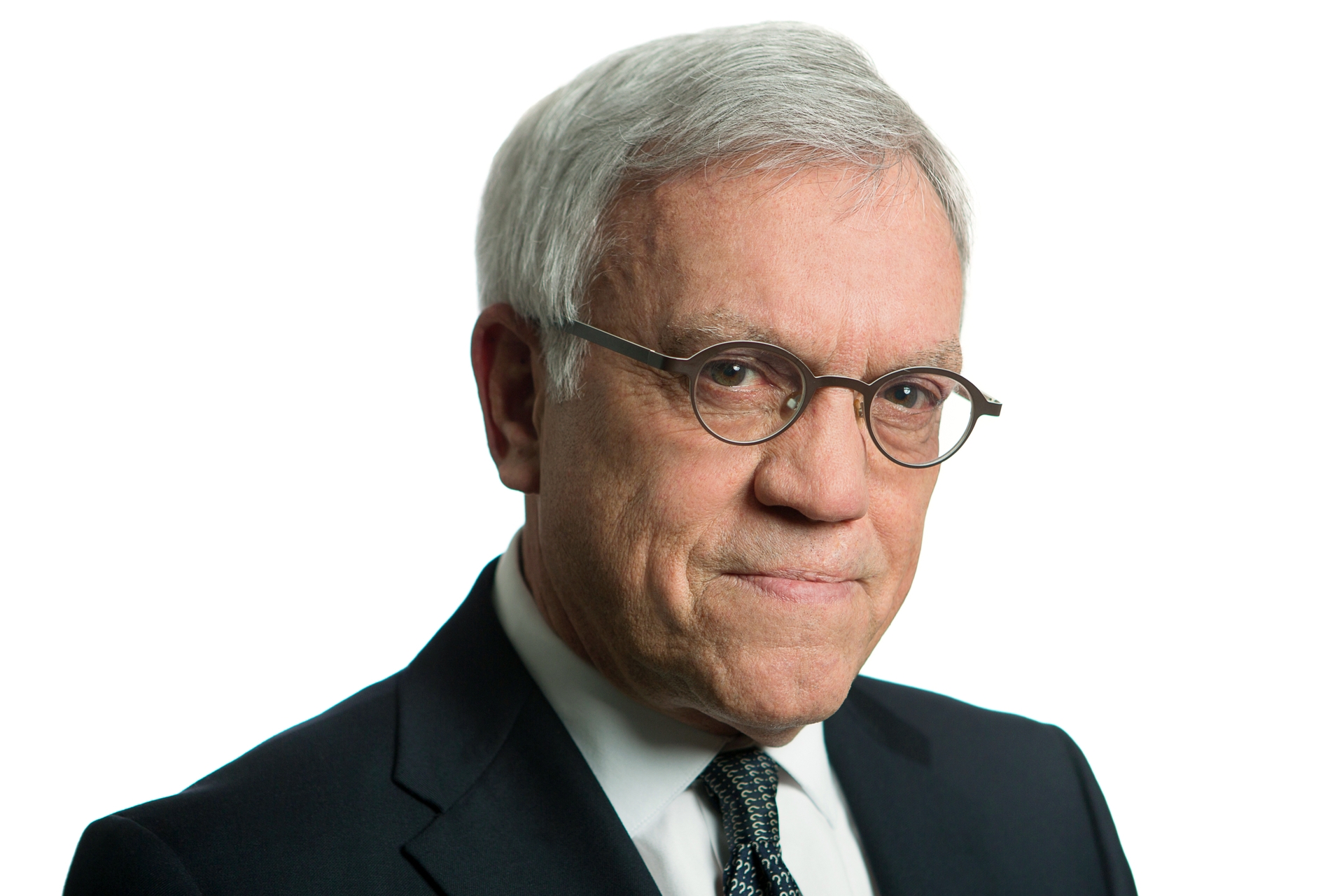
    John Baer, award-winning longtime Inquirer and Daily News political reporter and columnist, has died at 79

    John Baer was the son of a Harrisburg newspaperman. He literally grew up in the Pennsylvania state Capitol. And he never left.

    His father, John H. Baer, was a political reporter for what is now the Patriot-News in Harrisburg, and Mr. Baer spent many Sunday afternoons hanging around the old Capitol press room while his father worked on stories. Decades later, in 1972, Mr. Baer joined the Evening News in Harrisburg as a reporter and went on to work for nearly 50 years in that same press room.

    “I’m probably unique in Pennsylvania politics and journalism,” Mr. Baer said in a 2020 oral history interview for Pennsylvania State University. “I dare say there probably aren’t any who can say they worked in the same state capitol newsroom that their father did.”

    In 1987, the Daily News hired Mr. Baer to cover state politics in Harrisburg. He became a political columnist for the newspaper in 2000, and his plainspoken, no-holds-barred stories later appeared in The Inquirer as well. Before he left the papers in 2019, he covered hundreds of political campaigns, conventions, and elections, and wrote about thousands of local, state, and national politicians.

    Mr. Baer’s column on politics appeared in The Inquirer and Daily News from 2000 to 2019. Newspapers.com

    “He was the most feared reporter in my eight years in Harrisburg,” former Gov. Ed Rendell said. “He did his work. He did his digging. He really cared about the issues.”

    On Thursday, Sept. 24, Mr. Baer died of cancer at his home in New Cumberland, Pa. He was 79.

    For 32 years, Mr. Baer was a hard-hitting, award-winning political reporter and columnist for The Inquirer and Daily News. He was also a columnist for PennLive and the Patriot-News, onetime public TV producer and show host, former press secretary, author, teacher, and mentor.

    Many of those Mr. Baer covered in Harrisburg, Philadelphia, and Washington praised his “deep integrity” and “fierce independence,” and called him a “keen observer of Pennsylvania politics” and “a heavyweight in Pennsylvania political reporting” in online tributes. State Rep. Ben Waxman called Mr. Baer a “legendary Capitol journalist.” U.S. Rep. Dwight Evans said he was “authentic and a one-of-a-kind journalist.”

    Mr. Baer told Penn State he wanted to “let people see the inside of the game in Harrisburg.” His Inquirer.com online profile reads: “John Baer has written about politics and government since 1987. Neither subject ever fails to provide him with stories of policies and politicians walking on or skirting by paths to perdition.”

    In addition to covering nine Pennsylvania governors, the impeachment trial of President Bill Clinton, and the ascensions of Presidents Barack Obama and Donald Trump, Mr. Baer wrote about the execution of serial killer Gary Heidnik, the pleas for more research funding by a cancer victim, and the battle of a state policeman’s widow to receive her husband’s pension benefits.

    He said some of his favorite columns were the mea culpa pieces he wrote at the end of each year that highlighted things he got wrong. “I truly just had a ball at the Daily News,” he told Penn State. “I just loved it. … I’ve always said I had no adult supervision, and it was wonderful.”

    Mr. Baer joined PennLive in 2019, and his last column was published in July. “The depth and breadth of his knowledge was beyond compare,” said Amy Worden, his editor at PennLive.

    Mr. Baer and his wife, Rosemary, married in 1969.Courtesy of the family

    Before the Daily News, Mr. Baer spent 14 years in total as a reporter for the Patriot-News, an award-winning public TV producer and show host for WITF in Harrisburg, and a press secretary during Lt. Gov. Bill Scranton’s unsuccessful run for governor in 1986.

    He wrote freelance stories for Philadelphia Magazine and national publications. He was a frequent guest on political TV and radio shows and moderated several statewide candidate debates.

    A lifelong foodie, he also reviewed Harrisburg-area restaurants for a magazine under the pseudonym “the Phantom Diner.” His book, On the Front Lines of Pennsylvania Politics, was published in 2012.

    “He was so good at writing strong opinions with depth,” Paul Vigna, a retired Daily News editor, said.

    Mr. Baer earned awards for his journalism and was inducted into the Pennsylvania News Media Hall of Fame in 2024. He was cofounder of the Pennsylvania Press Club and onetime president of the Pennsylvania Legislative Correspondents Association.

    In tributes, colleagues praised his “sharp wit” and called him a “journalism giant,” “terrific writer,” and “mentor to many of us.” The internship program at the Pennsylvania Legislative Correspondents Association is named in his honor.

    “He was an All-Star, a Hall of Famer,” Vigna said. Rendell said: “He didn’t take any BS.”

    John Baer was born June 25, 1947, in Harrisburg. He graduated from Bishop McDevitt High School in 1965 and earned a bachelor’s degree in English at Mount St. Mary’s University in Maryland and a master’s degree in education later from Temple University.

    He coached basketball and football teams while teaching English for three years at Trinity High School in Harrisburg after college. He married Rosemary Ruggieri in 1969, and they had sons Johnny and James.

    Mr. Baer and his wife hosted many memorable Christmas parties and enjoyed road trips to Georgetown University basketball games, New York Mets baseball games, and their sons’ many sporting events. He played racquetball and tennis, and ran a marathon at 50.

    He was a longtime member of St. Theresa Catholic Church in New Cumberland. “He liked interesting people and had lifelong friendships,” his family said in a tribute. “He loved his friends.”

    On Facebook, colleague Diana Robinson said: “Here’s to you, John Baer. You’ll always be The Most Interesting Man in Harrisburg.”

    In addition to his wife and sons, Mr. Baer is survived by three grandchildren and other relatives.

    Services were held earlier.

    Donations in his name may be made to Vickie’s Angel Foundation, 511 Bridge St., Box 174, New Cumberland, Pa. 17070.

  • 83-year-old woman wounded by stray gunfire in North Philly

    83-year-old woman wounded by stray gunfire in North Philly

    An 83-year-old woman sitting on the steps in front of her house was wounded by stray gunfire from what police believe was a shootout early Wednesday evening in North Philadelphia, police said.

    The woman was struck twice in the torso from two bullets around 5:15 p.m. on the 2300 block of North Gratz Street, Chief Inspector Scott Small said.

    She was taken to Temple University Hospital, where she was listed in stable condition.

    Police found more than 40 spent shell casings at the scene fired from two different-caliber firearms, Small said.

    Nearby on Gratz Street, police found an empty sedan crashed into a light pole with its engine still running and a handgun inside, Small said.

    Video showed a blue Honda Accord heading east on Dauphin Street. It stops and someone gets out and starts shooting, Small said.

    It was not clear whom that person was shooting at, Small said.

  • Temple Health posted a $22.7 million operating profit in fiscal 2026

    Temple Health posted a $22.7 million operating profit in fiscal 2026

    Temple University Health System saw a $22.7 million operating profit in the year that ended June 30, up slightly from $21.9 million in fiscal 2025, the North Philadelphia nonprofit told bondholders this week.

    The result showed solid business operations while the system was “navigating intense professional liability and inflationary headwinds in a competitive Philadelphia healthcare market,” Temple said in an email to The Inquirer commenting on the results.

    Here are more details:

    Revenue: Temple’s total revenue rose nearly 10%, to $3.62 billion in fiscal 2026 from $3.29 billion the year before. Outpatient surgeries and cancer services were among the significant contributors to revenue growth from patient care, Temple said in its notice to bondholders.

    Expenses: Insurance expenses climbed $19.3 million because of “higher professional liability costs related to inflationary legal expenses and the accelerated settlement of claims to mitigate rising awards by local courts,” Temple said.

    Notable: Temple reported a 12% decline in cardiology procedures in fiscal 2026, to 4,654 from 5,274 the year before, because an unspecified number of physicians left. “As of late summer, 100% of these cardiology positions have been successfully filled,” Temple said.

  • These 32 Philadelphia middle school students just got their white coats, on a path to becoming doctors someday

    These 32 Philadelphia middle school students just got their white coats, on a path to becoming doctors someday

    When Martha Glasco was growing up in North Philadelphia, she said, her opportunities were limited.

    So when a teacher told Glasco — now an adult with a bright child of her own — about a new program that aimed to give promising Philadelphia kids six years of medical-school education with an eye toward careers in healthcare, Glasco was thrilled.

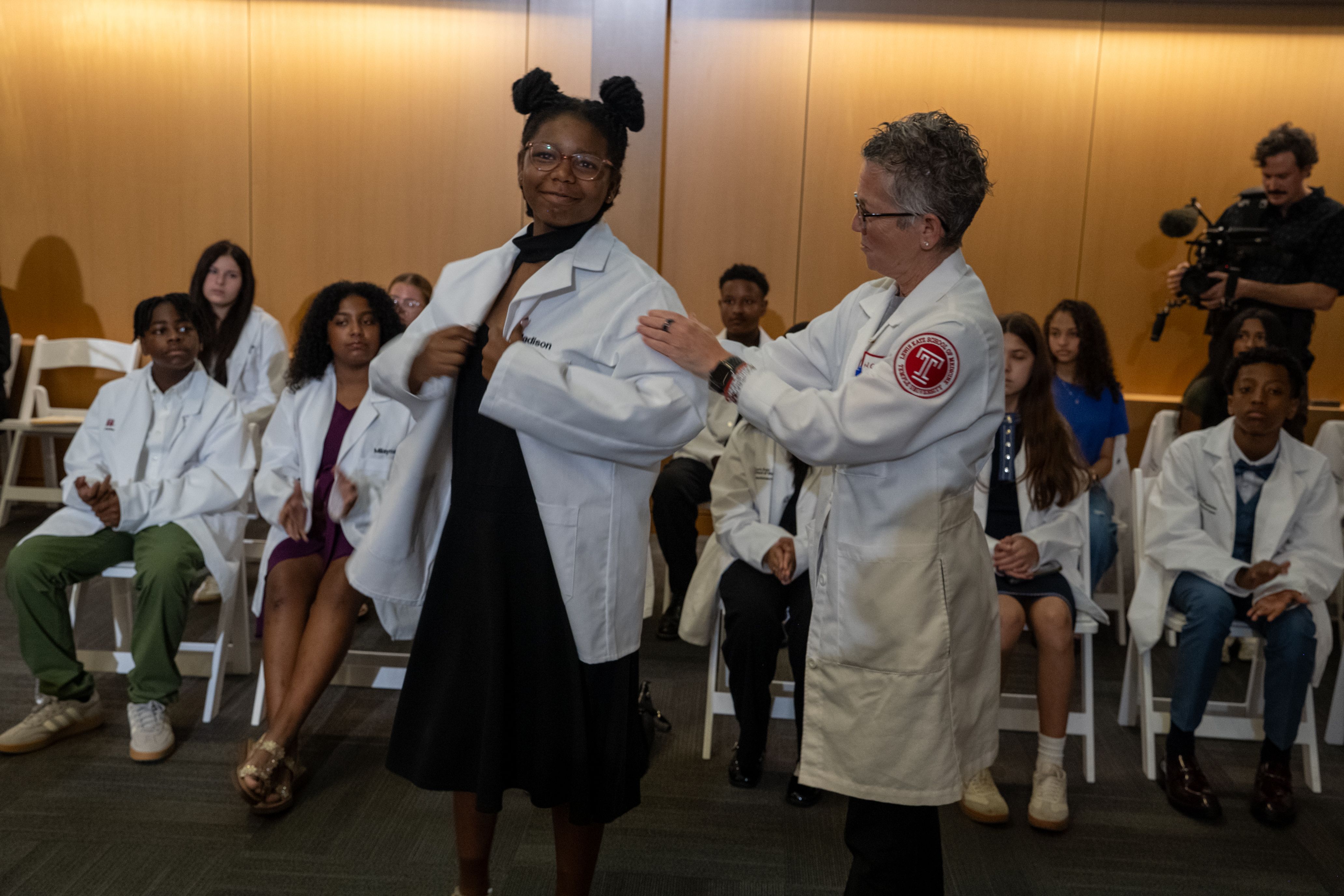
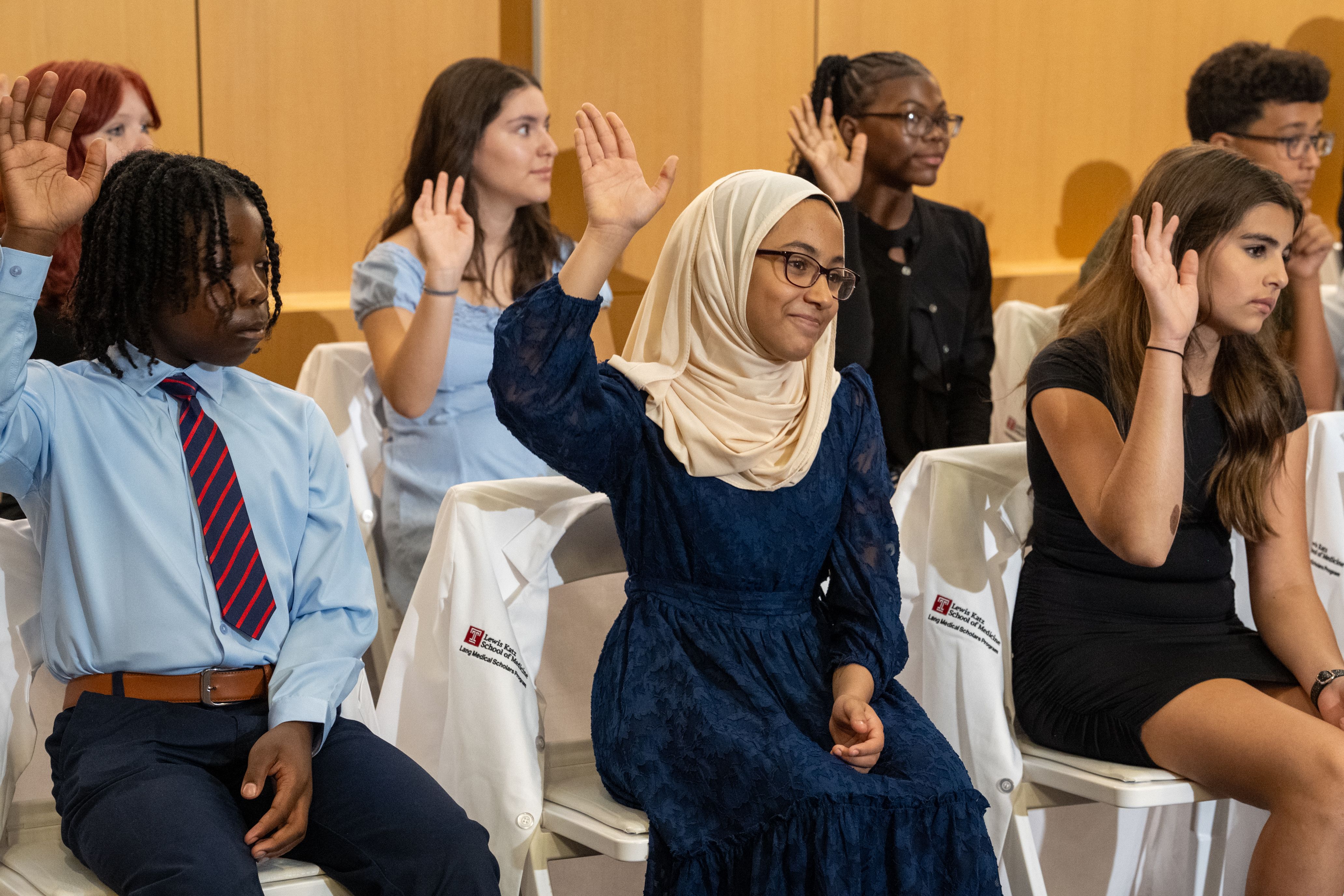
    This month, Glasco’s daughter Madison Miller slipped a white coat over her shoulders, one of 32 Philadelphia seventh graders chosen for the initial class of Temple University’s Lang Medical Scholars Program. The 12-year-old, a student at E.W. Rhodes Elementary at 22nd and Clearfield Streets, will spend weekends and summers learning about systems of the body, completing internships, and engaging in rigorous college prep.

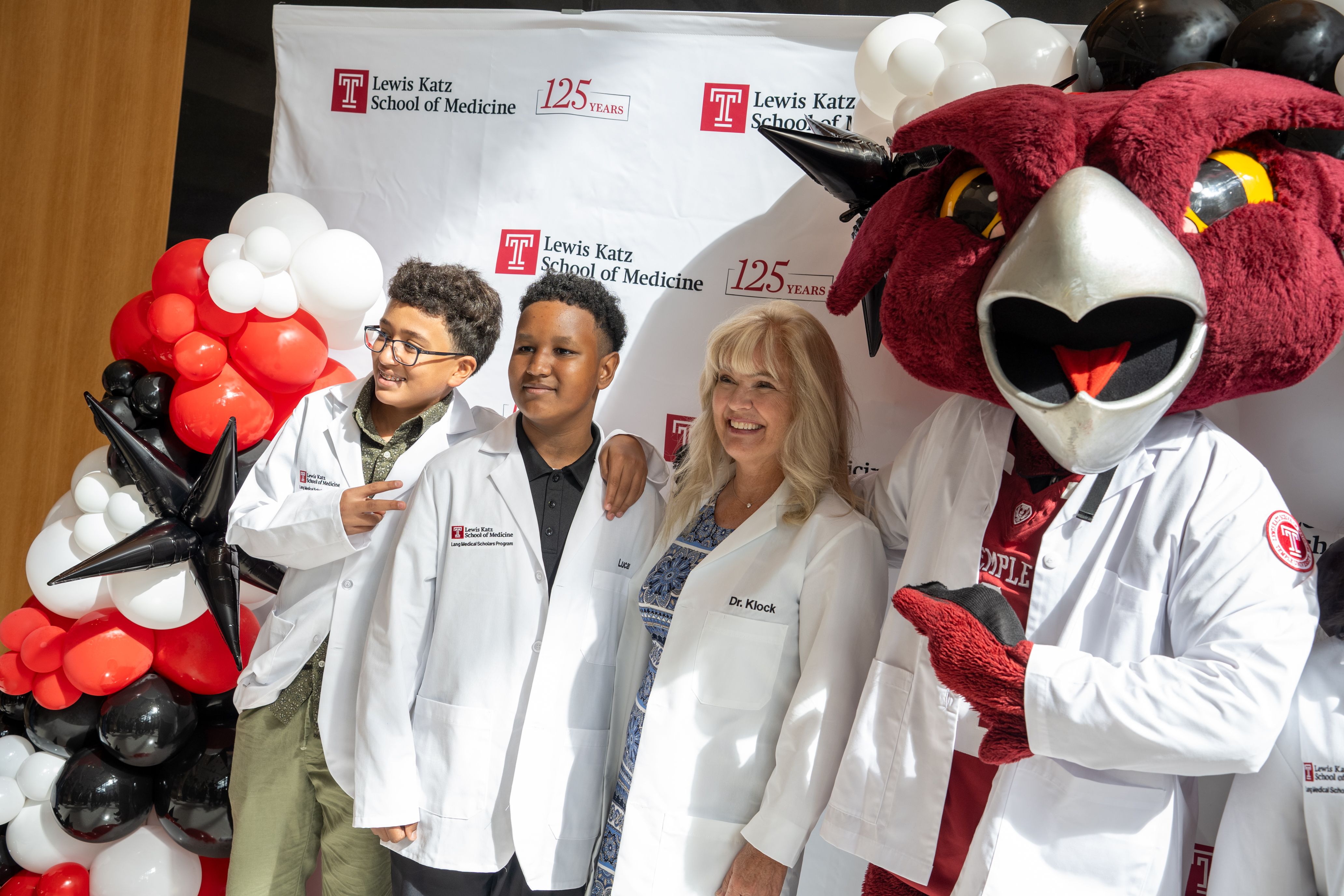
    Seventh graders in Temple University Medical School’s Lang Scholars program prepare to get their white coats. The new program identifies promising students and gives them six years of pre-medical school education.Courtesy of Temple University

    “This is a big deal,” said Glasco, who dreams of buying Madison scrubs and a stethoscope, tangible evidence of her place in Lang Scholars and the doors it could open.

    “The passion around this, the mission is just — talent abounds and opportunity does not, right?” said Barbara Klock, the program director and its architect. Lang, she said, aims to change that for its students.

    A long-held vision

    Klock carried the idea of the Lang Scholars around for years, through a career as a Children’s Hospital of Philadelphia pediatrician and the Philadelphia School District’s chief medical officer.

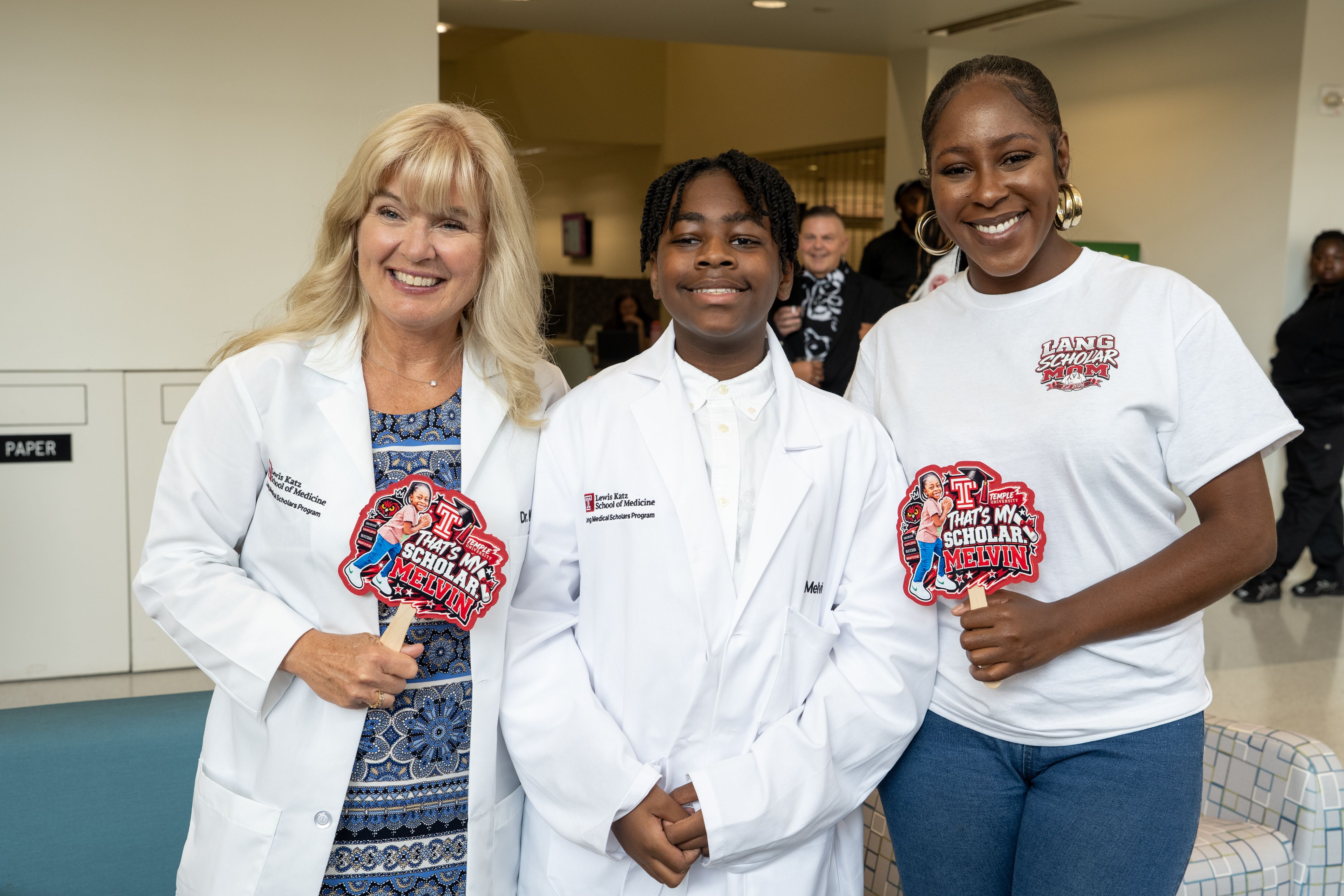
    Melvin Poulson IV, a student at Hope Partnership School, and his mother, Allison Agee, pose with Barbara Klock, director of the Lang Scholars program.Courtesy of Temple University

    Klock, who grew up in Philadelphia’s working-class Juniata Park section, was mentored by Eugene Lang at Swarthmore College. Lang, a businessperson and philanthropist, famously promised a class of Harlem sixth graders that he would pay for their college educations if they graduated from high school.

    Lang and Klock kept in touch after her Swarthmore graduation, and on one chance encounter at 30th Street Station in the 1990s, Lang mentioned to Klock that he was launching something he was really excited about.

    “He said, ‘I have this idea for a program, but the kids start really young.’ He was always, ‘If you’re going to do something, it’s got to be the best,’ and for him, the best would be going to medical school,” Klock said.

    That program, the Lang Youth Medical Program, has been thriving in New York for decades. Klock admired it from afar, and, sometimes, up close.

    “I would go on Saturdays and see the program with the dream of bringing it to Philadelphia,” she said.

    Klock decided it was time to go for her own version of that program in 2024. She reached out to Mitchell Morgan, chair of Temple’s board of trustees, via e-mail.

    “I said, ‘I have this program. I would love to bring it to Temple,’” Klock said. “I wanted to do this with Temple because of where Temple is located, Temple’s mission and vision, and they really do what they say they do.”

    Temple University Lang Scholars white coat ceremony.Courtesy of Temple University

    She expected she might hear from Morgan within three weeks. Instead, she had a response, and a connection to Lewis Katz School of Medicine dean Amy Goldberg, by the end of that day.

    In short order, the program was off and running, with Temple’s backing and philanthropic support, including some funding from Lang’s private foundation.

    Klock pounded the pavement in the 2025-26 school year, reaching out to every Philadelphia school she could connect with — district, charter, private — to ask: Can I come talk to your sixth graders about an idea? Thirty-five schools opened the door for Klock to make presentations.

    She didn’t ask counselors to recommend kids; she feared she would get only straight-A students and student council presidents. Those were fine, but she also wanted the bright-but-bored kids, the ones who were curious about science and life but maybe had hit a few bumps along the way.

    Klock hoped to bring in 20 Lang scholars for the inaugural class. Nearly 14 times that number applied, and those who made it to the interview round flat-out wowed her, Klock said. She ended up getting permission to build a class of 32 — 22 girls and 10 boys — and will grow a grade every year.

    The program’s aim is not to produce a class full of doctors. It is to produce a class full of curious and confident learners grounded in an academic medical setting. If some enter the medical field, Klock would be delighted, but that is not the main objective.

    “These are kids who are so eager to learn,” Klock said. “They want to be with other students who are eager to learn. They are incredibly curious. They ask, ‘why?’ and ‘what if?’ What I want to do is give them the chance to continue to ask, ‘why?’ and ‘what if?,’ no matter what.”

    ‘This is serious’

    Glasco was tipped off about the program by a teacher friend.

    Madison first expressed her desire to become a doctor at age 3. Her preschool teacher has a photo of Madison holding a sign stating her career goal.

    “She wants to be in the medical field, and I used to be in the medical field, so it’s actually perfect,” said Glasco, who used to work as an EMT and a medical assistant and is now a paraprofessional in a suburban school district.

    It’s not far from her North Philadelphia house to Temple’s medical school, Madison said, but walking into the Medical Education and Research Building on North Broad Street felt like a different world in some ways.

    Going to the interview was “very exciting,” Madison said, “but I was also very nervous. There were a lot of windows, and I could see everyone.”

    When she got the word that she was a Lang Scholar, Madison was thrilled.

    “My teacher was really excited, too, because he knew I was going to be in the medical field soon — kind of in medical school, like college,” Madison said. “My friends were really excited because they knew they were going to have a medical friend.”

    Madison and the other Lang Scholars received their professional white coats to kick off the program on Sept. 19. They will begin their studies Oct. 3. Klock will teach the biweekly courses on the human body, health equity, public health, and more.

    Over the years, the students will take trips, work at paid internships, sit in SAT prep courses, and receive help with college applications — all for free. They will dive into the health issues facing their communities, and have access to the same labs and facilities as Temple medical students.

    Glasco cannot wait to drop Madison off for her first day of class as a Lang Scholar.

    “I’m going to be on her really hard about this, because this is serious,” Glasco said. “I want her to get all the knowledge she can, and maintain it, so she can go further in whatever medical field she decides to do in the future.”

  • Ned Warwick, former TV news director and Inquirer reporter and editor, has died at 81

    Ned Warwick, former TV news director and Inquirer reporter and editor, has died at 81

    Ned Warwick, 81, of Philadelphia, former foreign correspondent and foreign, national, and Pennsylvania editor for The Inquirer, former news director for WPVI-TV (Channel 6) and international news director for ABC-TV, former reporter at the Bulletin, mentor, sailor, pilot, and die-hard Phillies fan, died Monday, Sept. 14, of complications from Parkinson’s disease at his home near the Philadelphia Museum of Art.

    Born in Philadelphia and reared in Germantown and Mount Airy, Mr. Warwick graduated from Chestnut Hill Academy and attended Temple University. He knew he wanted to be a newsman when he was 16, his wife, Joan, said, and he spent much of his free time reading newspapers in the high school library.

    He went on to work as a young city-side reporter for the Bulletin from 1969 to 1974 and a veteran editor and reporter for The Inquirer from 2001 to 2008. For TV, he was a news writer and assignment editor at WPVI from 1975 to 1981, news director at WTVD in Durham, N.C., from 1981 to 1986, and back as news director at WPVI from 1986 to 1990.

    Regarding the transition from print to TV work, he told Inquirer TV columnist Gail Shister in 1977: “The TV reporter’s job is more difficult because they have to be journalists and performers. It is in fact easier for a TV reporter to move over to print than vice versa.”

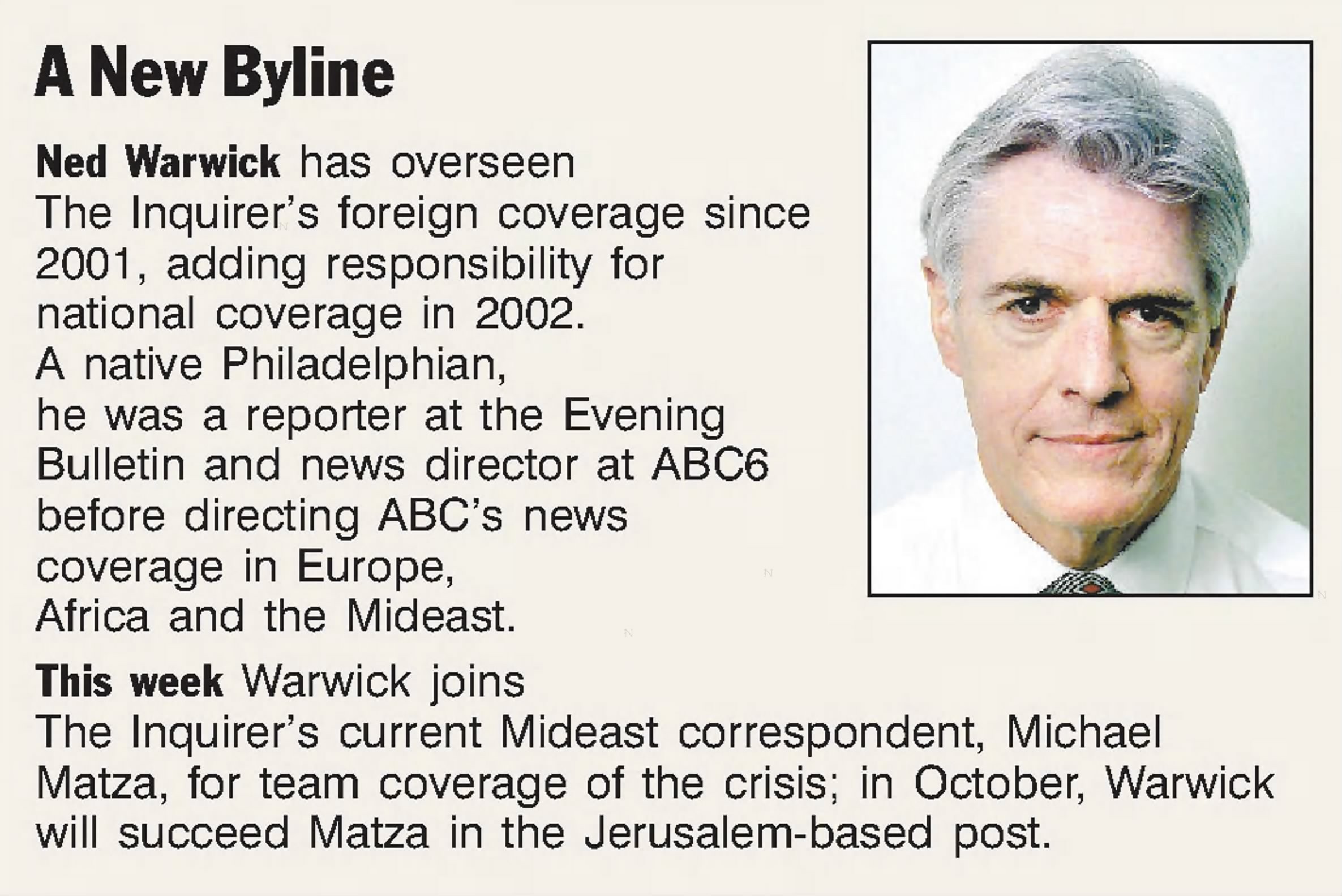
    Mr. Warwick became a foreign correspondent for The Inquirer in 2006.Newspapers.com

    From 1990 to 1995, Mr. Warwick was based in London as ABC’s director of news operations for Europe, Africa, and the Middle East. He worked with celebrated anchorman Peter Jennings, supervised dozens of other international TV types, and directed coverage of many of the world’s top stories.

    Actually, he told The Inquirer as he left for London, he did not expect the job to be much different from covering news in Philadelphia. “You can gather news around the corner or across the border,” he said. “But the essential business of newsgathering still remains the same. You’ve still got to get the story.”

    He nearly became the story in 1992 when he got pinned down in a gun battle while traveling in Somalia. “He always wanted to be a newsman and travel the world,” his wife said, “and he did. He loved the news. He loved ABC.”

    At The Inquirer, Mr. Warwick was the foreign and national editor for five years and a foreign correspondent in Jerusalem during and after the 2006 Lebanon war. He returned to Philadelphia in 2007 to be deputy business editor and Pennsylvania editor for a year.

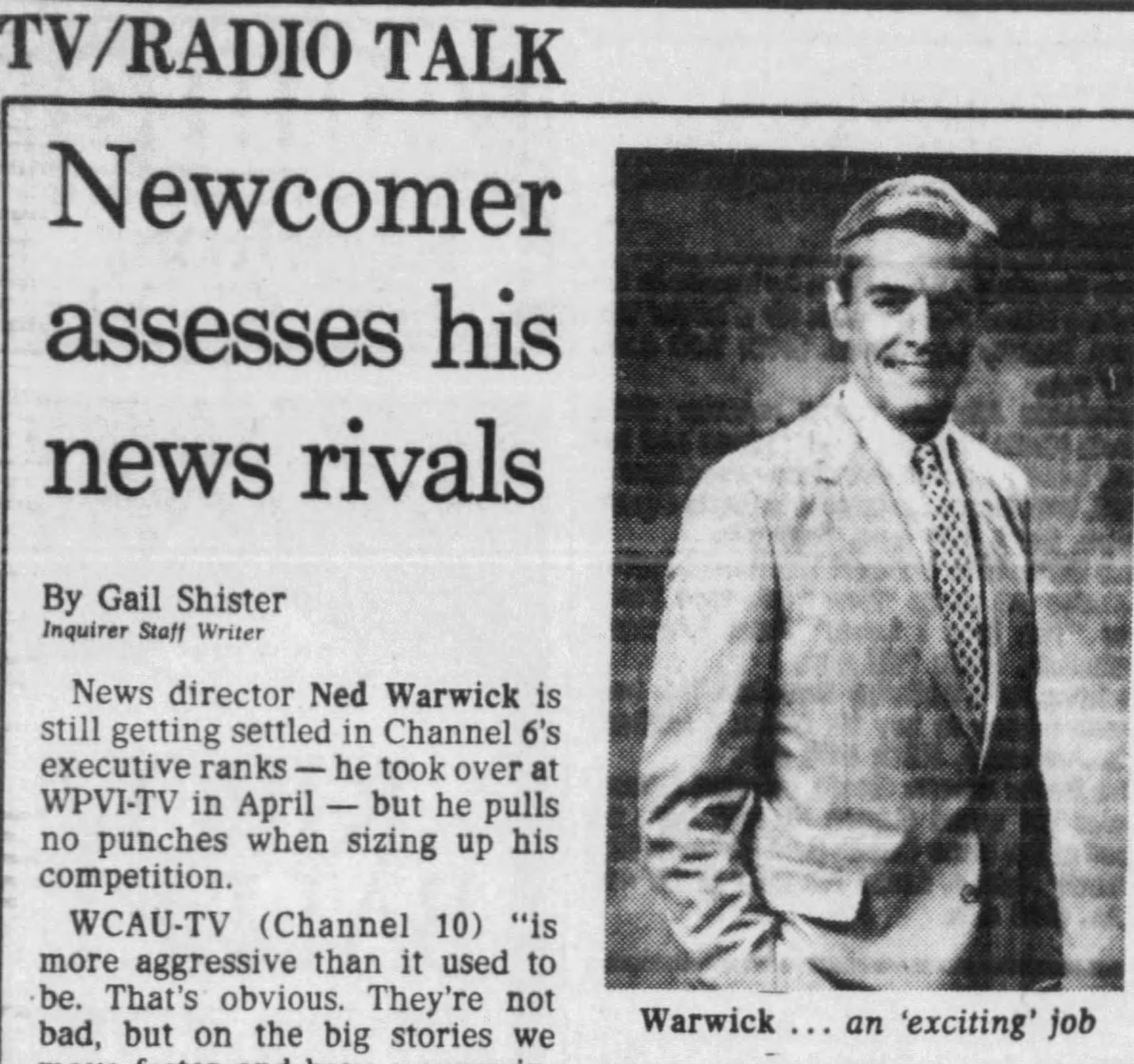
    The Inquirer covered Mr. Warwick’s return to WPVI-TV in 1986. Newspapers,com

    “He was a good listener and could manage a reporter’s needs,” former Inquirer staff writer Miriam Hill said. Former Inquirer staff writer Sally Downey said: “He was a very classy guy.”

    In 2006, his byline appeared in The Inquirer over dozens of war zone stories from Gaza City, Bethlehem, Acre, Ramallah, Huwwara, Turmus Aya, and elsewhere in the Middle East. On Oct. 17, 2006, he opened his story from Kafr Qalil with: “The sharp heat of summer lingers on the stony hills of the West Bank, and the pale olives are still ripening on the trees, thirsting for just a little of the fall rains that won’t come for a few more weeks.”

    “He was a lyrical writer,” Hill said. Former Inquirer editor William K. Marimow called his style “fluid” and “very solid.”

    Mr. Warwick also reported on the royal family from London and reviewed books for The Inquirer. He worked briefly as an editor at large with Bloomberg News after leaving the paper in 2008 and retired in 2010.

    Out of the office, Mr. Warwick was a sailor and a pilot. Courtesy of the family

    He mentored others wherever he worked and with the Rittenhouse Writers’ Group, and completed a first draft of his own book. “His mind was always crafting a story, seeing a story, or preparing to tell one in a way that made everyone near him want to listen,” said his daughter Katie Bishop.

    “No matter what was going on,” said Nathan Gorenstein, a former colleague at The Inquirer, “he was a good human.”

    Out of the office, Mr. Warwick was a sailor and a pilot. In 1986, when he was news director at WPVI, Shister asked him whether flying an airplane or directing a newsroom was more challenging. “Clearly,” he said, “if you don’t pay attention in either business, you’re going to crash.”

    He cheered openly for the Phillies even during the lean years and continued to follow them closely after becoming ill. “One of the first things he would ask in the morning,” his wife said, “is who won the game.”

    Edward Ramsey Warwick was born May 19, 1945. The oldest of three children, he was the great-grandson of former Mayor Charles Warwick. He left Temple and earned a bachelor’s degree in history at the University of the South in Sewanee, Tenn., in 1969.

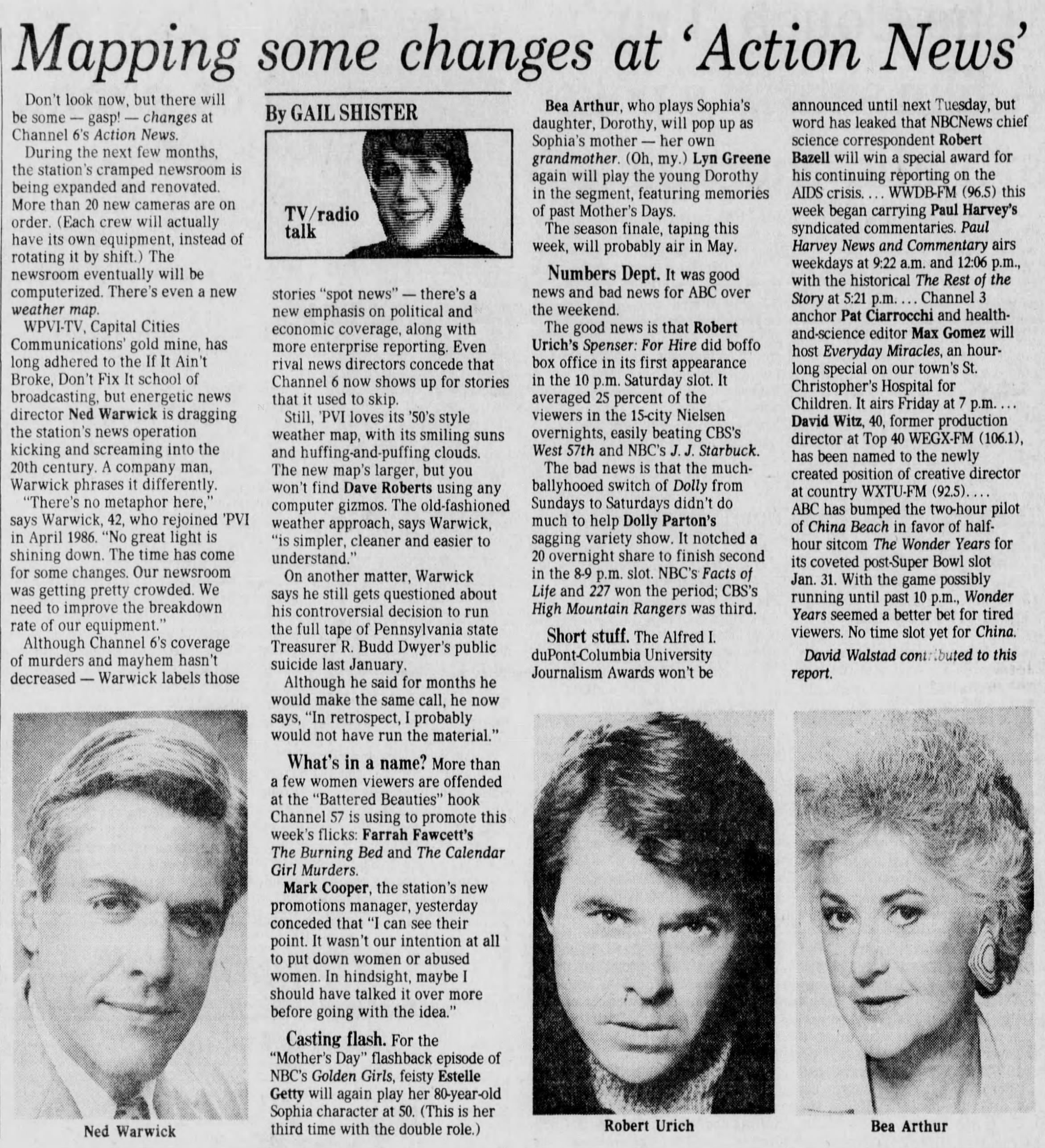
    Mr. Warwick’s local TV work was covered in The Inquirer in 1988. Newspapers.com

    He married Polly Price, and they had a daughter, Katie. After a divorce, he married Gayle Roth, and they had daughters Megan and Eliza.

    “He always made us feel like having three daughters was his greatest joy in life,” his daughter Megan Osborne said. “He taught us to throw a ball and let us braid his hair.”

    After a divorce, he married Joan Hunter, and they enjoyed museums, the theater, and the orchestra. They traveled the world together. He was a longtime runner and a fashionista, and studied Buddhism.

    He lived with Parkinson’s disease for eight years. But he refused to quit city living for the suburbs, his wife said, and he never lost his sense of humor and zest for life.

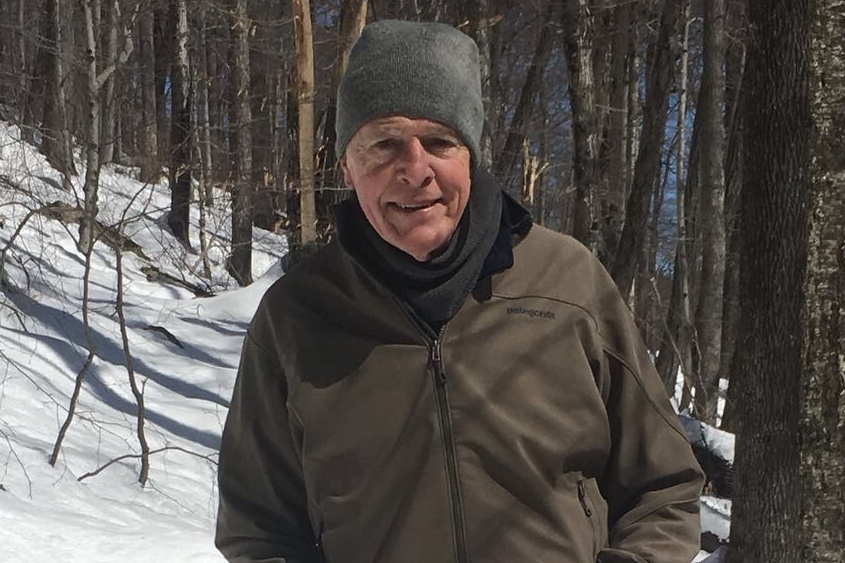
    Mr. Warwick was a longtime runner and a fashionista, and studied Buddhism. Courtesy of the family

    “Dad was a giant of a man in every sense of the word,” his daughter Eliza said. His wife said: “He never, ever complained. He made me a better person.”

    In addition to wife, daughters, and former wives, Mr. Warwick is survived by four grandchildren, a sister, a brother, and other relatives.

    A memorial service is to be from noon to 4 p.m. Saturday, Nov. 14, at the Germantown Cricket Club, 411 Manheim St., Philadelphia, Pa. 19144.

    Donations in his name may be made to Penn Medicine Neurology, 3535 Market St., Suite 750, Philadelphia, Pa. 19104; and the Katz JCC Parkinson’s Connection, 1301 Springdale Rd., Cherry Hill, N.J. 08003.

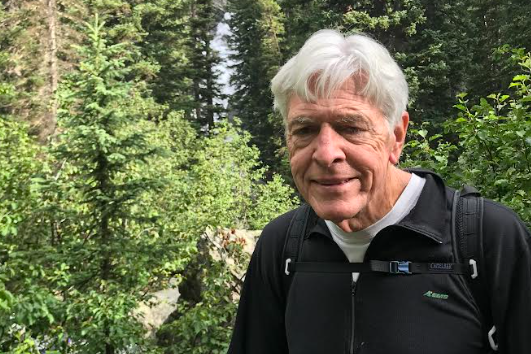
    Mr. Warwick “never, ever complained” his wife said. “He made me a better person.”Courtesy of the family
  • Jefferson CEO will chair Philadelphia region’s chamber of commerce

    Jefferson CEO will chair Philadelphia region’s chamber of commerce

    The CEO of Jefferson Health and Thomas Jefferson University will be the local chamber of commerce’s next chair, and he’s focused on a feeling of safety in the city.

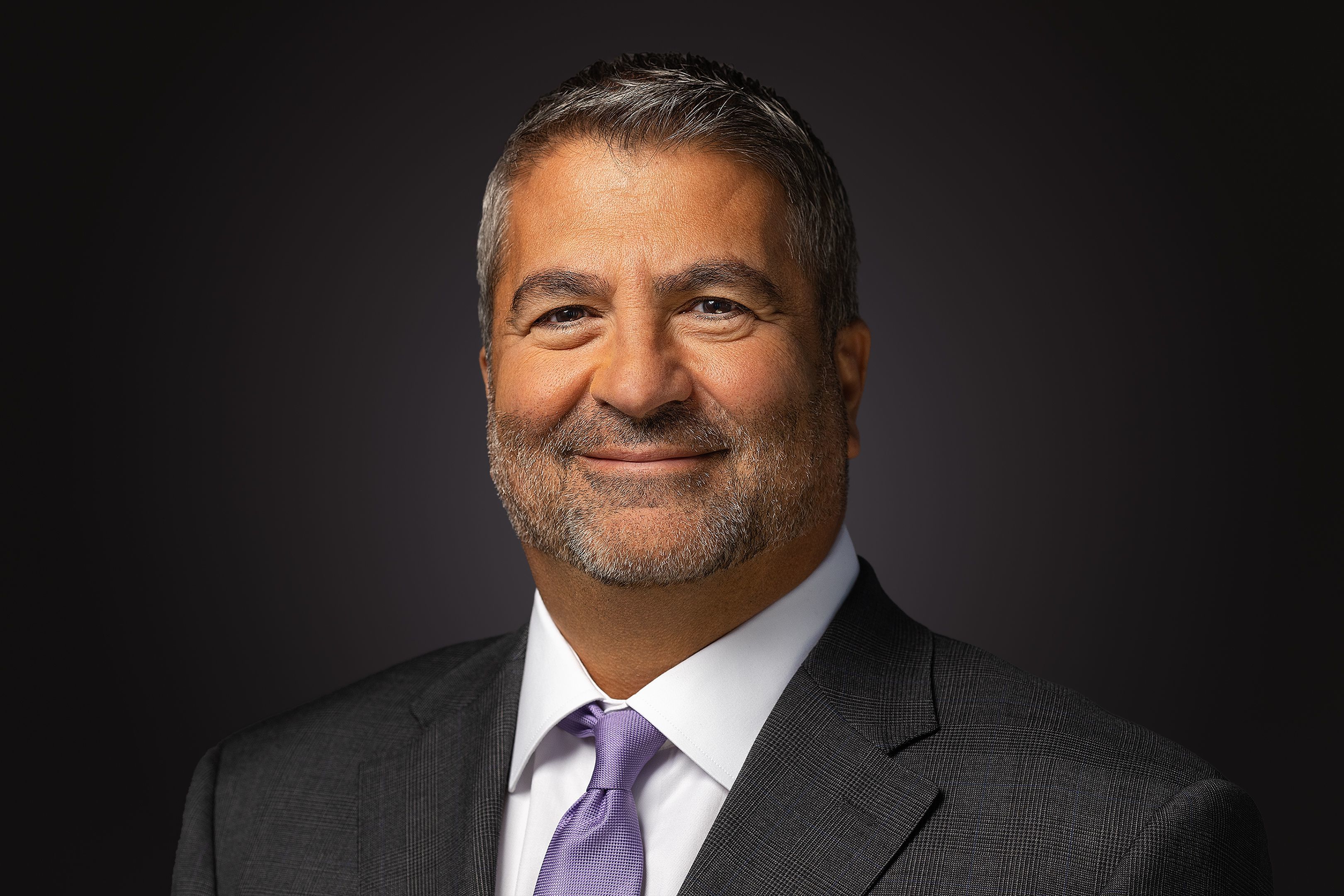
    Joseph G. Cacchione, Jefferson’s CEO since 2022, will chair the Chamber of Commerce for Greater Philadelphia’s board of directors beginning Oct. 15, the chamber announced Tuesday.

    The new role comes just a year after Cacchione said Jefferson could move its headquarters out of the city. But now he says that’s no longer on the table, crediting Mayor Cherelle L. Parker and the city’s police chief for making “great strides in improving safety.”

    “We’re here. We’re Jefferson. We’ve been in Center City for 200 years. We’re not moving,” he said in an interview Tuesday.

    Joseph G. Cacchione will begin his role as board chair at the chamber on Oct. 15.Thomas Jefferson University

    Cacchione says some of the region’s remaining challenges can be tackled through partnerships between business and government.

    “For me it’s about never standing back and watching but to actually roll your sleeves up and get in there and mix it up,” he said.

    Jefferson teamed up with the city police department and SEPTA transit police in one such partnership in June, launching a public safety hub in partnership in Market East.

    “East Market Street particularly has had challenges over the years,” he said Tuesday. “We saw an opportunity to have more visible police presence.”

    But recently, he said, the area has felt safer and more vibrant. He pointed to the pop-up businesses that opened along that corridor this year, as well as the pop-up plaza outside Reading Terminal Market.

    “We continue to need to work on that quality of life,” he said. “It’s not just East Market Street. It’s the entire city that we want to be safer.”

    More good jobs for the region

    Cacchione’s priorities also include supporting small and medium-sized businesses, continuing regional job growth, and improving access to healthcare.

    The chamber’s board of directors includes CEOs, presidents, and other leaders of area institutions such as CHOP, Aramark, Temple University, Comcast, Girl Scouts of Eastern Pennsylvania, and the Philadelphia Eagles.

    Its recent efforts include a new regional partnership to create good jobs in business software, biomedical engineering, and production, and specialized manufacturing, where business leaders see potential to grow. Jefferson Health and Thomas Jefferson University are early partners in the group.

    “We are at an inflection point for our region, and we have to make decisions to lean in so that we can continue to grow,” Chamber CEO Chellie Cameron said Tuesday. “I’m talking about attracting new businesses and growing existing businesses, creating jobs — not just any job, but opportunity jobs and pathways to those jobs.”

    Cacchione, as the leader of a very large employer in Center City, “gets it,” Cameron said, adding that he’s not just invested in the city, but the region as a whole.

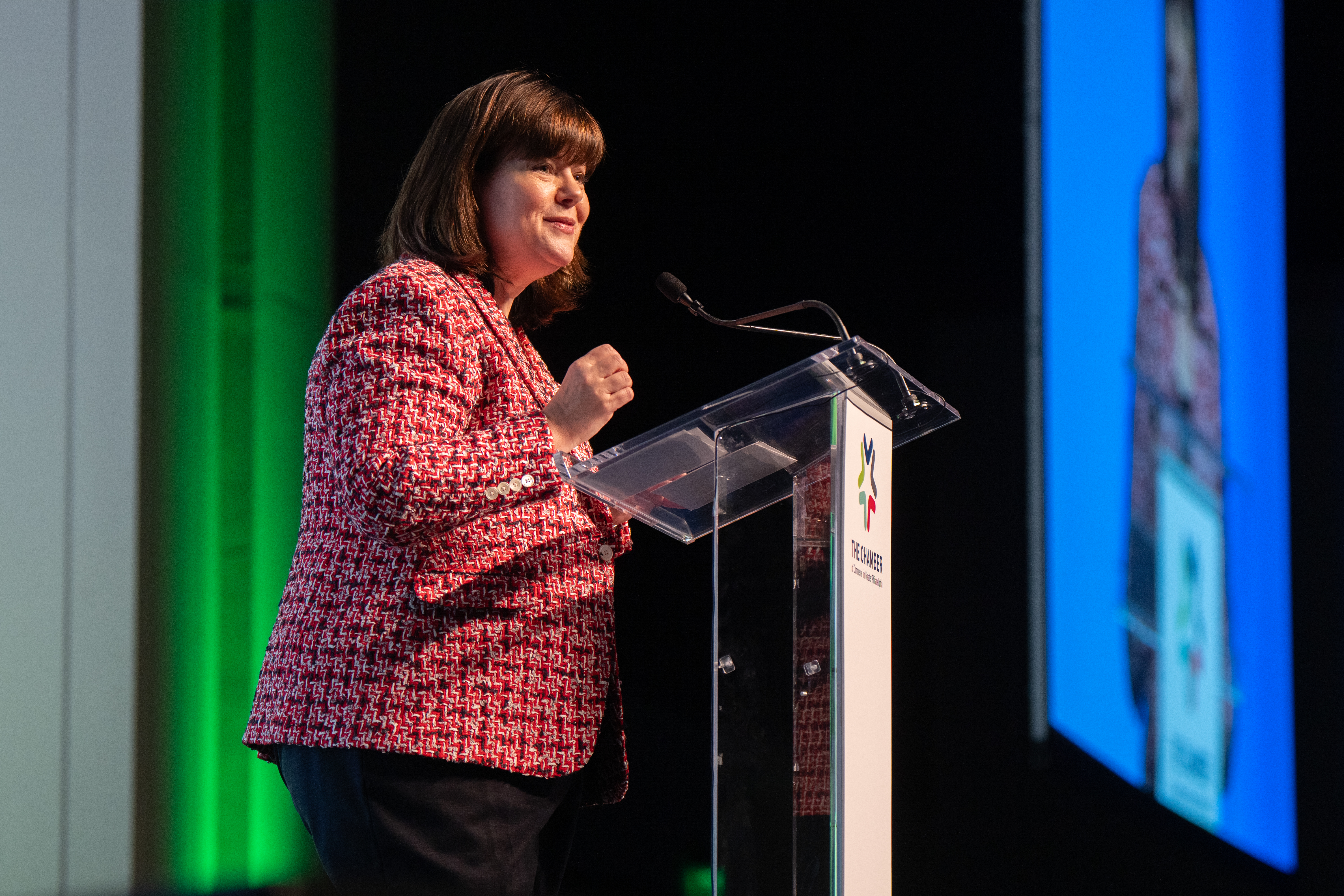
    Chellie Cameron, CEO of the Chamber of Commerce for Greater Philadelphia, at a chamber event in 2025.Jessica Griffin / Staff Photographer

    Cacchione added that AI will “change how we do business,” calling it an “enabler of business.” The chamber could help train workforces that don’t have experience with AI, he said.

    Jefferson employees have been adopting AI tools to improve efficiency. Nurses use it for note-taking, he said. By 2028, Jefferson aims to save over 10 million hours of clinician’s time by using AI — creating more time for “face-to-face” interaction with patients, Cacchione said.

    The hoped-for result, he said: “Our doctors are spending more time with patients and less time in front of a computer.”

  • How Temple University failed my daughter on her first day of college

    How Temple University failed my daughter on her first day of college

    Remember all those big feelings you had on move-in day as a college freshman? After a long summer, you probably arrived on campus ready to tackle dorm life fortified with new flip-flops, towels, and a duvet. Today held great promise — the start of a new you.

    My daughter recently enrolled at Temple University. Her move-in day was scheduled for the final week in August. I was proud, and she was excited. Yet, on our drive to campus, we discovered that something was wrong. She was somehow assigned to an all-male floor. How could this be?

    We contacted residence life and chatted with a well-meaning student who told us there was nothing she could do. Could we speak with her supervisor? Yes — another caring individual informed us that her hands were tied and that no other dorm rooms were available. How could this be possible? It was her first day of college.

    My daughter is transgender and autistic. Temple University assigned her to a male dorm section despite us working closely with intake counselors and disability resources to ensure a smooth and safe move to a gender-inclusive setting. Somehow, a form was missed that coordinates between the office that ensures students with special needs have the necessary supports and the residence halls that house our students.

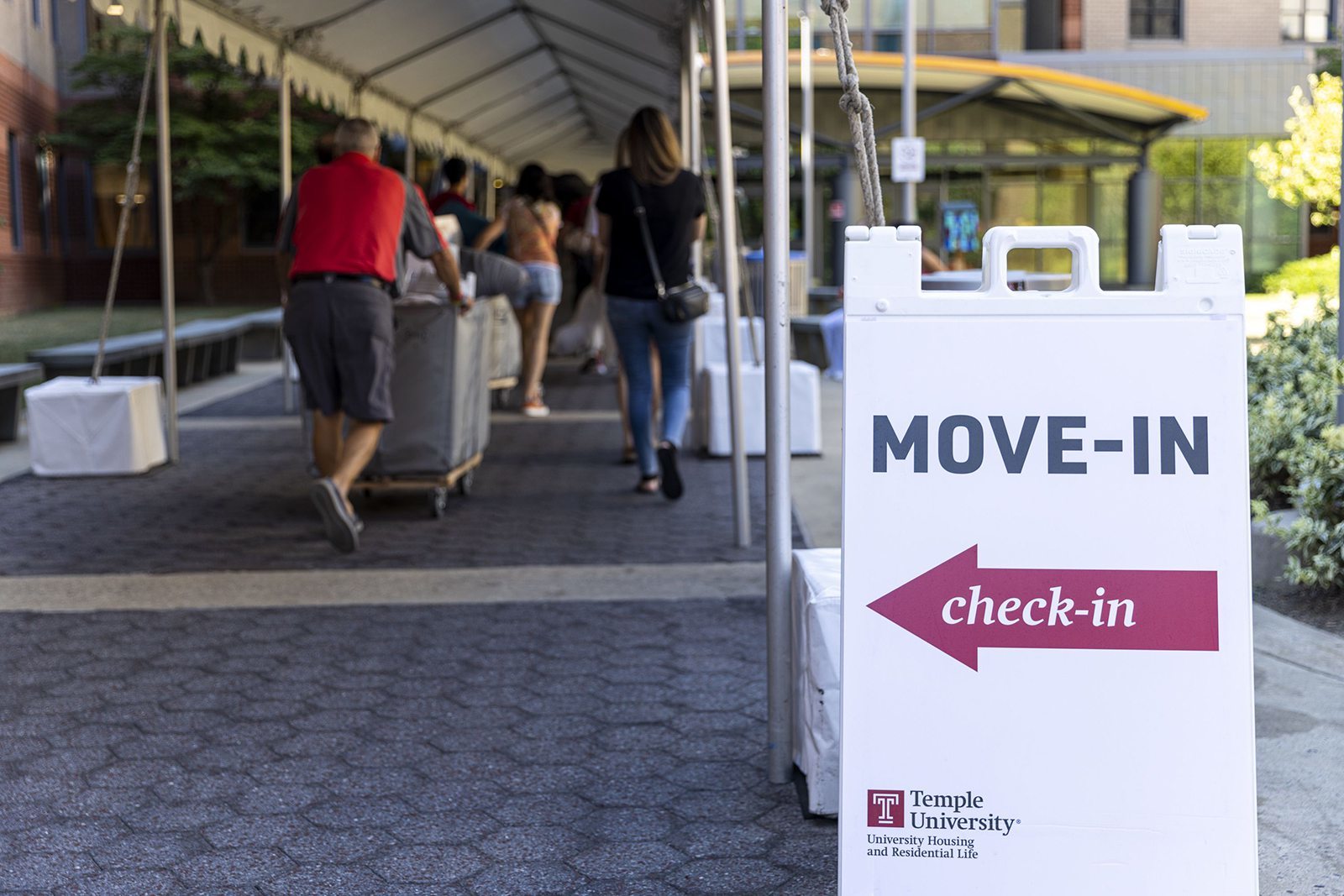
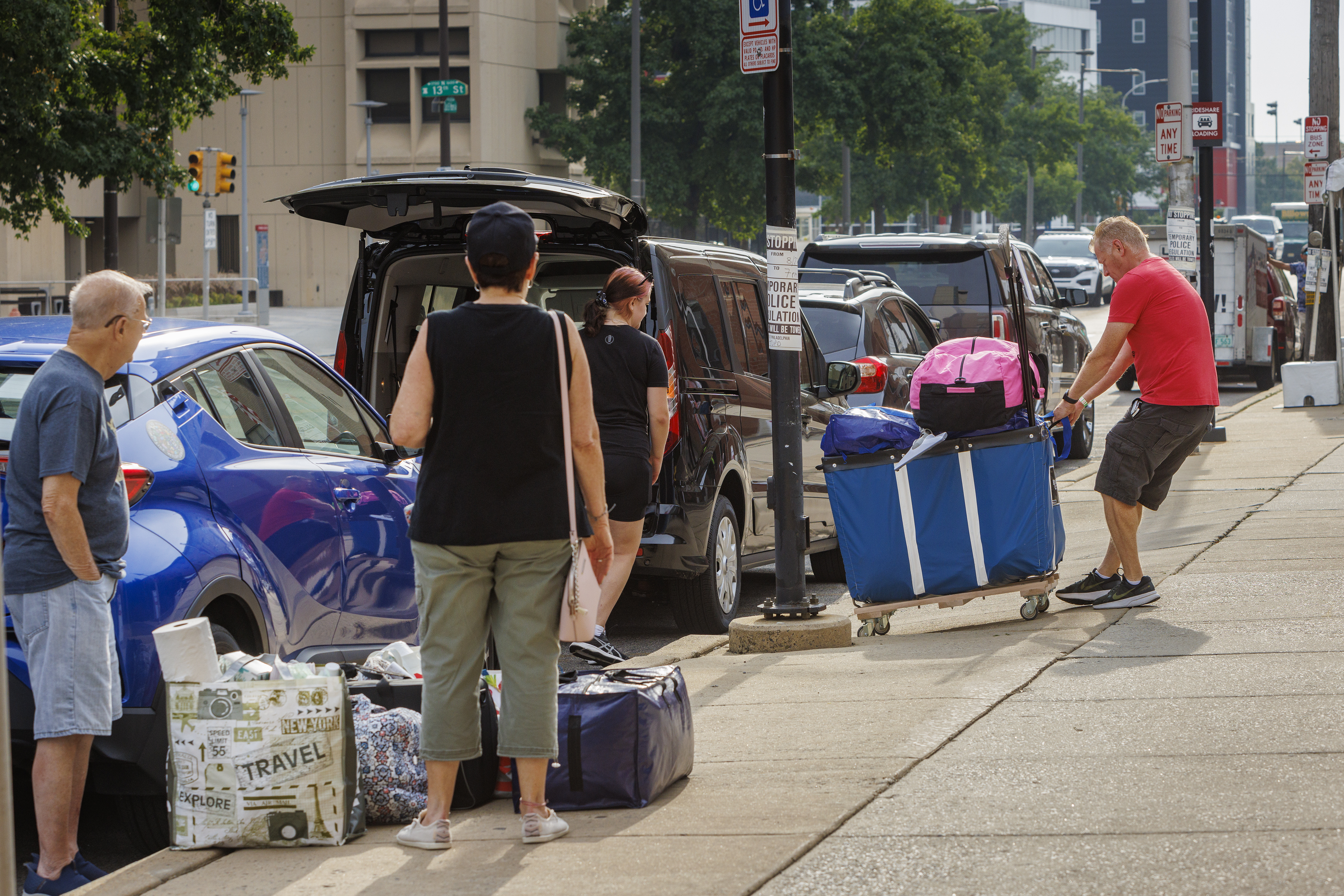
    Move-in day for Temple students living at 1300 Residence Hall at 13th Street and Cecil B. Moore Avenue in August 2023.Alejandro A. Alvarez / Staff Photographer

    We pulled up to her assigned dorm in a packed car for drop-off only to learn my daughter could not be accommodated.

    We drove home and unpacked the car. She moved back into her bedroom. It was devastating. There was a lot of crying.

    The following day, we were contacted by another staff member who informed us they had found a room for my daughter in a female suite. However, the floor was not gender-inclusive.

    My daughter would have to roll the dice and not disclose her gender identity.

    We asked what the contingency plan was if her roommates rejected her. There was no plan.

    We thanked the staff member and declined the offer. I sought assistance from many university administrators (president, provost, dean, heads of the disability resource center), none of whom responded.

    Fail.

    Full disclosure, I support the mission of Temple University as an alum, a donor, and tenured full professor in the College of Public Health. I am writing today not as a representative of the university, but as a concerned parent and member of the Philadelphia community.

    I am saddened (but not surprised) by how our move-in transpired.

    My daughter was collateral damage in an ongoing war for ever-higher enrollment numbers and was let down by an on-campus support system that has been weakened by extreme budget cuts.

    Like many American universities, student tuition dollars are integral to Temple’s survival. Student retention and enrollment are both down. The university is facing a well-publicized $25.5 million budget shortfall.

    Faculty, librarians, and support staff have been thinned to the breaking point. For example, many of my faculty colleagues in the College of Public Health recently learned that our salaries were to be cut by approximately 20%.

    This scenario is not unique to our institution. Indeed, a common cycle is at play.

    Tuition revenues fall in tandem with reduced enrollment and poor student retention. These deficits cause financial distress for the university. So administrators relax admissions and increase tuition in anticipation of a financial “sugar rush” that comes with more paying customers and a higher tuition rate.

    But many newly accepted students require complex psychosocial and educational supports, and those supports are now largely to be shouldered by a depleted faculty.

    Administrators cast instructors as friendly and approachable. Although this is a well-intentioned strategy, the teacher-student relationship is not based on casual friendship.

    As instructors, we are compelled to use a boilerplate syllabus template that addresses students using first-person language as if we are addressing them personally:

    Feel free to visit us during “drop-in” hours and discuss “anything you need to talk about.”

    That could mean anything from personal relationships, dating, intimate partner violence, parental neglect, trauma, financial insecurity, and concerns about immigration policies and enforcement (e.g., Will I be safe here?). Most of my faculty colleagues are not trained as clinical psychologists. Nor do we have sufficient expertise — or in-class support staff — to help students with complex learning disabilities in the context of large (and growing) classroom settings.

    When vulnerable students fail and/or withdraw, administration often attributes retention and enrollment dips to faculty — as justification for deeper cuts to classroom instruction and increases to a vast administrative framework.

    This cycle is continually baffling to us as teachers, because many of our institution’s most damaging reputational failures have originated in the boardroom rather than the classroom.

    I believe in Temple University and in its founder’s vision of a high-quality public education where students from all walks of life benefit from world-class scholars. The university has enriched my own life by providing the training I needed to thrive as a neuroscientist and clinical translational dementia researcher. My colleagues care deeply about the success and well-being of our students.

    Yet, many of us fear the university is losing its way.

    Unrelenting pressure for new revenue streams, expansion into costly real estate ventures, and lack of reinvestment in teaching and research are eroding the foundation of what makes us so special.

    My family experienced these failures up close on my daughter’s first day of college — when we learned there was no place for her here.

    Any educational system that fails its vulnerable students and families this badly needs oversight and reform. I hope we find it.

    Jamie Reilly is a professor in Temple University’s department of communication sciences and disorders.

    Editor’s note: An earlier version of this essay misstated the amount of Temple’s budget deficit; it is $25.5 million.

  • Bensalem school district selects a longtime administrator as its next superintendent

    Bensalem school district selects a longtime administrator as its next superintendent

    The Bensalem Township School District has selected longtime district administrator Victoria Velazquez as its next superintendent, after its previous superintendent resigned this spring amid a budget shortfall.

    Velazquez, who has worked for the district for 12 years, is expected to be appointed superintendent at a school board meeting Sept. 23, the Bucks County Intermediate Unit said in a statement Friday.

    “I am deeply honored and grateful for the opportunity to continue serving the Bensalem Township School District as district superintendent,” Velazquez said in a statement.

    Noting that her daughter graduated from Bensalem, Velazquez said, “It is my home, and it is a community I care deeply about and am incredibly proud to serve.”

    Velazquez was selected to lead the 6,400-student district after a search led by the Bucks County Intermediate Unit that drew 27 applicants from five states, according to the intermediate unit.

    Deborah King, the Bensalem school board president, said in a statement that she had watched Velazquez “lead with humility, diligence, integrity, and a genuine love for Bensalem.”

    “She knows this community, she believes in this community, and she understands that our students must remain at the heart of every decision we make,” King said.

    Velazquez has worked in Bensalem as assistant to the superintendent for K-12 administration, director of elementary curriculum and instruction/federal programs, and supervisor of data and assessment/federal programs.

    She has served as interim superintendent since April, after the district’s former superintendent, Samuel Lee, resigned amid a $12 million budget shortfall. The district eliminated more than 30 positions to help fill the gap .

    As interim superintendent, Velazquez worked with the board on organizational systems and fiscal stewardship “during a consequential period for the district,” the intermediate unit said in the statement.

    Before coming to Bensalem, Velazquez worked as a principal in the School District of Philadelphia and the Norristown Area School District. She received bachelor’s and master’s degrees from Temple University, a principal certification from Drexel University, and a doctorate in educational leadership, management, and policy and superintendent certification from Seton Hall University.

    If approved on Sept. 23, Velazquez will be sworn in as superintendent on Oct. 1 at Bensalem High School, the intermediate unit said.