Pennsylvania’s new budget has two significant changes for nursing homes.
In a long-sought victory for the nursing-home industry, lawmakers altered how the Medicaid long-term care budget is set, increasing the state’s share of nursing home funding by $162 million next year.
Lawmakers also amended the formula used to calculate whether nursing homes are complying with a 2022 law that required them to devote 70% of their expenses to resident care. The changes will make it easier to comply.
Change to 20-year-old Medicaid funding rule
For two decades, Pennsylvania Medicaid has paid nursing homes less than their audited costs, according to Michael Jacobs, CEO of the Pennsylvania Health Care Association, a trade group for nursing homes and other long-term care providers.
In 2005, when lawmakers decided they could only afford to pay nursing homes 95% of their costs, the measure was supposed to be temporary. But 20 years later, what was called the “budget adjustment factor” remains in place. The gap between funding and audited costs grew to 20% from 5%, Jacobs said.
This year, lawmakers agreed to raise the factor from 80% to 86% of costs and guarantee that it won’t drop below that level for two years.
“It’s a monumental victory for long-term care to get predictability and stability by putting in a floor,” Jacobs said.
That translates to a $162 million increase in state funding next year. (The change takes effect Jan. 1, because that’s when the fiscal years for Medicaid insurers begins.)
The floor on the budget adjustment factor “provides much-needed resources and stability to help nursing homes recruit and retain the experienced caregivers residents depend on,” Matt Yarnell, president of SEIU Healthcare Pennsylvania, said in an email.
“Now it’s critical that nursing home operators put these additional resources where they belong: into the quality of care for residents and into the frontline workforce,” said Yarnell, whose union represents thousands of nursing home workers.
Including a federal match of more than $200 million, nursing homes are expected to see a roughly $20 to $25 per day increase for residents with Medicaid, Jacobs said. He did not provide a percentage for the total state and federal increase.
Current minimum daily Medicaid rates range from $236.56 for Burgh Care Center in Pittsburgh to $573.92 for Fox Subacute in South Philadelphia, which specializes in caring for patients who need ventilators to breathe, according to state data.
A new formula for calculating 70% rule
In 2022, Pennsylvania became the fourth state to require nursing homes to devote a specific percentage of expenditures to resident care. Pennsylvania’s law set the threshold at 70%, with fines for nursing homes that didn’t comply.
When the state Department of Human Services began evaluating nursing homes under the new law, the analysis resulted in what the agency described last year as “distorted” penalties that it considered “inconsistent” with the intent of the law, known as Act 54 of 2022.
The agency found a lack of consistency in how nursing homes were reporting expenses. Some facilities, “mistakenly reported items that would be considered costs for resident care and services as administrative operating costs,” making it seem like they owed big fines, the agency said.
The original formula for overall costs also included things over which the nursing home operators had no control. Examples are property taxes, a nursing-home assessment, and depreciation. These items elevated total costs, making it harder for nursing homes to comply with the 70% rule.
One expense — excess administrative costs — was added to the new formula. That figure frequently topped $1 million per nursing home last year, according the cost report data.
Jacobs welcomed the formula changes, saying the industry was particularly interested in removing nursing home assessments and property taxes from total costs.
“We’re happy to be held accountable for the dollars that are being paid to the facilities and making sure they go where they need to be,” he said.
A Penn Medicine employee shuttle was struck by a car and knocked on its side early Friday morning in South Philadelphia, police said.
One passenger was initially in critical condition, but has since been upgraded to stable, Philadelphia police said.
The van was transporting 11 employees, plus the driver, the University of Pennsylvania Health System said. All were taken to hospitals for evaluation and treatment, Penn said, but other details on the passengers’ conditions was not provided.
The white Ford van was traveling east on Reed Street when a red Honda Civic Sport traveling south on South Christopher Columbus Boulevard struck the front driver’s side.
The impact caused the van to spin and tip onto the driver’s side, before stopping near train tracks in the road’s median.
The incident remains under investigation, police said.
All Jeremy Asch and Abby Armstrong wanted was a good breakfast sandwich close to their Point Breeze home.
“At some point, you say, ‘Screw it, I’ll do it myself,’” Asch said. “If we want it, I’m sure somebody else wants it, too.”
The result is Schmaltz, a new breakfast-and-lunch café at 18th and Wharton Streets serving a deliberately tight menu of latkes, blintzes, and egg sandwiches on house-baked English muffins. Since opening earlier this month, it has drawn lines during its Friday-through-Monday service.
Cheese blintzes, latkes, beet salad, and breakfast sandwich make up most of Schmaltz’s menu.Aidan T. Gallo / Staff Photographer
The sandwich that Asch and chef Sam Chertock devised satisfies that craving with an oniony potato pancake perched atop a slow-baked egg, whose firm texture helps the sandwich hold together. Tallarico’s hoagie spread, blended with seasoned mayo, supplies a Philadelphia accent.
“Are we breaking culinary boundaries? No,” Asch said. “It’s a latke on an egg-and-cheese sandwich.” Customers can also add gribenes — chicken-skin cracklings — and have the English muffin slathered with schmaltz, or rendered chicken fat.
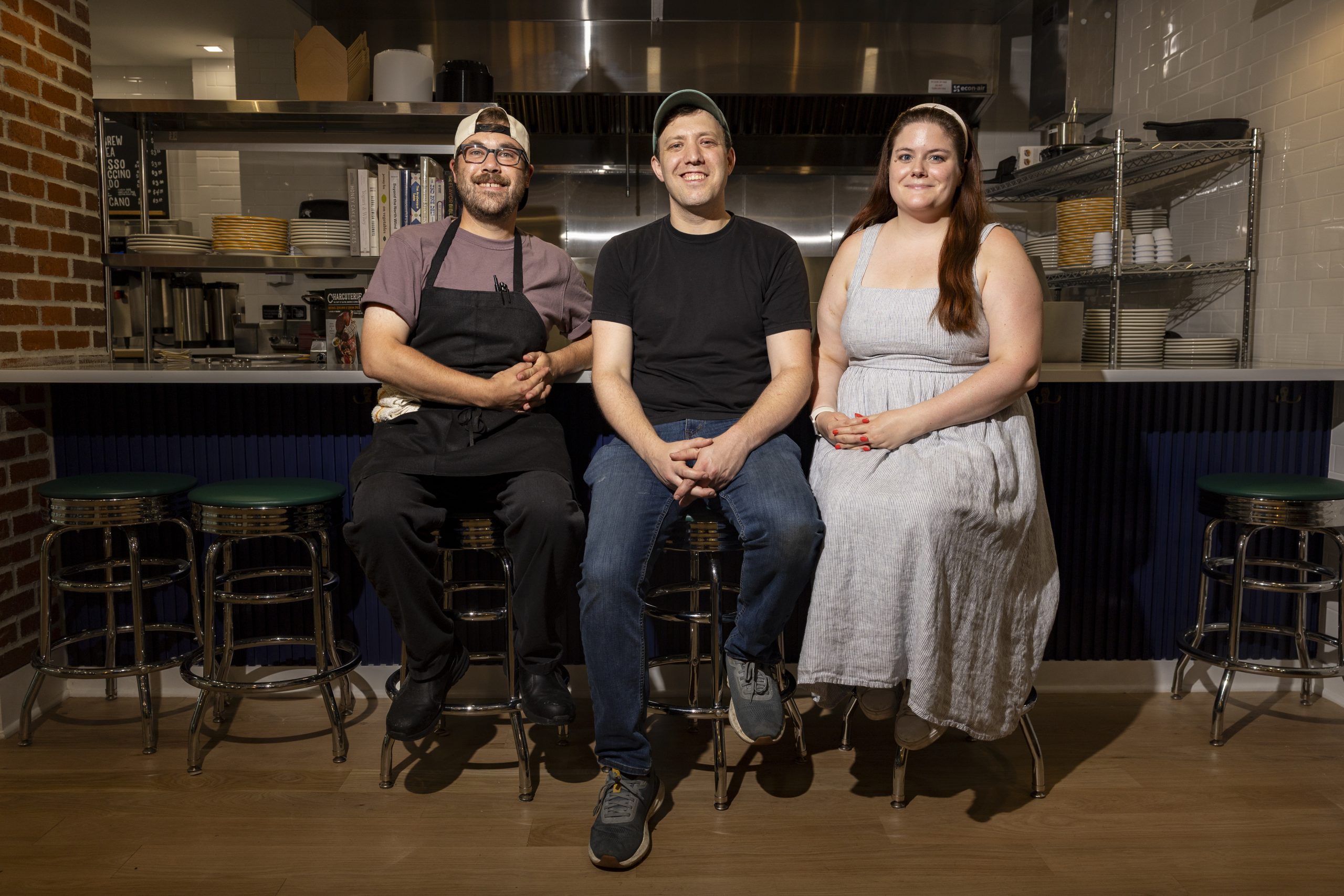
Chef Sam Chertock (left) and owners Jeremy Asch and Abby Armstrong at Schmaltz’s kitchen counter.Aidan T. Gallo / Staff Photographer
Schmaltz joins newer neighborhood arrivals including Little Susie’s Coffee & Pie and Hannah K Cafe. American Sardine Bar, which opened in 2011, is about two blocks north.
The couple bought the building at 1300 S. 18th St. in 2023, creating a wide-open room with an espresso station and order counter, six stools facing the kitchen, six more along the window, table seating, and a small merchandise counter. The couple built a ramp leading toward the rear of the dining room, which toddlers have happily treated as a runway while their parents wait for food.
The building previously housed the Pharmacy, a DIY music venue, art gallery, and coffee shop. Before that, it was the medical practice of Walter Lomax Jr., a pioneering Black physician.
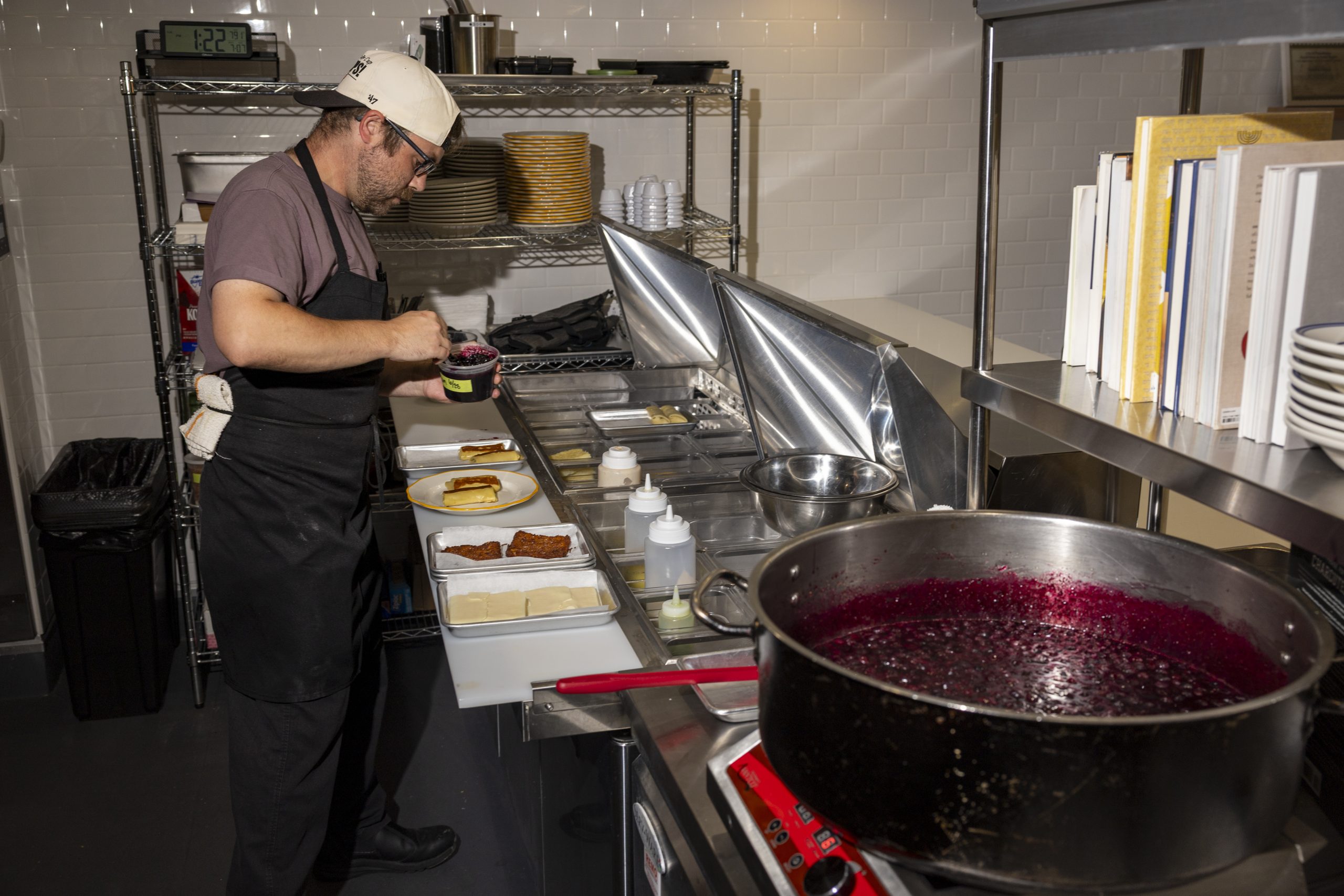
Chef Sam Chertock works at Schmaltz. A pot of jam is on the stove as a side for the blintzes. Aidan T. Gallo / Staff Photographer
That neighborhood accessibility is central to Schmaltz’s approach.
It’s a casual counter, not a full-scale Jewish restaurant or deli, Asch said. The opening menu is deliberately small. Besides the signature sandwich, cheese blintzes, and latkes, there’s a roasted beet salad and a shawarma-spiced chicken salad sandwich on rye, plus coffee, cold brew, espresso drinks, teas, and soda.
But no bagels.
“I will die on this hill,” Asch said. “There’s a lot more to Jewish restaurants than the bagel.”
Selling bagels, he said, can quickly define a restaurant, requiring staff and equipment to produce large quantities while pushing the rest of the menu into supporting roles. Schmaltz may eventually serve a locally made bagel as part of a specific dish, but Asch does not want it to become a bagel shop.
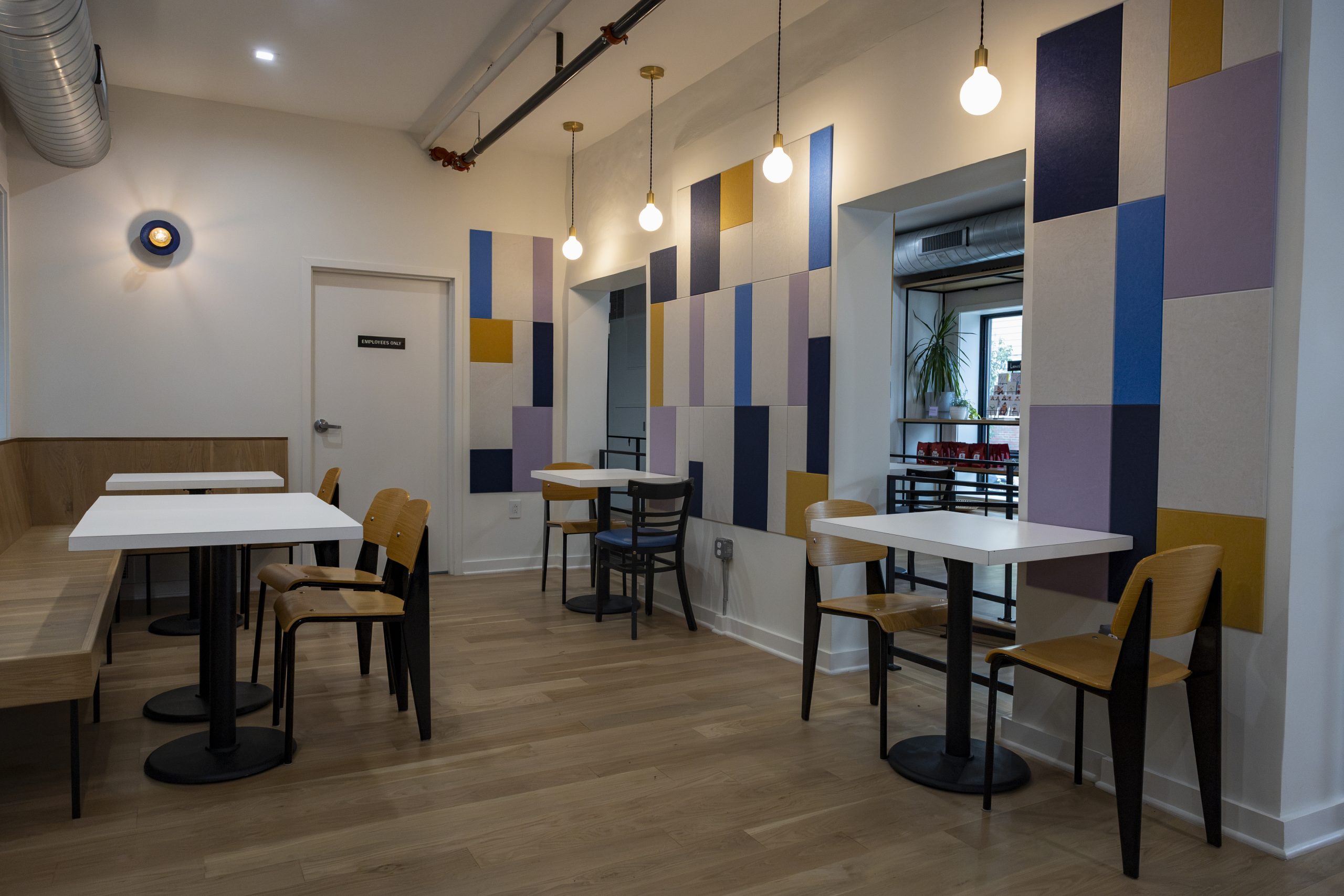
Table seating at Schmaltz.Aidan T. Gallo / Staff Photographer
Instead, the cooking draws broadly from the Ashkenazi and Eastern European food Asch and Chertock grew up eating. The blintzes, made from Asch’s recipe, are filled with lightly sweetened farmer’s cheese and served with Chertock’s jam.
Asch, who grew up in Bryn Mawr and attended Episcopal Academy, did not initially plan a restaurant career. After graduating from Brandeis University, he returned to Philadelphia in 2015 and spent several years working in clinical research at Penn Medicine.
Around the start of the pandemic, he left research and began cooking professionally, first at Grace Tavern. He later worked at Baology with Judy Ni and Andy Tessier before joining a.kitchen.
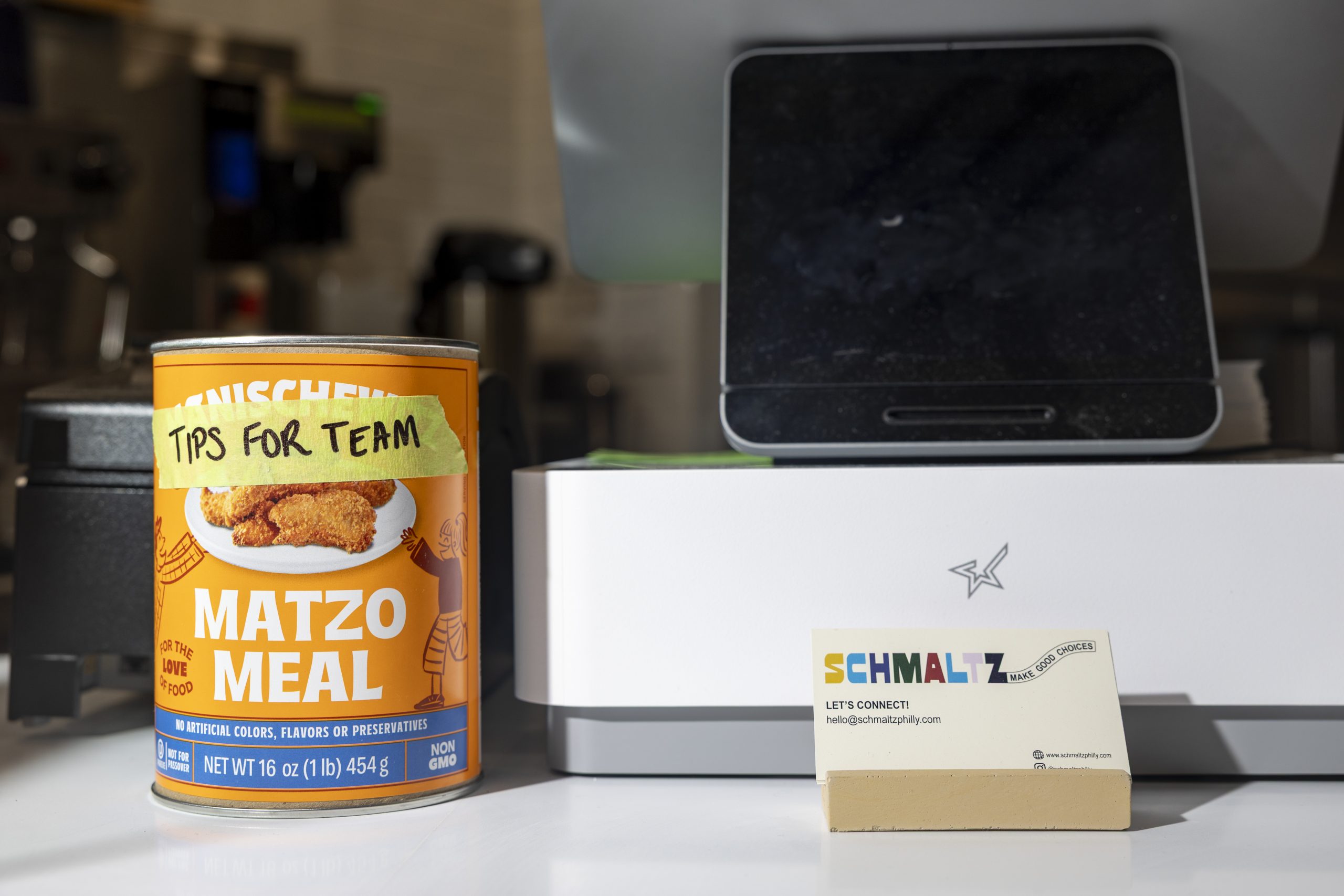
The tip jar and business cards at Schmaltz.Aidan T. Gallo / Staff Photographer
Ni and Tessier became mentors as Asch and Armstrong navigated zoning, vendors, construction, and the operational details that cannot be learned on the line.
“They took a huge weight off my shoulders of that knowledge burden,” Asch said. “They’re the reason we were able to do this.”
Armstrong, who grew up in Portland, Maine, studied theater at Brandeis before moving into investment and wealth management. She later earned an MBA at the Wharton School. Her work included chief-of-staff and operations roles, experience she likens to staging a complicated production.
“How do we make this whole orchestra, this whole production, work?” she said.
Chertock brings the deepest restaurant résumé of the trio. Trained as an architect at Syracuse University, he worked at a Lambertville firm while cooking nights at Charcoal BYOB in Yardley, his home town. He later joined the opening team at K’Far Cafe, worked his way up to sous chef, and went on to Zahav and Vernick Food & Drink.
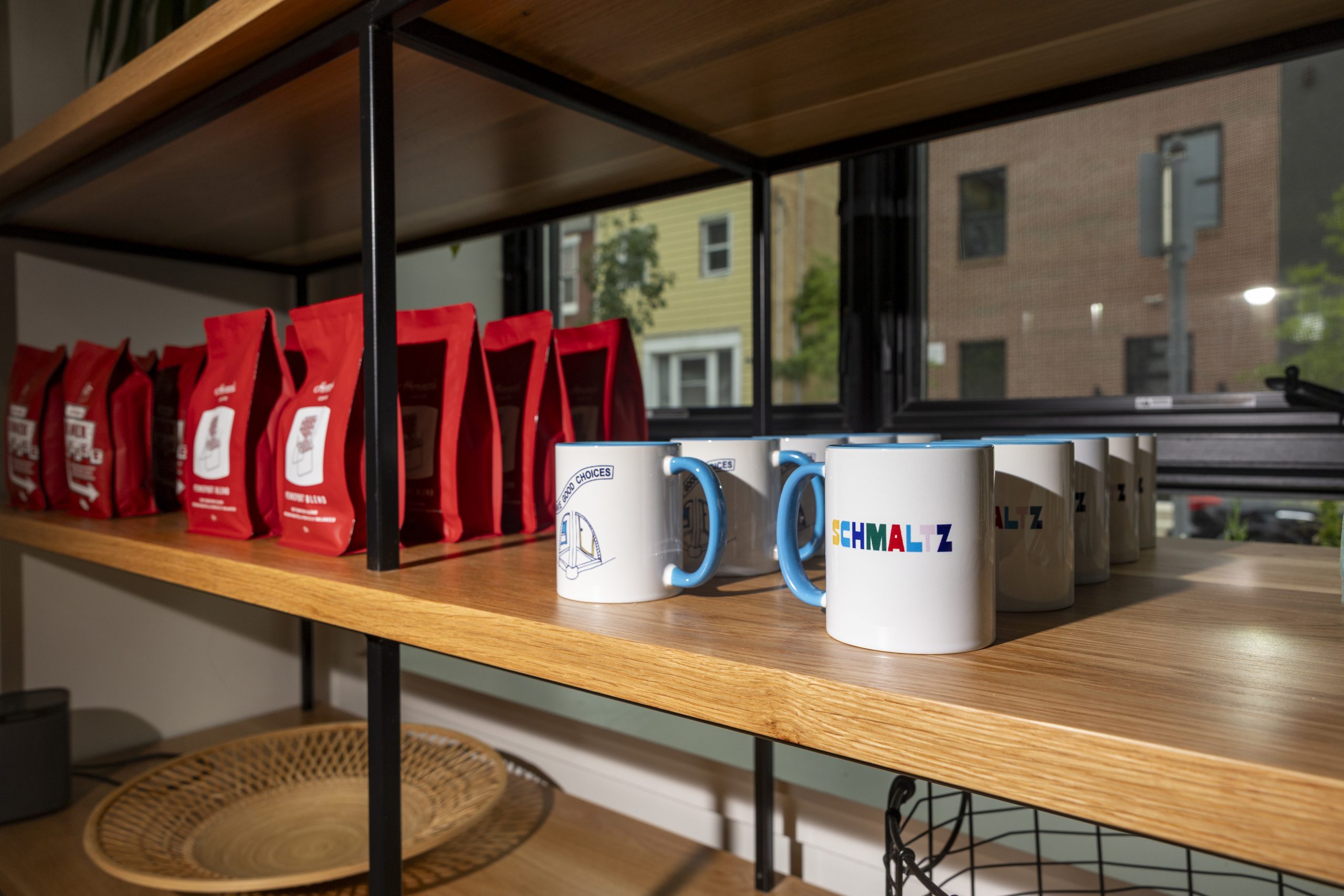
Schmaltz merchandise has its own counter.Aidan T. Gallo / Staff Photographer
He found Schmaltz almost by accident. Chertock, who once lived nearby, was biking through South Philadelphia when he noticed the restaurant name on the freshly painted building.
“‘Schmaltz’ immediately caught my attention,” he said.
Despite the term’s cultural focus, Asch said Schmaltz is neither kosher nor intended as a political statement. Asch said his parents worried that openly identifying the restaurant as Jewish might invite problems, but he said the response has been overwhelmingly supportive.
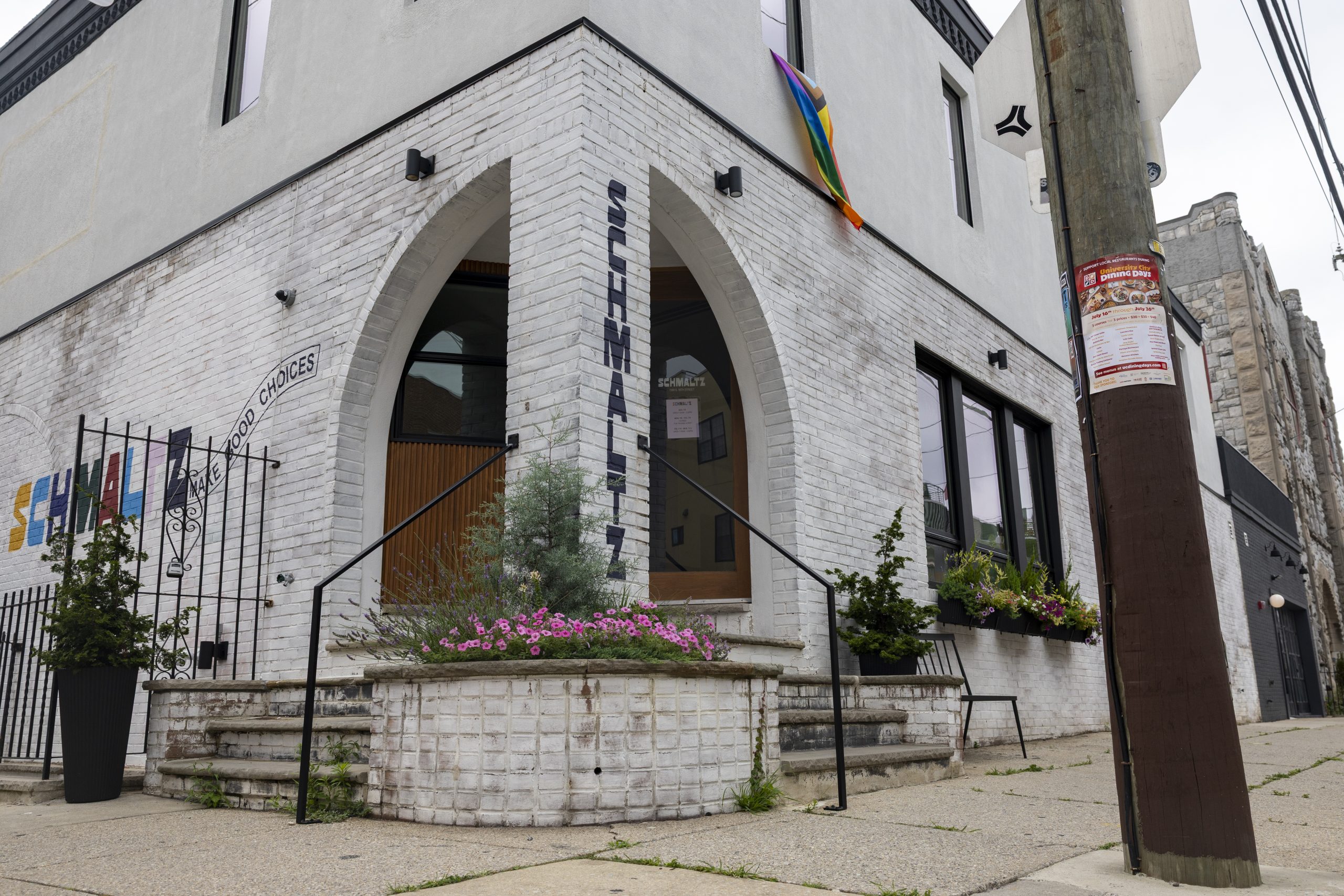
Schmaltz at 18th and Wharton Streets.Aidan T. Gallo / Staff Photographer
“We make food,” Asch said. “Maybe calling it Schmaltz is in itself a statement, but we can’t live in fear about what might happen.”
For now, the more immediate challenge is keeping up with the crowd outside. Asch expects most regulars to come from within a few blocks rather than from Center City.
That suits the couple, who bought the building with the idea of investing in the neighborhood where they live.
“We want to nourish it,” Armstrong said. “We want to be a part of it.”
Schmaltz, 1300 S. 18th St., schmaltzphilly.com. Opening hours: 7 a.m. to 2 p.m. Friday to Monday.
A previous version of this article incorrectly described the ramp in the restaurant. The owners added it to comply with ADA requirements.
A few blocks and a few days apart, two of the same story: people showing up, in public, as exactly who they are.
That’s what this World Cup summer has felt like across Philadelphia. Six matches at Lincoln Financial Field (or what was called Philadelphia Stadium for the tournament). A 39-day Fan Festival at Lemon Hill drawing tens of thousands a day. Northeast Philly, long home to one of the city’s largest Brazilian communities, turning into a sea of yellow jerseys. Africatown is filled with the flags of Ghana, Côte d’Ivoire, Curaçao. None of it required anyone to tone anything down.
Maxence Jeanty, 41, a fan from Chicago arrived at the FIFA World Cup game at Lincoln Financial Field between Brazil and Haiti, dressed as Jean-Jacques Dessalines, the leader of the Haitian revolution.Kerith Gabriel / Staff
I’ve spent years thinking about what it costs people to make themselves “easier to hold.” I host a podcast called Immigrantly, and after more than 4 million downloads and conversations with guests from New York City Mayor Zohran Mamdani and political candidate Darializa Avila Chevalier to comedians Hari Kondabolu and Aparna Nancherla, the thing I hear most often isn’t about policy or politics.
It’s usually much simpler: First- and second-generation immigrants didn’t know they were allowed to be complicated. Allowed to hold two, three, four places inside themselves at once without apologizing for the seams.
I know that erasure personally. I was born in Pakistan and built my adult life in America, and for years I made myself legible in rooms that hadn’t asked me to. I told myself it was politeness. It took me well into my 30s to understand it was a choice I’d been making so often it stopped feeling like one.
Which is why this summer has been disorienting in some ways. On the one hand, the World Cup has allowed people to make their origin pride more legible publicly. On the other hand, visibility doesn’t necessarily mean safety, warmth, or belonging.
Philadelphia has spent 2026 rehearsing its own origin story — the run-up to the country’s 250th birthday, with a Round of 16 match on July Fourth itself, in the city where the Declaration of Independence was signed.
And at the exact same time, in the exact same city, thousands of people have been reminding us that America was never actually one thing. It was Curaçao and Ghana and Ecuador and Brazil and Haiti, all at once, all unbothered, in a city built by people who never stopped arriving.
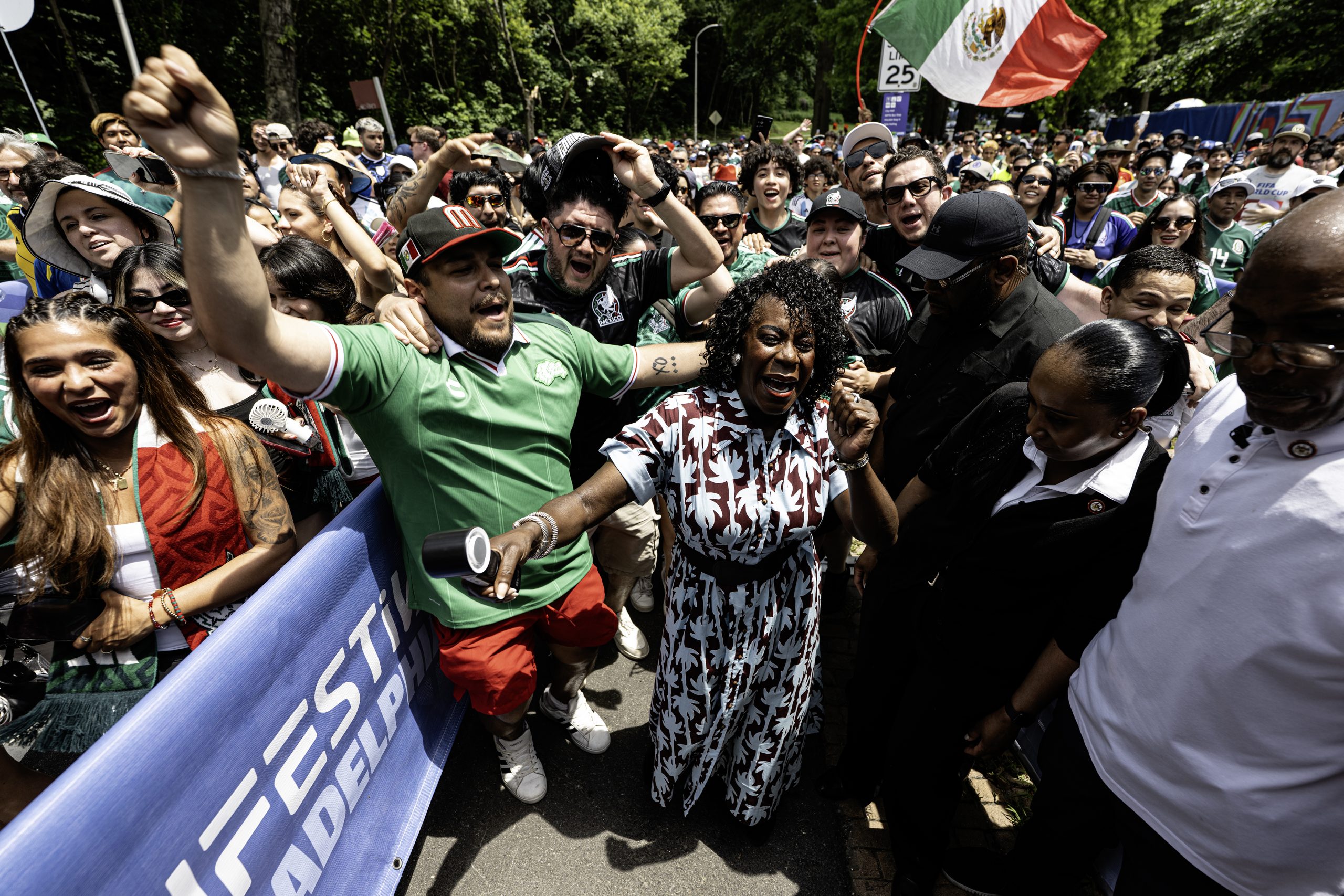
Philadelphia Mayor Cherelle L. Parker joins fans of Mexico’s soccer team in a chant during the FIFA Fan Festival at Lemon Hill on June 11, the opening day of the World Cup.Jose F. Moreno / Staff Photographer
Mayor Cherelle L. Parker put it plainly after the festival’s opening weeks: The energy across the city, she said, reflected Philadelphia “at its best — welcoming, diverse, joyful, and proud.”
I believe she meant it. I also know that sentence is easy to say about a festival and much harder to sustain on an ordinary Wednesday, after the last match, after the Fan Festival tents at Lemon Hill come down and Kelly Drive goes back to being Kelly Drive.
That’s the question I can’t stop asking: What happens on July 20?
Because the pride on display this summer isn’t new. The Brazilian families in the Northeast, the West African community that fills Africatown, the Haitian, Ghanaian, and Ivorian Philadelphians who’ve been here for decades — they didn’t invent their culture for this tournament.
A Brazil fan waves his national flag before a FIFA World Cup Group C soccer match between Brazil and Haiti at Lincoln Financial Field on June 19. Jose F. Moreno / Staff Photographer
What the World Cup did was give them permission to bring it fully into public view, and give the rest of us permission to celebrate it instead of asking it to quiet down.
I think about the women I talk to through my work — the ones fluent in code-switching, who’ve spent decades reading a room and calibrating themselves to fit it. I want to point them toward Lemon Hill in July and say: Look at what happens when nobody has to shrink. Look at what this city sounds like when everyone’s whole self shows up at once.
The tournament will end. The flags will come down. Philadelphia will go back to being, simply, Philadelphia.
But the pride we’ve watched all summer doesn’t have to be seasonal. It doesn’t need a stadium or a festival permit.
It can be what a Tuesday looks like here, if we decide it is — a city that doesn’t just tolerate its immigrants during a global tournament, but actually wants to see them, unedited, all year long.
Saadia Khan is a Pakistani immigrant and mother, host of the podcast “Immigrantly,” a Columbia University human rights graduate, and creator of Belong On Your Own Terms, an app for multicultural individuals reclaiming their full identity. Find her work at immigrantlypod.com.
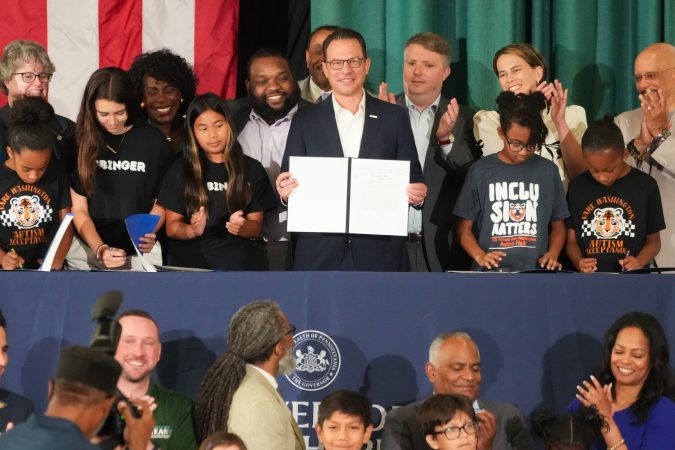
Gov. Josh Shapiro on Tuesday visited Vare-Washington Elementary School in South Philadelphia to tout the $678 million in new education funding included in the state budget deal finalized over the weekend.
The new education funding — including $565 million in “adequacy funding” to aid poorer districts — represented one of the most significant victories the first-term Democratic governor took home from the $50.8 billion state budget deal, which did not address lingering issues such as taxing so-called skill games and long-term funding for SEPTA and other public transit agencies.
The Philadelphia School District will receive $137 million in adequacy funding and $20 million in other new funding. The district will also be able to compete for a share of $125 million set aside for school facilities projects.
Philadelphia’s cash-strapped district, which entered this year with a $300 million structural budget deficit, still faces deep challenges. The school board this year approved a facilities plan to close 17 school buildings and renovate 169 more.
“We’re driving this money out to the schools that need it most — school districts like Philadelphia, Norristown, Pottstown, and Allentown, and others in our region,” Shapiro said. “They were getting shortchanged, and now they’re getting the lion’s share of this new funding.”
While it broke little new ground, this year’s state budget deal helped avoid another prolonged impasse involving Shapiro, the Democratic House, and the Republican Senate. Last year, lawmakers failed to reach a compromise until 135 days after the July 1 budget deadline, leaving school districts and local governments across the state in limbo for months.
“I‘m one of the only governors in the country with a divided legislature, one of the only legislatures that has to negotiate with people on the other side who really have a very different view, who don’t think the way we do about investing in public education,” said Shapiro, who was joined by Mayor Cherelle L. Parker and numerous Philadelphia Democratic lawmakers. “We have all been clear that we would not get up from the table in Harrisburg until we fully funded public education, and we’ve done that.”
Students applaud speakers at Vare-Washington Elementary School during an assembly highlighting the education investments included in the 2026-27 state budget in Philadelphia, Pa. on July 14, 2026.Jessica Griffin / Staff Photographer
The formula calculated that a majority of Pennsylvania schools were underfunded, by a total of $4.5 billion. For the last three years, the state has given those schools an extra $565 million a year, filling about one-third of the gap. The state plans to fullyaddress the shortfall by 2032.
Advocates for underfunded districts, like Philadelphia’s, have credited the state for sticking with the plan, but have also said the money is flowing too slowly for struggling districts. Meanwhile, Republican lawmakers have challenged the increased funding for poorer districts, saying others are getting shortchanged by the new system.
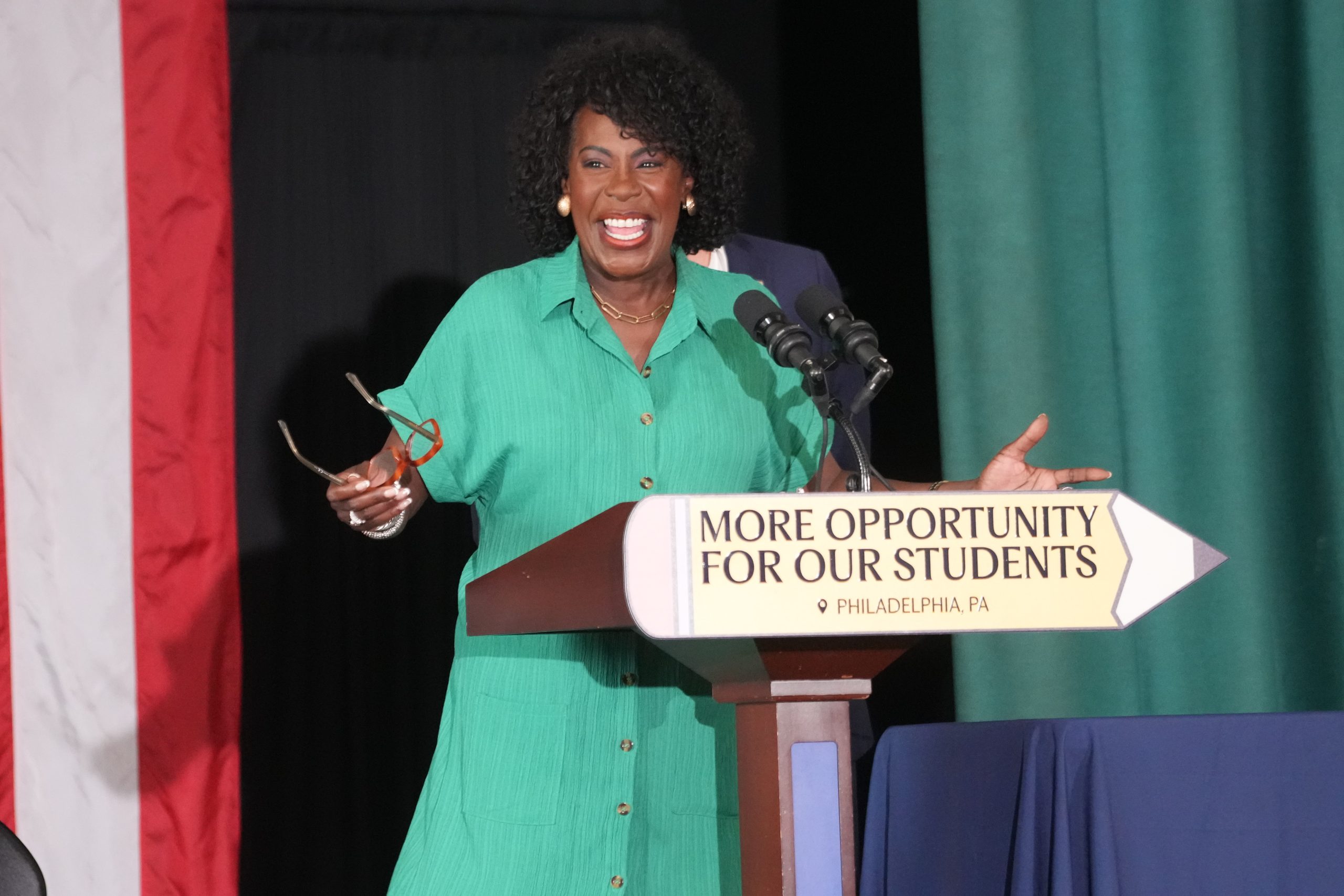
Mayor Cherelle L. Parker speaks at Vare-Washington Elementary School to highlight the historic education investments included in the 2026-27 state budget, in Philadelphia, Pa. on July 14, 2026.Jessica Griffin / Staff Photographer
Philadelphia’s school district, the only one in the state prohibited from raising its own revenue, relies on city and state lawmakers for its funding.
“We have limited revenue-generating capacity in the city of Philadelphia,” Parker said Tuesday. “I wish I could tell you, as mayor, that we had all of the money that we needed to address problems, but that is not the case. Our city can’t be successful without a strong partnership from Harrisburg.”
Parker thanked Shapiro and the city’s delegation to Harrisburg for “keeping your word” and delivering more education funding to Philadelphia from the state.
During her remarks, Parker led the students assembled at the event in several call-and-response chants, including, “Excellence matters — at Vare-Washington!”
“I want to hear you say, ‘Thank you — Gov. Shapiro!’” Parker said in another chant. “‘Thank you — Harrisburg legislators!’”
After years of fits and starts, Delaware says it is ready to build a new container port on the Delaware River to attract more cargo — and create jobs.
Not so fast, says an operator of ports upriver in Philadelphia and New Jersey.
Affiliates of Gloucester City-based Holt Logistics Corp. filed a lawsuit last week seeking to block project approvals granted by the U.S. Army Corps of Engineers for construction of Delaware’s proposed terminal in Edgemoor.
If that sounds familiar, it’s because Holt and the Pennsylvania agency that owns Philadelphia’s seaports in 2024 successfully persuaded a federal judge to throw out an Army Corps permit authorizing the same project.
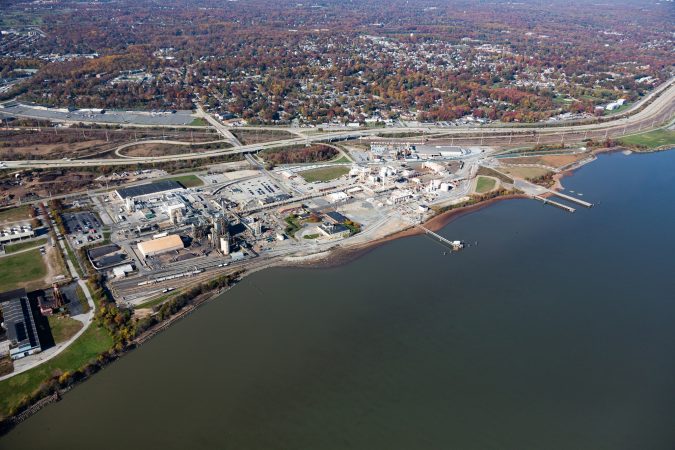
But since then, Delaware’s taxpayer-owned Diamond State Port Corp. requested new approvals, and the Army Corps granted them in April. The following month, Diamond State and its private-sector partner, Massachusetts-based Enstructure, announced they were moving ahead with the $669 million project at the site of a former DuPont chemical plant.
They say the new terminal — three miles northeast of the Port of Wilmington — will bring thousands of construction, warehouse, and longshore jobs to the area. Delaware officials estimate the Edgemoor terminal will be able to handle up to 1.2 million container units annually.
That’s one-third more than Philadelphia’s port handled in 2025, a record year. But Philly’s port — a major gateway for refrigerated cargo, especially fresh fruit from Central and South America — is also expanding.
The Philadelphia Regional Port Authority (PhilaPort), a state agency, last fall bought a 152-acre yard from Norfolk Southern Corp. for $90 million to create more cargo space.
A PhilaPort spokesperson declined to comment on the lawsuit. Diamond State didn’t immediately respond to a request for comment.
“While out-of-state competitors continue their efforts to stop this project, it is time to move forward and make sure Delaware’s port can compete fairly on the Delaware River,” Charuni Patibanda-Sanchez, who as Delaware’s secretary of state serves as Diamond State’s chair, said in May.
Holt — a family-owned company that operates marine terminals in South Philadelphia, Gloucester City, and Paulsboro — now says the Army Corps repeated several mistakes that doomed its earlier approvals.
“Most significantly, the court found that the Army Corps had failed to sufficiently consider the project’s likely impacts on navigation and safety in the Delaware River,” says the suit filed by Holt affiliates Greenwich Terminals LLC and Gloucester Terminals LLC.
“Yet despite the court’s detailed opinion and suggested remedial direction,” it continues, “the Army Corps reissued the project approvals again without conducting a proper evaluation of the applications before it.”
A spokesperson for the Army Corps declined to comment.
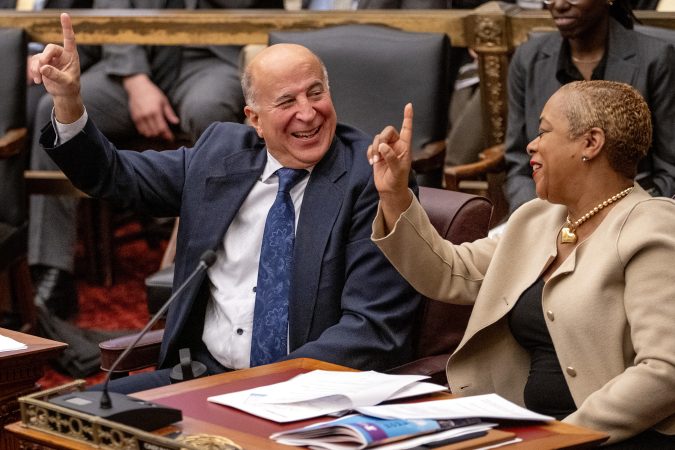
Philadelphia City Council is already looking to 2027. And with all 17 seats on the ballot next spring, the elections are shaping up to be a pivotal test of whether the city’s established politicians can withstand a rising tide of frustration with the party among Democratic voters.
All of the incumbents have said they intend to run for reelection, and several are likely to face serious challenges from new candidates focused on grassroots organizing and progressive groups — hoping to seize the opportunity presented by a nationwide leftward shift amid President Donald Trump’s second term.
Three districts have emerged as key battlegrounds.
And the city’s progressive organizations, emboldened by a series of wins locally and nationally, are targeting two other districts: the 1st, which stretches from South Philadelphia to Fishtown and is represented by Councilmember Mark Squilla, and the 8th, which includes parts of North and Northwest Philadelphia and is represented by Councilmember Cindy Bass.
“We’re definitely feeling confident,” said Robert Saleem Holbrook, executive director of the progressive advocacy group Straight Ahead. “Anyone who is going to be running under a progressive banner or a progressive movement is going to have to be running against the establishment, not toward it.”
A competitive race also appears to be taking shape for the seven Council seats that represent the city at-large.
Five of those seats are all but certain to be won by Democrats, making the May 2027 primary the key election in deep-blue Philadelphia.
The other two at-large seats — set aside for Council members outside the majority party under the city’s Home Rule Charter — will be decided in the November 2027 general election. Currently, the two minority party seats are held by Councilmembers Kendra Brooks and Nicolas O’Rourke of the left-leaning Working Families Party.
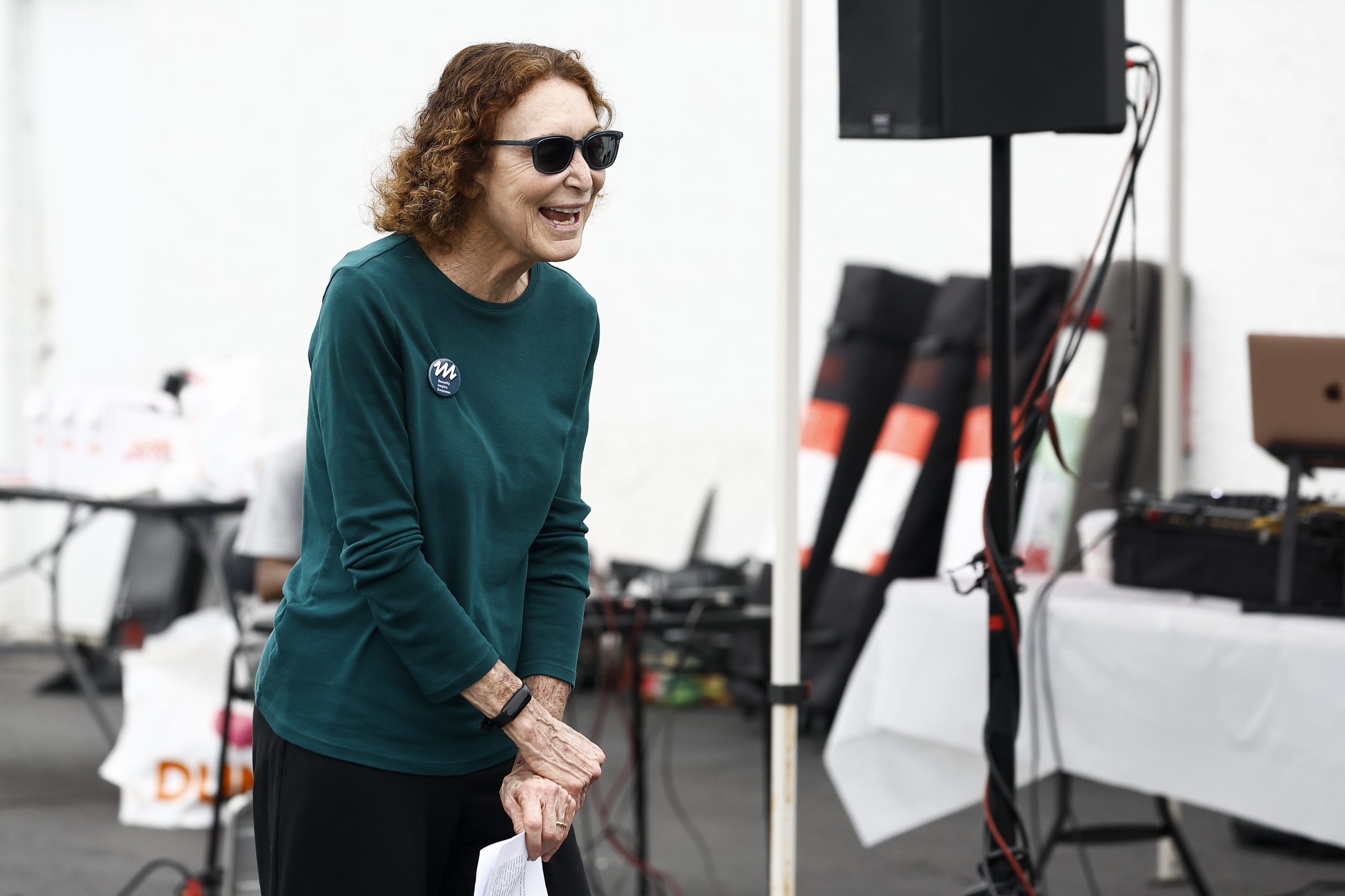
Jane Golden, founder and executive director of Mural Arts Philadelphia, takes the stage during the dedication of the Super Bowl LIX mural at Spike’s Trophies on June 17, 2025 in Philadelphia.Monica Herndon / Staff Photographer
Golden, 73, said last week that she is not currently running for Council, but acknowledged she has thought about it for years.
“It’s always something that is tempting to me, because I just love the city so much,” she said. “I feel honored that people even think of me.”
Progressives eye Bass’ North Philly seat
Philadelphia’s progressive activists this year see two key opportunities to expand the loosely organized left-leaning bloc on Council, which currently consists of four members. Winning additional seats could also grow their influence by enticing more moderate members to vote alongside them if they believe primary voters are moving left.
Leftists have notched high-profile wins in Democratic primaries across the country this year, including in Philadelphia, where democratic socialist State Rep. Chris Rabb (D., Philadelphia) bested more moderate candidates for a seat in Congress representing about half of the city. The district is one of the most Democratic in the nation.
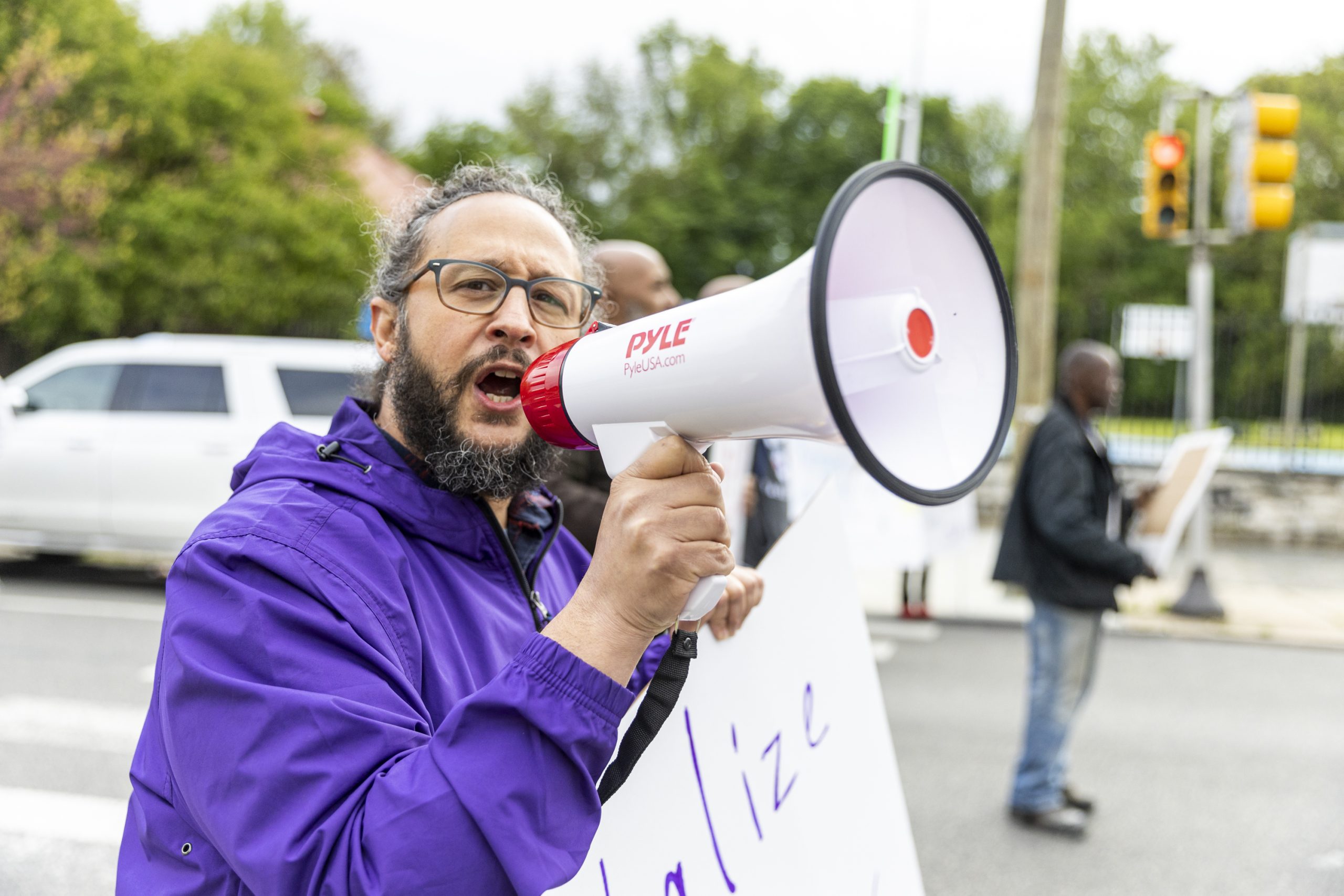
Anderson-Oberman, 55, the executive director of the progressive group Reclaim Philadelphia, said last week that he is “leaning” toward taking another swing.
“We’re in a moment in this country and this city where people have had enough,” he said. “People are looking for new answers. … Cindy represents the old way of doing things.”
Union organizer Seth Anderson-Oberman, running for 8th District City Council, joins in a small rally with community and Happy Hollow Advisory Board members along Wayne Avenue at Happy Hollow Playground in Philadelphia on April 2, 2023.Tyger Williams / Staff Photographer
Another Council run by Anderson-Oberman may test how far progressive momentum can go in Philadelphia. He was a member of the Communist Party USA in his 20s, and has said he is proud of that experience.
Bass, 58, said she is ready for the race no matter who her opponent is.
In June, she survived a contentious fight for another four-year term as Democratic leader of Mount Airy’s 22nd Ward. She was criticized for her handling of the process, and the party ordered a redo of the election.
She and her progressive opponent, Octavius Price, tied, then struck a power-sharing agreement. Through it all, Bass said, longtime residents stuck by her — and she is confident voters will do the same next year.
“My voters are people who are based in this community, committed to this community, intend to stay in the communities that they are in,” she said.
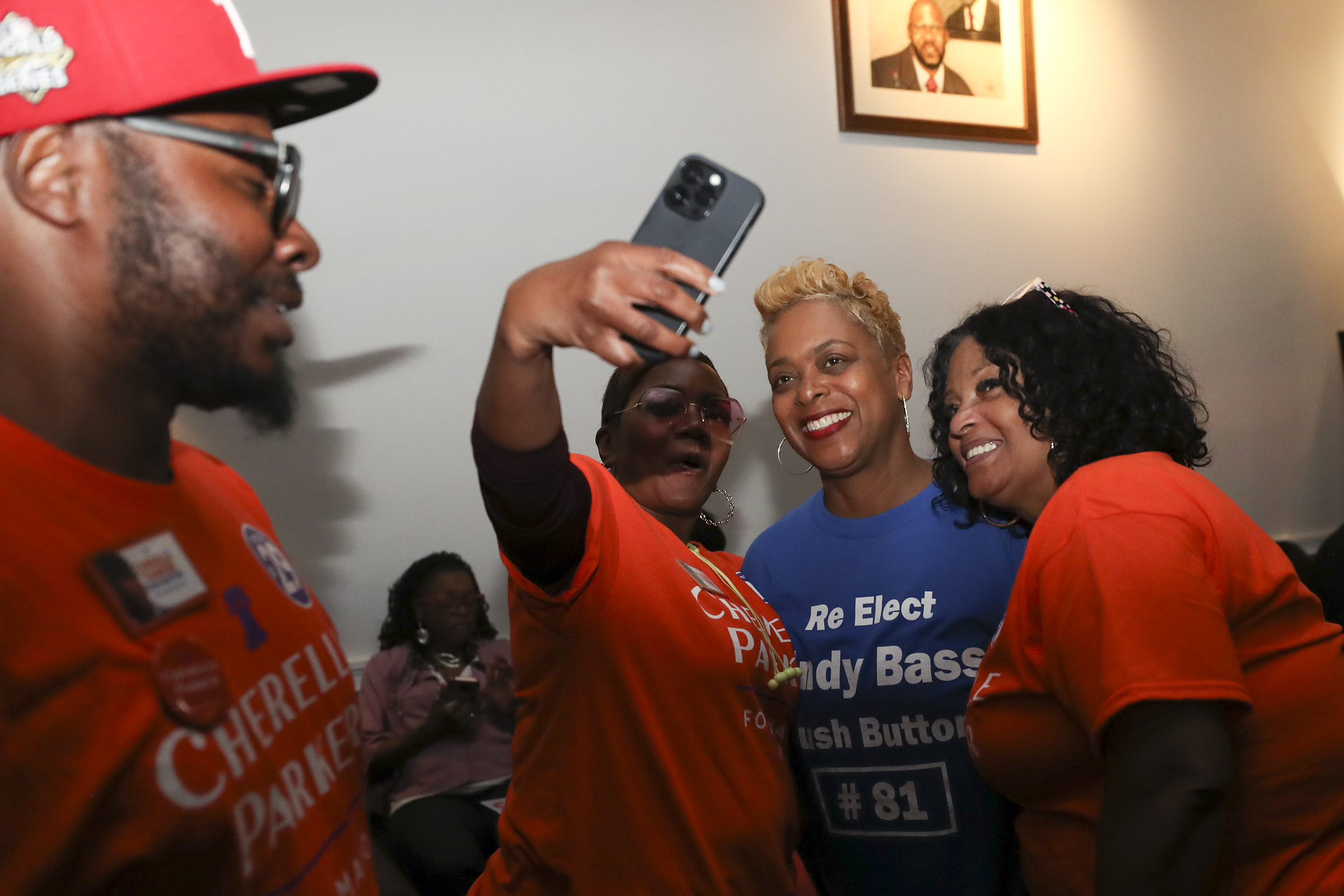
City Councilmember Cindy Bass (center) attends the watch party for Democratic candidate for mayor Cherelle L. Parker at Laborers 332 in Philadelphia on May 16, 2023.Heather Khalifa / Staff Photographer
Jeff Jones, a community leader and social justice advocate from Germantown, has also said he intends to run in the 8th District.
“I want to bring that new vision and a new voice to the 8th District, where residents and children and families can know that their voice matters, their concerns will be heard, and their challenges will be met,” said Jones, 61, a first-time political candidate.
Squilla could see a lefty challenger
Leftists are also eying Squilla’s seat, which represents the area along the Delaware River from Pennsport to Kensington. Since Squilla took office in 2012, the district has transformed from a bastion of working-class white voters to one of the most progressive swaths of the city.
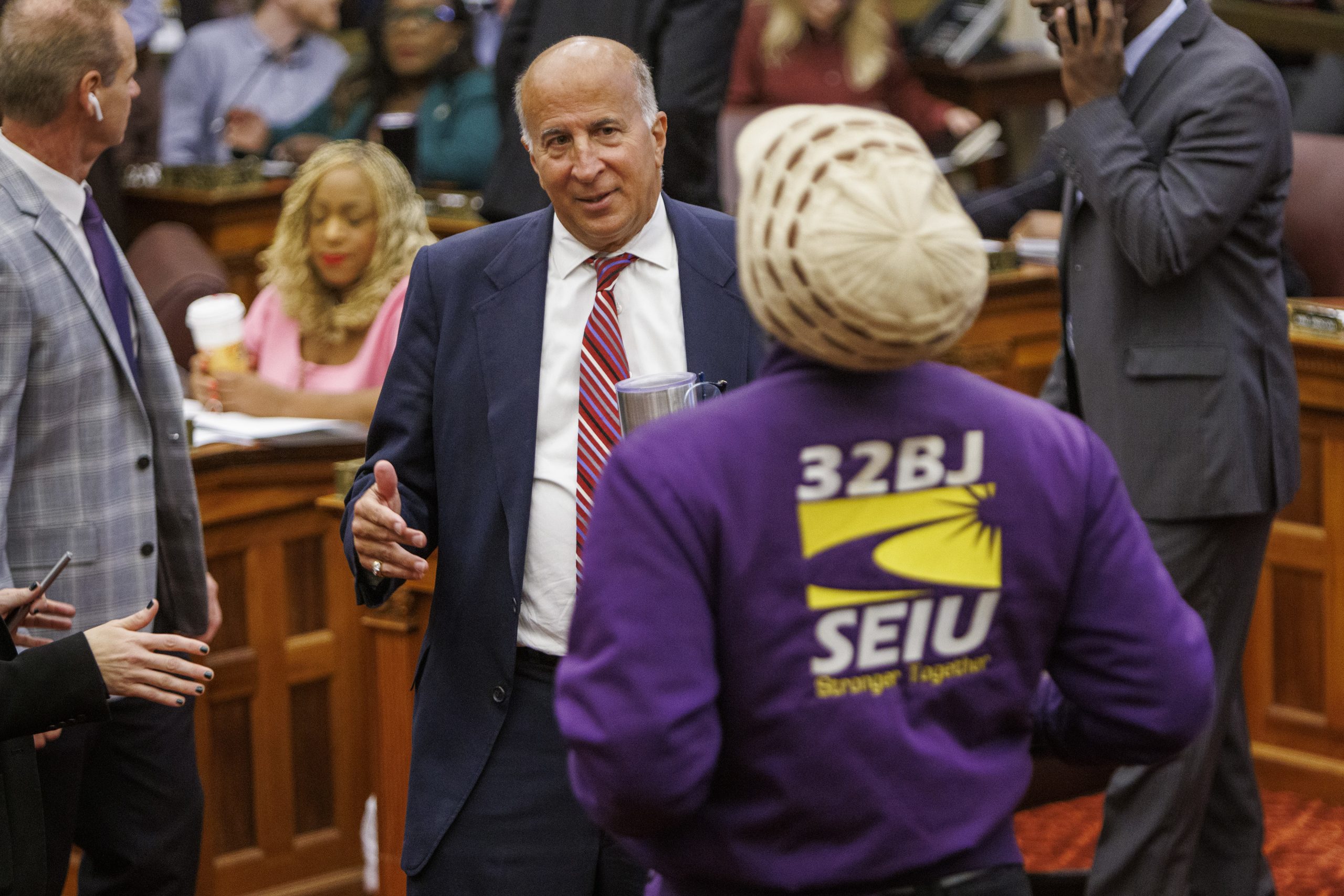
Squilla, 63, who has strong labor ties and is one of the most pro-development district Council members, said being a centrist has likely put a target on his back in the 2027 election.
Another contributing factor may be Squilla’s support for controversial legislation in 2024 to approve the 76ers’ since-abandoned plan to build a new arena in Center City. The project, which would have been in Squilla’s 1st District, was opposed by advocates for Chinatown, which the arena would havebordered.
Councilmember Mark Squilla arrives in Council chambers on Nov. 12, 2024, before the start of a public hearing on a proposed Sixers arena.Alejandro A. Alvarez / Staff Photographer
Despite the fierce objections, Council approved the project with Mayor Cherelle L. Parker’s support in December 2024. Weeks later, the basketball team announced it was abandoning its Center City plan and would instead build its next arena in South Philly.
Squilla said he is prepared to defend his actions, noting that he worked to ensure any arena deal would benefit his district and that many of those promises are moving forward despite the 76ers withdrawing their proposal.
“The goal as an elected official, and also as a leader, is not always to make the popular decision,” he said. “The goal is to have a process to make the decision that would be best for the people around it.”
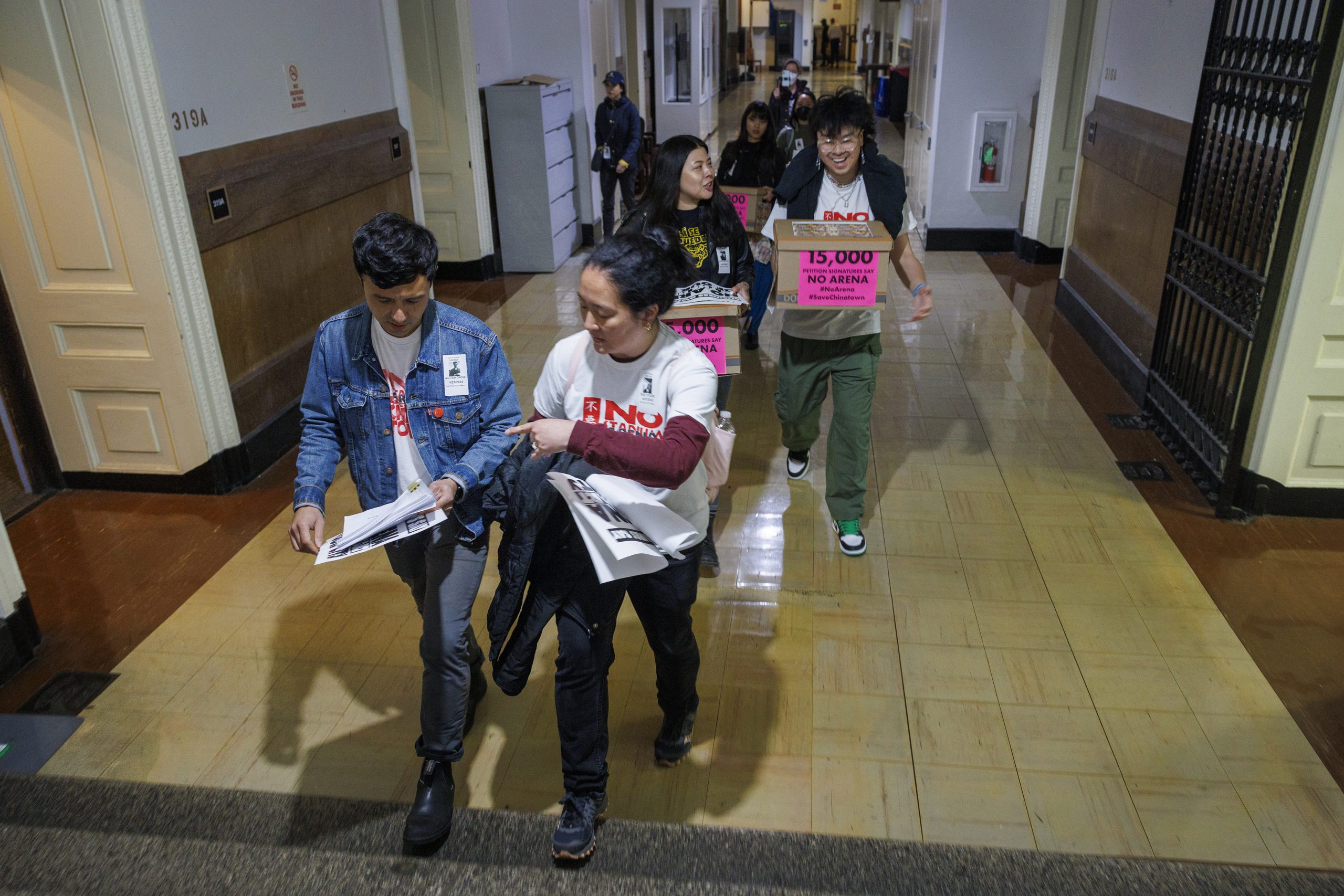
One prominent opponent of the Center City arena plan was Will Gross, the owner of Ox Coffee in Queen Village and a progressive who is the Democratic leader of the 2nd Ward. He is seen by political insiders and progressive organizations as the most likely candidate to take on Squilla.
Gross declined to comment.
In this 2023 file photo, Will Gross and Kay Yoon, of the No Arena in Chinatown group, deliver petitions to Councilmember Mark Squilla. Alejandro A. Alvarez / Staff Photographer
A progressive challenger may also emerge in the North Philly and Kensington-based 7th District, which is represented by Councilmember Quetcy Lozada.
Some insiders have speculated that Celin may run again. He declined to comment.
Lozada, 55, said she “can’t focus” on potential challengers.
“If I spend my time listening to the buzz about who is running,” she said, “we won’t get any work done.”
A battle takes shape in the 5th District
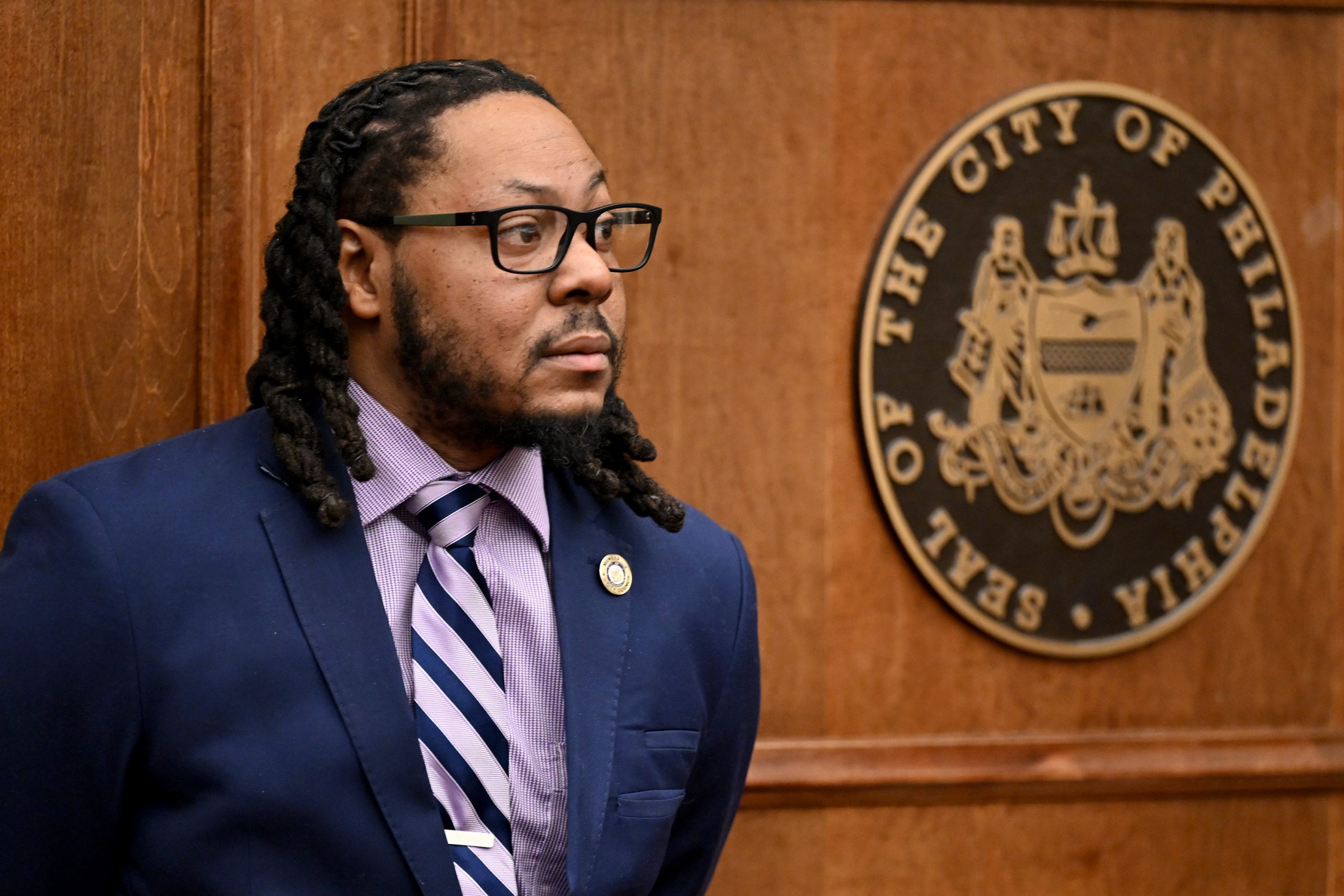
In the 5th District, a seat that represents parts of North Philadelphia and Center City, a handful of Democratic challengers are lining up to take on Young, 40, who is seen as one of Council’s most vulnerable members.
That is in part because of the unusual way in which he was elected in 2023. He ended up being the only Democrat on the ballot after several others, including party officials’ preferred candidates, were removed amid legal challenges.
Councilmember Jeffery Young Jr. in chambers as City Council meets Dec. 11, 2025.Tom Gralish / Staff Photographer
One of those candidates was Curtis Wilkerson, who was chief of staff to former City Council President Darrell L. Clarke. Two sources, who spoke on condition of anonymity because they were not authorized to discuss the campaign dynamics, said Wilkerson is considering running for the seat again next year.He did not respond to a request for comment.
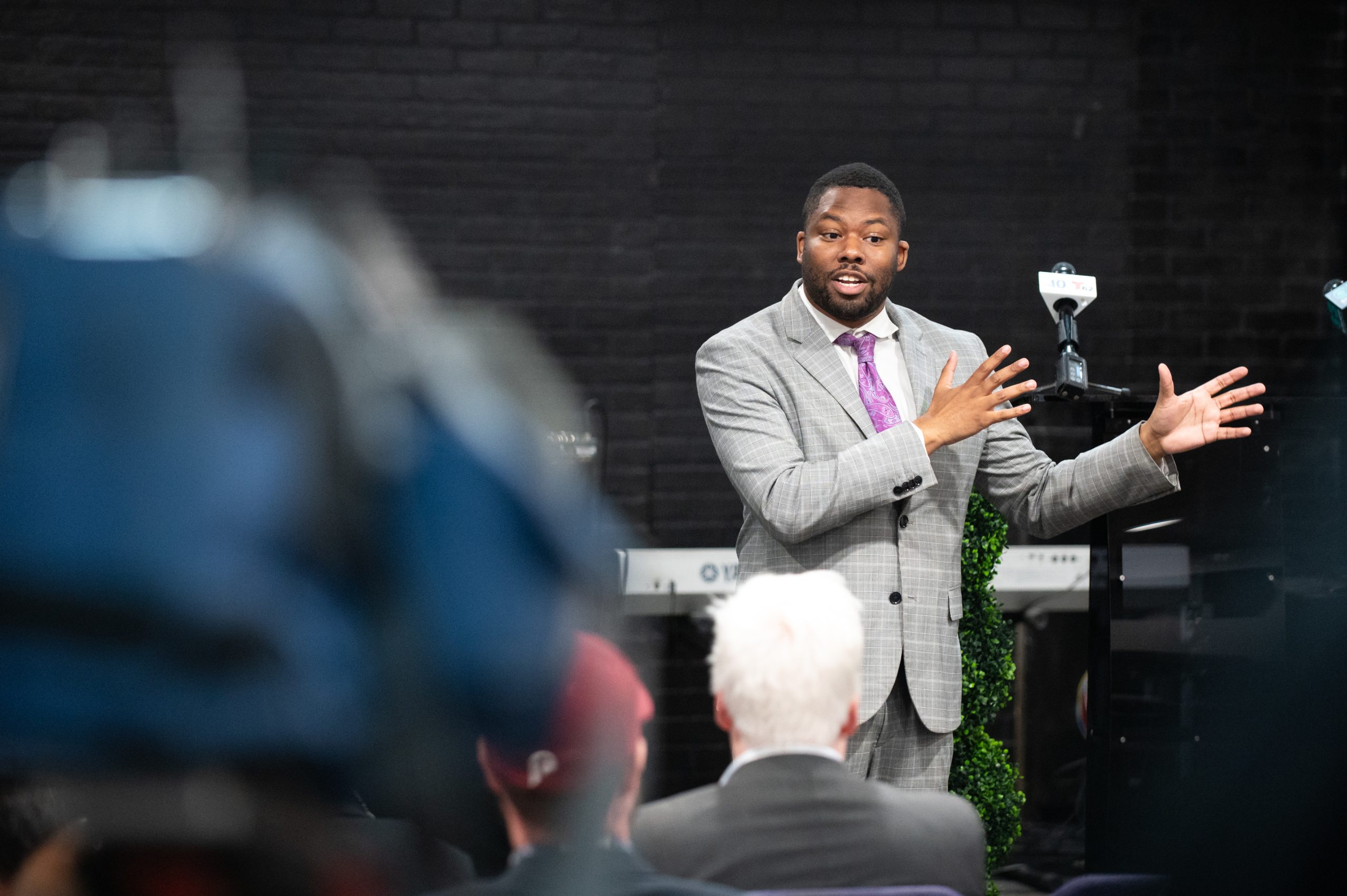
Also likely to run is Jalon Alexander, an attorney who unsuccessfully ran for an at-large seat on Council in 2023. Alexander, 33, formed an exploratory committee last year and is expected to formally declare his candidacy later this summer.
Two others are also considering running.
Dustin Dove, a lawyer and the president of the Fairmount Civic Association, said neighbors and community leaders have encouraged him to get in the Council race, and he is “taking the possibility of running seriously.”
“I think our city government should work for everyone by keeping our neighborhoods safe and streets walkable, making housing affordable, and ensuring fairness and access in public services,” Dove, 38, said last week.
Jalon Alexander, an attorney and community advocate, speaks to attendees at a meeting about potential SEPTA budget cuts hosted at Garden of Prayer Church in Strawberry Mansion on June 9, 2025.Erin Blewett / For The Inquirer
And Max Tuttleman, 37, a philanthropist who unsuccessfully ran for an at-large seat in 2023, said he “cares deeply about the 5th District and would never close the door to serving Philadelphia.”
He added that “Center City and the neighborhoods around it should be growing faster than they are.”
Young said in an interview last weekthat he intends to run for reelection, but that challengers are not his focus.
“I‘m focused on serving my constituency, serving my community,” he said. “The work that we’ve been doing will hopefully earn the support of the residents of the 5th District.”
A smaller, but competitive, at-large field
Over the last several election cycles, dozens of candidates lined up to run for at-large seats during a time of immense turnover in Council.
But with seven incumbents all looking toward reelection in 2027, there may be fewer challengers who line up to take them on. So far, only Golden and a handful of others have emerged as possible contenders.
David Alexander Jenkins, a cultural strategist known for delivering impassioned speeches during Council’s public comment section, said he is considering a run, encouraged by fellow community members.
“When the community that is around you constantly pushes you to intercede on their behalf, then it’s because they have trusted you to do what it is that you do best,” Jenkins, 39, said. “I think it would be incredibly unwise to ignore that.”
And Jude Husein, 28, a Palestinian-born community activist who was raised in North Philly, has already launched her campaign. If her bid is successful, Husein, a former staffer for State Sen. Art Haywood, would be the first member of Gen Z on Council.
In this 2023 file photo, Jude Husein, of North Philadelphia, speaks at a rally for a Day of Solidarity event at the Art Museum steps.Tyger Williams / Staff Photographer
Leaders of progressive organizations said they are closely watching her candidacy. However, Husein is not exactly running as a leftist. She said that her policy positions are varied and that she will seek endorsements from any institution that is “values-aligned.”
“I’m running because I think government should work for the people who pay for it, and should make neighborhoods affordable and safer,” she said.
Also in the running for Council at-large seats are Billy McCann, 46, a former teacher who lives in Port Richmond, and Isaiah T. Martin, 26, who lives in West Philly and leads a community development nonprofit. The pair, who both said they are progressive, have established something of a slate with Jones, who is challenging Bass in the 8th District.
They said they would prioritize public education, affordability, housing assistance, and government accountability, and they argued that establishment Democrats are failing to connect with voters.
“A new day is coming,” said Martin, another member of Gen Z who would make history on Council if elected. “It’s time we get people who are going to do the actual work and not just sit here and talk about it.”
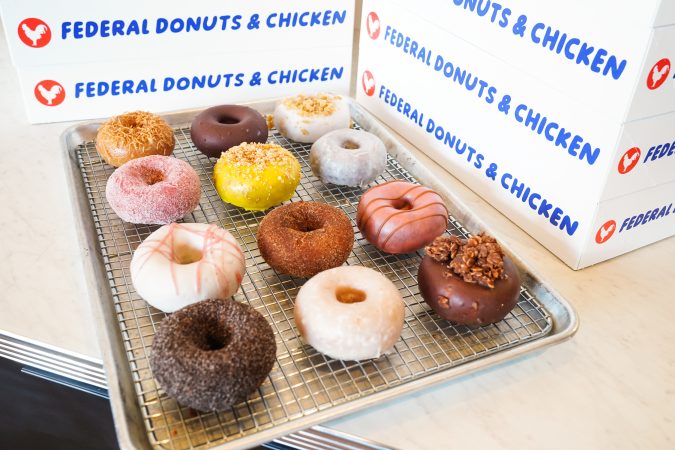
Restaurant group CookNSolo will close three Center City Federal Donuts & Chicken locations and shrink its Goldie falafel chain from four shops to one as owners Steve Cook and Michael Solomonov retrench, citing weakened demand for fast-casual dining, particularly at weekday lunch.
Federal Donuts’ shop at 1909 Sansom St. — designated only months ago as the company’s flagship after the South Philadelphia location closed in February — shut down after business Sunday. Locations at 21 S. 12th St. and 18th Street and Benjamin Franklin Parkway are expected to close by July 31, although Cook said staff departures could accelerate the timetable.
Of Federal’s 45 employees, 27 will be laid off, Cook said. Eighteen employees will be retained to staff the two remaining Philadelphia stores, on Fairmount Avenue and on South Street. Federal launched in 2011 in South Philadelphia with a menu of fried chicken, coffee, and hot doughnuts from a robotic fryer.
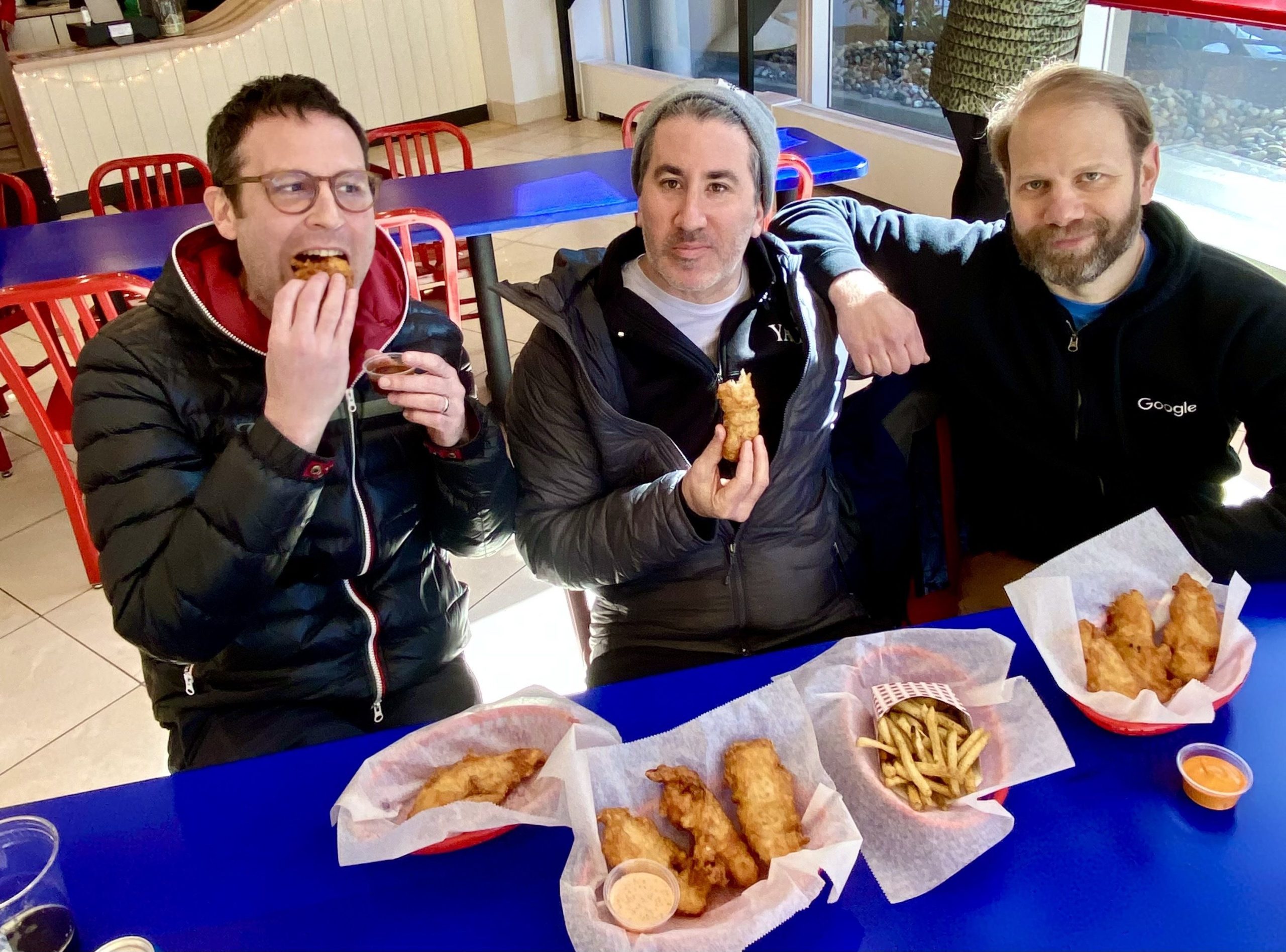
Federal Donuts founders (from left) Tom Henneman, Michael Solomonov, and Steve Cook at the Federal Donuts & Chicken location at 1776 Ben Franklin Parkway in 2022.Michael Klein / Staff
Goldie, which debuted in 2017 with a menu of falafel, fries, and tehina shakes, will close its restaurants at 1218 Sansom St., Franklin’s Table food hall at 34th and Walnut Streets, and the Whole Foods Market at 2101 Pennsylvania Ave. in late July or early August. The lone remaining Goldie, at 1911 Sansom St., will absorb the chain’s delivery, takeout, and catering business.
Eighteen of Goldie’s 36 employees will lose their jobs. Cook said the company is working to help find former Federal Donuts and Goldie workers other roles. Hourly staffers will not be given severance, Cook said, as is standard industry practice.
Cook said the closures reflect a restaurant landscape that has changed dramatically since the pandemic.
Dozens of fast-casual and quick-service restaurants have opened in recent years. “We feel like we’re oversaturated in the city, given the economy right now and the demand for fast-casual restaurants,” he said. Federal Donuts has experienced “significant” year-over-year same-store sales declines, he said. He hopes the closures stem the losses.
“We have two great brands here that are worth saving, and we feel like economically this is the best way to preserve those brands.”
Falafel from Goldie.Craig LaBan / Staff
The company’s full-service restaurants — including Zahav, Dizengoff, K’Far Cafe, Jaffa Bar, and Laser Wolf — are unaffected by the shutdowns.
“Post-COVID, while we’ve seen really good rebounds in the dinner, more fine-dining side of our business, weekday lunch traffic has never really returned to full strength,” he said. “The $10-to-$15 lunch is an easy thing to kind of do without.”
Cook’s assessment reflects broader industry trends.
Tehina shakes are a signature product at Goldie.Tim Tai / Staff Photographer
While some national fast-casual brands such as Chipotle and Cava continue to post strong results, many regional chains are struggling as consumers increasingly choose prepared foods from grocery stores and convenience stores instead of restaurant meals, according to R.J. Hottovy, head of analytical research at Placer.ai, a location analytics and foot-traffic company.
While fine-dining restaurants have generally continued to gain traffic through much of 2026, “fast-casual has been more of a mixed bag,” Hottovy said.
Placer.ai’s findings show visits to grocery stores, convenience stores, and wholesale clubs increasing from a year earlier while overall restaurant visits have declined. “Middle-income consumers are increasingly substituting restaurant visits with meals at home,” Hottovy said.
Restaurants also continue to battle rising labor costs while customer traffic softens as menu prices rise. “Price increases are increasingly showing up as lost visits,” he said.
Federal then operated 11 locations and arena concessions, and executives envisioned a franchise system that eventually could reach 150 stores.
The company’s largest franchisee later closed its restaurants in Radnor, Conshohocken, and Willow Grove and returned several Philadelphia stores to the company. In April, Cook and Solomonov announced plans to regain control of those city locations, simplify operations, and improve execution.
At the time, the Sansom Street restaurant was designated as the flagship to redevelop menu items. “I thought we would get a significant bounce in sales [there] and it just didn’t happen,” Cook said.
Cook said NewSpring remains the majority owner of Federal Donuts, while he and Solomonov retain a significant ownership stake and seats on its board. Representatives of NewSpring did not respond to requests for comment.
Under the restructuring, two Philadelphia stores will remain. CookNSolo will take over the location at Seventh Street and Fairmount Avenue, now owned by the company, as a franchisee around Aug. 1.
Federal cofounder Tom Henneman confirmed that he was in talks to operate the location at Sixth and South Streets as a franchisee.
Cook said those stores were chosen because of their historical performance and geographic separation. Consolidating delivery and takeout in two locations instead of five should improve profitability, he said.
Besides the two city stores, Federal will continue operating independently owned franchises in Marlton, Lancaster, and the Hard Rock Hotel & Casino in Atlantic City, along with its licensed airport and stadium locations.
Goldie, unlike Federal Donuts, is owned entirely by CookNSolo.
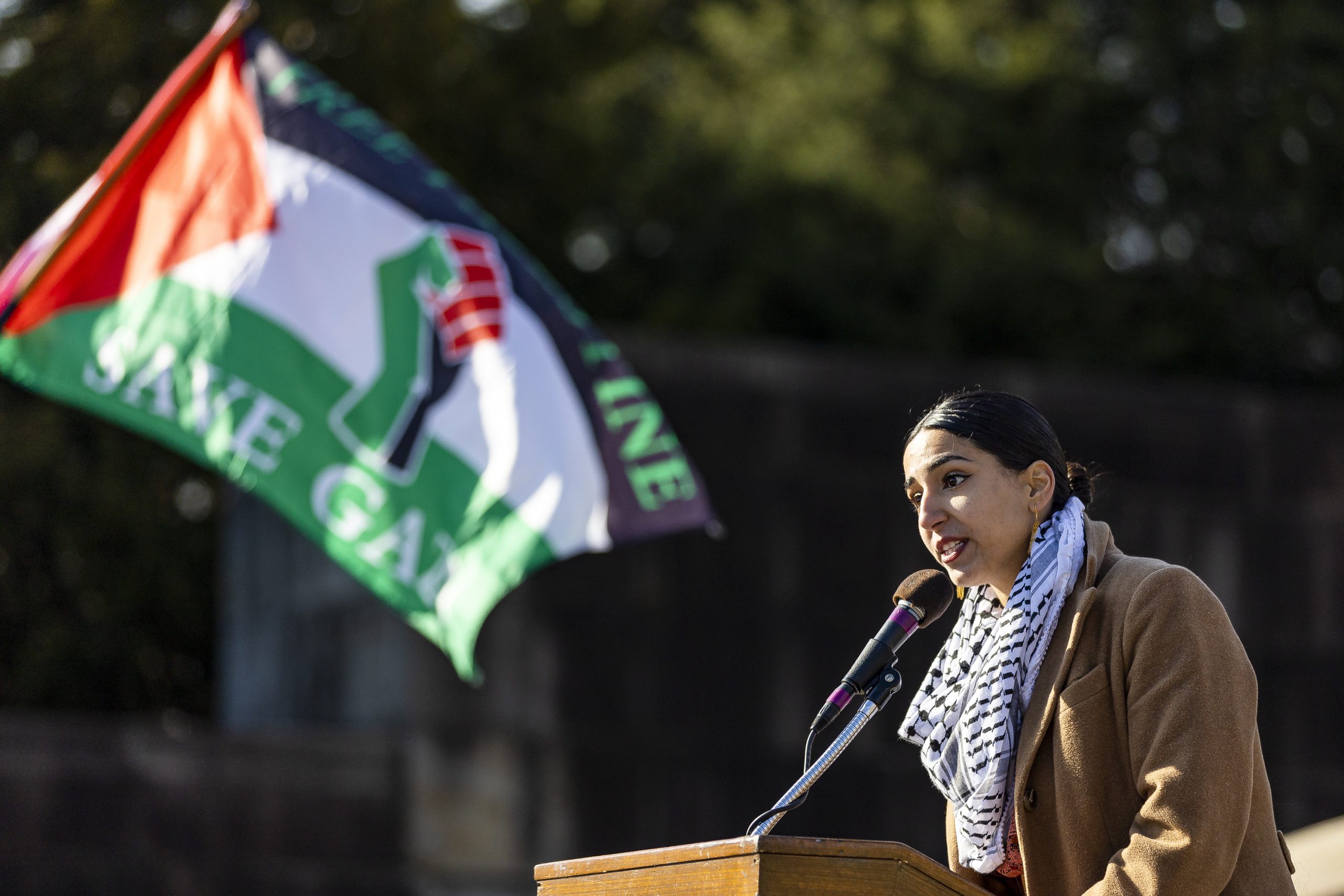
CookNSolo has also been the focus of pro-Palestinian demonstrations and boycott campaigns since the start of the Israel-Hamas war on Oct. 7, 2023. Activists have criticized the restaurant group for raising money for an Israeli emergency medical nonprofit as well as Cook’s and Solomonov’s outspoken support for Israel. The chefs have said their support for Israel was “not unqualified” and have criticized the Netanyahu government’s efforts to thwart a two-state solution.
A group with the Instagram handle @boycottcooknsolo on Monday reported word of the store closings, contending that the boycott had softened sales.
Cook disagreed. “Any time there’s been a protest, it’s always resulted in a short-term increase in business,” Cook said. “This is really an economic decision that goes back many years at this point.”
(function(){function e(){window.addEventListener(`message`,function(e){if(e.data[`datawrapper-height`]!==void 0){var t=document.querySelectorAll(`iframe`);for(var n in e.data[`datawrapper-height`])for(var r=0,i;i=t[r];r++)if(i.contentWindow===e.source){var a=e.data[`datawrapper-height`][n]+`px`;i.style.height=a}}})}e()})();
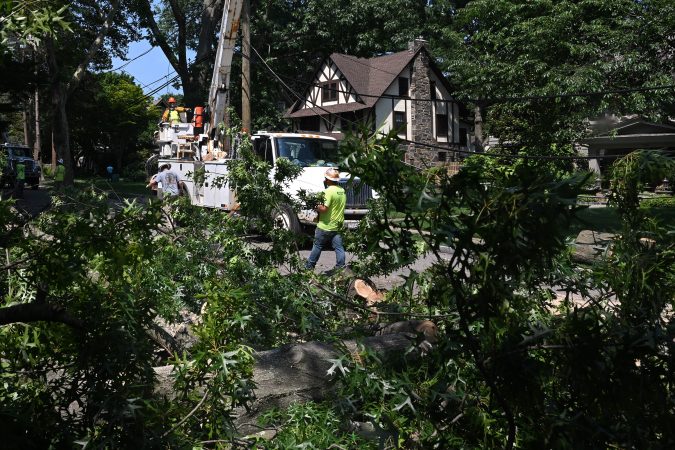
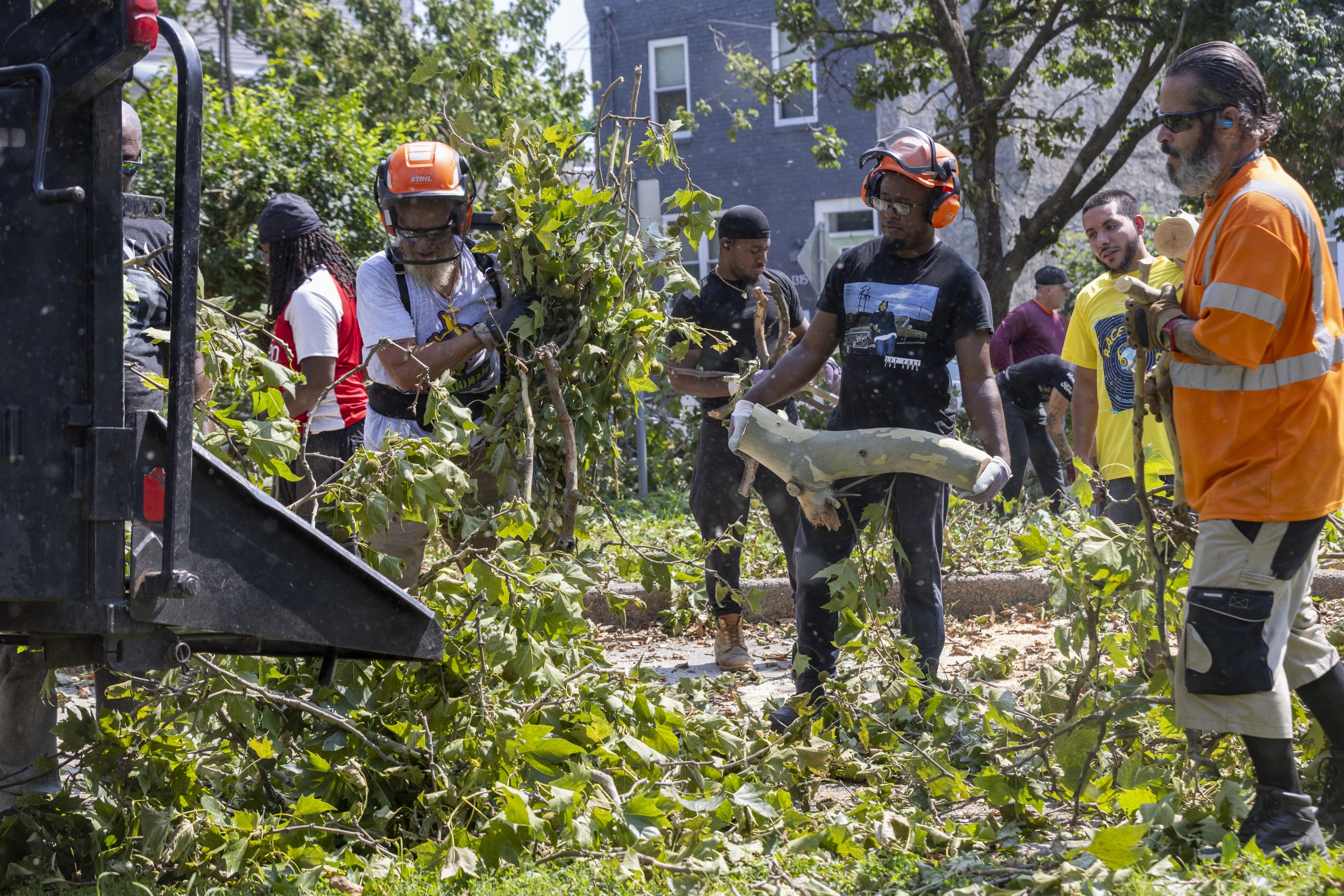
Hundreds of trees fell in Philadelphia within a matter of minutes during a weekend storm that left a narrow but destructive band of what one official called “unprecedented” damage in its wake in the region.
“We’ve never seen anything like this,” Parks and Recreation commissioner Susan Slawson said. “We’ve never seen a 15 and 20 minute storm come through an isolated area and take down that many trees.”
Those downed trees came following a series of four “microbursts,” which brought wind gusts traveling 60 to 70 mph. Those isolated instances of high winds primarily impacted parts of Philadelphia and Montgomery County.
Microbursts, the National Weather Service said, happen when a thunderstorm experiences a rapid increase in updraft. When that updraft stops, the mass of the storm system comes crashing back down, resulting in severe winds that sent trees tumbling into homes and vehicles, damaged public parks, and left neighborhoods grappling with cleanup efforts days later.
Slawson’s department, which handles downed trees in the city, had responded to at least 340 emergency requests as of Monday afternoon, and inspected about 220 trees. The hardest hit areas, she added, were in South Philadelphia, Wynnefield, and Southwest Philadelphia.
The harsh winter’s heavy caps of ice and snow that lasted for weeks likely left some trees weakened or damaged, Slawson said, making them more vulnerable to being toppled. Those that fell were being taken to the city’s Fairmount Park Organic Recycling Center in West Fairmount Park.
Evidence of the damage was apparent around the region Monday. In Malcolm X Park in West Philadelphia, piles of giant fallen trees, cut into large chunks, sat waiting for disposal. And nearby on Spruce Street, a downed tree blocked a busy two-way road between 53rd and 54th Streets, its corpse resting atop a crushed red pickup truck.
“They need to cut these trees down, they’re too tall,” said Schonder Pickney, 61, who lives across the street from the wreckage. She and her neighbors had asked the city to remove some of the old trees that appeared dangerous, but she said nothing came from it.
Philadelphia Parks and Recreation workers throw debris into an auxiliary chipper at Wharton Square Playground in Point Breeze, on
Monday.Aidan T. Gallo / Staff Photographer
Private tree management companies, like Rapid Tree Care in Grays Ferry, were inundated with service requests following the storm. Caleb Coome, the company’s founder, said that the storm’s intensity knocked down large trees across densely populated city blocks, and across multiple homes.
“It’s definitely unprecedented in terms of the amount of volume over a couple-day span,” said Coome, whose company has been in operations for three years.
Homeowners impacted by fallen trees, he said, were largely concentrated near FDR Park and the stadiums in South Philly, as well as the Cobbs Creek and Cedar Park neighborhoods in West Philly. Homeowners face logistical and financial hurdles for cleanup, as much of the damage occurred in areas with tight rowhouses.
In those tight quarters, a single fallen tree can span up to six properties, creating liability issues and disputes among neighbors over who is responsible for removal costs. A downed tree spanning multiple properties must be removed all at once, rather than limb-by-limb, for safety reasons, Coome said.
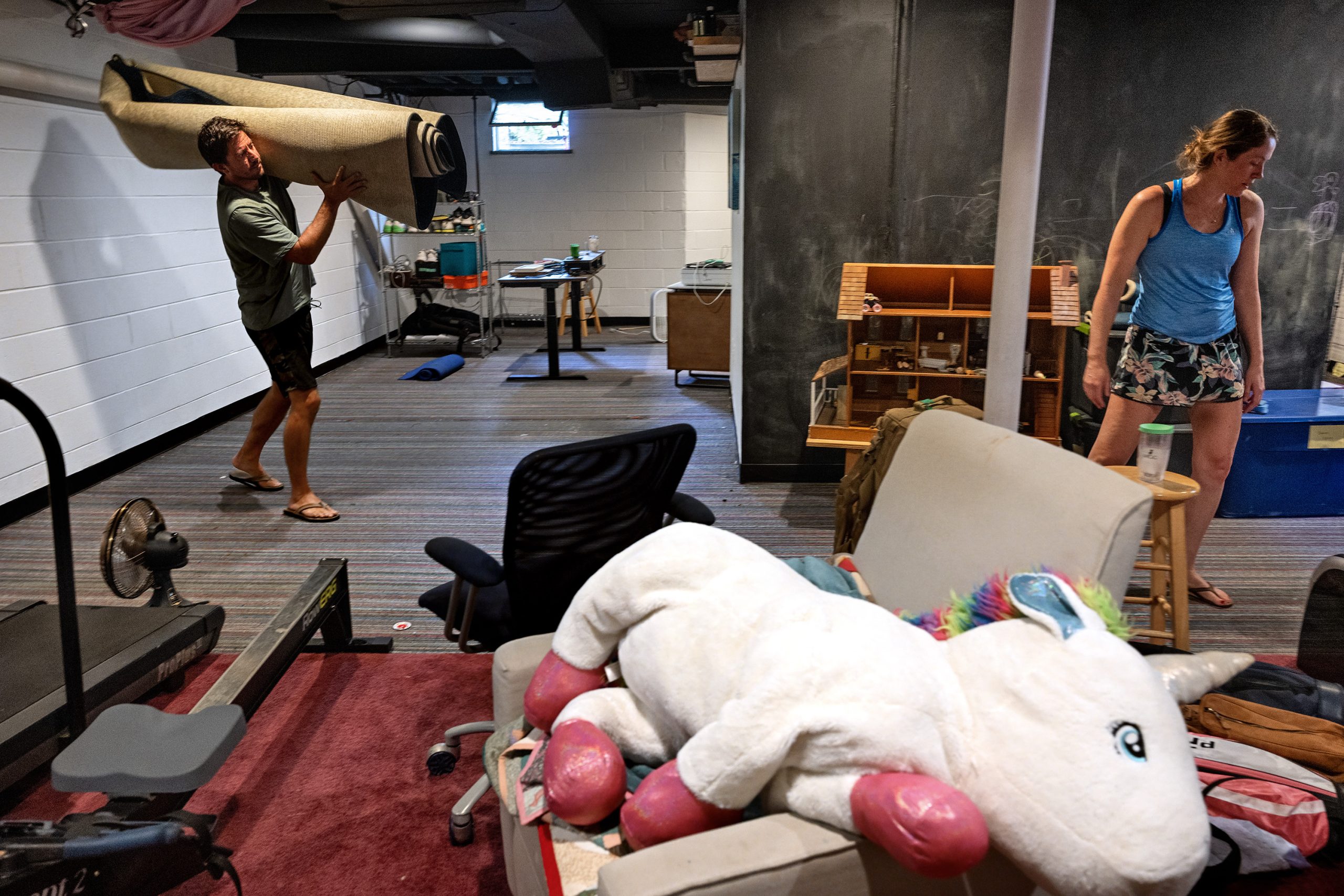
Some parts of the suburbs also saw shared tree damage. For example, in Narberth, Hugh Parker and his family hurried home from the Shore Saturday after they heard from neighbors that a 40-foot tree had been knocked down in their front yard.
Hugh and Grace Parker continue the cleanup in the basement of their Narberth home Monday. It flooded during weekend’s storm.Tom Gralish / Staff Photographer
Located on their neighbor’s property, the tree landed to cover their driveway, as well as a car belonging to Parker’s wife, Grace. As it came down, the tree’s canopy also took down power lines and blocked the street, and the damage it did to the vehicle remained unclear Monday.
A day later, Peco reconnected their power, which Parker said had been out for a little more than 24 hours. Then, he smelled smoke, thanks to a power line that started a fire after power had been restored. After about 30 minutes, the fire went out, but no one from the utility had come to check the power lines as of Monday morning.
“It was like something from a movie scene — there were sparks flying 10 to 15 feet in the air,” said Parker.
In Lower Merion Township, the local fire department responded to 98 incidents over the weekend, including numerous water rescues. Montgomery County communities were some of the hardest hit.
“It became apparent that nearly every street in Narberth had a tree down, a substantial tree on a car,” said Narberth Council Vice President Cyndi Rickards said.
The episode also highlights what many local officials have said is a need to further discuss improving local infrastructure and resources for extreme weather events.
“I think this is the reality of storms now,” said Lower Merion Commissioner Ray Courtney. “They are hard, they are intense, and they dump a lot of precipitation in a short period of time, and all local governments, and our state and federal government, need to be thinking about improvements to our infrastructure, and the resiliency against this kind of weather event.”
In addition to downed trees in the area, roughly 1,500 Peco customers remained without power across 119 reported outages as of late Monday afternoon. That number is down significantly from the height of the storm, when some 60,000 customers experienced extended outages. Overall, 105,000 Peco customers experienced some loss of power during the course of the storm, the company said.
Power for all customers in the region, Peco added, was expected to be restored by 11 p.m. Monday.
Among those impacted were West Philadelphia resident Lisa Phillips, who lives on the 5100 block of Hazel Avenue. A tree on her block went down Saturday, taking power lines with it. Electrical workers arrived Monday to take care of the downed lines, but she was still waiting for the city to clear the tree from her street.
“Never in my life have I experienced anything like this,” she said.
Staff writers Isabel Maney, Olivia Prusky, and Fallon Roth contributed to this article.
Law enforcement officials seized nearly $6 million worth of crack-cocaine destined for Philadelphia as well as thousands of fentanyl pills in a monthslongdrug operation, authorities said Monday.
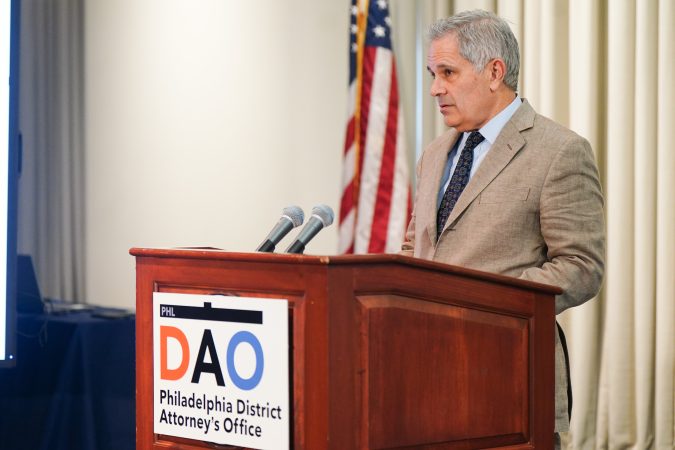
The seizure was the culmination of an 18-month joint investigation into several men who supplied or sold the potent synthetic opioid and other deadly drugs in the city’s Kensington neighborhood and elsewhere, according to Philadelphia District Attorney Larry Krasner, who said the cocaine seizure happened last week.
In all, Krasner said, law enforcement recovered 58 kilograms of cocaine with a street value of $5.8 million and fentanyl pills worth around $200,000.
The bust is the latest eye-grabbing effort to stem the flow of fentanyl and other deadly drugs into the city, and specifically to Kensington, considered one of the nation’s largest open-air drug markets.
The FBI targeted a sprawling criminal syndicate in the neighborhood last year when it arrested 33 members of the Weymouth Street gang, which was accused of running a 24/7 market for fentanyl and other drugs on the narrow block for nearly a decade.
In the latest raid, investigators were tipped off to the criminal activity in December 2025 when members of the Delaware River Port Authority Police pulled over 46-year-old Raabitah Reynolds as he drove back to Philadelphia from New York City.
After obtaining a search warrant for Reynolds’ vehicle, officers recovered a 9mm handgun and equipment for packaging drugs.
Later, when they searched a South Philadelphia stash house tied to Reynolds, they recovered 2 kilograms of fentanyl that was ready to be packaged, a gallon jar of PCP, various pills, and more firearms, according to Assistant District Attorney Stephen Girman.
Reynolds was charged with two counts of felony possession with the intent to deliver, two counts of criminal conspiracy, and related crimes. He is being held at the Curran Fromhold Correctional Facility with bail set at $500,000.
The haul was “a significant drug seizure in and of itself,” Girman said, but investigators did not stop there.
Reynolds’ arrest led them to one of his buyers, Khalil Dandy, a drug dealer who is accused of effectively controlling sales on a block at Kensington Avenue and E Street, according to Girman.
Dandy, 36, ran that operation from his home at a Center City condominium located near 12th and Chestnut Streets, Girman said.
Officers began visiting the Kensington block to conduct undercover buys, according to Girman, learning that Dandy was supplying fentanyl and crystal meth to street dealers in the neighborhood.
Dandy was arrested on March 18 and charged with possession with the intent to manufacture or deliver and related crimes. He was released from custody on bail as he awaits a preliminary hearing.
Meanwhile, investigators offered information about Reynolds to the DEA field office in New York, which led to the raid of a “pill mill” operating out of a Brooklyn apartment.
There agents recovered more than 20 kilograms of fentanyl that had been pressed into blue pills to pass off the deadly drug as oxycodone, Girman said.
These pills “are exceptionally dangerous, because people can take them thinking they are a regular prescription painkiller, and they can be filled with a fatal amount of fentanyl,” he said.
And as investigators traced Reynolds’ network, they learned he was also involved in bulk cocaine sales that came from a supplier on the West Coast.
Those shipments were shipped to Philadelphia in crates to be sold throughout the region, according to Girman.
In early July, investigators intercepted two of those containers, and with the assistance of a K9 unit, recovered a total of 58 kilograms of cocaine from within.
They arrested another Philadelphia man, 51-year-old Ephraim Ramsey, who had showed up to pick up the drugs.
Ramsey was charged with one count of felony possession with the intent to deliver and one count of criminal conspiracy.
And when Philadelphia police went to arrest Reynolds at an apartment in the city’s Kingsessing neighborhood, he led them on a chase through a second-story window and into a back alley before being apprehended.
From a separateapartment on City Avenue, investigators recovered more than 2,000 of the blue fentanyl-laced pills as well as counterfeit Adderall, according to Girman.
In a third residencein Olney — a house being prepped to stash the cocaine shipments — officers recovered an AR-15 rifle with an obliterated serial number.
Krasner, touting the success of the operation, said he was pleased that law enforcement officers had targeted large shipments of contraband as opposed to targeting “young people with a small amount of drugs in their pocket.”
“This, in my opinion, is a much more important and much more effective approach,” he said.