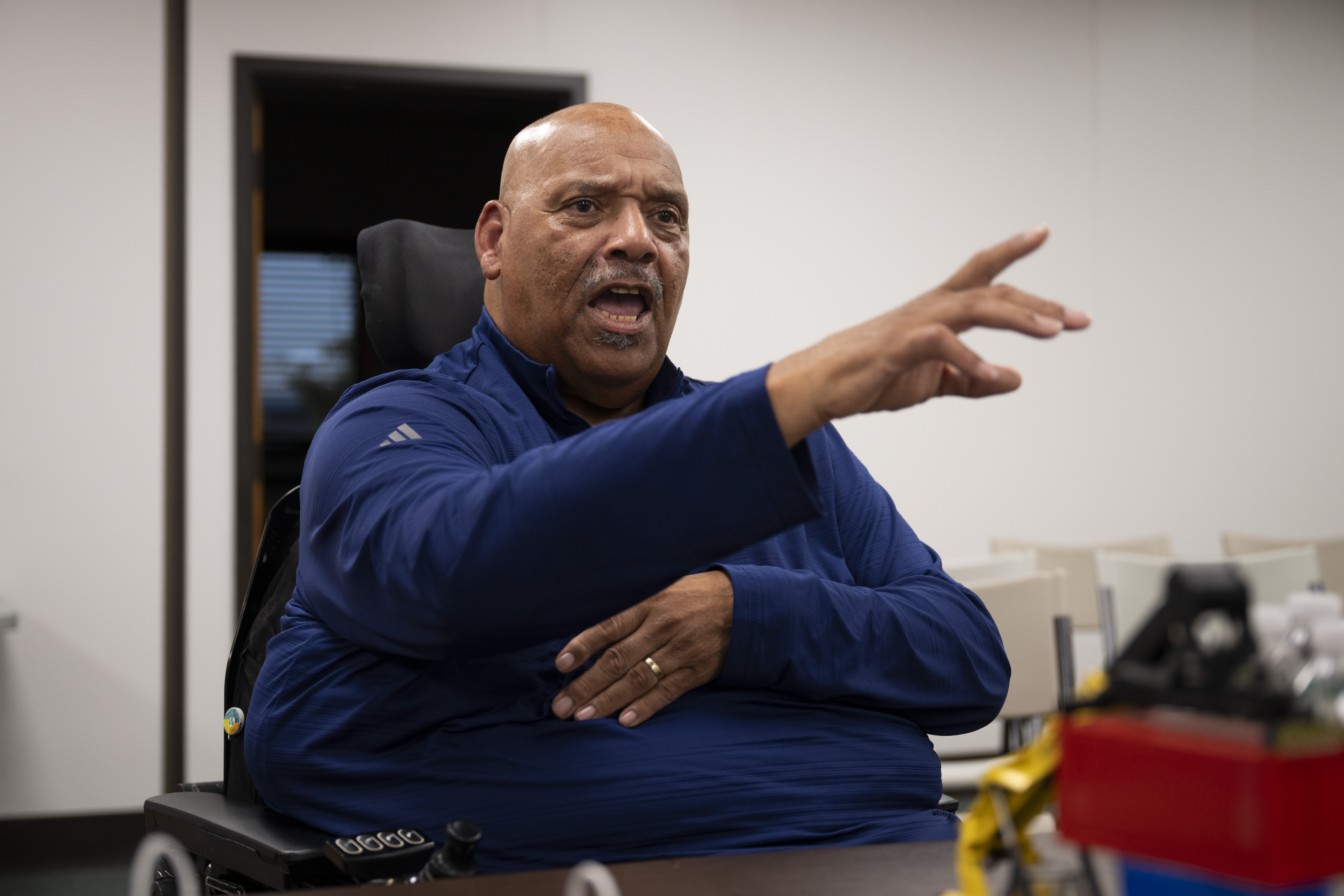
Cleo Winfield has worked at a warehouse located inside the Packer Avenue Marine Terminal in South Philadelphia for 22 years, stacking bananas and other cargo that are unloaded from ships docked on the Delaware River.
Now his job is at risk.
The warehouse, currently operated by an affiliate of Holt Logistics Corp. and staffed by members of a longshoremen’s union, is expected to be razed to make space on the terminal to stack more shipping containers.
As part of a port development plan, the Philadelphia Regional Port Authority (PhilaPort) — the Pennsylvania state agency that owns the city’s seaport facilities and leases them to private tenants — has built a new taxpayer-funded, Holt-operated warehouse a mile from the Packer Avenue terminal.
Gloucester City-based Holt says it has a deal to staff the new facility with workers represented byTeamsters Local 929. Holt has longshore work available for the members of International Longshoremen’s Association Local 1291, the company says, but it has been unable to reach an agreement with the union. A contract extension expired in June.
The ILA counters that such an arrangement would strip Winfield and 30 other warehouse workers of their seniority — sacrificing wages and benefits they’ve accrued over the years.
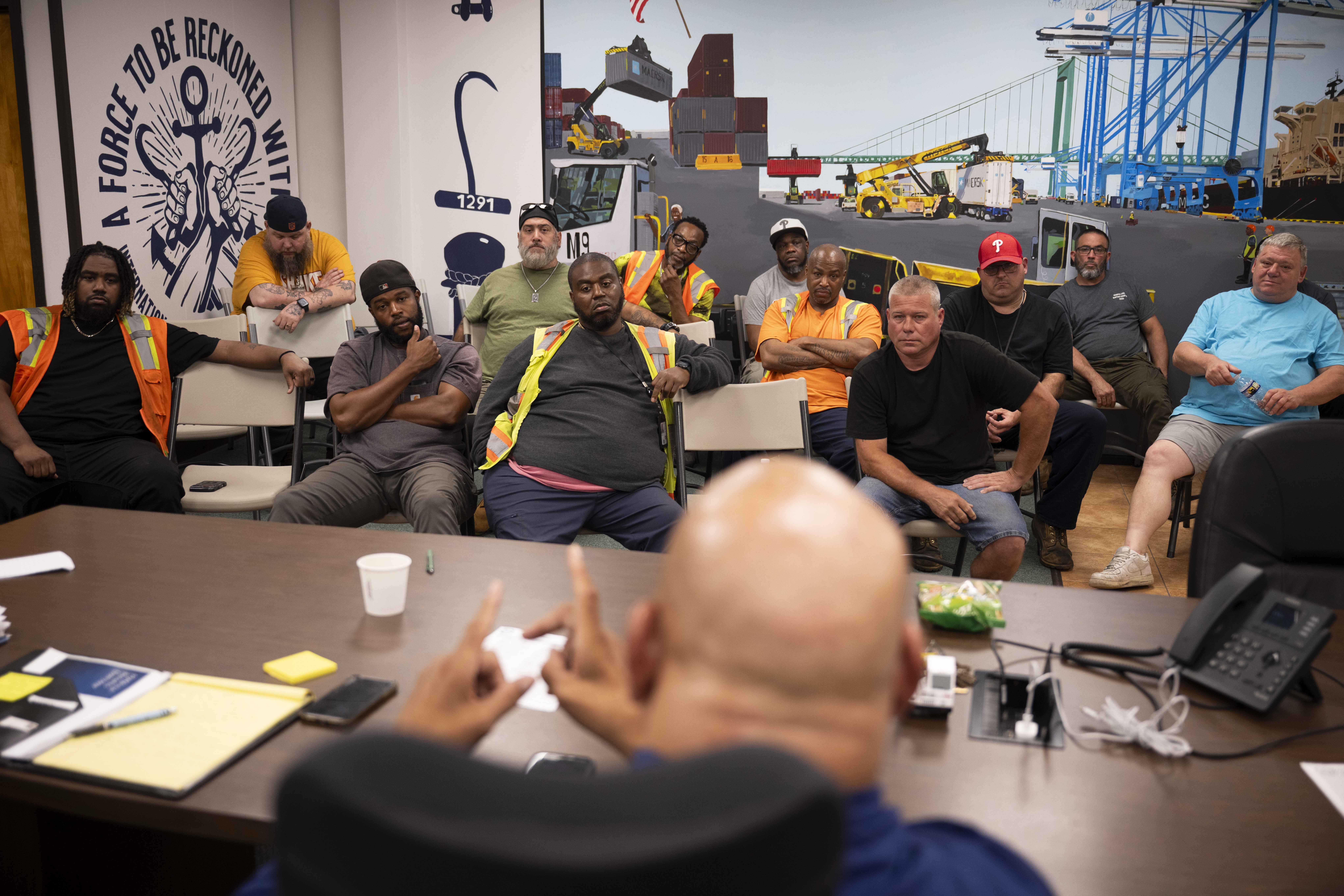
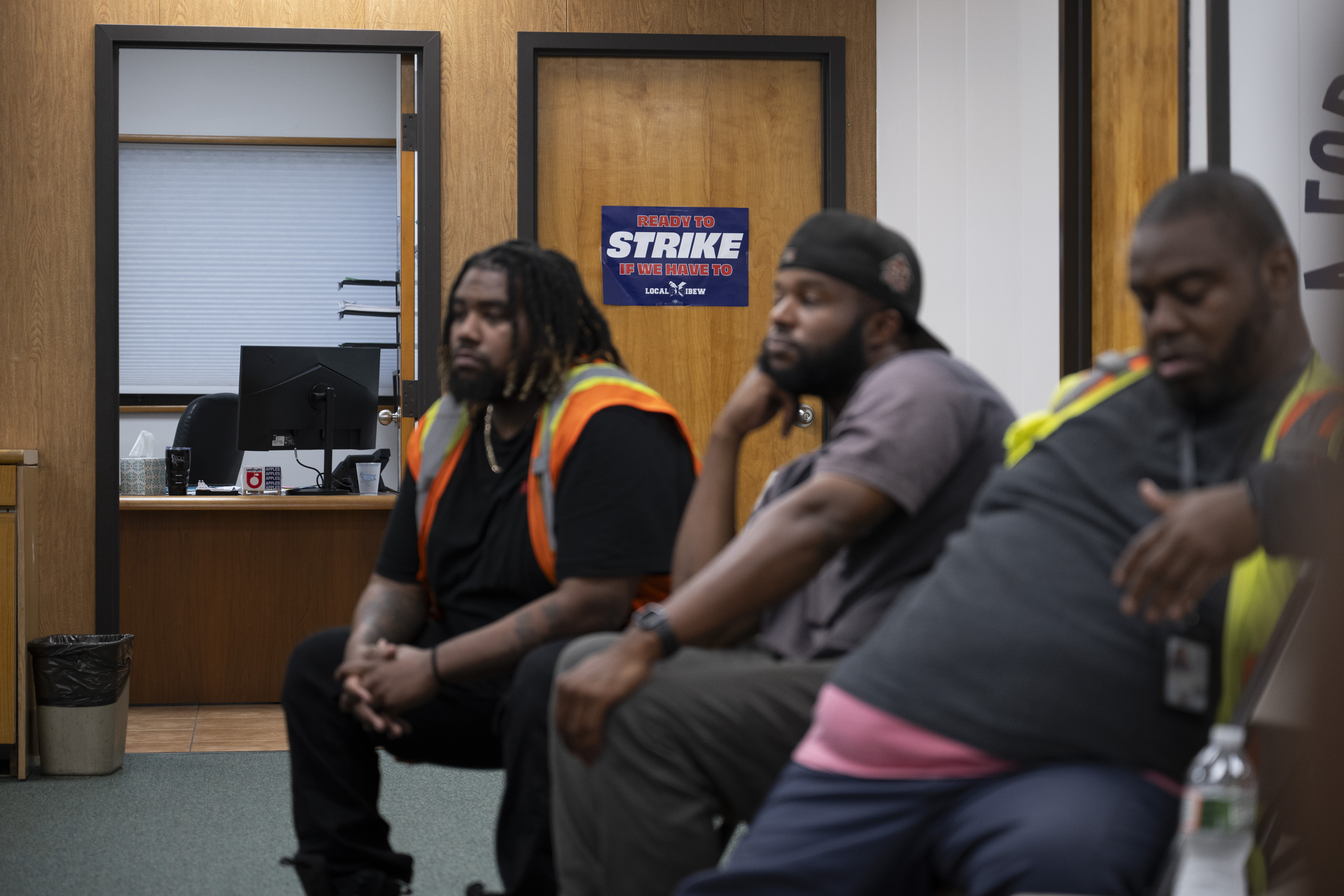
He and the other ILA members who attended Monday’s union meeting in Port Richmond voted unanimously to authorize a potential strike “if and when necessary,” a development that would require approval from their parent organization.
International Longshoremen’s Association Local 1291 members attend a union meeting.Joe Lamberti / For The Inquirer
“Been there so long. That’s really all I know, man,” said Winfield, 57. “Raised my family with that job, put my son through college, man. I’m still paying the student loan on that. … I just want to be able to take care of my family.”
Holt said in a statement that the workers are all “productive and hardworking ILA members.”
“To be clear, there is more than enough terminal and stevedoring work for these men at Packer, and we remain interested in bringing them on if the ILA agrees,” the company said.
Regardless of the outcome, the episode has laid bare growing pains at the Port of Philadelphia, which has seen hundreds of millions of dollars of public and private investment over the past decade — as well as disputes over competition and labor. That includes $85 million in state funds that were allocated to the new 165,500-square-foot warehouse, according to PhilaPort. Holt invested $81 million in the building.
Boise Butler, president of ILA Local 1291, said he wants Holt to be a healthy employer. “But don’t screw them,” he said, motioning to his members. “Don’t screw us. OK? Because it’s not necessary.”
Port development
Philly’s port is relatively small compared to the biggest U.S. container ports, but it’s seen steady growth in recent years and is a major gateway for refrigerated cargo, especially fresh fruit.
Container volumes have more than doubled since 2016, from about 400,000 units that year to almost 900,000 in 2025.
During that time, the U.S. Army Corps of Engineers completed the three-decade-long deepening of the Delaware River from 40 to 45 feet, which allowed the port to accommodate bigger ships.
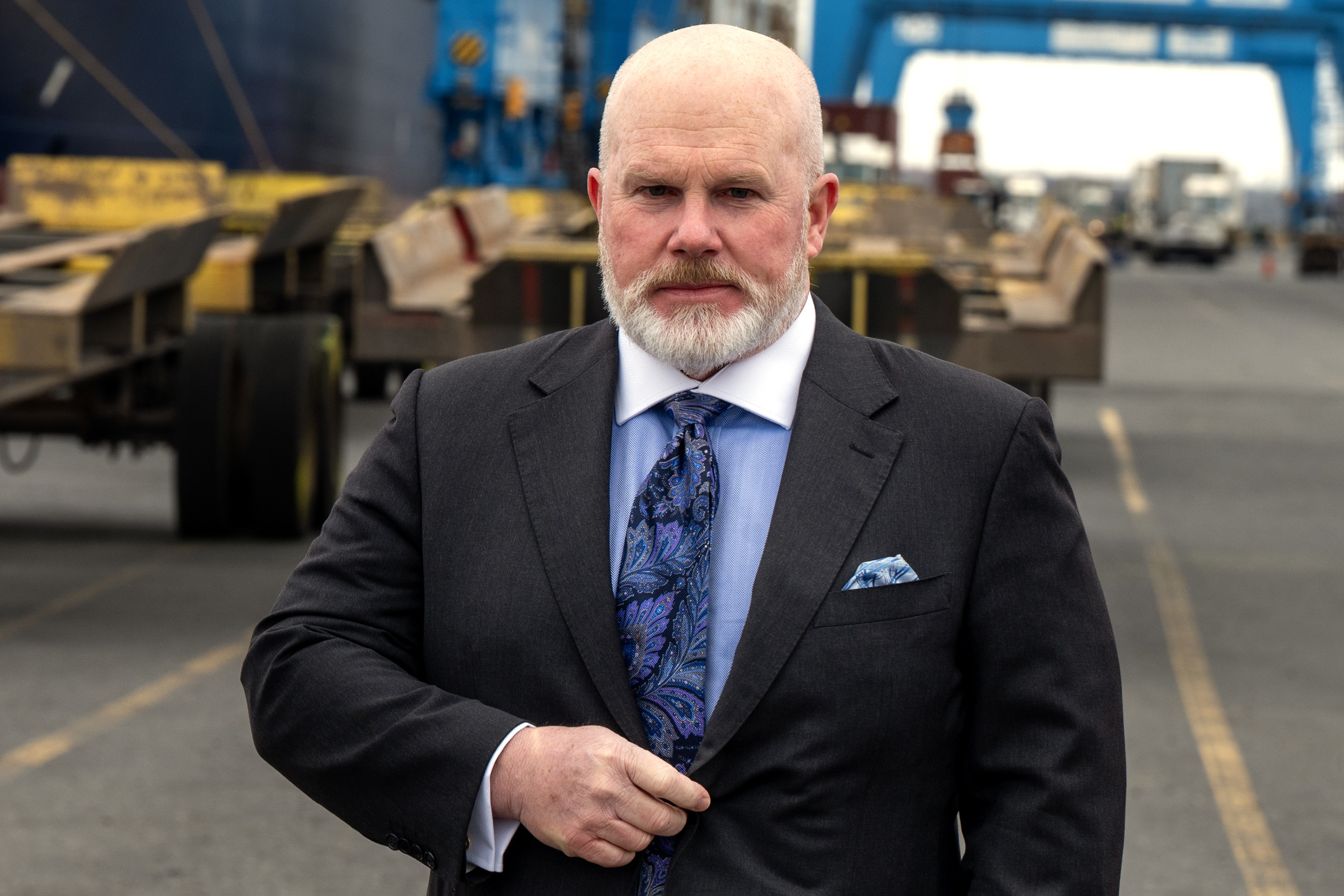
Leo Holt, president of Holt Logistics Corp., at the the Packer Avenue Marine Terminal in South Philadelphia in April 2025.Tom Gralish / Staff Photographer
And Democratic Gov. Tom Wolf’s administration invested more than $500 million in Philadelphia’s port expansion. That included more than $120 million for a distribution center near Packer Avenue featuring two warehouses totaling 365,000 square feet.
The distribution center “is an important step to improve port facilities and bring more traffic to the port,” Wolf said when construction began on the first warehouse in 2021. Leo Holt, president of family-owned Holt Logistics, said at the time that warehouse space “puts Philadelphia more fully into the last-mile business.”
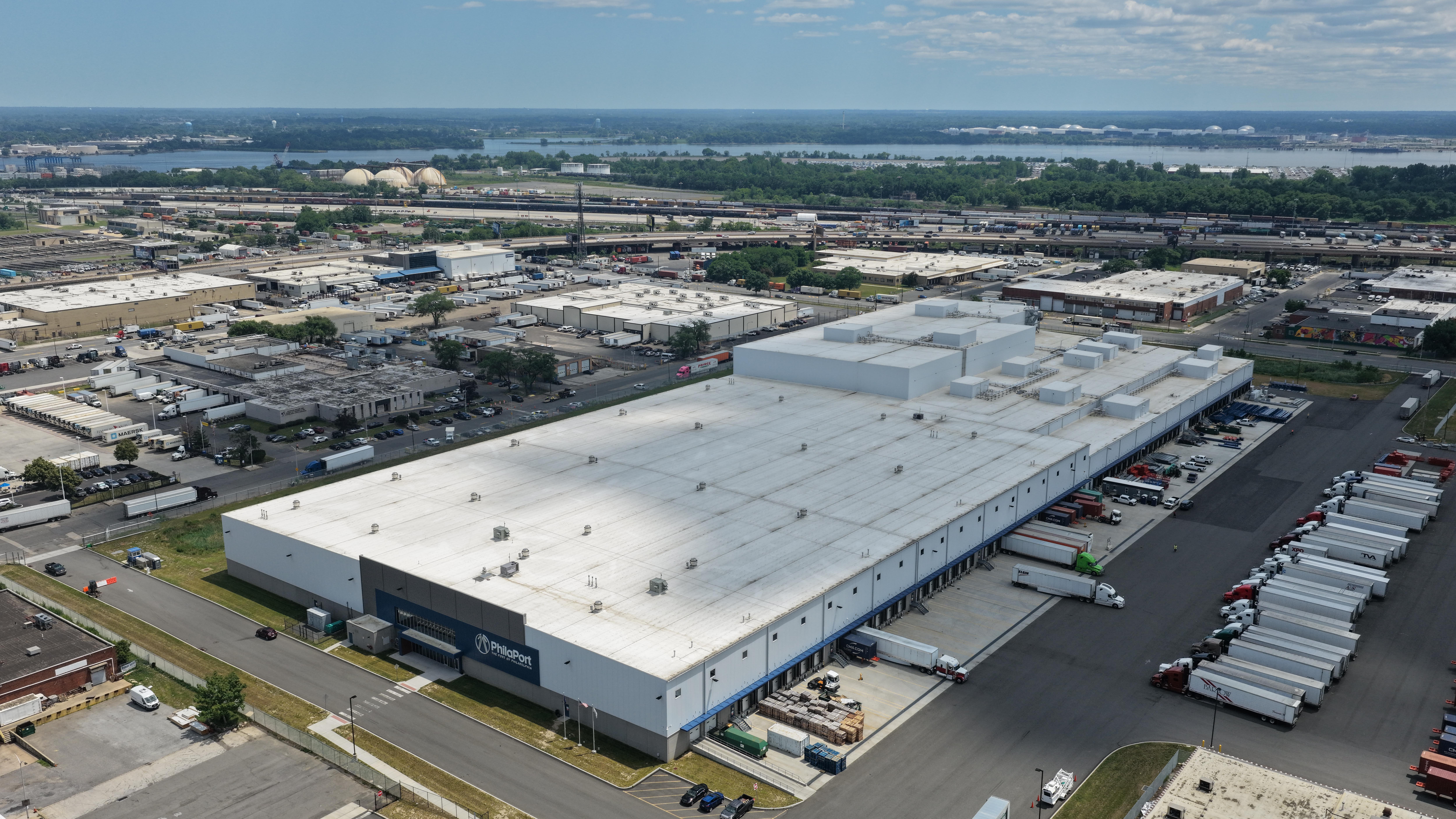
The PhilaPort Distribution Center in South Philadelphia.Courtesy Holt Logistics Corp.
Teamsters and longshoremen at odds
The warehouses were built at the site of the old Food Distribution Center, a wholesale market that opened in the late 1950s and employed Teamsters for decades.
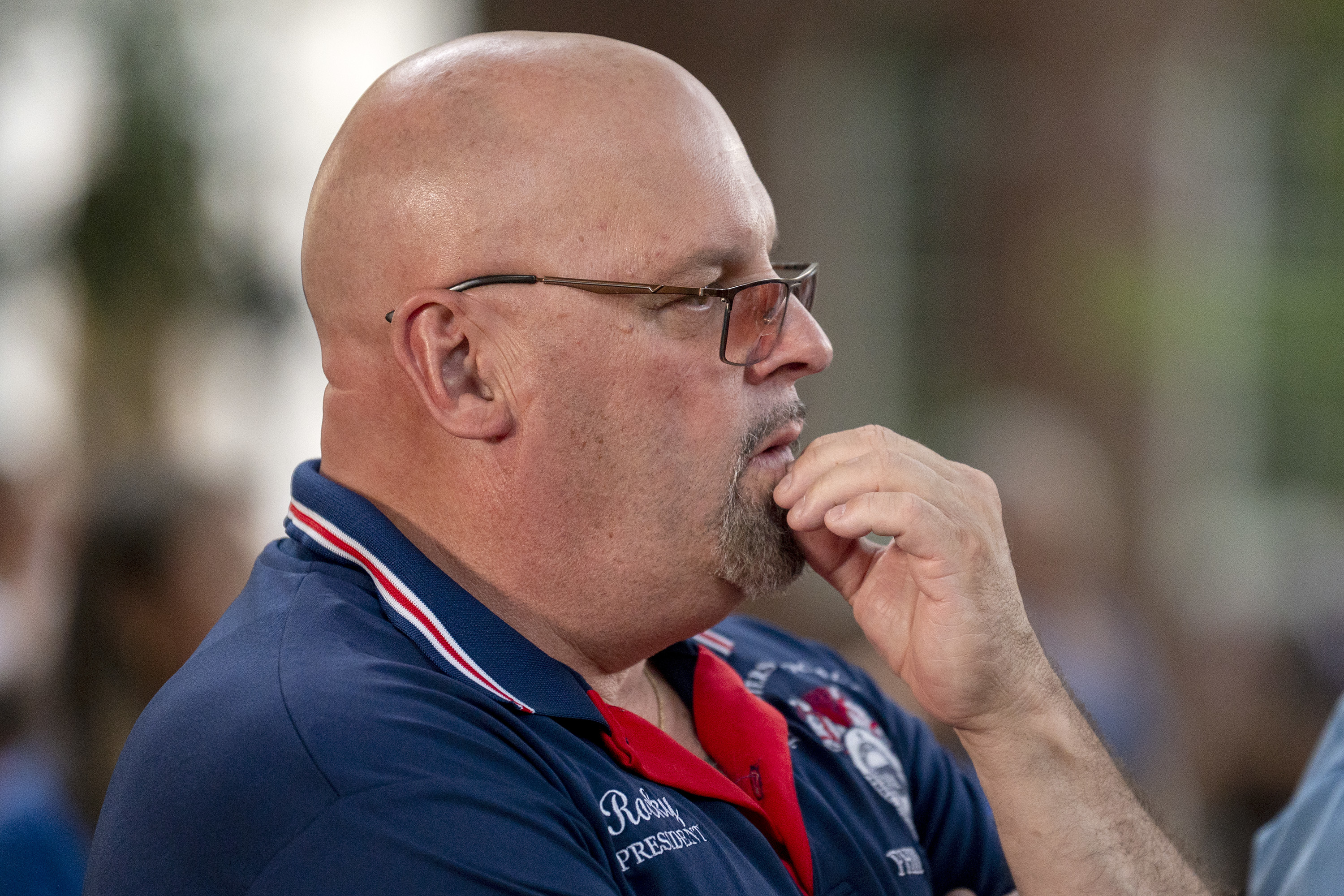
To Rocky Bryan Jr., that history is important. “We’ve been on that location there since the ’50s,” said Bryan, president of Teamsters Local 929, which represents about 3,000 members in three states.
Rocky Bryan Jr., president of the Teamsters Local 929, pictured in 2022.Tom Gralish / Staff Photographer
The first so-called dry warehouse opened three years ago, and there’s no conflict over that facility. About 15 Teamsters work there, Bryan said. The disagreement revolves around the second, refrigerated warehouse, with both the Teamsters and the longshoremen’s union making claims to the territory.
“To us, it’s all one warehouse. It’s our jurisdiction,” Bryan said, adding that a collective bargaining agreement is already in place. “It’s traditional Teamster work, which is truck driving and warehousing.”
As it happens, the ILA warehouse workers used to belong to the Teamsters but voted to join the longshoremen’s union in 2009, according to the ILA’s Butler.
Butler points to another piece of history. When the Food Distribution Center closed and a new Philadelphia Wholesale Produce Market opened on Essington Avenue near the airport in 2011, the same Teamsters who worked at the old facility continued to work at the new one, he says.
ILA Local 1291 President Boise Butler speaks to his members in Philadelphia.Joe Lamberti / For The Inquirer
The same principle should apply today, Butler says: Some of his members have been working at the Packer Avenue refrigerated warehouse since the late 1990s, and they should be able to “follow their work.”
Butler added, “I knew the Holts was gonna try to turn this into a union against union. I’m not fighting with Rocky.”
Butler — who serves alongside Bryan on PhilaPort’s board — has sought to elevate the dispute to political leaders, writing in an April memo to PhilaPort management and Democratic Gov. Josh Shapiro’s staff that Holt has “refused to commit to hiring” the ILA members.
“In effect, that will mean that taxpayer money was used to subsidize Holt Logistics’ desire to expand its refrigerated warehouse cargo operation, all while ending the careers of 31 warehouse workers in the process,” Butler wrote.
Representatives for PhilaPort and Shapiro’s office declined to comment.
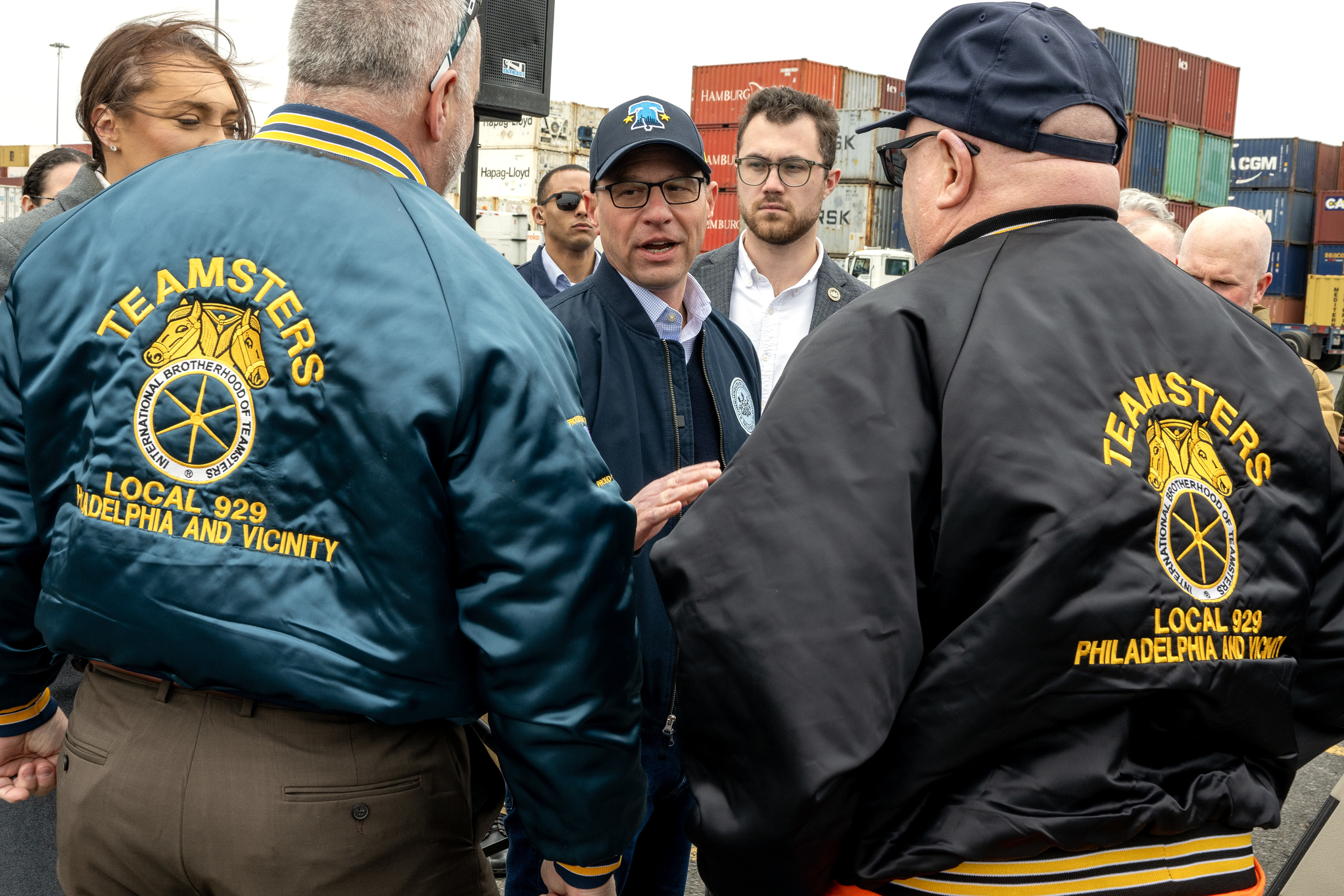
Gov. Josh Shapiro meets with officials of the Teamsters Local 929 as he visits the Packer Avenue Marine Terminal in South Philadelphia in April 2025. Tom Gralish / Staff Photographer
Holt maintains that traditional longshore work is available to the workers. Butler said it’s “not impossible to do that” but added that they would lose their seniority.
That’s because the warehouse workers belong to a separate bargaining unit from the 500 longshoremen in Local 1291 who work the docks at Packer Avenue and other Delaware River ports.
In the final year of the union’s recently expired contract, warehouse workers with at least three years on the job were paid a minimum wage of $30.59 an hour, plus a $4.25 hourly annuity contribution for retirement. It also included provisions for health insurance, overtime pay, and vacation.
“A lot of us put over 20 years here, and a lot of us is at the age where we don’t want to start over,” said Lonnie Boyd, 50, an assistant shop steward who’s worked at the Packer Avenue warehouse since 1998. “We can’t afford to start over.”
Philadelphia is the latest locale for vigilante Jack Reacher's shadowy dealings in season four of Reacher, streaming now on Amazon Prime. The show, which stars actor Alan Ritchson as the hulking retired Army investigator, was spotted filming around town last year.
Based on Lee Child's 2009 novel Gone Tomorrow, this season has Reacher facing off against the CIA, federal agents, and international mercenaries following a woman's suicide. And while much of the on-screen action appears to have been filmed elsewhere — namely Toronto, which looks a lot like Philly, but with space — the City of Brotherly Love does show up quite a bit.
Here, we'll be rounding up all the Philly spots we can identify this season. Check out the map below for where Reacher and his cohorts took them in the city.
story continues after advertisement
Loading…
Philadelphia
City Hall
Michael Bryant / Staff P
Reacher's fourth season immediately sets the scene with a shot of the William Penn statue atop City Hall as a nightscape of Center City shines in the background.
Philadelphia
Uptown Beer Garden
Erin Blewett / For The Inquirer
We catch our first glimpse of our hero, Jack Reacher (Alan Ritchson), as he exits Uptown Beer Garden, who walks out of the establishment silently with a beer in hand.
Philadelphia
LOVE Park
MICHAEL BRYANT / Staff Photographer
Reacher speaks for the first time this season, ordering a "wiz wit" from a nondescript food truck in Love Park.
Philadelphia
Avenue of the Arts
JESSICA GRIFFIN / Staff Photographer
Here, Reacher strolls down the sidewalk on the west side of Broad Street, chomping on his cheesesteak. Canonically, it is just after 2 a.m., and the street is deserted as he descends into the Walnut-Locust entrance B line, which runs along Broad Street.
Philadelphia
Walnut-Locust Station
Alejandro A. Alvarez / Staff Photographer
As he enjoys his cheesesteak, Jack Reacher (Alan Ritchson) heads down into the Broad Street Line at this Center City station. Several interior shots of the station are shown, including one in which a rat munches on a hot dog.
Philadelphia
Benjamin Franklin Bridge
Thomas Hengge / Staff Photographer
Philly is again shown off in all its nocturnal glory with a low-light shot of Center City from the Ben Franklin Bridge.
Philadelphia
Benjamin Franklin Parkway
For the first time in the season's first episode, the sun rises on Philadelphia. And it does so in this stunning aerial shot showcasing many of the Ben Franklin Parkway's gems — Logan Circle, the Philadelphia Museum of Art, the works.
Philadelphia
Parkway Central Library
Tom Gralish / Staff Photographer
We get a great glimpse of the exterior of the Parkway Central Library before heading inside, where Jack Reacher (Alan Ritchson) and Jacob Merrick (Christopher Rodriguez-Marquette) do research on Congressman John Sampson (Marc Blucas), a North Carolina representative who is launching a presidential bid.
Philadelphia
Parc
Courtesy of HughE Dillon
Parc briefly plays host to Reacher, Lila Hoth (Agnez Mo), and Jacob Merrick (Christopher Rodriguez-Marquette) as the trio settles in at an outdoor table to evade police.
Philadelphia
Walt Whitman Bridge
Tom Gralish / Staff Photographer
Reacher and his cohorts travel back into Philly via this bridge after escaping Washington, D.C. In the background, the old Southwark Generating Station is clearly visible.
Philadelphia
Schuylkill Expressway
Tom Gralish / Staff Photographer
As Reacher and his crew traverse Philly at night, the action leads to a shot of the west end of Center City near 30th Street Station from the Schuylkill Expressway.
Philadelphia
Schuylkill Expressway
Monica Herndon / Staff Photographer
Here, we get another nightscape shot of Philly's skyline, again from I-76 near 30th Street Station looking east. In the foreground, Locust on the Park is lit up green and is featured prominently.
story continues after advertisement
That was every location we could spot in the opening three episodes. Explore the map of all locations featured. Tap onHover overa pin to learn more.
Staff Contributors
Design and Development: Garland Fordice and Sam Morris
A teen sought in connection with the killing of a Pennsylvania State University student in South Philadelphia surrendered to police on Tuesday, the U.S. Marshals Service said.
Kadafi Fleming, 19, is also a suspect in the theft of a Philadelphia police officer’s car during a Monday morning robbery that ended in a shootout, according to the U.S. Marshals Service.
Fleming surrendered around 6 p.m. Tuesday at the Philadelphia Police Department’s headquarters at 400 N. Broad St., the U.S. Marshals Service said.
Authorities previously charged Azzubair Outen-Fleming, 16, and Kaiseem Smith, 16, with murder, robbery, and related crimes in the killing of 22-year-old William “Billy” Schmidt, who was robbed of his cell phone and shot on June 6 on the 1900 block of Durfor Street. This week, the marshals announced that they were seeking Fleming on a robbery charge in connection with the killing.
Fleming is Outen-Fleming’s older brother, authorities said.
The announcement of the marshals’ manhunt for Fleming came after another crime in South Philadelphia: About 3:15 a.m. Monday on the 6900 block of Grosbeak Place, authorities said, thieves stole a green Dodge Charger belonging to an off-duty police officer.
Supervisory Deputy U.S. Marshal Robert Clark said the officer found the thieves a few blocks from where his car had been stolen and exchanged gunfire with them before they fled.
Fleming has been named a person of interest in that theft, Clark said.
It was unclear Tuesday whether anyone had been injured in the shootout. Philadelphia police did not respond to requests for information about the incident.
.
Clark added that he did not expect the search to last long, noting that marshals had captured Fleming’s brother in June more than 1,700 miles away at a home in Colorado Springs, Colo.
Smith, who is accused of being the triggerman in Schmidt’s killing, turned himself in to authorities shortly after Outen-Fleming’s arrest. Outen-Fleming’s stepfather, Donte Abdulmalik, 35, has also been arrested and charged with helping his stepson evade the authorities.
A South Philadelphia babysitter, originally from Argentina, was released from ICE detention Monday after being arrested at Philadelphia International Airport last month.
Iliana Lick’s arrest made national headlines as the Trump administration steps up efforts to increase immigration enforcement at American airports.
Lick, 30, had been in Philadelphia since September 2024. She had a valid work authorization and a pending asylum application, but had overstayed her visa, according to the Department of Homeland Security. She was arrested as she headed to Kansas City to watch Argentina play in the World Cup, transported by Immigration and Customs Enforcement to Louisiana, Texas, and New Mexico instead.
“After nearly a month in custody, countless phone calls, legal proceedings, and several transfers across different states, this is a moment we have been praying and hoping for,” her boyfriend, Steven Melchiorre, 35, wrote in an update to supporters on Facebook and a GoFundMe page that has raised more than $18,000 for legal fees.
Though Lick’s release is a victory, the fight to stay in the country is far from over.
As a condition of her release on $10,000 bond, Lick had to surrender her passport and has to wear an ankle monitor.
Immigration advocates keeping track of those being arrested at the Philadelphia airport have said at least 10 people have been detained since mid-July. Of those, Lick is only the second to be released from custody.
Immigration advocate Vivian Chang, executive director of Asian Americans United, said the release of people arrested by ICE, whether at airports or during immigration check-ins, can be a crapshoot.
“You need like a CNN story and so many news articles, so much fundraising, all of that,” Chang said. “The vast majority of people can’t access that. They don’t get coverage, and that’s what the Trump administration is counting on.”
The Inquirer wrote about Lick’s case, and her story was most recently featured on CNN.
For its part, the Department of Homeland Security has said it is making sure undocumented immigrants are flying only to self-deport, offering them a $2,600 payment and a free flight home as an alternative to detention.
A New York Times report found instances of immigration arrests in at least 15 airports, with many of the cases getting follow-ups in local media markets.
Britni Zahodnick, who with her husband, Zane Schultz, has employed Lick as a babysitter for their two young children, ages 4 and 1, for more than a year, said she is grateful for the media attention.
When Zahodnick first learned of the arrest, she said, she was not seeing people talking about the issue on social media platforms. That changed in recent weeks.
In Philadelphia, people have rallied behind Lick, she said.
Donations have helped her to retain counsel, post bond, and pay fortransportation back to her South Philly home.
Zahodnick hopes attention to cases like Lick’s highlights how immigration enforcement is affecting people who have deep roots within their communities.
“A lot of the campaigning on this increased enforcement of immigration was really around criminals, and it just hasn’t panned out that way,” she said.
Eagles radio broadcasts will sound a little different this year.
While longtime announcers Merrill Reese and Mike Quick will be back for their 29th season together in the booth, 94.1 WIP won’t have a dedicated sideline reporter during Eagles games for the first time in more than 15 years.
WIP is shifting to a more limited role within the broadcast, with Reese and Quick turning to another WIP personality when needed.
It’s assumed that Eliot Shorr-Parks, the station’s Eagles beat reporter since 2018, will be the broadcast’s go-to voice for updates, but others could jump in as needed. Shorr-Parks will do a pregame hit from the sideline ahead of Saturday’s preseason game against the Baltimore Ravens.
“The rest of the role is still TBD,” said David Helm, a spokesperson for WIP’s parent company, Audacy.
Devan Kaney was laid off by WIP in March and has since landed in Chicago. David Maialetti / Staff Photographer
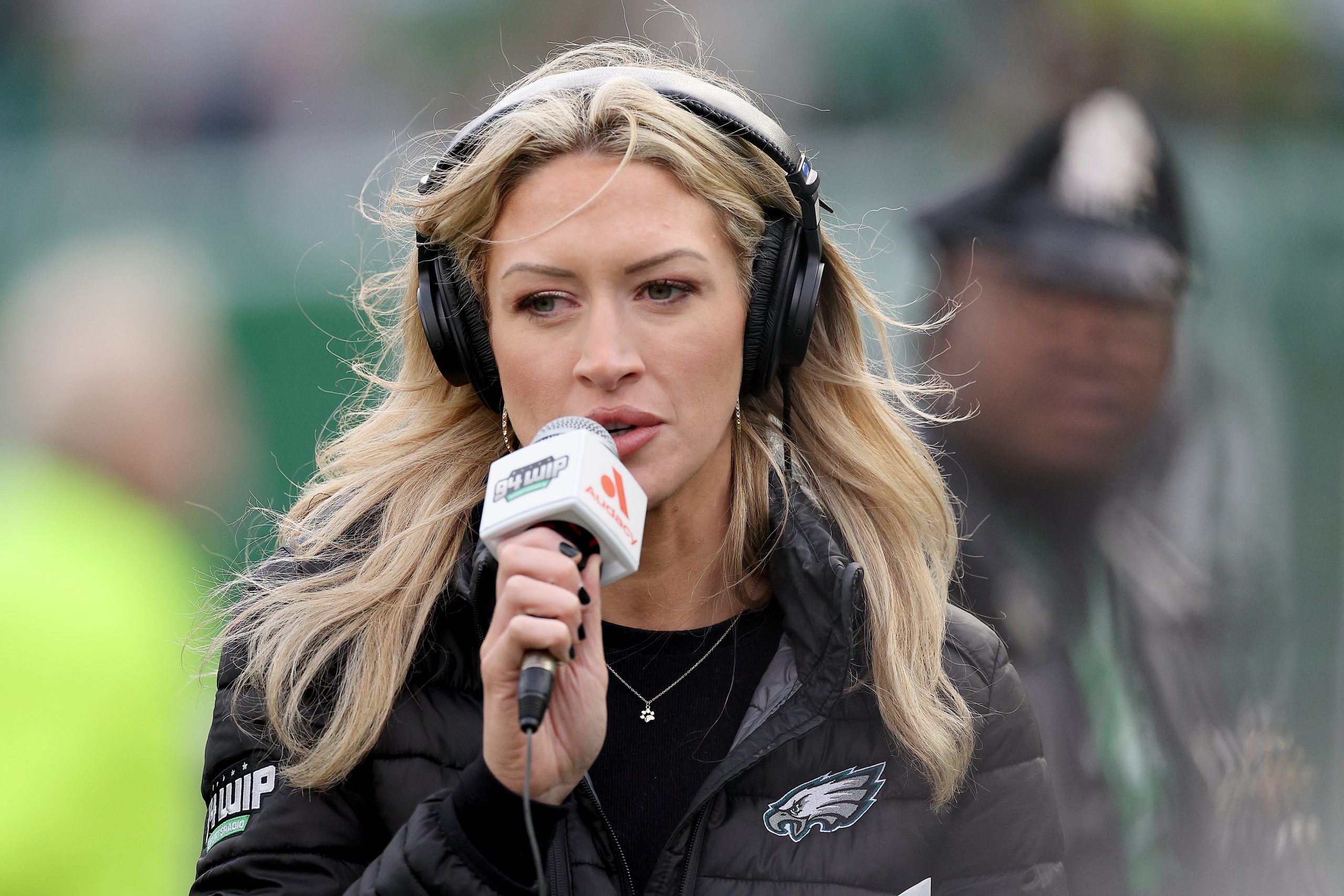
Devan Kaney, who served as sideline reporter last season and during the Eagles’ Super Bowl LIX run, was laid off by WIP in March as part of company-wide cutbacks by Audacy. She had been with the station since 2022 and served as an on-air personality, regularly cohosting WIP’s morning show alongside Joe DeCamara and Jon Ritchie.
“I had a blast working at WIP and sincerely enjoyed my time there,” Kaney told The Inquirer in March. “But as the old saying goes, when one door closes, another opens.”
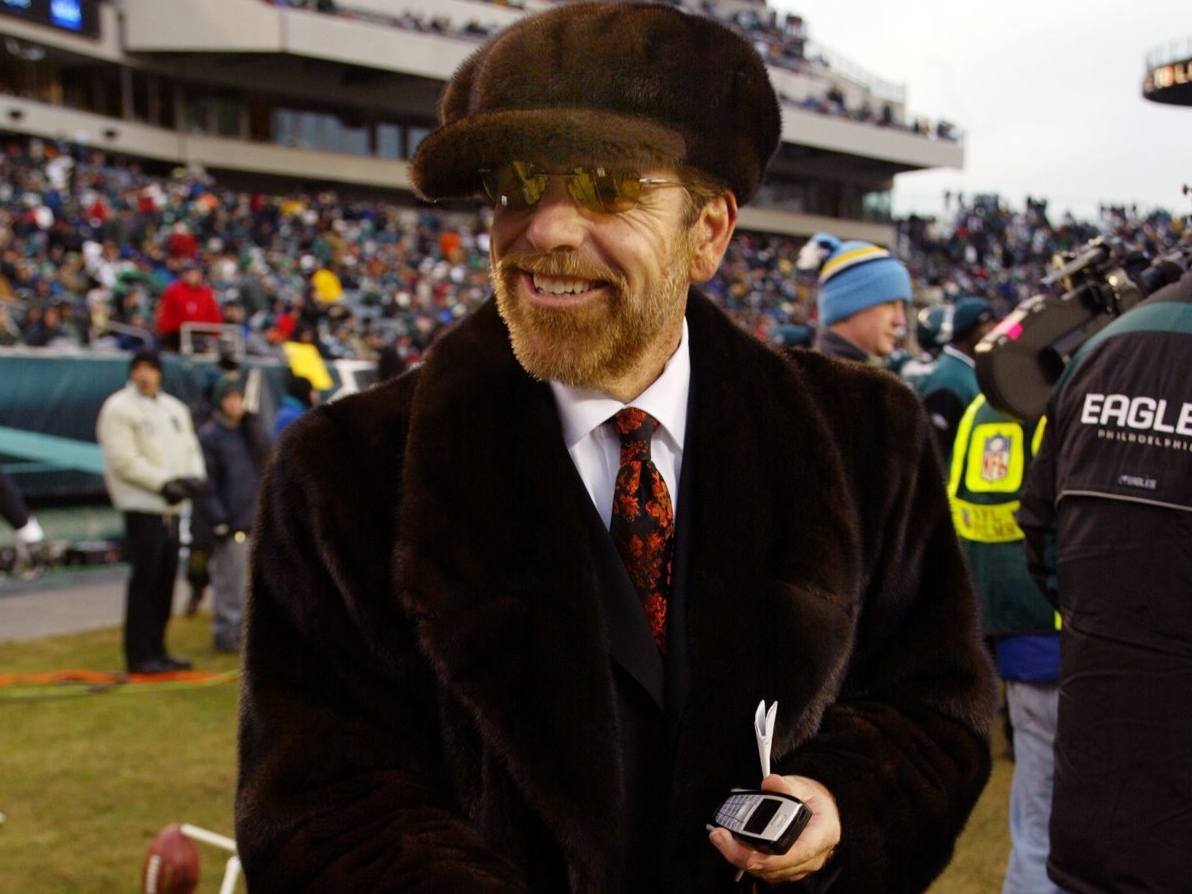
Former WIP host Howard Eskin served as a sideline reporter for more than 15 years. dnphoto
Former WIP host Howard Eskin was the station’s first Eagles sideline reporter, with his fur coats and colorful headphones becoming a sideline staple. Eskin covered the team since 1975, but said his first season as Eagles sideline reporter wasn’t until 2011.
WIP has been broadcasting Eagles games since 1969, with Reese entering his 50th season calling games, by far the longest-tenured announcer in the NFL. The station’s current deal to broadcast Eagles games runs through the 2028 season.
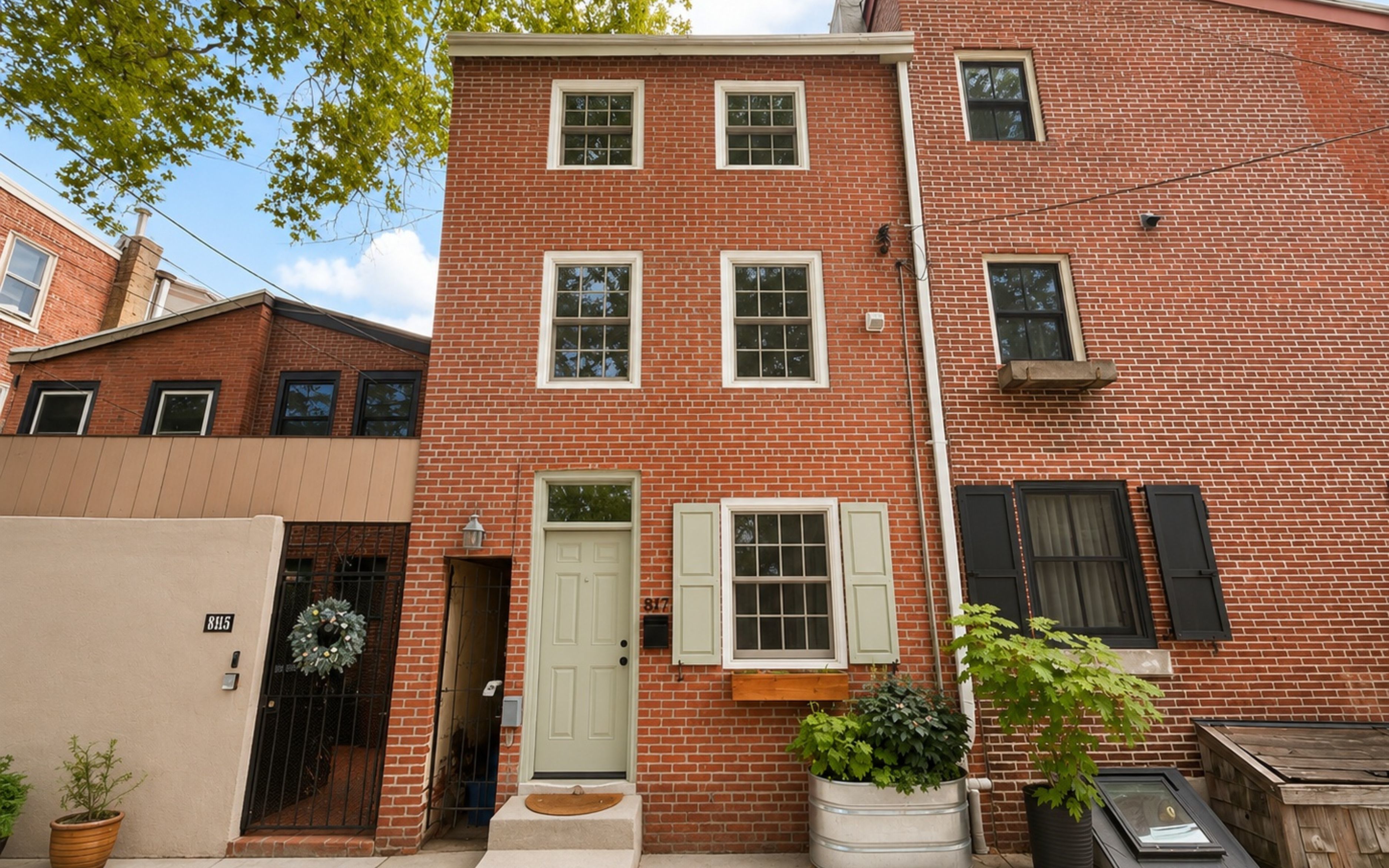
When Hunter Wages and his wife, Lauren Nalley, bought their Queen Village trinity in 2023 after renting nearby for two years, they especially liked having the Weccacoe Playground across the street.
They liked the constant activity there, such as park cleanup days, and, “It’s hard to beat having a tennis court in your front yard,” said Wages.
For Nalley, an environmental engineer in water resources, and Wages, who does software testing for a veterinarian agency, the two-bedroom, 1½-bathroom house was the first they had owned together.
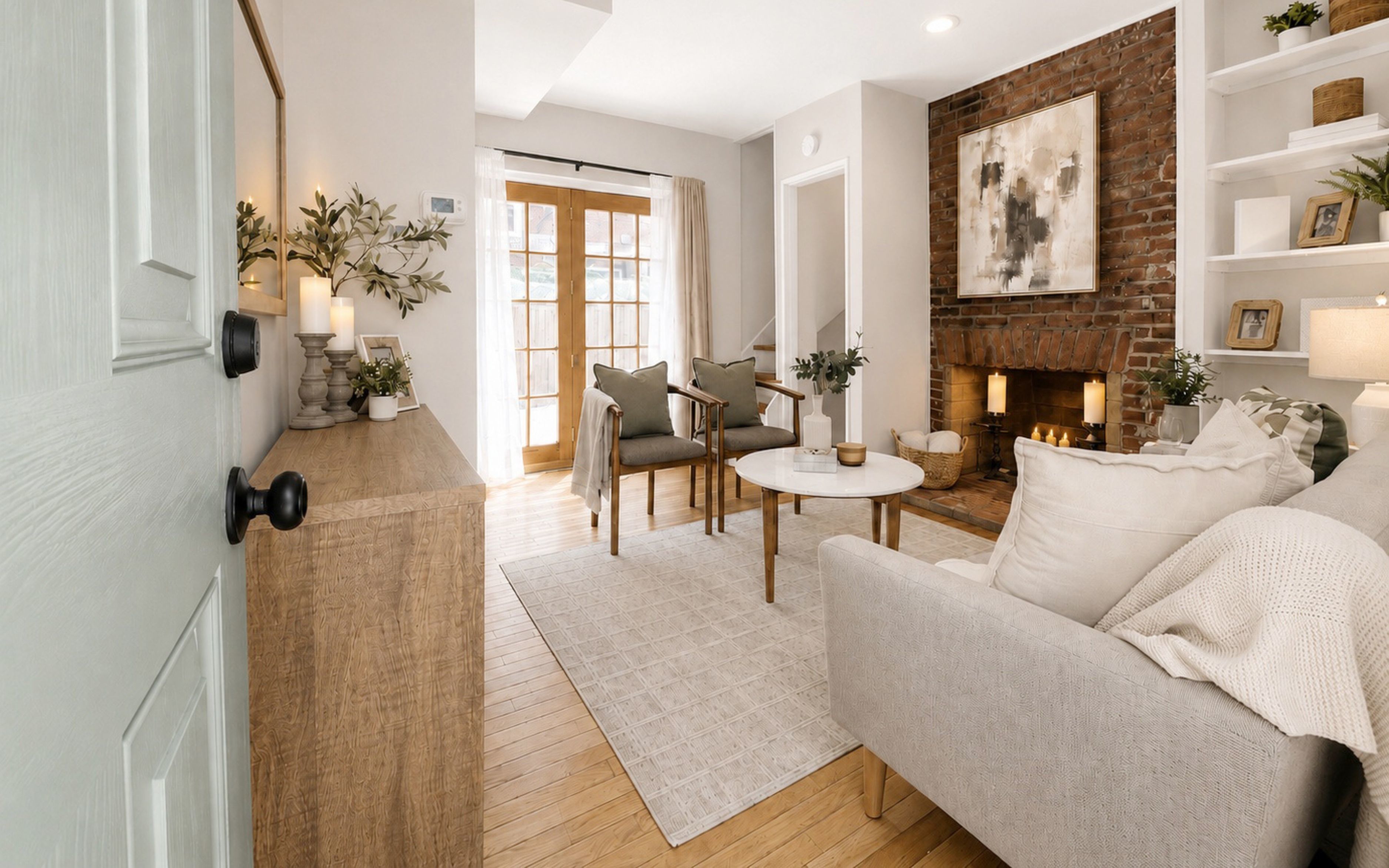
Living roomJim Armstrong
Noting the home’s “historic charm,” Wages said, “trinities are unique.” And he found the exposed brick sections of the interior attractive. But they are moving to Colorado to be with friends and family.
The 710-square-foot house on a tree-lined street has replacement windows and central air-conditioning.
The private fenced patioJim Armstrong
The living room has hardwood floors, built-in custom cabinetry, and French doors opening to a private fenced patio.
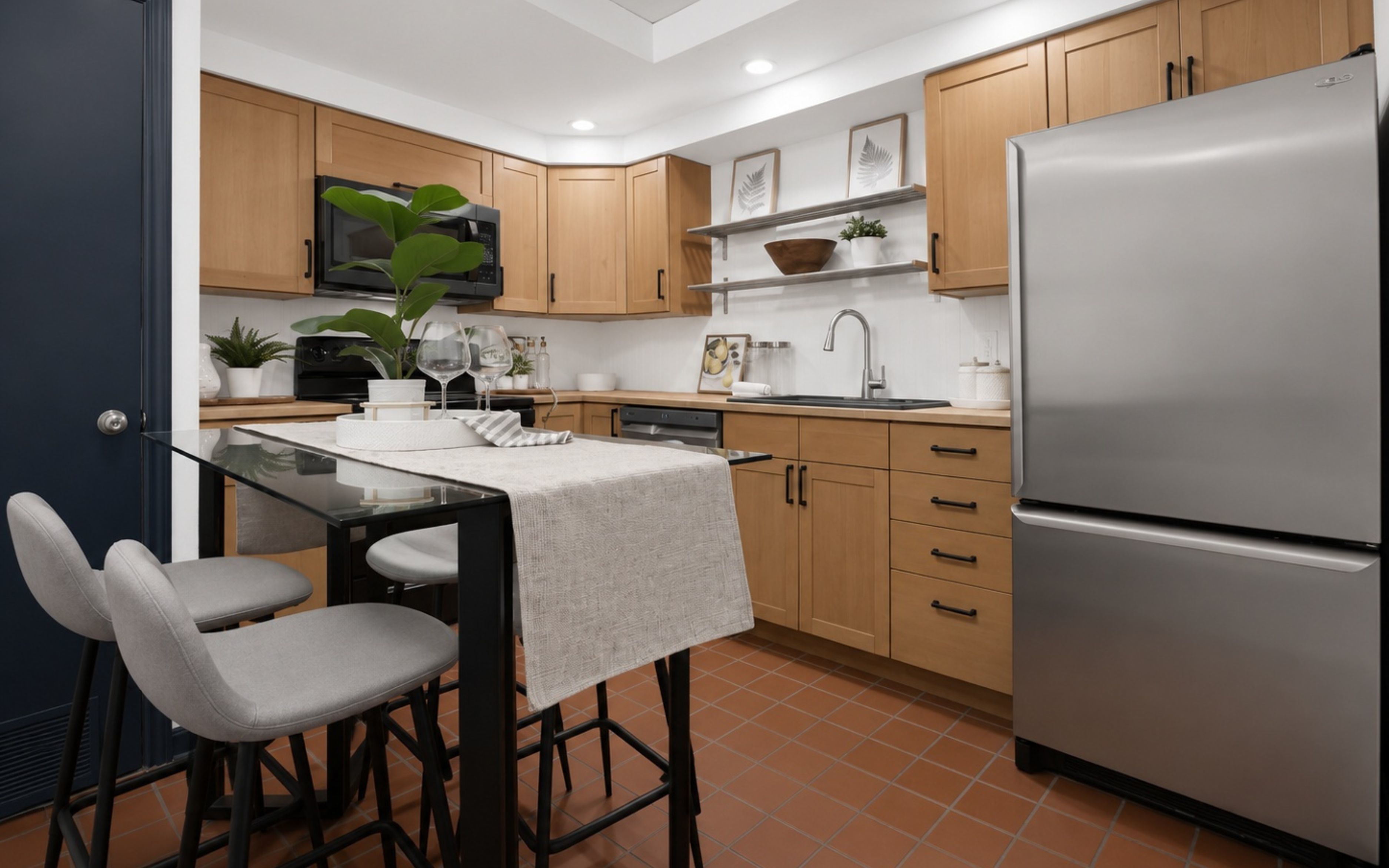
The lower level also has a modern kitchen.
KitchenJim Armstrong
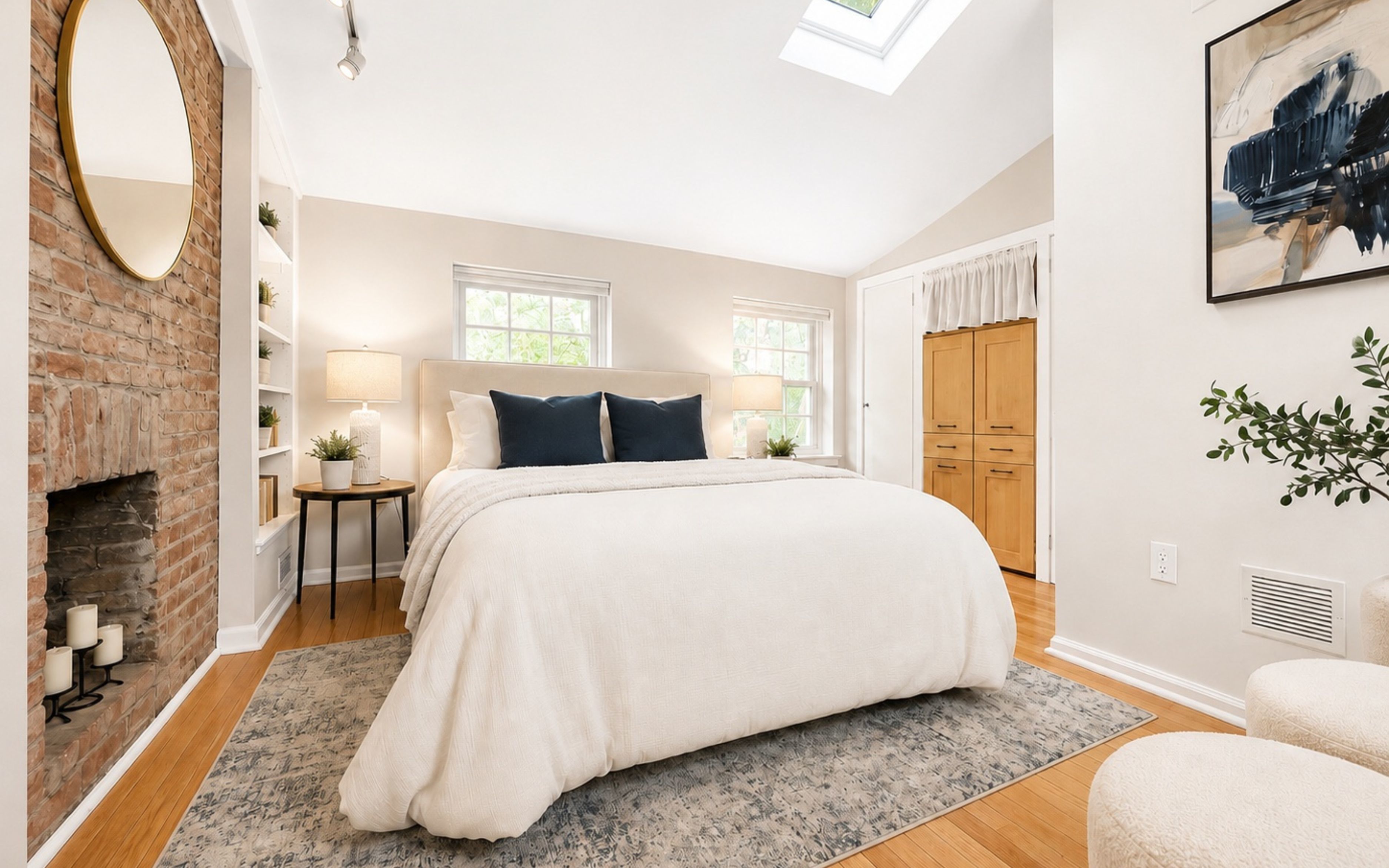
The second floor has a bedroom, the full bathroom, and multiple closets. The primary bedroom is on the third floor, with built-in shelves, vaulted ceilings, and an updated half-bathroom.
There are also decorative fireplaces on the first and third floors.
The primary bedroom has built-in shelves and a decorative fireplace.Jim Armstrong
The house is steps away from neighborhood restaurants such as Southwark and Ambra, as well as the Famous 4th Street Delicatessen and the Delaware River Trail.
It has easy access to I-95 and several bus routes.
It is in the William M. Meredith School catchment area.
It is listed by Jim Armstrong of JG Real Estate for $349,000.
Immigration advocates say at least 10 people have been arrested by ICE at Philadelphia International Airport since July 12, including a 68-year-old grandmother and the young babysitter of three children.
That comes amid a nationwide push by the Trump administration to increase arrests at American airports, spurring immigration attorneys to warn noncitizens with limited documentation that travel has become risky, including for those with valid work permits or pending applications for relief.
“People might not think Philly is being targeted, but we are,” said Vivian Chang, executive director of Asian Americans United, an advocacy group. “They’re trying to threaten people, trying to intimidate them — you can’t work freely, you can’t travel freely, you can’t fly.”
She said the arrests in Philadelphia include three people originally from Indonesia and others from India, Ukraine, China, Chile, and Argentina. Another person, a religious leader, was briefly taken into custody and released, she said.
Chang described the arrests in Philadelphia as especially troubling because the airport is owned and operated by the city.
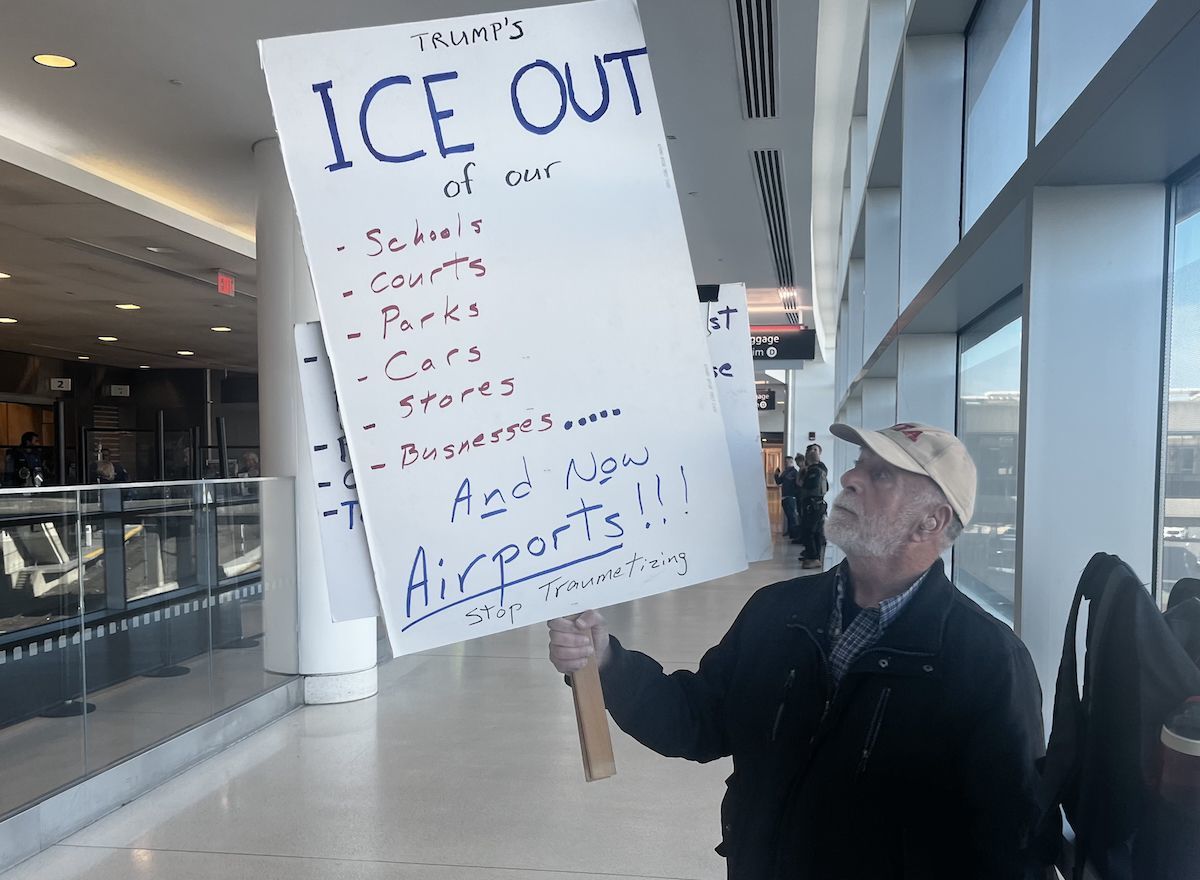
She questioned why that property would not be subject to Philadelphia’s recent “ICE Out” legislation, which bars U.S. Immigration and Customs Enforcement from conducting operations on city-owned lands and bans access to city-owned spaces, absent a judicial warrant.
Steve Papelian, 73, drove more than an hour from Nazareth, Pa. to the Philadelphia International Airport to protest the deployment of ICE agents to international airports across the U.S. on March 24. The former school teacher believes that ICE should target criminal activity, not “moms and pops with kids,” he said.Henry Savage / Staff
Sam Scavuzzo, chief of staff for the city law department, said in a statement that “federal law enforcement access to particular areas of the airport is governed by federal law.”
A spokesperson for the Department of Homeland Security said airport arrests are occurring because the Trump administration “reversed the horrendous Biden-era policy that allowed aliens in our country illegally to jet around our country.”
“Under President Trump, DHS will no longer tolerate this. This administration is working diligently to ensure that aliens in our country illegally can no longer fly unless it is out of our country to self-deport.”
The department said “being in detention is a choice,” and the federal government is offering people who are here without permission a $2,600 payment and a free flight home.
Self-deportation can preserve the right to later come back to the U.S., absent the penalties that accompany a government deportation.
DHS said people who do not leave voluntarily “will be arrested and deported without a chance to return.”
On July 11, what started out as a fun soccer trip for a South Philadelphia babysitter ended with her being arrested and ultimately moved across the country to an ICE detention center in New Mexico.
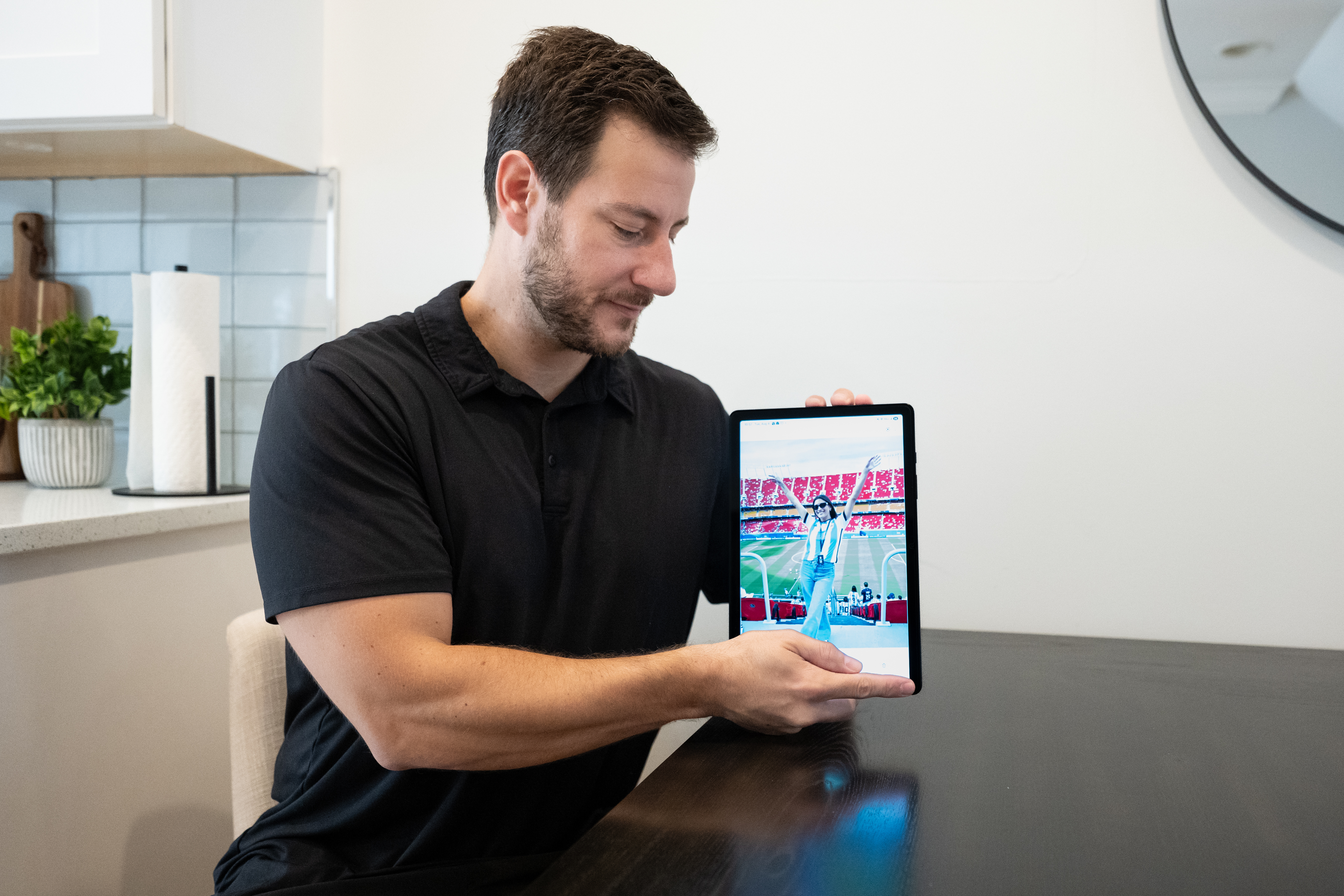
Steven Melchiorre, 35, a health worker, said that at 7 a.m. that day he dropped off his girlfriend, Iliana Lick, 30, to fly to Kansas City. Originally from Buenos Aires, she planned to see the Argentina national team play in the World Cup.
On July 11, what started out as a fun soccer trip for a Philadelphia babysitter ended with her being arrested and ultimately moved across the country to an ICE detention center in New Mexico. Iliana Lick legally entered the U.S. in 2023, though her visa later expired. She cares for the children of two South Philadelphia families.Courtesy of Steven Melchiorre
She texted Melchiorre from inside the airport to say the line was short, then did not answer his reply.
After a while, he said, Lick phoned, crying, to say she had been arrested by ICE. She was moved from Philadelphia to the Cambria County prison, which holds prisoners for the agency in south-central Pennsylvania, and in the following days was transferred to ICE facilities in Louisiana, Texas, and New Mexico.
Late Friday afternoon, an immigration judge in New Mexico set bond for Lick at $10,000, according to her boyfriend. He immediately began working to post that bond and bring her home. It was not clear how quickly Lick might be released.
DHS said Lick was arrested during a targeted operation, having overstayed her visa.
The department noted that work authorization or a pending application for immigration relief, both of which Lick has, do not confer legal status to be in the United States.
ICE began to deploy agents at U.S. airports in March, and the move was announced as a way to assist at checkpoint lines during a partial government shutdown.
The deployment quickly proved controversial, as travelers and labor unions objected, saying the agents were intimidating and lacked aviation training.
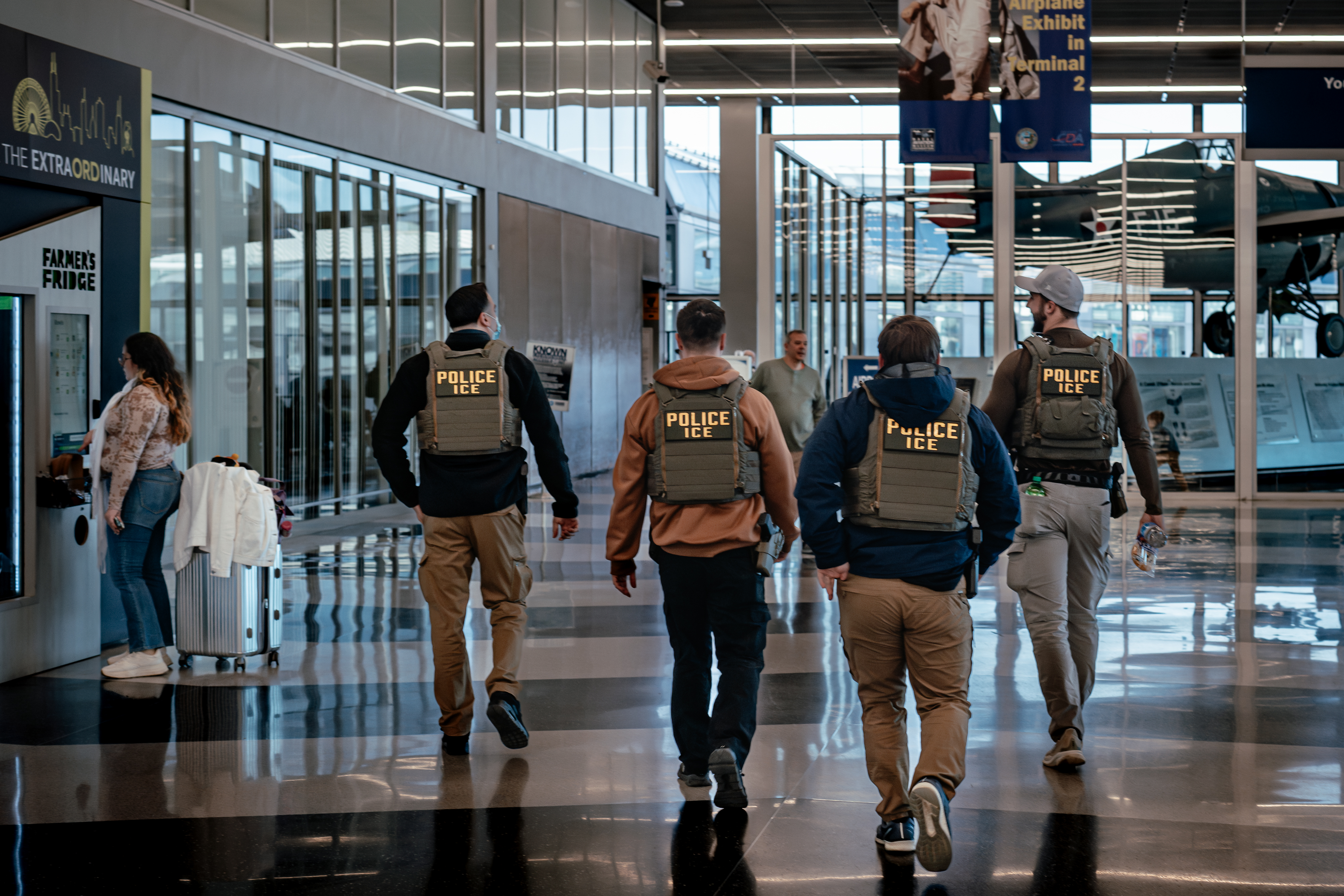
A group of federal immigration officers walk through O’Hare International Airport in Chicago on March 23, 2026. From large cities like Chicago and Las Vegas to small suburbs outside Milwaukee and San Antonio, immigrants have been picked up and detained at courthouses, ICE check-ins and traffic stops, with daily arrests doubling in the last week of June and continuing to climb.JAMIE KELTER DAVIS
Airports rank among the most sensitive public spaces in the country, traversed by millions of people, including U.S. citizens, noncitizens, and mixed-status families, California immigration lawyer Andrew Neitor wrote for the American Immigration Lawyers Association, a legal group.
The introduction of ICE agents, he said, blurs critical lines between airport security and immigration enforcement, around what authority is being exercised and by whom, and over the legal protections due to people who may be arrested.
“ICE was not intended to be omnipresent in daily civic life,” Neitor said. “Yet its footprint has expanded from courthouses to neighborhoods, workplaces, and even parking lots, shifting from targeted enforcement to visible, normalized presence.”
Last year, the Transportation Security Administration and ICE signed a memorandum of agreement that outlined how ICE would share information with TSA to identify people in whom ICE was interested, according to the memo, obtained through the Freedom of Information Act by the watchdog group American Oversight. The agreement said sharing the data would enhance national security, transportation safety, and immigration management.
On Tuesday, U.S. Rep. Rashida Tlaib of Michigan introduced a bill, the No TSA Data for ICE Act, that would bar the agencies from coordinating to conduct what her office called “a dramatic violation of privacy rights.”
The bill would ban TSA from sharing passenger names, birth dates, and other data that enable ICE to target immigrants who are in the process of changing status, including those awaiting visa extensions or who recently married U.S. citizens.
“TSA is readily offering up our immigrant residents to suffer at the hands of ICE agents so they can fulfill their daily arrest quota,” Tlaib said in a statement. “Immigrants should be able to safely fly in this country without the fear of arrest or deportation.”
Today ICE is making record numbers of arrests across the country, not only at airports but also at places that were once considered off-limits, including routine immigration check-ins.
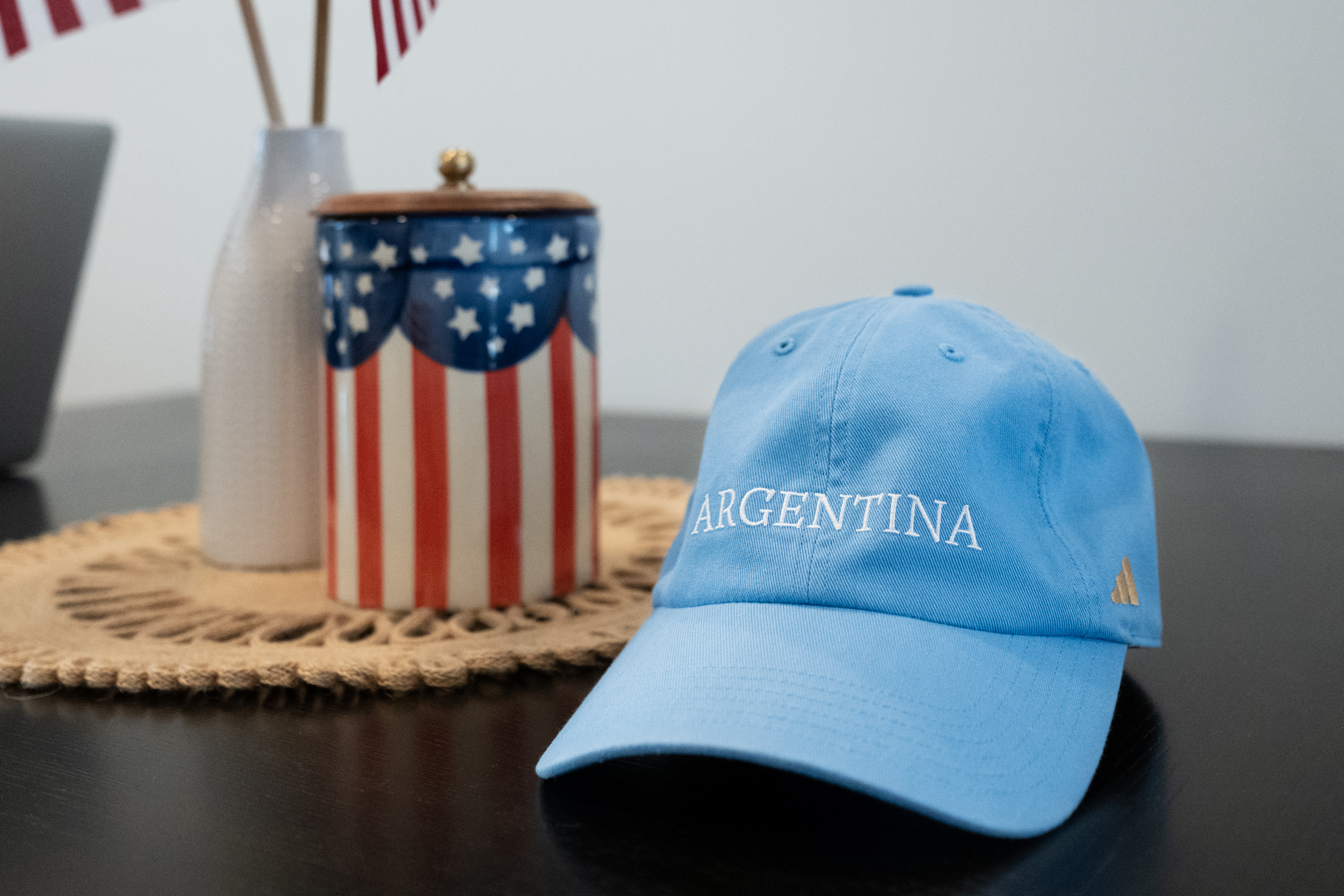
A hat belonging to Iliana Lick sits on a table in the home she shares with her partner, Steven Melchiorre, in the Point Breeze neighborhood of Philadelphia on Tuesday, Aug. 4. Lick has remained in ICE custody since her detention at Philadelphia International Airport on July 11, 2026.Erin Blewett / For The Inquirer
In June in Philadelphia, a 36-year-old survivor of slavery who had fled Mauritania, a mostly desert land in West Africa, filed suit in federal court over the issue. He accused ICE of having unlawfully rescinded a policy that generally allowed immigrants to pursue their cases without fear of arrest.
Nationally, the rate of ICE arrests topped 1,300 a day in June, and grew again to a record 1,474 a day during the first 11 days of July, Syracuse University professor and immigration-data analyst Austin Kocher reported.
Some of those being arrested at airports had legally entered the United States, then stayed after their visas expired. That includes some, like Lick, who were seeking to legally change their immigration status while in the U.S.
Lick, now of Point Breeze, legally entered the country in 2023. She held and extended a visa, and holds work authorization and a REAL ID driver’s license, her boyfriend said. She was trying to adjust her status before her visa expired and continued to do so afterward, Melchiorre said.
Lick works taking care of three children for two South Philadelphia families.
Britni Zahodnick and her husband, Zane Schultz, have employed Lick as a babysitter for their two young children, ages 4 and 1, for more than a year. They described her as soft-spoken, kind, attentive, funny, thoughtful, and a good listener.
“She was very quickly thought of as family,” Schultz said.
Trust does not come easily for any parent preparing to place their children in another’s hands, but Lick won theirs, the couple said.
“All the things you would look for in a caretaker for your kids,” Zahodnick said.
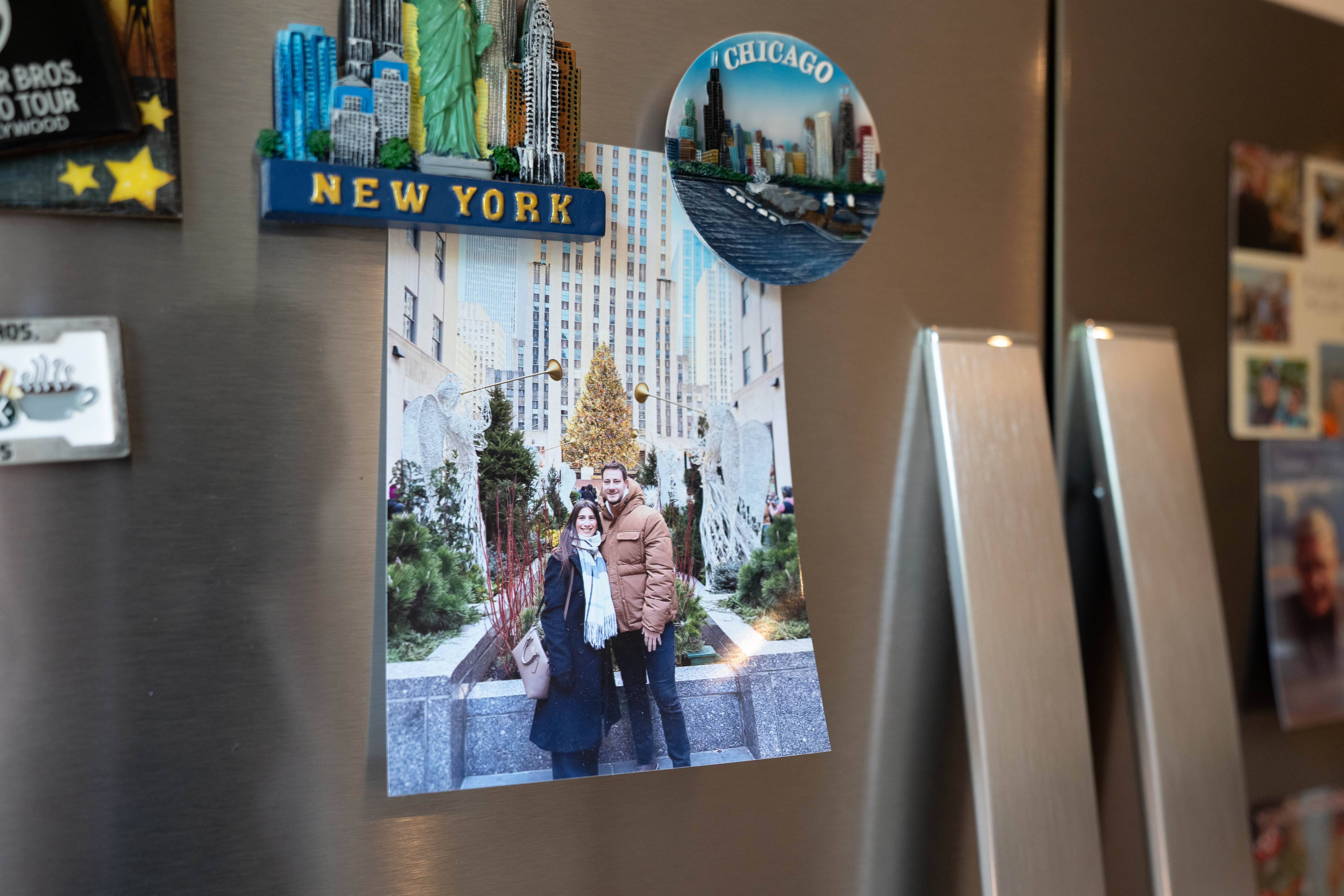
Illiana Lick with partner Steven Melchiorre in New York City. On July 11, what started out as a fun soccer trip for a Philadelphia babysitter ended with her being arrested and ultimately moved across the country to an ICE detention center in New Mexico. Iliana Lick legally entered the U.S. in 2023, though her visa later expired. She cares for the children of two South Philadelphia families.Courtesy of Steven Melchiorre
Melchiorre acknowledged that ICE had legal authority to detain Lick. He said people should follow immigration laws — but the couple thought Lick was doing so. They did not know domestic flights were in question, having flown in the past without incident.
Melchiorre said he was surprised and frustrated by her arrest, “because Iliana has not committed any crime, hasn’t missed any fees, hasn’t missed any court dates. She wasn’t trying to dodge immigration. Being detained, it’s similar to how criminals are treated.”
The Phillies tell me they sell more than 40 brands of beer, priced from $6.99 for a 12-ounce can of nonalcoholic beer to $17.69 for a 24-ounce premium can. Beer is everywhere at Citizens Bank Park, including at a humongous walk-through cooler on the main level.
I recently strolled into that cooler and found a lager — at $38.48 for two 19-ounce cans — that paired nicely with chicken fingers and the Fightin’ Phils. OK, so 64 ounces of the exact same beer costs $11.99 at Acme, but you can’t watch the Phils live from Acme, can you?
“Sometimes, things become clichés because they’re true: A cool beer on a warm summer day at the ballpark is among the great joys of fandom,” says the avuncular Glen Macnow, the former Inquirer reporter (and colleague) and sports talk-show host whose What’s Brewing PA beer show appears on the NBC Sports Philadelphia networks.
Macnow — who is, full disclosure, also the part-owner of Conshohocken Brewing Co., which vends two of its brands at the ballpark — adds: “I’ve spent many an afternoon (or evening) with a beer in one hand, a hot dog in the other, juggling both so I can fill out the scorecard balanced on my knees.
“Those are simple and eternal pleasures. Baseball isn’t designed for trendy cocktails in a can; it’s designed for the tradition of leisurely enjoying a cold brew over several innings as you try to convince the guy in the next seat that the manager (whoever he is) is the dumbest one in Phillies history.”
OK, but just in case you don’t care for a brewski, the Phillies also sell about a dozen different trendy cocktails in cans, with prices running from $14.55 to $23.99. These are no bargains, either, but consider the alternative: The Phillies used to not sell booze at all.
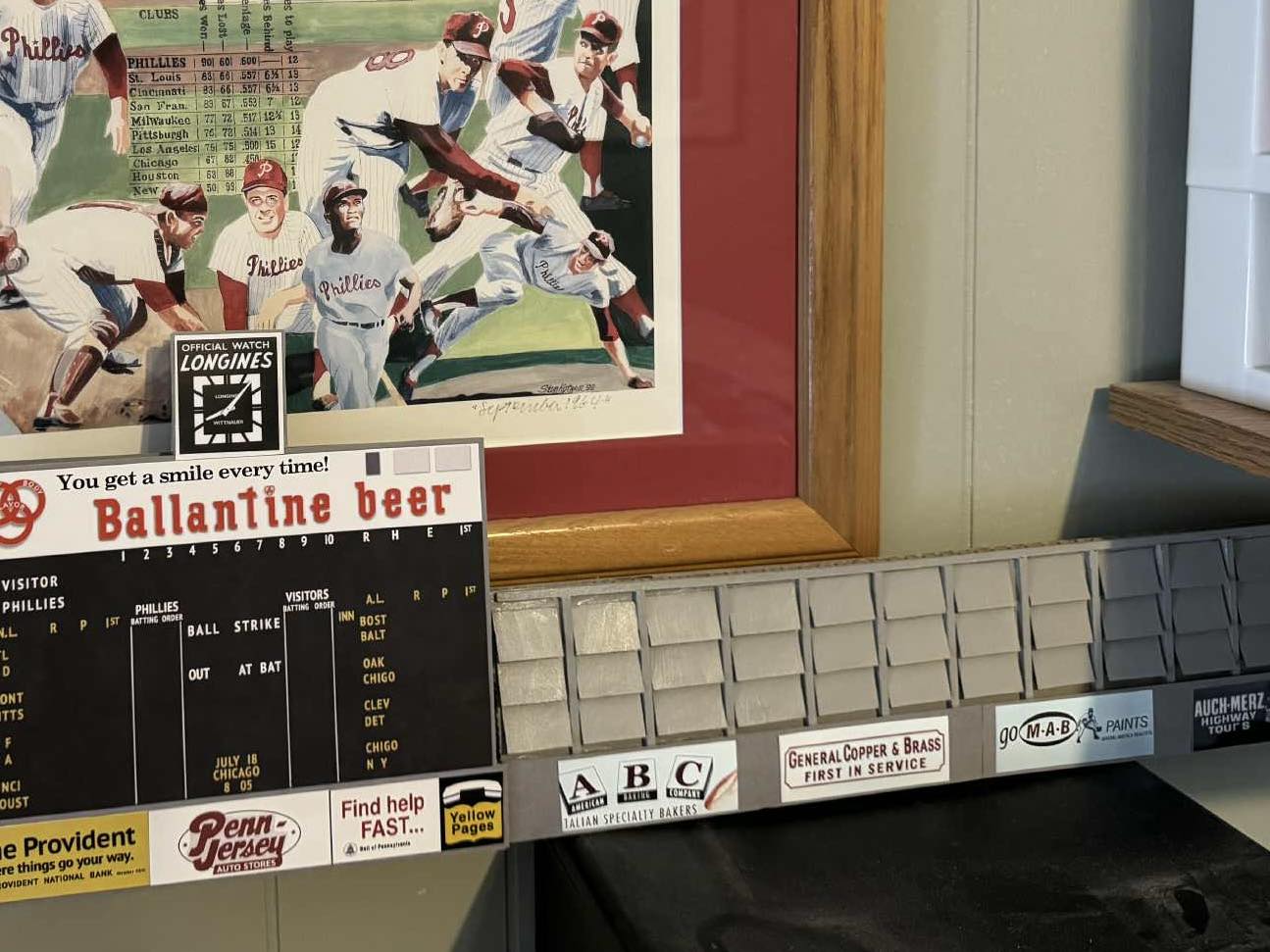
Baby boomers like me vividly remember the towering, then-state-of-the-art right field scoreboard at Connie Mack Stadium, topped by a gigantic advertisement for Ballantine Beer (and its three-ring logo, for Purity, Body, and Flavor).
A handmade model of the iconic Ballantine Beer scoreboard at Connie Mack Stadium by Phillies fan Bernie Valente.Courtesy of Bernie Valente
Well, that scoreboard was erected in 1956, five years before beer was sold there.
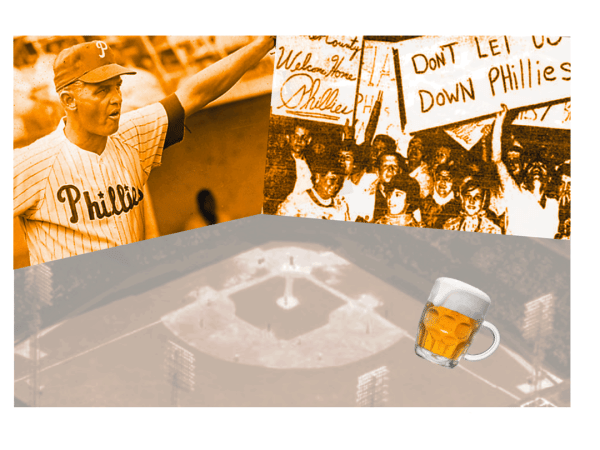
The Phillies first legally sold beer inside Connie Mack Stadium, their musty old park in North Philadelphia, on Aug. 7, 1961, when they put seven local brands of bottled beer on sale for 35 cents, first poured into a paper cup by eight vendors working the aisles.
The paper cup was a vital part of the transaction, because, prior to legal sales, Phillies fans used to sneak in cans of beer, often sold in “cold packs” at nearby bars like Charlie Quinn’s Deep Right Field Cafe at 20th and Lehigh.
Beer cans were heavier in those days, so they tended to become missiles when the umpires missed a call, or if the Phillies stank, which was quite often.
The low point probably came on June 12, 1959, when a twi-night doubleheader against San Francisco was halted after five innings because of rain. The Phillies were no-hit — but even worse, fans were denied rain checks to both games because the first game was official.
As Frank Fitzpatrick, the now-retired Inquirer reporter who attended the game as a 9-year-old, recalled in the paper in 2016: “Suddenly, one empty can fluttered toward the field. A second followed quickly. Soon, it was a dangerous deluge. So many were tossed that cans obscured the tarp, from the mound to the batter’s box.”
That was not good news for Robert R.M. Carpenter, the Phillies owner, who dearly wanted a new ballpark for his team. Plans had been drafted for a 45,000-seat, $8 million stadium in the Torresdale section of Philadelphia, with an adjoining theme park, yacht basin, and bird refuge park adjacent to I-95. Beer sales would bring in some cash for that amazing project.
On June 20, 1961, the Pennsylvania Senate passed a previously approved bill by the state House that would permit the sale of beer every day but Sunday at sporting events at stadiums in the state that seated more than 25,000. (The Pittsburgh Pirates also happened to be looking for a new ballpark.)
But they faced stout foes. After voting against the bill earlier in 1961 that would have enabled the Phillies to sell beer, a Democratic state assemblyman from Philadelphia, Charles Heavey, predicted that the sale of beer would actually “contaminate” youngsters.
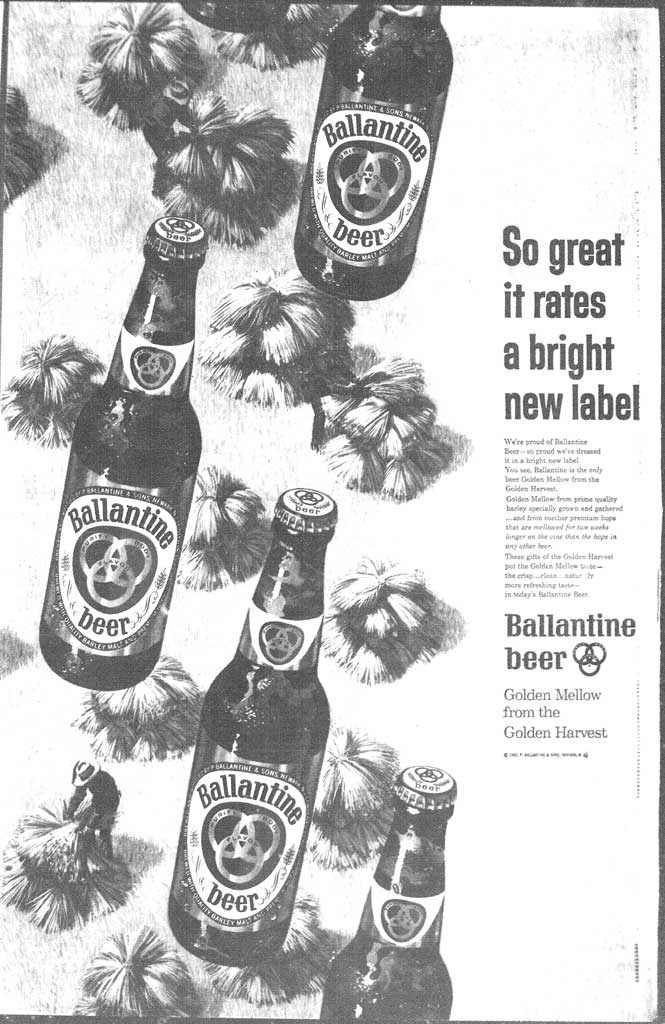
So … first the beer had to be poured into a paper cup before drinking, preventing another beer can pileup on the field like the one in 1959. And there would be more than one starting pitcher: Schmidt’s, Esslinger, Old Dutch, Horlacher, Neuwiler and, yep, Ballantine were all included in the original sudsy rotation.
A 1962 newspaper advertisement for Ballantine beer.
Larry Merchant provided statistics in his Daily News column the next day: A total of 3,739 beers were served to 5,586 who attended that Aug. 7 game, a 3-1 Pittsburgh victory on a Monday, which was also the Phillies’ 10th straight loss. No bottles or cans were thrown on the field, he reported, but fans did pop the cups and try to throw those onto the field — often in vain.
“For serious drinkers, it was about a four-beer game, just two and a half hours long,” Merchant joked. “For serious Phillies fans, it was a six-beer job. They look better that way.”
Merchant made note of signs at the entrances that read, “Bringing in of canned beer or bottled beverages will be a cause for ejection from the park.” Nonetheless, he reported, seven would-be beer smugglers were caught at the gate, their brews returned when they left the park.
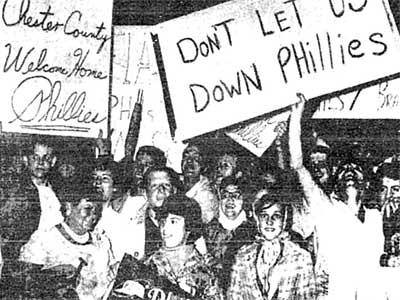
Those 1961 Phillies were so lousy that their losing streak grew to 23 games, still a modern record. After the Phillies beat Milwaukee, 7-4, on Aug. 20 in the second game of a doubleheader, their flight home was welcomed by 500 fans at 1 a.m. the next day at the airport.
About 500 Phillies fans welcomed the team home at the airport like conquering heroes after the club broke a 23-game losing streak in August 1961.
“They are selling rocks at $1.50 a pail,” Phillies pitcher Frank Sullivan, looking out of the plane, joked to his teammates.
He then wisecracked: “Leave the plane at five-minute intervals. That way, they can’t get us all with one burst.”
In truth, the beer ploy sales did not seem to provide much of a boost to the 1961 Phillies, who lost 107 games and finished last in the National League in home attendance in 1961, averaging only about 7,600 per home game. But a door, or many brewskis, had been cracked.
Beer would not be sold at Sunday home Phillies games until 1972, after the Phillies moved to Veterans Stadium, following the amendment of the ancient Pennsylvania Blue Laws, intended to curtail activities on Sundays (including Phillies and A’s home games until 1934).
“My parents didn’t drink, so I always associated the public consumption of alcohol as something dark and troubling,” Fitzpatrick told me recently. “That feeling was confirmed in spades at that 1959 game.
“By 1966, the summer I worked at the ballpark, I felt differently. I was a soda vendor, and beer suddenly was a precious commodity. Now I envied the beer sellers, because they made the most money and had the least amount of walking. Occasionally, rowdy fans would harass young vendors like me, hurling popcorn containers or wadded-up cups at us, [but] it definitely was comforting to know you wouldn’t have to dodge metal cans. On the other hand, in ’66 the smell of spilled beer now permeated the place. I don’t remember that same aroma when fans brought their own.”
Carpenter never did get his Torresdale stadium. After a one-year delay because of construction, however, the Vet opened in 1971 in South Philadelphia. A few fans grumbled about paying 75 cents for a 12-ounce beer served there by a vendor, perhaps because those same items were 40 cents and 60 cents, respectively, at Yankee and Shea Stadiums in New York.
Gene Mauch managed the Phillies during their historic 107-loss season in 1961. That team dropped 23 straight contests.
The pricing was actually meant to be sort of a deterrent. Bud Vye, the Connie Mack stadium manager, told The Inquirer, “At these prices, they’ve got to bring a bankroll just to get bombed out.”
But beer stuck around. A 1998 Daily News exposé into how Ogden Entertainment, then the vendor at the Vet, was caught skimming a half million dollars in annual beer sales led to a price reduction. Local brands, kicked to the side by the national brews, were sold again when the Phillies moved to Citizens Bank Park in 2004. (Large premium drafts then sold for $6.)
Cups were eventually discontinued, and most beer at the ballpark is sold in much lighter cans (which, it should be noted, are opened by the cashier, lest someone try to hurl a full can on the field). Dozens of different brands of beer can be spotted at any Phillies game.
“A big part of this is marketing,” Macnow tells me. “Beer at the ballpark is no longer poured into paper cups, so there’s a long-term benefit to seeing people walking around the park holding cans of your beer. Labeling becomes important. Naming beers becomes important.”
And so is the vessel itself. The Phillies continue to sell “beverage bats,” large hollow plastic souvenir baseball bats that can be filled with any beverage. Those are not cheap, either. Phillies fans may be held captive by the prices, but beer and baseball are inseparable.
Dave Caldwell lives in Manayunk and covered sports for The Inquirer from 1986 to 1995.
“When I turned 80,” Andrea Preis said, “our sons told me, ‘It’s time for you and Dad to downsize and move into a place that is more manageable.’ So we did.”
So in 2024, Andrea and husband Eran Preis moved from a four-bedroom home in Queen Village, where they lived for 26 years, to a two-bedroom condo in Bella Vista.
Andrea had no room for her collection of framed embroidery, her cookbooks, art books, albums of photos taken on trips all over the world, dishes, a painted cupboard, and other treasures.
“I had to force myself,” she said, to part with beloved objects. “It made me sick. It was so hard.”
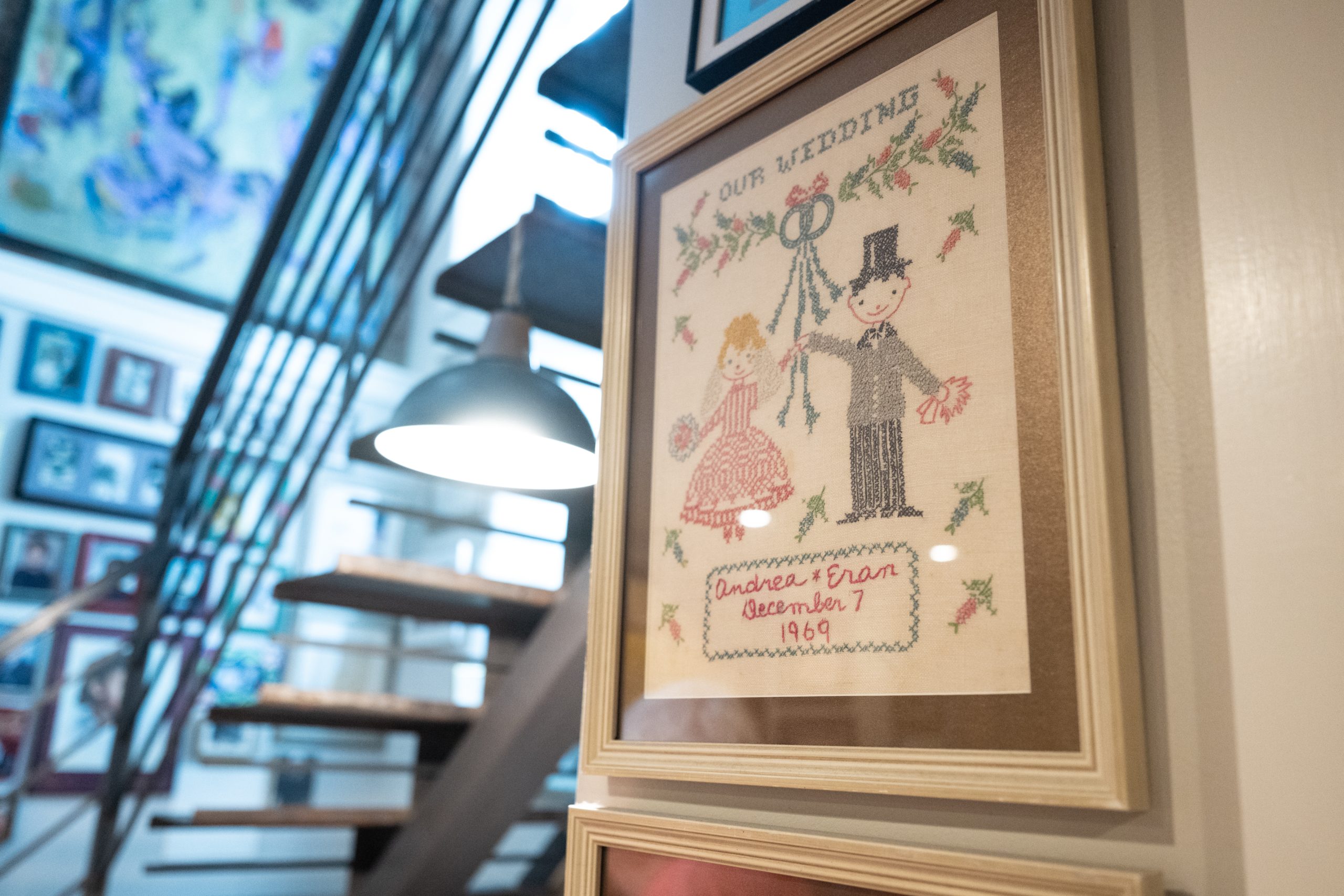
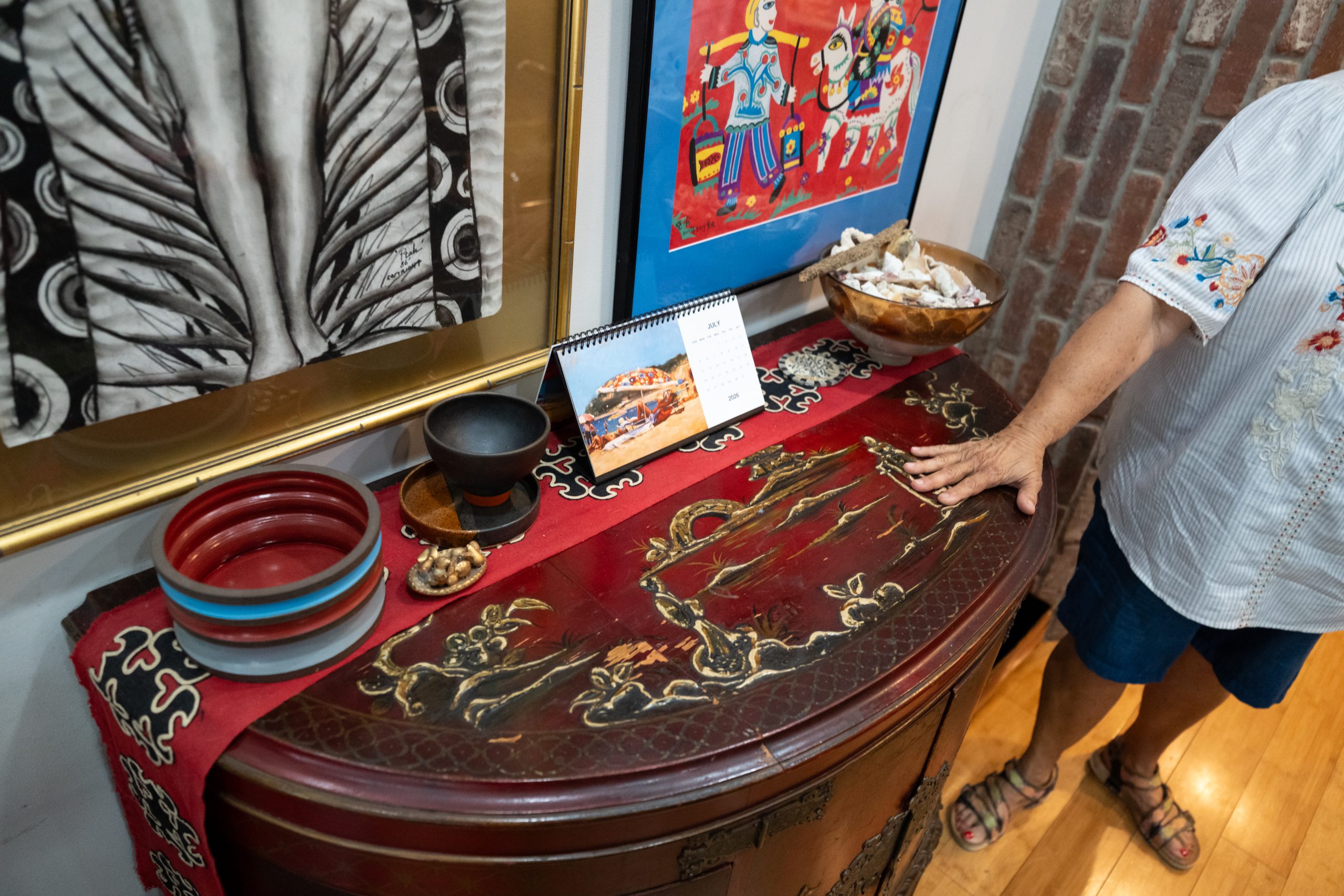
A wedding memento embroidered by Andrea Preis’ grandmother hangs in the basement of the home.Erin Blewett / For The InquirerAndrea Preis touches a cabinet at the front of the home, adorned with some of the items she has collected.Erin Blewett / For The Inquirer
Eran, who gave away stacks of books, was less nostalgic. “We needed to be on one level and our house was starting to fall apart,” he said.
Andrea had a house sale and later set out a table in front of her old home with items people took for free. “When I finally put away the table a woman knocked on the door wondering where everything was,” she recalled.
The couple’s condo comprises the first floor and basement of the three-story rowhouse and was renovated 20 years ago. The ground floor features a sitting area, kitchen, bedroom, and bathroom, and a tiny garden. In the basement there is another bedroom, bathroom, and sitting room.
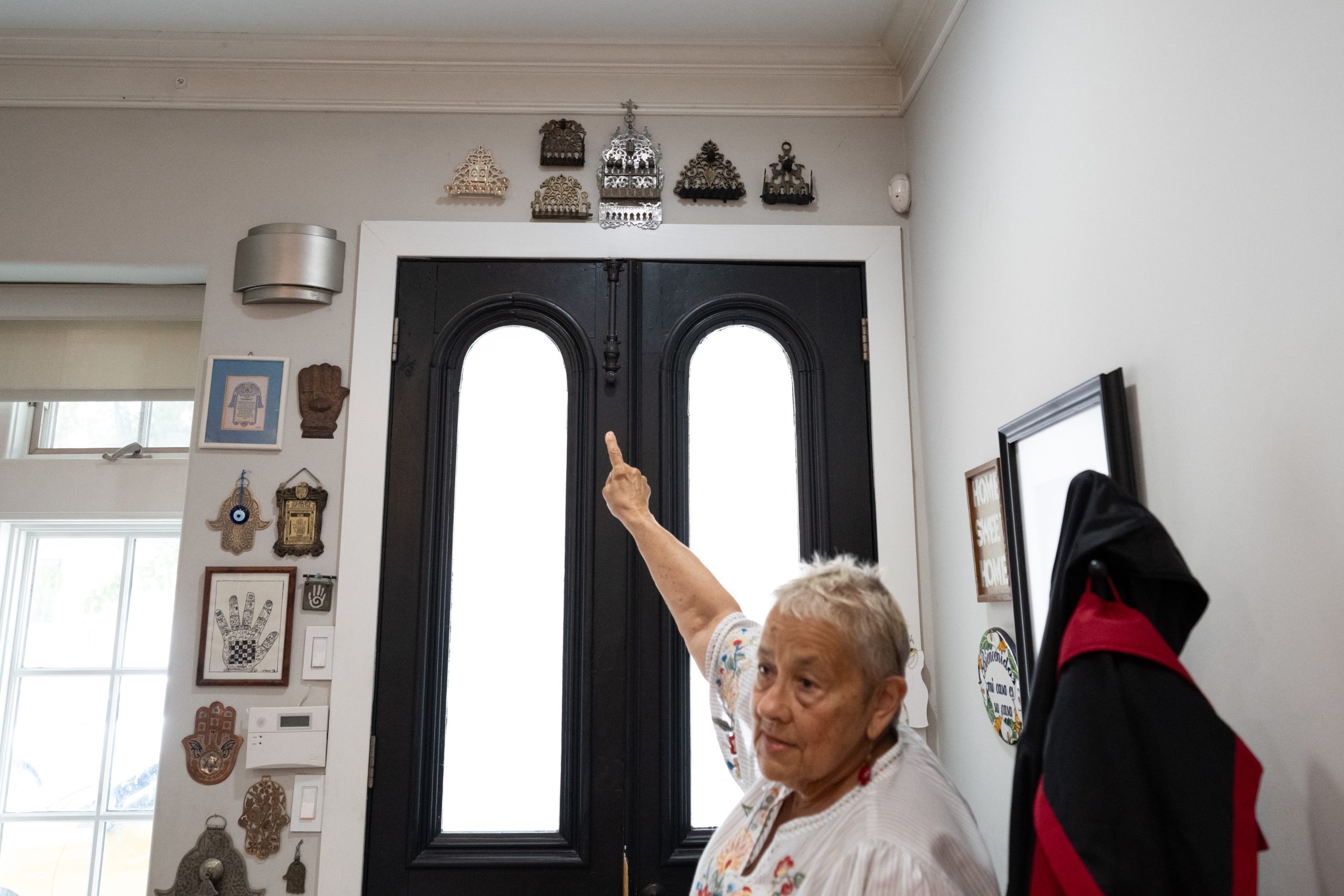
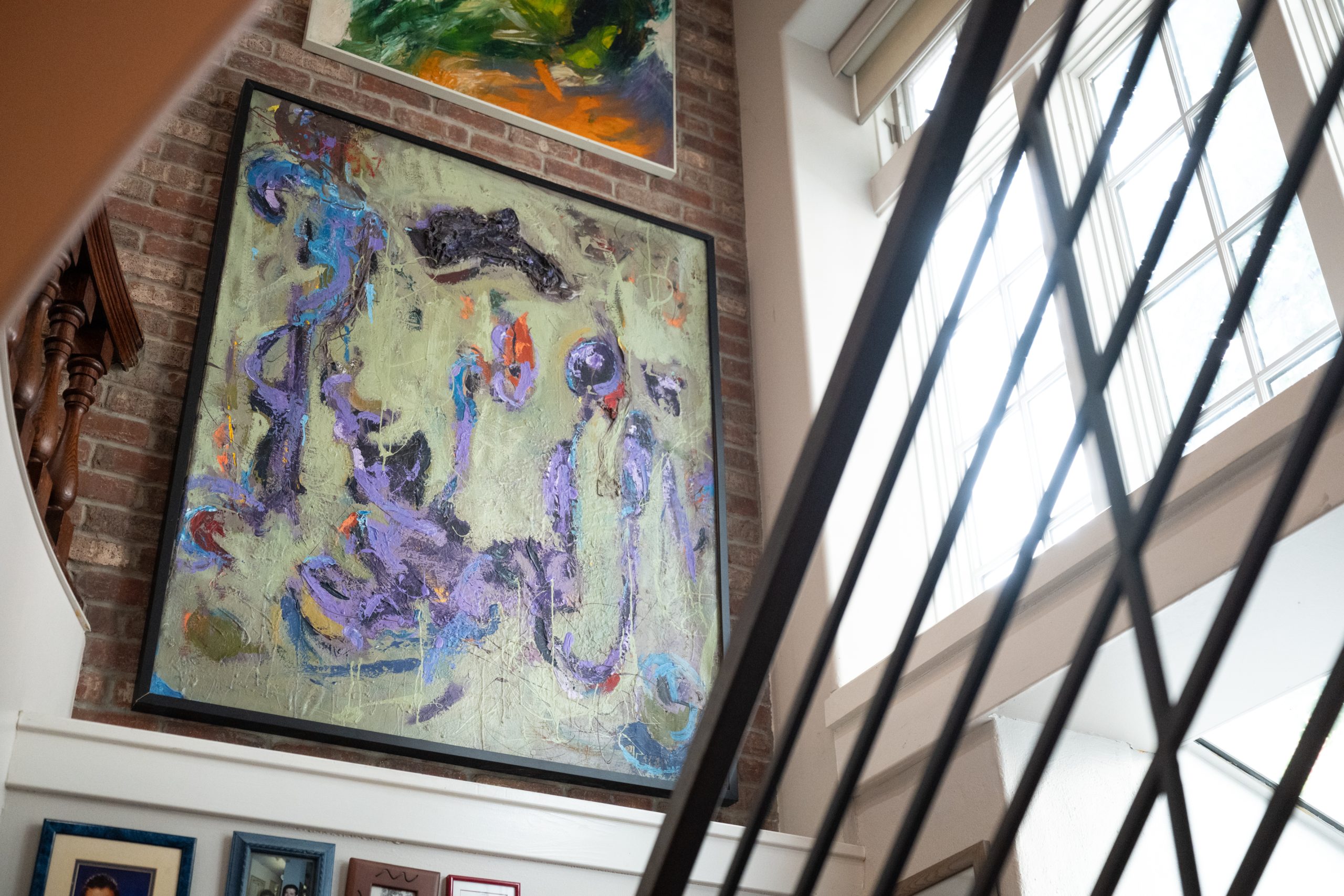
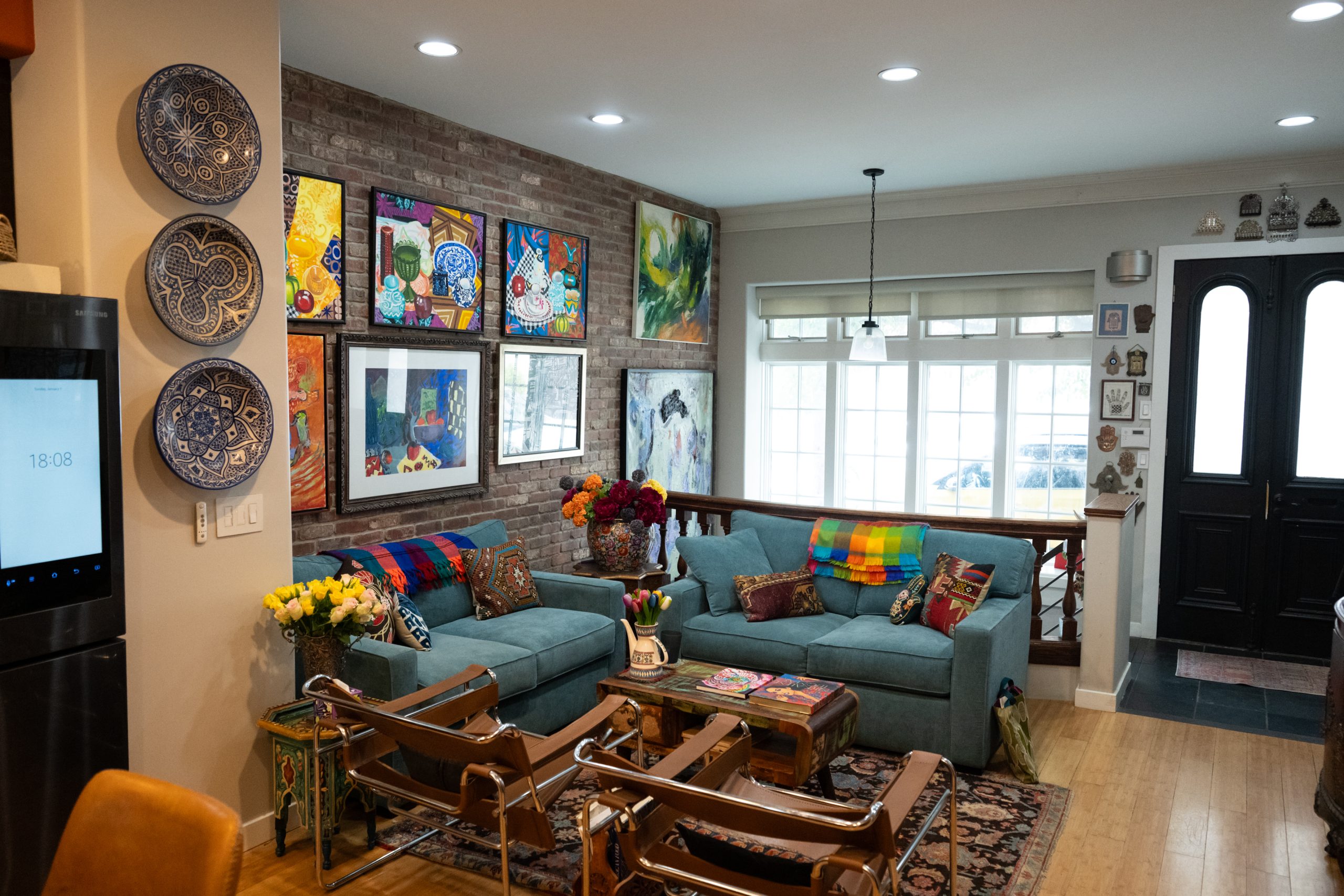
Though she purged half of her furnishings, Andrea kept favorites such as an elaborately carved antique buffet with brass fittings. Over the front door hang vintage Hanukkah oil lamps from Spain and Italy. White painted and exposed brick walls are hung with abstract art.
Andrea Preis points to vintage Hanukkah oil lamps from Spain and Italy hanging above the front door.Erin Blewett / For The InquirerA painting created by the couple’s son hangs in the stairwell.Erin Blewett / For The Inquirer
Several paintings are by Andrea and her son Abner. Her cousin Harriet Quick painted the swirls of green, gold, and orange on a white background.
The sitting area has two blue couches from Macy’s, two leather slingback chairs from a nearby furniture store, and a Persian rug from Material Cultures.
The living room walls are covered in art, echoed by brightly colored throw blankets and pillows.Erin Blewett / For The Inquirer
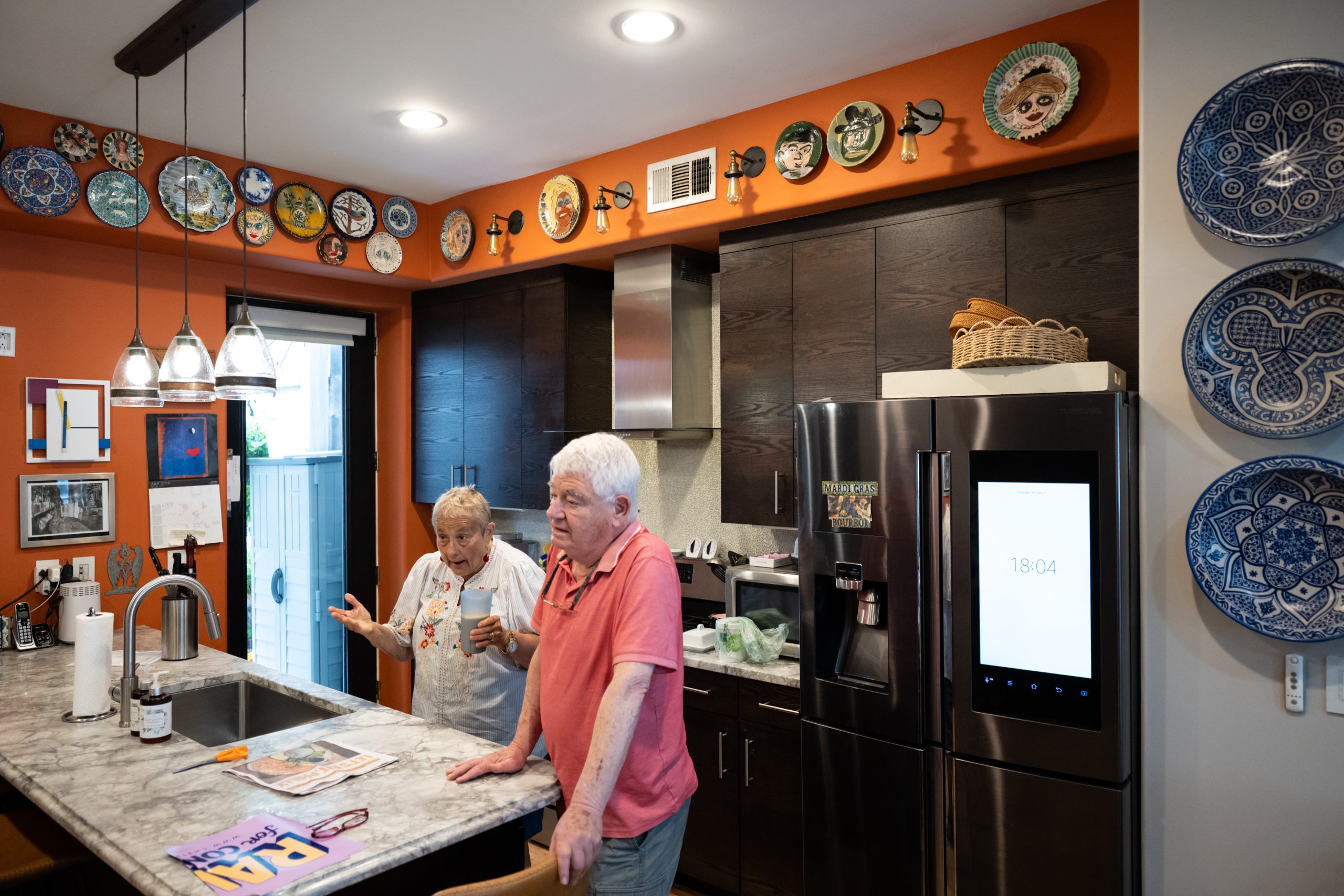
The kitchen’s pumpkin accent wall is decorated with over a dozen artfully arranged plates. Several of them, depicting whimsical women’s faces, were crafted by Andrea, a talented ceramicist and painter. Walnut double doors conceal a commodious pantry.
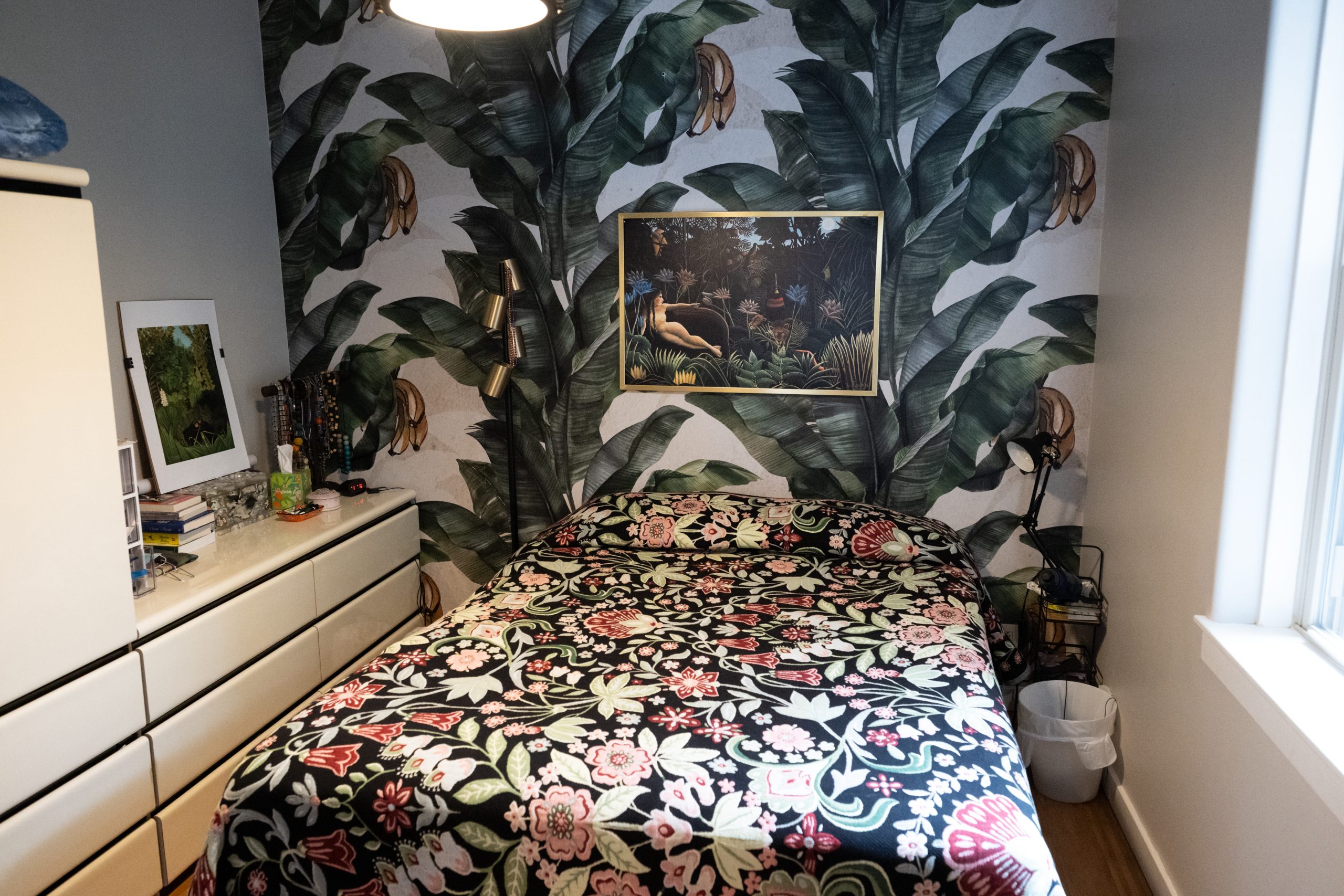
The queen-sized bed just fits in the bedroom, papered in an oversize leaf pattern. A poster of Henri Rousseau’s Eve in the Garden of Eden continues the leaf motif.
Andrea gave her dining table, which seated 14, to a family of 10. She now uses three folding tables, which seat 12, when she entertains.
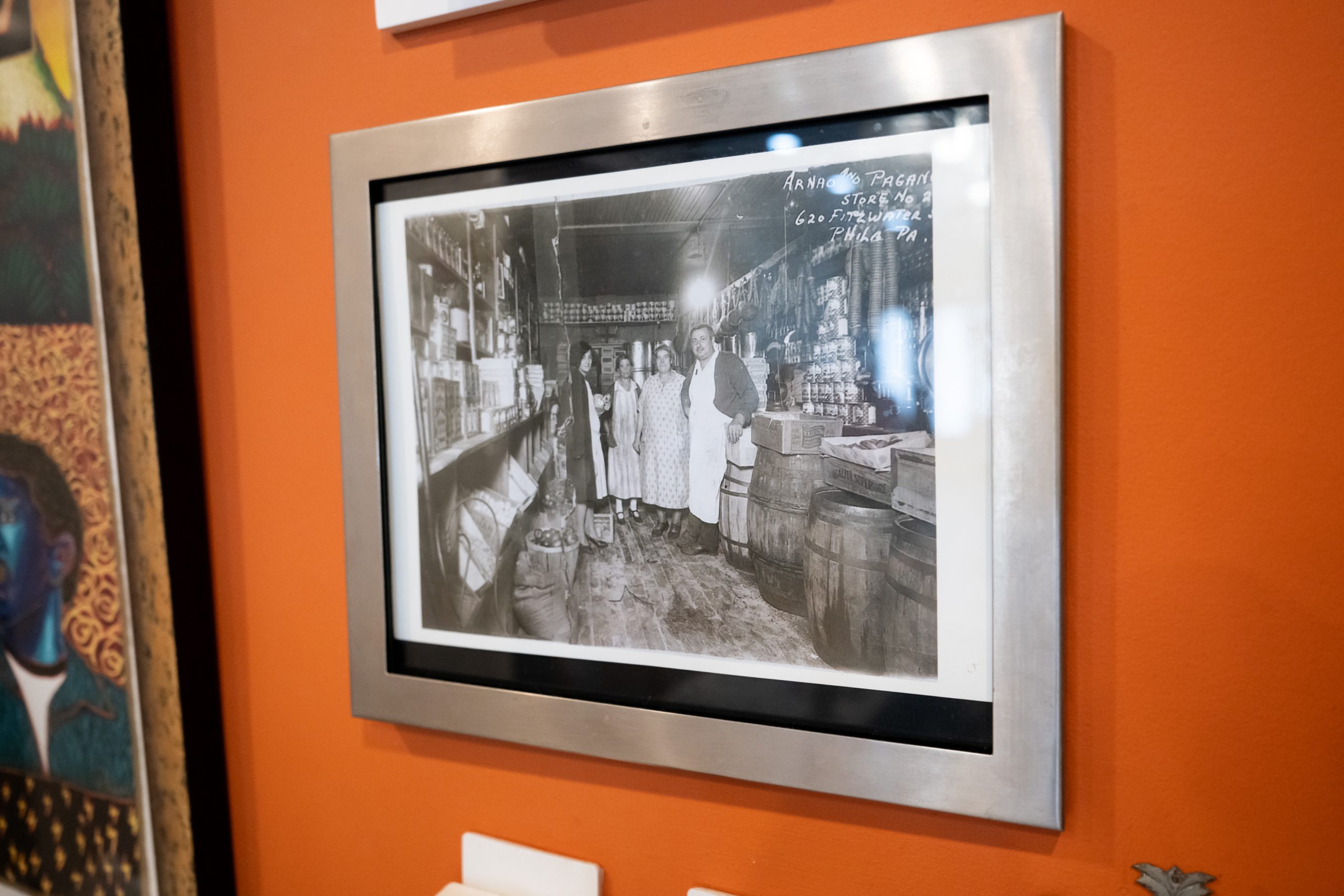
The couple stand in their kitchen. Erin Blewett / For The InquirerThe bedroom design includes a bold wallpaper and a print of a Henri Rousseau painting.Erin Blewett / For The InquirerA photograph showing the building when it was used as a store in the early 20th century. The image has been passed down from one homeowner to the next, Preis said.Erin Blewett / For The InquirerCeramic plates hanging on the wall above the kitchen include some Andrea Preis made herself.Erin Blewett / For The Inquirer
One new treasure from previous owners is a photo of the rowhouse when it was Arno & Pagano’s grocery store in the early 1900s.
During the building’s renovation, the exterior cellar door was replaced with a window to add light. Andrea did not want to tend fish in the former owner’s aquarium in the stairwell under the window. She replaced it with an array of fabric dolls in colorful costumes from around the world.
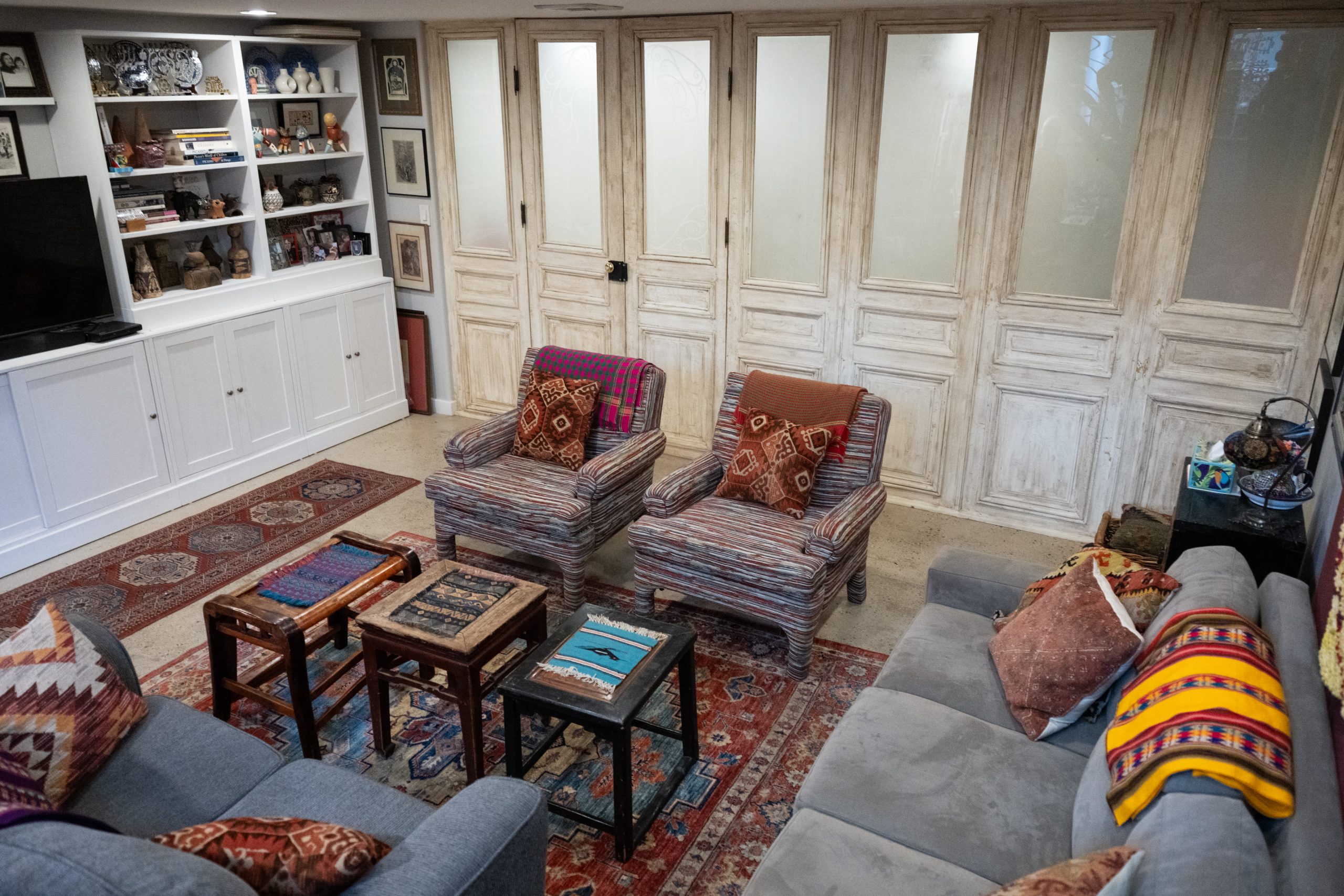
The basement sitting room is furnished with a love seat, two striped chairs, and a pullout couch for visiting family. Andrea and Eran have three sons and four grandchildren.
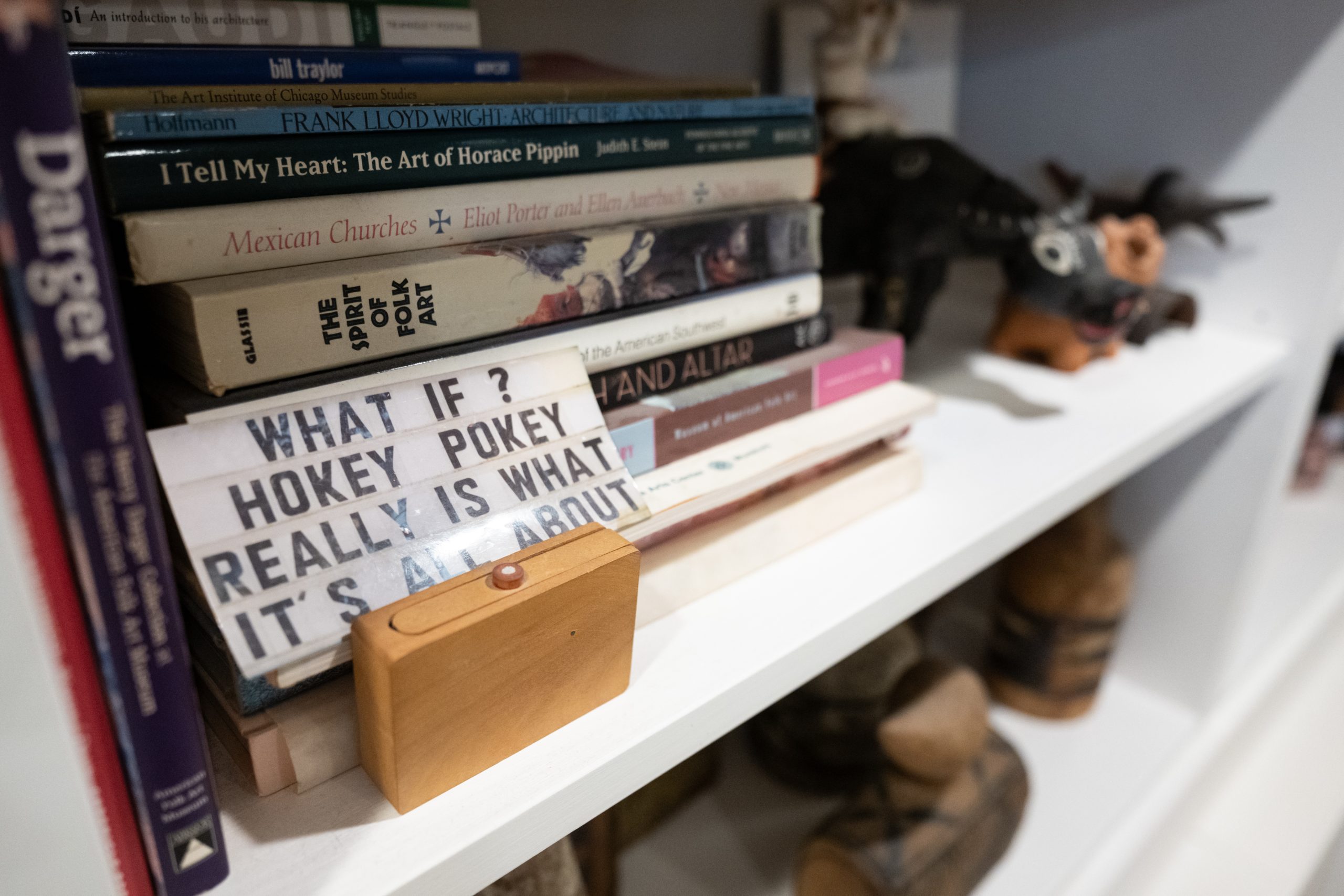
Bookshelves are filled with travel souvenirs and there is a large television.
Next to Eran’s basement desk hangs a poster for Beyond the Walls, an Israeli movie he cowrote. The prison drama was nominated for an Academy Award for Best Foreign Film in 1984.
Andrea, who grew up in Akron, Ohio, met Eran in his native Israel when she was living on a kibbutz. They married in 1969 and lived in Israel for 17 years, where Eran was a playwright and screenwriter for Israeli television, theater, and films.
The basement is where the couple enjoy watching movies with friends.Erin Blewett / For The InquirerDecor in the basement, including several books, though Eran gave away much of his collection when the couple moved.Erin Blewett / For The Inquirer
After earning a Master’s in Fine Arts from Ohio University, he taught at Midwestern universities before joining Temple University’s faculty in the late 1990s. He retired as a professor of film and media arts at Temple two years ago.
The couple have a film club with friends. Movie showings in the basement sitting room are followed by refreshments and discussions led by Eran.
“If and when we are no longer able to navigate the stairs,” Andrea said, “we will move the television upstairs and live in our cozy one-floor apartment.”
Is your house a Haven? Nominate your home by email (and send some digital photographs) at properties@inquirer.com.
On a humid Wednesday morning in Manayunk, movers in sweat-soaked T-shirts hauled three movie chairs, each at least 100 pounds, up two flights of a spiral staircase in a three-story home about to welcome its new owner.
Kevin Boras,a recent Temple University graduate working at Gentle Giant Moving Co. for the summer, has learned some tricks of the trade. As he tilted the widest chair on its side to squeeze through the entrance and over the railing, he explained, “Sometimes you gotta puzzle-piece it up the stairs.”
After the unwieldy seats were handled, the movers looked to the next item — a thin floor lamp.
Boras grabbed and huffed his way up the stairs, joking, “I don’t know if I’m gonna make it!”
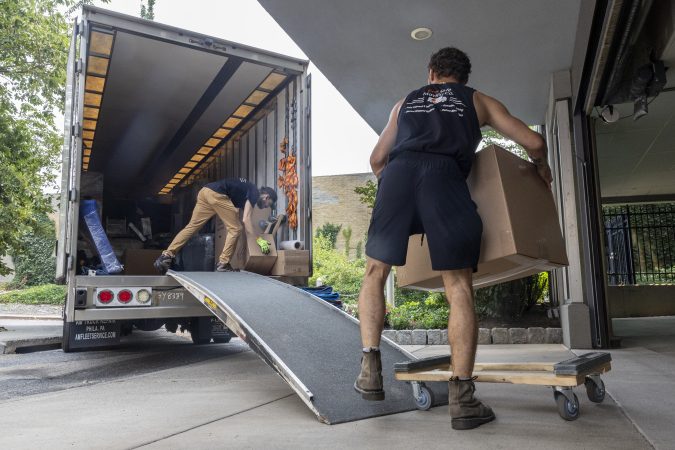
For most homeowners and renters, moves are stressful — once ranked more stressful than getting a divorce — but for the city’s professional movers, it’s just another day at work. Between parking troubles on tight South Philly streets and narrow doorways in historical trinity homes, these crews encounter and overcome Philly-specific challenges daily.
But, as Sultans of Schlep owner Tom Brouillette said, most of the city’s biggest moving obstacles can be overcome.
“Not everything is possible, but most things are,” Brouillette said.
So, larger, modern furniture is often a mismatch in these older homes, according to Jay Leone, a managing partner at EverSafe Moving Co. Sometimes, it’s unrealistic for a Samsung refrigerator to fit inside the entrance of a trinity.
“There’s only so much you can do in terms of disassembling something to buy yourself an extra inch of space,” Leone said.
An aged setting isn’t helped by the sizable items many Philadelphians own. James Dawkins, a regional manager at Two Men and a Truck, said his movers have faced retro pinball machines, pianos, and gun safes weighing more than 600 pounds. “People have a lot of fun toys in their house,” he said.
One time a customer had Two Men and a Truck movers transport a casket inside a residential home. Once they confirmed it was empty, no further questions were asked.
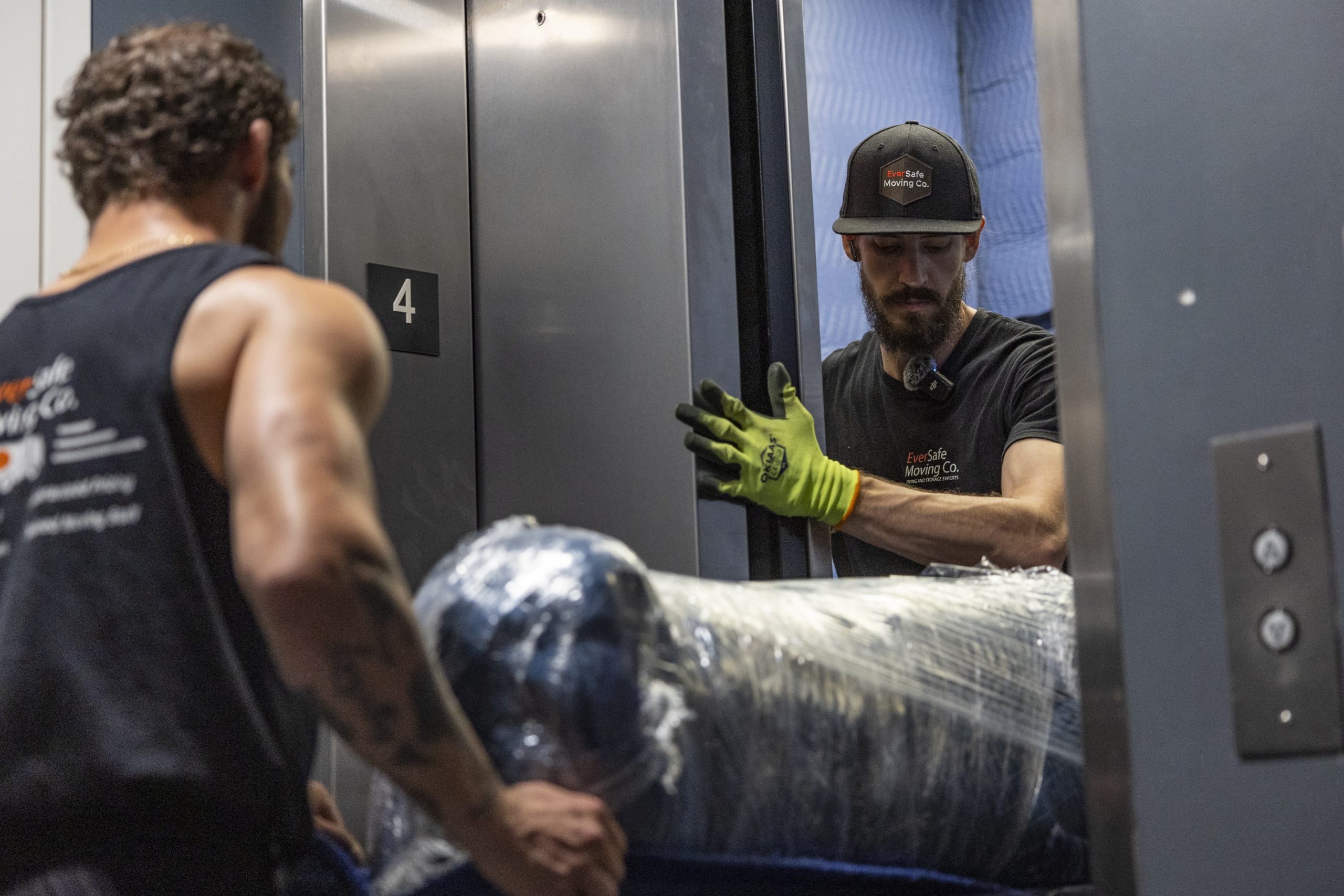
Fred Meder (right) holds the elevator door while John Wulffen loads in furniture during a July move in the city.Aidan T. Gallo / Staff Photographer
Often, the solution to small entrances can be hoisting larger items through a balcony or window. Sometimes, it’s more complicated.
Fred Meder of EverSafe recalls an especially tricky move into a four-story South Philly home. Since its tiny staircases couldn’t accommodate the customer’s bulky furniture, Meder hoisted it in pieces up to the third and fourth stories through literal holes in the floor — the home had been designed with 5-by-5-foot trap door-esque openings in the floorboards of each level.
“That was an interesting and tough scenario that I’m glad we don’t run into very often,” Meder said.
Devin Latimore, owner of No Stress Movers, said older, mid-rise apartment buildings present additional challenges. While these buildings have elevators, the elevator shafts were typically built first, Latimore said, and the building was constructed around it “with no mind for modern, bigger furniture.” The elevators also tend to be manually operated, slowing down the moving process.
“If the operator has to go to the bathroom, we’re stuck,” he said. “We have to wait for him to come back in order to do anything.”
Still, stairs are not always the preferred option. Latimore once carried a 350-pound office printer up 184 stairs and said it was one of the hardest jobs he’s ever accomplished.
“It feels like gravity gets stronger the higher you go,” he said. “We were trying not to drop it, and not die at the same time.”
Parking troubles
Parking in Philadelphia can be difficult for any driver on a regular day. It’s a nightmare for professional movers.
South Philly’s narrow streets were not designed for big trucks — “You could lay across the street and touch both curbs,” Lattimore said — and one must be an experienced truck driver to navigate the area.
For a recent South Philly move, Dawkins’ team had to park at the end of the block because they couldn’t get their truck to the house. The farther the truck is parked from the house, the longer and more strenuous the move.
Manayunk is another challenging neighborhood for parking: “The worst of both worlds,” according to Latimore. Not only does it have tight streets, but traffic comes from both directions.
For the Gentle Giants recent move in Manayunk, the moving truck was parked across the street, but the home was at a busy three-way intersection. The movers rolled furniture on top of dollies on the crosswalks, avoiding oncoming traffic like a game of Crossy Road.
To reserve a parking zone, movers can obtain temporary permits from the city’s Department of Streets that bar other vehicles from parking in a specific area. But these permits aren’t foolproof.
“It’s almost a 50-50 shot in Philly as far as whether the locals will abide by those parking permits, or even notice them,” Leone said. “We’re hoping nobody takes our spot before we get there.”
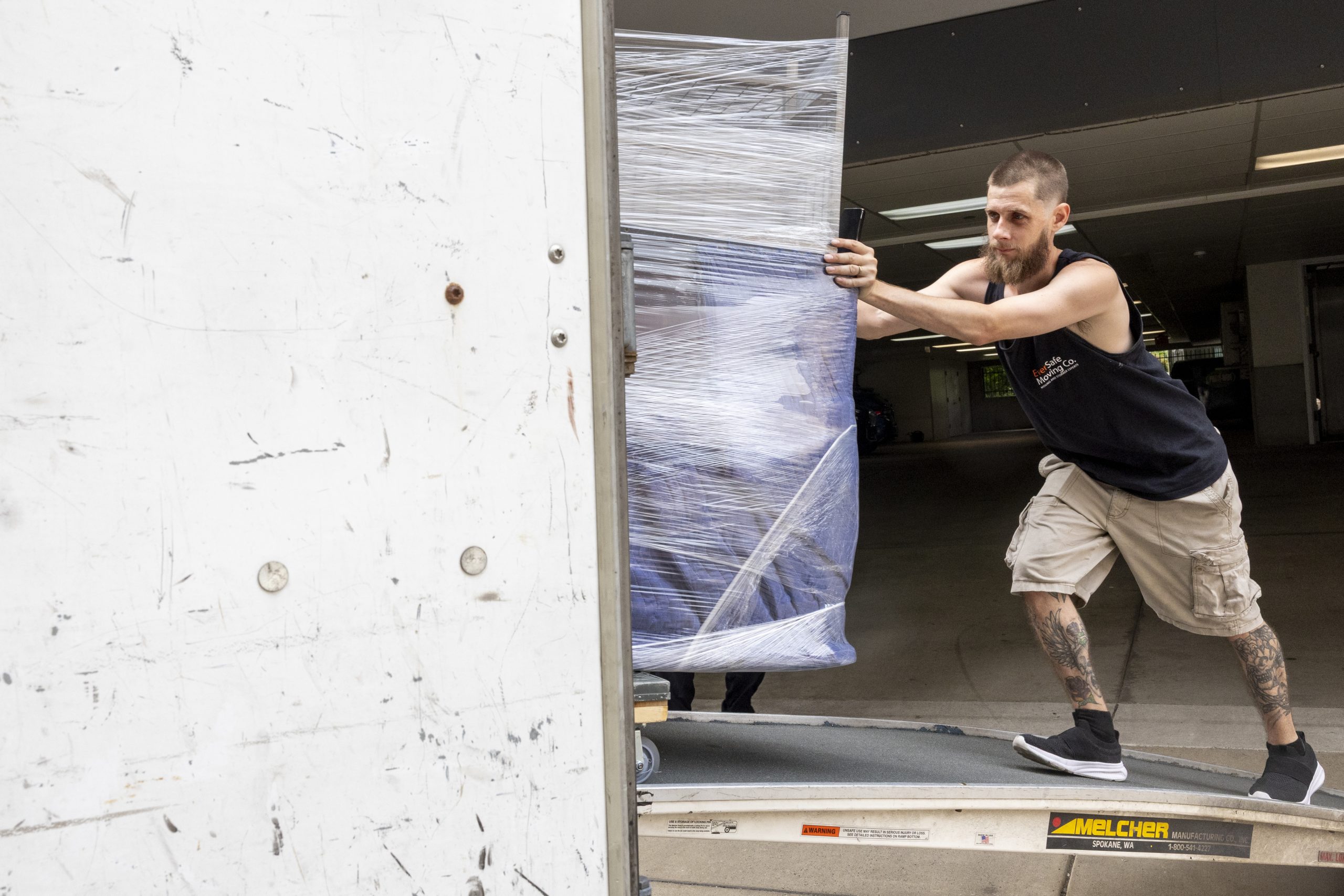
Tom Martin of EverSafe Moving Co. moves furniture into his company truck for a Philly customer in July.Aidan T. Gallo / Staff Photographer
Moving tips
For a seamless move, Latimore emphasized the importance of hiring movers early. He said a majority of customers reach out only two weeks before a move and are quickly surprised and stressed by pricing and availability.
“Start earlier than you think,” Latimore said. He recommended collecting estimates up to six months before a move, as costs increase closer to the moving date.
Nearby parades, road closures, and block parties also are a factor to consider when choosing a moving date, as they can make a movers’ job near impossible.
“You have so much happening in the city, and everyone is always celebrating something,” Dawkins said. “Sometimes it can throw a wrench in your plans.”
When creating an estimate, movers will want to discuss a home’s challenges so the company can allot the correct amount of time and muscle. It’s important to be straightforward about all potential roadblocks.
“Moving is one of the most challenging things; no one’s excited for it,” Dawkins said. “We try to make it as easy as possible.”