Tag: South Philadelphia

  • Hanwha vs. Holt: How New Jersey lost a shipyard

    Hanwha vs. Holt: How New Jersey lost a shipyard

    Hanwha Philly Shipyard says it needs a lot more space outside its 110-acre South Philadelphia complex to win lucrative U.S. Navy contracts, turn the money-losing facility profitable, and hire up to 1,000 union welders and metalworkers.

    The Korean-owned yard’s leaders thought they had found just the place, four miles by barge down the Delaware River at the New Jersey-funded Paulsboro facility, vacated by the offshore wind industry when President Donald Trump killed that program. In December, Hanwha agreed to take over the lease.

    But port operator Holt Logistics refused approval and sued to block the deal. After months of lobbying, Hanwha has given up and is now collecting offers from southern states that hope Hanwha will invest a big chunk of the $5 billion it has pledged for U.S. shipbuilding into their yards and future workers.

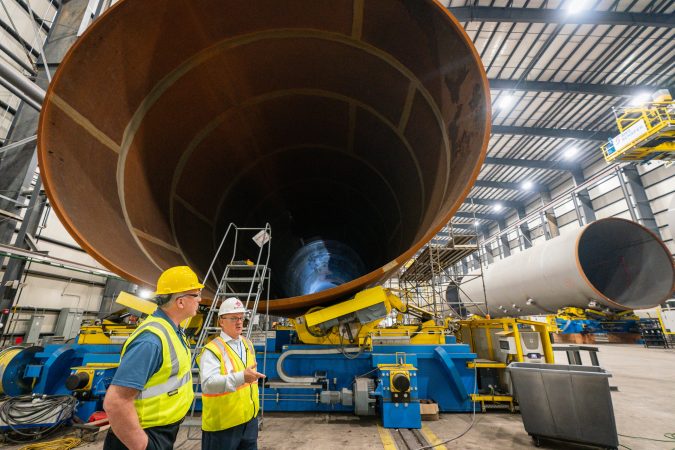
    Philadelphia Shipyard as seen from southbound I-95 in 2024.Alejandro A. Alvarez / Staff Photographer

    This despite the fact Hanwha’s proposal enjoyed support from federal, state, and local officials and even made it into the U.S. military budget for fiscal year 2026, which called for $110 million “to support shipbuilding industrial capacity” and steel fabrication in a manufacturing facility “formerly used for offshore wind manufacturing.”

    Paulsboro Mayor John Giovannitti estimates that on a given day, there are fewer than 50 workers at the port.

    Leo Holt, whose century-old company runs ports in Gloucester City and South Philadelphia, said he’s not completely averse to manufacturing around the Paulsboro terminal after his family’s plans to beef up container and bulk shipping there accelerate.

    Hanwha declined to comment, confirming only that the shipyard is still looking for space “in the U.S.”

    A rendering of a 600-acre shipyard that the Port of Tampa Bay has offered to build for Hanwha. Port Tampa Bay

    What went wrong?

    Since the early 2010s, New Jersey borrowed and spent more than $500 million building a Paulsboro wharf, highway ramps, and other facilities to attract big employers to the port. It replaced lost oil industry jobs and also compensated for nearby Camden’s loss of piers due to Holtec Inc.’s redevelopment in that city’s aging port district.

    In borrowing documents and news releases, the public spending was justified by predictions that the port would draw hundreds, even thousands, of port and industrial jobs, which in more than a decade have yet to arrive.

    Paulsboro sublets the facility to Holt as the port operator. Holt paid $1.6 million to use the property last year.

    At the urging of then-Gov. Phil Murphy, then-State Senate President and iron workers union leader Steve Sweeney, then-Paulsboro Mayor John Burzichelli, and other officials, Holt in 2020 agreed to let EEW, a global pipemaker based in Germany, build supports up to 400 feet long and 40 feet across for the federally subsidized offshore wind-electric generation facilities that its Danish partner Orsted planned to locate off the New Jersey coast.

    Orsted canceled in 2023, citing rising costs. Trying to cut his company’s losses, EEW executive vice president Esben Strandgaard began looking for new tenants, attracting more than 200 inquiries and initiating talks with Hanwha.

    Hanwha needed the landlord’s permission to take over the lease. Hanwha Defense USA president Tom Anderson, a retired Navy rear admiral, and the Holts met last fall to discuss the proposal.

    Instead of approving, the Holts sued, challenging EEW’s authority to pick a replacement and demanding control of the facility.

    Hanwha, aided by its political supporters, tried to make a deal, but Holt stood firm. In March, Hanwha canceled the agreement.

    What the Holts want

    “The north star for redevelopment at Paulsboro has been marine terminal operations,” said Leo Holt, president of the Gloucester City-based company. “We stretched to assist the state in any way we could,” but “Hanwha was never a part of the plan, nor was shipbuilding.”

    Holt spoke of the failed industrial proposals — wind, shipbuilding, and others to build power plant equipment on site — as an obstacle, not a goal.

    “The detour imposed on New Jersey is over, and the road is clear to the Paulsboro Marine Terminal,” he said. “We were glad to see that the page was turned on the detour.”

    Holt Logistics, which has been expanding containerized cargo facilities on both sides of the river, has shipped containers to Paulsboro and hopes to augment Paulsboro’s current port tenants, Holt said.

    Those include Novolipetsk Steel (NLMK), owned by Russian billionaire Vladimir Lisin, which due to Ukraine war sanctions stopped importing Russian steel through the port for its plant in Farrell, Pa., and has switched to steel from Latin America, East Asia, and other countries, according to Holt.

    The port also ships containers to the U.S. Navy base in Rota, Spain, and to ports in Cyprus, Israel, and other Mediterranean countries.

    More than a container port

    New Jersey has spent more than half a billion dollars improving the Paulsboro site with a wharf, highway connections to I-295, and other public works, the mayor said.

    “I’m not aware of Paulsboro people, Gloucester County people, working there right now,” said Burzichelli, now a state senator and a supporter of both the wind and the Hanwha projects.

    New Jersey invested in the BP site to make it more than a container port, Burzichelli says.

    “That [state-built] wharf was designed to handle any industry, and the public investment was designed to create the maximum amount of high-paying jobs that can be created,” he said.

    The port section “was always intended to be a bulk port,” requiring plenty of longshoremen’s labor, and “certainly not a container port,” which “take up a lot of space but don’t generate big jobs,” Burzichelli said.

    “They don’t pay taxes the way an [industrial] building will pay,” he added.

    The Holts’ “choices and the interest of the state of New Jersey, the interests of Gloucester County, and the interests of the borough of Paulsboro, are not aligned, at this point,” Burzichelli said. “I hope we can get them aligned.”

    Mayor Giovannitti said, “We thought we had a deal last year with Hanwha” but are left with “a $750,000 hole in our budget” — the annual payment, in lieu of taxes, that EEW and its partners paid the borough while it was operating. The town’s annual budget is $13 million.
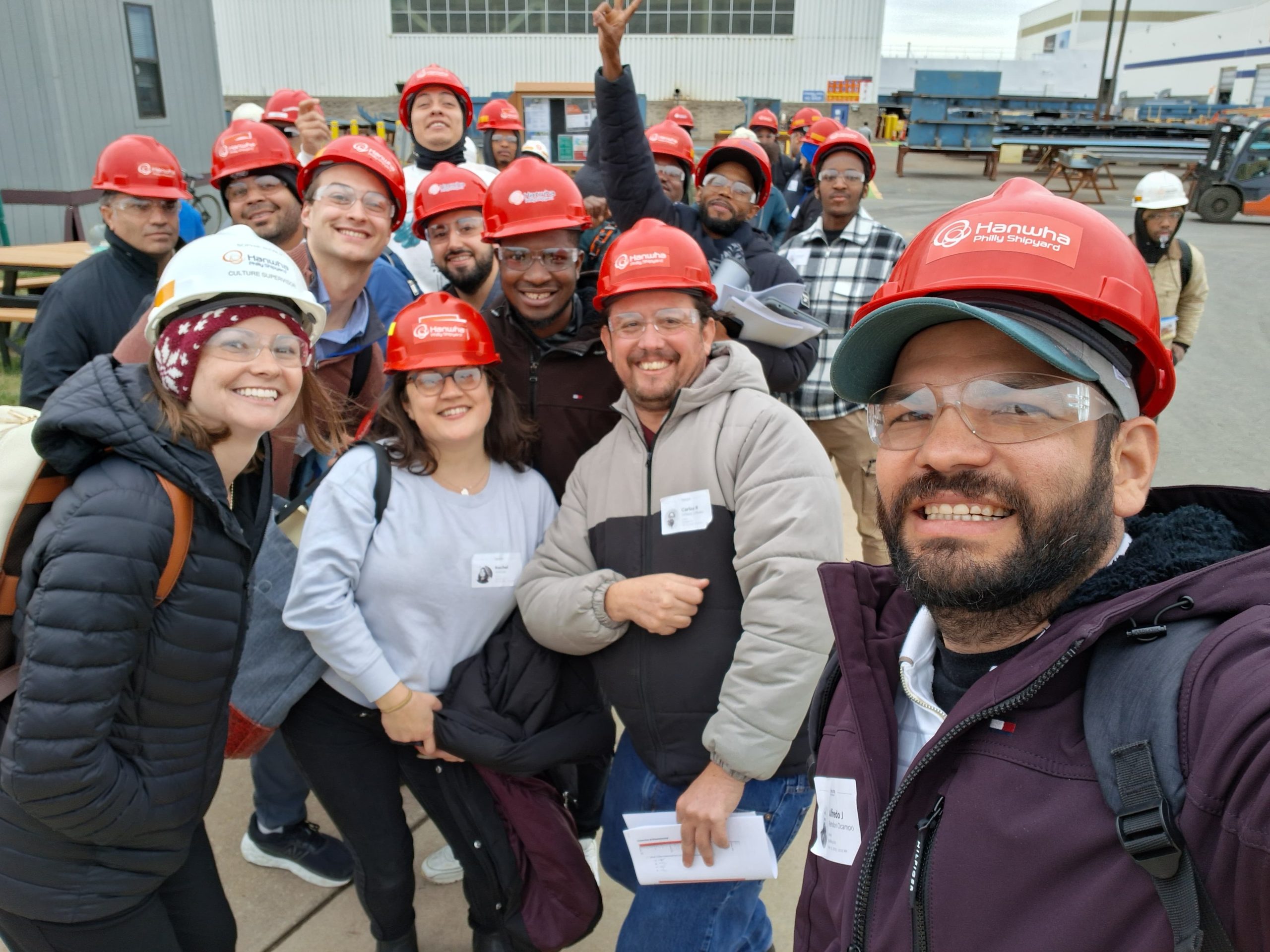
    Instructors and graduates of the union-backed preapprenticeship program Global Skills Union Pathways Project at Philly Hanwha Shipyard in February.GSUPP

    What Paulsboro could offer

    Strandgaard says he’s not surprised Hanwha decided not to “waste any more of their time” on Paulsboro: “They could not see themselves working with a hostile landlord.”

    It’s an ideal site for shipbuilding or any other industry that needs a deep water port, he said. But “Holt Logistics really controls what comes in and out. This was very upsetting, for us and Hanwha, that Hanwha with the support of the Navy did not have enough leverage.”

    Other East Coast sites would take a year or more to prepare. “The beauty of Paulsboro is they could start the day after” concluding a deal, Strandgaard said.

    He said he was surprised the new administration of New Jersey Gov. Mikie Sherrill didn’t make landing Hanwha a priority.

    Sherrill was “disappointed that EEW could not reach an agreement with Hanwha or other parties despite the state’s efforts to facilitate discussions and bring stakeholders together,” spokesperson Maggie Garbarino said in a statement.

    Holt’s goal: A modern marine terminal

    On any given day, between 500 and 900 Holt employees are moving cargo at the company’s South Jersey operations, Holt said. He declined to estimate how many of those were in Paulsboro.

    According to tax records, the port handled about 250,000 tons of cargo last year. That’s less than one-tenth of all South Jersey Port Corp. cargoes.

    Holt called the state “vital partners in the renovation of the facility. We are working to have both marine operations and manufacturing operations. But we cannot be deterred from taking it where we promised: to be an active modern marine terminal.”

    He said he expects the Sherrill administration will prove to be more congenial to the Holts’ vision for the property — “manufacturing, distribution, or anything” that makes sense to his family.

    South Jersey officials say they haven’t given up. “The people of Paulsboro were told this was about jobs, jobs, jobs, and those would be manufacturing jobs. Not stacking containers four high with automated forklifts,” Giovannitti said.

    Burzichelli still hopes Hanwha and Holt can be brought to the same page. “Many of us still don’t think we are done with manufacturing,” he said.

  • Trump wants smarter computers, dumber people | Will Bunch Newsletter

    Occasionally, I get to share good news in this space. Wu Shaoping — the Chinese dissident who fled to America but was detained by U.S. Immigration and Customs Enforcement after a Central Pennsylvania traffic stop — was freed from ICE’s Moshannon Valley Processing Center Friday night, not long after my column dropped and a couple of members of Congress pressed for his release. His asylum case is still pending. I’ve learned there’s actually a lot more to this story — stay tuned.

    If someone forwarded you this email, sign up for free here.

    The Trump regime is shifting billions from college into AI. That’s no accident.

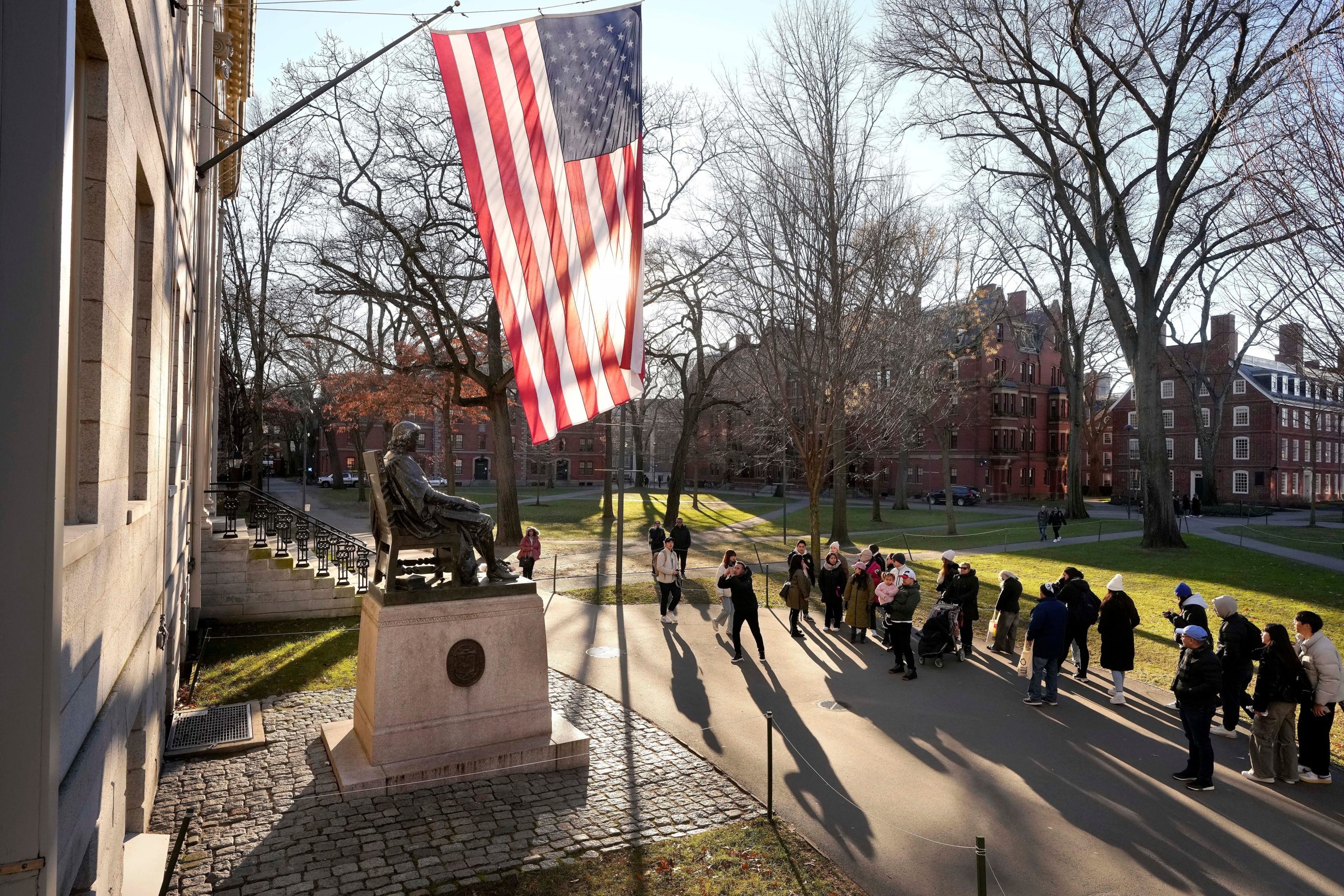
    People take photos near a John Harvard statue on the Harvard University campus in 2024 in Cambridge, Mass.Steven Senne

    The U.S. government has become pretty stingy when it comes to finding money for human beings — just ask any struggling single mother in Mississippi needing food stamps, or a physician in Africa waiting on vaccines that no longer arrive through American foreign aid programs.

    But Washington always seems to have an open wallet for computers.

    In fact, the very first one — ENIAC (Electronic Numerical Integrator and Computer), constructed right here in Philadelphia on the University of Pennsylvania campus as World War II came to an end — was funded by the U.S. Army Ordnance Corps at a cost of about $7 million in today’s dollars. Over the years, billions of dollars in federal funding would fuel key moments in the Computer Age, including the creation of the internet, which was also a Pentagon project.

    Still, there was something chilling about last week’s report from the White House Office of Science and Technology Policy that called for a surge in research aid in one area: computers and robots using artificial intelligence, or AI. The nuts-and-bolts of the paper — “Science: A New Golden Age” — highlighted a new, more-than-$5 billion commitment for an AI-in-science program called the Genesis Mission.

    But the White House paper also called for a radical shift in the way the federal government pays for science, with a massive move of $200 billion away from funding research and basic science at top universities — the system that has thrived since the time of ENIAC — and toward individuals and more directly applied AI projects, including those at private tech companies.

    Goodbye, John Harvard. Hello, Claude.

    “This plan raises profound concerns about the future of publicly funded science,” the top union leaders for educators — Todd Wolfson of the American Association of University Professors (AAUP) and Randi Weingarten of the American Federation of Teachers (AFT) — said in a joint statement last week. “It does nothing to make anyone healthier or safer, and it isn’t what Americans want.”

    Wolfson, Weingarten, and other critics of the new science scheme from the Trump regime say it unravels long-standing protections for academic freedom and transparency on campuses in favor of a process that’s ripe for political interference. “This is a defining moment for American science,” the educators wrote.

    Indeed, while the federal funding gains for AI are still mostly theoretical, the cuts for research projects on college campuses across the United States have been underway since Donald Trump took office in January 2025, and the impact has already been dramatic.

    The playing field is complex, but a recent deep analysis by the Brennan Center for Justice found that the Trump administration successfully froze about $3 billion in previously approved grants for scientific research, is imposing a scheme to slash an additional $4 billion, and issued a budget proposal calling for a whopping $44 billion additional reduction.

    The analysis noted that “these midstream freezes and cancelations have ripple effects far beyond the nominal dollars involved, prompting layoffs, interrupting careers, and destabilizing the budgets of research universities.”

    Of course, federal research grants have been just one front in the Trump regime’s much wider war against the basic foundations of higher education in America, with the MAGA movement seeing college campuses as bastions of liberal indoctrination that should be restored as narrow, beer-drenched pipelines for ambitious white men. This “war on woke” includes attacks on university diversity programs, steep barriers for international students, and the abandonment of college debt relief.

    But now it feels like the White House is stating the quiet part out loud: The bigger goal is simply to build smarter computers, even if that means humans get dumber. Intelligent robots still don’t vote in elections, after all, but poorly educated people do.

    Ironically, the regime’s rationale for spending our tax dollars on making AI more powerful regurgitates a Cold War mentality that, on the surface, sounds like the reasons behind decades of massive college research funding and programs like the space race of the 1960s or the nuclear arms buildup: to stay one step ahead of the communists — this time in China.

    The difference between then and now is that after World War II, Washington made a conscious effort to fund basic science and free inquiry as a way to distinguish the United States from the rigid planned economy of our then-biggest adversary, the Soviet Union. Now, the White House seeks to copy Beijing’s centralized planning. Can we truly promote science without lifting up the actual scientists?

    Trump’s “Golden Future of Science” feels more like an extremely narrow wind tunnel. The irony is that many of today’s politicians in both parties see higher education as mainly workforce development, even as corporate recruiters say what they really want are more broadly educated critical thinkers. In other words, the AI era actually screams out for a boost for the humanities like literature or philosophy — the types of majors that are getting crushed in the Trump era.

    An epic battle is looming between those obsessed with a new nuclear arms race around AI — especially the Silicon Valley billionaires who stand to gain and who, not coincidentally, have heavily funded the second coming of Trump — and a public that doesn’t want our communities ruined by noisy, energy-guzzling data centers that aim to take away our jobs while making reading a lost art.

    A government scheme to build better computers while rendering humans obsolete used to be the stuff of dystopian science fiction. Maybe we can keep it that way before it’s too late.

    Yo, do this!

    • About once a year or so, I write, “Yo, actually maybe don’t do this.” Last weekend, I ventured out of my underground lair to join every other American in devoting three hours to Christopher Nolan’s The Odyssey. To say I was underwhelmed would be, well, an understatement. The movie was a funeral for the now totally lost art of movie dialogue, amid a plot that meandered from gouge-your-one-eye-out boring to bursts of incomprehensible violence. It was a metaphor — Troy was My Lai, apparently — that got terribly lost at sea. But I do feel there’s something happening here. First the World Cup, now this mediocre whale of a motion picture: Americans are desperate to be a part of something, anything, that is bigger than our politics.
    • Regular readers know I’m a huge fan of the CNN modern history documentaries they now call the Decades Series, but the original format of politics, TV, and music did have gaping holes. A few years ago, they backfilled with a series on The Movies of our post-World War II world. Now, finally, Decades in Sports arrives on CNN with back-to-back episodes (presumably the 1960s and ‘70s) on Sunday night at 9 p.m. I can’t wait. Spoiler alert: Havlicek stole the ball.
    • Another thing you may have noticed is that Rep. Ro Khanna, who meandered west after Council Rock High School in Bucks County and became the congressman from Silicon Valley, is something of a friend of the newsletter. He’s back in our area frequently, and he’ll be at Philadelphia’s Parkway Central Library on Tuesday at 6 p.m. to deliver a special speech: “America at a Crossroads: A Vision for the Future on our 250th Anniversary.” He’ll talk about his background growing up here as the son of immigrants and the need for economic freedom that ends gross corruption and inequality — go check it out.

    Ask me anything

    Question: Who should be DNC [Democratic National Committee] chair? And does it matter? — Martha (@marthagrant.bsky.social) via Bluesky

    Answer: It does matter. Despite everything else that’s happening in the world right now, one of the more revealing stories of the last week was the New York Times article about Democrats in disarray, focusing on embattled DNC chair Ken Martin, who before the 2024 election was the state leader in Minnesota. Under Martin, the party is sliding deeper in debt, and there are complaints about an abrasive personal style, the botched “autopsy” of the 2024 election, and the Democrats’ muddled message. A change should be made as soon as possible. Hopefully, party leaders could rectify the mistake of not picking Wisconsin’s more skilled ex-party chief, Ben Wikler. The problem is that, under the constant assault of GOP fascism, Dems need to fix this plane while it is flying at 37,000 feet.

    What you’re saying about …

    There was an excellent response to last week’s question about what a future Democratic president should do on Day One to erase the stench from two Donald Trump presidencies. I wish I could reprint all the suggestions, but recurring themes included a rapid purge of any Trump holdovers, abolishing ICE and related immigration raiders, and a speedy effort to prosecute the many wrongdoers. The two most frequent suggestions included major reform of the judiciary, from fixing the mangled immigration courts to ethics reform, and definitely an expansion of the U.S. Supreme Court. Mark Cohen suggested two more federal appeals courts and then “assign a Supreme Court justice to each one, bringing a total of 13 justices to the Court for fixed term of 18 years.” Another theme was erasing Trump’s various renovations to the District of Columbia. The ex-congressman Joe Hoeffel wrote, “Strip all the cheesy gold out of the Oval Office.”

    📮 This week’s question: Speaking of Democrats, some top party officials like House Minority Leader Hakeem Jeffries seem to think the November election is primarily about “affordability.” That seems to miss the bigger moment, but I’m curious: What pithy message would you like to see Dems run on this fall? Please email me your answer and put the exact phrase “Democratic message” in the subject line.

    Backstory on the Gen Z revolution rocking India

    Protesters participate in a demonstration demanding educational reforms as part of the Cockroach Janta Party’s ongoing protest movement in New Delhi on July 25.Vipin

    Last October, I wrote a column, with great interest and enthusiasm, about a growing revolution of Gen Z 20-somethings that was taking place across the global south — from Madagascar to Peru to Nepal, and elsewhere — who were fed up with the political corruption of grown-ups and threatening to topple governments. I wondered if this very online youth activism might spread to the United States or other more developed nations, but over the coming months, the momentum for these protesters and their Japanese anime pirate flags seemed to fade. The so-called Gen Z revolution looked like a historical footnote.

    But it turns out that the embers of youth unrest were still smoldering, and this summer they have reignited in a big way in the world’s largest — if deeply flawed — democracy: India. And as is so often the case, the spark was something nobody saw coming: a nationwide exam for entrance to medical school taken by roughly two million students, which the government moved to scrap after allegations that some of the questions had leaked. Some young people who’d studied for months for the exam took to the streets in protest, and — as so often happens — a repressive police response only caused these demonstrations to get bigger. So did a comment from India’s chief justice, who described young, unemployed Indians as “cockroaches.”

    That gave the protests a name when Abhijeet Dipke, a 30-year-old graduate of Boston University, posted on the social media platform X that he was starting the “Cockroach Janta Party” — a wordplay on the Indian authoritarian-minded leader Narendra Modi’s Bharatiya Janata Party. Incredibly, this “CJP” has seen its protests — calling successfully for the resignation of the education secretary and for other deeper reforms, using tactics such as sit-ins and hunger strikes — spread to some 30 cities while clogging the streets of the capital, New Delhi. The movement has become arguably the biggest threat to Modi’s strongman rule since the leader’s ascension in 2014.

    All of which raises the same question I posed last fall: Could it happen here? In one sense, it already has. On Friday, about 500 Indian students and other members of the U.S.-based diaspora gathered under a statue of Mahatma Gandhi in Manhattan’s Union Square to express support for the “cockroaches” of their native country. Meanwhile, the kind of pressures that caused India’s youth to erupt — government meddling in higher education, diminished job prospects in a time of rising AI, to name two — are also found in the United States. Young people almost never protest over the same stuff that riles up their parents, as shown by the gray hairs that have populated the No Kings rallies against Donald Trump. When lightning strikes, it will probably be something as unexpected as a college entry exam. But thunderstorms are definitely in the forecast.

    What I wrote on this date in 2019

    A culture of death permeates the Donald Trump regime, from the doomed fishing boats of the Caribbean to an Iranian girls’ school to the scores now dying in immigration detention cells. But this is not exactly new. The seeds were planted in the first Trump presidency, when his attorney general, William Barr, led a push to revive the death penalty for federal prisoners in a big way. On July 28, 2019, I asked: “What took the American Caligula so long to bring back the spectacle of executions to electrify the masses (but not the prisoners … they’d be lethally injected) and juice his 2020 reelection campaign? Indeed, the five executions are scheduled around the Christmas holiday, presumably to remind us of its pagan roots.”

    Read the rest: “The cruelty is the point as AG Barr, Trump return to death penalty barbarism.”

    Recommended Inquirer reading

    • In 2026, I’ve been very focused on the individuals whose world has been turned upside down — or, in some cases, ended prematurely — by the horrors of life in these authoritarian United States. Last week, I took a deep dive into the story of Wu Shaoping, a Chinese dissident who fled his likely detainment by Xi Jinping’s regime and made it to Pennsylvania with his wife and teen daughter, only to get arrested at a traffic stop, turned over to U.S. Immigration and Customs Enforcement, and detained. The outcry may have had something to do with ICE’s release of Wu shortly after the column ran. Over the weekend, I wrote about the police killing of Corey Ruiz in Madison, Wisc. — noting that the shootings of civilians by cops have only increased since the massive George Floyd protest marches of 2020. I urged an end to the new numbness about police violence in America.
    • You didn’t really think I could make it all the way through the newsletter without mentioning the face that launched 1,000 hot takes: basketball king LeBron James. He stunned not just the sports world but America’s founding city by announcing Friday that he is taking his aging but still considerable talents to South Philadelphia, hoping to grab one last title with a completely revamped 76ers. Has there been any other story since then? The Inquirer has told you about the first time James played at the Palestra, his new uniform (No. 23), the speculation over how he will (or won’t) gel with the rest of the Sixers, the speculation over where he might live, his relationship with Tyrese Maxey and Joel Embiid, and on and on and on. Just wait until he actually takes the court this fall! Actually, don’t wait. Subscribe to The Inquirer today, slam dunk the paywall, and read every story from now until the hoped-for parade down Broad Street.

    By submitting your written, visual, and/or audio contributions, you agree to The Inquirer’s Terms of Use, including the grant of rights in Section 10.

  • FDR Park launches information desk at new Welcome Center

    FDR Park launches information desk at new Welcome Center

    South Philadelphia’s FDR Park now has its Welcome Center partially open to the public, with a public bathroom available for use and volunteers working an information desk seven days a week.

    “Do you need help finding anything?” a chipper volunteer asked, sticking her head out of the information center entrance during the blistering heat wave in July.

    The information desk is inside the Welcome Center and has been staffed since around late June, according to Philadelphia Parks and Recreation spokesperson Ra’Chelle Rogers. The restroom and information desk are open from 9 a.m. to 4 p.m. on weekdays, with closing extended to 5 p.m. on weekends.

    The air-conditioned respite from the heat showcases FDR’s programming, not limited to jazz in the park, community boating, and birding — all for free.

    Friends of FDR Park, the nonprofit that advocates for the 348-acre space, is also selling houseplants, seeds native to the park, and crocheted flowers as fundraisers.

    “FDR Park has always been a place that brings people together, and it’s rewarding to see the Welcome Center now offering the everyday amenities this community has long deserved — from public restrooms to visitor resources,” said Parks and Recreation Commissioner Susan Slawson, adding she was “grateful to everyone who stuck with us throughout this process.”

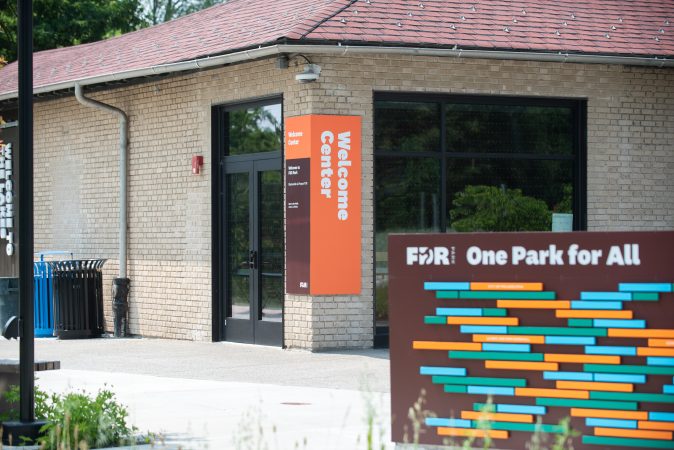
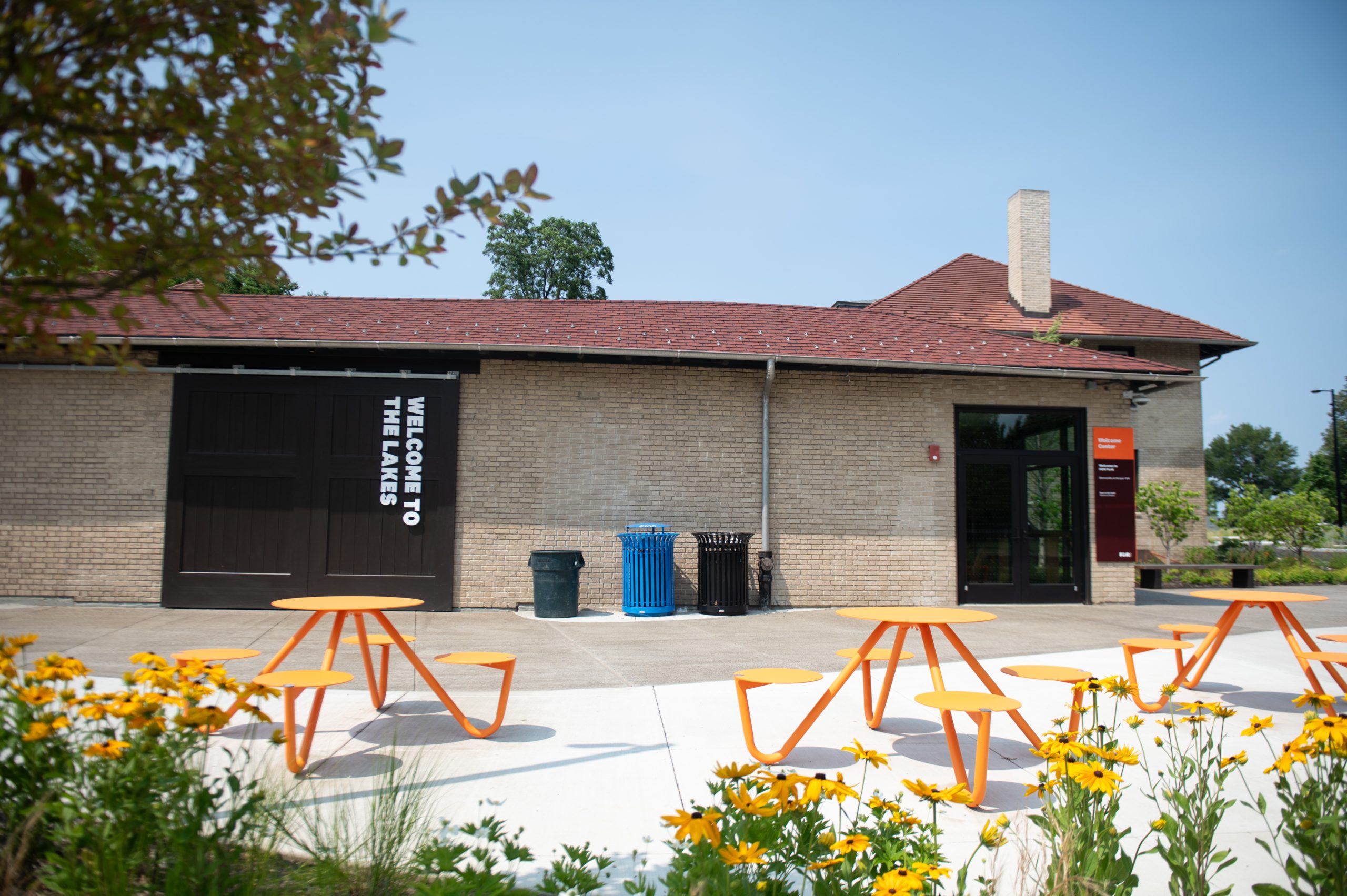
    The newly repurposed FDR Park Welcome Center, located on the east side of the Pattison Lagoon near the Broad Street and Pattison Avenue entrance to the park pictured on Wednesday, June 11, 2025 in South Philadelphia. The space, originally built in 1919, was used as a guard house and stables in the past.Erin Blewett / For The Inquirer

    The former guardhouse and horse stables that now make up the Welcome Center and abutting offices for park staff underwent a $12 million renovation in 2022 that was completed last summer. The renovated space integrated the original guardhouse and stables’ design and restored some of the windows, doors, glazed brickwork, and original hardware, according to the conservancy.

    The Welcome Center will eventually feature a handful of food vendors, but Philadelphia Parks and Recreation has no timeline for that yet, as the city would have to seek requests for proposals, according to Rogers.

    When fully operational, the Welcome Center will have 3,800 square feet of event space available that should be able to accommodate up to 200 guests for community meetings, according to the Fairmount Park Conservancy, which raised half the funds associated with the center’s renovation and is managing FDR’s larger once-in-a-generation overhaul. Additional bathrooms will eventually be available inside.

    For now, park visitors can grab a seat outside the Welcome Center, where several bright orange tables overlook a field of wildflowers.

    Park lovers willing to guide visitors can volunteer to help at the information desk through the Friends of FDR Park.