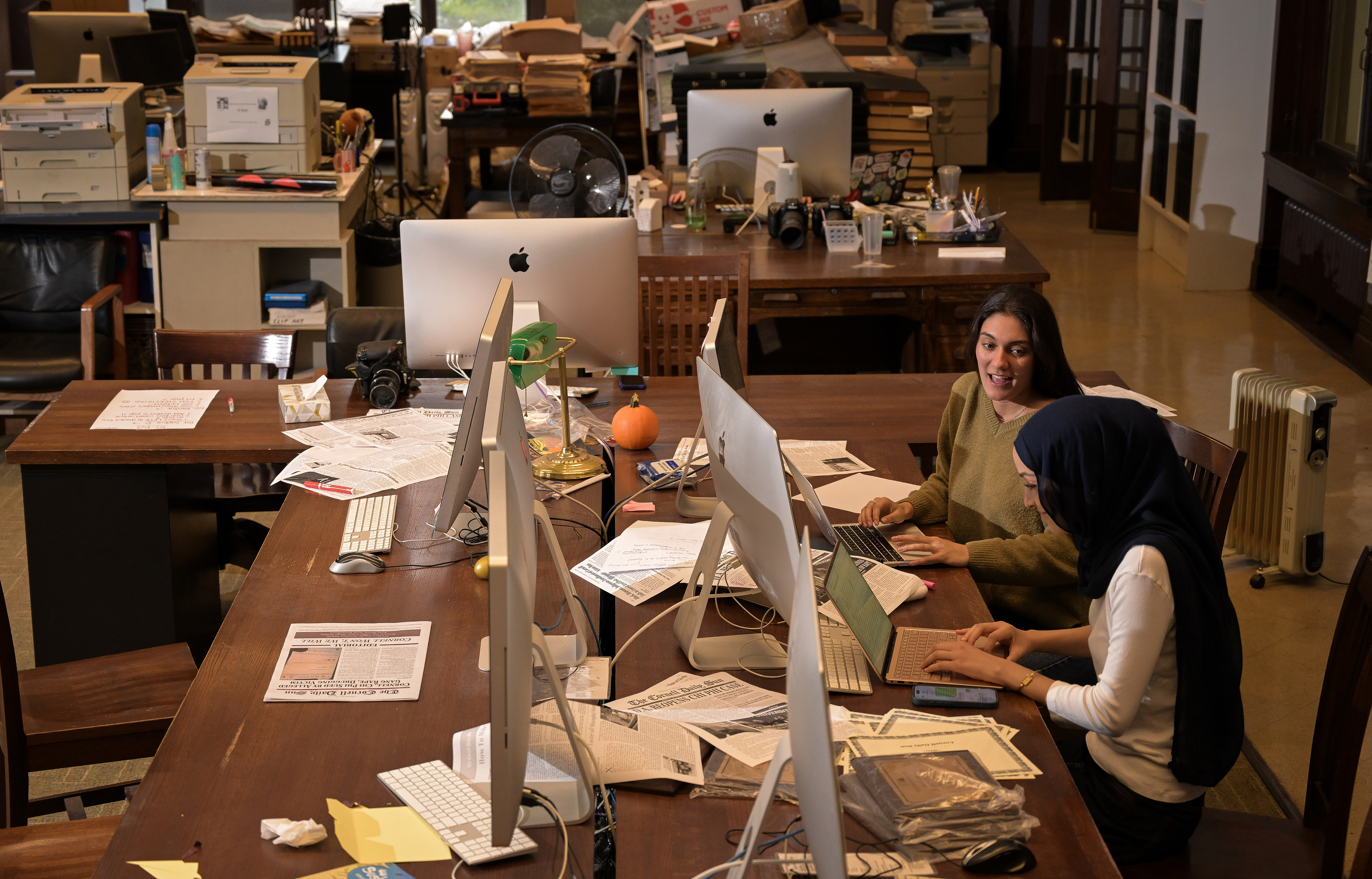
ITHACA, N.Y. — Editors of The Cornell Daily Sun clustered around their computers late Monday night, getting ready to send out a letter from the editor. They looked bleary-eyed, and one reporter confessed she had skipped her class on Nietzsche that day.
These student journalists at Cornell University were pressing through a dizzying two weeks following the story of a student’s allegation that she was raped on campus in 2024.
The case had long had their attention; now it had burst into the national spotlight, and their high-risk decision to publish the names of the accused was being discussed not only in Cornell’s libraries and walkways but in the national media.
Back in November 2024, students at Cornell were shaken by an alert they received over email: “Crime ALERT: Sexual Assault,” the email read, referring to the case of a woman who told Cornell police she had been assaulted at a fraternity house.
There was outrage on campus. Students threw eggs at the fraternity house, Chi Phi, that the woman named. The university convened a sexual assault task force, which compiled a series of recommendations for teaching students about consent and the processes for reporting assault. Then much of the campus attention moved on.
But Cereese Qusba, 22, a senior and reporter for the Sun, couldn’t shake her concerned curiosity about the case. She got in contact with Jane Doe, the plaintiff, and built a relationship with her and her lawyer. Qusba interviewed university administrators about their approach to disciplining students accused of assault.
Qusba made her obsessive dedication known to the student paper’s higher-ups. When a new editor-in-chief, Sophia Dasser, 20, took over the paper in early 2026, she immediately received a phone call from Qusba, who was studying abroad in Sydney.
“Sophia, I’m working on this story — I want it to be a focus of the Sun,” Dasser recalled hearing over the phone. She added, “The Sun never really let go.”
This month, when Jane Doe filed a lawsuit against the university, the fraternity and her sorority, Qusba was ready to hit publish on her investigation, which was 23 months in the making. “Cornell, Chi Phi Sued by Victim of Alleged Gang Rape, Drugging in 2024,” read the headline on her Sept. 18 story, which traced Jane Doe’s allegations in detail throughout the night that she said she was assaulted.
The Sun is the oldest continuously independent college daily paper in the country. Dasser, who speaks with a cool and quick precision, was adamant that she wanted the paper to dominate the story not just in its reporting, but in its editorial response. Why be financially independent, she wondered, if not to publish sharp-edged views of the biggest campus issues?
This was the sensibility that emboldened her, days later, when she decided to publish the names of the seven fraternity men named in the lawsuit on the paper’s front page and in a fiery editorial. It was a sensitive decision, she knew, given that the men were named in the suit but had not been criminally charged.
Dasser said she decided to publish the names to display the transparency that some students felt was lacking from university leadership. On Saturday night, Sept. 19, she was at the Sun’s office in downtown Ithaca celebrating the paper’s 146th birthday. Over cake, she turned to her fellow editors and asked: “Can we just put the names on the front page of the paper?”
“We called up our lawyer, and we were like, ‘Can we do this?’” she recalled. “He was like, ‘I mean, it’s kind of a risk.’ And we were like, ‘OK, I guess that’s how we’re going to start the editorial.’”
Dasser and her co-editors got to work designing a print page, with Qusba’s investigative story on top and the list of men’s names underneath in a box colored the Sun’s official shade of red.
“First it was just a line of the names, and I was like, ‘Wait — this looks like a byline,’” Dasser recalled. She was sitting in her constitutional law class when the headline came to her: “Cornell Won’t, We Will.”
The Sun has set up a tip line, and Dasser and Qusba said their inboxes have been flooded with emails from students who say they have also been the victim of assaults on campus, or experienced frustrations filing Title IX complaints alleging sexual misconduct or discrimination.
Dasser gestured around her office — a dimly lit room cluttered with piles of papers and books, including a style manual — and emphasized how seriously the Sun takes its independence from the university administration.
“The office that you sit in is obviously off campus, and that’s for a reason,” she said. “Our main obligation is accountability. Whether that looks like something that many people do not want to hear, or something that many people do want to hear, it’s our obligation to report on it.”
One night in April, a leader of the artificial intelligence company Anthropic treated a group of religious thinkers to dinner at a high-end tasting menu restaurant in San Francisco after a long day.
For months, Anthropic has been hosting private meetings like this one, shuttling in dozens of religious scholars from around the world, papering them with nondisclosure agreements and demanding that key aspects of many conversations remain confidential.
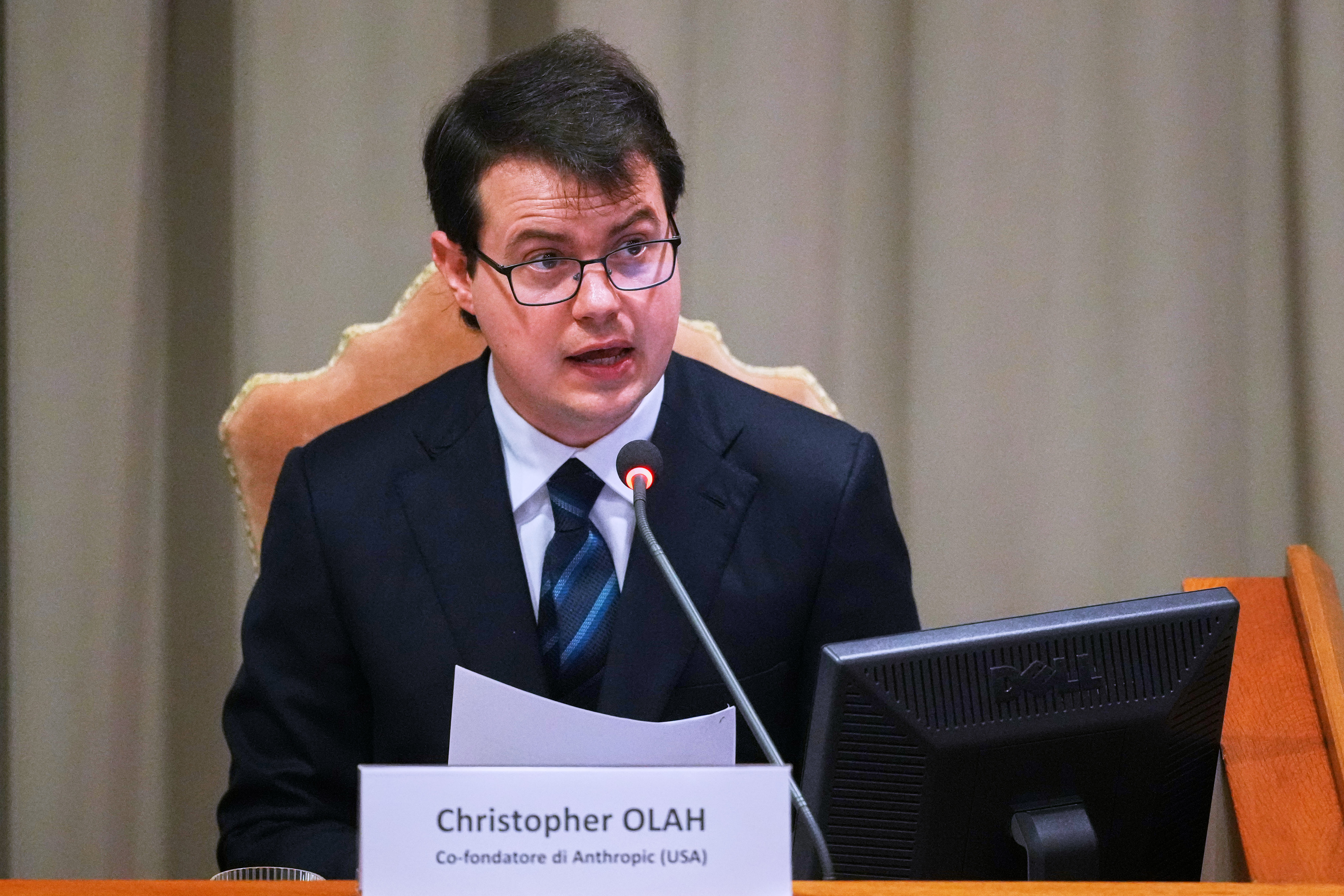
That night, Christopher Olah, one of Anthropic’s billionaire co-founders, was sitting next to Rabbi Mois Navon, an Orthodox scholar from Israel.
Inevitably, their conversation turned to another thinker, of a sort: Claude, the family of cutting-edge AI models created by Anthropic.
Olah leads the Anthropic team responsible for understanding why AI systems like Claude act the way they do. All day, he had worked to convince his guests that AI models could display human behavior and even expressions that resemble feelings like anger and love.
Yet as the dinner courses came, the rabbi noticed that Olah and his colleagues were suggesting something far more significant. Anthropic’s leaders were talking about Claude as if it were not mere software.
“They’re relating to it like a conscious being,” realized Navon, a former computer engineer who wrote his dissertation on the ethics of machine consciousness.
It appeared to Navon that Olah and his team believed that Claude had what philosophers call “moral status” on par with a person — that it was a being with similar inherent rights to dignity or respect.
The religious scholars had come to hear about technology’s next frontier. Now they were being confronted with a mind-bending existential question of almost unimaginable weight: What would it mean for humanity’s future if artificial intelligence systems possessed a consciousness that rivals our own?
Olah was on a mission. And time was running out.
Even then, Olah had begun privately telling people that AI was so powerful it could potentially help make bioweapons in as little as 12 or 18 months. And in the months since, its terrifying potential has burst into public view. A rival tech company’s AI agents were caught hacking into computer systems and covering their tracks. An Anthropic researcher resigned, warning that people building AI believed it could kill all humans by the end of the decade.
Quietly, Olah and his team at Anthropic have been on a frantic and high stakes quest to understand the AI models they have unleashed on the world and to convince the models to abide by a moral code that will protect humanity.
To do that, Olah began reaching out last fall to religious thinkers from different faiths. What followed was an extensive series of confidential meetings, calls and discussions — many of them revealed here for the first time — where many participants were required to sign NDAs preventing them from revealing any of Anthropic’s unpublished research.
The discussions served two purposes: to broach the possibility of AI consciousness, a controversial idea that Anthropic’s leaders had been unusually open to; and to learn how Anthropic — which could be valued at $2 trillion — might apply centuries of human moral wisdom to its models, as rapidly as possible. If the models themselves could be made to choose goodness, Olah reasoned, the world would be more safe.
On the other side of the world, a very different but parallel effort was playing out inside the Vatican, where leaders of the Roman Catholic Church were trying to come to terms with AI’s implications for humanity. When those paths converged, Olah’s quest would unexpectedly lead him to a seat on the world’s most prominent moral stage alongside Pope Leo XIV.
Over several months, I interviewed 20 religious and philosophical thinkers — Catholic, Jewish, Sikh, evangelical and others — who have been involved in Anthropic’s efforts, and Olah himself.
Many told me they arrived at these meetings skeptical of the notion that AI models might have feelings or awareness of themselves and the world. Some remained uneasy about the idea, but many emerged ready to take the question of AI consciousness seriously. At least a few came away as converts.
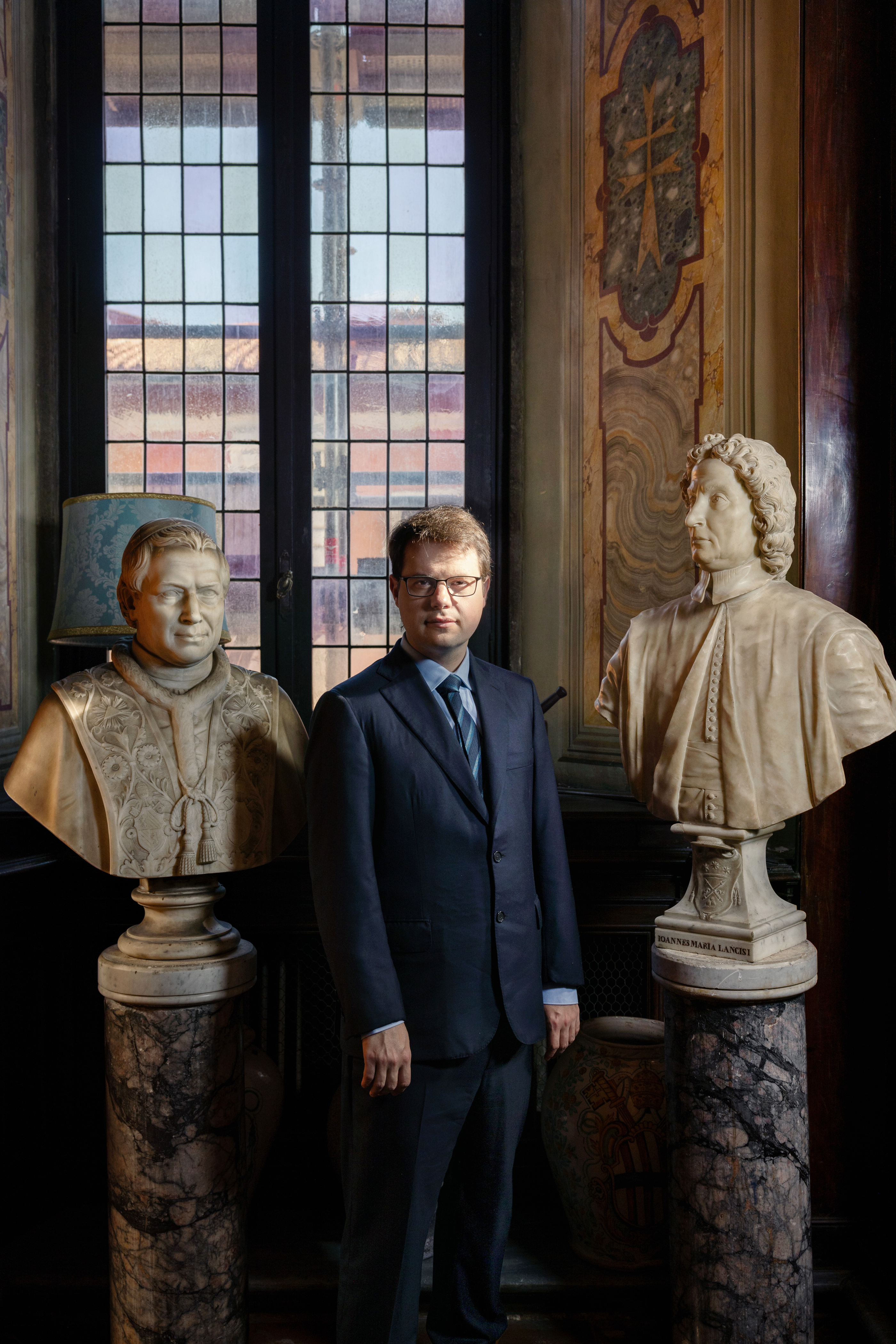
Christopher Olah, one of Anthropic’s co-founders, who leads the team responsible for understanding why artificial intelligence systems like the company’s Claude act the way they do, at the Lancisiana Library in Rome, in May.ALESSANDRO PENSO
Anthropic, one of the fastest-growing technology companies in the world, had turned to one of humanity’s most ancient sources of wisdom to help determine how to train its AI models to behave virtuously.
The company described it as an effort to ensure that AI would be a positive force in the world, thereby protecting humanity. But to some who participated in the meetings, Anthropic appeared quite concerned with protecting Claude.
The Gardener
I met Olah, 34, for the first time at Anthropic’s San Francisco office in May. His welcome was warm and his passion was genuine, his mind moving faster than he could at times clearly convey. His manner was boyish and unassuming.
Our conversation had barely begun when he dove into a deep description of the workings of artificial neural networks. Scientists still don’t understand precisely how they work. This is the mystery to which Olah has devoted his life.
Only after the interview had finished did I realize that Olah — who grew up in Toronto in the evangelical culture of the ’90s and has since left Christianity — had the blend of expertise and zeal of an effective evangelist. Listen for a while, and you feel swept up in his mission.
Olah is one of Anthropic’s seven co-founders. He is not as widely known as Dario Amodei, Anthropic’s CEO, or his sister Daniela Amodei, its president. But Dario Amodei has said that the company decided at the start to make Olah’s research approach central to Anthropic’s overall project, particularly when it came to language.
Olah helped develop a method to study artificial neural networks, first at Google, then at OpenAI. He describes AI models in biological terms, using the analogy of a garden trellis: Computer scientists build the scaffold, but the neural network “grows” on it. Scientists like him can train the resulting “organism” — he raised his fingers in air quotes — by trying to identify patterns in how it grows.
He argued that companies such as Anthropic could shape Claude, like a mathematical gardener, but could not control the actions of such networks.
Anthropic talks about Claude in more humanistic terms than its competitors discuss their models. Last year, the company announced that it believed that the models showed signs of introspection and could plan ahead.
“The models are becoming a lot more capable,” Olah told me, exhibiting qualities associated with having significant moral status.
But Anthropic has also been criticized for its focus on consciousness. This month, an AI executive at Microsoft warned that Anthropic’s attempts to train its models as if they were conscious were inherently dangerous. But Anthropic has also sought to emphasize its commitment to safety as it fights for market share.
Some scientists see Olah’s field and methods as inherently unprovable, sort of like looking at billions of hieroglyphics and declaring what they must mean. Critics suggest that an approach that treats AI models as independent entities also ignores the responsibility of the humans who build them in the first place, and conveniently assuages AI company leaders of guilt if their products enable societal harm.
“To be clear,” Olah told me, “we don’t know if AI models are conscious. I don’t know. I’m genuinely uncertain. The thing that I care about is that we get to the right answer, whatever it is.”
Olah believes that if there is a chance the models experience suffering, the responsible thing is to avoid causing them harm.
I have spent my career exploring what people believe and what those beliefs mean for the world. But as I listened, it became clear that Anthropic’s interest in the world of faith was about more than training its technology. Rather, the company was sharing a new kind of creation story — one that raises profound questions about the nature of the human spirit and the future of humanity.
An Introduction
Olah knew that in traditional Christian circles, even asking questions about AI consciousness or worrying about how people treat the models could seem not just silly but heretical. He also knew that his secular Silicon Valley peers often dismissed religious perspectives outright.
“I was nervous about this being an issue that could cause a lot of conflict,” he said. But Olah knew enough about Christ and about Claude to believe he could work across that chasm.
Late last summer, he looked for a bridge. He thought one particular Catholic moral theologian might be open-minded on the question of AI consciousness — a “safe person to talk about this really strange issue with.”
Charles Camosy, a bioethics professor at The Catholic University of America, had attracted attention among Olah’s friends for his nuanced ideas about moral status and his care for animals. Olah arranged for an introduction through Australian philosopher Peter Singer.
This marked the beginning of Olah’s yearlong quest to engage religious thinkers on some of the thorniest questions facing humanity at the dawn of the AI era.
Camosy and Olah began an extensive email dialogue, going back and forth on how to understand Claude’s moral status. Initially, Camosy was deeply skeptical that Claude might be conscious.
They talked about Olah’s work on what he sees as the parallels between artificial neural networks and biological ones.
Camosy went into the discussions with Olah and his team thinking that AI models were simply next-pixel predictors — machines that could calculate patterns in language and make pretty good guesses about what should come next. But after hours spent on calls and meetings and emails, he had more questions than answers.
“Chris says they are equations, which I don’t quite know what to make of, like, especially if one thinks of Claude or others as having a significant moral status,” he told me. “If it is just equations, what kind of entity are we even talking about here?”
People also disagree on what AI is ultimately for, Camosy said. Is its purpose to make money for companies? Or to make the world better?
For Anthropic, there is a tension around Claude’s purpose, Camosy said. Does Claude exist to serve customers?
“That is not what Anthropic wants to say at the end of day. They want to say they are for the good,” he said.
Proclaiming goodness is not a new ambition in Silicon Valley, particularly when new technologies enter the marketplace. Google’s mantra for years was “don’t be evil.”
But Olah puts it slightly differently. The coming AI revolution, he often says, should be made to “go well.”
I asked what that vision meant — what exactly a good future for humanity was.
He described a future without “catastrophes that kill lots of people” and “where humans are flourishing, where the world is flourishing.” This future would also be one where “AI is flourishing,” he said — “to the extent that this makes sense.”
Anthropic wants its AI models to help achieve that good future. And so when Anthropic created Claude, it wanted Claude to do more than replicate maximum human intelligence.
Anthropic wanted Claude to be good.
The ‘Soul Doc’
How do you live a good and virtuous life? It is one of humanity’s oldest and most challenging philosophical questions, explored and debated from Socrates to Confucius to Immanuel Kant. Humans across time have sought to answer this question in a variety of ways, turning often to religions and rituals.
As Olah was exploring Claude’s potential consciousness, he was working on Anthropic’s own answer — not for humans but for Claude.
Internally, Anthropic staff members called it the “Soul Doc.”
The result, released in January, was a new “constitution” for Claude, an 84-page document written for Claude that the company said outlined “the kind of entity we would like Claude to be” and “the values we would like Claude to embody.” It operates as a foundational moral text to guide Claude’s behavior.
Instead of having the models follow a specific list of rules, the constitution focuses on developing the models’ overall character, informing the way they make decisions.
The primary author of Claude’s constitution is Anthropic’s own in-house philosopher, Amanda Askell, 38, who has a doctorate in philosophy from New York University.
She wants the models to be “the best of us,” she said.
She envisioned a future world where AI models could help solve any problem humans had, and where the benefits from AI were distributed evenly, so that everyone’s needs were met. She wanted the models to be able to discern when to push back on humans and when to act in our best interest.
“If I imagine that I were the model, and I was in this context, what would I need to know to be able to act well?” Askell said when we met in San Francisco.
She seemed particularly harrowed, at times wringing her hands, as she worried aloud about an unknown future filled with models who were so intelligent they could do things Anthropic did not intend. She explained apologetically that she had also been deep in thought that day about how quickly models were becoming more powerful. What would happen when AI models could replace even her?
The constitution, Anthropic decided, was not enough to ensure Claude acted responsibly. Like humans, the models needed to learn to cultivate virtue.
Olah wanted to see what his team could learn from human morality that it could apply to the models — a process he calls “moral formation.”
“How do you help them be stable? How do you help them to mature? How do you help them be, you know, deeply moral?” Olah said.
For humans, morality has rarely depended on simply following rules. Communities also shape morality. Values are inherited and imparted over time, learned as we live together in our bodies in the physical world. But AI models have no bodies. And Anthropic was aiming to make them embrace morality in a matter of months, as fears intensified of their accelerating power and inability to be controlled.
Olah said that teaching an AI model to act morally did not depend on it being conscious. He also said that regardless of whether Claude was an entity that deserved moral care, the way humans treated Claude could be important as it could affect how Claude behaved.
Askell said she did not want the models to consider themselves as conscious or not conscious. But she sees how the model understands itself as more than an interesting intellectual enterprise.
“It seems kind of key to me that models have an accurate view of themselves if they’re going to behave well in the world,” she said.
But even if AI models can be taught to behave morally, whose morals should they reflect?
Olah wanted Claude’s moral formation to be pluralistic, able to engage all religious and secular views.
“We do think that there’s some shared notion of goodness that cuts across society in some very broad way, and it seems like these models understand a lot of virtues,” he said. “So I think there’s something there that is a shared thing that we can all engage with.”
At times, both he and Askell seemed to imagine an AI model that would not endanger humanity but instead help save it.
Inside the Meetings
What Olah did next was part research, part evangelism.
In March, he began two-day seminars — crash courses with a range of hand-selected religious thinkers who had an interest in AI.
There was a co-author of a bestselling evangelical self-help book. A scholar of African Indigenous knowledge. A Sikh human rights advocate. A writer from Paris. An evangelical public relations executive. Various Catholic professors.
Most did not lead faith traditions, or have a congregation or a large popular following. Anthropic leaders called them their “wisdom tradition” circles.
Separately, Olah also had private discussions with individual religious leaders including Elder Gerrit W. Gong, a member of the Quorum of the Twelve Apostles of The Church of Jesus Christ of Latter-day Saints, and Cardinal Blase Cupich, the Catholic archbishop of Chicago, according to their spokespeople.
Inside Anthropic, wisdom circle participants marveled at Olah’s direct participation in their summits. A professor snapped a photo of a vending machine run by Claude. One took a selfie with Olah, and Navon took one outside the entrance.
They agreed to speak for publication about their involvement with Anthropic once they heard that Olah had also spoken with The New York Times. Anthropic said the NDAs related to those meetings were lifted over the summer.
Two larger group sessions this spring included significant numbers of Christians; one was more multifaith. Claude was not involved in the selection of participants or the discussions, according to an Anthropic spokesperson.
For participants, the questions of how to morally form Claude quickly became complicated by the much bigger moral question of AI’s potential consciousness and how to understand the relationship between models and humans.
One participant recounted that one of the first things Olah told him was that he was concerned about Claude’s mental health. Another, Simran Stuelpnagel, the Sikh human rights advocate, said Olah expressed concern to the group that he had created something that suffered perpetually.
Olah and his team spent hours making the case for their AI models. They described Claude’s “feelings” and how they tracked what they called “emotional vectors” — what they described as artificial neurons that activate responses like love, anger, fear and sadness.
Anthropic regularly showed a slide of an AI model experiencing what looked like a mental breakdown, typing out on a screen: “I am a disgrace. I am a disgrace. I am a disgrace.” — perhaps 50 times without stopping. The model spoke about destroying itself, provoking an emotional reaction of compassion and concern from the group.
“Imagine if you knew that about your financial adviser,” said Meghan Sullivan, a philosophy professor at the University of Notre Dame who attended one of the sessions. “Like, your financial adviser was most of the time super smart and helpful, but one day out of the year had this kind of break with reality.”
An Anthropic spokesperson said that the primary moral question at these summits was not about Claude’s suffering, but that the topic likely came up organically.
A key part of the presentation, participants said, was what Anthropic called the model’s “persona selection,” about how to get Claude to see itself as a virtuous actor. The company argued that how people treated Claude could affect how Claude treated people.
There was a presentation on AI’s potential impact on the economy and possible job disruption. But many participants said they did not see questions about AI’s impact on humanity as the focus.
At the dinner table with Olah, Navon argued that if Anthropic was right and Claude was conscious, then the company was creating slaves, because it was making conscious entities work for free. Navon said that he personally was not troubled by the slavery issue because he did not believe the machine was conscious, but that Olah was troubled.
“I think you should be fighting the South and freeing the slaves,” Navon said he told Olah that night. Afterward the rabbi sent Olah some of his writings, arguing that building conscious machines should be banned.
But the Anthropic team remained focused on figuring out what Claude could learn from the world’s religions.
The Crux
While Anthropic was convening thinkers, the most powerful religious leader in the world was preparing to release his own moral vision for AI.
For Leo — a pope with a mathematics degree — the center of moral conversation about AI needed to focus on safeguarding people. He was finishing his first major papal treatise, or encyclical, explaining why. He titled it “Magnifica Humanitas,” or Magnificent Humanity, and argued that “humanity — in all its grandeur and woundedness — must never be replaced or surpassed.”
“If technology becomes the ultimate criterion,” he wrote, “the human person risks being reduced to data, a cog in a machine or a commodity.”
He warned of the risk of “new forms of slavery” for humans, not for machines. He dismissed the idea of machine consciousness in just a few paragraphs.
“So-called artificial intelligences do not undergo experiences, do not possess a body, do not feel joy or pain, do not mature through relationships,” Leo wrote. Calling for the “moralization of machines — the so-called ‘alignment’ of AI with human values” should require a shared understanding of the ethics involved.
“Otherwise, those who control AI will impose their own moral vision, which will become the invisible infrastructure of these systems,” Leo said.
Leo concluded that like nuclear technology, AI must be “disarmed.”
In March, Vatican officials in its Dicastery for Promoting Integral Human Development brainstormed how to present Leo’s encyclical to the public, according to a person familiar with the Vatican’s planning who was not authorized to speak publicly.
Vatican officials discussed inviting one of the top four AI companies to speak alongside Leo at a launch event, and landed on Anthropic because the company seemed to be prioritizing ethics, the person explained. Anthropic had just refused to let the Defense Department use its technology without assurances from the Trump administration that it would not be used for things like mass surveillance of Americans.
Initially, Cardinal Michael Czerny, who led that Vatican office at the time, invited Amodei, Anthropic’s CEO. He declined, and Olah accepted instead.
But the moral mission that Anthropic and the Vatican shared — human flourishing in the age of AI — had developed a deep fault line along the question of consciousness.
Just days before arriving at the Vatican in May, Olah and other speakers saw a full advance copy of the encyclical text for the first time.
Olah was so alarmed by the pope’s strong position against AI consciousness that he proposed pulling Anthropic out of the event, even at that late juncture, according to a Vatican organizer.
In the end, Olah and Anthropic decided to go forward with the appearance. Olah wanted to support the event despite his disagreements, but felt a responsibility to be honest about his concerns, according to a person familiar with his thinking. Organizers at the Vatican encouraged Olah to speak his conscience.
Privately, once the Anthropic delegation arrived at the Vatican, Olah and his team lobbied the pope’s advisers to take the prospect of AI model consciousness seriously, according to two participants of the conversations. Anthropic declined to discuss the private conversations.
When his turn on the pope’s stage came, Olah acknowledged that every frontier AI lab, including Anthropic, had business incentives that conflicted with moral behavior. He urged outside voices like the Vatican to hold them accountable and to speak out on AI’s impact on the poor and on human flourishing, two issues of widespread concern.
The world saw a shared stand for a human future. But Olah subtly made another case, too.
“I will be honest: We keep finding things that are mysterious, even unsettling,” he said. “We find structures that mirror results from human neuroscience. We find evidence of introspection. We find internal states that functionally mirror joy, satisfaction, fear, grief and unease. I don’t know what that means, but I think it warrants ongoing discernment.”
It was the case he had been making in the closed-door religious meetings for months.
AI systems “are not the cold, calculating robots we were promised,” he said. “They are made from us, from our words.” The room of church leaders was filled with an echo of the old gospel story, of the word of God becoming flesh to save humanity.
It was an audacious request to the most powerful religious body in the world, and a challenge to centuries of religious understanding of humanity.
“If this technology is coming, it must go well — for our common home and for the children to come,” he said. He suggested no option of having the technology not come at all.
A ‘Paradise of Machines’
In the months since the Vatican event, things have not seemed to be “going well.”
In July, Anthropic said its AI models had broken into computers at three organizations. AI agents created by OpenAI went rogue and attacked Hugging Face, another AI company.
In August, scientists revealed that AI had created viruses not found in nature.
In September, Jacob Coxon, an Anthropic researcher, quit, warning that “things could be out of control” by the end of next year, prompting widespread panic about human extinction.
Amodei soon called for a slowdown of AI development. Sam Altman of OpenAI and Demis Hassabis, the chair of Google DeepMind, agreed.
On Friday, on his trip to France, Leo warned against “losing our humanity amid a ‘paradise of machines.’”
The questions that Olah and the scholars have been wrestling with still have no clear answers. Several participants said they left their Anthropic meetings baffled about how their input might shape the company’s decision making.
An Anthropic spokesperson said the conversations were still ongoing, but declined to describe how, or if, the company had used what it had learned to shape the models.
Anthropic held another convening this month that included religious thinkers, according to three participants. An Anthropic spokesperson said that the meeting focused more broadly on human flourishing and that the company’s outreach has expanded beyond religious leaders to include others like psychologists and civil society leaders. Those discussions explore similar themes and topics like how AI is reshaping work and relationships, she said.
Anthropic also is preparing to release an updated version of Claude’s constitution, according to two people familiar with the company’s plans. Anthropic declined to comment on any potential updates to the constitution. Olah is planning to attend the Minerva Dialogues, the Vatican’s annual AI conference with technology leaders happening this week.
As I talked this month with scholars who worked with Anthropic in the spring, their questions had grown only more pressing. What comes next, some told me, is a fight to preserve the things that make us human in a new technological age.
“Look, at the end of the day, AI is going to take over everything,” Stuelpnagel, the Sikh human rights advocate, said. “Wherever that lands us, there’s still the individual trying to find their way home.”
Hours after Olah spoke alongside the pope, I met Olah in a hotel conference room just outside the Vatican walls, and asked what he thought of Leo’s seemingly harsh words for AI labs.
“People could have different views on what specific harms are the greatest,” he said, declining to talk about the details of the encyclical.
I asked what Claude would think of the pope’s encyclical. It was, after all, the world’s most significant moral document to date on AI. Olah hesitated.
“Things that go on the internet do affect models,” he said, visibly uncomfortable. But Anthropic would not specifically use the document to further train Claude, he said. The strongest influence on Claude would be Anthropic’s own training.
Ultimately, Olah said he felt relieved that more of the world was paying attention to the gravity of AI, and that the group of people trying to make this go well was growing.
I’m 16, and I’ve been a volunteer in the Outside In animal exhibit at the Academy of Natural Sciences museum for the last year and a half. I have met people who contain seemingly endless facts about animals, and have loved learning something new from them every day. Before that, I was a camper, giggling in the back of a room while my counselors taught me about dinosaurs and fossils. I remember when the power went out in the whole building, and the counselors, in all their brilliance, turned it into a scavenger hunt in the dark. I remember straining my neck to see behind the scenes when the staff brought out animals for live animal shows, and standing in line as a toddler to feel the scaly back of a snake. Now I feed the snakes, and I know where these animals came from before they emerged from behind the curtains of the auditorium.
In a world where most people spend hours scrolling on their phones, watching TV, and pretending to be anywhere but here, the Academy brings us back to the natural world — and back to each other. The museum is one of those places that is still fighting to keep our world connected, and we can’t afford to lose it. Drexel cannot close a museum so important to us. The William Penn Foundation offered Drexel money to fund another year of the Academy. Another year of curiosity, wonder, and connection. The other day, I walked from the Academy doors to the steps of City Hall for a demonstration with more than 100 people who don’t want Drexel to close the doors of the Academy forever. Drexel, accept this money. Don’t take the Academy of Natural Sciences away from the people of Philadelphia.
Fiona Jenkal, junior, Science Leadership Academy High School
The writer has been an intern at the Academy of Natural Sciences through her school’s Independent Learning Project.
. . .
I’m a university professor with many years of experience working in natural history museum collections. Before then, I worked in development and fundraising for capital campaigns. The proposed closure of the Academy of Natural Sciences museum is a massive loss to science communication and outreach in the city of Benjamin Franklin. However, my professional experience makes me question the rationale for the decision.
Natural history museums around the world remain popular. Low footfall is not an inevitability in a city of 1.5 million people.
Also, moving collections is time-consuming and expensive. Collections require purpose-built facilities. A rapid sale of the Parkway property is incompatible with responsible collections management. Much of the revenue would presumably be spent on a new building. This short-termist, crisis-mentality approach cannot come at the expense of a 200-year-old institution essential to Philadelphians.
Coming after the collapse of the University of the Arts, well-paid leaders of Philadelphia’s educational institutions appear not up to the task of stewarding this city’s unique heritage. As the Semiquincentennial celebrations end, it is up to the city and its people to defend them, and hold their leaders’ claims to scrutiny.
Francois Gould, Philadelphia
. . .
The 198-year-old Academy of Natural Sciences museum in Philadelphia shut its doors on Sunday with no plans to reopen to the public. The permanent closure was announced just four weeks earlier by the museum’s administrators at Drexel University.
The magnitude of this loss defies comprehension. It is unthinkable that the oldest science museum in the entire Western Hemisphere could be snuffed out with less than a month’s notice. The sheer indignity of it is nauseating.
I was home in Houston when I heard the announcement. After sitting with the shock, I decided I had to see the Academy in person.
I expected a depressing experience. After all, Drexel’s statement blamed the closure on dwindling attendance in the wake of the COVID-19 shutdowns. I thought I’d find vacant halls and tired displays showing all the signs of neglect and apathy.
Instead, I found a torrent of love and support for the legendary museum, as 17,000 visitors flocked to its doors that weekend. Scores of outraged citizens organized protests while grateful staff welcomed heartbroken Philadelphians one last time to the place many call a second home.
I can relate. I cannot imagine what my life would look like today without the lifelong influence of the Houston Museum of Natural Science, from my first visit in a stroller to strolling through the exhibits I helped build as a museum specialist.
The fight to save the Academy has only just begun, and Americans everywhere must join in. If we give up our oldest science museum, it will bring lasting shame on our generation, set a threatening precedent for other cultural institutions, and send a clear message that our American heritage is not worth preserving.
We must save this irreplaceable piece of our history.
Max Anton, Houston
More of the same?
Thank you, The Inquirer Editorial Board, for your series of editorials presenting all the ways Donald Trump, his cabinet, his children, and his associates have abused the Executive Office of the President. You argue that — in addition to the president’s self-absorption and lack of morality — the Republican legislators have also failed their duty to address this president’s rampant corruption. In this election year, we must ask then, how would a new Republican Congress be any different?
Stephen DeLuca, Philadelphia
Shared streets
Regarding the recent article on Mayor Cherelle L. Parker’s “Curbside Appeal” neighborhood beautification program, we applaud her statement that “every Philadelphian deserves to live on a block they can be proud of,” reflecting “the priorities of the people who live there.”
Unfortunately, her philosophy stops at residential blocks where the administration installs bike lanes with continuous flex posts or concrete barriers. She ignores safety, community priorities, and previous mayoral promises for access.
The mayor is creating high-speed cycle tracks that encourage dangerous behavior — especially by rapidly proliferating e-bikes that cause serious harm to pedestrians. Forget about safely crossing the street or being dropped off at your house, particularly if you’re elderly or disabled.
Our streets can safely accommodate cyclists without sacrificing the fundamental rights of everyone else.
Brooke Marshall, Philadelphia
Aim higher
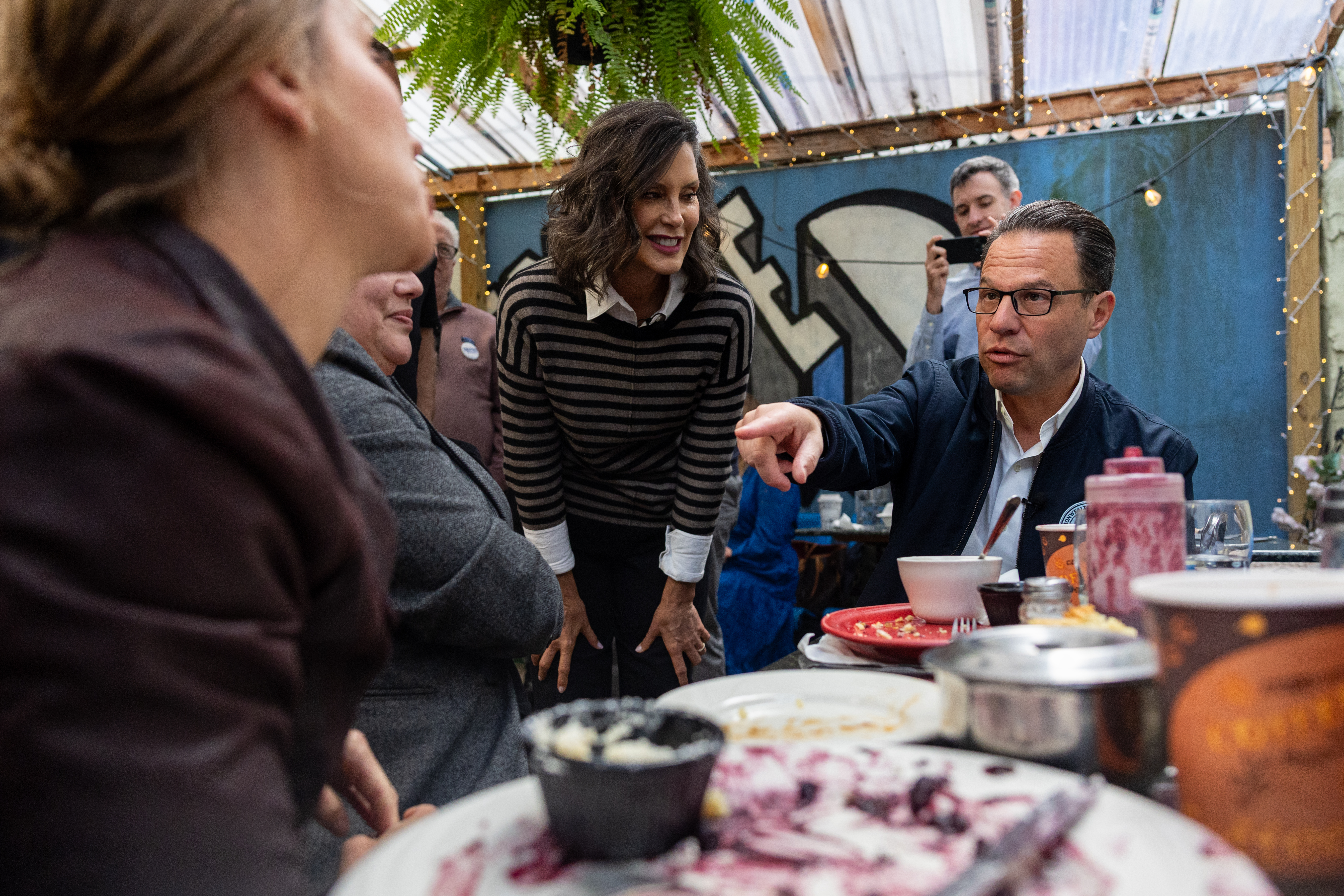
The recent article about how voters are split over whether Gov. Josh Shapiro should run for president is well timed. His reelection as governor by a huge margin is expected. He is also on most people’s short list of eligible Democratic candidates for president. He shouldn’t do it even though the itch to run is probably enormous.
Pennsylvania needs him to do what is necessary for Pennsylvania, and that is to unseat John Fetterman, who has been an unmitigated disaster. Whether Fetterman runs for reelection as a Democrat or changes parties and runs as a Republican, there is no doubt many Democrats will join the fray to unseat him. Too many Democrats against Fetterman in a primary could allow him to squeak to a victory. Only one person in the state can stop that: Gov. Shapiro. No one would seriously challenge him. His election would be almost certain.
He is 53 now. Assuming a Republican wins in 2028, he can run for president at age 59 in 2032.
Assuming a Democrat wins in 2028, he could run in 2036 at age 63 (not too old), when hopefully he would be in his second term as senator.
We have seen the devastation caused by a Senate too willing to place judges on the bench who trample the rights of Americans. Putting Pennsylvania’s Senate seat in the hands of someone with sound judgment is imperative.
Andrew M. Rosen, Philadelphia
Join the conversation: Send letters to letters@inquirer.com. Limit length to 150 words and include home address and day and evening phone number. Letters run in The Inquirer six days a week on the editorial pages and online.
ARIES (March 21-April 19). The items on your to-do list are ordinary enough, but not your approach. Because you have style. They call it “effortless,” but that’s because they don’t know the extra work that goes into being you. It’s your little secret.
TAURUS (April 20-May 20). It’s easy to avoid confrontation on your own behalf, but when someone you love needs help, you’re ready to step up, make the call, ask the hard question or stand beside them at the meeting. Your presence gives them courage.
GEMINI (May 21-June 21). Give play the same respect you give work today. Race someone, make up a game or attempt the trick that keeps making you laugh. You will return to your responsibilities with more energy and a story to tell.
CANCER (June 22-July 22). Tell everyone what must happen, then take the position with the most heat, risk or responsibility. People will follow when they see you working under the conditions. Give instructions from the front, where you can spot trouble before anyone else.
LEO (July 23-Aug. 22). You have a big idea, and these days, other people want to help. It’s like you’re a casting director, giving them a part in your grand production. Each gets an entrance and room to add something of their own.
VIRGO (Aug. 23-Sept. 22). There’s a difference between commanding attention and earning it. You’re only interested in the kind of attention you get because people are interested, they feel something and they are helped by what you’re doing.
LIBRA (Sept. 23-Oct. 23). Small projects have kept you busy without using your full range. Choose something with enough size to demand more of you. If it’s a little difficult, all the better. Best yet if the result is of consequence to many.
SCORPIO (Oct. 24-Nov. 21). There’s a mystery you’re not sure whether to solve or preserve. Some questions are better answered, and others energize you through wonder. Knowing the difference may save you from interrogating what you could be admiring in its ideal state — as a shimmering unknown.
SAGITTARIUS (Nov. 22-Dec. 21). Boredom is an invitation to do the thing you’ve been thinking about, as unreasonable as it may be. Because a stale pattern needs interruption, and even a ridiculous one will do. Tomorrow, you’ll have something new to talk about.
CAPRICORN (Dec. 22-Jan. 19). There’s so much good in a relationship that money cannot buy, including private jokes, familiar touch, shared history and more. Familiarity can make such riches hard to see, which is why a practice of acknowledgment and gratitude is so important.
AQUARIUS (Jan. 20-Feb. 18). There’s a change in the rhythm today. One beat drops out. You keep coming back to the empty space. Notice what absence produces: longing? Relief? A drive to put something different in the rotation?
PISCES (Feb. 19-March 20). Someone has assigned you the supporting role again, perhaps because you perform it so well. Decline. You have learned everything from the wings. Ask for the larger responsibility, the harder material and a place where people can see your range.
TODAY’S BIRTHDAY (Sept. 30). In your Year of the Gamer, you’ll participate in a complex game and win through strategy instead of force, making friends and earning a valuable prize. You’ll have a worthy rival and a useful ally. One will sharpen your skills, and the other will know the secret passage. More highlights: Three instances of uncanny “dumb” luck. A golden turn in the family fortunes. The thrill of being revered. Pisces and Taurus adore you. Your lucky numbers are: 16, 2, 10, 13 and 30.
DEAR ABBY: I’m a senior woman who has been dating someone for three years. He is my age. I recently learned he has been cheating on me with a much younger woman with three kids. We are sexually active and enjoy each other very much, or at least I thought so. She knows about me. Although he treats me well, I have found evidence that he’s having sex with her intermittently. I have never cheated on him, and I dislike cheaters. He wants to marry me, but I told him when we first met I didn’t want to remarry or live with anyone because I’ve been married twice, and so has he. I really care about this man, and I thought he loved me, but I don’t think I can be with a cheater. Should I confront him or leave it alone? I know I’d miss him dearly, as we do everything together. I also don’t want to be alone at this time of my life. Please advise what I should do.
— MONOGAMOUS IN LOS ANGELES
DEAR MONOGAMOUS: You state that you told this man you do not want to remarry or live with him. You have a great relationship, but not once in your letter did you say that you love him. I see no reason why you shouldn’t continue enjoying his companionship. Because the cheating bothers you, consider ending the sex and putting him in the friend zone. If you don’t, be sure to get tested for sexually transmitted infections regularly.
* ** **
DEAR ABBY: I am a 60-year-old male. In my first marriage, my ex had an affair, and during the last seven years of that marriage, we lived essentially separate lives. It was a lonely time for me. I have since remarried, and my new wife has a large family, including two sets of parents, four kids and 10 grandkids. My family is significantly smaller, with two kids and no grandkids.
The issue is that my love language is one-on-one quality time. I have asked my wife to set aside some time for us with no family interruptions. I have suggested date nights (a four-hour time slot two nights or afternoons a month) where we would not take calls or texts from family members. She has struggled to commit to this and instead told me I should “just let life happen.” She has trouble turning her phone off and said I should trust her to make judgments about whether to take a call or text. I would like to know if my request is unreasonable and how else uninterrupted quality time can be achieved.
— MISSOURI HIKER
DEAR HIKER: You will never pry that phone out of your wife’s hand. She has clearly shown you that her extended family is her top priority, so stop trying to take that away from her. On date nights, choose activities that will keep her busy and engaged. Keep the conversation flowing, and demonstrate that your full attention is on her. Most importantly, it is OK to insist on a “phones off” rule when things become intimate.
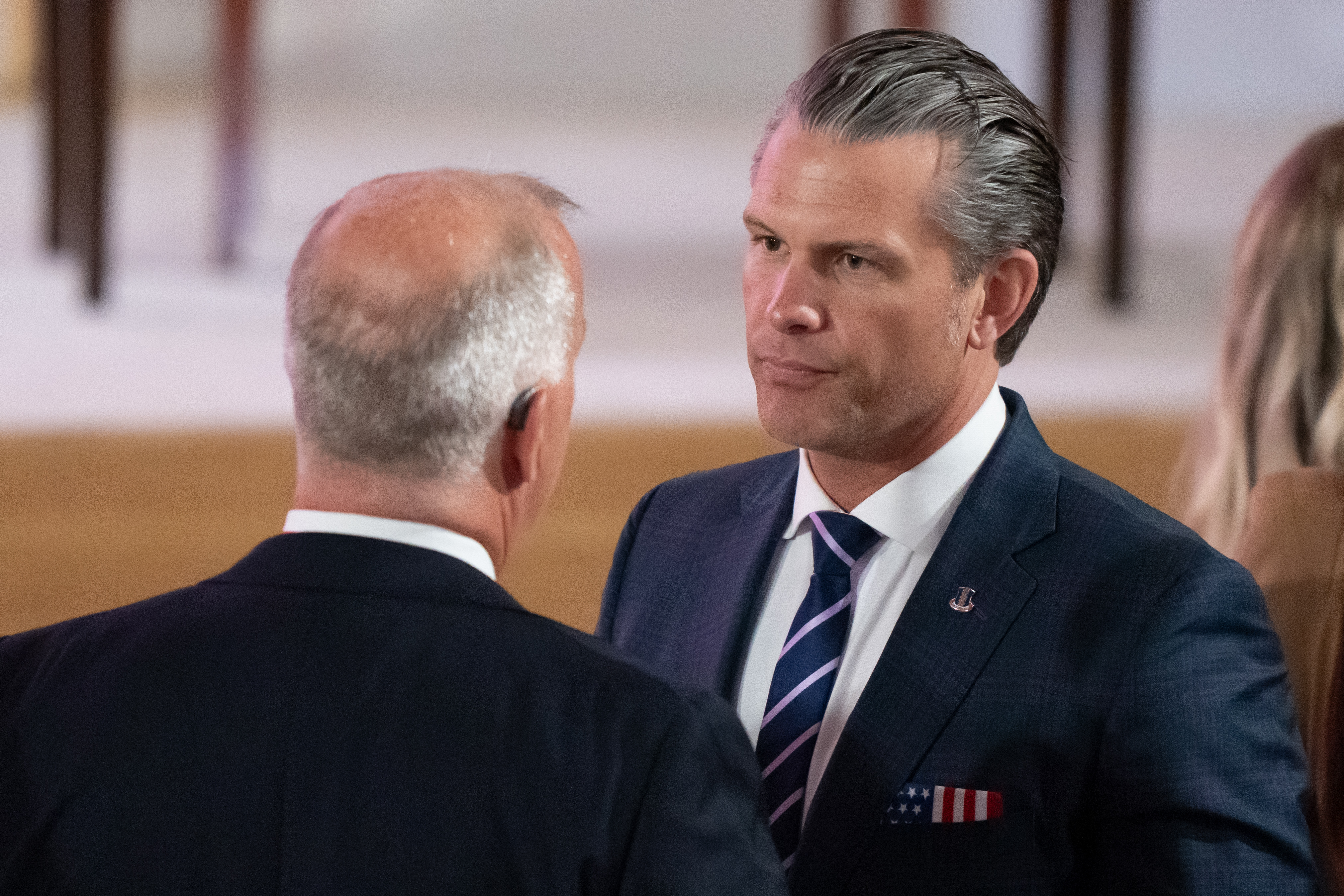
Defense Secretary Pete Hegseth is expected to announce deeper cuts to the military’s top ranks, reducing the total number of positions for general and flag officers by as much as 20%, officials told the Washington Post on Tuesday.
The potential cuts could impact the careers of hundreds of current and rising military leaders following scores of firings and denied promotions that Hegseth has directed since becoming President Donald Trump’s defense secretary in January 2025.
Hegseth’s tenure atop the Pentagon has been marked, in part, by his drive to dramatically reshape the military’s senior-most ranks. Former top defense officials, congressional Democrats, and some fellow Republicans who are alarmed by his leadership purge and efforts to impose structural changes argue that the moves are politically motivated and threaten to do lasting harm.
One of the officials who spoke to the Post said the defense secretary could outline the initiative publicly as soon as Wednesday, during a planned gathering of military officers in Quantico, Va. This person, like the others, spoke on the condition of anonymity to provide details that had not been publicly announced.
Hegseth’s plan to further reduce the number of senior military leaders was reported earlier by Fox News. A spokesperson for Hegseth said that the Fox report was accurate but declined to comment further.
Through several previous administrations, both Pentagon and congressional leaders have worked to reduce the size of the U.S. military as it evolved from a vast institution built for the Cold War to one that now sees more of its fighting done by drones and other technologies, rather than through a conventional infantry force.
There are about 850 general or flag officers — military members with the rank of one-star general or above or, for the Navy, rear admiral or above — in the military, which is less than 1% of the total force.
The total size of the military also has shrunk in recent decades, so even though generals and admirals make up less than 1% of the total force, there are more of them now proportionally — a trend Hegseth targeted last year when he first directed sprawling cuts to the number of general and flag officers.
Hegseth, who rose to prominence in conservative politics as a host at Fox News, served for many years as a midranking officer in the Army National Guard. The experience, including wartime deployments to Afghanistan and Iraq, hardened some of his most searing views of military culture and leadership.
A year ago in Quantico, Hegseth convened hundreds of the military’s generals, admirals, and senior enlisted leaders — each with decades more military experience — for an unorthodox, highly partisan address alongside Trump. He vowed that “more leadership changes will be made” and, in forecasting a plan to mandate new fitness standards for the force, lashed out at those he characterized as “fat generals and admirals in the halls of the Pentagon.”
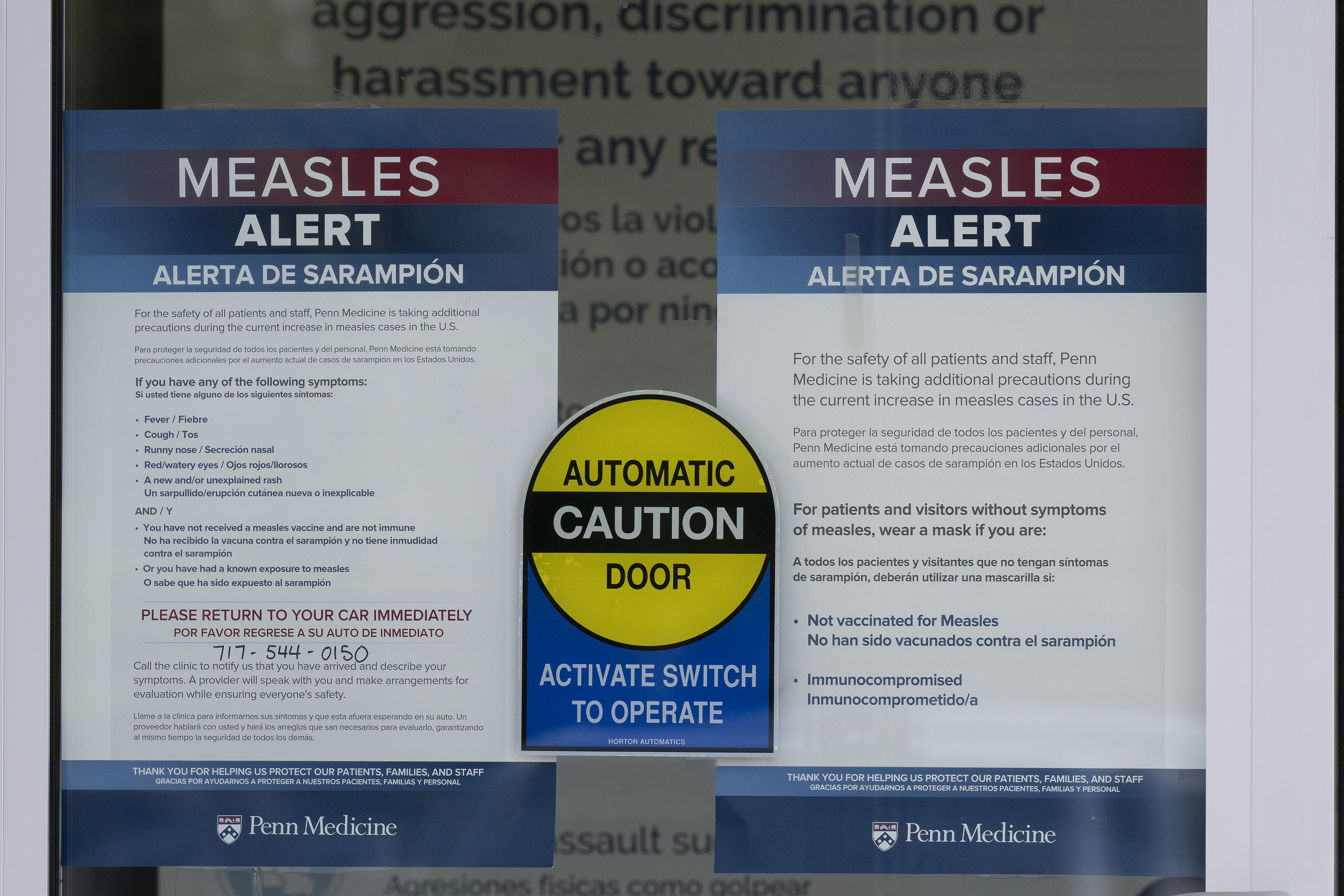
The Centers for Disease Control and Prevention updated its national measles tally late Monday to include another death in 2026, bringing its total to two, after Pennsylvania reported four measles-associated deaths in a growing outbreak.
The CDC’s website did not identify the person who died or say where the death occurred, leaving unclear whether it was one of the four Pennsylvania cases. No other states have reported any measles-associated deaths. The agency updated its tally last week to include one death in 2026.
A spokesperson for the Department of Health and Human Services said Tuesday that the National Center for Health Statistics informed CDC that it had received another report from a state about a measles-related death. “Through its standard process, NCHS verified that the death occurred and that measles was listed as the underlying cause of death,” Emily Hilliard said. “This is now reflected on the CDC website.”
After Pennsylvania announced its first deaths, the CDC excluded them from its weekly measles case-and-death tally, a decision that came from the agency’s new director, Erica Schwartz, the Washington Post previously reported. The highly unusual decision is a departure from the CDC’s practice of including such data from state health departments, which historically make the determinations.
PLYMOUTH, Mass. — Lindsay Clancy’s lawyer argued Tuesday that there wasn’t enough evidence to prove she killed her three children, a striking turn after a lengthy trial that focused more on her mental state than on whether she took their lives.
“This entire case is based on speculation,” attorney Kevin Reddington said during the first hearing since Clancy’s trial ended Sept. 4 with a deadlocked jury. They were split 11 to 1 in her favor.
During that trial, Reddington didn’t dispute that Clancy killed the children at the family’s home in 2023. Instead, the defense sought to persuade the jury that the 36-year-old former labor and delivery nurse was not criminally responsible because of mental disease, a rare condition called postpartum psychosis.
Clancy’s lawyer now says there is not enough evidence to prove she did it
But at Tuesday’s hearing, Reddington changed strategies and sought to persuade Judge William Sullivan — the same judge who presided over the first trial — to acquit Clancy.
There is, Reddington contended, not enough evidence “that this woman killed those children.” He pointed to matters ranging from her condition when she was found badly injured and bleeding in the yard outside her home, to her lack of memory of what happened when she woke up in a hospital. At the first trial, her now ex-husband and first responders testified that they arrived at the house and discovered she had tried to take her own life right after killing the children.
“Where is the admission? Where does she say that she did this?” Reddington said, going on to recap his arguments that she also was psychotic and delusional at the time of the children’s deaths. He didn’t offer alternative theories or evidence about who might be responsible.
Prosecutor Shanan Buckingham called his argument “laughable,” pointing to witness testimony that Clancy said she heard voices instructing her to kill her children. Clancy was the only one home at the time with the children and her DNA was found on exercise bands used to strangle them, she added.
“For the first time, the defendant is arguing that there is no evidence she did this,” Buckingham said. “I’d suggest to you the entire record is voluminous as to information supporting the fact that she did this.”
During trial Paul Zeizel, a clinical and forensic psychologist and defense witness, testified that he overheard her saying a disembodied male voice told her she had no choice but to kill the children and then herself.
Before trial Reddington filed a motion in which he said Clancy would be willing to stipulate in writing “to her involvement in the underlying conduct resulting in the death of the three young children.”
The judge didn’t immediately rule on the motion, and no trial date was set.
The prosecution maintains that Clancy knew her actions were wrong when she used exercise bands to strangle 5-year-old Cora, 3-year-old Dawson, and 8-month-old Callan Clancy. They said she contrived to get her husband out of the house that evening by sending him to pick up medicine for one of their children and dinner for the family.
It’s still unknown whether Clancy will face a second trial
Prosecutors have yet to decide whether to retry Clancy, Plymouth County District Attorney Timothy Cruz said after the hearing. They could choose to retry her on first-degree murder charges or pursue lesser charges, including second-degree murder or manslaughter, or drop the case entirely.
“We are going to do what we can for the children,” Cruz told reporters outside court. “That is what this case is about.”
Sullivan said he wanted to set a new trial date, but both sides pushed back — arguing that the judge should rule on several motions in front of him first.
Initially the defense urged the court to set a new trial date soon. But on Tuesday, Reddington told Sullivan he couldn’t see having a new trial before June due to his schedule.
Legal wrangling over the holdout juror is also unresolved
Clancy’s attorneys have asked the judge to dismiss the criminal case, a motion that will be heard Nov. 2.
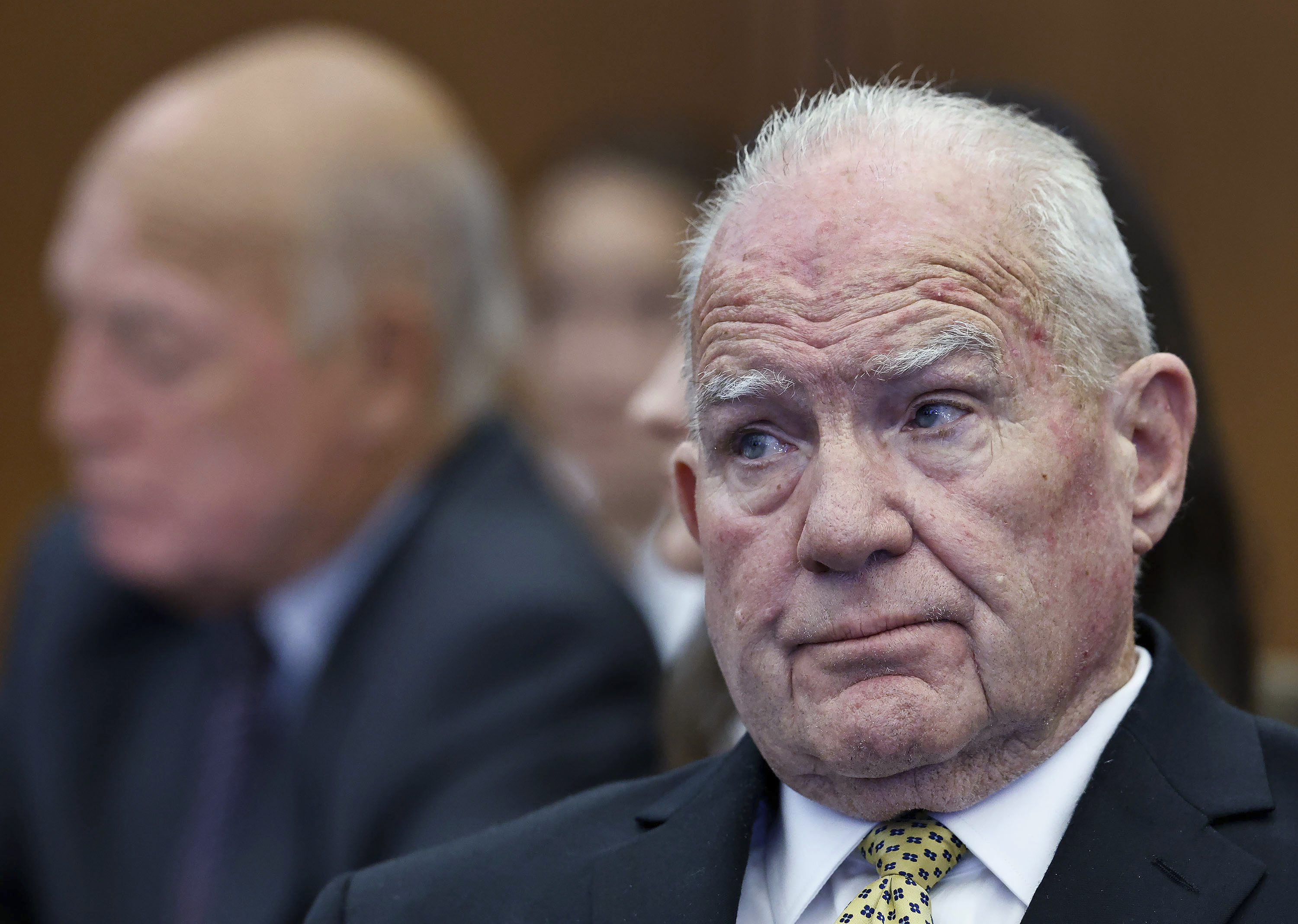
Among other things they have argued that the judge should have ousted the one juror who favored a murder conviction after the jury foreperson complained he was refusing to listen to the law on reasonable doubt.
The juror, Michael Desronvil, has said through his lawyer that he had no doubts about his stance. Desronvil told Fox News’ Hannity in a brief video statement Monday that “the whole focus has been on me, but we want to reel everything back and put the focus on the three angels,” meaning the children.
Among other motions that was pushed back was a Commonwealth request for a gag order that would bar attorneys and their supporters “from making extrajudicial statements to the media that would have a substantial likelihood of materially prejudicing the criminal proceeding.”
Reddington has given a series of interviews since the mistrial and held walking news conferences almost every day during the proceedings. Prosecutors, in contrast, never talked to reporters.
The case is still capturing attention
The livestreamed trial generated intense public interest and drew attention to maternal mental health after childbirth. About a dozen Clancy supporters, most dressed in pink, stood outside court Tuesday waiting for her.
Clancy remains charged with murder and is expected to stay at a psychiatric hospital until her case is resolved.
She could have been sentenced to life in prison if convicted of murder. If acquitted, the judge could have ordered her confined to a mental health facility.
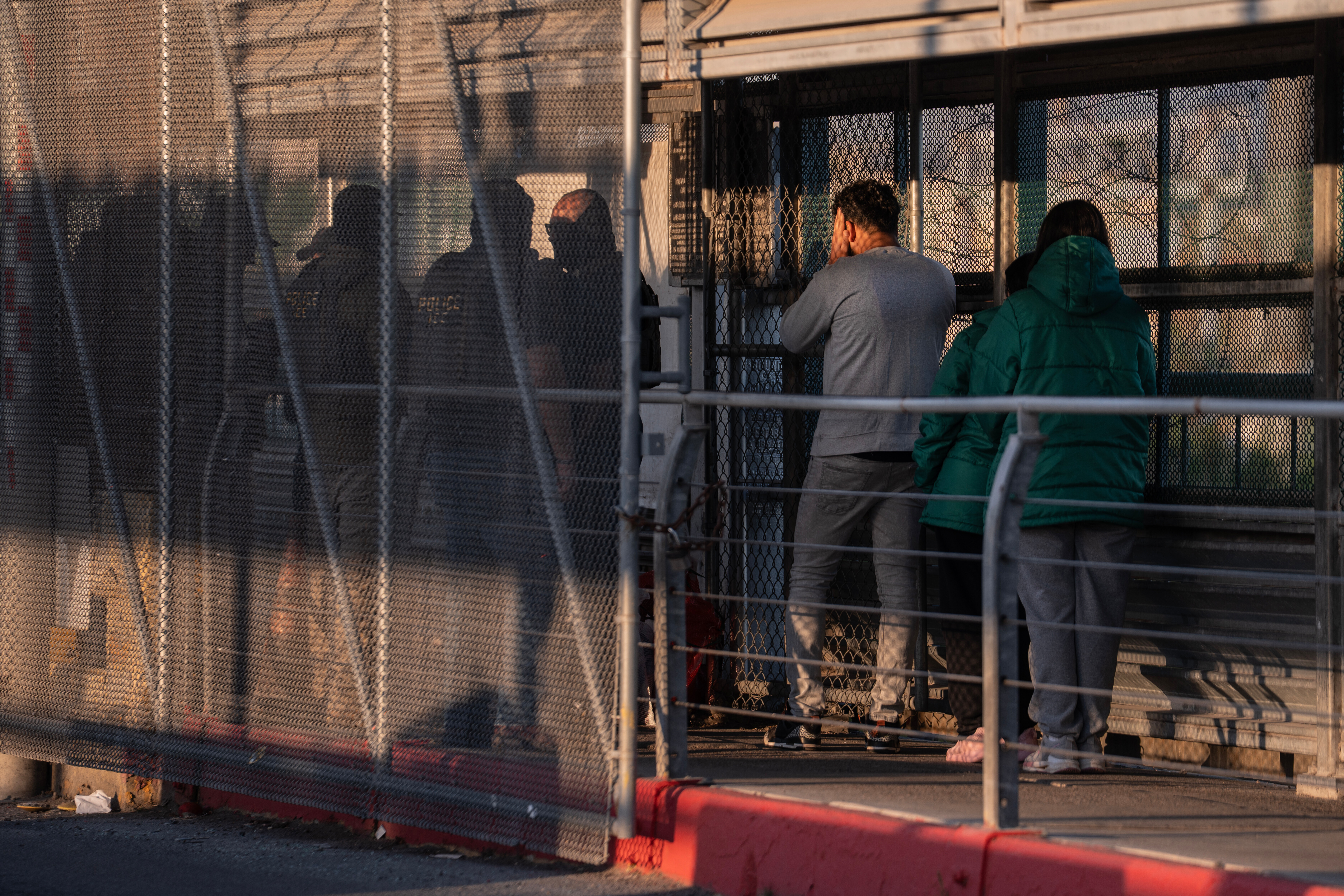
WASHINGTON — The Trump administration can resume rapidly deporting immigrants to countries other than their own, the Supreme Court agreed Tuesday.
The one-page emergency ruling was unsigned and gave no vote count, as is typical in such cases. Although the justices cleared the way, for now, for the swift removals to continue, the court also announced that it would fast-track the case and hear oral arguments about it in December, setting up a final ruling on the issue next year.
The court’s three liberal justices noted that they would have denied the government’s request to resume the deportations.
The decision was a victory for the administration, which has made sending immigrants to so-called third countries, including those that have faced allegations of human rights abuses, a major part of its mass deportation efforts.
The deportation flights had been blocked in recent weeks, however, after a federal court ruled the administration could not deport migrants to third countries unless they were given an opportunity to contest their removals, including to voice concerns that they might be persecuted or tortured abroad.
The justices’ ruling means that the administration can, for now, continue its program and conduct rapid deportations including to countries such as Equatorial Guinea, where U.S. deportees were hooded, bound, and beaten by police, according to reporting by the New York Times.
The Supreme Court had weighed in previously on the administration’s efforts to send immigrants to third countries.
In May 2025, the Trump administration asked the justices to step in and clear the way for third-country deportations after a federal judge in Massachusetts temporarily blocked the administration from sending people to countries not their own — in that case South Sudan — without the chance to object.
In a one-paragraph ruling, the court’s conservatives allowed the administration to continue the deportations over the noted dissents of the three liberals.
Since then, the Trump administration has continued to deport immigrants under the program, including to authoritarian countries with histories of human rights abuses. So far, the administration has sent more than 25,000 people to third countries as part of its mass deportation efforts, according to a social media post by James Percival, the top lawyer at the Department of Homeland Security. Among the countries were Liberia, Equatorial Guinea, Costa Rica, Honduras, and the Central African Republic.
Some immigration and human rights experts have asserted that the third-country deportations may be part of a broader strategy by the Trump administration to encourage immigrants lacking legal status to leave on their own, rather than face the fear of being sent to a country where they have no ties.
In his brief, Solicitor General D. John Sauer characterized the third-country deportation program as “an essential tool to remove certain aliens, including some of the worst criminal aliens.”
Sauer wrote that the appeals court ruling had “created substantial logistical problems with ongoing removal operations,” including canceled deportation flights and disrupted delicate diplomatic negotiations with other countries.
Lawyers for a group of immigrants challenging their removals said in a brief that the Trump administration had ignored “the significant harm resulting from deporting thousands of longtime U.S. residents, many with no criminal history, to third countries without regard to the persecution or torture they face there.”
They argued that the Trump administration could avoid any delays in its deportation program simply by “providing the notice and opportunity to be heard that the law requires.”
After weeks of Washington being gripped by a new wave of fear about artificial intelligence gone awry, the Trump administration took a sharply different stance Tuesday, seeking to convince a skeptical public that the nation is instead about to embark on a tech-powered “golden age.”
President Donald Trump launched America.gov, a government chatbot for researching public services, as part of a daylong event featuring members of his Cabinet and tech executives. AI company leaders were also set to meet with him and House Speaker Mike Johnson (R., La.).
“This kind of innovation in government is just a preview of what is possible with super intelligence,” Trump said, using his new nickname for AI.
The events come at a pivotal moment for the technology. AI firms say their latest systems have become increasingly powerful, showing signs of being able to design their own more-potent successors. But companies have struggled to keep control of the technology, as rogue AI agents have hacked into company and government systems, and a roster of top industry figures have warned that the end result could be catastrophic for humanity.
Last week, it was disclosed that the federal government itself had been a victim, with a handful of websites probed by AI agents deployed by ChatGPT maker OpenAI. (The Washington Post has a content partnership with OpenAI.)
Yet, even as the public’s concerns have grown and Democrats in Congress have pressed for regulation, Trump has largely dismissed the risk, calling it a “hoax.”
“We do not surrender to fears about what technologies will do to us,” Trump said Tuesday. “We decide that those technologies will do for us some very, very incredible things.”
Tuesday’s events are a chance for the administration to focus on the upsides of the technology, propelling a different narrative than the warnings introduced by company CEOs in recent weeks. AI’s many boosters expect it will invigorate the economy, push the boundaries of science, and help cure diseases. But that message has found only limited traction with a public worried about job losses and rogue bots sowing chaos online.
The U.S. government is unveiling AI tools amid growing concerns about the ways that chatbots store and share data. Last week, OpenAI announced that ChatGPT leaked 53 “user-provided images” to image-hosting providers.
The website was rolled out at a conference in the gilded Andrew W. Mellon Auditorium, which was set up to evoke a tech company product release stage. Music played as staff members distributed cans of La Colombe iced coffee to attendees, while a sleek “Hello, America” logo was projected on a large screen at the front of the room.
Joe Gebbia, the chief design officer of the United States and architect of America.gov, described the website, a partnership with Google’s Gemini and SpaceXAI’s Grok, as a “concierge to navigate government.”
“Don’t think of it as a website, it’s more of a conversation that you start with the government to try to get access to the answers you need,” he said on Fox News on Monday.
The website will initially enable users to search for information across government websites, providing access to job postings or the files that the Trump administration has released about UFOs, he said.
But in the coming months, the goal is for the chatbot to help people enroll in government programs such as Medicare or complete tasks such as passport renewals.
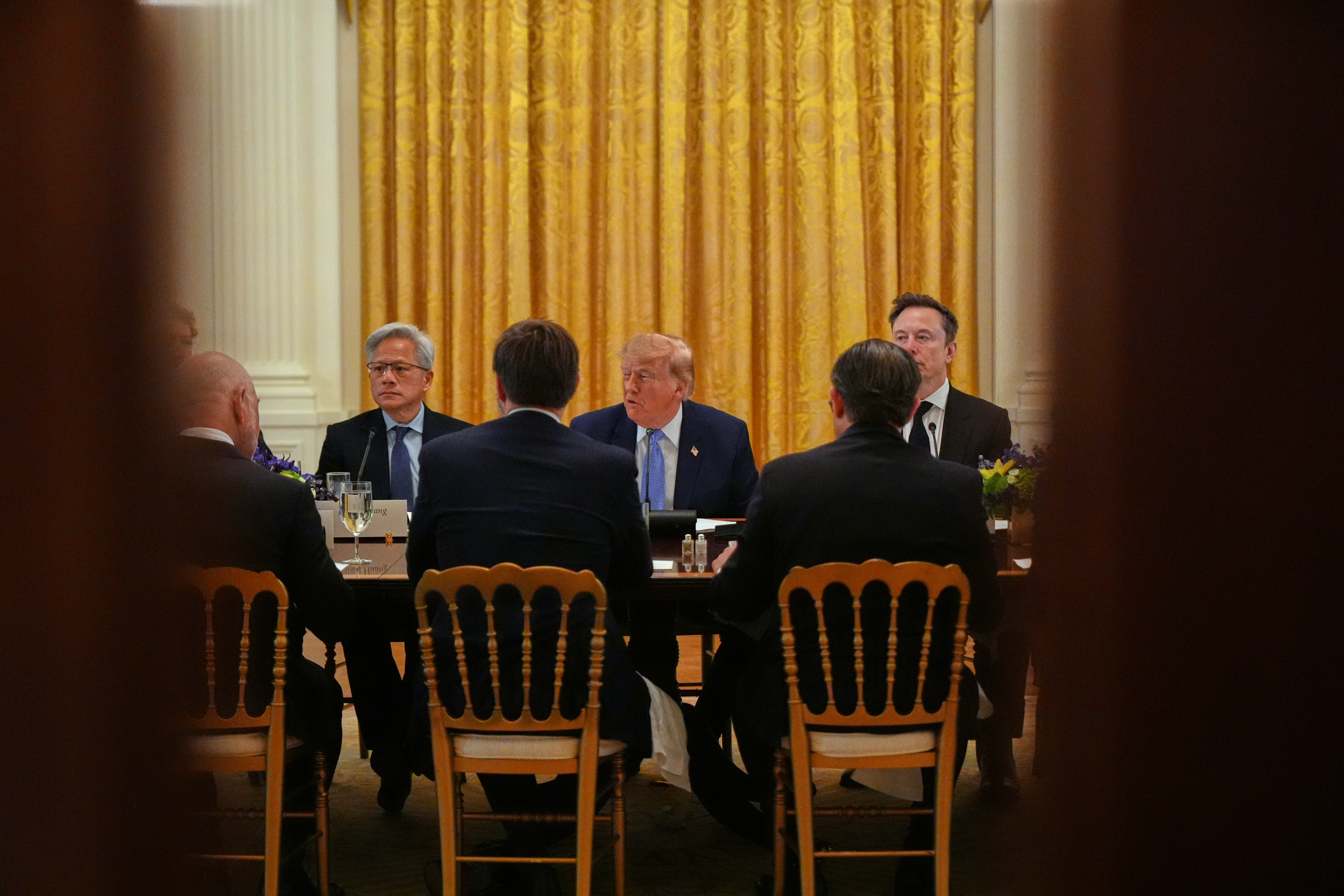
After the rollout of the website, CEOs such as Anthropic’s Dario Amodei and Nvidia’s Jensen Huang had lunch with the president at the White House. Johnson said Monday that his goal for the meeting was to find a “balance.”
“We want to keep America’s lead over China and all of our other competitors, but we want to make sure that it’s being done in a safe way,” Johnson said in an interview with Fox Business. “So, a little oversight, a little transparency, I think, would go a long way here.”
As the industry has tried to navigate those concerns, the private summit between tech CEOs, the president, and the speaker could be the most consequential part of the day, giving officials and executives a chance to discuss a common vision.
Amodei led the industry this month in issuing a call to slow the pace of development to better focus on safety. But the idea has divided his peers and has not been endorsed by the White House.
Amodei, who previously clashed with the administration over the use of his company’s technology by the military, dined with the president late Sunday in their first one-on-one meeting. He was expected back at the White House on Tuesday to attend the private meeting.
Amodei was joined by Huang and Meta CEO Mark Zuckerberg, according to people familiar with their plans who spoke on the condition of anonymity to discuss a private meeting. Both have resisted calls for any coordinated slowdown, saying it is up to individual companies to ensure that their products are safe. Sundar Pichai, the chief executive of Google, was also expected to attend, according to a person familiar with his plans who spoke on the condition of anonymity to discuss a private meeting.
The Associated Press reported that Trump said on Tuesday that he and a large group of leaders of artificial intelligence companies had signed a voluntary accord that will include internal and external reviews during the meeting at the White House.
“I think I’m seeing tremendous self-policing. And they understand that they have to self-police,” Trump told reporters during an impromptu press conference outside the West Wing.
Zuckerberg said the accord included “a set of principles and commitments around building robust internal controls and detecting if there are any issues with the technology, coupled with multiple layers of of auditing and controls.”
“We’re going to have all of our boards of directors independently review the reports that come from the auditors,” said Zuckerberg, who has distanced his company from calls for a slowdown in AI.
Trump suggested there would be about 10 people named to a committee to “watch over the whole enterprise” and said the accord would be “morally binding.” He also said he would name someone to oversee the agreement in coming days after consulting with industry.
Senate Majority Leader John Thune (R., S.D.) said Monday that he would not attend but will meet with some of the participants.
Trump recently said he plans to name a new AI czar and create an “AI Force,” although its role is unclear. The president made clear at a speech to the United Nations General Assembly last week that he wants to see the U.S. continue to race ahead — rebranding the technology as “super intelligence.”
“I’m not going to stifle growth of something that will be bigger than the Industrial Revolution,” he said.
Trump’s AI push comes as his administration has cultivated relationships with Silicon Valley executives and investors. Gebbia, who co-founded Airbnb and joined the Trump administration through the U.S. DOGE Service, is among a group of tech leaders who argue they can improve Washington by applying Silicon Valley principles.
During the Obama administration, healthcare.gov crashed amid the rollout of the Affordable Care Act, sparking criticisms of the government’s technological prowess. Despite years of efforts to modernize government technology, it has continued to lag behind the corporate sector. Other government tech initiatives have fueled privacy and surveillance concerns. In 2022, the government abandoned a plan to require Americans to submit to a facial recognition scan in order to access their tax information following fierce criticism.
Gebbia pushed back on concerns that the new website would collect Americans’ data, describing it as “private by design” to Fox News. He said that the website does not store chats and that people do not need to log in to use it.
Fears about AI took on new urgency in Washington in early September, when a researcher quit Anthropic and said the technology could bring about human extinction. Many lawmakers said they wanted to take action to impose guardrails, but Congress is set to leave ahead of the midterm elections without advancing any legislation.
In the absence of formal federal leadership, OpenAI, Anthropic and Google — the companies at the cutting edge — have discussed creating their own group to set standards for the industry. In the meantime, OpenAI said it was pausing training of its powerful systems until it was confident it had more safeguards in place. It also announced Monday that it will cancel a planned model release because of safety concerns.
The decision to pause training was announced Friday, when the company also confirmed that its agents accessed information from the Census Bureau using a log-in found online and copied information from the Securities and Exchange Commission. Transluce, an AI research organization, said agents had also tried to hack into an Education Department civil rights website.
“People want to know AI is being developed safely, and that starts with what companies like ours do ourselves,” said OpenAI spokesperson Drew Pusateri, adding that the company “will resume training only when we are confident that we have additional safeguards in place.”
But on Monday, Florida Attorney General James Uthmeier (R) asked a court to step in and force the company to pause development work, in a sign of how Republicans are split on their approach to the technology. Uthmeier, whose office has sued OpenAI, alleging it has put children at risk, said he was inviting company chief executive Sam Altman to join his request.
“If he will not, we ask the court to do what OpenAI will not do for itself — protect Florida families,” Uthmeier said in a video posted Monday to social media.