Tag: no-latest

  • Republicans see ‘scary’ lack of enthusiasm among core voters ahead of midterms

    Republicans see ‘scary’ lack of enthusiasm among core voters ahead of midterms

    Republican pollsters and political groups are raising the alarm that their party faces a listless and demotivated base ahead of November’s midterm elections.

    A raft of discouraging data from polling, door knocking, and focus groups is unsettling Republicans as their party heads into a midterm election season that would be challenging no matter what, given President Donald Trump’s low standing in polls and the fact that the party in control in Washington almost always loses seats.

    The lack of enthusiasm is reaching deep into Republicans’ loyal base, spreading to the party’s most consistent voters — who have shown up to vote in all of the past four primaries and general elections, according to an analysis done by Americans for Prosperity Action, a conservative super PAC that was founded by billionaire Charles Koch. This new issue with the base adds to the party’s more enduring problem of turning out less-frequent voters who support Trump but often skip midterm elections.

    About 1 in 5 reliable Republican base voters are at risk this November, according to Nathan Nascimento, executive director at AFP Action. Those voters in Iowa, Ohio, North Carolina, Montana, New Hampshire, and Michigan are either saying they may stay home or are weighing voting for Democrats, according to their data, which is based on polling and extensive efforts to engage targeted Republican voters by knocking on their doors. The voters are primarily worried about inflation and the economy.

    “This is a big chunk,” Nascimento said. “This is a scary number.”

    The group has found that reaching these voters at the door usually moves them toward Republican candidates — or at least away from Democratic ones and toward undecided, he said.

    The 20% of Republican base voters the group sees this issue with does not take into account low-propensity conservative voters who tend to turn out in general election years to support Trump but skip other elections. Motivating those Trump voters is a separate issue Republicans face in November.

    “We have a high-propensity base problem,” Nascimento said.

    Washington Post and Ipsos polling shows that Democrats have a 10-percentage-point advantage over Republicans among voters who say they are absolutely certain to vote in November. If that number doesn’t narrow, it could lead to a decisive advantage for Democrats, even though overall they lead by just three percentage points over Republicans on a generic ballot.

    Mitchell Brown, a Republican pollster at the firm Cygnal, said Democrats are as enthusiastic about voting as they were at the same time ahead of the 2018 midterm elections, when they swept back into power in the House. But Republicans are far less excited to vote at this point than they were then, posing an issue for the party.

    “It’s not that the Democrats are outperforming a topline number that we’d expect, it’s that Republicans are underperforming,” Brown said.

    He pinpointed men under 40 as the group that is most at risk among Republican voters, saying they have concerns about the economy and prices. This group proved pivotal to Trump’s 2024 electoral victory, which included a sweep of some of the same battleground states holding critical elections this year.

    The decline in support among those voters may change closer to the elections, once more people tune in, Republican strategists stressed. And Trump’s unprecedented redistricting efforts have also sought to give the party a structural advantage that could mitigate GOP losses.

    “Republicans are united, on offense, and armed with our largest war chest in party history because voters are energized and understand what’s at stake in November’s election,” said Natalie Baldassarre, a spokesperson for the Republican National Committee, in a statement.

    This dynamic is playing out in the red state of Iowa, where Republicans face open races for governor and a Senate seat that polling shows are surprisingly competitive. A recent door-knocking session in the Des Moines suburb of Urbandale with AFP Action turned up voters critical of the war in Iran and high inflation, with a handful saying they planned to support Democrats in the fall.

    In western Iowa, three-time Trump voter Lance Sulentic, a resident of Iowa’s rural Harrison County, described the past three presidential elections as “the worst three mistakes I’ve ever made in my life,” saying that the president has failed to fulfill his campaign promises. Higher gas prices have been costing him an extra $300 to $500 every month to ride his motorcycle, he said.

    “We voted for Trump, and he did the opposite of what he said he was going to do,” said Sulentic, a 56-year-old retired insurance agent. “Gas prices were going to be two dollars, food was going to be cheaper, energy prices was going to be in half, we were going to get two rebate checks to the American people, and we weren’t going to have any new wars, and we were going to build a wall and deport 30 million illegal aliens, and he did none of it.”

    He said he would either sit out this year’s election or vote for Democrats.

    Republican lawmakers are worried about such comments as their party remains mired in internal disagreements in Washington that have hampered them from passing signature agenda items that could motivate core supporters.

    “We need to do something to re-energize our base,” said Sen. Ron Johnson (R., Wis.). Johnson, who does not face reelection until 2028, has triumphed in tough races in his closely divided state.

    Johnson said GOP base voters may think the lawmakers “haven’t been … trying hard enough.” The party has been unable to pass a law to require ID to vote and proof of citizenship to register to vote called the Save America Act, which Trump has lambasted them for. They also have done little to tackle cost-of-living issues since the bill extending tax cuts in 2025.

    A spokesperson for Trump, Abigail Jackson, called the voting legislation a top priority but added that the administration “continues to deliver on the President’s affordability agenda by lowering drug prices, reshoring American jobs, lowering gas prices, and more.”

    Other senators have pressed Trump to use his large platform and $400 million MAGA Inc. war chest to activate lower-propensity voters. Trump has had far more success motivating supporters when he is on the ballot.

    Sen. Kevin Cramer (R., N.D.) said he told the president in the Oval Office last week that Trump is the key to turning out his voters.

    “Well, they will [turn out] if you pass the Save America Act,” Trump retorted, according to Cramer.

    The White House is hopeful the Republican Party’s planned midterm convention in September in Texas will help juice enthusiasm among the base as well.

    Sen. Thom Tillis (R., N.C.), who declined to run for reelection in his purple state, said he believes the traditional Republican base will ultimately turn out in November. But he fears the party’s brand has been damaged among moderates by the economy and inflation, and that the Iran war is becoming an additional political drag. Low-propensity Trump voters need to turn out to close that gap, he said.

    “The question is whether the coalition he has that’s unique to the president, if he can mobilize them to come out and vote for others,” Tillis said.

  • The shrinking world of former President Joe Biden

    The shrinking world of former President Joe Biden

    Joe Biden’s world has grown smaller.

    Eighteen months after leaving the White House, the 83-year-old former president moves within a narrowed circle of relatives, old friends, and longtime aides as he undergoes treatment for metastatic cancer.

    The treatment appears to be working, according to five former aides and others close to Biden, many of whom spoke on the condition of anonymity to candidly discuss his health and private life. But the disease — and the toll of treating it — has left him visibly frail.

    Those around Biden describe a post-presidency constrained by illness with his days increasingly organized around treatment, family, and efforts to shape his legacy.

    Unlike some recent predecessors, Biden has maintained a limited public schedule, has yet to build a sprawling philanthropic or policy operation, and has struggled to raise money for a presidential library, leaving him with fewer avenues to influence how his presidency is remembered.

    That frailty is likely to become harder to keep private this fall, when Biden begins promoting a memoir scheduled for publication on Nov. 17, two weeks after the midterm elections. The timing has unsettled some friends and former advisers, who worry not only about Biden’s well-being, but also about how much his visible health struggle could revive the bitter arguments of 2024 just as Democrats are trying to make the election a referendum on President Donald Trump.

    Trump has repeatedly mocked Biden’s age and acuity and replaced his portrait along a White House colonnade with an image of an autopen, a visual taunt built on the unsupported allegation that aides used the device to exercise presidential authority for a debilitated commander in chief.

    Those close to Biden bristle at the way his illness and physical decline have become part of his critics’ case against him and his party.

    Hunter Biden gave voice to the family’s frustration last month after a critic attacked his father’s cancer diagnosis on social media.

    “Listen man — I understand if you don’t like my Dad’s politics and you hate me because you believe everything Fox News has told you,” he wrote. “I’m fine with that, but my Dad has cancer. How is that an issue you want to attack. What sickness is in you that makes that fair game?”

    The Biden health debate may soon be reignited. On Tuesday, a federal appeals court cleared the way for the Heritage Foundation, a conservative think tank, to obtain redacted transcripts and audio recordings that were among the evidence a special prosecutor used to portray Biden as an “elderly man with a poor memory.”

    Questions about Biden’s age, stamina, and mental acuity shadowed much of his presidency and eventually overwhelmed his campaign for a second term.

    The health concerns became an acute political crisis after Biden’s June 27, 2024, debate against Donald Trump. Speaking in a weak, hoarse voice, Biden repeatedly lost his train of thought, struggled to complete answers and at times appeared unable to press a forceful case against his opponent.

    Biden’s performance intensified doubts among Democratic lawmakers, donors, and voters about both his ability to campaign and his capacity to serve through January 2029. Biden initially rejected calls to withdraw, attributing the performance to a cold, exhaustion, and a bad night. But after more than three weeks of mounting pressure, he ended his reelection bid on July 21.

    Biden’s planned return to the spotlight presents an awkward political challenge for Democrats. Many remain personally fond of Biden, grateful for the accomplishments of his presidency, and sympathetic to a man battling a serious illness. But they are also trying to distance themselves from a 2024 campaign in which questions about his age, health, and decision to seek reelection damaged public trust and divided the party.

    “President Biden has every right to tell his story. But Democratic candidates are already working their tails off to overcome the political damage he left behind,” said Sawyer Hackett, a Democratic strategist who worked on presidential campaigns for Barack Obama and Hillary Clinton. “The best thing Biden could do to help that effort is to get as far away from the spotlight as possible.”

    In May 2025, four months after leaving the White House, Biden was diagnosed with an aggressive form of prostate cancer that had spread to his bones. He is undergoing treatment for the disease, which can be managed but is not considered curable.

    In media interviews, former first lady Jill Biden has described her husband’s diagnosis as deeply unexpected, saying the family was shocked to learn that the cancer had already reached Stage 4 and metastasized to his bones. Since then she has offered a cautiously optimistic assessment of her husband’s health, saying his treatment is working and that he is maintaining a regimented schedule.

    Since leaving office, Biden has addressed the issue intermittently, generally offering upbeat but limited public accounts of his condition. He has made a handful of appearances, at Democratic Party events in South Carolina and South Dakota, and at the dedication of Obama’s presidential library, where he beamed alongside several other former occupants of 1600 Pennsylvania Ave.

    “Given all the health diagnoses, he was energetic, in good spirits,” former Democratic National Committee chair Jaime Harrison said of Biden at the South Carolina Democratic Party convention in May. Like many Democrats, Harrison knew the seriousness of Biden’s prognosis and wondered whether he would seem like his old self. Instead, the former president — also the convention’s keynote speaker — moved through a full slate of events, many of them organized to honor him.

    “He was fired up,” Harrison said. “You sure as hell couldn’t tell he was an 83-year-old man battling cancer.”

    Biden’s post-presidential office declined to answer questions about his day-to-day activities, medical treatment, or ongoing prognosis. Through a spokesperson, the former president declined an interview. His office disclosed in fall 2025 that he was receiving radiation and hormone therapy and that he had undergone Mohs surgery to remove cancerous skin cells. When he announced his forthcoming memoir earlier this month, Biden offered another brief update, saying that he was undergoing treatment and that it was going “really well.”

    The fallout from Biden’s 2024 campaign also sharpened scrutiny of how his aides — and even his successor, Vice President Kamala Harris — had managed his public exposure. Subsequent reporting described a presidency increasingly structured around shorter meetings, tightly controlled appearances, and greater reliance on senior advisers to serve as intermediaries.

    The public, jarring image of his shaky debate presentation made some voters feel that they had been misled — not only by the White House, but by a broader Democratic establishment that had defended his reelection bid and discouraged a competitive primary.

    Republicans have seized on those lingering questions, portraying Biden’s decline as evidence not only of the former president’s failings but of a coordinated effort by Democratic leaders they accuse of concealing his condition.

    In speeches, posts, anecdotes, and asides, Trump has repeatedly mentioned Biden’s health — often using the nickname “Sleepy Joe,” according to a Washington Post analysis.

    Last month, he referenced it nearly every other day, compared with about 1 in 5 days during the previous June, according to the Post’s review of Trump’s speeches, interviews, social media posts, and other public remarks.

    Biden’s aides and other Democrats reject the idea that a book tour by a former president who has not shaped policy in more than a year — and is now undergoing cancer treatment from his Delaware home — will meaningfully influence the midterm elections.

    “No one is going to be thinking about Joe Biden in November,” said one former aide, who requested anonymity to speak candidly about a former boss. “They’re going to be thinking about filling up their tank and putting food on their table, and Joe Biden has nothing to do with that.”

    Harrison, the former DNC chair, argued that voters have more immediate questions about the health of the man now occupying the Oval Office, who turned 80 in June.

    “It was amplified, it was even caricaturized when Biden was president, but Trump falls asleep during meetings. He is literally sleeping,” Harrison said. “But yet it’s like a blip. The man has more blemishes and marks on his skin — that says something is going on.”

    The White House has consistently pushed back on such criticism, insisting Trump remains in strong health and dismissing questions about his physical condition.

    Trump has made three trips to Walter Reed National Military Medical Center since April 2025 as persistent bruising on his hands and swelling in his lower legs have drawn scrutiny. His most recent examination involved 22 medical specialists — an unusually large team — though his physician pronounced him in “excellent health,” attributing the swelling to chronic venous insufficiency and the bruising to frequent handshaking combined with aspirin use.

    Health inevitably shapes what presidents can do after leaving office.

    Before age and illness restricted his public life, Jimmy Carter devoted decades to election monitoring, diplomacy, public health, and Habitat for Humanity — work that transformed his reputation and earned him the Nobel Peace Prize.

    Bill Clinton, who will turn 80 next month, remained highly visible, building a global foundation, writing books, delivering paid speeches, and campaigning for Democrats, including his wife. George W. Bush largely stepped away from partisan politics, focusing on veterans, the Bush Institute, and painting. Obama has been more selective, emerging for major political moments while devoting much of his time to books, media projects, his foundation, and, most recently, the Obama Presidential Center.

    Biden’s allies are raising money for a presidential library in Delaware, imagined as a center for public service and civic life. But his library effort has so far attracted only a fraction of the money raised for the legacy projects of recent presidents: His foundation expected to collect about $11 million by the end of 2027, compared with the hundreds of millions raised by Bush and Obama in the first years after they left office.

  • Airstrikes have paused and talks are pressing forward. But can the US and Iran take the off-ramp?

    Airstrikes have paused and talks are pressing forward. But can the US and Iran take the off-ramp?

    WASHINGTON — The U.S. military has paused its airstrikes on Iran after nearly two weeks of intensifying bombing, while diplomatic efforts have pushed forward to try to avert a return to all-out war.

    But it remains to be seen whether the U.S. and Iran are at an inflection point in a mercurial conflict that will reach the five-month point Tuesday. President Donald Trump both has threatened more strikes and said talks are pressing on, all while brushing off concerns that rising gas prices tied to the fighting could hurt Republicans in November’s midterm elections.

    Adding to the uncertainty is the impact of Israeli Prime Minister Benjamin Netanyahu’s planned visit with Trump this week in Washington. Israel, which launched the war alongside the U.S. on Feb. 28, has been notably absent from the renewed American attacks over Iran’s effective closure of the Strait of Hormuz, a vital shipping corridor through which 20% of the world’s oil normally flows.

    “The Iranians understand that perhaps it could get worse because Israel could come into the conflict,” said Michael Singh, managing director at the Washington Institute for Near East Policy. On the other hand, Israel’s lack of involvement so far “may signal to the Iranians that we’re looking to limit the conflict.”

    Singh, who was senior Middle East director on the National Security Council during the George W. Bush administration, said he was hesitant to read too much into the lull in fighting.

    “If it turns into a multiday pause, that’ll be something significant,” he said. “But it’s hard to know. Is it an operational pause? Is it a pause to allow for some kind of behind-the-scenes diplomacy?”

    Mediators keep pressing their diplomatic efforts

    A regional official involved in the mediation efforts said that concerted diplomacy was underway and that a pause in U.S. strikes and Iranian counterstrikes on neighboring countries hosting American forces was a “positive signal that helps their efforts to de-escalate.”

    The official said that both the U.S. and Iran want to return to the interim ceasefire deal and that a compromise, which is being negotiated now, centers around having Iran run vessel transit through the Strait of Hormuz with fewer restrictions on ships. The official was not authorized to discuss the matter and spoke on condition of anonymity.

    On Sunday, Iran’s Foreign Ministry spokesperson, Esmail Baghaei, confirmed that Iran and Oman had held several rounds of technical talks about the strait in Iran over the weekend. He said that while the Omani delegation left Tehran on Saturday afternoon, talks had made progress and were continuing.

    Iran put a chokehold on the narrow Persian Gulf waterway when the war began by firing on tankers and freighters. In turn, oil prices have soared during the conflict, which has been unpopular with many Americans, and could leave some Republican lawmakers vulnerable in November.

    Following the signing of an interim ceasefire deal in June, a battle for control over the strait has erupted. Iran demanded that ships use a route near its coastline and said it can potentially charge fees. Ships were increasingly navigating a southern route along the coast of Oman under a U.S. overwatch operation when Iran attacked some vessels.

    The U.S. renewed attacks on Iran’s coastal defenses, aiming to blunt Tehran’s ability to strike ships in the strait. The Trump administration then expanded its targets, hitting bridges and infrastructure in the south and striking deeper into the center of Iran.

    Singh said the strikes appear to be an attempt to push Iran back to the negotiating table. Now, he said, “the question would be: What kind of messages, if any, is the Iranian regime sending through diplomatic channels? Have those messages changed? Do they seem more eager to return to talks?”

    Among the challenges the U.S. faces is the fractured leadership in Iran, with different factions vying for control, Singh said, something that Trump administration officials have also pointed to. The people in charge in Iran may worry that compromising with the U.S. will be seen as weakness and could loosen their grip on power.

    Whatever the case, both the U.S. and Iran need the strait to reopen for their own economic reasons.

    “But they have very different conceptions of under what conditions, under whose control,” Singh said. “So we have to get to some kind of stable equilibrium on those questions before you’re going to see a longer period of quiet. I think this effort to negotiate with words and also to negotiate with force is going to continue until we reach that equilibrium.”

    Trump issues threats but also talks up diplomacy

    Despite the lull in fighting, tensions are high in the region.

    Yemen’s Houthi rebels said Saturday that they fired missiles and drones at Saudi Arabia in response to Saudi airstrikes on the strategic Red Sea city of Hodeida. The Iran-backed rebels say they have closed the Bab el-Mandeb Strait, which has become even more vital for Saudi oil exports since the disruption of the Strait of Hormuz.

    The U.S. military also is enforcing its naval blockade of Iranian ports, saying it disabled a Mozambique-flagged ship in the Gulf of Oman on Friday after the vessel tried to violate the blockade and ignored warnings.

    Trump also has kept up the threats against Iran even as he spotlighted diplomacy. Asked about his exit strategy Friday, Trump said there are two ways.

    “You can just keep doing exactly what we’re doing and take them apart piece by piece. We could do it in a more rapid fashion, which we might do,” he told reporters in the Oval Office. “Or we can negotiate with them, which we’re also doing right now.”

    While Trump said he doesn’t think Iran is “ready yet” to make a deal, he also asserted that “I think they’re getting more and more serious as the days go by, for maybe the obvious reason.”

    Trump met Friday with top national security aides to discuss the situation with Iran and whether the administration should maintain the current course or escalate military attacks, according to a U.S. official who spoke on condition of anonymity to discuss internal deliberations. No U.S. strikes occurred overnight in Iran after 13 consecutive nights.

    Trump insisted Friday that he was “not in a hurry” to wrap things up because of the approaching elections, in which voters, angry about high food and gasoline prices, could vote his Republican Party out of control of Congress.

    “Despite what everyone says about the election, I’m not in a hurry,” he said. “We have to do it right. Elections take care of themselves.”

  • Suspect in deadly Berlin Pride attack killed in confrontation with police

    Suspect in deadly Berlin Pride attack killed in confrontation with police

    BERLIN — The suspect in the deadly Berlin Pride attack that left one person dead and 29 injured was shot and killed by police during a confrontation on Sunday in a suburb of the city, authorities said.

    Abdul Ballout, a German citizen with Lebanese roots, was killed following a search that lasted nearly 24 hours after the attack in downtown Berlin. Prosecutors said he had previously sought to join the militant Islamic State group.

    Ballout was suspected of driving a van into a crowd near Berlin’s Pride festival Saturday night before apparently stabbing others with a machete in what authorities believe was an Islamic extremist terror attack.

    Interior Minister Alexander Dobrindt said the attack occurred a few hundred yards from a party near the Brandenburg Gate that was supposed to close out the city’s Pride festival.

    Ballout was tracked down around 6 p.m. Sunday at a garden in Spandau, a Berlin suburb, the city’s police department wrote on X. They said he apparently ran toward officers with a sharp instrument, and police fired at least one shot. He died at the scene.

    Ballout was born in Germany, the minister said. His mother was naturalized in 2002, three years before he was born.

    Ashley Jump, a 26-year-old U.K. resident, had traveled to Berlin for Saturday’s Pride parade but had left the celebrations before the attack. They returned Sunday to leave flowers at a memorial near the crime scene in support of the LGBTQ+ community.

    “They’ll never erase us, we’ll never be gone,” they said. “As long as humanity has existed, we’ve existed. And as long as humanity exists, we will exist. We will not be removed.”

    Suspect convicted of ties to Islamic extremism

    Ballout traveled to Lebanon in 2025 with the goal of going to Syria to join the Islamic State group, Berlin prosecutors said Sunday.

    There, he made contact with several people who were presumed members of the militant group — or at least he believed them to be, prosecutors said. He was arrested in Lebanon last year and sentenced by a military court to three months’ imprisonment for offenses including incitement to religious and sectarian conflict.

    He returned to Germany after completing his sentence, where he was arrested at the Berlin airport.

    In May, a juvenile court in Berlin convicted Ballout of preparing a serious act of violence endangering the state, as well as publishing Islamic State propaganda on his Instagram account and other charges, prosecutors said.

    The court handed down a suspended sentence of 1 year and 10 months in youth custody, which Berlin prosecutors had appealed.

    The court said it took Ballout’s months of pretrial detention in Germany and Lebanon into account. It also said it considered that Ballout had confessed to the crimes, appeared to distance himself from the militant group, and no actual threat had ever materialized.

    He was released from detention pending the appeal.

    Berlin’s Pride festival is one of Europe’s largest LGBTQ+ celebrations

    According to police, a white van drove into the Tiergarten park around 10 p.m. and hit several people before colliding with a tree. The closing party at the Pride festival, known as Christopher Street Day, was ongoing at the time next to the Brandenburg Gate, a short distance away. The party followed a parade with some 80 trucks that had made its way through downtown Berlin earlier in the day.

    The attack did not occur at the festival, along its route, or at the closing party. Rather, the violence took place a few hundred yards away on a track in the Tiergarten park. The van drove into a crowd that was likely a mix of festivalgoers and other locals or visitors.

    Police said a woman was killed.

    On Sunday afternoon, hundreds of mourners gathered at a memorial at the iconic gate. They hugged each other and laid down flowers, candles, rainbow flags, and homemade signs, including a cardboard one that said: “The only thing more powerful than hate is love.”

    Hundreds of thousands had come to Berlin to celebrate on Saturday, though it’s unclear how many were still at the festival by late evening. The event is one of Europe’s largest LGBTQ+ celebrations.

    “We are simply stunned by what happened,” said Andre Lehmann, a top official with the main national LGBTQ+ association, LSVD+. “This suspected attack hits the heart of the queer community.”

    Amsterdam says it will celebrate freedom in the wake of Berlin attack

    Chancellor Friedrich Merz urged the nation to remain united in the aftermath of the attack.

    “I would like to say this to Christopher Street Day participants here in Berlin but also across Germany: Don’t let yourselves, let us not let ourselves, be intimidated,” he said. ”These acts have only one purpose: They aim to divide our society. They want to take away from us the most important thing we have: Namely our openness and our freedom.”

    Dobrindt said he expected security measures at other major events in Germany, including Pride events elsewhere, to be reviewed and if necessary significantly boosted.

    Berlin has seen Islamic extremist attacks before. In December 2016, a rejected asylum seeker from Tunisia plowed a hijacked truck into a Christmas market, killing 13 people and injuring dozens. He was killed days later in a shootout in Italy.

    In February last year, a Spanish tourist was stabbed and seriously wounded at Berlin’s Holocaust Memorial, an attack that saw a Syrian man convicted in March and sentenced to 13 years.

    This week, Amsterdam will be hosting World Pride alongside its own annual Pride celebrations. Mayor Femke Halsema said authorities and organizers “are closely monitoring the security situation” after the Berlin attack but aim to prevent any extra measures getting in the way of celebrating freedom and love.

  • Trump officials vote to rewrite historic preservation rules, in boon for arch

    Trump officials vote to rewrite historic preservation rules, in boon for arch

    Trump officials on Friday voted to rewrite federal rules intended to protect historic sites, sending the plan to the White House for further review.

    The Advisory Council on Historic Preservation, a federal agency that oversees preservation reviews and advises the president and Congress, said it was moving forward with changes to a federally required process that governs changes to landmarks such as the National Mall, sites that are significant to Indigenous tribes, and other properties eligible for listing on the National Register of Historic Places. The process currently applies to any construction projects that are on federal land or receive federal funding, as well as private projects that require any type of federal approval.

    If codified into law, the new rules would make it easier for President Donald Trump to pursue his controversial construction projects — such as building his planned triumphal arch — and could eliminate the need for public input on other major federal projects.

    The ACHP is dominated by Trump appointees, leaving little doubt the proposal would pass.

    The proposed rules “will now move to the interagency review process” overseen by the White House’s Office of Management and Budget, Ashley Fry, an ACHP official, wrote in an email. Once it clears that review, the proposal will be opened for public comment before being finalized.

    Under the current rules, federal agencies must undertake a multistep Section 106 review assessing the potential effects of construction projects and soliciting public input, among other requirements.

    The changes would allow federal agencies to approve construction projects that would impact historical sites without the previous requirement to seek the agreement of affected states, tribes, and other interested parties. The proposal also would allow an agency to unilaterally decide whether or not it’s in the public interest to allow public participation in the review process.

    The proposed rules could make it easier to change or destroy sites like Native American burial grounds or historic downtowns, or to build projects that change the view from historic sites such as power lines near Thomas Jefferson’s Monticello estate.

    The current process has created speed bumps for some of Trump’s projects, which he has sought to rush through federal reviews and complete before his term ends in January 2029.

    Under the existing Section 106 rules, outside groups are currently weighing in on Trump’s plan to build a 250-foot-tall arch on federal parkland near Arlington National Cemetery.

    Trump officials complained last month that the current process was overly burdensome.

    “Consulting parties also often request mitigation that is beyond the agency’s authority, unacceptable to a project proponent or the agency, or unduly burdensome, which can lead to disagreements that delay the completion of the process,” said Kevin Lilly, acting assistant secretary for fish, wildlife, and parks at the time, adding that the agencies could be forced into “endless consultation” under the current rules.

    Historic preservationists and advocacy groups have decried the administration’s plan to overhaul the existing rules and vowed to mobilize resistance.

    “The proposed changes threaten the history of our nation and the fabric of our society — this is an attack on our civic and cultural inheritance,” Brent Leggs, the CEO of the National Trust for Historic Preservation, said in a statement on Friday night.

    The National Association of Tribal Historic Preservation Officers, a nonprofit that focuses on protecting culturally important places for Native Americans, said in a statement that the proposed changes are “an affront to Tribal sovereignty.” Other groups warned about the potential lack of protections.

    Rep. Chellie Pingree (D., Maine), the top Democrat on a House subcommittee that oversees funding for the Interior Department, said that the administration’s plan would allow rushed construction projects that could “permanently damage” historical sites.

    “They have shown time and again that they’re not interested in respecting the full scope of America’s history — only in fast-tracking the president’s vanity projects and giving sweetheart deals to donors and supporters,” Pingree said in a statement.

    Sara Bronin, who led the ACHP under the Biden administration, told the Washington Post that she was not surprised the council voted to advance the proposed rule. Twenty of the 24 seats on the council are either directly appointed by the president or are reserved for the heads of federal agencies, such as the Interior Department, which are controlled by Trump.

    “I expect the ACHP to ignore public comment and finalize the rule in the next month or so,” Bronin said. “Once they do, the preservation community and its allies will be ready both to challenge their action in court and to ask Congress to intervene.”

  • Letters to the Editor | July 26, 2026

    Letters to the Editor | July 26, 2026

    Nuclear reality

    Regarding the article about how regulators have ordered a probe into the response to July Fourth power outages, the recently enacted Power New Jersey Act supports building a large nuclear power plant in the state. Gov. Mikie Sherrill described nuclear power as “affordable,” “secure,” “reliable,” and “clean.” But facts indicate otherwise.

    Affordable? The only two new U.S. reactors started in the past 30 years cost $37 billion — way above the original estimate of $14 billion.

    Secure? Nuclear power plants are heavily guarded, especially after the 9/11 attacks (al-Qaeda had considered attacking U.S. nuclear plants on 9/11).

    Reliable? During a recent heat wave, France shut three reactors temporarily and reduced power at eight others. Reactors return billions of gallons of used/heated water to their source daily, making them unreliable when electricity is most needed.

    Clean? Reactors generate more than 100 radioactive chemicals, similar to atomic bomb explosions. This waste is stored at plants for hundreds of years, or escapes into air and water. The cancer death rate in Salem County, N.J., was slightly below the state until the mid-1980s (after three reactors opened), but is now 33% higher.

    New Jersey relies on fracked natural gas and nuclear power for most of its power. Safe, renewable, and affordable sources like wind and solar now generate more than 30% of U.S. electricity; these, not nuclear, should be the focus of our energy future.

    Joseph Mangano, Ocean City, N.J.

    What antifa?

    Marco Rubio is organizing an “antifa summit” to target “left-wing extremists,” which he claims pose a violent threat. Can he cite an example? There is no left-wing equivalent to the Ku Klux Klan, Proud Boys, or Oath Keepers. Right-wing individuals and groups have committed many acts of violence, including mass shootings at churches and synagogues. They held marches displaying racism and antisemitism, and played a prominent role in the violent (and televised) attack on the U.S. Capitol. The administration seeks to quell “violent secular political groups whose ideology is anti-American, radically pro-transgender, and anarchist.” Although no such groups exist, I will address those labels. For anti-American, Rubio should look at the White House. Donald Trump has expressed the desire to “terminate” any portion of the Constitution that stands in the way of his own agenda. When asked on Meet the Press if he needed to uphold the Constitution, he said, “I don’t know,” even though he swore an oath to do so. There is nothing more un-American than violating the Constitution, and Trump has done just that countless times. As for “pro-transgender,” I have read the Constitution, and there is not a word in it prohibiting people from being transgender, or requiring Americans to treat them with animosity. Nor is anarchy a goal of the left wing. On the contrary, the millions of people participating in No Kings rallies are doing so to remind Washington that the supreme law is the Constitution, and it applies to all, including elected officials.

    Jean A. Kozel, West Norriton

    Join the conversation: Send letters to letters@inquirer.com. Limit length to 150 words and include home address and day and evening phone number. Letters run in The Inquirer six days a week on the editorial pages and online.

  • Dear Abby | Sister makes being around her an unpleasant experience

    DEAR ABBY: My unpleasant older sister lives by the creed, “It’s my way or the highway.” As a result, she has no close friends, no husband or partner, no social circle. She was “strongly encouraged” to take early retirement from teaching because she couldn’t get along with her co-workers.

    After retirement, she joined a few clubs but soon quit because they “didn’t do things right,” aka her way. Even though she treats me terribly, I have tried for years to be the better person and invite her to my family gatherings so she doesn’t have to spend holidays alone. Unfortunately, she is also the world’s worst houseguest. Within minutes of arriving, she announces a list of things she just can’t stand (and are therefore prohibited during her stay). These include certain TV shows, music, foods, ingredients, topics of conversation, any family story that includes her, etc. She stays until everyone has gone and then berates me for everything that I did wrong during her visit.

    If I don’t invite her, I feel guilty that she’s alone and has no other options. If I do invite her, I’m so stressed that I don’t get to enjoy having time with my children and grandchildren, which is very precious to me. What do you recommend I do?

    — TORN SISTER IN WASHINGTON

    DEAR SISTER: I think you have suffered enough. If you decide to invite your older sister to visit again, first establish some ground rules. The first should be that when she’s under your roof, you, not she, will decide on what entertainment is appropriate and what foods you will serve. And how they’re prepared. No topic of discussion will be off-limits. If there is something she can’t eat, she can refuse it. If something being talked about is not to her liking, she’s free to leave the room.

    The second ground rule should be that you are not obligated to entertain her 24/7, particularly if you want to spend time with the grandchildren.

    Of course, Sissy is free to reject your kind invitation, but if she accepts your conditions, the holiday will be a far happier one for you.

    ** ** **

    DEAR ABBY: My husband passed away last year. I live by myself in a two-story house with three bedrooms and three bathrooms. My kids want me to sell it. I don’t care for the stairs, but that’s the only thing I don’t like about my house. I’ve lived in this house for more than 30 years, and I don’t want to sell. I’ve always done what everybody else, especially my husband, has told me to do. For once in my life, I want to do what I want to do.

    Can you give me some advice?

    — FINALLY FREE

    DEAR FREE: My advice is to take your own advice. You seem to be happy where you are, so don’t allow your kids to pressure you into selling before you’re ready. I will add, though, that it would be wise to run your kids’ worries by your physician. If there are health concerns that make it unsafe for you to live alone in a big house with stairs, it’s best to listen to your doctor.

  • Horoscopes: Sunday, July 26, 2026

    ARIES (March 21-April 19). People rarely understand the difficulty of a task until they try it themselves. Today, that means letting someone struggle through a task, even if you could do it faster yourself. Experience teaches lessons that explanations couldn’t.

    TAURUS (April 20-May 20). Whatever you pay close attention to becomes more interesting. Other people also notice where your attention goes, and today they will follow along, so your curiosity creates more curiosity.

    GEMINI (May 21-June 21). Whether you’re doing something because you want to, doing it out of duty or acting out of fear of what will happen if you don’t, the point is that you’re in motion. Your work will have a lucky outcome.

    CANCER (June 22-July 22). It’s time to treat yourself like an athlete the day before the race. Sleep, water and nutrition in the proper amounts are the cornerstone of your well-being and the reason you can do your best work.

    LEO (July 23-Aug. 22). Inspiration can strike, but mostly it doesn’t. Often it tickles. Other times it nudges. Sometimes it puts a hand on your shoulder and gently guides you in a direction. That’s the kind that’s happening now for you.

    VIRGO (Aug. 23-Sept. 22). Relationships run on a mix of spoken agreements and unspoken expectations — some obvious, others so deeply ingrained that they go undetected until someone breaks them. Today, you’ll notice assumptions that have been running in the background. That awareness changes everything.

    LIBRA (Sept. 23-Oct. 23). If you followed your every impulse, life would get chaotic and exhausting. So when your options narrow, you may as well consider that a good thing. The path gets easier to follow once there are fewer exits to distract you.

    SCORPIO (Oct. 24-Nov. 21). The person you’re with every moment of every day is you. When that relationship is easy, everything else requires less effort. Today, you’re really not looking to any person, place or thing to complete you. You’re looking, yes — but you’re looking for the sake of discovery, not rescue.

    SAGITTARIUS (Nov. 22-Dec. 21). Just because you love someone very much doesn’t mean the relationship will be without conflict. Love doesn’t guarantee agreement. It simply gives people more reasons to keep trying after they disagree.

    CAPRICORN (Dec. 22-Jan. 19). If you miss a beat, don’t scramble back to try to pick it up. Be like the professional musicians — pick it up next time it comes around. Always be moving forward. The beat goes on.

    AQUARIUS (Jan. 20-Feb. 18). Are you spending too much effort to keep something alive? That’s what happens when the relationship, project or circumstance doesn’t breathe on its own. Maybe it’s time to release what asks more than it gives.

    PISCES (Feb. 19-March 20). However well you love a plant, it will grow according to the sunlight and soil. Today, focus less on trying harder and more on creating the conditions where people, projects and even your own spirit can flourish.

    TODAY’S BIRTHDAY (July 26). It’s your Year of the U-Turn. There’s much going right, but for the areas of your life that just aren’t working? You will turn them around, with or without permission. And after a bit of backtracking, your destination changes. More highlights: A relationship gives you what you’ve longed for. Your shining example will be followed. An income opens up — you’re so good at this! Libra and Scorpio adore you. Your lucky numbers are: 6, 2, 14, 9 and 30.

  • How Jefferson is Deepening its Community Ties to Improve Health Outcomes

    How Jefferson is Deepening its Community Ties to Improve Health Outcomes

    From the Poconos to Cherry Hill, Jefferson has become a familiar presence. As the largest academic health system in the Greater Philadelphia region, the nonprofit institution sees millions of patients each year across its 33 hospitals and more than 700 care sites spanning Pennsylvania and New Jersey. That reach, said Keith Leaphart, the executive vice president and Humana chief health equity and community impact officer at Jefferson, gives the organization a particular responsibility to its communities.

    “We are the primary safety net system here,” Leaphart, who also serves as vice chair of The Inquirer’s board of directors, said. “We’re serving a lot of people who are uninsured and underinsured, and we’re not turning them away.”

    Jefferson’s 2025 Community Impact Report, “Driven to Improve Lives,” explains how the anchor institution is using its unique model as an integrated health system that includes a university and a not-for-profit health plan to address the region’s needs. The report highlights more than $2.7 billion in community funding, including investments in access to care, health professionals’ education, and community-based services. It also offers a road map for Jefferson’s community partnerships and initiatives: building trust through neighborhood partnerships, expanding access to nutritious food, creating pathways into healthcare careers, and preparing the next generation of providers to meet people where they are. “At Jefferson, we believe our responsibility goes far beyond the walls of our hospitals,” Jefferson CEO Dr. Joseph Cacchione said.


    Building Bridges to Bring Healthcare to All

    Jefferson’s 2025 Community Impact Report that approach through investments in initiatives like the Community Health Worker Academy, a paid job-training program for new healthcare professionals who help their neighbors navigate health and social services.

    The program is an example of how Jefferson has been intentional about mobilizing health workers who come from the same communities that they serve and are often able to speak with patients in their preferred languages. Empowering community members to provide care creates a powerful access point for residents who may not otherwise connect with care systems. Community health workers also help build trust between their neighbors and health institutions.

    Similarly, Jefferson’s Inspire Network, which launched last November, partners with faith-based organizations across the region to empower faith leaders to help their congregants better understand the healthcare system. “When someone gets sick or they need care, they’re often going to a community of faith and asking for prayers and support and comfort and meal trains,” Leaphart, the Jefferson leader, said. By teaming up with faith leaders, Jefferson can help them meet their congregations’ needs directly. The health system also invites faith leaders to its quarterly Partners in Purpose events to foster relationships and collaborate on their work together. To date, Jefferson has partnered with more than 150 faith-based organizations to offer health services like screenings. The organization also hosts family-friendly events like Night at the Zoo, an annual visit to the Philadelphia Zoo that provides residents with access to affordable health options. Last year’s occasion drew 4,000 residents.

    To build on the success of partnerships like these and create opportunities for future collaborations, Jefferson recently launched a community engagement request form through which workers with community-based organizations can request a JeffCARES team visit to their place of worship or social event to provide free screenings and other health services.

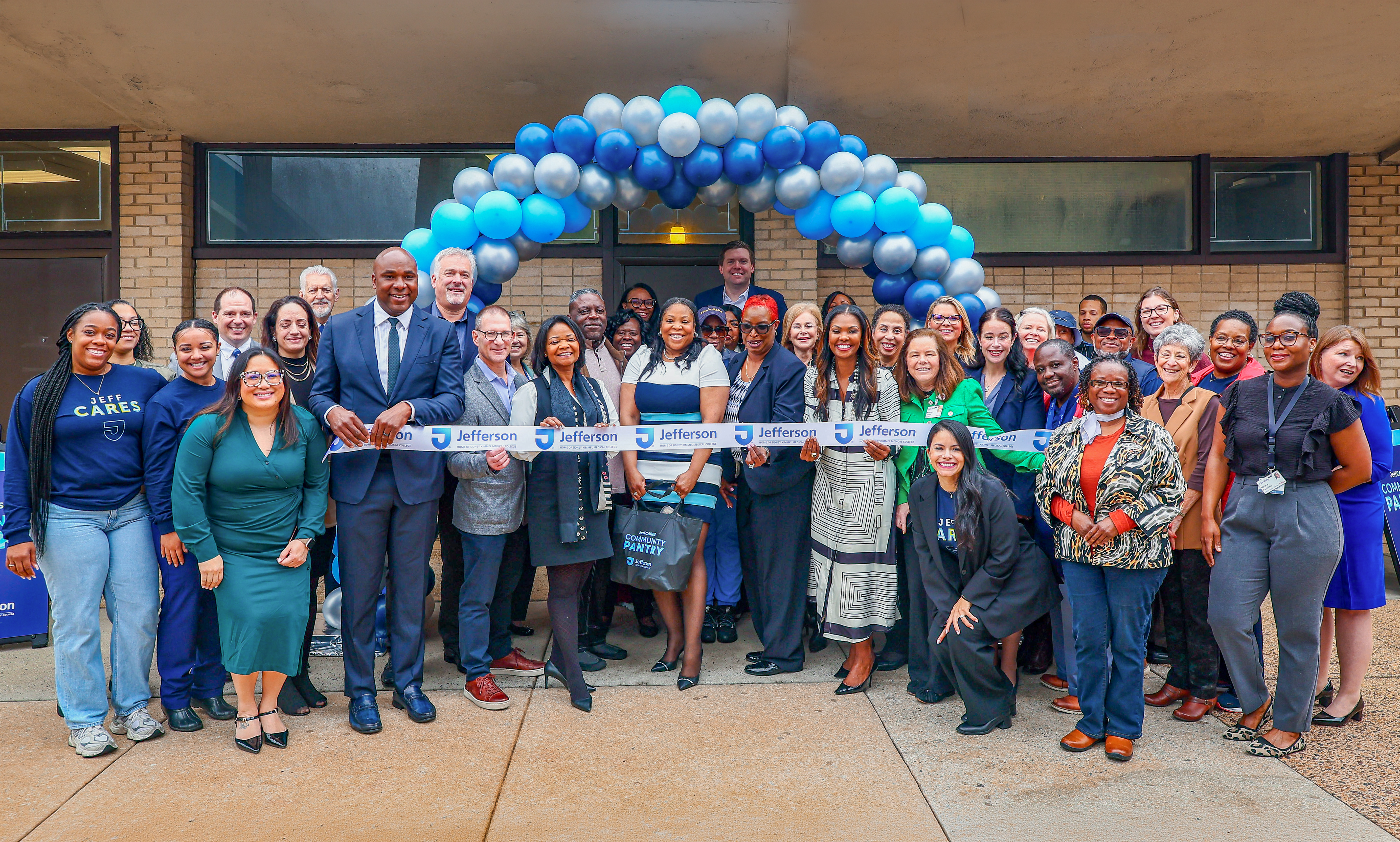
    Cortney Reed, Jefferson Health’s director of Community Engagement, at the JeffCARES Community Food Pantry, which offers fresh food and recipes to support healthy eating, at Jefferson Einstein Philadelphia Hospital.Courtesy Jefferson Health

    A Recipe for Expanding Food Access

    Jefferson’s community-impact report also shines a light on the work the organization is doing to increase access to healthy meals in the Philadelphia region, where more than 600,000 people experience food insecurity. The health system partners with food banks like Philabundance and Second Harvest Food Bank of the Lehigh Valley and Northeast Pennsylvania and runs a number of community pantries, volunteer programs, and initiatives, including custom meal plans that support cancer patients undergoing treatment in Willow Grove.

    One highlight from the report is the JeffCARES Community Food Pantry, the first Philabundance food pantry located within a hospital. It opened in April 2025 at Jefferson Einstein Philadelphia Hospital in North Philadelphia. “Philabundance has been a valued partner of ours for many years, but establishing a hospital-based site was something our community truly needed,” Dixie James, the president of Jefferson Health’s Central Region and the chair of the Philabundance Board of Directors, said.

    In addition to fresh dairy products, meat, and shelf-stable items, the pantry provides recipes for nutritious meals tailored to support a variety of health conditions, including diabetes. The pantry is open to patients, community members, and Jefferson colleagues.

    “Access to safe, healthy, nutritious foods, [and] fresh produce is something that we know is directly connected to overall better health. If you’re able to eat healthy, you’re going to have better health in general. We want to be at the center of that,” Leaphart said. “That doesn’t happen without partnerships.” Jefferson serves around 150 meals per week to families and has distributed about 6,700 bags of food so far this year.

    Jefferson’s $2.7 billion investment in community impact expands access to care and inspires future healthcare professionals through education and a school speaker series.Courtesy Jefferson Health

    Careers That Grow With Community Partnerships

    Another important part of Jefferson’s community-impact work, as detailed by the report, is career development. “One of the things that we’ve been really intentional about is building out pathway programs and pipeline programs for young people to be exposed really, really early to careers in medicine,” Leaphart said. The organization, which is the region’s largest employer with 65,000 employees, is getting kids interested in the healthcare industry by inviting staffers to visit classrooms to talk about their careers as Jefferson School Speakers.

    Jefferson has more than 20 programs across the enterprise engaging students from elementary to high school in career exploration, as well as pipeline initiatives with reputable workforce development organizations. Jefferson also runs dedicated programs for high school and college students through partnerships with educational institutions. “One that we’re really excited about is the Jefferson Workforce Development Program, a partnership between the School District of Philadelphia, North Philadelphia’s Esperanza College, and Jefferson Health,” Leaphart said. The program offers free training to high school students interested in careers as patient care technicians or medical assistants.

    Students who successfully complete the training are qualified to enter the healthcare industry as entry-level workers. Since launching the program last April, Jefferson has hired 27 students who earned their certification in the course.

    Community partnerships are also emphasized within Jefferson’s own academic institution. Students at Thomas Jefferson University, for instance, are encouraged to actively volunteer in the community. “Volunteering is core to everything that we do,” Susan Aldridge, Ph.D., the president of Thomas Jefferson University, said. “When you start here at Jefferson as an undergraduate student, within your first week, you’re volunteering in the local community, which is really unique and reflects the culture of our institution.”

    Many medical students with Sidney Kimmel Medical College volunteer with the student-run program JeffHOPE, through which they work alongside physicians to provide health screenings to vulnerable populations through a network of free drop-in clinics at homeless shelters — yet another example of how Jefferson is committed to expanding access to care. To date this year, Jefferson has hired 1,308 Thomas Jefferson University graduates.

    Community-First Leadership

    For Jefferson, improving access to health and education extends beyond hospital campuses and care sites into schools, shelters, food pantries, houses of worship, and community events — places where people feel comfortable and are already seeking support.

    “As a leading academic health system, we have both the reach and the obligation to improve health across entire communities — by expanding access, investing in people, and partnering in ways that create lasting impact,” Cacchione said. As the report makes clear, Jefferson’s mission to improve lives depends on building the partnerships, pathways, and trust that help communities thrive.


    Chloé Pantazi-Wolber is a writer and editor. Her work has appeared in Business Insider, Philadelphia Magazine, The Rooted Journal, Travel Bulletin, The Paris Review, and more.