MOGADISHU, Somalia — A leading soccer referee from Somalia who was denied entry to the United States for the World Cup tournament was warmly received by a crowd of supporters and officials on Wednesday as he arrived home.
Omar Artan, who was named as Africa’s best male referee in 2025, said he plans to be at the next World Cup and urged Somali youth to be proud of their country.
Artan was set to be the first referee from Somalia to officiate at a World Cup after making FIFA’s final list for the tournament.
He was denied entry to the U.S. at Miami International Airport on Saturday over unspecified “vetting concerns,” U.S. Customs and Border Protection said in a statement, without giving details of the concerns. FIFA subsequently cut him from the tournament’s referee list.
Artan was issued a visa to travel to the U.S. last week, according to the Somalia Embassy in Kenya, which processed it. The U.S. is co-hosting the tournament with Mexico and Canada, and Artan was due to meet up with other World Cup referees at their training base in Miami.
Arriving in the capital, Mogadishu, he thanked the Somali government and public as well as FIFA for their support.
“I promise you, God willing, that I will attend the next one,” he said as hundreds of supporters at the airport waved Somali flags. “I want the Somali public to take comfort in this and remain confident.”
Later on Wednesday, thousands of soccer fans packed the stadium in Mogadishu for a welcome ceremony for Artan, with patriotic songs echoing through the arena as supporters waved the nation’s flag and cheered him on.
Prime Minister Hamza Abdi Barre also hosted Artan, writing in a post on X that the referee had “already won the hearts of millions and secured his place in history.”
“He devoted himself to ensuring that football was decided by merit, yet fate denied him the stage he so richly deserved,” Barre said.
The U.S.’s highly unusual move to deny a FIFA-appointed match official permission to enter a World Cup host country drew outrage across the world and raised questions among some fans about America’s capacity to host the competition.
Somalia is one of nearly 40 countries subject to new travel restrictions under the Trump administration’s crackdown on immigration.
On Wednesday, the United Nations’ top human rights official called for a “massive rethink” of immigration policies especially in the United States around the World Cup.
Hundreds of supporters, government officials and members of Somalia’s football community gathered hours before Artan arrived at Aden Adde International Airport.
As he disembarked, supporters waving Somali flags crowded around him before draping him in the flag.
He was then escorted by police officers to the airport’s VIP terminal, where he was welcomed by Somalia’s sports minister and other dignitaries, and spoke to journalists.
“It is up to all of us to defend the Somali name,” Artan said. “Somalia belongs to us, whether it is in a bad state or a good state. That flag belongs to us, and that passport belongs to us.”
In a country where decades of war and the rise of the al-Qaeda-linked al-Shabab extremist group have limited the potential of many in Somalia, Artan’s denial brought disappointment but reminded people what is possible if they chase their dreams.
Artan’s expected milestone at this year’s World Cup “stands no matter what,” the World Health Organization Director-General Tedros Adhanom Ghebreyesus — from neighboring Ethiopia — wrote Tuesday on X. “You reached the summit of your profession and inspired a generation back home just by getting there, and being kept off the pitch you earned doesn’t change that.”
TOLEDO, Ohio — Police in Ohio were searching for a 20-year-old man in connection with a shooting between two rival groups that wounded 12 people at a crowded neighborhood festival, while authorities asked for help identifying a person they called a “second shooter.”
Ka Nye Taylor is wanted on 11 counts of felonious assault, the Toledo Police Department said Wednesday, four days after the shooting in a park filled with event tents, a music stage, and food trucks.
Police on Wednesday released a photo of a second male suspect dressed in all black at the festival. Phone numbers for Taylor or his family members were not immediately available or found in online directories.
The shooting erupted after someone was tackled and assaulted at the festival, leading one person to open fire and a second to respond with more gunshots, Toledo Police Chief Michael Troendle said at a news conference Tuesday.
Three of the 12 people shot were involved in the altercation, authorities said, while the rest were bystanders. The wounded ranged in age from teenagers to one person in their 60s. All but three had been released from the hospital by Tuesday.
The police chief and other city officials praised officers and good Samaritans who quickly helped the victims.
“We saw strangers who were shocked and frightened by the violence they just saw, they jumped into action,” said Chief of Fire and Rescue Allison Armstrong. “They helped others by placing tourniquets, dressing wounds, applying pressure and comforting those victims until additional help could arrive.”
Half the victims arrived at hospitals with tourniquets applied by either police or bystanders, Armstrong said.
Hundreds of people were at the Old West End Festival, an annual two-day celebration in Toledo’s historic district that covers several city blocks and features live music, vendors, and home tours.
The remainder of the festival was canceled Sunday. Organizers said it would not have been “compassionate, responsible or possible” to continue through he weekend.
When the first World Cup match in the U.S. kicks off, most eyes will be on the host country’s team. But for the small community of Paraguayans living in the U.S., it’s a moment in the spotlight for their own treasured team, returning to the tournament after a 16-year absence.
Paraguayan fans across the United States have been planning barbecues and get-togethers to watch the team’s group stage matches. While many balked at the prices for Friday’s match against the U.S., with seats selling for more than $1,000 each, some have already bought tickets to later matches.
Santiago Araujo is among them. His family owns one of the few Paraguayan restaurants in the U.S., in the seaside town of Pacific Grove, Calif. He and his brother scored tickets to see the team face Australia in Santa Clara, Calif., about 80 miles away.
“Every Paraguayan I know wants to go,” said Araujo, who moved to California with his family when he was 11. “It’s not like there’s seasons of any other sports in Paraguay. I used to sleep with a soccer ball as my toy.”
A long wait for the small, but dedicated, Paraguayan community
There are some 37,000 Paraguayans living in the U.S., according to Census estimates, and they’re eager for the team’s long-awaited return to FIFA’s prized tournament. It’s the first time Paraguay has clinched a World Cup spot since 2010, when it had its best performance, reaching the quarterfinals. The team, which FIFA currently ranks 40th in the world, is making its ninth World Cup appearance.
The U.S. and Paraguay are joined in Group D by Turkey and Australia, which Paraguay will respectively face on June 19 and June 25 in Santa Clara.
One of Paraguay’s veteran players, midfielder Miguel Almirón, plays for the MLS’ Atlanta United. At 32, he remembers watching that 2010 World Cup as a kid with hopes that someday he, too, would have the opportunity to play on soccer’s biggest stage.
It’s been a long wait.
“It’s going to be something beautiful in that moment, not just for me, but also for my family and for all the Paraguayan fans, and for anyone who’s been with us through all the tough moments,” Almirón said recently, thinking ahead to the first match. “There are going to be a lot of emotions at that moment. We take it on with responsibility, because we know so many people are depending on us.”
How fans are celebrating in the US and Paraguay
Paraguay is among South America’s less populous countries, with about 7 million people. Landlocked, it’s surrounded by Argentina, Bolivia and Brazil and known for vast savannas, lush landscapes and the indigenous Guarani culture. In the U.S., more concentrated Paraguayan communities can be found in New York and the affluent town of Bernardsville, N.J., which Paraguay’s President Santiago Peña visited in 2024.
To cheer on the team, Paraguay fans will don its red-and-white jerseys and tubular top hats. In Northern California, Cafe Guarani, which Araujo’s family owns, is hosting a celebration to bring together Paraguayan fans between the games with traditional dishes that include manioc empanadas and iced yerba mate. In the Queens borough of New York, they’ll gather at the I Love Paraguay restaurant to watch the games.
Ana Di Sessa, of New Jersey, said she’d love to attend the matches in California but it’s too much of a trip.
“It is not only the tickets — you have to pay your hotel, the flights,” she said. “A lot of people are not going to be able to go there.”
Zoraida Pereira, a travel agent in Bernardsville, said she has sold packages to fans heading to Santa Clara, but not the opening game because of ticket prices. The 43-year-old, who was born in Paraguay but has lived in the United States for more than 30 years, said it’s tough to choose between the two countries on the pitch.
“I am rooting for Paraguay this time around,” she said. “They’ve been out for so long.”
The frenzy is also underway more than 5,000 miles away in Paraguay, where the documentary film “El Renacer Albirrojo” was released about La Albirroja’s yearslong journey to return to the World Cup. The team was sent off to the United States with a fanfare of fireworks, and some community members in the U.S. said they have friends and family flying in from Paraguay to attend the matches.
Rodrigo Valdez, a computer engineer in San Diego, is planning to travel more than 450 miles to Santa Clara to see the team play. Born in the U.S., the 34-year-old spent his childhood in Paraguay and relishes the attention the team is getting.
He said he’ll watch Friday’s game with family and friends in San Diego. Despite having a 4-month-old baby, his wife encouraged him to buy himself a ticket to the match with Australia as a gift for his first Father’s Day.
“It was a unique opportunity for us that we are living in California,” Valdez said. “It will be very meaningful.”
Rep. Nancy Mace’s trouncing in Tuesday’s South Carolina gubernatorial primary dealt a blunt defeat to a once rising GOP star, a politician who had basked in national attention during her dramatic political transformation.
Mace had real political talent and promise, but her downfall and isolation followed years of brazen political opportunism, a hunger for media attention at any cost, rejecting advisers’ counsel and turning on many allies, more than a dozen former aides, colleagues and supporters in both South Carolina and Washington said in interviews.
She finished fifth in the contest, according to unofficial returns, solidly losing even her own home county and district.
Mace arrived in Congress after flipping a Charleston-area district in 2020 and built a reputation as a moderate who appealed to swing voters. She voted to codify same-sex marriage rights, called herself “pro transgender rights” and urged her party to “meet in the middle” with Democrats on abortion. By last year, Mace had begun repeatedly mocking transgender people as “trannies” and disparaged gay relationships on social media. In recent days, Mace suggested a Republican opponent in the governor’s race came from “a slum in India.”
Rep. Nancy Mace (R., S.C.) takes a selfie as President Donald Trump leaves the chamber after addressing a joint session of Congress on March 4, 2025. Ricky Carioti
Her relationship with President Donald Trump was similarly mercurial. She distanced herself from him soon after taking office, survived his attempt to oust her in 2022, rebranded herself as a MAGA warrior, defied Trump on the Epstein files and sought his endorsement in the governor’s race, only to watch him back a rival. No high-profile Republican endorsed her campaign.
The spectacle of Mace’s transformation often unfolded on the cameras she gravitated toward in television interviews, selfie videos posted on social media and dramatic exchanges in committee hearings. Her public appearances grew increasingly combative and bizarre.
“The only thing I hope is she gets the help she needs,” former Republican House speaker Kevin McCarthy told the Washington Post, saying he watched as her “political and personal life unraveled” in recent years.
Mace, whom McCarthy had helped to unseat Democrat Joe Cunningham in 2020, cast an unexpected vote for his ouster as speaker in 2023, joining right-wing hard-liners and Democrats as she abruptly turned on him. She later walked around the Capitol wearing a large scarlet “A” on her shirt, because she said she had been “demonized” for that vote.
“I helped her win. But I just watched her change along the way,” said McCarthy, who supported an unsuccessful primary challenge to Mace in 2024. “Some people warned when she was an early candidate, ‘Watch out, she’s not all there.’ I didn’t.”
Former staff said Mace embraced stories about her being a “caucus of one” on a “lonely political island.”
Mace and her campaign did not return requests for comment. She previously accused her former staff of mismanaging money and spying on her, and has dismissed criticism that she is overly focused on getting attention.
“I will always be grateful for the people of South Carolina who trusted me, fought with me, and refused to look the other way,” Mace posted on social media after her loss Tuesday evening. “This isn’t the end of the fight. It’s just the end of this chapter.”
Public outbursts
Mace raised eyebrows in Washington year after year for drawing attention to herself, such as wearing an arm sling after accusing a foster care activist of “trans violence” during a handshake — having him arrested on assault charges only for prosecutors to drop the case. Her behavior in the months preceding her gubernatorial run became even more confounding to those observing it.
In the throes of her split from her ex-fiancé, Mace in February 2025 spoke on the House floor for nearly an hour, accusing him and three other men of rape and other sex crimes, which the men denied. During a congressional hearing on surveillance months later, she showed a “naked silhouette” photo of herself, saying it was taken without her consent.
In April 2025, Mace posted a video she took at a makeup store where she repeatedly cursed out a constituent who asked when she planned to host her next town hall.
A week and a half later, Mace confronted her nephew John Mace McGrath as he sat next to local elected officials during Vice President JD Vance‘s visit to a steel plant in Huger, S.C. She stood over him and pointed her finger in his face as she upbraided him for accepting an endorsement in a local party chairman race from state Attorney General Alan Wilson, whom she had also criticized during her lengthy House floor speech and would later run against her for governor.
“You f— up taking Alan’s endorsement, and you’re going to pay for that someday,” Mace said to the 26-year-old, according to two people who witnessed the May 1, 2025, scene, which has not previously been reported. The people spoke on the condition of anonymity, saying they did not want to attract any additional wrath from Mace.
After conceding Tuesday, Mace endorsed Wilson in the gubernatorial runoff, despite repeatedly accusing him in the last year of being a “pedophile protector.”
The highest-profile eruption took place in October, when officials at Charleston airport reported that Mace had berated airport staff and police after a misunderstanding about her security escort preferences. A police report of the encounter described an expletive-laced tirade where she called airport police “f— incompetent.”
Mace is seen speaking with an officer during the confrontation at the Charleston International Airport.
Dozens of local elected officials in her district signed a letter condemning her behavior, and the state’s Republican senators, Tim Scott and Lindsey Graham, criticized her actions. Mace refused to apologize, threatening to sue the airport for defamation and claiming the incident report had been “fabricated.”
“People can say she’s crazy, but they’re still talking about her,” said Austin McCubbin, Mace’s former political adviser who resigned in December after disagreements about campaign decisions and compensation. “It’s kind of one of those things where just so long as you spell my name correctly, that’s all that matters.”
Shifting political persona
Days after the former state lawmaker entered Congress, Mace criticized Trump in the aftermath of the Jan. 6, 2021, attack on the Capitol, saying she did not believe he had a future in the Republican Party.
As the insurrection unfolded, Mace told aides she wanted to go out and get punched by rioters “so she could get on TV,” Natalie Johnson, her communications director at the time, told the Post. But Mace months later decided to pare back criticisms of Trump after a poll she commissioned showed they were unpopular in her district, Johnson said.
“I don’t know of anybody who puts their finger in the wind and tries to see which way it’s blowing more than Nancy Mace,” said Justin Evans, a longtime GOP political operative in the state who supported her state House run and now works for Pam Evette, the Trump-endorsed candidate who placed first in Tuesday’s gubernatorial primary. “She was a good-looking, talented communicator, had the social media following, had all the ingredients that a successful candidate should have. It’s just her moral compass was completely missing.”
Mace walks with a dog through Statuary Hall near the House chamber on July 5. Tom Brenner
Soon after entering office, Mace had shown herself to be a powerful force in politics who told a compelling backstory. A rape survivor at 16 and high school dropout who once worked as a Waffle House waitress, she became the first woman to graduate from The Citadel.
CJ Westfall, chairman of the Dorchester County Republican Party who worked on Mace’s 2022 general election campaign, described her as inspiring and hardworking. He credited her win that year to Republicans believing she was an “independent voice,” despite Trump’s opposition.
Since then, Westfall said her penchant for drama became clear and described her as a “crybully” who liked to provoke controversy and then “play the victim” when someone pushed back.
After her defeat, Mace said she challenged the powerful even if it cost her politically.
“Every vote I cast, every hearing I called, every fight I picked — it was always for you,” she wrote in a social media post. “I’ve seen what happens when good people stay quiet. And I’ve seen what happens when they don’t. I would choose the latter every single time.”
Strained alliances in Congress
Soon after Mace’s vote to oust McCarthy in fall 2023, Rep. Don Bacon (R., Neb.) greeted several of Mace’s congressional staff eating lunch at the Rayburn cafeteria and asked who they worked for.
“I used to really like her,” Bacon replied. “Not anymore. We can’t work with her.”
He told the Post he got along with her during her early time in the House, but her vote to push the speaker out “was a tough pill for many of us to swallow.”
At times, Mace allied with liberal Democrats including Reps. Ro Khanna of California and Jamie Raskin of Maryland.
“She would interact with Democrats in a way very few Republicans do, because she has sided with victims of sexual violence and sexual harassment,” Raskin said. “A lot of the people on the GOP side want to quickly brush those subjects under the rug, and Nancy, in her more freethinking, uninhibited moments, is willing to side with Democrats.”
Mace and Khanna, who had founded a joint caucus focusing on affordable child care, largely stopped their joint appearances after Mace fixated on transgender people. Mace introduced a resolution to ban transgender women from using women’s restrooms in the Capitol, in response to the 2024 election of Rep. Sarah McBride (D., Del.) as the first openly transgender member.
Mace, however, signed on to a successful petition last year by Khanna and Rep. Thomas Massie (R., Ky.) to release federal investigation files related to convicted sex offender Jeffrey Epstein.
She said she wanted justice for Epstein’s victims, even though Trump initially opposed the release of the files. But Mace’s decision surprised her own dwindling team of aides because she was bent on getting the president’s endorsement for her gubernatorial run.
Wooing Trump
A few days before Mace announced her run for governor in August 2025, she tried calling Trump to give him a heads-up. She left a voicemail for the president, who later texted her with well wishes, according to a person familiar with their communication who spoke on the condition of anonymity to discuss private conversations. But Mace panicked when Trump also passed along two polls that showed her struggling in a hypothetical race. Mace commissioned her own poll days later that showed her leading the field and with the highest name recognition.
Mace sent the poll to the president, who then posted it to Truth Social that month without comment — which political operatives said lent credibility to her nascent campaign.
In the final days of the race, Mace repeatedly said her support for releasing the Epstein files was the reason Trump did not endorse her. The president did not publicly criticize her for supporting the effort.
Mace’s congressional office frequently shed staff, some of whom she forced out, while others resigned citing difficult work conditions. At one point, in a three-month span after her McCarthy vote, her entire nine-member staff had turned over.
Mace during a staff meeting at her congressional office on April 25, 2023.Ricky Carioti
Mace also struggled to maintain political allies. She spoke of her love for former governor Nikki Haley, who backed Mace in the difficult 2022 reelection primary. But Mace went silent the next year when Haley sought her endorsement in her 2024 presidential run, and proceeded to blast Haley while campaigning for Trump.
“I don’t think Nancy Mace has ever seen a bridge in her life that she hasn’t burned down,” said Will Hampson, one of her former communications directors.
Hampson said his former boss was self aware that she was on an island. But he’s not sure if she recognizes she put herself there.
“She was her own best weapon,” he said, “and own worst enemy.”
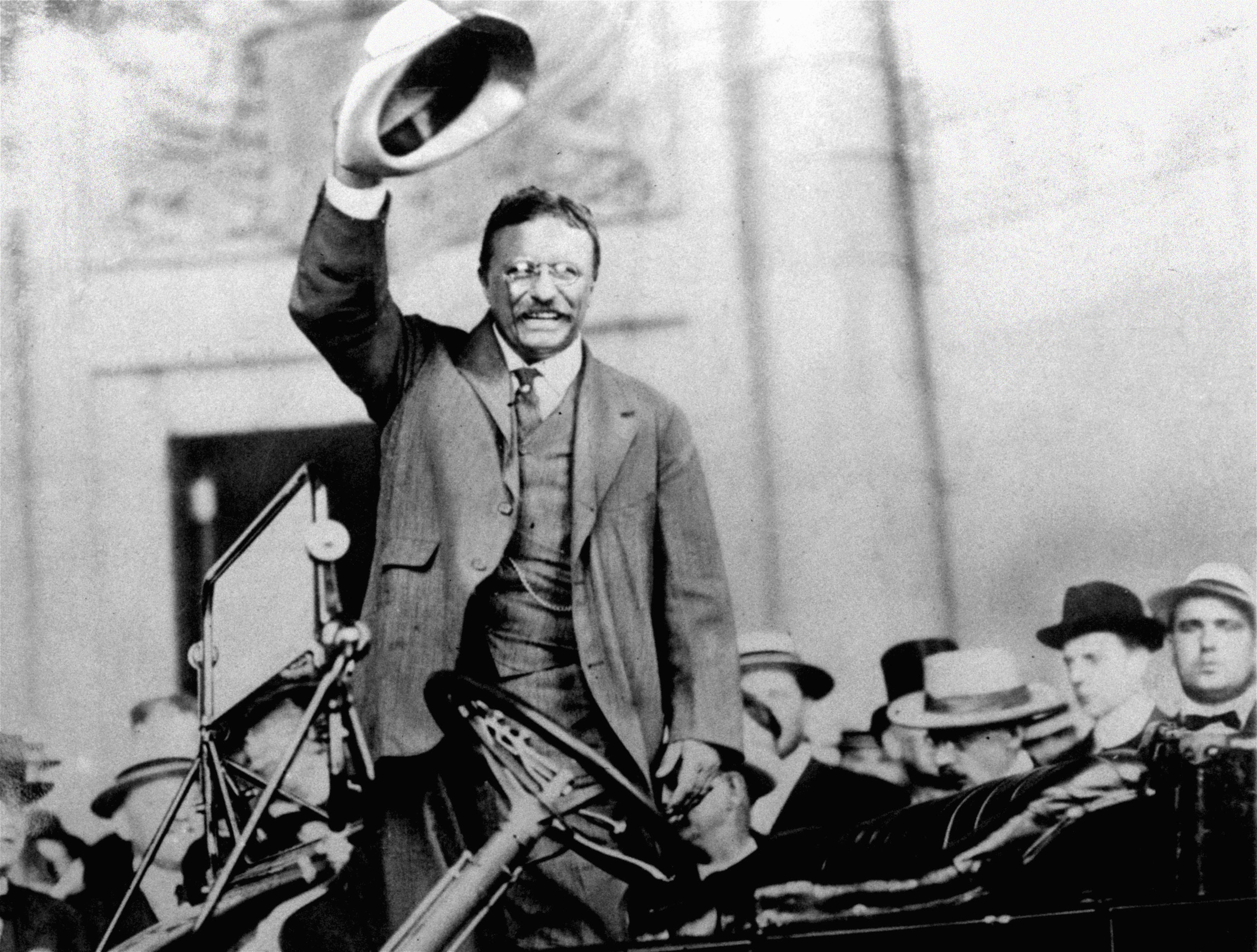
For most of Theodore Roosevelt’s presidency, he kept a secret. He was partially blind in his left eye.
It was only when he was out of office that he revealed the injury and how it came about: During a boxing match. In the White House.
Today, the White House plans to host UFC Freedom 250, as part of the celebrations honoring the semiquincentennial anniversary of American independence. Fourteen fighters will pound each other in seven separate bouts in a 5,000-seat arena that has been erected on the South Lawn.
Democratic lawmakers have widely criticized the planned event. A new lawsuit filed last weekend by the anti-corruption group Public Integrity Project on behalf of two plaintiffs is attempting to stop the event, claiming the plan is “deeply corrupt” and enriches President Donald Trump’s allies.
It will not be the first time the White House has served as a fighting arena. Last time, it was set against the backdrop of a presidency also marked by controversy over razing sections of the executive mansion.
During his roughly 7½ years in office, Roosevelt frequently invited aides, friends, and even professional athletes to the executive mansion to engage in all manner of sportsmanlike battery and barbarity. He was also frequently injured during these sporting matches.
But the damage to his left eye is believed to have occurred while boxing one of his military aides.
According to a 96-year-old letter sent from renowned ophthalmologist William H. Wilmer to Roosevelt’s biographer, Henry F. Pringle, Roosevelt was seen by Wilmer for the eye injury on Dec. 12, 1904. A transcript of Wilmer’s original letter, found in a Harvard University archive, details the approximate timing and extent of Roosevelt’s injury.
“At that time the President gave a history of having noticed for a while a dimness before the left eye after wrestling, and the further history that about two weeks ago, he was struck in the left eye while boxing,” the letter reads. “Since that time, he had noticed black spots before the eye. At first it seemed rather central and blurred the vision, but, now, it seems to have moved about two inches to the left … Examination at the time showed a few spots of hemorrhage in the retina of the left eye and some floating opacities in the vitreous.”
Roosevelt was told to take a break from “his very vigorous exercises” or else he might completely lose vision in the eye, according to the letter. The president protested, however, because he had already scheduled a jiu-jitsu match for 8 a.m., boxing at noon, a sport called “singlestick” involving wooden swords after that, then a long walk or horse ride in the afternoon. The doctor ultimately prevailed, and Roosevelt took his rest.
While Wilmer claims that the hemorrhage in Roosevelt’s eye healed, he later developed a cataract “reducing vision in the left eye to perception of light” — perhaps a result of the injury, Wilmer wrote.
Only a handful of people learned about Roosevelt’s medical condition at the time. The truth did not become public knowledge until October of 1917, after Roosevelt quietly checked himself in at a health camp in Stamford, Conn.
By that point it had been over eight years since the end of his presidency, but it wasn’t long before reporters discovered him. “The colonel is what is technically described as a ‘patient,’” reported the Springfield Daily News. “There is absolutely nothing the matter with him, except the extent of his girth.” In more polite terms, Roosevelt was there to lose some weight.
During his two terms as commander in chief, Roosevelt had dazzled the country with his relentless exercise regime. But at 58, after years of political setbacks, America’s “most strenuous citizen” — as he was playfully called in the press — was feeling depleted and bloated.
Historian Michael Cullinane, co-director of the Theodore Roosevelt Center, said that Roosevelt was stuck at home on the political sidelines during World War I. “He’s writing ferociously for journals and magazines about the war, and he’s very sedentary,” Cullinane said. “And so, what he realizes is that, if he doesn’t look after himself, he’s liable to have a heart attack or some weight-related illness.”
The health camp offered a rapid weight-loss program. And by the end, Roosevelt had lost 14 pounds, slimming down to 215. He gathered a group of reporters to witness the results. It was there, reminiscing about the glory years of his exercise routine, that he revealed the bombshell.
“The last boxing I did was in Washington. I boxed with my aides most of the time, but one day a young captain of artillery came along and broke some blood vessels in my left eye. I have never been able to see out of it since, although I don’t believe many people knew it.”
When pressed for more details by reporters, Roosevelt refused. “There is to be nothing more to say about the matter,” he said.
The mystery captivated newspapers. “Who hit the Colonel in the eye?” asked the Philadelphia Inquirer. There was no shortage of suspects. Roosevelt made it a regular habit of boxing with all sorts of White House visitors during his presidency.
“Every day, he built into his routine, some amount of exercise. And the people who exercise with him wound up being the ones who then had access to power,” Cullinane said.
Reporters scrambled to discover the identity of “the young captain of artillery” who had delivered the fateful blow. Within days they had uncovered their suspect: Col. Dan T. Moore, a cousin of the first lady Edith Roosevelt.
“I was one of the military aides at the White House in 1904 and 1905,” Moore confessed to the Evening Star. “The colonel and I boxed four or five times a week, I guess.”
Roosevelt’s injury had been such a secret, it had even been kept from Moore.
“I never knew the colonel had lost the sight of one eye in a glove bout until I read that interview the other day,” Moore told the Evening Star. “And I certainly do hate to think I was responsible for it.”
Cullinane said it was kept secret to protect Roosevelt’s modesty. “I mean, health issues, it’s no different now as then,” he said.
Roosevelt didn’t seem to have any hard feelings, which Cullinane credits to his sportsmanship. But this also wasn’t a fluke. Roosevelt was constantly getting himself injured as president. According to newspapers, he had almost had the same eye poked out the year prior, in fact, while fencing at the White House.
The rapier of his sparing partner, Gen. Leonard Wood, thrust through Roosevelt’s mask, narrowly missing his eye and leaving a serious bruise on his forehead. Then, just a week later, Roosevelt’s right wrist was severely injured in a singlestick match, again against Wood. “Such a collection of scars as that borne by President Roosevelt was never owned by an American Chief Executive before. He is the ‘most wounded’ President of the United States,” the Boston Post declared.
One mystery surrounding the injury to Roosevelt’s eye is pinpointing where the match occurred on the White House grounds. While newspaper accounts refer to a “gymnasium,” the White House Historical Association, which tracks these sorts of things, has no record of such a designated facility existing in 1904.
The White House underwent a massive renovation during Roosevelt’s tenure. After a century of different presidents and first ladies redecorating random rooms, the Roosevelts decided the whole house needed an overhaul.
“The decor was like a mix of like a Gilded Age, Victorian hotel, and steamboat gothic,” said Matthew Costello, chief education officer at the White House Historical Association. “When you see the photographs post-1902 renovation, I would argue, you see a White House that is much more recognizable to us today.”
Both the West Wing and East Wing were built during Roosevelt’s renovation, and many of the mansion’s iconic spaces were transformed. Not everyone was happy, though.
Among the most unpopular parts in the renovation plan: tearing down the enormous 45-year-old greenhouses on the west side of the mansion to make room for the new West Wing and turning the East Room into a state dining room, which would also function as a “handsome ballroom,” according to the Marion Star.
“Criticism of all these alterations are frequent and various,” wrote the Chattanooga News. “Many shake their heads, as though something were ‘rotten in the state,’ and mournfully talk of the desecration of the old mansion where Jefferson, Madison … and all the other noble executive chiefs were wont to keep ward over the nation’s destinies as they sat in stately communion.”
But Roosevelt’s “desecration” of the White House didn’t stop there. The venerated Cabinet Room, where for decades former presidents like Ulysses S. Grant had consulted with their top advisers, was rumored to have been converted into Roosevelt’s “department of physical culture.”
After the renovations were complete, Roosevelt was leading a group of guests on a tour of the second floor, taking pains to point out everything he had kept intact, when they arrived at the old Cabinet Room. “When the door was opened, ‘Presto change!’” the St. Louis Globe-Democrat reported: “All the guests rubbed their eyes. Before them were floor mats, shields, boxing gloves, wire masks, fencing gloves, padded vests, swords and foils, single sticks and other athletic paraphernalia.”
An unnamed White House official dismissed the rumor in the Times Herald. “It all depends on what you think is necessary to make up a gymnasium,” the official said. “If you require trapezes, and parallel bars, and flying rings, and all sorts of apparatus for exercising the muscles you would never be satisfied with the old Cabinet room for that purpose; for those things are not there. But if the President wants to singlestick there, I suppose he can find room enough, just as in any other of the rooms in the house.”
He might have injured his eye in that room — or not. According to historical accounts, it would appear Roosevelt was fighting all over the White House. There are stories of him wrestling and fencing in the basement, practicing jiu-jitsu in the library and boxing in the attic. The whole house served as his gymnasium.
Last month, the White House began erecting the UFC “octagon” fighting arena on the South Lawn.
Every president makes the White House their own to some extent. While the White House has long been a sacred symbol of American democracy, it is also a private home, and the history of the mansion is filled with these personal touches from past presidents, some more controversial than others, Costello said.
“There’s been tree houses, jungle gyms, swing sets, victory gardens, tennis courts, basketball courts, swimming pools, putting greens, Hoover ball — that was a big popular game during Herbert Hoover’s presidency,” he said. “But to the best of my knowledge, no octagons.”
TIJUANA, Mexico — The three SUVs pulled into the gas station parking lot, one after the other, Iranian flags taped onto the hoods and fluttering from the windows.
It was barely 4 a.m. The city’s nightclubs were closing, and the streets were dark. But this caravan had hatched a plan to stake out a national soccer team they never imagined they would see in person, and especially not here. So 4 a.m. at the gas station it was.
Like so many in Tijuana, the Iranian national soccer team was never supposed to end up here. They originally had planned to spend the month across the border, in Tucson, preparing to play their World Cup matches in Los Angeles and Seattle.
But for the first time in World Cup history, a host country is at war with one of the tournament’s contenders. FIFA, global soccer’s governing body, with tensions high and uncertainty about whether the team would even be allowed into the U.S., sought an alternative.
Co-host Mexico agreed to house them, with President Claudia Sheinbaum telling reporters that FIFA had asked for help because the “United States does not want the Iranian team staying overnight in the country.” Organizers opted for Tijuana, a border city close enough to the U.S. matches, with a stadium where the team could practice and a local government eager to welcome them.
The fans meet outside a convenience store at 4 a.m. in Tijuana. Stuart Palley
Now Sadegh Galavi and his relatives were piled into these SUVs, hoping to welcome their national team to the city that adopted his family. They knew what the world thinks of Tijuana, the dangerous, gritty border city from the movies, a hub for drug smugglers, and a cheap destination for Americans seeking parties and sex.
But they knew Tijuana as something different: a transient, multicultural city that embraces migrants and misfits, offering creole schools for Haitian children whose families are stranded there, and welcoming Sadegh and his wife four years ago when they knew no Spanish and not much more English.
It was just the place for a global soccer tournament, they thought, an unlikely but ideal refuge for their home team.
Sadegh and his friends spent the past two weeks working to convince the Iranian Embassy and team that Tijuana is safe. Now the team was minutes away from landing at Tijuana International Airport.
He had slept barely an hour, anxiously tracking the team’s flight, worried he might miss his chance to greet them. The jerseys ordered on Amazon hadn’t arrived on time, but the Iranian Embassy sent replacements at the last minute. The ambassador asked Sadegh’s wife, Maryam Asidi, to take photos and videos of the fans at the airport, to show Iranians back home that Tijuana isn’t as dangerous as they might fear.
“Hi brother, yes, please,” Sadegh said, answering his phone as he pulled into the airport. Military and police forces surrounded the airport’s entrances. The players must be landing soon, he thought.
He pulled over, hopped out of the car and power-walked toward the flight arrivals, waving his small Iranian flag.
Maryam and Sadegh Galavi pose at Tijuana International Airport on Sunday, while waiting for the arrival of the Iranian men’s soccer team. Stuart Palley
A divisive team
Known affectionately as Team Melli, Iran’s national team was near-universally loved in Iran for decades.
“There was absolute mania around Team Melli,” said Arash Azizi, an Iranian author and historian who recalled celebrations breaking out in the streets in Iran after the team qualified for the 1998 World Cup. “It was one of the most trusted, beloved institutions in Iran across political differences,” he said.
But after years of government mismanagement and repeated, brutal crackdowns on civilian protesters, many Iranians began to see even their national soccer team as an extension of the country’s leadership.
During the 2022 World Cup, in Qatar, Iran was engulfed by nationwide “Women, Life, Freedom” protests, and its men’s national team faced criticism for not vocally supporting the protesters. The team stood silently during Iran’s national anthem, but some fans were unsatisfied. Social media videos showed Iranians honking horns and setting off fireworks after their team’s 1-0 loss to the United States, which they viewed as a symbolic defeat for the regime.
Then, this March, the Iranian women’s team came under criticism from pro-government media outlets for standing silently during the national anthem, after reports that Iranian security forces had killed thousands of people in a violent January crackdown on protests.
Australia granted six players and a staff member humanitarian visas, citing concerns they would be persecuted for failing to sing along. Eventually, five of the team members withdrew their claims and were welcomed back to Iran with an elaborate ceremony.
Then came the war, which threw the men’s team’s season into chaos. Most play in domestic Iranian leagues whose games were suspended Feb. 28. A friendly, scheduled to be played in Arizona, was canceled. President Donald Trump, in a Truth Social post, said the Iranian team was “welcome” to play in the World Cup but advised them against it “for their own life and safety.”
Just days before the team was scheduled to travel to Mexico, it still hadn’t received its U.S. visas. Earlier this month, the players learned their visas had been approved, but visa applications for 15 members of the team’s support staff had been rejected.
In an interview with the Washington Post in Tijuana, Iran’s ambassador to Mexico said the 15 people included trainers, managers, a media director, a security leader and a delegate from the Foreign Ministry. He accused the United States of failing to follow FIFA rules.
On Tuesday, Iran’s soccer federation said the ticket allocation for Iranian fans had been revoked, in an “unexpected move.” FIFA requires that participating federations be allocated 8% of ticket capacity, so fans can purchase entry to their team’s games.
“From my perspective, politics needs to be separate from sports,” Abolfazl Pasandideh, the Iranian ambassador, said through his translator in Tijuana. “And if in this case they want to mix the two, it has to be the other way around. Politics must be at the service of sports.”
But to some in Tijuana’s small Iranian community — the ambassador puts it at 20 or so, in a city of over 2 million people — politics are inherent to Iranian soccer.
Iranian Pedram Maymand, a Tijuana resident, in the city’s center on Sunday.Stuart Palley
“For the team to come here while the country is grieving … I don’t think that celebrating the football team right now is appropriate,” said Pedram Maymand, 31, who moved to Tijuana from Fresno, Calif., when his student visa expired after graduation about five years ago. “They’re representing the government that is killing our people.”
If he could meet the players, he would want to send them a message, he said: “Have you any shame?”
Sadegh understands the complex feelings. But to him, Team Melli is still a symbol of national pride, of a country he chose to leave but that remains a core part of who he is.
People walk near the Tijuana Friendship Arch. Stuart Palley
How Tijuana became home
Sadegh’s family’s path to Tijuana, like the stories of many in this city, began with a romance across borders and cultures.
About 50 years ago, Maryam said, her father visited San Diego as part of the Iranian military. He fell in love with a Mexican woman, who eventually gave birth to their son.
Maryam grew up hearing about the half brother she had never met, who lived in the faraway city of Tijuana. But she didn’t believe the story until her half brother came to visit Iran for the first time when he was in his 20s, and she was 13.
Many years later, after marrying Sadegh, Maryam decided to visit her brother’s city, not knowing anything about Tijuana’s reputation. Within two weeks, they had decided to stay.
“Here, you never feel you are from another country,” Maryam said. “This country makes you feel good. … And as a woman, you are more free.”
She shed her hijab, a head covering that is mandatory for women in Iran. Within weeks of leaving the Islamic republic, where drinking is banned, Sadegh tried mezcal for the first time. The music coursing through Tijuana’s streets on Friday and Saturday nights made Maryam feel alive.
Maryam and Sedagh Galavi at their home in Tijuana. Stuart Palley
They longed for their family and for home, but they soon began finding the other Iranians. One day Sadegh saw a car parked on the side of a road with vanity plates: “Tehran.” He left a note on the windshield with his phone number; the car‘s owner is now his friend and boss, at a car-restoration business in town.
Sadegh and Maryam gave birth to a Mexican son, Sepehr, whose middle name, Mayahuel, was a reference to an Aztec god. “We want him to feel he’s from here,” Maryam said.
When her mother died unexpectedly of a heart attack last year, Maryam fell into a deep depression and returned to Iran for a long visit with her 9-month-old son. The trip coincided with the U.S.-backed Israeli attacks on Iran, and she had to flee the country by land. As soon as she landed back in Mexico, she was moved by the strangers who offered to help carry her suitcase.
She worried her grief would taint the city for her. Instead, Tijuana pulled her out of it. This was the place where she wanted to raise her son, she decided. The couple bought a house in Tijuana and began applying for Mexican citizenship.
Then, with the World Cup on the horizon and the war raging, rumors started circulating: Their country’s team needed a home.
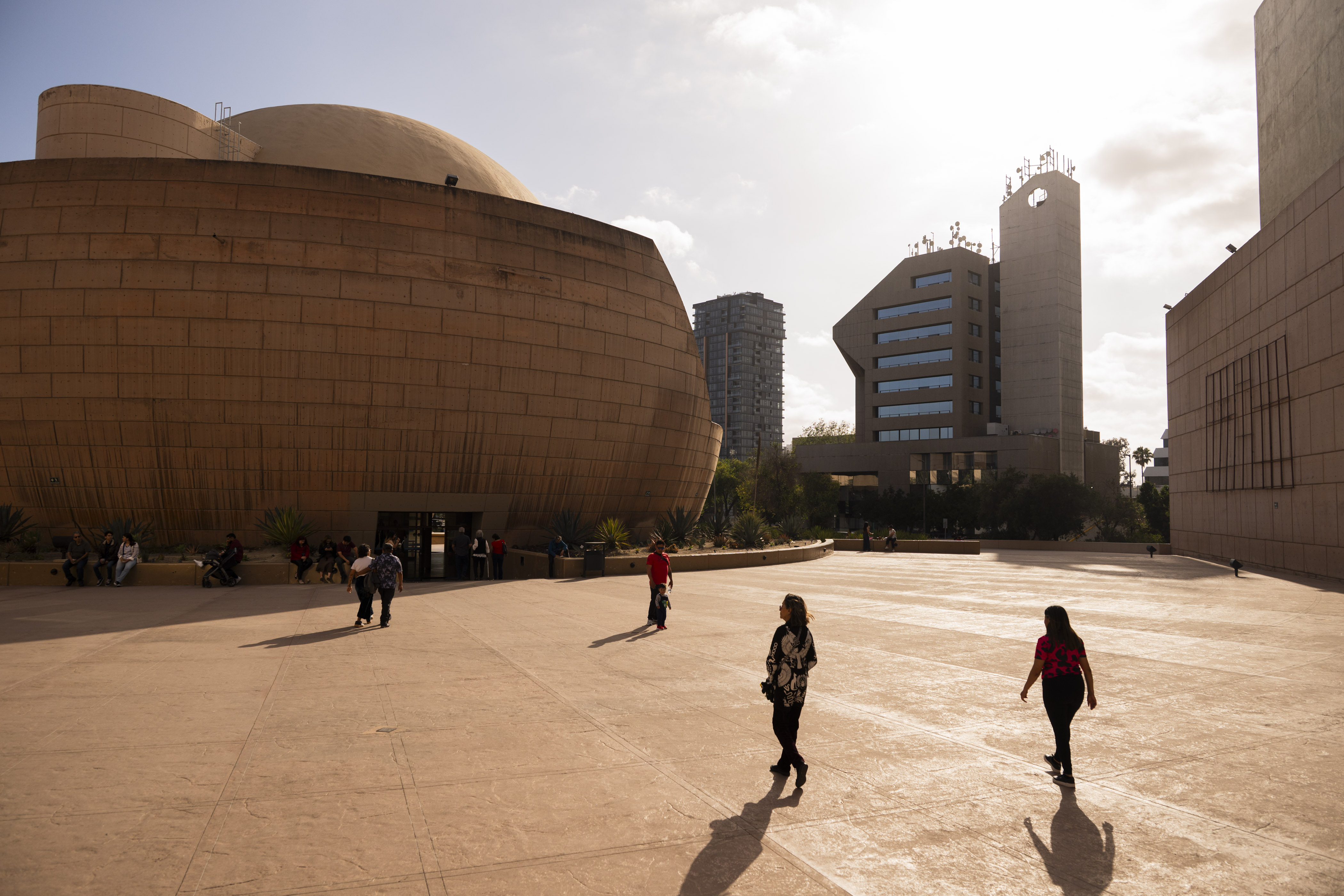
People exit the Tijuana Cultural Center this week. Stuart Palley
‘I am in my country’
Late last month, FIFA announced the team was heading to Tijuana.
Sadegh could hardly believe it. When Iranian news outlets raised concerns about security, he began messaging the players directly on Instagram to tell them about the city he loves and assure them they would be safe. He knew he would never get a response but kept typing anyway.
His boss and friend, Dara Makoipour, met with the Iranian ambassador and showed him around the city — to the stadium, to the restaurant known as the origin of the Caesar salad. Local tourism and Chamber of Commerce officials were eager to use this as a chance to change Tijuana’s reputation and put it on a global stage.
Sadegh started a WhatsApp group with his small circle of Iranian and Iranian Mexican family and friends in Tijuana, and they came up with a plan to welcome them at the airport for their 1:30 a.m. arrival. When the flight was delayed to 5 a.m., some in the group pulled out.
But his small family caravan had powered through, and now they were gathered in international arrivals, surrounded by heavily armed Mexican national guard troops, trying to scope out where they might be able to catch the team.
They walked around a security roadblock to a group of reporters and a handful of other fans from across the San Diego area.
Suddenly the team bus approached with a military escort. The small crowd cheered, raising their flags and chanting the name of one of the players. A team representative briefly rolled down the window and waved straight toward Sadegh.
“Merci,” the Iranian representative said with a smile.
The Iranian team’s bus departs a secure area of the Tijuana airport.Stuart Palley
Sadegh, his heart racing, accidentally spoke to them in English, calling out, “welcome!” He had forgotten he could speak to them in Farsi.
“Bienvenidos!” his Mexican relatives shouted.
Reporters surrounded the couple to ask them how they felt. Maryam beamed.
“I think now I am in my country,” she said.
The team later circulated a photo, taken from the bus on their arrival that morning, of Sadegh waving his flag. He proudly shared it on Instagram, writing in English and Farsi that “the Iranian national team belongs to all Iranians,” regardless of their beliefs, religion or political stance.
WASHINGTON — The House on Tuesday approved a Democratic bill aiming to fast-track contract negotiations between employers and newly created unions, after 20 Republicans defied their leaders to force it to the floor and push it to passage.
The measure, which passed on a 230-193 vote, faces a slim chance in the Senate and would be all but certain to be vetoed by President Donald Trump even if it were to reach his desk. Still, the vote was the latest reflection of Speaker Mike Johnson’s weak hold on his narrow majority, whose members have steered around him time and again and teamed with Democrats to win passage of legislation that he has toiled to block.
On Tuesday, a sizable bloc of Republicans, including several from competitive districts who are slogging through tough reelection fights, joined with Democrats to push through a pro-union bill. It would impose an initial 90-day deadline on contract negotiations for new unions and their employers, along with paths to mediation and arbitration if the parties reach an impasse.
Rep. Donald Norcross (D., N.J.), the sponsor of the bill, said he had written it to speed up workplace contract negotiations so that employers could not drag them out in the hopes of undercutting workers’ leverage.
“Union busting is illegal, and it’s wrong and it has been for generations,” Norcross said. “But with the dirty tactics of indefinite delays, many employers are working relentlessly to kill their employees’ unions.”
While several Republicans supported the legislation from the outset, party leaders declined to act on it. So Norcross turned to a procedural maneuver known as a discharge petition, which allows lawmakers to circumvent House leaders and force a bill to the floor if a majority of members sign on in support.
Seven GOP lawmakers did so and even more joined Democrats on Tuesday, in voting in favor of the legislation. Among the Republicans who banded together with Democrats to force action on the measure, several are seeking reelection in competitive districts, including Reps. Mike Lawler of New York, and Brian Fitzpatrick and Rob Bresnahan Jr. of Pennsylvania. Another, Rep. Don Bacon, who represents a center-leaning district in Nebraska, is retiring.
Some other swing-district Republicans joined them Tuesday night in backing the bill, including Reps. Derrick Van Orden of Wisconsin and Maria Elvira Salazar of Florida.
Historically, discharge petitions have rarely been successful, but this Congress has been an exception, as Johnson has been unable to stop Republicans from straying from the party line on a wide variety of issues. Democrats successfully employed the tactic to win passage of legislation directing the Justice Department to release files related to convicted sex offender Jeffrey Epstein, which became law, as well as another labor-related bill aimed at overturning Trump’s executive order stripping federal workers’ union protections, which has stalled in the Senate. Last week, they used it to win approval of a bill with new aid for Ukraine that also would impose new sanctions against Russia, defying both Johnson and Trump.
The trend reflects growing frustration among Republicans toward Johnson and party leaders as the midterm elections loom. Before the vote, Fitzpatrick wrote on social media that the tactic had succeeded so many times only because Republican leaders were shirking their responsibilities by blocking popular policies.
“A successful discharge petition is clear and direct evidence of a poorly managed House Floor — because it demonstrates that the will of the majority of the People is being thwarted by the privileged few,” he wrote.
The vast majority of House Republicans on Tuesday opposed the bill. Rep. Tim Walberg (R., Mich.) described the legislation as “a massive expansion of Washington’s power over American workers and job creators.”
“It is the latest attempt to put workers under the thumb of federal bureaucrats,” Walberg said.
Graham Platner, a military veteran and first-time candidate whose populist message resonated with voters in Maine, prevailed over the state’s governor to win the Democratic primary for Senate on Tuesday. Now, he will face Sen. Susan Collins, a vulnerable Republican incumbent, in one of the most consequential races in the country this fall.
Platner’s campaign has survived a series of scandals about his personal life, which Republicans began highlighting within minutes of his victory. And he used his speech Tuesday night to cast Collins as a tool of a political establishment that has let Maine down.
In other primaries on Tuesday, Democrats in Nevada picked Aaron Ford, the state attorney general, to oppose Gov. Joe Lombardo, solidifying the matchup in a competitive governor’s race in a key swing state. And Republicans in South Carolina showed their loyalty to President Donald Trump, supporting his preferred candidates in races for Senate and governor.
Here are three takeaways from the night of primaries.
Amid a barrage of scandals, Platner sought to shift to the fall
Platner, a Marine veteran who owns a small oyster farm, has been hampered for most of his campaign by scandal, including old, unearthed social media posts in which he made offensive comments about women and rape, and a tattoo resembling a Nazi symbol that he has since covered with new ink. The latest controversy came last week, when three women who had dated him told The New York Times that he had engaged in unsettling behavior toward them.
On Tuesday, Platner attempted to shift the focus to his general-election matchup with Collins, a battle-tested incumbent, while also acknowledging his stumbles. In a fiery speech, he said that members of the political establishment “keep looking for that one story, that one headline, that one moment in my life that they can define the campaign by.”
He added: “In trying so hard to understand me, they failed to understand that this is not about me at all. This is a movement about us, about the far too many, working far too hard and struggling far too much.”
Still, nearly 30% of primary voters cast ballots for other Democratic candidates, according to incomplete results early Wednesday, despite that fact that his main opponent, Gov. Janet Mills, had suspended her campaign. That suggested that some Mainers remained skeptical of him, and left him with the challenge of persuading voters in the general election that Collins’ shortcomings were greater than his.
In his effort to pivot, Platner blasted the moderate image Collins has cultivated, describing her as “only bipartisan when it doesn’t matter” and saying she had failed to protect abortion rights.
“If you are an independent voice, why do you vote with Donald Trump 95% of the time?” he said, addressing his opponent directly. “If you’re so bipartisan, why are you the deciding vote to put Brett Kavanaugh on the Supreme Court?”
Trump’s candidates advanced or were leading
Trump’s backing is usually the gold standard in a Republican primary, all but guaranteeing victory. His record suffered a rare blemish last week when the candidate he backed in the Iowa governor’s race lost the Republican primary.
On Tuesday, Trump returned to form, with candidates he supported winning their races, advancing to runoffs or leading challengers in races yet to be called. In South Carolina’s crowded Republican primary for governor, Lt. Gov. Pamela Evette, backed by Trump, led the field and advanced to a runoff with Alan Wilson, the state attorney general, who was close behind.
In Nevada, two of three House candidates the president backed — Carrie Buck and Marty O’Donnell — won their primaries. The third was too close to call early Wednesday.
Finally, in North Dakota, Rep. Julie Fedorchak easily fended off a primary challenge with help from Trump’s nod.
Lindsey Graham avoided the embarrassment of a runoff
Graham, an outspoken Republican who once clashed fiercely with Trump before becoming a staunch ally, has never been beloved by the MAGA base. He faced a serious Republican challenger, Mark Lynch, and a real chance that he could have been forced into a runoff by failing to earn more than 50% of the vote.
But Graham, too, had Trump’s backing, and he managed to avoid that embarrassing outcome. After his campaign and allied groups raised and spent millions on his reelection bid, Graham posted a strong enough showing among South Carolina primary voters to earn a spot on the November ballot. In a deep-red state, Graham will be overwhelmingly favored to win another six years in the Senate.
NEW YORK — When Manhattan’s original Pennsylvania Station was demolished in 1963, it marked the undignified end to one of America’s great public works, a monolithic Beaux Arts train terminal with Roman-style columns and a spacious central waiting area that was at the time the city’s largest indoor space.
In its place rose Madison Square Garden — home of NBA’s New York Knicks and NHL’s New York Rangers — while train commuters were forced underground into gloomy, claustrophobic, low-ceilinged corridors when the redesign was completed in 1968.
“Through Pennsylvania Station one entered the city like a god,” the architectural historian Vincent Scully famously lamented. “One scuttles in now like a rat.”
But a dramatic new vision for the busiest transit hub in the Western Hemisphere calls for a return to the original station’s grandeur from 1910.
Renderings released Monday feature a rectangular stone facade lined with imposing columns along a grand entryway. Inside, a sunlight-drenched concourse boasts soaring ceilings more than 50 feet high in places. There are bronze finishes and other ornamental details, like a bas-relief of the city’s famous skyline and a large station clock.
Inside one entryway, an inside wall bears the seal and name of President Donald Trump, who had Amtrak assume control of the project last year after decades of political infighting among transit agencies and opposition to moving MSG from billionaire owner James Dolan.
For now, though, the name etched across the proposed grand facade would still read “Pennsylvania Station,” according to the renderings. They were released by Amtrak, which owns the terminal, and Penn Transformation Partners, the design and development consortium picked for the project.
Proposal aims to make Penn Station an icon again
The proposed design draws from the ornate, Beaux-Arts design of Grand Central Terminal, the city’s other major rail hub, as well as Art Deco landmarks like the Empire State Building and Rockefeller Center, according to lead design architect Vishaan Chakrabarti.
The vision, he said, is to restore Penn Station’s place among the pantheon of the city’s greatest landmarks.
“There was this fearless embrace of ornament and decoration that in some ways we’ve lost,” Chakrabarti said. “We want to bring some of that sense of craftsmanship back.”
The redesign is projected to cost roughly $8 billion, and construction is targeted to begin before the end of 2027, officials said Monday. Penn Station would remain in operation throughout as the project progresses in phases over about six years.
More than 600,000 commuters traverse the rail hub on any given workday, or more than the three major international airports that serve greater New York City — John F. Kennedy, LaGuardia, and Newark Liberty — combined.
Knicks and Rangers home arena would remain at the site
Plans floated over the decades have called for relocating MSG, but the plan is for the “World’s Most Famous Arena” to remain in place. A theater owned by MSG and built directly above the tracks, however, would have to be razed.
The developers and MSG’s owner have reached an agreement on this critical point, but the final terms — including payment — are still being negotiated. That’s according to Andy Byford, a former New York City subway chief who Amtrak named as a special adviser to oversee the redevelopment.
Transit advocates complain the process has been shrouded in secrecy.
“It’s really important that there be public input and involvement,” said Lisa Daglian, who heads a group that advises the Metropolitan Transportation Authority, which operates New York’s subway and two commuter rail systems.
“We don’t need another megamall or monument and certainly not at the cost of billions in local revenue or by putting existing services at risk,” said Danny Pearlstein of the transit advocacy group Riders Alliance.
Byford said more details will be revealed in the months ahead, including a more detailed breakdown of costs, as the developers refine the preliminary designs and the project goes through the extensive federal environmental review process.
But he vowed no fare hikes to cover project costs and no plans for the government to condemn and take surrounding properties to expand the station, as some have suggested.
At Penn Station on Tuesday, John Schoen was among the regular riders who welcomed the prospect of a more inviting commute.
“The city needs new looks. This is old,” the 55-year-old Long Island resident said. “Let’s do it. Move forward.”
Others, though, wondered how construction might worsen their commutes. James Culhane, another Long Island rider, noted parts of the station received a significant face-lift in recent years that brought in new eateries, more natural light, and other improvements.
“Things are operating as well as they can be,” said the 24-year-old opera stagehand. “Just use the money elsewhere.”
This is a tumultuous week for Philadelphia’s schoolchildren. If members of City Council and the school board can find a path forward before lawmakers take a final vote on the budget on June 11, 340 school staff jobs will be saved. More than 3,700 Philadelphia students will enter the summer knowing that when they come back to school next year, their teachers, counselors, and climate staff will still be there.
A lot could still go right in the final days of the city budget negotiations. To its credit, City Council worked hard to find $48 million this year to save the jobs for a year. But the school district can’t reverse the cuts without recurring funding. That would not be sound fiscal management. If these positions are cut, critical school staff will be forced to find other jobs, and it will be almost impossible to bring them back.
City Council, the school district, and the mayor are ultimately on the same side — the side of the kids. Finding a way to keep the 340 school staff jobs is about more than balancing budgets; it is about protecting the educators, counselors, and support staff whose work shapes students’ lives. The decisions made in the coming days will determine whether our students start the next school year with stability or disruption.
Priyanka Reyes-Kaura,K-12 education policy director, Children First, Philadelphia
Budget questions
After reading that Jason Wingard was paid $1.5 million by Temple University — a year after resigning as president — I’m looking at my alma mater’s current budget situation in a different light.
In April, Wingard’s successor, John Fry, announced that the operating budget for next year was projected to have an $85 million deficit, a figure that has since come down.
I know capital budgets are in a separate category from other spending, but this doesn’t look good for the university. And has anyone calculated the increased operating expenses related to these new buildings? Or is it assumed that the cost will be covered by tuition from declining enrollment?
As a triple alum, I only want the best for the university, the students, and the staff. Hopefully, whoever’s reading this wants the same.
Ronnyjane Goldsmith,Palm Beach, Fla.
Join the conversation: Send letters to letters@inquirer.com. Limit length to 150 words and include home address and day and evening phone number. Letters run in The Inquirer six days a week on the editorial pages and online.