Tag: no-latest

  • Ms. Rachel goes to Washington, carrying letters from children in ICE custody

    Ms. Rachel goes to Washington, carrying letters from children in ICE custody

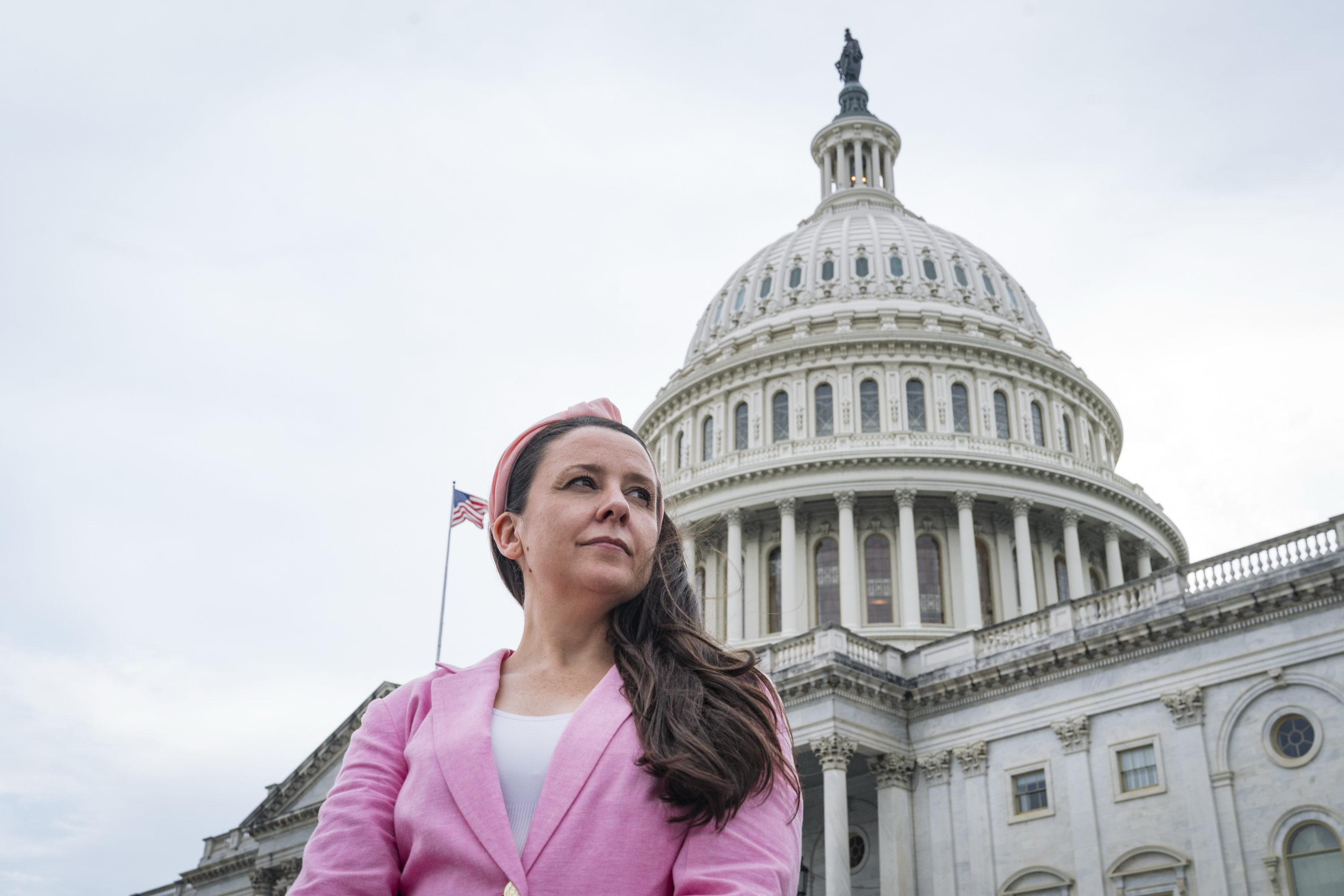
    WASHINGTON — Rachel Griffin Accurso — Ms. Rachel, to her millions of followers — made her first visit to Capitol Hill on Tuesday afternoon, wearing a bubblegum-pink linen suit and wheeling a black suitcase filled with stapled packets of handwritten letters and drawings. They were the words and artwork of children, all of whom have been — or remain — in the custody of U.S. Immigration and Customs Enforcement at the nation’s only family immigration detention center.

    “I cry a lot,” read one letter from a 7-year-old boy held at the Dilley Immigration Processing Center in South Texas. “I want to get out of here.” Among the illustrations were portraits of crying faces, families standing together behind bars and a red house that a 9-year-old child longed to return to. Accurso clutched one packet in her hand, ready to offer it to the first lawmaker she encountered.

    She had come with a plan: Over a brief two-day visit to Washington, she wanted to deliver the letters and drawings to members of Congress and tell them about the children she’d met. Her goal was to urge every official she spoke with — Democrats and Republicans alike — to end family detention and reunite the children and parents who had been separated by ICE enforcement.

    Sen. Andy Kim (D., N.J.) holds the letter of a child detained at the Dilley Immigration Processing Center in southern Texas. Maxine Wallace

    It was a new foray into the political realm for the early-childhood educator, who became the reigning star of children’s media with her wildly popular educational videos on YouTube and Netflix. Through her adult-facing social media platforms, Accurso has also emerged as a powerful advocate for vulnerable young people around the world, making headlines — and sometimes drawing backlash — for speaking out on behalf of children in Gaza, Sudan, and other humanitarian crisis zones.

    Now her efforts include children closer to home. Over the past few months, Accurso has become an increasingly prominent voice in the debate over family immigration detention and the mounting concerns about conditions at the Dilley detention center. She has spoken directly to 10 families there via video calls, she said, and has publicly shared clips from several of those conversations with her 5 million Instagram followers. Accurso helped launch a petition to close the Dilley facility that has more than 324,000 signatures, including dozens of celebrities (Ben Stiller, Ayo Edebiri, Cynthia Nixon, and John Legend are among the many signatories). She also shared an open letter addressed to CoreCivic, the private prison contractor that has operated Dilley since its Obama-era construction in 2014: “What we have to agree on is not harming children,” she wrote.

    When Accurso arrived on Capitol Hill along with her husband, Aron Accurso, they were welcomed by Sen. Andy Kim (D., N.J.). He offered them a brief tour through the Capitol, noting that the Senate had voted just days before to approve $70 billion in funding for President Donald Trump’s immigration enforcement agencies. “When you’re talking about this,” he said, nodding to the packet in Accurso’s hand, “what’s funding this? That’s what’s happening in this building.” As they spoke, the House was preparing to vote on the same funding package.
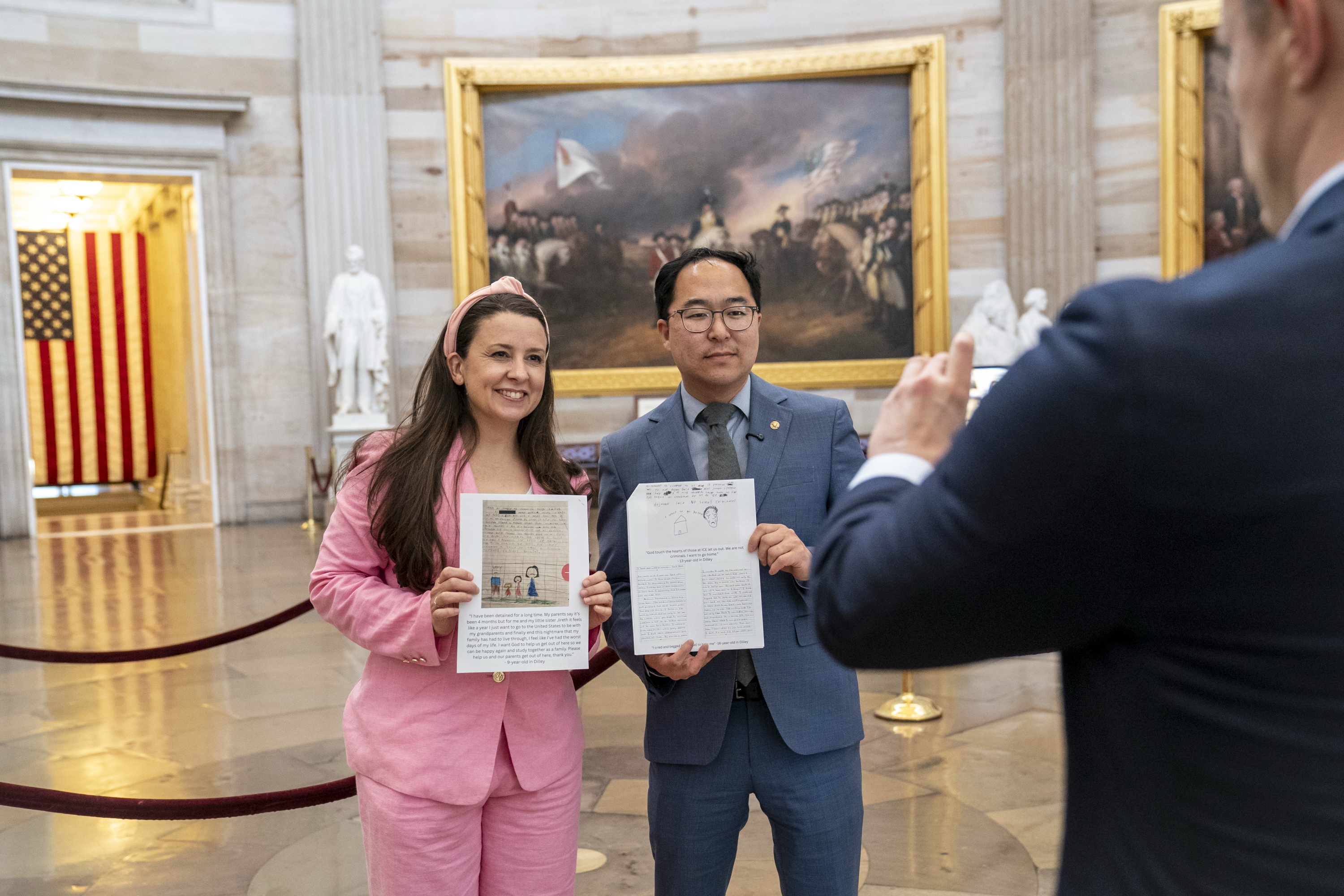
    Accurso and Kim in the Capitol Rotunda on Tuesday.Maxine Wallace

    Accurso and Kim posed for photos and filmed a brief video together in the Capitol Rotunda, then parted ways before she headed to the Hart Senate Office Building.

    She was stopped repeatedly by enthusiastic interns and staff members who asked for selfies to show their own children, or their nieces and nephews. “What’s their name?” Accurso always asked, before deftly switching the phone setting to record a personalized video for each child: Hi, Ava! Hi, Maeve! Hi, Hugh!

    Then she would steer the conversation toward the names of other children — some she had spoken with personally, and others whose circumstances were recounted to her by lawyers, advocates and journalists working with families at the Dilley facility. There was Amalia, an 18-month-old who suffered a near-fatal health crisis while in ICE custody at Dilley; Deiver, a 9-year-old who missed his friends at school and wanted to participate in the state spelling bee; Guri, a 12-year-old who has been detained with his family since February and has experienced chronic blood in his stool for months.
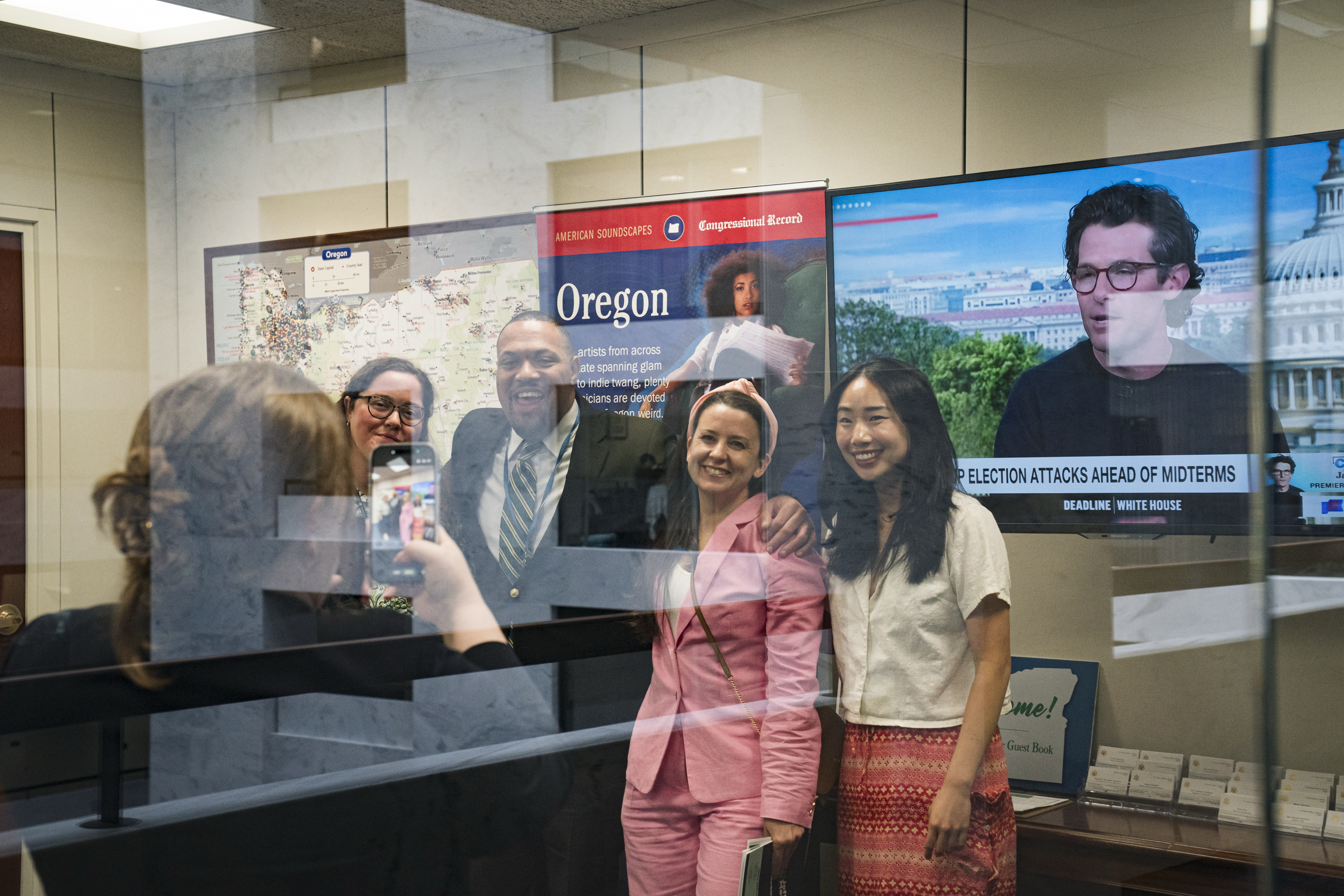
    Accurso poses for a group photo with some staff from the office of Sen. Jeff Merkley (D., Ore.) on Tuesday. Maxine Wallace

    Accurso was greeted with joyful shouts of recognition in the office of Sen. Jeff Merkley (D., Ore.). She left a packet with the staff of Sen. John Cornyn (R., Texas) and noted that they seemed friendly. She walked into the office of Sen. Lisa Murkowski (R., Alaska) with a cheerful, lilting “Hi, friends!” and the staff member’s subsequent gasp — “Oh my gosh!” — was audible down the hall.

    “Well, I hope this works,” Accurso said, as the clock ticked to a quarter past 6 and it became clear that most of the offices were now closed. She had visited 10.

    So she headed for the exit and learned the news as she was leaving: Minutes before, the House had narrowly passed the $70 billion funding package — including $38 billion for ICE enforcement and $26 billion for the Border Patrol. The vote paved the way for the agencies to build a detention system and pursue what Trump had pledged would be the largest mass-deportation operation in the country’s history.
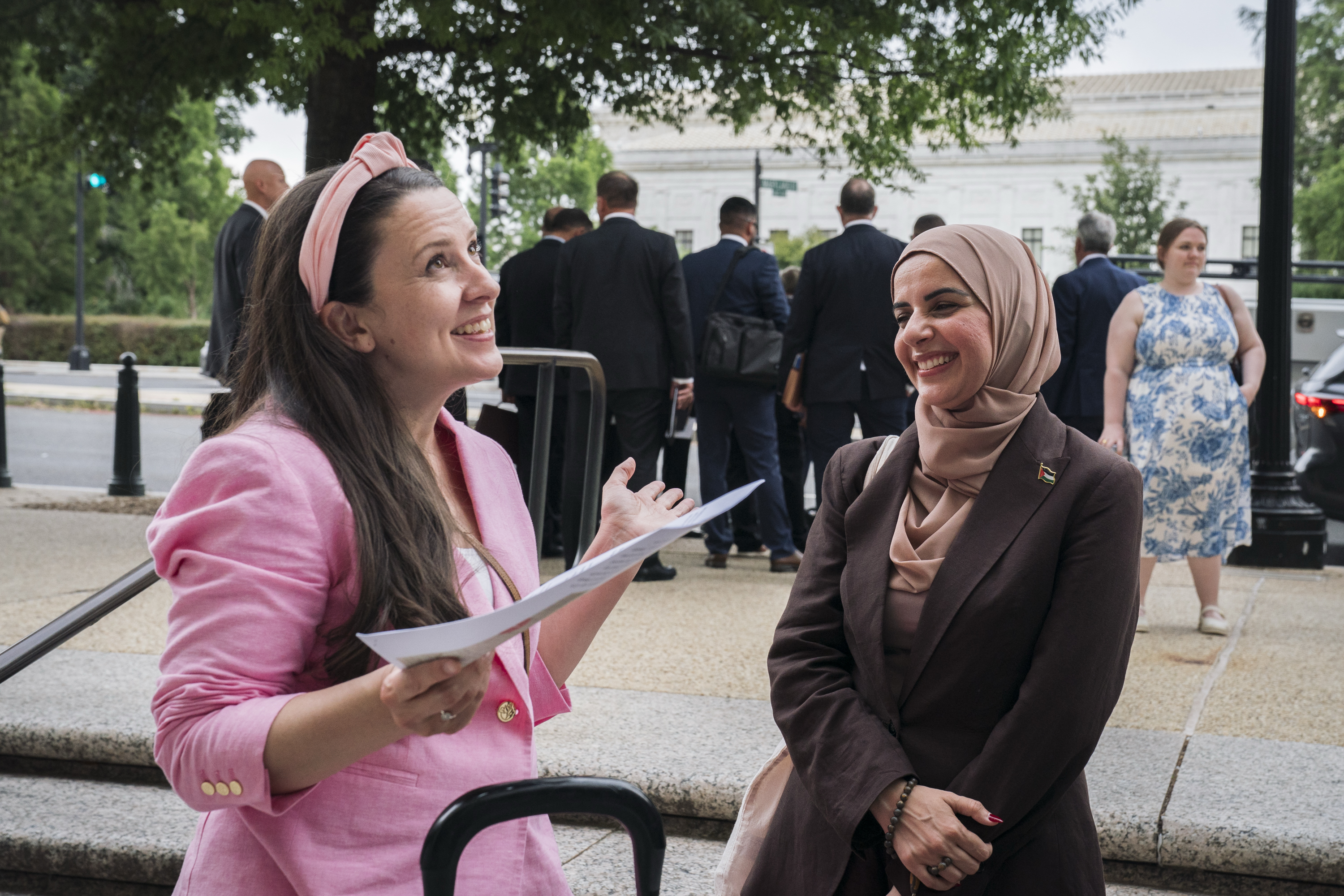
    Accurso on Tuesday outside the Hart Senate Office Building with Leqaa Kordia, a Palestinian woman detained for a year amid a Trump administration crackdown on protesters last spring.Maxine Wallace

    The day before she took the train to Washington from her home in New York, Accurso visited children and families at a hospitality tent set up by volunteers outside Delaney Hall, an immigration detention center in New Jersey where demonstrators and law enforcement have clashed in recent weeks.

    Accurso delivered toys and art supplies to the tent and, with the families there, sang a song written by the Peace Poets along with children detained at Dilley: “I’ll sing from here and you sing from there, together we’ll sing down the walls everywhere.”

    She spoke with a 13-year-old girl who described what it felt like to have only brief visits with her father, a truck driver who has lived in the United States for 20 years and supports his wife and three children, the youngest of whom has complex special needs.

    “We went to go and visit my dad, and it was really sad,” the teen told Accurso, who wiped away tears as she listened. “He looked like a prisoner. But I knew in my heart that he shouldn’t be in there.”

    Earlier this year, as she read more about the children being swept up in ICE enforcement operations, Accurso said, she began contacting legal experts, advocates, and journalists on the ground in Texas who detailed alarming conditions at the facility and helped connect her to families detained together there.

    Those parents described children who were deteriorating physically and mentally; several kids said the water in the facility made them feel ill. Autistic children were suffering in particular, Accurso said; one nonverbal 5-year-old named Gael had not had a bowel movement in nine days and had begun hitting himself in distress. Families told her that their children couldn’t sleep because the lights were on all night.

    She felt haunted by those conversations, Accurso said later, in an interview with the Washington Post: “I kept thinking, ‘How is this happening?’”

    Several children and teens who were included on Accurso’s social media platforms were subsequently released from detainment, including Gael; Deiver, the 9-year-old who begged to go to the state spelling bee; and Olivia Mabiala Andre, a 19-year-old asylum seeker and nursing student. Accurso posted about her gratitude and relief in those moments, but she said she is acutely aware of how many children remain behind, including those who don’t feel safe speaking publicly about what’s happening to their families.

    As of early June, about 320 people were at the Dilley center, including nearly 90 children, according to Faisal Al-Juburi, co-CEO of the Texas-based nonprofit Refugee and Immigrant Center for Education and Legal Services (RAICES). In the past year, he said, RAICES has documented roughly 1,500 medical concerns from families held at Dilley.

    Accurso has highlighted concerns voiced by medical experts: In April, responding to mounting reports of dangerous conditions for children at the Dilley center — including unsafe water, the spread of measles, delayed medical care and declining mental health — the American Academy of Pediatrics requested urgent access to the facility, reiterating that “no time in detention is appropriate for a child.”

    A spokesperson for CoreCivic said in an emailed statement that its facilities are safe, and noted that while some lighting is on during overnight hours, “lighting over sleeping areas is turned off during sleeping hours.”

    The spokesperson referred to a statement by Kristen Dauss, the company’s vice president and chief medical officer: “The children and their families at DIPC receive care that is clinically rigorous, federally overseen and delivered with dignity.” Dauss added that children receive clean water from the same regularly tested municipal source that supplies local drinking water, appropriate nutrition and hygiene supplies.

    Dauss echoed those points in a recent response to Accurso’s letter to CoreCivic. In a separate emailed statement, a spokesperson for the Department of Homeland Security echoed that families at Dilley are provided appropriate living conditions and medical care.

    When Accurso talks to people about the firsthand accounts she has heard, “they’re shocked,” she said. “Why don’t people know? But I also feel like I didn’t know the extent of what was happening, either. We have to get the information out.”

    This underscores the value of Accurso’s work and platform, said Elora Mukherjee, an attorney who represents numerous families detained at Dilley and serves as director of the Immigrants’ Rights Clinic at Columbia Law School. With her vast audience, Accurso represents a different way to inform people, beyond the reach of mainstream media: “Overwhelmingly, the American public still does not realize that, as a nation, we are imprisoning babies, toddlers and children who have done nothing wrong,” she said. “Sustained attention on cruelty against children is critically important.”

    Al-Juburi noted that although the country’s current immigration policy represents “generations-long, systemic issues that need to be addressed, fundamentally, by our legislative branch,” there is a meaningful impact when prominent people raise their voices.

    Culture often shifts before the law does, he said: “We will not see policy change until the public demands it. And that is what gives me hope when people like Ms. Rachel turn their spotlight onto a cause like this.”

    The sun was falling through mottled clouds as Accurso left the Hart Building and wheeled her suitcase down Constitution Avenue toward the Capitol. She wanted to record a video there for the children detained at Dilley and the ones waiting in the tent outside Delaney Hall. She would tell them that she’d brought their letters and their artwork to the place where decisions about their future were made. “I have your words right here,” she would say into her phone camera, holding the stapled packet close to her chest. “I’m always going to stand with you.”

    But when she arrived at the building, she first took a moment to sit quietly on the empty steps. The House’s vote, and its ramifications, were at the forefront of her mind. She felt a heavy sense of sorrow and defeat, she said.

    She adjusted her knotted pink headband and looked up toward the towering dome, bathed in the softening light of dusk. She thought about how young people often stop her — more than a dozen had done so just in the past few hours — to thank her and urge her to keep going. The next day, she would come back and meet with more elected officials in the House. She would make sure that all 535 packets of letters and drawings were delivered to every member of Congress. She would keep telling the stories of the children she’d met.

    “I’ll never stop trying, for them,” she said. “I can’t say, ‘I’m just one person, so I’m not going to make a difference.’ What if everyone said that?”


  • Trump bought tobacco stocks and raked in industry donations as FDA eased standards

    Trump bought tobacco stocks and raked in industry donations as FDA eased standards

    President Donald Trump, who once declared he had “saved” flavored vapes, grew his stock holdings this year to as much as $1.64 million in tobacco giant Philip Morris.

    He also had holdings in Altria and a third leading tobacco company, though an apparent discrepancy in his disclosures clouds the extent of his investments. In 2025, tobacco interests donated $6 million to MAGA Inc., a super PAC that supports the president, and Trump’s inauguration. And, on April 30, a week before FDA guidance that provided a critical boost to the industry, Reynolds American dropped an additional $5 million into the super PAC’s coffers.

    The stock trades and political contributions occurred as the Trump administration pursued a broadly pro-tobacco agenda: Its FDA piloted a fast-track program to approve nicotine pouches. It unveiled a program to allow vapes on the market more rapidly, despite resistance from career civil servants and leadership, culminating this year in guidance waving through flavored electronic cigarettes. It cut public health employees focusing on anti-tobacco policy. And it broadened enforcement against illicit e-cigarettes, competitors to the big industry players with a financial relationship to Trump.

    It amounts to the most pro-tobacco, pro-nicotine presidency in some time — a remarkable policy given the tens of millions of deaths cigarettes caused during the 20th century. Even in recent years, antismoking groups say a half-million Americans a year die from cigarettes. Industry advocates say the toll helps justify a shift to e-cigarettes and nicotine pouches, which they say are less harmful. However, public health advocates say these products carry their own risks, such as addiction.

    Lawmakers and public health leaders have criticized the recent FDA guidance and approvals as a “lucrative payday” that ignored scientific evidence to deliver what investment analysts have described as “very positive” steps for influential tobacco companies.

    The scale of the money is “unprecedented and problematic,” said Brian King, who was pushed out of the FDA’s tobacco office last April and now works as an executive at the Campaign for Tobacco-Free Kids. He fears that steering public policy toward tobacco — still addictive and harmful to health — puts Americans at risk.

    “It’s a gift on a platter with a side of public health malpractice,” he said.

    The White House did not comment on the president’s investments or industry donations to MAGA Inc. Spokesperson Kush Desai said, “The only guiding factor behind the Trump administration’s health policymaking is Gold Standard Science. FDA’s regulatory treatment of nicotine pouches and vapes is rooted in recent evidence that has found that these products can help adults quit smoking.”

    Philip Morris disputed any connection. Company representatives “regularly attend events and forums where we share our commitment to improving public health in the United States,” spokesperson Samuel Dashiell said, arguing that the company’s vapes offer a safer alternative to smoking cigarettes. “We do not comment on individual engagements or on the personal financial matters or disclosures of public officials.” Other tobacco companies whose stock Trump has bought and sold during his second term or that donated to groups aligned with Trump — Juul, Reynolds American, and Altria — did not respond to requests for comment.

    The financial stakes are huge. Investment analysts at Goldman Sachs say the newer products, touted as safer, make more money per sale than traditional cigarettes. Philip Morris expects Zyn pouches, for example, to make eight times the gross profits of its cigarettes, Goldman Sachs analysts said in March 2025.

    When he ran for his second term, Trump promoted himself as a pro-tobacco candidate, posting that he had “saved” flavored vaping and that President Joe Biden and Democratic nominee Kamala Harris “want everything banned.”

    Since late 2023, MAGA Inc. has received over $20 million in funding from the industry, federal campaign records show. Trump’s inauguration garnered nearly $4 million more. His ballroom project has disclosed donations of an unknown amount from Altria and Reynolds American.

    Recent Trump administration actions show he’s followed through with his campaign rhetoric. In May, the FDA released consequential guidance that allows manufacturers to market their vapes and nicotine pouches while awaiting agency approval. It also approved several vaping products. The month before, the Vapor Technology Association, which donated $1.25 million to Trump’s inauguration, told its vape-manufacturer members it had met with the White House to discuss its concerns.

    By that point, Trump had gone on a stock-purchasing spree. In March he made eight separate purchases of Philip Morris or Altria stock, worth as much as $275,000, according to a disclosure form that bears Trump’s signature.

    It is difficult to be precise about Trump’s tobacco investments, because the financial disclosures show only ranges of investment amounts. They also have an apparent discrepancy. In January, the president sold $500,000 to $1 million in Altria stock. But that’s confusing because previous disclosures didn’t show Trump held that much equity in Altria. The White House declined to comment on the matter.

    The FDA’s May guidance and approvals drew condemnation from public health leaders, who worry that the agency is allowing products with flavors especially appealing to young people. “After years of recognizing the dangers flavored e-cigarettes pose to youth, it is deeply troubling to see FDA ignore the scientific evidence and reverse course,” American Lung Association CEO Harold Wimmer said in a published statement.

    “I think it’s blatantly illegal, both on its merits and also procedurally, because it was issued as a final guidance without even giving the public an opportunity to comment on it,” said Mitch Zeller, a former head of the FDA’s tobacco center.

    A group of Democratic senators called the decision a “a free pass to addictive and harmful vapes” in letters to Reynolds American and Altria. It would lead to “a lucrative payday after years of unsuccessful legislative and regulatory efforts to weaken federal tobacco oversight,” they concluded.

    Members of Congress are barred from insider trading, and many legislators would like to see trading of individual company stocks banned for all members. In the wake of Trump’s most recent financial disclosures, with revelations that he often traded in companies manufacturing GLP-1 drugs before his administration steered policy in a favorable direction, some members are calling for the president, too, to be barred from stock trading.

    Trump’s tobacco policies have garnered favorable grades from investors. At Goldman Sachs, bankers described the May FDA guidance as “very positive” for Philip Morris and “a significant step in the FDA’s positioning toward enforcement and acceptance of nic pouch (as well as e-vapor) innovation generally.”

    And Barclays analysts said the FDA’s guidance was good news for Juul, a leading vape producer. (In November, the company contributed $1 million to MAGA Inc.)

    FDA resistance to speeding up approvals for these products reportedly contributed to the ouster of agency commissioner Marty Makary, who did not respond to requests for comment. According to The New York Times and The Wall Street Journal, the White House repeatedly intervened in the approval process.

    “I served during the entire first Trump administration as center director, and there was never any pressure from any political appointee at FDA, at HHS, or the White House when it came to application review,” Zeller said.

    But recent changes in FDA policy can be traced to the access tobacco firms have had to the White House, he said.

    By and large, the Trump administration has delivered on industry priorities. Soon after the inauguration — which tobacco companies had donated heavily to — the administration withdrew a Biden-era proposal to ban menthol cigarettes. The administration has eased the path for nicotine pouches such as Zyn. Investment analysts viewed government crackdowns on illicit e-cigarettes positively: Barclays wrote in January that “company commentary on enforcement has also been upbeat, suggesting that the tide could begin to turn in favor of the legal players in the market.”

    What’s more, the Trump administration’s government layoffs have decimated public health’s tobacco control offices. The work of the Centers for Disease Control and Prevention’s office of smoking has been sharply curtailed; its flagship “Tips From Former Smokers” campaign, which seeks to persuade viewers not to smoke, has been off the air for months, King said.

    “It’s not difficult to see that less dollars invested in prevention and control is going to lead to more tobacco product use and tobacco-related disease,” King said, especially given the government’s decades-long success in reducing cigarette usage.

    The shift is particularly ironic given the administration’s focus — through its Make America Healthy Again slogan — on chronic disease. “Attempting to combat chronic disease without tobacco control is like attempting a triathlon without a bicycle: You are destined for failure before leaving the starting line,” King concluded.

    KFF Health News is a national newsroom that produces in-depth journalism about health issues and is one of the core operating programs at KFF — the independent source for health policy research, polling, and journalism.

  • The war in Ukraine has now gone on longer than World War I

    The war in Ukraine has now gone on longer than World War I

    The war in Ukraine has often been compared to World War I for its brutal infantry assaults and heavy casualties. Yet the idea that it could, by any measure, surpass a conflict so long and bloody that French soldiers hoped it would be “the last of the last” once seemed unthinkable.

    That is just what happened on Thursday. The war in Ukraine — which reached 1,569 days, or more than four years and three months — has now outlasted World War I.

    When President Vladimir Putin of Russia sent his troops into Ukraine in February 2022, he believed the country would fall within days. After Ukraine pushed the Russians back and the conflict settled into a war of attrition, even many of those fighting could not imagine it would last this long.

    “I thought maybe two or three years, and then politicians will find some kind of consensus,” said a Ukrainian soldier who, for security reasons, gave only his call sign, France, a nod to his time in the French Foreign Legion.

    But the war has raged on, and, with peace talks stalled, it shows no sign of ending soon. Polls suggest that about half of Ukrainians believe it will not end before next year, which would push it closer to another threshold: the duration of World War II, which lasted six years. And there are many Ukrainians who would argue that the current war really began in 2014 when Russian troops seized Crimea.

    Historians caution that drawing parallels with the two world wars has limits. The global scale of those conflicts, involving many theaters and armies, makes comparisons about casualties and firepower difficult. Ukraine did not exist as a country during World War I.

    Still, the war in Ukraine, like World War I, is likely to rank among the most consequential conflicts in modern European history, said Yaroslav Hrytsak, a Ukrainian historian. Both wars transformed Europe’s geopolitics by reshaping military alliances and driving a defense buildup not seen in decades.

    Military analysts also note that both conflicts reshaped the nature of warfare through the introduction of new technologies — planes and tanks a century ago; drones across the air, sea and land today. In both cases, the advances made war only more brutal for humans.

    “In many respects, this war in Ukraine is the one that most closely resembles World War I,” said Michel Goya, a former French colonel and a military historian.

    The comparison begins with the opening phase of both wars. In 1914, the Germans launched a rapid offensive toward Paris in the hope of securing a swift victory. Russian forces had the same objective when they raced toward Kyiv, Ukraine’s capital, in 2022. In both cases, the attackers came close to their target but were ultimately driven back.

    Eventually, both wars settled into mostly static fighting along a largely frozen front. When soldiers on the Ukrainian battlefield hunkered down in trenches and bunkers in late 2022, historians described it as a return to World War I-style trench warfare.

    Scenes from the trenches of eastern Ukraine closely echoed those in northern France a century earlier. Ukrainian and Russian troops were often separated by just a few hundred yards, sometimes close enough to see one another. Assaults began with artillery barrages to pin down the opponent, followed by the storming of enemy trenches by infantry squads.

    “In general, when the front freezes, you’re back to World War I,” Goya said.

    In both wars, he added, it was the intensity of firepower, mainly artillery, that forced armies to turn to trenches. “You bury yourself to protect yourself,” he said.

    That calculus later changed in Ukraine with the introduction of a new class of weapon: drones. Networks of open trenches were rendered unsafe as drones monitored the battlefield around the clock and struck with greater precision than artillery shells.

    Now, Ukrainian soldiers say, survival depends on going smaller and deeper. Instead of sprawling trench systems, troops shelter in dugouts housing no more than a handful of soldiers. Such bunkers are small enough to be difficult to spot from the sky and deep enough to withstand strikes. A soldier operating on his own will often dig a position barely larger than a foxhole.

    In a recent interview near Ukraine’s southern front, a Ukrainian commander, who also only gave his call sign, Sour, for security reasons, recalled how his troops had to storm a well-fortified Russian dugout four times before forcing the soldier inside to surrender. The dugout had right-angled corners reinforced with metal sheets designed to absorb an explosive shock wave, he said.

    The commander, who leads the 5th Center of the International Legion, part of Ukraine’s military intelligence forces, said he took the captured Russian soldier to his unit’s training ground and asked him to dig a similar position so he could study how it was built.

    “In this environment, the people who dig survive longer and stay safer,” France, the Ukrainian soldier, said.

    As drones have come to dominate the battlefield, World War I-style opposing trench networks, separated by a narrow buffer zone, have given way to a miles-wide contested combat area scattered with dugouts. In this “kill zone,” any movement is quickly targeted by drones.

    Large-scale troop assaults of the kind seen a century ago have become all but impossible under the constant gaze of drones. Such assaults have been replaced with attacks by just one or two soldiers.

    Tanks, first introduced in 1916, were still a feared weapon in the first years of the war in Ukraine. They are rarely used now because their size makes them easy targets for drones, though some tanks have been retrofitted with protective metal cages that turn them into “Mad Max”-style vehicles.

    While the battlefield today bears less and less resemblance to that of a century ago, the scale of the destruction looks remarkably similar.

    In Ukrainian command posts near the front, live footage from reconnaissance drones shows scenes reminiscent of World War I battlefields: splintered trees, ruined houses, and fields pockmarked by shell craters.

    Casualties are difficult to compare, given the difference in scale between the two wars. A century ago, millions of soldiers were sent into battle across multiple fronts in Europe. Today, the forces involved number in the hundreds of thousands. Roughly 9 million to 11 million soldiers died in World War I, compared with about half a million in Ukraine so far.

    Still, military analysts and officials, including Adm. Pierre Vandier, who holds the post of Supreme Allied Commander Transformation in NATO, say drones have made the Ukrainian battlefield lethal at levels comparable to World War I. Vandier made the comparison after a study trip to Ukraine this spring.

    A mother cries at the coffin of her son Oleh Borovyk, a Ukrainian serviceman who was killed in fighting with Russian forces near Pokrovsk, during his funeral ceremony in Boiarka, Ukraine, on Dec. 3, 2025. Evgeniy Maloletka

    So grinding is the fighting in Ukraine that Russian advances have at times been slower than those in some of World War I’s most deadlocked battles.

    Russia’s offensive on Pokrovsk, an eastern Ukrainian city it recently fully captured, progressed at an average pace of about 75 yards per day, slower than in the bloody Battle of the Somme during World War I, according to an analysis by the Center for Strategic and International Studies, a Washington-based think tank.

    The question now is whether either side can break the deadlock.

    In World War I, the Allies prevailed by combining economic pressure on Germany through a tight naval blockade with military pressure through relentless offensives.

    Ukraine’s strategy to end the war carries some echoes of that approach.

    Drone strikes on Russia’s oil assets, the backbone of its economy, are designed to curb Moscow’s ability to finance its war effort. Kyiv lacks the manpower to replicate the offensives of World War I, but it has flooded the battlefield with small attack drones in the hope of inflicting unsustainable losses on the Russian army.

    “This is World War I, but with drones,” Hrytsak, the historian, said.

    A Ukrainian soldier is seen through the door of a destroyed church in Kostiantynivka, Ukraine, on Jan. 8.Tyler Hicks

    This article originally appeared in The New York Times.

  • Oceans are warming, but scientists are concerned about this cold blob

    As the planet warms, it’s becoming increasingly rare to see cooler than average conditions across vast stretches of the ocean, particularly as an expected super El Niño scorches parts of the Pacific.

    But right now, an expansive area of well below-average ocean temperatures exists in the North Atlantic, to the east of Newfoundland. There, unusually cool waters have lingered for the last year.

    This patch of cool water is occurring in one of the few areas where the ocean hasn’t warmed in recent decades — and where scientists are closely monitoring for changes in the Atlantic meridional overturning circulation (AMOC).

    The AMOC, which extends deep into the Atlantic Ocean, is a vital current that carries heat northward from the tropics toward the pole and plays a critical role in the climate around Greenland, Iceland and northern Europe. If the cold blob persists for years, it could eventually cool the climate in these places — and signal this key current is weakening. Should it collapse, a massive cooling could occur in the Northern Hemisphere, while it warms in the south; sea levels could rise in some areas and seasons could flip in others.

    As this conveyer belt of warm, salty water reaches the North Atlantic, it loses heat to the cold air above, becoming denser and sinking into the deep ocean. But as ice in the Arctic melts, introducing more freshwater into the sea, it becomes harder for the water to sink, potentially slowing down the current.

    Scientists have been monitoring the current’s behavior in the Irminger Sea, south of Greenland, where the U.S. National Science Foundation recently announced that it is dismantling its ocean monitoring equipment.

    In Iceland, a collapse of the AMOC is considered a national security risk, since it would send winter temperatures plunging to minus-50 degrees Fahrenheit.

    Recently published research from a team led by Stefan Rahmstorf of the Potsdam Institute concluded that “the strong evidence for a weakening AMOC is a serious concern for society and policy” and that it requires “urgent attention.” However, other research published last year found no evidence of long-term weakening, but that it was still expected to slow some in the future.

    There’s high confidence that the AMOC is weakening according to the U.N. Intergovernmental Panel on Climate Change. The IPCC has indicated, with medium confidence, that it will not abruptly collapse before 2100.

    But what about the recent cold blob? Does it offer a sign of AMOC’s eventual collapse or can it be explained by a combination of forces?

    Over the last week, the current cold blob has trended on social media, raising fresh concerns about the status of AMOC.

    While stormy and windy weather in the North Atlantic have enhanced the cold blob this year, those factors don’t immediately describe why it has remained there for a year straight.

    Other natural climate patterns, such as the Atlantic Multidecadal Oscillation (AMO), have affected the ocean’s conveyer belt. When the AMO is in its positive phase, waters warm in the North Atlantic. The opposite is generally true when it’s in its negative phase.

    From mid-2023 to mid-2025, when the AMO was predominantly in its positive phase, the cold blob disappeared for extended periods. But when it became negative in mid-2026, the cold blob returned.

    Based on this, a mix of climate forces — including human-driven warming as well as natural variability — appear to be contributing to the current conditions. And climate models predict that the cold blob could linger for the rest of the year — and possibly expand and become more frigid.

    What the current cold blob means for the future state of AMOC is uncertain, but models stop short of signaling widespread cooling across western Europe, Iceland or Greenland — the doomsday scenario that has so far been the stuff of movies.

  • Trump sees 22 medical specialists, appearing to set new bar for presidents

    For George H.W. Bush’s first medical checkup as president in 1989, he was seen by five specialists, the White House said at the time. His son George W. Bush was seen by 12 in his first presidential checkup, White House officials said a dozen years later.

    President Donald Trump appears to have set a new bar: 22 medical specialists assessed him as part of his latest checkup, according to a medical report recently released by the White House.

    That figure is nearly double the number of specialists who assessed Trump for his past medical checkups as president, according to a review of publicly available statements by Trump’s doctors.

    The figure also represents the most medical specialists to assess a president for a single visit, based on a review of public statements and records, prompting questions from outside physicians who said they were already skeptical of the White House’s disclosures around the nearly 80-year-old Trump’s health.

    “It is an extraordinary number,” said Jonathan Reiner, a longtime cardiologist for former vice president Dick Cheney. “What specialties do they represent? Why so many?”

    White House officials said that the number was commensurate with the need to perform a “complete and preventive evaluation” of the president. Sean Barbabella, the president’s physician, said the assessment found that Trump was in “excellent health.”

    “The involvement of multiple specialists reflects a comprehensive, multidisciplinary evaluation consistent with best practices for executive-level medical care,” the White House said in a statement.

    A White House official said that physicians affiliated with Harvard University, Duke University and other prominent institutions helped perform the evaluation. The official also said that some generalist physicians were included in the administration’s count of 22 specialists.

    “We have nothing to hide,” the official said.

    The White House has often declined to answer specific questions about Trump’s medical assessments, such as what prompted the president to undergo a second physical exam at Walter Reed National Military Medical Center last year. Presidents usually make one annual trip unless they have an urgent condition. Nearly three months after the visit, and after initially telling reporters that he had undergone an MRI exam, Trump and the White House clarified that the president had received a CT scan as part of his assessment.

    Trump’s medical reports also no longer include a common hair-loss prevention drug that his physicians said he routinely used during his first term in office. White House officials have declined to comment on Trump’s past use of the drug, finasteride, and whether he had stopped taking it.

    The scrutiny of Trump’s health comes amid broader questions about the fitness of the current president and his predecessor, Joe Biden, to serve as commander in chief. Biden, who was 82 when he left office, and Trump, who turns 80 on June 14, are the two oldest men to serve as president.

    Karine Jean-Pierre, who served as Biden’s press secretary, said at a February 2024 press briefing that a team of “20 doctors” participated in Biden’s medical evaluation at Walter Reed that year.

    Past administrations have often elected not to disclose the specific number of specialists who consult on the president’s medical evaluations, which are traditionally performed at Walter Reed.

    Presidents are not required to disclose their health records, although lawmakers in both parties have called for more checks on chief executives, such as creating an independent commission that could assess the president’s health.

    But publicly available records and statements indicate that the number of specialists reviewing presidential health appears to have ballooned.

    The five specialists involved in President George H.W. Bush’s checkup in May 1989 included an ophthalmologist, a urologist, a dermatologist and two allergists — White House officials said at the time. The 65-year-old Bush then saw eight specialists the following year, including a radiologist, cardiologist, and rheumatologist, the White House said.

    His son, President George W. Bush, saw 12 specialists for his 2001 checkup, White House officials said then.

    As questions swirled about Trump’s fitness during his first year in office, Ronny Jackson, who served as Trump’s physician during his first term and is now a Republican member of Congress from Texas, arranged 13 specialists to see the president, he wrote in his memoir.

    “I didn’t do this physical by myself; I was assisted by an entire committee of top-of-the-line specialty doctors at Walter Reed, including ones who specialized in dermatology, orthopedics, gastroenterology, ophthalmology, urology, pulmonary medicine, otolaryngology, and cardiology,” Jackson wrote in his book, Holding the Line.

    “The cardiologist did his heart exam. The pulmonologist did his lung exam and pulmonary function testing, the dermatologist did his skin exam, and so on.”

    Trump saw 11 specialists for his 2019 checkup and 14 specialists for his checkup last year, according to past medical reports released by the White House.

  • Forget coders. The real AI threat is in the back office.

    Forget coders. The real AI threat is in the back office.

    If artificial intelligence disrupts the job market, which workers will be most vulnerable?

    The obvious answer, and the one that has dominated public debate over AI job loss in recent months, is that the workers most at risk are programmers, software engineers and other tech industry employees. They have borne the brunt of the mass layoffs by Meta, Block and other Silicon Valley companies. Their skills are the ones that AI systems have mastered first.

    But many economists are more concerned about a different, larger group of white-collar workers: customer service representatives, bookkeepers, payroll clerks and human resources specialists who fly under the radar but collectively account for tens of millions of jobs.

    Some of these workers have college degrees. Many do not. They are spread across the country and throughout the economy, working in every industry, in big cities and small towns, at major corporations and mom-and-pop businesses. They are disproportionately — overwhelmingly, in some occupations — women.

    These jobs typically offer a middle-class salary or a pathway to achieving one — much as manufacturing jobs did for men before decades of globalization and automation wiped many of them away.

    “I worry that AI will be to high-school-educated women what deindustrialization was to high-school-educated men,” said Molly Kinder, a former researcher at the Brookings Institution who is starting an organization focused on AI’s impact on workers and the economy.

    For now, such an outcome is a fear, not a forecast. Despite high-profile layoffs in tech and finance, there is little firm evidence that AI has hurt the labor market as a whole.

    Economists have become increasingly convinced that disruptions are likely, but they say it is too early to know where or how widespread they will be. They remain broadly skeptical of claims that the technology will lead to mass unemployment in the near future. Some AI industry leaders have walked back such predictions in recent weeks.

    But given the extraordinary pace at which companies are adopting AI — and at which the technology is improving — economists say policymakers need to consider the potential effects on the labor market. And they say they are concerned that the public debate has focused too much on software engineers and a relative handful of other high-status careers — lawyers, consultants, economists — rather than the workers who could be most vulnerable.

    Back-office jobs deserve more attention in the AI discussion, said Mark Muro, an economist at Brookings who has studied the impact of the technology.

    “These are the kind of anchor jobs for families and households,” he said. “We really need to keep our eye on what is occurring across the entire labor market and in all of these occupations.”

    Good jobs at risk

    Software engineers have dominated the public discussion of AI partly because they have been the first to adopt it in their work. Measures of AI exposure that are based on how people are using the technology, therefore, inevitably show programming jobs as among the most at risk.

    But as the technology spreads through the economy, a broader set of roles could be affected. For companies, the promise of AI is that it will save them money, and back-office jobs are an obvious place to look to cut costs.

    “If you think about the back office, that’s not the main function of the company, so they might think of it as a cost center,” said Jung Ho Choi, an accounting professor at Stanford University.

    Economists at Northwestern University recently recalculated measures of AI exposure based on the makeup of the total workforce, not just the people using the technology. Administrative and front-line roles, such as customer service representatives, rose to the top of the list.

    “The most affected jobs are secretaries, are routine clerks,” said Michelle Yin, one of the working paper’s authors. “They’re not computer scientists or data scientists at all.”

    Widely cited measures of AI exposure, she added, “give the wrong impression” about who will be most affected — and, in particular, tend to understate the impact on people without college degrees, older workers and people of color.

    Kinder gave the example of medical records specialists, a job that pays about $50,000 a year and typically doesn’t require a college degree. More than 90% of the jobs are held by women, many of whom work from home, making it an ideal role for many mothers with young children.

    Other examples include billing and payroll clerks, and customer service representatives — jobs that pay at or near middle-class salaries without requiring a college degree. All of them are dominated by women. And all of them are, by various measures, vulnerable to substitution with AI.

    “My worry is that the lesson from deindustrialization is that many of these women will be able to get another job, but it might be a much worse job,” Kinder said. “It might be more precarious.”

    Vanishing options

    Such workers are also more vulnerable in another way: They will have a harder time recovering if they do lose their jobs.

    In a recent paper, researchers at GovAI, a nonprofit focused on AI policy, sorted occupations into categories based on not only how exposed they were to AI displacement but also their ability to adapt to a job loss, using factors like age, education and income.

    The good news: Many of the workers most exposed to AI right now are relatively well positioned to adjust. They tend to be younger, giving them more time to shift directions in their career. They generally have more education and live in cities with more job opportunities. And they are more likely to have higher incomes, giving them the resources to sustain them through a job search.

    The workers to be most concerned about, the authors argue, are the ones who are both at high risk of displacement and have little capacity to adapt: customer service agents, secretaries and other back-office workers.

    “If AI does lead to displacement, then these are the folks that you might want to consider paying special attention to,” said Sam Manning, one of the authors. Policymakers, he said, should “think about what sort of additional support they might need to manage a job transition, compared to the managing partner at a consulting firm or a lawyer or software engineer who’s similarly exposed, but if they lose their job, they have lots of things that might make them better positioned to find a new one.”

    Fewer rungs on the ladder

    Back-office workers are hardly strangers to technological disruptions. Word processors displaced typists; spreadsheet programs and accounting software displaced bookkeepers; online booking sites displaced travel agents.

    Those changes came gradually, however, giving workers a chance to adapt. Women, in particular, responded to the disappearance of many secretarial jobs in the 1980s and 1990s by attending college in record numbers, opening pathways to better-paying careers.

    U.S. businesses employ far fewer secretaries than they did 50 years ago, but the jobs that remain are more complex and better paid than they used to be.

    Women who didn’t attend college, however, have been pushed into retail, hospitality and healthcare — sectors in which jobs tend to be physically demanding and poorly paid, with few opportunities for advancement.

    “College-educated women are the ones who came out on top from this,” said Eliza Forsythe, an economist at the University of Illinois who has studied earlier waves of white-collar automation. “They’re the ones who experienced the employment gains without the wage declines. Everyone else are the ones who didn’t do as well from this technology.”

    The risk with AI is that it will move too quickly for workers to adapt — and that, this time, a college degree won’t protect against displacement. Indeed, many of the jobs that women transitioned to during the computer revolution of the 1980s and 1990s, like accounting and human resources, are now vulnerable to AI displacement.

    Forsythe said AI was also likely to create new jobs, as did earlier technological revolutions. And it is too soon to know to what degree AI will displace workers rather than make them more productive, potentially allowing them to earn more.

    “I would be cautious about just focusing on what are we losing as opposed to what are we going to gain on the other side,” Forsythe said.

    Even if AI doesn’t destroy jobs, there could be lasting consequences for workers caught in the transition. Muro, the Brookings economist, has studied how AI threatens jobs that have traditionally served as “gateways” between low-paying, entry-level work and more sustainable careers.

    Someone who starts as a receptionist, for example, might move into a customer service job that pays only modestly better but offers a chance to move into a much better job in human resources or even management. If AI eliminates that middle step, it could be harder for workers to move up the career ladder, said Justin Heck, a co-author on a recent article with Muro.

    “What happens if we’re no longer building those skills on the job? Where is there available to move up?” Heck asked. “What are the ramifications three years from now, when workers remain stranded in low-wage work, and employers are struggling to fill high-wage roles because we’ve carved out the middle?”

    This article originally appeared in The New York Times.

  • Trump’s new Fed chief may soon have to raise interest rates

    President Donald Trump’s new Federal Reserve chair, Kevin Warsh, previously argued that the Fed had room to cut interest rates, a message that made him attractive to a president who has long viewed cuts as a top priority.

    Only weeks into his role as chair, Warsh is confronting rekindled inflation that may eventually force him to do the opposite on rates, defying President Donald Trump, to exercise the Fed’s strongest tool to fight inflation.

    This week’s consumer price index showed inflation topping 4 percent on an annual basis for the first time in three years. The hot inflation report landed about a week before Warsh chairs his first regularly scheduled policy meeting and one that could set the early terms of his tenure. And the news follows a stronger-than-expected jobs report reflecting resilience in the labor market, the other part of economy the Fed watches.

    The Fed is designed to operate independently of the White House, setting interest rates based on its best assessment of the economy rather than short-term political pressure. That independence has long been considered a cornerstone of the central bank’s credibility — and a source of tension with some presidents, especially Trump, who wants dramatically lower borrowing costs.

    “A critical test for Warsh in the early going will be whether he delivers the cuts Trump so strenuously demanded,” said David Wilcox, an economist at Bloomberg Economics and the Peterson Institute for International Economics. “Depending on how economic circumstances unfold, Warsh and his colleagues may be put in the difficult position of having to defy Trump by not delivering rate cuts and conceivably even hiking them.”

    The logic behind a potential rate increase is straightforward: With the economy running hot, punctuated by the surprisingly solid jobs market, higher interest rates would raise borrowing costs on an array of loans, cooling demand and preventing the economy from overheating. It is the Fed’s classic role, in the words of a former chair, to take away the punch bowl just as the party gets going. The question is whether Warsh will pull that lever, and when.

    The Fed is almost certain to hold rates steady at its meeting next week. But investors increasingly predict the central bank will move toward higher rates before the end of the year.

    The Fed’s short-term benchmark rate ripples through the financial system, shaping what millions of Americans pay for mortgages, car loans and other forms of borrowing. The Fed doesn’t directly set those interest rates, though it does influence them.

    Warsh is unlikely to telegraph his next move, and he may in fact begin a shift toward communicating less about his projections about the economy. One subtle move: He may cut language in the Fed’s policy statement that has suggested a rate cut is more likely than a rate increase. That change alone would reflect a meaningful shift for the financial markets that closely parse every word emanating from the central bank.

    Some Fed officials have signaled growing impatience with the hope that inflation will simply fade on its own. Cleveland Fed President Beth Hammack said last week it “may soon be appropriate to act” on inflation — language widely read as a signal she could push for a rate hike this summer. Dallas Fed President Lorie Logan has also indicated openness to higher rates.

    Vincent Reinhart, a former Fed official who spent years drafting the Fed policy statements, said he thinks Warsh can navigate the politics without ever getting to a hike — at least for now. By stripping out existing language in its post-meeting statements that has signaled a bias toward rate cuts, Warsh can satisfy the inflation “hawks” on his committee.

    “There is a practical political benefit from cutting out the guidance,” said Reinhart, now at BNY Investments. “It makes the target you put on your back smaller.”

    Warsh can also signal he is an agent of change simply by reworking the post-meeting statement that has accumulated decades of boilerplate language that adds little value and takes up a big chunk of the document, Reinhart added.

    At his White House swearing-in ceremony last month, Warsh pledged to lead a “reform-oriented Federal Reserve.” He has yet to comment publicly on interest-rate policy. Warsh has since tapped two conservative policy veterans as interim advisers, one of whom helped write the chapter on overhauling the Fed in the conservative Project 2025 blueprint.

    Trump said he wanted Warsh to be “totally independent,” while adding what he hopes that independence will yield. “You get the interest rates down, everybody’s going to be very, very happy,” he said after Warsh’s swearing-in ceremony. Asked on NBC’s “Meet the Press” whether he would support a rate increase, Trump said he wanted Warsh to “do whatever he wants.” Then he added, “We should actually lower interest rates.”

    Veteran Fed watchers say Trump misunderstands how monetary policy actually works. The president tends to think of interest rates the way a real estate developer would, from the borrower’s side, rather than as a macroeconomic tool. If Warsh were to cut rates now, longer-term rates set by the market would likely rise in response, as investors demand higher returns in anticipation of higher inflation. That pushes up mortgage rates and undermines the very relief Trump craves. The bond market, already in a sour mood, would punish the move.

    The inflation toll is showing up in the data. Consumer sentiment has fallen to its lowest level on record, while inflation expectations remain elevated and are moving in the wrong direction.

    Though inflation has been fueled by successive supply and energy shocks, compounded by fiscal stimulus, it’s the Fed that now has a credibility problem: It is the institution specifically charged with price stability, and inflation has remained above target for more than five years, said Diane Swonk, chief economist at the accounting and consulting firm KPMG. She projects the Fed will raise rates twice this year.

    “At the end of the day, the Fed’s job is to make sure that does not continue,” she said.

  • Too sick to work, but can they prove it? New Medicaid rule worries patients

    NEW YORK (AP) — On hot afternoons, DeAnna Brandon’s three dogs zag around while she splashes in a backyard kiddie pool with her grandkids. These are the moments the 48-year-old blood cancer survivor cherishes — and wonders if she’ll get to have in the years to come.

    Brandon, who lives in Rockwell, North Carolina, is worried that new Medicaid work requirements starting next year could jeopardize her health coverage. She had expected to qualify for a medical frailty exemption, but new guidance introduced by President Donald Trump’s administration last week has thrown that into question.

    The interim final rule released by the Centers for Medicare and Medicaid Services means being sick with extreme exhaustion and memory challenges related to her treatments may not be enough for Brandon to evade the new work requirements. She’ll have to attest and later prove that those symptoms “significantly impair” her ability to fulfill the new mandates.

    If the government doesn’t accept her case, she could lose her coverage — and the twice-monthly maintenance chemotherapy that keeps her multiple myeloma in remission. Working is “outside of the realm of possibility for me,” she said in an interview.

    “I was always a push-through-it person — you know, ‘Oh, you’re tired. Push through,’” Brandon said. “It’s hard to explain to people you can’t push through it.”

    Health analysts have sounded the alarm about the Republican Trump administration’s newest guidance, which differs from what states had been expecting. Experts said it will put more Americans at risk of losing their health insurance and force states to scramble in their already harried efforts to implement the changes on time.

    “This will mean more paperwork for Medicaid patients — specifically for the sickest Medicaid patients,” said Adrianna McIntyre, a professor at Harvard University’s school of public health. That, she said, “is going to push in the direction of more people needlessly losing coverage.”

    Medical frailty rules may mean paperwork nightmares for sick people

    The new Medicaid restrictions were part of Trump’s big tax and policy law in 2025. The change affects those covered through an expansion, which most states chose to make, that gave more lower-income people access to the government’s safety net healthcare program.

    Expansion enrollees aged 19 to 64 will have to show that they work or do community service at least 80 hours a month or are in school at least half the time. There are exceptions for those considered medically frail or in addiction treatment programs, among others.

    Last week’s announcement from CMS caught states off guard with a new definition of medical frailty. The law had said medically frail people include those who have substance use disorders, disabilities or serious medical conditions. But the CMS rule last week went further, saying someone’s condition must “significantly impair” their ability to work, volunteer or attend school at the rates required in the law for them to be granted an exemption.

    In 2027 and once in 2028, the patient can attest that they meet this definition. But when they try to renew coverage in 2028, they’ll need to prove it.

    Advocates said it’s unclear what kind of documentation could prove that point. They said doctor notes may be required — something some providers don’t feel comfortable writing. Medicaid enrollees fighting disease may carry the bureaucratic burden.

    Brandon, who tried to prove she couldn’t work to access disability benefits during her active cancer treatment and failed, said she’s worried about the hoops she and other patients may need to jump through.

    “It’s not that easy — you may have to go through four doctors,” Brandon said. “If you’re already battling an illness like this, you don’t have the physical or the mental or the emotional energy to do that all the time.”

    States and advocates are confused by the government’s approach

    States have been planning to use Medicaid claims data and other data sources to automatically exempt eligible enrollees whenever possible.

    CMS Administrator Dr. Mehmet Oz on a call with reporters last week endorsed that approach, saying he hoped most people would be helped “without ever having to talk to anybody.”

    Asked to clarify how the rule should be implemented, CMS told The Associated Press in an emailed statement that the agency “chose not to allow states to categorically exclude individuals from work requirements based solely on a diagnosis or condition type.” For renewal in 2028, it said, “verification through claims data or other documentation will generally be required.”

    But state Medicaid officials and consultants said Medicaid claims data doesn’t prove someone is significantly impaired from working, and they don’t know of any existing data that does. That has left them confused about how to honor the government’s rule.

    “States are going to be asked to make a determination using information that doesn’t exist in their systems,” said Kinda Serafi, a partner at the consulting firm Manatt Health who is working with states to make the changes.

    One state, Nebraska, started the new Medicaid work requirements ahead of schedule. But it used diagnostic codes to identify people who are medically frail, and it therefore will likely have to rework its system, said Sarah Maresh, healthcare access program director at the advocacy group Nebraska Appleseed.

    Maresh said she was concerned doctors in the rural state who are already reluctant to take Medicaid patients may decide to stop.

    “They’re already drowning in paperwork, so to require them to do an additional step of certifying whether someone is able to work, I think is concerning,” she said.

    Preparing for the Jan. 1 kickoff of the new policies is an immense and expensive task. A $200 million federal allotment is flowing to states to help, and CMS has partnered with technology companies to provide free and discounted services, but the tab for the additional technology requirements and more staff is likely to exceed $1 billion, according to an AP analysis. That extra cost will be borne by a mix of federal and state tax dollars.

    Republicans say the rules will save Medicaid for those who need it most

    Republicans promoting the new rules say they are commonsense measures to eliminate government freeloading and preserve benefits for people who need them most. Oz last week, citing a report by the conservative American Enterprise Institute think tank, said able-bodied people on Medicaid spend an average of 6.1 hours a day “watching TV or just hanging out.”

    “This is a concern, not a criticism,” he said. “Work requirements are going to turn this around, we hope.”

    But current enrollees who don’t meet the work requirement threshold said that’s a misrepresentation of their experience.

    Mids Meinberg, a 42-year-old freelance writer from New Jersey who lives with chronic depression and diabetes, said that even with his health issues, he’s proud to have found a meaningful career. But his conditions make him unable to work 80 hours a month. He said he thinks there are many people with disabilities who are “too disabled to work but not disabled enough for the state to think they can’t work.”

    Brandon, in North Carolina, said she wants the government to understand that she’s “not just sitting around wasting time or being a drain on society.”

    “I’m pouring into my grandchildren,” she said. “We’re valuable, and we can still contribute to our communities even if it’s not working.”

  • Murals grace these homes | Real Estate Newsletter

    Murals grace these homes | Real Estate Newsletter

    A few years ago, friends from California came to visit me for their first trip to Philly. As we waited to get into a restaurant for brunch, one of them noticed a mural on a wall across the street and asked me what it was. I said, “It’s a mural.”

    I realized later I should have told them about Philly’s strong tradition of murals and that the city is known for them. (Sorry, Katie.)

    It’s easy to take for granted that our city is full of murals. But as a residential real estate reporter, I recently thought it’d be fun to talk to some of the homeowners who’ve turned their properties into giant canvases for artists’ creations.

    Keep scrolling for that story and more in this week’s edition:

    📮Each week, one of my colleagues highlights the story of how a homebuyer in the Philly region made their purchase happen. Did you recently buy a home in the area? Whether you have an inspiring or cautionary tale to share, tell us how you did it.

    — Michaelle Bond

    If someone forwarded you this email, sign up for free here.

    These owners turned their homes into art

    I pass the Baldwin Locomotive Works mural on North 20th Street all the time. It’s impossible to miss. It takes up the whole side of a house and has a train that looks like it’s coming at you.

    But now I know a secret that I’ll share with you: If you ever stop to look at the mural and think you hear a faint whistle coming from inside, it’s not your imagination. The homeowner told me she likes to blow her own personal train whistle when she sees the mural getting attention.

    Across the city, roughly 1,000 murals are on someone’s home through partnerships with Mural Arts Philadelphia. That number doesn’t include the homeowners who put art on their walls themselves or pay an artist to do it, like an owner I talked to in Fishtown who has a giant fish on her brick wall.

    As the founder of Mural Arts told me, in Philly, “people 100% absolutely love public art.” The organization has a long waitlist filled with people who have a mural idea or a wall to fill.

    I talked to six Philly homeowners about why they wanted their properties to join the city’s rich tapestry of murals. Here’s what they told me.

    The latest news to pay attention to

    Home tour: A Fairmount loft with history

    Allison Langer and her husband, Mark Paulson, were intrigued by the converted apartment building next to Langer’s yoga studio.

    They’re both fans of historic preservation and could tell from the street that they loved the windows in the old headquarters of the AF Bornot Dye Works Co. They could see themselves living there.

    But the four-story building was full, so they had to wait a few months to get an apartment.

    Once they moved in, they saw they were right about the windows, which are now the couple’s favorite feature. Langer, Paulson, and their cat are treated to lots of natural light and daily sunset views.

    Both the windows and high ceilings make their apartment feel bigger than it is.

    Take a peek inside their home and learn about their lamp collection and personally meaningful pieces of art.

    📊 The market

    Mortgage interest rates were higher at the end of last month than they’ve been since last summer.

    Elevated rates are sidelining some buyers who want to purchase their first home or who don’t have a lot of money to spend.

    The buyers driving the market in the Philly area are those with higher incomes. And it’s not looking like that will change anytime soon.

    In the Philadelphia metro area in May, pending home sales and prices were up, and more homeowners put their properties on the market.

    According to the multiple listing service Bright MLS:

    🔺New listings were up about 6.5% from last May, to roughly 8,000.

    🔺The overall number of homes for sale increased 9.5% from a year ago, to about 12,800 active listings.

    🔺New pending sales increased 4% from last year, to about 7,050.

    🔺The median sale price was $405,000, up 2.5% from the same time last year.

    📷 Photo quiz

    Do you know where this guy is lounging?

    📮 If you think you do, let me know.

    Last week’s quiz featured a photo taken at North Second Street and Elfreth’s Alley in Old City.

    Shout-out to David N. and Ben S. for being two of the first to answer correctly.

    Enjoy the rest of your week.

    By submitting your written, visual, and/or audio contributions, you agree to The Inquirer’s Terms of Use, including the grant of rights in Section 10.

  • Letters to the Editor | June 11, 2026

    Letters to the Editor | June 11, 2026

    $7.25 per hour

    The Pennsylvania Senate is in the process of working through the commonwealth’s annual budget. This could be a shining moment for some Republican senators if they were to recognize the imperative to increase Pennsylvania’s minimum hourly wage based on the challenges of affordability and the shame of being one of the neglectful states in America that still expects its most vulnerable residents and families to somehow continue to survive on $7.25 an hour.

    House Bill 2189 passed the state House of Representatives this past March and is now in the Senate Labor and Industry Committee. The bill would increase the minimum wage to $11 per hour, effective Jan. 1, 2027. The minimum wage would then increase to $13 per hour in 2028 and $15 per hour in 2029, followed by annual cost-of-living adjustments.

    Additionally, the bill would give counties the option to implement a $15-per-hour wage sooner and set the minimum wage for tipped employees at 60% of the statewide minimum wage.

    Pennsylvania raised its minimum wage in 2009, when the federal minimum wage increased to $7.25 per hour. In the 17 years since, neighboring states have raised their wages while inflation has increased by more than 50%. Pennsylvania has woefully remained at $7.25.

    Passage of HB 2189 would allow defenseless families to eat, remain housed and clothed, and restore the faith of countless members of this commonwealth that those who can affect change will actually do so.

    State Sen. Devlin Robinson, Senate Majority Leader Joe Pittman, and Senate President Pro Tempore Kim Ward need to be challenged and pressured to pass this measure so vital to Pennsylvania residents.

    Currently, it would take more than one hour of work to afford a gallon of white milk and a dozen eggs — maybe these legislators need to go to a supermarket to see how far $7.25 an hour will take any mother of two.

    Please call and/or email State Sens. Robinson, Pittman, and Ward and advocate for yourself, your neighbors, or maybe just be the voice of those who can’t even afford to make those calls.

    Increasing Pennsylvania’s minimum wage is shamefully overdue.

    Mary Kay Owen, Downingtown

    ‘Progress’ masks failures

    Celebrating Philadelphia schools’ post-pandemic progress misses the larger story.

    Yes, students have made gains — and hardworking teachers, parents, and students deserve credit. But Philadelphia students remain 2.46 grade levels behind the pre-pandemic national average. Only 33% are proficient in reading, and just 25% in math.

    That’s not a success story. It is a crisis.

    If a hospital healed only a quarter of its patients, few would celebrate, because other hospitals healed even fewer. We would demand answers and better options immediately. Yet, in education, we too often accept failure as progress because the comparison group is somehow even worse.

    The real question is not whether Philadelphia is improving faster than other urban districts. It’s why so many children still cannot read or do math at grade level — despite record-level funding, federal pandemic relief dollars, and decades of reform promises.

    Wealthy families don’t wait for broken systems to fix themselves. They find schools that work. Why would we deny poor kids in Philadelphia that same power? They deserve resources that will help them find better schools, such as tax-credit scholarships, educational savings accounts, and local tuition programs.

    Families need more options, not more excuses.

    Rachel Langan, senior education policy analyst, Commonwealth Foundation

    Join the conversation: Send letters to letters@inquirer.com. Limit length to 150 words and include home address and day and evening phone number. Letters run in The Inquirer six days a week on the editorial pages and online.